Formamide in Hybridization Buffer: A Comprehensive Guide to Mechanism, Optimization, and Safer Alternatives
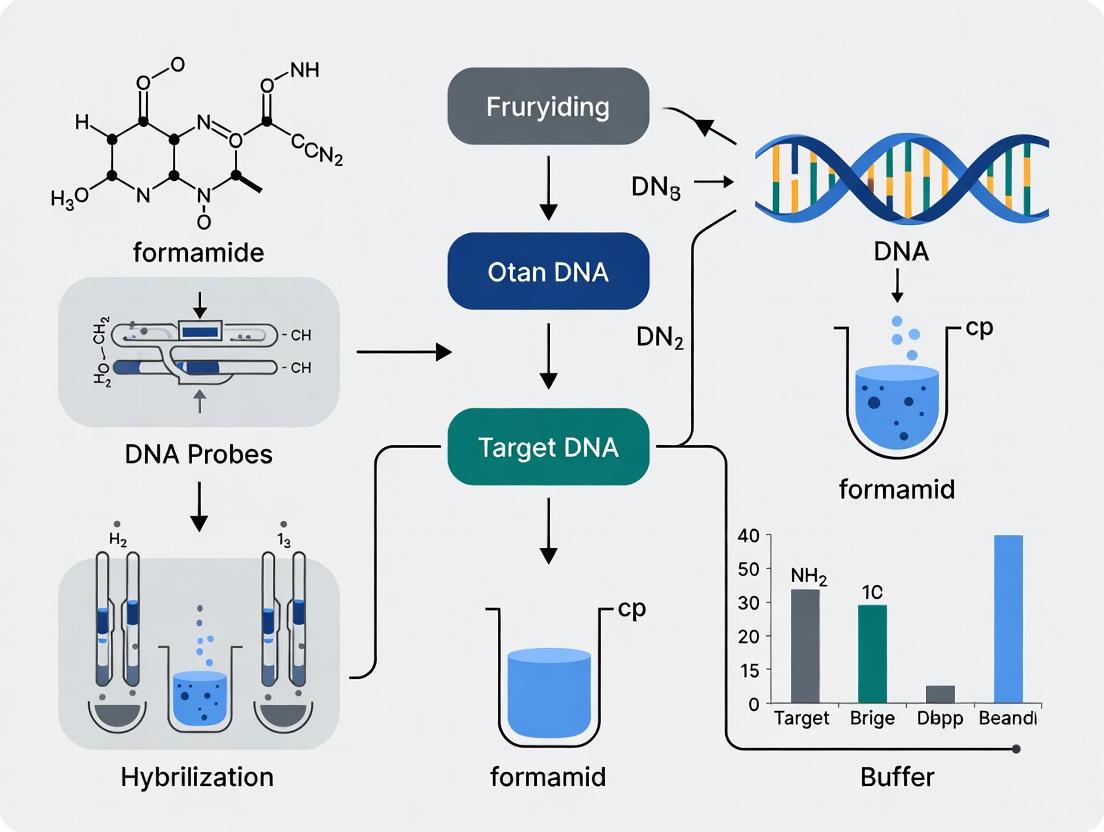
This article provides a complete resource for researchers and drug development professionals on the critical role of formamide in hybridization buffers.
Formamide in Hybridization Buffer: A Comprehensive Guide to Mechanism, Optimization, and Safer Alternatives
Abstract
This article provides a complete resource for researchers and drug development professionals on the critical role of formamide in hybridization buffers. It covers the foundational chemistry of how formamide denatures nucleic acids to control stringency, details its application in protocols like FISH and MERFISH for sensitive detection, and offers practical troubleshooting for common issues like high background. The content also evaluates formamide against emerging alternatives such as urea, empowering scientists to optimize hybridization assays for both performance and safety in biomedical and clinical research.
The Biochemical Role of Formamide: How It Controls Hybridization Stringency
This whitepaper elucidates the core function of formamide in hybridization buffers: its role in lowering the melting temperature (Tm) of nucleic acid duplexes. Formamide, a key denaturant, disrupts hydrogen bonding and base stacking interactions, thereby destabilizing double-stranded DNA (dsDNA) and RNA structures. This action allows for stringent hybridization to be achieved at lower, biologically favorable temperatures, preserving morphological integrity in techniques such as fluorescence in situ hybridization (FISH) and Northern blotting. We delve into the quantitative thermodynamics of this process, present experimental data and protocols, and discuss its critical implications for diagnostic and research applications. Understanding this mechanism is foundational for optimizing hybridization conditions and developing next-generation, non-toxic denaturants.
Nucleic acid hybridization—the specific base-pairing of complementary DNA or RNA strands—is a cornerstone technique in molecular biology, central to procedures ranging from diagnostic FISH to microarray analysis [1]. A fundamental challenge in these techniques is that the dissociation of double-stranded nucleic acids into single strands (denaturation) and their subsequent reannealing with complementary probes typically require high temperatures that can damage biological samples or the nucleic acids themselves [2].
Formamide (HCONH₂) addresses this challenge through its core function: effectively lowering the melting temperature (Tm) of nucleic acid duplexes. By adding formamide to hybridization buffers, researchers can significantly lower the energy required for denaturation, enabling high-stringency hybridization to occur at temperatures 20-30°C lower than in aqueous solutions [3]. This temperature reduction is crucial for maintaining tissue architecture in in situ applications and for ensuring the specificity of probe binding in microarray diagnostics [2] [4]. This whitepaper frames this core function within broader research efforts to refine hybridization protocols, enhance assay sensitivity, and develop safer laboratory reagents.
The Mechanistic Basis of Tm Reduction by Formamide
Formamide lowers the Tm of nucleic acids through a multi-faceted mechanism that targets the non-covalent forces stabilizing the double helix.
Disruption of Hydrogen Bonding and Base Stacking
The double helix is stabilized by hydrogen bonds between complementary base pairs and by hydrophobic base-stacking interactions along the helix core. Formamide, a highly polar and water-miscible organic solvent, competes for and disrupts these hydrogen bonds. Its amide group can act as both a hydrogen bond donor and acceptor, effectively interfering with the specific pairing of adenine-thymine and guanine-cytosine bases [5]. Furthermore, formamide penetrates the hydrophobic core of the double helix, destabilizing the cohesive base-stacking interactions that are a major contributor to helical stability [4]. By weakening these two primary stabilizing forces, formamide reduces the thermal energy required to separate the two strands.
Thermodynamic Modeling
The effect of formamide on hybridization thermodynamics can be quantitatively described using a Linear Free Energy Model (LFEM). This model simulates formamide melting by treating the denaturant's effect as an increase in the hybridization free energy (ΔG°). Research has established that formamide increases ΔG° by 0.173 kcal/mol per percent of formamide added (v/v) [4]. This linear relationship allows for the accurate prediction of probe-target duplex stability under various formamide concentrations, which is invaluable for probe design in applications like microbial diagnostic microarrays. The denaturation profile of a probe-target hybrid follows a sigmoidal curve, with the midpoint representing the Tm in a given formamide concentration.
The following diagram illustrates the conceptual mechanism of how formamide disrupts the double helix and the resulting thermodynamic effect.
Quantitative Data and Experimental Evidence
The Tm-lowering effect of formamide is well-characterized and can be precisely quantified, enabling its predictable application in experimental design.
Quantifying the Tm Reduction Effect
The effect of formamide on Tm is concentration-dependent. A general rule of thumb is that for DNA-DNA hybrids, the Tm decreases by approximately 0.6 to 0.7°C for every 1% (v/v) increase in formamide concentration in the hybridization buffer [3]. The relationship can be integrated into Tm calculation formulas. For instance, the formula for the Tm of an RNA:RNA duplex, which is more stable than a DNA:DNA duplex, is:
Tm(RNA:RNA) = 78°C + 16.6 log10([Na+] / (1.0 + 0.7[Na+])) + 0.7(%GC) - 0.35(% Formamide) - 500 / (duplex length) [3].
Table 1: Empirical Data on Formamide Denaturation Efficiency
| Formamide Concentration (% v/v) | Experimental Context | Observed Effect | Source |
|---|---|---|---|
| 30% | SPR-based DNA hybridization with a 22-mer DNA probe | Optimal condition for single base mismatch discrimination; mismatch DNA showed 1.7x less hybridization signal than perfect match DNA. | [6] |
| 50% | SPR-based DNA hybridization with a 22-mer PNA probe | Effective stringency condition; mismatch DNA showed 2.8x less hybridization signal than perfect match DNA. | [6] |
| 45% | Traditional FISH buffer composition | Standard formulation for overnight hybridization protocols. | [2] |
| 15% | Novel "Fast FISH" buffer with alternative solvents (e.g., ethylene carbonate) | Enabled hybridization times as short as 1 hour without the need for denaturation or blocking of repetitive sequences. | [2] |
Application in Stringency Control for Mismatch Discrimination
The primary application of controlled Tm reduction is to enhance hybridization stringency—the ability to discriminate between perfectly matched and mismatched sequences. Since mismatched duplexes are inherently less stable, they denature at a lower formamide concentration than perfect matches. As shown in Table 1, by performing hybridization in 30% formamide, researchers achieved a 1.7-fold discrimination against a single-base mismatch using a DNA probe [6]. This allows for the precise optimization of conditions to maximize signal from true targets while minimizing false positives from closely related sequences, a critical requirement in genetic diagnostics and microbial community analysis [4].
Experimental Protocols and Methodologies
The following section provides detailed methodologies that leverage the Tm-lowering function of formamide in different technical contexts.
Microarray Hybridization with Formamide Stringency Control
This protocol, adapted from Yilmaz et al. (2012), is used for optimizing probe sensitivity and specificity in microbial diagnostics [4].
Objective: To establish formamide denaturation profiles for microarray probes and determine the optimal formamide concentration for discriminating between perfect match and mismatch sequences.
Materials:
- Labeled Target Nucleic Acid: e.g., Cy3-labeled 16S rRNA gene amplicon.
- Microarray Slide containing the designed oligonucleotide probes.
- Hybridization Buffer Stock: Contains salts (e.g., SSC), detergents (e.g., SDS), and blocking agents (e.g., BSA).
- Formamide (Molecular Biology Grade).
- Hybridization Chamber and wash buffers.
Method:
- Prepare Formamide Gradient Buffers: Prepare a series of hybridization buffers with increasing formamide concentrations (e.g., 0%, 10%, 20%, 30%, 40%, 50% v/v). Keep the concentration of all other components constant.
- Hybridization:
- Apply the labeled target to the microarray.
- Hybridize at a constant temperature (e.g., 45°C) for a fixed duration (e.g., 16 hours) using the different formamide buffers.
- Post-Hybridization Washes: Perform stringent washes according to standard microarray protocols to remove non-specifically bound target.
- Signal Detection: Scan the microarray and quantify the fluorescence signal for each probe spot.
- Data Analysis:
- For each probe, plot the normalized signal intensity against the formamide concentration. This will generate a sigmoidal denaturation curve.
- The formamide concentration at the curve's midpoint (C(_{1/2})) is the point at which 50% of the duplexes are denatured.
- The optimal formamide concentration for a specific probe is one that maintains a high signal for the perfect match while abolishing the signal for known mismatches.
Northern Blot Analysis with RNA Probes
This protocol, based on recommendations from Thermo Fisher, utilizes formamide to facilitate high-stringency hybridization at manageable temperatures for sensitive RNA detection [3].
Objective: To detect specific RNA molecules, especially rare mRNAs, with high sensitivity and low background using single-stranded RNA probes.
Materials:
- Membrane: Positively charged nylon membrane with immobilized RNA.
- RNA Probe: In vitro transcribed, labeled RNA probe (antisense to the target mRNA).
- Pre-hybridization/Hybridization Buffer: e.g., ULTRAhyb or a standard 50% formamide-based buffer (5x SSC, 0.1% SDS, 100 µg/mL total yeast RNA, etc.).
- Water Bath or Hybridization Oven.
Method:
- Pre-hybridization: Incubate the membrane in pre-warmed hybridization buffer for 1-2 hours at 68°C. This blocks non-specific binding sites.
- Probe Denaturation: Denature the double-stranded DNA probe or, if using an RNA probe, simply heat it briefly to disrupt secondary structures.
- Hybridization: Add the denatured probe directly to the hybridization buffer. Incubate the membrane at 60-65°C for 16 hours (or as optimized). The 50% formamide allows for this high stringency at a temperature that prevents excessive RNA degradation.
- Stringency Washes:
- Wash the membrane twice for 5 minutes in 2x SSC / 0.1% SDS at room temperature.
- Perform two final washes for 15 minutes in 0.1x SSC / 0.1% SDS at 60-65°C.
- Detection: Proceed with appropriate detection methods (e.g., phosphorimaging for radioactive probes or chemiluminescence for digoxigenin-labeled probes).
The following workflow summarizes the key steps in a formamide-based Northern blot procedure.
The Scientist's Toolkit: Key Reagent Solutions
A successful hybridization experiment relies on a suite of reagents, each serving a specific function. The table below details essential components of a formamide-containing hybridization buffer.
Table 2: Essential Components of a Formamide-Based Hybridization Buffer
| Reagent | Typical Concentration | Core Function |
|---|---|---|
| Formamide | 15-50% (v/v) | Core Function: Lowers nucleic acid Tm by disrupting hydrogen bonds and base stacking, enabling lower temperature hybridization. |
| Dextran Sulfate | 10-20% (v/v) | A volume-excluding agent that increases the effective probe concentration, thereby accelerating hybridization kinetics. |
| Salts (NaCl, SSC) | 300-600 mM | Neutralizes the negative charge on the sugar-phosphate backbone, stabilizing the duplex by shielding electrostatic repulsion. |
| Citrate or Phosphate Buffer | 5-10 mM | Maintains a stable pH (typically between 6.2 and 7.5) to ensure optimal hybridization efficiency. |
| Blocking Agents (Cot-1 DNA, yeast tRNA, salmon sperm DNA) | 0.1 µg/µL (Cot-1) | Binds to and blocks non-specific binding sites on the membrane or tissue sample, reducing background noise. |
| Detergents (SDS) | 0.1-1% (w/v) | Reduces surface tension and prevents non-specific hydrophobic interactions, further minimizing background. |
| Vista-IN-3 | Vista-IN-3|VISTA Inhibitor|For Research Use | Vista-IN-3 is a potent VISTA checkpoint inhibitor for cancer immunology research. This product is for Research Use Only (RUO). Not for human use. |
| Antitumor agent-111 | Antitumor agent-111, MF:C34H29ClF2N6O5, MW:675.1 g/mol | Chemical Reagent |
The core function of formamide—lowering the Tm of nucleic acid duplexes—is a foundational principle that has enabled decades of advancement in molecular hybridization techniques. Its ability to facilitate high-stringency binding at physiologically gentle temperatures is indispensable for modern genomics, transcriptomics, and diagnostic pathology.
Current research is building upon this foundation in two key areas. First, there is a drive to develop formamide-free hybridization buffers using less toxic, alternative solvents like ethylene carbonate. These novel buffers have demonstrated the potential to radically reduce hybridization times from over 16 hours to under 1 hour for FISH assays, without requiring heat denaturation or blocking steps [2]. Second, efforts are focused on the precise thermodynamic modeling of formamide's effect, as exemplified by the Linear Free Energy Model. This allows for in-silico prediction of probe behavior, which is crucial for designing high-density microarrays for complex microbial community analysis and genetic screening [4] [6].
In conclusion, a deep understanding of how formamide lowers Tm is not merely a technical detail but a critical factor in designing robust, sensitive, and specific hybridization assays. As the field moves towards faster, safer, and more predictive molecular diagnostics, the principles governing this core function will continue to guide innovation.
In molecular biology, nucleic acid hybridization is a foundational process, and its efficiency critically depends on controlled denaturation. Formamide-containing hybridization buffers are indispensable reagents that facilitate this process by systematically destabilizing the native double-stranded structure of DNA and RNA. Formamide (HCONH2) acts as a chemical denaturant that linearly decreases the melting temperature (Tm) of nucleic acids by 2.4-2.9°C per mole of formamide, depending on the (G+C) composition and helix conformation [7]. This whitepaper details the mechanism by which formamide disrupts the hydrogen bonding and base stacking interactions that maintain nucleic acid structure, framed within the context of its application in hybridization buffer research for diagnostic and therapeutic development. The global market for these specialized buffers, currently valued at approximately $500 million and projected to reach $950 million by 2033, reflects their critical importance in genomics, transcriptomics, and molecular diagnostics [8].
The Molecular Mechanism of Formamide Denaturation
Competitive Hydrogen Bond Displacement
The primary mechanism of formamide denaturation involves the competitive displacement of native hydrogen bonds within the DNA double helix. Formamide molecules, which are both strong proton donors and acceptors, form hydrogen bonds with the nitrogenous bases of DNA (adenine, thymine, guanine, and cytosine), effectively replacing the inter-strand Watson-Crick hydrogen bonds that hold the duplex together [9]. Recent research quantifying the intermolecular forces involved in DNA denaturation has demonstrated that the proton-donor effect is the dominant mechanism for disrupting hydrogen bonds, with an influence approximately two times greater than that of the proton-acceptor effect [9]. This competitive binding disrupts the cooperative network of hydrogen bonds, leading to strand separation under conditions far milder than those required for thermal denaturation alone.
Destabilization of Base Stacking Interactions
Beyond hydrogen bond disruption, formamide significantly impacts the hydrophobic and stacking interactions between adjacent base pairs. The planar aromatic rings of nucleic acid bases normally stack in a helical arrangement stabilized by van der Waals forces and hydrophobic effects in an aqueous environment. Formamide, with a high dielectric constant, disrupts these stabilizing interactions by altering the solvation shell around the DNA molecule. This disruption decreases the free energy penalty for exposing hydrophobic bases to the solvent, thereby reducing the stability gained from base stacking [7] [9]. Single-molecule studies using optical tweezers have directly visualized this denaturation process, showing a measurable increase in DNA contour length as formamide concentration increases, corresponding to the transition from double-stranded to single-stranded form [10].
Thermodynamic Framework
The denaturation process can be described thermodynamically using a linear free energy model (LFEM). Research has established that formamide increases hybridization free energy (ΔG°) by approximately 0.173 kcal/mol per percent of formamide added (v/v) [4]. This relationship allows researchers to precisely predict hybridization efficiency and optimize stringency conditions for specific experimental applications. The overall effect is a destabilization of the helical state, with the inherent cooperativity of melting remaining unaffected by the denaturant [7].
Table 1: Quantitative Effects of Formamide on DNA Stability
| Parameter | Effect | Measurement | Reference |
|---|---|---|---|
| Melting Temperature (Tm) Depression | Linear decrease | 2.4-2.9°C per mole formamide | [7] |
| Free Energy Change | Linear increase | 0.173 kcal/mol per % formamide (v/v) | [4] |
| Denaturation Enthalpy | Significant reduction | Lower than thermal denaturation (positive values) | [9] |
| Dominant Mechanism | Hydrogen bond disruption | Proton-donor effect twice as influential as acceptor | [9] |
Quantitative Analysis of Denaturation Efficiency
Concentration-Dependent Effects
Formamide denaturation follows a concentration-dependent sigmoidal profile, with efficiency varying based on application-specific conditions. Systematic characterization of denaturation methods has revealed that 60% dimethyl sulfoxide (DMSO) represents an effective chemical denaturation alternative, fully denaturing DNA in 2-5 minutes [11]. However, formamide remains the dominant choice for most hybridization applications due to its well-characterized properties and effectiveness. In microarray applications, sigmoidal denaturation profiles are obtained with increasing formamide concentrations, enabling precise optimization of probe sensitivity and specificity [4].
Table 2: Comparative Denaturation Efficiency of Chemical Agents
| Denaturation Method | Time to Full Denaturation | Key Advantages | Key Limitations |
|---|---|---|---|
| Formamide (50%) | 2-5 minutes | Well-characterized, predictable Tm reduction | Toxicity concerns, handling precautions |
| DMSO (60%) | 2-5 minutes | Effective denaturation | May cause different renaturation kinetics |
| NaOH (1 mol/L) | 2-5 minutes | Rapid action | Highly alkaline, may damage nucleic acids |
| Direct Probe Sonication | 5 minutes | Physical method, no chemicals | Specialized equipment required |
Sequence-Dependent Variations
The efficiency of formamide denaturation exhibits sequence-dependent variations due to differences in hydrogen bonding patterns and hydration stability. Notably, poly(dA.dT) tracts exhibit much lower sensitivity to formamide compared to random sequences, attributed to specific patterns of tightly bound, immobilized water bridges that buttress the helix from within the narrow minor groove [7]. This structural particularity makes A-T rich regions more resistant to chemical denaturation, an important consideration for probe design and hybridization optimization. Tracts of three (A-T) pairs behave normally, but tracts of six exhibit the same level of reduced sensitivity as the polymer, suggesting a conformational shift as tracts elongate beyond a critical length [7].
Experimental Protocols for Denaturation Studies
Protocol: DNA Denaturation Using Chemical Denaturants
This protocol is adapted from systematic characterization studies of DNA denaturation and renaturation [11].
Materials:
- DNA sample (e.g., 86-bp dsDNA fragment)
- Molecular biology grade formamide (>99.5%)
- Dimethyl sulfoxide (DMSO, >99.9%)
- Sodium hydroxide (NaOH) pellets
- Tris-acetate-EDTA (TAE) or Saline-sodium citrate (SSC) buffer
- Spectrophotometer (e.g., NanoDrop) for A260 measurements
Method:
- Sample Preparation: Transfer 40 μL of DNA to a microcentrifuge tube.
- Denaturant Addition: Add the appropriate volume of denaturant to achieve desired concentration:
- For formamide: Add 40 μL of 100% formamide to achieve 50% concentration
- For DMSO: Add 60 μL of 100% DMSO to achieve 60% concentration
- For alkaline denaturation: Add 40 μL of 1 mol/L NaOH
- Incubation: Homogenize the mixture by gentle pipetting and incubate at ambient temperature (20-25°C) for time intervals (1, 2, 5, 10, 20, and 30 minutes).
- Measurement: Immediately measure absorbance at 260 nm using a spectrophotometer after each time interval.
- Analysis: Calculate denaturation percentage based on hyperchromic effect at A260.
Notes: For hybridization applications, the denatured DNA is typically used immediately in the hybridization reaction to prevent significant renaturation.
Protocol: Formamide Denaturation in Microarray Hybridization
This protocol outlines the use of formamide in microarray experiments for microbial diagnostics [4].
Materials:
- High-density microarray slides
- Fluorescently labeled and fragmented target DNA (e.g., 16S rRNA gene amplicon)
- Formamide-containing hybridization buffer
- Hybridization chamber
- Water bath or thermal cycler
Method:
- Target Preparation: Fragment labeled PCR product to lengths between 25-150 bases (average 65 bases) using random prime amplification.
- Buffer Preparation: Prepare hybridization buffer with varying formamide concentrations (0-50%) in appropriate saline buffer (e.g., SSC or SSPE).
- Hybridization: Apply target-buffer mixture to microarray and incubate at appropriate temperature (typically 45-65°C) for 4-16 hours.
- Washing: Perform stringency washes with buffer containing equivalent formamide concentration to hybridization step.
- Scanning: Image microarray using appropriate fluorescence scanner.
- Analysis: Generate sigmoidal denaturation profiles by plotting signal intensity versus formamide concentration for each probe.
Applications: This approach enables probe optimization and cross-hybridization assessment for diagnostic microarray design.
Visualization of Formamide Denaturation Mechanism
The Scientist's Toolkit: Research Reagent Solutions
Table 3: Essential Reagents for Formamide-Based Denaturation Studies
| Reagent/Solution | Composition | Function in Denaturation | Application Examples |
|---|---|---|---|
| Formamide Hybridization Buffer | 20-50% formamide, SSC or SSPE buffer, detergents, blocking agents | Lowers nucleic acid melting temperature, reduces background | Northern blotting, microarray hybridization, in situ hybridization [8] [1] |
| Denaturation Control Reagents | DMSO (60%), NaOH (1 mol/L) | Alternative denaturation methods for comparison | Experimental controls, protocol optimization [11] |
| Stringency Wash Buffers | SSC or SSPE with controlled formamide concentration | Removes non-specifically bound probes while maintaining specific hybrids | Post-hybridization washing in microarray and FISH [4] |
| Stabilization Additives | BSA, salmon sperm DNA, calf thymus DNA, yeast tRNA | Blocking agents that minimize non-specific binding | Reduction of background noise in hybridization assays [1] |
| Fluorescence Detection System | Fluorophore-labeled probes, quencher sequences | Signal generation upon successful hybridization | Real-time monitoring of hybridization efficiency [12] |
| Apoptosis inducer 13 | Apoptosis inducer 13, MF:C60H59ClF6N8O4PRu, MW:1237.6 g/mol | Chemical Reagent | Bench Chemicals |
| Bcl-2-IN-12 | Bcl-2-IN-12, MF:C47H41ClN4O6S, MW:825.4 g/mol | Chemical Reagent | Bench Chemicals |
Formamide achieves its denaturing effect through a multi-mechanistic process dominated by competitive hydrogen bond displacement, with the proton-donor effect being twice as influential as the proton-acceptor effect, coupled with significant disruption of base stacking interactions [9]. This dual mechanism efficiently destabilizes the DNA double helix while maintaining the cooperativity of the melting transition, enabling precise control over hybridization stringency in molecular biology applications. The well-characterized quantitative relationship between formamide concentration and melting temperature depression—2.4-2.9°C per mole of formamide—provides researchers with a predictable framework for assay design [7]. As the field advances, current research trends focus on developing safer formamide-free alternatives while maintaining hybridization efficiency, driven by both environmental concerns and the expanding applications of nucleic acid hybridization in clinical diagnostics and therapeutic development [8] [13]. Understanding these fundamental mechanisms provides the foundation for innovation in hybridization-based technologies that continue to advance research and diagnostic capabilities.
Formamide serves as a fundamental chemical denaturant in molecular hybridization techniques, with its concentration acting as a critical determinant for assay stringency and specificity. This technical guide delineates the quantitative relationship between the percentage of formamide in hybridization buffers and the resultant specificity in probing nucleic acid sequences. By systematically reducing the melting temperature (Tm) of duplexes, formamide concentration provides a powerful lever for optimizing the discrimination between perfectly matched and mismatched sequences, a principle foundational to techniques ranging from microarray analysis and fluorescence in situ hybridization (FISH) to Northern blotting. Framed within broader research on formamide function, this whitepaper synthesizes current thermodynamic models, empirical data, and experimental protocols to equip researchers and drug development professionals with a predictive framework for assay design.
Hybridization techniques form the cornerstone of modern molecular biology, enabling the detection and characterization of specific DNA and RNA sequences in complex mixtures. The specificity of this process—the ability to distinguish target sequences from non-target sequences with high fidelity—is paramount. Chemical denaturants are employed to fine-tune this specificity, and among them, formamide is preeminent.
Formamide (HCONHâ‚‚) is a water-miscible organic solvent that disrupts the hydrogen bonding between complementary nucleic acid bases. When incorporated into a hybridization buffer, it effectively lowers the thermal stability of the double-stranded helix. This property allows researchers to perform stringent hybridizations at lower, more manageable temperatures, thereby preserving the integrity of biological samples while maintaining high specificity. The core principle is that the denaturing effect of formamide is concentration-dependent; higher percentages of formamide more aggressively destabilize nucleic acid duplexes. This effect is not uniform, however, as mismatched duplexes are destabilized to a greater extent than perfectly matched ones. Consequently, controlling the percent formamide provides a precise mechanism to create a window of stringency where ideal probe-target hybrids remain stable while imperfect hybrids dissociate. The global market for formamide-containing RNA hybridization buffers, a testament to its ubiquity, is projected to grow significantly, driven by advances in genomics and clinical diagnostics [8].
The Mechanistic Basis: Formamide and Duplex Stability
The efficacy of formamide is rooted in its direct impact on the thermodynamics of nucleic acid hybridization. The fundamental parameter governing this interaction is the melting temperature (Tₘ), the temperature at which half of the duplex molecules dissociate into single strands.
Thermodynamic Modeling of Denaturation
The relationship between formamide concentration and duplex stability has been successfully modeled using a Linear Free Energy Model (LFEM). Research on microarray hybridizations has demonstrated that formamide linearly increases the Gibbs free energy change (ΔG°) of the duplex formation. Specifically, the denaturant m-value—the rate at which formamide increases the ΔG°—was found to be 0.173 kcal/mol per percent (v/v) formamide [14]. This quantitative relationship allows for the prediction of probe behavior under different stringency conditions, transforming probe design from an empirical art into a predictable science.
Mathematically, this can be represented as: ΔG°ₕᵧbᵣᵢd(formamide) = ΔG°ₕᵧbᵣᵢd + m * [Formamide]
Where:
- ΔG°ₕᵧbᵣᵢd(formamide) is the adjusted free energy change in the presence of formamide.
- ΔG°ₕᵧbᵣᵢd is the free energy change in the absence of formamide.
- m is the denaturant m-value (0.173 kcal/mol/%).
- [Formamide] is the concentration of formamide (v/v).
This model enables the simulation of formamide melting profiles, generating sigmoidal curves where signal intensity decreases as formamide concentration increases. The absolute error in predicting the position of these experimental denaturation profiles was less than 5% formamide for more than 90% of probes, confirming the model's practical utility [14].
The Impact on Mismatch Discrimination
The differential destabilization caused by formamide is the key to its power in enhancing specificity. A perfectly matched duplex has a higher initial stability (more negative ΔG°) than a duplex containing one or more mismatches. The addition of formamide adds a positive increment to the ΔG° of all duplexes, but the fractional increase in instability is greater for the mismatched duplex. As a result, at a given formamide concentration and temperature, a perfectly matched duplex may remain hybridized while a mismatched duplex of similar length and composition will denature. Systematic studies have established free energy rules to predict the stability of various mismatch types, including bulged and tandem mismatches, providing a comprehensive database for specificity optimization [14].
Quantitative Guidance: Formamide Concentration and Applications
The optimal formamide concentration is application-specific and must be determined empirically for each probe-target system. However, established ranges provide a critical starting point for experimental design.
Table 1: Formamide Concentration Guidelines for Hybridization Stringency
| Stringency Level | Typical Formamide Concentration (% v/v) | Primary Application Examples |
|---|---|---|
| Low Stringency | 20-30% | Initial screening of libraries; hybridization with probes of low homology |
| Medium Stringency | 30-40% | Standard Northern blotting; microarray analysis with well-characterized probes [8] |
| High Stringency | 40-50% | Discrimination of single-nucleotide polymorphisms (SNPs); FISH with repetitive sequences [8] |
The choice of concentration within these ranges directly controls the balance between sensitivity (detecting true positives) and specificity (avoiding false positives). For instance, in diagnostic applications aimed at identifying infectious diseases, high specificity is paramount to prevent misidentification, necessitating the use of higher formamide concentrations or other stringency-enhancing conditions [8] [14].
Table 2: Impact of Formamide on Experimental Parameters in Microarray Hybridization
| Parameter | Effect of Low [Formamide] | Effect of High [Formamide] |
|---|---|---|
| Effective Tₘ | Higher | Lower |
| Hybridization Rate | Faster | Slower |
| Probe Specificity | Lower (risk of false positives) | Higher (risk of false negatives) |
| Signal Intensity | Generally higher, but with higher background | Generally lower, with lower background |
Experimental Protocol: Determining Optimal Formamide Concentration
The following detailed protocol, adapted from empirical studies, outlines a method for determining the optimal formamide concentration for a specific oligonucleotide probe using a microarray setup [14].
Materials and Reagents
- High-density Microarray Slides containing the probe(s) of interest.
- Fluorescently Labeled Target (e.g., Cy3-dCTP labeled fragmented PCR product).
- Formamide (Molecular Biology Grade).
- 20X Saline-Sodium Citrate (SSC) Buffer.
- Blocking Agents (e.g., salmon sperm DNA, yeast tRNA).
- Sodium Dodecyl Sulfate (SDS).
- Hybridization Chamber and Water Bath or Oven.
Step-by-Step Methodology
Preparation of Hybridization Buffers: Prepare a series of hybridization buffers with identical components except for the formamide concentration. A typical series might range from 0% to 50% formamide in 10% increments. A standard buffer composition is:
- 25% (v/v) Formamide (for the 25% condition; adjust accordingly)
- 5X SSC
- 0.1% (w/v) SDS
- 100 µg/mL sheared salmon sperm DNA The buffer may also include other components like Denhardt's solution or dextran sulfate, depending on the application [15].
Target Denaturation and Hybridization:
- Mix the fluorescently labeled target with each of the formamide-containing hybridization buffers.
- Denature the mixture at 95°C for 5 minutes, then immediately place on ice.
- Apply the denatured mixture to the microarray slide and incubate in a sealed hybridization chamber at a constant, predetermined temperature (e.g., 37°C or 42°C) for 4-16 hours.
Post-Hybridization Washes: Perform a series of washes to remove non-specifically bound target. The stringency of these washes can also be adjusted with formamide and salt concentration, but for this experiment, they should be kept constant across all slides to isolate the effect of the hybridization formamide concentration.
- Wash 1: 2X SSC, 0.1% SDS at room temperature for 5 minutes.
- Wash 2: 1X SSC at room temperature for 5 minutes.
- Wash 3: 0.5X SSC at room temperature for 5 minutes.
Signal Detection and Data Analysis:
- Dry the slides and scan them using a microarray scanner appropriate for the fluorescent label.
- Quantify the signal intensity for each probe feature.
- Plot the normalized signal intensity against the formamide concentration for each probe. The resulting plot should produce a sigmoidal denaturation curve.
- The optimal formamide concentration for specific hybridization is typically chosen at a point on the high-signal plateau of the perfect-match probe, just before the signal from any mismatch controls begins to rise.
The Scientist's Toolkit: Essential Reagents and Solutions
The following table details key reagents used in formamide-based hybridization experiments, explaining their critical functions in the protocol.
Table 3: Essential Reagents for Formamide-Based Hybridization
| Reagent | Function / Rationale |
|---|---|
| Formamide (High Purity) | Primary denaturant; linearly reduces duplex Tₘ by disrupting hydrogen bonding, enabling high-stringency incubations at lower temperatures. |
| Saline-Sodium Citrate (SSC) | Provides ionic strength (Naâº) which shields the negative charges on the phosphate backbones of nucleic acids, promoting duplex stability. |
| Blocking DNA (e.g., Salmon Sperm DNA) | A non-specific, sheared DNA used to pre-absorb and block non-specific probe binding sites on the membrane or slide surface. |
| Sodium Dodecyl Sulfate (SDS) | Anionic detergent that reduces surface tension and minimizes non-specific hydrophobic interactions, thereby lowering background noise. |
| Dextran Sulfate | A polyanion that acts as a volume excluder, increasing the effective probe concentration and accelerating hybridization kinetics. |
| Denhardt's Solution | A mixture (often of Ficoll, polyvinylpyrrolidone, and BSA) used to block non-specific binding sites, particularly in filter-based hybridizations. |
| Tmv-IN-7 | Tmv-IN-7, MF:C17H15ClN6OS, MW:386.9 g/mol |
| Nardosinonediol | Nardosinonediol, MF:C15H24O3, MW:252.35 g/mol |
Technical Considerations and Emerging Alternatives
While formamide is highly effective, researchers must be aware of its limitations. Formamide can degrade over time, especially if not stored properly, forming formic acid and ammonium ions which can affect pH and hybridization efficiency. Furthermore, a significant finding from 2024 indicates that formamide denaturation in DNA FISH protocols can cause significant alterations to the sub-200 nm chromatin structure, potentially distorting the native architecture that the experiment aims to study [16] [17].
This has spurred the development and adoption of alternative labeling methods that do not rely on formamide denaturation. Techniques such as:
- RASER-FISH (Resolution After Single-strand Exonuclease Resection): Uses exonuclease digestion to generate single-stranded regions for probe access [17].
- CRISPR-Sirius: Utilizes a catalytically dead Cas9 (dCas9) complexed with guide RNAs to fluorescently label specific genomic loci without requiring DNA denaturation [17].
Studies using Partial Wave Spectroscopic (PWS) microscopy have demonstrated that these formamide-free methods have a minimal impact on nanoscale chromatin organization, making them superior for studies where preserving native chromatin structure is critical [17].
The concentration of formamide in a hybridization buffer is a powerful and indispensable parameter for controlling the specificity of molecular assays. The quantitative relationship between formamide percentage and duplex stability, elegantly described by thermodynamic models, provides researchers with a predictive framework for probe design and assay optimization. While formamide remains a staple in laboratories worldwide, evidenced by its significant and growing market, a nuanced understanding of its effects—including potential sample distortion—is crucial. As the field advances, the principles of stringency control mastered with formamide will continue to inform the development and application of next-generation, formamide-free hybridization technologies, further empowering research and diagnostic innovation.
The Formamide-Stringency Relationship in DNA-DNA and DNA-RNA Hybrids
Formamide is a crucial denaturant employed in nucleic acid hybridization techniques to precisely control stringency, thereby optimizing the sensitivity and specificity of molecular assays. This technical guide explores the fundamental relationship between formamide concentration and hybridization stringency within the context of DNA-DNA and DNA-RNA hybrids. It elaborates on the thermodynamic principles governing formamide's denaturing action, presents quantitative models predicting its effects, and provides detailed experimental protocols for its application. Furthermore, the guide examines recent evidence on formamide-induced structural perturbations in chromatin and introduces emerging alternative solvents. Designed for researchers, scientists, and drug development professionals, this document aims to serve as a comprehensive resource for leveraging formamide to enhance the accuracy and reliability of hybridization-based analyses in both basic research and diagnostic applications.
Within hybridization buffer research, formamide has long been established as a critical component for adjusting the stringency of nucleic acid hybridization assays. Stringency refers to the specificity required for two nucleic acid strands to form a stable duplex, and it is paramount for distinguishing perfectly complementary target sequences from those containing mismatches. Formamide, by lowering the melting temperature ((T_m)) of double-stranded DNA, allows for high-stringency hybridization to occur at lower, more physiologically compatible temperatures, which is essential for techniques like Fluorescence In Situ Hybridization (FISH) where sample morphology preservation is critical [18] [15]. Its function extends beyond mere temperature reduction; formamide actively disrupts the hydrogen bonding between complementary bases, thereby modulating the thermodynamic stability of the resulting hybrids [19]. This guide delves into the core relationship between formamide concentration and hybridization stringency, exploring its quantitative effects, practical applications, and recent findings on its impact on biological structures, thereby providing a foundational resource for its use in modern molecular techniques.
Thermodynamic Principles of Formamide Action
Formamide exerts its denaturing effect primarily by disrupting the hydrogen-bonding network of water and, consequently, the hydrogen bonds that stabilize the double helix of DNA or DNA-RNA hybrids. From a thermodynamic perspective, the addition of formamide linearly destabilizes the nucleic acid duplex. Research has quantified this relationship through a Linear Free Energy Model (LFEM), which establishes that formamide increases the standard Gibbs free energy change of hybridization (( \Delta G^\circ )) by approximately 0.173 kcal/mol for every percent (v/v) of formamide added to the hybridization buffer [14]. This linear increase in ( \Delta G^\circ ) translates directly to a decrease in the melting temperature ((T_m)) of the duplex.
The relationship between formamide concentration and (T_m) can be harnessed to predict hybridization efficiency. At a molecular level, higher formamide concentrations decrease stringency by promoting the denaturation of weaker, mismatched duplexes while still allowing perfectly matched, stable hybrids to form [19]. This property is critical for optimizing probe specificity in assays like microarray hybridization and FISH. Computational tools, such as mathFISH, leverage these thermodynamic principles and established nearest-neighbor parameters to predict the formamide dissociation profile of any given probe-target pair, providing researchers with a powerful means to optimize probe design and hybridization conditions in silico [20].
Table 1: Thermodynamic Parameters of Formamide Denaturation
| Parameter | Value | Experimental Context | Source |
|---|---|---|---|
| m-value (Free Energy Increase) | +0.173 kcal/mol per %FA | Microarray hybridization of 16S rRNA amplicons | [14] |
| Typical Working Concentration Range | 0 - 50% (v/v) | Common in FISH and microarray protocols | [14] [15] |
| Prediction Error (LFEM) | < 5% FA for >90% of probes | Enables practical accuracy in probe design | [14] |
Experimental Protocols and Methodologies
Microarray Hybridization with Formamide Stringency Adjustment
The application of formamide in microarray hybridization allows for the systematic optimization of probe sensitivity and specificity. The following protocol, adapted from studies on microbial community analysis, details the process [14].
Protocol:
- Probe Design and Microarray Setup: Design oligonucleotide probes (e.g., 18-26 nucleotides in length) targeting the gene of interest (e.g., 16S rRNA). A poly-T linker can be added to the 3' end of the probe to elevate it from the slide surface and minimize steric hindrance.
- Target Preparation and Labeling: Amplify the target gene (e.g., via PCR from a clone library) and fragment it. Label the fragmented target using a random prime amplification method with fluorescently labeled dCTP (e.g., Cy3-dCTP). Purify the labeled target and quantify the yield and incorporated dye concentration.
- Formamide Hybridization Buffer Preparation: Prepare a series of hybridization buffers with formamide concentrations ranging from 0% to 50% (v/v). A standard buffer may contain SSC (e.g., 2x to 6x), SDS, and blocking agents (e.g., dextran sulfate, salmon sperm DNA, or Cot-1 DNA for blocking repetitive sequences) [15].
- Hybridization: Apply the fluorescently labeled target to the microarray in the prepared formamide-containing buffers. Hybridize at a constant temperature (e.g., 46°C) for a defined period.
- Washing and Scanning: Following hybridization, wash the slides with a buffer of appropriate stringency (e.g., based on SSC concentration) to remove non-specifically bound target. Scan the microarray to quantify fluorescence signal intensity for each probe feature.
- Data Analysis: Plot the signal intensity against the formamide concentration for each probe to generate a sigmoidal denaturation profile. The concentration at which 50% of the signal is lost ([FA]m) is a key parameter for comparing duplex stability.
Fluorescence In Situ Hybridization (FISH) with Formamide
Formamide is a cornerstone of FISH protocols to denature double-stranded DNA within chromosomes or cells and permit probe access. However, recent studies indicate this step can distort nanoscale chromatin structure [17].
Protocol (Standard 3D FISH):
- Sample Fixation: Fix cells or tissue sections with paraformaldehyde (e.g., 4% PFA for 10 minutes) to preserve morphology.
- Permeabilization: Treat samples with a permeabilization agent (e.g., detergent) to allow probe entry.
- Denaturation with Formamide: Incubate the sample in a high concentration formamide solution (commonly 50-70% in 2x SSC) at an elevated temperature (e.g., 80-85°C) to denature the double-stranded DNA target. Alternatively, a lower temperature (e.g., 73°C) can be used with 70% formamide for specific applications like R-loop formation [21].
- Hybridization: Apply the fluorescent DNA or Peptide Nucleic Acid (PNA) probe in a hybridization buffer containing formamide (concentration optimized for the specific probe, typically 10-50%). Hybridization is often performed overnight at 37-45°C [18].
- Post-Hybridization Washes: Wash the samples to remove excess and non-specifically bound probe. Washes often include SSC buffers, sometimes with formamide, to maintain stringency.
- Imaging and Analysis: Mount the samples and image using a fluorescence or confocal microscope.
Table 2: Research Reagent Solutions for Hybridization Experiments
| Reagent / Solution | Function / Purpose | Example Formulation / Notes |
|---|---|---|
| Formamide | Denaturant that lowers Tm and controls stringency. | Molecular biology grade, deionized. Used at 0-70% (v/v). |
| SSC Buffer (Saline-Sodium Citrate) | Provides ionic strength for hybridization; salt concentration affects stringency. | Commonly used at 0.1x to 6x concentration in washes and buffers. |
| Dextran Sulfate | Volume excluder that increases effective probe concentration. | Accelerates hybridization kinetics. |
| Blocking Agents | Reduce non-specific binding of probes. | Salmon sperm DNA, Cot-1 DNA, or tRNA. |
| PFA (Paraformaldehyde) | Cross-linking fixative for tissue and cell morphology preservation. | Typically used at 4% in buffer. |
| PNA (Peptide Nucleic Acid) Probes | Synthetic probes with neutral backbone; higher affinity and specificity. | Used in FISH with lower formamide requirements [18]. |
Recent Advances and Considerations
Impact of Formamide on Chromatin Structure
Emerging evidence indicates that while formamide is effective for denaturation, it can have unintended consequences on the native structure of the target. A 2024 study demonstrated that the formamide denaturation step in standard 3D FISH protocols significantly alters sub-200 nm chromatin structure [17]. Using Partial Wave Spectroscopic (PWS) microscopy, researchers found that formamide exposure changes the polymer scaling parameter (D) of chromatin packing domains, indicating a shift from a more compact to a more expanded state. This structural distortion poses a challenge for techniques aiming to measure nanoscale genome organization, as the act of labeling perturbs the very structure under investigation.
Alternative Solvents and Methods
In response to the limitations of formamide, researchers are exploring alternative solvents and denaturation-free methods. One study developed a formamide-free hybridization buffer that reduces hybridization time from overnight to one hour for DNA FISH on tissue sections [18]. This "IQFISH" method reportedly eliminates the need for denaturation and blocking of repetitive sequences and is less hazardous. Furthermore, labeling techniques that circumvent formamide denaturation entirely, such as RASER-FISH and CRISPR-Sirius, have shown minimal impact on chromatin structure compared to conventional 3D FISH, providing more reliable tools for studying nanoscale genome architecture [17].
Formamide remains a fundamentally important reagent for controlling stringency in nucleic acid hybridization, with well-characterized thermodynamic properties that enable predictive modeling for probe design. Its ability to lower melting temperatures and destabilize mismatched duplexes is indispensable for techniques ranging from microarrays to FISH. However, a comprehensive understanding of its function must now incorporate recent findings on its potential to distort higher-order chromatin structure. The ongoing development of formamide-free alternatives and denaturation-independent labeling methods heralds a new era in hybridization technology, promising faster, safer, and structurally faithful analyses. As research continues, the optimal choice between traditional formamide-based protocols and emerging alternatives will depend on the specific application, weighing the requirements for stringency and specificity against the need to preserve native molecular architectures.
Protocol Integration: Applying Formamide Buffers in FISH, MERFISH, and Diagnostic Assays
Standard Formamide Buffer Formulations for DNA and RNA FISH
Formamide is a fundamental component of standard hybridization buffers used in fluorescence in situ hybridization (FISH) techniques, playing an indispensable role in both DNA and RNA detection assays. As a potent chaotropic agent, formamide effectively disrupts hydrogen bonding between nucleic acid strands, thereby lowering the melting temperature (T~m~) of DNA-DNA and DNA-RNA hybrids. This property enables researchers to perform specific hybridizations at lower, more practical temperatures that preserve cellular or tissue integrity while maintaining high stringency conditions to minimize non-specific probe binding [22] [23]. The strategic inclusion of formamide in hybridization buffers represents a cornerstone of FISH methodology, balancing the competing demands of assay sensitivity, hybridization specificity, and sample preservation.
The functional utility of formamide extends across the entire spectrum of FISH applications, from single-molecule RNA FISH (smFISH) to highly multiplexed techniques such as Multiplexed Error-Robust FISH (MERFISH) and spatial transcriptomics [22] [24]. In MERFISH, for instance, formamide concentration is carefully optimized to ensure efficient binding of encoding probes to their target RNAs while suppressing off-target binding in complex sample types, including cultured cells and tissue sections [24]. Similarly, in DNA-FISH applications, formamide concentration directly influences the efficiency and specificity of probe binding to genomic targets, with lower concentrations typically enabling hybridization at lower temperatures [25]. Understanding the standard formulations and functional principles of formamide-containing buffers is therefore essential for researchers aiming to optimize FISH protocols for diverse experimental contexts, from basic research to drug development applications.
Standard Formamide Buffer Compositions and Formulations
Core Components of Standard FISH Hybridization Buffers
Standard formamide-containing hybridization buffers share several key components that collectively create optimal conditions for specific nucleic acid hybridization. The typical composition includes a denaturing agent, salts for ionic strength, blocking agents to reduce non-specific binding, stabilizers, and nuclease inhibitors to protect RNA integrity in sample preparations [26].
The primary component, formamide, typically constitutes 40% (vol/vol) of the final hybridization buffer in MERFISH and many RNA FISH protocols [26]. This concentration has been empirically determined to provide an effective balance between sufficient stringency and acceptable hybridization kinetics. The chaotropic action of formamide denatures secondary structures in target RNAs and facilitates probe access while enabling hybridization to proceed at physiologically compatible temperatures (typically 37°C). The salt component, generally 2× SSC buffer, provides the appropriate ionic strength to promote nucleic acid hybridization by shielding the negative charges on phosphate backbones, while dextran sulfate (typically 10% wt/vol) acts as a volume exclusion agent that effectively increases probe concentration and enhances hybridization kinetics [26].
To minimize non-specific binding, hybridization buffers commonly include blocking agents such as yeast tRNA (0.1% wt/vol) which competes for non-specific binding sites, particularly in cellular and tissue samples with high protein content. Additionally, detergents like Tween 20 (1% vol/vol) help reduce surface adhesion and improve sample permeability. For RNA-targeting applications, murine RNase inhibitor (1% vol/vol) is frequently included to preserve RNA integrity during often lengthy hybridization procedures [26]. This combination of components creates a controlled environment that maximizes the probability of specific probe-target interactions while minimizing degradation and non-specific background.
Standardized Buffer Formulations for FISH Applications
Table 1: Standard Formamide-Containing Hybridization Buffer Formulation for FISH
| Component | Final Concentration | Function | Storage Conditions |
|---|---|---|---|
| Formamide | 40% (vol/vol) | Denaturing agent, lowers T~m~ | Added fresh |
| SSC Buffer | 2× | Ionic strength for hybridization | Stable at RT |
| Dextran Sulfate | 10% (wt/vol) | Volume exclusion, enhances kinetics | -20°C in master mix |
| Yeast tRNA | 0.1% (wt/vol) | Blocking agent for non-specific binding | -20°C |
| Tween 20 | 1% (vol/vol) | Surfactant, reduces adhesion | RT |
| Murine RNase Inhibitor | 1% (vol/vol) | Protects RNA integrity | -20°C |
| Encoding Probes | 5-200 μM (pool-dependent) | Target-specific hybridization | -20°C |
This standardized formulation serves as the foundation for both DNA and RNA FISH applications, though specific concentrations may be adjusted based on experimental requirements. For example, in the iterative RNA FISH experimental protocol (SOP002.v.4.6), the "Saber Encoding Hybridization Buffer" follows this formulation precisely, with encoding probes added at concentrations ranging from 5-200μM depending on the size of the probe pool [26]. Similarly, wash buffers used in FISH protocols typically contain 40% formamide in 2× SSC buffer to maintain stringency during post-hybridization rinses [26].
Alternative formulations have been explored to address specific experimental challenges. For instance, some protocols utilize ethylene carbonate (10% vol/vol) in readout hybridization buffers as a stabilizing agent [26]. Additionally, researchers have developed formamide-free FISH protocols for specific applications, such as a DNA-FISH probe for Candida albicans identification that functions with 0% formamide while maintaining high specificity [25]. However, these alternatives typically require extensive optimization and validation, whereas formamide-containing buffers remain the established standard for most FISH applications due to their predictable performance and well-characterized properties.
Quantitative Optimization of Formamide Concentrations
Systematic Analysis of Formamide and Probe Length Effects
Formamide concentration must be precisely optimized in relation to probe characteristics, particularly target region length, to achieve maximum hybridization efficiency. Recent systematic investigations have examined how formamide concentration and probe length interact to influence single-molecule signal brightness in RNA FISH applications [24]. Researchers created encoding probe sets with target regions of 20, 30, 40, or 50 nucleotides in length and performed smFISH on U-2 OS cells while screening a range of formamide concentrations (with fixed hybridization temperature of 37°C and duration of 1 day) [24]. The results demonstrated that signal brightness, used as a proxy for probe assembly efficiency, depends relatively weakly on formamide concentration within the optimal range for each target region length [24].
This systematic optimization revealed that the relationship between probe length and formamide concentration follows predictable thermodynamic principles, with longer probes generally tolerating higher formamide concentrations while maintaining efficient hybridization. The data further indicated that for each probe length, there exists a plateau of optimal performance across a range of formamide concentrations rather than a single precise optimum, providing researchers with flexibility in protocol design. These findings have significant practical implications for FISH experimental design, particularly in multiplexed applications where probe sets may contain heterogeneous target region lengths.
Table 2: Optimal Formamide Concentrations for Different Probe Lengths
| Target Region Length (nt) | Optimal Formamide Concentration Range | Relative Signal Brightness | Application Notes |
|---|---|---|---|
| 20 nt | 10-20% | ++ | Shorter probes require lower formamide |
| 30 nt | 20-40% | +++ | Balanced efficiency and specificity |
| 40 nt | 30-50% | ++++ | Optimal for many smFISH applications |
| 50 nt | 40-60% | ++++ | Higher specificity, potentially slower kinetics |
Impact on Detection Efficiency and False Positive Rates
The optimization of formamide concentration directly influences two critical performance metrics in FISH assays: detection efficiency (the fraction of true target molecules correctly identified) and false positive rates (non-target molecules incorrectly identified as targets). In MERFISH measurements, appropriately balanced formamide concentrations enable high detection efficiency while maintaining low false positive rates through several mechanisms [24]. First, optimal formamide concentration ensures sufficient disruption of RNA secondary structure to permit efficient probe binding while providing enough stringency to prevent non-specific binding of probes to off-target sequences with partial complementarity.
Experimental evidence indicates that suboptimal formamide concentrations can significantly impact MERFISH performance. Excessive formamide can reduce detection efficiency by preventing stable hybridization of even perfectly matched probes, particularly those with shorter target regions or lower GC content. Conversely, insufficient formamide can increase false positive rates through non-specific probe retention, especially in complex tissue samples with high autofluorescence or background signal [24]. This balance is particularly crucial when imaging shorter RNAs, where fewer probes can be deployed per molecule and thus each hybridization event carries greater weight in determining overall detection efficiency [22].
Experimental Protocols and Workflows
Standard Workflow for Formamide-Based FISH Assays
The experimental workflow for formamide-based FISH assays follows a systematic sequence of steps designed to maximize hybridization efficiency while preserving sample integrity. The process begins with sample preparation and fixation, typically using paraformaldehyde to cross-link and preserve cellular structures while maintaining nucleic acid accessibility [27] [26]. For tissue samples, this is often followed by permeabilization using detergents such as Triton X-100 or proteinase treatments to ensure probe access to intracellular targets [26]. For challenging samples like yeast, an optimized lyticase digestion step may be incorporated for more homogeneous results [27].
Following permeabilization, samples undergo pre-hybridization to prepare the cellular environment for probe binding, followed by hybridization with encoding probes in formamide-containing buffer typically for 12-48 hours at 37°C [24] [26]. The extended hybridization duration compensates for the slowed kinetics resulting from formamide-induced stringency while maintaining specific binding conditions. After encoding probe hybridization, samples are washed with formamide-containing wash buffer (typically 40% formamide in 2× SSC) to remove unbound probes while maintaining stringency conditions that preserve specifically bound probes [26]. For multiplexed FISH techniques like MERFISH, this is followed by multiple rounds of readout probe hybridization, imaging, and fluorescence removal using chemical cleavage or other methods [22] [26].
Diagram 1: Standard workflow for formamide-based FISH assays showing key steps from sample preparation through imaging. The loop between fluorescence removal and readout hybridization represents iterative cycles in multiplexed FISH methods.
Protocol Modifications for Enhanced Performance
Recent optimization studies have identified several protocol modifications that can significantly enhance FISH performance. Hybridization acceleration through probe annealing or increased probe concentration can substantially enhance the rate of probe assembly, potentially reducing required hybridization times [24]. For encoding probes, empirical testing has demonstrated that hybridization with a complex 130-RNA species library at 40 nM concentration for 1 day provides efficient labeling, while higher concentrations (4 μM) can achieve similar results in shorter timeframes [24] [28].
Buffer stabilization approaches address the gradual degradation of FISH reagents during extended measurements. Readout hybridization buffers and associated probes can be stabilized for up to 7 days when stored under specific conditions, such as under a layer of mineral oil, without significant performance loss [24] [28]. Additionally, imaging buffer optimization has led to the development of enhanced formulations containing oxygen-scavenging systems like Trolox with PCA (3,4-dihydroxybenzoic acid) that improve fluorophore photostability and extend imaging duration [26]. These protocol refinements collectively address key limitations in formamide-based FISH methods, particularly for long-duration or highly multiplexed experiments where reagent stability and signal persistence are critical for success.
The Scientist's Toolkit: Essential Research Reagent Solutions
Table 3: Essential Research Reagents for Formamide-Based FISH
| Reagent/Category | Specific Examples | Function & Application Notes |
|---|---|---|
| Denaturing Agents | Formamide (40% v/v) | Lowers hybridization temperature, maintains stringency |
| Stringency Wash Buffers | 40% Formamide in 2× SSC | Removes non-specifically bound probes |
| Blocking Agents | Yeast tRNA (0.1% w/v), BSA | Reduce non-specific background binding |
| Volume Exclusion Agents | Dextran Sulfate (10% w/v) | Increases effective probe concentration |
| Permeabilization Agents | Triton X-100 (0.5% v/v), Proteinase K | Enable probe access to intracellular targets |
| Nuclease Inhibitors | Murine RNase Inhibitor, RVC | Preserve RNA integrity during hybridization |
| Stabilizing Additives | Ethylene Carbonate (10% v/v) | Enhances reagent stability in readout steps |
| Fluorophore Protection Systems | Trolox Quinone, PCA | Oxygen scavenging for enhanced photostability |
| Cleaving Agents | TCEP (50 mM in 2× SSC) | Chemically cleaves fluorescent reporters between rounds |
| HDAC ligand-1 | HDAC ligand-1, MF:C7H8N2O, MW:136.15 g/mol | Chemical Reagent |
| G|Aq/11 protein-IN-1 | G|Aq/11 protein-IN-1, MF:C19H27N5, MW:325.5 g/mol | Chemical Reagent |
Molecular Mechanism of Formamide in Hybridization Stringency
Formamide functions as a key modulator of nucleic acid hybridization thermodynamics through its action as a chaotropic agent that disrupts the hydrogen-bonding network of water molecules, thereby reducing the stability of double-stranded nucleic acids [22] [23]. This destabilization effect directly lowers the melting temperature (T~m~) of DNA-DNA and DNA-RNA hybrids in a concentration-dependent manner, enabling highly specific hybridization to occur at experimentally convenient temperatures (typically 37°C) that preserve cellular and tissue architecture [23]. The molecular mechanism involves formamide molecules competing with nucleotide bases for hydrogen bonding sites, effectively weakening the thermodynamic stability of perfectly matched duplexes to a lesser extent than mismatched hybrids, thus enhancing discrimination between specific and non-specific binding events.
The strategic application of formamide's destabilizing properties enables precise control over hybridization stringency at multiple stages of FISH protocols. During the hybridization phase, formamide (typically at 40% vol/vol) creates conditions where only probes with perfect or near-perfect complementarity to their targets form stable duplexes, while those with significant mismatch remain unbound [22] [26]. During post-hybridization washes, formamide-containing wash buffers (again typically 40% formamide in 2× SSC) remove partially bound probes that may have transiently associated with off-target sequences, further enhancing the specificity of the final signal [26]. This dual application—during both hybridization and washing—makes formamide an exceptionally versatile reagent for controlling the stringency of FISH assays across diverse experimental conditions and sample types.
Diagram 2: Molecular mechanism of formamide function in FISH assays showing how formamide-mediated hydrogen bond disruption enables specific hybridization at lower temperatures while removing non-specific binding.
Technical Considerations and Alternative Approaches
Practical Handling and Safety Considerations
While formamide is an essential component of standard FISH hybridization buffers, its use requires careful attention to safety protocols due to its classification as a teratogen with potential developmental effects [26] [25]. Appropriate personal protective equipment, including gloves and lab coats, should always be worn when handling formamide, and all procedures should be conducted in a fume hood to prevent inhalation exposure [26]. Additionally, buffer stability represents a practical consideration, as formamide can degrade over time, generating formic acid and ammonia that may interfere with hybridization efficiency. Aliquoting formamide stocks under inert gas and storing at -20°C can extend useful shelf life, while regular pH monitoring of buffer solutions can help identify degradation before experimental use.
The concentration precision of formamide in hybridization buffers is critical for reproducible results, as relatively small variations (5-10%) can significantly alter stringency conditions and impact detection efficiency. Commercial preparations of formamide vary in purity, with higher grades recommended for sensitive FISH applications. For particularly demanding applications, deionization of formamide immediately before use may be necessary to ensure optimal performance. These practical considerations underscore the importance of careful reagent management in FISH workflows, particularly for extended multiplexed measurements where buffer consistency across multiple rounds of hybridization is essential for quantitative accuracy.
Formamide-Free Alternative Approaches
Despite the established utility of formamide in FISH protocols, research continues into alternative approaches that eliminate or reduce formamide content while maintaining hybridization specificity. One recent innovation developed a DNA-FISH probe for identification of Candida albicans that functions effectively with 0% formamide while maintaining high specificity (98.9% hybridization efficiency with target versus 4.7% or less with non-target yeasts) [25]. This approach leverages carefully designed probe sequences with optimized thermodynamic properties that provide sufficient discrimination between target and non-target sequences without requiring the destabilizing effects of formamide.
Other emerging strategies include the use of alternative denaturants such as urea or ethylene carbonate, though these typically require extensive protocol re-optimization and may not provide equivalent stringency control across diverse probe sequences. Additionally, enhanced probe design strategies utilizing modified nucleotides (such as locked nucleic acids [LNAs]) or computational optimization of binding characteristics can increase binding specificity independently of buffer composition [26]. While these formamide-free approaches offer potential advantages in terms of safety and reagent stability, they have not yet achieved the widespread adoption and validation of standard formamide-containing buffers, particularly for highly multiplexed applications like MERFISH where consistent performance across dozens to hundreds of parallel hybridization events is essential.
Achieving Single-Base Mismatch Discrimination with Stringent Washes
The ability to discriminate between perfectly matched DNA duplexes and those containing a single-base mismatch is a cornerstone of modern genetic analysis, enabling the identification of single nucleotide polymorphisms (SNPs), pathogen strains, and genetic mutations. This technical guide explores the critical role of stringent wash conditions, with a particular focus on formamide-based buffers, in achieving this high level of discrimination. Formamide functions as a denaturant in hybridization buffers, systematically destabilizing nucleic acid duplexes and allowing for fine control over hybridization stringency. Within the context of broader formamide function research, we detail how parameters such as formamide concentration, wash temperature, and probe design can be optimized to distinguish between target and non-target sequences that differ by just a single nucleotide. The protocols and data presented herein provide researchers, scientists, and drug development professionals with a framework for developing highly specific diagnostic and research assays.
The stability of a nucleic acid duplex is highly dependent on the perfect complementarity of its base pairs. A single-base mismatch can significantly destabilize the duplex, a property that can be exploited to differentiate between sequences. Stringent washes are a critical step in hybridization-based assays (e.g., microarrays, Southern blots, genosensors) whereby conditions are adjusted to dissociate imperfectly matched duplexes while retaining perfectly matched ones [29] [30].
Formamide is a key component used to control stringency. It acts by denaturing double-stranded nucleic acids, effectively lowering the melting temperature ((T_m)) of the duplex. This allows for high stringency conditions to be achieved at lower, more experimentally manageable temperatures, which helps preserve the integrity of biological samples and array surfaces [31] [32]. Research into formamide function has demonstrated that its effect on hybridization free energy is quantifiable and predictable. A linear free energy model (LFEM) has shown that each percent of formamide added increases the hybridization free energy (ΔG°) by approximately 0.173 kcal/mol, providing a mathematical foundation for precise probe design and stringency optimization [32].
Core Principles of Mismatch Discrimination
The degree of destabilization caused by a mismatch is not uniform; it depends on several factors that must be considered when designing an assay.
Position of the Mismatch
The location of the mismatch within the probe-target duplex has a profound effect on stability. Research on short DNA duplexes (18-25 bases) has consistently shown that mismatches at or near the terminus are less destabilizing than internal mismatches.
- Terminal Mismatches (Positions 1-2): Mismatches located at the very end (particularly the 5' terminus of the probe) cause a minimal reduction in dissociation temperature ((T_d)), making them difficult to discriminate from perfect matches under some conditions [31].
- Near-Terminal Mismatches (Positions 3-5): These mismatches produce a more significant decrease in duplex stability.
- Internal Mismatches: Mismatches located in the central region of the duplex have the most dramatic destabilizing effect. For instance, a central mismatch can reduce the (Td) by over 9°C compared to the perfect match [29]. Sensitivity analysis reveals that the position of the mismatch accounts for approximately 19% of the variability in (Td), second only to formamide concentration [31].
Type of Mismatch
The chemical nature of the mismatched bases also influences stability. The loss of hydrogen bonding and the introduction of structural distortions vary depending on the specific base pair combination (e.g., G-T versus G-G). While position is generally a greater determinant, the type of mismatch still explains about 6% of the variability in (T_d) and can be the overriding factor in some instances [31].
Probe Length and Composition
The length of the oligonucleotide probe is critical for specificity. While longer probes yield higher signal intensities, they can suffer from reduced specificity due to a higher propensity for cross-hybridization. Experimental data suggests that the optimal probe length for single-base specificity is 19–21 nucleotides [33]. Shorter probes in this range provide a better balance between sufficient hybridization energy and the ability to discern the disruptive effect of a single mismatch.
Experimental Optimization and Protocols
Establishing Denaturation Profiles with Formamide
A robust method for optimizing mismatch discrimination involves determining the nonequilibrium dissociation rate, or melting profile, of probe-target duplexes across a gradient of formamide concentrations.
Protocol: Generating Formamide Denaturation Profiles using Microarrays
- Probe Immobilization: Immobilize perfect-match (PM) and single-base mismatch (MM) probes on a microarray surface. The use of a 3D polyacrylamide gel pad format can enhance the stability of the probe-target duplex and improve data quality [31] [29].
- Hybridization: Hybridize the fluorescently labeled target to the array under permissive conditions.
- Stringent Washes: Perform a series of washes with buffers containing increasing concentrations of formamide (e.g., 0%, 10%, 20%, 30%) [31]. Alternatively, a temperature gradient can be used at a fixed formamide concentration.
- Signal Detection: After each wash step, measure the fluorescence signal intensity for each probe.
- Data Analysis: Calculate the dissociation temperature ((T_d))—the temperature or formamide concentration at which 50% of the probe-target duplexes remain hybridized during the wash. Plot the signal intensity against formamide concentration to generate a sigmoidal denaturation profile for each probe [32].
Table 1: Sample Dissociation Temperature ((T_d)) Data for a 19-mer Probe with Varied Mismatch Positions and Formamide Concentrations [31]
| Probe Type | Mismatch Position | Sequence (5' to 3') | Td at 0% Formamide (°C) | Td at 20% Formamide (°C) | ΔTd (vs PM) |
|---|---|---|---|---|---|
| Perfect Match (PM) | - | TCGCACATCAGCGTCAGTT | 45.4 | 34.8 | 0.0 |
| MM | 1 | ACGCACATCAGCGTCAGTT | 43.1 | 34.0 | -1.8 |
| MM | 2 | TAGCACATCAGCGTCAGTT | 43.1 | 33.9 | -2.0 |
| MM | 3 | TCCCACATCAGCGTCAGTT | 37.8 | ~29.0* | -7.3 |
| MM | 4 | TCGGACATCAGCGTCAGTT | 41.6 | ~30.5* | -3.5 |
Note: Values for 20% formamide are estimated from the original data trend. ΔTd is calculated at 0% formamide. Slight variations may occur based on mismatch type.
Calculating the Discrimination Index
To objectively determine the optimal wash condition for discriminating between PM and MM duplexes, a Discrimination Index (DI) can be calculated at each temperature or formamide concentration of the dissociation curve [29].
Formula: ( DI = \frac{(Signal{PM} - Signal{MM})}{Signal_{PM}} )
The wash condition that yields the maximum DI is the point of optimal discrimination, where the signal from the perfect match remains high while the mismatch signal is minimized.
Practical Wash Optimization for Various Platforms
The principles of formamide denaturation can be applied across different experimental platforms.
- Microarrays: The denaturation profile method is ideal for microarrays, as it allows parallel optimization for hundreds to thousands of probes simultaneously [29].
- Electrochemical Genosensors: Studies have shown that incorporating 25-45% formamide in the hybridization buffer enables discrimination of single-base mismatches. The concentrated formamide environment preferentially denatures the less stable mismatched duplexes [30].
- In Situ Hybridization (ISH): For ISH, formamide allows high-stringency hybridization at lower temperatures that preserve tissue morphology. Stringency is controlled by a combination of temperature, probe concentration, and the concentration of monovalent ions in the hybridization and wash buffers [34].
Table 2: Effects of Mismatch Type and Location on Dissociation Temperature (Td) with DNA and RNA Targets [29]
| Mismatch Position | Mismatch Type | ΔTd with DNA Target (°C) | ΔTd with RNA Target (°C) |
|---|---|---|---|
| 1 | A-A | -3.7 | -4.8 |
| 1 | G-A | -1.4 | -2.8 |
| 3 | C-C | -7.3 | -9.2 |
| 3 | T-C | -6.0 | -7.2 |
| 5 | G-T | -1.9 | -4.6 |
| 5 | C-T | -5.5 | -6.8 |
| 7 | G-T | -4.1 | -5.7 |
Visualization of Workflow and Denaturation Principles
The following diagrams illustrate the core experimental workflow and the theoretical effect of formamide on duplex stability.
Diagram 1: Workflow for stringency optimization.
Diagram 2: Principle of formamide denaturation for mismatch discrimination.
The Scientist's Toolkit: Essential Reagents and Materials
Table 3: Key Research Reagent Solutions for Stringent Wash Experiments
| Reagent / Material | Function in Experiment | Key Considerations |
|---|---|---|
| Formamide | Primary denaturant to control stringency and lower effective wash temperature. | Use high-purity, molecular biology grade. Concentration must be precisely prepared [31] [32]. |
| SSC Buffer (Saline-Sodium Citrate) | Provides the ionic strength (monovalent cations) for hybridization and washing. | Stringency increases with lower SSC concentration. Typical washes use 2x SSC or lower [30] [34]. |
| Oligonucleotide Probes | The molecular recognition element for the target sequence. | Optimal length is 19-21-mer. Must be designed to avoid self-complementarity [33] [31]. |
| Polyacrylamide Gel Pads (3D microarray substrate) | A substrate for probe immobilization that can enhance duplex stability and hybridization efficiency compared to flat glass surfaces. | Useful for obtaining high-quality melting curve data [31] [29]. |
| Proteinase K | For in-situ hybridization, digests proteins to expose target nucleic acids. | Concentration and time must be titrated to balance signal access with tissue morphology preservation [34]. |
| Biotin/Digoxigenin Labels | Non-radioactive tags for probe labeling and subsequent detection. | Digoxigenin is preferred for tissue samples to avoid interference from endogenous biotin [34]. |
| hRIO2 kinase ligand-1 | hRIO2 kinase ligand-1, MF:C17H14N2O, MW:262.30 g/mol | Chemical Reagent |
| Folate-PEG3-C2-acid | Folate-PEG3-C2-acid, MF:C28H36N8O10, MW:644.6 g/mol | Chemical Reagent |
Achieving robust single-base mismatch discrimination is a attainable goal through the careful application and optimization of stringent washes. The use of formamide as a controlled denaturant is a powerful strategy, grounded in quantifiable thermodynamics, that allows researchers to finely tune the stability of nucleic acid duplexes. The experimental framework outlined in this guide—utilizing dissociation profiles, calculating discrimination indices, and accounting for the positional and compositional effects of mismatches—provides a reliable path toward developing highly specific genetic assays. As research into formamide function and probe design continues to evolve, these foundational principles will remain essential for advancing diagnostics, genotyping, and the discovery of genetic markers in drug development.
Multiplexed error-robust fluorescence in situ hybridization (MERFISH) has emerged as a powerful image-based technique for single-cell transcriptomics, enabling the precise identification and spatial mapping of hundreds to thousands of RNA molecules within their native tissue context [24]. This method relies on a two-step hybridization process where unlabeled "encoding" probes first bind to target RNAs, followed by sequential rounds of hybridization with fluorescent "readout" probes that decipher optical barcodes [24]. The performance and detection efficiency of MERFISH measurements are fundamentally governed by the stringency of hybridization conditions, which balance the conflicting demands of high probe assembly efficiency and minimal off-target binding.
Formamide, a chemical denaturant, plays a pivotal role in this process by lowering the melting temperature of nucleic acid hybrids, thereby enabling hybridization to occur at biologically compatible temperatures while enhancing specificity [6] [35]. Within the context of a broader thesis on formamide function in hybridization buffer research, this case study systematically explores how optimized formamide conditions can significantly enhance MERFISH performance. We demonstrate that deliberate adjustments to formamide concentration and buffer composition directly impact signal brightness, detection efficiency, and measurement robustness in both cell culture and complex tissue samples.
Theoretical Background: Formamide Function in Hybridization Buffers
Biochemical Mechanism of Formamide
Formamide (HCONHâ‚‚) denatures double-stranded nucleic acids by disrupting hydrogen bonding between complementary bases and reducing the thermal stability of DNA-DNA and DNA-RNA hybrids [6] [35]. This property is harnessed in hybridization buffers to achieve several critical functions:
- Mel Temperature Reduction: Each 1% increase in formamide concentration lowers the melting temperature (Tₘ) of DNA-DNA hybrids by approximately 0.6-0.7°C [35]. This enables hybridization to proceed at lower, biologically preserving temperatures (e.g., 37-42°C) rather than the higher temperatures often required for formamide-free buffers.
- Stringency Control: By carefully modulating formamide concentration, researchers can create conditions where perfectly matched probe-target hybrids remain stable while imperfect matches (including single-base mismatches) are destabilized [6]. This is particularly crucial for MERFISH, which requires exceptionally high specificity to minimize misidentification errors in complex transcriptional profiles.
- Background Reduction: Formamide suppresses weak, non-specific interactions between probes and off-target sequences, thereby reducing background fluorescence and improving the signal-to-noise ratio for single-molecule detection [24] [35].
Formamide in Modern Hybridization Buffers
While formamide has been a staple component of hybridization buffers for decades, recent research has focused on optimizing its concentration and identifying potential alternatives. Traditional hybridization buffers often contained 50% formamide [36] [35], but current optimization efforts explore a wider range (typically 20-70%) to identify ideal conditions for specific applications [24] [13]. A significant market trend is the development of formamide-free buffers driven by safety concerns regarding formamide's toxicity, though these alternatives must replicate formamide's denaturing properties through other mechanisms, such as optimized salt concentrations and proprietary additives [13].
Experimental Investigation of Formamide Conditions in MERFISH
Experimental Design and Optimization Approach
To systematically evaluate the impact of formamide concentration on MERFISH performance, we designed an experiment testing encoding probes with different target region lengths. This approach recognized that optimal hybridization conditions would likely vary depending on the inherent melting temperatures associated with different probe designs [24].
Table 1: Experimental Design for Formamide Optimization in MERFISH
| Experimental Variable | Test Conditions | Measurement Output | Biological Model |
|---|---|---|---|
| Target region length | 20 nt, 30 nt, 40 nt, 50 nt | Single-molecule signal brightness | U-2 OS cell culture |
| Formamide concentration | Range screened at fixed 37°C | Probe assembly efficiency | |
| Hybridization duration | 1 day | Signal-to-noise ratio | |
| Target mRNAs | SCD, CSPG4 | Detection efficiency |
The experimental methodology followed a structured optimization workflow:
Figure 1: Experimental workflow for optimizing formamide conditions in MERFISH, showing the progression from probe design through performance validation.
Detailed Experimental Protocol
The optimization protocol was adapted from established MERFISH and in situ hybridization methods with key modifications to enable systematic evaluation of formamide conditions [24] [35]:
Probe Design and Preparation:
- Encoding probes were designed with target regions of 20, 30, 40, and 50 nucleotides for two different mRNAs (SCD and CSPG4)
- All probes shared common readout sequences to isolate the effect of target region length
- Probes were synthesized and purified using standard oligonucleotide synthesis methods
Sample Preparation:
- U-2 OS cells were cultured under standard conditions
- Cells were fixed with newly prepared 4% paraformaldehyde in PBS at 4°C for 4 hours
- Samples were dehydrated through graded ethanol series (70% to 100%) and cleared in xylene
- Cells were embedded in paraffin wax and sectioned at 6 μm thickness
- Sections were mounted on 3-aminopropyl triethoxysilane-coated glass slides
Hybridization with Variable Formamide Conditions:
- Sections were deparaffinized with xylene and rehydrated through descending ethanol concentrations
- Tissue permeabilization with proteinase K (2 μg/ml in PBS) at room temperature for 15 minutes
- Acetylation with 0.25% acetic anhydride in 0.1 M triethanolamine (pH 8.0) for 20 minutes
- Pre-hybridization with 50% deionized formamide/2× SSC at 42°C for 30 minutes
- Hybridization with encoding probes in optimized buffer containing variable formamide concentrations (0-70%), 10% dextran sulfate, 1× Denhardt's solution, and 200 μg/ml tRNA in 0.6 M NaCl, 10 mM Tris-HCl (pH 7.4), 1 mM EDTA (pH 8.0)
- Hybridization performed in a humidified chamber at 37°C for 24 hours
Post-Hybridization Processing:
- Sequential washes with 50% formamide/2× SSC at 42°C (20 minutes × 3)
- Treatment with RNase A (20 μg/ml) in NTE buffer at 37°C for 30 minutes
- Stringent washes with 0.1× SSC at 42°C (20 minutes × 3)
Readout and Imaging:
- Sequential rounds of readout probe hybridization with fluorophore-labeled probes complementary to encoding probe barcodes
- Imaging buffer optimization for photostability and signal brightness
- Image acquisition using single-molecule fluorescence microscopy
- Automated spot detection and quantification of single-molecule signal intensity
Key Findings and Quantitative Results
The systematic screening of formamide concentrations across different target region lengths yielded several critical insights for MERFISH optimization:
Table 2: Effect of Formamide Concentration on Single-Molecule Signal Brightness
| Target Region Length | Optimal Formamide Concentration | Relative Signal Brightness | Specificity Performance |
|---|---|---|---|
| 20 nt | 30-40% | 1.00 (reference) | Moderate |
| 30 nt | 30-50% | 1.35 | High |
| 40 nt | 40-60% | 1.42 | Very High |
| 50 nt | 50-70% | 1.38 | Very High |
The results demonstrated that signal brightness depends relatively weakly on formamide concentration within the optimal range for each target region length [24]. This indicates a practical flexibility in protocol design, as small deviations from ideal formamide concentrations do not catastrophically impact performance. However, the optimal range systematically shifted toward higher formamide concentrations as target region length increased, reflecting the need for greater denaturing power to maintain specificity with longer, higher-Tₘ probes.
A particularly significant finding was that the 40-nucleotide target region length provided an optimal balance of high signal brightness and robust specificity across the widest range of formamide concentrations [24]. This represents valuable practical guidance for designing MERFISH probe sets, suggesting that 40-mer targeting regions should be preferred over the shorter (20-mer) or longer (50-mer) alternatives.
Implementation of Optimized Conditions
Practical Application Guidelines
Based on our experimental findings, we recommend the following implementation strategy for enhancing MERFISH performance through optimized formamide conditions:
Probe Design:
- Utilize 40-nucleotide target regions for optimal performance across diverse RNA targets
- Include positive control targets with known expression patterns to validate hybridization efficiency
- Implement a pre-screening process for readout probes to identify and replace those with non-specific binding in specific tissue contexts [24]
Buffer Composition and Handling:
- Prepare hybridization buffer with 40-60% formamide for 40-mer probe sets
- Use high-purity, deionized formamide to prevent degradation and maintain consistent performance
- Include stabilizers in imaging buffers to counteract reagent "aging" during multi-day MERFISH measurements [24]
- Consider the trend toward formamide-free alternatives for enhanced safety, particularly in high-throughput applications [13]
Quality Control Measures:
- Monitor signal-to-noise ratio throughout extended imaging procedures
- Implement background correction algorithms that account for tissue-specific autofluorescence
- Validate detection efficiency using housekeeping genes with known expression levels
The Scientist's Toolkit: Essential Reagents for MERFISH Optimization
Table 3: Key Research Reagent Solutions for MERFISH with Optimized Formamide Conditions
| Reagent Category | Specific Example | Function in MERFISH Protocol |
|---|---|---|
| Chemical Denaturant | Formamide (50% concentration) | Lowers hybridization temperature, enhances specificity by destabilizing mismatched hybrids [24] [35] |
| Encoding Probes | 40-mer target region probes with readout sequences | Binds target mRNA and provides barcode sites for readout probes [24] |
| Readout Probes | Fluorescently-labeled oligonucleotides | Binds encoding probe readout sequences to generate detectable signals [24] |
| Hybridization Buffer Components | Dextran sulfate, Denhardt's solution, tRNA | Concentrates probes, reduces non-specific binding, and minimizes background [35] |
| Stringency Wash Buffer | 50% formamide/2× SSC | Removes non-specifically bound probes while preserving specific hybrids [35] |
| Blocking Reagent | RNA-free blocking serum | Prevents non-specific antibody binding in detection steps [35] |
| Detection System | Anti-DIG peroxidase conjugate + DAB substrate | Visualizes hybridized probes in non-radioactive detection [35] |
| Topoisomerase inhibitor 3 | Topoisomerase Inhibitor 3|RUO|DNA Replication Research | |
| Antimalarial agent 24 | Antimalarial agent 24|C20H16N4O2 | Antimalarial agent 24 is a small-molecule research compound with activity againstP. falciparum. For Research Use Only. Not for human consumption. |
Impact on MERFISH Performance and Biological Applications
The implementation of optimized formamide conditions significantly enhanced MERFISH performance across multiple metrics. In comparative studies using both cell culture and complex tissue samples (colon Swiss rolls), the optimized protocol demonstrated:
- Increased Signal Brightness: 35-42% improvement in single-molecule signal intensity compared to standard protocols [24]
- Enhanced Detection Efficiency: Higher molecular detection rates, particularly for low-abundance transcripts
- Reduced False Positives: Improved specificity through better discrimination of closely related sequences
- Extended Measurement Stability: Reduced signal degradation during multi-day imaging procedures
These technical improvements directly translated to enhanced biological discovery potential. For example, in studies of gut inflammation, the increased sensitivity revealed a previously unappreciated diversity of activated fibroblast states [24]. Similarly, applications in neuroscience, oncology, and developmental biology have benefited from the ability to detect subtle transcriptional differences in spatially defined cellular contexts.
The relationship between protocol optimization and biological discovery can be visualized as follows:
Figure 2: Impact pathway showing how formamide optimization in MERFISH protocols leads to enhanced biological discovery capabilities through improved technical performance.
This case study demonstrates that systematic optimization of formamide conditions represents a powerful approach for enhancing MERFISH performance. Through careful evaluation of target region length and formamide concentration, we established that 40-nucleotide targeting regions combined with formamide concentrations of 40-60% provide an optimal balance of high signal brightness, robust specificity, and experimental flexibility. These findings deliver practical guidance for researchers implementing MERFISH in diverse biological contexts, from cell culture to complex tissue samples.
The optimization strategies presented here align with broader trends in hybridization buffer research, including the development of safer formamide alternatives and application-specific formulations [13]. As spatial transcriptomics continues to drive discoveries across biological disciplines, continued refinement of these fundamental protocol elements will remain essential for maximizing the sensitivity, accuracy, and biological insights derived from MERFISH measurements.
Formamide has been a cornerstone reagent in molecular hybridization techniques for decades, serving as a key component in buffers for procedures like fluorescence in situ hybridization (FISH). Its primary function stems from its ability to destabilize double-stranded nucleic acids by lowering the melting temperature (Tm) of DNA and RNA duplexes, thereby enabling denaturation at lower temperatures that better preserve morphological integrity. This property has made formamide an essential component in clinical diagnostics, particularly in prenatal testing for chromosomal abnormalities and in solid tumor analysis for cancer biomarker detection. However, recent research has revealed significant limitations of formamide, including its toxicity and detrimental effects on chromatin structure, driving the development of alternative reagents and methodologies that maintain diagnostic efficacy while mitigating these drawbacks. This whitepaper examines the evolving role of formamide in clinical diagnostics within the broader context of hybridization buffer research, highlighting both conventional applications and emerging alternatives.
Molecular Mechanisms of Formamide in Nucleic Acid Hybridization
Thermodynamic Principles
Formamide (HCONH₂) exerts its effects on nucleic acid hybridization through well-characterized physicochemical mechanisms. As a polar solvent with high dielectric constant, formamide disrupts the hydrogen bonding and base stacking interactions that stabilize double-stranded DNA and RNA helices. The denaturing capability of formamide follows a predictable relationship, with each 1% addition of formamide lowering the melting temperature of DNA duplexes by approximately 0.6-0.7°C [18]. This property enables significant reduction of the denaturation and hybridization temperatures required for FISH procedures, typically from >70°C to 45-50°C, thereby preserving tissue architecture and cellular morphology.
The linear free energy model (LFEM) developed for microarray applications quantifies this relationship, demonstrating that formamide increases hybridization free energy (ΔG°) by 0.173 kcal/mol per percent of formamide added (v/v) [32]. This model enables accurate prediction of probe-target hybridization efficiency across different formamide concentrations, facilitating optimized probe design for diagnostic applications. The denaturation profile follows a sigmoidal curve, with complete strand separation occurring at formamide concentrations typically between 40-70%, depending on GC content and sequence length.
Figure 1: Molecular mechanism of formamide-mediated DNA denaturation
Chromatin Structural Impacts
Recent investigations using Partial Wave Spectroscopic (PWS) microscopy have revealed that formamide causes significant alterations to sub-200 nm chromatin structure, particularly affecting chromatin packing domains [37]. These domains, which have an average radius of approximately 80 nm, exhibit power-law scaling behavior quantified by the parameter D (M~rD, where M is mass in base pairs and r is radius). The physiological range of D typically spans 2.2-2.8, with higher values indicating more compact chromatin organization.
Formamide exposure during standard 3D FISH protocols reduces the scaling exponent D by approximately 15-21% compared to live cells, indicating substantial disruption of native chromatin architecture [37]. This structural perturbation occurs predominantly at the sub-Mbp length scale, precisely the scale most relevant to topological associating domains (TADs) and chromatin packing domains that regulate gene expression. These findings demonstrate a paradoxical challenge in conventional FISH methodologies: while formamide enables specific locus identification, it simultaneously alters the chromatin structure being investigated.
Table 1: Quantitative Effects of Formamide on Chromatin Structure
| Experimental Condition | Average Nuclear D ± SD | % Change from Live Cells | Statistical Significance (p-value) |
|---|---|---|---|
| Live Cells | 2.62 ± 0.13 | Reference | N/A |
| 10 min PFA Fixation | 2.53 ± 0.13 | -3.23% | 7.82×10â»Â²â¸ |
| Formamide (Cumulative) | 2.07 ± 0.12 | -20.99% | 1.10×10â»Â²â¹âµ |
| Formamide (Individual) | 2.16 ± 0.13 | -17.56% | 1.43×10â»Â¹â¸âµ |
Formamide in Solid Tumor Analysis
Metastatic Prostate Cancer Diagnostics
In metastatic castration-resistant prostate cancer (mCRPC) diagnostics, formamide-based FISH protocols have been instrumental in characterizing genomic alterations including androgen receptor (AR) gene amplification, TMPRSS2-ERG gene fusions, and PTEN deletions. Recent integrated analyses combining Hi-C sequencing with whole-genome sequencing have revealed dramatic differences in gene expression, methylation patterns, and structural variation frequencies between open (A) and closed (B) chromatin compartments [38].
The A compartments (open chromatin) demonstrate significantly higher gene density and expression levels compared to B compartments, along with increased 5-hydroxymethylcytosine (5hmC) marking active transcription. Notably, A compartments exhibit lower mutational burden but higher structural variant frequency, potentially reflecting increased accessibility to DNA repair machinery in open chromatin regions [38]. Formamide-based FISH enables visualization of these compartments in clinical specimens, though with the aforementioned limitations regarding chromatin structural preservation.
A particularly critical application in mCRPC involves detecting AR extrachromosomal DNA (ecDNA), which is associated with resistance to androgen signaling inhibitors and poor clinical outcomes. Hi-C analyses have identified subsets of tumors with depleted regional chromatin contacts at the AR locus, characterized by dramatically reduced regional contact frequency sliding-window (RCFS) scores, indicative of ecDNA-mediated oncogene amplification [38].
Experimental Protocols for Solid Tumor FISH
Standard Formamide-Based FISH Protocol for Solid Tumors:
Tissue Preparation: Formalin-fixed, paraffin-embedded (FFPE) tissue sections (4 µm thickness) are baked at 60°C for 60 minutes, deparaffinized in xylene, and rehydrated through graded ethanol series.
Pretreatment and Digestion: Slides are incubated in pretreatment solution at ≥95°C for 10 minutes, washed, then digested with pepsin (37°C for 3 minutes) to expose target nucleic acids.
Denaturation: Denaturation solution containing 70% formamide/2× SSC is applied to slides, which are heated to 67-82°C for 5-10 minutes to separate DNA strands.
Hybridization: Labeled probes (3-15 ng/µL) in hybridization buffer (45-50% formamide, 10% dextran sulfate, 300-600 mM NaCl, phosphate or citrate buffer) are applied to specimens. Traditional protocols require 16-48 hours hybridization at 37-45°C.
Stringency Washes: Post-hybridization washes with formamide-containing stringency buffer (65°C for 10 minutes) remove nonspecifically bound probes.
Detection and Analysis: Fluorescently labeled probes are visualized by epifluorescence microscopy, with digital image capture and analysis [2].
Table 2: Formamide-Based FISH Applications in Solid Tumor Diagnostics
| Tumor Type | Common Genetic Targets | Probe Type | Formamide Concentration | Hybridization Time | Clinical Utility |
|---|---|---|---|---|---|
| Prostate Cancer | AR amplification, TMPRSS2-ERG fusion, PTEN deletion | DNA probes (218-641 kb) | 45-50% | 16-48 hours | Prognostication, therapy selection |
| Breast Cancer | HER2 amplification, TOP2A | DNA probes (218 kb) | 45-50% | 16-48 hours | HER2-targeted therapy eligibility |
| Lymphoma | MYC, BCL2, BCL6 rearrangements | Break-apart DNA probes | 50% | 16-24 hours | Classification, risk stratification |
| Sarcoma | SYT-SSX fusion, EWSR1 rearrangements | Break-apart DNA probes | 50% | 16-48 hours | Diagnostic confirmation |
Emerging Alternatives to Formamide in Clinical Diagnostics
Next-Generation Hybridization Buffers
The recognized limitations of formamide have spurred development of alternative hybridization chemistries that maintain hybridization efficiency while reducing toxicity and structural damage. Research by Matthiesen et al. identified highly polar aprotic solvents with low hydrogen-bonding solubility parameters (δH below 13 MPa¹/²) and molar volumes below 110 cm³/mole as effective formamide substitutes [18] [2].
These solvents, including ethylene carbonate (EC), sulfolane, propylene carbonate, γ-butyrolactone, and 2-pyrrolidone, enable development of novel hybridization buffers that reduce required hybridization time from overnight to approximately one hour. The optimized buffer composition contains 15% v/v solvent, 20% v/v dextran sulfate, 600 mM NaCl, and 10 mM citrate buffer (pH 6.2) - utilizing one-third the solvent concentration but double the dextran sulfate and NaCl compared to traditional formamide buffers [2]. This "IQFISH" methodology eliminates the need for heat denaturation and repetitive sequence blocking while maintaining excellent signal-to-noise ratios.
Formamide-Free Methodological Advances
RASER-FISH and CRISPR-Sirius: These innovative techniques enable specific DNA sequence labeling without formamide denaturation, thereby minimizing perturbation of native chromatin organization. RASER-FISH (resolution after single-strand exonuclease resection) and CRISPR-Sirius (clustered regularly interspaced short palindromic repeats-Sirius) demonstrate significantly reduced impact on three-dimensional chromatin structure compared to conventional 3D FISH, particularly preserving the integrity of sub-200 nm chromatin packing domains [37].
Combinatorial Dual-Color (CoDuCo) In Situ Hybridization: This recently developed mRNA-based detection method enhances multiplexing capacity to simultaneously analyze up to 15 distinct markers in circulating tumor cells (CTCs) and solid tumor tissues [39]. The CoDuCo assay facilitates comprehensive resistance mechanism profiling in metastatic prostate cancer, including detection of neuroendocrine differentiation markers (SYP, CHGA, NCAM1), AR-V7 expression, and druggable targets (PSMA, DLL3, SLFN11), without formamide-dependent denaturation.
Enhanced Hybridization-Proximity Labeling (HyPro): This technology combines hybridization with proximity biotinylation to map RNA-protein interactions at single-molecule resolution [40]. The recently engineered HyPro2 enzyme demonstrates significantly improved labeling efficiency for RNA microcompartments, enabling proteomic profiling of individual RNA molecules in genetically unperturbed cells. Optimization with trehalose-containing buffers suppresses diffusion of activated biotin while maintaining labeling efficiency, addressing a key limitation in proximity labeling applications.
Figure 2: Evolution from traditional FISH to modern formamide-free methodologies
The Scientist's Toolkit: Research Reagent Solutions
Table 3: Essential Reagents for Nucleic Acid Hybridization in Clinical Diagnostics
| Reagent/Category | Specific Examples | Function/Application | Considerations for Use |
|---|---|---|---|
| Denaturing Agents | Formamide, Ethylene Carbonate, Sulfolane | Lower nucleic acid melting temperature, enable hybridization at lower temperatures | Formamide: gold standard but toxic; Alternatives: faster hybridization, less hazardous |
| Hybridization Enhancers | Dextran sulfate, Denhardt's solution, Salmon sperm DNA | Increase effective probe concentration, reduce nonspecific binding | Dextran sulfate concentration varies (10-20% depending on buffer composition) |
| Stringency Control | NaCl, Sodium citrate, Formamide, SDS | Control hybridization specificity through ionic strength and denaturant concentration | Higher stringency (lower salt, higher formamide) increases specificity but may reduce signal |
| Probe Systems | DNA probes, PNA probes, Padlock probes, CRISPR/dCas9 | Target-specific nucleic acid detection with different affinity and specificity profiles | PNA probes: higher affinity, resistance to nucleases; CRISPR/dCas9: high specificity, programmable |
| Detection Methods | Fluorescent labels (FITC, TxRed), Enzymatic reporters (HRP, AP), Proximity labeling (APEX2) | Signal generation for target visualization and quantification | Fluorescent: multiplex capability; Enzymatic: amplification for low-abundance targets |
| PAR4 antagonist 1 | PAR4 antagonist 1, MF:C26H21FN6O4S, MW:532.5 g/mol | Chemical Reagent | Bench Chemicals |
Formamide remains entrenched in clinical diagnostic workflows, particularly in prenatal FISH for aneuploidy detection and solid tumor analysis for oncogene amplification assessment. However, accumulating evidence of its detrimental effects on chromatin ultrastructure, combined with toxicity concerns, is driving gradual adoption of formamide-free alternatives. The ongoing evolution of hybridization technologies—including accelerated hybridization buffers, CRISPR-based detection systems, and highly multiplexed proximity labeling approaches—promises to maintain diagnostic efficacy while overcoming the limitations of conventional formamide-based methods.
Future developments will likely focus on integration of these advanced hybridization methodologies with multi-omics profiling platforms, enabling comprehensive molecular characterization of clinical specimens while preserving native molecular architecture. Such advances will be particularly impactful in cancer diagnostics, where understanding the interplay between three-dimensional genome organization, epigenetic modifications, and gene expression patterns provides critical insights into disease mechanisms and therapeutic opportunities.
Solving Common Problems: A Guide to Optimizing Formamide-Based Hybridization
High background signal remains a significant challenge in hybridization-based assays, compromising data clarity and experimental reliability. Within the context of formamide function in hybridization buffer research, the precise modulation of temperature and salt concentration emerges as a critical determinant of stringency. This technical guide synthesizes current empirical evidence to provide researchers and drug development professionals with a systematic framework for troubleshooting background issues. We present optimized protocols and quantitative data demonstrating that synergistic adjustment of thermal and ionic conditions can suppress non-specific probe binding while maintaining target sensitivity, thereby enhancing the precision of nucleic acid detection in both research and diagnostic applications.
Formamide-containing buffers are indispensable reagents in molecular biology, functioning primarily as helix-destabilizing agents that lower the melting temperature ((T_m)) of nucleic acid duplexes [8] [1]. By disrupting hydrogen bonding between base pairs, formamide enables hybridization to proceed at lower, biologically compatible temperatures that preserve tissue morphology and cellular integrity [41]. The global market for these specialized buffers, estimated at $500 million in 2025, reflects their fundamental importance in genomics, transcriptomics, and diagnostic applications [8]. However, the effective performance of formamide-based hybridization is contingent upon precisely balanced stringency conditions, wherein temperature and salt concentration play complementary roles in determining probe specificity [42].
The Stringency Balance: High background staining fundamentally results from non-specific probe retention, where imperfectly matched sequences survive hybridization and washing steps. Stringency describes the combination of conditions that dictate how rigorously a probe must match its target for stable hybridization to occur [42]. When stringency is too low, probes bind to related but non-target sequences; when too high, even perfectly matched probes may fail to bind, resulting in signal loss [43] [42]. Temperature and salt concentration interact with formamide content to establish this critical balance, requiring empirical optimization for each experimental system.
Theoretical Foundations: Melting Temperature and Stringency Controls
Calculating Melting Temperature for Probe Design
The melting temperature ((Tm)) represents the temperature at which half of the probe-target duplexes remain hybridized and half dissociate, serving as the theoretical foundation for stringency control [42]. For oligonucleotide probes typically used in FISH (14-20 base pairs), the (Tm) is calculated as:
- (T_m = 4°C \times (number\ of\ G/C\ pairs) + 2°C \times (number\ of\ A/T\ pairs)) [42]
The optimal hybridization temperature typically falls 5°C below the calculated (T_m) [42]. For longer probes, a more complex formula incorporating formamide concentration applies:
- (T_m = 81.5°C + 16.6\log M + 0.41(\%G+C) - 0.61(\%formamide) - (600/n)) Where (M) = sodium concentration (mol/L), and (n) = number of base pairs [42].
The following diagram illustrates the key factors influencing hybridization stringency and their combined effect on experimental outcomes:
Interactive Effects of Key Parameters
The relationship between formamide, temperature, and salt concentration creates a flexible system for stringency control. Formamide concentration directly influences the effective stringency at any given temperature, with each 1% increase in formamide lowering the (T_m) by approximately 0.6°C [42]. This allows researchers to achieve high stringency conditions at temperatures that preserve sample integrity (e.g., 37°C rather than higher temperatures that might damage tissue morphology) [41]. Simultaneously, monovalent cations (typically from NaCl in SSC buffers) regulate electrostatic repulsion between probe and target sequences—higher salt concentrations stabilize duplex formation (lower stringency), while lower concentrations increase stringency by permitting only perfectly matched sequences to remain hybridized [41].
Systematic Troubleshooting of High Background
Diagnostic Framework and Corrective Actions
High background signal typically indicates insufficient stringency during hybridization or washing phases. The following table summarizes the primary parameters to investigate and their appropriate adjustments:
Table 1: Troubleshooting Parameters for High Background in Hybridization Assays
| Parameter | Typical Manifestation | Recommended Adjustment | Experimental Evidence |
|---|---|---|---|
| Hybridization Temperature | Diffuse background across sample | Increase by 2-5°C increments | Increasing from 55% to 65% formamide equivalent improved specificity for bacterial probes [44] |
| Salt Concentration (SSC Buffer) | Generalized non-specific binding | Decrease concentration (e.g., from 2x to 0.2x SSC) | Low salt concentrations increase stringency by reducing electrostatic stabilization [41] [43] |
| Formamide Concentration | Probe-dependent background | Increase by 5-10% (v/v) increments | Systematic optimization from 0-50% formamide identified optimal ranges for different probes [45] |
| Wash Stringency | Residual background post-hybridization | Increase temperature, decrease salt, or add detergent | Post-hybridization washes with decreasing salt and increasing temperature reduce mismatched binding [41] [43] |
| Probe Concentration | Saturation background | Decrease concentration by 50-100 nM increments | Optimization tested 100-300 nM probe concentrations to minimize non-specific binding [45] |
Empirical Optimization Protocols
Recent investigations demonstrate the critical need for empirical optimization of stringency conditions, particularly as rRNA databases expand and probe specificities require re-evaluation. The following protocol exemplifies a systematic approach:
Protocol 1: Stringency Optimization for FISH Probes [44]
- Hybridization Buffer Composition: Prepare buffers with formamide concentrations varying from 0-50% (v/v) in 5-10% increments.
- Temperature Gradient: Perform hybridizations across a temperature range (e.g., 30-60°C) for each formamide concentration.
- Control Samples: Include both target strains (perfect match) and the closest non-target strains (1-4 mismatches).
- Wash Conditions: Use wash buffers with appropriate salt concentrations (e.g., 25mM Tris-HCl, 137mM NaCl, 3mM KCl) [45] and perform washes at temperatures matching or exceeding hybridization temperatures.
- Signal Assessment: Quantify target signal intensity and non-target background using fluorescence microscopy or flow cytometry.
Application Note: In one systematic re-evaluation, increasing the formamide concentration from 55% to 65% in the hybridization buffer was necessary to maintain specificity of the Eub338+EubII+EubIII probe mix for the Eubacteria domain, highlighting how evolving taxonomic classifications require ongoing protocol refinement [44].
Research Reagent Solutions for Hybridization Optimization
The following essential reagents form the foundation of effective hybridization troubleshooting:
Table 2: Essential Reagents for Hybridization Optimization
| Reagent | Function | Application Notes |
|---|---|---|
| Formamide | Denaturing agent that lowers (T_m) | Purity is critical; deionized formamide reduces non-specific binding [42] |
| SSC Buffer (Saline-Sodium Citrate) | Provides monovalent cations for electrostatic stabilization | Standard stringency control: 2x SSC (low) to 0.2x SSC (high) [46] [43] |
| Blocking Agents (BSA, salmon sperm DNA, yeast tRNA) | Reduce non-specific probe binding | Particularly important for complex tissues; yeast tRNA effective for RNA probes [1] [46] |
| Detergents (SDS, Tween-20, Triton X-100) | Reduce surface tension and non-specific binding | SDS (0.1-1%) in wash buffers decreases background [1] [45] |
| Dextran Sulfate | Probe concentrator that enhances hybridization rate | Increases effective probe concentration; use at 10% (w/v) [41] [45] |
Advanced Technical Considerations
Signal Amplification Systems
For low-abundance targets requiring signal amplification (e.g., TSA-FISH/CARD-FISH), stringency control becomes increasingly critical. The melting curves of horseradish peroxidase (HRP)-labeled probes differ significantly from monolabeled probes, necessitating re-optimization of established formamide concentrations when adapting protocols [44]. Additionally, the enzymatic amplification can magnify minor non-specific binding events, making rigorous washing conditions essential.
Tissue-Specific Optimization
Complex tissues present unique challenges for background reduction. The following workflow outlines a systematic approach for troubleshooting high background in tissue-based hybridization assays:
Implementation Notes: For tissue sections, insufficient permeabilization may cause probe trapping rather than true hybridization, while excessive permeabilization degrades morphology [43]. Proteinase K concentration and duration must be empirically optimized for each tissue type and fixation method [46]. Similarly, over-fixation can mask target epitopes, requiring additional antigen retrieval steps that may increase background [43].
Effective troubleshooting of high background in hybridization assays requires a systematic understanding of the interdependent relationships between temperature, salt concentration, and formamide content. As molecular techniques evolve toward higher multiplexing and single-molecule sensitivity—exemplified by advanced methods like MERFISH [24]—precise stringency control becomes increasingly critical. The optimization protocols and troubleshooting frameworks presented here provide researchers with evidence-based strategies for enhancing signal-to-noise ratios across diverse applications. Future developments in buffer chemistry, probe design, and computational prediction of hybridization kinetics will further refine our ability to achieve specific detection under physiologically relevant conditions, ultimately advancing both basic research and diagnostic applications in the pharmaceutical and biomedical sciences.
In the intricate world of molecular hybridization techniques, formamide-containing buffers serve as the fundamental backbone for successful nucleic acid detection. Formamide primarily functions as a denaturing agent that effectively lowers the melting temperature (Tm) of DNA-RNA and RNA-RNA hybrids, thereby facilitating hybridization under less stringent conditions that preserve cellular integrity [8]. This chemical property makes it indispensable for procedures requiring precise probe-target interactions, particularly in RNA fluorescence in situ hybridization (FISH) and related methodologies.
Despite the established utility of formamide-based systems, researchers frequently encounter the persistent challenge of weak hybridization signals that can compromise data interpretation and experimental outcomes. This technical guide addresses two paramount factors governing signal intensity—probe concentration and permeabilization efficiency—within the context of formamide-containing hybridization buffers. By examining the interplay between these variables and buffer composition, we provide evidence-based strategies to optimize signal-to-noise ratios while maintaining the structural and biological integrity of samples.
The Science of Formamide in Hybridization Buffers
Functional Mechanism and Concentration Optimization
Formamide exerts its effects through a well-characterized mechanism whereby it disrupts hydrogen bonding between nucleic acid bases, leading to a predictable depression of melting temperatures. The relationship between formamide concentration and stringency follows a systematic pattern: higher formamide concentrations (typically 40-50% v/v) create high-stringency conditions that minimize non-specific binding, whereas lower concentrations (20-30% v/v) permit hybridization under lower stringency, which may be necessary for certain probe-target combinations [8].
Advanced buffer formulations now incorporate formamide at specific concentrations calibrated to particular applications. For standard RNA-FISH protocols, concentrations between 5.5% and 50% have been successfully implemented, with the exact percentage being optimized for specific probe characteristics and target accessibility [47] [48]. The thermodynamic behavior of formamide enables researchers to fine-tune hybridization conditions according to the equation: Tm = 81.5 + 16.6(log10[Na+]) + 0.41(%GC) - 0.61(%formamide) - 500/L, where L represents probe length [49]. This mathematical relationship allows for precise adjustment of hybridization stringency by modulating formamide percentage in relation to salt concentration.
Table 1: Formamide Concentration Effects on Hybridization Stringency
| Formamide Concentration (% v/v) | Hybridization Condition | Effect on Melting Temperature (Tm) | Typical Application |
|---|---|---|---|
| 20-30% | Low stringency | Moderate reduction | AT-rich targets |
| 30-40% | Medium stringency | Significant reduction | Balanced GC/AT content |
| 40-50% | High stringency | Substantial reduction | GC-rich targets, complex samples |
Limitations and Safety Considerations
Despite its efficacy, formamide presents significant handling challenges due to its toxicity profile, including potential teratogenic effects [13]. This safety concern has driven innovation in formamide-free buffer systems that utilize alternative denaturing strategies, such as optimized salt concentrations and proprietary additives including detergents and polyethylene glycol (PEG). However, for many established protocols, particularly those requiring precise stringency control, formamide remains the reagent of choice due to its predictable behavior and extensive validation in published literature.
Systematic Troubleshooting of Weak Signals
A Framework for Diagnostic Resolution
Weak hybridization signals stem primarily from two mechanistic failures: inadequate probe accessibility to target sequences, or insufficient probe concentration at the target site. The following diagnostic framework provides a systematic approach to identify and resolve these issues within formamide-based hybridization systems.
Probe Concentration Optimization
Probe concentration directly influences hybridization kinetics and signal intensity. At insufficient concentrations, the rate of probe-target association becomes limiting, resulting in weak signals. Conversely, excessive probe concentrations can elevate background noise through non-specific binding. Evidence from microarray hybridization studies demonstrates that suboptimal probe concentrations can compress expression ratios greater than expected, fundamentally compromising data accuracy [49].
For PNA-FISH protocols, a probe concentration of 200 nM has been successfully implemented using AlexaFluor488-labeled probes [47] [50]. In advanced hybridization chain reaction (HCR) methodologies, researchers typically employ 15-20 probe pairs per transcript, with each oligonucleotide probe designed to specific melting temperature criteria (47°C–85°C) and GC content parameters (37–85%) [51]. For single-molecule FISH (smFISH) applications, Raj et al. established that a series of 20-mer oligonucleotide probes, each tagged with a single fluorophore at the 3′-terminus, collectively spanning the target transcript length, provides optimal signal resolution while minimizing background [48].
Table 2: Probe Concentration Guidelines by Methodology
| Methodology | Recommended Probe Concentration | Key Design Parameters | Reference Application |
|---|---|---|---|
| PNA-FISH | 200 nM | 14-mer PNA probe, double AEEA linker | Bacterial detection [47] [50] |
| smFISH | Multiple 20-mer oligonucleotides collectively spanning transcript | Single fluorophore per probe, predictable fluorophores per transcript | mRNA quantification [48] |
| HCR FISH | 15-20 probe pairs per transcript | Oligo length: 25 bp, GC content: 37-85%, Tm: 47°C–85°C | Whole-mount mosquito brain [51] |
| Microarray | Variable based on platform | Narrow Tm range for all probes, specific salt concentration | Gene expression profiling [49] |
Permeabilization Strategies for Enhanced Probe Accessibility
Permeabilization represents perhaps the most critical variable in hybridization protocols, particularly for complex samples such as Gram-positive bacteria or tissue sections. The fundamental purpose of permeabilization is to create sufficient porosity in cellular structures to permit probe penetration while maintaining structural integrity and target accessibility.
A systematic evaluation of permeabilization protocols employing ethanol, Triton X-100, and lysozyme in conjunction with paraformaldehyde demonstrated that optimal conditions vary significantly between Gram-negative and Gram-positive bacterial species [47] [50]. Response surface methodology revealed that Gram-positive species consistently required harsher permeabilization conditions compared to Gram-negative organisms, with the combination of paraformaldehyde and ethanol proving significantly superior for all tested bacteria (p<0.05) [50].
For whole-mount RNA-FISH in complex tissues like mosquito brains, a solution of 4% paraformaldehyde with 0.3% Triton X-100 has been effectively employed, facilitating probe penetration while preserving tissue architecture and mRNA integrity [51]. The critical balance in permeabilization lies in creating sufficient porosity for probe access without excessive degradation of the target molecules or cellular structure.
Table 3: Optimized Permeabilization Conditions by Sample Type
| Sample Type | Fixation | Permeabilization Agent | Optimal Conditions | Key Findings |
|---|---|---|---|---|
| Gram-negative bacteria (E. coli, P. fluorescens) | 4% PFA, 30-90 min, RT | Ethanol | 25-75% ethanol, 15-45 min, -20°C | Paraformaldehyde alone often sufficient [50] |
| Gram-positive bacteria (L. innocua, S. epidermidis) | 4% PFA, 30-90 min, RT | Ethanol | 50-92% ethanol, 30-55 min, -20°C | Significantly superior performance with ethanol permeabilization (p<0.05) [50] |
| Whole-mount tissues (A. gambiae brain) | 4% PFA with 0.3% Triton X-100, 1h | Incorporated in fixative | 0.3% Triton X-100 in 4% PFA | Enables 3D spatial gene expression analysis [51] |
| Cultured cells (HeLa) | 4% PFA, time variable | Variable based on application | Triton X-100 or ethanol-based | Dependent on target RNA localization [40] |
Integrated Experimental Protocols
Optimized Permeabilization Protocol for Gram-Positive Bacteria
Based on response surface methodology optimization, the following protocol provides maximum signal intensity for Gram-positive bacteria in PNA-FISH applications [47] [50]:
- Fixation: Pellet bacterial cells (10â¸â€“10â¹ cells/mL) by centrifugation at 10,000 × g for 5 minutes. Resuspend in 400 μL of 4% (wt/vol) paraformaldehyde and incubate at room temperature for 60-90 minutes.
- Permeabilization: Centrifuge at 10,000 × g for 5 minutes and resuspend pellet in 500 μL of 50-92% ethanol. Incubate at -20°C for 30-55 minutes.
- Hybridization: Pellet 100 μL of fixed cells and resuspend in 100 μL hybridization solution containing formamide (concentration optimized for specific probe), dextran sulfate, Triton X-100, and 50 mM Tris-base (pH 10).
- Probe Application: Add labeled PNA probe to a final concentration of 200 nM and hybridize under conditions optimized for the specific probe-target pair.
- Washing: Perform stringent washes to remove non-specifically bound probes while maintaining specifically hybridized probes.
This protocol capitalizes on the synergistic effect of paraformaldehyde-based fixation followed by ethanol permeabilization, which demonstrated significantly superior performance compared to Triton X-100 or lysozyme-based approaches [50].
Hybridization Condition Optimization for Microarrays
The following optimized protocol addresses both specific binding and background reduction in microarray applications [49]:
- Hybridization Buffer Formulation: Prepare buffer containing 5× SSC, 0.1% SDS, and 27-35% formamide for optimal stringency.
- Hybridization Parameters: Apply labeled targets to arrays and hybridize at 50°C for 16-18 hours.
- Stringent Washes: Implement post-hybridization washes with increasing stringency:
- First wash: 2× SSC, 0.1% SDS at 42°C for 5 minutes
- Second wash: 1× SSC at room temperature for 5 minutes
- Final wash: 0.5× SSC at room temperature for 5 minutes
- Signal Detection: Process slides according to scanner specifications.
This optimized approach dramatically reduced non-specific binding to control sequences while maintaining high signal-to-background ratios for target-specific probes [49].
Advanced Methodologies: Hybridization-Proximity Labeling
Recent advances in hybridization-based technologies have enabled unprecedented resolution for mapping RNA-protein interactions. Enhanced hybridization-proximity labeling (HyPro) technology represents a cutting-edge approach that combines the specificity of FISH with the protein profiling capabilities of proximity labeling [40].
The re-engineered HyPro2 enzyme demonstrates significantly improved performance in labeling efficiency for compartments containing minimal RNA molecules. When applied to single RNA molecules, such as pathogenic G4C2 repeat-containing C9orf72 RNAs in ALS patient-derived cells, this methodology revealed extensive interactions with disease-linked paraspeckle markers and specific pre-mRNA splicing factors [40].
The experimental workflow incorporates:
- Target-specific probes with digoxigenin modifications
- HyPro2 enzyme recruitment through digoxigenin-binding domain
- Proximity biotinylation of proteins associated with RNA targets
- Streptavidin-based purification and mass spectrometry analysis
This integrated approach provides a powerful tool for investigating RNA biology and its dysregulation in disease contexts, particularly for low-abundance targets that challenge conventional hybridization methods [40].
The Scientist's Toolkit: Essential Research Reagents
Table 4: Key Reagents for Hybridization Optimization
| Reagent | Function | Application Notes | Optimal Concentration Ranges |
|---|---|---|---|
| Formamide | Denaturing agent that lowers Tm | Enables hybridization at lower temperatures; concentration varies by application | 5.5%-50% (v/v) depending on desired stringency [8] [47] |
| Paraformaldehyde (PFA) | Cross-linking fixative | Preserves cellular structure and nucleic acid integrity | 4% (wt/vol) for most applications [47] [51] |
| Ethanol | Permeabilization agent | Creates pores in cellular envelopes; particularly effective for Gram-positive bacteria | 50-92% for bacterial permeabilization [50] |
| Triton X-100 | Detergent-based permeabilization | Increases membrane permeability; often incorporated in fixative solutions | 0.1-0.3% (vol/vol) [47] [51] |
| Dextran Sulfate | Volume exclusion agent | Increases effective probe concentration by molecular crowding | 2-10% (wt/vol) depending on application [47] |
| SSC Buffer | Salt buffer component | Provides appropriate ionic strength for hybridization kinetics | 5× SSC commonly used [49] |
The optimization of probe concentration and permeabilization methods within formamide-containing hybridization systems represents a multifaceted challenge with significant implications for experimental success. Through systematic evaluation of these parameters, researchers can dramatically improve signal intensity while minimizing background noise. The protocols and guidelines presented herein provide an evidence-based framework for troubleshooting weak hybridization signals across diverse applications, from conventional FISH to cutting-edge hybridization-proximity labeling technologies. As molecular techniques continue to evolve, the fundamental principles of probe design, concentration optimization, and sample preparation remain cornerstone elements of reliable nucleic acid detection.
{#formamide-function-hybridization}
Optimization Strategies for Challenging Samples (e.g., FFPE Tissues)
A Technical Guide within the Context of Formamide Function in Hybridization Buffer Research
Formalin-fixed paraffin-embedded (FFPE) tissues represent one of the most abundant and valuable resources in biomedical research and clinical diagnostics, with billions of samples archived worldwide [52]. However, the formalin fixation process introduces extensive RNA cross-linking and degradation, making these samples challenging for downstream molecular analyses like gene expression profiling [53] [54]. Next-generation sequencing (NGS) has transformed cancer research, but its application to FFPE-derived RNA requires optimized strategies to overcome issues of fragmentation and low input [53].
A critical component in many molecular assays, particularly those involving hybridization like RNA-Seq and Fluorescence In Situ Hybridization (FISH), is the chemical formamide. For decades, formamide has been the solvent of choice in hybridization buffers for its ability to destabilize double-stranded nucleic acids. By interfering with hydrogen bond formation, formamide lowers the melting temperature ((T_m)) of DNA and RNA duplexes, allowing for high-stringency hybridization to occur at lower, less damaging temperatures (approximately 0.75–1.0°C reduction per 1% formamide added) [55]. This is crucial for preserving the morphological integrity of tissue samples during procedures like FISH [2].
Despite its utility, formamide is a toxic and volatile compound, posing health risks to laboratory personnel [55] [2]. Furthermore, recent research indicates that formamide denaturation in FISH protocols can cause significant distortion to nanoscale chromatin structure, potentially compromising the accuracy of structural genomics studies [17]. This has driven the search for less toxic and disruptive alternatives. This guide synthesizes current optimization strategies for FFPE samples, framing them within the evolving landscape of formamide-based and formamide-free research reagents.
Pre-Analytical Optimization: From Patient to Nucleic Acid
The quality of data derived from FFPE samples is profoundly influenced by pre-analytical variables. Optimizing these initial steps is a prerequisite for success.
Tissue Preparation and Fixation
Controlled conditions during tissue collection and fixation are paramount. Key recommendations include:
- Ischemia Time: Limit cold ischemia time to <48 hours at 4°C or <0.5 hours at 25°C to minimize RNA degradation prior to fixation [54].
- Fixation Duration: A 48-hour fixation in formalin at 25°C is optimal. Prolonged fixation (e.g., 72 hours) contributes to excessive RNA fragmentation [54].
- Pathologist-Assisted Macrodissection: Precise dissection of the region of interest (ROI) is often necessary to ensure high tumor content or to isolate specific tissue microenvironments, though it can further reduce the amount of RNA available [53].
RNA Extraction and Quality Control
The choice of RNA extraction method significantly impacts the quantity and quality of recovered nucleic acids. A systematic comparison of seven commercial FFPE RNA extraction kits revealed notable disparities in performance across different tissue types [52]. Key findings are summarized in Table 1.
Table 1: Performance of Selected Commercial FFPE RNA Extraction Kits
| Kit Manufacturer | Reported Performance in Quantity | Reported Performance in Quality (RQS/DV200) | Key Notes |
|---|---|---|---|
| Promega (ReliaPrep FFPE Total RNA Miniprep) | Best performing for tonsil and lymphoma samples [52] | High quality recovery [52] | Provided the best overall ratio of both quantity and quality [52] |
| Roche | Not specified | Systematically better-quality recovery than other kits [52] | — |
| Thermo Fisher Scientific | Best for some appendix samples [52] | — | Performance is tissue-type dependent [52] |
Given the degraded nature of FFPE RNA, traditional RNA Integrity Number (RIN) is less applicable. Instead, the DV200 metric (the percentage of RNA fragments larger than 200 nucleotides) is a more reliable predictor of sequencing success. Samples with a DV200 < 30% are generally considered too degraded, whereas values above this threshold are often usable [53] [54].
The following workflow diagram outlines the critical steps for optimal FFPE sample processing, from tissue collection to nucleic acid qualification.
Figure 1: Optimal Pre-Analytical Workflow for FFPE Tissues
Experimental Protocol: Library Preparation and Hybridization
RNA-Seq Library Preparation from FFPE RNA
Selecting an appropriate library preparation kit is critical for generating high-quality sequencing data from challenging FFPE samples. A direct comparison of two FFPE-compatible, stranded RNA-seq kits highlights key trade-offs [53]:
- Takara SMARTer Stranded Total RNA-Seq Kit v2 (Kit A): This kit can achieve gene expression quantification comparable to the Illumina kit while requiring a 20-fold lower RNA input. This is a crucial advantage for limited samples, though it may require increased sequencing depth to compensate for a higher ribosomal RNA (rRNA) content (17.45% vs. 0.1%) and duplication rate [53].
- Illumina Stranded Total RNA Prep Ligation with Ribo-Zero Plus (Kit B): This kit demonstrates superior performance in several quality metrics, including more effective rRNA depletion, a higher percentage of uniquely mapped reads, and a greater proportion of reads mapping to intronic regions [53].
Despite these technical differences, both kits produced highly concordant gene expression profiles in differential expression and pathway analyses, confirming the biological validity of data generated from either method [53].
The Formamide Paradigm and Modern Hybridization Protocols
Formamide's primary function in hybridization buffers is to lower the melting temperature of nucleic acid duplexes, enabling high-stringency hybridization at temperatures that preserve tissue morphology (e.g., 42°C in 50% formamide) [55]. However, its toxicity and potential to distort chromatin structure at the nanoscale are significant drawbacks [17].
A novel line of research has focused on identifying less toxic, non-formamide based hybridization buffers. One study identified a class of highly polar aprotic solvents—including ethylene carbonate (EC), sulfolane, and γ-butyrolactone—as effective formamide substitutes [2]. A buffer containing 15% ethylene carbonate, 20% dextran sulfate, 600 mM NaCl, and 10 mM citrate buffer at pH 6.2 enabled a drastic reduction in FISH hybridization time from overnight to just one hour, without the need for heat denaturation or blocking of repetitive sequences [2]. This "IQFISH" method demonstrated that high-quality results can be achieved with a less hazardous workflow, challenging long-standing dogmas in hybridization technology.
The Scientist's Toolkit: Essential Research Reagent Solutions
The following table details key reagents and their optimized applications as discussed in this guide.
Table 2: Research Reagent Solutions for FFPE and Hybridization Workflows
| Reagent / Kit | Function / Application | Technical Notes |
|---|---|---|
| Formamide (Traditional) | Solvent in hybridization buffers to lower (T_m) [55]. | Toxic and volatile; may distort nanoscale chromatin in FISH [17]. Use with caution. |
| Ethylene Carbonate (EC) Buffer | Non-toxic alternative solvent for fast hybridization [2]. | Enables 1-hour FISH (IQFISH) without denaturation or blocking; low background [2]. |
| SMARTer Stranded Total RNA-Seq Kit v2 | RNA-seq library prep for ultra-low input FFPE samples [53]. | Requires 20x less RNA input; ideal for macrodissected samples. Higher rRNA and duplication rate [53]. |
| Illumina Stranded Total RNA Prep with Ribo-Zero Plus | RNA-seq library prep for FFPE samples with adequate RNA input [53]. | Superior rRNA depletion and alignment rates; robust performance for standard inputs [53]. |
| Proteinase K / Lysis Buffers | Enzymatic reversal of formalin-induced crosslinks during RNA extraction [52]. | Critical for liberating nucleic acids from FFPE matrices; component of most commercial kits [52]. |
| Human Cot-1 DNA | Blocking agent for repetitive DNA sequences in traditional FISH [2]. | Not required when using the fast hybridization EC buffer, simplifying the protocol [2]. |
The relationship between sample quality, input requirements, and library prep choice is a critical decision point, summarized in the following logic diagram.
Figure 2: Decision Logic for Library Prep and Hybridization Methods
Optimizing strategies for challenging FFPE samples requires a holistic approach that spans from the surgical theater to the final data analysis. Meticulous control of pre-analytical variables and the strategic selection of RNA extraction methods form the foundation of success. Furthermore, the choice of downstream library preparation and hybridization protocols must be guided by a clear understanding of the sample limitations and the specific research questions at hand.
The role of formamide, while historically central to hybridization-based techniques, is now being re-evaluated. The development of effective, non-toxic alternative solvents like ethylene carbonate marks a significant advancement, offering faster, safer, and potentially more structurally faithful methods for nucleic acid analysis. As research continues, this evolution from formamide-dependent to formamide-free protocols will empower researchers and clinicians to more fully harness the immense potential locked within archival FFPE tissue collections, driving discoveries in cancer research and personalized medicine.
Formamide is a critically important reagent in molecular biology, particularly as a key component of DNA hybridization buffers, where it facilitates denaturation and enhances hybridization specificity. However, its effective application in research and drug development is contingent upon the successful management of several intrinsic limitations, including significant health and safety risks, a high evaporation rate that can compromise experimental reproducibility, and a substantial refractive index that may interfere with downstream analytical techniques. This whitepaper provides an in-depth technical guide to these challenges, presenting structured quantitative data, detailed experimental protocols for mitigation, and visual workflows to equip scientists with robust strategies for handling formamide. Framed within broader research on optimizing hybridization buffers, the insights herein aim to foster safer laboratories and more reliable, reproducible experimental outcomes.
Within molecular biology and diagnostic development, in-situ hybridization (ISH) stands as a pivotal technique for the localization of specific DNA sequences. The performance of ISH is heavily dependent on the chemical environment provided by the hybridization buffer. As a cornerstone of many such buffers, formamide functions as a destabilizing agent, lowering the melting temperature ((T_m)) of nucleic acid duplexes and thereby permitting hybridization to occur at lower, more specific temperatures that help preserve cellular morphology [56]. Despite its utility, formamide presents a triad of practical challenges that can impede research progress and safety.
The core thesis of this document is that a sophisticated understanding and management of formamide's properties—specifically its toxicity, volatility, and optical characteristics—is not merely a supplementary concern but a fundamental prerequisite for rigorous and reproducible science. Failure to address these limitations can lead to increased experimental variability, potential health hazards for laboratory personnel, and interference with precise analytical measurements. This guide systematically addresses each limitation with quantitative data, actionable protocols, and strategic recommendations, providing a comprehensive resource for researchers and drug development professionals aiming to optimize their use of formamide in hybridization protocols.
Formamide Safety and Handling Protocols
Formamide poses notable health risks, and its safe handling requires implementing robust engineering controls and personal protective equipment (PPE). Although the provided search results note references to CDC and CLSI safety guidelines [56], the specific toxicological data is not detailed. The following protocol establishes a framework for safe laboratory use.
Hazard Identification and Personal Protective Equipment (PPE)
- Primary Hazards: Formamide is a known skin and eye irritant and may be harmful if absorbed through the skin, inhaled, or ingested. The primary route of exposure in the laboratory is through inhalation of vapors and skin contact.
- Required PPE:
- Gloves: Wear appropriate chemical-resistant gloves (e.g., nitrile).
- Eye Protection: Wear safety goggles or a face shield.
- Lab Attire: Use a lab coat, preferably made of a material that provides a barrier against chemical splashes.
Engineering Controls and Decontamination
- Ventilation: All procedures involving formamide must be conducted within a certified fume hood to maintain vapor concentrations below exposure limits and protect the user from inhalation hazards.
- Decontamination: The search results highlight the importance of specific decontamination procedures for laboratory waste, referencing guidelines for "Decontamination of Laboratory Sink Drains to Remove Azide Salts" [56]. This underscores the necessity of following institutional environmental health and safety (EHS) protocols for the disposal of formamide and formamide-containing buffers.
Managing Formamide Evaporation
The high evaporation rate of formamide is a critical variable that can alter buffer concentration, ionic strength, and pH, leading to significant experimental non-reproducibility. Controlling this physical property is therefore essential.
Quantitative Evaporation Data and Influencing Factors
Evaporation is influenced by temperature, surface area, and airflow. The following table summarizes key physical properties of formamide that relate to its evaporation characteristics.
Table 1: Key Physical Properties of Formamide Relevant to Evaporation
| Property | Value / Description | Experimental Impact |
|---|---|---|
| Boiling Point | 210 °C (decomposes) | High boiling point, but evaporation still occurs significantly at elevated hybridization temperatures (e.g., 37-45°C). |
| Vapor Pressure | ~0.03 mmHg at 20°C | Low vapor pressure at room temperature, but increases with temperature, necessitating sealed containers during incubations. |
| Function in Buffer | Reduces nucleic acid (T_m) | Evaporation increases effective concentration, potentially leading to non-specific binding and high background noise. |
Research in material science has demonstrated that formamide's evaporation can be harnessed and controlled. In the synthesis of silica aerogels, formamide is explicitly used as a drying control agent (DCA), where it functions by forming hydrogen bonds with silica sol to "prevent particle aggregation" and support the formation of a monolithic structure during ambient pressure drying [57]. This principle translates to its use in molecular biology; controlling the rate of solvent loss is key to maintaining structural integrity, whether of a silica network or the precise chemical environment of a hybridization reaction.
Experimental Protocol for Evaporation Control
The following protocol is designed to minimize evaporation during a standard hybridization experiment.
Materials:
- DNA Hybridization Buffer containing formamide [56]
- Nuclease-free water
- Target DNA and probe solution
- Thermoplastic film or sealing tape
- Thermal cycler or calibrated hybridization oven
- Microcentrifuge tubes or hybridization chambers
Procedure:
- Buffer Preparation: Allow the DNA Hybridization Buffer to reach room temperature and vortex thoroughly to ensure a homogeneous mixture before use.
- Reaction Assembly: Prepare the hybridization mix (probe, buffer, etc.) on ice or at room temperature quickly to minimize pre-incubation evaporation.
- Secure Sealing: After aliquoting the reaction mixture into tubes or chambers, ensure they are securely sealed. For microcentrifuge tubes, a brief centrifugation is recommended to collect all liquid at the bottom of the tube before sealing.
- Verification: After the hybridization incubation, visually inspect the sealed vessel for any signs of condensation outside the main droplet or a decrease in liquid volume, which could indicate seal failure.
Refractive Index in Optical Assays
The refractive index (RI) of a solution is a critical, though often overlooked, parameter in optical techniques. Formamide possesses a high RI (~1.447), which can directly interfere with assays reliant on precise optical measurements.
Impact on Analytical Techniques
- Fluorescence Microscopy: The RI of the mounting medium or the buffer in which a sample is immersed must be compatible with the numerical aperture of the objective lens to maximize resolution and signal intensity. A mismatch, such as that caused by residual formamide, can introduce spherical aberration, degrading image quality.
- Quantitative PCR (qPCR): While formamide is not typically used in standard qPCR buffers, its presence in samples carried over from upstream hybridization or purification steps can alter the well-to-well consistency of the RI, potentially affecting the accuracy of fluorescence quantification.
Protocol for Refractive Index Management via Post-Hybridization Washes
The standard and most effective method for mitigating RI interference is the rigorous removal of formamide after hybridization is complete. The DNA Hybridization Buffer product description implies this step is part of the standard ISH procedure [56].
Materials:
- Wash buffers (e.g., Saline-Sodium Citrate (SSC) buffer)
- Coplin jars or staining dishes
- Platform shaker (optional)
Procedure:
- Initial Rinse: Following hybridization, carefully remove the hybridization mix and perform an initial quick rinse with a small volume of the primary wash buffer to remove the bulk of the formamide-containing solution.
- Stringent Washes: Transfer the sample to a Coplin jar filled with a sufficient volume of pre-warmed wash buffer. The standard protocol often involves multiple washes (e.g., 2-3 washes of 5-10 minutes each) with gentle agitation on a shaker.
- Final Rinse: A final rinse with a buffer of known, suitable RI (e.g., a dilute SSC buffer or the specific mounting medium to be used) is recommended to standardize the optical environment for imaging.
Table 2: Managing Formamide's Refractive Index in Post-Hybridization Washes
| Step | Solution | Purpose | Impact on Refractive Index |
|---|---|---|---|
| Hybridization | DNA Hybridization Buffer (with formamide) | Facilitates specific probe binding. | High RI (~1.447) environment. |
| Initial Rinse | 1X SSC or similar buffer | Bulk removal of formamide. | Drastically reduces RI towards that of aqueous buffer (~1.33). |
| Stringent Washes | 0.1X-0.5X SSC with detergent | Removes non-specifically bound probe and residual formamide. | Normalizes RI to match standard aqueous systems. |
| Final Rinse/Optical Mounting | A specific, optically-clear mounting medium (e.g., glycerol-based) | Prepares sample for microscopy. | Sets a defined, matched RI for optimal image resolution. |
The Scientist's Toolkit: Essential Research Reagent Solutions
Successfully navigating formamide's limitations requires a suite of specific reagents and materials. The following table details key items referenced in the protocols above and their critical functions.
Table 3: Essential Reagents and Materials for Managing Formamide in Hybridization
| Item | Function / Description | Safety & Evaporation Context |
|---|---|---|
| DNA Hybridization Buffer | A modified Denhardt's solution with formamide; reduces nucleic acid melting temperature for specific probe binding [56]. | Primary source of formamide; requires careful handling and storage. |
| Formamide (High Purity) | Primary agent used in preparing custom hybridization buffers. | Use high-purity grade to minimize contaminants; store tightly sealed in a cool, ventilated area. |
| Saline-Sodium Citrate (SSC) Buffer | Standard ionic wash buffer used for post-hybridization stringency washes. | Critical for removing formamide after hybridization, managing both evaporation residue and refractive index. |
| Trimethylchlorosilane (TMCS) | A silylating agent used in material science to modify silica surfaces [57]. | Note: Not used in molecular biology with formamide. Highlights formamide's role in other scientific fields as a catalyst and DCA [57]. |
| Thermoplastic Sealing Film | Used to create a vapor-tight seal on microplates or hybridization chambers. | Essential for preventing formamide evaporation during elevated temperature incubations. |
| Fume Hood | Certified engineering control for laboratory ventilation. | Mandatory for handling pure formamide and when preparing hybridization buffers to protect the user from vapor inhalation. |
Formamide remains an indispensable component of DNA hybridization buffers, with its ability to fine-tune the stringency of nucleic acid interactions being crucial for the success of techniques like ISH. However, its practical application is bounded by significant challenges related to safety, evaporation, and refractive index. As detailed in this whitepaper, a systematic approach—incorporating rigorous safety protocols, meticulous sealing techniques during incubations, and thorough post-hybridization washing procedures—is necessary to mitigate these limitations. Furthermore, insights from other fields, such as materials science where formamide is used as a controlled drying agent, can inform better practices in molecular biology [57]. By acknowledging and actively managing these properties, researchers and drug development professionals can harness the full power of formamide-dependent assays, thereby enhancing the reliability, reproducibility, and safety of their work in hybridization buffer research.
Beyond Formamide: Validating Results and Evaluating Safer Alternatives
Essential Controls for Validating Formamide-Based Assay Specificity
Formamide is a critical component in molecular biology, widely used in hybridization buffers to lower the melting temperature ((T_m)) of nucleic acid duplexes and reduce non-specific binding. However, its denaturing properties also present significant challenges for assay specificity and reproducibility. This technical guide outlines essential controls and validation methodologies for ensuring the reliability of formamide-based assays, particularly in RNA hybridization. We provide a comprehensive framework for researchers to systematically evaluate and optimize formamide-dependent protocols, with emphasis on buffer composition, specificity verification, and troubleshooting common artifacts. Within the broader context of formamide function in hybridization research, this whitepaper establishes best practices for maintaining experimental rigor while leveraging the unique benefits of this versatile denaturant.
Formamide (HCONHâ‚‚) serves as a primary denaturant in nucleic acid hybridization techniques due to its ability to disrupt hydrogen bonding and destabilize secondary structures. By interfering with the water shell surrounding DNA and RNA molecules, formamide effectively lowers the thermal stability of nucleic acid duplexes, allowing hybridization to proceed at lower temperatures that preserve cellular and macromolecular integrity [58] [59]. This property is particularly valuable for sensitive techniques such as fluorescence in situ hybridization (FISH), Northern blotting, and microarray analyses where maintaining morphological structure while achieving specific probe binding is paramount.
The global market for formamide-containing RNA hybridization buffers, currently estimated at approximately $500 million, reflects its entrenched position in molecular biology workflows. Projected to reach $950 million by 2033, this growth underscores the continued reliance on formamide despite emerging safety concerns and the development of alternative formulations [8]. The critical challenge researchers face lies in balancing formamide's efficient denaturation capabilities with its potential to introduce variability and artifacts if not properly controlled.
Core Principles of Formamide-Mediated Hybridization
Biochemical Mechanism of Action
Formamide exerts its denaturing effect primarily by disrupting the hydration shell around nucleic acids, thereby reducing the energy required to separate complementary strands. This disruption occurs because formamide molecules, with their high dielectric constant and strong hydrogen-bonding capability, compete with nucleotide bases for water molecules, effectively destabilizing the duplex structure [58]. The extent of destabilization follows predictable patterns, with DNA melting temperature ((T_m)) decreasing linearly by approximately 0.6-0.8°C per 1% increase in formamide concentration (v/v) [58]. This linear relationship provides a crucial foundation for rational assay design but requires empirical verification across different experimental systems.
Beyond its effects on nucleic acid duplexes, recent evidence indicates that formamide preferentially targets RNA-related processes in vivo, potentially interfering with splicing efficiency and contributing to R-loop formation [59]. These secondary effects underscore the importance of controlled application and appropriate validation, particularly when working with RNA targets in complex biological samples.
Formamide Concentration and Buffer Composition
Hybridization buffers typically contain formamide at concentrations ranging from 20% to 50% (v/v), with specific concentrations tailored to application requirements. Lower concentrations (20-30%) provide mild stringency conditions, while higher concentrations (40-50%) enable more stringent hybridization [8]. The composition of a complete hybridization buffer extends beyond formamide to include several critical components:
- Salts (e.g., NaCl, sodium citrate): Stabilize nucleic acid structures by neutralizing phosphate group charges; typical concentrations range from 0.5M to 2.0M [1]
- Buffering agents (e.g., Tris, SSC): Maintain optimal pH (typically 6.5-8.0) throughout hybridization [1]
- Blocking agents (e.g., BSA, salmon sperm DNA, yeast tRNA): Reduce non-specific probe binding [1]
- Detergents (e.g., SDS, Tween-20): Minimize surface tension and prevent nucleic acid aggregation [1]
Table 1: Standard Formamide Concentrations for Common Applications
| Application | Typical Formamide Concentration | Primary Function |
|---|---|---|
| Northern Blotting | 30-50% | Reduce Tm for specific RNA detection |
| FISH | 20-50% | Preserve morphology while enabling hybridization |
| Microarray Analysis | 30-40% | Enhance specificity of parallel hybridizations |
| DNA-coated Nanoparticle Assembly | 0-40% | Rationally control crystallization temperature [58] |
Essential Controls for Specificity Validation
Specificity and Signal Verification Controls
Target Specificity Controls
- Positive Control: Include a known target sequence in parallel hybridizations to verify buffer performance and detection sensitivity. This confirms that the formamide concentration appropriately facilitates specific binding.
- Negative Control: Utilize samples lacking the target sequence to identify non-specific probe binding or background noise.
- Competition Control: Pre-hybridize with unlabeled target-specific oligonucleotides before adding labeled probes; significant signal reduction confirms binding specificity.
- Sequence Mutation Control: Employ probes with intentional mismatches to establish hybridization stringency and determine optimal formamide concentration.
Signal Specificity Controls
- Nuclease Treatment: Pre-treat samples with RNase-free DNase or RNase to confirm RNA-specific hybridization signals in RNA-FISH applications.
- Hybridization Temperature Gradient: Perform parallel hybridizations across a temperature range (e.g., ±10°C from calculated Tm) to empirically determine optimal stringency.
- Formamide Titration: Systematically vary formamide concentration (e.g., in 5% increments) to establish the concentration that maximizes signal-to-noise ratio.
Buffer Performance and Normalization Controls
Buffer Validation Controls
- Lot Consistency Control: Compare hybridization efficiency across different formamide buffer lots to identify reagent-driven variability.
- Probe Concentration Series: Hybridize with varying probe concentrations while maintaining constant formamide levels to optimize signal intensity without increasing background.
- Hybridization Time Course: Determine minimal sufficient hybridization time to reduce non-specific binding while maintaining adequate signal strength.
Table 2: Troubleshooting Common Formamide-Related Artifacts
| Problem | Potential Causes | Control Experiments |
|---|---|---|
| High Background Signal | Insufficient blocking, formamide concentration too low, excessive probe | Formamide titration, competition control, increased blocking agent concentration |
| Weak Specific Signal | Formamide concentration too high, excessive stringency, degraded probes | Positive control hybridization, formamide titration, probe integrity check |
| Inconsistent Results | Formamide lot variability, temperature fluctuations, evaporation | Lot consistency controls, temperature gradient, sealed hybridization chambers |
| Poor Cellular Morphology | Formamide purity issues, pH imbalance, osmotic effects | pH verification, formamide aliquoting, morphology controls without formamide |
Experimental Protocols for Control Implementation
Protocol 1: Formamide Concentration Optimization
Purpose: Determine optimal formamide concentration for specific probe-target pairs.
Materials:
- Formamide (molecular biology grade, >99.5% purity)
- 20X Saline-sodium citrate (SSC) buffer
- 10% Sodium dodecyl sulfate (SDS)
- Denatured labeled probe
- Target nucleic acid (positive control)
- Non-target nucleic acid (negative control)
- Hybridization apparatus
Methodology:
- Prepare hybridization buffers with formamide concentrations ranging from 0% to 50% in 5% increments using the following base formulation:
- Variable: Formamide (0-50%)
- Constant: 5X SSC, 0.1% SDS, 1X Denhardt's solution, 100μg/mL denatured salmon sperm DNA
- Apply identical aliquots of target nucleic acid to membranes or slides
- Hybridize with constant probe concentration (typically 10-50ng/mL) for standardized duration (typically 16 hours) at constant temperature (typically 42°C for DNA probes)
- Perform standardized post-hybridization washes (typically 2X SSC/0.1% SDS at room temperature followed by 0.1X SSC/0.1% SDS at hybridization temperature)
- Quantify signal intensity and background for each formamide concentration
- Plot signal-to-noise ratio versus formamide concentration to identify optimum
Validation: The optimal concentration produces maximum specific signal with minimal background, typically corresponding to the point just before significant signal reduction occurs.
Protocol 2: Specificity Verification Using Competition Assay
Purpose: Confirm hybridization specificity through competitive inhibition.
Materials:
- Optimized formamide hybridization buffer (from Protocol 1)
- Labeled probe (fluorescent or radioactive)
- Unlabeled identical probe (competitor)
- Unlabeled scrambled sequence probe (non-specific competitor)
- Target and non-target nucleic acids
Methodology:
- Prepare three identical target samples (membranes, slides, or in solution)
- Pre-hybridize for 30 minutes with:
- Sample A: No competitor (positive control)
- Sample B: 50-100X molar excess unlabeled specific competitor
- Sample C: 50-100X molar excess unlabeled non-specific competitor
- Add labeled probe to all samples without removing competitors
- Hybridize overnight under optimized conditions
- Perform standardized washes and detection
- Compare signal intensities: Sample B should show significant reduction (>70%) compared to Samples A and C
Validation: Specific competition confirms that signal derives from sequence-specific hybridization rather than non-specific probe retention.
Visualization of Validation Workflow
The following diagram illustrates the logical workflow for implementing essential controls in formamide-based assay validation:
The Scientist's Toolkit: Essential Research Reagents
Successful implementation of formamide-based assays requires carefully selected reagents and controls. The following table details essential components for validation workflows:
Table 3: Essential Research Reagent Solutions for Formamide-Based Hybridization
| Reagent/Category | Function/Purpose | Key Considerations |
|---|---|---|
| High-Purity Formamide (>99.5%) | Primary denaturant lowering nucleic acid Tm | Lot-to-lot consistency critical; aliquot to prevent oxidation; deionize if necessary [1] |
| Saline-Sodium Citrate (SSC) Buffer | Maintains ionic strength and pH | Concentration affects stringency; typically 2X-6X for hybridization, 0.1X-2X for washes [1] |
| Blocking Agents (BSA, salmon sperm DNA, yeast tRNA) | Reduce non-specific probe binding | RNA-specific assays benefit from yeast tRNA; DNA targets use denatured salmon sperm DNA [1] |
| Detergents (SDS, Tween-20) | Minimize surface tension, prevent aggregation | SDS (0.1-1%) in hybridization and washes reduces background [1] |
| Positive Control Nucleic Acids | Verify buffer performance and probe sensitivity | Should represent expected target sequence and concentration [60] |
| Negative Control Nucleic Acids | Identify non-specific binding and background | Should lack target sequence but otherwise be identical to test samples |
| Labeled Probes (Fluorescent, Radioactive, Enzymatic) | Target detection | Must validate specificity and concentration; include mismatch controls [51] |
Emerging Trends and Future Directions
The field of formamide-based hybridization is evolving toward safer and more specific formulations. A significant trend is the development of formamide-free buffers that utilize optimized salt concentrations, proprietary additives, and novel chaotropic agents to mimic formamide's effects while reducing toxicity concerns [13]. These alternatives are particularly valuable for high-throughput and diagnostic applications where safety and regulatory compliance are paramount.
Additionally, there is growing emphasis on application-specific buffer formulations tailored for particular RNA classes (e.g., microRNAs, lncRNAs) or detection platforms [8] [13]. These specialized buffers often incorporate unique additives that enhance sensitivity for challenging targets while maintaining compatibility with automated systems and complex multiplexing approaches.
The integration of computational probe design with empirical buffer optimization represents another advancement. Tools like the HCR Probe Designer enable researchers to systematically evaluate probe characteristics and predict hybridization behavior under different formamide concentrations [51]. This synergy between in silico design and wet-bench validation continues to improve the specificity and reliability of formamide-dependent assays.
Formamide remains an indispensable component in nucleic acid hybridization buffers, offering unique benefits for controlling stringency and enabling specific molecular interactions. However, its effective application requires rigorous validation through comprehensive controls that address both specificity and performance variables. The framework presented in this guide provides researchers with a systematic approach to implementing these essential controls, from initial buffer optimization to final data verification.
As molecular techniques continue to advance toward greater sensitivity and multiplexing capability, the principles of careful validation remain constant. By adopting these standardized controls and maintaining critical evaluation of formamide's role in hybridization specificity, researchers can ensure the reliability of their findings while leveraging the full potential of this powerful denaturant.
Formamide has long been a standard component of hybridization buffers in molecular techniques such as fluorescence in situ hybridization (FISH), functioning as a denaturing agent to facilitate probe access to target nucleic acids. However, its classification as a hazardous chemical poses significant health risks in research, medical, and teaching laboratories. This technical guide examines the substitution of formamide with urea, a safer and more effective alternative. Evidence from diverse animal species and microbial studies demonstrates that urea-based hybridization buffers not only reduce manipulation risks but also significantly improve morphological preservation, enhance signal resolution, and decrease nonspecific staining. The implementation of urea-based protocols offers a superior approach for gene expression visualization while aligning with enhanced laboratory safety standards.
In situ hybridization (ISH) and its fluorescence-based variant (FISH) are cornerstone techniques for visualizing specific nucleic acid sequences within fixed tissues and cells. These methods rely on hybridization buffers to create specific conditions that promote probe binding to target DNA or RNA while maintaining tissue integrity. For decades, formamide has been an almost universal component of these buffers, typically used at concentrations around 50% (v/v). Its primary function is to denature nucleic acid secondary structures by disrupting hydrogen bonds, thereby enabling probe access to target sequences at manageable hybridization temperatures (typically 37–45°C).
Despite its widespread use, formamide poses substantial health risks as a hazardous chemical with reproductive toxicity concerns. This classification necessitates rigorous safety protocols, engineering controls, and personal protective equipment, particularly concerning vapor exposure during the heated hybridization steps that can extend for several hours. The hazardous nature of formamide becomes particularly problematic in teaching environments or clinical diagnostic settings where routine use increases exposure risks.
Research initiatives have consequently sought safer alternatives that maintain or enhance technical performance while reducing toxicity. Among various candidates, urea has emerged as a particularly effective substitute, offering not only improved safety profiles but demonstrable benefits in sample preservation and hybridization quality across diverse biological specimens.
Urea's Mechanism of Action in Hybridization Chemistry
Urea functions as a denaturing agent through a mechanism distinct from formamide, yet achieves the same fundamental objective of nucleic acid strand separation and probe accessibility. At molecular concentrations (typically 6–8 M), urea penetrates biological specimens and disrupts hydrogen bonding networks that stabilize nucleic acid secondary structures and protein-nucleic acid interactions.
Biochemical Interactions
Urea molecules interfere with the hydration shell surrounding nucleic acids, displacing water molecules and thereby reducing the hydrophobic effect that contributes to structural stability. This action decreases the melting temperature (Tm) of double-stranded nucleic acids, allowing for efficient probe hybridization at standard temperatures without requiring hazardous chemicals. The hyperhydration effect induced by high urea concentrations further enhances probe penetration throughout tissue samples, improving hybridization efficiency, particularly in thicker sections or densely packed cellular environments [61].
Comparative Performance Advantages
Unlike formamide, which can cause progressive tissue deterioration during extended hybridization periods, urea maintains tissue architecture while effectively denaturing target nucleic acids. This property stems from urea's different chemical interactions with biological macromolecules; it sufficiently destabilizes nucleic acid duplexes for probe access without aggressively disrupting structural proteins that maintain morphological integrity. This differential effect explains the observed improvements in tissue preservation when using urea-based protocols [62].
Quantitative Performance Comparison: Urea vs. Formamide
Empirical studies directly comparing urea-based and formamide-based hybridization buffers demonstrate consistent advantages across multiple performance metrics. The following tables summarize key quantitative findings from controlled investigations.
Table 1: Experimental Performance Metrics in Diverse Species
| Species/Tissue Type | Morphological Preservation | Signal Resolution | Non-specific Staining | Reference |
|---|---|---|---|---|
| Clytia hemisphaerica (medusa) | Significant improvement with urea | Notably enhanced | Substantially reduced | [62] |
| Novocrania anomala (larva) | Improved tissue consistency | More precise localization | Reduced problematic staining | [62] |
| Terebratalia transversa (larva) | Better structural integrity | Improved pattern clarity | Fewer aspecific areas | [62] |
| Priapulus caudatus (worm) | Enhanced morphological detail | Sharper signal boundaries | Decreased background | [62] |
Table 2: Technical Parameters for Urea-Based Hybridization
| Parameter | Formamide Buffer (Traditional) | Urea Buffer (Alternative) | Technical Advantage |
|---|---|---|---|
| Denaturant Concentration | 50% (v/v) formamide | 8 M urea | Reduced toxicity |
| Hybridization Temperature | 37–45°C | Similar range (37–46°C) | Protocol compatibility |
| Hazard Classification | Hazardous (reproductive toxin) | Safer alternative | Improved laboratory safety |
| Sample Preservation | Tissue deterioration observed | Superior morphological integrity | Enhanced structural analysis |
| Signal Resolution | Moderate, with aspecific staining | Improved precision | More accurate localization |
| Method Flexibility | Standardized protocols | Adaptable to diverse species | Broader application range |
Experimental Protocols for Urea-Based Hybridization
Urea-Based FISH for Diverse Animal Species
This protocol, adapted from a Developmental Biology study, has been validated across multiple metazoan species including hydrozoans, brachiopods, and priapulids [62].
Reagent Preparation
- Hybridization Buffer with Urea: 8 M urea, 20 mM Tris (pH 8.0), 400 mM NaCl, 0.01% SDS
- Washing Buffer: 20 mM Tris (pH 8.0), 400 mM NaCl, 8 M urea
- Pre-hybridization Buffer: Identical to hybridization buffer without SDS
Step-by-Step Procedure
Fixation and Permeabilization: Fix samples in 4% paraformaldehyde (PFA) following standard protocols for your specimen. Perform appropriate permeabilization based on tissue characteristics (e.g., proteinase K treatment for dense tissues).
Pre-hybridization: Incubate fixed samples in pre-hybridization buffer for 30-60 minutes at 37-45°C to condition tissues and block nonspecific binding sites.
Probe Hybridization:
- Denature labeled probes at 95°C for 5 minutes, then immediately place on ice
- Apply probes diluted in urea-based hybridization buffer to samples
- Hybridize overnight (16-18 hours) at appropriate temperature (37-46°C) in a humidified chamber
Stringency Washes:
- Remove coverslips gently if used
- Wash samples with urea-based washing buffer for 15-30 minutes at 48°C
- Perform additional washes with decreasing urea concentrations (6M, 4M, 2M) if background remains elevated
- Final rinse with Tris-buffered saline or phosphate-buffered saline
Signal Detection and Imaging:
- For fluorescence detection, counterstain with DAPI and mount with anti-fade medium
- For chromogenic detection, proceed with appropriate enzyme-conjugated antibodies and substrate development
- Image using microscopy modalities appropriate for your detection method
Protocol Modifications for Different Specimens
- For delicate samples (e.g., hydrozoan medusae): Reduce hybridization temperature to 37°C and decrease urea concentration to 6M if morphological preservation remains challenging
- For dense tissues: Extend permeabilization time and consider increasing urea concentration to 8M for enhanced probe penetration
- For whole-mount specimens: Extend hybridization and washing times to 24-48 hours with gentle agitation
SCOPE Method for Microbial rRNA Quantification
The Sequence-Specific Capture of Oligonucleotide Probes (SCOPE) method utilizes urea in hybridization buffers for quantitative microbial rRNA analysis [63].
Reagent Preparation
- Hybridization Buffer: 20 mM Tris (pH 8.0), 400 mM NaCl, 0-6 M urea (concentration optimized for specific probe)
- Washing Buffer: 20 mM Tris (pH 8.0), 400 mM NaCl, urea concentration matching hybridization buffer
Step-by-Step Procedure
Preparation: Extract total RNA from environmental samples or microbial cultures. Prepare fluorescence-labeled oligonucleotide probes (25 nucleotides or less) targeting specific rRNA sequences.
Hybridization Mixture Assembly:
- Combine 2 μg extracted RNA with 50 pmol probe in 200 μl hybridization buffer
- Urea concentration should be optimized for each probe (typically 0-6 M range)
Hybridization Process:
- Denature mixture at 95°C for 2 minutes on heat block
- Incubate at 60°C for 15 minutes for hybridization
Separation via MWCOM:
- Filter hybridization mixture through molecular weight cutoff membrane (MWCOM) at -15 kPa
- Wash with 200 μl pre-warmed washing buffer at 60°C, repeat twice
- Remove remaining filtrate by brief centrifugation
Recovery and Quantification:
- Recover probe-rRNA hybrids from MWCOM by inverted centrifugation with TE buffer
- Measure fluorescence intensity to determine probe concentration
- Calculate target rRNA concentration using standardized formula accounting for hybridization efficiency
Implementation Workflow and Technical Considerations
The transition from formamide-based to urea-based hybridization methods follows a logical experimental pathway as illustrated below:
The Scientist's Toolkit: Essential Reagent Solutions
Successful implementation of urea-based hybridization requires specific reagents and materials. The following table details essential components and their functions:
Table 3: Research Reagent Solutions for Urea-Based Hybridization
| Reagent/Material | Function | Specifications & Considerations |
|---|---|---|
| High-Purity Urea | Denaturing agent | Molecular biology grade; prepare at 6-8 M concentration in buffer |
| Tris-HCl Buffer | pH stabilization | Typically 20 mM, pH 8.0 |
| Sodium Chloride (NaCl) | Ionic strength modifier | Typically 400 mM; concentration affects stringency |
| Sodium Dodecyl Sulfate (SDS) | Detergent | 0.01%; enhances probe penetration |
| Oligonucleotide Probes | Target recognition | 25 nucleotides or less for optimal kinetics |
| Molecular Grade Water | Solvent | Nuclease-free to prevent RNA degradation |
| Molecular Weight Cutoff Membrane | Separation matrix | For SCOPE method; 100 kDa nominal cutoff |
| Paraformaldehyde | Fixative | 4% in PBS; preserves tissue architecture |
The substitution of formamide with urea in hybridization buffers represents a significant advancement in molecular technique methodology, offering dual benefits of enhanced laboratory safety and improved analytical performance. Extensive validation across diverse biological systems—from delicate marine invertebrates to complex microbial communities—demonstrates that urea-based protocols provide superior tissue preservation, enhanced signal resolution, and reduced background staining compared to traditional formamide-based methods.
The experimental protocols detailed in this guide provide researchers with robust, reproducible methods for implementing urea-based hybridization in both histological and microbiological applications. As molecular techniques continue to evolve toward safer and more precise methodologies, urea-based approaches offer a promising pathway for advancing spatial genomics and transcriptomics while maintaining commitment to laboratory safety standards.
Stringency control is a fundamental requirement in molecular hybridization techniques, ensuring specific annealing between nucleic acid probes and their target sequences. This whitepaper provides a technical comparison of three primary stringency control methods: formamide-based denaturation, urea-based substitution, and temperature-only manipulation. Within the context of formamide function research, we examine how traditional formamide-based protocols compare with emerging urea-based alternatives and conventional thermal denaturation. The analysis draws on recent scientific literature to evaluate these methods across multiple parameters including specificity, sample preservation, safety profiles, and experimental flexibility. Findings indicate that while formamide remains widely utilized for its predictable melting temperature depression, urea-based protocols offer significant advantages in tissue preservation and safety without compromising hybridization efficiency. This comprehensive review provides researchers with quantitative data, procedural guidelines, and methodological frameworks for selecting optimal stringency control methods across diverse experimental applications.
Nucleic acid hybridization is a cornerstone technique in molecular biology that enables the detection and localization of specific DNA or RNA sequences through complementary base pairing [1]. The process involves denaturing double-stranded nucleic acids into single strands, allowing labeled probes to anneal to complementary target sequences. Successful hybridization requires precise stringency control—experimental conditions that promote specific probe-target binding while minimizing non-specific interactions [48]. Stringency determines the degree of discrimination between perfectly matched sequences and those with mismatches, making it critical for applications ranging from diagnostic assays to fundamental research.
The mechanisms of stringency control primarily involve manipulation of three factors: chemical denaturants, temperature, and ionic strength. Chemical denaturants like formamide and urea disrupt hydrogen bonding between base pairs, effectively lowering the melting temperature (Tm) of nucleic acid duplexes [64] [1]. Temperature manipulation directly affects kinetic energy and molecular stability, while ionic strength influences electrostatic repulsion between negatively charged phosphate backbones. Optimal stringency conditions must balance multiple competing factors: sufficient probe penetration and access to target sequences, preservation of cellular or tissue morphology, and safety considerations for laboratory personnel.
Within research on formamide function, investigations have focused on its efficacy as a denaturant and its broader biological effects. Recent studies have revealed that formamide preferentially targets RNA-related processes in vivo, weakening RNA secondary structures and RNA-protein interactions [59]. This understanding has accelerated the development of alternative stringency control methods, particularly urea-based systems, that maintain hybridization efficiency while reducing toxicity concerns.
Fundamental Principles and Mechanisms
Molecular Mechanisms of Denaturation
Chemical denaturants facilitate nucleic acid denaturation through distinct molecular mechanisms. Formamide (HCONH₂) is an amide derivative that disrupts the hydrogen-bonding network of water, reducing the stability of hydrogen bonds between complementary nucleic acid bases [64]. This action effectively lowers the melting temperature of DNA duplexes by approximately 0.60°C per percent formamide concentration, enabling hybridization to occur at lower temperatures that are less damaging to tissue morphology [64]. Formamide also decreases renaturation rates linearly by 1.1% per percent formamide, with optimal renaturation rates in 50% formamide being 0.45 times the rate in identical solutions without formamide [64].
Urea (CO(NH₂)₂) operates through a combination of direct and indirect mechanisms. As a water-structure breaker, urea weakens the hydrophobic effect that contributes to nucleic acid stability [65]. Urea molecules can directly interact with nucleic acid bases through hydrogen bonding, disrupting base-stacking interactions and destabilizing duplex structures [65]. Biochemically, urea lowers the Tm of DNA by approximately 2.25°C per molar concentration and decreases renaturation rates by about 8% per molar [64]. The slightly reduced efficiency compared to formamide is partially offset by urea's additional permeabilizing action on tissues, which may enhance probe accessibility [65].
Temperature-mediated denaturation relies exclusively on thermal energy to disrupt hydrogen bonds between base pairs. This method requires precise temperature control systems and often subjects samples to higher temperatures (typically 65-80°C for DNA denaturation) that can compromise tissue integrity, particularly in delicate samples [66] [65]. The relationship between temperature and stringency follows predictable thermodynamic principles, with the optimal hybridization temperature typically being 20-25°C below the Tm of the probe-target duplex [48].
Quantitative Effects on Hybridization Parameters
Table 1: Quantitative Effects of Denaturants on Nucleic Acid Thermodynamics
| Parameter | Formamide | Urea | Temperature-Only |
|---|---|---|---|
| Tm Reduction | 0.60°C per percent formamide [64] | 2.0-2.25°C per molar [64] [65] | N/A |
| Renaturation Rate Effect | Decrease of 1.1% per percent formamide [64] | Decrease of ~8% per molar [64] | Direct logarithmic relationship with temperature |
| Typical Working Concentration | 30-50% (v/v) [66] [1] | 4-8 M (often 4M final concentration) [66] [65] | Varies by application |
| Viscosity Impact | Moderate increase | Significant increase (8M solution is viscous) [65] | No direct effect |
The quantitative relationships between denaturant concentration and nucleic acid stability enable precise calculation of hybridization conditions. For formamide, the melting temperature depression follows the relationship: Tm = 81.5 + 16.6(log M) + 0.41(%GC) - 0.72(%formamide), where M is the molarity of monovalent cations and %GC is the guanine-cytosine content of the sequence [64]. For urea, the Tm reduction is approximately linear at 2.25°C per molar in the 0-8M range [64]. These mathematical relationships allow researchers to precisely calibrate stringency conditions based on probe characteristics and experimental requirements.
Formamide-Based Stringency Control
Mechanism and Applications
Formamide functions as a denaturant by disrupting the hydrogen-bonding network of aqueous solutions and directly interacting with nucleic acid bases, effectively reducing the energy required to separate double-stranded DNA or RNA [64] [1]. This property allows hybridization to occur at lower temperatures (typically 37-42°C rather than 65-72°C), thereby preserving tissue morphology and cellular integrity while maintaining probe specificity [48]. Formamide-containing buffers are particularly valuable for techniques requiring precise spatial resolution, such as fluorescence in situ hybridization (FISH) and chromosome mapping.
The global market for formamide-containing RNA hybridization buffers was estimated at $500 million in 2025, with projected growth to approximately $950 million by 2033, reflecting its entrenched position in research and diagnostic applications [8]. These buffers are extensively used across nucleic acid fragment base sequence detection, diagnosis of infectious diseases, and genetic engineering applications [8]. Formamide's dominance stems from its well-characterized properties, predictable effects on melting temperature, and extensive validation in numerous established protocols.
Experimental Protocol for Formamide-Based Hybridization
Table 2: Standard Formamide-Based Hybridization Buffer Composition
| Component | Final Concentration | Function |
|---|---|---|
| Formamide | 30-50% (v/v) | Denaturant that lowers Tm and reduces non-specific binding |
| SSC Buffer | 0.5-2X | Maintains ionic strength and pH |
| Blocking Agent | 0.1-1 mg/mL | Reduces background (e.g., salmon sperm DNA) |
| Detergent | 0.1-1% (e.g., SDS) | Reduces surface tension and prevents aggregation |
| Carrier Molecules | Variable | Enhances signal-to-noise ratio |
A standard formamide-based in situ hybridization protocol follows this workflow:
- Sample Preparation: Fix tissues or cells in appropriate fixative (typically 4% paraformaldehyde) to preserve morphology while maintaining nucleic acid accessibility [48].
- Permeabilization: Treat with detergent solution (e.g., 0.1-1% Triton X-100) to facilitate probe penetration.
- Pre-hybridization: Equilibrate samples in hybridization buffer without probe to reduce non-specific binding.
- Hybridization: Apply probe in formamide-containing hybridization buffer and incubate at appropriate temperature (typically 37-65°C depending on stringency requirements) for 4-16 hours [48].
- Post-hybridization Washes: Perform stringency washes with decreasing salt concentrations and potentially formamide to remove unbound probe.
- Detection: Visualize hybridized probes using appropriate detection methods (fluorescence, chromogenic substrates).
Advantages and Limitations
Formamide's key advantage lies in its well-characterized denaturation profile, enabling precise calculation of hybridization conditions based on probe length and GC content [64]. The ability to perform hybridization at lower temperatures helps preserve cellular morphology, particularly important for delicate samples. However, formamide presents significant health and safety concerns—it is an irritating, embryotoxic, and potentially teratogenic chemical requiring special handling and waste disposal procedures [65]. Additionally, researchers have reported that formamide-based hybridization can cause deterioration of morphology and tissue texture in delicate samples such as hydrozoan medusae, compromising interpretation of results [66]. Formamide has also been shown to preferentially target RNA-related processes in vivo, potentially introducing artifacts in certain experimental systems [59].
Urea-Based Stringency Control
Mechanism and Development
Urea-based stringency control has emerged as a safer and effective alternative to formamide, particularly for delicate samples and applications where tissue preservation is paramount. Urea's denaturing action involves disruption of water structure and direct interaction with nucleic acids, where urea molecules form hydrogen bonds with bases, destabilizing duplex structures [65]. While slightly less efficient than formamide on a molar basis (approximately 2.0-2.25°C Tm reduction per molar urea versus 2.4-2.9°C per molar for formamide), urea offers comparable denaturing capability at appropriate concentrations [65].
The development of urea-based protocols was driven by limitations observed with traditional formamide methods. Researchers working with the soft-bodied hydrozoan medusa Clytia hemisphaerica found that standard formamide hybridization approaches caused extensive deterioration of morphology and tissue texture, compromising observation and interpretation of results [66]. Inspired by optimized protocols for Northern and Southern blot analysis, they substituted 50% formamide with an equal volume of 8M urea solution in the hybridization buffer, resulting in significantly improved sample preservation and signal resolution [66].
Experimental Protocol for Urea-Based Hybridization
Table 3: Urea-Based Hybridization Buffer Components
| Component | Final Concentration | Function |
|---|---|---|
| Urea | 4-8 M (typically 4M final) | Primary denaturant replacing formamide |
| SSC Buffer | 0.5-2X | Maintains ionic strength |
| Citric Acid | To appropriate pH | Buffer system |
| Detergent | 0.1-1% (Tween-20) | Reduces surface tension |
| Blocking Agent | 0.1-1 mg/mL | Reduces non-specific binding |
| CHAPS | Optional | Additional detergent for difficult tissues |
The urea-based in situ hybridization protocol follows this established workflow:
- Sample Fixation: Fix samples in appropriate fixative (e.g., 4% paraformaldehyde in HEM buffer with EGTA) [65].
- Permeabilization: Treat with proteinase K or detergent solutions to enhance probe accessibility.
- Pre-hybridization: Incubate in urea-based hybridization buffer without probe for 1-4 hours.
- Hybridization: Apply labeled probes in urea-based hybridization buffer and incubate at appropriate temperature (typically 55-65°C) for 12-20 hours [66] [65].
- Stringency Washes: Perform washes with decreasing urea concentrations (2M, 1M, 0M) in SSCT solution.
- Detection: Detect hybridized probes using standard fluorescent or colorimetric methods.
Advantages and Limitations
Urea-based hybridization offers significantly improved safety profiles compared to formamide, as urea is less toxic and does not require special handling precautions [66] [65]. Research has demonstrated that urea-based protocols yield superior morphological preservation in delicate samples, maintaining tissue consistency and reducing damage caused by high temperatures or harsh chemical denaturants [66]. The method also provides enhanced signal-to-noise ratios with reduced nonspecific staining in problematic areas, potentially due to urea's additional permeabilizing action on tissues [65].
Potential limitations include the increased viscosity of urea solutions, particularly at higher concentrations, which requires careful handling to ensure samples remain properly immersed [65]. The denaturing efficiency of urea is slightly lower than formamide on a molar basis, potentially requiring optimization when adapting existing protocols [64]. Additionally, urea-based protocols are relatively newer compared to formamide-based methods, with less extensive validation across diverse sample types, though successful applications have been documented in numerous invertebrate and vertebrate species [65].
Temperature-Only Stringency Control
Mechanism and Implementation
Temperature-mediated stringency control represents the most fundamental approach to nucleic acid hybridization, relying exclusively on thermal energy to regulate probe-target binding specificity. The underlying mechanism involves direct application of heat to disrupt hydrogen bonds between complementary bases, with the dissociation temperature being precisely correlated with duplex stability [48]. Temperature stringency follows predictable thermodynamic principles, where the optimal hybridization temperature is typically 20-25°C below the melting temperature (Tm) of the probe-target duplex [48].
This approach is particularly valuable in techniques where chemical denaturants might interfere with detection systems or introduce unwanted variables. For example, in surface plasmon resonance (SPR) spectroscopy-based DNA analysis, employment of high temperature is not recommended because the refractive index sensitivity of SPR is influenced by temperature, and high temperature generates considerable complexities in SPR responses [6]. In such applications, temperature-only stringency provides a compatible alternative to chemical denaturants.
Experimental Considerations
Implementation of temperature-only stringency requires precise thermal control systems and thorough optimization of temperature parameters. Key considerations include:
- Melting Temperature Calculation: Tm can be estimated using standard formulas considering probe length, GC content, and salt concentration. For DNA-DNA hybrids, a common approximation is: Tm = 81.5 + 16.6(log M) + 0.41(%GC) - 0.72(%formamide), where M is the molarity of monovalent cations [64].
- Hybridization Temperature: Typically set at 20-25°C below Tm for high stringency conditions [48].
- Stringency Washes: Post-hybridization washes are performed at precisely controlled temperatures, with increasing temperatures resulting in higher stringency.
- Sample Compatibility: Many biological samples, particularly delicate tissues or whole mounts, may not withstand the elevated temperatures (often 65-72°C for DNA denaturation) required for temperature-only denaturation [66].
Advantages and Limitations
The primary advantage of temperature-only stringency is the elimination of chemical denaturants, simplifying buffer composition and reducing potential interference with detection systems [6]. This approach also offers precise control through adjustable parameters, enabling fine-tuning of stringency conditions throughout the hybridization and washing steps. From a practical perspective, temperature-only methods eliminate safety concerns associated with handling toxic denaturants like formamide.
Significant limitations include the potential for sample damage from elevated temperatures, particularly problematic for delicate tissues, whole mounts, or samples requiring preservation of fine morphological details [66] [65]. The method also requires precise temperature control equipment to maintain consistent conditions across experiments. Additionally, some applications, particularly those using longer probes (>15-mer), may find that temperature control alone is insufficient for effective single-base mismatch discrimination without additional stringency enhancers [6].
Comparative Analysis and Technical Considerations
Performance Comparison Across Applications
Table 4: Comparative Analysis of Stringency Control Methods
| Parameter | Formamide-Based | Urea-Based | Temperature-Only |
|---|---|---|---|
| Tm Reduction Efficiency | High (0.60°C/%) [64] | Moderate-High (2.0-2.25°C/M) [64] [65] | N/A |
| Sample Preservation | Moderate (improved over high temperature) | Excellent (superior morphology) [66] | Poor (high temperature damage) |
| Safety Profile | Poor (toxic, teratogenic) [65] | Good (low toxicity) [66] [65] | Excellent (no chemicals) |
| Signal-to-Noise Ratio | Good | Excellent (reduced background) [66] [65] | Variable |
| Protocol Established | Extensive | Emerging (growing validation) [65] | Extensive |
| Application Flexibility | Broad | Broad (multiple species) [66] [65] | Technique-dependent |
| Cost Considerations | Moderate | Low to Moderate | Low |
The comparative analysis reveals distinctive performance characteristics across stringency control methods. Formamide-based approaches offer the advantage of well-established protocols and predictable denaturation profiles, making them suitable for standardized applications where safety concerns can be adequately managed [64] [1]. Urea-based methods demonstrate superior performance in sample preservation and signal clarity, particularly valuable for delicate specimens or when investigating complex expression patterns with high background concerns [66] [65]. Temperature-only approaches provide chemical-free stringency control but may compromise sample integrity due to elevated temperature requirements.
Decision Framework for Method Selection
The selection of appropriate stringency control method should consider multiple experimental factors:
- Sample Type: Delicate samples (whole mount embryos, hydrozoans, etc.) benefit from urea-based methods, while robust cell preparations may tolerate formamide or temperature-only approaches [66].
- Detection Sensitivity Requirements: Applications requiring high signal-to-noise ratios may achieve better results with urea-based protocols [65].
- Safety Considerations: Teaching laboratories or facilities with limited ventilation systems should prioritize urea-based or temperature-only methods [65].
- Technical Constraints: Equipment limitations (precise temperature control) or detection system incompatibilities may dictate suitable options [6].
- Experimental Goals: Highly multiplexed experiments or those requiring absolute transcript quantification may benefit from the reduced background of urea-based systems [65] [48].
The Scientist's Toolkit: Essential Research Reagents
Table 5: Key Research Reagent Solutions for Hybridization Experiments
| Reagent/Category | Function | Example Applications |
|---|---|---|
| Formamide | Chemical denaturant that lowers Tm | Traditional FISH, Northern blotting [1] |
| Urea | Safer alternative denaturant | Delicate whole-mount ISH, teaching labs [66] [65] |
| SSC Buffer (Saline-Sodium Citrate) | Maintains ionic strength and pH | Hybridization buffer component [1] |
| SSCT | Stringency wash solution | Removing non-specifically bound probe [65] |
| Tween-20/Triton X-100 | Detergents for permeabilization | Enhancing probe penetration [65] [51] |
| Blocking Agents | Reduce non-specific binding | BSA, salmon sperm DNA, yeast tRNA [1] |
| HEPES Buffer | Maintenance of physiological pH | Tissue fixation and washing buffers [65] |
| Paraformaldehyde | Tissue fixative | Preserving morphology and nucleic acids [65] [51] |
This toolkit represents essential reagents for implementing the stringency control methods discussed in this whitepaper. When adapting protocols for new sample types or experimental conditions, researchers should consider establishing a core set of these reagents while optimizing concentrations and incubation conditions based on specific applications. The selection between formamide and urea as denaturants should be guided by the comparative considerations outlined in previous sections, with urea generally recommended for new protocol development due to its favorable safety profile and excellent sample preservation characteristics.
This comparative analysis demonstrates that each stringency control method offers distinct advantages and limitations for molecular hybridization applications. Formamide-based protocols provide well-established, predictable denaturation but present significant safety concerns and potential morphological damage to delicate samples. Urea-based methods emerge as a safer alternative with superior tissue preservation and enhanced signal-to-noise ratios, supported by growing validation across diverse species and sample types. Temperature-only stringency control offers chemical-free operation but requires elevated temperatures that may compromise sample integrity.
The evolving understanding of formamide function in hybridization buffers has catalyzed the development of these alternative approaches, with urea-based systems representing a particularly promising direction for future methodological development. As research continues to refine these techniques, the scientific community benefits from an expanding toolkit that balances experimental precision with practical safety considerations. Researchers are encouraged to consider their specific sample requirements, technical constraints, and safety considerations when selecting appropriate stringency control methods for their hybridization applications.
In molecular biology, achieving stringent hybridization—the specific binding of a nucleic acid probe to its perfectly matched target sequence—is paramount for the accuracy of techniques such as fluorescence in situ hybridization (FISH), Northern blotting, and diagnostic assays. Traditional methods for controlling stringency rely heavily on temperature and the chemical denaturant formamide in the hybridization buffer. Formamide destabilizes hydrogen bonds between nucleic acid strands by altering the dielectric constant of the solution, thereby lowering the effective melting temperature (T~m~) of the duplex [23] [15]. This allows hybridization to be performed at lower, biologically milder temperatures.
However, temperature-dependent stringency control presents significant limitations. The need for precise, often high-temperature incubation can compromise tissue morphology or cellular integrity. Furthermore, it introduces variability, as even minor temperature fluctuations can impact hybridization efficiency and specificity. These challenges necessitate the development of alternative stringency control methods.
This technical guide introduces Electric Field-Assisted Stringency as a novel, temperature-independent paradigm. This method leverages an applied electric field to achieve post-hybridization stringency washing, enabling highly specific nucleic acid detection under isothermal conditions. Framed within broader research on formamide function, this technique does not necessarily seek to replace formamide but to augment its utility or potentially offer pathways to reduce its concentration, mitigating its known handling and stability concerns [23].
Theoretical Foundation: Formamide in Hybridization Buffers
Formamide-containing buffers are a cornerstone of molecular hybridization techniques. Their primary function is to denature double-stranded nucleic acids and facilitate specific probe binding under controlled conditions.
Mechanism of Action
Formamide (HCONH~2~) is a potent chaotropic agent. Its key actions in a hybridization buffer include [23]:
- Reduction of Melting Temperature: Formamide disrupts the water structure around DNA molecules, effectively weakening the hydrophobic interactions that stabilize the double helix. This leads to a linear decrease in the T~m~ of the nucleic acid duplex, with each 1% addition of formamide lowering the T~m~ by approximately 0.6–0.7°C [15].
- Promotion of Duplex Destabilization: By reducing the energy required for strand separation, formamide allows for hybridization to occur at temperatures 25–30°C below the standard T~m~, preserving the integrity of biological samples.
Standard Formamide Buffer Composition
A typical high-stringency hybridization buffer includes the following components [15]:
- Formamide (50%): The primary denaturant.
- Saline-Sodium Citrate (SSC) Buffer (1X–2X): Provides the ionic strength necessary for probe binding.
- Denhardt's Solution or Dextran Sulfate: A blocking agent to reduce non-specific background binding.
- Salmon Sperm DNA or Cot-1 DNA: Used as a blocking agent to pre-absorb repetitive sequences.
Table 1: Common Components of a Formamide-Based Hybridization Buffer
| Component | Typical Concentration | Primary Function |
|---|---|---|
| Formamide | 20-50% | Denaturant; lowers hybridization T~m~ |
| SSC Buffer | 1X - 6X | Provides ionic strength for probe binding |
| Dextran Sulfate | 10% | Macromolecular crowding agent to enhance hybridization kinetics |
| SDS | 0.1-1% | Detergent to reduce non-specific binding |
| Blocking Agent (e.g., salmon sperm DNA) | 50-100 µg/mL | Pre-absorbs repetitive sequences and non-specific binding sites |
Electric Field-Assisted Stringency: Core Principles
Electric Field-Assisted Stringency leverages the principles of electrophoresis within a controlled microenvironment to selectively remove imperfectly matched probes after the hybridization step.
Fundamental Mechanism
The method applies a low-voltage, direct current (DC) electric field across the sample post-hybridization. The underlying principle is that the stability of a nucleic acid duplex under an electric field is a function of its length and, critically, its sequence complementarity. A mismatched duplex possesses local structural distortions and fewer hydrogen bonds, making it more susceptible to destabilization and dissociation under the electrophoretic force compared to a perfectly matched duplex. This force actively pulls the mismatched probes away from the target sequence, thereby achieving stringency without a temperature increase.
Advantages Over Thermal Stringency
- Isothermal Conditions: The entire process can be performed at a single, biologically compatible temperature (e.g., 37°C), preserving sample integrity.
- Rapid Kinetics: Electrophoretic removal of non-specific probes is significantly faster than thermal denaturation and equilibration.
- Enhanced Specificity: The applied force can discriminate based on the physical stability of the duplex, potentially offering superior resolution for single-nucleotide polymorphisms (SNPs).
- Reduced Formamide Dependency: While formamide may still be used for initial denaturation and hybridization, the required concentration for high-stringency washes may be lowered, alleviating concerns related to its toxicity and limited shelf-life [23].
Experimental Protocol
This section provides a detailed, step-by-step protocol for implementing Electric Field-Assisted Stringency in an FISH assay.
Materials and Equipment
Table 2: Research Reagent Solutions and Essential Materials
| Item | Function/Description |
|---|---|
| Formamide-Containing Hybridization Buffer (e.g., 30% formamide, 2X SSC, 10% dextran sulfate) [67] | Creates the chemical environment for initial probe binding and duplex destabilization. |
| Labeled Nucleic Acid Probes | Probes must be charged (e.g., DNA, RNA) to be mobilized by the electric field. |
| Custom Electrophoresis Chamber | A miniaturized chamber with platinum or carbon electrodes, capable of holding a microscope slide. |
| DC Power Supply | Capable of delivering precise, low-voltage (1-10 V/cm) DC current. |
| Conductive Buffer (e.g., 0.5X TBE or low-salt SSC) | A low-ionic-strength buffer is crucial to allow electric field penetration without excessive heating. |
Step-by-Step Workflow
Step 1: Sample Preparation and Standard Hybridization
- Prepare your biological sample (cells or tissue sections) on a conductive or standard glass slide.
- Denature the target nucleic acids and probes simultaneously using a standard formamide-containing hybridization buffer. The formamide concentration (e.g., 30%) is optimized to achieve initial denaturation at a manageable temperature (e.g., 75°C for 5 minutes) [67].
- Incubate the slides in a humidified chamber at the appropriate hybridization temperature (e.g., 37°C) for the required duration (e.g., 4-16 hours) to allow probe binding.
Step 2: Post-Hybridization Washes and Electric Field Application
- Perform a brief, gentle wash in a low-salt buffer (e.g., 2X SSC) to remove the bulk of the unbound hybridization mixture and formamide.
- Critical Step: Mount the slide into the custom electrophoresis chamber and fill the chamber with a pre-cooled, low-ionic-strength conductive buffer (e.g., 0.5X TBE).
- Connect the chamber to the DC power supply, ensuring the cathode (negative electrode) is positioned near the sample to repel the negatively charged probes.
- Apply a defined electric field. The optimal parameters (voltage, duration) must be determined empirically.
- Starting Parameters: Apply a field of 5 V/cm for 10 minutes at a constant temperature of 37°C.
- Immediately after the electric field application, disconnect the power and proceed to a final brief wash to remove the displaced probes.
Step 3: Detection and Analysis
- Counterstain the sample (e.g., with DAPI for nuclei) and mount with an anti-fade medium.
- Visualize the results using a fluorescence or confocal microscope. The signal should be specific to perfectly matched targets, with minimal background from non-specific binding.
Key Optimization Parameters and Data Presentation
The success of this method hinges on the systematic optimization of several interdependent parameters. The following tables summarize critical variables and hypothetical quantitative outcomes.
Table 3: Key Optimization Parameters for Electric Field-Assisted Stringency
| Parameter | Effect on Stringency | Recommended Range for Initial Testing |
|---|---|---|
| Electric Field Strength | Higher field strength increases the electrophoretic force, removing more probes (both specific and non-specific). | 1 - 10 V/cm |
| Application Duration | Longer duration allows more time for mismatched duplexes to dissociate and be cleared. | 5 - 30 minutes |
| Conductive Buffer Ionic Strength | Lower ionic strength reduces shielding, allowing the field to penetrate more effectively. | 0.1X - 1X TBE or SSC |
| Formamide Concentration in Hybridization | Lower concentrations may be sufficient when paired with electric field washing, reducing reagent toxicity [23]. | 10% - 30% |
| Temperature | While largely isothermal, slight adjustments can fine-tune the balance between duplex stability and electrophoretic mobility. | 25°C - 42°C |
Table 4: Hypothetical Data: Impact of Electric Field on Signal-to-Noise Ratio (SNR)
| Experimental Condition | Formamide in Hybridization | Electric Field | Signal Intensity (Perfect Match) | Signal Intensity (Single Mismatch) | Signal-to-Noise Ratio (SNR) |
|---|---|---|---|---|---|
| Standard Thermal Wash | 30% | None | 10,000 | 2,500 | 4.0 |
| Standard Thermal Wash | 40% | None | 8,500 | 1,200 | 7.1 |
| Electric Field-Assisted | 20% | 5 V/cm, 10 min | 9,800 | 800 | 12.3 |
| Electric Field-Assisted | 30% | 5 V/cm, 10 min | 10,200 | 450 | 22.7 |
Integration with Advanced Methods: TDDN-FISH
The Electric Field-Assisted Stringency method is highly compatible with and can significantly enhance next-generation FISH technologies. For instance, the recently developed Tetrahedral DNA Dendritic Nanostructure–Enhanced FISH (TDDN-FISH) employs self-assembling DNA nanostructures for rapid, enzyme-free signal amplification [67]. This method, which itself requires optimization of formamide concentration (typically 10-30%) and temperature (37–42°C) [67], could be powerfully combined with the electric field approach.
The workflow involves first performing the TDDN-FISH protocol as established, including the hybridization of primary probes and the assembly of the signal-amplifying DNA nanostructures [67]. Following this amplification, the Electric Field-Assisted Stringency wash is applied. This combined approach leverages the exponential signal boost of TDDN-FISH while utilizing the electric field to achieve an unparalleled level of specificity by actively stripping any non-specifically bound or mis-matched nanostructures, thereby maximizing the signal-to-noise ratio for detecting even low-abundance and short RNA targets.
Electric Field-Assisted Stringency represents a significant advancement in the methodology of nucleic acid hybridization. By decoupling stringency control from temperature and leveraging physical forces for discrimination, it offers a pathway to more robust, specific, and gentle assays. Integrated with the established chemistry of formamide buffers and cutting-edge amplification techniques like TDDN-FISH, this temperature-independent method provides a powerful new tool for researchers and drug development professionals seeking the highest levels of accuracy in spatial genomics, pathogen detection, and molecular diagnostics.
Conclusion
Formamide remains a cornerstone reagent in molecular hybridization, providing unparalleled control over stringency for applications ranging from basic research to clinical diagnostics. Its ability to finely tune the melting temperature of nucleic acid duplexes is critical for achieving high sensitivity and specificity, particularly in advanced multiplexed techniques like MERFISH. However, its handling risks and technical challenges, such as managing background and evaporation, necessitate careful optimization and troubleshooting. The emergence of viable alternatives like urea-based buffers offers promising pathways to safer protocols without sacrificing performance. Future directions will likely focus on further refining these alternatives, developing novel stringency methods, and creating standardized, robust hybridization systems that maximize data quality while ensuring researcher safety, ultimately accelerating discoveries in genomics, spatial biology, and personalized medicine.
References
- 1. Overview: Hybridization Buffers and Solutions [https://www.bostonbioproducts.com/hybridization-buffers-and-solutions/]
- 2. Fast and Non-Toxic In Situ Hybridization without Blocking of ... [https://pmc.ncbi.nlm.nih.gov/articles/PMC3404051/]
- 3. Increasing Sensitivity in Northern Analysis with RNA Probes [https://www.thermofisher.com/us/en/home/references/ambion-tech-support/northern-analysis/tech-notes/increasing-sensitivity-in-northern-analysis-with-rna-probes.html]
- 4. Modeling Formamide Denaturation of Probe-Target Hybrids ... [https://journals.plos.org/plosone/article?id=10.1371/journal.pone.0043862]
- 5. How Double-Stranded DNA Is Denatured: The Role of ... [https://www.letstalkacademy.com/dna-denaturation-agents-formamide/]
- 6. SPR study of DNA hybridization with DNA and PNA probes ... [https://www.sciencedirect.com/science/article/abs/pii/S0956566308005150]
- 7. Thermodynamic effects of formamide on DNA stability - PMC [https://pmc.ncbi.nlm.nih.gov/articles/PMC145899/]
- 8. Formamide-Containing RNA Hybridization Buffer Insights [https://www.marketreportanalytics.com/reports/formamide-containing-rna-hybridization-buffer-285894]
- 9. Mechanism of DNA Chemical Denaturation - PMC [https://pmc.ncbi.nlm.nih.gov/articles/PMC12529402/]
- 10. Single molecule study of the reaction between DNA and ... [https://www.sciencedirect.com/science/article/abs/pii/S0039914001004933]
- 11. Characterization of denaturation and renaturation of DNA ... [https://pmc.ncbi.nlm.nih.gov/articles/PMC4168728/]
- 12. Optimizing peptide nucleic acid probes for hybridization ... [https://pmc.ncbi.nlm.nih.gov/articles/PMC7039532/]
- 13. RNA Hybridization Buffer Size, Share, and Growth Report [https://www.marketreportanalytics.com/reports/rna-hybridization-buffer-285840]
- 14. Modeling Formamide Denaturation of Probe-Target ... [https://pmc.ncbi.nlm.nih.gov/articles/PMC3428302/]
- 15. Hybridization compositions and methods using formamide [https://patents.google.com/patent/WO2013046033A1/en]
- 16. Formamide denaturation of double-stranded DNA ... - PubMed [https://pubmed.ncbi.nlm.nih.gov/38805476/]
- 17. Formamide denaturation of double-stranded DNA for ... [https://journals.plos.org/plosone/article?id=10.1371/journal.pone.0301000]
- 18. Fast and non-toxic in situ hybridization without blocking of ... [https://pubmed.ncbi.nlm.nih.gov/22911704/]
- 19. How do temperature, salt concentration, and formamide ... [https://brainly.com/question/45377617]
- 20. Help [https://mathfish.wei.wisc.edu/helpdocuments.html]
- 21. Hybridization of RNA to double-stranded DNA [https://pmc.ncbi.nlm.nih.gov/articles/PMC430535/]
- 22. Multiplexed detection of RNA using MERFISH and ... [https://www.nature.com/articles/s41598-019-43943-8]
- 23. Formamide-Containing RNA Hybridization Buffer [https://www.archivemarketresearch.com/reports/formamide-containing-rna-hybridization-buffer-767912]
- 24. Protocol optimization improves the performance of ... [https://www.nature.com/articles/s41598-025-17477-1]
- 25. Design of a Novel DNA-FISH Probe for the Rapid ... [https://www.mdpi.com/2079-9284/12/3/115]
- 26. Iterative RNA FISH Experimental Protocol SOP002.v.4.6 [https://www.protocols.io/view/iterative-rna-fish-experimental-protocol-sop002-v-hadhb2a37.html]
- 27. Optimized protocol for single-molecule RNA FISH to ... [https://pmc.ncbi.nlm.nih.gov/articles/PMC8264745/]
- 28. Protocol optimization improves the performance of multiplexed ... [https://datadryad.org/dataset/doi:10.5061/dryad.sj3tx96g3]
- 29. Optimization of Single-Base-Pair Mismatch Discrimination in ... [https://pmc.ncbi.nlm.nih.gov/articles/PMC154504/]
- 30. DNA single-base mismatch study with an electrochemical ... [https://pmc.ncbi.nlm.nih.gov/articles/PMC7127251/]
- 31. Single-Base-Pair Discrimination of Terminal Mismatches ... [https://pmc.ncbi.nlm.nih.gov/articles/PMC126557/]
- 32. Modeling formamide denaturation of probe-target hybrids ... [https://pubmed.ncbi.nlm.nih.gov/22952791/]
- 33. Experimental optimization of probe length to increase the ... [https://bmcgenomics.biomedcentral.com/articles/10.1186/1471-2164-8-373]
- 34. 10 Tips for Optimizing In Situ Hybridization (ISH) [https://www.enzo.com/note/10-tips-for-optimizing-in-situ-hybridization-ish/]
- 35. A sensitive non-radioactive in situ hybridization method for ... [https://pmc.ncbi.nlm.nih.gov/articles/PMC145541/]
- 36. Hybridization Cocktails IV 50% Formamide [https://biofargo.com/products/hybridization-cocktails-iv-50-formamide-biofargo?srsltid=AfmBOorvDL2ypoCLaEXUf2IubaHWc6LJxsQalUGdz4_iQNkRJzg5dViw]
- 37. Formamide denaturation of double-stranded DNA for ... [https://pmc.ncbi.nlm.nih.gov/articles/PMC11132451/]
- 38. Integrated analyses highlight interactions between the ... [https://www.nature.com/articles/s41588-024-01826-3]
- 39. Unveiling resistance mechanisms with the CoDuCo in situ assay [https://pmc.ncbi.nlm.nih.gov/articles/PMC11568690/]
- 40. Enhanced hybridization-proximity labeling discovers ... [https://www.nature.com/articles/s41467-025-64282-5]
- 41. Solution Hybridization - an overview [https://www.sciencedirect.com/topics/medicine-and-dentistry/solution-hybridization]
- 42. Hybridization Conditions and Melting Temperature [https://labmedicineblog.com/2016/06/06/hybridization-conditions-and-melting-temperature/]
- 43. In Situ Hybridization Protocol & Troubleshooting [https://www.creativebiolabs.net/in-situ-hybridization.htm]
- 44. Specificity Re-evaluation of Oligonucleotide Probes for the ... [https://www.frontiersin.org/journals/microbiology/articles/10.3389/fmicb.2017.00854/full]
- 45. Optimization of hybridization for pure bacterial cultures [https://bio-protocol.org/exchange/minidetail?id=6649328&type=30]
- 46. Chromogenic in situ hybridisation [https://www.protocols.io/view/chromogenic-in-situ-hybridisation-dgjp3umn.html]
- 47. Influence of the fixation/permeabilization step on peptide ... [https://pmc.ncbi.nlm.nih.gov/articles/PMC5979007/]
- 48. A technical review and guide to RNA fluorescence in situ ... [https://pmc.ncbi.nlm.nih.gov/articles/PMC7085896/]
- 49. Improvement in the Reproducibility and Accuracy of DNA ... [https://bmcbioinformatics.biomedcentral.com/articles/10.1186/1471-2105-7-S2-S17]
- 50. Influence of the fixation/permeabilization step on peptide ... [https://journals.plos.org/plosone/article?id=10.1371/journal.pone.0196522]
- 51. Protocol for multiplex whole-mount RNA fluorescence in situ ... [https://pmc.ncbi.nlm.nih.gov/articles/PMC12509983/]
- 52. Systematic comparison of quantity and quality of RNA ... [https://translational-medicine.biomedcentral.com/articles/10.1186/s12967-024-05890-5]
- 53. Comparative analysis of library preparation approaches for ... [https://www.nature.com/articles/s41598-025-12992-7]
- 54. Optimization of FFPE preparation and identification of gene ... [https://pmc.ncbi.nlm.nih.gov/articles/PMC10830353/]
- 55. Formamide - an overview | ScienceDirect Topics [https://www.sciencedirect.com/topics/medicine-and-dentistry/formamide]
- 56. DNA Hybridization Buffer [https://biocare.net/product/dna-hybridization-buffer/]
- 57. Formamide as novel catalyst for the gelation of water glass ... [https://www.sciencedirect.com/science/article/abs/pii/S1293255824003856]
- 58. Controlling the thermally-driven crystallization of DNA-coated ... [https://pubs.rsc.org/en/content/articlehtml/2024/sm/d4sm00854e]
- 59. RNA metabolism is the primary target of formamide in vivo [https://www.nature.com/articles/s41598-017-16291-8]
- 60. GenomeFISH: genome-based fluorescence in situ ... [https://pmc.ncbi.nlm.nih.gov/articles/PMC12344553/]
- 61. A novel protein-preserving passive tissue clearing ... [https://www.nature.com/articles/s12276-025-01550-w]
- 62. A safer, urea-based in situ hybridization method improves ... [https://pubmed.ncbi.nlm.nih.gov/29197505/]
- 63. Sequence-Specific Capture of Oligonucleotide Probes ... [https://pmc.ncbi.nlm.nih.gov/articles/PMC8478447/]
- 64. Renaturation kinetics and thermal stability of DNA in ... [https://pubmed.ncbi.nlm.nih.gov/928068/]
- 65. A Widely Applicable Urea-based Fluorescent/Colorimetric ... [https://pmc.ncbi.nlm.nih.gov/articles/PMC7854207/]
- 66. A safer, urea-based in situ hybridization method improves ... [https://www.sciencedirect.com/science/article/pii/S0012160617303755]
- 67. Tetrahedral DNA dendritic nanostructure-enhanced FISH for ... [https://pmc.ncbi.nlm.nih.gov/articles/PMC12537822/]