Micropattern Differentiation in Gastrulation Models: A Guide for Researchers and Drug Developers
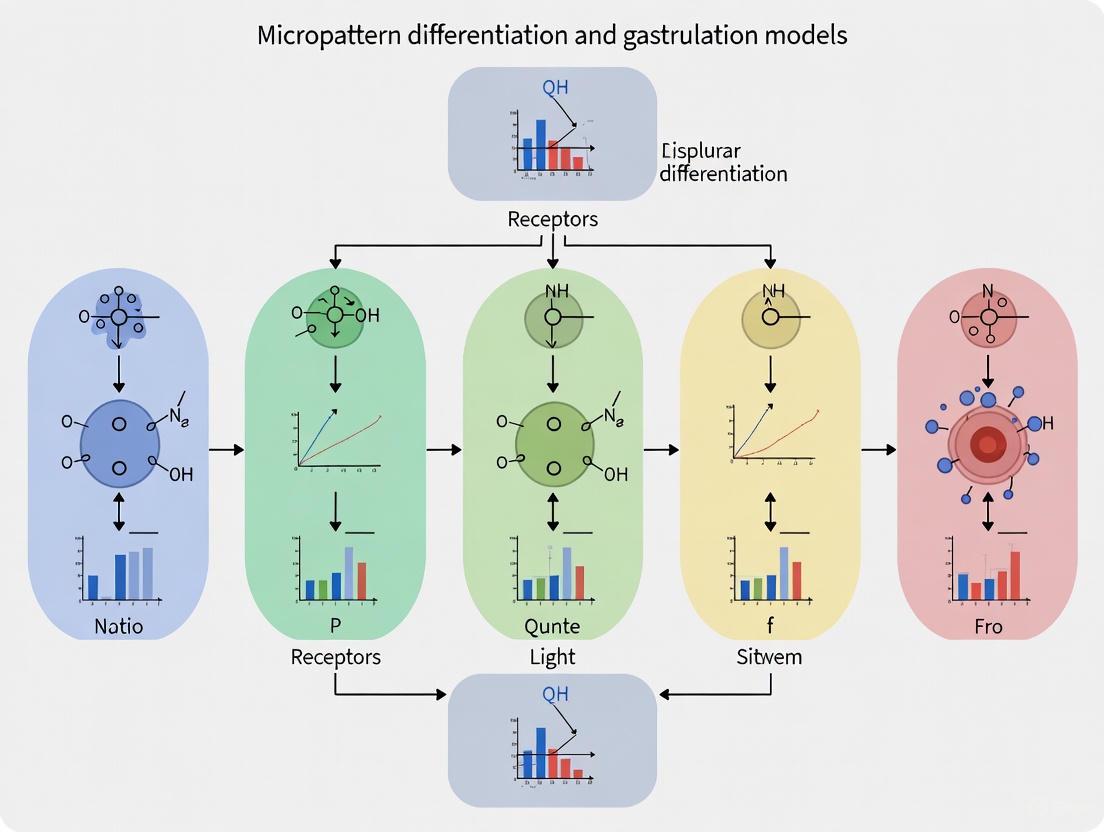
This article provides a comprehensive overview of micropatterned gastrulation models, a transformative bioengineering technology that enables the reproducible study of early human development in vitro.
Micropattern Differentiation in Gastrulation Models: A Guide for Researchers and Drug Developers
Abstract
This article provides a comprehensive overview of micropatterned gastrulation models, a transformative bioengineering technology that enables the reproducible study of early human development in vitro. We explore the foundational principles of how confining human pluripotent stem cells to defined geometric patterns, combined with morphogen signaling, leads to self-organization into radially patterned germ layers and extraembryonic cell types. The piece details key methodological protocols, applications in disease modeling and drug discovery, and strategies for troubleshooting and model optimization. Furthermore, we examine the critical validation of these models through cross-species transcriptomic comparisons and discuss their growing impact on overcoming the ethical and technical challenges of studying human embryogenesis, offering a robust platform for future biomedical research.
Understanding Micropatterned Gastruloids: Principles and Cellular Diversity
The process of gastrulation is a major milestone in early embryogenesis, characterized by symmetry breaking across a homogeneous population of embryonic cells, leading to the emergence of the body axes and the generation of the primordia of all organs [1]. Studying this process in human embryos presents significant ethical and technical challenges [2]. Consequently, in vitro models using human pluripotent stem cells (hPSCs) have become indispensable tools for developmental biologists [3] [2].
A key discovery in this field is that when hPSCs are grown in geometrical confinement on micropatterns and exposed to the morphogen Bone Morphogenetic Protein 4 (BMP4), they self-organize into radially symmetric patterns reminiscent of the human gastrula [1] [3]. This protocol outlines the core concepts and detailed methods for implementing this micropatterning platform to investigate how the interplay between geometric confinement and BMP4 signaling guides cellular self-organization.
Core Conceptual Framework: A Two-Step Patterning Model
The self-organization observed in these systems is understood to arise from a two-step process that integrates two fundamental biochemical models: Reaction-Diffusion (RD) and Positional Information (PI) [3].
- Step 1: Reaction-Diffusion (RD) for Self-Organized Gradient Formation. The system first establishes a self-organized signaling gradient. Upon BMP4 treatment, the ligand binds to its receptors and activates the intracellular signaling effector phosphorylated SMAD1 (pSMAD1). This activation triggers the expression of endogenous BMP inhibitors, such as NOGGIN (NOG). In this RD network, BMP4 acts as the activator, and NOG as the inhibitor. Due to their differential diffusivities, their interaction across the geometrically confined colony spontaneously breaks symmetry and generates a stable, radial gradient of pSMAD1 signaling, with the highest levels at the colony's edge [1] [3].
- Step 2: Positional Information (PI) for Fate Interpretation. Cells within the colony then interpret their position within this pre-established pSMAD1 gradient. The concentration and duration of pSMAD1 signaling act as a positional cue. Cells exposed to high levels of BMP4 signaling at the edge acquire extra-embryonic trophoblast-like fates. Those at an intermediate distance, receiving moderate signaling, acquire mesodermal and endodermal fates. Finally, cells in the center, shielded from high BMP4 activity, adopt ectodermal fates [3]. This step is consistent with the PI paradigm, where fate is determined by the level of a morphogen signal.
This two-step model provides a quantitative framework that accurately predicts experimental outcomes and can be formalized using mathematical models [1] [3].
Diagram: Conceptual Workflow of Micropattern Differentiation
The following tables summarize key quantitative parameters that govern the self-organization process in BMP4-treated micropatterned hPSC colonies.
Table 1: Key Signaling Pathways and Their Roles in Patterning
| Pathway / Molecule | Role in Patterning | Effect of Perturbation | Experimental Evidence |
|---|---|---|---|
| BMP4/pSMAD1 | Primary morphogen; forms signaling gradient; induces trophoblast, mesendoderm fates [3] [4]. | Loss of patterned differentiation; absence of BRA+ and CDX2+ regions [3]. | Immunostaining for pSMAD1 shows radial gradient; KO of BMP4 inhibitor NOGGIN disrupts pattern [1] [3]. |
| NODAL | Regulates fate heterogeneity; high endogenous levels promote gastrulation-associated (BRA+) fates [4]. | Downregulation biases colonies toward pre-neurulation-associated fates (SOX2+ center) [4]. | Screening of hPSC lines linked high NODAL to gastrulation gene profile; inhibition with SB431542 shifts fate bias [4]. |
| WNT | Induced by BMP4; cooperates with BMP4 to establish primitive streak-like population [1] [5]. | Inhibition reduces size of BRA+ population [5]. | Co-localization of BRA and nuclear β-Catenin; CHIR99021 (WNT agonist) increases BRA+ cells [5]. |
| YAP1 | Mechanosensory gene; integrates tissue mechanics with fate specification [1]. | Pharmacological inhibition or genetic ablation affects BRA induction [1]. | Differential nuclear localization in primitive streak-like region; modulates WNT3 expression [1]. |
Table 2: Experimental Parameters for Micropatterned Colony Patterning
| Parameter | Typical Range / Condition | Impact on Patterning Outcome |
|---|---|---|
| Colony Diameter | 200 - 1000 µm [3] | Smaller colonies: homogeneous response. Larger colonies: permit complex, periodic RD patterning [3]. |
| BMP4 Concentration | 5 - 100 ng/mL [3] [4] | Dose-dependent; higher doses expand CDX2+ and BRA+ regions, smaller SOX2+ center [3]. |
| Induction Duration | 24 - 72 hours [3] | Fate acquisition depends on both signal strength and duration (PI model) [3]. |
| Key Fate Markers | CDX2 (trophoblast), BRA/T (primitive streak/mesoderm), SOX2 (ectoderm), SOX17 (endoderm) [1] [3] [4]. | Radially organized expression domains appear by 48 hours [3]. |
| Base Medium | N2B27 (defined), mTeSR, Nutristem [3] | N2B27 + Nodal robustly supports peri-gastrulation-like patterning (CDX2, BRA, SOX17, SOX2) [3]. |
Experimental Protocols
Protocol: Micropatterning of hPSCs for Gastrulation Modeling
This protocol is adapted from established methods for high-throughput micropatterning [3] [4] [6].
I. Materials
- Substrate: PEG-coated micropatterned plates (e.g., 96-well format with circular adhesive islands of 500 µm diameter).
- Cells: Human Pluripotent Stem Cells (hPSCs), either embryonic (hESCs) or induced (hiPSCs).
- Coating Solution: Fibronectin (10 µg/mL) or Matrigel (1:100 dilution) in DMEM/F-12.
- Cell Dissociation Reagent: EDTA (0.5 mM) or enzyme-free dissociation buffer.
- Basal Medium: Defined, serum-free medium such as N2B27.
- Induction Medium: Basal medium supplemented with BMP4 (e.g., 20 ng/mL) and, for robust primitive streak formation, NODAL (100 ng/mL) [3].
- Fixative: 4% Paraformaldehyde (PFA) in PBS.
II. Step-by-Step Procedure
- Plate Activation: Pipette the extracellular matrix (ECM) coating solution (e.g., fibronectin) onto the PEG-coated micropatterned plate. Incubate for 1 hour at room temperature or 37°C.
- Wash: Aspirate the coating solution and wash the plate twice with PBS to remove excess protein, leaving protein only on the adhesive micropatterned islands.
- Cell Preparation: Harvest hPSCs using a gentle dissociation reagent to obtain a single-cell suspension. Accurate cell counting is crucial.
- Cell Seeding: Resuspend cells at a high density (e.g., 2-5 million cells/mL) in basal medium. Seed a calculated volume of cell suspension onto the micropatterned plate to achieve full colony confluency on each island without overpopulation. Centrifuge the plate gently to ensure even settlement onto the patterns.
- Attachment: Incubate the plate for 4-6 hours at 37°C to allow cells to attach exclusively to the adhesive islands.
- Medium Refresh & Induction: Carefully aspirate the seeding medium and replace it with Induction Medium containing BMP4. This marks time T=0 of differentiation.
- Differentiation: Culture the cells for 24-72 hours, changing the Induction Medium daily.
- Fixation and Analysis: At the desired time point, aspirate the medium, wash with PBS, and fix with 4% PFA for 20 minutes at room temperature. Proceed to immunostaining for key markers (see Table 2).
Protocol: Perturbation with Optogenetic BMP4 Control
Recent advances allow for spatiotemporal control over BMP4 signaling using optogenetics [1]. This protocol is for more advanced perturbation studies.
I. Specialized Materials
- Cells: hPSCs engineered with a light-inducible BMP4 gene cassette (e.g., via piggyBac vector) [1].
- Inducer: Doxycycline (DOX) to confer light sensitivity.
- Equipment: Blue light source (e.g., 470 nm LED array) with precise temporal and spatial control.
II. Step-by-Step Procedure
- Cell Seeding and Preparation: Seed the optogenetic hPSCs onto micropatterns as in Protocol 4.1.
- Sensitization: Add DOX to the culture medium 12-24 hours before induction to express the light-sensitive machinery.
- Spatiotemporal Induction: Expose the entire colony or specific sub-regions of the colony to blue light according to the experimental design. This triggers localized BMP4 production.
- Analysis: Fix cells and analyze patterning outcomes. Combining this with immunostaining for pSMAD1 and downstream fates allows direct quantification of how spatially controlled biochemical signals drive fate acquisition [1].
Diagram: BMP4 Signaling and Patterning Pathway
The Scientist's Toolkit: Essential Research Reagents
Table 3: Key Reagents and Materials for Micropattern Gastrulation Models
| Item | Function / Role in Experiment | Example / Specification |
|---|---|---|
| PEG-coated Micropatterned Plates | Provides geometrical confinement; defines colony size and shape for reproducible self-organization [3] [6]. | Commercially available 96-well plates (e.g., CYTOOchips) or custom-fabricated via deep UV photopatterning [4] [6]. |
| Recombinant Human BMP4 | Primary morphogen input to initiate the patterning cascade; activates SMAD1/5/8 signaling pathway [1] [3]. | High-purity, carrier-free protein; typical working concentration 10-50 ng/mL. |
| Recombinant Human NODAL | TGF-β family ligand; promotes primitive streak and mesendodermal fates; critical for robust BRA expression [3] [4]. | Used at ~100 ng/mL in N2B27 base medium [3]. |
| Small Molecule Inhibitors | Perturb specific pathways to test their necessity. Essential for mechanistic dissection [1] [4]. | LDN-193189 (BMP inhibitor), SB431542 (Nodal/Activin/TGF-β inhibitor), CHIR99021 (WNT agonist). |
| Antibodies for Immunostaining | Visualize and quantify spatial patterns of signaling and cell fates. | pSMAD1/5 (signaling), BRA/T (mesoderm), CDX2 (trophoblast), SOX2 (ectoderm), SOX17 (endoderm) [1] [3]. |
| Optogenetic hPSC Line | Enables spatiotemporal control over BMP4 expression with light, allowing precise perturbation studies [1]. | hPSCs with DOX-inducible, light-activated BMP4 transgene [1]. |
| Azoramide | Azoramide, CAS:932986-18-0, MF:C15H17ClN2OS, MW:308.8 g/mol | Chemical Reagent |
| AKBA | AKBA, CAS:67416-61-9, MF:C32H48O5, MW:512.7 g/mol | Chemical Reagent |
The process of gastrulation, during which the three primary germ layers—ectoderm, mesoderm, and endoderm—are specified and spatially organized, represents a pivotal event in early embryonic development. Studying this process in humans presents significant ethical and technical challenges, primarily due to the inaccessibility of in vivo embryos and legal restrictions that prohibit cultivation beyond 14 days post-fertilization, a point which roughly coincides with the onset of gastrulation [7]. Consequently, researchers have developed sophisticated in vitro models to investigate the fundamental mechanisms governing cell fate specification and patterning.
Among these, micropatterned differentiation models have emerged as a powerful and reproducible two-dimensional (2D) system for studying gastrulation events [8]. When human or mouse pluripotent stem cells (PSCs) are confined to geometrically defined, circular micropatterns and exposed to specific morphogenic signals, they undergo self-organized differentiation and form a radially patterned structure that mirrors key aspects of the gastrulating embryo [9] [7]. This system offers unparalleled scalability, ease of genetic manipulation, and simplicity of imaging, making it a robust platform for disentangling the complex signaling interactions that pattern the mammalian embryo [9].
This Application Note provides a detailed protocol for establishing a mouse pluripotent stem cell-based micropattern system to recapitulate gastrulation, complete with methodologies for quantitative analysis. Furthermore, we situate this protocol within the broader context of gastrulation model research, providing comparative data and resources to aid researchers and drug development professionals in implementing this technology.
Key Principles of Micropattern-Based Gastrulation Models
In a typical micropattern experiment, PSCs are seeded onto circular, extracellular matrix (ECM)-coated micropatterns. Upon exposure to a key inducing signal such as BMP4, the cells within the colony undergo coordinated differentiation [7]. The resulting structure exhibits a characteristic radial symmetry:
- A central region of ectodermal cells.
- An intermediate ring of mesodermal cells, which undergo an epithelial-to-mesenchymal transition (EMT) from a primitive streak-like region.
- An outer ring of definitive endodermal cells [7].
- Some protocols also report an outermost ring of cells with extraembryonic properties, though the precise identity of these cells can vary [7].
The reproducibility of this system allows for the robust quantification of spatial patterning by measuring protein expression levels as a function of radial position from the colony center to its edge [9]. The cell fate patterns that emerge are directly instructed by the combination and concentration of signaling pathway agonists and antagonists provided in the culture medium, enabling precise experimental control.
Establishing the Model: Protocols and Methodologies
Core Protocol: Mouse Epiblast-like Cell (EpiLC) Micropattern System
The following protocol, adapted from Morgani et al. (2018), details the process for generating patterned mouse EpiLCs, which correspond to the pre-gastrulation epiblast (~E5.5-E6.0) and demonstrate robust patterning capacity [9].
Preparation of Micropatterned Substrates
- Substrate Fabrication: Utilize commercially available micropatterned slides or create them using microcontact printing. The standard pattern diameter is 1000 µm.
- ECM Coating: Coat the micropatterns with Laminin (superior for EpiLC adhesion) or Fibronectin, both basement membrane components present at the epiblast-visceral endoderm interface in vivo. Incubate for at least 2 hours at 37°C or overnight at 4°C.
- Washing: Before cell seeding, wash the coated patterns three times with PBS to remove excess ECM material.
Generation and Seeding of Mouse EpiLCs
- EpiLC Differentiation: Generate EpiLCs from mouse embryonic stem cells (mESCs) as previously described (Hayashi et al., 2011). In brief, plate naive mESCs on Fibronectin-coated dishes in N2B27 medium supplemented with FGF2 (12 ng/mL) and Activin A (20 ng/mL) for approximately 44-48 hours [9].
- Cell Harvesting and Seeding: Gently dissociate the resulting EpiLCs to a single-cell suspension using Accutase or a similar enzyme. Seed the cells onto the pre-coated micropatterns at an optimized density (e.g., 1,000–2,000 cells/mm²) in EpiLC medium to form a confluent monolayer.
- Initial Incubation: Allow cells to adhere and form a uniform epithelium for 24 hours in EpiLC medium.
Patterning Induction and Signal Modulation
After 24 hours, replace the EpiLC medium with a patterning medium to induce spatially organized differentiation. The specific signals provided dictate the regional identities that emerge, emulating different embryonic environments [9]:
- For Posterior Mesoderm Patterning: Use a patterning medium containing BMP4 (10-50 ng/mL), a WNT agonist (e.g., CHIR99021, 3 µM), Activin A (50-100 ng/mL) to mimic Nodal signaling, and FGF2 (20-50 ng/mL). This combination promotes EMT and the specification of posterior epiblast, primitive streak, and mesoderm identities [9].
- For Anterior Patterning: Use a patterning medium lacking BMP4 but containing WNT, ACTIVIN, and FGF signaling components. This emulates the anterior primitive streak environment and promotes the specification of anterior epiblast, anterior primitive streak, axial mesoderm (AxM), and definitive endoderm fates [9].
- Induction Duration: Treat cells for 24-72 hours, fixing at specific time points for analysis based on the experimental requirements.
Workflow Visualization
The following diagram illustrates the key experimental stages from stem cell preparation to final analysis.
Quantitative Data and Analysis
The micropattern system's uniformity enables robust quantification of patterning outcomes. The data below, derived from key studies, illustrate the system's capabilities and the quantitative readouts that can be obtained.
Table 1: Key Signaling Molecules and Their Roles in Micropattern Patterning
| Signaling Pathway | Key Ligands/Agonists Used | Functional Role in Patterning | Representative Concentrations |
|---|---|---|---|
| BMP | BMP4 | Critical for inducing posterior mesoderm fates; required for outer trophectoderm-like fate in some models. | 10 - 50 ng/mL [9] |
| WNT/β-catenin | CHIR99021 (GSK3 inhibitor) | Cooperates with BMP to promote primitive streak formation and mesoderm specification. | 3 µM [9] |
| Nodal/Activin | Activin A | Patterns mesendodermal fates; essential for both anterior and posterior identity specification. | 20 - 100 ng/mL [9] |
| FGF | FGF2 (bFGF) | Supports epiblast exit from pluripotency, EMT, and mesoderm migration/survival. | 20 - 50 ng/mL [9] |
Table 2: Characteristic Radial Patterning Outcomes in Mouse EpiLC Micropatterns
| Induction Condition | Central Region | Intermediate Ring | Outer Ring | Key Markers |
|---|---|---|---|---|
| BMP + WNT + ACTIVIN + FGF | Pluripotent Epiblast | Posterior Primitive Streak & Mesoderm | Extraembryonic Mesoderm (proximal) | OCT4+ (center); BRACHYURY+, MIXL1+ (ring); GATA4+, FOXA2+ (outer) [9] |
| WNT + ACTIVIN + FGF | Anterior Epiblast | Anterior Primitive Streak & Axial Mesoderm | Definitive Endoderm | OTX2+ (center); BRACHYURY+, GOOSECOID+ (ring); SOX17+, FOXA2+ (outer) [9] |
The Scientist's Toolkit: Essential Research Reagents
Successful implementation of the micropattern gastrulation model relies on a defined set of core reagents. The following table details essential materials and their functions.
Table 3: Essential Research Reagents for Micropattern Gastrulation Models
| Reagent Category | Specific Examples | Function and Application Notes |
|---|---|---|
| Pluripotent Stem Cells | Mouse Naive ESCs, Human ESCs/iPSCs | The starting cellular material. The pluripotent state (naive vs. primed) must be appropriate for the protocol [10]. |
| Extracellular Matrix (ECM) | Laminin, Fibronectin, Collagen IV | Coats micropatterns to facilitate cell adhesion and provides a biomechanical cue. Laminin is superior for mouse EpiLC adhesion [9]. |
| Signaling Pathway Agonists | Recombinant BMP4, CHIR99021 (WNT), Activin A (Nodal/Activin), FGF2 | Directs cell fate patterning. Concentration and combination are critical for specifying anterior vs. posterior identities [9]. |
| Cell Dissociation Reagent | Accutase, Trypsin-EDTA | Generates a single-cell suspension for uniform seeding on micropatterns. |
| Fixation & Permeabilization | Paraformaldehyde (PFA), Triton X-100 | Prepares samples for immunostaining by fixing cellular structures and permeabilizing membranes. |
| Key Antibodies | Anti-OCT4, SOX2, NANOG (pluripotency); BRACHYURY, MIXL1 (mesoderm/primitive streak); SOX17, FOXA2 (endoderm) | Validates patterning outcomes through immunofluorescence and quantitative analysis [9]. |
| Albifylline | Albifylline|Xanthine Derivative|For Research Use | Albifylline (HWA 138) is a xanthine derivative for research into hemorrhagic shock and liver microcirculation. For Research Use Only. Not for human or veterinary use. |
| Albocycline | Albocycline|Antifungal Macrolide|For Research Use | Albocycline is a macrolide polyketide with research applications in plant pathogen studies, specifically against Verticillium dahliae. For Research Use Only. Not for human or veterinary use. |
Comparative Analysis of Gastrulation Models
While 2D micropatterns are highly reproducible and quantifiable, they represent one of several classes of stem cell-based embryo models. The field has rapidly advanced to include 3D integrated models that incorporate extraembryonic lineages.
Table 4: Comparison of Key Stem Cell-Based Models for Studying Gastrulation
| Model Type | Key Features | Advantages | Limitations |
|---|---|---|---|
| 2D Micropattern Colony | Radial patterning of germ layers on a flat, ECM-coated surface [7]. | High reproducibility; easy imaging and quantification; ideal for signaling studies [9] [11]. | Lacks 3D morphology, bilateral symmetry, and amniotic cavity [7]. |
| 3D Gastruloid | Self-organized 3D aggregates that mimic aspects of post-gastrulation development, including axial elongation [7] [11]. | 3D architecture; models early organogenesis and somitogenesis; can extend beyond the 14-day landmark [8]. | Lacks extraembryonic tissues; no brain/forebrain development; can be inefficient to generate [11]. |
| Integrated Stem Cell-Derived Embryo Model | Combines embryonic ESCs with extraembryonic stem cells (e.g., trophoblast, hypoblast) to model the entire conceptus [10]. | Most comprehensive model; enables study of embryonic-extraembryonic interactions post-implantation [10]. | Technically complex; low efficiency in some systems; raises significant ethical considerations [7] [10]. |
Model Selection Visualization
The following diagram outlines the decision-making process for selecting an appropriate gastrulation model based on research goals.
Concluding Remarks
The micropattern differentiation system provides a robust, scalable, and highly quantifiable platform for recapitulating the spatial patterning of germ layers during gastrulation. The protocols and data detailed in this Application Note provide a foundation for researchers to implement this technology for probing the fundamental mechanisms of cell fate decision-making, the impact of genetic perturbations, and the effects of teratogens or therapeutic compounds. As the field progresses, the integration of insights from 2D micropatterns with those from more complex 3D integrated models will be essential for building a comprehensive and multi-dimensional understanding of human development.
In the nascent field of synthetic embryology, micropatterned gastrulation models have emerged as a transformative platform for investigating the fundamental processes of early human development. These models bridge a critical gap in biomedical research by providing an accessible, reproducible, and ethically manageable system to study the conversion of a uniform epithelial sheet of pluripotent stem cells into the organized three germ layers that blueprint the adult body plan [12]. The core principle underpinning this technology is the geometric confinement of human pluripotent stem cells (hPSCs) on defined adhesive patterns, which, when coupled with precise morphogen stimulation, drives self-organized patterning reminiscent of the gastrulating embryo [13]. This application note details the protocols, analytical methods, and key reagents for implementing these micropattern differentiation systems, providing researchers with a robust toolkit for studying embryonic patterning, disease modeling, and developmental toxicity screening.
Biological Foundations of Micropatterned Gastrulation
The In Vivo Gastrulation Blueprint
Gastrulation is a pivotal event in the third week of human embryonic development, during which the bilaminar embryonic disc, composed of epiblast and hypoblast layers, transforms into a trilaminar structure containing the three definitive germ layers: ectoderm, mesoderm, and endoderm [14] [15]. This transformation is orchestrated by the emergence of the primitive streak, a groove-like structure that establishes the craniocaudal axis of the embryo [14] [16]. Epiblast cells undergo an epithelial-to-mesenchymal transition (EMT) and ingress through the primitive streak in a spatially and temporally coordinated manner [14]. The first cells to migrate displace the hypoblast to form the definitive endoderm, later cells form the mesoderm, and the remaining epiblast cells become the ectoderm [15]. Each germ layer possesses a unique developmental fate:
- Ectoderm: Gives rise to the surface ectoderm (epidermis) and neural ectoderm, which forms the neural tube (brain and spinal cord) and neural crest [17] [16].
- Mesoderm: Differentiates into paraxial (e.g., somites for skeleton, muscle, dermis), intermediate (e.g., kidneys, gonads), and lateral plate (e.g., circulatory system, spleen, gut wall) mesoderm [17] [16].
- Endoderm: Forms the epithelial lining of the digestive and respiratory tracts, and associated organs like the liver, pancreas, and thyroid [17] [16].
Key Signaling Pathways in Axis and Layer Formation
The self-organization observed in micropatterned colonies is directed by the same signaling pathways that govern these events in the natural embryo. The primitive streak is initiated and maintained by a concert of signaling molecules including Nodal (a TGF-β family member), Wnt, and BMP [14]. The formation of the notochord from the notochordal process further provides structural support and secretes signals essential for neural induction and axial patterning [14] [16]. The following diagram illustrates the core signaling logic that governs cell fate decisions in the developing embryo and is recapitulated in micropatterned cultures.
Signaling Pathways in Gastrulation
Micropattern Differentiation Protocol
This protocol describes a method for generating self-organized germ layer patterns from hPSCs cultured on circular micropatterns, based on the established work of Warmflash and colleagues [13] [18].
Materials and Reagent Solutions
Table 1: Essential Research Reagent Solutions for Micropattern Differentiation
| Item | Function / Description | Example / Specification |
|---|---|---|
| Micropatterned Substrates | Defines colony geometry and enables self-organization. | CYTOOchips or in-house fabricated polydimethylsiloxane (PDMS) stencils with defined feature sizes (e.g., 500-1000 µm diameter circles) [13] [18]. |
| Extracellular Matrix (ECM) | Coats micropatterns to support hPSC attachment and survival. | Human laminin-521 (LN-521) or hESC-qualified basement membrane matrix (e.g., Matrigel, Geltrex) [13] [18]. |
| Cell Culture Medium | Supports pluripotency maintenance prior to differentiation. | Chemically defined medium such as mTeSR [13]. |
| Differentiation Inducer | Key morphogen to initiate patterning. | Recombinant human BMP4 (e.g., 50 ng/ml) [13]. |
| ROCK Inhibitor (Y-27632) | Enhances single-cell survival after passaging. | 10 µM in culture medium [18]. |
| Fixative | For immobilizing cells for immunostaining. | 4% Paraformaldehyde (PFA). |
| Permeabilization Buffer | For intracellular antibody access. | 0.1-0.5% Triton X-100. |
| Blocking Buffer | Reduces non-specific antibody binding. | Serum (e.g., 5% donkey serum) in PBS. |
Step-by-Step Experimental Workflow
The following diagram and subsequent steps outline the complete process for a micropattern differentiation experiment.
Micropattern Differentiation Workflow
- Substrate Preparation: Secure a sterile PDMS stencil onto a culture dish. Coat the micropatterned surface with the appropriate ECM (e.g., 1.5x hESC-qualified basement membrane matrix in DMEM/F12) and incubate. Remove the stencil after coating to reveal the defined adhesive islands [18].
- Cell Seeding: Prepare hPSCs as a single-cell suspension using enzyme-free dissociation reagents. Resuspend the cells in maintenance medium supplemented with 10 µM ROCK inhibitor (Y-27632). Seed the cell suspension onto the micropatterned substrate at a density that ensures the formation of a confluent monolayer on each pattern within 24-48 hours [13] [18].
- Colony Formation: Culture the cells in a pluripotency maintenance medium (e.g., mTeSR) for 24-48 hours until a confluent, epithelial-like monolayer is formed on the micropatterns.
- Differentiation Induction: To initiate patterning, switch the culture medium to a differentiation medium containing recombinant human BMP4 (typically at 50 ng/ml). Incubate the cells for 42-48 hours to allow for the self-organization of germ layers [13].
- Pattern Analysis: At the endpoint, rinse the cells with PBS and fix with 4% PFA for 15-20 minutes at room temperature. The samples can then be processed for immunofluorescence analysis to visualize the spatial organization of the germ layers.
Data Analysis and Quantification
Expected Patterning Outcomes and Marker Expression
Following BMP4 stimulation, self-organized concentric rings of germ layer progenitors form within the micropatterned colony. The typical spatial organization and key markers for each domain are summarized below.
Table 2: Quantitative Patterning Outcomes in Micropatterned Colonies
| Spatial Domain | Germ Layer Identity | Key Transcription Factor Markers | Representative % of Colony Area |
|---|---|---|---|
| Center | Ectoderm | SOX2 (Neural Ectoderm) [13] [19] | ~40-60% |
| Middle Ring | Mesoderm | BRA (BRACHYURY) [13] [19] | ~20-40% |
| Outer Ring | Endoderm | SOX17 (Definitive Endoderm) [19] | ~10-20% |
| Periphery | Extra-embryonic/Trophoblast-like* | CDX2 [13] | Variable |
*Note: The identity of the outermost cell population can vary based on protocol specifics [12].
Protocol Variations and Their Effects
The patterning outcome is highly tunable by modulating physical and chemical parameters.
Table 3: Effects of Protocol Variations on Patterning
| Parameter | Standard Condition | Variation | Effect on Patterning |
|---|---|---|---|
| Colony Diameter | 800 - 1000 µm [13] | < 500 µm | Restricted patterning; favors central fates (ectoderm) [13]. |
| BMP4 Concentration | 50 ng/ml [13] | Lower (e.g., 10 ng/ml) | Reduced mesoderm/endoderm differentiation. |
| Higher (e.g., 100 ng/ml) | May expand mesodermal domain. | ||
| Signaling Modulators | BMP4 only | BMP4 + WNT/ACTIVIN | Can enhance posterior mesoderm fates [19]. |
| FGF/ACTIVIN/WNT (no BMP) | Promotes anterior fates, including definitive endoderm [19]. | ||
| Cell Line | hESCs (e.g., H9) | hiPSCs | Line-to-line variability may require protocol optimization. |
Discussion and Application Notes
The micropattern differentiation platform reliably generates a radially patterned germ layer structure that mirrors the fate allocation along the medial-lateral axis of the primitive streak in the gastrulating embryo [13] [19]. The concentric rings of ectoderm, mesoderm, and endoderm provide a quantitative and scalable system for studying the principles of self-organization.
Key Advantages:
- Reproducibility: The geometric confinement ensures highly uniform and reproducible patterning across hundreds of colonies per experiment [13].
- Accessibility: It provides a 2D window into the complex 3D process of gastrulation, facilitating high-resolution imaging and analysis.
- Tunability: The system is highly amenable to perturbation studies, including small molecule inhibition, gene knockdown, and media component modulation, allowing for the dissection of specific signaling requirements [19].
Limitations and Considerations:
- Simplified Geometry: The model lacks the full morphological complexity, bilateral symmetry, and some extra-embryonic interactions of the in vivo embryo [12].
- Marker Interpretation: Careful validation with multiple markers is required, as some markers can be co-expressed in progenitor populations or indicate alternative lineages.
This protocol provides a foundational tool for researchers to investigate the cellular and molecular complexity of human gastrulation, with direct applications in developmental biology, disease modeling, and teratogenicity screening.
The precise control of cell fate specification during gastrulation represents a fundamental process in embryonic development that can now be systematically studied using micropatterned stem cell models. These engineered platforms provide unprecedented spatial and temporal control over the cellular microenvironment, enabling researchers to deconstruct the complex signaling networks that pattern the early embryo [8]. Among these networks, four key signaling pathways—BMP, WNT, NODAL, and FGF—function in an integrated manner to direct cell fate decisions through concentration-dependent effects, temporal dynamics, and cross-regulatory interactions. The emergence of defined gastrulation models has been particularly transformative for investigating human development, overcoming significant ethical and technical challenges associated with embryonic research [8]. These systems replicate aspects of blastocyst formation, implantation, and germ layer specification, providing valuable insights into the morphogenetic events that shape human development. Understanding how these pathways interact to specify distinct mesodermal, endodermal, and ectodermal lineages is crucial for both developmental biology and regenerative medicine applications, particularly in the context of pattern formation and tissue morphogenesis.
BMP Signaling Pathway
Molecular Mechanisms and Regulation
The Bone Morphogenetic Protein (BMP) pathway constitutes a crucial signaling system within the transforming growth factor β (TGF-β) superfamily, with pleiotropic effects on neural cell specification and patterning throughout development [20]. BMP ligands are synthesized as large precursor proteins that undergo proteolytic processing by serine proteases such as furin before forming active dimers stabilized by cysteine knots [20]. These mature ligands signal through a heterotetrameric receptor complex comprising type I (BMPR1A/ALK3, BMPR1B/ALK6) and type II (BMPR2, ACVR2A, ACVR2B) serine/threonine kinase receptors, which subsequently phosphorylate intracellular SMAD effectors (primarily SMAD1/5/8) [20]. The phosphorylated SMADs then form complexes with SMAD4 and translocate to the nucleus to regulate target gene expression.
A critical aspect of BMP signaling is its extensive extracellular regulation by diffusible antagonists including noggin, chordin, and follistatin, which physically prevent BMPs from binding to their cognate receptors [20]. The bioavailability of BMP ligands is further modulated by their interaction with extracellular matrix components such as heparan sulfate proteoglycans and collagen IV, which help establish morphogen gradients essential for patterning [20]. Additionally, membrane-bound co-receptors of the repulsive guidance molecule (RGM) family, including hemojuvelin, enhance BMP signaling responses at low ligand concentrations, while pseudoreceptors like Bambi function as dominant-negative regulators by forming non-functional complexes with receptor components [20].
Functional Roles in Fate Specification
BMP signaling exerts dynamic functions throughout nervous system development, initially inhibiting neural precursor proliferation and promoting early neuronal differentiation, then later shifting to promote astroglial identity while inhibiting neuronal or oligodendroglial lineage commitment [20]. In postmitotic cells, BMPs regulate cell survival, neuronal subtype specification, dendritic and axonal growth, and synapse formation [20]. Beyond neural development, BMP signaling plays crucial roles in mesoderm patterning, where it promotes the differentiation of proximal mesoderm subtypes, including extraembryonic mesoderm and blood precursors, while inhibiting distal fates such as paraxial and axial mesoderm [21]. This patterning function operates in a concentration-dependent manner, with high BMP concentrations promoting proximal markers like HAND1 and GATA6, while lower concentrations favor distal markers including TBX6 and MSGN1 [21].
Table 1: BMP Concentration-Dependent Effects on Mesodermal Marker Expression
| BMP4 Concentration | Marker Expression | Mesodermal Subtype |
|---|---|---|
| High (16-32 ng/ml) | HAND1↑, GATA6↑ | Proximal (Extraembryonic, Heart) |
| Medium (~4 ng/ml) | T/Bra↑, TBX6↑, MSGN1↑ | Intermediate |
| Low (<4 ng/ml) | FOXA2↑, SHH↑ | Distal (Axial) |
Recent research utilizing micropatterned stem cell models has revealed that BMP signaling history, specifically the time-integral of signaling activity, strongly correlates with fate outcomes in individual cells [22]. This temporal dimension adds considerable sophistication to the traditional concentration-gradient model of BMP patterning. The integration of BMP signaling appears to be mechanistically mediated by SOX2, which represses differentiation genes and decreases in proportion to the cumulative BMP signal received by a cell [22]. This discovery highlights the importance of signaling dynamics rather than just instantaneous levels in fate determination, with both signaling duration and level controlling cell fate choices primarily through their effect on the time integral of signaling activity [22].
WNT Signaling Pathway
Canonical and Non-Canonical Mechanisms
The WNT signaling pathway represents a cornerstone of stem cell control with profound implications for development, homeostasis, and disease [23] [24]. In the canonical WNT pathway, WNT ligands bind to receptors of the Frizzled family and LRP co-receptors, leading to the stabilization and nuclear translocation of β-catenin, where it forms a complex with TCF transcription factors to activate target genes [23]. This canonical branch stands in contrast to non-canonical WNT signaling, which operates through alternative receptors including ROR and RYK tyrosine kinase receptors and can function independently of β-catenin [23]. The activation state of WNT signaling is dynamically regulated throughout tissue growth, with ligands and receptors often transcriptionally controlled by WNT signals themselves to ensure the proper balance between proliferation and differentiation [23].
Multiple layers of regulation govern WNT signaling activity, beginning with post-translational modifications of WNT ligands themselves. WNT proteins undergo lipid modification by porcupine in the endoplasmic reticulum, which is essential for their secretion and activity [23]. The dedicated transmembrane protein Wntless (Evi) facilitates WNT secretion from signaling cells, while extracellular glycosaminoglycans can modulate WNT localization and promote signal transduction [23]. Within the receiving cells, the phosphorylation status of the LRP co-receptor is regulated by a dual-kinase mechanism involving CK1γ and GSK3, which controls the assembly of the signaling complex that ultimately stabilizes β-catenin [23].
Roles in Stem Cell Maintenance and Differentiation
WNT signaling plays pivotal roles in maintaining various types of stem cells in a self-renewing state, functioning as a critical niche factor [23]. In embryonic stem cells, WNT signaling helps maintain pluripotency, with its precise dosage controlling differentiation decisions [23]. The pathway is particularly important in neural development, where it regulates cerebral cortical size by controlling cell cycle exit in neural precursors and continues to influence adult hippocampal neurogenesis [23]. In hematopoietic stem cells, WNT signaling supports self-renewal, while its dysregulation contributes to carcinogenesis, particularly in colorectal cancer where the pathway is frequently mutated [23] [24].
In the context of gastrulation models, WNT signaling functions within a transcriptional hierarchy alongside BMP and Nodal pathways to pattern cell populations [22]. This hierarchy positions WNT upstream of Nodal signaling, with WNT inhibition leading to the loss of endogenous Nodal signaling and consequent alterations in fate patterning [22]. The integration of WNT with other signaling pathways creates a robust network that ensures proper specification of mesodermal subtypes, with WNT particularly important for generating primitive streak-like and primordial germ cell-like fates in micropatterned systems [22].
NODAL Signaling Pathway
Signal Transduction and Modulation
The NODAL signaling pathway, a specialized branch of the TGF-β superfamily, plays central roles in patterning the early embryo during mesoderm and endoderm induction and in establishing left-right asymmetry [25] [26]. Activation of this pathway begins with NODAL binding to activin and activin-like receptors, leading to phosphorylation of the downstream effectors SMAD2 and SMAD3 [25]. These phosphorylated SMADs then complex with SMAD4 and translocate to the nucleus, where they interact with transcription factors including FoxH1, p53, and Mixer to induce expression of target genes [25]. The activation of NODAL signaling induces transcription of numerous targets including NODAL itself (forming a positive feedback loop), as well as antagonists like Lefty and Cerberus that restrict signaling activity [25].
The NODAL pathway is subject to multiple layers of regulation at both extracellular and intracellular levels. Extracellular antagonists include Lefty proteins, which act as competitive inhibitors of NODAL signaling, and DAN family proteins such as Cerberus and Coco, which bind directly to extracellular NODAL proteins and prevent receptor activation [25]. At the intracellular level, EGF-CFC family proteins (including Cripto and Cryptic) function as essential co-receptors absolutely required for NODAL signal transduction [25]. Additional negative regulators include Dapper2, which binds to activin type I receptors and targets them for lysosomal degradation, and ectodermin, which monoubiquitinates SMAD4 to promote its nuclear export [25]. MicroRNAs, particularly the evolutionarily conserved miR-430/427/302 family, provide yet another regulatory layer by controlling the translation of key pathway components including Lefty1/2 and NODAL itself [25].
Developmental Functions in Gastrulation
During gastrulation, NODAL signaling is required for the induction of mesodermal and endodermal cell types, with knockout studies demonstrating that NODAL-deficient embryos fail to develop notochord, heart, kidneys, or blood [25]. The spatial and temporal control of NODAL signaling is critical for its developmental functions, with signaling activity often initiated ubiquitously in epiblast cells before being refined through autoregulatory signaling and inhibition by antagonists [25]. In some species, such as Xenopus, NODAL expression (via Xnr genes) is induced by the transcription factor VegT at the vegetal pole and spreads through the blastula, with its expression stabilized by β-catenin [25].
The graded activity of NODAL signaling is particularly important for its ability to induce different cell fates, with temporal and spatial differences resulting in distinct developmental outcomes [25]. High levels of NODAL signaling typically promote endodermal fates, while intermediate levels induce mesoderm, creating a signaling gradient that patterns the germ layers [25]. In micropatterned stem cell models, NODAL signaling follows a dynamic pattern characterized by a late signaling wave that emerges around 24 hours of differentiation and correlates with primitive streak-like differentiation [22]. This NODAL activity wave depends on prior WNT signaling, as inhibition of WNT secretion eliminates the late NODAL wave and consequently alters the resulting fate pattern [22].
FGF Signaling Pathway
Mechanisms of Action
The Fibroblast Growth Factor (FGF) signaling pathway serves as a crucial regulator of morphogenetic movement and cell fate specification during gastrulation [27] [21]. FGF ligands signal through FGFR receptors, with FGFR1 playing particularly important roles in mesoderm formation and patterning [27]. During gastrulation, FGF signaling is most active in the primitive streak and nascent mesoderm, mirroring the expression of Fgf8, Fgf4, Fgf3, and Fgf17 ligand genes in these regions [21]. The pathway orchestrates the epithelial to mesenchymal transition (EMT) and subsequent morphogenesis of mesoderm at the primitive streak by controlling the expression of key regulators including Snail and E-cadherin [27]. Additionally, FGFR1 functions in mesoderm cell fate specification by positively regulating the expression of Brachyury and Tbx6, two transcription factors critical for mesoderm formation and differentiation [27].
Beyond these direct transcriptional targets, FGF signaling interacts with other pathways to coordinate developmental processes. Evidence suggests that FGF-induced downregulation of E-cadherin modulates cytoplasmic β-catenin levels, providing a molecular link between FGF and WNT signaling pathways at the primitive streak [27]. This connection may explain the attenuation of WNT3a signaling observed in Fgfr1-deficient embryos and the partial rescue of this phenotype by experimentally reducing E-cadherin levels [27]. Recent single-cell analyses of differentiating embryonic stem cells have identified opposing functions of BMP and FGF signaling, with FGF stimulating positive autoregulation of Fgf genes while simultaneously repressing Bmp ligand expression [21]. This antagonistic relationship between FGF and BMP may contribute to the specification of coherent cell cohorts through a community effect.
Roles in Mesoderm Patterning
FGF signaling plays indispensable roles in mesoderm cell fate specification and patterning, with distinct mesodermal subtypes exhibiting differential requirements for FGF activity [21]. While some proximal mesoderm forms in FGF signaling mutants, the differentiation of more distal cell types, particularly paraxial mesoderm, is severely impaired [21]. This requirement gradient reflects the dynamic expression pattern of FGF ligands and receptors during gastrulation, with signaling activity highest in regions fated to form distal mesoderm derivatives. The dose-dependent effects of FGF signaling extend beyond simple lineage specification to include the regulation of differentiation speed and the proportional distribution of discrete cell types within heterogeneous populations [21].
In human embryonic stem cell models, FGF signaling exhibits context-dependent requirements, generally cooperating with BMP signaling to promote efficient mesoderm differentiation while suppressing alternative differentiation trajectories toward extraembryonic cell types [21]. The integration of FGF signaling with other pathways creates a robust network that ensures proper spatial organization and proportional representation of various mesodermal precursors, highlighting its role as a key patterning cue during gastrulation. The discovery that FGF signaling is embedded in a positive autoregulatory loop while simultaneously repressing BMP signaling provides a plausible mechanism for how distinct mesodermal domains emerge from initially homogeneous cell populations [21].
Table 2: Comparative Functions of Key Signaling Pathways in Gastrulation
| Pathway | Key Receptors | Main Intracellular Effectors | Primary Roles in Gastrulation |
|---|---|---|---|
| BMP | BMPR1A/B, BMPR2 | SMAD1/5/8, SMAD4 | Proximal mesoderm specification; amnion-like differentiation; dorsal-ventral patterning |
| WNT | Frizzled, LRP5/6 | β-catenin, TCF/LEF | Primitive streak formation; posterior patterning; regulates Nodal signaling |
| NODAL | Activin receptors, EGF-CFC | SMAD2/3, SMAD4 | Mesoendoderm induction; primitive streak-like differentiation; left-right asymmetry |
| FGF | FGFR1-4 | MAPK, Snail | Epithelial-mesenchymal transition; distal mesoderm specification; morphogenetic movements |
Pathway Integration in Micropatterned Gastruloids
Signaling Hierarchies and Cross-Regulation
In micropatterned gastruloid systems, BMP, WNT, NODAL, and FGF pathways do not function in isolation but rather form an integrated network with defined hierarchical relationships and extensive cross-regulation [22]. This network architecture underlies the self-organized patterning observed in these models, where initially homogeneous stem cell populations spontaneously generate spatially arranged cell types corresponding to those found in the gastrulating embryo [8] [22]. The signaling hierarchy positions WNT and BMP as upstream regulators, with WNT functioning upstream of NODAL in a transcriptional cascade that patterns the primitive streak-like region [22]. Simultaneously, BMP and FGF signaling engage in mutual antagonism, with FGF signaling promoting positive autoregulation of Fgf genes while repressing Bmp ligand expression, and BMP signaling exhibiting the reciprocal effect [21].
This antagonistic relationship between BMP and FGF establishes a toggle-like switch that helps segregate proximal (BMP-dependent) and distal (FGF-dependent) mesodermal fates [21]. The regulatory logic of this network enables the formation of spatially coherent groups of cells with the same identity through community effects, ensuring reproducible proportions and spatial organization of different cell types [21]. Additional modulatory interactions include the regulation of WNT signaling by FGF through E-cadherin modulation and β-catenin availability, as well as the integration of temporal dynamics through pathway-specific kinetics and feedback loops [27] [22]. The emergent properties of this network explain how relatively simple signaling inputs can generate complex patterns in both embryonic development and synthetic embryo-like systems.
Quantitative Relationships and Fate Determination
Single-cell analyses of differentiating stem cell populations have revealed quantitative relationships between signaling history and fate outcomes that traditional bulk measurements could not detect [22]. For BMP signaling, the time-integral of signaling activity—rather than instantaneous levels—strongly correlates with fate in individual cells, with both signaling duration and level controlling fate choices primarily through their effect on this integral [22]. This relationship means that lower levels of signaling over longer durations can produce similar differentiation outcomes as higher signaling for shorter periods, explaining how cells can make reliable fate decisions in the context of dynamically changing signaling environments [22].
The mechanistic basis for this integration appears to involve the transcription factor SOX2, which decreases in proportion to the cumulative BMP signal received by a cell and represses differentiation genes [22]. This molecular integrator function provides a plausible mechanism for how cells measure and respond to the time-integral of signaling activity rather than responding to threshold concentrations at specific timepoints [22]. Similar quantitative relationships likely exist for other pathways, with the dynamic interplay between multiple signaling histories ultimately determining the final fate pattern. The demonstration that signaling histories can accurately predict cell fate patterns in micropatterned colonies highlights the importance of temporal information in developmental patterning and suggests new approaches for controlling stem cell differentiation in regenerative applications.
Experimental Protocols for Micropatterned Differentiation
Micropatterned Colony Differentiation Assay
The micropatterned differentiation assay enables precise control over colony geometry and reproducible spatial patterning of cell fates in response to defined signaling inputs [22]. This protocol begins with the fabrication of micropatterned substrates containing circular adhesion domains of defined size (typically 500-1000 μm diameter) using photolithography or microcontact printing techniques. Human pluripotent stem cells (hPSCs) are then seeded onto these substrates at optimized densities to ensure single-cell attachment and subsequent colony formation confined to the patterned areas [22]. Cells are maintained in pluripotency medium until they form confluent, homogeneous colonies, typically for 24-48 hours.
To initiate differentiation, the medium is switched to a defined differentiation medium containing specific pathway agonists or antagonists according to experimental requirements [22]. For basic amnion-like differentiation, BMP4 (10-50 ng/ml) is added to N2B27 basal medium without other signaling factors [22]. For primitive streak-like and mesodermal differentiation, a combination of BMP4 (5-20 ng/ml), CHIR99021 (1-3 μM to activate WNT signaling), and FGF2 (10-100 ng/ml) is typically used [8] [22]. The differentiation medium is replaced daily, and the process continues for 48-96 hours depending on the desired developmental stage. Throughout the differentiation, signaling dynamics can be monitored in live cells using endogenously tagged fluorescent reporters (e.g., GFP::SMAD4, RFP::SMAD1) with time-lapse microscopy [22]. Following differentiation, cells are fixed and stained for key lineage markers to assess the resulting fate pattern.
Single-Cell Signaling History Analysis
The signaling history analysis protocol enables correlation of dynamic signaling information with eventual cell fate in the same cells [22]. This approach requires hPSC lines with endogenously tagged signaling effectors (e.g., GFP::SMAD4, RFP::SMAD1) that allow live monitoring of pathway activity without perturbing normal function [22]. Cells are seeded in standard culture formats (without micropatterning to increase heterogeneity) or on micropatterned substrates as needed. Time-lapse imaging is performed throughout the differentiation period (typically 48 hours) with imaging intervals of 15-30 minutes to capture signaling dynamics without excessive phototoxicity [22].
Following live imaging, cells are fixed and subjected to iterative immunofluorescence staining for multiple fate markers to comprehensively characterize the differentiated state [22]. The resulting data undergoes automated cell tracking to link signaling histories with fate outcomes for individual cells and their progeny [22]. For quantitative analysis, nuclear-to-cytoplasmic ratios of fluorescent signaling reporters are quantified over time to generate signaling trajectories for each cell. These trajectories are then subjected to computational analysis including principal component analysis (PCA) and clustering to identify characteristic signaling history classes [22]. The correlation between signaling history classes and final fate markers is then statistically assessed to determine predictive relationships [22]. This protocol enables unbiased discovery of how signaling dynamics control fate decisions at single-cell resolution.
Table 3: Essential Research Reagents for Signaling Pathway Studies
| Reagent Category | Specific Examples | Primary Functions |
|---|---|---|
| Pathway Agonists | BMP4 (BMP), CHIR99021 (WNT), Activin A (Nodal), FGF2/FGF4 (FGF) | Selective pathway activation; concentration-response studies |
| Pathway Antagonists | Noggin (BMP), IWP2/IWR1 (WNT), SB431542 (Nodal), PD173074 (FGF) | Pathway inhibition; testing necessity; altering fate patterns |
| Signaling Reporters | GFP::SMAD4, RFP::SMAD1, T/Bra:mCherry, SOX2 live reporters | Live monitoring of pathway activity; correlation with fate |
| Detection Reagents | Phospho-SMAD antibodies, lineage marker antibodies, in situ hybridization probes | Endpoint assessment of signaling and differentiation states |
The Scientist's Toolkit: Essential Research Reagents
The investigation of signaling pathways in fate specification requires a carefully selected set of research reagents that enable precise manipulation and measurement of pathway activity. For pathway activation, recombinant proteins including BMP4 (BMP pathway), CHIR99021 (WNT pathway through GSK3 inhibition), Activin A (NODAL/TGF-β pathway), and FGF2 or FGF4 (FGF pathway) serve as essential tools for mimicking developmental signaling events [21] [22]. Conversely, specific inhibitors such as Noggin (BMP antagonist), IWP2/IWR1 (WNT secretion inhibitors), SB431542 (NODAL/Activin receptor inhibitor), and PD173074 (FGFR inhibitor) allow researchers to test the necessity of individual pathways in fate specification [21] [22].
Critical to dynamic studies are genetically engineered reporter cell lines with endogenously tagged signaling components such as GFP::SMAD4 (BMP and NODAL activity), RFP::SMAD1 (BMP-specific activity), and T/Bra:mCherry (mesoderm differentiation) [22]. These reporters enable live monitoring of pathway activity and correlation with eventual cell fate in the same cells. For endpoint analyses, phospho-specific antibodies (e.g., pSMAD1/5/9, pSMAD2) provide snapshots of pathway activation states, while comprehensive antibody panels against lineage-specific transcription factors (e.g., SOX2, BRA, TBX6, FOXA2) allow detailed characterization of resulting fate patterns [22]. Additionally, micropatterned substrates with defined geometries and microfluidic systems for controlled reagent delivery represent essential engineering tools that enhance the precision and reproducibility of gastrulation models [8].
Visualizing Signaling Pathways and Experimental Workflows
Protocols and Practical Applications in Research and Drug Development
Micropatterning encompasses a set of methods aimed at precisely controlling the spatial distribution of molecules onto the surface of materials to impose physical constraints on biological systems [6]. In developmental biology, this technique has gained significant popularity as it enables researchers to standardize cell culture environments, thereby facilitating quantitative analysis of complex processes such as gastrulation [6] [12]. By confining cells to defined adhesive islands separated by non-adhesive materials, micropatterning reduces experimental variability and reveals biological phenomena that might otherwise be obscured in conventional culture systems [6].
The application of micropatterning is particularly valuable for modeling early mammalian embryogenesis, not as a replacement for in vivo analysis but as a complementary approach that helps reveal how physicochemical context regulates developmental processes [6]. For developmental biologists studying gastrulation, 2D micropatterned systems provide a reproducible platform for investigating symmetry breaking, lineage specification, and tissue patterning events that mimic aspects of primate embryogenesis [28] [12]. This Technical Note provides comprehensive protocols and application guidelines for implementing micropattern technology in developmental biology research, with specific emphasis on gastrulation models.
Key Principles and Biological Foundations
Theoretical Basis of Micropatterned Gastrulation Models
Micropatterned gastrulation models leverage the inherent ability of pluripotent stem cells to self-organize in response to geometrically defined cues. When human pluripotent stem cells are confined to circular extracellular matrix (ECM) micro-discs and stimulated with appropriate morphogens such as BMP4, they undergo a reproducible differentiation pattern that radially organizes germ layer markers [28] [12]. The system successfully models several aspects of in vivo gastrulation, including the formation of a primitive streak-like region, epithelial-to-mesenchymal transition (EMT), and the specification of ectodermal, mesodermal, and endodermal progenitors in a spatially organized manner [28].
Single-cell RNA sequencing analyses have revealed that micropatterned gastruloids contain cells transcriptionally similar to epiblast, ectoderm, mesoderm, endoderm, primordial germ cells, trophectoderm, and amnion [28]. Cross-species comparisons demonstrate that these in vitro models correspond to early-mid gastrula stage and exhibit high resemblance in cellular composition and gene expression to in vivo primate gastrulae [28]. This conservation makes the system particularly valuable for studying human development, where in vivo samples are scarce and ethical restrictions limit experimentation [12].
Advantages of Micropatterning for Quantitative Biology
The primary advantage of micropatterning lies in its ability to reduce biological variability for enhanced quantitative analysis [6]. Traditional two-dimensional cultures exhibit substantial heterogeneity in colony size, shape, and density, which can obscure subtle phenotypes and complicate interpretation of results. By standardizing the physical environment, micropatterning enables:
- High-content imaging and analysis: Hundreds of standardized colonies can be imaged and computationally analyzed using automated approaches [6].
- Aggregated data representation: Images from multiple colonies can be superimposed to build composite representations showing average and variation in biological signals [6].
- Sub-visual phenotype detection: Standardization increases statistical power to detect subtle effects that might be missed in heterogeneous cultures [6].
- Decoupling of biological variables: Clever patterning designs can dissociate variables such as cell shape, adhesion site density, and matrix geometry to understand their individual contributions to cell fate decisions [6].
Technical Implementation: Methods and Protocols
Fabrication Method Selection Guide
Multiple fabrication methods exist for creating micropatterned substrates, each with distinct advantages and limitations. The table below summarizes the most common approaches:
Table 1: Comparison of Micropatterning Fabrication Methods
| Method | Principle | Resolution | Throughput | Equipment Needs | Best Applications |
|---|---|---|---|---|---|
| Soft Lithography/ Microcontact Printing [6] | PDMS stamping of ECM proteins | ~1 µm | Medium | Clean room access required | Standard lab use, protein patterning |
| Direct Photopatterning [6] | UV degradation of cell-repellent coating | <5 µm | High | Microscope with DMD or photomask | Dynamic pattern changes, high-throughput |
| Lipidure-based Photolithography [29] | UV patterning of Lipidure coating | <5 µm | Medium | UV source and photomask | Cost-effective production, long-term storage |
| BI-1230 | BI-1230, CAS:849022-32-8, MF:C42H52N6O9S, MW:817 g/mol | Chemical Reagent | Bench Chemicals | ||
| BI-69A11 | BI-69A11, MF:C25H16ClN3O2, MW:425.9 g/mol | Chemical Reagent | Bench Chemicals |
Detailed Protocol: Lipidure-based Micropattern Fabrication
This protocol provides a cost-effective method for producing stable micropatterned surfaces using Lipidure as a cell-repellent coating, adapted from characterized methods [29].
Materials and Reagents
- Glass coverslips or culture dishes
- Lipidure (2-Methacryloyloxy ethyl phosphorylcholine) (0.125% solution)
- Photomask with desired patterns (e.g., 500 µm diameter circles for gastruloids)
- Deep UV source (<200 nm)
- Extracellular matrix protein (e.g., fibronectin, Matrigel, or specific dECM)
- Polydimethylsiloxane (PDMS) for replica molding (if using soft lithography)
- Phosphate-buffered saline (PBS)
- Pluronic F-127 (10 mg/ml) for blocking non-specific adhesion
Step-by-Step Procedure
Substrate Preparation:
- Clean glass coverslips with oxygen plasma treatment or strong base solution
- Spin-coat with 0.125% Lipidure solution at 3000 rpm for 30 seconds
- Cure coated coverslips at 60°C for 1 hour
- Lipidure-coated surfaces remain stable for up to 90 days at room temperature [29]
Photopatterning:
- Align photomask with Lipidure-coated surface
- Expose to deep UV light through photomask (10-30 seconds depending on intensity)
- UV exposure selectively degrades Lipidure in unmasked areas
ECM Coating:
- Incubate patterned surface with ECM solution (e.g., 20 µg/ml fibronectin) for 1 hour at 37°C
- ECM proteins adsorb specifically to UV-exposed regions
- Rinse with PBS to remove unbound protein
Blocking:
- Incubate with 10 mg/ml Pluronic F-127 for 1 hour to prevent non-specific cell adhesion [30]
- Rinse with PBS before cell seeding
Quality Control:
- Verify pattern fidelity by fluorescently labeling ECM proteins
- Check feature resolution using phase-contrast microscopy
Detailed Protocol: hESC Gastruloid Differentiation on Micropatterns
This protocol for generating gastruloids from human embryonic stem cells on ECM micro-discs is adapted from established methods with modifications [28] [12].
Materials and Reagents
- Human ESCs or iPSCs (H1 or H9 lines validated)
- mTeSR1 or equivalent hESC maintenance medium
- RPMI 1640 medium
- B-27 supplement without insulin
- Recombinant human BMP4
- Y-27632 (ROCK inhibitor)
- Accutase or alternative dissociation reagent
- Micropatterned substrates (500 µm diameter ECM discs)
Step-by-Step Differentiation Procedure
Pattern Preparation:
- UV-sterilize micropatterned substrates for 30 minutes
- Equilibrate with appropriate culture medium for 1 hour before use
Cell Seeding:
- Dissociate hESCs to single cells using Accutase
- Resuspend cells in maintenance medium containing 10 µM Y-27632
- Seed cells at optimized density (approximately 1-5×10^5 cells per 35-mm dish depending on pattern density) [30]
- Distribute cell suspension evenly across patterned surface
- Incubate for 4-8 hours to allow attachment, then wash gently to remove non-adherent cells
BMP4-Induced Differentiation:
- Once cells reach confluence on patterns (typically 24 hours), switch to differentiation medium:
- RPMI 1640 supplemented with B-27 without insulin
- Add 10-20 ng/ml recombinant human BMP4
- Culture for 44 hours in BMP4-containing medium [28]
- Once cells reach confluence on patterns (typically 24 hours), switch to differentiation medium:
Monitoring and Analysis:
- Observe pattern formation daily using phase-contrast microscopy
- Fix cells at appropriate timepoints for immunostaining
- Process for single-cell RNA sequencing if required
Troubleshooting Guide
Table 2: Common Micropatterning Issues and Solutions
| Problem | Potential Causes | Solutions |
|---|---|---|
| Poor cell adhesion to patterns | Incomplete Lipidure removal; insufficient ECM coating | Increase UV exposure time; optimize ECM concentration and coating time |
| Cells adhering outside patterns | Incomplete blocking; Lipidure degradation | Increase Pluronic F-127 concentration and incubation time; ensure proper storage of patterned surfaces |
| Non-uniform patterning | Uneven UV exposure; photomask defects | Verify UV source uniformity; inspect photomask for defects |
| Inconsistent differentiation | Variable cell density; BMP4 concentration issues | Standardize cell seeding density; verify BMP4 activity with quality control assays |
| Pattern detachment during culture | Substrate coating instability | Ensure proper substrate cleaning before Lipidure application; consider alternative ECM attachment strategies |
Research Reagent Solutions
Successful implementation of micropatterned gastrulation models requires specific reagents optimized for this application. The following table details essential materials and their functions:
Table 3: Essential Research Reagents for Micropatterned Gastrulation Models
| Reagent Category | Specific Examples | Function | Application Notes |
|---|---|---|---|
| Cell-Repellent Coatings | Lipidure [29], Polyethylene glycol (PEG) [6] | Prevent cell attachment outside patterned areas | Lipidure offers cost-effectiveness and long shelf life; PEG-based coatings widely validated |
| Extracellular Matrices | Fibronectin, Laminin, Decellularized ECM (dECM) [30] | Provide adhesive substrate for cell attachment | Tissue-specific dECM may enhance physiological relevance; standard matrices offer consistency |
| Morphogens | Recombinant BMP4 [28] [12] | Induce gastrulation-like patterning | Concentration critical (typically 10-20 ng/ml); quality varies by supplier |
| Cell Lines | H1 hESCs, H9 hESCs [28] | Pluripotent cell source for gastruloid formation | Regular karyotyping recommended; monitor pluripotency marker expression |
| Specialized Media | mTeSR1, RPMI 1640/B-27 without insulin [28] | Cell maintenance and differentiation | Insulin-free formulation essential for BMP4 response during differentiation |
Data Analysis and Interpretation
Quantitative Analysis of Pattern Formation
The standardized nature of micropatterned cultures enables robust quantitative analysis. For gastruloid systems, typical readouts include:
Immunofluorescence analysis: Fixed gastruloids can be stained for key markers including:
- SOX2/POU5F1 (OCT4) for ectoderm
- Brachyury (T) for mesoderm
- SOX17 for endoderm
- CDX2 for trophectoderm-like cells [28]
Morphometric analysis: Using fully convolutional neural networks or similar computational approaches to quantify the proportion of cells expressing each marker [28]. Expected distributions for H1 hESCs are approximately:
- SOX2+ ectodermal cells: 61 ± 14%
- T+ mesodermal cells: 42 ± 8%
- SOX17+ endodermal cells: 18 ± 6%
- CDX2+ extraembryonic-like cells: 32 ± 6% [28]
Single-cell RNA sequencing: For comprehensive characterization of cellular heterogeneity and identification of novel cell types [28]
Experimental Workflow Visualization
The following diagram illustrates the complete workflow for establishing and analyzing micropatterned gastrulation models:
Experimental Workflow for Micropatterned Gastruloids
Signaling Pathway Diagram
The following diagram illustrates the key signaling pathways involved in BMP4-mediated gastruloid patterning:
BMP4 Signaling and Radial Patterning in Gastruloids
Applications in Drug Discovery and Disease Modeling
Micropatterned gastrulation models show significant promise for drug discovery and toxicology applications. The reproducible, quantitative nature of these systems enables robust screening for compounds that affect early developmental processes [31]. Specific applications include:
- Teratogenicity screening: Identifying compounds that disrupt embryonic patterning and germ layer specification
- Disease modeling: Investigating developmental disorders using patient-derived iPSCs
- Pathway analysis: Testing specific inhibitors or activators of developmental signaling pathways
- Tissue engineering: Optimizing differentiation protocols for specific cell types
The integration of micropatterning with automated imaging and analysis systems positions this technology as a valuable platform for high-content screening in pharmaceutical development [31]. Furthermore, the ability to combine tissue-specific decellularized ECM with micropatterned surfaces enhances physiological relevance for disease modeling applications [30].
Concluding Remarks
Micropatterned systems represent a powerful addition to the developmental biologist's toolkit, bridging the gap between conventional 2D culture and in vivo models. The protocols outlined in this Application Note provide researchers with comprehensive guidance for implementing this technology to study gastrulation and early lineage specification. The standardized nature of these systems enables quantitative analysis that is difficult to achieve with traditional culture methods, while their scalability supports both basic research and drug discovery applications.
As the field advances, future developments will likely focus on increasing complexity through multi-protein patterning, dynamic pattern modulation, and integration with microfluidic systems for precise temporal control of morphogen delivery [6] [2]. These innovations will further enhance the utility of micropatterned platforms for modeling the intricate processes of early mammalian development.
Application Notes
Synergistic Integration for Advanced Gastrulation Models
The convergence of microfluidics, synthetic biology, and micropatterned gastrulation models creates a powerful paradigm for precision research in developmental biology and drug development. Microfluidics provides the technological platform for manipulating small fluid volumes with high temporal and spatial control, enabling the creation of sophisticated cell culture environments [32]. Synthetic biology contributes the engineering principles to design and construct novel biological circuits and genetically modified cells, allowing for programmable responses to specific physiological cues [33]. When applied to micropatterned gastrulation models—where pluripotent stem cells are confined to defined geometric patterns to recapitulate early embryonic development—this integration enables unprecedented control over the signaling microenvironment and real-time analysis of cell fate emergence [34] [35].
This synergy is particularly transformative for studying human gastrulation, a process often described as a "black box" due to ethical restrictions on human embryo research [35]. The integration addresses key limitations of traditional in vitro models by providing:
- Spatiotemporal Control: Dynamic delivery of morphogens in precise, gradient configurations.
- Programmable Biology: Engineered cellular responses to specific microenvironmental signals.
- High-Throughput Screening: Scalable platforms for pharmacological and toxicological testing.
Key Signaling Pathways in Micropatterned Gastruloids
Micropatterned human pluripotent stem cell (hPSC) models have elucidated a conserved signaling hierarchy underlying germ layer specification during gastrulation. Upon BMP4 stimulation of circular micropatterned colonies, a radially symmetric patterning emerges that mirrors the in vivo anterior-posterior axis [34] [35]. Quantitative analyses of these systems have delineated the precise dynamics of key signaling pathways detailed in Table 1.
Table 1: Signaling Pathway Dynamics in BMP4-Induced hPSC Micropatterned Gastruloids
| Signaling Pathway | Key Effectors | Spatial Localization in Micropattern | Temporal Activation | Primary Functions in Patterning |
|---|---|---|---|---|
| BMP | BMP4, pSMAD1/5/9 | Restricted to colony edge [34] | Early (detectable by 12h) [34] | Initiates patterning cascade; induces WNT and NODAL; promotes extraembryonic and posterior mesoderm fates [34] [35] |
| WNT | β-catenin (CTNNB1) | Travels from edge toward center [34] | Early to Mid (after BMP) [34] | Activated by BMP; reinforces NODAL signaling; essential for primitive streak and mesendoderm formation [34] |
| NODAL/ACTIVIN | NODAL, pSMAD2/3 | Travels from edge toward center [34] | Early to Mid (after WNT) [34] | Activated by WNT; specifies mesendoderm precursors; critical for endoderm and anterior mesoderm [34] [35] |
| FGF | FGF2, FGF8 | Active throughout differentiation [34] | Sustained throughout (0-44h) [34] | Promotes epithelial-to-mesenchymal transition (EMT); supports cell migration and survival [19] [34] |
| HIPPO | YAP/TAZ | Active throughout differentiation [34] | Sustained throughout (0-44h) [34] | Regulates cell density and proliferation; modulates mechanical signaling [34] |
The data, consolidated from single-cell RNA sequencing and immunofluorescence time courses, demonstrates that BMP, WNT, and NODAL operate in a hierarchical cascade. This pathway interdependence is visually summarized in the following signaling hierarchy diagram:
Figure 1: Conserved signaling hierarchy governing germ layer specification in micropatterned gastruloids. Solid arrows represent primary inductive signaling, while dashed arrows represent supportive functions.
Experimental Protocols
Protocol: Fabrication of a Microfluidic Device for Micropatterned Cell Culture
This protocol describes the creation of an economical microfluidic device suitable for integrating with micropatterned gastrulation studies, adapted from recent advances in the field [36].
Materials
- SU-8 photoresist and SU-8 developer
- Silicon wafer (3-inch diameter, single side polished)
- Polydimethylsiloxane (PDMS) base and curing agent (e.g., Sylgard 184)
- Economical UV LED Array (365-405 nm wavelength)
- Plasma cleaner
- Desktop high-resolution printer or commercial transparency service
- Laminin (1 mg/mL) or Fibronectin (50 µg/mL)
Device Fabrication Procedure
Photomask Design and Fabrication:
- Design the microfluidic network and micropattern array using computer-aided design (CAD) software. The design should incorporate:
- One inlet and one outlet port.
- A main distribution channel leading to an array of circular microchambers (500-1000 µm diameter recommended for gastruloids).
- Connecting channels to ensure even fluid distribution.
- Print the design at high resolution (≥ 20,000 DPI) on a transparency film using a commercial service or desktop printer. This serves as the photomask.
- Design the microfluidic network and micropattern array using computer-aided design (CAD) software. The design should incorporate:
Master Silicon Wafer Fabrication (Single-Mask Photolithography):
- Spin-coat the silicon wafer with SU-8 photoresist to achieve a thickness of 50-100 µm.
- Soft-bake the wafer according to the SU-8 manufacturer's specifications.
- Place the photomask directly on the wafer and expose to UV light using the UV LED array. Exposure time must be calibrated based on intensity and resist thickness.
- Perform a post-exposure bake.
- Develop the wafer in SU-8 developer to reveal the relief structures, then rinse and dry thoroughly.
- Hard bake the master wafer to improve durability.
PDMS Device Replication and Bonding:
- Mix PDMS base and curing agent at a 10:1 ratio, degas under vacuum until all bubbles are removed.
- Pour the PDMS mixture over the master wafer and cure for 2 hours at 65°C or overnight at room temperature.
- Peel off the cured PDMS slab and cut out individual devices.
- Punch inlet and outlet ports using a biopsy punch (0.5-1 mm diameter).
- Clean the PDMS device and a glass slide (or Petri dish) with isopropanol. Treat both surfaces with oxygen plasma for 45 seconds and bond immediately to form a sealed device.
Surface Patterning and Sterilization:
- Introduce a solution of Laminin (1 mg/mL) or Fibronectin (50 µg/mL) into the device and incubate for 2 hours at 37°C.
- Flush channels with sterile PBS to remove excess coating solution.
- The device is now ready for cell seeding. Sterilize under UV light for 30 minutes if needed.
Protocol: Micropatterned Differentiation of hPSCs into 2D Gastruloids
This protocol details the differentiation of hPSCs into spatially patterned gastruloids within microfluidic devices or on standard micropatterned plates, based on established models [34] [35].
Materials
- hPSC Line (e.g., H1 human embryonic stem cells)
- mTeSR1 or equivalent hPSC maintenance medium
- Accutase
- Y-27632 (ROCK inhibitor)
- Recombinant Human BMP4
- CHIR99021 (WNT pathway agonist, optional)
- SB431542 (NODAL/ACTIVIN inhibitor, optional for pathway perturbation)
- DMEM/F-12 basal medium
- Micro-patterned Substrates (500 µm or 1000 µm diameter circular patterns, commercially available or fabricated as above)
Gastruloid Differentiation Procedure
Preparation of Micropatterned Surfaces:
- If using a microfluidic device, ensure the coating (Laminin/Fibronectin) is complete.
- For standard well plates, coat with the appropriate extracellular matrix (ECM) solution to create circular micropatterns using commercial kits or stamps.
Cell Seeding and Attachment:
- Harvest hPSCs using Accutase to create a single-cell suspension.
- Resuspend cells in mTeSR1 medium supplemented with 10 µM Y-27632.
- Seed cells onto the micropatterned surface at a density of ~1-2 million cells/mL. For microfluidic devices, introduce the cell suspension via the inlet port and allow to settle for 10-15 minutes.
- Incubate for 24 hours to allow formation of a confluent, uniform epithelium on each pattern.
BMP4-Induced Differentiation:
- After 24 hours, prepare differentiation medium: DMEM/F-12 supplemented with BMP4 (20-50 ng/mL). For posterior mesoderm induction, include FGF2 (20 ng/mL) and CHIR99021 (3 µM) [19]. For anterior fates, omit BMP4 and use only FGF2 and CHIR99021 [19].
- Replace the maintenance medium with the differentiation medium.
- Culture the cells for 44 hours, fixing samples at key time points (e.g., 12 h, 24 h, 44 h) for analysis.
Analysis and Validation:
- Immunofluorescence (IF): Fix cells with 4% PFA and stain for key markers: OCT4 (pluripotency), SOX2 (ectoderm), BRACHYURY/T (mesoderm), SOX17 (endoderm), GATA3 (trophectoderm) [34].
- Single-Cell RNA Sequencing (scRNA-seq): Dissociate gastruloids to single cells and process for scRNA-seq to comprehensively map cell types and states against in vivo reference atlases [34] [35].
The following workflow diagram illustrates the complete experimental pipeline:
Figure 2: Integrated workflow for microfluidic device fabrication and micropatterned gastruloid differentiation.
The Scientist's Toolkit: Research Reagent Solutions
The following table catalogs essential reagents and materials for implementing integrated microfluidics and synthetic biology protocols in micropatterned gastrulation research.
Table 2: Essential Research Reagents and Materials for Integrated Gastrulation Studies
| Item Name | Function/Application | Specifications/Notes |
|---|---|---|
| Komagataeibacter xylinus | Genetically engineered bacterial strain for producing tailored bacterial cellulose with functional peptides for drug delivery or signaling modulation [33]. | Enables synthetic biology-driven material design. Can be modified to produce pH-responsive cellulose for controlled release [33]. |
| Recombinant Human BMP4 | Key morphogen for initiating the gastrulation signaling cascade in micropatterned hPSCs [34] [35]. | Used at 20-50 ng/mL in differentiation medium. Critical for inducing the BMP-WNT-NODAL hierarchy. |
| CHIR99021 | Small molecule agonist of the WNT pathway (GSK-3 inhibitor). Used to mimic and enhance WNT signaling during differentiation [19]. | Typical working concentration: 3 µM. Essential for posterior mesoderm formation when combined with BMP4 and FGF. |
| Laminin | Natural extracellular matrix component for coating micropatterns to promote epithelial cell adhesion and organization [19]. | Superior to fibronectin for adhesion of mouse epiblast-like cells (EpiLCs) to micropatterns [19]. |
| PDMS (Sylgard 184) | Elastomeric polymer used for rapid prototyping of microfluidic devices via soft lithography. Biocompatible and gas-permeable [36]. | Mixed at 10:1 (base:curing agent) ratio. The standard material for organ-on-chip and microfluidic cell culture. |
| SU-8 Photoresist | Negative photoresist used to create high-resolution master molds for microfluidic device fabrication [36]. | Allows creation of features with 50-100 µm thickness, ideal for cell culture chambers. |
| Y-27632 (ROCK inhibitor) | Improves survival of single hPSCs during seeding by inhibiting apoptosis. Critical for achieving high-density, confluent micropatterns [34]. | Use at 10 µM in seeding medium only. |
| SB431542 | Small molecule inhibitor of the ACTIVIN/NODAL pathway (TGF-β receptor inhibitor). Used for pathway perturbation studies [34]. | Validates the requirement of NODAL signaling for mesendoderm specification. |
| BIBF0775 | BIBF0775, MF:C31H34N4O2, MW:494.6 g/mol | Chemical Reagent |
| c-Kit-IN-5-1 | c-Kit-IN-5-1, MF:C23H17N5O2, MW:395.4 g/mol | Chemical Reagent |
Micropatterned gastrulation models represent a groundbreaking advance in the stem cell and developmental biology fields, providing a highly reproducible, quantitative, and accessible platform for studying early human development in vitro. By confining human pluripotent stem cells (hPSCs) to defined geometric patterns (typically circular discs) and exposing them to specific morphogens, researchers can induce the formation of self-organized, radially patterned colonies that recapitulate aspects of the embryonic gastrula [37] [12]. These models mimic key developmental events, including the emergence of the three germ layers—ectoderm, mesoderm, and endoderm—in a spatially organized manner, thereby opening new avenues for investigating the fundamental mechanisms of development and its dysregulation in disease [38] [4]. This application note details how these models are being leveraged to model reproductive failures and developmental disorders, and provides detailed protocols for their implementation in a biomedical research context.
The driving force behind the adoption of these models is the profound inaccessibility of early post-implantation human embryos for research. Due to ethical considerations and the technical challenges of intrauterine development, direct experimentation on human embryos is extremely limited, with a widespread international consensus (the "14-day rule") restricting culture beyond the onset of gastrulation [38] [12]. Furthermore, significant species-specific differences between model organisms like mice and humans limit the translatability of findings [38] [12]. Micropatterned models overcome these hurdles by using hPSCs to create embryo-like structures that, while not complete embryos, provide a powerful and ethically less contentious system for probing the early stages of human development, toxicology, and disease pathogenesis [38] [12].
Application in Modeling Reproductive Failures
A significant proportion of human pregnancies fail during the early stages of development, with an estimated 50% of losses occurring during the pre-implantation period [38]. The causes are multifaceted, including gamete abnormalities, karyotypic disorders, immunological dysregulation, and critical defects in the process of implantation [38]. Micropatterned gastrulation models, particularly blastoids (blastocyst-like structures derived from PSCs), offer a novel tool to dissect the mechanisms underlying these failures.
- Studying Implantation Failure: The successful interaction between embryonic and extraembryonic tissues is a prerequisite for implantation. Protocols have been established to generate human blastoids by aggregating embryonic stem cells (ESCs) with trophoblast stem cells (TSCs) [38]. These structures model the pre-implantation human conceptus and can be used to study defects in the dialogue between the embryonic epiblast and the trophoblast that may lead to implantation failure. This is especially valuable given the low success rates of assisted reproduction technologies (ART), where only 25-30% of in vitro fertilization (IVF) procedures lead to a successful pregnancy [38].
- High-Throughput Screening for Fertility Research: The scalability and reproducibility of micropatterned systems make them ideal for high-content screening [4]. Researchers can assay multiple hPSC lines for their differentiation propensities under controlled conditions to identify inherent biases that may affect developmental competence. This can help in selecting optimal cell lines for ART and in screening for compounds or culture conditions that improve the developmental potential of embryos in vitro.
Application in Modeling Developmental Disorders
Micropatterned models provide a unique platform to investigate the genetic and environmental causes of developmental disorders by allowing precise control over the genotype and the cellular microenvironment.
- Teratology and Toxicology: Exposure to teratogens during early development can disrupt embryonic patterning, leading to congenital malformations. The radial organization of cell fates in micropatterned colonies provides a readout for the disruptive effects of environmental stressors, epigenetic modifiers, or pharmaceutical compounds [38]. By treating colonies with a teratogen and quantifying changes in the size and location of germ layer-specific marker domains, researchers can assess the compound's toxicity and identify specific developmental processes that are vulnerable.
- Linking Genotype to Phenotype in Genetic Disorders: The advent of induced pluripotent stem cells (iPSCs) enables the generation of PSCs from patients with genetic developmental disorders [38]. Differentiating patient-specific iPSCs on micropatterns can reveal patterning defects associated with the specific genotype. Furthermore, the system is highly amenable to genetic manipulation via CRISPR/Cas9, allowing researchers to introduce or correct disease-associated mutations in wild-type or patient-derived cells, respectively, and directly observe the consequent impact on gastrulation-like patterning [4]. This facilitates the exploration of mechanisms by which genotype leads to phenotypic expression.
Table 1: Quantitative Analysis of hPSC Line Heterogeneity in Micropattern Differentiation
This table summarizes example data on how different hPSC lines can exhibit distinct differentiation propensities in response to BMP4 stimulation on micropatterns, which is crucial for disease modeling applications. The trends are based on findings from high-throughput screening studies [4].
| hPSC Line | Endogenous Nodal Expression Level | Primary Patterning Outcome | Key Markers Upregulated | Implication for Disease Modeling |
|---|---|---|---|---|
| Line A (e.g., RUES2) | High | Peri-gastrulation-associated patterning | BRA (Brachyury), MIXL1, EOMES | Suitable for modeling gastrulation defects and mesendodermal disorders. |
| Line B | Low | Preneurulation-associated patterning | SOX1, SOX2, PAX6 | Suitable for modeling neural tube defects and early neurodevelopmental disorders. |
| Line C (iPSC from patient) | Variable/To be characterized | Altered patterning (e.g., expanded/ reduced domains) | Specific marker profile depends on genetic mutation | Reveals the effect of a specific human genotype on early fate patterning. |
Key Signaling Pathways in Micropattern Patterning
The self-organization observed in micropatterned colonies is directed by a core set of evolutionarily conserved signaling pathways. The canonical model involves stimulating confined hPSC colonies with Bone Morphogenetic Protein 4 (BMP4), which initiates a cascade of events.
- BMP Signaling: BMP4 acts as the primary inducer, triggering a signaling gradient that is highest at the colony periphery [37] [19].
- WNT and Nodal (ACTIVIN) Signaling: BMP4 upregulates the expression of WNT ligands, which in turn are critical for activating the Nodal signaling pathway [37]. Nodal, a TGF-β family ligand, then patterns the middle regions of the colony.
- Fate Specification: The concentric signaling gradients lead to the radial organization of fates: a central region of ectoderm (low BMP/WNT/Nodal), a middle ring of mesoderm (high Nodal/WNT), and an outer ring of endoderm and/or extra-embryonic-like cells (high BMP) [37] [12] [19]. Endogenous inhibitors like Lefty (a Nodal inhibitor) and Chordin (a BMP inhibitor) help sharpen these boundaries [37].
Disruption of these pathways, whether by genetic mutation or environmental teratogens, can lead to profound patterning defects, which these models are uniquely suited to capture.
Detailed Experimental Protocol
Materials and Reagents
Table 2: Research Reagent Solutions for Micropatterning
| Item | Function/Description | Example/Supplier |
|---|---|---|
| Micropatterned Substrates | Glass coverslips with defined (e.g., circular) adhesive domains to control colony geometry. | CYTOOchips (commercial) [37] |
| Extracellular Matrix (ECM) | Coats the adhesive domains to facilitate cell attachment. | Human Laminin-521 (LN-521) [37] |
| Cell Lines | Pluripotent stem cells capable of differentiation. | hESCs (e.g., RUES2, H1) or hiPSCs [37] [4] |
| Culture Medium | Base medium for maintaining pluripotency during seeding. | mTeSR1 or MEF-Conditioned Medium (MEF-CM) [37] |
| Induction Factor | Primary morphogen to induce patterned differentiation. | Recombinant Human BMP4 [37] [4] |
| Small Molecule Inhibitors | To perturb specific pathways for mechanistic studies. | SB431542 (Nodal/ACTIVIN inhibitor), LDN193189 (BMP inhibitor) [4] |
| Rock Inhibitor (Y-27632) | Improves single-cell survival after dissociation. | Added to seeding medium [37] |
Step-by-Step Methodology
Day 1: Coating and Cell Seeding
- Micropattern Coating: Place a CYTOOchip in a sterile culture dish. Incubate the chip with a solution of human laminin-521 (e.g., 10 µg/mL in PBS) for at least 2 hours at 37°C or overnight at 4°C [37].
- Cell Preparation: Dissociate a confluent well of hPSCs into a single-cell suspension using a gentle cell dissociation reagent. Resuspend the cells in mTeSR1 medium supplemented with 10 µM Rock Inhibitor (Y-27632).
- Seeding: Aspirate the laminin solution from the chip and wash once with PBS. Seed the cell suspension onto the chip at a density that ensures confluence on the micropatterns (e.g., 1,000-2,000 cells/cm²). Distribute the cells evenly and incubate at 37°C for 6-8 hours to allow for attachment [37].
Day 2: Pattern Induction
- Initiation of Differentiation: Approximately 24 hours after seeding, confirm that cells have formed confluent, epithelial-like colonies on the micropatterns.
- BMP4 Stimulation: Replace the seeding medium with a differentiation medium containing BMP4. A typical concentration is 10 ng/mL of BMP4 in a base medium such as RPMI supplemented with B27 and N2 [37] [4]. This marks the start of the differentiation protocol (t=0 hours).
Day 3-4: Maintenance and Monitoring
- Culture Maintenance: Culture the cells for 42-48 hours, replacing the BMP4-containing medium daily [37].
- Live Imaging (Optional): The colonies can be imaged live during this period to monitor dynamic processes like epithelial-to-mesenchymal transition (EMT) in the mesodermal ring.
Day 4-5: Endpoint Analysis
- Fixation and Immunostaining: At the desired timepoint (e.g., 48 hours post-BMP4), wash the chip with PBS and fix the cells with 4% paraformaldehyde for 15-20 minutes at room temperature. Proceed with standard immunostaining protocols to visualize patterned markers [37].
- Image Acquisition and Quantification: Acquire high-resolution, tiled images of the entire chip using an automated microscope. Use image analysis software (e.g., CellProfiler, custom MATLAB or Python scripts) to quantify fluorescence intensity as a function of radial position from the center to the edge of the colony, averaging data across hundreds of colonies for robust statistics [37] [19].
Critical Data Outputs and Analysis
The primary strength of this platform is the generation of quantitative, high-content data on spatial patterning.
- Radial Patterning Quantification: The standardized geometry allows for the aggregation of fluorescence intensity data from hundreds of colonies to generate average radial profiles for each marker. A typical output for a BMP4-induced colony would show a central peak for SOX2 (ectoderm), a middle ring for BRACHYURY (mesoderm), and an outer ring for SOX17 (endoderm) [37].
- Perturbation Analysis: When modeling a disease or testing a teratogen, the key output is the alteration of these radial profiles. This could manifest as a change in the diameter of a specific germ layer domain, a shift in the position of a boundary between fates, or the appearance of a new, ectopic expression domain. Statistical comparison of these profiles between control and test conditions reveals significant patterning defects.
Table 3: Signaling Pathways and Their Roles in Micropattern Patterning
This table outlines the core signaling pathways involved and how they can be manipulated to model specific developmental defects.
| Signaling Pathway | Role in Patterning | Effect of Inhibition | Associated Developmental Disorder Model |
|---|---|---|---|
| BMP | Specifies outer primitive streak, extraembryonic, and endodermal fates [19]. | Loss of outer fates; potential expansion of neural/ectodermal identity. | Models of defective extraembryonic development. |
| Nodal/ACTIVIN | Patterns mid-colony regions; critical for mesendoderm specification [19] [4]. | Abrogation of mesendodermal derivatives; shift towards preneurulation program [4]. | Laterality defects, heterotaxy. |
| WNT | Acts as an intermediary between BMP and Nodal; supports primitive streak formation [37] [19]. | Disruption of mesoderm and endoderm specification. | Models of caudal dysgenesis. |
Micropatterned gastrulation models have emerged as a powerful and transformative platform for disease modeling. By providing a reproducible, scalable, and quantitative in vitro system that recapitulates key aspects of early human development, they enable direct investigation into the causes of reproductive failures and developmental disorders. The ability to combine patient-derived iPSCs with precise biochemical and biophysical control allows researchers to move beyond descriptive studies to mechanistic, causal analyses of disease pathogenesis. As these protocols continue to be refined and integrated with other technologies like microfluidics and synthetic biology, their value in preclinical research, drug screening, and personalized medicine will only continue to grow [38] [8] [4].
The pursuit of physiologically relevant and scalable predictive models is a central challenge in drug development. Traditional high-throughput screening (HTS) methods often rely on simplified cellular systems that fail to capture the complex cellular interactions and differentiation processes of human development. This creates a significant translational gap between preclinical findings and clinical outcomes. Micropatterned human pluripotent stem cell models, particularly two-dimensional (2D) gastruloids, have emerged as a powerful platform to bridge this gap by recapitulating key aspects of human gastrulation—the foundational stage of embryonic development where the basic body plan is established [39].
Quantitative HTS (qHTS) represents a technological evolution in screening capability, performing multiple-concentration experiments across large chemical libraries to generate concentration-response data for thousands of compounds simultaneously [40]. When applied to gastruloid models, qHTS enables unprecedented systematic evaluation of compound effects on early human developmental processes and tissue patterning. This protocol details the integration of extended 2D gastruloid cultures with qHTS methodologies to establish a predictive platform for drug efficacy and developmental toxicity screening, providing a more physiologically relevant human model system for pharmaceutical applications.
Key Research Reagent Solutions
Table 1: Essential Research Reagents for Gastruloid-based Screening
| Reagent/Category | Specific Examples | Function in Workflow |
|---|---|---|
| Stem Cell Line | Human Pluripotent Stem Cells (hPSCs) | Starting cellular material capable of differentiation into all germ layers. |
| Patterning Molecule | BMP4 (Bone Morphogenetic Protein 4) | Key morphogen that induces gastrulation-like patterning in micropatterned colonies [39]. |
| Cell Culture Substrate | Micropatterned surfaces (e.g., specific ECM proteins) | Confines cell adhesion and growth to defined geometries, ensuring reproducible colony size and organization. |
| Mass Spectrometry System | High-Resolution Mass Spectrometer (e.g., SCIEX X500R QTOF) | Enables quantitative drug screening and metabolomic analysis from cell culture samples [41]. |
| Data Analysis Software | SCIEX OS Software, Custom Scripts | Manages high-throughput data processing, compound identification, and concentration-response modeling [41]. |
Experimental Protocols
Protocol for Extended 2D Gastruloid Culture
Principle: This protocol extends the culture duration of BMP4-treated, micropatterned hPSCs to model later stages of mesoderm development and differentiation, which are critical for drug toxicity assessment [39].
Materials:
- Human pluripotent stem cells (hPSCs)
- Micropatterned cultureware
- Appropriate cell culture medium
- Recombinant human BMP4
- Phosphate-buffered saline (PBS)
- Cell dissociation reagent
Procedure:
- Micropattern Seeding: Seed a single-cell suspension of hPSCs onto micropatterned surfaces pre-coated with extracellular matrix (e.g., Matrigel or Fibronectin). The confined adhesion areas ensure formation of uniformly sized colonies.
- Gastruloid Induction: After 24 hours, treat cells with culture medium containing a defined concentration of BMP4 (e.g., 10-50 ng/mL) to induce primitive streak-like patterning and germ layer specification.
- Extended Culture Maintenance: Continue culture for up to 10 days, replacing the medium with fresh BMP4-containing medium every 24-48 hours. Earlier protocols were limited to ~2 days due to loss of organization; this extended duration requires optimized conditions [39].
- Morphogenesis Monitoring: Observe the colonies daily for morphogenetic events. Between days 2-4, directed cell migration from the primitive streak-like region should form a mesodermal layer beneath an epiblast-like layer, with spatially organized lateral plate and paraxial mesoderm [39].
- Endpoint Analysis: At desired time points (e.g., day 4, 7, 10), harvest gastruloids for downstream assays such as single-cell RNA sequencing, immunostaining, or drug treatment.
Protocol for Quantitative HTS (qHTS) and Data Analysis
Principle: This protocol outlines a qHTS approach where extended gastruloids are treated with compound libraries across a range of concentrations. The resulting data is fitted to nonlinear models to estimate toxicity and efficacy parameters [40].
Materials:
- 384-well or 1536-well microplates
- Compound library
- Automated liquid handling system
- High-content imaging system or other endpoint readout equipment
- Data analysis software (e.g., R, Python with appropriate packages)
Procedure:
- Assay Miniaturization: Scale down the gastruloid assay to a high-density microplate format (384-well or 1536-well plates). Ensure reproducibility of gastruloid formation in the miniaturized format.
- Compound Dispensing: Using automated liquid handlers, dispense chemical compounds from the library into the assay plates across a series of concentrations (e.g., 15 concentrations, typical for Tox21 collaboration [40]). Include controls (DMSO vehicle, positive toxicity control).
- Treatment and Incubation: Treat gastruloids with compounds and incubate for a defined period (e.g., 24-72 hours).
- Endpoint Measurement: Acquire readouts using a high-content imaging system. Relevant endpoints may include cell viability, apoptosis markers, differentiation markers (via immunofluorescence), and morphological changes.
- Concentration-Response Modeling: For each compound, fit the dose-response data to the Hill equation (Equation 1) to derive parameters like AC50 (potency) and Emax (efficacy) [40].
- Quality Control: Apply strict quality control measures. Use standardized scoring systems that combine multiple confidence criteria (e.g., mass error, retention time, isotope ratio, library score) to minimize false positives and negatives [41].
Quantitative Data Analysis and Interpretation
Table 2: Key Parameters for Analyzing qHTS Data from Gastruloid Assays
| Parameter | Description | Interpretation in Toxicity/Screening |
|---|---|---|
| AC50 | The concentration that produces 50% of the maximal activity (potency). | Lower AC50 indicates higher compound potency. Used to prioritize chemicals for further testing [40]. |
| Emax | The maximal response or efficacy of a compound. | Indicates the maximum biological effect a compound can produce, crucial for assessing toxicity severity [40]. |
| Hill Slope (h) | The steepness of the concentration-response curve. | Can indicate cooperativity in binding or complex multi-target mechanisms. |
| Baseline Response (E0) | The response in the absence of the compound. | Represents the background or control level of the assay signal. |
| Lethal Concentration (LC50) | The concentration that causes 50% cell death. | A standard metric for acute cytotoxicity. |
| Teratogenic Index (TI) | Ratio of concentration causing developmental malformation to concentration causing cytotoxicity. | A predictive metric for specific developmental toxicity risk. |
Statistical Considerations: Parameter estimates from the Hill equation can be highly variable if the tested concentration range fails to define both the upper and lower asymptotes of the curve [40]. Figure 1 illustrates that reliable AC50 estimation requires the concentration range to capture the full sigmoidal curve. Insufficient range leads to poor repeatability and confidence intervals spanning several orders of magnitude. Increasing experimental replicates (n) improves the precision of parameter estimates, as shown in Table 3 [40].
Table 3: Impact of Sample Size on Parameter Estimation Precision (Simulated Data)
| True AC50 (μM) | True Emax (%) | Sample Size (n) | Mean Estimated AC50 [95% CI] | Mean Estimated Emax [95% CI] |
|---|---|---|---|---|
| 0.001 | 50 | 1 | 6.18e-05 [4.69e-10, 8.14] | 50.21 [45.77, 54.74] |
| 0.001 | 50 | 3 | 1.74e-04 [5.59e-08, 0.54] | 50.03 [44.90, 55.17] |
| 0.001 | 50 | 5 | 2.91e-04 [5.84e-07, 0.15] | 50.05 [47.54, 52.57] |
| 0.1 | 50 | 1 | 0.10 [0.04, 0.23] | 50.64 [12.29, 88.99] |
| 0.1 | 50 | 5 | 0.10 [0.06, 0.16] | 50.07 [46.44, 53.71] |
Workflow and Signaling Pathway Diagrams
Overcoming Technical Challenges and Enhancing Model Fidelity
In the rapidly advancing field of micropattern differentiation and gastrulation models, the ability to generate highly uniform cellular aggregates has emerged as a fundamental prerequisite for reproducible research. Stem cell-derived embryo models, including gastruloids, blastoids, and somitoids, have opened unprecedented windows into early mammalian developmental processes that are otherwise ethically and technically challenging to study [8]. However, the self-organizing potential of these systems is exquisitely sensitive to initial conditions, where minor variations in aggregate size, cellular composition, or signaling environment can lead to dramatically different developmental outcomes [42] [43]. This application note provides detailed protocols and quantitative benchmarks for controlling the fundamental parameters of aggregate size and uniformity, enabling researchers to achieve the reproducibility required for robust experimental outcomes in studies of human development and disease modeling.
Technical Protocols for Reproducible Aggregate Formation
Micropatterned 2D Gastruloid Culture
The 2D micropatterned system represents one of the most reproducible platforms for gastruloid research, offering exceptional control over the initial cellular microenvironment [28]. The protocol below details the standardized approach for forming uniform 2D aggregates:
Materials:
- Extracellular Matrix (ECM) Micropatterned Substrates: Circular micro-discs of defined diameter (typically 500 µm) [28]
- Human Pluripotent Stem Cells (hPSCs): H1 or H9 embryonic stem cell lines
- BMP4: Bone Morphogenetic Protein 4 for differentiation induction
- N2B27 Basal Media: Serum-free differentiation medium
Procedure:
- Surface Preparation: Plate ECM micropatterned substrates according to manufacturer specifications. Verify pattern integrity and uniformity under microscopy.
- Cell Seeding: Dissociate hPSCs to single cells using appropriate enzymatic treatment. Seed cells at a defined density (optimized to achieve confluent monolayers on each micro-disc).
- Attachment Period: Allow 12-24 hours for cell attachment in pluripotency-maintaining media.
- Differentiation Induction: Replace media with N2B27 basal media supplemented with BMP4 (typically 10-100 ng/mL, concentration must be optimized for specific cell line and batch).
- Culture Duration: Maintain differentiation for 44-48 hours for standard gastruloid formation [28]. For extended models, continue culture with specialized media formulations for up to 10 days [39].
Critical Control Parameters:
- Maintain consistent cell passage number (recommended below passage 50)
- Standardize cell counting methodology between experiments
- Use freshly prepared growth factors and media components
- Implement rigorous quality control of micropatterned substrates
3D Gastruloid Aggregation Protocol
For 3D gastruloid formation, precise control over aggregation parameters is essential for generating uniform structures:
Materials:
- Aggregation Plates: Low-adhesion U-bottom plates or microwell plates (e.g., AggreWell plates)
- Mouse or Human Embryonic Stem Cells (mESCs/hESCs)
- 2i/LIF Media: For mouse ESCs to minimize pre-existing heterogeneity [44]
- CHIR-99021: Wnt pathway activator for symmetry breaking
Procedure:
- Pre-culture Conditioning: Maintain mESCs in 2i/LIF media for at least 3 passages prior to aggregation to ensure homogeneous starting population [44].
- Aggregate Formation: Seed precisely counted single cells (typically 300-500 cells per aggregate) into aggregation plates.
- Centrifugation: Centrifuge plates at 100-200 × g for 2-3 minutes to encourage aggregate formation.
- CHIR Pulse: Between 48-72 hours after aggregation (haa), supplement media with CHIR-99021 (typically 3 µM) to initiate symmetry breaking [44].
- Pattern Monitoring: Track Wnt activity using biosensors (e.g., TCF/LEF-iRFP-PEST) to monitor symmetry breaking dynamics.
Quality Assessment:
- Measure aggregate diameter at 24-hour intervals (target coefficient of variation <10%)
- Assess circularity using image analysis software
- Document the timing of symmetry breaking events (typically between 90-96 haa) [44]
Table 1: Quantitative Benchmarks for Reproducible Gastruloid Formation
| Parameter | 2D Micropatterned System | 3D Aggregate System | Measurement Method |
|---|---|---|---|
| Size Specification | 500 µm diameter ECM discs [28] | 300-500 cells/aggregate [44] | Microscopy + image analysis |
| Timeline to Pattern | 44-48 hours with BMP4 [28] | 90-96 hours for symmetry breaking [44] | Fluorescent biosensors |
| Cell Type Distribution | Ectoderm: 61±14%Mesoderm: 42±8%Endoderm: 18±6%ExE-like: 32±13% [28] | Wnt-high subpopulation emerges 90-96 haa [44] | Immunofluorescence, scRNA-seq |
| Success Rate | Highly reproducible across replicates [28] | 10-15% yield well-organized structures [43] | Morphological scoring |
| Key Variability Source | Cell density, BMP4 concentration [42] | Pre-culture conditions, CHIR timing [44] | Quantitative pattern analysis |
Experimental Workflow and Signaling Pathways
The following diagrams illustrate the core experimental workflows and signaling relationships critical for achieving reproducible gastruloid differentiation.
Experimental Workflows for 2D and 3D Gastruloid Systems
Signaling Pathways in Gastruloid Patterning and Symmetry Breaking
The Scientist's Toolkit: Essential Research Reagents and Materials
Table 2: Key Research Reagent Solutions for Gastruloid Research
| Reagent/Material | Function | Application Notes |
|---|---|---|
| ECM Micropatterned Substrates | Provides geometrically constrained growth areas for reproducible 2D patterning [28] | 500µm diameter optimal for standard gastruloids; ensures consistent cell-cell contact |
| BMP4 | Differentiation inducer; initiates primitive streak-like program [28] | Concentration critical (10-100 ng/mL); batch variability requires dose optimization |
| CHIR-99021 | GSK-3β inhibitor; activates Wnt signaling for symmetry breaking [44] | Pulse timing (48-72 haa) crucial; concentration typically 3µM in 3D systems |
| 2i/LIF Media | Minimizes pre-existing heterogeneity in mESCs [44] | Essential pre-culture step for uniform 3D gastruloids; contains MEK and GSK3 inhibitors |
| Wnt/TCF/LEF Biosensors | Reports Wnt signaling activity in live cells [44] | Enables monitoring of symmetry breaking; critical for timing experiments |
| Signal Recording Gene Circuits | Permanently records transient signaling activity [44] | Uses doxycycline-dependent transcription factors; captures cell fate history |
| ARTseq-FISH | Simultaneously profiles mRNAs, proteins, and phosphoproteins [45] | Enables comprehensive analysis of position-dependent gene expression |
| AMG-47a | AMG-47a, CAS:882663-88-9, MF:C29H28F3N5O2, MW:535.6 g/mol | Chemical Reagent |
| Bikinin | Bikinin, CAS:188011-69-0, MF:C9H9BrN2O3, MW:273.08 g/mol | Chemical Reagent |
Applications and Implications for Drug Development
The standardized protocols detailed herein enable researchers to leverage gastruloid systems for predictive toxicology and teratogenicity screening with human-specific relevance. The 2D gastruloid platform, with its exceptional reproducibility and scalability, is particularly suited for high-throughput compound screening [42]. Recent work has demonstrated how comprehensive mapping of gastruloid morphospace enables identification of teratogenic compounds that may be missed in traditional animal models [42]. This approach is especially valuable for detecting human-specific teratogens, as conventional models like mice and rats are notoriously resistant to certain compounds such as thalidomide [42].
For drug development professionals, these systems offer a human-relevant platform for evaluating developmental toxicity earlier in the drug discovery pipeline. The extended 2D gastruloid model, which can now be maintained for up to 10 days, captures later developmental events including mesoderm migration and organization, providing windows into processes relevant to congenital heart defects and other structural abnormalities [39]. By combining the quantitative control parameters outlined in this application note with high-content imaging and transcriptional analyses, researchers can build predictive models of compound effects on human development, potentially reducing late-stage drug failures due to undiscovered teratogenic effects.
The reproducibility of gastruloid models hinges on meticulous control of initial conditions, particularly aggregate size and uniformity. The protocols and benchmarks provided here establish a foundation for standardized practices across the field, enabling more direct comparison of results between laboratories and accelerating the adoption of these powerful models in both basic research and drug development applications. As the technology continues to evolve, maintaining emphasis on quantitative rigor and standardization will be essential for realizing the full potential of gastrulation models to illuminate the complex processes of early human development.
The Critical Role of Epithelialization and Lumen Formation in Morphogenesis
Epithelialization and lumen formation are fundamental morphogenetic processes that transform pluripotent cell populations into the structured tissues and organs of a developing organism. During embryogenesis, epithelial tissues form through the polarization and adhesion of cells, while lumenogenesis creates the fluid-filled cavities that are the primitive templates for many internal tubular structures [46]. These processes are particularly critical during gastrulation, when the basic body plan is established, and are governed by a complex interplay of biochemical signaling and physical forces [8] [46]. The emergence of micropatterned gastruloid systems has provided unprecedented access to studying these events in human models, revealing conserved and species-specific mechanisms [28]. This application note examines the core principles and experimental methodologies for investigating epithelialization and lumen formation within the context of contemporary gastrulation research, providing a framework for leveraging these models in both basic developmental biology and drug discovery applications.
Quantitative Dynamics of Lumen Formation: A Cross-Model Analysis
Lumen formation follows predictable dynamics across multiple model systems, though the specific mechanisms and timelines can vary. Quantitative analyses reveal universal trends alongside system-specific behaviors, providing insights for model selection and experimental design.
Table 1: Quantitative Comparison of Lumen Dynamics Across Model Systems
| Model System | Maximum Lumen Number (16 initial cells) | Time to Single Lumen (16 initial cells) | Primary Nucleation Mechanism | Primary Fusion Driver |
|---|---|---|---|---|
| MDCK Cysts | ~6 lumens | ~192 hours (8 days) | Post-division hollowing & cell-cell adhesion | Hydrostatic pressure (slow, adhesion-counteracted) |
| Pancreatic Spheres | ~5 lumens | ~48 hours (2 days) | Post-division hollowing & cell-cell adhesion | Hydrostatic pressure (fast, dominant) |
| Epiblast Models | ~4 lumens | ~72 hours (3 days) | Rosette formation (~10 cells) | Cell motion (negligible pressure) |
The data demonstrates a consistent biphasic behavior across all systems: an initial increase in lumen number (Phase I) followed by a decrease through fusion events until a single, stable lumen is achieved (Phase II) [46]. The initial cell number is a critical parameter, directly determining the peak number of lumens but not impacting the final steady state of a single lumen [46]. The physical mechanism of fusion, however, varies significantly. In epithelial models like MDCK cysts and pancreatic spheres, luminal hydrostatic pressure is the primary driver, ripping apart adhesions between cells to merge adjacent lumens [46]. In contrast, epiblast models achieve fusion primarily through active cell motion with negligible hydrostatic pressure contribution [46].
Table 2: Key Molecular and Physical Regulators of Lumen Dynamics
| Regulator | Function/Role | Experimental Evidence |
|---|---|---|
| E-cadherin | Cell-cell adhesion; counteracts pressure-driven fusion in high-expression systems (e.g., MDCK). | Higher E-cadherin concentration at junctions correlates with slower fusion rates [46]. |
| Luminal Hydrostatic Pressure | Generates expansive force; primary driver of lumen fusion in epithelial systems. | Lumen index (LI) increases prior to fusion in MDCK/pancreatic spheres; direct manipulation of volume alters dynamics [46]. |
| Cell Cycle Length | Influences the timing of nucleation and fusion phases. | Dynamics normalize when plotted per cell cycle, revealing conserved rates [46]. |
| BMP4 Signaling | Key morphogen inducing symmetry breaking and germ layer patterning in 2D gastruloids. | Creates phosphorylated SMAD1 gradient; essential for radial patterning of micropatterned colonies [28]. |
Experimental Protocols for Core Analyses
Protocol 1: Micropatterned 2D Gastruloid Differentiation and Analysis
This protocol enables the study of epithelialization and germ layer segregation within a highly reproducible, radially patterned system [28].
Workflow Overview
Materials and Reagents
- Human Pluripotent Stem Cells (hPSCs): H1 or H9 ESC lines [28].
- Micropatterned Substrates: Cytoochips or custom fabricated substrates with 500 µm diameter circular adhesive domains [28].
- Extracellular Matrix (ECM): Fibronectin or similar ECM protein for coating.
- Induction Medium: Essential 6 or similar minimal medium supplemented with BMP4 (e.g., 20 ng/ml) [28].
- Fixation and Staining: Paraformaldehyde (4%), antibodies against SOX2 (ectoderm), Brachyury/T (mesoderm), SOX17 (endoderm), CDX2 (ExE-like cells) [28].
Procedure
- Micropattern Fabrication: Create adhesive micropatterns on non-adhesive surfaces using photolithography or microcontact printing. Standardize with 500 µm diameter circular domains [28].
- ECM Coating: Coat the micropatterned surfaces with fibronectin (10 µg/ml) for 1 hour at 37°C.
- Cell Seeding: Seed a single-cell suspension of hPSCs onto the micropatterned surface at an appropriate density to ensure confluent colonies within each micropattern.
- BMP4 Induction: After 24 hours, switch to induction medium containing BMP4 (20 ng/ml) for 44 hours to trigger differentiation [28].
- Analysis:
- Immunofluorescence: Fix, permeabilize, and stain for germ layer and extraembryonic markers. Image using confocal microscopy.
- Quantitative Image Analysis: Use convolutional neural networks or similar tools to quantify the percentage of cells expressing each marker and their spatial distribution [28].
- Single-Cell RNA Sequencing: For deep transcriptional profiling, pool 36+ individual gastruloids, dissociate, and process through standard scRNA-seq workflows (e.g., 10x Genomics) [28].
Protocol 2: 3D Lumen Dynamics and Fusion Analysis
This protocol details the use of microwell arrays to track the formation and fusion of lumens in 3D epithelial organoids, quantifying the role of physical forces [46].
Workflow Overview
Materials and Reagents
- Microwell Devices: Fabricated via soft lithography with well diameters adjusted to target cell dimensions (e.g., height equal to cell height) [46].
- Cell Lines: MDCK cells, primary pancreatic cells, or epiblast stem cells.
- Live-Cell Imaging Setup: Confocal or spinning disk microscope with environmental control (37°C, 5% CO₂).
- Fluorescent Reporters: Cell lines expressing fluorescently tagged markers for cell-cell junctions (e.g., E-cadherin-GFP) and lumens (e.g., fluorescent dextran) [46].
- Image Analysis Software: Custom ImageJ/Fiji pipelines or commercial packages for 3D segmentation and tracking.
Procedure
- Device Preparation: Fabricate PDMS microwell devices containing wells of different diameters (designed for 1, 2, 4, 8, 16 initial cells) [46].
- Cell Seeding: Seed a single-cell suspension at varying densities to achieve the desired initial cell number per well.
- Time-Lapse Imaging: Acquire 3D image stacks every 30-60 minutes for up to 8 days, maintaining culture conditions.
- Lumen Tracking and Quantification:
- Lumen Count: Manually or automatically count the number of distinct luminal cavities in each well over time.
- Lumen Index (LI) Calculation: For each lumen, calculate LI = (Luminal Area)/(Outer Cyst Area). Track LI of adjacent lumens before and during fusion events [46].
- Junctional Protein Analysis: Fix cysts at different time points and immunostain for E-cadherin. Quantify mean fluorescence intensity at cell junctions [46].
Signaling Pathways Governing Morphogenesis
The processes of epithelialization and lumen formation are directed by conserved signaling pathways that integrate biochemical and mechanical cues.
Key Signaling Pathways in Gastruloid Patterning and Morphogenesis
The BMP4 pathway is a master regulator of micropatterned gastruloid differentiation, establishing a radial signaling gradient that directly patterns the concentric germ layers and extraembryonic-like cells from the colony edge inward [28]. The WNT/β-catenin pathway is central to symmetry breaking and axial elongation in 3D gastruloids, driving the expression of mesodermal markers like Brachyury and promoting posterior identity [47]. Furthermore, pathways like Notch and Estrogen signaling play crucial roles in regulating cellular quiescence and activation during epithelial morphogenesis events, such as the estrogen-driven suppression of Notch signaling that enables perivascular cells to contribute to endometrial re-epithelialization [48].
The Scientist's Toolkit: Essential Research Reagents and Models
Table 3: Key Reagents and Models for Studying Epithelialization and Lumen Formation
| Category | Item | Specification/Example | Primary Function |
|---|---|---|---|
| Stem Cell Models | Naive hPSCs | H1, H9 lines [28] | Form blastoids; model pre- to post-implantation transition. |
| Primed hPSCs | Conventional hESC/iPSC lines | Differentiate into 2D micropatterned gastruloids. | |
| Extraembryonic Stem Cells | TSCs, XEN cells, hypoblast cells [10] | Generate integrated embryo models with embryonic and extraembryonic compartments. | |
| Engineering Tools | Micropatterned Substrates | 500 µm circular ECM domains [28] | Control colony geometry for reproducible patterning. |
| Microfluidic Devices | Gradient generators; microwell arrays [8] [46] | Deliver precise morphogen gradients; confine cells for 3D culture. | |
| Aggregation Devices | U-bottom wells; AggreWell plates [8] | Generate uniform 3D aggregates (gastruloids/blastoids). | |
| Critical Reagents | Morphogens | Recombinant BMP4, WNT agonists/inhibitors [28] | Induce symmetry breaking and germ layer specification. |
| Small Molecule Inhibitors | MEKi (PD0325901), GSK3i (CHIR99021) [10] | Maintain pluripotent states; modulate signaling pathways. | |
| Fluorescent Reporters | E-cadherin-GFP; lumenal dyes [46] | Live imaging of cell junctions and lumen dynamics. | |
| BMS-199945 | BMS-199945, MF:C18H27NO2, MW:289.4 g/mol | Chemical Reagent | Bench Chemicals |
| BMS-433771 | BMS-433771|RSV Fusion Inhibitor|For Research | BMS-433771 is a potent, orally active RSV fusion inhibitor. This product is for research use only (RUO) and not for human use. | Bench Chemicals |
The systematic analysis of epithelialization and lumen formation is fundamental to advancing our understanding of human development and disease. Micropatterned gastruloid systems offer a uniquely reproducible platform for dissecting the signaling and force dynamics that shape the early embryo, while 3D organoid and embryo models reveal the universal physical principles governing lumen architecture [8] [46] [28]. The integrated experimental approaches detailed herein—combining engineered microenvironments, live-cell imaging, and molecular profiling—provide a robust framework for quantifying these complex processes.
For the drug development professional, these models present compelling alternatives to traditional animal studies for investigating developmental toxicity and organogenesis. The high reproducibility of the 2D micropatterned system is ideal for high-throughput compound screening, whereas the 3D lumen models offer direct insights into tubulogenesis defects relevant to renal, pulmonary, and vascular diseases. As these technologies continue to mature, incorporating additional biological complexity such as extraembryonic cell types and immune components will further enhance their physiological relevance and application in both basic research and translational medicine.
Micropatterned gastruloid systems have emerged as a powerful in vitro platform for studying the principles of mammalian embryogenesis. By confining pluripotent stem cells to defined geometric patterns (typically circular micro-discs) and exposing them to morphogenetic signals, researchers can generate radially patterned colonies that mimic aspects of the germ layer arrangement observed during early development [28] [19]. While these systems excel at modeling early fate specification and have been instrumental in revealing fundamental signaling dynamics, they inherently lack the bilateral symmetry characteristic of most animal body plans, including humans. This limitation restricts their utility for investigating later developmental events, such as axial organization and organogenesis, which rely on precisely coordinated bilateral patterning. This Application Note details integrated methodological frameworks to overcome this constraint, leveraging recent advances in signaling manipulation and mechanical conditioning to induce bilateral symmetry and enhanced structural complexity in gastruloid systems.
Quantitative Analysis of Current Micropatterned Systems
The following table summarizes key quantitative parameters and observed outcomes from standard micropatterned differentiation systems, establishing a baseline from which to build more complex models.
Table 1: Quantitative Profiling of Standard Micropatterned Gastruloid Systems
| Parameter | Human ESC Gastruloids (500µm disc) [28] | Mouse EpiLC Gastruloids (1000µm disc) [19] | Notes/Functional Significance |
|---|---|---|---|
| Typical Pattern Geometry | Radial (concentric rings) | Radial (concentric rings) | Reproducible but lacks anterior-posterior (A-P) axis. |
| Cell Fate Proportions | SOX2+ ectoderm: 61% ± 14%T+ mesoderm: 42% ± 8%SOX17+ endoderm: 18% ± 6%CDX2+ ExE-like: 32% ± 13% | Varies with signaling conditions (BMP4 present or absent) | Proportions exceed 100% due to co-expression and transitional states [28]. |
| Key Signaling Inputs | BMP4 | BMP4, FGF, ACTIVIN/Nodal, WNT | BMP4 initiates the patterning cascade in both systems. |
| Resulting Cell Types (scRNA-seq) | Epiblast, Ectoderm, Mesoderm (2 clusters), Endoderm, Primordial Germ Cell-like, Extraembryonic-like (TE, Amnion) [28] | Posterior: Posterior Epi, Primitive Streak, Embryonic & Extraembryonic Mesoderm.Anterior: Anterior Epi, Anterior PS, Axial Mesoderm (AxM), Definitive Endoderm [19] | Mouse system allows precise regional identity assignment based on in vivo data. |
| Morphogenetic Behaviors | Cell sorting upon dissociation and re-aggregation [28] | Epithelial-to-Mesenchymal Transition (EMT) [19] | Indicates inherent self-organization capacity. |
Core Experimental Protocols
Protocol A: Micropatterned Gastruloid Differentiation for Human ESCs
This foundational protocol is adapted from Warmflash et al. (2014) and refined by subsequent work [28].
1. Fabrication of MicroContact-Printed Well Plates (μCP Well Plates)
- Master Mold: Use a silicon master mold containing the desired micropattern array (e.g., 500 µm diameter circles).
- Stamp Preparation: Cast polydimethylsiloxane (PDMS) elastomer (e.g., Sylgard 184) onto the master mold and allow to set overnight at 37°C [49].
- Surface Coating: Sputter a thin layer of gold onto a 116 mm x 77 mm glass sheet (3.5 nm Ti adhesion layer, followed by 18 nm Au) [49].
- Microcontact Printing: Ink the PDMS stamp with an alkanethiol solution (e.g., 2mM in ethanol) and press it onto the gold-coated glass to create a patterned self-assembled monolayer (SAM) [49].
- PEG Backfilling: Incubate the stamped glass sheet in a solution of PEG-SVA to create a non-adhesive background. This reaction can be performed at room temperature for 16 hours [49].
- Well Plate Assembly: Adhere the patterned glass sheet to a well plate frame from which the plastic bottoms have been removed, using a double-sided adhesive and a custom alignment device for precision [49].
- ECM Coating: Before cell seeding, coat the micropatterned adhesive islands with an appropriate extracellular matrix (ECM), such as Fibronectin or Laminin-521, for at least 2 hours at 37°C.
2. Cell Seeding and Differentiation
- Cell Preparation: Use H1 or H9 human ESCs. Accutase-dissociated cells should be passed through a 40 µm strainer to ensure a single-cell suspension.
- Seeding: Seed cells onto the μCP Well Plate at a defined density (e.g., 3,000 - 5,000 cells per cm²) to ensure confluent monolayers form exclusively on the micropatterned islands.
- Pluripotency Maintenance: Culture cells for 24 hours in essential pluripotency medium (e.g., mTeSR Plus) to allow formation of a uniform epithelium.
- BMP4 Induction: To initiate patterning, replace the medium with a differentiation medium containing 10-20 ng/mL of recombinant human BMP4. Culture the cells for 44 hours to induce radial patterning [28].
- Media & Environment: Use N2B27-based medium, maintained at 37°C with 5% CO₂.
Protocol B: Generating Bilateral Symmetry via Anterior-Posterior Patterning
This protocol modifies Protocol A to break radial symmetry and establish a bilateral axis.
1. Pre-patterning with WNT Signaling Inhibition
- Procedure: Following the formation of the uniform epithelial monolayer (Step 2.3 in Protocol A), pre-treat the gastruloids for 6-12 hours with a WNT inhibitor (e.g., IWP-2 at 2 µM or XAV939 at 5 µM) in N2B27 medium without BMP4.
- Rationale: This creates a WNT-low environment, predisposing the colony to an anterior identity and breaking the radial symmetry of the subsequent BMP4 response.
2. Asymmetric BMP4 Stimulation
- Gradient Generation: Utilize a microfluidic device or a guided diffusion chamber to establish a stable, linear gradient of BMP4 across the micropatterned colony during the differentiation phase.
- Alternative Agarose Bead Implant: Soak heparin-coated agarose beads in a high concentration of BMP4 (e.g., 100 ng/µL) and carefully place them at one edge of the micropatterned colony at the onset of differentiation.
- Objective: To create a source of BMP4 signaling from one side of the colony only, mimicking the posterior signaling center in vivo.
3. Mechanical Conditioning for Symmetry Breaking
- Substrate Engineering: Fabricate micropatterns with elliptical or dumbbell geometries instead of circles. The elongated geometry can mechanically constrain the tissue and guide the orientation of the emergent axis [49].
- Dynamic Tensioning: Culture cells on flexible PDMS membranes. After epithelial formation, apply uniaxial cyclic strain (1-5% elongation, 0.1 Hz) using a mechanical stretching device for 24-48 hours to guide cell and nuclear alignment, a process dependent on Myosin II and the LINC complex [50].
Signaling Pathway and Experimental Workflow Diagrams
Signaling Network for Bilateral Patterning
The following diagram illustrates the core signaling interactions that can be manipulated to convert radial symmetry to bilateral symmetry.
Diagram 1: Signaling for Bilateral Symmetry. This network shows how inhibiting WNT and applying mechanical strain spatially restricts BMP signaling and activates actomyosin and LINC complex dynamics to break radial symmetry.
Integrated Experimental Workflow
The following flowchart outlines the complete integrated protocol from substrate preparation to analysis.
Diagram 2: Integrated Experimental Workflow. This chart outlines the complete protocol, highlighting the critical decision point for inducing either standard radial patterning or advanced bilateral symmetry.
The Scientist's Toolkit: Essential Research Reagents and Materials
The following table catalogs the key reagents, tools, and their functions essential for implementing the protocols described in this note.
Table 2: Research Reagent Solutions for Advanced Gastruloid Patterning
| Item Name | Supplier Examples (Non-exhaustive) | Function/Application in Protocol |
|---|---|---|
| Laminin-521 | Thermo Fisher Scientific, BioLamina | ECM coating for superior mouse and human PSC adhesion and survival on micropatterns [19]. |
| Recombinant Human BMP4 | R&D Systems, PeproTech | Key morphogen for inducing primitive streak and germ layer patterning in micropatterned colonies [28] [19]. |
| IWP-2 (WNT Inhibitor) | Tocris Bioscience, Selleck Chem | Pre-treatment to create an anterior-like, WNT-low domain and break radial symmetry prior to BMP4 addition. |
| Heparin-Acrylic Beads | Sigma-Aldrich, Bio-Rad | Used for localized, asymmetric delivery of high-concentration BMP4 to one side of the gastruloid. |
| Y-27632 (ROCK Inhibitor) | Tocris Bioscience | Enhances single-cell survival during passaging and seeding; reduces apoptosis. |
| Anti-BRACHYURY (T) Antibody | R&D Systems, Santa Cruz | Immunofluorescence validation of nascent mesoderm and primitive streak formation. |
| Anti-SOX2 Antibody | Abcam, Cell Signaling Tech | Immunofluorescence validation of ectodermal/neuroectodermal identity. |
| Anti-SOX17 Antibody | R&D Systems, Abcam | Immunofluorescence validation of definitive endoderm identity. |
| Sylgard 184 (PDMS) | Dow Corning | Elastomer for fabricating microcontact printing stamps and flexible membranes for mechanical conditioning. |
| Single-Cell RNA-seq Kit | 10x Genomics | For comprehensive transcriptional profiling of cell types present in bilateral gastruloids [28]. |
Concluding Remarks
The protocols and analytical frameworks detailed herein provide a concrete roadmap for transcending the radial symmetry inherent in standard micropatterned gastruloids. By integrating precise signal modulation, geometric constraints, and mechanical cues, researchers can now engineer in vitro models that exhibit the foundational feature of bilaterian body plans: bilateral symmetry. This methodological advancement is a critical step toward modeling complex morphogenetic events like axial elongation, somitogenesis, and the initial stages of organ symmetry and asymmetry in a highly controlled, scalable, and ethically amenable system. The capacity to generate such advanced models will undoubtedly accelerate research in developmental biology, regenerative medicine, and the developmental origins of disease.
The integration of biomechanical cues and signaling dynamics is fundamental to directing cell fate decisions in synthetic developmental models. Over the last two decades, the importance of mechanical cues—ranging from extracellular matrix (ECM) stiffness to cell shape and density—has gained significant momentum, recognized as a vital regulator of cellular processes on par with soluble biochemical factors [51]. This document provides detailed application notes and protocols for the manipulation of these parameters within the context of micropatterned gastrulation models, which serve as powerful, reproducible platforms for studying early human development [8] [12]. These engineered systems enable unprecedented insights into early lineage specification and the morphogenetic events that shape human development, offering a scalable and ethically accessible alternative to natural embryos [8]. The following sections outline quantitative data, standardized protocols, and key reagents to equip researchers with the tools necessary to probe the mechanobiological principles of gastrulation.
Quantitative Data on Biomechanical Cues
The following tables summarize key quantitative relationships between intrinsic mechanical cues and stem cell differentiation outcomes, particularly for mesenchymal stem cells (MSCs) and similar progenitor types used in differentiation models.
Table 1: The Impact of Cell Shape and Spreading on MSC Differentiation Fate
| Micropattern Shape | Cell Area (μm²) | Aspect Ratio | Edge Curvature | Primary Differentiation Outcome | Key Molecular Markers |
|---|---|---|---|---|---|
| Small Island | <1,600 | ~1:1 (Round) | High | Adipogenesis | Lipid droplets [51] |
| Large Island | >1,600 | ~1:1 (Spread) | Low | Osteogenesis | Alkaline Phosphatase (ALP) [51] |
| Rectangle | Constant | 4:1 | Low | Osteogenesis (20% higher rate) | ALP [51] |
| Flower Shape | Constant | ~1:1 | High | Adipogenesis | Lipid droplets [51] |
| Star Shape | Constant | ~1:1 | Low (Straight edges) | Osteogenesis | ALP [51] |
Table 2: Effects of Cell Density and Matrix Stiffness on Lineage Commitment
| Culture Parameter | Condition | Cell Morphology | Cytoskeletal Tension | Primary Differentiation Outcome |
|---|---|---|---|---|
| Seeding Density | Low Density | Spread | High | Osteogenesis [51] |
| Seeding Density | High Density | Rounded | Low | Adipogenesis [51] |
| ECM Stiffness | Soft Matrix (~0.1-1 kPa) | Rounded | Low | Adipogenesis, Neurogenesis [51] |
| ECM Stiffness | Stiff Matrix (~25-40 kPa) | Spread, Elongated | High | Osteogenesis [51] |
| ECM Stiffness | Intermediate Stiffness (~10-15 kPa) | Spread | Moderate | Myogenesis [51] |
Experimental Protocols
Protocol 1: Generation of 2D Micropatterned Gastruloids
This protocol describes the creation of a two-dimensional micropatterned (MP) colony system that recapitulates key aspects of gastrulation, including the self-organization of germ layers and the formation of a primitive streak (PS)-like structure [12].
Workflow Diagram: Micropatterned Gastruloid Differentiation
Detailed Methodology
Micropattern Fabrication and Coating
- Acquire or fabricate slides with arrays of circular adhesive disks (typical diameters range from 200μm to 1000μm) using photolithography or microcontact printing [12].
- Incubate the slides with an appropriate ECM solution (e.g., Fibronectin at 10-20 μg/mL or Matrigel at 50-100 μg/mL) in PBS for at least 2 hours at 37°C or overnight at 4°C.
- Block non-patterned areas by incubating with a pluronic solution (e.g., 0.1% Pluronic F-127 in PBS) for 1 hour at room temperature to prevent non-specific cell adhesion.
- Wash slides three times with sterile PBS before cell seeding.
Cell Seeding and Adhesion
- Harvest human Pluripotent Stem Cells (hPSCs) as a single-cell suspension using a gentle cell dissociation reagent. Accurately determine cell viability and concentration.
- Resuspend cells in the appropriate maintenance medium without Rho-associated protein kinase (ROCK) inhibitor to a final density of 5-10 x 10^4 cells/mL.
- Carefully pipette the cell suspension onto the patterned slide, ensuring complete coverage. A common method is to use a removable silicone gasket to create a well.
- Allow cells to adhere for 24-48 hours in a standard hPSC culture incubator (37°C, 5% CO2) until near-confluent monolayers form on the patterned disks.
BMP4 Induction and Differentiation
- Prepare differentiation medium. A common formulation is N2B27 basal medium supplemented with 20-50 ng/mL of recombinant human BMP4.
- Gently aspirate the maintenance medium and replace it with the BMP4-containing differentiation medium.
- Culture the cells for 72-96 hours, changing the differentiation medium every 24 hours to ensure consistent morphogen signaling.
Analysis of Patterned Gastruloids
- Immunostaining: The resulting MP colonies should exhibit a characteristic radial pattern. Fix with 4% PFA and stain for germ layer markers: SOX2 (ectoderm), BRA (mesoderm), SOX17 (endoderm) [12].
- Live Imaging: To track cell migration from the PS-like structure, use live-cell imaging systems if available.
- Molecular Analysis: Harvest cells for RNA-sequencing or qPCR to quantify lineage-specific gene expression.
Protocol 2: Modulating Intrinsic Mechanical Cues for Lineage Specification
This protocol outlines methods to manipulate substrate stiffness and cell shape to directly investigate their influence on the adipogenic-osteogenic fate decision, a classic model of mechano-guided differentiation [51].
Signaling Pathway Diagram: Mechanotransduction to Transcription
Detailed Methodology
Preparation of Tunable Stiffness Substrates
- Use commercially available polyacrylamide (PA) hydrogels or polydimethylsiloxane (PDMS) elastomers with tunable elastic moduli.
- Prepare hydrogels with stiffness values representing target tissues: ~0.5 kPa (soft, brain-like for neurogenesis), ~10 kPa (intermediate, muscle-like), and ~40 kPa (stiff, bone-like for osteogenesis) [51].
- Functionalize the surface of the hydrogels by conjugating an ECM protein (e.g., Collagen I or Fibronectin) using a crosslinker like Sulfo-SANPAH to enable cell adhesion.
Cell Seeding and Culture on Stiffness Gradients
- Seed MSCs or relevant progenitor cells at a low density (1,000 - 5,000 cells/cm²) onto the functionalized substrates in a standard growth medium.
- Allow cells to adhere and spread for 24-48 hours.
Induction of Differentiation and Analysis
- Switch to a mixed induction medium containing both adipogenic (e.g., Insulin, IBMX, Dexamethasone) and osteogenic (e.g., β-glycerophosphate, Ascorbic acid) inducers.
- Culture cells for 7-14 days, refreshing the medium every 2-3 days.
- Quantitative Analysis:
- Osteogenesis: Quantify Alkaline Phosphatase (ALP) activity via enzymatic assay or stain for mineralized matrix with Alizarin Red S.
- Adipogenesis: Stain lipid droplets with Oil Red O and quantify via elution and spectrophotometry.
- Cytoskeletal Analysis: Fix and stain for F-actin (e.g., with phalloidin) to visualize stress fiber formation, which correlates with increased stiffness and osteogenesis.
The Scientist's Toolkit: Research Reagent Solutions
Table 3: Essential Materials for Micropattern and Mechanobiology Studies
| Item Name | Function/Description | Example Application |
|---|---|---|
| Fibronectin | ECM protein that promotes cell adhesion via integrin binding. | Coating agent for micropatterned slides and tunable hydrogels [51]. |
| Recombinant Human BMP4 | Key morphogen for inducing primitive streak formation and germ layer patterning. | Induction of radial patterning in 2D micropatterned gastruloids [12]. |
| Polyacrylamide Hydrogels | Tunable substrate with a wide range of physiological elastic moduli. | Platform for studying the effect of substrate stiffness on stem cell fate [51]. |
| Y-27632 (ROCK Inhibitor) | Selective inhibitor of Rho-associated kinase (ROCK). | Note: Often used in hPSC passaging to enhance survival, but should be omitted during seeding on micropatterns to avoid altering intrinsic contractility [51]. |
| Collagenase/Dispase | Enzyme blend for the gentle dissociation of cell colonies. | Harvesting hPSCs for seeding as single cells in micropattern protocols [52]. |
| Anti-BRA Antibody | Antibody against Brachyury, a key transcription factor marking primitive streak/mesoderm. | Immunostaining to identify the PS-like structure in micropatterned colonies [12]. |
| Sulfo-SANPAH | UV-activatable crosslinker. | Covalently linking ECM proteins to the surface of non-adhesive polyacrylamide hydrogels [51]. |
Benchmarking Model Systems: Cross-Species and In Vivo Validation
Application Note
The study of human gastrulation is fundamental to understanding congenital disorders and early pregnancy loss, yet it is constrained by ethical considerations and the limited availability of in vivo samples. Stem cell-based micropattern differentiation models have emerged as a transformative in vitro platform to simulate this crucial developmental window. The scientific value of these models hinges entirely on their molecular and cellular fidelity to the native human gastrula. Authenticating these models requires unbiased, high-resolution transcriptional profiling. This Application Note details how a newly established, comprehensive human embryo scRNA-seq reference tool enables rigorous validation of in vitro gastrulation models, ensuring their reliability for developmental biology research and drug discovery [53].
A Universal Transcriptomic Roadmap from Zygote to Gastrula
To address the lack of a standardized reference, a unified scRNA-seq dataset was constructed by integrating data from six publicly available human embryo studies, spanning developmental stages from the zygote to the gastrula (Carnegie Stage 7) [53]. This integration created a high-resolution transcriptomic roadmap encompassing 3,304 early human embryonic cells [53].
The reference reveals a continuous developmental progression:
- Early Lineage Segregation: The first lineage branch point occurs as the inner cell mass (ICM) and trophectoderm (TE) cells diverge around embryonic day 5 (E5), followed by the bifurcation of ICM into epiblast and hypoblast [53].
- Post-implantation Transitions: The atlas captures the transition of epiblast cells from a pre-implantation to a post-implantation "primed" state, a transition also validated by projecting in vitro cultured human embryonic stem cell (hESC) data onto the in vivo reference [54].
- Gastrula-Level Complexity: In the Carnegie Stage 7 gastrula, the reference annotates further specification of the epiblast into primitive streak, mesoderm, definitive endoderm, and amnion, alongside extraembryonic lineages like yolk sac endoderm and extraembryonic mesoderm [53] [54].
Table 1: Key Lineage Markers Identified in the Human Embryo Reference
| Cell Lineage/State | Key Marker Genes | Functional Significance |
|---|---|---|
| Morula | DUXA | Critical transcription factor in early cleavage-stage embryos [53] |
| Inner Cell Mass (ICM) | PRSS53, TDGF1, POU5F1 (OCT4) | Pluripotency-associated factors [53] |
| Primitive Streak | TBXT (Brachyury) | Definitive marker of streak formation and mesendodermal progenitors [53] [54] |
| Definitive Endoderm | SOX17, FOXA2 | Core transcriptional regulators of endoderm specification [55] |
| Emergent Mesoderm | MESP2, SNAI1 | Transcription factors driving mesoderm delamination and migration [53] [54] |
| Amnion | ISL1, GABRP | Key for amniotic cavity formation [53] |
Validating Micropattern Models Against the In Vivo Benchmark
The utility of this reference is demonstrated by projecting query datasets from micropattern gastrulation models onto the standardized atlas. This projection allows for the direct, unbiased annotation of cell identities within the model and the quantification of its fidelity.
- Preventing Misannotation: The reference tool highlights the risk of misannotating cell lineages when using irrelevant or incomplete transcriptional datasets for benchmarking. It provides the necessary context to accurately distinguish between closely related lineages, such as definitive endoderm versus other endodermal populations [53].
- Identifying Key Drivers of Lineage Propensity: Beyond authentication, the reference informs functional studies. For example, analysis of hiPSCs with varying efficiencies for definitive endoderm differentiation revealed that early activation of MIXL1—a transcription factor expressed in the primitive streak—is a critical correlate of high endoderm propensity. Enforced expression of MIXL1 in low-propensity lines enhanced their differentiation into FOXA2+/SOX17+ definitive endoderm cells, demonstrating how the reference can guide model improvement [55].
- Cross-Species Comparisons: The human reference enables critical comparisons with model organisms. Pseudotime analysis of the epiblast-to-mesoderm transition in human and mouse revealed conserved expression trends for genes like CDH1 (decreasing) and TBXT (transiently increasing), but also identified species-specific differences, such as the upregulation of SNAI2 only in human gastrulation [54].
Table 2: Quantitative Assessment of Differentiation Propensity in hiPSC Lines
| hiPSC Line | Endoderm Propensity (PC1 Score Proxy) | FOXA2/SOX17 Expression (Day 4) | Functional Outcome in Advanced Derivatives |
|---|---|---|---|
| C11 (High) | High | High | Robust generation of functional hepatocytes and viable intestinal organoids [55] |
| C9 (High) | High | High | Efficient differentiation into endoderm derivatives [55] |
| C32 (Low) | Low | Low | Poor generation of intestinal organoid precursors; impaired growth beyond passage 3 [55] |
| C7 (Low) | Low | Low | Inefficient definitive endoderm formation [55] |
Experimental Protocol: Projecting a Gastrulation Model onto the Reference
This protocol outlines the key steps for using the human embryo reference tool to validate a micropattern-based gastrulation model.
Sample Preparation and scRNA-seq Library Generation
- In Vitro Differentiation: Differentiate human pluripotent stem cells on micropatterned surfaces using your established gastrulation protocol. Collect cells at multiple time points corresponding to primitive streak emergence and lineage specification [55].
- Single-Cell Suspension: Generate a high-viability, single-cell suspension using enzymatic or mechanical dissociation. Ensure cell integrity is maintained to minimize stress-induced artifacts [56] [57].
- Library Preparation: Utilize a droplet-based scRNA-seq protocol (e.g., 10x Genomics Chromium platform) for high-throughput capture. Protocols like the Universal 3' Gene Expression assay employ microfluidics to partition single cells into GEMs (Gel Beads-in-emulsion), where cell lysis, barcoding, and reverse transcription occur. This ensures all cDNA from a single cell shares the same barcode, preserving cellular identity [57].
- Sequencing: Sequence the barcoded libraries on a next-generation sequencing platform (e.g., Illumina) to a sufficient depth to robustly detect gene expression across the diverse cell types present.
Computational Analysis and Projection
- Data Preprocessing: Process the raw sequencing data through a dedicated pipeline (e.g., Cell Ranger) to perform sample demultiplexing, barcode processing, alignment to the human genome (GRCh38), and UMI counting to generate a gene expression matrix [57].
- Quality Control: Filter the matrix to remove low-quality cells (high mitochondrial read percentage, low gene counts) and potential doublets.
- Reference Projection: Use the stabilized UMAP embedding of the integrated human embryo reference. The query dataset is projected onto this reference space using fast mutual nearest neighbor (fastMNN) correction methods to mitigate batch effects. The tool will then annotate each cell in the query with a predicted cell identity (e.g., "Primitive Streak," "Nascent Mesoderm") based on its nearest neighbors in the reference [53].
- Visualization and Interpretation: Explore the co-embedding of your model's data with the reference using the provided Shiny interfaces or visualization software (e.g., Loupe Browser). Assess the distribution of your model's cells across the reference lineages to evaluate its accuracy and completeness [53] [57].
The Scientist's Toolkit: Essential Research Reagents and Solutions
Table 3: Key Research Reagents for scRNA-seq and Gastrulation Modeling
| Reagent / Solution | Function | Example or Note |
|---|---|---|
| Micropatterned Substrates | Provides geometrically defined signaling centers to spatially organize differentiation, mimicking the embryonic disk. | Circular micropatterns used to generate patterned gastruloids [54]. |
| RGD-derived Peptide | Biofunctionalizes surfaces to enhance cell adhesion and prevent detachment during culture and manipulation. | Covalently bound to PDMS to improve myoblast adhesion in stretching studies; applicable to various cell types [58]. |
| STEMDiff Definitive Endoderm Kit | Directs pluripotent stem cell differentiation toward the definitive endoderm lineage. | Used in standardized protocols to assess hiPSC line differentiation propensity [55]. |
| Chromium Single Cell Kit | Reagents for generating barcoded scRNA-seq libraries from single-cell suspensions. | Enables high-throughput, cell-specific transcriptome capture [57]. |
| Cell Ranger Pipeline | Software for processing scRNA-seq data, performing alignment, barcode counting, and gene expression quantification. | Essential for transforming raw sequencing data into an analyzable gene expression matrix [57]. |
Visualizing the Validation Workflow and Key Pathways
The following diagrams illustrate the core experimental workflow and a key transcriptional relationship identified using the reference tool.
Diagram 1: scRNA-seq Validation Workflow
Diagram 2: MIXL1 in Endoderm Propensity
Application Notes
This document outlines the key conserved and species-specific features of gastrulation and early development, leveraging cross-species comparisons and advanced in vitro models like micropattern differentiation. Understanding these processes is vital for developmental biology, disease modeling, and drug discovery.
Conserved Physical Mechanisms in Evolutionarily Distant Species
Recent research has identified a conserved physical mechanism underlying gastrulation across fish, frogs, and fruit flies. In all three species, tissues undergo a phase transition to form a nematic liquid crystal state, characterized by long-range orientational order of cells before overt changes in cell shape [59] [60].
- Quantification of Order: The nematic order parameter (S) is used to quantify this alignment, where S=1 indicates perfect order. In zebrafish, this nematic phase emerges early in the notochord region, with S values approaching unity [59].
- Spatial Correlations: The spatial correlations within the nematic phase follow a power-law decay ((y \sim {x}^{-\alpha })) with α less than unity, indicating a common underlying physical mechanism [59] [60].
- Theoretical Predictions and Validations: A theoretical model predicted that disrupting planar cell polarity, cell adhesion, or notochord boundary formation would disrupt the nematic phase. These predictions were confirmed through gene knockdown and mutational studies in frog and zebrafish models [59].
Primate-Specific Features of Gastrulation and Early Organogenesis
Single-cell transcriptomic analyses of cynomolgus monkey embryos (Carnegie Stage 8-11) have illuminated both conserved and primate-specific features during gastrulation and early organogenesis [61].
Table 1: Key Signaling Pathway Roles in Primates versus Mice
| Pathway | Role in Mouse Development | Role in Primate Development (Findings from single-cell atlas) |
|---|---|---|
| Hippo Signaling | Not identified as critical for PSM differentiation. | Shows species-specific dependency during presomitic mesoderm (PSM) differentiation [61]. |
| Notch2 Signaling | Embryos with perturbed Notch signaling develop normally beyond gastrulation [61]. | Ligand-receptor interactions are over-represented between EPI derivatives and visceral endoderm (VE), implying a new role [61]. |
| WNT/NODAL Inhibition by VE | Well-established role in anterior patterning of the epiblast [61]. | Conserved interactions identified between VE and epiblast/EPI derivatives [61]. |
| TGF-β (BMP, NODAL) | Key pathway in mesoderm patterning and primitive streak development. | Conserved ligand-receptor interactions identified between VE and EPI derivatives [61]. |
Additional primate-specific observations include:
- Gut Tube Formation: RNA velocity analysis predicts that the foregut (HHEX+ cells) is solely derived from definitive endoderm (DE), whereas the hindgut (CDX2+ cells) is exclusively contributed by visceral endoderm (VE). Other gut regions show a dual origin from both DE and VE [61].
- Extra-Embryonic Mesoderm Cells (EXMCs): Evidence supports a contribution from the primitive streak (nascent mesoderm) to EXMCs, in addition to a hypoblast origin, highlighting a potential complex origin in primates [61].
In Vitro Models: Micropatterns and Blastoids
Stem cell-based models provide a scalable and ethical platform for studying early human development and cross-species comparisons.
- Mouse Micropattern System: When mouse epiblast-like cells (EpiLCs) are differentiated on micropatterned surfaces, they recapitulate organized germ layer specification. Signaling pathways can be manipulated to generate distinct regional identities:
- Human Blastoids: Stem-cell based blastocyst models (blastoids) can attach in vitro and progress toward gastrulation. Studies using this platform have detected:
Experimental Protocols
Protocol: Micropattern Differentiation of Mouse Pluripotent Stem Cells
This protocol, adapted from [9], details the process of generating spatially patterned germ layers from mouse EpiLCs on circular micropatterns.
Workflow Overview:
Materials and Reagents
- Micropatterned Surfaces: 1000 µm diameter circular micropatterns (commercially available from companies like CYTOO).
- Coating Solution: Laminin solution in PBS.
- Cell Line: Mouse embryonic stem cells (mESCs).
- Key Culture Media and Reagents:
- EpiLC Conversion Medium: N2B27 basal medium supplemented with 12 ng/mL FGF2 and 20 ng/mL Activin A [9].
- Posterior Mesoderm Patterning Medium: N2B27 basal medium supplemented with BMP4 (concentration to be titrated, e.g., 10-50 ng/mL), CHIR99021 (WNT activator, e.g., 3 µM), Activin A (e.g., 20 ng/mL), and FGF2 (e.g., 12 ng/mL) [9].
- Anterior Patterning Medium: N2B27 basal medium supplemented with CHIR99021, Activin A, and FGF2 (at same concentrations as above, but without BMP4) [9].
- Fixative: 4% Paraformaldehyde (PFA) in PBS.
- Antibodies for Immunofluorescence: Primary and secondary antibodies for markers of interest (e.g., CDH1 (E-CADHERIN), BRA (for primitive streak), SOX2, TBX6 (for mesoderm), FOXA2 (for definitive endoderm)).
Step-by-Step Procedure
- Micropattern Coating: Coat the micropatterned surfaces with Laminin for at least 2 hours at 37°C or overnight at 4°C.
- Generate EpiLCs:
- Seed EpiLCs on Micropatterns:
- Harvest EpiLCs to create a single-cell suspension.
- Seed cells onto the Laminin-coated micropatterns at a density that ensures a confluent monolayer forms within 24 hours (e.g., ~1 million cells per well of a 24-well plate containing micropatterns).
- Allow cells to adhere and form a uniform epithelial disc for 24 hours in EpiLC Conversion Medium.
- Differentiation and Patterning:
- After 24 hours, replace the medium with either Posterior Mesoderm Patterning Medium or Anterior Patterning Medium.
- Culture the cells for an additional 48-72 hours, with daily medium changes.
- Analysis:
- Fixation: Fix colonies with 4% PFA for 20 minutes at room temperature for subsequent immunofluorescence analysis.
- Imaging and Quantification: Acquire high-resolution images of the entire micropatterned colonies. Quantify protein expression levels as a function of radial position from the colony center to the edge using image analysis software (e.g., ImageJ, CellProfiler) [9].
Protocol: Cross-Species Single-Cell Transcriptomic Comparison
This protocol leverages computational tools like Icebear [63] to compare single-cell RNA sequencing (scRNA-seq) data across species, enabling the identification of conserved and species-specific gene expression patterns.
Workflow Overview:
Materials and Reagents
- Biological Samples: Tissues from the species of interest (e.g., mouse, non-human primate, human embryoids). For minimal batch effects, consider a mixed-species sci-RNA-seq3 approach where cells from different species are barcoded and processed jointly [63].
- Single-Cell RNA Sequencing Kit: Such as 10X Genomics Chromium Single Cell 3' Reagent Kit.
- Computational Resources: High-performance computing cluster with sufficient RAM and CPU.
- Software and Algorithms:
- Icebear (Available at: https://github.com/bbi-lab/bbi-sci/ or similar repository).
- STAR aligner for read mapping.
- BEDtools for handling genomic intervals.
- Orthology Databases: EnsEMBL Compara for one-to-one orthology relationships.
Step-by-Step Procedure
- Sample Preparation and Sequencing:
- Isolate single cells from the tissues of each species.
- Generate scRNA-seq libraries following the manufacturer's protocol (e.g., 10X Genomics). For mixed-species experiments, use a combinatorial indexing approach (sci-RNA-seq3) with species-specific barcoding [63].
- Sequence the libraries on an appropriate Illumina platform.
- Data Preprocessing and Mapping:
- For mixed-species samples, create a concatenated multi-species reference genome. Map reads uniquely to this reference to assign species identity to each cell and remove species-doublets [63].
- Re-map reads from each single-species cell to its corresponding species-specific reference genome.
- Generate a gene expression matrix (e.g., counts per gene per cell) for each species.
- Orthology Reconciliation:
- Use EnsEMBL Compara to establish one-to-one orthology relationships among genes across the species being compared [63].
- Filter the gene expression matrices to include only one-to-one orthologs for direct comparison.
- Running Icebear for Decomposition and Analysis:
- Input the processed, orthology-filtered gene expression matrices from all species into the Icebear model.
- Icebear will decompose the data into factors representing cell identity, species, and batch effects [63].
- Cross-Species Prediction: To predict gene expression in a missing biological context (e.g., a specific cell type in human), swap the species factor for the corresponding cells.
- Direct Comparison: Use the decomposed, batch-corrected factors to compare expression profiles of conserved genes across species at single-cell resolution.
- Validation:
- Validate predictions by comparing with held-out data or available public datasets from the target species.
- Perform differential expression analysis and pathway enrichment on the compared results to identify biologically significant conserved and divergent features.
The Scientist's Toolkit: Key Research Reagent Solutions
Table 2: Essential Reagents and Resources for Cross-Species Developmental Studies
| Item | Function/Application | Example/Note |
|---|---|---|
| Laminin | Coats micropatterns to promote epithelial formation of EpiLCs [9]. | Superior to fibronectin for adhesion in mouse micropattern system [9]. |
| CHIR99021 | GSK3 inhibitor; activates WNT signaling pathway. Used in both stem cell maintenance and differentiation [10] [9]. | Component of 2i/LIF naive pluripotency medium [10] and patterning media [9]. |
| Activin A / NODAL | Activates TGF-β/Activin/NODAL signaling. Critical for primitive streak formation and endoderm specification [9]. | Used in EpiLC conversion and anterior/posterior patterning media [9]. |
| BMP4 | Bone Morphogenetic Protein 4; key for posterior mesoderm patterning [9]. | Required in combination with WNT/Activin/FGF for posterior mesoderm fates in micropatterns [9]. |
| FGF2 (bFGF) | Fibroblast Growth Factor 2; supports epiblast growth and patterning [9]. | Used in EpiLC conversion and patterning media [9]. |
| 4DXpress Database | Public repository to query and compare gene expression patterns across zebrafish, Drosophila, medaka, and mouse [64]. | Useful for complementing lacking expression information in one species with data from another. |
| Icebear Software | Neural network framework for cross-species prediction and comparison of single-cell transcriptomic profiles [63]. | Enables single-cell resolution comparisons and prediction of profiles for missing cell types/species. |
| Cynomolgus Monkey Atlas | Single-cell transcriptome atlas of CS8-11 embryos [61]. | Serves as an in vivo reference for primate gastrulation and early organogenesis. |
Gastrulation is a fundamental process during mammalian embryogenesis wherein the pluripotent epiblast gives rise to the three definitive germ layers—ectoderm, mesoderm, and endoderm—that form the blueprint for all adult tissues and organs [65]. Micropattern differentiation has emerged as a powerful in vitro platform that recapitulates aspects of gastrulation by guiding pluripotent stem cells (PSCs) to undergo spatially organized fate specification on geometrically defined substrates [19] [12]. While human pluripotent stem cells (hPSCs) undergo spatially organized fate specification on micropatterned surfaces, the lack of in vivo validation data in humans presents a significant challenge for interpreting results and assigning definitive cell identities [19]. This application note details how the mouse micropattern system bridges this gap by leveraging the well-defined genetic toolkit and extensive in vivo knowledge of mouse embryogenesis, thereby providing a robust, scalable platform for direct comparison between in vitro models and in vivo development.
System Foundations: Comparative Analysis of Mouse and Human Micropattern Models
Key Similarities and Differences
The following table summarizes the core characteristics of mouse and human micropattern systems, highlighting their complementary strengths.
Table 1: Comparative Analysis of Mouse and Human Micropattern Systems
| Feature | Mouse Micropattern System | Human Micropattern System |
|---|---|---|
| Starting Cell Type | Epiblast-like Cells (EpiLCs), corresponding to pre-gastrulation epiblast (E5.5-E6.0) [19] | Human Embryonic Stem Cells (hESCs) [35] [12] |
| Key Signaling Pathways | BMP, WNT, ACTIVIN/Nodal, FGF [19] | BMP, WNT, Nodal, FGF, HIPPO [35] |
| Spatial Patterning | Radial symmetry with distinct regional identities [19] | Radial symmetry with concentric germ layers [35] [12] |
| Validated Against | Direct in vivo mouse embryo data [19] | In vivo data from model organisms (e.g., monkey, mouse) [35] |
| Primary Application | Decoding signaling dynamics and patterning mechanisms with in vivo validation [19] | Studying human-specific aspects of gastrulation and germ layer specification [12] |
Cell Types and Regional Identities Generated
Both systems demonstrate a remarkable capacity to generate diverse cell fates in a spatially organized manner. The mouse system, when exposed to posterior signals (BMP, FGF, ACTIVIN, WNT), robustly specifies posterior mesoderm fates, including embryonic and extra-embryonic mesoderm [19]. Conversely, when BMP is removed to emulate an anterior primitive streak environment, the system patterns anterior identities, such as anterior epiblast, anterior primitive streak, and definitive endoderm [19]. The human system similarly forms a self-organized radial pattern consisting of an ectodermal center, a mesodermal ring where cells undergo an epithelial-to-mesenchymal transition (EMT), an endodermal layer, and an outermost ring of extra-embryonic-like cells [12]. Single-cell RNA sequencing has further revealed that human micropattern gastruloids form seven cell types, including epiblast, prospective ectoderm, two mesoderm populations, endoderm, primordial germ cell-like cells, and extra-embryonic cells resembling trophectoderm and amnion [35].
Experimental Protocol: Mouse Micropattern Differentiation
Protocol Workflow
The following diagram outlines the key stages of the mouse micropattern differentiation protocol, from cell preparation to final analysis.
Detailed Step-by-Step Methodology
Step 1: Micropattern Substrate Preparation
- Use commercially available micropatterned slides or dishes with defined circular adhesive domains.
- The standard diameter for mouse EpiLC differentiation is 1000 μm [19].
- Coat the micropatterns with Laminin to promote superior cell adhesion compared to Fibronectin [19].
Step 2: Generation of Mouse Epiblast-like Cells (EpiLCs)
- Differentiate mouse Embryonic Stem Cells (mESCs) into EpiLCs as previously described [19].
- Culture mESCs for 44-48 hours in N2B27 medium supplemented with 12 ng/mL FGF2 and 20 ng/mL Activin A on Fibronectin-coated plates [19].
- Quality Control: Verify successful conversion by confirming expression of formative pluripotency markers (OCT4, SOX2, NANOG, OTX2, POU3F1) and absence of naïve (KLF4) and lineage-specific markers (GATA6, FOXA2, CDX2, BRACHYURY) via immunostaining [19].
Step 3: Seeding and Pre-patterning
- Seed the prepared EpiLCs onto the Laminin-coated micropatterns at an appropriate density.
- Culture for 24 hours to allow the formation of a confluent, spatially homogeneous epithelial monolayer [19].
- Confirm the formation of a simple epithelium expressing E-CADHERIN and the absence of spontaneous differentiation before proceeding to gastrulation induction [19].
Step 4: Gastrulation Induction and Pattern Specification
- To induce posterior fates, treat the uniform EpiLC colonies with a combination of BMP4, a WNT agonist (e.g., CHIR99021), ACTIVIN A, and FGF2 [19].
- To induce anterior fates, treat colonies with WNT, ACTIVIN, and FGF, but omit BMP from the medium [19].
- The standard differentiation period is 44 hours, after which radially patterned colonies can be analyzed [19] [35].
Step 5: Analysis and Validation
- Immunofluorescence: Quantify spatial patterning by measuring protein marker levels as a function of radial position from the colony center to the edge [19].
- Single-Cell RNA Sequencing (scRNA-seq): For unbiased characterization of all emergent cell types and their transcriptional states [35].
- In Vivo Comparison: Validate cell identities by directly comparing the expression profiles of micropattern-derived cells to reference datasets from staged mouse embryos (e.g., E6.5-E8.5) [19] [66].
Signaling Pathways and Their Roles in Patterning
Pathway Interaction Logic
The spatial patterns in micropattern systems are directed by the interplay of a few key morphogen signaling pathways. The following diagram illustrates the core signaling logic that dictates anterior versus posterior cell fate specification.
Quantitative Signaling Requirements
Table 2: Signaling Pathways in Mouse Micropattern Patterning
| Signaling Pathway | Role in Mouse Micropatterns | Corresponding In Vivo Process |
|---|---|---|
| BMP | Directs posterior mesoderm formation; essential for generating embryonic and extra-embryonic mesoderm fates [19] | BMP4 from the extra-embryonic ectoderm creates a proximal-high gradient, promoting posterior identity [19] [65] |
| WNT | Cooperates with BMP to promote posterior fates; required for anterior fates in the absence of BMP [19] | WNT3a from the posterior epiblast and visceral endoderm establishes the posterior signaling center [65] |
| ACTIVIN/Nodal | Promotes EMT and ingress through a primitive streak-like domain; required for both anterior and posterior patterning [19] | Nodal signaling gradient established by pro-NODAL from the epiblast and processing in the extra-embryonic ectoderm [65] |
| FGF | Supports EMT and mesoderm specification; acts in conjunction with other pathways [19] | FGF signaling facilitates EMT and migration of mesoderm away from the primitive streak [19] |
The Scientist's Toolkit: Essential Research Reagents
Table 3: Key Reagent Solutions for Mouse Micropattern Experiments
| Reagent / Material | Function | Example/Note |
|---|---|---|
| Laminin | Extracellular matrix coating for micropatterns; promotes superior EpiLC adhesion [19] | Preferred over Fibronectin for the mouse EpiLC protocol [19] |
| FGF2 (bFGF) | Critical for generating and maintaining EpiLCs; supports pluripotency exit and differentiation during gastrulation induction [19] | Used at 12 ng/mL for EpiLC generation [19] |
| Activin A | Mimics Nodal signaling; key for EpiLC generation and for inducing EMT and endoderm/mesoderm specification during differentiation [19] | Used at 20 ng/mL for EpiLC generation [19] |
| BMP4 | Key morphogen for posterior patterning; essential for inducing posterior mesoderm fates [19] [35] | Concentration must be optimized; omission shifts patterning to anterior fates [19] |
| WNT Agonist | Activates canonical WNT signaling; required in combination with other factors for both anterior and posterior patterning [19] | e.g., CHIR99021 (GSK3 inhibitor) |
| EpiLC Medium | Defined medium supporting the formative pluripotency state of EpiLCs [19] | N2B27 base medium supplemented with FGF2 and Activin A [19] |
Application in Drug Development and Disease Modeling
The reproducibility and scalability of micropattern systems make them uniquely suited for biomedical applications. For drug development professionals, these platforms offer a standardized and high-throughput compatible system for toxicity screening and teratogen testing. The ability to observe the disruption of fundamental patterning events in a human-specific context provides a powerful tool for assessing compound safety [12]. Furthermore, by using patient-derived induced Pluripotent Stem Cells (iPSCs), researchers can model developmental diseases and understand the genetic basis of congenital disorders in a controlled in vitro environment [12]. The mouse system, with its capacity for direct in vivo validation, is particularly valuable for confirming the physiological relevance of pathological mechanisms identified in human iPSC models, thereby strengthening the translational pipeline from in vitro observation to in vivo understanding.
Stem cell-based embryo models (SCBEMs) are organized three-dimensional structures generated from pluripotent stem cells that mimic specific aspects or stages of early human embryonic development [67]. These models provide an invaluable, ethically regulated platform for studying developmental processes that are otherwise inaccessible in utero [12]. The classification into non-integrated and integrated models is fundamental, hinging on the presence of embryonic and extra-embryonic lineages, which directly dictates a model's developmental potency and applicable research scope [68] [12].
The International Society for Stem Cell Research (ISSCR) has provided a dynamic oversight framework for this rapidly advancing field. Its latest guidelines refine the classification, recommending that all organized 3D human SCBEMs must have a clear scientific rationale, a defined endpoint, and be subject to appropriate oversight [68] [69]. The guidelines explicitly prohibit the transfer of any human SCBEM to a uterus or culturing them to the point of potential viability (ectogenesis) [69].
Table 1: Fundamental Classification of Human Stem Cell-Based Embryo Models
| Feature | Non-Integrated Models | Integrated Models |
|---|---|---|
| Core Definition | Models lacking one or all major extra-embryonic lineages; designed to mimic specific, isolated developmental events [68] [12]. | Models containing embryonic (epibast) and both hypoblast- and trophoblast-associated extra-embryonic lineages; model the integrated development of the entire conceptus [68] [12]. |
| Developmental Potential | Limited self-organization; cannot recapitulate the complete embryonic program or cross the boundary to integrated development [12]. | Higher degree of self-organization; potential for more complex morphogenesis and tissue-tissue crosstalk, mimicking the intact embryo [68] [70]. |
| Key Example Structures | Micropatterned Colonies, Gastruloids, Post-implantation Amniotic Sac Embryoids (PASE) [68] [12]. | Blastoids, E-assembloids, Bilaminoids, Structured Stem Cell-Based Embryo Models (SEM) [68] [70]. |
| ISSCR Oversight Category (Post-2025) | Category 2 (Requires review and approval) [68] | Category 2 (Requires review and approval) [68] |
Model Systems and Their Applications
The choice between non-integrated and integrated models is driven by the specific research question. Non-integrated models offer a reductionist approach to study fundamental mechanisms, while integrated models provide a more holistic system for studying the complex crosstalk that dictates embryonic development.
Non-Integrated Embryo Models
These models are engineered to isolate and study particular developmental processes, such as germ layer formation or amniotic cavity development, without the complexity of a full set of extra-embryonic tissues [12].
Table 2: Non-Integrated Embryo Models and Applications
| Model Name | Protocol Summary | Key Readouts & Applications |
|---|---|---|
| 2D Micropatterned (MP) Colony [12] | hPSCs are plated on small, circular micropatterns coated with extracellular matrix (e.g., Matrigel) and stimulated with BMP4. | - Readouts: Radial patterning of germ layers (ectoderm center, mesoderm ring, endoderm periphery); primitive streak-like structure formation [12].- Applications: Study of symmetry breaking, gastrulation, cell fate specification, and basement membrane assembly [12]. |
| Post-implantation Amniotic Sac Embryoid (PASE) [68] [12] | hPSCs are placed on a soft gel substrate and embedded in an ECM-rich medium to trigger 3D self-organization. | - Readouts: Lumenogenesis (amniotic cavity formation); separation of amniotic ectoderm from the epiblast; emergence of a primitive streak-like structure [12].- Applications: Modeling post-implantation events, amniogenesis, and primordial germ cell-like cell development [12]. |
| Gastruloids [68] [8] | Aggregation of hPSCs in low-adhesion plates, often induced with specific morphogens like BMP4 or WNT activation. | - Readouts: Expression of axial markers showing anterior-posterior polarization; emergence of trilaminar organization [68] [8].- Applications: Study of axial elongation, germ layer specification, and somitogenesis (in advanced models like somitoids) beyond the 14-day culture limit [8] [12]. |
Integrated Embryo Models
Integrated models aim to reconstitute the entirety of the early embryonic environment, including critical embryonic-extra-embryonic interactions that are essential for normal development in vivo [70].
Table 3: Integrated Embryo Models and Applications
| Model Name | Protocol Summary | Key Readouts & Applications |
|---|---|---|
| Blastoids [68] [70] | Derived from extended pluripotent stem cells (EPS) or through the aggregation of trophoblast stem cells and induced pluripotent stem cells. | - Readouts: Structure mimicking the blastocyst with a distinct epiblast, hypoblast, and trophoblast cavity [68] [70].- Applications: Modeling pre-implantation development, implantation processes, and early lineage segregation; studying causes of early pregnancy failure [68]. |
| E-assembloids / Bilaminoids [68] [70] | Co-culture of embryonic stem cells with extra-embryonic-like cells (e.g., trophoblast stem cells and extra-embryonic endoderm cells). | - Readouts: Formation of structures resembling the post-implantation embryo with embryonic and extra-embryonic tissues; evidence of integrated morphogenesis [70].- Applications: Uncovering tissue-tissue interactions; studying peri-implantation to early gastrulation events; modeling causes of infertility [70] [12]. |
Experimental Protocols
Protocol for 2D Micropatterned Colony Differentiation to Model Gastrulation
This protocol enables the study of symmetry breaking and germ layer patterning in a highly reproducible and spatially controlled 2D environment [12].
Key Reagent Solutions:
- Micropatterned Substrates: Commercial slides with defined-diameter (e.g., 500-1000 µm) circular ECM patches.
- Extracellular Matrix: Matrigel or recombinant Laminin-521 for coating.
- Induction Medium: Essential for gastrulation; consists of a base medium (e.g., DMEM/F12 with BSA) supplemented with BMP4 (10-50 ng/ml) [12].
Workflow:
- Patterning: Incubate micropatterned slides with ECM solution for at least 2 hours at 37°C.
- Cell Seeding: Harvest human pluripotent stem cells (hPSCs) as single cells and seed them onto the coated micropatterns at a defined density (e.g., 2-5 million cells/ml) to ensure confluency within the patterns.
- Attachment: Allow cells to attach in standard hPSC maintenance medium for 12-24 hours.
- Gastrulation Induction: Replace the medium with the BMP4-containing induction medium.
- Culture & Analysis: Culture the colonies for 48-96 hours, then fix and immunostain for key markers: SOX2 (ectoderm), BRA (mesoderm), SOX17 (endoderm) [12].
Protocol for Optogenetic Control of Gastrulation
This advanced protocol utilizes optogenetics to achieve precise spatiotemporal control over key developmental signals, such as BMP4, allowing researchers to dissect the interplay between biochemical signaling and mechanical forces [71].
Key Reagent Solutions:
- Optogenetic hPSC Line: hPSCs engineered to express a light-activated BMP4 switch (e.g., via a CRY2-CIB1 system).
- Micro-Chip Platform or Confining Hydrogels: To control tissue geometry and mechanical tension.
- Blue Light Device: LED array or laser for precise light delivery.
Workflow:
- Line Preparation: Generate a stable hPSC line with an optogenetic BMP4 construct.
- Sample Preparation: Seed optogenetic hPSCs on a micro-chip or embed them in tension-inducing hydrogels.
- Localized Induction: Apply a specific wavelength of blue light (e.g., 488 nm) to a defined region of the cell colony to locally activate BMP4 signaling.
- Mechanical Manipulation: Confine cells or use hydrogels to apply mechanical stress, working in tandem with light induction.
- Analysis: Assess symmetry breaking and germ layer specification via immunostaining and quantify nuclear localization of mechanosensory proteins like YAP1 [71].
The Scientist's Toolkit: Key Research Reagents
Table 4: Essential Reagents for Embryo Model Research
| Reagent / Material | Function & Application |
|---|---|
| Pluripotent Stem Cells (hESCs/iPSCs) | The foundational cell type capable of self-organization and differentiation into all embryonic lineages [70] [67]. |
| Trophoblast Stem Cells (TSCs) & Hypoblast-like Cells | Essential for constructing integrated models; provide the necessary extra-embryonic components [70]. |
| Recombinant Morphogens (BMP4, WNTs, Nodal) | Key signaling molecules used to direct patterning and germ layer specification in a stage-specific manner [71] [12]. |
| Synthetic Hydrogels & Micro-patterned Substrates | Engineered microenvironments that provide controlled biochemical and biophysical cues, including mechanical confinement and stiffness [71]. |
| Optogenetic Constructs | Molecular tools (e.g., light-activated switches) for the precise, spatiotemporal control of gene expression and signaling pathways [71]. |
| Single-Cell RNA-Sequencing Kits | For high-resolution profiling of cell populations within models to validate identity and uncover novel cell states [70]. |
Conclusion
Micropatterned gastrulation models represent a paradigm shift in developmental biology, offering an ethical, reproducible, and scalable platform to dissect the fundamental processes of early human development. By faithfully recapitulating key events like germ layer specification and revealing conserved signaling hierarchies, these models bridge a critical gap between animal studies and human embryogenesis. The integration of bioengineering tools continues to enhance their precision and complexity. Future directions will focus on increasing model integration with extraembryonic tissues, extending development to later stages, and fully leveraging these systems for high-throughput drug discovery, personalized disease modeling, and ultimately, improving clinical outcomes in reproductive medicine and beyond.
References
- 1. Crosstalk between tissue mechanics and BMP4 signaling ... [https://www.sciencedirect.com/science/article/abs/pii/S1934590925003376]
- 2. Advances in engineered models of peri-gastrulation - PMC [https://pmc.ncbi.nlm.nih.gov/articles/PMC12159512/]
- 3. A stepwise model of reaction-diffusion and positional ... [https://pmc.ncbi.nlm.nih.gov/articles/PMC5769627/]
- 4. High-throughput micropatterning platform reveals Nodal ... [https://journals.plos.org/plosbiology/article?id=10.1371/journal.pbio.3000081]
- 5. Geometrical confinement controls the asymmetric ... [https://pmc.ncbi.nlm.nih.gov/articles/PMC6176930/]
- 6. Quantitative developmental biology in vitro using ... [https://pmc.ncbi.nlm.nih.gov/articles/PMC8353268/]
- 7. Stem cell-based human embryo models [https://pmc.ncbi.nlm.nih.gov/articles/PMC12395930/]
- 8. Advances in engineered models of peri-gastrulation [https://www.sciencedirect.com/science/article/pii/S2589004225009204]
- 9. Micropattern differentiation of mouse pluripotent stem cells ... [https://pmc.ncbi.nlm.nih.gov/articles/PMC5807051/]
- 10. The building blocks of embryo models: embryonic and ... [https://www.nature.com/articles/s41421-025-00780-6]
- 11. Stem Cell-Based Embryo Models Add a Dimension to ... [https://www.the-scientist.com/stem-cell-based-embryo-models-add-a-dimension-to-developmental-biology-72132]
- 12. Stem cell-based human embryo models: current knowledge ... [https://stemcellres.biomedcentral.com/articles/10.1186/s13287-025-04581-2]
- 13. Self-organization of human embryonic stem cells on ... [https://www.nature.com/articles/nprot.2016.131]
- 14. Embryology, Gastrulation - StatPearls - NCBI Bookshelf - NIH [https://www.ncbi.nlm.nih.gov/books/NBK554394/]
- 15. Embryology - Cellular Division - Gastrulation [https://teachmeanatomy.info/the-basics/embryology/gastrulation/]
- 16. Embryology: 3rd week of development [https://www.kenhub.com/en/library/anatomy/embryology-3rd-week-of-development]
- 17. Germ layer [https://en.wikipedia.org/wiki/Germ_layer]
- 18. Stencil Micropatterning of Human Pluripotent Stem Cells ... [https://pmc.ncbi.nlm.nih.gov/articles/PMC4927795/]
- 19. Micropattern differentiation of mouse pluripotent stem cells ... [https://elifesciences.org/articles/32839]
- 20. BMP signaling in telencephalic neural cell specification and ... [https://pmc.ncbi.nlm.nih.gov/articles/PMC3671186/]
- 21. Population-level antagonism between FGF and BMP ... [https://pmc.ncbi.nlm.nih.gov/articles/PMC10445724/]
- 22. Time-integrated BMP signaling determines fate in a stem ... [https://www.nature.com/articles/s41467-024-45719-9]
- 23. Wnt signaling and stem cell control | Cell Research [https://www.nature.com/articles/cr200847]
- 24. Wnt signaling and the control of human stem cell fate [https://pubmed.ncbi.nlm.nih.gov/24323281/]
- 25. Nodal signaling pathway [https://en.wikipedia.org/wiki/Nodal_signaling_pathway]
- 26. Nodal signaling: developmental roles and regulation - PubMed [https://pubmed.ncbi.nlm.nih.gov/17287255/]
- 27. FGF signaling regulates mesoderm cell fate specification ... [https://pubmed.ncbi.nlm.nih.gov/11703922/]
- 28. High-resolution transcriptional and morphogenetic profiling ... [https://elifesciences.org/articles/59445]
- 29. Lipidure-based micropattern fabrication for stereotyping ... [https://www.nature.com/articles/s41598-023-47516-8]
- 30. Tissue-specific micropattern array chips fabricated via ... [https://pmc.ncbi.nlm.nih.gov/articles/PMC10652133/]
- 31. Three-Dimensional in Vitro Cell Culture Models in Drug ... [https://www.frontiersin.org/journals/pharmacology/articles/10.3389/fphar.2018.00006/full]
- 32. methods and protocols for biological and chemical sciences [https://link.springer.com/collections/jdijjfgbhj]
- 33. Synthetic biology innovations in designing cellulose-based ... [https://bioresources.cnr.ncsu.edu/resources/synthetic-biology-innovations-in-designing-cellulose-based-smart-drug-delivery-systems/]
- 34. Gene expression dynamics underlying cell fate emergence ... [https://pmc.ncbi.nlm.nih.gov/articles/PMC8185470/]
- 35. "Differentiating Human Embryonic Stem Cells in Micropatterns ... [https://openscholarship.wustl.edu/eng_etds/598/]
- 36. Editorial: Advanced microfluidics for synthetic biology and/ ... [https://pmc.ncbi.nlm.nih.gov/articles/PMC11239540/]
- 37. Self-organization of human embryonic stem cells on ... [https://pmc.ncbi.nlm.nih.gov/articles/PMC5821517/]
- 38. Biomedical and societal impacts of in vitro embryo models of ... [https://pmc.ncbi.nlm.nih.gov/articles/PMC8185435/]
- 39. Extended culture of 2D gastruloids to model human ... - PubMed [https://pubmed.ncbi.nlm.nih.gov/40335707/]
- 40. Quantitative high-throughput screening data analysis [https://pmc.ncbi.nlm.nih.gov/articles/PMC4375054/]
- 41. Implementing quantitative drug screening for workplace ... [https://sciex.com/tech-notes/forensic/toxicology/implementing-quantitative-drug-screening-for-workplace-testing-u]
- 42. An explainable map of human gastruloid morphospace ... [https://pmc.ncbi.nlm.nih.gov/articles/PMC11463602/]
- 43. Embryo model completes gastrulation to neurulation and ... [https://www.nature.com/articles/s41586-022-05246-3]
- 44. Recording morphogen signals reveals mechanisms ... [https://pmc.ncbi.nlm.nih.gov/articles/PMC11806519/]
- 45. ARTseq-FISH reveals position-dependent differences in ... [https://www.nature.com/articles/s41467-024-48107-5]
- 46. Generic comparison of lumen nucleation and fusion in ... [https://www.nature.com/articles/s41467-025-60780-8]
- 47. Gastrulation morphogenesis in synthetic systems - PMC [https://pmc.ncbi.nlm.nih.gov/articles/PMC9825685/]
- 48. Mesenchymal-to-epithelial transition of perivascular cells ... [https://pmc.ncbi.nlm.nih.gov/articles/PMC12630900/]
- 49. High-Content Imaging with Micropatterned Multiwell Plates ... [https://pmc.ncbi.nlm.nih.gov/articles/PMC6948850/]
- 50. Collective nuclear behavior shapes bilateral ... [https://pmc.ncbi.nlm.nih.gov/articles/PMC8126412/]
- 51. Intrinsic Mechanical Cues and Their Impact on Stem Cells and ... [https://pmc.ncbi.nlm.nih.gov/articles/PMC8606660/]
- 52. Optimizing experimental procedures for quantitative ... [https://www.frontiersin.org/journals/plant-science/articles/10.3389/fpls.2014.00770/full]
- 53. A comprehensive human embryo reference tool using ... [https://www.nature.com/articles/s41592-024-02493-2]
- 54. Single cell transcriptomic characterization of a gastrulating ... [https://pmc.ncbi.nlm.nih.gov/articles/PMC7615353/]
- 55. MIXL1 activation in endoderm differentiation of human ... [https://pmc.ncbi.nlm.nih.gov/articles/PMC12143138/]
- 56. A practical guide to single-cell RNA-sequencing for ... [https://genomemedicine.biomedcentral.com/articles/10.1186/s13073-017-0467-4]
- 57. Single cell RNA-seq: An introductory overview and tools for ... [https://www.10xgenomics.com/blog/single-cell-rna-seq-an-introductory-overview-and-tools-for-getting-started]
- 58. A new biofunctionalized and micropatterned PDMS is able to ... [https://pubs.rsc.org/en/content/articlehtml/2025/lc/d4lc00911h]
- 59. Emergence of cellular nematic order is a conserved feature ... [https://www.nature.com/articles/s41467-025-61045-0]
- 60. Emergence of cellular nematic order is a conserved ... - PubMed [https://pubmed.ncbi.nlm.nih.gov/40595575/]
- 61. Primate gastrulation and early organogenesis at single-cell ... [https://pmc.ncbi.nlm.nih.gov/articles/PMC9771819/]
- 62. Blastoids enable greater understanding of human ... [https://www.drugtargetreview.com/news/145643/blastoids-enable-greater-understanding-of-human-gastrulation/]
- 63. Cross-species imputation and comparison of single-cell ... [https://genomebiology.biomedcentral.com/articles/10.1186/s13059-025-03493-x]
- 64. 4DXpress: a database for cross-species expression pattern ... [https://pmc.ncbi.nlm.nih.gov/articles/PMC2238840/]
- 65. Mouse gastrulation: coordination of tissue patterning ... [https://pmc.ncbi.nlm.nih.gov/articles/PMC7534585/]
- 66. A single-cell time-lapse of mouse prenatal development ... [https://www.nature.com/articles/s41586-024-07069-w]
- 67. Embryo Models - About Stem Cells [https://www.aboutstemcells.org/info/embryo-models-rlrwl]
- 68. Stem cell-based embryo models: The 2021 ISSCR ... [https://pmc.ncbi.nlm.nih.gov/articles/PMC12181966/]
- 69. Guidelines — International Society for Stem Cell Research [https://www.isscr.org/guidelines]
- 70. Stem Cell and Synthetic Embryo Models [https://pmc.ncbi.nlm.nih.gov/articles/PMC12356733/]
- 71. Study uncovers role of mechanical forces in human ... [https://www.news-medical.net/news/20251122/Study-uncovers-role-of-mechanical-forces-in-human-gastrulation.aspx]