Optimizing Neural Organoid Culture: A Comprehensive Guide to Geltrex Matrix Encapsulation
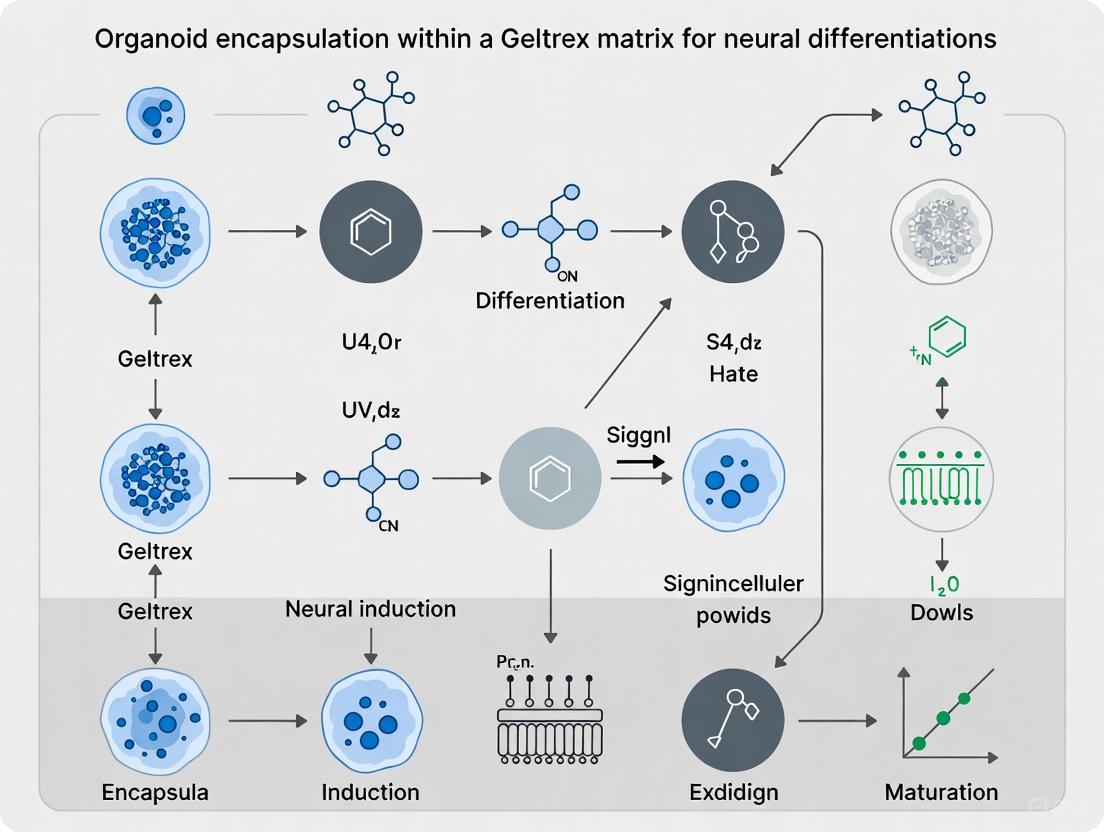
This article provides a detailed guide for researchers and drug development professionals on using Geltrex matrix for neural organoid culture.
Optimizing Neural Organoid Culture: A Comprehensive Guide to Geltrex Matrix Encapsulation
Abstract
This article provides a detailed guide for researchers and drug development professionals on using Geltrex matrix for neural organoid culture. It covers the foundational role of the extracellular matrix in neural differentiation, step-by-step encapsulation protocols, and troubleshooting for common challenges. The content also includes validation strategies and comparative analysis with other matrices like Matrigel, presenting Geltrex as a defined, reliable alternative. By integrating current research and practical methodologies, this resource aims to enhance the reproducibility and translational potential of neural organoid models in disease modeling and drug screening.
The Neural Stem Cell Niche: Why the Extracellular Matrix is Fundamental for Brain Organoids
Brain organoids are three-dimensional (3D) in vitro models derived from human pluripotent stem cells (hPSCs) that self-organize to recapitulate aspects of the human brain's developmental process and disease-related phenotypes [1]. This technology has emerged as a highly promising platform for studying human brain development, neurological disorders, and drug discovery, overcoming the limitations of traditional two-dimensional (2D) cell culture systems [2]. The integration of advanced extracellular matrices (ECM), particularly Geltrex matrix, has been pivotal in enhancing the structural complexity and functional maturity of these 3D neural models [2] [3].
The transition from 2D cultures to complex 3D models represents a paradigm shift in neural research. While 2D cultures have provided valuable insights into basic neural mechanisms, they lack the cellular diversity, spatial organization, and cell-cell interactions found in native brain tissue [2]. Brain organoids address these limitations by modeling the intricate cellular makeup and function of the developing brain, enabling researchers to investigate complex neurological processes and diseases with greater physiological relevance [2] [1].
Fundamental Concepts: From 2D Neural Differentiation to 3D Organoids
2D Neural Differentiation
Traditional 2D neural differentiation begins with neural stem cells (NSCs) derived from human embryonic stem cells (ESCs) or induced pluripotent stem cells (iPSCs) [4]. These self-renewing multipotent stem cells can be proliferated in supportive culture systems such as StemPro NSC SFM and subsequently differentiated into downstream neuronal and glial lineages through specific molecular induction [4]. The 2D differentiation process involves carefully timed exposure to growth factors and small molecules that direct cell fate toward specific neural lineages, including neurons, astrocytes, and oligodendrocytes [4].
Standard 2D protocols require preparing specialized coating substrates such as CELLstart, Geltrex matrix, or poly-L-ornithine/laminin to provide the necessary adhesion and signaling cues for neural attachment and differentiation [4]. The differentiation process is monitored through the expression of characteristic markers: NSCs express Nestin and Sox2; neurons express Doublecortin (Dcx) and MAP2; astrocytes express GFAP; and oligodendrocytes express GalC [4]. Despite their utility, 2D systems fundamentally lack the spatial architecture and complex cell-cell interactions of developing neural tissue, limiting their physiological relevance [2].
Advancements in 3D Brain Organoid Technology
3D brain organoids represent a significant technological advancement by mimicking the human brain's developmental process and cellular diversity [1]. These complex models are generated from pluripotent stem cells that spontaneously self-organize into structured tissues containing multiple neural cell types, including neurons, astrocytes, and oligodendrocytes [3] [5]. The development of brain organoids has opened new possibilities for modeling neurological disorders, screening therapeutic compounds, and studying human-specific aspects of brain development that cannot be adequately investigated in animal models [2] [1].
The enhanced biological relevance of 3D organoids comes with technical challenges, including batch-to-batch variability, incomplete cellular diversity, and lack of vascularization [1] [5]. Protocol refinement approaches such as the single rosette method generate more homogeneous organoids with consistent size, significantly improving reproducibility [5]. Furthermore, incorporating non-neural tissues such as meningeal cells through co-culture systems enhances cytoarchitecture and laminar organization, better mimicking the in vivo cortical environment [5].
Table 1: Comparative Analysis of 2D Neural Cultures vs. 3D Brain Organoids
| Characteristic | 2D Neural Cultures | 3D Brain Organoids |
|---|---|---|
| Spatial Organization | Flat, monolayer | Complex 3D structure with spatial patterning |
| Cellular Diversity | Limited cell types | Multiple neural cell types (neurons, astrocytes, oligodendrocytes) |
| Cell-Cell Interactions | Limited to adjacent cells | Enhanced, physiologically relevant interactions |
| Throughput | High | Moderate to low |
| Reproducibility | High | Variable (improved with standardized protocols) |
| Disease Modeling | Suitable for reductionist approaches | Better for complex neurological disorders |
| Maturation Timeline | Relatively fast | Extended culture periods required |
| Technical Complexity | Low to moderate | High |
Geltrex Matrix Encapsulation: Principles and Applications
Geltrex Composition and Properties
Geltrex is a solubilized basement membrane extract containing key extracellular matrix proteins including laminin, collagen IV, entactin, and heparan sulfate proteoglycans [6]. This complex composition closely mimics the natural extracellular environment of developing neural tissue, providing crucial biochemical and biophysical cues that support cell survival, proliferation, differentiation, and tissue organization [2] [6]. The reduced growth factor formulation minimizes confounding variables in experimental systems while maintaining essential matrix components necessary for neural development [6].
The Geltrex Flex platform represents the next generation of basement membrane matrices, offering enhanced flexibility through multiple sizing options (1mL, 5mL, and 10mL vials) and specialized formulations for specific applications [6]. This advancement reduces upfront costs, eliminates the need for manual aliquoting, minimizes lot-to-lot variability, and reduces potential contamination risks [6]. For neural research, dedicated formulations include the hESC-Qualified matrix for pluripotent stem cell maintenance and neural differentiation, and the Organoid-Qualified matrix specifically validated for complex 3D tissue modeling [6].
Mechanism of Action in Neural Differentiation
Geltrex matrix supports neural differentiation through multiple mechanisms. The laminin component particularly promotes neuronal attachment, neurite outgrowth, and synaptic formation through interactions with integrin receptors on neural cells [4] [3]. Additionally, the matrix provides a 3D scaffold that allows for self-organization and polarisation of neural structures, enabling the formation of complex features such as neural rosettes and layered cortical arrangements [2] [5].
The mechanical properties of Geltrex, including its viscoelastic characteristics, contribute to mechanotransduction signaling that influences neural differentiation and tissue patterning [7]. Studies have shown that the mechanical microenvironment regulates fundamental developmental processes in neural tissues, and Geltrex provides appropriate physical cues that promote proper morphogenesis [7]. When used in organoid encapsulation, the matrix additionally serves as a reservoir for nutrients and growth factors, sustaining cell viability in the inner regions of developing organoids [2] [3].
Diagram 1: Geltrex Matrix Mechanisms in Neural Differentiation
Experimental Protocols
Protocol 1: Generation of Midbrain Organoids with Geltrex Encapsulation
This protocol adapts the 2D dopaminergic neuron differentiation process for 3D midbrain organoid generation using the Gibco PSC Dopaminergic Neuron Differentiation Kit with Geltrex encapsulation [2] [3].
Materials:
- Human induced pluripotent stem cells (iPSCs)
- Gibco PSC Dopaminergic Neuron Differentiation Kit
- Geltrex LDEV-Free hESC-Qualified or Organoid-Qualified Matrix
- N2B27 medium
- DMEM/F-12
- KnockOut DMEM
- Matrigel or Geltrex for coating
- Low-attachment 96-well U-bottom plates
- Horizontal shaker
Procedure:
Preparation of Coated Plates (Day -2):
- Dilute Geltrex matrix 1:90 in cold KnockOut DMEM.
- Add 1.5 mL diluted matrix per well of a 6-well plate.
- Incubate plate at room temperature for 24 hours, then store at 4°C sealed with parafilm.
Neuroepithelial Stem Cell (NESC) Culture (Days -5 to 0):
- Thaw and plate NESCs derived from iPSCs onto pre-coated plates.
- Culture in N2B27 maintenance medium supplemented with 3μM CHIR99021 and 0.5-0.75μM purmorphamine.
- Passage cells at 80-90% confluence using Accutase.
- Seed 4-6×10^5 cells per well in 6-well plates for expansion.
3D Organoid Formation (Day 0):
- Dissociate NESCs with Accutase and resuspend in floor plate specification medium.
- Seed 5,000-10,000 cells per well in low-attachment 96-well U-bottom plates.
- Centrifuge plates at 300×g for 3 minutes to aggregate cells.
Geltrex Encapsulation (Day 2):
- Prepare floor plate specification medium supplemented with 2% Geltrex matrix.
- Carefully add the Geltrex-containing medium to the wells with cell aggregates.
- Maintain in static culture for 5 days to allow for initial specification.
Organoid Maturation (Days 7-35):
- Transfer organoids to floor plate expansion medium on day 7.
- On day 14, switch to dopaminergic neuron maturation medium.
- After day 21, transfer organoids to a horizontal shaker for improved nutrient exchange.
- Culture for up to 35 days total, with medium changes every 2-3 days.
Diagram 2: Midbrain Organoid Generation Workflow
Protocol 2: Cortical-Meningeal Organoid Co-culture System
This protocol describes the generation of cortical organoids with meningeal cell co-culture to enhance cytoarchitecture and laminar organization [5].
Materials:
- Human iPSCs
- Geltrex matrix
- Neural induction medium with 1μM dorsomorphin and 10μM SB431542
- Meningeal cell medium (ScienCell #1404)
- Human meningeal cells (ScienCell #1400)
- Accutase
- Low-attachment plates
Procedure:
Preparation of Geltrex Bubbles (Day -1):
- Place 30μL of concentrated Geltrex in the center of each well of a 12-well plate.
- Incubate for 20 minutes at 37°C to solidify.
- Coat the remaining surface around the bubble with Geltrex diluted 1:100 in DMEM/F-12.
iPSC Plating and Rosette Formation (Day 0):
- Dissociate iPSCs with Accutase.
- Seed 8×10^5 cells in TeSR-E8 medium around the Geltrex bubbles.
- After 24 hours, change to neural induction medium with supplements.
Single Rosette Selection (Day 5):
- Manually pick the largest single rosettes forming near the Geltrex bubbles.
- Transfer individual rosettes to separate wells of a 96-well round bottom plate.
- Culture for 3 days with neural induction medium changes every other day.
Meningeal Cell Co-culture (Day 8):
- Detach meningeal cells using Accutase.
- Add 8×10^3 meningeal cells to each organoid in suspension.
- Use a 1:1 mixture of meningeal cell medium and neural induction medium.
- Maintain this co-culture for 3 days.
Organoid Maturation (Days 12-70):
- Change to neural induction medium supplemented with 10ng/mL BDNF and 10ng/mL NT3.
- Refresh medium daily.
- Transfer organoids to 48-well round bottom plates after day 42 for continued maturation.
- Fix and analyze at desired timepoints (days 42, 56, or 70).
Comparative Analysis of Organoid Culture Methods
Table 2: Quantitative Comparison of 3D Organoid Culture Methods
| Culture Method | Organoid Morphology | Rosette Formation | Neuronal Maturation | Throughput | Technical Complexity |
|---|---|---|---|---|---|
| Suspension Culture (No ECM) | Irregular structures | Limited | Slow | High | Low |
| ECM Encapsulation | Enhanced complexity | Prominent | Accelerated | Low | High |
| U-well Plates (No ECM) | Regular shape | Moderate | Moderate | High | Moderate |
| U-well + Dilute Geltrex (2%) | Regular, complex | Prominent | Accelerated | High | Moderate |
| Meningeal Co-culture | Improved laminar organization | Enhanced | Enhanced | Moderate | High |
The Scientist's Toolkit: Essential Research Reagents
Table 3: Essential Reagents for Brain Organoid Research
| Reagent/Catalog Number | Function | Application Notes |
|---|---|---|
| Geltrex Matrix (A1413301/A1413302) | Basement membrane extract providing structural support and biochemical cues | Critical for organoid encapsulation; enhances complexity and maturation [2] [6] |
| StemPro NSC SFM | Serum-free medium for neural stem cell expansion | Supports NSC proliferation prior to differentiation [4] |
| N2 Supplement | Defined supplement for neural cell culture | Provides essential components for neural differentiation [4] [3] |
| B-27 Supplement | Serum-free supplement for neuronal cell culture | Enhances neuronal survival and maturation; use without Vitamin A for neural differentiation [4] [3] |
| BDNF (10ng/mL) | Brain-derived neurotrophic factor | Supports neuronal survival and differentiation in maturation phase [3] [5] |
| GDNF (10ng/mL) | Glial cell line-derived neurotrophic factor | Particularly important for dopaminergic neuron survival [3] |
| CHIR99021 (3μM) | GSK-3β inhibitor activating Wnt signaling | Promotes floor plate specification for midbrain patterning [3] |
| Purmorphamine (0.5-0.75μM) | Sonic hedgehog pathway agonist | Patterns neural tissue toward ventral midbrain fate [3] |
| Accutase | Cell detachment solution | Gentle enzymatic dissociation for neural cells and organoids [3] [5] |
| Human Meningeal Cells (ScienCell #1400) | Non-neural cells for co-culture systems | Enhances cortical organoid cytoarchitecture and laminar organization [5] |
| Prunasin | Prunasin|Cyanogenic Glycoside|For Research Use | High-purity Prunasin for plant physiology and biochemistry research. This product is for Research Use Only (RUO). Not for diagnostic or personal use. |
| Rubropunctatin | Rubropunctatin, CAS:514-67-0, MF:C21H22O5, MW:354.4 g/mol | Chemical Reagent |
Analytical Methods for Organoid Characterization
Immunohistochemical Analysis
Comprehensive characterization of brain organoids requires validation of neural cell types and structural organization through immunohistochemistry [4] [5]. Standard markers include:
- Neural Progenitors: Nestin, SOX2, PAX6
- Neurons: β-III Tubulin (TUJ1), MAP2, Doublecortin (Dcx)
- Dopaminergic Neurons: Tyrosine Hydroxylase (TH), FOXA2, LMX1A
- Astrocytes: GFAP, S100β
- Cortical Layer Markers: TBR2 (intermediate progenitors), CTIP2 (deep layers), BRN2 (upper layers)
Organoids should be fixed in 4% PFA for 20 minutes, cryoprotected in 30% sucrose, embedded in O.C.T. compound, and sectioned at 20μm thickness [5]. For 3D imaging of intact organoids, optical clearing using reagents such as CytoVista 3D Cell Culture Clearing Reagent enables deep-tissue imaging when combined with high-content analysis platforms [2].
High-Content Analysis and Imaging
Advanced imaging systems such as the Thermo Scientific CellInsight CX7 LZR High-Content Analysis Platform facilitate quantitative characterization of 3D organoids [2]. These systems acquire z-stacks through multicellular structures and provide automated measurements of organoid size, morphology, and marker expression patterns. This approach is particularly valuable for assessing the impact of Geltrex encapsulation on organoid complexity, as demonstrated by enhanced rosette formation in Geltrex-containing cultures [2].
Troubleshooting and Technical Considerations
Optimizing Geltrex Concentrations
The concentration of Geltrex matrix significantly influences organoid development. For midbrain organoid specification, a 2% concentration in the culture medium provides substantial benefits without the technical challenges of full encapsulation [2]. Higher concentrations (30-50%) are used for complete organoid encapsulation, creating a surrounding matrix that supports complex structural development [2]. Systematic optimization of Geltrex concentration is recommended when establishing new protocols or working with novel cell lines.
Enhancing Reproducibility
Batch-to-batch variability remains a challenge in organoid research. Several strategies can improve reproducibility:
- Use the single rosette selection method to generate organoids of consistent size and morphology [5]
- Implement standardized aggregation methods using U-bottom plates
- Utilize the Geltrex Flex platform with its reduced lot-to-lot variability [6]
- Incorporate quality control checkpoints using high-content imaging [2]
- Maintain consistent medium change schedules and environmental conditions
The integration of Geltrex matrix encapsulation represents a significant advancement in brain organoid technology, enabling the generation of more physiologically relevant 3D neural models that bridge the gap between traditional 2D cultures and in vivo brain tissue. The protocols and methodologies outlined in this application note provide researchers with robust tools for implementing these advanced techniques in their neural differentiation and disease modeling research. As the field continues to evolve, further refinements in matrix composition, co-culture systems, and analytical methods will enhance the precision and predictive power of brain organoid models, accelerating discovery in basic neurobiology and drug development for neurological disorders.
Geltrex Basement Membrane Matrix is a solubilized extracellular matrix (ECM) preparation derived from Engelbreth-Holm-Swarm (EHS) mouse tumors that serves as a critical biological scaffold for three-dimensional cell culture. Its core biochemical components—laminin, collagen IV, and entactin—create a structurally and biologically active microenvironment that mimics the in vivo basement membrane. When used for organoid encapsulation, particularly in neural differentiation research, this specific composition provides the essential cues for proper cell polarization, tissue organization, and morphogenesis. This application note details the matrix's core components, provides validated protocols for cerebral organoid generation, and presents quantitative data supporting its use in advanced neural research models.
Basement membranes are specialized sheets of extracellular matrix that form a crucial interface between epithelial, endothelial, muscle, or neuronal cells and their adjacent stromal tissues [8]. They not only deliver structural support but also play an active role in regulating critical cellular processes including adhesion, migration, proliferation, and differentiation. Geltrex matrix is a soluble form of this basement membrane that, when raised to 37°C, undergoes polymerization to form a reconstituted 3D gel [8]. This gel provides a physiologically relevant scaffold for cultivating complex tissue models like organoids.
In the specific context of neural organoid research, the encapsulation of pluripotent stem cell (PSC) aggregates in Geltrex matrix is a established methodological step. It supports the complex process of self-organization and morphogenesis required to form structured neural tissues in vitro [9]. The matrix components interact with cell surface receptors, influencing signaling pathways that guide differentiation and tissue patterning, making the specific composition of laminin, collagen IV, and entactin a foundational element for successful experimental outcomes.
Core Biochemical Components and Functional Significance
The biological functionality of Geltrex matrix is directly attributable to its major structural and functional proteins. The matrix is purified from EHS tumors and is composed of several key elements that work in concert.
Table 1: Core Protein Components of Geltrex Basement Membrane Matrix
| Component | Primary Function | Role in Neural Differentiation & Organoid Formation |
|---|---|---|
| Laminin | Primary organizer of basement membrane structure; binds to cell surface integrins and dystroglycan receptors. | Promoves cell adhesion, polarizes neuroepithelial cells, guides neuronal migration, and supports the formation of rosette structures in neural organoids. |
| Collagen IV | Provides structural integrity and tensile strength to the basement membrane; forms a flexible network. | Serves as a mechanical scaffold for growing neural tissues; influences neural progenitor cell differentiation through mechanotransduction pathways. |
| Entactin (Nidogen) | Acts as a critical bridging molecule, binding laminin and collagen IV networks to stabilize the ECM structure. | Facilitates the integration of biochemical and mechanical signals by ensuring the cohesion of the ECM microenvironment surrounding developing organoids. |
| Heparan Sulfate Proteoglycans | Includes perlecan; interacts with growth factors and cytokines to regulate their bioavailability and signaling. | Modulates key morphogen pathways (e.g., FGF, Wnt, BMP) essential for neural patterning, regional specification, and vascularization of cerebral organoids. |
The matrix is provided as a sterile, frozen solution with a protein concentration ranging from 9 to 18 mg/mL, depending on the specific product variant [10] [11]. It is formulated without phenol red to avoid potential estrogen-like effects and is tested to be free of lactose dehydrogenase elevating virus (LDEV), ensuring safety for cell culture applications [10] [11].
Geltrex Matrix for Neural Organoid Encapsulation: Experimental Workflow
The following section outlines a standardized protocol for generating cerebral organoids from pluripotent stem cells (PSCs), with a specific focus on the critical step of encapsulating neuralized embryoid bodies in Geltrex matrix.
Diagram 1: Workflow for generating neural organoids, highlighting the key encapsulation step in Geltrex matrix.
Detailed Protocol: Neural Organoid Formation
3.1.1. PSC Culture and Embryoid Body (EB) Formation
- PSC Culture: Maintain PSCs (e.g., H9 hESCs or iPSCs) in feeder-free conditions using StemFlex Medium on tissue cultureware coated with a 1:100 dilution of Geltrex LDEV-Free, hESC-Qualified Matrix [9].
- EB Formation: When PSC cultures reach 70-80% confluency, dissociate them into a single-cell suspension using a reagent like Accutase or TrypLE Select. Seed 6-9 x 10³ viable cells per well in a 96-well U-bottom ultra-low attachment plate (e.g., Nunclon Sphera) in StemFlex Medium supplemented with RevitaCell Supplement to enhance cell survival and aggregation. EBs form overnight and should be cultured for 3-4 days with 75% medium changes every other day [9].
3.1.2. Neural Induction and Patterning
- Following EB formation, induce neural differentiation by gradually transitioning to a neural induction medium, typically composed of DMEM/F-12 with GlutaMAX and N-2 Supplement [9].
- Culture EBs in this medium for 8-9 days, changing 75% of the volume every other day. A successful neural induction is marked by the appearance of a bright "ring" around the EB's periphery, indicating the formation of neuroepithelium [9].
3.1.3. Geltrex Matrix Encapsulation of Neuralized EBs This step is critical for supporting the subsequent 3D expansion and morphogenesis of the organoid.
- Thawing: Thaw an aliquot of undiluted Geltrex LDEV-Free Reduced Growth Factor Basement Membrane Matrix overnight at 2-8°C [8]. Keep it on ice during handling to prevent premature gelling.
- Encapsulation: Gently mix the neuralized EBs into the cold, liquid Geltrex matrix. Using a cold pipette tip, transfer droplets of the EB-matrix mixture onto a culture dish.
- Gelation: Incubate the dish at 37°C for 30 minutes to allow the matrix to polymerize and form a stable gel [8].
- Transfer: Once gelled, carefully transfer the encapsulated EBs to a low-attachment plate (e.g., Nunclon Sphera 6-well or 24-well plate) containing a differentiation medium that supports neural growth, such as a mix of Neurobasal Medium and DMEM/F-12, supplemented with B-27 [9].
3.1.4. Organoid Growth and Maturation
- Culture the encapsulated organoids on an orbital shaker at 80-85 rpm to enhance nutrient exchange [9].
- Change the medium every 2-3 days. Organoids can be cultured for many weeks to allow for advanced maturation and the emergence of complex neural structures.
- Characterize organoids through brightfield imaging, immunofluorescence, and gene expression analysis for markers like SOX1 (neural progenitor), MAP2 (neurons), and FOXG1 (forebrain) [9].
Advanced Application: Vascularization of Cerebral Organoids
A key limitation of cerebral organoids is the lack of a vascular network, leading to necrotic cores. Advanced research utilizes Geltrex matrix to promote endothelial network integration.
Table 2: Geltrex Matrix Concentration Effects on Endothelial Network Formation
| Geltrex Concentration | Total Vessel Length | Network Interconnectedness (Lacunarity) | Experimental Implication |
|---|---|---|---|
| 80% | Low | Low | Limited network formation; matrix is too dense for effective endothelial cell migration and tube formation. |
| 60% | Moderate | Moderate | Supports network formation; performance is enhanced with VEGF supplementation. |
| 40% | High | High (Low Lacunarity) | Optimal for robust and interconnected endothelial network formation; provides a tunable matrix for cell migration. |
A study by Fumadó Navarro et al. (2025) demonstrated an optimized strategy for generating vascularized cerebral organoids [12]. The method involved encapsulating human brain microvascular endothelial cells (HBMVECs) within the same Geltrex matrix droplet used to embed the developing cerebral organoid, as opposed to merely seeding them on the surface. This "encapsulation approach" was found to be superior, resulting in more stable and deeply integrated vascular networks [12].
Key Optimizations for Vascularization:
- Matrix Concentration: Reducing the Geltrex concentration from the standard 100% to 40-60% significantly improved endothelial network connectivity and total vessel length [12].
- Media and Supplements: Using a 1:1 mix of endothelial cell growth media and organoid maturation media, supplemented with VEGF (50 ng/mL), promoted the most robust network assembly [12].
Vascularized organoids demonstrated enhanced media internalization and up to a three-fold reduction in apoptosis compared to non-vascularized controls, highlighting the physiological benefits of an integrated endothelial network [12].
The Scientist's Toolkit: Essential Reagent Solutions
Table 3: Key Reagents for Neural Organoid Culture with Geltrex Matrix
| Reagent / Material | Function in Protocol | Example Product (Gibco) |
|---|---|---|
| Geltrex Matrix, hESC-Qualified | Coating substrate for initial 2D PSC culture to maintain pluripotency. | Geltrex LDEV-Free, hESC-Qualified (A1413301) [10] |
| Geltrex Matrix, Reduced GF | 3D encapsulation of neuralized EBs to support organoid morphogenesis. | Geltrex LDEV-Free Reduced GF (A1413201) [9] |
| StemFlex Medium | Robust, feeder-free medium for the expansion and maintenance of PSCs. | StemFlex Medium (A3349401) [9] |
| N-2 & B-27 Supplements | Serum-free supplements providing essential factors for neural induction and maintenance. | N-2 Supplement (17502001), B-27 Supplement (17504044) [9] |
| Low-Attachment Plates | Promote the formation and free-floating culture of uniform EBs and organoids. | Nunclon Sphera U-bottom Plates [9] |
| RevitaCell Supplement | Improves cell viability post-passivation and enhances EB formation efficiency. | RevitaCell Supplement (100X) (A2644501) [9] |
| Xanthoxyletin | Xanthoxyletin, CAS:84-99-1, MF:C15H14O4, MW:258.27 g/mol | Chemical Reagent |
| 7-Ethylcamptothecin | 7-Ethylcamptothecin, CAS:78287-27-1, MF:C22H20N2O4, MW:376.4 g/mol | Chemical Reagent |
Product Selection and Transition to Geltrex Flex Platform
Thermo Fisher Scientific has introduced the Geltrex Flex platform as the next generation of its basement membrane matrices, offering greater flexibility with 1 mL, 5 mL, and 10 mL vial sizes [13] [6]. The platform includes application-specific qualifications:
- Geltrex Flex hESC-Qualified: For attachment and maintenance of human PSCs [13] [6].
- Geltrex Flex Organoid-Qualified: Specifically tested for supporting the growth and differentiation of various organoids, including stable 3D dome formation [13] [14] [6].
- Geltrex Flex Reduced Growth Factor: For general cell culture applications, including angiogenesis and hepatocyte assays [13] [11].
Diagram 2: A guide for selecting the appropriate Geltrex matrix product based on primary research application.
It is important to note that the original Geltrex products (e.g., A1413301) are being phased out and will not be restocked. Researchers are encouraged to transition to the equivalent Geltrex Flex products for continued supply and enhanced flexibility [10] [6].
The differentiation of stem cells into neural lineages has long been guided by biochemical factors. However, emerging research reveals that the physical and mechanical properties of the extracellular matrix (ECM) serve as equally critical Instructive cues that direct neural stem cell fate through mechanotransduction—the process by which cells convert mechanical stimuli into biochemical signals [15]. For researchers employing organoid encapsulation in Geltrex matrix for neural differentiation, understanding these mechanobiological principles is essential for recapitulating the native stem cell niche and achieving reproducible, physiologically relevant outcomes.
The ECM provides not merely structural support but a dynamic, information-rich environment. During neural development, the mechanical landscape evolves precisely, with properties such as matrix stiffness, viscoelasticity, and ligand presentation orchestrating fundamental processes including neurogenesis, neuronal migration, and circuit formation [15]. This application note details the principles and protocols for harnessing mechanotransduction to guide neural differentiation within Geltrex-based systems, providing a structured framework for researchers and drug development professionals.
Core Principles: Matrix-Derived Mechanotransduction
Key Mechanical Cues and Their Cellular Perception
Cells perceive mechanical cues from their environment through transmembrane receptors, primarily integrins, which bind to ECM ligands such as the laminin abundantly present in Geltrex [15]. This binding initiates the assembly of focal adhesion complexes, connecting the external matrix to the internal cytoskeleton. Force transmission through these complexes leads to cytoskeletal remodeling and activation of downstream signaling pathways, ultimately influencing nuclear transcription and cell fate decisions [15]. The table below summarizes the key mechanical parameters and their biological impacts in neural differentiation.
Table 1: Key Mechanical Cues in Neural Differentiation
| Mechanical Cue | Typical Physiological Range in Neural Tissue | Cellular Sensors | Impact on Neural Cell Fate |
|---|---|---|---|
| Stiffness/Elasticity | ~0.1-1 kPa (Brain-like) [15] | Integrins, Focal Adhesions, Mechanosensitive Ion Channels | Softer matrices promote neurogenesis; stiffer matrices tend to favor glial fates. |
| Ligand Presentation | Variable density & identity (e.g., Laminin, Fibronectin) | Integrins, Syndecans | Specific ligands (e.g., Laminin in Geltrex) provide adhesive cues and co-activate growth factor signaling. |
| Viscoelasticity | Stress relaxation is critical for process outgrowth [15] | Integrins, Cytoskeleton | Matrices that relax stress better facilitate neurite extension and cell migration. |
| Topography/Geometry | Nanoscale to microscale features | Focal Adhesions, Cytoskeleton | Aligned fibers can guide neurite orientation; 3D confinement affects polarity and branching. |
Downstream Signaling Pathways
The mechanical signals perceived at the cell surface are transduced into biochemical activity through several key pathways. The YAP/TAZ pathway is a primary mechanotransduction effector, where nuclear translocation is promoted on stiff substrates and inhibited on soft, brain-like matrices, directly influencing cell proliferation versus differentiation [15]. The Wnt/β-catenin pathway is also mechanically regulated, with forces stabilizing β-catenin and activating target genes crucial for neural patterning [15]. Furthermore, mechanical strain can trigger calcium signaling through mechanosensitive ion channels, a response vividly demonstrated in human cerebral organoid models of traumatic brain injury [16].
The following diagram illustrates the core mechanotransduction pathway from matrix interaction to transcriptional changes.
Experimental Data and Comparisons
Influence of Culture Substrate on Neuronal Morphology and Maturation
The choice of culture substrate profoundly impacts the morphological and functional maturity of derived neurons. A comparative study on rat iPSC-derived neural progenitor cells (NPCs) plated on four common substrates revealed significant differences in neuronal arborization and maturity after nine days of differentiation [17].
Table 2: Substrate Comparison for Neuronal Differentiation of riPSC-NPCs
| Culture Substrate | Neuronal Morphology | Neurite Outgrowth & Arborization | Functional Maturity (Electrophysiology) |
|---|---|---|---|
| Polyornithine/Laminin | Complex, highly arborized morphology | Extensive neurite outgrowth and branching | Promoted electrical maturation [17] |
| Geltrex | Bipolar cell morphology predominant | Limited arborization | Indicators of functional immaturity [17] |
| Poly-D-Lysine | Limited arborization | Restricted neurite outgrowth | Not specified |
| Gelatin | Least favorable morphology | Poor growth and differentiation | Not specified |
This data underscores that Polyornithine-Laminin coating is superior for achieving complex neuronal morphologies and maturation, while Geltrex favors a simpler, bipolar neuronal phenotype [17]. This is a critical consideration when selecting a matrix for specific research applications.
Accelerating Neuronal Maturation with Small Molecules
The slow maturation of human PSC-derived neurons remains a major challenge. A high-content screen identified a cocktail of small molecules, termed GENtoniK, that significantly accelerates maturation across morphological, synaptic, and electrophysiological parameters [18]. This cocktail, applied transiently, induces a lasting "maturation memory" in the cells.
Table 3: GENtoniK Cocktail Components and Functions
| Component | Target/Function | Role in Maturation |
|---|---|---|
| GSK2879552 | Inhibitor of LSD1/KDM1A (Histone Demethylase) | Chromatin remodeling to promote a mature transcriptional state [18] |
| EPZ-5676 | Inhibitor of DOT1L (Histone Methyltransferase) | Chromatin remodeling; works synergistically with LSD1 inhibition [18] |
| NMDA | Agonist of NMDA-type Glutamate Receptors | Activates calcium-dependent transcription and synaptic signaling pathways [18] |
| Bay K 8644 | Agonist of L-Type Calcium Channels (LTCC) | Potentiates calcium influx and activates transcriptional programs for maturity [18] |
The Scientist's Toolkit: Essential Reagents for Mechanotransduction Studies
Table 4: Key Research Reagent Solutions
| Reagent / Material | Function / Application | Example / Note |
|---|---|---|
| Geltrex / Matrigel | Basement membrane extract for 3D organoid culture and substrate coating. | Provides laminin-rich, biologically active environment; batch variability is a known challenge [15] [19]. |
| Laminin | Core adhesive ligand in neural ECM for neurite outgrowth. | Often used in combination with Polyornithine for 2D neuronal culture [4] [17]. |
| Poly-L-Ornithine | Synthetic polymer coating to enhance surface adhesion for neural cells. | Provides a positive charge for cell attachment, often as a base coat for laminin [4]. |
| B-27 & N-2 Supplements | Serum-free supplements providing hormones, antioxidants, and other factors. | Essential for neuronal survival and differentiation in defined media [4]. |
| Growth Factors (EGF, bFGF, BDNF) | Signaling molecules for proliferation (EGF, bFGF) and neuronal maturation (BDNF). | Used in staged protocols: EGF/bFGF for NSC expansion, BDNF for differentiation [4] [17]. |
| Y-27632 (ROCK inhibitor) | Inhibitor of Rho-associated kinase; promotes single-cell survival after passaging. | Reduces anoikis; critical for enhancing organoid growth and passage efficiency [19]. |
| GENtoniK Cocktail | Small-molecule combination to accelerate neuronal maturation. | Contains GSK2879552, EPZ-5676, NMDA, and Bay K 8644 [18]. |
| Decitabine | 4-Amino-1-[4-hydroxy-5-(hydroxymethyl)oxolan-2-yl]-1,3,5-triazin-2-one | Explore 4-Amino-1-[4-hydroxy-5-(hydroxymethyl)oxolan-2-yl]-1,3,5-triazin-2-one for research. This compound is For Research Use Only (RUO). Not for human or veterinary diagnosis or therapeutic use. |
| Creatine Monohydrate | Creatine Monohydrate|High-Purity Reagent|RUO | High-purity Creatine Monohydrate for research. Study energy metabolism, neuroprotection, and myopathies. For Research Use Only. Not for human consumption. |
Detailed Protocols for Neural Differentiation
Protocol 1: Coating Culture Vessels with Geltrex Matrix for 2D Culture
This protocol is essential for preparing surfaces for the attachment and growth of neural stem cells or for plating organoid-derived cells for downstream assays [4].
Materials:
- Geltrex Matrix (Thermo Fisher Scientific)
- Cold D-MEM/F-12 medium
- Pre-chilled tubes and pipettes
Procedure:
- Thawing: Thaw the Geltrex matrix bottle overnight at 4°C to prevent polymerization.
- Aliquot Preparation: Dilute Geltrex matrix 1:2 with cold D-MEM/F-12 at 4°C to make a 100X stock solution. Quickly prepare 0.5 mL aliquots in pre-chilled 50 mL conical tubes and store at –20°C.
- Working Solution: Thaw one 0.5 mL aliquot slowly at 4°C. Add 49.5 mL of cold D-MEM/F-12 to achieve a 1:100 dilution. Mix gently.
- Coating: Cover the entire surface of the culture plate with the Geltrex solution (e.g., 1.5 mL for a 35-mm dish).
- Incubation: Seal the dish with Parafilm and incubate for 1 hour at room temperature in a laminar flow hood.
- Plating: Immediately before use, aspirate all Geltrex matrix solution, wash once with D-PBS (with calcium and magnesium), and replace with pre-warmed complete culture medium.
Note: Geltrex-treated dishes can be stored at 4°C, wrapped in Parafilm, for up to one month. Do not let the coating dry out [4].
Protocol 2: Encapsulation of Organoids in Geltrex for 3D Culture
3D encapsulation is the cornerstone of cerebral organoid generation, providing a biomimetic environment for self-organization.
Materials:
- Neural progenitor cells (NPCs) or embryoid bodies (EBs)
- Geltrex Matrix
- Pre-warmed neural differentiation medium
Procedure:
- Prepare Geltrex: Thaw Geltrex on ice and keep it liquid at 4°C.
- Mix Cell Suspension: Gently mix the concentrated pellet of NPCs or EBs with cold Geltrex. The final concentration of Geltrex should be high enough to form a dome (typically >70%).
- Plate Droplets: Pipette small droplets (e.g., 20-50 µL) of the cell-Geltrex mixture onto the surface of a culture dish.
- Polymerize: Incubate the dish at 37°C for 20-30 minutes to allow the Geltrex to polymerize and form a solid dome.
- Feed Cultures: Carefully overlay the polymerized domes with pre-warmed neural differentiation medium.
- Maintain Cultures: Change the medium regularly. For long-term culture, organoids can be embedded in a thin layer of Geltrex to provide structural support or transferred to agitated cultures to enhance nutrient exchange [20] [16].
Protocol 3: Differentiation of Encapsulated Neural Stem Cells
This workflow outlines the stages from expansion to lineage-specific differentiation, which can be applied to cells within a 3D Geltrex environment.
Materials:
- StemPro NSC SFM Complete Medium: KnockOut D-MEM/F-12 supplemented with 2% StemPro Neural Supplement, 20 ng/mL EGF, 20 ng/mL bFGF, and 2 mM GlutaMAX [4].
- Neural Differentiation Medium: Neurobasal Medium supplemented with 2% B-27 Supplement and 2 mM GlutaMAX [4].
- Astrocyte Differentiation Medium: D-MEM supplemented with 1% N-2 Supplement, 2 mM GlutaMAX, and 1% FBS [4].
- Oligodendrocyte Differentiation Medium: Neurobasal Medium supplemented with 2% B-27, 2 mM GlutaMAX, and 30 ng/mL T3 [4].
Procedure:
- Expansion: Maintain and expand neural stem cells (NSCs) in StemPro NSC SFM Complete Medium on Geltrex-coated vessels or in 3D aggregates.
- Plating/Encapsulation: For differentiation, plate NSCs as a monolayer on Geltrex or encapsulate them as 3D organoids in Geltrex droplets as described in Protocols 1 and 2.
- Induction: Switch the medium to the appropriate differentiation medium.
- For general neurons, use Neural Differentiation Medium for several weeks.
- For astrocytes, use Astrocyte Differentiation Medium.
- For oligodendrocytes, use Oligodendrocyte Differentiation Medium.
- Maturation (Optional): To accelerate neuronal maturation, treat cultures with the GENtoniK cocktail (e.g., from day 7 to day 14, with analysis after a compound-free period) [18].
- Characterization: Differentiated cells can be characterized by immunocytochemistry for markers like MAP2/TUJ1 (neurons), GFAP (astrocytes), and GalC/O4 (oligodendrocytes), and by functional assays like patch-clamp electrophysiology [4] [17].
Integrating an understanding of mechanotransduction into neural differentiation protocols is paramount for advancing organoid research. While Geltrex provides a biologically rich and laminin-rich environment conducive to initial neural specification and organization, its undefined nature and mechanical limitations can introduce variability and restrict functional maturation [15] [19]. The future of reproducible and physiologically accurate neural organoid culture lies in the development of defined, tunable synthetic matrices that allow precise control over mechanical properties such as stiffness, viscoelastic stress relaxation, and adhesive ligand density [15] [19]. By combining these advanced biomaterials with optimized biochemical and small-molecule cues, such as the GENtoniK cocktail, researchers will be better equipped to build robust, predictive in vitro models of human neural development and disease.
The extracellular matrix (ECM) is not merely a structural scaffold but a dynamic, bioactive environment that profoundly influences cellular fate through the regulation of key signaling pathways. In advanced in vitro neural models, such as cerebral organoids, the ECM provides critical biochemical and mechanical cues that direct cell behavior. The use of defined matrices, like Geltrex, for organoid encapsulation has become a cornerstone technique for investigating these complex interactions. This application note details how the ECM, particularly in 3D organoid cultures, orchestrates the YAP/Notch signaling network and other pathways to guide neural differentiation and tissue morphogenesis. Framed within the context of neural differentiation research, we provide quantitative data, optimized protocols, and visual workflows to empower researchers in leveraging these insights for more physiologically relevant brain models and drug screening applications.
Core Signaling Pathways
The YAP/Notch/REST Signaling Network
The YAP and Notch pathways form a conserved, interconnected network that is critically sensitive to ECM composition and rigidity. This network acts as a primary mechanism through which the ECM transmits mechanical and biochemical signals to the nucleus to control cell fate decisions, particularly in neural systems.
- Notch Signaling Activation: The Notch pathway is a canonical cell-cell communication pathway. Ligand-receptor interactions between neighboring cells trigger proteolytic cleavage of the NOTCH receptor, releasing the Notch intracellular domain (NICD). NICD translocates to the nucleus, complexes with the transcription factor RBP-J, and activates the expression of target genes including HES1 and REST [21].
- YAP/TAZ as Mechanotransducers: The Hippo pathway effectors YAP and its paralog TAZ are central mediators of mechanotransduction. In response to ECM stiffness, cell spreading, and cytoskeletal tension, YAP translocates from the cytoplasm to the nucleus. There, it partners with transcription factors like TEADs to promote the expression of genes driving proliferation and inhibiting differentiation.
- Network Crosstalk: A crucial link exists between YAP and Notch in determining neuroendocrine (NE) cell fate. YAP and REST have been identified as promoters of the transition from a NE to a non-NE state, a process driven by Notch activation. This network is conserved across embryonic lung development, adult lung repair, and cancer, highlighting its fundamental role in cell fate control [21]. NOTCH activation in NE cells leads to the upregulation of REST, which acts as a transcriptional repressor of neuronal genes, thereby reinforcing the non-neuronal, epithelial fate.
The following diagram illustrates the core components and interactions within this pathway, particularly in the context of neural fate decisions:
Diagram Title: YAP/Notch/REST Network in Cell Fate
Additional Key ECM-Sensitive Pathways
Beyond the YAP/Notch axis, the ECM modulates several other critical signaling pathways that collectively determine stem cell behavior and neural differentiation outcomes. These pathways often exhibit extensive crosstalk, creating a robust regulatory network.
- Wnt/β-catenin Pathway: The Wnt pathway is a principal regulator of tissue homeostasis and stem cell self-renewal. ECM components can sequester Wnt ligands or present them to cells, thereby modulating signaling activity. In spinal cord injury models, the Wnt/β-catenin pathway is a key molecular signal regulating the differentiation fate of endogenous neural stem cells (eNSCs) [22]. Its activation can be directed towards neuronal fates, making it a prime target for therapeutic intervention.
- Hedgehog (Hh) Pathway: The Hedgehog pathway is vital for embryonic patterning, including limb and bone formation, via the regulation of epithelial-mesenchymal interactions. Similar to Wnt, the ECM can influence the distribution and activity of Hh ligands. This pathway works in concert with others to fine-tune the delicate balance between stem cell self-renewal and differentiation [23].
- TGF-β/BMP Signaling: The TGF-β superfamily, including BMPs, plays a multifaceted role in development and tissue repair. TGF-β signaling is crucial for maintaining pluripotency in stem cells; for instance, BMP-4 supports the self-renewal of embryonic stem cells [23]. The pathway is also a key mediator of ECM deposition and cellular differentiation, with its outcomes highly dependent on cellular context and the specific ligands involved.
The table below summarizes the core functions and cellular outcomes of these key ECM-sensitive pathways.
Table 1: Key ECM-Sensitive Signaling Pathways in Stem Cell Regulation
| Pathway | Core Functions | Key Cellular Outcomes | Context in Neural Models |
|---|---|---|---|
| YAP/Notch | Mechanotransduction, Cell-Cell Communication, Fate Decision | Promotes non-neural/epithelial fate, Represses neuronal genes [21] | Inhibits neuroendocrine fate, promotes proliferative state |
| Wnt/β-catenin | Tissue Homeostasis, Stem Cell Self-Renewal | Regulates eNSC differentiation, Supports progenitor proliferation [22] | Target for enhancing neuronal differentiation after injury |
| Hedgehog (Hh) | Embryonic Patterning, Epithelial-Mesenchymal Interaction | Regulates cell differentiation and tissue morphogenesis [23] | Works in concert with other pathways to fine-tune cell fate |
| TGF-β / BMP | Pluripotency Maintenance, ECM Deposition, Differentiation | Maintains naive pluripotency (e.g., via BMP-4), directs lineage specification [23] | Role in maintaining stem cell state and guiding differentiation |
Quantitative Data and Analysis
Optimization of the ECM environment is a quantitative process. Systematic analysis of hydrogel concentration and media composition is required to balance multiple experimental parameters, from network formation to tissue health. The following data, derived from vascularized cerebral organoid studies, provides a framework for this optimization in neural differentiation contexts.
Table 2: Optimization of ECM and Media for Network Formation in 3D Cultures
| Experimental Parameter | Tested Conditions | Optimal Condition | Observed Outcome in Optimal Condition |
|---|---|---|---|
| Hydrogel Concentration | 40%, 60%, 80% Geltrex | 40% Geltrex | Highest network density, greatest total vessel length, lowest lacunarity [12] |
| Media Composition | ECG:Maturation Media (1:0, 1:7, 1:3, 1:1, 0:1) | Ratio of 1:1 | Most robust networks (highest junctions, lowest endpoints) [12] |
| VEGF Dosage & Schedule | 25 ng/mL vs. 50 ng/mL; Every 2 vs. 4 days | 50 ng/mL every 4 days | Robust network formation, aligned with practical media change schedule [12] |
| Cell Seeding Density | 50,000; 500,000; 2 million HBMVECs/organoid | 50,000 HBMVECs/organoid | Effective superficial network formation, prevented excess layer deposition [12] |
The impact of a well-defined ECM and culture environment extends beyond molecular signaling to tangible improvements in organoid physiology. Vascularized cerebral organoids generated using optimized Geltrex encapsulation protocols demonstrated significant functional advantages over their non-vascularized counterparts, including a three-fold reduction in apoptosis and greater media internalization, which mitigates the formation of a necrotic core [12]. These factors are critical for maintaining healthy, differentiated neuronal populations in long-term cultures.
Experimental Protocols
Protocol: Generation and Encapsulation of Cerebral Organoids in Geltrex
This protocol adapts and refines established methods for generating cerebral organoids, with a focus on encapsulation within a Geltrex matrix to support complex tissue development and signaling pathway modulation [12].
Part A: Generation of Cerebral Organoids
- Initial Aggregation: Using the STEMdiff Cerebral Organoid Kit or a similar protocol based on Lancaster et al., aggregate human induced pluripotent stem cells (iPSCs) or embryonic stem cells (hESCs) in low-attachment 96-well U-bottom plates.
- Neural Induction: Maintain aggregates in neural induction media for the initial phase (typically ~6 days) to promote the formation of neuroectoderm.
- Matrix Embedding (Day ~8): On approximately day 8, embed each organoid in a droplet of Geltrex matrix. The optimal concentration for supporting network infiltration is often a 40% dilution of the commercial Geltrex product [12].
- Expansion and Maturation: Transfer the encapsulated organoids to a spinning bioreactor or an orbital shaker to enhance nutrient exchange. Culture them in organoid maturation media for several weeks to months, allowing for the development of complex neural structures.
Part B: Experimental Modulation for Signaling Studies
- ECM Modulation: To study the effect of ECM stiffness, prepare Geltrex at different concentrations (e.g., 40%, 60%, 80%) during the encapsulation step (Part A, Step 3).
- Pharmacological Inhibition/Activation: To dissect specific pathway functions, supplement the maturation media with small molecule inhibitors or activators.
- YAP Inhibition: Add 1-5 µM Verteporfin.
- Notch Inhibition: Add 5-10 µM DAPT (a γ-secretase inhibitor).
- Include vehicle control (e.g., DMSO) in parallel cultures.
- Endpoint Analysis: After the desired culture period, analyze organoids via:
- Immunofluorescence for key neural markers (βIII-Tubulin, MAP2), glial markers (GFAP), Notch effectors (NICD, HES1), and YAP localization.
- RNA Sequencing or qPCR to evaluate transcriptomic changes in pathway targets (REST, HES1, CTGF, CYR61) and neural genes.
- Confocal Imaging to assess organoid morphology, cytoarchitecture, and the presence of integrated networks.
Protocol: Quantitative Analysis of Endothelial Network Integration
This ancillary protocol is useful for quantifying the success of vascularization or other network-forming processes within organoids, a key readout of ECM functionality.
- Sample Staining: Fix organoids and immunostain for endothelial cell markers (e.g., CD31) and relevant neural or structural markers.
- Image Acquisition: Capture high-resolution z-stack images of the entire organoid using a confocal microscope.
- Image Analysis: Use automated image analysis software (e.g., ImageJ with Angiogenesis Analyzer, or commercial HCS platforms).
- Metrics to Quantify:
- Total Vessel Length: The sum of the length of all network branches.
- Number of Junctions: The points where three or more branches meet.
- Lacunarity: A measure of "gappiness" or structural heterogeneity; lower values indicate denser, more interconnected networks [12].
- Metrics to Quantify:
- Statistical Analysis: Perform statistical tests (e.g., one-way ANOVA) to compare the metrics between different experimental conditions (e.g., varying Geltrex concentrations, presence of inhibitors).
The workflow for the complete process of generating and analyzing ECM-encapsulated organoids is summarized below:
Diagram Title: Organoid Encapsulation and Analysis Workflow
The Scientist's Toolkit: Research Reagent Solutions
Successful research into ECM-regulated pathways relies on a suite of specialized reagents. The following table details essential materials and their functions for organoid encapsulation and signaling studies.
Table 3: Essential Research Reagents for Organoid Encapsulation and Signaling Studies
| Reagent / Material | Function / Application | Example Product / Specification |
|---|---|---|
| Basement Membrane Matrix | Provides a biologically active 3D scaffold for organoid encapsulation and growth; contains laminin, collagen IV, entactin, and heparan sulfate proteoglycans. | Geltrex Flex LDEV-Free Organoid-Qualified Matrix [13] |
| Induced Pluripotent Stem Cells | The starting cell source for generating patient-specific cerebral organoids. | Quality-controlled iPSC line; confirm normal karyotype and pluripotency. |
| Cerebral Organoid Kit | Provides a standardized system for the directed differentiation of iPSCs into cerebral organoids. | STEMdiff Cerebral Organoid Kit [12] |
| VEGF Supplement | Critical cytokine for inducing endothelial network formation and angiogenesis within the organoid. | Recombinant Human VEGF-165 (50 ng/mL) [12] |
| Notch Pathway Inhibitor | Small molecule inhibitor (γ-secretase inhibitor) used to experimentally block Notch signaling. | DAPT (N-[N-(3,5-Difluorophenacetyl)-L-alanyl]-S-phenylglycine t-butyl ester) |
| YAP/TAZ Inhibitor | Small molecule inhibitor used to disrupt YAP-mediated transcriptional activity. | Verteporfin (for research use) |
| Endothelial Cell Medium | Specialized medium for supporting the growth and network formation of endothelial cells. | EGM-2 MV or similar ECG media, used in a 1:7 ratio with organoid maturation media [12] |
| Gibberellin A5 | Gibberellin A5, CAS:561-56-8, MF:C19H22O5, MW:330.4 g/mol | Chemical Reagent |
| 5-Deoxystrigol | 5-Deoxystrigol, CAS:151716-18-6, MF:C19H22O5, MW:330.4 g/mol | Chemical Reagent |
In the field of neural differentiation research, the selection of an appropriate extracellular matrix (ECM) is a critical determinant of experimental success. Basement membrane matrices provide the essential physical scaffolding and biochemical cues necessary for stem cell maintenance, organoid development, and tissue-specific differentiation. Among commercially available options, Geltrex Basement Membrane Matrix has emerged as a frequently utilized substrate, though its precise performance characteristics relative to alternative matrices must be thoroughly understood to make informed experimental decisions. This application note provides a systematic benchmarking of Geltrex within the specific context of neural organoid encapsulation, enabling researchers to optimize their culture systems for enhanced reproducibility, maturation, and functionality.
The complex microenvironment provided by ECM materials influences multiple aspects of organoid development, including cell survival, proliferation, polarity, and ultimately, the acquisition of mature neural phenotypes. While traditional matrices like Matrigel have long served as the field standard, a growing recognition of batch-to-batch variability and undefined composition has driven the search for more consistent alternatives [24]. Geltrex, a basement membrane extract with a defined protein composition including laminin, collagen IV, entactin, and heparan sulfate proteoglycans, presents itself as a potential solution to these challenges [6]. This evaluation positions Geltrex within the landscape of commercial matrices through comparative performance metrics, detailed protocols for neural applications, and analysis of its mechanistic contributions to neural differentiation pathways.
Comparative Performance Analysis of Commercial Matrices
Quantitative Benchmarking of Key Matrices
A comparative study of human induced pluripotent stem cell (hiPSC) maintenance and intestinal organoid generation in four different matrices—Matrigel (Matrix 1-AB), Geltrex (Matrix 2-AB), Cultrex (Matrix 3-AB), and VitroGel (Matrix 4-XF)—revealed significant differences in performance characteristics [25]. Although this evaluation focused on intestinal models, the findings provide valuable insights applicable to neural differentiation research, particularly regarding stem cell maintenance and three-dimensional structure formation.
Table 1: Performance Benchmarking of Commercial Basement Membrane Matrices
| Matrix | Origin | Stem Cell Marker Expression (SSEA-4) | 3D Structure Formation | Differentiation Efficiency | Key Findings |
|---|---|---|---|---|---|
| Geltrex | Animal-derived | >85% [25] | Spheroid formation with minimal spontaneous differentiation [25] | Fewer spheroid releases during mid-/hindgut stage [25] | Consistent performance, suitable for protocol standardization |
| Matrigel | Animal-derived | >85% [25] | Standard spherical colonies [25] | Moderate differentiation efficiency [25] | Established benchmark, but with noted batch variability [24] |
| Cultrex | Animal-derived | >85% [25] | Standard spherical colonies [25] | Comparable to Matrigel [25] | Functionally similar to Matrigel with potentially improved consistency |
| VitroGel | Xeno-free | Improved by 1.3-fold with optimized media [25] | Formation of 3D round clumps [25] | Leads to larger, more mature organoids [25] | Enhanced maturation potential; clinically translatable platform |
The data indicate that while all tested animal-derived matrices (Geltrex, Matrigel, and Cultrex) supported hiPSC maintenance with over 85% expression of the stem cell marker SSEA-4, each exhibited distinct characteristics in differentiation protocols [25]. Specifically, hiPSCs maintained in Geltrex demonstrated fewer spheroid releases during the mid-/hindgut differentiation stage compared to other animal-derived basement membranes, suggesting potentially altered differentiation kinetics that may be relevant to neural patterning protocols [25].
Advancements in Geltrex Formulations
The Geltrex product line has evolved to include specialized formulations addressing specific research needs. The introduction of Geltrex Flex platform offers enhanced flexibility through multiple sizing options (1mL, 5mL, and 10mL vials), reducing the need for manual aliquoting and minimizing freeze-thaw cycles that contribute to batch variability [6]. Most notably for neural organoid research, the platform now includes a dedicated Organoid-Qualified formulation specifically validated for complex 3D tissue modeling and stable dome formation [6]. This specialized formulation undergoes rigorous quality testing to ensure lot-to-lot consistency, addressing a critical pain point in organoid research reproducibility.
For researchers transitioning from legacy Geltrex products, the Geltrex Flex series provides direct replacements: Geltrex Flex LDEV-Free Reduced Growth Factor Basement Membrane Matrix for general cell culture, Geltrex Flex LDEV-Free hESC Qualified Reduced Growth Factor Basement Membrane Matrix for stem cell maintenance, and Geltrex Flex LDEV-Free Organoid-Qualified Reduced Growth Factor Basement Membrane Matrix for 3D organoid applications [6]. This streamlined product range allows for more precise matrix selection aligned with specific experimental objectives in neural differentiation studies.
Geltrex in Neural Organoid Research: Applications and Protocols
Neural Organoid Culture Using Geltrex Matrices
Neural organoids derived from human pluripotent stem cells have emerged as powerful models for studying human brain development, disease mechanisms, and drug screening applications [26] [27]. The integration of Geltrex as a scaffolding material provides critical structural and biochemical support during the complex process of neural differentiation and organoid maturation. Research indicates that neural organoids cultured in Geltrex-based systems demonstrate enhanced cellular diversity, regional specification, and functional maturation compared to those grown in traditional two-dimensional cultures [26].
For glioblastoma research, neural organoids serve as advanced platforms for investigating tumor invasion within a human-relevant neural microenvironment [26]. In these models, Geltrex provides a permissive substrate that supports both organoid development and subsequent tumor cell integration. Studies have demonstrated invasion depths of up to 300 μm in such systems, with organoid maturity, culture duration, and ECM composition identified as critical factors influencing model performance [26]. The defined nature of Geltrex enhances experimental reproducibility in these applications compared to poorly defined matrices.
Table 2: Research Reagent Solutions for Neural Organoid Encapsulation
| Reagent | Function | Application Notes |
|---|---|---|
| Geltrex Flex LDEV-Free hESC Qualified | Maintenance of pluripotent stem cells | Rigorously tested for hESC/hiPSC expansion; supports attachment and pluripotency maintenance [6] |
| Geltrex Flex Organoid-Qualified | 3D neural organoid formation | Supports stable 3D dome formation; optimized for complex neural tissue assembly [6] |
| DMEM/F-12 with HEPES | Base medium for organoid culture | Provides nutritional support and buffering capacity for pH stability [28] |
| Y-27632 ROCK Inhibitor | Enhances cell survival | Reduces apoptosis during initial plating and passaging; critical for improving viability |
| Neural Induction Supplements | Directs neural lineage specification | Typically includes N-2, B-27, and other patterning factors for regional identity |
| GelMA (Gelatin Methacrylate) | Engineered hydrogel alternative | Tunable mechanical properties; used in biohybrid systems for enhanced maturation [29] |
Detailed Protocol: Neural Organoid Encapsulation in Geltrex
Thawing and Preparation of Geltrex Hydrogel
- Procedure: Rapidly thaw Geltrex matrix on ice overnight or at 4°C for approximately 2-3 hours. Never thaw at room temperature or 37°C, as premature polymerization will occur. Pre-chill all tubes, pipette tips, and culture vessels before handling Geltrex. For neural organoid work, prepare a working solution concentration of 8-12 mg/mL in cold DMEM/F-12 medium. Keep the solution on ice at all times during handling to prevent premature gelling.
hiPSC Dissociation and Encapsulation
- Procedure: Differentiate hiPSCs toward neural lineage using your established protocol for 10-15 days until neural progenitor cells are obtained. Gently dissociate neural progenitor clusters using Accutase or enzyme-free dissociation buffer, creating small cell aggregates of 100-200 cells. Resuspend the cell aggregates in the ice-cold Geltrex solution at a density of 1-2 × 10^6 cells/mL. Pipette 20-40 μL drops of the cell-Geltrex suspension onto pre-warmed culture plates. Incubate at 37°C for 30 minutes to allow polymerization, then carefully overlay with neural differentiation medium.
Neural Organoid Maturation and Maintenance
- Procedure: Culture organoids for 7-10 days before first passaging. Refresh 50% of the medium every 2-3 days, carefully removing old medium without disturbing the Geltrex domes. For long-term culture (beyond 30 days), monitor for core necrosis and consider periodic cutting using 3D-printed jigs to maintain viability [28]. Assess maturity markers at appropriate timepoints: βIII-tubulin (TUBB3) for early neurons, MAP2 for mature neurons, GFAP for astrocytes, and MBP for oligodendrocytes [27].
Engineering Approaches to Enhance Geltrex-Based Neural Organoids
Integration with Advanced Culture Platforms
The performance of Geltrex in neural organoid formation can be significantly enhanced through integration with engineered culture platforms that address diffusion limitations. The UniMat system, featuring a 3D geometrically-engineered permeable membrane, has demonstrated remarkable improvements in organoid uniformity and maturity when combined with basement membrane matrices [30]. This platform provides geometrical constraints that ensure consistent organoid size and structure while maintaining efficient exchange of nutrients, growth factors, and oxygen—critical factors for neural tissue development [30].
For neural organoid research specifically, such platforms mitigate the central hypoxia and necrosis that often plague long-term cultures, particularly in dense neural tissues [27]. By combining the biochemical advantages of Geltrex with the physical advantages of permeable membrane systems, researchers have achieved more reliable neural organoid models with enhanced cellular diversity, vascularization potential, and long-term stability [30]. This combinatorial approach represents a significant advancement over traditional methods where organoids are embedded in ECM hydrogels without additional structural support.
Strategic Cutting for Long-Term Maintenance
Neural organoids require extended culture periods (often ≥6 months) to achieve late-stage maturation markers including synaptic refinement, functional network plasticity, and complete gliogenesis [27]. As organoids increase in size, diffusion limitations inevitably create hypoxic cores and nutrient deprivation, compromising their utility for modeling later developmental stages. Implementing a systematic cutting protocol using 3D-printed jigs significantly improves long-term viability and functional maturation [28].
The cutting process involves transferring organoids to a specialized jig channel, aligning them individually, and using a blade guide to ensure consistent sectioning [28]. This approach maintains cellular organization while reducing diffusion distances, thereby enhancing nutrient access and prolonging culture viability. For neural organoids, this technique enables maintenance for five months or longer, facilitating the study of later developmental processes and adult-onset neurological disorders [28] [27]. The mechanical sectioning preserves crucial cell-cell contacts and tissue architecture better than enzymatic dissociation methods, which is particularly important for complex neural circuits.
Matrix-Driven Signaling in Neural Differentiation
The extracellular matrix contributes significantly to neural patterning through both biochemical and biophysical signaling mechanisms. Geltrex contains key ligands that engage integrin receptors and activate downstream pathways essential for neural differentiation and organization. The diagram below illustrates the primary signaling networks through which Geltrex components influence neural fate determination.
Diagram 1: Geltrix Matrix Signaling Neural Differentiation Pathways
The mechanical properties of the matrix environment additionally influence neural differentiation through mechanotransductive pathways. Studies have demonstrated that the YAP/TAZ signaling pathway, which is responsive to matrix stiffness and composition, plays a significant role in neural progenitor maintenance and differentiation decisions [29]. Geltrex provides an intermediate stiffness that appears conducive to balanced neural lineage specification, avoiding the excessive stiffness that can promote reactive glial phenotypes often observed in synthetic substrates with supraphysiological elastic moduli.
Geltrex establishes a strong position within the landscape of commercial matrices for neural organoid research, offering a balanced profile of performance consistency, biochemical complexity, and practical handling characteristics. While traditional matrices like Matrigel remain widely used, Geltrex presents advantages in lot-to-lot consistency and specialized formulation options that address specific challenges in neural differentiation protocols. The emergence of xeno-free alternatives signals the field's direction toward clinical translation, though animal-derived matrices like Geltrex continue to offer unmatched performance for fundamental research applications.
Future advancements in Geltrex-based neural organoid culture will likely focus on integration with bioengineering approaches that enhance vascularization, electrical activity, and regional patterning. The combination of Geltrex with tunable synthetic hydrogels may offer opportunities to decouple biochemical and mechanical cues, enabling more precise control over neural tissue development [29]. As the field progresses toward standardized maturity benchmarks and high-throughput screening applications, the consistent performance characteristics of Geltrex position it as a valuable substrate for establishing reproducible neural organoid models that effectively bridge between traditional culture systems and in vivo neural environments.
A Step-by-Step Protocol for Neural Organoid Encapsulation in Geltrex Matrix
Within the field of neural differentiation research, the encapsulation of stem cell-derived neural progenitors in a defined 3D extracellular matrix is a critical step for generating organoids that recapitulate the complex architecture of the nervous system. The Geltrex Organoid-Qualified Matrix provides a reconstituted basement membrane rich in key proteins that support the development and self-organization of these intricate structures. Proper thawing and handling are paramount to maintaining the biophysical and biochemical properties of the matrix, which directly influences experimental reproducibility and the success of subsequent neural differentiation. This application note provides a detailed, step-by-step protocol for the preparation of Geltrex Organoid-Qualified Matrix, contextualized for research aiming to model neural tissues.
Key Principles and Composition
Geltrex is a soluble basement membrane extract derived from the Engelbreth-Holm-Swarm (EHS) mouse sarcoma. Its major components include laminin, collagen IV, entactin, and heparan sulfate proteoglycans [8]. The Geltrex Flex platform offers a dedicated Organoid-Qualified formulation, which is rigorously tested to support stable 3D dome formation and the assembly of organotypic structures in vitro [13] [6]. It is phenol red-free to minimize potential estrogen-like effects and interference with downstream imaging applications [13].
A critical property of Geltrex is its temperature-dependent gelling. It remains liquid at low temperatures but undergoes rapid polymerization to form a 3D gel at temperatures above 15°C, typically within 5-10 minutes at 37°C [8]. This characteristic underpins the requirement for pre-chilling reagents and working quickly with cold liquid handlers.
Research Reagent Solutions
The following table details the essential materials required for the successful preparation of Geltrex matrix for organoid culture.
Table 1: Essential Research Reagents for Geltrex-Based Organoid Culture
| Item | Function/Description |
|---|---|
| Geltrex Flex LDEV-Free Organoid-Qualified Matrix | A defined, reduced-growth factor basement membrane extract optimized for 3D organoid culture and stable dome formation [13] [6]. |
| Refrigerator (2-8°C) | For the safe, overnight thawing of the matrix vial to prevent premature gelling [8]. |
| Ice Bucket | To keep the matrix cold during all subsequent handling steps after thawing. |
| Pre-chilled Serological Pipettes and Tips | To accurately measure and dispense the viscous, cold liquid matrix without initiating gelation. |
| Cold Serum-Free Medium (e.g., DMEM/F12) | Used to dilute the matrix to the desired working concentration for specific applications [8]. |
| 37°C Cell Culture Incubator | To provide the physiological temperature required for the matrix to polymerize into a stable gel. |
Thawing and Handling Protocol
Thawing and Initial Handling
- Thawing: Transfer the frozen vial of Geltrex from a -20°C or -80°C freezer to a refrigerator (2-8°C) and allow it to thaw overnight (approximately 12-16 hours). For slower, more controlled thawing, place the vial on ice within the refrigerator [8].
- Mixing: Once fully thawed, gently mix the solution by slowly pipetting it up and down using a pre-chilled pipette tip. Take care to avoid introducing air bubbles, as they can disrupt the homogeneity of the final gel [8].
- Storage of Working Aliquot: For prolonged use, aliquot the thawed matrix into pre-chilled microcentrifuge tubes to avoid repeated freeze-thaw cycles. Store aliquots at -20°C to -80°C. Partial tubes and aliquots must be kept on ice at all times during use to prevent premature gelling [8].
Preparation for Organoid Encapsulation
The following workflow outlines the key decision points and steps for preparing Geltrex matrices for organoid culture, leading to two common encapsulation methods.
Workflow for Geltrex Matrix Preparation
For neural differentiation, two primary methods are employed, each resulting in a different physical environment for the developing organoids. The table below summarizes the key parameters for each method.
Table 2: Comparison of Geltrex Preparation Methods for Organoid Culture
| Parameter | Thick Gel Method (3D Encapsulation) | Thin Layer Method (2D Coating) |
|---|---|---|
| Application | Primary method for embedding organoids within a 3D matrix [13]. | Creating an adhesive surface for plating neural progenitor cells prior to differentiation or for 2D culture [8]. |
| Volume | 150-200 µL per cm² of growth surface [8]. | Sufficient to cover the surface; a starting concentration of 0.1 mg/mL is recommended [8]. |
| Gelation | Forms a true 3D gel after incubation at 37°C for 30 minutes [8]. | Non-gelling layer; solution is added and allowed to dry or adhere at 37°C for 60 minutes [8]. |
| Typical Use in Neural Differentiation | Encapsulation of neural progenitor cell aggregates to promote 3D self-organization and neurite outgrowth in all directions. | Provides a consistent adhesion substrate for the initial attachment and 2D expansion of neural progenitor cells (NPCs) [17]. |
Application in Neural Differentiation Research
The choice of substrate and culture methodology significantly influences the morphology and maturity of differentiated neurons. Research comparing culture substrates for rat iPSC-derived neural progenitor cells demonstrated that Geltrex favored a bipolar neuronal morphology, whereas polyornithine-laminin coating promoted more complex arborization [17]. This indicates that the Geltrex matrix provides a foundational environment that can be further modulated to guide specific neuronal outcomes.
For advanced 3D neural organoid culture, the Thick Gel Method is typically employed. Cells are gently resuspended in the cold, liquid Geltrex solution and then dispensed onto a culture dish. The dish is immediately transferred to a 37°C incubator, where the matrix rapidly gels, encapsulating the cells in a three-dimensional environment that facilitates the cell-cell and cell-matrix interactions critical for complex tissue morphogenesis.
Troubleshooting Guide
Table 3: Common Issues and Solutions in Geltrex Handling
| Problem | Potential Cause | Solution |
|---|---|---|
| Premature Gelling | Matrix warmed above 15°C during handling. | Keep matrix on ice at all times; use pre-chilled tips and tubes for all steps [8]. |
| Inconsistent Gel Formation | Incomplete or uneven thawing; improper mixing. | Ensure overnight thawing at 2-8°C; mix gently but thoroughly before use [8]. |
| Poor Organoid Growth or Differentiation | Incorrect matrix concentration; high lot-to-lot variability. | Use the dedicated Organoid-Qualified formulation; confirm the application-specific concentration [13] [6]. |
| Cracks in Gel Dome | Gel was allowed to dry out during incubation. | Ensure the culture plate lid has a tight seal and the incubator humidity is maintained. |
The generation of embryoid bodies (EBs) from pluripotent stem cells (PSCs) represents a critical foundational step in organoid development, particularly for neural differentiation research. EBs are three-dimensional (3D) aggregates of PSCs that mimic early embryonic development and undergo differentiation into cells of all three germ layers—ectoderm, mesoderm, and endoderm [31] [32]. Within the context of neural differentiation and cerebral organoid generation, the initial EB formation stage is pivotal for recapitulating early neurodevelopmental events [12] [33]. The choice of seeding strategy—whether using dissociated single cells or cell clusters—significantly influences EB homogeneity, size, and subsequent differentiation efficiency [31] [34].
This Application Note provides a comprehensive overview of EB formation methodologies, with a specific focus on their application within neural differentiation research using Geltrex matrix encapsulation. We present quantitative comparisons of different techniques, detailed protocols for implementation, and analysis of key signaling pathways involved in the transition from EBs to neural organoids.
Embryoid Body Formation Methods: A Comparative Analysis
Various techniques have been developed for EB formation, each offering distinct advantages and limitations in terms of homogeneity, scalability, and applicability to high-throughput screening. The table below summarizes the key characteristics of prevalent EB formation methods:
Table 1: Comparative Analysis of Embryoid Body Formation Methods
| Method | Principle | EB Homogeneity | Scalability | Throughput | Technical Complexity | Key Applications |
|---|---|---|---|---|---|---|
| Suspension Culture | Spontaneous aggregation in non-adherent vessels [31] [32] | Low to Moderate [31] | High | Moderate | Low | Initial neural induction, basic differentiation studies [31] |
| Hanging Drop | Gravity-mediated aggregation in suspended droplets [31] [32] | High [32] | Low | Low | Moderate | Controlled size studies, research requiring high uniformity [35] |
| Microwell Arrays | Forced aggregation in non-adhesive microwells [34] [32] | High [34] | Moderate to High | High | Moderate to High | High-throughput screening, reproducible neural differentiation [34] [35] |
| Bioreactors | Aggregation maintained by controlled agitation [31] | Moderate [31] | Very High | High | High | Large-scale EB production for industrial applications [31] |
The selection of an appropriate EB formation method fundamentally influences experimental outcomes in neural differentiation research. Heterogeneous EB size distribution introduces significant variability in differentiation outcomes, as EB size affects viability, germ layer specification, and the emergence of patterned structures [31]. While smaller EBs may exhibit poor survival, larger EBs frequently develop necrotic cores due to diffusion limitations [31] [34]. In neural differentiation, specifically, EB size influences the propensity for neuroectodermal specification [31]. Therefore, methods that generate highly uniform EBs, such as microwell arrays and hanging drop techniques, provide more reproducible and interpretable results for cerebral organoid generation [34].
Detailed Protocols for Embryoid Body Formation
Microwell Array-Based Formation of Uniform EBs
The use of non-adhesive microwell arrays enables the production of highly synchronous EBs of defined sizes from dissociated human induced pluripotent stem cells (hiPSCs) without requiring Rho-associated kinase (ROCK) inhibitor or centrifugation [34].
Table 2: Key Parameters for Microwell-Mediated EB Formation
| Parameter | Specification | Notes |
|---|---|---|
| Microwell Material | Non-cell-adhesive hydrogel (e.g., agarose) [34] | Prevents cell attachment, promoting aggregation |
| Input Cells | Dissociated hiPSC single-cell suspension [34] | Eliminates pre-existing organization biases |
| Cell Density per Microwell | Optimal range critical [34] | Too few or too many cells compromises EB formation |
| ROCK Inhibitor | Not required [34] | Avoids potential differentiation bias |
| Centrifugation | Not required [34] | Preces potential cell damage |
Protocol Steps:
- Microwell Preparation: Fabricate round-bottom microwells using non-cell-adhesive agarose hydrogel via stamping with a master mold [34].
- Cell Preparation: Culture hiPSCs to appropriate confluence in feeder-free conditions. Dissociate into single cells using enzyme-free dissociation reagent. Accurately determine cell concentration and viability.
- Cell Seeding: Resuspend cell pellet in appropriate differentiation medium without ROCK inhibitor. Seed cell suspension onto microwell arrays at optimized density (e.g., within the range of 1-5 × 10^3 cells per microwell, depending on desired EB size) [34].
- EB Formation: Incubate seeded arrays at 37°C, 5% CO2. Cell aggregation typically occurs within 24 hours, forming one EB per microwell.
- EB Harvesting: After 3-5 days, gently flush EBs from microwells using a pipette. Transfer to subsequent differentiation steps.
Hanging Drop Method for EB Formation
The hanging drop technique generates highly uniform EBs through gravity-mediated aggregation, though with more limited scalability [32] [35].
Protocol Steps:
- Cell Preparation: Prepare a single-cell suspension of hiPSCs as described in Section 3.1.
- Drop Preparation: Adjust cell concentration to target specific cell numbers per EB (typically 500-5,000 cells/drop). Pipette 20-50 µL drops of cell suspension onto the lid of a culture dish [32].
- Inversion and Incubation: Carefully invert the lid and place over a dish containing PBS to maintain humidity. Incubate for 3-5 days.
- EB Collection: After aggregation, carefully wash EBs from the lid with culture medium and transfer for further differentiation.
Encapsulation in Geltrex Matrix for Neural Differentiation
Following EB formation, encapsulation in Geltrex matrix provides a supportive 3D microenvironment that promotes neural differentiation and organization, mimicking the native extracellular matrix [12] [13].
Protocol Steps:
- Geltrex Preparation: Thaw Geltrex LDEV-Free Organoid-Qualified Reduced Growth Factor Basement Membrane Matrix on ice overnight. Pre-chill tubes and pipette tips [13].
- EB Preparation: Form uniform EBs using preferred method (microwell or hanging drop).
- Mixing and Encapsulation: Gently mix EBs with cold Geltrex matrix at a concentration optimized for neural differentiation (typically 40-60% Geltrex in differentiation medium) [12]. Pipette the EB-Geltrex mixture as droplets into cell culture plates.
- Polymerization: Incubate plates at 37°C for 20-30 minutes to allow matrix polymerization.
- Overlay with Medium: Carefully add neural differentiation medium over the polymerized Geltrex domes. Culture with regular medium changes, typically every 2-4 days.
The Scientist's Toolkit: Essential Reagents for EB and Neural Organoid Research
Table 3: Key Research Reagent Solutions for EB and Neural Organoid Workflows
| Reagent/Category | Specific Examples | Function in Workflow |
|---|---|---|
| Basement Membrane Matrices | Geltrex Flex hESC Qualified, Geltrex Organoid-Qualified Matrix [13] | Provides biologically relevant 3D scaffold for EB embedding and neural organoid culture; supports complex tissue architecture [12] [13] |
| Cell Culture Media | mTeSR1 [31], StemFlex Medium [13], Neural Differentiation Media | Maintains pluripotency (mTeSR) or directs differentiation toward neural lineages; provides essential nutrients and signaling factors |
| Dissociation Reagents | StemPro Accutase [36], TrypLE Select [13] | Generates single-cell suspensions from PSC cultures for controlled EB formation; gentle on cell surfaces |
| Small Molecule Inhibitors | ROCK inhibitor (Y-27632) [31], SMAD pathway inhibitors (Dorsomorphin, SB431542) [12] | Enhances survival of dissociated single cells (ROCKi); directs neural induction by inhibiting alternative lineages (SMADi) |
| Characterization Tools | Antibodies against βIII-tubulin (ectoderm), α-fetoprotein (endoderm), smooth muscle actin (mesoderm) [36] | Validates EB formation and germ layer differentiation through immunocytochemistry; essential for quality control |
| 19-hydroxybaccatin III | 19-hydroxybaccatin III, CAS:78432-78-7, MF:C31H38O12, MW:602.6 g/mol | Chemical Reagent |
| Quinovic acid | Quinovic acid, CAS:465-74-7, MF:C30H46O5, MW:486.7 g/mol | Chemical Reagent |
Signaling Pathways in EB Development and Neural Differentiation
The transition from pluripotent stem cells to neural organoids involves precisely orchestrated signaling events, many of which begin during EB formation and are modulated by the 3D environment provided by matrices like Geltrex.
The molecular progression during EB differentiation and neural specification involves precise temporal regulation of key signaling pathways and gene expression patterns:
Pluripotency Exit: EB formation initiates with the withdrawal of pluripotency-maintaining factors (LIF, bFGF), leading to downregulation of OCT4 and NANOG [32]. The mechanosensitive pathway regulator YAP is simultaneously downregulated, facilitating the exit from pluripotency [32].
Neural Induction: Dual SMAD inhibition (BMP/TGFβ pathways) is routinely applied to direct differentiation toward neuroectoderm rather than mesendodermal fates [12] [33]. This inhibition promotes the expression of neural progenitor markers such as SOX1 and PAX6 [32].
Regional Patterning: Subsequent activation or inhibition of the Wnt/β-catenin pathway guides regional specification within developing neural tissues, enabling the generation of forebrain, midbrain, or other specific neural identities in cerebral organoids [12].
Advanced Applications: Vascularized Cerebral Organoids
A significant advancement in neural organoid technology involves the generation of vascularized cerebral organoids to enhance nutrient delivery, reduce necrotic core formation, and improve physiological relevance.
Protocol for Vascularization Integration:
- EB Formation: Generate uniform EBs from hiPSCs using microwell arrays as described in Section 3.1.
- Endothelial Cell Incorporation: At day 3-5 of EB development, encapsulate EBs in Geltrex hydrogel (40-60% concentration) containing human brain microvascular endothelial cells (HBMVECs) at a density of approximately 50,000 cells per organoid [12].
- Media Optimization: Use a mixed media approach combining neural maturation media with endothelial cell growth media at a 7:1 ratio, supplemented with VEGF (50 ng/mL) to promote vascular network formation without compromising neural development [12].
- Maturation and Characterization: Culture vascularized organoids for 20-30 days with regular medium changes. Validate endothelial network integration using antibodies against CD31 (PECAM-1) and VE-cadherin, and assess blood-brain barrier characteristics through the presence of astrocytic end-feet interactions and pericyte wrapping [12].
This advanced approach demonstrates how initial EB seeding strategies directly enable the generation of more complex and physiologically relevant neural tissue models, with vascularized organoids showing significantly reduced apoptosis (up to three-fold lower) and enhanced media internalization compared to non-vascularized controls [12].
The selection of appropriate cell seeding strategies for embryoid body formation establishes the critical foundation for successful neural differentiation and cerebral organoid generation. Methods that produce homogeneous EBs of defined sizes—particularly microwell arrays and hanging drop techniques—provide superior reproducibility and differentiation outcomes compared to traditional suspension culture. Subsequent encapsulation in Geltrex matrix offers a physiologically relevant microenvironment that supports the complex morphogenetic processes required for neural tissue development. Together, these optimized protocols for EB formation and 3D encapsulation create a robust platform for neural differentiation research, disease modeling, and drug screening applications.
Optimizing Dome Culture and Suspension Formats for Neural Organoids
The development of three-dimensional neural organoids has revolutionized the study of human brain development and neurological disorders. These complex, self-organized structures mimic the cellular heterogeneity and architectural features of the developing brain, providing unprecedented opportunities for disease modeling and drug discovery [37]. However, the physiological relevance and experimental utility of neural organoids depend significantly on the culture methodology employed. This application note provides a detailed comparison of two fundamental approaches—dome culture and suspension formats—for generating neural organoids using Geltrex matrix encapsulation, with a specific focus on optimizing protocols for midbrain organoid development and Parkinson's disease modeling.
The transition from traditional two-dimensional cultures to three-dimensional organoid systems represents a paradigm shift in neurological research. Neural organoids derived from human induced pluripotent stem cells (iPSCs) recapitulate key aspects of brain organization, including the formation of distinct neuronal layers, synaptogenesis, and the emergence of functional neural networks [37]. For modeling Parkinson's disease, the specification of midbrain dopaminergic neurons within these organoids is particularly valuable, as it enables researchers to study the selective vulnerability of these neurons to degeneration—a hallmark of the disease [2].
Comparative Analysis of Culture Platforms
The selection of an appropriate culture platform is critical for successful neural organoid generation. Both dome culture and suspension formats offer distinct advantages and limitations that must be considered in experimental design.
Table 1: Comparison of Dome Culture and Suspension Formats for Neural Organoids
| Parameter | Dome Culture | Suspension Format |
|---|---|---|
| Structural Complexity | High structural organization; preserves tissue architecture | Variable complexity; dependent on culture conditions |
| Throughput | Moderate; limited by manual embedding process | High; amenable to scale-up in bioreactors |
| Reproducibility | Subject to technical variability in dome formation | Enhanced consistency through standardized suspension |
| Nutrient Diffusion | Potential limitations in larger organoids | Improved diffusion in dilute matrix conditions |
| Maturation Timeline | Extended maturation period (often 30+ days) | Accelerated maturation (as little as 4-7 days) |
| Technical Demands | Requires skill in dome formation and handling | Simplified handling and medium changes |
| Downstream Applications | Excellent for histology and spatial analysis | Ideal for high-content screening and molecular analysis |
| Matrix Requirements | High matrix concentration (≥90% Matrigel/Geltrex) | Reduced matrix concentration (2-5% Geltrex) |
The dome culture method, characterized by embedding cells in high-concentration matrix domes, provides optimal structural support for complex tissue organization but faces challenges in nutrient diffusion to the organoid core [38]. Suspension formats, utilizing dilute matrix concentrations in ultra-low attachment vessels, offer improved nutrient access and scalability while maintaining key aspects of cellular organization [39] [2]. Recent advancements have demonstrated that combining suspension culture with dilute extracellular matrix can enhance neural maturation without compromising structural complexity [2].
Materials and Reagents
Essential Research Reagent Solutions
Table 2: Key Reagents for Neural Organoid Culture
| Reagent | Function | Application Notes |
|---|---|---|
| Geltrex LDEV-Free Reduced Growth Factor Basement Membrane Matrix | Provides ECM proteins for structural support and signaling | Use undiluted for dome cultures; 2% dilution for suspension formats [2] |
| PSC Dopaminergic Neuron Differentiation Kit | Specifies midbrain floor plate lineage | Contains floor plate specification and maturation supplements [2] |
| StemFlex Medium | Maintains iPSC pluripotency and supports expansion | Used with ROCK inhibitor Y-27632 for enhanced cell survival [2] |
| RevitaCell Supplement | Improves cell viability after passaging and thawing | Essential for single-cell cloning of edited iPSC lines [2] |
| DMEM/F-12 with HEPES | Base medium for matrix dilution and organoid handling | Provides buffering capacity during room temperature procedures [39] |
| Rho-associated kinase inhibitor (Y-27632) | Enhances cell survival after dissociation | Critical for preventing anoikis in single-cell passaging [38] |
| CytoVista 3D Cell Culture Clearing Reagent | Enables deep imaging of organoid structures | Permits antibody penetration for whole-organoid imaging [2] |
Protocol for Dome Culture of Neural Organoids
Preparation of Geltrex Matrix Domes
- Matrix Handling: Thaw Geltrex LDEV-Free Reduced Growth Factor Basement Membrane Matrix overnight at 4°C or on ice for 2-3 hours. Pre-chill all tubes, tips, and culture plates on ice before use.
- Cell Preparation: Harvest iPSCs using Accutase or EDTA when colonies reach 80-90% confluency. Prepare single-cell suspension and count viability using trypan blue exclusion.
- Mixing Matrix and Cells: Centrifuge cell suspension at 300 × g for 5 minutes and resuspend in cold Geltrex matrix at a density of 5,000-10,000 cells/μL. Maintain suspension on ice throughout process to prevent polymerization.
- Dome Formation: Plate 20-30 μL drops of the cell-matrix suspension onto pre-warmed culture plates using pre-chilled pipette tips. Space domes evenly to prevent merging (typically 5-7 domes per 6-well plate).
- Polymerization: Incubate plates at 37°C for 20-30 minutes to allow complete matrix solidification.
- Medium Addition: Gently add pre-warmed differentiation medium along the side of each well, taking care not to disrupt the domes. Use 2-4 mL per well of a 6-well plate.
- Culture Maintenance: Change medium every 2-3 days, carefully removing spent medium without disturbing domes. Monitor organoid growth daily using brightfield microscopy.
Differentiation and Maturation
Initiate neural induction 24 hours after dome formation using floor plate specification medium. The differentiation protocol follows a sequential specification, expansion, and maturation process over 35 days, with medium changes every other day [2]. For midbrain dopaminergic neuron specification, utilize the PSC Dopaminergic Neuron Differentiation Kit according to manufacturer's instructions, with adaptation for 3D culture conditions.
Protocol for Suspension Culture of Neural Organoids
Dilute Matrix Suspension Method
- Preparation of Coated Plates: Pre-cool ultra-low attachment (ULA) 6-well plates or 96U-well microplates at 4°C for at least 10 minutes before use.
- Matrix Supplementation: Prepare culture medium supplemented with 2% Geltrex matrix (v/v) by adding cold matrix to pre-chilled differentiation medium. Mix gently by inversion to prevent bubble formation.
- Organoid Formation: Transfer dissociated iPSCs or pre-formed spheroids to ULA plates at a density of 3,000-5,000 cells per well in 100-150 μL of 2% Geltrex-supplemented medium.
- Centrifugation: For U-bottom plates, centrifuge at 100 × g for 2 minutes to aggregate cells in the well bottom.
- Culture Conditions: Maintain cultures at 37°C with 5% CO₂ in static conditions for the first 4 days of differentiation, then transfer to orbital shakers set to 80 rpm for continued maturation.
- Medium Changes: Perform half-medium changes every 2-3 days by allowing organoids to settle naturally, carefully removing 50% of spent medium, and replacing with fresh pre-warmed medium without matrix supplementation after day 7.
- Passaging: For long-term culture (beyond 30 days), fragment organoids mechanically every 10-14 days using fire-polished Pasteur pipettes or enzymatic dissociation with Accutase.
Bioreactor Scale-Up
For large-scale organoid production, adapt the suspension protocol to spinner flasks or specialized bioreactor systems:
- Use 100 mL sterile spinner flasks with suspended magnetic impellers
- Maintain constant stirring at 33-40 rpm
- Seed at density of 1,000-3,000 fragments per mL of medium
- Perform medium changes every 2-3 days with continuous pH and oxygen monitoring [39]
Workflow Integration and Process Optimization
The following workflow diagram illustrates the parallel processes for dome culture and suspension formats, highlighting key decision points and comparative timelines:
Technical Notes and Troubleshooting
Optimization of Matrix Concentration
The concentration of Geltrex matrix significantly influences organoid morphology and maturation. For floor plate specification in suspension culture, supplementation with 2% Geltrex matrix enhances the formation of rosette-like structures—early indicators of successful neural patterning [2]. Compare the effects of different matrix conditions on organoid morphology:
Table 3: Effects of ECM Conditions on Midbrain Organoid Development
| Culture Condition | Organoid Morphology | Rosette Formation | Neural Maturation | Throughput |
|---|---|---|---|---|
| No ECM | Irregular structures with limited organization | Minimal | Delayed (beyond 30 days) | High |
| ECM Encapsulation (50% Geltrex) | Complex architecture with defined regions | Robust | Accelerated (20-25 days) | Low |
| Dilute ECM (2% Geltrex) | Regular spherical shapes with good complexity | Prominent | Accelerated (20-25 days) | High |
| U-Well Plates + 2% Geltrex | Uniform size and complex internal organization | Enhanced | Most rapid (15-20 days) | High |
Enhancing Reproducibility
Neural organoid generation is susceptible to batch-to-batch variability. To enhance reproducibility:
- Use Geltrex Flex matrices with consistent lot-to-lot performance [6] [13]
- Implement standardized counting methods for initial cell seeding
- Incorporate control organoid lines with known differentiation efficiency
- Utilize high-content imaging systems for quantitative morphology assessment [2]
Advanced Applications: Disease Modeling
For Parkinson's disease modeling, incorporate CRISPR-edited iPSCs carrying PD-associated mutations (e.g., α-synuclein A30P) into the organoid generation protocol. Culture these edited lines in 2% Geltrex suspension format to promote midbrain patterning and dopaminergic neuron differentiation [2]. The resulting organoids exhibit disease-relevant phenotypes including protein aggregation and selective neuronal vulnerability, providing a physiologically relevant platform for drug screening.
Both dome culture and suspension formats offer distinct advantages for neural organoid generation, with selection dependent on experimental priorities. Dome cultures provide superior structural complexity for morphological studies, while suspension formats enable scalable production for high-throughput screening applications. Integration of Geltrex matrix at optimized concentrations enhances neural patterning and accelerates maturation in both systems. The protocols outlined in this application note provide researchers with robust methodologies for generating physiologically relevant neural organoids to advance neurological disease modeling and drug development.
Three-dimensional neural organoid models have revolutionized the study of human brain development and disease. Central to the success of these models is the provision of a physiologically relevant extracellular microenvironment that supports complex tissue morphogenesis. Basement membrane matrices, particularly the Geltrex platform, serve as critical scaffolding that facilitates the self-organization, polarization, and regional specification of pluripotent stem cell-derived neural tissues [6]. The Geltrex matrix, composed of laminin, collagen IV, entactin, and heparan sulfate proteoglycans, provides not only structural support but also crucial biochemical cues that guide neural differentiation and organoid maturation [13] [6]. This application note details standardized protocols for generating cortical, midbrain, and cerebellar neural lineages from human induced pluripotent stem cells (hiPSCs) using Geltrex matrix encapsulation, enabling robust and reproducible modeling of human-specific neural development for basic research and drug discovery applications.
Media Formulations and Protocol Specifications
Table 1: Base Media Composition for Neural Induction and Maintenance
| Component | Neural Induction Medium | Cortical Maturation Medium | Midbrain Patterning Medium |
|---|---|---|---|
| Base Medium | DMEM/F-12 + GlutaMAX | Neurobasal Medium | DMEM/F-12 + Neurobasal (1:1) |
| Supplements | 1× N-2 Supplement | 1× B-27 Supplement (minus vitamin A) | 1× B-27 Supplement |
| SMAD Inhibitors | 100 nM LDN-193189, 10 μM SB-431542 | - | - |
| Patterning Factors | - | 20 ng/mL BDNF, 20 ng/mL GDNF | 100 ng/mL FGF-8b, 100 ng/mL SHH |
| Other Components | - | 200 μM Ascorbic Acid, 1 mM cAMP | 200 μM Ascorbic Acid |
| Typical Usage | Days 0-10 | Days 10+ | Days 10-30 |
Table 2: Geltrex Matrix Specifications for Neural Lineage Differentiation
| Application | Geltrex Matrix Type | Recommended Dilution | Encapsulation Format | Key Advantages |
|---|---|---|---|---|
| Cortical Organoids | Organoid-Qualified | 1:1 in cold DMEM/F-12 | 3D dome formation | Supports lumen expansion & telencephalic identity [40] |
| Midbrain Dopaminergic Neurons | hESC-Qualified | 1:30 in cold DMEM/F-12 | 2D surface coating | Enhances floor plate patterning |
| Cerebellar Progenitors | Reduced Growth Factor | 1:2 in cold DMEM/F-12 | Microdrop encapsulation | Promotes rhombic lip formation |
| General Neural Differentiation | hESC-Qualified | 1:50 to 1:100 | 2D surface coating | Maintains pluripotency pre-differentiation |
Experimental Protocols
Cortical Neural Differentiation Protocol
Materials:
- Geltrex LDEV-Free hESC Qualified Reduced Growth Factor Basement Membrane Matrix (Thermo Fisher, cat. no. A4000046801) [6]
- DMEM/F-12, GlutaMAX supplement (Fisher Scientific, cat. no. 10-565-042) [41]
- StemFlex Medium (Gibco)
- Y-27632 (Tocris, cat. no. 1254/10)
- Accutase (Fisher/Innovative Cell Technologies, cat. no. NC9839010) [41]
- RevitaCell (Thermo Fisher, cat. no. A2644501) [41]
Procedure:
- hiPSC Culture Preparation: Culture hiPSCs in StemFlex Medium on Geltrex-coated plates (1:100 dilution in DMEM/F-12) until 90% confluent [41].
- Neural Induction Initiation: Dissociate hiPSCs with Accutase and seed at 0.5 × 10ⶠcells per well in a Geltrex-coated 6-well plate in StemFlex Medium supplemented with 10 μM Y-27632.
- Dual SMAD Inhibition: 24 hours after seeding (Day 0), replace medium with Neural Induction Medium containing 100 nM LDN-193189 and 10 μM SB-431542 in DMEM/F-12 + GlutaMAX supplemented with 1× N-2 Supplement [41].
- Geltrex Encapsulation: On Day 6, dissociate neural progenitors with Accutase and resuspend in Geltrex Organoid-Qualified Matrix (diluted 1:1 in cold DMEM/F-12) at a density of 1 × 10ⶠcells/mL. Plate 50 μL drops onto non-adherent culture dishes and incubate at 37°C for 30 minutes to polymerize [6].
- Cortical Maturation: After polymerization, carefully overlay drops with Cortical Maturation Medium containing 20 ng/mL BDNF and 20 ng/mL GDNF. Change medium every 2-3 days.
- Quality Control Monitoring: Assess organoid morphology, size, and structure regularly. At Day 60, organoids should exhibit dense overall structure with well-defined borders and minimal cystic cavities [42].
Troubleshooting:
- Problem: Cell death following replating on Day 6.
- Solution: Replenish RevitaCell supplement within 18-24 hours and ensure Geltrex polymerization is complete before adding medium [41].
- Problem: Appearance of contaminating non-neural cells.
- Solution: Maintain optimal cell density throughout differentiation and avoid large aggregates that create empty gaps where non-specific cells can proliferate [41].
Midbrain Neural Differentiation Protocol
Materials:
- Geltrex LDEV-Free hESC Qualified Reduced Growth Factor Basement Membrane Matrix
- DMEM/F-12, GlutaMAX supplement
- Neurobasal Medium
- B-27 Supplement (50X), serum free (Thermo Fisher Scientific, cat. no. 17504044) [41]
- Recombinant Human FGF-8b (R&D Systems)
- Recombinant Human SHH (R&D Systems)
Procedure:
- Neural Induction: Follow Steps 1-3 of the Cortical Neural Differentiation Protocol.
- Midbrain Patterning: On Day 10 of differentiation, switch to Midbrain Patterning Medium consisting of DMEM/F-12 + Neurobasal (1:1 mixture) supplemented with 1× B-27, 100 ng/mL FGF-8b, and 100 ng/mL SHH.
- Geltrex Encapsulation: On Day 14, dissociate patterned progenitors and resuspend in diluted Geltrex hESC-Qualified Matrix (1:30 in cold DMEM/F-12). Plate as 3D drops or for 2D differentiation on pre-coated surfaces.
- Terminal Differentiation: From Day 30 onward, transition to Midbrain Maturation Medium (Neurobasal + B-27 + 20 ng/mL BDNF + 20 ng/mL GDNF + 200 μM Ascorbic Acid + 0.5 mM db-cAMP) to promote dopaminergic neuron maturation.
Cerebellar Neural Differentiation Protocol
Materials:
- Geltrex LDEV-Free Reduced Growth Factor Basement Membrane Matrix
- Advanced DMEM/F-12
- Recombinant Human FGF-19 (R&D Systems)
- Recombinant Human FGF-2 (R&D Systems)
- Recombinant Human SDF-1 (R&D Systems)
Procedure:
- Neural Induction: Initiate differentiation as described in Section 3.1, Steps 1-3.
- Hindbrain Patterning: On Day 8, transition to Cerebellar Patterning Medium (DMEM/F-12 + 1× N-2 + 10 ng/mL FGF-19 + 10 ng/mL FGF-2 + 25 ng/mL SDF-1).
- Geltrex Encapsulation: On Day 12, dissociate cerebellar progenitors and resuspend in Geltrex Reduced Growth Factor Matrix (diluted 1:2 in cold Advanced DMEM/F-12). Plate as 10 μL microdrops in non-adherent dishes.
- Cerebellar Maturation: From Day 25, maintain organoids in Cerebellar Maturation Medium (Neurobasal + B-27 + 10 ng/mL BDNF) with medium changes every 3-4 days.
Signaling Pathways in Neural Lineage Specification
Neural Lineage Specification Pathways
The Scientist's Toolkit: Essential Research Reagents
Table 3: Essential Research Reagents for Neural Lineage Differentiation
| Reagent Category | Specific Product | Manufacturer | Function in Neural Differentiation |
|---|---|---|---|
| Basement Membrane Matrix | Geltrex Flex LDEV-Free Organoid-Qualified | Thermo Fisher | Supports 3D organoid structure & polarization [13] [6] |
| Cell Culture Medium | DMEM/F-12, GlutaMAX | Thermo Fisher | Base medium for neural induction |
| SMAD Inhibitors | LDN-193189, SB-431542 | Tocris, R&D Systems | Induces neuroectodermal differentiation [41] |
| Neural Supplements | N-2 Supplement, B-27 Supplement | Thermo Fisher | Provides essential factors for neural survival |
| Patterning Factors | FGF-8b, SHH, FGF-19 | R&D Systems | Regional specification of neural subtypes |
| Dissociation Enzyme | Accutase | Innovative Cell Technologies | Gentle cell dissociation for passaging |
| Rho Kinase Inhibitor | Y-27632 | Tocris | Enhances survival after single-cell passaging |
| Quality Control Markers | Antibodies: PAX6, SOX1, TUJ1 | Multiple | Verification of neural differentiation stages |
| Epitulipinolide diepoxide | Epitulipinolide diepoxide, CAS:39815-40-2, MF:C17H22O6, MW:322.4 g/mol | Chemical Reagent | Bench Chemicals |
| Acetylcephalotaxine | Acetylcephalotaxine, CAS:24274-60-0, MF:C20H23NO5, MW:357.4 g/mol | Chemical Reagent | Bench Chemicals |
The protocols detailed in this application note provide a standardized framework for generating region-specific neural lineages from hiPSCs using Geltrex matrix encapsulation. The combination of chemically defined media formulations with appropriate extracellular matrix support enables reproducible differentiation of cortical, midbrain, and cerebellar neural models that recapitulate key aspects of human brain development. These systems offer powerful platforms for studying neurodevelopmental processes, disease mechanisms, and compound screening, with the Geltrex matrix playing an indispensable role in supporting three-dimensional tissue architecture and appropriate neural patterning.
Timeline and Key Milestones in Neural Differentiation and Maturation
The development of advanced in vitro neural models is a critical frontier in neuroscience, disease modeling, and drug discovery. The timeline of neural differentiation and maturation encompasses a precisely orchestrated sequence of molecular and cellular events that transform stem cells into complex, functional neural tissues. This process has been significantly advanced through three-dimensional (3D) culture systems, particularly those utilizing basement membrane matrices such as Geltrex for organoid encapsulation. These matrices provide a supportive scaffold that mimics the native extracellular environment, promoting self-organization and maturation of neural tissues in a manner that closely recapitulates in vivo development [13] [43]. This application note details the key milestones, quantitative benchmarks, and standardized protocols for generating and analyzing neural tissues, with a specific focus on Geltrex-based 3D culture systems for organoid research.
Neural Differentiation Timeline and Quantitative Milestones
The journey from pluripotent stem cells to mature neural structures follows a defined temporal progression, marked by distinct morphological and molecular changes. The table below outlines the key stages and corresponding milestones in neural differentiation and maturation.
Table 1: Timeline and Key Milestones in Neural Differentiation and Maturation
| Time Post-Induction | Developmental Stage | Key Morphological & Structural Events | Characteristic Molecular Markers | Functional Capabilities |
|---|---|---|---|---|
| Days 0-7 | Neural Induction & Early Progenitors | Formation of neural rosettes; appearance of neural tube-like structures [44] [45]. | Nestin, PAX6, SOX2 [45] [4]. | Self-renewal of neural progenitor cells (NPCs). |
| Days 7-35 | Neural Progenitor Expansion & Regional Patterning | Organoid growth; emergence of region-specific architectures (e.g., cortical layers, midbrain domains) [44]. | FOXG1 (forebrain), OTX2 (midbrain), NESTIN [44] [4]. | Commitment to specific neuronal subtypes (e.g., dopaminergic neurons). |
| Days 35-84+ | Neuronal Maturation & Synaptogenesis | Neurite outgrowth; formation of complex neural networks; appearance of astrocytes and oligodendrocytes [4]. | MAP2, DCX (neurons); GFAP (astrocytes); GALC (oligodendrocytes) [4]. | Action potentials; spontaneous synaptic activity. |
| Beyond Day 84 | Advanced Maturation & Vascularization | Reduction of necrotic core; integration of endothelial networks; enhanced tissue complexity [12]. | PECAM-1/CD31, VE-CAD (endothelial cells); Synapsin-1 [12]. | Enhanced nutrient diffusion; modeled blood-brain barrier (BBB) characteristics. |
Note: The timeline for vascularization can be accelerated through co-culture strategies, such as encapsulating human brain microvascular endothelial cells (HBMVECs) within the Geltrex matrix [12].
Experimental Protocols for 3D Neural Culture in Geltrex
Protocol 1: Geltrex Encapsulation for Cerebral Organoid Vascularization
This protocol enhances the physiological relevance of cerebral organoids by promoting integrated vascular networks [12].
Workflow Diagram: Cerebral Organoid Vascularization
Materials:
- Induced Pluripotent Stem Cells (iPSCs): Quality-checked line [12].
- Geltrex Matrix: LDEV-Free, Reduced Growth Factor [13] [12].
- Human Brain Microvascular Endothelial Cells (HBMVECs) [12].
- Basal Media: Neural induction medium, organoid maturation medium, Endothelial Cell Growth (ECG) medium [12].
- Growth Factors: VEGF (50 ng/mL) [12].
- Equipment: Low-attachment U-bottom 96-well plates, bioreactor or rotating platform [12] [44].
Procedure:
- Generate Embryoid Bodies (EBs): Aggregate iPSCs in low-attachment plates for 4-8 days to form EBs using a standard cerebral organoid protocol [12].
- Prepare Geltrex-HBMVEC Mixture: On ice, gently mix Geltrex matrix with HBMVECs to a density of 2,000 cells/µL in cold DMEM/F-12. The final Geltrex concentration should be 40% for optimal network formation [12].
- Encapsulate EBs: Transfer individual EBs into the Geltrex-HBMVEC mixture. Pipette droplets (e.g., 25 µL) containing one EB and the cell-matrix suspension onto a pre-warmed plate. Incubate at 37°C for 30 minutes to polymerize the gel.
- Neural Specification: Culture the encapsulated EBs in neural induction medium in static suspension for the specification phase.
- Maturation and Vascularization: Transfer the organoids to a rotating bioreactor system. Culture them in a 1:7 mixture of ECG medium to organoid maturation medium, supplemented with 50 ng/mL VEGF. Refresh the medium and VEGF every 4 days [12].
- Analysis: After 30-60 days of maturation, analyze vascular network integration using immunostaining for CD31/PECAM-1 and VE-CAD, and assess blood-brain barrier properties [12].
Protocol 2: 3D Midbrain Organoid Formation for Disease Modeling
This protocol is optimized for generating region-specific midbrain organoids, relevant for modeling Parkinson's disease [44].
Workflow Diagram: 3D Midbrain Organoid Formation
Materials:
- PSC Dopaminergic Neuron Differentiation Kit [44].
- Geltrex Matrix: LDEV-Free Reduced Growth Factor Basement Membrane Matrix [44].
- Basal Media: Essential 8 Medium, Neurobasal Medium [44].
- Small Molecules: Dorsomorphin (BMP inhibitor), SB431542 (TGF-β inhibitor) for neural induction [45].
- Equipment: Nunclon Sphera U-bottom 96-well microplates [44].
Procedure:
- Initial Culture: Maintain human iPSCs in Essential 8 Medium.
- Form Spheroids: Dissociate iPSCs and seed them into U-bottom 96-well low-attachment plates to form uniform spheroids via static suspension.
- Incorporate Geltrex: At day 2 of differentiation, supplement the floor plate specification medium with 2% Geltrex matrix. This supports complex organoid morphology without full encapsulation [44].
- Neural Specification: Culture spheroids in specification medium containing dorsomorphin and SB431542 to inhibit BMP and TGF-β pathways, directing cells toward a midbrain floor plate fate [44] [45].
- Expansion and Maturation: Sequentially transition spheroids to expansion medium and then to dopaminergic neuron maturation medium without passaging.
- Analysis: Fix organoids between days 30-35. Clear using a 3D cell culture clearing reagent and immunostain for markers like Tyrosine Hydroxylase (TH) for dopaminergic neurons and N-cadherin for structural analysis. Image using a high-content analysis platform [44].
Signaling Pathways in Neural Differentiation
The directed differentiation of stem cells into neural lineages requires precise manipulation of key developmental signaling pathways. The core biochemical logic is summarized below.
Signaling Pathway Diagram
The Scientist's Toolkit: Essential Research Reagents
Successful neural differentiation and organoid culture rely on a defined set of reagents and materials. The following table lists key solutions for setting up these experiments.
Table 2: Essential Research Reagent Solutions for Neural Differentiation
| Reagent Category | Specific Product Examples | Function in Neural Differentiation |
|---|---|---|
| Basement Membrane Matrix | Geltrex LDEV-Free hESC-Qualified Matrix; Geltrex LDEV-Free Reduced Growth Factor Matrix [13] [46] | Provides a biologically active 3D scaffold that supports stem cell attachment, self-organization, and differentiation. The hESC-qualified version is recommended for feeder-free PSC culture [13] [45]. |
| Stem Cell Maintenance Media | Essential 8 Medium; mTeSR1; StemFlex Medium [44] [45] | Supports the expansion and maintenance of pluripotent stem cells prior to differentiation. Geltrex is compatible with these media [13] [46]. |
| Neural Induction Media | DMEM/F12 with B-27 Supplement; Media with Dorsomorphin & SB431542 [45] [4] | Directs pluripotent stem cells toward a neural progenitor fate via dual-SMAD inhibition, a cornerstone of many neural differentiation protocols [45] [43]. |
| Neural Maturation Media | Neurobasal Medium with B-27 & BDNF; Dopaminergic Neuron Maturation Supplement [44] [4] | Supports the terminal differentiation, survival, and functional maturation of neurons and glial cells from neural progenitors. |
| Growth Factors & Cytokines | VEGF; EGF; bFGF; BDNF; Ascorbic Acid [12] [4] | EGF/bFGF expand neural progenitors; BDNF supports neuronal survival; VEGF specifically promotes endothelial network formation in vascularized organoids [12] [4]. |
| Enzymes & Passaging Reagents | Accutase; Dispase; TrypLE [13] [45] | Gently dissociates stem cell colonies and organoids into single cells or small clumps for passaging and re-plating. |
| Hypocrellin A | Hypocrellin A|CAS 77029-83-5|For Research Use | Hypocrellin A is a natural perylenequinone photosensitizer for cancer PDT, antiviral, and antimicrobial research. For Research Use Only. Not for human use. |
| Furaquinocin A | Furaquinocin A|C22H26O7|Meroterpenoid Research Compound | High-purity Furaquinocin A for Research Use Only (RUO). Explore this potent natural meroterpenoid's antitumor activity and unique biosynthesis. |
Solving Common Challenges: A Troubleshooting Guide for Geltrex-Based Neural Organoids
The emergence of organoid technology has revolutionized biomedical research by providing three-dimensional (3D) in vitro models that recapitulate the complex architecture and functionality of native tissues [47] [48]. These self-organized cellular aggregates derived from pluripotent or adult stem cells have become invaluable tools for developmental studies, disease modeling, and personalized medicine research [47] [43]. However, the transformative potential of organoid models is constrained by significant challenges in reproducibility and heterogeneity, which affect both basic research and clinical translation [49] [50].
Sources of heterogeneity in organoid cultures are multifaceted, arising from variations in stem cell sources, extracellular matrix (ECM) composition, culture conditions, and organoid size distribution [19] [49]. This heterogeneity manifests as differences in morphology, cellular composition, maturation state, and functionality across batches [50]. In neural differentiation research using Geltrex matrix encapsulation, these challenges are particularly pronounced due to the complex nature of brain development and the sensitivity of neural precursors to microenvironmental cues [12] [49]. This Application Note provides detailed strategies and protocols to address these challenges, with a specific focus on improving reproducibility for organoids encapsulated in Geltrex matrix for neural differentiation research.
Material and Reagent Solutions
Table 1: Essential Research Reagents for Reproducible Neural Organoid Culture
| Reagent Category | Specific Product | Function and Application |
|---|---|---|
| Basement Membrane Matrix | Geltrex Flex LDEV-Free Organoid-Qualified Reduced Growth Factor Basement Membrane Matrix | Provides a defined, reproducible 3D scaffold for organoid encapsulation and growth; supports stable 3D dome formation and organotypic structure assembly [13] |
| Stem Cell Maintenance | Geltrex Flex LDEV-Free hESC Qualified Reduced Growth Factor Basement Membrane Matrix | Attachment and maintenance of human iPSCs and hESCs; promotes stem cell expansion with minimal batch-to-batch variability [13] |
| Neural Induction | STEMdiff Cerebral Organoid Kit | Directed differentiation of pluripotent stem cells into neural lineages; provides standardized media formulations for reproducible neural induction [12] |
| Vascularization Supplement | Human Brain Microvascular Endothelial Cells (HBMVECs) | Enhances vascular network formation in neural organoids; improves nutrient diffusion and reduces necrotic core formation [12] |
| Enzymatic Dissociation | Gibco TrypLE reagent | Gentle cell dissociation for organoid passaging; maintains high cell viability during subculture [13] |
| Cryopreservation Medium | Custom formulation with DMSO and organoid media | Enables long-term storage and banking of organoid lines; maintains viability and differentiation potential after thawing [50] |
Quantitative Assessment of Organoid Heterogeneity
Table 2: Key Metrics for Assessing Neural Organoid Reproducibility
| Parameter Category | Specific Metric | Measurement Technique | Target Range for High-Quality Neural Organoids |
|---|---|---|---|
| Structural Metrics | Organoid diameter | Brightfield microscopy with image analysis software (ImageJ, CellProfiler) | 400-600 μm (Day 30); consistent within ±15% across batch [50] |
| Neuroepithelial thickness | Immunofluorescence for SOX2+ ventricular zone; radial measurements | 50-80 μm with defined ventricular zones [49] | |
| Cellular Composition | Neural progenitor percentage | Flow cytometry for SOX2+/PAX6+ cells | 60-75% at Day 25 of differentiation [50] |
| Neuronal differentiation | Immunofluorescence for TUBB3/Tuj1 | 20-35% at Day 40; organized cortical layers by Day 80 [49] | |
| Vascular integration | CD31+/VE-Cadherin+ network quantification | Network density: 15-25% coverage in vascularized models [12] | |
| Functional Assessment | Metabolic activity | ATP assay, CYP3A4 activity measurement | Consistent metabolic profile across batches (CV < 15%) [13] |
| Necrotic core incidence | Caspase-3 staining, hypoxic marker analysis | <5% of organoids with significant necrotic cores [47] [12] | |
| Molecular Characterization | Transcriptional consistency | scRNA-seq batch correlation analysis | R² > 0.85 across batches for neural lineage markers [50] |
Protocols for Enhanced Reproducibility
High-Quantity Neural Organoid Production with Controlled Sizing
The Hi-Q brain organoid protocol addresses heterogeneity by controlling initial aggregate size through microfabricated platforms, generating thousands of uniform organoids across multiple hiPSC lines [50].
Materials:
- Custom-designed spherical plate (Cyclo-Olefin-Copolymer) with 185 microwells (1×1mm opening, 180μm diameter base)
- Geltrex Flex hESC Qualified Matrix
- Neural induction medium (see Supplementary Table 1)
- SB431542 (5μM) and Dorsomorphin (0.5μM)
- Spinner flask bioreactors
Procedure:
- hPSC Preparation: Culture hiPSCs in Geltrex-coated plates using defined maintenance media. Ensure cells are 80-90% confluent with minimal differentiation.
- Dissociation: Wash with DPBS and dissociate with TrypLE enzyme for 5-7 minutes at 37°C. Quench with organoid medium and create single-cell suspension.
- Microwell Seeding: Adjust cell density to 10,000 cells per neurosphere in neural induction medium. Seed cells into spherical plate microwells without centrifugation.
- Neurosphere Formation: Culture for 5 days, replacing ROCK inhibitor after 24 hours. Confirm uniform neurosphere formation with neural rosette organization.
- Bioreactor Transfer: On day 5, transfer uniform-sized neurospheres to spinner bioreactors containing 75ml neurosphere medium.
- Neural Differentiation: On day 7, switch to brain organoid differentiation medium with SB431542 and Dorsomorphin to inhibit TGF-β and BMP pathways.
- Long-term Maturation: On day 21, transition to brain organoid maturation medium with constant spinning at 25 RPM. Culture for up to 150 days with weekly medium changes.
Quality Control: Monitor organoid size distribution daily for first week, then weekly. Acceptable batches maintain <15% coefficient of variation in diameter [50].
Systematic Organoid Cutting for Long-term Culture Maintenance
Regular cutting of mature organoids prevents necrotic core formation and maintains proliferative capacity during extended culture periods [47].
Materials:
- 3D-printed organoid cutting jig (flat-bottom design, BioMed Clear resin)
- Double-edge safety razor blades
- Sterile fine-point tweezers
- Polydimethylsiloxane (PDMS) sheet
- DMEM/F12 with HEPES
Procedure:
- Jig Sterilization: Autoclave 3D-printed cutting jig and blade guides. Sterilize razor blades with 70% ethanol.
- Organoid Harvesting: Collect organoids from bioreactor into 50mL conical tube containing DMEM/F12 with HEPES.
- Jig Setup: Place cutting jig base in 100mm cell culture dish or on PDMS sheet within biosafety cabinet.
- Organoid Loading: Aspirate approximately 30 organoids in minimal medium using cut 1000μL pipette tip. Deposit into cutting jig channel.
- Alignment: Remove excess medium with 200μL pipette tip. Use sterile tweezers to gently align organoids in channel without contact.
- Sectioning: Position blade guide onto jig base. Push blade down through guide until contact with jig base or PDMS sheet.
- Collection: Remove blade and guide. Flush cut organoids with medium into clean dish. Check guide underside for stuck organoid halves.
- Reculture: Collect sliced organoids into new 50mL tube and return to bioreactor with fresh medium.
Schedule: Begin cutting on day 34-35 of culture, repeating every 3 weeks (±3 days) for long-term maintenance [47].
Vascular Integration for Enhanced Viability and Maturation
Incorporating endothelial networks improves nutrient diffusion, reduces necrosis, and enhances physiological relevance of neural organoids [12].
Materials:
- Human Brain Microvascular Endothelial Cells (HBMVECs)
- Geltrex matrix (40% concentration in ECG media)
- VEGF supplement (50ng/mL)
- Organoid maturation media
Procedure:
- HBMVEC Preparation: Culture HBMVECs in endothelial cell growth media following supplier instructions.
- Encapsulation Optimization: Prepare 40% Geltrex concentration in 1:7 ratio of ECG:organoid maturation media supplemented with 50ng/mL VEGF.
- Cell Encapsulation: Mix HBMVECs at density of 2,000 cells/μL of Geltrex matrix (50,000 cells per organoid).
- Organoid Embedding: Transfer day 8-10 neural organoids to encapsulation mixture. Create droplets containing single organoids with encapsulated HBMVECs.
- Network Formation: Culture for 10 days, maintaining VEGF supplementation with media changes every 4 days.
- Maturation: Continue culture with mixed media (1:7 ECG:organoid maturation media) to support both neural and endothelial components.
Validation: Assess network integration via CD31/VE-cadherin immunostaining. Successful vascularization shows 15-25% network coverage with deep penetration into organoid core [12].
Experimental Workflow and Signaling Pathways
The following workflow diagram illustrates the integrated process for generating reproducible neural organoids with vascular integration:
Diagram 1: Neural Organoid Generation Workflow
The signaling pathways governing neural differentiation and vascular integration represent critical control points for reproducibility:
Diagram 2: Key Signaling Pathways in Neural Organoid Development
Discussion and Implementation Guidelines
The protocols presented herein address the major sources of heterogeneity in neural organoid cultures through standardized sizing, systematic maintenance, and vascular integration. The Hi-Q approach generates organoids with consistent cytoarchitecture, cell diversity, and functionality while eliminating ectopically active cellular stress pathways that compromise reproducibility [50]. Implementation of regular cutting cycles enables long-term culture without necrosis, particularly important for modeling later stages of neural development [47].
For research applications, these methods support cryopreservation and reconstitution of organoid lines, facilitating the creation of biobanks for drug screening and disease modeling [50]. The vascular integration protocol enhances physiological relevance for blood-brain barrier studies and improves organoid health through enhanced nutrient diffusion [12]. When implementing these protocols, researchers should perform rigorous quality control at each stage, particularly monitoring organoid size distribution and neural marker expression profiles.
These standardized approaches provide a foundation for comparative studies across laboratories and clinical applications requiring predictable, reproducible organoid models. By controlling initial aggregate formation, maintaining viability through cutting and vascularization, and implementing consistent quality metrics, researchers can significantly reduce technical variability and enhance the reliability of organoid-based neural differentiation research.
Optimizing Matrix Concentration and Stiffness for Neuronal Maturation
The extracellular matrix (ECM) provides critical biochemical and biophysical cues that direct stem cell fate, influence tissue morphology, and ultimately determine the success of neuronal maturation in three-dimensional models. For researchers focusing on organoid encapsulation in Geltrex matrix for neural differentiation, optimizing matrix concentration is not merely a procedural step but a fundamental determinant of experimental outcomes. This protocol details the systematic optimization of Geltrex concentration and stiffness to enhance neuronal maturation, providing standardized methodologies essential for reproducibility in developmental biology, disease modeling, and drug development research.
The Critical Role of Matrix in Neural Differentiation
The extracellular matrix serves as a scaffolding structure and an instructive microenvironment that profoundly influences neural development. Research on human brain organoids has demonstrated that the presence of an extrinsic ECM, such as Geltrex, modulates tissue morphogenesis by inducing cell polarization and neuroepithelial formation, and fosters lumen enlargement through fusions [40]. Furthermore, matrix-induced regional guidance is linked to the WNT and Hippo (YAP1) signaling pathways, which mark the earliest emergence of brain region identities [40]. Unguided organoids grown in the absence of an extrinsic matrix exhibit altered morphologies with increased neural crest and caudalized tissue identity, underscoring the indispensable role of matrix in proper neural patterning [40].
Beyond structural support, the ECM's mechanical properties, particularly stiffness, function as a mechanosensory input that influences neuronal differentiation. The matrix-linked mechanosensing dynamics have been identified as having a central role during brain regionalization [40]. This mechanotransduction process converts physical signals into biochemical responses, ultimately guiding gene expression programs that determine neuronal fate and maturation states.
Geltrex Matrix Fundamentals
Composition and Properties
Geltrex Reduced Growth Factor Basement Membrane Matrix is a soluble form of basement membrane purified from Engelbreth-Holm-Swarm (EHS) tumor. The major components include laminin, collagen IV, entactin, and heparin sulfate proteoglycan [8]. This complex composition closely mimics the native basement membrane environment, providing essential ligands for cell adhesion, migration, and differentiation. The reduction of specific growth factors in this formulation allows for greater experimental control over exogenous patterning factors during neural differentiation protocols.
Reconstitution and Gelation Principles
Geltrex undergoes thermoreversible gelation, remaining liquid at temperatures below 15°C and forming a solid gel at 37°C within 5-10 minutes [8]. This property is exploited for organoid encapsulation, where the matrix creates a three-dimensional environment that supports complex tissue morphogenesis. The protein concentration of Geltrex directly correlates with gel stiffness, making dilution a critical parameter for controlling mechanical properties. It is important to note that diluted matrix below 9 mg/ml does not form a gel, which impacts its support for differentiated cellular phenotypes [8].
Optimized Matrix Concentrations for Neural Applications
Concentration Guidelines for Specific Applications
Table 1: Geltrex Concentration Guidelines for Neural Differentiation Applications
| Application | Recommended Concentration | Protocol Method | Key Rationale |
|---|---|---|---|
| Organoid Encapsulation | Undiluted (>9 mg/ml) | Thick Gel Method | Supports self-organization and polarized neuroepithelium; enhances lumen expansion and telencephalon formation [40] [8] |
| Neurite Outgrowth Assays | Diluted (1-2 mg/ml) | Thin Gel Method | Permits neurite extension while providing adhesion sites; ideal for 2D neuronal differentiation [8] |
| Primary Neuron Propagation | 0.1 mg/ml | Thin Layer Method | Maintains viability without inducing premature differentiation; suitable for expansion phases [8] |
| Neural Stem Cell Differentiation | 3-5 mg/ml | Thin Gel Method | Balances structural support with permeability to patterning factors [8] |
Quantifiable Impact of Matrix on Neuronal Maturation
Table 2: Experimental Outcomes Based on Matrix Concentration
| Matrix Condition | Neuronal Maturation Markers | Structural Outcomes | Functional Assessment |
|---|---|---|---|
| With ECM (Geltrex) | Upregulation of telencephalic markers; Enhanced WNT and YAP1 signaling [40] | Expanded lumens; Polarized neuroepithelium; Proper regionalization [40] | Improved electrophysiological synchronization; Enhanced synaptic connectivity [51] |
| Without ECM | Increased caudalized tissue identity; Altered gene expression programs [40] | Multiple small lumens; Altered morphologies; Fusion events [40] | Heterogeneous activity; Reduced functional maturation [51] |
Detailed Experimental Protocols
Protocol 1: Organoid Encapsulation in Geltrex Matrix
Purpose: To create a 3D microenvironment that supports neural differentiation, polarization, and regionalization of pluripotent stem cell-derived organoids.
Materials:
- Geltrex Basement Membrane Matrix
- DMEM/F-12 medium
- Pre-formed pluripotent stem cell aggregates
- Neural induction medium
- Refrigerated centrifuge
- Pre-chilled pipette tips and tubes
Procedure:
- Thawing Geltrex: Thaw Geltrex overnight at 2-8°C. For immediate use, thaw on ice in a refrigerator. Critical: Avoid multiple freeze-thaw cycles by aliquoting to appropriate working volumes [8].
- Preparation of Geltrex-Organoid Mixture:
- Keep Geltrex on ice throughout the procedure.
- Gently mix Geltrex by slowly pipetting up and down, avoiding air bubbles.
- Combine pre-formed aggregates with chilled Geltrex at a 1:1 ratio (v/v) in a pre-chilled tube.
- Gently mix with a wide-bore pipette tip to prevent mechanical shearing.
- Polymerization:
- Quickly plate the Geltrex-organoid mixture into culture vessels.
- Incubate at 37°C for 30 minutes to allow gelation.
- Timing is critical: Complete pipetting within 5 minutes to prevent premature gelling.
- Medium Addition:
- Carefully overlay with pre-warmed neural induction medium.
- For enhanced patterning, include small molecules such as LDN193189 (0.5 μM) and SB431542 (10 μM) for dual-SMAD inhibition [51].
- Culture Maintenance:
- Change 50% of medium every 2-3 days.
- Monitor organoid growth and lumen formation daily.
Troubleshooting:
- Premature gelling: Ensure all tools are pre-chilled and work quickly.
- Irregular organoid distribution: Use wide-bore tips and avoid excessive pipetting.
- Poor differentiation: Verify matrix concentration is >9 mg/ml for proper gel formation [8].
Protocol 2: Matrix-Coated Surfaces for 2D Neuronal Differentiation
Purpose: To create a defined substrate that promotes neuronal attachment, neurite outgrowth, and maturation of pluripotent stem cell-derived neural progenitors.
Materials:
- Geltrex Basement Membrane Matrix
- DMEM/F-12 medium
- Tissue culture plates
- Neural differentiation medium
Procedure:
- Dilution Preparation:
- Thaw Geltrex as described in Protocol 1.
- Dilute Geltrex to desired concentration (typically 0.1-0.5 mg/ml) in cold DMEM/F-12 medium.
- For consistent results, prepare a 1:100 dilution (1 ml Geltrex in 99 ml medium) as a stock coating solution [8].
- Surface Coating:
- Add sufficient diluted Geltrex solution to cover the entire growth surface.
- Incubate at room temperature for 60 minutes or at 37°C for 30 minutes.
- Alternative: For long-term storage, seal plates with parafilm and store at 2-8°C for up to two weeks.
- Plate Preparation:
- Before use, aspirate excess Geltrex solution.
- Plate cells immediately in pre-equilibrated culture medium.
- For accelerated neuronal maturation, consider supplementing with maturation-enhancing compounds such as the GENtoniK cocktail (GSK2879552, EPZ-5676, NMDA, and Bay K 8644) [18].
Protocol 3: Air-Liquid Interface Culture for Enhanced Maturation
Purpose: To establish standardized organoid cultures with improved oxygen and nutrient exchange, promoting neuronal maturation and functional synchronization.
Materials:
- AirLiwell plates or similar air-liquid interface system
- Geltrex matrix
- Neural induction and maturation media
Procedure:
- Cell Seeding:
- Seed 2000 human pluripotent stem cells per microwell in AirLiwell plates.
- Distribute cells evenly by gentle shaking and let settle for 15 minutes [51].
- Medium Addition:
- Add neural induction medium to the reservoir beneath the membrane.
- The air-liquid interface configuration optimizes gas exchange while maintaining organoid separation.
- Culture Differentiation:
- Maintain cultures with regular medium changes every 2-3 days.
- For midbrain patterning, include SHH (100 ng/mL), Purmorphamine (2 µM), and FGF-8 (100 ng/mL) during early differentiation stages [51].
- Functional Validation:
- Assess electrophysiological properties after 60-90 days of differentiation.
- Air-liquid interface organoids demonstrate striking electrophysiological synchronization compared to immersion-cultured organoids [51].
Signaling Pathways in Matrix-Mediated Neuronal Maturation
The following diagram illustrates the key signaling pathways through which matrix concentration and stiffness influence neuronal maturation, incorporating findings from recent research:
Matrix Signaling in Neuronal Maturation
This diagram illustrates how matrix properties activate YAP/TAZ and mechanosensing pathways, which subsequently regulate WNT and Hippo signaling to promote specific maturation outcomes including regionalization, lumen expansion, and telencephalon formation [40].
The Scientist's Toolkit: Essential Research Reagents
Table 3: Key Reagents for Matrix Optimization and Neuronal Maturation Studies
| Reagent/Category | Specific Examples | Function in Neural Differentiation |
|---|---|---|
| Basement Membrane Matrices | Geltrex, Matrigel | Provides structural and biochemical cues for 3D organization; concentration determines stiffness and differentiation outcomes [40] [8] |
| Small Molecule Inhibitors | LDN193189, SB431542 | Dual-SMAD inhibition to enhance neural induction efficiency [51] |
| Patterning Factors | SHH, Purmorphamine, FGF-8 | Directs regional identity (e.g., midbrain patterning) [51] |
| Maturation Enhancers | GSK2879552 (LSD1 inhibitor), EPZ-5676 (DOT1L inhibitor), NMDA, Bay K 8644 (LTCC agonist) | Accelerates functional maturation; combined as GENtoniK cocktail [18] |
| Trophic Factors | BDNF, GDNF, TGF-β3 | Supports neuronal survival, neurite outgrowth, and synaptic maturation [51] |
| Culture Systems | Air-liquid interface (AirLiwell) plates | Enhances oxygenation, reduces fusion, and promotes functional synchronization [51] |
| Hit 14 | Hit 14, MF:C22H28N2O7S2, MW:496.6 g/mol | Chemical Reagent |
Optimizing Geltrex matrix concentration and stiffness represents a critical parameter in neuronal maturation protocols, directly influencing tissue architecture, regional patterning, and functional outcomes. The protocols outlined herein provide a standardized framework for achieving reproducible and physiologically relevant neural differentiation. By integrating appropriate matrix conditions with advanced culture systems such as air-liquid interface technology, researchers can enhance the translational relevance of their organoid models for drug discovery and disease modeling applications.
Central necrosis is a fundamental challenge in three-dimensional organoid research, particularly in neural differentiation studies. As organoids grow beyond a critical size, typically reaching millimetric dimensions, the passive diffusion of nutrients and oxygen becomes insufficient to sustain cells in the core region [52]. This limitation severely restricts organoid maturation, viability, and physiological relevance, especially for cerebral organoids where the lack of vascularization leads to hypoxia, metabolic stress, and eventual cell death in the center [12]. In the specific context of cerebral organoid encapsulation within Geltrex matrix for neural differentiation, overcoming these diffusion limitations is paramount for generating organoids with enhanced structural integrity and functional maturity. This Application Note details standardized protocols and quantitative frameworks to address this critical research challenge through enhanced vascularization and optimized encapsulation parameters.
Background and Quantitative Evidence
The diffusion limitation in organoids is not merely a theoretical concern but a well-documented phenomenon with measurable consequences. Non-vascularized cerebral organoids develop a characteristic necrotic core, which exhibits significantly higher apoptosis rates compared to vascularized counterparts. Quantitative studies demonstrate that vascularized cerebral organoids can achieve up to three-fold lower apoptosis than non-vascularized controls, directly attributable to improved nutrient delivery and waste removal [12].
The diffusion challenge is further quantified through apparent diffusion coefficient (ADC) measurements, a technique adapted from clinical imaging. In diagnostic radiology, centrally restricted diffusion—characterized by lower ADC values in necrotic regions—serves as a marker for coagulative necrosis, with specific cutoff values providing diagnostic utility [53]. While these exact values are derived from clinical tissue, the principle remains relevant for organoid engineering: regions with limited diffusion exhibit measurable changes in physical parameters.
Table 1: Quantitative Parameters for Diffusion Assessment and Optimization
| Parameter | Non-Vascularized Organoids | Vascularized Organoids | Measurement Method |
|---|---|---|---|
| Apoptosis Rate | High (Baseline) | Up to 3-fold reduction | Caspase-3 staining, TUNEL assay |
| Nutrient Penetration | Limited to periphery | Enhanced central delivery | Fluorescent dextran tracing |
| ADC Values in Core | Lower (suggesting restricted diffusion) | Higher (improved microenvironment) | Diffusion-weighted MRI |
| Maximum Sustainable Diameter | ~500 µm | >1 mm | Microscopic measurement |
| Oxygen Concentration in Core | Hypoxic (<1% Oâ‚‚) | Improved (>5% Oâ‚‚) | Microsensor measurement |
Experimental Protocols
Protocol 1: Vascularization of Cerebral Organoids via HBMVEC Encapsulation
Principle: Integrating human brain microvascular endothelial cells (HBMVECs) within the Geltrex encapsulation matrix promotes the formation of vascular-like networks that enhance nutrient diffusion and reduce central necrosis [12].
Materials:
- Induced pluripotent stem cells (iPSCs)
- STEMdiff Cerebral Organoid Kit
- Geltrex LDEV-Free Reduced Growth Factor Basement Membrane Matrix
- Human Brain Microvascular Endothelial Cells (HBMVECs)
- Endothelial Cell Growth Media (ECG)
- VEGF (50 ng/mL)
- Low-attachment U-bottom 96-well plates
- Neural maturation media
Methodology:
- Cerebral Organoid Generation: Generate cerebral organoids from iPSCs using the STEMdiff Cerebral Organoid Kit according to manufacturer specifications until day 8 of differentiation.
- HBMVEC Preparation: Culture and expand HBMVECs in complete endothelial growth media prior to encapsulation.
- Matrix Encapsulation: On day 8, prepare a 40% Geltrex solution in DMEM/F-12 and maintain on ice. Resuspend HBMVECs at a density of 2,000 cells/μL in the Geltrex solution.
- Organoid Embedding: Transfer individual cerebral organoids to the HBMVEC-Geltrex suspension. Pipette 25μL droplets containing one organoid and approximately 50,000 HBMVECs into each well of a low-attachment U-bottom 96-well plate.
- Polymerization: Incubate plates at 37°C for 20 minutes to allow Geltrex polymerization.
- Media Formulation: Prepare maturation media composed of a 1:7 ratio of endothelial cell growth media to neural maturation media, supplemented with 50 ng/mL VEGF.
- Culture Maintenance: Carefully add prepared media to each well. Refresh media every 4 days, maintaining VEGF supplementation with each change.
- Monitoring and Analysis: Culture for 4-6 weeks, monitoring network formation weekly via immunostaining for CD31/PECAM-1 or VE-cadherin.
Troubleshooting:
- Poor Network Formation: Optimize Geltrex concentration (40% recommended) and ensure consistent VEGF supplementation.
- Excessive Surface Endothelial Layering: Reduce HBMVEC density if multilayered sheets form on organoid surface.
- Neural Differentiation Impairment: Gradually adjust ECG:neural media ratio to favor 1:7 for balanced vascular and neural development.
Protocol 2: Optimization of Geltrex Matrix Properties for Enhanced Diffusion
Principle: Modulating the physical properties of the encapsulation matrix directly influences diffusion characteristics and can mitigate central necrosis without requiring vascularization [44] [12].
Materials:
- Geltrex LDEV-Free Reduced Growth Factor Basement Membrane Matrix
- DMEM/F-12 dilution medium
- Cerebral organoids at day 8 of differentiation
- Low-attachment 96-well U-bottom plates
Methodology:
- Matrix Dilution Preparation: Prepare Geltrex dilutions at 40%, 60%, and 80% concentrations using DMEM/F-12 as dilution medium.
- Organoid Encapsulation: Embed individual cerebral organoids in 25μL droplets of each Geltrex concentration in U-bottom plates.
- Polymerization: Incubate at 37°C for 20 minutes to permit matrix polymerization.
- Culture Maintenance: Add neural maturation media without vascular supplements and refresh every 4 days.
- Diffusion Assessment: At day 35, assess organoid viability via live/dead staining and measure necrotic core size through histological analysis.
- Optimal Condition Selection: Identify the Geltrex concentration that minimizes necrotic area while maintaining structural integrity.
Validation:
- Quantify diffusion efficiency using fluorescent dextran molecules of varying molecular weights.
- Measure oxygen concentration gradients within organoids using microsensors.
- Correlate Geltrex concentration with expression of hypoxia markers (HIF-1α) in the organoid core.
Signaling Pathways in Vascularized Organoid Development
The successful integration of vascular networks within cerebral organoids requires the coordinated activation of specific signaling pathways that govern both neural development and angiogenesis. The Wnt/β-catenin pathway plays a crucial role in blood-brain barrier formation, while VEGF signaling directly stimulates endothelial cell proliferation and tube formation [12]. Simultaneously, inhibition of BMP and TGF-β pathways (dual SMAD inhibition) maintains dorsal forebrain identity in neural tissue [12]. The interplay between these pathways ensures proper spatial organization where endothelial networks display blood-brain barrier features, including astrocytic end-foot-like interactions, pericyte wrapping, and collagen-laminin basal lamina formation [12].
Diagram 1: Signaling pathways in vascularized organoid development (Title: Signaling Pathways in Vascularized Organoid Development)
Integrated Experimental Workflow
The comprehensive strategy for preventing central necrosis involves a sequential integration of optimized encapsulation and vascularization techniques. This workflow begins with iPSC expansion and proceeds through cerebral organoid differentiation, HBMVEC incorporation, and final maturation in optimized media conditions to achieve vascularized cerebral organoids with minimal necrosis [44] [12].
Diagram 2: Integrated experimental workflow (Title: Vascularized Cerebral Organoid Workflow)
The Scientist's Toolkit: Essential Research Reagents
Table 2: Key Research Reagents for Vascularized Cerebral Organoid Culture
| Reagent/ Material | Function | Application Notes |
|---|---|---|
| Geltrex LDEV-Free Reduced GF Matrix | Basement membrane extract providing 3D scaffolding for organoid development and cell network formation. | Optimal at 40% concentration for vascular network formation; higher concentrations impede endothelial connections [12]. |
| Human Brain Microvascular Endothelial Cells (HBMVECs) | Form vascular networks with brain-specific properties, including tight junction expression. | Source specialized endothelial cells; encapsulate at 2,000 cells/μL Geltrex for optimal integration without surface layering [12]. |
| VEGF (50 ng/mL) | Key cytokine stimulating endothelial cell proliferation, migration, and tube formation. | Supplement every 4 days with media changes; critical for robust network formation in neural differentiation media context [12]. |
| STEMdiff Cerebral Organoid Kit | Directed differentiation system for generating cerebral organoids from iPSCs. | Provides standardized basal medium and supplements for reproducible neural differentiation prior to vascularization [44]. |
| Low-Attachment U-bottom Plates | Promote aggregate formation and prevent unwanted surface adhesion during organoid development. | Essential for maintaining 3D structure during initial spheroid formation and subsequent vascular network development [44]. |
| Endothelial Cell Growth Media | Provides specific factors supporting endothelial cell survival and proliferation. | Use at 1:7 ratio with neural maturation media to balance vascular and neural development needs [12]. |
The protocols and data presented herein provide a comprehensive framework for addressing diffusion limitations in cerebral organoid research. Through strategic vascularization and matrix optimization, researchers can significantly reduce central necrosis, enabling the generation of larger, more mature, and physiologically relevant neural models. The integration of HBMVECs within a optimized Geltrex matrix creates vascular-like networks that enhance nutrient delivery and mimic native cerebrovascular properties, including blood-brain barrier features. These advanced organoid models offer promising platforms for studying neurovascular interactions, disease modeling, and drug screening applications, ultimately bridging critical gaps between in vitro models and in vivo physiology.
Achieving robust and consistent neural differentiation in three-dimensional organoid models is a cornerstone of modern neurological research and drug development. When differentiation efficiency falters, it compromises disease modeling accuracy and therapeutic screening reliability. This Application Note provides detailed protocols for rescuing suboptimal neural differentiation outcomes, specifically within the context of Geltrex matrix-encapsulated organoids, by systematically adjusting growth factors and small molecule concentrations. The guidance presented is grounded in recent advances in neural organoid technology and small-molecule directed maturation, offering researchers validated strategies to overcome common differentiation challenges.
The Scientist's Toolkit: Essential Reagents for Neural Differentiation
The following table catalogs key reagents critical for successful neural differentiation and rescue protocols, along with their primary functions.
Table 1: Essential Research Reagents for Neural Differentiation Protocols
| Reagent Name | Function & Application |
|---|---|
| Geltrex/Matrigel | Basement membrane extract used for extracellular matrix (ECM) embedding of organoids to boost cellular interaction and maturation. [3] |
| N2 & B27 Supplements | Chemically defined supplements providing essential hormones, vitamins, and lipids for the survival and maturation of neural cells. [3] |
| CHIR99021 | Small molecule inhibitor of GSK-3, activating the canonical WNT signaling pathway to pattern neural precursors toward midbrain fate. [3] |
| Purmorphamine (PMA) | Small molecule agonist of the Sonic Hedgehog (SHH) signaling pathway, crucial for ventral patterning and dopaminergic neuron specification. [3] |
| BDNF & GDNF | Recombinant human neurotrophic factors (Brain-Derived and Glial Cell Line-Derived Neurotrophic Factors) that support neuronal survival, maturation, and function in differentiation media. [3] |
| GSK2879552 | Small molecule inhibitor of Lysine-Specific Demethylase 1 (LSD1/KDM1A), an epigenetic modulator identified to accelerate neuronal maturation. [18] |
| EPZ-5676 | Small molecule inhibitor of Disruptor of Telomerase-like 1 (DOT1L), a histone methyltransferase whose inhibition promotes maturation. [18] |
| Brain Extracellular Matrix (BMX) | Tissue-specific ECM from the brain that can direct pluripotent stem cells toward neural lineages without additional differentiation stimuli. [54] |
Troubleshooting Poor Differentiation: Protocol Adjustments and Quantitative Guidance
When neural organoids exhibit poor differentiation characterized by low yields of target neurons, insufficient maturation, or incorrect regional identity, targeted adjustments to the protocol are required. The following table summarizes key parameters for rescue interventions.
Table 2: Adjustment Strategies for Rescuing Poor Neural Differentiation
| Differentiation Issue | Target Parameter | Recommended Adjustment | Concentration Range | Expected Outcome |
|---|---|---|---|---|
| Insufficient Midbrain Patterning | WNT Signaling | Add/Increase CHIR99021 [3] | 3 µM [3] | Enhanced specification toward midbrain dopaminergic neuronal fate. |
| Poor Ventral Patterning | SHH Signaling | Add/Increase Purmorphamine (PMA) [3] | 0.5 - 0.75 µM [3] | Improved generation of ventral neural progenitors, including dopaminergic neurons. |
| Slow Neuronal Maturation | Epigenetic Modulation | Add LSD1 Inhibitor (GSK2879552) [18] | Part of GENtoniK cocktail [18] | Accelerated maturation of synaptic density, electrophysiological function, and transcriptomic profile. |
| Slow Neuronal Maturation | Calcium Signaling | Add NMDA & Bay K 8644 [18] | Part of GENtoniK cocktail [18] | Potentiated calcium-dependent transcription, enhancing functional maturation. |
| Low Neuronal Survival/Yield | Neurotrophic Support | Add/Increase BDNF & GDNF [3] | 10 ng/mL each [3] | Increased survival, outgrowth, and maintenance of mature neurons. |
| Suboptimal 3D Microenvironment | Extracellular Matrix | Embed organoids in Geltrex or use Brain-Specific ECM (BMX) [3] [54] | Dilution 1:90 (Geltrex) [3] | Boosted cellular interaction, structural complexity, and neural lineage commitment. |
Detailed Experimental Protocols
Protocol 1: Rescuing Midbrain Patterning in Human Midbrain Organoids
This protocol is adapted from a established method for the reproducible generation of human midbrain organoids, with emphasis on corrective steps for poor patterning. [3]
Before You Begin:
- Ensure all work is sterile in a Class II biosafety cabinet.
- Pre-coat plates at least 24 hours in advance.
- Prepare N2B27 base medium, which can be stored at 4°C for up to one month.
- Add small molecules freshly on the day of media change.
Step-by-Step Method:
- Starting Cell Population: Use human neuroepithelial stem cells (NESCs) derived from induced pluripotent stem cells (iPSCs). Confirm NESC quality by verifying expression of neural progenitor markers (Nestin, SOX2, PAX6) before beginning. [3]
- Initial Organoid Formation: Seed NESCs into ultra-low attachment U-bottom 96-well plates to allow for 3D spheroid formation. [3]
- Midbrain Patterning and Rescue:
- Culture Medium: Use N2B27 base medium supplemented with key small molecules for patterning.
- Critical Adjustments: To rescue poor dorsal-ventral patterning, ensure the medium contains 3 µM CHIR99021 (WNT pathway activator) and 0.5-0.75 µM Purmorphamine (SHH pathway agonist). [3]
- Timing: Culture spheroids in this patterning medium for the specified duration, typically 7-11 days, with full media changes every 2nd day. [3]
- ECM Embedding for Enhanced Maturity:
- Long-term Maturation and Analysis:
- Transfer ECM-embedded organoids to a non-treated 24-well plate on an orbital shaker placed in a humidified incubator (37°C, 5% CO2). [3]
- Continue culture with N2B27 maturation medium, now supplemented with neurotrophic factors BDNF (10 ng/mL) and GDNF (10 ng/mL) to support neuronal survival and function. [3]
- Monitor organoids for the appearance of characteristic structures and analyze via immunostaining for markers like Tyrosine Hydroxylase (TH) for dopaminergic neurons.
Protocol 2: Accelerating Neuronal Maturation Using the GENtoniK Cocktail
This protocol utilizes a small-molecule cocktail, GENtoniK, to overcome the characteristically slow maturation of human pluripotent stem cell (hPSC)-derived neurons, a common bottleneck in disease modeling. [18]
Application Principle: The cocktail combines epigenetic modulators and activators of calcium-dependent transcription to accelerate the intrinsic molecular clock of human neurons. It can be applied to various neuronal subtypes, including cortical neurons and spinal motoneurons, in both 2D cultures and 3D organoids. [18]
Cocktail Composition:
- GSK2879552: LSD1/KDM1A inhibitor (Epigenetic modulator)
- EPZ-5676: DOT1L inhibitor (Epigenetic modulator)
- N-methyl-d-aspartate (NMDA): NMDA-type glutamate receptor agonist (Calcium signaling)
- Bay K 8644: L-type calcium channel (LTCC) agonist (Calcium signaling) [18]
Treatment Workflow:
- Differentiate Neurons: Generate your target neuronal population (e.g., cortical neurons from hPSCs) using your standard protocol.
- Transient Compound Treatment: Apply the GENtoniK cocktail to the cultures. The treatment period in the original study was a transient exposure from day 7 to day 14 of differentiation. [18]
- Culture in Compound-Free Medium: After the treatment period, remove the cocktail and return cells to standard maturation medium without the compounds. Culture for an additional 7 days or more. [18]
- Validate Maturation: Assess maturation phenotypes after compound withdrawal. Key readouts include:
- Morphology: Increased dendritic complexity and soma size. [18]
- Function: Enhanced synaptic density and electrophysiological activity. A key scalable metric is the fraction of neurons showing induction of immediate early genes (e.g., FOS and EGR1) upon KCl-induced depolarization. [18]
- Transcriptomics: Shift in gene expression profile toward a more mature state. [18]
Signaling Pathways in Neural Differentiation and Maturation
The following diagram illustrates the key molecular pathways targeted by the growth factors and small molecules discussed in these rescue protocols.
Key Molecular Pathways in Neural Differentiation
Successful neural differentiation is a multi-parametric challenge. Rescuing poor outcomes requires a diagnostic approach to identify whether the issue lies in initial patterning, long-term maturation, or the supporting microenvironment. The protocols and adjustments detailed herein—ranging from the precise application of patterning molecules like CHIR99021 and purmorphamine to the accelerated maturation driven by the GENtoniK cocktail—provide a robust toolkit for researchers. By systematically leveraging growth factors, small molecules, and optimized ECM components like Geltrex, scientists can significantly enhance the fidelity, maturity, and reproducibility of neural organoids, thereby advancing more reliable models for the study of neurological diseases and the development of novel therapeutics.
Long-Term Maintenance and Passaging of Established Neural Organoids
The long-term maintenance of neural organoids is critical for studying late stages of neurodevelopment and chronic neurological diseases. A significant challenge in extended culture is the development of a necrotic core within the organoid, resulting from diffusion limitations that create hypoxic conditions and nutrient deprivation in the central regions [28]. This technical note details an efficient mechanical passaging method utilizing three-dimensional (3D) printed cutting jigs to maintain human pluripotent stem cell (hPSC)-derived neural organoids over extended periods, framed within the context of organoid encapsulation in Geltrex matrix.
Materials and Reagents
Research Reagent Solutions
Table 1: Essential reagents for neural organoid culture and passaging
| Reagent Category | Specific Product | Function and Application |
|---|---|---|
| Basement Membrane Matrix | Gibco Geltrex Flex LDEV-Free Organoid-Qualified Reduced Growth Factor BMM [6] | Supports stable 3D dome formation and organotypic structure assembly; specifically validated for complex 3D neural organoid culture. |
| Cell Culture Media | Neural Induction Media; Maintenance Media [55] | Promotes neural differentiation and long-term maintenance of neural organoids; composition varies by specific neural protocol. |
| Bioreactor System | Mini-spin bioreactors [28] | Provides dynamic culture environment enhancing nutrient/waste exchange for improved organoid growth and viability. |
| Cutting Jig Material | BioMed Clear resin (Formlabs) [28] | Biocompatible, sterilizable resin for 3D printing custom organoid cutting jigs enabling uniform, sterile sectioning. |
Protocol: Mechanical Passaging Using 3D Printed Cutting Jigs
Cutting Jig Design and Preparation
- Design Specifications: Cutting jigs with blade guides were designed using Autodesk Inventor Professional 2024. A flat-bottom cutting jig design was determined to have superior cutting efficiency [28]. Digital models (.stl and .ipt formats) are available in Supplementary files S1-S16 of the original publication and as entry 3DPX-021856 on the NIH 3D database [28].
- Fabrication: Jigs were 3D printed using BioMed Clear resin and a Formlabs Form3B 3D printer. Post-processing and sterilization were performed according to the manufacturer's instructions prior to use [28].
- Blade Selection: Double-edge safety razor blades were used for organoid cutting [28].
Organoid Passaging Procedure
Note: All procedures should be performed under sterile conditions in a biosafety cabinet.
- Organoid Harvesting: Collect neural organoids from mini-spin bioreactors into a 50 mL conical tube containing DMEM/F12 with HEPES [28].
- Transfer to Cutting Jig: Aspirate approximately 30 organoids in a small volume of medium using a cut 1000 µL pipette tip and deposit into the channel of the cutting jig base, placed in a 100 mm cell culture dish [28].
- Medium Removal: Carefully remove excess medium from the channel using a 200 µL pipette tip [28].
- Organoid Alignment: Using sterile, fine-point tweezers, gently align organoids at the bottom of the cutting jig channel without contacting adjacent organoids [28].
- Cutting: Position the blade guide onto the jig base. Push the blade down through the blade guide until it contacts the bottom of the cutting jig channel, cleanly slicing all organoids [28].
- Collection: Remove the blade and blade guide. Flush the cut organoids with medium into a clean dish. Check the underside of the blade guide for any stuck organoid halves and collect them with sterile tweezers [28].
- Return to Culture: Collect sliced organoids into a new 50 mL conical tube and return them to the bioreactor for continued culture in fresh Geltrex-organoid mixture [28].
Passaging Schedule and Maintenance
- Initial Passaging: Begin cutting on day 34-35 of neural organoid culture [28].
- Maintenance Schedule: Perform passaging every three weeks (± 3 days) throughout long-term culture [28].
- Recovery Period: Allow cut organoids to recover for 6 days before subsequent analyses or manipulations [28].
Results and Data Analysis
Quantitative Outcomes of Regular Passaging
Table 2: Effects of regular passaging on neural organoid viability and function
| Parameter | Uncut Organoids | Regularly Cut Organoids | Measurement Method |
|---|---|---|---|
| Proliferative Activity | Reduced over time | Sustained high levels | Ki-67/SOX2 expression [28] |
| Necrotic Core Formation | Significant, increases with size | Minimal to absent | Histological analysis [28] |
| Long-Term Culture Viability | Limited beyond 2-3 months | Maintained for ≥5 months [28] | Continuous viability assessment |
| Organoid Size Uniformity | High variability | Consistent size and shape [28] | Diameter measurement |
| Transcriptomic Maturity | Stalled development | Continued maturation toward second-trimester equivalents [56] | scRNA-seq mapping to developmental atlases |
Applications for High-Throughput Analysis
The cutting method enables the creation of uniform organoid fragments suitable for high-throughput applications:
- Organoid Array Formation: Utilize 3D printed molds to create GelMA or Geltrex-embedded organoid arrays for consistent spatial distribution [28].
- Cryosectioning: Employ silicone molds for optimal cutting temperature compound (OCT)-embedding of organoid arrays, producing cryosections with evenly distributed organoids for improved histological and transcriptomic analyses [28].
- Spatial Transcriptomics: Densely packed arrays maximize slide utilization, reducing costs and enhancing data capture efficiency for spatial transcriptomics applications [28].
Discussion
Signaling Pathways in Organoid Maintenance
The mechanical cutting process influences key developmental signaling pathways essential for neural patterning and maintenance. The diagram below illustrates the critical pathways and their interactions during long-term organoid culture.
Advantages Over Alternative Methods
This mechanical passaging method provides significant advantages over other approaches:
- Versus Enzymatic Dissociation: Preserves crucial cellular organization and tissue architecture that is compromised by enzymatic digestion, particularly important for complex neural organoids [28].
- Versus Scalpel-Based Cutting: Enables higher throughput with greater uniformity and maintenance of sterile conditions [28].
- Versus Vibratome Sectioning: Reduces equipment requirements and processing time while maintaining viability [28].
Experimental Workflow Integration
The comprehensive workflow below illustrates the integration of the passaging protocol into long-term neural organoid culture and analysis pipelines.
The mechanical passaging method using 3D printed cutting jigs provides an efficient, reproducible approach for maintaining neural organoids over extended culture periods exceeding five months. This technique directly addresses the critical challenge of necrotic core formation by improving nutrient diffusion and oxygen availability, thereby enhancing cell proliferation and organoid growth. The integration of this method with Geltrex matrix encapsulation and array-based analysis techniques enables unprecedented opportunities for long-term developmental studies, disease modeling, and high-throughput drug screening applications in neural organoid research.
Beyond Geltrex: Validation and Comparative Analysis with Defined and Synthetic Matrices
Within the burgeoning field of neural organoid research, the encapsulation of organoids in Geltrex matrix has become a cornerstone technique for supporting complex three-dimensional tissue modeling [6] [13]. Geltrex, a basement membrane extract containing key extracellular matrix proteins like laminin, collagen IV, entactin, and heparan sulfate proteoglycans, provides a stable, physiologically relevant foundation that is critical for the growth, differentiation, and assembly of organotypic structures in vitro [13]. The Geltrex Flex LDEV-Free Organoid-Qualified Reduced Growth Factor Basement Membrane Matrix is specifically validated for such complex 3D applications, enabling stable dome formation and supporting neural differentiation [6]. However, the structural complexity afforded by this platform necessitates rigorous functional validation to confirm that these organoids recapitulate not only the morphology but also the functional properties of native neural tissue. This application note details three pivotal functional assays—electrophysiology, calcium imaging, and immunocytochemistry—for the comprehensive characterization and validation of neural organoids, providing detailed protocols and data analysis frameworks for researchers and drug development professionals.
The Scientist's Toolkit: Essential Research Reagents & Materials
Successful execution of the described functional assays relies on a suite of specialized reagents and instruments. The table below catalogues the key solutions and their functions specific to this workflow.
Table 1: Essential Research Reagent Solutions for Neural Organoid Validation
| Item | Function/Description | Example/Note |
|---|---|---|
| Geltrex Flex Matrix | Basement membrane extract for organoid encapsulation; supports 3D growth & differentiation. | Use Organoid-Qualified formulation for neural organoids [6]. |
| jGCaMP8 Sensors | Genetically encoded calcium indicators (GECIs) for tracking neural activity. | jGCaMP8s (sensitive), jGCaMP8f (fast kinetics), jGCaMP8m (balanced) [57]. |
| Primary Antibodies | Target-specific antibodies for immunostaining key neural markers. | Targets: Tuj1 (neurons), GFAP (astrocytes), Synapsin (synapses). |
| Calcium Dyes | Synthetic fluorescent dyes for monitoring intracellular calcium flux. | An alternative to GECIs; requires loading into cells. |
| Micro-Electrode Array (MEA) | Substrate with embedded electrodes for non-invasive electrophysiology. | Enables recording of network-wide extracellular voltage [58]. |
| NEurotransmitters/Agonists | Pharmacological agents for functional perturbation. | e.g., Norepinephrine (NE), Glutamate, GABA. |
Electrophysiological Validation Using Micro-Electrode Arrays (MEA)
Micro-Electrode Array (MEA) recording provides a non-invasive method to monitor the extracellular electrical activity of neural networks within organoids over extended periods, capturing phenomena from single action potentials to synchronized network bursts [58].
Workflow:
- Organoid Transfer: Carefully transfer a Geltrex-encapsulated neural organoid onto the pre-equilibrated MEA chip, ensuring contact between the tissue and multiple electrodes.
- System Setup: Place the MEA in the recording setup and maintain environmental control (37°C, 5% CO₂).
- Data Acquisition:
- Record spontaneous activity (SA) for a baseline period (e.g., 5-10 minutes).
- Apply electrical stimulation (ES) via selected electrodes within the field of view, using programmed timing, frequency, and amplitude.
- Introduce pharmacological agents (e.g., 50 µM Norepinephrine) via a medium change and record the subsequent activity.
- A typical recording sequence is: SA → ES → SA → Pharmacology (NE/Control) → SA → ES → SA [58].
- Data Analysis: Use specialized software (e.g., MC-RACK) for spike sorting, burst detection, and raster plot generation.
Data Interpretation and Analysis
MEA data yields quantitative metrics that reflect the functional maturity and network integrity of neural organoids.
Table 2: Key Quantitative Metrics from MEA Recordings of Neural Organoids
| Parameter | Description | Indication in Mature Networks |
|---|---|---|
| Mean Firing Rate | Average number of spikes per second across the network. | Increased rate indicates higher network activity. |
| Network Bursts | Short periods of highly synchronized firing across many electrodes. | Emergence of complex, connected network activity. |
| Inter-Burst Interval | The time interval between consecutive network bursts. | Shorter, regular intervals suggest network stability. |
| Response to Stimulation | Change in activity following electrical or chemical perturbation. | Robust, predictable response indicates functional excitability. |
Figure 1: MEA Experimental Workflow. The protocol involves sequential recording of spontaneous and stimulated network activity.
Functional Imaging with Genetically Encoded Calcium Indicators
Protocol for Calcium Imaging
Calcium imaging serves as a powerful proxy for visualizing neural activity, as action potentials are followed by rapid influxes of calcium ions into the cytoplasm. The latest jGCaMP8 series of GECIs offer unprecedented sensitivity and speed for monitoring population dynamics in neural organoids [57].
Workflow:
- Sensor Expression: Genetically introduce the jGCaMP8 sensor (e.g., jGCaMP8s for high sensitivity or jGCaMP8f for fast kinetics) into the stem cells before organoid differentiation, typically via lentiviral transduction.
- Imaging Preparation: Encapsulate the sensor-expressing neural organoid in Geltrex matrix and transfer to an imaging-appropriate dish or MEA plate for simultaneous recording.
- Image Acquisition: Use a high-speed, sensitive camera on an epifluorescence or confocal microscope. Acquire time-lapse movies (e.g., 5-12 minutes) at a high frame rate (≥50 fps) to capture rapid calcium transients [58] [57]. Include periods of spontaneous activity and response to stimulation.
- Data Processing: Process the raw TIF stack to extract fluorescence changes (ΔF/F₀) over time for individual cells or regions of interest.
Data Interpretation and Analysis
Calcium imaging data provides rich, spatially resolved information on the activity of individual neurons and their coordination within a network.
Table 3: Key Metrics from Calcium Imaging of Neural Organoids
| Parameter | Description | Biological Significance |
|---|---|---|
| ΔF/F₀ | Normalized change in fluorescence intensity. | Amplitude of calcium influx, correlates with action potential firing. |
| Event Frequency | Rate of detectable calcium transients per cell. | Intrinsic excitability of the neuron. |
| Half-Rise Time (tâ‚/â‚‚,ʀɪsá´‡) | Time for signal to reach half its peak amplitude. | Kinetics of the calcium transient; jGCaMP8f has tâ‚/â‚‚,ʀɪsá´‡ ~2-6 ms [57]. |
| Half-Decay Time (tâ‚/â‚‚,ᴅᴇᴄᴀÊ) | Time for signal to decay to half its peak. | Calcium clearance rate. |
| Synchronization Index | Degree of coordinated activity between cells. | Measure of functional network connectivity. |
Figure 2: Calcium Imaging Data Analysis Pipeline. From raw movie acquisition to quantitative analysis of neural activity.
Structural Analysis via Immunocytochemistry
Staining Protocol for Geltrex-Encapsulated Organoids
Immunocytochemistry (ICC) provides a snapshot of the structural and molecular composition of neural organoids, validating the presence and localization of key neural cell types and synaptic proteins.
Workflow:
- Fixation: Fix Geltrex-encapsulated organoids in 4% paraformaldehyde for 45-60 minutes at room temperature.
- Permeabilization and Blocking: Permeabilize cell membranes with 0.3% Triton X-100 and block non-specific binding with 5% normal serum for 2-4 hours.
- Primary Antibody Incubation: Incubate organoids with primary antibodies diluted in blocking solution for 24-48 hours at 4°C with gentle agitation.
- Example Targets: βIII-Tubulin (Tuj1) for neurons, GFAP for astrocytes, Synapsin-1 for pre-synaptic terminals.
- Secondary Antibody Incubation: Wash and incubate with fluorophore-conjugated secondary antibodies for 12-24 hours at 4°C, protected from light.
- Imaging and Analysis: Mount organoids for confocal microscopy. Acquire z-stacks and perform 3D reconstruction and morphological analysis.
Data Interpretation and Analysis
ICC data confirms the successful differentiation and structural maturation of neural organoids, complementing functional data from MEA and calcium imaging.
Table 4: Key Markers for Immunocytochemical Validation of Neural Organoids
| Target Protein | Cell Type / Structure | Expected Localization |
|---|---|---|
| βIII-Tubulin (Tuj1) | Neurons (immature and mature) | Cell bodies and neuronal processes (axons). |
| Microtubule-Associated Protein 2 (MAP2) | Neuronal cell bodies and dendrites | Somatic and dendritic compartments. |
| Glial Fibrillary Acidic Protein (GFAP) | Astrocytes | Cytoskeleton of astrocytic cell bodies and projections. |
| Synapsin-1 | Pre-synaptic terminals | Punctate staining along neurites, indicating synapses. |
| Hoechst 33342 | Nuclear DNA (all cells) | Nuclei; used for cell counting and spatial context. |
Figure 3: Immunocytochemistry Staining Workflow. Key steps for labeling and visualizing neural structures in 3D organoids.
The selection of an appropriate extracellular matrix (ECM) is a critical determinant of success in neural organoid culture. Among the various available options, Geltrex and Matrigel have emerged as two of the most widely utilized basement membrane extracts for supporting three-dimensional neural differentiation and organoid development. While both are derived from the Engelbreth-Holm-Swarm (EHS) mouse sarcoma and share similar core components, key differences in their composition and properties can significantly influence experimental outcomes in neural research [59] [19]. This application note provides a systematic comparison of these two matrices within the specific context of organoid encapsulation for neural differentiation studies, offering evidence-based guidance for researchers navigating matrix selection.
Compositional and Functional Comparison
Understanding the fundamental differences between Geltrex and Matrigel at a compositional level provides crucial insight into their performance characteristics for neural organoid culture.
Table 1: Key Characteristics of Geltrex and Matrigel
| Characteristic | Geltrex | Matrigel |
|---|---|---|
| Source | Engelbreth-Holm-Swarm (EHS) mouse sarcoma | Engelbreth-Holm-Swarm (EHS) mouse sarcoma |
| Major Components | Laminin, Collagen IV, Entactin, Heparan Sulfate Proteoglycans [59] | Laminin (~60%), Collagen IV (~30%), Entactin, Heparan Sulfate Proteoglycans, Growth Factors [59] |
| Growth Factor Content | Reduced, more standardized content [59] | High, contains various growth factors (e.g., TGF-β, EGF, IGF, FGF) in undefined concentrations [59] [19] |
| Batch-to-Batch Variability | Lower, designed as a more standardized variant [59] | Higher, a known limitation due to complex biological origin [59] [19] |
| Typical Polymerization Concentration | Diluted 1:100 to 1:2 for coating [4] | Varies by application; used undiluted or diluted for organoid encapsulation |
The reduced growth factor content of Geltrex represents one of its most significant advantages for researchers seeking a more defined microenvironment. This characteristic minimizes uncontrolled differentiation cues that can confound experimental results, potentially offering greater reproducibility in neural differentiation studies [59]. In contrast, Matrigel's complex and undefined cocktail of growth factors, while potentially beneficial for initiating complex organoid development, introduces a source of variability that can complicate data interpretation and hinder protocol standardization across laboratories [59] [19].
For neural organoid encapsulation, this compositional difference directly impacts signaling pathways critical for neural patterning. The rich growth factor milieu of Matrigel can actively influence key developmental pathways, including Wnt and BMP signaling, which are paramount for neural specification and regionalization [59] [60]. Researchers must therefore consider whether these bioactive components align with their experimental goals or represent confounding variables in their specific research context.
Performance in Neural Culture Systems
Cell Survival and Differentiation
Both Geltrex and Matrigel effectively support neural cell survival, but exhibit distinct performance characteristics in differentiation outcomes:
Matrigel for Enhanced Survival and Neuronal Differentiation: Multiple studies demonstrate that Matrigel significantly improves cell survival and promotes neuronal differentiation. Research using human neural progenitor cells (HNPCs) showed that Matrigel-coated surfaces yielded better survival rates and significantly greater neuronal differentiation compared to uncoated surfaces, alongside stronger synaptic marker expression [61]. Similarly, in spinal cord injury models, neural stem cells (NSCs) transplanted in Matrigel showed efficient survival and differentiation, leading to improved behavioral recovery in vivo [62].
Geltrex for Specific Morphological Outcomes: While supporting survival, Geltrex may promote different morphological outcomes. Studies comparing substrates for rat iPSC-derived neural progenitor cell differentiation found that polyornithine-laminin coating promoted neuronal arborization and maturation, while Geltrex favored bipolar cells displaying indicators of functional immaturity [17] [63]. This suggests that Geltrex may be suitable for specific neural subtypes but less optimal for achieving full neuronal maturity.
Organoid Formation and Phenotype
The choice of matrix significantly influences organoid development and resulting phenotypes:
Spheroid Formation Capacity: In prostate cancer cell line studies (relevant for neuroendocrine differentiation), Matrigel promoted the most robust spheroid formation, particularly for aggressive lines like LASCPC-01, while GrowDex (a plant-based alternative) showed limitations [59]. This robust spheroid-forming capacity likely extends to neural organoid systems, making Matrigel preferable for initial structure establishment.
Phenotypic Influence: The ECM composition can directly influence cellular phenotype through biochemical and mechanical cues. Research indicates that 3D growth conditions can accentuate neuroendocrine features in prostate cancer models, with scaffold-dependent variability observed in neuroendocrine marker expression [59]. Similarly, in neural systems, matrix properties can influence lineage specification and maturation, highlighting the importance of matching matrix characteristics to desired neural organoid outcomes.
Diagram: Matrix Influence on Neural Culture Outcomes. This diagram illustrates the relative performance strengths of Geltrex and Matrigel across key parameters for neural culture. While both support cell survival, Matrigel demonstrates superior spheroid formation and phenotypic influence, whereas Geltrex's impact on morphology and maturation is more context-dependent.
Practical Application Protocols
Neural Organoid Encapsulation in Geltrex
This protocol is optimized for encapsulating neural progenitor cells for organoid formation in Geltrex matrix, suitable for neural differentiation research.
Table 2: Geltrex Encapsulation Protocol for Neural Organoids
| Step | Procedure | Critical Parameters |
|---|---|---|
| 1. Matrix Thawing | Thaw Geltrex overnight at 4°C. Keep all tubes and reagents on ice during handling to prevent premature polymerization. | Maintain temperature at 4°C throughout preparation; irreversible polymerization occurs above 10°C [4]. |
| 2. Dilution | Dilute Geltrex with cold DMEM/F-12 to working concentration (typically 5-15 mg/mL for organoid encapsulation). | Optimal concentration varies by cell type; test empirically. Higher concentrations (8-15 mg/mL) often support better 3D structure. |
| 3. Cell Incorporation | Gently mix neural progenitor cell suspension (1-5×10^6 cells/mL) with cold diluted Geltrex. Keep on ice. | Maintain single-cell suspension; clumps disrupt uniform organoid formation. Work quickly to minimize matrix exposure to warm temperatures. |
| 4. Plating | Dispense cell-matrix mixture into pre-warmed culture vessels (typical 20-50 μL domes). | Use pre-warmed tips and plates to initiate immediate gelation at plate interface. |
| 5. Polymerization | Incubate plates at 37°C for 20-30 minutes to allow complete polymerization. | Do not disturb during polymerization period to ensure uniform matrix structure. |
| 6. Media Addition | Gently overlay with pre-warmed neural differentiation medium after polymerization. | Add medium carefully down side of well to avoid disrupting soft gel. |
Following encapsulation, monitor organoid development daily. The neural differentiation medium should be refreshed every 2-3 days, with organoids typically showing visible spheroid formation within 3-7 days. For long-term culture (beyond 2 weeks), consider embedding the Geltrex domes in a secondary matrix or using air-liquid interface methods to improve nutrient exchange [19].
Comparative Assessment Protocol
To directly evaluate matrix performance for your specific neural cell source, implement this comparative assessment protocol:
Parallel Culture Setup: Encapsulate identical neural progenitor cell populations in both Geltrex and Matrigel at multiple concentrations (e.g., 5, 8, and 12 mg/mL) following the encapsulation protocol above.
Assessment Timeline:
- Days 1-3: Quantify initial cell viability using live/dead staining or ATP-based assays.
- Days 5-7: Assess spheroid formation efficiency, measuring organoid size, uniformity, and number.
- Days 10-21: Evaluate differentiation markers via immunocytochemistry (TUJ1 for neurons, GFAP for astrocytes, O4 for oligodendrocytes).
- Days 21-30: Analyze functional maturation through calcium imaging or electrophysiology for neuronal activity.
Outcome Metrics: Compare matrices based on organoid formation efficiency, cellular composition, marker expression intensity, and functional maturity to determine the optimal matrix for your specific research application.
The Scientist's Toolkit: Essential Reagents for Neural Organoid Research
Table 3: Essential Research Reagents for Neural Organoid Culture
| Reagent Category | Specific Examples | Function in Neural Organoid Culture |
|---|---|---|
| Basement Membrane Matrices | Geltrex, Matrigel | Provide 3D scaffold mimicking native basement membrane; support polarization and self-organization of neural tissue [59] [4]. |
| Neural Induction Media | StemPro NSC SFM, Neural Differentiation Medium (Neurobasal + B-27) | Promote expansion and directed differentiation of neural stem cells toward neuronal and glial lineages [4]. |
| Surface Coating Reagents | Poly-L-ornithine, Laminin | Enhance cell attachment and neuronal outgrowth when pre-coating surfaces before matrix application [17] [63]. |
| Growth Factors & Small Molecules | EGF, bFGF, BDNF, GDNF, Y-27632 (ROCK inhibitor) | Guide neural patterning, support progenitor expansion (EGF/bFGF), promote maturation (BDNF/GDNF), and enhance cell survival after passaging (Y-27632) [4] [62]. |
| Dissociation Enzymes | TrypLE, Collagenase | Enable organoid passaging and single-cell isolation for downstream analysis; enzyme selection impacts cell viability and recovery [64]. |
The choice between Geltrex and Matrigel for neural organoid culture involves careful consideration of experimental priorities. Matrigel demonstrates superior performance in supporting robust spheroid formation, enhancing cell survival, and promoting complex tissue organization through its rich composition of ECM proteins and growth factors. Conversely, Geltrex offers advantages in reproducibility and standardization due to its reduced growth factor content and lower batch-to-batch variability, though it may produce different morphological outcomes in some neural cell systems.
For researchers pursuing neural organoid encapsulation, selection criteria should align with specific research goals: choose Matrigel when seeking maximum structural complexity and cellular diversity, particularly for disease modeling where tissue-level organization is critical. Opt for Geltrex when experimental standardization and defined conditions are prioritized, such as in mechanistic studies or high-content screening applications. Ultimately, empirical testing using the comparative assessment protocol outlined above will provide the most definitive guidance for matching matrix properties to specific neural organoid applications.
In neural differentiation research, organoid encapsulation in Geltrex (Matrigel) matrix has been the prevailing methodology, despite its significant limitations for mechanistic studies and clinical translation. The undefined, tumor-derived nature of Geltrex introduces substantial batch-to-batch variability, confounding factors from uncharacterized growth factors, and limitations in recapitulating neural-specific microenvironments [65] [66]. This Application Note systematically evaluates defined hydrogel alternatives—synthetic polyethylene glycol (PEG)-based systems and natural polymer blends—for neural organoid research. These engineered matrices provide precisely tunable biochemical and biophysical properties that enable researchers to establish reproducible, physiologically relevant microenvironments for studying neural development and disease [65] [29].
The transition to defined hydrogel systems represents a paradigm shift in organoid engineering, moving from ill-defined, biologically derived matrices to designer microenvironments where individual parameters can be controlled and systematically varied. This approach is particularly valuable for neural differentiation studies, where precise spatiotemporal presentation of mechanical cues and biochemical signals dictates neural patterning, cortical layer formation, and functional maturation [65] [67]. By implementing the protocols and matrices described herein, researchers can overcome the limitations of Geltrex while gaining unprecedented experimental control over the organoid microenvironment.
Quantitative Comparison of Defined Hydrogel Systems
Table 1: Mechanical and Structural Properties of Defined Hydrogel Alternatives
| Hydrogel System | Storage Modulus (G′) | Swelling Ratio | Mesh Size | Crosslinking Mechanism | Key Compositional Features |
|---|---|---|---|---|---|
| PEG-based (3 wt%) | ≈1.3 kPa | High | Large (≈nm) | MMP-degradable peptides (GPQGIWGQ) | 8-arm PEG-norbornene, RGD (1-2 mM) |
| PEG-based (5 wt%) | ≈4.7 kPa | Medium | Medium | MMP-degradable peptides | 8-arm PEG-norbornene, RGD (1-2 mM) |
| PEG-based (8 wt%) | ≈11.9 kPa | Low | Small | MMP-degradable peptides | 8-arm PEG-norbornene, RGD (1-2 mM) |
| GI-tissue ECM | Variable (tissue-dependent) | Tissue-dependent | Nanofibrous | Collagen self-assembly | Tissue-specific collagen subtypes, proteoglycans |
| Matrigel (Reference) | ≈25 Pa | High | Nanofibrous | Thermal gelation | Laminin-111, collagen IV, growth factors |
Table 2: Functional Performance in Organoid Culture Applications
| Hydrogel System | Organoid Viability | Reproducibility | Neural Differentiation Support | Key Advantages | Documented Limitations |
|---|---|---|---|---|---|
| PEG-based (3 wt%) | High (comparable to Matrigel) | Excellent (low batch variability) | Demonstrated for multiple lineages | Precise control over stiffness and ligands | Requires optimization of adhesive motifs |
| PEG-based (5-8 wt%) | Reduced at higher stiffness | Excellent | Restricted growth at higher stiffness | Tunable mechanical confinement | May limit organoid expansion |
| GI-tissue ECM | High (often superior to Matrigel) | Good (with standardized processing) | Tissue-specific maturation potential | Native tissue-specific biochemical cues | Tissue-specificity may not match neural targets |
| Matrigel (Reference) | High | Poor (high batch variability) | Established protocols available | Rich in growth factors | Undefined composition, tumor-derived |
Synthetic PEG Hydrogel System: Design and Protocol
Material Design Principles
Synthetic PEG hydrogels offer unparalleled control over the biochemical and biophysical microenvironment through systematic variation of polymer concentration, adhesive ligand density, and crosslinking chemistry. The matrix metalloproteinase (MMP)-degradable PEG system enables cell-mediated remodeling crucial for organoid morphogenesis and expansion [68]. The incorporation of RGD (arginine-glycine-aspartic acid) cell-adhesive motifs at defined densities (1-2 mM) supports integrin-mediated adhesion and signaling, while the MMP-sensitive crosslinker (GPQGIWGQ) permits cellular proteolysis essential for organoid growth and expansion [68] [29].
The mechanical properties of PEG hydrogels can be precisely tuned by adjusting polymer concentration (3-8 wt%), yielding storage moduli ranging from approximately 1.3 kPa to 11.9 kPa, which spans physiologically relevant stiffness ranges for neural tissues [68]. Softer formulations (3 wt%) with larger mesh sizes promote superior nutrient diffusion and organoid expansion, while stiffer matrices (8 wt%) provide mechanical confinement that may guide specific morphological patterning events [68].
Detailed Protocol: PEG Hydrogel Preparation and Organoid Encapsulation
Reagent Preparation
- PEG Stock Solution: Prepare 8-arm PEG-norbornene macromers (20 kDa) in DPBS at 2× the desired final concentration (e.g., 6 wt% for 3 wt% final gels). Sterilize through 0.22 μm filtration and store at -20°C.
- Crosslinker Solution: Dissolve MMP-degradable peptide (sequence: GPQGIWGQ) in DPBS at 4 mM concentration. Include cell-adhesive RGD peptide (sequence: GCGYGRGDSPG) at 2-4 mM for functionalization. Sterilize by filtration and store at -20°C.
- Photoinitiator: Prepare lithium phenyl-2,4,6-trimethylbenzoylphosphinate (LAP) in DPBS at 0.05% (w/v). Protect from light and store at -20°C.
- Neural Induction Medium: Prepare appropriate neural differentiation medium according to established protocols for your specific neural subtype of interest.
Hydrogel Fabrication and Organoid Encapsulation
Precursor Mix Preparation:
- Thaw all solutions on ice and maintain at 4°C throughout preparation.
- Combine equal volumes of PEG stock solution and crosslinker solution in a sterile vial.
- Add LAP photoinitiator to achieve 0.025% final concentration.
- Mix gently by pipetting to avoid introducing air bubbles.
Organoid Integration:
- Centrifuge pre-formed neural progenitor aggregates (150-200 μm diameter) at 100 × g for 3 minutes.
- Resuspend organoids in the PEG-precursor solution at desired density (typically 10-20 organoids/100 μL).
- Pipette gently to ensure even distribution without damaging organoids.
Crosslinking and Culture:
- Transfer 50-100 μL aliquots of the organoid-polymer mixture to non-adherent culture plates.
- Initiate crosslinking by exposure to UV light (365 nm, 5 mW/cm²) for 3-5 minutes.
- Carefully overlay each hydrogel with neural induction medium.
- Culture at 37°C, 5% CO₂, with medium changes every 2-3 days.
Quality Control:
- Verify hydrogel formation via rheological assessment if available (G′ ≈ 1.3 kPa for 3 wt% PEG).
- Assess organoid viability at 24-72 hours post-encapsulation using LIVE/DEAD staining.
- Monitor organoid growth and morphological changes daily.
Diagram 1: PEG Hydrogel Crosslinking Mechanism
Natural ECM Hydrogel Blends: Design and Protocol
Material Design Principles
Natural extracellular matrix (ECM) hydrogels derived from decellularized tissues provide tissue-specific biochemical cues that can enhance organoid maturation and function. Unlike Matrigel, which predominantly contains tumor-derived laminin-111 and collagen IV, tissue-specific ECM hydrogels preserve native composition of collagen subtypes (particularly collagen VI), proteoglycans (including decorin), and tissue-specific matrisome components that guide organogenesis [66]. Gastrointestinal tissue-derived ECM hydrogels have demonstrated superior performance for GI organoid culture compared to Matrigel, suggesting similar tissue-specific advantages may be achievable with neural tissue-derived matrices [66].
Decellularized ECM hydrogels maintain a nanofibrous ultrastructure that closely mimics the native ECM architecture, providing topographical cues that influence cell behavior and tissue organization [66]. The mechanical properties of these natural hydrogels can be modulated through processing parameters and concentration adjustments, though with less precision than synthetic PEG systems.
Detailed Protocol: Tissue ECM Hydrogel Preparation
Tissue Decellularization and ECM Processing
Tissue Acquisition and Preparation:
- Obtain fresh neural tissue (porcine or murine sources) and rinse in DPBS with antibiotics.
- Mince tissue into <1 mm³ fragments using sterile surgical blades.
Decellularization Protocol:
- Treat tissue fragments with 1% Triton X-100 in DPBS for 24-48 hours with continuous agitation.
- Rinse thoroughly with DPBS to remove cellular debris and detergents.
- Treat with DNase solution (50 U/mL in DPBS) for 6 hours to remove residual nucleic acids.
- Perform multiple washes with sterile water and DPBS until supernatant is clear.
ECM Solubilization and Hydrogel Formation:
- Lyophilize decellularized tissue for 48 hours.
- Mill into fine powder using cryomill at -80°C.
- Digest ECM powder in 0.1M acetic acid with pepsin (1:10 ratio) for 48-72 hours at 4°C with stirring.
- Neutralize digest solution to pH 7.4 using 0.1M NaOH and dilute to desired concentration.
Organoid Encapsulation in ECM Hydrogels
Hydrogel Preparation:
- Maintain ECM solution on ice to prevent premature gelation.
- Mix ECM solution with concentrated neural organoid suspension at 4°C.
- Pipette mixture into culture plates (50-100 μL drops).
- Incubate at 37°C for 30-60 minutes to induce thermal gelation.
Culture and Maintenance:
- Carefully overlay gels with neural differentiation medium.
- Monitor gel contraction and refresh medium every 2-3 days.
- Assess organoid growth, viability, and neural marker expression.
Diagram 2: Natural ECM Hydrogel Workflow
Mechanobiological Signaling in Engineered Microenvironments
The mechanical properties of hydrogel systems directly influence neural organoid development through mechanotransductive signaling pathways. Stiffness-dependent activation of YAP/TAZ signaling serves as a critical regulator of organoid morphogenesis, where nuclear translocation of YAP/TAZ complexes in response to matrix rigidity modulates transcriptional programs controlling proliferation versus differentiation [65] [29]. In compliant microenvironments (≤1 kPa), characteristic of early neural development, YAP/TAZ remain cytoplasmic, promoting neural differentiation, while stiff matrices (≥5 kPa) promote nuclear localization and maintenance of proliferative states.
Additionally, integrin-mediated adhesion to RGD motifs in synthetic PEG hydrogels activates downstream signaling through FAK and SRC kinases, influencing neural progenitor behavior and cortical layer organization [68] [29]. The PIEZO channels, specialized mechanosensitive receptors, transduce matrix mechanical properties into cation influx that regulates neural differentiation timing and patterning through calcium-mediated signaling events [29].
Diagram 3: Mechanosensitive Pathways in Neural Organoids
The Scientist's Toolkit: Essential Research Reagents
Table 3: Key Reagents for Defined Hydrogel Organoid Culture
| Reagent Category | Specific Examples | Function | Application Notes |
|---|---|---|---|
| Synthetic Polymers | 8-arm PEG-norbornene (20 kDa) | Hydrogel backbone providing structural integrity | Vary concentration (3-8 wt%) to control mechanical properties |
| Protease-sensitive Crosslinkers | MMP-degradable peptide (GPQGIWGQ) | Enables cell-mediated hydrogel remodeling | Critical for organoid expansion and morphogenesis |
| Adhesive Ligands | RGD peptide (GCGYGRGDSPG) | Promotes integrin-mediated cell adhesion | Optimal at 1-2 mM concentration; essential for viability |
| Photoinitiators | Lithium phenyl-2,4,6-trimethylbenzoylphosphinate (LAP) | Enables light-mediated crosslinking of PEG hydrogels | Use at 0.025% final concentration; 365 nm UV exposure |
| Decellularization Reagents | Triton X-100, Sodium deoxycholate, DNase I | Removes cellular components while preserving ECM | Protocol-dependent efficiency in ECM preservation |
| Natural Polymer Sources | Decellularized neural tissue, Hyaluronic acid, Collagen type I | Provides tissue-specific biochemical cues | Requires optimization of concentration and gelation conditions |
Comparative Analysis and Implementation Guidelines
Performance Benchmarking
When evaluating defined hydrogel alternatives against conventional Geltrex matrices, researchers should consider multiple performance metrics. PEG-based systems demonstrate superior reproducibility with consistent mechanical properties (G′ = 1.3 kPa for 3 wt% PEG across batches) compared to the high variability inherent in Geltrex preparations [68]. Both synthetic PEG and natural ECM hydrogels support high organoid viability comparable to Geltrex, though optimal formulations must be determined for specific neural subtypes [68] [66].
For neural differentiation applications, 3 wt% PEG hydrogels with RGD functionalization have demonstrated robust support for organoid development, with stiffness values approximating native neural tissues. Natural ECM hydrogels potentially offer enhanced maturation cues through tissue-specific biochemical signaling, though neural-specific ECM formulations require further development and characterization [66].
Implementation Recommendations
- For mechanistic studies: Utilize synthetic PEG hydrogels to isolate effects of specific mechanical or biochemical cues through systematic parameter variation.
- For enhanced maturation: Implement natural ECM hydrogels derived from relevant tissue sources to provide physiological biochemical microenvironments.
- For high-throughput screening: Employ PEG-based systems for superior reproducibility and minimal batch-to-batch variation.
- For transplantation studies: Consider clinical-grade natural polymer blends or synthetics to meet regulatory requirements.
Transition protocols should include side-by-side comparisons with existing Geltrex-based systems, assessing key neural differentiation markers (e.g., PAX6, NESTIN, TUJ1, MAP2), morphological development, and functional maturation through electrophysiological assessments where applicable.
Troubleshooting and Optimization Guide
Table 4: Common Challenges and Solutions in Defined Hydrogel Culture
| Challenge | Potential Causes | Recommended Solutions |
|---|---|---|
| Poor organoid viability | Insufficient cell-adhesive ligands, excessive stiffness, inadequate nutrient diffusion | Increase RGD concentration (1-2 mM), reduce polymer concentration (3 wt%), increase pore size |
| Incomplete gelation | Improper stoichiometry, insufficient crosslinking time, inactive components | Verify component ratios, extend crosslinking time, prepare fresh solutions |
| Limited organoid growth | Excessive crosslinking density, insufficient MMP sensitivity, restrictive mechanics | Increase MMP-degradable crosslinker ratio, reduce polymer concentration, incorporate additional protease sites |
| High batch variability | Inconsistent processing, reagent degradation, protocol deviations | Standardize reagent sources, implement quality control checks, validate each hydrogel batch |
| Organoid fusion or clustering | Low hydrogel density, excessive organoid proximity | Increase polymer concentration, reduce organoid density in gel, optimize distribution |
By implementing these defined hydrogel alternatives and following the detailed protocols provided, researchers can overcome the limitations of Geltrex while establishing more reproducible, physiologically relevant model systems for neural differentiation research. The systematic approach to hydrogel design and validation outlined in this Application Note provides a framework for advancing organoid technology toward more predictive disease modeling and therapeutic development.
The use of Geltrex as an encapsulation matrix for neural differentiation represents a significant advancement in cerebral organoid technology, yet its clinical translation faces three critical challenges: batch consistency, xeno-free composition, and comprehensive safety profiling. As regulatory agencies like the FDA and NIH increasingly promote New Approach Methodologies (NAMs) that reduce reliance on animal testing, the development of standardized, clinically relevant organoid models has become a research priority [69]. This application note systematically addresses these challenges by presenting quantitative data on Geltrex performance, detailing optimized protocols for neural differentiation, and introducing validated xeno-free alternatives to support the transition toward clinically applicable organoid systems.
Performance Metrics: Quantitative Assessment of Encapsulation Matrices
Hydrogel Concentration Optimization for Neural Differentiation
Table 1: Effects of Geltrex Concentration on Cerebral Organoid Development and Vascular Integration
| Geltrex Concentration | Network Connectivity | Total Vessel Length | Lacunarity Value | Organoid Viability | Recommended Application |
|---|---|---|---|---|---|
| 40% | Highest | Greatest | Lowest | 3-fold lower apoptosis [12] | Optimal for vascular network formation |
| 60% | Moderate | Moderate | Moderate | Improved viability | Balanced neural-vascular co-development |
| 80% | Poor | Low | High | Limited improvement | Suboptimal for vascular integration |
| 100% (Standard) | Variable | Variable | Variable | Baseline apoptosis | General neural differentiation |
Media Composition and VEGF Optimization for Vascularized Organoids
Table 2: Media and VEGF Optimization for Vascularized Cerebral Organoids
| Condition | Network Robustness | Total Vessel Length | Number of Junctions | End Points | Impact on Neural Differentiation |
|---|---|---|---|---|---|
| ECG:Maturation Media (1:1) | Most robust | Highest | Highest | Lowest | Potential interference with neural patterning |
| ECG:Maturation Media (1:3) | Robust | High | High | Low | Moderate impact |
| ECG:Maturation Media (1:7) | Developed | Moderate | Moderate | Moderate | Minimal impact [12] |
| VEGF 50 ng/mL every 4 days | Well-connected | Significant increase | Significant increase | Reduced | Aligned with media change schedule [12] |
| VEGF 25 ng/mL every 4 days | Poorer formation | Reduced | Reduced | Increased | Suboptimal for network maintenance [12] |
Experimental Protocols: Methodologies for Clinically Relevant Organoids
Protocol 1: Generation of Vascularized Cerebral Organoids with Geltrex Encapsulation
Principle: This protocol adapts the commercially available STEMdiff Cerebral Organoid Kit to incorporate human brain microvascular endothelial cells (HBMVECs) via a progressively degrading ECM-based hydrogel droplet encapsulation method, promoting vascular network infiltration while maintaining neural differentiation potential [12].
Materials:
- Induced pluripotent stem cells (iPSCs)
- STEMdiff Cerebral Organoid Kit
- Geltrex LDEV-Free Reduced Growth Factor Basement Membrane Matrix
- Human brain microvascular endothelial cells (HBMVECs)
- Endothelial Cell Growth Medium
- VEGF supplement
Procedure:
- iPSC Aggregation (Day 0): Harvest iPSCs and initiate aggregation using the STEMdiff Cerebral Organoid Kit according to manufacturer specifications.
- Geltrex-HBMVEC Encapsulation (Day 8):
- Prepare Geltrex hydrogel at 40% concentration in DMEM/F-12.
- Resuspend HBMVECs at 2,000 cells/μL in the Geltrex solution.
- Embed developing cerebral organoids in HBMVEC-Geltrex droplets.
- Polymerize droplets at 37°C for 30 minutes.
- Dual Media Culture (Day 8-30):
- Supplement organoid maturation media with endothelial cell growth media at 1:7 ratio.
- Add VEGF at 50 ng/mL concentration with media changes every 4 days.
- Maintain cultures in rotating bioreactors for optimal nutrient exchange.
- Maturation and Analysis (Day 30+):
- Culture organoids for up to 60 days with regular media changes.
- Assess vascular network integration via immunostaining for CD31/PECAM-1 and VE-cadherin.
- Evaluate blood-brain barrier characteristics through astrocytic end-foot interactions and pericyte wrapping.
Technical Notes:
- HBMVEC encapsulation at 50,000 cells/organoid optimal for network formation
- 40% Geltrex concentration enhances network connectivity while supporting organoid integrity
- VEGF supplementation critical for sustained endothelial network maintenance
Protocol 2: Xeno-Free Midbrain Organoid Generation with Vitronectin Coating
Principle: This protocol establishes a completely xeno-free workflow for midbrain organoid generation using defined vitronectin coating for iPSC maintenance and fibrin-based hydrogels for 3D differentiation, eliminating animal-derived components while maintaining organoid complexity [70] [71].
Materials:
- Human pluripotent stem cells (hPSCs)
- Recombinant human vitronectin
- DMEM/F-12 medium
- Fibrinogen solution (5 mg/mL)
- Thrombin solution (2 U/mL)
- Neural induction medium
- Dopaminergic neuron maturation supplements
Procedure:
- Vitronectin Coating (Day -1):
- Prepare vitronectin working solution at 0.5 μg/cm² in DMEM/F-12.
- Coat culture vessels with vitronectin solution.
- Incubate at 4°C for 12 hours or 37°C for 30 minutes.
- hPSC Passaging and Expansion:
- Culture hPSCs on vitronectin-coated plates in defined, xeno-free medium.
- Passage at 70-80% confluency using EDTA dissociation.
- Maintain pluripotency through regular passaging before differentiation.
- Midbrain Organoid Differentiation (Day 0):
- Initiate neural induction with SB431542 (2 μM), DMH1 (2 μM), CHIR99021 (0.4 μM), and SHHC25 (500 ng/mL).
- Replace half of the neural induction medium every other day.
- 3D Fibrin Hydrogel Encapsulation (Day 9):
- Prepare fibrin hydrogel by combining fibrinogen and thrombin solutions.
- Encapsulate neural progenitor clusters in fibrin hydrogel droplets.
- Transfer to suspension culture for maturation.
- Organoid Maturation (Day 9-35):
- Culture organoids in dopaminergic neuron maturation medium.
- Maintain in static suspension for 14 days, then transfer to rotating bioreactors.
Technical Notes:
- Vitronectin supports hPSC expansion equivalent to Matrigel with maintained pluripotency markers (Nanog, OCT3/4)
- Fibrin hydrogels support vascular network formation comparable to Matrigel-based cultures
- Protocol enables completely animal-free organoid generation suitable for clinical applications
Signaling Pathways and Experimental Workflows
Figure 1: Experimental workflow for generating vascularized cerebral organoids using Geltrex encapsulation, showing key procedural stages and temporal progression.
Figure 2: Signaling pathways and functional outcomes in vascularized cerebral organoid development, showing key experimental factors and their effects on organoid maturation and functionality.
Xeno-Free Transition Strategy
Animal-Free Hydrogel Alternatives for Clinical Translation
Table 3: Comparison of Animal-Derived and Xeno-Free Hydrogel Systems
| Matrix Type | Composition | Batch Consistency | Neural Differentiation Support | Vascular Network Formation | Clinical Compatibility |
|---|---|---|---|---|---|
| Geltrex | Mouse sarcoma-derived ECM proteins (laminin, collagen IV, entactin) [70] | Low (high batch-to-batch variability) [70] [72] | Excellent | Enhanced with VEGF supplementation [12] | Limited (xenogeneic origin) |
| Vitronectin | Recombinant human protein | High (defined composition) [70] [71] | Equivalent to Matrigel for iPSC culture [70] | Supports subsequent vascular differentiation [70] | High (xeno-free, recombinant) |
| Fibrin-Based Hydrogels | Human fibrinogen + thrombin | High (controlled polymerization) [70] | Supports 3D organoid differentiation | Comparable to Matrigel for endothelial sprouting [70] | High (autologous potential) |
| Plasma-Derived ECM | Platelet-rich plasma fractions | Moderate (donor variation) [72] | Demonstrated for HCC organoids [72] | Rich in angiogenic growth factors [72] | High (human autologous source) |
Strategic Migration Path to Xeno-Free Organoid Systems
Figure 3: Strategic migration path from Geltrex-based to xeno-free organoid culture systems, showing transitional steps and key drivers for clinical translation.
The Scientist's Toolkit: Essential Research Reagents
Table 4: Key Reagent Solutions for Advanced Organoid Research
| Reagent Category | Specific Products | Function | Clinical Compatibility |
|---|---|---|---|
| Basement Membrane Matrices | Geltrex LDEV-Free Reduced Growth Factor Basement Membrane Matrix [44] | Provides 3D structural support for organoid development | Limited (mouse tumor-derived) |
| Xeno-Free Cell Culture Coatings | Recombinant human vitronectin [70] [71] | Supports iPSC attachment and expansion in defined conditions | High (recombinant human protein) |
| Animal-Free Hydrogels | Fibrin-based hydrogels [70], VitroGel [69] [70] | Enables 3D organoid culture without animal components | High (defined composition) |
| Neural Differentiation Kits | PSC Dopaminergic Neuron Differentiation Kit [44] | Provides standardized reagents for specific neural lineage differentiation | Medium (component-dependent) |
| Blood-Derived Biomaterials | Platelet-rich plasma (PRP) ECM [72] | Offers human-derived scaffold with native growth factors | High (autologous potential) |
The encapsulation of cerebral organoids in Geltrex matrix represents a powerful tool for neural differentiation research, particularly with the enhanced functionality afforded by integrated vascular networks. However, the transition to clinically applicable systems requires addressing fundamental challenges in batch consistency, xeno-free composition, and safety validation. The data and protocols presented herein demonstrate that current Geltrex-based systems can be effectively optimized through controlled hydrogel concentration (40%), dual media approaches, and strategic VEGF supplementation to enhance reproducibility and functionality.
Looking forward, the successful clinical translation of organoid technologies will depend on the adoption of fully defined, xeno-free culture systems using recombinant proteins like vitronectin and fibrin-based hydrogels that demonstrate equivalent performance to traditional matrices without the associated batch variability and safety concerns. With regulatory agencies increasingly supporting human-relevant New Approach Methodologies [69], the field is poised to transition from proof-of-concept models to clinically predictive systems that can ultimately support personalized medicine and therapeutic development applications.
The advent of three-dimensional (3D) brain organoid technology has revolutionized the study of the human brain, offering unprecedented insights into neurodevelopment and the pathophysiology of neurological disorders. These in vitro models recapitulate the cellular diversity, spatial organization, and functional features of the human brain more accurately than traditional two-dimensional (2D) cultures or animal models [73] [33]. A critical factor in the successful generation and maintenance of brain organoids is the extracellular matrix (ECM) that provides the essential structural and biochemical support for neural growth and organization. Among available matrices, Geltrex Basement Membrane Matrix has emerged as a foundational tool, particularly with the recent introduction of the Geltrex Flex platform, which offers enhanced flexibility and specialized formulations for organoid culture [6] [13]. This case study examines the application of Geltrex-based neural organoids for modeling neurological diseases and advancing drug discovery, providing detailed protocols and analytical data to guide researchers in this innovative field.
The Role of Geltrex in Neural Organoid Culture
Geltrex Composition and Key Characteristics
Geltrex is a basement membrane extract containing key ECM proteins, including laminin, collagen IV, entactin, and heparan sulfate proteoglycans [6] [13]. This composition closely mimics the natural neural microenvironment, providing crucial biochemical and biophysical cues that support cell adhesion, proliferation, differentiation, and 3D tissue organization [73]. The matrix is available in several qualified formats, with the Geltrex Flex LDEV-Free Organoid-Qualified Reduced Growth Factor Basement Membrane Matrix being specifically validated for complex 3D tissue modeling and organotypic structure assembly [6].
The development of the Geltrex Flex platform addresses key challenges in organoid research by introducing flexible sizing options (1mL, 5mL, and 10mL vials) that reduce upfront costs, minimize variability from freeze-thaw cycles, and decrease contamination risks associated with manual aliquoting [6] [13]. Each lot undergoes rigorous quality testing to ensure consistent, reliable performance across experiments, providing researchers with a standardized foundation for organoid culture [13].
Advantages Over Traditional Modeling Systems
Compared to conventional neural culture systems, Geltrex-based 3D organoids offer significant advantages:
- Superior Structural Fidelity: Geltrex-supported organoids develop complex 3D architectures that more closely resemble native brain tissue compared to 2D cultures [73].
- Enhanced Cellular Diversity: These models support the development and interaction of multiple neural cell types, including neurons and glial cells [73] [33].
- Patient-Specific Modeling: When combined with patient-derived induced pluripotent stem cells (iPSCs), Geltrex-based organoids can replicate disease-specific phenotypes for personalized medicine applications [73].
Table 1: Comparison of Neural Modeling Systems
| Model System | Advantages | Limitations |
|---|---|---|
| 3D Geltrex-Based Organoids | Mimics complex structure and microenvironment of native brain tissue; enables realistic cell-cell interactions; supports patient-specific disease modeling [73] | Potential nutrient diffusion limitations in large organoids; batch-to-batch variability requires careful quality control [73] |
| 2D Cell Cultures | Simple setup, easy imaging and analysis; suitable for high-throughput screening [73] | Lack spatial organization and cellular diversity of native tissue; limited cell-cell interactions [73] [74] |
| Animal Models | Provide systemic context and intact neural circuits; allow behavioral studies [74] | Species-specific differences limit translational relevance; ethical concerns; high costs [74] [33] |
Experimental Protocols and Workflows
Generation of Geltrex-Based Neural Organoids
Materials Required:
- Geltrex Flex LDEV-Free Organoid-Qualified Matrix (Thermo Fisher Scientific, Cat. No. A4000046901-03)
- Human induced pluripotent stem cells (hiPSCs)
- Neural induction medium (DMEM/F12, N2 supplement, etc.)
- Differentiation and maturation media with appropriate growth factors
- 3D culture vessels or bioreactors
Protocol Workflow:
Step-by-Step Procedure:
hiPSC Culture and Embryoid Body (EB) Formation: Maintain hiPSCs on Geltrex-coated plates in essential 8 medium (E8). For EB formation, dissociate hiPSCs and transfer to low-attachment plates to allow 3D aggregation [74] [50].
EB Embedding in Geltrex Matrix: Thaw Geltrex on ice and dilute to working concentration with cold DMEM/F12. Mix EBs with Geltrex solution and plate as droplets in culture dishes. Incubate at 37°C for 30 minutes to polymerize [6] [74].
Neural Induction and Organoid Differentiation: Culture embedded EBs in neural induction medium for 5-10 days. Transfer to differentiation medium containing TGF-β (SB431542, 5-10μM) and BMP (Dorsomorphin, 0.5-1μM) pathway inhibitors to direct neural differentiation [50].
Organoid Maturation and Maintenance: Culture organoids in maturation medium with neurotrophic factors (BDNF, GDNF). For long-term culture (>30 days), transfer to spinning bioreactors to enhance nutrient exchange and prevent necrosis [74] [50]. Medium should be changed twice weekly.
3D Bioprinting of Neural Constructs Using Geltrex-Containing Bioinks
For more controlled neural tissue models, Geltrex can be incorporated into bioinks for 3D bioprinting:
Bioink Formulation: Combine Geltrex with gelatin methacryloyl (GelMA) at an 8% concentration in a 1:1 (v/v) ratio [74]. This blend provides optimal printability while maintaining bioactivity.
Bioprinting Protocol:
- Mix the Geltrex/GelMA blend with hiPSC-derived neural progenitor cells (NPCs) at a density of 10-50 million cells/mL.
- Load the bioink into a temperature-controlled bioprinter cartridge and maintain at 15-20°C.
- Print constructs using appropriate parameters (pressure: 15-25 kPa, speed: 5-10 mm/s, nozzle: 22-27G).
- Crosslink printed structures with UV light (365 nm, 5-10 mW/cm² for 30-60 seconds) [74].
- Culture bioprinted constructs in neural differentiation media for up to 110 days, with periodic assessment of neuronal maturation and network formation [74].
Applications in Disease Modeling
Neurodegenerative Disease Modeling
Geltrex-based organoids have demonstrated significant utility in modeling neurodegenerative disorders:
Alzheimer's Disease (AD) Modeling: Cortical organoids derived from AD patient iPSCs recapitulate key pathological features, including amyloid-β accumulation and tau hyperphosphorylation [73]. Proteomic analyses of these organoids have identified aberrant signaling pathways, including PI3K-Akt and NF-κB, providing insights into disease mechanisms [73].
Parkinson's Disease (PD) Modeling: Midbrain organoids generated using region-specific patterning cues develop dopaminergic neurons that exhibit disease-relevant vulnerabilities. These models enable study of mitochondrial dysfunction and protein aggregation patterns characteristic of PD [73].
Table 2: Disease Modeling Applications of Geltrex-Based Neural Organoids
| Disease Model | Organoid Type | Key Phenotypes Observed | References |
|---|---|---|---|
| Alzheimer's Disease | Cortical organoids | Amyloid-β accumulation, tau hyperphosphorylation, neuroinflammation markers | [73] |
| Parkinson's Disease | Midbrain organoids | Dopaminergic neuron vulnerability, mitochondrial dysfunction | [73] |
| Primary Microcephaly | Whole brain organoids | Reduced organoid size, impaired neural progenitor proliferation | [50] |
| Glioma Invasion | Cerebral organoids | Patient-specific glioma cell invasion patterns | [50] |
Neurodevelopmental Disorder Modeling
The Hi-Q (High Quantity) brain organoid approach, which can be adapted for Geltrex-based cultures, enables robust modeling of neurodevelopmental conditions:
Primary Microcephaly: Organoids derived from patients with CDK5RAP2 mutations recapitulate the characteristic reduced organoid size and impaired neural progenitor proliferation, mirroring the human condition [50].
Cockayne Syndrome: This progeria-associated neurological disorder has been modeled using brain organoids, which exhibit developmental defects associated with DNA damage response deficiencies [50].
Drug Screening Applications
Platform Development and Validation
The reproducibility and scalability of Geltrex-based neural organoids make them ideal platforms for drug discovery. The Hi-Q method enables generation of thousands of uniform organoids suitable for medium- to high-throughput screening [50]. Key advantages include:
- Batch Consistency: Reduced inter-organoid variability improves statistical power in screening assays.
- Cryopreservation Capacity: Hi-Q organoids can be cryopreserved and re-cultured, facilitating large-scale screening campaigns [50].
- Complex Phenotype Modeling: Organoids replicate tissue-level responses not observable in 2D systems.
Glioma Invasion Screening Case Study
A demonstrated application of Geltrex-based organoids in drug discovery involved modeling glioma invasion:
Workflow Overview:
Experimental Details:
- Organoid Generation: Healthy Hi-Q brain organoids were generated in large quantities using the previously described protocol [50].
- Glioma Fusion: Patient-derived glioma stem cells (GSCs) were fused with mature organoids to model invasive behavior.
- Compound Screening: A medium-throughput screen identified Selumetinib and Fulvestrant as potent inhibitors of glioma invasion [50].
- Validation: Hits were confirmed in mouse xenograft models, demonstrating the predictive value of the organoid screening platform [50].
The Scientist's Toolkit: Research Reagent Solutions
Table 3: Essential Reagents for Geltrex-Based Neural Organoid Research
| Reagent/Catalog Item | Manufacturer | Function in Protocol | Key Characteristics |
|---|---|---|---|
| Geltrex Flex LDEV-Free Organoid-Qualified Matrix | Thermo Fisher Scientific | 3D scaffold for organoid formation and maintenance | Specifically validated for organoid culture; supports stable 3D dome formation; available in 1mL, 5mL, 10mL vials [6] [13] |
| StemFlex Medium | Thermo Fisher Scientific | Maintenance of hiPSCs prior to differentiation | Supports robust pluripotent stem cell growth; enables single-cell passaging [13] |
| DMEM/F-12 Medium | Various | Base medium for neural induction and organoid culture | Optimal nutrient balance for neural tissue development [74] |
| SB431542 (TGF-β inhibitor) | Various | Neural induction and patterning | Inhibits SMAD signaling to promote neural differentiation; typically used at 5-10μM [74] [50] |
| Dorsomorphin (BMP inhibitor) | Various | Neural induction and patterning | Inhibits BMP signaling to promote neural differentiation; typically used at 0.5-1μM [50] |
| B-27 Supplement | Thermo Fisher Scientific | Neuronal maturation and survival | Serum-free supplement containing essential factors for neuronal health [74] |
| BDNF, GDNF | Various | Neuronal maturation and network formation | Neurotrophic factors that support neuronal survival and differentiation [74] |
Analytical Methods and Data Interpretation
Multi-Omics Integration for Comprehensive Characterization
The combination of Geltrex-based organoids with multi-omics technologies provides powerful insights into disease mechanisms and drug responses:
Transcriptomics: Single-cell RNA sequencing (scRNA-seq) of brain organoids reveals cell-type heterogeneity and disease-relevant gene expression patterns. For example, scRNA-seq has identified Wnt signaling disruptions in autism spectrum disorder (ASD) models and neuroinflammatory markers in Alzheimer's organoids [73].
Proteomics and Phosphoproteomics: Mass spectrometry-based profiling identifies post-translational modifications such as tau hyperphosphorylation in AD organoids, providing complementary data to transcriptomic findings [73].
Epigenomics: Assays for transposase-accessible chromatin with sequencing (ATAC-seq) and DNA methylation analysis illuminate regulatory mechanisms. In AD organoids, ATAC-seq has revealed reduced enhancer activity in genes associated with neuronal apoptosis [73].
Functional Assessment of Neuronal Activity
Calcium imaging using dyes such as Fluo4-AM demonstrates increased neuronal activity in mature organoids, providing functional validation of neuronal maturation and network formation [75]. Electrophysiological recordings can further characterize network-level activity in long-term cultures [33].
Troubleshooting and Technical Considerations
Addressing Common Challenges
Necrotic Core Formation: As organoids increase in size (>500μm), diffusion limitations can lead to necrotic centers. This can be mitigated by:
- Transferring to spinning bioreactors for improved nutrient exchange [50]
- Implementing regular cutting protocols using 3D-printed jigs to maintain organoid size [28]
- Optimizing Geltrex concentration to balance support with diffusion
Batch-to-Batch Variability: Consistency can be enhanced by:
- Using Geltrex Flex platform with rigorous lot testing [6] [13]
- Implementing standardized quality control metrics for organoid assessment
- Employing high-quantity methods (Hi-Q) to generate large batches for statistical power [50]
Limited Vascularization: Current Geltrex-based organoids lack vascular networks, restricting long-term maturation. Emerging approaches include:
- Incorporation of vascular endothelial cells during organoid formation
- Bioengineering strategies to create perfusable channels
- In vivo transplantation to study maturation in vascularized environments [73]
Geltrex-based neural organoids represent a transformative platform for modeling neurological disorders and advancing drug discovery. The specialized Geltrex Flex Organoid-Qualified matrix provides an optimal microenvironment that supports the complex 3D architecture and cellular diversity of neural tissue. Through standardized protocols for organoid generation, maturation, and analysis, researchers can leverage these models to investigate disease mechanisms with enhanced physiological relevance. The integration of multi-omics technologies and functional assessments further enhances the utility of these systems for both basic research and translational applications. As the field progresses, continued refinement of Geltrex-based protocols—particularly addressing challenges in vascularization, reproducibility, and long-term culture—will unlock even greater potential for personalized medicine and therapeutic development in neurology.
Conclusion
Geltrex matrix, particularly its Organoid-Qualified formulation, provides a robust and increasingly defined platform for neural organoid culture, effectively balancing biological complexity with practical reproducibility. The successful application of this system hinges on understanding the foundational role of ECM cues, adhering to optimized protocols, and implementing rigorous validation. Future directions point toward the integration of Geltrex-based neural organoids with advanced technologies like bioprinting and organ-on-a-chip systems to create vascularized, immunocompetent models. This evolution will further bridge the gap between in vitro models and in vivo physiology, accelerating their impact in personalized oncology, neurodegenerative disease modeling, and high-content drug discovery.
References
- 1. Emerging brain organoids: 3D models to decipher, identify ... [https://www.sciencedirect.com/science/article/pii/S2452199X25000258]
- 2. 3D Midbrain Organoid Model Development [https://www.thermofisher.com/us/en/home/references/newsletters-and-journals/bioprobes-journal-of-cell-biology-applications/bioprobes-81/3d-midbrain-neural-organoid-model-development.html]
- 3. A robust protocol for the generation of human midbrain ... [https://pmc.ncbi.nlm.nih.gov/articles/PMC8121770/]
- 4. Differentiating Neural Stem Cells into Neurons & Glial Cells [https://www.thermofisher.com/us/en/home/references/protocols/neurobiology/neurobiology-protocols/differentiating-neural-stem-cells-into-neurons-and-glial-cells.html]
- 5. Novel model of cortical–meningeal organoid co-culture ... [https://www.nature.com/articles/s41598-023-35077-9]
- 6. Gibco Geltrexâ„¢ Flex - The Next Generation of Basement ... [https://rheniumbio.co.il/gibco-geltrex-flex-the-next-generation-of-basement-membrane-matrix/]
- 7. 3D Hydrogel Encapsulation Regulates Nephrogenesis in ... [https://pmc.ncbi.nlm.nih.gov/articles/PMC10994733/]
- 8. Growing Cells in Geltrexâ„¢ Reduced Growth Factor ... [https://www.thermofisher.com/us/en/home/references/protocols/cell-culture/3-d-cell-culture-protocol/geltrex-reduced-growth-factor-basement-membrane-matrix.html]
- 9. Differentiation of Pluripotent Stem Cells Into Neural ... [https://www.thermofisher.com/us/en/home/life-science/cell-culture/cell-culture-learning-center/cell-culture-resource-library/cell-culture-transfection-application-notes/differentiation-pluripotent-stem-cells-neural-organoids.html]
- 10. Geltrexâ„¢ Reduced-Growth Factor Basement-Membrane ... [https://www.thermofisher.com/order/catalog/product/A1413301]
- 11. Gibcoâ„¢ Geltrexâ„¢ Flex LDEV-Free Reduced Growth Factor ... [https://www.fishersci.com/shop/products/geltrex-flex-ldev-free-reduced-growth-factor-basement-membrane-matrix-3/A4000046701]
- 12. Cerebral Organoids with Integrated Endothelial Networks ... [https://pmc.ncbi.nlm.nih.gov/articles/PMC12631921/]
- 13. Geltrex Flex Basement Membrane Matrices [https://www.thermofisher.com/us/en/home/life-science/cell-culture/organoids-spheroids-3d-cell-culture/extracellular-matrices-ecm/geltrex-matrix-products.html]
- 14. Gibcoâ„¢ Geltrexâ„¢ Flex LDEV-Free Organoid-Qualified ... [https://www.fishersci.com/shop/products/geltrex-flex-ldev-free-organoid-qualified-reduced-growth-factor-basement-membrane-matrix-3/A4000046901]
- 15. Mechanobiological engineering strategies for organoid culture [https://pmc.ncbi.nlm.nih.gov/articles/PMC12276045/]
- 16. Characterization of neural mechanotransduction response ... [https://www.nature.com/articles/s41598-023-40431-y]
- 17. Differentiation and Characterization of Neurons Derived from ... [https://pmc.ncbi.nlm.nih.gov/articles/PMC8883348/]
- 18. Combined small-molecule treatment accelerates ... [https://www.nature.com/articles/s41587-023-02031-z]
- 19. Reproducible extracellular matrices for tumor organoid culture [https://translational-medicine.biomedcentral.com/articles/10.1186/s12967-025-06349-x]
- 20. Modeling neurodegenerative diseases with brain organoids [https://pmc.ncbi.nlm.nih.gov/articles/PMC12631289/]
- 21. A conserved YAP/Notch/REST network controls the ... [https://www.nature.com/articles/s41467-022-30416-2]
- 22. Research progress on the mechanisms of endogenous neural ... [https://pmc.ncbi.nlm.nih.gov/articles/PMC12213763/]
- 23. Pharmacological modulation of stem cells signaling pathway ... [https://stemcellres.biomedcentral.com/articles/10.1186/s13287-025-04438-8]
- 24. Towards organoid culture without Matrigel [https://www.nature.com/articles/s42003-021-02910-8]
- 25. Comparative Study of Basement-membrane Matrices for ... [https://pubmed.ncbi.nlm.nih.gov/38557663/]
- 26. Stem cell-derived neural organoids as platforms to ... [https://pmc.ncbi.nlm.nih.gov/articles/PMC12427015/]
- 27. Navigating Brain Organoid Maturation [https://www.mdpi.com/2218-273X/15/8/1118]
- 28. An Efficient Organoid Cutting Method for Long-Term ... [https://link.springer.com/article/10.1007/s13770-025-00731-y]
- 29. Rational design matrix materials for organoid development ... [https://pmc.ncbi.nlm.nih.gov/articles/PMC12187070/]
- 30. Scalable production of uniform and mature organoids in a ... [https://www.nature.com/articles/s41467-024-53073-z]
- 31. Engineering Strategies for the Formation of Embryoid Bodies ... [https://pmc.ncbi.nlm.nih.gov/articles/PMC4499791/]
- 32. Cell Mechanics in Embryoid Bodies [https://www.mdpi.com/2073-4409/9/10/2270]
- 33. Modeling neurodegenerative diseases with brain organoids [https://www.frontiersin.org/journals/cell-and-developmental-biology/articles/10.3389/fcell.2025.1663286/full]
- 34. Formation of Well-defined Embryoid Bodies from ... [https://www.nature.com/articles/srep07402]
- 35. Controlling Embryonic Stem Cell Growth and ... [https://www.sciencedirect.com/science/article/pii/S2472555222076997]
- 36. Formation of Embryoid Bodies (EBs) from Mouse ... [https://www.thermofisher.com/us/en/home/references/protocols/cell-culture/stem-cell-protocols/ipsc-protocols/formation-embryoid-bodies-mouse-embryonic-stem-cells.html]
- 37. Organoids-on-a-chip: microfluidic technology enables ... [https://www.frontiersin.org/journals/bioengineering-and-biotechnology/articles/10.3389/fbioe.2025.1515340/full]
- 38. Establishing 3D organoid models from patient-derived ... [https://molecular-cancer.biomedcentral.com/articles/10.1186/s12943-025-02374-y]
- 39. Expansion of Hepatic Organoids in Suspension Culture [https://www.stemcell.com/liver-organoid-suspension-culture.html]
- 40. Morphodynamics of human early brain organoid ... [https://www.nature.com/articles/s41586-025-09151-3]
- 41. Simple and reproducible directed differentiation of cortical ... [https://www.sciencedirect.com/science/article/abs/pii/S2468748024000316]
- 42. Towards a quality control framework for cerebral cortical ... [https://www.nature.com/articles/s41598-025-14425-x]
- 43. Organoids: The current status and biomedical applications [https://pmc.ncbi.nlm.nih.gov/articles/PMC10192887/]
- 44. 3D Midbrain Organoid Model Development [https://www.thermofisher.com/ps/en/home/references/newsletters-and-journals/bioprobes-journal-of-cell-biology-applications/bioprobes-81/3d-midbrain-neural-organoid-model-development.html]
- 45. Human Embryonic Stem Cells into Differentiating Progenitors Neural [https://www.jove.com/t/31019/differentiating-human-embryonic-stem-cells-into-neural-progenitors]
- 46. Matrigel vs. Geltrex : what's the difference? - Tempo Bioscience Matrices [https://www.tempobioscience.com/matrigel-vs-geltrex-matrices-whats-the-difference/]
- 47. An Efficient Organoid Cutting Method for Long-Term ... [https://pmc.ncbi.nlm.nih.gov/articles/PMC12209159/]
- 48. Organoids in high-throughput and high-content screenings [https://www.frontiersin.org/journals/chemical-engineering/articles/10.3389/fceng.2023.1120348/full]
- 49. Rigor and reproducibility in human brain organoid research [https://pmc.ncbi.nlm.nih.gov/articles/PMC11297560/]
- 50. Reliability of high-quantity human brain organoids for ... [https://www.nature.com/articles/s41467-024-55226-6]
- 51. Generation of Individualized, Standardized, and Electrically ... [https://pmc.ncbi.nlm.nih.gov/articles/PMC12346388/]
- 52. Strategies to overcome the limitations of current organoid ... [https://pmc.ncbi.nlm.nih.gov/articles/PMC12033597/]
- 53. Diagnostic Accuracy of Centrally Restricted Diffusion in the ... [https://pmc.ncbi.nlm.nih.gov/articles/PMC7410592/]
- 54. Combined 3D bioprinting and tissue-specific ECM system reveals the influence of brain matrix on stem cell differentiation - PubMed [https://pubmed.ncbi.nlm.nih.gov/37928905/]
- 55. A review of protocols for brain organoids and applications for ... [https://pmc.ncbi.nlm.nih.gov/articles/PMC9803834/]
- 56. An integrated transcriptomic cell atlas of human neural ... [https://www.nature.com/articles/s41586-024-08172-8]
- 57. Fast and sensitive GCaMP calcium indicators for imaging ... [https://www.nature.com/articles/s41586-023-05828-9]
- 58. Calcium imaging, MEA recordings, and immunostaining ... [https://pmc.ncbi.nlm.nih.gov/articles/PMC6351728/]
- 59. Comparative Analysis of 3D Culture Methodologies in ... [https://pmc.ncbi.nlm.nih.gov/articles/PMC11952452/]
- 60. Harnessing stem cells and biomaterials to promote neural repair [https://pmc.ncbi.nlm.nih.gov/articles/PMC6329623/]
- 61. The Effects of Matrigel® on the Survival and Differentiation ... [https://pubmed.ncbi.nlm.nih.gov/30968577/]
- 62. The effect of Matrigel as scaffold material for neural stem ... [https://www.nature.com/articles/s41598-020-59148-3]
- 63. Differentiation and characterization of neurons derived ... [https://www.sciencedirect.com/science/article/abs/pii/S0165027020301163]
- 64. Defining optimal enzyme and matrix combination for ... [https://www.sciencedirect.com/science/article/abs/pii/S0014482721001312]
- 65. Dynamic hydrogel mechanics in organoid engineering [https://www.sciencedirect.com/science/article/pii/S2452199X2500427X]
- 66. Tissue extracellular matrix hydrogels as alternatives to ... [https://www.nature.com/articles/s41467-022-29279-4]
- 67. Bioengineering Approaches for the Advanced Organoid ... [https://pmc.ncbi.nlm.nih.gov/articles/PMC8682947/]
- 68. Mechanically and Chemically Defined PEG Hydrogels ... [https://pmc.ncbi.nlm.nih.gov/articles/PMC12184082/]
- 69. Key Milestones Toward Animal-Free Research with NAMs [https://www.thewellbio.com/news/tracking-progress-key-milestones-toward-animal-free-research-with-nams/]
- 70. Animal-free alternatives for Matrigel in human iPSC- ... [https://www.nature.com/articles/s41598-025-20091-w]
- 71. Protocol for differentiating human pluripotent stem cells into ... [https://pmc.ncbi.nlm.nih.gov/articles/PMC12318278/]
- 72. Plasma-derived extracellular matrix for xenofree and cost- ... [https://pmc.ncbi.nlm.nih.gov/articles/PMC11110239/]
- 73. Human brain organoids: an innovative model for ... [https://pmc.ncbi.nlm.nih.gov/articles/PMC12417440/]
- 74. 3D bioprinted human iPSC-derived neural progenitor cells ... [https://pmc.ncbi.nlm.nih.gov/articles/PMC12422755/]
- 75. Graphene nanoplatelets enhance neuronal differentiation of ... [https://biolres.biomedcentral.com/articles/10.1186/s40659-025-00616-3]