Advances in Low-Abundance RNA Detection: From Foundational Concepts to Clinical Applications
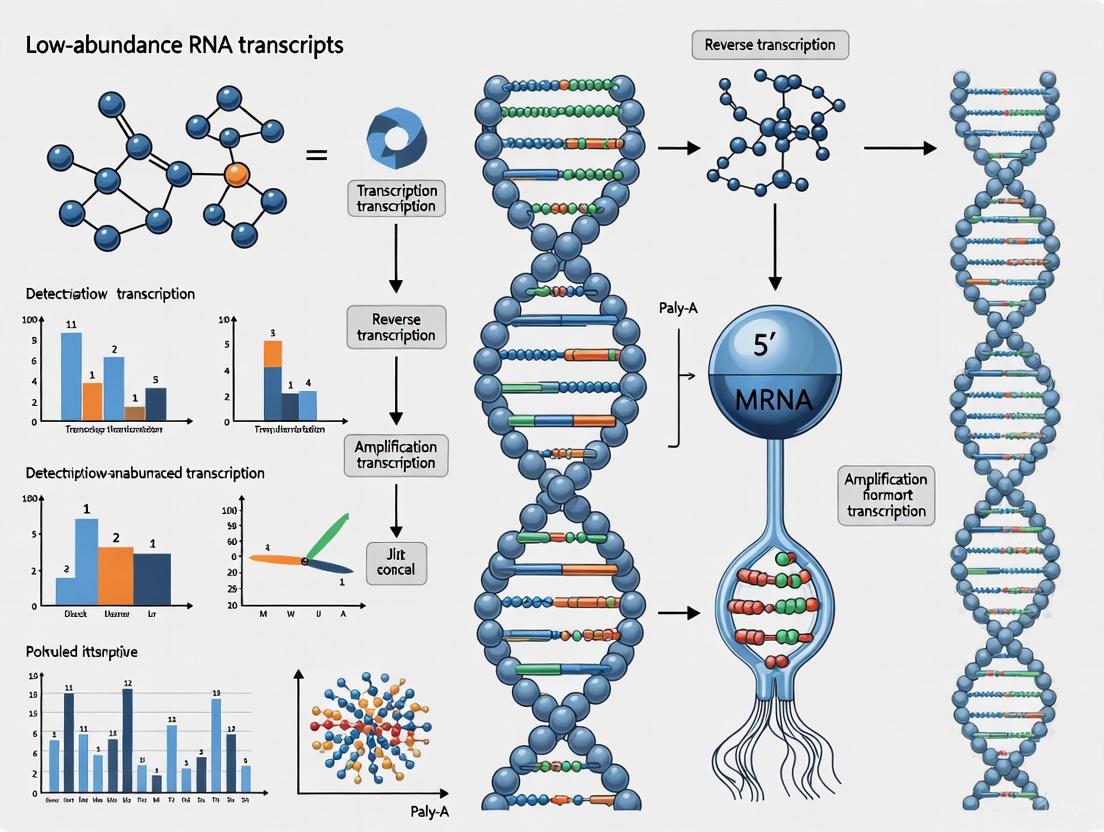
Accurate detection and quantification of low-abundance RNA transcripts are pivotal for advancing molecular diagnostics, understanding complex diseases like cancer, and driving drug discovery.
Advances in Low-Abundance RNA Detection: From Foundational Concepts to Clinical Applications
Abstract
Accurate detection and quantification of low-abundance RNA transcripts are pivotal for advancing molecular diagnostics, understanding complex diseases like cancer, and driving drug discovery. This article provides a comprehensive resource for researchers and drug development professionals, exploring the foundational challenges of low-abundance RNA, cutting-edge methodological solutions from ultra-deep sequencing to targeted amplification, critical optimization strategies for robust results, and frameworks for rigorous validation. By synthesizing the latest technological breakthroughs and comparative analyses, this review serves as a strategic guide for navigating the complexities of the low-abundance transcriptome.
The Critical Challenge and Expanding Universe of Low-Abundance RNAs
Low-abundance transcripts represent a functionally significant yet technically challenging class of RNA molecules that include sparse messenger RNAs (mRNAs) and regulatory long non-coding RNAs (lncRNAs). Their accurate detection and quantification is paramount for advancing our understanding of gene regulation in development, disease, and cellular response mechanisms. These transcripts, often characterized by quantification cycle (Cq) values above 30 in RT-qPCR assays or limited read counts in RNA-seq data, play disproportional roles in critical biological processes despite their sparse expression [1] [2].
The technical definition of low-abundance transcripts varies by detection platform. In reverse transcription-quantitative real-time PCR (RT-qPCR), they typically yield Cq values exceeding 30-35, approaching the lower limit of reliable quantification [1] [3]. In RNA sequencing, they are characterized by low read counts, with one study defining them as transcripts below the 60th percentile of relative abundance, accounting for only 3% of total read counts despite comprising over 60% of detected transcripts [2]. These transcripts include key regulatory molecules such as transcription factors, alternative splicing isoforms, and lncRNAs that function as master regulators of downstream gene expression networks [2] [4].
This technical guide examines the detection challenges, methodological innovations, and experimental considerations for studying these elusive transcripts, providing researchers with a comprehensive framework for advancing research in this critical area of molecular biology.
Characteristics and Detection Challenges
Defining Features of Low-Abundance Transcripts
Low-abundance transcripts share several distinguishing characteristics that contribute to both their functional significance and detection challenges. Long non-coding RNAs, a major category of low-abundance transcripts, are defined as RNA transcripts longer than 200 nucleotides that lack protein-coding capacity [5]. Unlike mRNAs, lncRNAs exhibit distinct molecular properties including fewer exons, shorter sequence length, lower GC content, and reduced evolutionary conservation [5] [4]. They are predominantly transcribed by RNA polymerase II, and while many are capped and polyadenylated, a subset are stabilized through secondary structures such as triple-helical formations at their 3' ends rather than polyadenylation [5].
These transcripts display stronger tissue-specific and cell-type-specific expression patterns compared to protein-coding genes, suggesting specialized roles in cellular processes [5] [6]. The advent of single-cell omics technologies has further highlighted the expression heterogeneity of lncRNAs and their importance in cellular identity and function [6]. Additionally, lncRNAs undergo extensive alternative splicing, dramatically increasing their potential isoform diversity and functional complexity beyond current annotations [5].
Technical Limitations in Detection
Conventional detection methods face significant challenges in accurately quantifying low-abundance transcripts. Standard RT-qPCR encounters sensitivity limitations as Cq values above 30-35 are often considered unreliable due to poor reproducibility and precision issues [1] [3]. This is particularly problematic for isoform-specific quantification where differential primer efficiency introduces amplification bias when comparing similar transcript variants [1] [3].
Table 1: Challenges in Detecting Low-Abundance Transcripts by Method
| Method | Primary Challenges | Impact on Low-Abundance Detection |
|---|---|---|
| RT-qPCR | Cq values >30-35 become unreliable; primer efficiency bias for isoforms [1] [3] | Limited sensitivity for transcripts <10 copies/cell; inaccurate isoform quantification |
| RNA-seq | Low read counts show high variability; requires deep sequencing [2] | 60% of transcripts may be low-count; high false-negative rate without sufficient depth |
| dPCR | Requires specialized instrumentation and reagents [3] | Improved sensitivity but limited accessibility and higher cost per sample |
| NanoString | Narrower dynamic range than RNA-seq [7] | Reduced sensitivity for very low-expressing genes |
For transcriptome-wide approaches, RNA sequencing struggles with the inherently noisy behavior of low-count transcripts, which exhibit large variability in logarithmic fold change estimates [2]. While methods like DESeq2 and edgeR robust attempt to address this through statistical moderation, accurate quantification of low-abundance isoforms still typically requires costly deep sequencing and complex bioinformatic analysis [3] [2]. Digital PCR improves sensitivity but requires specialized instrumentation and reagents, limiting its accessibility [3]. The NanoString nCounter system, while avoiding amplification bias through direct molecular barcoding, has a narrower dynamic range than RNA-seq, reducing its sensitivity for extremely low-expressing genes [7].
Methodological Approaches for Detection and Analysis
Targeted Amplification and Enrichment Strategies
STALARD: Selective Target Amplification
The STALARD method provides a targeted approach for detecting low-abundance polyadenylated transcripts that share a known 5'-end sequence. This two-step RT-PCR technique uses standard laboratory reagents to achieve rapid (<2 hours) pre-amplification specifically designed to overcome both sensitivity limitations and primer-induced bias in conventional RT-qPCR [1] [3].
The STALARD workflow employs a gene-specific primer (GSP) tailored to the 5'-end of the target RNA (with thymine replacing uracil) and a GSP-tailed oligo(dT) primer for reverse transcription. Following cDNA synthesis, limited-cycle PCR (<12 cycles) is performed using only the GSP, which anneals to both ends of the cDNA, specifically amplifying the target transcript without requiring a separate reverse primer [3]. This approach minimizes amplification bias while significantly enhancing detection sensitivity for low-abundance isoforms.
When applied to Arabidopsis thaliana, STALARD successfully amplified the low-abundance VIN3 transcript to reliably quantifiable levels and detected known splicing changes in FLM, MAF2, EIN4, and ATX2 isoforms during vernalization, including cases where conventional RT-qPCR failed [3]. The method also enabled consistent quantification of the extremely low-abundance antisense transcript COOLAIR and revealed novel COOLAIR polyadenylation sites when combined with nanopore sequencing [3].
Capture Sequencing and RNAscope
CaptureSeq represents a targeted RNA sequencing approach that uses hybridization-based enrichment to improve detection of low-abundance transcripts. This method employs custom capture probes to enrich for specific transcripts of interest prior to sequencing, significantly enhancing sensitivity compared to standard RNA-seq [8]. A recent application designed 565,878 capture probes for 49,372 human lncRNA genes, enabling detection of a more diverse repertoire of lncRNAs with better reproducibility and higher coverage across various sample types including formalin-fixed paraffin-embedded (FFPE) tissue and biofluids [9].
RNAscope represents an alternative non-PCR-based approach that utilizes a series of amplification steps to detect low-abundance RNAs with improved signal-to-noise ratio. This multiplexed RNA-FISH method is particularly valuable for investigating the regulation of low-abundance lncRNAs in situ and is suitable for high-throughput screening in 96-well plate formats [10]. The technique provides spatial context for RNA localization, which is critical for understanding lncRNA function, as their subcellular localization often determines their mechanistic roles [5].
Advanced Statistical Methods for RNA-seq Data
Statistical advances in processing RNA-seq data have provided alternative approaches for analyzing low-count transcripts without arbitrary filtering. Methods such as DESeq2 and edgeR robust employ sophisticated statistical frameworks to address the high variability inherent in low-count transcripts [2].
DESeq2 utilizes a generalized linear model based on the negative binomial distribution and implements information sharing across transcripts to moderate transcript-specific dispersion estimates. Crucially, it applies shrinkage to logarithmic fold change (LFC) estimates in a manner inversely proportional to the amount of information available for a transcript, preventing overinterpretation of variable estimates from low-count genes [2].
edgeR robust employs a similar negative binomial framework but incorporates differential weighting of observations that deviate from the model fit, thereby dampening the effect of extreme expression values on parameter estimates. This approach requires careful specification of the degrees of freedom parameter that controls the amount of shrinkage, which has non-trivial impacts on inference [2].
Table 2: Performance Comparison of Statistical Methods for Low-Count RNA-seq Transcripts
| Method | Key Features | Performance on Low-Count Transcripts |
|---|---|---|
| DESeq2 | Shrinks LFC estimates toward zero; shares information across genes [2] | Greater precision and accuracy; proper type 1 error control |
| edgeR robust | Down-weights observations deviating from model fit [2] | Greater power; proper type 1 error control when properly specified |
| Data Filtering | Removes transcripts below arbitrary expression thresholds [2] | Excludes 60% of transcripts; may remove biologically relevant signals |
Plasmode-based validation studies have demonstrated that both methods properly control family-wise type 1 error rates for low-count transcripts, with DESeq2 showing greater precision and accuracy, while edgeR robust exhibits greater power for differential expression detection [2]. These approaches enable researchers to retain biologically relevant low-count transcripts that would typically be excluded by standard filtering practices at arbitrary expression thresholds.
Experimental Protocols and Workflows
STALARD Protocol for Low-Abundance Isoform Detection
The STALARD protocol provides a detailed methodology for targeted amplification of low-abundance transcripts [3]:
Primer Design:
- Design a gene-specific primer (GSP) matching the 5'-end sequence of the target RNA (substituting T for U)
- Parameters: Tm = 62°C, GC content = 40-60%, avoid hairpin or self-dimer structures
- Prepare GSP-tailed oligo(dT)24VN primer (GSoligo(dT)) where V = A, G, or C and N = any base
cDNA Synthesis:
- Use 1 µg of total RNA and 1 µL of 50 µM GSoligo(dT) primer
- Perform first-strand cDNA synthesis using HiScript IV 1st Strand cDNA Synthesis Kit
- The resulting cDNA carries the GSP sequence at its 5' end
Targeted Pre-amplification:
- Perform PCR using 1 µL of 10 µM GSP and SeqAmp DNA Polymerase in a 50 µL reaction
- Thermal cycling: 95°C for 1 min; 9-18 cycles of 98°C for 10s, 62°C for 30s, 68°C for 1 min/kb; final extension at 72°C for 10 min
Purification and Analysis:
- Purify PCR products using AMPure XP beads at 1.0:0.7 product:beads ratio
- Elute in RNase-free water for subsequent qPCR or sequencing analysis
This protocol has been successfully applied to quantify splicing changes in response to environmental stimuli such as vernalization in Arabidopsis thaliana, demonstrating its utility for capturing biologically relevant expression changes in low-abundance isoforms [3].
RNA-FISH Protocol for lncRNA Localization
RNAscope provides a robust method for multiplexed detection of low-abundance long noncoding RNAs in cultured cells [10]:
Sample Preparation:
- Culture cells on appropriate chambered slides or coverslips
- Fix cells with 4% paraformaldehyde
- Permeabilize cells to allow probe access
Hybridization:
- Design target-specific probes that hybridize to the RNA of interest
- Perform sequential hybridization and amplification steps to enhance signal-to-noise ratio
- Incubate with label probes for detection
Detection and Imaging:
- Detect signals using fluorescence microscopy
- For multiplexing, use different fluorophores for distinct RNA targets
- Image using high-content imaging systems such as Operetta for 96-well plate formats
This method is particularly valuable for studying the subcellular localization of lncRNAs, which provides critical insights into their function, as localization directly impacts interaction partners and regulatory mechanisms [10] [5].
The Scientist's Toolkit: Essential Research Reagents
Table 3: Key Research Reagent Solutions for Low-Abundance RNA Detection
| Reagent/Kit | Function | Application Examples |
|---|---|---|
| GSP-tailed oligo(dT) primers | Target-specific reverse transcription with adapter sequence | STALARD method for selective amplification [3] |
| HiScript IV 1st Strand cDNA Synthesis Kit | High-efficiency cDNA synthesis with high sensitivity | STALARD first-strand synthesis [3] |
| SeqAmp DNA Polymerase | High-fidelity PCR amplification | Targeted pre-amplification in STALARD [3] |
| AMPure XP beads | PCR product purification and size selection | Post-amplification clean-up [3] |
| RNAscope probes | Target-specific hybridization for RNA-FISH | Multiplexed detection of low-abundance lncRNAs [10] |
| Custom capture probes | Hybridization-based enrichment for targeted RNA-seq | CaptureSeq for sensitive lncRNA detection [9] |
Subcellular Localization and Functional Implications
The subcellular localization of low-abundance transcripts, particularly lncRNAs, is a critical determinant of their function. Research has revealed that lncRNAs exhibit specific localization patterns that define their mechanistic roles [5]. Nuclear-enriched lncRNAs frequently function in transcriptional regulation through chromatin modification or as nuclear organization scaffolds, while cytoplasmic lncRNAs often participate in post-transcriptional processes including mRNA stability, translation regulation, and signaling pathways [5].
Techniques such as RNA-FISH have been instrumental in mapping these localization patterns, revealing that lncRNAs are often enriched in specific subcellular compartments including nuclear speckles, paraspeckles, P-bodies, and stress granules [5]. These phase-separated bodies represent specialized environments where lncRNAs nucleate functional complexes through interactions with RNAs, proteins, and DNA elements [5].
The functional significance of localization is exemplified by lncRNAs such as COOLAIR in Arabidopsis thaliana, which plays a role in epigenetic silencing of the FLC locus during vernalization [3]. The detection and accurate quantification of such extremely low-abundance transcripts has been challenging with conventional methods, leading to inconsistencies in reported expression patterns that newer targeted approaches are now resolving [3].
Method Selection Guidelines and Future Perspectives
Choosing the Appropriate Detection Method
Selection of optimal detection strategies for low-abundance transcripts depends on research goals, sample characteristics, and available resources [7]:
RNA-seq excels in discovery-phase research where comprehensive transcriptome characterization is needed. Transcriptome-wide RNA-seq enables discovery of novel transcripts, splice variants, and non-coding RNAs, while targeted RNA-seq panels provide deeper coverage of predefined gene sets at lower cost [8] [7].
NanoString nCounter offers advantages for degraded or FFPE-preserved samples where amplification-based methods may fail. Its direct digital counting without reverse transcription or PCR minimizes bias, and the simple workflow delivers results rapidly with minimal bioinformatics requirements [7].
qPCR remains the gold standard for targeted validation of small gene sets, offering exceptional sensitivity, speed, and precision for hypothesis-driven studies [7].
STALARD and CaptureSeq provide intermediate solutions that bridge the gap between targeted and discovery-based approaches, offering enhanced sensitivity for specific transcript classes while maintaining more accessible workflow requirements than comprehensive RNA-seq [1] [3] [9].
Emerging Trends and Future Directions
The field of low-abundance transcript research is rapidly evolving with several promising developments. Single-cell omics technologies are revealing unprecedented heterogeneity in lncRNA expression and function, enabling the construction of single-cell gene regulatory networks (scGRNs) that incorporate non-coding RNAs [6]. The integration of long-read sequencing with targeted enrichment methods is improving isoform-level characterization, as demonstrated by STALARD combined with nanopore sequencing revealing previously unannotated polyadenylation sites [3]. Additionally, spatial transcriptomics approaches are advancing our understanding of how subcellular localization impacts lncRNA function in different cellular contexts [5] [6].
As these technologies mature, they promise to illuminate the complex roles of low-abundance transcripts in development, disease, and cellular regulation, ultimately enabling researchers to fully characterize these elusive but biologically critical molecules.
Rare transcripts, including low-abundance isoforms and non-coding RNAs, represent a critical yet under-explored layer of biological regulation. While traditionally overlooked due to technical limitations in detection, these molecules exert disproportionate functional influence on developmental processes and disease pathogenesis. Advances in RNA sequencing technologies, particularly long-read platforms and sophisticated bioinformatics tools, are now enabling researchers to systematically identify and characterize these rare transcriptional events. This technical guide synthesizes current methodologies for rare transcript detection, validation, and functional interpretation, providing researchers with a comprehensive framework for investigating the full transcriptional complexity of biological systems. The emerging paradigm suggests that rare transcripts often serve key regulatory functions, with important implications for understanding disease mechanisms and developing targeted therapeutic interventions.
The transcriptional output of eukaryotic genomes is remarkably complex, encompassing not only abundant messenger RNAs but also a diverse array of rare transcripts that often escape conventional detection methods. These rare transcripts include low-abundance alternative isoforms, tissue-specific transcripts, non-coding RNAs, and transcripts from poorly annotated genes. Their scarcity belies their significant biological impact, as they frequently play outsized roles in critical processes such as cellular differentiation, immune response, and disease progression.
The study of rare transcripts presents distinct technical challenges. Traditional short-read RNA sequencing approaches often struggle to detect transcripts expressed at low levels, particularly when they share exonic sequences with more abundant isoforms. Furthermore, standard bioinformatics pipelines frequently filter out rarely observed transcripts as potential artifacts. However, as we will demonstrate, emerging methodologies are overcoming these limitations, revealing a previously hidden layer of transcriptional regulation with profound implications for basic biology and clinical applications.
Technical Approaches for Rare Transcript Detection
Sequencing Platform Considerations
The choice of sequencing platform significantly impacts the ability to detect and accurately characterize rare transcripts. Each technology offers distinct advantages and limitations for rare transcript research, as summarized in Table 1.
Table 1: Sequencing Platform Comparison for Rare Transcript Detection
| Platform Type | Key Advantages | Limitations | Ideal Applications |
|---|---|---|---|
| Short-read (Illumina) | High throughput, low error rate, low cost per base | Limited ability to resolve full-length isoforms, mapping ambiguity for repetitive regions | Quantifying known transcripts, splicing analysis in well-annotated regions |
| Long-read (PacBio) | Full-length transcript sequencing, no assembly required | Higher error rate, lower throughput, higher input requirements | Discovery of novel isoforms, complex splicing patterns, fusion genes |
| Long-read (Oxford Nanopore) | Real-time sequencing, direct RNA detection, long read lengths | Higher error rate, throughput limitations | Detection of RNA modifications, extremely long transcripts |
| Single-cell RNA-seq | Resolution of cellular heterogeneity, identification of rare cell populations | Low sequencing depth per cell, high cost | Identifying rare cell types, cell-to-cell variation in transcript expression |
Recent systematic assessments of long-read RNA-seq methods demonstrate that libraries with longer, more accurate sequences produce more accurate transcript identifications than those with increased read depth alone [11]. However, greater read depth remains important for accurate quantification of detected transcripts. For de novo transcript detection in genomes lacking high-quality references, the integration of additional orthogonal data and replicate samples is strongly recommended [11].
Experimental Design and Quality Control
Robust experimental design is paramount for successful rare transcript detection. Key considerations include:
Biological Replicates: Biological replicates are essential for distinguishing true rare transcripts from technical artifacts. The number of replicates has a greater impact on detection power than sequencing depth [12]. At least 3-6 biological replicates per condition are recommended, with more replicates providing greater power to detect statistically significant rare expression events.
RNA Quality and Integrity: RNA quality directly impacts transcript detection capability. While traditional mRNA sequencing requires high-quality RNA (RIN > 7), newer total RNA approaches with ribosomal depletion can successfully sequence degraded samples (RIN > 3.5) [13] [14]. This is particularly valuable for clinical samples where RNA integrity may be compromised.
Library Preparation Strategy: The choice between poly-A enrichment and ribosomal depletion significantly affects rare transcript detection. Poly-A selection captures only polyadenylated transcripts, while ribosomal depletion preserves non-polyadenylated RNA species, providing a more comprehensive view of the transcriptome [13] [14]. Stranded library protocols are preferred as they preserve transcript orientation information, which is crucial for identifying antisense transcripts and overlapping genes [13].
Spike-in Controls: Artificial spike-in controls, such as SIRVs, are valuable tools for quality control in rare transcript studies. They enable measurement of assay performance, including dynamic range, sensitivity, and reproducibility, providing an internal standard for normalizing data and assessing technical variability [15].
Bioinformatics and Computational Approaches
Specialized computational methods are required to distinguish true rare transcripts from sequencing artifacts and background noise.
Expression-Aware Annotation: The "proportion expression across transcripts" (pext) metric quantifies isoform expression for variants using large transcriptome datasets like GTEx [16]. This approach helps differentiate functional exons from non-functional ones, with rare variants in lowly-expressed exons showing significantly different effect sizes compared to those in highly expressed exons.
Variant Interpretation Tools: Tools like InfoScan enable comprehensive analysis of full-length single-cell RNA sequencing data, facilitating identification of unannotated transcripts and rare cell populations [17]. In glioblastoma research, InfoScan identified a rare "neoplastic-stemness" subpopulation with cancer stem cell-like features that would be missed by conventional analysis.
De Novo Transcript Detection: In genomes lacking high-quality references, reference-free approaches can reconstruct transcripts from sequencing data alone. These methods benefit from longer read lengths and higher accuracy, though performance varies substantially between tools [11].
Quantitative Analysis of Rare Transcript Detection
The performance of different methodological approaches can be quantitatively assessed across multiple dimensions. Table 2 summarizes key metrics for evaluating rare transcript detection methodologies.
Table 2: Performance Metrics for Rare Transcript Detection Methods
| Methodological Approach | Sensitivity | Specificity | Diagnostic/Discovery Utility | Key Supporting Evidence |
|---|---|---|---|---|
| Blood RNA-seq for rare diseases | 70.6% of known rare disease genes expressed in blood | Filtering reduced candidate genes to <1% of initial outliers | 7.5% diagnostic rate, plus 16.7% with improved candidate resolution [18] | Integration of expression, splicing, and allele-specific expression signals |
| pext metric for variant interpretation | Filters 22.8% of falsely annotated pLoF variants | Removes <4% of high-confidence pathogenic variants [16] | Improved identification of pathogenic variants in haploinsufficient genes | Analysis of 11,706 GTEx tissue samples |
| Long-read vs short-read sequencing | Higher sensitivity for full-length isoforms | Moderate agreement among bioinformatics tools [11] | Superior for de novo transcript discovery | LRGASP consortium evaluation of multiple platforms |
| Single-cell RNA-seq | Identifies rare cell populations (e.g., neoplastic-stemness cells) | Requires validation for low-abundance transcripts | Reveals cellular heterogeneity in cancer [17] | Application in glioblastoma identifying rare subpopulations |
Statistical considerations for rare transcript analysis include:
Multiple Testing Correction: Traditional false discovery rate controls may be overly stringent for rare transcript detection. Bayesian approaches that incorporate prior knowledge about transcript characteristics can improve detection power.
Expression Thresholds: Setting appropriate expression thresholds is crucial. Overly stringent thresholds eliminate true rare transcripts, while lenient thresholds increase false positives. The pext metric provides a principled approach by focusing on the proportion of transcriptional output affected by a variant [16].
Power Analysis: Pilot studies are valuable for determining sample size requirements for rare transcript detection. The extreme skewness of transcript abundance distributions means that substantially larger sample sizes are often needed to detect rare events with statistical confidence [15].
Experimental Protocols for Rare Transcript Validation
Protocol: RNA-seq for Rare Disease Gene Identification
This protocol, adapted from Frésard et al. (2019), outlines an approach for identifying rare disease genes using blood RNA-seq [18]:
Sample Collection and RNA Extraction:
- Collect whole blood in RNA-stabilizing reagents (e.g., PAXgene).
- Extract total RNA using standardized protocols.
- Assess RNA quality using RIN, with values >7 preferred.
Library Preparation and Sequencing:
- Perform ribosomal RNA depletion rather than poly-A selection to capture non-polyadenylated transcripts.
- Use stranded library protocols to preserve transcript orientation.
- Sequence to a depth of 30-50 million reads per sample.
Data Processing:
- Align reads to the reference genome using splice-aware aligners.
- Quantify gene and transcript expression levels.
- Identify outlier expression and splicing events by comparing to large control cohorts (N=1,594 recommended).
Variant Filtering and Prioritization:
- Filter expression outliers based on:
- LoF intolerance (pLI ≥0.9)
- Phenotype relevance (HPO term matching)
- Presence of rare variants nearby (MAF ≥0.01%)
- Deleterious variant prediction (CADD score ≥10)
- Filter splicing outliers based on:
- Phenotype relevance (HPO term matching)
- Presence of deleterious rare variants near splice junctions
- Filter expression outliers based on:
Integration and Validation:
- Integrate expression, splicing, and allele-specific expression signals.
- Validate candidate genes through orthogonal methods (e.g., Sanger sequencing, functional assays).
Protocol: Single-Cell Analysis of Rare Cell Populations
This protocol, based on InfoScan methodology, details the identification of rare cell populations using single-cell RNA-seq [17]:
Single-Cell Library Preparation:
- Prepare single-cell suspensions from tissue samples.
- Perform single-cell RNA-seq using full-length transcript protocols.
- Include unique molecular identifiers (UMIs) to correct for amplification biases.
Data Processing and Transcript Identification:
- Process raw sequencing data to generate count matrices.
- Perform quality control to remove low-quality cells and doublets.
- Identify unannotated transcripts and isoforms.
Cell Clustering and Rare Population Identification:
- Perform dimensionality reduction and clustering.
- Identify rare clusters based on distinct expression profiles.
- Characterize marker genes for each population.
Functional Analysis:
- Perform pathway enrichment analysis on rare population markers.
- Investigate cell-cell communication patterns.
- Validate findings using orthogonal methods (e.g., immunohistochemistry, flow cytometry).
Visualization of Analytical Workflows
The following diagrams illustrate key workflows and relationships in rare transcript analysis, created using DOT language with the specified color palette.
Rare Transcript Analysis Workflow
Figure 1: Comprehensive workflow for rare transcript analysis, encompassing experimental and computational steps.
Rare Transcript Filtering Strategy
Figure 2: Multi-step filtering strategy for identifying high-confidence rare transcripts from initial candidates.
The Scientist's Toolkit: Essential Research Reagents and Materials
Successful rare transcript research requires specialized reagents and materials. Table 3 details key solutions and their applications.
Table 3: Essential Research Reagents for Rare Transcript Studies
| Reagent/Material | Function | Application Notes | Key References |
|---|---|---|---|
| RNA-stabilizing reagents | Preserve RNA integrity during sample collection and storage | Critical for clinical samples; PAXgene recommended for blood | [13] |
| Ribosomal depletion kits | Remove abundant ribosomal RNA to enhance detection of rare transcripts | Preferred over poly-A selection for comprehensive transcriptome coverage | [13] [14] |
| Stranded library prep kits | Preserve transcript orientation information | Essential for identifying antisense transcripts and overlapping genes | [13] |
| Spike-in controls | Quality control and normalization standards | Enable technical variability assessment; SIRVs recommended | [15] |
| Unique Molecular Identifiers | Correct for amplification biases | Crucial for accurate quantification in single-cell studies | [17] [14] |
| Long-read sequencing kits | Generate full-length transcript sequences | PacBio or Oxford Nanopore kits for isoform resolution | [11] |
The systematic study of rare transcripts represents a frontier in molecular biology with significant implications for understanding development and disease. Methodological advances in sequencing technologies, experimental design, and computational analysis are increasingly enabling researchers to detect and characterize these elusive molecules. The evidence demonstrates that rare transcripts frequently play critical roles in biological regulation, from guiding developmental processes to contributing to disease pathogenesis when dysregulated.
Future progress in this field will likely come from several directions. The integration of multi-omics datasets will provide crucial context for interpreting the functional significance of rare transcripts. Improvements in long-read sequencing accuracy and throughput will enhance detection capabilities while reducing costs. The development of more sophisticated computational methods that incorporate biological priors will improve discrimination between functional rare transcripts and transcriptional noise. Finally, the creation of comprehensive tissue and cell-type-specific transcriptome atlases will provide essential reference data for distinguishing truly rare transcripts from context-specific expression.
As these methodological advances mature, rare transcript analysis will increasingly transition from a specialized research area to an integral component of comprehensive transcriptional studies. This integration will deepen our understanding of biological complexity and provide new avenues for therapeutic intervention in human disease.
The detection and accurate quantification of low-abundance RNA transcripts represent a fundamental challenge in modern biology with profound implications for understanding cellular function, disease mechanisms, and therapeutic development. This technical guide examines three interrelated, core obstacles that critically define the boundaries of current research: tissue-specific expression patterns, pervasive transcriptional noise, and fundamental technological detection limits. Within the context of detecting low-abundance RNA transcripts, these factors conspire to obscure genuine biological signals. Tissue-specific expression dictates that critical regulatory genes, including transcription factors, are often expressed at low levels and in a confined subset of cells, making them difficult to capture in heterogeneous tissue samples [19] [20]. Furthermore, the transcriptome is not a static entity but is subject to intrinsic stochastic fluctuations, leading to transcriptional noise that can be misinterpreted as biological signal or, conversely, mask true cell-to-cell differences [21] [22]. Finally, technical limitations inherent to RNA sequencing protocols, from reverse transcription inefficiencies to the statistical sampling of sequencing itself, impose a hard ceiling on our ability to detect and quantify the rarest transcripts [23] [24]. This whitepaper provides an in-depth analysis of these obstacles, summarizes key quantitative data, details relevant experimental methodologies, and visualizes the core concepts and workflows for the research community.
Tissue-Specific Expression: A Spatial Challenge
Classification and Patterns
Global classification of human proteins and their corresponding mRNAs with regard to spatial expression patterns across organs and tissues is essential for interpreting transcriptomic data. A foundational study using quantitative transcriptomics (RNA-Seq) across a representative set of all major human organs and tissues led to a systematic classification of all human protein-coding genes. The research established eight distinct categories based on fragments per kilobase of exon model per million mapped reads (FPKM) levels in 27 tissues, with a detection limit cutoff set at 1 FPKM [19].
Table 1: Gene Classification Based on Tissue-Specific Expression Patterns [19]
| Classification Category | Definition |
|---|---|
| Not Detected | < 1 FPKM in all 27 tissues |
| Tissue Specific | ≥ 50-fold higher FPKM level in one tissue vs. all others |
| Tissue Enriched | ≥ 5-fold higher FPKM level in one tissue vs. all others |
| Group Enriched | ≥ 5-fold higher average FPKM level in a group of 2-7 tissues vs. all others |
| Mixed (Low) | Detected in 1-26 tissues and at least one tissue < 10 FPKM |
| Mixed (High) | Detected in 1-26 tissues and all detected tissues > 10 FPKM |
| Expressed in All (Low) | Detected in all 27 tissues and at least one tissue < 10 FPKM |
| Expressed in All (High) | Detected in all 27 tissues and all tissues > 10 FPKM |
This work, integrated into the Human Protein Atlas, demonstrated that a significant portion of the genome exhibits restricted expression patterns. This has direct consequences for detecting low-abundance transcripts, as many are not ubiquitously expressed but are instead concentrated in specific cell types, making them easy to miss in bulk tissue analyses or whole transcriptome studies that lack the necessary spatial or cellular resolution [19].
Experimental Protocol: Tissue-Specific RNA-Seq
The following methodology outlines the key steps for generating the data used in the aforementioned tissue-specific classification [19]:
- Sample Acquisition and Quality Control: Tissue samples are collected and embedded in Optimal Cutting Temperature (O.C.T.) compound. A hematoxylin-eosin (HE) stained section is prepared and examined by a pathologist to ensure proper tissue morphology.
- RNA Extraction: Three 10 μm sections are cut and collected for RNA extraction. Total RNA is extracted using a kit-based method (e.g., RNeasy Mini Kit).
- RNA Quality Assessment: Extracted RNA is analyzed using an automated electrophoresis system (e.g., Experion or Bioanalyzer). Only high-quality RNA samples with an RNA Integrity Number (RIN) ≥ 7.5 are used for subsequent library preparation.
- Library Preparation and Sequencing: mRNA sequencing is performed on a high-throughput platform (e.g., Illumina HiSeq) using the standard RNA-seq protocol with a read length of 2 x 100 bases. Samples are multiplexed, targeting an average of 18 million mappable read pairs per sample.
- Bioinformatic Processing:
- Quality Control: Raw reads are trimmed for low-quality ends.
- Alignment: Processed reads are mapped to the human genome (e.g., GRCh37) using a splice-aware aligner (e.g., Tophat).
- Quantification: Gene expression levels are calculated as FPKM values using software (e.g., Cufflinks), which corrects for transcript length and total mapped reads.
- Tissue-Specificity Classification: For each tissue, the average FPKM value across sample replicates is used. Each gene is then classified into one of the eight categories based on the predefined FPKM fold-change rules and detection limits.
Transcriptional Noise: A Stochastic Challenge
Quantifying and Interpreting Noise
Transcriptional noise refers to the stochastic fluctuations in gene expression that create cell-to-cell variability within an isogenic population. This noise is a significant confounding factor in detecting low-abundance transcripts, as it can be difficult to distinguish a genuine, consistently low signal from random transcriptional bursts. A critical challenge is that different single-cell RNA sequencing (scRNA-seq) algorithms systematically underestimate the fold change in transcriptional noise compared to the gold-standard method, single-molecule RNA fluorescence in situ hybridization (smFISH) [22] [25].
Research utilizing a small-molecule noise enhancer (5′-iodo-2′-deoxyuridine, IdU) demonstrated that while various scRNA-seq analysis algorithms (SCTransform, scran, Linnorm, BASiCS, SCnorm) could consistently detect genome-wide noise amplification, the magnitude of noise increase was consistently underestimated. smFISH validation confirmed that IdU amplifies noise in a "globally penetrant" manner—increasing variability without altering mean expression levels—for the vast majority of genes [22]. This underestimation by scRNA-seq has critical implications for interpreting data on low-abundance transcripts, where noise can represent a substantial portion of the measured signal.
Furthermore, the very presence of transcriptional "noisy transcripts" (erroneous transcription from intergenic regions, erroneous splicing, and retained introns) has been shown to impact computational methods. The inclusion of this biological noise leads to systematic errors in expression measurement, including an increase in false-positive genes and transcripts and an underestimation of true transcript abundance [21].
Table 2: Impact of Transcriptional Noise on RNA-seq Analysis Tools [21]
| Analysis Tool | False Positive Transcripts (without noise) | False Positive Transcripts (with noise) | Increase | Median Abundance of FPs (with noise) |
|---|---|---|---|---|
| StringTie2 | 18,844 (FPR=7%) | 23,494 (FPR=8%) | ~25% | 0.14 TPM |
| Salmon | 21,546 (FPR=8%) | 36,677 (FPR=13%) | ~70% | 0.85 TPM |
| kallisto | 34,316 (FPR=12%) | >51,000 (FPR=18%) | ~50% | 0.39 TPM |
It is also important to note that the role of transcriptional noise in biological processes like aging is complex and may not be a universal hallmark. Systematic analysis of multiple aging scRNA-seq datasets using specialized toolkits like Decibel shows large variability between tissues, suggesting that increased transcriptional noise is not a consistent feature of aged tissues and may be overshadowed by other factors like changes in cell type composition [26].
Experimental Protocol: Quantifying Noise with scRNA-seq and smFISH
The following combined protocol is used to quantify and validate transcriptional noise [22]:
- Cell Culture and Perturbation: Culture isogenic cells (e.g., mouse embryonic stem cells or human Jurkat T lymphocytes). Treat with a noise-enhancing molecule like IdU or a DMSO control.
- Single-Cell RNA Sequencing:
- Single-Cell Isolation: Isolate individual cells using a microfluidic or droplet-based system.
- Library Preparation: Generate barcoded cDNA libraries from the single cells. Sequence the pooled library on an appropriate platform.
- Computational Noise Quantification: Analyze the raw scRNA-seq data using multiple normalization and noise quantification algorithms (e.g., SCTransform, scran, BASiCS, a "raw" method normalized only by sequencing depth). Key metrics include:
- Coefficient of Variation (CV): σ/μ (standard deviation / mean).
- Fano Factor: σ²/μ (variance / mean), which is not inherently dependent on the mean expression level.
- Validation by smFISH (Gold Standard):
- Probe Design: Design fluorescently labeled oligonucleotide probes against a panel of target genes representing a range of expression levels and functions.
- Hybridization: Fix cells and hybridize the fluorescent probes to the target mRNAs.
- Imaging and Quantification: Acquire high-resolution images using fluorescence microscopy. Identify and count individual mRNA molecules as discrete spots within each cell. Calculate the mean, variance, and Fano factor for each gene across the cell population.
Detection Limits: A Technological Challenge
Methodological Limitations and Artifacts
The journey from a rare RNA transcript in a cell to a quantified signal in a dataset is fraught with technical hurdles that fundamentally limit detection. A primary challenge is the inherent inefficiency of reverse transcription (RT), the critical first step in most RNA-seq protocols. Modified nucleotides in RNA can cause the reverse transcriptase to stall, misincorporate a base, or "jump," creating a characteristic "RT-signature" [23]. For many important RNA modifications, these signatures are weak or non-existent, making the modifications effectively "RT-silent" and thus invisible to standard sequencing. The background of natural RT-stops and misincorporations creates significant noise, against which the signal of a rare transcript or modification must be detected, leading to a poor signal-to-noise ratio, especially for substoichiometric modifications [23].
In single-cell RNA-seq, the problem is exacerbated by the "gene dropout" problem, where genes that are truly expressed fail to be detected. This is due to the minuscule amount of starting RNA in a single cell and the low efficiency of mRNA capture. This issue is particularly pronounced for low-abundance transcripts, a category that includes many key regulatory genes like transcription factors [20]. Whole Transcriptome approaches spread a finite number of sequencing reads across all ~20,000 genes, resulting in shallow coverage for any individual gene and making it prone to missing low-abundance signals [20] [24].
Furthermore, the choice of tissue itself is a critical consideration. Tissues that are difficult to preserve (e.g., brain) or are processed using certain methods (e.g., Formalin-Fixed Paraffin-Embedded or FFPE samples) suffer from RNA degradation and modifications, leading to fragmented transcripts and biased gene expression quantification [24].
Experimental Protocol: Targeted RNA Expression Profiling
To overcome the limitations of whole transcriptome sequencing for detecting specific low-abundance transcripts, targeted gene expression profiling is often employed [20]. The protocol focuses sequencing resources on a pre-defined gene set.
- Panel Design: A panel of target genes (from dozens to several thousand) is selected based on the research question (e.g., a specific signaling pathway, candidate biomarkers).
- Library Preparation: The initial steps for single-cell isolation and cDNA synthesis may be similar to whole transcriptome methods. However, instead of sequencing all cDNA, a targeted amplification step is incorporated using probes designed for the specific gene panel.
- Sequencing and Analysis: All sequencing reads are channeled towards the target genes. This results in a much higher sequencing depth per gene for the same total number of reads.
- Advantages:
- Superior Sensitivity: Dramatically reduces the "gene dropout" rate for target genes, allowing reliable quantification of low-abundance transcripts.
- Cost-Effectiveness: Requires far fewer sequencing reads per cell, enabling scaling to hundreds or thousands of samples.
- Streamlined Bioinformatics: Analysis is simplified with data from a few hundred genes instead of the entire transcriptome.
Table 3: Comparison of scRNA-seq Methodologies for Detecting Low-Abundance Transcripts [20]
| Feature | Whole Transcriptome Sequencing | Targeted Gene Expression Profiling |
|---|---|---|
| Goal | Unbiased, discovery-oriented | Focused, hypothesis-driven |
| Sensitivity | Lower for low-abundance transcripts due to shallow coverage | Higher for target genes due to deep coverage |
| Quantitative Accuracy | Limited for rare transcripts by gene dropout | Superior for the pre-defined gene panel |
| Best For | De novo cell type identification, discovering novel disease pathways | Validating targets, interrogating specific pathways, clinical biomarker assays |
| Cost per Cell | Higher | Lower |
| Computational Complexity | High | Low to Moderate |
The Scientist's Toolkit: Essential Research Reagents and Materials
Table 4: Key Reagents and Materials for Overcoming Key Obstacles in RNA Detection
| Reagent/Material | Function | Context |
|---|---|---|
| RNeasy Mini Kit (Qiagen) | Extraction of high-quality total RNA from tissue and cell samples. | Standard protocol for bulk RNA-seq; critical for ensuring high RIN numbers [19]. |
| ERCC Spike-In Controls | Synthetic RNA controls added to samples to estimate technical variation. | Allows for decomposition of total variance into biological and technical components in scRNA-seq, crucial for noise quantification [26]. |
| IdU (5′-Iodo-2′-deoxyuridine) | A small-molecule noise enhancer. | Used as an experimental perturbation to orthogonally amplify transcriptional noise without altering mean expression, enabling noise studies [22] [25]. |
| SMART-seq v4 Reagent Kit | For generating high-quality, full-length cDNA from single cells. | A common choice for whole transcriptome scRNA-seq protocols [20]. |
| Chromium Single Cell Gene Expression Solution (10x Genomics) | A droplet-based system for parallel barcoding of thousands of single cells. | Enables large-scale whole transcriptome scRNA-seq studies [20]. |
| Custom Targeted Gene Expression Panel | A set of probes designed to enrich for a specific set of genes of interest. | Used in targeted scRNA-seq to focus sequencing on a pre-defined gene set, increasing sensitivity for low-abundance targets [20]. |
| smFISH Probe Sets | Fluorescently labeled oligonucleotide probes designed to bind specific mRNA sequences. | The gold-standard for absolute mRNA quantification and validation of transcriptional noise in single cells [22]. |
| CMCT (Carbodiimide) | Chemical that forms alkaline-resistant adducts with pseudouridine (Ψ). | Converts an RT-silent RNA modification into a detectable RT-stop, enabling mapping of Ψ [23]. |
| Decibel (Python Toolkit) | A computational toolkit implementing multiple methods for quantifying transcriptional noise from scRNA-seq data. | Standardizes the analysis of age-related or disease-related transcriptional noise across datasets [26]. |
| StringTie2, Salmon, kallisto | Computational tools for transcript assembly and abundance estimation from RNA-seq data. | Essential for quantifying gene expression; their performance is differentially affected by transcriptional noise [21]. |
The transcriptome represents a vastly complex landscape where low-abundance transcripts play disproportionately critical roles in cellular regulation, disease mechanisms, and therapeutic development. These rare RNA molecules—including non-coding RNAs, alternatively spliced isoforms, and regulatory RNAs—often function at the very helm of gene regulatory networks despite their scarce numbers. Historically, technical limitations have obscured this "dark matter" of the transcriptome, but recent technological revolutions are now bringing these elusive molecules into clear view [14]. The comprehensive cataloging of these transcripts is not merely an academic exercise; it represents a fundamental requirement for advancing our understanding of cellular heterogeneity, precision medicine, and the development of novel RNA-based therapeutics [27].
The detection and accurate quantification of low-abundance transcripts present formidable technical challenges that conventional RNA sequencing approaches frequently fail to overcome. Sensitivity limitations inherent in standard protocols, combined with amplification biases and overwhelming signal from abundant housekeeping RNAs, have created critical blind spots in transcriptome analysis [28]. Furthermore, the limited input material available from rare cell populations and single-cell analyses compounds these issues, demanding innovative approaches specifically designed to enhance detection capabilities for rare transcript species [3]. This technical whitepaper examines the current state-of-the-art methodologies for uncovering and characterizing this hidden dimension of the transcriptome, providing researchers with a comprehensive framework for advancing discovery in this rapidly evolving field.
Technical Challenges in Low-Abundance Transcript Detection
The journey to comprehensively catalog low-abundance transcripts is fraught with technical hurdles that must be systematically addressed through experimental design and analytical refinement.
Fundamental Detection Barriers
- Signal-to-Noise Ratio: In standard RNA-Seq workflows, ribosomal RNA (rRNA) constitutes approximately 80% of cellular RNA, meaning the vast majority of sequencing resources are consumed without generating informative data about non-ribosomal transcripts. This creates an inherent sensitivity limitation for detecting rare transcripts [29].
- Amplification Bias: PCR amplification, an essential step in library preparation, introduces substantial bias as amplification efficiency varies significantly between transcripts. This variability disproportionately affects low-abundance transcripts, whose representation may be either artificially suppressed or exaggerated through stochastic effects [3].
- Sample Quality Degradation: RNA integrity directly impacts detection capability, particularly for longer transcripts. The RNA Integrity Number (RIN) serves as a critical quality metric, with values greater than 7 generally required for high-quality sequencing. However, challenging sample types like blood often yield compromised RNA, further reducing sensitivity for low-abundance targets [29].
Methodological Limitations
- Primer Efficiency Artifacts: Conventional isoform-specific qPCR requires distinct primer pairs that introduce amplification bias due to differences in primer efficiency. This presents a particular challenge for low-abundance transcripts where small absolute differences in detection threshold can dramatically alter biological interpretation [3].
- Throughput-Accuracy Tradeoffs: Different single-cell RNA-seq protocols present inherent tradeoffs. Full-length methods (Smart-Seq2, MATQ-Seq) offer superior sensitivity for low-abundance genes and better isoform characterization, while 3'-end counting methods (Drop-Seq, inDrop) enable higher throughput but may miss rare transcripts [27].
- Quantification Inaccuracy: According to MIQE guidelines, Cq values above 30-35 in RT-qPCR are considered unreliable due to poor reproducibility, creating a fundamental detection limit for many low-abundance transcripts using conventional approaches [3].
Table 1: Key Challenges in Low-Abundance Transcript Detection
| Challenge Category | Specific Limitation | Impact on Sensitivity |
|---|---|---|
| Sample Composition | rRNA dominance (80% of total RNA) | Reduces sequencing depth for non-rRNA targets |
| Amplification Effects | PCR stochasticity and bias | Distorts true abundance relationships |
| Technical Thresholds | RT-qPCR Cq > 30-35 limit | Precludes reliable quantification of rare transcripts |
| Protocol Selection | Throughput vs. sensitivity tradeoffs | Full-length methods more sensitive but lower throughput |
Advanced Methodologies for Enhanced Detection
Depletion and Enrichment Strategies
Strategic removal of abundant RNA species and targeted enrichment of low-abundance transcripts represent powerful approaches for enhancing detection sensitivity.
- rRNA Depletion Methods: Both magnetic bead-based precipitation and RNase H-mediated degradation methods effectively reduce ribosomal RNA content, dramatically improving signal-to-noise ratio for non-ribosomal transcripts. Bead-based methods typically offer greater enrichment but with higher variability, while RNase H approaches provide more modest but reproducible enrichment [29].
- Globin Depletion: In blood-derived samples, globin transcripts represent a major confounding abundance similar to rRNA. Depletion of globin mRNA significantly enhances detection capability for low-abundance transcripts in hematological samples, though this approach obviously precludes analysis of globin gene regulation itself [14] [29].
- Probe-Based Capture Enrichment: Targeted enrichment using custom-designed probes complementary to low-abundance transcripts of interest facilitates more efficient sequencing and significantly enhanced detection of RNA modification events like A-to-I editing. This approach directly addresses the fundamental limitation that sequencing depth for a given transcript correlates directly with expression level [28].
Library Preparation Innovations
- Unique Molecular Identifiers (UMIs): Incorporation of UMIs during cDNA synthesis enables accurate quantification by correcting for PCR amplification bias, allowing distinction between biological variation and technical artifacts. This approach is particularly valuable for quantifying low-abundance transcripts where amplification bias represents a major confounding factor [14] [27].
- Stranded Library Protocols: Strand-aware library preparation preserves transcript orientation information, which is critical for identifying antisense transcripts and non-coding RNAs that often exhibit low abundance. The use of dUTP incorporation during second-strand synthesis followed by uracil-DNA-glycosylase treatment effectively generates stranded libraries without significantly compromising sensitivity [29].
- Single-Cell RNA-Seq Adaptations: Droplet-based single-cell technologies (Drop-Seq, inDrop) combined with UMIs enable transcriptome analysis at individual cell resolution, inherently enhancing detection of low-abundance transcripts that may be specific to rare cell subpopulations [27].
Table 2: Comparison of Advanced Detection Methodologies
| Methodology | Mechanism | Advantages | Limitations |
|---|---|---|---|
| rRNA Depletion | Removal of ribosomal RNA | Increases sequencing depth for mRNA/lncRNA | Potential off-target effects; variable efficiency |
| Probe-Based Capture | Hybridization and enrichment of targets | Enables focused sequencing on transcripts of interest | Requires prior knowledge of target sequences |
| UMI Incorporation | Molecular barcoding of original molecules | Corrects for PCR amplification bias | Adds complexity and cost to library preparation |
| Long-Read Sequencing | Full-length transcript sequencing | Resolves isoform complexity without assembly | Higher error rates than short-read technologies |
The STALARD Method for Targeted Amplification
The STALARD (Selective Target Amplification for Low-Abundance RNA Detection) method represents a specialized approach designed specifically to overcome sensitivity limitations for known low-abundance transcripts. This rapid (<2 hour) targeted two-step RT-PCR method uses standard laboratory reagents to selectively amplify polyadenylated transcripts sharing a known 5'-end sequence [3].
The experimental workflow proceeds as follows:
- Primer Design: A gene-specific primer (GSP) is designed to match the 5'-end sequence of the target RNA (with thymine replacing uracil), with optimal Tm of 62°C and GC content of 40-60%.
- Reverse Transcription: First-strand cDNA synthesis is performed using an oligo(dT) primer tailed at its 5'-end with the GSP sequence.
- Targeted Amplification: Limited-cycle PCR (9-18 cycles) is performed using only the GSP, which anneals to both ends of the cDNA, specifically amplifying the target transcript without requiring a separate reverse primer.
- Quantification: Amplified products are purified and quantified using either qPCR or nanopore sequencing [3].
When applied to Arabidopsis thaliana, STALARD successfully amplified the low-abundance VIN3 transcript to reliably quantifiable levels and enabled consistent quantification of the extremely low-abundance antisense transcript COOLAIR, resolving inconsistencies reported in previous studies [3].
STALARD Method Workflow
Experimental Design Considerations for Optimal Detection
Strategic Planning Framework
- Define Clear Biological Questions: Prior to initiating any RNA-Seq study, researchers must precisely define their biological questions, as this dictates all subsequent experimental design choices. A clearly articulated hypothesis helps design appropriate statistical analysis strategies and determines the required sequencing depth, replication, and analytical approaches [29].
- Select Appropriate RNA Biotype Targeting: Different RNA species require specialized approaches. mRNA sequencing typically employs poly-A selection, while non-coding RNAs often require ribosomal depletion. Small RNAs need specialized size selection, and non-polyadenylated transcripts demand specific ribosomal depletion protocols [29].
- Implement Robust Quality Control: RNA quality must be rigorously assessed through RIN measurement, 260/280 and 260/230 ratios, and visual inspection of electropherograms. High-quality RNA shows distinct 28S and 18S rRNA peaks in a 2:1 ratio, which is particularly critical for detecting low-abundance transcripts where degradation artifacts can completely obscure true signals [29].
Platform and Protocol Selection
The Long-read RNA-Seq Genome Annotation Assessment Project (LRGASP) consortium conducted a comprehensive evaluation of long-read approaches for transcriptome analysis, generating over 427 million long-read sequences from complementary DNA and direct RNA datasets [11]. Their findings provide critical guidance for platform selection:
- Sequence Length vs. Depth Tradeoff: Libraries with longer, more accurate sequences produce more accurate transcripts than those with increased read depth, whereas greater read depth improves quantification accuracy. This distinction helps researchers optimize resources based on their primary objective—isoform discovery versus expression quantification [11].
- Reference-Based Advantages: In well-annotated genomes, tools based on reference sequences demonstrate the best performance for transcript identification, though reference-free approaches remain valuable for discovering novel transcripts in less-characterized systems [11].
- Orthogonal Validation: Incorporating additional orthogonal data and replicate samples is strongly advised when aiming to detect rare and novel transcripts, as technical artifacts can mimic biological signals, particularly for low-abundance targets [11].
Table 3: Technical Recommendations for Experimental Design
| Experimental Factor | Recommendation | Rationale |
|---|---|---|
| Sequencing Depth | 50-100 million reads per sample | Enhances statistical power for low-abundance detection |
| Replication | Minimum 3 biological replicates | Enables robust differential expression analysis |
| RNA Quality | RIN >7, distinct 28S/18S peaks | Preserves full-length transcript integrity |
| rRNA Depletion | RNAse H method for consistency | More reproducible than bead-based approaches |
| Library Type | Stranded protocols | Preserves orientation for non-coding RNA detection |
Computational and Analytical Approaches
Bioinformatics Strategies for Enhanced Sensitivity
The computational analysis of RNA-seq data requires specialized approaches to accurately identify and quantify low-abundance transcripts amidst background noise and technical artifacts.
- Unique Molecular Identifier (UMI) Processing: Dedicated computational methods are required to correctly process UMI-tagged reads, including accurate UMI extraction, error correction for sequencing errors in the UMI sequence, and deduplication to distinguish biological duplicates from PCR artifacts. These steps are particularly critical for low-abundance transcripts where few original molecules are present [14] [27].
- Single-Cell Data Analysis: Specialized computational tools are essential for addressing the high dimensionality, sparsity, and noise characteristic of single-cell RNA-seq data. These include imputation algorithms for missing values, batch effect correction methods that preserve biological variation, and dimensionality reduction techniques that can identify rare cell populations based on low-abundance marker transcripts [27].
- Long-Read Transcriptome Assembly: For novel transcript discovery, long-read sequencing technologies enable full-length transcript sequencing without assembly, but still require sophisticated algorithms for accurate identification of splice variants, transcription start and end sites, and differentiation between real transcripts and technical artifacts [11].
Visualization Principles for Complex Data
Effective visualization of transcriptome data requires adherence to established design principles that maximize information transfer while minimizing distortion.
- Maximize Data-Ink Ratio: A concept introduced by Edward Tufte, the data-ink ratio emphasizes maximizing the proportion of ink (or pixels) dedicated to presenting actual data rather than non-informative elements. Removing chartjunk such as unnecessary gridlines, backgrounds, and 3D effects dramatically improves clarity [30] [31].
- Direct Labeling and Meaningful Baselines: Label elements directly to avoid indirect look-up through legends, and ensure axes start at meaningful baselines (bar charts should typically start at zero) to prevent visual distortion of quantitative relationships [30].
- Color Selection for Scientific Communication: Choose color palettes appropriate to data type—qualitative palettes for categorical data, sequential palettes for ordered numeric data, and diverging palettes for data that diverges from a central value. Critically, ensure color choices are perceptible to those with color vision deficiencies, affecting approximately 8% of men worldwide [30] [32].
Computational Analysis Workflow
Research Reagent Solutions for Low-Abundance Transcript Detection
Table 4: Essential Research Reagents and Their Applications
| Reagent Category | Specific Examples | Function in Low-Abundance Detection |
|---|---|---|
| Depletion Reagents | rRNA depletion kits (RNase H-based), Globin depletion probes | Remove abundant RNA species to increase sequencing depth for rare transcripts |
| Library Preparation Kits | Stranded cDNA synthesis kits, UMI-containing adapters | Preserve strand information and enable amplification bias correction |
| Enzymes | SeqAmp DNA polymerase, HiScript IV reverse transcriptase | Ensure high efficiency in cDNA synthesis and targeted amplification |
| Target Capture Reagents | Custom DNA probes, GSoligo(dT) primers | Specifically enrich for transcripts of interest to enhance detection |
| Quality Assessment Tools | Bioanalyzer RNA kits, AMPure XP beads | Assess RNA integrity and purify amplification products |
The comprehensive cataloging of novel low-abundance transcripts represents both a formidable technical challenge and a tremendous opportunity for advancing biological understanding and therapeutic development. As the methodologies detailed in this whitepaper demonstrate, successful detection requires an integrated approach combining strategic sample preparation, specialized enrichment protocols, sophisticated computational analysis, and appropriate visualization techniques. The field is rapidly evolving toward multi-omics integration, where Total RNA Sequencing data gains exponential value when analyzed alongside genomic variants, epigenetic modifications, protein expression patterns, and metabolic profiles [14].
Looking ahead, several emerging trends promise to further enhance our ability to explore the hidden dimensions of the transcriptome. Long-read sequencing technologies continue to improve in accuracy and throughput, enabling more comprehensive isoform characterization without assembly artifacts [11]. Spatial transcriptomics approaches are beginning to map low-abundance transcripts within their tissue context, revealing microenvironment-specific expression patterns that bulk sequencing approaches inevitably miss. Microfluidics and single-cell technologies are advancing toward true single-molecule sensitivity, potentially eliminating the final barriers to detecting even the rarest transcriptional events [27]. As these technologies mature and converge, we anticipate a new era of transcriptome analysis where the complete regulatory landscape becomes visible, unlocking unprecedented opportunities for understanding disease mechanisms and developing targeted interventions.
Cutting-Edge Technologies for Sensitive Detection and Quantification
The advent of ultra-deep RNA sequencing, which pushes sequencing depths to approximately one billion reads, represents a paradigm shift in transcriptomic research and clinical diagnostics. This approach addresses a fundamental limitation of standard RNA-seq protocols, which typically operate at 50-150 million reads and frequently fail to detect low-abundance transcripts and rare splicing events critical for accurate biological interpretation and clinical diagnosis [33] [34]. The core thesis of this whitepaper is that by dramatically increasing sequencing depth, researchers can achieve unprecedented sensitivity to uncover molecular features previously obscured by technical limitations, thereby advancing both fundamental research and precision medicine.
In Mendelian disorder diagnostics, for example, variants of uncertain significance (VUSs) often affect gene expression and splicing in ways that remain cryptic at conventional sequencing depths [33]. Research from Baylor College of Medicine demonstrates that pathogenic splicing abnormalities undetectable at 50 million reads become readily apparent at 200 million reads and are further elucidated at 1 billion reads [34] [35]. This whitepaper provides a comprehensive technical examination of ultra-deep RNA sequencing methodologies, their experimental parameters, and their transformative applications for researchers and drug development professionals focused on detecting the most elusive elements of the transcriptome.
Quantitative Benefits of Ultra-Deep Sequencing
Depth-Dependent Gains in Detection Sensitivity
The relationship between sequencing depth and transcript detection follows a predictable yet impactful trajectory. While standard-depth sequencing (∼50 million reads) captures the majority of highly expressed transcripts, ultra-deep sequencing provides diminishing returns for high-abundance genes but offers exponential gains for low-abundance targets [33]. At approximately 1 billion reads, experiments achieve near-saturation for gene-level detection, although isoform-level coverage continues to benefit from even deeper sequencing [36].
Table 1: Impact of Sequencing Depth on Transcript Detection Sensitivity
| Sequencing Depth | Gene Detection Capability | Splicing Event Detection | Clinical Utility for VUS |
|---|---|---|---|
| 50 million reads (Standard) | Saturated for high-expression genes | Limited to common splicing events | Pathogenic abnormalities often missed |
| 200 million reads (High) | Improved low-expression gene detection | Enhanced rare splicing discovery | Emerging detection of pathogenic signals |
| 1 billion reads (Ultra-deep) | Near-saturation for most genes | Comprehensive splicing landscape | Clear resolution of previously cryptic VUS |
The diagnostic implications of these depth-dependent sensitivity gains are profound. In two clinical cases described by Zhao et al., pathogenic splicing abnormalities were completely undetectable at 50 million reads but emerged clearly at 200 million reads and became even more pronounced at 1 billion reads [33] [36]. This demonstrates that for critical applications in genetic diagnostics and biomarker discovery, ultra-deep sequencing can reveal pathogenic mechanisms that would otherwise remain undetected.
The MRSD-deep Resource for Experimental Design
To guide researchers in selecting appropriate sequencing depths for their specific applications, the Baylor team developed MRSD-deep, a resource that estimates the Minimum Required Sequencing Depth to achieve desired coverage thresholds [33] [35]. This tool provides both gene- and junction-level guidelines, enabling laboratories to optimize their sequencing investments based on their specific targets.
For genes with low expression but high clinical relevance, such as those expressed at minimal levels in clinically accessible tissues like blood, MRSD-deep can calculate the depth necessary to achieve sufficient coverage for confident variant interpretation [34]. This is particularly valuable for neurodevelopmental and neurological disorder genes that may be weakly expressed in readily available tissues but require comprehensive characterization for accurate diagnosis.
Experimental Framework for Ultra-Deep RNA Sequencing
Core Methodology and Platform Selection
The foundational study validating ultra-deep RNA sequencing utilized the Ultima Genomics platform to achieve depths of up to ∼1 billion unique reads across four clinically accessible tissues: blood, fibroblast, lymphoblastoid cell lines (LCLs), and induced pluripotent stem cells (iPSCs) [33] [36]. The experimental workflow encompasses several critical phases:
Sample Preparation and Quality Control: RNA extraction followed by rigorous quality assessment, including RNA Integrity Number (RIN) evaluation. For FFPE samples, the DV200 score (percentage of RNA fragments >200 nucleotides) serves as a critical quality metric [37].
Library Construction: Employing either rRNA depletion or poly-A selection methods. The Baylor team used rRNA removal approaches to capture both coding and non-coding RNA species [34] [38].
Ultra-Deep Sequencing: Implementation on the Ultima platform with quality control measures including PhiX spike-in controls (typically at 5%) to monitor sequencing performance [37].
Bioinformatic Processing: A comprehensive pipeline including quality control, alignment, and quantification, as detailed in Section 3.3.
The Scientist's Toolkit: Essential Research Reagents and Platforms
Successful implementation of ultra-deep RNA sequencing requires careful selection of reagents, platforms, and computational tools. The following table catalogs essential components validated in recent studies.
Table 2: Essential Research Reagents and Platforms for Ultra-Deep RNA Sequencing
| Category | Specific Product/Platform | Function & Application |
|---|---|---|
| Sequencing Platform | Ultima Genomics | Enables cost-effective sequencing up to 1 billion reads [33] |
| Library Prep Kit | Stranded Total RNA Prep with Ribo-Zero Plus (Illumina) | rRNA depletion for comprehensive transcriptome capture [37] |
| RNA Quality Control | Tapestation High Sensitivity RNA Assay (Agilent) | Assesses RNA integrity for sequencing suitability [37] |
| RNA Quantification | Qubit HS RNA Assay (Thermo Fisher) | Accurately measures RNA concentration [37] |
| Alignment Software | HISAT2, STAR | Splice-aware alignment to reference genome [39] [40] |
| Quantification Tool | featureCounts, RSEM | Generates gene and isoform expression counts [39] [37] |
| Splicing Analysis | MRSD-deep | Determines minimum sequencing depth for specific targets [33] [35] |
Bioinformatics Processing Pipeline
The computational workflow for ultra-deep RNA sequencing data builds upon standard RNA-seq pipelines but requires enhanced processing capabilities to manage the substantial data volumes. A representative pipeline integrates the following components:
- Quality Control and Trimming: FastQC for quality assessment and Trimmomatic for adapter removal and quality trimming [40].
- Alignment: HISAT2 or STAR with splice-aware alignment to GRCh38 reference genome [39] [40].
- Quantification: featureCounts (from Subread package) or RSEM for generating raw count matrices [39] [37].
- Normalization: FPKM/RPKM or TPM for cross-sample comparisons, with caution regarding limitations for quantitative comparisons across different sample types [39].
- Specialized Applications: For allele-specific expression analysis, the ASET pipeline provides an end-to-end solution for quantification and visualization [41].
The NCBI also offers precomputed RNA-seq count data for human studies, generated through a standardized pipeline that aligns reads to GRCh38 using HISAT2 and quantifies expression with featureCounts [39]. However, researchers should note that these counts may not match publication results if different processing approaches were used originally.
Diagnostic Applications: Resolving Variants of Uncertain Significance
Clinical Workflow for Mendelian Disorders
Ultra-deep RNA sequencing demonstrates particular utility in resolving VUSs in Mendelian disorders, where it illuminates the functional consequences of non-coding and splice-region variants. The clinical application follows a structured pathway:
Expanding Tissue Utility for Diagnostic Applications
A significant advantage of ultra-deep sequencing is its ability to expand the diagnostic utility of clinically accessible tissues. Genes causing developmental and neurological disorders may not be strongly expressed in blood and skin cells, which are commonly used for clinical testing [34]. As Dr. Pengfei Liu of Baylor College of Medicine notes, "If you can sequence blood samples to extremely high depths, you can capture those genes traditionally thought to be tissue specific" [34].
This capability is further enhanced through the development of expanded splicing-variation references built from deep RNA-seq data. By applying ultra-deep sequencing to fibroblasts, the Baylor team created a comprehensive resource that successfully identifies low-abundance splicing events missed by standard-depth data [33] [36]. This resource enables more accurate interpretation of splicing anomalies in patient samples compared against a more comprehensive baseline of natural splicing variation.
Future Directions and Implementation Considerations
Clinical Translation and Validation
The transition of ultra-deep RNA sequencing from research to clinical applications requires careful validation and standardization. The Baylor team is pursuing clinical validation for ultra-deep RNA-seq and planning for a clinical test based on their findings [34]. This process involves establishing standardized protocols, depth requirements for specific clinical applications, and rigorous quality control metrics.
As cost-effective deep sequencing technologies like the Ultima platform become more accessible, and as robust reference cohorts expand, the implementation barriers for ultra-deep RNA sequencing will continue to diminish [36]. The creation of resources like MRSD-deep further facilitates this transition by providing laboratories with evidence-based depth recommendations for their specific diagnostic or research questions [33].
Research Applications Beyond Mendelian Disorders
While this whitepaper has focused heavily on diagnostic applications for Mendelian diseases, the principles of ultra-deep RNA sequencing extend to numerous research domains:
- Cancer biomarker discovery: Identification of rare transcript isoforms expressed in minimal residual disease or early-stage tumors [37].
- Drug development: Comprehensive characterization of drug response biomarkers across coding and non-coding RNA species [38].
- Single-cell RNA-seq follow-up: Deep sequencing of bulk RNA from cell populations identified as significant in single-cell studies.
In all these applications, the fundamental principle remains: when research questions involve low-abundance transcripts, rare splicing events, or critical decisions based on negative findings, ultra-deep RNA sequencing provides the sensitivity required for confident results that would be unattainable with standard sequencing approaches.
Ultra-deep RNA sequencing represents a significant technological advancement that pushes beyond the plateaus of conventional transcriptome analysis. By enabling detection of low-abundance transcripts and rare splicing events, this approach illuminates previously dark regions of the transcriptome with profound implications for both basic research and clinical diagnostics. The methodology, applications, and resources described in this whitepaper provide researchers and clinicians with a roadmap for leveraging this powerful technology to address some of the most challenging questions in genomics and precision medicine. As the field continues to evolve, ultra-deep RNA sequencing promises to become an indispensable tool for unraveling the complexities of gene regulation and its role in human health and disease.
Accurate detection and quantification of low-abundance RNA transcripts represents a significant technical challenge in molecular biology research, particularly in fields such as cancer biomarker discovery, drug development, and the study of cellular differentiation pathways. Many biologically crucial transcripts, including alternative splicing isoforms, non-coding RNAs, and regulatory molecules, are expressed at minimal levels that fall beneath the reliable detection threshold of conventional methods like reverse transcription-quantitative real-time PCR (RT-qPCR) [42]. According to MIQE guidelines, Cq values above 30-35 are considered unreliable due to poor reproducibility, creating a substantial detection gap for rare transcripts with critical biological functions [42]. This limitation impedes research progress in understanding disease mechanisms, cellular responses to therapeutics, and the functional complexity of transcriptome diversity.
Targeted enrichment strategies have emerged as essential methodological approaches to overcome these sensitivity limitations. These techniques employ specialized biochemical and bioinformatic methods to selectively amplify specific transcript subsets of interest before quantification, thereby enhancing detection capability for low-abundance species while maintaining accuracy and reproducibility. This technical guide examines current enrichment methodologies, with particular focus on the novel STALARD protocol, while providing researchers with practical frameworks for method selection, implementation, and integration into comprehensive transcript analysis workflows for drug development and clinical research applications.
STALARD: Selective Target Amplification for Low-Abundance RNA Detection
2.1.1 Principles and Mechanism
The STALARD method employs a targeted pre-amplification strategy specifically designed to overcome both low transcript abundance and primer-induced amplification bias that plagues conventional RT-qPCR [42]. This technique combines conventional reverse transcription with targeted PCR amplification, optimized particularly for quantifying polyadenylated isoforms that share a defined 5'-end sequence. The core innovation lies in its two-step process: first, reverse transcription is performed using an oligo(dT) primer tailed at its 5'-end with a gene-specific sequence that matches the 5' end of the target RNA (with T substituted for U). This strategic design incorporates the gene-specific adapter into the resulting cDNA. In the second step, limited-cycle PCR (< 12 cycles) is performed using only this gene-specific primer, which now anneals to both ends of the cDNA [42]. This elegant approach specifically amplifies the target transcript without requiring a separate reverse primer, thereby minimizing amplification bias caused by primer selection and reducing nonspecific amplification.
2.1.2 Experimental Protocol
The STALARD methodology follows a standardized workflow:
Primer Design: Two specialized primers are required: (1) a gene-specific primer (GSP) designed to match the 5'-end sequences of the target RNA (with thymine replacing uracil), and (2) a GSP-tailed oligo(dT)24VN primer (GSoligo(dT); where V = adenine (A), guanine (G), or cytosine (C) and N = any base). GSPs should be selected with a melting temperature (Tm) of 62°C, GC content of 40-60%, and no predicted hairpin or self-dimer structures using tools like Primer3 software [42].
cDNA Synthesis: First-strand cDNA is synthesized from 1 µg of total RNA using a reverse transcription kit (e.g., HiScript IV 1st Strand cDNA Synthesis Kit) and 1 µL of 50 µM GSoligo(dT) primer. The resulting cDNA carries the GSP sequence at its 5' end [42].
Targeted Pre-amplification: PCR amplification is performed using 1 µL of 10 µM GSP and a high-fidelity DNA polymerase (e.g., SeqAmp DNA Polymerase) in a 50 µL reaction. Thermal cycling parameters include: initial denaturation at 95°C for 1 min; 9-18 cycles of 98°C for 10 s (denaturation), 62°C for 30 s (annealing), and 68°C for 1 min per kb (extension); followed by a final extension at 72°C for 10 min [42].
Downstream Analysis: PCR products are purified using solid-phase reversible immobilization beads (e.g., AMPure XP beads) at a 1.0:0.7 product-to-bead ratio. The amplified products can then be quantified using qPCR, digital PCR, or sequenced with long-read technologies such as nanopore sequencing [42].
STALARD Method Workflow: This diagram illustrates the two-step STALARD process involving targeted reverse transcription followed by gene-specific primer amplification.
Alternative RNA Amplification and Enrichment Methods
2.2.1 Advanced Single-Cell RNA Amplification
For single-cell transcriptome analysis, specialized amplification methods address the challenge of minute RNA quantities (10-20 pg per cell). One prominent approach combines exponential and linear amplification steps using a limited number of PCR cycles and T7-driven in vitro transcription (IVT) [43]. This method incorporates significant technical modifications including: (1) "extending primers" containing random and semi-random sequences at the 3' ends during PCR to tag 3' ends of cDNAs; (2) a combination of modified oligo(dT) and modified random primers to decrease size distribution of cDNA fragments, improving PCR efficiency; and (3) a priming strategy utilizing both oligo(dT) and random primers during reverse transcription to secure full-length RNA coverage and diminish 3' bias [43]. This technique generates 200-250 μg of amplified RNA from a single cell, enabling comprehensive transcriptome analysis even at single-cell resolution.
2.2.2 Spatial Transcriptomic Approaches
The PHOTON method represents a breakthrough in spatial transcriptomics, enabling identification of RNA molecules at their native locations within cells [44]. This technique uses DNA-based molecular cages that bind to all RNA in cells. These cages open when exposed to light, allowing specific labeling of RNAs in illuminated regions as small as 200-300 nanometers [44]. Following light activation, researchers collect and sequence the labeled RNA molecules to determine their identities and functions while preserving spatial context. This approach is particularly valuable for studying RNA redistribution in subcellular compartments like stress granules during aging, neurodegenerative diseases, or cellular stress responses [44].
2.2.3 tRNA Modification Profiling
For epitranscriptome studies, automated tRNA modification profiling enables rapid analysis of thousands of biological samples to detect tRNA modifications that regulate cellular growth, stress adaptation, and disease responses [45]. This robotic system uses liquid chromatography-tandem mass spectrometry (LC-MS/MS) to identify and quantify tRNA modifications at high throughput, having generated over 200,000 data points from more than 5,700 genetically modified bacterial strains [45]. The platform has revealed new tRNA-modifying enzymes and gene networks controlling cellular stress responses, providing insights into how RNA modifications control bacterial survival mechanisms with potential applications in cancer and infectious disease research.
Comparative Method Analysis
Table 1: Technical Comparison of Targeted RNA Enrichment and Analysis Methods
| Method | Key Applications | Sensitivity | Throughput | Technical Complexity | Required Input |
|---|---|---|---|---|---|
| STALARD | Low-abundance isoform quantification, Alternative splicing analysis | High (detects Cq >30 transcripts) | Moderate (focused targets) | Moderate (specialized primer design) | 1 µg total RNA [42] |
| Single-Cell RNA Amplification | Cellular heterogeneity studies, Rare cell population analysis | Very High (works with single cells) | Low to Moderate | High (multiple enzymatic steps) | Single cell (10-20 pg RNA) [43] |
| PHOTON | Spatial RNA localization, Subcellular transcript distribution | High (nanoscale resolution) | Low (imaging-based) | Very High (specialized equipment) | Fixed cells/tissues [44] |
| tRNA Modification Profiling | Epitranscriptome analysis, tRNA modification mapping | High (LC-MS/MS detection) | Very High (automated, 5700+ samples) | High (mass spectrometry expertise) | Varies (compatible with high-throughput) [45] |
| Total RNA-Seq | Comprehensive transcriptome discovery, Novel transcript identification | Moderate (depends on depth) | High (multiplexing capable) | High (bioinformatics intensive) | 500ng total RNA (RIN >3.5) [14] |
Table 2: Performance Characteristics for Low-Abundance Transcript Detection
| Method | Detection Limit | Amplification Bias | Multi-isoform Capability | Compatibility with Degraded Samples | Cost Considerations |
|---|---|---|---|---|---|
| STALARD | VIN3 (Cq>30) [42] | Low (single primer) | Yes (with known 5' end) | Moderate (depends on target integrity) | Low (conventional reagents) [42] |
| Conventional RT-qPCR | Cq<30-35 (MIQE guidelines) [42] | High (primer-dependent) | Limited | Poor | Low |
| Targeted RNA-Seq Panels | Moderate-high (depth dependent) | Moderate | Yes | Moderate | Moderate-high [46] |
| NanoString nCounter | Moderate | None (amplification-free) | Limited by panel design | Good | Moderate [46] |
Practical Implementation: Research Reagent Solutions
Table 3: Essential Research Reagents and Kits for Targeted RNA Enrichment
| Reagent/Kits | Specific Function | Application Examples |
|---|---|---|
| GSP-tailed oligo(dT) primers | Target-specific reverse transcription with adapter incorporation | STALARD cDNA synthesis [42] |
| SeqAmp DNA Polymerase | High-fidelity amplification during limited-cycle PCR | STALARD pre-amplification step [42] |
| AMPure XP Beads | Size-selective purification of PCR products | STALARD post-amplification cleanup [42] |
| HiScript IV 1st Strand cDNA Synthesis Kit | Efficient reverse transcription with high cDNA yield | STALARD first-strand synthesis [42] |
| Advantage 2 PCR Enzyme System | High-efficiency amplification of limited templates | Single-cell RNA amplification [43] |
| MEGAScript High Yield Transcription Kit | T7-driven in vitro transcription for RNA amplification | aRNA amplification in single-cell protocols [43] |
| LC-MS/MS instrumentation | High-precision identification and quantification of RNA modifications | tRNA modification profiling [45] |
Application Case Studies: Validation in Research Contexts
Plant Vernalization Research
STALARD has been successfully applied to quantify low-abundance transcripts in Arabidopsis thaliana during vernalization—the process by which prolonged cold exposure promotes flowering. Researchers amplified and detected VIN3 transcripts, which are expressed at very low levels under non-vernalized conditions (requiring Cq >30 for detection) [42]. The method also effectively captured alternative splicing patterns of FLM, MAF2, EIN4, and ATX2 isoforms during vernalization, including cases where conventional RT-qPCR failed to detect relevant isoforms [42]. Furthermore, STALARD enabled consistent quantification of the extremely low-abundance antisense transcript COOLAIR, resolving inconsistencies reported in previous studies and revealing novel polyadenylation sites not captured by existing annotations when combined with nanopore sequencing [42].
Cancer and Infectious Disease Research
Novel tRNA modification profiling tools have enabled researchers to scan thousands of biological samples to detect tRNA modifications that help control how cells grow, adapt to stress, and respond to diseases such as cancer and antibiotic-resistant infections [45]. In Pseudomonas aeruginosa, this approach revealed that the methylthiotransferase MiaB—an enzyme responsible for tRNA modification ms2i6A—was sensitive to iron and sulfur availability and metabolic changes during low oxygen conditions [45]. Such discoveries highlight how cells respond to environmental stresses and could lead to future development of therapies or diagnostics for infectious diseases and cancer.
Neurodegenerative Disease Research
The PHOTON method has been applied to study RNA redistribution into stress granules—transient, membraneless structures that cells form under stress [44]. Researchers used this approach to demonstrate that RNAs in stress granules carried significantly more m6A modifications than those outside them, suggesting this modification plays a role in moving specific RNAs into stress granules [44]. This finding has particular relevance for neurodegenerative diseases and aging, where stress granule formation is dysregulated. Ongoing research applies PHOTON to compare RNA distributions in diseased versus healthy cells to identify new targets for therapies treating these conditions [44].
Method Selection Framework: Strategic Guidance for Researchers
Method Selection Decision Tree: This framework guides researchers in selecting appropriate enrichment strategies based on specific research questions.
Future Directions and Integration with Multi-Omics Approaches
The evolution of targeted enrichment technologies will increasingly focus on integration with diverse 'omics platforms. As researchers adopt more comprehensive multi-omics strategies, targeted RNA enrichment data gains exponential value when analyzed alongside genomic variants, epigenetic modifications, protein expression patterns, and metabolic profiles [14]. This convergence represents the essence of systems biology, capturing dynamic interplay between different molecular layers. By leveraging multi-omics datasets, scientists can uncover regulatory mechanisms that would remain elusive through isolated analyses, advancing our understanding of biological systems and accelerating clinical application development [14].
Future technical developments will likely include: (1) increased automation of sample preparation to enhance reproducibility and throughput; (2) improved multiplexing capabilities to simultaneously quantify multiple low-abundance targets; (3) enhanced compatibility with emerging sequencing technologies, particularly long-read platforms; and (4) reduced input requirements to enable analysis of increasingly limited clinical samples. As these advancements mature, targeted enrichment methods will become more accessible to research groups with varying levels of technical expertise, further democratizing cutting-edge transcriptomic analysis and accelerating discoveries in basic research and therapeutic development.
Targeted enrichment strategies represent essential methodological advances for detecting and quantifying low-abundance RNA transcripts that play crucial roles in disease mechanisms, cellular regulation, and therapeutic responses. The STALARD method offers a particularly valuable approach for researchers needing sensitive, specific, and accessible quantification of known transcript isoforms with minimal amplification bias. When selected according to specific research requirements and integrated within comprehensive experimental designs, these enrichment technologies provide powerful tools to overcome the persistent challenge of low-abundance transcript detection. As these methods continue to evolve and integrate with multi-omics platforms, they will undoubtedly expand our understanding of transcriptome complexity and accelerate the development of novel biomarkers and therapeutic targets across diverse disease contexts.
The comprehensive detection and accurate quantification of low-abundance RNA transcripts present a significant challenge in transcriptomics, with profound implications for understanding cellular biology and disease mechanisms. Short-read RNA sequencing, while instrumental for gene-level expression analysis, fragments transcripts and relies on computational assembly, failing to resolve complete isoform structures and often missing rare transcripts. Long-read sequencing technologies from PacBio and Oxford Nanopore Technologies (ONT) directly sequence full-length cDNA or native RNA, enabling the unambiguous characterization of complex transcriptomes. This technical guide explores how these platforms are transforming our ability to discover novel isoforms, detect allele-specific expression, and identify low-abundance transcripts in disease research, providing scientists with the methodological framework to advance RNA biology beyond the limitations of short-read sequencing.
Eukaryotic transcriptomes are characterized by remarkable complexity, where a single gene can produce multiple distinct RNA isoforms through alternative splicing, alternative promoter usage, and alternative polyadenylation. These isoforms can encode proteins with divergent functions or exhibit different regulatory properties. While short-read RNA sequencing has been the workhorse of transcriptomics for over a decade, its fundamental limitation lies in read length—typically 50-300 bases—which is insufficient to span full-length transcripts that can extend to tens of kilobases. This fragmentation necessitates complex computational assembly that often produces incomplete or inaccurate transcript models, particularly for isoforms with low expression levels.
The research on low-abundance RNA transcripts faces particular challenges with short-read technology. Rare transcripts, including tissue-specific isoforms, developmental stage-specific variants, and transcripts from genes with low expression, often remain undetected or cannot be fully resolved. Furthermore, in complex loci such as imprinted gene clusters or genes with numerous alternative isoforms, short reads cannot determine which combinations of exons originate from the same transcript molecule, a capability known as phasing.
Long-read sequencing platforms address these limitations by generating reads that routinely span entire RNA transcripts. Two principal technologies dominate this space: Pacific Biosciences (PacBio) HiFi sequencing, which produces highly accurate long reads through circular consensus sequencing, and Oxford Nanopore Technologies (ONT), which sequences single RNA or DNA molecules in real-time by measuring changes in electrical current as nucleic acids pass through protein nanopores. The application of these technologies is revolutionizing our capacity to resolve complex transcriptional landscapes, particularly for low-abundance isoforms with potential roles in development, cellular identity, and human diseases [47] [48].
Platform Technologies and Performance Benchmarks
Pacific Biosciences HiFi and Iso-Seq Method
The PacBio Iso-Seq (Isoform Sequencing) method involves converting RNA into full-length cDNA followed by PCR amplification and size selection. These cDNA molecules are then circularized and sequenced repeatedly on PacBio's Single Molecule, Real-Time (SMRT) platforms. The repeated sequencing of the same molecule generates HiFi (High-Fidelity) reads with accuracies exceeding 99.9% [48]. The recent introduction of the Revio and Vega systems, coupled with Kinnex kits that concatenate multiple cDNA molecules into longer sequencing fragments, has dramatically increased throughput while reducing costs, making large-scale transcriptome studies more feasible [49].
A key advantage of the Iso-Seq method is its ability to sequence transcripts up to 10-20 kb in length without the need for fragmentation, preserving the complete transcriptional context from the 5' cap to the poly-A tail. This allows for direct observation of splice variants, alternative start and end sites, and the simultaneous detection of single nucleotide variants within a transcript [50]. For low-abundance transcript research, the high accuracy of HiFi reads is particularly beneficial for distinguishing true rare isoforms from sequencing errors and for detecting allele-specific expression patterns in complex loci.
Oxford Nanopore Technologies Direct RNA and cDNA Sequencing
Oxford Nanopore Technologies offers multiple approaches for transcriptome analysis. The direct RNA sequencing protocol sequences native RNA without reverse transcription or amplification, preserving RNA modifications that can be detected through characteristic signal perturbations [51]. This method is unique in its ability to directly interrogate epigenetic marks on RNA, such as N6-methyladenosine (m6A). Alternatively, cDNA sequencing protocols (both PCR-amplified and amplification-free) provide higher throughput and are more suitable for samples with limited input material [51].
Nanopore reads can extend to hundreds of kilobases, theoretically capable of capturing the longest known eukaryotic transcripts in their entirety. While the per-read accuracy of Nanopore sequencing has historically been lower than HiFi sequencing, recent improvements in chemistry, basecalling algorithms, and the use of duplex sequencing have significantly enhanced accuracy. The platform's ability to perform real-time analysis and its relatively low capital cost make it accessible for many laboratories [52] [51].
Comparative Performance Analysis
Recent large-scale consortium efforts have systematically evaluated the performance of long-read RNA sequencing platforms. The Long-read RNA-Seq Genome Annotation Assessment Project (LRGASP) consortium, which included data from both PacBio and ONT platforms, revealed that libraries with longer, more accurate sequences produce more accurate transcripts than those with increased read depth, whereas greater read depth improved quantification accuracy [11]. The Singapore Nanopore Expression (SG-NEx) project provided a comprehensive benchmark, comparing five different RNA-seq protocols across seven human cell lines and reporting that "long-read RNA sequencing more robustly identifies major isoforms" compared to short-read approaches [51].
Table 1: Performance Comparison of Long-Read RNA Sequencing Platforms
| Feature | PacBio HiFi | ONT Direct RNA | ONT cDNA |
|---|---|---|---|
| Read Length | Up to 10-20 kb | Ultra-long (theoretically unlimited) | Ultra-long (theoretically unlimited) |
| Accuracy | >99.9% (HiFi reads) | ~98-99.5% (varies with kit and basecaller) | ~98-99.5% (varies with kit and basecaller) |
| Throughput | High with Revio/Kinnex | Moderate to High | High |
| Detection of RNA Modifications | No (except through indirect effects) | Yes, native detection | Limited (epigenetic information largely lost) |
| Input Requirements | Moderate (nanograms) | Higher for direct RNA | Lower for PCR-cDNA |
| Best Applications | Isoform discovery, allele-specific expression, fusion genes | Epitranscriptomics, full-length native RNA | Isoform discovery, transcript quantification |
For detecting low-abundance transcripts, a key consideration is the platform's sensitivity. Studies have demonstrated that both platforms can identify novel isoforms missed by short-read sequencing. For instance, research on human frontal cortex samples using Nanopore sequencing identified 428 new isoforms, 53 of which originated from medically relevant genes involved in brain-related diseases [52]. Similarly, PacBio Iso-Seq analysis of human oocytes revealed approximately 40% of detected isoforms were novel transcripts not annotated in the GENCODE reference, including over 25% derived from transposable elements that had been challenging to characterize with short-read techniques [49].
Experimental Design and Methodologies
Sample Preparation and Library Construction
The initial steps in long-read RNA sequencing are critical for success, particularly when targeting low-abundance transcripts. For PacBio Iso-Seq, the standard workflow involves:
- RNA Extraction and Quality Control: High-quality, intact RNA is essential. RNA Integrity Number (RIN) values >8.0 are recommended.
- Full-Length cDNA Synthesis: Using reverse transcriptases with high processivity (e.g., Cloned AMV or SuperScript IV) with template-switching activity to ensure complete 5' to 3' coverage.
- PCR Amplification: Optimized cycle numbers to maintain representation while minimizing duplicates.
- Size Selection: Using BluePippin or SPRI beads to remove very short fragments and select for transcripts of interest.
- SMRTbell Library Preparation: Ligation of hairpin adapters to create circularizable templates for sequencing.
For Nanopore sequencing, the cDNA-PCR protocol is most commonly used and involves similar reverse transcription steps, followed by PCR amplification with Nanopore-specific adapters. The direct RNA protocol bypasses cDNA synthesis entirely, instead ligating adapters directly to the 3' end of RNA molecules and using a reverse transcription primer to prepare the sequencing library.
Table 2: Key Research Reagent Solutions for Long-Read RNA Sequencing
| Reagent/Category | Function | Considerations for Low-Abundance Transcripts |
|---|---|---|
| Template-Switching Reverse Transcriptase | Ensures complete 5' coverage of transcripts | High efficiency crucial for capturing rare transcripts |
| Polymerase for Amplification | Amplifies cDNA prior to sequencing | High-fidelity polymerases minimize PCR errors; limited cycles maintain representation |
| Size Selection Systems | Enriches for transcripts of desired length | Critical for focusing on specific transcript size ranges |
| Magnetic Beads (SPRI) | Cleanup and size selection | Ratios can be adjusted to include or exclude specific fragment sizes |
| UMI Barcodes | Molecular tagging to correct for PCR and sequencing duplicates | Essential for accurate quantification of low-abundance isoforms |
Bioinformatic Processing and Analysis
The analysis of long-read RNA sequencing data requires specialized tools that differ from short-read pipelines. A typical workflow includes:
- Read Processing and Quality Control: For PacBio data, this involves generating HiFi reads from subread BAM files. For Nanopore, signal processing and basecalling are performed followed by quality filtering.
- Alignment to Reference Genome: Tools like Minimap2 are commonly used for both platforms.
- Isoform Identification and Clustering: Tools such as Iso-Seq (SMRT Link) for PacBio data or FLAIR for Nanopore data identify full-length transcripts and collapse redundant isoforms.
- Quality Filtering and Annotation: SQANTI3 is widely used to classify transcripts based on splice junctions, polyadenylation sites, and other structural features, removing artifacts and technical noise.
- Quantification: Tools like ESPRESSO (for PacBio) or bambu (for Nanopore) enable transcript-level quantification, which is particularly challenging for low-abundance isoforms.
For allele-specific expression analysis, as demonstrated in a study of F1 mouse brains, the Iso-Seq workflow can be integrated with phasing tools like WhatsHap to assign long reads to parental alleles using single nucleotide polymorphisms (SNPs) [53]. This approach enabled researchers to resolve the complex imprinted Gnas locus and detect isoforms from both active and inactive X chromosomes.
Diagram 1: Long-read RNA sequencing workflow for isoform resolution. The shared initial steps diverge into platform-specific protocols before converging for bioinformatic analysis and biological interpretation.
Enhancing Sensitivity for Low-Abundance Transcript Detection
Several experimental and computational strategies can enhance the detection of low-abundance transcripts:
- Molecular Tagging: Incorporating Unique Molecular Identifiers (UMIs) during cDNA synthesis enables accurate counting of original RNA molecules and corrects for PCR amplification bias, which is crucial for quantifying rare isoforms.
- Targeted Enrichment: For specific gene families or loci of interest, probe-based hybridization capture can enrich for transcripts of interest prior to sequencing, increasing coverage for targeted low-abundance transcripts.
- Reduced rRNA Depletion: Ribosomal RNA constitutes the majority of cellular RNA; effective removal using hybridization-based methods increases the sequencing depth available for mRNA and non-coding RNA.
- Sequencing Depth: While long-read sequencing has historically had lower throughput than short-read, newer platforms like PacBio Revio and ONT PromethION enable deeper sequencing to capture rare transcripts.
- Multi-platform Validation: Integrating long-read data with orthogonal methods such as single-cell RNA-seq, proteomics, or RT-PCR validation strengthens confidence in identified low-abundance isoforms.
Applications in Disease Research and Biomarker Discovery
The ability to resolve full-length transcript isoforms has profound implications for understanding human disease mechanisms and developing novel biomarkers and therapeutic strategies.
Neurodegenerative Disorders
Research using Nanopore long-read sequencing of Alzheimer's disease brain samples demonstrated the power of isoform-resolution analysis. While gene-level analysis identified 176 differentially expressed genes, isoform-level analysis revealed 105 differentially expressed RNA isoforms, 99 of which came from genes that were not differentially expressed at the gene level [52]. For example, the TNFSF12 gene showed no significant differential expression at the gene level, but specific isoforms (TNFSF12-219 and TNFSF12-203) were differentially regulated between Alzheimer's and control samples. This isoform-specific regulation would have been completely missed by short-read sequencing.
Cancer Research
In oncology, long-read sequencing enables the detection of fusion genes in their complete isoform context, which is critical for understanding their functional consequences. The technology has been used to identify IGH-DUX4 fusions in B-cell acute lymphoblastic leukemia and patient-specific fusions in ovarian cancer that were misclassified by short-read data [50]. Additionally, research using PacBio Kinnex data identified an average of 88 significant allele-specific splicing events per sample in human cell lines, 46% of which involved unannotated junctions [49]. These allele-specific events represent potential therapeutic targets in cancer treatment.
Single-Cell Isoform Analysis
The integration of long-read sequencing with single-cell technologies enables the resolution of isoform diversity at cellular resolution, crucial for understanding heterogeneity in complex tissues and tumors. A study comparing single-cell long-read and short-read sequencing from the same cDNA determined that "both methods render highly comparable results and recover a large proportion of cells and transcripts" [54]. However, long-read sequencing provided the additional advantage of filtering artifacts identifiable only from full-length transcripts, such as truncated cDNA contaminated by template switching oligos.
Long-read sequencing technologies have emerged as transformative tools for resolving complex transcriptomes, moving beyond the limitations of short-read RNA sequencing. By providing full-length transcript information without assembly, these platforms enable the comprehensive characterization of isoform diversity, allele-specific expression, and rare transcripts that were previously challenging to detect. As throughput continues to increase and costs decrease, long-read RNA sequencing is poised to become the standard for transcriptome analysis, particularly for studying low-abundance transcripts with potential roles in development, cellular identity, and disease pathogenesis. The integration of these technologies with proteogenomic approaches and single-cell methods will further enhance our understanding of transcriptome complexity and its functional consequences, opening new avenues for biomarker discovery and therapeutic intervention.
RNA structure plays fundamental roles in diverse biological processes, including gene regulation, catalysis, and cellular signaling. For decades, our understanding of RNA structure has been limited primarily to the most abundant RNA species, whose structures can be determined using conventional biochemical methods. However, the vast majority of transcripts in living cells—including low-abundance mRNAs, regulatory non-coding RNAs, and specialized small RNAs—have remained structurally uncharacterized due to technical limitations. This knowledge gap is particularly significant given that most transcripts exist at low cellular concentrations and play crucial roles in health and disease. The development of DMS/SHAPE-LMPCR (Dimethyl Sulfate/Selective 2'-Hydroxyl Acylation Analyzed by Primer Extension-Ligation Mediated PCR) represents a transformative advancement that enables researchers to probe RNA structure in living cells with unprecedented sensitivity, achieving attomole detection levels that provide a 100,000-fold improvement over conventional methods [55] [56].
Understanding the in vivo structure of rare transcripts is essential for drug development, as RNA represents a promising class of therapeutic targets for diseases traditionally deemed undruggable. The structural landscape of RNA in its native cellular environment differs dramatically from structures determined in vitro due to the presence of RNA-binding proteins, molecular crowding, and transient interactions that all influence RNA folding [55]. Prior to the development of highly sensitive in vivo probing methods, the structures of all but the few most abundant RNAs were unknown in living cells, severely limiting our understanding of RNA function in physiological and pathological contexts [55]. This technical guide provides a comprehensive overview of the DMS/SHAPE-LMPCR methodology, its applications, and implementation considerations for researchers investigating the structure-function relationships of rare transcripts in drug discovery and basic research.
Technical Foundation: Principles of DMS/SHAPE-LMPCR
Core Principles and Advantages
DMS/SHAPE-LMPCR integrates cell-permeable chemical probes with an advanced amplification strategy to achieve single-nucleotide resolution mapping of RNA structure in living cells. The method combines two complementary approaches: DMS methylation of the Watson-Crick face of adenine (N1) and cytosine (N3) bases, and SHAPE acylation of the 2'-hydroxyl group on the ribose sugar of all four nucleotides [55] [57]. These modifications occur preferentially in flexible, unstructured regions where the nucleobases are accessible, while base-paired regions in double-stranded helices are protected from modification [55].
The key innovation of DMS/SHAPE-LMPCR lies in its detection strategy. While conventional methods use reverse transcription (RT) alone to detect modifications, DMS/SHAPE-LMPCR incorporates Ligation-Mediated PCR (LMPCR) to amplify cDNA products after reverse transcription, enabling detection of modifications in low-abundance transcripts that would otherwise be undetectable [55] [56]. This approach achieves attomole (10^-18 mole) sensitivity, allowing structural analysis of transcripts present at concentrations five orders of magnitude lower than those accessible with standard methods [56].
Table 1: Key Advantages of DMS/SHAPE-LMPCR Over Conventional RNA Structure Probing Methods
| Feature | Conventional Methods | DMS/SHAPE-LMPCR |
|---|---|---|
| Sensitivity | High-abundance transcripts only (>1 pmol) | Attomole sensitivity (100,000-fold improvement) |
| Cellular Context | Primarily in vitro | Native in vivo environment |
| Transcript Coverage | Limited to most abundant RNAs (rRNAs, etc.) | Any transcript, including rare mRNAs and ncRNAs |
| Protein Effects | Not captured | Reveals protein-induced structural changes |
| Throughput | Individual transcripts | Multiple transcripts can be probed simultaneously |
Chemical Probing Mechanisms
The chemical probes used in DMS/SHAPE-LMPCR provide complementary structural information through distinct modification mechanisms:
DMS (Dimethyl Sulfate): This cell-permeable reagent methylates the N1 position of adenine and N3 position of cytosine on the Watson-Crick base-pairing face. These positions are unprotected in single-stranded regions but become inaccessible when involved in base pairing or protected by protein interactions [55] [57]. DMS modification is highly specific for unpaired adenines and cytosines, providing direct information about secondary structure elements.
SHAPE Reagents (e.g., NAI, 1M7): SHAPE (Selective 2'-Hydroxyl Acylation analyzed by Primer Extension) reagents acylylate the 2'-hydroxyl group of the ribose sugar in all four nucleotides [55] [58]. SHAPE reactivity correlates with local nucleotide flexibility and dynamics, where constrained nucleotides in base-paired regions exhibit low reactivity, while flexible nucleotides in loops, bulges, and single-stranded regions show high reactivity [58]. The SHAPE reagent 2-methylnicotinic acid imidazolide (NAI) is particularly useful for in vivo applications due to its cell permeability and rapid reaction kinetics [55].
The modifications introduced by both DMS and SHAPE reagents are detected as reverse transcription stops or mutations one nucleotide before the modified base during cDNA synthesis [55]. These stops are then amplified and quantified using the LMPCR protocol to generate nucleotide-resolution reactivity profiles that inform RNA structural models.
Experimental Workflow: Implementing DMS/SHAPE-LMPCR
The following diagram illustrates the complete DMS/SHAPE-LMPCR workflow, from in vivo probing to structure analysis:
Step-by-Step Protocol
In Vivo Chemical Probing
Cell/Tissue Treatment: Apply chemical probes directly to living cells or intact tissue. For Arabidopsis thaliana seedlings, treatment with 0.75% (∼75 mM) DMS for 15 minutes or 100 mM NAI for 15 minutes has been shown to yield ideal modification results while maintaining cell viability [55].
Controls: Include untreated controls to identify background stops in reverse transcription. For SHAPE experiments, include a DMSO-treated control to account for spontaneous RNA degradation.
Quenching: Stop the probing reaction by removing unreacted reagent. For DMS, use β-mercaptoethanol; for NAI, use 2-mercaptoethanol to quench unreacted reagent [55] [58].
RNA Extraction and Quality Control
Total RNA Isolation: Extract RNA using standard methods (e.g., TRIzol), including an exogenous RNA spike-in control to verify that modifications occurred in vivo and not during RNA extraction [55].
Quality Assessment: Evaluate RNA integrity using capillary electrophoresis (e.g., Bioanalyzer/TapeStation) with RNA Integrity Number (RIN) >7 recommended for optimal results [29]. Verify minimal protein/DNA contamination using 260/280 and 260/230 ratios.
Target Enrichment (Optional): For extremely rare transcripts, consider mRNA enrichment using oligo(dT) magnetic beads with optimized beads-to-RNA ratios (25:1 to 125:1) to reduce rRNA content to <10% [59].
Reverse Transcription and LMPCR
Gene-Specific Reverse Transcription: Use gene-specific primers for rare transcripts to increase sensitivity. Reverse transcription will stop one nucleotide before DMS/SHAPE-modified positions [55] [56].
cDNA Blunt-Ending: Treat cDNA with T4 DNA polymerase to create blunt ends for efficient linker ligation.
Linker Ligation: Ligate a defined double-stranded linker to the blunt-ended cDNA using a hybridization-based strategy to improve yield and reduce nucleotide bias [56].
PCR Amplification: Amplify the ligated products using a primer complementary to the linker and a nested gene-specific primer to increase specificity.
Detection and Analysis
Fragment Separation: Separate PCR products by denaturing polyacrylamide gel electrophoresis or capillary electrophoresis.
Modification Mapping: Identify modification sites by comparing treated and untreated samples, quantifying band intensity to determine reactivity values.
Structure Modeling: Integrate chemical probing data with RNA structure prediction algorithms (e.g., RNAstructure) to generate secondary structure models. Validate models against phylogenetic structures when available [55].
Essential Research Reagents and Solutions
Table 2: Key Research Reagents for DMS/SHAPE-LMPCR Experiments
| Reagent/Category | Specific Examples | Function & Importance |
|---|---|---|
| Chemical Probes | DMS (Dimethyl Sulfate), NAI (2-methylnicotinic acid imidazolide), 1M7 | Modify accessible nucleotides in RNA structure; DMS probes base-pairing face, SHAPE probes backbone flexibility |
| Reverse Transcription Enzymes | SuperScript III, AMV Reverse Transcriptase | Generate cDNA with stops at modified nucleotides; high processivity needed for structured regions |
| Ligation Components | T4 DNA Ligase, T4 Polynucleotide Kinase, Custom DNA Linkers | Enable ligation of adapters for PCR amplification; critical for sensitivity enhancement |
| Amplification Reagents | High-Fidelity DNA Polymerase, Gene-Specific Primers | Amplify low-abundance cDNA products; maintain specificity while avoiding bias |
| RNA Quality Tools | Bioanalyzer/TapeStation, Qubit RNA IQ Assay | Assess RNA integrity and purity; essential for reliable structural data |
| Specialized Kits | Poly(A)Purist MAG Kit, RiboMinus Transcriptome Isolation Kit | Enrich for target RNAs; reduce ribosomal RNA background (optional) |
Applications and Key Findings in Rare Transcript Analysis
Case Study: U12 Small Nuclear RNA (snRNA) in Plants
The application of DMS/SHAPE-LMPCR to the low-abundance U12 snRNA in Arabidopsis thaliana provided the first in vivo structural evidence supporting phylogenetically-derived models [55] [56]. This study revealed that, in contrast to mammalian U12 snRNAs, the loop of the SLIIb domain in plant U12 snRNA is variable among species and unstructured in vivo—a finding that could not have been predicted from sequence analysis alone [55]. Furthermore, the methodology provided direct experimental evidence that the single-stranded Sm-protein binding site in U12 snRNA is bound by Sm-proteins in living cells, demonstrating how protein interactions shape RNA structure in the cellular environment [56].
Protein-Induced RNA Structural Changes
Comparative analysis of rRNA structures using DMS/SHAPE-LMPCR has revealed dramatic differences between in vitro and in vivo RNA folding. For the H16-H20 region of 25S rRNA, the Pearson correlation coefficient (PCC) between in vitro and in vivo normalized reactivities was only 0.32 for DMS and 0.24 for SHAPE, indicating significantly different structural environments [55]. These differences were attributed to ribosomal protein-induced protections, particularly near helices H19 and H20, where numerous ribosomal proteins interact with the RNA in the native cellular context [55].
Similarly, analysis of 5.8S rRNA demonstrated exceptionally weak correlation (PCC=0.14) between in vitro transcribed RNA and in vivo structures, highlighting the importance of cellular factors, including intermolecular RNA-RNA interactions with 25S rRNA, for proper folding [55]. These findings underscore that RNA structures determined in vitro may not accurately represent native cellular conformations, emphasizing the critical importance of in vivo probing for understanding biological function.
Technical Validation and Optimization
Extensive validation experiments have confirmed that DMS/SHAPE modifications occur specifically in vivo and not during RNA extraction. Using exogenous RNA spikes added during the extraction process, researchers demonstrated that >95% of modifications occur in living cells [55]. Additionally, the structural predictions derived from DMS/SHAPE-LMPCR data for rRNAs showed strong agreement with evolutionarily-derived phylogenetic structures, providing independent validation of the method's accuracy [56].
Table 3: Quantitative Comparison of In Vitro vs. In Vivo RNA Structural Features
| RNA Target | Structural Feature | In Vitro Reactivity | In Vivo Reactivity | Biological Implication |
|---|---|---|---|---|
| 25S rRNA (H19-H20) | Helix-proximal nucleotides | Strong modification | Weak or no modification | Protein-induced protection in ribosome |
| 5.8S rRNA (5'-portion) | H1 and H2 helices | Modified | Unmodified | Base pairing with 25S rRNA in ribosome |
| U12 snRNA | SLIIb loop | N/A | Unstructured | Species-specific structural variation |
| U12 snRNA | Sm-protein binding site | Modified | Protected | Protein binding in snRNP complex |
Integration with Broader Methodological Approaches
DMS/SHAPE-LMPCR occupies a strategic position in the landscape of RNA structural genomics methods, particularly suited for targeted analysis of specific rare transcripts. For genome-wide approaches, methods like Structure-Seq or DMS-Seq provide broader coverage but with lower sensitivity for individual low-abundance RNAs [57] [56]. The recent development of SHAPE-MaP (Mutational Profiling) offers an alternative sequencing-based readout that detects modifications as mutations during reverse transcription rather than termination events, potentially offering advantages for certain applications [58].
When planning RNA structure studies, researchers should consider the following methodological selection criteria:
Target Abundance: DMS/SHAPE-LMPCR is ideal for transcripts of low to moderate abundance that are difficult to assess by whole-transcriptome methods [58].
Cellular Context Requirements: For questions requiring native cellular environment assessment, in vivo probing is essential, as protein interactions and cellular crowding dramatically impact RNA structure [55].
Resolution Needs: DMS/SHAPE-LMPCR provides single-nucleotide resolution, enabling precise secondary structure modeling [56].
Throughput Considerations: While lower throughput than genome-wide methods, DMS/SHAPE-LMPCR enables focused investigation of specific transcripts of biological interest.
Limitations and Future Directions
Despite its significant advantages, DMS/SHAPE-LMPCR has several limitations that researchers should consider. The method requires prior knowledge of target RNA sequences for gene-specific priming, making it less suitable for discovery-based approaches targeting novel transcripts [55]. The multi-step protocol introduces potential points of variation, requiring careful optimization and standardization across experiments. Additionally, while highly sensitive, the method is relatively low-throughput compared to sequencing-based approaches, typically analyzing a limited number of transcripts per experiment [56].
Future methodological developments will likely focus on integrating the sensitivity of LMPCR with sequencing-based readouts to enhance throughput while maintaining attomole sensitivity. Additionally, combining DMS/SHAPE-LMPCR with approaches for identifying RNA-protein interactions could provide more comprehensive understanding of how RNA structure and protein binding reciprocally influence each other in cellular environments [60]. As RNA-targeted therapeutics continue to gain prominence, particularly for rare transcripts with disease-modifying potential, the ability to determine in vivo RNA structure with high sensitivity will play an increasingly important role in drug development pipelines [60].
DMS/SHAPE-LMPCR represents a powerful methodology for investigating the in vivo structures of rare transcripts that have previously eluded structural characterization. By achieving attomole sensitivity through the strategic integration of chemical probing with ligation-mediated PCR amplification, this approach has opened new avenues for understanding the structure-function relationships of low-abundance regulatory RNAs, mRNAs, and non-coding RNAs in their native cellular environments. The method has already revealed critical insights into protein-induced structural changes, species-specific structural variations, and the profound differences between in vitro and in vivo RNA folding. For researchers and drug development professionals focused on RNA-targeted therapeutics, DMS/SHAPE-LMPCR provides an essential tool for characterizing the structural landscapes of clinically relevant low-abundance transcripts, ultimately facilitating the rational design of small molecules that modulate RNA function in disease contexts.
Liquid biopsy represents a transformative approach in oncology, enabling the detection of cancer through a simple blood draw by analyzing tumor-derived components released into bodily fluids. While traditional liquid biopsies have primarily focused on circulating tumor DNA (ctDNA), recent advancements have unveiled the profound potential of cell-free RNA (cfRNA). Unlike DNA, which provides a static view of mutations, the RNA transcriptome offers a dynamic, real-time snapshot of gene expression, reflecting the biological activity of both tumor and its microenvironment [61]. This capability is particularly crucial for addressing a central challenge in modern oncology: the detection of low-abundance cancer signals in early-stage disease or minimal residual disease, where tumor-derived material in the bloodstream is scarce [62] [63]. This technical guide explores the cutting-edge methodologies, analytical frameworks, and applications that are positioning cfRNA analysis as a powerful tool for sensitive cancer transcript detection within the broader research objective of diagnosing and monitoring cancer with unprecedented precision.
Emerging cfRNA Biomarkers and Technological Platforms
The circulating transcriptome encompasses a diverse universe of RNA species, each offering unique insights into cancer biology. Moving beyond traditional DNA-based analyses, researchers are now leveraging these RNAs to gain a more functional understanding of tumor presence and behavior.
Key Cell-Free RNA Biomarkers
- Orphan Noncoding RNAs (oncRNAs): A recently identified category of small, non-coding RNAs that are robustly enriched in cancer tissues and actively secreted by tumor cells. These RNAs form the basis of a novel platform that, when combined with generative AI, has demonstrated 80% sensitivity for detecting stage I colorectal cancer in plasma, a notable achievement for early-stage disease [64].
- RNA Modifications: Beyond mere abundance, chemical modifications to RNA molecules (such as methylation) serve as stable biomarkers that remain consistent regardless of RNA concentration. This approach has shown 95% accuracy in detecting early-stage colorectal cancer by analyzing modifications in both human and microbiome-derived cfRNA, the latter of which turns over rapidly and can signal cancerous activity earlier than human tumor markers [62].
- Fragmentary Messenger RNA (mRNA): Once thought to be rare in circulation, fragmented extracellular mRNA is now recognized as the predominant RNA fraction in human plasma [61]. These fragments, protected from degradation by proteins or within extracellular vesicles, provide a rich source of gene expression data directly relevant to tumor behavior.
Advanced Detection Platforms
Table 1: Advanced Sequencing Platforms for cfRNA Analysis
| Platform | Core Technology | Key Advantages | Primary Applications |
|---|---|---|---|
| RARE-seq | Random primed RT, affinity capture of target cfRNA | Ultra-high sensitivity; detects >5,000 "rare abundance" transcripts; 50-fold sensitivity boost over prior methods [61] [65] | Cancer detection, therapy resistance monitoring, tissue injury tracking [65] |
| SLiPiR-seq | Specialized primers binding 3' termini of cfRNA | Enhanced sensitivity; multi-dimensional data; does not rely on RNA terminal modifications [61] | Comprehensive cfRNA profiling, biomarker discovery |
| OMPLETE-seq | Repeat-element-aware tech with nanopore sequencing | High multiplexing capacity; versatility; superior sensitivity [61] | Profiling of diverse cfRNA species, transcriptome-wide analysis |
| oncRNA-AI Platform | Small RNA-seq coupled with generative AI (Orion framework) | High specificity for cancer-derived signals; effective in early-stage detection [64] | Early cancer detection, cancer signal origin tracing |
These platforms address the fundamental challenge of detecting scarce mRNA molecules in blood, where they constitute less than 5% of total cell-free RNA and are often obscured by more abundant RNA species like platelet RNA [65]. The RARE-seq platform, for instance, overcame this through six years of methodological refinement to specifically isolate and amplify these rare transcripts.
Quantitative Performance of cfRNA-Based Detection
The clinical validity of cfRNA-based cancer detection has been demonstrated across multiple cancer types and stages, with particular strength in early-stage disease where traditional methods often struggle.
Table 2: Performance Metrics of cfRNA-Based Cancer Detection Assays
| Cancer Type | Technology | Biomarker | Overall Sensitivity | Stage I Sensitivity | Specificity | Sample Size |
|---|---|---|---|---|---|---|
| Colorectal Cancer | RNA modification analysis | Microbial & human cfRNA modifications | 95% | High performance at earliest stages (exact % not specified) | 95% | Not specified [62] |
| Colorectal Cancer | oncRNA-AI (Orion) | Orphan noncoding RNAs | 89% | 80% | 90% | 192 patients (validation set) [64] |
| Non-Small Cell Lung Cancer | oncRNA-AI (Orion) | Orphan noncoding RNAs | 94% | Not specified | 87% | 419 cases, 631 controls [64] |
| Multiple Cancers | RARE-seq | Cell-free mRNA | Not specified (detects treatment resistance & tissue damage) | Not specified | Not specified | Pre-clinical studies [65] |
The performance of these assays is particularly notable in early-stage disease. For context, commercially available non-invasive tests like those measuring DNA or RNA abundance in stool are approximately 90% accurate for later stages of cancer, but their accuracy drops below 50% for early stages [62]. The ability of RNA modification-based tests and oncRNA-AI platforms to maintain high accuracy at the earliest stages of cancer represents a significant advancement in the field.
Experimental Workflows for cfRNA Analysis
Implementing a robust cfRNA analysis pipeline requires meticulous attention to each step, from sample collection to computational analysis. The following workflow outlines the key procedures for sensitive detection of cancer transcripts from liquid biopsies.
Sample Collection and Processing
The foundational step for any reliable cfRNA analysis begins with standardized sample collection and processing:
- Blood Collection: Plasma is collected in specialized blood collection tubes such as Streck Cell-Free DNA BCT tubes or K3EDTA tubes (e.g., S-Monovettes from Sarstedt) to preserve sample integrity [64]. These tubes stabilize nucleated blood cells to prevent them from lysing and releasing genomic DNA and RNA that would dilute the tumor-derived signal.
- Plasma Isolation: Following manufacturer recommendations, blood samples are processed through centrifugation to isolate plasma from other blood components. The isolated plasma is then typically stored at -80°C until RNA extraction to prevent degradation of labile RNA molecules [64].
- Critical Exclusion Criteria: To ensure sample quality and minimize confounding factors, patients should be excluded if they have: a history of prior cancer therapy, surgery within one month of collection, blood product infusion within 30 days, active COVID-19 infection, or are organ transplant recipients [64]. These factors can significantly alter the cfRNA profile and introduce technical noise.
RNA Extraction and Library Preparation
The extraction and preparation of cfRNA libraries require specialized approaches to capture the sparse tumor-derived molecules:
- RNA Extraction: Cell-free RNA is extracted from 1 mL of plasma using automated systems such as the Maxwell instrument (Promega) [64]. This volume provides a balance between sufficient RNA yield and practical sample requirements.
- Library Preparation: For small RNA sequencing, libraries are typically prepared using smRNA library prep kits (e.g., from Takara). These kits are specifically designed to capture the small RNA fragments that are abundant in cfRNA, unlike standard RNA-seq kits which are optimized for longer transcripts [64].
- Sequencing: Libraries are sequenced using high-throughput platforms such as Illumina NovaSeq with 100-bp single-end reads to an average depth of 58 million reads per sample to ensure adequate coverage of low-abundance transcripts [64].
The following diagram illustrates the complete workflow from sample collection to computational analysis:
Bioinformatics and AI Analysis
The computational analysis of cfRNA sequencing data presents unique challenges due to the fragmented nature of the transcripts and their low abundance:
- Read Processing: Sequencing reads are demultiplexed using tools like BCL Convert (v4.0.3) and filtered for PCR artifacts and adapter content using Cutadapt (v4.1) [64].
- Read Mapping: Processed reads are mapped to the human reference genome (e.g., hg38.analysisSet) using aligners such as Bowtie 2 (v2.4.5) [64]. This requires careful parameter optimization to account for the fragmented nature of cfRNA.
- Quantification and Peak Calling: Following mapping, tools like SAMtools (v1.16.1) and bedtools (v2.30.0) are used for downstream processing [64]. For novel biomarkers like oncRNAs, specialized peak calling is performed to identify distinct, non-overlapping loci of interest from the sequencing data.
- AI-Enhanced Classification: The true power of modern cfRNA analysis emerges with AI integration. The Orion framework, a generative AI system, is trained on oncRNA profiles to identify subtle patterns indicative of cancer that may be missed by conventional statistical approaches [64]. This AI framework has demonstrated particular effectiveness in detecting early-stage cancers where the signal is typically weak.
The Scientist's Toolkit: Essential Research Reagents and Materials
Implementing a robust cfRNA research pipeline requires specific reagents and tools optimized for working with low-abundance RNA species from liquid biopsies.
Table 3: Essential Research Reagents and Tools for cfRNA Analysis
| Category | Product/Technology | Specific Function | Key Considerations |
|---|---|---|---|
| Blood Collection Tubes | Streck Cell-Free DNA BCT Tubes | Preserves blood cell integrity during transport/storage | Prevents dilution of tumor-derived cfRNA by cellular RNA [64] |
| RNA Extraction | Promega Maxwell Instrument | Automated extraction of cfRNA from plasma | Enables processing of 1mL plasma volumes with good recovery [64] |
| Library Preparation | Takara smRNA Library Prep Kit | Construction of sequencing libraries from small RNAs | Optimized for fragmented RNA typical in cfRNA [64] |
| Sequencing Platform | Illumina NovaSeq | High-throughput sequencing of cfRNA libraries | Provides depth needed (50M+ reads) for rare transcript detection [64] |
| Computational Tools | Bowtie 2, SAMtools, bedtools | Read mapping and processing | Standardized workflows for reproducible analysis [64] |
| AI Framework | Orion (Generative AI) | Pattern recognition in oncRNA profiles | Critical for early-cancer detection from subtle signals [64] |
Integration with Broader Research Applications
The sensitive detection of cancer transcripts from cfRNA does not exist in isolation but rather connects to several critical applications in cancer research and drug development:
- Therapy Response Monitoring: cfRNA analysis excels at detecting non-mutational resistance mechanisms, where cancer cells shift identity under treatment pressure without acquiring new DNA mutations. The RARE-seq platform has demonstrated capability in tracking these changes, potentially identifying resistance before clinical symptoms appear or radiological progression is evident [65].
- HER2-Low Stratification: In breast cancer, quantitative transcriptomics can sensitively detect ERBB2 mRNA in tumors classified as HER2-zero by immunohistochemistry (IHC). One study found detectable ERBB2 mRNA in 86% of IHC 0 cases, suggesting many more patients might benefit from HER2-targeting antibody-drug conjugates than are currently identified by standard pathology [66].
- Microbiome-Derived Signals: Analysis of cfRNA is not limited to human transcripts. The gut microbiome releases RNA fragments into circulation that show substantial differences between cancer patients and healthy individuals. Since microbial populations turn over much more quickly than human cells, these signals can provide an early warning system for cancerous activity in the gastrointestinal tract [62].
The sensitive detection of cancer transcripts from cell-free RNA represents a paradigm shift in liquid biopsy, moving beyond the static genomic information provided by ctDNA to capture the dynamic functional state of tumors. Through innovative biomarkers such as RNA modifications, orphan noncoding RNAs, and fragmentary mRNAs, combined with advanced sequencing platforms and AI-powered analytics, researchers can now identify cancer signals with unprecedented sensitivity—even in early-stage disease where tumor material in circulation is minimal. As these technologies continue to mature and validate in larger clinical studies, they hold the potential to transform cancer screening, therapy selection, and resistance monitoring, ultimately enabling interventions at the earliest possible stages when treatments are most effective.
Optimizing Workflows and Overcoming Technical Hurdles for Robust Data
The accurate detection of low-abundance RNA transcripts is a pivotal challenge in molecular biology, with significant implications for basic research, biomarker discovery, and drug development. Many transcripts of high biological importance, including key regulatory non-coding RNAs and splice variants, are expressed at minimal levels, making them difficult to quantify reliably using conventional methods [3]. This technical limitation obstructs a complete understanding of gene regulation, particularly in contexts like cellular differentiation, cancer progression, and response to environmental stimuli. The core of the problem lies in the overwhelming abundance of ribosomal RNA (rRNA), which typically constitutes 80-90% of total RNA in a cell, thereby diluting the sequencing signal from informative but rare transcripts [67]. This challenge is further compounded when working with template-limited samples, such as fine needle biopsies, single cells, or degraded materials like FFPE (Formalin-Fixed Paraffin-Embedded) tissues, where the minimal starting material intensifies issues of bias and low sensitivity [68]. This whitepaper details advanced, practical strategies for efficient rRNA depletion and specialized library preparation, providing researchers with a framework to overcome these barriers and achieve robust detection of low-abundance RNAs within the broader pursuit of transcriptomic completeness.
Core Strategy I: Efficient Ribosomal RNA Depletion
Effective rRNA depletion is the first and most critical step in enhancing the detection of low-abundance RNAs, as it directly increases the proportion of sequencing reads coming from target transcripts. While poly(A) enrichment is a common approach for capturing messenger RNA, it fails to recover non-polyadenylated RNAs and can exhibit 3' bias. For whole-transcriptome analysis and low-abundance RNA detection, direct rRNA depletion is strongly preferred.
Enzyme-Based Depletion with RNase H
A powerful and cost-effective alternative to commercial kits is an enzyme-based depletion method that leverages the specificity of RNase H. This peer-reviewed protocol, optimized for Drosophila melanogaster but adaptable to other species, uses single-stranded DNA (ssDNA) probes complementary to the target rRNA sequences [67].
Experimental Protocol: RNase H-Based rRNA Depletion [67]
- Probe Design: Design 60-80 nucleotide single-stranded DNA probes complementary to the 18S and 28S rRNA sequences of your target organism. For Drosophila, a specific set of these probes is publicly available.
- Hybridization: Combine 1 µg of total RNA with the ssDNA probes in a suitable hybridization buffer.
- Incubation: Heat the mixture to 95°C for 2 minutes to denature the RNA secondary structure, then incubate at 45°C for 10 minutes to allow the probes to anneal to their complementary rRNA targets, forming DNA-RNA hybrids.
- RNase H Digestion: Add RNase H enzyme to the reaction and incubate at 37°C for 30 minutes. RNase H specifically cleaves the RNA strand in RNA-DNA duplexes, thereby degrading the rRNA.
- Cleanup: Purify the remaining RNA using a standard RNA clean-up kit (e.g., silica column-based) to remove the degraded rRNA fragments, DNA probes, and enzymes. The resulting RNA is enriched for non-ribosomal RNAs, including mRNA, lncRNA, and small RNAs.
This method demonstrated superior performance in a direct comparison, depleting ~97% of rRNA and resulting in a higher percentage of reads mapping to non-ribosomal features [67]. The following diagram illustrates this efficient workflow:
Comparison of rRNA Depletion and Poly(A) Enrichment Methods
The choice between depletion and enrichment significantly impacts the outcomes of an RNA-seq experiment. The table below summarizes the key characteristics of these approaches.
Table 1: Comparison of RNA Selection Methods for Sequencing
| Method | Principle | Best For | Key Advantages | Key Limitations |
|---|---|---|---|---|
| RNase H Depletion | Hybridization of DNA probes followed by enzymatic digestion of rRNA [67]. | Whole transcriptome analysis, degraded samples (FFPE), non-polyadenylated RNAs. | Preserves all non-rRNA species; effective for degraded RNA. | Requires species-specific probes. |
| Poly(A) Enrichment | Selection of mRNA using magnetic beads coated with oligo(dT) primers [69]. | High-quality RNA, focused mRNA expression analysis. | Highly specific for polyadenylated mRNA; simple protocol. | Loses non-polyA RNAs (e.g., some lncRNAs); 3' bias in fragmented/FFPE RNA. |
| Commercial Depletion Kits | Probe-based (often in solution) capture and removal of rRNA. | Complex whole transcriptome studies across multiple species. | Often pre-designed for multiple species; high efficiency. | Typically more expensive than in-house methods. |
Core Strategy II: Specialized Low-Input RNA Library Prep Technologies
Once rRNA has been efficiently depleted, the next critical step is converting the limited, precious RNA into a sequencing library with minimal bias and maximal complexity. Specialized library prep kits are engineered to maintain sensitivity and accuracy even with minute amounts of input material.
Several commercial kits are specifically designed to handle low-input and challenging samples. Their workflows often incorporate novel enzymes and streamlined protocols to reduce bias and improve robustness.
Table 2: Comparison of Low-Input RNA Library Prep Kits
| Kit Name | Recommended Input Range | Workflow Time | Key Features for Challenging Samples | Strandedness |
|---|---|---|---|---|
| NEBNext UltraExpress RNA | 25 - 250 ng [70] | ~3 hours (prep) [70] | Single protocol for entire range; fewer cleanups saves time and tips. | Yes (Directional) |
| NEBNext Ultra II Directional RNA | 10 ng - 1 µg [70] | ~5 hours (prep) [70] | Robust performance with low-quality RNA (e.g., FFPE); broad input range. | Yes (Directional) |
| Watchmaker RNA Library Prep | 0.25 - 100 ng [68] | Under 3.5 hours [68] | Novel FFPE treatment step; engineered reverse transcriptase for improved sensitivity. | Yes |
Key Workflow Considerations and Experimental Protocol
The general workflow for stranded RNA library preparation from depleted RNA involves several key steps, as exemplified by the KAPA mRNA HyperPrep Kit, which is compatible with low inputs down to 50 ng [69].
Experimental Protocol: Stranded RNA Library Prep [69]
- RNA Fragmentation: The enriched RNA (either via depletion or poly(A) selection) is fragmented using heat and magnesium. This step ensures that the final library represents fragments of a size suitable for high-throughput sequencing.
- First-Strand cDNA Synthesis: Reverse transcription is performed using random primers. This creates a cDNA:RNA hybrid.
- Second-Strand Synthesis & A-Tailing: The RNA strand is degraded, and the second cDNA strand is synthesized. This step incorporates dUTP into the second strand and adds a single 'dA' nucleotide to the 3' ends of the double-stranded cDNA (dscDNA). The dUTP incorporation is key for strand specificity.
- Adapter Ligation: Double-stranded DNA adapters with 3' 'dTMP' overhangs are ligated to the 'dA'-tailed library fragments.
- Library Amplification: A high-fidelity PCR is performed to amplify library fragments that have adapters ligated to both ends. The enzyme used does not amplify the strand containing dUTP, resulting in a strand-specific library. A post-amplification cleanup with magnetic beads (e.g., KAPA Pure Beads, SPRIselect, or AMPure XP) is performed to purify the final library and remove adapter dimers [69].
The entire workflow for a kit like the Watchmaker RNA Library Prep can be completed in under 3.5 hours, incorporating fewer cleanup steps to enhance recovery and automateability [68]. The following diagram visualizes this streamlined, strand-specific process:
A Targeted Approach: STALARD for Ultra-Sensitive Quantification
For the specific quantification of known low-abundance isoforms, targeted pre-amplification strategies can overcome the sensitivity limits of both standard RNA-seq and qPCR. The STALARD (Selective Target Amplification for Low-Abundance RNA Detection) method is a recent innovation designed for this purpose [3] [1].
STALARD addresses the limitation of conventional RT-qPCR, where quantification cycle (Cq) values above 30 are often considered unreliable, and primer efficiency bias confounds isoform-specific quantification [3] [1]. This method selectively amplifies only polyadenylated transcripts that share a known 5'-end sequence, dramatically enhancing sensitivity for target isoforms.
Experimental Protocol: STALARD Workflow [3]
- Primer Design: Design a gene-specific primer (GSP) that matches the 5'-end sequence of the target RNA isoform (with T substituted for U). The primer should have a Tm of ~62°C and no predicted secondary structures.
- Reverse Transcription: Perform first-strand cDNA synthesis from total RNA (e.g., 1 µg) using an oligo(dT) primer that has the GSP sequence tailed at its 5'-end. This produces cDNA molecules that contain the GSP sequence at both ends.
- Targeted Pre-amplification: Perform a limited-cycle PCR (9-18 cycles) using only the GSP. This primer anneals to both ends of the target cDNA, enabling highly specific, exponential amplification of the full-length target transcript without the need for a reverse primer, thereby minimizing amplification bias.
- Quantification or Sequencing: The amplified product can be quantified using standard qPCR to achieve reliable Cq values, or it can be used for long-read nanopore sequencing to reveal novel transcript structures, such as previously unannotated polyadenylation sites [3].
The strategic application of STALARD allows researchers to bridge the gap between discovery-oriented RNA-seq and highly sensitive, isoform-specific validation, making it an essential tool for confirming the presence and abundance of transcripts identified through the methods described in the previous sections.
The Scientist's Toolkit: Essential Reagents and Materials
Successful library preparation from low-input and challenging samples relies on a suite of specialized reagents. The following table details key solutions and their critical functions in the workflow.
Table 3: Essential Research Reagent Solutions for Low-Input RNA Library Prep
| Reagent / Material | Function in the Workflow | Key Considerations |
|---|---|---|
| RNA Depletion Probes | Single-stranded DNA probes target rRNA for RNase H-mediated depletion [67]. | Must be designed for the specific organism; sequence availability is critical. |
| Magnetic Beads (Oligo(dT)) | Capture polyadenylated mRNA for enrichment, separating it from rRNA and other RNAs [69]. | Efficiency is crucial for low-input samples; can introduce 3' bias. |
| Magnetic Beads (Size Selection) | Used for post-reaction cleanups (e.g., after ligation or PCR) to purify nucleic acids and remove short fragments like adapter dimers [69]. | Bead-to-sample ratio is critical for size selection; over-drying beads can lead to DNA loss. |
| Engineered Reverse Transcriptase | Converts RNA template into first-strand cDNA; novel enzymes are engineered for higher processivity and efficiency with damaged or low-input RNA [68]. | A key differentiator in commercial kits for improving sensitivity and yield. |
| Strand-Marking dUTP | Incorporated during second-strand synthesis; allows for enzymatic negation of this strand during PCR, preserving strand-of-origin information [69]. | Essential for generating stranded RNA-seq libraries, which are critical for accurate annotation. |
| High-Fidelity PCR Master Mix | Amplifies the final library; high fidelity reduces PCR mutations, and low bias ensures equitable amplification of all fragments [69]. | Contains a polymerase with proofreading activity to maintain sequence accuracy. |
| Dual-Indexed Adapters | Short, double-stranded DNA oligos ligated to cDNA fragments; contain sequencing primer binding sites and unique barcodes for sample multiplexing [70] [69]. | Allow pooling of multiple libraries, reducing per-sample sequencing cost; quality impacts ligation efficiency. |
The reliable detection of low-abundance RNA transcripts is no longer an insurmountable challenge. As detailed in this guide, a strategic combination of efficient rRNA depletion, specialized low-input library preparation technologies, and, where appropriate, targeted amplification methods like STALARD, provides researchers with a powerful arsenal. By adopting these optimized wet-lab and analytical strategies, scientists and drug development professionals can significantly enhance the sensitivity and quantitative accuracy of their transcriptomic studies. This enables a deeper exploration of the transcriptome, unlocking the functional secrets held within rare but biologically critical RNA molecules, from novel disease biomarkers to key regulatory isoforms, thereby advancing our understanding of health and disease.
Detecting and accurately quantifying low-abundance RNA transcripts presents a significant challenge in modern genomics research. The analysis of RNA sequencing (RNA-Seq) data is fundamentally based on count data, where the number of reads mapped to a gene serves as a proxy for its expression level [71] [72]. However, when investigating rare transcripts or working with limited biological material, researchers frequently encounter what is termed "low-count" data, characterized by an excess of zeros and high variability that standard count distributions fail to capture adequately. The statistical pitfalls in modeling such data can lead to false discoveries, reduced sensitivity, and ultimately, erroneous biological conclusions.
The non-uniformity of RNA-Seq data is partially attributable to systematic biases resulting from sequencing preference, where the nucleotide sequences surrounding the start position of reads influence their likelihood of being sequenced [71]. Existing approaches that model this non-uniformity with single-component models often prove insufficient for capturing the complexity of real data, particularly for low-abundance transcripts where zero-inflation and mixture structures are consistently observed [71]. This technical overview examines advanced statistical distributions specifically designed to address these challenges, providing researchers with a framework for selecting appropriate models that enhance the reliability of conclusions in low-abundance transcript research.
Statistical Distributions for Modeling RNA-Seq Count Data
Characteristics of RNA-Seq Count Data
RNA-Seq data are composed of two primary components: (1) a sequence of nucleotides from the genome, and (2) a corresponding sequence of counts representing the number of short reads whose mapped positions start at each genomic position [71]. These count data typically exhibit several key characteristics that complicate statistical analysis, especially for low-abundance transcripts. The data are often non-uniform due to technical artifacts including positional bias (fragmentation preference producing short reads at transcript start/end sites) and sequencing bias (sequence-specific effects during ligation, amplification, and sequencing) [71]. Furthermore, low-count data frequently demonstrate zero-inflation, where the number of observed zeros exceeds what would be expected under standard count distributions, and overdispersion, where variance exceeds the mean [71] [73].
The limitations of traditional gene expression estimates such as RPKM, FPKM, and TPM become particularly pronounced with low-abundance transcripts. These measures normalize read counts by gene length and sequencing depth but often fail to account for the systematic biases affecting low-count data, potentially leading to inaccurate abundance estimates and reduced power to detect true differential expression [71] [72].
Table 1: Statistical Distributions for Modeling RNA-Seq Count Data
| Distribution | Key Characteristics | Handles Zero-Inflation | Handles Overdispersion | Suitable for Low-Count Data |
|---|---|---|---|---|
| Poisson | Simple count distribution with equal mean and variance | No | No | Limited |
| Negative Binomial | Generalization of Poisson with additional dispersion parameter | No | Yes | Moderate |
| Zero-Inflated Poisson (ZIP) | Two-component mixture of zero mass and Poisson distribution | Yes | Limited | Good |
| Zero-Inflated Negative Binomial (ZINB) | Two-component mixture of zero mass and negative binomial distribution | Yes | Yes | Excellent |
| Zero-Inflated Mixture Poisson Linear Model | Incorporates sequencing preferences and multiple components | Yes | Yes | Excellent |
| Poisson Lognormal | Hierarchical model with latent Gaussian variables | Yes | Yes | Excellent |
Advanced Models for Complex Data Structures
For low-count data with particularly complex structures, specialized modeling approaches have been developed. The Zero-Inflated Mixture Poisson Linear Model addresses the limitation of single-component models by simultaneously accounting for zero-inflation, multiple sequencing preferences, and the mixture structure observed in RNA-Seq data [71]. This model can be represented as:
[ X{ij} \sim \text{Poisson}(\mu{ij}) ]
with
[ \log\mu{ij} = \alpha + \nui + \sum{k=1}^{K}\sum{h\in{A,C,G}}\beta{kh}I(b{ijk}=h) ]
where (X{ij}) denotes the count of reads starting from nucleotide j in gene i, α is an intercept, exp(α + νi) represents the expression level of gene i, and the summation term captures the sequencing preference effects based on the surrounding nucleotide sequence [71].
The Poisson Lognormal distribution offers another sophisticated approach, providing a hierarchical framework that can model complex covariance structures and handle both overdispersion and zero-inflation effectively [74]. This distribution is particularly valuable for high-dimensional data and can be implemented using variational approximation-based parameter estimation strategies, making it computationally feasible for modern biological datasets [74].
Experimental Design Considerations for Low-Abundance Transcript Detection
Sample Size and Sequencing Depth
Robust experimental design is paramount for reliable detection of low-abundance transcripts. Both sample size (number of biological replicates) and sequencing depth significantly impact the ability to distinguish true signals from technical noise. Recent large-scale empirical research using murine models has demonstrated that sample sizes of 6-7 mice per group are required to consistently decrease false positive rates below 50% and achieve sensitivity above 50% for detecting 2-fold expression differences [75]. Importantly, sample sizes of 8-12 provide significantly better recapitulation of true biological effects, with "more is always better" applying to both sensitivity and false discovery rates within practical limits [75].
For standard differential gene expression analysis, sequencing depths of approximately 20-30 million reads per sample are often sufficient [72]. However, for studies specifically targeting low-abundance transcripts, deeper sequencing may be necessary to capture sufficient counts for reliable quantification. Prior to sequencing, depth requirements can be estimated through pilot experiments, analysis of existing datasets from similar systems, or using power analysis tools that model detection power as a function of read count and expression distribution [72].
Normalization Strategies for Low-Count Data
Normalization is a critical preprocessing step that removes technical biases to make gene counts comparable within and between samples. The choice of normalization method significantly impacts downstream analysis, particularly for low-count data where technical artifacts can overwhelm true biological signals.
Table 2: Normalization Methods for RNA-Seq Data
| Method | Type | Corrects Sequencing Depth | Corrects Gene Length | Corrects Library Composition | Suitable for DE Analysis |
|---|---|---|---|---|---|
| CPM | Within-sample | Yes | No | No | No |
| FPKM/RPKM | Within-sample | Yes | Yes | No | No |
| TPM | Within-sample | Yes | Yes | Partial | No |
| TMM | Between-sample | Yes | No | Yes | Yes |
| RLE (DESeq2) | Between-sample | Yes | No | Yes | Yes |
| GeTMM | Hybrid | Yes | Yes | Yes | Yes |
Between-sample normalization methods such as TMM (implemented in edgeR) and RLE (implemented in DESeq2) generally outperform within-sample methods like TPM and FPKM for differential expression analysis [72] [76]. These methods correct for not only sequencing depth but also library composition biases, which is particularly important when a few highly expressed genes consume a substantial fraction of sequencing reads [72]. Empirical benchmarks have demonstrated that RLE, TMM, and GeTMM normalization methods enable the production of condition-specific models with considerably lower variability compared to within-sample normalization methods [76].
Experimental Workflow for Low-Abundance Transcript Analysis
The following workflow diagram illustrates the key stages in processing RNA-Seq data with an emphasis on proper statistical modeling for low-count data:
Figure 1: Experimental workflow for RNA-Seq data analysis with emphasis on proper statistical modeling decisions for low-count data. Diamond-shaped decision points highlight critical assessments for zero-inflation and overdispersion that guide model selection.
Table 3: Research Reagent Solutions for RNA-Seq Analysis
| Tool/Reagent | Function | Application Notes |
|---|---|---|
| UMIs (Unique Molecular Identifiers) | Corrects PCR amplification biases and enables accurate molecular counting | Essential for digital counting protocols; distinguishes biological zeros from technical dropouts |
| Spike-in RNAs | Provides external controls for normalization | Particularly valuable for low-count data; helps distinguish technical zeros from true non-expression |
| Full-length protocols (Smart-Seq2, Smart-Seq3) | Enables complete transcript sequencing | Enhanced sensitivity for low-abundance transcripts; superior for isoform identification |
| 3'//5' end counting protocols (10X Genomics, Drop-Seq) | High-throughput, cost-effective transcript quantification | Higher cell throughput but reduced sensitivity for rare transcripts; UMI incorporation standard |
| ERCC Spike-in Controls | External RNA controls consortium standards | Creates standard baseline for counting and normalization; assesses technical variability |
| Quality Control Tools (FastQC, multiQC) | Assesses sequence quality and technical artifacts | Critical for identifying biases affecting low-count genes; informs preprocessing decisions |
| Normalization Software (DESeq2, edgeR) | Implements advanced normalization algorithms | Applies between-sample normalization methods (RLE, TMM) that correct for composition biases |
Accurate detection and quantification of low-abundance RNA transcripts requires careful consideration of both experimental design and statistical modeling approaches. The excess zeros and overdispersion characteristic of low-count data render standard Poisson models inadequate, necessitating advanced distributions such as Zero-Inflated Negative Binomial models, mixture models, and Poisson Lognormal distributions that explicitly account for these features [71] [73] [74].
Robust experimental design incorporating sufficient biological replicates (6-12 per group) and appropriate sequencing depth, coupled with between-sample normalization methods (TMM, RLE), provides the foundation for reliable analysis [72] [76] [75]. The integration of molecular barcoding technologies such as UMIs and spike-in controls further enhances accuracy by distinguishing technical artifacts from true biological signals [77] [27].
As research continues to push the boundaries of detection for increasingly rare transcripts, the statistical framework outlined in this overview provides a pathway for navigating the pitfalls of low-count data, ultimately enabling more confident biological conclusions in the study of low-abundance RNA transcripts.
The success of research aimed at detecting low-abundance RNA transcripts is fundamentally dependent on the initial steps of sample handling. The inherent fragility of RNA molecules, combined with the minute quantities of target transcripts, means that even minor deviations from optimal practice can amplify bias and lead to significant sample loss. The single-stranded nature of RNA makes it particularly susceptible to degradation by ribonucleases (RNases), which are ubiquitous and highly stable enzymes [78]. When studying rare transcripts, this degradation does not merely represent a uniform loss of signal; it can disproportionately affect the detection of less abundant RNA species and introduce technical artifacts that distort the true biological picture. Therefore, streamlining wet-lab protocols to proactively minimize these risks is not a matter of simple optimization—it is a prerequisite for generating reliable and meaningful data in low-abundance RNA research.
The challenges are multifaceted. Beyond degradation from RNases, RNA is vulnerable to hydrolysis caused by high temperature or humidity [78]. Furthermore, the multistep process of RNA sequencing—from fragmentation and cDNA synthesis to adapter ligation and PCR amplification—introduces multiple potential sources of bias, including GC bias, fragmentation bias, and library preparation bias [79]. For low-abundance transcripts, these biases can be especially detrimental, as their signals are easily swamped by technical noise. This guide details a comprehensive set of best practices, from sample acquisition to storage, designed to preserve sample integrity, minimize bias, and ensure that your data reflects biology rather than technical artifact.
Foundational Principles: Preserving RNA Integrity from the Start
Immediate and Effective Sample Stabilization
The most critical window for preserving RNA integrity is immediately upon sample collection. RNA degradation begins the moment a sample is harvested, and this process is driven largely by endogenous RNases present within the sample itself [78]. For research focused on low-abundance transcripts, where the starting material is already limited, immediate stabilization is non-negotiable.
- Flash-Freezing: The traditional method involves rapidly freezing samples using liquid nitrogen. This instantly halts all enzymatic activity, including RNase action. While effective, this method can be logistically challenging in field settings or operating rooms and requires consistent access to liquid nitrogen and reliable long-term ultra-low-temperature storage [80].
- Chemical Stabilization: A highly effective and convenient alternative is the use of RNA stabilization reagents such as RNAlater [81]. This solution rapidly penetrates tissues and cells, inactivating RNases and preserving RNA integrity at room temperature for limited periods, thus simplifying the collection and temporary storage of samples. Studies have shown that RNAlater provides RNA preservation equivalent to flash-freezing without the associated handling inconveniences [81] [80]. This method is particularly suited for the collection of multiple or geographically dispersed samples.
The choice of stabilization method should be guided by sample type, logistical constraints, and downstream applications. Table 1 provides a comparative overview of common RNA preservation methods.
Table 1: Comparison of RNA Preservation Methods for Low-Abundance Transcript Research
| Preservation Method | Mechanism of Action | Key Advantages | Key Limitations | Suitability for Low-Abundance Transcripts |
|---|---|---|---|---|
| Flash-Freezing in Liquid Nitrogen | Instantly halts all cellular metabolism and enzymatic activity. | Gold standard for maximum preservation; avoids chemical additives. | Logistically complex; requires immediate access to liquid nitrogen and ultra-low freezers. | Excellent, provided handling during freezing and thawing is minimized. |
| RNAlater/Stabilization Solutions | Penetrates tissue to precipitate RNases into an aqueous salt solution. | Convenient; no immediate freezing needed; protects RNA during transient warming events. | May not be suitable for all downstream assays (e.g., some histological applications). | Excellent, offers robust stabilization that is critical for rare transcripts. |
| PAXgene & Tempus Blood Tubes | Contains reagents that stabilize RNA within whole blood immediately upon draw. | Standardizes blood collection; ideal for clinical or multi-center studies. | Specialized for blood samples only. | Essential for transcriptomic studies from blood. |
| TRIzol/RNAiso Plus | Monophasic solution of phenol and guanidine isothiocyanate that denatures proteins during homogenization. | Effective for simultaneous isolation of RNA, DNA, and proteins; inactivates RNases. | Highly toxic; requires specialized handling and fume hoods [80]. | Good, but potential for incomplete recovery of low-abundance species during phase separation. |
Establishing an RNase-Free Environment
Preventing the introduction of exogenous RNases is as important as quenching endogenous ones. A dedicated, clean workspace is the first line of defense.
- Dedicated Workspace: Designate a clean, RNase-free area specifically for RNA work, separate from general lab benches and activities involving bacterial culture or plasmid preps to minimize contamination risks [78].
- Decontamination: Regularly clean work surfaces, pipettes, and equipment with reagents specifically designed to inactivate RNases. Commercially available RNase decontamination solutions or freshly prepared 0.1 M NaOH/1 mM EDTA are effective choices [78].
- Consumables and Reagents: Use certified RNase-free, disposable plasticware (tubes, tips) whenever possible. All water and buffers used in RNA work must be certified nuclease-free or treated with Diethyl pyrocarbonate (DEPC) to destroy RNases [78].
- Personal Protective Equipment (PPE): Always wear gloves and replace them frequently, especially after touching potentially contaminated surfaces like door handles, keyboards, or shared equipment. Avoid breathing or speaking directly over open samples [78].
Streamlining Sample Handling and Storage to Minimize Loss
Optimal RNA Extraction and Handling Practices
Once a sample is stabilized, the extraction and subsequent handling steps present further opportunities for loss and bias. Adherence to the following practices is crucial.
- Use Appropriate Homogenization Methods: The method must be efficient enough to fully disrupt cells or tissues but not so harsh as to shear RNA. For tissues, grinding under liquid nitrogen or using bead-based homogenizers is effective. The rigidity of plant cell walls or the fibrous nature of some animal tissues requires specialized methods compared to softer cellular structures [78].
- Incorporate RNAse Inhibitors: During the lysis and homogenization process, use buffers that contain strong RNase inhibitors, such as guanidine isothiocyanate, to provide continued protection [78].
- Avoid Excessive Mechanical Force: When working with high molecular weight RNA, avoid vigorous vortexing or repeatedly passing lysates through narrow-gauge needles, as this can physically shear the RNA molecules [78].
- Minimize Freeze-Thaw Cycles: Divide purified RNA into small, single-use aliquots. Repeated freezing and thawing of RNA samples can lead to degradation and fragmentation, which disproportionately affects the accurate quantification of longer and less abundant transcripts [78].
- Optimal Storage Conditions: For short-term storage (up to a few weeks), RNA can be stored at -20°C in nuclease-free water or TE buffer. For long-term storage (months to years), -70°C to -80°C is required [78]. Ensure that storage containers are tightly sealed to prevent moisture buildup, which can lead to hydrolysis.
Mitigating Contamination and Cross-Contamination
The integrity of low-abundance transcript data can be compromised not only by degradation but also by contamination.
- Preventing Cross-Contamination: Use fresh gloves and clean instruments between samples. When using homogenizers, clean them thoroughly between samples to prevent carryover [78].
- rRNA Depletion: For most RNA-seq applications, ribosomal RNA (rRNA) constitutes the vast majority of the RNA population. To increase the sequencing depth of informative transcripts, particularly low-abundance ones, it is crucial to deplete rRNA. Kits like the Ribo-off rRNA Depletion Kit are designed to selectively remove rRNA, thereby enriching for mRNA and non-coding RNAs and significantly enhancing the sensitivity of the assay [79].
Advanced Protocol Considerations for Minimizing Bias
Library Preparation and the Single-Cell Frontier
The library preparation stage is a major source of bias in RNA sequencing. This is especially true for single-cell RNA-seq (scRNA-seq), which is often deployed to discover and characterize rare cell populations based on their transcriptomic signatures.
- Protocol Selection: Different scRNA-seq protocols have inherent strengths and weaknesses that can introduce bias. Table 2 summarizes key protocols and their characteristics relevant to bias. Full-length protocols (e.g., Smart-Seq2) excel in detecting a greater number of genes and are better for isoform analysis, while 3'-end counting droplet-based methods (e.g., Drop-Seq, 10X Genomics) allow for higher throughput and are more cost-effective for detecting cellular heterogeneity [27].
- Unique Molecular Identifiers (UMIs): Protocols that incorporate UMIs are highly recommended for quantifying low-abundance transcripts. UMIs are short, random barcodes added to each molecule during reverse transcription. This allows bioinformaticians to accurately count the original RNA molecules and correct for PCR amplification bias, which is a significant source of quantitative error [27].
- Spike-In Controls: Using synthetic RNA spikes of known concentration and sequence can help monitor technical performance throughout the library prep and sequencing process, allowing for the normalization of technical variations that might otherwise mask true biological differences in low-abundance genes.
Table 2: Common scRNA-seq Protocols and Their Bias Considerations
| Protocol | Isolation Strategy | Transcript Coverage | UMI | Amplification Method | Bias Considerations |
|---|---|---|---|---|---|
| Smart-Seq2 | FACS | Full-length | No | PCR | High sensitivity for low-abundance transcripts; PCR bias can be introduced. |
| Drop-Seq | Droplet-based | 3'-end | Yes | PCR | High throughput, lower cost; captures only 3' end, introducing 3' bias. |
| CEL-Seq2 | FACS | 3'-only | Yes | IVT (In Vitro Transcription) | Linear IVT amplification can reduce PCR bias, but retains 3' bias. |
| inDrop | Droplet-based | 3'-end | Yes | IVT | Linear amplification; 3' bias. |
| MATQ-Seq | Droplet-based | Full-length | Yes | PCR | Increased accuracy in quantifying transcripts and detecting variants. |
A Novel Computational Approach to Bias Mitigation
Even with optimized wet-lab protocols, some biases are inevitable. Emerging computational methods are designed to correct for these post-hoc. The Gaussian Self-Benchmarking (GSB) framework is a novel approach that leverages the natural Gaussian distribution of guanine (G) and cytosine (C) content in RNA to mitigate multiple sequencing biases simultaneously [79].
Unlike traditional methods that correct for individual biases (e.g., GC content, positional effects) one at a time using potentially flawed empirical data, the GSB framework establishes a theoretical benchmark. It organizes k-mers by their GC content and fits their counts to a Gaussian distribution derived from theoretical principles. This model then corrects the empirical sequencing data, effectively addressing co-existing biases jointly and independently of the biases within the dataset itself [79]. This method has shown superior performance in improving the accuracy and reliability of RNA-seq data, which is directly beneficial for the confident detection of low-abundance transcripts.
The following workflow diagram integrates both the laboratory and computational best practices detailed in this guide into a coherent process for detecting low-abundance RNA transcripts.
The Scientist's Toolkit: Essential Reagents and Materials
The following table details key research reagent solutions essential for experiments focused on detecting low-abundance RNA transcripts.
Table 3: Essential Research Reagent Solutions for Low-Abundance RNA Research
| Reagent/Material | Function | Key Consideration for Low-Abundance Transcripts |
|---|---|---|
| RNAlater RNA Stabilization Solution | Preserves RNA integrity in fresh tissues/cells immediately after collection by inactivating RNases. | Critical for standardizing collection and preventing degradation-driven loss of rare transcripts before extraction. |
| RNAiso Plus / TRIzol Reagent | Monophasic solution for RNA isolation that effectively denatures RNases and other proteins during homogenization. | Ensures high-quality RNA yield; the partitioning step must be performed carefully to maximize recovery of all RNA species. |
| RNeasy Mini Kit (QIAGEN) | Silica-membrane based purification of high-quality RNA, often including DNase digest steps. | Provides clean, reproducible RNA; ideal for removing contaminants that can inhibit downstream enzymatic reactions. |
| Ribo-off rRNA Depletion Kit | Selectively removes ribosomal RNA (rRNA) from total RNA samples. | Dramatically increases the sequencing depth of informative (including low-abundance) transcripts by removing >90% of rRNA. |
| VAHTS Universal V8 RNA-seq Library Prep Kit | A standardized, multi-step kit for preparing sequencing-ready RNA libraries. | Utilizes optimized reagents to minimize bias in fragmentation, adapter ligation, and amplification steps. |
| RNase-Free Water | A solvent and diluent certified to be free of RNases. | Used for resuspending RNA and preparing reagents; essential for preventing sample degradation at all post-extraction stages. |
| RNase Decontamination Solution | A chemical reagent used to decontaminate surfaces and equipment by degrading RNases. | Foundational for maintaining an RNase-free environment throughout the entire workflow. |
Tracking for Success: Key Laboratory Metrics for Quality Assurance
Maintaining rigor and reproducibility requires monitoring key performance indicators (KPIs) that reflect the quality and efficiency of your laboratory's RNA workflows.
- Operational Efficiency Metrics: Track Sample Turnaround Time to identify bottlenecks, and Equipment Utilization to ensure instruments like bioanalyzers and sequencers are properly maintained and calibrated [82] [83].
- Quality Control Metrics: The RNA Integrity Number (RIN) is a paramount metric. For sensitive applications, a RIN > 8 is often recommended, though specialized protocols like BRB-seq can tolerate lower values [80]. Monitor the Error Rate and Assay Reproducibility to ensure consistency across replicates and batches [82] [84].
- Sample Quality Metrics: The Specimen Rejection Rate tracks samples rejected due to improper collection or degradation. A high rate indicates a need for better training or stabilization protocols at the point of collection [84].
The path to reliable detection of low-abundance RNA transcripts is paved with meticulous attention to detail at every stage of the wet-lab process. From the decisive moment of sample collection and stabilization through the potential minefields of extraction and library preparation, each protocol must be streamlined to defend against the twin threats of sample loss and technical bias. By integrating the best practices outlined here—employing rapid stabilization, maintaining an RNase-free environment, selecting bias-aware library construction methods, and leveraging advanced computational corrections—researchers can significantly enhance the fidelity of their data. This rigorous approach ensures that the resulting insights into the rare transcriptome are a true reflection of underlying biology, thereby empowering discoveries in fundamental research and drug development.
The accurate detection and quantification of low-abundance RNA transcripts represents a significant challenge in transcriptomics research, particularly in clinical diagnostics where biologically significant changes can be subtle. The transition of RNA sequencing (RNA-seq) from a discovery tool to a clinical diagnostic platform requires ensuring reliability and cross-laboratory consistency in detecting subtle differential expressions, such as those between different disease subtypes or stages [85]. For low-abundance transcripts, which often yield quantification cycle (Cq) values above 30-35 in RT-qPCR (rendering them unreliable by MIQE guidelines), the choice of computational tools becomes particularly critical [42].
Recent multi-center benchmarking studies reveal substantial inter-laboratory variations in RNA-seq results, with experimental factors including mRNA enrichment and strandedness, and each bioinformatics step emerging as primary sources of variation [85]. These variations profoundly impact the sensitivity required to detect low-abundance transcripts, underscoring the necessity for optimized computational workflows tailored to specific research contexts, especially when investigating rare transcript variants or subtle expression changes in drug development research.
RNA-Seq Computational Workflow: From Raw Data to Biological Insight
The computational analysis of RNA-seq data follows a structured workflow where choices at each stage profoundly impact the ability to detect and accurately quantify low-abundance transcripts. The following diagram illustrates the complete pathway from raw sequencing data to biological interpretation, highlighting the key decision points at each computational stage:
Figure 1: Comprehensive RNA-seq computational workflow highlighting key stages and tool options. Each stage builds upon the previous one, with tool selection critically impacting the sensitivity for detecting low-abundance transcripts.
Alignment Tools: Balancing Sensitivity and Specificity
Read alignment constitutes the foundational step where sequencing reads are mapped to reference sequences, with significant implications for downstream quantification accuracy. For detecting low-abundance transcripts, alignment tools must balance sensitivity (ability to detect true mappings) with specificity (avoiding false mappings), particularly for transcripts with alternative splicing patterns.
Alignment Methodologies and Considerations
Two primary approaches exist for read alignment: splice-aware alignment to a reference genome and pseudoalignment to a transcriptome. Splice-aware aligners like STAR and HISAT2 identify exon-exon junctions and can discover novel splicing events, while pseudoaligners like Salmon and kallisto offer computational efficiency but rely on existing annotations [86].
For clinical applications focused on known transcripts, pseudoalignment provides advantages in quantification accuracy and speed. However, for discovery research investigating novel low-abundance isoforms, splice-aware alignment remains essential. Recent benchmarks indicate that a hybrid approach using STAR for initial alignment followed by Salmon for quantification offers optimal balance for low-abundance transcript detection, providing both comprehensive alignment information and accurate quantification [86].
Performance Comparison of Alignment Tools
Table 1: Comparison of RNA-seq alignment and quantification tools for low-abundance transcript detection
| Tool | Method | Strengths | Limitations for Low-Abundance Transcripts | Recommended Use Cases |
|---|---|---|---|---|
| STAR [86] | Splice-aware alignment to genome | Comprehensive junction discovery, excellent for novel isoform detection | Computationally intensive, requires significant resources | Discovery research, cancer biomarker studies |
| Salmon [86] [87] | Pseudoalignment/lightweight alignment | Fast, accurate quantification, handles uncertainty | Limited novel isoform discovery | Clinical validation studies, large cohorts |
| kallisto [86] | Pseudoalignment | Extremely fast, minimal resource requirements | Limited to annotated transcripts | Rapid screening studies, resource-limited settings |
| Hisat2 | Splice-aware alignment | Memory efficient, good sensitivity | Less accurate for complex splice variants | Standard differential expression studies |
Quantification Strategies: Statistical Models for Low-Abundance Detection
Quantification converts aligned reads into expression estimates, with different statistical models handling the uncertainty inherent in assigning reads to transcripts, particularly problematic for low-abundance targets with limited read coverage.
Addressing Read Assignment Uncertainty
The fundamental challenge in quantification involves two levels of uncertainty: identifying the most likely transcript of origin for each RNA-seq read, and converting these assignments to counts while modeling the inherent uncertainty [86]. For low-abundance transcripts, this uncertainty is exacerbated by limited read counts.
Tools like Salmon employ sophisticated statistical models including expectation-maximization algorithms to probabilistically assign reads to transcripts, significantly improving accuracy for low-expression genes compared to simple count-based methods [86]. RSEM uses similar probabilistic approaches but typically operates on pre-aligned BAM files, while Salmon can work directly from FASTQ files or alignments [86].
Impact on Low-Abundance Transcript Detection
Recent benchmarking demonstrates that quantification tools implementing probabilistic assignment methods achieve superior performance for low-abundance transcripts compared to traditional count-based methods. In the Quartet project multi-center study, quantification emerged as a primary source of variation in cross-laboratory comparisons, particularly affecting genes with low expression levels [85].
For targeted detection of known low-abundance transcripts, methods like STALARD (Selective Target Amplification for Low-Abundance RNA Detection) provide a specialized approach through targeted pre-amplification prior to quantification, significantly improving detection sensitivity for transcripts with Cq values above 30 [42].
Normalization Methods: Accounting for Technical Variability
Normalization addresses technical variability between samples to enable biologically meaningful comparisons. The choice of normalization method becomes critical for detecting subtle expression changes in low-abundance transcripts where technical artifacts can easily obscure biological signals.
Normalization Techniques and Applications
Table 2: Comparison of normalization methods for RNA-seq data analysis
| Method | Implementation | Key Principle | Effectiveness for Low-Abundance Transcripts | Considerations |
|---|---|---|---|---|
| TMM [87] | edgeR | Trimmed Mean of M-values assumes most genes are not DE | Good for most applications | Sensitive to composition effects in extreme cases |
| DESeq2 [87] | DESeq2 | Median ratio method based on geometric mean | Robust for diverse sample types | Conservative with low replicate numbers |
| Upper Quartile | Various | Uses upper quartile of counts as scaling factor | Moderate performance | Problematic with proportionally large DE genes |
| TPM | General | Transcripts Per Million for within-sample comparison | Useful for absolute quantification | Not for cross-sample DE analysis |
| Spike-in [85] [51] | Experimental | Uses exogenous RNA controls for normalization | Excellent for low-abundance targets | Requires experimental foresight and resources |
Special Considerations for Low-Abundance Transcripts
Normalization presents particular challenges for low-abundance transcripts as they are more susceptible to technical noise and their counts may be disproportionately affected by highly expressed genes. The Quartet project benchmarking study demonstrated that normalization choices significantly impact the ability to detect subtle differential expression, with methods incorporating spike-in controls providing the most reliable results for low-abundance targets [85].
For studies specifically focused on low-abundance transcripts, incorporating spike-in controls like ERCC or SIRV mixtures during library preparation enables more reliable normalization, as these controls account for technical variability across the entire expression range, including very low expression levels where standard normalization methods may perform poorly [85] [51].
Integrated Workflows and Benchmarking Insights
Comprehensive benchmarking studies provide critical insights for selecting optimal tool combinations when detecting low-abundance transcripts represents a primary research objective.
Multi-Center Benchmarking Results
The Quartet project, encompassing 45 laboratories using 26 experimental processes and 140 bioinformatics pipelines, revealed substantial inter-laboratory variations in detecting subtle differential expression [85]. This study highlighted that each bioinformatics step contributes significantly to variation, with normalization and quantification having particularly pronounced effects on low-abundance transcript detection.
Findings from this large-scale benchmarking indicate that pipelines utilizing STAR or HISAT2 for alignment followed by Salmon for quantification and TMM or DESeq2 normalization consistently performed well across sample types [85] [88]. For the specific challenge of low-abundance transcripts, the integration of spike-in controls with appropriate normalization methods proved essential for reliable detection.
Species-Specific Considerations
Tool performance exhibits species-specific variations, with optimal parameters differing across humans, animals, plants, and fungi [88]. A comprehensive workflow analysis demonstrated that default parameters optimized for human data may perform suboptimally for other species, particularly for detecting low-abundance transcripts in organisms with less complete genome annotations [88].
For plant pathogenic fungi research, benchmarking of 288 analysis pipelines revealed that carefully selected tool combinations provided more accurate biological insights compared to default software configurations [88]. These findings emphasize the importance of species-specific optimization when studying low-abundance transcripts in non-model organisms relevant to drug development, such as fungal pathogens.
Experimental Protocols for Enhanced Low-Abundance Detection
STALARD Protocol for Targeted Low-Abundance Transcript Quantification
The STALARD method provides a specialized protocol for detecting known low-abundance transcripts that share a defined 5'-end sequence [42]. This two-step targeted pre-amplification approach significantly enhances detection sensitivity:
Reverse Transcription: Perform first-strand cDNA synthesis using an oligo(dT)24VN primer tailed with a gene-specific sequence matching the 5' end of the target RNA (with T substituted for U).
Limited-Cycle PCR: Perform PCR amplification (<12 cycles) using only the gene-specific primer, which anneals to both ends of the cDNA, specifically amplifying the target transcript without requiring a separate reverse primer.
This method reduces amplification bias caused by primer selection and improves detection of transcripts with Cq values >30, enabling reliable quantification of low-abundance isoforms that conventional RT-qPCR fails to detect [42].
Recommended Best-Practice RNA-seq Protocol
For comprehensive transcriptome analysis including low-abundance transcripts, the nf-core RNA-seq workflow implements best practices [86]:
Quality Control: FastQC for initial quality assessment followed by FastP or Trim Galore for adapter trimming and quality filtering.
Alignment: STAR splice-aware alignment to the reference genome, generating BAM files for quality assessment.
Quantification: Salmon alignment-based quantification using the STAR alignments projected to the transcriptome.
Normalization: TMM normalization using edgeR or median ratio normalization with DESeq2, supplemented with spike-in controls when available.
This workflow provides comprehensive QC metrics while leveraging statistically rigorous quantification methods, offering balanced sensitivity and specificity for low-abundance transcript detection [86].
Table 3: Key research reagents and computational resources for low-abundance RNA transcript studies
| Resource | Type | Function | Application Context |
|---|---|---|---|
| ERCC Spike-in Controls [85] | Synthetic RNA controls | Normalization standards across expression range | Low-abundance transcript quantification |
| SIRV Spike-in Controls [51] | Spike-in RNA variants | Isoform-level quantification standards | Long-read RNA-seq benchmarking |
| Quartet Reference Materials [85] | RNA reference samples | Inter-laboratory benchmarking | Subtle differential expression detection |
| STAR Aligner [86] | Computational tool | Splice-aware read alignment | Novel isoform discovery |
| Salmon [86] [87] | Computational tool | Rapid transcript quantification | Large-scale studies, clinical applications |
| DESeq2 [87] | R package | Differential expression analysis | RNA-seq statistical analysis |
| limma-voom [87] | R package | Linear modeling of RNA-seq data | Complex experimental designs |
| Pathway Volcano [89] | R Shiny tool | Pathway-guided visualization | Interpretation of differential expression |
Emerging Technologies and Future Directions
Long-read sequencing technologies demonstrate particular promise for low-abundance transcript research by enabling full-length transcript sequencing that resolves isoform ambiguity. The SG-NEx project systematically benchmarked Nanopore long-read RNA sequencing, demonstrating its ability to robustly identify major isoforms and detect alternative isoforms, novel transcripts, fusion transcripts, and RNA modifications [51].
For clinical applications, Wobble Genomics' long-read RNA sequencing technology has demonstrated unprecedented sensitivity in detecting rare full-length RNA transcript variants, identifying over 600,000 RNA transcripts per patient in breast cancer studies—more than double the number in public annotation databases [90]. This enhanced detection capability enabled early-stage breast cancer detection with 80% sensitivity at 95% specificity, highlighting the translational potential of advanced sequencing technologies for low-abundance transcript detection in clinical settings [90].
As these technologies mature, computational methods must evolve to leverage their unique capabilities while addressing new analytical challenges, particularly in quantifying low-abundance full-length transcripts and detecting rare isoforms with clinical significance in disease diagnostics and drug development.
Benchmarking Performance and Establishing Confidence in Results
The accurate identification and quantification of full-length RNA isoforms is a fundamental challenge in modern transcriptomics, with particular significance for research focused on detecting low-abundance RNA transcripts. These transcripts, which often include key regulatory isoforms, are frequently masked by the limitations of standard analytical approaches. In eukaryotic cells, over 90% of multi-exonic genes undergo alternative splicing to produce multiple mRNA isoforms, dramatically expanding the functional diversity of the proteome [91] [92]. However, different isoforms from the same gene can perform opposing biological functions; for instance, in the TP53 gene, the Δ133p53 isoform inhibits apoptosis induced by the full-length p53β isoform, highlighting why accurate isoform-level quantification is essential for understanding cellular mechanisms [93].
The core computational challenge stems from what researchers have termed the "data deconvolution" problem: most RNA sequencing produces short reads that cannot be unambiguously assigned to their specific isoform of origin when those isoforms share exonic sequences [94]. This problem is particularly acute for low-abundance transcripts, where limited read coverage compounds assignment ambiguities. While long-read sequencing technologies from PacBio and Oxford Nanopore Technologies (ONT) can sequence entire RNA molecules, they present their own challenges including higher error rates and lower throughput [91] [47]. The establishment of a robust comparative framework is therefore essential for evaluating the growing number of computational tools designed to tackle these challenges, especially for applications in disease research where detecting rare isoforms may reveal critical pathological mechanisms.
Key Metrics and Benchmarks for Tool Performance
Established Performance Metrics
The assessment of isoform quantification tools relies on several well-established metrics that evaluate different aspects of performance. For detection accuracy, precision (the fraction of predicted expressed isoforms that are truly expressed) and recall (the fraction of truly expressed isoforms that are correctly predicted) are fundamental, with the F1 score (harmonic mean of precision and recall) providing a single overall measure [95]. For quantification accuracy, studies typically employ Spearman's rho to measure the monotonic relationship between estimated and true expression, and the Normalized Root Mean Square Error (NRMSE) to quantify deviation from ideal linear correlation [95]. The Mean Absolute Relative Difference (MARD) is also widely used due to its robustness against outliers [94] [93].
Recently, the generalized condition number (K-value) has been proposed as a gene- and data-specific proxy for quantification difficulty. The K-value measures how ambiguous read-isoform alignments are for a given gene, with higher values indicating greater potential for quantification error. Research has demonstrated that genes with K(A) > 25 show median MARD values almost three times higher than genes with K(A) ≤ 2, even at high sequencing depths [94]. This metric is particularly valuable for predicting which isoforms will be challenging to quantify accurately, especially those at low abundance levels.
Performance Across Tools and Technologies
Table 1: Comparative Performance of Selected Isoform Quantification Tools
| Tool | Sequencing Type | Key Strength | Quantification Accuracy (NRMSE Range) | Detection Accuracy (F1 Score Range) | Notable Limitations |
|---|---|---|---|---|---|
| Kallisto | Short-read | Speed and precision | Low to Moderate [95] [96] | 0.777-0.888 [95] | Performance decreases for complex genes [94] |
| Salmon | Short-read | Flexible modes | Low to Moderate [95] [96] | 0.777-0.888 [95] | Performance decreases for complex genes [94] |
| RSEM | Short-read/Long-read | Consistency | Low to Moderate [95] [96] | 0.777-0.888 [95] | Computational intensity [93] |
| miniQuant | Hybrid | Integrates long and short reads | Improved for high K-value genes [94] | Not specified | Requires multiple data types [94] |
| IsoQuant | Long-read | Precision and sensitivity | High for long-read data [91] | Highest in long-read benchmarks [91] | Designed primarily for long-read data [91] |
| eXpress | Short-read | Online algorithm | High [95] | 0.463-0.492 [95] | Lower precision than contemporaries [95] |
| Bambu | Long-read | Context-aware quantification | High for long-read data [91] [92] | High, second to IsoQuant [92] | Optimized for long-read data [92] |
| StringTie2 | Long-read | Computational efficiency | Good for long-read data [91] | High but with more false negatives [92] | Higher false negatives in discovery [92] |
Independent benchmarking studies have revealed that performance varies significantly across tools and depends heavily on the underlying technology. For short-read data, tools like Kallisto, Salmon, and RSEM generally show comparable and good accuracy for standard transcripts, with F1 scores ranging between 0.777-0.888 and Spearman's rho values of 0.782-0.891 in controlled simulations [95]. However, their performance deteriorates markedly for genes with complex isoform structures, particularly those with high K-values [94]. The tool eXpress consistently underperforms compared to other methods, showing lower precision and higher false positive rates [95] [93].
For long-read data, comprehensive evaluations including the LRGASP consortium study have identified IsoQuant as a top-performing tool, excelling in both precision and sensitivity for isoform detection [91]. Bambu and StringTie2 also demonstrate strong performance, with StringTie2 particularly noted for its computational efficiency [91]. When comparing sequencing technologies directly, PacBio's Iso-Seq method has been shown to detect more long and rare isoforms accurately and provides approximately 2-fold higher abundance resolution compared to ONT cDNA data [97]. The Iso-Seq method was also the only approach that successfully recovered all synthetic SIRV spike-in transcripts in validation studies [97].
Experimental Protocols for Benchmarking
Rigorous benchmarking requires carefully designed experimental protocols that enable comparison against known ground truth. The following methodologies represent current best practices:
Simulation-Based Benchmarking with Synthetic Controls: This approach uses simulated datasets where the true isoform abundances are known. Tools like RSEM and BEERS can generate synthetic reads from a reference transcriptome, while spike-in RNA standards such as SIRVs (Spike-in RNA Variants) and RNA sequins provide synthetic molecules with known sequences and abundances that can be mixed with real samples [95] [91]. These controls are particularly valuable for assessing accuracy at low abundance levels, as they enable precise measurement of detection limits and quantification accuracy across the dynamic range of expression [91].
Hybrid Validation with Orthogonal Methods: This approach combines simulated data with experimental validation. For example, the University of Basel study used both synthetic data from the Flux Simulator and an independent experimental method (A-seq-2) for quantifying transcript ends genome-wide [98]. This dual approach helps validate findings against both computational and laboratory ground truths. For novel isoform verification, targeted PCR validation of isoforms discovered by long-read sequencing has shown remarkably high validation rates (100% for isoforms consistently detected across pipelines), confirming that most predicted novel isoforms represent biologically real molecules [97].
Differential Isoform Usage (DIU) Analysis: To assess performance in realistic research scenarios, benchmarks can evaluate how quantification accuracy impacts downstream differential expression analysis. This involves comparing DIU results derived from tool-specific quantifications against those from known true abundances in simulated data [91]. This approach is particularly valuable for establishing the practical significance of quantification differences between tools.
Visualization of the Isoform Quantification Challenge
The following diagram illustrates the fundamental computational challenge in isoform quantification and the general workflow for assessing tool performance:
Diagram 1: Isoform quantification challenge and assessment workflow (width: 760px)
Factors Influencing Quantification Accuracy
Biological and Technical Factors
Multiple biological and technical factors significantly impact quantification accuracy across all tools. Transcript length and complexity are major determinants, with longer transcripts and those with more exons presenting greater challenges [96]. However, perhaps the most significant factor is the K-value (generalized condition number), which mathematically represents the ambiguity in read-isoform assignments for a given gene [94]. Genes with high K-values (K(A) > 25) show quantification errors nearly three times higher than those with low K-values, regardless of sequencing depth [94]. This relationship is particularly problematic for research on low-abundance transcripts, as these are disproportionately affected by alignment ambiguities.
Sequencing depth and read length interact in complex ways to influence accuracy. While deeper short-read sequencing improves quantification for some genes, those with high K-values show limited benefit from increased depth alone [94]. Long reads dramatically reduce alignment ambiguity by spanning multiple exons, but their typically lower coverage can disadvantage low-abundance isoforms [94] [91]. This has led to the development of hybrid approaches like miniQuant, which integrates both data types to leverage their complementary strengths [94].
Annotation completeness also significantly affects performance, particularly for long-read methods. Benchmarking with different annotation scenarios (complete, insufficient, and over-annotated) has revealed that most tools show decreased performance when reference annotations are incomplete, though the magnitude of this effect varies substantially between tools [96] [92]. IsoLamp, a tool specialized for amplicon sequencing, has demonstrated particularly robust performance even with incomplete annotations [92].
Impact on Low-Abundance Transcript Detection
The accurate detection and quantification of low-abundance transcripts presents distinct challenges that are disproportionately affected by the factors described above. Benchmarking studies have consistently shown that low-expression isoforms have higher relative quantification errors across all tools [95] [96]. This effect is compounded for low-abundance transcripts that also have complex structures (high K-values), creating a particular blind spot for many analytical approaches.
The technology choice significantly impacts sensitivity to low-abundance isoforms. While short-read methods generally have better detection limits due to higher coverage, they struggle with assignment accuracy for complex genes. Long-read technologies provide more confident assignments but may miss rare isoforms altogether due to sampling limitations [94] [91]. The PacBio Iso-Seq method has demonstrated particular strength in detecting long and rare isoforms, though this comes with higher sequencing costs [97].
Table 2: Research Reagent Solutions for Isoform Quantification Studies
| Reagent/Resource | Category | Primary Function | Utility in Low-Abundance Detection |
|---|---|---|---|
| SIRV Spike-Ins | Synthetic RNA controls | Known isoform mixture for accuracy assessment | Provides absolute quantification standards across abundance range [92] |
| RNA Sequins | Synthetic RNA controls | Spike-in controls with complex splicing | Enables detection threshold determination [91] |
| Universal Human Reference RNA (UHRR) | Biological Reference | Standardized transcript mixture | Inter-laboratory reproducibility assessment [93] |
| Human Brain Reference RNA (HBRR) | Biological Reference | Tissue-specific transcript mixture | Tissue-specific performance validation [93] |
| BEERS Simulator | Computational Tool | RNA-seq read simulation | Controlled benchmarking with known truth [96] |
| RSEM Simulator | Computational Tool | RNA-seq read simulation | Expression-level specific accuracy assessment [95] [93] |
| YASIM Simulator | Computational Tool | Long-read RNA-seq simulation | Platform-specific error modeling [91] |
| Polyester | Computational Tool | RNA-seq read simulation | Differential expression benchmarking [95] |
Implications for Detecting Low-Abundance RNA Transcripts
Research focused on detecting low-abundance RNA transcripts must navigate significant methodological challenges that impact result interpretation. The consistent finding that quantification errors are substantially higher for complex genes (high K-values) suggests that negative results for low-abundance isoforms of such genes should be treated with particular caution [94]. This is especially relevant in disease research, where neuropsychiatric disorder risk genes like ITIH4, ATG13, and GATAD2A have been found to express previously undetected isoforms, with some novel isoforms accounting for the majority of expression in certain cases [92].
The benchmarking evidence strongly suggests that no single technology or tool optimally addresses all low-abundance detection scenarios. Short-read methods provide better sampling depth for rare transcripts but suffer from assignment ambiguities, while long-read methods provide unambiguous assignments but with potentially insufficient sampling. This supports the value of targeted long-read approaches, such as amplicon sequencing or hybrid capture, for specifically interrogating low-abundance transcripts of known interest [92]. The development of specialized tools like IsoLamp for amplicon data further enhances this targeted approach [92].
For studies requiring genome-wide discovery of novel low-abundance isoforms, the PacBio Iso-Seq method currently provides the best combination of read length and accuracy, though at higher cost [97]. The emerging MAS-Seq method for bulk Iso-Seq on PacBio's Revio system promises to alleviate throughput limitations, making comprehensive isoform discovery more accessible [97]. As the LRGASP consortium concluded, continued methodological improvements are likely to further enhance quantification accuracy for rare transcripts as long-read technologies mature [97].
The establishment of a comprehensive comparative framework for isoform quantification tools reveals both significant progress and persistent challenges, particularly for research focused on low-abundance RNA transcripts. While modern tools like Kallisto, Salmon, and RSEM provide accurate quantification for standard transcripts using short-read data, and long-read specialized tools like IsoQuant and Bambu offer improved detection of complex isoforms, genes with high quantification difficulty (K-values) continue to pose problems across all methodologies. The accurate detection and quantification of low-abundance transcripts remains particularly challenging, requiring careful matching of tools and technologies to specific research questions.
For researchers investigating low-abundance RNA transcripts, the evidence suggests several strategic considerations: First, the use of spike-in controls and simulation studies should be incorporated to validate tool performance for specific transcripts of interest. Second, hybrid approaches that combine short- and long-read data may offer the best balance of sensitivity and accuracy for complex genes. Third, targeted long-read sequencing provides the most reliable approach for confirming the existence and abundance of specific rare isoforms. As benchmarking methodologies continue to evolve and sequencing technologies advance, the research community moves closer to comprehensive isoform-level understanding of transcriptomes, enabling more precise connections between transcriptomic variation and disease pathophysiology.
Orthogonal validation, the practice of employing multiple, methodologically distinct techniques to verify a scientific finding, is a critical pillar of robustness in molecular research. In the study of RNA, and particularly for the detection of low-abundance transcripts, reliance on a single technology can introduce biases and lead to inaccurate conclusions. This whitepaper details a framework for the orthogonal validation of RNA expression data, focusing on the integration of RT-qPCR, long-read sequencing, and targeted methods. Within the context of detecting low-abundance RNA transcripts—a significant challenge in biomarker and drug target discovery—we demonstrate how a multi-platform approach mitigates the limitations inherent to any single method. This guide provides researchers with comparative performance data, detailed experimental protocols, and visual workflows to design and implement a rigorous validation strategy, thereby enhancing the reliability and reproducibility of their research outcomes.
The Critical Need for Orthogonal Validation in Low-Abundance RNA Research
The accurate identification and quantification of RNA transcripts are fundamental to advancing our understanding of biology and disease. However, no single RNA profiling technology is perfect; each possesses unique strengths and limitations that can significantly impact data interpretation, especially when studying transcripts present at low levels.
Short-read RNA sequencing (RNA-seq), while a powerful and ubiquitous tool for gene expression profiling, struggles with accurately quantifying low-abundance transcripts. This is primarily due to Poisson sampling noise, which becomes the dominant source of error when read counts for a transcript are low [99]. One study characterized that at a sequencing depth of 331 million reads, only 41% of all transcript targets could be measured with a relative error of 20% or less. While increasing read depth can help, it offers diminishing returns for low-abundance RNAs, as the majority of added sequencing power is consumed by a small number of highly expressed transcripts, such as housekeeping genes [99]. Microarrays, in contrast, can sometimes offer better performance for low-abundance RNAs because the detection of a specific transcript via hybridization is less affected by the presence of other, highly abundant RNAs in the sample [99].
Long-read sequencing (LRS) technologies from PacBio and Oxford Nanopore Technologies (ONT) revolutionize the field by capturing full-length transcript isoforms, eliminating the need for computational inference of splice junctions [100] [51]. This is crucial for identifying novel isoforms, fusion transcripts, and accurately defining transcript start and end sites [51]. However, LRS has its own challenges, including lower throughput, higher error rates, and specific biases. For instance, identifying the true terminal ends (TSS and PAS) of mRNA molecules remains a substantial challenge with LRS, as reads often fail to accurately recapitulate annotated ends [100]. Furthermore, targeted amplicon sequencing approaches, like the ARTIC protocol used for SARS-CoV-2, can suffer from amplification bias and "primer knockout" due to mutations at priming sites, leading to significant dropout and reduced sensitivity compared to PCR-based methods [101].
These methodological limitations underscore the necessity of orthogonal validation. A direct comparison of targeted amplicon sequencing and RT-ddPCR for detecting SARS-CoV-2 mutations in wastewater revealed that 42.6% of positive detections by RT-ddPCR were missed by sequencing due to negative detection or limited read coverage [101]. Conversely, when sequencing reported negative results, 26.7% of those events were positive detections by RT-ddPCR, highlighting a serious sensitivity gap [101]. Another study comparing methods for quantifying the genome formula of cucumber mosaic virus found that while all methods (RT-qPCR, RT-dPCR, Illumina RNA-seq, Nanopore RNA-seq) gave roughly similar results, there was a significant method effect on the final estimates, and HTS-based methods deviated from PCR-based results [102]. Therefore, corroborating findings across multiple platforms is not merely a best practice but an essential requirement for generating reliable data, particularly when the target RNAs are rare and the biological or clinical implications are significant.
Performance Comparison of RNA Detection Methods
The following tables summarize the key characteristics and performance metrics of major RNA detection technologies, providing a basis for selecting complementary methods for orthogonal validation.
Table 1: Key Characteristics of RNA Profiling Technologies
| Technology | Primary Use | Key Strengths | Key Limitations | Suitability for Low-Abundance Transcripts |
|---|---|---|---|---|
| RT-qPCR / RT-ddPCR | Targeted quantification | High sensitivity, specificity, and precision; absolute quantification; cost-effective for few targets [101] [102]. | Limited multiplexing; requires prior knowledge of target sequence [101]. | Excellent (High sensitivity) [101] |
| Short-Read RNA-seq (Illumina) | Discovery & quantification | High throughput; low per-base cost; comprehensive profiling of expression and splicing [103]. | Inference of isoforms; struggles with terminal ends; high abundance transcripts dominate sequencing capacity [100] [99]. | Poor to Moderate (Limited by read depth and composition) [99] |
| Long-Read Sequencing (PacBio, ONT) | Isoform identification & quantification | Full-length transcripts; reveals novel isoforms, fusions, and RNA modifications; no inference required [51] [11]. | Lower throughput; higher error rate; challenges in accurately identifying transcript ends [100] [11]. | Moderate (Dependent on read depth and accuracy) [11] |
| Microarrays | Expression profiling | Established technology; good for profiling many samples; less affected by sample composition for low-abundance targets [99]. | Limited dynamic range; requires pre-designed probes; no discovery of novel sequences. | Good (Better than RNA-seq for some low-abundance RNAs) [99] |
Table 2: Comparative Performance Metrics from Validation Studies
| Study Context | Comparison | Key Finding | Implication for Orthogonal Validation |
|---|---|---|---|
| SARS-CoV-2 Mutation Detection in Wastewater [101] | RT-ddPCR vs. Targeted Amplicon Sequencing | 42.6% of RT-ddPCR+ results were missed by sequencing. 26.7% of sequencing-negative/-limited results were RT-ddPCR+ [101]. | PCR methods can validate and uncover false negatives in sequencing assays. |
| Viral Genome Formula Quantification [102] | RT-qPCR, RT-dPCR, Illumina RNA-seq, & Nanopore dRNA-seq | All methods gave roughly similar results, but with a significant method effect. HTS estimates deviated from PCR-based results [102]. | Different methods can produce systematically different results; absolute values may be method-dependent. |
| Transcript Quantification Benchmark (LRGASP) [11] | Multiple lrRNA-seq protocols & analysis tools | Libraries with longer, more accurate sequences produced more accurate transcripts. Greater read depth improved quantification accuracy [11]. | The choice of lrRNA-seq protocol and analysis tool impacts the outcome and should be considered in validation. |
| Low-Abundance RNA Profiling [99] | RNA-seq vs. Microarrays | At 331M reads, only 41% of transcripts were measured with <20% error. Microarrays can detect more low-abundance lncRNAs than standard RNA-seq [99]. | Microarrays can serve as an orthogonal method to confirm RNA-seq findings for low-abundance targets. |
Experimental Protocols for Orthogonal Validation
Implementing a rigorous orthogonal validation strategy requires careful experimental planning. Below are detailed protocols for key techniques, designed to be used in concert.
RT-ddPCR for Absolute Quantification
RT-ddPCR is ideal for validating the presence and concentration of specific low-abundance transcripts or mutations identified in sequencing experiments due to its high sensitivity and precision [101].
Detailed Protocol:
- RNA Extraction and QC: Extract total RNA using a commercial kit. Assess RNA integrity and concentration using an instrument such as a Bioanalyzer or Tapestation.
- Reverse Transcription: Convert RNA to cDNA using a reverse transcription kit with random hexamers and/or oligo-dT primers.
- Droplet Generation: Prepare a 20µL reaction mix containing the ddPCR supermix, target-specific FAM-labeled probe assay, and cDNA template. Generate droplets using a QX200 Droplet Generator (Bio-Rad).
- PCR Amplification: Transfer the emulsified droplets to a 96-well plate and run the PCR protocol on a thermal cycler. Use optimized annealing/extension temperatures for the probe assay.
- Droplet Reading and Analysis: Read the plate on a QX200 Droplet Reader (Bio-Rad). Use analysis software (e.g., QuantaSoft) to set a fluorescence amplitude threshold to distinguish positive from negative droplets.
- Data Calculation: The software calculates the concentration of the target transcript in copies/µL based on the fraction of positive droplets using Poisson statistics. Normalize to a reference gene or input RNA mass as required.
Long-Read cDNA Sequencing for Isoform Validation
This protocol using the ONT platform is designed to confirm the full-length structure of transcripts, including alternative splicing and novel isoforms [51].
Detailed Protocol:
- RNA QC: Verify RNA quality (RIN > 8.5) using a Fragment Analyzer or Bioanalyzer.
- Reverse Transcription & Strand-Switching: Use the ONT Direct cDNA Sequencing Kit. Perform first-strand cDNA synthesis with a reverse transcriptase that adds a non-templated sequence to the 3' end upon reaching the 5' cap of the mRNA. A strand-switching primer then binds this sequence to initiate second-strand synthesis, capturing the complete 5' end.
- cDNA Purification: Clean up the double-stranded cDNA using AMPure XP beads.
- PCR Amplification (Optional): Amplify the library with a low number of cycles (e.g., 12-14) to minimize bias. Use barcoded primers for multiplexing.
- Library Preparation and Sequencing: Prepare the final sequencing library by ligating ONT adapters to the cDNA. Load the library onto a FLO-MIN106D (R9.4.1) flow cell and sequence on a GridION or PromethION sequencer for 24-72 hours.
- Data Analysis: Basecall the raw data using Guppy. Align reads to the reference genome with a splice-aware aligner like Minimap2. Use tools like FLAIR or StringTie2 for isoform identification and quantification.
Targeted Amplicon Sequencing (ARTIC-style)
This protocol is for deep sequencing of specific genomic regions and is useful for validating mutations or specific transcript regions, though it requires validation itself due to potential primer bias [101].
Detailed Protocol:
- Primer Design: Design a tiling scheme of multiplex primers to generate short, overlapping amplicons (e.g., 400-500 bp) covering the target region (e.g., a viral genome or a specific gene locus).
- Two-Pool PCR Amplification: Divide the primer set into two pools to reduce interference. Perform the first PCR amplification from cDNA using a high-fidelity DNA polymerase.
- Library Preparation: Clean up the PCR products and use them as input for a library prep kit (e.g., Illumina DNA Prep). Attach dual indices and Illumina adapters via a second, limited-cycle PCR.
- Sequencing: Pool the final libraries and sequence on an Illumina MiSeq or iSeq platform to generate high-depth, paired-end reads (2x150 bp or 2x250 bp).
- Variant Calling: Trim and quality-filter reads. Map to the reference sequence and use a variant caller (e.g, iVar, GATK) to identify single-nucleotide variants (SNVs) and indels. Manually inspect low-coverage regions and primer binding sites for potential dropouts.
Visual Workflows for Orthogonal Validation
The following diagram illustrates a logical, integrated workflow for applying orthogonal validation to the study of low-abundance RNA transcripts.
Integrated Workflow for Orthogonal RNA Validation
The Scientist's Toolkit: Essential Research Reagents and Materials
The following table lists key reagents and tools essential for executing the experimental protocols described in this guide.
Table 3: Research Reagent Solutions for Orthogonal Validation
| Item | Function / Description | Example Use Case |
|---|---|---|
| High-Fidelity DNA Polymerase | Enzyme for accurate PCR amplification with low error rates, critical for amplicon sequencing and cDNA synthesis. | Targeted amplicon sequencing library preparation [101]. |
| Strand-Switching Reverse Transcriptase | Enzyme that adds a non-templated sequence to cDNA, enabling capture of complete 5' transcript ends without a separate cap-selection step. | ONT Direct cDNA library preparation for full-length transcript sequencing [51]. |
| Target-Specific ddPCR Probe Assays | FAM/HEX-labeled probes and primers designed for a specific RNA target to enable absolute quantification without a standard curve. | Validating the concentration of a low-abundance transcript or mutation identified by RNA-seq [101]. |
| Orthogonal Array Testing Software | Software to design a minimal set of experiments that efficiently tests multiple variables (e.g., primer combinations, buffer conditions). | Optimizing multiplex PCR conditions for targeted amplicon sequencing to reduce primer interference [104] [105]. |
| Spike-in RNA Controls (e.g., ERCC, SIRV) | Synthetic RNA molecules added to the sample in known quantities before library prep to assess technical performance, sensitivity, and quantification accuracy. | Benchmarking the limit of detection and quantitative accuracy across different RNA-seq and qPCR protocols [103] [51]. |
| Magnetic Beads (e.g., AMPure XP) | Size-selective solid-phase reversible immobilization (SPRI) beads for purifying and size-selecting nucleic acids after enzymatic reactions. | Cleaning up cDNA synthesis reactions and selecting appropriate fragment sizes for sequencing libraries [51]. |
In the pursuit of scientific discovery, particularly in the challenging realm of low-abundance RNA transcripts, confidence in results is paramount. As the data clearly show, over-reliance on any single technology—be it the ubiquitous short-read RNA-seq, the insightful long-read sequencing, or the sensitive RT-qPCR—introduces a measurable risk of inaccuracy due to their inherent methodological biases. The integration of these methods through a structured orthogonal validation framework, as outlined in this whitepaper, provides a powerful solution. By leveraging the high sensitivity of RT-ddPCR, the full-length context of long-read sequencing, and the deep coverage of targeted approaches in a complementary fashion, researchers can triangulate on the truth. This multi-faceted strategy moves beyond simple verification to a deeper, more robust characterization of the transcriptome, ultimately strengthening the foundation upon which future research and drug development decisions are made.
Accurate detection of low-abundance RNA transcripts is a critical challenge in molecular biology with profound implications for understanding gene regulation, disease mechanisms, and drug development. The reliability of transcriptome data hinges on rigorous evaluation of three fundamental performance metrics: sensitivity (the ability to detect true positives), specificity (the ability to avoid false positives), and reproducibility (consistency of results across replicates and laboratories). These metrics become particularly crucial when investigating subtle differential expression between sample groups, such as different disease subtypes or stages, where biological differences are minimal and technical noise can easily obscure true signals [85]. This technical guide examines the core principles and methodologies for evaluating these performance metrics within the specific context of low-abundance RNA transcript research, providing researchers with a framework for robust experimental design and data interpretation.
Foundational Concepts and Metrics
Defining Core Performance Metrics
In transcriptomics, performance metrics quantitatively describe the reliability and accuracy of RNA detection and quantification methods. Sensitivity refers to the minimum expression level at which a transcript can be reliably detected, often measured using the lower limit of quantification (LLOQ). For low-abundance transcripts, conventional reverse transcription-quantitative real-time PCR (RT-qPCR) often struggles, as quantification cycle (Cq) values above 30-35 are typically considered unreliable according to MIQE guidelines [3]. Specificity indicates the method's ability to distinguish between similar transcript isoforms and avoid false positives from non-target sequences or background noise. Reproducibility measures the consistency of results across technical replicates, experimental batches, and different laboratories, which is essential for clinical and regulatory applications [106] [103].
The relationship between these metrics involves important trade-offs. For instance, increasing sensitivity to detect more low-abundance transcripts can sometimes compromise specificity by increasing false discovery rates. Similarly, stringent filtering to improve specificity may reduce sensitivity for genuinely expressed low-abundance transcripts. Optimal experimental design balances these competing demands based on the specific research objectives [106] [107].
Benchmarking Frameworks and Reference Materials
Robust assessment of performance metrics requires well-characterized reference materials with built-in "ground truths." Two primary resources have been developed for this purpose: the MAQC/SEQC consortium reference samples and the more recent Quartet project materials [106] [103] [85]. The MAQC consortium established reference RNA samples (A: Universal Human Reference RNA; B: Human Brain Reference RNA) and their defined mixtures (C: 3:1 mixture of A:B; D: 1:3 mixture of A:B), which are spiked with synthetic RNA controls from the External RNA Control Consortium (ERCC) [103]. These samples enable objective assessment of RNA-seq performance through known relationships between samples.
The Quartet project introduced reference materials derived from immortalized B-lymphoblastoid cell lines from a Chinese quartet family, which exhibit smaller biological differences that better reflect the challenges of detecting subtle differential expression in clinical settings [85]. These materials provide ratio-based reference datasets that are particularly valuable for assessing performance on low-abundance transcripts, where technical variation often exceeds biological signals.
Table 1: Performance Metrics for RNA-seq Analysis Pipelines (SEQC Benchmark Data)
| Expression Estimation Method | Differential Expression Tool | Raw DECs | After SVA Correction | After SVA + FC Filter | After SVA + FC + AE Filter |
|---|---|---|---|---|---|
| r-Make | limma | 7,226 | 8,078 | 4,498 (56%) | 3,058 (38%) |
| Subread | edgeR | 10,202 | 10,522 | 5,398 (51%) | 3,036 (29%) |
| TopHat2/Cufflinks2 | DESeq2 | 8,536 | 8,489 | 4,077 (48%) | 3,061 (36%) |
| SHRiMP2/BitSeq | limma | 8,952 | 8,276 | 4,086 (49%) | 3,045 (37%) |
| kallisto | edgeR | 9,356 | 9,284 | 4,666 (50%) | 3,039 (33%) |
DECs: Differentially Expressed Genes; SVA: Surrogate Variable Analysis; FC: Fold-Change Filter; AE: Average Expression Filter. Data adapted from SEQC/MAQC consortium benchmarks [106].
Experimental Approaches for Low-Abundance RNA Detection
Methodological Comparisons for Transcript Detection
Multiple technological platforms are available for transcriptome profiling, each with distinct strengths and limitations for detecting low-abundance RNAs. RNA-seq has emerged as a powerful tool that offers greater sensitivity and dynamic range compared to microarrays, particularly for transcripts with low expression levels [108]. The digital nature of RNA-seq provides essentially unlimited dynamic range, unlike microarrays which have saturation effects at high abundance and limited sensitivity at low abundance [108]. However, standard RNA-seq protocols still face challenges in reliably quantifying extremely low-abundance transcripts without extremely deep sequencing, which becomes costly and may increase detection of transcriptional noise [107].
For miRNA quantification, a systematic comparison of four platforms (small RNA-seq, FirePlex, EdgeSeq, and nCounter) found that small RNA-seq demonstrated superior accuracy, sensitivity, and specificity, with an area under the curve of 0.99 for distinguishing present versus absent miRNAs, compared to 0.97 for EdgeSeq and 0.94 for nCounter [109]. This highlights how platform selection significantly impacts the ability to detect low-abundance RNA species.
Long-read RNA-seq technologies (lrRNA-seq) offer advantages for full-length transcript identification, which is particularly valuable for detecting novel isoforms of low-abundance transcripts. The Long-read RNA-Seq Genome Annotation Assessment Project (LRGASP) consortium found that libraries with longer, more accurate sequences produce more accurate transcripts than those with increased read depth, whereas greater read depth improved quantification accuracy [11]. This trade-off between read length and depth has important implications for studying low-abundance transcripts.
Figure 1: Standard RNA-seq Experimental Workflow. Critical decision points include RNA selection method (poly(A) vs. ribosomal depletion) and sequencing strategy, which significantly impact sensitivity for low-abundance transcripts [107].
Specialized Methods for Enhanced Sensitivity
To address the specific challenge of detecting low-abundance transcripts, specialized methods have been developed. STALARD (Selective Target Amplification for Low-Abundance RNA Detection) is a targeted two-step RT-PCR method that selectively amplifies polyadenylated transcripts sharing a known 5'-end sequence, enabling efficient quantification of low-abundance isoforms that conventional RT-qPCR fails to detect reliably [3]. This method uses a gene-specific primer (GSP) and a GSP-tailed oligo(dT)24VN primer during reverse transcription, followed by limited-cycle PCR amplification (9-18 cycles) using only the GSP, which anneals to both ends of the cDNA [3]. When applied to Arabidopsis thaliana, STALARD successfully amplified the low-abundance VIN3 transcript to reliably quantifiable levels and resolved inconsistencies in detecting the extremely low-abundance antisense transcript COOLAIR that were reported in previous studies [3].
Digital PCR (dPCR) offers another approach for improving sensitivity for low-abundance transcripts by partitioning samples into thousands of individual reactions, but requires specialized reagents and instrumentation [3]. For researchers studying known low-abundance transcripts with defined 5' sequences, STALARD provides a sensitive and accessible alternative that can be implemented with standard laboratory reagents in less than 2 hours [3].
Table 2: Performance Comparison of RNA Profiling Methods
| Method | Sensitivity | Specificity | Reproducibility | Key Applications | Limitations |
|---|---|---|---|---|---|
| STALARD | Very High (detects Cq >35) | High (gene-specific amplification) | High (minimizes primer bias) | Known low-abundance isoforms | Requires known 5' sequence |
| RNA-seq | High (digital nature) | Moderate (mapping challenges) | Variable (depends on pipeline) | Discovery, novel transcripts | Cost, computational complexity |
| Microarray | Moderate (saturation effects) | High (established probes) | High (standardized protocols) | High-throughput screening | Limited dynamic range |
| dPCR | Very High (single molecule) | High (partitioning) | High (digital counting) | Absolute quantification | Specialized equipment needed |
| Conventional RT-qPCR | Low (Cq>30 unreliable) | Variable (primer efficiency) | Moderate (reagent variability) | Targeted validation | Limited for low-abundance targets |
Wet-Lab Protocols and Best Practices
STALARD Protocol for Low-Abundance RNA Detection
The STALARD method provides a specialized protocol for detecting low-abundance transcripts that conventional methods often miss [3]:
Primer Design: Design two types of primers: a gene-specific primer (GSP) and a GSP-tailed oligo(dT)24VN primer (GSoligo(dT)). The GSP should match the 5'-end sequences of the target RNA (with thymine replacing uracil), with a melting temperature (Tm) of 62°C, GC content of 40-60%, and no predicted hairpin or self-dimer structures (designed using Primer3 software).
cDNA Synthesis: Synthesize first-strand cDNA from 1 µg of total RNA using a reverse transcription kit (e.g., HiScript IV 1st Strand cDNA Synthesis Kit) and 1 µL of 50 µM GSoligo(dT) primer. The resulting cDNA carries the GSP sequence at its 5' end.
PCR Amplification: Perform PCR amplification using 1 µL of 10 µM GSP and a high-fidelity DNA polymerase (e.g., SeqAmp DNA Polymerase) in a 50 µL reaction. Use the following thermal cycling conditions: initial denaturation at 95°C for 1 min; 9-18 cycles of 98°C for 10 s (denaturation), 62°C for 30 s (annealing), and 68°C for 1 min per kb (extension); final extension at 72°C for 10 min.
Product Purification: Purify PCR products using solid-phase reversible immobilization beads (e.g., AMPure XP beads) at a 1.0:0.7 (product:beads) ratio and elute in RNase-free water for subsequent quantification.
This protocol enables specific amplification of target transcripts without requiring a separate reverse primer, thereby minimizing amplification bias caused by primer selection and reducing nonspecific amplification [3].
RNA-seq Experimental Design Considerations
For standard RNA-seq approaches targeting low-abundance transcripts, several experimental factors significantly impact sensitivity and reproducibility [107] [85]:
RNA Extraction and Enrichment: For eukaryotes, choose between poly(A) selection (higher sensitivity for mRNA with minimal degradation) and ribosomal depletion (necessary for degraded samples or bacterial RNA). Poly(A) selection typically yields a higher fraction of reads mapping to known exons but requires high RNA integrity (RIN > 8).
Library Preparation: Strand-specific protocols (e.g., dUTP method) preserve information about the transcribed strand, crucial for analyzing antisense transcripts and overlapping genes. For low-abundance transcript detection, incorporate unique molecular identifiers (UMIs) to control for PCR amplification biases.
Sequencing Depth and Configuration: While 10-30 million reads may suffice for quantifying highly expressed genes, detection of low-abundance transcripts requires deeper sequencing (≥100 million reads). Paired-end reads (2×75 bp or longer) improve mappability and transcript identification, particularly for isoform-level analysis.
Replication: Biological replicates (minimum n=3, preferably n=5-6) are essential for reliable detection of differential expression, especially for subtle changes in low-abundance transcripts. Technical replicates can help distinguish experimental noise from biological variation.
Figure 2: STALARD Workflow for Low-Abundance RNA Detection. This targeted pre-amplification strategy overcomes limitations of conventional RT-qPCR for transcripts with high Cq values by minimizing primer-induced bias [3].
Computational Analysis and Quality Control
Bioinformatics Pipelines and Their Impact on Performance Metrics
Bioinformatics analysis choices significantly impact all three performance metrics, particularly for low-abundance transcripts. A comprehensive assessment of 140 different bioinformatics pipelines revealed substantial variation in performance depending on the combination of tools used for alignment, quantification, and differential expression analysis [85]. The key computational steps include:
Read Alignment and Quantification: Alignment tools (STAR, Subread, etc.) and quantification methods (alignment-based vs. alignment-free) exhibit different strengths. Pseudoalignment tools like kallisto provide fast transcript abundance estimation, while traditional alignment-based approaches (e.g., Subread) coupled with count-based methods (featureCounts) offer robust gene-level quantification [106] [107]. For low-abundance transcripts, alignment-free methods may offer advantages in sensitivity by avoiding multi-mapping issues.
Normalization and Batch Effect Correction: Normalization methods (TMM, RLE, upper quartile, etc.) significantly impact differential expression results, particularly for genes with low expression levels. Factor analysis approaches like surrogate variable analysis (SVA) can identify and remove hidden confounders, substantially improving the empirical False Discovery Rate (eFDR) without compromising sensitivity [106].
Differential Expression Analysis: Tools like limma (with voom transformation), edgeR, and DESeq2 employ different statistical models for identifying differentially expressed genes. Benchmark studies show that typical reproducibility for differential expression calls ranges from 60% to 93% for top-ranked candidates, with specific tool combinations performing better for different experimental designs [106]. For low-abundance transcripts, incorporating a minimum expression threshold and fold-change filter dramatically improves specificity while only modestly reducing sensitivity [106].
Quality Control Metrics and Visualization
Comprehensive quality control is essential for reliable detection of low-abundance transcripts. The following QC checkpoints should be implemented at each analysis stage [107]:
Raw Read QC: Assess sequence quality, GC content, adapter contamination, and duplicated reads using FastQC or NGSQC. For low-abundance work, pay particular attention to overrepresented k-mers that might indicate amplification artifacts.
Alignment QC: Evaluate the percentage of mapped reads (expect 70-90% for human RNA-seq), uniformity of exon coverage, and strand specificity. Tools like RSeQC and Qualimap provide detailed alignment metrics. Non-uniform coverage or 3' bias may indicate RNA degradation that particularly affects low-abundance transcript detection.
Quantification QC: Examine gene biotype composition (e.g., rRNA removal efficiency), GC content biases, and gene length biases. For studies focusing on low-abundance transcripts, create saturation curves to determine whether sequencing depth was sufficient to detect rare transcripts.
Multi-center studies have shown that inter-laboratory variations are significantly larger when detecting subtle differential expression compared to large expression differences, highlighting the importance of standardized protocols and quality metrics for low-abundance transcript research [85]. Signal-to-noise ratio (SNR) calculations based on principal component analysis provide a robust metric for assessing data quality, with lower SNR values expected for sample groups with smaller biological differences [85].
The Scientist's Toolkit: Research Reagent Solutions
Table 3: Essential Reagents and Materials for Low-Abundance RNA Studies
| Reagent/Material | Function | Example Products | Considerations for Low-Abundance RNA |
|---|---|---|---|
| RNA Stabilization Reagents | Preserve RNA integrity immediately after sample collection | RNAlater, PAXgene Blood RNA Tubes | Critical for maintaining low-abundance transcripts prone to degradation |
| rRNA Depletion Kits | Remove abundant ribosomal RNA to enhance detection of mRNA | Ribo-Zero, NEBNext rRNA Depletion | Essential for degraded samples or non-polyadenylated transcripts |
| Poly(A) Selection Beads | Enrich for polyadenylated transcripts | Dynabeads mRNA DIRECT, NEBNext Poly(A) mRNA Magnetic Isolation | Requires high-quality RNA; may lose some non-polyadenylated isoforms |
| UMI Adapters | Unique Molecular Identifiers for correcting PCR amplification bias | SMARTer smRNA-seq Kit, Lexogen UMI Second Strand Synthesis | Crucial for quantifying absolute abundance of rare transcripts |
| Strand-Specific Library Prep Kits | Maintain information about transcript orientation | Illumina Stranded mRNA Prep, NEBNext Ultra II Directional RNA | Important for antisense transcript detection |
| High-Sensitivity cDNA Synthesis Kits | Reverse transcription with high efficiency for limited input | SuperScript IV, Maxima H Minus Reverse Transcriptase | Improved sensitivity for low-input samples |
| Targeted Pre-amplification Reagents | Selective amplification of specific transcripts | STALARD components, TaqMan PreAmp Master Mix | Enables detection of transcripts below standard detection limits |
| RNA Spike-in Controls | Normalization and quality assessment | ERCC RNA Spike-In Mix, SIRV Spike-in Kit | Essential for distinguishing technical vs. biological variation |
Accurate evaluation of sensitivity, specificity, and reproducibility forms the foundation of rigorous research on low-abundance RNA transcripts. As demonstrated through benchmark studies by the SEQC/MAQC and Quartet consortia, methodological choices at both experimental and computational levels significantly impact these performance metrics [106] [85]. For researchers focusing on low-abundance transcripts, specialized methods like STALARD offer enhanced sensitivity for known targets, while optimized RNA-seq workflows with appropriate sequencing depth, replication, and bioinformatics pipelines provide comprehensive transcriptome coverage [3] [107]. The increasing recognition of subtle differential expression in clinical contexts underscores the need for standardized quality assessment using appropriate reference materials that reflect these challenging scenarios [85]. By adhering to best practices in both wet-lab methodologies and computational analyses, researchers can significantly improve the reliability and reproducibility of their findings in the technically demanding area of low-abundance RNA transcript detection.
The detection and analysis of low-abundance RNA transcripts represent a significant frontier in molecular diagnostics. These transcripts, often expressed at minute levels but critical for cellular function, have historically eluded conventional sequencing approaches. This technical guide explores the transformative power of advanced RNA sequencing (RNA-seq) technologies through detailed case studies in Mendelian disorder diagnostics and cancer profiling. The ability to reliably detect these rare transcriptional events is refining variant interpretation, uncovering novel disease mechanisms, and directly influencing the development of targeted therapies, thereby offering new hope for patients with previously undiagnosed conditions.
Technical Foundations of Low-Abundance Transcript Detection
The systematic identification of low-abundance transcripts requires specialized wet-lab and computational approaches that go beyond standard RNA-seq protocols. Key methodologies include:
- Ultra-Deep RNA Sequencing: Standard clinical RNA-seq typically sequences between 50-150 million reads. Ultra-deep sequencing pushes this to up to 1 billion reads, substantially increasing the detection sensitivity for lowly expressed genes and rare splicing events that are critical for clinical interpretation [34].
- Serial Analysis of Gene Expression (SAGE): This method is particularly sensitive for detecting lower abundance transcripts, with more than a third of human SAGE tags identified being novel, representing the "hidden" transcriptome. The Generation of Longer 3' ESTs from SAGE Tags for Gene Identification (GLGI) method can then be used to convert short SAGE tags into longer 3' expressed sequence tags (ESTs) for better annotation [110].
- Tissue-Specific Sequencing: The diagnostic yield is profoundly affected by the tissue source. For Mendelian disorders, sequencing the disease-relevant tissue is crucial, as many disease-associated genes are poorly expressed in easily accessible tissues like blood or fibroblasts [111] [112]. For cancer, liquid biopsies that analyze circulating tumor DNA (ctDNA) and RNA from blood are emerging as a non-invasive alternative to tissue biopsies, allowing for longitudinal tracking of cancer evolution [113] [114].
Case Study 1: Mendelian Disorder Diagnostics
Experimental Protocol and Workflow
The application of RNA-seq for diagnosing Mendelian disorders follows a structured workflow, optimized for detecting aberrant transcriptional events:
- Sample Collection & Preparation: Obtain a disease-relevant tissue (e.g., muscle biopsy for myopathies, skin fibroblasts for mitochondrial disorders). Extract total RNA, ensuring high RNA integrity. For blood samples, globin RNA depletion is often performed to improve coverage of other genes [111] [115].
- Library Preparation & Sequencing: Use total RNA-seq protocols with ribosomal RNA depletion to preserve non-polyadenylated transcripts. Sequence to a high depth (≥100 million reads, or ultra-deep for blood/skin) to capture low-expression genes [115] [34].
- Bioinformatic Analysis:
- Alignment: Map reads to the reference genome (e.g., using STAR aligner) [115].
- Aberrant Splicing Detection: Use outlier detection methods (e.g., FRASER2, LeafCutterMD) and event-based methods (e.g., rMATS-turbo) to identify novel splice junctions, exon skipping, intron retention, and cryptic exons. Normalize junction counts to account for library size [111] [115].
- Expression Outlier Analysis: Identify genes with abnormally low or high expression using Z-score-based methods (e.g., OUTRIDER) [115] [112].
- Variant Calling & Allele-Specific Expression: Call variants from RNA-seq data and detect mono-allelic expression, which can indicate a silencing event on one allele [112].
- Validation: Confirm prioritized aberrant splicing events or expression outliers using an independent method such as RT-PCR and Sanger sequencing [111] [115].
The following diagram illustrates the logical relationship and flow of this diagnostic process.
Key Findings and Diagnostic Outcomes
This RNA-seq-centric approach has significantly improved diagnostic yields in challenging cases, as summarized in the table below.
Table 1: Diagnostic Outcomes of RNA-seq in Mendelian Disorder Cohorts
| Study Cohort | Cohort Size (Undiagnosed) | Key Diagnostic Technology | Primary Diagnostic Findings | Overall Diagnostic Yield | Key Low-Abundance Finding |
|---|---|---|---|---|---|
| Rare Muscle Disorders [111] | 50 patients | RNA-seq from muscle tissue | Splice-disrupting variants (exonic/deep intronic); recurrent de novo COL6A1 intronic mutation | 35% (17/50 patients) | Identification of cryptic, low-frequency splice variants |
| Mitochondrial Disorders [112] | 48 patients | RNA-seq from fibroblasts | Aberrant expression (e.g., TIMMDC1); aberrant splicing; mono-allelic expression | 10% (5/48 patients) | Discovery of private exons from cryptic splice sites in TIMMDC1 |
| Heterogeneous Rare Diseases [115] | 38 patients (no VUS) | Blood-based RNA-seq | Novel aberrant splicing; skewed X-inactivation | New diagnoses in patients with no candidate VUS | Detection of aberrant splicing in lowly expressed genes in blood |
A seminal study on muscle disorders demonstrated the power of RNA-seq to validate candidate splice-disrupting mutations and identify novel splice-altering variants in both exonic and deep intronic regions. This led to the discovery of a highly recurrent de novo intronic mutation in COL6A1 that results in a pathogenic splice-gain event, explaining ~25% of patients with a clinical diagnosis of collagen VI dystrophy who were previously genetically unsolved [111]. In mitochondrial disorders, RNA-seq on fibroblasts identified TIMMDC1 as a novel disease-associated gene through both severe down-regulation and aberrant splicing, establishing its essential role as a complex I assembly factor [112].
Case Study 2: Cancer Profiling for Precision Oncology
Experimental Protocol and Workflow
Comprehensive molecular profiling in oncology leverages both DNA and RNA to guide treatment decisions.
- Sample Collection: Use tumor tissue (FFPE or fresh frozen) or liquid biopsy (blood, plasma). Liquid biopsies enable non-invasive, longitudinal monitoring [116] [113] [114].
- Nucleic Acid Extraction: Co-extract DNA and RNA from the same sample. Specialized kits are required for FFPE or liquid biopsy samples to handle degraded or low-input material [116] [113].
- Library Preparation & Sequencing:
- DNA: Perform Whole Exome Sequencing (WES) or large-panel sequencing (e.g., 55-324 genes) to identify single nucleotide variants (SNVs), insertions/deletions (indels), and copy number variations (CNVs) [116] [114].
- RNA: Perform Whole Transcriptome Sequencing to detect gene fusions, alternative splice variants, and measure gene expression signatures [116].
- Bioinformatic Analysis & Integration:
- DNA Analysis: Identify and annotate somatic mutations, tumor mutational burden (TMB), and microsatellite instability (MSI).
- RNA Analysis: Detect fusion transcripts, viral sequences, and perform expression subtyping.
- Data Integration: Combine DNA and RNA evidence to generate a comprehensive molecular profile for therapy selection [116].
The workflow for comprehensive cancer profiling, particularly using liquid biopsy, is outlined below.
Key Applications in Precision Oncology
RNA-seq in cancer profiling moves beyond DNA-based analysis by capturing critical functional information about the tumor transcriptome.
Table 2: Applications of RNA Sequencing in Precision Cancer Medicine
| Application | Technical Description | Clinical/Drug Development Utility | Example |
|---|---|---|---|
| Gene Fusion Detection | Identification of chimeric transcripts from DNA rearrangements | Defines eligibility for targeted therapies (e.g., TRK inhibitors) | NTRK fusion-positive tumors [116] [117] |
| Tumor Microenvironment Characterization | Deconvolution of gene expression data to infer immune cell populations | Predicts response to immunotherapy; identifies immune escape mechanisms | SLAMF6 as an immune escape mechanism in Acute Myeloid Leukemia [118] |
| Therapeutic Target Validation | Confirmation of expression and splice variants of target genes | Supports drug development and confirms target engagement | Recurrent splice variants in COL6A1 in muscle disorders [111] |
| Viral Sequence Detection | Identification of RNA from oncogenic viruses | Informs on etiology and potential treatment avenues | Cancer-related virus detection by tests like MI Cancer Seek [116] |
Tests like the FDA-approved MI Cancer Seek exemplify the integrated approach, using both whole exome and whole transcriptome sequencing from a single tumor sample to identify key biomarkers—including mutations, TMB, MSI, and gene fusions—linked to FDA-approved treatments for several major cancers [116]. This comprehensive profiling connects patients to effective therapies more quickly and streamlines the diagnostic process.
The Scientist's Toolkit: Essential Research Reagents and Solutions
Successful implementation of these technologies relies on a suite of specialized reagents and tools.
Table 3: Essential Research Reagents and Solutions for Low-Abundance Transcript Research
| Reagent/Solution | Function | Application Notes |
|---|---|---|
| rRNA Depletion Kits (e.g., NEBNext) | Removes abundant ribosomal RNA, enriching for mRNA and non-coding RNA | Crucial for total RNA-seq; improves detection of non-polyadenylated and low-abundance transcripts [115] |
| Oligo(dT) Magnetic Beads | Islates polyadenylated RNA from total RNA | Standard for mRNA-seq; may miss some low-abundance non-polyadenylated transcripts [110] |
| Streptavidin Magnetic Beads | Captures biotin-labeled cDNA fragments | Used in targeted approaches like GLGI to isolate specific 3' cDNAs for sequencing [110] |
| FFPE RNA Extraction Kits | Optimized nucleic acid isolation from formalin-fixed, paraffin-embedded tissue | Addresses RNA fragmentation and cross-linking; key for utilizing archival clinical samples [113] |
| Cell-free DNA/RNA Extraction Kits | Isolates circulating nucleic acids from plasma or serum | Enables liquid biopsy applications; requires high sensitivity for low-input, fragmented material [113] [114] |
| Anchored Oligo(dT) Primers | Synthesizes cDNA from the transcript's 3' end | Ensures priming from the true transcript start of the poly-A tail; improves coverage of 3' ends [110] |
The case studies presented herein demonstrate that the strategic application of RNA sequencing, particularly when optimized for low-abundance transcript detection, is no longer a supplemental tool but a cornerstone of modern molecular diagnostics. In Mendelian disorders, it resolves vexing undiagnosed cases by pinpointing the functional consequences of non-coding variants. In oncology, it provides an indispensable layer of transcriptomic information that guides targeted therapies and drug development. As technologies like ultra-deep sequencing and sophisticated bioinformatics pipelines continue to mature, the research community's ability to illuminate the darkest corners of the transcriptome will only accelerate. This progress promises to unravel further biological complexity, deliver diagnoses to more patients, and ultimately pave the way for increasingly effective, personalized treatments.
Conclusion
The field of low-abundance RNA detection is rapidly evolving, propelled by synergistic advancements in ultra-deep sequencing, targeted enrichment, and sophisticated computational analysis. These technologies are transforming our ability to illuminate the once-hidden 'dark matter' of the transcriptome, revealing critical players in disease mechanisms and potential therapeutic targets. Future progress will hinge on the continued integration of these methods, the development of even more sensitive and accessible platforms, and the rigorous standardization of validation practices. For researchers and drug developers, mastering this toolkit is no longer a niche specialty but an essential competency for unlocking new frontiers in precision medicine, from non-invasive liquid biopsies to the diagnosis of rare genetic diseases.
References
- 1. Selective Target Amplification for Low-Abundance RNA ... [https://pubmed.ncbi.nlm.nih.gov/41023677/]
- 2. Inferential considerations for low-count RNA-seq transcripts [https://bmcgenomics.biomedcentral.com/articles/10.1186/s12864-016-2442-7]
- 3. STALARD: Selective Target Amplification for Low-Abundance ... [https://plantmethods.biomedcentral.com/articles/10.1186/s13007-025-01443-z]
- 4. Identification and characterization of long non-coding RNA ... [https://pmc.ncbi.nlm.nih.gov/articles/PMC12131558/]
- 5. LNCcation: lncRNA localization and function - PMC [https://pmc.ncbi.nlm.nih.gov/articles/PMC7816648/]
- 6. Exploring long non-coding RNA networks from single cell ... [https://www.sciencedirect.com/science/article/pii/S2001037022003373]
- 7. BLOG: Choosing the Right RNA Analysis Method [https://www.eurofins-viracorbiopharma.com/resource-library/posts/2025/june/blog-choosing-the-right-rna-analysis-method-rna-seq-nanostring-or-qpcr/]
- 8. Study Points to Utility of Targeted RNA Sequencing for Low ... [https://www.rna-seqblog.com/study-points-to-utility-of-targeted-rna-sequencing-for-low-abundance-transcripts/]
- 9. Custom long non-coding RNA capture enhances detection ... [https://ega-archive.org/studies/EGAS00001005418]
- 10. Multiplexed Detection and Analysis of Low-Abundance ... [https://pubmed.ncbi.nlm.nih.gov/32394378/]
- 11. Systematic assessment of long-read RNA-seq methods for ... [https://www.nature.com/articles/s41592-024-02298-3]
- 12. Experimental design considerations | Introduction to RNA-seq ... [https://hbctraining.github.io/Intro-to-rnaseq-fasrc-salmon-flipped/lessons/02_experimental_planning_considerations.html]
- 13. Commentary: a review of technical considerations for ... [https://pmc.ncbi.nlm.nih.gov/articles/PMC12522984/]
- 14. Total RNA Sequencing Breakthroughs Transform ... [https://broadclinicallabs.org/total-rna-sequencing-breakthroughs-transform-research-accessibility/]
- 15. RNA-Seq Experimental Design Guide for Drug Discovery [https://www.lexogen.com/blog/planning-for-success-a-strategic-design-guide-for-rna-seq-experiments-in-drug-discovery/]
- 16. Transcript expression-aware annotation improves rare ... [https://www.nature.com/articles/s41586-020-2329-2]
- 17. A New Transcript Identification Tool Based on scRNA-Seq ... [https://pubmed.ncbi.nlm.nih.gov/40076844/]
- 18. Identification of rare-disease genes using blood ... [https://pmc.ncbi.nlm.nih.gov/articles/PMC6634302/]
- 19. Analysis of the Human Tissue-specific Expression by Genome ... [https://pmc.ncbi.nlm.nih.gov/articles/PMC3916642/]
- 20. Whole Transcriptome vs. Targeted Gene Expression Profiling [https://missionbio.com/company/blog/comparison-whole-transcriptome-vs-targeted-gene-expression-profiling/]
- 21. Effects of transcriptional noise on estimates of gene and ... [https://pmc.ncbi.nlm.nih.gov/articles/PMC7849408/]
- 22. Single-cell RNA sequencing algorithms underestimate ... [https://pmc.ncbi.nlm.nih.gov/articles/PMC11704610/]
- 23. General Principles and Limitations for Detection of RNA ... [https://pmc.ncbi.nlm.nih.gov/articles/PMC10851944/]
- 24. Navigating RNA sequencing (RNA-seq): considerations ... [https://biomodal.com/blog/navigating-rna-sequencing-rna-seq-considerations-and-challenges/]
- 25. Single-cell RNA sequencing algorithms underestimate ... [https://www.sciencedirect.com/science/article/pii/S2667237524003230]
- 26. Lack of evidence for increased transcriptional noise in ... [https://elifesciences.org/articles/80380]
- 27. Navigating single-cell RNA-sequencing: protocols, tools ... [https://pmc.ncbi.nlm.nih.gov/articles/PMC12085826/]
- 28. A probe-based capture enrichment method for detection of A ... [https://pubmed.ncbi.nlm.nih.gov/39870451/]
- 29. Commentary: a review of technical considerations for planning ... [https://bmcgenomics.biomedcentral.com/articles/10.1186/s12864-025-12094-8]
- 30. 16 Guidelines for Effective Data Visualizations in ... - Luís Cruz [https://luiscruz.github.io/2021/03/01/effective-visualizations.html]
- 31. Principles of Effective Data Visualization - PMC [https://pmc.ncbi.nlm.nih.gov/articles/PMC7733875/]
- 32. Designing Effective Data Visualizations [https://guides.library.jhu.edu/datavisualization/design]
- 33. The utility of ultra-deep RNA sequencing in Mendelian ... [https://pubmed.ncbi.nlm.nih.gov/41075783/]
- 34. Researchers show benefit of ultra-deep RNA sequencing ... [https://www.bcm.edu/news/researchers-show-benefit-of-ultra-deep-rna-sequencing-in-mendelian-disorder-diagnostics]
- 35. The utility of ultra-deep RNA sequencing in Mendelian ... [https://www.rna-seqblog.com/the-utility-of-ultra-deep-rna-sequencing-in-mendelian-disorder-diagnostics/]
- 36. The Utility of Ultra-Deep RNA sequencing in Mendelian ... [https://www.medrxiv.org/content/10.1101/2025.01.28.25321295v1]
- 37. Consistently processed RNA sequencing data from 50 ... [https://www.nature.com/articles/s41597-025-05376-z]
- 38. Total RNA Sequencing | Whole-transcriptome ... [https://www.illumina.com/techniques/sequencing/rna-sequencing/total-rna-seq.html]
- 39. NCBI-generated RNA-seq count dataBETA - GEO - NIH [https://www.ncbi.nlm.nih.gov/geo/info/rnaseqcounts.html]
- 40. A Guide to Basic RNA Sequencing Data Processing and ... [https://pmc.ncbi.nlm.nih.gov/articles/PMC12067304/]
- 41. ASET: an end-to-end pipeline for quantification and ... [https://bmcbioinformatics.biomedcentral.com/articles/10.1186/s12859-025-06282-2]
- 42. STALARD: Selective Target Amplification for Low- ... [https://pmc.ncbi.nlm.nih.gov/articles/PMC12482509/]
- 43. Application of an RNA amplification method for reliable ... [https://pmc.ncbi.nlm.nih.gov/articles/PMC4832400/]
- 44. New tool sheds light on where RNA is found in cells [https://www.utsouthwestern.edu/newsroom/articles/year-2025/june-tool-sheds-light-on-rna.html]
- 45. New RNA tool to advance cancer and infectious disease ... [https://news.mit.edu/2025/new-rna-tool-advance-cancer-infectious-disease-research-treatment-0911]
- 46. Genome-wide RNA-Seq vs. NanoString nCounter® ... [https://blog.crownbio.com/choosing-the-right-rna-analysis-methods]
- 47. Long-read RNA sequencing: A transformative technology ... [https://www.sciencedirect.com/science/article/pii/S1525001624007524]
- 48. The Role of Long-Reads in Transcript Isoform Discovery ... [https://www.admerahealth.com/blog/the-role-of-long-reads-in-transcript-isoform-discovery-and-rna-analysis]
- 49. Powered by PacBio: Selected publications from June 2025 [https://www.pacb.com/blog/powered-by-pacbio-selected-publications-from-june-2025/]
- 50. RNA sequencing [https://www.pacb.com/products-and-services/applications/rna-sequencing/]
- 51. A systematic benchmark of Nanopore long-read RNA ... [https://www.nature.com/articles/s41592-025-02623-4]
- 52. full-length RNA isoforms deliver new insights into human ... [https://nanoporetech.com/resource-centre/full-length-rna-isoforms-deliver-new-insights-into-human-health-and-disease]
- 53. Long-read sequencing disentangles isoform complexity at ... [https://www.nature.com/articles/s41598-025-97362-z]
- 54. Comparison of single-cell long-read and short ... [https://pmc.ncbi.nlm.nih.gov/articles/PMC12231600/]
- 55. Determination of in vivo RNA structure in low-abundance ... [https://www.nature.com/articles/ncomms3971]
- 56. Structural and Functional Roles of RNA ... [https://etda.libraries.psu.edu/catalog/20111]
- 57. New Era of Studying RNA Secondary Structure and Its ... [https://pmc.ncbi.nlm.nih.gov/articles/PMC5972288/]
- 58. In-cell RNA structure probing with SHAPE-MaP - PMC [https://pmc.ncbi.nlm.nih.gov/articles/PMC6402486/]
- 59. A comparative analysis of mRNA enrichment strategies ... [https://www.nature.com/articles/s41598-025-02082-z]
- 60. Discovery of RNA‐Targeting Small Molecules - PubMed Central [https://pmc.ncbi.nlm.nih.gov/articles/PMC12375692/]
- 61. A promising frontier of circulating messenger RNA in liquid ... [https://pmc.ncbi.nlm.nih.gov/articles/PMC12375855/]
- 62. Innovative liquid biopsy test uses RNA to detect early-stage ... [https://biologicalsciences.uchicago.edu/news/liquid-biopsy-rna-cancer]
- 63. Liquid biopsy – a narrative review with an update on current ... [https://pmc.ncbi.nlm.nih.gov/articles/PMC12333414/]
- 64. Detection of Early-Stage Colorectal Cancer Using Cell ... [https://pmc.ncbi.nlm.nih.gov/articles/PMC12314518/]
- 65. Game‑Changing mRNA Liquid Biopsy [https://zettagenomics.com/game-changing-mrna-liquid-biopsy/]
- 66. Enhancing HER2-low breast cancer detection with ... [https://www.nature.com/articles/s41523-025-00817-9]
- 67. EFFICIENT RIBOSOMAL RNA DEPLETION FROM ... [https://pubmed.ncbi.nlm.nih.gov/40454261/]
- 68. Watchmaker RNA Library Prep Kits [https://www.watchmakergenomics.com/rna-ngs-solutions/rna-prep.html]
- 69. RNA Library Prep [https://www.protocols.io/view/rna-library-prep-bd5gi83w.html]
- 70. RNA Library Prep for Illumina [https://www.neb.com/en-us/products/next-generation-sequencing-library-preparation/library-preparation-for-illumina/rna-library-prep-for-illumina?srsltid=AfmBOoobFrxCrFuaI3zamQPMjQ0yp7XdJ84GYIj_htOJNE9FaxFD2xGm]
- 71. Modelling RNA-Seq data with a zero-inflated mixture ... [https://pmc.ncbi.nlm.nih.gov/articles/PMC6763381/]
- 72. a practical guide to RNA sequencing data analysis [https://pmc.ncbi.nlm.nih.gov/articles/PMC12599993/]
- 73. metamicrobiomeR: an R package for analysis of microbiome ... [https://bmcbioinformatics.biomedcentral.com/articles/10.1186/s12859-019-2744-2]
- 74. Multivariate Poisson lognormal distribution for modeling ... [https://www.sciencedirect.com/science/article/pii/S2001037025000856]
- 75. Optimized murine sample sizes for RNA sequencing ... [https://www.nature.com/articles/s41467-025-65022-5]
- 76. A benchmark of RNA-seq data normalization methods for ... [https://www.nature.com/articles/s41540-024-00448-z]
- 77. Data normalization for addressing the challenges in the ... [https://bmcgenomics.biomedcentral.com/articles/10.1186/s12864-024-10364-5]
- 78. Best practices for RNA storage and sample handling [https://www.qiagen.com/us/knowledge-and-support/knowledge-hub/bench-guide/rna/introduction/general-remarks-on-rna-handling-storage-and-stabilization]
- 79. Enhancing RNA-seq bias mitigation with the Gaussian self ... [https://pmc.ncbi.nlm.nih.gov/articles/PMC11441123/]
- 80. RNA Preservation Methods to Improve RNA Quality and ... [https://alitheagenomics.com/blog/rna-preservation-methods-to-improve-rna-quality-and-quantity]
- 81. Preserve RNA in the Tissue Before RNA Isolation [https://www.thermofisher.com/us/en/home/references/ambion-tech-support/rna-isolation/tech-notes/preserve-rna-in-the-tissue-before-rna-isolation.html]
- 82. 45 Essential Sample & LIMS Metrics to Track for Lab ... [https://www.scispot.com/blog/lab-metrics-that-matter-how-to-elevate-biotech-and-diagnostics-lab-operations]
- 83. Tracking 15 Essential Lab Metrics Using a Laboratory ... [https://cloudlims.com/tracking-15-essential-lab-metrics-using-a-laboratory-information-management-system-lims/]
- 84. 45 Lab Metrics You Need to Track [Download the Full List] [https://qbench.com/blog/40-lab-metrics-you-need-to-track]
- 85. A real-world multi-center RNA-seq benchmarking study ... [https://www.nature.com/articles/s41467-024-50420-y]
- 86. [Tutorial] Bulk RNA-seq DE analysis [https://informatics.fas.harvard.edu/resources/tutorials/differential-expression-analysis/]
- 87. A robust pipeline for RNA-seq data and a benchmark ... [https://www.sciencedirect.com/science/article/pii/S2950433325002034]
- 88. A comprehensive workflow for optimizing RNA-seq data analysis [https://bmcgenomics.biomedcentral.com/articles/10.1186/s12864-024-10414-y]
- 89. an interactive tool for pathway guided visualization of ... [https://pubmed.ncbi.nlm.nih.gov/40581591/]
- 90. Wobble Genomics' new tech demonstrates the power of ... [https://www.rna-seqblog.com/wobble-genomics-new-tech-demonstrates-the-power-of-rna-sequencing-in-identifying-rare-rna-transcript-variants/]
- 91. Comprehensive assessment of mRNA isoform detection ... [https://www.nature.com/articles/s41467-024-48117-3]
- 92. Long-read sequencing reveals the RNA isoform repertoire ... [https://pmc.ncbi.nlm.nih.gov/articles/PMC12455821/]
- 93. Evaluation and comparison of computational tools for RNA ... [https://bmcgenomics.biomedcentral.com/articles/10.1186/s12864-017-4002-1]
- 94. Improving gene isoform quantification with miniQuant [https://www.nature.com/articles/s41587-025-02633-9]
- 95. Simulation-based benchmarking of isoform quantification ... [https://pmc.ncbi.nlm.nih.gov/articles/PMC6223048/]
- 96. Comparative evaluation of full-length isoform quantification ... [https://bmcbioinformatics.biomedcentral.com/articles/10.1186/s12859-021-04198-1]
- 97. Iso-Seq method outperforms other long-read ... [https://www.pacb.com/blog/iso-seq-method-outperforms-other-long-read-methods-in-benchmarking-consortium-study/]
- 98. Comparative assessment of methods for the computational ... [https://www.rna-seqblog.com/comparative-assessment-of-methods-for-the-computational-inference-of-transcript-isoform-abundance-from-rna-seq-data/]
- 99. Microarrays Are More Adept at Low Abundance RNA ... [https://www.arraystar.com/reviews/microarrays-are-more-adept-at-low-abundance-rna-profiling/]
- 100. Challenges in identifying mRNA transcript starts and ends ... [https://pmc.ncbi.nlm.nih.gov/articles/PMC11610588/]
- 101. Direct comparison of RT-ddPCR and targeted amplicon ... [https://pmc.ncbi.nlm.nih.gov/articles/PMC8983075/]
- 102. Evaluation of sequencing and PCR-based methods for ... [https://www.sciencedirect.com/science/article/pii/S0168170223000266]
- 103. A comprehensive assessment of RNA-seq accuracy ... [https://pmc.ncbi.nlm.nih.gov/articles/PMC4321899/]
- 104. Orthogonal arrays: Efficient experimental design [https://www.statsig.com/perspectives/orthogonal-arrays-design]
- 105. Orthogonal array testing [https://en.wikipedia.org/wiki/Orthogonal_array_testing]
- 106. Sensitivity, specificity, and reproducibility of RNA-Seq ... [https://pmc.ncbi.nlm.nih.gov/articles/PMC5168849/]
- 107. A survey of best practices for RNA-seq data analysis [https://genomebiology.biomedcentral.com/articles/10.1186/s13059-016-0881-8]
- 108. Comparing Bioinformatic Gene Expression Profiling Methods [https://pmc.ncbi.nlm.nih.gov/articles/PMC4152252/]
- 109. Comparison of Reproducibility, Accuracy, Sensitivity, and ... [https://www.sciencedirect.com/science/article/pii/S2211124719315694]
- 110. Pan-genome Isolation of Low Abundance Transcripts ... [https://pmc.ncbi.nlm.nih.gov/articles/PMC1791009/]
- 111. Improving genetic diagnosis in Mendelian disease with ... [https://pmc.ncbi.nlm.nih.gov/articles/PMC5548421/]
- 112. Genetic diagnosis of Mendelian disorders via RNA ... [https://www.nature.com/articles/ncomms15824]
- 113. A Step-by-Step Guide to Molecular Profiling of Tumors for ... [https://www.thermofisher.com/blog/life-in-the-lab/a-step-by-step-guide-to-molecular-profiling-of-tumors-for-cancer-researchers/]
- 114. An Overview of Comprehensive Genomic Profiling ... - NCBI [https://www.ncbi.nlm.nih.gov/books/NBK603368]
- 115. Identification of diagnostic candidates in Mendelian disorders ... [https://genomemedicine.biomedcentral.com/articles/10.1186/s13073-024-01381-w]
- 116. FDA-Approved MI Cancer Seek Test Enhances Tumor ... [https://www.oncotarget.com/news/pr/fda-approved-mi-cancer-seek-test-enhances-tumor-profiling-for-precision-oncology/]
- 117. Precision cancer medicine 2025: some concerns - PMC [https://pmc.ncbi.nlm.nih.gov/articles/PMC12439214/]
- 118. Articles in 2025 | Nature Cancer [https://www.nature.com/natcancer/articles?year=2025]