Blastomere Recombination: Decoding Gastrulation Cell Movements in Vertebrate Development
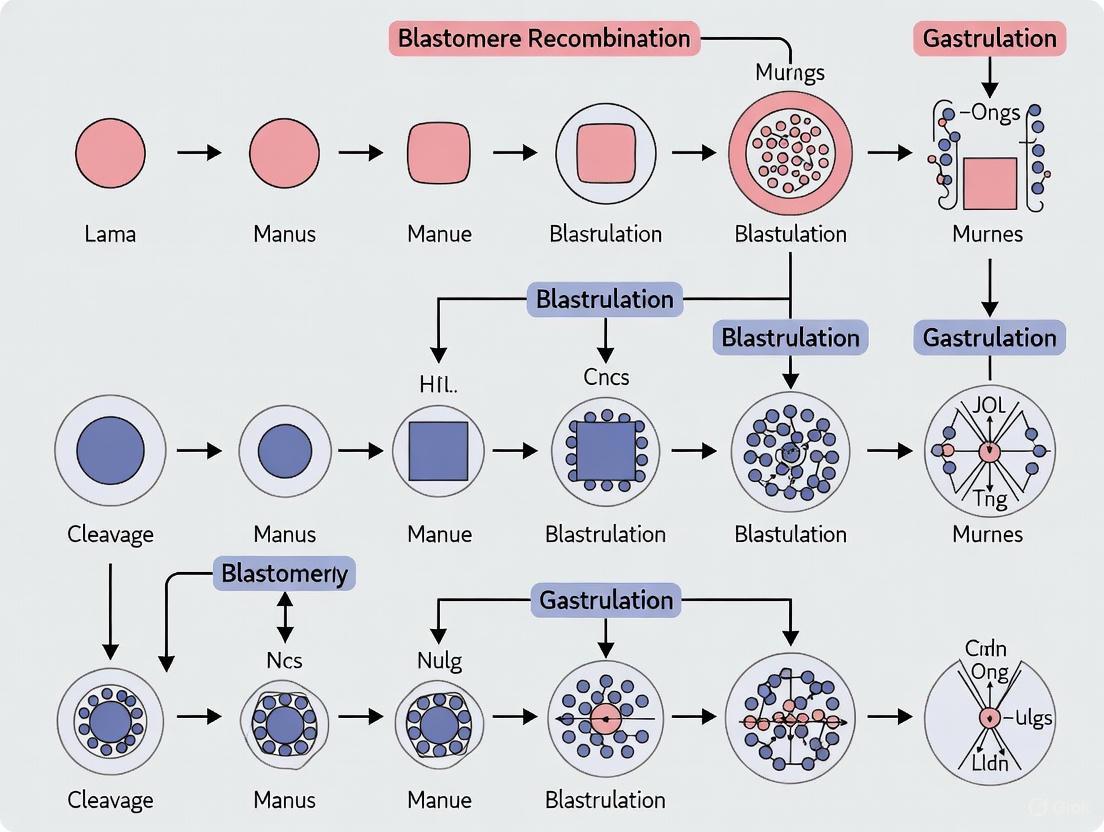
This article explores the pivotal role of blastomere recombination in elucidating the complex cell movements of vertebrate gastrulation.
Blastomere Recombination: Decoding Gastrulation Cell Movements in Vertebrate Development
Abstract
This article explores the pivotal role of blastomere recombination in elucidating the complex cell movements of vertebrate gastrulation. We cover foundational principles, from conserved patterns of epiboly and convergent extension to the mechanical forces generated by apical constriction and actomyosin networks. The methodological section details modern applications, including live imaging, computational modeling, and the use of CRISPR-based perturbations to dissect molecular controls. We address common challenges in experimental manipulation and data interpretation, providing optimization strategies. Finally, we compare findings across model systems and validate mechanisms through emerging stem cell-based models, offering a comprehensive resource for developmental biologists and researchers aiming to translate insights into regenerative medicine applications.
Core Principles: Unraveling the Fundamentals of Gastrulation Movements
{Conserved Patterns of Cell Movements from Fish to Mammals}
Gastrulation is a fundamental and evolutionarily conserved process in vertebrate development during which the basic body plan is established. This process transforms a simple ball or sheet of cells into a multi-layered embryo possessing distinct germ layers—ectoderm, mesoderm, and endoderm—that will give rise to all tissues and organs. A key conserved feature is the formation of a blastopore (or its equivalent, the primitive streak in amniotes), an opening through which cells move to internalize [1]. The axial side of this structure is consistently marked by a signaling center known as the organizer (e.g., Spemann-Mangold organizer in frogs, the node in mice), which patterns the germ layers and directs gastrulation movements [1]. Despite significant differences in embryo morphology and scale, the core patterns of cell movements—including internalization, epiboly, convergence, and extension—are remarkably similar from fish to mammals, governed by a shared set of molecular pathways [1] [2]. This application note details the experimental approaches for investigating these conserved patterns, with a specific focus on their relevance to blastomere recombination studies aimed at dissecting the autonomy of cell movement programs.
Key Conserved Cell Movements and Quantitative Analysis
The cellular choreography of gastrulation can be broken down into several discrete, quantifiable movement types that are conserved across vertebrate model systems. Table 1 summarizes these primary cell movements and their conserved functions.
Table 1: Conserved Gastrulation Cell Movements and Their Functions
| Movement Type | Primary Function in Body Plan Formation | Key Conserved Features from Fish to Mammals |
|---|---|---|
| Internalization | Formation of endoderm and mesoderm germ layers via ingress at the blastopore/primitive streak [1]. | Cell movement through a blastopore (fish, amphibians) or primitive streak (birds, mammals); regulated by signals from the organizer [1] [2]. |
| Epiboly | Expansion and thinning of germ layers to cover the embryo [1]. | Radial intercalation and/or cell flattening to increase surface area of the cellular sheet [1]. |
| Convergence & Extension (C&E) | Narrowing of tissues mediolaterally and elongation along the anteroposterior axis [2]. | Polarized cell behaviors, including mediolateral intercalation, driven by non-canonical Wnt/PCP signaling; establishes the elongated body axis [2]. |
The quantitative characterization of these movements in different models reveals both conservation and variation. Table 2 provides a comparative overview of key model organisms used in these studies.
Table 2: Comparative Analysis of Gastrulation Models and Key Quantitative Metrics
| Model Organism | Key Advantages for Study | Representative Quantitative Measurements | Insights into Conservation |
|---|---|---|---|
| Zebrafish | Optical transparency, high fecundity, amenability to live imaging and genetic manipulation [3]. | - Cell migration speed (e.g., µm/min) [3].- Directionality/persistence of migration.- Rate of epiboly progression (% of embryo covered over time). | Shared requirement for non-canonical Wnt/PCP pathway in C&E movements [2]. |
| Mouse | Direct relevance to mammalian, including human, development; advanced genetic tools [2]. | - Primitive streak length and cell ingression rate over time.- Fate mapping of blastomere descendants in chimeras. | FGF signaling promotes EMT and ingression through the primitive streak, a functional equivalent to blastopore internalization [2]. |
| Human Embryo Models (e.g., CS7-CS9) | Direct study of human development; 3D reconstructions provide unprecedented spatial resolution [4] [5]. | - 3D spatial mapping of gene expression and cell positions.- Quantification of emerging germ layer progenitor populations. | Confirmed presence of an organizer and conserved anterior-posterior axis establishment mechanisms [4] [5]. |
Core Experimental Protocols for Blastomere Recombination and Cell Movement Analysis
A powerful approach to interrogate the autonomy and conservation of gastrulation movements is blastomere recombination, which tests the ability of cells to execute their movement programs in novel contexts. The following protocol outlines a generalized methodology applicable across models, with species-specific adaptations.
Protocol: Blastomere Recombination and Fate-Mapping
I. Objective: To determine the intrinsic vs. extrinsic regulation of gastrulation cell movements by transplanting blastomeres from a donor embryo to a host embryo at a different spatial location and tracking their subsequent behavior.
II. Materials and Reagents
- Model Organisms: Zebrafish, Xenopus, or mouse embryos at appropriate pre-gastrula stages.
- Micromanipulation Setup: Micropipette/pipette puller, microinjector, micromanipulators, and an upright compound microscope with a temperature-controlled stage.
- Host and Donor Labeling:
- Lineage Tracers: Fluorescent dextrans (e.g., Rhodamine-dextran, FITC-dextran) for short-term tracking.
- Transgenic Donors: Genetically encoded fluorescent proteins (e.g., GFP, RFP) under ubiquitous promoters for long-term tracking.
- Embryo Culture Media: Species-specific, sterile media (e.g., Danieau's solution for zebrafish, M2/M16 for mouse).
- Agarose Plates: For embryo immobilization during transplantation.
III. Experimental Workflow
Diagram Title: Blastomere Recombination and Tracking Workflow
IV. Step-by-Step Procedure
Donor Embryo Preparation:
- At the desired cleavage stage, inject a single blastomere of the donor embryo with a non-diffusible, fluorescent lineage tracer using a fine glass micropipette.
- Alternatively, use embryos from a transgenic line expressing a fluorescent protein in all cells.
Host Embryo Preparation:
- Dechorionate the host embryos if necessary.
- Immobilize the host embryos in a small depression on an agarose-coated dish filled with culture medium.
Blastomere Transplantation:
- Using a sharp transplantation needle, carefully remove a single, labeled blastomere from the donor embryo.
- Transfer this blastomere to the perivitelline space of the host embryo, placing it in a specific region of interest (e.g., from a prospective ventral region to a dorsal region, or vice versa).
- Ensure the transplanted cell makes direct contact with the host embryo's cells.
Post-Operative Culture:
- Allow the transplanted embryos to recover and develop in an incubator at species-specific temperatures.
- Screen for successfully transplanted embryos under a fluorescence microscope.
Live Imaging and Cell Tracking:
- Mount the developing embryos for live imaging, using low-melting-point agarose if necessary to restrict movement.
- Acquire time-lapse images throughout gastrulation using a confocal or spinning-disk microscope.
- Track the 3D coordinates of the transplanted cell(s) and control host cells over time using tracking software (e.g., TrackMate in Fiji/ImageJ).
V. Data Analysis and Interpretation
- Trajectory Analysis: Plot the paths of transplanted cells versus control cells. Do transplanted cells from a dorsal origin autonomously execute mediolateral intercalation and dorsal convergence when placed in a ventral host region?
- Quantitative Metrics: Calculate and compare cell migration speed, directionality, and persistence.
- Fate Mapping: At the end of the experiment, fix the embryos and perform immunostaining or in situ hybridization to determine the final fate of the transplanted cells. This links movement to fate.
Conserved Molecular Pathways Regulating Cell Movements
The conserved patterns of gastrulation movements are orchestrated by a core set of evolutionarily ancient signaling pathways. These pathways often play dual roles, influencing both cell fate specification and cell movement, sometimes through distinct downstream effectors [2].
Key Signaling Pathways and Their Roles
The following diagram illustrates the core conserved pathways and their mechanisms of action in regulating cell movements during gastrulation.
Diagram Title: Core Pathways Regulating Gastrulation Movements
Protocol: Functional Interrogation of Signaling Pathways
I. Objective: To determine the functional requirement of a specific signaling pathway (e.g., BMP, Nodal, Wnt/PCP) in directing conserved gastrulation cell movements.
II. Materials and Reagents
- Small Molecule Inhibitors/Activators:
- DAPT: A γ-secretase inhibitor that blocks Notch signaling activation [3].
- DMH1: A selective BMP type I receptor inhibitor.
- SB431542: A selective inhibitor of TGF-β/Activin/Nodal type I receptors.
- IWP-2: An inhibitor of Wnt secretion that affects both canonical and non-canonical signaling.
- Morpholino Oligonucleotides (MOs): For gene-specific knockdown in zebrafish and Xenopus.
- CRISPR/Cas9 Components: For targeted gene knockout in zygotes.
- Antibodies: For phosphorylated Smad1/5/8 (BMP readout), phosphorylated Smad2 (Nodal readout), and β-catenin (Wnt readout).
III. Step-by-Step Procedure
Treatment Groups:
- Set up the following groups in culture medium: Vehicle Control (e.g., DMSO), Pathway Inhibitor, and Pathway Activator (if available).
Embryo Exposure:
- Add the chemical modulators to the embryo culture medium at the onset of gastrulation (or just prior). Use a range of concentrations based on published literature to establish a dose-response curve.
Phenotypic Analysis:
- Live Imaging: As in Section 3.1, perform live imaging to track cell movements in treated versus control embryos.
- Fixation and Staining: At specific gastrulation stages, fix embryos and perform:
Rescue Experiments:
- To confirm specificity, perform a rescue experiment. For example, if a BMP inhibitor causes a defect, attempt to rescue the phenotype by co-injecting mRNA for a constitutively active BMP receptor.
IV. Data Analysis
- Quantify gastrulation defects: Measure the length-to-width ratio of the embryo to assess C&E failure.
- Analyze cell morphology: Measure the mediolateral elongation index of mesodermal cells in control versus PCP-inhibited embryos.
- Quantify changes in cell migration speed and directionality from live-imaging data.
The Scientist's Toolkit: Essential Research Reagents and Models
This section details critical reagents, model systems, and technological approaches for studying conserved gastrulation movements.
Table 3: Research Reagent Solutions for Gastrulation Studies
| Reagent / Model / Tool | Function / Application | Example Use Case in Gastrulation Research |
|---|---|---|
| DAPT (γ-secretase inhibitor) | Inhibits Notch signaling by preventing cleavage and activation of the Notch intracellular domain (NICD) [3]. | Used in a zebrafish FASD model to demonstrate that alcohol-induced neurodefects via Notch upregulation can be ameliorated by DAPT, improving neuron differentiation [3]. |
| Spatial Transcriptomics (Stereo-seq) | High-resolution mapping of gene expression within the native tissue context [4] [5]. | 3D reconstruction of human Carnegie Stage 7-9 embryos, revealing spatial organization of germ layers and signaling centers during early body plan formation [4] [5]. |
| Stem-cell-based Embryo Models | Provides an accessible, ethical platform to study early human development and test hypotheses [6]. | Modeling early human development events, such as primitive streak formation and symmetry breaking, which are difficult to study in natural embryos [6]. |
| Fluorescent Lineage Tracers (e.g., Dextrans) | Labeling and live tracking of specific blastomeres and their progeny over time. | Fundamental for blastomere recombination and transplantation experiments to trace cell fates and movement trajectories. |
| Yap-miRFP670 Reporter Mouse Line | Endogenous tagging of YAP protein allows for live imaging of its dynamics [7]. | Monitoring YAP nuclear/cytoplasmic shuttling during early cell fate decisions in the mouse blastocyst, revealing regulation by cell cycle [7]. |
Advanced Applications: 3D Reconstruction of Human Gastrulation
Recent technological breakthroughs now allow for the direct study of conserved principles in human development. The following protocol outlines the workflow for creating a 3D model of a gastrulating human embryo, an approach that has recently provided unprecedented insights.
Workflow for 3D Embryo Reconstruction [4] [5]:
- Sample Preparation: A single, well-preserved human embryo at Carnegie Stage 7 (the start of gastrulation) is serially cryosectioned.
- Spatial Transcriptomics: Every section is processed using high-resolution spatial transcriptomics (e.g., Stereo-seq) to capture the full transcriptome with precise spatial coordinates.
- Computational 3D Reconstruction: A deep learning algorithm is used to align the sequential 2D sections, correcting for distortions and reconstructing a 3D point cloud of gene expression data for the entire embryo.
- Data Visualization and Analysis: The 3D model is used to map the precise location of cell types (e.g., the anterior visceral endoderm, primitive streak sub-populations, primordial germ cells) and active signaling pathways (e.g., Wnt, BMP). Interactive online databases (e.g., cs7.3dembryo.com) make this data accessible for the research community [5].
Key Findings from this Approach:
- Confirmed the existence of an anterior visceral endoderm (AVE), a conserved signaling center previously known in mice, in the CS7 human embryo [5].
- Revealed the early spatial segregation of different mesodermal subtypes (axial, paraxial, lateral plate) within the primitive streak [5].
- Mapped the location of primordial germ cells (PGCs) to the connecting stalk at the caudal end of the embryo [5].
- Provided a direct molecular and spatial reference for assessing the fidelity of stem-cell-based embryo models [4] [6].
The establishment of the vertebrate body plan is a fundamental process in developmental biology, orchestrated by specialized signaling centers. The Spemann-Mangold organizer, a group of cells located in the dorsal blastopore lip of amphibian embryos, represents a classic example of such a center [8] [9]. The seminal 1924 experiment by Spemann and Mangold demonstrated that transplanting this organizer to the ventral side of a host embryo induces the formation of a secondary body axis [8]. This discovery introduced the concept of embryonic induction, where specific cells instruct the fate of neighboring cells, and highlighted the blastopore—the site of gastrulation cell movements—as a critical functional region [10] [9]. This application note details the core signaling pathways and experimental protocols for investigating these signaling centers, framed within contemporary research on blastomere recombination and gastrulation movements.
Core Concepts and Key Signaling Pathways
The Blastopore and its Equivalents
The blastopore is the embryonic region through which cells invaginate during gastrulation to form the endoderm and mesoderm [10]. Its structure varies across vertebrates, but its functional role is conserved.
- Amphibians: The dorsal blastopore lip is the site of the Spemann organizer [8].
- Amniotes (Birds/Mammals): The primitive streak and its anterior structure, Hensen's node (chick) or the node (mouse), are considered homologous to the amphibian blastopore and organizer [8] [10]. These structures share key molecular markers, such as goosecoid and noggin, and possess axis-inducing properties upon transplantation [10].
Molecular Basis of Organizer Function
The organizer influences embryonic patterning primarily through the secretion of molecules that antagonize key signaling pathways. The table below summarizes the primary signaling pathways involved and their roles.
Table 1: Key Signaling Pathways in Organizer Function
| Signaling Pathway | Role in Ventral/Lateral Regions | Organizer-Derived Antagonist(s) | Effect of Antagonism |
|---|---|---|---|
| Bone Morphogenetic Protein (BMP) | Induces epidermal ectoderm; promotes ventral mesoderm [11] | Noggin, Chordin [8] [11] | Neural induction from ectoderm; dorsalization of mesoderm [11] |
| Wnt/β-catenin | Promotes posterior fates [8] | Dickkopf-1 (Dkk-1), Frzb-1 [8] [9] | Induction of anterior neural structures and head formation [8] |
| Nodal | Promotes mesendodermal fates [8] | Cerberus [8] [9] | Restriction of mesendodermal formation to appropriate regions [8] |
The following diagram illustrates the functional relationships and logical flow of signals from the Nieuwkoop center to the establishment of the body axis.
Application Notes: Experimental Protocols
Protocol 1: Classical Organizer Transplantation
This protocol, based on the original Spemann-Mangold experiment, is used to test the inductive capacity of a putative organizer tissue.
1. Principle The ability of a tissue to induce a secondary embryonic axis when transplanted to an ectopic location is the definitive functional test for an organizer [8] [9].
2. Materials
- Donor and host embryos at early gastrula stage.
- Barth's solution or equivalent physiological saline.
- Fine glass needles and hair loops for microsurgery.
- Agarose-coated Petri dishes.
- Fluorescent dextran (e.g., Alexa Fluor 488) for lineage tracing.
3. Step-by-Step Procedure 1. Preparation: Position donor and host embryos in agarose-coated dishes to stabilize them. 2. Lineage Labeling (Optional): Inject a lineage tracer (e.g., fluorescent dextran) into the donor embryo to distinguish donor and host cells in the resulting chimera [12]. 3. Excision: Using a fine glass needle, excise a small fragment (approximately 100-200 µm) of the dorsal blastopore lip from the donor embryo. 4. Recipient Site Preparation: On the host embryo, create a recipient site on the ventral side, opposite the native organizer. 5. Transplantation: Graft the donor tissue into the prepared host site. Ensure good contact between the graft and host tissues. 6. Culture: Allow the manipulated embryo to develop in culture medium. Monitor for the formation of a secondary axis, evident by the appearance of a second neural tube and somites.
4. Data Analysis
- Score the percentage of transplants that result in a complete or partial secondary axis.
- Use lineage tracing to confirm that induced tissues are derived from the host, demonstrating true induction [8] [9].
Protocol 2: Molecular Dissection via mRNA Microinjection
This protocol assesses the functional role of specific genes in organizer formation and function.
1. Principle Ectopic expression or inhibition of candidate genes in single blastomeres tests their sufficiency in mimicking organizer activity, such as inducing secondary axes [12].
2. Materials
- Capped, synthetic mRNA for the gene of interest (e.g., Wnt1, Noggin, β-catenin).
- Microinjection apparatus (micropipette puller, injector).
- Injection needles.
- Embryos at 1- to 8-cell stage.
3. Step-by-Step Procedure 1. mRNA Preparation: Synthesize and purify capped mRNA. Resuspend in nuclease-free water. A tracer dye (e.g., Rhodamine-dextran) can be co-injected to mark the injected cells. 2. Embryo Preparation: De-jelly and align embryos in grooves on an injection dish. 3. Microinjection: Load the mRNA solution into a glass needle and inject a calibrated volume (typically 5-50 nL) into a single blastomere at the desired stage. 4. Culture and Scoring: Culture the injected embryos and score for phenotypic changes, including the formation of secondary axes, altered gene expression patterns, or changes in cell fate.
4. Data Analysis
- Quantify the percentage of injected embryos exhibiting ectopic axis formation.
- Analyze gene expression changes via in situ hybridization or immunohistochemistry.
Table 2: Quantitative Data from Molecular Dissection Experiments
| Ectopically Expressed Gene | Experimental System | Phenotype Observed | Induction Efficiency | Citation Context |
|---|---|---|---|---|
| Wnt1 + Wnt3 (co-injection) | Nematostella vectensis (Sea Anemone) | Complete ectopic body axes with tentacles, pharynx, and mesenteries | ~50% | [12] |
| Noggin | Xenopus laevis (Frog) | Neural induction and dorsalization of mesoderm | N/A (Molecule mimics organizer signal) | [11] |
| Chordin | Nematostella vectensis (Sea Anemone) | No ectopic axis formation | 0% (0/120 embryos) | [12] |
The Scientist's Toolkit: Research Reagent Solutions
Table 3: Essential Reagents for Organizer and Blastopore Research
| Research Reagent | Function / Mechanism of Action | Key Application in the Field |
|---|---|---|
| Noggin Protein | Binds and inactivates BMP4, preventing its interaction with cell-surface receptors [11]. | Used to induce neural tissue from ectoderm and dorsalize ventral mesoderm in cell culture and embryo perturbation assays [11]. |
| CHIR-99021 | Small molecule agonist of the Wnt/β-catenin pathway (GSK-3 inhibitor) [13]. | Used to stabilize β-catenin and mimic the dorsalizing signal in stem cell models and embryos; component of totipotent-like cell induction cocktails [13]. |
| 1-Azakenpaullone | GSK-3β inhibitor that activates Wnt/β-catenin signaling [12]. | Tool for oral-aboral (axis) patterning studies in cnidarian and vertebrate model systems [12]. |
| Fluorescent Dextrans | Lineage tracing molecules that are retained in cells after injection and inherited by progeny. | Critical for cell fate mapping and distinguishing donor vs. host cell contributions in transplantation experiments [12]. |
| Capped Synthetic mRNA | Allows for ectopic gene expression in embryos or explants. | Functional testing of gene sufficiency (e.g., axis induction by Wnt or Nodal genes) [12]. |
Visualization of Signaling Pathways
The following diagram provides a detailed view of the molecular interactions within and around the Spemann organizer, integrating the key pathways from Table 1.
Gastrulation is a fundamental phase in embryonic development, transforming a simple cellular assembly into a complex, multi-layered structure poised to form the body plan. This process is driven by conserved cellular behaviors that generate the mechanical forces necessary for large-scale tissue reshaping and cell repositioning. Understanding these drivers—apical constriction, epithelial-to-mesenchymal transition (EMT), and directed intercalation—is critical not only for developmental biology but also for regenerative medicine and understanding disease processes such as cancer metastasis. This application note details the core mechanisms, quantitative dynamics, and experimental protocols for investigating these key cellular drivers, providing a resource for researchers exploring the physical and molecular basis of morphogenesis.
Core Concepts and Mechanisms
Apical Constriction: The Force Generator for Tissue Bending and Invagination
Cellular Process: Apical constriction is an evolutionarily conserved cell shape change where the apical surface of an epithelial cell narrows, generating mechanical forces that drive tissue folding, invagination, and cell delamination [14] [15]. During mouse gastrulation, epiblast cells constrict their apically positioned cell-cell junctions in a pulsed, ratchet-like fashion to ingress through the primitive streak [14].
Molecular Machinery: The core engine of apical constriction is the actomyosin network. Non-muscle myosin II (NMII) generates contractile force on apical actin filaments, progressively shrinking the junctional circumference [14] [15]. This process is regulated by polarity proteins like Crumbs2, which is required for the proper apical localization and activity of myosin II, creating an anisotropic (directional) distribution of contractile force that promotes asynchronous shrinkage of different junctions within a cell [14]. Key regulators such as aPKC and Rock1 kinases are also integrated into this network [14].
Epithelial-to-Mesenchymal Transition (EMT): The Gateway for Cell Ingression
Cellular Process: EMT is a fundamental process wherein epithelial cells lose their apical-basal polarity and cell-cell adhesions, acquire front-rear polarity, and become migratory mesenchymal cells [14] [16]. In gastrulation, EMT allows cells to exit the epiblast epithelium and ingress through the primitive streak. It is crucial to note that cells can exist in a spectrum of hybrid epithelial/mesenchymal (E/M) states, exhibiting a mix of molecular markers and behaviors, rather than undergoing a complete, binary switch [16].
Molecular Triggers: EMT is dynamically regulated by signaling pathways including WNT, BMP, Nodal, and FGF [14] [17]. A key downstream event is the transcriptional downregulation of epithelial adhesion proteins like E-cadherin, coupled with the upregulation of mesenchymal proteins such as N-cadherin and vimentin [16]. The extent of EMT can be modulated by the dose and duration of external signals like TGFβ, leading to progressively more mesenchymal phenotypes [16].
Directed Cell Intercalation: The Engine of Tissue Elongation and Flow
Cellular Process: Also known as convergent extension, directed intercalation occurs when cells maneuver between one another, converging toward a central axis and extending the tissue along the perpendicular axis [18] [19]. In the chick embryo, this process drives the formation and elongation of the primitive streak and is responsible for the large-scale vortical "Polonaise movements" of the epiblast [18] [19].
Molecular Machinery: Intercalation is powered by mediolaterally polarized actomyosin activity. In the chick epiblast, multicellular actomyosin cables form at junctions that are oriented perpendicular to the embryonic midline. The contraction of these cables shrinks those specific junctions, forcing cells to intercalate mediolaterally and thereby elongating the streak anteroposteriorly [18] [19]. This process is dependent on myosin II activity and is patterned by upstream signaling.
Table 1: Key Cellular Drivers of Gastrulation Movements
| Cellular Driver | Primary Morphogenetic Function | Core Molecular Machinery | Representative Model Organisms |
|---|---|---|---|
| Apical Constriction | Tissue bending; cell ingression/delamination | Actomyosin contractility; Crumbs2; aPKC; Rock1 | Mouse [14], Drosophila [14] |
| EMT | Cell ingression; acquisition of migratory potential | Snail/Twist transcription factors; E- to N-cadherin switch; TGFβ signaling | Mouse [14], Chick [18], Mammary epithelial cells (MCF-10A) [16] |
| Directed Intercalation | Tissue convergence and extension (elongation) | Polarized actomyosin cables; Myosin II; planar cell polarity pathways | Chick [18] [19], Xenopus [20] |
Quantitative Data and Experimental Findings
Dynamics of Apical Constriction and Ingression
Live imaging of mouse embryos expressing ZO-1-GFP (a junctional marker) has enabled the quantification of apical constriction dynamics. The process is asynchronous and stochastic within the population of primitive streak cells.
Table 2: Quantitative Dynamics of Cell Ingression in the Mouse Primitive Streak [14]
| Parameter | Measurement | Experimental Context |
|---|---|---|
| Ingression Rate | 44 ± 2% of cells within 1 hour | Mid/late-streak stage (E7.5) embryos; n=378 cells from 3 embryos |
| Temporal Patterning | 48% as isolated cells; 52% as pairs/groups | Cells ingressing >30 min apart classified as isolated; <30 min apart as coordinated |
| Spatial Scale of Ingression | ~40 µm region at the posterior midline | Corresponds to the domain of Snail expression and basement membrane breakdown |
Relationship Between EMT Degree and Invasive Behavior
The functional impact of EMT is not all-or-none. A quantitative relationship exists between the extent of EMT progression and the expression of an invasive cell behavior called "contact-initiated sliding" [16].
Table 3: Quantitative Relationship Between EMT and Cell Sliding Behavior [16]
| TGFβ Treatment (Inducer of EMT) | E-cadherin Expression | Minimum Micropattern Width for Sliding | Inferred EMT Status |
|---|---|---|---|
| Untreated (Control) | High | 41 µm | Epithelial |
| Low Dose/Short Duration | Intermediate | 26 µm | Hybrid E/M State (Partial EMT) |
| High Dose/Long Duration | Low | 15 µm | Mesenchymal (Complete EMT) |
Application Notes: Experimental Protocols
Protocol 1: Live Imaging and Quantification of Apical Constriction in Mouse Embryos
This protocol outlines the methodology for visualizing and measuring the dynamics of apical constriction during mouse gastrulation [14].
Research Reagent Solutions:
- ZO-1-GFP reporter mouse line: Labels tight junctions, enabling visualization of the apical surface of epiblast cells.
- Rosa26mT/mG reporter mouse line: Labels the entire plasma membrane, useful for identifying the completion of ingression.
- Ex utero embryo culture system: Allows for post-implantation development and time-lapse imaging.
Detailed Workflow:
- Embryo Preparation: Harvest ZO-1-GFP or Rosa26mT/mG transgenic mouse embryos at E6.5-E7.5.
- Embryo Culture: Establish ex utero cultures in appropriate media under physiological conditions (37°C, 5% CO2).
- 3D Time-lapse Imaging: Mount the embryo to optimize optical access to the primitive streak. Acquire z-stacks at high temporal resolution (e.g., every 5-10 minutes) over several hours using a confocal or light-sheet microscope.
- Image Analysis and Segmentation: Use image analysis software (e.g., Fiji, Imaris) to segment cell membranes and junctions in 3D over time.
- Quantitative Tracking: Track individual cells to measure the rate and pattern of apical surface area reduction. Quantify the pulsatile dynamics of junctional shrinkage and the timing of ingression events relative to neighbors.
Protocol 2: Modulating and Analyzing Gastrulation Morphologies in Chick Embryo
This protocol describes how to manipulate signaling pathways to alter large-scale tissue flows and gastrulation morphologies in the chick embryo, a classic model for studying directed intercalation [18].
Research Reagent Solutions:
- LY2874455 (pan-FGF receptor inhibitor): Used to inhibit mesoderm differentiation.
- FGF4/FGF8 (Recombinant proteins): Used to expand the mesendoderm territory.
- LDN-193189 (BMP receptor inhibitor): Used to induce ectopic mesendoderm rings.
- Membrane-GFP transgenic chick: Enables live imaging of cell behaviors and tissue flows.
Detailed Workflow:
- Embryo Preparation: Incubate fertilized chick eggs to Hamburger-Hamilton (HH) stage 3-4. Isolate the embryo and culture on semi-solid media.
- Experimental Perturbation:
- To inhibit streak formation, apply FGF inhibitor LY2874455 to the culture medium.
- To induce a circular "germ ring" morphology, apply a bead soaked in FGF4/8 to the marginal zone or add recombinant FGF to the medium.
- To generate an ectopic ring of mesoderm, apply the BMP inhibitor LDN-193189.
- Live Imaging: Image the embryo using light-sheet or confocal microscopy over 10-20 hours to capture tissue flows.
- Data Analysis:
- Particle Image Velocimetry (PIV): Quantify tissue-scale velocity fields and strain rates from the time-lapse data.
- Cell Behavior Quantification: Analyze the movies for rates and directions of cell intercalation and ingression.
- Dynamic Morphoskeleton (DM) Analysis: Compute Lagrangian attractors to model and visualize the organizing centers of the tissue flows.
Signaling Network Regulating Gastrulation Drivers
The following diagram illustrates the core signaling pathways that pattern the embryo and regulate the cellular drivers of gastrulation, integrating information from mouse, chick, and Xenopus studies [14] [17] [18].
The Scientist's Toolkit: Research Reagent Solutions
Table 4: Essential Reagents for Investigating Gastrulation Cell Movements
| Reagent / Tool | Function/Application | Example Use Case |
|---|---|---|
| ZO-1-GFP Reporter | Live visualization of tight junctions and apical surface area. | Quantifying ratchet-like apical constriction in mouse epiblast cells [14]. |
| Membrane-GFP Reporter (Chick) | Labeling of all plasma membranes for tracking cell shapes and movements. | Analyzing tissue flows and cell intercalations during primitive streak formation [18]. |
| FGF Receptor Inhibitors (e.g., LY2874455) | Chemical inhibition of FGF signaling to block mesoderm formation. | Testing the requirement of mesoderm for generating gastrulation flows in chick [18]. |
| BMP Receptor Inhibitors (e.g., LDN-193189) | Chemical inhibition of BMP signaling to expand the mesendoderm domain. | Inducing a ring-shaped mesoderm territory, mimicking teleost fish gastrulation in chick [18]. |
| TGFβ (Recombinant Protein) | Soluble factor to induce epithelial-to-mesenchymal transition (EMT) in vitro. | Establishing a dose- and duration-dependent model of partial to complete EMT in MCF-10A cells [16]. |
| CRISPR-DiCas7-11 (Xenopus) | RNA-targeting knockdown system for gene function analysis. | Investigating the role of Sox8 in ventral mesoderm and blastopore closure [21]. |
| Fiber-like Micropatterned Surfaces | In vitro substrate that mimics confined, fibrillar environments. | Quantifying contact-initiated sliding behavior as a metric for invasiveness during EMT [16]. |
Integrated Workflow for Gastrulation Analysis
The following diagram outlines a generalized experimental workflow, from perturbation to quantitative analysis, for studying the cellular drivers of gastrulation, synthesizing approaches from multiple model systems.
Mechanical Forces and Tissue-Scale Strain in Driving Involution
Application Note: The Mechanochemical Principles of Gastrulation
Gastrulation represents a pivotal stage in embryonic development where extensive tissue rearrangements establish the fundamental body plan. While genetic and biochemical signals have long been recognized as directors of this process, contemporary research has elucidated that mechanical forces and tissue-scale strains are equally critical in driving morphogenetic events [22] [19]. This application note examines how mechanical forces generated by cells and tissues coordinate involution movements during gastrulation, with particular emphasis on blastomere recombination studies. The integration of physical forces with molecular signaling creates a robust mechanochemical framework that ensures reproducible tissue patterning amidst complex cellular flows [19] [23].
Classification of Developmental Mechanical Forces
Embryonic cells generate and respond to diverse mechanical forces through specialized cellular machinery. The table below summarizes the principal force types involved in gastrulation processes:
Table 1: Mechanical Forces in Embryonic Development
| Force Type | Molecular/Cellular Basis | Primary Role in Gastrulation | Experimental Measurement Methods |
|---|---|---|---|
| Tensional forces/Traction | Actomyosin contraction, cytoskeletal prestress | Cell shape stabilization, tissue tension | Traction force microscopy [22] [24] |
| Shear stress | Fluid flow against cell surfaces | Endothelial/hematopoietic patterning | Magnetic twisting cytometry [22] |
| Surface tension | Intercellular adhesion, cortical tension | Tissue segregation, boundary formation | Surface tensiometry [22] |
| Compressive stress | Cell proliferation, neighbor crowding | Epithelial folding, buckling | Atomic force microscopy, laser ablation [25] [24] |
| Spring forces | Actin bundle conformational changes | Sperm penetration, egg activation | Micromanipulation [22] |
Quantitative Data in Gastrulation Mechanics
Force-Induced Tissue Remodeling Metrics
Recent investigations have yielded quantitative insights into the mechanical parameters governing gastrulation. The following table compiles key experimental measurements from model systems:
Table 2: Quantitative Measurements of Mechanical Parameters in Gastrulation
| Parameter | Experimental System | Measured Value | Biological Significance | Citation |
|---|---|---|---|---|
| Ectopic fold area | Drosophila cephalic furrow mutants | 25% of wild-type furrow area | Indicates mechanical instability in absence of patterned invagination | [25] |
| Ectopic fold depth | Drosophila btd/eve mutants | 20% of wild-type furrow depth | Demonstrates reduced invagination efficiency | [25] |
| Strain rate peak | Drosophila head-trunk interface | Higher in mutants vs controls | Reveals increased tissue deformation from mitotic expansions | [25] |
| Shear stress | Mechanical SVF gel preparation | τ = 4μQ/πR³ (calculated) | Determines mechanical input for adipose regeneration | [26] |
| Cellular prestress | Cytoskeletal force balance | Microfilament tension vs. microtubule compression | Maintains mechanical stability of cell shape | [22] |
Experimental Protocols
Protocol 1: Traction Force Microscopy for Cell-Generated Stresses
Purpose
To quantify traction forces exerted by individual cells or cell collectives during gastrulation movements.
Materials
- Flexible substrate: Polyacrylamide gel with known elastic modulus (0.5-10 kPa)
- Fiduciary markers: Fluorescent nanobeads (0.2 μm diameter) embedded in gel
- ECM coating: Fibronectin or laminin at appropriate concentration
- Imaging system: Confocal or epifluorescence microscope with environmental control
- Analysis software: Custom MATLAB algorithms or open-source solutions
Procedure
- Substrate preparation: Fabricate polyacrylamide gels of defined stiffness on glass-bottom dishes. Incorporate fluorescent beads at sufficient density for pattern recognition.
- Surface functionalization: Couple extracellular matrix proteins to gel surface using sulfo-SANPAH crosslinking.
- Cell plating: Dissociate gastrula-stage tissues or use explants. Plate at appropriate density on functionalized gels.
- Time-lapse imaging: Acquire bead displacement images with simultaneous brightfield or phase contrast of cells every 2-5 minutes for required duration.
- Reference image: After experiment, trypsinize cells and image bead positions without cellular traction.
- Force calculation: Compute displacement fields by comparing bead positions with and without cells. Convert to traction stresses using Fourier-transform traction cytometry.
Data Interpretation
Traction forces are typically highest at the leading edges of migrating mesendoderm cells. In avian embryos, traction patterns reveal anisotropic forces aligned with the primitive streak during convergent extension [22] [19].
Protocol 2: Laser Ablation for Tissue Tension Mapping
Purpose
To infer endogenous tensions within tissues by measuring recoil dynamics after targeted laser cutting.
Materials
- Laser system: Pulsed UV laser (e.g., 355 nm) coupled to confocal microscope
- Membrane markers: Cell-permeable fluorescent dyes (e.g., CellMask) or transgenic membrane-GFP
- Live imaging capability: High-speed camera for immediate post-ablation imaging
- Analysis software: ImageJ with appropriate plugins for recoil quantification
Procedure
- Sample preparation: Mount embryo or explant in appropriate imaging chamber. Label cell membranes with fluorescent marker.
- Baseline imaging: Acquire 3-5 pre-ablation images at high temporal resolution.
- Laser ablation: Define cut region (typically 3-5 cell junctions) oriented orthogonally to presumed tension axis. Execute ablation with minimal laser power.
- Recoil imaging: Capture immediate recoil dynamics at 0.5-2 second intervals for 2-5 minutes.
- Quantification: Measure initial recoil velocity and maximum displacement of adjacent vertices.
Data Interpretation
Recoil velocity correlates with pre-existing tension. In Drosophila studies, laser ablation at the trunk-germ interface revealed compressive stresses from germ band extension [25].
Protocol 3: In Vivo Mechanical Perturbation in Avian Embryos
Purpose
To directly test the role of specific mechanical forces in gastrulation through controlled physical manipulation.
Materials
- Micro-manipulation system: Precision micromanipulator with fine glass needles
- Embryo culture: Modified New culture or similar ex ovo culture system
- Magnetic beads: Ferromagnetic or superparamagnetic beads (10-50 μm)
- External magnet: Electromagnetic or permanent magnet with fine positioning
Procedure
- Embryo preparation: Explain gastrulating avian embryos to culture substrate. Stabilize with appropriate agarose or albumen rings.
- Force application:
- Option A (Direct mechanical): Use glass needle to apply localized compression or tension to specific tissue regions.
- Option B (Magnetic forces): Implant magnetic beads at target locations. Apply calibrated magnetic fields for controlled force application.
- Perturbation protocol: Apply forces of defined magnitude and duration during critical gastrulation stages.
- Live imaging: Document tissue responses with time-lapse microscopy.
- Fixation and analysis: Process for immunohistochemistry or in situ hybridization to assess molecular changes.
Data Interpretation
Magnetic force application in avian embryos demonstrated that mechanical inputs can alter primitive streak formation and mesendoderm ingression trajectories [22] [19].
Signaling Pathways in Mechanotransduction
FGFR/Erk2 Mechanical Activation Pathway
Mechanical stimulation during gastrulation activates specific signaling cascades independent of traditional ligand-receptor interactions. The FGFR/Erk2 pathway has been identified as a key mechanotransduction pathway in Xenopus embryos [27].
Diagram Title: FGFR/Erk2 Mechanotransduction Pathway
Nodal Gradient and Motility-Driven Unjamming
In zebrafish gastrulation, the Nodal morphogen gradient orchestrates tissue internalization through a motility-driven unjamming transition [23]. High Nodal signaling generates highly protrusive "leader" cells that initiate local unjamming, while lower levels produce "follower" cells that require mechanical coupling for internalization.
The Scientist's Toolkit: Research Reagent Solutions
Table 3: Essential Reagents for Mechanobiology Studies in Gastrulation
| Reagent/Category | Specific Examples | Function/Application | Experimental Context |
|---|---|---|---|
| Cytoskeletal Inhibitors | Y-27632 (ROCK inhibitor), Blebbistatin (myosin II inhibitor) | Perturb actomyosin contractility to test mechanical hypotheses | Avian primitive streak formation [19] |
| Fluorescent Biosensors | FRET-based tension sensors, F-actin markers (LifeAct) | Visualize molecular-scale forces and cytoskeletal dynamics | Zebrafish mesendoderm protrusiveness [23] |
| Deformable Substrates | Polyacrylamide gels of tuned stiffness, PDMS microposts | Quantify cellular traction forces and stiffness sensing | Xenopus blastula explants [24] |
| Magnetic Manipulation | Ferromagnetic beads, magnetic tweezers | Apply controlled forces to specific tissue regions | Drosophila ectopic fold analysis [25] |
| Genetic Perturbations | DN-Rac1, E-cadherin knockout, PAR protein mutants | Test specific molecular functions in mechanotransduction | Cell competition assays [28] |
Integrated Experimental Workflow
The following diagram illustrates a comprehensive workflow for investigating mechanical forces in gastrulation, integrating multiple experimental approaches:
Diagram Title: Integrated Mechanobiology Workflow
The investigation of mechanical forces in driving involution during gastrulation requires multidisciplinary approaches that integrate physical manipulation, quantitative imaging, and computational modeling. The protocols and reagents detailed herein provide a framework for interrogating how tissue-scale strains coordinate with molecular signals to shape the embryonic body plan. Future advances will depend on continued development of more precise mechanical manipulation tools and more sophisticated computational models that can bridge molecular-scale events with tissue-level morphogenesis.
Blastomere recombination is a foundational experimental technique in developmental biology used to determine whether a cellular phenotype—be it a specific fate, behavior, or movement—is determined by intrinsic factors within the cell itself (cell-autonomous) or by signals originating from its neighboring cells (non-autonomous). This methodology involves the surgical isolation and reassembly of specific blastomeres from early embryos into novel configurations, creating a chimeric embryonic environment. By observing the developmental behavior of the transplanted cells in their new context, researchers can decipher the sources of instructional information that guide morphogenetic events.
The profound cell rearrangements of gastrulation serve as a critical arena for applying this tool. During gastrulation, the embryo transforms from a simple spherical structure into a complex multilayered organism through meticulously coordinated cell movements such as invagination, ingression, and convergent extension [29] [20]. These processes are driven by a combination of cell-intrinsic programming and extrinsic signals from surrounding tissues. Understanding the autonomy of these movements is essential for unraveling the genetic and molecular circuitry that orchestrates embryonic development. This protocol details the application of blastomere recombination within the context of gastrulation research, using the Xenopus embryo as a model system due to its experimental versatility and the extensive characterization of its gastrulation movements.
Theoretical Foundation
The Principle of Cell Autonomy Testing
A cell-autonomous process is one in which a cell's fate or behavior is determined by its own internal components, regardless of its environment. In contrast, a non-autonomous process is one where the cell's behavior is directed by signals from other cells. The classic experimental design to distinguish between these possibilities is outlined below:
- Cell-Autonomous Result: If a blastomere (or its descendants) continues to express its original fate or behavior even after being transplanted into a host embryo with a different fate, the process is deemed cell-autonomous. The cell carries its own "instructions."
- Non-Autonomous Result: If a transplanted blastomere adopts the fate or behavior of its new location in the host embryo, the process is non-autonomous. The cell is taking "instructions" from its new neighbors.
Key Signaling Pathways in Gastrulation Cell Movements
Gastrulation movements are regulated by an interplay of several evolutionarily conserved signaling pathways. When designing recombination experiments, it is crucial to consider the components of these pathways, as they represent potential sources of autonomous or non-autonomous instruction.
The following diagram illustrates the core signaling pathways and their functional interactions in regulating cell movements during gastrulation:
Figure 1. Key signaling pathways regulating gastrulation cell movements. Pathways like TGF-β/Nodal, Wnt (including Planar Cell Polarity, PCP), and FGF converge on regulators like the Snail/Slug family, which directly control Epithelial-to-Mesenchymal Transition (EMT) [29] [30]. The Furry (Fry) protein and its functional partner NDR1 kinase represent an evolutionarily conserved module essential for cell polarization and morphogenesis during gastrulation [20].
Application Notes & Protocols
This section provides a detailed methodology for a blastomere recombination experiment designed to test the autonomy of convergent extension movements in the dorsal mesoderm of Xenopus laevis.
Experimental Workflow
The entire procedure, from embryo preparation to analysis, is visualized in the following workflow:
Figure 2. Overall workflow for a blastomere recombination experiment.
Detailed Step-by-Step Protocol
Step 1: Embryo Preparation and Fate Mapping
- Obtain Embryos: Collect Xenopus laevis embryos through natural mating or in vitro fertilization. Dejelly the embryos chemically (e.g., with 2% Cysteine-HCl, pH 8.0) or manually.
- Fate Mapping: Utilize established fate maps for the 32- to 64-cell stage Xenopus embryo. The dorsal marginal zone (DMZ), which gives rise to the axial and paraxial mesoderm responsible for convergent extension, is typically targeted. For lineage tracing, inject a lineage tracer (e.g., Fluorescein Dextran, Lysinated Rhodamine Dextran, or an mRNA for a fluorescent protein like GFP) into the donor blastomere at the 1- to 4-cell stage.
Step 2: Donor and Host Embryo Selection
- Donor Embryo: Use an embryo previously injected with a lineage tracer for easy identification post-recombination.
- Host Embryo: Use a non-injected, wild-type embryo. To create a distinct niche, the host can be genetically manipulated or derived from a differently pigmented species (e.g., Xenopus laevis vs. Xenopus tropicalis).
Step 3: Blastomere Excision
- Preparation: Place donor and host embryos in an agarose-coated dish containing 1x Modified Barth's Saline (MBS) or Normal Amphibian Medium (NAM).
- Surgical Removal: Using a sharp eyebrow hair knife or a fine glass needle, carefully excise the target blastomere (e.g., a DMZ progenitor) from the donor embryo. Similarly, remove the equivalent region from the host embryo to create a "niche" for the donor tissue.
Step 4: Tissue Recombination and Healing
- Transplantation: Gently maneuver the excised donor blastomere into the vacancy created in the host embryo using a hair loop or glass needle.
- Healing: Allow the recombinant embryo to heal. The tissues will naturally adhere and integrate. Maintain the recombinant embryo in a small well of 0.75x-1x MBS/NAM supplemented with antibiotics (e.g., Gentamicin) to prevent infection.
Step 5: Culture and Phenotypic Analysis
- Culture: Culture the recombinant embryos until the desired developmental stage (e.g., mid-gastrula to early neurula) at a temperature between 14-22°C.
- Phenotypic Assessment: Analyze the recombinant embryos for defects in gastrulation movements. Key phenotypes to score include:
- Blastopore closure: Delayed or failed closure indicates impaired mesodermal migration and involution [20].
- Axis elongation: A shortened anterior-posterior axis is a hallmark of defective convergent extension [20].
- Explant Assays: For a more direct assessment, isolate the recombinant DMZ and culture it as an explant. Measure the degree of narrowing (convergence) and lengthening (extension) over time compared to control explants.
Step 6: Lineage Tracing and Quantitative Analysis
- Imaging: Fix the recombinant embryos and process them for whole-mount in situ hybridization to analyze marker gene expression or perform immunohistochemistry. Use confocal microscopy to visualize the lineage tracer and assess the morphology, alignment, and intercalation behavior of the donor-derived cells.
- Quantification: Measure key parameters such as:
- Mediolateral Cell Orientation: The angle of donor cell long axes relative to the embryonic midline.
- Cell Intercalation Index: The number of donor-derived cells intercalated between host cells within a defined region.
- Tissue Length: The length of the elongated explant or axial tissue.
Expected Outcomes and Data Interpretation
The table below summarizes the anticipated results and their interpretation for autonomy of convergent extension movements.
Table 1: Interpretation of Blastomere Recombination Results for Convergent Extension
| Donor Cell Origin | Host Environment | Experimental Outcome | Interpretation |
|---|---|---|---|
| Dorsal Marginal Zone (DMZ) | Ventral Marginal Zone (VMZ) | Donor cells undergo mediolateral intercalation and form an elongated protrusion. | Cell-Autonomous. The DMZ cells intrinsically "know" to undergo convergent extension. |
| Dorsal Marginal Zone (DMZ) | Ventral Marginal Zone (VMZ) | Donor cells fail to intercalate and contribute to a non-elongated, rounded mass. | Non-Autonomous. Convergent extension requires signals from the dorsal environment. |
| Ventral Marginal Zone (VMZ) | Dorsal Marginal Zone (DMZ) | Donor cells intercalate and contribute to axis elongation. | Non-Autonomous. The dorsal host environment can instruct ventral cells to undergo convergent extension. |
| Ventral Marginal Zone (VMZ) | Dorsal Marginal Zone (DMZ) | Donor cells fail to intercalate and disrupt host elongation. | Cell-Autonomous (with inhibitory factors). Ventral cells are intrinsically incapable of or actively resist convergent extension signals. |
Key Quantitative Parameters for Analysis
To ensure robust and reproducible conclusions, the following parameters should be quantitatively measured during analysis.
Table 2: Key Quantitative Metrics for Assessing Gastrulation Phenotypes
| Parameter | Measurement Method | Significance in Gastrulation |
|---|---|---|
| Blastopore Closure Index | (Initial Blastopore Diameter - Current Diameter) / Initial Diameter | Quantifies progression of involution and mesendoderm internalization [20]. |
| Axis Length (Anterior-Posterior) | Pixel measurement from anterior-most to posterior-most point in neurula embryos | Direct readout of successful convergent extension [20]. |
| Convergent Extension Ratio (Explants) | (Final Explant Length / Final Explant Width) | Direct measure of explant narrowing and lengthening. |
| Cell Polarization Index | Percentage of cells with a mediolateral alignment > 30° from the A-P axis | Indicates proper cellular polarity required for intercalation [20]. |
The Scientist's Toolkit: Research Reagent Solutions
Successful execution of blastomere recombination experiments relies on a suite of specialized reagents and tools.
Table 3: Essential Research Reagents and Materials for Blastomere Recombination
| Reagent / Material | Function / Application | Example & Notes |
|---|---|---|
| Lineage Tracers | Labeling donor cell progeny for identification post-recombination. | Fluorescein Dextran (FD), Rhodamine Dextran: Cell-impermeant, photostable. GFP mRNA: Allows for live, long-term tracing. |
| Morpholino Oligonucleotides | Knockdown of specific gene expression to test gene function in an autonomous manner. | Fry-MO: Used to deplete Furry protein, causing gastrulation defects [20]. Requires injection into donor or host blastomeres. |
| Embryo Culture Media | Physiological buffer for maintaining embryo health during and after manipulation. | 1x Modified Barth's Saline (MBS), Normal Amphibian Medium (NAM): Must be sterile and at correct pH and osmolarity. |
| Microsurgical Tools | Precise excision and manipulation of blastomeres. | Eyebrow Hair Knife, Fine Glass Needles, Hair Loops: Essential for manual embryology. |
| Genome Editing Tools | Creating host embryos with specific genetic deficiencies to test niche requirements. | CRISPR/Cas9: Enables direct production of knockout host embryos for genes like Gata4, Nkx2-5 [31]. |
| Antibodies for Immunostaining | Visualizing protein localization and expression in recombinant tissues. | Anti-α-Tubulin: Labels spindle microtubules. Anti-E-cadherin: Assesses cell adhesion changes [30]. |
Modern Techniques: From Live Imaging to Computational Modeling
Advanced Live Imaging and Quantitative Light Sheet Microscopy
Gastrulation is a fundamental process in embryonic development, where massive cell rearrangements and movements establish the foundational body plan of an organism. Investigating blastomere recombination and gastrulation cell movements in mammalian embryos, particularly mice, requires advanced imaging technologies that can capture rapid, three-dimensional dynamics over extended periods without inducing phototoxicity. Light-sheet fluorescence microscopy (LSFM) has emerged as a premier technique for such studies, enabling the quantitative, long-term, live imaging of delicate developmental processes with high spatial and temporal resolution [32] [33] [34].
Unlike traditional epifluorescence or confocal microscopy, which can cause significant light damage and offer slower acquisition speeds, LSFM illuminates only a single plane of the sample at a time with a thin sheet of light. This optical sectioning minimizes light exposure, reduces photobleaching, and allows for exceptionally fast acquisition of 3D image stacks over time (4D imaging) [35] [34]. This makes it uniquely suited for capturing the dynamic and complex cell movements of gastrulating embryos, providing unprecedented insights into developmental mechanisms that are impossible to gain from fixed endpoint assays [32].
Quantitative Advantages of Light-Sheet Microscopy
The application of LSFM to live embryo imaging provides distinct quantitative advantages over other microscopy modalities. The core benefit lies in its ability to generate high-fidelity, quantitative data on cellular dynamics while preserving sample viability.
Table 1: Comparative Analysis of Microscopy Modalities for Live Embryo Imaging
| Microscopy Modality | Typical Acquisition Speed (for a 3D stack) | Phototoxicity & Photobleaching | Suitability for Long-Term (12+ hour) Live Imaging | Primary Strengths |
|---|---|---|---|---|
| Epifluorescence (Wide-Field) | Fast (simultaneous wide-field capture) | High (entire sample illuminated) | Poor | Simplicity, cost-effectiveness |
| Laser Scanning Confocal (LSCM) | Slow (~1 second per frame) | Moderate (out-of-focus areas illuminated) | Moderate with environmental control | Optical sectioning, resolution |
| Light-Sheet Fluorescence Microscopy (LSFM) | Very Fast (milliseconds per plane) | Very Low (only focal plane illuminated) | Excellent | Speed, low photodamage, high contrast |
The quantitative data extracted from LSFM time-series, such as cell migration trajectories, velocity, and division rates, are inherently more reliable because the imaging process itself minimally perturbs the native biological system [32]. This allows researchers to profile phenotypic responses kinetically, revealing transient events and adaptive responses that would be missed in a single snapshot [32]. For instance, temporal profiling can distinguish protrusion of the leading edge, lamellipodia dynamics, and uropod retraction in migrating cells, providing deep mechanistic insight [32].
Table 2: Quantitative Parameters Extractable from LSFM Imaging of Gastrulation
| Quantitative Parameter | Biological Significance in Gastrulation | Common Analytical Method |
|---|---|---|
| Cell Trajectory & Migration Velocity | Maps primitive streak formation, mesoderm and endoderm migration | 3D Single-Cell Tracking [33] |
| Directionality & Persistence | Indicates guidance cues and collective cell behavior | Mean Squared Displacement (MSD) Analysis |
| Cell Division Timing & Location | Reveals proliferation zones and their contribution to tissue morphogenesis | Cell Cycle Phase Analysis [36] |
| Cellular Volume & Morphology Dynamics | Uncovers mechanical constraints and epithelial-mesenchymal transitions (EMT) | Quantitative Phase Imaging or Segmentation [36] |
Experimental Protocol: Live Imaging of Gastrulation in Mouse Embryos
This protocol, adapted from Ichikawa et al. (2014), details the methodology for imaging gastrulation in live mouse embryos using light-sheet microscopy and subsequent computational analysis [33].
Sample Preparation and Mounting
Goal: To maintain mouse embryos under physiological conditions for imaging without agarose embedding, which can restrict movement and gas exchange.
Materials:
- E0-E7.5 Mouse Embryos: Collected in pre-warmed M2 medium.
- Holding Pipette: A thin glass capillary or custom-fabricated holder to gently secure the embryo.
- Imaging Medium: Pre-equilibrated culture medium, e.g., DMEM/F12.
- Environmental Chamber: A custom-built or commercial chamber that maintains 37°C and 5% CO₂.
Procedure:
- Embryo Transfer: Using a mouth pipette or micro-manipulator, gently transfer a live mouse embryo (e.g., E6.5) into the holding pipette. The pipette should be sized to hold the embryo snugly without deformation.
- Secure Mounting: Position the embryo within the field of view of both the illumination and detection objectives. Critically, avoid air exposure during the transfer into the environmental chamber.
- Chamber Sealing: Close and seal the environmental chamber, allowing the system to stabilize at 37°C and 5% CO₂ for at least 10 minutes before initiating imaging. This step is crucial for ensuring normal embryonic development continues throughout the experiment [33].
Microscope Setup and Image Acquisition
Goal: To acquire high-resolution, time-lapse 3D image data of the gastrulating embryo.
Materials:
- Digital Scanned Light-Sheet Microscope (DSLM): A microscope capable of generating a thin light-sheet. Key components include:
- Laser Source (e.g., 488 nm for GFP): For exciting fluorescent reporters.
- Cylindrical Lens or Scanner: To form the light-sheet.
- Detection Objective: High-NA water-dipping objective.
- Camera: sCMOS or EMCCD for high-sensitivity detection.
Procedure:
- System Alignment: Align the illumination and detection paths to ensure the light-sheet is thin and coincident with the focal plane of the detection objective. For Gaussian beams, the beam waist (ω₀g) and Rayleigh range (zRg) should be optimized for the embryo size [35].
- Acquisition Parameters:
- Light-Sheet Thickness: Set to 1-3 µm to achieve optimal optical sectioning.
- Laser Power: Use the minimum power required for a sufficient signal-to-noise ratio to minimize photodamage.
- Exposure Time: Typically 10-50 ms per plane.
- 3D Stack Settings: Acquire z-stacks with a step size of 1-2 µm, covering the entire embryo volume.
- Temporal Resolution: Set a time interval of 2-5 minutes between full 3D volumes to effectively track cell movements. The total imaging duration can extend up to 12 hours [33].
- Data Streaming: For multi-terabyte datasets, stream the acquired images directly to a high-performance storage server. Using the Zarr file format instead of TIFF can facilitate faster parallel reading and writing, which is critical for real-time processing [37].
Image Processing and 3D Single-Cell Tracking
Goal: To transform raw 4D image data into quantitative single-cell trajectories.
Materials:
- Processing Software: PetaKit5D [37], FIJI/ImageJ [38], or Arivis Vision4D.
- Computing Hardware: A workstation with a multi-core CPU, ample RAM (>64 GB recommended), and a high-speed GPU, or access to a high-performance computing (HPC) cluster for petabyte-scale data [37].
Procedure:
- Deskew and Rotation: Raw images acquired with angled objectives are geometrically distorted. Use a combined deskew and rotation algorithm (e.g., in PetaKit5D) to transform the data into a conventional Cartesian coordinate space efficiently and without creating prohibitively large intermediate files [37].
- Multi-view Fusion and Deconvolution (Optional): If the embryo was imaged from multiple angles, register and fuse these views to create a single, high-quality isotropic dataset. Apply Richardson-Lucy deconvolution to enhance resolution [37].
- Cell Segmentation and Tracking:
- Automated/Semi-automated Tracking: Use software like TrackMate (in FIJI) or custom MATLAB/Python scripts. Manually correct any tracking errors, such as when cells divide or come into close contact.
- Data Export: Export the final tracking data for each cell, including its X, Y, Z coordinates and a unique ID for every time point, into a spreadsheet or MATLAB (.mat) file for further analysis [33].
Diagram Title: LSFM Workflow for Gastrulation Analysis
The Scientist's Toolkit: Essential Research Reagents and Materials
Successful live imaging of gastrulation requires a combination of specialized hardware, software, and biological reagents.
Table 3: Essential Research Reagent Solutions for LSFM Gastrulation Studies
| Item | Function/Role | Specific Example/Note |
|---|---|---|
| Light-Sheet Microscope | Core imaging platform for high-speed, low-phototoxicity 4D acquisition. | Digital Scanned Light-Sheet Microscope (DSLM); Lattice Light-Sheet Microscope (LLSM) for super-resolution [35] [33]. |
| Environmental Chamber | Maintains mammalian embryos at 37°C and 5% CO₂ for normal development during imaging. | Custom-built or commercial chamber integrated with the microscope stage [33]. |
| High-Sensitivity Camera | Detects low-light fluorescence signals with high quantum efficiency and speed. | sCMOS or EMCCD cameras. |
| Genetically Encoded Fluorophores | Labels specific cell populations or structures for tracking (e.g., membrane-GFP). | Fluorescent proteins (e.g., GFP, mCherry) expressed under cell-type-specific promoters. |
| PetaKit5D Software | Processes petabyte-scale LSFM data efficiently (deskew, rotation, deconvolution, stitching) [37]. | Open-source or licensed software; crucial for handling large datasets. |
| 3D Cell Tracking Software | Extracts quantitative single-cell trajectories from 4D image stacks. | TrackMate (FIJI), Arivis Vision4D, or custom MATLAB/Python scripts [33] [38]. |
| Holding Pipette/Capillary | Secures the live embryo during imaging without physical constraint. | Thin glass capillary, custom-fabricated to embryo size [33]. |
| Physiological Culture Medium | Supports continued embryonic growth and development ex vivo during imaging. | Pre-equilibrated M2 or DMEM/F12 medium [33]. |
Advanced Applications: Metabolic Imaging and AI Integration
Light-sheet microscopy is rapidly evolving, with new applications enhancing its utility in developmental biology. Metabolic imaging is a promising frontier. A novel "light-sheet on-a-chip" device has been developed to image the autofluorescence of metabolic cofactors like NAD(P)H in live mouse embryos, providing a readout of metabolic activity linked to developmental potential [34]. This method is label-free, uses a low light dose (16 J·cm⁻²), and has been shown to not impair embryo development to the blastocyst stage, making it a powerful future tool for non-invasively assessing embryo health during gastrulation studies [34].
Furthermore, artificial intelligence is being integrated into the analysis pipeline. Convolutional neural networks (CNNs), such as ResNet 34, can be trained on metabolic images of two-cell embryos to predict blastocyst formation with high accuracy (AUC of 0.974) [34]. This demonstrates the potential of combining LSFM with AI to not only describe cell movements but also predict developmental outcomes based on early imaging data.
Diagram Title: AI and Metabolic Analysis Workflow
Within developmental biology, understanding the precise patterns of cell movement during processes like gastrulation is fundamental. These coordinated tissue flows are driven by complex cellular mechanisms and are critical for proper embryogenesis. This Application Note details the implementation of Particle Image Velocimetry (PIV) and subsequent strain rate analysis to quantitatively map these flows within the context of blastomere recombination studies. By providing a protocol for quantifying displacement and derived deformation metrics, this guide aims to equip researchers with tools to connect cellular behaviors to large-scale morphogenetic events.
The core principle involves using PIV to track the motion of natural textures or labeled cells between consecutive images, generating a velocity vector field that describes the direction and speed of tissue movement [39]. This velocity field is then used to compute the strain rate tensor, which locally describes the rate of tissue deformation—including expansion, contraction, and shear [40]. In a gastrulating embryo, such analysis can, for instance, pinpoint regions of convergent extension or identify the location of a primitive streak.
The Scientist's Toolkit: Essential Research Reagents and Materials
The following table lists key reagents and materials essential for conducting PIV and strain rate analysis in developmental biology contexts.
Table 1: Key Research Reagent Solutions and Materials
| Item | Function/Application in PIV & Strain Rate Analysis |
|---|---|
| Fluorescent Cell Labelers (e.g., DiI) | Vital dyes used for lineage tracing and to create artificial texture for tracking in blastomere recombination experiments [41] [42]. |
| CRISPR/Cas9 System with Barcoded Libraries | For introducing specific genetic perturbations (e.g., in genes affecting cell motility) and tracking affected cells in a pooled screening format via optical barcodes [43]. |
| DNA Damage Agents (e.g., Cisplatin, Etoposide) | Used as experimental tools to perturb cellular processes and study their effect on tissue mechanics and flow during development [43]. |
| Index-Matching Solutions (e.g., PEGASOS, BABB) | Organic solvents or aqueous solutions used in tissue clearing to reduce light scattering, enabling deeper imaging for 3D PIV in thick samples like whole embryos [44]. |
| Padlock and Primer Oligos | Essential for in situ barcode readout in optical pooled screens (e.g., CRISPRmap), allowing linkage of a genetic perturbation to a spatial phenotype [43]. |
| Embryo Culture Media | Specifically formulated to support the ex vivo development of model organism embryos (e.g., sea urchin, mouse) during time-lapse imaging for PIV. |
Methods and Experimental Protocols
Core Protocol: Particle Image Velocimetry (PIV) for Tissue Flow Mapping
This protocol outlines the steps to quantify velocity fields from a time-lapse image series of a developing embryo.
I. Sample Preparation and Image Acquisition
- Generate Trackable Texture: In blastomere recombination assays, the inherent texture of the blastomeres or the use of vital dyes (e.g., DiI) [41] often provides sufficient contrast. For other samples, fluorescent labeling of cell membranes or nuclei may be necessary.
- Mount and Image: Secure the sample (e.g., a recombinant blastomere structure or whole embryo) in an appropriate imaging chamber. Acquire a time-lapse series using a microscope equipped with a camera suitable for the required spatial and temporal resolution. Ensure the frame rate is sufficiently high to capture displacements smaller than the average feature spacing between frames [39].
II. Image Processing and PIV Analysis
- Preprocessing: Improve image quality by subtracting the background intensity if uneven illumination is present [45].
- Define Interrogation Windows: In the PIV software (e.g., the popular PIVlab for MATLAB [45]), divide the first image of a pair into small sub-regions, known as interrogation windows.
- Perform Cross-Correlation: For each interrogation window, compute the 2D cross-correlation function with the subsequent image. The location of the correlation peak indicates the most probable displacement vector for that sub-region [39] [45].
- The normalized cross-correlation is given by:
- Sub-Pixel Peak Fitting: Fit the correlation peak with a Gaussian or quadratic function to achieve sub-pixel resolution on the displacement estimate [39] [45].
- Multi-Pass and Deformation: Employ a multi-pass approach: start with larger interrogation windows for large displacements, then use the result to offset and deform smaller windows in the next pass for greater accuracy and spatial resolution [45].
- Post-Processing: Identify and remove spurious vectors using median or other filters. The final output is a spatially resolved field of displacement vectors, (\vec{u}(x, y, t)), which can be converted to a velocity field, (\vec{v}(x, y, t)), by dividing by the time interval, (\Delta t).
Core Protocol: Strain Rate Analysis from PIV Data
This protocol describes how to calculate the strain rate tensor from a measured PIV velocity field.
I. Compute the Velocity Gradient Tensor
- Starting from the 2D velocity field (\vec{v} = (vx, vy)), calculate the spatial derivatives of the velocity components at each point. In practice, this is often done using central finite differences between adjacent PIV vectors.
- The velocity gradient tensor, (L), is defined as:
II. Calculate the Strain Rate Tensor
- The strain rate tensor, (S), is the symmetric part of the velocity gradient tensor and describes the rate of deformation:
III. Interpret Key Strain Rate Components
- Normal Strain Rates ((S{xx}), (S{yy})): Describe the rate of elongation or contraction along the x- and y-axes. Positive values indicate extension, negative values indicate contraction.
- Shear Strain Rate ((S_{xy})): Describes the rate at which the tissue is being deformed by sliding in the x-direction along the y-axis, or vice versa. This is critical for identifying shear zones during gastrulation.
The workflow for the entire process, from image acquisition to strain rate calculation, is summarized in the following diagram:
Data Presentation and Analysis
Quantitative Comparison of PIV Methodologies
The choice of PIV methodology can significantly impact the results. The following table compares different approaches based on key performance metrics, guiding researchers in selecting the most appropriate method for their specific application.
Table 2: Performance Comparison of PIV and Related Methodologies
| Method | Key Principle | Best For | Advantages | Limitations / Typical Errors |
|---|---|---|---|---|
| Standard PIV [39] [45] | Cross-correlation of interrogation windows between frames. | Dense textures, steady flows. | Well-established, widely available software (e.g., PIVlab). | Susceptible to errors with low signal-to-noise; struggles with large rotations. |
| Optical Flow [39] | Solves an advection equation assuming intensity conservation. | Smooth, continuous motion fields. | Higher accuracy and efficiency than PIV in benchmarks; provides dense vector fields. | Assumes small displacements (can be mitigated by image blurring). |
| Ensemble Correlation [45] | Averages correlation matrices from multiple image pairs. | Very low seeding densities, steady, repeatable flows. | Can work where standard PIV fails (e.g., <1 particle per window). | Requires flow to be stationary over the averaged image pairs. |
Key Strain Rate Formulae and Their Biological Significance
The following table defines the core strain rate components and their interpretation in the context of embryonic development.
Table 3: Key Strain Rate Tensor Components and Biological Interpretation
| Tensor Component / Metric | Mathematical Formula | Physical & Biological Meaning in Development |
|---|---|---|
| Normal Strain Rate (X) | ( S{xx} = \frac{\partial vx}{\partial x} ) | Rate of tissue extension (>0) or contraction (<0) along the anterior-posterior axis. |
| Normal Strain Rate (Y) | ( S{yy} = \frac{\partial vy}{\partial y} ) | Rate of tissue extension (>0) or contraction (<0) along the dorsal-ventral axis. |
| Shear Strain Rate | ( S{xy} = S{yx} = \frac{1}{2}(\frac{\partial vx}{\partial y} + \frac{\partial vy}{\partial x}) ) | Rate of angular deformation; indicates sliding between tissue layers, as in epiboly or convergent extension. |
| Volumetric Strain Rate | ( S{vol} = S{xx} + S_{yy} ) (in 2D) | Rate of local area change; crucial for identifying zones of cell division (expansion) or apoptosis (contraction). |
The relationships between the measured velocity field and the derived strain rate components are visualized in the following analytical workflow:
Application Notes for Blastomere Recombination Studies
- Generating Trackable Textures: In recombinant blastomeres, where cells from different lineages are combined, the inherent differences in pigmentation or granulation can serve as natural texture for PIV. If this is insufficient, microinjection of fluorescent dextrans or vital dyes like DiI into specific blastomeres prior to recombination can create high-contrast patterns [41] [42].
- Perturbation Studies: To investigate the genetic control of gastrulation movements, combine PIV/strain rate analysis with functional genomics. CRISPRmap is a powerful method that allows for in situ readout of genetic barcodes linked to CRISPR perturbations, enabling researchers to correlate specific gene knockouts or point mutations (e.g., in cadherins or cytoskeletal regulators) with altered tissue flow phenotypes within the same sample [43].
- 3D Considerations: While this protocol focuses on 2D analysis, gastrulation is inherently a 3D process. For smaller embryos, 3D PIV can be enabled by using tissue clearing methods (e.g., PEGASOS [44]) to render the sample transparent, followed by light-sheet microscopy to acquire 3D time-lapses. The PIV analysis is then extended volumetrically.
The study of gastrulation, a pivotal stage in embryonic development where the three primary germ layers are established, relies heavily on the ability to disrupt gene function and signaling pathways. Techniques such as CRISPR-based genome editing, morpholino oligonucleotides, and small-molecule inhibitors enable researchers to dissect the complex genetic and mechanical networks that coordinate cell movements and fate specification. This Application Note provides a consolidated guide to the latest protocols and reagents for perturbing these processes, with a specific focus on applications in blastomere recombination and gastrulation cell movements research. The quantitative data and standardized methodologies summarized herein are designed to help researchers in developmental biology and drug development select the optimal tools for their experimental needs.
Research Reagent Solutions
The table below catalogs essential reagents for perturbing development, as exemplified by recent studies.
Table 1: Key Research Reagents for Perturbing Gastrulation
| Reagent / Tool | Type | Primary Function / Target | Example Application in Gastrulation |
|---|---|---|---|
| CRISPR-DiCas7-11 [21] | RNA-targeting CRISPR system | Catalyzes the knockdown of specific mRNA transcripts. | Used to knockdown sox8 mRNA in the ventrolateral mesoderm of Xenopus laevis, revealing its role in blastopore closure [21]. |
| Chemical Cocktail (CD1530, CHIR-99021, PD0325901, Elvitegravir) [13] | Small molecule inducer | Induces a totipotent-like state in mouse pluripotent stem cells. | Generates totipotent-like cells for constructing embryo models that recapitulate development from zygotic genome activation to gastrulation [13]. |
| AZD7648 [46] | Small molecule inhibitor | Potent and selective inhibitor of DNA-PKcs, a key kinase in the NHEJ DNA repair pathway. | Shifts DNA double-strand break repair toward the MMEJ pathway, enhancing knock-in efficiency in mouse embryos when combined with Polq knockdown [46]. |
| LY2874455 [18] | Small molecule inhibitor | Pan-fibroblast growth factor (FGF) receptor inhibitor. | Inhibits mesoderm differentiation in chick embryos, demonstrating that mesendoderm tissue is a prerequisite for primitive streak formation [18]. |
| LDN-193189 [18] | Small molecule inhibitor | Pan-inhibitor of BMP type I receptors (ALK1, ALK2, ALK3, ALK6). | Blocks BMP signaling, leading to the expansion of the mesendoderm territory and formation of a circular streak in chick embryos [18]. |
| Opto-DNRho1 [47] | Optogenetic tool | Allows light-activated, local inhibition of actomyosin contractility. | Used to mechanically block cephalic furrow formation in Drosophila embryos without genetic perturbation, demonstrating its role in preventing mechanical stress [47]. |
| Morpholino Oligonucleotides [21] | Antisense oligonucleotide | Binds to target mRNA to block translation or splicing. | Validated the role of Sox8 in Xenopus gastrulation by knocking down its expression, recapitulating blastopore closure defects [21]. |
Quantitative Data from Perturbation Studies
CRISPR Knock-in Efficiency by Repair Pathway
The efficiency of CRISPR-mediated knock-in is highly dependent on the DNA repair profile of the sgRNA used. The following table summarizes data from mouse embryo studies comparing non-homologous end joining (NHEJ) and microhomology-mediated end joining (MMEJ) biased sgRNAs [46].
Table 2: Knock-in Efficiency of dsDNA Donors with Different sgRNA Repair Biases
| Target Locus | sgRNA | NHEJ/MMEJ (N/M) Ratio | Knock-in Efficiency (mCherry+ Embryos) |
|---|---|---|---|
| Actb | sgRNA3 | 1.00 | Relatively High |
| Actb | sgRNA7 | 2.07 | Lowest |
| Cdx2 | sgRNA6 | 0.23 | Relatively High |
| Cdx2 | sgRNA3 | 2.38 | Lowest |
Phenotypic Outcomes of Genetic Perturbations
Targeted genetic disruptions reveal critical genes governing gastrulation movements. The table below lists phenotypes observed in key model organisms [25] [21] [47].
Table 3: Phenotypic Consequences of Genetic Perturbations During Gastrulation
| Organism | Target Gene / System | Phenotypic Outcome | Penetrance/Frequency |
|---|---|---|---|
| Drosophila melanogaster | buttonhead (btd), even-skipped (eve), or eve1 KO [25] [47] | Failure to form cephalic furrow; subsequent ectopic folding/head-trunk buckling. | >92% of homozygote embryos [25]; Fully penetrant head-trunk buckling [47]. |
| Xenopus laevis | sox8 knockdown (CRISPR-DiCas7-11) [21] | Blastopore closure defects; impaired anterior-posterior axis elongation; reduced cell movement persistence. | Not specified. |
| Chick Embryo | FGF inhibition (LY2874455) [18] | Complete inhibition of mesoderm differentiation; loss of organized tissue flows and primitive streak formation. | Not specified. |
| Chick Embryo | BMP inhibition (LDN-193189) [18] | Expansion of mesendoderm territory; formation of a circular primitive streak. | Not specified. |
Detailed Experimental Protocols
Protocol: ChemiCATI for Universal Knock-in in Mouse Embryos
This protocol describes a highly efficient knock-in strategy in mouse embryos by combining a DNA-PKcs inhibitor (AZD7648) with knockdown of Polq (MMEJ pathway) to favor HDR across diverse genomic loci [46].
Workflow Diagram: ChemiCATI Knock-in Strategy
Step-by-Step Procedure:
- sgRNA and Donor Design: Design sgRNAs as per standard protocols. The ChemiCATI strategy is designed to be effective across different sgRNA target sites, reducing the need for extensive sgRNA screening [46].
- Zygote Microinjection: Prepare the knock-in mixture containing Cas9 protein, sgRNA, and the dsDNA donor template (e.g., ~800 bp mCherry cassette). Perform microinjection into the pronucleus of mouse zygotes [46].
- Chemical Treatment: After injection, culture the embryos in KSOM medium supplemented with AZD7648 (concentration to be optimized based on supplier recommendation, e.g., 1-10 µM). This inhibitor shifts DNA repair away from NHEJ [46].
- Polq Knockdown: To simultaneously inhibit the MMEJ pathway, co-inject reagents for knocking down Polq (DNA polymerase theta). This can be achieved via an editor like CasRx [46].
- Embryo Culture and Analysis: Culture embryos ex vivo to the desired stage. Assess knock-in efficiency by quantifying the ratio of mCherry-positive embryos via fluorescence microscopy or by genomic analysis [46].
Expected Outcomes: This combined approach has been validated at more than ten genomic loci, achieving knock-in efficiencies of up to 90% [46].
Protocol: CRISPR-DiCas7-11 for mRNA Knockdown in Xenopus
This protocol utilizes the CRISPR-DiCas7-11 system for targeted mRNA knockdown in Xenopus laevis embryos, as applied to study the transcription factor sox8 [21].
Step-by-Step Procedure:
- gRNA Design and Synthesis: Design gRNAs complementary to the target mRNA sequence (e.g., sox8). Clone the gRNA sequence into a plasmid vector under a U6 promoter suitable for expression in Xenopus.
- In Vitro Transcription: Synthesize Cas7-11 mRNA in vitro from a linearized plasmid template using an mRNA synthesis kit. Similarly, transcribe the gRNA if necessary.
- Embryo Injection: Harvest and fertilize Xenopus eggs in vitro. Inject a mixture of Cas7-11 mRNA (200-500 pg) and gRNA (50-100 pg) into the ventrolateral marginal zone of 1- to 4-cell stage embryos, targeting the future ventrolateral mesoderm [21].
- Embryo Culturing and Staging: After injection, culture the embryos in a suitable medium (e.g., 0.1x MMR). Let them develop until the desired gastrula stage (e.g., stage 11.5) is reached [21].
- Phenotypic Analysis:
- Morphology: Observe blastopore closure and axis elongation defects using live imaging and light microscopy.
- Molecular Validation: Confirm knockdown efficiency by whole-mount in situ hybridization (WMISH) for the target mRNA (sox8), which should show a clear decrease in signal in the injected territory [21].
- Cell Behavior: Analyze cell movement defects via live imaging and trajectory analysis of involuting ventral cells [21].
Protocol: Modulating Gastrulation Modes in Chick Embryo
This protocol uses small-molecule inhibitors to manipulate signaling pathways and thereby alter large-scale tissue flows and gastrulation morphology in the chick embryo [18].
Signaling Pathway Diagram: Gastrulation Modulation
Step-by-Step Procedure:
- Embryo Preparation: Incubate fertilized chick eggs to Hamburger-Hamilton (HH) stage 2-3 (approximately 6-12 hours of incubation). Harvest the embryos using the filter paper carrier method and place them in culture dishes containing New culture medium [18].
- Chemical Perturbation:
- To inhibit primitive streak formation: Add the pan-FGF receptor inhibitor LY2874455 (e.g., 10 µM) to the culture medium. This inhibits mesoderm differentiation and blocks streak formation [18].
- To induce a circular streak (germ ring): Add the BMP inhibitor LDN-193189 (e.g., 5 µM) to the culture medium. This expands the mesendoderm territory into a ring structure, leading to the formation of a circular primitive streak [18].
- Live Imaging and Analysis: Culture the treated embryos ex vivo and image them using light-sheet or time-lapse microscopy.
- Tissue Flow Analysis: Use particle image velocimetry (PIV) to quantify tissue deformation and strain rates.
- Cell Behavior Analysis: Quantify isotropic strain rates (indicative of apical contraction/ingression) and anisotropic strain rates (indicative of convergent-extension via cell intercalation) [18].
- Molecular Confirmation: Fix embryos at desired stages and perform WMISH for mesendoderm markers like SNAI2 to visualize the expansion of the territory [18].
Application Notes and Troubleshooting
- Selecting the Right Perturbation Tool: The choice between CRISPR (for permanent genetic change), morpholinos (for transient knockdown), and small molecules (for temporal, reversible inhibition) is critical. For example, to study the immediate mechanical role of a structure like the Drosophila cephalic furrow, optogenetic inhibition (Opto-DNRho1) provides superior temporal and spatial control compared to genetic mutants [47].
- CRISPR Knock-in Optimization: If standard HDR efficiency is low, prioritize sgRNAs with a bias toward the MMEJ repair pathway (lower N/M ratio). The ChemiCATI protocol is a robust solution for overcoming the inherent variability in knock-in efficiency across different genomic loci [46].
- Interpreting Phenotypes in Gastrulation: Gastrulation defects can be primary or secondary. Always use multiple methods to validate findings. For instance, the Xenopus sox8 phenotype was confirmed using both CRISPR-DiCas7-11 and morpholino knockdown, and followed by transcriptomic analysis to identify downstream effects on the Wnt pathway [21].
- Species-Specific Considerations: Be aware of evolutionary divergences. The cephalic furrow is an evolutionary novelty of cyclorrhaphan flies, and its function was elucidated by comparing Drosophila (which has it) with Chironomus (which lacks it) [25] [47]. Applying insights across distant species requires careful validation.
Biophysical Force Measurements with Nanoscale Cantilevers
The morphogenetic movements that shape an embryo during gastrulation are driven by precisely regulated physical forces. A comprehensive understanding of these processes requires quantitative measurement of the forces generated at the cellular and tissue scales. This Application Note details the use of nanoscale cantilevers for biophysical force measurements, placing specific emphasis on their application in the context of blastomere recombination and gastrulation cell movements. We provide validated protocols for quantifying tissue-scale forces and a framework for linking these mechanical measurements to the cellular machinery driving gastrulation.
The Role of Mechanics in Gastrulation
Gastrulation is a fundamental morphogenetic process during which the embryonic germ layers are organized through large-scale, coordinated cell movements. A key model for studying these movements is blastopore closure (BC) in amphibian embryos, which involves the progressive reduction in diameter of the blastopore as tissues involute internally [48] [49].
These large-scale tissue deformations are ultimately driven by subcellular mechanisms. The force-producing apparatus is often the actomyosin cytoskeleton. In the amphibian embryo, the F-actin network is organized differently in various regions around the blastopore. For instance, F-actin is consistently oriented toward the blastopore lip in dorsal and lateral cells but oriented parallel to the lip in ventral regions [48]. This regional specialization of the cytoskeleton creates localized mechanical environments that direct specific cell behaviors, such as apical constriction, convergent extension, and epithelial-mesenchymal transition, which collectively power gastrulation [48] [50] [51].
Table 1: Key Cellular Behaviors Driving Gastrulation
| Cellular Behavior | Mechanical Role in Gastrulation | Primary Germ Layer Affected |
|---|---|---|
| Apical Constriction | Generates bending moments for tissue invagination [51] | Endoderm, Mesoderm |
| Convergent Extension | Drives tissue elongation and blastopore closure [48] | Mesoderm (notochord, somitic) |
| Convergent Thickening | Produces a thicker tissue contributing to closure [48] | Posterior-Ventral Mesoderm |
| Epithelial-Mesenchymal Transition (EMT) | Enables cell ingression and migration [50] | Mesoderm, Endoderm |
Quantitative Force Measurement in Gastrulating Embryos
To move beyond qualitative descriptions of cell movements, researchers have developed methods to directly measure the forces produced by embryonic tissues.
Nano-Newton Scale Force Measurement with Dual Cantilevers
The physical force of blastopore closure can be quantified using a dual-cantilever force transducer [48].
- Cantilever Fabrication: Flexible cantilevers are constructed from aramide-polymer fibers, allowing for the creation of cantilevers 5–30 μm in diameter. These are sensitive to nano-Newton (10⁻⁹ N) scale forces [48].
- Instrument Setup: A dual-cantilever device is mounted on a single manipulator. The cantilever tips are initially separated by approximately 300 μm, matching the diameter of the blastopore at stage 10.5 [48].
- Force Measurement: The cantilever tips are inserted into opposite sides of the blastopore. As closure proceeds, the cantilevers deflect under the force generated by the constricting tissue. The deflection is tracked over time to calculate force [48].
- Typical Results: Measurements in amphibian embryos reveal a "ramp-like" linear increase in force, reaching a peak on the order of 0.5 μNewtons around stage 12 (mid- to late-gastrula). During this period, the embryo also exhibits a 1.5-fold increase in structural stiffness [48] [49].
Table 2: Key Quantitative Findings from Amphibian Blastopore Closure Studies
| Parameter Measured | Measurement Technique | Representative Finding |
|---|---|---|
| Closure Force | Dual-cantilever force transducer | Peak force of ~0.5 μN [48] |
| Tissue Stiffness | Cantilever-based structural testing | 1.5-fold stiffening during closure [48] |
| Tissue Strain Rate | Digital Image Correlation (DIC) | Spatially varying patterns of radial contraction/expansion [48] |
| Cellular Geometry | Quantitative 3D image analysis | Distinct cell shape and F-actin polarity in dorsal, lateral, and ventral regions [48] |
Atomic Force Microscopy (AFM) for Nanoscale Imaging and Mechanics
Atomic Force Microscopy (AFM) is a powerful tool for mapping surface topography and mechanical properties at the nanoscale. Recent advances have significantly expanded its capabilities.
- Conventional AFM: Operates by scanning a sharp tip attached to a cantilever across a sample surface. It can measure morphology, nanomechanical properties, and adhesion forces by analyzing tip-sample interactions [52] [53].
- High-Speed AFM (HS-AFM): Enables video-rate image acquisition, allowing researchers to monitor biomolecular structure and dynamics in near real-time under physiological conditions [52].
- Nanoendoscopy-AFM: This protocol involves fabricating ultra-sharp "nanoneedle" tips, via focused ion beam milling or electron beam deposition, that can be gently inserted into living cells. This allows for 2D and 3D imaging of nanoscale intracellular structures, such as organelles and the cytoskeleton, without causing significant damage [54].
- Ringing Mode AFM: A high-speed sub-resonance tapping mode that analyzes the cantilever's resonant oscillations ("ringing") after detaching from the sample surface. This provides five additional compositional channels, including restored adhesion and disconnection energy loss, and can be up to 20 times faster than standard sub-resonance modes [53].
- Hollow Cantilevers: Innovations in probe design include hollow cantilevers with nanoscale wall thicknesses. These probes can have spring constants up to 100 times lower and bandwidths up to 50 times higher than traditional solid cantilevers, enabling them to react to topography changes more quickly and with less sample damage [55].
Detailed Experimental Protocols
Protocol: Measuring Tissue-Scale Force Production during Blastopore Closure
This protocol is adapted from studies on amphibian gastrulation [48].
Cantilever Preparation:
- Material Selection: Select an aramide-polymer fiber of suitable diameter (e.g., 10-20 μm).
- Fabrication: Fashion the fiber into a dual-cantilever probe using a microforge. Calibrate the spring constant (k) of each cantilever using thermal tuning or a reference cantilever of known stiffness.
- Mounting: Secure the dual-cantilever assembly onto a micromanipulator. Ensure the tips are parallel and separated by ~300 μm.
Embryo Preparation:
- Model System: Use amphibian (e.g., Xenopus laevis) embryos developed to stage 10-10.5.
- De-jelly and Position: Manually remove the jelly coat and position the embryo in a recording chamber with a small volume of saline solution. Stabilize the embryo using a custom-made holder or a bed of agarose.
Force Measurement:
- Insertion: Under a dissecting microscope, carefully advance the dual-cantilever probe and insert the tips into the blastopore lip on opposite sides.
- Data Acquisition: Initiate time-lapse recording. As the blastopore closes, the tissue will deflect the cantilevers. Record the deflection (d) of the cantilevers at regular intervals (e.g., every 30 seconds).
- Force Calculation: Calculate the instantaneous force (F) using Hooke's Law: F = k * d. Plot force versus time to obtain a force trace.
Data Analysis:
- The force trace is expected to show a ramping increase to a peak force, followed by a plateau phase as the cantilever stalls further closure.
- Correlate force measurements with concurrent imaging of cell shape changes or cytoskeletal dynamics.
Protocol: Live Imaging of Intracellular Structures with Nanoendoscopy-AFM
This protocol enables nanoscale imaging inside living cells [54].
Probe Fabrication:
- Method: Use a focused ion beam (FIB) or electron beam deposition (EBD) system to mill a standard AFM cantilever tip into a sharp nanoneedle with a tip radius of <50 nm.
- Functionalization (Optional): Chemically functionalize the nanoneedle with specific dyes or biomarkers for targeted imaging.
Cell Staining and Preparation:
- Culture the cells of interest (e.g., gastrulating blastomeres, human embryonic stem cells) on a suitable substrate.
- Staining: Stain live cells with vital, photostable fluorescent dyes that label the intracellular structure of interest (e.g., mitochondria, actin network).
AFM Setup and 2D Nanoendoscopy:
- Mount the nanoneedle probe in the AFM holder.
- Approach the cell surface with the nanoneedle in a non-destructive, force-controlled manner until the membrane is gently penetrated.
- Perform 2D scanning at a defined depth within the cell to obtain an intracellular topographic map.
3D Nanoendoscopy and Data Visualization:
- Acquire sequential 2D slices at different Z-heights to build a 3D volumetric dataset of the intracellular environment.
- Use custom-built analysis software (e.g., available from open-source repositories like GitHub) to reconstruct and visualize the 3D intracellular structures from the acquired data.
The Scientist's Toolkit: Research Reagent Solutions
Table 3: Essential Materials for Cantilever-Based Biomechanics Studies
| Item Name | Function/Description | Application Context |
|---|---|---|
| Aramide-Polymer Fibers | Material for fabricating flexible, nano-Newton sensitive cantilevers. | Tissue-scale force measurement (e.g., blastopore closure force) [48] |
| Atomic Force Microscope | Core instrument for nanoscale imaging and mechanical property mapping. | All AFM-based applications, including surface scanning and nanoendoscopy [54] [52] |
| FIB/EBD System | Instrument for milling and sharpening AFM tips to create nanoneedles. | Fabrication of nanoendoscopy-AFM probes [54] |
| Hollow AFM Cantilevers | Probes with low spring constant and high bandwidth for fast, gentle imaging. | High-speed imaging of soft biological samples with reduced damage [55] |
| Latrunculin B | Small molecule inhibitor of actin polymerization. | Perturbation studies to test the role of F-actin in force generation and gastrulation mechanics [48] |
| Laminin-rich Reconstituted Basement Membrane (rBM) | Extracellular matrix coating for cell culture substrates. | Provides a biologically relevant adhesive surface for culturing hESCs and promoting self-organization [50] |
Integrating Force Measurement with Gastrulation Research
The true power of biophysical force measurement is realized when it is correlated with other data streams. In studies of amphibian gastrulation, force measurements are integrated with:
- Strain Rate Mapping: Using Digital Image Correlation (DIC) on time-lapse sequences to calculate tissue deformation patterns, revealing regions of radial expansion and contraction [48].
- Cell Shape Analysis: Quantifying geometry and polarity of epithelial cells surrounding the blastopore to infer local mechanical environments [48] [56].
- Cytoskeletal Analysis: Using immunofluorescence to visualize the organization of F-actin, revealing regional specialization correlated with force production [48].
This multi-scale approach confirms that mechanical tension is not merely a consequence but an active regulator of cell fate. For example, in human embryonic stem cell (hESC) models, tissue geometries that generate high cell-adhesion tension locally enhance Wnt/β-catenin signaling and promote BMP4-dependent mesoderm specification, directly linking mechanics to cell fate decisions during gastrulation-like events [50].
The process of gastrulation is a fundamental milestone in embryonic development, during which massive tissue rearrangements give rise to the three primary germ layers. Within the context of blastomere recombination studies, understanding the interplay between chemical signaling and physical forces is paramount. Mechanochemical modeling provides a theoretical and computational framework to integrate cell behavior with tissue deformation, offering a systems-level understanding of how molecular-scale events drive large-scale morphogenesis. These models are grounded in the principle that mechanical forces generated by living cells are as crucial as genes and chemical signals for the control of embryological development, morphogenesis, and tissue patterning [22]. This protocol details the application of mechanochemical models to simulate and analyze the complex cell movements observed during gastrulation, particularly in experimentally recombined blastomere contexts.
The core strength of mechanochemical modeling lies in its ability to formalize the dynamic reciprocity between biochemical signaling and mechanical forces. Chemical cues, such as morphogen gradients, influence cellular mechanics by regulating actomyosin contractility and cell adhesion. In turn, these mechanical changes alter tissue shape and tension, which can feedback to modulate biochemical signaling pathways. This continuous dialogue drives the complex cell rearrangements, such as invagination, extension, and convergence, that are hallmarks of gastrulation. For researchers investigating blastomere recombination, these models offer a predictive platform to explore how perturbations to specific nodes within this mechanochemical network impact overall tissue deformation and developmental outcomes.
Theoretical Framework and Key Equations
Core Mechanochemical Circuit for Cell Polarization and Migration
The following diagram illustrates the core interactions between biochemical components and mechanical forces in a minimal mechanochemical model, extending the classic wave-pinning framework.
This network encapsulates the core regulatory logic implemented in computational models. The active GTPase (Rac-GTP) promotes actin polymerization and its own activation through positive feedback, driving protrusive forces at the cell membrane [57]. Simultaneously, the model incorporates mechanical feedback, where F-actin polymerization contributes to global cell tension, which in turn inhibits further actin assembly [57]. The mutual inhibition between F-actin and myosin creates a toggle switch that can polarize the cell, a prerequisite for directional migration.
Mathematical Implementation
The dynamics of the biochemical species are typically governed by a system of reaction-diffusion equations. The interchange between membrane-bound Rac-GTP and cytosolic Rac-GDP is described as:
[ \begin{aligned} \frac{\partial u}{\partial t} &= Du \nabla^2 u + b + \frac{c1 u^2}{u^2 + K1^2} + \frac{c2 f^2}{f^2 + K2^2} - r u \ \frac{\partial v}{\partial t} &= Dv \nabla^2 v - b - \frac{c1 u^2}{u^2 + K1^2} - \frac{c2 f^2}{f^2 + K2^2} + r u \end{aligned} ]
Here, (u) and (v) represent the concentrations of Rac-GTP and Rac-GDP, with (Du \ll Dv) reflecting their different diffusion coefficients. The terms include basal activation ((b)), autocatalysis, feedback from F-actin, and inactivation ((r)) [57]. The F-actin and myosin dynamics incorporate their mutual inhibition:
[ \begin{aligned} \frac{\partial f}{\partial t} &= Df \nabla^2 f + \frac{c3 u^2}{u^2 + K3^2} \cdot \frac{KF}{KF + mt} - df f - \frac{c5 K5^2}{f^2 + K5^2} m \ \frac{\partial m}{\partial t} &= Dm \nabla^2 m + \frac{c4 K4^2}{m^2 + K4^2} - dm m - \frac{c5 K5^2}{f^2 + K_5^2} m \end{aligned} ]
A critical feature is the tension-dependent inhibition of F-actin assembly, where (mt(f) = \sigma L (1 + \int f dA)) represents the global cell tension, proportional to the cell perimeter (L) and the total F-actin content [57].
Hierarchical Modeling of Epithelial Sheets
To bridge cellular dynamics with tissue-level deformation during gastrulation, a hierarchical approach is essential. The workflow below outlines the process of translating a particle-based model into a continuum model for collective cell migration.
This hierarchical framework allows researchers to connect microscopic cell-cell interactions to macroscopic tissue deformation. The particle-based model treats the epithelial sheet as a collection of discrete cells connected by elastic springs, where the dynamics of the (i)-th cell are given by:
[ \frac{dvi}{dt} = -\mui(ERK) vi - k \left[ (R{i+1} + Ri) - (x{i+1} - x_i) \right] + \text{neighbor interactions} ]
Here, the ERK activity wave directly modulates cellular properties, increasing the cell radius (Ri = R0 (1 + \alpha ERKi)) and decreasing the friction coefficient (\mui = \mu0 \exp(-\beta ERKi)) [58]. This ERK-dependence is crucial for driving collective migration.
Through coarse-graining, this discrete model can be transformed into a continuum model described by a flow field:
[ \frac{Dv}{Dt} = -\mu(ERK) v - \frac{1}{\rho} \frac{\partial P}{\partial x} + \frac{\eta}{\rho^2} \frac{\partial^2 v}{\partial x^2} - \frac{\eta}{\rho^3} \frac{\partial \rho}{\partial x} \frac{\partial v}{\partial x} ]
where (v) is the velocity field, (\rho) is the cell density, and (P) is the pressure term that depends on the difference between the natural density and the actual density [58]. This formulation enables direct comparison with experimental data from live-imaging of migrating epithelial sheets during wound healing and, by extension, gastrulation processes.
Quantitative Parameters for Simulation
To implement the models described, the following parameters, derived from published literature, provide a starting point for simulations of gastrulation-like cell movements.
Table 1: Key Parameters for the Mechanochemical Model of Cell Migration
| Parameter | Description | Typical Value/Range | Reference |
|---|---|---|---|
| (D_u) | Diffusion coefficient of Rac-GTP | ~0.01 μm²/s | [57] |
| (D_v) | Diffusion coefficient of Rac-GDP | ~10 μm²/s | [57] |
| (b) | Basal conversion rate (GDP→GTP) | Model-dependent | [57] |
| (r) | Dephosphorylation rate (GTP→GDP) | Model-dependent | [57] |
| (c1, c2) | Max. activation rates (feedback) | Model-dependent | [57] |
| (K1-K5) | Dissociation constants | Model-dependent | [57] |
| (df, dm) | Degradation rates of F-actin/Myosin | Model-dependent | [57] |
| (\sigma) | Initial line membrane tension | Model-dependent | [57] |
Table 2: Parameters for Hierarchical Model of Collective Migration
| Parameter | Description | Typical Value | Biological Effect |
|---|---|---|---|
| (R_0) | Basal cell radius | ~5-10 μm | Sets initial cell size [58] |
| (\mu_0) | Basal friction coefficient | Model-dependent | Determines resistance to motion [58] |
| (\alpha) | ERK effect on radius | Positive constant | ERK increases cell volume [58] |
| (\beta) | ERK effect on friction | Positive constant | ERK decreases friction, enhances motility [58] |
| (k) | Spring constant | Model-dependent | Stiffness of cell-cell junctions [58] |
| (\eta) | Viscosity coefficient | Model-dependent | Internal tissue viscosity [58] |
Experimental Protocols
Protocol 1: Implementing a 2D Phase-Field Mechanochemical Model
This protocol describes how to computationally implement a minimal mechanochemical model to simulate cell polarization and migration, relevant to the behavior of individual blastomeres or small cell aggregates.
Initialization and Domain Setup:
- Define a 2D computational domain (e.g., 40 × 40 μm).
- Initialize a cell as a round disk (radius ~5 μm) using a phase field function (\phi), which distinguishes the interior ((\phi \approx 1)) from the exterior ((\phi \approx 0)) of the cell.
- Set initial homogeneous distributions for all species (Rac-GTP, Rac-GDP, F-actin, myosin) with small random fluctuations to break symmetry.
Model Dynamics and Numerical Integration:
- Solve the reaction-diffusion equations for the biochemical network (Section 2.2) on the computational domain. Use a fine grid for spatial discretization and an implicit-explicit (IMEX) method for time integration to handle stiffness.
- Couple the biochemistry to mechanics by calculating the global cell tension (mt(f)) at each time step.
- Update the phase field variable (\phi) according to a Cahn-Hilliard-type equation that incorporates the protrusive forces generated by Rac-GTP and F-actin, balanced by membrane tension and bending rigidity.
Simulation and Analysis:
- Run the simulation for a defined period (e.g., equivalent to several hours of biological time).
- Analyze the output for the emergence of polarization (stable front-back asymmetry), changes in cell shape, and net displacement of the cell centroid.
- To test model predictions, perform in silico perturbations, such as increasing the global tension parameter (\sigma) and quantifying the resultant inhibition of protrusion formation and migration speed [57].
Protocol 2: Simulating ERK Wave-Driven Collective Migration
This protocol uses the hierarchical framework to simulate tissue-scale movements driven by chemical waves, analogous to those potentially guiding gastrulation.
Particle-Based Model Setup:
- In a 1D or 2D domain, seed (N) particles (cells) with an initial density (\rho_0).
- Connect neighboring particles with springs representing cell-cell adhesion. The resting length of each spring is determined by the ERK-modulated radius of the connected cells.
- Define an ERK wave profile as a traveling Gaussian pulse: (ERKi = A0 \exp[-{xi - (s0 + ct)}^2 / (2\sigma^2)]).
Integration of Cell Dynamics:
- For each cell (i), numerically integrate the equation of motion (Section 3) using the velocity-Verlet algorithm.
- At each time step, update the ERK activity for every cell based on the wave profile.
- Dynamically recalculate the cell radius (Ri) and friction coefficient (\mui) based on the local ERK activity.
Continuum Model Derivation and Validation:
- From the particle-based simulation data, compute coarse-grained fields: cell density (\rho(x,t)) and velocity (v(x,t)).
- Implement the continuum equations (Section 3) in the same domain and with the same initial ERK wave.
- Compare the density and velocity fields generated by the particle-based and continuum models to validate the coarse-graining procedure [58]. The continuum model should recapitulate the key observation of cells migrating directionally opposite to the ERK wave.
The Scientist's Toolkit: Research Reagent Solutions
Table 3: Essential Reagents and Tools for Mechanochemical Studies
| Reagent / Tool | Function / Description | Application in Protocol |
|---|---|---|
| Phase-Field Model | Diffuse interface method for tracking cell shape. | Captures large cell deformations and topological changes in Protocol 1. |
| Rac FRET Biosensor | Genetically encoded biosensor (e.g., Raichu-Rac). | Live-cell imaging of Rac-GTPase activity dynamics; validates model predictions. |
| ERK FRET Biosensor (e.g., EKAR) | Biosensor for extracellular signal-regulated kinase activity. | Visualizing ERK wave propagation in collective migration (Protocol 2). |
| Myosin Inhibitors (e.g., Blebbistatin) | Small molecule inhibitor of non-muscle myosin II. | Experimental perturbation to test model predictions on the role of contractility. |
| CD1530 / CHIR-99021 / PD0325901 / Elvitegravir | Chemical cocktail for inducing totipotent-like cells. | Generating in vitro systems for model validation in a developmental context [13]. |
| Traction Force Microscopy | Measures forces exerted by cells on their substrate. | Quantifying cellular traction forces; provides parameter estimates and model validation [22]. |
| Atomic Force Microscopy (AFM) | Measures mechanical properties (stiffness, tension) of cells and tissues. | Directly quantifying cortical tension and cell stiffness for parameterizing models [22]. |
Resolving Experimental Challenges in Gastrulation Studies
Addressing Blastopore Closure Defects and Axis Elongation Failures
Blastopore closure and subsequent body axis elongation are fundamental, force-driven morphogenetic events during vertebrate gastrulation. Defects in these processes lead to catastrophic failures in embryonic development, including incorrect germ layer organization and severe axial truncations. This Application Note synthesizes current biomechanical and molecular insights, primarily from the Xenopus model, to provide researchers with established protocols and a conceptual framework for investigating these complex morphogenetic events. The content is framed within the broader context of blastomere recombination and gastrulation cell movements research, offering quantitative data, detailed experimental methodologies, and essential resource guides for the field.
Quantitative Biomechanics of Gastrulation
Direct physical measurements are crucial for understanding the forces that shape the embryo. The tables below summarize key quantitative findings on tissue-level forces and material properties relevant to blastopore closure and axis elongation.
Table 1: Measured Convergence Forces in Xenopus Gastrulation
| Tissue/Explant Type | Developmental Stage | Measured Force | Primary Force Generator | Citation |
|---|---|---|---|---|
| Intact Embryo Blastopore Lip | Mid- to Late Gastrula | ~0.5 μN | Convergent Thickening (CT) & Convergent Extension (CE) | [48] |
| Explanted Marginal Zone (MZ) | Gastrula | Up to 1.5 μN | Convergent Thickening (CT) | [59] |
| Explanted Marginal Zone (MZ) | Post-Gastrula | Over 4 μN | Convergent Extension (CE) | [59] |
| Ventralized Embryo Explant | Gastrula | Up to 2 μN | Convergent Thickening (CT) alone | [59] |
Table 2: Tissue Material Properties and Cellular Behaviors
| Parameter | Measurement/Characterization | Significance | Citation |
|---|---|---|---|
| Tissue Stiffness | Increases ~1.5 fold during gastrulation | Enhances long-range transmission of convergence forces. | [48] [59] |
| Archenteron Fluid Pressure | Constant fluid pressure during development | Creates internal pressure against which blastopore closure forces must act. | [60] |
| Key Cellular Process | Description | Role in Morphogenesis | |
| Convergent Thickening (CT) | Radial thickening causing tissue convergence; non-polarized. | Primary driver of early blastopore closure. | [59] |
| Convergent Extension (CE) | Mediolateral cell intercalation; requires PCP pathway. | Drives axis elongation and late gastrulation closure. | [20] [59] [61] |
| Apical Constriction | Constriction of cell apices at blastopore ends. | Generates pushing force to maintain blastopore closure against fluid pressure. | [60] |
Experimental Protocols
The following protocols are essential for functionally probing the roles of specific genes and measuring physical forces during gastrulation.
Protocol: Gene Knockdown via Morpholino Injection in Xenopus
This protocol details the loss-of-function approach used to determine the role of the Furry (fry) gene in gastrulation movements [20].
- Objective: To deplete maternal and zygotic Fry protein and assess the phenotypic consequences on blastopore closure and axis elongation.
- Materials:
- Xenopus laevis embryos at 1-4 cell stage.
- Validated antisense morpholino oligonucleotide (fry-MO) against fry [20].
- Standard microinjection apparatus (micropipettes, injector, air compressor).
- Micromanipulator.
- Injection buffer.
- Procedure:
- Embryo Preparation: Obtain Xenopus embryos through natural mating or in vitro fertilization. Dejelly embryos chemically prior to injection.
- Morpholino Injection: Back-load the fry-MO solution into a fine glass micropipette.
- Targeted Injection: Mount the embryos in a injection chamber. For dorsal-specific phenotypes, inject the fry-MO solution into both dorsal blastomeres of 4-cell stage embryos. A control morpholino should be injected into a separate batch of embryos.
- Incubation: Post-injection, rinse embryos and incubate in an appropriate saline solution (e.g., 0.1x MMR) until desired developmental stages.
- Phenotypic Analysis:
- Blastopore Closure: Monitor gastrulation via time-lapse microscopy. Quantify blastopore closure rate and note any delays or failures.
- Axis Elongation: At tailbud stages, score embryos for shortened anterior-posterior axis and reduced head structures (e.g., absent cement gland, optic vesicles) [20].
- Cell Polarity Analysis: Fix control and morphant embryos at gastrula stages. Perform whole-mount immunofluorescence or phalloidin staining to analyze mediolateral cell alignment and protrusive activity in the dorsal mesoderm.
Protocol: Ex Vivo Force Measurement from Explanted Tissues
This protocol describes the "Tractor Pull" assay used to directly measure tensile forces generated by explanted tissues [59].
- Objective: To quantitatively measure the circumblastoporal convergence forces generated by the Marginal Zone (MZ).
- Materials:
- Procedure:
- Explant Preparation: Using sharp tools, isolate the desired MZ explant from the embryo. Types of explants include:
- "Giant" Explant: The entire ring of MZ.
- Dorsal 180° Explant: Contains CE-competent tissues.
- Ventral 180° Explant: Primarily undergoes CT.
- Ventralized Giant Explant: From embryos ventralized prior to gastrulation, lacking dorsal CE tissues [59].
- Mounting: Transfer the explant to the measurement chamber. Carefully mount the explant onto the cantilever tips of the measurement device. The setup should allow the explant to contract and pull on the cantilevers.
- Force Recording: As the explant undergoes morphogenesis (CT and/or CE), it will generate tensile force, deflecting the cantilevers. Record the deflection over time using time-lapse imaging.
- Data Calculation: Convert the measured cantilever deflection into force (in μNewtons) using the pre-calibrated stiffness of the cantilever.
- Analysis: Plot force over time to identify phases of force generation, which can be correlated with the contributions of CT and CE.
- Explant Preparation: Using sharp tools, isolate the desired MZ explant from the embryo. Types of explants include:
Signaling Pathways and Molecular Mechanisms
The following diagram illustrates the core molecular players and their functional interactions in regulating gastrulation movements, based on evidence from multiple studies.
Diagram 1: Molecular regulation of gastrulation movements. Furry and NDR1 form an evolutionarily conserved complex essential for morphogenesis. Wnt/PCP signaling directs mediolateral cell polarity. Inhibition of these pathways disrupts cellular behaviors, leading to failures in blastopore closure and axis elongation [20] [59] [61].
The Scientist's Toolkit: Research Reagent Solutions
Table 3: Essential Reagents for Investigating Gastrulation Defects
| Reagent / Tool | Function / Target | Application Example in Research |
|---|---|---|
| Antisense Morpholino Oligos | Gene-specific knockdown of mRNA translation. | Depleting Furry (fry) to cause axis elongation defects and disrupt convergent extension [20]. |
| Ventralizing Agents (e.g., UV) | Ablates dorsal structures (e.g., organizer). | Generating embryos that rely solely on Convergent Thickening to study its sufficiency for blastopore closure [59]. |
| PCP Pathway Inhibitors | Disrupts non-canonical Wnt signaling (e.g., Dsh mutants). | Inhibiting Convergent Extension to dissect its specific role in axis elongation versus blastopore closure [59] [61]. |
| Flexible Cantilever Force Sensor | Nanoscale force transducer. | Directly measuring tensile forces (in μNewtons) produced by explanted Marginal Zones during gastrulation [48] [59]. |
| F-Actin Labels (e.g., Phalloidin) | Visualizes actin cytoskeleton. | Analyzing cell shape changes and apical constriction in the circumblastoporal region [48] [60]. |
| Dominant-Negative Constructs (e.g., FD+LZ) | Acts as a competitive inhibitor for specific protein domains. | Testing the functional importance of the N-terminal Furry (FD) and C-terminal Leucine Zipper (LZ) domains of Fry protein [20]. |
Addressing blastopore closure and axis elongation failures requires a multidisciplinary approach integrating molecular genetics, cell biology, and quantitative biomechanics. The experimental frameworks and data presented here provide a foundation for designing targeted studies to dissect the contributions of specific genes, signaling pathways, and physical forces. By utilizing these protocols and reagents, researchers can systematically uncover the mechanisms ensuring the robust execution of these critical developmental events.
Optimizing Cell Tracking and Movement Persistence Assays
The quantitative analysis of cell movements is a cornerstone of developmental biology, providing critical insights into the mechanisms that shape the embryo. Within the specific context of a thesis on blastomere recombination and gastrulation cell movements, mastering these assays is paramount. Gastrulation represents a pivotal period during which massive, coordinated cell rearrangements transform a simple blastula into a multi-layered embryo [62]. In vivo studies of these processes are complex due to the multitude of interacting cellular properties, such as apical constriction and cell-cell adhesion, which drive sheet bending [62]. This document provides detailed application notes and protocols for optimizing cell tracking and movement persistence assays, enabling researchers to dissect the mechanics of these fundamental morphogenetic events with high precision and statistical confidence.
Current Methodologies and Technological Advances
The field of cell tracking has been revolutionized by artificial intelligence, yet a fundamental limitation has persisted: the inability of algorithms to assign confidence to their predictions. A new approach combining neural networks with statistical physics now determines cell tracks with error probabilities for each step [63]. This method, implemented in tools like OrganoidTracker 2.0, uses a probabilistic graph description of the tracking problem. Neural networks predict "link energies" (the negative log likelihood of a connection between cells in consecutive frames) and "division energies" (the likelihood of a cell division event) [63]. This allows for the computation of context-aware error probabilities, bringing unprecedented statistical rigor to lineage tree reconstruction.
Concurrently, 3D cell-based models have emerged as essential tools for understanding gastrulation. Unlike 2D simulations, these models can capture the effect of three-dimensional properties, such as endodermal plate shape and cell number, on the global shape of the embryo [62]. They simulate cells as separate deformable entities with conserved volume, enabling the study of how local changes in mechanical properties like cell stiffness and apical constriction factor influence global tissue bending [62].
Table 1: Key Advances in Cell Tracking and Persistence Analysis
| Technology | Key Innovation | Application in Gastrulation Research |
|---|---|---|
| OrganoidTracker 2.0 [63] | Neural networks with statistical physics for error probability assignment on tracking steps. | Enables high-confidence lineage tracing of invaginating cells; allows fully automated analysis by retaining only high-confidence track segments. |
| 3D Deformable Cell Vertex Models [62] | Cells simulated as separate, volume-conserving, deformable 3D entities. | Studies the role of 3D geometry, cell stiffness, and adhesion in blastula invagination; reveals process robustness to endodermal plate irregularities. |
| Adaptive Distance Maps [63] | Improved 3D U-Net cell detection by adjusting distance values for pixels equidistant to two cell centers. | Reduces undersegmentation of closely packed nuclei in dense embryonic tissues, a common challenge in gastrulation. |
| Quantitative Persistence Metrics | Statistical analysis of movement paths to quantify directionality and speed consistency. | Allows correlation of specific cellular behaviors (e.g., persistent apical constriction) with large-scale tissue folding events. |
Detailed Experimental Protocols
Protocol 1: Automated 3D Cell Tracking with Error Prediction for Gastrulation Studies
This protocol leverages OrganoidTracker 2.0 to track cells in a developing embryo or organoid with built-in error assessment [63].
Materials:
- Biological Sample: Embryo (e.g., Cnidarian, Drosophila) or gastruloid culture expressing a fluorescent nuclear marker (e.g., H2B-mCherry).
- Imaging Setup: Confocal or light-sheet microscope for long-term, multi-position 3D time-lapse imaging.
- Software: OrganoidTracker 2.0 or similar software with error prediction capabilities.
Procedure:
- Sample Preparation and Imaging:
- Mount and maintain the sample under conditions that support normal development for the duration of gastrulation.
- Acquire a 3D image stack of the entire embryo/organoid at regular time intervals (e.g., every 1-2 minutes) to capture cell movements during invagination.
Cell Detection with 3D U-Net:
- Input the 3D time-lapse data into the detection neural network.
- The network will generate an adaptive distance map, where local peaks correspond to cell centers. This map is designed to prevent undersegmentation of closely packed nuclei [63].
- Verify the detected cell centroids align with the center of mass of each nucleus.
Linking Graph Construction:
- For each cell at time point t, the software automatically proposes potential links to cells at time point t+1.
- A second neural network analyzes cropped 3D images centered on each cell pair to predict the "link energy," representing the likelihood they are the same cell [63].
- A separate network analyzes nuclear morphology over three consecutive frames to predict "division energy" and identify mitotic events precisely.
Track Assembly and Error Probability Calculation:
- An integer flow solver finds the most probable set of cell tracks from the graph of links and divisions [63].
- Using concepts from statistical physics (microstates, partition functions), the software computes a context-aware error probability for every link in the final tracks.
Curation and Analysis:
- Use the software interface to focus manual curation efforts exclusively on track segments with high predicted error rates, drastically reducing curation time [63].
- Alternatively, for fully automated analysis, filter the data to retain only high-confidence track segments for downstream analysis of cell trajectories, divisions, and differentiation events.
Protocol 2: Integrating Cell Tracking with 3D Computational Modeling of Invagination
This protocol combines live-cell tracking data with a 3D vertex model to simulate and test hypotheses about the mechanical drivers of gastrulation [62].
Materials:
- Tracking Data: Output from Protocol 1 (cell positions and lineages over time).
- Software: A 3D deformable cell-based model, such as the vertex model described in [62].
Procedure:
- Model Initialization:
- Initialize the model to create a 3D blastula sphere. Cells are represented as deformable polyhedrons that adhere to their neighbors and maintain a conserved volume [62].
- Use the initial cell positions from your tracking data to inform the model's starting geometry.
Parameterization from Experimental Data:
- Define the Invaginating Region: Identify the group of cells fated to invaginate (the endodermal plate) based on tracking data and known fate maps.
- Infer Mechanical Properties: Use the tracked cell shapes and movements to estimate parameters for the model cells, particularly in the invaginating region:
- Apical Constriction Factor: Actively increase the contractility of the apical surface of endodermal cells to drive wedge-shaped deformation [62].
- Cell Stiffness: Define the resistance of a cell to deformation.
- Cell-Cell Adhesion: Set the energy associated with maintaining contacts between neighboring cells.
Simulation Execution:
- Run the simulation, allowing the mechanical forces (generated by apical constriction and resisted by cell stiffness and adhesion) to propagate through the 3D cell sheet.
- The model will output the changing 3D shape of the embryo and the detailed deformation of each cell over time.
Validation and Hypothesis Testing:
- Qualitative Comparison: Compare the simulated embryo shape transitions to the actual shapes observed in your biological sample [62].
- Quantitative Comparison: Compare the simulated cell trajectories and shapes directly with your tracking data from Protocol 1.
- Perturbation Experiments: In silico, systematically alter individual properties (e.g., reduce adhesion only in the endoderm) and observe the effect on invagination. This can identify which mechanical properties are critical for the process and generate testable hypotheses for wet-lab experiments.
Quantitative Data Analysis Framework
The quantitative data from tracking and persistence assays fall into several key categories, each requiring specific analytical methods [64].
Table 2: Quantitative Data Analysis Methods for Cell Movement Data
| Analysis Type | Description | Application to Cell Movements |
|---|---|---|
| Descriptive Analysis [64] | Summarizes what happened in the data using averages, medians, and variability metrics. | Calculate mean cell speed, total distance traveled, and directness (straight-line distance / actual path length) for individual cells or populations. |
| Diagnostic Analysis [64] | Discovers relationships and understands why something happened. | Use regression analysis to determine if the level of a adhesion protein correlates with a cell's movement persistence. Use cluster analysis to identify distinct behavioral groups (e.g., fast, directed mesoderm cells vs. slow, meandering ectoderm cells) [64]. |
| Time Series Analysis [64] | Analyzes data points collected sequentially over time to identify trends and cycles. | Plot and model the velocity of a cell sheet over the course of invagination to identify key acceleration and deceleration phases. |
| Statistical Testing [64] | Determines if observed patterns are statistically significant or due to random chance. | Employ A/B testing (e.g., t-tests) to compare the average persistence of a control cell group versus a group where a key guidance gene has been knocked down. |
Visualization and Data Presentation Workflows
Effective communication of experimental workflows and results is critical. The following diagrams, created using Graphviz DOT language, illustrate standard procedures in this field. The color palette and contrast ratios have been selected to meet web accessibility guidelines (WCAG) for non-text contrast, ensuring a minimum 3:1 contrast ratio for graphical objects [65].
Cell Tracking and Analysis Pipeline
Integrated Experimental-Computational Workflow
The Scientist's Toolkit: Research Reagent Solutions
Table 3: Essential Research Reagents and Materials for Cell Tracking and Persistence Assays
| Item | Function/Application |
|---|---|
| Fluorescent Nuclear Labels (e.g., H2B-mCherry) [63] | Enables long-term tracking of cell positions and divisions via live-cell 3D microscopy without severe phototoxicity. |
| Organoid/Embryo Culture Systems [63] | Provides a ex vivo model that recapitulates key features of organ development and gastrulation, suitable for long-term imaging. |
| Morpholinos / CRISPR-Cas9 Tools | Allows targeted knockdown or mutation of specific genes (e.g., adhesion molecules, cytoskeletal regulators) to test their role in cell movement during gastrulation. |
| Validated Antibodies for Key Proteins (e.g., E-Cadherin, β-Catenin, Phospho-Myosin) | Used in immunofluorescence to correlate protein localization and abundance with cell behaviors extracted from tracking data. |
| 3D Deformable Cell-Based Modeling Software [62] | Provides a computational framework to simulate the mechanical interactions between cells and test hypotheses that are difficult to address experimentally. |
| Cell Tracking Software with Error Prediction (e.g., OrganoidTracker 2.0) [63] | Core software for accurate, high-confidence extraction of cell trajectories and lineages from 3D time-lapse datasets. |
Gastrulation is a fundamental process in embryonic development during which the basic body plan is established through extensive cell rearrangements and tissue morphogenesis. A critical aspect of this process involves the interpretation of molecular phenotypes, encompassing dynamic gene expression patterns and the interpretation of signaling gradients that direct cell fate and movement. Within the context of blastomere recombination and gastrulation cell movements, researchers can investigate how embryonic cells sense, interpret, and translate these molecular signals into coordinated behaviors. The mechanical properties of individual cells—including stiffness, adhesion, and capacity for apical constriction—directly influence tissue-level shape changes during events like invagination, where a cell sheet bends inward [62]. Simultaneously, morphogen gradients provide positional information to cells, enabling them to activate specific genetic programs based on their location within the embryo [66]. This application note provides detailed methodologies for analyzing these phenomena, with particular emphasis on quantitative approaches for measuring signaling gradients and their functional outcomes during gastrulation.
Analyzing Morphogen Gradients: The BMP Signaling Paradigm
Background and Principles
Morphogen gradients are concentration gradients of signaling molecules that pattern tissues by inducing different cellular responses at different threshold concentrations. The Bone Morphogenetic Protein (BMP) pathway serves as a quintessential model for studying gradient interpretation during vertebrate gastrulation, where it patterns the dorsal-ventral (DV) axis [66]. In zebrafish, a BMP2/7 signaling gradient forms during gastrulation, with highest levels ventrally and lowest levels dorsally, transduced through phosphorylation of the transcription factor Smad5 (pSmad5) [66]. Research has demonstrated that cells interpret this gradient through distinct threshold levels of nuclear pSmad5 rather than through temporal duration or spatial slope of the gradient, leading to activation of specific target genes that define ventral cell fates [66].
Protocol: Identifying Direct BMP Target Genes
Purpose: To identify genes directly activated by BMP signaling during gastrulation, eliminating secondary targets.
Materials:
- Wild-type and bmp7 mutant zebrafish embryos (bmp7asb1aub)
- Cycloheximide (CHX) translation inhibitor
- Recombinant BMP2/7 protein
- RNA sequencing facilities
- In situ hybridization reagents
Procedure:
- BMP-Dependent Gene Identification:
- Collect wild-type and bmp7 mutant embryos at shield (early gastrula) and 70% epiboly (mid-gastrula) stages [66].
- Perform RNA sequencing and identify differentially expressed genes (FDR < 0.05) in bmp7 mutants compared to wild-type embryos.
Direct Target Identification:
- At 4 hours post-fertilization (hpf), treat bmp7 mutant embryos with cycloheximide to inhibit protein synthesis [66].
- Inject recombinant BMP2/7 protein into the intercellular space of the blastula.
- Incubate for 1.5 hours, then isolate total RNA for RNA-seq analysis.
- Identify differentially expressed genes in BMP2/7-injected versus uninjected embryos.
Data Analysis:
- Compare the 274 genes up-regulated by BMP signaling after CHX treatment with those endogenously expressed during gastrula stages.
- Identify the overlapping set (57 genes in zebrafish) as direct BMP targets [66].
- Validate selected targets (e.g., foxi1) by in situ hybridization 1.5 hours after BMP2/7 injection in CHX-treated embryos [66].
Troubleshooting:
- Ensure CHX treatment effectively blocks protein synthesis without causing excessive toxicity.
- Optimize BMP2/7 concentration to achieve physiological signaling levels.
- Include appropriate controls for injection procedure and CHX treatment effects.
Research Reagent Solutions
Table 1: Essential Reagents for BMP Gradient Studies
| Reagent | Function | Application Example |
|---|---|---|
| bmp7 mutant zebrafish | Eliminates endogenous BMP signaling | Identifying BMP-dependent gene expression [66] |
| Recombinant BMP2/7 protein | Activates BMP signaling pathway | Rescue experiments; direct target identification [66] |
| Cycloheximide (CHX) | Translation inhibitor | Distinguishing direct vs. indirect BMP targets [66] |
| Anti-pSmad5 antibodies | Detects phosphorylated Smad5 | Quantifying BMP signaling activity at single-cell resolution [66] |
Figure 1: BMP Signaling Gradient Interpretation Pathway. Cells translate different nuclear pSmad5 levels into distinct gene expression thresholds that specify ventral cell fates [66].
Computational Analysis of Spatial Transcriptomic Gradients
Background and Principles
Spatial transcriptomic technologies enable simultaneous characterization of gene expression and tissue context, revealing spatial transcriptomic gradients (STGs) where gene expression changes gradually across tissue locations. These gradients reflect responses to microenvironmental cues such as cell-cell communication, pH, oxygen, or metabolic variations [67]. The Local Spatial Gradient Inference (LSGI) framework provides a computational approach for de novo identification, characterization, and visualization of STGs without prior pathological annotations, enabling discovery of molecular-spatial heterogeneity beyond apparent tissue boundaries [67].
Protocol: LSGI Analysis of Spatial Transcriptomics Data
Purpose: To identify spatial locations with prominent, interpretable transcriptomic gradients from spatial transcriptomics (ST) data.
Materials:
- Spatial transcriptomics dataset (e.g., 10X Visium, seqFISH, MERFISH)
- R statistical environment with LSGI package (https://github.com/qingnanl/LSGI)
- Functional gene set annotations (e.g., GO, KEGG, Hallmark)
Procedure:
- Data Preprocessing:
- Load spatial transcriptomics data containing gene expression matrices and spatial coordinates.
- Perform quality control to remove low-quality cells/spots.
Non-negative Matrix Factorization (NMF):
- Factorize the gene expression matrix into multiple programs using NMF.
- Extract cell loadings (program activity per cell) and gene loadings (gene contribution to programs) [67].
Spatial Gradient Detection:
- Apply sliding-window approach to group cells by spatial localizations in overlapping windows.
- For each NMF program and cell group, fit linear models with spatial coordinates as predictors and cell NMF loadings as targets.
- Calculate R-squared values to evaluate goodness of fit, with higher values indicating stronger STGs.
- Determine gradient direction from regression coefficients [67].
Threshold Application:
- Set empirical R-squared threshold (e.g., >0.6) to identify significant STGs.
- Visualize significant gradients as arrows on spatial maps, colored by NMF program assignment.
Functional Annotation:
- Perform gene set enrichment analysis using hypergeometric tests on top genes (e.g., top 50 by loading) for each NMF program.
- Annotate programs with biological processes and pathways.
Spatial Relationship Analysis:
- Quantify mean physical distance between different gradient types.
- Identify colocalization patterns and opposing gradients [67].
Troubleshooting:
- Adjust window size based on tissue structure and cellular density.
- Validate findings against known biological patterns when available.
- Compare results with alternative methods like STew for verification [67].
Research Reagent Solutions
Table 2: Computational Tools for Spatial Gradient Analysis
| Tool/Resource | Function | Application |
|---|---|---|
| LSGI R package | De novo detection of spatial transcriptomic gradients | Identifying STGs in tumor and developmental datasets [67] |
| NMF algorithms | Dimension reduction to identify co-expression programs | Extracting interpretable cellular phenotypes from ST data [67] |
| STew | Identification of gradated signals in ST data | Comparative analysis with LSGI results [67] |
| Processed ST data meta-analysis | Resource of 87 tumor ST datasets from 9 studies | Benchmarking and discovery of pan-cancer gradients [67] |
Figure 2: LSGI Computational Workflow. The process identifies spatial transcriptomic gradients through localized linear modeling of program activities [67].
Measuring Cellular Mechanics During Gastrulation Movements
Background and Principles
Gastrulation involves coordinated cell movements including invagination, convergent extension, and epiboly, driven by changes in cellular mechanical properties. Apical constriction, where cells constrict their apices and adopt wedge shapes, drives epithelial sheet bending during invagination [62]. This process is mediated by actomyosin cytoskeleton contraction and transmitted to neighboring cells through adherens junctions [62]. In Xenopus, the Furry (Fry) protein regulates cell polarization and movement during gastrulation, interacting with NDR1 kinase to control morphogenetic processes including blastopore closure and convergent extension [20].
Protocol: 3D Cell-Based Modeling of Invagination
Purpose: To simulate and analyze how cellular properties influence tissue-scale shape changes during gastrulation.
Materials:
- 3D cell-based modeling framework
- Parameters for cell stiffness, cell-cell adhesion, apical constriction factor
- Geometrical parameters (endodermal plate shape, cell number)
Procedure:
- Model Setup:
- Create a blastula sphere by adhering deformable cells together in a 3D configuration.
- Implement volume conservation constraints for individual cells.
- Define regional properties for apical, basal, and lateral cell surfaces [62].
Parameter Variation:
- Systematically vary individual mechanical properties:
- Cell stiffness
- Cell-cell adhesion strength
- Apical constriction factor
- Variation geometrical properties:
- Endodermal plate shape
- Number of endodermal cells
- Initiation position of constriction [62]
- Systematically vary individual mechanical properties:
Simulation and Analysis:
- Run simulations of invagination process.
- Quantify the degree of inward bending.
- Analyze the shape transitions in the endodermal region.
- Compare simulation results with biological data from model organisms [62].
Validation:
- Qualitatively compare simulation shapes with microscopic observations of invagination in biological systems.
- Identify discrepancies that may indicate missing mechanisms [62].
Key Findings from Simulation Studies:
- Apical constriction combined with cell adhesion is a primary driver of cell sheet bending.
- Invagination robustness depends more on cell number than precise endodermal plate shape.
- 3D models reveal limitations of 2D simulations, particularly in force propagation and resistance from neighboring cells [62].
Protocol: Analyzing Fry Function in Xenopus Gastrulation
Purpose: To determine the role of Furry protein in cell movements during gastrulation.
Materials:
- Xenopus laevis embryos
- fry morpholino oligonucleotide (fry-MO)
- FD + LZ mRNA (rescue construct)
- Microinjection equipment
- Live imaging microscopy setup
Procedure:
- Embryo Manipulation:
- Inject fry-MO into both dorsal blastomeres of 4-cell stage embryos.
- For rescue experiments, co-inject FD + LZ mRNA with fry-MO.
- Culture embryos to desired stages (gastrula to tailbud) [20].
Phenotypic Analysis:
- Score axis elongation defects at tailbud stages.
- Classify phenotypes as "Shortened axis" or "Shortened axis & Head-less" [20].
- Analyze blastopore closure progression during gastrulation.
Cell Behavior Analysis:
- Explain dorsal marginal zone (DMZ) tissues.
- Image cell movements and shape changes using time-lapse microscopy.
- Quantify cell polarization, mediolateral alignment, and intercalation behaviors [20].
Gene Expression Analysis:
- Perform in situ hybridization for organizer genes (otx2, gsc) in early gastrula.
- Analyze expression domain sizes and positions [20].
Troubleshooting:
- Optimize morpholino dose to minimize nonspecific effects.
- Include appropriate controls for injection procedure.
- Verify specificity of phenotypes with rescue experiments.
Research Reagent Solutions
Table 3: Essential Reagents for Gastrulation Movement Studies
| Reagent | Function | Application |
|---|---|---|
| fry morpholino (fry-MO) | Knocks down Furry protein translation | Studying Fry function in Xenopus gastrulation [20] |
| FD + LZ mRNA | Rescue construct containing Fry functional domains | Validating specificity of morpholino phenotypes [20] |
| 3D vertex modeling software | Simulates deformable cells in 3D space | Analyzing mechanical drivers of invagination [62] |
| Anti-GFP antibodies | Detects GFP-tagged fusion proteins | Localizing Fry protein in dorsal mesodermal cells [20] |
Integrated Data Presentation Strategies
Principles for Effective Data Visualization
Effective presentation of quantitative data is essential for communicating research findings in developmental biology. Tables should be designed to aid comparisons, reduce visual clutter, and increase readability [68]. Key principles include right-flush alignment of numeric data, use of tabular fonts, consistent precision levels, clear indication of statistical significance, and informative titles [68]. For color-based visualizations, ensure sufficient contrast ratios (≥4.5:1 for standard text) following WCAG accessibility guidelines, which can be achieved through "magic number" approaches in color palette design [69].
Quantitative Data Tables
Table 4: Mechanical Parameters in 3D Gastrulation Models
| Parameter | Default Value | Variation Range | Effect on Invagination | Reference |
|---|---|---|---|---|
| Cell stiffness | 1.0 (normalized) | 0.5–2.0 | Increased stiffness reduces bending | [62] |
| Cell-cell adhesion | 1.0 (normalized) | 0.25–2.0 | Moderate adhesion optimizes bending | [62] |
| Apical constriction factor | 1.0 (normalized) | 0.5–1.5 | Increased constriction enhances bending | [62] |
| Endodermal cell number | 50 cells | 25–100 cells | Major impact on robustness | [62] |
| Endodermal plate shape | Circular | Various shapes | Minor impact on process robustness | [62] |
Table 5: Phenotypic Classes in Fry Morphant Embryos
| Phenotype Class | Frequency in Controls | Frequency in fry-MO | Rescue with FD+LZ | Key Characteristics |
|---|---|---|---|---|
| Normal | 95% | 20% | 65% | Wild-type axis and head structures |
| Shortened axis | 5% | 45% | 25% | Reduced anterior-posterior elongation |
| Shortened axis & Head-less | 0% | 35% | 10% | Missing cement gland, optic/otic vesicles |
Balancing Cell Autonomy and Non-Autonomy in Recombination Assays
A fundamental challenge in developmental biology and drug discovery is determining whether a gene of interest functions in a cell-autonomous manner (affecting only the cell in which it is expressed) or a non-autonomous manner (influencing the behavior of other cells). Recombination-based genetic mosaic models provide a powerful solution to this problem by enabling the generation of genetically distinct cell populations within the same animal, thereby allowing researchers to dissect complex cell-cell interactions in vivo. These assays are particularly crucial for studying processes such as gastrulation and early cell fate decisions, where dynamic cell movements and signaling interactions define the embryonic body plan [70]. This Application Note details the protocols and analytical frameworks for employing these advanced assays to precisely balance the investigation of autonomous gene function against non-autonomous tissue-level effects.
Key Recombination Assay Technologies
Two primary systems, Mosaic Analysis with a Repressible Cellular Marker (MARCM) and Mosaic Analysis with Double Markers (MADM), form the cornerstone of modern genetic mosaic analysis. Their core principle involves using site-specific recombination (e.g., via FLP/FRT) to create genetically distinct sibling cells that are simultaneously labeled with different fluorescent markers [70].
Mosaic Analysis with a Repressible Cellular Marker (MARCM)
MARCM allows for the generation of homozygous mutant cells that are positively labeled from a heterozygous background. This system is ideal for tracking the lineage and analyzing the phenotype of pure mutant cells in a wild-type environment.
Mosaic Analysis with Double Markers (MADM)
MADM enables the creation of GFP-positive homozygous mutant cells and RFP-positive homozygous wild-type cells, alongside other genotypic combinations, from heterozygous progenitors. This not only facilitates high-resolution lineage tracing but also allows for a direct, internal comparison of mutant and wild-type cells within the very same tissue [70].
Table 1: Comparison of Key Genetic Mosaic Models
| Feature | MARCM | MADM |
|---|---|---|
| Primary Use | Analysis of homozygous mutant cell clones | High-resolution lineage tracing; direct mutant/wild-type comparison |
| Genetic Outcome | Generates labeled homozygous mutant cells | Generates GFP+ mutant and RFP+ wild-type sibling cells |
| Cell Labeling | Single-color (e.g., GFP) labeling of mutant cells | Two-color (GFP and RFP) labeling for distinct genotypes |
| Spatial Resolution | Cell autonomous and non-autonomous analysis | Exceptional resolution for both autonomous and non-autonomous effects |
| Model Organisms | Drosophila, Mouse | Mouse, Zebrafish (zMADM), Drosophila |
Application in Gastrulation and Blastomere Research
Gastrulation is driven by coordinated cell movements and fate specifications. Recombination assays are instrumental in deconstructing the roles of specific genes in these processes. For instance, in Xenopus, the protein Furry (Fry) is required for normal morphogenetic movements during gastrulation. Fry depletion leads to defects in blastopore closure and impaired convergent extension of the dorsal mesoderm [20]. By using mosaic models, one can ask whether Fry functions autonomously within mesodermal cells to control their polarity and movement, or non-autonomously by affecting the surrounding tissue environment.
Furthermore, recent research on human embryos has revealed that the first two blastomeres contribute unequally to the future body. Prospective lineage tracing shows that the majority of the epiblast (which gives rise to the body) is derived from only one blastomere of the 2-cell stage embryo [71]. This early asymmetry, established by cell division dynamics and a cell internalization bottleneck, presents a critical context for using recombination assays to investigate how autonomous cell behaviors and non-autonomous interactions between blastomere lineages coordinate to ensure proper development.
Experimental Protocols
Protocol: MADM-based Lineage Tracing and Phenotypic Analysis
This protocol outlines the steps for analyzing cell autonomy during gastrulation morphogenesis using MADM in mouse models.
I. Materials and Reagents
- MADM transgenic mice (e.g., MADM-11GT)
- Inducible CreER(^T2) or tissue-specific Cre driver line
- Tamoxifen (for CreER(^T2) induction)
- Dissection tools and microscope for embryo isolation
- Confocal microscope for high-resolution imaging
- Software for image analysis (e.g., Imaris, Fiji)
II. Methods
- Crossing Scheme: Cross MADM mice with a Cre driver line specific to your cell type of interest (e.g., expressed in early mesoderm precursors).
- Mosaic Induction: For temporal control, administer tamoxifen to pregnant females at the desired developmental stage (e.g., E6.5 for early gastrulation) to induce Cre-mediated recombination.
- Embryo Collection: Harvest embryos at the stage of interest (e.g., late gastrulation, E8.5).
- Tissue Processing and Imaging: Fix, stain, and clear embryos as needed. Image using a confocal microscope to visualize GFP and RFP labels.
- Phenotypic Analysis:
- Cell Autonomous Analysis: Quantify and compare cellular phenotypes (e.g., morphology, proliferation, migration speed) between GFP+ (mutant) and RFP+ (wild-type) cells within the same embryo.
- Non-Autonomous Analysis: Assess the behavior and organization of wild-type (RFP+) cells in proximity to mutant clones versus those distant from clones.
III. Data Analysis
- Use quantitative morphometrics to measure parameters like cell shape, alignment, and movement trajectories.
- Statistical comparison between mutant and wild-type cells within the same environment tests for cell autonomy.
- Altered behavior of wild-type cells adjacent to a mutant clone indicates a non-autonomous effect.
Protocol: Functional Interaction Testing (e.g., Fry and NDR1)
This protocol describes a rescue experiment to test functional interactions between genes, such as Fry and its kinase NDR1, in morphogenesis [20].
I. Materials
- Wild-type and mutant (e.g., fry morphant) embryos
- mRNA for rescue (e.g., wild-type fry, kinase-active/inactive NDR1)
- Microinjection apparatus
- Morpholino oligonucleotides (for knock-down)
II. Methods
- Generate Loss-of-Function Model: Knock down the gene of interest (e.g., fry) in embryos using validated antisense morpholinos.
- Rescue Experiment: Co-inject morpholino with mRNA encoding the putative interacting partner (e.g., NDR1). Include controls (morpholino only, mRNA only).
- Phenotypic Scoring: Assess rescue of the morphant phenotype (e.g., rate of blastopore closure, axis length, cell alignment in explants).
- Quantitative Analysis: Measure the extent of phenotypic rescue using image-based quantification.
III. Data Interpretation
- Significant rescue of the loss-of-function phenotype by the interacting partner suggests a functional genetic interaction.
- This approach, combined with mosaic analysis, can delineate whether the interaction occurs cell-autonomously.
Quantitative Data and Standardization
The reliability of conclusions from recombination assays hinges on robust quantitative data. Standardized metrics are essential for comparing results across experiments and organisms. The following table summarizes key quantitative parameters from related research that can be adapted for analyzing mosaic clones.
Table 2: Key Quantitative Metrics from Developmental Studies
| Parameter | Experimental Context | Measurement/Outcome | Implication |
|---|---|---|---|
| Clonal Contribution | Human embryo lineage tracing [71] | One 2-cell blastomere contributes ~70% to epiblast | Establishes inherent embryonic asymmetry |
| Axis Elongation Defect | fry morphant Xenopus [20] | Significant shortening of anterior-posterior axis | Indicates impaired morphogenetic movements |
| Blastopore Closure Rate | fry morphant Xenopus [20] | Delayed or failed closure | Reveals defect in gastrulation efficiency |
| Zp Thinning Dynamics | Human blastocyst development [72] | Faster, more consistent thinning in euploid embryos | Correlates with enhanced developmental competence |
| Mutation Rate (MR) Skew | Tumor replication timing [73] | Log2 ratio of MR in Late vs. Early replicating regions (RT-MRa) | Serves as a quantitative metric for genomic instability |
The Scientist's Toolkit: Essential Research Reagents
Table 3: Key Research Reagent Solutions
| Reagent / Tool | Function in Assay | Example Use |
|---|---|---|
| FLP/FRT System | Mediates site-specific recombination to generate genetic mosaics. | Creating labeled mutant clones in Drosophila or mouse MADM models [70]. |
| Cre/loxP System | Induces conditional gene knockout or activation; used for temporal control. | Tissue-specific or time-controlled recombination in MADM/MARCM in mice [70]. |
| Morpholino Oligonucleotides | Transient knock-down of gene expression by blocking translation or splicing. | Rapidly assessing loss-of-function phenotypes in Xenopus (e.g., fry knock-down) [20]. |
| Fluorescent Protein Tags (GFP, RFP) | Visual labeling of distinct cell populations or genotypes. | Live imaging of mutant (GFP) and wild-type (RFP) cell behaviors in MADM [70]. |
| Tamoxifen | Inducer of CreER(^T2) activity for precise temporal control of recombination. | Controlling the timing of mosaic clone induction in utero for gastrulation studies. |
Mitigating Technical Variability in Embryo Culture and Manipulation
Within the context of blastomere recombination and gastrulation cell movements research, maintaining the highest standards of experimental reproducibility is paramount. Technical variability in embryo culture and manipulation represents a significant confounding factor, potentially obscuring true biological signals and compromising the validity of research outcomes. Environmental stressors ranging from culture media composition to physical manipulations can impact biochemical, metabolic, and epigenetic patterns in developing embryos, independent of experimental variables [74]. This application note provides detailed protocols and analytical frameworks designed to identify, quantify, and mitigate sources of technical variability, thereby enhancing the reliability of data generated in studies of early mammalian development.
Technical variability in embryo research manifests across multiple domains of the experimental workflow. The table below summarizes primary sources and their potential impact on developmental outcomes.
Table 1: Major Sources of Technical Variability in Embryo Culture Systems
| Variability Source | Specific Examples | Potential Impact on Embryos |
|---|---|---|
| Culture Media | Composition variations between commercial brands [75], batch-to-batch differences [75], sequential vs. single-step formulations [75] | Altered gene expression [74], metabolic changes [74], epigenetic modifications [74], birth weight changes [75] |
| Physical Environment | Temperature fluctuations, pH shifts, oxygen tension variability, oil overlay quality | Reduced developmental rates, increased stress responses, transcriptional changes |
| Embryo Manipulation | Biopsy technique [74] [76], vitrification protocols [74], timing of procedures | Immediate cell death [76], compromised developmental potential [74], cell lineage mis-specification [77] |
| Starting Biological Material | Developmental stage precision, blastomere heterogeneity [77], donor-to-donor variability | Differential developmental competence [77], unequal ability to generate stem cell lines [77] |
Quantitative Assessment of Variability
Systematic quantification of variability enables targeted mitigation strategies. The following table presents key quantitative findings from empirical studies measuring the impact of technical variables.
Table 2: Quantitative Measures of Technical Variability Impact
| Experimental Parameter | Quantitative Finding | Experimental Context |
|---|---|---|
| Blastomere Biopsy Impact | 49.2% (32/65) of biopsied morulae developed to blastocysts [76] | Bovine model, single blastomere biopsy at morula stage [76] |
| Gene Expression Differences | 1,204 out of 13,580 genes showed differential mRNA expression [76] | Comparison between embryos developing to blastocyst vs. those arrested [76] |
| Blastomere Developmental Bias | At least half of 8-cell blastomeres showed lower potential to generate ESCs [77] | Single blastomere ESC derivation in mouse model [77] |
| Maximum Lines per Embryo | Up to 7 ESC lines generated from blastomeres of a single embryo [77] | Mouse model with optimized culture conditions [77] |
Standardized Protocols for Variability Reduction
Protocol: Quality-Controlled Embryo Culture System
Principle: Standardize the physicochemical environment to minimize stress on developing embryos [74] [75].
Reagents and Materials:
- Commercially produced culture media with quality certification (CE and MEA marked) [75]
- Pre-screened mineral oil for overlay
- Quality-controlled water (Type I reagent grade)
- Validated incubators with data logging capability
Procedure:
- Media Selection and Storage:
Media Preparation:
- Equilibrate media in incubator for a minimum of 4 hours prior to use
- Perform pH verification using a calibrated meter (target: 7.2-7.4)
- Document osmolarity for each new lot (acceptable range: 270-290 mOsm)
Incubation System:
- Utilize incubators with active oxygen control and infrared CO₂ sensors
- Maintain temperature at 37.0°C ± 0.2°C with continuous monitoring
- Implement a staged incubation system to minimize door openings
Quality Assessment:
Protocol: Minimally Invasive Blastomere Biopsy
Principle: Obtain diagnostic material while preserving embryonic developmental competence [76].
Reagents and Materials:
- HEPES-buffered manipulation medium [76]
- Acidified Tyrode's solution for zona pellucida drilling (if required)
- Biopsy pipette (inner diameter: 30-40 µm)
- Piezo-driven micromanipulation system
Procedure:
- Embryo Selection:
- Select morphologically normal morulae on day 5 of development [76]
- Ensure embryos have compacted appropriately with clear cell boundaries
Biopsy Technique:
- Secure embryo using a holding pipette with minimal suction
- Introduce biopsy pipette through zona pellucida using laser or mechanical means
- Aspirate a single blastomere using a microneedle with gentle pressure [76]
- Retract pipette smoothly to minimize membrane shear stress
Post-Biopsy Handling:
Sample Processing:
- Transfer biopsied blastomere directly into 4µL lysis buffer [76]
- Process immediately for downstream applications or store at -80°C
Protocol: Culture Conditions to Redirect Blastomere Fate
Principle: Overcome developmental bias in blastomeres through optimized culture conditions [77].
Reagents and Materials:
- Pluripotency-promoting culture conditions (e.g., 2i/LIF cocktail) [77]
- Laminin-coated culture plates for ESC derivation
- Small molecule modulators of signaling pathways
Procedure:
- Blastomere Isolation:
- Isolate individual blastomeres from 8-cell embryos using gentle enzymatic digestion
- Confirm membrane integrity post-isolation
Pluripotency Promotion:
Aggregation and Expansion:
- Allow blastomeres to form aggregates over 3-5 days
- Monitor for emergence of epiblast-like cells with compact morphology
- Passage emerging ESC colonies using standard protocols
Validation:
- Confirm pluripotency marker expression (OCT4, NANOG) via immunostaining
- Assess trilineage differentiation potential in vitro
- Perform transcriptional profiling to verify line quality [77]
Signaling Pathways in Embryo Development and Variability
The following diagram illustrates key signaling pathways affecting embryo development and how they represent potential sources of technical variability.
Figure 1. Signaling pathways and technical variability. Key developmental pathways including BMP4, FGF, and cadherin-mediated adhesion are sensitive to culture conditions and manipulation. These pathways influence cell lineage decisions and gene expression, ultimately affecting developmental outcomes.
Experimental Workflow for Variability Assessment
The following diagram outlines a comprehensive workflow for identifying and controlling technical variability in embryo research.
Figure 2. Workflow for technical variability assessment. This integrated approach incorporates quality control at multiple stages with feedback mechanisms to continuously improve experimental conditions.
Research Reagent Solutions
The table below details essential reagents and their functions in mitigating technical variability in embryo research.
Table 3: Essential Research Reagents for Mitigating Technical Variability
| Reagent/Category | Specific Function | Variability Control Application |
|---|---|---|
| Commercial Culture Media | Provides consistent nutrient composition [75] | Reduces batch-to-batch variation compared to in-house preparations [75] |
| 2i/LIF Cocktail | Inhibits differentiation signaling pathways [77] | Promotes consistent ESC derivation from single blastomeres [77] |
| BMP4 Supplement | Directs cell fate specification [78] [79] | Standardizes differentiation in gastrulation models [79] |
| Cadherin Modulators | Regulates cell adhesion and sorting [80] | Improves organization in synthetic embryo models [80] |
| Amino Acid Supplements | Supports preimplantation development [75] | Reduces metabolic stress and epigenetic alterations [75] |
| Quality Control Assays | Tests for toxicity and performance [75] | Validates media lots via Mouse Embryo Assay [75] |
| Single-Cell RNA Sequencing | Measures transcriptional profiles [76] | Identifies gene expression differences due to technical variables [76] |
Technical variability in embryo culture and manipulation presents a significant challenge in developmental biology research, particularly in studies of blastomere recombination and gastrulation. Through implementation of the standardized protocols, quality control measures, and analytical frameworks presented here, researchers can significantly enhance the reproducibility and reliability of their findings. The integrated approach addressing media composition, physical parameters, manipulation techniques, and molecular verification provides a comprehensive strategy for isolating true biological signals from technical artifacts. As the field advances toward increasingly complex embryo models and precise developmental manipulations, rigorous attention to these fundamental experimental parameters will be essential for generating meaningful insights into the mechanisms governing early mammalian development.
Cross-Species Validation and Emerging Model Systems
Gastrulation is a pivotal phase in early embryonic development, during which the single-layered blastula is reorganized into a multi-layered structure containing the foundational germ layers—ectoderm, mesoderm, and endoderm. This process establishes the basic body plan and axial polarity of the embryo [81]. Research into blastomere recombination, which involves isolating and recombining cells from different embryos or species, provides a powerful tool for investigating the cell-autonomous versus non-autonomous mechanisms that control gastrulation movements and cell fate specification. This Application Note synthesizes current protocols and data for studying gastrulation in four key model organisms—Xenopus, Chick, Zebrafish, and Mouse—framed within the context of blastomere recombination studies to elucidate evolutionary conserved and species-specific mechanisms.
Comparative Analysis of Gastrulation Models
The following table summarizes key quantitative and qualitative characteristics of gastrulation across the four model organisms, providing a basis for comparative experimental design.
Table 1: Comparative Gastrulation Analysis Across Model Organisms
| Feature | Xenopus | Chick | Zebrafish | Mouse |
|---|---|---|---|---|
| Key Symmetry Breaking Event | Cortical rotation; sperm entry point defines dorsal organizer [81] | Asymmetric cell movements & gene expression (e.g., Shh) around the node [82] | Dorsal yolk syncytial layer (YSL) formation; ciliary flow in Kupffer's vesicle [82] | Anterior Visceral Endoderm (AVE) migration; ciliary leftward flow in the node [82] [81] |
| Morphological Landmark | Dorsal Lip of the Blastopore (DLB) [81] | Primitive Streak [81] | Germ Ring / Shield [82] | Primitive Streak [83] [81] |
| Primary Cell Internalization | Involution [81] | Ingression through the Primitive Streak [81] | Involution and Epiboly [82] | Ingression through the Primitive Streak [83] |
| Onset of Gastrulation (Hours Post Fertilization, hpf) | ~6-7 hpf | ~7-8 hpf (Stage 2-3, HH) [82] | ~6 hpf (50% epiboly) [82] | ~24-48 hpf (E6.5-E7.0) [84] [83] |
| Core Signaling Pathways | Nodal, Wnt/β-catenin, BMP [81] | Nodal, BMP, FGF, Wnt [81] | Nodal, Wnt/β-catenin, FGF [82] | Nodal, BMP, Wnt, FGF [84] [83] [81] |
| Left-Right Patterning Mechanism | Ciliary leftward flow in the gastrocoel roof plate [82] | Asymmetric cell movements & Shh expression; non-ciliary [82] | Ciliary leftward flow in Kupffer's vesicle [82] | Ciliary leftward flow in the node [82] |
Table 2: Key Molecular Markers for Germ Layer Identification
| Germ Layer / Structure | Xenopus | Chick | Zebrafish | Mouse |
|---|---|---|---|---|
| Early Mesoderm / Primitive Streak | Brachyury (Xbra) | Brachyury (Bra) [83] | Brachyury (ntl) | Brachyury (Bra) [83] |
| Endoderm | Sox17α, FoxA2 | Sox17, FoxA2 [83] | Sox17, FoxA2 | Sox17, FoxA2 [83] |
| Organizer / Node | Goosecoid (Gsc), Chordin | Hensen's Node (Gsc) | Goosecoid (Gsc) | Node (Gsc) [84] |
| Pre-somitic Mesoderm Oscillations | Hes7, Lfng | Hes7, Lfng | Her1, Her7 | Hes7, Lfng [84] |
Experimental Protocols for Gastrulation Studies
Protocol: Generating Mouse Gastruloids to Model Early Development
Application: This protocol is used to create in vitro models that recapitulate aspects of symmetry breaking, axial elongation, and germ layer specification, providing a scalable platform for probing cell-intrinsic developmental programs and the effects of blastomere recombination in a controlled environment [84].
Materials:
- Mouse Embryonic Stem Cells (mESCs): Naive state, e.g., RUES2 [84] [83].
- Culture Medium: Appropriate for maintaining mESCs.
- Small Molecule Agonist: CHIR99021 (CHIR), a Wnt agonist [84].
- Extracellular Matrix (ECM): Such as Geltrex or Matrigel [84].
- Inhibitors (for lineage-specific differentiation): bFGF, SB431542, DMH1, LDN193189 [84].
- Equipment: Low-adhesion U-bottom 96-well plates for 3D aggregation, standard cell culture incubator.
Method:
- Cell Aggregation: Harvest and resuspend naive mESCs to a concentration of 300-1,000 cells per 40 μL in culture medium. Plate the cell suspension into low-adhesion U-bottom 96-well plates. Centrifuge the plates at 300-400 x g for 3-5 minutes to form uniform aggregates.
- Primed State Transition: Culture the aggregates for 24-48 hours to allow the cells to transition from a naive to a primed pluripotent state.
- Wnt Activation (Symmetry Breaking): At the 48-hour mark, pulse-treat the aggregates with 3 μM CHIR99021 for 24 hours to activate the Wnt signaling pathway, which initiates symmetry breaking and germ layer specification.
- Extended Culture & Differentiation: Replace the medium with fresh medium without CHIR99021. Culture the gastruloids for up to 5-7 days, with medium changes every 48 hours. For somitogenesis studies, provide ECM support and add specific inhibitor cocktails (e.g., bFGF, SB431542, and DMH1) to restrict differentiation toward somitic lineages [84].
- Analysis: Fix gastruloids at desired time points for immunostaining (e.g., for OCT4, BRA/T, SOX2, SOX17) or process for single-cell RNA sequencing to analyze transcriptional profiles.
Protocol: In Vitro Attachment of Human Blastoids to Study Gastrulation Onset
Application: This methodology models post-implantation development, including the emergence of the primitive streak and early mesoderm, enabling the study of human gastrulation in an experimentally accessible system derived from reprogrammed cells [83].
Materials:
- Naive Human Pluripotent Stem Cells (hPSCs): Chemically reset to a naive state (e.g., RUES2 or niPSC75.2) [83].
- Attachment Substrate: Tissue culture plastic coated with Laminin-521.
- Attachment Medium: Includes ROCK inhibitor (Y-27632) and 5% Geltrex (ECM) in an appropriate base medium [83].
- Fixative: 4% Paraformaldehyde (PFA).
Method:
- Blastoid Generation: Differentiate naive hPSCs in microwells (e.g., Aggrewell plates) using specialized medium (e.g., PALLY-LY medium) to promote self-organization into 3D blastoids containing epiblast, primitive endoderm, and trophectoderm lineages [83].
- In Vitro Attachment: Transfer individual blastoids to the Laminin-521-coated plates containing the attachment medium.
- Culture and Monitoring: Culture the attached blastoids for 7-10 days, monitoring for the emergence of a BRA+ (Brachyury) cell population, which marks the primitive streak and early mesoderm.
- Endpoint Analysis: At 7-10 days post-attachment (dpa), fix samples for immunostaining to confirm the presence of OCT4+/BRA+ primitive streak cells and other germ layer markers (e.g., MIXL1, HAND1, FOXA2, SOX17). Alternatively, dissociate for scRNA-seq to map the transcriptomic landscape against known human gastrula signatures [83].
Protocol: Analyzing Developmental Tempo Using Interspecies PSM Models
Application: This protocol leverages in vitro models of pre-somitic mesoderm (PSM) to investigate the cell-intrinsic biochemical kinetics (e.g., protein half-life, transcription delays) that underlie species-specific differences in developmental timing (allochrony), a key consideration in blastomere recombination experiments [84].
Materials:
- PSC-Derived PSM Cells: from mouse and human.
- Reporter Constructs: Fluorescent reporters for oscillatory genes (e.g., HES7) [84].
- Live-Cell Imaging System: Equipped with environmental control for long-term time-lapse imaging.
- Cycloheximide: For protein synthesis inhibition assays.
Method:
- Cell Line Generation: Differentiate mouse and human PSCs into PSM cells. Generate stable cell lines expressing HES7 reporter constructs (e.g., HES7-Venus) [84].
- Time-Lapse Imaging: Culture the PSM cells and acquire time-lapse images every 10-20 minutes over 24-48 hours to track the oscillation dynamics of the HES7 reporter.
- Measurement of Oscillation Period: Quantify the period of HES7 expression oscillations from the time-lapse data. (Expected: ~2 hours for mouse, >3 hours for human) [84].
- Biochemical Kinetics Assay: Treat PSM cells with cycloheximide to inhibit protein synthesis. Monitor the decay of HES7 protein (and others like TBX6, MSGN1) via immunoblotting or live reporter signal to determine protein half-life.
- Data Analysis: Correlate the differences in oscillation period with the measured differences in protein half-life and transcriptional delays to attribute developmental tempo to intrinsic cellular biochemistry.
Signaling Pathway and Experimental Workflow Visualizations
Key Signaling Pathways in Mammalian Gastrulation
Diagram 1: Core signaling pathways driving germ layer specification and EMT during gastrulation. Pathway activation promotes mesendoderm formation, while BMP inhibition is permissive for neural ectoderm. FGF signaling drives epithelial-to-mesenchymal transition (EMT), essential for cell ingression [84] [83] [81].
Gastruloid Generation and Analysis Workflow
Diagram 2: Generic workflow for generating and analyzing gastruloids from pluripotent stem cells (PSCs). This *in vitro model recapitulates key gastrulation events like symmetry breaking and germ layer formation [84] [83].*
Left-Right Symmetry Breaking Mechanisms
Diagram 3: Conserved cilia-dependent mechanism for left-right symmetry breaking in vertebrates like mouse, zebrafish, and Xenopus. Asymmetric calcium signaling leads to left-sided Nodal expression [82].
The Scientist's Toolkit: Essential Research Reagents
Table 3: Key Reagents for Gastrulation and Blastomere Recombination Research
| Reagent / Tool | Function / Application | Example Use Case |
|---|---|---|
| CHIR99021 | GSK-3β inhibitor; activates Wnt/β-catenin signaling. | Induces symmetry breaking and germ layer specification in mouse and human gastruloids [84]. |
| LDN193189 | BMP type I receptor inhibitor. | Promotes neural ectoderm fate; used in combination to pattern gastruloids [84]. |
| Y-27632 (ROCK inhibitor) | Inhibits ROCK kinase; reduces apoptosis in dissociated cells. | Improves survival of single cells and aggregates during plating and recombination assays [83]. |
| Laminin-521 | Key component of the extracellular matrix. | Provides a defined substrate for robust in vitro attachment of blastoids and embryos [83]. |
| Fluorescent Reporter Cell Lines | Visualizing gene expression and protein dynamics in live cells. | Monitoring oscillatory gene expression (e.g., HES7) in pre-somitic mesoderm to study developmental timing [84]. |
| BMP4 | Morphogen; promotes primitive streak and mesoderm fate. | Used in 2D micropatterned hESC cultures to model germ layer patterning [84]. |
Gastrulation is a fundamental morphogenetic process in early embryogenesis, driven by the precise spatiotemporal coordination of several conserved molecular pathways. Research into blastomere recombination and gastrulation cell movements has increasingly highlighted that core signaling pathways—including Planar Cell Polarity (PCP), Fibroblast Growth Factor (FGF), and Bone Morphogenetic Protein (BMP)—do not operate in isolation. Instead, they form an integrated signaling network that directs cell fate, polarity, and movement [85] [86]. Validating the specific functions and extensive cross-talk between these pathways is therefore paramount for understanding embryonic development and the etiology of congenital disorders. This Application Note provides detailed experimental protocols designed to dissect and validate the conserved functions and mechanistic interactions of PCP, FGF, and BMP signaling during gastrulation, providing a validated toolkit for researchers in developmental biology and drug discovery.
Theoretical Background: Pathway Functions and Intersections
The PCP, FGF, and BMP pathways orchestrate gastrulation through distinct but interconnected mechanisms. The core PCP pathway, featuring proteins like Vangl2 and Prickle, coordinates collective cell orientation and polarized cell behaviors in the tissue plane, which is essential for convergent extension and neural tube closure [85]. The FGF signaling pathway, a receptor tyrosine kinase (RTK) pathway, regulates a plethora of processes including cell proliferation, migration, and differentiation, and is critical for mesoderm formation and neural induction [87] [88]. The BMP pathway, a member of the TGF-β superfamily, provides key dorsal-ventral patterning cues and regulates cell fate specification within the ectoderm and mesoderm [86] [89].
Recent studies have revealed direct molecular cross-talk between these pathways. A key finding is that FGFR1 directly associates with and phosphorylates the core PCP protein Vangl2 on specific N-terminal tyrosine residues. This phosphorylation event modulates Vangl2's interaction with other PCP components, such as Prickle and the RTK PTK7, thereby influencing planar polarity in the neuroectoderm [85]. Furthermore, FGF and BMP signaling often function in concert; for instance, they synergize to promote mesoderm formation and cardiomyocyte differentiation, highlighting the complex interplay that underpins germ layer specification and morphogenesis [90] [88].
The following diagram illustrates the core components and the established molecular cross-talk between these three pathways.
Figure 1: Integrated View of PCP, FGF, and BMP Signaling Pathways. The diagram illustrates core pathway components (grouped by color) and key cross-talk mechanisms, notably the phosphorylation of Vangl2 by FGFR1. Dashed lines represent interactive modulation between pathways.
Experimental Protocols for Pathway Validation
Protocol 1: Validating FGFR-PCP Cross-talk via Vangl2 Phosphorylation
This protocol outlines the steps to demonstrate the direct functional interaction between FGF signaling and the PCP pathway, specifically the FGFR1-mediated phosphorylation of Vangl2 and its functional consequences on planar cell polarity.
Figure 2: Workflow for Validating FGFR-PCP Cross-talk.
Detailed Procedures
Step 1: Sample Preparation.
- Xenopus laevis embryos: Collect embryos at desired stages (e.g., stage 12 for neurulation studies). Generate mosaic clones by injecting FGFR1 morpholino (MO) or dominant-negative FGFR1 (XFD) mRNA into a subset of blastomeres to assess cell-autonomous effects [85].
- Mammalian cells: Use wild-type and FGFR1/2 double-knockout mouse embryonic stem (mES) cells [85]. Culture cells under standard conditions.
Step 2: Genetic and Pharmacological Manipulation.
- Knockdown: Inject FGFR1 MO (e.g., 0.5-1.0 pmol per Xenopus embryo) or transfert mES cells with siRNA targeting FGFR1.
- Receptor Inhibition: Treat samples with the FGFR inhibitor SU5402 (10-50 µM) for 4-6 hours [85].
- Ligand Stimulation: Treat ectodermal explants with FGF8 (e.g., 50 ng/mL) to stimulate signaling [85].
- Control: Use standard control MO or vehicle (DMSO) treatments.
Step 3: Co-immunoprecipitation (Co-IP) and Phosphorylation Assay.
- Lysis: Lyse embryos or cells in a modified RIPA buffer (e.g., 50 mM Tris-HCl pH 7.4, 150 mM NaCl, 1% NP-40) supplemented with protease and phosphatase inhibitors.
- Immunoprecipitation: Incubate 500 µg of total protein lysate with 2 µg of anti-FGFR1 or anti-Vangl2 antibody overnight at 4°C. Capture immune complexes with Protein A/G beads.
- Washing: Wash beads 3-4 times with lysis buffer.
Step 4: Western Blot Analysis.
- Separate immunoprecipitated proteins or total lysates by SDS-PAGE and transfer to a PVDF membrane.
- Probe membranes with the following antibodies:
- Primary antibodies: Anti-phosphotyrosine (pY, e.g., 4G10), anti-Vangl2, anti-FGFR1.
- Secondary antibodies: HRP-conjugated anti-mouse/rabbit IgG.
- Develop blots using enhanced chemiluminescence (ECL). A phosphotyrosine signal on Vangl2 upon FGF stimulation or FGFR1 co-expression indicates direct phosphorylation [85].
Step 5: Planar Polarity Assessment by Immunofluorescence.
- Fix embryos or cells in 4% paraformaldehyde (PFA) for 2 hours.
- Permeabilize with 0.1% Triton X-100 and block with 5% normal serum.
- Incubate with anti-Vangl2 antibody overnight at 4°C, followed by fluorescent dye-conjugated secondary antibody.
- Image samples using confocal microscopy. In control neuroepithelial cells, Vangl2 should be enriched at anterior cell edges. Loss of this asymmetric localization in FGFR1-morphant cells indicates disrupted PCP [85].
Step 6: Data Analysis.
- Quantify Vangl2 polarity by calculating an Anterior Enrichment Index (fluorescence intensity at anterior membrane / intensity at posterior membrane). A value of ~1 indicates loss of polarity.
- Perform statistical analyses (e.g., unpaired t-test, ANOVA) to compare means between control and experimental groups. A p-value < 0.05 is considered significant.
Protocol 2: Assessing BMP and FGF Synergy in Lineage Commitment
This protocol describes how to test the synergistic interaction between BMP and FGF signaling in directing cell fate, using embryonic explants and stem cell differentiation models.
Figure 3: Workflow for Assessing BMP and FGF Synergy.
Detailed Procedures
Step 1: Sample Preparation.
- Xenopus animal cap explants: Dissect animal pole regions from blastula-stage (stage 8-9) embryos and culture in 0.5x MMR saline [88].
- Mouse proepicardium/septum transversum (PE/ST) explants: Isolate PE/ST from embryonic day (E) 9.5 mouse embryos and culture in hanging drops with DMEM medium [91].
- Human induced pluripotent stem cells (hiPSCs): Maintain hiPSCs in primed pluripotency culture conditions [92].
Step 2: Growth Factor Administration.
- Prepare fresh solutions of recombinant human proteins: BMP2 (50 ng/µL), BMP4 (50 ng/µL), FGF2 (50 ng/µL), FGF8 (50 ng/µL) [91] [90].
- Treatment groups should include:
- Individual factors (BMP or FGF alone)
- Combination (BMP + FGF)
- Control (vehicle only)
- Incubate explants/cells with factors for 24-48 hours.
Step 3: Molecular Analysis via qPCR and RNA-seq.
- Extract total RNA using a commercial kit (e.g., TRIzol).
- Synthesize cDNA and perform quantitative PCR (qPCR) for lineage-specific markers:
- For comprehensive analysis, perform RNA-seq on a subset of samples to identify global transcriptome changes and novel targets.
Step 4: Phenotypic Assessment.
- For cardiomyocyte differentiation, immunostain for cardiac Troponin T (cTnT) or α-actinin and analyze by flow cytometry or microscopy.
- Quantify the percentage of cTnT-positive cells. Co-treatment with BMP and FGF is expected to yield a higher cardiomyogenic index compared to single factors in responsive systems [90].
Step 5: Data Integration.
- Compare expression levels of key markers across treatment groups. Synergy is indicated when the combined treatment elicits a significantly stronger response than the sum of individual treatments.
- Note that responses can be species-specific; for example, BMP/FGF promotes PE/ST cardiomyogenesis in chicken but not in mouse explants [91].
Key Data and Reagent Tables
Quantitative Phenotypes of Pathway Perturbation
Table 1: Characteristic Phenotypes from Perturbing PCP, FGF, and BMP Signaling
| Pathway Modulated | Experimental System | Key Phenotypic Outcomes | Quantifiable Readouts |
|---|---|---|---|
| FGF Loss-of-Function (MO, SU5402) [85] [88] | Xenopus embryo | Neural tube closure defects; Loss of Vangl2 anterior enrichment; Failure of mesoderm/neural induction. | - Vangl2 Anterior Enrichment Index ↓- % Embryos with open neural tube ↑- Expression of brachyury (mesoderm) ↓ |
| BMP Loss-of-Function (Noggin, Chordin) [86] [92] | Xenopus/Mouse embryo | Dorsalized embryo; Ectopic neural tissue; Impaired DV patterning. | - Expansion of neural markers (sox2, neurogenin)- Reduction of epidermal markers (k1, dlx3) |
| PCP Loss-of-Function (Vangl2 mutation) [85] | Mouse ES cells / Xenopus | Defective convergent extension; Disrupted neuroectoderm polarity. | - Cell alignment defects- Impaired polarization of core PCP proteins |
| FGF & BMP Co-activation [90] | hiPSC differentiation | Enhanced cardiomyocyte differentiation; Synergistic marker induction. | - % cTnT+ cells ↑↑- Expression of NKX2-5 and TNNT2 ↑↑ |
The Scientist's Toolkit: Essential Reagents for Pathway Validation
Table 2: Key Research Reagent Solutions for Signaling Studies
| Reagent / Tool | Primary Function / Mechanism | Example Application / Note |
|---|---|---|
| SU5402 [85] | Chemical inhibitor of FGFR tyrosine kinase activity. Validates FGF pathway requirement. | Used at 10-50 µM to inhibit endogenous FGFR signaling in explants and embryos. |
| Recombinant Noggin [86] [92] | Extracellular BMP antagonist. Binds and neutralizes BMP ligands. | Used to assess BMP loss-of-function; induces neural marker expression in ectoderm. |
| Recombinant FGF8 [85] | Paracrine FGF ligand; activates FGFRs (e.g., FGFR1). | Key ligand for studying PCP cross-talk; induces Vangl2 phosphorylation. |
| FGFR1 Morpholino (MO) [85] | Antisense oligonucleotide that knocks down FGFR1 translation. | Creates cell-autonomous loss-of-function phenotype in mosaic embryos. |
| Dominant-Negative FGFR (XFD) [85] | Acts as a dominant-negative receptor, inhibiting endogenous FGFR signaling. | Useful for tissue-wide or temporal inhibition of FGF signaling. |
| Anti-phosphotyrosine Antibody [85] | Detects tyrosine-phosphorylated proteins in Western blot. Essential for identifying direct FGFR substrates. | Critical for detecting FGFR1-mediated phosphorylation of Vangl2. |
| Dorsomorphin [89] | Small-molecule inhibitor of BMP type I receptors (ALK2/3/6). | Chemical alternative to Noggin for BMP inhibition; used at cleavage stages. |
| EmbryoNet [93] | Deep convolutional neural network for automated, high-throughput phenotyping. | Classifies signaling defects in zebrafish with 91% accuracy, unbiased. |
Discussion and Technical Notes
Critical Considerations for Experimental Design
- Species-Specific Differences: Be aware that signaling outcomes can vary significantly between model organisms. For example, while BMP and FGF signaling synergistically promote cardiomyogenesis in chicken proepicardium, this effect is not observed in mouse under parallel conditions [91]. Always validate key findings in multiple systems where possible.
- Temporal Control of Signaling: The outcome of pathway activation or inhibition can be highly stage-dependent. For instance, inhibiting BMP signaling very early in amphioxus development blocks ectodermal commitment entirely, while later inhibition only modestly expands neural markers [89]. Use inducible systems or precise temporal administration of inhibitors for fine control.
- Distinguishing Direct vs. Indirect Effects: The phosphorylation of Vangl2 by FGFR1 is a validated direct cross-talk [85]. To establish such direct mechanisms, combine co-immunoprecipitation and in vitro kinase assays with functional studies in live embryos.
- Leveraging Advanced Phenotyping: For high-throughput screening of chemical libraries or genetic mutants, tools like EmbryoNet provide unbiased, rapid classification of signaling defects with accuracy surpassing human experts [93]. This is particularly valuable for drug discovery pipelines.
Troubleshooting Common Issues
- Off-Target Morphant Effects: Always include multiple, non-overlapping morpholinos and rescue experiments with MO-resistant mRNA to confirm phenotype specificity. Monitor p53 levels to rule out non-specific activation of stress pathways [88].
- High Background in Phosphorylation Assays: To reduce non-specific signals in phosphotyrosine blots, ensure lysis buffers contain fresh sodium orthovanadate (a phosphatase inhibitor) and optimize antibody concentrations.
- Variable Explant Differentiation: For stem cell or embryonic explant differentiation, ensure precise staging of embryos and use large sample sizes (n ≥ 20 embryos per condition) to account for biological variability [91].
- Phenotype Classification: When complex phenotypes arise (e.g., shortened tails in multiple signaling mutants), utilize automated, deep-learning-based classification systems like EmbryoNet to objectively assign the defect to the correct pathway [93].
The protocols and tools detailed herein provide a robust framework for validating the conserved yet context-specific functions of PCP, FGF, and BMP signaling pathways. The growing appreciation of their extensive molecular cross-talk, such as the FGFR1-Vangl2 axis, reveals that these pathways form an integrated network rather than acting in parallel. By applying these standardized methodologies—ranging from classic embryological manipulations to modern deep-learning phenotyping—researchers can systematically dissect these interactions. This will not only deepen our understanding of fundamental gastrulation mechanics but also accelerate the identification of novel therapeutic targets for congenital diseases and inform more effective stem cell differentiation protocols for regenerative medicine.
This application note details the conserved genetic and cellular mechanisms controlling developmental timing and cell fate specification across evolutionarily divergent species, from C. elegans to mammals. It provides experimental protocols for analyzing heterochronic genes and blastomere polarization, highlighting the role of microRNAs, RNA-binding proteins, and epigenetic regulators like CARM1. Structured tables and workflows are included to facilitate the study of evolutionarily conserved ingression mechanisms in blastomere recombination and gastrulation research.
The transition from a fertilized egg to a complex organism requires precise spatial and temporal control of cell fates. Research in model organisms, particularly C. elegans and mouse, has revealed deeply conserved genetic pathways that orchestrate these developmental events. In C. elegans, a gene regulatory network (GRN) involving microRNAs, RNA-binding proteins, and transcription factors controls the timing and progression of cell fates during larval development, a system known as the "heterochronic gene cascade" [94]. Key components of this cascade, especially microRNA-target interactions, play essential roles in mammalian development and disease [94].
Similarly, early mammalian development involves previously unappreciated heterogeneities that guide cell fate. In mouse embryos, differences in the activity of the enzyme CARM1 at the four-cell stage influence the timing of blastomere polarization and subsequent lineage specification, creating a link between early molecular asymmetries and later developmental outcomes [95] [96]. This application note provides detailed protocols for investigating these conserved mechanisms, enabling researchers to trace cell fates from early embryonic stages.
Application Notes: Core Principles and Quantitative Data
Key Conserved Mechanisms
- Developmental Timing Regulation: The C. elegans heterochronic gene cascade demonstrates how microRNA/Argonaute complexes within GRNs control the timing of developmental events, a function conserved in mammals [94].
- Early Embryonic Cell Fate Bias: In mouse embryos, asynchronous polarization of blastomeres at the eight-cell stage is influenced by CARM1 activity at the four-cell stage, challenging the view of completely identical early cells [95].
- Evolutionary Conservation: MicroRNA-target interactions identified in C. elegans are essential for normal physiology and disease in mammals, including humans [94].
Quantitative Data in Developmental Timing and Fate
Table 1: Quantitative Relationships in Developmental Fate Specification
| Parameter | C. elegans Heterochronic Cascade | Mouse Blastomere Polarization |
|---|---|---|
| Key Regulator | microRNAs/Argonaute complexes [94] | CARM1 enzyme [95] |
| Developmental Stage | Larval stages [94] | 4-cell to 8-cell stage [96] |
| Timing Influence | Controls progression through larval stages [94] | Influences polarization timing (early vs. late) [95] |
| Fate Outcome | Cell lineage specification during development [94] | Early polarizers: >80% contribute to trophectoderm; Late polarizers: ~68% contribute to trophectoderm [95] |
| Molecular Link | microRNA-target interactions [94] | CARM1 → BAF155 → Keratin expression → Cap stabilization [95] |
Table 2: Experimental Readouts for Conserved Developmental Mechanisms
| Experimental Approach | Measurable Output | Biological Significance |
|---|---|---|
| Lineage Tracing | Percentage of progeny contributing to specific tissue (e.g., trophectoderm) [95] | Quantifies fate bias and developmental potential |
| Molecular Perturbation | Change in polarization timing or cell fate proportions [95] | Establishes mechanistic requirements |
| Live Imaging | Temporal sequence of polarization events [95] | Reveals asynchrony and dynamic processes |
| Genetic Analysis | Penetrance of developmental timing defects [94] | Identifies essential pathway components |
Experimental Protocols
Protocol 1: Analyzing Heterochronic Gene Functions in C. elegans
Objective: To characterize the role of heterochronic genes and microRNAs in controlling developmental timing.
Workflow Overview:
Step-by-Step Procedures:
Strain Preparation
- Synchronize C. elegans populations at the first larval stage (L1) by standard hypochlorite treatment and hatching in M9 buffer overnight.
- Obtain mutant strains or create RNAi feeding clones for target heterochronic genes (e.g., lin-4, let-7 family microRNAs).
Phenotypic Analysis
- Transfer synchronized L1 larvae to NGM plates seeded with OP50 E. coli (or HT115 for RNAi).
- Monitor developmental progression every 12 hours, documenting:
- Molting cycles by cuticle morphology
- Cell division patterns in specific lineages (e.g., seam cells)
- Terminal differentiation markers
Data Collection and Interpretation
- Compare the timing of developmental events in experimental groups to wild-type controls.
- Classify phenotypes as: precocious (stage-specific events skipped) or retarded (repetition of earlier stage patterns).
- Quantify the penetrance and expressivity of heterochronic phenotypes across multiple batches.
Protocol 2: Investigating Blastomere Fate Bias in Mouse Embryos
Objective: To track the relationship between CARM1 activity, polarization timing, and cell fate specification in early mouse embryos.
Workflow Overview:
Step-by-Step Procedures:
Embryo Collection and Culture
- Collect 2-cell stage mouse embryos from superovulated females 1.5 days post-coitum.
- Culture embryos in KSOM medium under mineral oil at 37°C with 5% CO₂.
CARM1 Activity Assessment
- At the 4-cell stage, immunostain embryos for CARM1 and quantify expression levels between individual blastomeres using fluorescence intensity measurements.
- Alternatively, inject mRNA encoding CARM1-GFP fusion proteins to monitor localization and activity.
Polarization Timing Analysis
- Monitor embryos from 8-cell stage onward using time-lapse microscopy to detect the onset of polarization (marked by apical domain formation of Par3/aPKC).
- Classify blastomeres as "early polarizers" or "late polarizers" based on the timing of polarization cap establishment relative to cell cycle progression.
Lineage Tracing and Fate Mapping
- Inject individual blastomeres with fluorescent cell lineage tracers (e.g., GFP mRNA) at the 4- or 8-cell stage.
- Culture embryos to blastocyst stage (3.5-4.5 days) and quantify contribution of labeled progeny to inner cell mass (ICM) versus trophectoderm.
- Correlate early CARM1 levels and polarization timing with eventual lineage contribution.
The Scientist's Toolkit: Research Reagent Solutions
Table 3: Essential Reagents for Studying Ingression Mechanisms
| Reagent/Category | Specific Examples | Function/Application |
|---|---|---|
| Model Organisms | C. elegans N2 (wild type), Mouse (C57BL/6) | Principal systems for evolutionary comparison of development [94] [95] |
| Genetic Tools | RNAi clones, CRISPR/Cas9 constructs, Mutant strains | Gene perturbation to establish functional requirements [94] |
| Lineage Tracers | Fluorescent proteins (GFP, RFP), Dil lipophilic dyes | Live tracking of cell fates and progeny [95] |
| Live Imaging Tools | Confocal microscopy with environmental control, Fluorescent reporters (Par3-GFP, CARM1-GFP) | Real-time visualization of dynamic processes [95] |
| Perturbation Reagents | CARM1 inhibitors, Cytoskeletal disruptors, microRNA mimics/inhibitors | Experimental manipulation of key pathways [95] |
| Analysis Software | ImageJ plugins for lineage tracing, Statistical packages (R, Python) | Quantitative analysis of developmental data [97] |
Visualizing Molecular Pathways
CARM1-Polarization Pathway in Mouse Blastomeres
Diagram Title: CARM1 Mechanism in Cell Fate
Experimental Workflow for Blastomere Recombination Studies
Diagram Title: Blastomere Recombination Protocol
Concluding Applications in Biomedical Research
The conserved mechanisms of developmental timing and cell fate specification have profound implications for regenerative medicine and disease modeling. The blastocyst complementation technique, where pluripotent stem cells are introduced into organogenesis-disabled pre-implantation embryos, represents a powerful application of this fundamental research [31]. This approach enables donor cells to colonize vacant developmental niches and generate functional tissues, with growing potential for addressing the critical shortage of human organs for transplantation [31].
Furthermore, understanding the molecular determinants of developmental potential, such as CARM1 activity and polarization timing, provides valuable biomarkers for predicting embryo viability in assisted reproductive technologies [95] [96]. The quantitative frameworks and standardized protocols outlined in this application note provide researchers with essential tools for exploring these conserved ingression mechanisms across evolutionary distant species, ultimately advancing both basic developmental biology and its clinical applications.
Application Notes
Synthetic embryos and gastruloids, collectively known as stem cell-based embryo models (SCBEMs), are revolutionizing the study of early mammalian development, disease mechanisms, and drug toxicity screening. These in vitro models recapitulate key stages of embryogenesis, including gastrulation—the critical process where the three primary germ layers (ectoderm, mesoderm, and endoderm) are established. Their development is guided by principles of conditional specification, where cell fate is determined by interactions with neighboring cells and the microenvironment, allowing for regulative development where cells can alter their fates to compensate for missing parts [98]. The following applications highlight their utility in modern biological research.
Modeling Complex Developmental Processes: SCBEMs provide an ethically accessible window into human developmental stages that are otherwise difficult to study, such as implantation, gastrulation, and early organogenesis. For instance, integrated mouse embryo models assembled from embryonic stem (ES) cells, trophoblast stem (TS) cells, and induced extraembryonic endoderm stem (iXEN) cells can complete gastrulation, proceed through neurulation, and develop structures including a beating heart, a neural tube, somites, and a gut tube, mirroring development up to the equivalent of natural mouse embryo day 8.5 [99]. This allows for the direct testing of hypotheses regarding the role of specific genes and cell lineages in these processes.
Elucidating the Role of the Biophysical Microenvironment: Research demonstrates that the physical properties of the microenvironment alone can drive gastrulation-like events. Confining human pluripotent stem cells to compliant, protein-conjugated hydrogel islands can trigger spontaneous differentiation into a primitive streak-like population, characterized by the co-expression of endoderm (SOX17) and mesoderm (T/BRACHYURY) markers. This process occurs without exogenous morphogens and is orchestrated by mechanotransduction-coupled WNT signaling, highlighting how biophysical forces contribute to cell fate decisions [100].
Investigating Gene Function and Disease Mechanisms: The capacity to introduce specific genetic modifications into the stem cell components of SCBEMs makes them powerful tools for functional genomics. The neurulating embryo model assembled from Pax6-knockout ES cells aggregated with wild-type TS and iXEN cells successfully recapitulated the ventral domain expansion of the neural tube observed in natural, ubiquitous Pax6-knockout embryos, confirming the model's fidelity for in vivo phenotypes [99].
Providing a Platform for Toxicological and Pharmacological Screening: Gastruloids and other non-integrated models offer a scalable system to assess the teratogenic effects of compounds. Their ability to mimic key developmental events, such as germ layer specification and patterning, allows researchers to test how potential drugs or chemicals might disrupt normal embryogenesis, providing a human-relevant model that can reduce reliance on animal testing [101].
Advancing Organoid Bioengineering: The spatial patterning and complex structures achieved in SCBEMs provide a foundational blueprint for engineering more sophisticated and patterned organoids. The self-organization principles observed in gastruloids can be harnessed to guide the formation of specific tissues and micro-anatomies from pluripotent stem cells [100] [99].
Quantitative Data on Model Development and Efficiency
Table 1: Key Quantitative Data from Integrated Embryo Model (ETiX Embryoid) Development [99]
| Development Metric | Value / Observation | Context |
|---|---|---|
| Final Developmental Stage | Equivalent to natural mouse embryo day 8.5 post-fertilization | Model develops headfolds, beating heart, neural tube, somites, gut tube, and primordial germ cells. |
| Initial Structure Formation Efficiency | 10-15% of all structures from AggreWell plate | Reflects variability in random collisions between ES, TS, and iXEN cells. |
| Day 4 to Day 5 Transition Efficiency | 21% (average) | Selection for structures with correct post-implantation morphology. |
| Subsequent Daily Transition Efficiency | >70% | From day 5 to day 6, day 6 to day 7, and day 7 to day 8. |
| Cell Type Recapitulation | 26 identified cell types | Similar local cluster topography and gene expression to natural embryos; one placental cluster (junctional zone) was missing. |
Table 2: Key Signaling Pathways and Markers in Gastrulation Models
| Pathway / Marker | Role in Gastrulation Models | Experimental Evidence |
|---|---|---|
| WNT Signaling | Critical for mechanotransduction-driven differentiation; regulates primitive streak formation. | Inhibition blocks SOX17+ T/BRACHYURY+ cell emergence on hydrogels [100]. |
| T/BRACHYURY | Marker for primitive streak and nascent mesoderm. | Expressed in a ring at the edge of colonies on compliant hydrogels and in ingressing cells in ETiX embryoids [100] [99]. |
| SOX17 | Marker for definitive endoderm. | Co-expressed with T/BRACHYURY in cells within confined hydrogel colonies, indicating mesendodermal identity [100]. |
| YES-associated protein (YAP) | Mechanotransduction effector. | Translocates from nucleus to cytoplasm in confined colonies on hydrogels, indicating loss of TEAD activity [100]. |
| Epithelial-to-Mesenchymal Transition (EMT) | Essential for cell ingression through the primitive streak. | Observed in both ETiX embryoids and hydrogel-confined colonies [100] [99]. |
Experimental Protocols
Protocol 1: Generating Integrated ETiX Embryoids
This protocol details the assembly of integrated embryo models from mouse ES, TS, and iXEN cells to model development from gastrulation to early organogenesis [99].
Workflow Diagram: ETiX Embryoid Generation
Materials
- Mouse ES Cells: Derived from the epiblast.
- Mouse TS Cells: Derived from extraembryonic ectoderm precursors.
- Mouse iXEN Cells: ES cells transiently expressing the visceral endoderm master regulator GATA4.
- AggreWell Plate: For controlled aggregation of the three cell types.
- Basal Culture Medium: Appropriate for post-implantation embryo culture (e.g., Advanced DMEM/F12).
- Glucose Supplement: Added to the medium on day 7.
- Rotating Culture Bottles: For advanced culture from day 7 to day 8.
Procedure
- Cell Preparation: Culture mouse ES cells, TS cells, and iXEN cells separately under standard conditions to expand cell numbers.
- Embryoid Assembly: Combine the three cell types in an AggreWell plate to allow for self-assembly into embryo-like structures. The random collisions and differential cadherin expression will lead to variable structures.
- Day 4 Selection: On day 4 of culture, identify and select well-organized structures (typically 10-15% of the total) that display:
- Cavitated epithelial ES cell and TS cell compartments.
- A fully enveloping visceral endoderm (VE)-like layer.
- Suspension Culture: Transfer the selected structures to suspension culture conditions.
- Day 5 Selection: On day 5, identify gastrulating embryoids for further culture based on these morphological criteria:
- A merged proamniotic cavity.
- A fully migrated anterior visceral endoderm (AVE).
- Active epithelial-to-mesenchymal transition (EMT) and formation of a cell layer between the ES cells and the VE-like layer, indicating primitive streak formation.
- Advanced Culture: Culture the selected gastrulating embryoids under conditions that support development ex utero.
- Glucose Supplementation: On day 7, supplement the culture medium with glucose.
- Rotating Culture: Transfer the embryoids to rotating culture bottles for one additional day (from day 7 to day 8) to support further development and patterning.
- Analysis: On day 8, the embryoids can be analyzed. Expected structures include anterior brain regions, a neural tube, somites, a beating heart-like structure, a gut tube, and primordial germ cells, all contained within an extraembryonic yolk sac-like structure.
Protocol 2: Inducing Gastrulation via Geometric Confinement on Hydrogels
This protocol describes using micropatterned hydrogels to trigger spontaneous mesendodermal differentiation in human pluripotent stem cells (hPSCs) through mechanotransduction, without added morphogens [100].
Signaling Pathway Diagram: Mechanotransduction-Driven Gastrulation
Materials
- Polyacrylamide (PA) Hydrogels: Tuneable stiffness (e.g., 1, 10, 100 kPa).
- Soft Lithography Stamps: Polydimethylsiloxane (PDMS) stamps patterned with circles (e.g., 250 µm, 500 µm diameter).
- Recombinant Human Vitronectin: Identified as a compatible protein for iPSC attachment on oxidized hydrogels.
- Sodium Periodate: For oxidizing the printing protein.
- Human Induced Pluripotent Stem Cells (hiPSCs): Pluripotent cell source.
- Rho-kinase Inhibitor (Y-27632): To support single-cell survival after dissociation.
Procedure
- Hydrogel Fabrication: Prepare polyacrylamide hydrogels of desired stiffness (1, 10, or 100 kPa) on chemically modified glass coverslips.
- Surface Functionalization:
- Treat the hydrogel surface with hydrazine hydrate.
- Oxidize recombinant human vitronectin with sodium periodate.
- Using a patterned PDMS stamp, imprint the oxidized vitronectin onto the hydrogel surface to create covalent Schiff bases, defining adhesive islands (e.g., 250 µm or 500 µm circles) on an otherwise non-adhesive background.
- Cell Seeding:
- Dissociate hiPSCs to a single-cell suspension.
- Seed the cells at a uniform density onto the vitronectin-patterned hydrogels in medium supplemented with Rho-kinase inhibitor (Y-27632) to enhance survival.
- The seeding density should be optimized to reach near confluence on the patterned islands within the first day.
- Culture: Allow the cells to attach and grow on the patterned hydrogels for 48 hours without adding any soluble differentiation factors like BMP4.
- Analysis: After 48 hours, fixed samples can be analyzed by immunostaining. Key observations include:
- OCT4 Loss: A ring-like (annular) pattern of OCT4 expression at the colony edges, with loss in the center, indicating loss of pluripotency in a spatially organized manner.
- Mesendoderm Markers: Emergence of SOX17 and T/BRACHYURY double-positive cells, indicating primitive streak-like differentiation.
- YAP Localization: Translocation of YAP from the nucleus to the cytoplasm, indicating mechanosensing.
The Scientist's Toolkit
Table 3: Essential Research Reagents and Materials for Embryo Model Research
| Item | Function / Application |
|---|---|
| Pluripotent Stem Cells (ES/iPS) | The foundational cellular building block that differentiates into embryonic tissues; can be genetically modified to study gene function [99]. |
| Extraembryonic Stem Cells (TS, XEN, iXEN) | Provide essential signals for patterning the epiblast and driving the formation of the anterior-posterior axis and extraembryonic structures in integrated models [99]. |
| Compliant Hydrogels (e.g., Polyacrylamide) | Provide a tuneable biophysical microenvironment to study the role of substrate stiffness and geometric confinement in cell fate specification [100]. |
| Micropatterning / Soft Lithography | Technique to define precise geometric regions of cell adhesion, enabling the study of spatial organization and signaling in gastrulation mimics [100]. |
| Morphogen Inhibitors/Activators | Small molecules or recombinant proteins used to selectively activate or inhibit key signaling pathways (WNT, TGFβ, FGF, BMP) to test their role in gastrulation [100]. |
| Rho-kinase Inhibitor (Y-27632) | Enhances the survival of dissociated human pluripotent stem cells, critical for protocols requiring single-cell seeding [100]. |
| AggreWell Plates | Microwell plates designed for the consistent and efficient formation of uniform cell aggregates and embryoid bodies [99]. |
| Rotating Bioreactor Culture Systems | Provides dynamic culture conditions that improve gas exchange and nutrient distribution, supporting the advanced development of larger embryo models [99]. |
Gastrulation represents a fundamental phase in embryonic development, wherein coordinated cell movements establish the foundational body plan. Understanding this process requires integrating data across multiple biological scales—from molecular signaling within single cells to the physical forces that drive tissue-level morphogenesis. This Application Note provides a structured framework and detailed protocols for capturing and modeling these multi-scale interactions, with a specific focus on the cell behaviors and mechanical principles that coordinate embryo-wide flows. Designed for researchers and drug development professionals, the document synthesizes advanced computational and experimental methodologies to bridge the gap between single-cell omics and organismal-scale biomechanics.
Gastrulation is an essential and highly coordinated process in early embryonic development during which the three primary germ layers—ectoderm, mesoderm, and endoderm—are formed and positioned. This process involves the integration of cell division, differentiation, and the collective movement of thousands of cells, all orchestrated through short- and long-range signaling that incorporates robust mechanical and biochemical feedback [19]. A grand challenge in developmental biology is elucidating the mechanisms that coordinate these diverse cell behaviors to sculpt and pattern the embryo reproducibly. While genetic control has been a traditional focus, all embryo-scale motion is ultimately driven by mechanical forces, and the feedback between mechanics and biochemistry is now recognized as central to understanding large-scale tissue movements [19]. This necessitates a research approach that can seamlessly integrate data across scales, from the transcriptomic state of individual cells to the physical properties of tissues and the emergent, organism-wide flows that characterize gastrulation.
Key Cellular Behaviors and Physical Principles
The following table summarizes the core cell behaviors and physical principles that drive gastrulation, serving as critical targets for multi-scale data integration.
Table 1: Key Cell Behaviors and Physical Principles in Gastrulation
| Process/Property | Description | Role in Gastrulation | Example System |
|---|---|---|---|
| Convergent Extension | Aligned cell intercalations elongate tissues [19]. | Drives primitive streak elongation and embryonic axis formation [19]. | Chick, Frog (Xenopus) |
| Epithelial-Mesenchymal Transition (EMT) | Cells lose adhesion and become migratory [19]. | Enables mesendoderm precursor ingression through the primitive streak [19]. | Chick, Mouse |
| Apical Constriction | Myosin II-driven contraction of apical cell surfaces [19]. | Initiates tissue folding and invagination events [19]. | Drosophila, Chick |
| Material Properties (Longitudinal Modulus) | Cell resistance to deformation, measurable via Brillouin shift [102]. | Spatially varying properties facilitate folding; e.g., transient increase in mesoderm stiffness during invagination [102]. | Drosophila |
| Mechanosensitive Signaling | Signaling pathways activated by mechanical stress [19]. | Creates feedback between tissue forces and cell fate/behavior, coordinating movements at the embryo scale [19]. | Vertebrate Models |
Experimental Protocols for Multi-Scale Data Acquisition
Protocol: Measuring Dynamic Cell Material Properties with Brillouin Microscopy
This protocol details the use of line-scan Brillouin microscopy (LSBM) to map the dynamic material properties of embryonic cells in 3D during gastrulation, as applied in Drosophila [102].
I. Sample Preparation
- Embryo Collection and Preparation: Collect Drosophila embryos at the desired developmental stage and dechorionate them using standard protocols.
- Mounting: Orient and mount embryos in a sealed imaging chamber filled with an appropriate physiological buffer (e.g., Schneider's insect medium) to prevent dehydration and maintain viability.
- Viability Control: Include a control group of embryos for parallel imaging of a known morphogenetic event (e.g., ventral furrow formation) to confirm that imaging conditions do not disrupt normal development.
II. Data Acquisition via Line-Scan Brillouin Microscopy
- Microscope Setup: Utilize a line-scan Brillouin microscope system. The system should be equipped with a single-frequency laser (e.g., 532 nm), a scanning module, a high-resolution spectrometer, and a temperature-controlled stage.
- Spectral Calibration: Calibrate the Brillouin spectrometer using a standard sample with a known Brillouin shift (e.g., toluene) before measurements.
- Volumetric Imaging: Acquire 3D stacks of the embryo at regular time intervals (e.g., every 1-2 minutes) throughout the gastrulation process. Key parameters:
- Laser Power: Keep as low as possible (e.g., <10 mW on sample) to minimize phototoxicity.
- Spatial Resolution: Aim for subcellular resolution (e.g., 0.5 x 0.5 x 1.0 μm).
- Integration Time: Optimize for signal-to-noise ratio while maintaining temporal resolution suitable for the dynamic process (e.g., 50-200 ms per point).
III. Data Processing and Analysis
- Brillouin Shift Extraction: For each voxel, extract the Brillouin shift (GHz) from the measured spectrum by fitting a Lorentzian function to the Brillouin peak.
- Longitudinal Modulus: Calculate the longitudinal modulus M' using the formula: ( M' = \frac{\rho \nu^2}{} ), where ( \rho ) is the mass density, ( \nu ) is the sound velocity derived from the Brillouin shift, and the refractive index (n) is known. Note: If absolute values are not required, the Brillouin shift can be used directly as a reliable proxy for the longitudinal modulus [102].
- Spatio-Temporal Mapping: Register and segment the 3D data over time to create maps of Brillouin shift/longitudinal modulus for different cell populations (e.g., ventral mesoderm vs. lateral ectoderm).
- Statistical Analysis: Compare the temporal dynamics of the material properties between different cell populations using appropriate statistical tests (e.g., RM one-way ANOVA).
Protocol: Single-Cell Multi-Omics Integration for Lineage Tracing
This protocol describes a workflow for integrating single-cell multi-omics data to infer cell states and lineages during gastrulation, leveraging recent benchmarking studies and novel computational tools [103] [104].
I. Wet-Lab Single-Cell Multi-omics
- Tissue Dissociation: Microdissect the relevant region of the gastrulating embryo (e.g., the primitive streak region in chick or the ventrolateral mesoderm in Xenopus) and dissociate it into a single-cell suspension using a gentle enzymatic treatment.
- Library Preparation: Use a technology that enables co-profiling of multiple modalities from the same cell, such as:
- Sequencing: Generate sequencing libraries according to the platform-specific protocols and sequence on an Illumina platform to a sufficient depth.
II. Computational Data Integration
- Preprocessing: Process the raw data for each modality separately using established pipelines (e.g., Cell Ranger for 10x Genomics data). Perform standard quality control, normalization, and feature selection.
- Vertical Integration: Use a computational method capable of integrating paired multi-omics data from the same cells to learn a unified representation. Based on comprehensive benchmarks, the following methods are recommended for their performance [103]:
- For RNA+ADT data: Seurat WNN, sciPENN, or Multigrate.
- For RNA+ATAC data: Seurat WNN, Multigrate, or UnitedNet.
- For >2 modalities: Multigrate or Matilda.
- Unpaired Data Integration (if applicable): For integrating data from different samples or batches where cells are not paired, use a scalable and flexible framework like scMRDR. This method uses a β-VAE architecture to disentangle modality-shared and modality-specific latent components, effectively aligning data without requiring prior pair information [104].
- Downstream Analysis: Use the integrated latent space for:
- Clustering: Identify distinct and transitional cell states.
- Trajectory Inference: Reconstruct potential lineage paths and fate decisions.
- Feature Selection: Identify key genes, proteins, or regulatory elements defining each state.
The Scientist's Toolkit: Essential Reagents and Models
Table 2: Key Research Reagent Solutions for Gastrulation Studies
| Reagent/Model | Function/Application | Key Example |
|---|---|---|
| CRISPR-DiCas7-11 | RNA-targeting knockdown tool for precise gene inhibition without altering genomic DNA. | Used to deplete Sox8 in the ventrolateral mesoderm of Xenopus, revealing its role in blastopore closure [21]. |
| SCTransform (Seurat) | Regularized negative binomial regression for normalization and variance stabilization of scRNA-seq data. | Used in preprocessing pipelines to mitigate technical noise and batch effects prior to integration [105]. |
| Sox8/Kremen2 Molecular Axis | A defined pathway for modulating Wnt signaling in ventral territories. | Sox8 directly activates kremen2, a Wnt inhibitor, confining Wnt/β-catenin activity to dorsal regions and ensuring proper patterning [21]. |
| Colcemid | Microtubule-depolymerizing agent. | Used to demonstrate that microtubules are potential mechano-effectors responsible for dynamic changes in cell material properties during tissue folding [102]. |
| Avian Embryo Model | An amniote model system with a flat, disk-shaped embryo amenable to manipulation and live imaging. | Ideal for studying primitive streak formation and "Polonaise" tissue flows due to its morphological resemblance to the human embryo and accessibility [19]. |
Conceptual and Computational Modeling Frameworks
To make sense of multi-scale data, conceptual and computational models are indispensable. These models formalize assumptions about the mechanisms driving gastrulation and suggest new experiments [19].
Modeling Scales:
- Cell-based Models (e.g., Vertex Models): Describe individual cells, incorporating details of cytoskeletal dynamics (actin, myosin) to show how mechanochemical feedback changes cell shape and stress states. These are useful for understanding tissue folding and convergent extension [19].
- Continuum/Tissue-scale Models: Use a continuum approximation to describe average tissue flows and molecular/mechanical fields. These models can integrate quantified tissue-scale deformations and are essential for simulating embryo-wide flows [19].
Integrated Workflow: An effective strategy involves decomposing tissue-scale deformation observed via live imaging into contributions from specific cell behaviors (division, intercalation, shape change). The parameters for these behaviors can be informed or constrained by single-cell omics data (e.g., expression of cytoskeletal regulators), creating a tightly coupled cycle between experiment and theory [19].
Signaling Pathways in Multi-Scale Coordination
The following diagram illustrates the Sox8-Kremen2 regulatory axis, a specific molecular pathway that coordinates cell fate and tissue patterning by modulating a key signaling pathway during gastrulation.
Sox8-Kremen2 Axis in Ventral Patterning
The workflow below outlines the core process of integrating data from single cells to embryo-wide flows, connecting the experimental and computational protocols detailed in this document.
Multi-Scale Data Integration Workflow
Conclusion
The integration of classic blastomere recombination experiments with modern quantitative and computational approaches has been instrumental in decoding the complex choreography of gastrulation. These studies have revealed a core set of conserved cellular behaviors—apical constriction, directed intercalation, and EMT—orchestrated by a relatively small number of signaling pathways. The emergence of stem cell-derived embryo models offers an unprecedented opportunity to probe human-specific aspects of gastrulation in an ethically accessible system. Future research will focus on understanding the precise feedback between mechanical forces and biochemical signaling, with profound implications for diagnosing developmental disorders and engineering tissues for regenerative medicine.
References
- 1. Conserved Patterns of Cell Movements during Vertebrate ... [https://www.sciencedirect.com/science/article/pii/S0960982205002770]
- 2. Back and Forth between Cell Fate Specification and ... [https://pmc.ncbi.nlm.nih.gov/articles/PMC2706661/]
- 3. Notch signaling pathway inhibitor DAPT improves alcohol ... [https://pmc.ncbi.nlm.nih.gov/articles/PMC10339305/]
- 4. 北理工团队连续发表两篇高水平文章 [https://www.bit.edu.cn/xww/xzw/xsjl1/58832405ce9d4a8eb088fcf1225eb22b.htm]
- 5. 郭靖涛/于乐谦团队合作利用3D重构解析人类原肠运动早期 ... [https://ioz.cas.cn/gb2018/xwdt/kyjz/202501/t20250113_7517202.html]
- 6. 对话Cells青年编委——西湖大学刘立中博士 [https://wap.sciencenet.cn/blog-3516770-1482510.html?mobile=1]
- 7. 探秘胚胎发育:YAP 动态变化如何决定细胞命运抉择 [https://www.ebiotrade.com/newsf/2025-5/20250512124622791.htm]
- 8. The Organizer and Its Signaling in Embryonic Development [https://pmc.ncbi.nlm.nih.gov/articles/PMC8628936/]
- 9. The Spemann Organizer [https://encyclopedia.pub/entry/15870]
- 10. Blastopore - an overview [https://www.sciencedirect.com/topics/neuroscience/blastopore]
- 11. Article The Spemann Organizer Signal noggin Binds and ... [https://www.sciencedirect.com/science/article/pii/S0092867400801336]
- 12. Pre-bilaterian origin of the blastoporal axial organizer - PMC [https://pmc.ncbi.nlm.nih.gov/articles/PMC4895019/]
- 13. A continuous totipotent-like cell-based embryo model ... [https://www.nature.com/articles/s41556-025-01793-9]
- 14. A ratchet-like apical constriction drives cell ingression ... [https://elifesciences.org/articles/84019]
- 15. Apical constriction in morphogenesis: From actomyosin ... [https://www.sciencedirect.com/science/article/pii/S0955067425001000]
- 16. Positive Quantitative Relationship between EMT and ... [https://pmc.ncbi.nlm.nih.gov/articles/PMC5052509/]
- 17. Towards an integrated view and understanding of ... [https://www.sciencedirect.com/science/article/pii/S266729012500035X]
- 18. Reconstruction of distinct vertebrate gastrulation modes via ... [https://pmc.ncbi.nlm.nih.gov/articles/PMC9812380/]
- 19. Advances in mechanochemical modelling of vertebrate ... [https://pmc.ncbi.nlm.nih.gov/articles/PMC12409983/]
- 20. Furry is required for cell movements during gastrulation ... [https://www.nature.com/articles/s41598-021-86153-x]
- 21. Sox8 is essential for vertebrate gastrulation | EMBO Reports [https://link.springer.com/article/10.1038/s44319-025-00617-z]
- 22. Mechanical control of tissue and organ development - PMC [https://pmc.ncbi.nlm.nih.gov/articles/PMC2853843/]
- 23. Morphogen gradient orchestrates pattern-preserving tissue ... [https://www.nature.com/articles/s41567-022-01787-6]
- 24. Quantitative microscopy and imaging tools for the mechanical ... [https://pmc.ncbi.nlm.nih.gov/articles/PMC3632073/]
- 25. Patterned invagination prevents mechanical instability ... [https://www.nature.com/articles/s41586-025-09480-3]
- 26. Mechanical force promotes tissue and molecular changes ... [https://www.frontiersin.org/journals/cell-and-developmental-biology/articles/10.3389/fcell.2024.1472575/full]
- 27. Mechanical Stress Regulates Epithelial Tissue Integrity ... [https://www.sciencedirect.com/science/article/pii/S2211124720302436]
- 28. Force transmission is a master regulator of mechanical cell ... [https://www.nature.com/articles/s41563-025-02150-9]
- 29. Embryology, Gastrulation - StatPearls - NCBI Bookshelf - NIH [https://www.ncbi.nlm.nih.gov/books/NBK554394/]
- 30. Cell movements during gastrulation: Snail dependent and ... [https://www.sciencedirect.com/science/article/abs/pii/S0959437X02003209]
- 31. Blastocyst complementation: current progress and future ... [https://pmc.ncbi.nlm.nih.gov/articles/PMC12186422/]
- 32. Live Cell in Vitro and in Vivo Imaging Applications [https://pmc.ncbi.nlm.nih.gov/articles/PMC3864231/]
- 33. Live imaging and quantitative analysis of gastrulation in ... [https://pubmed.ncbi.nlm.nih.gov/24525751/]
- 34. Novel application of metabolic imaging of early embryos ... [https://pmc.ncbi.nlm.nih.gov/articles/PMC11700888/]
- 35. A practical guide to light-sheet microscopy for nanoscale ... [https://pmc.ncbi.nlm.nih.gov/articles/PMC11380115/]
- 36. Quantitative Live-Cell Imaging Analysis - PHI Blog [https://phiab.com/quantitative-live-cell-imaging-analysis/]
- 37. Image processing tools for petabyte-scale light sheet ... [https://www.nature.com/articles/s41592-024-02475-4]
- 38. Navigating the Light-Sheet Image Analysis Software ... [https://www.frontiersin.org/journals/cell-and-developmental-biology/articles/10.3389/fcell.2021.739079/full]
- 39. On the Quantification of Cellular Velocity Fields - PMC [https://pmc.ncbi.nlm.nih.gov/articles/PMC4833777/]
- 40. On the measurement of strain rate in an oscillatory baffled ... [https://www.sciencedirect.com/science/article/abs/pii/S0009250999005771]
- 41. Blastomere Isolation and Transplantation - ScienceDirect [https://www.sciencedirect.com/science/article/abs/pii/S0091679X0474011X]
- 42. Blastomere - an overview | ScienceDirect Topics [https://www.sciencedirect.com/topics/medicine-and-dentistry/blastomere]
- 43. Mapping multimodal phenotypes to perturbations in cells ... [https://www.nature.com/articles/s41587-024-02386-x]
- 44. Clearing Tissue for Microscopy: Part 1 - Dehydration [https://fluorofinder.com/clearing-tissue-for-microscopy-part-1-dehydration-protocols/]
- 45. Particle Image Velocimetry for MATLAB: Accuracy and ... [https://openresearchsoftware.metajnl.com/articles/10.5334/jors.334]
- 46. Refined DNA repair manipulation enables a universal ... [https://www.nature.com/articles/s41467-025-61696-z]
- 47. Divergent evolutionary strategies pre-empt tissue collision ... [https://www.nature.com/articles/s41586-025-09447-4]
- 48. Mechanics of Blastopore Closure during Amphibian ... [https://pmc.ncbi.nlm.nih.gov/articles/PMC4317491/]
- 49. Mechanics of blastopore closure during amphibian gastrulation [https://agris.fao.org/search/en/providers/122535/records/65df0d4e63b8185d9caa7479]
- 50. Mechanical tension promotes formation of gastrulation-like ... [https://pmc.ncbi.nlm.nih.gov/articles/PMC7755684/]
- 51. Studying gastrulation by invagination: The bending of a cell ... [https://journals.plos.org/ploscompbiol/article?id=10.1371/journal.pcbi.1013151]
- 52. Nanoscale Analysis beyond Imaging by Atomic Force ... [https://pmc.ncbi.nlm.nih.gov/articles/PMC12622512/]
- 53. Nanoscale compositional mapping of cells, tissues, and ... [https://www.nature.com/articles/s41598-017-12032-z]
- 54. Protocol for live imaging of intracellular nanoscale ... [https://www.sciencedirect.com/science/article/pii/S2666166723004355]
- 55. Hollow Atomic Force Microscopy Cantilevers with ... [https://ui.adsabs.harvard.edu/abs/2021Small..1702979C/abstract]
- 56. Article A Quantitative Approach to the Study of Cell Shapes ... [https://www.sciencedirect.com/science/article/pii/S096098220601027X]
- 57. Tuning Cell Motility via Cell Tension with a ... [https://pmc.ncbi.nlm.nih.gov/articles/PMC7300309/]
- 58. Hierarchical modeling of mechano-chemical dynamics ... [https://www.nature.com/articles/s41598-021-83396-6]
- 59. Large, long range tensile forces drive convergence during Xenopus blastopore closure and body axis elongation | eLife [https://elifesciences.org/articles/26944]
- 60. Blastopore gating mechanism to regulate extracellular fluid ... [https://www.sciencedirect.com/science/article/pii/S2589004223006624]
- 61. Wnt/planar cell polarity signaling controls morphogenetic movements of gastrulation and neural tube closure - PubMed [https://pubmed.ncbi.nlm.nih.gov/36369349/]
- 62. Studying gastrulation by invagination: The bending of a cell ... [https://pmc.ncbi.nlm.nih.gov/articles/PMC12194075/]
- 63. Cell tracking with accurate error prediction [https://www.nature.com/articles/s41592-025-02845-6]
- 64. A Practical Guide to Quantitative Data Analysis Methods ... [https://www.looppanel.com/blog/quantitative-data-analysis-methods]
- 65. Understanding Success Criterion 1.4.11: Non-text Contrast [https://www.w3.org/WAI/WCAG21/Understanding/non-text-contrast.html]
- 66. The BMP signaling gradient is interpreted through ... [https://pmc.ncbi.nlm.nih.gov/articles/PMC7857602/]
- 67. LSGI: interpretable spatial gradient analysis ... - Genome Biology [https://genomebiology.biomedcentral.com/articles/10.1186/s13059-025-03716-1]
- 68. Design of tables for the presentation and ... [https://pmc.ncbi.nlm.nih.gov/articles/PMC10346464/]
- 69. Designing an accessible color palette with magic numbers [https://darekkay.com/blog/accessible-color-palette/]
- 70. Phenotypic analysis with trans-recombination–based ... [https://www.sciencedirect.com/science/article/pii/S0021925823022937]
- 71. The first two blastomeres contribute unequally to ... [https://www.sciencedirect.com/science/article/pii/S0092867424004550]
- 72. Quantitative Standardized Expansion Assay: An Artificial ... [https://www.mdpi.com/2075-1729/14/11/1396]
- 73. Both cell autonomous and non-autonomous processes ... [https://www.nature.com/articles/s41598-023-39463-1]
- 74. Optimizing the culture environment and embryo ... [https://pubmed.ncbi.nlm.nih.gov/26851765/]
- 75. Considerations Regarding Embryo Culture Conditions [https://pmc.ncbi.nlm.nih.gov/articles/PMC6000787/]
- 76. Detecting Embryo Developmental Potential by Single ... [https://pmc.ncbi.nlm.nih.gov/articles/PMC10048244/]
- 77. Blastomeres of 8-cell mouse embryos differ in their ability ... [https://www.frontiersin.org/journals/cell-and-developmental-biology/articles/10.3389/fcell.2023.1274660/full]
- 78. Establishment and transcriptome analysis of single ... [https://www.sciencedirect.com/science/article/pii/S1673852724001966]
- 79. Stem cell-based human embryo models: current knowledge ... [https://stemcellres.biomedcentral.com/articles/10.1186/s13287-025-04581-2]
- 80. Stem Cell and Synthetic Embryo Models [https://pmc.ncbi.nlm.nih.gov/articles/PMC12356733/]
- 81. Gastrulation [https://en.wikipedia.org/wiki/Gastrulation]
- 82. Left-right symmetry breaking: learning from the chicken [https://pmc.ncbi.nlm.nih.gov/articles/PMC12504268/]
- 83. The emergence of human gastrulation upon in vitro attachment [https://pmc.ncbi.nlm.nih.gov/articles/PMC10828709/]
- 84. Interspecies control of development during mammalian ... [https://pmc.ncbi.nlm.nih.gov/articles/PMC10754326/]
- 85. FGF receptor modulates planar cell polarity in the ... [https://pmc.ncbi.nlm.nih.gov/articles/PMC12326008/]
- 86. TGF-β/BMP signaling and other molecular events: regulation ... [https://pmc.ncbi.nlm.nih.gov/articles/PMC4472151/]
- 87. Functional Roles of FGF Signaling in Early Development ... [https://www.mdpi.com/2073-4409/10/8/2148]
- 88. Lineage commitment of embryonic cells involves MEK1 ... [https://elifesciences.org/articles/21526]
- 89. Nodal/Activin Pathway is a Conserved Neural Induction Signal ... [https://pmc.ncbi.nlm.nih.gov/articles/PMC5540175/]
- 90. Signaling Pathways Governing Cardiomyocyte Differentiation [https://www.mdpi.com/2073-4425/15/6/798]
- 91. The Role of Bmp- and Fgf Signaling Modulating Mouse ... [https://www.frontiersin.org/journals/cell-and-developmental-biology/articles/10.3389/fcell.2021.757781/full]
- 92. Developmental signals control chromosome segregation ... [https://www.nature.com/articles/s41467-024-51821-9]
- 93. EmbryoNet: using deep learning to link embryonic ... [https://www.nature.com/articles/s41592-023-01873-4]
- 94. Genetic Mechanisms Controlling Developmental Timing in ... [https://oir.nih.gov/wals/2025-2026/genetic-mechanisms-controlling-developmental-timing-elegans]
- 95. Blastomeres: Tracing cell fates in embryos [https://elifesciences.org/articles/108962]
- 96. Tracing cell fates in embryos - PMC [https://pmc.ncbi.nlm.nih.gov/articles/PMC12488185/]
- 97. Quantitative Data Analysis. A Complete Guide [2025] [https://www.6sigma.us/six-sigma-in-focus/quantitative-data-analysis/]
- 98. The Developmental Mechanics of Cell Specification - NCBI - NIH [https://www.ncbi.nlm.nih.gov/books/NBK9968/]
- 99. Embryo model completes gastrulation to neurulation and ... [https://www.nature.com/articles/s41586-022-05246-3]
- 100. Defined Microenvironments Trigger In Vitro Gastrulation in ... [https://pmc.ncbi.nlm.nih.gov/articles/PMC9929265/]
- 101. Stem cell-based embryo models: The 2021 ISSCR ... [https://pmc.ncbi.nlm.nih.gov/articles/PMC12181966/]
- 102. Highly dynamic mechanical transitions in embryonic cell ... [https://www.nature.com/articles/s41467-025-61702-4]
- 103. Multitask benchmarking of single-cell multimodal omics ... [https://www.nature.com/articles/s41592-025-02856-3]
- 104. A scalable and flexible framework for unpaired single-cell ... [https://arxiv.org/abs/2510.24987]
- 105. A robust multi-scale clustering framework for single-cell ... [https://www.nature.com/articles/s41598-025-03603-6]