CRISPR vs. Morpholino Knockdown: A Comprehensive Guide to Efficacy, Applications, and Best Practices for Researchers
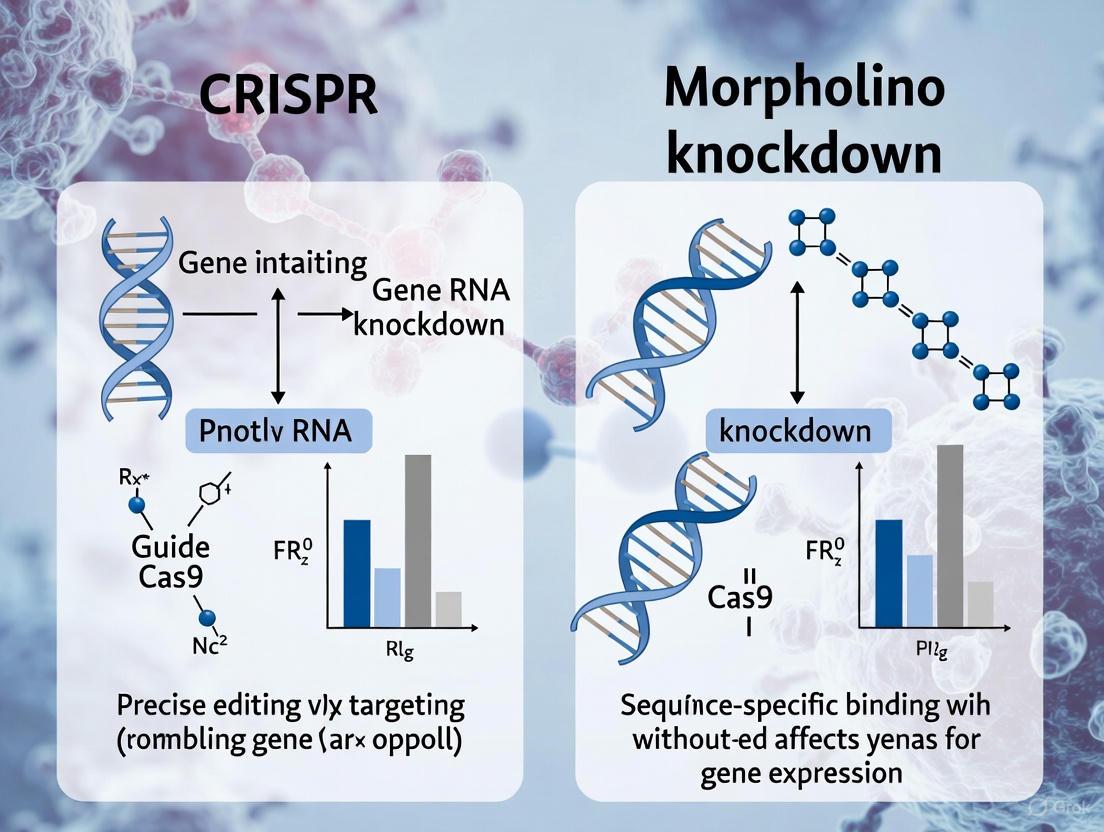
This article provides a systematic comparison of CRISPR-based gene editing and morpholino oligonucleotide (MO) knockdown, two foundational technologies in functional genomics.
CRISPR vs. Morpholino Knockdown: A Comprehensive Guide to Efficacy, Applications, and Best Practices for Researchers
Abstract
This article provides a systematic comparison of CRISPR-based gene editing and morpholino oligonucleotide (MO) knockdown, two foundational technologies in functional genomics. Tailored for researchers, scientists, and drug development professionals, it explores the core principles, mechanisms, and optimal applications of each tool. The scope ranges from foundational concepts and methodological protocols to troubleshooting off-target effects and validation strategies. By synthesizing current research and technical insights, this guide aims to empower readers in selecting the appropriate technology for their specific experimental goals, from early-stage phenotypic screening to the generation of stable genetic models and therapeutic development.
Understanding the Core Mechanisms: From DNA Editing to RNA Knockdown
In functional genomics and therapeutic development, CRISPR and morpholinos represent two powerful but fundamentally distinct technologies. CRISPR-Cas9 is a genome-editing system that permanently modifies DNA sequences, while morpholino oligonucleotides are antisense molecules that temporarily modulate RNA processing and translation [1] [2] [3]. This comparison guide examines their mechanisms, applications, and experimental considerations to help researchers select the appropriate tool for their specific research context.
Table 1: Fundamental Characteristics of CRISPR and Morpholino Technologies
| Characteristic | CRISPR-Cas9 | Morpholino Oligonucleotides |
|---|---|---|
| Molecular Target | DNA | RNA (mRNA or pre-mRNA) |
| Primary Mechanism | Creates double-strand breaks in DNA; exploits cellular repair mechanisms (NHEJ/HDR) for permanent changes [2] | Steric blockade of translation initiation or pre-mRNA splicing via Watson-Crick base pairing [4] [3] |
| Nature of Effect | Typically permanent, heritable genetic modification | Transient, non-heritable knockdown |
| Duration of Effect | Stable, long-lasting | Temporary (days to a week, depending on system) |
| Key Components | Cas nuclease (e.g., Cas9) + guide RNA (sgRNA) [2] | Single-stranded morpholino oligo (25-30 bases) [3] |
| Common Applications | Gene knockout, knock-in, gene correction, large-scale screening, therapeutic genome editing [5] [2] | Acute gene knockdown, splicing modulation, translational inhibition, developmental biology studies [1] [6] |
Mechanisms of Action: DNA Editing Versus RNA Interference
CRISPR-Cas9: Programmable DNA Cleavage
The CRISPR-Cas9 system functions as a programmable DNA endonuclease. The Cas9 enzyme is directed to a specific genomic locus by a guide RNA (gRNA) that is complementary to the target DNA sequence. Upon binding, Cas9 creates a double-strand break (DSB) in the DNA [2]. The cell then repairs this break through one of two primary pathways:
- Non-Homologous End Joining (NHEJ): An error-prone repair process that often results in small insertions or deletions (indels) at the cut site. This can disrupt the open reading frame of a gene, effectively creating a knockout [2].
- Homology-Directed Repair (HDR): A precise repair pathway that uses a donor DNA template to introduce specific genetic alterations, such as point mutations or gene insertions (knock-in) [2].
Morpholinos: Steric Blockade of RNA Function
Morpholinos are synthetic oligonucleotides where the natural ribose sugar backbone is replaced by a morpholine ring and connected via phosphorodiamidate linkages [1] [3]. This unique structure makes them uncharged, nuclease-resistant, and stable in vivo. They do not degrade their target RNA but instead act through steric hindrance [4]. The two primary design strategies are:
- Translation-Blocking Morpholinos: Bind to the 5' untranslated region (UTR) including the AUG start codon, physically preventing the ribosomal complex from initiating translation [1] [3].
- Splice-Blocking Morpholinos: Target exon-intron or intron-exon junctions in pre-mRNA, interfering with the splicing machinery and often leading to exon skipping or intron retention [1] [3] [6].
Experimental Protocols and Workflows
A Typical Workflow for CRISPR-Cas9 Gene Editing
- Target Selection and gRNA Design: Identify the target genomic sequence adjacent to a Protospacer Adjacent Motif (PAM), which is required for Cas9 recognition (e.g., 5'-NGG-3' for SpCas9) [2]. Design 2-3 gRNAs with high on-target and low off-target potential using computational tools.
- Component Delivery:
- In vitro: Deliver Cas9 and gRNA expression plasmids, ribonucleoprotein (RNP) complexes, or viral vectors into cells via transfection, electroporation, or viral transduction [2].
- In vivo: Systemic delivery using viral vectors (e.g., AAV) or non-viral methods like Lipid Nanoparticles (LNPs), which show promise for therapeutic applications, particularly for liver targets [5].
- Validation and Analysis:
- Confirm editing efficiency via T7E1 assay, TIDE analysis, or next-generation sequencing.
- For knockouts, validate protein loss by western blot or immunofluorescence.
- For knock-ins, confirm correct integration via PCR and sequencing.
A Typical Workflow for Morpholino-Mediated Knockdown
- Target Selection and Morpholino Design:
- Delivery:
- Validation and Analysis:
- For translation blockers: Assess protein reduction via western blot, immunofluorescence, or functional assays.
- For splice blockers: Use RT-PCR to detect changes in mRNA splicing patterns (e.g., size shifts due to exon skipping) [3] [6].
- Always include standard control and mismatch morpholinos to confirm specificity [3].
Performance and Efficacy Comparison
Table 2: Quantitative Comparison of Efficacy and Experimental Parameters
| Parameter | CRISPR-Cas9 | Morpholino Oligonucleotides |
|---|---|---|
| Typical Knockdown/Knockout Efficiency | 50% - 90% in different experimental setups [7] | Dose-dependent; ED₅₀ in the range of 1–3 μmol/L for effective splice-blocking in cells [6] |
| Time to Onset of Effect | Dependent on protein turnover; can take 24-72 hours for full effect | Rapid; effect can be observed within hours of delivery |
| Optimal Research Context | Stable gene inactivation, generating mutant lines, therapeutic correction of mutations [5] [2] | Acute, transient knockdown; studying early developmental processes; splicing modulation [1] [8] |
| Key Advantages | Permanent modification, versatile (knockout/knock-in), suitable for in vivo therapy [5] | Rapid application, no genetic compensation reported, temporal control via timing of delivery [1] [8] |
| Key Limitations | Potential for off-target editing, complex delivery, ethical concerns for germline editing | Transient effect, potential for off-target toxicity (p53 activation), requires careful dose optimization [1] |
Recent studies highlight the contextual nature of their efficacy. For example, in a direct comparison in chick embryos, CRISPR-Cas13d (an RNA-targeting CRISPR system) achieved knockdown of the PAX7 gene that was comparable to a translation-blocking morpholino [8]. In therapeutic contexts, systemic delivery of CRISPR-LNPs for hereditary transthyretin amyloidosis (hATTR) achieved a ~90% reduction in disease-related protein levels in human clinical trials [5], whereas a morpholino (eteplirsen) for Duchenne muscular dystrophy is FDA-approved to induce exon skipping and restore the reading frame of dystrophin in a subset of patients [3].
Research Reagent Solutions
Table 3: Essential Research Materials and Their Functions
| Reagent / Material | Function in Experiment | Key Considerations |
|---|---|---|
| Cas9 Nuclease (protein or plasmid) | The effector enzyme that cuts the target DNA [2]. | Choose between wild-type (creates DSBs) or nickase/nuclease-dead (dCas9) variants for different applications. |
| Guide RNA (sgRNA) | A synthetic RNA that directs Cas9 to the specific DNA target sequence [2]. | Can be produced via in vitro transcription, purchased as synthetic RNA, or delivered via plasmid. |
| Morpholino Oligonucleotide | A synthetic antisense oligo that binds target RNA to block translation or splicing [3]. | Must be designed to be perfectly complementary to the target RNA sequence; typically 25 bases in length. |
| Lipid Nanoparticles (LNPs) | A non-viral delivery vehicle for in vivo delivery of CRISPR components or other nucleic acids [5]. | Particularly effective for targeting the liver; enables potential re-dosing. |
| Control Morpholino | A standard control (e.g., scrambled sequence) to distinguish specific from non-specific effects [3] [6]. | Critical for validating that observed phenotypes are due to specific gene knockdown. |
| Homology-Directed Repair (HDR) Donor Template | A DNA template containing the desired sequence change, used to precisely edit the genome after a DSB [2]. | Can be a single-stranded oligodeoxynucleotide (ssODN) or a double-stranded DNA plasmid. |
The choice between CRISPR and morpholinos is not a matter of which tool is superior, but which is optimal for the specific biological question and experimental system.
- Choose CRISPR-Cas9 when the research goal requires permanent, heritable genetic modification, such as generating stable cell lines or animal models, conducting large-scale genetic screens, or developing therapeutic interventions that correct the underlying genetic cause of a disease [5] [2].
- Choose Morpholinos for experiments requiring rapid, transient gene knockdown without altering the genome, particularly in early developmental studies (e.g., in zebrafish, Xenopus, or chick embryos), for modulating RNA splicing, or when investigating genes where early knockout is embryonically lethal [1] [8].
The future of genetic research lies in the synergistic use of both technologies. Morpholinos can provide rapid initial functional data, while CRISPR can be used to generate stable, validated models. Furthermore, the emergence of new systems like CRISPR-Cas13d, which targets RNA like morpholinos but is encoded by plasmids, expands the available toolkit, offering researchers more flexibility to design rigorous and informative experiments [8].
In functional genomics and therapeutic development, two principal technologies enable targeted gene disruption: the CRISPR-Cas9 system and Morpholino oligonucleotides (MOs). These technologies employ fundamentally distinct mechanisms to achieve gene knockdown. CRISPR-Cas9 introduces permanent genomic modifications by creating double-strand breaks (DSBs) in DNA, which are then repaired by cellular mechanisms that often result in gene disruption [9]. In contrast, Morpholinos are synthetic antisense oligonucleotides that achieve transient gene knockdown by blocking translation or splicing of targeted RNA transcripts without altering the underlying DNA sequence [10] [11]. Understanding their mechanistic differences is critical for researchers selecting the appropriate tool for specific experimental or therapeutic goals, particularly in studies assessing gene function and developing genetic therapies.
Mechanism of CRISPR-Cas9 Action
Core Components and DNA Targeting
The CRISPR-Cas9 system functions as a programmable DNA endonuclease. Its operation requires two core components: the Cas9 nuclease, which creates double-strand breaks in DNA, and a guide RNA (gRNA), a short synthetic RNA sequence complementary to the target DNA locus. The gRNA directs Cas9 to a specific genomic location through Watson-Crick base pairing, while an adjacent protospacer adjacent motif (PAM) sequence is essential for Cas9 recognition and cleavage activity [9].
Double-Strand Break Induction and Repair Pathways
Once bound to the target DNA, Cas9 induces a double-strand break (DSB) approximately 3-4 nucleotides upstream of the PAM site. The cell subsequently attempts to repair this break through two primary pathways [9]:
- Non-Homologous End Joining (NHEJ): This error-prone pathway directly ligates the broken DNA ends, often resulting in small insertions or deletions (indels). If these indels are not multiples of three nucleotides, they cause frameshift mutations that lead to premature termination codons (PTCs) and gene knockout [9] [12].
- Homology-Directed Repair (HDR): This precise repair pathway uses a homologous DNA template to repair the break, potentially allowing for specific gene corrections or insertions when an exogenous donor template is supplied [9].
Figure 1: CRISPR-Cas9 mechanism for inducing double-strand breaks and subsequent repair pathways leading to genetic outcomes.
Mechanism of Morpholino Oligonucleotide Action
Molecular Structure and Design Principles
Morpholino oligonucleotides are synthesized with a specific chemical architecture that distinguishes them from natural nucleic acids. They feature a phosphorodiamidate backbone with morpholine rings instead of the ribose sugar-phosphate backbone found in DNA and RNA. This unique structure confers several advantages: neutral charge preventing non-specific binding to cellular proteins, resistance to enzymatic degradation, and high binding affinity for complementary RNA sequences [10] [11].
MO design follows precise parameters: typically 25 bases in length, 40-60% GC content, and minimal self-complementarity to prevent secondary structure formation. Target specificity is crucial, particularly in organisms like zebrafish which often possess duplicated genes (paralogs) that may require paralog-specific MO designs [10] [11].
Modes of Action: Translation Blocking and Splice Modification
MOs exert their effects through two primary mechanisms based on their target binding sites:
Translation Blocking: MOs targeting the 5' untranslated region (UTR) or region surrounding the translational start site physically prevent the assembly of the translation initiation complex, thereby blocking ribosome scanning and protein synthesis. This approach effectively knocks down both maternal and zygotic transcripts [10] [11].
Splice Modification: MOs targeting splice junctions (5' splice donor sites, branch points, or 3' splice acceptor sites) interfere with splicesome assembly and pre-mRNA processing. This results in exon skipping, intron retention, or activation of cryptic splice sites, often producing frameshifts and premature termination codons that lead to nonsense-mediated decay of the aberrant transcript [10].
Figure 2: Two primary mechanisms of Morpholino action showing translation blockade and splice modification pathways.
Comparative Experimental Data
Quantitative Comparison of Efficiency and Applications
Table 1: Direct comparison of key characteristics between CRISPR-Cas9 and Morpholino technologies
| Parameter | CRISPR-Cas9 | Morpholino Oligonucleotides |
|---|---|---|
| Molecular Target | DNA | RNA |
| Mechanism | DSB induction followed by NHEJ/HDR repair [9] | Steric blockade of translation or splicing [10] [11] |
| Persistence | Permanent, heritable changes | Transient (typically 3-5 days in zebrafish) [10] [11] |
| Efficiency Range | Variable (10-90% depending on system) | High with proper design and delivery |
| Delivery Methods | Viral vectors, plasmids, RNPs [13] | Microinjection, "caged" MOs for temporal control [10] [11] |
| Primary Applications | Stable gene knockout, gene correction, therapeutic editing [9] | Transient knockdown, isoform-specific targeting, maternal transcript targeting [10] |
| Optimal Use Case | Permanent genetic modification, animal model generation | Rapid functional screening, essential gene analysis, developmental studies [11] |
Experimental Outcomes in Model Systems
Table 2: Experimental results demonstrating efficacy and specific applications of each technology
| Experiment | System | Outcome | Reference |
|---|---|---|---|
| CRISPR: HTT CAG repeat contraction | Human HEK293T cells (41 CAG repeats) | ~90% contraction when DSB within repeats; complete tract deletion with upstream DSB [14] [15] | BMC Biology (2024) |
| CRISPR: SMN2 splicing correction | SMA iPSCs and mice | Disruption of ISS-N1 enhanced exon 7 inclusion; rescued SMA mice survival to >400 days [16] | NSR (2019) |
| CRISPR: Alternative splicing induction | Rabbit models | Exon skipping only occurred with PTC mutations, not missense mutations [17] | Genome Biology (2018) |
| Morpholino: AHR2 knockdown | Zebrafish embryos | Protection against TCDD-induced pericardial edema [11] | Methods Mol Biol (2012) |
| Morpholino: p53 co-knockdown | Zebrafish embryos | Reduced off-target apoptosis in MO-treated embryos [18] | PLoS Genetics (2007) |
| Morpholino: Cyp1a knockdown | Zebrafish embryos | Exacerbated toxicity from PAHs (ANF, BNF) [11] | Methods Mol Biol (2012) |
Detailed Experimental Protocols
CRISPR-Cas9 Workflow for Gene Knockout
The standard protocol for implementing CRISPR-Cas9 gene editing involves sequential steps from design to validation:
Target Selection and gRNA Design: Identify a 20-nucleotide target sequence adjacent to a PAM (NGG for SpCas9). Tools like CRISPOR or CHOPCHOP can predict efficiency and minimize off-target effects. For repetitive regions like CAG tracts, careful gRNA positioning is critical—DSBs within repeats yield contractions while upstream breaks cause complete tract deletions [14] [15].
Component Delivery: Transfert cells with plasmids encoding both Cas9 and gRNA, or use preassembled ribonucleoprotein (RNP) complexes for higher precision and reduced off-target effects. Delivery methods include lipid nanoparticles, viral vectors, or electroporation [13].
DSB Induction and Repair: After cellular uptake, the Cas9-gRNA complex localizes to the target DNA and induces DSBs. The cell's endogenous repair machinery, predominantly NHEJ, introduces indels at the break site [9].
Validation and Screening: Extract genomic DNA 24-72 hours post-transfection. Amplify the target region by PCR and analyze edits by sequencing (Sanger or NGS) or T7 endonuclease I assay. For the HTT CAG repeat study, deep sequencing precisely quantified repeat contraction frequencies [14].
Morpholino Knockdown Protocol
The established protocol for effective morpholino-mediated gene knockdown includes:
MO Design and Preparation: For translation blocking, target the 25 bases surrounding the start codon. For splice blocking, target splice acceptor/donor sites or branch points. Resuspend lyophilized MO in high-grade water to 1-5 mM stock concentration. Validate sequence specificity, especially in zebrafish with paralogous genes [10] [11].
Embryo Microinjection: Prepare working dilutions (typically 0.5-5 ng/nL) in injection buffer. Microinject 1-2 nL into the yolk or cytoplasm of 1-8 cell stage zebrafish embryos. The cytoplasmic bridges enable ubiquitous MO distribution. Include standard control MOs to distinguish specific from non-specific effects [10].
Phenotypic Assessment: Monitor embryos for expected morphological changes over 1-5 days post-fertilization (dpf). For splice-blocking MOs, validate efficacy by RT-PCR to detect altered splicing patterns 24-48 hours post-injection [10].
Off-Target Mitigation: To address p53-mediated apoptosis, a common off-target effect, co-inject with p53-targeting MO (0.5-1 ng/nL). This approach specifically reduces non-specific cell death without affecting specific knockdown phenotypes [18].
The Scientist's Toolkit: Essential Research Reagents
Table 3: Key reagents and materials required for implementing CRISPR-Cas9 and Morpholino techniques
| Reagent Category | Specific Examples | Function/Purpose |
|---|---|---|
| CRISPR-Cas9 Components | SpCas9 nuclease, sgRNA scaffolds, PAM-compatible plasmids | Core editing machinery [9] |
| Delivery Vehicles | Lentiviral/AAV vectors, lipid nanoparticles, electroporation systems | Cellular introduction of editing components [13] |
| Morpholino Oligonucleotides | Translation blockers, splice blockers, standard control MOs | Gene-specific knockdown [10] [11] |
| Microinjection Supplies | Microinjector, micropipette puller, borosilicate glass capillaries | Embryo manipulation and delivery [10] |
| Validation Tools | T7 endonuclease I, sequencing primers, Western blot antibodies | Efficiency assessment and confirmation [14] [10] |
| Specialized Modifications | HiFi Cas9 variants, base editors, "caged" photoactivatable MOs | Enhanced specificity or temporal control [13] [11] |
CRISPR-Cas9 and Morpholino technologies offer complementary approaches for gene disruption with distinct mechanistic bases and application landscapes. CRISPR-Cas9 creates permanent DNA-level modifications through DSB repair, making it ideal for generating stable cell lines, animal models, and therapeutic interventions. Conversely, Morpholinos provide transient, RNA-level knockdown perfect for rapid functional screening, developmental studies, and analyzing essential genes where permanent knockout would be lethal. The selection between these technologies depends fundamentally on the experimental timeline, desired persistence of effect, and specific biological question. As both technologies continue to evolve with enhanced specificity and novel applications, they will remain indispensable tools in the molecular biologist's arsenal for deciphering gene function and developing genetic therapies.
In functional genomics and drug development, two technologies represent fundamentally different approaches to probing gene function: Morpholino oligonucleotides (MOs) and CRISPR-Cas9 systems. MOs provide transient gene knockdown by targeting specific RNA sequences, while CRISPR creates permanent, heritable mutations at the DNA level. This distinction creates a temporal divide that significantly impacts experimental design, data interpretation, and translational applications. For researchers investigating developmental processes, disease mechanisms, and therapeutic targets, understanding this dichotomy is crucial for selecting the appropriate tool and accurately evaluating resulting phenotypes. This guide objectively compares the performance characteristics, experimental parameters, and optimal applications of these technologies, providing a framework for their use in modern biological research.
Morpholino Oligonucleotides (MOs): Transient Knockdown
Morpholinos are synthetic antisense oligonucleotides typically 25 bases in length, composed of morpholine rings connected by phosphorodiamidate linkages [19]. This unique chemistry makes them highly resistant to nucleases, providing stability in biological systems without triggering significant innate immune responses [1]. MOs function primarily through two distinct mechanisms:
- Translation Blocking: MOs bind to the 5' untranslated region (UTR) and start codon of target mRNAs, sterically preventing the ribosomal initiation complex from assembling and proceeding with protein synthesis [19].
- Splice Modification: MOs target splice donor or acceptor sites in pre-mRNA, disrupting normal processing and leading to exon skipping, intron retention, or activation of cryptic splice sites, typically generating nonfunctional protein products [11] [19].
A key advantage of MOs is their temporal flexibility. They can be injected into zebrafish embryos at the 1-8 cell stage, providing effective knockdown through the first 4 days of development [11]. For conditional applications, "caged" MOs can be photo-activated to function in specific locations at specific times, creating spatially and temporally controlled knockdowns [11].
CRISPR-Cas Systems: Permanent Genome Editing
The CRISPR-Cas9 system, derived from a bacterial adaptive immune system, creates targeted double-strand breaks (DSBs) in genomic DNA [20]. The system comprises two key components:
- Guide RNA (gRNA): A synthetic RNA molecule that directs the Cas nuclease to complementary DNA sequences through Watson-Crick base pairing [13].
- Cas9 Nuclease: An enzyme that introduces double-strand breaks three base pairs upstream from protospacer adjacent motifs (PAMs) in the target DNA [20].
Following DNA cleavage, cellular repair mechanisms are activated:
- Non-Homologous End Joining (NHEJ): An error-prone pathway that results in small insertions or deletions (indels), often disrupting gene function through frameshift mutations [13].
- Homology-Directed Repair (HDR): A precise repair pathway that allows for specific genetic modifications when a donor DNA template is provided [13].
Unlike MOs, CRISPR generates permanent, heritable mutations that persist throughout the organism's lifespan and can be transmitted to subsequent generations, enabling the creation of stable mutant lines [21].
Performance Comparison: Quantitative Analysis
Table 1: Key Characteristics of MO and CRISPR Technologies
| Parameter | Morpholino (MO) | CRISPR-Cas9 |
|---|---|---|
| Temporal Control | Transient (4-5 days in zebrafish) [11] | Permanent, heritable |
| Molecular Target | mRNA | Genomic DNA |
| Mechanism | Translation blocking, splice modification [19] | DNA double-strand break, NHEJ/HDR repair [13] |
| Onset of Effect | Rapid (hours) | Delayed (requires turnover of existing protein) |
| Duration of Effect | Days | Lifetime and inheritable |
| Efficiency Range | Variable (dose-dependent) [19] | Variable (depends on gRNA design, delivery) [20] |
| Optimal GC Content | 40-60% [19] | 65% or higher for improved efficiency [22] |
| Typical Delivery | Microinjection into embryos [19] | Multiple methods (microinjection, viral vectors, LNPs) [5] |
| Cost Considerations | Moderate (reagent cost) | Low (CRISPR), higher (delivery optimization) |
Table 2: Applications and Limitations
| Aspect | Morpholino (MO) | CRISPR-Cas9 |
|---|---|---|
| Optimal Applications | Acute knockdowns, early development studies, splice modulation, conditional knockdowns [11] | Stable mutant lines, genetic screening, disease modeling, gene therapy [5] |
| Key Advantages | Rapid deployment, titratable effects, targets maternal mRNA, temporal control [11] [21] | Permanent modification, high specificity versions available, versatile editing capabilities [20] |
| Primary Limitations | Transient nature, off-target effects (p53 activation) [1], limited to developmental windows | Potential for compensatory mutations [23], off-target editing [20], mosaic F0 generation |
| Phenotype Concordance | May reveal functions obscured in mutants by genetic compensation [21] [23] | May show absence of phenotype due to genetic compensation [23] |
Experimental Protocols and Methodologies
Morpholino Knockdown Experiments
MO Design Considerations:
- Sequence Selection: Target the 5' UTR extending no more than 25 bases upstream of the start codon for translation blockers, or splice donor/acceptor sites for splice modifiers [19].
- Specificity Controls: Perform BLAST analysis to ensure target sequence uniqueness and design two non-overlapping MOs against the same target to confirm phenotype specificity [21].
- Optimization Parameters: Design MOs that are 25 bases long with 40-60% GC content, avoiding stretches of more than three contiguous guanines [19].
Experimental Workflow:
- MO Preparation: Resuspend lyophilized MO in cell culture-grade water at 1-3 mM concentration. Heat at 65°C for 10 minutes with vortexing to ensure complete resuspension [19].
- Concentration Optimization: Perform dose-response experiments (typically 1-10 ng per embryo) to identify the optimal phenotype-to-toxicity ratio [19].
- Microinjection: Inject 1-8 cell stage zebrafish embryos using standard microinjection apparatus [11].
- Validation Assays:
- Phenotypic Analysis: Document morphological changes at appropriate developmental stages.
Troubleshooting Notes:
- Off-target effects can be controlled by co-injecting p53-targeting MOs to suppress apoptotic responses [19].
- Phenotype specificity should be confirmed through rescue experiments with MO-insensitive mRNA [1].
CRISPR-Cas9 Mutagenesis Experiments
gRNA Design and Construction:
- Target Selection: Identify 20-base target sequences adjacent to 5'-NGG-3' PAM sites using validated computational tools (CRISPR-P 2.0, E-CRISP, CasFinder) [20].
- Efficiency Optimization: Select gRNAs with GC content >65% for improved editing efficiency, as demonstrated in grapevine mutagenesis studies [22].
- Specificity Enhancement: Consider truncated gRNAs (17-18 nucleotides) to reduce off-target effects while maintaining on-target activity [20].
Experimental Workflow:
- Component Preparation: Synthesize gRNA and Cas9 mRNA or prepare ribonucleoprotein (RNP) complexes.
- Delivery Method Selection: Choose appropriate delivery method (microinjection, viral vectors, or lipid nanoparticles) based on target organism/cells [5].
- Microinjection: Inject into zygotes or early embryos for heritable mutations.
- Mutation Validation:
- PCR amplification of target region followed by restriction enzyme assay (if editing disrupts a site).
- T7 endonuclease I or SURVEYOR assays to detect heteroduplex formation.
- Sanger sequencing of cloned PCR products or next-generation sequencing for precise mutation characterization.
- Founder Screening: Identify germline-transmitted mutations in F1 generation.
Advanced Considerations:
- For improved specificity, use high-fidelity Cas9 variants (e.g., eSpCas9, SpCas9-HF1, HypaCas9) [20].
- Employ novel repressor domains like dCas9-ZIM3(KRAB)-MeCP2(t) for enhanced CRISPRi efficiency [24].
Critical Research Reagent Solutions
Table 3: Essential Research Reagents and Their Applications
| Reagent Type | Specific Examples | Research Applications | Technical Considerations |
|---|---|---|---|
| Morpholino Oligos | Translation-blocking MOs, splice-modifying MOs [19] | Acute gene knockdown, splice modulation, developmental studies [11] | Dose optimization required, validate with two non-overlapping MOs [21] |
| CRISPR Nucleases | Wild-type Cas9, High-fidelity variants (eSpCas9, SpCas9-HF1) [20] | Gene knockout, large-scale screening, therapeutic development [5] | Specificity varies by variant; PAM requirements constrain targeting |
| CRISPR Repressors | dCas9-KRAB, dCas9-ZIM3(KRAB)-MeCP2(t) [24] | Transcriptional repression (CRISPRi), reversible knockdown | No DNA damage; enables temporal control of gene expression |
| Delivery Systems | Lipid nanoparticles (LNPs), viral vectors [5] | In vivo delivery, therapeutic applications | Cell-type specificity; immunogenicity concerns with viral vectors |
| Validation Tools | T7EI assay, antibody detection, RT-PCR [19] | Editing efficiency confirmation, knockdown verification | Method depends on MO type (translation vs splice-blocking) |
Interpretation of Divergent Phenotypes
A significant challenge in genetic manipulation is the frequent observation of different phenotypes between MO knockdowns and CRISPR mutants targeting the same gene. Understanding the biological and technical bases for these discrepancies is essential for proper data interpretation.
Genetic Compensation in Mutants
CRISPR-generated mutants may fail to display expected phenotypes due to transcriptional adaptation or genetic compensation. This phenomenon occurs when mutations that produce degraded transcripts trigger upregulation of functionally related genes, potentially compensating for the lost gene function [23]. Notably, this compensation response is typically activated by mutant mRNA degradation rather than protein loss, explaining why MO knockdowns (which don't necessarily cause transcript degradation) may not trigger the same compensatory mechanisms [23].
Technical Considerations
Temporal Factors:
- MOs produce acute protein depletion, potentially revealing functions essential during specific developmental windows.
- CRISPR mutants experience lifelong gene absence, potentially allowing for developmental adaptation.
Maternal Contributions:
- Translation-blocking MOs can target both maternal and zygotic transcripts [19].
- CRISPR mutants typically only affect zygotic genome, leaving maternal contributions intact in early development.
Experimental Design Considerations:
- MO-specific artifacts: Potential off-target effects can be controlled using p53-targeting MOs and rescue experiments [19].
- CRISPR-specific limitations: Mosaic F0 animals may show variable phenotypes; stable lines are needed for conclusive analysis.
The choice between MO-mediated knockdown and CRISPR-Cas9 mutagenesis depends fundamentally on the research question, temporal requirements, and desired permanence of the genetic perturbation. MOs offer unparalleled temporal control and are ideal for studying acute gene functions, early developmental processes, and when titratable effects are desirable. CRISPR technologies provide permanent, heritable modifications essential for creating stable model systems, studying long-term genetic effects, and therapeutic applications.
For comprehensive gene characterization, a combined approach is often most powerful:
- Use MOs for rapid initial assessment of gene function and early developmental roles.
- Employ CRISPR to generate stable mutant lines for detailed phenotypic analysis across the lifespan.
- Interpret phenotypic discrepancies not necessarily as technical failures but as potential insights into compensatory mechanisms and genetic network interactions.
As both technologies continue to evolve—with advances in conditional CRISPR systems and improved MO delivery methods—their complementary strengths will further enhance their utility in functional genomics and drug development research.
The field of developmental genetics and functional genomics has been profoundly shaped by two powerful technologies: Morpholino oligonucleotides (MOs) and CRISPR-based genome editing. Morpholinos, developed in the 1990s and widely adopted in the early 2000s, represent a knockdown approach that transiently suppresses gene expression at the RNA level. In contrast, CRISPR (Clustered Regularly Interspaced Short Palindromic Repeats) systems, which emerged as a versatile genome-editing tool in the 2010s, enable a knockout approach that creates permanent modifications at the DNA level. While MOs have been indispensable, particularly in early vertebrate models like zebrafish and Xenopus, CRISPR has revolutionized genetic research by enabling precise genomic modifications across a wide range of organisms. Understanding the technical specifications, applications, strengths, and limitations of each technology is crucial for researchers selecting the appropriate tool for specific experimental questions in basic research and drug development.
Morpholino Oligonucleotides: Design and Mechanism
Morpholino oligonucleotides are synthetic antisense molecules designed to bind to complementary RNA sequences through Watson-Crick base pairing. Their unique chemical structure features a morpholine ring backbone connected by phosphorodiamidate linkages, which makes them uncharged and resistant to cellular nucleases, ensuring stability in biological systems [1]. MOs function primarily through two mechanisms:
Translation Blocking: MOs designed to target the 5' untranslated region (UTR) and the start codon (AUG) prevent the assembly of the translation initiation complex, thereby inhibiting protein synthesis [1] [25].
Splice Blocking: MOs binding to exon-intron or intron-exon splice junctions disrupt spliceosome assembly, leading to exon skipping or intron retention, which often generates defective or truncated proteins [1] [26].
MOs are typically delivered into early-stage embryos (e.g., 1-4 cell stage zebrafish embryos) via microinjection, making them ideal for studying gene function during early development [25].
CRISPR-Cas Systems: From DNA Cleavage to RNA Targeting
CRISPR-Cas systems are adaptive immune mechanisms in bacteria and archaea that have been repurposed for precise genome editing in eukaryotic cells. The most widely used system, CRISPR-Cas9 from Streptococcus pyogenes, creates double-strand breaks (DSBs) in DNA at sites specified by a guide RNA (gRNA) and adjacent to a Protospacer Adjacent Motif (PAM) [2]. The DSBs are then repaired by the cell's endogenous machinery:
Non-Homologous End Joining (NHEJ): An error-prone repair pathway that often results in small insertions or deletions (indels), leading to frameshift mutations and gene knockouts [2].
Homology-Directed Repair (HDR): A precise repair pathway that uses a template to introduce specific genetic modifications [2].
More recently, CRISPR-Cas13 systems have been developed that target RNA instead of DNA. Cas13d, in particular, has been successfully adapted for targeted gene expression knockdown in model organisms like zebrafish and chick embryos, functioning at the transcript level similarly to MOs but with different delivery mechanisms and potential for spatial-temporal control [8].
The following diagram illustrates the core mechanisms of action for both technologies:
Technical Comparison and Experimental Data
Key Technical Specifications
The following table summarizes the fundamental characteristics of MOs versus CRISPR-Cas systems:
| Feature | Morpholino Oligonucleotides | CRISPR-Cas Systems |
|---|---|---|
| Molecular Target | RNA (mature or pre-mRNA) | DNA (Cas9) or RNA (Cas13) |
| Mechanism of Action | Steric blocking of translation or splicing | Enzymatic cleavage followed by DNA repair or RNA degradation |
| Genetic Effect | Transient knockdown | Permanent knockout (Cas9) or transient knockdown (Cas13) |
| Duration of Effect | Transient (days to a week) | Permanent (Cas9) or transient (Cas13) |
| Delivery Method | Microinjection into embryos | Microinjection, electroporation, viral vectors, LNPs |
| Typical Efficiency | Variable (dose-dependent) | High (can approach 100% in some systems) |
| Primary Applications | Acute gene suppression, splice modulation, developmental studies | Gene knockout, knock-in, epigenetic modification, gene activation/repression |
Efficacy Comparison in Model Organisms
Direct comparative studies in zebrafish and other model organisms have revealed complex efficacy patterns for both technologies:
| Organism/Application | Morpholino Performance | CRISPR Performance | Key Findings |
|---|---|---|---|
| Zebrafish - Early Development | Rapid phenotype assessment (24-48 hpf); Effective for maternal and zygotic transcripts [1] [25] | Requires generation of stable lines; Potential embryonic lethality masking later phenotypes [21] | MOs preferred for acute knockdowns; CRISPR better for stable genetic lines |
| Zebrafish - Genetic Compensation | Phenotypes often observed [27] | Compensation by related genes may mask phenotypes [21] [27] | Transcriptional adaptation in mutants can lead to false negatives with CRISPR |
| Chick Embryo | Effective with microinjection or electroporation [8] | Cas9 effective; Cas13d recently adapted with comparable efficacy to MOs [8] | Both technologies viable; Cas13d offers plasmid-based alternative to MOs |
| Human Cell Lines/Therapeutics | Limited use in therapeutics | Multiple clinical trials (e.g., hATTR, sickle cell disease) [5] | CRISPR dominates therapeutic applications with permanent corrections |
Experimental Workflow Comparison
The typical workflows for implementing MO and CRISPR approaches differ significantly in their timeframes and technical requirements:
Detailed Experimental Protocols
Morpholino Knockdown in Zebrafish Embryos
Protocol for Translation-Blocking MO in Heart Development Studies [25]
MO Design: Design a 25-base morpholino complementary to the sequence surrounding the translation start site of the target gene. Verify sequence specificity using BLAST against the zebrafish genome.
MO Preparation: Resuspend the MO to a stock concentration of 1-5 mM in nuclease-free water. Prepare working solutions (typically 0.5-2 ng/nL) for microinjection.
Embryo Collection and Preparation: Collect zebrafish embryos within 30 minutes of spawning and maintain in embryo medium. Arrange embryos in injection mold.
Microinjection: Load MO solution into a glass capillary needle and calibrate injection volume (typically 1-2 nL per embryo). Inject into the yolk or cell cytoplasm of 1-4 cell stage embryos.
Dose Optimization: Perform preliminary dose-response experiments with concentrations ranging from 0.5-8 ng per embryo to identify the minimum effective dose while minimizing toxicity.
Phenotype Assessment: For heart development studies, examine embryos at 24-72 hours post-fertilization (hpf) for cardiac malformations, edema, and circulatory defects.
Validation Experiments: Include appropriate controls: standard control MO, second non-overlapping MO targeting the same gene, and rescue experiments with synthetic mRNA encoding the target gene.
CRISPR-Cas9 Gene Editing in Zebrafish
Protocol for Generating Stable Mutant Lines [26]
gRNA Design and Synthesis: Identify target sequence (20 nt) adjacent to a 5'-NGG-3' PAM sequence in an early exon of the target gene. Synthesize gRNA by in vitro transcription or purchase as synthetic RNA.
Cas9 mRNA Preparation: Obtain Cas9 expression vector and synthesize capped mRNA using in vitro transcription kits.
Microinjection Mixture: Prepare injection mixture containing Cas9 mRNA (150-300 pg/nL) and gRNA (25-50 pg/nL) in nuclease-free water.
Embryo Injection: Inject 1-2 nL of the mixture into the cell cytoplasm or yolk of single-cell zebrafish embryos.
Founder Screening: Raise injected embryos (F0) to adulthood. Outcross F0 fish to wild-type partners and screen F1 progeny for germline transmission by PCR and sequencing.
Mutant Line Establishment: Identify F1 fish carrying mutations and incross to establish homozygous lines. Confirm stable transmission of the mutation and characterize the phenotype across generations.
DeMOBS: A Validation Method for Morpholino Specificity
Deletion of Morpholino Binding Sites (DeMOBS) Protocol [26]
Rationale: This method uses CRISPR-Cas9 to introduce small deletions within the MO binding site, creating MO-refractive alleles that can distinguish specific from off-target MO effects.
Guide RNA Design: Design gRNAs targeting the 5' UTR region where the MO binds, ensuring PAM sites are within or adjacent to the MO target sequence.
Mutant Generation: Generate heterozygous mutants carrying deletions in the MO binding site using standard CRISPR methods.
Testing MO Specificity: Outcross heterozygous mutants to wild-type fish and inject embryos with the MO. In the resulting clutch, approximately 50% of embryos will be genotypically wild-type (MO-sensitive) while 50% will be heterozygous for the deletion (MO-refractive).
Phenotype Analysis: Compare phenotypes between MO-sensitive and MO-refractive siblings. Specific MO phenotypes will be suppressed in MO-refractive embryos, while non-specific toxicity effects will persist in both groups.
The Scientist's Toolkit: Essential Research Reagents
| Reagent/Tool | Function | Example Applications |
|---|---|---|
| Morpholino Oligonucleotides | Gene knockdown via translation or splice blocking | Acute suppression of gene function in early development [1] [25] |
| CRISPR-Cas9 Systems | Permanent gene editing via DNA cleavage | Generation of stable knockout lines, gene correction [26] [2] |
| CRISPR-Cas13d Systems | RNA knockdown without permanent genomic changes | Transcript-level knockdown with temporal control [8] |
| Vivo-Morpholinos | Systemically delivered MOs for later stages | Gene knockdown in juvenile and adult organisms [4] |
| p53 MO | Suppression of p53-dependent apoptosis | Control for off-target effects in MO experiments [26] |
| Lipid Nanoparticles (LNPs) | Delivery vehicle for CRISPR components | In vivo therapeutic applications [5] |
| nCas9n mRNA | Nickase version of Cas9 with reduced off-target effects | Improved specificity in genome editing [26] |
Applications in Disease Modeling and Drug Development
Morpholinos for Functional Validation of Disease Variants
MOs have proven particularly valuable for functionally characterizing Variants of Unknown Significance (VUS) in human disease genes. In mitochondrial disease research, MO knockdown in zebrafish has enabled rapid assessment of pathogenicity through rescue experiments [28]. The typical approach involves:
Knockdown Phenotyping: MO-induced suppression of the target gene recapitulates key disease phenotypes (e.g., neurological defects, metabolic abnormalities).
Rescue Experiments: Co-injection of MO with wild-type human mRNA restores normal phenotype, while mutant mRNA fails to rescue, confirming pathogenicity.
Therapeutic Screening: Validated models can be used for small-molecule screening to identify potential therapeutics.
CRISPR in Clinical Applications
CRISPR-based therapies have advanced rapidly into clinical trials, with notable successes including [5]:
Casgevy: The first FDA-approved CRISPR-based medicine for sickle cell disease and transfusion-dependent beta thalassemia.
hATTR Amyloidosis: Intellia Therapeutics' Phase I trial using LNP-delivered CRISPR-Cas9 to target the TTR gene in the liver, showing ~90% reduction in disease-related protein levels.
Hereditary Angioedema (HAE): CRISPR-mediated reduction of kallikrein protein, with 86% reduction in inflammatory attacks at higher doses.
Personalized CRISPR Therapies: Recent breakthrough case of an infant with CPS1 deficiency treated with a bespoke in vivo CRISPR therapy developed in just six months.
The evolution from MOs to CRISPR technologies represents not a simple replacement but an expansion of the genetic toolkit available to researchers. Each technology occupies distinct but complementary niches in biomedical research:
Morpholinos remain the preferred choice for rapid assessment of gene function during early development, particularly when transient knockdown is desirable or when maternal gene contributions need to be targeted. Their relatively low cost, ease of use, and immediate availability make them ideal for preliminary screens and acute interventions.
CRISPR systems dominate applications requiring permanent genetic modification, including the generation of stable animal models, therapeutic gene editing, and large-scale genetic screens. The technology's versatility continues to expand with developments like base editing, prime editing, and epigenome modulation.
For drug development professionals, the technologies offer different pathways: MOs provide rapid target validation in disease models, while CRISPR enables both sophisticated disease modeling and direct therapeutic intervention. As both technologies continue to evolve, their strategic combination will likely yield the most comprehensive insights into gene function and disease mechanisms.
The rapid advancement of gene-editing technologies, particularly CRISPR/Cas9, has revolutionized functional genomics. However, a perplexing phenomenon often confronts researchers: discrepancies between phenotypes observed in traditional morpholino knockdown (morphant) models versus modern CRISPR-generated mutant lines. This guide objectively examines the growing body of evidence identifying genetic compensation as a primary biological mechanism underlying these phenotypic differences, rather than technical artifacts alone. We compare the efficacy, applications, and limitations of both approaches through experimental data and methodological protocols, providing researchers with a framework for selecting appropriate gene perturbation strategies and interpreting resulting phenotypes within the context of this complex compensatory response.
The field of functional genomics relies heavily on technologies that disrupt gene function to determine phenotypic outcomes. For decades, antisense morpholino oligonucleotides (MOs) have served as a cornerstone tool for transient gene knockdown in model organisms, particularly zebrafish and Xenopus. MOs are synthetic molecules designed to block gene expression by binding complementary RNA sequences, either inhibiting translation initiation or pre-mRNA splicing [1]. Their neutral morpholine backbone linked by phosphorodiamidate bonds creates a stable, water-soluble molecule resistant to nucleases, enabling specific RNA targeting without triggering widespread RNA degradation pathways [1].
The emergence of CRISPR/Cas9 genome editing has provided an alternative approach through permanent gene knockout. This system utilizes a Cas9 nuclease guided by RNA to create double-stranded DNA breaks at specific genomic loci, which are repaired by error-prone non-homologous end joining (NHEJ) pathways, resulting in insertions or deletions (INDELs) that disrupt gene function [29] [30]. More recently, CRISPR interference (CRISPRi) and CRISPR/Cas13 systems have expanded the toolbox, enabling targeted transcriptional repression or RNA degradation without permanent genomic alterations [31] [32] [33].
A contentious debate emerged in the mid-2010s when several studies reported poor phenotypic correlation between morpholino knockdowns and CRISPR-generated mutants, initially attributed primarily to off-target effects of morpholinos [21]. However, subsequent research has revealed a more complex biological explanation: differential activation of genetic compensation in response to these distinct perturbation modalities.
Understanding Genetic Compensation
Mechanisms and Evidence
Genetic compensation represents a biological phenomenon where organisms activate compensatory mechanisms to maintain homeostasis following genetic perturbation. Research indicates that mutant lines frequently develop compensatory gene expression changes that mask expected phenotypes, while morphants typically exhibit immediate, acute loss-of-function effects before such compensation can occur [27].
Seminal work by Rossi et al. (2015) demonstrated that permanent mutations induced by gene editing technologies can trigger upregulation of genetically related genes, often from the same gene family or functional network, which partially or completely compensate for the lost gene function [27]. In contrast, transient knockdown using morpholinos typically does not induce this compensatory response, potentially revealing the "true" acute loss-of-function phenotype. This fundamental biological difference explains why morphants sometimes exhibit stronger or different phenotypes than mutants for the same targeted gene, independent of morpholino off-target effects [27].
Evidence supporting this mechanism includes:
- Transcriptomic analyses showing widespread expression changes in mutant but not morphant zebrafish [27]
- CRISPRi knockdown that phenocopies morpholino results rather than mutant phenotypes [27]
- Partial suppression of morphant phenotypes in heterozygous mutants, indicating biological specificity rather than off-target effects [27]
Visualizing Genetic Compensation Mechanisms
The following diagram illustrates the fundamental biological processes that lead to differential phenotypic outcomes between mutagenesis and morpholino approaches:
Genetic Compensation Pathway
Comparative Experimental Data
Phenotypic Discrepancies in Key Studies
Substantial experimental evidence demonstrates phenotypic differences between mutant and morphant models across multiple model organisms and target genes. The table below summarizes key findings from the literature:
| Target Gene | Organism | Mutant Phenotype | Morphant Phenotype | Compensation Evidence |
|---|---|---|---|---|
| Multiple genes in reverse genetic screen | Zebrafish | 80% of morphant phenotypes not recapitulated [21] | Strong, specific phenotypes | Genetic compensation confirmed in follow-up studies [27] |
| Cdh2 | Zebrafish | Severe malformations, early lethality [32] | Viable with specific pituitary defects [32] | Knockdown enables study of essential gene functions |
| miR-196a, miR-219 | Xenopus | Craniofacial and pigment defects [34] | Neural crest loss phenotypes [34] | Both approaches validated with miRNA mimics rescue |
Methodological Comparisons
The technical and practical differences between gene perturbation approaches significantly influence their applications and limitations:
| Parameter | CRISPR Mutants | Morpholino Knockdown | CRISPRi/Knockdown |
|---|---|---|---|
| Mechanism of action | Permanent DNA mutation [29] | Transient RNA blocking [1] | Transcriptional repression [33] |
| Temporal resolution | Developmental and permanent | Acute, transient (hours-days) [1] | Inducible, reversible [33] |
| Compensation induction | High (genomic scale) [27] | Low (transcript level) [27] | Variable [33] |
| Technical considerations | Possible embryonic lethality | Dose-dependent toxicity [1] | Efficient, specific repression [33] |
| Key applications | Stable genetic lines, developmental studies | Acute function, essential genes [1] [32] | Temporal control, subtle modulation |
Experimental Protocols and Methodologies
Establishing Reliable Knockdown with Morpholinos
Proper morpholino experimentation requires stringent design and validation protocols to ensure specificity:
Target Identification and Verification: Identify zebrafish orthologs from genomic databases (Ensembl, NCBI) and verify transcript sequences by RT-PCR and sequencing of multiple individuals (n=4-6) to detect natural polymorphisms that might affect MO binding efficiency [1].
Morpholino Design:
- Translation-blocking MOs: Target the 5' untranslated region (5'-UTR) and start codon (AUG) to prevent ribosome assembly [1].
- Splice-blocking MOs: Bind to exon-intron or intron-exon splice junctions to induce exon skipping or intron retention [1].
- Design principles include perfect base-pair complementarity with target sequence and minimal self-complementarity [1].
Specificity Controls:
Dose Optimization: Titrate MO concentrations to the lowest effective dose (typically 1-5ng/embryo for zebrafish) to minimize potential off-target effects while maintaining efficacy [27].
CRISPR Mutant Generation and Validation
Establishing valid mutant lines requires careful design and comprehensive phenotypic assessment:
Guide RNA Design:
Mutation Efficiency Assessment:
- Sequence F0 founder animals to confirm mutation presence and type (INDELs vs. large deletions).
- Establish stable F1/F2 lines to ensure heritable mutations.
Phenotypic Analysis:
- Compare multiple mutant alleles when possible.
- Assess potential compensatory gene expression through transcriptomic analyses [27].
Experimental Workflow for Comparative Studies
The following diagram outlines a rigorous experimental approach for comparing mutant and morphant phenotypes while controlling for genetic compensation:
Comparative Gene Function Study
Research Reagent Solutions
Selecting appropriate reagents is crucial for successful gene perturbation studies. The table below details key solutions and their applications:
| Reagent / Solution | Function | Specific Applications |
|---|---|---|
| Morpholino oligonucleotides (Gene Tools LLC) | Transient gene knockdown by blocking translation or splicing [1] | Acute loss-of-function; essential gene study; splice modulation [1] |
| CRISPR/Cas9 systems | Permanent gene knockout through DNA cleavage and repair [29] | Stable mutant line generation; developmental studies; domain deletion [29] |
| CRISPRi (dCas9-KRAB) | Transcriptional repression without DNA cleavage [33] | Reversible knockdown; subtle expression modulation; essential genes [33] |
| CRISPR/Cas13 systems | Targeted mRNA degradation [32] | RNA-level knockdown; potential alternative to morpholinos [31] |
| Rescue mRNAs | Express target gene despite morpholino presence [27] | Specificity control for morpholino experiments [27] |
Discussion and Research Implications
Context-Dependent Technology Selection
The choice between mutagenesis and knockdown approaches should be guided by specific research questions rather than presumed technological superiority. Each method offers distinct advantages:
Morpholinos are preferable for:
- Studying essential genes where mutant homozygotes are lethal [32]
- Acute loss-of-function studies in early development [1]
- Investigating gene function in organisms where genetic tools are limited [1]
- Splice modulation or other RNA-specific manipulations [21]
CRISPR mutants are essential for:
- Establishing stable genetic lines for long-term studies
- Modeling human genetic diseases with specific mutations [29]
- Studying developmental processes beyond embryonic stages
CRISPRi/Cas13 systems offer promising alternatives that may combine advantages of both approaches, providing specific, efficient knockdown without permanent genomic changes [32] [33].
Future Directions and Best Practices
The recognition of genetic compensation as a fundamental biological phenomenon necessitates revised best practices in functional genomics:
Embrace Complementary Approaches: Rather than dismissing morpholino data that differs from mutant phenotypes, researchers should interpret these differences as potentially revealing important biological compensation mechanisms [27].
Implement Rigorous Controls: For morpholino studies, essential controls include dose optimization, two non-overlapping MOs, rescue experiments, and p53 pathway assessment [27].
Develop Enhanced CRISPR Applications: CRISPRi with dual-guideRNA designs demonstrates improved knockdown efficacy and consistency [33], potentially offering a middle ground with minimal compensatory activation.
Concurrent Transcriptomic Analysis: When phenotypic discrepancies occur, RNA sequencing of both mutants and morphants can identify compensatory gene expression networks [27].
Genetic compensation represents a crucial biological variable that significantly impacts phenotypic outcomes in gene perturbation studies. The historical debate pitting morpholinos against CRISPR mutants has evolved to recognize that phenotypic differences often reflect genuine biological compensation mechanisms rather than mere technical artifacts. A comprehensive understanding of gene function requires acknowledging that organisms respond differently to transient versus permanent genetic perturbations, with each approach revealing distinct aspects of gene function and network robustness. As genetic manipulation technologies continue to advance, researchers should select methodologies based on specific biological questions while implementing appropriate controls and interpretations that account for compensatory mechanisms. The integration of multiple approaches—mutants, morphants, and emerging CRISPR knockdown technologies—provides the most powerful strategy for unraveling complex genetic networks and their roles in development and disease.
Strategic Deployment in Research: Choosing the Right Tool for Your Experimental Goal
In the field of functional genomics, rapid phenotypic screening during early development is crucial for unraveling the complex genetic networks that orchestrate embryogenesis and disease etiology. Researchers and drug development professionals are often faced with the critical decision of selecting the most appropriate loss-of-function technology to meet their experimental goals. Within this context, two powerful approaches—Morpholino oligonucleotides (MOs) for gene knockdown and CRISPR/Cas9 for gene knockout—offer complementary strengths and limitations [35]. While CRISPR technology has revolutionized genetic engineering with its permanent gene disruption capabilities, Morpholinos remain an indispensable tool for high-throughput phenotypic screening, particularly when investigating early developmental processes where temporal control, scalability, and cost-effectiveness are paramount [21] [1]. This guide provides an objective comparison of these technologies, focusing on their efficacy in rapid phenotypic screening, with supporting experimental data and detailed methodologies to inform research decisions.
The fundamental distinction between these technologies lies in their mechanism of action: Morpholinos achieve transient gene knockdown by blocking translation or splicing of target mRNAs, while CRISPR/Cas9 creates permanent genetic mutations at the DNA level [35] [26]. This distinction has profound implications for experimental design, especially in developmental studies where the timing of gene function is critical. As we explore the technical performance, experimental workflows, and specific applications of each technology, it becomes evident that both have a justified place in the modern researcher's toolkit, with selection dependent on the specific research questions being addressed.
Technology Comparison: Mechanisms and Performance Profiles
Technical Specifications and Performance Metrics
Table 1: Comparative analysis of Morpholino and CRISPR/Cas9 technologies for phenotypic screening
| Parameter | Morpholino (MO) | CRISPR/Cas9 |
|---|---|---|
| Mechanism of Action | Antisense oligonucleotide that binds to RNA; blocks translation or splicing [1] | RNA-guided nuclease creates double-strand breaks in DNA; repaired by error-prone NHEJ or HDR [29] |
| Temporal Control | Immediate effect after delivery; knocks down existing mRNA [1] | Delayed effect due to DNA repair and protein turnover; depends on Cas9 expression and activity [35] |
| Permanence of Effect | Transient (2-4 days in zebrafish) [1] | Permanent; heritable genetic modification [29] |
| Throughput Capacity | High; suitable for screening dozens to hundreds of genes simultaneously [26] | Moderate; requires generation and validation of mutant lines [35] |
| Development Time for Functional Analysis | 1-2 days (direct embryo injection) [1] | Weeks to months (requires germline transmission and stable line establishment) [35] |
| Maternal Effect Assessment | Possible by targeting maternal mRNA pools [26] | Requires generation of maternal-zygotic mutants (multiple generations) [26] |
| Compensatory Mechanisms | Minimal; acute knockdown avoids developmental compensation [21] | Common; genetic compensation can mask phenotypes [21] [26] |
| Off-Target Effects | p53-mediated toxicity; potential non-specific binding [26] | Off-target cleavage at similar genomic sites [36] |
| Additional Applications | Splice modification, miRNA protection, translational blocking [21] | Gene knockout, knock-in, epigenetic editing, transcriptional regulation [30] [36] |
Quantitative Efficacy Data from Comparative Studies
Table 2: Experimental efficacy data from direct comparison studies
| Study System | Morpholino Efficacy | CRISPR/Cas9 Efficacy | Phenotype Concordance | Key Findings |
|---|---|---|---|---|
| tbx5a gene (Zebrafish) | 2ng MO: >90% pectoral fin defects [26] | N/A | Partial | DeMOBS validation confirmed specificity of MO phenotype; genetic compensation observed in mutants [26] |
| Carbonic Anhydrase Genes (Zebrafish) | Multiple CA isoforms knocked down; novel roles in neural development, reproduction identified [1] | N/A | N/A | MOs enabled rapid functional assessment of entire gene family during early development [1] |
| Imaging-Based Pooled Screening | N/A | Identified regulators of lncRNA localization; high-content phenotype imaging [37] | N/A | CRISPR screening with complex cellular phenotypes beyond MO capabilities [37] |
| ctnnb2 gene (Maternal Effect) | Effective maternal mRNA knockdown [26] | Requires maternal-zygotic mutants | Partial | MOs enabled assessment of maternal gene function without multi-generation breeding [26] |
Experimental Protocols and Methodologies
Morpholino-Based Screening Workflow
MO Design and Validation: Translation-blocking MOs are designed to target the 5' untranslated region (5'-UTR) and start codon (AUG) to prevent ribosome assembly and inhibit translation initiation. Splice-blocking MOs bind to exon-intron or intron-exon splice junctions, leading to exon skipping or intron retention, thereby generating defective or truncated transcripts [1]. The design process involves:
- Target Identification and Verification: Precise identification of the target gene and verification of its transcript sequence using genomic databases (Ensembl, NCBI), followed by sequence verification through RT-PCR and sequencing of multiple individuals to detect natural polymorphisms that might affect MO binding efficiency [1].
- Control Design: Essential controls include standard control MO (Gene Tools), two non-overlapping MOs targeting the same gene to confirm specificity, and rescue experiments with synthetic mRNA engineered to lack the MO target site [21] [26].
- Dose Optimization: Titration experiments (e.g., 2-12ng per embryo) to determine the lowest effective dose that elicits the phenotype while minimizing potential off-target effects [26].
Delivery and Phenotype Analysis: MOs are typically delivered into single-cell or early-stage embryos via microinjection [1]. For zebrafish embryos, 1-2 nL of MO solution is injected into the yolk or cell cytoplasm. After delivery, phenotypic analysis proceeds through:
- Morphological Assessment: Visual inspection for developmental defects at specific timepoints.
- Molecular Validation: RT-PCR, Western blot, or immunohistochemistry to confirm reduction of target RNA or protein.
- High-Throughput Adaptation: For screening applications, automated injection systems and automated image acquisition and analysis can be implemented to process large embryo numbers [26].
CRISPR/Cas9 Screening Workflow
Vector Design and Delivery: For gene knockout approaches, sgRNAs are designed to target early coding sequences or regulatory regions. Single sgRNAs can produce small indels via NHEJ repair, while dual sgRNAs can create large deletions [29]. The implementation involves:
- sgRNA Design: Identification of target sites with high on-target and low off-target potential using AI-powered tools (e.g., DeepCRISPR, CRISPRon) [36]. The protospacer adjacent motif (PAM) sequence requirement must be considered for the specific Cas nuclease being used.
- Delivery System Selection: Choice between viral vectors (lentivirus, AAV), lipid nanoparticles (LNPs), or physical methods (electroporation, microinjection) [38]. Recent advances include lipid nanoparticle spherical nucleic acids (LNP-SNAs) that improve cellular uptake and editing efficiency [38].
- Validation: Deep sequencing of target loci to assess editing efficiency and potential off-target effects in relevant cell types.
Mutant Line Generation and Analysis: For developmental studies in model organisms like zebrafish:
- Founder Generation: Microinjection of CRISPR components into single-cell embryos, raising injected embryos (F0) to adulthood.
- Germline Screening: Outcrossing F0 adults and screening F1 progeny for germline transmission using T7 endonuclease assay or sequencing.
- Stable Line Establishment: Raising heterozygous F1 fish and intercrossing to generate homozygous mutants for phenotypic analysis.
- Phenotypic Characterization: Comprehensive analysis across developmental stages, with particular attention to potential genetic compensation mechanisms that may mask true phenotypes [21].
Advanced Applications and Specialized Uses
Specialized Research Applications
Table 3: Application-specific recommendations and considerations
| Research Application | Recommended Technology | Rationale | Technical Considerations |
|---|---|---|---|
| Early Developmental Screens | Morpholino | Rapid assessment; maternal effect analysis; high-throughput capability [1] [26] | Dose optimization critical; include proper controls for specificity |
| Late Developmental/Adult Studies | CRISPR/Cas9 | Permanent modification; analysis beyond early stages [35] | Time-intensive line establishment; watch for genetic compensation |
| Structure-Function Studies | CRISPR/Cas9 | Precise domain deletion; specific amino acid changes [29] | Dual sgRNA approach for large deletions; reading frame preservation |
| Splice Variant Analysis | Morpholino | Splice blocking capability; isoform-specific knockdown [21] | RT-PCR validation of splicing defects; rescue with isoform-specific mRNA |
| Therapeutic Development | CRISPR/Cas9 | Permanent correction; clinical applications [5] | Advanced delivery systems (LNP-SNAs); safety validation required |
| Large-Scale Genetic Screens | Both (Complementary) | MOs for rapid initial screening; CRISPR for validation and mechanistic studies [35] [26] | DeMOBS approach to validate MO phenotypes in CRISPR-refractive alleles [26] |
Addressing Technical Challenges
Morpholino Off-Target Effects: A significant concern with MOs is non-specific effects, particularly p53-mediated toxicity. The Deletion of Morpholino Binding Sites (DeMOBS) method provides a genetic approach to validate MO specificity [26]. This technique involves:
- Creating indel mutations within the 5' UTR MO target site using CRISPR/Cas9.
- Generating heterozygous carriers of these MO-refractive alleles.
- Injecting MO into offspring and assessing whether the phenotype is suppressed in heterozygous mutants compared to wild-type siblings.
- This approach effectively distinguishes genuine morphant phenotypes from those produced by off-target effects [26].
CRISPR Compensation Mechanisms: A notable limitation of CRISPR knockout approaches is the frequent observation that mutant phenotypes are less severe than corresponding morphant phenotypes. This discrepancy is attributed to genetic compensation, where mutations trigger upregulation of related genes that compensate for the lost function [21]. This phenomenon explains why MO knockdown sometimes reveals functions that are masked in knockout models due to compensatory mechanisms [21].
Essential Research Reagents and Tools
Table 4: Key research reagent solutions for loss-of-function studies
| Reagent/Tool | Function/Application | Examples/Sources |
|---|---|---|
| Morpholino Oligomers | Gene knockdown via translation or splicing blockade | Gene Tools LLC [21] |
| CRISPR/Cas9 Systems | Gene knockout via targeted DNA cleavage | Various Cas9 variants (SpCas9, St1Cas9) [36] |
| Lipid Nanoparticles (LNPs) | Non-viral delivery of CRISPR components | LNP-SNAs for enhanced delivery [38] |
| AI-Based Design Tools | gRNA optimization and off-target prediction | DeepCRISPR, CRISPRon, Rule Set models [36] |
| DeMOBS Validation System | Genetic validation of MO specificity | CRISPR-generated indels in MO target sites [26] |
| High-Content Imaging Systems | Phenotypic screening and analysis | Imaging-based pooled CRISPR screening [37] |
The comparative analysis presented in this guide demonstrates that both Morpholino and CRISPR/Cas9 technologies offer distinct advantages for phenotypic screening in early development. Morpholinos excel in scenarios requiring rapid, high-throughput analysis of gene function, particularly when investigating early developmental processes, maternal effects, or when temporal control is essential. Their relatively low cost, straightforward implementation, and immediate effects make them ideally suited for large-scale screening applications. Conversely, CRISPR/Cas9 provides permanent genetic modifications that are essential for studying gene function beyond early development, establishing animal models of disease, and conducting structure-function analyses of specific protein domains.
The most robust research strategies often employ both technologies in complementary roles: using Morpholinos for initial high-throughput screening to identify candidate genes, followed by CRISPR/Cas9 for validation and detailed mechanistic studies. The DeMOBS approach further enhances this integration by providing a genetic method to validate Morpholino specificity [26]. As CRISPR technology continues to advance with improved delivery systems like LNP-SNAs [38] and AI-enhanced design tools [36], its applications in developmental biology will undoubtedly expand. Nevertheless, the unique advantages of Morpholinos for rapid, transient knockdown ensure their continued relevance in the functional genomics toolkit, particularly for researchers focused on high-throughput phenotypic screening during critical early developmental windows.
In functional genomics and drug development, the choice between transient gene knockdown and permanent gene editing is foundational to experimental design. For investigations requiring heritable mutations and long-term studies, the generation of stable cell lines is paramount. CRISPR-based technologies and Morpholino oligonucleotides (MOs) represent two fundamentally different approaches for probing gene function. CRISPR facilitates permanent, heritable genetic modifications that are passed to subsequent cellular generations, making it the preferred method for generating stable knock-in and knock-out lines [13]. In contrast, MOs induce a transient, non-heritable knockdown, with effects typically lasting from a few days to a week, making them suitable for acute, short-term functional assessments, particularly in early developmental models like zebrafish [1] [39]. This guide provides an objective comparison of these platforms, focusing on their efficacy in creating stable, durable models for research and drug development.
CRISPR-Cas Systems for Permanent Genome Editing
The CRISPR-Cas system functions as a programmable nuclease. A guide RNA (gRNA) directs the Cas enzyme to a specific DNA sequence, where it induces a double-strand break (DSB) [13] [40]. The cell's repair machinery then resolves this break, primarily through two pathways:
- Non-Homologous End Joining (NHEJ): An error-prone process that often results in small insertions or deletions (indels), effectively disrupting the target gene and creating a knockout [13].
- Homology-Directed Repair (HDR): A precise repair pathway that can be co-opted by providing an exogenous DNA donor template. This allows for specific nucleotide changes or the insertion of entire genes, creating a knock-in [13].
When performed in stem cells or early progenitor cells, these edits become permanent and are inherited by all subsequent daughter cells, forming the basis of a stable, clonal cell line [41].
Morpholino Oligonucleotides for Transient Gene Suppression
Morpholinos are synthetic antisense oligonucleotides that sterically block translation or pre-mRNA splicing [1] [42]. Their unique phosphorodiamidate morpholino backbone makes them nuclease-resistant and neutral-charged, which enhances stability and reduces non-specific interactions [42]. However, as they do not integrate into the genome and are diluted through cell division, their effects are inherently transient. This limits their application to short-term experiments and prevents their use in establishing permanently altered cell lines for long-term studies [1] [39].
Performance Comparison: Efficacy, Stability, and Specificity
The following table summarizes a direct, data-driven comparison between CRISPR and Morpholino technologies for generating stable lines.
Table 1: Quantitative Performance Comparison of CRISPR and Morpholino Technologies
| Feature | CRISPR-Cas9 | Morpholino (MO) |
|---|---|---|
| Heritability | Permanent and heritable; edits passed to daughter cells [41] | Transient and non-heritable; effect diluted with cell division [1] |
| Duration of Effect | Lifetime of the cell line | Typically 3-7 days in zebrafish embryos [1] |
| Primary Application | Generation of stable knock-in/knock-out lines; long-term functional studies; therapeutic development [41] [13] | Acute gene knockdown; analysis of early developmental phenotypes; rapid target validation [1] [39] |
| Typical Editing Efficiency (Knock-in) | Up to 84% in optimized systems (e.g., HEK293T with EZ-HRex platform) [41] | Not applicable (no knock-in capability) |
| Key Genomic Risk | Structural variations (megabase deletions, translocations) [40] | Off-target effects via p53 activation [1] |
| Experimental Timeline | Weeks to months (requires screening and validation of clones) [41] | Days (phenotypes assessable within 48-96 hours post-injection) [1] |
Experimental Protocols for Stable Line Generation
Protocol for CRISPR-Cas9 Stable Knock-in Cell Line Generation
This protocol is adapted from established methods for creating clonal lines with precise, durable integrations [41].
Table 2: Key Research Reagent Solutions for CRISPR Stable Line Generation
| Reagent | Function | Stability & Handling Notes |
|---|---|---|
| Alt-R Cas9 Nuclease | Engineered Cas9 protein for high-fidelity cleavage. | Stable ≥1 year at -20°C; withstands 10+ freeze-thaw cycles [43]. |
| Alt-R gRNA (crRNA + tracrRNA) | Guides Cas9 to the specific genomic target. | Lyophilized, stable 1 year at -20°C; resuspend in nuclease-free water or IDTE [43]. |
| Electroporation Enhancer | Increases HDR efficiency in primary cells. | Stable 1 year at -20°C in a sealed container [43]. |
| HDR Donor Template | DNA template for precise knock-in via homologous recombination. | Design with ~800 bp homology arms; use ssDNA for point mutations, dsDNA for large insertions. |
| DNA-PKcs Inhibitor (e.g., AZD7648) | Enhances HDR efficiency by suppressing NHEJ. | Warning: Can exacerbate large structural variations; use with caution [40]. |
Workflow:
- gRNA Design and Complex Formation: Design gRNAs with high on-target and low off-target scores. Complex the Alt-R Cas9 nuclease with the gRNA to form a ribonucleoprotein (RNP) complex. Note: Pre-complexed RNPs are stable for up to 2 years at -80°C, offering a ready-to-use format [43].
- Co-delivery of RNP and Donor: Deliver the RNP complex and HDR donor template into the target cells via electroporation or lipofection.
- Clonal Selection and Expansion: At 48 hours post-delivery, begin antibiotic selection (e.g., puromycin) to eliminate unedited cells. After selection, isolate single cells into 96-well plates to form clonal populations.
- Genomic Validation: Screen expanded clones for precise integration using junction PCR and Sanger sequencing. Confirm the absence of random integration events.
- Long-Term Stability Tracking: Passage positive clonal lines for multiple generations (e.g., 10+ passages). Regularly assay for consistent transgene expression via Western blot or fluorescence to ensure the edit is durable and not silenced [41].
The following diagram visualizes this multi-stage workflow for generating a stable knock-in cell line.
Protocol for Morpholino Transient Knockdown
This protocol outlines the use of MOs for acute loss-of-function studies, typically in zebrafish embryos, where generating stable lines is not the objective [1].
Workflow:
- Target Identification and MO Design: Verify the target transcript sequence and design either a translation-blocking MO (targeting the 5' UTR and start codon) or a splice-blocking MO (targeting exon-intron junctions) [1].
- Microinjection: Resuspend the Morpholino oligo in nuclease-free water. Inject 1-10 nL of the MO solution (at typically 0.1-1.0 mM concentration) into the yolk or cell of 1-4 cell stage zebrafish embryos [1] [44].
- Phenotypic Screening: Incubate injected embryos and screen for expected morphological or physiological phenotypes within the first 3-5 days post-fertilization, during the peak efficacy window of the MO.
- Validation and Rescue: Quantify knockdown efficiency via RT-PCR or Western blot. Perform a rescue experiment by co-injecting in vitro transcribed wild-type mRNA encoding the target gene. Phenotype rescue confirms the specificity of the MO-induced effect [1] [39].
Risk Analysis and Mitigation Strategies
A critical component of experimental design is understanding and planning for the unique risks associated with each technology.
CRISPR-Specific Risks: Structural Variations and Instability
- Large Structural Variations (SVs): Beyond small indels, CRISPR can induce kilobase- to megabase-scale deletions, chromosomal translocations, and complex rearrangements [40]. These SVs are often undetected by standard short-read amplicon sequencing, leading to an overestimation of precise HDR efficiency [40].
- Mitigation: Employ long-read sequencing (e.g., PacBio) or specialized assays (e.g., CAST-Seq, LAM-HTGTS) to comprehensively screen for SVs. Avoid the use of DNA-PKcs inhibitors for HDR enhancement, as they can dramatically increase the frequency of these hazardous events [40].
Morpholino-Specific Risks: Transiency and Off-Target Effects
- Transient Nature: The effect is temporary, precluding long-term studies. Phenotypes observed only during the knockdown window may miss later developmental or cellular roles [1].
- Off-Target Toxicity: MOs can non-specifically activate p53-dependent stress pathways and induce apoptosis, leading to misleading phenotypes that are not specific to the target gene [1].
- Mitigation: Always perform dose-response curves to find the minimal effective dose. Conduct rescue experiments with synthetic mRNA to confirm phenotype specificity, which is considered a gold-standard validation [1] [39].
The decision to use CRISPR or Morpholinos is dictated by the experimental goal. For generating stable, heritable mutations for long-term studies, CRISPR is the unequivocal tool of choice. Its ability to create permanent, clonal cell lines provides the foundation for reproducible, longitudinal research in drug discovery and disease modeling. However, this power comes with the responsibility of rigorous validation to mitigate risks associated with structural variations.
Conversely, Morpholino knockdown is a specialized tool ideal for rapid, transient gene silencing, most famously in zebrafish for deciphering early gene function. Its utility lies in its speed and simplicity, not in the creation of stable models.
Future advancements will continue to enhance the safety and precision of CRISPR (e.g., high-fidelity Cas variants, base editing) and improve the design algorithms for Morpholinos. For now, a clear understanding of their distinct operational profiles—permanent versus transient—ensures the correct tool is selected to build a robust and reliable experimental foundation.
The functional analysis of essential genes—those critical for cellular survival and organismal development—presents a unique challenge for researchers: how to study genes whose complete inactivation causes early embryonic lethality. This dilemma is particularly acute in developmental genetics, where the very genes of greatest interest often prove lethal when disrupted. Two powerful technologies have emerged to address this challenge: morpholino oligonucleotides (MOs) for transient gene knockdown and CRISPR/Cas9 for permanent gene knockout. While both are loss-of-function approaches, their methodological differences lead to distinct experimental outcomes, especially when investigating essential genes required for early development.
Embryonic lethality represents a significant bottleneck in genetic studies. Research indicates that approximately 30% of mouse genes are embryonic lethal when knocked out, preventing the study of their later developmental functions [45]. The conditional AML1-ETO oncogene study exemplifies this challenge, demonstrating that conventional knockout approaches caused embryonic lethality due to disrupted hematopoiesis, requiring sophisticated conditional genetic strategies to bypass this limitation [46]. Similarly, human genetic studies have identified mutations in genes like TLE6 that cause the "earliest known human embryonic lethality" at the preimplantation stage, completely preventing further development [45].
This guide objectively compares MO and CRISPR technologies for studying essential genes, with particular focus on how MO dose titration strategies can circumvent embryonic lethality to enable functional analysis of critical developmental genes.
Morpholino oligonucleotides and CRISPR/Cas9 represent fundamentally distinct approaches to gene disruption, with significant implications for studying essential genes and bypassing embryonic lethality.
Morpholino Oligonucleotides (MOs)
MOs are synthetic antisense molecules designed to bind complementary RNA sequences through standard nucleic acid bases connected by a morpholine backbone with phosphorodiamidate linkages [1] [4]. This unique chemistry confers nuclease resistance and enhanced stability in vivo. MOs function primarily through steric blockade, with two principal mechanisms:
- Translation-blocking MOs: Target the 5' untranslated region (5'-UTR) and start codon (AUG) to prevent ribosome assembly and translation initiation
- Splice-blocking MOs: Bind exon-intron or intron-exon junctions to disrupt pre-mRNA splicing, often causing exon skipping or intron retention [1]
The transient nature of MO-mediated knockdown (typically 3-5 days) allows researchers to titrate doses to achieve partial rather than complete gene suppression, potentially bypassing complete embryonic lethality while still revealing gene function.
CRISPR/Cas9 Gene Editing
The CRISPR/Cas9 system induces permanent genetic modifications at the DNA level. Single-guide RNAs (sgRNAs) direct Cas9 nucleases to create double-strand breaks at specific genomic loci, which are repaired by non-homologous end joining (NHEJ), often resulting in frameshift mutations and complete gene knockout [47] [48]. While CRISPR enables absolute gene disruption, this permanence can be problematic for essential genes, as it may prevent the establishment of stable mutant lines or mask true gene functions through compensatory mechanisms [35] [21].
Table 1: Fundamental Differences Between MO and CRISPR Technologies
| Feature | Morpholino Oligonucleotides | CRISPR/Cas9 |
|---|---|---|
| Molecular Target | RNA (mRNA or pre-mRNA) | DNA (genomic locus) |
| Mechanism of Action | Steric blockade of translation or splicing | DNA double-strand breaks and repair |
| Persistence | Transient (3-5 days) | Permanent, heritable |
| Temporal Control | High (via injection timing) | Limited after integration |
| Delivery Method | Microinjection, electroporation | Microinjection, viral transduction |
| Off-target Effects | Potential splice or translation errors | Potential off-target genomic edits |
Key Technological Workflows
The fundamental differences in how MO and CRISPR technologies function can be visualized in their experimental workflows:
MO Dose Titration: Experimental Protocol for Bypassing Embryonic Lethality
MO dose titration represents a strategic approach to partial gene suppression that can circumvent the embryonic lethality associated with complete gene knockout. This methodology enables researchers to establish a phenotypic gradient and identify sub-lethal doses that permit embryonic survival while still revealing gene function.
Principles of Dose Titration
The core principle underlying MO dose titration is the establishment of a correlation between MO concentration and phenotypic severity. By systematically varying MO concentration, researchers can identify a "window" where gene function is sufficiently impaired to reveal phenotypes without causing complete embryonic lethality. This approach capitalizes on the transient nature of MOs and their concentration-dependent efficacy.
The mathematical relationship between MO concentration and knockdown efficiency can be modeled as:
Knockdown Efficiency = [Morpholino] / (K_d + [Morpholino])
Where [Morpholino] is the concentration of morpholino and K_d is the dissociation constant [4]. This relationship demonstrates the saturable nature of MO binding and provides a theoretical foundation for dose-response experiments.
Step-by-Step Experimental Protocol
Target Sequence Verification: Identify the target gene and verify transcript sequence using genomic databases (Ensembl, NCBI). Perform RT-PCR with primers designed to amplify full-length transcripts and sequence products from multiple individuals (n=4-6) to detect natural polymorphisms that might affect MO binding efficiency [1].
MO Design Strategy: Design both translation-blocking and splice-blocking MOs for each target gene:
- Translation-blocking MOs: Target the 5'-UTR and start codon (AUG) region
- Splice-blocking MOs: Bind to exon-intron or intron-exon splice junctions
- Ensure perfect base-pair complementarity with target sequence
- Avoid sequences with high GC content or repetitive regions
- Verify specificity using BLAST to check for off-target effects [1]
Dose-Response Curve Establishment:
- Prepare a minimum of five MO concentrations spanning a 10-fold range (e.g., 0.5, 1, 2, 4, 8 ng per embryo for zebrafish)
- Include appropriate controls: standard control MO, mismatch MO, and uninjected embryos
- For each concentration, inject a minimum of 50 embryos to account for biological variability
Phenotypic Assessment:
- Monitor embryonic development daily, documenting viability and morphological abnormalities
- For survivors, analyze specific developmental processes relevant to the target gene
- Use molecular assays (RT-PCR, Western blot) to quantify actual knockdown efficiency at each concentration
Identification of Optimal Dose Range:
- Determine the maximum tolerated dose (MTD) that does not cause significant lethality
- Identify the minimum effective dose (MED) that produces consistent phenotypic effects
- The therapeutic window for functional studies lies between MED and MTD
Validation and Controls
Rigorous validation is essential for reliable MO studies. Key control experiments include:
- Two non-overlapping MOs: Target different regions of the same gene to confirm phenotype specificity [21]
- Rescue experiments: Co-inject in vitro transcribed mRNA lacking the MO target sequence to reverse phenotypes
- Molecular validation: Use RT-PCR to verify aberrant splicing or Western blot to confirm reduced protein levels
- Dose-dependent response: Demonstrate that phenotypic severity correlates with MO concentration
Comparative Efficacy: MO versus CRISPR in Essential Gene Studies
Direct comparisons between MO and CRISPR technologies reveal significant differences in their performance characteristics, particularly when studying essential genes. Understanding these differences enables researchers to select the appropriate technology for their specific experimental goals.
Phenotypic Concordance and Divergence
A critical issue in genetic screening is the frequent observation that MO-induced phenotypes do not always match those observed in CRISPR mutants. Research indicates this discordance stems from fundamental biological differences between transient knockdown and permanent knockout rather than technical deficiencies alone [35] [21].
Studies in zebrafish have demonstrated that genetic compensation represents a major factor in phenotypic differences. CRISPR knockouts frequently trigger compensatory expression of related genes or alternative pathways, potentially masking true gene functions. In contrast, MO-mediated transient knockdown may not activate these compensatory mechanisms, potentially revealing phenotypes that are obscured in knockout models [35] [21]. This phenomenon was notably discussed at the 2015 Strategic Conference of Zebrafish Investigators, where researchers acknowledged that "CRISPRs tend to present false negatives" due to compensatory mechanisms [21].
Performance Across Gene Expression Levels
Large-scale comparative analyses of CRISPR and shRNA screens (which share similarities with MO mechanisms) provide insights into technology performance. One comprehensive study analyzing 254 cell lines found that:
- shRNA/MO performs better for identifying essential genes with low expression levels
- Both platforms perform well for highly expressed essential genes, though with limited overlap
- Combining both screening platforms improves identification of highly expressed essential genes [49]
These findings suggest that MO approaches may offer advantages for studying lowly expressed essential genes that might be missed in CRISPR screens.
Table 2: Performance Comparison of MO versus CRISPR for Essential Gene Studies
| Parameter | Morpholino Oligonucleotides | CRISPR/Cas9 |
|---|---|---|
| Ability to Bypass Lethality | High (via dose titration) | Low (complete knockout) |
| Temporal Control | Excellent | Limited |
| Compensatory Mechanisms | Minimal | Frequent |
| Sensitivity for Lowly Expressed Genes | Higher | Lower |
| Phenotypic Penetrance | Often stronger | Sometimes attenuated |
| Experimental Timeline | Rapid (days) | Extended (generations) |
Biological Context and Pathway Analysis
The choice between MO and CRISPR can significantly influence the biological processes and pathways identified in essential gene screens. Morgens et al. demonstrated that while both CRISPR and shRNA screens could identify essential genes, they frequently revealed different biological processes associated with distinct Gene Ontology terms [49]. This suggests that each technology may be better suited for investigating specific biological pathways or processes.
Case Studies: Successful Applications of MO Dose Titration
Carbonic Anhydrase Studies in Zebrafish
Research on carbonic anhydrases (CAs) and carbonic anhydrase-related proteins (CARPs) in zebrafish provides compelling evidence for the utility of MO dose titration in functional gene analysis. Our laboratory has systematically applied MO-mediated knockdown to investigate CA gene families, revealing novel roles in neural development, reproduction, and swim bladder formation [1].
For example, studies of ca8, ca10a, and ca10b demonstrated that MO dose titration enabled the identification of specific developmental functions without causing embryonic lethality. These studies confirmed roles previously reported in humans, including pigmentation, acid-base homeostasis, neural development, and motor coordination, while also revealing novel functions specific to zebrafish development [1]. The ability to titrate MO concentrations allowed researchers to establish phenotypic thresholds and distinguish primary gene functions from secondary consequences of general developmental disruption.
Conditional AML1-ETO Oncogene Expression
The AML1-ETO oncogene study illustrates the embryonic lethality challenge in mammalian systems. Expression of this fusion protein in mice resulted not in leukemia, but in embryonic lethality due to absent definitive hematopoiesis [46]. Researchers bypassed this lethality by generating a conditional knockin allele with a loxP-bracketed transcriptional stop cassette, enabling controlled activation of the oncogene.
While this approach used genetic rather than MO strategies, it demonstrates the same fundamental principle: controlled, partial activation of gene function can bypass embryonic lethality to enable functional studies. The MO dose titration approach applies this same concept through chemical rather than genetic means.
Signaling Pathway Analysis
The strategic approach to bypassing embryonic lethality through controlled gene disruption can be visualized as a decision pathway:
Research Reagent Solutions
Successful implementation of MO dose titration studies requires specific reagents and methodological approaches. The following table outlines essential research tools for studying essential genes while bypassing embryonic lethality.
Table 3: Essential Research Reagents for MO Dose Titration Studies
| Reagent/Category | Specific Examples | Function and Application |
|---|---|---|
| Morpholino Types | Translation-blocking MOs, Splice-blocking MOs | Gene-specific knockdown; translation-blocking prevents protein synthesis, splice-blocking alters RNA processing |
| Control MOs | Standard control MO, Mismatch MO (5-base mismatch) | Control for non-sequence-specific effects; essential for validating phenotypic specificity |
| Delivery Methods | Microinjection, Electroporation, Vivo-Morpholinos | Introduction of MOs into embryos or specific tissues; microinjection standard for zebrafish embryos |
| Validation Reagents | RT-PCR primers, Antibodies for Western blot, In vitro transcribed mRNA | Confirm knockdown efficiency and specificity; rescue experiments validate phenotype causality |
| Cell Lines | KBM7, K562, HL-60 (for mammalian studies) | In vitro screening for essential genes; model systems for validation studies [47] [49] |
| Software Tools | MAGeCK, RIGER, BLAST analysis | Computational analysis of screening data; sgRNA design; sequence specificity verification [48] [49] |
The comparative analysis of MO and CRISPR technologies for studying essential genes reveals a complementary rather than competitive relationship. Each approach offers distinct advantages and limitations that make them suitable for different research scenarios.
For investigators facing embryonic lethality when studying essential genes, MO dose titration provides a powerful strategy to bypass this limitation. The ability to precisely control gene suppression levels through concentration adjustments enables researchers to establish phenotypic thresholds and identify sublethal conditions that permit functional analysis. This approach is particularly valuable for:
- Early developmental studies where complete gene knockout proves lethal
- Functional dissection of genes with pleiotropic effects at different developmental stages
- Rapid phenotypic screening before investing in generation of stable mutant lines
- Studies of lowly expressed genes where MO approaches may offer superior sensitivity
Conversely, CRISPR technology remains indispensable for generating stable genetic models and studying gene functions in later developmental stages or adult organisms. The permanent nature of CRISPR modifications provides certainty of gene disruption but reduces flexibility for temporal control or dose modulation.
Future research should focus on integrating both technologies, using MO dose titration for initial functional screening and CRISPR for validation and detailed mechanistic studies. Additionally, continued refinement of conditional CRISPR systems that enable temporal and spatial control of gene editing may eventually provide the best of both approaches—permanent genetic modifications with the controllability currently offered by MOs.
For researchers studying essential genes, the evidence suggests that MO dose titration remains a valuable, and in some cases superior, approach for bypassing embryonic lethality and revealing gene function during critical developmental windows.
The landscape of genetic manipulation has evolved dramatically from the early days of gene knockdowns to the current era of precise genome engineering. While morpholino oligonucleotides (MOs) have been a cornerstone for transient gene knockdown in model organisms like zebrafish, the advent of CRISPR-Cas9 technology revolutionized the field with its capacity for permanent gene knockout. However, scientific progress has pushed beyond simple knockouts. The CRISPR toolkit has expanded to include base editing, prime editing, and sophisticated transcriptional modulation systems that offer unprecedented precision and versatility. This review objectively compares these technologies, examining their mechanisms, applications, and performance relative to both traditional knockouts and morpholino-based approaches, providing researchers with a comprehensive framework for selecting appropriate gene perturbation strategies.
The functional analysis of genes has long relied on loss-of-function approaches to establish causal relationships between genetic sequences and phenotypic outcomes. For decades, antisense morpholino oligonucleotides (MOs) served as a primary tool for transient gene knockdown, particularly in zebrafish and other model organisms [1]. These synthetic molecules bind complementary RNA sequences to block translation or splicing, enabling rapid assessment of gene function during early development without generating stable mutant lines [1]. However, MOs face limitations including transient efficacy, potential off-target effects, and activation of stress pathways [35] [1].
The discovery of CRISPR-Cas systems addressed many limitations of earlier technologies. The Type II CRISPR-Cas9 system, derived from Streptococcus pyogenes (SpCas9), introduced a programmable approach to genome editing [2] [50]. By generating double-strand breaks (DSBs) at specific genomic locations determined by a guide RNA (gRNA), CRISPR-Cas9 enables permanent gene knockout through non-homologous end joining (NHEJ)-mediated repair, which often introduces frameshift mutations that disrupt gene function [51] [29]. This technology represented a paradigm shift in genetic engineering, offering greater precision and permanence than MO-based approaches.
Despite their transformative impact, traditional CRISPR knockouts have limitations. DSBs can trigger unintended large-scale genomic alterations, including deletions, chromosomal loss, and translocations [51]. Additionally, the error-prone nature of NHEJ makes precise nucleotide-level editing challenging. These constraints motivated the development of more sophisticated editing platforms that minimize DNA damage while expanding the scope of editable sequences [52] [50].
Traditional Approaches: Morpholino Knockdown vs. CRISPR Knockout
Mechanism and Technical Implementation
Morpholino Oligonucleotides (MOs) are synthetic molecules featuring a morpholine backbone linked by phosphorodiamidate bonds [1]. This chemistry provides nuclease resistance and water solubility while enabling high-affinity binding to complementary RNA sequences. Two primary MO designs are employed:
- Translation-blocking MOs: Target the 5' untranslated region (5'-UTR) and start codon (AUG) to prevent ribosome assembly and translation initiation.
- Splice-blocking MOs: Bind to exon-intron or intron-exon junctions to disrupt pre-mRNA splicing, often resulting in exon skipping or intron retention [1].
Standard MO protocols involve microinjection into zebrafish embryos at the 1-4 cell stage, with efficacy typically lasting 2-5 days. Validation requires rescue experiments (phenotype reversal via exogenous mRNA) and/or use of multiple non-overlapping MOs targeting the same gene [1].
CRISPR-Cas9 Knockout utilizes the Cas9 endonuclease complexed with a single-guide RNA (sgRNA) to introduce DSBs at specific genomic loci [29]. The system relies on recognition of a protospacer adjacent motif (PAM) adjacent to the target sequence (NGG for SpCas9). Cellular repair of Cas9-induced DSBs occurs primarily via NHEJ, generating small insertions or deletions (indels) that often disrupt gene function through frameshift mutations or disruption of functional domains [51] [29].
Two strategic approaches are employed for gene knockout:
- Single sgRNA targeting: Introduces indels via NHEJ; efficient but may not guarantee complete loss-of-function if in-frame mutations occur.
- Dual sgRNA targeting: Directs Cas9 to two flanking sites, excising the intervening sequence; more reliably disrupts gene function but increases risk of large deletions [29].
Table 1: Comparison of Morpholino Knockdown and CRISPR Knockout Approaches
| Parameter | Morpholino Knockdown | CRISPR Knockout |
|---|---|---|
| Target | RNA (mRNA/pre-mRNA) | DNA (genomic locus) |
| Mechanism | Translation or splicing blockade | DSB induction with NHEJ repair |
| Temporal Profile | Transient (2-5 days in zebrafish) | Permanent, heritable |
| Delivery Method | Microinjection into embryos | Microinjection, electroporation, viral delivery |
| Efficiency | High with optimized design | Variable (often 50-90% in vivo) |
| Off-Target Effects | Potential p53 activation, non-specific binding | Off-target cleavage, large genomic rearrangements |
| Compensation | Minimal compensatory upregulation | Common genetic compensation in mutants |
| Optimal Application | Acute knockdown, essential gene analysis, rapid screening | Stable mutation, genetic modeling, multigenerational studies |
Experimental Considerations and Phenotypic Discrepancies
A significant challenge in genetic perturbation studies involves reconciling phenotypic differences between morphants and mutants. While initially attributed to MO off-target effects, research now indicates that genetic compensation in knockout models substantially contributes to these discrepancies [27] [23]. In mutants, particularly those producing unstable mRNAs, transcriptionally related genes are often upregulated, potentially masking expected phenotypes [23]. This compensation mechanism is typically absent in morphants due to their transient nature, sometimes making them more reliable for assessing gene function in certain contexts [27].
Technical implementation differences further complicate direct comparisons. MOs enable rapid, dose-dependent knockdown, allowing researchers to titrate gene expression to sublethal levels and assess essential gene functions [1]. Conversely, CRISPR knockouts establish complete, permanent gene disruption but may necessitate complex breeding schemes to bypass embryonic lethality in essential genes [35].
Next-Generation CRISPR Technologies
Base Editing: Precision Single-Nucleotide Modification
Base editing represents a revolutionary advance that enables direct chemical conversion of one DNA base pair to another without inducing DSBs [51] [52]. This technology addresses a significant limitation of traditional CRISPR-Cas9, as DSBs can be toxic and lead to unintended mutations.
Mechanism and Experimental Design: Base editors fuse a catalytically impaired Cas9 (Cas9 nickase) to a nucleobase deaminase enzyme [51] [52]. Two primary classes have been developed:
- Cytosine Base Editors (CBEs): Convert C•G to T•A base pairs through deamination of cytosine to uracil, which is subsequently repaired to thymine.
- Adenine Base Editors (ABEs): Convert A•T to G•C base pairs through deamination of adenine to inosine, which is read as guanine during DNA replication.
The base editing process involves several coordinated steps [51]:
- The gRNA directs the base editor complex to the target DNA sequence.
- The deaminase enzyme modifies specific nucleotides within a narrow editing window (typically positions 4-8 within the protospacer).
- Cas9 nickase cleaves the non-edited DNA strand to trigger cellular repair mechanisms that favor incorporation of the edited base.
- DNA mismatch repair or replication permanently installs the point mutation.
Base Editing Mechanism: The base editor complex binds DNA through guide RNA recognition, enabling targeted nucleotide conversion without double-strand breaks.
Prime Editing: Versatile Search-and-Replace Genome Editing
Prime editing further expands CRISPR capabilities beyond the limitations of base editing, enabling all 12 possible base-to-base conversions, as well as small insertions and deletions, without requiring DSBs [53] [52].
Mechanism and Experimental Design: Prime editors utilize a fusion protein consisting of Cas9 nickase fused to a reverse transcriptase enzyme, along with a specialized prime editing guide RNA (pegRNA) [53] [52]. The pegRNA serves dual functions: targeting the genomic locus of interest and encoding the desired edit.
The prime editing process occurs through several coordinated steps [52]:
- The pegRNA directs the prime editor to the target DNA sequence.
- Cas9 nickase cleaves one DNA strand at the target site.
- The prime editor hybridizes the nicked DNA strand to the pegRNA's primer binding site.
- The reverse transcriptase uses the pegRNA's extension template to synthesize DNA containing the desired edit.
- Cellular repair mechanisms resolve the resulting DNA heteroduplex, permanently incorporating the edit.
Prime Editing Mechanism: The prime editor uses a specialized pegRNA to direct nicking and template reverse transcription for precise DNA writing.
CRISPR-Based Transcriptional Modulation
Beyond permanent genome modification, CRISPR systems can regulate gene expression without altering DNA sequences through transcriptional modulation tools [2].
CRISPR Interference (CRISPRi) utilizes a catalytically dead Cas9 (dCas9) fused to repressive domains like the Krüppel-associated box (KRAB) to block transcription initiation or elongation [2]. When targeted to promoter or enhancer regions, dCas9-KRAB physically obstructs RNA polymerase binding or progression, effectively suppressing gene expression.
CRISPR Activation (CRISPRa) employs dCas9 fused to transcriptional activators such as VP64, p65, or MS2-VP16 hybrids to enhance gene expression [2]. By recruiting these activation domains to gene promoters, CRISPRa increases transcription of target genes, enabling gain-of-function studies without transgenic overexpression.
Table 2: Comparison of Advanced CRISPR Technologies
| Parameter | Base Editing | Prime Editing | Transcriptional Modulation |
|---|---|---|---|
| Editing Type | Point mutations | Point mutations, insertions, deletions | Gene expression modulation |
| DNA Break Mechanism | Single-strand nick | Single-strand nick | No DNA break |
| PAM Requirement | Yes (varies by Cas variant) | Yes (varies by Cas variant) | Yes (varies by Cas variant) |
| Theoretical Correction Rate | ~25% of pathogenic SNPs | ~89% of pathogenic SNPs | N/A |
| Editing Window | Narrow (typically 4-8 nucleotides) | Flexible (determined by pegRNA) | N/A |
| Delivery Format | mRNA/protein + sgRNA | mRNA/protein + pegRNA | dCas9-effector + sgRNA |
| Primary Applications | Disease modeling, pathogenic SNP correction | Broad therapeutic correction, protein engineering | Functional genomics, epigenetic studies, synthetic circuits |
| Limitations | Restricted to specific transitions, off-target editing | Lower efficiency than base editing, complex pegRNA design | Transient effect, potential for incomplete repression/activation |
Comparative Performance Analysis
Efficiency and Precision Metrics
Each gene perturbation technology exhibits distinct efficiency and precision profiles. MOs achieve high knockdown efficiency (typically 70-90% protein reduction) with optimized design and dosage, but efficacy diminishes over time [1]. Traditional CRISPR knockouts generate permanent mutations with highly variable efficiency (10-90% across loci), influenced by gRNA design, Cas9 delivery method, and cellular context [29].
Base editors demonstrate intermediate efficiency (typically 20-60% in mammalian cells) with exceptionally high product purity (ratio of desired edit to indels) often exceeding 90% [52]. Prime editing generally shows lower absolute efficiency (5-30% in mammalian cells) but offers substantially broader editing capabilities [53] [52]. CRISPRi/a systems typically achieve 2-10 fold transcriptional modulation, with efficacy dependent on target site selection relative to transcriptional start sites [2].
Applications in Functional Genomics
The choice of gene perturbation strategy should align with experimental objectives:
Morpholinos remain valuable for:
- Rapid assessment of gene function in early development
- Essential gene analysis where constitutive knockout is lethal
- Species with limited genetic tools [1]
CRISPR knockouts excel for:
- Establishing stable mutant lines
- Studying genetic compensation and adaptation
- Long-term functional studies [35] [29]
Base editors are ideal for:
- Modeling specific pathogenic point mutations
- Introducing precise stop codons
- Correction of G>C or A>T mutations in disease models [51] [52]
Prime editors apply to:
- Correction of diverse mutation types including transversions
- Precise insertions or deletions
- Complex edits not achievable with base editors [53] [52]
Transcriptional modulators best serve:
- Acute gene regulation studies
- Essential gene manipulation without DNA alteration
- Epigenetic engineering [2]
Research Reagent Solutions
Table 3: Essential Reagents for Gene Perturbation Experiments
| Reagent Category | Specific Examples | Function | Considerations |
|---|---|---|---|
| Targeting Molecules | Morpholino oligonucleotides, sgRNAs, pegRNAs | Sequence-specific targeting of genetic elements | Design specificity, off-target potential, modification (e.g., chemical stabilization) |
| Effector Proteins | Cas9 nucleases, Base editors, Prime editors, dCas9-effector fusions | Executing genetic or epigenetic modifications | Size constraints for delivery, catalytic activity, PAM requirements |
| Delivery Vehicles | Electroporation, Microinjection, AAV, Lentivirus, Lipid nanoparticles | Introducing editing components into cells | Packaging capacity, tropism, transfer efficiency, cellular toxicity |
| Validation Tools | Sanger sequencing, Next-generation sequencing, RT-PCR, Western blot | Confirming editing efficiency and specificity | Sensitivity, quantitative capability, ability to detect structural variants |
| Control Reagents | Non-targeting guides, Mock electroporation, GFP reporters | Establishing experimental baseline | Matching delivery method, concentration, and formulation to experimental conditions |
The expanding CRISPR toolkit, encompassing base editing, prime editing, and transcriptional modulation, offers researchers an unprecedented array of options for genetic perturbation. Each technology presents distinct advantages and limitations, making them suited to different experimental contexts. While traditional morpholino knockdowns retain value for specific applications, particularly in developmental models, advanced CRISPR technologies provide more permanent and precise solutions for genetic manipulation. The optimal approach depends on multiple factors, including desired edit type, temporal requirements, and model system constraints. As these technologies continue to evolve, they will undoubtedly yield new insights into gene function and accelerate the development of genetic therapies.
The selection of an appropriate model organism is a critical determinant of success in biomedical research, influencing the validity, translatability, and efficiency of scientific discoveries. Among vertebrate models, the zebrafish (Danio rerio) has emerged as a premier system, particularly for high-throughput genetic studies and disease modeling. Zebrafish possess a unique combination of experimental accessibility and physiological relevance, offering external fertilization, optical transparency during embryogenesis, and rapid development alongside significant genetic homology with humans [54] [55]. Approximately 70% of human genes have at least one obvious zebrafish ortholog, rising to 84% for disease-associated genes, making this model exceptionally valuable for understanding human biology and pathology [54] [55] [56].
This guide provides a comprehensive comparison of zebrafish alongside other common models, with a specialized focus on evaluating two principal gene perturbation technologies—morpholino oligonucleotides (MOs) and CRISPR/Cas9 genome editing—within the context of zebrafish research. We objectively assess their efficacy, applications, and limitations through experimental data and standardized protocols, providing researchers with a framework for selecting appropriate models and methods for specific investigative goals.
Comparative Analysis of Common Model Organisms
The choice of model organism involves balancing factors such as genetic tractability, physiological complexity, cost, and ethical considerations. The following table provides a systematic comparison of commonly used models, highlighting their respective advantages and limitations.
Table 1: Comparative Analysis of Common Model Organisms in Biomedical Research
| Model Organism | Genetic Similarity to Humans | Key Advantages | Principal Limitations | Ideal Research Applications |
|---|---|---|---|---|
| Zebrafish (Danio rerio) | ~70% protein-coding genes; ~84% disease genes [54] [55] | High fecundity (200-300 eggs/clutch); transparent embryos for live imaging; cost-effective; suitable for high-throughput screening [54] [56] | Poikilotherm (metabolism differs from mammals); lacks some mammalian structures (e.g., lungs, mammary glands) [57] | Developmental biology, toxicology, drug discovery, genetics, neurobiology [58] [55] |
| Mouse (Mus musculus) | ~80% protein-coding genes [57] | Mammalian physiology; well-established genetic tools and disease models; advanced immune system [58] [59] | High cost and maintenance; long generation time; ethical constraints; lower throughput [58] | Immunology, cancer research, complex disease modeling, preclinical studies [58] |
| Fruit Fly (Drosophila melanogaster) | ~75% human disease-related genes [58] [59] | Very short lifecycle (~12 days); low cost; powerful genetic tools; large sample sizes [58] [59] | Limited anatomical and physiological similarity; cannot be frozen for storage [58] [59] | Fundamental genetics, developmental biology, neurobiology, high-throughput genetic screens [58] |
| C. elegans | 65% disease genes homologous [59] | Transparent body; simple anatomy (known cell lineage); can be frozen; very low cost [58] [59] | Over-simplified anatomy (lacks brain, blood, many organs) [58] [59] | Cell lineage, apoptosis, neurodevelopment, RNAi screening [58] [59] |
| Cell Cultures | Varies by cell type | Highly controlled environment; cost-effective for molecular studies; reduced ethical concerns [58] [59] | Lack systemic complexity; poor correlation with in vivo outcomes [58] [59] | Molecular mechanism studies, initial drug candidate screening, pathway analysis [58] |
Zebrafish occupy a crucial niche, bridging the gap between the simplicity of invertebrate models and the physiological complexity of mammals. Their high fecundity and small size allow for statistically robust experimental designs that are logistically and financially challenging with murine models [54] [56]. A key strength is the optical clarity of their embryos and larvae, which enables real-time, non-invasive visualization of developmental processes, organ function, and cellular dynamics in vivo [55] [56]. Furthermore, the existence of non-pigmented mutant lines (e.g., casper) extends this imaging capability into adulthood [56] [60].
Zebrafish-Specific Experimental Design and Considerations
Effective experimentation with zebrafish requires an understanding of their unique biological characteristics. Two factors are particularly critical for genetic and developmental studies: inherent genetic diversity and the maternal contribution of gene products.
Unlike highly inbred rodent strains, common laboratory zebrafish lines (e.g., Tubingen, AB) exhibit significant genetic heterogeneity. One study revealed up to 37% genetic variation in wild-type lines [56]. This diversity, while more accurately modeling human genetic variation, introduces background noise that must be accounted for through appropriate sample sizes and statistical power analysis [56]. The large clutch sizes of zebrafish are a distinct advantage here, enabling researchers to achieve the necessary statistical rigor.
Additionally, due to an ancient genome duplication event, many zebrafish genes have two orthologs for a single human gene. While this can complicate the creation of null phenotypes, it also offers opportunities to study subfunctionalization of paralogous genes [56]. Researchers must verify the number of orthologs for their gene of interest via databases like ZFIN and may need to target multiple genes to fully recapitulate a human loss-of-function state [56].
Finally, the embryo relies on maternal RNAs and proteins deposited in the egg until the zygotic genome is fully activated around 3 hours post-fertilization (hpf) [56]. This means that phenotypes in homozygous mutant embryos may be masked by maternal gene product. To study the complete loss of function, both maternal and zygotic gene functions must be perturbed [56].
The Scientist's Toolkit: Key Reagents for Zebrafish Research
Table 2: Essential Research Reagents and Solutions for Zebrafish Genetic Manipulation
| Reagent/Tool | Category | Primary Function | Key Considerations |
|---|---|---|---|
| Morpholino Oligos (MOs) [1] [56] | Transient Knockdown | Block translation or splicing of target mRNA by steric hindrance. | Controls for off-target effects (e.g., p53 activation) are critical; efficacy is transient (2-3 dpf). |
| CRISPR/Cas9 System [55] [56] | Permanent Genome Editing | Creates targeted double-strand breaks in DNA, leading to frameshift mutations and gene knockouts. | Enables generation of stable mutant lines; potential for mosaicism in F0 generation (CRISPants). |
| Tol2 Transposon System [55] | Transgenesis | Facilitates integration of foreign DNA into the genome to create transgenic lines. | Commonly used with tissue-specific promoters and fluorescent reporters for fate mapping and live imaging. |
| Phenyl-thio-urea (PTU) [56] | Chemical Treatment | Inhibits melanin formation to maintain larval transparency for imaging beyond early stages. | Does not inhibit other pigment types (e.g., iridophores); genetic mutants like casper are alternatives. |
| Casper Mutant Line [56] [60] | Genetic Tool | A genetically pigment-free zebrafish line allowing for high-resolution imaging in adult fish. | Enables non-invasive observation of internal organs and processes in live adult zebrafish. |
CRISPR vs. Morpholino Knockdown: A Technical and Practical Evaluation
The functional analysis of genes in zebrafish heavily relies on two powerful technologies: transient knockdown with morpholinos and permanent mutagenesis with CRISPR/Cas9. The following diagram and subsequent analysis outline their fundamental mechanisms and key decision points.
Diagram: Decision workflow and key characteristics for choosing between Morpholino and CRISPR/Cas9 gene perturbation methods.
Morpholino-Mediated Knockdown: Methodology and Experimental Design
Morpholinos are synthetic antisense oligonucleotides that bind to complementary RNA sequences via a morpholine backbone with phosphorodiamidate linkages, making them nuclease-resistant and stable in vivo [1]. They are typically injected into one-cell stage zebrafish embryos.
Table 3: Morpholino Experimental Protocol and Design Criteria
| Step | Protocol Details | Best Practices & Validation |
|---|---|---|
| 1. Target Identification | Retrieve zebrafish ortholog sequence from Ensembl or ZFIN. Verify transcript sequence by RT-PCR and sequencing from multiple individuals (n=4-6) to identify polymorphisms [1]. | Ensure perfect sequence complementarity to the target; single mismatches can reduce efficacy dramatically [1]. |
| 2. MO Design | Translation-blocking MO: Targets the 5' UTR and start codon (AUG) to prevent ribosome assembly [1] [56].Splice-blocking MO: Binds to exon-intron junctions to cause exon skipping or intron retention [1] [56]. | Design both types to confirm phenotype specificity. Follow principles of perfect complementarity and minimal self-complementarity to avoid aggregation [1]. |
| 3. Delivery | Microinjection into the yolk or cell of 1-4 cell stage embryos. Typical doses range from 1-10 ng per embryo [1] [61]. | A dose-response curve is recommended. A standard control is a standard control MO with a scrambled sequence [1]. |
| 4. Validation | For translation-blockers: Western blot or immunohistochemistry to assess protein reduction.For splice-blockers: RT-PCR to detect aberrant transcript sizes [1] [56]. | Co-injection of p53 MO can check for phenotype dependency on p53 activation. Rescue by co-injection of wild-type mRNA is the gold standard [56] [61]. |
CRISPR/Cas9 Genome Editing: Methodology and Experimental Design
The CRISPR/Cas9 system introduces permanent, heritable mutations by targeting the Cas9 nuclease to a specific genomic locus via a guide RNA (gRNA), resulting in double-strand breaks that are repaired by error-prone non-homologous end joining (NHEJ).
Table 4: CRISPR/Cas9 Experimental Protocol for Zebrafish
| Step | Protocol Details | Best Practices & Validation |
|---|---|---|
| 1. gRNA Design | Identify a 20-nucleotide target sequence adjacent to a 5'-NGG-3' PAM sequence. Use online tools (e.g., CHOPCHOP) to predict efficiency and minimize off-targets [55]. | Select target sites in early exons or critical functional domains. Design multiple gRNAs to increase success rates. |
| 2. Component Preparation | Synthesize gRNA by in vitro transcription or as a synthetic oligonucleotide. Prepare Cas9 mRNA or use recombinant Cas9 protein for greater efficiency [55]. | Using Cas9 protein complexed with gRNA (ribonucleoprotein, RNP) can reduce mosaicism and improve cutting efficiency. |
| 3. Delivery | Co-inject gRNA and Cas9 into one-cell stage embryos. Injection mixes typically contain 25-100 pg of gRNA and 150-300 pg of Cas9 mRNA [55]. | Optimize concentrations to balance high mutagenesis rates with embryo viability. |
| 4. Validation & Line Establishment | F0 (CRISPants): Assess mutagenesis efficiency via T7 Endonuclease I assay, high-resolution melt analysis (HRMA), or amplicon sequencing from pooled embryo DNA [61].Stable Lines: Outcross F0 fish, genotype F1 progeny to identify germline transmission, and raise heterozygous carriers to establish the line [55]. | Sequence confirmed mutations. Outcross heterozygous fish to establish stable lines. For phenotypic analysis, compare homozygous mutants to wild-type and heterozygous siblings from the same clutch. |
Critical Comparison: Phenotypic Discrepancies and Genetic Compensation
A direct comparison of MO and CRISPR is essential for interpreting gene function data. A reviewed preprint study on the podxl gene provides a compelling case study [61]. In this research, podxl morphants and F0 CRISPants both showed a significant reduction in hepatic stellate cells (HSCs). However, stable podxl knockout mutants displayed no such reduction, with some alleles even showing an increase in HSCs [61].
This discrepancy highlights a crucial phenomenon: genetic compensation, where stable mutants activate compensatory mechanisms that mask the loss-of-function phenotype, a response often absent in transient knockdowns [61]. This study underscores that while CRISPant phenotypes often replicate morphant phenotypes, stable mutant phenotypes may diverge due to long-term adaptive responses. Therefore, MOs can remain valuable for studying acute gene functions, especially during early development, while CRISPR is indispensable for modeling chronic loss-of-function and human genetic diseases [1] [61].
Zebrafish represent a versatile and powerful model organism that optimally balances experimental tractability with physiological relevance to humans. The choice between morpholino and CRISPR technologies is not one of superiority but of strategic application. Morpholinos offer a rapid, cost-effective means for transient knockdown ideal for initial, high-throughput screens and acute functional assessments, particularly in early development. In contrast, CRISPR/Cas9 provides a robust platform for generating stable, heritable genetic modifications essential for long-term studies, disease modeling, and the elucidation of complex genetic networks, notwithstanding the potential confounder of genetic compensation.
The future of zebrafish research is bright, driven by advancements in high-throughput imaging, single-cell sequencing, and the continued refinement of genome-editing tools. By leveraging the unique strengths of both zebrafish and the suite of genetic tools available, researchers can continue to deconstruct the molecular mechanisms of development and disease with unprecedented precision and efficiency.
Mitigating Pitfalls and Enhancing Specificity for Rigorous Data
The precision of genetic manipulation tools is paramount for accurate biological research and therapeutic development. While CRISPR-Cas9 and Morpholino oligos (MOs) represent distinct generations of genetic technologies, both face significant challenges regarding their specificity. CRISPR-Cas9, which operates at the DNA level, can induce unintended edits at off-target genomic sites with sequence similarity to the intended target [62] [63]. Meanwhile, Morpholinos, which target RNA sequences, can trigger p53-mediated toxicity through off-target activation of cellular stress pathways, particularly in zebrafish models [27]. This comparative analysis examines the mechanisms, detection methods, and mitigation strategies for these off-target effects, providing researchers with experimental frameworks for evaluating both technologies in functional genomics applications.
CRISPR-Cas9: Mechanisms and Management of Unintended DNA Editing
Mechanisms Underlying CRISPR Off-Target Effects
The CRISPR-Cas9 system induces DNA double-strand breaks (DSBs) at specific genomic locations guided by complementary base pairing between a single-guide RNA (sgRNA) and target DNA. However, off-target editing occurs when Cas9 cleaves at unintended sites, primarily due to:
- Sequence similarity: Genomic regions with homology to the sgRNA, particularly those with mismatches in the seed region (8-12 nucleotides proximal to the PAM sequence), can be erroneously cleaved [62]. Cas9 can tolerate up to 3 mismatches between sgRNA and genomic DNA, with mismatch position influencing cleavage probability [63].
- PAM recognition limitations: While the Protospacer Adjacent Motif (PAM) requirement (5'-NGG-3' for standard Streptococcus pyogenes Cas9) provides some specificity, both PAM-dependent and PAM-independent off-target events have been documented [62].
- Chromatin accessibility: Regions with open chromatin structures are more susceptible to off-target editing, as demonstrated by methods like DIG-seq that incorporate chromatin context in off-target assessment [63].
- GC content influence: sgRNAs with excessive GC content (particularly poly-G sequences) can promote Cas9 misfolding and erroneous cleavage, with optimal GC content ranging between 40-60% [62].
Detection Methods for CRISPR Off-Target Effects
In Silico Prediction Tools
Computational approaches provide preliminary off-target assessment during sgRNA design:
Table 1: In Silico Tools for CRISPR Off-Target Prediction
| Tool | Algorithm Basis | Key Features | Limitations |
|---|---|---|---|
| Cas-OFFinder [63] | Exhaustive search | High tolerance for sgRNA length, PAM types, mismatches/bulges | Does not consider chromatin environment |
| DeepCRISPR [64] [63] | Deep learning | Incorporates epigenetic features (chromatin opening, DNA methylation) | Requires extensive training data |
| CCTop [63] | Position-based scoring | Considers distance of mismatches from PAM | Limited to sgRNA-dependent effects |
| Elevation [63] | Composite model | Includes DNA accessibility information | Restricted to human exome (GRCh38) |
Experimental Detection Methods
Cell-based and cell-free methods provide empirical validation of off-target sites:
Table 2: Experimental Methods for Genome-Wide Off-Target Detection
| Method | Principle | Sensitivity | Advantages | Limitations |
|---|---|---|---|---|
| GUIDE-seq [62] | Integration of oligonucleotide tags at DSB sites | High | Works in living cells | Requires electroporation |
| Digenome-seq [62] [63] | In vitro digestion of purified genomic DNA with Cas9 | Very high (≤0.1% indel frequency) | Cell-free; minimal background | High sequencing coverage needed |
| CIRCLE-seq [62] [63] | Circularization and amplification of genomic DNA | Ultra-high | Highly sensitive in vitro method | May detect biologically irrelevant sites |
| SITE-seq [62] [63] | Selective enrichment and identification of tagged genomic DNA ends | High | Combined with sequencing | Complex workflow |
Figure 1: Workflow for Comprehensive CRISPR Off-Target Detection
Strategies to Minimize CRISPR Off-Target Effects
Several approaches have been developed to enhance CRISPR specificity:
- High-fidelity Cas9 variants: Engineered Cas9 enzymes (e.g., eSpCas9, SpCas9-HF1) exhibit reduced tolerance for sgRNA-DNA mismatches [62].
- sgRNA optimization: Rational sgRNA design through chemical modifications, truncation of sgRNA sequences by 1-2 nucleotides, and avoidance of repetitive genomic regions [62].
- Regulated Cas9 expression: Limiting Cas9 activity duration through transient delivery methods reduces cumulative off-target editing [62].
- AI-enhanced design: Tools like DeepCRISPR and CRISPOR leverage machine learning to predict optimal target sites, reporting up to 30% reduction in errors compared to conventional methods [64].
Morpholino Oligos: P53-Mediated Toxicity and Specificity Concerns
Mechanisms of Morpholino Off-Target Effects
Morpholinos are synthetic antisense oligonucleotides that block translation or splicing by binding to complementary RNA sequences. Their primary off-target concern involves:
- p53 pathway activation: MOs can trigger a p53-mediated apoptotic response, leading to widespread cellular toxicity that mimics loss-of-function phenotypes [27]. This effect is particularly pronounced at higher concentrations (>20ng/embryo in zebrafish) and may not reflect specific target gene perturbation.
- Non-specific protein binding: MOs can interact with cellular proteins beyond their intended RNA targets, activating stress responses independent of their sequence specificity [27].
The Morphant-Mutant Paradox: Genetic Compensation
A significant challenge in Morpholino research is the frequent discrepancy between morphant (MO-induced) and mutant (CRISPR-generated) phenotypes:
- Genetic compensation: Mutant lines may activate compensatory mechanisms that obscure phenotypes apparent in morphants [27] [21]. This phenomenon was demonstrated by Rossi et al., who found that mutant zebrafish upregulated expression of related genes, while morphants did not, explaining phenotypic differences [27].
- Temporal considerations: MOs cause transient, acute knockdowns, while mutants represent permanent genetic changes, allowing for developmental adaptation [27].
Figure 2: Dual Pathways in Morpholino Effects: Specific Target Binding vs. p53-Mediated Toxicity
Comparative Analysis: CRISPR vs. Morpholino Specificity
Direct Comparison of Off-Target Mechanisms
Table 3: Comparative Analysis of Off-Target Effects in CRISPR and Morpholinos
| Parameter | CRISPR-Cas9 | Morpholino Oligos |
|---|---|---|
| Molecular mechanism | DNA double-strand breaks at off-target genomic sites | p53-mediated toxicity; non-specific protein binding |
| Primary cause | sgRNA-DNA mismatches; chromatin accessibility | Concentration-dependent stress response |
| Detection methods | GUIDE-seq, Digenome-seq, CIRCLE-seq | p53 immunohistochemistry; dose-response curves |
| Temporal manifestation | Permanent genomic alterations | Transient during oligo presence |
| Mitigation strategies | High-fidelity Cas9 variants; optimized sgRNA design | Dose optimization; phenocopy with non-overlapping MOs |
| Therapeutic implications | Genomic instability; oncogenic risk | Developmental toxicity; confounding phenotypes |
Experimental Design Considerations for Specificity Control
Essential Controls for Morpholino Experiments
To ensure specificity in MO studies, researchers should implement:
- Dose-response analysis: Systematic titration (typically 1-5ng/embryo in zebrafish) to identify the minimum effective dose, reducing non-specific toxicity [27].
- Multiple non-overlapping MOs: Using at least two independent MOs targeting the same gene to confirm phenotype reproducibility [21].
- p53 co-injection assays: Co-injecting p53-targeting MOs to distinguish specific phenotypes from p53-mediated toxicity [27].
- Rescue experiments: mRNA complementation to reverse the morphant phenotype, confirming target specificity [21].
Essential Controls for CRISPR Experiments
For CRISPR specificity, researchers should employ:
- Multiple sgRNAs: Using several sgRNAs targeting the same gene to confirm consistent phenotypes [65].
- Off-target assessment: Combination of in silico prediction and empirical validation for nominated off-target sites [62] [63].
- p53 status monitoring: Evaluating p53 pathway activation, particularly in sensitive cell types like pluripotent stem cells [66].
- Clonal validation: Sequencing multiple clones to confirm on-target editing and exclude off-target events.
The Scientist's Toolkit: Essential Reagents and Methods
Table 4: Research Reagent Solutions for Off-Target Assessment
| Reagent/Method | Application | Function | Key Considerations |
|---|---|---|---|
| High-fidelity Cas9 [62] | CRISPR gene editing | Reduced mismatch tolerance | Improved specificity but potentially lower efficiency |
| GUIDE-seq oligos [62] | Off-target detection | Tags double-strand breaks for genome-wide identification | Requires electroporation delivery |
| p53-targeting MO [27] | Morpholino specificity control | Distinguishes specific from p53-mediated phenotypes | May mask true phenotypes in p53-dependent processes |
| DeepCRISPR platform [64] [63] | sgRNA design | AI-powered off-target prediction | Incorporates epigenetic context |
| Digenome-seq kit [63] | In vitro off-target screening | Cell-free method for comprehensive off-target identification | Requires high sequencing depth |
CRISPR-Cas9 and Morpholino technologies present distinct off-target challenges requiring specialized detection and mitigation approaches. CRISPR's primary limitation lies in DNA-level off-target editing addressable through high-fidelity enzymes and comprehensive screening methods. In contrast, Morpholinos predominantly cause p53-mediated cellular toxicity manageable through rigorous dosing controls and appropriate experimental design. The scientific community has developed sophisticated tools and validation frameworks for both technologies, enabling researchers to make informed selections based on their specific experimental needs, target biological systems, and required precision levels. As both technologies continue to evolve, particularly with AI-enhanced design platforms, their specificity and reliability will further improve, expanding their utility in both basic research and therapeutic applications.
In functional genomics, loss-of-function approaches are indispensable for deciphering gene function and its physiological significance. Two primary technologies—morpholino oligonucleotides (MOs) and CRISPR/Cas9 systems—have become foundational tools in this endeavor [35]. While MOs mediate transient gene knockdown by targeting RNA, CRISPR/Cas9 achieves permanent gene knockout by directly modifying genomic DNA [35] [1]. The selection between these methodologies hinges on multiple factors, including experimental timeline, desired perturbation permanence, and the specific biological question being addressed. This guide provides a detailed, objective comparison of optimization protocols for both technologies, focusing on MO dosage titration and control design, alongside CRISPR gRNA selection strategies, to empower researchers in making informed experimental decisions.
Morpholino Knockdown Optimization
MO Design and Dosage Titration
Morpholinos are synthetic molecules designed to bind complementary RNA sequences through Watson-Crick base pairing, effectively blocking translation or splicing events. Their neutral phosphorodiamidate backbone confers high specificity and resistance to nucleases [1].
Design Strategies: Two primary MO designs are employed:
- Translation-blocking MOs: Target the 5' untranslated region (5'-UTR) and the start codon (AUG) to prevent ribosome assembly and inhibit translation initiation [1].
- Splice-blocking MOs: Bind to exon-intron or intron-exon splice junctions, leading to exon skipping or intron retention and generating defective transcripts [1]. The initial step in MO-based knockdown involves precise identification of the target gene and verification of its transcript sequence using genomic databases and RT-PCR to ensure perfect sequence matching, as even single mismatches can reduce efficacy [1].
Dosage Titration: A critical step to minimize off-target effects is determining the lowest effective MO concentration. Empirical titration experiments are conducted by injecting a series of MO concentrations into zebrafish embryos, for instance, and assessing both the penetrance of the expected phenotype and signs of non-specific toxicity. The optimal dose is identified as the lowest concentration that produces a consistent, specific phenotypic effect without inducing toxicity [1]. This process mitigates p53-mediated apoptosis and other off-target effects associated with higher MO concentrations.
Control Design and Validation
Rigorous control designs are paramount for establishing MO specificity.
- Standard Control MOs: A standard practice involves using a random sequence or mismatch MO that does not target any endogenous gene, helping to identify non-specific effects caused by the MO injection process itself [1].
- Two-Nonoverlapping-Oligo Approach: A powerful specificity control involves designing two separate, non-overlapping MOs against the same target gene. Observing congruent phenotypes with both MOs strongly suggests the effects are on-target, as the probability of two distinct MOs having the same off-target effect is low [21].
- Phenotypic Rescue: The most stringent validation is rescuing the MO-induced phenotype. This is achieved by co-injecting a MO-resistant, wild-type mRNA construct. If the mRNA restores normal phenotype, it confirms the observed effects result from specific knockdown of the target gene [1].
The following diagram illustrates the key steps and controls in a morpholino knockdown workflow:
CRISPR-Cas9 gRNA Selection and Optimization
gRNA Efficiency Prediction and Design
The efficacy of CRISPR/Cas9 editing is profoundly influenced by the selection of highly efficient single-guide RNAs (gRNAs). Advances in machine learning have significantly improved the prediction of on-target gRNA activity [67].
- Key Design Parameters: Computational tools for gRNA design, such as CRISPRon, analyze multiple sequence and thermodynamic features. A major contributing feature is the gRNA-DNA binding energy (ΔGB), which encapsulates the gRNA-DNA hybridization free energy, and the DNA-DNA opening and RNA unfolding free energy penalties [67]. gRNAs should also be selected to have a GC content between 40% and 90%, and avoid stable secondary structures, particularly those with minimum folding energies (MFE) < -7.5 kcal/mol, as these can hinder efficiency [67].
- Scaffold Optimization: The standard gRNA scaffold contains a sequence of four thymine nucleotides (4T) that can inhibit transcription from U6 Pol III promoters. Modifying this scaffold by shortening the T-string (e.g., creating a 3TC scaffold by replacing the fourth T with a C) significantly boosts gRNA transcript levels. This optimization is particularly beneficial under conditions of limited vector availability, for high-fidelity Cas9 variants, and for SaCas9, leading to marked improvements in editing efficiency [68].
Experimental Validation and Workflow
Even with computational prediction, experimental validation of gRNA efficiency remains crucial.
- High-Throughput Screening: Methods based on barcoded gRNA oligonucleotide pools cloned into lentiviral surrogate vectors enable massively parallel quantification of gRNA activity in cells. This approach faithfully recapitulates indel frequencies at endogenous genomic loci, providing high-quality data for model training and validation [67].
- Cell Population Dynamics Modeling: Algorithms like Chronos use an explicit model of cell proliferation dynamics after CRISPR knockout to infer gene fitness effects more accurately. This model accounts for variable sgRNA efficacy, nonspecific CRISPR-cutting induced toxicity, and heterogeneous DNA repair outcomes, thereby improving the interpretation of CRISPR screen data [69].
The CRISPR gRNA optimization and screening pipeline can be visualized as follows:
Direct Comparison of Applications and Efficacy
Phenotypic Discrepancies: Knockdown vs. Knockout
A significant debate in comparative physiology revolves around observations where knockout mutants exhibit phenotypes different from those observed in morpholino-mediated knockdowns [35]. These discrepancies are not necessarily due to off-target effects of MOs but can arise from genetic compensation in knockout mutants. In seeking homeostasis, mutants can obscure the knockdown phenotype by altering the expression of other genes, suggesting that while Morpholinos may sometimes present false positives, CRISPR knockouts can present false negatives due to compensatory mechanisms [21].
Strategic Selection for Experimental Goals
The choice between MO and CRISPR is not a matter of one being universally superior, but rather depends on the experimental context and the biological question.
Table 1: Comparison of Morpholino and CRISPR-Cas9 Technologies
| Feature | Morpholino (MO) | CRISPR-Cas9 |
|---|---|---|
| Mechanism of Action | Binds RNA to block translation or splicing [1] | Creates double-stranded DNA breaks, repaired by NHEJ/HDR [70] |
| Permanence | Transient knockdown (several days) [1] | Permanent knockout (stable mutant lines) |
| Speed of Phenotype | Rapid (phenotypes often visible within days) [1] | Slower (requires time for mutant generation and analysis) |
| Technical Applications | Gene knockdown, splice modulation, miRNA blocking [21] | Gene knockout, gene deletion, base editing, transcriptional regulation [70] [29] |
| Common Artifacts | Off-target toxicity (p53 activation), transient suppression [35] [1] | Off-target editing, incomplete penetrance, cutting-induced toxicity [69] |
| Ideal Use Cases | Rapid assessment of gene function, studies of early development, functional domain dissection [35] [1] | Generation of stable mutant lines, studies requiring complete gene ablation, whole-organism studies [35] |
- Advantages of Morpholinos: MOs are unmatched for rapid, transient gene knockdown. They are ideal for assessing gene function in early development and for applications beyond simple knockout, such as splice redirection, blocking miRNA target sites, and other molecular "masking tape" functions at the RNA level [21]. Their transient nature is advantageous for studying essential genes whose complete knockout would be lethal.
- Advantages of CRISPR/Cas9: CRISPR provides a permanent solution for gene inactivation. It is the preferred method for creating stable cell lines or animal models and is less prone to the widespread off-target effects that can occur in RNAi experiments, though it has its own artifacts like DNA cutting toxicity [69]. Furthermore, the CRISPR toolkit is highly versatile, enabling not just knockout but also precise nucleotide changes, base editing, and transcriptional control via catalytically inactive dCas9 fused to effector domains [70].
Research Reagent Solutions
The following table summarizes key reagents and resources essential for implementing optimized MO and CRISPR protocols.
Table 2: Essential Research Reagents and Resources
| Reagent/Resource | Function | Examples & Notes |
|---|---|---|
| Morpholino Oligos | Synthetic antisense molecules for gene knockdown. | Commercial source: Gene Tools LLC [21]. Design translation-blocking or splice-blocking types [1]. |
| CRISPR gRNA Design Tools | Computational prediction of gRNA on-target efficiency. | CRISPRon (deep learning model) [67], CRISPOR [71]. |
| Cas9 Expression Systems | Delivery of the Cas9 nuclease. | All-in-one plasmids (e.g., PX459.v2) [68], ribonucleoprotein (RNP) complexes for electroporation [71]. |
| Electroporation Systems | Efficient delivery of RNP complexes into cells. | MaxCyte and 4D-Nucleofector systems for hard-to-transfect cells like iPSCs [71]. |
| Analysis Algorithms | Modeling screen data and inferring gene fitness effects. | Chronos (for CRISPR screens) [69], CRISPRoff (energy model) [67]. |
Both morpholino knockdown and CRISPR/Cas9 knockout are powerful, complementary technologies in the functional genomics toolkit. Optimal results are achieved not by declaring one technology the universal "gold standard," but by understanding their respective strengths and limitations. Critical optimization of MO dosage and controls is essential for generating reliable knockdown data, while careful gRNA selection and scaffold design are paramount for efficient CRISPR editing. The observed phenotypic differences between morphants and mutants often reflect biological phenomena like genetic compensation, rather than mere technical artifacts. By applying the rigorous optimization protocols outlined in this guide—meticulous MO titration and validation, and computationally informed gRNA selection—researchers can confidently leverage both technologies to uncover gene function and advance drug discovery.
Essential Validation Experiments: Rescue with Wild-Type mRNA for MOs and Sequencing for CRISPR Mutants
The rigorous validation of loss-of-function experiments is a cornerstone of reliable functional genomics. For Morpholino (MO) knockdowns and CRISPR-Cas9 mutagenesis—two foundational technologies in gene function research—the gold-standard validation methods are fundamentally different. This guide provides a detailed comparison of the essential control experiments required to confirm the specificity and efficacy of each approach, complete with experimental protocols and key reagent solutions.
Core Principles of Validation: Why Methods Diverge
The choice of validation strategy is dictated by the fundamental mechanism of each technology.
- Morpholino (MO) Knockdown: MOs act at the RNA level to transiently block translation or splicing. The primary risk is off-target effects, where the oligonucleotide inadvertently modulates the expression of unrelated genes due to partial sequence complementarity [72]. Therefore, the central goal of MO validation is to demonstrate that the observed phenotype is a direct consequence of inhibiting the intended target gene.
- CRISPR-Cas9 Mutagenesis: CRISPR acts at the DNA level to create permanent, heritable mutations. The primary challenge is confirming that the intended genomic edit has occurred and that the resulting mutant allele leads to a loss-of-function. A significant secondary concern is transcriptional compensation, where the organism upregulates related genes or utilizes alternative transcripts to mask the mutant phenotype [21] [26]. Thus, validation requires genotyping and also awareness that a phenotype might be absent despite a successful knockout.
The table below summarizes the core objectives and challenges addressed by each validation method.
Table 1: Foundational Concepts of Validation for MOs and CRISPR
| Aspect | Morpholino (MO) Knockdown | CRISPR-Cas9 Mutagenesis |
|---|---|---|
| Primary Mechanism | Transient, RNA-level inhibition [25] | Permanent, DNA-level mutation |
| Main Artifact Risk | Off-target/p53-mediated effects [1] | Incomplete editing; transcriptional compensation [21] |
| Validation Goal | Prove phenotype specificity to target gene knockdown | Confirm mutant allele generation and characterize its nature |
| Key Strategy | Phenotypic rescue by reintroducing wild-type gene product | Molecular confirmation of indel sequences and frameshifts |
Essential Validation Experiment for Morpholino Knockdown: mRNA Rescue
The most critical experiment to confirm the specificity of a MO-induced phenotype is the co-injection rescue with in vitro transcribed wild-type mRNA [25] [26].
Experimental Protocol
The following workflow details the key steps for performing an mRNA rescue experiment in a zebrafish model, a common system for MO studies.
Key Research Reagent Solutions for MO Rescue
Table 2: Essential Reagents for Morpholino and Rescue Experiments
| Reagent / Material | Function / Purpose | Example Details |
|---|---|---|
| Translation-Blocking MO | Binds mRNA start codon to inhibit ribosome assembly [73]. | 25-base sequence; design reverse complement of target 5'UTR/start codon [73]. |
| Gene-Specific Rescue mRNA | Expresses wild-type protein to reverse MO phenotype [25]. | In vitro transcribed from cDNA lacking MO target site [26]. |
| Standard Control MO | Controls for non-specific effects of MO injection [25]. | Commercially available from Gene Tools, LLC [1]. |
| Microinjection Setup | Delivers MO/mRNA into early embryos [25]. | Includes micropipette puller, microinjector, micromanipulator [73]. |
| Phenol Red | Visualizes injection bolus for accurate delivery [25]. | Added to injection mix at ~10% final volume [73]. |
| p53 MO | Co-injection can suppress p53-mediated off-target effects [26]. | Used as a secondary control to confirm phenotype specificity [26]. |
Essential Validation Experiments for CRISPR Mutants: Sequencing and Beyond
Validating a CRISPR-generated mutant line requires confirming the edit at the DNA sequence level and linking it to the expected molecular consequence.
Experimental Protocol
A comprehensive validation workflow involves initial screening followed by detailed molecular characterization.
Key Research Reagent Solutions for CRISPR Validation
Table 3: Essential Reagents for CRISPR Mutant Generation and Validation
| Reagent / Material | Function / Purpose | Example Details |
|---|---|---|
| Cas9 Protein or mRNA | Effector nuclease that creates double-strand breaks. | Can be used as purified protein or encoded in mRNA. |
| Target-Specific gRNA | Guides Cas9 to specific genomic locus. | Cloned into vectors like pLenti-sgRNA [74]. |
| Genomic DNA Extraction Kit | Provides template for PCR-based genotyping. | Used for tissue samples (e.g., fin clips). |
| PCR Reagents & Primers | Amplifies the target genomic region for analysis. | Primers must flank the gRNA cut site. |
| T7 Endonuclease I | Detects indel mutations by cleaving DNA heteroduplexes. | Part of initial screening before sequencing [26]. |
| Sanger Sequencing Service | Provides definitive sequence of the mutated allele. | Used to confirm the exact nature of indels [26]. |
Direct Comparison: Validation Data and Experimental Outcomes
The following table synthesizes quantitative data and expected outcomes from the described validation experiments, providing a clear framework for researchers to interpret their results.
Table 4: Comparative Experimental Data and Interpretation of Validation Outcomes
| Experiment | Typical Quantitative Readout | Interpretation of a Successful Result |
|---|---|---|
| MO + mRNA Rescue | Phenotypic Scoring: Percentage of embryos with rescued phenotype. A significant reduction (e.g., from >80% morphant to <20% in rescued group) confirms specificity [25]. | The wild-type mRNA, which lacks the MO binding site, produces functional protein that reverses the MO-induced phenotype, proving it was caused by loss of the target gene. |
| CRISPR Sequencing Analysis | Editing Efficiency: Percentage of indels in a pool (e.g., ~30% efficiency reported in one study [26]). Frameshift Frequency: The proportion of indels that are not multiples of 3. | A high frequency of frameshift indels (e.g., -1, -2, +4, +5 bp) suggests a high probability of generating a null, non-functional protein due to a premature stop codon. |
| DeMOBS Specificity Control [26] | Rescue Rate: In a clutch from a heterozygote, ~50% of embryos (those with the mutation) should show suppressed MO phenotype. | Small deletions within the MO binding site make the mRNA refractive to the MO. This suppresses the true morphant phenotype but not off-target effects, confirming MO specificity. |
While CRISPR-Cas9 has become the predominant technology for generating permanent mutant lines, Morpholino knockdown remains a rapid and powerful tool for probing gene function, especially for studying maternal gene contributions or when large numbers of transiently knocked-down embryos are needed for biochemical analysis [26].
A sophisticated understanding of their unique validation pathways is critical. The mRNA rescue experiment for MOs directly tests phenotypic specificity, while sequencing of CRISPR mutants confirms genotypic integrity. Notably, an emerging powerful approach is their combined use, where the DeMOBS (Deletion of Morpholino Binding Sites) method uses CRISPR to create alleles that are resistant to a MO, providing a genetic test for the MO's specificity within a single generation [26].
Ultimately, the choice between MOs and CRISPR, and the rigorous application of their respective validation experiments, empowers researchers to draw confident conclusions about gene function, paving the way for discoveries in basic biology and drug development.
The zebrafish (Danio rerio) has emerged as a preeminent model organism in vertebrate developmental biology and functional genomics, owing to its genetic tractability, optical transparency during embryogenesis, and high fecundity [1]. A defining characteristic of the zebrafish genome is the presence of numerous paralogous genes, which arise from a teleost-specific whole-genome duplication event that occurred approximately 100 million years ago [75]. This duplication often results in two or more gene copies (paralogs) with overlapping or subdivided functions, creating a system of genetic redundancy that can complicate functional analysis.
This guide objectively compares two principal reverse genetics approaches—CRISPR/Cas9-mediated gene knockout and morpholino oligonucleotide (MO)-mediated knockdown—for interrogating the functions of paralogous genes in zebrafish. We provide a detailed examination of their respective experimental protocols, efficacy, and limitations, supported by quantitative data and illustrative case studies. Understanding the strategic application of these tools is fundamental for researchers aiming to decipher complex genetic networks and for drug development professionals seeking to validate therapeutic targets in this model system.
The fundamental distinction between CRISPR/Cas9 and Morpholino technologies lies in their target molecule and temporal action: CRISPR/Cas9 permanently alters genomic DNA, while Morpholinos transiently modulate RNA processing.
CRISPR/Cas9-Mediated Gene Knockout
CRISPR/Cas9 facilitates permanent gene knockout by introducing double-strand breaks in genomic DNA, which are repaired via the error-prone Non-Homologous End Joining (NHEJ) pathway. The strategic design of guide RNAs (gRNAs) determines the nature of the knockout, enabling either complete gene inactivation or selective deletion of protein domains [29].
- Gene Inactivation: A single gRNA targeting an early coding exon can induce small insertions or deletions (INDELs). If the INDEL is not a multiple of three, it causes a frameshift mutation, leading to a premature stop codon and a truncated, non-functional protein [29].
- Domain Deletion: Two gRNAs flanking a specific genomic region (e.g., a particular exon encoding a protein domain) can elicit a large genomic deletion. This allows for the study of specific functional domains without necessarily abolishing the entire protein's expression, provided the reading frame is preserved [29].
Morpholino-Mediated Gene Knockout
Morpholinos are synthetic antisense oligonucleotides that transiently block gene expression by binding to complementary RNA sequences. Their neutral morpholine backbone confers high specificity and resistance to nucleases [1]. Two primary types are used for loss-of-function studies, as detailed in the table below.
Table: Types of Morpholino Oligonucleotides for Gene Knockdown
| Morpholino Type | Target Site | Mechanism of Action | Key Outcome |
|---|---|---|---|
| Translation-Blocking | 5' Untranslated Region (UTR) or start codon (AUG) | Prevents ribosome assembly and translation initiation [1] | Reduces or eliminates synthesis of the target protein |
| Splice-Blocking | Exon-intron or intron-exon boundaries | Disrupts pre-mRNA splicing, leading to exon skipping or intron retention [76] [1] | Generates aberrant, typically non-functional mRNA transcripts |
The following diagram illustrates the core mechanistic differences between these two technologies.
Comparative Analysis: Efficacy in Paralogous Gene Studies
Direct comparisons of CRISPR knockout and Morpholino knockdown for the same paralogous genes reveal critical differences in observed phenotypes, largely influenced by compensatory mechanisms.
Case Study: Theambra1Paralogs
The ambra1a and ambra1b genes in zebrafish provide a compelling case study. Initial Morpholino knockdown of either paralog resulted in severe embryonic malformations and defects in organogenesis, demonstrating that both genes are essential for early development [76]. However, stable CRISPR/Cas9 knockout lines for each paralog did not recapitulate these severe early phenotypes, likely due to the activation of genetic compensation mechanisms that upregulate the remaining functional paralog [77] [78]. Despite the lack of overt developmental defects, the ambra1b knockout line revealed a novel, essential function for the gene in primordial germ cell (PGC) survival and sex determination, leading to an all-male population [77] [78]. This phenotype was confirmed by both knockout and additional Morpholino knockdown experiments, followed by a successful mRNA rescue, validating the specificity of the finding [78].
Case Study: Theznf143Paralogs
A study on the paralogs znf143a and znf143b employed CRISPR interference (CRISPRi), a knockdown version of the technology, for transient repression. Knockdown of either paralog resulted in nearly identical, severe brain morphology defects [75]. This demonstrates that despite potential redundancy, both genes are individually required for normal development. Quantitative PCR showed that knockdown of znf143a caused a 1.5-fold increase in znf143b mRNA, suggesting a compensatory cross-regulation that could not fully rescue the loss [75].
Table: Comparative Phenotypes from Paralogous Gene Studies
| Gene Target | Technology Used | Key Phenotypic Outcomes | Evidence of Compensation |
|---|---|---|---|
| ambra1a | Morpholino Knockdown [76] | Severe embryonic malformations; defects in brain development and autophagy | Not observed in acute knockdown |
| CRISPR/Cas9 Knockout [78] | Viable; no severe developmental defects; adult gonadal pathologies | Yes, upregulation of ambra1b | |
| ambra1b | Morpholino Knockdown [76] | Severe embryonic malformations; hemorrhagic pericardial cavity | Not observed in acute knockdown |
| CRISPR/Cas9 Knockout [77] [78] | Viable; no severe developmental defects; all-male progeny due to PGC loss | Yes, upregulation of ambra1a | |
| znf143a | CRISPRi Knockdown [75] | Severe brain development defects (loss of midbrain/hindbrain) | Yes, 1.5-fold increase in znf143b mRNA |
| znf143b | CRISPRi Knockdown [75] | Severe brain development defects (loss of midbrain/hindbrain) | No significant change in znf143a mRNA |
Experimental Protocols and Workflows
A Workflow for Targeting Paralogous Genes
A robust strategy for studying redundant genes often involves a multi-step approach, leveraging the strengths of both knockdown and knockout technologies. The following workflow outlines this integrated process.
Detailed Methodologies
CRISPR/Cas9 Knockout for Gene Inactivation
This protocol is adapted from methods used to generate ambra1a and ambra1b mutant lines [77] [78].
- gRNA Design and Synthesis: Design two single guide RNAs (sgRNAs) targeting early exons of the target gene to maximize the probability of frameshift mutations via a large deletion [29].
- Microinjection: Co-inject Cas9 mRNA or protein with the sgRNAs into single-cell stage zebrafish embryos.
- Founder (F0) Screening: Raise injected embryos (F0 founders) and screen for somatic mutations. A high-efficiency method involves screening sperm from male founders via PCR and sequencing to identify those carrying mutant alleles [79].
- Establishing Stable Lines: Outcross F0 founders to wild-type fish. Identify F1 offspring carrying germline-transmitted mutations by sequencing. Increase heterozygous (F1) fish to establish a stable mutant line.
- Phenotypic Analysis: Compare homozygous (F2) mutants to their wild-type and heterozygous siblings for developmental, morphological, and molecular phenotypes.
Morpholino Knockdown with Specificity Controls
This protocol is standard in carbonic anhydrase and other gene function studies in zebrafish [76] [1].
- Target Verification and MO Design:
- Retrieve the target gene's transcript sequence from databases like Ensembl and verify it by RT-PCR and sequencing to identify any natural polymorphisms [1].
- Design both a translation-blocking MO (targeting the 5'UTR/start codon) and a splice-blocking MO (targeting an exon-intron junction). Using two non-overlapping MOs against the same gene that produce the same phenotype is a strong specificity control [21] [27].
- Dose Optimization and Injection: Resuspend MOs in nuclease-free water. Determine the minimum effective dose through a dilution series (e.g., 1-8 ng per embryo) to minimize off-target effects [27]. Microinject into the yolk or cell of 1-4 cell stage embryos.
- Efficacy and Specificity Validation:
- For translation-blocking MOs: Perform western blotting or immunostaining to confirm protein reduction.
- For splice-blocking MOs: Use RT-PCR with primers flanking the target intron/exon to confirm aberrant splicing [76].
- Rescue Experiment: Co-inject in vitro transcribed, MO-resistant mRNA of the target gene. Phenotype rescue strongly confirms target specificity [78].
- Phenotypic Analysis: Score injected embryos for phenotypes compared to uninjected or standard control-MO injected embryos within the first few days of development.
The Scientist's Toolkit: Essential Research Reagents
Table: Key Reagents for Genetic Targeting in Zebrafish
| Reagent / Solution | Function and Application | Key Considerations |
|---|---|---|
| Morpholino Oligonucleotides | Synthetic antisense molecules for transient gene knockdown [1]. | Requires careful dose optimization and rigorous specificity controls (e.g., rescue, two non-overlapping MOs) [21] [27]. |
| Cas9 Nuclease | Bacterial enzyme that creates double-strand breaks in DNA at sites specified by guide RNAs [29]. | Can be used as mRNA, recombinant protein, or complexed with gRNA as a ribonucleoprotein (RNP). |
| Single-Guide RNA (sgRNA) | Chimeric RNA that directs Cas9 to a specific genomic locus [75] [29]. | Specificity and efficiency are critical; design tools are available to minimize off-target effects. |
| Homology-Directed Repair (HDR) Template | A DNA template containing a desired mutation flanked by homology arms; used for precise gene editing [79]. | Used to introduce point mutations or tags via CRISPR/HDR, but efficiency in zebrafish can be low. |
| Deactivated Cas9 (dCas9) | A catalytically "dead" Cas9 that binds DNA but does not cut it; the effector domain for CRISPR interference (CRISPRi) [75]. | Used for transient transcriptional repression without altering the DNA sequence. |
| Microinjection Apparatus | A precision system including a micropipette puller, injector, and micromanipulator for delivering reagents to zebrafish embryos. | Essential for the consistent introduction of MOs, CRISPR components, and mRNA into early embryos. |
The decision to use CRISPR/Cas9 knockout or Morpholino knockdown for studying paralogous genes in zebrafish is not a matter of selecting a universally superior technology, but rather of choosing the right tool for the specific biological question.
CRISPR/Cas9 knockout is unparalleled for studying long-term developmental consequences, adult phenotypes, and genetic compensation [35] [77] [78]. It is the method of choice for generating stable, heritable mutant lines. However, the potential for compensatory mechanisms to mask loss-of-function phenotypes can lead to false negatives, a significant challenge in functional genomics [21] [27].
Morpholino knockdown excels in probing the acute, early developmental functions of genes, as its transient action often occurs before compensatory networks are fully activated [35] [76]. It is faster, more cost-effective for initial screening, and offers unique capabilities for modulating RNA processing [21] [1]. The primary risk is off-target effects, which must be mitigated through stringent controls [35] [27].
For navigating genetic redundancy, an integrated approach is most powerful. Morpholinos can provide an initial, rapid assessment of gene function. Subsequent generation of CRISPR knockout lines can then reveal which of these functions are essential in the long term, uncover adult-specific roles, and expose sophisticated compensatory interactions between paralogs. This combined strategy, leveraging the complementary strengths of both technologies, offers the most robust pathway to deciphering the complex functional relationships within paralogous gene families in zebrafish.
The advent of programmable gene-editing technologies, particularly CRISPR-Cas systems, has revolutionized functional genomics and therapeutic development. However, the potential for off-target effects—unintended modifications at sites other than the intended target—remains a significant concern for both basic research and clinical applications. This challenge has catalyzed the development of advanced approaches to enhance editing specificity, primarily through two complementary strategies: the engineering of high-fidelity Cas protein variants and the application of artificial intelligence to design novel editors with improved properties. Concurrently, morpholino oligonucleotides continue to serve as a valuable tool for transient gene knockdown, offering distinct advantages and limitations in specificity. This guide provides a comparative analysis of these technologies, focusing on their mechanistic basis, experimental performance, and optimal applications in biomedical research.
High-Fidelity CRISPR-Cas Systems
Natural CRISPR-Cas systems function as adaptive immune mechanisms in bacteria and archaea, with the Type II CRISPR-Cas9 system from Streptococcus pyogenes (SpCas9) being widely repurposed for genome editing [2]. These systems create double-strand breaks in DNA at programmer-specified locations, which are then repaired by the cell's endogenous repair machinery, predominantly through error-prone non-homologous end joining (NHEJ) or, less frequently, homology-directed repair (HDR) [2].
High-fidelity Cas9 variants represent engineered versions of the wild-type nuclease with reduced off-target activity while maintaining robust on-target editing. These variants generally fall into two categories:
- Canonical variants feature mutations in one of the Cas9 endonuclease domains (HNH or RuvC) that enhance editing specificity by minimizing non-specific interactions between the enzyme and target DNA [2].
- Non-canonical variants contain mutations in the PAM-interacting domain that expand the targeting range by relaxing protospacer adjacent motif (PAM) recognition requirements, though often with some trade-off in editing efficiency [2].
AI-Designed CRISPR Systems
Artificial intelligence approaches represent a paradigm shift from engineering natural proteins to de novo generation of novel editors. These systems use large language models (LLMs) trained on extensive biological datasets to design CRISPR-Cas proteins with optimized properties [80]. The AI model ProGen2, fine-tuned on the CRISPR-Cas Atlas (containing over one million CRISPR operons), can generate novel protein sequences that maintain structural and functional characteristics of natural Cas proteins while exhibiting improved characteristics such as reduced off-target effects [80].
Morpholino Knockdown Technology
Morpholino oligonucleotides (MOs) are synthetic antisense molecules that inhibit gene expression through transient blockade of translation or pre-mRNA splicing [81]. Their neutral phosphorodiamidate morpholino backbone provides high specificity and resistance to nucleases [11]. Unlike CRISPR, MOs do not permanently alter the genome but instead temporarily reduce protein production, making them particularly valuable for studying gene function during early developmental stages and for assessing the functional impact of genetic variants [28] [1].
Table 1: Fundamental Characteristics of Gene Modulation Technologies
| Technology | Mechanism of Action | Persistence | Genetic Alteration | Primary Applications |
|---|---|---|---|---|
| High-Fidelity CRISPR-Cas9 | Engineered nucleases with reduced off-target DNA cleavage | Permanent | Yes | Functional genomics, therapeutic development |
| AI-Designed Editors (e.g., OpenCRISPR-1) | AI-generated Cas proteins with optimized sequence-function relationships | Permanent | Yes | Precision genome editing, specialized applications |
| Morpholino Oligonucleotides | Antisense blockade of translation or splicing | Transient (days) | No | Early development studies, variant functional assessment |
Performance Comparison: Quantitative Analysis of Specificity
High-Fidelity Cas Variants
Experimental data from genome-scale screens measuring guide RNA activity for high-fidelity SpCas9 variants reveal significant improvements in specificity. Deep learning models that incorporate 1,031 features to predict gRNA activity have demonstrated that a combination of recurrent neural networks with important biological features outperforms other models for activity prediction, providing researchers with improved design tools [82]. These high-fidelity variants maintain robust on-target activity while substantially reducing off-target effects, though the specific quantitative improvement depends on the particular variant and target sequence.
AI-Designed Editors
The AI-generated editor OpenCRISPR-1 demonstrates a compelling specificity profile. In proof-of-concept studies, OpenCRISPR-1 exhibited comparable on-target editing efficiency to SpCas9 (median indel rates of 55.7% versus 48.3%) while achieving a 95% reduction in off-target editing across multiple genomic sites tested (median indel rates of 0.32% versus 6.1% for wild-type SpCas9) [80]. This high specificity resembles that of engineered high-fidelity SpCas9 variants, despite OpenCRISPR-1 being 1,380 amino acids long with 403 mutations compared to SpCas9 and 182 mutations from any natural protein in the CRISPR-Cas Atlas [80].
Morpholino Specificity Considerations
Morpholino specificity is achieved through perfect base-pair complementarity to target RNA sequences, with optimal morpholinos being 25 bases in length with 40-60% GC content [81]. However, MOs can produce off-target effects through unintended interactions, particularly with sequence-similar transcripts, and can activate innate immune responses or p53 pathways if delivered at high concentrations [1]. Rigorous control experiments, including dose-response analyses, rescue experiments with target mRNA, and the use of multiple MOs targeting the same gene, are essential to confirm specificity [11].
Table 2: Experimental Performance Comparison
| Parameter | Wild-Type SpCas9 | High-Fidelity Cas9 Variants | OpenCRISPR-1 (AI-Designed) | Morpholino Oligonucleotides |
|---|---|---|---|---|
| On-Target Efficiency | 48.3% median indel rate [80] | Comparable to wild-type [82] | 55.7% median indel rate [80] | Dose-dependent (typically 1-10 ng/embryo) [81] |
| Off-Target Rate | 6.1% median indel rate [80] | Significantly reduced [82] | 0.32% median indel rate [80] | Sequence-dependent; requires careful controls [1] |
| Protein Expression | Endogenous or delivered | Endogenous or delivered | Endogenous or delivered | Not applicable |
| Optimal Validation Method | NGS for indels | NGS for indels | NGS for indels | Western blot, phenotypic rescue, RT-PCR (splice MOs) [81] |
Experimental Protocols for Specificity Assessment
Assessing CRISPR-Cas9 Specificity
Comprehensive Off-Target Analysis Using NGS
- Predicted Off-Target Identification: Use computational tools (e.g., Cas-OFFinder) to identify genomic sites with sequence similarity to the target site, allowing up to 5 nucleotide mismatches.
- Amplicon Sequencing Library Preparation: Design primers flanking the on-target and predicted off-target sites. Amplify these regions from edited and control samples.
- Next-Generation Sequencing: Sequence amplified regions using Illumina platforms with sufficient depth (typically >100,000x coverage).
- Variant Calling and Analysis: Use specialized algorithms (e.g., CRISPResso2, DESKG) to quantify insertion/deletion frequencies at each site, distinguishing true editing events from sequencing errors.
- Calculation of Specificity Ratio: Determine the ratio of on-target to off-target editing frequencies for comparative analysis between different editors.
Genome-Wide Off-Target Assessment
- CELL-Seq or GUIDE-Seq: These methods capture double-strand breaks genome-wide by integrating oligonucleotides at break sites, providing an unbiased view of off-target activity.
- Data Analysis: Map integration sites to the reference genome and quantify editing events at each location.
Validating Morpholino Specificity
For Translation-Blocking Morpholinos:
- Dose-Response Analysis: Inject increasing concentrations of MO (typically 1-10 ng per embryo) to identify the lowest effective dose [81].
- Rescue Experiments: Co-inject in vitro transcribed, MO-resistant target mRNA and assess phenotypic reversion [28].
- Western Blot Analysis: Quantify target protein reduction when antibodies are available [81].
- Immunofluorescence: Visualize protein distribution and abundance in morphant tissues.
For Splice-Blocking Morpholinos:
- RT-PCR Validation: Design primers flanking the targeted splice site and amplify transcripts from control and morphant embryos [81].
- Gel Electrophoresis: Resolve PCR products to detect size shifts indicative of aberrant splicing.
- Sequencing: Confirm the precise nature of splicing alterations by sequencing RT-PCR products [81].
- qPCR Quantification: Measure reduction of correctly spliced transcripts.
Research Reagent Solutions
Table 3: Essential Reagents for Gene Editing and Knockdown Studies
| Reagent/Category | Specific Examples | Function & Application |
|---|---|---|
| CRISPR Nucleases | eSpCas9(1.1), SpCas9-HF1, OpenCRISPR-1 | High-specificity DNA cleavage for gene knockout |
| Design Tools | DeepHF, ProGen2 (fine-tuned) | gRNA activity prediction, novel protein generation |
| Delivery Vectors | Lipid nanoparticles (LNPs), AAV vectors | In vivo delivery of editing components |
| Morpholino Types | Translation-blocking, splice-blocking | Transient gene knockdown in model organisms |
| Validation Reagents | Antibodies for target proteins, RT-PCR primers | Confirmation of editing or knockdown efficiency |
| Control Morpholinos | Standard control, mismatch control | Specificity controls for morpholino experiments |
Decision Framework: Technology Selection Guide
The choice between CRISPR-based editing and morpholino knockdown depends on multiple experimental factors, including research goals, model system, and required specificity level.
Technology Selection Workflow
The landscape of gene modulation technologies has evolved substantially, offering researchers multiple pathways to achieve high specificity. High-fidelity Cas variants provide proven, reliable options for permanent genetic modification with reduced off-target effects, while AI-designed editors represent a promising frontier with the potential for bespoke solutions to challenging editing scenarios. Morpholino oligonucleotides maintain their relevance for transient knockdown studies, particularly in early development and for rapid functional assessment of genetic variants.
Future developments will likely focus on further enhancing specificity through improved computational prediction tools, more sophisticated AI models trained on expanded datasets, and novel delivery strategies that maximize on-target activity while minimizing off-target exposure. The integration of these advanced tools will continue to accelerate both basic research and therapeutic development, providing researchers with an increasingly precise toolkit for genetic manipulation.
Direct Efficacy Comparison and Validation Frameworks for Confident Interpretation
In functional genomics, two principal methodologies—CRISPR-mediated gene knockout and morpholino oligonucleotide (MO)-mediated gene knockdown—enable researchers to investigate gene function through loss-of-function approaches. While both techniques aim to elucidate phenotypic consequences of gene disruption, they operate through fundamentally distinct mechanisms and exhibit unique strengths and limitations. The ongoing scientific discourse centers on understanding why these approaches sometimes yield divergent phenotypic outcomes and how to interpret these discrepancies within a rigorous experimental framework. This guide provides an objective comparison of these technologies, focusing on their operational principles, experimental outcomes, and appropriate applications in modern biological research, particularly in model organisms like zebrafish.
Technology Comparison: Mechanisms and Technical Profiles
Table 1: Fundamental Characteristics of CRISPR Knockout vs. Morpholino Knockdown
| Feature | CRISPR/Cas9 Gene Knockout | Morpholino Oligonucleotides |
|---|---|---|
| Molecular Mechanism | Permanent DNA disruption via NHEJ repair or large deletions [29] | Transient RNA binding blocking translation or splicing [10] [1] |
| Target Level | Genomic DNA | mRNA or pre-mRNA |
| Temporal Resolution | Constitutive, permanent inactivation | Acute, transient knockdown (typically 3-5 days in zebrafish) [10] [11] |
| Phenotype Penetrance | Complete loss-of-function (null alleles) | Partial to near-complete knockdown (dose-titratable) [11] |
| Primary Applications | Generation of stable mutant lines; complete gene ablation | Rapid assessment of gene function; maternal transcript targeting; splice modulation [35] [11] |
| Compensatory Mechanisms | Potential for genetic compensation masking phenotypes [21] | Less likely to trigger compensatory mechanisms [72] |
| Off-Target Effects | DNA-level off-target cutting; heterogeneous repair outcomes [69] | RNA-level off-target effects via partial sequence complementarity [72] |
Figure 1: Core mechanistic pathways for CRISPR/Cas9 gene knockout and morpholino-mediated knockdown. CRISPR operates at the DNA level, creating permanent mutations, while morpholinos function at the RNA level, producing transient effects.
Quantitative Phenotype Comparison: Concordance and Divergence
Empirical studies directly comparing CRISPR knockout and morpholino knockdown phenotypes reveal a complex landscape of both concordance and divergence. Understanding the frequency and biological basis for these discrepancies is crucial for interpreting functional genomics data.
Table 2: Experimental Evidence of Phenotype Concordance and Divergence
| Study System | Gene Target | CRISPR Phenotype | Morpholino Phenotype | Interpretation of Divergence |
|---|---|---|---|---|
| Zebrafish (General) | Multiple genes in screening | Variable; sometimes absent or milder [21] | Often pronounced [21] | Genetic compensation in mutants; no compensation in morphants [21] |
| Zebrafish tbx5a | tbx5a | Malformed pectoral fins, linear heart [26] | Malformed pectoral fins, linear heart [26] | High concordance when MO specificity validated [26] |
| Zebrafish Ser/Arg-rich splicing factors | srsf5a | Potential compensation | Specific splicing defects | MO off-target effects via 11-nt complementarity [72] |
| Zebrafish ctnnb2 | ctnnb2 (maternal effect) | Requires maternal-zygotic mutants | Effective maternal transcript knockdown [26] | MO targets maternal mRNA; CRISPR zygotic only [26] |
The DeMOBS (Deletion of Morpholino Binding Sites) method provides a genetic approach to validate morpholino specificity. This technique introduces small deletions within the 5' UTR MO target site, creating MO-refractive alleles. In heterozygous crosses, wild-type embryos display morphant phenotypes while refractive embryos (with deleted binding sites) are rescued, confirming target specificity [26]. This approach demonstrated that a 7-base pair deletion in the tbx5a MO target site could completely suppress cardiac edema and pectoral fin defects at appropriate MO doses, genetically validating the specificity of the observed morphant phenotypes [26].
Experimental Protocols and Methodologies
CRISPR Knockout Screening Workflow
Large-scale CRISPR knockout screening, as applied in pancreatic cancer research, follows a systematic workflow [83]:
- Library Design: A single-guide RNA (sgRNA) library targeting ~4,000 human genes (enriched for epigenetic regulators, transcription factors, and nuclear proteins) is designed.
- Cell Infection: Approximately 150-200 million PDAC (pancreatic ductal adenocarcinoma) cells are infected at low multiplicity of infection (~0.3) to maintain sgRNA coverage.
- Selection and Expansion: After one week of drug selection, surviving cells are randomly divided into batches with ~200x sgRNA coverage.
- In Vivo/In Vitro Screening: Cells are either maintained in culture (in vitro) or injected into mouse pancreas (in vivo) and treated with either vehicle control or drug (e.g., trametinib).
- Sequencing and Analysis: sgRNA abundance is assessed by targeted amplification and deep sequencing of tumor genomic DNA after 4 weeks of treatment.
- Hit Validation: Top candidate genes (e.g., CENPE, RRM1) are validated through targeted genetic deletion and small molecule inhibition.
Advanced computational tools like Chronos improve inference of gene fitness effects by modeling cell population dynamics in CRISPR experiments, addressing artifacts like variable sgRNA efficacy and DNA cutting toxicity [69].
Morpholino Knockdown Experimental Protocol
For zebrafish morpholino studies, a standardized protocol ensures reliable results [10] [1] [11]:
- Target Verification: Precisely identify the target gene and verify transcript sequence through cloning and sequencing from the specific zebrafish strain to detect polymorphisms.
- Morpholino Design:
- Translation-blocking MOs: Target 25 bases surrounding the start codon (including 5' UTR and initial coding sequence).
- Splice-blocking MOs: Bind to exon-intron boundaries (typically targeting splice acceptor sites).
- Sequence Optimization: Ensure 40-60% GC content, avoid self-complementarity (hairpins, dimers), and exclude stretches of 4+ consecutive G bases.
- Embryo Injection: Resuspend MOs in high-grade water and inject into the yolk of 1-8 cell stage zebrafish embryos.
- Dose Titration: Conduct dose-response experiments (e.g., 2-12 ng) to identify the lowest effective dose and minimize toxicity.
- Phenotype Assessment: Monitor embryos over 3-5 days post-fertilization for developmental phenotypes.
- Specificity Controls:
- Co-inject p53-targeting MO to suppress off-target apoptosis.
- Use two non-overlapping MOs targeting the same gene.
- Perform mRNA rescue experiments.
- Employ DeMOBS approach with CRISPR-generated binding site deletions [26].
Figure 2: Comprehensive workflow for morpholino experiments in zebrafish, emphasizing critical validation steps to ensure phenotype specificity. The control experiments represent essential components for rigorous experimental design.
Research Reagent Solutions and Essential Materials
Table 3: Key Research Reagents for Loss-of-Function Studies
| Reagent / Material | Function and Application | Technical Considerations |
|---|---|---|
| Morpholino Oligonucleotides | Gene-specific knockdown; supplied by Gene Tools LLC [10] | Design against verified sequence; resuspend in high-grade water; store in evaporation-resistant containers [10] |
| CRISPR/Cas9 System | Permanent gene knockout; requires Cas9 nuclease and sgRNA [83] | Optimize sgRNA efficiency; consider heterogeneous repair outcomes [69] |
| nCas9n mRNA | For targeted mutagenesis; used in DeMOBS validation [26] | Co-inject with sgRNA for efficient indel formation |
| sgRNA Libraries | Large-scale knockout screening (e.g., nuclear protein-targeted) [83] | Maintain ~200x coverage; assess library representation by sequencing |
| PDX Models | Patient-derived xenografts for in vivo screening [83] | Retain biological properties of original tumors; orthotopic implantation preferred |
| Chronos Algorithm | Computational analysis of CRISPR screen data [69] | Models cell population dynamics; addresses sgRNA efficacy and cutting toxicity |
CRISPR knockout and morpholino knockdown technologies represent complementary rather than mutually exclusive approaches for functional genomics. CRISPR excels in creating permanent, complete loss-of-function mutations for stable genetic studies, while morpholinos provide acute, titratable knockdowns ideal for rapid phenotypic screening and targeting maternal transcripts. The observed phenotypic discrepancies between these methods often reflect biological realities rather than technical failures—including genetic compensation in knockout lines and temporal specificity of knockdown approaches. The most rigorous experimental designs increasingly leverage both technologies in tandem, using CRISPR-generated mutations to validate morpholino specificity (e.g., DeMOBS approach) while employing morpholinos to reveal phenotypes potentially masked by compensation in stable mutants. This integrated methodology provides a more comprehensive understanding of gene function than either approach could deliver independently.
{ARTICLE CONTENT STARTS HERE}
Validation Hierarchy: Establishing Confidence Through Rescue Experiments and Independent Reagents
In the field of functional genomics, establishing confidence in loss-of-function phenotypes is paramount. This guide objectively compares two predominant technologies—transient morpholino (MO) knockdown and permanent CRISPR/Cas9 knockout—within a validation hierarchy framework. We detail how rescue experiments and independent reagents serve as critical controls to confirm phenotypic specificity, addressing the ongoing scientific debate regarding the correlation between morphant and mutant phenotypes. Supported by experimental data and protocols, this analysis provides researchers and drug development professionals with a structured approach to validate gene function studies, ensuring data robustness and reproducibility.
The core challenge in reverse genetics is reliably attributing an observed phenotype to the loss of function of a specific target gene. This is central to the long-standing debate within the zebrafish and broader model organism communities, where discrepancies between morpholino-induced knockdown and CRISPR/Cas9-generated mutant phenotypes have been frequently reported [35] [27] [84]. While some initially attributed these differences primarily to off-target effects of morpholinos, emerging evidence suggests a more complex picture involving genetic compensation, a phenomenon where knockout mutants, but not transient knockdowns, activate compensatory mechanisms that can mask the true loss-of-function phenotype [27] [21]. This complexity underscores the necessity of a rigorous validation hierarchy. No single experiment is sufficient; confidence is built through a cascade of evidence, with rescue experiments and the use of multiple, independent reagents forming the cornerstone of this process [21] [85].
Technology Comparison: Mechanisms, Applications, and Data
Morpholinos and CRISPR/Cas9 function through fundamentally distinct mechanisms, leading to different strengths, limitations, and appropriate applications.
Table 1: Core Technology Comparison: Morpholino Knockdown vs. CRISPR/Cas9 Knockout
| Feature | Morpholino (MO) Knockdown | CRISPR/Cas9 Knockout |
|---|---|---|
| Molecular Target | RNA (mature or pre-mRNA) [1] | DNA (genomic locus) [86] |
| Mechanism of Action | Steric blockade of translation or splicing [1] [4] | Nuclease-induced double-strand breaks repaired by NHEJ (often causing indels) or HDR (for precise edits) [86] |
| Nature of Effect | Transient, dose-dependent knockdown [39] | Permanent, heritable knockout [84] |
| Key Advantage | Rapid assessment; avoids compensation; can target maternal transcripts; splice-modulation [35] [21] | High specificity for DNA target; permanent genetic change; superior for long-term studies [84] |
| Key Limitation | Potential for off-target effects; transient effect requires careful dosing [84] [85] | Potential for compensatory mechanisms masking phenotype [27] [21] |
| Ideal for | Acute, early developmental roles; rapid functional screening; hypomorphic analysis [39] [1] | Generating stable lines; studying long-term or adult phenotypes; modeling human genetic diseases [86] |
Table 2: Phenotypic Correlation and Key Evidence
| Gene / Study Context | Reported Morphant Phenotype | Reported Mutant Phenotype | Evidence for/Against Compensation |
|---|---|---|---|
| sox18, nr2f1a, prox1a/b (Lymphatic vasculature) | Defects reported in lymphatic vasculature [84] | No phenotype observed in mutant alleles [84] | Suggests possible MO off-target effects or issues with MO dosing [84] |
| Multiple Genes (Rossi et al. study) | Strong morphant phenotype observed [27] | Mutants showed no phenotype, with widespread gene expression changes [27] | CRISPRi phenocopied MO; suppression in heterozygotes suggests genetic compensation in mutants [27] |
| ca8, ca10a, ca10b (Zebrafish carbonic anhydrases) | Phenotypes in neural development, motor coordination, swim bladder formation [1] | Not explicitly mentioned in results | MO phenotypes confirmed via rescue with wild-type mRNA, demonstrating specificity [1] |
The Validation Hierarchy: A Stepwise Workflow
To navigate the complexities of loss-of-function studies, a stepwise validation workflow is essential. The following diagram outlines the critical path from initial experimentation to validated results, incorporating key decision points for both MO and CRISPR approaches.
Tier 1: Favoring Specificity with Experimental Design
The first tier focuses on minimizing false positives through careful experimental design.
- Morpholino Specificity Controls: For MOs, the gold standard is to use two non-overlapping morpholinos targeting the same gene (e.g., one translation-blocking and one splice-blocking) that produce the same phenotype [21] [85]. This controls for sequence-specific off-target effects. Furthermore, dose-response curves are critical, as high MO concentrations can exacerbate off-target outcomes [27] [85]. A standard practice is to use the lowest effective dose, which can be as low as 1ng/embryo for some targets [27].
- CRISPR Specificity Controls: For CRISPR, specificity is bolstered by using multiple single-guide RNAs (sgRNAs) targeting different regions of the same gene to generate independent mutant alleles. Consistent phenotypes across alleles strengthen the case that the effect is due to the intended gene knockout and not an off-target mutation [84]. Off-target mutations can often be segregated away from the locus of interest via outcrossing [84].
Tier 2: Establishing Causality with Rescue Experiments
Rescue experiments are the most powerful tool for confirming that a phenotype is specifically caused by the loss of the target gene.
- Morpholino Rescue: For MO knockdowns, the most definitive validation is the rescue of the morphant phenotype by co-injecting wild-type mRNA of the target gene [39] [1]. The exogenous mRNA lacks the MO target sequence and thus restores gene function. This approach has been successfully used, for example, in zebrafish models of mitochondrial diseases to confirm the pathogenicity of Variants of Unknown Significance (VUS) [39]. Failure of a mutant mRNA to rescue provides strong evidence for a variant's pathogenic effect [39].
- CRISPR Rescue: For CRISPR-generated mutants, rescue is typically achieved by introducing a wild-type transgene or a bacterial artificial chromosome (BAC) containing the entire genomic locus of the target gene. This confirms that the mutant phenotype is due to the loss of the targeted gene and not a second-site mutation.
Molecular Mechanisms and Experimental Pathways
Understanding the distinct molecular pathways of MOs and CRISPR is key to designing proper experiments. The following diagram contrasts their mechanisms of action and the cellular responses they trigger.
Essential Research Reagent Solutions
Successful execution of these validation experiments relies on a toolkit of specific reagents.
Table 3: Key Research Reagents and Their Functions
| Reagent | Function & Utility in Validation | Key Consideration |
|---|---|---|
| Translation-Blocking MO | Binds near 5' UTR/start codon to inhibit ribosome assembly [1]. Used for phenocopy and as one of two independent reagents. | Target accessibility can vary; requires careful sequence selection [85]. |
| Splice-Blocking MO | Binds to exon-intron junctions to cause mis-splicing [1]. Ideal as a second, non-overlapping reagent. Efficacy is confirmed by RT-PCR. | Must be designed to specific splice donor/acceptor sites [1]. |
| Control MO (Standard Control) | A scrambled or mismatch sequence MO. Controls for non-specific effects of MO injection and presence in the embryo [85]. | Should have the same base composition as the active MO but no significant sequence complementarity to the genome [85]. |
| p53 MO | Co-injected to suppress p53-dependent apoptosis activated by some MOs [84]. A troubleshooting reagent. | Use is debated, as it alters the genetic background. Phenotypes should be interpretable without it [84]. |
| Wild-type mRNA | Synthetic mRNA for the target gene, used in MO rescue experiments [39] [1]. The definitive test for MO specificity. | Must lack the MO binding site. Proper capping and polyadenylation are critical for stability and translation. |
| sgRNA/Cas9 Complex | Ribonucleoprotein complex that induces a double-strand break at a specific genomic locus [86]. The core CRISPR knockout reagent. | sgRNA design is critical for efficiency and minimizing off-target cuts. PAM sequence (NGG for SpCas9) is required [86]. |
| HDR Template | A DNA template (single-stranded oligo or plasmid) with homology arms, used with CRISPR to introduce precise point mutations or tags via Homology-Directed Repair [86]. | Required for knock-ins. Efficiency is lower than NHEJ and is cell-cycle dependent [86]. |
Detailed Experimental Protocols
Protocol: Morpholino Knockdown with Rescue Validation
This protocol is adapted from established methods in zebrafish [1] [85].
- MO Design and Preparation:
- Design two non-overlapping MOs (e.g., one translation-blocker, one splice-blocker) targeting the gene of interest. Verify sequence specificity using BLAST.
- Resuspend lyophilized MOs in nuclease-free water to a stock concentration (e.g., 1-5 mM). Verify concentration spectrophotometrically using the hypochromic effect [85].
- Dose Optimization:
- Inject a series of concentrations (e.g., 0.5, 1, 2, 4 ng) of each MO into one-cell stage embryos. Include a control MO group.
- Assess embryos for phenotypic severity and toxicity at 24-48 hours post-fertilization (hpf). Select the lowest dose that produces a consistent, specific phenotype for subsequent experiments.
- Molecular Validation:
- For a splice-blocking MO, pool 10-20 injected embryos at 24 hpf. Extract RNA, perform RT-PCR, and analyze products by gel electrophoresis to confirm aberrant splicing.
- For a translation-blocking MO, use Western blotting or immunohistochemistry on embryo lysates to confirm reduced protein levels, if antibodies are available.
- Rescue Experiment:
- Co-inject the active MO at the optimized dose with wild-type human or zebrafish mRNA (e.g., 50-100 pg) that lacks the MO target sequence.
- Score the embryos for a significant reduction or elimination of the morphant phenotype compared to embryos injected with MO alone.
Protocol: CRISPR/Cas9 Knockout with Phenotypic Validation
This protocol outlines the generation and validation of knockout mutants [86] [84].
- sgRNA Design and Synthesis:
- Design 2-3 sgRNAs targeting early exons of the gene to maximize the chance of generating a null allele.
- Synthesize sgRNAs by in vitro transcription from a DNA template or as synthetic, chemically modified sgRNAs.
- Microinjection and Founder Generation:
- Co-inject Cas9 mRNA or protein with sgRNA into one-cell stage embryos.
- Raise injected embryos (F0 founders) to adulthood. These are mosaic for potential mutations.
- Mutant Line Establishment:
- Outcross F0 adults to wild-type fish. Screen their F1 progeny for indels at the target locus via PCR and sequencing of genomic DNA from tail clips.
- Establish stable heterozygous lines from F1 fish carrying frameshift mutations.
- Phenotypic and Molecular Analysis:
- Intercross heterozygous (F2) fish to generate homozygous mutants. Compare their phenotype to wild-type and heterozygous siblings.
- Confirm the absence of functional protein via Western blot if antibodies are available.
- To perform a rescue, inject a BAC containing the wild-type gene locus into single-cell embryos from a heterozygous incross and assess whether it prevents the mutant phenotype in homozygous individuals.
The "knockdown versus knockout" debate has evolved from a simple question of which technology is superior to a more nuanced understanding of their complementary roles. A rigid hierarchy that places CRISPR mutants above morpholinos is not scientifically justified, as both can produce false positives and false negatives for different reasons [35] [21]. The true validation hierarchy is not based on the tool itself, but on the rigor of the experimental controls applied. Rescue experiments remain the most definitive method to establish a causal link between gene and phenotype. By systematically employing independent reagents and rescue strategies, researchers can navigate the complexities of genetic compensation and off-target effects, thereby establishing high-confidence loss-of-function phenotypes that advance both basic science and drug development.
{ARTICLE CONTENT ENDS HERE}
In the field of functional genomics, loss-of-function technologies are indispensable for deciphering the roles of genes in development, physiology, and disease. Among the most widely used techniques are CRISPR-based systems and morpholino oligonucleotides (MOs), each offering distinct mechanisms for gene knockdown [35]. This guide provides an objective, data-driven comparison of these technologies, focusing on key parameters critical for experimental design in research and drug development: specificity, duration of effect, cost, and experimental throughput. The analysis draws upon current literature to equip scientists with the information needed to select the appropriate tool for their specific application, whether it involves large-scale genetic screening or rapid assessment of gene function during early development.
CRISPR (Clustered Regularly Interspaced Short Palindromic Repeals) systems and morpholinos represent two different generations of genetic perturbation tools. CRISPR/Cas9 functions as an RNA-guided genomic scissor. The system's two core components are a single-guide RNA (sgRNA), which provides target specificity through Watson-Crick base pairing, and the Cas9 nuclease, which creates a double-strand break in the DNA at the site specified by the sgRNA [30] [86]. The cell then repairs this break through either error-prone non-homologous end joining (NHEJ), typically resulting in gene knockout, or homology-directed repair (HDR) if a donor template is provided, enabling precise knock-in of sequences [86]. A derivative technology, CRISPR interference (CRISPRi), uses a catalytically "dead" Cas9 (dCas9) fused to transcriptional repressor domains like KRAB. This complex binds to DNA without cutting it and blocks transcription, offering a reversible knockdown without altering the DNA sequence [87].
In contrast, morpholino oligonucleotides are synthetic antisense molecules that target RNA rather than DNA. They feature a unique backbone of morpholine rings and phosphorodiamidate linkages, making them nuclease-resistant and highly stable in vivo [4] [11]. MOs primarily operate through steric blockade: translation-blocking MOs bind to the translation start site of an mRNA, physically preventing the ribosome from initiating protein synthesis [11] [1]. Splice-blocking MOs bind to pre-mRNA splice junctions, causing aberrant splicing and often leading to non-functional or degraded transcripts [11]. Unlike CRISPR, MOs act transiently at the RNA level and do not permanently alter the genome.
Figure 1: Mechanism of Action Comparison. This flowchart contrasts the fundamental processes of CRISPR/Cas9, which permanently edits DNA, and morpholinos, which transiently block RNA function.
Comparative Analysis of Key Parameters
The choice between CRISPR and morpholino technologies hinges on several critical experimental parameters. The table below provides a detailed, side-by-side comparison to guide this decision.
Table 1: Comparative Analysis of CRISPR and Morpholino Technologies
| Parameter | CRISPR/Cas9 Systems | Morpholino Oligonucleotides (MOs) |
|---|---|---|
| Specificity & Off-Target Effects | High specificity, but potential for off-target DNA cleavage depending on sgRNA design [30]. CRISPRi offers high specificity and reversible silencing with minimal off-target transcription effects [87]. | High specificity when designed correctly; potential for off-target effects due to RNA interaction, particularly at high concentrations [35] [85]. |
| Duration of Effect | Permanent knockout; stable and heritable. CRISPRi knockdown is reversible upon removal of the inducer [87]. | Transient; typically effective for 3-5 days in zebrafish embryos, making them suitable for studying early development [11] [1]. |
| Temporal Control | Inducible systems (e.g., with doxycycline) allow good temporal control over Cas9 or dCas9 expression [87]. | Limited temporal control; effect begins immediately after delivery. "Caged" MOs can be activated with light for spatial-temporal control [11]. |
| Knockdown Efficiency | Highly efficient knockout in most cells; CRISPRi provides more homogenous and efficient knockdown across cell populations compared to CRISPR nuclease [87]. | Variable; requires careful dose optimization. Efficiency depends on target site accessibility and MO stability [11] [85]. |
| Experimental Workflow & Throughput | High-throughput screening is feasible with sgRNA libraries [30]. Requires stable cell line generation or complex delivery, which can be time-consuming. | Rapid setup; no need for stable lines. Ideal for medium-throughput screening in early embryonic models [4] [1]. |
| Cost & Accessibility | Higher initial setup cost for cloning and viral packaging. Cost-effective for large-scale screens once established. | Lower startup cost; commercially available from sources like Gene Tools LLC without specialized molecular biology setup [1]. |
| Key Applications | Generation of stable knockout/knock-in cell lines and animal models; genome-wide screens; therapeutic gene editing [30] [86] [88]. | Rapid assessment of gene function in early development (e.g., zebrafish, Xenopus); toxicology studies; bypassing embryonic lethality [11] [1]. |
| Technical Challenges | Delivery efficiency, particularly in primary cells; HDR efficiency for knock-ins can be low; potential for compensatory mutations in mutants [35] [86]. | Dose-dependent toxicity (e.g., p53 activation); requirement for extensive controls; transient nature limits long-term studies [35] [85]. |
Resolving Discrepancies: Knockdown vs. Knockout Phenotypes
A significant debate in comparative physiology arises when morphant (MO-knockdown) phenotypes differ from mutant (CRISPR-knockout) phenotypes for the same gene. While this was initially attributed largely to off-target effects of MOs, emerging evidence suggests genetic compensation as a major factor [35] [27]. In permanent knockout mutants, organisms may activate compensatory mechanisms that upregulate related genes or alternative pathways, masking the expected phenotype. This compensation is often not triggered by the transient mRNA blockade caused by MOs, allowing the true morphological consequence of the gene's loss to be observed [27]. Therefore, phenotypic differences do not automatically invalidate MO results but may instead provide complementary biological insights.
Experimental Protocols and Workflows
Detailed Protocol: CRISPR Knock-in in B Cells
CRISPR-mediated knock-in is a powerful method for introducing specific mutations endogenously. The following protocol outlines the key steps for achieving precise knock-ins in challenging primary cells like B cells, which favor the NHEJ repair pathway over HDR [86].
Step 1: gRNA Design and Complex Formation
- Design sgRNAs with high on-target efficiency and minimal off-target potential. The target site should be as close as possible to the intended insertion site.
- Form ribonucleoprotein (RNP) complexes by pre-assemblying purified Cas9 protein with the synthetic sgRNA. RNP delivery is preferred over plasmid-based systems as it is faster, reduces off-target effects, and minimizes persistent Cas9 expression [86] [88].
Step 2: HDR Template Design
- Design a single-stranded or double-stranded DNA donor template with the desired mutation or insertion flanked by homology arms.
- For small insertions (e.g., tags, point mutations), use single-stranded oligodeoxynucleotides (ssODNs) with 30-60 nt homology arms.
- For larger insertions (e.g., fluorescent proteins), use double-stranded DNA plasmids with 200-500 nt homology arms [86].
- To enhance HDR efficiency, strategically design the template considering strand preference: use the targeting strand for PAM-proximal edits and the non-targeting strand for PAM-distal edits [86].
Step 3: Cell Transfection and HDR Enhancement
- Deliver the RNP complex and HDR template into cells via electroporation. For sensitive cells like AML lines, RNP delivery has shown high efficiency and good cellular tolerability [88].
- To suppress the competing NHEJ pathway and favor HDR, consider using small molecule inhibitors such as NU7026 or SCR7 during the transfection and initial recovery phase [86].
Step 4: Validation and Screening
- Extract genomic DNA from transfected cells and screen for successful knock-in using junction PCR and sequencing.
- Validate the functional expression of the knocked-in gene at the protein level using flow cytometry or Western blot, as applicable.
Figure 2: CRISPR Knock-in Workflow. This diagram visualizes the key steps for precise gene editing via Homology-Directed Repair (HDR), highlighting the competition with the Non-Homologous End Joining (NHEJ) pathway.
Detailed Protocol: Gene Knockdown with Morpholinos in Zebrafish
MOs are a cornerstone for rapid gene function analysis in zebrafish embryogenesis. The protocol below ensures specificity and efficacy while minimizing artifacts [11] [85].
Step 1: Morpholino Design and Preparation
- Design: For translation blocking, design a 25-base MO complementary to the sequence spanning the AUG start codon. For splice blocking, target exon-intron boundaries. Use BLAST to ensure sequence specificity and avoid high GC content or self-complementary regions [1] [85].
- Preparation: Resuspend the lyophilized MO in sterile water or a dedicated buffer. Determine the concentration accurately using spectrophotometry (accounting for the hypochromic effect) to ensure reproducibility. Store aliquots at -20°C [85].
Step 2: Microinjection into Zebrafish Embryos
- Prepare a dilution series of the MO (e.g., from 0.5 to 4 mM) in water containing a tracer dye like phenol red.
- Using a microinjector, deliver 1-2 nL of the MO solution into the yolk or cell cytoplasm of 1-4 cell stage zebrafish embryos.
- A vehicle-only control (water with tracer dye) must be injected in parallel.
Step 3: Dose Optimization and Phenotypic Analysis
- Incubate injected embryos and observe for phenotypic developments over 2-5 days post-fertilization (dpf).
- Perform a dose-response curve to identify the lowest effective dose that elicits the phenotype, thereby minimizing the risk of off-target effects [11] [85].
Step 4: Specificity Controls and Validation
- Rescue Experiment: Co-inject the MO with synthetic mRNA of the target gene that lacks the MO-binding site. Restoration of the wild-type phenotype confirms the specificity of the MO [27] [85].
- Second, Non-Overlapping MO: Use a second MO targeting a different site on the same gene. Phenocopying of the phenotype with both MOs strongly supports an on-target effect [27].
- p53 MO Control: Co-inject a p53-targeting MO to check if the phenotype is caused by non-specific activation of apoptosis [85].
- Molecular Validation: For splice-blocking MOs, use RT-PCR to confirm aberrant splicing. For translation blockers, use Western blot or immunohistochemistry to demonstrate reduced protein levels [11] [1].
Research Reagent Solutions
A successful gene knockdown experiment relies on high-quality reagents. The table below lists essential materials and their functions.
Table 2: Essential Research Reagents for Knockdown Experiments
| Reagent | Function | Application Context |
|---|---|---|
| Purified Cas9 Protein | The nuclease enzyme that creates double-strand breaks in DNA when complexed with a gRNA. | CRISPR RNP assembly for knockout/knock-in; preferred for sensitive cells and to reduce off-target effects [88]. |
| Synthetic sgRNA | A single-guide RNA that directs Cas9 to a specific genomic locus via complementary base pairing. | CRISPR knockout/knock-in; can be synthesized in vitro for rapid RNP formation [86] [88]. |
| HDR Donor Template | A DNA template (ssODN or plasmid) containing the desired insertion flanked by homology arms for precise repair. | CRISPR-mediated knock-in to introduce specific mutations, tags, or reporter genes [86]. |
| Morpholino Oligonucleotide | A synthetic antisense molecule that blocks translation or splicing of a target mRNA. | Transient gene knockdown in model organisms like zebrafish and Xenopus [4] [11]. |
| Vivo-Morpholino | A morpholino conjugated to a delivery moiety for enhanced cellular uptake in vivo. | Systemic delivery of morpholinos in adult animals or hard-to-transfect tissues [85]. |
| Electroporator/ Microinjector | Equipment for delivering macromolecules (RNPs, MOs) into cells or embryos. | Introducing CRISPR components into mammalian cells or morpholinos into zebrafish embryos [86] [11]. |
| p53 Morpholino | A control morpholino that knocks down p53 to inhibit apoptosis. | Used to distinguish specific morphant phenotypes from non-specific toxicity in MO experiments [85]. |
CRISPR and morpholino technologies are powerful yet distinct tools in the functional genomics arsenal. The choice is not a matter of which is universally superior, but which is optimal for a given research question and context.
CRISPR-based systems are unparalleled for generating permanent, heritable genetic alterations, conducting large-scale genetic screens, and developing therapeutic applications. Their ability to create stable knock-in models for studying specific mutations endogenously is a key advantage for disease modeling [86] [87]. Morpholinos, on the other hand, excel in scenarios requiring rapid, transient knockdown, particularly in the early stages of development in model organisms like zebrafish. They are invaluable for probing gene function without the confounding effects of genetic compensation and for overcoming the embryonic lethality often associated with full knockouts [35] [27] [11].
A well-designed experiment acknowledges the strengths and limitations of each tool. Rigorous controls are non-negotiable: for MOs, this includes dose optimization, rescue experiments, and p53 controls [85]; for CRISPR, this involves careful gRNA design and thorough validation of editing outcomes. By understanding the comparative parameters of specificity, duration, cost, and throughput, researchers can make an informed selection, and in some cases, use these technologies synergistically to uncover deeper biological insights.
In the landscape of modern preclinical research, loss-of-function technologies represent indispensable tools for establishing causal relationships between genes and biological functions. Among these, CRISPR-based gene editing and morpholino oligonucleotide (MO)-mediated knockdown have emerged as prominent, yet fundamentally distinct, approaches for genetic perturbation [35]. While CRISPR/Cas9 creates permanent modifications at the DNA level, morpholinos achieve transient blockade of gene function at the RNA level [11]. This fundamental difference dictates their unique applications, advantages, and limitations in drug discovery pipelines and disease modeling. The scientific community has actively debated their comparative efficacy, particularly when phenotypic outcomes diverge [27] [21]. However, rather than being mutually exclusive, these technologies offer complementary insights. This guide provides an objective comparison of their translational potential, supported by experimental data and methodological protocols, to empower researchers in selecting the optimal strategy for their specific preclinical objectives.
Understanding the core mechanisms of CRISPR/Cas9 and morpholino technologies is crucial for appreciating their respective roles in translational research.
CRISPR/Cas9 Gene Editing
The CRISPR/Cas9 system functions as a programmable DNA-endonuclease. The core components include the Cas9 nuclease and a single-guide RNA (sgRNA), which directs Cas9 to a specific genomic locus complementary to its 20-nucleotide spacer sequence [89]. Upon binding, Cas9 induces a double-strand break in the DNA, which the cell repairs through error-prone non-homologous end joining (NHEJ) or homology-directed repair (HDR). NHEJ typically results in small insertions or deletions (INDELs) that can disrupt the reading frame and abolish gene function [29]. Researchers can employ one sgRNA to generate INDELs or two sgRNAs to delete large genomic regions, including specific protein domains, enabling precise structure-function studies [29].
Morpholino Oligonucleotides
Morpholinos are synthetic antisense oligonucleotides composed of a morpholine ring backbone linked by phosphorodiamidate groups [90] [1]. This structure makes them uncharged and resistant to nucleases, providing excellent stability in biological systems. They do not degrade their target RNA but instead act through steric blockade [90]. There are two primary types of morpholinos:
- Translation-blocking MOs: Bind to the 5' untranslated region (UTR) and start codon, preventing the ribosome from initiating protein synthesis [1] [11].
- Splice-blocking MOs: Bind to pre-mRNA splice junctions, causing exon skipping or intron retention and resulting in aberrant, often non-functional, mature mRNA [1] [11].
Table 1: Fundamental Characteristics of CRISPR/Cas9 and Morpholino Technologies
| Feature | CRISPR/Cas9 | Morpholino (MO) |
|---|---|---|
| Molecular Target | Genomic DNA | RNA (mRNA or pre-mRNA) |
| Mechanism of Action | Permanent gene knockout via DNA cleavage and repair | Transient gene knockdown via steric blockade |
| Persistence of Effect | Permanent, heritable | Transient (typically 3-5 days in zebrafish) [11] |
| Typical Time to Effect | Slower (requires time for DNA degradation and protein turnover) | Rapid (directly inhibits existing RNA) |
| Primary Applications | Generation of stable mutant lines, domain deletion studies, gene therapy | Acute functional knockdown, splice modulation, target validation |
| Key Technological Variants | CRISPRn (knockout), CRISPRa (activation), CRISPRi (inhibition) | Translation-blocking, splice-blocking, Vivo-Morpholinos (for adult animals) |
Direct Comparison: Efficacy, Applications, and Translational Value
A critical assessment of both technologies reveals a complex picture where the optimal tool depends heavily on the research question, model system, and stage of the drug discovery process.
Resolving the Phenotype Discrepancy Debate
A significant debate in comparative physiology has been triggered by observations that morpholino knockdowns and CRISPR knockouts of the same gene can sometimes yield different phenotypes [35] [27]. Initial interpretations attributed these discrepancies to off-target effects of morpholinos. However, growing evidence suggests a more nuanced explanation involving genetic compensation, a phenomenon where deleterious mutations in DNA (as in CRISPR knockouts) trigger upregulation of related genes or pathways that functionally compensate for the lost gene, thereby masking the phenotype [27] [21]. In contrast, transient RNA-level knockdown with morpholinos may not always trigger this compensatory response, potentially revealing the acute functional requirement of the gene [27]. This is not necessarily a failure of the technology but rather a reflection of different biological responses to permanent DNA mutation versus transient RNA blockade.
Quantitative Comparison of Performance Metrics
The following table summarizes key performance metrics and considerations for preclinical applications, drawing from recent literature and case studies.
Table 2: Performance and Preclinical Application Comparison
| Parameter | CRISPR/Cas9 | Morpholino | Translational Implication |
|---|---|---|---|
| Specificity & Off-Target Effects | Can have DNA off-target effects; study in CorriXR showed <0.2% unintended edits, supporting safety [91]. | High RNA-level specificity; potential for off-target effects (e.g., p53 activation) mitigated by proper controls and dosing [27] [1]. | Both require rigorous controls. CRISPR's DNA-level precision is key for therapeutics, while MO's specificity is sufficient for acute target validation. |
| Temporal Control | Low (permanent effect). Conditional knockouts require complex genetic systems. | High. Effect is dose-dependent and transient. "Caged" MOs allow spatial/temporal control via photoactivation [11]. | MOs are superior for studying gene function in specific developmental windows or avoiding embryonic lethality. |
| Therapeutic Potential | High and rapidly advancing. Demonstrated in preclinical cancer models [91] and clinical trials for genetic diseases [89]. | Several FDA-approved drugs (e.g., Eteplirsen) [90]. Primarily used for target discovery and validation. | CRISPR leads in developing curative, one-time therapies. MOs have proven clinical success for specific antisense applications. |
| Ease of Use & Speed | Requires generation and validation of mutant lines, a lengthy process. | Rapid (knockdown achieved by microinjection into embryos); results in days [1] [11]. | MOs offer a fast, economical first pass for functional genomics and target prioritization. |
| Model System Versatility | Broad (cells to animals). Requires effective delivery of Cas9/sgRNA. | Broad (zebrafish, Xenopus, protists, bacteria) [1]. Effective in systems where genetic manipulation is difficult. | Both are versatile, but MOs are particularly valuable in non-traditional models and for early embryonic studies. |
Experimental Protocols for Preclinical Validation
To ensure reliable and interpretable results, researchers must adhere to robust experimental protocols tailored to each technology.
Protocol for CRISPR/Cas9 Gene Knockout
The following workflow is adapted from successful preclinical studies, including work in lung cancer models [91] [29].
- sgRNA Design and Synthesis: Design one or more sgRNAs targeting early exons of the gene to disrupt the open reading frame. For domain-specific deletions, design two sgRNAs flanking the domain. Use online tools (e.g., CRISPRscan, ChopChop) to minimize off-target potential.
- Component Delivery: Formulate Cas9 mRNA or protein (ribonucleoprotein, RNP) with the sgRNA(s). For in vivo delivery, use appropriate vectors (e.g., adenovirus, AAV) or nanoparticles (e.g., Lipid Nanoparticles, LNP) [91]. For in vitro studies, use transfection or electroporation.
- Validation of Editing Efficiency: 48-72 hours post-delivery, extract genomic DNA from the target cells or tissue. Assess editing efficiency using:
- T7 Endonuclease I Assay or SURVEYOR Assay to detect mismatches in heteroduplex DNA.
- Sanger Sequencing followed by tracking of INDELs by decomposition (TIDE) analysis for precise quantification of mutation spectra.
- Phenotypic Characterization: Analyze the functional consequences of the knockout. In the CorriXR study, this involved treating edited squamous cell lung carcinoma models with chemotherapy and measuring metrics like tumor growth reduction and restoration of chemosensitivity [91].
- Off-Target Analysis: Perform targeted sequencing of the top in silico-predicted off-target sites to confirm specificity, as demonstrated by the <0.2% off-target editing in the CorriXR study [91].
Protocol for Morpholino-Mediated Knockdown
This protocol, derived from established methods in zebrafish toxicology and carbonic anhydrase research [1] [11], highlights best practices to ensure specificity.
- Morpholino Design:
- For translation-blocking, target the 5'-UTR sequence spanning the start codon (AUG). Verify the target sequence by cDNA sequencing to avoid polymorphisms [1].
- For splice-blocking, target exon-intron boundaries. Validate efficacy by RT-PCR to confirm aberrant splicing [1] [11].
- BLAST the sequence against the model organism's genome to ensure uniqueness.
- Dose Optimization and Controls: This is a critical step to minimize off-target effects.
- Conduct a dose-response curve (e.g., 0.5-8.0 ng per zebrafish embryo) to find the lowest effective dose [27] [11].
- Include a standard control MO, a non-targeting sequence provided by commercial vendors (e.g., Gene Tools).
- For p53-associated off-target effects, co-inject a p53 MO or monitor p53 pathway activation [1].
- Delivery: For zebrafish embryos, microinject 1-2 nL of the MO solution into the yolk or cell of 1-4 cell stage embryos [11].
- Specificity Validation (Phenocopy): This is essential for confirming that the observed phenotype is due to the intended target.
- Use a second, non-overlapping MO against the same mRNA target. A matching phenotype strongly supports specificity [27] [21].
- Perform mRNA rescue experiments. Co-inject in vitro-transcribed, MO-resistant wild-type mRNA with the MO. Restoration of the wild-type phenotype confirms specificity [1] [11].
- Efficacy and Phenotypic Assessment:
- For splice-blocking MOs, use RT-PCR 24-48 hours post-injection to confirm altered RNA processing [11].
- Use western blotting or immunohistochemistry to quantify reduction of the target protein (for translation-blocking MOs).
- Record morphological, behavioral, or toxicological phenotypes at relevant timepoints.
The logical relationship between experimental steps and key decision points for a rigorous morpholino experiment is outlined below.
Essential Research Reagents and Solutions
Successful implementation of these technologies relies on a suite of core reagents. The following table details key materials and their functions in related experiments.
Table 3: Key Research Reagent Solutions for Loss-of-Function Studies
| Reagent / Solution | Function | Example Application |
|---|---|---|
| Cas9 Nuclease | Engineered DNA endonuclease that creates double-strand breaks at target sites. | Generation of knockout cell lines or animal models for target validation [29]. |
| sgRNA (single-guide RNA) | A chimeric RNA that combines tracerRNA and crRNA to guide Cas9 to the target DNA sequence. | Specific targeting of genomic loci; can be synthesized in vitro or expressed from a plasmid [29]. |
| Morpholino Oligonucleotide | Synthetic antisense oligo for transient gene knockdown via steric blockade of RNA. | Acute inhibition of gene function in zebrafish embryos to assess role in development or toxicology [11]. |
| Vivo-Morpholino | A Morpholino oligo conjugated to a delivery moiety for enhanced cellular uptake in adult animals. | Gene knockdown in adult animal models for target validation or therapeutic studies [90]. |
| Lipid Nanoparticles (LNPs) | Non-viral delivery vector for encapsulating and delivering nucleic acids (e.g., sgRNA/Cas9 RNA). | In vivo delivery of CRISPR components to target tissues, as used in CorriXR's preclinical cancer study [91]. |
| Endo-Porter | A peptide that facilitates the release of Morpholinos from endosomes into the cytosol. | Enhanced delivery of Morpholinos into cells in culture [90]. |
| T7 Endonuclease I | Enzyme that cleaves mismatched DNA at heteroduplex sites. | Detection and quantification of CRISPR-induced INDEL mutations in a target population [29]. |
CRISPR/Cas9 and morpholino technologies are not adversaries but powerful allies in the preclinical toolkit. The choice between them should be strategic, guided by the specific research question and stage of investigation.
- Morpholinos excel in early-stage, high-throughput functional screening and acute knockdown studies where temporal control is critical. Their speed, ease of use, and ability to circumvent embryonic lethality make them ideal for initial target identification and validation, particularly in developmental models and systems where genetic compensation might obscure mutant phenotypes [27] [1] [21].
- CRISPR/Cas9 is unparalleled for generating stable, heritable knockout models, conducting long-term phenotypic studies, and developing therapeutic modalities. Its application in creating more physiologically relevant disease models and its direct pathway to clinical intervention, as demonstrated by personalized CRISPR therapies [92], make it the technology of choice for late-stage preclinical development and translational medicine.
A synergistic approach is often most powerful. A gene of interest can be first rapidly assessed with a morpholino knockdown. If a compelling phenotype is observed, a CRISPR/Cas9 knockout line can be generated to study long-term consequences and validate the target in a more permanent model, while being mindful of potential genetic compensation. By understanding and leveraging the distinct strengths of each technology, researchers can deconvolute gene function with greater confidence and accelerate the journey from discovery to therapy.
The modeling of human genetic diseases in research organisms is a cornerstone of modern biomedical science, enabling the elucidation of gene function and the development of therapeutic interventions. For conditions like carbonic anhydrase (CA) deficiencies, which can affect processes ranging from pH regulation to neural development and bone integrity, the choice of genetic tool can significantly influence experimental outcomes and biological interpretations. Two primary technologies—CRISPR-mediated gene knockout and morpholino oligonucleotide (MO) knockdown—dominate the landscape of reverse genetics. This guide provides an objective, data-driven comparison of their efficacy, drawing on direct experimental evidence from zebrafish models of carbonic anhydrase-related pathologies to inform researchers, scientists, and drug development professionals.
CRISPR/Cas9 and morpholino oligonucleotides represent distinct approaches to gene perturbation, each with unique mechanisms, strengths, and limitations.
CRISPR/Cas9 is a genome-editing system that introduces double-stranded breaks in DNA at sequences specified by a guide RNA (gRNA). When repaired by the error-prone non-homologous end joining (NHEJ) pathway, these breaks often result in small insertions or deletions (INDELs) that disrupt the reading frame, leading to premature stop codons and effective gene knockout. Using two gRNAs can create large, precise genomic deletions [29]. The resulting knockout is permanent and heritable.
Morpholino Oligonucleotides are synthetic, antisense molecules that bind to complementary RNA sequences through Watson-Crick base pairing. Their unique morpholine backbone and phosphorodiamidate linkages make them nuclease-resistant and stable in vivo [1] [4]. They act primarily through steric blockade to inhibit translation initiation or alter RNA splicing, resulting in a transient knockdown of gene function [1].
The table below summarizes their core characteristics.
| Feature | CRISPR/Cas9 Gene Knockout | Morpholino Oligonucleotide (MO) Knockdown |
|---|---|---|
| Molecular Target | DNA | RNA (mRNA or pre-mRNA) |
| Primary Mechanism | Induction of double-stranded breaks, leading to frameshift mutations and premature stop codons [29]. | Steric blockade of translation initiation or splice sites [1]. |
| Duration of Effect | Permanent and heritable. | Transient (typically 3-5 days in zebrafish embryos) [1]. |
| Key Applications | Complete gene knockout; deletion of specific protein domains; generation of stable mutant lines [29]. | Rapid, transient knockdown; splice modulation; studies of essential genes in early development [1] [21]. |
| Typical Development Time | Several months to generate and validate stable mutant lines. | A few days to design, inject, and assess phenotype. |
| Mutational Outcome | Can produce a spectrum of alleles; may allow for genetic compensation [35] [21]. | Does not alter the genomic DNA, thus avoiding genetic compensation [21]. |
Direct Experimental Comparisons: Lessons from Carbonic Anhydrase Studies
Studies on carbonic anhydrase genes in zebrafish provide a robust framework for comparing CRISPR and morpholino approaches, revealing both congruent and divergent phenotypic outcomes.
Case Study 1: Carbonic Anhydrase 8 (ca8) and Motor Coordination
Research into ca8, a carbonic anhydrase-related protein linked to human ataxia, demonstrates how both tools can converge on the same biological insight.
- Morpholino Knockdown: Knockdown of ca8 in zebrafish embryos resulted in severe motor coordination defects, characterized by an uncoordinated swimming pattern [93].
- CRISPR/Cas9 Knockout: Generating a stable ca8 knockout mutant line recapitulated the motor deficits observed in the morpholino knockdown models, confirming the gene's critical role in locomotor function [93].
Interpretation: The concordance between the morpholino and CRISPR phenotypes for ca8 provides strong, validated evidence for its non-enzymatic role in motor coordination. This case represents an ideal scenario where both techniques reliably inform on gene function.
Case Study 2: Carbonic Anhydrase 2a (ca2a) and Ionocyte Function
Studies on ca2a, involved in acid-base balance and ion transport, highlight a more complex picture where biological context is critical.
- Morpholino Knockdown: Knockdown of ca2a in zebrafish larvae disrupted the function of H+-ATPase-rich (HR) cells (ionocytes), leading to decreased H+ activity and impaired Na+ uptake [93]. This demonstrated the enzyme's role in ionocyte function and acid-base regulation.
- CRISPR/Cas9 Phenotype: The phenotype observed in ca2a CRISPR mutants was notably milder than the morphant phenotype [93].
Interpretation: The discrepancy in phenotypic severity is not necessarily due to off-target effects of the morpholino. A leading hypothesis is genetic compensation, where the permanent knockout triggers upregulation of related genes or alternative pathways that partially compensate for the lost function, a phenomenon less common in transient knockdowns [35] [21]. This suggests morpholinos can sometimes reveal functions that knockouts obscure.
The table below synthesizes findings from multiple carbonic anhydrase studies in zebrafish, illustrating the relationship between tool choice and observed phenotype.
| Gene | Morpholino (MO) Knockdown Phenotype | CRISPR/Cas9 Knockout Phenotype | Concordance | Biological Process |
|---|---|---|---|---|
| ca8 | Motor coordination defects [93]. | Motor coordination defects [93]. | High | Nervous system function |
| ca10a/ca10b | Embryonic lethality, motor defects [93]. | Embryonic lethality, motor defects [93]. | High | Embryonic development |
| ca2a | Disrupted ionocyte function, impaired Na+ uptake [93]. | Milder phenotypic manifestations [93]. | Low | Ion transport, acid-base balance |
| ca5 | Not Applicable | Abnormal medial fin and embryonic development [93]. | N/A | Acid-base homeostasis |
Decision Framework and Experimental Design
Choosing between CRISPR and morpholino technologies depends on the research question, timeline, and resources. The following workflow diagrams a structured decision-making process.
Essential Research Reagents and Solutions
Successful execution of gene perturbation experiments requires a suite of specific reagents.
| Reagent / Solution | Function in Experiment | Example Application |
|---|---|---|
| Translation-Blocking MO | Binds to 5' UTR/start codon to prevent ribosome binding and inhibit translation [1]. | Knockdown of carbonic anhydrase 6 (ca6) to study swim bladder development [93]. |
| Splice-Blocking MO | Binds to exon-intron junctions to disrupt pre-mRNA splicing, often causing exon skipping [1]. | Alternative method for knocking down CA genes to confirm translation-blocking MO phenotypes [1]. |
| Cas9 Nuclease | Bacterial-derived enzyme that creates double-stranded breaks at target DNA sequences [29]. | Component of the CRISPR/Cas9 system for generating knockout mutations in CA genes. |
| Single-Guide RNA (sgRNA) | Synthetic RNA that complexes with Cas9 and directs it to a specific genomic locus via complementary base pairing [29]. | Targeting exons of ca8 or ca10a to disrupt gene function [93]. |
| Vivo-Morpholino | A morpholino conjugated to a delivery moiety for efficient uptake into tissues of live animals [4]. | Systemic delivery of morpholinos in adult animal models. |
| Control Morpholino | A standard or mismatched morpholino with no specific target; used to control for non-specific effects [1] [21]. | Critical control to ensure observed phenotypes are due to specific gene knockdown and not off-target toxicity. |
The debate between CRISPR and morpholino technologies is not about identifying a single "best" tool, but about understanding their complementary roles in the functional genomics toolkit. Evidence from carbonic anhydrase research demonstrates that CRISPR/Cas9 knockout is unparalleled for creating stable, heritable mutations and studying gene function across the entire lifespan of an organism. Conversely, morpholino knockdown offers unmatched speed and flexibility for probing gene function in early development, particularly for essential genes where knockout lethality would preclude analysis, and in contexts where genetic compensation may mask a phenotype in a stable mutant.
The most robust research strategies often employ both techniques in a complementary fashion: using morpholinos for rapid initial screening and hypothesis generation, and following up with CRISPR to create stable lines and validate findings. This combined approach, guided by careful experimental design and appropriate controls, provides the most powerful path forward for modeling human diseases and advancing therapeutic development.
Conclusion
CRISPR and morpholino technologies are not simply interchangeable but are powerful complementary tools in the functional genomics arsenal. The choice between them hinges on the experimental question: MOs offer unparalleled speed and flexibility for transient, dose-dependent knockdown during early development, while CRISPR provides the permanence and precision required for generating stable models and probing long-term physiological consequences. Future directions will be shaped by continued advancements in CRISPR precision, such as base and prime editing, and the development of more sophisticated conditional and inducible systems. For the research community, a rigorous, context-aware application of both technologies, grounded in robust validation and an understanding of their distinct mechanisms, will be crucial for driving reproducible discoveries and accelerating the translation of genetic insights into clinical therapies.
References
- 1. Making sense of carbonic anhydrase function in zebrafish using... [https://link.springer.com/article/10.1007/s00438-025-02303-0]
- 2. Frontiers | Unraveling the future of genomics: CRISPR , single-cell... [https://www.frontiersin.org/journals/genome-editing/articles/10.3389/fgeed.2025.1565387/full]
- 3. Using Morpholinos to Control Gene Expression - PMC [https://pmc.ncbi.nlm.nih.gov/articles/PMC7162182/]
- 4. Unlocking Developmental Genetics with Morpholino Oligonucleotides [https://www.numberanalytics.com/blog/ultimate-guide-morpholino-oligonucleotides-developmental-genetics]
- 5. CRISPR Clinical Trials: A 2025 Update - Innovative Genomics Institute (IGI) [https://innovativegenomics.org/news/crispr-clinical-trials-2025/]
- 6. Morpholino-mediated Knockdown of DUX4 Toward Facioscapulohumeral Muscular Dystrophy Therapeutics - PMC [https://pmc.ncbi.nlm.nih.gov/articles/PMC5023379/]
- 7. CRISPR Statistics and Facts (2025) [https://media.market.us/crispr-statistics/]
- 8. -Cas13d as a molecular tool to achieve targeted gene... CRISPR [https://pmc.ncbi.nlm.nih.gov/articles/PMC11312552/]
- 9. Advancements and Obstacles of CRISPR - Cas Technology in... 9 [https://pmc.ncbi.nlm.nih.gov/articles/PMC6447755/]
- 10. A Primer for Morpholino Use in Zebrafish - PMC [https://pmc.ncbi.nlm.nih.gov/articles/PMC2776066/]
- 11. Gene knockdown by morpholino-modified oligonucleotides in the... [https://pmc.ncbi.nlm.nih.gov/articles/PMC4218736/]
- 12. CRISPR/Cas9-mediated genome editing induces gene knockdown by altering the pre-mRNA splicing in mice | BMC Biotechnology | Full Text [https://bmcbiotechnol.biomedcentral.com/articles/10.1186/s12896-018-0472-8]
- 13. Comparing Gene Editing Platforms: CRISPR vs. Traditional Methods [https://blog.crownbio.com/comparing-gene-editing-platforms-crispr-vs-traditional-methods]
- 14. / CRISPR -induced Cas - 9 in the huntingtin locus... double strand breaks [https://bmcbiol.biomedcentral.com/articles/10.1186/s12915-024-02079-6]
- 15. / CRISPR -induced Cas - 9 in the huntingtin locus... double strand breaks [https://pubmed.ncbi.nlm.nih.gov/39627841/]
- 16. Disruption of splicing -regulatory elements using CRISPR / Cas to... 9 [https://pmc.ncbi.nlm.nih.gov/articles/PMC8446915/]
- 17. Understanding and repurposing CRISPR -mediated alternative splicing [https://genomebiology.biomedcentral.com/articles/10.1186/s13059-018-1565-3]
- 18. p53 Activation by Knockdown Technologies | PLOS Genetics [https://journals.plos.org/plosgenetics/article?id=10.1371/journal.pgen.0030078]
- 19. Morpholino - an overview | ScienceDirect Topics [https://www.sciencedirect.com/topics/neuroscience/morpholino]
- 20. Strategies for High-Efficiency Mutation Using the CRISPR/Cas System - PMC [https://pmc.ncbi.nlm.nih.gov/articles/PMC8860194/]
- 21. Morpholinos, mutants, and phenocopying | Gene Tools, LLC [https://www.gene-tools.com/content/morpholinos-mutants-and-phenocopying]
- 22. Frontiers | Efficiency Optimization of CRISPR/Cas9-Mediated Targeted ... [https://www.frontiersin.org/articles/10.3389/fpls.2019.00612/full]
- 23. Detouring the roadblocks in gene expression | Nature Reviews Molecular Cell Biology [https://www.nature.com/articles/s41580-019-0107-5]
- 24. Engineering novel CRISPRi repressors for highly efficient mammalian... [https://genomebiology.biomedcentral.com/articles/10.1186/s13059-025-03640-4]
- 25. Design and Microinjection of Morpholino Antisense Oligonucleotides... [https://pubmed.ncbi.nlm.nih.gov/36036621/]
- 26. Deletion of morpholino binding sites (DeMOBS) to assess specificity of morphant phenotypes | Scientific Reports [https://www.nature.com/articles/s41598-020-71708-1]
- 27. Gene Editing Versus Morphants - PMC [https://pmc.ncbi.nlm.nih.gov/articles/PMC4675175/]
- 28. in Zebrafish: A Tool to Investigate the... Morpholino Knockdown [https://link.springer.com/article/10.1007/s12017-025-08890-w]
- 29. Two Comparing /Cas9 Gene Knockout... | ZeClinics CRO CRISPR [https://www.zeclinics.com/blog/two-crispr-gene-knockout-methods/]
- 30. Frontiers | Advanced In vivo Use of CRISPR /Cas9 and Anti-sense DNA... [https://www.frontiersin.org/journals/genetics/articles/10.3389/fgene.2015.00362/full]
- 31. /Cas-mediated mRNA CRISPR in the embryos of Xenopus... knockdown [https://cellandbioscience.biomedcentral.com/articles/10.1186/s13578-025-01397-8]
- 32. Frontiers | Standardizing CRISPR -Cas13 knockdown technique to... [https://www.frontiersin.org/journals/endocrinology/articles/10.3389/fendo.2024.1466638/full]
- 33. Behind the Data of the Virtual Cell Challenge | Arc Institute [https://arcinstitute.org/news/behind-the-data-virtual-cell-challenge]
- 34. An efficient miRNA knockout approach using CRISPR -Cas9 in Xenopus [https://pubmed.ncbi.nlm.nih.gov/34968443/]
- 35. Loss-of-function approaches in comparative physiology: is there... [https://pubmed.ncbi.nlm.nih.gov/30948498/]
- 36. Revolutionizing CRISPR technology with artificial intelligence | Experimental & Molecular Medicine [https://www.nature.com/articles/s12276-025-01462-9]
- 37. Imaging-based pooled CRISPR reveals regulators of... screening [https://pubmed.ncbi.nlm.nih.gov/31085639/]
- 38. Scientists just made CRISPR three times more effective | ScienceDaily [https://www.sciencedaily.com/releases/2025/09/250907024543.htm]
- 39. in Zebrafish: A Tool to Investigate the... Morpholino Knockdown [https://pubmed.ncbi.nlm.nih.gov/41075035/]
- 40. The hidden risks of CRISPR/Cas: structural variations and genome integrity | Nature Communications [https://www.nature.com/articles/s41467-025-62606-z]
- 41. The Key to Long-Term CRISPR Success: Cell Line Stability - North Penn Now [https://northpennnow.com/news/2025/may/16/the-key-to-long-term-crispr-success-cell-line-stability/]
- 42. Morpholino History, Production, and Properties | Gene Tools, LLC [https://www.gene-tools.com/history_production_and_properties]
- 43. CRISPR reagent stability in storage and with freeze-thaws | IDT [https://www.idtdna.com/pages/education/decoded/article/stability-of-crispr-reagents-under-different-freezing-storage-and-thawing-conditions]
- 44. Zebrafish Morpholino Gene Knockdown - Creative Biogene Zebrafish... [https://zebrafish.creative-biogene.com/zebrafish-morpholino-gene-knockdown.html]
- 45. TLE6 mutation causes the earliest known human embryonic lethality [https://genomebiology.biomedcentral.com/articles/10.1186/s13059-015-0792-0]
- 46. Expression of a conditional AML1-ETO oncogene bypasses ... [https://pubmed.ncbi.nlm.nih.gov/12086889/]
- 47. Identification and characterization of essential genes in the human genome - PMC [https://www.ncbi.nlm.nih.gov/pmc/articles/PMC4662922/]
- 48. MAGeCK enables robust identification of essential genes from genome-scale CRISPR/Cas9 knockout screens | Genome Biology | Full Text [https://genomebiology.biomedcentral.com/articles/10.1186/s13059-014-0554-4]
- 49. Systematic Comparison of CRISPR and shRNA Screens to Identify Essential Genes Using a Graph-Based Unsupervised Learning Model - PMC [https://pmc.ncbi.nlm.nih.gov/articles/PMC11475473/]
- 50. Advances in CRISPR-Cas technology and its applications: revolutionising precision medicine - PMC [https://pmc.ncbi.nlm.nih.gov/articles/PMC11669675/]
- 51. CRISPR Tools for T cells: Targeting the Genome, Epigenome and Transcriptome - PMC [https://pmc.ncbi.nlm.nih.gov/articles/PMC12397615/]
- 52. -Cas9 DNA CRISPR - Base and Editing - Prime - PMC Editing [https://pmc.ncbi.nlm.nih.gov/articles/PMC7503568/]
- 53. The Next Big Thing in CRISPR : Base Editing Prime Editing Compared [https://synapse.patsnap.com/article/the-next-big-thing-in-crispr-base-editing-prime-editing-compared]
- 54. Zebrafish Model Organism: Biology, Benefits, and Applications [https://www.zeclinics.com/blog/zebrafish-model-organism-all-you-need-to-know/]
- 55. Zebrafish as an animal model for biomedical research | Experimental & Molecular Medicine [https://www.nature.com/articles/s12276-021-00571-5]
- 56. Zebrafishology, study design guidelines for rigorous and reproducible data using zebrafish | Communications Biology [https://www.nature.com/articles/s42003-025-07496-z]
- 57. Zebrafish: The Emergence of a New Animal Model in Scientific Research | The Triple Helix at UChicago [https://voices.uchicago.edu/triplehelix/2025/01/02/zebrafish-the-emergence-of-a-new-animal-model-in-scientific-research/]
- 58. Comparing Common Model Organisms | ZeClinics CRO [https://www.zeclinics.com/blog/comparing-common-model-organisms/]
- 59. An Updated Comparison of Common Model Organisms - InVivo Biosystems [https://invivobiosystems.com/disease-modeling/an-updated-comparison-of-common-model-organisms/]
- 60. Zebrafish as an alternative animal model in human and animal vaccination research | Laboratory Animal Research | Full Text [https://labanimres.biomedcentral.com/articles/10.1186/s42826-020-00042-4]
- 61. Genetic compensation in podocalyxin-like mutants during zebrafish ... [https://elifesciences.org/reviewed-preprints/106460/reviews]
- 62. - CRISPR : Mechanisms and Solutions | Danaher Life... Off Target Effects [https://lifesciences.danaher.com/us/en/library/crispr-off-target-effects.html]
- 63. Frontiers | Off - target in effects /Cas9 gene CRISPR editing [https://www.frontiersin.org/journals/bioengineering-and-biotechnology/articles/10.3389/fbioe.2023.1143157/full]
- 64. AI Meets CRISPR : The Future of Smart Gene Editing - Poniak Times [https://www.poniaktimes.com/ai-crispr-gene-editing-2025/]
- 65. Parallel CRISPR -Cas9 screens clarify impacts of p on screen... 53 [https://elifesciences.org/articles/55325]
- 66. activation: a checkpoint for precision genome editing? p 53 [https://genomemedicine.biomedcentral.com/articles/10.1186/s13073-018-0578-6]
- 67. Enhancing CRISPR-Cas9 gRNA efficiency prediction by data integration and deep learning | Nature Communications [https://www.nature.com/articles/s41467-021-23576-0]
- 68. Optimal SpCas9- and SaCas9-mediated gene editing by enhancing... [https://bmcgenomics.biomedcentral.com/articles/10.1186/s12864-025-11317-2]
- 69. Chronos: a cell population dynamics model of CRISPR ... experiments [https://genomebiology.biomedcentral.com/articles/10.1186/s13059-021-02540-7]
- 70. Comprehensive strategies for constructing efficient CRISPR/Cas based cancer therapy: Target gene selection, sgRNA optimization, delivery methods and evaluation - ScienceDirect [https://www.sciencedirect.com/science/article/abs/pii/S0001868625001083]
- 71. Optimized electroporation of CRISPR -Cas9/ gRNA ribonucleoprotein... [https://pubmed.ncbi.nlm.nih.gov/34825222/]
- 72. Paper on Morpholino specificity and CRISPR-MO combination | Gene Tools, LLC [https://www.gene-tools.com/content/paper-morpholino-specificity-and-crispr-mo-combination]
- 73. Mediated Gene Editing: A Gene Morpholino Technique... Knockdown [https://www.jove.com/t/30314/morpholino-mediated-gene-editing-gene-knockdown-technique-using]
- 74. /dCas9-Dnmt3a-mediated targeted DNA methylation of APP... CRISPR [https://translationalneurodegeneration.biomedcentral.com/articles/10.1186/s40035-022-00314-0]
- 75. Two paralogous znf143 genes in zebrafish encode transcriptional activator proteins with similar functions but expressed at different levels during early development - PMC [https://pmc.ncbi.nlm.nih.gov/articles/PMC6977252/]
- 76. Ambra1 knockdown in zebrafish leads to incomplete development... [https://pubmed.ncbi.nlm.nih.gov/23348054/]
- 77. Zebrafish ambra1b knockout reveals a novel role for Ambra1 in primordial germ cells survival, sex differentiation and reproduction - PubMed [https://pubmed.ncbi.nlm.nih.gov/37106439/]
- 78. ambra1b knockout reveals a novel role for Ambra1 in... Zebrafish [https://biolres.biomedcentral.com/articles/10.1186/s40659-023-00430-9]
- 79. TALEN- and CRISPR -enhanced DNA homologous recombination for... [https://pubmed.ncbi.nlm.nih.gov/27443922/]
- 80. News: OpenCRISPR-1: Generative AI Meets CRISPR - CRISPR Medicine [https://crisprmedicinenews.com/news/opencrispr-1-generative-ai-meets-crispr/]
- 81. Morpholino Oligonucleotide - an overview | ScienceDirect Topics [https://www.sciencedirect.com/topics/neuroscience/morpholino-oligonucleotide]
- 82. Optimized CRISPR guide RNA design for two high - fidelity ... [https://pubmed.ncbi.nlm.nih.gov/31537810/]
- 83. screening identifies... | Nature Communications CRISPR knockout [https://www.nature.com/articles/s41467-018-06676-2?error=cookies_not_supported&code=df18bf82-b683-4033-957e-9a8c8bf08143]
- 84. Out with the old, in with the new: reassessing morpholino knockdowns in light of genome editing technology - the Node [https://thenode.biologists.com/out-with-the-old-in-with-the-new-reassessing-morpholino-knockdowns-in-light-of-genome-editing-technology/discussion/]
- 85. Making a Morpholino Experiment Work: Controls, Favoring Specificity, Improving Efficacy, Storage, and Dose - PubMed [https://pubmed.ncbi.nlm.nih.gov/28364230/]
- 86. Frontiers | Strategies for CRISPR -based knock -ins in primary human... [https://www.frontiersin.org/journals/immunology/articles/10.3389/fimmu.2025.1589729/full]
- 87. CRISPR Interference Efficiently Induces Specific and Reversible Gene Silencing in Human iPSCs - PMC [https://pmc.ncbi.nlm.nih.gov/articles/PMC4830697/]
- 88. Studying the cellular efficacy and tolerability of using CRISPR -gRNA... [https://link.springer.com/article/10.1007/s11033-025-10487-2]
- 89. -Cas9: A CRISPR and Clinical Perspective for the... Preclinical [https://pubmed.ncbi.nlm.nih.gov/33238136/]
- 90. Home | Gene Tools, LLC [https://www.gene-tools.com/]
- 91. CorriXR Therapeutics Announces Publication of Preclinical Data... [https://finance.yahoo.com/news/corrixr-therapeutics-announces-publication-preclinical-133000762.html]
- 92. The latest trends in drug | CAS discovery [https://www.cas.org/pt-br/resources/cas-insights/2025-drug-discovery-trends]
- 93. Roles of Carbonic Anhydrases and Carbonic Anhydrase Related Proteins in Zebrafish - PMC [https://www.ncbi.nlm.nih.gov/pmc/articles/PMC9032886/]