Formamide Bleaching in ISH: Signal Enhancement, Protocol Optimization, and Safer Alternatives
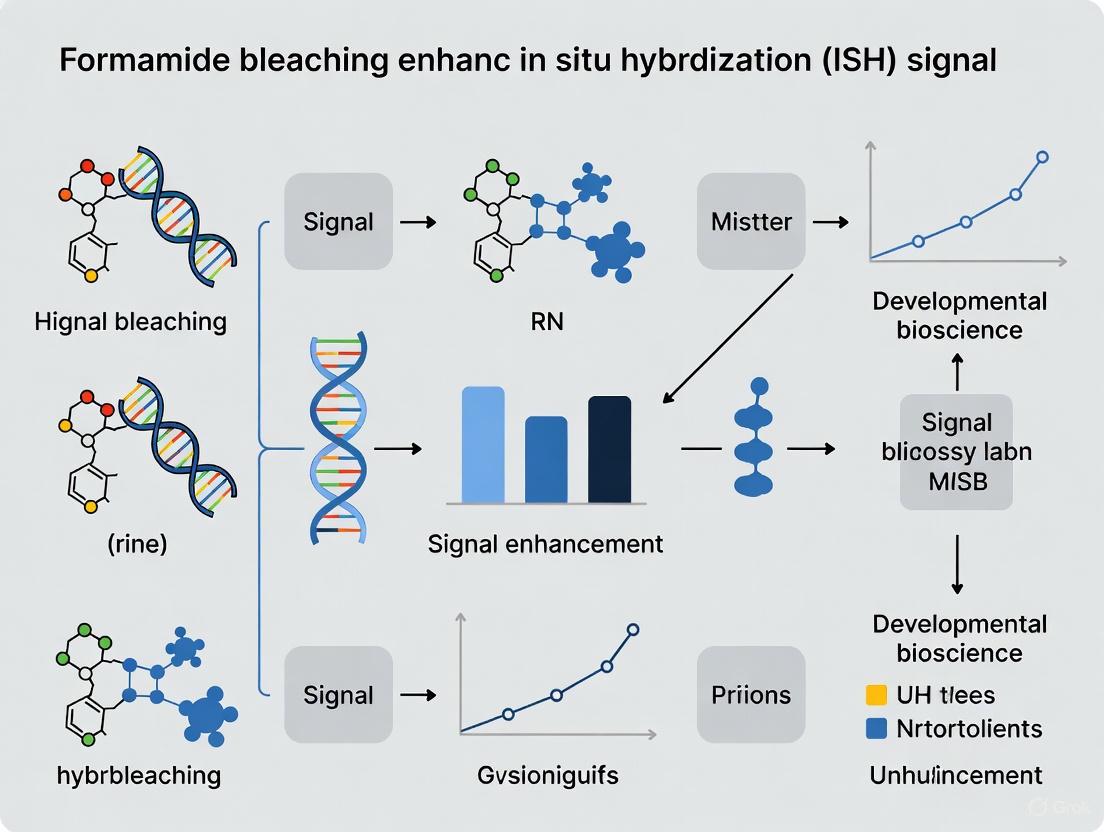
This article explores the dual role of formamide in in situ hybridization (ISH) protocols, focusing on its application in a bleaching step to enhance signal intensity for low-abundance transcripts.
Formamide Bleaching in ISH: Signal Enhancement, Protocol Optimization, and Safer Alternatives
Abstract
This article explores the dual role of formamide in in situ hybridization (ISH) protocols, focusing on its application in a bleaching step to enhance signal intensity for low-abundance transcripts. We detail the mechanistic basis of how peroxide bleaching in formamide improves tissue permeability and signal-to-noise ratio, providing optimized methodologies for researchers. The content also addresses critical troubleshooting for common ISH issues and presents a comparative analysis of traditional formamide-based methods against emerging, less toxic alternatives and formamide-free protocols, empowering scientists and drug development professionals to make informed choices for sensitive and accurate spatial gene expression analysis.
The Science of Signal Enhancement: How Formamide Bleaching Boosts ISH Sensitivity
Frequently Asked Questions (FAQs)
FAQ 1: What is the primary mechanism by which formamide bleaching enhances signal in my ISH experiments? Formamide bleaching improves signal through a dual mechanism that enhances both tissue permeability and the hybridization process itself. It acts as a powerful denaturant that helps remove pigments and other obscuring biomolecules from tissues. Furthermore, it improves tissue permeability, allowing probes better access to their targets. Research on planarians showed that this treatment provides more consistent labeling of densely packed regions that typically have reduced probe penetration [1]. In bacterial samples, formamide also exerts a beneficial denaturant effect during the hybridization process, though its concentration must be carefully optimized as it can have a harmful effect on cellular integrity at higher concentrations [2].
FAQ 2: Why did my formamide bleaching experiment yield poor results? Poor results can stem from several common pitfalls. The most frequent issue is incorrect formamide concentration, which varies significantly depending on your sample type and fixation method. Using a concentration that is too high can damage tissue morphology, while too low may provide insufficient bleaching or permeabilization. Other common issues include incomplete removal of mucous or pigments prior to bleaching, insufficient bleaching time, and damage to target mRNAs from over-bleaching. For planarian tissues, researchers found that pre-bleaching in methanol actually negated the benefits of subsequent formamide bleaching, suggesting an incompatibility between these steps [1].
FAQ 3: How long should I bleach my samples with formamide for optimal results? Optimal bleaching time should be determined empirically for your specific tissue type, but general guidelines can be established from published protocols. In planarian studies, signal intensity improved dramatically after 30 minutes of bleaching and reached maximum levels between 1 to 2 hours of incubation in formamide bleaching solution [1]. Overnight bleaching in formamide produced slightly more diffuse signal but similar intensity to the 2-hour treatment. The key is to balance sufficient permeabilization with preservation of RNA integrity and tissue morphology.
FAQ 4: Can I combine formamide bleaching with other permeabilization methods? Yes, formamide bleaching can be part of a comprehensive permeabilization strategy, but the sequence of treatments matters significantly. Research indicates that certain permeabilization methods performed before formamide bleaching may reduce its effectiveness. For instance, in planarians, a reduction step that was previously added to improve permeability of difficult regions actually diminished signal intensity when performed before formamide bleaching [1]. However, heat-induced antigen retrieval steps have been successfully employed after formamide bleaching for regenerating planarians to better balance permeabilization with tissue preservation [1].
FAQ 5: Does formamide concentration affect different bacterial species equally in FISH experiments? No, optimal formamide concentration varies significantly between bacterial species. Optimization studies for PNA-FISH revealed that the optimum formamide concentration varied according to the bacterium tested. For bacteria with thicker peptidoglycan layers, hybridization was more successful at nearly 50% (v/v) formamide, while other microorganisms performed better with much lower formamide concentrations [2]. This indicates that a universal optimum formamide concentration does not exist, and protocols must be optimized for specific microorganisms.
Troubleshooting Guides
Table 1: Troubleshooting Formamide Bleaching Problems
| Problem Symptom | Potential Causes | Recommended Solutions |
|---|---|---|
| High background noise | Insufficient bleaching, incorrect formamide concentration, incomplete probe removal | Increase bleaching time (30 min-2 hours); optimize formamide concentration; extend post-hybridization washes [1] |
| Weak or no signal | Over-bleaching, formamide concentration too high, target mRNA degradation | Reduce bleaching duration; lower formamide concentration; verify RNA integrity with controls [1] |
| Poor probe penetration | Incomplete permeabilization, tissue too thick, incorrect formamide concentration | Combine with appropriate detergents (Triton X-100); section tissues thinner; optimize formamide percentage [1] |
| Tissue morphology damage | Formamide concentration too high, bleaching time too long, sensitive tissue type | Reduce formamide concentration; shorten bleaching time; test gentler alternative permeabilization methods [2] |
| Inconsistent results between samples | Variable bleaching times, formamide concentration fluctuations, tissue heterogeneity | Standardize bleaching protocol; use fresh formamide solutions; ensure consistent tissue preparation [3] |
Table 2: Optimal Formamide Bleaching Parameters Across Model Systems
| Model System | Formamide Concentration | Bleaching Duration | Temperature | Key Findings |
|---|---|---|---|---|
| Planarian | In formamide-based bleaching solution | 1-2 hours (optimal) | Not specified | Dramatically enhanced WISH/FISH signal; better prepharyngeal region labeling [1] |
| Bacteria (PNA-FISH) | Varies by species (up to ~50%) | Protocol-dependent | 37-65°C | Effect is balance between cell envelope disruption and beneficial denaturant effect [2] |
| Newt Spinal Cord | In formamide-based solution | Not specified | Not specified | Effective for whole-mount immunohistofluorescence in adult tissues [4] |
Experimental Protocols
Protocol 1: Standard Formamide Bleaching for Whole-Mount ISH
This protocol is adapted from enhanced ISH methods developed for planarian research [1]:
Sample Preparation: Fix tissues appropriately for your experiment (e.g., formaldehyde-based fixation for planarians). Remove mucous or obscuring materials using appropriate reagents (e.g., N-acetyl-cysteine for planarians).
Formamide Bleaching Solution Preparation: Prepare a bleaching solution containing formamide, hydrogen peroxide, and appropriate buffers. The exact formulation may require optimization for your specific tissue type.
Bleaching Incubation: Incubate samples in formamide bleaching solution for 1-2 hours at room temperature with gentle agitation. Monitor bleaching progress visually for heavily pigmented tissues.
Post-Bleaching Washes: Rinse samples thoroughly with PTW (PBS with 0.1% Tween 20) or similar buffer to remove all bleaching solution.
Hybridization: Proceed with standard ISH or FISH hybridization protocols. Researchers found that the reduction step could be eliminated when using formamide bleaching [1].
Protocol 2: Optimization Strategy for Bacterial PNA-FISH with Formamide
For bacterial applications, a systematic optimization approach is recommended [2] [5]:
Preliminary Testing: Test a wide range of formamide concentrations (e.g., 10-60%) at a fixed hybridization temperature and duration.
Response Surface Methodology: Use statistical experimental design to optimize the interplay between formamide concentration, hybridization temperature, and time.
Gram Stain Characterization: Characterize peptidoglycan thickness and cell wall structure, as this significantly influences optimal formamide concentration.
Validation: Validate optimized conditions with control strains to ensure specificity and sensitivity.
Key Signaling Pathways and Workflows
Formamide Bleaching Mechanism
Research Reagent Solutions
Table 3: Essential Reagents for Formamide Bleaching Protocols
| Reagent | Function | Application Notes |
|---|---|---|
| Formamide | Primary denaturant and permeabilization agent | Use molecular biology grade; concentration must be optimized for specific tissue types [1] [2] |
| Hydrogen Peroxide | Oxidizing agent for pigment bleaching | Typically used at low concentrations (0.5-3%) in combination with formamide [1] |
| Triton X-100 | Non-ionic detergent for enhanced permeabilization | Use at 0.3-2% in combination with formamide for improved signal specificity [1] |
| Tween-20 | Weaker non-ionic detergent for washing | Alternative to Triton X-100 for more sensitive tissues [4] |
| N-methylglucamine | Mild denaturant for proteinaceous cytosol | Can replace urea in clearing solutions for better tissue preservation [6] |
| Roche Western Blocking Reagent | Reduces non-specific background | Particularly effective for anti-DIG and anti-FAM antibodies in FISH [1] |
Technical Support Center
Troubleshooting Guides
Issue 1: High Background Autofluorescence After Bleaching
- Problem: Tissue autofluorescence remains high after peroxide-formamide treatment, compromising signal-to-noise ratio.
- Possible Causes and Solutions:
- Cause: Insufficient bleaching time or light intensity. The OMAR protocol requires high-intensity light sources (e.g., 20,000 lumen LED panels) for effective oxidation [7].
- Solution: Extend bleaching duration and verify light source efficacy by monitoring bubble formation, which indicates active oxidation [7].
- Cause: Endogenous peroxidase activity not fully quenched [8].
- Solution: Incorporate an azide quenching step between sequential rounds of tyramide signal amplification, proven more effective than other quenching methods [8].
Issue 2: Weak or Absent Hybridization Signal
- Problem: Specific FISH signal is weak despite successful autofluorescence reduction.
- Possible Causes and Solutions:
- Cause: mRNA damage from over-bleaching. Studies show overnight methanol bleaching can diminish benefits of subsequent formamide treatment [8].
- Solution: Optimize bleaching duration to 1-2 hours in formamide rather than extended overnight treatments [8].
- Cause: Inadequate tissue permeability preventing probe access [8].
- Solution: Use Triton X-100 (0.3%) in wash and blocking buffers to improve permeability without excessive tissue damage [8].
Issue 3: Poor Tissue Morphology or Integrity
- Problem: Tissue structure deteriorates during peroxide-formamide treatment.
- Possible Causes and Solutions:
- Cause: Over-digestion during permeabilization steps [9].
- Solution: Titrate proteinase K concentration (typically 20 µg/mL) and incubation time (10-20 minutes) for specific tissue types [9].
- Cause: Formamide concentration too high for delicate tissues [10].
- Solution: Screen formamide concentrations (e.g., 40-50%) to balance denaturation with tissue preservation [11] [10].
Frequently Asked Questions
Q1: What is the mechanism by which peroxide-formamide treatment reduces autofluorescence? A: The peroxide-formamide combination acts through photochemical oxidation (OMAR - Oxidation-Mediated Autofluorescence Reduction). High-intensity light catalyzes peroxide-driven oxidation of fluorescent molecules in tissues, while formamide improves tissue permeability and may directly quench certain autofluorescent compounds [7] [8].
Q2: How does this treatment enhance specific ISH signals? A: Research in planarians demonstrated that peroxide bleaching in formamide dramatically improves probe penetration and accessibility to target mRNAs, significantly reducing development time and increasing signal intensity compared to methanol bleaching [8].
Q3: Can this method be combined with immunofluorescence? A: Yes, studies confirm compatibility with immunofluorescence when proper fixation is maintained. The OMAR protocol has been successfully applied to whole-mount RNA-FISH with immunofluorescence co-staining [7] [12].
Q4: What are the optimal bleaching conditions for different tissue types? A: Optimal parameters vary by tissue. For planarians, 1-2 hours in formamide-based bleaching solution at room temperature proved optimal [8]. For mouse embryonic limb buds, OMAR treatment using high-intensity LED light for specified durations effectively reduced autofluorescence [7].
Q5: Are there tissue types where this method is not recommended? A: Delicate tissues and early regenerating tissues may require reduced bleaching times or alternative permeabilization methods. A heat-induced antigen retrieval step may provide better balance for fragile regenerating tissues [8].
Table 1: Optimization of Peroxide-Formamide Bleaching Time in Planarian Tissue [8]
| Bleaching Time (hours) | Signal Intensity | Tissue Permeability | Recommended Application |
|---|---|---|---|
| 0.5 | Moderate improvement | Improved | Robust transcripts |
| 1-2 | Maximum intensity | Optimal | Low-abundance transcripts |
| >2 (e.g., overnight) | No additional benefit | Potential over-permeabilization | Not recommended |
Table 2: Comparison of Bleaching Methods for Whole-Mount FISH [8] [7]
| Method | Autofluorescence Reduction | Signal Enhancement | Tissue Preservation | Typical Duration |
|---|---|---|---|---|
| Methanol-peroxide | Moderate | Minimal | Good | 12-16 hours (overnight) |
| Formamide-peroxide | High | Significant | Good with optimization | 1-2 hours |
| OMAR (photochemical) | Very high | Maintained | Very good | Protocol-dependent |
Detailed Experimental Protocols
- Fixation: Fix tissues in formaldehyde-based fixative appropriate for your tissue type.
- Bleaching Solution Preparation: Prepare fresh bleaching solution containing:
- 5% formamide
- 0.5% hydrogen peroxide
- In appropriate buffer (e.g., SSC or PBS)
- Bleaching Incubation: Incubate tissues in bleaching solution for 1-2 hours at room temperature with gentle agitation.
- Washing: Rinse tissues 3-5 times with appropriate wash buffer.
- Hybridization: Proceed with standard FISH protocol using optimized hybridization conditions.
- Sample Preparation: Fix and permeabilize tissues using standard methods.
- OMAR Solution Preparation: Prepare OMAR working solution containing hydrogen peroxide in appropriate buffer.
- Light Treatment: Place samples in OMAR solution under high-intensity white LED light (e.g., 20,000 lumen).
- Monitoring: Observe bubble formation as indicator of active oxidation.
- Duration: Treat until autofluorescence is minimized (typically protocol-specific duration).
- Validation: Image untreated and treated tissues to confirm autofluorescence reduction before proceeding with FISH.
Methodology Visualization
Research Reagent Solutions
Table 3: Essential Reagents for Peroxide-Formamide ISH Protocols [11] [8] [7]
| Reagent | Function | Example Formulation | Notes |
|---|---|---|---|
| Formamide | Denaturant, permeability enhancer | 40-50% in hybridization buffer | Teratogen - use appropriate safety precautions [11] |
| Hydrogen Peroxide | Oxidizing agent for autofluorescence reduction | 0.5-1% in bleaching solutions | Prepare fresh for consistent results [8] [7] |
| SSC Buffer (Saline-Sodium Citrate) | Hybridization and wash buffer | 2x SSC for standard stringency | Concentration affects stringency - adjust for probe specificity [11] [9] |
| Proteinase K | Tissue permeabilization | 20 µg/mL for 10-20 minutes at 37°C | Titrate for specific tissue types to balance access vs. morphology [9] |
| Triton X-100 | Detergent for enhanced permeability | 0.1-0.3% in wash buffers | Improves antibody penetration in detection steps [8] |
| Dextran Sulfate | Volume exclusion in hybridization | 10% in hybridization buffer | Increases effective probe concentration [11] [9] |
| Blocking Reagents (BSA, casein, serum) | Reduce non-specific binding | 1-2% in appropriate buffer | RWBR (Roche Western Blocking Reagent) shows superior background reduction [8] |
Q: What is the key methodological improvement discussed here, and what is its empirically proven impact?
Research demonstrates that a short peroxide bleaching step in formamide significantly enhances Whole-mount In Situ Hybridization (WISH) and Fluorescent ISH (FISH) in planarians. This method replaces the conventional overnight peroxide bleach in methanol. Empirical data confirm that this modification leads to dramatically reduced development time and increased signal intensity, facilitating the detection of low-abundance transcripts [1].
The table below summarizes the core quantitative findings from the empirical study:
- Table 1: Empirical Impact of Formamide Bleaching on WISH/FISH
Experimental Parameter Conventional Methanol Bleach Formamide Bleach Empirical Outcome Bleaching Duration Overnight (≈16 hours) 1 to 2 hours >85% reduction in bleaching time [1] Signal Intensity Baseline Dramatically enhanced Maximum signal achieved; improved signal-to-noise ratio for FISH [1] Tissue Permeability Variable, lower in dense regions Consistently improved More consistent labeling in densely-packed prepharyngeal region [1] Development Time Standard time to signal Significantly reduced Faster development for all probes tested (readily detected, moderate, and weak) [1]
Detailed Experimental Protocol
Q: What is the detailed methodology for the formamide bleaching protocol?
The following steps outline the optimized protocol based on the research, which used the established formaldehyde-based WISH protocol as a starting point [1].
- Table 2: Key Reagent Solutions for Enhanced ISH
Research Reagent Solution Function in Protocol Specific Example / Note Formamide Bleaching Solution Improves tissue permeability and signal intensity; replaces methanol-based bleach. Hydrogen peroxide in formamide [1] Modified Blocking Buffer Dramatically reduces background staining without diminishing signal. Contains Roche Western Blocking Reagent (RWBR) [1] Modified Wash Buffer Further improves signal specificity. Contains 0.3% Triton X-100 as detergent [1] Tyramide Signal Amplification (TSA) Enables fluorescent detection of low-abundance transcripts. Critical for FISH sensitivity [1] Azide Solution Effectively quenches peroxidase activity between TSA rounds in multicolor FISH. Prevents false signals in sequential detection [1]
Step-by-Step Workflow:
- Sample Preparation and Fixation: Fix planarians in formaldehyde-based fixative. Remove mucous using N-acetyl-cysteine [1].
- Formamide Bleaching:
- Replace the overnight methanol peroxide bleaching step.
- Incubate fixed samples in formamide bleaching solution.
- Optimal Duration: Signal intensity improves dramatically after 30 minutes, reaching a maximum between 1 to 2 hours [1].
- Critical Note: Pre-bleaching in methanol eliminates the benefit of the formamide bleach. The formamide bleach should be the primary bleaching step [1].
- Hybridization: Hybridize with target-specific probes in an appropriate hybridization buffer. The reduction step used in the original protocol may be omitted as it can slightly diminish the enhanced signal intensity achieved with formamide bleaching [1].
- Blocking and Washing:
- Use a modified blocking buffer containing Roche Western Blocking Reagent (RWBR) to dramatically reduce background.
- Use wash buffers containing 0.3% Triton X-100 to further improve signal specificity [1].
- Detection:
- For chromogenic detection (WISH), use standard alkaline phosphatase-based development, noting the significantly reduced development time.
- For fluorescent detection (FISH):
Troubleshooting & FAQ
Q: We observe high background staining in our FISH experiments. How can this be reduced? A: High background is a common challenge. The research provides specific solutions:
- Modify your blocking buffer: Add Roche Western Blocking Reagent (RWBR), which was shown to dramatically reduce background, particularly for anti-DIG and anti-FAM antibodies, without compromising signal intensity [1].
- Modify your wash buffer: Supplement or replace Tween 20 with 0.3% Triton X-100 for improved signal specificity [1].
- Ensure proper stringent washes: Use the correct SSC buffer concentration and temperature (e.g., 75-80°C) to remove unbound probe effectively [13].
Q: Our positive control shows a signal, but the target gene of interest (a low-abundance transcript) does not. What optimizations can we try? A: Detecting low-abundance RNAs requires enhanced sensitivity.
- Implement the formamide bleach: This is the primary recommendation to increase signal intensity and improve probe penetration [1].
- Use Tyramide Signal Amplification (TSA): TSA is crucial for enhancing the signal of weakly expressed genes in FISH [1].
- Quench autofluorescence: Planarian tissues autofluoresce broadly. Use a copper sulfate quenching step to improve the signal-to-noise ratio [1].
- Verify probe quality and concentration: Always run positive and negative control probes (e.g., PPIB/UBC and dapB) to confirm assay performance and RNA quality [14] [15].
Q: For multicolor FISH, we get false signals in the second round of detection. How can we prevent this? A: This is caused by residual peroxidase activity from the first TSA round.
- Use azide quenching: Direct comparison of quenching methods showed that incubation with sodium azide is the most effective way to quench peroxidase activity between TSA rounds without being detrimental to subsequent detection steps [1].
Q: The morphology of our regenerating tissue samples is poor after the protocol. Are there special considerations? A: Yes, regenerating tissues are fragile.
- Employ Heat-Induced Antigen Retrieval (HIAR): The study found that using a heat-induced antigen retrieval step provides a better balance between permeabilizing mature tissues and preserving the fragile morphology of regenerating tissues [1].
Frequently Asked Questions (FAQs)
Q1: What is the "Formamide Paradox" in ISH experiments? The "Formamide Paradox" refers to the dual nature of formamide in ISH protocols. While it is a key component for enhancing signal intensity by promoting specific probe hybridization and allowing the procedure to be performed at lower, gentler temperatures, it also has the potential to disrupt tissue morphology and chromatin integrity if used at inappropriate concentrations or under suboptimal conditions [16] [17].
Q2: How can I optimize formamide concentration to maximize signal without damaging my sample? Optimal formamide concentration is probe-specific and must be determined empirically. Research indicates that signal brightness often has a broad optimal range [10]. A systematic approach is recommended: start with a standard concentration (e.g., 50% v/v in your hybridization buffer [17]) and perform a matrix test, varying the formamide concentration by 10% increments while monitoring both signal intensity and tissue preservation. Using a known positive control tissue is crucial for this optimization [3] [18].
Q3: My ISH signal is weak after using formamide. What should I check? Weak signal can often be traced to several factors related to formamide use and general protocol health:
- Probe Concentration: Ensure your probe concentration is optimal for your specific tissue and detection method [17].
- Hybridization Temperature: Temperature is a critical variable for specificity. Typically ranging between 55°C and 62°C, it must be calibrated for your specific probe and formamide concentration [16].
- Sample Integrity: Check that the target RNA or DNA is not degraded. Poor RNA quality is a common cause of weak or absent signals [18].
- Permeabilization: Verify that effective permeabilization (e.g., with Proteinase K or detergents) has been achieved to allow probe access [17].
Q4: I observe high background staining. Could formamide be the cause? High background is usually not directly caused by formamide but by insufficiently stringent washing conditions after hybridization. To resolve this:
- Increase Wash Stringency: Use post-hybridization washes with lower salt concentrations (e.g., lower SSC concentration) and/or a higher temperature [18] [17].
- Review Hybridization Buffer: Ensure your hybridization buffer contains blocking agents like denatured salmon sperm DNA or tRNA to reduce non-specific probe binding [17].
- Check Probe Concentration: An excessively high probe concentration can also lead to elevated background [18].
Q5: Are there alternative fixation methods that work well with formamide-based ISH? Yes, recent research has developed fixation protocols that enhance compatibility with ISH while preserving delicate tissues. The Nitric Acid/Formic Acid (NAFA) protocol, for instance, has been shown to robustly preserve fragile tissues like regeneration blastemas in planarians and killifish fins without the need for proteinase K digestion, which can damage epitopes and morphology. This protocol is highly compatible with subsequent formamide-based ISH and immunostaining [19].
Troubleshooting Guide
| Problem | Possible Causes Related to Formamide/Stringency | Solutions |
|---|---|---|
| Weak or No Signal [18] [17] | Hybridization conditions too stringent (e.g., high formamide, high temperature), leading to reduced probe binding. | Decrease formamide concentration in hybridization buffer; lower hybridization temperature; increase probe concentration. |
| High Background [18] [17] | Conditions not stringent enough, failing to wash away non-specifically bound probe. | Increase formamide concentration in wash buffers; decrease salt (SSC) concentration in washes; increase wash temperature. |
| Uneven Staining [3] [17] | Incomplete reagent coverage or drying of formamide-containing buffers on the slide during incubation. | Ensure even probe application; use a properly sealed humidified chamber to prevent evaporation. |
| Tissue Damage [19] | Over-fixation making tissue brittle, combined with harsh permeabilization (Proteinase K). | Optimize fixation time; consider gentler permeabilization methods or alternative fixation protocols like NAFA [19]. |
| Non-specific Signals [17] | Probe binding to off-target sequences due to suboptimal stringency. | Increase stringency of washes; confirm probe specificity; use RNase/DNase digestion controls to validate signal origin. |
Experimental Protocol & Data
Quantitative Optimization of Formamide Concentration
Recent systematic studies on multiplexed error-robust FISH (MERFISH) have quantified the effect of formamide concentration on single-molecule signal brightness, which serves as a proxy for probe assembly efficiency [10].
Table 1: Signal Brightness vs. Formamide Concentration for Different Probe Target Lengths
| Target Region Length | Optimal Formamide Range | Signal Brightness Characteristic | Key Finding |
|---|---|---|---|
| 20 nt | Specific range not detailed | Weak dependence within optimal range | The average brightness of single-molecule signals depends relatively weakly on formamide concentration within the optimal range for a given probe length [10]. |
| 30 nt | Specific range not detailed | Weak dependence within optimal range | |
| 40 nt | Specific range not detailed | Weak dependence within optimal range | |
| 50 nt | Specific range not detailed | Weak dependence within optimal range |
Methodology Summary:
- Probe Design: Encoding probe sets with 80 different probes were designed for two different mRNAs (SCD and CSPG4) with target regions of 20, 30, 40, or 50 nucleotides in length [10].
- Hybridization: smFISH was performed on U-2 OS cells. A range of formamide concentrations was screened with a fixed hybridization temperature of 37°C and a hybridization duration of 1 day [10].
- Imaging & Analysis: Fluorescent signals from single molecules were identified, and their brightness was measured to determine probe assembly efficiency [10].
Detailed Hybridization Protocol
The following workflow integrates formamide for optimal signal enhancement while highlighting critical control points to prevent tissue disruption.
Key Reagents & Steps:
- Fixation and Permeabilization: Fix tissues with 4% paraformaldehyde for optimal nucleic acid preservation. Avoid exceeding 24 hours of fixation, as over-fixation can reduce FISH signals [16] [20]. Permeabilize with detergents (e.g., Triton X-100) or Proteinase K to allow probe access [17].
- Pre-hybridization: Incubate samples in a pre-warmed pre-hybridization buffer containing formamide (commonly 50% v/v) and blocking agents (e.g., heparin, salmon sperm DNA) for 30-60 minutes at 37-45°C. This step blocks non-specific binding sites [17].
- Probe and Hybridization:
- Denature the labeled probe at 95°C for 5 minutes and immediately place on ice [17].
- Apply the denatured probe diluted in hybridization buffer (containing formamide, SSC, detergents) to the sample [17].
- Incubate overnight (16-18 hours) at the appropriate temperature (37-45°C is common) in a securely sealed, humidified chamber to prevent evaporation, which can cause high background and uneven staining [3] [17].
- Stringency Washes: After carefully removing coverslips, wash the slides to remove unbound probe. The stringency is controlled by the salt concentration (SSC) and temperature of the wash buffers. Gradually increasing stringency (e.g., lower SSC, higher temperature) helps eliminate background [16] [17].
- Signal Detection and Imaging: Proceed with chromogenic or fluorescent detection based on your probe label. For fluorescence, mount with an antifade medium and image promptly [17].
The Scientist's Toolkit: Essential Research Reagents
Table 2: Key Reagent Solutions for Formamide-Based ISH
| Reagent | Function | Key Considerations |
|---|---|---|
| Formamide | Chemical denaturant that lowers the melting temperature (Tm) of nucleic acid hybrids, allowing hybridization to occur at lower temperatures that preserve tissue morphology. | Use high-grade, molecular biology quality. Concentration must be optimized for each probe to balance signal and specificity [10] [16]. |
| Saline-Sodium Citrate (SSC) | Provides the ionic strength for hybridization. Critical for controlling stringency in post-hybridization washes. | Lower SSC concentration in washes increases stringency. A 20X stock is commonly used [17]. |
| Blocking Agents (Heparin, Salmon Sperm DNA, tRNA) | Block non-specific binding sites on the tissue to reduce background signal. | An essential component of both pre-hybridization and hybridization buffers [17]. |
| Denhardt's Solution | A mixture of polymers used to reduce background by blocking non-specific binding. | Often included in hybridization buffers [17]. |
| Proteinase K | Proteolytic enzyme used to permeabilize fixed tissues by digesting proteins, thereby allowing probe penetration. | Concentration and time must be carefully optimized; over-digestion damages tissue morphology [18] [19]. |
| Paraformaldehyde (PFA) | Cross-linking fixative that preserves tissue architecture and immobilizes nucleic acids. | A 4% solution is standard. Over-fixation can mask targets and reduce signal [16] [20]. |
Optimized Protocols: A Step-by-Step Guide to Implementing Formamide Bleaching
Within the methodology of in situ hybridization (ISH), the challenge of detecting low-abundance transcripts is a significant hurdle. This technical guide focuses on formamide bleaching, a critical pretreatment step developed to enhance signal intensity and sensitivity. Formamide, a key solvent in ISH, functions by destabilizing the double-stranded nucleic acid helix, thereby lowering the melting temperature and facilitating probe hybridization [21]. The integration of formamide into a peroxide-based bleaching solution serves a dual purpose: it simultaneously reduces tissue autofluorescence and improves probe permeability. Research within a planarian model system has demonstrated that a short bleaching step in formamide dramatically enhances signal intensity for both chromogenic and fluorescent ISH, providing a robust tool for researchers and drug development professionals aiming to elucidate elusive gene expression patterns [8].
Core Formulations and Component Functions
The efficacy of a formamide bleaching solution is dependent on the precise concentration and quality of its components. The table below summarizes a standard formulation and the role of each constituent.
Table 1: Standard Formulation for Formamide Bleaching Solution
| Component | Final Concentration | Function & Critical Notes |
|---|---|---|
| Formamide | 50% (v/v) | Primary solvent that enhances tissue permeability and contributes to signal intensity [8]. |
| Hydrogen Peroxide (H₂O₂) | 1-5% (v/v) | Oxidizing agent responsible for bleaching endogenous pigments and reducing autofluorescence. |
| Saline-Sodium Citrate (SSC) Buffer | 1X | Provides appropriate ionic strength and pH for the reaction; helps maintain tissue integrity. |
| Detergent (e.g., Tween 20) | 0.1-1% (v/v) | Reduces surface tension, ensuring even penetration of the solution across the tissue sample. |
Critical Components and Rationale
- Formamide Concentration and Purity: A concentration of 50% formamide has been empirically shown to provide the optimal balance between tissue preservation and enhanced permeability [8]. Using high-quality, deionized formamide is critical, as degraded formamide (which can form formic acid and ammonia) can compromise the procedure and lead to high background or loss of signal [22] [23].
- Hydrogen Peroxide Concentration: The 1-5% concentration range is sufficient for bleaching pigmented tissues and quenching autofluorescence without causing excessive damage to the target mRNA or tissue morphology. The exact concentration can be optimized for specific tissue types.
Step-by-Step Experimental Protocol
This protocol outlines the application of formamide bleaching for whole-mount ISH, based on methodologies that have demonstrated significant signal enhancement [8].
Formamide Bleaching Solution Preparation
- Combine the following in a nuclease-free tube:
- 5.0 mL of deionized formamide (high purity).
- 1.0 mL of 10X SSC buffer.
- 0.5-1.0 mL of 30% H₂O₂ (to achieve a final concentration of 1.5-3%).
- 0.1 mL of 10% Tween 20.
- Add nuclease-free water to a final volume of 10 mL.
- Mix the solution thoroughly by inversion. Prepare the solution fresh before each use for optimal results.
Bleaching Procedure
- Sample Preparation: Fix and permeabilize tissue samples according to standard protocols for your model organism (e.g., planarians, zebrafish embryos). For planarians, mucous should be removed prior to fixation [8].
- Bleaching Incubation: Transfer the fixed samples into the prepared formamide bleaching solution. Incubate at room temperature for 1-2 hours with gentle agitation. Note: Experiments have shown that bleaching for 30 minutes dramatically improves signal, with maximum intensity reached between 1 to 2 hours [8].
- Washing: Carefully remove the bleaching solution and wash the samples thoroughly (3 x 5 minutes) with a solution of 1X PBS containing 0.1% Tween 20 (PBTw) to terminate the reaction.
- Proceed to Hybridization: The samples are now ready for the standard ISH or FISH protocol, including hybridization with your target-specific nucleic acid probes.
The following workflow diagram illustrates the key steps of this protocol and their logical sequence.
Troubleshooting Common Issues (FAQs)
FAQ 1: Despite using the formamide bleach, my ISH signal remains weak or absent. What could be the cause?
Weak signal can result from several factors related to reagent quality and protocol execution.
- Cause A: Degraded Formamide. Formamide breaks down into formic acid and ammonia upon exposure to air and repeated freeze-thaw cycles, which can compromise its efficacy and damage nucleic acids [22] [23].
- Solution: Always use high-quality, deionized formamide. Aliquot formamide upon receipt and store at -20°C to minimize freeze-thaw cycles and exposure to air.
- Cause B: Over-fixation. Excessive cross-linking from over-fixation can trap mRNA targets, making them inaccessible to probes [20].
- Solution: Optimize fixation time for your specific tissue. If over-fixation is suspected, a protease treatment step can be introduced post-bleaching to free up cross-linked molecules [20].
- Cause C: Suboptimal Bleaching Time. The required bleaching time can vary by tissue type and thickness.
- Solution: Perform a time-course experiment, testing bleaching times from 30 minutes to 2 hours to determine the optimum for your sample [8].
FAQ 2: I am observing high background staining after the bleaching step. How can this be resolved?
High background is often attributable to non-specific binding of detection reagents.
- Cause A: Insufficient Blocking or Washing. The bleaching step improves permeability but can also increase non-specific binding sites.
- Solution: Enhance blocking after the bleaching and hybridization steps. Adding Roche Western Blocking Reagent (RWBR) to your standard blocking buffer and incorporating 0.3% Triton X-100 in wash buffers have been shown to dramatically reduce background for fluorescent detection [8].
- Cause B: Bacterial Contamination of Reagents. Solutions containing proteins (e.g., BSA in wash buffers) can support bacterial growth, which may inactivate enzymes like alkaline phosphatase and cause high background or signal loss [23].
- Solution: Prepare fresh wash and blocking solutions. Avoid storing BSA-containing solutions for extended periods at room temperature.
FAQ 3: My tissue morphology appears damaged after the formamide bleaching. How can I preserve structure?
- Cause: The formamide and peroxide combination can be harsh on delicate tissues, particularly during extended incubations.
- Solution: For fragile tissues, such as early regenerating planarian tissue, a heat-induced antigen retrieval step can provide a better balance between permeabilization and morphology preservation [8]. Alternatively, slightly reduce the formamide concentration or bleaching time and empirically determine the gentlest effective conditions.
The Scientist's Toolkit: Essential Research Reagent Solutions
The following table lists key reagents and their specific functions in the formamide bleaching and associated ISH protocols.
Table 2: Essential Reagents for Formamide Bleaching and ISH
| Research Reagent | Function in the Protocol |
|---|---|
| Formamide (Deionized) | Primary agent in bleaching solution to enhance tissue permeability and signal intensity [8]. Also a standard component of hybridization buffers to lower nucleic acid melting temperature [21]. |
| Hydrogen Peroxide (H₂O₂) | The active bleaching component that oxidizes pigments and reduces autofluorescence. |
| Saline-Sodium Citrate (SSC) Buffer | Provides the appropriate ionic strength and pH environment for the bleaching reaction and subsequent hybridization steps. |
| Roche Western Blocking Reagent (RWBR) | A critical component for blocking non-specific binding sites after bleaching, dramatically improving signal-to-noise ratio in FISH [8]. |
| Anti-Digoxigenin-POD (Anti-DIG) | A common peroxidase-conjugated antibody used to detect DIG-labeled probes in conjunction with tyramide signal amplification (TSA) for FISH. |
| Hybridization Chain Reaction (HCR) Probes | A modern probe system that enables sensitive, multiplexed RNA detection in cleared tissues and is compatible with formamide-based protocols [20]. |
Formamide bleaching has emerged as a critical pretreatment step that significantly enhances signal intensity and tissue permeability for in situ hybridization (ISH) and fluorescence in situ hybridization (FISH) procedures. When integrated within a complete workflow, this method dramatically improves the detection of low-abundance transcripts while maintaining excellent tissue morphology. Research demonstrates that replacing traditional overnight peroxide bleaching in methanol with a short peroxide bleaching step in formamide dramatically reduces development time for all probes tested, indicating improved signal sensitivity [1]. This technical guide provides comprehensive protocols and troubleshooting advice for researchers seeking to implement this powerful technique within their complete ISH/FISH workflow.
Complete Integrated Workflow with Formamide Bleaching
The following diagram illustrates the complete ISH/FISH workflow with the formamide bleaching step positioned within the overall procedure:
Detailed Experimental Protocols
Formamide Bleaching Protocol
The formamide bleaching step represents a significant improvement over traditional methods. Follow this optimized protocol for enhanced signal intensity:
Materials Needed:
- Formamide (molecular biology grade)
- Hydrogen peroxide (30%)
- SSC buffer (20X)
- RNase-free water
Procedure:
- Prepare formamide bleaching solution:
- 50% formamide (v/v)
- 0.5% hydrogen peroxide (v/v)
- 1X SSC buffer
- RNase-free water to volume
After mucous removal and fixation, incubate samples in formamide bleaching solution for 1-2 hours at room temperature with gentle agitation [1].
Rinse samples twice with PBST or TBST buffer to remove residual bleaching solution.
Proceed to permeabilization step.
Critical Notes:
- Do not perform methanol bleaching before formamide bleaching, as this eliminates the benefit of formamide treatment [1].
- Optimal bleaching time is tissue-dependent; test between 30 minutes to 2 hours for your specific application.
- Formamide bleaching improves tissue permeability, making additional reduction steps unnecessary in most cases [1].
Complete ISH/FISH Protocol with Integrated Formamide Bleaching
Sample Preparation and Fixation:
- Extract and fix tissues promptly using known and consistent fixation conditions (fixative type, pH, temperature, time) to preserve nucleic acid integrity [3].
- For planarians, use formaldehyde-based fixation with N-acetyl-cysteine for mucous removal [1].
- For paraffin sections, ensure complete deparaffinization and rehydration before fixation [17].
Permeabilization and Blocking:
- Apply appropriate permeabilization (Proteinase K or detergent-based) after formamide bleaching [17].
- Use modified blocking buffer containing Roche Western Blocking Reagent (RWBR) and 0.3% Triton X-100 to dramatically reduce background staining [1].
Hybridization and Detection:
- Denature labeled probes at 95°C for 5 minutes before application [17].
- Hybridize overnight (16-18 hours) at 37-45°C in a properly sealed humidified chamber to prevent evaporation [17].
- Perform stringency washes with precise temperature and salt concentration control [17].
- For fluorescent detection, employ copper sulfate quenching to eliminate autofluorescence [1].
- Use iterative rounds of tyramide signal amplification (TSA) for low-abundance transcripts [1].
Quantitative Data and Optimization
Formamide Bleaching Efficiency Over Time
The table below summarizes the quantitative improvements in signal intensity achieved through formamide bleaching optimization:
| Bleaching Time (minutes) | Signal Intensity | Tissue Permeability | Development Time | Recommended Application |
|---|---|---|---|---|
| 30 minutes | Moderate improvement | Noticeably improved | Reduced by ~40% | Routine transcripts |
| 60 minutes | Maximum intensity | Optimal | Reduced by ~60% | Low-abundance targets |
| 120 minutes | Maximum intensity | Slightly over-permeabilized | Reduced by ~60% | Dense tissue regions |
| Overnight in methanol | Baseline | Moderate | Baseline (reference) | Not recommended with formamide |
Data adapted from planarian FISH studies showing optimal bleaching duration of 1-2 hours in formamide [1].
Buffer Composition for Enhanced Performance
| Buffer Component | Standard Formulation | Enhanced Formulation | Improvement Achieved |
|---|---|---|---|
| Blocking Buffer | Standard blocking reagent | Roche Western Blocking Reagent + 0.3% Triton X-100 | Dramatic background reduction [1] |
| Wash Buffer | Tween-20 only | Triton X-100 (0.3%) | Improved signal specificity [1] |
| Pre-hybridization Buffer | Variable formulations | 50% formamide, 1X SSC, heparin, salmon sperm DNA, SDS, Tween-20 | Reduced non-specific binding [17] |
| Autofluorescence Quench | Not typically used | Copper sulfate solution | Virtually eliminated autofluorescence [1] |
Troubleshooting Guide: Formamide Bleaching in ISH/FISH
Problem: Weak or No Signal After Formamide Bleaching
- Potential Cause: Over-fixation of tissue reducing FISH signals [20]
- Solution: Reduce fixation time or apply protease treatment to free up cross-linked molecules [20]
- Potential Cause: Incomplete probe penetration
- Solution: Ensure formamide bleaching solution is fresh and properly formulated; extend bleaching time to 2 hours [1]
Problem: High Background Staining
- Potential Cause: Inadequate blocking after formamide treatment
- Solution: Use modified blocking buffer with Roche Western Blocking Reagent and 0.3% Triton X-100 [1]
- Potential Cause: Non-specific probe binding
- Solution: Increase stringency of post-hybridization washes (higher temperature, lower SSC concentration) [17]
Problem: Tissue Damage or Morphology Loss
- Potential Cause: Excessive bleaching time in formamide
- Solution: Reduce bleaching time to 30-60 minutes for delicate tissues
- Potential Cause: Formamide quality issues
- Solution: Use fresh, molecular biology grade formamide; avoid repeated freeze-thaw cycles
Problem: Uneven Staining Throughout Tissue
- Potential Cause: Incomplete coverage during bleaching step
- Solution: Ensure adequate volume of bleaching solution with gentle agitation throughout incubation
- Potential Cause: Bubble formation during hybridization
- Solution: Use coverslips and properly sealed humidified chamber to prevent evaporation [17]
Researcher's Toolkit: Essential Reagents and Solutions
| Research Reagent | Function in ISH/FISH | Specific Role in Formamide Bleaching |
|---|---|---|
| Formamide | Chemical denaturant in hybridization | Primary component of bleaching solution; enhances tissue permeability [1] |
| Hydrogen Peroxide | Oxidizing agent for bleaching | Removes pigments and reduces background autofluorescence [1] |
| SSC Buffer (Saline-Sodium Citrate) | Hybridization and wash buffer | Maintains ionic strength during bleaching step [17] |
| Roche Western Blocking Reagent | Blocking nonspecific binding | Critical for reducing background after formamide treatment [1] |
| Triton X-100 | Detergent for permeabilization | Enhances penetration of bleaching solution and subsequent reagents [1] |
| Proteinase K | Proteolytic enzyme for permeabilization | Additional permeabilization after bleaching for challenging tissues [17] |
| Copper Sulfate | Chemical quenching agent | Eliminates autofluorescence after bleaching step [1] |
Frequently Asked Questions (FAQs)
Q: Why does formamide bleaching improve signal intensity compared to traditional methanol bleaching? A: Formamide bleaching dramatically enhances tissue permeability while preserving target mRNA integrity. Research shows it reduces development time for all probes tested and provides more consistent labeling of densely packed tissue regions [1].
Q: Can I combine formamide bleaching with methanol bleaching for enhanced results? A: No. Studies specifically show that the improved signal intensity resulting from bleaching in formamide is lost when animals are first bleached overnight in methanol. The formamide bleaching step should replace rather than complement methanol bleaching [1].
Q: How does formamide bleaching affect tissue autofluorescence? A: While formamide bleaching itself reduces some autofluorescence, for complete elimination, researchers should follow with a copper sulfate quenching step, which has been shown to virtually eliminate autofluorescence across a broad range of wavelengths [1].
Q: Is formamide bleaching compatible with 3D imaging and tissue clearing techniques? A: Yes, formamide bleaching can be integrated with optical clearing methods. Recent studies demonstrate compatibility with aqueous clearing protocols like LIMPID for high-resolution 3D FISH imaging of thick tissues [20].
Q: What safety precautions are necessary when working with formamide? A: Formamide should be handled with appropriate personal protective equipment in a well-ventilated area or fume hood. Use molecular biology grade formamide, and avoid repeated freeze-thaw cycles which can degrade the compound and affect performance.
Advanced Applications and Future Directions
The integration of formamide bleaching within complete ISH/FISH workflows enables several advanced applications. Researchers can now achieve:
- Single-molecule RNA detection in thick tissue sections through combination with optical clearing methods like LIMPID [20]
- Multiplexed imaging of both mRNA and protein expression within the same sample [20]
- Enhanced signal sensitivity for spatial transcriptomics methods including MERFISH and other error-robust FISH techniques [10]
- 3D gene expression mapping in whole-mount tissues with minimal aberrations using high numerical aperture objectives [20]
The positioning of formamide bleaching as a key pretreatment step represents a significant advancement in molecular histology, particularly for the detection of low-abundance transcripts that were previously challenging or impossible to visualize using conventional ISH/FISH methodologies.
Frequently Asked Questions (FAQs)
Q1: Why is optimizing incubation temperature and duration critical in an ISH protocol that uses formamide bleaching?
Balancing temperature and time is essential to maximize the hybridization signal while preserving tissue morphology. Formamide bleaching dramatically enhances tissue permeability and signal intensity ( [1]). However, this also makes tissues more susceptible to damage during subsequent high-temperature incubation steps. An optimized protocol ensures that the probe has sufficient time to bind to its target without causing over-digestion or loss of cellular structure, which is vital for accurate spatial localization of gene expression.
Q2: What are the typical temperature and duration parameters for the hybridization step following formamide bleaching?
Following a formamide bleach, the hybridization step typically uses temperatures ranging from 55°C to 65°C ( [9] [17]). The incubation often occurs overnight (for 16-18 hours) to ensure sufficient probe binding ( [17]). The exact temperature within this range should be optimized based on the probe's sequence and the tissue type. Higher temperatures within this range increase stringency, reducing non-specific binding but potentially weakening the signal for some probes.
Q3: How does formamide bleaching improve the ISH signal, and how long should it be performed?
Formamide bleaching enhances tissue permeability, allowing for better probe penetration and significantly increasing signal intensity. Research on planarians shows that a short bleaching step of 1 to 2 hours in formamide dramatically enhances signal for both WISH and FISH compared to traditional overnight methanol bleaching ( [1]). The signal intensity reaches its maximum within this timeframe, and longer durations do not provide additional benefit and may risk morphology.
Q4: What are the consequences of excessive incubation time or temperature?
Excessive incubation time or temperature can lead to several issues:
- Morphology Damage: Over-digestion can result in poor tissue morphology, making it difficult to localize the hybridization signal ( [9]).
- Weak or Lost Signal: Ironically, both over-digestion and under-digestion during steps like proteinase K treatment can decrease or eliminate the CISH signal ( [24]).
- High Background: Overly long hybridization or insufficiently stringent washes can lead to non-specific probe binding and high background staining ( [17]).
Q5: How can I troubleshoot a weak signal after hybridization?
If you encounter a weak signal:
- Optimize Probe Concentration: Ensure an effective and non-saturating probe concentration ( [17]).
- Check Permeabilization: Verify that permeabilization (e.g., with Proteinase K) was effective. The formamide bleach should help with this ( [1]).
- Confirm Nucleic Acid Integrity: Check that the RNA or DNA in your sample has not degraded prior to hybridization ( [17]).
- Use Signal Amplification: For low-abundance transcripts, consider using tyramide signal amplification (TSA) to enhance signal intensity ( [1]).
Troubleshooting Guides
Problem: Weak or Absent Hybridization Signal
| Potential Cause | Diagnostic Steps | Recommended Solution |
|---|---|---|
| Insufficient permeabilization | Check if pre-hybridization steps were performed correctly. | Incorporate a 1-2 hour formamide bleach to enhance permeability ( [1]). Optimize Proteinase K concentration and incubation time ( [9]). |
| Suboptimal hybridization temperature | Verify the melting temperature (Tm) of your probe. | Titrate the hybridization temperature. Start at 55°C and increase in increments of 2°C up to 65°C to find the optimal stringency and signal ( [9]). |
| Probe degradation or low concentration | Run a gel to check probe integrity and concentration. | Prepare a fresh probe aliquot. Systemically test a range of probe concentrations to find the optimum for your specific target ( [17]). |
| Target mRNA is low-abundance | Confirm with a known positive control probe. | Employ signal amplification techniques such as tyramide signal amplification (TSA) to enhance detection sensitivity ( [1]). |
Problem: Poor Tissue Morphology or Damage
| Potential Cause | Diagnostic Steps | Recommended Solution |
|---|---|---|
| Over-digestion during permeabilization | Inspect tissue structure after Proteinase K step. | Perform a Proteinase K titration experiment. Reduce concentration or incubation time; typical range is 10-20 minutes at 37°C ( [9]). |
| Excessive formamide bleaching | Compare morphology after different bleach durations. | Limit formamide bleaching to 1-2 hours. Do not extend overnight, as maximum benefit is achieved within this window ( [1]). |
| Excessive hybridization temperature or time | Review your protocol parameters. | Ensure hybridization temperature does not exceed 65°C for standard protocols. While overnight hybridization is common, do not extend beyond 72 hours ( [24]). |
| Inadequate tissue fixation | Check fixation protocol and duration. | Ensure tissues are properly fixed immediately after collection, using agents like paraformaldehyde or formalin, to preserve structure and nucleic acid integrity ( [9] [17]). |
Problem: High Background Staining
| Potential Cause | Diagnostic Steps | Recommended Solution |
|---|---|---|
| Insufficient stringency washes | Check salt concentration and temperature of wash buffers. | Increase wash stringency by using lower SSC concentrations (e.g., 0.1-0.2x SSC) and/or higher wash temperatures (up to 65°C) for short periods ( [9] [17]). |
| Inadequate blocking | Review blocking buffer composition. | Use a modified blocking buffer containing Roche Western Blocking Reagent (RWBR) and 0.3% Triton X-100, which dramatically reduces background ( [1]). |
| Non-specific probe binding | Include a no-probe control and a sense-strand control. | Include blocking agents like denatured salmon sperm DNA in the hybridization buffer. Acetylation of tissues can also block positively charged amines that cause non-specific binding ( [17]). |
| Probe concentration too high | Titrate the probe. | Dilute the probe further in hybridization buffer and test signal-to-noise ratio ( [17]). |
Experimental Data and Protocols
Quantitative Impact of Formamide Bleaching on Signal Intensity
The following table summarizes key experimental findings on the effects of formamide bleaching on ISH signal, as demonstrated in research on planarians ( [1]).
| Experimental Condition | Signal Intensity | Development Time | Tissue Permeability | Recommended Application |
|---|---|---|---|---|
| Overnight methanol bleach | Baseline | Baseline | Standard | Standard protocol for pigmented organisms. |
| 30-min formamide bleach | Dramatically improved | Signally reduced | Improved | Not recommended for optimal results. |
| 1-2 hour formamide bleach | Maximum | Minimal | Maximally improved | Optimal duration for maximizing signal and permeability. |
| Overnight formamide bleach | Similar to 2-hour | Minimal | Slightly more diffuse | No significant benefit over 2-hour bleach; may increase morphological risk. |
Temperature and Duration Parameters for Key ISH Steps
This table provides a consolidated view of optimized parameters based on the reviewed literature.
| Protocol Step | Recommended Temperature | Recommended Duration | Key Considerations |
|---|---|---|---|
| Formamide Bleaching | Room Temperature | 1 - 2 hours | Replaces overnight methanol bleach. Maximum signal achieved at 2 hours ( [1]). |
| Proteinase K Digestion | 37°C | 10 - 20 minutes | Requires titration for each tissue type and fixation method ( [9]). |
| Probe Denaturation | 95°C | 2 - 5 minutes | Use a PCR block or water bath, then immediately chill on ice ( [9] [17]). |
| Hybridization | 55°C - 65°C | Overnight (16-18 hrs) | Must be performed in a humidified chamber to prevent evaporation ( [9] [17]). |
| Stringency Washes | 25°C - 75°C | 3 washes, 5 min each | Temperature and SSC concentration are critical for removing non-specific binding ( [9]). |
Detailed Protocol: Enhanced ISH with Formamide Bleaching
This protocol integrates the optimized formamide bleaching step for enhanced signal detection, particularly for low-abundance transcripts.
Stage 1: Tissue Preparation and Formamide Bleaching
- Fixation: Fix tissue samples appropriately (e.g., with 4% paraformaldehyde) and embed in paraffin or prepare for whole-mount analysis ( [9] [17]).
- Deparaffinization and Rehydration: For FFPE sections, deparaffinize in xylene and rehydrate through a graded ethanol series to water ( [9]).
- Formamide Bleaching: Incubate samples in peroxide bleaching solution prepared with formamide for 1-2 hours at room temperature ( [1]).
- Permeabilization: Treat with Proteinase K (e.g., 20 µg/mL) for 10-20 minutes at 37°C. Note: The need for a separate reduction step may be diminished after formamide bleaching ( [1]).
Stage 2: Hybridization
- Pre-hybridization: Incubate samples in pre-warmed pre-hybridization buffer containing blocking agents (e.g., 50% formamide, 1x SSC, heparin, denatured salmon sperm DNA) for 30-60 minutes at 37-45°C ( [17]).
- Probe Preparation: Denature the labeled probe (e.g., DIG-labeled RNA probe) at 95°C for 2-5 minutes and immediately place on ice ( [9] [17]).
- Hybridization: Apply denatured probe in hybridization buffer to the sample. Incubate overnight (16-18 hours) in a humidified chamber at a temperature between 55°C and 65°C, optimized for your probe and tissue ( [9] [17]).
Stage 3: Post-Hybridization Washes and Detection
- Stringency Washes:
- Immunological Detection:
- Block samples with a modified blocking buffer (e.g., containing Roche Western Blocking Reagent and 0.3% Triton X-100) for 1-2 hours at room temperature ( [1]).
- Incubate with enzyme-conjugated antibody (e.g., anti-DIG-AP) for 1-2 hours at room temperature.
- Perform chromogenic development (e.g., with NBT/BCIP) or proceed with fluorescent detection, using amplification like TSA if needed ( [1]).
Signaling Pathways and Workflow Diagrams
The Scientist's Toolkit: Research Reagent Solutions
| Reagent | Function | Application Note |
|---|---|---|
| Formamide | A key component of hybridization buffers and the bleaching solution. It denatures nucleic acids and lowers the effective melting temperature of hybrids, allowing hybridization to occur at lower, less destructive temperatures. | Used at 50% (v/v) in standard hybridization buffers. Serves as the solvent for the peroxide bleaching solution that enhances permeability ( [1] [17]). |
| Proteinase K | A broad-spectrum serine protease that digests proteins and permeabilizes the tissue by breaking down the cellular matrix, allowing the probe better access to the target nucleic acids. | Concentration and time require optimization (10-20 min at 37°C is a start). Over-digestion damages morphology; under-digestion reduces signal ( [9]). |
| Saline Sodium Citrate (SSC) | A buffer used in hybridization and stringency washes. The ionic strength (concentration) of SSC, combined with temperature, determines the stringency of the washes. | 20x SSC is a common stock. Lower concentrations (e.g., 0.1x SSC) and higher temperatures in post-hybridization washes increase stringency, removing non-specifically bound probe ( [9]). |
| Roche Western Blocking Reagent (RWBR) | A proprietary, optimized blocking agent that dramatically reduces non-specific background binding of antibodies used for detection. | When added to blocking buffer, it significantly improves signal-to-noise ratio for anti-hapten antibodies like anti-DIG and anti-FAM in FISH experiments ( [1]). |
| Tyramide Signal Amplification (TSA) Reagents | A powerful signal amplification system that uses the catalytic activity of horseradish peroxidase (HRP) to deposit numerous fluorescent or chromogenic tyramide labels at the probe binding site. | Essential for detecting low-abundance transcripts. Allows for iterative rounds of amplification in multicolor FISH experiments ( [1]). |
| Digoxigenin (DIG)-labeled Probes | Non-radioactive hapten-labeled RNA or DNA probes that are detected with enzyme-conjugated anti-DIG antibodies. Offer high sensitivity and specificity. | A standard choice for ISH. RNA probes (~800 bases long are optimal) provide high sensitivity and strong hybridization to target mRNA ( [9]). |
Formamide Bleaching Compatibility Table
| Method | Compatibility | Key Benefit | Protocol Modifications Required |
|---|---|---|---|
| Chromogenic WISH | Fully Compatible | Dramatically enhanced signal intensity; reduced development time [8]. | Replace overnight methanol peroxide bleach with short formamide bleach [8]. |
| Fluorescent FISH | Fully Compatible | Improved signal-to-noise ratio; better tissue permeability [8]. | Use formamide bleach, copper sulfate quenching, and optimized blocking buffers [8]. |
| Whole-Mount Specimens | Fully Compatible | Superior probe penetration and preservation of delicate tissues (e.g., blastema) [8] [19]. | Incorporate into fixation protocols (e.g., NAFA) that avoid harsh permeabilization like proteinase K [19]. |
Detailed Experimental Protocols
Formamide Bleaching Protocol for Enhanced Signal
This protocol is designed to replace traditional methanol-based bleaching steps to improve signal intensity in both WISH and FISH [8].
- Formamide Bleaching Solution: 5% formamide and 0.5x SSC in 1x PBS.
- Procedure:
- Fix specimens according to your standard protocol.
- Incubate specimens in formamide bleaching solution for 1 to 2 hours at room temperature.
- Rinse specimens with 1x PBS before proceeding to hybridization steps.
- Note: Pre-bleaching in methanol can mask the benefits of this step. The formamide bleach dramatically reduces the development time for chromogenic detection and improves the signal-to-noise ratio for FISH [8].
Modified Blocking and Wash for FISH Specificity
This protocol is optimized for fluorescent in situ hybridization (FISH) to minimize background and improve the signal from low-abundance transcripts [8].
- Key Reagents:
- Roche Western Blocking Reagent (RWBR): Dramatically reduces background for anti-DIG and anti-FAM antibodies.
- Triton X-100: Use at 0.3% in place of, or in addition to, Tween 20 in blocking and wash buffers.
- Blocking Buffer Recipe: 1x maleic acid buffer (or PBS/Tris), 0.3% Triton X-100, and 2% RWBR.
- Procedure: Apply this blocking buffer for at least 1 hour before adding your primary anti-hapten antibody.
Copper Sulfate Quenching for Autofluorescence
Planarian tissues autofluoresce across a broad spectrum. This step effectively quenches this autofluorescence [8].
- Copper Sulfate Solution: 10 mM CuSO₄ in 50 mM ammonium acetate buffer, pH 5.0.
- Procedure: Incubate specimens in this solution for 1 hour after the hybridization and wash steps, but prior to antibody detection.
Peroxidase Quenching for Multicolor FISH
When performing sequential rounds of tyramide signal amplification (TSA), it is critical to quench peroxidase activity between developments to prevent false signals [8].
- Quenching Solution: 0.1% sodium azide in PBS.
- Procedure: After completing the first round of TSA development, incubate specimens in the azide solution to inactivate the peroxidase. Then, proceed with the next round of antibody application and development.
Troubleshooting FAQs
Q1: After switching to formamide bleaching, my signal is weak or absent. What could be wrong?
- Cause: The most likely cause is that the specimens were pre-bleached in methanol, which can mask the benefits of the formamide step [8].
- Solution: Apply the formamide bleaching solution directly after fixation, omitting any extended methanol bleaching steps. Ensure the bleaching time is sufficient (1-2 hours).
Q2: I am getting high background in my FISH experiments. How can I improve the signal-to-noise ratio?
- Cause: Non-specific binding of antibodies or insufficient blocking.
- Solutions:
- Revise your blocking buffer: Use Roche Western Blocking Reagent (RWBR) and include 0.3% Triton X-100 in your blocking and wash buffers [8].
- Quench autofluorescence: Implement the copper sulfate quenching step detailed above [8].
- Optimize washes: Gradually increase the stringency of post-hybridization washes to remove weakly bound probes [16].
Q3: My whole-mount specimens, particularly regenerating tissues, are falling apart during the protocol. How can I preserve them better?
- Cause: Harsh permeabilization treatments, such as proteinase K or aggressive mucolytic agents, can damage delicate tissues like the regeneration blastema [19].
- Solution: Adopt a gentler fixation and permeabilization protocol. The NAFA (Nitric Acid/Formic Acid) protocol is specifically designed to preserve fragile tissues while allowing probe penetration for whole-mount ISH and is compatible with formamide bleaching [19].
The Scientist's Toolkit: Research Reagent Solutions
| Reagent / Solution | Function | Key Application |
|---|---|---|
| Formamide Bleaching Solution | Enhances tissue permeability and signal intensity [8]. | WISH & FISH |
| Roche Western Blocking Reagent (RWBR) | Dramatically reduces non-specific antibody binding, lowering background [8]. | FISH |
| Copper Sulfate Quenching Solution | Chemically quenches broad-spectrum tissue autofluorescence [8]. | FISH |
| Sodium Azide Solution | Effectively quenches peroxidase activity between TSA rounds for multicolor FISH [8]. | Multicolor FISH |
| NAFA Fixation Protocol | Preserves delicate tissues (epidermis, blastema) while enabling probe penetration; compatible with ISH and immunostaining [19]. | Whole-mount ISH |
Experimental Workflow Diagram
Formamide Bleaching Signal Enhancement Logic
Troubleshooting ISH Results: Solving Common Problems with Formamide and Bleaching
A technical guide for researchers troubleshooting high background in formamide-based ISH protocols.
FAQs: Understanding and Controlling Background
What causes high background after formamide treatment in my ISH experiment?
High background following formamide treatment typically stems from two main sources: insufficient stringency washing, which fails to remove weakly bound or unbound probes, and inadequate blocking of nonspecific binding sites prior to hybridization. Formamide itself can contribute to background if not completely washed away, as it may retain probes in a state prone to nonspecific binding [25].
How does adjusting stringency help reduce background?
Stringency washing controls the "strictness" of the hybridization conditions. Increasing stringency selectively removes imperfectly matched or weakly bound probes from off-target sequences while preserving the specific probe-target hybrids. This is crucial after formamide treatment because formamide denatures nucleic acids, increasing the chance of nonspecific interactions if not properly controlled [17] [25].
What blocking strategies are most effective after formamide treatment?
Effective blocking strategies include using acetylated BSA, salmon sperm DNA, or tRNA in your pre-hybridization and hybridization buffers. These compounds bind to and "block" positively charged amines and other nonspecific binding sites in the tissue. For probes containing repetitive sequences (like Alu or LINE elements), adding COT-1 DNA to the hybridization mix is essential to block probe binding to these repetitive genomic regions [17] [13].
My signal is weak after optimizing for low background. What should I do?
This common trade-off indicates that your adjustments may have been too aggressive. Systematically optimize one parameter at a time: first, try gradually reducing the stringency of your washes (e.g., by lowering the wash temperature by 2-3°C or slightly increasing the SSC concentration). If signal remains weak, investigate other factors like probe concentration, degradation, or target accessibility [17] [18].
Troubleshooting Guide: Common Problems and Solutions
| Problem | Possible Cause | Recommended Solution |
|---|---|---|
| High, uniform background | Inadequate blocking of nonspecific sites | Increase concentration of blocking agents (e.g., BSA, salmon sperm DNA) in pre-hybridization buffer; consider adding an acetylation step [17]. |
| Speckled or patchy background | Probe binding to repetitive sequences | Include COT-1 DNA in the hybridization mixture to competitively inhibit nonspecific binding [13]. |
| High background on specific tissue types | Endogenous proteins or lipids binding probe | Increase detergent concentration (e.g., Tween-20) in wash buffers; optimize protease digestion time to improve accessibility [26] [13]. |
| Background after correct stringency | Incomplete removal of formamide | Ensure stringent wash solution is properly prepared and that washes are performed with adequate volume and duration to remove all formamide [25]. |
| Weak specific signal with low background | Overly stringent wash conditions | Slightly decrease wash temperature (e.g., by 2-5°C) or increase salt concentration (e.g., use 0.5x SSC instead of 0.1x SSC); verify probe integrity and concentration [17] [18]. |
Experimental Protocols
Optimized Stringency Wash Procedure After Formamide Treatment
This protocol is adapted for situations where high background has been observed following hybridization with formamide-containing buffers.
Materials Needed:
- Stringent wash solution: 20% formamide, 0.1x SSC (for high stringency) [25]
- 2x SSC buffer
- 0.1x SSC buffer
- Water bath or hybridization oven (accurate to ±0.5°C)
- Staining jars or Coplin jars
- Forceps
Step-by-Step Method:
- Prepare Solutions: Pre-warm stringent wash solution (20% formamide, 0.1x SSC), 0.1x SSC, and 2x SSC to 42°C in a water bath [25].
- Remove Coverslips: Gently float off coverslips by incubating slides in a staining jar of 2x SSC at 35-42°C for 5-10 minutes [25].
- Initial Wash: Wash slides with fresh 2x SSC at 42°C for 2 minutes [25].
- Stringent Wash: Incubate slides in stringent wash solution (20% formamide, 0.1x SSC) twice for 5 minutes each at 42°C. Critical: Maintain temperature within ±0.5°C for consistent results [25].
- Remove Formamide: Wash slides in 0.1x SSC twice for 5 minutes at 42°C to ensure complete removal of formamide residues [25].
- Final Rinse: Wash slides with 2x SSC twice for 3 minutes each at 42°C [25].
- Cool Down: Remove staining jar from water bath and allow slides to cool for 5-15 minutes before proceeding to detection steps [25].
Key Considerations:
- For higher stringency, increase temperature incrementally (up to 45-50°C) or decrease formamide concentration.
- For lower stringency, decrease temperature or increase salt concentration (e.g., use 2x SSC with 20% formamide).
- Always include positive and negative controls to monitor stringency effects on specific and nonspecific signals.
Enhanced Blocking Protocol for Formamide-Treated Samples
This protocol adds an acetylation step to standard blocking procedures for challenging samples.
Additional Materials:
- Triethanolamine (0.1M, pH 8.0)
- Acetic anhydride
- Blocking buffer: 2-5% BSA or casein in hybridization buffer
Method:
- Acetylation Step: After permeabilization and before pre-hybridization, treat slides with 0.1M triethanolamine containing 0.25% acetic anhydride for 10 minutes with stirring. This chemically blocks positively charged amines that contribute to background [17].
- Standard Blocking: Incubate samples in pre-hybridization buffer containing 2-5% BSA or casein, plus denatured salmon sperm DNA (100μg/mL) at 37-45°C for 30-60 minutes [17].
- Probe Blocking: For genomic DNA probes, add COT-1 DNA to the hybridization mixture to block repetitive sequences [13].
Research Reagent Solutions
Essential reagents for optimizing background reduction in ISH experiments.
| Reagent | Function | Application Note |
|---|---|---|
| Formamide | Denaturant that lowers melting temperature of nucleic acids, enabling hybridization at lower temperatures [27]. | Use molecular biology grade; aliquot and store at -20°C to prevent degradation; concentration typically 20-50% in hybridization buffers. |
| Salmon Sperm DNA | Nonspecific DNA used to block repetitive sequences and charged binding sites [17]. | Denature at 90-100°C for 10 minutes before adding to hybridization buffer; typical concentration 100μg/mL. |
| COT-1 DNA | Enriched for repetitive sequences; specifically blocks Alu, LINE, and other repetitive elements [13]. | Essential when using genomic DNA probes; add directly to hybridization mixture. |
| Dextran Sulfate | Volume excluder that increases effective probe concentration and hybridization efficiency [27]. | Use at 10-20% in hybridization buffers; dissolves slowly with gentle heating and mixing. |
| SSC Buffer (Saline-Sodium Citrate) | Provides appropriate ionic strength and pH for hybridization and washing [17]. | Standard concentrations: 2x-6x for hybridization, 0.1x-2x for washes; lower SSC and higher temperature increase stringency. |
| Tween-20 | Nonionic detergent that reduces nonspecific hydrophobic interactions [17] [13]. | Add at 0.025-0.1% to wash buffers (PBST or TBST); prevents background from hydrophobic interactions. |
Relationship Between Formamide, Stringency, and Background
The diagram below illustrates how formamide treatment influences hybridization stringency and background, along with the key control points for troubleshooting.
Quantitative Adjustment Guide for Stringency Washes
Reference table for adjusting stringency parameters to control background.
| Target Issue | Formamide Concentration | SSC Concentration | Temperature Range | Wash Duration |
|---|---|---|---|---|
| Very High Background | 20-30% [25] | 0.1x [25] | 45-50°C [17] | 2 x 10 minutes [25] |
| Moderate Background | 20% [25] | 0.1x [25] | 40-45°C [17] | 2 x 5 minutes [25] |
| Standard Stringency | 20% [25] | 0.1x-2x [25] | 42°C [25] | 2 x 5 minutes [25] |
| Weak Signal Recovery | 10-20% [25] | 0.5x-2x [25] | 37-42°C [17] | 2 x 3 minutes [25] |
| DNA Target Preservation | 20-50% [27] | 2x [25] | 37-45°C [27] | 2 x 5 minutes [25] |
Key Optimization Principles
Systematic Adjustment is Critical When troubleshooting high background, adjust only one stringency parameter at a time while keeping others constant. A recommended approach is to begin with temperature adjustments (as they often have the most significant impact), followed by SSC concentration, and finally formamide concentration [17] [25].
Control for Signal Specificity Always include appropriate controls: no-probe controls identify background from detection systems, sense probes (for RNA) control for sequence specificity, and RNase or DNase pretreatment (on separate slides) confirms nucleic acid target identity [17] [18].
Monitor Tissue Integrity Overly aggressive stringency conditions can damage tissue morphology. If morphology deteriorates after optimization, slightly reduce stringency and compensate by enhancing blocking or using higher quality probes [13].
In the context of formamide bleaching research for in situ hybridization (ISH), achieving optimal signal intensity is a common challenge that hinges on two fundamental factors: effective tissue permeabilization and precise probe concentration. Formamide plays a dual role in these experiments—it acts as a potent denaturant that enhances probe access to target sequences while simultaneously serving as a key component in bleaching protocols to reduce autofluorescence. However, the very properties that make formamide effective can also introduce structural artifacts, as recent studies demonstrate that formamide denaturation in standard fluorescence in situ hybridization (FISH) protocols causes significant distortion to nanoscale chromatin structure [28] [29]. This technical guide addresses these competing considerations by providing evidence-based troubleshooting approaches to overcome weak or no signal problems while maintaining structural integrity.
Troubleshooting Guide: Permeabilization and Probe Concentration
Permeabilization Optimization
Inadequate permeabilization represents one of the most frequent causes of weak or absent ISH signals. The following table summarizes key optimization parameters based on recent research findings:
Table 1: Permeabilization Optimization Parameters
| Parameter | Suboptimal Approach | Optimized Approach | Experimental Evidence |
|---|---|---|---|
| Formamide Bleaching | Overnight methanol bleaching | 1-2 hours in formamide-based bleaching solution | Development time reduced dramatically; maximum signal achieved between 1-2 hours [1] |
| Protease Treatment | Proteinase K digestion | Acid-based permeabilization (NAFA protocol) | Better preservation of antigen epitopes and tissue integrity [19] |
| Detergent Selection | Tween 20 alone | 0.3% Triton X-100 substitution | Noticeable improvement in signal, especially with anti-DIG and anti-FAM antibodies [1] |
| Thermal Permeabilization | Standard hybridization temperature | Heat-induced antigen retrieval (HIAR) | Better balance between permeabilization and preservation of regenerating tissues [30] |
Probe Concentration and Design
Optimizing probe concentration and design is equally critical for achieving robust hybridization signals:
Table 2: Probe Concentration and Design Optimization
| Parameter | Suboptimal Approach | Optimized Approach | Experimental Evidence |
|---|---|---|---|
| Target Region Length | Fixed length regardless of application | 30-50 nt for optimal assembly efficiency | Brightness depends weakly on target region length for regions of sufficient length (20-50 nt) [10] |
| Formamide Concentration | Fixed concentration for all probes | Concentration screened based on target length | Weak dependence of brightness on formamide concentration within optimal range [10] |
| Signal Amplification | Non-linear amplification schemes | Hybridization chain reaction (HCR) | Linear amplification scales fluorescence intensity to RNA quantity; enables quantification [20] |
| Encoding Probe Hybridization | Standard hybridization duration | Optimized hybridization rate protocols | Increased rate of probe assembly provides avenue to brighter signals [10] |
Frequently Asked Questions (FAQs)
Q1: Why does formamide bleaching improve ISH signal intensity compared to traditional methanol bleaching?
Research demonstrates that a short peroxide bleaching step in formamide dramatically enhances signal intensity for both whole-mount ISH (WISH) and FISH compared to overnight methanol bleaching. This improvement is attributed to enhanced tissue permeability while maintaining mRNA integrity. The optimal bleaching duration is 1-2 hours in formamide-based bleaching solution, with maximum signal achieved within this timeframe [1].
Q2: How does formamide concentration affect hybridization efficiency, and what is the optimal range?
Formamide concentration in hybridization buffers significantly impacts the balance between specificity and signal intensity. Systematic optimization experiments reveal that signal brightness depends relatively weakly on formamide concentration within an optimal range, which should be determined empirically based on target region length. Typically, researchers should screen a range of formamide concentrations with a fixed hybridization temperature (e.g., 37°C) to identify the optimal concentration for their specific application [10].
Q3: What are the structural trade-offs when using formamide in FISH protocols?
Recent high-resolution studies demonstrate that formamide denaturation of double-stranded DNA in standard 3D FISH protocols causes significant alterations to sub-200 nm chromatin structure. For applications where preserving native chromatin organization is critical, alternative methods such as RASER-FISH and CRISPR-Sirius that do not rely on formamide denaturation show minimal impact on three-dimensional chromatin organization [28] [29].
Q4: How can researchers improve signal specificity in challenging tissues?
Modified blocking and wash buffers dramatically improve signal specificity. Adding Roche Western Blocking Reagent (RWBR) to blocking buffers dramatically reduces background without significantly affecting signal intensity, particularly for anti-DIG and anti-FAM antibodies. Additionally, substituting Tween 20 with 0.3% Triton X-100 in wash buffers further improves signal specificity, especially in challenging tissues like planarians [1].
Q5: What are the considerations for probe design to maximize signal intensity?
Probe design significantly impacts signal brightness. Research indicates that target regions between 30-50 nucleotides provide sufficient length for optimal assembly efficiency. While the optimal hybridization conditions depend on target region length, the maximum assembly efficiency for different lengths within this range can achieve similar results when properly optimized [10].
Experimental Workflow for Signal Optimization
The following diagram illustrates the integrated experimental workflow for optimizing permeabilization and probe concentration to resolve weak signal issues:
Research Reagent Solutions
Table 3: Essential Reagents for ISH Signal Optimization
| Reagent | Function | Optimized Implementation |
|---|---|---|
| Formamide | Denatures double-stranded DNA, reduces melting temperature, enhances probe access | Spectral grade; use in bleaching (1-2 hours) and hybridization buffers (concentration screening recommended) [31] [1] |
| Triton X-100 | Detergent for enhanced tissue permeabilization | 0.3% in blocking and wash buffers improves signal specificity [1] |
| Roche Western Blocking Reagent (RWBR) | Blocking agent to reduce non-specific background | Added to blocking buffer dramatically reduces background without diminishing signal [1] |
| Hybridization Chain Reaction (HCR) Probes | Signal amplification with linear quantification | Enables precise RNA quantification; compatible with various clearing methods [20] |
| NAFA Fixation | Acid-based permeabilization | Preserves delicate tissues without proteinase K damage; compatible with both ISH and immunostaining [19] |
| Iohexol | Refractive index matching agent | Enables high-resolution imaging in thick tissues when used in LIMPID clearing protocol [20] |
Optimizing permeabilization and probe concentration requires a balanced approach that considers both signal intensity and structural preservation. While formamide-based methods significantly enhance signal detection for low-abundance transcripts, researchers must weigh these benefits against potential structural artifacts in chromatin organization. The protocols and troubleshooting guides presented here provide a roadmap for achieving robust, reproducible ISH signals while acknowledging the methodological trade-offs involved. As the field advances, developing and adopting formamide-free labeling methods may provide optimal solutions for applications where preserving native chromatin structure is paramount.
In the context of research on how formamide bleaching enhances ISH signal, achieving uniform staining is a fundamental prerequisite for valid data interpretation. Formamide, by lowering the melting temperature of nucleic acids, enables specific hybridization at lower temperatures, better preserving tissue morphology and target mRNA [32]. However, this advantage can be negated by technical artifacts such as uneven probe distribution and sample drying, which introduce unacceptable variability. This guide addresses these critical issues within the framework of advanced ISH protocols, providing researchers with targeted troubleshooting strategies to ensure reliable, reproducible results in gene expression studies.
FAQs: Troubleshooting Uneven Staining and Drying
Q1: Why do I see uneven staining with patches of high background and other areas with no signal?
This is a classic symptom of uneven probe distribution or localized sample drying. Incomplete removal of paraffin wax can create hydrophobic barriers, causing unstained or poorly stained areas as reagents cannot penetrate evenly [3]. Furthermore, if the probe or other reagents dry out on the section—often at the edges—it causes heavy, non-specific staining in those areas due to concentration of reagents [3]. Bubbles retained on the section surface during pretreatment or staining can also create localized barriers to reagent application, resulting in unstained spots [3].
Q2: How can I prevent my samples from drying out during long hybridization steps?
Preventing evaporation is crucial, especially during overnight incubations. The use of good quality equipment designed to maintain a humidified environment is essential [3]. For hybridization, ensure slides are cover-slipped and run the process in a closed chamber in the presence of a small amount of pre-warmed water to provide a humidified environment [13]. It is critical to ensure that the hydrophobic barrier drawn around the sample remains intact so that the tissues do not dry out at any time [15].
Q3: My positive control stains well, but my experimental samples are uneven. What is wrong?
This indicates a problem with sample preparation rather than the probe or detection system itself. Variable fixation conditions, producing under-fixed or over-fixed tissues, are a common culprit [3]. Carefully handle tissue specimens and prompt fixation to limit the degradation of RNA [3]. Also, ensure consistent section quality by using thin, flat sections that have been thoroughly dried onto charged slides, as uneven, poorly adhering sections stain unevenly with variable background staining [3].
Q4: What steps can I take to ensure consistent washing between experiments?
Use standardized washing steps throughout (duration, volume, and form of agitation) to ensure consistency of results [3]. Results that are variable within runs with the same probe or between runs on different days can often be traced back to different washing techniques used by different operators [3]. For stringent washes, carefully control the temperature and duration, as recommended by your specific probe and kit protocol [13].
Troubleshooting Guide: Uneven Staining Patterns and Solutions
The following table summarizes common uneven staining patterns, their likely causes, and corrective actions.
Table 1: Troubleshooting Guide for Uneven Staining in ISH
| Observed Pattern | Primary Likely Cause | Corrective Actions |
|---|---|---|
| Heavy edge staining, non-specific signal at borders | Reagent evaporation, sample drying at edges [3] | Ensure proper humidification in hybridization chamber; check integrity of hydrophobic barrier [15] |
| Patchy staining, irregular stained and unstained areas | Incomplete dewaxing [3]; bubbles on section during reagent application [3] | Extend dewaxing time; ensure uniform reagent application without bubbles; flick slides to remove residual liquid but do not let dry [15] |
| High background with weak specific signal | Inadequate washing [13]; over-digestion during enzyme pretreatment [13] | Standardize washing steps (duration, volume, agitation) [3]; optimize enzyme (e.g., pepsin) digestion time [13] |
| Variable results between runs or operators | Non-standardized washing techniques [3] | Implement a standardized protocol with fixed wash times, volumes, and agitation methods for all users [3] |
| Weak or negative staining even with good probe | Under-digestion during enzyme pretreatment [13]; insufficient target retrieval | Optimize enzyme pretreatment conditions based on tissue type and fixation; consider heat-induced antigen retrieval [13] |
Experimental Protocol: Optimizing Probe Distribution and Preventing Drying
The following workflow diagram outlines a standardized protocol integrating key steps to prevent uneven staining, incorporating formamide bleaching for enhanced signal.
Step-by-Step Methodology with Critical Checks
Sample Preparation and Sectioning:
- Use High-Quality Sections: Start with thin, flat sections that have been thoroughly dried onto charged slides. Uneven, poorly adhering sections are a primary cause of uneven staining [3].
- Avoid Protein-Based Adhesives: Do not use protein-based section adhesives (glue, starch, gelatin) in the flotation bath, particularly on charged slides, as they can block the slide surface and cause inconsistent adhesion and reagent pooling [3].
Dewaxing and Permeabilization:
- Ensure Complete Dewaxing: Incomplete removal of wax will produce unstained or poorly stained areas. Use fresh xylene or substitutes and ensure adequate incubation time [3] [15].
- Apply Formamide Bleaching: To enhance signal and permeability, perform a short peroxide bleaching step in formamide (1-2 hours) instead of overnight methanol bleaching. This dramatically improves signal intensity and consistency, particularly in densely packed tissues [8].
Hybridization (The Most Critical Step for Evenness):
- Apply Probe Evenly: Ensure efficient and uniform distribution of the probe on the specimen surface. Avoid introducing bubbles [3].
- Prevent Evaporation: Apply a coverslip and seal the edges. Perform hybridization in a securely closed chamber with adequate pre-warmed water or humidifying buffer to maintain 100% humidity. This prevents the probe from drying out, which causes severe edge artifacts [3] [13].
- Verify Equipment: Use a reliable hybridization oven or system to maintain a constant, optimal temperature throughout the incubation.
Washing and Detection:
- Standardize Washes: Use standardized washing steps for duration, volume, and form of agitation (e.g., on a shaker) to ensure consistency between runs and operators [3].
- Prevent Drying Between Steps: Do not let slides dry out at any point after hybridization. Flick or tap slides to remove residual reagent but immediately proceed to the next step. Keep slides in a humidified tray during longer incubation steps in the detection protocol [13] [15].
Research Reagent Solutions for Robust ISH
The following table details key reagents and their optimized use to prevent uneven staining and drying.
Table 2: Essential Research Reagents for Preventing Uneven Staining
| Reagent / Material | Function / Rationale | Optimization Tip for Uniformity |
|---|---|---|
| Charged Slides | Provides strong electrostatic adhesion for tissue sections, preventing detachment during stringent steps. | Avoid using protein-based adhesives which block the charged surface [3]. |
| Formamide Bleaching Solution | Peroxide in formamide dramatically enhances tissue permeability and signal intensity while reducing background [8]. | Bleach for 1-2 hours; pre-bleaching in methanol can mask the benefits of formamide [8]. |
| Hybridization Chamber | Maintains a saturated humid environment to prevent evaporation of probe and reagents during long incubations. | Always add the recommended amount of pre-warmed water or humidity buffer and ensure the chamber is sealed [13]. |
| Blocking Reagent (e.g., RWBR) | Blocks non-specific binding sites to reduce background staining. | Using Roche Western Blocking Reagent (RWBR) can dramatically reduce background without sacrificing signal [8]. |
| Wash Buffers with Detergent | Removes unbound probe and reagents while keeping sections hydrated. | Use buffers containing Tween 20 or Triton X-100 (e.g., 0.3% Triton) to improve signal specificity [13] [8]. |
| Hydrophobic Barrier Pen | Creates a boundary around the sample to contain liquid reagents and prevent spillover. | Ensure the barrier is intact and completely sealed before applying large volumes of reagents [15]. |
In advancing research on formamide bleaching for enhanced ISH signal, meticulous attention to technical consistency is paramount. Uneven staining caused by poor probe distribution and sample drying is not a minor inconvenience but a significant source of experimental error. By integrating the troubleshooting strategies and standardized protocols outlined here—particularly the use of formamide bleaching for improved permeability and stringent controls against drying—researchers can achieve the high levels of reproducibility and sensitivity required for cutting-edge genomic and drug development research.
Achieving a superior signal-to-noise ratio (SNR) is a critical objective in in situ hybridization (ISH) and fluorescence in situ hybridization (FISH). A high SNR is essential for the clear detection of low-abundance transcripts, reduces the rate of false positives and negatives, and is a key indicator of a robust and reliable assay. Optimization revolves around meticulously fine-tuning buffer compositions, detergent concentrations, and incorporating advanced techniques such as formamide bleaching. This guide provides detailed methodologies and troubleshooting advice to help researchers systematically overcome common challenges in ISH optimization.
Key Research Reagent Solutions
The following table details essential reagents used in optimized ISH protocols, along with their specific functions in enhancing signal and reducing noise.
| Reagent | Function in Optimization | Application Notes |
|---|---|---|
| Formamide [30] [9] | Reduces background autofluorescence through bleaching; acts as a denaturant in hybridization buffers to enhance probe specificity and signal intensity. | A short bleaching step dramatically enhances signal intensity [30]. Use at 50% concentration in hybridization buffer [9]. |
| Proteinase K [9] | Digests proteins cross-linked during fixation to permeabilize the tissue, providing better access for probes. | Concentration and time require optimization (e.g., 20 µg/mL for 10-20 min at 37°C). Over-digestion damages morphology [9]. |
| Detergents (Tween-20, Triton X-100) [33] [9] | Acts as a surfactant in wash buffers (e.g., MABT, PBS-T) to reduce non-specific binding and lower background by improving the stringency of washes. | Included in post-hybridization wash buffers like MABT, which is gentler than PBS for nucleic acid detection [9]. |
| Dextran Sulfate [9] | Adds viscosity to the hybridization buffer, effectively increasing the probe concentration and enhancing the hybridization signal. | Used at 10% concentration in hybridization solution [9]. |
| Saline-Sodium Citrate (SSC) [9] | Determines the stringency of hybridization and post-hybridization washes. Higher temperatures and lower SSC concentrations increase stringency, reducing non-specific signal. | For stringency washes, use 0.1-2x SSC. Lower SSC and higher temperature for repetitive probes [9]. |
| Blocking Agents (BSA, Milk, Serum) [9] | Reduces non-specific binding of detection antibodies to the tissue, thereby lowering background noise. | Use in blocking buffer (e.g., MABT + 2% blocker) for 1-2 hours at room temperature [9]. |
Optimization Parameters and Data Presentation
Systematic optimization involves titrating key parameters to find the ideal conditions for your specific tissue and probe. The table below summarizes target values and the impact of different conditions.
Table 2: Key Parameters for SNR Optimization
| Parameter | Optimal / Target Value | Effect of Sub-Optimal Condition | Optimization Strategy |
|---|---|---|---|
| Formamide (Hybridization Buffer) | 50% [9] | Reduced signal specificity; higher background. | Titrate between 40-60% for specific probe-target pairs. |
| Hybridization Temperature | 55-65°C [9] | Non-specific binding (too low); weak signal (too high). | Optimize based on probe GC%; use control probes. |
| Proteinase K Concentration | Titrated (e.g., 20 µg/mL) [9] | Weak signal (too low); poor tissue morphology (too high). | Perform a matrix experiment with concentration and time. |
| Post-Hybridization Wash Stringency | 0.1-2x SSC, 25-75°C [9] | High background (low stringency); signal loss (high stringency). | Adjust SSC concentration and wash temperature incrementally. |
| Antibody Blocking Concentration | 2% (BSA, milk, or serum) [9] | High non-specific background staining. | Ensure adequate blocking time (1-2 hours) and concentration. |
Troubleshooting Guide: FAQs on SNR Optimization
Question: I am getting a high background or non-specific signal across my entire tissue section. What are the primary causes and solutions?
- A: High background is frequently caused by insufficient stringency in washing, inadequate blocking, or over-fixation of the tissue.
- Solution 1: Increase Wash Stringency. Perform post-hybridization washes with lower salt concentrations (e.g., 0.1x SSC instead of 2x SSC) and at a higher temperature (up to 65°C for short periods) to remove weakly bound probes [9].
- Solution 2: Optimize Blocking. Ensure you are using a fresh, effective blocking agent (like 2% BSA in MABT buffer) for a sufficient time (1-2 hours) before antibody application [9].
- Solution 3: Titrate Protease Treatment. Over-fixed tissues may require a longer protease digestion to allow probe access, but this must be balanced against tissue integrity. Conversely, under-fixed tissue may need less [9].
Question: My signal is weak or absent, even for positive control probes. How can I enhance signal intensity?
- A: A weak signal can result from poor probe penetration, inefficient hybridization, or degradation of reagents.
- Solution 1: Incorporate Formamide Bleaching. A short bleaching step in formamide has been shown to dramatically enhance signal intensity for both WISH and FISH by reducing autofluorescence [30].
- Solution 2: Optimize Permeabilization. Re-visit your Proteinase K concentration and incubation time. Insufficient digestion will prevent probes from reaching their targets [33] [9].
- Solution 3: Check Probe Quality and Hybridization Conditions. Ensure your probe is labeled efficiently and is not degraded. Verify that the hybridization temperature is correct for your probe's GC content and that the probe is denatured properly before use [33] [9].
Question: I experience uneven or patchy staining. What could be the reason?
- A: This is often related to technical handling during the procedure.
- Solution 1: Ensure Even Reagent Coverage. Apply probes and antibodies carefully to ensure they cover the entire sample without air bubbles. Using a humidified chamber is essential to prevent the sample from drying out, which causes high, patchy background [33].
- Solution 2: Check Fixation and Permeabilization Uniformity. Ensure the tissue is fixed uniformly and that permeabilization agents are applied evenly across the section [33].
Question: How can I quench autofluorescence effectively for cleaner FISH images?
- A: Beyond formamide bleaching, other chemical treatments can be highly effective.
- Solution: Copper Sulfate Quenching. Treating tissues with a solution of copper sulfate in ammonium acetate buffer has been demonstrated to virtually eliminate autofluorescence, providing a significant improvement in the signal-to-noise ratio for FISH [30].
Experimental Protocol: Enhanced ISH with Formamide Bleaching
This protocol integrates formamide bleaching and other key optimizations for superior SNR, based on published research [30].
Materials
- Tissue Samples: Fixed (e.g., fresh 10% NBF for 16-32 hours) and paraffin-embedded or frozen sections [14].
- Formamide Bleaching Solution: Formamide (e.g., 50-100% in appropriate buffer) [30].
- Hybridization Buffer: 50% formamide, 5x salts, 10% dextran sulfate, 0.1% SDS, and other components (e.g., Denhardt's solution, heparin) [9].
- Stringent Wash Buffers: 2x SSC, 0.1-2x SSC, and MABT (Maleic Acid Buffer with Tween-20) [9].
- Blocking Buffer: MABT containing 2% blocking reagent (BSA, milk, or serum) [9].
- Anti-Digoxigenin Antibody: Conjugated to alkaline phosphatase or a fluorophore.
- Detection Reagents: NBT/BCIP for chromogenic detection or appropriate substrates for fluorescence.
Detailed Step-by-Step Method
Sample Preparation and Permeabilization:
- Deparaffinize and rehydrate FFPE sections using a graded series of ethanol to water [9].
- Perform antigen retrieval if required. Digest with a titrated concentration of Proteinase K (e.g., 20 µg/mL) in pre-warmed Tris buffer for 10-20 minutes at 37°C. Optimization Note: Insufficient digestion reduces signal, while over-digestion damages morphology [9].
- Rinse slides thoroughly with distilled water.
Formamide Bleaching (Signal Enhancement):
- Immerse slides in a formamide-based bleaching solution for a short period. Research Context: This step has been shown to dramatically enhance signal intensity for WISH and FISH [30].
- Rinse slides thoroughly to remove the formamide solution.
Pre-hybridization and Hybridization:
- Apply pre-warmed hybridization solution to the slides and incubate in a humidified chamber for 1 hour at the desired hybridization temperature (e.g., 55-65°C) [9].
- Denature your DIG-labeled RNA probe by heating it to 95°C for 2 minutes in hybridization buffer, then chill on ice.
- Drain the pre-hybridization solution, apply the denatured probe to the tissue, and cover with a coverslip.
- Hybridize overnight (12-16 hours) in a humidified chamber at 65°C.
Post-Hybridization Stringency Washes:
- Carefully remove the coverslip and wash the slides to remove unbound probe:
- Wash twice in MABT for 30 minutes at room temperature to prepare for immunodetection.
Immunological Detection and Signal Amplification:
- Block non-specific sites by applying blocking buffer (MABT + 2% blocker) for 1-2 hours at room temperature [9].
- Drain the blocking buffer and apply the anti-DIG antibody diluted in blocking buffer. Incubate for 1-2 hours at room temperature.
- Wash slides 5 times for 10 minutes each with MABT to remove unbound antibody.
- For enhanced sensitivity, especially for low-abundance targets, apply tyramide signal amplification (TSA) if your detection system is compatible. Research Context: Iterative rounds of TSA provide significant improvements in signal sensitivity [30].
- Proceed with chromogenic or fluorescent development according to the manufacturer's instructions.
Visualization: Optimization Decision Pathway
Beyond Formamide: Evaluating Safer Alternatives and Next-Generation Methods
Weifting Formamide's Risks Against Its Proven Performance
In the pursuit of scientific precision, researchers employing in situ hybridization (ISH) face a persistent challenge: balancing the undisputed performance benefits of formamide with the very real safety concerns it presents. This technical support center is framed within a broader thesis investigating how formamide bleaching enhances ISH signal detection. Formamide, a solvent commonly used to lower hybridization temperatures and preserve tissue morphology, has more recently been identified as a critical agent in signal intensity enhancement through bleaching protocols. While its efficacy in improving the detection of low-abundance transcripts is well-documented, its classification as a reproductive hazard and irritant necessitates rigorous safety protocols. This resource provides targeted troubleshooting guides and FAQs to help researchers navigate this complex risk-benefit landscape, enabling the secure adoption of advanced formamide-based techniques for superior experimental outcomes.
Safety First: Understanding and Mitigating the Risks of Formamide
Formamide (CAS 75-12-7), also known as methanamide, requires careful handling based on its documented hazards. Adherence to institutional safety guidelines is mandatory before any use [34].
- Hazard Classification: Formamide is classified under the Globally Harmonized System (GHS) as a substance that may damage fertility or the unborn child (Reproductive toxicity), is harmful if swallowed, in contact with skin, or if inhaled, and causes skin and eye irritation [35].
- Acute Health Effects: Short-term exposure can cause drowsiness, headache, nausea, and diarrhea. The substance is moderately irritating to the eyes and skin and may affect the central nervous system [35].
- Physical and Chemical Hazards: Formamide is a combustible liquid. Its decomposition at 180°C produces toxic and corrosive gases, including ammonia and hydrogen cyanide. It reacts with oxidants, acids, and bases, which can generate fire and toxic hazards [35].
Essential Safety Protocols for Formamide Bleaching
- Personal Protective Equipment (PPE): Always wear protective clothing, protective gloves, and a face shield. Use ventilation, local exhaust, or breathing protection to prevent inhalation of vapors or mists [35] [34].
- Spill and Disposal: Collect leaking liquid in sealable containers. Absorb any remaining liquid with dry sand or an inert absorbent. All waste must be stored and disposed of according to local regulations [35].
- Storage: Formamide should be stored separated from oxidants, acids, and bases in a dry environment [35].
The Proven Performance: Quantitative Benefits of Formamide in ISH
The following table summarizes key experimental data demonstrating the performance enhancements achieved through formamide-based techniques in ISH protocols.
Table 1: Quantitative Performance Enhancements from Formamide-Based ISH Techniques
| Technique / Modification | Key Quantitative Improvement | Experimental Context | Citation |
|---|---|---|---|
| Formamide Bleaching | Dramatically reduced development time; maximum signal intensity achieved after 1-2 hours of bleaching. | Planarian whole-mount ISH; improved signal for low- to high-abundance transcripts. | [1] |
| Alkaline Fixation | 5- to 6-fold increase in ISH sensitivity; signal for low-abundance messages appeared after 6-8 hours vs. 3 days. | Human mammary gland tissue sections with RNA probes. | [36] |
| Modified Blocking & Wash | Dramatically reduced background without significant signal loss, particularly for anti-DIG and anti-FAM antibodies. | Planarian fluorescent ISH (FISH) using tyramide signal amplification (TSA). | [1] |
Core Methodologies: Detailed Protocols for Enhanced ISH
Protocol: Formamide Bleaching for Enhanced Signal Intensity
This protocol, adapted from planarian research, demonstrates a key modification for improving the signal-to-noise ratio in whole-mount ISH and FISH [1].
- Step 1: Sample Preparation. Fix specimens appropriately for your system (e.g., with 4% paraformaldehyde). For planarians, mucous is removed with N-acetyl-cysteine prior to fixation [1].
- Step 2: Formamide Bleaching. Replace common methanol-based bleaching steps. Incubate fixed samples in a peroxide bleaching solution prepared with formamide. Optimal bleaching time is 1 to 2 hours at room temperature. Note that pre-bleaching in methanol can negate the benefit of this step [1].
- Step 3: Hybridization. Proceed with standard hybridization steps. The use of a hybridization buffer containing formamide allows for lower, morphology-preserving hybridization temperatures (typically between 55°C and 62°C) [1] [16] [37].
- Step 4: Post-Hybridization Washes and Detection. Perform post-hybridization washes with increasing stringency. For FISH, the enhanced permeability from formamide bleaching, combined with optimized blocking (e.g., with Roche Western Blocking Reagent) and copper sulfate quenching of autofluorescence, leads to vastly superior results for low-abundance transcripts [1].
Protocol: Alkaline Fixation for Increased Sensitivity
This methodology significantly boosts the signal for both high- and low-abundance RNAs [36].
- Step 1: Prepare Alkaline Fixative. Prepare a 4% paraformaldehyde solution in phosphate-buffered saline (PBS) at pH 9.5. Fixation at pH 9 or 10 for 1 hour provides the strongest signal [36].
- Step 2: Fix Tissue Sections. Snap-freeze tissue and cut 10-15 µm sections. Air-dry sections and fix them in the alkaline fixative for 60 minutes at room temperature [36].
- Step 3: Permeabilization. Wash slides twice with PBS and permeabilize with 1% Triton X-100 in PBS for 20 minutes at room temperature, or with 70% ethanol overnight at 4°C [36].
- Step 4: Hybridization and Detection. Hybridize with DIG-labeled RNA probes. Following post-hybridization washes, detect signal with alkaline phosphatase-conjugated anti-DIG antibodies and a color reaction that can be monitored for up to 3 days for very low-abundance messages [36].
Troubleshooting Guide: FAQs for Formamide-Based ISH
This section addresses specific, common problems encountered when working with formamide-based ISH protocols.
FAQ 1: I am observing high background staining in my FISH experiments after using formamide. What could be the cause?
- Potential Cause and Solution: High background is frequently related to insufficient blocking or suboptimal wash stringency.
- Recommended Action: Optimize your blocking solution. The addition of Roche Western Blocking Reagent (RWBR) has been shown to dramatically reduce background for anti-DIG and anti-FAM antibodies without diminishing signal. Furthermore, supplement your wash buffers with 0.3% Triton X-100 to improve specificity. Ensure post-hybridization washes are of gradually increasing stringency to remove weakly bound, non-specific probe [1] [37].
FAQ 2: The signal intensity for my low-abundance transcript is still weak, even with formamide in the hybridization buffer. How can I enhance it further?
- Potential Cause and Solution: The standard protocol may lack sufficient signal amplification.
- Recommended Action: Incorporate a short formamide bleaching step (1-2 hours) as described in Section 4.1. Additionally, consider using alkaline fixation (pH 9.5) instead of neutral buffered formalin, which can increase sensitivity 5- to 6-fold. For fluorescent detection, Tyramide Signal Amplification (TSA) can be applied to dramatically enhance the signal for low-copy targets [1] [36] [13].
FAQ 3: My tissue morphology is poor after protease digestion and formamide treatment. How can I preserve it better?
- Potential Cause and Solution: Over-digestion with protease or excessive permeabilization can destroy morphology.
- Recommended Action: Titrate your Proteinase K concentration carefully. A good starting point is 1-5 µg/mL for 10 minutes at room temperature. The formamide in the hybridization buffer itself helps preserve morphology by allowing hybridization to occur at lower temperatures. For regenerating or fragile tissues, a heat-induced antigen retrieval step can provide a better balance between permeabilization and morphology preservation [1] [37].
FAQ 4: I am performing multicolor FISH and getting false signals in subsequent TSA reaction channels. How can I prevent this?
- Potential Cause and Solution: Incomplete quenching of peroxidase activity from the first TSA round leads to residual activity causing false positives in the next.
- Recommended Action: After each round of TSA development, include a peroxidase quenching step. Direct comparison has shown that incubation with sodium azide is the most effective method for quenching peroxidase activity without being detrimental to subsequent hybridization rounds [1].
FAQ 5: My sample has high levels of autofluorescence, which is masking my specific FISH signal. What is an effective way to reduce this?
- Potential Cause and Solution: Planarian and other tissues autofluoresce across a broad spectrum, creating a poor signal-to-noise ratio.
- Recommended Action: Implement a copper sulfate quenching step. This treatment has been proven to virtually eliminate autofluorescence, making the specific FISH signal much clearer [1].
The Scientist's Toolkit: Essential Research Reagents
Table 2: Key Reagents for Advanced Formamide-Enhanced ISH Protocols
| Reagent | Function in Protocol | Example / Note |
|---|---|---|
| Formamide | Reduces hybridization temperature, preserves morphology, and enhances signal intensity when used for bleaching. | Use high-purity grade. Always consult safety guidelines [35] [34]. |
| Hydrogen Peroxide | Component of the formamide bleaching solution used to reduce background and enhance permeability. | [1] |
| Roche Western Blocking Reagent (RWBR) | Dramatically reduces non-specific background binding in FISH, particularly with anti-DIG and anti-FAM antibodies. | [1] |
| Tyramide Signal Amplification (TSA) Kit | Provides significant signal amplification for detecting low-abundance transcripts in FISH. | Essential for low-copy targets [1] [13]. |
| Anti-Digoxigenin (DIG) Antibodies | Immunological detection of DIG-labeled nucleic acid probes. | Conjugated to peroxidase for TSA or alkaline phosphatase for colorimetric detection [36] [37]. |
| Copper Sulfate | Used in a quenching step to effectively eliminate tissue autofluorescence. | [1] |
| Proteinase K | Digests proteins to permeabilize tissue for better probe penetration. Concentration must be carefully optimized. | [37] |
| Sodium Azide | Effectively quenches peroxidase activity between rounds of TSA in multicolor FISH experiments. | [1] |
Experimental Workflow and Safety Integration
The following diagram illustrates the integrated workflow for a formamide-enhanced ISH protocol, highlighting key steps where performance enhancements are achieved and where safety precautions are most critical.
Risk-Benefit Decision Pathway for Formamide Use
The decision to use formamide involves weighing its significant performance benefits against its inherent risks. The following logic pathway provides a structured approach for researchers.
The following table summarizes the key performance differences between formamide bleaching and the traditional methanol peroxide method, as established in planarian research [1].
| Parameter | Formamide Bleaching | Methanol Peroxide Bleaching |
|---|---|---|
| Primary Mechanism | Improves tissue permeability and enhances probe access in formamide solution [1]. | Oxidizes and clears pigments through an overnight incubation in methanol [1]. |
| Optimal Duration | 1 to 2 hours [1]. | Overnight (typically 16+ hours) [1]. |
| Impact on Signal Intensity | Dramatically increased; reduces development time for both high- and low-abundance transcripts [1]. | Standard signal intensity; serves as the baseline for comparison [1]. |
| Tissue Permeability | Improved, leading to more consistent labeling in dense tissue regions like the prepharynx [1]. | Standard; may require an additional reduction step for better penetration [1]. |
| Effect on Morphology | Preserves tissue integrity when performed for 1-2 hours [1]. | Preserves tissue integrity, but pre-bleaching eliminates the benefit of subsequent formamide treatment [1]. |
| Compatibility with Other Steps | Replaces the reduction step, which can be omitted as it slightly diminishes signal [1]. | Often used in conjunction with a reduction step to improve permeability [1]. |
Detailed Experimental Protocols
Enhanced Formamide Bleaching Protocol
This protocol is optimized for Whole-Mount In Situ Hybridization (WISH) and Fluorescent ISH (FISH) in planarians and can be adapted for other model organisms [1].
Reagents Required:
- Formamide Bleaching Solution: 5% (v/v) H₂O₂ in formamide. Prepare fresh.
Procedure:
- Sample Preparation: Fix, permeabilize, and pre-hybridize samples according to your standard WISH/FISH protocol [1].
- Bleaching: Incubate samples in the formamide bleaching solution for 1 to 2 hours at room temperature. Note: Do not pre-bleach samples in methanol.
- Washing: Rinse samples thoroughly with 1X PBS containing 0.1% Tween 20 (PBST).
- Hybridization: Proceed immediately with the application of your labeled nucleic acid probes.
- Key Modification: Omit any reduction steps (e.g., with sodium borohydride) that are sometimes used after methanol bleaching, as they can slightly diminish the enhanced signal achieved with formamide [1].
Traditional Methanol Peroxide Protocol
This is the standard against which the formamide method was compared [1].
Reagents Required:
- Methanol Bleaching Solution: 5% (v/v) H₂O₂ in methanol. Prepare fresh.
Procedure:
- Sample Preparation: Fix and permeabilize samples as usual.
- Bleaching: Incubate samples in the methanol peroxide bleaching solution overnight (approximately 16 hours) at room temperature in the dark.
- Rehydration and Washing: Rehydrate samples through a graded methanol series (e.g., 75%, 50%, 25% methanol in PBST) and then wash thoroughly with PBST.
- Optional Reduction: A reduction step may be incorporated at this point to improve permeability further.
- Hybridization: Continue with the standard hybridization protocol.
Troubleshooting Guides & FAQs
Frequently Asked Questions (FAQs)
Q1: Why does formamide bleaching enhance signal intensity compared to methanol peroxide? A1: The key difference lies in the mechanism. While both methods use peroxide to bleach pigments, performing this step in formamide simultaneously improves tissue permeability. This allows for better penetration of hybridization probes and detection antibodies, leading to stronger and more consistent signals, especially for low-abundance transcripts. Formamide acts as a denaturant, weakening hydrogen bonds and making the tissue matrix more accessible [1] [31].
Q2: Can I use formamide bleaching after methanol bleaching for an additive effect? A2: No. Experimental evidence shows that pre-bleaching samples overnight in methanol eliminates the signal-enhancing benefit of a subsequent formamide bleach. The two methods are not synergistic in this context. For optimal results, you should replace the methanol peroxide step entirely with the formamide peroxide method [1].
Q3: My samples appear fragile or morphology is degraded after formamide bleaching. What could be the cause? A3: Morphological preservation is highly dependent on bleaching duration. While 1-2 hours is optimal, excessively long bleaching times (e.g., overnight in formamide) can lead to tissue degradation and diffuse signal. Ensure you are adhering to the recommended 1-2 hour incubation window. For delicate or regenerating tissues, you may need to empirically optimize the time, starting with a shorter 30-minute bleach [1].
Q4: I am still getting high background after formamide bleaching. How can I improve signal specificity? A4: The bleaching step is only one part of the puzzle. To combat high background, consider optimizing your blocking and wash conditions [1]:
- Blocking: Add Roche Western Blocking Reagent (RWBR) to your blocking buffer, which dramatically reduces background for common anti-hapten antibodies [1].
- Wash Buffers: Supplement your standard wash buffer (e.g., PBST) with 0.3% Triton X-100 to further improve signal-to-noise ratio [1].
- Autofluorescence: Implement a copper sulfate quenching step post-hybridization to virtually eliminate endogenous autofluorescence [1].
Troubleshooting Common Problems
| Problem | Possible Cause | Solution |
|---|---|---|
| Weak or No Signal | Incomplete bleaching or permeabilization [1]. | Ensure formamide bleaching solution is fresh and incubation time is a full 1-2 hours. |
| Probe degradation or inefficient hybridization [13]. | Check probe integrity and confirm hybridization temperature is correct. Always use positive control probes [15]. | |
| High Background Staining | Inadequate blocking or washing [1]. | Use a modified blocking buffer with RWBR and add Triton X-100 to wash buffers [1]. |
| Non-specific probe binding [13]. | Increase the stringency of post-hybridization washes (e.g., adjust temperature and salt concentration) [13]. | |
| Poor Tissue Morphology | Over-bleaching [1]. | Reduce formamide bleaching time. For regenerating tissues, a balance between permeabilization and preservation is critical. |
| Suboptimal fixation [3]. | Ensure consistent and prompt fixation of tissues using known fixation conditions [3]. | |
| Uneven Signal Across Sample | Inconsistent probe application or drying of reagents [3]. | Ensure the sample does not dry out during hybridization and that the probe solution is evenly distributed. Use a humidified chamber [3]. |
| Uneven permeabilization [33]. | Check that permeabilization reagents (e.g., Triton X-100, proteinase K) are applied uniformly and that conditions are consistent across the sample [33]. |
The Scientist's Toolkit: Essential Research Reagents
The following reagents are critical for implementing the enhanced bleaching and detection protocols described in this guide.
| Reagent / Solution | Function / Role in Protocol |
|---|---|
| Spectral Grade Formamide | A high-purity denaturant used in the bleaching solution to enhance tissue permeability and in hybridization buffers to lower probe melting temperature (Tm), enabling specific binding at lower temperatures [1] [31]. |
| Hydrogen Peroxide (H₂O₂) | The active oxidizing agent in both formamide and methanol bleaching solutions that clears pigmentation and reduces sample autofluorescence [1]. |
| Roche Western Blocking Reagent (RWBR) | A highly effective blocking agent that dramatically reduces non-specific background binding of anti-hapten antibodies (e.g., anti-DIG, anti-FAM) in fluorescent detection, without significantly diminishing signal intensity [1]. |
| Triton X-100 | A non-ionic detergent used in wash and blocking buffers to improve tissue permeabilization and help wash away unbound reagents, thereby improving the signal-to-noise ratio [1]. |
| Tyramide Signal Amplification (TSA) Reagents | A powerful enzyme-mediated detection system that provides significant signal amplification, making it essential for detecting low-abundance transcripts that are not visible with standard chromogenic or fluorescent methods [1]. |
| Copper Sulfate Solution | Used in a post-hybridization quenching step to effectively reduce broad-spectrum tissue autofluorescence, which is a common challenge in planarian and other tissue FISH experiments [1]. |
Visual Experimental Workflows
Protocol Decision Pathway
Enhanced FISH Detection Workflow
Technical Support Center
Troubleshooting Guide
Issue 1: High Background Staining During Urea-Based ISH
- Possible Cause: Nonspecific interactions between the primary antibody and non-target epitopes in the tissue sample.
Solution: Reduce the final concentration of the primary antibody used for staining. Add NaCl to the blocking buffer/antibody diluent to a final concentration between 0.15 M and 0.6 M NaCl to reduce ionic interactions [38].
Possible Cause: Endogenous enzymes causing interference.
Solution: Quench endogenous peroxidases with 3% H₂O₂ in methanol or water. For endogenous phosphatases, use the inhibitor levamisole [38].
Possible Cause: Secondary antibody cross-reactivity.
- Solution: Increase the concentration of normal serum from the source species for the secondary antibody to as high as 10% (v/v) in your blocking reagent [38].
Issue 2: Weak Target Staining with Alternative Solvents
- Possible Cause: Primary antibody has lost affinity for the target antigen due to protein degradation or denaturation.
Solution: Ensure the antibody diluent pH is within the specified range for optimum antibody binding (7.0 to 8.2). Store antibodies according to manufacturer's instructions and divide them into separate small aliquots to prevent contamination [38].
Possible Cause: Enzyme-substrate reactivity issues.
Solution: Avoid using deionized water that may contain peroxidase inhibitors. Do not use buffers containing sodium azide in the presence of HRP. Verify that the pH of the substrate buffer is appropriate for the specific substrate being used [38].
Possible Cause: Excessive secondary antibody concentration causing inhibition.
- Solution: Reduce the concentration of the secondary antibody. Test positive control samples using decreasing concentrations of the secondary antibody to identify the optimal concentration [38].
Issue 3: Tissue Morphology Deterioration
- Possible Cause: Traditional formamide-based hybridization approach damaging delicate tissues.
- Solution: Substitute 50% formamide with an equal volume of 8 M urea solution in the hybridization buffer. This approach has been shown to yield better morphologies and tissue consistency in sensitive specimens like Clytia hemisphaerica medusae [39].
Frequently Asked Questions
Q1: Why should I consider replacing formamide in my ISH experiments?
Formamide is a hazardous chemical classified as a "substance of very high concern" (SVHC) under REACH legislation due to reproductive toxicity concerns [40]. Research has shown that substituting formamide with 8 M urea in hybridization buffers not only reduces manipulation risks but also improves sample preservation, provides more precise expression patterns, and reduces problems due to aspecific staining [39].
Q2: What concentration of urea is effective for replacing formamide in ISH protocols?
Studies have successfully used 8 M urea solution as a direct replacement for 50% formamide in hybridization buffers. This concentration has been tested on multiple metazoans including Clytia hemisphaerica, Novocrania anomala, Terebratalia transversa, and Priapulus caudatus, with consistent improvements in signal resolution and specimen preservation [39].
Q3: Are there specific tissue types that benefit more from urea-based ISH protocols?
Yes, soft-bodied and delicate specimens particularly benefit from this approach. Researchers found that the traditional formamide hybridization approach caused extensive deterioration of morphology and tissue texture in hydrozoan medusa Clytia hemisphaerica, which was significantly improved with the urea-based protocol [39].
Q4: What are the main advantages of using urea instead of formamide?
The urea-based protocol offers two primary advantages: (1) improved safety with reduced manipulation risks, and (2) enhanced results including better sample preservation, more precise localization of gene expression, and reduced aspecific staining in problematic areas [39].
Experimental Protocols
Urea-Based In Situ Hybridization Protocol
This protocol substitutes the traditional 50% formamide with 8 M urea solution, inspired by optimized protocols for Northern and Southern blot analysis [39].
Materials Needed:
- 8 M urea solution in hybridization buffer
- Target tissue specimens (fixed)
- Specific antisense RNA or DNA probes
- Standard ISH equipment and reagents
Procedure:
- Sample Preparation: Fix specimens according to standard protocols for your tissue type.
- Hybridization Buffer Preparation: Replace the 50% formamide component with an equal volume of 8 M urea solution.
- Hybridization: Carry out the hybridization step at high temperatures using the urea-based buffer.
- Detection: Follow standard detection protocols for your ISH method.
- Analysis: Compare results with traditional formamide-based methods for morphology preservation and signal resolution.
Validation: This protocol has been validated on multiple metazoan species including Clytia hemisphaerica medusae, Novocrania anomala and Terebratalia transversa brachiopods, and Priapulus caudatus priapulid worms, showing consistent improvement in specimen preservation and signal precision [39].
Quantitative Data Comparison
Table 1: Solvent Properties and Performance Comparison
| Solvent | Concentration | Tissue Preservation | Signal Resolution | Safety Profile |
|---|---|---|---|---|
| Formamide | 50% (v/v) | Extensive deterioration in delicate tissues | Moderate with aspecific staining | Hazardous, reproductive toxicity concerns [40] [39] |
| Urea | 8 M solution | Improved morphologies and tissue consistency | Enhanced precision, reduced aspecific staining | Safer alternative [39] |
Table 2: Regulatory Status of Common Solvents
| Solvent | REACH Status | Primary Health Concerns | Restrictions Timeline |
|---|---|---|---|
| Formamide | Candidate list of SVHC [40] | Reproductive toxicity [40] | Under assessment for restrictions [40] |
| NMP | Restricted under REACH Annex XVII [40] | Reproductive toxicity [40] | Concentration >0.3% restricted with conditions [40] |
| DMF | Candidate list of SVHC [40] | Reproductive toxicity [40] | Restrictions from December 2023 [40] |
Signaling Pathways and Experimental Workflows
The Scientist's Toolkit: Research Reagent Solutions
Table 3: Essential Materials for Urea-Based ISH
| Reagent | Function | Application Notes |
|---|---|---|
| 8 M Urea Solution | Replaces formamide in hybridization buffer | Use equal volume to the 50% formamide being replaced [39] |
| Sodium Chloride (NaCl) | Reduces ionic interactions in antibody solutions | Use at 0.15 M to 0.6 M concentration in blocking buffers [38] |
| 3% H₂O₂ in Methanol | Quenches endogenous peroxidases | Apply for 15 minutes at room temperature [38] |
| Levamisole | Inhibits endogenous alkaline phosphatase | Use according to manufacturer's instructions [38] |
| Normal Serum | Blocks secondary antibody cross-reactivity | Use 2-10% (v/v) from secondary antibody source species [38] |
Frequently Asked Questions (FAQs)
Q1: Why is there a push to develop formamide-free FISH methods?
Traditional 3D-FISH protocols use formamide, a chaotropic agent, to denature double-stranded DNA and allow fluorescent probes to bind. However, recent research demonstrates that formamide causes significant alterations to the native three-dimensional organization of chromatin at sub-200 nm scales. It decreases the chromatin scaling exponent (D), leading to a more compact chromatin globule state that does not represent the live-cell state. Formamide-free methods were developed to preserve this native chromatin structure while still enabling specific labeling [41].
Q2: What are the primary formamide-free methods available for imaging genomic loci?
Two prominent methods are:
- RASER-FISH (Resolution After Single-strand Exonuclease Resection FISH): This method uses exonuclease digestion to create single-stranded DNA targets for probe binding, completely avoiding the need for heat denaturation or formamide [42].
- CRISPR-Sirius: This CRISPR-based imaging technology uses catalytically inactive Cas9 (dCas9) and specially engineered sgRNAs containing RNA aptamers (e.g., MS2 or PP7 stem loops). Fluorescent proteins bound to these aptamers allow for high-signal visualization without denaturing DNA [43] [44].
Q3: Can these methods be used for live-cell imaging?
Yes, but the capabilities differ. CRISPR-Sirius is explicitly designed for live-cell imaging, allowing researchers to track the dynamics of genomic loci in real time [44]. RASER-FISH, on the other hand, is typically performed on fixed cells, but it excels at preserving the 3D chromatin structure much better than conventional FISH during the fixation process [42].
Q4: How do the signal-to-noise ratios of these methods compare to traditional FISH?
Both methods employ sophisticated signal amplification strategies to achieve high signal-to-noise ratios without formamide.
- RASER-FISH is reported to have improved hybridization efficiency compared to classic 3D-FISH [42].
- CRISPR-Sirius incorporates multiple RNA aptamers (e.g., 8x MS2 stem loops) into its sgRNA. Each aptamer binds a fluorescently tagged coat protein, significantly amplifying the signal at the target locus [43] [44].
Q5: Are these methods compatible with multiplexing to visualize multiple targets?
Yes, both support multiplexing. CRISPR-Sirius can use different aptamers (MS2 and PP7) bound to different fluorescent proteins to simultaneously visualize distinct genomic loci in a single cell [44]. RASER-FISH can also be combined with immunostaining or RNA detection to correlate chromatin structure with other nuclear components [42].
Troubleshooting Guides
Troubleshooting CRISPR-Sirius
CRISPR-Sirius can face challenges in achieving efficient locus visualization. The table below outlines common problems and solutions.
Table: Troubleshooting Guide for CRISPR-Sirius
| Problem | Possible Cause | Suggested Solution |
|---|---|---|
| Low or no imaging efficiency for a target locus [44] | Inefficient sgRNA design or delivery; suboptimal target site. | Use online design tools (e.g., CRISPRbar) to select locus-specific short tandem repeats. Prefer lentiviral transduction over transient transfection for sgRNA delivery for higher efficiency [44]. |
| High background noise [43] | Non-specific binding of fluorescent proteins; overexpression. | Optimize the expression levels of the MCP/PCP fluorescent proteins. Ensure the use of engineered sgRNAs with stabilized stem-loop structures (e.g., internal mutated hairpins) to improve specificity [43]. |
| Inefficient visualization with one coat protein system [44] | Intrinsic differences in efficiency between MCP and PCP systems. | Use the MCP-sfGFP version of CRISPR-Sirius, which has been shown to provide more efficient visualization for a wider range of loci compared to the PCP version [44]. |
| Cell toxicity [45] | High concentrations of CRISPR-Cas9 components. | Titrate the amounts of delivered dCas9 and sgRNA plasmids to find the balance between editing efficiency and cell viability. Use codon-optimized Cas9 and efficient promoters suited to your cell type [45]. |
Troubleshooting RASER-FISH
RASER-FISH is a robust protocol, but its success depends on careful execution. Key issues are addressed below.
Table: Troubleshooting Guide for RASER-FISH
| Problem | Possible Cause | Suggested Solution |
|---|---|---|
| Poor probe hybridization [42] | Incomplete exonuclease digestion to create single-stranded DNA. | Confirm the activity and concentration of the exonuclease. Optimize digestion time and temperature. |
| Loss of 3D chromatin structure [41] | Over-fixation or harsh physical treatment of samples. | Standardize fixation time; avoid over-fixation which can damage chromatin and reduce signals. Handle samples gently to preserve nuclear integrity [41]. |
| Weak fluorescence signal [42] | Insufficient probe concentration or degradation of fluorescent probes. | Increase probe concentration, ensure probes are stored correctly and protected from light. Validate probe set efficiency. |
| High non-specific background [20] | Inadequate post-hybridization washes. | Increase stringency of washes (e.g., adjust salt concentration, temperature). Include appropriate blocking agents during hybridization. |
Quantitative Data Comparison
The following table summarizes key characteristics of formamide-free methods compared to traditional 3D-FISH, based on recent literature.
Table: Comparison of Genomic Locus Labeling Methods
| Method | DNA Denaturation Method | Preservation of 3D Chromatin (Scaling Exponent D) | Key Advantage | Typical Experimental Duration |
|---|---|---|---|---|
| Live Cell (Native State) | Not Applicable | ~2.62 (Baseline) [41] | Gold standard for native structure. | N/A |
| Traditional 3D-FISH | Heat + Formamide [41] | ~2.25 (≈14% decrease from live) [41] | Well-established protocol. | 1-2 days [42] |
| RASER-FISH | Exonuclease Digestion [42] | Minimal impact; near-native preservation [41] [42] | Excellent structure preservation in fixed cells. | ~2 days [42] |
| CRISPR-Sirius | Not Required (CRISPR-based binding) [43] [44] | Minimal impact; suitable for live cells [41] | Real-time dynamics in live cells. | Varies (includes transfection/transduction) |
Experimental Protocols
Workflow for RASER-FISH in Fixed Cells
The diagram below outlines the key steps in the RASER-FISH protocol.
Diagram Title: RASER-FISH Experimental Workflow
Detailed Protocol Steps:
- Sample Fixation and Permeabilization: Fix cells according to standard protocols (e.g., with 4% PFA). Permeabilize the nuclear membrane with a detergent like Triton X-100 to allow enzyme and probe access [41].
- Exonuclease Resection (Key Step): Treat the cells with an exonuclease enzyme. This digests one strand of the DNA double helix, creating single-stranded target regions for the FISH probes without the need for heat and formamide denaturation. This step is crucial for preserving 3D structure [42].
- Hybridization: Incubate the sample with your designed fluorescently labeled DNA probes. These will bind complementarily to the single-stranded target loci. This incubation can be performed overnight [42].
- Post-Hybridization Washes: Perform a series of stringent washes to remove any excess or non-specifically bound probes, thereby reducing background noise [42].
- Imaging and Analysis: The sample can be imaged using conventional fluorescence microscopy or super-resolution techniques like 3D Structured Illumination Microscopy (3D-SIM). The maintained chromatin structure allows for accurate measurement of spatial distances [42].
Workflow for CRISPR-Sirius in Live Cells
The diagram below illustrates the key components and process for CRISPR-Sirius.
Diagram Title: CRISPR-Sirius System Workflow
Detailed Protocol Steps:
Component Design and Delivery:
- Target Selection: Identify a genomic locus containing a cluster of short, tandem repeats (at least 20 repeats) [44].
- Plasmid Construction: Obtain or clone three main components:
- A plasmid expressing nuclease-deactivated Cas9 (dCas9).
- A plasmid expressing a single guide RNA (sgRNA) targeting your locus. The sgRNA must be engineered with eight MS2 or PP7 RNA aptamer stem loops in its tetraloop structure [44].
- A plasmid expressing the MS2 coat protein (MCP) or PP7 coat protein (PCP) fused to a bright fluorescent protein like superfolder GFP (sfGFP) [44].
- Delivery: Introduce these plasmids into your cells. Lentiviral transduction has been shown to be more efficient for imaging than transient transfection [44].
Complex Formation in Live Cells: Inside the cell nucleus, the sgRNA/dCas9 complex binds to the target DNA sequence. Simultaneously, the MCP-sfGFP (or PCP-sfGFP) proteins bind with high affinity to the MS2 (or PP7) stem loops on the sgRNA. This co-localizes multiple fluorescent proteins at the target locus, creating a bright, detectable focus [43] [44].
Live-Cell Imaging: Visualize the fluorescently tagged genomic locus over time using live-cell fluorescence microscopy. The MCP version of CRISPR-Sirius is generally recommended for higher efficiency in visualizing a broader set of target loci, including TAD borders [44].
The Scientist's Toolkit: Essential Reagents and Materials
Table: Key Research Reagent Solutions for Formamide-Free Labeling
| Reagent/Material | Function | Example Usage |
|---|---|---|
| dCas9 (Nuclease-deactivated Cas9) | Serves as a programmable DNA-binding platform that does not cut DNA. | Core component of CRISPR-Sirius for targeting specific genomic sequences in live cells [43] [44]. |
| Engineered sgRNA (with MS2/PP7 aptamers) | Guides dCas9 to the target locus and provides binding sites for fluorescent proteins. | Used in CRISPR-Sirius for signal amplification; the 8x stem-loop design increases brightness and stability [43] [44]. |
| MCP/PCP Fusion Proteins | Binds specifically to RNA aptamers (MS2 or PP7) on the sgRNA; fused to a fluorescent protein for detection. | MCP-sfGFP is a key component in the more efficient version of CRISPR-Sirius [44]. |
| Exonuclease | Enzymatically digests one strand of DNA to create single-stranded targets for FISH probes. | Critical reagent in RASER-FISH that replaces the formamide denaturation step [42]. |
| HCR (Hybridization Chain Reaction) FISH Probes | Linear amplification system that builds long chains of fluorescent probes on a target, providing high signal-to-noise ratio. | Can be used with clearing methods like LIMPID for sensitive, quantifiable RNA or DNA FISH in thick tissues [20]. |
| LIMPID (Lipid-preserving index matching for prolonged imaging depth) Clearing Solution | An aqueous optical clearing agent that reduces light scattering in tissues while preserving lipids and fluorescence. | Used for 3D FISH imaging of whole-mount tissues to achieve deep, high-resolution images without advanced microscopy [20]. |
Conclusion
Formamide bleaching stands as a powerful technique for significantly enhancing signal intensity in ISH, particularly for challenging, low-abundance targets, by improving tissue permeability. However, its adoption must be balanced with an awareness of its toxicity and potential to distort nanoscale chromatin structure. The ongoing development and validation of safer, effective alternatives—such as urea-based hybridization buffers and formamide-free labeling methods—are paving the way for more sustainable and structurally faithful spatial genomics. For researchers in biomedicine and drug development, a nuanced approach that matches the protocol to the experimental question is key. Future directions will likely focus on standardizing these alternative methods and further integrating them with advanced 3D imaging and multiplexing technologies to achieve a comprehensive and accurate view of gene expression within its native cellular context.
References
- 1. In situ hybridization protocol for enhanced detection of gene ... [https://pmc.ncbi.nlm.nih.gov/articles/PMC3610298/]
- 2. Optimization of a peptide nucleic acid fluorescence in situ ... [https://pubmed.ncbi.nlm.nih.gov/25034435/]
- 3. Steps to Better ISH Staining [https://www.leicabiosystems.com/us/knowledge-pathway/steps-to-better-ish/]
- 4. Fluorescent whole-mount method for visualizing 3-dimensional relationships in intact and regenerating adult newt spinal cords - PMC [https://pmc.ncbi.nlm.nih.gov/articles/PMC3013515/]
- 5. Optimization of a peptide nucleic acid fluorescence in situ ... [https://www.sciencedirect.com/science/article/abs/pii/S0168165614003149]
- 6. Next generation histology methods for three-dimensional ... [https://www.nature.com/articles/s41467-018-03359-w]
- 7. Optimized protocol for whole-mount RNA fluorescent in situ ... [https://pmc.ncbi.nlm.nih.gov/articles/PMC10522992/]
- 8. In situ hybridization protocol for enhanced detection of gene ... [https://bmcdevbiol.biomedcentral.com/articles/10.1186/1471-213X-13-8]
- 9. ISH: in situ hybridization protocol [https://www.abcam.com/en-us/technical-resources/protocols/in-situ-hybridization]
- 10. Protocol optimization improves the performance of ... [https://www.nature.com/articles/s41598-025-17477-1]
- 11. Iterative RNA FISH Experimental Protocol SOP002.v.4.6 [https://www.protocols.io/view/iterative-rna-fish-experimental-protocol-sop002-v-hadhb2a37.html]
- 12. Simultaneous RNA Fluorescent In Situ Hybridization and ... [https://pmc.ncbi.nlm.nih.gov/articles/PMC12423284/]
- 13. In Situ Hybridization Support—Troubleshooting [https://www.thermofisher.com/us/en/home/technical-resources/technical-reference-library/gene-expression-analysis-genotyping-support-center/in-situ-hybridization-support/ish-support-troubleshooting.html]
- 14. RNAscope Troubleshooting Guide and FAQ [https://acdbio.com/technical-support/solutions/faq]
- 15. RNAscope ISH Troubleshooting [https://www.bio-techne.com/resources/protocols-troubleshooting/rnascope-ish-troubleshooting]
- 16. FISH Tips and Troubleshooting [https://www.clinicallab.com/fish-tips-and-troubleshooting-22053]
- 17. ISH Protocol [https://www.bostonbioproducts.com/resources/ish-protocol/]
- 18. Overview of In Situ Hybridization [https://www.creative-bioarray.com/support/ish-fish.htm]
- 19. A powerful and versatile new fixation protocol for ... [https://bmcbiol.biomedcentral.com/articles/10.1186/s12915-024-02052-3]
- 20. A simple and fast optical clearing method for whole-mount ... [https://pmc.ncbi.nlm.nih.gov/articles/PMC12342960/]
- 21. Fast and Non-Toxic In Situ Hybridization without Blocking of ... [https://pmc.ncbi.nlm.nih.gov/articles/PMC3404051/]
- 22. A Troubleshooting Guide for Common Issues in STR Analysis [https://www.forensicmag.com/Forensic-Tips/613460-A-Troubleshooting-Guide-for-Common-Issues-in-STR-Analysis/]
- 23. Formamide - an overview | ScienceDirect Topics [https://www.sciencedirect.com/topics/nursing-and-health-professions/formamide]
- 24. In Situ Hybridization Support—Getting Started [https://www.thermofisher.com/us/en/home/technical-resources/technical-reference-library/gene-expression-analysis-genotyping-support-center/in-situ-hybridization-support/in-situ-hybridization-support-getting-started.html]
- 25. In situ hybridization and stringent washes [https://www.le.ac.uk/bl/phh4/prostingent.htm]
- 26. Review of In Situ Hybridization Techniques for Drug Research ... [https://pmc.ncbi.nlm.nih.gov/articles/PMC10467011/]
- 27. Fast and Non-Toxic In Situ Hybridization without Blocking of ... [https://journals.plos.org/plosone/article?id=10.1371/journal.pone.0040675]
- 28. Formamide denaturation of double-stranded DNA ... - PubMed [https://pubmed.ncbi.nlm.nih.gov/38805476/]
- 29. Formamide denaturation of double-stranded DNA for ... [https://journals.plos.org/plosone/article?id=10.1371/journal.pone.0301000]
- 30. In situ hybridization protocol for enhanced detection ... [https://experts.illinois.edu/en/publications/in-situ-hybridization-protocol-for-enhanced-detection-of-gene-exp]
- 31. Formamide | Spectral Grade | Culture Media Reagents [https://www.ibisci.com/products/formamide-spectral-grade]
- 32. Fast and non-toxic in situ hybridization without blocking of repetitive sequences - PubMed [https://pubmed.ncbi.nlm.nih.gov/22911704/]
- 33. FISH Tips and Troubleshooting [https://www.creative-bioarray.com/support/fish-tips-and-troubleshooting.htm]
- 34. Lab Safety Guideline: Formamide [https://www.ehs.harvard.edu/resource/lab-safety-guideline-formamide]
- 35. ICSC 0891 - FORMAMIDE [https://chemicalsafety.ilo.org/dyn/icsc/showcard.display?p_card_id=0891]
- 36. Alkaline fixation drastically improves the signal of in situ ... [https://pmc.ncbi.nlm.nih.gov/articles/PMC105385/]
- 37. 10 Tips for Optimizing In Situ Hybridization (ISH) [https://www.enzo.com/note/10-tips-for-optimizing-in-situ-hybridization-ish/]
- 38. IHC Troubleshooting Guide [https://www.thermofisher.com/us/en/home/life-science/protein-biology/protein-biology-learning-center/protein-biology-resource-library/pierce-protein-methods/ihc-troubleshooting-guide.html]
- 39. A safer, urea-based in situ hybridization method improves ... [https://www.sciencedirect.com/science/article/pii/S0012160617303755]
- 40. Replacement of Less-Preferred Dipolar Aprotic and Ethereal ... [https://pmc.ncbi.nlm.nih.gov/articles/PMC9098182/]
- 41. Formamide denaturation of double-stranded DNA for ... [https://pmc.ncbi.nlm.nih.gov/articles/PMC11132451/]
- 42. RASER-FISH: non-denaturing fluorescence in situ ... [https://pubmed.ncbi.nlm.nih.gov/35379945/]
- 43. Unveiling the invisible genomic dynamics [https://www.nature.com/articles/s12276-025-01434-z]
- 44. A Comparison of Two Versions of the CRISPR-Sirius ... [https://www.mdpi.com/2073-4409/13/17/1440]
- 45. Troubleshooting Guide for Common CRISPR-Cas9 Editing ... [https://synapse.patsnap.com/article/troubleshooting-guide-for-common-crispr-cas9-editing-problems]