From Mouse to Human: A Comparative Analysis of Embryonic Development for Biomedical Research
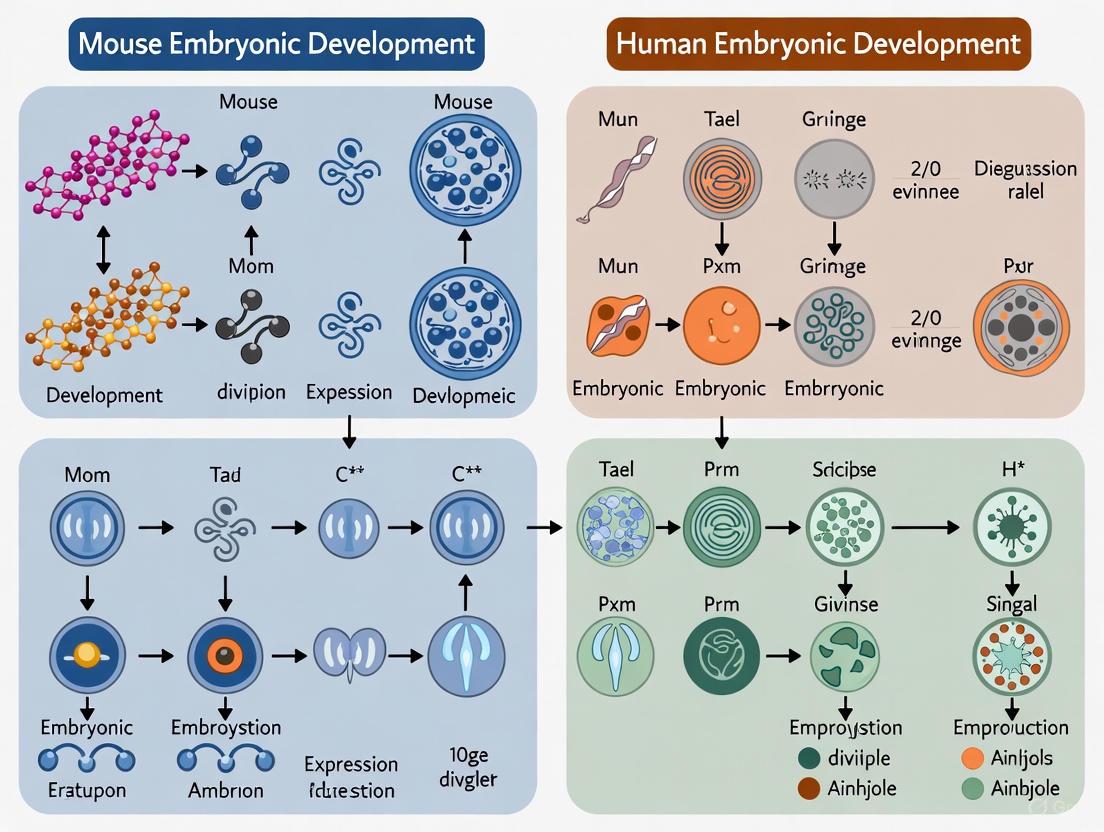
This article provides a comprehensive comparative analysis of mouse and human embryonic development, tailored for researchers, scientists, and drug development professionals.
From Mouse to Human: A Comparative Analysis of Embryonic Development for Biomedical Research
Abstract
This article provides a comprehensive comparative analysis of mouse and human embryonic development, tailored for researchers, scientists, and drug development professionals. It explores the foundational biological similarities and differences, from the timing of embryonic genome activation to the regulation of totipotency. The review critically assesses cutting-edge methodological approaches, including live imaging, embryoid models, and high-throughput screening, highlighting their applications and limitations. Furthermore, it addresses troubleshooting in experimental models and validates the translational relevance of murine findings for human development and clinical applications, such as assisted reproductive technologies and developmental disorder research.
Blueprints for Life: Comparing Foundational Timelines and Molecular Onset in Mouse and Human Embryos
The choice of model organisms is fundamental to biomedical research, and the mouse remains the predominant mammalian model for studying embryonic development. A precise understanding of how mouse embryogenesis aligns with and diverges from human development is critical for translating basic research findings into clinical applications. This guide provides a comparative analysis of the germinal, embryonic, and fetal periods in mice and humans, synthesizing current staging systems, key molecular events, and experimental methodologies. A thorough grasp of these temporal and mechanistic differences is essential for researchers and drug development professionals to effectively design experiments, interpret results, and assess the translational potential of discoveries made in model systems.
Staging Systems and Comparative Timelines
Formal staging systems provide the foundational framework for comparing developmental events across species. Mouse development is most commonly described using the Theiler Stages (TS), which divide prenatal development into 26 stages based on morphological criteria such as somite number [1]. In contrast, human embryonic development is classified according to the Carnegie Stages (CS), a system based on developmental structures rather than strict size or age [2]. The following table summarizes the primary staging systems and equivalent developmental milestones.
Table 1: Comparative Staging Systems and Key Developmental Milestones
| Developmental Period | Mouse (Theiler Stages) | Human (Carnegie Stages) | Key Morphological Milestones |
|---|---|---|---|
| Germinal | TS 1-3 (Days 1-4.5) [1] | CS 1-3 (Days 1-~7) [2] | Fertilization, zygote formation, cleavage, morula formation, blastocyst implantation [3] [4] |
| Embryonic | TS 4-21 (E5.0 - E15.5) [1] | CS 4-23 (Week 2-8) [2] | Gastrulation, neural tube formation, onset of organogenesis, establishment of major organ primordia [2] |
| Fetal | TS 22-28 (E16.0 - Birth) [1] | Post-CS 23 (Week 9 - Birth) [2] | Advanced organ growth, tissue maturation, and significant overall growth [3] [4] |
The overall pace of development differs significantly. The total gestation period for a mouse is approximately 20 days post-conception (dpc), whereas human gestation lasts about 280 days [2] [5]. This temporal divergence is not linear across all stages or organ systems. For instance, a P60 (postnatal day 60) mouse is considered roughly equivalent to a human teenager in terms of white matter pathway maturation in the brain [6].
Table 2: Landmark Molecular and Cellular Events in Preimplantation Development
| Developmental Event | Mouse Timeline | Human Timeline | Key Regulators / Markers |
|---|---|---|---|
| Fertilization & Zygote Formation | Day 1 [1] | Day 1 [7] | - |
| Minor Embryonic Genome Activation (EGA) | Within 4 hours of fertilization (maternal genome); paternal ~10h [8] | Late 1-cell (L1C) stage [9] | MYC/c-Myc; disruption causes developmental arrest [8] |
| Major Embryonic Genome Activation (EGA) | Late 2-cell (L2C) stage [9] | Around 8-cell (8C) stage [9] | DUXA (morula) [7] |
| Lineage Specification (ICM/TE) | ~E3.25-E4.5 [1] | ~Day 5-7 [7] | POU5F1, NANOG (ICM/Epiblast); CDX2, GATA3 (TE) [7] |
Molecular Mechanisms of Developmental Divergence
Underlying the morphological differences are distinct molecular timelines and programs. Key processes such as embryonic genome activation, metabolic regulation, and transcriptional networks exhibit significant interspecies variation.
Embryonic Genome Activation (EGA) Pathways
Embryonic Genome Activation marks the critical transition from reliance on maternal transcripts to the transcriptional control by the embryonic genome. Recent single-cell RNA-sequencing (scRNA-seq) studies have refined our understanding of its timing, revealing an "immediate EGA" (iEGA) initiating as early as 4 hours post-fertilization in the mouse, predominantly from the maternal genome [8]. A comparable process occurs in human one-cell embryos [8]. This iEGA is continuous with what was previously termed "minor ZGA" and is followed by a higher-amplitude "major EGA" wave.
The following diagram illustrates the transcriptional network and sequential pathway activation during immediate EGA (iEGA) in mice and humans.
Brain Development and Transcriptional Specialization
The divergence in developmental timing is also evident in the central nervous system. An analysis of gene expression specialization in the developing mouse brain revealed an "hourglass" shape [10]. Transcriptional specialization across brain regions actually decreases during early embryonic development, reaching its lowest point, a "neurotypic" phase, around birth (E18.5/P4) [10]. This is followed by a post-natal increase in regional specialization, largely driven by genes involved in plasticity and neural activity [10]. The cerebellum is a notable region, becoming increasingly distinct from other brain regions postnatally in both mouse and human [10]. This contrasts with the thalamus and cortex, which show strikingly different regionalization profiles between the two species [10].
Experimental Protocols for Comparative Analysis
Cutting-edge technologies are enabling increasingly precise comparisons between mouse and human embryonic development. The following section details key methodologies cited in recent literature.
Single-Cell RNA-Sequencing (scRNA-seq) for Lineage Mapping
Objective: To construct a high-resolution transcriptomic atlas of embryonic development, enabling unbiased cell type identification, lineage tracing, and direct cross-species comparison of gene expression patterns [7].
- Sample Preparation: Single cells are isolated from precisely staged mouse or human embryos. Human studies often use embryos donated from in vitro fertilization (IVF) procedures [7].
- Library Construction & Sequencing: Single-cell libraries are prepared using a platform (e.g., 10x Genomics) to barcode transcripts from individual cells. Sequencing is performed to a sufficient depth to capture the transcriptome of each cell.
- Data Integration and Analysis: Raw sequencing data is processed (mapped, filtered, and normalized). Datasets from multiple embryos or studies are integrated using algorithms like fastMNN to correct for technical batch effects [7]. Cell clusters are identified and annotated based on known marker genes.
- Trajectory Inference: Tools like Slingshot are applied to the embedded data (e.g., UMAP) to infer developmental trajectories and pseudotime, ordering cells along a continuous path of differentiation [7].
- Cross-Species Projection: Integrated reference atlases, such as the one described by [7], can be used to project and annotate query datasets (e.g., from stem cell-derived embryo models), assessing their fidelity to in vivo development.
Deep-Coverage Single-Embryo Proteomics (SEP)
Objective: To quantify the global protein landscape of individual oocytes and preimplantation embryos, providing a direct readout of functional gene products that is complementary to transcriptomic data [9].
- Sample Lysis and Digestion: A single zona pellucida-free oocyte or embryo is lysed, and proteins are reduced, alkylated, and digested into peptides. The method relies on specialized platforms like nanodroplet processing in one pot for trace samples (NanoPOTS) or a comprehensive solution for ultrasensitive proteomic technology (CS-UPT) to handle nanoliter-volume samples and minimize material loss [9].
- Peptide Separation and Mass Spectrometry Analysis: Peptides are separated by liquid chromatography and analyzed by mass spectrometry in data-independent acquisition (DIA) mode, particularly diaPASEF, which increases sensitivity and coverage, allowing identification of over 3,800 protein groups from a single human oocyte [9].
- Data Processing and Integration: Raw spectral data are searched against a protein sequence database to identify and quantify proteins. Proteomic profiles are then integrated with matched transcriptomic or translatomic data to analyze post-transcriptional regulation and correlation between mRNA and protein levels during early development [9].
The Scientist's Toolkit: Essential Research Reagents and Platforms
This table details key reagents, technologies, and computational tools essential for conducting research in comparative mammalian embryology.
Table 3: Key Research Reagents and Platforms for Embryonic Development Studies
| Reagent / Platform | Function / Application | Example Use in Context |
|---|---|---|
| Allen Developing Mouse Brain Atlas [10] | A public repository of in situ hybridization (ISH) data providing spatiotemporal gene expression patterns. | Quantifying gene expression regionalization and specialization during brain development [10]. |
| Integrated Human Embryo scRNA-seq Reference [7] | A unified transcriptomic roadmap from zygote to gastrula, serving as a universal benchmark. | Authenticating stem cell-based human embryo models by projecting query data onto the reference [7]. |
| SCENIC [7] | Computational tool for single-cell regulatory network inference from scRNA-seq data. | Inferring activity of key transcription factors (e.g., VENTX in epiblast, OVOL2 in TE) driving lineage specification [7]. |
| diaPASEF Mass Spectrometry [9] | High-sensitivity proteomic platform for trace samples using data-independent acquisition. | Deep coverage profiling of the proteome from a single human oocyte or embryo [9]. |
| Ex Utero Embryo Culture Systems [1] | Platforms for culturing postimplantation mouse embryos outside the uterus for prolonged periods. | Studying morphogenetic events and testing experimental perturbations from gastrulation to advanced organogenesis [1]. |
| Translating Time Resource [6] | A tool that equates corresponding ages across species using metrics from bone, dental, and brain maturation. | Aligning postnatal mouse brain development (e.g., P60) with equivalent human developmental stages (e.g., teenager) [6]. |
The strategic comparison of mouse and human embryonic development reveals a complex interplay of conserved genetic programs and species-specific adaptations in timing, regulation, and morphology. While the mouse model remains an indispensable tool, the divergence in key events like EGA, brain transcriptome specialization, and overall developmental pace necessitates careful interpretation of murine data. The continued development and application of high-resolution technologies—such as single-cell multi-omics, advanced proteomics, and refined ex utero culture systems—are critical for deepening our understanding of these divergent pathways. For researchers in drug development and regenerative medicine, a rigorous, evidence-based application of cross-species alignment tools is paramount for successfully translating foundational discoveries from the bench to the clinic.
In mammalian embryonic development, the brief totipotent phase, where a single cell can give rise to an entire organism and its supporting tissues, is governed by a precise transcriptional program. Key orchestrators of this program are the double homeobox (Dux) genes. This guide provides a comparative analysis of the roles, regulation, and experimental investigation of the central regulators DUX (in mouse) and its functional counterpart DUX4 (in human), along with the critical silencing factor DUXBL.
The following table summarizes the core functions and regulatory relationships of these key transcription factors in mouse embryogenesis.
| Molecular Regulator | Primary Function in Totipotency | Key Target Genes/Pathways | Effect of Knockout/Knockdown | Effect of Prolonged Ectopic Expression |
|---|---|---|---|---|
| DUX (Mouse) | Master activator of zygotic genome activation (ZGA); initiates the 2-cell transcriptional program [11] [12]. | Activates 2C-specific transcripts (e.g., Zscan4, Tdpoz4), retrotransposons (MERVL), and other ZGA genes [11]. | Delayed but not abolished ZGA; reduced litter size; embryos are viable but suboptimal [11]. | Developmental arrest at 2C/4C stage; sustained expression of 2C markers (e.g., Zscan4, MERVL) [11]. |
| DUXBL (Mouse) | Controls exit from totipotency; silences the DUX-driven 2-cell program [13] [14]. | Interacts with TRIM24/TRIM33 to form silencing complexes at DUX-bound regions [13]. | Sustained expression of 2C-associated transcripts; early developmental arrest [13]. | Impairs 2C-associated transcription; promotes progression from totipotency [13]. |
| DUX4 (Human) | Putative master regulator of human embryonic genome activation (EGA) [15]. | Activates cleavage-stage genes and retrotransposons (HERVL) [15]. | Silencing in human embryos leads to inefficient maternal RNA degradation and incomplete EGA [15]. | Cytotoxic in most somatic cells; activates EGA-like transcriptome in hESCs [15]. |
Core Regulatory Network and Experimental Workflow
The precise transition into and out of the totipotent state is controlled by a tightly regulated feedback loop between DUX and DUXBL. The following diagram illustrates this core pathway and a common experimental approach for its functional validation.
The Scientist's Toolkit: Essential Research Reagents
Studying these totipotency regulators requires a specific set of reagents and model systems, each with a distinct function, as detailed below.
| Reagent / Model System | Key Function in Research |
|---|---|
| Dux-Knockout Mouse Model | Used to investigate the phenotypic consequences of Dux loss-of-function on ZGA and embryo viability in vivo [11]. |
| 2-Cell-like Cells (2CLCs) | A subpopulation within mESC cultures that mimics the 2C embryo transcriptome; a tractable in vitro model for studying totipotency and DUX function [12]. |
| Conditional Overexpression Systems | Allows controlled, timed expression of Dux or Duxbl in embryos or stem cells to study the effects of prolonged expression on development [11] [13]. |
| Single-Cell RNA-seq (e.g., Smart-seq2) | Used to profile the transcriptomes of individual wild-type and mutant embryos, revealing subtle and stage-specific defects in ZGA [11]. |
| Human Embryonic Stem Cells (hESCs) | Serve as a model for human early development; ectopic DUX4 expression in hESCs activates an EGA-like transcriptome [15]. |
| Proteasome Inhibitor (MG132) | Used to demonstrate the importance of rapid DUX protein degradation via the ubiquitin-proteasome system for normal embryo development [11]. |
Experimental Protocols for Functional Validation
Protocol: Analyzing DUX Function via Knockout in Mouse Embryos
This protocol is adapted from studies generating Dux-KO models to dissect its role in ZGA [11].
- Step 1: Model Generation. Inject Cas9 mRNA and sgRNAs targeting the Dux macrosatellite region into C57BL/6 mouse zygotes.
- Step 2: Embryo Transfer and Collection. Transfer the injected embryos into pseudo-pregnant recipients. Collect resulting F0 generation embryos at specific stages (zygote, early 2-cell, middle 2-cell, late 2-cell).
- Step 3: Genotypic Validation. Use long-read whole-genome sequencing to confirm large-fragment deletions in the Dux locus and related repeats.
- Step 4: Phenotypic and Molecular Analysis.
- Developmental Tracking: Compare the rate of development to morula/blastocyst stages and the litter sizes of KO vs. wild-type mice.
- Transcriptomic Profiling: Perform single-cell RNA-seq (e.g., Smart-seq2) on individually collected WT and KO embryos. Analyze the expression of known DUX targets (e.g., Zscan4, Tdpoz4) and global ZGA genes.
Protocol: Analyzing DUXBL Function via Overexpression and Knockdown
This protocol outlines methods to define DUXBL's role as a silencer of the 2-cell program [13].
- Step 1: Genetic Perturbation.
- Overexpression: Inject in vitro transcribed mRNA for DUXBL (or a fluorescently tagged version) into one blastomere of a late 2-cell or 4-cell stage mouse embryo.
- Knockdown/Knockout: Use CRISPR/Cas9 or RNAi to inactivate Duxbl in mESCs or early embryos.
- Step 2: Phenotypic Scoring. Monitor and quantify the developmental arrest of injected blastomeres versus non-injected siblings. In knockout models, check for early developmental arrest.
- Step 3: Molecular Readouts.
- Immunostaining: Stain embryos or cells for 2C-specific markers (e.g., ZSCAN4) and pluripotency/blastocyst markers (e.g., NANOG, CDX2).
- Transcriptomics: Perform RNA-seq on control and experimentally manipulated samples to assess the expression level of the 2C transcriptional program.
- Biochemical Assays: Use co-immunoprecipitation (Co-IP) followed by mass spectrometry to identify DUXBL-interacting proteins (e.g., TRIM24, TRIM33).
Critical Considerations for Comparative Research
When applying findings from mouse models to human biology, several key distinctions must be considered:
- Species-Specific Timing: The major transcriptional waves during pre-implantation development occur at different stages. In mice, the major wave is at the 2-cell stage, whereas in humans, it occurs between the 4-cell and 8-cell stages [16]. This suggests differences in the precise timing of DUX/DUX4 function.
- Genomic Context and Regulation: The human DUX4 gene is located in a complex macrosatellite repeat array on chromosome 4 (D4Z4), which is prone to epigenetic dysregulation linked to Facioscapulohumeral Muscular Dystrophy (FSHD) [15]. This toxic gain-of-function context is a major consideration not present in standard mouse studies.
- Protein Stability and Metabolic Context: Emerging evidence suggests fundamental biochemical differences, such as slower protein degradation rates in human cells compared to mouse cells [17]. This could impact the dynamics and persistence of totipotency factors like DUX4.
Embryonic Genome Activation (EGA) represents a cornerstone event in mammalian development, marking the transition from a transcriptionally silent zygote to an embryo under the control of its newly formed genome. For decades, the prevailing model held that this activation occurred at the two-cell stage in mice and the four-to-eight-cell stage in humans. However, groundbreaking research utilizing high-resolution single-cell RNA sequencing (scRNA-seq) has fundamentally challenged this timeline. Recent evidence now confirms that EGA initiates much earlier, during the one-cell stage in both mouse and human embryos [8] [18]. This newly defined initial wave, termed immediate EGA (iEGA), is characterized by low-magnitude but biologically critical transcription, which is continuous with what was previously described as 'minor' EGA or 'minor' Zygotic Genome Activation (ZGA) [8]. This iEGA phase is distinct from the subsequent, higher-amplitude wave of gene expression, traditionally known as 'major EGA' or 'major ZGA,' which occurs at the two-cell stage in mice and the 4-8-cell stage in humans [8] [19]. This comparative guide provides a detailed analysis of the kinetics, regulation, and experimental assessment of these EGA waves in mouse and human embryonic development, offering a vital resource for researchers and drug development professionals.
Comparative Kinetics of EGA Waves in Mouse and Human Embryos
The journey of embryonic genome activation is a meticulously timed process, with distinct yet interconnected transcriptional waves. The table below summarizes the key characteristics of iEGA and major EGA, highlighting the comparative timelines and features between mouse and human embryos.
Table 1: Comparative Kinetics of Immediate and Major EGA Waves in Mouse and Human Embryos
| Feature | Mouse iEGA | Human iEGA | Mouse Major EGA | Human Major EGA |
|---|---|---|---|---|
| Developmental Stage | One-cell stage (zygote) | One-cell stage (zygote) | Two-cell stage | 4- to 8-cell stage |
| Approximate Timing Post-Fertilization | Initiates within 4 hours; paternal genome from ~10 hours [8] | During the one-cell stage (within ~16-24 hours) [18] | ~24-36 hours [8] | ~48-72 hours [18] |
| Transcriptional Magnitude | Low-magnitude upregulation [8] [18] | Low-magnitude upregulation [18] | High-amplitude wave [8] | High-amplitude wave [18] |
| Genomic Contribution (Initial) | Mainly maternal genome [8] | - | Biparental | Biparental |
| Transcript Splicing | Canonically spliced [8] | Canonically spliced [18] | - | - |
| Key Functional Pathways | tRNA charging, G2/M checkpoint, DNA methylation, IGF signaling, molecular mechanisms of cancer [8] | Cell-cycle progression, chromosome maintenance, ATM activation, redox systems [18] | - | - |
A critical concept emerging from recent studies is Embryonic Genome Repression (EGR). Research in mouse one-cell embryos has shown that inhibiting key transcription factors like c-Myc leads to the upregulation of hundreds of genes, suggesting the existence of an active repressive mechanism that operates alongside iEGA to fine-tune the initial transcriptional landscape [8].
Experimental Workflows for EGA Analysis
High-Resolution Transcriptomic Profiling
The rediscovery of iEGA was made possible by advanced scRNA-seq protocols that overcome historical technical limitations. Key methodological refinements include:
- Precise Embryo Staging: Using embryos with accurately determined fertilization times to resolve transcriptional events within the narrow window of the one-cell stage [8].
- Poly(A)-Independent Library Preparation: Avoiding poly(A) capture, which can introduce bias due to dynamic polyadenylation states in early embryos, providing a more direct assessment of de novo transcription [8] [18].
- Whole-Transcriptome Amplification: Enabling deep sequencing from single cells, yielding high read counts (e.g., a mean of 66.3 million reads per cell in human oocytes/zygotes) to detect low-magnitude transcriptional changes [18].
- Validation with Abnormal Embryos: Assessing transcript upregulation in morphologically abnormal one-cell embryos (e.g., 1PN and 3PN) confirmed that observed expression is a specific feature of healthy development, as it is disrupted in these arrest-prone embryos [18].
The following diagram illustrates the logical workflow for transcriptomic analysis of EGA.
Functional Screening Using Inhibitor Libraries
Beyond observation, functional screening is crucial for identifying essential regulators. A novel screening system in mice combines ultra-superovulation with cryopreservation of one-cell embryos, allowing for the high-throughput processing of large numbers of embryos from the same genetic background [20].
- Workflow: Thawed one-cell embryos are cultured in medium containing a library of low-molecular-weight inhibitors (e.g., at 1 μM final concentration). Each inhibitor targets a specific enzyme or pathway.
- Outcome Measurement: The developmental rate is calculated based on the number of embryos that progress to subsequent stages. Inhibitors that cause developmental arrest point to essential factors [20].
- Hit Validation: Identified factors (e.g., cathepsin D, CXCR2) are further validated using genome editing techniques like CRISPR-Cas9 to confirm the phenotype [20].
The Scientist's Toolkit: Key Research Reagents and Solutions
Successful investigation into EGA kinetics relies on a suite of specialized reagents and tools. The following table details essential items for researchers in this field.
Table 2: Key Research Reagent Solutions for EGA Studies
| Reagent / Solution | Function / Application | Example Use-Case |
|---|---|---|
| Chemically Defined Media (e.g., KSOM, HTF) | Supports in vitro culture and development of pre-implantation embryos, providing a stable environment for inhibitor screening [20]. | Culturing one-cell mouse embryos for inhibitor library screens [20]. |
| Standardized Inhibitor Libraries (e.g., SCADS Kits) | Systematic collections of chemical inhibitors targeting diverse pathways; enable high-throughput screening for novel developmental factors [20]. | Identifying that inhibition of PRIMA-1, cathepsin D, or CXCR2 arrests mouse preimplantation development [20]. |
| Cryopreservation Solutions (e.g., with DMSO) | Allow long-term storage of one-cell embryos, facilitating the creation of large, synchronized embryo banks for replicate experiments [20]. | Enabling batch screening of cryopreserved one-cell mouse embryos from the same parents [20]. |
| Poly(A)-Independent scRNA-seq Kits | Library preparation for transcriptomics that does not rely on poly(A) tails, critical for accurate gene expression measurement in early embryos. | Detecting low-magnitude, canonically spliced transcripts during human iEGA [8] [18]. |
| CRISPR-Cas9 System | Genome editing tool for validating the functional role of genes identified via transcriptomics or screening. | Knockout of cathepsin D (Ctsd) and Cxcr2 genes to confirm their essential role in mouse embryonic development [20]. |
Regulatory Dynamics and Cross-Species Insights
The regulation of iEGA versus major EGA involves distinct transcriptional mechanisms. In the mouse, iEGA predicts the involvement of transcription factors like c-Myc, and its inhibition disrupts development and iEGA, highlighting its functional importance [8]. Interestingly, while mRNAs for some predicted major EGA activators (like Klf17, Obox5) increase during iEGA, others show no change or decrease, suggesting a layered activation of the transcriptional network [8].
This requirement for transcriptional regulators in early cell fate decisions is conserved, as evidenced by studies in other models. In Drosophila, regulators of ZGA, such as the pioneer factor Zelda, are required not only for somatic transcription but also for the proper specification of the germline, indicating an intricate link between genome activation and the first cell fate decision [21].
The following diagram summarizes the sequential and regulatory relationship between the key transcriptional waves in early mammalian development.
The paradigm shift in understanding EGA kinetics—from a single, late event to a phased initiation at the one-cell stage—has profound implications for developmental biology, assisted reproductive technologies (ART), and regenerative medicine. The precise comparison between mouse and human EGA, as detailed in this guide, is critical for validating animal models and ensuring research findings are translatable to human health.
Future research will continue to elucidate the complex regulatory circuitry, including the balance between activation (iEGA) and repression (EGR), that governs the emergence of totipotency. Furthermore, the development of more sophisticated models, such as stem-cell-derived embryos [22], and ongoing ethical debates on extending human embryo culture limits [23], will provide new platforms to explore these earliest moments of life. For researchers and drug developers, a deep understanding of these kinetic principles is essential for innovating in areas from infertility treatment to preventing early developmental disorders.
The journey from a single fertilized egg to a complex organism comprising diverse cell types represents one of biology's most remarkable processes. Recent advances in single-cell RNA sequencing (scRNA-seq) have revolutionized our ability to decode this intricate transformation, providing unprecedented resolution to map transcriptional trajectories during embryogenesis. These technologies enable researchers to reconstruct developmental pathways, identify key branching points in cell fate decisions, and uncover the molecular signatures that guide specialization. The construction of comprehensive transcriptional atlases for model organisms, particularly mice, has established foundational frameworks for understanding mammalian development [24]. However, the translation of these findings to human embryogenesis reveals both conserved principles and critical species-specific variations that necessitate direct investigation of human developmental processes [25].
This comparative analysis examines the current landscape of single-cell research in mouse and human embryonic development, highlighting how trajectory inference methodologies are deployed to reconstruct developmental cascades. We evaluate the experimental designs, computational frameworks, and biological insights emerging from these approaches, with particular attention to their implications for understanding human development and disease. The integration of diverse datasets across developmental timepoints presents both technical challenges and unprecedented opportunities to build predictive models of cell fate acquisition that may ultimately inform regenerative medicine strategies and developmental disorder therapeutics [24] [26].
Comparative Analysis of Mouse and Human Embryonic Development
Fundamental Divergences in Developmental Programs
Mouse models have served as the primary experimental system for mammalian developmental biology, but direct comparisons reveal significant differences in transcriptional regulation and timing between species. Studies comparing gene expression features in early development (10-21 days) of human versus mouse embryonic stem cells (hESCs vs. mESCs) demonstrate that while many aspects are conserved, crucial differences exist in the expression patterns of transcription factors and stimulus-responsive genes [25]. Notably, the population doubling time differs significantly (30-35 hours for hESCs versus 12-15 hours for mESCs), necessitating different experimental timeframes for equivalent developmental stages [25].
Perhaps most strikingly, certain biological processes unfold quite differently between species. Neuron and sensory organ development involves a larger number of genes and exhibits prolonged upregulation in hESCs continuing until day 21, whereas in mESCs, these genes show peak upregulation around day 2 [25]. Similarly, muscle tissue development genes show minimal upregulation during 21 days of hESC development, in contrast to their prominent expression in mouse models. These fundamental differences highlight the necessity of complementing mouse studies with direct human embryonic research to accurately understand human-specific developmental programs.
Technical Considerations for Cross-Species Comparisons
When comparing developmental trajectories between mouse and human, researchers must account for several technical factors:
- Developmental staging: Mouse gestation is approximately 20 days, while human gestation spans 40 weeks, with different proportions dedicated to specific developmental milestones.
- Embryo availability: Human embryo research faces significant ethical and practical constraints, limiting sample availability compared to mouse models.
- Analytical frameworks: Integrated analysis requires sophisticated batch correction methods to distinguish technical artifacts from biological differences when combining datasets derived from different technologies [24].
Trajectory Inference Methodologies: Computational Frameworks for Lineage Reconstruction
Core Concepts and Algorithms
Trajectory inference represents a class of computational methods that order individual cells along pseudotemporal trajectories based on transcriptional similarity, reconstructing developmental or differentiation processes from snapshot data [27]. The fundamental output is pseudotime, a numerical value representing a cell's relative position along an inferred path, which serves as a proxy for progressive changes in cellular states [27]. Multiple algorithms have been developed to address this challenge, each with distinct strengths and underlying assumptions.
The TSCAN algorithm employs a cluster-based minimum spanning tree (MST) approach, first grouping cells into clusters, computing cluster centroids, then constructing the most parsimonious tree connecting these centroids [27]. Cells are projected onto the closest edge of the MST, and pseudotime is calculated as the distance along the tree from a defined root node. This approach offers computational efficiency and intuitive interpretation but depends heavily on clustering granularity and struggles with complex trajectory topologies like cycles or "bubbles" [27].
In contrast, principal curves methods (implemented in packages like Slingshot) fit a smooth, one-dimensional curve through the cloud of cells in high-dimensional expression space, effectively creating a non-linear generalization of PCA [27]. The URD algorithm (used in the human pacemaker cell study [28]) employs a diffusion map and reverse graph walking approach to reconstruct complex branching trees and identify discrete cell populations along differentiation pathways.
Application to Embryonic Development
In practice, these methods have been successfully applied to reconstruct developmental trajectories across multiple systems. In mouse gastrulation, a single-embryo, single-cell time-resolved model revealed combinatorial multifurcation dynamics rather than hierarchical binary decisions during lineage specification [29]. Similarly, the systematic reconstruction of cellular trajectories across mouse embryogenesis integrated multiple scRNA-seq datasets spanning E3.5 to E13.5, creating a directed acyclic graph (TOME) that maps relationships between cell states across successive developmental stages [24].
For human development, trajectory analysis has illuminated specialized differentiation pathways, such as the diversification of pacemaker cardiomyocytes from a common progenitor with proepicardial cells [28]. These analyses identified critical branching points determined by WNT signaling, with TGFβ and WNT signaling further guiding the specialization into transitional and head sinoatrial nodal cardiomyocyte subtypes [28].
Table 1: Key Trajectory Inference Algorithms and Applications
| Algorithm | Core Methodology | Strengths | Developmental Applications |
|---|---|---|---|
| TSCAN | Cluster-based minimum spanning tree | Computational efficiency; intuitive cluster-based interpretation | Hematopoietic stem cell differentiation [27] |
| Slingshot | Principal curves | Flexibility in capturing non-linear paths; no clustering dependency | Mouse preimplantation development [27] |
| URD | Diffusion maps + reverse graph walking | Handles complex branching events; identifies discrete populations | Human pacemaker cell differentiation [28] |
| Monocle3 | Reversed graph embedding | Manages multiple branches; learns principal graph directly | Human embryonic development (7-9 weeks) [26] |
Experimental Protocols for Single-Cell Embryo Analysis
Sample Preparation and Single-Cell Isolation
Robust experimental protocols are essential for generating high-quality single-cell data from embryonic tissues. For mouse gastrulating embryos (E6.5-E8.5), an optimized pipeline includes:
- Timed pregnancies established by vaginal plug observation (noon on plug day = E0.5), with multiple synchronized breeding trios to increase embryo yield [30].
- Embryo isolation involving euthanasia of the dam via CO2 followed by cervical dislocation, dissection of uterine horns, and careful extraction of embryos in ice-cold DMEM/FBS [30].
- Same-day genotyping (3-hour protocol) for mutant embryos to enable processing of cells/nuclei on isolation day, preserving viability [30].
- Tissue dissociation using enzymatic digestion (e.g., collagenase/trypsin) at 37°C for 15 minutes, followed by filtration through 40μm strainers and red blood cell lysis if needed [26] [30].
For human embryos (7-9 weeks), similar dissociation protocols are employed with additional ethical oversight and approval from institutional review boards [26]. The limited availability of human samples necessitates careful optimization to maximize information recovery from each specimen.
Library Preparation and Sequencing
Standardized approaches ensure data quality and comparability:
- Single-cell suspension density is adjusted to 1×10⁵ cells/mL before loading onto microfluidic devices [26].
- Library construction follows platform-specific protocols (10x Genomics, sci-RNA-seq3, etc.), with quality control measures including fragment size selection and purification [24] [26].
- Sequencing typically employs Illumina platforms (HiSeq, NovaSeq) with depth adjusted based on experimental goals, typically targeting 50,000-100,000 reads per cell [26] [31].
Data Processing and Quality Control
Computational preprocessing ensures analytical reliability:
- Quality filtering removes low-quality cells based on thresholds for unique RNA molecules (200-6,000), total RNA count (<30,000), and mitochondrial percentage (<30%) [26].
- Normalization and feature selection using methods like SCTransform to identify highly variable genes (typically 3,000) for downstream analysis [26].
- Batch correction across samples or datasets using integration methods like those in Seurat to address technical variation [24] [32].
- Dimension reduction via principal component analysis (PCA) followed by visualization techniques (UMAP, t-SNE) to explore population structure [27] [26].
Signaling Pathways Governing Developmental Transitions
Key Pathway Interactions in Cell Fate Determination
Embryonic development is orchestrated by coordinated signaling pathways that guide cell fate decisions through precise spatiotemporal activation. The following diagram illustrates core pathway interactions during critical developmental transitions:
Figure 1: Signaling Pathways in Cardiac Progenitor Diversification
Pathway-Specific Roles in Lineage Specification
The WNT signaling pathway plays particularly decisive roles at multiple branching points. In human pacemaker cell differentiation, WNT determines the fate decision of a common progenitor toward either myocardial or proepicardial lineages [28]. Inhibition of WNT signaling steers mesoderm toward ventricular-like cardiomyocytes, while specific combinations of BMP4, retinoic acid (RA), and WNT inhibition direct differentiation toward sinoatrial nodal cardiomyocytes (SANCMs) [28].
BMP and FGF signaling orchestrate the separation of myocardial and proepicardial cells in chicken development, with conserved functions observed in human in vitro models [28]. These pathways interact with retinoic acid signaling to establish anterior-posterior patterning and regional specification within developing tissues.
The TGFβ pathway specifically promotes differentiation toward transitional cell types, as demonstrated in the diversification of SAN subpopulations, where active TGFβ signaling directs differentiation exclusively toward SAN transitional cells (SAN-TZ) [28]. These cells exhibit functional properties intermediate between pacemaker cells and adjacent atrial myocardium, facilitating electrical impulse transmission.
Table 2: Signaling Pathways in Embryonic Lineage Specification
| Signaling Pathway | Key Ligands/Receptors | Developmental Functions | Experimental Manipulations |
|---|---|---|---|
| WNT | WNT ligands, Frizzled receptors | Fate determination of common progenitors; anterior-posterior patterning; SAN subpopulation divergence | Inhibition with XAV939 promotes ventricular fate; Activation promotes proepicardial lineage [28] |
| BMP | BMP4, BMP receptors | Mesoderm specification; myocardial vs. proepicardial separation; cardiac field establishment | BMP4 treatment directs SANCM differentiation when combined with RA and WNT inhibition [28] |
| TGFβ | TGFβ ligands, ALK5 receptors | Transitional cell type specification; epithelial-mesenchymal transition; SAN-TZ differentiation | ALK5 inhibition with SB431542 modulates SANCM differentiation efficiency [28] |
| FGF | FGF ligands, FGFR | Germ layer patterning; cardiac mesoderm specification; neural crest development | FGF inhibition with PD173074 influences SANCM specification [28] |
| Retinoic Acid | RA, RAR/RXR receptors | Anterior-posterior patterning; heart field specification; SAN development | Combined with BMP4 and WNT inhibition for SANCM differentiation [28] |
Comparative Trajectory Analysis: Mouse vs. Human Embryogenesis
Gastrulation and Early Organogenesis
The transition from gastrulation to early organogenesis represents a period of rapid cellular diversification, with notable similarities and differences between mouse and human. Systematic reconstruction of mouse embryogenesis from E3.5 to E13.5 has revealed coordinated transcriptional dynamics across developing tissues, with particularly rapid changes in neuroectodermal cell types that correlate strongly with somite formation [24]. In mouse models, single-embryo analysis has demonstrated that differentiation flows often involve combinatorial multifurcation dynamics rather than simple hierarchical binary decisions, with dozens of transcription factors combinatorially regulating these branch points [29].
Human embryonic development during the late Carnegie stages (7-9 weeks) exhibits distinct bifurcating trajectories where mesenchymal progenitor cells separate into osteoblast progenitor cells and neural stem cell lineages, while multipotential stem cells differentiate into adipocyte, hematopoietic, and neutrophil lineages [26]. Cell communication analysis identified specific ligand-receptor interactions mediating these developmental pathways, including COL1A2-(ITGA1+ITGB1) between mesenchymal and osteoblast progenitors, and NCAM1-FGFR1 between mesenchymal progenitors and neural stem cells [26].
Cardiac Development Trajectories
Cardiac development provides a compelling example of both conserved and species-specific features. In human models, single-cell analysis of pacemaker cell differentiation has revealed distinct subpopulations resembling the in vivo SAN subdomains (head, tail, and transitional zones), alongside a non-myocardial population of proepicardial cells reflecting their shared ontogeny [28]. The transcriptional roadmap of this process identifies critical regulators including transcription factors SHOX2, TBX3, TBX18, and ISL1, each required for proper SAN function [28].
Electrophysiological properties emerge in parallel with these transcriptional programs, with SAN-like cardiomyocytes exhibiting shorter cycle lengths, less negative maximum diastolic potentials, lower action potential amplitudes, and slower upstroke velocities compared to ventricular-like cardiomyocytes - characteristics consistent with freshly isolated human SAN cells [28]. These functional differences correlate with differential expression of ion channel genes including HCN1/4 (funny current), CACNA1D/G (calcium channels), and KCNJ3 (inward rectifying potassium channel) [28].
Neuroectodermal Trajectories
Neuroectodermal development shows particularly complex patterning across both species. In mouse embryos, single-cell analysis has revealed sophisticated substructure within seemingly homogeneous populations, including:
- Floor plate separation into anterior (Bmp7+) and posterior subpopulations with distinct developmental origins [24].
- Rhombomeres exhibiting distinct Hox code signatures and ordered along the rostral-caudal axis in relation to other neuroectodermal regionalization [24].
- Neural crest cells diversifying into mesencephalic/PA1, PA2, and PA3 subpopulations emerging asynchronously from different neuroectodermal regions [24].
Similar comprehensive analyses of human neuroectodermal development are emerging, with studies of 7-9 week embryos identifying neural stem cells that further differentiate into neurons, mediated by NCAM1-NCAM1 homophilic interactions [26]. The specific transcription factors driving these programs (HIC1, LMX1B, TWIST1) represent potential human-specific regulators of neurogenesis [26].
Experimental Platforms and Reagents
Successful single-cell trajectory analysis requires carefully selected reagents and platforms optimized for embryonic tissues:
Table 3: Essential Research Reagents for Embryonic Single-Cell Analysis
| Reagent/Platform | Specification | Function in Experimental Pipeline |
|---|---|---|
| scRNA-seq Platform | 10x Genomics Chromium, sci-RNA-seq3, SMART-Seq2 | Single-cell transcriptome profiling with cell barcoding and library preparation |
| Dissociation Reagents | Collagenase/Trypsin in DMEM/FBS | Tissue dissociation into single-cell suspensions while maintaining viability |
| Cell Viability Assay | Trypan blue exclusion, flow cytometry | Assessment of cell integrity post-dissociation before library preparation |
| mRNA Capture Beads | Barcoded oligo-dT magnetic beads | mRNA capture and barcoding during single-cell library preparation |
| Reverse Transcription Mix | Template-switching oligos, reverse transcriptase | cDNA synthesis from captured mRNA with cell-specific barcode incorporation |
| PCR Amplification Mix | High-fidelity polymerase, unique dual indices | Amplification of cDNA libraries with minimal bias for sequencing |
| Sequence Alignment | STAR, CellRanger, CeleScope | Alignment of sequencing reads to reference genome and quantitation |
| Trajectory Inference Software | URD, Monocle3, Slingshot, TSCAN | Reconstruction of developmental trajectories from single-cell data |
Computational Tools and Databases
Beyond wet-lab reagents, sophisticated computational resources are essential for trajectory reconstruction:
- Cell type annotation databases (CellMarker, PanglaoDB) provide reference markers for identifying cell states across developmental timepoints [26].
- Batch correction algorithms (e.g., in Seurat) enable integration of datasets across technologies and developmental stages [24] [32].
- Pseudotime calculation methods (TSCAN, Slingshot, URD) reconstruct ordering of cells along developmental trajectories [27].
- Cell-cell communication tools (CellChat) infer ligand-receptor interactions mediating developmental decisions [26].
- Integrated atlases (TOME for mouse embryogenesis) provide reference frameworks for trajectory mapping [24].
The construction of single-cell roadmaps for embryogenesis has transformed our understanding of mammalian development, revealing both conserved principles and species-specific adaptations in transcriptional trajectories. Mouse models continue to provide unparalleled resolution for exploring gene function through genetic manipulation, while emerging human embryonic datasets highlight critical developmental differences that necessitate direct investigation of human systems. The integration of these complementary approaches through sophisticated computational frameworks offers a path toward comprehensive models of human development that can illuminate developmental disorders and inform regenerative strategies.
Future advances will likely come from multi-omic approaches that combine transcriptional data with epigenetic information, spatial context, and protein expression to build more complete models of fate acquisition. Additionally, the integration of single-cell datasets across mammalian species may reveal evolutionary principles governing developmental program regulation. As these technologies mature, they promise to unravel the exquisite precision of embryonic development while providing foundational knowledge for addressing developmental disorders and advancing regenerative medicine applications.
Bridging the Species Gap: Innovative Models and Live Imaging for Developmental Studies
Live imaging of embryonic development represents a significant technical challenge, requiring the observation of delicate, rapid cellular events without compromising viability. Light-sheet fluorescence microscopy (LSFM) has emerged as a transformative solution, enabling high-resolution, real-time visualization of living specimens with minimal phototoxicity [33] [34]. This capability is paramount in mammalian embryology, where the precise dynamics of early cell divisions and fate decisions are fundamental. When integrated with sophisticated nuclear labeling techniques, LSFM allows researchers to track the behavior of individual nuclei in three dimensions over extended periods, from preimplantation stages through advanced organogenesis [35] [36]. This article provides a comparative analysis of how these state-of-the-art tools are applied in mouse and human embryonic development research, detailing experimental protocols, presenting key quantitative data, and outlining the essential reagents that constitute the modern embryologist's toolkit.
Comparative Methodologies in Mouse and Human Embryo Imaging
The application of LSFMS and nuclear labeling must be tailored to the distinct biological and ethical considerations of mouse and human model systems.
Light-Sheet Microscopy Fundamentals and Configurations
LSFM operates by illuminating the sample with a thin "sheet" of light, capturing emitted fluorescence from an entire plane at once with a camera detection objective oriented orthogonally. This principle provides several key advantages:
- Minimal Photodamage: By illuminating only the focal plane being imaged, LSFM significantly reduces light exposure compared to point-scanning confocal microscopy [37] [34].
- High Imaging Speed: The ability to capture full planes rapidly enables high temporal resolution, crucial for tracking dynamic processes like cell division [34].
- Long-Term Viability: Reduced phototoxicity and photobleaching allow embryos to be cultured and imaged for days, facilitating the study of complete developmental processes [35].
Advanced implementations, such as lattice light-sheet microscopy, use two-dimensional optical lattices to create exceptionally thin light sheets, further improving resolution and reducing scattering for imaging at the single-molecule level up to entire embryos [34]. For robust imaging of dense tissues, systems like the Leica TCS SP8 DLS employ counter-propagating light sheets to minimize artifacts, merging images from both illuminations for superior clarity [37].
Nuclear Labeling and Segmentation Strategies
A critical step in quantitative live imaging is accurately identifying and tracking every nucleus.
Labeling Techniques:
- Mouse Models: Stable genetic labeling is the gold standard. The H2B-miRFP720 transgenic mouse line expresses a near-infrared fluorescent histone protein, providing robust nuclear labeling with minimal spectral overlap with other reporters and reduced phototoxicity [36].
- Human Embryos: Genetic modification is not feasible. Researchers use electroporation at the blastocyst stage, applying brief low-voltage electrical pulses to introduce mRNA encoding a histone H2B-fluorescent protein fusion directly into cells [35]. A limitation is that trophectoderm cells often take up the marker more effectively than the inner cell mass.
Nuclear Instance Segmentation: Identifying individual nuclei in 3D image volumes is a complex computational task. Stardist-3D, a deep learning method, has demonstrated state-of-the-art performance. It predicts voxel affiliation and distances to the nuclear boundary, assuming a star-convex shape, and can accurately segment densely packed nuclei in blastocysts containing over 100 cells [36].
Experimental Data and Comparative Performance
The integration of these technologies has yielded quantitative insights into the divergent developmental dynamics of mouse and human embryos.
Key Experimental Protocols
Protocol 1: Long-Term Live Imaging of Human Blastocysts [35]
- Sample Preparation: Culture human embryos to the blastocyst stage (typically day 5-7 post-fertilization).
- Nuclear Labeling: Electroporate embryos with mRNA encoding H2B-fluorescent protein using brief, low-voltage electrical pulses.
- Microscopy: Mount embryos in an imaging chamber and image using a light-sheet microscope equipped with a low-phototoxicity laser source.
- Data Acquisition: Capture 3D image stacks of the entire embryo every 15 minutes for up to 48 hours.
- Data Analysis: Use software for 3D segmentation and tracking of nuclei to analyze cell cycle dynamics, division orientation, and chromosome segregation errors.
Protocol 2: High-Fidelity Imaging and Segmentation of Mouse Embryos [36]
- Sample Preparation: Utilize transgenic mouse embryos expressing the H2B-miRFP720 nuclear reporter.
- Microscopy: Image live embryos from the 8-cell stage to the late blastocyst stage (>100 cells) using light-sheet microscopy.
- Ground Truth Generation: Manually annotate a subset of 3D images to create the "BlastoSPIM" dataset for training segmentation models.
- Model Training: Train the Stardist-3D convolutional neural network on the BlastoSPIM ground truth data.
- Segmentation & Analysis: Apply the trained model to automatically segment all nuclei in the time-lapse series, enabling quantitative analysis of nuclear volume, position, and shape over time.
Quantitative Comparison of Embryonic Dynamics
Table 1: Comparative Analysis of Mouse and Human Preimplantation Development via LSFM
| Parameter | Mouse Embryo | Human Embryo | Implications |
|---|---|---|---|
| Mitotic Error Frequency | ~4% of divisions [35] | ~8% of divisions [35] | Human embryos exhibit higher intrinsic chromosomal instability. |
| Cell Cycle Interphase | Shorter duration [35] | Approximately twice as long as in mouse [35] | Divergent regulation of the cell cycle pace between species. |
| Nuclear Segmentation | Stardist-3D performs robustly to >100 cells using H2B-miRFP720 [36] | Electroporation labels trophectoderm more efficiently than inner cell mass [35] | Genetic models in mice allow more uniform and consistent labeling for segmentation. |
| Developmental Timeline | ~4.5 days to blastocyst [1] | ~6-7 days to blastocyst [35] | Human development proceeds at a slower pace, requiring adjusted imaging protocols. |
Table 2: Performance of Deep Learning Models for 3D Nuclear Instance Segmentation [36]
| Method | Key Architecture | Performance on Late Blastocysts | Notable Features |
|---|---|---|---|
| Stardist-3D | Linear convolutional & residual blocks | High accuracy even at >100 cells | Predicts star-convex shapes; less prone to merging nuclei. |
| QCANet | Dual 3D U-Nets | Performance deteriorates past ~32 cells | Designed for early embryos; struggles with dense packing. |
| U3D-BCD | Single modified 3D U-Net | Moderate accuracy | Predicts contours and distance maps for watershed. |
| Cellpose | U-Net based | Variable performance | Generalist model, may require extensive training. |
A striking finding enabled by this technology is the differential handling of chromosomal errors. In human embryos, mis-segregated chromosomes can form micronuclei, which are notably tolerated in trophectoderm cells (future placenta). These cells continue to divide and contribute to blastocyst development, suggesting a buffering mechanism that may confine errors to extra-embryonic tissues [35]. This has direct implications for the clinical use of Preimplantation Genetic Testing for Aneuploidy (PGT-A), as a biopsy of the trophectoderm might overestimate the chromosomal abnormalities of the entire embryo.
Visualizing the Workflows
The following diagrams illustrate the core experimental and computational workflows that underpin state-of-the-art live imaging in embryology.
Live Imaging and Analysis Workflow
Deep Learning Segmentation Pipeline
The Scientist's Toolkit: Essential Research Reagents and Materials
Successful implementation of these advanced imaging protocols relies on a carefully selected set of reagents and tools.
Table 3: Key Research Reagent Solutions for Live Embryo Imaging
| Item | Function | Example Application |
|---|---|---|
| H2B-miRFP720 transgenic mouse line | Provides stable, near-infrared nuclear labeling for long-term live imaging with minimal phototoxicity and spectral overlap. | Nuclear segmentation and tracking in mouse preimplantation development [36]. |
| mRNA encoding H2B-fluorescent protein | Enables transient nuclear labeling in embryos where genetic modification is not possible, such as in human clinical research. | Electroporation-based labeling of human blastocysts for live imaging [35]. |
| Aggrewell Plates | Micro-wells used to generate uniformly sized embryoid bodies (EBs) or to position embryos for consistent imaging. | Standardized generation of EBs from iPSCs for 3D morphology studies [37]. |
| Stardist-3D Software | Deep learning-based tool for accurate 3D instance segmentation of nuclei in dense tissues from light-sheet data. | Quantifying nuclear number, volume, and position in mouse blastocysts [36]. |
| Leica TCS SP8 DLS Microscope | Commercial digital light-sheet microscope system capable of counter-propagating illumination to reduce artifacts. | Imaging live embryoid bodies and preimplantation embryos with high viability [37]. |
| Live/Dead Viability Assay Kit | Fluorescent dyes (e.g., calcein-AM for live cells, propidium iodide for dead cells) to assess embryo health during imaging. | Validating that culture and imaging conditions maintain sample viability [37]. |
The synergy between light-sheet microscopy and advanced nuclear labeling has created an unprecedented window into the earliest stages of mammalian life. The comparative data gleaned from mouse and human embryos reveal not only shared fundamental principles but also critical species-specific differences in developmental timing, error correction, and cell fate determination. These insights are invaluable for basic developmental biology and have direct ramifications for improving assisted reproductive technologies. As computational segmentation methods like Stardist-3D continue to evolve and novel nuclear reporters with improved optical properties are developed, the ability to quantitatively deconstruct the complex choreography of embryogenesis will only deepen, driving forward both scientific discovery and clinical innovation.
Programmable Embryo-like Structures (Embryoids) for Gene Function Studies
The study of early embryonic development presents significant challenges due to the inaccessibility and ethical constraints associated with natural embryos, particularly in humans. Programmable embryo-like structures, or embryoids, have emerged as powerful in vitro models that enable detailed investigation of gene function during critical developmental stages. These self-organizing structures, derived from stem cells, mimic key aspects of embryonic development while offering unprecedented experimental accessibility. For researchers comparing mouse and human embryonic development, embryoids provide a controllable platform for studying conserved and species-specific mechanisms, from genome activation to tissue patterning [38] [8].
The programmable nature of these models allows scientists to investigate gene function with precision that was previously unattainable using natural embryos. By incorporating CRISPR-based engineering and signaling center manipulation, researchers can now systematically dissect the genetic cascades governing early development, with significant implications for understanding developmental disorders and improving assisted reproductive technologies [38] [39].
Comparative Analysis of Embryoid Technologies
Key Methodological Approaches for Embryoid Generation
CRISPR-Based Programming of Stem Cells
Scientists at UC Santa Cruz developed a breakthrough approach using CRISPR-based epigenome editing to guide mouse stem cells into forming embryoids. This method modifies how DNA is expressed without altering the genetic code itself, activating existing genes that drive the formation of embryo-like structures. The researchers targeted specific genomic regions involved in early development, resulting in 80% of stem cells organizing into structures that mimic natural embryos [38].
This technology enables different cell types to co-develop together, closely resembling natural embryo formation where cells establish developmental history through neighborly interactions. The resulting embryoids exhibit remarkable similarity in both cellular organization and molecular composition to natural embryos, with cells displaying collective rotational migration behavior similar to patterns observed in natural systems [38].
Signaling Center Engineering
An alternative approach involves engineering morphogen signaling centers within stem cell aggregates. Researchers have created embryoids by merging untreated mouse embryonic stem cell aggregates with those instructed to express key developmental morphogens (WNT3 and NODAL) through BMP4 pretreatment. This method generates an organizing center that patterns the entire structure, leading to extensive embryonic development including germ layer formation and axial organization [39].
The resulting embryoids develop structures highly similar to neurula-stage mouse embryos, featuring a dorsal neural tube patterned along the antero-posterior axis, somitic and intermediate mesoderm, beating cardiac tissue, and a primitive gut tube patterned both antero-posteriorly and dorso-ventrally [39].
Self-Assembly from Multiple Stem Cell Types
A third methodology utilizes a nonadherent-suspension-shaking system to generate embryo-like structures (ETX-embryoids) from three types of mouse blastocyst-derived stem cells: embryonic, trophoblast, and extra-embryonic endoderm stem cells. When cultured together, these cell types spontaneously aggregate and sort into lineage-specific compartments, establishing molecular and morphogenic events that closely mimic wild-type embryos [40].
These ETX-embryoids demonstrate lumenogenesis, asymmetric patterns of gene expression for markers of mesoderm and primordial germ cell precursors, and formation of anterior visceral endoderm-like tissues. After transplantation into pseudopregnant mouse uteri, they efficiently initiate implantation and trigger decidual tissue formation [40].
Comparative Performance of Embryoid Technologies
Table 1: Comparison of Key Embryoid Generation Methodologies
| Methodology | Developmental Stage Achieved | Key Advantages | Efficiency | Gene Function Applications |
|---|---|---|---|---|
| CRISPR-Based Programming [38] | First days post-fertilization | High programmability; precise gene targeting; no extrinsic factors needed | 80% organization success | Studying role of specific genes in early development; cascading genetic effects |
| Signaling Center Engineering [39] | Neurula-stage (E8.5-E9.0 equivalent) | Extensive germ layer derivatives; proper axial organization | 99.29% aggregate merging success | Patterning studies; tissue morphogenesis; organizer function |
| Multi-Stem Cell Self-Assembly [40] | Pre- to post-implantation transition | Includes extra-embryonic lineages; initiates implantation in utero | Successful aggregation and lineage specification | Embryonic-extra-embryonic interactions; implantation studies |
Applications in Mouse vs. Human Development Research
Modeling Genome Activation Dynamics
Embryoid systems have revealed critical insights into species-specific differences in embryonic genome activation (EGA). Recent evidence from single-cell RNA-sequencing demonstrates that both mouse and human EGA initiate at the one-cell stage, contrary to previous beliefs that it occurred at the two-cell stage in mice and four-to-eight-cell stage in humans. This immediate EGA (iEGA) begins within 4 hours of fertilization in mouse embryos, mainly from the maternal genome, with paternal genomic transcription starting around 10 hours post-fertilization [8].
Healthy human one-cell embryos show similar significant low-magnitude upregulation, with new transcripts being canonically spliced in both species. This iEGA is followed by a subsequent, higher-amplitude wave of gene expression (major EGA) at the two-cell stage in mice and 4-8-cell stage in humans. These findings have implications for understanding epigenetic inheritance and developmental bottlenecks in human reproduction [8].
Analyzing Hidden Developmental Dynamics
Advanced computational approaches are now being applied to embryoid systems to uncover hidden developmental dynamics. Deep manifold learning frameworks using autoencoders can project embryoid images into latent spaces and model developmental dynamics using mean-reverting stochastic processes. This approach accurately captures phenotypic changes and enables generation of artificial yet realistic embryoid images at finer temporal resolutions, providing deeper insights into early developmental progression [41].
These computational methods are particularly valuable for human embryoid models, where natural embryo research faces significant ethical and practical limitations. The ability to interpolate developmental stages and predict progression patterns enhances the utility of embryoids for studying human-specific developmental processes [41].
Table 2: Species-Specific Insights Gained from Embryoid Research
| Developmental Process | Mouse Embryoid Insights | Human Embryoid Insights | Research Implications |
|---|---|---|---|
| Genome Activation [8] | Initiates within 4h post-fertilization; paternal genome activation at ~10h; major EGA at 2-cell stage | Similar low-magnitude upregulation at 1-cell; major EGA at 4-8-cell stage | Revised understanding of transcriptional initiation; species-specific timing differences |
| Metabolic Requirements | Well-defined from established models | Less defined; limited by material availability | Human embryoids enable metabolic studies not feasible with natural embryos |
| Gene Function Conservation | High conservation with humans but with timing differences | Human-specific developmental pathways | Embryoids enable direct comparison of gene function across species |
| Reproductive Bottlenecks [38] | Fewer reproduction challenges | High rate of early embryo failure | Human embryoids can identify causes of early pregnancy failure |
Experimental Protocols for Embryoid Research
CRISPR-Based Embryoid Programming Protocol
The CRISPR-based programming approach developed by UC Santa Cruz researchers involves a structured workflow:
Step 1: Stem Cell Preparation
- Culture mouse stem cells under standard conditions
- Ensure cells are in a pluripotent, undifferentiated state
Step 2: CRISPR Epigenome Editing
- Design guide RNAs targeting developmental gene regulatory regions
- Transfect with catalytically inactive CRISPR system fused to epigenetic effectors
- Modify DNA accessibility without cutting the genetic sequence
Step 3: Aggregation and Self-Organization
- Transfer programmed cells to low-attachment plates
- Allow self-organization over 3-5 days
- 80% of aggregates form embryo-like structures
Step 4: Gene Function Analysis
- Introduce secondary genetic manipulations at desired timepoints
- Assess developmental consequences through imaging and molecular analysis
- Track cascading effects across cell types and tissues [38]
Figure 1: CRISPR-based embryoid programming workflow
Signaling Center Embryoid Generation Protocol
The signaling center approach involves creating an experimental organizer:
Step 1: Aggregate Formation
- Generate two types of aggregates: small (50 cells) and large (100 cells)
- Culture for 3 days in basal medium without pluripotency factors
Step 2: Signaling Center Induction
- Incubate small aggregates with purified BMP4 protein for 8 hours
- Verify induction of WNT3 and NODAL expression
- Confirm downstream target activation (Eomes, Brachyury)
Step 3: Embryoid Assembly
- Merge one instructed aggregate with one untreated aggregate
- 99.29% success rate in merging (5,154/5,184 attempts)
- The instructed aggregate functions as an organizing center
Step 4: Development and Analysis
- Culture merged embryoids for extended development
- Monitor elongation and germ layer formation
- Analyze tissue patterning through in situ hybridization and immunolabelling [39]
Figure 2: Signaling center embryoid assembly process
Multi-Stem Cell Self-Assembly Protocol
The multi-stem cell approach requires coordination of multiple stem cell types:
Step 1: Stem Cell Expansion
- Independently culture mouse embryonic stem cells (ESC)
- Maintain trophoblast stem cells (TSC)
- Propagate extra-embryonic endoderm stem cells (XEN)
Step 2: Controlled Aggregation
- Combine the three stem cell types in defined proportions
- Use nonadherent-suspension-shaking culture system
- Promote spontaneous aggregation and lineage sorting
Step 3: In Vitro Development
- Culture ETX-embryoids for 5-7 days
- Monitor formation of lineage-specific compartments
- Verify molecular and morphogenic events against natural embryos
Step 4: Functional Validation
- Assess lumenogenesis and asymmetric gene expression
- Test implantation potential in pseudopregnant mice
- Analyze decidual tissue formation [40]
The Scientist's Toolkit: Essential Research Reagents
Table 3: Key Research Reagents for Embryoid Studies
| Reagent/Cell Type | Function in Embryoid Research | Example Applications |
|---|---|---|
| Mouse Embryonic Stem Cells (mESC) | Foundation for self-organizing embryoids | All embryoid protocols; pluripotency studies [38] [39] |
| CRISPR Epigenome Editors | Precise gene expression control without DNA cutting | Programming cell fate; gene function studies [38] |
| Recombinant BMP4 Protein | Induces signaling center formation | Organizer engineering; axial patterning [39] |
| Trophoblast Stem Cells (TSC) | Forms extra-embryonic lineages | Modeling implantation; embryonic-extra-embryonic interactions [40] |
| Extra-embryonic Endoderm (XEN) Cells | Generates primitive endoderm derivatives | Yolk sac modeling; patterning studies [40] |
| Single-cell RNA-seq Reagents | Transcriptomic profiling of development | Genome activation studies; lineage tracing [8] [41] |
| Deep Manifold Learning Algorithms | Computational analysis of developmental dynamics | Hidden pattern identification; trajectory prediction [41] |
Programmable embryo-like structures represent a transformative technology for comparative analysis of mouse and human embryonic development. The continuous refinement of embryoid systems—through improved programming techniques, better representation of extra-embryonic tissues, and advanced computational analysis—promises to unlock deeper understanding of conserved and species-specific aspects of mammalian development.
As these technologies mature, they will increasingly enable researchers to move beyond observation to active testing of developmental hypotheses, with significant potential for illuminating the genetic and epigenetic factors underlying developmental disorders and improving human reproductive health outcomes. The programmable nature of these systems makes them particularly valuable for drug development professionals seeking to understand the developmental toxicity of candidate compounds and model developmental diseases.
High-Throughput Functional Screening with Inhibitor Libraries
High-throughput functional screening using inhibitor libraries has become an indispensable methodology for probing complex biological systems, particularly in the comparative analysis of mouse and human embryonic development. These screens enable researchers to systematically interrogate signaling pathways and cellular processes by employing curated collections of small-molecule inhibitors across diverse biological contexts. The fundamental premise involves exposing biological systems—ranging from pluripotent stem cells to complex engineered tissues—to libraries of biologically active compounds, then quantifying phenotypic outcomes to identify key regulatory mechanisms.
Within embryonic development research, these approaches allow direct comparison between mouse and human systems by applying identical screening conditions to equivalent cell types derived from both species. The resulting data provides unprecedented insight into conserved and species-specific aspects of developmental regulation. This comparative framework is particularly valuable given the ethical and technical constraints associated with direct experimentation on human embryos, making stem cell-based models and cross-species comparisons essential for advancing our understanding of human development and its relevance to disease mechanisms.
Key Screening Platforms and Applications
Platform Comparisons and Performance Metrics
High-throughput screening platforms vary significantly in their design, throughput, and application specificity. The table below summarizes representative platforms used in developmental biology and related fields.
Table 1: Comparison of High-Throughput Screening Platforms
| Platform/Source | Library Size | Primary Application | Key Outcomes/Performance | Species/Model System |
|---|---|---|---|---|
| Drug Repurposing Libraries (DRLs) [42] | 9,710 compounds | Fibrin-mediated clot retraction | 162 inhibitors identified (1.6% hit rate); 14 known antiplatelet compounds validated | Human platelets |
| Kinase Chemogenomic Set [43] | 187 compounds | Triple-negative breast cancer (TNBC) vulnerability | 14 kinase inhibitors effective; 3 (THZ531, THZ1, PFE-PKIS 29) showed consistent effects | Human cancer cell lines |
| BIOPTIC B1 Virtual Screening [44] | 40 billion compounds (virtual) | LRRK2 inhibition for Parkinson's disease | 14 binders confirmed; best Kd = 110 nM; 21% hit rate in analog expansion | In vitro binding assays |
| Human Pluripotent Stem Cell Platform [45] | Not specified | Embryonic vascular development toxicity | Identified compounds affecting embryonic-like endothelial cell survival | Human pluripotent stem cells & mouse embryonic ECs |
| IL-12 p40 Reporter System [46] | N/A (Reporter gene) | High-throughput screening of engineered mouse ES cells | Sensitive detection of successful transformants; no effect on pluripotency | Mouse embryonic stem cells |
Experimental Protocols for High-Throughput Screening
Miniaturized Phenotypic Screening Protocol
The clot retraction screening protocol demonstrates a robust approach for functional phenotypic screening [42]:
- Plate Preparation: 10 μL of HEPES-modified Tyrode buffer is dispensed into black-walled, clear-bottomed 384-well plates using a Multidrop Combi-dispense robot.
- Compound Addition: 200 nL of test compound (final concentration 10 μM) in DMSO is added via Janus-384-MDT NanoHead, achieving 0.4% DMSO concentration.
- Activation: 4 μL of CaCl₂ (1 mM final) and human α-thrombin (0.2 U/mL final) are added, followed by centrifugation at 180g for 1 minute.
- Cell Addition: 36 μL of washed platelets treated with RGDW peptide (150 μM) and supplemented with fibrinogen (100 μg/mL) are added, yielding 2.5 × 10⁵ platelets/μL.
- Incubation and Imaging: Plates incubate at 37°C for 60 minutes, then imaged using ImageXpress high-content imaging system with 4× bright-field objective.
Image analysis utilizes MetaXpress software to identify retracted clots, with results annotated in binary format (inhibition present/absent) based on well opacity and visual inspection.
Stem Cell-Based Embryonic Toxicity Screening
The embryonic vascular development screening platform provides a relevant model for developmental toxicology [45]:
- Cell Generation: Human pluripotent stem cells (hPSCs) are differentiated into embryonic-like endothelial cells (ECs) expressing markers including DLL1, EPHB2, TEK, and FLT1.
- Maturation: Cells undergo maturation under arterial flow conditions to better mimic physiological environments.
- Compound Screening: Embryonic-like ECs are exposed to small molecule libraries to identify compounds that specifically inhibit survival.
- Validation: Hits are confirmed in embryonic-like ECs under flow shear stress, with final validation in mouse embryonic ECs for cross-species comparison.
The complete screening procedure requires approximately one month, providing an alternative to standard animal protocols for assessing chemical effects on embryonic vascular development.
Visualizing Screening Workflows
High-Throughput Screening Data Generation Pipeline
Signaling Pathways in Developmental Screening
The Scientist's Toolkit: Essential Research Reagents
Table 2: Key Research Reagent Solutions for High-Throughput Screening
| Reagent/Resource | Function/Application | Example Sources/Providers |
|---|---|---|
| Drug Repurposing Libraries (DRLs) | Collections of FDA-approved or clinically developed compounds for rapid screening | Multiple vendors [42] |
| Kinase Chemogenomic Set | Well-annotated library of 187 kinase inhibitors indexing 215 human kinases | Academic/commercial providers [43] |
| mirVana miRNA Mimics & Inhibitors | Synthetic RNA molecules for gain/loss-of-function studies of microRNAs | Thermo Fisher Scientific [47] |
| Mouse Embryonic Stem Cells (mESCs) | Pluripotent cells for disease modeling, differentiation studies, and toxicology | Multiple biotech firms & academic institutions [48] |
| Human Pluripotent Stem Cells (hPSCs) | Human embryonic-like cells for developmental studies and disease modeling | Multiple providers [45] |
| IL-12 p40 Reporter System | Secreted reporter protein for non-invasive monitoring of gene expression | Research community [46] |
| Custom Compound Libraries | Targeted collections for specific target classes or disease areas | TargetMol, Creative Enzymes [49] [50] |
| Virtual Screening Platforms | Computational systems for ultra-high-throughput in silico screening | BIOPTIC B1 [44] |
Comparative Analysis: Mouse vs. Human Systems
The comparative analysis of mouse and human embryonic development using inhibitor libraries reveals both conserved pathways and significant species-specific differences. Mouse embryonic stem cells (mESCs) provide an excellent model system due to their well-characterized properties, ease of genetic manipulation, and physiological similarities to human development. However, critical differences in developmental timing, signaling pathway regulation, and metabolic processes necessitate careful interpretation of cross-species data.
Studies utilizing human pluripotent stem cell-derived models have identified compounds that specifically affect human embryonic-like endothelial cells, with subsequent validation in mouse systems demonstrating both conserved and divergent vulnerabilities [45]. This comparative approach is particularly valuable for identifying potential developmental toxicants that may have species-specific effects, thereby improving the predictive accuracy of safety assessments.
The integration of high-throughput screening data from both mouse and human systems enables researchers to distinguish fundamental developmental mechanisms from species-specific adaptations. This comparative framework is essential for translating findings from model organisms to human biology, particularly in the context of drug development and safety assessment, where species differences can significantly impact predictive accuracy.
High-throughput functional screening with inhibitor libraries continues to evolve, with several emerging trends shaping the future of this field in developmental biology research. The integration of virtual screening platforms like BIOPTIC B1, which can evaluate billions of compounds computationally before synthetic selection, represents a powerful approach for expanding accessible chemical space [44]. Similarly, advances in stem cell technologies and organoid development are producing increasingly sophisticated human models that better recapitulate embryonic development.
The growing emphasis on cross-species comparisons between mouse and human systems addresses a critical need in translational research, particularly for understanding conserved developmental pathways versus species-specific differences. As these technologies mature, we anticipate increased integration of high-throughput screening data with multi-omics approaches, providing comprehensive insights into the molecular mechanisms underlying developmental processes.
These methodological advances, combined with carefully curated inhibitor libraries and robust screening platforms, are establishing high-throughput functional screening as an indispensable tool for unraveling the complexities of embryonic development. The continued refinement of these approaches will enhance our ability to model human development, identify potential toxicants, and discover novel therapeutic strategies for developmental disorders.
CRISPR-Based Tools for Modeling Human Development and Disease
The study of human development and disease relies heavily on research conducted in model organisms, which provide invaluable insights into genetic functions and pathophysiological mechanisms. The RNA-guided CRISPR/Cas9 system has revolutionized this field, offering an efficient and programmable method for targeted genome manipulation. This technology enables the creation of precise disease models and facilitates the functional analysis of genes involved in development. A critical, ongoing pursuit in biomedical science is the selection of appropriate biological models that most accurately recapitulate human physiology and disease states. This guide provides a comparative analysis of CRISPR applications in established models like mice and zebrafish, with a specific focus on their use in studying embryonic development. We objectively compare the performance of these systems and the resulting biological insights, providing researchers with the data necessary to select the most suitable models for their investigative goals.
Comparative Analysis of CRISPR in Mouse and Human Embryonic Development
A direct comparison of CRISPR/Cas9 outcomes in mouse and human embryos reveals both conserved functions and critical species-specific differences, underscoring the importance of model selection. A seminal study investigating the POU5F1 gene, which encodes a transcription factor (OCT4) vital for pluripotency, provides a powerful example [51].
Experimental Protocol for Comparative Embryonic Gene Targeting
The following methodology was applied to both mouse and human models to ensure a valid comparative analysis [51]:
- CRISPR Component Delivery: A mixture of Cas9 protein and a guide RNA (gRNA) targeting exon 2 of the POU5F1/Pou5f1 gene was prepared.
- Microinjection Timing:
- Mouse: Injected at the zygote stage (S-phase) or the oocyte stage (Metaphase II).
- Human: Injected into in vitro matured metaphase II (MII) oocytes.
- Control Groups: Included non-injected, sham-injected, and Cas9-only injected embryos for both species.
- Embryo Culture and Assessment:
- Mouse: Cultured for 4 days to the blastocyst stage. A subset was cultured to postimplantation stages (8.5 days post-fertilization).
- Human: Cultured for 6.5 days in sequential media.
- Outcome Measures: Embryonic development was assessed daily, with detailed analysis of blastocyst structure. Genomic editing was evaluated via next-generation sequencing, and protein expression was confirmed via immunofluorescence for POU5F1 and the primitive marker SOX17.
Quantitative Outcomes and Comparative Data
The experimental data highlights significant differences in developmental outcomes and technical efficiency between the two species.
Table 1: Comparative Outcomes of POU5F1/Pou5f1 Targeting in Mouse and Human Embryos
| Parameter | Mouse Model | Human Model |
|---|---|---|
| Editing Efficiency | 95% (S-Phase), 100% (M-Phase) embryos modified [51] | 88.37% of embryos successfully edited [51] |
| Blastocyst Formation Rate | 46.88% (S-Phase), 19.05% (M-Phase) [51] | 4.55% of microinjected embryos [51] |
| Phenotype of Null Blastocysts | Significantly lower blastocyst rate; lack of Inner Cell Mass (ICM) formation [51] | Complete absence of ICM; irregular trophectoderm cell layer [51] |
| Impact on Downstream Marker | Downregulation of Sox17 [51] | Absence of SOX17 expression [51] |
| Key Species Difference | Requirement for Pou5f1 confirmed in a second mouse strain (B6CBA) [51] | Developmental compromise evident from the eight-cell stage onwards [51] |
Figure 1: Experimental workflow for comparative POU5F1 gene targeting in mouse and human embryos, revealing conserved gene function but species-specific developmental outcomes [51].
Safety Considerations and Chromosomal Abnormalities
Beyond functional analysis, CRISPR application in human embryos has revealed significant safety pitfalls. Research aimed at correcting a blindness-causing mutation in the EYS gene found that DNA breaks induced by CRISPR/Cas9 frequently resulted in major chromosomal abnormalities instead of the intended repair [52]. These undesirable outcomes included the loss of an entire chromosome or large chromosomal segments, a phenomenon that appears more prevalent in human embryonic cells than in other cell types [52] [53]. These findings highlight a critical technical challenge and suggest that some previously reported "successful" corrections in human embryos may have instead been the result of chromosomal loss [52].
The Expanding CRISPR Toolkit for Disease Modeling and Gene Therapy
The core CRISPR/Cas9 system has been extensively engineered to expand its capabilities beyond simple gene knockouts, greatly enhancing its utility for modeling diseases and developing therapies.
Key CRISPR System Variants and Their Applications
Table 2: Engineered CRISPR/Cas9 Systems and Their Research Applications
| CRISPR Tool | Engineering Principle | Primary Research Application | Key Advantage |
|---|---|---|---|
| Cas9 Nickase (nCas9) | Inactivation of one of the two catalytic domains (RuvC or HNH) [54]. | Introduces single-strand breaks; can be used for reduced-off-target editing [54]. | Reduces off-target effects compared to wild-type Cas9 [54]. |
| dCas9 (dead Cas9) | Mutagenesis of both catalytic domains, rendering the enzyme catalytically inactive [54]. | Targetable DNA-binding platform for transcriptional regulation and epigenome editing [54] [55]. | Does not cleave DNA; allows for reversible gene modulation [54]. |
| dCas9-FokI | Fusion of dCas9 to the FokI nuclease domain [54]. | Genome editing requiring dimerization for activity [54]. | Significantly lowers off-target effects, as cleavage requires two adjacent molecules to bind [54]. |
| dCas9-Effector Fusions | Fusion of dCas9 to transcriptional/epigenetic regulators (e.g., DNMT3a, TET1, P300) [55]. | Precise modulation of gene expression and epigenetic states (e.g., DNA methylation) [54] [55]. | Enables study of epigenetic mechanisms without altering DNA sequence [55]. |
| Base Editors | Fusion of Cas9 nickase to a deaminase enzyme [56]. | Direct conversion of one DNA base pair to another (e.g., C•G to T•A) [56]. | Corrects point mutations without requiring a DNA double-strand break or donor template [56]. |
These tools have been successfully applied across various disease contexts. In neurodegenerative diseases, CRISPR is used to create animal models that mimic genetic defects, providing insights into the pathogenesis of conditions like Alzheimer's and Parkinson's disease [54]. In cardiovascular and autoimmune diseases, as well as cancer, the technology is instrumental for both in vivo and in vitro disease modeling and holds significant potential for gene therapy [54]. Furthermore, the dCas9-DNMT3a fusion has been used to edit genomic imprinting regions in oocytes, offering a strategy to correct maternally transmitted epigenetic disorders [55].
The Scientist's Toolkit: Essential Reagents for CRISPR Research
Successful CRISPR/Cas9 experimentation requires a suite of well-characterized reagents. The following table details key materials and their functions.
Table 3: Essential Research Reagent Solutions for CRISPR Experiments
| Research Reagent | Function and Importance | Technical Notes |
|---|---|---|
| Cas9 Nuclease | The effector protein that creates double-strand breaks in target DNA. | Can be delivered as mRNA or protein. Codon-optimized versions with nuclear localization signals (NLS) enhance efficiency in eukaryotic cells [56]. |
| Guide RNA (gRNA) | A synthetic RNA complex (or single-guide RNA, sgRNA) that directs Cas9 to a specific genomic locus via base pairing. | Design is critical for efficiency and specificity. gRNA synthesis can be streamlined by annealing two oligonucleotides as a template for in vitro transcription [56]. |
| Delivery Vehicle (Microinjection) | Physical method for introducing CRISPR components into zygotes or oocytes. | A standard technique for creating genetically modified embryos in species like mice and zebrafish [51] [56]. |
| Homology-Directed Repair (HDR) Template | A DNA template containing the desired modification, used to precisely edit the genome during repair. | Required for precise gene knock-in or correction of point mutations [57] [55]. |
| Next-Generation Sequencing (NGS) | A suite of high-throughput DNA sequencing technologies used to assess editing efficiency and detect off-target effects. | Essential for comprehensive genomic analysis of edited embryos and cells [51] [58]. |
CRISPR-based tools provide an unparalleled platform for modeling human development and disease. The comparative analysis of mouse and human embryonic systems reveals a conserved essential role for genes like POU5F1 but also underscores critical species-specific differences in developmental timing, morphology, and response to genetic perturbation. These differences necessitate careful model selection, where murine models offer genetic tractability and human models provide ultimate physiological relevance. The rapid expansion of the CRISPR toolkit—with systems now available for base editing, transcriptional regulation, and epigenetic modification—continues to enhance the precision and scope of biological inquiry. However, technical challenges such as mosaicism, off-target effects, and the potential for catastrophic chromosomal damage in human embryos remain significant hurdles [51] [52] [53]. As these tools continue to evolve, they will undoubtedly deepen our understanding of human embryogenesis and disease mechanisms, paving the way for novel therapeutic strategies.
Navigating Experimental Challenges: Artifacts, Variability, and Technical Bottlenecks
Chromosome segregation errors during the initial mitotic divisions of embryonic development are a fundamental cause of aneuploidy (the state of having an abnormal number of chromosomes) and mosaicism (the presence of multiple genetically distinct cell lines within an embryo) [59]. These errors represent a major challenge in reproductive medicine, contributing significantly to implantation failure, miscarriage, and infertility [60] [61]. In vitro fertilization (IVF) studies reveal that a substantial proportion of human embryos exhibit mosaicism, with estimates suggesting 30–70% of cleavage-stage embryos and approximately 10–30% of blastocysts are affected [60]. Understanding the mechanisms underlying these de novo errors is therefore critical for improving assisted reproductive technologies.
This guide provides a comparative analysis of mitotic error research in mouse and human embryonic development. The mouse model is a cornerstone of developmental biology, yet significant species-specific differences exist, necessitating direct human embryo studies despite their technical and ethical challenges [60] [62]. We objectively compare the performance of these two research models, detailing key experimental protocols, quantitative findings, and the essential reagents that constitute the modern scientist's toolkit for this field.
Comparative Quantitative Data: Mouse vs. Human Embryonic Mitosis
Direct comparative studies have quantified key differences in cell division dynamics between mouse and human blastocysts. The data below summarize these findings, highlighting fundamental physiological variations.
Table 1: Comparative Dynamics of Mitosis and Interphase in Mouse vs. Human Blastocysts
| Developmental Parameter | Mouse Embryo (Mean ± SD) | Human Embryo (Mean ± SD) | Citation |
|---|---|---|---|
| Mitotic Duration (Mural cells) | 49.95 ± 8.68 minutes | 51.09 ± 11.11 minutes | [60] |
| Mitotic Duration (Polar cells) | 49.90 ± 8.32 minutes | 52.64 ± 9.13 minutes | [60] |
| Interphase Duration (Mural cells) | 11.33 ± 3.14 hours | 18.10 ± 3.82 hours | [60] |
| Interphase Duration (Polar cells) | 10.51 ± 2.03 hours | 18.96 ± 4.15 hours | [60] |
| First Mitosis (Anaphase to Furrow Ingression) | ~7 minutes (somatic cells) | ~45 minutes | [63] |
Table 2: Spectrum and Frequency of Observed Chromosome Segregation Errors
| Type of Segregation Error | Description | Prevalence / Notes |
|---|---|---|
| Multipolar Spindle Formation | Formation of mitotic spindles with more than two poles, leading to unequal chromosome segregation. | Common in human zygotes; correlated with multinucleation [60] [63]. |
| Lagging Chromosomes | Chromosomes that fail to segregate properly to either pole during anaphase. | Observed in human embryos; can lead to micronuclei formation [60] [63]. |
| Mitotic Slippage | A cell exits mitosis without completing chromosome segregation. | Detected in human blastocysts via live imaging [60]. |
| Chaotic Cell Division | Errors involving simultaneous loss of multiple chromosomes. | Pattern consistent with catastrophic mitotic failure; often selected against by day 5 of development [61]. |
Experimental Protocols for Live Imaging of Embryonic Mitosis
To study de novo segregation errors, researchers have developed sophisticated protocols for labeling and imaging embryos. The following methodologies are central to the field.
Protocol 1: Nuclear DNA Labeling via mRNA Electroporation
Application: This method is optimized for labeling nuclei in late-stage preimplantation embryos (blastocysts) for long-term live imaging without inducing significant DNA damage [60].
Detailed Workflow:
- mRNA Preparation: Synthesize and purify mRNA coding for a fluorescent histone protein (e.g., H2B-mCherry or H2B-GFP) to enable direct DNA labeling.
- Embryo Handling: For human studies, thaw cryopreserved early blastocysts (5 days post-fertilization). For mouse studies, use cleavage-stage embryos or blastocysts.
- Electroporation: Introduce the mRNA (at a concentration of 700–800 ng/µL) into the embryo using optimized electrical parameters. This method shows an efficiency of approximately 75% in mouse and 41% in human embryos [60].
- Validation: After electroporation, culture embryos and verify expression of the fluorescent marker. Immunofluorescence staining for lineage markers (e.g., CDX2 for trophectoderm, NANOG for epiblast) can be performed to confirm the protocol does not adversely affect cell fate specification or total cell number [60].
Protocol 2: Light-Sheet Fluorescence Microscopy for Long-Term Imaging
Application: This imaging technique minimizes phototoxicity and light exposure, enabling continuous, high-resolution observation of embryo development for up to 48 hours [60] [64].
Detailed Workflow:
- Sample Mounting: Position the labeled embryo in a specialized chamber designed for the light-sheet microscope.
- Microscopy Setup: Utilize a system with dual illumination and double detection (e.g., an LS2 light-sheet microscope) to capture a dual view of the sample. This setup creates a thin sheet of light that illuminates only the plane being imaged.
- Time-Lapse Imaging: Acquire images at frequent intervals (e.g., every 2 minutes) over an extended period (e.g., 40-46 hours) [60] [64].
- Data Analysis: Track mitotic events (prophase, metaphase, anaphase, telophase) and interphase duration. Analyze the recorded data for errors such as multipolar spindles, lagging chromosomes, and micronuclei formation.
Comparative Workflow Diagram
The following diagram illustrates the core experimental workflow for studying de novo mitotic errors, highlighting the parallel paths for mouse and human embryo research.
The Scientist's Toolkit: Essential Research Reagents and Solutions
Successful investigation of mitotic errors relies on a specific set of reagents and tools. The table below catalogs key solutions used in the featured experiments.
Table 3: Essential Research Reagents for Embryonic Mitotic Error Studies
| Reagent / Solution | Function / Application | Example Use-Case |
|---|---|---|
| H2B-mCherry/H2B-GFP mRNA | Nuclear DNA labeling via electroporation; allows tracking of chromosomes during cell division. | Optimized for labeling blastocyst-stage mouse and human embryos with minimal developmental impact [60]. |
| SPY-DNA / SiR-DNA Dyes | Live-cell, far-red fluorescent DNA stains for visualizing chromosomes without genetic modification. | Used for tracking chromosome segregation in human zygotes; concerns exist about potential DNA damage with prolonged incubation [60] [63]. |
| SPY-tubulin Dyes | Live-cell fluorescent probes for visualizing microtubule dynamics and mitotic spindle architecture. | Employed with SPY-DNA to correlate spindle morphology (e.g., low length-to-width ratio) with segregation errors [63]. |
| Light-sheet Microscope | Advanced imaging system that minimizes phototoxicity for long-term, high-resolution observation of live embryos. | Enabled 48-hour imaging of human blastocysts, revealing de novo errors like multipolar divisions and lagging chromosomes [60] [64]. |
| SCADS Inhibitor Kit | A standardized library of low-molecular-weight inhibitors for screening novel factors involved in embryonic development. | Identified novel regulators (e.g., Cathepsin D, CXCR2) affecting mouse preimplantation development [20]. |
| KSOM Medium | A standardized culture medium optimized for the in vitro development of preimplantation mouse embryos. | Used as the base medium for culturing one-cell stage mouse embryos during inhibitor library screening [20]. |
Signaling Pathways and Regulatory Networks
Beyond structural errors, developmental regulation is key. Screening approaches have identified critical molecular pathways governing early development.
Discussion and Concluding Analysis
The comparative data unequivocally demonstrates that while the mouse model is an indispensable tool for discovery-based screening of regulatory factors [20], significant physiological differences exist in the pace of development (e.g., interphase duration) and the specific responses of human embryos [60]. The prolonged first mitotic division and specific spindle abnormalities observed in human embryos [63] underscore a unique vulnerability to de novo aneuploidy. Furthermore, the discovery that many mitotic errors in human blastocysts are passively inherited rather than reincorporated [60] has direct implications for the clinical practice of Preimplantation Genetic Testing for Aneuploidy (PGT-A), challenging the assumption that mosaic embryos lack developmental potential.
The future of this field lies in the continued refinement of non-invasive live imaging techniques [60] [63] and the development of more sophisticated stem cell-based embryo models (SCBEMs) [62] to complement studies with scarce human embryos. Integrating advanced data analysis, such as the semi-automated segmentation methods developed for tracking nuclei [60], with direct manipulation of protein function in human zygotes will be essential for moving from correlation to causation in understanding the origins of mitosis-derived human embryo aneuploidy.
Assessing the Impact of Assisted Reproductive Technologies (ART) on DNA Mutation Rates
Assisted Reproductive Technologies (ART), including in vitro fertilization (IVF) and intracytoplasmic sperm injection (ICSI), have enabled the birth of over 10 million children worldwide [65]. While the majority of ART-conceived offspring are healthy, ongoing scientific discourse centers on whether these technologies impact the genetic integrity of embryos, specifically the rate of de novo mutations (DNMs) [65]. These spontaneous genetic alterations, which arise in the germline or during early embryonic development, are linked to various human diseases [65]. This guide provides a comparative objective analysis of the current experimental data on ART-associated mutation rates, placing specific emphasis on the critical comparison between mouse model research and human studies—a cornerstone for researchers and drug development professionals in this field.
Quantitative Data Comparison: Mouse Models vs. Human Studies
Current understanding of ART's impact on DNMs relies on a combination of controlled animal studies and emerging human clinical data. The tables below summarize key quantitative findings.
Table 1: Summary of Key Studies on ART and Mutation Rates
| Study Model | Key Finding on Mutation Rate | Magnitude of Effect | Primary Assay/Method |
|---|---|---|---|
| Mouse Model [66] | Increased de novo single-nucleotide variants (SNVs) in IVF-conceived pups | ~30% increase vs. natural conception | Whole-genome sequencing |
| Human Sperm [67] | Sperm DNA Fragmentation Index (DFI) increases with male age | DFI positively correlated with advancing paternal age | Sperm chromatin structure assay (SCSA) |
| Human Embryos [68] | High sperm DFI (≥30%) associated with reduced embryo euploidy | Lower odds (OR = 0.742) of euploid embryos with DFI ≥30% | PGT-A (NGS, aCGH, SNP array) |
Table 2: Comparing Mutation Landscapes in Mouse and Human ART Studies
| Feature | Mouse Model Evidence | Human Clinical Evidence |
|---|---|---|
| Overall DNM Increase | Clear signal of modest increase [66] | Inconsistent; more data needed [65] |
| Mutation Type | Primarily single-nucleotide variants (SNVs) [66] | SNVs, indels, and potential structural variations [65] |
| Biological Mechanism | Hormone stimulation, embryo handling, culture environment [66] | Paternal factors (age, sperm DFI), lab procedures, ovarian stimulation [67] [65] [68] |
| Clinical Correlation | ~1 additional harmful mutation per 50 IVF pups [66] | Sperm DFI >30% linked to lower euploidy and live birth rates [68] |
| Main Confounding Factor | Controlled genetics in lab strains | Underlying parental infertility, advanced age [65] |
Detailed Experimental Protocols and Methodologies
To critically evaluate data, understanding the underlying experimental methodologies is essential. This section details protocols from key studies.
Protocol: Assessing De Novo Mutations in a Mouse Model
A seminal study investigating DNMs in mice conceived via ART employed the following detailed protocol [66]:
- Experimental Groups: The study design included two main cohorts: 1) pups conceived through assisted reproduction (involving hormone treatments, IVF, and embryo transfer), and 2) control pups conceived naturally.
- Genome Sequencing: Whole-genome sequencing was performed on the entire trio (father, mother, and offspring) for both experimental and control groups.
- Variant Calling: Bioinformatic pipelines compared the offspring's genome to the parental genomes. True de novo mutations were identified as single-nucleotide variants (SNVs) present in the offspring but completely absent from both parents.
- Data Analysis: The researchers quantified and compared the number of new SNVs per genome between the ART-conceived and naturally conceived groups. The mutations were analyzed for their genomic distribution and potential functional impact (e.g., neutral vs. deleterious).
This protocol's strength lies in the controlled genetics of the mouse model and the trio-based sequencing design, which allows for precise DNM identification.
Protocol: Evaluating Sperm DNA Fragmentation and Embryo Euploidy in Humans
A recent systematic review and meta-analysis established a protocol to correlate sperm quality with embryo chromosomal status in humans [68]:
- Patient Selection: Inclusion of infertile couples undergoing IVF or ICSI cycles. Female partners were often young with normal ovarian reserve to minimize confounding maternal age effects on aneuploidy.
- Sperm DNA Fragmentation (SDF) Assessment: SDF was measured using validated assays, predominantly the sperm chromatin structure assay (SCSA). Patients were categorized into "high SDF" and "low SDF" groups based on predefined cutoff values (e.g., 15% and 30%).
- Embryo Culture and Biopsy: Embryos were cultured to the blastocyst stage. A trophectoderm biopsy was then performed.
- Ploidy Assessment: Biopsied cells were analyzed using preimplantation genetic testing for aneuploidy (PGT-A). Technologies included array comparative genomic hybridization (aCGH), next-generation sequencing (NGS), or single nucleotide polymorphism (SNP) arrays to determine if the embryo was euploid (normal chromosome count) or aneuploid.
- Statistical Analysis: The embryo euploidy rate (number of euploid embryos divided by total embryos biopsied) was compared between the "high SDF" and "low SDF" groups. Pooled odds ratios (ORs) were calculated from multiple studies.
Signaling Pathways and Workflows
The following diagrams illustrate the hypothesized mechanisms linking ART procedures to genetic alterations and the experimental workflow for assessing mutations.
Potential Pathways Linking ART to Genetic Alterations
Workflow for De Novo Mutation Analysis in ART Research
The Scientist's Toolkit: Essential Research Reagents and Materials
This table catalogs key reagents and technologies essential for conducting research in ART and genetic integrity.
Table 3: Key Research Reagent Solutions for ART Genetics Studies
| Reagent / Technology | Primary Function | Application in Context |
|---|---|---|
| Single-Cell RNA Sequencing (scRNA-seq) [7] [69] | Unbiased transcriptional profiling of individual cells. | Authentication of embryo models and defining cell lineages in early development. |
| Preimplantation Genetic Testing for Aneuploidy (PGT-A) [68] | Assesses chromosomal normality (euploidy/aneuploidy) in embryos. | Determining embryo ploidy status in correlation studies with sperm DFI. |
| Sperm Chromatin Structure Assay (SCSA) [67] [68] | Quantifies sperm DNA fragmentation index (DFI) using flow cytometry. | Standardized measurement of sperm DNA integrity as a variable in ART outcomes. |
| Next-Generation Sequencing (NGS) [66] [65] [68] | High-throughput sequencing for genome, exome, or transcriptome analysis. | Identifying de novo mutations (DNMs) and performing PGT-A. |
| In Vitro Culture Media [66] [65] | Supports the development of gametes and embryos outside the body. | A variable tested for its impact on epigenetic remodeling and genetic stability. |
| Deep Learning Models (e.g., scVI, scANVI) [69] | Integration and classification of complex single-cell transcriptomic datasets. | Unbiased cell type classification and comparison of in vivo embryos vs. in vitro models. |
Species-Specific Responses to Hormone Treatments and Embryo Culture Conditions
The use of mammalian embryos in biomedical research is foundational for advancing our understanding of developmental biology, regenerative medicine, and assisted reproductive technologies. Within this field, the mouse model has been extensively utilized as a paradigm for human development. However, a growing body of evidence indicates that fundamental physiological and molecular responses to experimental conditions are not always conserved between these species. This guide provides a comparative analysis of species-specific responses in mouse and human embryos to two critical experimental dimensions: hormone treatments and embryo culture conditions. The objective data presented herein underscore the necessity of carefully selecting an appropriate model system based on the specific research context, particularly for studies with translational ambitions in drug development.
Fundamental Differences in Pre-implantation Development
A critical foundation for interpreting experimental outcomes is the recognition that the basic timelines and regulatory events of pre-implantation development differ significantly between mice and humans.
Table 1: Key Developmental Landmarks in Mouse and Human Embryos
| Developmental Parameter | Mouse Model | Human Model | Key References |
|---|---|---|---|
| Duration of Fertilization | ~16 hours | >16 hours | [8] |
| Onset of Immediate EGA (iEGA) | Within 4 hours post-fertilization | Within 4 hours post-fertilization | [8] |
| Timing of Major ZGA | 2-cell stage | 4- to 8-cell stage | [8] [16] |
| Major Transcriptional Waves | 1-cell → 2-cell; 4-cell → 8-cell | 4-cell → 8-cell; 8-cell → Morula | [16] |
| Onset of Maternal Transcript Degradation | Early, coordinated with ZGA | Later, timing is species-specific | [70] |
These developmental disparities are not merely temporal; they reflect deeper mechanistic divergences. Global gene expression profiling reveals that the major transitions in transcriptional programs occur at different stages, separating pre-implantation development into distinct, non-overlapping phases between the two species [16]. Furthermore, the degradation of maternally inherited proteins, a prerequisite for successful embryonic genome activation, has been shown to be a highly species-specific process, with low conservation that does not depend on evolutionary relatedness [70].
Species-Specific Responses to Hormone Treatments
Hormonal exposures during early embryonic stages can have profound and lasting effects on metabolic and reproductive physiology. Research indicates that the timing and nature of these effects can vary by species.
Experimental Protocol: Androgen Exposure
- Model Organism: Zebrafish (Danio rerio).
- Exposure Windows:
- Early Treatment: 26 to 56 hours post-fertilization (hpf), a period covering GnRH neuron development and migration.
- Late Treatment: 21 to 28 days post-fertilization (dpf), during ovarian development.
- Agents: Testosterone (T) or Dihydrotestosterone (DHT) dissolved in dimethoxyethane (DME) vehicle, diluted in egg water.
- Concentrations: 50, 500, or 1000 ng/L.
- Experimental Groups: Exposed generation (F0) and their unexposed offspring (F1) generated by crossing exposed individuals.
- Outcome Measures: Global DNA methylation in ovarian tissue (via luminometric methylation assay), fasting and postprandial blood glucose levels [71].
Key Findings on Hormonal Effects
The zebrafish model revealed that a transient exposure to androgens specifically during the early embryonic window induced transgenerational alterations. The F0 generation exhibited altered global methylation levels in the ovary and decreased fasting blood glucose, though postprandial glucose levels were elevated. Their unexposed F1 offspring displayed global hypomethylation and a more pronounced metabolic phenotype, with increased fasting blood glucose and elevated postprandial glucose levels [71]. These findings highlight the potential for early hormonal insults to reprogram the epigenome and disrupt metabolic homeostasis across generations.
In avian models, the metabolic fate of maternal androgens is a key differentiator. In black-headed gull eggs, exogenous testosterone and androstenedione (A4) were found to increase embryonic heart rate and decrease bill length. However, their metabolite, etiocholanolone (ETIO), did not mimic these effects but instead decreased tarsus length and brain mass [72]. This indicates that the embryonic metabolism of maternal hormones can diversify their biological functions, adding a layer of species-specific complexity.
Differential Responses to Embryo Culture Conditions
The in vitro environment, a cornerstone of assisted reproductive technologies and developmental research, presents another source of species-specific variation. Key factors include culture medium composition, embryo density, and oxygen tension.
Experimental Protocol: Assessing Culture Conditions
- Model Organism: Domestic cat, with findings contextualized by human clinical data.
- Culture Media Comparison: Synthetic Oviduct Fluid (SOF), modified Tyrode's solution, MK-1 medium.
- Embryo Density Testing: Groups of 8-10 embryos cultured in fixed volumes of 20 µL, 50 µL, and 100 µL.
- Glucose Concentration: SOF supplemented with 1.5, 3.0, and 6.0 mM glucose.
- Outcome Measures: Embryo development to blastocyst stage; relative expression of genes (BAX, BCL-2, GLUT-1) in resulting blastocysts using real-time RT-PCR [73].
Key Findings on Culture Conditions
Table 2: Impact of Culture Conditions on Embryo Development and Gene Expression
| Culture Condition | Effect in Cat / Animal Models | Effect in Human Clinical Outcomes | Key References |
|---|---|---|---|
| Culture Medium Type | SOF and MK-1 supported development better than modified Tyrode's solution. | Small but significant differences in live birth rates between media; no significant association with birth weight. | [73] [74] |
| High Glucose (6.0 mM) | Adversely affected embryo development; increased anti-apoptotic BCL-2 transcript. | Information not available in search results. | [73] |
| Low Embryo Density (20 µL) | Decreased development across all media. | Information not available in search results. | [73] |
| Extended Culture (to Blastocyst) | Not directly studied in this experiment. | Increased odds of live birth but also increased risk of preterm birth and higher gestation-adjusted birth weight. | [74] |
A critical insight from the cat model is that differential gene expression can occur in embryos with similar morphology, indicating that the health and viability of an embryo are not solely determined by its physical appearance [73]. This has profound implications for the assessment of embryo quality in both research and clinical settings.
In human ART, a large-scale UK national study found that the specific type of culture medium had a small but statistically significant impact on live birth rates, but showed no significant association with singleton birth weight [74]. In contrast, the duration of culture was a more influential factor. Blastocyst culture (5-6 days) was associated with a 35% increase in the odds of a live birth but also a 42% increased risk of preterm birth and a significant increase in gestation-adjusted birth weight (+38.97g) compared to cleavage-stage transfer [74]. This illustrates a direct trade-off between treatment efficacy and neonatal health, a consideration that is unique to clinical human applications.
The Scientist's Toolkit: Essential Research Reagents
Table 3: Key Reagents for Embryo Culture and Hormone Studies
| Reagent / Material | Function in Research | Example from Search Results |
|---|---|---|
| Sequential Culture Media | Supports development in stage-specific formulations; requires embryo movement between media. | Used in human ART; associated with variations in live birth rates [74]. |
| Single-Step Culture Media | Formulated to support development from zygote to blastocyst in a single medium. | Used in human ART as an alternative to sequential media [74]. |
| SCNT / IVF Reagents | For in vitro fertilization, somatic cell nuclear transfer, and subsequent embryo culture. | Used in bovine, pig, and mouse embryo production for research [70]. |
| Hormone Agonists/Antagonists | To manipulate hormonal signaling pathways and study their effects on development. | Testosterone, DHT, and JH III used to treat zebrafish and honeybee embryos [71] [75]. |
| Liquid Chromatography-Mass Spectrometry (LC-MS/MS) | Precisely quantify hormone levels and their metabolites in embryonic tissues or culture medium. | Used to track the metabolism of testosterone and A4 in gull eggs [72]. |
Visualizing the Experimental Workflow and Key Pathways
The following diagrams summarize a generalized experimental workflow for studying hormone effects and the distinct transcriptional activation profiles in mouse and human embryos.
Experimental Workflow for Hormone Studies
Species-Specific Transcriptional Activation
Overcoming Limitations in Human Embryo Research with Alternative Models
Human embryo research is fundamental for advancing our understanding of early development, causes of miscarriage, and developmental disorders [76]. However, this field faces significant ethical constraints and technical limitations. The 14-day rule, a widely accepted international ethical guideline, restricts the cultivation of human embryos for research beyond 14 days post-fertilization, precisely when many crucial developmental processes occur and many pregnancies fail [76]. Furthermore, there are substantial species-specific differences between commonly used animal models and humans, limiting the translational relevance of findings [77] [17].
This article provides a comparative analysis of mouse versus human embryonic development research and explores how alternative models are overcoming these fundamental limitations. We will examine key differences in developmental timing, molecular processes, and physiological systems, then evaluate how emerging technologies—including stem cell-based embryo models (SCBEMs) and humanized mouse models—are creating new pathways for research that adhere to ethical boundaries while providing human-relevant insights.
Comparative Analysis: Mouse vs. Human Embryonic Development
Fundamental Differences in Developmental Timing and Processes
Mouse and human embryos exhibit profound differences in their developmental trajectories, which must be accounted for in research design and data interpretation. The table below summarizes key comparative aspects:
Table 1: Key Differences Between Mouse and Human Embryonic Development
| Developmental Parameter | Mouse Embryo | Human Embryo | Research Implications |
|---|---|---|---|
| Duration of Preimplantation Development | ~3-4 days | ~5-7 days | Different temporal windows for key events |
| Embryonic Genome Activation (EGA) Timing | Initiated at 1-cell stage; major ZGA at 2-cell stage [8] | Initiated at 1-cell stage; major ZGA at 4-8 cell stage [8] | Different transcriptional regulation mechanisms |
| Segmentation Clock Period | Faster periodicity (~2-3 hours) [17] | Slower periodicity (~5-6 hours) [17] | Different pacing of body axis formation |
| Protein Degradation Rate | Faster (average ~24 hours) [17] | Slower (average ~37 hours) [17] | Metabolic and regulatory differences |
| Blastocyst Development in ART | 3-5 days in culture [76] | 3-5 days in culture [76] | Similar laboratory timelines |
These developmental timing differences, known as developmental allochrony, extend beyond simple pacing variations to fundamental molecular disparities. Research has demonstrated that the segmentation clock—a genetic oscillator controlling the rhythmic formation of body segments—operates with different periodicities between species, directly impacting how developmental processes are regulated [17].
Molecular and Metabolic Differences
At the molecular level, systematic comparisons reveal profound differences in protein stability and metabolic regulation:
Table 2: Molecular and Metabolic Differences Between Species
| Molecular Process | Mouse Characteristics | Human Characteristics | Experimental Evidence |
|---|---|---|---|
| Overall Protein Degradation | Faster turnover (average 24 hours for thousands of proteins) [17] | Slower turnover (average 37 hours for thousands of proteins) [17] | Dynamic SILAC-based proteomics in iPSM cells |
| HES7 Protein Degradation | Faster degradation [17] | Slower degradation [17] | Key segmentation clock component analysis |
| Energy Metabolism Influence | Glycolysis inhibition slows protein degradation and segmentation clock [17] | Naturally slower energy metabolism correlates with slower protein turnover [17] | Metabolic perturbation experiments |
| Zygotic Genome Activation | Immediate EGA within 4 hours of fertilization [8] | Immediate EGA within similar timeframe [8] | Single-cell RNA-sequencing time courses |
These molecular differences create significant challenges for translating findings from mouse models to human applications, particularly in drug development and toxicity testing, where species-specific responses can lead to misleading conclusions.
Alternative Model 1: Stem Cell-Based Embryo Models (SCBEMs)
Stem cell-based embryo models (SCBEMs) represent a breakthrough alternative, created by coaxing clusters of stem cells to form laboratory-grown structures that resemble human embryos without sperm or egg cells [78]. While no current model completely mimics human embryo development, they exhibit several internal features and cell types essential for development, including the amnion, yolk sac, and primitive streak [78].
The International Society for Stem Cell Research (ISSCR) has established clear guidelines for this research, prohibiting the transfer of human embryo models into a human or animal uterus and advising against using them for ectogenesis (development outside the human body via artificial wombs) [79] [78]. These models are considered distinct from research on actual human embryos and are subject to appropriate ethical and scientific review [78].
Key Experimental Protocols
Table 3: Research Reagent Solutions for SCBEM Generation
| Reagent/Material | Function | Application Examples |
|---|---|---|
| Pluripotent Stem Cells | Foundation for generating all embryonic cell types | Human embryonic stem cells, induced pluripotent stem cells |
| Continuous Single Culture Medium (CSCM) | Supports embryo development in vitro | With added HSA for protein supplementation [80] |
| Extracellular Matrix Proteins | Provide structural support and biochemical signals | Matrigel or synthetic hydrogels for 3D culture |
| Mineral Oil Overlay | Prevents evaporation and maintains medium stability | Used in micro-drop and micro-well cultures [80] |
| Signaling Pathway Modulators | Direct differentiation toward specific lineages | Growth factors, small molecule inhibitors |
The general workflow for generating and analyzing SCBEMs involves several critical steps, visualized in the following diagram:
Advantages and Research Applications
SCBEMs offer several distinct advantages over traditional embryo research:
- Scalability: Can be produced at scale in laboratories, enabling larger studies than possible with donated IVF embryos [78]
- Genetic Manipulation: More amenable to genetic engineering techniques for studying gene function [78]
- Beyond 14-Day Limit: Can potentially model post-implantation stages beyond the 14-day limit for human embryo research [78]
- Disease Modeling: Enable study of developmental diseases and screening of teratogenic compounds [78]
Recent advances have been significant. In 2023, researchers grew embryo-like models to a stage resembling 14-day-old embryos, containing all the cell types essential for development, including precursors of the placenta [78]. This allows research on the implantation stage, when many miscarriages occur.
Alternative Model 2: Humanized Mouse Systems
Humanized mouse models are immunodeficient mice co-engrafted with human tumors and immune components, providing an in vivo system for studying human-specific biological processes [77] [81]. The development of these models has evolved significantly over decades, with key milestones including:
Table 4: Evolution of Humanized Mouse Models
| Mouse Model Generation | Key Genetic Features | Advantages | Limitations |
|---|---|---|---|
| First Generation (SCID) | Prkdcscid mutation [77] | Deficient T and B cells | High NK cell activity, radiation sensitivity |
| Second Generation (NOD/SCID) | SCID mutation on NOD background [77] | Reduced NK cell function, lack of complement | Short lifespan, residual immunity |
| Third Generation (NSG/NOG) | IL2rgnull mutation combined with SCID [77] | Minimal innate immunity, enhanced engraftment | Limited human innate immune cell development |
The progression of these models has steadily improved their capacity to support functional human biological systems, making them increasingly valuable for research applications.
Key Experimental Protocols
The generation of humanized mice involves a standardized protocol with specific reagents and procedures:
Table 5: Essential Research Reagents for Humanized Mouse Generation
| Reagent/Material | Function | Specific Examples |
|---|---|---|
| Immunodeficient Mice | Host organism with compromised immunity | NOD/SCID/IL2rgnull (NSG) mice [77] |
| Human Hematopoietic Stem Cells | Source of human immune system | CD34+ cells from cord blood, bone marrow, or fetal liver [77] |
| Irradiation Equipment | Create niche for engraftment | Sublethal radiation (1-3 Gy) [77] |
| Engraftment Verification Tools | Confirm human cell presence | Flow cytometry for human CD45+ cells [77] |
| Supportive Care | Maintain health during engraftment | Antibiotics, special diet, sterile housing [77] |
Applications in Developmental and Disease Research
While traditionally used in immuno-oncology and infectious disease research, humanized mouse models show increasing promise for embryonic development studies, particularly for:
- Human Erythropoiesis Modeling: Studying development of human red blood cells and related diseases like sickle cell anemia and β-thalassemia [77]
- Placental Development: Investigating maternal-fetal interface and placental disorders [77]
- Developmental Immunology: Understanding the ontogeny of the human immune system [77]
- Metabolic Disease Modeling: Creating models for inborn errors of metabolism [77]
Recent advances include the development of humanized mouse models with better and longer human red blood cell reconstitution, enabling improved study of erythropoiesis and huRBC-related diseases [77].
Direct Comparative Analysis: Applications and Limitations
Functional Capabilities Across Model Systems
Each alternative model offers distinct advantages and limitations for specific research applications:
Table 6: Functional Comparison of Embryo Research Models
| Research Application | Mouse Embryos | Human Embryos | SCBEMs | Humanized Mice |
|---|---|---|---|---|
| Genetic Manipulation | Excellent (established techniques) | Limited (ethical constraints) | Excellent (amenable to engineering) | Moderate (in human components) |
| High-Throughput Screening | Moderate | Limited | Excellent | Limited |
| Human-Relevant Development | Limited (species differences) | Excellent | Good (improving) | Good (specific systems) |
| Tissue-Tissue Interactions | Excellent (intact organism) | Excellent | Limited (improving) | Good (in engrafted systems) |
| Post-Implantation Development | Excellent | Restricted by 14-day rule | Promising future potential | Limited to specific systems |
| Ethical Constraints | Moderate | Significant | Evolving guidelines | Moderate |
Integration of Models for Comprehensive Research
The most powerful approach involves integrating multiple models to leverage their complementary strengths:
- Initial discovery in SCBEMs for human-specific processes
- Functional validation in mouse embryos for tissue interactions
- Physiological context in humanized mice for systemic responses
- Final confirmation in limited human embryo studies when essential
This integrated approach maximizes scientific insight while respecting ethical boundaries and acknowledging species-specific limitations.
The field of embryonic development research is undergoing a transformative shift from reliance on a single model system to a diversified approach utilizing complementary alternatives. The future of this field will likely focus on:
- Refined SCBEMs with greater fidelity to human embryos, potentially including more complete embryonic and extra-embryonic tissue formation [78]
- Enhanced humanized models with better development of human innate immune cells and organ systems [77] [81]
- Integrated multi-species comparisons leveraging the unique advantages of zebrafish, mouse, and non-human primate models [82]
- Advanced computational models complementing biological systems with in silico simulations of development [82]
As these technologies progress, continued attention to ethical guidelines and oversight remains crucial. The International Society for Stem Cell Research regularly updates its guidelines to address new scientific capabilities while maintaining strong ethical standards [79] [78]. By responsibly leveraging these complementary approaches, researchers can overcome the limitations of traditional human embryo research while advancing our understanding of human development and disease.
Translational Validation: Assessing Murine Model Fidelity for Human Development and Disease
Cell division dynamics are fundamental to embryonic development, with the precise duration of interphase and mitosis critically influencing developmental tempo and fidelity. The mouse (Mus musculus) serves as the primary model organism for understanding these dynamics in mammalian systems, though significant efforts are underway to translate these findings to human developmental biology. This guide provides a comparative analysis of the methodologies, quantitative measurements, and experimental platforms used to study cell cycle duration in mouse and human embryonic contexts, providing researchers with a framework for selecting appropriate models and interpreting cross-species data.
Quantitative Comparison of Cell Cycle Phase Duration
Direct quantitative data for cell cycle phase durations, particularly from live imaging studies, is more readily available for mouse models and cultured cells than for human embryos due to technical and ethical constraints. The table below summarizes key quantitative findings from the search results.
Table 1: Measured Durations of Mitosis and Interphase
| Biological System | Treatment/Condition | Median Mitotic Duration | Mean Mitotic Duration | Interphase Duration | Primary Measurement Method | Citation |
|---|---|---|---|---|---|---|
| HeLa H2B-GFP cells | Control (4-min imaging interval) | 52 minutes | 59.1 min (manual)55.4 min (automated) | Not Specified | Automated time-series analysis (DCellIQ) of nuclear area & intensity [83] | [83] |
| HeLa H2B-GFP cells | Control (8-min imaging interval) | Increased | Increased | Not Specified | Automated time-series analysis (DCellIQ) [83] | [83] |
| HeLa H2B-GFP cells | Low-dose nocodazole (microtubule depolymerizer) | Not Specified | ~66.4 minutes | Not Specified | Automated time-series analysis (DCellIQ) [83] | [83] |
Experimental Protocols for Measuring Cell Cycle Dynamics
Automated Time-Series Analysis of Live-Cell Imaging Data
This protocol, implemented in the DCellIQ (Dynamic Cell Image Quantitator) software, enables automated, high-throughput measurement of interphase and mitotic duration without supervised learning [83].
Workflow Overview
Detailed Methodology
- Cell Preparation and Imaging: Culture cells expressing a fluorescent nuclear marker (e.g., H2B-GFP). Acquire time-lapse images using wide-field fluorescence microscopy at defined intervals (e.g., 4-12 minutes) over 24-48 hours [83].
- Image Segmentation and Nuclei Tracking: Segment images to identify nuclei using local adaptive thresholding and seeded watershed segmentation with fragment merging. Track nuclei from frame to frame based on area, grey value histogram, XY displacement, speed, direction, and shape similarity. A "trace" is defined as a single nucleus tracked over time [83].
- Feature Extraction: For each trace, extract the nuclear area (A) and average fluorescence intensity (I) over time. These two features show reproducible, dramatic changes during mitotic transitions [83].
- Time-Series Analysis and Transition Identification: The algorithm first identifies the Interphase-Prophase Transition (IPT), followed by the Metaphase-Anaphase Transition (MAT) [83].
- Duration Calculation:
- Mitotic Duration: Time between the IPT and MAT.
- Interphase Duration: Time between the MAT of one division and the IPT of the next division for the same cell lineage [83].
Inhibitor-Based Screening in Mouse Embryos
This protocol uses inhibitor libraries to identify novel factors affecting embryonic development, which can indirectly probe cell cycle dynamics.
Workflow Overview
Detailed Methodology
- Embryo Collection and Preparation: Collect one-cell stage mouse embryos using ultra-superovulation techniques. Cryopreserve embryos for consistent, on-demand use in screening [20].
- Inhibitor Library Dispensing: Utilize standardized inhibitor kits (e.g., SCADS Inhibitor Kit). Prepare stock solutions and dilute to working concentration (e.g., 1 µM) in embryo culture medium (e.g., KSOM) [20].
- Ex Vivo Culture and Phenotypic Assessment: Culture embryos (e.g., 20 per group) in inhibitor-supplemented medium. Monitor and quantify development rates, calculating the percentage of embryos that develop to target stages [20].
- Hit Validation: Validate hits from the initial screen using genetic approaches like CRISPR-Cas9 mediated knockout to confirm the target's role in development [20].
The Scientist's Toolkit: Essential Research Reagents
This section details key reagents, tools, and technologies used in the featured experiments.
Table 2: Essential Reagents and Tools for Embryonic Cell Division Research
| Tool/Reagent | Function/Description | Example Use Case |
|---|---|---|
| H2B-GFP | Fluorescent histone marker for visualizing chromatin and nuclear morphology in live cells. | Tracking nuclear area and intensity changes to identify mitotic transitions [83]. |
| DCellIQ Software | Automated image analysis package for segmenting nuclei, tracking cells over time, and extracting features. | Determining interphase and mitotic duration from time-lapse movies without manual inspection [83]. |
| SCADS Inhibitor Kits | Standardized libraries of low-molecular-weight inhibitors targeting various enzymes and pathways. | High-throughput screening to identify novel factors essential for embryonic development [20]. |
| KSOM Medium | Potassium Simplex Optimized Medium; a defined medium for preimplantation embryo culture. | Supporting the ex vivo development of mouse embryos during inhibitor screening [20]. |
| Advanced Light-Sheet Microscopy | High-resolution, low-phototoxicity imaging technique for long-term observation of delicate samples. | Capturing time-lapse footage of heart formation in live mouse embryos without impairing development [64]. |
| Stem Cell-Based Embryo Models (SCBEMs) | In vitro structures from pluripotent stem cells that mimic aspects of natural embryos. | Studying early developmental events, including lineage specification, under controlled and scalable conditions [62]. |
Cross-Species Developmental Context and Model Systems
Understanding the temporal context of development is crucial for comparing cell cycle dynamics. The following table aligns mouse and human embryonic stages based on morphological milestones, known as Carnegie Stages.
Table 3: Carnegie Stage Comparison of Mouse and Human Embryonic Development
| Carnegie Stage | Approximate Human Embryonic Day | Approximate Mouse Embryonic Day |
|---|---|---|
| 10 | 22 | 9.5 |
| 11 | 24 | 10 |
| 12 | 28 | 10.5 |
| 13 | 30 | 11 |
| 14 | 33 | 11.5 |
| 15 | 36 | 12 |
| 16 | 40 | 12.5 |
| 17 | 42 | 13 |
| 18 | 44 | 13.5 |
| 19 | 48 | 14 |
| 20 | 52 | 14.5 |
| 21 | 54 | 15 |
| 22 | 55 | 15.5 |
| 23 | 58 | 16 |
Data sourced from comparative embryology resources [84].
While the mouse is a powerful model, significant differences exist in preimplantation development, including the timing and regulation of lineage specification [85]. Furthermore, technical limitations have historically restricted the study of human embryos to the first 14 days of development, creating a knowledge gap for later stages [23]. To address this, researchers are developing alternative human models, most notably Stem Cell-Based Embryo Models (SCBEMs). These models, derived from human pluripotent stem cells, can recapitulate aspects of pre- to post-implantation development in vitro and offer a scalable, ethically less contentious platform for research [62].
Conserved vs. Species-Specific Essential Developmental Factors
The mouse model has served as a cornerstone for understanding mammalian development and disease due to its genetic tractability and physiological similarities to humans. For decades, research has relied on the assumption that fundamental developmental processes are largely conserved across mammals [86]. However, recent advances in genomic technologies and comparative embryology have revealed critical divergences at molecular, cellular, and temporal levels that significantly impact translational research outcomes. This comparison guide objectively analyzes the conserved and species-specific essential developmental factors through direct comparison of experimental data from both species, providing researchers with a framework for selecting appropriate models and interpreting cross-species results in drug development and basic research.
Developmental Timeline and Morphological Transitions
Mouse and human embryogenesis share overarching morphological stages from zygote to organogenesis, but with significant differences in timing and developmental strategy (Table 1).
Table 1: Key Developmental Parameters in Mouse and Human Embryogenesis
| Parameter | Mouse | Human | Biological Significance |
|---|---|---|---|
| Gestation Period | 19-20 days [86] | ~270 days [87] | Human fetal period extends significantly beyond organogenesis |
| Preimplantation Development | 5 days [87] | 6-7 days [87] | Differences in timing of lineage specification |
| Organogenesis Completion | ~19 days post-conception (birth) [86] | ~8 weeks post-conception [86] | Mouse born immediately after organogenesis; human has extended fetal period |
| Post-implantation Morphology | Egg cylinder [87] | Flat embryonic disc [87] | Fundamental differences in embryonic architecture |
| BMP4 Source for Gastrulation | Extra-embryonic ectoderm [87] | Amnion [87] | Different signaling centers pattern the embryo |
Conserved Genetic Programs in Early Development
Global gene expression analyses reveal that approximately 2,472 human orthologs of mouse essential genes demonstrate strong evolutionary conservation [88]. These genes exhibit signatures of purifying selection, including reduced sequence variation, skew toward rare alleles, and increased conservation across primates and rodents [88]. Functional analysis shows enrichment for processes including gene expression, cell growth, proliferation, and death, with these genes being more likely to demonstrate haploinsufficiency and ubiquitous expression patterns [88].
Molecular Mechanisms: Conservation and Divergence
Signaling Pathways in Lineage Specification
The molecular pathways governing early lineage specification demonstrate both remarkable conservation and critical species-specific variations (Table 2).
Table 2: Signaling Pathway Conservation and Divergence
| Pathway/Component | Conservation Status | Mouse-Specific Features | Human-Specific Features |
|---|---|---|---|
| BMP4 Induction of Gastrulation | Conserved function [87] | Source: Extra-embryonic ectoderm [87] | Source: Amnion [87] |
| Anterior Visceral Endowment (AVE) | Conserved inhibitors (CER1, LEFTY1) [87] | OTX2, HHEX, HESX1, FOXA2, LHX1 markers [87] | LHX1, HHEX, DKK1 transcripts [87] |
| Pluripotency Network | Core OCT4-SOX2-NANOG circuitry conserved [89] | KLF2/4/5 critical; LIF dependent [89] | KLF factors decoupled; LIF independent [89] |
| Retrotransposon-Driven Promoters | Alternative isoform function conserved [90] | MT2B2 LTR drives Cdk2ap1ΔN [90] | Different promoter architectures [90] |
The following diagram illustrates the conserved yet differentially regulated network governing motor neuron differentiation, highlighting how protein stability differences underlie temporal scaling:
Species-Specific Gene Regulation Mechanisms
Retrotransposon-Driven Innovation: A mouse-specific MT2B2 retrotransposon promoter generates an N-terminally truncated Cdk2ap1ΔN isoform that peaks in preimplantation embryos and promotes proliferation [90]. This promoter, whose deletion abolishes Cdk2ap1ΔN production, reduces cell proliferation and impairs embryo implantation, demonstrating its developmental essentiality [90]. Interestingly, while the Cdk2ap1ΔN isoform is evolutionarily conserved in sequence and function, it is driven by different promoters across mammals, with distinct preimplantation expression patterns correlating with species-specific developmental timing [90].
Human-Specific Amino Acid Substitutions: The human-specific I197V substitution in NOVA1, an RNA-binding protein, alters splicing regulation and vocalization patterns when introduced into mice [91]. Nova1hu/hu mice exhibited behavioral differences in vocalization patterns as both pups and adults, suggesting this human-specific substitution may have contributed to the development of spoken language through differential RNA regulation during brain development [91].
Experimental Approaches and Methodologies
High-Throughput Functional Screening in Mouse
Ultra-Superovulation and Cryopreservation Screening System: Researchers developed a novel screening method combining ultra-superovulation technology with one-cell stage embryo cryopreservation in mice [20]. This system enables large-scale screening of inhibitor libraries by ensuring consistent availability of developmentally synchronized embryos from the same genetic background.
Table 3: Essential Research Reagents for Developmental Studies
| Reagent/Category | Function | Example Applications |
|---|---|---|
| SCADS Inhibitor Kits | Systematic collection of chemical inhibitors [20] | Screening novel developmental regulators [20] |
| KSOM Medium | Optimized embryo culture conditions [20] | Maintaining embryo viability during experiments [20] |
| HyperOva | Ultra-superovulation induction [20] | Large-scale embryo production [20] |
| Affymetrix Microarrays | Global gene expression profiling [86] | Transcriptome analysis across developmental stages [86] |
| CRISPR-Cas9 System | Genome editing [20] | Validating gene function through knockout [20] |
Experimental Protocol: Inhibitor Library Screening
- Embryo Collection: Induce ultra-superovulation in 4-week-old C57BL/6N female mice using HyperOva, followed by human chorionic gonadotropin injection [20]
- In Vitro Fertilization: Perform fertilization in HTF medium, incubate oocytes with sperm for 4 hours [20]
- Cryopreservation: Preserve one-cell stage embryos in liquid nitrogen using freezing solution containing 1M DMSO and DAP213 solution [20]
- Screening Setup: Thaw embryos rapidly in 0.25M sucrose solution, wash twice in KSOM medium [20]
- Inhibitor Treatment: Add inhibitors to KSOM medium at final concentration of 1μM, culture 20 embryos per treatment group [20]
- Development Assessment: Calculate developmental rate as (number of developed embryos / total embryos) × 100% [20]
Using this approach, researchers identified 16 essential factors, including p53 activator (PRIMA-1), cathepsin D, CXCR2, and potassium channels (SK2 and SK3), with CRISPR-Cas9 knockout validating their essential functions [20].
Global Gene Expression Profiling
Experimental Protocol: Developmental Transcriptome Analysis
- Sample Collection: Collect mouse C57BL/6J oocytes and embryos at 11 Theiler stages, with each biological replicate including at least 500 eggs or 20 embryos [86]
- Microarray Processing: Subject three biological replicates per stage to Affymetrix Mouse 430 expression microarray analysis [86]
- Data Analysis: Score transcripts as "expressed" if significant signal detected in ≥2 of 3 individual microarrays [86]
- Temporal Pattern Identification: Use maSigPro procedure to identify co-regulated gene groups across developmental stages [86]
- Functional Annotation: Identify significantly enriched Gene Ontology categories among uniquely regulated genes [86]
This approach revealed that the extent of transcriptome changes between adjacent stages correlates with gross morphological changes, with more dramatic morphological transitions involving higher proportions of uniquely regulated genes [86].
Developmental Timing and Scaling Mechanisms
Heterochrony in Neuronal Differentiation
The differentiation of motor neurons (MNs) follows a conserved sequence of gene expression but proceeds at different rates between species, taking 3-4 days in mouse versus ~2 weeks in human [92]. This "developmental allochrony" represents a global scaling of developmental timing without morphological alteration.
Experimental Findings:
- Neither species-specific sensitivity to Shh signaling nor genetic sequence differences in Olig2 explain the temporal difference [92]
- Global mRNA stability shows no species difference, but protein half-life is approximately 2.5-fold longer in human neural progenitors [92]
- Mathematical modeling demonstrates that increased transcription factor stability alone can account for the observed temporal differences [92]
The following workflow illustrates the experimental approach used to identify mechanisms underlying developmental timing differences:
Implications for Research and Drug Development
The conservation and divergence of essential developmental factors between mouse and human have profound implications for translational research:
Stem Cell-Based Embryo Models: Integrated stem cell-based embryo models provide alternatives to overcome species-specific limitations, reducing the need for sacrificing mice and overcoming ethical limitations associated with human embryo research [87]. These models require careful optimization to account for species differences in pluripotency networks and signaling requirements.
Disease Modeling: Essential genes identified in mouse show strong enrichment for human disease genes, with de novo variants in Autism Spectrum Disorder patients significantly enriched in this gene set [88]. This conservation enhances the utility of mouse models for neurodevelopmental disorder research.
Temporal Scaling in Drug Testing: The 2.5-fold difference in protein stability and developmental timing between mouse and human [92] suggests that drug exposure times and developmental windows may need proportional scaling when translating from mouse to human clinical applications.
Mouse and human embryonic development share a core set of essential genes and regulatory principles, but demonstrate critical differences in developmental timing, signaling centers, and gene regulatory mechanisms. Researchers must account for these species-specific factors when designing experiments and interpreting results, particularly in translational applications. The integration of comparative genomics, functional screening, and stem cell technologies provides powerful approaches to distinguish conserved principles from species-specific adaptations, ultimately enhancing the predictive value of developmental models in biomedical research.
Predictive Value of Mouse Models for Human Infertility and Developmental Disorders
The mouse has emerged as the premier mammalian model organism for biomedical research, offering numerous advantages including small size, relatively short life spans, cost-effectiveness, and ease of breeding [93]. From a genetic perspective, approximately 99% of mouse genes are evolutionarily conserved in humans, despite approximately 65 million years of divergent evolution [93] [94]. This remarkable genetic homology, combined with the ability to control genetic and environmental variables, has made mice invaluable for studying human disease etiology and therapeutic interventions. For researchers investigating infertility and developmental disorders—conditions with significant genetic components—mouse models provide an experimentally tractable system to probe mechanisms that would be otherwise challenging or unethical to study in humans [95] [87]. However, a major limitation of traditional mouse models has been the limited genetic diversity associated with common laboratory strains, potentially reducing their translational power for heterogeneous human populations [93]. This comparative analysis examines the predictive value of mouse models for human infertility and developmental disorders, evaluating both their demonstrated utilities and inherent limitations within the context of contemporary research paradigms.
Comparative Embryonic Development: Mouse versus Human
Understanding the developmental similarities and differences between mouse and human embryos is fundamental to interpreting data from mouse models accurately. While preimplantation development appears morphologically similar between species, taking approximately 5 days in mice and 6-7 days in humans, significant differences emerge in subsequent developmental processes [87] [96].
Table 1: Key Developmental Differences Between Mouse and Human Embryos
| Developmental Aspect | Mouse | Human/Primate |
|---|---|---|
| Preimplantation Period | 5 days | 6-7 days |
| Post-implantation Morphology | Egg cylinder | Flat embryonic disc |
| BMP4 Source for Gastrulation | Extra-embryonic ectoderm (ExEc) | Amnion |
| Extra-embryonic Mesoderm Emergence | During gastrulation | Pre-gastrulation |
| Gestation Period | 19-20 days | ~270 days |
Following implantation, mouse embryos form a characteristic cylindrical, elongated structure known as an egg cylinder, whereas primate embryos form a flat sheet of cells known as an embryonic disc [87]. These morphological differences are accompanied by significant molecular variations in the signaling mechanisms guiding development. For instance, the source of BMP4—a critical morphogen for establishing the anterior-posterior axis and initiating mesoderm formation—differs between species. In mice, BMP4 originates from the extra-embryonic ectoderm, while in primates it is produced by the amnion [87]. These developmental distinctions present challenges for direct extrapolation from mouse to human development, particularly for late gestational processes.
Figure 1: Key developmental signaling and morphological differences between mouse and human embryos. BMP4 source, gastrulation induction mechanisms, and extra-embryonic mesoderm (ExEM) development differ significantly between species.
Mouse Models in Infertility Research
Infertility affects 12-18% of couples and 9% of men in the United States, with a significant genetic component contributing to its etiology [95]. Mouse models have proven particularly valuable for identifying and characterizing fertility genes, especially through supervised learning approaches that integrate high-throughput functional genomic data. One significant study reprocessed over 30 functional genomics datasets from human and mouse germ cells to perform genome-wide prediction of genes underlying various reproductive phenotypes [95].
Experimental Approaches and Predictive Performance
The methodology for fertility gene identification involves creating training sets of known reproductive genes from mouse phenotypic databases and human genetic studies. Positive training sets are derived from genes where knockouts produce reproductive system phenotypes, while negative training sets comprise genes without such phenotypes [95]. Researchers then extract multiple genomic features including protein-protein interactions, gene expression data, epigenetic marks, and conservation metrics to train machine learning classifiers.
Table 2: Predictive Performance of Genomic Data Types for Fertility Gene Identification
| Data Type | Relative Informativeness | Key Findings |
|---|---|---|
| Protein-Protein Interactions | Most informative | Highest predictive value for fertility genes |
| Gene Expression | Moderately informative | Tissue-specific expression valuable |
| Epigenetic Marks | Least informative | Provided some predictive signal |
| Integrated All Data Types | Highly informative | Enabled CNV pathogenicity prediction |
This approach has demonstrated that genes involved in male fertility are easier to predict than their female analogs [95]. As an application of these predictions, researchers showed that copy number variations (CNVs) disrupting predicted fertility genes are more strongly associated with gonadal dysfunction in male and female case-control cohorts when compared to all gene-disrupting CNVs (OR=1.64, p<1.64×10⁻⁸ versus OR=1.25, p<4×10⁻⁶) [95]. Using gender-specific fertility gene annotations further increased the observed associations (OR=2.31, p<2.2×10⁻¹⁶), highlighting the predictive value of these approaches [95].
Modeling Developmental Disorders in Mice
Mouse models have been extensively employed to study neurodevelopmental disorders, including autism spectrum disorders (ASD), offering insights into the developmental timing and circuit mechanisms underlying these conditions. Recent research has focused on somatosensory alterations, which affect over 60% of individuals with ASD and often predate formal diagnoses [97].
Experimental Protocols for Assessing Developmental Trajectories
Methodologies for evaluating developmental disorders in mice involve longitudinal assessment of tactile reactivity, anxiety-like behaviors, and social interactions. Tactile reactivity is measured using tactile prepulse inhibition (PPI) of an acoustic startle response and response to gentle air puff stimuli [97]. For neonatal mice (postnatal day P4), air puffs of varying intensities (0.10-, 0.25-, 0.50-, and 0.75-psi) are delivered to the back hairy skin, with body displacement responses quantified through optical flow point tracking [97]. Anxiety-like behaviors are assessed through open field tests measuring time spent in the center of a chamber, while social behaviors are evaluated using three-chamber social interaction tests comparing time spent with a novel mouse versus an empty cup [97].
Predictive Insights from Developmental Timing
Research comparing multiple ASD mouse models (Gabrb3+/-, Mecp2-/y, Nlgn2+/-, and Rorbh1/+) reveals that although all exhibit aberrant tactile behaviors in adulthood, the developmental onset of these alterations varies and predicts comorbid behavioral manifestations [97]. Models with dysfunction in presynaptic feedback inhibition of peripheral sensory neurons (Gabrb3+/-, Mecp2-/y) exhibit touch overreactivity during perinatal development and display anxiety-like and social behavior deficits in adulthood [97]. In contrast, models with disruption to axodendritic/axosomatic feedforward inhibition in spinal touch circuits (Nlgn2+/-, Rorbh1/+) have normal tactile reactivity neonatally but develop enhanced tactile reactivity later in life without anxiety-like or social behavioral deficits [97]. This suggests that the developmental timing of sensory alteration onset, rather than merely its presence, critically influences predictive validity for complex behavioral disorders.
Figure 2: Developmental timing of tactile disruption predicts behavioral outcomes in ASD mouse models. The locus of circuit disruption determines when tactile abnormalities emerge, with early onset predicting more complex behavioral deficits.
Limitations and Predictive Challenges
Despite their extensive use, mouse models face significant challenges in predicting human responses. Rodent models have correctly predicted human toxicity in only 43% of cases in large-scale comparisons of human and animal drug toxicities [94]. Even when testing in two species (one rodent and one non-rodent), the ability to predict human toxicity reaches only 71% accuracy [94]. This "prediction problem" stems from several sources.
Species-Specific Differences in Drug Metabolism
Important differences in absorption, distribution, metabolism, and excretion (ADME) of xenobiotics represent a major cause of divergent toxicity responses between mice and humans [94]. Evolutionary adaptations to diet have resulted in species-specific additions and losses of genes for enzymes that metabolize xenobiotics, including the cytochrome P450 system responsible for metabolizing 75% of drugs [94]. Additionally, diet-related changes in gene expression and the intestinal microbiome significantly contribute to species differences in drug metabolism and response [94].
Stem Cell-Based Embryo Models as Alternatives
To address limitations of traditional mouse models, researchers have developed stem cell-based embryo models (SEMs) that reduce the need for sacrificing mice and overcome ethical limitations associated with human embryo research [87]. These include both partially and fully integrated stem cell models that simulate progressive development of the mammalian conceptus. For primate-specific developmental questions, non-human primate embryos and stem cell-based embryo models provide an intermediate platform that may offer better translational predictability [87].
The Scientist's Toolkit: Essential Research Reagents
Table 3: Key Research Reagents for Mouse Model Studies
| Reagent/Model Type | Function/Application | Key Features |
|---|---|---|
| CRISPR/Cas9 Systems | Genome editing | Rapid generation of pathogenic variants; applicable across genetic backgrounds |
| Collaborative Cross Strains | Genetically diverse populations | Approximates human genetic diversity; population-based response studies |
| Diversity Outbred Mice | Outbred research models | Maintains genetic heterogeneity; models human population diversity |
| Stem Cell-Based Embryo Models (SEMs) | Embryonic development studies | Reduces mouse sacrifice; enables human-relevant development studies |
| Inbred Strains (e.g., C57BL/6) | Controlled genetic background | Genetic uniformity; well-characterized phenotypes |
| Conditional Knockout Systems | Spatiotemporal gene control | Tissue-specific and developmentally timed gene deletion |
Mouse models remain indispensable tools for studying human infertility and developmental disorders, but their predictive value depends critically on recognizing both their strengths and limitations. The high genetic conservation between mice and humans—with approximately 85% identity in protein-coding regions—provides a substantial foundation for modeling human diseases [94]. However, evolutionary adaptations to different ecological niches have resulted in significant differences in physiology, metabolism, and development that must be accounted for in translational research. Emerging approaches including CRISPR/Cas9 genetic engineering, diverse outbred populations, stem cell-based embryo models, and careful consideration of developmental timing significantly enhance the predictive power of mouse studies. By integrating evolutionary principles, acknowledging species differences, and selecting appropriate model systems for specific research questions, scientists can continue to leverage the experimental power of mouse models while improving their translational relevance for human infertility and developmental disorders.
Cross-Species Analysis of Gene Expression in Early Cell Lineage Specification
The process of early cell lineage specification, wherein a single fertilized egg gives rise to all the differentiated tissues of an organism, represents one of the most fundamental events in mammalian development. Cross-species analysis of gene expression during this critical period provides invaluable insights into the evolutionarily conserved mechanisms that orchestrate embryogenesis while highlighting species-specific adaptations. This guide objectively compares the experimental approaches, findings, and challenges in studying gene expression during early lineage specification in mouse and human models, providing a framework for researchers to evaluate the most appropriate systems for their investigative needs. Understanding the similarities and divergences between mouse and human embryonic development is particularly crucial for drug development professionals seeking to translate preclinical findings into therapeutic applications, as apparent homologs may conceal important functional differences at the molecular level [87].
Fundamental Divergences in Mouse and Human Embryogenesis
While mouse and human preimplantation development shares morphological similarities, significant differences emerge in developmental timing, embryonic architecture, and signaling mechanisms, particularly following implantation.
Developmental Timelines and Morphological Transitions
Mouse preimplantation development spans approximately 5 days, while in humans this process typically takes 6-7 days [87]. The most striking differences emerge post-implantation: mouse embryos form a characteristic egg cylinder structure, whereas primate (including human) embryos form a flat bilaminar disc [87]. These distinct morphological trajectories are supported by different signaling centers; in mice, the extra-embryonic ectoderm (ExEc) produces BMP4 to initiate gastrulation, while in primates, the amnion serves as this signaling source [87].
Table 1: Key Developmental Differences Between Mouse and Human Embryos
| Developmental Feature | Mouse | Human |
|---|---|---|
| Preimplantation period | ~5 days | ~6-7 days |
| Post-implantation morphology | Egg cylinder | Flat bilaminar disc |
| BMP4 source for gastrulation | Extra-embryonic ectoderm | Amnion |
| Gestation period | 19-20 days | ~270 days |
| Emergence of extra-embryonic mesoderm | During gastrulation | Pre-gastrulation |
Embryonic Genome Activation (EGA)
The initiation of transcriptional activity from the embryonic genome follows different timelines between species. Immediate EGA (iEGA) begins at the one-cell stage in both mouse and human embryos, but the subsequent major EGA occurs at the 2-cell stage in mice compared to the 4-8-cell stage in humans [8]. This temporal shift in transcriptional control mechanisms reflects fundamental differences in the regulation of totipotency and the maternal-to-zygotic transition.
Molecular Mechanisms of Lineage Specification
Epigenetic Landscapes During Early Development
Comprehensive investigation of base-resolution methylomes in mouse embryos reveals dynamic epigenomic remodeling during early lineage specification. Research shows allele-specific and lineage-specific de novo methylation at CG and CH sites that establishes differential methylation patterns between embryonic and extra-embryonic lineages at promoters of lineage regulators, gene bodies, and DNA-methylation valleys [98]. These epigenetic modifications occur in concert with changes in chromatin architecture, with both global demethylation and remethylation correlating with chromatin compartments during early development [98].
The integration of transcriptome and DNA methylome data during peri- and postimplantation stages in mouse embryos demonstrates that de novo methylation patterning does not strictly require implantation, suggesting cell-autonomous regulation of this process [98]. These epigenomic dynamics enable the identification of putative regulatory elements during gastrulation, providing a roadmap for understanding the molecular control of lineage specification.
Signaling Pathways Governing Germ Layer Formation
The signaling mechanisms that induce gastrulation demonstrate both conservation and divergence between species. While both mice and humans utilize BMP4, WNT, and NODAL signaling pathways to establish the anterior-posterior axis and initiate mesoderm formation, the spatial organization of these signals differs significantly [87].
In mouse embryos, the anterior visceral endoderm (AVE) acts as a protective barrier by producing Wnt, Bmp, and Nodal antagonists like DKK1, CER1, and LEFTY1, preventing ectopic primitive streak formation on the anterior side [87]. Similar inhibitory mechanisms involving OTX2, DKK1, and CER1 are observed in human and non-human primate embryos, though the precise spatial organization varies due to the differing embryonic architectures [87].
Diagram 1: Comparative signaling pathways in mouse and human gastrulation. While both species utilize similar signaling molecules, the tissue sources of these signals differ significantly between species.
Methodological Approaches for Cross-Species Analysis
Experimental Models for Studying Early Development
Research into early mammalian development utilizes diverse experimental models, each with distinct advantages and limitations:
- In vivo embryos: Provide the most physiologically relevant context but face ethical limitations and practical constraints, especially for human studies [87].
- Stem cell-based embryo models: These include partially and fully integrated models that simulate progressive development of the conceptus [87]. These reduce the need for sacrificing mice and overcome ethical limitations associated with human embryo research while providing a platform for investigating specific aspects of embryogenesis [87].
- Gastruloids: Three-dimensional aggregates that recapitulate aspects of germ layer formation and patterning [99]. Recent approaches have combined gastruloids with multilayered mass spectrometry-based proteomics to investigate global dynamics of (phospho)protein expression during differentiation [99].
Cross-Species Gene Expression Analysis Methods
Cross-species analysis of gene expression presents unique computational challenges due to the lack of one-to-one correspondence between genes from different species. Evolutionary events such as gene duplication create complex relationships where orthologs (genes separated by speciation) may have multiple paralogs (genes separated by duplication) [100].
Advanced computational methods have been developed to address these challenges, including:
- Homology-based approaches: These methods consider the evolutionary structure between compared species and can handle genes with any number of orthologs and paralogs by summarizing in-paralogs into a single value [100].
- Markov random fields: Utilizing belief propagation to identify shared expression patterns while accounting for complex gene relationships [100].
- Alignment-based regulatory mapping: Using whole genome alignments to map transcription factor occupied segments (TFos) between species, revealing both conserved and species-specific regulatory elements [101].
Table 2: Analytical Methods for Cross-Species Gene Expression Studies
| Method | Key Features | Advantages | Limitations |
|---|---|---|---|
| Homology-based combination | Uses evolutionary structure; handles many-to-many relationships | Increased statistical power; applicable to diverse platforms | Requires known homology groups |
| Fisher's combined probability | Transforms p-values from multiple tests | Simple implementation; widely used | Assumes one-to-one gene correspondence |
| Regulatory sequence mapping | Maps TF occupied segments using whole genome alignments | Identifies conserved and species-specific regulatory elements | Limited to regions with sequence homology |
| Single-cell RNA sequencing | Profiles transcriptomes of individual cells | Reveals cellular heterogeneity; identifies novel cell states | Sensitive to technical noise; complex data analysis |
Comparative Analysis of Experimental Data
Conserved and Divergent Gene Expression Patterns
Cross-species analyses reveal a complex landscape of conserved and divergent gene expression programs. Studies of mononuclear phagocytes (MPs) found that only 13%-23% of the top 1,000 marker genes overlap in corresponding human-mouse counterparts, highlighting substantial transcriptional divergence even in homologous cell types [102]. This pattern appears consistent across tissues, with similar percentages observed for both pulmonary MPs and well-characterized blood and splenic MPs [102].
Research comparing neural differentiation of embryonic stem cells identified commnalities in neurodevelopmental genes and gene ontology terms, but also found that mouse assays showed higher specificity for neurodevelopment than human assays, partly attributable to necessary differences in test protocols [103]. These findings underscore the importance of validating presumed functional homologs across species.
Regulatory Sequence Conservation and Divergence
Genome-wide comparative analysis of regulatory landscapes reveals that while transcription factor occupied segments (TFos) are under evolutionary constraint, approximately 25% of TFos lack homologous sequences in the other species [101]. Furthermore, among homologous TFos with binding activity in both species, 79.87% (human) and 69.22% (mouse) are repurposed, meaning they bind the same TF in different cells or different TFs in the same cells [101]. This regulatory repurposing suggests extensive exaptation of functional regulatory sequences for new functions across evolutionary lineages.
The Scientist's Toolkit: Research Reagent Solutions
Table 3: Essential Research Reagents for Cross-Species Embryonic Studies
| Reagent/Category | Function | Example Applications |
|---|---|---|
| Pluripotent Stem Cells | Self-renewing, differentiation-competent cells | Generating stem cell-based embryo models; differentiation studies |
| Lineage-Specific Reporter Lines | Visualizing specific cell lineages | Tracking lineage specification in real time |
| CRISPR/Cas9 Systems | Gene editing | Functional validation of developmental genes |
| Single-Cell RNA Sequencing Kits | Transcriptome profiling of individual cells | Characterizing cellular heterogeneity; identifying novel states |
| ChIP-Seq Kits | Mapping transcription factor binding sites | Defining regulatory landscapes; comparing regulatory elements |
| Bisulfite Sequencing Kits | DNA methylation analysis | Profiling epigenomic dynamics during lineage specification |
| Mass Spectrometry Reagents | Proteomic and phosphoproteomic analysis | Quantifying protein expression and post-translational modifications |
Cross-species analysis of gene expression during early cell lineage specification reveals both deeply conserved mechanisms and important species-specific adaptations. The experimental data summarized in this guide demonstrates that apparent homologs between mouse and human developmental systems can conceal significant differences in gene expression patterns, regulatory sequences, and signaling organization. These divergences highlight the importance of carefully considering species context when extrapolating findings from model systems to human development.
For drug development professionals, these comparisons underscore both the value and limitations of mouse models for predicting human biology. While conserved elements provide confidence in translational potential, divergent aspects necessitate caution and highlight the importance of developing improved human-specific model systems, such as stem cell-based embryo models and organoid systems. The continued refinement of cross-species analytical methods will further enhance our ability to distinguish conserved principles from species-specific adaptations, ultimately advancing both fundamental knowledge and therapeutic development.
Conclusion
This analysis underscores that while mouse models provide an indispensable and powerful platform for probing the fundamental principles of mammalian development, critical species-specific differences necessitate cautious extrapolation to humans. Key divergences in developmental timing, transcriptional regulation, and cellular dynamics highlight the limitations of murine models. The emergence of advanced technologies—such as high-resolution live imaging, programmable embryoids, and sophisticated cross-species molecular roadmaps—is progressively closing this translational gap. Future research must focus on refining these human-centric models, systematically validating findings across species, and leveraging comparative biology to improve clinical outcomes in assisted reproduction, developmental disorder prevention, and regenerative medicine.
References
- 1. - Mouse Development Embryology [https://embryology.med.unsw.edu.au/embryology/index.php/Mouse_Development]
- 2. Global expression profiling reveals genetic programs underlying the developmental divergence between mouse and human embryogenesis | BMC Genomics | Full Text [https://bmcgenomics.biomedcentral.com/articles/10.1186/1471-2164-14-568/figures/1]
- 3. Prenatal Development | Introduction to Psychology [https://courses.lumenlearning.com/waymaker-psychology/chapter/stages-of-development/]
- 4. 9.3 Stages of Development - Psychology 2e | OpenStax [https://openstax.org/books/psychology-2e/pages/9-3-stages-of-development]
- 5. Comparative Embryonic Development Guide [https://www.numberanalytics.com/blog/comparative-embryonic-development-guide]
- 6. From circuits to lifespan: translating mouse and human timelines with neuroimaging based tractography - PMC [https://pmc.ncbi.nlm.nih.gov/articles/PMC11312435/]
- 7. A comprehensive human embryo reference tool using single-cell RNA-sequencing data | Nature Methods [https://www.nature.com/articles/s41592-024-02493-2]
- 8. Frontiers | Mouse and human genome activation initiate at... embryonic [https://www.frontiersin.org/journals/cell-and-developmental-biology/articles/10.3389/fcell.2025.1594995/full]
- 9. Comparative proteomic landscapes elucidate human preimplantation development and failure - ScienceDirect [https://www.sciencedirect.com/science/article/abs/pii/S0092867424014703]
- 10. Specialization of Gene Expression during Mouse Brain Development | PLOS Computational Biology [https://journals.plos.org/ploscompbiol/article?id=10.1371/journal.pcbi.1003185]
- 11. Precise temporal regulation of Dux is important for embryo ... [https://pmc.ncbi.nlm.nih.gov/articles/PMC6889123/]
- 12. DUX: One Transcription Factor Controls 2-Cell-like Fate - PubMed [https://pubmed.ncbi.nlm.nih.gov/35216182/]
- 13. The homeobox transcription factor DUXBL controls exit from totipotency - PubMed [https://pubmed.ncbi.nlm.nih.gov/38509386/]
- 14. Exit from totipotency is controlled by DUXBL in mice | Nature Genetics [https://www.nature.com/articles/s41588-024-01690-1]
- 15. 4, the rockstar of DUX genome activation? embryonic [https://ijdb.ehu.eus/article/230247sn]
- 16. A comparative genome analysis of gene expression reveals different... [https://pmc.ncbi.nlm.nih.gov/articles/PMC2876170/]
- 17. Differences in Protein Breakdown: Humans . vs - Simple Science Mice [https://scisimple.com/en/articles/2025-09-18-differences-in-protein-breakdown-humans-vs-mice--a9mq8xp]
- 18. Human embryonic genome activation initiates at the one-cell stage - PMC [https://pmc.ncbi.nlm.nih.gov/articles/PMC8826644/]
- 19. [Embryonic genome activation] - PubMed [https://pubmed.ncbi.nlm.nih.gov/18922733/]
- 20. Frontiers | Screening for Novel Factors Involved in Mouse Early... [https://www.frontiersin.org/journals/cell-and-developmental-biology/articles/10.3389/fcell.2025.1643551/abstract]
- 21. Germline/soma distinction in Drosophila embryos requires regulators of... [https://elifesciences.org/articles/78188]
- 22. Human embryo models are getting more realistic — raising ethical questions [https://www.nature.com/articles/d41586-024-02915-3]
- 23. Human embryo research: how to move towards a 28-day limit [https://www.nature.com/articles/d41586-025-02016-9]
- 24. Systematic reconstruction of cellular ... | Nature Genetics trajectories [https://www.nature.com/articles/s41588-022-01018-x?error=cookies_not_supported&code=b3c54bcc-79be-4871-9631-974d3b7400ea]
- 25. Differences in the Early Development of Human and Mouse Embryonic Stem Cells - PMC [https://pmc.ncbi.nlm.nih.gov/articles/PMC4608779/]
- 26. ‑ Single RNA sequencing analysis of cell from the late... human embryos [https://cellandbioscience.biomedcentral.com/articles/10.1186/s13578-024-01302-9]
- 27. Chapter 10 Trajectory Analysis | Advanced Single-Cell Analysis with Bioconductor [https://bioconductor.org/books/3.14/OSCA.advanced/trajectory-analysis.html]
- 28. A single of human pacemaker cell... cell transcriptional roadmap [https://elifesciences.org/articles/76781]
- 29. A single- embryo , single - cell time-resolved model for mouse ... [https://pubmed.ncbi.nlm.nih.gov/33932341/]
- 30. - Single RNA Sequencing of Mutant Whole Cell : From... Mouse Embryos [https://www.jove.com/t/66866/single-cell-rna-sequencing-mutant-whole-mouse-embryos-from-epiblast]
- 31. - Single RNA-Seq profiling of cell preimplantation human and... embryos [https://www.nature.com/articles/nsmb.2660?error=cookies_not_supported&code=e6a629a0-f518-473d-afae-d07612961847]
- 32. - Single analysis of cell reveals diverse patterns of... human embryos [https://pubmed.ncbi.nlm.nih.gov/32641298/]
- 33. fluorescence Light for monitoring drug delivery... sheet microscopy [https://pubmed.ncbi.nlm.nih.gov/39842696/]
- 34. Lattice light - sheet : imaging molecules to embryos at high... microscopy [https://pubmed.ncbi.nlm.nih.gov/25342811/]
- 35. Seeing the unseen: Live imaging of late-stage preimplantation human ... [https://www.progress.org.uk/seeing-the-unseen-live-imaging-of-late-stage-preimplantation-human-embryos/]
- 36. A novel ground truth dataset enables robust 3D nuclear instance... [https://pmc.ncbi.nlm.nih.gov/articles/PMC10055179/]
- 37. and 3D Analysis of Human... | Preprints.org Light Sheet Microscopy [https://www.preprints.org/manuscript/202301.0238/v1]
- 38. Scientists program stem cells to mimic first days of embryonic ... - News [https://news.ucsc.edu/2025/03/scientists-program-stem-cells-to-mimic-first-days-of-embryonic-development/]
- 39. Construction of a mammalian embryo model... | Nature Communications [https://www.nature.com/articles/s41467-021-23653-4?error=cookies_not_supported&code=64abff5b-51b5-47c4-8234-74a0a062b907]
- 40. Implantation initiation of self-assembled embryo - like ... structures [https://pubmed.ncbi.nlm.nih.gov/30700702/]
- 41. Deep manifold learning reveals hidden developmental dynamics of... [https://pubmed.ncbi.nlm.nih.gov/40768579/]
- 42. Unbiased high - throughput of drug-repurposing screening ... libraries [https://pmc.ncbi.nlm.nih.gov/articles/PMC11909436/]
- 43. Screening of a kinase inhibitor library identified novel targetable kinase pathways in triple-negative breast cancer - PubMed [https://pubmed.ncbi.nlm.nih.gov/39671264/]
- 44. ARTICLE: BIOPTIC B1 Ultra- High - Throughput Virtual Screening ... [https://bioptic.io/science/article-bioptic-b1-lrrk2-jcim-2025]
- 45. A High ‐ Throughput Method to Identify Compounds... | Scilit Screening [https://www.scilit.com/publications/9629c55e7283af8df8716447ae5d63ae]
- 46. IL-12 p40 as a reporter gene for Human - high ... throughput screening [https://bmcbiotechnol.biomedcentral.com/articles/10.1186/1472-6750-8-52]
- 47. miRNA Mimics & Inhibitors | Thermo Fisher Scientific - US [https://www.thermofisher.com/us/en/home/life-science/epigenetics-noncoding-rna-research/mirna-analysis/mirna-mimics-inhibitors.html]
- 48. Stem Cell in the Real World: 5 Uses You'll Actually... Mouse Embryonic [https://www.linkedin.com/pulse/mouse-embryonic-stem-cell-real-world-5-uses-youll-actually-y9pnc]
- 49. Construction of Inhibitor for Libraries - High Throughput Screening [https://www.creative-enzymes.com/service/construction-of-inhibitor-libraries-for-highthroughput-screening_653.html]
- 50. Compound Libraries | Inhibitors | Virtual Screening - TargetMol | TAR [https://www.targetmol.com/]
- 51. analysis of Comparative and mouse preimplantation... human [https://pubmed.ncbi.nlm.nih.gov/33609360/]
- 52. Study Identifies Pitfall for Correcting Mutations in Human Embryos with CRISPR | Columbia University Irving Medical Center [https://www.cuimc.columbia.edu/news/study-identifies-pitfall-correcting-mutations-human-embryos-crispr]
- 53. CRISPR gene editing in human embryos wreaks chromosomal mayhem [https://www.nature.com/articles/d41586-020-01906-4]
- 54. Frontiers | Application and perspective of CRISPR/Cas9 genome editing technology in human diseases modeling and gene therapy [https://www.frontiersin.org/journals/genetics/articles/10.3389/fgene.2024.1364742/full]
- 55. /Cas9 technology: applications in oocytes and early embryos CRISPR [https://translational-medicine.biomedcentral.com/articles/10.1186/s12967-023-04610-9]
- 56. Frontiers | Expanding the CRISPR Toolbox in Zebrafish for Studying... [https://www.frontiersin.org/journals/cell-and-developmental-biology/articles/10.3389/fcell.2019.00013/full]
- 57. history and application of Developmental in CRISPR human disease [https://pubmed.ncbi.nlm.nih.gov/28623876/]
- 58. An Overview and Comparative Analysis of CRISPR-SpCas9 gRNA Activity Prediction Tools - PubMed [https://pubmed.ncbi.nlm.nih.gov/40151952/]
- 59. The Consequences of Chromosome in Segregation ... Errors Mitosis [https://pmc.ncbi.nlm.nih.gov/articles/PMC5372005/]
- 60. Live imaging of late-stage preimplantation human embryos reveals de ... [https://www.nature.com/articles/s41587-025-02851-1?error=cookies_not_supported&code=4a1c6d13-51d7-49f3-b55e-c164eb232a05]
- 61. Evidence of Selection against Complex Mitotic-Origin Aneuploidy during Preimplantation Development | PLOS Genetics [https://journals.plos.org/plosgenetics/article?id=10.1371/journal.pgen.1005601]
- 62. Stem cell-based embryo models: a tool to study early human development | Science China Life Sciences [https://link.springer.com/article/10.1007/s11427-024-2741-1]
- 63. On the origin of mitosis-derived human embryo aneuploidy | Nature Communications [https://www.nature.com/articles/s41467-024-54953-0]
- 64. Moment of heart’s formation captured in images for first... | The Guardian [https://www.theguardian.com/science/2025/may/13/heart-cells-mouse-embryo-science-research]
- 65. The Effects of Assisted ... - Acta Naturae Reproductive Technologies [https://actanaturae.ru/2075-8251/article/view/27589]
- 66. Study finds increased rates of DNA in mice pups conceived... mutations [https://www.news-medical.net/news/20251117/Study-finds-increased-rates-of-DNA-mutations-in-mice-pups-conceived-with-IVF.aspx]
- 67. Frontiers | Increasing age in men is negatively associated with sperm... [https://www.frontiersin.org/journals/aging/articles/10.3389/fragi.2025.1603916/full]
- 68. Effect of sperm DNA fragmentation on embryo euploidy rate in... [https://eurjmedres.biomedcentral.com/articles/10.1186/s40001-025-03402-9]
- 69. Deep learning-based models for preimplantation mouse and human embryos based on single-cell RNA sequencing | Nature Methods [https://www.nature.com/articles/s41592-024-02511-3]
- 70. The timing of maternal protein degradation during mammalian preimplantation development is species-specific - PMC [https://pmc.ncbi.nlm.nih.gov/articles/PMC12358800/]
- 71. Early Embryonic Androgen Exposure Induces Transgenerational Epigenetic and Metabolic Changes - PMC [https://pmc.ncbi.nlm.nih.gov/articles/PMC5414805/]
- 72. Effects of maternal androgens and their metabolite etiocholanolone on prenatal development in birds - PMC [https://pmc.ncbi.nlm.nih.gov/articles/PMC11418167/]
- 73. Culture medium and embryo density influence on developmental competence and gene expression of cat embryos - PubMed [https://pubmed.ncbi.nlm.nih.gov/21396699/]
- 74. The impact of selected embryo culture conditions on ART treatment cycle outcomes: a UK national study - PMC [https://pmc.ncbi.nlm.nih.gov/articles/PMC7016773/]
- 75. Interactions of juvenile hormone, 20-hydroxyecdysone, developmental genes, and miRNAs during pupal development in Apis mellifera | Scientific Reports [https://www.nature.com/articles/s41598-025-93580-7]
- 76. Opinion | Human : What Time Limit Should We Set? Embryo Research [https://www.nytimes.com/interactive/2025/03/25/opinion/human-embryo-experiments-timeline.html]
- 77. Frontiers | Benefits and limitations of humanized mouse models for human red blood cell-related disease research [https://www.frontiersin.org/journals/hematology/articles/10.3389/frhem.2022.1062705/full]
- 78. Could stem cells be used to create life without sperm or egg? | CNN [https://www.cnn.com/2025/07/30/science/human-embryo-models-stem-cells-ethics]
- 79. Guidelines — International Society for Stem Cell Research [https://www.isscr.org/guidelines]
- 80. Genetic mouse embryo assay: improving performance and quality testing for assisted reproductive technology (ART) with a functional bioassay - PMC [https://www.ncbi.nlm.nih.gov/pmc/articles/PMC4806453/]
- 81. Humanized mouse models for immuno-oncology research | Nature Reviews Clinical Oncology [https://www.nature.com/articles/s41571-022-00721-2]
- 82. Methodological and Ethical Considerations in the Use of Chordate... [https://pmc.ncbi.nlm.nih.gov/articles/PMC11941781/]
- 83. A Time-Series Method for Automated Measurement of Changes in... [https://pmc.ncbi.nlm.nih.gov/articles/PMC3180452/]
- 84. Carnegie Stage Comparison - Embryology [https://embryology.med.unsw.edu.au/embryology/index.php/Carnegie_Stage_Comparison]
- 85. Cross-species comparison of mouse and human preimplantation development with an emphasis on lineage specification - PubMed [https://pubmed.ncbi.nlm.nih.gov/36700623/]
- 86. Global expression profiling reveals genetic programs underlying the... [https://bmcgenomics.biomedcentral.com/articles/10.1186/1471-2164-14-568]
- 87. Frontiers | A comprehensive review: synergizing stem cell and embryonic development knowledge in mouse and human integrated stem cell-based embryo models [https://www.frontiersin.org/journals/cell-and-developmental-biology/articles/10.3389/fcell.2024.1386739/full]
- 88. From Mouse to Human : Evolutionary Genomics Analysis of Human ... [https://pmc.ncbi.nlm.nih.gov/articles/PMC3649967/]
- 89. Differences in the Early Development of Human and Mouse Embryonic Stem Cells | PLOS One [https://journals.plos.org/plosone/article?id=10.1371/journal.pone.0140803]
- 90. A mouse - specific retrotransposon drives a conserved... [https://pubmed.ncbi.nlm.nih.gov/34644528/]
- 91. A humanized NOVA1 splicing factor alters mouse vocal... [https://www.nature.com/articles/s41467-025-56579-2?error=cookies_not_supported&code=7c8d431a-5d84-4bdf-a3e1-7355bc297c99]
- 92. - Species timing is associated with... - preLights specific developmental [https://prelights.biologists.com/highlights/species-specific-developmental-timing-is-associated-with-global-differences-in-protein-stability-in-mouse-and-human/]
- 93. Mouse Models for Drug Discovery. Can New Tools and Technology Improve Translational Power? - PMC [https://pmc.ncbi.nlm.nih.gov/articles/PMC5886322/]
- 94. as Mouse of Human Responses: Evolutionary... Models Predictors [https://link.springer.com/article/10.1007/s40139-015-0086-y]
- 95. Improved detection of disease-associated variation by sex-specific... [https://pmc.ncbi.nlm.nih.gov/articles/PMC4877036/]
- 96. Comparative analysis of human and mouse development: From zygote to pre-gastrulation - PubMed [https://pubmed.ncbi.nlm.nih.gov/31959285/]
- 97. The developmental timing of spinal touch... | Nature Neuroscience [https://www.nature.com/articles/s41593-023-01552-9?error=cookies_not_supported&code=29a4bdda-fc5d-42e0-be37-c25a65902428]
- 98. Dynamic epigenomic landscapes during early in... lineage specification [https://www.nature.com/articles/s41588-017-0003-x?error=cookies_not_supported&code=bb1c922b-25af-4d67-a651-b8b10464906c]
- 99. Deciphering lineage during specification embryogenesis in... early [https://pubmed.ncbi.nlm.nih.gov/38754429/]
- 100. A novel method for cross-species gene expression analysis | BMC Bioinformatics | Full Text [https://bmcbioinformatics.biomedcentral.com/articles/10.1186/1471-2105-14-70]
- 101. Genome-wide comparative analysis reveals human-mouse regulatory landscape and evolution | BMC Genomics | Full Text [https://bmcgenomics.biomedcentral.com/articles/10.1186/s12864-015-1245-6]
- 102. Human and Mouse Transcriptome Profiling Identifies Cross-Species Homology in Pulmonary and Lymph Node Mononuclear Phagocytes - PMC [https://pmc.ncbi.nlm.nih.gov/articles/PMC7673261/]
- 103. of Comparison regulation in gene - and expression ... mouse human [https://pubmed.ncbi.nlm.nih.gov/26072468/]