Harnessing CRISPRa dCas9 for Transcriptional Activation in Zebrafish: A Comprehensive Guide for Functional Genomics and Drug Discovery
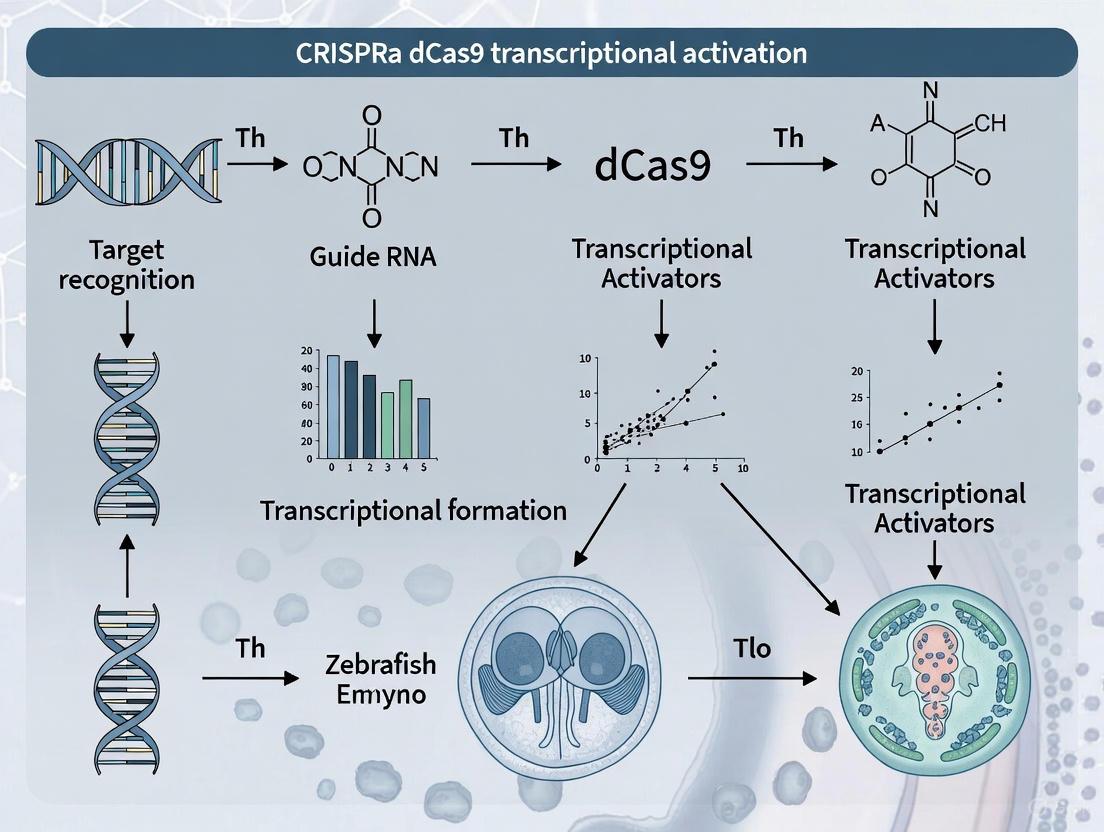
This article provides a comprehensive overview of CRISPR activation (CRISPRa) technology using catalytically dead Cas9 (dCas9) for targeted transcriptional upregulation in the zebrafish model.
Harnessing CRISPRa dCas9 for Transcriptional Activation in Zebrafish: A Comprehensive Guide for Functional Genomics and Drug Discovery
Abstract
This article provides a comprehensive overview of CRISPR activation (CRISPRa) technology using catalytically dead Cas9 (dCas9) for targeted transcriptional upregulation in the zebrafish model. It covers foundational principles, detailing the components of dCas9, guide RNA design, and transcriptional activators like VP64, SAM, and VPR. The review explores advanced methodologies for efficient gene activation in zebrafish, including delivery strategies and high-throughput screening applications in disease modeling and drug discovery. It addresses common challenges such as off-target effects and optimization techniques to enhance activation efficiency. Finally, it offers a comparative analysis with other genome-editing tools and outlines robust validation protocols, positioning zebrafish CRISPRa as a powerful, versatile platform for advancing functional genomics and translational research.
Understanding CRISPRa dCas9: Core Principles and the Zebrafish Model Advantage
The discovery of the Clustered Regularly Interspaced Short Palindromic Repeats (CRISPR)-Cas9 system has revolutionized genetic engineering, offering an unprecedented ability to manipulate genomes. Originally characterized as an adaptive immune system in bacteria and archaea, the CRISPR-Cas9 system was repurposed for genome editing following the seminal finding that the Cas9 protein from Streptococcus pyogenes could be directed by guide RNA to cleave DNA at specific sites [1]. The system's core mechanism involves a guide RNA (gRNA) with a 20-nucleotide spacer sequence that targets complementary DNA sequences through base pairing, while the Cas9 nuclease induces double-stranded breaks at these targeted sites [1].
The transformation of Cas9 from a DNA-cleaving enzyme to a transcriptional regulator represents one of the most significant innovations in CRISPR technology. This conversion is achieved through the generation of catalytically dead Cas9 (dCas9), created by introducing point mutations (D10A and H840A in S. pyogenes Cas9) that abolish its nuclease activity while preserving its DNA-binding capability [2]. When fused to transcriptional activation domains and targeted to gene promoter regions, dCas9 can effectively upregulate endogenous gene expression without altering the underlying DNA sequence [3]. This CRISPR activation (CRISPRa) technology has become an integral part of the molecular biology toolkit, enabling pooled or targeted upregulation of gene expression to identify genes that, when upregulated, modify cell physiology and/or disease progression [2].
The fusion of different effector domains to dCas9 has led to the development of various CRISPRa systems with differing activation capacities. The dCas9-VP64 system employs a fusion of dCas9 to the VP64 transcriptional activator, consisting of four copies of the Herpes Simplex Viral Protein 16 [4]. Enhanced systems such as dCas9-VPR incorporate stronger activation domains (VP64-p65-Rta) to drive more robust gene expression [4]. More sophisticated systems, including the Synergistic Activation Mediator (SAM), utilize modified sgRNA scaffolds with RNA aptamers that recruit additional activator proteins, further enhancing transcriptional activation [3]. These technologies have opened new avenues for gain-of-function studies, allowing researchers to investigate the consequences of gene overexpression in diverse biological contexts.
dCas9 Transcriptional Activation Systems: Architectural Diversity
The engineering of dCas9-based transcriptional activators has evolved through multiple generations, each offering improved efficacy and functionality. Understanding the architecture of these systems is crucial for selecting the appropriate tool for specific research applications. The following diagram illustrates the fundamental difference between wild-type Cas9 and dCas9-based transcriptional activation systems:
Core dCas9 Activator Systems
Table 1: Comparison of Primary dCas9 Transcriptional Activation Systems
| System | Components | Activation Mechanism | Typical Fold Activation | Applications |
|---|---|---|---|---|
| dCas9-VP64 | dCas9-VP64 fusion + sgRNA | Direct recruitment of VP64 activation domain to promoter | 2-20x [4] | Basic gene activation, proof-of-concept studies |
| dCas9-VPR | dCas9-VP64-p65-Rta fusion + sgRNA | Enhanced activation with three synergistic domains | 10-100x [4] | Strong activation requirements, difficult-to-activate genes |
| SAM | dCas9-VP64 + modified sgRNA with MS2 aptamers + MS2-P65-HSF1 | Recruitment of multiple activators via RNA aptamers | 10-1000x [3] | High-throughput screens, robust activation needs |
| SunTag | dCas9 fused to GCN4 peptide array + scFv-VP64 + sgRNA | Recruitment of multiple VP64 domains via peptide array | 10-500x | Extreme activation requirements, precise control |
The selection of an appropriate CRISPRa system depends on multiple factors, including the target gene's baseline expression, chromatin environment, and the desired level of activation. For genes with low endogenous expression or repressive chromatin marks, stronger systems like VPR or SAM are typically required to achieve meaningful transcriptional upregulation. The dCas9-VP64 system, while less potent, offers advantages in applications where moderate activation is sufficient or when minimizing potential off-target effects is a priority.
The Scientist's Toolkit: Essential Reagents for dCas9 Research
Implementing dCas9-based transcriptional activation requires a comprehensive set of molecular tools and reagents. The table below outlines the core components necessary for establishing CRISPRa experiments in vertebrate model systems, with particular emphasis on zebrafish applications.
Table 2: Essential Research Reagents for dCas9 Transcriptional Activation Studies
| Reagent Category | Specific Examples | Function | Notes for Zebrafish Applications |
|---|---|---|---|
| dCas9 Activators | dCas9-VP64, dCas9-VPR, dCas9-SAM [4] [3] | DNA-binding scaffold fused to transcriptional activation domains | dCas9-VPR shows strong activation but may increase background noise [4] |
| Guide RNA Systems | Native sgRNA, iSBH-sgRNA [4] [5] | Targets dCas9 to specific genomic loci | iSBH-sgRNAs enable conditional activation in response to RNA triggers [5] |
| Delivery Vectors | Lentiviral vectors, plasmid DNA with U6 promoters [4] [3] | Introduction of CRISPR components into cells | U6 promoters efficiently drive sgRNA expression in zebrafish [4] |
| Reporters | ECFP with 1xCTS or 8xCTS reporters [4] | Readout of CRISPRa efficiency | 8xCTS reporters with dCas9-Vp64 reduce background and enhance signal [4] |
| Cell Lines/Models | HEK293T, PK15, zebrafish embryos [4] [3] [5] | Experimental systems for testing and validation | Zebrafish embryos allow in vivo validation and developmental studies [5] |
The selection of appropriate reagents is critical for successful implementation of dCas9 transcriptional activation. For zebrafish research specifically, the external development and transparency of embryos facilitate microinjection of CRISPR components and real-time observation of transcriptional outcomes. Additionally, the high genetic similarity between zebrafish and humans (approximately 71.4% of human genes have zebrafish counterparts) makes this model system particularly valuable for studying gene function and regulatory mechanisms relevant to human biology and disease [6].
Conditional CRISPR Control: RNA-Sensing iSBH-sgRNAs
A significant advancement in dCas9 technology is the development of conditional activation systems that respond to specific cellular cues. The inducible spacer-blocking hairpin sgRNA (iSBH-sgRNA) platform represents a particularly innovative approach that enables CRISPR activation in response to RNA detection [4] [5]. This system engineers sgRNAs to fold into complex secondary structures that inhibit their activity in the ground state, but become activated upon recognizing complementary RNA triggers.
The iSBH-sgRNA design incorporates a 14-nucleotide loop and a partially complementary spacer* sequence in addition to the standard spacer and scaffold sequences. The complementarity between the spacer and spacer* sequences creates a stable secondary structure that physically blocks the spacer sequence from interacting with target DNA, effectively turning CRISPR activity OFF [5]. When RNA sequences complementary to both the loop and spacer* sequences are present in the cell, they hybridize with the iSBH-sgRNA, causing a conformational change that exposes the spacer sequence and turns CRISPR activity ON [4].
This RNA-sensing capability holds particular significance for zebrafish research, as it enables spatiotemporal precision in CRISPR activation. The technology can restrict dCas9 activity to specific cell types expressing RNA biomarkers of interest while preventing unwanted activity in other cells [5]. This is especially valuable during embryonic development, where precise control of gene expression in time and space is critical for normal embryogenesis. The system has been functionally validated in both HEK293T cells and zebrafish embryos, demonstrating its broad applicability across model systems [4] [5].
Application Notes: dCas9-Mediated Transcriptional Activation in Zebrafish
Protocol: Implementing dCas9-VPR for Gene Activation in Zebrafish Embryos
Objective: To achieve targeted transcriptional activation of specific genes in developing zebrafish embryos using the dCas9-VPR system.
Materials:
- dCas9-VPR expression vector (under appropriate promoter)
- Target-specific sgRNA expression vector (U6 promoter)
- Microinjection apparatus
- One-cell stage zebrafish embryos
- Embryo medium
Procedure:
- Design and preparation of sgRNAs:
- Design sgRNAs with 20-nucleotide spacer sequences complementary to the target gene's promoter region
- For conditional activation, utilize iSBH-sgRNA designs with 14-nt loop and spacer* sequences [5]
- Clone sgRNA sequences into U6-driven expression vectors
Preparation of injection mixture:
- Combine dCas9-VPR mRNA (100-200 pg) with sgRNA (25-50 pg) [1]
- Include fluorescent tracer (e.g., rhodamine dextran) to identify successfully injected embryos
- Adjust final concentration with nuclease-free water
Microinjection:
- Collect one-cell stage zebrafish embryos within 15 minutes post-fertilization
- Align embryos on injection mold submerged in embryo medium
- Inject 1-2 nL of the injection mixture into the cell cytoplasm
- Transfer injected embryos to fresh embryo medium and maintain at 28.5°C
Validation of activation:
- At appropriate developmental stages, harvest embryos for RNA extraction
- Perform RT-qPCR to quantify expression of target genes
- For spatial analysis, perform whole-mount in situ hybridization
- For live monitoring, co-inject fluorescent reporter constructs
Troubleshooting:
- High mortality: Reduce injection volume or concentration of components
- Low activation: Verify sgRNA target sites are in accessible chromatin regions
- Off-target effects: Include multiple sgRNAs with different spacers to confirm specific effects
- Background activation: Consider using dCas9-Vp64 with 8xCTS reporters to reduce noise [4]
Protocol: High-Throughput CRISPRa Screening in Zebrafish
Objective: To perform large-scale functional screening for genes that modify developmental processes when transcriptionally activated.
Materials:
- Pooled sgRNA library targeting transcription factors or genes of interest
- dCas9-VPR or dCas9-SAM stable transgenic zebrafish line
- Microinjection equipment
- High-throughput sequencing platform
- Phenotypic analysis tools (automated imaging, analysis software)
Procedure:
- Library design and preparation:
- Design sgRNAs targeting promoter regions of 1264 transcription factors or genes of interest [3]
- Clone sgRNA library into lentiviral or plasmid vectors with U6 promoters
Embryo injection and screening:
- Inject one-cell stage embryos from dCas9-activator transgenic fish with pooled sgRNA library
- Raise injected embryos to desired developmental stages
- Sort based on phenotypic criteria of interest (e.g., morphological defects, behavioral changes)
sgRNA quantification and hit identification:
- Extract genomic DNA from pooled embryos with specific phenotypes
- Amplify sgRNA regions with barcoded primers for multiplexing
- Perform high-throughput sequencing to quantify sgRNA abundance
- Compare sgRNA representation between experimental and control groups to identify enriched guides
Validation of hits:
- Re-test individual sgRNAs from candidate hits in secondary screens
- Validate transcriptional activation of target genes by RT-qPCR
- Confirm phenotypic consistency across multiple injections
Applications: This approach has been successfully used to identify genes involved in diverse processes including hair cell regeneration [1], retinal development [1], and models of human diseases such as Fanconi anemia and autism spectrum disorder [6].
Advanced Applications and Future Directions
The integration of dCas9 transcriptional activation with zebrafish research continues to evolve, enabling increasingly sophisticated experimental approaches. Recent advances include the development of tissue-specific CRISPRa systems that restrict gene activation to particular cell types, multiplexed activation strategies for simultaneously manipulating multiple genes, and inducible systems that provide temporal control over gene upregulation.
One particularly promising application is the combination of CRISPRa with single-cell RNA sequencing in zebrafish. This approach enables high-resolution analysis of transcriptional changes resulting from targeted gene activation, revealing cell-type-specific responses and gene regulatory networks. As noted in recent studies, "newer methods, such as MIC-Drop and Perturb-seq, which increase screening throughput in vivo, hold significant promise to improve our ability to dissect complex biological processes and mechanisms" [1].
The future of dCas9 technology in zebrafish research will likely focus on enhancing the precision and versatility of transcriptional control. Improvements in sgRNA design algorithms, optimization of activator domains for specific tissue types, and development of more sophisticated conditional control systems will further expand the utility of these tools. Additionally, the integration of CRISPRa with other emerging technologies, such as live imaging of transcription and epigenome editing, will provide unprecedented insights into gene regulatory mechanisms in vertebrate development and disease.
As CRISPR-based functional genomics continues to mature, dCas9 transcriptional activators will play an increasingly central role in bridging the gap between genomic sequence information and biological function. The zebrafish model, with its unique combination of experimental accessibility and physiological complexity, provides an ideal platform for harnessing these powerful tools to advance our understanding of vertebrate biology.
CRISPR-based transcriptional activation (CRISPRa) systems represent a powerful frontier in functional genomics, enabling precise upregulation of endogenous genes without altering DNA sequence. These technologies are particularly transformative in vertebrate models like zebrafish, which combine genetic tractability with the biological complexity of in vivo systems. By leveraging nuclease-dead Cas9 (dCas9) fused or recruited to transcriptional activator domains, researchers can investigate gene function, model genetic diseases, and validate therapeutic targets with unprecedented scale and precision. This application note details the core CRISPRa systems—VP64, SAM, SunTag, and VPR—providing a structured comparison, detailed protocols for implementation in zebrafish, and key reagent solutions to guide researchers and drug development professionals in harnessing these tools for advanced genetic studies.
Core CRISPRa Architectures and Quantitative Comparison
The potency of a CRISPRa system is largely determined by its architecture and the combination of activation domains used to recruit the cellular transcription machinery.
| System Name | Core Architecture | Key Activator Domains | Reported Activation Fold-Change (Range) | Key Advantages | Reported Limitations |
|---|---|---|---|---|---|
| VP64 | dCas9 directly fused to a synthetic tetramer of VP16 minimal activation domains [7] | VP64 (4xVP16) [7] | 10-100x [8] | Simple, robust design; lower baseline cytotoxicity [7] | Lower potency compared to advanced systems [8] |
| SAM (Synergistic Activation Mediator) | dCas9-VP64 + MS2-recruited accessory activators [7] [9] | VP64, p65, HSF1 [7] | 100-10,000x [8] [9] | Very high activation potency; suitable for genome-wide screens [8] [9] | Pronounced cytotoxicity; complex 2-3 component system [7] |
| SunTag | dCas9 recruits a array of peptide epitopes, which bind scFv-fused activators [8] | VP64, GCN4 peptide array, scFv antibodies [8] | 100-1,000x [8] | Amplified recruitment without dCas9 fusion; modular design | Large genetic payload; potential for immune response in vivo |
| VPR | dCas9 directly fused to a tripartite activator domain [8] [10] | VP64, p65, Rta [8] [10] | 100-5,000x [8] | High potency in a single polypeptide; simplifies delivery [8] [10] | Can exhibit cell-specific variability in efficacy [8] |
| dCas9-p300/CBP | dCas9 fused to catalytic core of histone acetyltransferases [8] | p300 or CBP HAT core [8] | 50-500x [8] | Epigenetic mechanism; can activate from enhancer regions [8] | Distinct mode of action; locus-dependent efficiency [8] |
The SAM system is among the most potent, employing a three-component recruitment strategy: a dCas9-VP64 fusion protein, a modified sgRNA with MS2 RNA aptamers, and an MS2 coat protein (MCP) fused to the NF-κB p65 and heat shock factor 1 (HSF1) activation domains (MPH) [7]. This synergistic recruitment results in very high levels of target gene activation. However, a significant consideration is its pronounced cytotoxicity, which can lead to low lentiviral titers and cell death in transduced populations, potentially confounding long-term screens and applications [7].
In contrast, the VPR system offers high potency in a more compact, single-vector format by directly fusing dCas9 to a tripartite activator (VP64-p65-Rta) [8] [10]. This simplifies delivery and reduces the number of genetic components, though its efficacy can vary across different cell and tissue types [8].
Detailed Protocol for CRISPRa in Zebrafish Research
The following protocol is optimized for robust gene activation in zebrafish embryos, leveraging the model's advantages for in vivo functional genomics and target validation [11] [12].
Stage 1: sgRNA and CRISPRa Component Preparation
sgRNA Design and Synthesis:
- Target Selection: Design sgRNAs to target promoter regions within 200 bp upstream of the transcription start site (TSS) of your gene of interest.
- sgRNA Scaffold: For SAM system use, employ the MS2-modified sgRNA scaffold (e.g., from Addgene #61424) [8]. For other systems, a standard sgRNA scaffold is sufficient.
- Synthesis: Synthesize sgRNAs via in vitro transcription (IVT) using a T7 polymerase system or purchase chemically modified sgRNAs (e.g., Alt-R gRNAs from IDT) for enhanced stability [12]. Purify using standard phenol-chloroform extraction or spin columns.
CRISPRa mRNA Preparation:
- Plasmids: Obtain plasmids encoding your chosen CRISPRa system. Common sources include Addgene (e.g., dCas9-VPR #63798, dCas9-VP64, SunTag components #60903/4, and SAM components #61423/5/6) [8].
- mRNA Synthesis: Linearize the plasmid template and synthesize capped mRNA using an mRNA synthesis kit (e.g., mMESSAGE mMACHINE T7 ULTRA Kit). Purify the mRNA using a standard LiCl precipitation protocol or spin columns.
- Quality Control: Verify the integrity and concentration of sgRNAs and mRNA by denaturing agarose gel electrophoresis and spectrophotometry.
Stage 2: Zebrafish Embryo Microinjection
- Injection Solution Preparation: Co-inject sgRNA and mRNA into one-cell stage zebrafish embryos to ensure widespread distribution. A recommended starting concentration is 25-50 ng/μL for dCas9-activator mRNA and 15-30 ng/μL for each sgRNA [13] [12]. Include phenol red (0.1%) in the injection solution for visualization.
- Microinjection: Using a microinjection apparatus and a fine glass needle, inject approximately 1 nL of the solution directly into the cytoplasm of one-cell stage embryos.
- Control Groups:
- Experimental Group: Embryos injected with dCas9-activator mRNA + gene-targeting sgRNA(s).
- Control Group 1: Embryos injected with dCas9-activator mRNA + non-targeting control sgRNA.
- Control Group 2: Uninjected embryos from the same clutch.
Stage 3) Incubation and Phenotypic Analysis
- Incubation: Maintain injected embryos in E3 embryo medium at 28.5°C. Monitor development daily.
- Efficiency Validation (48-72 hours post-fertilization - hpf):
- Molecular Validation: For rapid assessment, a subset of embryos can be pooled for RNA extraction. Perform RT-qPCR to quantify the mRNA levels of the target gene relative to housekeeping genes (e.g., ef1a, bactin). Successful activation should show a significant increase (fold-change as referenced in the comparison table).
- Visual Validation: If using a fluorescent reporter (e.g., GFP under control of an endogenous promoter), visualize and score fluorescence using a fluorescence stereomicroscope.
- Phenotypic Screening: Screen for expected morphological, behavioral, or molecular phenotypes at larval (3-7 dpf) or adult stages. For skeletal phenotypes, as in fragile bone disease research, use Alizarin Red S staining for bone mineralization and micro-CT for quantitative skeletal analysis at adult stages (e.g., 90 dpf) [12].
The Scientist's Toolkit: Research Reagent Solutions
Successful implementation of CRISPRa requires a suite of reliable reagents and tools. The following table details essential materials for establishing these systems in a zebrafish model.
| Reagent / Tool | Function / Description | Example Sources / Identifiers |
|---|---|---|
| dCas9-Activator Plasmids | Expresses the nuclease-dead Cas9 fused to or co-expressed with activator domains. | dCas9-VPR (Addgene #63798), SAM system (dCas9-VP64: #61423, MPH: #61425), SunTag system (#60903, #60904) [8] |
| MS2-modified sgRNA Scaffold | sgRNA backbone containing MS2 aptamers for recruiting MPH in the SAM system. | sgRNA(MS2) cloning backbone (Addgene #61424) [8] |
| In Vitro Transcription Kit | For synthesizing high-quality, capped mRNA for microinjection. | mMESSAGE mMACHINE T7 ULTRA Kit (Thermo Fisher) |
| Chemically Modified sgRNAs | Enhanced stability and efficiency for in vivo use, reducing required doses. | Alt-R CRISPR-Cas9 sgRNAs (IDT) [12] |
| Fluorescent Reporter Lines | Transgenic zebrafish with fluorescent proteins under tissue-specific promoters to visually monitor activation efficacy. | Custom generation via knock-in, e.g., using S-25 donor method [13] |
| Casper / nacre Mutant Lines | Pigmentation-deficient zebrafish lines enabling clear in vivo imaging at larval and adult stages. | ZIRC (casper, nacre) [14] |
Critical Considerations for Experimental Design
When planning CRISPRa experiments in zebrafish, several factors are crucial for success and data interpretation:
- Genetic Heterogeneity: Unlike inbred mammalian models, common laboratory zebrafish strains (AB, TU) exhibit significant genetic variability. To mitigate this, use large sample sizes (clutches from multiple breeding pairs) and include proper internal controls to ensure statistical power [14].
- Cytotoxicity Monitoring: Be vigilant for signs of toxicity, especially when using highly potent systems like SAM. Reduced viability, developmental delays, or failure to establish stable expression could indicate activator toxicity. Consider using inducible systems or the VPR system as alternatives [7] [15].
- "Crispant" vs. Stable Lines: For rapid functional screening, F0 mosaic "crispants" are highly efficient, allowing phenotypic assessment in ~3 months without generating stable lines. This approach has been validated to faithfully recapitulate stable mutant phenotypes in skeletal disease research [12]. For long-term studies, however, establishing stable transgenic lines is necessary.
The versatile toolkit of CRISPRa transcriptional activators—from the simplicity of VP64 to the robust synergy of SAM and the compact potency of VPR—provides researchers with a powerful means to dissect gene function in the versatile zebrafish model. By selecting the appropriate system based on the required activation strength and experimental constraints, and by adhering to the detailed protocols and reagent solutions outlined herein, scientists can accelerate functional genomics and pre-clinical target validation with high precision and in vivo relevance.
Why Zebrafish? Genetic Tractability and Physiological Relevance for Functional Genomics
Zebrafish (Danio rerio) has emerged as a preeminent model system in biomedical research, particularly for functional genomics and precision medicine. Its value stems from a unique combination of biological, practical, and genetic features that make it particularly suitable for in vivo studies bridging fundamental biology and translational applications [16]. For research focused on CRISPRa dCas9 transcriptional activation, zebrafish offer a genetically tractable vertebrate platform that is simultaneously high-throughput, enabling rapid functional validation of gene candidates and disease mechanisms that would be challenging to study in mammalian systems. This application note details the specific advantages of zebrafish and provides established protocols for their use in transcriptional activation studies, framed within the context of an advanced functional genomics thesis.
Core Advantages for Functional Genomics
High Genetic and Physiological Conservation with Humans
A foundational reason for the zebrafish's translational relevance is its significant genetic similarity to humans.
- Genetic Homology: Approximately 70% of human genes have at least one zebrafish ortholog [16] [17]. More importantly in a disease context, about 84% of genes known to be associated with human diseases have a functional zebrafish counterpart [16] [18]. This high degree of conservation allows for the direct modeling of a wide range of human genetic disorders.
- Physiological Relevance: Zebrafish possess anatomically and functionally similar organs to humans, including a heart, blood vessels, nervous system, kidney, and liver [16]. This facilitates the study of systemic physiology and organ-specific diseases in a vertebrate context.
Table 1: Quantitative Comparison of Zebrafish with Other Common Model Organisms
| Feature | Zebrafish | Mouse | Humans |
|---|---|---|---|
| Genetic Similarity to Humans | ~70% of genes have an ortholog [16] | ~85% similarity [16] | 100% |
| Optical Transparency | High (embryos/larvae; adult "Casper" strain) [16] | Low | N/A |
| High-Throughput Screening | Very high (larvae in multi-well plates) [16] | Moderate | Low |
| Disease Modeling Efficiency | High for developmental, cardiovascular, cancer models [16] | High for complex diseases [16] | Direct, but not feasible for experimentation |
| Ethical & Cost Considerations | Lower cost, fewer ethical limitations [16] | Higher cost, stricter regulations [16] | Highest ethical concerns |
Technical and Practical Advantages
Zebrafish offer a suite of technical benefits that are particularly advantageous for CRISPRa dCas9 research.
- External Fertilization and Embryo Transparency: Embryos develop externally and are optically transparent, permitting non-invasive, real-time imaging of developmental processes, cellular dynamics, and the effects of genetic manipulation in a live organism [16].
- Rapid Development and High Fecundity: Major organ systems form within 24-48 hours post-fertilization, and a single pair of fish can produce hundreds of embryos weekly [16] [19]. This allows for the rapid generation of large datasets and high-throughput phenotypic screening.
- Ease of Genetic Manipulation: Zebrafish are highly amenable to a range of genetic techniques, including CRISPR/Cas9, prime editing, and morpholino oligonucleotides [16]. The prolific breeding supports large-scale genetic screens.
The Scientist's Toolkit: Essential Reagent Solutions
Successful CRISPRa experiments in zebrafish require a core set of validated reagents. The table below lists essential components and their functions.
Table 2: Key Research Reagent Solutions for Zebrafish CRISPRa
| Reagent / Tool | Function / Explanation | Example Application |
|---|---|---|
| dCas9-VP64/p65 Activators | Catalytically dead Cas9 fused to transcriptional activation domains (e.g., VP64, p65) to drive gene expression without cutting DNA. | Targeted upregulation of endogenous genes; p65 used in light-activated systems in ZF4 cells [20]. |
| CRISPRa sgRNAs | Single-guide RNAs designed to target upstream of the transcription start site (TSS) of the gene of interest. | Guides the dCas9-activator complex to the specific genomic locus to initiate transcription [21] [4]. |
| Codon-Optimized dCas9 | dCas9 sequence optimized for zebrafish codon usage to enhance translation efficiency and protein expression. | Proof-of-concept for robust CRISPRi/a system function in zebrafish [21]. |
| RNA-Sensing iSBH-sgRNAs | Engineered sgRNAs with complex secondary structures that activate CRISPRa only upon sensing complementary RNA triggers. | Enables cell-type-specific CRISPR activity restricted to cells expressing specific RNA biomarkers [4]. |
| Light-Activated Systems (e.g., CRY2/CIB1) | Optogenetic system where blue light induces dimerization of CRY2 and CIB1, bringing the activator domain to dCas9. | Provides spatiotemporal control of gene activation; demonstrated in zebrafish ZF4 cells [20]. |
| Microinjection Apparatus | Equipment (e.g., Eppendorf FemtoJet microinjector, micromanipulators) for precise delivery of reagents into one-cell-stage embryos. | Essential for introducing CRISPRa components (e.g., Cas9 protein/sgRNA mixes or mRNA) into zebrafish embryos [18] [22]. |
Established Experimental Protocols
Protocol 1: Standard CRISPRa for Transcriptional Activation
This protocol outlines the general workflow for achieving targeted gene activation in zebrafish using a CRISPRa system [21].
Workflow Overview:
Detailed Methodology:
sgRNA Design and Synthesis
- Design: Design 2-4 sgRNAs targeting the promoter region ~50-500 base pairs upstream of the transcription start site (TSS) of your target gene. Tools like MODesign can be employed for complex sgRNA designs [4].
- Synthesis: Synthesize sgRNAs via in vitro transcription from a DNA template or purchase them commercially.
Preparation of Injection Mix
- Combine the following components in nuclease-free water:
- dCas9-activator mRNA (e.g., dCas9-VP64, dCas9-VPR): 100-200 pg per embryo.
- sgRNA(s): 50-100 pg per embryo per sgRNA.
- Phenol red (0.1%) for visualization.
- Centrifuge the mix briefly and keep it on ice until injection.
- Combine the following components in nuclease-free water:
Microinjection into Zebrafish Embryos
- Load the injection mix into a fine glass needle.
- Using a microinjector and a stereomicroscope, inject ~1 nL of the mix directly into the cytoplasm of one-cell stage zebrafish embryos.
- After injection, transfer embryos to egg water and incubate at 28.5°C.
Phenotypic and Molecular Validation
- Phenotypic Monitoring: Observe injected embryos (F0 "CRISPants") daily for expected phenotypes related to target gene overexpression (e.g., altered pigmentation for mitfa, increased body length for mrap2a) [21].
- Molecular Validation: At 1-5 days post-fertilization (dpf), pool embryos for:
- RT-qPCR: To quantitatively measure mRNA expression levels of the target gene relative to controls.
- RNA Sequencing: For an unbiased assessment of transcriptional changes and off-target effects.
Protocol 2: Advanced Spatiotemporal Control with Optogenetics
This protocol enables precise, light-controlled gene activation, allowing researchers to probe gene function at specific times and in specific tissues [20].
Workflow Overview:
Detailed Methodology:
System Components
- Plasmid Constructs:
- NLS-dCas9-trCIB1: A fusion of nuclear-localized dCas9 and a truncated CIB1 protein.
- NLS-CRY2PHR-p65: A fusion of the CRY2 photosensory domain and the p65 transcriptional activation domain.
- Target-specific sgRNA plasmid.
- Plasmid Constructs:
Cell Transfection and Light Induction
- Transfert zebrafish ZF4 cells with the three plasmid constructs using a standard transfection method.
- Divide transfected cells into two groups:
- Experimental Group: Expose to blue light (e.g., 460 nm LED)
- Control Group: Keep in complete darkness.
- A typical induction protocol involves cyclical illumination (e.g., 1 hour light/1 hour dark) for a total of 6-12 hours.
Validation of Light-Induced Activation
- Harvest cells after the illumination period.
- Perform RT-qPCR to measure mRNA levels of the target gene (e.g., ASCL1a, BCL6a, HSP70). A significant increase in expression should be observed in the light-treated group compared to the dark control [20].
Validation and Application in Disease Modeling
CRISPRa in zebrafish is not just a tool for gene function discovery but also a powerful platform for modeling human diseases and validating genetic variants.
- Functional Validation of Human Variants: Zebrafish CRISPRa can be used to overexpress a human gene variant to study its pathogenic mechanism. For instance, a novel FBN1 nonsense variant associated with Marfan syndrome was modeled in zebrafish, providing functional evidence for its pathogenicity [22].
- Modeling Complex Diseases: The system is effective for studying metabolic disorders and rare diseases. For example, CRISPRa targeting mrap2a significantly increased larval body length, modeling aspects of energy homeostasis [21]. Zebrafish have also been successfully used to model Lowe syndrome and Dent-2 disease, providing insights into renal and neurological pathologies [19].
- Rapid CRISPant Phenotyping: The F0 generation of injected embryos (CRISPants) can be used for rapid phenotypic and biochemical assessment. For instance, sdhb CRISPants displayed elevated catecholamine levels, reduced motor activity, and increased heart rate, effectively modeling features of pheochromocytomas/paragangliomas (PPGLs) within days [23].
The zebrafish model, particularly when empowered by CRISPRa dCas9 technologies, represents a versatile, scalable, and physiologically relevant platform for functional genomics. Its high genetic homology to humans, coupled with unparalleled advantages for high-throughput screening and real-time imaging, makes it an indispensable tool for understanding gene function, validating disease-associated variants, and pioneering new therapeutic strategies. The protocols and reagents detailed herein provide a robust foundation for researchers to harness the full potential of zebrafish in transcriptional activation studies.
CRISPR activation (CRISPRa) technology, based on a catalytically deactivated Cas9 (dCas9), enables precise transcriptional upregulation of endogenous genes without altering the DNA sequence. In zebrafish (Danio rerio), a model organism celebrated for its genetic similarity to humans and rapid development, CRISPRa presents a powerful tool for functional genomics and disease modeling [24]. By fusing dCas9 to transcriptional effector domains, researchers can target specific genomic loci to interrogate gene function in development, physiology, and pathology [25] [1]. This application note details the core components, protocols, and reagent solutions for implementing CRISPRa in zebrafish research, providing a structured guide for scientists and drug development professionals.
Core Components of the CRISPRa System
The CRISPRa system comprises three fundamental elements: the guide RNA (gRNA) for target specificity, the dCas9-effector fusion protein for transcriptional activation, and a delivery system to introduce these components into zebrafish embryos.
Guide RNA (gRNA) Design and Engineering
The single-guide RNA (sgRNA) is a synthetic fusion of a CRISPR RNA (crRNA) component, which contains a ~20 nucleotide spacer sequence complementary to the target DNA, and a trans-activating crRNA (tracrRNA) scaffold that binds to dCas9 [10]. For CRISPRa, the sgRNA must be designed to bind specifically to the promoter or enhancer region of the target gene. The PAM (Protospacer Adjacent Motif) sequence (5'-NGG-3' for the commonly used S. pyogenes Cas9) is a critical targeting constraint and must be present adjacent to the target site [26].
Recent advancements have enabled the engineering of "RNA-sensing" sgRNAs, such as inducible spacer-blocking hairpin sgRNAs (iSBH-sgRNAs), which remain inactive until they bind to a specific endogenous RNA trigger. This allows for conditional CRISPRa activity in specific cell types or at specific developmental stages, adding a layer of spatiotemporal precision to experiments in zebrafish [10].
dCas9-Effector Fusion Proteins
The catalytic endonuclease activity of Cas9 is nullified through point mutations (e.g., D10A and H840A for S. pyogenes Cas9), creating dCas9, which retains its ability to bind DNA based on gRNA guidance but does not cleave the DNA [27]. This dCas9 protein is then fused to transcriptional activation domains to form the core of the CRISPRa machinery. The choice of effector domain significantly influences the level and pattern of gene activation.
Two primary transcriptional activators used in zebrafish are dCas9-VP64 and dCas9-VPR [10]. The VP64 domain consists of four tandem copies of the Herpes Simplex Viral Protein 16 (VP16) and acts as a relatively weak activator. The VPR system is a more potent synthetic tripartite activator, combining VP64 with two additional strong activation domains, p65 and Rta [10]. Weaker activators like dCas9-Vp64 can help minimize background noise in the OFF state, while stronger activators like dCas9-VPR can drive more robust gene expression [10].
Delivery Systems for Zebrafish Embryos
Efficient delivery of CRISPRa components into one-cell stage zebrafish embryos is crucial for achieving high editing rates and germline transmission. The most common and effective method is the microinjection of nucleic acids (DNA or mRNA) or pre-assembled ribonucleoprotein (RNP) complexes directly into the cytoplasm or cell nucleus [24].
Table 1: Comparison of CRISPRa Delivery Methods in Zebrafish
| Delivery Method | Material Injected | Advantages | Disadvantages | Typical Efficiency (Germline Transmission) |
|---|---|---|---|---|
| DNA Injection | Plasmid DNA encoding dCas9-effector and sgRNA | Cost-effective; stable for complex constructs | Potential for random integration; slower onset | Variable; can be lower than mRNA/RNP |
| mRNA/sgRNA Co-injection | In vitro transcribed dCas9-effector mRNA and sgRNA | Rapid onset; no integration | Requires in vitro transcription | High; germline transmission rates ~28% on average [25] |
| Ribonucleoprotein (RNP) | Pre-complexed dCas9 protein and sgRNA | Immediate activity; reduced off-target effects | Requires recombinant protein production | High efficiency; demonstrated in zebrafish [24] |
The performance of CRISPRa systems is quantified by their activation efficiency and dynamic range. The data below, derived from mammalian cell studies and applicable to zebrafish design, provides benchmarks for component selection.
Table 2: Performance Metrics of Key dCas9-Effector Systems
| dCas9-Effector | Core Components | Typical Activation Fold-Change | Notes and Applications |
|---|---|---|---|
| dCas9-VP64 | dCas9 + VP64 (x4) | Lower (e.g., 2-10x) | Weaker activator; can mask background noise; useful for fine-tuning expression [10]. |
| dCas9-VPR | dCas9 + VP64-p65-Rta | Higher (e.g., 10-100x) | Strong, synergistic activator; drives robust gene expression [10]. |
| CRISPRa with iSBH-sgRNA | Engineered sgRNA + dCas9-VPR/Vp64 | Dynamic range of ~5-10x (OFF to ON state) | Enables conditional activation; ON-state can match native sgRNA efficiency [10]. |
Experimental Protocol: Implementing CRISPRa in Zebrafish
This protocol outlines the steps for a typical CRISPRa experiment in zebrafish using mRNA and sgRNA co-injection.
Protocol Workflow
The following diagram illustrates the complete experimental workflow from preparation to phenotypic analysis.
Detailed Methodologies
Step 1: Target Selection and gRNA Design
- Identify Target Locus: Select a promoter or enhancer region (typically within -200 to +50 bp relative to the transcription start site) of your gene of interest. Ensure the presence of an NGG PAM sequence [26].
- Design sgRNA Spacer: Design a 20-nucleotide spacer sequence with high specificity and minimal off-target potential using established design tools (e.g., CHOPCHOP, CRISPRscan).
- For Conditional Activation (Optional): For iSBH-sgRNAs, use computational tools like the MODesign algorithm to design the loop and spacer* sequences complementary to your desired RNA trigger [10].
Step 2: Component Preparation
- sgRNA Synthesis: Synthesize sgRNA via in vitro transcription from a DNA template containing a T7 promoter, followed by purification [25]. For iSBH-sgRNAs, the DNA template encodes the full engineered structure [10].
- dCas9-Effector mRNA Synthesis: Clone the sequence for your chosen dCas9-effector (e.g., dCas9-VPR) into a vector containing flanking 5' and 3' UTRs for stability in zebrafish. Linearize the plasmid and perform in vitro transcription to generate capped, polyadenylated mRNA. Purify the mRNA using standard kits [24].
Step 3: Microinjection Setup
- Preparation of Injection Mix: Combine the following in nuclease-free water:
- dCas9-effector mRNA: 100-300 pg per embryo
- sgRNA: 25-50 pg per embryo
- Phenol red tracer (0.1%)
- Needle Preparation: Pull glass capillary needles to a fine point using a micropipette puller. Load the injection mix into the needle.
Step 4: Embryo Injection
- Collection of Embryos: Collect naturally spawned zebrafish embryos at the one-cell stage.
- Microinjection: Using a micromanipulator and microinjector, inject approximately 1 nL of the injection mix directly into the cytoplasm of the one-cell stage embryo [24].
Step 5: Post-Injection Incubation
- Maintenance: Transfer injected embryos to E3 embryo medium. Incubate at 28.5°C. Monitor development and remove dead or unfertilized embryos.
Step 6: Screening and Validation
- Molecular Validation: At 24-48 hours post-fertilization (hpf), pool embryos and extract RNA. Perform reverse transcription followed by quantitative PCR (RT-qPCR) to measure the upregulation of the target gene transcript compared to uninjected controls.
- Imaging: For visible phenotypes or using fluorescent reporters, image live embryos under a stereomicroscope or confocal microscope to assess morphological changes or reporter expression.
Step 7: Phenotypic Analysis
- Conduct in-depth phenotypic analyses based on your research question, which may include high-throughput phenotyping, behavioral assays, or histological examination.
The Scientist's Toolkit: Research Reagent Solutions
Table 3: Essential Reagents for CRISPRa in Zebrafish
| Item | Function/Description | Example/Note |
|---|---|---|
| dCas9-VPR Plasmid | Template for in vitro transcription of dCas9-effector mRNA. | Ensure plasmid has zebrafish-optimized codons for improved expression [24]. |
| T7 RNA Polymerase | Enzyme for in vitro transcription of sgRNA and mRNA. | High-yield kits are commercially available. |
| Cap Analog (e.g., Anti-Reverse Cap Analog - ARCA) | Added during mRNA transcription to produce capped mRNA for enhanced stability and translation. | Critical for achieving high protein levels. |
| Microinjector & Micromanipulator | Precision system for delivering nanoliter volumes into zebrafish embryos. | Essential for consistent embryo injection. |
| iSBH-sgRNA DNA Template | DNA oligonucleotide or plasmid for transcribing conditionally activated sgRNA. | Designed using the MODesign algorithm [10]. |
| Fluorescent Reporter Plasmid | Plasmid with a minimal promoter and CRISPR Target Sequences (CTS) upstream of a fluorescent protein (e.g., ECFP). | Used as a co-injection control to visually confirm CRISPRa system activity [10]. |
Visualization of the CRISPRa Mechanism
The molecular mechanism of CRISPRa-mediated transcriptional activation is illustrated below.
Implementing CRISPRa in Zebrafish: Protocols and High-Throughput Applications
The application of CRISPR-Cas9 technology in zebrafish has revolutionized functional genomics, enabling researchers to dissect gene functions in development, physiology, and disease modeling with unprecedented precision [1]. For CRISPRa (CRISPR activation) systems utilizing catalytically dead Cas9 (dCas9) fused to transcriptional activators, efficient delivery of editing components is paramount to achieve robust gene upregulation. The choice between delivering ribonucleoprotein (RNP) complexes versus plasmid vectors represents a critical methodological decision that significantly influences editing efficiency, specificity, and phenotypic outcomes. This protocol examines these two principal delivery strategies within the context of zebrafish CRISPRa research, providing structured comparisons and detailed methodologies to guide selection and implementation for transcriptional activation studies.
Comparative Analysis of Delivery Methods
The two primary delivery strategies—RNP complexes and plasmid vectors—offer distinct advantages and limitations for CRISPRa applications in zebrafish. The table below summarizes the key characteristics of each approach:
Table 1: Comparison of RNP Complex versus Plasmid Vector Delivery for CRISPR in Zebrafish
| Characteristic | RNP Complex Delivery | Plasmid Vector Delivery |
|---|---|---|
| Components Delivered | Pre-assembled Cas9 protein + sgRNA [28] | DNA plasmid encoding Cas9/sgRNA [28] |
| Mechanism of Action | Direct genome editing immediately upon delivery [28] | Requires cellular transcription/translation [28] |
| Editing Speed | Rapid (hours) | Slower (days) |
| Delivery Efficiency | High with optimized microinjection [29] | Variable, depends on plasmid uptake and expression |
| Off-target Effects | Potentially reduced due to shorter activity window [28] | Potentially increased due to prolonged expression |
| Toxicity | Generally lower | Can be higher due to bacterial backbone or persistent expression |
| Applicability to CRISPRa | Suitable for transient activation; requires dCas9-VPR or dCas9-Vp64 protein | Compatible with stable activation systems; can express complex activators (dCas9-VPR, dCas9-Vp64) |
| Ease of Preparation | Requires protein purification or commercial source | Standard molecular biology techniques |
| Cost Considerations | Higher for recombinant protein | Lower for plasmid DNA |
Beyond these fundamental differences, the delivery method significantly impacts experimental outcomes. RNP delivery facilitates rapid genome editing with potentially reduced off-target effects because the pre-assembled complexes become active immediately upon delivery and are degraded quickly, limiting the time window for non-specific activity [28]. Conversely, plasmid-based delivery requires transcription and translation of the CRISPR components within the cell, resulting in prolonged expression that may increase off-target effects but can be beneficial for sustained transcriptional activation in CRISPRa applications [28].
Detailed Experimental Protocols
Microinjection of RNP Complexes
Principle: Direct delivery of pre-assembled complexes of dCas9 transcriptional activator protein and guide RNA into zebrafish embryos enables rapid genome targeting and transcriptional activation without the delay associated with plasmid-based expression systems [29] [28].
Materials:
- Purified dCas9-VPR or dCas9-Vp64 protein (commercially available or purified in-house)
- Target-specific sgRNA (chemically synthesized or in vitro transcribed)
- Microinjection apparatus (pressure injector, micromanipulator)
- Borosilicate glass capillary needles
- Zebrafish embryos at 1-cell stage
- Embryo medium (e.g., E3 medium)
- Phenol red tracking dye (optional)
Procedure:
- RNP Complex Assembly:
- Combine dCas9 protein (typically 100-200 ng/µL) with sgRNA (50-100 ng/µL) in a molar ratio of 1:2 to 1:3 (protein:RNA) in nuclease-free injection buffer.
- Incubate at 37°C for 10-15 minutes to allow complex formation.
Needle Preparation:
- Pull borosilicate glass capillaries to generate fine-tipped injection needles.
- Back-fill needles with 2-3 µL of the prepared RNP complex mixture.
Embryo Preparation:
- Collect freshly fertilized zebrafish embryos within 15-30 minutes post-fertilization.
- Arrange embryos in grooves on an injection agar plate with the cell facing the needle.
Microinjection:
- Calibrate injection volume to 1-2 nL per embryo using a micrometer.
- Inject the RNP complex directly into the cell cytoplasm of 1-cell stage embryos.
- Typically inject 200-500 pg of RNP complex per embryo [29].
Post-injection Care:
- Transfer injected embryos to fresh embryo medium.
- Incubate at 28.5°C and monitor development regularly.
- Remove defective or unfertilized embryos after 4-6 hours.
Optimization Notes:
- The Cas9/sgRNA ratio should be optimized for different protein batches [30].
- Injection volume and concentration should be calibrated to maximize efficiency while minimizing embryo toxicity.
- For CRISPRa applications using dCas9 activators, the same RNP assembly principles apply, though the specific activator domain (VPR vs Vp64) may influence complex stability and nuclear localization.
Plasmid Vector Microinjection
Principle: Delivery of plasmid DNA encoding both the dCas9 transcriptional activator and guide RNA components allows for sustained intracellular expression of CRISPRa machinery, potentially enabling prolonged transcriptional activation of target genes [28].
Materials:
- Plasmid vectors expressing dCas9-VPR/Vp64 and sgRNA (available from repositories such as AddGene [31])
- Restriction enzymes or cloning systems for sgRNA insertion (e.g., BsmBI or BsaI sites [31])
- Phenol red tracking dye
- Microinjection apparatus and supplies (as above)
Procedure:
- Vector Preparation:
- Select appropriate CRISPRa plasmids (e.g., dCas9-VPR under appropriate promoter, sgRNA under U6 promoter).
- Clone target-specific sgRNA sequence into the gRNA expression cassette using appropriate restriction sites (e.g., BsmBI [31]).
- Prepare high-purity plasmid DNA using endotoxin-free purification kits.
- Resuspend plasmid DNA in nuclease-free microinjection buffer (typically 5-10% phenol red for visualization).
Injection Solution Preparation:
- For co-injection of multiple plasmids, mix dCas9 activator plasmid (25-100 pg) and sgRNA plasmid (25-50 pg) to achieve final concentration.
- Centrifuge injection mixture at high speed (≥12,000 × g) for 10 minutes to remove particulate matter.
Embryo Microinjection:
- Pull and back-fill injection needles as described in section 3.1.
- Calibrate injection volume to 1-2 nL per embryo.
- Inject plasmid mixture directly into the cell cytoplasm of 1-cell stage embryos.
Post-injection Handling:
- Transfer injected embryos to fresh embryo medium.
- Incubate at 28.5°C and monitor for transgene expression if using fluorescent markers.
- Screen for successful editing or activation using appropriate phenotypic or molecular assays.
Optimization Notes:
- Promoter selection significantly impacts expression timing and tissue specificity (e.g., U6 for sgRNA, CMV or other promoters for dCas9 activator).
- Plasmid concentration should be titrated to balance expression efficiency against potential toxicity.
- For CRISPRa applications, the ratio of dCas9-activator plasmid to sgRNA plasmid may require optimization to maximize transcriptional activation while minimizing non-specific effects.
The Scientist's Toolkit: Research Reagent Solutions
Table 2: Essential Reagents for CRISPR Delivery in Zebrafish
| Reagent/Resource | Function | Examples/Specifications |
|---|---|---|
| dCas9 Transcriptional Activators | DNA-binding scaffold for recruitment of activation complexes | dCas9-VPR, dCas9-Vp64 [10] |
| Guide RNA Cloning Vectors | Template for sgRNA expression | pT7-gRNA, DR274 vector [31] |
| Microinjection Equipment | Precise delivery of reagents to embryos | Pressure injector, micromanipulator, capillary needles [29] |
| CRISPR Plasmids (AddGene) | Pre-made genetic tools for CRISPR applications | Zebrafish-optimized CRISPR plasmids [31] |
| Capped mRNA Kits | In vitro transcription for RNA delivery | For producing synthetic mRNA encoding CRISPR components [29] |
| Antisense Morpholinos | Traditional gene knockdown method | Control for CRISPR experiments or transient inhibition [29] |
Workflow Visualization
CRISPRa Delivery Workflow Comparison for Zebrafish
Conditional CRISPRa Activation via RNA-Sensing Guide RNAs
Designing Effective gRNAs for Promoter-Targeted Activation
In the context of zebrafish research, the success of CRISPR-mediated transcriptional activation (CRISPRa) is fundamentally dependent on the precise design of guide RNAs (gRNAs). Effective gRNA design ensures that the dCas9-activator complex is recruited to optimal promoter-proximal regions, enabling robust and specific gene activation without inducing DNA damage. This application note details evidence-based protocols for designing gRNAs that maximize activation efficiency while minimizing off-target effects, with specific considerations for zebrafish models. The principles outlined herein are supported by recent advances in CRISPRa technology, including optimized scaffold designs and RNA-sensing systems that have been functionally validated in vivo.
Foundational Principles of gRNA Design for CRISPRa
Key Positioning and Sequence Considerations
The target window for CRISPRa gRNAs is significantly narrower than for knockout approaches, as efficacy depends on binding within specific promoter regions relative to the transcription start site (TSS). The table below summarizes the optimal positioning for CRISPRa gRNAs:
| Design Parameter | Optimal Specification | Biological Rationale | Supporting Evidence |
|---|---|---|---|
| Target Window (Activation) | ~100 nt window upstream of the TSS | Proximal promoter regions are enriched for transcription factor binding sites that support pre-initiation complex assembly. | [32] |
| Target Window (Interference) | ~100 nt window downstream of the TSS | Targeting near the +1 nucleosome and early elongation region allows for more effective steric inhibition of RNA polymerase. | [32] |
| TSS Annotation Source | FANTOM database (CAGE-seq) | Provides the most accurate mapping of mRNA cap sites, which is critical for defining the true TSS. | [32] |
| Basal Expression Impact | dCas9-VPR activation level is anti-correlated with basal gene expression | Genomic contexts with low basal activity (e.g., bivalent promoters) are often more responsive to CRISPRa. | [33] |
The Influence of Chromatin State
The epigenetic landscape of the target promoter is a critical determinant of CRISPRa success. Different chromatin states respond variably to dCas9-activator systems:
- Bivalent Chromatin: Genes marked by both H3K4me3 (active) and H3K27me3 (repressive) histone modifications, often found in developmental regulators in stem cells, are particularly sensitive to dCas9-VPR activation [33].
- Constitutive Heterochromatin: Genomic regions marked by H3K9me3 are generally less responsive to CRISPRa, presenting a significant challenge for activation [33].
- Cellular State Dependence: The efficacy of a given gRNA can change during cellular differentiation, as the chromatin landscape is dynamically remodeled. For instance, the same reporter integration site showed different basal expression and activation potential in iPSCs versus iNeurons [33].
Experimental Protocol for gRNA Design and Validation
This protocol provides a step-by-step workflow for designing and testing gRNAs for promoter-targeted activation in zebrafish research.
gRNA Design and In Silico Analysis
- Define the Target TSS: Utilize the FANTOM database (or equivalent CAGE-seq data) to identify the precise TSS for your gene of interest. Avoid relying solely on gene model predictions, as they can be inaccurate.
- Identify Target Regions: Generate a list of all possible gRNA spacer sequences (20 nt) with a 5'-NGG PAM within the optimal ~100 bp window upstream of the validated TSS.
- Prioritize gRNAs: Rank candidate gRNAs using established on-target scoring algorithms (e.g., from the Synthego or Benchling design tools) that predict high on-target activity [34].
- Evaluate Off-Target Potential: Use computational tools to scan the genome for potential off-target sites with up to 3-4 mismatches. Select gRNAs with minimal off-target potential, particularly in gene-rich or regulatory regions.
- Select Multiple gRNAs: It is essential to design and test a minimum of 3-5 gRNAs per target gene. This controls for variable efficacy due to local chromatin architecture and confirms that observed phenotypes are on-target effects [32] [34].
In Vivo Validation in Zebrafish
- Preparation of Reagents: Synthesize or clone the selected gRNA sequences. Co-inject zebrafish one-cell stage embryos with:
- dCas9-Activator mRNA: e.g., dCas9-VPR or dCas9-VP64.
- Candidate gRNAs: A mix of the designed gRNAs or test them in separate batches.
- Fluorescent Reporter (Optional): An ECFP or other reporter cassette under the control of a synthetic promoter with target sites, to serve as an initial co-injection marker [10] [5].
- Initial Efficacy Screening: At 24-48 hours post-fertilization (hpf), assess the reporter fluorescence (if used) and collect a subset of embryos for RNA extraction.
- Molecular Validation: Perform quantitative RT-PCR (qRT-PCR) on the extracted RNA to measure the fold-increase in expression of the endogenous target gene relative to controls (e.g., non-targeting gRNA or uninjected embryos).
- Phenotypic Confirmation: For genes with known morphological or behavioral outcomes, document relevant phenotypes in activated embryos.
- Germline Transmission: Raise injected (F0) founders to adulthood and outcross to wild-type fish. Screen the F1 progeny for stable inheritance of the activation-capible allele and confirm sustained gene expression [35].
The Scientist's Toolkit: Essential Reagents and Solutions
The table below catalogs key reagents required for implementing CRISPRa in zebrafish.
| Reagent / Solution | Function / Application | Example / Note |
|---|---|---|
| dCas9-Activator Fusion | Core effector complex for transcriptional activation. | dCas9-VPR or dCas9-VP64 mRNA for injection. dCas9-VPR is generally more potent [10] [33]. |
| Engineered sgRNA Scaffolds | Enhances recruitment of activator complexes to the target locus. | SAM-compatible sgRNA variants (e.g., MS2 aptamer-containing scaffolds) significantly improve activation functionality [9]. |
| RNA-Sensing gRNAs (iSBH-sgRNAs) | Enables conditional CRISPRa activation upon detection of specific RNA biomarkers. | iSBH-sgRNAs are engineered to be inactive until a complementary RNA trigger is present, allowing for spatiotemporal control [10] [5]. |
| Fluorescent Reporter Cassettes | Serves as a rapid, visual readout for CRISPRa system activity. | Reporters with multiple CRISPR target sequences (e.g., 8xCTS-ECFP) provide a more sensitive and robust signal than single-copy reporters [10] [5]. |
| Chemical Modifications for gRNAs | Protects synthetic gRNAs from degradation, improving stability and efficacy in vivo. | Specific chemical modifications at residues prone to nuclease cleavage can stabilize engineered iSBH-sgRNAs in zebrafish embryos [5]. |
| Microhomology-Mediated Donor | For knock-in of tags or reporters to monitor endogenous gene expression. | The S-NGG-25 donor plasmid, using short microhomology arms, enables high-efficiency, seamless knock-in in zebrafish [35]. |
Advanced Applications: Conditional Control with RNA-Sensing gRNAs
A cutting-edge application for zebrafish research involves engineering gRNAs that activate gene expression only in the presence of specific cellular RNA biomarkers. The iSBH-sgRNA (inducible Spacer-Blocking Hairpin sgRNA) system provides this functionality [10] [5].
Diagram 1: Logic of RNA-sensing gRNA activation.
- Mechanism: The iSBH-sgRNA is designed with a complementary "spacer" sequence that binds the spacer, folding into a hairpin that prevents dCas9 binding. A separate RNA trigger, complementary to the loop and spacer sequence, is expressed from a cell-specific promoter. When this trigger RNA is present, it binds the iSBH-sgRNA with higher affinity, disrupting the inhibitory hairpin and exposing the spacer, thereby enabling dCas9 binding and gene activation [10] [5].
- Application: This system allows for cell-type-specific CRISPRa in zebrafish based on endogenous RNA signatures. For example, activation of a transgene can be restricted to neurons by using an RNA trigger for a neuronal-specific gene like
elavl3. This provides unparalleled spatiotemporal precision for functional studies.
Workflow Diagram: From Design to Functional Validation
The following diagram summarizes the complete experimental pipeline for designing and applying promoter-targeted gRNAs in zebrafish CRISPRa research.
Diagram 2: gRNA design and validation workflow.
By adhering to these design principles, experimental protocols, and utilizing the recommended toolkit, researchers can reliably generate effective gRNAs for precise transcriptional activation in zebrafish, thereby advancing functional genomics and disease modeling in this versatile vertebrate model.
The advent of CRISPR-based transcriptional activation (CRISPRa) has revolutionized functional genomics, enabling systematic gain-of-function studies that were previously challenging to perform at scale. By using a catalytically dead Cas9 (dCas9) fused to transcriptional activator domains, CRISPRa allows for precise upregulation of endogenous genes without altering the underlying DNA sequence. This technology is particularly powerful in model organisms like zebrafish, where it combines the versatility of CRISPR tools with the unique advantages of a vertebrate model system—external development, optical transparency, and high genetic homology to humans.
CRISPRa screening in zebrafish provides an unparalleled platform for investigating gene function in development and disease. It facilitates the identification of genes whose overexpression drives specific phenotypic outcomes, from developmental abnormalities to disease rescue, offering critical insights for therapeutic development. This Application Note details the methodologies, reagents, and analytical frameworks for implementing large-scale CRISPRa screens in zebrafish, providing a standardized protocol for researchers in functional genomics and drug discovery.
CRISPRa Core Technology and Mechanisms
The fundamental CRISPRa system consists of two primary components: a deactivated Cas9 (dCas9) protein that retains its DNA-binding capability but lacks nuclease activity, and a single guide RNA (sgRNA) that directs dCas9 to specific genomic loci. The transcriptional activation potential is achieved by fusing dCas9 to potent transcriptional activator domains. Several optimized systems have been developed to maximize activation efficiency:
- VP64-Based Systems: Early CRISPRa systems used dCas9 fused to a four-copy repeat of the VP16 minimal activation domain (VP64). While effective, these often required multiple sgRNAs per gene for robust activation [36].
- VPR System: An enhanced tripartite activator combining VP64 with the activation domains of p65 (a subunit of NF-κB) and Rta (from Epstein-Barr virus). This system demonstrates high potency in various cell types, including primary cells, and often outperforms more complex systems like SAM in certain contexts [37].
- Synergistic Activation Mediator (SAM): A more complex system employing a three-component approach: (1) dCas9-VP64, (2) an engineered sgRNA containing two MS2 RNA aptamers, and (3) an MS2 coat protein (MCP) fused to p65 and HSF1 activation domains. The MS2 aptamers recruit the additional activators, creating a synergistic effect that drives strong gene activation [7] [9].
Table 1: Comparison of Major CRISPRa Systems
| System | Core Components | Key Features | Reported Performance |
|---|---|---|---|
| VPR | dCas9-VP64-p65-Rta | Single fusion protein; Simplified delivery | Highly potent; >90% activation in primary cells with mRNA delivery [37] |
| SAM | dCas9-VP64 + MS2-p65-HSF1 + modified sgRNA | Multi-component; Recruits additional activators via RNA aptamers | Very high activation; Used in multiple genome-scale screens; can exhibit cytotoxicity [7] [9] |
| VP64 | dCas9-VP64 | Simple architecture; First-generation system | Moderate activation; Often requires multiple sgRNAs for strong effect [36] |
Recent advances have focused on improving the efficiency and specificity of these systems. For instance, optimized sgRNA scaffolds have been developed that significantly enhance CRISPRa functionality by improving activator recruitment [9]. Furthermore, self-selecting CRISPRa systems using piggyBac transposon technology enable rapid generation of stable, high-efficiency CRISPRa-competent cell populations without laborious clonal selection [9].
Quantitative Outcomes of CRISPRa Screening
CRISPRa screens have successfully identified genes involved in diverse biological processes and disease states. The tables below summarize key quantitative findings from published studies.
Table 2: Phenotypic Outcomes from CRISPRa Screens in Mammalian Systems
| Cell Type/Model | Target Genes | Screening Phenotype | Key Findings | Reference |
|---|---|---|---|---|
| K562 leukemia cells | Protein-coding genome | Cellular fitness/growth | Identified tumor suppressors and developmental TFs whose overexpression inhibits growth [36] | |
| K562 leukemia cells | Protein-coding genome | Sensitivity to bacterial toxin | Revealed trafficking pathways and receptor biosynthesis genes [36] | |
| A375 melanoma cells | Protein-coding genome | Resistance to BRAF inhibitor | Identified genes conferring drug resistance [36] | |
| Multiple cell lines | 14 surface marker genes | Activation efficiency | 8/14 genes showed >90% activation; 5/14 showed partial activation; 1/14 (ITGAX) resistant to activation [37] |
Table 3: Proof-of-Concept CRISPRa Outcomes in Zebrafish
| Target Gene | Biological Process | Activation Method | Phenotypic Outcome | Reference |
|---|---|---|---|---|
| mrap2a | Energy homeostasis, somatic growth | CRISPRa (specific system not detailed) | Significant increase in larval body length | [21] |
| tyr, mitfa, mitfb, sox10 | Melanocyte differentiation | CRISPRi (complementary approach) | Hypopigmentation of epidermal melanocytes and RPE | [21] |
| Various genes | General gene activation | RNA-sensing iSBH-sgRNAs | Successful activation in zebrafish embryos | [10] |
Experimental Protocol: CRISPRa Screening in Zebrafish
Reagent Design and Preparation
A. CRISPRa System Selection and Vector Design For zebrafish studies, the VPR system offers a balance of potency and simplicity. The core components include:
- dCas9-VPR expression vector: Clone codon-optimized dCas9-VPR under the control of a zebrafish-specific promoter (e.g., U6 or SP6) for embryonic expression. Nuclear localization signals should be included to ensure proper targeting [37].
- sgRNA design: Design sgRNAs to target the transcriptional start site (TSS) of genes of interest, typically within -200 to +50 bp relative to the TSS. Use bioinformatic tools to minimize off-target effects. For zebrafish applications, ensure sgRNAs are specific to the target gene with minimal off-target binding [38].
B. sgRNA Library Design and Cloning For large-scale screens:
- Select 3-5 sgRNAs per gene to ensure adequate coverage and activation
- Include non-targeting control sgRNAs (at least 5% of library)
- Clone sgRNA library into appropriate zebrafish expression vectors using golden gate assembly or similar high-throughput methods
Zebrafish Embryo Microinjection
A. Preparation of Injection Materials
- Prepare sgRNA library pools at a concentration of 25-50 ng/μL
- dCas9-VPR mRNA should be in vitro transcribed using mMESSAGE mMACHINE kit and purified
- Prepare injection mix: 300 ng/μL dCas9-VPR mRNA + 25-50 ng/μL sgRNA pool + phenol red tracer
B. Microinjection Protocol
- Set up zebrafish mating pairs and collect embryos within 15 minutes of spawning
- Arrange embryos on injection mold with grooves oriented anterior-posterior
- Using a microinjection apparatus, inject 1-2 nL of injection mix into the yolk or cell cytoplasm at the 1-4 cell stage
- Maintain injected embryos at 28.5°C in E3 embryo medium
- Include control groups: uninjected, dCas9-VPR only, and non-targeting sgRNA
Phenotypic Screening and Analysis
A. High-Throughput Phenotyping At appropriate developmental stages (e.g., 24, 48, 72 hours post-fertilization), screen for phenotypes of interest:
- Imaging: Use automated microscopy systems for high-content screening
- Morphometric analysis: Quantify body length, eye size, organ dimensions
- Behavioral assays: For neurological screens, include touch response, swimming behavior
- Molecular readouts: For specific pathways, use transgenic reporter lines
B. Sample Processing for Sequencing
- Pool embryos/tissue displaying similar phenotypes (≥20 individuals per pool)
- Extract genomic DNA using commercial kits
- Amplify integrated sgRNA sequences with barcoded primers for multiplexing
- Purify PCR products and prepare for next-generation sequencing
Data Analysis and Hit Validation
A. Bioinformatics Pipeline
- Process sequencing data to count sgRNA reads per sample
- Normalize read counts using DESeq2 or similar methods
- Perform statistical analysis to identify enriched sgRNAs in phenotypic groups
- Use MAGeCK or similar tools for CRISPR screen analysis
B. Hit Validation
- Resynthesize hit sgRNAs individually
- Repeat microinjection with individual sgRNAs
- Quantify gene expression changes by RT-qPCR
- Confirm phenotypic recapitulation
- Perform downstream mechanistic studies on validated hits
The Scientist's Toolkit: Essential Research Reagents
Table 4: Key Research Reagent Solutions for CRISPRa in Zebrafish
| Reagent Category | Specific Product/System | Function and Application Notes |
|---|---|---|
| CRISPRa Systems | dCas9-VPR System | Single-vector system; High potency; Suitable for mRNA synthesis for zebrafish injection [37] |
| SAM System | Multi-component; High activation; Potential cytotoxicity concerns; Requires modified sgRNA with MS2 aptamers [7] [9] | |
| Delivery Tools | In vitro transcription kits (mMESSAGE mMACHINE) | High-yield mRNA synthesis for dCas9-VPR delivery [37] |
| Microinjection apparatus | Precise delivery of CRISPR components to zebrafish embryos | |
| sgRNA Tools | Chemically modified synthetic sgRNAs | Enhanced stability and reduced immune response; Critical for efficient activation [37] |
| SAM-compatible sgRNA scaffolds | Optimized scaffolds with MS2 aptamers for enhanced recruitment of activators [9] | |
| Control Reagents | Non-targeting sgRNAs | Control for non-specific effects; Essential for screen validation |
| Fluorescent reporter constructs | Validation of targeting efficiency and system functionality |
Signaling Pathways and Workflow Diagrams
CRISPRa Screening Workflow in Zebrafish: This diagram illustrates the comprehensive workflow for conducting large-scale CRISPRa screens in zebrafish, from sgRNA library design through hit validation.
CRISPRa Molecular Mechanism: This diagram illustrates the core mechanism of CRISPRa, showing how the dCas9-VPR fusion protein complex is guided to specific DNA sequences by sgRNAs to activate transcription.
Technical Considerations and Optimization
A. Addressing Cytotoxicity Concerns Recent studies have revealed that some CRISPRa systems, particularly those using potent activation domains like p65 and HSF1 (components of the SAM system), can exhibit significant cytotoxicity [7]. This toxicity can lead to:
- Selection pressure that confounds screening results
- Reduced lentiviral titers during production
- Cell death in transduced populations
Mitigation Strategies:
- System Selection: Consider using VPR systems which may present reduced cytotoxicity in some contexts [37]
- Inducible Systems: Implement tetracycline-or Shield1-inducible dCas9 systems to control timing of activation
- Dose Titration: Carefully optimize the amount of dCas9-activator and sgRNA delivered
- Monitoring: Include appropriate controls to distinguish true phenotypic effects from toxicity
B. Optimization for Zebrafish-Specific Applications
- Codon Optimization: Ensure dCas9 and activator components are codon-optimized for zebrafish expression to maximize translation efficiency [21]
- Promoter Selection: Use zebrafish-specific promoters (e.g., U6 for sgRNA, SP6/T7 for dCas9-VPR mRNA) for appropriate temporal and spatial expression
- Delivery Method Optimization: For zebrafish embryos, mRNA injection is typically more efficient than plasmid DNA [37]
- Chemical Modifications: Incorporate chemically modified nucleotides in synthetic sgRNAs to enhance stability and reduce immune responses [37]
CRISPRa-based functional screens in zebrafish represent a powerful approach for systematically uncovering gene function in vertebrate development and disease. The combination of scalable CRISPRa technology with the experimental advantages of zebrafish enables researchers to identify genes whose overexpression drives specific phenotypes, potentially revealing new therapeutic targets and disease mechanisms. As the technology continues to evolve—with improvements in activation efficiency, specificity, and delivery—CRISPRa screens in zebrafish will undoubtedly yield increasingly impactful insights into functional genomics. The protocols and considerations outlined here provide a foundation for implementing these powerful screens in diverse research contexts.
The functional characterization of genes implicated in human diseases represents a central challenge in modern biomedical research. With the advent of next-generation sequencing, the number of candidate disease genes and variants of uncertain significance has surged, creating a critical need for efficient in vivo validation systems [1] [39]. Zebrafish (Danio rerio) has emerged as a premier vertebrate model for this purpose, with approximately 70% of human genes having functional homologs, along with logistical advantages including high fecundity, external fertilization, rapid development, and optical transparency of embryos [39]. The integration of CRISPR-activated transcription (CRISPRa) technologies with the zebrafish model provides a powerful platform for investigating gene function in human disease pathogenesis, offering unique insights that cannot be obtained through loss-of-function approaches alone.
CRISPRa employs a catalytically deactivated Cas9 (dCas9) fused to transcriptional activators, enabling targeted upregulation of endogenous genes without altering DNA sequence [40]. This gain-of-function approach is particularly valuable for studying genetic redundancy, where knockout of individual genes may not reveal phenotypic consequences due to compensation by homologous genes [40]. Furthermore, CRISPRa allows for quantitative and reversible gene activation, mimicking endogenous expression patterns more accurately than traditional transgenic overexpression methods that rely on random DNA insertion and can be subject to positional effects [40]. This technical overview details the application of CRISPRa-dCas9 systems in zebrafish for modeling human diseases across the spectrum from monogenic disorders to complex traits.
Principles of CRISPRa Technology
Core System Components
The CRISPRa system consists of several key molecular components that work in concert to achieve targeted gene activation. The foundation is the dCas9 protein, generated through point mutations (D10A and H840A for Streptococcus pyogenes Cas9) that abolish nuclease activity while preserving DNA binding capability [40]. This dCas9 core is fused to transcriptional activation domains such as VP64, which consists of four copies of the herpes simplex viral protein 16 [40]. More potent synthetic activators include the tripartite VPR (VP64-p65-Rta) domain and the SunTag system, which employs a multimeric recruitment platform for enhanced activation [41].
The second essential component is the single guide RNA (sgRNA), a chimeric RNA molecule that combines the functions of the CRISPR RNA (crRNA) and trans-activating crRNA (tracrRNA) [40]. The sgRNA directs the dCas9-activator fusion to specific genomic loci through complementary base pairing between its 5' spacer sequence and the target DNA. For effective transcriptional activation, sgRNAs must be designed to target regions within approximately 200 base pairs upstream of the transcription start site [40].
Table 1: Core Components of CRISPRa Systems for Zebrafish Research
| Component | Function | Common Variants | Considerations for Zebrafish |
|---|---|---|---|
| dCas9 | DNA binding without cleavage | dCas9 from S. pyogenes | Codon optimization for zebrafish; nuclear localization signals |
| Activation Domain | Recruits transcriptional machinery | VP64, VPR, SunTag | SunTag shows 20-fold higher activation than VPR in some systems [41] |
| Guide RNA | Targets complex to specific DNA sequence | Standard sgRNA, modified scaffolds | Secondary structure affects efficiency; chemical modifications enhance stability [5] |
| Promoter | Drives expression of target gene | Endogenous promoter of gene of interest | Activation depends on targeting within 200bp of TSS [40] |
Advanced CRISPRa Systems
Recent advancements have yielded more sophisticated CRISPRa platforms with enhanced capabilities. The SunTag system represents a significant improvement over direct fusions, employing a dCas9 protein fused to multiple GCN4 peptide epitopes that recruit multiple copies of single-chain antibodies (scFv) fused to VP64 activators [41]. This multivalent recruitment strategy creates localized activator clusters that significantly boost transcriptional activation compared to single activator fusions [41]. In fungal systems, dCas9-SunTag has demonstrated 20-fold higher activation performance than dCas9-VPR, highlighting its potential for applications requiring strong gene induction [41].
Inducible CRISPRa systems provide temporal control over gene activation, enabling researchers to investigate gene function at specific developmental stages. Recent work has established drug-responsive CRISPRa systems by fusing mutated human estrogen receptor (ERT2) domains to CRISPRa components [42]. These systems remain sequestered in the cytoplasm until administration of tamoxifen or its active metabolite 4-hydroxy-tamoxifen (4OHT) induces nuclear translocation and subsequent gene activation [42]. This inducible platform shows rapid response kinetics and reversible activation, making it particularly valuable for studying genes with pleiotropic or stage-specific functions.
Another innovative approach involves engineering conditionally active sgRNAs that respond to cellular biomarkers. The iSBH-sgRNA (inducible spacer-blocking hairpin sgRNA) platform designs complex sgRNA secondary structures that inhibit function in the ground state [5]. Upon recognition of complementary RNA triggers, the sgRNA undergoes conformational changes that activate CRISPRa function [5]. This technology enables restriction of CRISPR activity to specific cell types expressing RNA biomarkers of interest, providing spatial precision that could be leveraged for cell-type-specific interventions in disease models.
Zebrafish as a Model for Human Diseases
Advantages for Functional Genomics
Zebrafish offer a unique combination of vertebrate biological complexity and experimental tractability that makes them ideally suited for functional genomics and disease modeling. Several characteristics contribute to their utility. The optical transparency of embryos and larvae enables direct visualization of developmental processes and disease phenotypes in real time [39]. This transparency facilitates sophisticated imaging approaches, including whole-brain functional imaging of neuronal activity and deep tissue visualization of cellular processes [39]. Additionally, high fecundity—with hundreds of eggs per mating—enables medium-to-high throughput genetic screens that would be prohibitively expensive in mammalian systems [1].
The short generation time of zebrafish (approximately 3 months to sexual maturity) allows for rapid progression through genetic crosses and the establishment of stable lines [39]. From a practical perspective, external fertilization simplifies embryonic manipulation and direct observation under standard microscopy equipment. A comprehensive phenotyping toolbox has been developed for zebrafish, including automated behavioral video tracking systems, whole-mount histochemistry with well-characterized markers, and optogenetic tools for reversible modulation of cellular activity with high spatiotemporal resolution [39].
Disease Modeling Applications
Zebrafish have successfully modeled a wide spectrum of human diseases, from monogenic disorders to complex traits. For monogenic diseases, CRISPR-based knockout of zebrafish orthologs has established models for childhood epilepsies [1], Fanconi anemia [1], and spinal muscular atrophy [1]. The conservation of disease pathways enables faithful recapitulation of human pathophysiology, as demonstrated by studies targeting zebrafish orthologs of 132 human schizophrenia-associated genes [1] and 254 genes involved in hair cell regeneration [1].
For complex traits, zebrafish provide a platform for investigating gene-environment interactions and polygenic contributions. Behavioral assays have been standardized for both larval and adult zebrafish, enabling quantification of complex phenotypes relevant to neurological and psychiatric disorders [39]. The ability to perform high-throughput chemical screens in zebrafish offers unique opportunities for drug discovery, as demonstrated by identification of compounds modifying disease processes in various models [39].
Experimental Design and Workflow
Target Selection and sgRNA Design
Effective CRISPRa experiments begin with careful target selection and sgRNA design. For disease modeling, candidate genes are typically identified through human genetic studies such as genome-wide association studies (GWAS) or whole-exome sequencing of patient cohorts [39]. When selecting target sequences for activation, prioritize regions within 200 base pairs upstream of the transcription start site, as targeting more distal regions may yield suboptimal activation [40]. For simultaneous activation of multiple genes, design sgRNAs with minimal off-target potential using computational tools such as CRISPOR [42].
Recent research has demonstrated that sgRNA efficacy is strongly influenced by secondary structure, with a key parameter being the Folding Barrier—the energy required for the sgRNA to transition from its most stable structure to the active conformation [43]. sgRNAs with Folding Barriers ≤10 kcal/mol consistently show high activation efficiency, while those with higher barriers frequently underperform [43]. Computational tools can predict this parameter during design, enabling selection of optimal sgRNAs before experimental validation.
Table 2: sgRNA Design Parameters for Efficient CRISPRa
| Parameter | Optimal Range | Impact on Efficiency | Design Tool |
|---|---|---|---|
| Folding Barrier | ≤10 kcal/mol | Primary determinant; low barrier enables proper folding [43] | ViennaRNA with custom algorithms [43] |
| Target Position | Within 200bp of TSS | Critical for recruitment to transcriptional machinery [40] | Genomic browsers & annotation databases |
| Spacer Length | 20 nucleotides | Standard length for sufficient specificity | CRISPOR [42] |
| GC Content | 40-60% | Affects binding stability; extreme values reduce efficiency | Standard sgRNA design tools |
| Off-target Potential | Minimal matches in genome | Reduces unintended activation; essential for interpretation | BLAST against zebrafish genome |
Component Assembly and Validation
For zebrafish CRISPRa, assemble the system as DNA expression vectors encoding both the dCas9-activator fusion and the sgRNA components. The dCas9-activator should be driven by a ubiquitous or tissue-specific promoter depending on experimental needs, while sgRNAs are typically expressed from U6 promoters [5]. The SunTag system requires separate expression of dCas9-GCN4 and scFv-VP64 components, often linked via P2A self-cleaving peptides to ensure coordinated expression [41].
Before microinjection, validate component functionality in cell culture if possible. For CRISPRa systems, test activation efficiency using reporter constructs containing target sequences upstream of a minimal promoter driving fluorescent protein expression [5]. For inducible systems, verify low background activity in the absence of inducer and robust activation in its presence [42]. Quantitative assessment at this stage saves considerable time and resources by identifying non-functional constructs before proceeding to zebrafish experiments.
Zebrafish Microinjection and Screening
Deliver CRISPRa components to one-cell stage zebrafish embryos via microinjection. Prepare injection mixtures containing expression plasmids or mRNA encoding the dCas9-activator fusion and sgRNA transcripts. Optimal concentrations must be determined empirically but typically range from 25-100 pg for mRNA and 25-50 pg for plasmid DNA [39]. For maximal activation, target early embryonic stages when chromatin is more accessible and transcriptional machinery is being established.
Following injection, screen embryos for desired phenotypes at developmentally appropriate timepoints. For morphological assessments, utilize standard microscopy and whole-mount in situ hybridization. For behavioral phenotypes, employ automated video tracking systems to quantify parameters such as locomotor activity, startle response, or social behavior [39]. Molecular validation should include RNA extraction and qRT-PCR to confirm target gene upregulation, and if applicable, Western blotting to assess protein level increases.
Research Reagent Solutions
Table 3: Essential Research Reagents for CRISPRa in Zebrafish
| Reagent Category | Specific Examples | Function | Source/Reference |
|---|---|---|---|
| dCas9-Activators | dCas9-VP64, dCas9-VPR, dCas9-SunTag | DNA binding & transcriptional activation | Addgene plasmids #61422, #140199 [41] [40] |
| Guide RNA Backbones | pU6-sgRNA, modified scaffolds | Targets CRISPR complex to specific genomic loci | Addgene plasmid #60955 [42] |
| Inducible Systems | iCRISPRa/i (ERT2 fusion), iSBH-sgRNA | Enables temporal or conditional control of activation | [5] [42] |
| Delivery Vectors | Tol2 transposon system, plasmid vectors | Efficient genomic integration in zebrafish | [39] |
| Validation Reporters | Fluorescent proteins (ECFP, mCherry), GUS | Assess CRISPRa efficiency and specificity | [41] [5] |
Conditional CRISPRa Systems for Spatial-Temporal Control
Advanced CRISPRa applications increasingly require precision beyond simple gene activation, with spatial and temporal control being particularly important for modeling complex diseases. Several innovative systems now enable this refined approach in zebrafish models.
The iSBH-sgRNA platform represents a breakthrough in conditional activation, employing engineered sgRNAs that fold into complex secondary structures that inhibit function in their ground state [5]. These engineered sgRNAs become activated upon recognizing complementary RNA sequences, enabling CRISPRa specifically in cells expressing RNA biomarkers of interest [5]. This technology has been successfully implemented in both mammalian cells and zebrafish embryos, opening possibilities for cell-type-specific interventions in disease models based on endogenous gene expression patterns.
Drug-inducible systems provide orthogonal control mechanisms for temporal regulation. The iCRISPRa/i system fuses mutated human estrogen receptor (ERT2) domains to CRISPRa components, sequestering them in the cytoplasm until administration of tamoxifen or its metabolite 4OHT induces nuclear translocation [42]. This system demonstrates rapid response kinetics (hours rather than days), reversibility upon inducer withdrawal, and minimal background activity, making it ideal for studying gene function at specific developmental windows [42].
These conditional systems enable sophisticated experimental designs that more accurately model the complexity of human diseases, particularly for disorders with age-dependent onset or tissue-specific pathophysiology.
Data Analysis and Validation
Robust data analysis is essential for interpreting CRISPRa experiments in disease modeling. For transcriptomic validation, RNA sequencing provides the most comprehensive assessment of gene activation and potential off-target effects. Compare CRISPRa-treated samples to appropriate controls, including uninjected embryos and those receiving dCas9-only or non-targeting sgRNA [40]. Significant upregulation of the target gene without widespread transcriptomic alterations indicates specific activation.
For phenotypic assessment, establish quantitative metrics relevant to the disease process being modeled. For neurological disorders, this may include automated analysis of locomotor activity, seizure-like behaviors, or social interactions [39]. For structural or developmental disorders, morphometric measurements provide objective quantification of anatomical changes. Always include appropriate controls and blind analysis when possible to minimize bias.
Statistical analysis should account for multiple comparisons when assessing multiple genes or conditions. For behavioral data, ensure adequate sample sizes based on power calculations from preliminary experiments. Molecular validation should include technical replicates to ensure reproducibility of gene activation measurements.
Troubleshooting Common Challenges
Several technical challenges may arise when implementing CRISPRa in zebrafish. Inefficient gene activation can result from suboptimal sgRNA design, inadequate dCas9-activator expression, or targeting inaccessible chromatin regions. To address this, validate sgRNA efficiency using reporter assays, optimize injection concentrations, and consider using multiple sgRNAs targeting the same gene.
Off-target activation remains a concern, though CRISPRa generally shows higher specificity than CRISPR nuclease systems. To minimize off-target effects, use computationally validated sgRNAs with minimal genomic matches, and employ truncated sgRNAs with 17-18 nucleotide spacers for enhanced specificity where possible.
Variable penetration of CRISPRa effects across tissues or individuals can complicate interpretation. This can be mitigated by using established transgenic lines expressing dCas9-activators, ensuring consistent injection quality, and analyzing sufficient numbers of embryos to account for biological variability.
The integration of CRISPRa technologies with the zebrafish model provides a powerful and versatile platform for modeling human diseases across the spectrum from monogenic disorders to complex traits. The protocols outlined in this application note enable researchers to design, implement, and validate CRISPRa experiments for functional characterization of disease genes and pathways. As CRISPRa systems continue to evolve with enhanced activation potency, precision control mechanisms, and improved specificity, they will undoubtedly accelerate our understanding of disease mechanisms and contribute to the development of novel therapeutic strategies.
The unique advantages of zebrafish—including genetic tractability, optical transparency, and physiological relevance—combined with the precision of CRISPRa create unprecedented opportunities for investigating gene function in a vertebrate context. By following the detailed methodologies presented here, researchers can leverage this powerful combination to advance our understanding of human disease pathogenesis and identify new targets for therapeutic intervention.
Modern drug discovery is primarily guided by two strategies: phenotypic screening, which identifies compounds based on a desired biological effect in cells or whole organisms, and target-based discovery, which focuses on modulating specific molecular targets with known functions [44]. While phenotypic screening has proven more successful for discovering first-in-class therapies, it traditionally faces challenges in identifying the mechanistic targets of active compounds—a process known as target deconvolution [44] [45]. Conversely, target-based approaches, though more straightforward for optimization, rely on pre-validated targets and may overlook complex biological contexts [44].
The integration of these approaches is now reshaping drug discovery pipelines [44]. This convergence is particularly powerful when combined with CRISPR activation (CRISPRa) transcriptional systems in vertebrate models like zebrafish (Danio rerio). These models preserve the physiological complexity needed for phenotypic assessment while enabling precise genetic manipulation [1] [46]. This application note details protocols that leverage CRISPRa-dCas9 in zebrafish to bridge phenotypic observation and target validation, creating a streamlined workflow for identifying and validating novel therapeutic candidates.
Table 1: Comparison of Drug Discovery Approaches
| Aspect | Phenotypic Screening | Target-Based Discovery |
|---|---|---|
| Starting Point | Measurable biological response or phenotype [44] | Well-characterized molecular target [44] |
| Key Advantage | Captures system complexity; identifies first-in-class therapies [44] | Rational design; streamlined optimization [44] |
| Major Challenge | Target deconvolution [44] [45] | Relies on validated targets; may lack physiological context [44] |
| Role in Integrated Workflow | Identifies bioactive compounds | Validates targets and optimizes compounds [44] |
The Scientist's Toolkit: Research Reagent Solutions
Table 2: Essential Reagents for CRISPRa and Phenotypic Screening in Zebrafish
| Reagent / Tool | Function / Description | Application in Workflow |
|---|---|---|
| dCas9-VPR or dCas9-Vp64 | CRISPR activation systems; transcription activators that recruit factors to specific genomic loci [5] | Transcriptional activation of endogenous genes for functional studies [5] |
| iSBH-sgRNA (Inducible Spacer-Blocking Hairpin sgRNA) | Engineered sgRNA that remains inactive until triggered by a complementary RNA sequence [5] | Conditional gene activation in response to specific cellular biomarkers; enables spatial/temporal control [5] |
| MODesign Algorithm | Computational tool for generating custom RNA-sensing iSBH-sgRNAs [5] | Designing sgRNAs to detect specific RNA biomarkers of interest [5] |
| Zebrafish Larvae Xenografts | Transplantation of human tumor cells into transparent zebrafish larvae [46] | In vivo phenotypic screening of compound efficacy in a complex, whole-organism environment [46] |
| High-Content Imaging Systems (e.g., Operetta CLS) | Automated microscopy platforms for acquiring and analyzing multiparametric image data [46] | Automated, quantitative analysis of phenotypic outcomes (e.g., tumor size) in zebrafish xenografts [46] |
| Activity-Based Protein Profiling (ABPP) | Chemoproteomic method using reactive probes to map small molecule-protein interactions [47] | Target deconvolution for hits from phenotypic screens; identifies direct molecular targets [47] |
Experimental Protocols
Protocol 1: Designing an RNA-Sensing CRISPRa System for Conditional Target Validation
This protocol describes the use of engineered iSBH-sgRNAs to create a CRISPRa system that activates gene expression only in the presence of a specific RNA biomarker, linking a cellular state to a functional response [5].
Materials
- Plasmid DNA encoding dCas9-VPR or dCas9-Vp64 activator [5]
- MODesign algorithm access [5]
- Cloning reagents for U6 promoter-driven expression vectors [5]
- HEK293T cells or zebrafish embryos for validation [5]
Procedure
- Design iSBH-sgRNA: Utilize the MODesign algorithm to generate an iSBH-sgRNA sequence targeting your gene of interest. The design includes a 14-nucleotide loop and a spacer* sequence complementary to the spacer, creating a secondary structure that inhibits sgRNA function in its ground state [5].
- Design RNA Trigger: Design an RNA trigger sequence (typically ≥ 34 nt) that is complementary to both the loop and spacer* sequences of the iSBH-sgRNA. To enhance stability in vivo, flank the trigger sequence with 5' and 3' hairpin structures [5].
- Molecular Cloning:
- Cell-Based Validation:
- Co-transfect HEK293T cells with the three plasmids: iSBH-sgRNA, RNA trigger, and dCas9 activator, along with a fluorescent reporter cassette (e.g., ECFP under a promoter with a CRISPR-targeting sequence) [5].
- Use flow cytometry to measure reporter signal. A significant increase in fluorescence in the presence of the RNA trigger compared to its absence indicates successful activation of the iSBH-sgRNA [5].
- In Vivo Validation in Zebrafish:
- Microinject the validated plasmid constructs or their in vitro-transcribed mRNAs into single-cell zebrafish embryos.
- Assess the phenotype and/or use chemical modifications to protect the engineered sgRNAs from cleavage, thereby improving stability in the embryo [5].
- Confirm conditional gene activation and the resulting biological effect.
Protocol 2: High-Content Phenotypic Screening in Zebrafish Xenografts
This protocol outlines a robust workflow for screening compound efficacy on human tumor cells xenotransplanted into zebrafish larvae, using high-content imaging for automated analysis [46].
Materials
- 2 days post-fertilization (dpf) zebrafish larvae (immunosuppressed, if necessary) [46]
- Human cancer cells (cell lines or patient-derived), labeled with a fluorescent dye (e.g., GFP, RFP) [46]
- Microinjection apparatus
- 96-well imaging plates (e.g., ZF plates from Hashimoto or ibidi plates with 3D-printed inserts) [46]
- Small molecule compounds for screening
- High-content imager (e.g., PerkinElmer Operetta CLS) [46]
- Image analysis software (e.g., Harmony, PerkinElmer) [46]
Procedure
- Preparation of Cells and Zebrafish:
- Culture and label your human cancer cells with a stable fluorescent marker (e.g., GFP) or a cell-tracker dye [46].
- Dechorionate 2 dpf zebrafish larvae if required for injection.
- Xenotransplantation:
- For most solid tumor cells (e.g., Ewing sarcoma, neuroblastoma), inject approximately 200-400 cells into the perivitelline space (PVS) of the larva using a microinjector [46].
- For specific brain-tropic cells (e.g., glioblastoma), consider orthotopic injection into the optic tectum [46].
- Incubate injected larvae at 32-34°C for 1-3 hours to recover.
- Compound Treatment:
- At 1-day post-injection (dpi), array individual xenografted larvae into the wells of a 96-well imaging plate containing embryo medium.
- Add small molecule compounds directly to the water in each well. Include DMSO-only wells as negative controls.
- Incubate the plate for the desired treatment duration (e.g., 24-72 hours).
- Automated High-Content Imaging:
- Use a high-content imager. For lateral imaging, position larvae using specialized plates with slots or agarose stamps [46].
- Acquire image stacks (z-stacks) of each larva using both brightfield and the fluorescence channel corresponding to your tumor cell label.
- Use a pre-scan/rescan strategy: take a low-magnification (5x) overview to detect the larva's position, then automatically re-image that area at higher magnification (20x) for detailed analysis [46].
- Automated Image and Data Analysis:
- Use image analysis software (e.g., Harmony) to automatically identify the zebrafish larva based on brightfield texture [46].
- Within the detected larva, identify the tumor cell mass based on fluorescence intensity and thresholding.
- Quantify the footprint area (2D projection) or the volume (from 3D stack) of the tumor mass. The footprint area is often more practical and reliable due to light scattering in opaque tumors [46].
- Compare tumor size between treatment and control groups to quantify compound efficacy.
Workflow Visualization and Data Interpretation
Integrated Drug Discovery Workflow
The following diagram illustrates the streamlined, integrated workflow combining phenotypic screening in zebrafish with CRISPR-based target validation.
Integrated Discovery Workflow: This diagram outlines the core protocol, from phenotypic screening in zebrafish xenografts to hit identification and subsequent target deconvolution and validation using CRISPRa and other methods.
iSBH-sgRNA Activation Mechanism
The mechanism of the conditional CRISPRa system based on RNA-sensing iSBH-sgRNAs is shown below.
iSBH-sgRNA Activation: This diagram illustrates the conditional activation of the engineered iSBH-sgRNA. In the OFF state, the sgRNA is inactive. Upon binding a complementary RNA trigger, a structural change activates the CRISPRa system.
Discussion and Future Perspectives
The integration of phenotypic screening in zebrafish with CRISPRa technologies represents a powerful and streamlined approach to modern drug discovery. The protocols outlined here leverage the physiological complexity of a whole vertebrate organism with the precision of targeted genetic manipulation, effectively bridging the gap between observing a phenotype and understanding its mechanistic cause [46] [5].
Key to this integrated workflow is the use of conditional CRISPRa systems, such as the iSBH-sgRNA platform, which allows for target validation in a spatially and temporally controlled manner [5]. When a hit compound is identified from a phenotypic zebrafish xenograft screen, the researcher can use this system to activate candidate target genes and determine if this activation phenocopies or rescues the compound's effect. This creates a direct functional link between target and phenotype.
Future directions for this field will involve further automation and data integration. Advances in high-content imaging and automated analysis, as highlighted in the protocol, are already increasing throughput and reproducibility [46] [48]. The application of artificial intelligence and machine learning to the rich, multiparametric data generated from these screens holds the promise of identifying complex predictive patterns, ultimately accelerating the journey from phenotypic observation to validated therapeutic target [44].
Maximizing Efficiency and Precision: Troubleshooting Common CRISPRa Challenges
In the context of CRISPR activation (CRISPRa) research using zebrafish models, achieving robust and specific transcriptional upregulation is a central challenge. CRISPRa employs a deactivated Cas9 (dCas9) fused to transcriptional activators, enabling targeted gene activation without altering the DNA sequence [49]. This Application Note details two cornerstone strategies for enhancing CRISPRa efficiency: the use of multiplexed guide RNAs (gRNAs) to cooperatively target a single genomic locus and the implementation of advanced effector systems that recruit potent transcriptional machinery. These approaches are critical for overcoming limitations in activation strength, particularly when modeling complex diseases or performing large-scale functional genomic screens in zebrafish. The protocols herein are framed within a broader thesis on zebrafish research, providing a practical guide for scientists aiming to optimize their CRISPRa workflows.
Multiplexed gRNA Strategies
Using multiple gRNAs to target a single promoter or gene locus can synergistically enhance transcriptional output by recruiting a higher number of activator complexes, thereby increasing the probability of successful gene activation [50].
gRNA Multiplexing Architectures
Several genetic architectures have been engineered for the simultaneous expression of multiple gRNAs from a single transcriptional unit. The choice of architecture depends on the desired application, organism, and required precision.
Table 1: Comparison of gRNA Multiplexing Architectures
| Architecture | Core Principle | Processing Mechanism | Key Advantages | Reported Application in Vertebrates |
|---|---|---|---|---|
| tRNA-gRNA Polycistron | gRNAs flanked by tRNA sequences [51]. | Endogenous RNase P and RNase Z [51]. | High precision; ubiquitous cellular machinery; high efficiency (up to 100% editing shown in plants) [51]. | Yes (implied by conservation, used in rice and human pluripotent stem cells (hPSCs)) [51] [52]. |
| Cas12a pre-crRNA Array | Array of crRNAs separated by direct repeats [50]. | Autonomous processing by Cas12a itself [50]. | Simplified delivery; no co-factors needed. | Yes (demonstrated in human cells) [50]. |
| Ribozyme-gRNA Array | gRNAs flanked by self-cleaving ribozymes [50]. | Cis-acting catalytic RNA cleavage [50]. | Compatible with RNA Polymerase II promoters; allows for inducible expression. | Yes (mammalian cells) [50]. |
| Csy4-gRNA Array | gRNAs separated by Csy4 endoribonuclease recognition sites [50]. | Co-expression of the Csy4 protein [50]. | Highly specific and efficient cleavage. | Yes (mammalian cells, yeast) [50]. |
The following diagram illustrates the logical workflow for selecting and implementing a multiplexed gRNA strategy, from design to functional validation in zebrafish.
Protocol: Implementing a tRNA-gRNA System in Zebrafish
The tRNA-gRNA system is a robust and highly efficient method for multiplexed gRNA expression, leveraging the cell's endogenous tRNA-processing machinery [51].
Materials & Reagents
- Plasmid Backbone: A U6 promoter-driven vector suitable for zebrafish expression.
- tRNA Sequence: A 77-bp pre-tRNAGly (GGC) gene or other suitable tRNA [51].
- Synthetic DNA Fragment: A gene fragment containing your specific gRNA spacers interspaced with the tRNA sequence (e.g., [tRNA]-[gRNA1]-[tRNA]-[gRNA2]-[tRNA]-[gRNA3]).
- Restriction Enzymes & Cloning Kit (e.g., Gibson Assembly, Golden Gate).
- Nuclease-Free Water.
- Microinjection Apparatus for zebrafish embryos.
Procedure
- gRNA Spacer and Array Design:
- Design 3-4 gRNA spacers targeting the promoter region of your gene of interest, ideally within 300 base pairs upstream of the transcriptional start site (TSS) [52].
- Design a synthetic DNA fragment where each gRNA spacer is immediately flanked 5' by the 77-bp pre-tRNA sequence. The final architecture is a tandem array:
U6 Promoter - [tRNA-gRNA1] - [tRNA-gRNA2] - [tRNA-gRNA3] - terminator.
Molecular Cloning:
- Synthesize the designed polycistronic tRNA-gRNA (PTG) gene fragment.
- Clone this PTG fragment downstream of a U6 or other Pol III promoter in your chosen zebrafish expression plasmid using standard molecular biology techniques.
Delivery into Zebrafish:
- Prepare a microinjection mixture containing the PTG plasmid (25-50 ng/µL) and an mRNA or plasmid encoding your chosen dCas9-effector (e.g., dCas9-VPR).
- Co-inject ~1 nL of this mixture into the yolk or cell of one-cell stage zebrafish embryos.
Validation:
- At the desired developmental stage, pool 10-20 embryos and extract total RNA.
- Perform reverse transcription quantitative PCR (RT-qPCR) to assess the fold-increase in mRNA expression of the target gene compared to controls injected with non-targeting gRNAs.
Advanced Effector Systems
Beyond multiplexing gRNAs, the choice of the dCas9-effector fusion protein is a critical determinant of activation strength. Second- and third-generation systems move beyond the basic dCas9-VP64 to recruit more powerful transcriptional machinery.
Table 2: Advanced CRISPRa Effector Systems
| Effector System | Composition | Mechanism of Action | Reported Activation Fold | Considerations |
|---|---|---|---|---|
| Synergistic Activation Mediator (SAM) | dCas9-VP64 + MS2-p65-HSF1 (MPH) recruited via sgRNA aptamers [53] [7]. | Recruits multiple distinct activators (VP64, p65, HSF1) synergistically [53]. | Most potent for silent gene activation in hPSCs [53]. | Can exhibit significant cytotoxicity [7]. |
| VPR | dCas9 fused directly to VP64-p65-Rta [42]. | Single polypeptide chain recruiting a tripartite activator [42]. | Highly potent; comparable to non-inducible counterparts [42]. | Simpler delivery than SAM, but still potent. |
| Inducible Systems (e.g., iCRISPRa) | dCas9-effector (e.g., VPR) fused to mutated estrogen receptor (ERT2) domains [42]. | Effector sequestered in cytoplasm until 4-hydroxy-tamoxifen (4OHT) addition induces nuclear translocation [42]. | Rapid, reversible, dose-dependent regulation with lower background leakage [42]. | Provides temporal control, crucial for studying essential genes. |
Protocol: Applying the SAM System with Inducible Control
This protocol combines the potency of the SAM system with a drug-inducible module for temporal control, which is highly valuable for developmental studies in zebrafish [42].
Materials & Reagents
- Plasmids:
- Plasmid encoding dCas9-VP64 under a zebrafish-specific promoter.
- Plasmid encoding the MPH (MS2-p65-HSF1) activator fusion.
- Plasmid(s) encoding your multiplexed sgRNA array (e.g., tRNA-gRNA) targeting the gene of interest, engineered with two MS2 RNA aptamers in the sgRNA scaffold.
- Chemical Inducer: 4-Hydroxytamoxifen (4OHT), prepared as a stock solution in ethanol.
- Control gRNA Plasmid: A non-targeting sgRNA array with MS2 aptamers.
Procedure
- System Assembly:
- Generate a stable zebrafish line or use transient expression that includes the dCas9-VP64 and MPH components.
- For transient assays, prepare a microinjection mixture containing the dCas9-VP64 plasmid, the MPH plasmid, and your target-specific MS2-modified multiplexed gRNA plasmid.
- Induction and Analysis:
- At the desired developmental stage, treat zebrafish embryos with 100-500 nM 4OHT dissolved in the embryo medium. A vehicle control (ethanol) should be run in parallel.
- Incubate the embryos for 24-48 hours to allow for nuclear translocation of the effector and gene activation.
- Manually dechorionate embryos if necessary. Pool 15-20 embryos per condition (e.g., 4OHT-treated, vehicle control, non-targeting gRNA control).
- Homogenize the pools and extract total RNA, followed by cDNA synthesis.
- Perform RT-qPCR to quantify the mRNA levels of the target gene. Calculate fold-activation relative to the non-targeting gRNA control and/or the vehicle-treated group.
The relationships and workflow for deploying an advanced, inducible effector system are summarized below.
The Scientist's Toolkit: Research Reagent Solutions
Table 3: Essential Reagents for CRISPRa in Zebrafish
| Reagent / Tool | Function / Description | Example Use Case |
|---|---|---|
| Polycistronic tRNA-gRNA (PTG) Vector | Expresses multiple gRNAs from a single transcript for cooperative targeting [51]. | The core vector for implementing the multiplexed gRNA strategy described in Protocol 2.2. |
| dCas9-VPR Plasmid | A single, potent all-in-one activator plasmid for strong transcriptional upregulation [42] [52]. | A simpler alternative to the multi-component SAM system, suitable for strong, constitutive activation. |
| Inducible iCRISPRa/i System (ERT2-based) | Enables temporal control over CRISPRa activity using 4OHT, minimizing off-target effects and allowing study of essential genes [42]. | To activate a gene at a specific timepoint in zebrafish development (e.g., during organogenesis). |
| MS2-Modified sgRNA Scaffold | An engineered sgRNA that contains RNA aptamers to recruit secondary activator proteins (like MPH) [7]. | A required component for assembling the SAM system, turning the sgRNA into a recruitment platform. |
| 4-Hydroxytamoxifen (4OHT) | The small-molecule inducer that triggers nuclear translocation of ERT2-fused proteins in inducible systems [42]. | Used to precisely time the onset of CRISPRa activity in zebrafish treated with the iCRISPRa system. |
In the context of a broader thesis on CRISPRa dCas9 transcriptional activation in zebrafish research, minimizing off-target effects transitions from a technical consideration to a fundamental requirement for data integrity. The application of CRISPR activation (CRISPRa) technologies in zebrafish significantly expands its capacity for systematic biological exploration and modeling of human diseases [21]. However, the fidelity of these experiments depends entirely on the precision of the tools employed. Off-target effects pose a substantial challenge in CRISPR-based applications, potentially confounding phenotypic observations and compromising therapeutic development [54] [55]. This application note provides a structured framework integrating optimized gRNA design principles with advanced high-fidelity base editors to ensure maximal specificity in zebrafish CRISPRa studies, directly addressing the needs of researchers and drug development professionals working with this model organism.
Understanding Off-Target Effects in CRISPR Applications
Mechanisms and Consequences of Off-Target Activity
CRISPR off-target editing refers to non-specific activity of the CRISPR machinery at genomic sites other than the intended target, leading to unintended modifications with potentially confounding consequences [55]. In zebrafish models, where phenotypic screens often drive discovery, these effects can obscure true genotype-phenotype relationships or create misleading experimental outcomes.
The wild-type Cas9 from Streptococcus pyogenes (SpCas9) exhibits reasonable tolerance for mismatches between the gRNA and target DNA—typically accommodating three to five base pair mismatches—especially when these off-target sites contain correct PAM sequences [55]. This permissiveness stems from the natural biology of CRISPR systems but presents significant challenges in complex eukaryotic genomes like zebrafish.
The implications extend beyond basic research confusion. In therapeutic development contexts, off-target edits in protein-coding regions can disrupt essential genes or, more dangerously, activate oncogenes or inactivate tumor suppressors [54] [55]. As noted in recent reviews, "substantial off-target genotoxicity concerns delay its clinical translation" of CRISPR technologies [54], highlighting the critical importance of addressing these issues at the research stage.
Unique Considerations for Zebrafish Models
Zebrafish present both advantages and challenges for CRISPR applications. Their genetic similarity to humans (approximately 70% of human genes have a zebrafish counterpart) makes them valuable for disease modeling [56]. However, delivery methods such as microinjection, electroporation, and transduction present unique challenges for controlling editor persistence and thus off-target potential [24] [57]. The rapid embryonic development and transparency of zebrafish embryos do allow for direct phenotypic observation, but precisely attributing these phenotypes to specific genetic modifications requires exceptional editing specificity.
Strategic gRNA Design for Enhanced Specificity
Computational Design and Selection Criteria
Careful gRNA design represents the first and most critical barrier against off-target effects. Guide design software, such as CRISPOR, employs specialized algorithms to rank potential gRNAs based on their predicted on-target to off-target activity ratio [55]. These tools evaluate multiple parameters to identify guides with maximal target engagement and minimal off-target potential.
Key gRNA Design Parameters:
- Specificity Scoring: Select gRNAs with high specificity scores that quantify uniqueness within the genome
- GC Content Optimization: Maintain 40-60% GC content for optimal stability without increasing off-target risk
- Genomic BLAST Analysis: Verify minimal homology to other genomic regions, especially in coding sequences
- Poly-T Avoidance: Prevent termination of U6 polymerase transcription by avoiding TTTT stretches
Chemical Modifications for Enhanced Stability and Specificity
Chemical modifications to synthetic gRNAs significantly reduce off-target effects while maintaining or even improving on-target efficiency [55]. These modifications enhance nuclease resistance and improve the pharmacokinetic profile of gRNAs in vivo.
Table 1: Chemical Modifications for Enhanced gRNA Performance
| Modification Type | Structural Basis | Primary Function | Impact on Off-Target Effects |
|---|---|---|---|
| 2'-O-methyl analogs (2'-O-Me) | Ribose methylation at first three and last four bases | Increases nuclease resistance and thermal stability | Reduces promiscuous binding at off-target sites |
| 3' phosphorothioate bonds (PS) | Sulfur substitution for non-bridging oxygen in phosphate backbone | Enhances intracellular stability and bioavailability | Decreases off-target editing by reducing gRNA degradation products |
| Combined 2'-O-Me + PS | Dual modification approach | Synergistic stabilization of gRNA structure | Significantly lowers off-target rates while maintaining on-target activity |
For zebrafish embryos, these modifications are particularly valuable as they extend the effective window of editing while constraining the potential for non-specific interactions. The modified gRNAs with "2'-O-Methyl analog at the first three and last four bases and 3′phosphorothioate bonds between three first and last bases" have demonstrated improved performance in complex organisms [24].
Advanced gRNA Engineering for Conditional Activation
Emerging technologies enable even finer control through engineered gRNA scaffolds that respond to cellular cues. RNA-sensing guide RNAs (iSBH-sgRNAs) incorporate complex secondary structures that maintain the gRNA in an inactive state until specific RNA triggers are detected [10]. This approach provides spatial and temporal control over CRISPR activity, potentially restricting editing to specific cell types expressing RNA biomarkers of interest.
The iSBH-sgRNA design incorporates:
- A 14-nucleotide loop sequence for trigger recognition
- A spacer* sequence partially complementary to the spacer
- A conformational shift upon trigger binding that exposes the functional spacer
This technology has been successfully implemented in both mammalian cells and zebrafish embryos, opening possibilities for cell-type-specific activation in complex organisms [10].
High-Fidelity Base Editors for Precision Genome Modulation
Evolution of Base Editing Systems in Zebrafish
Base editors represent a significant advancement beyond conventional CRISPR-Cas9 systems by enabling precise single-nucleotide changes without inducing double-strand DNA breaks (DSBs) [24] [57]. This mechanism inherently reduces off-target effects associated with DSB repair pathways.
Table 2: Evolution of Base Editor Systems in Zebrafish
| Editor System | Editing Type | Key Features | Off-Target Profile | Zebrafish Applications |
|---|---|---|---|---|
| BE3 | C:G to T:A | First-generation cytosine base editor | Moderate off-target rates | Pioneered base editing in zebrafish; 9.25-28.57% efficiency |
| HF-BE3 | C:G to T:A | Four-point mutations (N497A, R661A, Q695A, Q926A) | 37-fold reduction at non-repetitive sites | Improved specificity over BE3 |
| AncBE4max | C:G to T:A | Codon-optimized for zebrafish; ancestral reconstruction | Reduced off-target editing | ~3x higher efficiency than BE3; cancer modeling |
| ABE | A:T to G:C | Adenine deaminase fusion | Minimal RNA off-target effects | Specific A-to-G conversions |
| CBE4max-SpRY | C:G to T:A | "Near PAM-less" cytidine base editor | Low off-target by HTS analysis | Up to 87% efficiency at some loci |
| zhyA3A-CBE5 | C:G to T:A | Integrated Rad51 DNA-binding domains | Almost imperceptible off-target editing | Extended editing window (C3-C16) |
The development of zebrafish-codon-optimized editors like AncBE4max significantly improved editing efficiency—approximately threefold compared to the BE3 system—while maintaining tighter specificity profiles [24] [57]. Further refinements led to "near PAM-less" editors such as CBE4max-SpRY that bypass traditional NGG PAM requirements while achieving exceptional editing efficiencies up to 87% at some loci [57].
Mechanism of Base Editors and Specificity Advantages
Base editors achieve their precision through a fundamentally different mechanism than nuclease-based CRISPR systems. Cytosine base editors (CBEs) fuse a catalytically inactive Cas9 (dCas9) or Cas9 nickase (nCas9) to cytidine deaminase enzymes that directly convert cytosine to uracil within a defined editing window, typically 4-5 nucleotides wide [24]. Similarly, adenine base editors (ABEs) convert adenosine to inosine, which is read as guanine by cellular machinery.
This direct chemical conversion avoids the double-strand break repair pathways that often introduce stochastic insertions and deletions (indels) at both on-target and off-target sites [57]. The specificity is further enhanced by the requirement that off-target sites must not only have sufficient homology for Cas binding but also position the target nucleotide appropriately within the editing window.
Diagram 1: Base Editor Specificity Mechanism. High-fidelity base editors require precise alignment of the target base within the editing window, providing inherent protection against off-target editing.
Recent innovations continue to enhance specificity. The incorporation of Rad51 DNA-binding domains into editors like zhyA3A-CBE5 has demonstrated "almost imperceptible off-target editing" in high-throughput sequencing analysis while extending the practical editing window [57]. Similarly, engineered variants such as zevoCDA1-198 achieve more focused editing windows, reducing bystander edits at adjacent cytosines [57].
Integrated Experimental Protocol for Zebrafish CRISPRa
gRNA Design and Validation Workflow
Phase 1: Computational Design
- Target Identification: Select target sequence considering chromatin accessibility and epigenetic context
- gRNA Selection: Use CRISPOR or similar tools to identify 5-10 candidate gRNAs with high on-target and low off-target scores
- Specificity Verification: Perform genome-wide in silico analysis to identify potential off-target sites for subsequent screening
- Chemical Modification Planning: Incorporate 2'-O-Me and PS modifications into synthetic gRNA design
Phase 2: Experimental Validation
- In Vitro Testing: Assess cleavage efficiency using purified Cas9 protein and synthetic gRNAs
- Primary Validation: Inject top 3-5 gRNA candidates into zebrafish embryos with dCas9-VP64/p65-HSF1 (SAM system)
- Initial Specificity Assessment: Sequence top 5 predicted off-target sites for each gRNA
- Lead Selection: Choose gRNA with optimal efficiency and minimal off-target activity for full experiment
Delivery and Analysis of High-Fidelity Base Editors
Microinjection Protocol for Zebrafish Embryos:
- Editor Preparation: Formulate ribonucleoprotein (RNP) complexes with purified high-fidelity base editor protein and chemically modified sgRNA
- Optimized Injection Mix:
- 300 ng/μL high-fidelity base editor mRNA OR 150 ng/μL purified protein for RNP
- 50 ng/μL chemically modified sgRNA
- 1× injection buffer with phenol red tracking dye
- Embryo Injection: Inject 1-2 nL into the cell yolk or cytoplasm at 1-cell stage
- Post-Injection Incubation: Maintain embryos at 28°C with appropriate staging
Comprehensive Off-Target Assessment:
- Candidate Site Sequencing: Amplify and sequence top 10 bioinformatically-predicted off-target sites
- Targeted Sequencing Methods: Employ GUIDE-seq or CIRCLE-seq for unbiased off-target identification when needed for therapeutic applications [54]
- Whole-Genome Sequencing: Reserve for final validation of lead therapeutic candidates due to cost considerations
- Phenotypic Monitoring: Document developmental abnormalities potentially indicating off-target effects
Diagram 2: Zebrafish CRISPRa Experimental Workflow. Integrated pipeline from gRNA design to validation combines computational prediction with experimental assessment to minimize off-target effects.
The Scientist's Toolkit: Essential Research Reagents
Table 3: Research Reagent Solutions for Precision Zebrafish CRISPRa
| Reagent Category | Specific Product/System | Function in Workflow | Key Considerations for Zebrafish |
|---|---|---|---|
| gRNA Design Tools | CRISPOR, ACEofBASEs | In silico specificity prediction and off-target scoring | Zebrafish genome compatibility; Danio rerio reference sequence required |
| High-Fidelity Editors | AncBE4max, ABE8e, zhyA3A-CBE5 | Precision nucleotide conversion without DSBs | Codon-optimization for zebrafish; nuclear localization signals (NLS) |
| CRISPRa Systems | dCas9-VP64, SAM system | Transcriptional activation without DNA cleavage | Optimized activator domains for zebrafish chromatin |
| Chemical Modifications | 2'-O-Me, Phosphorothioate bonds | gRNA stabilization and off-target reduction | Commercial synthetic gRNAs with pre-installed modifications |
| Delivery Reagents | Microinjection needles, Electroporation systems | Physical delivery into embryos | Needle calibration for 1-2 nL injections; embryo orientation |
| Validation Tools | ICE (Inference of CRISPR Edits), T7E1 assay | Editing efficiency quantification and specificity verification | Sanger sequencing compatibility; amplicon sequencing protocols |
The integration of optimized gRNA design with high-fidelity base editors establishes a robust foundation for precise CRISPRa applications in zebrafish research. As these technologies continue evolving, several emerging trends promise even greater specificity. Prime editing systems, which combine Cas9 nickase with reverse transcriptase, enable precise DNA substitutions and small insertions without double-strand breaks [56]. In zebrafish, the PE2 system has demonstrated superior precision scores (40.8%) compared to nuclease-based approaches (11.4%) for single-nucleotide substitutions [56].
Additionally, RNA-sensing technologies that activate CRISPR machinery only in specific cell types present opportunities for spatial control of gene activation [10]. When combined with the specificity enhancements outlined in this application note, these approaches will further empower researchers to establish causal relationships between gene expression and phenotype in zebrafish models with unprecedented confidence—accelerating both basic discovery and therapeutic development.
Addressing Mosaicism and Ensuring Germline Transmission
A primary obstacle in utilizing zebrafish for CRISPR-mediated transcriptional activation (CRISPRa) is the pervasive issue of mosaicism in the G0 generation. Following microinjection of CRISPR components at the one-cell stage, the CRISPR machinery may remain active through subsequent cell divisions, leading to embryos that possess a complex mixture of edited and unedited cells. This mosaicism presents a significant challenge for functional studies, as the incomplete and variable penetration of the genetic perturbation can obscure phenotypic analysis. In the specific context of CRISPRa, which employs a nuclease-deficient Cas9 (dCas9) fused to transcriptional activation domains to upregulate endogenous gene expression, the problem is equally pertinent. A mosaic distribution of the activation apparatus results in inconsistent gene upregulation across tissues, complicating the interpretation of transcriptional outcomes and their biological consequences. While the establishment of stable, germline-transmitting lines remains the gold standard, the high-throughput potential of direct G0 analysis (crisprZ) is immense, provided that the confounding effects of mosaicism can be understood, quantified, and minimized [58].
This Application Note details protocols for quantifying mosaicism and implementing screening strategies to efficiently identify founders that robustly transmit CRISPRa alleles through the germline. The goal is to empower researchers to design robust CRISPRa experiments in zebrafish, enabling reliable functional genomics and drug target validation within the framework of a broader thesis on dCas9 transcriptional activation.
Quantitative Assessment of Mosaicism
A critical first step in managing mosaicism is its accurate quantification. Molecular tools are essential to move beyond qualitative visual assessments of fluorescence or phenotype.
Table 1: Methods for Quantifying Editing Efficiency and Mosaicism in G0 Embryos
| Method | Principle | Application in Mosaicism Quantification | Key Metrics | Relevant Citations |
|---|---|---|---|---|
| ICE Analysis | Deconvolution of Sanger sequencing traces to infer the spectrum and frequency of indels. | Provides an overall efficiency score for a pool of injected embryos, representing the average degree of editing. | ICE Score (%): Estimates the proportion of edited alleles in a pooled sample. | [58] |
| TIDE Analysis | Similar to ICE, uses Sanger sequencing trace decomposition to quantify editing efficiency. | Yields a comparable efficiency score to ICE, useful for a rapid, cost-effective initial assessment. | TIDE Score (%): Estimated editing efficiency from Sanger traces. | [58] |
| Illumina Sequencing | High-throughput sequencing of PCR-amplified target regions, followed by precise variant calling. | The gold standard. Precisely identifies and quantifies the percentage of individual mutant alleles in a pooled DNA sample, directly measuring editing efficiency. | Editing Efficiency (%): The percentage of sequencing reads containing indels. | [58] |
| Polyacrylamide Gel Electrophoresis (PAGE) | Visual detection of DNA heteroduplexes formed by the coexistence of wild-type and mutant alleles. | A qualitative to semi-quantitative method. The "smear" intensity ratio between injected and uninjected controls correlates with mosaicism. | Heteroduplex Ratio: A semi-quantitative measure of editing. | [58] |
It is crucial to note that while the above methods quantify editing efficiency, they are equally applicable to quantifying the delivery efficiency of the CRISPRa system. For CRISPRa, the "efficiency" measured from genomic DNA of G0 embryos typically refers to the rate of indel mutations at the binding site, which serves as a proxy for how successfully the dCas9-activator complex was introduced and functioned in the early embryo. A high observed editing efficiency suggests widespread activity of the CRISPR system, which for CRISPRa implies a greater likelihood of robust and widespread transcriptional activation, though the final confirmation must always come from transcriptional readouts like RT-qPCR or RNA-seq.
Protocols for Ensuring Germline Transmission
Protocol: High-Efficiency Knock-In and Germline Screening
This protocol, adapted from an optimized zebrafish gene-tagging strategy, focuses on using a specific donor design to improve the odds of obtaining seamless knock-in germlines, which is directly applicable to integrating reporter genes or activation elements for CRISPRa [13].
Workflow Overview:
Step-by-Step Procedure:
- Donor Construction (S-25 Design): Clone the desired cargo (e.g., a reporter like eGFP) into a donor vector featuring a single, optimized sgRNA (lamGolden) site, flanked by 25-bp microhomology arms (S-25). This design favors the high-efficiency Microhomology-Mediated End Joining (MMEJ) repair pathway [13].
- Microinjection: Co-inject into one-cell stage zebrafish embryos:
- S-25 donor plasmid.
- Cas9 mRNA.
- Two sgRNAs: one targeting the genomic locus of interest and one targeting the lamGolden site on the donor plasmid.
- Founder (F0) Identification: Raise injected embryos and screen for those exhibiting the expected fluorescence or phenotypic evidence of successful knock-in at the larval stage (e.g., 48-72 hpf).
- Outcrossing and Germline Screening: Outcross potential positive F0 founders to wild-type fish. At 2-5 dpf, screen the resulting F1 progeny for fluorescence.
- Junction PCR Validation: Pool fluorescent F1 larvae and perform junction PCR with primers spanning the 5' and 3' integration sites. Sequence the PCR products to confirm precise, seamless integration.
- Founder Selection: Calculate the germline transmission rate for each F0 founder. Founders with high transmission rates and precise integration should be selected for establishing stable lines.
Protocol: Fluorescence-Enriched Germline Transmission Screen
This protocol combines fluorescence observation with a refined PCR screening workflow to expedite the identification of transmitting founders, which is critical for high-throughput CRISPRa applications [13].
Step-by-Step Procedure:
- Generate and Enrich F0: Inject the CRISPRa system along with a fluorescent reporter. Raise and pre-select F0 embryos showing robust fluorescence, indicating successful delivery and activation.
- Outcross Fluorescent F0: Outcross the selected fluorescent F0 adults.
- Non-Invasive Fin Clip and Pre-screening: At the juvenile stage, perform a small caudal fin clip from the outcrossed F0 founder. Use this tissue for junction PCR to pre-confirm the presence of the integrated allele before waiting for the F1 to mature. This saves significant time and resources.
- F1 Screening and Validation: Screen the F1 progeny from PCR-positive founders for fluorescence. The combination of pre-screening the founder and confirming transmission in the F1 ensures a highly efficient and reliable pipeline for establishing stable lines.
The Scientist's Toolkit: Essential Research Reagents
Table 2: Key Reagent Solutions for Zebrafish CRISPRa Studies
| Reagent / Tool | Function / Application | Key Features & Considerations |
|---|---|---|
| dCas9-SunTag System | Multiplexed transcriptional activation. A dCas9 protein fused to peptide epitopes recruits multiple antibody-activator fusions. | Demonstrated to outperform dCas9-TV and dCas9-Act2.0 in cell-type-specific activation in plants; a strong candidate for adaptation in zebrafish [59]. |
| S-25 Donor Plasmid | High-efficiency knock-in via MMEJ. Used for integrating transcriptional reporters or other cargo. | Features 25-bp microhomology arms and a single sgRNA cut site; shown to yield higher germline transmission rates compared to other donor designs [13]. |
| CRISPRscan | In silico sgRNA design tool. Predicts on-target efficiency of sgRNAs. | Algorithm trained on zebrafish data; considers GC content, nucleotide position, and other features to improve gRNA success rate [58]. |
| Cytosine Base Editor (AncBE4max) | Precision single-nucleotide editing. Introduces C•G to T•A conversions without double-strand breaks. | Codon-optimized for zebrafish; useful for creating specific point mutations in regulatory regions to study gene expression control [24]. |
| CrispRVariants | Bioinformatics tool for sequencing data analysis. Precisely identifies and quantifies the spectrum of editing events from NGS data. | Essential for accurately quantifying the complexity and efficiency of editing (and by extension, activation delivery) in mosaic G0 zebrafish [58]. |
Successfully addressing mosaicism and ensuring germline transmission in zebrafish CRISPRa research requires a multi-faceted approach. Key recommendations include:
- Quantify, Don't Qualify: Routinely use tools like ICE or NGS to measure editing efficiency in G0 pools, as this provides a crucial metric for experimental success and comparability between experiments [58].
- Prioritize High-Efficiency Donors: Employ optimized donor designs like the S-25 plasmid to maximize the probability of obtaining clean, heritable integrations [13].
- Implement Streamlined Screens: Adopt integrated screening workflows that combine fluorescence, non-invasive founder genotyping, and junction PCR in F1 progeny to efficiently identify germline-transmitting founders [13].
- Validate Activation Transcriptionally: Ultimately, the success of a CRISPRa experiment must be confirmed by directly measuring the upregulation of the target gene's mRNA using RT-qPCR or RNA-seq on isolated tissues or whole embryos.
By integrating these protocols and reagents into your research workflow, the challenge of mosaicism can be systematically managed, paving the way for robust and reproducible CRISPRa outcomes in the zebrafish model.
Overcoming In Vivo Toxicity of Potent Activator Systems
The application of CRISPR-based transcriptional activation (CRISPRa) in zebrafish research has revolutionized functional genomics, enabling targeted upregulation of endogenous genes for studying development, disease mechanisms, and therapeutic interventions. However, the pronounced cytotoxicity associated with potent activator systems presents a significant barrier to their effective implementation in vivo. Recent studies have demonstrated that commonly used CRISPRa systems expressing strong activation domains (ADs) can lead to low lentiviral titers in producer cells and induced cell death in transduced target cells [7]. This toxicity introduces confounding selection pressures that can compromise experimental outcomes in zebrafish models, particularly in large-scale genetic screens and long-term phenotypic studies.
The synergistic activation mediator (SAM) system, which utilizes dCas9-VP64 alongside MS2 or PP7 bacteriophage coat protein-fused ADs of p65 and HSF1 (designated MPH or PPH), has shown particularly pronounced toxicity across multiple model systems [7]. In zebrafish embryos, similar CRISPRa systems employing dCas9-VPR and dCas9-VP64 have demonstrated dCas9-associated toxicity and undesirable phenotypic effects, including epileptiform activity when targeting specific genes [60]. Understanding and mitigating these toxic effects is therefore essential for advancing zebrafish research applications that rely on robust, sustained gene activation.
Quantitative Assessment of CRISPRa Toxicity
Comprehensive analysis of cytotoxicity parameters provides critical insights for developing safer CRISPRa implementations. The table below summarizes key toxicity metrics observed with different activator systems:
Table 1: Quantitative Toxicity Profiles of CRISPRa Systems
| Activator System | Experimental Model | Toxicity Manifestation | Severity Assessment | Reference |
|---|---|---|---|---|
| SAM (MPH/PPH) | Lentiviral producer cells | Low viral titers | Pronounced (5-fold reduction in PPH expression in surviving cells) | [7] |
| dCas9-VPR | Zebrafish embryos | dCas9-associated toxicity, developmental defects | Severe (toxicity in majority of embryos) | [60] |
| dCas9-VP64 | Zebrafish embryos | dCas9-associated toxicity | Severe (toxicity in majority of embryos) | [60] |
| Constitutive CRISPRa/i | Mammalian cell lines | Continuous transcriptional manipulation, off-target effects | Moderate (restricts application for temporal regulation) | [61] |
The toxicity observed with potent activator systems manifests through multiple mechanisms. Expression of MCP-fused p65AD-HSF1AD fusion proteins (MPH) causes dramatic reductions in cell survival following transduction, with fewer than 10% of expected cells surviving selection in some experiments [7]. In zebrafish embryos, injection of CRISPRa components targeting the scn1laa promoter resulted in significant toxicity regardless of the specific guide RNA used, suggesting the dCas9-activator fusion itself contributes to the observed effects [60]. These findings highlight the necessity for improved systems that maintain high activation potential while minimizing adverse effects on cell viability and development.
Strategies for Mitigating CRISPRa Toxicity
Inducible and Reversible CRISPRa Systems
Novel drug-inducible CRISPRa systems represent a promising approach for overcoming toxicity by enabling temporal control over activator expression and function. The iCRISPRa/i systems utilize mutated human estrogen receptor (ERT2) domains fused to CRISPRa components, which respond to estrogen analogs like 4-hydroxy-tamoxifen (4OHT) [61]. These systems provide rapid nuclear translocation of the activator complex upon induction and reversible transcriptional control when the inducer is withdrawn, effectively minimizing continuous transcriptional manipulation that contributes to toxicity.
The optimized iCRISPRa configuration (ERT2-ERT2-CRISPRa-ERT2) demonstrates reduced background activity and comparable efficiency to constitutive systems when induced, with the added benefit of dose-dependent response to 4OHT [61]. This temporal control allows researchers to activate gene expression at specific developmental stages in zebrafish, potentially bypassing critical periods where constitutive activation proves toxic. The reversibility of these systems further enables transient activation windows sufficient for phenotypic analysis while limiting long-term cytotoxic effects.
Component Optimization and Delivery Methods
Strategic optimization of CRISPRa components and delivery methods can significantly reduce toxicity while maintaining efficacy:
Activator Potency Balancing: While the SAM system demonstrates high activation potential, its pronounced cytotoxicity suggests alternative AD combinations may offer better tolerance profiles. Systems like dCas9-VP64 provide moderate activation with potentially reduced toxicity compared to more potent multi-domain activators [7] [61].
Chemical Modifications of Guide RNAs: Implementation of chemically modified gRNAs (cm-gRNAs) with 2'-O-methyl analogs and 3'-phosphorothioate internucleotide linkages enhances stability and targeting efficiency, potentially allowing reduced activator doses while maintaining effective gene upregulation [62].
Ribonucleoprotein (RNP) Complex Delivery: Transient delivery of preassembled RNP complexes containing dCas9-activator proteins and guide RNAs enables robust gene activation without genomic integration, limiting long-term exposure to potentially toxic components [62].
Nuclear Localization Optimization: Incorporating nuclear localization signals (NLS) improves nuclear targeting of CRISPRa components, potentially reducing cytoplasmic sequestration and associated proteotoxic stress [62].
Experimental Protocols for Toxicity-Reduced CRISPRa
Inducible CRISPRa Implementation in Zebrafish
This protocol details the implementation of 4OHT-inducible CRISPRa systems for reduced-toxicity gene activation in zebrafish models:
Table 2: Reagents for Inducible CRISPRa in Zebrafish
| Reagent | Function | Specifications | Alternative Options |
|---|---|---|---|
| iCRISPRa Plasmid | Expresses ERT2-dCas9-ERT2-activator-ERT2 fusion | CMV or cell-specific promoter | Tissue-specific promoters for targeted expression |
| sgRNA Expression Vector | Guides dCas9-activator to target locus | U6 promoter-driven expression | Modified sgRNAs with enhanced stability |
| 4-Hydroxy-Tamoxifen (4OHT) | Inducer of nuclear translocation | Working concentration: 100-500 nM | Tamoxifen or endoxifen for specific applications |
| Control Plasmids | Assess background activation & toxicity | Non-inducible CRISPRa constructs | Empty vector controls |
Procedure:
- Vector Preparation: Clone selected activator domains (e.g., VP64, VPR) into the iCRISPRa backbone containing N-terminal and C-terminal ERT2 domains.
- sgRNA Design: Design and clone sgRNAs targeting the promoter region of your gene of interest, prioritizing regions within 200 bp upstream of the transcription start site.
- Microinjection: Co-inject iCRISPRa mRNA (100-200 pg) and sgRNA (50-100 pg) into one-cell stage zebrafish embryos.
- Induction Timing: At desired developmental stage (e.g., shield stage for early genes, 24 hpf for tissue-specific genes), treat embryos with 250 nM 4OHT dissolved in DMSO.
- Toxicity Monitoring: Assess embryonic viability, morphological abnormalities, and behavioral phenotypes daily post-induction.
- Efficiency Validation: Quantify target gene expression via qRT-PCR at 24 hours post-induction to confirm activation.
- Reversibility Assessment: For reversible activation studies, transfer induced embryos to 4OHT-free medium and monitor persistence of gene activation.
Toxicity Assessment and Validation Workflow
Rigorous toxicity assessment is essential when implementing CRISPRa systems in zebrafish research:
Developmental Toxicity Scoring:
- Document mortality rates at 24, 48, and 72 hours post-fertilization (hpf)
- Score morphological abnormalities using standardized zebrafish developmental staging criteria
- Quantify behavioral parameters (spontaneous movement, touch response, swimming behavior)
Molecular Toxicity Assessment:
- Monitor endoplasmic reticulum stress markers (e.g., BiP, CHOP) via whole-mount in situ hybridization or qRT-PCR
- Assess DNA damage response through γH2AX immunostaining
- Evaluate apoptotic signaling via TUNEL assay or caspase-3 activation monitoring
Experimental Controls:
- Include non-targeting sgRNA controls to assess activator-independent effects
- Utilize dCas9-only controls to differentiate DNA-binding from activation-associated toxicity
- Implement non-induced iCRISPRa controls to evaluate background activity
Table 3: Research Reagent Solutions for Toxicity-Reduced CRISPRa
| Reagent Category | Specific Examples | Function & Application | Toxicity Considerations |
|---|---|---|---|
| Inducible Systems | iCRISPRa/i (ERT2-fused) | Tamoxifen/4OHT-inducible nuclear translocation | Minimal background activity; reduced long-term toxicity |
| Activation Domains | VP64, VPR, MPH/PPH | Transcriptional activation with varying potency | Higher potency systems (VPR, SAM) associated with increased toxicity |
| Delivery Methods | RNP complexes, mRNA injection | Transient, non-integrating delivery | Avoids insertional mutagenesis; reduced long-term exposure |
| Chemical Modifications | cm-gRNAs (2'-O-methyl, 3'-phosphorothioate) | Enhanced gRNA stability and activity | Allows lower dosing; reduced non-specific effects |
| Optimized Cas Variants | Nuclear-targeted RfxCas13d | Enhanced nuclear RNA targeting | Improved efficiency for nuclear-retained transcripts |
Regulatory and Biosafety Considerations
Implementing CRISPRa technologies in zebrafish research requires attention to regulatory and biosafety guidelines. Researchers should consult their institutional biosafety committees regarding containment requirements for lentiviral-based delivery systems. The 3Rs principles (Replacement, Reduction, and Refinement) support the use of zebrafish larvae before 5 days post-fertilization, as they are not considered protected animals under many regulatory frameworks [63]. Proper documentation of genetic modifications and adherence to local genetically modified organism (GMO) regulations is essential for all CRISPRa experiments.
The development of inducible, optimized CRISPRa systems represents a significant advancement in overcoming the in vivo toxicity challenges associated with potent transcriptional activators in zebrafish research. By implementing drug-responsive systems like iCRISPRa, researchers can achieve precise temporal control over gene activation, minimizing cytotoxic effects while maintaining robust transcriptional upregulation. Continued refinement of activation domains, delivery methods, and toxicity assessment protocols will further enhance the utility of CRISPRa technologies for functional genomics and disease modeling in zebrafish.
Future directions include the development of zebrafish-specific optimized activators with improved toxicity profiles, tissue-restricted inducible systems for spatial control, and integration of CRISPRa with emerging technologies like base editing and epigenetic modification. These advances will empower researchers to harness the full potential of CRISPRa for understanding gene function and developing therapeutic interventions, while effectively managing the toxicity challenges that have limited broader application of these powerful tools.
Validating Somatic Editing Efficiency and Plasmid Construct Integrity
The deployment of CRISPR activation (CRISPRa) systems in zebrafish research has advanced the study of gene function in development and disease. A core requirement for the success of these studies is the rigorous validation of two key components: the integrity of the plasmid constructs used to deliver the CRISPRa machinery and the efficiency of somatic editing in resultant zebrafish embryos. Failures in either domain can lead to ambiguous results and erroneous conclusions. This application note details standardized protocols for verifying plasmid constructs and quantifying somatic editing efficiency within the context of a dCas9 transcriptional activation system in zebrafish, providing a critical framework for ensuring experimental reproducibility and data reliability.
Plasmid Construct Validation
Before microinjection into zebrafish embryos, plasmid constructs containing the dCas9-activator and guide RNA (gRNA) expression cassettes must be thoroughly validated to ensure sequence fidelity and correct assembly. Several methodological tiers can be employed for this verification [64].
Table 1: Methods for Plasmid Construct Verification
| Method | Key Information Provided | Throughput | Cost | Recommended Use |
|---|---|---|---|---|
| Restriction Digest Analysis | Approximate insert size and orientation; confirms the presence of the gene of interest. | High | Low | Preliminary screening of plasmid clones. |
| Sanger Sequencing | High-accuracy sequence data for the gene of interest and short flanking regions. | Medium | Medium | Final confirmation of the insert sequence for well-characterized plasmids. |
| Nanopore Sequencing | Complete sequence of the entire plasmid, including backbone, promoter, and resistance gene. | Medium | Medium to High | Comprehensive validation, especially for novel or complex constructs; identifies mutations in critical regulatory regions. |
Protocol: Comprehensive Plasmid Verification Workflow
This protocol outlines a sequential approach from initial clone screening to full plasmid confirmation.
Materials & Reagents
- Plasmid DNA (miniprep or midiprep quality)
- Restriction enzymes and appropriate buffers
- Agarose gel electrophoresis equipment
- Sanger sequencing primers
- Nanopore sequencing kit and hardware
Procedure
Restriction Digest Screening:
- Select restriction enzymes that flank the inserted gRNA expression cassette and/or the dCas9-activator (e.g., dCas9-VPR) within the plasmid backbone.
- Set up the digest reaction with purified plasmid DNA according to the enzyme manufacturer's instructions.
- Run the digested products on an agarose gel alongside an uncut plasmid control and a DNA ladder.
- Analyze the fragment sizes under UV light. The observed bands should match the sizes predicted from the digital plasmid map. This confirms the correct basic architecture of the plasmid [64].
Sequencing Verification:
- For Sanger sequencing, design primers that bind in the plasmid backbone and read into the inserted sequences. Key regions to sequence include:
- The entire gRNA scaffold and spacer sequence.
- The junction between the dCas9 and the transcriptional activator domain (e.g., VP64, VPR).
- Critical regulatory elements (e.g., promoter, polyA signal).
- For Nanopore sequencing, prepare the library according to the kit's protocol. This method sequences the entire plasmid in a single read, eliminating the need for primer walking and providing a complete picture of the plasmid's sequence, including the origin of replication and antibiotic resistance gene [64].
- For Sanger sequencing, design primers that bind in the plasmid backbone and read into the inserted sequences. Key regions to sequence include:
Analysis:
- For Sanger sequencing, align the resulting chromatogram files to the expected reference sequence using software like Geneious or SnapGene to check for mutations.
- For Nanopore data, perform basecalling and alignment to the reference plasmid sequence using the platform's dedicated software (e.g., MinKNOW) and subsequent analysis tools. This will reveal any single-nucleotide variants or indels across the entire construct.
Validating Somatic Editing Efficiency
In CRISPRa zebrafish experiments, the "editing" is transcriptional activation rather than DNA cleavage. Efficiency is measured by the degree of upregulation of the target gene. Given the mosaic nature of G0 embryos, quantification requires sensitive molecular and phenotypic assays.
Table 2: Methods for Assessing Somatic CRISPRa Efficiency in Zebrafish
| Method | What It Measures | Key Advantages | Key Limitations |
|---|---|---|---|
| RT-qPCR | mRNA expression levels of the target gene. | Quantitative; high sensitivity; can be multiplexed. | Does not confirm dCas9 binding as the cause of activation. |
| Reporter Assay with Fluorescence | Activation of a fluorescent reporter gene (e.g., ECFP) under a synthetic promoter containing the target sequence [5]. | Provides a visual, rapid readout of activity; enables sorting of live cells/embryos. | Requires a separate, integrated reporter construct. |
| Phenotypic Scoring | Manifestation of a known, quantifiable phenotype (e.g., pigmentation [21], body length [21]). | Directly links gene activation to biological function. | Requires a well-characterized and scorable phenotype. |
Protocol: Quantifying Transcriptional Activation by RT-qPCR
This protocol describes the quantification of target gene mRNA levels in pooled CRISPRa-injected zebrafish embryos at 5 days post-fertilization (dpf), a common endpoint for G0 somatic screens [58].
Materials & Reagents
- Pool of ~20 CRISPRa-injected zebrafish larvae at 5 dpf
- Pool of ~20 control (uninjected or gRNA-only injected) larvae at 5 dpf
- RNA extraction kit (e.g., TRIzol)
- cDNA synthesis kit
- qPCR reagents (SYBR Green or TaqMan)
- Primers for target gene and reference genes (e.g., ef1a, rpl13a)
Procedure
RNA Extraction:
- Homogenize the pooled larvae in a RNA preservation reagent (e.g., TRIzol).
- Extract total RNA following the manufacturer's protocol.
- Treat the RNA with DNase I to remove genomic DNA contamination.
- Quantify RNA concentration and purity using a spectrophotometer.
cDNA Synthesis:
- Reverse transcribe equal amounts of total RNA (e.g., 1 µg) from each pool (test and control) into cDNA using a reverse transcription kit.
Quantitative PCR (qPCR):
- Design and validate primers that amplify a 70-150 bp fragment of the target gene. Primers for at least two stable reference genes are also required.
- Prepare qPCR reactions in triplicate for each sample (test and control) for both the target and reference genes.
- Run the qPCR plate using a standard cycling protocol (e.g., 95°C for 10 min, followed by 40 cycles of 95°C for 15 sec and 60°C for 1 min).
- Include a no-template control (NTC) for each primer set.
Data Analysis:
- Calculate the mean Cq value for each sample and gene.
- Use the comparative ΔΔCq method to determine the relative fold-change in gene expression in the CRISPRa-injected larvae compared to the control larvae.
- A significant increase (e.g., 2 to 10-fold or higher) in the target gene's expression in the injected pool indicates successful somatic CRISPRa activation.
Integrated Workflow and Reagent Solutions
The following diagram illustrates the integrated workflow for preparing and validating a CRISPRa experiment in zebrafish, from the plasmid stage to the final assessment of editing efficiency.
Integrated Validation Workflow for CRISPRa in Zebrafish
Table 3: Research Reagent Solutions for CRISPRa Validation
| Reagent / Tool | Function / Description | Application in Protocol |
|---|---|---|
| dCas9-VPR/dCas9-VP64 | CRISPR activator proteins. dCas9-VPR is a stronger synthetic activator, while dCas9-VP64 is weaker and can help reduce background noise [5]. | The core effector for transcriptional activation; choice depends on the required expression level and dynamic range. |
| iSBH-sgRNA | Engineered sgRNA with a complex secondary structure that remains inactive until a specific RNA trigger is present, allowing for conditional activation [5]. | Useful for restricting CRISPRa activity to specific cell types or conditions, increasing spatial/temporal precision. |
| Modified sgRNA Scaffold | sgRNA with 2'-O-Methyl and 3' phosphorothioate modifications at the terminal bases to improve stability and reduce degradation by cellular exonucleases [24]. | Enhances CRISPRa efficiency by protecting the sgRNA in vivo, leading to more potent and sustained target gene activation. |
| CRISPRscan Algorithm | A gRNA design tool that predicts on-target efficiency scores based on nucleotide content and sequence features, trained on zebrafish data [58]. | In-silico design and selection of highly efficient sgRNAs prior to synthesis and validation. |
| CrispRVariants Tool | A bioinformatic software package for quantifying and visualizing the spectrum of mutations from deep sequencing data [58]. | Can be adapted to quantify sequencing results from plasmid verification or, in knockout contexts, editing efficiency. |
| Digital PCR (dPCR) | A highly sensitive and absolute nucleic acid quantification method that does not require a standard curve. | Can be used for precise quantification of plasmid copy number or for analyzing viral vector genome integrity in delivery systems [65]. |
Benchmarking Success: Validation Frameworks and Comparative Technology Analysis
The deployment of CRISPR activation (CRISPRa) technologies in zebrafish research marks a significant advancement for systematic biological exploration. This application note details robust validation techniques—qRT-PCR, flow cytometry, and phenotypic characterization—within the context of a broader thesis on CRISPRa dCas9 transcriptional activation in zebrafish. These methodologies are essential for researchers, scientists, and drug development professionals seeking to validate gene function assays and disease modeling with high precision and reliability. The integration of these techniques provides a multi-faceted approach to confirm transcriptional activation, assess protein expression, and quantify resulting phenotypic changes in vivo.
qRT-PCR for Transcriptional Validation
Quantitative real-time PCR (qRT-PCR) serves as a cornerstone technique for validating changes in gene expression following CRISPRa-mediated transcriptional activation. Its high sensitivity and specificity make it ideal for quantifying mRNA levels of target genes.
Experimental Protocol for qRT-PCR in Zebrafish
- Sample Collection: Pool 15-20 zebrafish embryos or larvae at the desired developmental stage. For tissue-specific analysis, dissect relevant organs under a stereomicroscope. Flash-freeze samples in liquid nitrogen and store at -80°C.
- RNA Extraction: Homogenize samples in TRIzol Reagent (1 mL per 50-100 mg tissue). Add chloroform (0.2 mL per 1 mL TRIzol), shake vigorously, and centrifuge at 12,000 × g for 15 minutes at 4°C. Transfer the aqueous phase and precipitate RNA with isopropanol. Wash the pellet with 75% ethanol and resuspend in RNase-free water.
- cDNA Synthesis: Use 1-2 µg of total RNA with a Reverse Transcription kit (e.g., RevertAid First Strand cDNA Synthesis Kit). Include a no-reverse transcriptase control for each sample to detect genomic DNA contamination.
- qPCR Reaction Setup: Prepare reactions in a 10-20 µL volume containing 1× EvaGreen qPCR Mix, 0.2-0.5 µM of each primer, and 2 µL of diluted cDNA (1:10). Run duplicates or triplicates for each sample-primer combination.
- Thermal Cycling Conditions: Initial denaturation at 95°C for 10 minutes; 40 cycles of 95°C for 15 seconds and 60°C for 1 minute; followed by a melt curve analysis from 65°C to 95°C in 0.5°C increments.
- Data Analysis: Calculate relative gene expression using the 2^(-ΔΔCt) method with stable reference genes for normalization [66].
Reference Gene Selection and Validation
Proper normalization is critical for accurate qRT-PCR results. Studies in complex organisms like zebrafish require validation of reference genes across different tissues and developmental stages. Research in wheat has demonstrated that inappropriate reference genes can lead to misleading results, highlighting the importance of this step [66].
Table 1: Candidate Reference Genes for qRT-PCR Normalization in Zebrafish
| Gene Symbol | Gene Name | Stability Assessment | Recommended Use |
|---|---|---|---|
| eF1a | Elongation factor 1-alpha | High stability across multiple tissues | General use, whole embryos |
| rpl13 | Ribosomal protein L13 | Stable in early development | Early developmental stages |
| β-actin | Beta-actin | Variable across tissues | Tissue-specific validation required |
| gapdh | Glyceraldehyde-3-phosphate dehydrogenase | Condition-dependent | Validate for specific experiments |
| 18S rRNA | 18S ribosomal RNA | Highly abundant, may mask variations | Not recommended for subtle changes |
Flow Cytometry for Cellular Characterization
Flow cytometry enables quantitative analysis of cell surface markers, intracellular proteins, and fluorescent reporters in zebrafish hematopoietic cells or dissociated tissues, providing high-throughput multiparameter data at single-cell resolution.
Protocol for Flow Cytometric Analysis in Zebrafish
- Cell Preparation: For hematopoietic cells, harvest kidney marrow from adult zebrafish. For embryonic analysis, dissociate pools of 20-30 transgenic embryos expressing fluorescent reporters using trypsin-EDTA or collagenase treatment. Pass cells through a 40-µm cell strainer to obtain single-cell suspensions.
- Staining for Surface Markers: Resuspend 1×10^6 cells in 100 µL FACS buffer (PBS with 1% FBS). Add fluorochrome-conjugated primary antibodies (e.g, anti-CD41, anti-CD45) at predetermined optimal dilutions. Incubate for 30 minutes on ice in the dark. Wash twice with FACS buffer.
- Intracellular Staining: Fix cells with 4% paraformaldehyde for 15 minutes at room temperature. Permeabilize with 0.1% Triton X-100 in PBS for 10 minutes. Incubate with intracellular primary antibodies for 1 hour, followed by fluorochrome-conjugated secondary antibodies if needed.
- Data Acquisition: Analyze samples on a flow cytometer (e.g., BD FACSLyric) with a minimum of 10,000 events recorded per sample. Include unstained controls, single-color controls for compensation, and fluorescence-minus-one (FMO) controls for gating.
- Data Analysis: Use flow cytometry analysis software (e.g., FlowJo) to apply sequential gating strategies: FSC-A/SSC-A to identify cell population, FSC-H/FSC-A to exclude doublets, and fluorescence gates based on control samples [67].
Validation Parameters for Flow Cytometry
Flow cytometry assays require rigorous validation, particularly when adapted for potency determination in Advanced Therapeutic Medicinal Products (ATMPs). Key validation parameters include [68]:
- Specificity: Demonstrate ability to distinguish positive and negative populations using isotype controls and FMO controls.
- Sensitivity: Determine the limit of detection (LOD) and limit of quantification (LOQ) using dilution series of positive cells.
- Reproducibility: Assess intra-assay and inter-assay precision with coefficient of variation (%CV) calculations.
- Linearity: Evaluate across the expected measurement range using reference materials when available.
Table 2: Flow Cytometry Validation Parameters for Zebrafish Hematopoietic Markers
| Parameter | Assessment Method | Acceptance Criteria |
|---|---|---|
| Specificity | Comparison to isotype control; FMO controls | Clear separation of positive and negative populations |
| Sensitivity | Limit of detection (LOD) with serial dilutions | LOD ≤ 0.1% for rare populations |
| Precision | Coefficient of variation (%CV) for replicate measurements | Intra-assay CV < 10%; Inter-assay CV < 15% |
| Stability | Sample analysis over time with proper storage | Minimal signal degradation over 24 hours post-preparation |
| Reproducibility | Comparison between operators and instruments | Correlation R² > 0.95 between technical replicates |
Phenotypic Characterization in Zebrafish
Phenotypic characterization provides functional validation of CRISPRa-mediated gene activation through quantitative assessment of morphological and physiological changes in zebrafish models.
Protocol for Phenotypic Analysis
- Hypopigmentation Assay: Inject CRISPRa components (dcas9-VP64, MS2-P65-HSF1, and sgRNAs) targeting melanocyte genes (sox10, mitfa, mitfb, tyr) into 1-4 cell stage zebrafish embryos. At 48-72 hours post-fertilization (hpf), anesthetize larvae with tricaine and image using a stereomicroscope with consistent lighting conditions. Quantify pigmentation by measuring melanin area or intensity using ImageJ software [21].
- Larval Growth Measurement: For genes regulating growth like mrap2a, inject CRISPRa components and measure standard length at 5-7 days post-fertilization. Anesthetize larvae and capture dorsal images with a calibration scale. Use image analysis software to measure from the snout to the end of the notochord. Compare to uninjected controls and CRISPRi-treated larvae [21].
- High-Content Phenotypic Screening: For systematic analysis, deploy automated imaging systems to capture multiple morphological parameters simultaneously. Process images using computational tools like PhenoQC for quality control and data standardization [69].
Data Quality Control for Phenotypic Data
Robust phenotypic data requires rigorous quality control measures. The PhenoQC toolkit provides an integrated solution for quality control of phenotypic data in genomic research through [69]:
- Schema Validation: Ensures data structure and type constraints compliance
- Ontology Alignment: Harmonizes phenotype terminology using fuzzy matching
- Missing-data Imputation: Applies user-defined or state-of-the-art imputation methods (KNN, MICE, Iterative SVD)
- Bias Quantification: Reports standardized metrics (SMD, variance ratio, KS; PSI, Cramér's V) to assess imputation-induced distributional shifts
Integrated Workflow for CRISPRa Validation
A comprehensive validation strategy for CRISPRa experiments in zebrafish integrates these three techniques sequentially to confirm transcriptional activation, protein expression, and functional phenotypic outcomes.
Critical Considerations for CRISPRa Validation
Addressing CRISPRa Cytotoxicity
Recent evidence indicates that commonly used CRISPRa systems, particularly those expressing potent activation domains like p65 and HSF1 (components of the SAM system), can exhibit pronounced cytotoxicity. This toxicity manifests as low lentiviral titers in producer cells and cell death in transduced target cells, potentially confounding experimental results [7]. Mitigation strategies include:
- Inducible Systems: Use inducible vectors to control activator expression timing and duration
- Dosage Titration: Carefully titrate activator components to balance efficacy and toxicity
- Alternative Systems: Consider less cytotoxic activator domains or recently developed systems with improved safety profiles
- Monitoring: Include appropriate viability controls and regularly assess cell health metrics
RNA-Sensing Guide RNAs for Controlled Activation
Engineering sgRNAs to respond to endogenous RNA biomarkers enables spatiotemporal precision in CRISPRa activation. Inducible spacer-blocking hairpin sgRNAs (iSBH-sgRNAs) maintain a default OFF state through complex secondary structures that inhibit sgRNA function until specific RNA triggers are detected [10].
Research Reagent Solutions
Table 3: Essential Research Reagents for CRISPRa Validation in Zebrafish
| Reagent Category | Specific Examples | Function & Application |
|---|---|---|
| CRISPRa Systems | dCas9-VP64, dCas9-VPR, SAM system | Transcriptional activation of endogenous genes |
| Activation Domains | VP64, p65, HSF1, RTA | Recruitment of transcriptional machinery |
| Reference Genes | eF1a, rpl13, β-actin (validated) | qRT-PCR normalization for accurate quantification |
| Flow Cytometry Antibodies | Anti-CD41, Anti-CD45, Cell lineage markers | Cell surface marker detection and population analysis |
| Phenotypic Assay Reagents | Tricaine, Melanin quantification standards | Standardization of morphological and physiological readouts |
| RNA-Sensing Components | iSBH-sgRNAs, MODesign algorithm | Controlled activation in response to RNA biomarkers |
The integration of qRT-PCR, flow cytometry, and phenotypic characterization provides a robust framework for validating CRISPRa dCas9 transcriptional activation in zebrafish models. Each technique contributes unique and complementary data: qRT-PCR confirms transcriptional changes, flow cytometry quantifies protein-level effects, and phenotypic characterization validates functional outcomes. By implementing rigorous quality control measures, addressing potential cytotoxicity concerns, and leveraging emerging technologies like RNA-sensing guide RNAs, researchers can maximize the reliability and translational potential of their CRISPRa studies in zebrafish. This multi-faceted validation approach ensures that observed phenotypes can be confidently attributed to targeted gene activation, strengthening conclusions in both basic research and drug development applications.
The CRISPR-Cas9 system has revolutionized functional genomics, offering researchers an unprecedented ability to interrogate gene function. While CRISPR knockout (CRISPRko) permanently disrupts gene function by introducing double-strand breaks in DNA, CRISPR activation (CRISPRa) takes an alternative approach by precisely upregulating gene expression without altering the DNA sequence itself [70] [71]. These complementary technologies serve distinct purposes in gain-of-function and loss-of-function studies, presenting researchers with a strategic choice for experimental design.
The fundamental distinction lies in their mechanisms: CRISPRko utilizes the native endonuclease activity of Cas9 to create permanent gene disruptions, whereas CRISPRa employs a catalytically dead Cas9 (dCas9) fused to transcriptional activators to enhance gene expression [70]. In zebrafish research, both approaches have demonstrated significant utility for unraveling gene function in development, disease modeling, and drug discovery [12] [1]. Understanding the strengths, limitations, and appropriate applications of each tool is essential for designing effective experiments that yield biologically relevant insights, particularly within the context of complex in vivo systems.
Technical Mechanisms: How the Tools Work
CRISPR Knockout (CRISPRko)
The CRISPRko system functions through the introduction of double-strand breaks (DSBs) in target DNA sequences. The native Cas9 protein, guided by a single guide RNA (sgRNA), recognizes and cleaves DNA at sites complementary to the sgRNA spacer sequence and adjacent to a protospacer adjacent motif (PAM) [71] [1]. Cellular repair of these breaks predominantly occurs through the error-prone non-homologous end joining (NHEJ) pathway, which often results in small insertions or deletions (indels) that disrupt the reading frame and generate premature stop codons, effectively knocking out the target gene [1].
CRISPR Activation (CRISPRa)
CRISPRa utilizes a catalytically dead Cas9 (dCas9) that lacks endonuclease activity due to point mutations (D10A and H840A) in its RuvC and HNH nuclease domains [71] [72]. This dCas9 retains its ability to bind DNA in an sgRNA-directed manner but does not cleave the target. For transcriptional activation, dCas9 is fused to various transcriptional activator domains, enabling targeted upregulation of endogenous genes [70] [71]. Several enhanced CRISPRa systems have been developed:
- dCas9-VP64: The simplest architecture, where dCas9 is fused to a tetramer of the VP16 viral activation domain (VP64) [36].
- dCas9-VPR: An improved tripartite activator combining VP64, p65, and Rta activation domains [36].
- SunTag System: Utilizes dCas9 fused to a array of peptide epitopes that recruit multiple copies of antibody-activator fusion proteins, enabling stronger activation [70] [36].
- SAM (Synergistic Activation Mediator): Incorporates RNA aptamers into the sgRNA scaffold that recruit MS2-p65-HSF1 activation complexes, creating a highly potent synthetic activation complex [36].
The following diagram illustrates the fundamental mechanistic differences between these two systems:
Application Comparison: Strategic Selection for Research Goals
The choice between CRISPRa and CRISPRko depends heavily on the biological question, gene essentiality, and desired phenotypic readout. The table below provides a comparative overview to guide tool selection:
Table 1: Comparative Analysis of CRISPRko and CRISPRa Technologies
| Feature | CRISPR Knockout (CRISPRko) | CRISPR Activation (CRISPRa) |
|---|---|---|
| Molecular Mechanism | Catalytically active Cas9 creates DSBs, repaired by NHEJ causing frameshifts [1] | dCas9 fused to transcriptional activators (e.g., VP64, VPR) recruits RNA polymerase [71] [36] |
| Genetic Outcome | Permanent gene disruption; complete loss-of-function [1] | Transient gene upregulation; gain-of-function [70] |
| Effect on Gene Expression | Reduces expression to zero | Increases expression beyond physiological levels |
| Best Suited For | Studying essential genes, synthetic lethality, tumor suppressor genes [36] | Studying gene overexpression effects, oncogenes, drug resistance mechanisms [36] [73] |
| Screening Applications | Identification of essential genes, vulnerability genes [36] [1] | Identification of genes causing resistance or survival advantages [36] [73] |
| Key Advantages | Complete and permanent ablation of gene function; well-established protocols | Mimics pharmacological activation; avoids embryonic lethality of essential genes [70] [73] |
| Primary Limitations | Lethal for essential genes; may not mimic drug effects | Variable activation efficiency; potential for non-physiological overexpression [71] |
Zebrafish-Specific Applications and Protocols
Zebrafish as a Model for CRISPR Studies
Zebrafish present unique advantages for CRISPR-based functional genomics, sharing substantial genetic similarity with humans—over 70% of human protein-coding genes and 82% of human disease-related genes have zebrafish orthologs [12] [1]. Their external development, optical transparency during early stages, and high fecundity make them exceptionally suitable for large-scale genetic screens. The zebrafish model is particularly valuable for studying skeletal biology, neural development, and complex behaviors, as demonstrated by recent research on bone fragility disorders and learning mechanisms [12] [74].
Quantitative Assessment of CRISPR Efficiency in Zebrafish
Recent studies have established robust protocols and generated quantitative data on CRISPR efficiency in zebrafish models. The following table summarizes key performance metrics from published zebrafish CRISPR studies:
Table 2: Quantitative Metrics from Zebrafish CRISPR Studies
| Study System | Target Genes | Efficiency Metrics | Phenotypic Outcomes | Reference |
|---|---|---|---|---|
| Crispant Screening for Bone Fragility Disorders | 10 genes (ALDH7A1, MBTPS2, etc.) | Mean indel efficiency: 88% in F0 crispants [12] | Adult crispants showed consistent skeletal phenotypes: malformed neural arches, vertebral fractures/fusions; aldh7a1/mbtps2 crispants had increased mortality [12] | [12] |
| CRISPRko in Behavioral Studies | fosaa, fosab | Germline knockout established [74] | fosab-/- (not fosaa-/-) showed significant learning/memory deficits in T-maze; reduced brain weight [74] | [74] |
| Large-Scale Mutagenesis Screening | 162 loci across 83 genes | 99% mutation success rate; 28% average germline transmission [1] | Successful identification of genes essential for development and disease modeling [1] | [1] |
Experimental Workflow for Zebrafish CRISPR Studies
The following diagram outlines a standardized workflow for implementing CRISPR technologies in zebrafish research, from target identification to phenotypic validation:
Detailed Zebrafish CRISPR Protocols
CRISPRko Knockout Protocol in Zebrafish
gRNA Design and Synthesis:
- Design gRNAs targeting early exons of the target gene using established platforms (e.g., Benchling)
- Select gRNAs with high predicted on-target efficiency and low off-target scores
- Synthesize gRNAs via in vitro transcription using T7 RNA polymerase or purchase as synthetic oligonucleotides [12] [1]
Microinjection Solution Preparation:
- Prepare injection mixture containing:
- 150-300 ng/μL Cas9 protein or 100-200 pg Cas9 mRNA
- 25-50 ng/μL target sgRNA
- Phenol red as injection tracer (0.1%)
- Centrifuge mixture at 13,000 × g for 10 minutes to remove particulates [12]
Zebrafish Embryo Injection:
- Collect one-cell stage embryos within 15 minutes post-fertilization
- Inject 1-2 nL of the injection mixture into the cell cytoplasm or yolk
- Maintain injected embryos at 28.5°C in E3 embryo medium
- Assess survival and development at 24 hours post-fertilization (hpf) [12] [1]
Efficiency Validation and Genotyping:
- At 24-48 hpf, pool 5-10 embryos for initial efficiency check
- Extract genomic DNA and amplify target region by PCR
- Assess indel formation using T7 Endonuclease I assay or tracking of indels by decomposition (TIDE) analysis
- For stable lines, raise injected embryos (F0) to adulthood and outcross to identify germline transmission
- Screen F1 progeny for desired mutations by sequencing [12] [1]
CRISPRa Activation Protocol in Zebrafish
CRISPRa Component Preparation:
- Utilize dCas9-VPR or dCas9-SunTag activator systems
- Design sgRNAs targeting promoter regions 50-200 bp upstream of transcription start site
- Co-inject dCas9-activator mRNA (100-200 pg) with promoter-targeting sgRNAs (25-50 ng/μL) [10] [71]
Expression Analysis:
- At desired developmental stages, collect embryos for expression analysis
- Extract total RNA and synthesize cDNA
- Perform RT-qPCR using gene-specific primers to quantify overexpression efficiency
- For spatial analysis, perform whole-mount in situ hybridization or immunohistochemistry [12]
Functional Validation:
- Assess phenotypic consequences of gene activation
- Conduct behavioral assays for neural genes (e.g., T-maze for learning/memory) [74]
- Perform histological analysis for structural phenotypes
- Analyze molecular pathways downstream of the activated gene
The Scientist's Toolkit: Essential Research Reagents
Successful implementation of CRISPR technologies requires specific reagent systems. The following table details essential components and their functions:
Table 3: Essential Research Reagents for CRISPR Studies in Zebrafish
| Reagent Category | Specific Examples | Function and Application | Considerations |
|---|---|---|---|
| CRISPRko Systems | Wild-type Cas9 protein/mRNA; gene-specific sgRNAs [12] [1] | Introduces DSBs for gene knockout; used in crispant (F0) or stable line generation | High indel efficiency (>80%) achievable in F0 crispants; germline transmission ~28% [12] [1] |
| CRISPRa Activators | dCas9-VPR, dCas9-SunTag, SAM system [71] [36] | Transcriptional activation; gain-of-function studies | Target promoter regions; activation levels vary by system (VPR and SAM most potent) [36] |
| Screening Libraries | Whole-genome sgRNA libraries; sub-pooled targeted libraries [1] [73] | Functional genomics screens; identification of novel gene functions | Pooled formats for viability screens; arrayed formats for complex phenotypes [73] |
| Delivery Tools | Microinjection apparatus; fluorescent tracers [12] | Precise delivery of CRISPR components to zebrafish embryos | Optimize concentration to balance efficiency and toxicity [12] |
| Validation Reagents | T7 Endonuclease I; sequencing primers; RNA in situ hybridization probes [12] [1] | Assessment of editing efficiency; phenotypic confirmation | Multi-modal validation (genotypic and phenotypic) recommended [12] |
Advanced Applications and Future Perspectives
Integrated Screening Approaches
The most powerful applications of CRISPR technologies often emerge from integrated approaches that combine multiple perturbation methods. Dual-direction screening, which pairs CRISPRa with loss-of-function technologies (CRISPRko or CRISPRi), enables researchers to investigate opposite phenotypic effects on genes and gain deeper insights into pathway identification and mechanisms of action [73]. For example, Revvity has utilized all three CRISPR technologies—CRISPRko, CRISPRi, and CRISPRa—in a genome-wide screen to identify genes that contribute to both sensitivity and resistance to the BRAF inhibitor vemurafenib, facilitating elucidation of mechanisms of action through systematic identification of hits and evaluation of gene networks [73].
Emerging Technologies and Future Directions
Recent advances in CRISPR technology continue to expand its applications in zebrafish research. RNA-sensing guide RNAs represent a promising development, enabling conditional CRISPR activation in response to endogenous RNA biomarkers [10]. This approach provides spatial and temporal precision in gene regulation, particularly valuable for studying developmental processes. Additionally, the integration of CRISPR screening with organoid models and single-cell transcriptomics (Perturb-seq) offers unprecedented resolution for deconvoluting complex biological processes and disease mechanisms in vertebrate models [75] [1].
As CRISPR technologies continue to evolve, their implementation in zebrafish will undoubtedly yield deeper insights into gene function, disease mechanisms, and therapeutic development. The complementary nature of CRISPRa and CRISPRko approaches provides a powerful toolkit for comprehensive functional genomics, enabling researchers to establish causal relationships between genes and phenotypes with increasing precision and physiological relevance.
The advent of CRISPR-based transcriptional activation (CRISPRa) has revolutionized functional genomics, enabling precise upregulation of endogenous genes without altering the underlying DNA sequence. For researchers using zebrafish (Danio rerio), a premier model organism for studying development and disease, choosing the appropriate dCas9-activator system is crucial for experimental success. The performance characteristics of these systems—including their activation strength, specificity, and cellular toxicity—vary significantly and must be carefully balanced against research goals. This application note provides a systematic comparison of three widely used dCas9-activators—VP64, SAM, and VPR—in the zebrafish model, synthesizing quantitative performance data and providing detailed protocols for their implementation.
Performance Characteristics of dCas9-Activators
The selection of an appropriate dCas9-activator requires understanding the trade-offs between activation strength, dynamic range, and potential cytotoxicity. The table below summarizes the key characteristics of VP64, SAM, and VPR systems based on current research findings.
Table 1: Performance comparison of dCas9-activator systems in zebrafish
| Activator System | Components | Reported Activation Strength | Dynamic Range | Cytotoxicity | Best Applications |
|---|---|---|---|---|---|
| VP64 | dCas9-VP64 (4x VP16 domains) | Moderate [10] [5] | High (Low background) [10] [5] | Low | Sensitive assays requiring low background noise; synthetic circuits [10] [5] |
| SAM (Synergistic Activation Mediator) | dCas9-VP64 + MS2-p65-HSF1 (MPH) | Strong [7] [35] | Not fully characterized | High (Documented) [7] | Applications where maximum activation is critical and toxicity can be managed |
| VPR | dCas9-VP64-p65-Rta | Strong [10] | Reduced (Higher background) [10] | Not characterized in zebrafish | Experiments requiring strong activation with a single effector |
Key Performance Insights
VP64 offers superior signal-to-noise ratio. Research has demonstrated that the weaker activator dCas9-Vp64, when combined with a reporter cassette containing multiple CRISPR-targeting sequences (8xCTS), effectively reduced OFF-state activation while maintaining a strong ON-state signal. This configuration is particularly valuable for applications like RNA-sensing circuits where minimizing background leakage is essential [10] [5].
SAM and similar strong activators present cytotoxicity concerns. Recent evidence indicates that the expression of potent activation domains, particularly the p65-HSF1 (MPH) components of the SAM system, can exhibit pronounced cytotoxicity. This toxicity can lead to low lentiviral titers during production and induce cell death in transduced target cells, potentially confounding screening results by introducing significant selection pressure [7].
VPR may propagate background noise. While dCas9-VPR is a strong standalone activator, its potency can amplify background activity in systems designed to be conditionally activated, such as engineered sgRNA switches. This results in a narrower dynamic range compared to the VP64 system in some configurations [10].
Experimental Protocols for Zebrafish
The following protocols provide a framework for implementing and testing dCas9-activators in zebrafish, based on established methods from recent literature.
Protocol: Testing Activator Performance with a Fluorescent Reporter
This protocol is adapted from methods used to validate RNA-sensing sgRNAs and is ideal for comparing the efficacy and background activity of different dCas9-activators [10] [5].
A. Reagents and Equipment
- dCas9-activator plasmids (e.g., dCas9-VP64, dCas9-VPR) or mRNA
- sgRNA targeting a fluorescent reporter construct
- 8xCTS-ECFP reporter plasmid [10] [5]
- Microinjection apparatus for zebrafish embryos
- Fluorescence microscope or flow cytometer for quantification
B. Procedure
- Prepare Injection Mixes: Co-inject the following components into the yolk of one-cell stage zebrafish embryos:
- Group 1 (Test): dCas9-activator (25-50 pg mRNA or 100-200 pg plasmid) + sgRNA (25-50 pg) + 8xCTS-ECFP reporter plasmid (25-50 pg).
- Group 2 (Background Control): dCas9-activator + 8xCTS-ECFP reporter plasmid (no sgRNA).
- Group 3 (Baseline Control): 8xCTS-ECFP reporter plasmid only.
Incubate and Sample: Incubate injected embryos at 28.5°C. Collect embryos for analysis at 24-48 hours post-fertilization (hpf).
Quantify Activation: Anesthetize embryos and quantify ECFP fluorescence intensity using a fluorescence microscope with consistent exposure settings or, for higher precision, dissociate cells and analyze via flow cytometry.
Analyze Data: Calculate the fold activation by comparing the average fluorescence of Group 1 (Test) to Group 2 (Background Control). The signal-to-noise ratio can be assessed by comparing the background control (Group 2) to the baseline control (Group 3).
Protocol: Mitigating SAM System Cytotoxicity
This protocol addresses the toxicity issues associated with the SAM system, as documented in recent studies [7].
A. Reagents
- Inducible lentiviral vectors for MPH/PPH component expression (e.g., tetracycline-inducible)
- Lentiviral vector for dCas9-VP64
- Lentiviral vector for modified sgRNA (with MS2 aptamers)
- Suitable packaging cells (e.g., HEK293T) for lentivirus production
- Target zebrafish cells (e.g., ZF4) or primary cells
B. Procedure
- Use Inducible Systems: Clone the toxic activator (MPH or PPH) under a tightly controlled inducible promoter (e.g., Tet-On). This allows expression only during the desired activation window.
Titer Viruses Carefully: Quantify lentiviral preparations by qRT-PCR for genomic RNA content. Be aware that functional titers may be lower than expected due to cytotoxicity.
Establish Stable Lines: Transduce zebrafish cells first with the dCas9-VP64 and inducible MPH/PPH vectors at a low MOI (<1). Select with appropriate antibiotics.
Induce and Monitor: Add inducer (e.g., doxycycline) to the culture medium for a limited time (e.g., 24-48 hours). Monitor cell viability and morphology closely. Consider using a low, minimally effective concentration of the inducer to find a balance between toxicity and activation.
Validate and Apply: After establishing a stable pool, validate activation efficiency and cytotoxicity for your specific target gene before proceeding with large-scale experiments.
The Scientist's Toolkit: Essential Reagents
The table below lists key reagents utilized in contemporary CRISPRa studies in zebrafish.
Table 2: Key research reagents for CRISPRa in zebrafish
| Reagent/Solution | Function/Description | Example Use Case |
|---|---|---|
| dCas9-Vp64 | Fusion of nuclease-dead Cas9 to a tetramer of VP16 activation domains; a moderate, reliable activator. | Used with 8xCTS reporters to achieve high dynamic range activation with low background [10] [5]. |
| 8xCTS-ECFP Reporter | A reporter construct with eight consecutive CRISPR target sites upstream of a minimal promoter driving ECFP. | Sensitive quantification of CRISPRa efficiency in vivo [10] [5]. |
| iSBH-sgRNA | "Inducible spacer-blocking hairpin" sgRNA; engineered to be inactive until a specific RNA trigger is detected. | Building conditional CRISPRa systems that activate only in specific cell types [10] [4] [5]. |
| Chemically Modified sgRNAs | sgRNAs incorporating 2'-O-methyl analogs and phosphorothioate bonds at terminal bases to enhance stability. | Improving the in vivo performance and durability of sgRNAs, especially in engineered configurations [24]. |
| S-25 Donor Plasmid | A donor plasmid with 25-bp microhomology arms and a single sgRNA cut site for highly efficient MMEJ-mediated knock-in. | Precisely tagging endogenous genes with fluorescent proteins for expression profiling [35]. |
System Architecture and Workflow Visualization
The following diagrams illustrate the core components of the dCas9-activator systems and a generalized workflow for their application in zebrafish.
Component Architecture of dCas9-Activator Systems
Workflow for CRISPRa in Zebrafish
The choice between VP64, SAM, and VPR dCas9-activators in zebrafish research involves a strategic balance between activation strength and experimental fidelity. For most applications, particularly those requiring conditional activation or low background noise, dCas9-VP64 represents the most robust and reliable choice. Its superior dynamic range, when configured with multi-copy reporter cassettes, makes it ideal for synthetic biology applications and sensitive detection systems.
The SAM system, while capable of potent activation, should be employed with caution due to its documented cytotoxicity. Its use is best reserved for situations where maximal transcriptional upregulation is absolutely necessary and where inducible expression systems can be implemented to mitigate toxic effects. The VPR system offers a balance of strength and simplicity but may require careful optimization to minimize background activity in precision applications. By aligning system capabilities with experimental goals and adhering to the detailed protocols provided, researchers can effectively harness the power of CRISPRa to illuminate gene function in the versatile zebrafish model.
The adaptation of CRISPR-Cas systems has propelled functional genomics into a new era, providing researchers with an unprecedented ability to interrogate gene function. While the foundational CRISPR-Cas9 technology introduces double-strand breaks (DSBs) to disrupt genes, the field has rapidly expanded to include more precise and versatile modalities [76]. CRISPR-based transcriptional activation (CRISPRa) represents a powerful approach for gain-of-function studies, enabling targeted upregulation of endogenous genes without altering the DNA sequence itself [7]. In parallel, base editing and prime editing technologies have emerged as precision tools for introducing specific nucleotide changes with minimal genotoxic impact [77] [78]. For researchers using zebrafish as a model system, understanding the distinct capabilities, applications, and limitations of each tool is crucial for experimental design, particularly in the context of drug discovery and disease modeling.
Zebrafish (Danio rerio) offer unique advantages for CRISPR applications, including high genetic similarity to humans, transparent embryos for direct observation, and rapid external development [6] [24]. The zebrafish model is particularly amenable to large-scale functional genomics screens, facilitating the systematic dissection of gene functions in vertebrate development and disease pathology [25]. This application note delineates the technical specifications of CRISPRa, base editing, and prime editing within the zebrafish research context, providing structured protocols and resources to guide tool selection and implementation.
Technology Comparison: Mechanisms and Applications
The core distinction between these technologies lies in their mechanism of action and resultant outcomes. CRISPRa modulates gene expression epigenetically, while base and prime editors directly and permanently alter the DNA sequence with varying degrees of precision.
CRISPR Activation (CRISPRa)
CRISPRa utilizes a catalytically deactivated Cas9 (dCas9) fused or recruited to transcriptional activation domains. This complex is guided to gene promoters by sgRNAs, where it recruits the cellular transcription machinery to enhance gene expression without cutting DNA [7]. A common and potent system is the Synergistic Activation Mediator (SAM), which employs dCas9-VP64 along with modified sgRNAs that recruit additional activator proteins like MS2-P65-HSF1 (MPH) [7]. However, a critical consideration for researchers is the recently documented cytotoxicity associated with expressing potent activators like p65-HSF1, which can lead to low viral titers and cell death in transduced populations, potentially confounding screening results [7].
Base Editing
Base editors represent a significant leap toward precision genome engineering. They catalyze direct, irreversible chemical conversion of one DNA base pair to another without inducing a DSB [77] [79] [24]. They function by fusing a catalytically impaired Cas9 (nCas9, which nicks one strand) or dCas9 to a deaminase enzyme.
- Cytosine Base Editors (CBEs) convert a C•G base pair to a T•A pair within a defined editing window [24].
- Adenine Base Editors (ABEs) convert an A•T base pair to a G•C pair [24].
The primary advantage is high efficiency and a cleaner product with significantly fewer indels compared to DSB-dependent methods [78]. A key limitation is that they can only perform transition mutations (C to T, T to C, A to G, G to A) and not transversions, and their activity is constrained by the protospacer adjacent motif (PAM) requirement and a narrow editing window that can lead to bystander mutations [77] [24].
Prime Editing
Prime editing is the most versatile precision editing tool, capable of installing all 12 possible base-to-base conversions, as well as small insertions and deletions, without requiring DSBs or donor DNA templates [77] [80]. The system uses a Cas9 nickase fused to a reverse transcriptase enzyme, programmed by a specialized prime editing guide RNA (pegRNA) [80] [78]. The pegRNA both specifies the target site and encodes the desired edit. After nicking the target DNA, the reverse transcriptase uses the pegRNA template to synthesize a DNA flap containing the edit, which is then incorporated into the genome [78]. While offering unparalleled versatility and reduced off-target effects, prime editing currently suffers from lower efficiency compared to base editing and requires a more complex reagent design [80].
Table 1: Comparative Overview of CRISPR-Based Technologies in Zebrafish Research
| Feature | CRISPRa (e.g., SAM system) | Base Editing | Prime Editing |
|---|---|---|---|
| Core Mechanism | dCas9 fused to transcriptional activators recruits machinery to promoters [7]. | Cas9 nickase fused to deaminase enzyme directly converts one base to another [24]. | Cas9 nickase-reverse transcriptase fusion uses pegRNA to write new genetic information [80]. |
| Primary Use | Gain-of-function studies, gene overexpression, functional redundancy analysis. | Precision point mutation introduction, disease modeling, gene correction [24]. | All 12 point mutations, small insertions/deletions; corrects ~89% of known pathogenic variants [79]. |
| DNA Break | No | Single-strand nick | Single-strand nick |
| Key Advantage | Controls expression from endogenous locus; scalable for screens. | High efficiency and precision for transitions; fewer indels [78]. | Extreme versatility; minimal off-targets; no donor DNA required [80]. |
| Key Limitation | Potent systems (e.g., SAM) can exhibit significant cytotoxicity [7]. | Limited to transition mutations; bystander editing in window [77]. | Complex pegRNA design; lower editing efficiency than base editors [80]. |
| Therapeutic Example | Research tool for target identification. | Correcting sickle cell mutation to Makassar variant in mouse models [78]. | Correcting sickle cell mutation to wild-type sequence in patient-derived cells [77] [78]. |
Experimental Protocols for Zebrafish
Protocol: CRISPRa for Gene Activation in Zebrafish
This protocol outlines the use of a CRISPRa system for targeted gene activation in zebrafish embryos, incorporating considerations for mitigating cytotoxicity.
Materials & Reagents:
- Plasmids: dCas9-VP64 activator plasmid, sgRNA expression plasmid (with appropriate aptamers for SAM), MPH/PPH activator plasmid (use with caution due to toxicity) [7].
- Injection Components: Nuclease-free water, phenol red injection dye.
- Equipment: Microinjector, fine-needle puller, micromanipulator, zebrafish embryo rearing facilities.
Procedure:
- sgRNA Design: Design sgRNAs to target the promoter region of your gene of interest, ideally within -200 to +1 bp from the transcription start site.
- Template Construction: Clone the sgRNA sequence into an appropriate U6-driven expression vector. For the SAM system, ensure the sgRNA scaffold includes the MS2 or PP7 aptamer loops [10].
- mRNA/Plasmid Preparation: Linearize plasmid templates for in vitro transcription of dCas9-VP64 and activator protein (MPH/PPH) mRNAs. Alternatively, prepare supercoiled plasmids for direct injection.
- Microinjection: Co-inject a mixture of dCas9-VP64 mRNA (e.g., 150 pg), MPH mRNA (e.g., 150 pg), and sgRNA plasmid (e.g., 25 pg) into the yolk or cell of one-cell stage zebrafish embryos [10].
Critical Note: To mitigate cytotoxicity from strong activators like MPH, consider using lower amounts of the activator plasmid/mRNA or testing inducible expression systems [7].
- Phenotypic Analysis: Assess phenotypes at relevant developmental stages. Monitor for non-specific toxicity, including developmental delay or cell death.
- Validation:
- qRT-PCR: Measure mRNA expression levels of the target gene in injected embryos versus controls at 24-48 hours post-fertilization (hpf).
- In Situ Hybridization: Visualize the spatial pattern of gene overexpression.
Protocol: Base Editing for Point Mutation Modeling
This protocol describes the use of cytosine base editing to introduce a precise C-to-T point mutation in zebrafish, a common approach for disease modeling.
Materials & Reagents:
- Base Editor Plasmid: A zebrafish-codon optimized ABE or CBE plasmid, such as AncBE4max for C-to-T editing [24].
- sgRNA: Designed to place the target base within the editing window (typically positions 4-8 for SpCas9-based editors).
- Equipment: Microinjector, capillary needles, PCR thermocycler, sequencing facility.
Procedure:
- Target and sgRNA Design: Select a target site where the desired C (for CBE) or A (for ABE) is within the effective editing window (e.g., ~5 nucleotides upstream of the NGG PAM for AncBE4max) [24]. Check for potential bystander bases.
- Reagent Preparation: Synthesize sgRNA via in vitro transcription. Prepare base editor mRNA from a high-quality plasmid.
- Microinjection: Co-inject base editor mRNA (e.g., 300 pg) and sgRNA (e.g., 150 pg) into the cytoplasm of one-cell stage zebrafish embryos.
- Efficiency Check: At 24 hpf, pool 10-20 embryos and extract genomic DNA. Amplify the target region by PCR and submit for Sanger sequencing. Use tracking of indels by decomposition (TIDE) or next-generation sequencing (NGS) to quantify editing efficiency and bystander mutations.
- Rearing and Germline Transmission: Raise injected (F0) embryos to adulthood. Outcross F0 adults to wild-type fish to identify founders transmitting the edited allele. Screen F1 progeny to establish stable lines.
Table 2: Troubleshooting Common Issues in Zebrafish Genome Editing
| Problem | Possible Cause | Suggested Solution |
|---|---|---|
| Low CRISPRa Efficiency / Toxicity | Cytotoxicity from strong activators (p65-HSF1) [7]. | Titrate down activator amount; use a weaker activator system (e.g., dCas9-VP64 alone); employ an inducible vector. |
| Low Base Editing Efficiency | Target base outside activity window; suboptimal sgRNA; poor PAM [24]. | Redesign sgRNA; use a base editor with a different PAM specificity (e.g., SpRY-based editor) [24]. |
| High Bystander Mutations | Multiple editable bases within the activity window [24]. | Redesign sgRNA to reposition the target base and minimize other C/As in the window; use a base editor with a narrower window. |
| Low Prime Editing Efficiency | Complex pegRNA secondary structure; low stability of the editing complex [80]. | Use computational tools to design pegRNAs with minimal secondary structure; optimize the PBS and RT template length; try dual pegRNA strategies. |
The Scientist's Toolkit: Essential Research Reagents
Successful implementation of CRISPR technologies in zebrafish relies on a core set of reagents and tools.
Table 3: Essential Reagents for CRISPR Research in Zebrafish
| Reagent / Tool | Function | Example & Notes |
|---|---|---|
| dCas9-VP64 | Core CRISPRa effector; binds DNA and provides initial transcriptional activation [7]. | Often delivered as mRNA for microinjection. |
| Synergistic Activator (e.g., MPH) | Enhances transcriptional output in systems like SAM [7]. | MS2-P65-HSF1 (MPH). Source from Addgene. Note: Can be cytotoxic [7]. |
| Base Editor mRNA | Executes precise point mutation editing. | AncBE4max (CBE) or ABE8e (ABE) mRNA, codon-optimized for zebrafish [24]. |
| Prime Editing System | Executes precise edits, including transversions and indels. | PE2 plasmid (fusion protein) and pegRNA [80]. |
| sgRNA/pegRNA | Guides the Cas protein to the specific genomic locus. | In vitro transcribed RNA for high efficiency and transient activity. |
| Microinjection Apparatus | Delivers CRISPR reagents into zebrafish embryos. | Standard equipment for zebrafish research. |
| Computational Design Tools | For designing specific sgRNAs and pegRNAs; predicting efficiency and off-targets. | ACEofBASEs for base editing sgRNA design [24]. |
The expanding CRISPR toolkit, encompassing CRISPRa, base editing, and prime editing, provides zebrafish researchers with a powerful spectrum of options for functional genomics and disease modeling. The choice of technology is dictated by the experimental question: CRISPRa for interrogating gene function through overexpression, base editing for highly efficient installation of specific transition mutations, and prime editing for its unparalleled versatility in creating a broad range of genetic alterations. A critical awareness of the limitations of each tool—such as the cytotoxicity of potent CRISPRa systems, the restricted editing scope of base editors, and the current efficiency challenges of prime editing—is essential for robust experimental design. As these technologies continue to evolve, particularly in delivery and efficiency, their combined application in zebrafish will undoubtedly accelerate the discovery of gene function and the development of novel therapeutic strategies.
Establishing Reliable Controls and Experimental Best Practices
CRISPR-based transcriptional activation (CRISPRa) using deactivated Cas9 (dCas9) fused to transcriptional activators represents a powerful gain-of-function approach for zebrafish research. This technology enables precise upregulation of endogenous genes without altering DNA sequences, facilitating functional genomic studies, disease modeling, and drug discovery [40] [21]. Unlike traditional cDNA overexpression, CRISPRa maintains native gene regulation contexts, including isoform-specific expression and non-coding RNA manipulation [7]. However, establishing reliable controls and robust experimental practices is paramount for generating reproducible data, especially given the technical challenges such as activator cytotoxicity and variable efficiency reported in mammalian systems [7].
Critical Experimental Controls for CRISPRa Studies
Control Groups for Validating CRISPRa Specificity
Implementing comprehensive control groups is essential for distinguishing specific CRISPRa-mediated effects from non-specific outcomes. The recommended control framework includes multiple parallel conditions to address different aspects of experimental validity.
Table 1: Essential Control Groups for Zebrafish CRISPRa Experiments
| Control Type | Description | Purpose | Interpretation |
|---|---|---|---|
| Non-targeting sgRNA | sgRNA with no genomic target | Control for non-specific dCas9-VP64 binding | Baseline for non-target effects; any phenotype suggests system toxicity |
| dCas9-activator only | dCas9-VP64 without sgRNA | Control for activator toxicity | Phenotypes indicate cytotoxic effects of the activator complex |
| Untransfected/injected wild-type | Unmanipulated zebrafish | Natural baseline reference | Normal developmental and expression benchmarks |
| Known positive control sgRNA | sgRNA targeting well-characterized gene (e.g., pigment genes) | System functionality validation | Confirms the CRISPRa system is working (e.g., expected phenotype) |
| mRNA expression control | Co-injection with tracer mRNA (e.g., mCherry) | Delivery and expression efficiency | Normalization for injection efficiency variations |
Addressing CRISPRa-Specific Challenges
Recent studies have identified cytotoxicity as a significant concern with CRISPRa systems. Research in mammalian cells demonstrated that commonly used activator domains, particularly the synergistic activation mediator (SAM) system components (p65 and HSF1 activation domains), can exhibit pronounced toxicity leading to cell death and low lentiviral titers [7]. Although this finding comes from mammalian studies, zebrafish researchers should implement stringent controls to monitor for similar effects, including:
- Viability assays: Document survival rates at multiple developmental stages
- Morphological scoring: Assess standard developmental milestones
- Activator expression monitoring: Use Western blotting to confirm appropriate expression levels of dCas9-activator fusions [7]
Quantitative Assessment of CRISPRa Efficiency
Methods for Measuring Gene Activation
Accurate quantification of transcriptional activation is crucial for interpreting CRISPRa outcomes. Multiple complementary approaches should be employed to validate target gene upregulation.
Table 2: Methods for Quantifying CRISPRa Efficiency in Zebrafish
| Method | Application | Advantages | Limitations |
|---|---|---|---|
| RT-qPCR | mRNA expression quantification | High sensitivity, quantitative | Requires pre-existing basal expression |
| Whole-mount in situ hybridization | Spatial expression patterns | Preserves anatomical context | Semi-quantitative |
| - Antibody staining | Protein level detection | Confirms functional output | Antibody availability and specificity |
| RNA-seq | Transcriptome-wide assessment | Unbiased, comprehensive | Higher cost, computational requirements |
When using RT-qPCR, researchers should note that genes with low basal expression may show dramatic fold-changes (100-10,000×), while moderately expressed genes typically exhibit more modest activation (generally <100×) [81]. The ΔΔCq method requires careful implementation when basal expression is undetectable, often requiring assignment of arbitrary values at the detection limit (Cq 35-40) for calculations [81].
Benchmarking Against Alternative Technologies
Comparing CRISPRa performance with established gene activation methods provides critical context for evaluating its effectiveness:
Optimized Protocols for Zebrafish CRISPRa
Workflow for Transient CRISPRa in Zebrafish Embryos
The following optimized protocol has been validated for robust gene activation in zebrafish embryos, based on recent proof-of-concept studies [21]:
Reagent Preparation and Quality Control
- dCas9-VP64 mRNA synthesis: Use codon-optimized dCas9-VP64 template for zebrafish with confirmed VP64 activator domain. Purify mRNA using standard kits and quantify accurately [21]
- sgRNA preparation: Design sgRNAs to target promoter regions or 5'-UTRs, using established algorithms that consider chromatin accessibility and nucleosome positioning. Pooling multiple sgRNAs (typically 3-4) per gene significantly enhances activation efficiency [81]
- Quality assessment: Verify RNA integrity via gel electrophoresis and measure concentrations using spectrophotometry. Aliquot and store at -80°C to prevent degradation
Microinjection Optimization
Effective delivery is critical for successful CRISPRa. The protocol below minimizes toxicity while maximizing efficiency:
- Prepare injection mixture: 25 nM pooled sgRNA, 150 ng/μL dCas9-VP64 mRNA, and phenol red tracer in nuclease-free water
- Back-load injection needles and calibrate to deliver 1 nL volume into the yolk or cell cytoplasm of 1-cell stage embryos
- Include all control groups in each injection session: non-targeting sgRNA, dCas9-VP64 only, and uninjected embryos
- Incubate injected embryos at 28.5°C and monitor daily, removing any necrotic embryos
The Scientist's Toolkit: Essential Research Reagents
Table 3: Key Reagent Solutions for Zebrafish CRISPRa Research
| Reagent Category | Specific Examples | Function | Considerations |
|---|---|---|---|
| CRISPRa Activators | dCas9-VP64, dCas9-VPR | Transcriptional activation | VP64 shows lower background than VPR; monitor cytotoxicity [7] |
| Guide RNA Formats | Synthetic sgRNA, crRNA:tracrRNA | Target specificity | Pooling multiple guides increases efficacy; synthetic guides reduce off-targets [81] |
| Delivery Tools | Microinjection apparatus, electroporation | Reagent introduction | Microinjection standard for embryos; optimize concentrations to minimize toxicity |
| Validation Reagents | qPCR primers, antibody probes, RNAscope | Confirm activation | Always confirm at mRNA and protein levels when possible |
| Positive Controls | tyr, mrap2a, pigment genes | System validation | mrap2a activation increases body length; tyr affects pigmentation [21] |
Troubleshooting and Quality Assurance
Addressing Common Technical Challenges
- Low activation efficiency: Pool multiple sgRNAs (3-4) targeting the same gene to significantly enhance activation levels [81]. Verify sgRNA binding site accessibility and consider epigenetic context
- Developmental abnormalities: Titrate dCas9-activator concentrations to minimize toxicity while maintaining efficacy. Include dCas9-only controls to distinguish activator-specific toxicity [7]
- Variable results between embryos: Standardize injection techniques and use tracer dyes to identify successfully injected embryos. Include co-injected marker mRNAs (e.g., mCherry) for precise normalization
- High background activation: Use weaker activators like dCas9-VP64 instead of stronger systems like SAM or VPR when background noise is problematic, as VP64 requires concomitant binding of several effectors for efficient activation, reducing non-specific effects [10]
Validation and Reproducibility Measures
- Independent biological replicates: Perform at least three independent injection experiments with embryos from different mating pairs
- Multiple sgRNA validation: Confirm phenotypes with at least two different sgRNAs targeting the same gene
- Time-course analysis: Monitor phenotypes at multiple developmental stages to distinguish transient from sustained effects
- Orthogonal validation: Confirm key findings using alternative methods (e.g., cDNA overexpression or mutant rescue)
The optimized controls and best practices outlined here provide a framework for generating reliable, reproducible CRISPRa data in zebrafish. As CRISPRa technology continues to evolve, particularly with the development of inducible systems [42] and RNA-sensing platforms [10], these foundational practices will remain essential for rigorous functional genomic studies in this versatile model organism.
Conclusion
CRISPRa dCas9 technology has firmly established the zebrafish as a premier vertebrate model for high-throughput gain-of-function studies. By enabling precise transcriptional activation of endogenous genes, it provides unparalleled insights into gene function, disease mechanisms, and potential therapeutic pathways. The successful application of this platform hinges on a thorough understanding of its foundational principles, the implementation of optimized methodological protocols, proactive troubleshooting to enhance efficiency and specificity, and rigorous validation against established benchmarks. Future directions will likely focus on refining the precision and scope of gene activation, developing more sophisticated inducible and tissue-specific systems, and further integrating zebrafish CRISPRa into the drug discovery pipeline to bridge the gap between basic research and clinical translation. This powerful synergy between zebrafish biology and CRISPRa technology promises to accelerate functional genomics and the development of novel treatments for human diseases.
References
- 1. CRISPR-based functional genomics tools in vertebrate ... [https://www.nature.com/articles/s12276-025-01514-0]
- 2. CRISPR activation screens: navigating technologies and ... [https://www.sciencedirect.com/science/article/pii/S0167779924000362]
- 3. Establishment of a CRISPR/dCas9 Activation Library for ... [https://pmc.ncbi.nlm.nih.gov/articles/PMC12427770/]
- 4. Specific Modulation of CRISPR Transcriptional Activators ... [https://elifesciences.org/reviewed-preprints/87722v1]
- 5. Specific modulation of CRISPR transcriptional activators ... [https://pmc.ncbi.nlm.nih.gov/articles/PMC12306969/]
- 6. Gene Editing Using CRISPR: Zebrafish as a Model System ... [https://www.synthego.com/blog/crispr-zebrafish/]
- 7. Cytotoxicity of activator expression in CRISPR-based ... [https://www.nature.com/articles/s41467-025-63570-4]
- 8. Systematic comparison of CRISPR-based transcriptional ... [https://pmc.ncbi.nlm.nih.gov/articles/PMC9371918/]
- 9. A versatile, high-efficiency platform for CRISPR-based ... [https://www.nature.com/articles/s41467-023-36452-w]
- 10. Specific modulation of CRISPR transcriptional activators ... [https://elifesciences.org/articles/87722]
- 11. Target Validation with Zebrafish in Drug Discovery [https://www.zeclinics.com/blog/target-validation-drug-discovery-zebrafish]
- 12. Crispant analysis in zebrafish as a tool for rapid functional ... [https://elifesciences.org/reviewed-preprints/100060v1]
- 13. Optimal tagging strategies for illuminating expression profiles ... [https://pmc.ncbi.nlm.nih.gov/articles/PMC10739737/]
- 14. Zebrafishology, study design guidelines for rigorous and ... [https://www.nature.com/articles/s42003-025-07496-z]
- 15. An inducible CRISPR activation tool for accelerating plant ... [https://www.sciencedirect.com/science/article/pii/S2590346224000439]
- 16. Zebrafish: A Versatile and Powerful Model for Biomedical ... [https://pmc.ncbi.nlm.nih.gov/articles/PMC12632426/]
- 17. Making sense of carbonic anhydrase function in zebrafish ... [https://link.springer.com/article/10.1007/s00438-025-02303-0]
- 18. Zebrafish Functional Genomics Facility [https://med.psu.edu/research/core-facilities/zebrafish]
- 19. Modelling Lowe syndrome and Dent-2 disease using ... [https://www.frontiersin.org/journals/cell-and-developmental-biology/articles/10.3389/fcell.2025.1637005/full]
- 20. Spatiotemporal control of zebrafish (Danio rerio) gene ... [https://www.sciencedirect.com/science/article/abs/pii/S0378111918308564]
- 21. Proof of concept study deploying CRISPR inhibition and ... [https://pubmed.ncbi.nlm.nih.gov/39345571/]
- 22. Identification and functional validation of a novel FBN1 variant ... [https://bmcgenomics.biomedcentral.com/articles/10.1186/s12864-025-11471-7]
- 23. Rapid generation of a sdhb loss-of-function zebrafish model ... [https://pmc.ncbi.nlm.nih.gov/articles/PMC12339709/]
- 24. Base editors in zebrafish: a new era for functional ... [https://www.frontiersin.org/journals/genome-editing/articles/10.3389/fgeed.2025.1598887/full]
- 25. CRISPR-based functional genomics tools in vertebrate models [https://pmc.ncbi.nlm.nih.gov/articles/PMC12322193/]
- 26. Advances in CRISPR-Cas technology and its applications [https://pmc.ncbi.nlm.nih.gov/articles/PMC11669675/]
- 27. Advancements in CRISPR/Cas systems for disease treatment [https://pmc.ncbi.nlm.nih.gov/articles/PMC12254762/]
- 28. Delivery Strategies of the CRISPR-Cas9 Gene-Editing ... [https://pmc.ncbi.nlm.nih.gov/articles/PMC5723556/]
- 29. Microinjection of Antisense Morpholinos, CRISPR/Cas9 ... [https://pubmed.ncbi.nlm.nih.gov/29330802/]
- 30. Request your copy: New─Efficient Mouse and Zebrafish ... [https://www.thermofisher.com/us/en/home/global/forms/crispr-cas9-embryos-microinjection-protocol.html]
- 31. CRISPR Plasmids - Zebrafish [https://www.addgene.org/crispr/zebrafish/]
- 32. How to Design Your gRNA for CRISPR Genome Editing [https://blog.addgene.org/how-to-design-your-grna-for-crispr-genome-editing]
- 33. Massively parallel characterization of CRISPR activator ... [https://pmc.ncbi.nlm.nih.gov/articles/PMC10114495/]
- 34. How To Design Guide RNA for CRISPR [https://www.synthego.com/guide/how-to-use-crispr/design-grna-crispr/]
- 35. Optimal tagging strategies for illuminating expression ... [https://www.nature.com/articles/s42003-023-05686-1]
- 36. CRISPRi and CRISPRa screens in mammalian cells for ... [https://pmc.ncbi.nlm.nih.gov/articles/PMC5886776/]
- 37. Targeted regulation of transcription in primary cells using ... [https://pmc.ncbi.nlm.nih.gov/articles/PMC8559706/]
- 38. Zebrafish genome engineering using the CRISPR-Cas9 ... [https://pmc.ncbi.nlm.nih.gov/articles/PMC5127170/]
- 39. CRISPR/Cas9 in zebrafish: an efficient combination for human ... [https://pmc.ncbi.nlm.nih.gov/articles/PMC5214880/]
- 40. CRISPR activation: identifying and using novel genes for ... [https://pmc.ncbi.nlm.nih.gov/articles/PMC12450905/]
- 41. Establishment of an efficient CRISPR-dCas9-SunTag ... [https://www.sciencedirect.com/science/article/abs/pii/S1385894725086796]
- 42. Novel drug-inducible CRISPRa/i systems for rapid and ... [https://pmc.ncbi.nlm.nih.gov/articles/PMC12185803/]
- 43. Guide RNA structure design enables combinatorial ... [https://www.nature.com/articles/s41467-024-50528-1]
- 44. Phenotypic and targeted drug discovery in immune therapeutics [https://pubs.rsc.org/en/content/articlehtml/2025/ra/d5ra03914b]
- 45. The Deconvolution Revolution: Strategies for Target ... [https://momentum.bio/content/the-deconvolution-revolution-strategies-for-target-identification/]
- 46. Refined high-content imaging-based phenotypic drug ... [https://www.nature.com/articles/s41698-023-00386-9]
- 47. Antibiotic target discovery by integrated phenotypic and ... [https://www.sciencedirect.com/science/article/pii/S2451945625000339]
- 48. ELRIG High Content Imaging and Flow Cytometry 2025 [https://www.genedata.com/resources/connect/details/conference/elrig-high-content-imaging-and-flow-cytometry-2025]
- 49. CRISPR Activation: Identifying and Using Novel Genes for ... [https://www.frontiersin.org/journals/genome-editing/articles/10.3389/fgeed.2025.1596600/abstract]
- 50. Multiplexed CRISPR technologies for gene editing and ... [https://www.nature.com/articles/s41467-020-15053-x]
- 51. Boosting CRISPR/Cas9 multiplex editing capability with the ... [https://pmc.ncbi.nlm.nih.gov/articles/PMC4371917/]
- 52. A multiplexed gRNA piggyBac transposon system ... [https://www.nature.com/articles/s41598-020-57500-1]
- 53. Leveraging CRISPR activation for rapid assessment of ... [https://www.sciencedirect.com/science/article/pii/S2213671125001031]
- 54. Off-target effects in CRISPR-Cas genome editing for ... [https://pubmed.ncbi.nlm.nih.gov/40777742/]
- 55. CRISPR Off-Target Editing: Prediction, Analysis, and More [https://www.synthego.com/blog/crispr-off-target-editing/]
- 56. Optimised genome editing for precise DNA insertion and ... [https://elifesciences.org/reviewed-preprints/107475]
- 57. Base editors in zebrafish: a new era for functional ... [https://pmc.ncbi.nlm.nih.gov/articles/PMC12133889/]
- 58. Evaluation of CRISPR gene-editing tools in zebrafish [https://bmcgenomics.biomedcentral.com/articles/10.1186/s12864-021-08238-1]
- 59. Efficient, cell-type-specific production of flavonols by ... [https://www.nature.com/articles/s41467-025-61742-w]
- 60. CRISPRa-Mediated Upregulation of scn1laa During Early ... [https://pubmed.ncbi.nlm.nih.gov/34406040/]
- 61. Novel drug-inducible CRISPRa/i systems for rapid and ... [https://link.springer.com/article/10.1007/s00018-025-05786-7]
- 62. Enhanced RNA-targeting CRISPR-Cas technology in ... [https://www.nature.com/articles/s41467-025-57792-9]
- 63. Combining Zebrafish and CRISPR/Cas9: Toward a More ... [https://pmc.ncbi.nlm.nih.gov/articles/PMC6037853/]
- 64. 3 Methods for Verifying Your DNA Plasmids [https://www.goldbio.com/blogs/articles/3-methods-for-verifying-your-dna-plasmids?srsltid=AfmBOoqDCv4aC7TqKbN4kj7kmt7UmX0CfLH527TkdCRcC9TXZ4j-49l4]
- 65. A Q&A on Viral Vector Integrity Analysis: Advancements in ... [https://www.isctglobal.org/telegrafthub/blogs/francheska-juliano/2025/10/08/a-qa-on-viral-vector-integrity-analysis-advancemen]
- 66. Validated reference genes for normalization of RT-qPCR in ... [https://www.nature.com/articles/s41598-025-08295-6]
- 67. Flow cytometry-based validation of soluble biomarker ... [https://www.sciencedirect.com/science/article/pii/S2352551725000630]
- 68. Flow Cytometry as a Tool for Potency Determination in ... [https://www.bioagilytix.com/resources/posters/flow-cytometry-as-a-tool-for-potency-determination-in-atmp-development-wcbp-2025/]
- 69. An integrated toolkit for quality control of phenotypic data in ... [https://www.sciencedirect.com/science/article/pii/S2352914825000826]
- 70. CRISPRa and CRISPRi [https://www.synthego.com/guide/crispr-methods/crispri-crispra/]
- 71. Recent Progress and Future Prospect of CRISPR/Cas ... [https://pmc.ncbi.nlm.nih.gov/articles/PMC9564188/]
- 72. CRISPR/dCas9 Tools: Epigenetic Mechanism and ... [https://www.mdpi.com/1422-0067/24/19/14865]
- 73. Unlocking drug secrets: how functional genomic screening ... [https://www.revvity.com/blog/unlocking-drug-secrets-how-functional-genomic-screening-reveals-valuable-mechanism-action]
- 74. Wang et al., 2025 [https://zfin.org/ZDB-PUB-250211-16]
- 75. CRISPR screening redefines therapeutic target ... [https://www.sciencedirect.com/science/article/pii/S2095177925001741]
- 76. Comparing Gene Editing Platforms: CRISPR vs. Traditional ... [https://blog.crownbio.com/comparing-gene-editing-platforms-crispr-vs-traditional-methods]
- 77. Back to Basics - Base & Prime Editing [https://frontlinegenomics.com/back-to-basics-base-and-prime-editing/]
- 78. New kids on the block: Base and prime editors [https://www.asbmb.org/asbmb-today/science/011724/new-kids-on-the-block-base-and-prime-editors]
- 79. CRISPR-Cas9 DNA Base-Editing and Prime-Editing - PMC [https://pmc.ncbi.nlm.nih.gov/articles/PMC7503568/]
- 80. Prime Editing Vs. CRISPR-Cas9 [https://www.fiosgenomics.com/prime-editing-crispr-cas9/]
- 81. CRISPR activation [https://horizondiscovery.com/en/applications/crisprmod/crispra]