Hox Gene Control of Lateral Plate Mesoderm Patterning: Mechanisms, Models, and Biomedical Implications
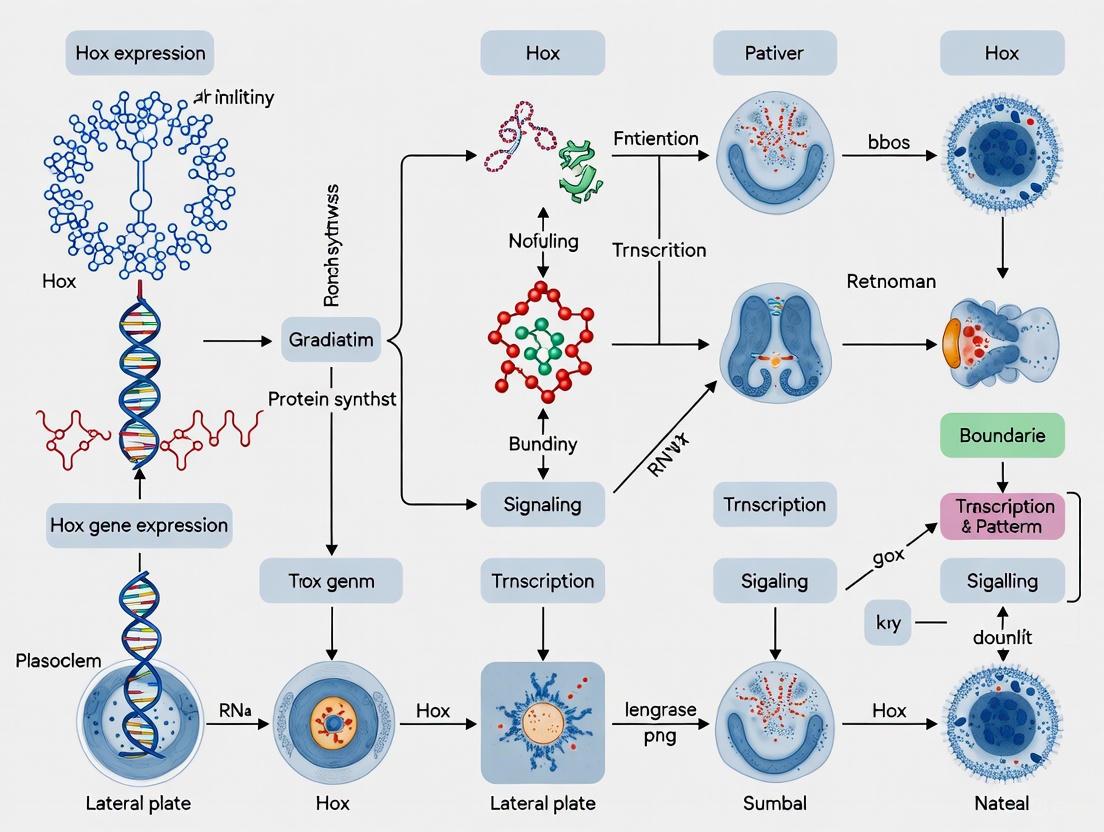
This comprehensive review synthesizes current knowledge on how Hox genes govern patterning of the lateral plate mesoderm (LPM), a key embryonic tissue that gives rise to paired appendages, cardiovascular system,...
Hox Gene Control of Lateral Plate Mesoderm Patterning: Mechanisms, Models, and Biomedical Implications
Abstract
This comprehensive review synthesizes current knowledge on how Hox genes govern patterning of the lateral plate mesoderm (LPM), a key embryonic tissue that gives rise to paired appendages, cardiovascular system, and other vital structures. We explore the foundational principles of Hox-mediated positional coding along the anterior-posterior axis, examining genetic evidence from zebrafish, mouse, and chick models that reveals both conserved functions and species-specific adaptations. The article details cutting-edge methodological approaches for investigating Hox function, addresses persistent challenges in deciphering complex Hox codes, and validates findings through cross-species comparative analysis. For researchers and drug development professionals, this work highlights how understanding Hox-directed LPM patterning provides critical insights into congenital disorders and evolutionary developmental biology.
Decoding the Hox Blueprint: Fundamental Principles of LPM Patterning
The lateral plate mesoderm (LPM) is a fundamental embryonic cell layer that gives rise to diverse vertebrate organ systems, including the cardiovascular system, kidneys, connective tissues, and paired appendages. Its proper patterning, largely governed by Hox gene expression, is not only critical for normal embryonic development but also offers profound insights into major evolutionary transitions, most notably the origin of paired fins and limbs. This whitepaper synthesizes current research on the developmental origin of the LPM and its evolutionary significance, with a specific focus on the mechanisms of Hox gene patterning. We provide a detailed analysis of key experimental models, methodologies, and reagent solutions to serve as a resource for researchers and drug development professionals working in developmental biology and regenerative medicine.
The lateral plate mesoderm is one of the primary derivatives of the mesodermal germ layer, flanking the intermediate and paraxial mesoderm in the developing embryo. Unlike the paraxial mesoderm, which forms somites and their derivatives, the LPM gives rise to structures including the heart, blood vessels, limb buds, and the lining of body cavities [1]. The evolutionary significance of the LPM is profoundly linked to the origin of paired appendages. For over a century, two principal hypotheses have sought to explain the evolutionary origin of paired fins and limbs: the gill arch theory, which proposes derivation from gill arches, and the lateral fin fold hypothesis, which posits that paired fins evolved from longitudinal, bilateral fin folds [2] [1]. Recent research, leveraging modern genetic lineage-tracing techniques in model organisms, has provided crucial molecular insights that are reshaping this classic debate, pointing toward a dual origin for the limb developmental program [1].
Central to the patterning of the LPM and the specification of limb position along the anterior-posterior axis is the spatiotemporally controlled expression of Hox genes. These highly conserved transcription factors exhibit a property known as temporal collinearity, wherein their sequential activation over time in the LPM determines the precise anatomical locations where limb buds will form [3] [4]. This review will delve into the cellular origins, Hox-mediated patterning, and evolutionary innovations associated with the LPM, supported by summarized quantitative data and detailed experimental protocols.
Developmental Origin and Derivatives of the Lateral Plate Mesoderm
Lineage Specification and Key Markers
The LPM is specified during gastrulation and can be distinguished from other mesodermal lineages by its unique gene expression signature. A cornerstone marker for LPM progenitor cells is the transcription factor Hand2. In zebrafish, TgBAC(hand2:EGFP) transgenes show robust expression in the LPM and its derivatives, including the heart, pharyngeal arches, and pectoral fin buds [2]. The hand2 mutant hands off (hans6) in zebrafish exhibits severe defects in these LPM-derived structures, confirming its essential role in their development [2].
Further evidence for LPM lineage comes from sophisticated genetic lineage tracing. The drl:creERT2; hsp70l:Switch transgenic system in zebrafish allows for permanent, tamoxifen-inducible labeling of LPM-primed mesoderm. This approach has demonstrated that the LPM contributes mesenchymal cells to the paired pectoral and pelvic fins, as well as to a specific unpaired structure, the pre-anal fin fold (PAFF) [2]. This finding is pivotal as it challenges the long-held dogma that all unpaired fins are exclusively derived from the paraxial mesoderm.
Table 1: Key Molecular Markers for Lateral Plate Mesoderm and Derivatives
| Marker Gene | Expression Domain | Function | Experimental Model |
|---|---|---|---|
| Hand2 | LPM progenitors, heart, pectoral fins, PAFF | Transcription factor essential for LPM-derived structure development | Zebrafish (TgBAC(hand2:EGFP), hans6 mutant) [2] |
| Tbx5 | Forelimb field LPM | Early marker of forelimb development, activates Fgf10 |
Chick [4] |
| Fgf10 | Limb bud mesenchyme | Required for initiation of limb budding, induces Fgf8 in ectoderm |
Chick, Mouse [4] |
| Bmp1a | Fin fold mesenchyme | Extracellular matrix maturation, collagen fiber organization | Zebrafish (frilly fin mutant) [2] |
The Somitic Frontier: A Compartmental Boundary
The concept of the "somitic frontier" delineates anatomical compartments based on embryonic origin. The dorsal compartment is formed solely from somitic (paraxial mesoderm) cells, while the ventral compartment comprises a mixture of cells from both somites and LPM [5]. Heterotopic transplantation experiments in quail and chick embryos reveal that somitic cells retain their original Hox code and morphological fate in the dorsal compartment. In striking contrast, when these somitic cells migrate ventrally across the somitic frontier, they adopt the Hox expression profile of the host LPM and contribute to local morphology [5]. This demonstrates that the LPM exerts a dominant patterning influence over surrounding tissues, establishing the regional identity of ventral structures.
Hox Gene Patterning of the Lateral Plate Mesoderm
Determining Limb Position
The role of Hox genes in specifying limb position represents a classic example of their function in assigning regional identity. Research in chick embryos has shown that Hox paralogy group (PG) 6 and 7 genes (e.g., Hoxa6, Hoxa7) are both necessary and sufficient to induce forelimb budding. Loss-of-function experiments using dominant-negative forms of Hoxa6/a7 in the prospective wing field lead to downregulation of Tbx5 and Fgf10 and a marked reduction in wing bud size [4]. Conversely, gain-of-function experiments, where Hoxa6 or Hoxa7 is overexpressed in the neck region (a normally limb-incompetent territory), are sufficient to induce ectopic Tbx5 and Fgf10 expression and initiate the formation of an ectopic forelimb bud [4].
Interestingly, more anterior Hox genes, such as Hox PG4 and PG5 (Hoxa4, Hoxa5), are necessary for normal forelimb development but are not sufficient to induce ectopic buds. This indicates an instructive role for Hox6/7 genes in limb field specification, whereas Hox4/5 genes may play a more permissive role [4]. The differential timing of Hox gene activation in the LPM, controlled by a combination of regulatory inputs and chromatin dynamics, ultimately creates a precise "Hox code" that delineates the positions of the forelimbs and hindlimbs along the body axis [3] [6].
Figure 1: Hox Gene Logic in Limb Positioning. Hox gene expression, activated by retinoic acid and Wnt signaling in a temporally collinear manner, creates a code that determines limb position. Hox PG6/7 genes provide an instructive signal necessary and sufficient for Tbx5 activation, while Hox PG4/5 provide a permissive signal.
Hox Codes in Mesodermal Subtypes
The Hox code is not uniform across all mesoderm. There is compelling evidence for independent Hox codes in the paraxial and lateral plate mesoderm. As demonstrated by transplantation studies, the Hox expression profile of paraxial mesoderm (somites) is cell-autonomous and maintained when transplanted to a new axial level. In contrast, when somitic cells migrate into the LPM-dominated ventral compartment, they shed their original Hox identity and acquire that of the host LPM [5]. This indicates that the LPM operates under a distinct, and potentially dominant, Hox regulatory regime that is essential for patterning the ventral body wall and appendages.
Table 2: Hox Gene Functions in Lateral Plate Mesoderm Patterning
| Hox Paralogy Group | Role in Limb Positioning | Key Findings | Experimental Evidence |
|---|---|---|---|
| PG4/5 (e.g., Hoxa4, Hoxa5) | Necessary but not sufficient | Required for normal Tbx5 activation; permissive role. |
Dominant-negative constructs in chick LPM downregulate Tbx5; overexpression in neck does not induce buds [4]. |
| PG6/7 (e.g., Hoxa6, Hoxa7) | Necessary and sufficient | Instructive role in limb field specification; can induce ectopic buds. | Dominant-negative constructs disrupt wing bud formation; overexpression induces ectopic Tbx5/Fgf10 and bud initiation in chick neck [4]. |
| Posterior Hox (e.g., Hoxa10) | Posterior identity | Associated with "trunk-to-tail" transition in neuromesodermal progenitors. | Single-cell RNA-seq in mouse embryos shows late expression in posterior NMPs [7]. |
Evolutionary Significance: The Origin of Paired Appendages
The evolutionary origin of paired fins, the precursors to terrestrial animal limbs, is a major unresolved question. A groundbreaking study has identified a potential developmental intermediate in zebrafish: the pre-anal fin fold (PAFF). Unlike all other median fins, which are derived from paraxial mesoderm, the PAFF is uniquely derived from the LPM, as evidenced by its expression of hand2 and its labeling in drl:creERT2 lineage tracing experiments [2]. Furthermore, the PAFF requires Hand2 function, as hans6 mutants show a significantly reduced PAFF, similar to defects in other LPM-derived structures.
The evolutionary significance is profound. The LPM-derived PAFF expresses a typical fin mesenchyme program (fbln1, itgb3b) and requires Bmp1a for collagen organization, just like other fins [2]. This discovery provides tangible evidence for an existing LPM-derived fin fold in a modern vertebrate that could represent an evolutionary precursor to paired appendages. The study further demonstrated that increasing BMP signaling could bifurcate the PAFF, effectively generating paired, LPM-derived fin folds [2]. This supports a modified lateral fin fold hypothesis, wherein an ancestral, continuous LPM-derived fin fold was co-opted and subdivided into paired appendages through changes in developmental signaling pathways.
Figure 2: Evolutionary Model of Paired Appendage Origin. Pectoral appendages are specified by Hox PG6/7 in the anterior LPM. The pre-anal fin fold (PAFF), a posterior LPM-derived structure, may represent an evolutionary precursor. Modulation of BMP signaling could have led to the bifurcation of such a structure, giving rise to paired pelvic appendages.
Experimental Models and Methodologies
Key Experimental Protocols
Lineage Tracing of Lateral Plate Mesoderm in Zebrafish
Objective: To definitively trace the fate of LPM cells and confirm their contribution to specific structures like the PAFF and paired fins [2].
- Transgenic System: Use the
drl:creERT2driver line, which expresses a tamoxifen-inducible Cre recombinase specifically in the LPM-primed mesoderm. Cross this line with a reporter line containing a loxP-flanked STOP cassette followed by a fluorescent protein (e.g.,hsp70l:Switchoractb2:loxP-mCherry-loxP-GFP). - Induction: Treat embryos with 4-Hydroxytamoxifen (4-OHT) during gastrulation or early somitogenesis to activate Cre recombinase. This results in permanent fluorescent labeling of the LPM and all its descendants.
- Analysis: Use confocal microscopy to screen for and image fluorescent cells in structures of interest (e.g., pectoral fin buds, PAFF) at later developmental stages (e.g., 3-5 days post-fertilization). The presence of fluorescent cells in the PAFF mesenchyme confirms its LPM origin.
Functional Analysis via Gene Knockdown in Zebrafish
Objective: To determine the functional requirement of an LPM marker (e.g., hand2) in the development of LPM-derived structures [2].
- Knockdown Method: Inject
hand2-specific antisense morpholinos (MOs) into single-cell stage zebrafish embryos to inhibit mRNA translation or splicing. - Phenotypic Analysis:
- Morphology: Compare the fin height of the PAFF and the ventral caudal fin fold in morphant versus wild-type/control morphant embryos at 3 and 5 dpf.
- Cell Behavior: Conduct transplantation experiments. Inject donor embryos (
hand2MO + a lineage tracer like fluorescent dextran) and transplant labeled cells into unlabeled wild-type hosts. Track the migration, morphology, and clone size of thehand2-deficient cells compared to control transplants.
In Vitro Derivation of LPM-Mesenchymal Stem Cells from Human Pluripotent Stem Cells (hPSCs)
Objective: To generate homogeneous human LPM-derived mesenchymal stem cells (LM-MSCs) for studying their properties and for therapeutic applications [8].
Stage 1: Primitive Streak Induction (48 hours)
- Culture hPSCs as single cells on Matrigel-coated plates.
- Use Stage 1 medium: DMEM/F12 base supplemented with 1% Penicillin/Streptomycin, 1% NEAA, 1% ITS, 1% L-Glutamine, and 3 μM CHIR99021 (a GSK3β inhibitor that activates Wnt signaling to induce mesendodermal progenitors).
Stage 2: Lateral Mesoderm Specification (6 days)
- Change to Stage 2 medium: Base same as Stage 1, with 3 μM CHIR99021 and 100 ng/mL Bone Morphogenetic Protein 7 (BMP-7). This combination promotes specification toward the lateral mesoderm lineage.
- Confirm LM identity by flow cytometry or qRT-PCR for markers like HAND1 and FOXF1.
Stage 3: Mesenchymal Stem Cell Expansion (3-4 weeks)
- Switch cells to a commercial, defined MSC medium (e.g., StemFit MSC medium).
- Passage cells using Accutase upon subconfluence. The resulting LM-MSCs express classic MSC surface markers (CD29, CD44, CD73, CD90, CD105, CD166) and lack hematopoietic/endothelial markers (CD45, CD34, CD11b, CD19, HLA-DR). They exhibit a HOX gene expression profile typical of skeletal MSCs from long bones and possess robust osteogenic and chondrogenic potential [8].
The Scientist's Toolkit: Essential Research Reagents
Table 3: Key Research Reagents for Lateral Plate Mesoderm Studies
| Reagent / Tool | Type | Function in Research | Example Use Case |
|---|---|---|---|
| TgBAC(hand2:EGFP) | Transgenic Line | Visualizes LPM progenitors and derivatives in vivo. | Identifying LPM-derived PAFF mesenchyme in zebrafish [2]. |
| drl:creERT2; hsp70l:Switch | Inducible Lineage Tracing System | Enables permanent, temporally-controlled genetic labeling of LPM lineage. | Confirming LPM origin of PAFF and pelvic fin osteoblasts [2]. |
| CHIR99021 | Small Molecule Inhibitor | GSK3β inhibitor; activates Wnt signaling. | Directing hPSCs toward primitive streak and mesoderm fates in vitro [8]. |
| BMP-7 | Recombinant Protein | Morphogen; patterns mesoderm and promotes LM fate. | Specifying LM from PS cells in hPSC differentiation protocol [8]. |
| Hoxa6/a7 Full-length Constructs | DNA Plasmid | For gain-of-function studies. | Electroporation into chick neck LPM to test sufficiency for limb bud induction [4]. |
| Dominant-negative Hoxa4-a7 | DNA Plasmid | For loss-of-function studies; disrupts native Hox function. | Electroporation into chick wing field LPM to test necessity for limb budding [4]. |
The lateral plate mesoderm is a central player in vertebrate development and evolution. Research over the past decade has solidified our understanding that its derivatives are far more extensive than previously known, encompassing not only the cardiovascular system and paired appendages but also specific unpaired fin folds, as evidenced by the LPM-derived PAFF in zebrafish. The patterning of this tissue layer by a temporally regulated Hox code is a exquisite mechanism for ensuring the precise placement of structures like limbs along the body axis.
Future research will continue to leverage single-cell technologies [7] and complex in vitro models [9] [8] to further decode the regulatory networks that govern LPM specification and differentiation. Understanding the fundamental biology of the LPM and its Hox code is not only essential for resolving long-standing evolutionary puzzles but also for advancing regenerative medicine, where the directed differentiation of stem cells into specific LPM lineages holds promise for generating patient-specific tissues for repair and therapy.
The Hox gene family comprises a set of highly conserved transcription factors that are fundamental to patterning the anterior-posterior (A-P) axis in virtually all bilaterally symmetrical animals (Bilateria) [10]. In vertebrates, these genes are notable for their unique genomic organization into dense clusters and their principle of expression collinearity, where the order of genes on the chromosome corresponds to their spatial and temporal sequence of expression in the developing embryo [10] [11]. This whitepaper details the genomic organization of Hox clusters, the mechanistic basis of collinear expression, and the critical role of Hox genes in patterning tissues including the lateral plate mesoderm (LPM), the progenitor tissue for structures including the limbs, heart, and body wall. Understanding these processes is essential for fundamental research into body plan establishment and has implications for regenerative medicine and therapeutic intervention in developmental disorders.
Genomic Organization of Hox Clusters in Vertebrates
Evolution and Cluster Duplication
The Hox gene cluster is an ancestral feature of the Bilateria. The protostome-deuterostome last common ancestor (P-DLCA) is inferred to have possessed a single Hox cluster used for A-P axis patterning [10]. During vertebrate evolution, this single cluster underwent whole-genome duplication events. Most mammals, including humans and mice, possess 39 Hox genes distributed across four clusters (HOXA, HOXB, HOXC, and HOXD) located on different chromosomes [11]. Some teleost fish, like zebrafish, underwent a third, teleost-specific genome duplication (TSGD), resulting in 48 Hox genes distributed across seven clusters [12]. Despite these duplications, the fundamental organization and regulatory logic of the clusters have been preserved.
The Principle of Collinearity
The organization of Hox genes within their clusters is not random; it is directly linked to their expression through two key principles:
- Spatial Collinearity: The order of genes from the 3' to the 5' end of the cluster corresponds to the anterior to posterior order of their expression domains along the embryonic axis [10] [13]. Genes at the 3' end of a cluster (e.g., HoxB1) pattern more anterior regions, while genes at the 5' end (e.g., HoxB9) pattern more posterior regions.
- Temporal Collinearity: The order of genes along the chromosome also corresponds to the temporal sequence of their activation during development. The 3' genes are activated first, and the 5' genes are activated later [13]. This is particularly evident during gastrulation and the progressive patterning of the embryonic axis.
Table 1: HoxB Cluster Gene Activation Sequence in the Chick Embryo
| HoxB Gene | Developmental Stage of Consistent Activation* | Initial Spatial Domain of Expression |
|---|---|---|
| HoxB1 | HH3 | Primitive streak (excluding Hensen's node), extending radially |
| HoxB2 | HH3+ | Posterior primitive streak, extending rostrally; salt-and-pepper pattern |
| HoxB3 | HH4 | Posterior half of the primitive streak |
| HoxB5 | HH5 | Posterior primitive streak cells contributing to extraembryonic mesoderm |
| HoxB6 | HH6 | Not detected before HH6; expressed in a sharp band in the presomitic mesoderm |
| HoxB7 | HH7 | Not detected before HH7; expressed in a sharp band in the presomitic mesoderm |
| HoxB8 | HH8 | Not detected before HH8; expressed in a sharp band in the presomitic mesoderm |
| HoxB9 | HH9 | Not detected before HH9; expressed in a sharp band in the presomitic mesoderm |
Stage at which in situ hybridization staining is observed in >50% of embryos. Data adapted from [13].
The Molecular Regulation of Collinear Hox Expression
Chromatin Dynamics and Regulatory Landscapes
The collinear expression of Hox genes is governed by a sophisticated epigenetic landscape that makes the clusters "competent" for expression in a temporally and spatially ordered sequence. The chromatin state of Hox genes shifts from a closed, non-expressible state to an open, expressible state in a progressive, 3'-to-5' manner [10]. This is regulated by opposing complexes of trithorax group (TrxG) and Polycomb group (PcG) proteins, which maintain heritable states of gene activation and repression, respectively [10]. This ensures that the Hox expression pattern, once established, is remembered by cells throughout development.
A key feature of Hox cluster regulation is enhancer sharing, where a single regulatory element can control multiple Hox genes. For example, in Drosophila, the iab-5 regulatory region controls both abd-A and Abd-B [10]. Similarly, in mice, the CR3 enhancer regulates the anterior expression boundaries of both Hoxb4 and Hoxb3 [10]. This shared regulation helps coordinate the nested patterns of Hox expression.
Signaling Pathways and Temporal Control
The initial activation of Hox genes during gastrulation is controlled by a combination of signaling gradients. Wnt, Fgf, and Retinoic Acid (RA) pathways have been implicated in this process, with RA often playing a posteriorizing role [13]. The timing of Hox gene activation is crucial for determining the ultimate position of structures along the A-P axis. For instance, in birds, natural variations in the timing of Hox gene activation during gastrulation between species like zebra finch, chicken, and ostrich correlate with differences in forelimb (wing) position [14].
A link has been proposed between the somitogenesis "clock"—the molecular oscillator that segments the paraxial mesoderm into somites—and the timing of Hox activation in the mesoderm. In the chick embryo, HoxB2 expression is cyclic in the rostral presomitic mesoderm, with the same periodicity as somite formation, suggesting coordination between the processes of segmentation and A-P patterning [13].
Diagram: Molecular regulation of Hox gene collinearity and its role in LPM patterning. Global morphogen gradients influence the progressive opening of Hox cluster chromatin, leading to collinear gene expression that patterns the lateral plate mesoderm and determines limb position.
Hox Gene Function in Lateral Plate Mesoderm Patterning
Determining Limb Position along the A-P Axis
The LPM gives rise to the forelimb and hindlimb fields. A pivotal function of Hox genes is to determine the precise position of these limb buds along the A-P axis. Research in avian models has shown that this process begins during gastrulation. The dynamic, collinear activation of Hox genes in the forming LPM generates a "Hox code" that pre-patterns the mesoderm and defines the location of the limb fields [14].
The transcription factor Tbx5 is a critical marker and effector of forelimb initiation. The position of the forelimb is determined by the balance between Hoxb4, which activates Tbx5, and posterior Hox genes like those from the Hox9 group, which repress Tbx5 [14]. The anterior boundary of Hox9 expression effectively sets the posterior limit of the forelimb field, thereby defining its A-P position.
Experimental Evidence from Avian Models
Key insights into the role of Hox genes in LPM patterning come from functional experiments in chick embryos:
- Functional Perturbation: Knockdown of Hoxb4 during gastrulation leads to a posterior shift in the Tbx5 expression domain and a consequent posterior shift in forelimb position. Conversely, misexpression of Hoxb4 can expand the Tbx5 domain anteriorly [14].
- Lineage Analysis: Dynamic lineage tracing demonstrates that the forelimb, interlimb, and hindlimb fields are generated and patterned concomitantly with the collinear activation of Hox genes during gastrulation [14].
- Comparative Biology: The timing of Hox gene activation varies between bird species. In the ostrich, where wings are positioned more anteriorly, the activation of posterior Hox genes like Hoxc9 is delayed compared to the chicken, allowing the forelimb field to be established in a more anterior location [14].
Table 2: Key Hox Genes in Lateral Plate Mesoderm and Limb Patterning
| Hox Gene / Factor | Role in LPM/Limb Patterning | Experimental Evidence |
|---|---|---|
| Hoxb4 | Activator of Tbx5; promotes forelimb field specification | Loss-of-function causes posterior shift of forelimb; gain-of-function expands forelimb field anteriorly [14]. |
| Hox9 Genes (e.g., Hoxc9) | Repressor of Tbx5; sets posterior boundary of forelimb field | Anterior expression boundary defines forelimb position; delayed activation in ostrich correlates with more anterior wing position [14]. |
| Tbx5 | Critical downstream target; effector of forelimb initiation | Expression domain directly correlates with forelimb position and is regulated by Hox genes [14]. |
| Hoxd11 | Patterns the emerging limb bud itself | In mouse mutants, premature activation shifts expression domains in LPM and paraxial mesoderm, altering patterning [15]. |
Experimental Methodologies for Investigating Hox Gene Regulation and Function
The following protocols are central to the research cited in this whitepaper and are essential for investigating Hox gene function in vertebrate model systems.
Protocol: Spatiotemporal Mapping of Hox Gene Expression via Whole-Mount In Situ Hybridization
This technique is fundamental for establishing the expression domains of Hox genes during early embryogenesis [13].
- Probe Synthesis: Generate digoxigenin (DIG)-labeled antisense RNA probes complementary to the mRNA of the target Hox gene (e.g., HoxB1-B9).
- Embryo Collection & Fixation: Collect chick embryos at precise developmental stages (HH1-HH10). Fix in 4% paraformaldehyde (PFA) in phosphate-buffered saline (PBS) to preserve morphology and RNA.
- Hybridization: Rehydrate fixed embryos through a methanol series. Permeabilize with proteinase K. Incubate with the DIG-labeled probe in hybridization buffer at 65-70°C overnight.
- Immunological Detection: Wash off excess probe. Incubate with an anti-DIG antibody conjugated to alkaline phosphatase (AP).
- Colorimetric Reaction: Develop the signal using the AP substrates NBT/BCIP, which yield a purple-blue precipitate at the site of gene expression.
- Analysis: Image embryos whole-mount. For detailed spatial analysis, embed in resin and section histologically (e.g., 10 µm sections) to determine expression in specific tissues like neural tube, paraxial mesoderm, and LPM.
Protocol: Functional Perturbation of Hox Genes during Gastrulation
To establish causality, Hox gene function must be manipulated in vivo [14].
- Electroporation of Plasmid Vectors:
- Knockdown: Design short hairpin RNA (shRNA) constructs targeting the Hox gene of interest (e.g., Hoxb4).
- Overexpression: Clone the full-length Hox cDNA into an expression vector with a strong promoter (e.g., CAGGS).
- Preparation: Inject the plasmid DNA into the lumen of the gastrulating chick embryo (e.g., at HH3-4) in the region of the primitive streak/LPM progenitors.
- Electroporation: Apply brief electrical pulses (5-10V, 50ms pulses) to facilitate DNA uptake into the cells of the targeted tissue.
- Lineage Tracing: Co-electroporate a fluorescent reporter plasmid (e.g., pCAGGS-GFP) to mark transfected cells and track their descendants.
- Phenotypic Analysis: Allow embryos to develop to limb bud stages (HH18-20). Analyze changes in the expression of marker genes (e.g., Tbx5 via in situ hybridization) and assess morphological shifts in limb position.
The Scientist's Toolkit: Key Research Reagents
Table 3: Essential Reagents for Hox Gene and LPM Patterning Research
| Reagent / Resource | Function and Application | Example Use Case |
|---|---|---|
| DIG-Labeled RNA Probes | Sensitive detection of specific Hox mRNA transcripts in tissue sections or whole embryos. | Mapping the precise anterior expression boundary of Hoxb9 in the chick LPM [13]. |
| shRNA Expression Vectors | Knockdown of specific Hox gene function to assess loss-of-function phenotypes. | Determining the requirement for Hoxb4 in establishing the Tbx5 expression domain [14]. |
| Hox cDNA Overexpression Vectors | Ectopic expression to assess gain-of-function phenotypes and gene hierarchy. | Testing if Hoxb4 is sufficient to expand the forelimb field anteriorly [14]. |
| Fluorescent Reporter Plasmids (e.g., GFP) | Lineage tracing and visualization of electroporated cells and their progeny. | Fate mapping of Hox-expressing cells in the gastrula to their destinations in the LPM [14]. |
| Antibodies (Anti-DIG-AP) | Immunological detection of hybridized DIG-labeled probes for in situ hybridization. | Colorimetric visualization of Hox gene expression patterns [13]. |
| Morphogens (RA, FGF, WNT Agonists/Antagonists) | To manipulate signaling pathways that regulate Hox gene expression. | Testing the role of RA signaling in the timing of Hox gene activation during gastrulation. |
The study of Hox gene clusters provides a paradigm for understanding how genomic organization is leveraged to control complex transcriptional programs during development. The principles of collinearity are central to the faithful patterning of the vertebrate body axis, with precise control over the timing and spatial domain of each Hox gene being critical for determining the location of structures such as the limbs. Research focused on the lateral plate mesoderm has been particularly revealing, showing that the Hox code is established early during gastrulation to define fields like the forelimb.
Future research will continue to unravel the complex chromatin-level regulation that enforces collinearity and the downstream gene networks through which Hox proteins execute their patterning functions. The continued use of advanced gene editing, single-cell transcriptomics, and live imaging in a variety of model organisms will deepen our understanding of these master regulators of animal body plans. Furthermore, investigating the postnatal roles of Hox genes in tissue homeostasis, repair, and cancer [11] [16] underscores their lasting biological and medical significance beyond embryonic development.
Hox genes, a family of evolutionarily conserved transcription factors, constitute a fundamental regulatory system encoding positional information along the anterior-posterior (A-P) body axis during embryonic development. Through a combinatorial code of spatially and temporally restricted expression, these genes instruct cell fate and tissue patterning, thereby defining anatomical territories. This whitepaper delineates the mechanisms of Hox-driven patterning, with a specific focus on its role in the lateral plate mesoderm, the embryonic tissue that gives rise to structures of the limb and body wall. We further explore the implications of Hox code dysregulation in cancer and the consequent therapeutic opportunities, providing a detailed experimental framework for ongoing research in this field.
The concept of positional information is central to developmental biology, proposing that cells acquire spatial identities that guide their subsequent differentiation and morphogenesis. The Hox gene family is a principal executor of this concept. These genes encode transcription factors that provide a molecular blueprint, specifying the identity of body regions along the A-P axis—from the neck to the tail in vertebrates. This "Hox code" is defined by the unique combination of Hox genes expressed in a given cell population, which in turn dictates the structural fate of that region [17] [18].
The lateral plate mesoderm (LPM) is a key site of Hox gene action. The LPM is the mesoderm found at the periphery of the embryo, which subsequently splits into two layers: the somatopleure (which forms the body wall) and the splanchnopleure (which forms the circulatory system and heart) [19]. The precise patterning of this tissue into distinct anatomical structures, such as the different segments of the limb, is critically dependent on the regionalized expression of Hox genes. Understanding the establishment and interpretation of the Hox code in the LPM is therefore essential for deciphering the principles of vertebrate body plan organization [17].
Genomic Organization and the Principle of Collinearity
A defining feature of Hox genes is their genomic organization, which is intimately linked to their expression patterns.
- Cluster Organization: In mammals, the 39 Hox genes are organized into four clusters (A, B, C, and D) located on four different chromosomes [20] [18]. Each cluster contains up to 11 genes, classified into 13 paralog groups based on sequence similarity and position within the cluster [17].
- Spatial and Temporal Collinearity: Hox genes exhibit a remarkable phenomenon termed collinearity. Genes located at the 3' end of a cluster (e.g., paralog groups 1-4) are activated earlier and are expressed in more anterior regions of the embryo. Conversely, genes at the 5' end (e.g., paralog groups 9-13) are activated later and are expressed in more posterior regions [17] [18]. This colinear arrangement ensures a precise spatiotemporal sequence of gene activation that mirrors the A-P axis of the developing embryo.
Table 1: Hox Gene Clusters and Their Genomic Locations in Humans
| Cluster | Chromosomal Location | Number of Genes | General Expression Domain |
|---|---|---|---|
| HOXA | Chromosome 7 | 11 | Hindbrain, posterior body, limbs |
| HOXB | Chromosome 17 | 10 | Hindbrain, posterior body |
| HOXC | Chromosome 12 | 9 | Hindbrain, spinal cord, hindlimb |
| HOXD | Chromosome 2 | 9 | Posterior body, limbs |
Hox Codes in Patterning the Lateral Plate Mesoderm and Limb
The role of Hox genes in patterning the LPM is particularly evident in the developing limb, a derivative of the LPM. The vertebrate limb is divided into three main segments along the proximodistal (PD) axis: the stylopod (upper arm/thigh), zeugopod (forearm/shank), and autopod (hand/foot). Specific posterior Hox genes are responsible for patterning each of these segments [17].
- Non-Overlapping Function in Limb Patterning: Unlike their combinatorial role in the axial skeleton, Hox paralog groups in the limb often function in a more discrete, segment-specific manner. The posterior genes of the HoxA and HoxD clusters are the primary regulators [17].
- Stromal Connective Tissue as a Hub for Hox Activity: Notably, Hox genes are not typically expressed in the differentiated cartilage or bone cells of the limb skeleton. Instead, they are highly expressed in the surrounding stromal connective tissues, including the muscle connective tissue and tendon precursors. This suggests that Hox genes pattern the limb skeleton indirectly by first instructing the connective tissue framework, which then guides the morphogenesis of other tissues [17].
Table 2: Hox Gene Function in Vertebrate Limb Patterning
| Limb Segment | Hox Paralog Group | Major Phenotype upon Loss-of-Function | Key Expressed Tissues in Limb Bud |
|---|---|---|---|
| Stylopod (humerus/femur) | Hox9, Hox10 | Severe mis-patterning of proximal limb elements; loss of Shh expression (Hox9) [17] | Limb bud mesenchyme, stromal connective tissue |
| Zeugopod (radius-ulna/tibia-fibula) | Hox11 | Severe zeugopod mis-patterning; loss of forearm/shank elements [17] | Limb bud mesenchyme, stromal connective tissue |
| Autopod (hand/foot) | Hox12, Hox13 | Complete loss of autopod skeletal elements; failure to form digits [17] | Limb bud mesenchyme, stromal connective tissue |
The following diagram illustrates the signaling network between the lateral plate mesoderm, myotome, and ectoderm during limb development, driven by Hox-initiated factors:
Epigenetic Regulation of Hox Gene Expression
The precise spatiotemporal expression of Hox genes is governed by a complex epigenetic code that involves dynamic modifications to chromatin structure without altering the underlying DNA sequence [21].
- The Histone Code: The N-terminal tails of core histone proteins (H2A, H2B, H3, H4) are subject to post-translational modifications—including acetylation, methylation, phosphorylation, and ubiquitination. These modifications create a "histone code" that is read by other proteins to determine whether a genomic region is open and active for transcription, or closed and silenced [21].
- Writers, Erasers, and Readers: The establishment of this code is carried out by enzyme complexes ("writers") such as histone acetyltransferases (HATs) and histone methyltransferases (HMTs). The modifications can be removed by "erasers" like histone deacetylases (HDACs) and histone demethylases (HDMTs). The functional outcome is mediated by "readers," proteins with domains like bromodomains (recognizing acetylated lysines) and chromodomains (recognizing methylated lysines) that recruit additional effector proteins [21].
- Hox Gene Regulation: The chromatin state of Hox clusters is a major determinant of their expression. For instance, methylation of histone H3 at lysine 4 (H3K4me) is associated with active, transcriptionally competent chromatin, while methylation of H3 at lysine 27 (H3K27me) is associated with silenced, heterochromatic states. The table below summarizes key histone modifications and their correlation with Hox gene activity, as observed in model organisms like C. elegans [21].
Table 3: Correlation of Histone Modifications with Transcriptional Status in Hox Genes
| Histone Modification | State (i=0,1,2,3) | Chromatin State | Transcriptional Status |
|---|---|---|---|
| H3K4me(i) | i=1,2,3 | Euchromatin | On (Active) [21] |
| H3K9me(i) | i=0 | Constitutive Heterochromatin | On (Active) [21] |
| H3K27me(i) | i=0 | Constitutive Heterochromatin | On (Active) [21] |
| H3K36me(i) | i=1,2,3 | Euchromatin | On (Active) [21] |
The following workflow outlines a protocol for analyzing the Hox epigenetic code, from chromatin immunoprecipitation to data interpretation:
Dysregulation of Hox Codes in Cancer and Therapeutic Implications
Given their pivotal role in controlling cell identity, proliferation, and differentiation during development, it is not surprising that the dysregulation of Hox gene expression is a common feature in cancer. This mis-expression can involve either oncogenic activation or tumor-suppressive silencing of specific Hox genes, depending on the context [22] [20] [18].
- HOX Genes as Biomarkers: Comprehensive analyses of HOX gene expression across multiple cancer types have revealed distinct dysregulation signatures. For example, a systematic study comparing data from The Cancer Genome Atlas (TCGA) with healthy tissue data from GTEx found that HOX gene clusters can effectively discriminate between tumor and healthy samples. In certain cancers like glioblastoma (GBM), a large number of HOX genes (36 out of 39) show significantly altered expression [20].
- Role in Cancer Stem Cells (CSCs): HOX genes are implicated in maintaining and regulating the self-renewal of normal stem cells and CSCs. For instance, ectopic expression of HOXB4 has been shown to enhance the self-renewal capacity of hematopoietic stem cells without inducing leukemia, highlighting its potent role in stem cell biology. In a cancerous context, such pathways can be co-opted to sustain the CSC population that drives tumor initiation and metastasis [18].
- Epigenetic Therapies: Since the aberrant expression of HOX genes in cancer is often driven by epigenetic alterations rather than genetic mutations, they present attractive targets for epigenetic therapy. Drugs that target the "writers" or "erasers" of the histone code, such as histone deacetylase inhibitors (HDACi) or inhibitors of histone methyltransferases, could potentially be used to restore normal HOX gene expression patterns and halt cancer progression [21] [18].
Table 4: Examples of HOX Gene Dysregulation in Human Cancers
| Cancer Type | Dysregulated HOX Genes | Nature of Dysregulation | Potential Clinical Implication |
|---|---|---|---|
| Breast Cancer | HOXB4, HOXB7, HOXB9 | Upregulated [20] | Biomarker for progression and prognosis [18] |
| Prostate Cancer | HOXB3, HOXC4 | Upregulated (e.g., HOXB3 transactivates CDCA3) [20] | Promotes cell progression and invasion [18] |
| Brain Cancer (GBM) | HOXA2, HOXA4, HOXB2, HOXB3, HOXB4, HOXC4 | Upregulated (specific to brain cancers) [20] | May serve as a tumor-specific signature |
| Acute Myeloid Leukemia | Multiple HOX genes (e.g., HOXA9) | Upregulated | Associated with poor survival; therapeutic target [18] |
The Scientist's Toolkit: Essential Reagents and Models for Hox Research
Research into Hox gene function relies on a specialized set of reagents, model organisms, and analytical tools. The following table details key resources for investigating Hox codes in development and disease.
Table 5: Research Reagent Solutions for Hox Gene Studies
| Reagent / Model | Specific Example | Function & Application |
|---|---|---|
| Chromatin Modification Inhibitors | HDAC Inhibitors (e.g., SAHA), EZH2 (HMT) Inhibitors | Probe the epigenetic control of Hox genes; potential therapeutic agents to reverse aberrant Hox expression [21] [18]. |
| Specific Antibodies | Anti-H3K4me3, Anti-H3K27me3, Anti-HOX (cluster-specific) | Identify histone modification states (ChIP-seq) and visualize Hox protein expression patterns (IHC/IF) [21]. |
| Model Organisms | C. elegans, Mouse (Mus musculus) | Study Hox gene function in a whole-organism context. C. elegans offers simplicity and homologs to human epigenetic regulators (e.g., MES-2/EZH2). Mouse models allow for tissue-specific gene knockout [21] [17]. |
| Loss-of-Function Models | Knockout Mice (e.g., Hoxa9-/-;Hoxb9-/-;Hoxc9-/-;Hoxd9-/-) | Determine the functional requirement of Hox paralog groups in patterning specific anatomical territories (e.g., limb, axial skeleton) [17]. |
| Bioinformatics Databases | TCGA, GTEx, UCSC Xena Browser | Perform comprehensive analysis of HOX gene expression in healthy and cancerous human tissues [20]. |
The Hox code represents a fundamental mechanism for translating positional information into anatomical diversity along the A-P axis. Its action in tissues like the lateral plate mesoderm orchestrates the formation of complex structures, ensuring that the right elements form in the right locations. The fidelity of this code is maintained by a sophisticated epigenetic system, and its disruption is increasingly linked to carcinogenesis. Future research, leveraging the tools and protocols outlined herein, will continue to decrypt the Hox code, offering profound insights into developmental biology and opening new avenues for diagnosing and treating human diseases, including cancer.
The precise patterning of the mesoderm during embryonic development is governed by the integrated activity of multiple signaling pathways. Bone Morphogenetic Protein (BMP), Fibroblast Growth Factor (FGF), and Retinoic Acid (RA) pathways form a core signaling network that establishes positional information and mediates cell fate decisions. Emerging evidence demonstrates that these pathways function not in isolation but through extensive crosstalk to regulate the expression and activity of Hox genes, which provide the transcriptional framework for anterior-posterior patterning. This review synthesizes current understanding of how BMP, FGF, and RA signaling interact both antagonistically and synergistically to control Hox gene expression during lateral plate mesoderm patterning, with particular relevance to research and therapeutic applications.
The lateral plate mesoderm gives rise to diverse tissues including the cardiovascular system, limb buds, and body wall structures. Its patterning along the anterior-posterior (AP) axis is primarily directed by the nested expression of Hox genes, which are themselves regulated by extrinsic signaling gradients. BMP, FGF, and RA pathways serve as key mediators of these gradients, establishing a complex regulatory network that ensures proper tissue specification and morphogenesis.
Research over the past decade has revealed that these pathways engage in extensive mutual regulation. BMP and FGF signaling often function antagonistically, while RA frequently opposes FGF signaling and modulates BMP activity [23] [24]. This interconnected signaling network precisely controls the spatiotemporal expression of Hox genes, which ultimately execute patterning decisions through the regulation of downstream effector genes. Understanding these interactions provides critical insights for developmental biology and regenerative medicine approaches aimed at tissue engineering and repair.
BMP Signaling
BMP signaling operates as a key lateralizing factor during mesoderm patterning. The pathway is activated upon binding of BMP ligands to receptor complexes, leading to phosphorylation of SMAD transcription factors (primarily SMAD1/5/8). These then complex with SMAD4 and translocate to the nucleus to regulate target gene expression [23].
In post-gastrulation embryos, BMP signaling is necessary and sufficient for endothelial specification from neuromesodermal progenitor (NMP)-derived mesoderm. Inhibition of BMP signaling using dominant-negative receptors or small molecule inhibitors (e.g., DMH1) results in loss of endothelial tissue and ectopic somite formation, while constitutive activation expands vascular endothelium at the expense of paraxial mesoderm [23]. The pathway executes these fate decisions primarily through induction of Id helix-loop-helix (HLH) proteins, which antagonize basic HLH (bHLH) transcription factors that specify medial fates [23].
Table 1: Quantitative Effects of BMP Signaling Manipulation on Mesodermal Fate Decisions
| Experimental Condition | Model System | Muscle Fate (%) | Endothelial Fate (%) | Mixed/Other Fates (%) |
|---|---|---|---|---|
| Control cells | Zebrafish | 81% | 0% | 19% |
| BMP signaling activation | Zebrafish | 8% | 39% | 53% |
| BMP inhibition (DMH1) | Zebrafish | Expanded domain | Lost | N/A |
| BMP inhibition (HS:dnbmpr) | Zebrafish | Expanded domain | Lost | N/A |
FGF Signaling
FGF signaling promotes medial mesodermal fates and maintains progenitor populations through MAPK pathway activation. During body axis extension, FGF functions as a general repressor of differentiation, preserving caudal progenitor cells in a pluripotent state [25]. The pathway exerts its effects through induction of bHLH transcription factors including myf5, myod, and msgn1, which drive specification toward medial fates such as somites [23].
FGF also modulates other signaling pathways through multiple mechanisms. It can repress transcriptional activation of BMP ligands and inhibit BMP signaling through MAPK-mediated phosphorylation of the SMAD linker region, targeting it for proteasomal degradation [23]. Additionally, FGF engages in mutual antagonism with RA signaling, creating opposing gradients that pattern the extending body axis [24] [25].
Retinoic Acid Signaling
RA, a vitamin A derivative, functions as a morphogen that provides positional information during mesoderm patterning. RA synthesis is mediated by enzymes including ALDH1A2 and RDH10, while degradation is controlled by CYP26 family enzymes [24]. RA binds to nuclear receptors (RAR/RXR heterodimers) that regulate transcription of target genes containing retinoic acid response elements (RAREs).
In mesodermal patterning, RA promotes differentiation and opposes the progenitor-maintaining effects of FGF signaling [25]. RA signaling is required for neuronal differentiation, expression of ventral neural patterning genes, and somite boundary formation [25]. The pathway exhibits dynamic spatiotemporal regulation through positive and negative feedback mechanisms, including activation of nuclear receptors (RARB, NR2F1/2) and degrading enzymes (CYP26, DHRS3) [24].
Table 2: Phenotypic Consequences of RA Pathway Manipulations in Mouse Models
| Genetic Manipulation | Somitogenesis Defects | Heart Defects | Limb Defects | Tail Defects |
|---|---|---|---|---|
| Aldh1a2−/− | Asymmetric, under-developed | No looping, hypoplastic atria | No limb buds | Shorter |
| Rdh10−/− | First six somites under-developed | Ventricle misalignment | Stunted forelimbs | Shorter |
| Cyp26a1−/− | Normal | Under-developed endothelium | Sirenomelic hindlimbs | Shorter |
| Rara−/−;Rarb−/− | N/A | Truncus arteriosus, VSD | Normal | N/A |
Hox Genes
Hox genes encode transcription factors that determine AP positional identity across bilaterian animals. They are arranged in clusters and exhibit temporal and spatial collinearity in their expression patterns. Hox genes integrate signaling information from BMP, FGF, and RA pathways to specify regional properties of mesodermal derivatives [26].
RA is a well-established direct regulator of Hox gene expression, particularly anterior Hox genes [27] [24]. Recent research has also revealed that Hox genes can modulate cellular responses to signaling pathways, creating feedback loops that refine patterning outcomes. For example, anterior Hox genes (Hoxa1, Hoxb1, Hoxa2) can induce neural crest specification through interaction with BMP and Notch signaling pathways [28].
Pathway Integration and Crosstalk
BMP-FGF Interactions
BMP and FGF signaling pathways engage in complex crosstalk during mesoderm patterning. While BMP promotes lateral fates and FGF specifies medial fates, they do not function independently. Instead, they converge on the regulation of bHLH transcription factor activity through opposing mechanisms:
- FGF induces bHLH transcription factors (myf5, myod, msgn1) that promote medial fate specification [23]
- BMP counters this by inducing Id HLH proteins that antagonize bHLH transcription factors, thereby promoting lateral fates [23]
- FGF can inhibit BMP signaling through MAPK-mediated phosphorylation of SMAD linker regions, targeting them for proteasomal degradation [23]
- FGF also represses transcriptional activation of BMP ligands [23]
This molecular integration creates a binary switch mechanism that patterns mesoderm into medial versus lateral fates based on the relative activities of these pathways.
FGF-RA Antagonism
FGF and RA signaling form opposing gradients that control the balance between progenitor maintenance and differentiation during axis extension. This antagonistic relationship operates through multiple mechanisms:
- RA attenuates Fgf8 expression in neuroepithelium and paraxial mesoderm [25]
- FGF maintains caudal progenitors in an undifferentiated state, while RA promotes differentiation [25]
- The opposing gradients position segment boundaries and control the timing of neuronal differentiation [25]
- RA and FGF pathways are mutually inhibitory, creating a signaling system that coordinates differentiation with axis extension [25]
In the context of Hox patterning, this FGF-RA antagonism helps establish the nested expression patterns of Hox genes along the AP axis, with RA promoting more anterior Hox expression and FGF maintaining a posterior progenitor identity.
BMP-RA Interactions
While less extensively characterized than FGF-RA interactions, BMP and RA signaling also exhibit crosstalk during mesoderm patterning. In lateral plate mesoderm, BMP and RA signaling cooperate in limb bud initiation, with RA providing a permissive environment for Fgf8 repression and Tbx5 activation [24]. This interaction may be mediated through Hox transcription factors, which are targets of RA and known regulators of Tbx5 [24].
Diagram 1: BMP-FGF-RA signaling network in mesoderm patterning. Arrows indicate activation; T-bars indicate inhibition.
Experimental Approaches and Methodologies
Model Systems
Current understanding of BMP, FGF, and RA integration with Hox patterning derives from multiple model systems, each offering distinct advantages:
Zebrafish: Ideal for live imaging and genetic manipulation. Studies in zebrafish NMPs revealed the binary medial-lateral fate switch controlled by BMP and FGF [23]. Transgenic lines such as fli1:GFP (endothelial reporter) and neurod1:egfp (neuronal reporter) enable fate tracking.
Mouse: Provides relevance to mammalian development. Mouse NMP grafting experiments demonstrated conservation of BMP-mediated lateralization mechanisms [23]. Genetic tools include inducible Cre lines and RARE-lacZ reporters for visualizing RA signaling.
Drosophila: Powerful for genetic dissection of Hox gene function. Studies of abdominal-A (abdA) revealed Hox control of neural stem cell size and division timing [29].
Chick: Accessible for surgical manipulation and electroporation. Used to demonstrate Hox gene induction of neural crest specification through BMP and Notch signaling interactions [28].
Key Methodologies
Genetic Manipulation:
- Loss-of-function: Dominant-negative receptors (HS:dnbmpr), small molecule inhibitors (DMH1 for BMP), gene knockouts
- Gain-of-function: Constitutively active receptors (HS:caalk6), RA supplementation, Hox gene electroporation
- Lineage tracing: Cre-lox systems, transplantation assays
Signaling Visualization:
- Transgenic reporters: RARE-lacZ for RA signaling, BRE-luc for BMP signaling
- Fluorescent in situ hybridization: RNAscope for precise transcript localization
- scRNA-seq: Identification of distinct transcriptional states (e.g., ret+ pioneers vs. ret- followers) [27]
Quantitative Assessment:
- Cell fate quantification: Single-cell transplantation and clonal analysis
- Proliferation measurements: BrdU incorporation, mitotic index
- Cell size analysis: Membrane labeling and volumetric measurements [29]
Table 3: Essential Research Reagents for Studying Signaling Pathways in Mesoderm Patterning
| Reagent/Category | Specific Examples | Function/Application |
|---|---|---|
| BMP Modulators | DMH1, LDN-193189 | Small molecule BMP receptor inhibitors |
| HS:dnbmpr transgenic | Inducible BMP pathway inhibition | |
| HS:caAlk6 transgenic | Inducible BMP pathway activation | |
| FGF Modulators | SU5402, PD173074 | FGF receptor inhibitors |
| RA Modulators | DEAB (ALDH1A2 inhibitor) | RA synthesis inhibition |
| BMS-493 (RAR antagonist) | RA signaling antagonism | |
| DAPT (γ-secretase inhibitor) | Notch signaling inhibition | |
| Transgenic Reporters | fli1:GFP | Endothelial lineage tracing |
| RARE-lacZ/RARE-GFP | RA signaling activity reporting | |
| neurod1:EGFP | Neuronal differentiation reporting | |
| Expression Vectors | pCAGGS-IRES-NLS-GFP | Hox gene expression in chick electroporation |
| ΔN-TCF4 | Wnt pathway inhibition | |
| noggin expression vector | BMP ligand sequestration |
Hox Patterning Integration with Signaling Pathways
RA-Hox Axis
Retinoic acid serves as a primary regulator of Hox gene expression during mesoderm patterning. The molecular mechanism involves direct binding of RA-bound RAR/RXR heterodimers to RAREs in Hox gene regulatory regions [24]. This relationship exhibits temporal and spatial specificity:
- Anterior Hox genes (e.g., Hoxa1, Hoxb1, Hoxa2) are particularly responsive to RA regulation [28]
- RA signaling establishes anterior expression boundaries of specific Hox genes
- The RA-Hox axis helps translate morphogen gradients into discrete regional identities
In the posterior lateral line system of zebrafish, RA signaling is active in all progenitors but becomes downregulated specifically in pioneers, allowing expression of the neurotrophic factor receptor ret required for correct axon targeting [27]. This demonstrates how dynamic RA regulation of transcriptional programs creates cellular diversity.
BMP-Hox Interactions
BMP signaling influences Hox gene expression both directly and indirectly. In neural crest specification, BMP signaling is required for Hox-induced expression of neural crest markers Snail2 and Msx1/2 [28]. This interaction appears to be context-dependent, with BMP potentiating the effects of anterior Hox genes on neural crest specification.
The molecular basis for BMP-Hox interactions may involve:
- SMAD binding to Hox gene regulatory elements
- Cooperative regulation of common target genes
- BMP-mediated modulation of Hox protein activity
FGF-Hox Relationships
FGF signaling influences Hox patterning primarily through its maintenance of posterior progenitors and opposition to RA signaling. The FGF gradient from the tailbud helps maintain a posterior Hox code by preventing premature differentiation and anterior Hox expression.
Additionally, FGF can modulate Hox gene expression through:
- Regulation of Cdx transcription factors, which are direct regulators of Hox genes
- MAPK-mediated phosphorylation of Hox proteins, potentially altering their transcriptional activity
- Opposition to RA signaling, which indirectly affects Hox expression patterns
Diagram 2: Hox gene regulation by signaling gradients along the anterior-posterior axis.
Discussion and Research Implications
The integration of BMP, FGF, and RA signaling with Hox patterning represents a sophisticated mechanism for translating graded signaling information into discrete cellular identities and tissue patterns. Several key principles emerge from current research:
First, the opposing relationships between pathways (BMP vs. FGF, FGF vs. RA) create binary switches that enable robust patterning decisions. These antagonistic interactions help establish sharp boundaries between developmental domains despite graded signaling inputs.
Second, Hox genes serve as integrators of multiple signaling inputs, translating transient signaling information into stable positional identities through epigenetic mechanisms. This creates a "memory" of positional information that persists beyond the initial signaling events.
Third, pathway interactions exhibit significant context-dependence, with the same signaling pathways producing different outcomes depending on timing, level, and cellular context. This complexity underscores the importance of studying these pathways in integrated systems rather than in isolation.
From a therapeutic perspective, understanding these integrated networks provides opportunities for improved regenerative medicine approaches. Manipulation of these pathways could potentially direct stem cell differentiation toward specific mesodermal fates for tissue engineering applications. Additionally, this knowledge informs our understanding of congenital disorders affecting mesoderm-derived tissues, including cardiovascular malformations and limb defects.
The patterning of lateral plate mesoderm requires precise integration of BMP, FGF, and RA signaling pathways with the transcriptional regulatory network of Hox genes. These pathways form a complex interacting system characterized by mutual regulation, opposing gradients, and feedback loops that ensure robust patterning outcomes. BMP promotes lateral fates through Id protein induction, FGF maintains medial progenitors and induces bHLH-mediated medial specification, and RA promotes differentiation and anterior Hox expression while opposing FGF signaling.
Future research should focus on quantifying the dynamic interactions between these pathways using live imaging and mathematical modeling, elucidating the epigenetic mechanisms through which Hox genes maintain positional identity, and exploring the therapeutic potential of manipulating these integrated networks for regenerative medicine applications. The continued dissection of these signaling integrations will undoubtedly yield fundamental insights into developmental biology and novel approaches for tissue engineering and repair.
Genetic Redundancy and Functional Specialization Among Hox Paralogs
The Hox family of transcription factors, renowned for their role in anterior-posterior axis patterning, exhibits a pervasive characteristic of functional redundancy among paralogous members, a feature that has complicated the phenotypic characterization of single-gene mutants. This redundancy, however, is frequently partial, overlaying a deeper level of functional specialization critical for precise morphological ontogeny. This review synthesizes evidence from murine, zebrafish, and ecological fitness models to dissect the mechanisms of paralog cooperation and specialization, with a specific focus on their collective function in patterning the lateral plate mesoderm (LPM) and initiating paired appendage formation. We integrate quantitative phenotypic data, delineate experimental methodologies for probing redundant gene function, and present a molecular toolkit for ongoing research, providing a comprehensive resource for developmental biologists and translational scientists.
HOX genes are organized into four clusters (A, B, C, D) in tetrapods, with genes within each cluster classified into 13 paralog groups based on sequence homology and genomic position. A defining feature of their expression is collinearity, where the order of genes on the chromosome correlates with their temporal and spatial expression domains along the embryonic anterior-posterior axis [30]. This generates a combinatorial "Hox code" that specifies regional identity [30]. The evolution of Hox clusters, influenced by whole-genome duplication events, has produced paralogous genes with deeply conserved sequences, leading to the widespread observation of functional redundancy [31] [32]. This redundancy often masks severe phenotypic anomalies in single mutants, as other paralogs can compensate for the loss [33]. However, a growing body of evidence from in-depth phenotypic analysis and fitness assessments under ecologically relevant conditions reveals that this redundancy is often incomplete, with individual paralogs possessing unique, non-overlapping functions [32]. This review explores this interplay, focusing on the context of LPM patterning, a key tissue giving rise to the cardiovascular system, limb buds, and body wall structures.
Experimental Evidence of Paralog Cooperation and Specialization
Phenotypic Severity in Compound Mutants
The most direct evidence for functional redundancy comes from the analysis of compound mutants, where the simultaneous disruption of multiple paralogs uncovers phenotypes absent in single mutants. This is powerfully illustrated by studies of the Hox5 paralog group in mouse lung development and HoxB clusters in zebrafish fin formation.
Table 1: Quantitative Phenotypes in Hox5 Paralog Mutants During Murine Lung Development
| c Genotype | Viability | Lung Branching Morphogenesis | Goblet Cell Specification | Postnatal Air Space Structure |
|---|---|---|---|---|
| Hoxa5-/- | High neonatal mortality | Severely impaired | Defective (metaplasia) | Emphysema-like [33] |
| Hoxb5-/- | Viable | No overt phenotype reported | No overt phenotype reported | No overt phenotype reported [33] |
| Hoxa5-/-; Hoxb5-/- | Lethal at birth | More severely impaired than Hoxa5-/- single mutant | Aggravated defects | Not applicable (lethal at birth) [33] |
As shown in Table 1, while Hoxb5 single mutants are viable with no reported lung defects, Hoxa5 single mutants have severe lung dysmorphogenesis [33]. The compound Hoxa5;Hoxb5 mutant displays an aggravated lung phenotype, resulting in neonatal lethality, which firmly establishes a role for Hoxb5 in lung formation and reveals a partial functional redundancy with Hoxa5, albeit with Hoxa5 playing a predominant role [33].
A parallel phenomenon is observed in zebrafish, where the deletion of a single hox cluster (hoxba) leads to morphological abnormalities in pectoral fins, but the simultaneous deletion of both the hoxba and hoxbb clusters (derived from the ancestral HoxB cluster) results in a complete absence of pectoral fins [34]. This synergistic phenotypic severity in compound mutants is a hallmark of genetic redundancy, suggesting that the total dosage or a specific combination of HOX proteins from paralogous genes is critical for threshold-dependent developmental processes.
Functional Divergence Revealed by Ecological Fitness Assays
Standard laboratory phenotyping can overestimate the extent of functional redundancy. A seminal study testing this hypothesis replaced the Hoxb1 coding sequence with that of its paralog, Hoxa1, creating a Hoxb1A1 knock-in allele [32]. Under controlled laboratory conditions, homozygous Hoxb1A1/A1 mice were viable and fertile, displaying no discernible embryonic or physiological defects, suggesting near-complete functional redundancy [32].
However, when these mice were competed against wild-type controls in semi-natural enclosures designed to measure organismal performance and fitness, significant deficits emerged [32]. The results, summarized in Table 2 below, demonstrate that the Hoxb1A1 allele confers a competitive disadvantage, indicating that the two paralogs are not functionally equivalent in a natural context.
Table 2: Fitness Measures in Hoxb1A1/A1 Mice Under Semi-Natural Conditions
| Fitness Component | Measurement in Hoxb1A1/A1 Mice | Implication |
|---|---|---|
| Male Competitive Ability | 10.6% fewer territories acquired [32] | Reduced social dominance and resource holding potential |
| Allele Frequency | Decreased from 0.500 (founders) to 0.419 (offspring) [32] | Negative selection against the swap allele |
| Offspring Genotype | Deficiency of both Hoxb1A1/A1 homozygous and heterozygous offspring [32] | Reduced reproductive success |
This evidence strongly suggests that subfunctionalization and/or neofunctionalization has occurred between Hoxa1 and Hoxb1, leading to a divergence in gene function that is cryptic under standard laboratory conditions but critical for fitness in a competitive environment [32].
Molecular Mechanisms Underlying Redundancy and Specificity
The dual nature of Hox paralog function is underpinned by distinct molecular mechanisms that operate at the level of gene expression and protein function.
Cis-Regulatory Control and Enhancer Architecture
The regulatory landscape of Hox clusters is complex, with enhancers that can act locally on a single gene or globally across multiple genes within a cluster [30]. For instance, in the mouse Hoxb cluster, several retinoic acid response elements (RAREs) are embedded. Some of these, like one downstream of Hoxb4, are involved in the long-range coordination of multiple Hoxb genes, a feature that could facilitate redundant expression patterns [30]. Conversely, other enhancers in the same cluster appear to regulate only their immediately adjacent gene, providing a mechanism for spatial or temporal specificity [30]. This modular enhancer architecture allows paralogs to share broad domains of expression (enabling redundancy) while also possessing private regulatory elements that fine-tune their expression for specialized tasks.
Protein-Level Divergence and Functional Specificity
Despite high conservation in the DNA-binding homeodomain, sequence divergence outside this core region contributes to functional specialization. The Hoxa1 and Hoxb1 proteins, for example, share only 49% overall amino acid identity, with a 15% difference in their homeodomains [32]. These differences likely affect interactions with cofactors (e.g., PBX and MEIS proteins), DNA-binding affinity at specific sites, or the regulation of distinct target genes. The finding that the Hoxb1A1 swap allele does not fully recapitulate wild-type Hoxb1 function in a natural environment points to the importance of these sequence-specific properties for optimal fitness.
The Scientist's Toolkit: Key Reagents and Experimental Approaches
Table 3: Essential Research Reagents and Methodologies for Hox Gene Functional Analysis
| Reagent / Method | Function and Application in Hox Research |
|---|---|
| CRISPR-Cas9 Gene Editing | Generation of single and compound cluster-deletion mutants to bypass redundancy and uncover gene function [34]. |
| Hoxb1A1 Swap Allele | A pre-existing knock-in mouse model where Hoxb1 is replaced by Hoxa1 cDNA, used to test functional equivalence of paralogs [32]. |
| Compound Mutant Mice (e.g., Hoxa5-/-;Hoxb5-/-) | Essential models for revealing redundant functions masked in single mutants [33]. |
| Antibodies for IHC/IF (e.g., pHH3, CC10, T1α, FoxA2, pro-SP-C) | Key reagents for visualizing and quantifying phenotypic outcomes in tissues (e.g., proliferation, cell fate, differentiation) [33]. |
| Organismal Performance Assays (OPAs) | Semi-natural enclosure experiments that measure fitness components (territoriality, reproductive success) to uncover cryptic phenotypes [32]. |
| LacZ Reporters and In Situ Hybridization | Critical for precisely mapping and comparing the expression domains of Hox paralogs in the LPM and other tissues [33] [34]. |
Experimental Workflow for Analyzing Hox Function in LPM Patterning
The following diagram illustrates a generalized, high-yield experimental pipeline for dissecting redundant and specific roles of Hox paralogs, with a focus on LPM patterning.
Signaling and Genetic Pathways in LPM Patterning
A key model for understanding Hox paralog function is their role in positioning the paired appendages from the LPM. The following diagram synthesizes the genetic pathway elucidated in zebrafish, demonstrating how HoxB paralogs integrate positional information to initiate fin/limb development.
This pathway, supported by genetic evidence in zebrafish, shows that the combined activity of hoxb4a, hoxb5a, and hoxb5b within the hoxba and hoxbb clusters is essential for inducing tbx5a expression in a restricted field of the LPM, thereby determining the anteroposterior position of pectoral fin initiation [34]. Retinoic acid signaling is a key upstream regulator that helps establish the Hox expression domains themselves [30].
The study of Hox paralogs demonstrates that functional redundancy and specialization are not mutually exclusive but are interconnected principles governing the evolution of developmental systems. Redundancy provides robustness to the system and masks the deeper, specialized functions of individual paralogs. Unmasking these functions requires a multi-faceted approach: the generation of higher-order compound mutants, detailed molecular dissection of cis-regulatory elements and protein function, and, crucially, the assessment of phenotypes in ecologically relevant contexts. Future research leveraging single-cell technologies and quantitative modeling of Hox-dependent gene regulatory networks will further refine our understanding of how this ancient gene family builds complex, region-specific morphologies from the LPM and other embryonic tissues. For drug development professionals, this intricate balance underscores the potential for hidden compensatory mechanisms in monogenic disease models and highlights the importance of targeting functionally specialized nodes within redundant networks for therapeutic intervention.
Experimental Paradigms: Advanced Techniques for Dissecting Hox Function in LPM
The lateral plate mesoderm (LPM) gives rise to critical vertebrate structures including the heart, limbs, and vascular system. Within this embryonic tissue, Hox genes—highly conserved transcription factors arranged in clusters—provide positional information along the anterior-posterior axis, determining the specific morphology and identity of resulting structures [35] [5]. The application of CRISPR-Cas9 cluster deletion in zebrafish has revolutionized our ability to dissect the functional complexity of these genes during LPM patterning. This approach enables researchers to move beyond single-gene studies to model large genomic rearrangements and understand the cooperative functions of gene families. The technique has proven particularly valuable for investigating the genetic basis of congenital conditions and evolutionary adaptations, providing unprecedented insight into how coordinated gene expression from clustered loci directs the formation of complex tissues and organs [36] [37] [34].
Technical Foundations of CRISPR-Cas9 in Zebrafish
The CRISPR-Cas9 System: Basic Principles
The CRISPR-Cas9 system, derived from the bacterial adaptive immune system, consists of a Cas9 endonuclease and a guide RNA (gRNA) that directs the nuclease to specific genomic sequences. The system creates double-strand breaks (DSBs) at targeted locations, which are then repaired through endogenous cellular mechanisms [38]. In zebrafish, two primary repair pathways are engaged:
- Non-homologous end joining (NHEJ): An error-prone process that often results in small insertions or deletions (indels), typically producing knockout alleles through frameshift mutations.
- Homology-directed repair (HDR): A more precise pathway that can be harnessed to create specific knock-in alleles when a repair template is provided [38].
For generating large cluster deletions, multiple gRNAs are designed to target the flanking regions of the genomic segment of interest. Simultaneous delivery of these gRNAs with Cas9 results in the excision of the entire intervening sequence, enabling researchers to study the coordinated function of gene clusters [36] [34].
Advantages Over Previous Genome Engineering Technologies
CRISPR-Cas9 has superseded earlier technologies like Zinc Finger Nucleases (ZFNs) and Transcription Activator-Like Effector Nucleases (TALENs) for several reasons [38]:
- Design simplicity: CRISPR requires only the synthesis of a short RNA sequence rather than the design and assembly of multiple protein domains
- Higher efficiency: Successful mutagenesis rates are generally higher with CRISPR-Cas9
- Multiplexing capability: Multiple genomic loci can be targeted simultaneously by delivering several gRNAs
- Reduced sensitivity to DNA methylation: Unlike FokI-based systems (used in ZFNs and TALENs), Cas9 activity is not inhibited by DNA methylation [38]
Experimental Design and Workflow
The following diagram illustrates the comprehensive workflow for creating and analyzing zebrafish mutants with CRISPR-Cas9-mediated cluster deletions:
Critical Methodological Steps
gRNA Design and Synthesis
Effective gRNA design follows specific parameters to maximize efficiency:
- Target sequence: 20 nucleotides immediately 5' to the PAM sequence (5'-NGG-3')
- Design considerations: Avoidance of repetitive regions and minimization of potential off-target effects through bioinformatic screening
- Synthesis method: Most protocols use in vitro transcription with T7 RNA polymerase, which can be performed in 96-well plates for high-throughput applications without cloning steps [38] [39]
For cluster deletions, pairs of gRNAs are designed to flank the target region, with optimal spacing typically between 30 bp and 100 kb, depending on the desired deletion size [39].
Delivery Methods and Embryo Handling
- Microinjection: Cas9 mRNA or protein is mixed with sgRNAs and injected into single-cell zebrafish embryos
- Concentration optimization: Typical working concentrations range from 100-500 ng/μL for Cas9 mRNA and 50-100 ng/μL for sgRNAs
- Quality control: Injected embryos are screened for viability and raised to adulthood [38] [39]
Screening and Validation
Founder screening represents a critical step in the process. Advanced approaches include:
- Germline screening: Sequencing sperm samples from potential founder males to identify those transmitting desired mutations before raising F1 generations [39]
- High-throughput amplicon sequencing: Using nested PCR primers with Illumina adapters to screen hundreds of samples simultaneously [39]
- Phenotypic screening: In F1 or F2 generations, depending on the inheritance pattern of the mutation
Key Case Studies in Zebrafish Hox Cluster Deletion
hoxbb Cluster Deletion and Cardiac Development
A 2023 study demonstrated the power of CRISPR-Cas9 cluster deletion by modeling a large-scale hoxbb cluster deletion (approximately 25.5 kb) in zebrafish to investigate congenital heart defects [36] [37]. The experimental approach and outcomes are summarized below:
Table 1: hoxbb Cluster Deletion Experimental Parameters and Outcomes
| Parameter | Experimental Details | Results and Outcomes |
|---|---|---|
| Target Region | 25.5 kb on chromosome 12 containing hoxb1b, hoxb5b, hoxb6b, hoxb8b | Successful deletion of entire cluster confirmed by PCR and sequencing |
| gRNA Design | Two gRNAs targeting sequences before hoxb8b initiation codon and after hoxb1b stop codon | ~80% knockout efficiency in F0 generation |
| Cardiac Phenotypes | Pericardial edema, heart looping failure, AV regurgitation | 84.6% of homozygous mutants displayed cardiac abnormalities vs 7.7% controls |
| Lethality | Homozygous mutants | Complete lethality by 11 dpf, with 25% mortality between 8-11 dpf |
| Follow-up Analysis | Isolated hoxb1b deletion | Recapitulated cardiac abnormalities, identifying hoxb1b as causal gene |
This study established that hoxb1b regulates cardiac development through a pathway involving gata5 and hand2, revealing a previously unrecognized role for segmentation genes in establishing the atrioventricular boundary in the vertebrate heart [36] [37].
hoxba/hoxbb Double Deletion and Limb Positioning
Research on HoxB-derived clusters in zebrafish has revealed essential functions in positioning paired appendages along the anterior-posterior axis [34]. The experimental approach involved:
Table 2: Hoxba/hoxbb Double Deletion and Pectoral Fin Development
| Experimental Group | Phenotype | tbx5a Expression | Genetic Interpretation |
|---|---|---|---|
| Wild-type | Normal pectoral fin development | Normal expression in pectoral fin buds | Baseline reference |
| hoxba-/- single mutant | Morphological abnormalities | Reduced expression | Partial loss of function |
| hoxba-/-; hoxbb+/- | Pectoral fins present | Not reported | One allele from either cluster sufficient |
| hoxba+/-; hoxbb-/- | Pectoral fins present | Not reported | One allele from either cluster sufficient |
| hoxba-/-; hoxbb-/- double mutant | Complete absence of pectoral fins | Nearly undetectable | Functional redundancy between clusters |
This study demonstrated that hoxb4a, hoxb5a, and hoxb5b cooperatively determine pectoral fin positioning through induction of tbx5a expression in the LPM, with the double cluster deletion completely abolishing fin formation [34].
Table 3: Key Reagents and Resources for CRISPR-Cas9 Cluster Deletions in Zebrafish
| Reagent/Resource | Function/Application | Specific Examples/Considerations |
|---|---|---|
| Cas9 Protein/mRNA | Core nuclease component | NLS-tagged versions for nuclear localization; protein or mRNA forms |
| gRNA Synthesis Kit | In vitro gRNA production | T7 polymerase-based transcription systems |
| Microinjection Apparatus | Embryo delivery | Precision micropipettes and manipulators |
| Off-target Prediction Tools | Bioinformatics screening | CRISPRon/off, other algorithms to minimize off-target effects [36] |
| High-throughput Sequencing Platform | Mutation screening | Illumina MiSeq for amplicon sequencing of target regions [39] |
| Transgenic Reporter Lines | Phenotypic assessment | e.g., myl7:EGFP (myocardium), kdrl:mCherry (endocardium) [36] |
| Genotyping Tools | Mutation verification | KASP assays, capillary sequencing, T7 endonuclease I assay |
Molecular Pathways and Regulatory Networks
The following diagram illustrates the key molecular pathways identified through cluster deletion studies in zebrafish, particularly focusing on cardiac development and limb patterning:
Interpretation of Regulatory Networks
The molecular pathways elucidated through cluster deletion studies reveal several key principles of Hox gene function in LPM patterning:
- Hierarchical regulation: Hox genes function as master regulators positioned at the top of genetic hierarchies that specify tissue identity and boundaries
- Pathway specificity: Distinct Hox genes regulate different developmental programs (e.g., hoxb1b in cardiac development vs. hoxb4a/5a/5b in limb positioning)
- Interaction with signaling pathways: Hox genes interface with major signaling pathways, such as retinoic acid, to execute their patterning functions [34]
- Redundancy and specificity: While some functional redundancy exists between paralogous genes (e.g., hoxba and hoxbb clusters), specific family members have unique functions that cannot be fully compensated by related genes
Technical Challenges and Optimization Strategies
Addressing Mosaicism in F0 Generation
A common challenge in zebrafish CRISPR experiments is mosaicism—where founder animals contain multiple different mutations across their tissues. Several strategies can mitigate this issue:
- High-concentration RNP injection: Some studies report that higher concentrations of Cas9 ribonucleoprotein complex favor more consistent mutation profiles [40]
- Early embryo screening: Assessment of mutation patterns at early developmental stages
- Germline-focused screening: Sequencing sperm samples to identify founders transmitting desired mutations before extensive crossing [39]
Off-target Effects and Quality Control
Minimizing off-target effects is crucial for interpreting phenotypic outcomes:
- Bioinformatic prediction: Using multiple algorithms to identify gRNAs with minimal off-target potential [36]
- Experimental validation: Sequencing potential off-target sites in mutant lines (as demonstrated in the hoxbb cluster study which examined 16 potential off-target sites) [36]
- Control experiments: Including appropriate controls to distinguish specific from nonspecific phenotypes
Future Directions and Applications
The application of CRISPR-Cas9 cluster deletion in zebrafish continues to evolve with several promising frontiers:
- Multi-cluster deletions: Simultaneous targeting of multiple gene clusters to unravel complex genetic interactions
- Conditional deletions: Temporal control of cluster deletion using inducible systems
- Human disease modeling: Creating more accurate models of human genomic disorders caused by large deletions
- Evolutionary developmental biology: Investigating how changes in gene clusters contributed to morphological evolution
These approaches will further enhance our understanding of how coordinated gene regulation within clusters directs the patterning of tissues derived from the lateral plate mesoderm, with significant implications for both basic developmental biology and clinical applications.
Dominant-Negative and Gain-of-Function Approaches in Chick Embryos
The lateral plate mesoderm (LPM) gives rise to critical anatomical structures, including the limb buds and parts of the body wall. Within this embryonic tissue, Hox gene expression provides a combinatorial code that specifies positional identity along the anterior-posterior axis, ultimately determining where these structures will form [4] [5]. For over three decades, developmental biologists have hypothesized that specific combinations of Hox proteins—a "Hox code"—orchestrate this patterning, but elucidating the precise functional roles of individual genes has required sophisticated genetic manipulation [4]. In this context, the chick embryo has emerged as a powerful vertebrate model due to its accessibility for surgical manipulation and genetic perturbation. Two primary functional approaches for probing gene function in this system are:
- Dominant-Negative (DN) Mutations: These involve the expression of mutant proteins that disrupt the function of the wild-type protein within the cell, often by interfering with the formation of active multi-protein complexes [41].
- Gain-of-Function (GOF) Approaches: These involve the ectopic expression of a gene in a tissue or time where it is not normally active, forcing it to execute its function in a new context [4].
These approaches are particularly vital for studying genes where simple loss-of-function may not reveal the full picture due to functional redundancy among paralogs, which is common in the Hox family [4]. This guide details the protocols, mechanistic insights, and key reagents for implementing these techniques to study Hox-driven LPM patterning.
Theoretical Foundations of Experimental Approaches
Molecular Mechanisms of Dominant-Negative and Gain-of-Function Mutations
Understanding the protein-level effects of different mutation types is crucial for experimental design. Pathogenic missense mutations can have profoundly different effects on protein structure and function [42].
Table 1: Characteristics of Different Mutation Types
| Mutation Type | Molecular Mechanism | Typical Effect on Protein Structure | Key Functional Outcome |
|---|---|---|---|
| Loss-of-Function (LOF) | Disrupts protein activity, stability, or folding. | Often highly destabilizing. | Reduced or abolished protein function. |
| Gain-of-Function (GOF) | Confers new or enhanced activity, e.g., constitutive activation. | Generally has milder structural effects. | Ectopic or hyper-activated signaling. |
| Dominant-Negative (DN) | Mutant subunit "poisons" multimetric complexes. | Mildly destabilizing; often occurs at protein interfaces. | Inhibition of wild-type protein function. |
DN effects are classically observed in proteins that function as multimers, such as dimers or higher-order complexes. A mutant polypeptide that can still assemble into the complex but renders it inactive effectively "poisons" the pool of wild-type protein [41]. For a homodimeric transcription factor like many Hox proteins, a heterozygote (A/a) would produce only 25% functional complexes (AA), 50% non-functional complexes (Aa), and 25% mutant complexes (aa). This can result in a more severe phenotype than a simple heterozygous null allele (A/-), which would typically retain 50% function [41].
Signaling Pathways Downstream of Hox Genes in LPM Patterning
Hox transcription factors sit atop a regulatory hierarchy that governs LPM patterning and limb bud initiation. They activate downstream effector pathways that execute the developmental program. A key pathway in forelimb specification is the Tbx5-Fgf10 feedback loop.
Hox genes of paralog groups 4/5 and 6/7 in the LPM are both necessary for the activation of the transcription factor Tbx5, a master regulator of forelimb identity [4]. Tbx5, in turn, activates Fgf10 expression in the mesenchyme. Fgf10 signals to the overlying ectoderm to induce Fgf8 expression, which forms a positive feedback loop by reinforcing Fgf10 expression and promoting the formation of the Apical Ectodermal Ridge (AER), a critical signaling center for limb outgrowth [4]. Recent research has also begun to link Hox activity to biomechanical processes, such as how HOXD13 directs hindgut morphogenesis through TGFβ signaling and extracellular matrix (ECM) remodeling, highlighting the multifaceted role of Hox genes in development [43].
Experimental Protocols for Chick Embryo Studies
Gain-of-FFunction Protocol: Ectopic Limb Bud Induction
This protocol tests the sufficiency of a Hox gene to induce a forelimb developmental program, as demonstrated for Hoxa6 and Hoxa7 [4].
- Objective: To determine if ectopic expression of a Hox gene in the neck region is sufficient to induce
Tbx5expression and initiate ectopic limb budding. - Key Workflow Steps:
- Detailed Methodology:
- Embryo Preparation: Incubate fertilized chick eggs to Hamburger-Hamilton (HH) stage 12. Window the eggshell and visualize the embryo.
- Plasmid Preparation: Clone the full-length coding sequence of the Hox gene of interest (e.g.,
Hoxa6orHoxa7) into an electroporation vector containing a strong, ubiquitous promoter (e.g., CAGGS or CMV). Prepare high-purity, endotoxin-free plasmid DNA. - Electroporation: Inject the plasmid DNA (∼1-2 µg/µL concentration mixed with a fast-green tracking dye) into the lumen of the lateral plate mesoderm at the neck level, a region normally incompetent for limb formation. Position platinum foil electrodes on either side of the embryo and deliver pulses (e.g., 5-10V, 50ms, 5 pulses) to drive DNA into the cells of the prospective neck LPM.
- Culture and Analysis: After electroporation, embryos can be cultured ex vivo using a filter paper carrier system for 24-48 hours to allow for gene expression and phenotypic analysis.
- Validation: Fix embryos and perform whole-mount in situ hybridization for key marker genes:
Tbx5: Confirms transformation of positional identity.Fgf10: Indicates initiation of the limb bud signaling program.Fgf8: Assesses AER induction (often absent in ectopic neck buds due to non-permissive ectoderm).
- Advanced Analysis: For molecular profiling, microdissect the ectopic bud for RNA-sequencing to compare its transcriptome to a control wing bud and neck mesenchyme [4].
Dominant-Negative Loss-of-Function Protocol
This protocol tests the necessity of endogenous Hox gene function in the normal wing field [4].
- Objective: To disrupt the function of specific Hox proteins in the prospective wing field and assess the requirement for limb bud initiation.
- Key Workflow Steps:
- Detailed Methodology:
- Construct Design: Engineer a dominant-negative form of the Hox gene. This typically involves a C-terminal truncation that removes the DNA-binding homeodomain but retains the protein-protein interaction domains. This mutant protein can dimerize with wild-type Hox proteins and/or their co-factors (like Pbx), forming non-functional complexes that cannot bind DNA [4] [41].
- Embryo Preparation and Electroporation: As in the GOF protocol, use HH stage 12 embryos. Electroporate the DN construct specifically into the LPM of the established forelimb field.
- Phenotypic Analysis: After culture, analyze embryos for:
- Downregulation of Markers: Perform in situ hybridization for
Tbx5andFgf10. A successful DN perturbation will significantly reduce their expression. - Morphological Defects: Assess the size and morphology of the early wing bud. A strong phenotype will result in a marked reduction in bud size, indicating a failure of the initiation program [4].
- Downregulation of Markers: Perform in situ hybridization for
- Critical Control: To ensure specificity, it is crucial to include control experiments that demonstrate the DN construct is acting specifically on the targeted Hox protein pathway and not causing general toxicity [4].
Quantitative Data and Experimental Outcomes
Table 2: Functional Outcomes of Hox Gene Perturbations in Chick LPM
| Hox Gene / Paralog Group | Loss-of-Function (DN) Phenotype | Gain-of-Function Phenotype | Conclusion |
|---|---|---|---|
| Hoxa4 / PG4 | Downregulation of Tbx5 and Fgf10; reduced wing bud size [4]. |
Not sufficient to induce ectopic Tbx5 or budding in neck [4]. |
Necessary, but not sufficient. Permissive role. |
| Hoxa5 / PG5 | Downregulation of Tbx5 and Fgf10; reduced wing bud size [4]. |
Not sufficient to induce ectopic Tbx5 or budding in neck [4]. |
Necessary, but not sufficient. Permissive role. |
| Hoxa6 / PG6 | Downregulation of Tbx5 and Fgf10; reduced wing bud size [4]. |
Induces ectopic Tbx5 and Fgf10; initiates budding in neck [4]. |
Both necessary and sufficient. Instructive role. |
| Hoxa7 / PG7 | Downregulation of Tbx5 and Fgf10; reduced wing bud size [4]. |
Induces ectopic Tbx5 and Fgf10; initiates budding in neck [4]. |
Both necessary and sufficient. Instructive role. |
The data support a model where a permissive Hox code (provided by PG4/5) is required to establish a competent LPM state, while an instructive Hox code (provided by PG6/7) actively directs cells to adopt a forelimb fate [4].
Transcriptomic Profiling of Ectopic Structures
RNA-sequencing analysis of Hoxa6-induced ectopic limb buds reveals why these structures often arrest early and fail to form proper limbs [4].
Table 3: Molecular Characterization of Hoxa6-Induced Ectopic Limb Buds
| Molecular Component | Expression in Ectopic Neck Bud | Interpretation |
|---|---|---|
Early Limb Markers (Lmx1b, Hoxa9, Hoxd9, Hoxa10, Hoxd10) |
Activated | Confirms initiation of a limb-type program. |
AER Marker (Fgf8) |
Not expressed | Neck ectoderm is not competent to form an AER. |
Later-Patterning Genes (Shh, Hox12/13) |
Not properly established | Lack of AER signaling prevents progression to later stages of limb development. |
The Scientist's Toolkit: Essential Research Reagents
Table 4: Key Reagents for Hox Gene Studies in Chick Embryos
| Reagent / Resource | Function and Application | Example Use Case |
|---|---|---|
| Full-length Hox Constructs | For GOF studies; contains entire coding sequence for ectopic expression. | Testing sufficiency of Hoxa6 to induce ectopic limb buds [4]. |
| Dominant-Negative Hox Constructs | For LOF studies; truncated version (e.g., ΔDNA-binding domain) to disrupt native complexes. | Disrupting Hoxa4 function in the wing field to test necessity [4]. |
| Electroporator & Electrodes | Method for introducing DNA into specific regions of the chick embryo. | Targeting DNA constructs to the LPM at HH stage 12 [4]. |
| In Situ Hybridization Probes | To visualize spatial gene expression patterns. | Detecting Tbx5 and Fgf10 mRNA expression post-electroporation [4]. |
| ex vivo Culture System | Allows embryo development after experimental manipulation outside the egg. | Enabling post-electroporation development for phenotypic analysis [4]. |
| RNA-sequencing | For global transcriptome analysis of microdissected tissues. | Comparing gene expression profiles of ectopic buds vs. control wing buds [4]. |
The lateral plate mesoderm (LPM) serves as a fundamental progenitor tissue that gives rise to diverse anatomical structures including the cardiovascular system, limbs, and visceral organ stroma. The precise patterning of this embryonic tissue along the anterior-posterior (A-P) axis determines the ultimate position, identity, and morphology of these derived structures. For decades, the mechanisms governing LPM patterning remained obscured by cellular heterogeneity and the dynamic nature of embryonic development. Central to this process are Hox genes, which encode evolutionarily conserved transcription factors that confer positional identity during embryogenesis. These genes exhibit both temporal and spatial collinearity—their sequential genomic arrangement corresponds directly with their activation timing and anterior expression boundaries along the embryonic axis [44]. While Hox genes have long been hypothesized to coordinate LPM patterning, traditional bulk sequencing approaches and functional genetics have provided limited resolution into the complex cellular hierarchies and transcriptional networks involved. The emergence of single-cell RNA sequencing (scRNA-seq) has revolutionized our capacity to deconstruct this complexity, revealing unprecedented insights into LPM lineage specification and the foundational role of Hox codes in orchestrating vertebrate body planning.
scRNA-seq Methodologies for Decoding LPM Heterogeneity
Experimental Workflows for Embryonic Mesoderm Profiling
Comprehensive single-cell analysis of the LPM necessitates precisely timed embryo collection and meticulous tissue processing. Key methodological frameworks have been established across multiple studies:
- Embryo Staging and Tissue Dissection: Studies typically employ precisely staged mouse or chicken embryos. For LPM analysis, embryos are often collected at E7.25 to E9.5 in mice (corresponding to HH12-HH31 in chicken), spanning critical periods of LPM patterning and organ primitivia formation [45] [46]. The LPM and associated tissues are microdissected using fine surgical instruments, with protocols for foregut analysis demonstrating the isolation of tissue between the posterior pharynx and midgut [46].
- Single-Cell Suspension Preparation: Dissected tissues undergo enzymatic digestion (commonly using collagenase, trypsin, or papain) combined with gentle mechanical trituration to generate single-cell suspensions while preserving cell viability [47] [46]. Viability staining and cell counting are performed to ensure sample quality before loading onto scRNA-seq platforms.
- scRNA-seq Platform Implementation: The 10X Genomics Chromium platform has been widely adopted for its ability to profile thousands of cells simultaneously [47]. The Drop-Seq method has also been successfully applied, as demonstrated in the chicken limb bud atlas [47]. Standard bioinformatic processing pipelines (Cell Ranger, Seurat, Scanpy) are then employed for demultiplexing, quality control, and initial clustering analysis.
Table 1: Key scRNA-seq Studies of LPM-Derived Tissues
| Study System | Developmental Stages | Cells Sequenced | Major LPM-Derived Lineages Identified | Reference |
|---|---|---|---|---|
| Mouse Foregut Organogenesis | E8.5-E9.5 | 31,268 cells | Splachnic mesoderm subtypes (pharyngeal, respiratory, esophageal, gastric, hepatic, duodenal) | [46] |
| Chicken Limb Development | HH25-HH31 | 17,628 cells | Skeletal progenitors, connective tissue, distal mesenchyme, endothelial/smooth muscle cells | [47] |
| Mouse Heart and Extraembryonic Interface | E7.25-E8.25 | Not specified | First/second heart field cardiomyocytes, epicardial progenitors, extraembryonic mesoderm | [45] |
| Mouse Left-Right Organizer | 0-1 somite | 21,552 cells | Pit cells, crown cells, notochord, axial mesoderm | [48] |
Computational Analytical Frameworks
The interpretation of scRNA-seq data from LPM requires sophisticated computational approaches to reconstruct developmental trajectories and identify regulatory networks:
- Dimensionality Reduction and Clustering: Principal component analysis (PCA) followed by graph-based clustering (e.g., Seurat, Scanpy) and visualization with t-distributed stochastic neighbor embedding (t-SNE) or uniform manifold approximation and projection (UMAP) represent standard approaches for identifying distinct cell populations [46] [49].
- Developmental Trajectory Inference: Algorithms such as URD, Monocle, and Slingshot reconstruct pseudotemporal ordering of cells along differentiation trajectories [45]. Application of URD to mouse Mesp1-lineage traced cells revealed two distinct developmental pathways contributing to cardiomyocytes—one from intraembryonic LPM and another from late extraembryonic mesoderm [45].
- Gene Regulatory Network Reconstruction: Tools like SCENIC infer transcription factor regulon activity from scRNA-seq data, providing insights into the regulatory logic underlying cell identity [49]. This approach successfully delineated epithelial, mesodermal, hematopoietic, and neuronal lineages during mouse organogenesis based on regulatory rather than expression patterns alone.
- Topological Data Analysis (TDA): The scTDA algorithm offers a non-linear, model-independent framework for identifying transient cellular states and continuous differentiation processes, effectively capturing the dynamics of LPM diversification [50].
Hox Codes as Central Regulators of LPM Patterning
Hox-Mediated Axial Patterning of LPM
scRNA-seq studies have substantially advanced our understanding of how Hox genes establish positional identity within the LPM:
- Collinear Activation During Gastrulation: Dynamic lineage tracing in chicken embryos demonstrated that LPM precursor cells acquire their A-P positional identity during gastrulation, with forelimb, interlimb, and hindlimb domains generated sequentially [44]. This process mirrors the collinear activation of Hox genes, with Hoxb4 expression preceding forelimb field formation and Hoxb7/Hoxb9 expression demarcating the interlimb region [44].
- Instructive versus Permissive Hox Codes: Functional studies in chick embryos revealed that Hox paralogy group (PG) 6/7 genes are both necessary and sufficient to induce forelimb budding, whereas HoxPG4/5 genes, while necessary, lack this instructive capacity [4]. This hierarchical functional specificity reflects a sophisticated Hox code that precisely positions limb formation along the A-P axis.
- Combinatorial Control of Limb Positioning: The definitive positioning of the forelimb involves both the activation of limb-promoting programs by anterior Hox genes and the repression of these programs in flanking regions by more posterior Hox genes. Specifically, Hoxc9 functions to repress Tbx5 expression in the interlimb region, and only combined ectopic expression of Hoxb4 with dominant-negative repression of Hoxc9 successfully shifts the forelimb position posteriorly [44].
Hox Codes in Visceral Organ Specification
Beyond limb patterning, Hox genes play essential roles in regionalizing the splanchnic mesoderm (SPL), which gives rise to the mesenchymal components of visceral organs:
- Foregut Mesenchyme Diversity: scRNA-seq of mouse embryonic foregut identified at least 13 distinct SPL populations at E9.5, each with unique combinatorial expression of Hox genes and other transcription factors [46]. These include Nkx6-1/Gata4/Wnt2+ respiratory mesenchyme, Nkx6-1/Sfrp2/Wnt4+ esophageal mesenchyme, Barx1/Hlx+ stomach mesenchyme, and Hand1/Hoxc8+ duodenum mesenchyme.
- Redundant Functions in Organogenesis: Analysis of Hox9,10,11 mutant mice revealed extensive functional redundancy among Abd-B type Hox genes in uterine gland formation, with compound heterozygotes exhibiting striking glandular defects and disrupted Wnt signaling and Cxcl12/Cxcr4 ligand/receptor axes [51].
Table 2: Hox Gene Functions in LPM Patterning
| Hox Gene/Paralog Group | Expression Domain in LPM | Functional Role | Genetic Evidence |
|---|---|---|---|
| Hoxb4 (PG4) | Forelimb field | Activates forelimb program; necessary but not sufficient for Tbx5 induction | Ectopic expression extends forelimb field only when combined with Hoxc9 repression [44] |
| Hoxa6/Hoxa7 (PG6/7) | Forelimb field | Necessary and sufficient for forelimb budding; instructive role in limb positioning | Dominant-negative constructs suppress Tbx5; ectopic expression induces limb buds in neck region [4] |
| Hoxc9 (PG9) | Interlimb field | Represses Tbx5 expression; establishes forelimb/interlimb boundary | Dominant-negative repression combined with Hoxb4 overexpression shifts forelimb position posteriorly [44] |
| Hoxa10/Hoxa11 (PG10/11) | Hindlimb field, urogenital mesenchyme | Patterns hindlimb structures; regulates uterine gland development | Mutants show homeotic transformations and fertility defects [51] |
Figure 1: Hox Gene Network Patterning LPM along A-P Axis. Hox genes are collinearly activated during gastrulation to establish discrete LPM domains. In the forelimb field, Hox PG6/7 genes provide instructive signals for limb bud initiation, while Hox PG9 represses limb programs in the interlimb field.
Signaling Networks Coordinating LDM Diversification
Epithelial-Mesenchymal Interaction Systems
scRNA-seq analyses have revealed intricate signaling networks between LPM-derived mesenchyme and adjacent epithelial tissues, which coordinately orchestrate organogenesis:
- Comprehensive Ligand-Receptor Mapping: Analysis of mouse foregut organogenesis at E8.5-E9.5 identified dynamically expressed ligand-receptor pairs between epithelial and mesenchymal compartments, including Bmp-Fgfr, Wnt-Fzd, and Hh-Ptch interactions [46]. This approach predicted previously unappreciated signaling hubs, such as endoderm-derived hedgehog signaling in patterning the liver mesenchyme.
- Validation of Predicted Interactions: Functional validation using mouse genetics confirmed that epithelial-derived sonic hedgehog (Shh) is essential for patterning the splanchnic mesoderm into gut tube versus liver mesenchyme [46]. Mesenchyme-specific ablation of Smo, a key component of the Hh signaling pathway, resulted in dramatic mesenchyme patterning defects.
- Spatiotemporally Refined Signaling Microenvironments: The developing liver bud exhibits particularly complex mesenchymal heterogeneity, with scRNA-seq identifying five distinct mesenchymal populations including Alcam/Wnt2/Gata4+ septum transversum mesenchyme, Tbx5/Wnt2/Gata4/Vsnl1+ sinus venosus, and Msx1/Wnt2+ hepatic mesenchyme [46]. Each population presents unique ligand-receptor expression profiles, creating localized signaling niches that direct hepatic endoderm differentiation.
Pathway Coordination in Specific Lineage Programs
Discrete LPM-derived lineages employ specific signaling pathways during their specification and differentiation:
- Cardiovascular Lineage Diversification: scRNA-seq of Mesp1+ mesodermal progenitors revealed two distinct developmental trajectories contributing to first heart field cardiomyocytes—one embryonic (LPM) and one with an extraembryonic gene expression signature (LEM) [45]. This finding challenges traditional heart field models and demonstrates unexpected lineage relationships between embryonic cardiovascular lineages and extraembryonic mesoderm.
- Limb Bud Patterning Networks: Analysis of chicken autopod development identified coordinated signaling between the apical ectodermal ridge (AER) and underlying mesenchyme, with Fgf, Wnt, and Bmp pathways defining progressive patterning states from undifferentiated mesenchyme to skeletal progenitors [47].
- Left-Right Organizer Signaling: scRNA-seq of the murine left-right organizer (LRO) identified 127 novel LRO-enriched genes, including Ttll3, Syne1 and Sparcl1, which function in cilia organization and fluid flow sensing to establish left-right asymmetry [48].
Figure 2: Signaling Networks in LPM Patterning. Reciprocal epithelial-mesenchymal interactions coordinate LPM diversification through multiple conserved signaling pathways. Each LPM-derived lineage responds to distinct combinatorial signaling inputs.
Table 3: Key Research Reagent Solutions for LPM scRNA-seq Studies
| Reagent Category | Specific Examples | Research Application | Technical Considerations |
|---|---|---|---|
| Genetic Lineage Tracing Tools | Mesp1-Cre; Rosa26-tdTomato, Hand1-CreERT2 | Fate mapping of mesodermal progenitors and their derivatives | Inducible systems enable precise temporal control of lineage labeling [45] |
| scRNA-seq Platforms | 10X Genomics Chromium, Drop-Seq | High-throughput single-cell transcriptome profiling | 10X provides higher gene detection sensitivity; Drop-Seq offers cost efficiency [47] |
| Bioinformatic Analysis Pipelines | Seurat, Scanpy, Monocle, URD, SCENIC | Data preprocessing, clustering, trajectory inference, regulatory network analysis | Pipeline selection depends on experimental design; URD excels for complex trajectories [45] |
| Functional Validation Tools | In situ hybridization (RNAscope), Immunofluorescence, CRISPR/Cas9 | Spatial validation of gene expression, functional perturbation of candidate genes | Multiplexed RNAscope enables validation of combinatorial gene expression patterns [46] |
| Species-Specific Resources | Chicken electroporation, Mouse mutant models (Hox clusters) | Functional testing of gene requirements in LPM patterning | Chicken model enables precise spatiotemporal manipulation; mouse models assess genetic redundancy [4] [44] |
Future Directions and Therapeutic Implications
The integration of scRNA-seq with functional genetics has fundamentally advanced our understanding of LPM development and Hox-mediated patterning. However, several frontier areas remain:
- Integration with Epigenomic Landscapes: Future studies combining scRNA-seq with single-cell epigenomic approaches (scATAC-seq, CUT&Tag) will elucidate the regulatory logic underlying Hox-mediated LPM patterning, particularly how Hox transcription factors establish and maintain distinct lineage-specific gene expression programs.
- Modeling Human Development and Disease: The application of scRNA-seq to human pluripotent stem cell (hPSC) differentiation systems has enabled the generation of specific LPM-derived lineages, including various splanchnic mesoderm subtypes [46]. These models provide unprecedented opportunities for studying human congenital disorders affecting LPM-derived structures and for developing regenerative therapies.
- Evolutionary Developmental Insights: Comparative scRNA-seq analyses across vertebrate species will illuminate how modifications in Hox expression domains and LPM genetic networks underlie evolutionary adaptations in body plan organization, particularly variations in limb positioning and visceral organ arrangement [44].
The resolution of LPM lineage complexity through single-cell genomics represents not only a fundamental advance in developmental biology but also provides critical insights for regenerative medicine and therapeutic development. By decoding the Hox-dependent regulatory programs that orchestrate LPM patterning, we move closer to harnessing these mechanisms for tissue engineering and repairing congenital defects affecting LPM-derived organ systems.
The intricate patterning of the lateral plate mesoderm (LPM) and the subsequent specification of appendages represent a fundamental process in vertebrate development. Central to this process is the collaborative function of Hox genes with key signaling pathways and transcription factors, including Tbx5, Sonic Hedgehog (Shh), and Promyelocytic Leukemia Zinc Finger (Plzf). This whitepaper synthesizes current research to provide an in-depth technical guide on the genetic interactions between these molecules. We detail the molecular mechanisms governing LPM subdivision into forelimb, hindlimb, and interlimb territories, emphasizing the experimental evidence that reveals how Hox genes integrate positional information to orchestrate limb formation. The content is framed within a broader thesis on Hox gene expression during LPM patterning, offering researchers a comprehensive resource on the experimental methodologies, core signaling networks, and essential reagents driving this field forward.
The vertebrate body plan is characterized by a precise axial organization where paired appendages emerge at specific positions along the rostral-caudal axis. This reproducibility is governed by early events in the lateral plate mesoderm (LPM), which is subdivided into regions with distinct limb-forming potentials [52]. The limbs themselves are a significant evolutionary innovation, with forelimbs and hindlimbs displaying distinct morphologies tailored to their locomotory functions, yet sharing common developmental signaling networks [52].
A family of transcription factors, the Hox genes, play a pivotal role in conferring positional identity along the anterior-posterior (AP) axis. In the context of limb development, Hox genes function as key regulators that integrate spatial and temporal cues to demarcate the limb-forming fields within the LPM [53]. Their activity is not isolated; they operate within complex genetic interaction networks with other critical developmental regulators such as Tbx5, a forelimb initiation gene, Shh, a central morphogen for anteroposterior patterning, and Plzf, a transcriptional repressor [54] [17] [53]. Understanding the genetic interactions between Hox proteins and these factors is essential for unraveling the logic of LPM patterning and its implications for congenital disorders and evolutionary morphology.
Core Genetic Interactions and Molecular Mechanisms
Hox-Tbx5 Interaction: Defining the Limb Field
The position of the forelimb along the body axis is directly determined by the early interaction between Hox genes and Tbx5. During gastrulation, a collinear activation of Hox genes, particularly in the Hoxb cluster, patterns the nascent LPM.
- Mechanism of Action: The sequential activation of Hoxb genes establishes overlapping domains of expression. Within these domains, Hoxb4 promotes the expression of Tbx5, the master regulator gene for forelimb initiation. Conversely, more posterior Hox genes, specifically members of the Hox9 paralog group, repress Tbx5 expression. This antagonistic interaction defines the precise anterior boundary of the forelimb-forming field [53].
- Functional Significance: This mechanism ensures the forelimb forms at a species-specific, reproducible position along the AP axis. Variations in the timing of this Hox collinear activation are believed to underlie the natural variation in forelimb position observed across different bird species [53].
Hox5-Plzf-Shh Interaction: Restricting Anterior Patterning
A distinct and crucial genetic interaction involving an anterior Hox paralog group, Hox5 (Hoxa5, Hoxb5, Hoxc5), is essential for patterning the anteroposterior (AP) axis of the established forelimb bud.
- Mechanism of Action: The Hox5 proteins interact biochemically and genetically with the transcriptional repressor Plzf. Together, this complex binds to and represses the Shh limb enhancer (ZPA Regulatory Sequence - ZRS), preventing the ectopic expression of Shh in the anterior limb bud [54]. Shh expression is thus confined to the posterior Zone of Polarizing Activity (ZPA).
- Functional Significance: This repression is critical for normal anterior limb patterning. Loss of this function leads to ectopic Shh expression in the anterior limb bud, causing anterior patterning defects such as a missing or transformed first digit (thumb) and a truncated radius [54] [17]. This interaction highlights a previously unappreciated role for non-AbdB Hox genes (HoxB and HoxC) in limb development.
Table 1: Phenotypic Consequences of Hox5 Paralogue Group Loss-of-Function
| Genotype | Forelimb Phenotype | Hindlimb Phenotype | Molecular Alteration |
|---|---|---|---|
| Single Hox5 mutant | No reported patterning defects [54] | Normal [54] | Not detected |
| Compound mutant (5/6 alleles) | No reported patterning defects [54] | Normal [54] | Not detected |
| Hox5 Triple Mutant (all 6 alleles) | Anterior defects: missing/transformed digit 1, truncated radius, bifurcated digit 2 [54] | Normal [54] | Ectopic anterior Shh expression [54] |
Hox9-Hand2-Shh Interaction: Initiating Posterior Patterning
The establishment of the posterior limb compartment is governed by the function of posterior Hox genes, specifically the Hox9 paralog group.
- Mechanism of Action: Hox9 genes are required in the early LPM to initiate the expression of Hand2, a transcription factor in the posterior limb bud. Hand2, in turn, inhibits the hedgehog pathway inhibitor Gli3. The repression of Gli3 allows for the induction and maintenance of Shh expression in the ZPA [17].
- Functional Significance: This genetic cascade is fundamental for establishing the AP axis. Loss of Hox9 function or loss of Hand2 results in a failure to initiate Shh expression, leading to a severe limb phenotype characterized by the absence of posterior skeletal elements, mirroring the loss of Shh itself [17].
Table 2: Summary of Key Hox Genetic Interactions in Limb Patterning
| Hox Gene(s) | Interacting Factor(s) | Primary Function in Limb Development | Phenotype of Loss-of-Function |
|---|---|---|---|
| Hoxb4 | Tbx5 | Activates Tbx5 to position forelimb field [53] | Alters forelimb position along AP axis [53] |
| Hox9 | Hand2, Gli3, Shh | Initiates posterior Shh expression [17] | Loss of posterior skeletal elements [17] |
| Hox5 | Plzf, Shh | Represses anterior Shh expression [54] | Ectopic Shh, anterior patterning defects [54] |
| Hox10, Hox11, Hox13 | - | Patterning along Proximodistal axis (Stylopod, Zeugopod, Autopod) [17] | Loss of specific limb segments [17] |
Experimental Protocols for Key Studies
Protocol: Genetic Interaction Study via Compound Mutant Analysis
This protocol outlines the generation and analysis of compound Hox mutants to uncover functional redundancy and genetic interactions, as demonstrated in the study of Hox5 genes [54].
Animal Model Generation:
- Targeting Vectors: Design CRISPR/Cas9 guide RNAs or traditional targeting vectors to disrupt the coding sequences of Hoxa5, Hoxb5, and Hoxc5.
- Mouse Breeding Scheme: Generate single-gene knockout mice. Cross these single mutants to create double mutants, and finally, intercross double mutants to generate embryos lacking all six alleles (triple homozygous mutants). Maintain strict isogenic background controls (e.g., C57BL/6) to minimize phenotypic variability.
- Genotyping: Perform routine PCR or sequencing on genomic DNA from tail or yolk sac biopsies to identify wild-type, heterozygous, and homozygous mutant alleles for all three Hox5 genes.
Phenotypic Analysis:
- Skeletal Staining: At embryonic day (E) 16.5-18.5, euthanize embryos and eviscerate. Fix in 95% ethanol, then stain with Alcian Blue (for cartilage) and Alizarin Red (for bone) to visualize the skeletal pattern of the forelimbs and hindlimbs [54].
- Histology: For finer morphological detail, forelimbs can be fixed in 4% paraformaldehyde, paraffin-embedded, sectioned, and stained with Hematoxylin and Eosin (H&E).
Molecular Analysis (In Situ Hybridization):
- Probe Synthesis: Generate digoxigenin (DIG)-labeled RNA antisense probes for genes of interest (e.g., Shh, Ptch1, Gli1, Fgf4, Hoxd10-13).
- Tissue Preparation: Harvest forelimb buds from somite-matched mutant and control embryos at specific stages (e.g., E9.5-E10.5). Fix in 4% PFA.
- Hybridization and Detection: Follow standard in situ hybridization protocols. Permeabilize tissues, hybridize with DIG-labeled probes, wash stringently, and incubate with an anti-DIG antibody conjugated to alkaline phosphatase. Develop using NBT/BCIP substrate to visualize mRNA expression patterns [54].
Protocol: Biochemical Interaction Assay (Co-Immunoprecipitation)
This protocol validates direct protein-protein interactions, such as the one between Hox5 and Plzf [54].
Protein Lysate Preparation:
- Transfect expression vectors for tagged proteins (e.g., HA-Hoxa5 and FLAG-Plzf) into a mammalian cell line such as HEK293T.
- After 48 hours, lyse cells in a non-denaturing lysis buffer (e.g., RIPA buffer without SDS) supplemented with protease inhibitors.
Immunoprecipitation:
- Pre-clear the cell lysate with Protein A/G beads.
- Incubate the pre-cleared lysate with an antibody against the tag of one protein (e.g., anti-HA antibody) or a control IgG.
- Add Protein A/G beads to capture the antibody-antigen complex.
- Wash the beads extensively with lysis buffer to remove non-specifically bound proteins.
Detection (Western Blot):
- Elute the bound proteins from the beads by boiling in SDS-PAGE sample buffer.
- Separate the proteins by SDS-Polyacrylamide Gel Electrophoresis (SDS-PAGE).
- Transfer the proteins to a nitrocellulose or PVDF membrane.
- Probe the membrane with antibodies against the tag of the second protein (e.g., anti-FLAG antibody) to detect co-precipitated interaction partners.
The Scientist's Toolkit: Essential Research Reagents
Table 3: Key Research Reagent Solutions for Studying Hox Genetic Interactions
| Reagent / Resource | Function / Application | Example Use in Context |
|---|---|---|
| Hox5 Triple Mutant Mice | In vivo model to study functional redundancy and anterior limb patterning [54] | Revealed requirement for all three Hox5 genes in restricting Shh expression [54]. |
| DIG-labeled RNA Probes (Shh, Ptch1, Gli1) | Molecular detection of gene expression patterns via in situ hybridization [54] | Identified ectopic and anteriorized Shh signaling in Hox5 mutant limb buds [54]. |
| Anti-HA / Anti-FLAG Antibodies | Immunoprecipitation and Western Blot detection of tagged proteins [54] | Validated biochemical interaction between Hox5 and Plzf proteins [54]. |
| Alcian Blue / Alizarin Red | Histological staining for cartilage and bone, respectively [54] | Visualized skeletal defects in the radius and digits of Hox5 mutant forelimbs [54]. |
| Shh Limb Enhancer (ZRS) Reporter | Cis-regulatory element to study transcriptional regulation of Shh [54] | Used to test the repressive function of Hox5/Plzf complex. |
| Cytoscape | Open-source platform for visualizing complex biomolecular interaction networks [55] | Integrate Hox, Tbx5, Shh, and Plzf into a comprehensive network model. |
| NetworkAnalyst | Visual analytics platform for comprehensive gene expression profiling and meta-analysis [56] | Analyze and visualize transcriptomic data from wild-type vs. mutant LPM and limb buds. |
The genetic interaction studies summarized herein underscore a sophisticated regulatory logic where Hox genes act as central integrators of positional information within the lateral plate mesoderm. Their collaboration with Tbx5, Shh, and Plzf is not linear but forms a multi-layered network that operates in a spatiotemporally distinct manner: from the earliest specification of the limb field (Hox-Tbx5) to the subsequent refinement of the anteroposterior axis within the bud (Hox5-Plzf-Shh and Hox9-Hand2-Shh).
Future research in this domain will benefit from the application of advanced technologies. Single-cell RNA sequencing of the developing LPM and limb bud will reveal the full complexity of cellular heterogeneity and gene expression dynamics underlying these patterning events. Furthermore, high-resolution chromatin conformation capture (Hi-C) and CUT&RUN assays will be instrumental in mapping the precise genomic landscapes and direct transcriptional targets of these factors, moving beyond correlation to causal regulatory connections. The continued integration of classical mouse genetics with these modern genomic tools will undoubtedly unveil further intricacies of Hox collaboration, enhancing our understanding of both normal development and the etiologies of congenital limb malformations.
The patterning of the lateral plate mesoderm (LPM) represents a fundamental process in early embryogenesis, giving rise to diverse visceral organs including those of the respiratory, cardiovascular, and digestive systems. Within this developmental context, Hox genes—highly conserved transcription factors that encode positional information along the anterior-posterior axis—play a pivotal role in determining cell fate and organizing spatial domains. Understanding how Hox-mediated decisions unfold in real-time within the dynamic environment of the LPM requires sophisticated approaches that integrate live imaging with precise lineage tracing. Recent technical advances now enable researchers to visualize and quantify these processes with unprecedented spatial and temporal resolution, providing new insights into the cellular and molecular mechanisms governing LPM patterning. This technical guide synthesizes current methodologies and experimental paradigms for investigating Hox gene function during LPM development, with particular emphasis on approaches relevant to drug discovery and therapeutic development.
Fundamental Principles: From Morphogen Gradients to Lineage Decisions
Hierarchical Organization of Cell Fate Decisions
Cell fate decisions within the LPM occur through a series of progressively restricted choices guided by combinatorial signaling inputs. Single-cell transcriptomic analyses of mouse embryonic foregut between E8.5 and E9.5 have revealed that LPM-derived splanchnic mesoderm (SM) undergoes extensive regionalization into organ-specific mesenchymal subtypes that develop in close register with the definitive endoderm [57]. This patterning is characterized by differential expression of Hox genes along the anterior-posterior axis, which establishes distinct transcriptional programs for pharyngeal, respiratory, esophageal, gastric, and hepatic mesenchyme. The SM cell-type diversity is remarkably complex, with populations defined not by single markers but by combinations of multiple transcripts, including Hox genes alongside other region-specific factors [57].
Hox Expression as a Determinant of Mesodermal Patterning
Hox gene expression provides a molecular coordinate system that positions cells within the developing embryo and instructs their developmental potential. In the context of LPM patterning, Hox genes function as key intermediaries translating morphogen gradients into discrete cellular identities. For example, in the posterior primitive streak, Hox genes including HOXA5-HOXA10 are expressed and confer competence to generate hematopoietic progenitors with specific transcriptional profiles [58]. The expression of these Hox genes is associated with the acquisition of arterial endothelial identity and subsequent hematopoietic potential, illustrating how Hox codes establish permissive environments for specific lineage trajectories within the mesoderm.
Technical Approaches: Integrating Live Imaging and Lineage Tracing
Molecular Recording of Lineage Decisions
Continuous molecular recording using CRISPR-Cas9-based systems represents a powerful approach for reconstructing cell lineage relationships while simultaneously capturing transcriptional states. This methodology has been successfully applied in mouse stem cell-derived embryoids modeling the embryonic trunk, enabling the construction of single-cell phylogenies that describe the behavior of transient, multipotent neuro-mesodermal progenitors (NMPs) as they commit to neural and somitic fates [59]. The technique involves:
Implementation Workflow:
- Engineered Recording System: Introduce a synthetic DNA barcode array with CRISPR target sites into progenitor cells
- Continuous Editing: Express Cas9 continuously throughout development to accumulate stochastic indels in the barcode array
- Lineage Reconstruction: Sequence barcodes from single cells and reconstruct phylogenetic relationships based on shared mutation patterns
- Transcriptional Correlation: Pair lineage barcodes with single-cell RNA sequencing to correlate fate decisions with gene expression
This approach has revealed that NMPs show subtle transcriptional signatures related to their recent differentiation and contribute to downstream lineages through a broad distribution of individual fate outcomes, with decision-making influenced by both intrinsic maturation and environmental cues [59].
Long-Term Live Imaging at Cellular Resolution
Long-term live imaging presents unique challenges for studying developmental processes, particularly in mammalian systems where culture conditions and viability must be carefully maintained. Successful approaches have been developed in multiple model systems that can be adapted for studying Hox-mediated patterning in LPM:
Crustacean Leg Regeneration Model: In Parhyale hawaiensis, a method has been established for imaging the entire course of leg regeneration (up to 10 days) at cellular resolution [60]. The key innovations include:
- Specimen Immobilization: Fixing the chitinous exoskeleton to a coverslip with surgical glue to immobilize without anesthesia
- Photodamage Minimization: Using long-wavelength fluorescent proteins (H2B-mRFPruby) and optimized exposure parameters
- Cell Tracking: Computer-assisted lineage tracing to follow individual cells through divisions and movements
C. elegans Embryogenesis Mapping: A comprehensive platform enables qualitative and quantitative analysis of 3D cell shape, volume, surface area, and contact area throughout embryogenesis [61]. The CMap pipeline uses an advanced adaptive deep convolutional neural network (EDT-DMFNet) for cell membrane recognition, segmenting fluorescently labeled membranes up to the 550-cell stage with high accuracy.
Enhancer Cytometry for Cell Identity Resolution
Chromatin accessibility profiling provides a powerful alternative to transcriptomic analysis for resolving cell identities in complex populations. The Assay for Transposase Accessible Chromatin using sequencing (ATAC-seq) has been optimized for primary blood cells in a protocol termed "Fast-ATAC," which requires just 5,000 cells and provides high-quality data with reduced noise [62]. This approach enables "enhancer cytometry"—the deconvolution of complex cellular mixtures based on cell-type-specific regulatory elements. The method is particularly valuable because distal element accessibility is highly cell-type specific and provides better classification than promoter accessibility or mRNA expression levels [62].
Table 1: Quantitative Comparison of Lineage Tracing and Live Imaging Modalities
| Technique | Spatial Resolution | Temporal Coverage | Cell Number Capacity | Key Applications in LPM Patterning |
|---|---|---|---|---|
| Molecular Recording with scRNA-seq | Single-cell | Endpoint analysis with retrospective lineage | High (10,000+ cells) | Reconstruction of progenitor fate maps; correlation of Hox expression with lineage decisions |
| Long-term Live Imaging | Subcellular (membrane or nuclear) | Continuous, days to weeks | Medium (hundreds to thousands of cells) | Direct observation of cell behaviors; division patterns; migration trajectories |
| Enhancer Cytometry | Single-cell | Endpoint analysis | High (10,000+ cells) | Identification of cell types in mixed populations; definition of regulatory states |
| Integrated Imaging + Recording | Single-cell | Continuous imaging with molecular recording | Medium (hundreds to thousands of cells) | Comprehensive fate mapping with behavioral context |
Experimental Protocols: Methodologies for Key Experiments
Protocol 1: Single-Cell Transcriptomics of Developing Foregut
This protocol enables comprehensive characterization of LPM and endoderm diversification during critical stages of foregut organogenesis [57]:
Sample Preparation:
- Microdissect mouse embryonic foregut between posterior pharynx and midgut at precise somite stages (E8.5: 5-10 somites; E9.0: 12-15 somites; E9.5: 25-30 somites)
- Pool tissue from 15-20 embryos per time point to ensure adequate cell numbers
- Process tissue to single-cell suspension using gentle enzymatic digestion (TrypLE for 5-7 minutes at 37°C)
- Resuspend cells in 0.04% BSA in PBS for loading onto 10x Genomics Chromium platform
Library Preparation and Sequencing:
- Use 10x Genomics 3' gene expression v3 according to manufacturer's protocol
- Target recovery of 10,000 cells per sample with sequencing depth of 50,000 reads per cell
- Include sample multiplexing using cell hashing antibodies to pool multiple time points
Computational Analysis:
- Process data using Cell Ranger pipeline with standard parameters
- Cluster cells using Seurat or Scanpy workflows with resolution adapted to biological complexity
- Annotate clusters by comparison with established markers from mouse genome informatics database
- Infer cell trajectories using PAGA or Slingshot for lineage reconstruction
Protocol 2: Retinoic Acid-Induced Trunk-Like Structures from Human Gastruloids
This protocol generates human gastruloids with posterior embryo-like structures containing neural tubes and segmented somites, providing a model for studying axial elongation and Hox gene activation [63]:
Gastruloid Differentiation:
- Culture human pluripotent stem cells in essential 8 medium until 70-80% confluent
- Dissociate to single cells and seed in U-bottom low-attachment 96-well plates at optimized density (1,000-3,000 cells per well)
- At 24 hours after seeding, add 1µM retinoic acid (RA) for precisely 24 hours
- At 48 hours, replace medium with fresh base medium supplemented with 10% Matrigel
- From 72 hours onward, maintain in base medium with periodic medium changes
Live Imaging Integration:
- Transfer gastruloids to glass-bottom imaging plates at 72 hours
- For membrane labeling, transduce with lentiviral vectors expressing membrane-localized GFP under constitutive promoter
- Image using confocal microscopy with environmental control (37°C, 5% CO2)
- Acquire z-stacks every 20-30 minutes with minimal laser power to reduce phototoxicity
Validation and Analysis:
- Fix subsets at 24-hour intervals for immunostaining of Hox proteins (HOXA5, HOXA7, HOXA9, HOXA10) and mesodermal markers (TBX6, MESP2)
- Process for single-cell RNA sequencing to validate Hox gene expression patterns
- Use computational staging algorithms based on scRNA-seq to align gastruloids with in vivo developmental timing
Protocol 3: Arterial-to-Hematopoietic Transition Recording
This protocol leverages the arterial origin of hematopoietic stem cells to model and record the endothelial-to-hematopoietic transition, a process governed by Hox gene regulation [58]:
Stepwise hPSC Differentiation:
- Differentiate hPSCs into posterior primitive streak using CHIR99021 (3µM) and BMP4 (10ng/ml) for 24 hours
- Induce lateral mesoderm specification with FGF2 (20ng/ml) and VEGF (50ng/ml) for 48 hours
- Promote arterial endothelial commitment through VEGF (100ng/ml), BMP4 (50ng/ml), and SB431542 (10µM) for 72 hours
- Generate hemogenic endothelial cells and hematopoietic progenitors with cytokine combination (SCF, FLT3L, IL-3, IL-6)
Lineage Tracing Implementation:
- Engineer hPSC line with constitutive H2B-GFP and tamoxifen-inducible CreER under arterial-specific promoter (CX40 or DLL4)
- Introduce loxP-flanked tdTomato reporter and molecular recording system
- Pulse with 4-hydroxytamoxifen (100nM for 12 hours) during arterial endothelial stage
- Track labeled progeny through subsequent differentiation stages
Functional Validation:
- Sort tdTomato+ cells at hematopoietic stage for transplantation assays
- Analyze Hox gene expression (HLF, HOXA5, HOXA7, HOXA9, HOXA10) by qRT-PCR
- Perform ATAC-seq on sorted populations to map chromatin accessibility changes at Hox loci
Signaling Pathways Governing Hox Expression in LPM
The regulation of Hox gene expression in LPM involves integrated signaling pathways that convey positional information and reinforce lineage commitments. Key pathways include:
Retinoic Acid Signaling: RA acts as a critical morphogen that directly regulates Hox gene expression in a concentration-dependent manner. In human gastruloids, an early pulse of RA is essential for establishing bipotential neuromesodermal progenitors capable of generating both neural and mesodermal derivatives [63]. RA synthesis and degradation enzymes (ALDH1A2 and CYP26, respectively) show dynamic expression patterns that create spatial gradients permissive for specific Hox gene activation.
BMP Signaling: BMP4 signaling plays a context-dependent role in cell fate decisions, capable of diverting cells from pluripotent states toward primitive endoderm by physically dissociating SALL4 from the NuRD complex [64]. This pathway modification enables alternative transcriptional programs, including specific Hox codes appropriate for posterior mesodermal fates.
WNT Signaling: WNT activation through CHIR99021 is essential for establishing posterior primitive streak identity, which expresses HOXA5-HOXA10 and is uniquely competent to generate hematopoietic progenitors [58]. The duration and intensity of WNT signaling influences the anterior-posterior patterning of mesodermal derivatives.
Table 2: Experimental Parameters for Signaling Pathway Manipulation in LPM Patterning
| Signaling Pathway | Key Agonists | Key Inhibitors | Optimal Concentration Range | Critical Timing Window | Primary Hox Targets |
|---|---|---|---|---|---|
| Retinoic Acid | Retinoic acid, Retinol, Retinal | BMS-493, AGN-193109 | 100nM-1µM | Early pulse (24-48h in differentiation) | HOXA5-HOXA10 cluster activation |
| BMP | BMP4, BMP2 | Dorsomorphin, LDN-193189 | 10-50ng/ml | Stage-dependent (early vs. late) | Posterior Hox genes; context-dependent |
| WNT | CHIR99021, Wnt3a | IWP-2, XAV-939 | 3-6µM (CHIR99021) | Initial priming (first 24h) | HOXA activation via TBXT |
| FGF | FGF2, FGF4 | PD-173074, SU5402 | 20-100ng/ml | Middle differentiation phase | HOX expression maintenance |
The Scientist's Toolkit: Essential Research Reagents
Table 3: Key Research Reagent Solutions for Hox-Mediated Fate Decision Studies
| Reagent Category | Specific Examples | Function/Application | Technical Notes |
|---|---|---|---|
| Lineage Tracing Systems | Cx40-CreERT2; VE-Cadherin-Cre; Continuous Cas9 recording | Specific labeling of progenitor populations and their progeny | Cx40 provides arterial specificity; Cas9 recording enables unbiased lineage reconstruction |
| Live Imaging Reporters | H2B-mRFPruby; H2B-GFP; Membrane-GFP | Nuclear or membrane labeling for cell tracking | H2B fusions enable division counting; membrane labels facilitate shape analysis |
| Signaling Modulators | CHIR99021 (WNT); BMP4; Retinoic Acid; LDN-193189 (BMP inhibitor) | Directing differentiation toward specific mesodermal fates | Concentration and timing critically determine outcome |
| Cell Surface Markers | CD34; CXCR4; CD31; CD144 (VE-Cadherin) | Isolation of specific progenitor populations | Combination markers improve purification specificity |
| Chromatin Accessibility | Fast-ATAC reagents; Tagmentase | Mapping regulatory element activity | Fast-ATAC optimized for blood cells; requires only 5,000 cells |
| Single-Cell Analysis | 10x Genomics; Parse Biosciences | Transcriptomic profiling of heterogeneous populations | Enables reconstruction of differentiation trajectories |
Data Analysis and Interpretation Framework
Quantitative Analysis of Cell Fate Decisions
The integration of live imaging and lineage tracing generates complex multidimensional datasets requiring specialized analytical approaches:
Lineage Tree Analysis: Phylogenetic trees constructed from molecular recording data enable quantification of progenitor plasticity and fate bias. Key metrics include:
- Fate Bias Index: Measures preferential contribution to specific lineages
- Plasticity Score: Quantifies the diversity of fates arising from single progenitors
- Decision Point Resolution: Identifies developmental stages when fate restrictions occur
Cell Behavior Correlation: Combining cell tracking data with endpoint transcriptional information allows correlation of dynamic behaviors (division orientation, migration speed, neighbor interactions) with ultimate fate outcomes. This approach has revealed that in C. elegans, Notch signaling interactions between neighboring cells regulate both fate asymmetry and size asymmetry in a division orientation-dependent manner [61].
Regulatory Network Inference: Single-cell RNA sequencing data from developing mouse foregut enables reconstruction of signaling networks between mesoderm and endoderm [57]. Computational tools like NicheNet or CellChat can infer ligand-receptor interactions and predict signaling axes that position Hox expression domains.
Validation and Experimental Design Considerations
Robust interpretation of Hox-mediated fate decisions requires careful validation:
Spatial Validation: Section in situ hybridization remains essential for validating the spatial organization of Hox expression patterns predicted from single-cell data. For example, validation of foregut SM subtypes required multiplexed in situ hybridization for combinations of markers rather than single genes [57].
Functional Validation: Genetic perturbation using CRISPR/Cas9 in model systems or hPSC differentiation models provides critical functional validation of Hox gene requirements. Inducible systems enable stage-specific manipulation to determine when Hox genes function in fate decisions.
Integration with Human Development: Comparison of mouse models with human gastruloid systems helps identify conserved principles of Hox-mediated patterning. Computational staging algorithms that align in vitro models with in vivo development timelines are essential for meaningful cross-species comparisons [63].
The integration of live imaging with advanced lineage tracing technologies has transformed our ability to visualize Hox-mediated cell fate decisions during lateral plate mesoderm patterning. The methodologies outlined in this technical guide provide a framework for investigating how Hox genes translate positional information into specific lineage choices within the developing embryo. As these technologies continue to evolve, particularly with improvements in spatial transcriptomics, multi-modal molecular recording, and computational integration, we anticipate increasingly precise models of mesodermal patterning that will inform therapeutic approaches for congenital disorders and regenerative medicine applications. The continued refinement of human gastruloid models, combined with in vivo validation in model organisms, promises to bridge the gap between basic mechanisms of development and clinical applications in human health and disease.
Resolving Complexity: Challenges in Interpreting Hox Gene Function
Functional redundancy represents a fundamental challenge in molecular genetics, particularly in the analysis of multi-gene families where duplicated genes perform overlapping functions. This phenomenon is especially pertinent in developmental biology, where gene families such as Hox genes exhibit complex expression patterns and functional relationships. During vertebrate embryogenesis, the lateral plate mesoderm gives rise to critical structures including the limb buds, heart, and vascular system, processes governed by precise Hox gene expression codes. The functional redundancy between Hox genes complicates genetic investigations, as deleting individual genes often produces minimal phenotypic consequences due to compensation by paralogous family members [5].
The evolutionary persistence of functional redundancy challenges classical models of duplicate gene evolution. While traditional theories predict rapid functional divergence after gene duplication, many ancient duplicates maintain significant functional overlap over evolutionary timescales [65]. This sustained redundancy is not merely an evolutionary artifact but may represent an important biological mechanism for ensuring developmental robustness and phenotypic stability. In the context of Hox-dependent patterning of the lateral plate mesoderm, understanding these redundant relationships is essential for deciphering the genetic architecture underlying morphological diversity and developmental defects.
Computational Approaches for Analyzing Redundant Gene Clusters
Multi-Omics Integration for Enhanced Gene Clustering
Traditional gene-clustering algorithms that rely on single data types (e.g., transcriptomics alone) often fail to capture the complex relationships within redundant gene families. Novel computational frameworks now enable integrative analysis of multiple omics datasets to identify functionally related gene clusters more accurately. The Multi-omics Meta-Analytic Gene Clustering (MMAGC) algorithm exemplifies this approach by combining data from multiple studies and omics types to improve clustering accuracy [66].
MMAGC employs three distinct correlation measures to quantify gene-gene relationships:
- Canonical Correlation (CC): Identifies the highest correlation between linear combinations of multi-omics profiles from two genes
- Maximum Omics Correlation (MOC): Selects the strongest correlation among all possible omics type pairings between two genes
- Maximum Same Omics Correlation (MSOC): Identifies the strongest correlation between the same omics types across two genes
This multi-faceted approach enables researchers to capture different aspects of functional relationships, potentially revealing redundant gene pairs that might be missed when analyzing single omics datasets.
Spatial Gene Expression Analysis in Developmental Contexts
For developmental processes such as lateral plate mesoderm patterning, the spatial context of gene expression is critical. ClusterMap provides an unsupervised framework that incorporates both physical location and gene identity data to identify biologically meaningful patterns in spatially resolved transcriptomic data [67]. The method computes a neighborhood gene composition vector for each RNA molecule, capturing local expression patterns that define cellular and subcellular environments.
ClusterMap employs density peak clustering to identify cluster centers with both high local density and substantial distance from other dense regions. This approach has proven effective for identifying cell types and tissue regions in complex developmental systems, including the mouse brain and placenta [67]. For Hox gene studies, such spatial clustering methods can reveal redundant functions by identifying genes with similar expression patterns across developing tissue compartments.
Comparative Gene Cluster Analysis
The CompArative GEne Cluster Analysis Toolbox (CAGECAT) enables rapid homology searches and comparison of gene clusters across taxa [68]. This platform is particularly valuable for evolutionary analyses of redundant gene families, as it facilitates identification of conserved syntenic relationships and divergent cluster architectures. CAGECAT implements a user-friendly interface for the cblaster and clinker pipelines, performing homology searches, gene neighborhood estimation, and dynamic visualization of gene cluster variants.
The toolbox allows researchers to:
- Identify homologous gene clusters across multiple genomes
- Visualize conserved genes and structural variants within clusters
- Analyze taxonomic distribution of cluster types
- Generate publication-quality comparative diagrams
For Hox gene researchers, such comparative approaches can reveal evolutionary patterns of redundancy conservation and divergence across vertebrate lineages.
Table 1: Computational Tools for Analyzing Redundant Gene Clusters
| Tool | Primary Function | Data Types | Advantages for Redundancy Studies |
|---|---|---|---|
| MMAGC [66] | Meta-analytic gene clustering | Multi-omics data from multiple studies | Improves clustering accuracy by integrating diverse data sources |
| ClusterMap [67] | Spatial clustering of gene expression | Spatial transcriptomics | Identifies spatially co-expressed redundant genes in developing tissues |
| CAGECAT [68] | Comparative gene cluster analysis | Genomic sequences, gene clusters | Enables evolutionary analysis of redundant gene family organization |
| MAsC [69] | Multi-assignment clustering | Transcriptomics | Allows genes to belong to multiple functional clusters |
Experimental Strategies for Dissecting Functional Redundancy
Combinatorial Mutagenesis Approaches
Overcoming the challenges of functional redundancy requires sophisticated genetic strategies that move beyond single-gene deletions. The power of combinatorial mutagenesis was demonstrated elegantly in studies of the anaerobically-induced cell wall mannoprotein (anCWMP) family in Saccharomyces cerevisiae [70]. Initial studies produced conflicting results, with single-gene deletion studies showing variable phenotypes, while deletion library screens failed to identify any anCWMP gene as essential for anaerobic growth.
Through systematic construction of 32 combinatorial deletion mutants, researchers determined that only two genes (TIR1 and TIR3) were necessary and sufficient for the anCWMP contribution to anaerobic growth [70]. Neither gene alone could support anaerobic growth even when overexpressed, indicating non-overlapping essential functions. This case study illustrates a general principle for addressing redundancy: comprehensive combinatorial approaches are often necessary to reveal the core essential functions within redundant gene families.
Evolutionary and Phylogenetic Frameworks
Interpreting experimental results from redundant gene families requires an understanding of their evolutionary history. Gene duplication events can occur through various mechanisms, including whole genome duplication (WGD) and small-scale duplications, each with different implications for functional redundancy [70]. The birth-and-death evolution model describes how multi-gene families undergo repeated duplication followed by functional divergence or pseudogenization [70].
In the anCWMP family, phylogenetic analyses revealed that the functionally critical TIR1 and TIR3 genes diverged prior to the WGD event, while other family members resulted from post-WGD amplifications [70]. Such evolutionary analyses help prioritize candidates for functional studies by identifying anciently conserved paralogs that may retain core functions.
Table 2: Experimental Approaches for Functional Redundancy Studies
| Method | Application | Key Considerations | Example Findings |
|---|---|---|---|
| Combinatorial Deletion [70] | Systematic generation of multiple gene knockouts | Requires careful planning of gene combinations based on phylogeny and expression | Identified TIR1 and TIR3 as essential redundant pair in yeast anCWMP family |
| Evolutionary Analysis [70] | Reconstruction of gene family history | Synteny analysis combined with phylogenetics improves accuracy | Revealed pre- and post-WGD duplication events in anCWMP family |
| Functional Compensation Assays [65] | Testing whether duplicates can replace each other | Requires controlled expression levels | Demonstrated that expression reduction facilitates duplicate gene retention |
| Spatial Expression Mapping [5] | Correlating expression patterns with morphological outcomes | Must account for both autonomous and non-autonomous patterning | Revealed Hox code differences between axial and lateral patterning in mesoderm |
Research Reagent Solutions for Redundancy Studies
Table 3: Essential Research Reagents for Functional Redundancy Investigations
| Reagent/Category | Function | Application Examples |
|---|---|---|
| Combinatorial Deletion Strains [70] | Systematic testing of gene function across multi-gene families | anCWMP deletion library (32 combinations) to identify essential redundant genes |
| Spatial Transcriptomics Platforms [67] | Mapping gene expression in tissue context | STARmap, MERFISH, seqFISH for Hox expression in lateral plate mesoderm |
| Comparative Genomics Tools [68] | Identifying homologous gene clusters across species | CAGECAT for evolutionary analysis of Hox cluster conservation and divergence |
| Multi-omics Datasets [66] | Integrating different molecular perspectives | MMAGC algorithm combining transcriptomic, proteomic, and epigenetic data |
| Conditional Expression Systems | Controlling gene dosage and timing | Tetracycline-inducible systems for testing functional compensation between duplicates |
A Framework for Hox Gene Redundancy Studies in Lateral Plate Mesoderm
The principles and methods discussed above can be integrated into a comprehensive framework for studying functional redundancy within Hox gene families during lateral plate mesoderm patterning. The somitic frontier concept [5] provides critical context for these studies, as it distinguishes between dorsal compartments (formed from purely somitic cells) and ventral compartments (comprising cells from both somites and lateral plate). This anatomical boundary correlates with differences in Hox gene regulation and function.
An effective experimental strategy might include:
- Comparative genomic analysis of Hox cluster organization across vertebrates to identify conserved and divergent redundant relationships
- Spatial transcriptomic mapping of Hox gene expression during lateral plate mesoderm development using ClusterMap or similar approaches
- Combinatorial mutagenesis in model systems to test functional redundancy between specific Hox paralogs
- Multi-omics integration to correlate Hox expression patterns with epigenetic states and protein expression
This integrated approach acknowledges both the evolutionary conservation of redundancy in Hox families and the technical challenges in dissecting these relationships experimentally.
Diagram 1: Integrated framework for analyzing functional redundancy in gene clusters, showing the relationships between data sources, analytical methods, and biological insights.
Diagram 2: Experimental workflow for dissecting functional redundancy, showing the integration of computational and experimental approaches.
Functional redundancy in multi-gene clusters represents both a challenge for genetic analysis and an important biological phenomenon with implications for developmental robustness and evolutionary innovation. Addressing this redundancy requires integrated approaches that combine evolutionary analysis, advanced computational methods, and systematic experimental designs. The strategies outlined here provide a framework for dissecting these complex genetic relationships, with particular relevance for understanding Hox gene function in lateral plate mesoderm patterning.
As methods for multi-omics integration and spatial transcriptomics continue to advance, our ability to identify and characterize redundant gene functions will improve significantly. These technical advances, combined with theoretical frameworks that explain the evolutionary maintenance of redundancy, will ultimately enhance our understanding of how complex developmental processes are encoded in genomes and orchestrated during embryogenesis.
Distinguishing Positioning vs. Patterning Defects in Limb Development
Limb morphogenesis requires the precise coordination of two distinct processes: the initial positioning of limb-forming fields and the subsequent patterning of limb structures. Within the context of Hox gene expression during lateral plate mesoderm patterning, defects in these processes arise from distinct molecular mechanisms. Positioning defects result from spatiotemporal alterations in Hox gene expression that mis-specify limb field location along the body axis, whereas patterning defects involve erroneous interpretation of positional information during limb bud outgrowth. This technical guide delineates the molecular basis, experimental methodologies, and diagnostic criteria for distinguishing these defect types, providing researchers and drug development professionals with frameworks for identifying teratogenic mechanisms and developing targeted therapeutic interventions.
The development of paired limbs represents a paradigm of vertebrate organogenesis, orchestrated by tightly regulated gene networks. Hox genes encode transcriptional regulators that impart positional information along the embryonic anteroposterior axis, thereby establishing the blueprint for the vertebrate body plan [71]. Their spatiotemporally collinear expression patterns—with 3' genes expressed anteriorly and early, and 5' genes expressed posteriorly and later—create a combinatorial code that specifies regional identity [71]. Within the lateral plate mesoderm (LPM), specific Hox paralog groups demarcate the positions where limb buds will emerge, with Hox4-5 paralogs specifying the forelimb field and Hox8-9 paralogs specifying the hindlimb field [72]. The foundational premise of this guide is that disruptions to Hox-directed processes manifest as two distinct defect categories: those affecting where limbs form (positioning) and those affecting how limb structures form (patterning).
Molecular Mechanisms of Limb Positioning
Hox-Dependent Specification of Limb Fields
Limb positioning is established during gastrulation when Hox gene expression patterns prefigure the location of future limbs. The forelimb field is specified by Tbx5 expression under the regulatory control of anterior Hox paralogs (Hox4-5), while the hindlimb field is specified by Tbx4 expression under the control of posterior Hox paralogs (Hox8-9) [72]. This Hox-Tbx code is highly conserved across amniotes, though species-specific differences in the timing of Hox expression result in variations in limb position relative to somite boundaries [72]. The precise anterior restriction of the forelimb field involves not only activation by anterior Hox genes but also active repression by posterior Hox genes like Hoxc9, which inhibits Tbx5 expression in posterior regions [72].
Table 1: Key Genes Regulating Limb Positioning and Their Functions
| Gene | Expression Domain | Function in Limb Positioning | Mutant Phenotype |
|---|---|---|---|
| Hox4-5 paralogs | Anterior LPM | Activate Tbx5 to specify forelimb field | Forelimb agenesis or positioning defects |
| Hox8-9 paralogs | Posterior LPM | Activate Tbx4 to specify hindlimb field | Hindlimb agenesis or positioning defects |
| Tbx5 | Forelimb field | Determines forelimb identity and position | Forelimb deficiencies [73] |
| Tbx4 | Hindlimb field | Determines hindlimb identity and position | Hindlimb deficiencies |
| Hoxc9 | Posterior LPM | Represses Tbx5 to restrict forelimb field anteriorly | Anterior expansion of forelimb field [72] |
Mechanisms of Positioning Defects
Positioning defects result from heterochronic changes in the timing of Hox gene expression or from alterations in the Hox code itself. Heterochrony—changes in the timing of developmental events relative to an ancestral state—can manifest as hypermorphosis (extended development), progenesis (truncated development), acceleration, or neoteny [72]. Such temporal shifts in Hox expression directly impact limb positioning, as demonstrated by comparative studies in avian species showing that differences in the onset of Hoxc9 expression correlate with species-specific variations in forelimb position [72]. In zebra finch, chicken, and ostrich embryos, the forelimb position ends at the 13th, 15th, and 18th somite respectively, reflecting heterochronic differences in Hox gene expression [72].
Molecular Mechanisms of Limb Patterning
Signaling Centers and Pattern Formation
Once limb fields are established, patterning processes orchestrate the formation of specific limb structures through a system of signaling centers. The apical ectodermal ridge (AER), which expresses Fgf8, and the zone of polarizing activity (ZPA), which expresses Sonic hedgehog (Shh), constitute the primary signaling centers that coordinate proximal-distal and anterior-posterior patterning, respectively [74]. These centers engage in reciprocal signaling loops that sustain limb bud outgrowth and pattern formation. Notably, the AER and ZPA utilize an evolutionarily conserved feedback system wherein Fgf8 from the AER maintains Shh expression in the ZPA, and Shh in turn maintains Fgf8 expression in the AER [74].
Positional Memory and Patterning
Patterning relies on positional memory mechanisms that enable cells to retain and recall their spatial identity. Recent research in axolotl limb regeneration has identified a positive-feedback loop between Hand2 and Shh that maintains posterior identity [74]. Posterior cells constitutively express low levels of Hand2, which primes them to activate Shh expression following amputation. During regeneration, Shh signaling reinforces Hand2 expression, creating a self-sustaining loop that maintains positional memory even after regeneration is complete [74]. This mechanism demonstrates how patterning information, once established during development, can persist into adulthood.
Table 2: Key Genes and Signals in Limb Patterning
| Gene/Signal | Expression Domain | Function in Patterning | Defect Phenotype |
|---|---|---|---|
| Shh | Zone of polarizing activity (posterior) | Anterior-posterior patterning; digit specification | Digit reduction/loss (e.g., syndactyly, polydactyly) [74] |
| Fgf8 | Apical ectodermal ridge | Proximal-distal outgrowth; maintains Shh expression | Limb truncations [73] |
| Hand2 | Posterior mesenchyme | Establishes posterior identity; activates Shh | Loss of posterior structures [74] |
| Hoxd13 | Distal limb bud | Digit specification; interdigital regulation | Synpolydactyly [75] |
| Bmp4 | Interdigital mesenchyme | Promotes apoptosis for digit separation | Syndactyly (webbed digits) [73] |
Experimental Approaches for Distinguishing Defect Types
Lineage Tracing and Fate Mapping
To determine whether a limb defect originates from erroneous positioning or patterning, researchers can employ lineage tracing to track the fate of specific cell populations during development.
Protocol: Genetic Fate Mapping of Limb Progenitor Cells
- Generate transgenic embryos (e.g., chick, mouse, or axolotl) containing a tamoxifen-inducible Cre recombinase under the control of a limb-specific enhancer (e.g., ZRS for Shh-expressing cells) [74].
- Cross these with a loxP-flanked reporter strain (e.g., tdTomato or mCherry).
- Administer 4-hydroxytamoxifen (4-OHT) at specific developmental stages to label progenitor populations (e.g., HH St17-19 in chick for early limb buds) [74].
- Allow embryos to develop until limb bud stages or beyond, then analyze the distribution of labeled cells.
- For positioning defects, labeled cells will be found in ectopic locations along the anteroposterior axis. For patterning defects, cells will be correctly positioned but contribute to malformed structures.
Molecular Profiling of Anterior-Posterior Compartments
Transcriptional profiling of anterior versus posterior limb compartments can reveal patterning disruptions before morphological changes become apparent.
Protocol: Isolation and Transcriptomic Analysis of Limb Compartments
- Dissect anterior and posterior limb bud regions from control and experimental embryos at equivalent stages (e.g., HH St19-24 for chick) [74].
- Digest tissue with collagenase to create single-cell suspensions.
- Fluorescently label and FACS-sort specific cell populations (e.g., Prrx1+ connective tissue cells, which carry positional memory) [74].
- Extract RNA and perform RNA-seq analysis.
- Use DESeq2 to identify differentially expressed genes (α < 0.01) [74].
- Key markers to assess: Hand2 (posterior), Shh (posterior), Alx1 (anterior), Lhx2/9 (anterior).
- Positioning defects typically preserve normal anterior-posterior gene expression boundaries but at ectopic locations, while patterning defects show disrupted expression domains even in correctly positioned limbs.
Teratogen Response Profiling
Pharmaceutical agents can selectively induce positioning or patterning defects, providing mechanistic insights into teratogenic actions.
Protocol: Thalidomide Analog-Induced Limb Defect Analysis
- Incubate chick embryos at HH St17-19—the sensitive window for limb teratogenesis [73].
- Apply antiangiogenic thalidomide analogs (e.g., CPS49 at 100μg/mL; 160μg/kg) or control solutions to the right limb, using the left limb as an internal control [73].
- Analyze embryos at multiple time points post-treatment (2h, 3h, 6h, 24h):
- Assess vasculature with Indian ink injection [73]
- Analyze cell death (TUNEL assay) and proliferation (phospho-histone H3 staining)
- Examine gene expression patterns via in situ hybridization (Fgf8, Fgf10, Shh, Tbx5)
- Positioning defects manifest as changes in Tbx5 expression domains, while patterning defects show altered Shh or Fgf8 expression in correctly positioned buds.
The following diagram illustrates the signaling pathways and their vulnerabilities in positioning versus patterning defects:
Diagram 1: Signaling pathways in limb development and their vulnerabilities to positioning versus patterning defects. Positioning defects (blue pathway) originate from errors in Hox gene expression and limb field specification, while patterning defects (red pathway) result from disrupted signaling between the AER and ZPA. Teratogens like thalidomide typically induce patterning defects through angiogenesis disruption.
The Scientist's Toolkit: Essential Research Reagents
Table 3: Key Reagents for Studying Limb Development Defects
| Reagent/Category | Specific Examples | Function/Application | Considerations |
|---|---|---|---|
| Lineage Tracing Systems | ZRS>TFP (Shh-lineage); Hand2:EGFP knock-in; Cre-loxP (Prrx1-Cre) | Fate mapping of specific cell populations; tracking embryonic origins | Tamoxifen-inducible systems enable temporal control [74] |
| Transcriptional Reporters | Tbx5-GFP; Tbx4-LacZ; Hoxc9:YFP | Visualizing expression domains of key patterning genes | Reveals heterochronic shifts in gene expression [72] |
| Pharmacological Inhibitors | Cyclopamine (Shh inhibition); SU5402 (Fgf inhibition); CPS49 (antiangiogenic) | Disrupting specific signaling pathways; modeling teratogenesis | Dose and timing critical for specific phenotypes [73] |
| Morpholinos/CRISPR | Hox gene knockouts; Tbx5/Tbx4 knockdown; Hand2 mutation | Loss-of-function studies of key regulators | Paralog compensation common in Hox mutants [71] |
| Transcriptomic Tools | RNA-seq; Single-cell RNA-seq; DESeq2 analysis | Identifying differentially expressed genes between anterior-posterior compartments | Prrx1+ connective tissue cells key for positional memory studies [74] |
The distinction between positioning and patterning defects in limb development hinges on both temporal and molecular criteria. Positioning defects originate earlier, during gastrulation and limb field specification, and involve alterations in Hox gene expression patterns that misplace limb buds along the anteroposterior axis. In contrast, patterning defects occur later, during limb bud outgrowth, and involve disruptions to the signaling centers that orchestrate limb morphology. From a drug development perspective, this distinction is crucial: compounds that interfere with Hox timing or function may cause complete limb agenesis or ectopic limb formation, while agents that disrupt Shh, Fgf, or angiogenic signaling typically cause malformations of correctly positioned limbs. As research advances, the integration of lineage tracing, transcriptomic profiling, and targeted mutagenesis continues to refine our understanding of these processes, enabling more precise identification of teratogenic mechanisms and potential therapeutic interventions for congenital limb disorders.
Overcoming Technical Limitations in Dominant-Negative Construct Validation
Within the broader study of Hox gene expression during lateral plate mesoderm patterning, understanding the functional consequences of genetic variations is paramount. A significant challenge in this domain involves the validation of dominant-negative (DN) mutations—genetic variants where a mutated protein subunit disrupts the function of the wild-type protein within a multimeric complex. This technical guide addresses the limitations of traditional validation approaches and outlines modern methodologies to conclusively demonstrate dominant-negative effects, providing a framework that can be applied to genes involved in developmental processes, including those governing mesodermal patterning.
Defining the Dominant-Negative Mechanism
A dominant-negative (DN) mutation occurs when a mutant gene product disrupts the activity of the wild-type (WT) gene product within the same cell [76]. This mechanism is particularly prevalent in proteins that function as multimers (e.g., dimers or larger complexes). The mutant subunit co-assembles with the wild-type subunits, but the resulting complex is non-functional [77] [78]. This "poisoning" effect distinguishes DN mutations from haploinsufficiency (where a simple 50% reduction in protein leads to disease) and gain-of-function (GOF) mutations.
Recent large-scale analyses estimate that dominant-negative and gain-of-function mechanisms account for 48% of phenotypes in dominant genes, highlighting the critical importance of accurately identifying this disease mechanism [76].
Traditional Approaches and Their Limitations
Traditional methods for validating DN constructs often rely on overexpression systems, which introduce several technical limitations.
- Competition with Endogenous Alleles: Overexpression of a DN construct from a viral vector does not eliminate the expression and signaling of the endogenous wild-type protein [79]. This allows residual signaling to continue, potentially masking the full DN effect.
- Non-Physiological Expression Levels: Artificially high expression levels achieved via strong promoters may not reflect pathophysiological conditions and can lead to non-specific toxicity or misleading phenotypic readouts [77].
- Vector Packaging Limits: The inclusion of large DN constructs as additional genetic cargo can reduce viral titers and compromise the expression levels of other essential elements, such as Chimeric Antigen Receptors (CARs) in T-cell therapies [79].
Advanced Methodologies for Robust Validation
To overcome these limitations, researchers are adopting more precise genetic editing tools and sophisticated functional assays.
Precision Genome Editing with Base Editors
Base editing technology allows for the direct installation of point mutations into endogenous genes, creating a more physiologically relevant model system [79]. This approach avoids the pitfalls of overexpression.
Experimental Protocol: Installing DN Mutations with Base Editing
- gRNA Design: Design guide RNAs (gRNAs) to target loci where naturally occurring DN mutations have been characterized. For example, in a study targeting the FAS and TGFβR2 genes, gRNAs were designed to install point mutations like FAS Y232C and TGFβR2 V447A [79].
- Cell Electroporation: Electroporate primary human T cells with a mixture of base editor mRNA (e.g., ABE8e) and synthetic gRNAs.
- Efficiency Validation: At 7 days post-electroporation, assess base conversion efficiency at the target site via Sanger sequencing or next-generation sequencing. Efficiencies of >50% are achievable [79].
The workflow below illustrates this precise gene-editing approach.
In Vivo Functional Modeling
Zebrafish embryos provide a powerful, physiologically relevant in vivo platform for assessing the functional impact of human gene variants [77]. The high conservation of developmental genes and the ability to perform rapid rescue assays make it ideal for studying genes involved in mesoderm patterning.
Experimental Protocol: Zebrafish Rescue Assay
- Gene Knockdown: Suppress the endogenous zebrafish orthologue of the target gene using translation-blocking or splice-blocking morpholinos (MOs).
- Define Phenotype: Quantify the resulting morphological defects (e.g., gastrulation defects, shortened body axes) at specific developmental stages.
- Rescue with Human mRNA: Coinject the MO with wild-type human mRNA and score for phenotypic rescue. This establishes the baseline for functional protein activity.
- Test Mutant Alleles: Coinject the MO with mutant human mRNA (e.g., carrying a candidate DN mutation) and compare the rescue efficiency to the wild-type control.
- Null Allele: No rescue.
- Hypomorphic Allele: Partial rescue.
- Dominant-Negative Allele: Phenotype significantly worse than MO alone [77].
In Vitro Validation of Molecular Mechanism
For a conclusive demonstration of a DN effect, in vitro assays must show that the mutant protein disrupts the function of the wild-type protein through direct interaction.
Experimental Protocol: Validating Heterodimer Formation and Function
- Co-Immunoprecipitation (Co-IP): Express tagged wild-type and mutant proteins in mammalian cells. Perform Co-IP to confirm that the mutant subunit physically interacts with the wild-type subunit to form heterodimers [78].
- Enzymatic Activity Assay: Measure the activity of the wild-type homodimer, mutant homodimer, and wild-type/mutant heterodimer. A classic DN effect is confirmed if the heterodimer's activity is severely compromised and comparable to the mutant homodimer, demonstrating functional poisoning [78].
- Assessment of Downstream Signaling: In cell-based assays, monitor downstream signaling pathways after introducing the DN mutation. For example:
The following diagram synthesizes the key experimental pathways for validating a dominant-negative mechanism.
Quantitative Data from Key Studies
The following table summarizes quantitative results from recent studies that successfully validated dominant-negative effects using these advanced methodologies.
Table 1: Quantitative Validation of Dominant-Negative Effects in Recent Studies
| Gene / Protein | Mutation | Experimental System | Key Functional Metric | Result with DN Mutation | Citation |
|---|---|---|---|---|---|
| NARS1 (AsnRS) | R534* | Patient-derived lymphoblasts & cellular models | Enzymatic activity of WT:R534* heterodimer | Severe defect, comparable to mutant homodimer [78] | [78] |
| FAS | Y232C | Base-edited primary human T cells | Reduction in cell death after FASL exposure | ~80% reduction in cell death vs. control [79] | [79] |
| FAS | Y232C | Base-edited primary human T cells | Downstream signaling (Cleaved Caspase-3) | ~75% reduction vs. unedited control [79] | [79] |
| TGFβR2 | V447A | Base-edited primary human T cells | Proliferation after 3 TGF-β stimulations | 2.8-fold increase in cell numbers vs. control [79] | [79] |
| TGFβR2 | V447A | Base-edited primary human T cells | Downstream signaling (pSMAD2/3) | 92% reduction in expression vs. control [79] | [79] |
| BBS proteins | 35 alleles | Zebrafish rescue assay | Phenotypic score vs. morphant | Phenotype worse than morphant alone [77] | [77] |
The Scientist's Toolkit: Key Research Reagents
Table 2: Essential Reagents for Dominant-Negative Construct Validation
| Reagent / Tool | Function in Validation | Example Use Case |
|---|---|---|
| Adenine Base Editor (ABE8e) | Installs A->G point mutations with high efficiency and low off-target activity to create endogenous DN mutations. | Installing the FAS Y232C and TGFβR2 V447A mutations in primary T cells [79]. |
| Morpholinos (MOs) | Knocks down endogenous gene expression in model organisms (e.g., zebrafish) to create a phenotypic baseline for rescue assays. | Suppressing bbs genes to induce gastrulation defects for subsequent mRNA rescue [77]. |
| Chimeric Antigen Receptor (CAR) | Provides a clinically relevant functional context to test the impact of DN mutations on cell persistence and efficacy. | Testing the effect of dnTGFβR2 on CAR-T cell cytotoxicity and exhaustion markers [79]. |
| FoldX & EDC Metric | Computational tools to predict protein stability (ΔΔG) and variant clustering, aiding in the identification of non-LOF (e.g., DN) mechanisms. | Calculating a missense LOF (mLOF) score to distinguish LOF from DN/GOF variants [76]. |
Validating dominant-negative constructs requires moving beyond simple overexpression. The integration of precise genome editing (base editors), physiologically relevant in vivo models (zebrafish), and rigorous in vitro mechanistic studies (heterodimer analysis) provides a robust framework to overcome traditional technical limitations. As research into complex processes like Hox gene-mediated lateral plate mesoderm patterning advances, these methodologies will be crucial for definitively establishing gene function and pathogenicity, ultimately informing therapeutic strategies aimed at counteracting these powerful dominant-negative effects.
The patterning of the lateral plate mesoderm (LPM) to determine the precise positions of paired appendages represents a fundamental process in vertebrate embryogenesis. For decades, Hox genes have been implicated in this process, but the exact mechanisms remained elusive, framed by a longstanding debate between permissive versus instructive signaling models. Contemporary research has now transcended this dichotomy, revealing that Hox-driven limb positioning employs a sophisticated combinatorial code where permissive and instructive signals are integrated in both time and space. This whitepaper synthesizes recent genetic, genomic, and embryological evidence to delineate this integrated model, providing researchers and drug development professionals with a refined framework for understanding Hox-based patterning and its implications for evolutionary biology and regenerative medicine.
In developmental biology, the concepts of permissive and instructive signaling describe how cellular cues confer specific identities.
- Instructive Signaling: A signal directly initiates a specific cell fate by activating a new genetic program in a responsive cell. In the context of Hox genes, this would mean that a specific Hox code actively directs the formation of a limb bud at a precise location.
- Permissive Signaling: A signal allows a cell to respond to other factors but does not itself determine the specific outcome. It creates a permissive environment or "competence" for a fate that is otherwise specified. A permissive Hox code would define a territory where limb formation is possible, but not actively initiate it.
Historically, evidence for Hox genes in limb positioning was largely correlative or resulted in subtle phenotypes upon gene knockout, leaving the field without a definitive mechanistic model. This document integrates breakthrough studies that provide direct genetic and functional evidence, resolving how these signaling modes are combined to pattern the LPM.
Deciphering the Hox Code in the Lateral Plate Mesoderm
The Avian Model: A Clear-Cut Division of Labor
Research in chick embryos has been instrumental in disentangling the roles of different Hox paralog groups. A seminal study demonstrated that Hox4 and Hox5 genes act as a permissive signal, while Hox6 and Hox7 genes provide an instructive cue [80].
- Permissive Role of Hox4/5: The expression domain of Hox4/5 genes demarcates a broad region of the LPM, including the neck, that is competent to form a forelimb. Within this domain, cells possess forelimb-forming potential. However, Hox4/5 genes are necessary but insufficient to initiate limb bud formation on their own [80].
- Instructive Role of Hox6/7: The final position of the forelimb is determined by the more posteriorly expressed Hox6/7 genes. Gain-of-function experiments showed that misexpression of Hox6/7 in the anterior LPM (within the Hox4/5 domain) is sufficient to reprogram this tissue and induce an ectopic limb bud anterior to the normal limb field. This active redirection of cell fate is a hallmark of instructive signaling [80].
This model posits that during evolution, the emergence of the neck region involved Hox4/5 providing a broad permissive zone for limb formation, with Hox6/7 providing the precise instructive signal that defines the actual limb position.
The Zebrafish Model: Genetic Evidence for an Essential Hox Code
Complementary genetic evidence from zebrafish reinforces the critical role of Hox genes in limb (pectoral fin) positioning. Deletion mutants for the hoxba and hoxbb clusters (derived from the ancestral HoxB cluster) result in a complete absence of pectoral fins [81].
The molecular basis for this phenotype is the failure to induce expression of Tbx5, a master regulator gene essential for limb bud initiation. In these mutants, the competence to respond to retinoic acid, a key signaling molecule, is lost, and the pectoral fin precursor cells are not established. Further analysis identified hoxb4a, hoxb5a, and hoxb5b as pivotal genes within these clusters that cooperatively determine the position of the fin field via the induction of tbx5a [81]. This genetic ablation leading to a complete loss of structure provides robust evidence for an essential, instructive-like function of these Hox genes in this context.
Conserved Mechanisms: Integration with Signaling Pathways
Hox genes do not function in isolation; they are integrated with key signaling pathways. The Hox-TALE (Three-Amino-acid-Loop-Extension) code is a critical mechanism for unlocking downstream transcriptional responses.
Research in mouse models demonstrates that TALE/HOX complexes (involving co-factors like PBX) are essential for paraxial mesoderm formation. These complexes bind to regulatory elements and help establish a permissive chromatin landscape, making genes responsive to WNT signaling [82]. In the absence of PBX proteins, neuromesodermal progenitors (NMPs) fail to transition properly into paraxial mesoderm and remain trapped in a progenitor state [82]. This illustrates a permissive role for the TALE/HOX code in enabling cells to respond to WNT signaling and execute a differentiation program.
Table 1: Key Hox Genes and Their Demonstrated Roles in Limb Positioning
| Hox Gene / Group | Model Organism | Primary Role | Phenotype upon Manipulation | Key Molecular Target |
|---|---|---|---|---|
| Hox4/5 (e.g., Hoxa4, a5) | Chick | Permissive | Necessary but insufficient for forelimb formation; defines competent field. | Creates competence for Tbx5 induction. |
| Hox6/7 (e.g., Hoxa6, a7) | Chick | Instructive | Misexpression induces ectopic limb buds; determines precise position. | Directly activates Tbx5 expression. |
| hoxb4a, hoxb5a, hoxb5b | Zebrafish | Essential/Instructive | Cluster deletion abolishes pectoral fin formation. | Required for induction of tbx5a expression. |
| Hox PG9-13 (Posterior) | Mouse | Repressive | Regulates axis termination and hindlimb positioning. | Limits and refines Tbx5/Tbx4 expression domains. |
Experimental Methodologies and Protocols
To investigate permissive vs. instructive Hox signaling, researchers employ a suite of sophisticated techniques.
Key In Vivo Functional Assays
- Gain-of-Function (Instructive Test): Electroporation of Hox expression plasmids into the anterior LPM of chick embryos (e.g., HH stage 12). The appearance of an ectopic limb bud, as monitored by Tbx5 expression and morphological analysis, is a definitive test for an instructive signal [80].
- Loss-of-Function (Permissive/Essential Test):
- Dominant-Negative Constructs: Electroporation of dominant-negative Hox constructs (lacking the DNA-binding domain but retaining co-factor binding ability) can be used to disrupt the function of specific Hox paralog groups in a spatiotemporally controlled manner [80].
- CRISPR-Cas9 Gene/Cluster Deletion: Generation of full knockout mutants in model organisms like zebrafish. The complete deletion of the hoxba and hoxbb clusters provides unambiguous evidence for their essential role [81].
- Lineage Tracing and Transplantation: Heterotopic transplantation of somitic or LPM tissue between quail and chick embryos has shown that cells can adopt the Hox code of their new environment, particularly when crossing the "somitic frontier" into the LPM, highlighting the dynamic regulation of Hox identity [5].
Molecular and Genomic Analyses
- Single-Cell RNA Sequencing (scRNA-seq): Used to define the transcriptional states of cell populations during the transition from progenitors (NMPs) to differentiated mesoderm. This can reveal blocks in differentiation, as seen in Pbx1/2 mutant mice where cells accumulate in a NMP/MPC transition state [82].
- Chromatin Accessibility Assays (ATAC-seq): Determines how TALE/HOX factors create a permissive chromatin environment at key regulatory elements, such as those controlling Msgn1, allowing for the recruitment of other factors like LEF1 [82].
- In Situ Hybridization and Spatial Transcriptomics: Critical for visualizing the precise expression patterns of Hox genes and their targets (e.g., Tbx5) within the embryo, providing spatial context to the molecular code [81] [83].
Visualization of Signaling Pathways and Logic
The Hox Code Logic in Limb Positioning
The following diagram summarizes the integrated permissive and instructive model derived from chick and zebrafish studies.
Experimental Workflow for Functional Validation
A standard pipeline for validating the role of a candidate Hox gene is outlined below.
The Scientist's Toolkit: Key Research Reagents
The following table catalogues essential reagents and their applications in studying Hox signaling in the LPM.
Table 2: Research Reagent Solutions for Hox Gene Studies
| Reagent / Tool | Function / Description | Example Application |
|---|---|---|
| CRISPR-Cas9 Systems | For targeted gene or cluster deletion in model organisms. | Generating zebrafish hoxba;hoxbb double mutants to study complete loss-of-function [81]. |
| Electroporation Plasmids | Vectors for misexpression (Hox genes) or dominant-negative constructs. | Testing instructive potential of Hox6/7 in chick LPM [80]. |
| scRNA-seq Platforms | (e.g., 10X Genomics) Unbiased profiling of cell states and transcriptional trajectories. | Identifying NMP/MPC transition block in Pbx mutant mice [82]. |
| Spatial Transcriptomics | (e.g., Visium, ISS) Mapping gene expression to tissue anatomy. | Defining rostrocaudal HOX code in developing human spine [83]. |
| TALE/HOX Inhibitors | (e.g., HXR9 peptide) Competitive inhibitor of HOX-PBX interaction. | Studying apoptosis induction in cancer cells via derepression of Fos, DUSP1, ATF3 [84]. |
| Specific Antibodies | For immunofluorescence detection of proteins (e.g., T-BRA, SOX2, TBX6). | Visualizing progenitor populations in mouse embryo tailbuds [82]. |
The integration of competing models reveals that Hox gene function in LPM patterning is not a binary choice but a dynamic interplay. The prevailing model indicates that anterior Hox genes (e.g., Hox4/5) set up a permissive field, a zone of competence within the LPM. Subsequently, more posterior Hox genes (e.g., Hox6/7) provide an instructive signal that actively initiates the limb program by directly activating Tbx5 within this field. This combinatorial code, integrated with major signaling pathways like WNT and retinoic acid, ensures the robust and species-specific positioning of paired appendages.
Future research will focus on:
- Single-Cell Omics in Human Development: Leveraging technologies like those used to map the human fetal spine [83] to define the Hox code in human LPM derivatives.
- Enhancer-Promoter Dynamics: Understanding how the changing 3D genome architecture, from permissive to instructive interactions [85], facilitates Hox target gene activation.
- Therapeutic Targeting: Exploiting the HOX-TALE interaction, as demonstrated in cancer models with HXR9 [84], for manipulating cell fate in regenerative contexts.
This refined understanding moves the field beyond a simple dichotomy and provides a powerful, integrated framework for deciphering one of development's most fascinating patterning events.
Deciphering Phenotypic Penetrance in Compound Mutants
Phenotypic penetrance—the frequency with which a genotypic variant manifests as an expected phenotype—presents a significant challenge in genetic research. In the context of Hox gene function during lateral plate mesoderm (LPM) patterning, compound mutagenesis has revealed that single-gene knockouts often yield variable or incomplete penetrance due to extensive functional redundancy within this evolutionarily conserved gene family. This technical guide synthesizes current research on methodological approaches for analyzing penetrance in compound Hox mutants, focusing specifically on their roles in LPM patterning and appendage positioning. We provide comprehensive experimental frameworks, quantitative data comparisons, standardized protocols for phenotypic assessment, and visualizations of key regulatory pathways to equip researchers with tools for deciphering the complex genotype-phenotype relationships in this critical developmental context.
The Hox family of transcription factors represents a crucial regulatory system for anterior-posterior (A-P) axis patterning throughout bilaterian development. In vertebrates, the 39 Hox genes are organized into four clusters (A, B, C, and D) that exhibit both temporal and spatial collinearity—their genomic order corresponds with both their timing of activation and their anterior expression boundaries along the body axis [86]. During lateral plate mesoderm patterning, Hox genes provide positional information that determines the specific locations along the A-P axis where paired appendages, including limbs and fins, will form [34].
A fundamental characteristic of Hox gene function is their extensive functional redundancy, wherein paralogous genes (members of the same paralog group across different clusters) can compensate for each other's loss. This redundancy manifests experimentally as incomplete penetrance in single mutant models—where the expected phenotypic alteration occurs in only a fraction of mutants—and frequently necessitates the generation of compound mutants to reveal the full functional requirement for specific paralog groups [87]. The penetrance of homeotic transformations in compound mutants typically increases in a dose-dependent manner, with more extensive genetic perturbations resulting in more complete and consistent phenotypic manifestations [87].
The molecular basis for this redundancy lies in the evolution of the Hox clusters through duplication events and the subsequent conservation of DNA-binding specificity among paralogous proteins. This enables different Hox proteins to regulate common sets of target genes, including critical developmental regulators such as Tbx5 in the forelimb/pectoral fin field [34]. Consequently, deciphering the complete functional repertoire of Hox genes in LPM patterning requires strategic approaches to compound mutagenesis and penetrance quantification.
Current Research and Quantitative Data on Compound Mutants
Recent investigations into Hox gene function have demonstrated that compound mutants reliably exhibit higher penetrance and more severe phenotypes than single mutants, revealing functions that remain masked by compensatory mechanisms in simpler genetic manipulations.
Table 1: Comparative Penetrance in Selected Hox Compound Mutant Studies
| Organism | Genetic Manipulation | Key Phenotypic Outcome | Penetrance/Severity Notes | Citation |
|---|---|---|---|---|
| Mouse | Hoxa4, Hoxb4, Hoxd4 triple mutant | Transformation of cervical vertebrae C2-C5 to C1 identity | Dose-dependent increase in number of vertebrae transformed | [87] |
| Mouse | Hoxa3, Hoxd3 double mutant | Deletion of cervical vertebrae | Non-homeotic transformation; not interpretable as regional identity change | [87] |
| Zebrafish | hoxba; hoxbb double cluster deletion | Complete absence of pectoral fins | 100% penetrance for fin loss; embryonic lethal | [34] |
| Zebrafish | hoxb4a, hoxb5a, hoxb5b deletion mutants | Absence of pectoral fins | Low penetrance; indicates cooperative function | [34] |
| Mouse | Nr6a1 knockout (regulates Hox dynamics) | Altered trunk vertebral number | Dose-dependent control of Hox expression progression | [88] |
The quantitative data from these studies highlight several critical principles in penetrance analysis. First, the number of genetic loci inactivated directly correlates with both the severity of the phenotype and the consistency of its manifestation. For example, while single Hoxb4 mutants exhibit minimal phenotypic consequences, the combination of mutations across all three group 4 paralogs (Hoxa4, Hoxb4, Hoxd4) reveals their collective requirement in specifying cervical vertebral identity [87]. Similarly, in zebrafish, deletion of both hoxba and hoxbb clusters is necessary to completely abrogate pectoral fin formation, demonstrating the redundant functions of these duplicated clusters [34].
Second, the specific combination of mutated genes significantly influences the phenotypic outcome, as illustrated by the contrasting effects of different double mutant combinations. While Hoxa4/Hoxb4 double mutants show nearly complete transformation of the second cervical vertebra toward a first cervical vertebra identity, other combinations such as Hoxa3/Hoxd3 produce deletion phenotypes that do not conform to simple homeotic transformation models [87]. This indicates that paralogous genes within the same group may have distinct functional weights or unique downstream targets despite their overlapping expression patterns.
Experimental Protocols for Compound Mutant Analysis
Strategic Design of Compound Mutants
The rational design of compound mutants begins with phylogenetic analysis to identify paralogous relationships and potential functional redundancy. Target selection should prioritize:
- Paralog groups with overlapping expression domains in the LPM, as determined by whole-mount in situ hybridization or spatial transcriptomics
- Genes within the same cluster that may cooperate in regulating specific target genes through shared enhancer elements
- Evolutionarily conserved genes with demonstrated roles in appendage patterning across model organisms
For functional testing, CRISPR-Cas9 approaches enable the simultaneous targeting of multiple loci. The design should include:
- Dual sgRNA strategies for deleting entire regulatory landscapes [89]
- Multiplexed injections for generating multi-gene knockouts in a single generation
- Large chromosomal deletions for removing microRNA binding sites that regulate Hox expression dynamics [88]
Phenotypic Assessment and Penetrance Quantification
Standardized phenotypic assessment is crucial for accurate penetrance quantification in compound mutants. Recommended approaches include:
Skeletal Analysis:
- Whole-mount Alcian Blue (cartilage) and Alizarin Red (bone) staining for skeletal preparations
- Micro-computed tomography (μCT) for three-dimensional skeletal morphology
- Quantification of vertebral transformations using established morphological criteria
Molecular Marker Analysis:
- Whole-mount in situ hybridization for key marker genes (e.g., Tbx5a for pectoral fin field)
- Immunohistochemistry for HOX protein expression and downstream targets
- Single-cell RNA sequencing to characterize changes in transcriptional programs
Spatial Mapping:
- Visium spatial transcriptomics to correlate gene expression with anatomical位置
- In situ sequencing for high-resolution mapping of HOX codes
- 3D reconstruction of expression patterns in the LPM
Table 2: Essential Molecular Markers for Assessing LPM Patterning Defects
| Marker Gene | Expression Domain | Utility in Phenotyping | Expected Alteration in Compound Mutants | |
|---|---|---|---|---|
| Tbx5a | Pectoral fin/forelimb field | Marker of appendage initiation | Reduction or loss of expression | [34] |
| Hoxd13a | Posterior fin bud | Marker of distal appendage patterning | Altered spatial restriction | [89] |
| Hoxa13 | Distal limb/fin bud | Marker of autopodial identity | Expansion or reduction of domain | [89] |
| Hoxb5a | Anterior LPM | Positional cue for appendage location | Rostral or caudal shift | [34] |
Visualization of Key Regulatory Pathways
The following diagrams illustrate critical regulatory relationships and experimental workflows for analyzing penetrance in compound Hox mutants, with a focus on LPM patterning.
The Scientist's Toolkit: Essential Research Reagents
Table 3: Key Reagents for Compound Hox Mutant Research
| Reagent/Category | Specific Examples | Function/Application | Technical Notes |
|---|---|---|---|
| Gene Editing Tools | CRISPR-Cas9 with multiplexed sgRNAs | Generation of compound mutants | Design dual sgRNAs for cluster deletions [34] |
| Spatial Transcriptomics | 10X Visium, Cartana ISS | Mapping HOX codes in developing tissues | 50μm resolution for regional identity [83] |
| Lineage Tracing Systems | Cre-loxP, Dre-rox | Fate mapping of LPM derivatives | Combine with Hox-specific drivers |
| Epigenetic Profiling | CUT&RUN for H3K27ac, H3K27me3 | Assessing regulatory landscape activity | Compare posterior trunk vs. head [89] |
| Phenotypic Analysis | Alcian Blue/Alizarin Red staining | Skeletal preparation and morphology | Quantify homeotic transformations [87] |
| In Situ Hybridization | RNAscope, Whole-mount ISH | Spatial localization of gene expression | Critical for Tbx5a assessment [34] |
Discussion and Future Perspectives
The study of phenotypic penetrance in compound Hox mutants continues to evolve with advancing technologies. Single-cell and spatial transcriptomics approaches are revealing unprecedented details about the "HOX code"—the specific combination of Hox genes expressed in particular regions—and how this code is disrupted in compound mutants [83]. Recent work has demonstrated that neural crest-derived fibroblasts maintain their anatomical HOX code into adulthood, suggesting that the positional identity established during development has long-lasting consequences [90]. This has implications for understanding how Hox gene dysregulation in cancer, particularly glioblastoma, may exploit developmental programs [91].
Future research directions should include:
- Temporal control of mutagenesis to distinguish early patterning functions from later differentiation roles
- Single-cell multi-omics to simultaneously assess chromatin accessibility and transcriptional output in compound mutants
- Advanced imaging techniques to visualize Hox protein dynamics in live embryos
- Computational modeling of Hox regulatory networks to predict penetrance patterns
The emerging concept that Hox genes function within discrete developmental modules (e.g., trunk vs. tail) regulated by factors like Nr6a1 provides a framework for understanding how penetrance can vary across different axial regions [88]. Similarly, the discovery that zebrafish use an ancestral cloacal regulatory landscape rather than the tetrapod digit program highlights the importance of evolutionary context in interpreting mutant phenotypes [89].
As these technologies and concepts mature, researchers will be better equipped to predict and manipulate phenotypic outcomes in compound mutants, with potential applications in regenerative medicine, evolutionary biology, and cancer therapeutics.
Evolutionary Conservation and Divergence: Cross-Species Validation of Hox Mechanisms
The formation of paired appendages is a major morphological innovation in vertebrates, orchestrated by the conserved activity of HoxA and HoxD cluster genes. While the murine limb and zebrafish fin exhibit stark anatomical differences, research over the past decade has revealed a deep homology in the genetic programs patterning these structures. This whitepaper synthesizes evidence that the functional roles of HoxA and HoxD genes, their dose-dependent outputs, and their underlying regulatory logic are strikingly conserved between mammals and teleost fishes. Understanding these shared principles provides a fundamental framework for studying limb development and evolution, with significant implications for regenerative medicine and developmental biology research.
Hox genes are a family of evolutionarily conserved transcription factors that act as master regulators of animal body plans. They are characterized by a 180-base-pair DNA sequence known as the homeobox, which encodes a 60-amino-acid homeodomain responsible for DNA binding [92]. A defining feature of Hox genes in bilaterians is their genomic organization into clusters, where the order of genes on the chromosome corresponds to their spatial and temporal expression domains along the embryo's anterior-posterior axis, a phenomenon known as colinearity [93] [92]. In vertebrates, the Hox gene family expanded through whole-genome duplications, resulting in four main clusters in mammals (HoxA, HoxB, HoxC, and HoxD) and up to seven in teleost fishes like zebrafish [93]. The genes at equivalent positions within different clusters are called paralogs and often exhibit functional redundancy and overlapping expression patterns [94].
The development of paired appendages from the lateral plate mesoderm (LPM) represents a key transitional event in vertebrate evolution [52]. The LPM is subdivided into distinct territories with specific limb-forming potential, a process governed by a complex interplay of signaling molecules and transcription factors, including Pitx1 and Tbx genes [52]. Within this cascade, the posterior Hox genes from the A and D clusters—specifically paralogs 9 to 13—play a critical and conserved role in instructing the morphology of these appendages, whether they are fins or limbs [95] [94] [96].
Molecular Mechanisms of Hox Gene Function in Appendage Patterning
The Hox Code and Its Latent Potential
The concept of the "Hox code" refers to the combinatorial expression of Hox proteins that specifies positional identity [94]. In vertebrates, the morphology of a given segment is not typically defined by a single Hox gene but by the overlapping expression of multiple Hox paralogs, allowing for a greater diversity of forms [94]. This combinatorial code is evident in appendage development, where specific sets of posterior HoxA and HoxD genes are required to pattern proximal-distal elements.
Recent work in zebrafish has revealed that the teleost fin possesses a latent potential to form more limb-like skeletal structures. Activating mutations in the vav2/waslb pathway were found to cause the formation of supernumerary long bones in zebrafish pectoral fins; these new bones integrate into musculature, form joints, and articulate with neighboring elements [97]. Crucially, this phenotype requires Hox11 gene activity, indicating a developmental homology with the forearm (zeugopod) of tetrapod limbs [97]. This discovery suggests that a limb-like Hox program is retained, but typically suppressed, in teleost fishes and can be reactivated through simple genetic perturbation.
The Critical Role of Hox Dosage
Morphological diversification is not solely dependent on which Hox genes are expressed, but also on their expression levels. Hox dosage is a key mechanism for shaping morphological outcomes during development and evolution [98]. In mice, a progressive decrease in the dosage of posterior Hox genes (Hoxd11, Hoxd12, Hoxd13, Hoxa13) leads to increasingly severe defects in the size and number of digits [98]. Similarly, in insects, the Hox gene Ultrabithorax (Ubx) modulates leg length in a dose-dependent manner, with low levels promoting growth and high levels repressing it [98]. This principle of dosage sensitivity underscores that quantitative variations in Hox protein levels can produce qualitative changes in morphology, providing a versatile mechanism for evolutionary change.
Regulatory Architecture and the "Distal Phase" Expression
A hallmark of Hox gene function in appendages is a dynamic shift in their expression patterns during development. A particularly important phenomenon is the "Distal Phase" (DP) expression, first characterized for HoxD genes in the developing autopod (hand/foot) of tetrapods [96]. This phase is defined by several features:
- It occurs in distal domains as bony elements are being specified.
- It is regulated independently from the earlier, collinear phase of Hox expression.
- It results in a broader expression domain for the most 5' genes (e.g., HoxD13) compared to their 3' neighbors (e.g., HoxD12) [96].
This DP expression is not a tetrapod novelty, nor is it confined to HoxD or to paired appendages. Research has shown HoxD DP expression in the pectoral fins of basal ray-finned fishes like paddlefish [96]. Furthermore, DP expression has been demonstrated for HoxA genes in structures such as the hindgut and vent in ray-finned fishes, and even in sensory barbels developing from the mandibular arch [96]. This indicates that the DP regulatory module is an ancient feature of both the HoxA and HoxD clusters and has been co-opted for the development of a variety of distally elongated structures throughout vertebrate evolution.
Table 1: Key Features of Hox Gene Expression in Vertebrate Appendage Patterning
| Feature | Mouse Limb | Zebrafish Fin | Evolutionary Significance |
|---|---|---|---|
| Core Functioning Clusters | HoxA, HoxD | HoxA-related (hoxaa, hoxab), HoxD-related (hoxda) | Role of HoxA/D is conserved from teleosts to mammals [95]. |
| Critical Paralog Groups | Hox9-Hox13 | Hox9-Hox13 (orthologs) | Specifies identity and morphology along proximal-distal axis [95] [94]. |
| Gene Dosage Effect | Digit number/size dependent on Hoxa13/Hoxd11-13 dosage [98] | Pectoral fin morphology sensitive to Hox cluster number [95] | Dosage as a common mechanism for morphological diversification [98]. |
| "Distal Phase" Expression | Well-defined in autopod (HoxD) [96] | Observed in fin buds; also in HoxA genes in other structures [96] | DP is an ancient, co-opted module not limited to limbs [96]. |
| Latent Limb-like Program | N/A (manifest in limb) | Revealed by vav2/waslb mutation, requires Hox11 [97] |
Teleosts retain a latent potential to form more elaborate limb-like endoskeletons. |
Comparative Analysis: Functional Conservation in Mouse and Zebrafish
Phenotypic Outcomes of Hox Cluster Deletion
Genetic knockout studies provide the most direct evidence for functional conservation. In mice, deleting both the HoxA and HoxD clusters results in severe limb truncations that are more dramatic than the deletion of single genes or paralogous groups [95]. Mirroring this finding in zebrafish, researchers generated mutants with combinations of deletions in the hoxaa, hoxab, and hoxda clusters. The triple mutant larvae (hoxaa-/-;hoxab-/-;hoxda-/-) exhibited significantly shortened endoskeletal discs and fin-folds [95]. This anomaly was traced to a defect in pectoral fin growth after the initial fin bud formation. In surviving adults, micro-CT scans revealed specific defects in the posterior portion of the pectoral fin, a region considered homologous to latent limb domains [95]. These parallel results strongly support the conserved functional role of HoxA and HoxD clusters in the development of paired appendages in bony vertebrates.
Resolving the Hox Paradox: Cofactors and Dosage
The "Hox paradox" refers to the discrepancy between the highly specific functions of Hox proteins in vivo and their poorly selective DNA-binding properties in vitro [98]. This paradox is partially resolved by their partnership with TALE-class cofactors, such as PBX (PBC) and MEIS, which form complexes with Hox proteins on DNA to increase their specificity [98] [92]. However, Hox dosage presents an additional solution. The interpretation of Hox binding and transcriptional activity can depend on their concentration within the nucleus. Different target genes, particularly those with low-affinity binding sites, may require distinct Hox protein thresholds for activation or repression, thereby linking dosage directly to morphological outcome [98].
Experimental Approaches and Methodologies
Zebrafish Mutant Generation and Phenotypic Analysis
Objective: To determine the functional requirement of HoxA- and HoxD-related clusters in zebrafish pectoral fin development.
Detailed Protocol:
- Mutant Generation: Use genome-editing technologies (e.g., CRISPR/Cas9) to generate stable mutant lines with deletions in the
hoxaa,hoxab, andhoxdaclusters. Cross these lines to create various combinatorial genotypes, including the triple knockout. - Larval Analysis: Fix larval specimens at specific stages (e.g., 5-6 days post-fertilization). Perform whole-mount in situ hybridization (WISH) using RNA probes against genes marking the endoskeletal disc (e.g.,
and1) and the fin-fold. Use morphometric software to quantify the length and area of these structures in mutants compared to wild-type siblings [95]. - Adult Skeletal Analysis: Fix adult mutant specimens. Utilize high-resolution micro-computed tomography (micro-CT) scanning to visualize the bony elements of the pectoral fin in three dimensions. Reconstruct 3D models to analyze specific defects in the endoskeletal elements, particularly in the posterior domain [95].
Analyzing Hox Dosage Effects in Mouse Digits
Objective: To assess the dose-dependent effect of posterior Hox genes on digit morphogenesis.
Detailed Protocol:
- Genetic Crosses: Cross mouse lines carrying mutant alleles for posterior Hox genes (e.g.,
Hoxa13,Hoxd11,Hoxd12,Hoxd13). Generate embryos with progressively reduced total Hox dosage (e.g., from 8 functioning alleles down to 4 or fewer) [98]. - Skeletal Staining: For embryonic analysis, perform Alcian Blue (cartilage) and Alizarin Red (bone) staining on cleared embryos to visualize the entire skeletal pattern.
- Phenotypic Scoring: Systematically score the size and number of digits in the forelimbs and hindlimbs of each mutant combination. Correlate the increasing severity of the phenotype (digit loss, size reduction) with the decreasing number of functional Hox alleles [98].
Figure 1: Regulatory Logic of Hox-Dependent Appendage Patterning. This workflow illustrates the key stages from LPM specification to distal patterning, highlighting the regulatory switch to the "Distal Phase" and the genetic pathway that reveals latent limb potential in zebrafish.
The Scientist's Toolkit: Essential Research Reagents
Table 2: Key Research Reagents for Investigating Hox-Dependent Appendage Development
| Reagent / Tool | Function / Application | Example Use-Case |
|---|---|---|
| CRISPR/Cas9 Systems | Targeted gene knockout and cluster deletion. | Generating zebrafish hoxaa/hoxab/hoxda triple mutants to study functional redundancy [95]. |
| LacZ Reporter Mice | Visualizing spatial gene expression patterns. | Mapping the "distal phase" expression domains of HoxD genes in the mouse autopod [96]. |
| Anti-Hox Antibodies | Detecting protein expression and distribution via immunofluorescence. | Revealing dynamic Antp expression in the Drosophila wing disc pouch using the 8C11 antibody [99]. |
| Micro-CT Scanning | High-resolution 3D imaging of mineralized skeletal structures. | Analyzing defects in the posterior pectoral fin skeleton of adult zebrafish Hox mutants [95]. |
| Transgenic Enhancer Reporters | Identifying and validating cis-regulatory elements. | Demonstrating the activity of centromeric enhancers driving HoxD DP expression in transgenic mice [96]. |
| Phylogenetic Mutants (Cbx, etc.) | Studying the effect of misexpression and dosage. | Using the Cbx mutation in Drosophila to study how Ubx dosage dictates haltere vs. wing identity [99]. |
The comparative analysis of mouse and zebrafish models unequivocally demonstrates that the fundamental principles of HoxA/HoxD-dependent appendage formation are deeply conserved across vertebrates. The shared features—including the necessity of both clusters for outgrowth, the deployment of a dynamic "distal phase" expression program, and the sensitivity of morphology to Hox dosage—highlight an ancient and robust genetic system for building paired appendages. The discovery of a latent limb-like program in zebrafish, activatable through simple genetic changes, opens exciting new avenues for research. It suggests that evolutionary changes in appendage morphology may have been achieved not only by inventing new genes but also by modulating the activity and expression of existing Hox-regulated networks. Future work will focus on precisely delineating the global chromatin architecture that governs Hox collinearity and the distal phase switch, and on identifying the complete set of downstream target genes that execute the Hox code to sculpt the diverse appendages of the vertebrate lineage.
The Hox family of transcription factors are master regulators of embryonic patterning, with conserved roles in specifying positional identity along the anterior-posterior (A-P) axis. While the functions of HoxA and HoxD clusters in limb patterning are well-established, the specific contributions of the HoxB cluster have remained less clear. This whitepaper synthesizes recent genetic evidence that reveals a specialized, divergent role for the HoxB cluster in determining the initial A-P positioning of paired appendages. Drawing on a robust zebrafish model, we elucidate how HoxB-derived hoxba and hoxbb clusters are essential for defining the limb field through the induction of tbx5a expression in the lateral plate mesoderm (LPM). We contrast these findings with data from mouse and axolotl models, highlighting species-specific mechanistic adaptations. The document provides a detailed experimental protocol for interrogating HoxB cluster function and offers a curated toolkit of research reagents, serving as a comprehensive technical guide for researchers in developmental biology and regenerative medicine.
The successful organization of the vertebrate body plan requires the translation of local embryonic information into a global functional pattern. A critical aspect of this process is the patterning of the mesoderm, which gives rise to axial structures (e.g., vertebrae) and lateral structures (e.g., limbs). Research has defined two anatomical compartments based on embryonic origin: the dorsal compartment, formed from somitic cell populations, and the ventral compartment, comprising cells from both somites and lateral plate mesoderm (LPM) [5]. The boundary between these compartments is termed the somitic frontier.
Hox genes are pivotal in establishing morphological identity on both sides of this frontier. Somitic tissue transplanted along the axis retains its original Hox expression and morphological identity in the dorsal compartment. In striking contrast, when lateral somitic cells cross the somitic frontier, they adopt the Hox expression profile of the local LPM and participate in the host-level morphology [5]. This supports the hypothesis of independent Hox codes operating in the paraxial and lateral plate mesoderm. It is within the LPM that Hox genes, particularly those of the HoxB cluster, play a specialized role in determining the precise location where limb buds will form.
HoxB Cluster Specialization: A Cross-Species Analysis
The HoxB cluster, and its derived duplicates in teleost fish, exhibit a specialized function in positioning the forelimbs/pectoral fins. The table below summarizes the roles and mechanisms of the HoxB cluster across different model organisms.
Table 1: Divergent Roles of the HoxB Cluster in Limb Positioning Across Species
| Species | Genomic Organization | Key HoxB Genes Involved | Phenotype upon Loss-of-Function | Proposed Mechanism | Genetic Evidence |
|---|---|---|---|---|---|
| Zebrafish (Danio rerio) | Two clusters: hoxba & hoxbb (teleost-specific duplication) [81] |
hoxb4a, hoxb5a, hoxb5b [81] |
Complete absence of pectoral fins; failure of tbx5a induction in LPM [81] |
HoxB genes cooperatively establish A-P positional cue in LPM, inducing tbx5a in restricted fin field and regulating competence to Retinoic Acid [81] |
Double homozygous mutants (hoxba-/-; hoxbb-/-) show 100% penetrance of finless phenotype; single cluster mutants have mild or no defects [81] |
| Mouse (Mus musculus) | Single HoxB cluster | Hoxb5 [81] |
Rostral shift of forelimb buds (incomplete penetrance) [81] | Suspected role in regulating the position of the limb field, though functional redundancy with other genes complicates analysis [81] [94] | Single Hoxb5 knockout shows phenotype with low penetrance; no severe limb positioning defects reported in other single HoxB KOs [81] |
| Axolotl (Ambystoma mexicanum) | Single HoxB cluster | Not specifically identified in limb positioning context | Not directly implicated in initial limb positioning; involved in posterior positional memory for regeneration [74] | Posterior identity in adult limb connective tissue is maintained by a Hand2-Shh positive-feedback loop, safeguarding positional memory for regeneration [74] |
Embryonic Shh-lineage cells are dispensable for Shh expression during regeneration; Hand2 is continuously expressed in posterior cells [74] |
Detailed Experimental Protocol: Analyzing HoxB Cluster Function in Zebrafish
The following protocol is adapted from the seminal study by Kikuchi et al. (2025) that established the essential role of hoxba and hoxbb in pectoral fin positioning [81].
Objective: To generate and analyze zebrafish mutants deficient for hoxba and hoxbb clusters to assess their requirement for pectoral fin development.
Key Workflow Diagram:
Generation of Hox Cluster Mutants using CRISPR-Cas9
- gRNA Design and Synthesis: Design multiple single-guide RNAs (gRNAs) targeting the flanking regions of the entire
hoxbaandhoxbbgenomic clusters. The goal is to excise the entire cluster, not just individual genes. - Microinjection: Co-inject gRNAs and Cas9 protein into the yolk of one-cell stage wild-type zebrafish embryos.
- Founder (F0) Generation: Raise the injected embryos to adulthood. These mosaic founders are outcrossed to wild-type fish.
- Identification of Germline Transmitters: Screen the F1 offspring by PCR for large deletions in the
hoxbaorhoxbbloci. Positive F1 fish are raised to establish stable mutant lines. - Generation of Double Mutants: Cross single
hoxbaandhoxbbcluster heterozygous mutants to generate compound heterozygotes. Intercross these to obtainhoxba;hoxbbdouble homozygous mutants.
Phenotypic and Molecular Characterization
- Morphological Screening: At 3 days post-fertilization (dpf), score live embryos under a dissecting microscope for the presence or absence of pectoral fins.
- Whole-Mount In Situ Hybridization (WISH):
- Probe Synthesis: Generate digoxigenin-labeled RNA antisense probes for key marker genes, notably
tbx5a. - Hybridization: Fix embryos at critical developmental stages (e.g., 24-48 hours post-fertilization) and perform WISH according to standard protocols [81].
- Analysis: Compare the expression patterns of
tbx5ain wild-type,hoxbasingle mutant,hoxbbsingle mutant, andhoxba;hoxbbdouble mutant embryos. The double mutants are expected to show a complete absence oftbx5asignal in the pectoral fin field.
- Probe Synthesis: Generate digoxigenin-labeled RNA antisense probes for key marker genes, notably
- Retinoic Acid (RA) Competence Assay: Treat wild-type and
hoxba;hoxbbdouble mutant embryos with exogenous RA at early stages. Subsequently, assess the induction oftbx5aexpression via WISH. The double mutants are expected to be incompetent to inducetbx5ain response to RA, indicating a loss of the specified fin field [81].
Key Signaling Pathways and Genetic Interactions
The genetic pathway elucidated from the zebrafish model demonstrates a clear hierarchy from HoxB cluster genes to the initiation of the limb program. The molecular relationship between these key components is outlined below.
Genetic Pathway for Fin Positioning:
Diagram 2: HoxB-dependent pathway for limb bud initiation.
This pathway illustrates that the HoxB-derived genes (hoxb4a/hoxb5a/hoxb5b) act upstream of tbx5a to establish the limb field. They are required for the LPM to acquire the competence to respond to Retinoic Acid (RA) signaling, which is a known upstream regulator of tbx5a [81]. Without HoxB function, tbx5a is not induced, and the limb bud fails to form entirely.
The Scientist's Toolkit: Essential Research Reagents
The table below catalogs key reagents for investigating HoxB cluster function in limb development, based on the methodologies cited in this review.
Table 2: Research Reagent Solutions for Studying HoxB in Limb Development
| Reagent / Tool | Function / Application | Example Use Case |
|---|---|---|
| CRISPR-Cas9 System | Targeted genome editing for generating cluster-wide deletions. | Creation of hoxba and hoxbb cluster-deleted mutant zebrafish lines [81]. |
tbx5a RNA Probe |
Detection of tbx5a mRNA via in situ hybridization. |
Molecular phenotyping to confirm loss of pectoral fin field in zebrafish mutants [81]. |
| Retinoic Acid (RA) | Small molecule agonist of RA signaling pathway. | Testing the competence of the lateral plate mesoderm to induce tbx5a and form a limb bud [81]. |
ZRS (Limb-Specific Shh Enhancer) Reporter |
Transgenic line marking Shh-expressing cells. |
Fate-mapping and studying the origin of posterior cells during limb development and regeneration (e.g., in axolotl) [74]. |
| Hoxb5 Mutant Mouse | Model for studying HoxB function in a tetrapod. | Investigation of subtle shifts in forelimb positioning and genetic redundancy [81]. |
Discussion and Future Perspectives
The evidence from zebrafish provides the most compelling genetic case to date for a direct, essential role of the HoxB cluster in dictating the A-P coordinate for limb emergence. The functional divergence between zebrafish and mice may be explained by several factors. The teleost-specific genome duplication, which resulted in two HoxB-derived clusters (hoxba and hoxbb), potentially allowed zebrafish to subfunctionalize and retain a critical role in limb positioning, whereas in mice, greater redundancy among the four Hox clusters may have obscured this function [81] [93]. Furthermore, the concept of independent Hox codes in the paraxial and lateral plate mesoderm [5] suggests that HoxB's primary influence on limbs is channeled specifically through its expression in the LPM.
Future research should focus on identifying the direct transcriptional targets of Hoxb5a and Hoxb5b in the zebrafish LPM. Chromatin immunoprecipitation sequencing (ChIP-seq) could reveal how these factors directly regulate the tbx5a enhancer. Additionally, exploring the potential conservation of this mechanism in tetrapods by generating compound HoxB cluster mutants in mice would be highly informative. Finally, the intersection between Hox-based positional memory and the Hand2-Shh feedback loop identified in axolotl regeneration [74] presents an exciting frontier for understanding how embryonic patterning is maintained into adulthood and leveraged for tissue repair.
Vertebrate paired appendages emerge at precise locations along the anterior-posterior axis, a process long suspected to be regulated by Hox genes, though conclusive genetic evidence has remained limited. This whitepaper examines the essential role of the zebrafish hoxba and hoxbb clusters, derived from the ancestral HoxB cluster through teleost-specific genome duplication, in determining pectoral fin position. We present genetic evidence that double-deletion mutants of these clusters exhibit a complete absence of pectoral fins due to failed induction of tbx5a expression in the lateral plate mesoderm [100] [34]. The pivotal genes hoxb4a, hoxb5a, and hoxb5b cooperatively establish positional cues along the anterior-posterior axis, defining the restricted field for fin bud initiation [101]. These findings provide not only a mechanistic understanding of limb positioning in teleosts but also broader insights into the evolutionary acquisition of paired appendages in vertebrates.
In jawed vertebrates, the lateral plate mesoderm (LPM) gives rise to paired appendages—pectoral and pelvic fins in fish and their homologous limbs in tetrapods. The anteroposterior positioning of these structures is a fundamental aspect of vertebrate body plan organization, yet the molecular mechanisms specifying their precise locations remain incompletely characterized [35].
Hox genes, encoding conserved homeodomain-containing transcription factors, are prime candidates for providing the positional information that instructs appendage formation. These genes exhibit two defining characteristics: they are organized in clusters in the genome, and they display collinear expression where their order within a cluster correlates with their spatial and temporal expression domains along the embryonic axes [100]. While the role of Hox genes in patterning the proximal-distal axis of already-formed limbs is well-established, their function in specifying the initial position of limb bud formation has been more elusive [100] [34].
The zebrafish (Danio rerio), as a representative teleost, offers a unique perspective for investigating these mechanisms. Following the two rounds of whole-genome duplication early in vertebrate evolution, teleosts experienced an additional teleost-specific whole-genome duplication event. This resulted in the retention of seven hox clusters in zebrafish, compared to the four clusters typically found in tetrapods [100] [34]. Among these, the hoxba and hoxbb clusters are both derived from the ancestral HoxB cluster, providing a unique opportunity to study functional specialization and redundancy in a teleost-specific context.
Results: Genetic Evidence for hoxba and hoxbb Cluster Function
Phenotypic Analysis of Cluster Deletion Mutants
Through systematic CRISPR-Cas9-mediated deletion of all seven zebrafish hox clusters, researchers discovered that simultaneous deletion of both hoxba and hoxbb clusters resulted in a complete absence of pectoral fins [100] [34]. This phenotype exhibited Mendelian inheritance patterns, with all embryos lacking pectoral fins identified as hoxba;hoxbb double homozygous mutants (15/252 embryos, representing 5.9% penetrance, consistent with the expected 6.25% for double homozygotes) [100].
Table 1: Phenotypic Penetrance in hoxba;hoxbb Cluster Mutants
| Genotype | Pectoral Fin Phenotype | Penetrance | tbx5a Expression |
|---|---|---|---|
| Wild-type | Normal pectoral fins | 100% | Normal |
hoxba-/- or hoxbb-/- single mutants |
Abnormal pectoral fins | 100% | Reduced |
hoxba-/-;hoxbb+/- or hoxba+/-;hoxbb-/- |
Pectoral fins present | 100% | Not reported |
hoxba-/-;hoxbb-/- double mutants |
Complete absence of pectoral fins | 100% of double mutants | Nearly undetectable |
Notably, single mutants for either cluster (hoxba-/- or hoxbb-/-) exhibited morphological abnormalities in pectoral fins, but still retained these structures, indicating functional redundancy between the two clusters [100]. Furthermore, heterozygous retention of either cluster (hoxba-/-;hoxbb+/- or hoxba+/-;hoxbb-/-) was sufficient for pectoral fin formation, demonstrating that a single allele from either cluster can support initial fin positioning [100].
Molecular Mechanisms of Fin Bud Initiation
The absence of pectoral fins in double mutants correlated with a fundamental failure in the genetic program initiating fin development. At 30 hours post-fertilization (hpf), hoxba;hoxbb cluster mutants showed significantly reduced to nearly undetectable levels of tbx5a expression in the pectoral fin field of the lateral plate mesoderm [100] [34]. This finding is particularly significant as tbx5a is established to play a predominant role in the initial induction of pectoral fin buds in zebrafish [100].
Further molecular analysis revealed that the competence to respond to retinoic acid signaling was impaired in the double mutants, indicating that the genetic program establishing the fin-forming region had been fundamentally disrupted [100]. This suggests that the hoxba and hoxbb clusters operate upstream of the critical tbx5a induction pathway, potentially by conferring positional identity to specific regions of the lateral plate mesoderm.
Diagram 1: Genetic hierarchy of pectoral fin positioning. The hoxba and hoxbb clusters, through key genes hoxb4a, hoxb5a, and hoxb5b, establish positional information in the lateral plate mesoderm, enabling tbx5a induction and subsequent fin bud formation. Dashed lines indicate the additional role in establishing competence to respond to retinoic acid signaling.
Identification of Key Hox Genes
Through meticulous genetic analysis, three specific genes within the hoxba and hoxbb clusters were identified as pivotal for pectoral fin positioning: hoxb4a, hoxb5a, and hoxb5b [100] [101]. Interestingly, frameshift mutations in these individual genes did not recapitulate the complete absence of pectoral fins observed in the full cluster deletions, suggesting substantial functional redundancy even among these critical factors [100].
However, deletion mutants targeting the genomic loci of these specific genes did show absence of pectoral fins, albeit with low penetrance [100] [101]. This supports a model where these Hox genes act cooperatively to establish the expression domains along the anterior-posterior axis that ultimately determine the position of pectoral fin formation through induction of tbx5a in the restricted pectoral fin field.
Table 2: Key Hox Genes in Pectoral Fin Positioning
| Gene | Cluster | Mutant Phenotype | Proposed Function |
|---|---|---|---|
hoxb4a |
hoxba or hoxbb | Absence of pectoral fins (low penetrance) | Anterior-posterior positioning |
hoxb5a |
hoxba or hoxbb | Absence of pectoral fins (low penetrance) | Anterior-posterior positioning |
hoxb5b |
hoxba or hoxbb | Absence of pectoral fins (low penetrance) | Anterior-posterior positioning |
| Frameshift mutations in individual genes | - | No recapitulation of full cluster deletion phenotype | Functional redundancy |
Experimental Protocols and Methodologies
Generation of hox Cluster Mutants
The genetic evidence presented was obtained through systematic CRISPR-Cas9-mediated genome editing approaches. The experimental workflow encompassed several critical phases:
1. Guide RNA Design and Validation:
- Designed multiple guide RNAs targeting flanking regions of each hox cluster
- Selected guides with minimal off-target potential using genome-wide specificity algorithms
- Validated guide efficiency through in vitro cleavage assays and preliminary injections
2. Embryo Microinjection:
- Injected CRISPR-Cas9 ribonucleoprotein complexes (Cas9 protein + guide RNAs) into one-cell stage zebrafish embryos
- Used approximately 200-500 embryos per experimental group to ensure statistical power
- Included uninjected controls and mock-injected controls to account for procedural artifacts
3. Genotype Screening and Establishment of Stable Lines:
- Screened F0 founders for deletion events using PCR-based assays with primers flanking targeted regions
- Outcrossed mosaic F0 founders to wild-type fish to establish stable F1 lines
- Intercrossed F1 heterozygotes to generate F2 homozygous mutants for phenotypic analysis
- Maintained all mutant lines under standardized aquaculture conditions at 28.5°C [100]
Molecular and Phenotypic Analysis
1. Whole-Mount In Situ Hybridization (WISH):
- Digoxigenin-labeled antisense RNA probes synthesized for
tbx5aand other marker genes - Embryos fixed at specific developmental stages (24, 30, 36, 48 hpf) in 4% paraformaldehyde
- Hybridization performed at 65-70°C in standardized hybridization buffer
- Color development using NBT/BCIP substrate system
- Documented results using compound microscopy with consistent imaging settings [100]
2. Retinoic Acid Response Competence Assays:
- Treated embryos with all-trans retinoic acid (RA) at specific concentrations (10^-6 M to 10^-8 M)
- Administered treatments during critical developmental windows (20-28 hpf)
- Assessed response through
tbx5aexpression patterns and additional RA-responsive markers - Included DMSO vehicle controls in all experiments [100]
3. Phenotypic Scoring and Statistical Analysis:
- Evaluated pectoral fin presence/absence at 3 days post-fertilization (dpf) using stereomicroscopy
- Calculated penetrance percentages based on Mendelian expectations
- Applied Chi-square tests to determine significance of phenotypic distributions
- Conducted all analyses with blinding to genotype to prevent observer bias [100]
Diagram 2: Experimental workflow for generating and analyzing hox cluster mutants. The approach begins with CRISPR-Cas9 design and progresses through stable line establishment to comprehensive phenotypic and molecular characterization.
The Scientist's Toolkit: Essential Research Reagents
Table 3: Key Research Reagents for Hox Gene and Limb Patterning Studies
| Reagent/Resource | Function/Application | Specific Examples/References |
|---|---|---|
| CRISPR-Cas9 system | Targeted deletion of hox clusters | Guide RNAs flanking hoxba/hoxbb clusters [100] |
tbx5a antisense RNA probes |
Detection of pectoral fin bud initiation marker by WISH | Digoxigenin-labeled probes for embryo staining [100] |
| Retinoic acid (all-trans) | Competence response assays | 10^-6 M to 10^-8 M treatments [100] |
| PCR genotyping primers | Identification of cluster deletion mutants | Flanking region primers for deletion detection [100] |
| Zebrafish hox cluster mutant lines | Seven distinct hox cluster-deficient mutants | Previously generated lines [100] |
| Anti-digoxigenin antibodies | Detection of WISH signals | Alkaline phosphatase-conjugated antibodies [100] |
| NBT/BCIP substrate | Colorimetric detection in WISH | Standardized reaction conditions [100] |
Evolutionary and Developmental Context
The findings from zebrafish hoxba and hoxbb cluster studies must be interpreted within the broader evolutionary framework of lateral plate mesoderm development and paired appendage acquisition. Comparative analyses across chordates reveal sequential evolutionary changes in the lateral plate mesoderm that likely facilitated the emergence of paired appendages.
In the cephalochordate amphioxus, considered a basal chordate, the ventral mesoderm posterior to the pharynx shows no regionalization into cardiac and posterior subdivisions, suggesting this represents an ancestral condition [35]. In contrast, lampreys (agnathan vertebrates) possess lateral plate mesoderm that is regionalized into cardiac and posterior domains, similar to gnathostomes, though their posterior lateral plate mesoderm does not separate into somatic and splanchnic layers [35].
Critically, nested expression of Hox genes (specifically LjHox5i and LjHox6w) has been observed in the posterior lateral plate mesoderm of lamprey embryos [35]. This suggests that the integration of Hox-based positional information with lateral plate mesoderm development occurred early in vertebrate evolution, before the emergence of paired appendages. The zebrafish findings thus build upon an ancient genetic framework that was likely co-opted for positioning paired appendages with the origin of gnathostomes.
The teleost-specific duplication of the HoxB cluster into hoxba and hoxbb represents a more recent evolutionary innovation that has allowed functional specialization or subdivision of ancestral HoxB functions. The essential role of these clusters in pectoral fin positioning demonstrates how genome duplications can provide genetic material for the evolution of novel developmental regulatory mechanisms.
This whitepaper has synthesized evidence establishing the essential role of zebrafish hoxba and hoxbb clusters in determining the anteroposterior position of pectoral fins through the induction of tbx5a expression. The genetic data demonstrate that these clusters, derived from the ancestral HoxB cluster via teleost-specific genome duplication, exhibit functional redundancy in positioning paired appendages.
The identification of hoxb4a, hoxb5a, and hoxb5b as pivotal genes within these clusters provides a mechanistic link between the established Hox code for anterior-posterior patterning and the initiation of the limb genetic program. The failure of tbx5a induction in double mutants, coupled with lost competence to respond to retinoic acid, reveals a fundamental role for these Hox genes in establishing the fin-forming region within the lateral plate mesoderm.
These findings from zebrafish offer insights with broader implications for understanding the evolutionary origin of paired appendages in vertebrates. The conservation of Hox gene involvement in limb positioning across tetrapods and teleosts suggests deep homology in the genetic mechanisms underlying this process, despite the extensive morphological divergence between fins and limbs. For researchers in developmental biology and evolutionary genetics, these results highlight the power of teleost models in uncovering both conserved and lineage-specific adaptations in vertebrate development.
Comparative Analysis of Hox5 Paralog Function in Forelimb vs. Hindlimb Development
The Hox family of transcription factors plays a pivotal role in assigning positional identity along the anteroposterior axis during vertebrate embryogenesis. While posterior Hox genes (paralog groups 9-13) have well-established functions in limb patterning, emerging evidence reveals distinct and specialized roles for anterior Hox genes, particularly the Hox5 paralog group (Hoxa5, Hoxb5, Hoxc5), in coordinating forelimb versus hindlimb development. This review synthesizes recent findings demonstrating that Hox5 genes exhibit remarkable functional specificity for forelimb patterning, with minimal impact on hindlimb development, despite their expression in both limb contexts. We analyze the molecular mechanisms underlying this divergence, focusing on Hox5 interactions with key signaling pathways and co-factors, and present a model for how compartment-specific Hox codes integrate positional information from the lateral plate mesoderm to generate morphological diversity in vertebrate paired appendages.
In vertebrate embryos, the lateral plate mesoderm (LPM) gives rise to the progenitor cells that form paired appendages—forelimbs and hindlimbs—at specific positions along the anteroposterior axis [81]. The precise molecular mechanisms that determine why limbs form at specific locations and how their distinct identities are established remain fundamental questions in developmental biology. Hox genes, which encode evolutionarily conserved homeodomain-containing transcription factors, provide positional information and are prime candidates for regulating these processes [81] [80].
Historically, research on Hox genes in limb development has focused predominantly on the five most posterior paralog groups (Hox9-Hox13), which control proximodistal patterning and maintain Sonic Hedgehog (Shh) expression in the zone of polarizing activity [54]. However, growing evidence demonstrates that anterior Hox genes, including the Hox5 paralog group, play equally critical but distinct roles. The Hox5 paralog group consists of three genes in mammals—Hoxa5, Hoxb5, and Hoxc5—which exhibit significant functional redundancy yet have emerging specific functions in forelimb development that are not recapitulated in the hindlimb [54].
This review examines the compartment-specific functions of Hox5 paralogs, exploring the molecular basis for their predominant role in forelimb development and their minimal impact on hindlimb patterning. Within the context of LPM patterning, we analyze how Hox5 genes integrate into broader genetic networks to specify forelimb identity and morphology, and how their functional divergence contributes to the evolutionary diversification of vertebrate appendages.
Hox5 Expression Patterns and Functional Redundancy
Spatial and Temporal Expression Dynamics
The three Hox5 paralogs exhibit dynamic expression patterns in the developing embryo, with distinct profiles in the forelimb versus hindlimb fields. In situ hybridization and transcriptional profiling reveal that Hox5 genes are expressed in both forelimb and hindlimb buds during early stages of murine development [54]. However, quantitative analyses indicate differences in expression levels and spatial distribution between these compartments. In the forelimb bud, Hox5 genes display broader and more intense expression domains, particularly in the anterior mesenchyme, whereas their expression in the hindlimb is more restricted and diffuse.
The temporal dynamics of Hox5 expression also differ between limb types. In the forelimb, Hox5 transcripts are detectable at embryonic day (E) 9.5, peak around E10.5-E11.5, and persist through early patterning stages. In contrast, hindlimb expression initiates slightly later and declines more rapidly, suggesting a narrower temporal window of potential function [54].
High Degree of Functional Redundancy
Genetic studies reveal substantial functional redundancy among Hox5 paralogs. Single mutants for Hoxa5, Hoxb5, or Hoxc5 exhibit minimal to no limb patterning defects despite their expression in the developing limbs [54]. Similarly, compound mutants deficient for any combination of up to five of the six Hox5 alleles (in diploid genome) do not display noticeable limb abnormalities. Only when all six Hox5 alleles are mutated do severe anterior forelimb defects emerge, demonstrating the high degree of redundancy within this paralog group [54].
Table 1: Phenotypic Severity in Hox5 Mutant Combinations
| Genotype | Forelimb Phenotype | Hindlimb Phenotype | Penetrance |
|---|---|---|---|
| Hoxa5-/- | Normal | Normal | N/A |
| Hoxb5-/- | Normal | Normal | N/A |
| Hoxc5-/- | Normal | Normal | N/A |
| Hoxa5-/-;Hoxb5-/- | Normal | Normal | N/A |
| Hoxa5-/-;Hoxc5-/-;Hoxb5+/- | Normal | Normal | N/A |
| Hoxa5-/-;Hoxb5-/-;Hoxc5-/- | Severe anterior defects | Normal | 100% |
This redundancy poses significant challenges for functional analysis but underscores the evolutionary importance of robust genetic control mechanisms for critical developmental processes like limb patterning.
Forelimb-Specific Functions of Hox5 Paralogs
Anterior Patterning and Shh Restriction
The most pronounced function of Hox5 genes in forelimb development is their requirement for proper anterior patterning. Triple mutant embryos (deficient for all Hox5 paralogs) display specific defects in anterior skeletal elements, including:
- Variable malformations of the humerus
- Truncation or complete loss of the radius
- Absence or transformation of digit 1 (often into a triphalangeal digit)
- Occasional bifurcation of digit 2 [54]
Molecular analyses reveal that these morphological defects result from deregulation of Sonic Hedgehog (Shh) signaling. In Hox5 triple mutants, Shh expression expands anteriorly in early forelimb buds, with ectopic Shh expression domains observed in some instances [54]. This Shh misexpression leads to subsequent anteriorization of downstream targets, including Ptch1 and Gli1, and anterior expansion of Fgf4 expression in the apical ectodermal ridge (AER) [54].
Hox5 genes function to restrict Shh expression through interaction with promyelocytic leukemia zinc finger (Plzf), as demonstrated by biochemical and genetic assays [54]. This Hox5-Plzf complex acts as a repressor that confines Shh expression to the posterior zone of polarizing activity, establishing proper anteroposterior patterning in the forelimb.
Figure 1: Hox5-Plzf interaction restricts Shh expression to pattern the anterior forelimb. Hox5 proteins form a complex with Plzf that functions as a repressor of Shh expression in the anterior limb bud.
Regulation of Tbx5 and Limb Field Positioning
Beyond their role in patterning established limb buds, Hox5 genes contribute to the initial positioning of the forelimb field. Studies in zebrafish demonstrate that HoxB-derived genes (including hoxb5a and hoxb5b) are essential for induction of tbx5a expression in the pectoral fin (homologous to tetrapod forelimb) field [81]. Double mutants for hoxba and hoxbb clusters exhibit complete absence of pectoral fins, accompanied by failure to induce tbx5a expression in the LPM [81].
This positioning function appears to be conserved in amniotes. In chick embryos, Hox5 genes provide permissive cues for forelimb formation, working in concert with Hox4 and Hox6/7 paralogs to establish the Tbx5-expressing forelimb field [80]. The competence to respond to retinoic acid, a key signal for limb induction, is lost in hoxba;hoxbb cluster mutants, indicating that Hox5 genes establish a permissive state for limb initiation [81].
Contrasting Hindlimb Development in Hox5 Mutants
Normal Hindlimb Patterning Despite Hox5 Expression
A striking aspect of Hox5 function is the normal development of hindlimbs in Hox5 triple mutants, despite the expression of Hox5 genes in early hindlimb buds [54]. Detailed morphological analyses reveal no significant defects in hindlimb skeletal elements, including the pelvis, femur, tibia, fibula, or autopod elements [54]. This contrasts sharply with the severe anterior patterning defects observed in forelimbs of the same mutants.
Molecular examinations confirm that Shh expression patterns, downstream signaling, and AER function remain normal in hindlimbs of Hox5 mutants. This compartment-specific requirement suggests either compensatory mechanisms in the hindlimb or fundamental differences in the genetic circuitry controlling limb-type-specific development.
Potential Compensatory Mechanisms in Hindlimb
Several non-exclusive mechanisms may explain the lack of hindlimb phenotype in Hox5 mutants:
Paralog compensation: Other Hox paralogs, particularly from the Hox4 or Hox6 groups, may compensate for Hox5 loss in the hindlimb but not in the forelimb. Expression analyses reveal distinct Hox codes in forelimb versus hindlimb fields, with different combinatorial expressions that could provide functional redundancy [80].
Differential co-factor expression: The presence or absence of essential co-factors like Plzf may differ between limb types. While Plzf is expressed and interacts with Hox5 in forelimbs, its expression or function might be limited in hindlimbs, altering the functional consequences of Hox5 loss.
Alternative regulatory networks: Hindlimb development may employ different genetic circuitry that is less dependent on Hox5-mediated Shh restriction. The hindlimb-specific determinants Pitx1 and Tbx4 may establish regulatory contexts that bypass the requirement for Hox5 function [102].
Molecular Mechanisms and Experimental Approaches
Protein Interaction Networks
Hox5 proteins function within complex protein interaction networks to execute their compartment-specific functions. The most well-characterized interaction is with Plzf, which converts Hox5 from a potential activator to a repressor of Shh expression [54]. This interaction requires specific protein domains and is likely modulated by additional factors that differ between forelimb and hindlimb contexts.
Hox5 proteins also interact with TALE-homeodomain cofactors, including Pbx and Meis proteins, which enhance DNA-binding specificity and affinity [103] [31]. These interactions are critical for the selection of appropriate genomic targets and may contribute to the functional differences between limb types.
Genomic Targeting and Transcriptional Regulation
Chromatin immunoprecipitation studies indicate that Hox5 proteins bind regulatory elements of key limb patterning genes, including the ZRS limb enhancer located approximately 1 Mb upstream of the Shh coding sequence [54]. At these genomic targets, Hox5 complexes recruit chromatin modifiers that establish repressive chromatin states, preventing ectopic Shh expression in the anterior forelimb.
The differential genomic occupancy of Hox5 in forelimb versus hindlimb mesenchyme likely underlies their compartment-specific functions. Epigenetic differences between limb fields may create distinct accessible chromatin landscapes that determine where Hox5 can bind and regulate target genes.
Table 2: Key Molecular Interactions of Hox5 Proteins
| Interacting Factor | Interaction Type | Functional Consequence | Limb Type Specificity |
|---|---|---|---|
| Plzf | Protein-protein | Forms repressor complex | Forelimb-specific |
| Pbx proteins | DNA-binding cooperation | Enhances target specificity | Both limb types |
| Meis proteins | DNA-binding cooperation | Modifies DNA binding affinity | Both limb types |
| Shh ZRS enhancer | DNA binding | Represses Shh expression | Forelimb-specific |
Experimental Methodologies for Hox5 Functional Analysis
Genetic Manipulation Approaches:
- Triple mutant generation: Sequential crossing of single Hoxa5, Hoxb5, and Hoxc5 mutants to generate embryos deficient for all Hox5 paralogs [54].
- Conditional mutagenesis: Tissue-specific deletion using Cre-loxP systems to dissect requirements in specific compartments (e.g., LPM versus somitic derivatives) [104].
- Dominant-negative constructs: Electroporation of constructs expressing dominant-negative forms that disrupt Hox DNA-binding in specific regions [80].
Molecular Analysis Techniques:
- Whole-mount in situ hybridization: Spatial localization of gene expression patterns in mutant versus wild-type embryos [54].
- LacZ reporter staining: Visualization of expression domains in heterozygous mutants carrying LacZ knock-in alleles [54].
- Immunohistochemistry: Protein localization and interaction studies using compartment-specific markers [104].
Functional Assays:
- Limb explant cultures: Assessment of signaling activity and response to pathway agonists/antagonists [54].
- Electroporation-based misexpression: Targeted perturbation of gene expression in specific limb regions [80].
The Scientist's Toolkit: Essential Research Reagents
Table 3: Key Research Reagents for Studying Hox5 Function in Limb Development
| Reagent/Category | Specific Examples | Function/Application | Experimental Use |
|---|---|---|---|
| Genetic Models | Hoxa5-/-, Hoxb5-/-, Hoxc5-/- mice | Single and compound mutants | Phenotypic analysis of gene function |
| Hox5 triple mutants | Complete Hox5 paralog group loss | Assessment of redundant functions | |
| Prx1-Cre; Hox5fl/fl | Limb mesenchyme-specific deletion | Tissue-specific requirement analysis | |
| Molecular Probes | Shh, Ptch1, Gli1 RNA probes | Marker gene expression analysis | Detection of signaling pathway activity |
| Hoxd10-13 RNA probes | Posterior Hox gene expression | Assessment of anterior-posterior patterning | |
| Plzf antibodies | Protein localization and interaction | Co-immunoprecipitation studies | |
| Functional Tools | Dominant-negative Hox constructs | Disruption of endogenous Hox function | Loss-of-function assays |
| Retinoic acid pathway modulators | Manipulation of limb induction signals | Competence and positioning studies |
Integrated Model of Hox5 Function in Limb Development
The collective evidence supports a model in which Hox5 paralogs function within distinct regulatory landscapes in forelimb versus hindlimb fields to generate compartment-specific developmental outcomes:
Figure 2: Context-dependent function of Hox5 proteins in limb development. Hox5 genes are expressed in both forelimb and hindlimb fields, but their functional output depends on compartment-specific cofactors and regulatory contexts.
In the forelimb field, Hox5 proteins encounter a permissive context including Plzf expression and other limb-type-specific cofactors. This enables the formation of functional repressor complexes that bind to and silence the Shh ZRS enhancer in anterior regions, establishing proper AP patterning. Loss of Hox5 function disrupts this repression, leading to ectopic Shh expression and anterior patterning defects.
In the hindlimb field, the regulatory context differs significantly. The presence of hindlimb-determining factors like Tbx4 and Pitx1, combined with potentially different cofactor availability, creates a landscape where Hox5 proteins either function differently or where their absence can be compensated by other regulatory factors. This results in normal hindlimb development even in the complete absence of Hox5 function.
The compartment-specific functions of Hox5 paralogs in forelimb but not hindlimb development illustrate several key principles in developmental biology. First, they demonstrate how similar genetic tools can be deployed in different contexts to generate distinct morphological outcomes. Second, they highlight the importance of genetic redundancy in buffering critical developmental processes against mutational perturbation. Third, they reveal how functional specificity can emerge from differential protein interactions and regulatory contexts rather than solely from gene expression patterns themselves.
Future research should focus on identifying the precise molecular determinants that confer forelimb-specific function to Hox5 proteins, characterizing the epigenetic landscapes that differentiate forelimb and hindlimb mesenchyme, and elucidating the compensatory mechanisms that ensure robust hindlimb development in the absence of Hox5 function. These investigations will not only advance our understanding of limb patterning but also provide broader insights into how Hox genes generate morphological diversity along the anteroposterior axis.
From a translational perspective, understanding Hox5 functions may inform regenerative approaches for limb tissues and provide insights into the evolutionary mechanisms underlying the diversification of vertebrate appendages. The compartment-specific requirements for Hox5 paralogs serve as a powerful model for exploring how conserved transcription factors acquire context-dependent functions to generate morphological complexity.
The evolutionary transition from fish fins to tetrapod limbs represents a pivotal event in vertebrate history, enabling the conquest of terrestrial environments. This whitepaper delineates the core genetic and developmental mechanisms underpinning this transformation, focusing on the crucial role of Hox gene expression during lateral plate mesoderm (LPM) patterning. We synthesize current research illustrating how modifications in the regulatory strategies of Hox clusters and their downstream targets, such as Tbx5 and Fgf10, have redirected developmental trajectories from fin to limb morphogenesis. The findings frame a broader thesis on how alterations in conserved gene regulatory networks (GRNs) within the LPM facilitate evolutionary innovation.
The origin of tetrapod limbs from paired fish fins approximately 440 million years ago required profound morphological changes, including the emergence of novel skeletal structures like digits [105]. A central theme in evolutionary developmental biology (Evo-Devo) is that such morphological shifts often originate from changes in the regulation of highly conserved toolkits of developmental genes, rather than from the genes themselves. Among these, Hox genes—encoding evolutionarily conserved transcription factors—are prime candidates for directing the anteroposterior positioning of paired appendages and orchestrating their subsequent patterning [81]. This review examines the mechanisms of limb initiation and patterning within the lateral plate mesoderm, arguing that the evolution of limb morphogenesis was achieved through the genetic retrofitting of pre-existing fin-patterning circuits, particularly the bimodal regulatory landscapes of Hox genes [106].
The Genetic Toolkit for Limb Initiation in the Lateral Plate Mesoderm
Before patterning and outgrowth, limbs must be initiated at specific positions along the body axis. The limb forms from the somatopleure, a layer of LPM underlying the ectoderm. Research in amniote models (e.g., mouse and chick) has identified a core genetic module responsible for this process [105].
Key Genes and Signaling Pathways
The initiation cascade begins with the expression of T-box transcription factors Tbx5 (forelimb/pectoral fin) and Tbx4 (hindlimb/pelvic fin) in specific domains of the LPM. These genes act upstream of Fibroblast Growth Factor 10 (Fgf10), a key mitogen and signaling molecule. Tbx5 directly induces Fgf10 expression in the lateral plate mesoderm [105]. The subsequent induction of Fgf8 in the overlying ectoderm establishes a positive feedback loop (Fgf10-Fgf8) that drives limb bud outgrowth and maintains the signaling center known as the Apical Ectodermal Ridge (AER) [105].
A critical cellular event in limb initiation is an Epithelial-to-Mesenchymal Transition (EMT). Prior to budding, the somatopleure is a columnar epithelium. Upon initiation, cells lose polarity, degrade the basement membrane, and delaminate to form a mesenchymal bud. This process is marked by the downregulation of epithelial markers like laminin and is promoted by Fgf10 signaling. Inhibition of EMT (e.g., via RhoA overexpression) prevents bud formation [105].
The Role of Hox Genes in Positioning the Limb Bud
The precise anteroposterior positioning of limb buds is a hallmark of vertebrate body plans. Evidence from multiple models indicates that Hox genes provide the positional cues that determine where along the flank the limb initiation module is activated.
- Zebrafish Studies: Genetic evidence from zebrafish demonstrates that the hoxba and hoxbb clusters (derived from the ancestral HoxB cluster) are essential for pectoral fin positioning. Double homozygous mutants for these clusters exhibit a complete absence of pectoral fins and a failure to induce tbx5a expression in the LPM. Further analysis identified hoxb4a, hoxb5a, and hoxb5b as the pivotal genes within these clusters responsible for cooperatively inducing tbx5a expression and defining the fin field [81].
- Mouse Studies: In mice, the anterior expression boundaries of Hox genes align with future limb positions. While single Hox knockouts often show subtle shifts (e.g., a rostral shift in Hoxb5 mutants), the functional redundancy between four Hox clusters has made it difficult to reveal severe positioning defects in single mutants. Nevertheless, Hox proteins directly bind to a limb-specific enhancer of the Tbx5 gene, providing a direct mechanistic link between Hox activity and limb initiation [81].
Table 1: Core Genes in Vertebrate Limb Initiation and Positioning
| Gene | Expression Domain | Function | Phenotype of Loss-of-Function |
|---|---|---|---|
| Tbx5 | Forelimb/Pectoral Fin LPM | Upstream regulator; induces Fgf10 | Failure of forelimb/pectoral fin initiation [105] |
| Tbx4 | Hindlimb/Pelvic Fin LPM | Upstream regulator; induces Fgf10 | Required for outgrowth, but not initial initiation, of hindlimb [105] |
| Fgf10 | Limb Bud Mesenchyme | Key mitogen; induces Fgf8 in ectoderm | Complete failure of limb formation [105] |
| Hoxb5 (mouse) | Anterior LPM | Positions forelimb bud | Rostral shift of forelimb bud (incomplete penetrance) [81] |
| hoxba/bb (zebrafish) | Pectoral Fin Field | Positions fin bud; induces tbx5a | Complete absence of pectoral fins [81] |
The Bimodal Hox Regulatory Strategy: A Deeply Conserved Mechanism
A fundamental concept in limb development is the bimodal regulation of Hox genes, which prefigures the proximal-distal (P-D) patterning of the appendage. This regulatory strategy is conserved between the HoxA and HoxD clusters and appears to predate the divergence of fish and tetrapods [106].
The Regulatory Landscapes
During tetrapod limb development, Hox genes are expressed in two waves:
- An early phase where genes like Hoxa9, Hoxa10, Hoxa11, Hoxd9, Hoxd10, and Hoxd11 are expressed in the proximal limb (stylopod and zeugopod).
- A late phase where Hoxa13 and Hoxd9-d13 are expressed in the distal limb (autopod, or digits) [106].
These two phases are governed by separate, global regulatory landscapes located on opposite sides of the Hox clusters. A proximal landscape on the 3' side of the cluster controls the early wave, while a distal landscape on the 5' side controls the late, digit-associated wave. Chromatin conformation capture (4C) has revealed that the Hox gene cluster physically reconfigures, switching interactions from the 3' to the 5' landscape to facilitate the transition in gene expression [106].
Conservation and Divergence in Fish
The same bimodal chromatin architecture exists in zebrafish embryos, indicating its ancient evolutionary origin. However, a critical functional difference exists. When fish DNA sequences orthologous to the tetrapod digit enhancers were placed into transgenic mice, they drove gene expression in the proximal limb but not in the digits [106].
This key experiment suggests that while the core regulatory machinery is shared, its implementation has diverged. The late phase of Hox expression in tetrapods, crucial for digit formation, is a novel application of the ancient bimodal system. This supports the evolutionary scenario that digits arose as tetrapod novelties through the retrofitting of pre-existing regulatory landscapes, rather than through the evolution of entirely new genes or enhancers. Consequently, fin radials are not considered homologous to tetrapod digits [106].
Diagram 1: Bimodal Hox gene regulation during limb development, showing the switch from 3' to 5' regulatory landscape control.
Experimental Protocols and Methodologies
Understanding the genetic basis of limb evolution relies on sophisticated genetic and molecular techniques in model organisms.
Genetic Ablation of Hox Clusters in Zebrafish
Objective: To determine the functional requirement of specific hox clusters in pectoral fin positioning. Methodology (from [81]):
- CRISPR-Cas9 Mutagenesis: The CRISPR-Cas9 system was used to generate large deletion mutants for each of the seven zebrafish hox clusters.
- Phenotypic Analysis: Mutant embryos were screened for morphological defects in pectoral fin development at 3 days post-fertilization (dpf).
- In Situ Hybridization (ISH): Embryos were subjected to ISH to visualize the expression patterns of key genes like tbx5a in the pectoral fin field of the LPM, comparing wild-type and mutant embryos.
- Compound Mutant Analysis: Given the functional redundancy between duplicated clusters (e.g., hoxba and hoxbb), double mutants were generated and analyzed to reveal latent phenotypes.
Key Findings: The hoxba;hoxbb double homozygous mutants showed a complete lack of pectoral fins and an absence of tbx5a expression, demonstrating that these clusters are essential for fin field specification [81].
Transgenic Enhancer Assays
Objective: To test the functional conservation of regulatory elements between fish and tetrapods. Methodology (from [106]):
- Identification of Enhancers: Fish genomic sequences orthologous to known tetrapod digit enhancers (from the 5' HoxD regulatory landscape) were identified.
- Transgenic Mouse Generation: These fish DNA sequences were linked to a reporter gene (e.g., LacZ) and used to create transgenic mouse embryos.
- Reporter Expression Analysis: The expression pattern of the reporter was analyzed in developing mouse limbs and compared to the pattern driven by the native mouse enhancer.
Key Findings: The fish enhancers drove reporter expression in the proximal mouse limb but failed to activate expression in the distal digit domain, indicating a lack of digit-specific regulatory potential in the fish sequences [106].
Table 2: Essential Research Reagents and Solutions for Limb Evo-Devo Studies
| Reagent / Material | Function / Application | Example Use Case |
|---|---|---|
| CRISPR-Cas9 System | Targeted genome editing for generating knockout mutants. | Creating hox cluster deletion mutants in zebrafish [81]. |
| RNA Probes for In Situ Hybridization | Spatial visualization of gene expression patterns in embryos. | Detecting tbx5a mRNA in the lateral plate mesoderm [81]. |
| Transgenic Reporter Constructs | Assessing the regulatory potential of DNA sequences in vivo. | Testing fish enhancer activity in mouse limbs [106]. |
| Chromatin Conformation Capture (4C) | Mapping long-range chromatin interactions and 3D genome architecture. | Identifying physical contacts between Hox genes and their regulatory landscapes [106]. |
| Polyclonal Antibodies (e.g., anti-HOX, anti-TBX5) | Immunohistochemistry to localize protein expression. | Validating the presence and localization of key transcription factors. |
The Scientist's Toolkit: Key Research Reagent Solutions
This table details essential materials and reagents used in the featured experiments, providing a resource for researchers seeking to replicate or build upon these findings.
Diagram 2: A generalized experimental workflow for genetic analysis of limb positioning.
The evolutionary trajectory from fin patterning to limb morphogenesis was directed by modifications to a deeply conserved genetic toolkit operating in the lateral plate mesoderm. The core of this toolkit includes Hox genes for anteroposterior positioning, Tbx4/5 for initiating the limb genetic program, and Fgf signaling for bud outgrowth. A critical evolutionary innovation was the co-option and modification of the ancient bimodal Hox regulatory system to govern the formation of the autopod, a tetrapod novelty.
Future research should focus on:
- Elucidating the complete gene regulatory network connecting Hox genes to the limb initiation module.
- Investigating the role of epigenetic modifications in the evolution of limb-specific enhancers.
- Exploring the contribution of other signaling pathways (e.g., Retinoic Acid, Wnt) in fine-tuning the position and size of limb buds.
This synthesis underscores that major evolutionary transitions are achievable through the strategic rewiring of pre-existing developmental gene regulatory networks.
Conclusion
The systematic investigation of Hox gene function in lateral plate mesoderm patterning reveals a sophisticated regulatory network where combinatorial Hox codes provide both permissive and instructive signals for tissue specification and organ positioning. Key takeaways include the essential role of HoxB-derived genes in initiating appendage formation through Tbx5 induction, the conserved yet adaptable functions of HoxA and HoxD clusters in appendage patterning across vertebrate species, and the critical balance between genetic redundancy and functional specialization within Hox paralog groups. Future research directions should focus on elucidating the precise transcriptional networks downstream of Hox proteins, developing tissue-specific manipulation techniques to overcome embryonic lethality, and exploring the clinical relevance of Hox-mediated patterning in congenital disorders affecting cardiovascular, renal, and limb development. For biomedical researchers and drug development professionals, understanding these fundamental mechanisms opens avenues for regenerative medicine approaches and therapeutic interventions for congenital malformations.
References
- 1. Where Do Our Limbs Come From? [https://news.cuanschutz.edu/medicine/where-do-our-limbs-come-from]
- 2. A median fin derived from the lateral plate mesoderm and ... [https://www.nature.com/articles/s41586-023-06100-w]
- 3. Hox Timing Determines Limb Placement - PubMed - NIH [https://pubmed.ncbi.nlm.nih.gov/30668947/]
- 4. Permissive and instructive Hox codes govern limb positioning [https://elifesciences.org/reviewed-preprints/100592/reviews]
- 5. Hox genes and morphological identity: axial versus lateral ... [https://pubmed.ncbi.nlm.nih.gov/10976057/]
- 6. Special Issue on HOX Genes in Development - PMC [https://pmc.ncbi.nlm.nih.gov/articles/PMC5831763/]
- 7. A single-cell time-lapse of mouse prenatal development ... [https://www.nature.com/articles/s41586-024-07069-w]
- 8. Lateral Mesoderm-Derived Mesenchymal Stem Cells With ... [https://pmc.ncbi.nlm.nih.gov/articles/PMC9095820/]
- 9. A post-implantation model of human embryo development ... [https://www.sciencedirect.com/science/article/pii/S2211124725011441]
- 10. Seeking Sense in the Hox Gene Cluster - PMC [https://pmc.ncbi.nlm.nih.gov/articles/PMC9680502/]
- 11. Hox genes and patterning the vertebrate body [https://www.sciencedirect.com/science/article/abs/pii/S0070215324000322]
- 12. The Evolution and Maintenance of Hox Gene Clusters ... [https://pubmed.ncbi.nlm.nih.gov/19557682/]
- 13. Patterning in time and space: HoxB cluster gene ... [https://pmc.ncbi.nlm.nih.gov/articles/PMC4614886/]
- 14. Timed Collinear Activation of Hox Genes during ... [https://pubmed.ncbi.nlm.nih.gov/30554902/]
- 15. Uncoupling Time and Space in the Collinear Regulation ... [https://journals.plos.org/plosgenetics/article/figures?id=10.1371/journal.pgen.1000398]
- 16. Regulation of HOX gene expression in AML [https://www.nature.com/articles/s41408-024-01004-y]
- 17. Hox Genes and Limb Musculoskeletal Development - PMC [https://pmc.ncbi.nlm.nih.gov/articles/PMC4216602/]
- 18. Role of HOX genes in cancer progression and their ... [https://www.sciencedirect.com/science/article/abs/pii/S0378111924003822]
- 19. Lateral plate mesoderm [https://en.wikipedia.org/wiki/Lateral_plate_mesoderm]
- 20. Quantitative Analysis of Differential Expression of HOX Genes ... [https://pmc.ncbi.nlm.nih.gov/articles/PMC7352544/]
- 21. Analysis of the Hox epigenetic code - PMC [https://pmc.ncbi.nlm.nih.gov/articles/PMC3341740/]
- 22. Quantitative Analysis of Differential Expression of HOX ... [https://pubmed.ncbi.nlm.nih.gov/32545894/]
- 23. BMP and FGF signaling interact to pattern mesoderm by ... [https://pmc.ncbi.nlm.nih.gov/articles/PMC6013256/]
- 24. Mesoderm patterning by a dynamic gradient of retinoic acid ... [https://pmc.ncbi.nlm.nih.gov/articles/PMC7482219/]
- 25. Opposing FGF and Retinoid Pathways Control Ventral ... [https://www.sciencedirect.com/science/article/pii/S0896627303005658]
- 26. HOX genes in stem cells: Maintaining cellular identity and ... [https://www.frontiersin.org/journals/cell-and-developmental-biology/articles/10.3389/fcell.2022.1002909/full]
- 27. Axon targeting of transcriptionally distinct pioneer neurons ... [https://www.nature.com/articles/s41467-025-61044-1]
- 28. Anterior Hox Genes Interact with Components of the Neural ... [https://pmc.ncbi.nlm.nih.gov/articles/PMC3184476/]
- 29. The Hox Gene, abdominal-A, controls the size and timely ... [https://pmc.ncbi.nlm.nih.gov/articles/PMC12586889/]
- 30. Transcriptional Regulation and Implications for Controlling ... [https://pmc.ncbi.nlm.nih.gov/articles/PMC8788451/]
- 31. Diversification and Functional Evolution of HOX Proteins [https://www.frontiersin.org/journals/cell-and-developmental-biology/articles/10.3389/fcell.2022.798812/full]
- 32. Fitness Assays Reveal Incomplete Functional Redundancy of ... [https://pmc.ncbi.nlm.nih.gov/articles/PMC4596679/]
- 33. Partial functional redundancy between Hoxa5 and Hoxb5 ... [https://pmc.ncbi.nlm.nih.gov/articles/PMC3680751/]
- 34. HoxB-derived hoxba and hoxbb clusters are essential for ... [https://elifesciences.org/reviewed-preprints/105889?utm]
- 35. Development and evolution of the lateral plate mesoderm ... [https://www.sciencedirect.com/science/article/pii/S0012160611011754]
- 36. Modeling of large-scale hoxbb cluster deletions in ... [https://pmc.ncbi.nlm.nih.gov/articles/PMC11072906/]
- 37. Modeling of large-scale hoxbb cluster deletions in ... [https://link.springer.com/article/10.1007/s00018-023-04933-2]
- 38. Zebrafish genome engineering using the CRISPR-Cas9 ... [https://pmc.ncbi.nlm.nih.gov/articles/PMC5127170/]
- 39. Efficient identification of CRISPR/Cas9-induced insertions ... [https://bmcgenomics.biomedcentral.com/articles/10.1186/s12864-016-2563-z]
- 40. High doses of CRISPR/Cas9 ribonucleoprotein efficiently ... [https://www.nature.com/articles/s41598-018-30188-0]
- 41. Exploring the Molecular Etiology of Dominant-Negative ... [https://pmc.ncbi.nlm.nih.gov/articles/PMC2217636/]
- 42. Loss-of-function, gain-of-function and dominant-negative ... [https://www.nature.com/articles/s41467-022-31686-6]
- 43. Hox gene activity directs physical forces to differentially ... [https://pmc.ncbi.nlm.nih.gov/articles/PMC11537829/]
- 44. Hox genes: the key to decipher limb position - the Node [https://thenode.biologists.com/hox-genes-the-key-to-decipher-limb-position-the-story-behind-the-paper/research/]
- 45. Unveiling complexity and multipotentiality of early heart fields [https://pmc.ncbi.nlm.nih.gov/articles/PMC9308985/]
- 46. Single cell transcriptomics identifies a signaling network ... [https://www.nature.com/articles/s41467-020-17968-x]
- 47. A single-cell transcriptomic atlas of the developing chicken limb [https://bmcgenomics.biomedcentral.com/articles/10.1186/s12864-019-5802-2]
- 48. Single cell RNA analysis of the left–right organizer ... [https://www.nature.com/articles/s41598-023-36862-2]
- 49. Single-cell RNA-seq analysis unveils a prevalent epithelial ... [https://genomebiology.biomedcentral.com/articles/10.1186/s13059-018-1416-2]
- 50. Single-cell topological RNA-Seq analysis reveals insights ... [https://pmc.ncbi.nlm.nih.gov/articles/PMC5569300/]
- 51. Single cell RNA-seq study of wild type and Hox9,10,11 ... [https://www.nature.com/articles/s41598-019-40923-w]
- 52. Subdivision of the lateral plate mesoderm and specification ... [https://www.sciencedirect.com/science/article/pii/S1084952115300082]
- 53. Article Timed Collinear Activation of Hox Genes during ... [https://www.sciencedirect.com/science/article/pii/S0960982218314751]
- 54. Hox5 interacts with Plzf to restrict Shh expression in the ... [https://pmc.ncbi.nlm.nih.gov/articles/PMC3845161/]
- 55. Cytoscape: An Open Source Platform for Complex Network ... [https://cytoscape.org/]
- 56. NetworkAnalyst [https://www.networkanalyst.ca/]
- 57. Single cell transcriptomics identifies a signaling network ... [https://pmc.ncbi.nlm.nih.gov/articles/PMC7453027/]
- 58. Lineage-tracing hematopoietic stem cell origins in vivo to ... [https://pmc.ncbi.nlm.nih.gov/articles/PMC11072092/]
- 59. Reconstructing axial progenitor field dynamics in mouse ... [https://www.sciencedirect.com/science/article/pii/S1534580724001928]
- 60. Long-term live imaging, cell identification and cell tracking ... [https://elifesciences.org/articles/107534]
- 61. Cell lineage-resolved embryonic morphological map ... [https://www.nature.com/articles/s41467-025-58878-0]
- 62. Lineage-specific and single cell chromatin accessibility ... [https://pmc.ncbi.nlm.nih.gov/articles/PMC5042844/]
- 63. Retinoic acid induces human gastruloids with posterior ... [https://www.nature.com/articles/s41556-024-01487-8]
- 64. Cell fate decision by a morphogen-transcription factor ... [https://www.nature.com/articles/s41467-024-50144-z]
- 65. Maintenance of duplicate genes and their functional ... [https://pmc.ncbi.nlm.nih.gov/articles/PMC2942974/]
- 66. Meta-Analytic Gene-Clustering Algorithm for Integrating ... [https://pmc.ncbi.nlm.nih.gov/articles/PMC11201102/]
- 67. ClusterMap for multi-scale clustering analysis of spatial ... [https://www.nature.com/articles/s41467-021-26044-x]
- 68. CAGECAT: The CompArative GEne Cluster Analysis Toolbox ... [https://bmcbioinformatics.biomedcentral.com/articles/10.1186/s12859-023-05311-2]
- 69. Multi-assignment clustering: Machine learning from a ... [https://www.sciencedirect.com/science/article/pii/S0168165620303242]
- 70. Functional Divergence in a Multi-gene Family Is a Key ... [https://pmc.ncbi.nlm.nih.gov/articles/PMC9551191/]
- 71. Hox Genes and Regional Patterning of the Vertebrate Body Plan [https://pmc.ncbi.nlm.nih.gov/articles/PMC2909379/]
- 72. The role of timing in the development and evolution of the limb [https://pmc.ncbi.nlm.nih.gov/articles/PMC10185760/]
- 73. Thalidomide induces limb defects by preventing angiogenic ... [https://pmc.ncbi.nlm.nih.gov/articles/PMC2688998/]
- 74. Molecular basis of positional memory in limb regeneration [https://www.nature.com/articles/s41586-025-09036-5]
- 75. Hox Genes and the Evolution of Paired Limbs [https://pubmed.ncbi.nlm.nih.gov/1363084/]
- 76. Prevalence of loss-of-function, gain-of-function and ... [https://www.nature.com/articles/s41467-025-63234-3]
- 77. Functional analyses of variants reveal a significant role for ... [https://pmc.ncbi.nlm.nih.gov/articles/PMC2890780/]
- 78. Dominant-negative NARS1 R534* mutation causes wild ... [https://www.sciencedirect.com/science/article/pii/S0021925825025426]
- 79. Installation of dominant-negative mutations in FAS and ... [https://pmc.ncbi.nlm.nih.gov/articles/PMC12547302/]
- 80. Permissive and instructive Hox codes govern limb positioning [https://elifesciences.org/reviewed-preprints/100592]
- 81. HoxB-derived hoxba and hoxbb clusters are essential for ... [https://elifesciences.org/articles/105889]
- 82. A TALE/HOX code unlocks WNT signalling response ... [https://www.nature.com/articles/s41467-021-25370-4]
- 83. HOX gene expression in the developing human spine [https://www.nature.com/articles/s41467-024-54187-0]
- 84. A Subset of HOX Genes Negatively Correlates with HOX/PBX ... [https://pmc.ncbi.nlm.nih.gov/articles/PMC12294241/]
- 85. Enhancer–promoter interactions become more instructive in ... [https://pmc.ncbi.nlm.nih.gov/articles/PMC11018526/]
- 86. Irreducible Complexity of Hox Gene: Path to the Canonical ... [https://link.springer.com/article/10.1134/S0006297924060014]
- 87. Compound mutants for the paralogous hoxa-4, hoxb-4, and ... [https://genesdev.cshlp.org/content/9/13/1667?ijkey=70ab5293e20c315f7247d2412d3c1641d74d175a&keytype2=tf_ipsecsha]
- 88. Nr6a1 controls Hox expression dynamics and is a master ... [https://www.nature.com/articles/s41467-022-35303-4]
- 89. Co-option of an ancestral cloacal regulatory landscape ... [https://www.nature.com/articles/s41586-025-09548-0]
- 90. The HOX code of human adult fibroblasts reflects their ... [https://link.springer.com/article/10.1007/s00418-025-02362-9]
- 91. HOX gene dysregulation in glioblastoma: a narrative review of ... [https://pmc.ncbi.nlm.nih.gov/articles/PMC12092875/]
- 92. Hox gene [https://en.wikipedia.org/wiki/Hox_gene]
- 93. Hox genes in development and beyond - PMC - PubMed Central [https://pmc.ncbi.nlm.nih.gov/articles/PMC10216783/]
- 94. Hox Genes in Development: The Hox Code [http://www.nature.com/scitable/topicpage/hox-genes-in-development-the-hox-code-41402]
- 95. and HoxD-related clusters in the pectoral fin development [https://pubmed.ncbi.nlm.nih.gov/39384796/]
- 96. HoxA and HoxD expression in a variety of vertebrate body ... [https://evodevojournal.biomedcentral.com/articles/10.1186/2041-9139-5-44]
- 97. Latent developmental potential to form limb-like skeletal ... [https://www.sciencedirect.com/science/article/pii/S0092867421000039]
- 98. Hox dosage and morphological diversification during ... [https://www.sciencedirect.com/science/article/abs/pii/S1084952122003603]
- 99. Hox dosage contributes to flight appendage morphology in ... [https://www.nature.com/articles/s41467-021-23293-8]
- 100. HoxB-derived hoxba and hoxbb clusters are essential for ... [https://pmc.ncbi.nlm.nih.gov/articles/PMC12638046/]
- 101. HoxB-derived hoxba and hoxbb clusters are essential for ... [https://pubmed.ncbi.nlm.nih.gov/41268905/]
- 102. A Comparative Molecular Analysis of Developing Mouse ... [https://pubmed.ncbi.nlm.nih.gov/11591645/]
- 103. Genetic and Functional Modularity of Hox Activities in the ... [https://journals.plos.org/plosgenetics/article?id=10.1371/journal.pgen.1003184]
- 104. Hoxa5 Activity Across the Lateral Somitic Frontier ... [https://www.frontiersin.org/journals/cell-and-developmental-biology/articles/10.3389/fcell.2022.806545/full]
- 105. Limb positioning and initiation: an evolutionary context of ... [https://pmc.ncbi.nlm.nih.gov/articles/PMC10623539/]
- 106. Conservation and Divergence of Regulatory Strategies at Hox ... [https://pmc.ncbi.nlm.nih.gov/articles/PMC3897358/]