Hox Gene Evolution: Decoding the Genetic Blueprint of the Fin-to-Limb Transition
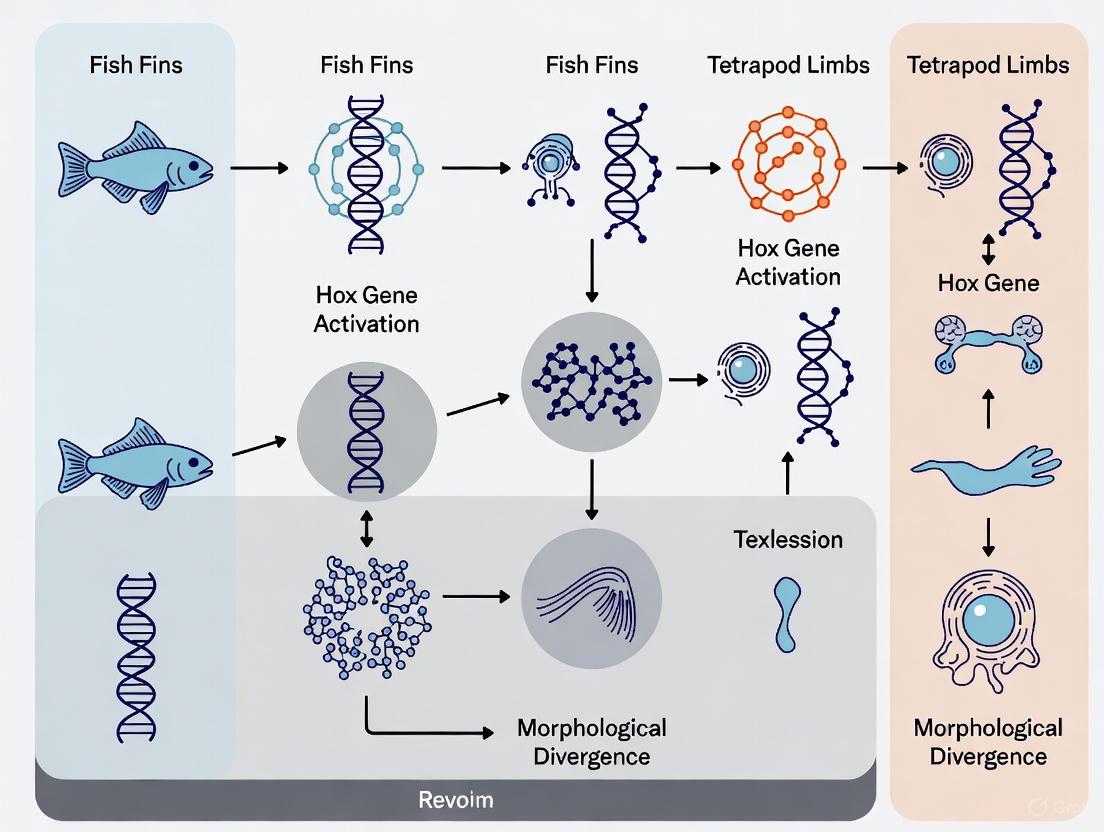
The evolution of fins into limbs was a pivotal event in vertebrate history, enabling the transition to terrestrial life.
Hox Gene Evolution: Decoding the Genetic Blueprint of the Fin-to-Limb Transition
Abstract
The evolution of fins into limbs was a pivotal event in vertebrate history, enabling the transition to terrestrial life. This article synthesizes recent groundbreaking research on the role of Hox genes in this process, targeting researchers and drug development professionals. We explore the foundational concepts of Hox gene regulation in appendage development, detail cutting-edge methodological approaches like CRISPR-Cas9 and chromatin profiling, and analyze challenges in interpreting mutant phenotypes. A comparative framework across zebrafish, mice, and chicks reveals a paradigm-shifting model of regulatory co-option, where digit-specific programs were recruited from ancestral functions in the cloaca. These insights into deep genetic homology and regulatory network evolution provide a critical foundation for understanding the molecular basis of congenital limb disorders and the potential for regenerative medicine strategies.
Deep Homology and Regulatory Landscapes: The Evolutionary Foundation of Paired Appendages
The evolution of tetrapod limbs from fish fins represents a pivotal transition in vertebrate history, enabling the conquest of terrestrial environments. Central to this morphological transformation are the HoxA and HoxD gene clusters, which exhibit a bimodal regulatory strategy during limb development. This whitepaper synthesizes current research on the evolutionary origins of this regulatory mechanism, detailing how a conserved chromatin architecture was co-opted and modified to facilitate the emergence of novel distal structures (digits) in tetrapods. We provide comprehensive experimental data, methodological protocols, and visualization tools to support ongoing research in evolutionary developmental biology and inform therapeutic strategies for congenital limb disorders.
The fossil record indicates that limbs evolved from fins via successive steps of distal elaboration, eventually resulting in the formation of the autopod (hand/foot) as a tetrapod-specific evolutionary novelty [1]. While the skeletal organization of the proximal limb (stylopod and zeugopod) has clear homologs in sarcopterygian fish fins, the origin of digits remains controversial [1] [2]. During mammalian limb development, the activity of both HoxA and HoxD gene clusters is essential, with ablation of these loci leading to rudimentary, truncated appendages [1]. These genes are expressed in two temporally and spatially distinct waves: an early phase in the developing proximal limb (presumptive arm/forearm) and a late phase in the presumptive digits [1]. This bimodal expression pattern is governed by a corresponding bimodal chromatin architecture flanking the Hox clusters, with proximal and distal enhancers located in large regulatory landscapes on opposite sides of the gene clusters [1] [2]. Remarkably, this fundamental regulatory architecture predates the divergence of fish and tetrapods, yet its functional output diverged significantly during evolution, facilitating the fin-to-limb transition [1] [2].
The Conserved Bimodal Chromatin Architecture
Regulatory Landscapes in Tetrapods
In tetrapods, the HoxD gene cluster is flanked by two large gene deserts that function as distinct regulatory landscapes [1] [2]. The 3' regulatory landscape (3DOM) contains enhancers that control the early, proximal wave of Hoxd gene expression (approximately Hoxd9-Hoxd11), patterning the stylopod and zeugopod [2]. Subsequently, limb bud cells switch their regulatory interactions to the 5' regulatory landscape (5DOM), which drives the late, distal expression of Hoxd genes (particularly Hoxd13) in the developing autopod and digits [2]. This switch in chromatin conformation creates a bimodal expression pattern that prefigures the proximal-distal (P-D) organization of the tetrapod limb [1].
The same bimodal regulatory strategy is implemented at the HoxA cluster, revealing a generic mechanism shared by both gene clusters during limb development [1]. Similar to Hoxd genes, Hoxa genes exhibit two phases of transcription: Hoxa11 is expressed in the proximal limb (forearm) and is excluded from the distal limb by Hoxa13 repression, while Hoxa13 is specifically expressed in the distal, presumptive digit domain [1]. This coordinated regulation of HoxA and HoxD clusters provides redundant patterning information essential for proper limb formation.
Deep Evolutionary Conservation in Fish
Unexpectedly, the same bimodal chromatin architecture exists in zebrafish, indicating that this regulatory mechanism predates the divergence between fish and tetrapods [1] [2]. The zebrafish hoxda locus shares high synteny with the mammalian HoxD locus, with the gene cluster flanked by two gene deserts corresponding to topologically associating domains (TADs) [2]. Conservation of critical CTCF binding sites at TAD borders and the overall three-dimensional conformation suggests these architectural features are ancestral characteristics preserved due to important regulatory functions [2].
Table 1: Comparative Genomics of Bimodal Regulatory Landscapes
| Feature | Mouse HoxD | Zebrafish hoxda | Functional Implication |
|---|---|---|---|
| 3DOM Size | Larger | Smaller | Relative size differs but function conserved |
| 5DOM Size | Smaller | Larger | Relative size differs, functional output diverged |
| TAD Structure | Present | Present | Conserved 3D architecture |
| CTCF Sites | Conserved positions | Conserved positions | conserved topological boundaries |
| Enhancer Conservation | Low in 3DOM | Low in 3DOM | Proximal regulation conserved |
| Enhancer Conservation | High in 5DOM | Moderate in 5DOM | Distal regulation diverged in function |
Despite this structural conservation, functional differences emerged. When assessed in transgenic mice, fish regulatory landscapes from both 3DOM and 5DOM drove transcription primarily in proximal limb territories rather than distal digits [1]. This supports an evolutionary scenario whereby digits arose as tetrapod novelties through genetic retrofitting of preexisting regulatory landscapes rather than entirely novel genetic inventions [1].
Experimental Evidence and Key Methodologies
Landscape Deletion Studies
Critical insights into the function of regulatory landscapes came from targeted deletion experiments in both mouse and zebrafish models.
Mouse Deletion Studies
In mice, deletion of the entire 5DOM landscape abrogated all Hoxd gene expression in the forming autopod, resulting in digit agenesis [2]. Conversely, deletion of 3DOM eliminated the proximal expression domain of Hoxd genes but preserved distal digit expression [2]. These findings demonstrate the essential and specific roles of each landscape in patterning distinct limb segments.
Zebrafish Deletion Studies
In zebrafish, deletion of 3DOM eliminated expression of hoxd4a to hoxd10a in pectoral fin buds, mirroring the mouse phenotype [2]. This confirms the ancestral regulatory function of 3DOM in proximal appendage development. Surprisingly, however, deletion of 5DOM in zebrafish did not disrupt hoxd13a expression in distal fin buds [2]. Instead, this deletion impaired expression in the cloaca, revealing a previously unrecognized primary function for this landscape in fish [2].
Table 2: Phenotypic Consequences of Regulatory Landscape Deletions
| Genetic Manipulation | Mouse Phenotype | Zebrafish Phenotype | Evolutionary Interpretation |
|---|---|---|---|
| 5DOM Deletion | Loss of distal Hoxd expression; digit agenesis | Normal distal hoxd13a fin expression; cloacal defects | 5DOM digit function is tetrapod novelty |
| 3DOM Deletion | Loss of proximal Hoxd expression; stylopod/zeugopod defects | Loss of proximal hoxd gene expression; proximal fin defects | Proximal regulatory function conserved |
| Hox13 Paralogue Mutation | Autopod agenesis | Distal fin reduction | Deep homology of distal genetic program |
| Fish 5DOM in Mouse Transgenics | Proximal limb expression only | N/A | Regulatory potential present but utilization differs |
Transgenic Enhancer Assays
To test the functional conservation of specific regulatory elements, researchers introduced zebrafish regulatory sequences into transgenic mice. These experiments revealed that fish DNA sequences orthologous to tetrapod digit enhancers drove transgene expression primarily in proximal mouse limb territories rather than in digits [1]. This demonstrates that while the cis-regulatory sequences were present in fish, their functional deployment in distal appendages represents a tetrapod innovation.
Chromatin Conformation Capture (4C)
Chromosome conformation capture technologies have been instrumental in mapping the physical interactions between Hox genes and their regulatory landscapes. In developing limb buds, 4C analyses revealed that Hoxd genes sequentially interact with first the 3DOM and then the 5DOM landscapes, physically switching their regulatory contacts at the transition from proximal to distal fates [1]. This conformational switch occurs in tetrapods but appears to be utilized differently in fish despite the conserved chromatin architecture.
Signaling Pathways and Regulatory Workflows
The following diagram illustrates the core regulatory logic of the bimodal switch system in tetrapod limb development:
Diagram 1: Bimodal Regulatory Logic. The sequential activation of 3DOM and 5DOM regulatory landscapes drives proximal then distal Hox gene expression during tetrapod limb development.
The Co-option Hypothesis: From Cloaca to Digits
A groundbreaking finding from recent research reveals that the 5DOM regulatory landscape in zebrafish is essential for cloacal development rather than distal fin patterning [2]. Deletion of 5DOM in fish abolishes hoxd13a expression in the cloaca but not in fins, while in mice, this same landscape controls both digit development and patterning of the urogenital sinus (the mammalian homologous structure) [2]. This suggests that the digit regulatory program in tetrapods was co-opted from an ancestral cloacal regulatory machinery.
The following diagram illustrates this evolutionary co-option hypothesis:
Diagram 2: Regulatory Co-option. The 5DOM landscape was co-opted during tetrapod evolution to regulate digit development while maintaining its ancestral role in cloacal/urogenital patterning.
This co-option event represents a fundamental mechanism in evolutionary innovation, whereby existing genetic regulatory circuits are redeployed for novel functions without disrupting their ancestral roles.
The Scientist's Toolkit: Essential Research Reagents and Methods
Table 3: Essential Research Reagents and Methodologies for Studying Bimodal Regulation
| Reagent/Method | Specific Example | Application | Key Insight Generated |
|---|---|---|---|
| CRISPR-Cas9 Deletion | Whole landscape deletion (Δ5DOM, Δ3DOM) | Functional assessment of regulatory regions | Revealed landscape-specific requirements in fins vs limbs [2] |
| Transgenic Reporter Assays | Zebrafish enhancers in mouse models | Testing cross-species regulatory potential | Showed fish enhancers drive proximal, not distal, expression [1] |
| Chromatin Conformation Capture (4C) | Promoter-centered chromatin interaction mapping | Identifying physical enhancer-promoter contacts | Revealed bimodal switching between landscapes [1] |
| CUT&RUN | H3K27ac, H3K27me3 profiling | Mapping active and repressive regulatory elements | Demonstrated distinct histone modifications in 3DOM vs 5DOM [2] |
| Hoxd13a Replacement with Fluorescent Protein | hoxd11b-knockin with RFP | Visualizing gene expression in live tissues | Identified mutant effects on hoxd11b expression domains [3] |
| Whole-mount in situ Hybridization (WISH) | hoxd13a, hoxd10a, hoxd4a riboprobes | Spatial mapping of gene expression | Revealed expression changes in deletion mutants [2] |
Discussion: Evolutionary Developmental Biology Perspectives
The bimodal regulatory switch represents a paradigmatic example of how evolution creates novelty through modification of existing genetic infrastructure. Several key principles emerge from this analysis:
First, deep homology characterizes the fundamental regulatory architecture, with the bimodal chromatin structure predating the fin-to-limb transition by millions of years [1] [2]. Second, regulatory co-option of the 5DOM landscape from cloacal to digit development provided a mechanism for generating morphological novelty without evolving entirely new genetic circuits [2]. Third, changes in regulatory circuit utilization rather than mere presence/absence of genes or regulatory elements underlies major evolutionary transitions [1].
The dissociation of HoxA11 and HoxA13 expression domains represents another critical modification in tetrapods [4]. In zebrafish, hoxa11 and hoxa13 expression domains largely overlap, while in tetrapods they become spatially segregated, with Hoxa11 marking the zeugopod and Hoxa13 the autopod [4]. This domain separation, potentially facilitated by the origin of a novel long non-coding RNA (Hoxa11as) with inhibitory function on Hoxa11, enabled the distinct specification of middle and distal limb segments [1] [4].
The bimodal regulatory switch controlling Hox gene expression during limb development exemplifies how major evolutionary transformations occur through modification of deeply conserved genetic mechanisms. The co-option of the 5DOM regulatory landscape from cloacal to digit patterning provides a compelling model for how novel structures can emerge without complete rewiring of developmental genomes.
Future research should focus on:
- Identifying the specific signals that trigger the switch from 3DOM to 5DOM utilization
- Characterizing the complete set of enhancers within each landscape and their individual contributions
- Exploring how chromatin topology dynamics are regulated during the transition
- Investigating whether similar regulatory co-option mechanisms underlie other evolutionary innovations
Understanding these fundamental mechanisms of evolutionary development not only illuminates our own morphological history but also provides insights for regenerative medicine and therapeutic interventions for congenital limb disorders.
The development of the autopod, the most distal segment of the vertebrate limb, is orchestrated by the synergistic functions of HoxA and HoxD cluster genes. This in-depth technical review examines the distinct temporal expression patterns, functional hierarchies, and molecular interactions governing HoxA and HoxD cooperation during autopod specification. We synthesize evidence from genetic perturbation studies in model organisms that reveal how the quantitative integration of HOXA13 and HOXD13 protein thresholds establishes the autopodial ground pattern, alongside the contributions of paralogous group 9-12 genes to proximal-distal limb patterning. The analysis is framed within an evolutionary developmental biology context, exploring how the co-option of ancestral regulatory landscapes during the fin-to-limb transition potentiated the emergence of digits. The review provides detailed experimental methodologies for investigating Hox gene function, presents structured quantitative data comparisons, and outlines essential research tools and reagents, offering a comprehensive resource for developmental biologists and translational researchers working on limb patterning and congenital limb malformations.
The Hox family of transcription factors, organized into four clusters (A-D), function as master regulators of positional identity along the anterior-posterior body axis in bilaterian animals. During vertebrate limb development, genes from the HoxA and HoxD clusters exhibit particularly sophisticated regulatory dynamics that enable them to pattern distinct limb segments with remarkable precision. The development of the autopod (hands and feet) represents a quintessential model for understanding how transcriptional synergy between these two clusters generates complex morphological structures.
A defining feature of Hox gene regulation in limbs is their biphasic expression strategy. In both clusters, genes are initially activated following a collinear pattern where 3' genes are expressed earlier and in more proximal domains, while 5' genes are expressed later and in more distal domains. However, the autopod-specific program involves a distinctive regulatory switch, particularly evident for HoxD genes, which shift from early 3'-proximal regulation to late 5'-distal regulation driven by a topological inversion of chromatin architecture [5] [2]. This regulatory landscape switching enables the same genomic locus to control profoundly different expression patterns at successive developmental stages.
This technical guide examines the molecular mechanisms underlying HoxA and HoxD synergy in autopod specification, with particular emphasis on:
- The distinct temporal hierarchies of HoxA versus HoxD activation
- Quantitative functional relationships between paralogous group 13 proteins
- Evolutionarily conserved versus derived aspects of distal limb patterning
- Experimental approaches for dissecting Hox gene function
- Implications for understanding congenital limb malformations
Temporal Dynamics and Spatial Regulation of Hox Expression
Biphasic Expression Patterns in Limb Development
Hox gene expression during limb development occurs in two principal phases that correspond to the specification of different limb segments. The early phase establishes the initial proximal-distal coordinates, while the late phase specifically patterns the autopod.
Table 1: Temporal Expression Patterns of HoxA and HoxD Genes During Limb Development
| Gene | Early Phase Expression | Late Phase Expression | Primary Regulatory Landscape |
|---|---|---|---|
| Hoxa9 | Proximal limb (stylopod) | Absent/very low | 3' HoxA regulation |
| Hoxa10 | Proximal limb (stylopod) | Absent/very low | 3' HoxA regulation |
| Hoxa11 | Mid-limb (zeugopod) | Excluded from autopod | 3' HoxA regulation |
| Hoxa13 | Distal limb (autopod) | Strong autopod expression | 5' HoxA regulation |
| Hoxd9 | Proximal limb (stylopod) | Weak autopod (posterior) | Early: 3' HoxD (ELCR) |
| Hoxd10 | Proximal limb (stylopod) | Moderate autopod | Early: 3' HoxD (ELCR) |
| Hoxd11 | Mid-limb (zeugopod) | Strong autopod | Early: 3' HoxD; Late: 5' HoxD |
| Hoxd12 | Distal limb (autopod) | Strong autopod | Early: 3' HoxD; Late: 5' HoxD |
| Hoxd13 | Distal limb (autopod) | Broad autopod expression | Late: 5' HoxD (POST) |
The early phase of HoxD gene expression is controlled by enhancers located in the 3' regulatory domain (3DOM), often referred to as the Early Limb Control Region (ELCR) [5]. This phase follows classical collinearity, with 3' genes (Hoxd1-10) expressed in nested proximal domains. Concomitantly, a 5' regulatory region (POST) exerts repressive effects to spatially restrict 5'Hoxd expression to the posterior mesenchyme of early limb buds [5]. Subsequently, during the late phase, the regulatory control of HoxD genes switches to the 5' regulatory domain (5DOM), located on the opposite side of the cluster, which drives expression in the developing autopod in a reverse collinear manner [2].
For HoxA genes, while a similar biphasic regulation has been hypothesized based on conserved genomic architecture, the late phase autopod expression of Hoxa13 appears to follow a collinear rather than reverse collinear pattern, with Hoxa13 expression excluding Hoxa11 from the distalmost limb bud [6]. This indicates that despite synergistic function in autopod patterning, HoxA and HoxD clusters employ distinct regulatory strategies for establishing their late-phase expression domains.
Chromatin Architecture and Regulatory Landscapes
The spatial organization of chromatin plays a crucial role in orchestrating the complex expression patterns of Hox genes during limb development. Both the HoxA and HoxD clusters are flanked by large gene deserts that function as topologically associating domains (TADs) containing multiple enhancer elements [2]. These domains exhibit remarkable evolutionary conservation between mammals and teleost fishes, despite approximately 450 million years of divergence [2].
The HoxD cluster is particularly well-characterized, with its regulation governed by two principal TADs:
- 3DOM (3' regulatory domain): Controls early phase expression in proximal limbs through enhancers such as the Early Limb Control Region (ELCR)
- 5DOM (5' regulatory domain): Controls late phase expression in the autopod through a constellation of enhancers forming a "regulatory archipelago" [2]
During the transition from proximal to distal limb patterning, the HoxD locus undergoes a dramatic chromatin conformational switch, physically reorienting from interaction with 3' enhancers to engagement with the 5' regulatory landscape [5] [2]. This architectural reorganization enables the same genes to participate in two distinct transcriptional programs at successive developmental stages.
Recent evolutionary developmental studies reveal that the 5DOM regulatory landscape controlling digit development was co-opted from an ancestral program controlling cloacal development [2] [7]. Genetic ablation of 5DOM in zebrafish demonstrates that this region is dispensable for distal fin development but essential for hoxd13a expression in the cloaca, whereas in mice the same region is essential for digit formation [2] [7]. This represents a fascinating example of evolutionary co-option where tetrapods recruited a pre-existing regulatory machinery for building novel morphological structures.
Diagram 1: Regulatory dynamics of HoxD gene expression during limb development, showing the switch from 3' to 5' regulatory control and the evolutionary co-option of the distal program.
Functional Synergy Between HoxA and HoxD in Autopod Specification
Genetic Evidence for Synergistic Function
The functional collaboration between HoxA and HoxD clusters is most evident in the specification of the autopod, where paralogous group 13 genes (Hoxa13 and Hoxd13) play particularly crucial roles. Genetic studies in mice demonstrate that while single mutants for either Hoxa13 or Hoxd13 exhibit specific autopod defects, double mutants show dramatically enhanced phenotypes indicating synergistic interaction [8].
Table 2: Phenotypic Spectrum of Hox13 Single and Compound Mutants in Mouse Autopod Development
| Genotype | Forelimb Phenotype | Hindlimb Phenotype | Genetic Interpretation |
|---|---|---|---|
| Hoxa13-/- | Lack of anterior digit; malformed carpal elements | Similar to forelimb | Specific function in anterior autopod |
| Hoxd13-/- | Digit fusions; reduced digit number | Similar to forelimb | Specific function in posterior autopod |
| Hoxa13+/-/Hoxd13+/- | Subset of alterations seen in single homozygotes | Similar to forelimb | Quantitative dosage sensitivity |
| Hoxa13-/-/Hoxd13-/- | Near complete agenesis of autopod elements | Similar to forelimb | Complete functional redundancy |
The phenotypic analysis reveals several important principles of Hox gene function in autopod development. First, Hoxa13 and Hoxd13 exhibit both unique functions and partial redundancy, as single mutants affect different aspects of autopod patterning while double mutants show dramatically enhanced phenotypes [8]. Second, there is clear dosage sensitivity, as even double heterozygous mutants (Hoxa13+/-/Hoxd13+/-) display abnormalities that represent subsets of the alterations seen in each individual homozygous mutant [8]. Third, the products of these genes appear to function in a quantitative manner rather than through strictly qualitatively distinct programs, with the combined protein threshold determining the extent of autopod development.
Beyond the paralogous group 13 genes, more proximal Hox genes also contribute to the overall limb pattern through genetic interactions. For instance, Shox2, a homeobox gene expressed in proximal limb domains, demonstrates genetic interaction with both HoxA and HoxD genes, particularly Hoxd9 and Hoxa11 [9]. Modulation of Shox2 expression in Hox-mutant backgrounds produces non-additive effects on limb growth, indicative of epistatic interactions that tune limb segment length [9]. This suggests that the coordination between Hox and Shox genes establishes the appropriate proportionality between limb segments.
Molecular Mechanisms of Synergy
The molecular basis for HoxA and HoxD synergy likely operates at multiple levels, including:
- Combinatorial DNA binding: HOXA13 and HOXD13 may cooperatively bind regulatory elements of downstream target genes
- Cross-regulatory interactions: Hox proteins directly regulate the expression of other Hox genes, creating auto-regulatory and cross-regulatory loops
- Shared protein cofactors: Both proteins may compete for or cooperatively engage with limited transcriptional co-activators or co-repressors
Evidence for auto-regulation and cross-regulation in Hox gene networks comes from studies showing that inactivation of a subset of HOXA and HOXD proteins leads to global deregulation of HoxA and HoxD expression patterns [5]. This suggests the existence of a "self-regulation" mechanism where HOX proteins establish and/or maintain the spatial domains of Hox gene expression, potentially contributing to the establishment of the final HOX code [5].
The functional dominance of certain HOX proteins in specific domains is illustrated by the requirement for HOX13 proteins in segregating zeugopod and autopod expression domains. In the absence of HOXA13, the expression domains of both HoxA and HoxD genes are disrupted, indicating that HOXA13 plays a particularly crucial role in organizing the distal limb regulatory landscape [5].
Evolutionary Context: Fin-to-Limb Transition
The evolutionary origin of digits represents one of the most significant innovations in the fin-to-limb transition, and the regulatory reorganization of Hox gene function sits at the center of this evolutionary process. Comparative studies across vertebrate taxa reveal both deeply conserved and newly derived aspects of Hox gene regulation in distal appendages.
The late phase "distal program" of Hox gene expression, characterized by the reverse collinear pattern of 5'HoxD genes, is not exclusive to tetrapod limbs but appears to be an ancient module that has been co-opted in a variety of structures [6]. This program has been identified in:
- Paddlefish barbels (sensory adornments developing from the first mandibular arch)
- Ray-finned fish vents (medial structures analogous to a urethra)
- Various distally elongated structures across vertebrate taxa [6]
This broader distribution suggests that the distal Hox program represents an evolutionarily ancient module that was recruited multiple times for the development of distally elongated structures, with digit formation representing one particularly prominent application of this toolkit.
A groundbreaking recent discovery indicates that the regulatory landscape controlling digit development was co-opted from an ancestral program controlling cloacal development [2] [7]. In zebrafish, deletion of the 5DOM region has no effect on distal fin development but abolishes hoxd13a expression in the cloaca, whereas in mice the same deletion eliminates digit formation [2] [7]. This suggests that during the evolution of tetrapods, the entire 5DOM regulatory machinery was recruited from its ancestral role in cloacal patterning to a new function in digit specification.
Diagram 2: Evolutionary co-option of the 5DOM regulatory landscape from ancestral cloacal development to derived digit development in tetrapods.
The deep homology between fin rays and digits remains contested, but the shared deployment of the distal Hox program in both structures suggests they may be built through modifications of a common genetic toolkit. The functional divergence appears to stem more from changes in regulatory connectivity than the evolution of fundamentally new genes or protein functions.
Experimental Approaches and Methodologies
Genetic Perturbation Strategies
Dissecting the individual and combined functions of HoxA and HoxD genes requires sophisticated genetic approaches that enable both loss-of-function and gain-of-function analyses in a spatially and temporally controlled manner.
Targeted Gene Inactivation: Traditional knockout approaches have been instrumental in establishing the essential functions of Hox genes in autopod development. The standard protocol involves:
- Vector Construction: Designing targeting vectors with homologous arms flanking critical exons of the Hox gene of interest, with insertion of a positive selection marker (e.g., neomycin resistance)
- Embryonic Stem Cell Electroporation: Introducing the targeting vector into embryonic stem (ES) cells
- Selection and Screening: Selecting for homologous recombination events using positive selection and verifying by Southern blot or PCR
- Chimera Generation: Injecting targeted ES cells into blastocysts to generate chimeric mice
- Germline Transmission: Breeding chimeras to establish heterozygous mutant lines
- Phenotypic Analysis: Intercrossing heterozygotes to generate homozygous mutants for phenotypic characterization [8]
Conditional Genetic Approaches: For genes with essential early functions that would preclude analysis of later roles in limb development, conditional approaches using Cre-loxP technology are essential:
- Floxed Allele Design: Engineering loxP sites flanking critical exons of the Hox gene
- Tissue-Specific Cre Drivers: Crossing with transgenic lines expressing Cre recombinase under limb-specific promoters (e.g., Prrx1-Cre for limb mesenchyme) [9]
- Temporal Control: Using inducible Cre systems (e.g., Cre-ERT2) for temporal control of recombination
Large-Scale Regulatory Deletions: Understanding the function of the global regulatory landscapes controlling Hox expression requires deletion of large genomic regions:
- CRISPR-Cas9-Mediated Deletion: Designing multiple guide RNAs targeting the boundaries of regulatory domains (e.g., 5DOM or 3DOM)
- Dual gRNA Strategy: Co-injecting gRNA pairs targeting the 5' and 3' boundaries of the region to be deleted
- Deletion Verification: Screening for large deletions by PCR and sequencing
- Phenotypic Characterization: Analyzing effects on Hox gene expression and limb morphology [2]
Molecular Analysis Techniques
Comprehensive analysis of Hox gene function requires multimodal assessment of expression patterns, molecular interactions, and phenotypic consequences.
Spatial Transcript Analysis:
- Whole-mount in situ hybridization (WISH): Visualizing mRNA distribution patterns in embryonic tissues using digoxigenin-labeled antisense riboprobes [2] [9]
- Section in situ hybridization: Higher resolution localization of transcripts in tissue sections
- Double fluorescence in situ hybridization (FISH): Simultaneous detection of multiple transcripts to establish co-expression patterns [9]
Protein and Chromatin Analysis:
- Chromatin Conformation Capture: Assessing three-dimensional chromatin architecture and enhancer-promoter interactions
- CUT&RUN/CUT&Tag: Mapping histone modifications (H3K27ac, H3K27me3) and transcription factor binding genome-wide [2]
- Immunohistochemistry: Localizing HOX protein distribution in developing limbs
Transcriptomic Approaches:
- RNA-seq: Comprehensive profiling of gene expression changes in mutant versus wild-type limb buds
- Single-cell RNA-seq: Resolving cellular heterogeneity and identifying distinct regulatory states within the limb bud mesenchyme
- Quantitative RT-PCR: Precise quantification of transcript levels in specific limb regions [9]
The Scientist's Toolkit: Essential Research Reagents
Table 3: Essential Research Reagents for Investigating HoxA/HoxD Synergy in Autopod Specification
| Reagent/Category | Specific Examples | Function/Application | Key References |
|---|---|---|---|
| Mouse Models | Hoxa13-/-, Hoxd13-/-, HoxDdel(11-13) | Loss-of-function analysis of individual and compound Hox mutations | [5] [8] |
| Conditional Alleles | HoxAfl/fl, HoxDfl/fl | Tissue-specific and temporal gene inactivation | [9] |
| Cre Driver Lines | Prrx1-Cre, Prrx1-Cre-ERT2 | Limb mesenchyme-specific recombination | [9] |
| Regulatory Deletions | Del(5DOM), Del(3DOM) | Analysis of global regulatory landscape function | [2] |
| Expression Reporters | Hoxd11-lacZ, various Hox-GFP knock-ins | Visualization of expression domains | [5] |
| Detection Reagents | Hox-specific riboprobes (Hoxa13, Hoxd13, etc.) | Spatial transcript analysis by in situ hybridization | [2] [9] |
| Chromatin Profiling | H3K27ac, H3K27me3 antibodies | Mapping active and repressive regulatory elements | [2] |
The synergistic interaction between HoxA and HoxD genes in autopod specification represents a paradigm for understanding how combinatorial transcriptional control generates morphological complexity during embryonic development. The quantitative integration of HOXA13 and HOXD13 protein thresholds, combined with the distinct temporal hierarchies of their activation and the sophisticated switching of regulatory landscapes, creates a robust system for patterning the diverse elements of the vertebrate hand and foot.
Future research directions in this field should focus on:
- Comprehensive identification of direct transcriptional targets of HOXA13 and HOXD13 through integrated chromatin binding and transcriptomic approaches
- High-resolution characterization of chromatin dynamics during the transition from proximal to distal limb patterning programs
- Single-cell analysis of regulatory states across the developing autopod to resolve the cellular heterogeneity of the digit-forming region
- Evolutionary comparative studies across diverse tetrapod lineages to understand how modifications to the Hox regulatory apparatus generate morphological diversity in autopod patterns
- Human genetic investigations connecting variants in Hox genes and their regulatory elements to congenital limb malformations
The evolutionary perspective reveals that the sophisticated regulatory machinery controlling digit development was largely assembled through the co-option and reorganization of pre-existing genetic programs, particularly the ancestral cloacal regulatory landscape. This illustrates how major morphological innovations often arise not from entirely new genes, but from novel combinations of existing regulatory modules. The continued dissection of HoxA and HoxD synergy will undoubtedly yield further insights into both the fundamental principles of developmental patterning and the evolutionary mechanisms generating morphological novelty.
The evolution of tetrapod limbs from fish fins represents a major morphological transition in vertebrate history. For decades, teleost fish like zebrafish have been the primary model for this research. However, their recent, lineage-specific genome duplication and rapid evolutionary rate can obscure deep conservation. Studies on slowly evolving cartilaginous fish, such as sharks and skates, have revealed a profound evolutionary conservation of the genetic toolkit for appendage development. This whitepaper synthesizes evidence that the fundamental regulatory architecture governing fin and limb patterning is deeply conserved between sharks and mammals, predating the teleost-tetrapod divergence and providing a crucial framework for understanding the evolution of morphological novelty.
Molecular Mechanisms: A Deeply Conserved Toolkit
The development of both fins and limbs is orchestrated by a core set of transcription factors and signaling pathways, the functions of which have been maintained for over 450 million years.
Hox Genes and Axial Patterning
HoxA and HoxD cluster genes are paramount in specifying the proximal-distal axis of vertebrate appendages. A key finding from shark models is the conserved, distal expression of HoxA13 and HoxD13, which is essential for establishing the most distal appendage structures, a pre-requisite for the later evolution of the autopod (wrist/ankle and digits) [4] [10]. In tetrapods, the evolution of a bimodal regulation of the HoxD cluster, involving the activation of novel cis-regulatory units, was a fundamental mechanism that potentiated the fin-to-limb transition [11]. Functional assays demonstrate that increased levels of 5'HoxD genes stimulate the production of additional endochondral bone while repressing the formation of the dermal skeleton distally, mirroring two key morphological changes in the fossil record [11] [12].
The Turing Patterning System
Beyond Hox genes, a Turing-type reaction-diffusion system, implemented by the Bmp-Sox9-Wnt (BSW) network, is responsible for the periodic patterning of the skeletal elements in the distal appendage. Evidence from the catshark (Scyliorhinus canicula) confirms that this network is deeply conserved [13]. In sharks, the system generates a spot-like pattern of Sox9 expression, prefiguring the nodular fin radials, whereas in mice, it produces stripes that prefigure digits. This indicates that the broad morphological diversity of distal elements arose from the spatial re-organization of a deeply conserved Turing mechanism, not the invention of new genes [13].
Table 1: Key Genetic Regulators in Fin and Limb Development
| Gene/Pathway | Function in Appendage Patterning | Conservation in Sharks |
|---|---|---|
| 5'HoxD (HoxD13) | Stimulates endochondral bone formation; represses dermal skeleton [11] | Yes; distal expression conserved; overexpression causes chondrogenic expansion [12] |
| HoxA13 | Specifies autopod (distal limb) identity [4] | Yes; distal expression conserved, though domains with HoxA11 may overlap [4] [10] |
| Sox9 | Master regulator of chondrogenesis; pre-patterns skeletal condensations [13] | Yes; forms a periodic spot pattern in fin buds, driven by a conserved BSW network [13] |
| Bmp-Sox9-Wnt (BSW) Network | Turing system for generating periodic skeletal patterns [13] | Yes; network interactions and out-of-phase expression of Bmp/Wnt with Sox9 are conserved [13] |
Critical Evidence from Comparative Analyses
Comparative transcriptomic and genomic studies between sharks and mammals provide direct evidence of this deep conservation.
Transcriptomic Hourglass Pattern
A comparative transcriptome analysis of developing bamboo shark (Chiloscyllium punctatum) fins and mouse limbs revealed an hourglass-shaped pattern of conservation [10]. The mid-stages of development exhibited the highest degree of gene expression similarity between fins and limbs, while early and late stages were more divergent. This suggests that the mid-stage, when the core appendage pattern is established, is under strong evolutionary constraint, and its mechanisms are deeply conserved [10].
Conserved Cis-Regulatory Elements
Genomic comparisons show that non-coding regulatory sequences near Hox genes are highly conserved. The HoxA clusters of sharks, teleosts, and mammals share conserved putative regulatory elements, particularly in the intergenic regions between the most 3' (anterior) genes [14]. Furthermore, a tetrapod-specific digit enhancer for Hoxd13, when tested in zebrafish, was shown to drive a similar distal-specific expression pattern, suggesting that the foundational regulatory potential was already present in the common ancestor of fish and tetrapods [12].
Table 2: Key Findings from Shark-Mammal Comparative Studies
| Study Type | Model Organism(s) | Key Quantitative Finding | Interpretation |
|---|---|---|---|
| Transcriptomics | Bamboo Shark vs. Mouse [10] | Highest gene expression similarity during mid-development (hourglass model) | Mid-development is evolutionarily constrained; core patterning mechanisms are conserved. |
| Genomics | Catshark, Horn Shark, Zebrafish, Human, Mouse [14] | HoxA cluster in shark ~110 kb; human ~110 kb; teleosts (e.g., zebrafish Aα) ~62 kb | Genomic architecture and non-coding regulatory elements are conserved over 500 million years. |
| Functional Genetics | Zebrafish (with shark/tetrapod insights) [12] | Overexpression of hoxd13a induced distal chondrogenic expansion and finfold reduction | Modulation of 5'HoxD expression levels is a key mechanism for evolutionary change. |
Experimental Protocols for Key Studies
Protocol: Comparative Transcriptome Analysis (RNA-seq)
This protocol is based on the methodology used to compare bamboo shark fins and mouse limbs [10].
- 1. Sample Collection: Collect embryonic fin/limb bud tissues across a developmental time series. For mouse, collect forelimb buds from E9.5 to E12.5. For bamboo shark, collect pectoral fin buds from stages 29 to 39 [10].
- 2. RNA Extraction and Sequencing: Homogenize tissue and extract total RNA using a column-based kit. Assess RNA integrity. Prepare sequencing libraries (e.g., poly-A selected) and perform high-throughput sequencing (e.g., Illumina) to a sufficient depth (e.g., >20 million reads per sample) with three biological replicates per stage [10].
- 3. Data Analysis:
- Assembly and Annotation: For non-model organisms (shark), perform de novo transcriptome assembly. Annotate genes using BLASTP against known vertebrate proteomes and custom orthology assignment algorithms to create an accurate orthology map between species [10].
- Expression Quantification: Map reads to the respective reference genomes or transcriptomes. Calculate expression values (e.g., Transcripts Per Million - TPM) for each gene in each sample.
- Comparative Analysis: Scale expression values (e.g., Max one method) to compare temporal dynamics. Use clustering and statistical analyses to identify conserved and divergent expression phases across development [10].
Protocol: Open-Chromatin Analysis (ATAC-seq)
This protocol outlines the method for identifying putative regulatory elements in developing limbs [10].
- 1. Nuclei Isolation: Dissect limb/fin buds and homogenize gently to isolate intact nuclei in a cold nucleus buffer.
- 2. Tagmentation: Treat the nuclei with the Tn5 transposase enzyme. The hyperactive Tn5 simultaneously fragments the DNA and inserts adapter sequences into open, nucleosome-free regions of the genome.
- 3. Library Preparation and Sequencing: Purify the tagmented DNA and perform a limited-cycle PCR to amplify the library and add full sequencing adapters. Sequence the library on a high-throughput platform.
- 4. Data Analysis: Map sequenced reads to the reference genome. Call peaks to identify Open Chromatin Regions (OCRs), which represent putative enhancers and promoters. Analyze the evolutionary conservation of sequences within these OCRs and correlate them with stage-specific gene expression [10].
Protocol: Functional Perturbation of Signaling Pathways
This protocol is derived from experiments in catshark embryos to test the BSW Turing network [13].
- 1. Embryo Collection and Maintenance: Collect fertilized catshark eggs and incubate them in oxygenated, artificial seawater at a species-appropriate temperature.
- 2. Pharmacological Inhibition: Soak developing embryos in seawater containing small molecule inhibitors.
- Bmp Inhibition: Use dorsomorphin or LDN-193189.
- Wnt Inhibition: Use IWP-2 or IWR-1.
- Include control embryos soaked in vehicle solution (e.g., DMSO) [13].
- 3. Phenotypic Analysis: After a defined treatment period, fix embryos and perform skeletal staining (e.g., Alcian Blue for cartilage) to visualize the pattern of fin radials. Compare the treated phenotypes with in silico predictions from the BSW computational model [13].
Visualization of Signaling Pathways and Regulatory Logic
Diagram 1: The Conserved Bmp-Sox9-Wnt (BSW) Turing Network
This diagram illustrates the core interactions of the Turing mechanism that patterns skeletal elements in both shark fins and mouse limbs [13].
Diagram Title: Core BSW Turing Network Interactions
Diagram 2: Hox Gene Regulatory Logic in Fin-to-Limb Evolution
This diagram outlines the regulatory shifts in Hox gene function that contributed to the fin-to-limb transition [11] [4] [12].
Diagram Title: Hox Gene Regulatory Evolution
The Scientist's Toolkit: Research Reagent Solutions
Table 3: Essential Research Reagents for Evolutionary Developmental Studies
| Research Reagent / Material | Function and Application in the Field |
|---|---|
| Bamboo Shark (C. punctatum) Embryos | A slowly-evolving cartilaginous fish model with an accessible genome; enables comparative transcriptomics and ATAC-seq with minimal evolutionary noise [10]. |
| Catshark (S. canicula) Embryos | Model for classic embryology and perturbation studies due to large, accessible eggs; used for fate mapping and testing Turing mechanisms [13]. |
| Small Molecule Inhibitors (e.g., Bmp/Wnt) | Pharmacological tools to perturb key signaling pathways in vivo in non-genetic models like sharks to test computational models [13]. |
| Optical Projection Tomography (OPT) | A 3D imaging technology used to visualize and analyze gene expression patterns (e.g., Sox9) in entire shark fin buds, revealing complex 3D patterns [13]. |
| Tetrapod-Cartilaginous Fish Orthology Map | A custom bioinformatic resource critical for accurately aligning genes between evolutionarily distant species for transcriptomic comparisons [10]. |
The evolution of digits from fish fins represents a foundational transition in vertebrate history. For decades, the evolutionary origin of the genetic mechanisms patterning the autopod (hand/foot) remained enigmatic. This whitepaper synthesizes recent groundbreaking research that challenges the paradigm of a fin-to-limb continuum and instead provides compelling evidence that the distal limb regulatory program was co-opted from an ancestral system patterning the cloaca. We present comprehensive experimental data from zebrafish and mouse models demonstrating that the Hoxd gene regulatory landscape (5DOM), essential for digit formation in tetrapods, retains its ancestral function in cloacal development in zebrafish, which lack digits. The implications of this evolutionary co-option event extend beyond developmental biology to offer novel perspectives on the deep homology of regulatory networks and their relevance to human congenital disorders.
The transition from aquatic fins to terrestrial limbs marks one of the most significant events in vertebrate evolution, enabling the colonization of land approximately 390 million years ago. Central to this transition was the emergence of the autopod, the distinctive distal segment of tetrapod limbs comprising wrists, ankles, and digits. While the fossil record documents the morphological progression from fin endoskeletons to limb bones, the genetic and developmental mechanisms underlying this transformation have remained intensely debated.
The Hox gene family, particularly the 5' members of the HoxA and HoxD clusters (Hoxa13 and Hoxd13), have been identified as master regulators of distal limb patterning [4]. In tetrapods, these genes are expressed in distinctive spatial and temporal patterns controlled by complex regulatory landscapes flanking the Hox clusters. Specifically, the 5' regulatory domain of the HoxD cluster (5DOM) contains enhancers essential for activating Hoxd13 and related genes during digit development [2]. Remarkably, syntenic counterparts to these regulatory regions exist in teleost fishes like zebrafish, despite their lack of bona fide digits—a paradox that has fueled scientific inquiry for decades.
This whitepaper examines the transformative hypothesis that the digit regulatory program did not gradually evolve from fin patterning mechanisms but was instead co-opted during tetrapod evolution from a pre-existing regulatory system dedicated to cloacal development.
The Co-option Hypothesis: Conceptual Framework
Core Principle and Evolutionary Mechanism
The co-option hypothesis proposes that the large regulatory landscape (5DOM) controlling Hoxd gene expression during digit development in tetrapods was recruited from an ancestral program responsible for patterning the cloaca—a common opening for digestive, urinary, and reproductive tracts in non-mammalian vertebrates [2] [7]. This represents a case of evolutionary co-option where existing genetic circuitry is redeployed for novel functions without fundamental rewiring.
This model challenges the previous prevailing view of "deep homology," which suggested that distal fin and limb development shared a continuous evolutionary and developmental genetic program [15]. Instead, it posits that the tetrapod lineage specifically repurposed an entire regulatory module for a new morphological context while retaining its original function in cloacal development.
Regulatory Architecture Conservation
The hypothesis is grounded in the remarkable conservation of genomic architecture across vertebrates. Both tetrapods and teleost fishes possess:
- Syntenic HoxD clusters with flanking gene deserts (3DOM and 5DOM)
- Conserved topologically associating domains (TADs) that compartmentalize regulatory interactions
- Similar three-dimensional chromatin conformations despite a 2.6-fold size difference between mouse and zebrafish loci
- Orthologous CTCF binding sites at TAD borders, indicating conserved structural organization [2] [15]
This architectural conservation suggests that both regulatory landscapes represent ancestral features predating the divergence of ray-finned fishes and tetrapods, preserved due to critical developmental functions.
Comparative Experimental Evidence
Zebrafish Deletion Studies
Critical insights emerged from systematic deletion of regulatory landscapes in zebrafish, providing a comparative functional approach.
Table 1: Phenotypic Outcomes of Regulatory Domain Deletions in Zebrafish
| Deleted Region | Effect on Fin Development | Effect on Cloaca | hoxd Genes Affected |
|---|---|---|---|
| 3DOM (3' regulatory domain) | Complete loss of proximal hoxd gene expression | Minimal effect | hoxd4a, hoxd10a (proximal) |
| 5DOM (5' regulatory domain) | No significant effect on distal hoxd gene expression | Complete loss of hoxd expression | hoxd13a (distal/cloacal) |
| hox13 genes (functional knockout) | Distal fin development defects | Severe cloacal formation defects | All hox13 paralogs |
The deletion of 3DOM in zebrafish resulted in complete abolition of hoxd4a and hoxd10a expression in pectoral fin buds, mirroring effects observed in mouse limb buds and confirming the ancestral conservation of proximal appendage regulation [2]. Surprisingly, however, deletion of 5DOM—essential for digit formation in mice—had negligible effects on hoxd13a expression during fin development [2] [15].
The pivotal discovery emerged when researchers examined tissues beyond appendages: 5DOM deletion in zebrafish completely abrogated hoxd gene expression in the developing cloaca and caused severe malformations of this structure [7] [15]. Similarly, functional inactivation of distal hox13 genes was shown to be essential for proper cloacal formation, confirming the specific requirement for this regulatory system.
Mouse Model Validation
Parallel investigations in mouse models demonstrated the dual functionality of the 5DOM regulatory landscape in tetrapods:
Table 2: 5DOM Functions in Mouse Development
| Developmental Context | 5DOM Regulatory Function | Biological Outcome |
|---|---|---|
| Digit Development | Activates Hoxd13 expression in distal limb buds | Controls autopod patterning and bone morphogenesis |
| External Genitalia | Regulates Hoxd13 in genital tubercle | Essential for genital tubercle development |
| Urogenital Sinus | Controls Hoxd13 expression | Patterns mammalian homolog of cloacal derivatives |
In mice, the 5DOM landscape contains multiple enhancers active in both digits and the genital tubercle (the mammalian counterpart to ancestral cloacal structures) [16]. Deletion of this region abolishes Hoxd13 expression in both contexts, leading to concurrent defects in digit and genital development [16]. This functional duality in tetrapods supports the model that an initially cloaca-specific regulatory system was co-opted to pattern novel distal limb structures.
Methodological Approaches
Experimental Workflows
The evidence supporting the co-option hypothesis derives from sophisticated genetic, genomic, and molecular techniques.
Chromosome Engineering with CRISPR-Cas9
- Objective: Generate large-scale deletions of regulatory domains (3DOM, 5DOM)
- Procedure:
- Design guide RNAs flanking target regions (~100-200kb)
- Co-inject Cas9 protein and guide RNAs into zebrafish embryos
- Screen for founders transmitting deletions
- Establish stable mutant lines
- Validation: PCR genotyping, sequencing of deletion junctions [2] [15]
Chromatin Conformation Analysis (4C-seq)
- Objective: Map physical interactions between Hoxd promoters and regulatory regions
- Procedure:
- Crosslink chromatin with formaldehyde
- Digest with restriction enzymes (e.g., DpnII)
- Ligate crosslinked DNA fragments
- Reverse crosslinks and purify DNA
- Generate sequencing libraries from viewpoint of Hoxd13 promoter
- Sequence and map interaction frequencies [16]
Epigenetic Profiling (CUT&RUN and ATAC-seq)
- Objective: Identify active regulatory elements through chromatin accessibility and modifications
- Procedure:
Gene Expression Analysis
- Objective: Quantify spatial and temporal hoxd gene expression
- Methods:
The Scientist's Toolkit
Table 3: Essential Research Reagents and Applications
| Reagent/Technique | Primary Function | Experimental Application |
|---|---|---|
| CRISPR-Cas9 | Genome editing | Generate regulatory domain deletions |
| CUT&RUN | Epigenetic profiling | Map histone modifications (H3K27ac, H3K27me3) |
| ATAC-seq | Chromatin accessibility | Identify active regulatory elements |
| 4C-seq | Chromatin conformation | Capture enhancer-promoter interactions |
| Whole-mount in situ hybridization | Spatial gene expression | Visualize hoxd gene expression patterns |
| RNA-sequencing | Transcriptome analysis | Quantify gene expression changes in mutants |
Signaling Pathways and Regulatory Logic
The transcriptional regulation of Hoxd genes in developing digits and cloaca involves complex interactions within topologically associating domains.
Diagram 1: Evolutionary co-option of the cloacal regulatory program for digit development. The 5DOM regulatory landscape controlling Hoxd13 expression was redeployed from ancestral cloacal patterning to digit formation in the tetrapod lineage.
The regulatory logic follows a TAD-based mechanism where the 5DOM forms a physically interacting chromatin compartment that specifically engages with Hoxd13 promoters while being insulated from more 3' Hoxd genes by boundary elements.
Diagram 2: Experimental workflow for testing the co-option hypothesis. The approach integrates comparative genomics with functional genetic manipulations and molecular profiling to trace the evolutionary rewiring of regulatory networks.
Discussion and Research Implications
Evolutionary Developmental Significance
The co-option of cloacal enhancers for digit patterning represents a elegant solution to the evolutionary challenge of generating novel structures. Rather than developing entirely new genetic circuitry, tetrapods repurposed existing regulatory capacity, facilitating the relatively rapid emergence of morphological complexity. This mechanism helps explain the paradoxical presence of "digit-specific" regulatory sequences in fish that lack digits.
This finding also illuminates the deep connection between limb and genital development in tetrapods. The shared dependence on the 5DOM regulatory landscape clarifies why mutations affecting digit development often concurrently impact external genitalia in human congenital disorders [16]. The common developmental origin of these seemingly unrelated structures underscores the importance of understanding evolutionary history for interpreting birth defects.
Future Research Directions
Key unanswered questions emerging from this research include:
- What transcriptional or epigenetic triggers enabled the co-option event in the tetrapod lineage?
- Do remnants of the ancestral cloacal program persist in tetrapod limb development?
- How precisely did the 5DOM landscape escape evolutionary constraint to acquire novel functions while maintaining ancestral roles?
Further comparative studies across diverse vertebrate lineages, particularly amphibians and reptiles, will help reconstruct the stepwise evolutionary history of this regulatory co-option event.
The co-option hypothesis resolves longstanding paradoxes in the fin-to-limb transition by demonstrating that digit enhancers were not gradually elaborated from fin patterning systems but were repurposed from an ancestral cloacal regulatory program. This paradigm shift highlights the importance of considering diverse developmental contexts when tracing the evolutionary history of genetic networks and provides a powerful framework for understanding the origin of morphological novelty through regulatory rewiring. For researchers and drug development professionals, these findings offer new perspectives on the deep interconnectedness of developmental pathways and their relevance to congenital disorders affecting both limbs and urogenital systems.
Topologically Associating Domains (TADs) are fundamental, sub-megabase-scale structural units of the genome characterized by high frequencies of chromatin interactions within their boundaries and relative insulation from neighboring domains [17] [18]. These domains form through an active process of loop extrusion, where cohesin complexes progressively translocate along chromatin fibers until encountering boundary elements, often marked by the CCCTC-binding factor (CTCF) in convergent orientation [19] [18]. This architectural organization creates regulatory neighborhoods that facilitate enhancer-promoter interactions while insulating them from aberrant regulatory crosstalk, thereby playing a crucial role in gene regulation during development and disease [17] [19].
In the context of Hox gene regulation, TADs provide the structural framework for implementing the complex, spatiotemporal expression patterns essential for axial patterning and limb development. The HoxA and HoxD clusters, central to the evolution of paired appendages, are flanked by TADs containing numerous enhancer elements that orchestrate gene expression in developing fins and limbs [4] [20]. This review explores the mechanistic role of TADs in Hox gene regulation, with a specific focus on their evolutionary significance in the fin-to-limb transition, and provides a technical resource for researchers investigating 3D genome architecture.
Fundamental Principles of TAD Architecture and Function
Structural and Functional Characteristics of TADs
TADs are defined by several key structural and functional properties that establish them as critical regulatory units in the genome. Mammalian genomes are partitioned into several thousand TADs, typically ranging from 500 kb to 1 Mb in size, with intra-domain contact enrichment approximately two-fold higher than inter-domain interactions [18]. While initially described as static, insulated domains, recent evidence reveals TADs as dynamic entities containing actively extruding loops rather than fixed structures [18].
Table 1: Key Characteristics of Topologically Associating Domains (TADs)
| Feature | Description | Functional Significance |
|---|---|---|
| Definition | Self-interacting genomic regions with frequent internal contacts | Creates regulatory neighborhoods for genes and their enhancers |
| Size Range | Typically 500 kb - 1 Mb in mammals | Accommodates multiple genes and regulatory elements |
| Boundary Markers | CTCF, cohesin, active transcription, housekeeping genes [17] | Insulates domains from aberrant regulatory crosstalk |
| Evolutionary Conservation | Varying conservation; 31%-76% of boundaries conserved between mouse/human [21] | Maintains regulatory landscapes despite sequence divergence |
| Formation Mechanism | Loop extrusion by cohesin complexes, halted at CTCF sites [18] | Creates dynamic, actively maintained chromatin organization |
The functional importance of TAD boundaries is underscored by their evolutionary conservation and essential role in development. Targeted deletion of TAD boundaries in mouse models results in a range of molecular and organismal phenotypes, including altered chromatin interactions, changes in gene expression, reduced viability, and anatomical malformations [17]. In one striking example, deletion of a boundary near Smad3/Smad6 caused complete embryonic lethality, while deletion near Tbx5/Lhx5 resulted in severe lung malformation, demonstrating the critical nature of these structural elements for normal development [17].
TADs as Gene Regulatory Hubs
TADs function as regulatory neighborhoods that coordinate gene expression through several mechanisms. They facilitate enhancer-promoter communication by confining these interactions within discrete nuclear territories, thereby promoting specific regulatory relationships while preventing ectopic activation [19] [18]. This insulation property is particularly important for genes with highly specific expression patterns, such as developmental regulators. Research has shown that functionally important genes, especially those involved in developmental processes, are more likely to occupy TADs alone, suggesting that dedicated architectural units provide precise regulatory control for critical genetic programs [19].
The functional relationship between linear proximity and TAD organization presents a complex interplay in gene regulation. While genes within the same TAD show correlated expression patterns and functional relationships, this similarity may be partially explained by their linear proximity rather than the 3D structure itself [19]. However, TAD boundaries play a non-redundant role in insulating regulatory domains, as evidenced by pathogenic structural variants that disrupt boundary function and lead to developmental disorders through enhancer hijacking, where enhancers inappropriately activate genes outside their native TAD [17] [19].
TADs in Hox Gene Regulation During Appendage Development
Bimodal Regulatory Landscapes at Hox Loci
The HoxA and HoxD clusters exemplify the sophisticated implementation of TAD-based regulation in vertebrate development. These gene clusters are flanked by two large regulatory landscapes organized into distinct TADs that operate in a bimodal, mutually exclusive manner during limb development [2] [20]. At the HoxD locus, the telomeric TAD (T-DOM) contains enhancers that regulate genes from Hoxd8 to Hoxd11 in the proximal limb (stylopod and zeugopod), while the centromeric TAD (C-DOM) harbors digit-specific enhancers that control Hoxd9 to Hoxd13 expression in the autopod [20]. A critical transition between these regulatory domains occurs at the prospective wrist position, creating a stripe of non-expressing cells that articulates these limb segments [20].
This regulatory switch is evolutionarily significant in the fin-to-limb transition. In tetrapods, the spatial separation of HoxA11 (zeugopod) and HoxA13 (autopod) expression domains establishes a clear developmental boundary that is absent or transient in fish fins, where these expression domains overlap [4]. This divergence in Hox regulation correlates with the emergence of the autopod, a distinctive tetrapod innovation. The evolution of separate regulatory control for distal structures enabled the elaboration of endoskeletal elements and reduction of the apical dermoskeleton (fin rays), key transformations in the origin of limbs [4] [22].
HOX13 Proteins as Regulators of TAD Switching
A remarkable feedback mechanism exists wherein HOX13 transcription factors directly regulate the switch between TAD activities at the HoxD locus [20]. HOXA13 binding is enriched at both flanking TADs, where it exerts antagonistic effects: it represses the telomeric T-DOM while simultaneously activating the centromeric C-DOM. This dual function ensures the mutually exclusive operation of these regulatory landscapes, with HOX13 proteins effectively terminating proximal limb patterning while initiating distal (autopod) development [20].
The critical nature of this regulatory switch is evident in mutant phenotypes. Mouse embryos lacking both Hoxa13 and Hoxd13 functions display a distal limb bud that molecularly resembles an extension of the proximal domain (zeugopod), with no clear wrist articulation—a condition reminiscent of the ancestral fish fin structure [20]. This suggests that the origin of digits in tetrapods required the evolution of a mechanism to definitively switch off proximal Hox gene regulation in distal cells, a function primarily fulfilled by HOX13 proteins acting on TAD organization [4] [20].
Evolutionary Context: TAD Co-option in the Fin-to-Limb Transition
Regulatory Landscape Co-option
Recent evolutionary developmental biology research has revealed that the regulatory machinery controlling digit development was co-opted from a pre-existing program rather than evolving entirely de novo. Surprisingly, the Hoxd regulatory landscape active in developing digits (5DOM) serves an ancestral function in cloacal development in zebrafish, with deletion of this region affecting hoxd gene expression in the cloaca but not in fins [2] [7]. In tetrapods, this same regulatory landscape was co-opted to control Hoxd gene expression in the emerging autopod, representing a striking example of evolutionary redeployment of genomic architecture for novel morphological structures [2].
This finding provides a molecular basis for the "deep homology" underlying fin and limb development—where divergent structures develop from shared genetic and regulatory foundations [2] [7]. The regulatory switch between TADs at the HoxD locus, crucial for wrist formation and digit development in tetrapods, likely evolved from this pre-existing regulatory capacity present in ancestral vertebrates, modified through changes in the regulatory inputs and outputs of conserved TAD architectures.
Comparative TAD Conservation and Evolution
The conservation of TAD organization across evolutionary timescales varies significantly. While overall chromatin architecture correlates with evolutionary distance, individual TADs and their boundaries can diverge relatively rapidly [21]. In rice species, for example, comparative analyses revealed that while global chromatin organization is conserved, individual TADs show limited conservation even over short evolutionary timescales [21]. This pattern suggests that while the fundamental principle of domain organization is maintained, specific implementations can evolve relatively quickly, potentially contributing to morphological diversification.
Table 2: TAD Boundary Deletion Phenotypes in Mouse Models
| Boundary Locus | Deletion Size | 3D Architecture Changes | Viability & Developmental Phenotypes |
|---|---|---|---|
| B1 (Smad3/Smad6) | Not specified | Merging of neighboring TADs | Complete embryonic lethality (E8.5-E10.5) |
| B2 | Not specified | Merging of neighboring TADs | ~65% loss of homozygous offspring |
| B3 | Not specified | Merging of neighboring TADs | 20-37% depletion of homozygotes |
| B4 | Not specified | Reduced long-range contacts | 20-37% depletion of homozygotes |
| B5 | Not specified | Not specified | 20-37% depletion of homozygotes |
| B6 | Not specified | Merging of neighboring TADs | No significant viability impact |
| B7 | Not specified | Reduced long-range contacts | No significant viability impact |
| B8 | Not specified | Loss of insulation without TAD merging | No significant viability impact |
The functional conservation of TAD boundaries is further evidenced by their enrichment at synteny breakpoints across species, highlighting their dual nature as both constrained regulatory elements and hotspots for genomic rearrangements that may drive evolutionary change [21]. This paradoxical characteristic—evolutionarily conserved yet prone to breakage—positions TAD boundaries as potentially important players in the evolution of genomic architecture and, consequently, morphological diversity.
Experimental Approaches for Investigating TAD Function
Key Methodologies for TAD Analysis
The experimental investigation of TAD structure and function relies on a suite of genomic, molecular, and computational approaches that enable researchers to characterize 3D genome organization and manipulate architectural elements.
Chromatin Conformation Capture Techniques: The core methodologies for mapping 3D genome architecture include:
- Hi-C: A genome-wide version of Chromosome Conformation Capture that identifies chromatin interactions across the entire genome [21] [19].
- Micro-C: An enhanced version utilizing micrococcal nuclease that provides higher resolution mapping of chromatin interactions, capable of detecting finer-scale structures [21].
- CUT&RUN: (Cleavage Under Targets and Release Using Nuclease) Used for mapping protein-DNA interactions and histone modifications, providing complementary data on regulatory element activity [2].
Genetic Manipulation Strategies:
- CRISPR/Cas9-mediated Deletion: Targeted removal of specific TAD boundaries or regulatory elements to assess their functional necessity, as demonstrated in studies deleting eight different TAD boundaries in mice [17].
- Enhancer Mutagenesis: Systematic disruption of individual enhancer elements within TADs to determine their contribution to gene regulation [20].
- Transgenic Reporter Assays: Testing the regulatory potential of specific genomic elements by linking them to reporter genes and examining their activity in developing embryos [2].
The Scientist's Toolkit: Essential Research Reagents
Table 3: Key Research Reagents for TAD and Hox Gene Studies
| Reagent/Resource | Function/Application | Example Use in Hox/TAD Research |
|---|---|---|
| CRISPR/Cas9 Systems | Targeted genome editing for boundary deletion | Deletion of specific TAD boundaries to assess insulation function [17] |
| Hi-C & Micro-C Protocols | Genome-wide mapping of chromatin interactions | Comparing 3D genome organization across species and tissues [21] |
| CTCF Antibodies | Chromatin immunoprecipitation of boundary elements | Identifying conserved TAD boundaries across evolution [17] |
| Hox Mutant Mouse Lines | Functional analysis of Hox gene requirements | Compound mutants reveal HoxA/HoxD functional redundancy [20] |
| Zebrafish Transgenics | Evolutionary comparisons of regulatory activity | Testing enhancer function in fins vs. limbs [2] |
| ChIP-seq Grade Antibodies | Mapping transcription factor binding and histone modifications | HOX13 binding studies at HoxD locus [20] |
| RNA-seq Platforms | Transcriptome profiling of mutant tissues | Assessing gene expression changes after boundary deletion [17] |
The architectural organization of genomes into Topologically Associating Domains represents a fundamental principle of gene regulation that is particularly critical for developmental genes with complex expression patterns. At Hox loci, TADs provide the structural framework for implementing sequential regulatory programs that orchestrate axial patterning and limb development. The evolution of novel regulatory interactions within conserved TAD architectures, and the co-option of ancestral regulatory landscapes, have been instrumental in the fin-to-limb transition—one of the most significant morphological transformations in vertebrate evolution.
Future research directions will likely focus on the dynamic nature of TAD organization through development, the protein complexes that mediate architectural changes, and how mutations affecting 3D genome organization contribute to both evolutionary diversification and human disease. The continued development of high-resolution mapping techniques and sophisticated genetic tools will enable increasingly precise manipulation of genomic architecture, further illuminating the relationship between form and function in the eukaryotic genome.
From Gene Deletion to Chromatin Profiling: Advanced Techniques for Deciphering Hox Function
The fin-to-limb transition represents a foundational event in vertebrate evolution, central to understanding how developmental mechanisms underlie macroevolutionary change. Recent advances in CRISPR-Cas9 genome editing have enabled direct functional testing of hypotheses regarding the evolutionary repurposing of genomic regulatory landscapes. This technical guide synthesizes current research on the deletion of two critical regulatory domains—3DOM and 5DOM—flanking the HoxD gene cluster in zebrafish and mice. We present comprehensive experimental protocols, quantitative phenotypic data, and evolutionary interpretations that reveal how the digit development program in tetrapods was co-opted from an ancestral cloacal regulatory machinery. Our analysis provides a framework for researchers investigating gene regulatory evolution through targeted landscape deletion.
The evolutionary origin of tetrapod limbs from fish fins remains a paradigmatic case study in evolutionary developmental biology. Central to this transition are the HoxA and HoxD gene clusters, which encode transcription factors that orchestrate patterning along the proximal-distal axis of developing appendages [4] [11]. In tetrapods, the limb is organized into three discrete anatomical modules: the stylopod (upper arm), zeugopod (forearm), and autopod (hand/foot with digits) [2] [15]. The autopod represents a key morphological novelty that emerged during the fin-to-limb transition.
A fundamental discovery in the field revealed that Hoxd gene transcription during tetrapod limb development is controlled by two large, flanking regulatory landscapes [2] [15]. The 3' regulatory domain (3DOM) controls proximal expression (stylopod and zeugopod), while the 5' regulatory domain (5DOM) controls distal expression (autopod and digits). Remarkably, syntenic counterparts of these regulatory landscapes exist in zebrafish, which lack digits, suggesting deep homology or shared developmental foundations underlying distal fin and limb structures [2] [23].
This technical guide examines how CRISPR-Cas9-mediated deletion of these landscapes in zebrafish and mice has transformed our understanding of Hox gene evolution, revealing an unexpected evolutionary co-option event where digit regulation was borrowed from an ancestral cloacal program.
Comparative Genomics of 3DOM and 5DOM Landscapes
Architectural Conservation Across Vertebrates
The HoxD locus exhibits remarkable genomic conservation between zebrafish and mice, with the gene cluster flanked by two large gene deserts corresponding to the 3DOM and 5DOM regulatory landscapes [2] [15]. Both organisms maintain the same fundamental three-dimensional chromatin architecture, with these domains corresponding to topologically associating domains (TADs), despite a 2.6-fold size difference between the mouse and zebrafish loci [2].
Table 1: Genomic Architecture Comparison of HoxD Loci
| Feature | Zebrafish | Mouse | Evolutionary Significance |
|---|---|---|---|
| Synteny | High degree of conservation with mammalian HoxD locus | Reference structure | Predates ray-finned fish/tetrapod divergence [2] |
| 3DOM Size | Smaller relative to cluster size | Larger relative to cluster size | Relative size differences with conserved function [2] |
| 5DOM Size | Larger than 3DOM | Smaller than 3DOM | Opposite size relationships with functional implications [15] |
| TAD Structure | Conserved TADs and sub-TADs | Conserved TADs and sub-TADs | Ancient architectural conservation [2] |
| CTCF Sites | Conserved position and orientation | Conserved position and orientation | Boundary element conservation [2] |
Sequence and Epigenetic Conservation
Interspecies genomic alignments reveal striking patterns of evolutionary conservation. The 5DOM landscape contains numerous conserved sequences across vertebrates, with several previously annotated mouse enhancers identifiable in their zebrafish counterparts [2] [15]. In contrast, 3DOM shows considerably less sequence conservation [15].
Epigenetic profiling using H3K27ac marks demonstrates that both gene deserts serve as active regulatory landscapes in zebrafish, with 3DOM particularly enriched for active histone marks in posterior trunk tissues where hoxda genes are expressed [2]. This conservation of epigenetic features suggests preserved regulatory potential despite differential utilization.
Experimental Framework: CRISPR-Cas9 Landscape Deletion
Strategic Design for Regulatory Landscape Deletion
The functional assessment of 3DOM and 5DOM requires complete deletion of these large regulatory domains rather than discrete enhancer elements. This approach tests the holistic function of the entire regulatory landscape, capturing potential redundant or cooperative interactions among constituent elements [2].
Key Design Considerations:
- Target Range: Full deletion of entire 3DOM or 5DOM regions, typically spanning tens to hundreds of kilobases
- Boundary Definition: Using TAD boundaries informed by CTCF binding sites to define deletion endpoints [2]
- Control Elements: Preservation of the HoxD gene cluster itself and flanking essential genes
- Validation: Confirmation of complete deletion via PCR and sequencing across junction sites
Zebrafish CRISPR-Cas9 Protocol
The following protocol adapts established zebrafish CRISPR-Cas9 methods [24] [25] for large regulatory landscape deletion:
1. gRNA Design and Synthesis:
- Design two gRNAs flanking the target regulatory domain (3DOM or 5DOM)
- Select targets with high predicted efficiency using multiple algorithms (e.g., CRISPRScan) [25]
- In vitro transcription of sgRNAs using T7 RNA polymerase
- Purification using RNA clean-up kits
2. Microinjection:
- Prepare injection mixture: 300 ng/μL Cas9 protein + 30 ng/μL each sgRNA
- Inject 1 nL into zebrafish embryo yolk at one-cell stage
- Raise injected embryos to desired stages for analysis
3. Genotype Validation:
- Extract genomic DNA from pooled embryos or fin clips
- PCR amplification across deletion junctions using flanking primers
- Sanger sequencing to confirm precise deletion boundaries
- Quantitative assessment of deletion efficiency via PAGE heteroduplex analysis or next-generation sequencing [25]
Mouse CRISPR-Cas9 Protocol
The mouse protocol follows similar principles but requires additional considerations for mammalian systems:
1. Embryonic Stem Cell Targeting:
- Design CRISPR constructs targeting 3DOM or 5DOM boundaries
- Transfect mouse embryonic stem cells with CRISPR constructs
- Select for targeted clones using antibiotic resistance
2. Generation of Mutant Mice:
- Inject targeted ES cells into blastocysts
- Generate chimeric mice and breed to germline transmission
- Establish homozygous mutant lines for phenotypic analysis
3. Phenotypic Screening:
- Skeletal preparation of E18.5 embryos for bone/cartilage staining
- Whole-mount in situ hybridization for gene expression analysis
- Micro-CT scanning for detailed skeletal phenotyping
Functional Outcomes: Comparative Analysis
3DOM Deletion Effects
Deletion of the 3DOM landscape produces conserved phenotypic effects in both zebrafish and mice, indicating deep evolutionary conservation of proximal appendage patterning.
Table 2: Functional Consequences of 3DOM Deletion
| Organism | Gene Expression Changes | Morphological Phenotypes | Interpretation |
|---|---|---|---|
| Zebrafish | Complete loss of hoxd4a and hoxd10a expression in pectoral fin buds [2] | Disrupted proximal fin patterning | Conserved regulatory function for proximal appendages [2] |
| Mouse | Abrogated Hoxd gene expression in proximal limb domain [2] [15] | Disrupted stylopod and zeugopod formation | Essential for proximal limb patterning [2] |
| Both | hoxd13a/Hoxd13 expression unaffected in distal domains [2] | Preserved distal structures | Specific to proximal program; distinct from distal regulation |
5DOM Deletion Effects
In contrast to 3DOM, 5DOM deletion reveals a profound evolutionary divergence between zebrafish and mice, illuminating the origins of digit development.
Table 3: Functional Consequences of 5DOM Deletion
| Organism | Gene Expression Changes | Morphological Phenotypes | Interpretation |
|---|---|---|---|
| Zebrafish | Minimal impact on hoxd gene expression during fin development [2] [15] | Normal distal fin development | Not essential for distal fin patterning [2] |
| Zebrafish | Complete loss of hoxd expression in developing cloaca [2] [15] | Severe cloacal malformations | Essential for cloacal development [2] |
| Mouse | Loss of all Hoxd mRNAs in forming autopod [2] [15] | Digit agenesis [2] | Essential for digit formation |
| Mouse | Disrupted Hoxd expression in urogenital sinus [2] [15] | Urogenital defects | Conserved cloacal/urogenital function |
Evolutionary Interpretation: Co-option of Cloacal Regulation
The functional data demonstrate that the 5DOM regulatory landscape controls Hoxd gene expression in the zebrafish cloaca and mouse urogenital sinus (the mammalian homologous structure), while only in tetrapods has it been recruited for digit development [2] [15]. This represents a classic case of evolutionary co-option, where existing genetic machinery is redeployed for novel functions.
The evolutionary trajectory can be summarized as follows:
- Ancestral State: 5DOM regulation functioned in patterning the cloaca, an embryonic structure involved in excretory and reproductive systems
- Lineage Diversification: In the tetrapod lineage, this regulatory landscape was co-opted to control Hoxd gene expression in the developing autopod
- Functional Conservation: The ancestral cloacal function was maintained in both lineages
- Regulatory Innovation: Tetrapods evolved novel connections between 5DOM enhancers and the distal limb program
This model explains why zebrafish maintain 5DOM despite not requiring it for fin development—it remains essential for cloacal formation. The conservation of this regulatory landscape across vertebrates reflects its pleiotropic functions rather than deep homology in appendage patterning.
The Scientist's Toolkit: Essential Research Reagents
Table 4: Key Reagents for CRISPR-Cas9 Landscape Deletion Studies
| Reagent/Category | Specific Examples/Specifications | Function/Application |
|---|---|---|
| CRISPR Design Tools | CRISPRScan, TIDE, ICE, CIRCLE-Seq [25] | gRNA efficiency prediction and validation |
| Genome Editing Components | S. pyogenes Cas9 protein, tracrRNA, crRNA [24] | Core editing machinery assembly |
| Validation Reagents | Flanking PCR primers, sequencing primers, hybridization probes | Confirmation of deletions and expression changes |
| Expression Analysis | Whole-mount in situ hybridization kits, RNAscope probes | Spatial localization of gene expression |
| Epigenetic Profiling | CUT&RUN kits, ATAC-seq reagents, H3K27ac antibodies [2] [15] | Chromatin state and accessibility assessment |
| Model Organisms | Zebrafish (Danio rerio), Mice (Mus musculus) | Comparative functional testing |
| Phenotypic Analysis | Skeletal staining reagents, micro-CT imaging | Morphological assessment of mutants |
Visualizing Experimental Workflows
The functional assessment of 3DOM and 5DOM through CRISPR-Cas9-mediated landscape deletion has fundamentally advanced our understanding of Hox gene evolution during the fin-to-limb transition. The demonstration that digit development co-opted an ancestral cloacal regulatory program represents a significant shift in evolutionary developmental biology, highlighting how major morphological innovations can arise through repurposing existing genetic machinery rather than evolving entirely new regulatory elements.
Future research directions should include:
- Investigating the precise evolutionary timing of this co-option event using basal tetrapod models
- Identifying the specific mutations that enabled 5DOM recruitment to the distal limb program
- Exploring potential co-option events in other morphological transitions
- Applying similar landscape deletion approaches to other gene regulatory networks
These approaches will continue to illuminate the mechanistic basis of evolutionary innovation, with implications for understanding congenital limb abnormalities and regenerative medicine applications.
The evolution of morphological structures, such as the fin-to-limb transition in vertebrates, is driven largely by changes in gene regulatory networks rather than the protein-coding sequences themselves. A pivotal transition in this process was the elaboration of the autopod (hand/foot), which is controlled by the spatiotemporal expression of 5' HoxA genes. This technical guide details how modern epigenomic profiling methods—specifically ChIP-seq and CUT&RUN—enable precise mapping of active enhancers marked by H3K27ac to unravel the regulatory logic behind such evolutionary innovations. By comparing the established chromatin immunoprecipitation sequencing (ChIP-seq) with the emerging Cleavage Under Targets and Release Using Nuclease (CUT&RUN) technology, we provide researchers with a framework for investigating the conserved and derived cis-regulatory elements that guided the evolution of Hox gene function, offering insights critical for understanding the genetic basis of evolutionary developmental biology.
The fin-to-limb transition represents one of the most significant morphological innovations in vertebrate evolution, culminating in the development of the autopod with its complex pattern of digits. A substantial body of evidence indicates that this transition was facilitated by changes in the regulation of Hox genes, particularly HoxA13 and HoxA11, which acquired novel expression domains and functional specializations [4]. Comparative analyses reveal that while the coding sequences of Hox genes are highly conserved, their regulatory landscapes have undergone significant elaboration in tetrapods, enabling the development of limb-specific structures [14] [26].
Active enhancers, marked by histone modification H3K27ac (acetylation of lysine 27 on histone H3), are crucial regulatory elements that drive spatiotemporal gene expression patterns during development. Mapping these elements across different species provides a powerful approach to identify regulatory innovations that contributed to morphological evolution. The emergence of sophisticated epigenomic profiling technologies has enabled researchers to characterize these regulatory elements with unprecedented resolution, shedding light on how alterations in Hox gene regulation facilitated the fin-to-limb transition [4] [26].
Chromatin Immunoprecipitation Sequencing (ChIP-seq)
ChIP-seq has been the gold standard for genome-wide mapping of histone modifications and transcription factor binding sites for over a decade. The method relies on formaldehyde cross-linking to fix proteins to DNA, followed by chromatin fragmentation via sonication, immunoprecipitation with specific antibodies, and high-throughput sequencing of the enriched DNA fragments [27] [28].
While robust and widely adopted, traditional ChIP-seq presents several challenges: it typically requires millions of cells, generates high background noise due to cross-linking artifacts, involves lengthy protocols (3-5 days), and demands significant sequencing depth due to substantial non-specific background DNA [29] [28].
Cleavage Under Targets and Release Using Nuclease (CUT&RUN)
CUT&RUN represents a paradigm shift in epigenomic profiling, moving from in vitro immunoprecipitation to in situ cleavage. This technology utilizes a Protein A/G-Micrococcal Nuclease (pA/G-MNase) fusion protein targeted to chromatin-bound antibodies, which then cleaves and releases specific protein-DNA complexes from intact nuclei [29] [28].
The key advantages of CUT&RUN include:
- Low cell requirement (validated for 5,000-100,000 cells)
- Minimal background due to absence of cross-linking and sonication
- Rapid protocol (1-2 days from cells to DNA)
- Reduced sequencing depth (3-5 million reads versus 20-40 million for ChIP-seq)
- High resolution and specificity for mapping regulatory elements [29]
Table 1: Quantitative Comparison of ChIP-seq and CUT&RUN for H3K27ac Profiling
| Parameter | ChIP-seq | CUT&RUN |
|---|---|---|
| Starting Cells | 1-10 million | 5,000-100,000 |
| Protocol Duration | 3-5 days | 1-2 days |
| Cross-linking | Required (potential artifacts) | Omitted (native chromatin) |
| Background Noise | High | Very low |
| Sequencing Depth | 20-40 million reads | 3-5 million reads |
| Resolution | 100-500 bp | 10-100 bp |
| Antibody Compatibility | All ChIP-validated antibodies | Rabbit and mouse antibodies |
Hox Gene Regulation and the Fin-to-Limb Transition
Evolutionary Context of Hox Gene Function
Hox genes encode transcription factors that establish the anterior-posterior body axis in all bilaterian animals. In vertebrates, the HoxA cluster plays a particularly crucial role in patterning paired appendages. Comparative studies across vertebrates and their chordate relatives reveal that the evolution of limb-specific structures involved both the duplication of the Hox gene cluster and an elaboration of Hox expression patterns and regulatory roles [26].
During the fin-to-limb transition, modifications in the regulation of 5' HoxA genes, particularly HoxA11 and HoxA13, enabled the development of the autopod. In tetrapod limb development, HoxA11 specifies the zeugopod (forearm), while HoxA13 patterns the autopod (hand/foot), with their expression domains becoming clearly separated—a patterning mechanism not observed in teleost fishes [4].
Cis-Regulatory Evolution in Hox Clusters
Analysis of HoxA clusters across diverse vertebrates reveals remarkable conservation of non-coding sequences, indicating functional constraint on regulatory elements. These conserved non-coding elements are particularly enriched in the 5' regions of Hox clusters that control expression in the most anterior domains, suggesting their importance in patterning novel structures [14].
Transgenic studies using amphioxus (a cephalochordate) Hox regulatory elements in mouse and chick embryos demonstrate the deep conservation of neural tube regulatory mechanisms, while also revealing vertebrate-specific elaborations that drive expression in neural crest cells and branchial arches—structures absent in amphioxus [26]. This suggests that the evolution of complex craniofacial and appendicular structures involved the co-option and modification of ancient regulatory circuits.
Experimental Framework for H3K27ac Profiling in Evolutionary Studies
CUT&RUN Protocol for H3K27ac Mapping
The following workflow details the optimized CUT&RUN protocol for mapping H3K27ac in evolutionary developmental studies:
Cell Permeabilization and Immobilization
- Harvest and bind cells to Concanavalin A-coated magnetic beads to form bead-cell complexes
- Permeabilize cells with digitonin (0.01%-0.05% concentration, optimized per cell type) in washing buffer containing spermidine and EDTA-free protease inhibitors
- Quality control: Verify successful permeabilization via microscopy and trypan blue staining [28]
Antibody Binding
- Incubate with anti-H3K27ac antibody (ChIP-grade validated) at 4°C overnight with gentle rotation
- Antibody dilution typically 1:50 to 1:500 (requires titration for optimal signal-to-noise ratio)
- Include controls: IgG negative control and H3K4me3 positive control [29] [28]
Targeted Cleavage and Release
- Bind pA/G-MNase fusion protein to antibody Fc regions
- Activate MNase with calcium chloride to cleave DNA around target sites
- Stop reaction with EGTA chelator and release cleaved chromatin fragments
- Purify DNA using phenol/chloroform extraction or spin columns [29]
Library Preparation and Sequencing
- Construct sequencing libraries from purified DNA
- Sequence with 3-5 million reads per sample typically sufficient due to low background
- Align sequences to reference genome and call peaks using specialized algorithms [27] [29]
Data Analysis and Peak Calling for H3K27ac
The unique characteristics of H3K27ac present specific challenges for peak calling, as this histone mark can identify both narrow promoter-associated regions and broad enhancer domains. Specialized algorithms like GoPeaks have been developed specifically for histone modification CUT&Tag/CUT&RUN data, demonstrating improved sensitivity for H3K27ac detection compared to general-purpose peak callers [27].
Key considerations for H3K27ac data analysis:
- Peak characteristics: H3K27ac marks both narrow promoters and broad enhancer domains
- Algorithm selection: Standard peak callers like MACS2 may miss broad domains
- Validation: Compare with complementary H3K4me1 data to distinguish enhancers from promoters
- Evolutionary comparison: Identify conserved and species-specific H3K27ac peaks across lineages
Table 2: Essential Research Reagents for H3K27ac Profiling Studies
| Reagent Category | Specific Examples | Function & Importance |
|---|---|---|
| Validated Antibodies | Anti-H3K27ac (ChIP-grade) | Specific recognition of target epitope; most critical factor for success |
| Cell Isolation Reagents | Concanavalin A-coated magnetic beads | Cell immobilization and handling throughout protocol |
| Permeabilization Agents | Digitonin (optimized concentration) | Creates pores in cell membrane for antibody and enzyme entry |
| Enzyme Complexes | pA/G-MNase fusion protein | Targeted cleavage and tagging of antibody-bound chromatin |
| Control Antibodies | H3K4me3 (positive control), IgG (negative control) | Experimental validation and background determination |
| Library Prep Kits | DNA Library Prep Kit for Illumina | Preparation of sequencing libraries from low-input DNA |
Applying H3K27ac Profiling to Fin-to-Limb Evolution Research
Experimental Design for Comparative Studies
To investigate the regulatory evolution of Hox genes during the fin-to-limb transition, a comparative epigenomic approach can be applied across multiple species:
Species Selection
- Teleost fish models (zebrafish, stickleback) representing fin development
- Amphibian models (Xenopus) representing transitional forms
- Avian and mammalian models (chick, mouse) representing limb development
Developmental Timepoints
- Sample multiple stages covering appendage bud initiation to skeletal patterning
- Focus on stages when HoxA11 and H3K27ac expression domains become established
- Include both forelimb and hindlimb buds where appropriate
Integration with Functional Data
- Correlate H3K27ac patterns with transcriptional data (RNA-seq)
- Validate enhancer function through transgenic assays
- Integrate with chromatin conformation data (Hi-C) to map enhancer-promoter interactions
Case Study: HoxA13 Regulation and Autopod Evolution
Research has revealed that the origin of a distal domain exclusively expressing HoxA13 was crucial for the formation of novel endoskeleton structures in the autopod. In zebrafish fins, hoxa13 expression remains largely overlapping with hoxa11, while in tetrapods, these expression domains separate, with HoxA13 becoming restricted to the autopod [4].
H3K27ac profiling across fish and tetrapod models can identify:
- Conserved regulatory elements maintaining HoxA13 expression in distal appendages
- Tetrapod-specific H3K27ac peaks associated with novel autopod expression
- Changes in chromatin accessibility correlating with domain separation
- Candidate enhancers driving limb-specific HoxA13 expression
Recent work in zebrafish has demonstrated that mutations in waslb and vav2 genes cause increased expression of hoxa11b, resulting in a fin phenotype with additional endochondral bones and joints—essentially a more limb-like pattern [3]. This suggests that the latent potential for limb-like patterning exists in teleost fins and can be activated through genetic changes that modulate Hox gene expression, likely through alterations in their regulatory landscapes.
The integration of advanced epigenomic profiling technologies with evolutionary developmental biology has revolutionized our ability to decipher the regulatory changes underlying morphological evolution. CUT&RUN, with its low cell requirements, high resolution, and minimal background, offers particular advantages for comparative studies where sample material may be limited. By applying H3K27ac profiling to the question of Hox gene regulation during the fin-to-limb transition, researchers can identify the crucial enhancer elements that facilitated this key evolutionary innovation, moving beyond coding sequences to understand the regulatory logic that shapes animal form. As these technologies continue to evolve, they promise to illuminate not only the deep history of vertebrate appendage evolution but also the general principles by which regulatory networks evolve to generate novel structures.
Whole-mount in situ hybridization (WISH) remains a cornerstone technique for visualizing the spatial and temporal expression of genes in developing model organisms. Within the context of the fin-to-limb evolutionary transition, mapping the expression of key developmental regulators like hoxd13a and hoxa11 provides critical insights into the molecular mechanisms that drove this major morphological innovation. This technical guide details optimized WISH methodologies for these genes, frameworks for interpreting results within an evolutionary developmental biology context, and standardized reporting protocols for cross-species comparisons. The distinct yet overlapping expression patterns of hoxa11 (associated with the zeugopod/forearm) and hoxd13a (associated with the autopod/digits) form a fundamental patterning code for appendage development, the regulation of which was transformed during the origin of tetrapods [4] [3].
The transition from fish fins to tetrapod limbs required significant changes in the embryonic patterning of the skeletal elements of the appendages. The Hox family of transcription factors, particularly genes from the 5' end of the HoxA and HoxD clusters, are master regulators of this process. A crucial difference observed between zebrafish fins and tetrapod limbs is the simple, jointless endoskeleton of the former versus the complex, articulated skeleton of the latter [3]. The genetic potential for a more limb-like pattern, however, is latent within the zebrafish genome, as mutations in genes like waslb and vav2 can lead to the formation of new bones complete with muscles and joints, a transformation driven by increased expression of hoxa11b [3].
A key evolutionary change involved the refinement of Hox gene expression domains. In tetrapods, Hoxa11 and Hoxa13 expression is mutually exclusive, defining the zeugopod (forearm) and autopod (hand/foot) respectively. In contrast, in zebrafish fins, the expression domains of hoxa11 and hoxa13 largely overlap [30] [4]. This overlapping expression is associated with the development of a simpler fin skeleton. The mutual exclusion in tetrapods is facilitated by a tetrapod-specific enhancer that drives Hoxa11 antisense transcription in the distal limb, effectively repressing its translation in the autopod domain in a mechanism dependent on HOXA13 and HOXD13 function [30]. Therefore, visualizing the expression of hoxd13a and hoxa11 via WISH is not merely descriptive; it provides a direct window into the evolutionary modifications of gene regulation that enabled the fin-to-limb transition.
Detailed Experimental Protocol for Whole-Mount In Situ Hybridization
The following protocol is optimized for zebrafish embryos, a key model for studying the fin-to-limb transition.
Probe Synthesis
Template Acquisition:
- Source: Clone the gene-specific cDNA sequences for
hoxd13aandhoxa11from zebrafish embryonic cDNA libraries. Forhoxd13a, target a unique ~800 bp fragment from the 3' UTR. Forhoxa11, distinguish between paralogshoxa11aandhoxa11bby targeting divergent regions. - Linearization: Linearize 5-10 µg of plasmid template with an appropriate restriction enzyme that allows for RNA polymerase-driven transcription of the anti-sense RNA probe.
- Probe Synthesis and Labeling:
- Use in vitro transcription with SP6, T7, or T3 RNA polymerases.
- Incorporate digoxigenin (DIG)-labeled UTP as the non-radioactive label.
- Treat with DNase I to remove the DNA template.
- Precipitate the probe with LiCl and ethanol, and resuspend in nuclease-free hybridization buffer.
- Quantify the probe and validate its integrity via gel electrophoresis before use.
Embryo Preparation and Fixation
- Collect zebrafish embryos at key developmental stages for pectoral fin formation: 24, 36, 48, 60, and 72 hours post-fertilization (hpf). The onset of
hoxd13aexpression, for instance, is detectable at 36 hpf [2]. - Dechorionate embryos manually with fine forceps.
- Fixation: Fix embryos in 4% paraformaldehyde (PFA) in phosphate-buffered saline (PBS) for 2-4 hours at room temperature or overnight at 4°C. This cross-links proteins and preserves RNA.
- Dehydration: Wash embryos thoroughly with PBS containing 0.1% Tween-20 (PBT) and dehydrate through a graded methanol series (25%, 50%, 75% in PBT, then 100% methanol). Store at -20°C for long-term preservation.
Hybridization and Washes
- Rehydration: Rehydrate embryos through a descending methanol/PBT series.
- Proteinase K Treatment: Treat with Proteinase K (e.g., 10 µg/ml for 15-30 minutes) to increase permeability. The concentration and time must be optimized for embryo age.
- Post-fixation: Re-fix briefly in 4% PFA to maintain morphology.
- Pre-hybridization: Pre-incubate embryos in hybridization buffer (50% formamide, 5x SSC, 0.1% Tween-20, 50 µg/ml heparin, 500 µg/ml tRNA) for 2-4 hours at 65-70°C.
- Hybridization: Replace buffer with fresh hybridization buffer containing 0.5-1.0 ng/µl of the DIG-labeled RNA probe. Incubate overnight at 65-70°C.
- Stringency Washes: The next day, remove excess probe with a series of stringent washes:
- 2x SSC (at hybridization temperature)
- 2x SSC with 50% formamide (at hybridization temperature)
- A graded series of 2x SSC and 0.2x SSC at room temperature.
Immunological Detection
- Blocking: Wash embryos into a neutral buffer like Tris-buffered saline with Tween-20 (TBST). Block non-specific sites with 10% fetal bovine serum (FBS) or 2% blocking reagent in TBST for 2-4 hours.
- Antibody Incubation: Incubate embryos with an alkaline phosphatase (AP)-conjugated anti-DIG antibody (e.g., 1:5000 dilution) in blocking solution overnight at 4°C.
- Washing: Perform extensive washes with TBST over 6-8 hours to remove unbound antibody completely, minimizing background.
- Color Reaction: Develop the signal by incubating embryos in the AP substrate NBT/BCIP in a staining buffer (e.g., 100 mM Tris-HCl pH 9.5, 100 mM NaCl, 50 mM MgCl₂). The reaction produces an insoluble purple precipitate. Monitor the development under a microscope and stop the reaction by washing with PBT.
- Post-fixation: Post-fix in 4% PFA to preserve the stain.
- Imaging: Clear embryos in glycerol and image using a stereomicroscope with a high-resolution camera. For long-term storage, preserve in 100% glycerol.
Data Interpretation and Quantitative Analysis in an Evolutionary Context
Interpreting WISH data for hoxd13a and hoxa11 requires assessing both spatial localization and signal intensity, which can be semi-quantified.
Defining Expression Domains
- hoxd13a: In wild-type zebrafish fins at 48-72 hpf,
hoxd13aexpression is robustly restricted to the posterior (postaxial) portion of the growing fin bud [2]. This posterior domain is considered homologous to the tetrapod autopodial domain. - hoxa11: Expression is typically observed in a broader, more central domain, which largely overlaps with that of
hoxa13in zebrafish, in contrast to the mutually exclusive domains in tetrapods [30] [4].
Table 1: Characteristic Expression Domains of hoxd13a and hoxa11 in Zebrafish Fin Buds
| Gene | Spatial Domain at 48-72 hpf | Evolutionary Homology | Expected Phenotype if Disrupted |
|---|---|---|---|
| hoxd13a | Posterior (postaxial) mesenchyme | Tetrapod autopod (digits) | Severe truncation of distal fin structures [31] |
| hoxa11 (a/b) | Broader, central mesenchyme (overlaps with hoxa13) | Tetrapod zeugopod (forearm/leg) | Shortening of the fin; in mutants, can lead to a more limb-like pattern if ectopically expressed distally [3] |
Quantitative and Phenotypic Correlation
Signal intensity and domain size can be measured using image analysis software (e.g., ImageJ). These quantitative measures should be correlated with phenotypic outcomes, as revealed by mutant studies.
Table 2: Quantitative Correlations from Mutant Analyses
| Genotype / Condition | Observed Effect on Gene Expression | Resulting Phenotype | Evolutionary Insight |
|---|---|---|---|
| hoxaa⁻/⁻; hoxab⁻/⁻; hoxda⁻/⁻ [31] | Downregulation of shha in fin buds |
Severely shortened endoskeletal disc and fin-fold | Functional role of HoxA and HoxD clusters is conserved in paired appendage formation in bony fishes |
| waslb, vav2 mutants [3] | Increase in hoxa11b expression |
Formation of new endoskeletal bones with muscles and joints (limb-like pattern) | The genetic potential for a more complex, limb-like pattern is latent in the zebrafish fin |
| Ectopic Hoxa11 in mouse limb [30] | N/A (gain of function) | Polydactyly (extra digits) | Mutually exclusive expression of Hoxa11 and Hoxa13 is required for the pentadactyl state in tetrapods |
| hoxd13a overexpression in zebrafish [12] | N/A (gain of function) | Distal expansion of chondrogenic tissue, finfold reduction | Mirrors key morphological changes in the fin-to-limb transition |
The following workflow diagram summarizes the key steps from experiment to evolutionary interpretation:
The Scientist's Toolkit: Essential Research Reagents
Successful execution and interpretation of WISH experiments rely on a suite of specific reagents and tools.
Table 3: Essential Reagents and Resources for WISH in Fin-to-Limb Research
| Reagent / Resource | Function / Description | Example & Notes |
|---|---|---|
| DIG-Labeled RNA Probe | The key reagent for specific detection of target mRNA. | Must be designed against unique, often 3' UTR, sequences of hoxd13a or hoxa11a/b. |
| Anti-DIG-AP Antibody | Binds to the DIG label on the hybridized probe for detection. | Fab fragments from sheep (Roche) are standard; used at high dilution (1:5000). |
| NBT/BCIP Stock Solution | Substrate for Alkaline Phosphatase (AP); yields purple precipitate. | Stable, light-sensitive; ready-to-use solutions are available. |
| Proteinase K | Digests proteins in the fixed embryo to allow probe penetration. | Concentration and incubation time are critical and stage-dependent. |
| Hybridization Buffer | Creates optimal conditions for specific probe-mRNA hybridization. | Contains formamide for stringency and blocking agents to reduce noise. |
| Mutant Zebrafish Lines | Essential for functional validation and evolutionary comparisons. | e.g., hoxab⁻/⁻;hoxda⁻/⁻ [31], hoxd13a overexpressors [12]. |
| hoxa11:eGFP Knock-in | Visualizes the activity of the hoxa11 promoter in vivo. |
Reveals ectopic distal expression when antisense regulation is disrupted [30]. |
Signaling and Regulatory Pathways Visualized by WISH
The expression patterns of hoxd13a and hoxa11 are not isolated; they are nodes within a complex regulatory network. WISH can be used to visualize how this network changes in mutants. A core evolutionary mechanism involves the HOX13-dependent repression of Hoxa11 in the distal limb, which is crucial for pentadactyly.
The following diagram illustrates this key regulatory interaction, which can be inferred from WISH and genetic studies:
This model shows that in the distal limb/fin, HOX13 transcription factors bind to a specific intronic enhancer within the Hoxa11 locus [30]. This enhancer activation drives the transcription of antisense RNAs that overlap the Hoxa11 sense transcript. This antisense transcription, or the act of its transcription, acts in cis to repress the production of Hoxa11 mRNA in the distal cells. The exclusion of Hoxa11 from the distal domain, which instead expresses Hox13, is critical for the proper formation of the autopod (digits). This repressive enhancer is a tetrapod novelty, explaining the overlapping hoxa11/hoxa13 domains in fish fins and their mutual exclusion in tetrapod limbs [30].
Standardized Reporting and Cross-Species Comparison
To maximize the utility of WISH data for evolutionary studies, reporting should be standardized.
- Imaging Conditions: Always report microscope, magnification, and lighting conditions. Provide both dorsal and lateral views of fin buds.
- Developmental Staging: Use hpf for zebrafish and embryonic day (E) for mice (e.g., E11.5 for mouse limb buds) [32].
- Probe Specificity: Clearly state the cloned region of the probe to distinguish between paralogs (e.g.,
hoxa11avs.hoxa11b). - Negative Controls: Always include images of embryos hybridized with a sense probe or stained without a probe.
- Positive Controls: Include a probe for a ubiquitously expressed gene to ensure technical success across all samples.
- Phenotypic Correlation: When analyzing mutants, always document the skeletal phenotype, for example, by complementary cartilage staining (e.g., Alcian Blue).
A central question in evolutionary developmental biology concerns how major morphological transitions, such as the fin-to-limb transition in vertebrates, are genetically encoded. Increasing evidence suggests that changes in gene regulation, rather than protein-coding sequences themselves, play a predominant role in morphological evolution. The Hox family of transcription factors, particularly genes in the HoxA and HoxD clusters, have been identified as key regulators of appendage patterning in both fins and limbs [11] [33]. Understanding how their expression is controlled requires functional dissection of their cis-regulatory elements (CREs)—non-coding DNA sequences that regulate the timing, location, and level of gene expression.
Transgenic reporter assays represent a powerful methodological approach for directly testing the activity of putative CREs in vivo. By linking candidate regulatory sequences to a reporter gene and introducing this construct into a host organism, researchers can determine whether a sequence possesses enhancer or promoter activity, and how this activity varies across species, developmental stages, or genetic backgrounds. This technical guide explores how transgenic reporter assays are being employed to decipher the evolutionary changes in Hox gene regulation that underpinned the fin-to-limb transition, providing researchers with both theoretical background and practical methodological frameworks.
The Fin-to-Limb Transition: A Paradigm for Studying Cis-Regulatory Evolution
The transformation of paired fins into limbs during vertebrate evolution facilitated the water-to-land transition and ultimately enabled the diversification of tetrapods. This morphological innovation involved substantial changes in the appendicular skeleton, including the expansion of endochondral elements and reduction of the dermal skeleton [11] [34]. The fossil record shows that this transition occurred in a stepwise fashion, with successive elaboration of proximal-to-distal skeletal elements.
From a developmental perspective, the fin-to-limb transition entailed changes in the patterning of skeletal elements along the proximal-distal axis. In tetrapod limbs, this patterning relies on the nested and dynamic expression of 5' HoxA and HoxD genes, with Hoxa11 specifying the zeugopod (forearm/leg) and Hoxa13 specifying the autopod (hand/foot) [33]. A critical evolutionary innovation appears to have been the decoupling of HoxA11 and HoxA13 expression domains, which occurs in tetrapods but not in zebrafish, where their expression domains remain overlapping [33].
Beyond skeletal changes, the fin-to-limb transition also involved significant alterations in musculoskeletal architecture. Recent comparative studies of muscle mass and architecture in extant vertebrates suggest a general increase in appendicular muscle mass relative to body mass during this transition, with a shift from pectoral to pelvic dominance in locomotion [34].
Table 1: Key Morphological Changes During the Fin-to-Limb Transition
| Feature | Fish Fins | Tetrapod Limbs | Developmental Basis |
|---|---|---|---|
| Distal skeleton | Dermal fin rays | Endochondral digits (autopod) | Reduced apical fin fold; expanded Hoxa13 domain |
| Proximal-Distal patterning | Overlapping Hoxa11/Hoxa13 | Separate Hoxa11 (zeugopod) and Hoxa13 (autopod) domains | Evolution of cis-regulatory elements enabling domain separation |
| Muscle architecture | Pectoral-dominated | Pelvic-dominated | Changes in investment in muscle groups; increased muscle mass relative to body |
| Regulatory landscapes | Single-purpose enhancers | Bimodal regulation; co-opted regulatory landscapes | Evolution of TADs; enhancer co-option |
Transgenic Reporter Assays: Core Principles and Methodologies
Fundamental Concepts and Applications
Transgenic reporter assays are designed to test the functional capacity of putative regulatory DNA sequences to drive gene expression in a spatial-temporal manner. In these assays, a candidate regulatory sequence is cloned upstream of a minimal promoter and reporter gene (e.g., lacZ, GFP, luciferase), and this construct is introduced into a host organism. The resulting expression pattern of the reporter reveals the enhancer activity of the tested sequence [35].
These assays have become indispensable for validating enhancer candidates identified through high-throughput genomic methods such as ATAC-seq, ChIP-seq, or DNase-seq [36] [37]. While these genomic methods can predict potential regulatory elements based on chromatin accessibility or histone modifications, only transgenic assays can directly demonstrate the tissue-specific activity of these elements in the context of a developing embryo.
Comparison of Major Assay Types
Different transgenic reporter approaches offer varying balances of throughput, physiological relevance, and experimental control:
Table 2: Comparison of Transgenic Reporter Assay Methods
| Method | Throughput | Physiological Context | Key Advantages | Limitations |
|---|---|---|---|---|
| Massively Parallel Reporter Assays (MPRAs) | High (10,000+ sequences) | Cell culture (e.g., neuronal differentiation) | Quantitative assessment of thousands of variants; statistical power | Limited cellular context; lacks tissue interactions |
| Mouse Transgenic Enhancer Assay | Low-Moderate | Whole organism (in vivo) | Rich phenotypic information; tissue-specific and pleiotropic effects can be observed | Resource-intensive; lower throughput |
| enSERT (Safe Harbor Transgenesis) | Moderate | Whole organism (in vivo) | Standardized genomic context; reduces position effects | Still requires mouse transgenesis; moderate throughput |
The enSERT Transgenic Mouse Assay Workflow
The enSERT (enhancer SEquence Reporter Test) method represents an advanced transgenic approach that mitigates position effects by targeting constructs to a defined "safe harbor" locus [36] [37]. The workflow proceeds as follows:
- Candidate enhancer selection based on genomic features (conservation, ATAC-seq peaks, histone modifications)
- Vector construction with the candidate sequence, minimal promoter, and reporter gene (e.g., lacZ)
- Zygote injection and integration into the safe harbor locus
- Embryo collection at appropriate developmental stages (e.g., E11.5 for limb development)
- Expression analysis through reporter detection (e.g., X-gal staining for lacZ)
- Pattern documentation and comparison to known expression domains
This method has been successfully applied to characterize hundreds of neuronal enhancers, with results cataloged in resources such as the VISTA Enhancer Browser [36].
Figure 1: Workflow for enSERT Transgenic Mouse Enhancer Assays
Case Studies: Deciphering Hox Regulation in Fin-to-Limb Transition
Comparative Analysis of HoxD Regulatory Landscapes
A landmark study employing comparative transgenic approaches revealed deep homologies and surprising differences in how HoxD genes are regulated across vertebrates [2]. Researchers systematically deleted the two major regulatory landscapes flanking the HoxD cluster—the 3' regulatory domain (3DOM) controlling proximal expression and the 5' regulatory domain (5DOM) controlling distal expression—in both mice and zebrafish.
In mice, deletion of 5DOM completely abrogates Hoxd gene expression in the developing autopod and leads to digit agenesis [2]. Surprisingly, when the syntenic 5DOM region was deleted in zebrafish, there was no effect on hoxd13a expression in distal fin buds. Instead, this deletion impaired gene expression in the cloaca, suggesting that the regulatory landscape controlling digit development in tetrapods was co-opted from a pre-existing cloacal regulatory program [2].
This discovery illustrates the principle of regulatory landscape co-option, where existing regulatory architectures are repurposed for novel morphological structures during evolution. The HoxD 5DOM appears to have been an ancient regulatory system for cloacal development that was later recruited for autopod formation in the tetrapod lineage.
Bimodal Regulation of HoxD Genes
The evolution of bimodal regulation—whereby HoxD genes are sequentially controlled by two separate regulatory landscapes during limb development—has been proposed as a key innovation in the fin-to-limb transition [11]. In tetrapods, early proximal expression is controlled by enhancers in 3DOM, while later distal expression is controlled by enhancers in 5DOM.
While both mice and zebrafish show conservation of the 3DOM regulatory function for proximal appendage development, the 5DOM regulation has diverged significantly. The zebrafish 5DOM is enriched for repressive H3K27me3 marks in fin tissues, whereas the mouse 5DOM is associated with active H3K27ac marks in the developing autopod [2]. This suggests that evolutionary changes in chromatin state and accessibility of the 5DOM landscape were critical for the fin-to-limb transition.
Figure 2: Bimodal HoxD Regulation Comparison Between Mouse and Zebrafish
Integration of MPRA and Transgenic Approaches
Recent work has demonstrated the power of combining high-throughput MPRAs with traditional transgenic assays to study neuronal enhancers [36] [37]. In one study, researchers designed an MPRA library containing over 50,000 sequences—including tiles from neuronal ATAC-seq peaks and evolutionarily conserved enhancers—and tested them in human neurons derived from induced pluripotent stem cells.
Key findings from this integrated approach include:
- A strong correlation between MPRA activity in human neurons and enhancer activity in mouse transgenic assays
- Four out of five variants with significant effects in MPRA also affected neuronal enhancer activity in mouse embryos
- Mouse transgenic assays revealed pleiotropic variant effects that could not be observed in MPRA, demonstrating the value of the whole-organism context
This combined approach offers a powerful strategy for functional enhancer validation, leveraging the throughput of MPRA with the physiological relevance of transgenic models.
The Scientist's Toolkit: Essential Research Reagents
Table 3: Essential Reagents for Transgenic Reporter Assays
| Reagent/Category | Specific Examples | Function/Application | Considerations |
|---|---|---|---|
| Reporter Genes | lacZ (β-galactosidase), GFP, eGFP, YFP, luciferase | Visualizing spatial and temporal expression patterns | lacZ requires fixation; GFP allows live imaging |
| Vector Systems | enSERT safe harbor vector, Tol2 transposon (zebrafish), lentiviral MPRA vectors | Delivery and integration of reporter constructs | Safe harbor vectors reduce position effects |
| Promoter Elements | Hsp68 minimal promoter, Hsp70 | Basal transcription machinery; minimal promoters reveal enhancer activity | Strength and specificity vary |
| Enzyme Substrates | X-gal (for lacZ), luciferin | Detection of reporter gene activity | Sensitivity and resolution requirements |
| Cell Culture Systems | iPSC-derived neurons (for neuronal MPRAs) | Differentiated cell types for context-specific testing | Relevance to endogenous cell type crucial |
| Genome Editing Tools | CRISPR/Cas9 reagents for deletion mutants (e.g., 3DOM, 5DOM deletions) | Functional validation of regulatory elements | Off-target effects must be controlled |
Technical Protocols and Best Practices
MPRA in Neuronal Cell Types
For studies investigating regulatory elements relevant to nervous system evolution or function, MPRA in differentiated neuronal cultures provides a high-throughput screening approach:
- Library Design: Select 270 bp tiles covering ATAC-seq peaks, evolutionary conserved elements, and positive controls from validated enhancers
- Oligo Synthesis and Cloning: Synthesize oligonucleotide pools and clone into lentiviral MPRA vectors containing barcodes for quantification
- Cell Differentiation: Differentiate iPSCs to excitatory neurons using Ngn2 induction protocol [36]
- Lentiviral Transduction: Transduce neuronal cultures with lentiviral MPRA library at appropriate MOI
- RNA/DNA Extraction: Harvest cells and separately extract genomic DNA and RNA
- Sequencing Library Prep: Prepare sequencing libraries from both DNA and RNA samples to quantify barcode abundance
- Data Analysis: Calculate enhancer activity as log2(RNA/DNA) ratio, normalized to scrambled negative controls
Quality control should include assessment of barcode representation (minimum 15 barcodes per element), correlation between replicates (Pearson correlation >0.7), and validation against known positive and negative controls.
Cross-Species Transgenic Validation
To test the functional conservation or divergence of regulatory elements:
- Orthologous Sequence Identification: Use synteny and sequence alignment to identify orthologous regulatory regions across species
- Reporter Construct Design: Clone orthologous sequences into identical reporter vectors to allow direct comparison
- Host Species Selection: Commonly used model organisms include mouse (Mus musculus), zebrafish (Danio rerio), and African clawed frog (Xenopus laevis)
- Standardized Analysis: Process and image embryos at comparable developmental stages using consistent reporter detection methods
- Pattern Comparison: Qualitatively and quantitatively assess expression patterns relative to anatomical landmarks
This approach revealed, for instance, that the zebrafish 5DOM landscape retains ancestral cloacal enhancer function but has lost ancestral distal appendage regulation [2].
Future Directions and Concluding Perspectives
The integration of transgenic reporter assays with emerging technologies promises to further illuminate the cis-regulatory changes underlying the fin-to-limb transition and other major evolutionary events. Single-cell RNA sequencing and spatial transcriptomics can provide higher-resolution insights into the expression patterns driven by candidate enhancers. Genome editing technologies like CRISPR/Cas9 enable more precise manipulation of endogenous regulatory elements, moving beyond reporter assays to study elements in their native genomic context.
Furthermore, the application of these approaches to non-traditional model organisms—such as the coelacanth, paddlefish, or bichir—which occupy key phylogenetic positions, can help reconstruct the evolutionary history of regulatory changes [34] [38]. As these methods become more accessible, we can anticipate a more comprehensive understanding of how alterations in Hox gene regulation facilitated one of the most significant morphological transitions in vertebrate evolution.
Transgenic reporter assays remain indispensable tools for bridging the gap between computational predictions of regulatory function and biological reality. By enabling direct experimental testing of cis-regulatory activity across species, these approaches continue to reveal how evolutionary tinkering with gene regulatory landscapes produces morphological diversity.
The transition from fins to limbs in vertebrates represents one of the most significant evolutionary transformations, enabling the movement of life from aquatic to terrestrial environments. Central to this transition are the Hox genes, which encode transcription factors that orchestrate the development of appendage patterns. Recent advances in 3D genome conformation analysis have revealed that the regulatory evolution underlying the fin-to-limb transition is not solely due to changes in protein-coding sequences but is profoundly influenced by the dynamic spatial organization of chromatin. This technical guide explores how methods like Hi-C and Micro-C have begun to unravel the long-range enhancer-promoter interactions that control Hox gene expression, providing a new dimension to our understanding of evolutionary developmental biology. By examining the changing genomic architecture in developing appendages, researchers can now decipher how physical proximity between regulatory elements and their target genes facilitated the morphological innovations necessary for limb development.
The eukaryotic genome is organized in a complex, hierarchical manner within the nucleus, and this three-dimensional architecture plays a crucial role in regulating gene expression. At the finest level of organization are the chromatin interactions between distal genomic regions, including those between enhancers and promoters [39]. Enhancers are cis-regulatory elements that can be located tens to hundreds of kilobases away from the genes they control, and their functional communication with target promoters often requires physical proximity, even if transient [39]. The development of high-throughput genomic and imaging technologies has revolutionized our ability to map these interactions genome-wide, providing unprecedented insights into how spatial genome organization contributes to transcriptional control during development and evolution.
The Hierarchical Organization of the Genome
The 3D architecture of the genome is organized into several nested levels:
- Chromosome Territories: Individual chromosomes occupy distinct territories within the nucleus.
- A/B Compartments: At a megabase scale, the genome is segregated into active (A) and inactive (B) compartments.
- Topologically Associating Domains (TADs): These are self-interacting regions, typically ranging from hundreds of kilobases to a few megabases, where interactions within a TAD occur more frequently than between TADs.
- Chromatin Loops: At the finest scale, point-to-point contacts bring specific regulatory elements, such as enhancers and promoters, into close proximity.
This organizational framework forms the structural context within which enhancer-promoter communication occurs, creating specialized environments that either facilitate or constrain regulatory interactions.
Technical Approaches for Mapping 3D Genome Architecture
Several powerful methodologies have been developed to capture and quantify chromatin interactions. These approaches can be broadly categorized into sequencing-based methods and imaging-based techniques, each with distinct strengths and applications.
Hi-C and Its Derivatives
Hi-C is a comprehensive, genome-wide method for capturing chromatin conformation that combines chromosome conformation capture with next-generation sequencing [40] [41]. The technique provides an "all-versus-all" interaction profiling, enabling the systematic identification of chromatin contacts throughout the genome.
Table 1: Key 3D Genome Mapping Techniques
| Technique | Resolution | Scale | Key Applications |
|---|---|---|---|
| Hi-C | 1-10 kb | Genome-wide | Mapping chromatin compartments, TADs, and loops [40] |
| Micro-C | <1 kb | Genome-wide | High-resolution mapping of enhancer-promoter interactions [39] |
| Capture-C | <1 kb | Targeted | High-resolution analysis of specific loci [42] |
| ChIA-Drop | Single-molecule | Targeted | Identifying multiway chromatin interactions [43] |
| MERFISH | Single-cell | Targeted | Imaging multiple genomic loci in single cells [43] |
Detailed Hi-C Protocol
The standard Hi-C workflow involves several critical steps [40]:
Crosslinking: Cells are treated with formaldehyde to covalently link spatially proximal chromatin segments. Formaldehyde is highly permeable to cell and nuclear membranes and forms reversible covalent links between adjacent chromatin segments.
Digestion and Labeling: Chromatin is digested with a restriction enzyme (e.g., HindIII) that generates 5' overhangs. The resulting ends are filled with biotinylated nucleotides, enabling subsequent purification.
Proximity Ligation: The digested chromatin is diluted and ligated under conditions that favor intramolecular ligation events between crosslinked fragments. This step creates chimeric DNA molecules from spatially proximal genomic regions.
Purification and Sequencing: The biotinylated ligation products are purified using streptavidin beads, processed into a sequencing library, and subjected to high-throughput sequencing.
Data Analysis: Sequencing reads are mapped to the reference genome, and interaction frequencies are quantified to generate contact probability maps.
Recent advancements have led to improved protocols such as in situ Hi-C and Micro-C, the latter using micrococcal nuclease for digestion to achieve nucleosome-resolution mapping [39]. Hi-C 3.0, which enhances crosslinking with formaldehyde followed by disuccinimidyl glutarate (DSG), has further improved resolution [40].
Imaging-Based Approaches
Imaging techniques provide complementary information to sequencing-based methods, allowing direct visualization of spatial relationships in single cells.
Multiplexed FISH Approaches: Techniques such as MERFISH (Multiplexed Error-Robust Fluorescence In Situ Hybridization) enable simultaneous visualization of hundreds to thousands of genomic loci by using combinatorial barcoding and sequential hybridization [43]. These methods can reveal the spatial distribution of enhancers, promoters, and their interactions within the nucleus.
Live-Cell Imaging: The dynamics of chromatin interactions can be visualized in live cells using engineered systems such as the LacO/LacR system, where multiple copies of an operator sequence are inserted at genomic loci of interest and visualized with fluorescent repressor proteins [43].
Diagram 1: Hi-C Experimental Workflow. This diagram outlines the key steps in the Hi-C protocol for capturing genome-wide chromatin interactions.
Enhancer-Promoter Communication: Mechanisms and Models
The physical communication between enhancers and promoters is facilitated by several interconnected mechanisms that operate within the framework of 3D genome organization.
Cohesin-Mediated Loop Extrusion
One of the most prominent models for explaining enhancer-promoter communication involves cohesin-mediated loop extrusion [39]. The cohesin complex is a ring-shaped protein complex that can extrude DNA loops until it encounters boundary elements. In mammals, CTCF proteins often act as barriers that stall cohesin, thereby defining the boundaries of chromatin loops and TADs. This process is particularly important for facilitating long-range enhancer-promoter interactions spanning large genomic distances (often >100 kb) [39]. However, many shorter-range enhancer-promoter interactions are cohesin-independent, suggesting multiple mechanisms are at play [39].
Modes of Enhancer-Promoter Regulation
Studies across various developmental systems have revealed that enhancer-promoter interactions can follow distinct regulatory modes:
Instructive Interactions: E-P interactions form specifically in the cell type and developmental stage where the gene is expressed. Changes in proximity are directly correlated with changes in transcriptional activity [42].
Permissive Interactions: Pre-formed E-P loops exist before gene activation, poising genes for rapid expression when appropriate signals are received. This mode is prevalent during cell-fate specification [42].
Multiway Hubs: Recent research has identified complex interaction hubs that bring together multiple enhancers and promoters from distant genomic regions. These hubs are particularly prominent during cell state transitions, such as when mouse ES cells exit pluripotency [44].
Table 2: Modes of Enhancer-Promoter Communication
| Regulatory Mode | Relationship to Expression | Developmental Context | Key Features |
|---|---|---|---|
| Instructive | Correlation between proximity and activation | Terminal tissue differentiation [42] | Cell-type specific, dynamic |
| Permissive | Pre-formed loops before activation | Cell-fate specification [42] | Poised state, widespread topology |
| Multiway Hubs | Integration of multiple signals | Cell state transitions [44] | Bring together 5-8 distant loci |
3D Genome Organization in Hox Gene Regulation and the Fin-to-Limb Transition
The evolution of fins into limbs in vertebrates represents a classic example of morphological innovation, and the Hox gene family has been identified as a central player in this transition. Comparative analyses of fish and tetrapod models have revealed that changes in the spatial organization of Hox gene regulation were crucial for the development of limb morphology.
Hox Gene Expression Patterns in Fin vs. Limb Development
In tetrapod limb development, the expression domains of HoxA11 and HoxA13 become clearly separated, with HoxA11 expressed in the prospective zeugopod (forearm) and HoxA13 restricted to the future autopod (hand/foot) [4]. This decoupling creates distinct transcriptional territories that guide the formation of segmented limb elements.
In contrast, during zebrafish fin development, the expression domains of hoxa11 and hoxa13 never fully separate and largely overlap [4]. This difference in expression pattern is associated with the simpler skeletal structure of fins compared to limbs. The evolution of limb complexity thus involved the acquisition of mechanisms that spatially compartmentalize Hox gene expression.
Regulatory Evolution in the Fin-to-Limb Transition
Several molecular mechanisms have been proposed to explain the evolving regulation of Hox genes during the fin-to-limb transition:
Expansion of Protein Repeats: The HoxA11 and HoxA13 proteins acquired expansions of polyalanine repeats, potentially altering their functional properties [4].
Emergence of Non-Coding RNAs: A novel long non-coding RNA with a possible inhibitory function on HoxA11 expression may have emerged [4].
Acquisition of New cis-Regulatory Elements: The evolution of new enhancers and other regulatory sequences provided additional layers of control over Hox gene expression [4].
Changes in 3D Chromatin Architecture: Structural reorganization of the chromatin surrounding Hox gene clusters likely facilitated new enhancer-promoter interactions, enabling the more complex expression patterns required for limb development.
Diagram 2: Evolution of Hox Gene Regulation. This diagram contrasts the chromatin organization and enhancer-promoter interactions in fish fin development versus tetrapod limb development.
Experimental Evidence from Evolutionary Studies
Forward genetic screens in zebrafish have revealed the latent potential for limb-like patterning in fish fins. Mutations in genes such as waslb and vav2 cause the development of additional bones with muscles and joints, resulting in a more limb-like fin pattern [3]. These mutations increase the expression of hoxa11b, the zebrafish counterpart of the tetrapod HoxA11 gene, demonstrating that the genetic circuitry for building more complex appendages exists in a latent state in fish and can be reactivated [3]. This finding suggests that the fin-to-limb transition did not require the evolution of entirely new genes but rather the modification of regulatory connections controlling existing genes.
The Scientist's Toolkit: Essential Research Reagents and Solutions
To investigate 3D genome organization and its role in evolution, researchers require a specialized set of tools and reagents. The following table outlines key resources for studying enhancer-promoter interactions in developmental and evolutionary contexts.
Table 3: Research Reagent Solutions for 3D Genomics
| Reagent/Solution | Function | Application Examples |
|---|---|---|
| Formaldehyde | Crosslinking agent for fixing chromatin interactions | Standard crosslinking in Hi-C protocols [40] |
| Disuccinimidyl Glutarate (DSG) | Enhanced crosslinker for protein-protein interactions | Hi-C 3.0 protocol for improved resolution [40] |
| Restriction Enzymes (e.g., HindIII) | Digest chromatin at specific recognition sites | Fragmenting chromatin in traditional Hi-C [40] |
| Micrococcal Nuclease (MNase) | Digests chromatin between nucleosomes | High-resolution mapping in Micro-C [39] |
| Biotin-dATP/dCTP | Labels DNA ends for purification | Marking ligation junctions in Hi-C [40] [41] |
| Streptavidin Magnetic Beads | Purifies biotinylated ligation products | Isolation of chimeric DNA fragments in Hi-C [40] |
| Anti-CTCF Antibodies | Immunoprecipitate architectural protein | ChIP-seq for identifying loop anchors [39] |
| Anti-Cohesin Antibodies | Target cohesin complex subunits | Studying loop extrusion and TAD formation [39] [45] |
| CRISPR/dCas9 Systems | Locus-specific targeting and manipulation | Validating enhancer-promoter interactions [43] |
| Multiplexed FISH Probes | Visualize multiple genomic loci by imaging | MERFISH for single-cell interaction analysis [43] |
The integration of 3D genome conformation analysis with evolutionary developmental biology has opened new avenues for understanding the genetic basis of morphological evolution. The fin-to-limb transition serves as a powerful model for deciphering how changes in genome architecture facilitated major evolutionary innovations. Future research will likely focus on:
Single-Cell Multi-Omics: Combining single-cell Hi-C with transcriptomic and epigenomic measurements to reconstruct regulatory networks in heterogeneous developing tissues.
Dynamic Perturbation Studies: Using CRISPR-based genome editing to specifically alter architectural elements and observe the consequent effects on chromatin folding and gene expression.
Comparative 4D Nucleomics: Applying time-resolved 3D genome mapping across multiple species to reconstruct the evolutionary trajectory of chromatin architecture.
Integration with Functional Genomics: Combining chromatin conformation data with massively parallel reporter assays to validate the functional consequences of specific enhancer-promoter interactions.
In conclusion, 3D genome conformation analysis has transformed our understanding of how gene regulation evolves. By revealing the spatial context of enhancer-promoter communication, these approaches have provided mechanistic insights into the evolution of Hox gene regulation during the fin-to-limb transition. As these technologies continue to advance, they will undoubtedly uncover further principles governing the relationship between genome structure, gene regulation, and phenotypic evolution.
Resolving Paradoxes: Challenges in Functional Redundancy and Phenotypic Interpretation
The fin-to-limb transition represents a foundational event in vertebrate evolution, yet the genetic origins of digit development have remained partially enigmatic. Recent research has uncovered a surprising paradox in zebrafish: deletion of the 5' regulatory domain (5DOM) of the Hoxd cluster, essential for digit formation in mice, leaves fin bud transcription largely unaffected while severely disrupting cloacal development. This technical guide synthesizes current findings to resolve this paradox, presenting evidence that tetrapods co-opted an ancestral cloacal regulatory landscape for digit evolution. We detail the experimental approaches, quantitative findings, and evolutionary implications of this discovery, providing researchers with comprehensive methodological frameworks and analytical tools for further investigation into Hox gene regulatory evolution.
The evolutionary origin of tetrapod limbs from fish fins represents one of the most significant morphological transitions in vertebrate history. Central to this transition were genetic modifications in the Hox gene system, particularly the derived functions of 5' HoxA and HoxD genes in patterning the autopod (hand/foot) [4]. In tetrapods, the transcription of Hoxd genes in developing digits depends on a set of enhancers forming a large regulatory landscape known as 5DOM (5'-located domain) [2] [15]. Surprisingly, this genomic region shows remarkable syntenic conservation in zebrafish, which lack bona fide digits, creating a fundamental paradox regarding its functional conservation.
The Bimodal Regulatory Hypothesis in Tetrapods
During tetrapod limb bud development, Hoxd gene expression is governed by two distinct regulatory landscapes positioned on either side of the HoxD cluster:
- 3DOM (proximal domain): A large regulatory landscape 3' of the HoxD cluster containing enhancers that control transcription of Hoxd genes (up to Hoxd11) in proximal limb domains, giving rise to the stylopod (upper arm) and zeugopod (forearm) [2] [15].
- 5DOM (distal domain): A regulatory landscape 5' to the gene cluster enriched with conserved enhancer elements that activate Hoxd13 and neighboring genes during digit formation [2] [15].
Genetic evidence from mouse models demonstrates that deletion of 3DOM abrogates Hoxd gene expression in proximal limb domains, while deletion of 5DOM eliminates all Hoxd mRNAs from the forming autopod [2] [15]. This bimodal regulatory switch represents a fundamental mechanism in tetrapod limb patterning.
Experimental Resolution of the Paradox
Genomic Conservation of Regulatory Landscapes
The zebrafish hoxda locus shares high synteny with the mammalian HoxD locus, flanked by two gene deserts corresponding to 3DOM and 5DOM [2]. Comparative genomic analyses reveal:
Table 1: Genomic Comparison of Hoxd Loci in Mouse and Zebrafish
| Feature | Mouse | Zebrafish | Evolutionary Significance |
|---|---|---|---|
| Overall locus size | Larger (~2.6x) | Smaller | Size expansion in tetrapod lineage |
| 3DOM size relative to cluster | Larger | Smaller | Differential evolutionary constraints |
| 5DOM size relative to cluster | Smaller | Larger | Possible functional repurposing |
| TAD organization | Conserved 3D conformation | Conserved 3D conformation | Ancient architectural conservation |
| CTCF site positioning | Conserved orientation | Conserved orientation | Deep conservation of topological constraints |
| Sequence conservation in 5DOM | High across vertebrates | High conservation detected | Functional conservation despite divergent outputs |
Chromatin profiling using CUT&RUN assays for H3K27 acetylation in zebrafish posterior trunk tissues revealed that both 3DOM and 5DOM display active chromatin marks, suggesting regulatory potential [2]. Specifically, H3K27ac-positive marks were enriched over 3DOM, while H3K27me3 marks were enriched over 5DOM, indicating distinct regulatory states for these domains during zebrafish development [2].
Functional Deletion of Regulatory Landscapes
To resolve the zebrafish paradox, researchers generated mutant lines carrying full deletions of either 5DOM (hoxdadel(5DOM)) or 3DOM (hoxdadel(3DOM)) using CRISPR-Cas9 chromosome editing [2] [15]. The experimental workflow and key findings are summarized below:
Diagram 1: Experimental workflow for functional analysis of zebrafish hoxda regulatory landscapes
Quantitative Assessment of Deletion Effects
Table 2: Functional Outcomes of Regulatory Domain Deletions in Zebrafish
| Experimental Manipulation | Effect on Fin Bud hoxd Expression | Effect on Cloacal Development | Conservation with Mouse Phenotype |
|---|---|---|---|
| 3DOM deletion | Complete disappearance of hoxd4a and hoxd10a expression in pectoral fin buds at all stages (36-72 hpf) [2] | Not reported | Yes: Recapitulates proximal limb defects observed in mouse 3DOM deletion |
| 5DOM deletion | No significant disruption of hoxd13a expression in posterior fin bud cells; transcript distribution indistinguishable from wild-type [2] [15] | Complete loss of hoxd13a expression within cloacal region; essential for correct cloacal formation [2] [15] | Partial: Mouse 5DOM deletion disrupts digits, not cloaca |
| hox13 paralog inactivation | Disruption of distal fin skeletal development [2] | Defects in cloacal formation [2] | Partial: Mouse Hoxa13/Hoxd13 double mutants show autopod agenesis |
Methodological Framework
CRISPR-Cas9 Mediated Domain Deletion
The complete deletion of large regulatory domains requires specialized CRISPR-Cas9 approaches:
Reagent Preparation:
- Design guide RNAs (gRNAs) flanking target regions (3DOM: ~120kb; 5DOM: ~160kb in zebrafish)
- Synthesize Cas9 mRNA and gRNAs using in vitro transcription
- Microinject into single-cell zebrafish embryos
Validation Methods:
- Long-range PCR: Amplification across deletion junctions
- Southern blotting: Confirm complete domain excision
- Whole-genome sequencing: Verify specificity and detect off-target effects
Phenotypic Assessment Techniques
Whole-mount in situ hybridization (WISH):
- Fix embryos at critical stages (30, 36, 48, 60, 72 hpf)
- Use antisense riboprobes for hoxd4a, hoxd10a, hoxd13a
- Quantitative analysis of expression domains in fin buds and cloacal region
Histological analysis:
- Plastic sections (1-2μm) of fin buds and cloacal region
- Cartilage staining (Alcian blue) and bone staining (Alizarin red) for skeletal analysis
- Immunohistochemistry for protein localization
The Co-option Hypothesis: Evolutionary Interpretation
The paradoxical findings in zebrafish reveal that the 5DOM regulatory landscape possesses deep evolutionary ancestry predating the divergence of ray-finned fishes and tetrapods, but with divergent functions in these lineages. The resolution to the zebrafish paradox emerges from a co-option hypothesis:
Diagram 2: Evolutionary co-option of the 5DOM regulatory landscape
Regulatory Rewiring Without Sequence Loss
The evolutionary trajectory of 5DOM illustrates several key principles in developmental evolution:
Deep homology of regulatory infrastructures: The three-dimensional chromatin architecture, including TAD organization and CTCF binding sites, is conserved between zebrafish and mouse despite ~400 million years of divergence [2].
Functional co-option without sequence elimination: The 5DOM sequence was largely conserved but acquired novel regulatory connections in the tetrapod lineage while retaining its ancestral cloacal function.
Tissue-specific enhancer multifunctionality: Enhancer elements within 5DOM likely possess latent potential for activation in different tissues, which was exploited during tetrapod evolution.
Research Toolkit: Essential Reagents and Methods
Table 3: Research Reagent Solutions for Hox Regulatory Studies
| Reagent/Method | Specific Application | Function/Utility | Key References |
|---|---|---|---|
| CRISPR-Cas9 domain deletion | Large-scale regulatory landscape removal | Functional assessment of topological domains | [2] |
| CUT&RUN for H3K27ac | Chromatin state profiling | Mapping active enhancers without requiring large cell numbers | [2] [46] |
| Whole-mount in situ hybridization | Spatial expression analysis | Precise localization of hoxd transcripts in embryos | [2] [15] |
| Zebrafish tbx5a/tbx5b mutants | Pectoral fin development studies | Modeling Holt-Oram syndrome; assessing fin vs. limb development | [47] |
| H3K4me3 CUT&Tag | Regenerating fin epigenomics | Mapping promoter activation during regeneration with low cell input | [46] |
| Transgenic reporter lines | Enhancer activity validation | Testing conserved enhancer elements across species | [15] |
The zebrafish paradox of 5DOM function reveals a fundamental principle in evolutionary developmental biology: major morphological innovations can arise through regulatory co-option rather than exclusively through de novo generation of regulatory elements. The repurposing of an ancestral cloacal regulatory landscape for digit development represents an elegant evolutionary solution to the challenge of building complex new structures.
Future research directions should focus on:
- Identifying the specific transcriptional regulators that differentially engage the 5DOM landscape in fish cloaca versus tetrapod digits
- Understanding the three-dimensional chromatin dynamics that enable tissue-specific deployment of this regulatory region
- Exploring whether similar co-option mechanisms underlie other evolutionary innovations in vertebrate morphology
This resolution of the zebrafish paradox not only advances our fundamental understanding of the fin-to-limb transition but also provides a paradigm for investigating how conserved genomic elements can be reconfigured to drive morphological evolution.
This whitepaper synthesizes pivotal findings from recent genetic studies on Hox gene functional redundancy, with a specific focus on the hoxba;hoxbb cluster double mutants in zebrafish. These findings provide the first compelling genetic evidence that HoxB-derived genes are essential for determining the anterior-posterior position of paired appendages by inducing tbx5a expression in the pectoral fin field. The complete absence of pectoral fins in double mutants, contrasted with the viability of single cluster mutants, establishes a powerful paradigm for studying genetic compensation. This analysis details the experimental methodologies, quantitative phenotypic penetrance, and evolutionary implications of these findings, offering a technical guide for researchers investigating gene redundancy in developmental evolution and its relevance to the fin-to-limb transition.
In jawed vertebrates, the positioning of paired appendages—from fish pectoral fins to tetrapod forelimbs—along the anterior-posterior (A-P) body axis is a fundamental, yet incompletely understood, aspect of development [48] [49]. The Hox family of transcription factors, which provide positional information during embryogenesis, has long been considered a prime candidate for controlling this process. Vertebrate Hox genes are organized into four major clusters (A, B, C, and D). However, teleost fishes, including zebrafish, experienced an additional teleost-specific whole-genome duplication (TWGD), resulting in seven hox clusters (hoxaa, hoxab, hoxba, hoxbb, hoxca, hoxcb, and hoxda) [48] [50]. The hoxba and hoxbb clusters are paralogues derived from the ancestral HoxB cluster, creating a natural system for investigating functional redundancy [48].
Despite evidence from avian and mouse models suggesting Hox genes regulate limb positioning, clear genetic evidence for severe limb-positioning defects in mutants was limited prior to the study of zebrafish hox clusters [48] [49]. This whitepaper examines how the systematic deletion of these clusters, particularly the hoxba;hoxbb double mutant, provides unprecedented insights into genetic redundancy, compensatory mechanisms, and the deep evolutionary logic governing the emergence of morphological novelties like limbs.
Experimental Findings in hoxba;hoxbb Cluster Mutants
A Paradigm of Genetic Redundancy and Severe Phenotypic Penetrance
Using CRISPR-Cas9, researchers generated mutants for each of the seven zebrafish hox clusters [48] [49]. Initial characterization revealed that deletion of the hoxba cluster alone resulted in morphological abnormalities and reduced tbx5a expression in pectoral fin buds. However, the simultaneous deletion of both hoxba and hoxbb clusters produced a dramatic and unexpected phenotype: a complete absence of pectoral fins [48].
Crucially, heterozygous mutants (hoxba−/−;hoxbb+/− or hoxba+/−;hoxbb−/−) retained pectoral fins, demonstrating that a single functional allele from either cluster is sufficient for normal fin development. This is a classic signature of genetic redundancy. The penetrance of the pectoral finless phenotype followed Mendelian expectations, with 5.9% (15/252) of embryos being double homozygous mutants and showing the defect [48].
Table 1: Phenotypic Penetrance in hoxba and hoxbb Cluster Mutants
| Genotype | Pectoral Fin Phenotype | tbx5a Expression |
|---|---|---|
| Wild-type | Normal | Normal |
hoxba−/− |
Abnormal, reduced | Reduced |
hoxbb−/− |
(Implied normal/less severe) | (Implied normal/less severe) |
hoxba−/−; hoxbb+/− |
Normal | Not Reported |
hoxba+/−; hoxbb−/− |
Normal | Not Reported |
hoxba−/−; hoxbb−/− |
Complete Absence | Nearly Undetectable |
Molecular Mechanism: Failure of tbx5a Induction
The failure of fin formation was traced to the earliest stages of specification. The gene tbx5a, a key transcription factor responsible for initiating pectoral fin development, was found to be nearly undetectable in the lateral plate mesoderm of hoxba;hoxbb double mutants at 30 hours post-fertilization (hpf) [48]. This indicates that the hoxba and hoxbb clusters are collectively required for the induction of tbx5a expression in the pectoral fin field, thereby specifying the correct A-P position for appendage outgrowth.
Further mechanistic insight revealed that the competence to respond to retinoic acid (RA), a key signaling molecule in limb development, was lost in the double mutants. This suggests that the HoxB-derived genes sit upstream of, or are integral to, the RA-responsive machinery that activates tbx5a [48].
Key Genes and Incomplete Penetrance in Sub-Deletions
Follow-up experiments identified hoxb4a, hoxb5a, and hoxb5b as pivotal genes within the hoxba and hoxbb clusters underlying this process. While frameshift mutations in these individual genes did not recapitulate the finless phenotype, deletion mutants of their specific genomic loci did show an absence of pectoral fins, albeit with low penetrance [48]. This points to a model where hoxb4a, hoxb5a, and hoxb5b act cooperatively to provide the positional cues for fin formation, with their combined function being essential and largely uncompensated for by other hox clusters.
Detailed Experimental Protocols
To enable replication and further investigation, this section outlines the key methodologies used in the cited research.
Generation of hox Cluster-Deletion Mutants using CRISPR-Cas9
- Objective: To create stable zebrafish lines with large deletions encompassing entire
hoxclusters. - Procedure:
- gRNA Design: Multiple single-guide RNAs (sgRNAs) were designed to target genomic sequences flanking the
hoxbaandhoxbbclusters. - Microinjection: A mixture of Cas9 mRNA and the designed sgRNAs was co-injected into single-cell stage zebrafish embryos.
- Screening: Injected embryos (F0 founders) were raised to adulthood and outcrossed. Their F1 progeny were screened via PCR and DNA sequencing to identify individuals carrying large deletions.
- Line Establishment: Positive F1 fish were in-crossed or inter-crossed to generate homozygous mutant lines for phenotypic analysis [48] [49].
- gRNA Design: Multiple single-guide RNAs (sgRNAs) were designed to target genomic sequences flanking the
Analysis of Gene Expression by Whole-Mount In Situ Hybridization (WISH)
- Objective: To visualize the spatial and temporal expression patterns of key genes like
tbx5aandhoxdgenes in mutant embryos. - Procedure:
- Sample Fixation: Wild-type and mutant embryos at specific developmental stages (e.g., 30 hpf, 36 hpf, 72 hpf) were collected and fixed in paraformaldehyde (PFA).
- Probe Synthesis: Digoxigenin (DIG)-labeled antisense RNA probes were synthesized for the genes of interest.
- Hybridization and Staining: Fixed embryos were permeabilized, incubated with the DIG-labeled probe, and then washed. Hybridized probes were detected with an anti-DIG antibody conjugated to alkaline phosphatase, followed by incubation with a chromogenic substrate (e.g., NBT/BCIP) that produces a colored precipitate [48] [2].
- Imaging: Stained embryos were imaged using a dissecting microscope to compare expression patterns between genotypes.
Evolutionary Context: Hox Regulation from Fins to Limbs
The findings from the hoxba;hoxbb mutants must be viewed within the broader landscape of Hox gene evolution and function. Recent comparative studies of Hox regulatory landscapes reveal deep evolutionary processes that inform the fin-to-limb transition.
Co-option of an Ancestral Regulatory Landscape
In tetrapods, the transcription of Hoxd genes in developing digits depends on a large regulatory landscape (5'DOM) located upstream of the cluster. A syntenic region exists in zebrafish, despite their lack of digits. Surprisingly, deletion of this 5'DOM region in zebrafish (hoxdadel(5DOM)) does not disrupt hoxd13a expression in distal fin buds [2] [7].
Instead, this deletion ablates hoxd gene expression in the cloaca, a structure homologous to the mammalian urogenital sinus. Conversely, the mouse version of this same regulatory landscape controls both digit development and urogenital sinus formation. This led to the proposal that the regulatory machinery for tetrapod digits was co-opted from a pre-existing ancestral program responsible for cloacal development [2] [7]. This underscores that evolutionary innovation can occur through the rewiring of regulatory elements, independent of gene duplication.
Divergence and Specialization After Duplication
The functional redundancy observed between hoxba and hoxbb clusters is a direct consequence of the TWGD. According to classical models, after duplication, genes can undergo several fates: non-functionalization (loss of function), neofunctionalization (acquisition of a new function), or subfunctionalization (partitioning of ancestral functions) [51] [50]. The retention of both hoxba and hoxbb clusters, and their collective essential role in fin positioning, suggests their functions have been preserved (non-diverged) or are highly overlapping, providing a robust, fail-safe mechanism for a critical developmental process.
Table 2: Fate of Genes After Duplication Events
| Fate | Description | Evolutionary Implication |
|---|---|---|
| Non-functionalization | One duplicate copy loses all function, becoming a pseudogene. | Common fate; leads to gene loss. |
| Neofunctionalization | One duplicate acquires a novel, beneficial function. | Source of genuine evolutionary novelty. |
| Subfunctionalization | Ancestral functions are partitioned between the duplicates. | Preservation of both copies; specialization. |
| Functional Redundancy | Both duplicates retain overlapping or identical functions. | Provides genetic buffering and robustness. |
The diagram below illustrates the logical relationship between genome duplication, the emergence of redundancy, and the phenotypic outcomes in single versus double mutants, culminating in evolutionary insights.
The Scientist's Toolkit: Essential Research Reagents and Models
This section details key reagents and model systems central to this field of research.
Table 3: Key Research Reagents and Models for Studying Hox Gene Function
| Reagent / Model | Function/Description | Application in Hox Research |
|---|---|---|
| Zebrafish (Danio rerio) | A teleost model organism with externally developing embryos, ideal for developmental genetics. | Studying the function of duplicated hox clusters; forward and reverse genetics [48] [49]. |
| CRISPR-Cas9 System | A versatile genome-editing technology using a bacterial Cas9 nuclease and guide RNAs (gRNAs). | Generating large cluster deletions (e.g., hoxba, hoxbb) and specific gene knockouts [48] [50]. |
| Whole-Mount In Situ Hybridization (WISH) | A technique to localize specific mRNA transcripts within intact embryos. | Visualizing gene expression patterns (e.g., tbx5a, hoxd genes) in mutant backgrounds [48] [2]. |
| Mouse (Mus musculus) | A mammalian model organism for studying limb development and Hox gene function. | Comparative analysis of Hox gene regulation and function in tetrapod limbs [2]. |
| Retinoic Acid (RA) | A signaling molecule critical for patterning along multiple body axes, including limbs. | Probing the competence of the lateral plate mesoderm to initiate limb/fin programs [48]. |
The analysis of hoxba;hoxbb double mutants provides a textbook example of how genetic redundancy, born from genome duplication, can enforce developmental robustness. The severe phenotype—complete absence of pectoral fins—unmasks a fundamental, non-redundant role for the HoxB lineage in positioning vertebrate paired appendages via the direct regulation of tbx5a. This finding, coupled with emerging insights into the evolutionary co-option of Hox regulatory landscapes, profoundly deepens our understanding of the fin-to-limb transition.
Future research should focus on:
- Defining the precise enhancer logic by which
hoxb4a/5a/5bproteins directly regulate thetbx5alocus. - Systematically interrogating epistatic relationships between all seven zebrafish
hoxclusters to map the complete redundancy network governing appendage formation. - Employing advanced genomic techniques (e.g., single-cell ATAC-seq) in both zebrafish and mouse models to trace the evolutionary rewiring of
Hoxtarget enhancers across the fin-to-limb transition.
These investigations will not only clarify a key event in vertebrate evolution but also provide a mechanistic framework for understanding how gene duplication and functional redundancy shape morphological diversity.
In the field of evolutionary developmental biology, the concept of incomplete penetrance—where a genetic variant does not always produce its expected phenotypic outcome—presents a significant challenge for functional interpretation. This guide details robust experimental strategies for validating low-penetrance phenotypes, framed within the context of Hox gene evolution during the fin-to-limb transition. We provide a comprehensive framework encompassing statistical assessment, enhanced phenotyping, mechanistic follow-up, and confirmation of regulatory consequences, offering researchers a structured approach to confidently characterize mutant effects with variable expressivity.
The fin-to-limb transition represents one of the most significant morphological innovations in vertebrate evolution, driven largely by changes in the regulation and function of Hox genes [4]. These highly conserved transcription factors determine regional identity along the anterior-posterior axis and play crucial roles in appendage development across diverse species [52]. However, interpreting the phenotypic consequences of Hox gene mutations is complicated by the frequent observation of incomplete penetrance—where individuals with identical pathogenic variants exhibit varying phenotypic expression, from severe morphological defects to completely wild-type appearance.
Studies of human populations have revealed that variants classified as "known pathogenic" in databases like ClinVar and HGMD often show surprisingly low penetrance in general populations. One study of an elderly population found that only 13% of carriers of such variants exhibited any related clinical phenotype during 25 years of follow-up [53]. This discrepancy highlights the critical need for rigorous validation strategies when studying gene function, particularly for evolutionary significant genes like the Hox family where subtle phenotypic effects may have driven major morphological transitions.
Understanding incomplete penetrance is particularly relevant for studies of Hox gene evolution, as these genes often show context-dependent effects during development. For instance, the functional analysis of Hox gene regulation has been critical to inferring evolutionary trajectories in vertebrate appendages [2]. The co-option of an ancestral cloacal regulatory landscape for digit development in tetrapods exemplifies how existing genetic circuits can be redeployed with modified phenotypic outcomes [2]. This whitepaper provides a technical guide for researchers addressing the challenge of validating low-penetrance phenotypes, with specific application to the evolution of Hox gene function.
Defining Incomplete Penetrance in Genetic Studies
Conceptual Framework and Terminology
Incomplete penetrance refers to the phenomenon where not all individuals carrying a predisposing genetic variant express the associated phenotype. This can be quantified as the proportion of genotype carriers who exhibit any level of the expected phenotype. A related concept, variable expressivity, describes differences in the severity or form of the phenotype among expressing individuals. Both phenomena exist on a spectrum and often share underlying biological mechanisms.
Several factors contribute to incomplete penetrance in mutant studies:
- Genetic modifiers: Background genetic variation can suppress or enhance the effects of a primary mutation
- Environmental influences: External factors during development can shape phenotypic outcomes
- Stochastic events: Random molecular and cellular processes during development create phenotypic variation
- Epigenetic regulation: Chromatin states and DNA methylation can influence gene expression patterns
- Threshold effects: Phenotypes may only manifest when disruption exceeds biological buffering capacity
In the context of Hox gene studies, these factors are particularly relevant. For example, research on the fin-to-limb transition has shown that the functional separation of HoxA11 and HoxA13 expression domains was likely crucial for the evolution of the autopod (hand/foot) [4]. The failure of this separation, as observed in some regeneration models, is associated with the inability to form proper autopod structures [4], but the penetrance of this effect can vary substantially based on genetic background and environmental conditions.
Quantitative Assessment of Penetrance
Proper measurement of penetrance requires careful study design and statistical analysis. The basic formula for calculating penetrance is:
Penetrance = (Number of individuals with mutation who show phenotype / Total number of individuals with mutation) × 100
However, this simple calculation must be interpreted with caution, as apparent penetrance can be influenced by study design factors including sample size, phenotyping methods, and developmental stage at assessment. Table 1 outlines key parameters for quantitative assessment of penetrance in mutant studies.
Table 1: Key Parameters for Quantitative Assessment of Penetrance
| Parameter | Description | Considerations for Hox Gene Studies |
|---|---|---|
| Sample Size | Number of mutant individuals assessed | Hox gene effects may require large N to detect low-penetrance phenotypes; consider power analysis |
| Phenotyping Resolution | Precision of phenotypic assessment | Morphological effects may be subtle; consider 3D reconstruction, μCT, or molecular markers |
| Developmental Timing | Stage at which phenotype is assessed | Hox genes often have stage-specific effects; multiple timepoints recommended |
| Genetic Background | Strain or population background | Use defined genetic backgrounds to reduce modifier effects; outcross to test modifier influence |
| Environmental Control | Standardization of environmental conditions | Environmental factors can influence penetrance; document and control rearing conditions |
The challenge of penetrance assessment is exemplified by studies of Hoxd regulatory landscapes in zebrafish. Deletion of the 5DOM region, which contains enhancers critical for digit development in tetrapods, surprisingly did not disrupt hoxd13a expression during distal fin development, unlike the equivalent mutation in mice [2]. This suggests evolutionary changes in regulatory network architecture that could influence the penetrance of phenotypic effects from similar genetic perturbations.
Experimental Strategies for Validating Low-Penetrance Phenotypes
Enhancing Phenotypic Detection
Standard morphological assessment often fails to detect subtle phenotypic effects associated with low-penetrance mutations. Enhanced phenotyping approaches can significantly improve detection sensitivity:
High-Resolution Morphological Analysis
- Micro-computed tomography (μCT): Provides detailed 3D skeletal morphology without dissection
- Whole-mount in situ hybridization chain reaction (HCR): Offers superior resolution for gene expression patterns compared to traditional methods
- Cleavage Under Targets & Release Using Nuclease (CUT&RUN): Maps protein-DNA interactions with high sensitivity [2]
- Confocal microscopy of cleared specimens: Enables 3D visualization of entire structures
Molecular Phenotyping
- Single-cell RNA sequencing: Identifies cell population shifts that may precede morphological changes
- Quantitative PCR for downstream targets: Measures subtle changes in gene regulatory networks
- Proteomic analysis: Detects post-transcriptional compensation mechanisms
In Hox gene studies, these approaches are particularly valuable. For example, comparative analysis of HoxA11 and HoxA13 expression patterns in various fish and tetrapod models has revealed subtle differences in their spatial segregation that correlate with appendage morphology [4]. These differences might be missed with conventional analysis but become apparent with enhanced phenotyping.
Modifier Screening and Genetic Context
Genetic background effects significantly contribute to incomplete penetrance. Several approaches can identify and characterize these modifiers:
Systematic Modifier Screens
- Chemical mutagenesis: Followed by screening for enhanced or suppressed phenotypes
- CRISPR-based genetic interaction mapping: Methodically test candidate modifier genes
- Outcrossing approaches: Introduce mutation into diverse genetic backgrounds to assess penetrance variability
Controlled Genetic Backgrounds
- Use of isogenic strains: Reduces background variation but may mask modifiers
- Congenic line development: Places mutation on defined genetic backgrounds
- Hybrid backgrounds: Can sometimes enhance phenotypic manifestation
The importance of genetic context is evident in studies of Hox gene regulation during the fin-to-limb transition. The regulatory landscape controlling Hoxd genes in tetrapod limbs shares synteny with zebrafish, but its function has diverged [2]. This suggests that evolutionary changes in genetic background have modified the phenotypic output of similar regulatory sequences.
Environmental and Stochastic Factors
Environmental manipulation can help uncover low-penetrance phenotypes by challenging developmental systems:
Environmental Perturbation
- Temperature shifts: Can influence protein function and gene expression
- Hypoxic conditions: May stress developmental processes
- Chemical treatments: Inhibitors of related pathways can reveal compensatory mechanisms
- Nutritional manipulation: Alters resources available for development
Controlled Stochasticity
- Clonal analysis: Tracks fate of individual cells to understand stochastic outcomes
- Time-lapse imaging: Captures dynamic processes that may vary between individuals
For Hox gene studies, environmental manipulation can be particularly informative. Research on the fin-to-limb transition has revealed that the timing of the apical ectodermal ridge (AER) to finfold (FF) transition may have mediated differences between fins and limbs [4]. Environmental factors influencing this timing could potentially affect the penetrance of Hox gene mutations.
Data Presentation and Quantitative Analysis
Effective data presentation is crucial for interpreting and communicating findings about low-penetrance phenotypes. Quantitative data should be presented using appropriate statistical summaries and visualizations that accurately represent distributions and relationships.
Statistical Approaches for Low-Penetrance Phenotypes
Frequency Distribution Analysis
- Use histograms to show the full distribution of phenotypic measurements [54]
- Consider frequency polygons or curves when comparing multiple distributions [54]
- Box plots effectively display central tendency, spread, and outliers for continuous data divided into groups [55]
Comparative Statistics
- Fisher's exact test is often more appropriate than chi-square for low-frequency events
- Confidence interval calculation for penetrance estimates communicates precision
- Multivariate models can account for covariates influencing penetrance
Table 2: Quantitative Data Presentation Strategies for Low-Penetrance Phenotypes
| Data Type | Recommended Visualization | Statistical Measures | Example from Hox Gene Studies |
|---|---|---|---|
| Binary Phenotype | Bar graph with frequency labels | Penetrance percentage with confidence intervals | Proportion of mutants showing autopod defects [4] |
| Continuous Morphometrics | Box plots or dot plots | Mean, standard deviation, effect size | Digit length distributions in Hoxd13 mutants |
| Expression Levels | Scatterplots with correlation coefficients | Regression analysis, R² values | HoxA11 vs. HoxA13 expression correlation [4] |
| Categorical Assessments | Stacked bar charts | Frequency counts, percentages | Skeletal element identity changes |
Visualization of Complex Relationships
For multidimensional data, advanced visualization techniques can reveal patterns that might be missed in simple summary statistics:
Scatterplot Matrices
- Display pairwise relationships between multiple continuous variables
- Useful for identifying correlated phenotypic features
Heatmaps
- Visualize gene expression patterns across multiple samples or conditions
- Reveal clusters of co-regulated genes
Sankey Diagrams
- Illustrate fate mapping or lineage relationships
- Show proportional outcomes from common precursors
When presenting quantitative data, it's essential to show the full distribution rather than just summary statistics, as different distributions can produce similar summary measures [55]. For example, the same bar graph showing a difference between groups could result from symmetric distributions with high overlap, outlier-driven effects, or bimodal distributions [55].
Research Reagent Solutions for Penetrance Studies
Technical validation of low-penetrance phenotypes requires specialized reagents and tools. The following table summarizes essential resources for comprehensive penetrance analysis in Hox gene studies and related evolutionary developmental research.
Table 3: Essential Research Reagents for Validating Low-Penetrance Phenotypes
| Reagent Category | Specific Examples | Application in Penetrance Studies |
|---|---|---|
| Genome Editing Tools | CRISPR-Cas9 systems, Cre-lox vectors | Generate allelic series; tissue-specific knockout; regulatory element deletion [2] |
| Transcriptional Reporters | LacZ, GFP, Luciferase constructs under Hox regulatory elements | Quantify expression levels and patterns; monitor temporal dynamics [4] |
| Antibodies | Anti-HoxA11, Anti-HoxA13, Anti-HoxD13 [4] | Validate protein expression and localization; assess post-transcriptional regulation |
| In Situ Probes | RNA probes for Hox genes and downstream targets | Spatial mapping of expression domains; assess domain segregation defects [4] [2] |
| Histological Stains | Alcian Blue, Alizarin Red, Trichrome | Cartilage and bone staining; tissue morphology assessment |
| Transgenic Lines | Hoxa13-Cre, Hoxd13-Cre ERT2 | Lineage tracing; temporal control of gene function |
Signaling Pathways and Experimental Workflows
The following diagrams illustrate key signaling pathways and experimental approaches relevant to studying incomplete penetrance in Hox gene mutants, using the specified color palette and formatted in DOT language.
Hox Gene Regulation in Limb Patterning
Validation Workflow for Low-Penetrance Phenotypes
Validating low-penetrance phenotypes requires a multifaceted approach that combines enhanced phenotyping, consideration of genetic and environmental contexts, and rigorous statistical analysis. In the context of Hox gene evolution, understanding incomplete penetrance is particularly important for interpreting how changes in gene regulation and function during the fin-to-limb transition produced consistent morphological outcomes despite biological variability. The framework presented here provides a roadmap for researchers to confidently characterize mutant effects that show variable penetrance, ultimately leading to more robust conclusions about gene function in development and evolution. As the field moves forward, integrating these approaches with emerging technologies like single-cell multi-omics and computational modeling will further enhance our ability to decipher the complex relationship between genotype and phenotype.
The evolution of paired appendages from fish fins to tetrapod limbs represents a major morphological transition in vertebrate history. While the role of Hox genes in patterning the proximal-distal axis of limbs is well-established, their specific function in determining the initial anteroposterior position where appendages form has remained elusive. This review synthesizes recent genetic evidence that definitively uncovers a unique role for HoxB-derived genes in orchestrating fin bud initiation through direct regulation of tbx5a. We present a mechanistic model whereby hoxb4a, hoxb5a, and hoxb5b within the zebrafish hoxba and hoxbb clusters cooperatively provide positional information along the anterior-posterior axis, establishing the pectoral fin field through induction of tbx5a expression in the lateral plate mesoderm. This positioning function distinguishes HoxB genes from the well-characterized patterning roles of HoxA and HoxD genes during later appendage development, providing new insights into the evolutionary origin of paired appendages.
The conceptual distinction between appendage patterning and positioning represents a critical paradigm in evolutionary developmental biology. Appendage patterning refers to the process of organizing cellular fates along established axes (proximal-distal, anterior-posterior, dorsal-ventral) after bud initiation, while appendage positioning encompasses the earlier events that specify the precise location along the anterior-posterior body axis where the appendage field is established [56]. For decades, Hox genes have been recognized as master regulators of axial patterning throughout bilaterian animals, with their nested expression domains providing positional information along the developing body axis [56]. In vertebrate appendage development, research has predominantly focused on the roles of 5' HoxA and HoxD genes in controlling the formation of skeletal elements along the proximal-distal limb axis [4] [7].
The Hox code hypothesis proposed that combinatorial expressions of Hox genes determine morphological identity along body axes, but evidence specifically linking Hox function to the initial positioning of paired appendages remained indirect and inconclusive [49] [48]. Despite extensive genetic manipulation in mouse models, including numerous single and compound Hox knockouts, no severe defects in the initial positioning of limb buds were documented, leaving a fundamental gap in our understanding of how appendage position is genetically encoded [48]. Recent studies in zebrafish have now provided breakthrough evidence, revealing that HoxB-derived genes play a unique and essential role in fin bud initiation through regulation of tbx5a, the earliest known marker of pectoral fin field specification [49] [48] [57].
The HoxB Genetic Program for Fin Bud Positioning
Genetic Evidence from Zebrafish Cluster Mutants
Groundbreaking research using CRISPR-Cas9-mediated cluster deletion in zebrafish has provided the first definitive genetic evidence that HoxB-derived genes are essential for pectoral fin formation. When Kikuchi et al. generated mutants for each of the seven zebrafish hox clusters, they made a striking discovery: while single hoxba cluster mutants exhibited only mild pectoral fin abnormalities, double mutants lacking both hoxba and hoxbb clusters displayed a complete absence of pectoral fins [49] [48] [57]. This phenotype showed complete penetrance, with all double homozygous mutants (15/252 embryos) lacking any trace of pectoral fin development [49] [48].
The functional redundancy between hoxba and hoxbb clusters reflects their evolutionary origin from the ancestral HoxB cluster through teleost-specific whole-genome duplication [49] [48]. The presence of pectoral fins in hoxba−/−;hoxbb+/− and hoxba+/−;hoxbb−/− mutants demonstrates that a single allele from either cluster is sufficient for normal fin formation, indicating substantial functional compensation between these duplicated clusters [49]. This genetic interaction explains why the crucial positioning function of HoxB genes remained undiscovered in previous studies that targeted individual Hox genes rather than complete clusters.
Table 1: Phenotypic Spectrum of Hox Cluster Mutants in Zebrafish
| Genetic Background | Pectoral Fin Phenotype | tbx5a Expression | Penetrance |
|---|---|---|---|
| Wild-type | Normal | Normal | 100% |
| hoxba−/− | Mild abnormalities | Reduced | 100% |
| hoxbb−/− | Normal | Normal | 100% |
| hoxba−/−;hoxbb+/− | Normal | Normal | 100% |
| hoxba+/−;hoxbb−/− | Normal | Normal | 100% |
| hoxba−/−;hoxbb−/− | Complete absence | Absent | 100% (15/15) |
Molecular Mechanism: tbx5a as the Critical Downstream Target
The molecular pathway connecting HoxB genes to fin bud initiation centers on T-box transcription factor 5a (tbx5a), a master regulator of pectoral appendage development. In hoxba;hoxbb double mutants, tbx5a expression in the pectoral fin field of the lateral plate mesoderm fails to be induced at early developmental stages [49] [48] [57]. This failure of tbx5a induction represents a specific defect in the establishment of the fin field rather than a general developmental delay, as these mutants also lose competence to respond to retinoic acid signaling that normally induces tbx5a expression [48].
Further genetic mapping identified hoxb4a, hoxb5a, and hoxb5b as the pivotal genes within the hoxba and hoxbb clusters underlying this positioning function [49] [48]. Although frameshift mutations in individual hoxb genes did not recapitulate the complete absence of pectoral fins, deletion mutants targeting these specific genomic loci showed absent pectoral fins with low penetrance, suggesting cooperative action among these genes [49] [48]. The proposed model suggests that by establishing precise expression domains along the anteroposterior axis, hoxb4a, hoxb5a, and hoxb5b cooperatively determine the positioning of zebrafish pectoral fins through direct induction of tbx5a in a restricted pectoral fin field [48].
Figure 1: Genetic hierarchy of HoxB-mediated fin bud positioning. HoxB-derived genes, particularly hoxb4a, hoxb5a, and hoxb5b, establish positional information along the anterior-posterior axis, leading to tbx5a induction and subsequent fin bud formation.
Experimental Approaches and Methodologies
CRISPR-Cas9 Cluster Deletion Strategy
The definitive evidence for HoxB genes in fin positioning came from sophisticated cluster deletion approaches using CRISPR-Cas9 technology. The experimental workflow involved:
Guide RNA Design: Multiple guide RNAs were designed to target conserved regions flanking each hox cluster, enabling complete deletion of cluster sequences [49] [48] [57].
Microinjection: Cas9 mRNA and guide RNAs were co-injected into single-cell zebrafish embryos to generate founder animals with germline transmissions [49] [48].
Mutant Validation: Deletions were confirmed through PCR genotyping and sequencing, ensuring complete removal of targeted clusters [49] [48].
Phenotypic Analysis: Mutant embryos were screened for developmental abnormalities at 3 days post-fertilization (dpf), with specific attention to pectoral fin formation [49].
This approach overcame previous limitations of functional redundancy by simultaneously targeting multiple genes within clusters, revealing essential functions that single-gene knockouts had failed to demonstrate.
Molecular Phenotyping Techniques
Comprehensive molecular analyses were essential for characterizing the mechanism of HoxB action:
Whole-mount in situ hybridization (WISH) was used to visualize spatial expression patterns of tbx5a and other marker genes in mutant backgrounds, revealing the specific absence of tbx5a in the pectoral fin field of hoxba;hoxbb double mutants [49] [48].
Retinoic acid competence assays tested whether HoxB genes establish competence to respond to positioning signals by exposing embryos to retinoic acid and monitoring tbx5a induction [48]. The loss of this response in double mutants indicated that HoxB genes act upstream of retinoic acid signaling in the positioning hierarchy.
Table 2: Key Experimental Approaches for Studying Hox Gene Function in Appendage Positioning
| Method | Application | Key Findings | Technical Considerations |
|---|---|---|---|
| CRISPR-Cas9 cluster deletion | Overcoming functional redundancy | Complete fin absence in double mutants | Requires careful guide RNA design to delete entire clusters |
| Whole-mount in situ hybridization | Spatial expression analysis | Lost tbx5a expression in fin field | Provides cellular resolution of gene expression patterns |
| Retinoic acid response assays | Signaling competence testing | Lost competence in double mutants | Determines position in signaling hierarchy |
| Genetic complementation | Gene function mapping | hoxb4a, hoxb5a, hoxb5b identified | Establishes functional redundancy |
Comparative Perspectives Across Vertebrates
Avian Models: Permissive and Instructive Hox Codes
Research in chick embryos has revealed complementary insights into Hox-mediated limb positioning, proposing a model of combinatorial Hox actions [58]. In this model, Hox4/5 genes provide a permissive signal that demarcates a territory where forelimbs can form, while Hox6/7 genes within this domain provide instructive cues that directly determine the final forelimb position [58]. When Hox6/7 genes were misexpressed in the neck region of chick embryos, the lateral plate mesoderm was reprogrammed to form ectopic limb buds anterior to the normal limb field [58].
This permissive/instructive model aligns with the zebrafish findings, suggesting an evolutionary conserved mechanism whereby different Hox paralog groups play distinct but complementary roles in appendage positioning. The chick studies further demonstrated that the forelimb-forming potential exists in mesodermal cells at the cervico-thoracic transitional zone long before Tbx5 activation, and that cells acquire positional identity through Hox expression prior to initiating the limb developmental program [58].
Murine Models: The Positioning Paradox
The situation in mouse models presents a fascinating paradox. While numerous genetic studies have demonstrated functional redundancy of Hox genes across the four Hox clusters, mice lacking the entire HoxB cluster (except Hoxb13) did not exhibit apparent abnormalities in forelimb development [48]. This contrasts sharply with the complete fin loss observed in zebrafish hoxba;hoxbb double mutants, suggesting significant evolutionary divergence in Hox gene function between teleost and tetrapod lineages.
Several factors may explain these differential phenotypes:
Compensatory mechanisms: Tetrapod HoxA, C, or D clusters may compensate for HoxB loss in mice but not in zebrafish.
Regulatory evolution: Differences in how Hox genes regulate downstream targets like Tbx5 between lineages.
Developmental context variation: Fundamental differences in lateral plate mesoderm patterning between fish and tetrapods.
This evolutionary perspective highlights the importance of comparative approaches in uncovering both conserved and divergent aspects of Hox gene function in appendage development.
Evolutionary Implications: Fin-to-Limb Transition
The unique positioning role of HoxB genes provides important insights into the evolutionary origin of paired appendages. The demonstration that HoxB-derived genes control the initial establishment of the fin field through tbx5a induction suggests that this genetic module was present in the common ancestor of all jawed vertebrates [49] [48]. This represents a deep homology in the genetic machinery controlling appendage formation across vertebrates, despite dramatic differences in final morphology.
Recent research has revealed additional fascinating aspects of Hox gene evolution during the fin-to-limb transition. Studies of Hox regulation in zebrafish and mice have shown that the regulatory landscape controlling Hoxd gene expression in tetrapod digits was co-opted from an ancestral program controlling cloacal development [7] [2]. This evolutionary co-option suggests that novel morphological structures often arise through redeployment of existing genetic circuits rather than invention of entirely new ones.
Furthermore, comparisons of transcriptomes and open-chromatin regions between shark fins and mouse limbs have revealed an hourglass-shaped conservation pattern during development, with middle stages exhibiting the highest constraint [10]. This developmental constraint may explain why the fundamental genetic circuitry controlling appendage positioning has been so deeply conserved throughout vertebrate evolution.
The Scientist's Toolkit: Essential Research Reagents
Table 3: Key Research Reagents for Studying Hox Gene Function in Appendage Development
| Reagent/Category | Specific Examples | Function/Application | Key References |
|---|---|---|---|
| Zebrafish mutant lines | hoxba;hoxbb double mutants | Modeling complete HoxB loss of function | [49] [48] [57] |
| CRISPR-Cas9 systems | Cluster deletion constructs | Overcoming genetic redundancy | [49] [48] |
| Molecular markers | tbx5a probes, Hox antibodies | Phenotypic characterization | [49] [48] |
| Transgenic reporters | hoxa11b:RFP knock-in | Live imaging of gene expression | [3] |
| Regulatory element mutants | 3DOM, 5DOM deletions | Studying enhancer evolution | [7] [2] |
Figure 2: Experimental workflow for investigating Hox gene function in appendage development. Researchers can select appropriate model systems and genetic approaches based on specific research questions about appendage positioning versus patterning.
The distinction between appendage patterning and positioning represents a fundamental conceptual framework for understanding Hox gene function in vertebrate evolution. The definitive genetic evidence from zebrafish establishes that HoxB-derived genes play a unique and essential role in fin bud initiation through direct regulation of tbx5a, distinguishing this function from the well-characterized patterning roles of HoxA and HoxD genes in later appendage development.
Future research should focus on several key areas:
Molecular mechanisms: Precisely how HoxB proteins regulate tbx5a transcription, including identification of direct transcriptional targets and co-factors.
Evolutionary diversification: How the positioning function of Hox genes has been modified in different vertebrate lineages to produce diverse appendage positions.
Clinical relevance: Whether disruptions in this positioning machinery contribute to congenital limb positioning defects in humans.
Integrative approaches: Combining single-cell transcriptomics, chromatin accessibility mapping, and live imaging to understand the dynamic process of fin/limb field specification.
The unique role of HoxB genes in fin bud initiation via tbx5a represents a paradigm shift in our understanding of appendage evolution, highlighting the importance of distinguishing positional specification from morphological patterning in evolutionary developmental biology.
The evolutionary transition from fins to limbs involved key morphological changes, including distal endochondral expansion and concurrent reduction of the ectodermal finfold. This in-depth technical guide synthesizes current research demonstrating that targeted overexpression of hoxd13a in zebrafish (Danio rerio) provides a robust experimental model that recapitulates these core evolutionary transformations. The evidence establishes a Hoxd13/Bmp2-mediated mechanism as a crucial driver of endochondral expansion, offering functional proof-of-principle for how modulation of Hox gene regulation could have underpinned the fin-to-limb transition. This guide details the experimental methodologies, quantitative findings, and reagent solutions that form the foundation for this impactful research paradigm.
The origin of tetrapod limbs from fish fins represents a classic paradigm in evolutionary developmental biology. A pivotal aspect of this transition was the shift from a fin skeleton dominated by dermal fin rays (lepidotrichia) to one characterized by elaborate endochondral bones in the autopod (wrist/ankle and digits) [59] [60]. Genes of the HoxD cluster, particularly Hoxd13, have been centrally implicated in this process due to their essential role in autopod formation in tetrapods [59] [2].
A long-standing hypothesis posits that transcriptional modulation of 5'HoxD genes, especially Hoxd13, was a key genetic driver of this evolutionary innovation [59] [61]. This guide details how the experimental overexpression of hoxd13a in zebrafish has been used to test this hypothesis directly, providing functional proof-of-principle for its capacity to drive limb-like developmental outcomes in a fin context.
Core Experimental Findings: Phenotypes and Mechanisms
Hoxd13a Overexpression Recapitulates Key Evolutionary Phenotypes
The foundational experiment involves inducing hoxd13a overexpression during a specific window of zebrafish fin development, typically around 30-32 hours post-fertilization (hpf). This is achieved using transgenic lines where hoxd13a is under the control of a heat-shock inducible promoter (e.g., hsp70) [59].
- Distal Endochondral Expansion: Transgenic fins exhibit a significant distal expansion of the endochondral plate, the cartilaginous precursor to the fin's endoskeleton. This mimics the expansion thought to have given rise to the robust endochondral bones of the tetrapod autopod [59].
- Finfold Reduction: A simultaneous and pronounced reduction of the finfold occurs. The finfold, a structure supported by dermal fin rays, is the evolutionary precursor that was reduced during the origin of limbs [59].
This phenotype—endochondral expansion coupled with finfold reduction—directly mirrors the major anatomical shifts documented by the fossil record during the fin-to-limb transition, providing strong support for the "Hox gene modulation" hypothesis [59] [62].
Quantitative Analysis of Gene Expression Changes
The phenotypic changes induced by hoxd13a overexpression are underpinned by specific alterations in the gene regulatory network. Quantitative expression analyses of dissected fins reveal consistent and significant changes in key developmental genes, summarized in Table 1.
Table 1: Gene Expression Changes in hoxd13a-Overexpressing Zebrafish Fins
| Gene | Expression Change | Functional Implication | Developmental Stage of Significant Change |
|---|---|---|---|
| and1 (Actinodin1) | ↓ Downregulated | Marker of finfold identity; reduction correlates with finfold loss [59] | 56, 85, 115 hpf |
| fgf8 | ↓ Downregulated | Marker of Apical Ectodermal Ridge (AER)/finfold signaling activity [59] | 56, 85, 115 hpf |
| meis1b | ↓ Downregulated | Proximal fin identity marker; repression shifts identity distally [59] | 85, 115 hpf |
| dacha | ↑ Upregulated | Involved in skeletogenesis/patterning; promotes distal fate [59] | 56, 85, 115 hpf |
| bmp2b | ↑ Upregulated | Signaling molecule in AER/finfold; promotes apoptosis [59] | 85 hpf |
| bmp7b | ↑ Upregulated | Signaling molecule in AER/finfold; promotes apoptosis [59] | 85 hpf |
The Hoxd13/Bmp2 Signaling Axis as a Core Mechanism
A critical finding from this model is the identification of Bmp2b as a key downstream mediator of Hoxd13a's effects. Several lines of evidence establish this link:
- Bmp2b is Upstream of Apoptosis: Forced overexpression of bmp2b at 32 hpf recapitulates the finfold reduction phenotype observed in hoxd13a-overexpressors. This reduction is associated with an increase in cell death (apoptosis), suggesting Bmp2b impairs finfold elongation by activating apoptotic pathways [59].
- Genetic Correlation in Mutants: In leot1/lofdt1 zebrafish mutants, which are characterized by long finfolds, both hoxd13a and bmp2b expression are significantly downregulated. This inverse correlation further supports the functional relationship between these genes in controlling finfold size [59] [63].
These results support a model wherein Hoxd13a drives endochondral expansion and finfold reduction, at least in part, by upregulating bmp2b expression, which in turn activates apoptotic mechanisms in the finfold [59].
Figure 1: Hoxd13a/Bmp2-Mediated Signaling Pathway. This diagram illustrates the proposed genetic pathway through which hoxd13a overexpression induces finfold reduction and endochondral expansion, integrating key findings from gene expression and functional analyses.
Detailed Experimental Protocols
This section provides a detailed methodology for the core experiments that establish the hoxd13a overexpression model.
Generating a Time-Specific hoxd13a Overexpression System
Objective: To create a transgenic zebrafish model that allows for precise temporal control of hoxd13a overexpression during fin development [59].
Protocol:
- Transgenic Line Creation:
- Clone the zebrafish hoxd13a coding sequence downstream of a heat-shock inducible promoter (e.g., hsp70) in a transgenesis vector.
- Microinject the purified plasmid, along with transposase mRNA (e.g., Tol2), into single-cell zebrafish embryos to generate stable founder lines (F0).
- Outcross F0 fish to wild-type (e.g., AB strain) adults and screen subsequent generations (F1, F2) for germline transmission of the transgene.
Heat-Shock Induction:
- Raise transgenic embryos in standard E3 embryo medium at 28.5°C.
- At the desired developmental stage (e.g., 32 hpf), subject the embryos to a heat-shock treatment. The specific duration and temperature (e.g., 37°C for a defined period) must be optimized to achieve the desired phenotype while minimizing lethality.
- Return embryos to 28.5°C and allow them to develop until the desired analysis stage (e.g., 56-115 hpf for larval fin analysis, or adulthood for skeletal phenotyping).
Phenotypic Validation:
- Finfold Assessment: Use live imaging or in situ hybridization for finfold markers like and1 or fgf8 to confirm finfold reduction in larval stages [59].
- Skeletal Analysis: In adult fins, perform Alcian Blue (cartilage) and Alizarin Red (bone) staining or micro-CT scanning to visualize the expanded endochondral skeleton and reduced fin rays [60].
Quantitative Gene Expression Analysis via qRT-PCR
Objective: To quantitatively measure changes in the expression of putative downstream target genes in hoxd13a-overexpressing fins.
Protocol:
- Tissue Dissection and RNA Extraction:
- Anesthetize and dissect pectoral fins from transgenic and wild-type control larvae at multiple time points (e.g., 56, 85, 115 hpf). Pool fins to obtain sufficient material (e.g., n=100 fins per sample) [59].
- Homogenize tissue and extract total RNA using a commercial kit (e.g., TRIzol reagent or column-based methods). Treat samples with DNase I to remove genomic DNA contamination.
- Quantify RNA concentration and purity via spectrophotometry.
cDNA Synthesis and qRT-PCR:
- Reverse transcribe equal amounts of total RNA (e.g., 1 µg) into cDNA using a reverse transcription kit with oligo(dT) and/or random hexamer primers.
- Perform quantitative PCR using gene-specific primers for target genes (meis1b, dacha, bmp2b, bmp7b, and1, fgf8) and reference housekeeping genes (e.g., ef1α, rpl13a).
- Run reactions in technical triplicates on a real-time PCR machine. Use a standard SYBR Green protocol with a two-step thermal cycling program.
Data Analysis:
- Calculate relative gene expression using the 2^(-ΔΔCt) method. Normalize target gene Ct values to the geometric mean of reference genes and then compare to the control group (wild-type fins).
- Perform statistical analysis (e.g., Student's t-test or ANOVA) to determine the significance of observed expression differences.
Functional Validation via bmp2b Overexpression
Objective: To test the hypothesis that Bmp2b is a functionally relevant downstream effector of Hoxd13a.
Protocol:
- Generate hsp70:bmp2b Transgenic Line: Follow the same transgenesis protocol outlined in 3.1 to create a stable zebrafish line allowing heat-shock-inducible overexpression of bmp2b.
- Phenotypic Comparison: Induce bmp2b overexpression at 32 hpf and analyze the resulting fin phenotypes in larvae and adults. Compare these directly to the phenotypes of hoxd13a-overexpressors and wild-type controls.
- Cell Death Assay: To link Bmp2b activity to finfold reduction, perform a TUNEL assay on fin buds from bmp2b-overexpressing and control embryos after heat-shock induction. This will label apoptotic cells and allow for quantification of cell death in the developing finfold [59].
Figure 2: Experimental Workflow for Hoxd13a Overexpression Studies. This diagram outlines the key steps from model generation to integrated data analysis, highlighting the multi-faceted approach required to validate the model.
The Scientist's Toolkit: Essential Research Reagents
Table 2 catalogues key reagents and resources essential for implementing the described hoxd13a overexpression model and related experiments.
Table 2: Research Reagent Solutions for Hoxd13a Functional Studies
| Reagent / Resource | Type | Key Function in Research | Example / Source |
|---|---|---|---|
| Transgenic Zebrafish Line: hsp70:hoxd13a | In vivo model | Enables temporal control of hoxd13a expression via heat-shock; core proof-of-principle tool [59]. | Generated in-house via Tol2 transgenesis [59]. |
| Transgenic Zebrafish Line: hsp70:bmp2b | In vivo model | Validates Bmp2b as a downstream effector of Hoxd13a [59]. | Generated in-house via Tol2 transgenesis [59]. |
| CRISPR/Cas9 Knockout Lines (hoxa13a/b, hoxd13a)* | In vivo model | Determines loss-of-function phenotypes; reveals genetic redundancy and shifts in cell fate [60]. | Stable mutant lines [60]. |
| Lineage Tracing Zebrafish: Tg(ubi:Switch) | In vivo tool | Permanently labels cells expressing Cre under a specific enhancer; maps cell fates [60]. | Tg(ubi:Switch) line [60]. |
| Gar hoxa13 Enhancer (e16) | Molecular reagent | Drives late-phase "autopod" specific expression; used in fate-mapping to link fin rays to digits [60]. | Spotted gar (Lepisosteus oculatus) genomic DNA [60]. |
| In Situ Hybridization Probes (and1, shha, fgf8)* | Molecular reagent | Visualizes spatial expression patterns of key fin/limb markers [59] [60]. | Cloned from zebrafish cDNA. |
| Alcian Blue & Alizarin Red | Histochemical stain | Visualizes cartilage and bone, respectively, in cleared skeletal preparations [60]. | Commercial vendors (e.g., Sigma-Aldrich). |
Evolutionary Context and Broader Implications
The hoxd13a overexpression model provides critical functional evidence for a proposed evolutionary mechanism. It demonstrates that a heterochronic shift in the expression level of a single transcription factor can produce coordinated changes in both the endoskeleton and the finfold, mirroring the fin-to-limb transition [59]. This supports the "clock model" of the fin-to-limb transition, which posits that a delay in the transition from the Apical Ectodermal Ridge (AER) to the finfold allowed for greater expansion of the underlying mesenchyme, facilitating endochondral growth [59].
Recent research adds a deeper layer of complexity, suggesting that the regulatory landscape controlling Hoxd13 expression in tetrapod digits was likely co-opted from an ancestral program used in developing the cloaca (the common opening for digestive, urinary, and reproductive tracts) [2] [7]. While the zebrafish possesses a syntenic regulatory region, its deletion does not disrupt distal fin development but does impair cloacal formation. This indicates that the connection between this specific Hoxd13 regulatory program and appendage patterning is a tetrapod innovation [2]. The hoxd13a overexpression model thus acts as a functional bypass, demonstrating the latent potential of the fin bud to respond to Hoxd13 signals in a limb-like manner, even if its native regulatory wiring is different.
The hoxd13a overexpression model in zebrafish stands as a powerful proof-of-principle that firmly establishes the sufficiency of this gene to drive key aspects of the fin-to-limb transition. By integrating quantitative gene expression data, functional validation through downstream effector manipulation, and sophisticated lineage-tracing approaches, this model has illuminated a core Hoxd13/Bmp2-mediated developmental module. This module, which controls the balance between endochondral expansion and finfold integrity, provides a concrete genetic and cellular framework for understanding one of the most significant evolutionary transformations in vertebrate history.
Cross-Species Validation and Evolutionary Divergence of Hox Regulatory Mechanisms
The fin-to-limb transition represents one of the most significant evolutionary transformations in vertebrate history, culminating in the development of digits and terrestrial locomotion. Central to this process are the Hox genes, particularly those in the HoxA and HoxD clusters, which encode transcription factors essential for appendage patterning. While zebrafish and mouse models share deeply conserved genetic toolkits, recent research reveals that the regulatory outcomes of these conserved genes have dramatically diverged. This whitepaper synthesizes current evidence demonstrating how the co-option of an ancestral regulatory landscape in tetrapods, contrasted with its retention for cloacal development in zebrafish, underscores the mechanistic basis for evolutionary innovation. We provide a comprehensive technical analysis of the experimental approaches, key findings, and methodological frameworks driving this paradigm shift in evolutionary developmental biology.
The skeletal architecture of tetrapod limbs is organized along three primary segments: the stylopod (upper arm/thigh), zeugopod (forearm/leg), and autopod (wrist/ankle, hand/foot). This segmented pattern is governed by a sophisticated Hox gene regulatory code [33]. In mice, the transcription of Hoxd genes during limb development is controlled by two large, flanking regulatory landscapes: the 3' regulatory domain (3DOM), which drives gene expression in proximal domains (stylopod and zeugopod), and the 5' regulatory domain (5DOM), which activates Hoxd genes in the distal autopod, specifically governing digit formation [7] [2].
Notably, a syntenic genomic organization exists in zebrafish, which lacks digits, presenting an evolutionary paradox [7] [2]. This conserved synteny suggested deep homology—a shared developmental genetic foundation underlying distal fin and limb structures [7]. However, functional investigations have revealed that despite genomic conservation, the operational outcomes of these regulatory landscapes have diverged profoundly between teleost fish and tetrapods.
Table 1: Core Anatomical and Genetic Concepts in Fin-to-Limb Evolution
| Term | Anatomical Correlation | Key Regulatory Genes |
|---|---|---|
| Stylopod | Single proximal bone (e.g., humerus, femur) | Early phase Hoxd genes (3DOM-dependent) |
| Zeugopod | Two middle bones (e.g., radius/ulna, tibia/fibula) | Hoxa11, Hoxd11 |
| Autopod | Most distal elements (wrist/ankle, digits) | Hoxa13, Hoxd13 (5DOM-dependent in tetrapods) |
| Ancestral Fin | Endoskeletal radials, apical finfold | hoxa13, hoxd13 (5DOM-independent in zebrafish) |
Comparative Genomic Organization and Regulatory Landscapes
The genomic loci housing the HoxD cluster exhibit remarkable organizational conservation between mice and zebrafish. The cluster is flanked by two gene deserts corresponding to topologically associating domains (TADs)—3DOM and 5DOM—with conserved positions of critical CTCF binding sites, indicating deep evolutionary conservation of the three-dimensional chromatin architecture [2].
Despite this structural conservation, genomic alignments reveal a critical functional divergence: while sequences within the 5DOM are highly conserved across vertebrates, their functional deployment differs. In mice, the 5DOM is essential for digit development, whereas in zebrafish, its deletion does not disrupt distal fin development [7] [2]. This finding fundamentally challenges the assumption that conserved synteny implies conserved function and highlights the importance of functional validation across models.
Figure 1: Divergent Regulatory Outcomes from Conserved Genomic Architecture. The HoxD/hoxda loci in mouse and zebrafish share conserved synteny and 3D chromatin organization, yet the 5DOM regulatory landscape drives digit development in mice but cloacal development in zebrafish.
Experimental Paradigms: Functional Deletion of Regulatory Landscapes
Detailed Methodology: Landscape Deletion and Phenotypic Assessment
To functionally dissect the regulatory divergence, researchers employed CRISPR-Cas9 chromosome editing to generate full deletions of the 3DOM and 5DOM landscapes in both model organisms [2].
Key Experimental Steps:
- Guide RNA Design: Multiple guide RNAs were designed to target the upstream and downstream boundaries of the 3DOM and 5DOM regions in both mouse and zebrafish.
- CRISPR-Cas9 Microinjection: Guides and Cas9 enzyme were co-injected into single-cell embryos to induce large chromosomal deletions.
- Genotypic Validation: Founders and subsequent generations were genotyped using long-range PCR and sequencing to confirm precise deletion of the target landscapes.
- Phenotypic Analysis:
- Whole-mount in situ hybridization (WISH) was performed on embryos at multiple developmental stages (e.g., 36-72 hours post-fertilization for zebrafish) using probes for
hoxd13a,hoxd10a, andhoxd4ato assess spatial expression patterns. - Skeletal preparation and staining (e.g., Alcian Blue for cartilage, Alizarin Red for bone) visualized the resulting skeletal morphology in mutants compared to wild-type.
- Histological sectioning and staining (e.g., H&E) provided cellular-level detail of affected structures.
- Whole-mount in situ hybridization (WISH) was performed on embryos at multiple developmental stages (e.g., 36-72 hours post-fertilization for zebrafish) using probes for
Divergent Outcomes of 5DOM Deletion
The functional deletion experiments yielded starkly contrasting results, summarized in Table 2.
Table 2: Comparative Phenotypes of 5DOM Deletion in Mouse vs. Zebrafish
| Model Organism | Effect on Distal Appendage Expression | Effect on Skeletal Morphology | Novelly Discovered Expression Site |
|---|---|---|---|
| Mouse ( [7] [2]) | Complete loss of Hoxd13 and neighboring gene expression in the developing autopod. |
Severe agenesis of digits. | Urogenital sinus (part of the mammalian genital system). |
| Zebrafish ( [7] [2]) | No discernible effect on distal hoxd13a expression during fin development. |
Normal distal fin skeleton patterning. | Cloaca (a common chamber for excretory and genital tracts). |
The critical finding was that in zebrafish, deletion of 5DOM abolished hoxd13a expression in the cloaca and disrupted its formation, revealing the landscape's primary ancestral role. This suggests that during tetrapod evolution, the pre-existing cloacal regulatory machinery housed in the 5DOM was co-opted to govern the novel digit developmental program [7] [2].
The Pivotal Role of HOX13 Proteins as Pioneering Factors
Beyond sequence conservation, the functional capacity of HOX proteins themselves contributes to regulatory divergence. Research comparing HOXA11 (zeugopod determinant) and HOX13 (autopod determinant) revealed a special role for HOX13 proteins as pioneer transcription factors [32].
Experimental Protocol: Assessing Chromatin Accessibility
The following integrated approaches were used to delineate the pioneering function of HOX13:
- Chromatin Immunoprecipitation Sequencing (ChIP-seq):
- Tissue: Wild-type,
Prrx1:Cre;Rosa26Hoxa11/Hoxa11(ectopic HOXA11), andHox13-/-mouse limb buds at E11.5. - Protocol: Limb bud tissue was cross-linked, chromatin was sheared, and immunoprecipitated using antibodies against HOXA11 and HOXA13/HOXD13. Precipitated DNA was sequenced to map genome-wide binding sites.
- Tissue: Wild-type,
- ATAC-seq (Assay for Transposase-Accessible Chromatin with sequencing):
- Tissue: Microdissected proximal and distal wild-type limb buds; whole
Hox13-/-limb buds. - Protocol: Nuclei were isolated and treated with the Tn5 transposase, which preferentially inserts into and fragments open, accessible chromatin regions. These fragments were then sequenced to map the chromatin accessibility landscape.
- Tissue: Microdissected proximal and distal wild-type limb buds; whole
- Single-cell ATAC-seq (scATAC-seq): Performed on wild-type and
Hox13-/-limb buds to analyze chromatin accessibility at single-cell resolution, identifying cell-type-specific effects.
Key Findings on HOX13 Pioneer Activity
Analysis revealed that HOX13 proteins are essential for establishing the distal limb-specific chromatin accessibility landscape. In Hox13-/- mutants, thousands of distal limb-specific accessible chromatin sites fail to open [32]. These sites are enriched for the HOX13 binding motif and are associated with genes critical for digit morphogenesis. When HOXA11 was ectopically expressed in the distal limb domain of wild-type mice, it bound these HOX13-specific sites. However, this ectopic binding was absent in Hox13-/- mutants, proving that HOXA11's ability to bind these loci is contingent upon HOX13 first having rendered the chromatin accessible [32]. This establishes HOX13's role in "pioneering" the distal limb regulome.
Figure 2: HOX13 Pioneer Function in Establishing the Distal Limb Regulome. (A) In wild-type limbs, HOX13 proteins bind closed chromatin and pioneer the opening of distal-specific regulatory elements, enabling the digit development program. (B) In Hox13-/- mutants, these regions remain closed, preventing ectopically expressed HOXA11 from binding and leading to failure of digit development.
The Scientist's Toolkit: Essential Reagents and Models
Table 3: Key Research Reagent Solutions for Hox Gene and Appendage Development Research
| Reagent / Model | Category | Primary Function in Research |
|---|---|---|
| CRISPR-Cas9 System | Genome Editing | Targeted deletion of large regulatory landscapes (e.g., 3DOM, 5DOM) and specific Hox genes to assess function. |
| Hoxa13-/; Hoxd13-/- (Hox13-/-) | Mouse Mutant Model | Compound mutant to study the essential combined role of Hox13 genes in autopod formation. |
| Prrx1:Cre;Rosa26Hoxa11/Hoxa11 | Mouse Genetic Model | Drives ectopic expression of Hoxa11 in the distal limb bud to test cell-context specificity of HOX protein function. |
| hoxdadel(5DOM) / Del(5DOM) | Zebrafish Mutant Model | Zebrafish line with deleted 5DOM to test its requirement for fin development versus cloacal formation. |
| Anti-HOXA11 / HOXA13 / HOXD13 Antibodies | Immunochemical Reagents | Chromatin immunoprecipitation (ChIP) for mapping genome-wide binding sites of specific HOX transcription factors. |
| H3K27ac / H3K27me3 CUT&RUN | Epigenetic Profiling | Maps active enhancers (H3K27ac) and repressed chromatin (H3K27me3) in specific tissues like fin/limb buds. |
| ATAC-seq / scATAC-seq | Chromatin Accessibility Assay | Identifies open, regulatory-active regions of the genome in bulk tissue (ATAC-seq) or single cells (scATAC-seq). |
| Zebrafish Forward Genetic Screens | Discovery Platform | Unbiased identification of novel genes (e.g., waslb, vav2) that, when mutated, elaborate fin skeleton towards limb-like complexity. |
Evolutionary Synthesis: Co-option and Developmental Hourglass
The collective evidence supports a model of evolutionary co-option. The 5DOM regulatory landscape and its interaction with HOX13 proteins originally functioned in patterning the ancestral cloaca in vertebrates. In the tetrapod lineage, this pre-existing regulatory module was co-opted to drive the novel digit development program [7] [2]. This explains the deep conservation of the system and its divergent contemporary functions.
Furthermore, transcriptomic comparisons between bamboo shark fins and mouse limbs suggest a developmental hourglass model applies to appendage development. Mid-stages of limb/fin development exhibit the highest transcriptomic conservation and are most enriched for pleiotropic genes, rendering this phase more constrained. In contrast, earlier and later stages are more divergent, allowing for evolutionary innovation such as the elaboration of the autopod [10].
The comparison between zebrafish and mouse models unequivocally demonstrates that dramatic morphological evolution can occur through changes in the regulation and deployment of conserved genetic toolkits, rather than solely through the invention of new genes. The co-option of the cloacal 5DOM landscape for digit development is a prime example of this mechanism.
Future research directions should focus on:
- Identifying the trigger for the cis-regulatory switch that enabled 5DOM co-option in the tetrapod lineage.
- Systematically comparing the HOX13-driven regulomes across diverse vertebrate models like the bamboo shark to trace the evolutionary history of the autopod program.
- Exploring the potential of manipulating these regulatory pathways, perhaps via the
waslb/vav2/hoxa11baxis discovered in zebrafish [3], to understand the potential for morphological change.
These studies underscore the power of comparative functional genomics in unraveling the mechanistic basis of evolutionary change, providing insights that are fundamental to both evolutionary biology and biomedical science.
The evolution of tetrapod limbs from fish fins represents a major morphological transition in vertebrates, driven largely by modifications in Hox gene regulation. This whitepaper provides a comparative analysis of the bimodal regulatory system controlling HoxD gene expression during forelimb and hindlimb development in chick and mouse models. We demonstrate that while the fundamental bimodal regulatory mechanism is conserved across tetrapods, species-specific modifications in its implementation—particularly in chromatin architecture and enhancer activity—correlate with profound morphological differences between avian wings and legs. These findings illuminate the evolutionary flexibility of constrained gene regulatory networks and offer insights for biomedical research on congenital limb syndromes. The experimental frameworks and reagent solutions detailed herein provide researchers with essential tools for investigating Hox gene function in developmental and evolutionary contexts.
The transition from fish fins to tetrapod limbs required significant alterations in the appendicular skeleton, including the emergence of novel structures like the multi-digit autopod [4]. This evolutionary innovation was facilitated by changes in the expression and function of 5' HoxA and HoxD genes, which play crucial roles in patterning the proximal-distal axis of developing appendages [4] [61]. In particular, the origin of a distinct autopod domain has been linked to the evolutionary decoupling of HoxA11 and HoxA13 expression domains, a separation that is transient or absent in fish fin development [4].
In tetrapods, the HoxD cluster is regulated by a sophisticated bimodal control system involving two large regulatory domains located on either side of the gene cluster [64]. The telomeric regulatory domain (T-DOM) primarily controls genes in the 3' region of the cluster (e.g., Hoxd1 to Hoxd11) during early limb development for proximal patterning, while the centromeric regulatory domain (C-DOM) regulates genes in the 5' region (e.g., Hoxd9 to Hoxd13) during later stages for distal patterning [64]. The shift between these regulatory modes creates a domain of low Hoxd gene expression that gives rise to the wrist and ankle joints [64]. This whitpaper examines how modifications to this conserved regulatory system have contributed to the divergent morphologies of forelimbs and hindlimbs in chick and mouse, within the broader context of vertebrate limb evolution.
The Bimodal Regulatory System: Core Principles and Mechanisms
Architectural Framework of HoxD Regulation
The HoxD cluster resides within a complex genomic landscape bounded by two topologically associating domains (TADs) that correspond to T-DOM and C-DOM [64]. These TADs function as distinct regulatory units containing multiple enhancer elements that interact specifically with their target genes through chromatin looping:
- T-DOM (Telomeric Domain): Contains enhancers that drive early expression of Hoxd1 to Hoxd11 in the prospective zeugopod (forearm/shank)
- C-DOM (Centromeric Domain): Contains enhancers that activate Hoxd9 to Hoxd13 during later development in the forming autopod (hand/foot)
- Regulatory Switch: HOX13 proteins inhibit T-DOM activity while reinforcing C-DOM function, facilitating the transition between regulatory modes [64]
Table 1: Core Components of the Bimodal Regulatory System
| Component | Genomic Position | Target Hox Genes | Limb Domain | Primary Function |
|---|---|---|---|---|
| T-DOM | Telomeric to HoxD cluster | Hoxd1 - Hoxd11 | Proximal (Zeugopod) | Early patterning of forearm/shank |
| C-DOM | Centromeric to HoxD cluster | Hoxd9 - Hoxd13 | Distal (Autopod) | Late patterning of hand/foot |
| Boundary Region | Between T-DOM and C-DOM | Hoxd9 - Hoxd11 | Transition Zone | Facilitates regulatory switch |
Figure 1: Bimodal Regulatory Switch. HOX13 proteins, expressed in distal limb bud cells, inhibit T-DOM while reinforcing C-DOM activity, facilitating the transition from proximal to distal patterning.
Evolutionary Conservation and Variation
The fundamental bimodal regulatory system is conserved across tetrapods, indicating its ancient origin and essential function in limb development [64]. However, important species-specific modifications have evolved:
- Avian Specializations: Chicken embryos display striking morphological differences between forelimbs (wings) and hindlimbs (legs), correlated with variations in Hoxd gene regulation [64]
- Regulatory Timing: In chicken hindlimb buds, the duration of T-DOM regulation is significantly shortened, accounting for reduced Hoxd gene expression in the zeugopod compared to forelimbs [64]
- Enhancer Activity: The chicken ortholog of a conserved enhancer within T-DOM shows stronger activity in forelimb buds than hindlimb buds, correlating with differential mRNA levels [64]
Comparative Analysis: Chick versus Mouse Limb Development
Methodology for Comparative Studies
The comparative analysis of bimodal regulation in chick and mouse embryos employs multiple complementary techniques:
- Whole-Mount In Situ Hybridization (WISH): Spatial localization of Hoxd gene mRNA transcripts in forelimb and hindlimb buds at equivalent developmental stages (mouse E12.5; chick HH28/HH30) [64]
- Chromosome Conformation Capture (4C): Mapping of long-range chromatin interactions between Hoxd genes and their regulatory domains in specific limb bud regions [64]
- Histone Modification Profiling: Identification of active enhancer elements through ChIP-seq for H3K27ac and other activation marks
- Mutational Analysis: Use of targeted deletions (e.g., HoxDDel(attp-SB3) and HoxDDel(Mtx-Ttn) alleles) to dissect T-DOM and C-DOM functions [64]
Table 2: Key Differences in Hoxd Regulation Between Chick and Mouse
| Regulatory Feature | Mouse | Chick | Functional Implication |
|---|---|---|---|
| TAD Boundary Width | Standard | Increased | Altered regulatory compartmentalization |
| T-DOM Activity Duration | Similar in FL and HL | Shortened in HL | Reduced Hoxd expression in chick hindlimb zeugopod |
| Specific Enhancer Activity | Balanced between limbs | Stronger in FL vs. HL | Correlates with mRNA level differences |
| Hoxd11 Proximal Expression | Robust in both limbs | Diminished in HL | Morphological divergence in avian limbs |
| Response to T-DOM Deletion | FL affected > HL | N/A | Limb-type specific regulatory dependence |
Forelimb-Hindlimb Asymmetries in Regulatory Control
Critical differences exist in how the bimodal system operates between forelimbs and hindlimbs within each species:
- Mouse Asymmetries: Deletion of T-DOM (HoxDDel(attp-SB3) mutant) dramatically reduces Hoxd11 expression in proximal forelimbs but has less effect on hindlimbs, revealing limb-type-specific regulatory dependencies [64]
- Chick Asymmetries: Important reductions in Hoxd gene transcription occur in chick hindlimb buds versus forelimb buds, correlating with shortened T-DOM activity duration [64]
- Compensatory Mechanisms: In mutants lacking both T-DOM and the HoxC cluster, Hoxd11 expression remains robust, suggesting compensatory interactions between regulatory systems [64]
Figure 2: Species-Specific Regulation. Compared to mouse, chick exhibits differential T-DOM activity duration between forelimbs and hindlimbs, resulting in asymmetric Hoxd11 expression patterns that correlate with morphological specialization.
Experimental Protocols for Key Methodologies
Chromatin Conformation Analysis (4C-seq)
Principle: Circular Chromosome Conformation Capture sequencing identifies long-range DNA interactions between a viewpoint (e.g., Hoxd11 promoter) and distal regulatory elements.
Procedure:
- Cross-linking: Fix embryonic limb buds (E11.5 mouse or HH24 chick) in 2% formaldehyde for 10 minutes to preserve chromatin structure
- Digestion: Lyse cells and digest chromatin with primary restriction enzyme (e.g., DpnII, 4bp cutter) overnight at 37°C
- Ligation: Perform intra-molecular ligation under diluted conditions to favor ligation between cross-linked fragments
- Reverse Cross-linking: Purify DNA and digest with secondary restriction enzyme (e.g., Csp6I, 4bp cutter)
- Second Ligation: Perform second intra-molecular ligation to create circular DNA molecules
- Amplification: PCR amplify using viewpoint-specific primers with Illumina adapters
- Sequencing and Analysis: Sequence on Illumina platform and map reads to reference genome; normalize contact frequencies by sequencing depth and compare between conditions
Critical Parameters: Use biological replicates (n≥3); include negative control viewpoints; normalize to input DNA; validate findings by independent method (e.g., RNA-FISH)
Whole-Mount In Situ Hybridization for Hox Genes
Principle: Spatial localization of mRNA transcripts in intact embryos using digoxigenin-labeled antisense riboprobes.
Procedure:
- Probe Synthesis: Generate digoxigenin-UTP labeled antisense RNA probes by in vitro transcription from cDNA clones
- Tissue Fixation: Fix embryos in 4% paraformaldehyde in PBS overnight at 4°C
- Proteinase Treatment: Permeabilize with proteinase K (10μg/mL) for 5-15 minutes depending on embryo size
- Hybridization: Incubate with riboprobes (0.5-1.0μg/mL) in hybridization buffer at 65-70°C overnight
- Washing: Remove unbound probe with stringent washes (50% formamide, 2x SSC, 0.1% Tween-20 at 65°C)
- Immunodetection: Incubate with anti-digoxigenin-AP Fab fragments (1:2000) overnight at 4°C
- Color Reaction: Develop with NBT/BCIP substrate in staining buffer; monitor development under microscope
- Documentation: Image embryos using stereomicroscope with consistent lighting conditions
Troubleshooting: Optimize proteinase K treatment time to balance signal and tissue integrity; include sense probe controls; use identical development times for comparative analyses
The Scientist's Toolkit: Essential Research Reagents
Table 3: Key Research Reagents for Studying Bimodal Hox Regulation
| Reagent/Solution | Specific Example | Application | Key Function |
|---|---|---|---|
| T-DOM Deletion Alleles | HoxDDel(attp-SB3) (1Mb deletion) | Functional genetics | Dissects T-DOM-specific regulatory inputs |
| C-DOM Deletion Alleles | HoxDDel(Mtx-Ttn) (2.1Mb deletion) | Functional genetics | Dissects C-DOM-specific regulatory inputs |
| HoxC Cluster Mutants | HoxC⁻/⁻ | Genetic interaction studies | Reveals compensatory mechanisms between Hox clusters |
| Limb Bud Dissection Tools | Tungsten needles | Tissue preparation | Precise isolation of proximal vs. distal limb bud regions |
| Chromatin Analysis Kits | 4C-seq kit | 3D genome architecture | Maps long-range chromatin interactions |
| Hoxd Specific Antibodies | Anti-HOXD11 (rabbit polyclonal) | Immunohistochemistry | Protein localization in limb bud sections |
| Hoxd Riboprobes | Hoxd11 digoxigenin-UTP labeled | In situ hybridization | Spatial localization of mRNA expression |
| Embryo Staging Systems | Hamburger-Hamilton (chick) | Developmental biology | Standardizes comparative developmental timing |
Evolutionary Context: From Fins to Limbs
The evolution of tetrapod limbs from fish fins required fundamental changes in Hox gene regulation that enabled the formation of novel skeletal structures. Several key evolutionary modifications have been identified:
- Domain Separation: The evolutionary decoupling of HoxA11 and HoxA13 expression domains, which remains transient or incomplete in fish fins, facilitated the formation of distinct zeugopod and autopod regions in tetrapods [4]
- Protein Modifications: Expansion of polyalanine repeats in HoxA11 and HoxA13 proteins may have altered their functional properties during the fin-to-limb transition [4]
- Regulatory Innovation: Acquisition of novel cis-regulatory elements and long non-coding RNAs with inhibitory functions provided additional layers of control over Hox gene expression [4]
Experimental evidence from zebrafish demonstrates that overexpression of hoxd13a can induce a limb-like phenotype in fins characterized by expanded endochondral tissue and reduced apical finfold, recapitulating two major morphological changes documented in the fossil record [4]. This supports the concept that modifications in Hox gene regulation were central to the fin-to-limb transition.
Research Applications and Implications
The comparative analysis of bimodal Hox regulation provides valuable insights for both evolutionary developmental biology and biomedical research:
- Disease Modeling: Understanding Hox gene regulation informs research on human congenital limb syndromes, such as mesomelic dysplasia caused by disrupted proximal-distal patterning [64]
- Regulatory Principles: The HoxD locus serves as a model system for understanding how complex gene regulatory networks evolve while maintaining core functions
- Experimental Design: The documented species-specific and limb-type-specific differences highlight the importance of comparing both forelimbs and hindlimbs in developmental studies
Future research directions include identifying the specific transcription factors responsible for differential enhancer activity between species, elucidating the mechanisms controlling TAD boundary strength, and exploring the potential for manipulating Hox regulatory networks in regenerative medicine applications.
The evolutionary transition from fish fins to tetrapod limbs represents a seminal morphological innovation in vertebrate history. Central to this transition was the emergence of the autopod (hand/foot), a distinct morphological segment characterized by the formation of digits. This in-depth technical guide examines the pivotal role played by the dynamic separation of HoxA11 and HoxA13 expression domains in autopod formation. We synthesize current research demonstrating that the evolution of mutually exclusive expression patterns for these transcription factors was not merely correlative but a critical mechanistic driver of the fin-to-limb transition. The content explores the molecular regulation of this domain separation, its consequences for skeletal patterning, and the experimental evidence linking its disruption to morphological abnormalities. Within the broader context of Hox gene evolution, this analysis provides a framework for understanding how alterations in gene regulatory networks can produce profound morphological novelties, with implications for evolutionary developmental biology and therapeutic interventions in congenital limb disorders.
The diversification of vertebrate appendages, from fish fins to tetrapod limbs, represents a cornerstone of evolutionary morphology. A key distinction lies in the autopod, the most distal segment of tetrapod limbs comprising the wrist and digits, which is absent in fish fins [4]. Both paleontological and developmental evidence indicates that this structure evolved through sequential expansion and elaboration of endochondral bones in sarcopterygian fins, coupled with reduction of the apical dermoskeleton [4]. The fossil record suggests an evolutionary progression from an adactyl state in early sarcopterygians, through stages of polydactyly in stem tetrapods, culminating in the fixation of the pentadactyl pattern in extant tetrapods [4].
The genetic toolkit underlying appendage development is remarkably conserved across jawed vertebrates, with Hox genes encoding transcription factors that play particularly crucial roles in patterning the proximodistal (PD) axis [65]. Among these, the 5' HoxA genes—specifically HoxA11 and HoxA13—have been identified as master regulators with distinct functions: HoxA11 patterns the zeugopod (forearm/leg) while HoxA13 specifies the autopod (hand/foot) [4] [66]. A fundamental difference in their expression patterns distinguishes fish fins from tetrapod limbs. In tetrapods, HoxA11 and HoxA13 exhibit mutually exclusive expression domains with a clear boundary defining the zeugopod-autopod transition, whereas in fish fins, their expression domains largely overlap without clear segregation [4] [67] [65].
This whitepaper examines the critical importance of this expression domain separation for autopod formation, exploring the molecular mechanisms that enforce it and the evolutionary significance of its emergence during the fin-to-limb transition. We present a comprehensive analysis of experimental evidence from model organisms, detailed methodologies for investigating Hox gene regulation, and visualization of the regulatory networks that orchestrate this pivotal developmental process.
Evolutionary Context: From Overlapping to Exclusive Domains
The comparative analysis of HoxA11 and HoxA13 expression patterns across vertebrates reveals a clear evolutionary trajectory toward domain separation that correlates with anatomical complexity. In basal vertebrates such as cartilaginous fishes (e.g., sharks and skates) and ray-finned fishes (e.g., zebrafish), the expression domains of hoxa11 and hoxa13 exhibit substantial overlap during fin development without establishing a definitive boundary [4] [65]. This overlapping pattern appears to be the ancestral condition for jawed vertebrates.
Notably, this ancestral expression pattern is retained in some tetrapod lineages. Studies in lissamphibians, an early branching tetrapod lineage, reveal that they exhibit Hox gene expression domains characteristic of fish fins rather than the fully mutually exclusive patterns observed in amniotes [67]. For instance, in both axolotl and Xenopus limbs, a clear distal domain of HoxA11 expression persists alongside HoxA13, although the latter shows more restricted distribution [67] [68]. This intermediate condition in amphibians suggests that the complete mutual exclusion of HoxA11 and HoxA13 expression was established gradually during tetrapod evolution, becoming firmly fixed only in the amniote lineage [67].
The functional significance of this evolutionary transition is underscored by regeneration studies in Xenopus. During patternless limb regeneration in froglets, the re-expression of hoxa11 and hoxa13 initiates normally, but the subsequent proximal-distal patterning—including separation of their expression domains—is disrupted, resulting in spike-like regenerates without proper autopod structures [68]. This correlation suggests that the uncoupling of HoxA11 and HoxA13 expression domains was a critical evolutionary innovation enabling the proper formation of distinct limb segments, particularly the autopod.
Table 1: Evolutionary Comparison of HoxA11 and HoxA13 Expression Patterns Across Vertebrates
| Taxonomic Group | Representative Species | HoxA11-HoxA13 Expression Relationship | Distal Appendage Morphology |
|---|---|---|---|
| Chondrichthyans | Little skate (Leucoraja erinacea) | Overlapping domains | Pectoral fins fused to head |
| Actinopterygians | Zebrafish (Danio rerio) | Overlapping domains | Bony fin rays |
| Lissamphibians | Axolotl (Ambystoma mexicanum) | Partial segregation, co-expression in some domains | Limbs with reduced digits |
| Amniotes | Mouse (Mus musculus) | Mutually exclusive domains | Pentadactyl limbs with distinct autopod |
Molecular Mechanisms of Domain Separation
The Hoxa11 Antisense RNA Pathway
A pivotal mechanism enabling the mutual exclusion of HoxA11 from the autopod involves the emergence of a tetrapod-specific long non-coding RNA (lncRNA) that initiates antisense transcription at the Hoxa11 locus. This regulatory innovation represents a key molecular adaptation during the fin-to-limb transition [30].
In tetrapods, an enhancer element embedded within Hoxa11 intron drives the expression of antisense transcripts (Hoxa11as-b) that initiate within Hoxa11 exon 1 [30]. This antisense transcription event, or the transcripts themselves, function in cis to repress Hoxa11 sense transcription in distal limb cells. Several lines of evidence support this mechanism:
- Enhancer Dependence: Deletion of the intronic enhancer (Hoxa11ΔInt/ΔInt) abrogates Hoxa11as-b expression in distal cells and results in ectopic Hoxa11 expression in the presumptive digits [30].
- HOX13 Activation: The enhancer contains binding sites for HOXA13 and HOXD13, and chromatin immunoprecipitation sequencing (ChIP-seq) confirms their binding in vivo. The ablation of HOX13 function completely abrogates distal antisense transcription [30].
- Evolutionary Emergence: The enhancer driving Hoxa11 antisense transcription is absent in zebrafish, correlating with the overlapping expression of hoxa11 and hoxa13 in fish fins [30].
This regulatory module establishes a negative feedback loop wherein HOX13 proteins activate antisense transcription at the Hoxa11 locus, thereby excluding HoxA11 expression from the autopod and establishing a clear zeugopod-autopod boundary.
Chromatin Accessibility and Pioneer Activity of HOX13
Recent research has revealed that HOX13 transcription factors function as pioneer factors that establish a distal limb-specific chromatin landscape, creating a permissive environment for the autopod developmental program [32]. This mechanism represents another crucial layer of regulation in domain separation.
Assay for transposase-accessible chromatin with high-throughput sequencing (ATAC-seq) comparisons between proximal and distal wild-type limb buds identified 1,629 sites with stronger accessibility in distal limbs [32]. These distal limb-enriched accessible sites are associated with a HOX13-specific DNA binding motif and are bound by HOX13 transcription factors. Crucially, this distal limb-specific chromatin accessibility is directly dependent on HOX13 function, as evidenced by its significant reduction in Hox13-/- mutants [32].
The pioneer activity of HOX13 creates a distinct regulatory environment that influences the binding specificity of other HOX proteins. When HOXA11 is ectopically expressed in distal limb buds (R26A11d/A11d), it binds to sites that are normally HOX13-specific in wild-type limbs [32]. However, this ectopic binding is entirely dependent on HOX13 function, as it does not occur in Hox13-/- mutants despite Hoxa11 expression in distal cells [32]. This indicates that HOX13-mediated chromatin accessibility determines the binding repertoire of HOXA11 in a cellular context-dependent manner.
Table 2: Key Molecular Mechanisms in HoxA11-HoxA13 Domain Separation
| Mechanism | Molecular Components | Function in Domain Separation | Evolutionary Origin |
|---|---|---|---|
| Antisense-mediated repression | Hoxa11 intronic enhancer, Hoxa11as-b lncRNA, HOX13 TFs | Excludes HoxA11 expression from autopod by transcriptional interference | Tetrapod-specific innovation |
| Chromatin remodeling | HOX13 pioneer activity, distal limb enhancers | Establishes autopod-specific chromatin accessibility landscape | Modified from ancestral state |
| Transcriptional cross-regulation | HOXA13, HOXD13, HoxA11 promoter | Reinforces mutual exclusion through protein-DNA interactions | Conserved with modifications |
Experimental Approaches and Key Findings
Loss-of-Function Studies
Genetic ablation of Hox13 function provides compelling evidence for its crucial role in autopod formation and domain separation. Compound mutants for Hoxa13 and Hoxd13 display severe autopod defects, including complete digit agenesis [30]. Notably, these mutants exhibit a failure of HoxA11 exclusion from the distal limb, with Hoxa11 expression expanding into the presumptive autopod domain [30]. This demonstrates that HOX13 is necessary both for promoting autopod development and for repressing HoxA11 expression in the distal limb.
The phenotypic consequences of disrupted domain separation extend beyond molecular patterns to affect limb morphology. When Hoxa11 is ectopically expressed in the distal limb through a conditional gain-of-function allele (Rosa26Hoxa11), it results in polydactylous limbs with extra digits [30]. This finding provides a developmental mechanism for the polydactylous states observed in stem-group tetrapods and suggests that the evolution of HoxA11 regulation contributed to the transition from polydactylous to pentadactyl limbs in extant tetrapods [30].
Cross-Species Comparative Analyses
Comparative studies across vertebrates reveal both conserved and derived aspects of Hox gene regulation. Research in the little skate (Leucoraja erinacea) demonstrates that HoxA11 and HoxA13 are expressed in novel apical ectodermal ridge (AER) domains associated with derived fin morphologies in batoids [65]. However, unlike the mutually exclusive patterns in amniotes, skate HoxA11 and HoxA13 exhibit overlapping expression domains, consistent with the ancestral condition [65].
Transcriptomic comparisons between bamboo shark fins and mouse limbs reveal an intriguing hourglass-shaped conservation of gene expression during development [10]. While early and late stages show considerable divergence, mid-stage fin and limb development exhibit remarkable similarity in gene expression profiles, suggesting developmental constraints during this critical period. However, significant differences emerge in the regulation of Hox genes, particularly in the establishment of exclusive expression domains [10].
Figure 1: Regulatory Network Controlling HoxA11 and HoxA13 Expression. This diagram illustrates the proposed "crossover model" of proximodistal patterning, where the proximal morphogen (retinoic acid, RA) controls the distal boundary of HoxA11, while distal morphogens (FGFs) control the proximal boundary of HoxA13. HOX13 activates Hoxa11 antisense transcription, which represses HoxA11 in the autopod [66] [30].
Research Reagent Solutions
The investigation of HoxA11-HoxA13 dynamics relies on specialized research reagents and experimental approaches. The following toolkit enables researchers to probe different aspects of this regulatory system:
Table 3: Essential Research Reagents for Investigating HoxA11-HoxA13 Dynamics
| Reagent / Method | Utility | Key Findings Enabled |
|---|---|---|
| Hoxa11ΔInt/ΔInt mutant mice | Tests enhancer requirement in antisense transcription | Demonstrated enhancer necessity for distal HoxA11 exclusion [30] |
| Rosa26Hoxa11 allele (conditional) | Enforced HoxA11 expression in distal limb | Ectopic HoxA11 causes polydactyly [30] |
| Hoxa11eGFP reporter line | Visualizes HoxA11 expression without antisense disruption | Confirmed cis-repression by antisense transcription [30] |
| ChIP-seq for HOXA13/HOXA11 | Maps transcription factor binding genome-wide | Identified direct targets and binding specificity [32] |
| ATAC-seq on proximal/distal limb | Profiles chromatin accessibility landscapes | Revealed HOX13-dependent accessible sites [32] |
| Cross-species comparative analysis | Traces evolutionary changes in regulation | Identified tetrapod-specific enhancers [10] [30] |
Discussion and Future Directions
The critical separation of HoxA11 and HoxA13 expression domains represents a prime example of how evolutionary changes in gene regulation can drive morphological innovation. The emergence of the autopod through this mechanism was not the result of entirely new genes, but rather the modification of regulatory interactions within an existing genetic toolkit. The co-option of antisense transcription as a repressive mechanism exemplifies how genomic elements can be recruited for novel regulatory functions.
Future research directions should address several unresolved questions. First, what are the precise mechanisms by which Hoxa11 antisense transcripts repress sense transcription? Does this involve transcriptional interference, RNA-mediated mechanisms, or chromatin modifications? Second, how exactly do HOX13 transcription factors pioneer chromatin accessibility, and what co-factors facilitate this function? Third, what evolutionary changes in the HoxA cluster enabled the emergence of the intronic enhancer responsible for antisense transcription?
From a biomedical perspective, understanding these mechanisms has implications for congenital limb malformations. disruptions in the regulatory networks controlling Hox gene expression may underlie various syndromic and non-syndromic limb abnormalities in humans. Furthermore, the principles revealed by studying this system—such as the role of antisense transcription in defining developmental boundaries—may apply to other developmental processes and pathological conditions.
The HoxA11-HoxA13 regulatory system continues to serve as a rich model for understanding how changes in gene regulation translate into morphological diversity throughout evolution. The experimental approaches and reagents summarized in this review provide a foundation for ongoing investigations into this fundamental process in evolutionary developmental biology.
The fin-to-limb transition represents one of the most significant morphological innovations in vertebrate evolution, facilitating the colonization of terrestrial environments. This transformation was driven not primarily by the origin of new genes, but rather through changes in the regulatory architecture controlling developmental gene expression. Phylogenetic footprinting has emerged as a powerful computational method for identifying conserved regulatory elements by comparing orthologous genomic regions across multiple species. This technical review examines how phylogenetic footprinting approaches have elucidated the evolutionary changes in Hox gene regulation that underpin the divergence of tetrapod limbs from teleost fins. We provide a comprehensive analysis of methodological frameworks, experimental validation techniques, and key findings that have shaped our understanding of regulatory evolution across this critical evolutionary transition.
Phylogenetic footprinting is a computational method for discovering functionally important regulatory elements by identifying unusually conserved motifs in orthologous regulatory regions from multiple species [69]. The fundamental premise is that selective pressure causes functional elements to evolve at a slower rate than nonfunctional sequences, making them detectable as conserved islands in alignments of orthologous regions [69] [70].
This approach offers significant advantages over single-genome methods for regulatory element discovery. While traditional methods attempt to identify overrepresented motifs in coregulated genes from a single genome, phylogenetic footprinting can identify regulatory elements specific to a single gene by leveraging evolutionary conservation across species [69]. This eliminates the requirement for pre-defined sets of coregulated genes, which can be challenging to assemble accurately.
The power of phylogenetic footprinting has been dramatically enhanced by the growing availability of sequenced genomes from diverse species, enabling comparative analyses across appropriate evolutionary distances. When species are too closely related, functional elements may not be sufficiently more conserved than surrounding sequence; when too distantly related, alignment becomes difficult [69]. The ideal comparison involves species at intermediate evolutionary distances where regulatory elements stand out clearly against a background of neutral divergence.
Computational Framework and Methodologies
Core Algorithmic Approaches
The FootPrinter algorithm represents a specialized implementation of phylogenetic footprinting that explicitly incorporates phylogenetic relationships to improve prediction accuracy [69]. Unlike general motif discovery tools that assume input sequences are independent, FootPrinter accounts for the phylogenetic tree relating the species, preventing undue weighting of similar sequences from closely related species.
The algorithm identifies all DNA motifs with unusually low rates of evolution compared to surrounding sequences. Formally, given n orthologous input sequences and phylogenetic tree T relating them, FootPrinter produces every set of k-mers (one from each sequence) that have a parsimony score ≤ d with respect to T, where k and d are user-specified parameters [69].
For scenarios where regulatory elements may have been lost or altered in some lineages, a variant algorithm identifies motifs occurring in many—but not necessarily all—input sequences. This approach uses a threshold system where users can require that motifs with higher parsimony scores must span greater evolutionary distances (measured by branch lengths) to be considered significant [69].
Practical Implementation and Tools
ConSite provides an accessible web-based platform for phylogenetic footprinting, integrating transcription factor binding site (TFBS) prediction with cross-species conservation filtering [70]. The system scans individual sequences for potential TFBSs using position-specific weight matrices (PWMs) from databases like JASPAR, then identifies conserved sites in equivalent positions in aligned orthologous sequences.
This phylogenetic filtering significantly reduces false positive predictions. In benchmark tests, phylogenetic footprinting improved the selectivity of TFBS prediction by approximately 85% compared to using matrix models alone, while maintaining sensitivity for verified sites [70].
Table 1: Key Computational Tools for Phylogenetic Footprinting
| Tool | Methodology | Key Features | Applications |
|---|---|---|---|
| FootPrinter | Parsimony-based motif discovery | Incorporates phylogenetic relationships; guaranteed optimal motifs | Discovery of novel regulatory elements in orthologous sequences |
| ConSite | PWM scanning + conservation filtering | User-friendly web interface; integrated with JASPAR database | TFBS prediction in promoter regions |
| MEME/AlignAce | General motif discovery | Identifies overrepresented motifs without phylogenetic information | Single-genome regulatory element discovery |
Hox Gene Regulation in the Fin-to-Limb Transition
Bimodal Regulation of Hox Clusters
A fundamental discovery in limb evolution research is the bimodal regulatory strategy implemented by both HoxA and HoxD clusters during tetrapod limb development [1]. This bimodality refers to the sequential activation of Hox genes in two distinct phases:
- Early phase: Hoxd9-d11 and Hoxa11 are expressed in the developing proximal limb (stylopod and zeugopod)
- Late phase: Hoxd9-d13 and Hoxa13 are expressed in the presumptive digits (autopod) [1]
This transcriptional pattern is controlled by distinct regulatory landscapes located on opposite sides of the Hox clusters. A proximal regulatory landscape on the 3' side controls early expression, while a distal regulatory landscape on the 5' side controls the late, digit-specific expression [1]. Chromosome conformation capture (4C) analyses have demonstrated that these landscapes correspond to topological domains that facilitate long-range enhancer-promoter interactions.
Conservation and Divergence in Teleosts
Comparative analyses reveal that the fundamental bimodal chromatin architecture of Hox clusters predates the divergence of fish and tetrapods [1]. However, critical functional differences exist in how these regulatory landscapes are utilized:
In zebrafish, hoxa11 and hoxa13 expression domains show substantial overlap, unlike the clear spatial separation observed in tetrapods [4] [1]. This overlapping expression pattern may reflect differences in the deployment of the distal regulatory program.
Transgenic studies testing fish regulatory elements in mouse limb development demonstrate that fish DNA sequences orthologous to tetrapod digit enhancers can drive gene expression in mouse limbs, but primarily in proximal rather than distal territories [1]. This suggests that while the fundamental regulatory architecture existed in fish, modifications to these elements were crucial for the evolution of digits.
Table 2: Comparative Hox Gene Expression and Regulation in Fins versus Limbs
| Feature | Teleost Fins | Tetrapod Limbs | Functional Significance |
|---|---|---|---|
| Hoxa11/Hoxa13 expression | Largely overlapping domains | Distinct, segregated domains | Establishes zeugopod-autopod boundary in limbs |
| Distal (5') regulatory landscape | Present but different utilization | Activated in digit progenitors | Enabled evolution of autopod as novel structure |
| Hoxd13 overexpression effect | Causes additional endochondral tissue, finfold reduction [12] | Essential for proper digit formation | Demonstrates similar potential for promoting endochondral bone formation |
Diagram 1: Bimodal Regulatory Strategy of Hox Clusters in Appendage Development. The schematic illustrates how Hox gene clusters interact with distinct regulatory landscapes on their 3' and 5' sides to control proximal and distal expression patterns, and how modifications to this system underlie differences between fins and limbs.
Experimental Protocols for Validation
Phylogenetic Footprinting Workflow
A standard phylogenetic footprinting analysis involves these critical steps:
Sequence Acquisition: Collect orthologous regulatory regions for the gene of interest from multiple species at appropriate evolutionary distances. For Hox gene studies, this typically includes teleosts (zebrafish, stickleback), amphibians, birds, and mammals [69].
Phylogenetic Tree Construction: Derive phylogenetic relationships from established sources (e.g., Murphy et al. 2001; Maddison 2002) to properly weight sequence contributions [69].
Motif Discovery: Apply FootPrinter or similar algorithms with parameters tuned for regulatory element discovery (typical k-values of 6-20 bp). The algorithm calculates parsimony scores for all k-mers with respect to the phylogenetic tree [69].
Conservation Thresholding: Apply branch-length spanning thresholds to identify statistically significant motifs. For example, require motifs with parsimony score 0 to span ≥200 Myrs, score 1 motifs ≥350 Myrs, etc. [69].
Functional Annotation: Compare discovered motifs against known TFBS databases (TRANSFAC, JASPAR) and test for enrichment in specific transcription factor binding sites [70].
Transgenic Validation of Candidate Enhancers
Candidate regulatory elements identified through phylogenetic footprinting require experimental validation:
Construct Design: Clone candidate regulatory elements (typically 200-2000 bp) from both teleost and tetrapod species into reporter vectors (e.g., GFP or LacZ) with minimal promoters [1].
Transgenic Analysis: Introduce constructs into model organisms (typically mouse) via pronuclear injection and analyze reporter expression patterns throughout limb development [1] [12].
Comparative Assessment: Compare expression patterns driven by teleost versus tetrapod orthologs of the same regulatory element. Note that fish enhancers often drive expression in proximal limb territories rather than digits, despite their sequence conservation [1].
Functional Disruption: Use CRISPR/Cas9 to delete endogenous elements in model organisms and assess resulting phenotypic consequences on limb development [1].
Diagram 2: Experimental Workflow for Phylogenetic Footprinting and Validation. The process begins with identification of orthologous sequences and proceeds through computational analysis and experimental verification of regulatory elements.
The Scientist's Toolkit: Essential Research Reagents
Table 3: Key Research Reagents for Phylogenetic Footprinting and Validation Studies
| Reagent/Resource | Function | Example Applications |
|---|---|---|
| FootPrinter Software | Identifies conserved motifs using phylogenetic parsimony | Discovery of novel regulatory elements in orthologous sequences [69] |
| ConSite Web Platform | Combines PWM scanning with conservation filtering | TFBS prediction in promoter regions with reduced false positives [70] |
| JASPAR Database | Curated collection of transcription factor binding profiles | Source of position weight matrices for TFBS prediction [70] |
| Reporter Constructs (GFP/LacZ) | Visualize spatial expression patterns of regulatory elements | Testing enhancer activity of conserved elements in transgenic models [1] |
| Chromosome Conformation Capture (4C) | Map chromatin interactions and topological domains | Characterizing bimodal regulatory landscapes of Hox clusters [1] |
Case Study: Hox Gene Regulatory Evolution
The power of phylogenetic footprinting is exemplified by research on Hox gene regulation during the fin-to-limb transition. Several key insights have emerged:
Evolution of Digit-specific Enhancers
Phylogenetic comparisons revealed that tetrapods evolved specific enhancer elements that drive Hox gene expression in the developing digits. The CsC enhancer, which controls Hoxd13 expression in digits, represents a prime example [12]. When this tetrapod-specific enhancer was tested in zebrafish, it drove expression in fin buds, demonstrating its potential regulatory capacity across vertebrates [12].
However, the orthologous genomic regions from fish, while capable of driving expression in mouse limbs, primarily activated transcription in proximal limb territories rather than digits [1]. This suggests that modifications to pre-existing regulatory elements, rather than entirely new elements, underpin the evolution of digit-specific Hox expression.
Functional Consequences of Regulatory Changes
Experimental manipulation of Hox gene expression demonstrates the functional significance of these regulatory changes:
Hoxd13 overexpression in zebrafish fins produces a limb-like phenotype characterized by expanded chondrogenic tissue and reduced finfold [12]. This mirrors two key morphological changes in the fossil record: expansion of endochondral bone and reduction of dermoskeleton [4].
The co-option of HoxA11 and HoxA13 for distinct domains in tetrapod limbs, compared to their overlapping expression in fish fins, enabled the specification of distinct limb segments [4] [1]. This regulatory divergence facilitated the evolution of the zeugopod-autopod boundary, a key innovation in tetrapod limbs.
Phylogenetic footprinting has revolutionized our ability to identify functional regulatory elements by leveraging evolutionary conservation. Applications to Hox gene regulation have revealed that the fin-to-limb transition involved modifications to pre-existing regulatory architectures rather than completely novel genetic inventions. The bimodal regulatory strategy of Hox clusters predates the fish-tetrapod divergence, but alterations in how these landscapes are deployed—particularly the enhanced distal regulation—enabled the evolution of digits.
Future research directions will likely focus on integrating phylogenetic footprinting with functional genomic approaches such as single-cell epigenomics and CRISPR-based screening. As genomes from more species at critical evolutionary positions become available, our ability to reconstruct the stepwise evolution of regulatory elements will continue to improve. These approaches will further elucidate how changes in gene regulation transformed fins into limbs, one of the most significant morphological transitions in vertebrate evolution.
The evolution of Hox genes, key regulators of animal body plans, has been extensively studied in the context of vertebrate genome duplications and the fin-to-limb transition. However, independent genome duplication events in invertebrate lineages provide complementary models for understanding the evolutionary principles governing duplicated Hox clusters. Recent research on molluscs, particularly terrestrial slugs and snails of the order Stylommatophora, reveals how duplicated Hox clusters evolve in an invertebrate system. These findings demonstrate striking parallels with vertebrate Hox evolution, including patchwork gene retention, subfunctionalization, and cluster fragmentation. This review synthesizes evidence from molluscan systems to illuminate fundamental principles of Hox cluster evolution after duplication, offering broader insights for evolutionary developmental biology and the genetic basis of morphological innovation.
Hox genes encode transcription factors that orchestrate body patterning along the anterior-posterior axis in most bilaterian animals [71]. These genes are notable for their genomic organization into clusters, often exhibiting colinearity between their chromosomal order and their spatial and temporal expression domains during development [72]. Throughout animal evolution, whole genome duplications (WGDs) have provided raw genetic material for innovation by creating duplicate copies of entire Hox clusters [73].
While the consequences of WGDs for Hox evolution have been thoroughly investigated in vertebrates [2], independent WGDs in molluscan lineages offer valuable comparative systems. This review examines Hox cluster evolution after genome duplication in molluscs, focusing on parallels with vertebrate systems and implications for understanding the fin-to-limb transition. We integrate recent genomic evidence with functional data to elucidate general principles of Hox gene evolution.
Genome Duplication Events in Molluscan Lineages
Molluscs have experienced multiple independent genome duplication events throughout their evolutionary history. Chromosome number analyses initially suggested at least three polyploidization events in molluscan evolution: within Caenogastropoda, Stylommatophora, and Cephalopoda [73]. Molecular genomic analyses have since provided robust support for the first two events, while evidence for cephalopod genome duplication remains lacking.
Table 1: Documented Genome Duplication Events in Molluscs
| Lineage | Evidence | Timing | Key References |
|---|---|---|---|
| Neogastropoda (Caenogastropoda) | Intragenomic synteny in Lautoconus ventricosus (Mediterranean cone snail) | Ancient | Pardos-Blas et al. (2021) |
| Stylommatophora (terrestrial slugs/snails) | BUSCO analyses showing 16-21% duplicated genes; extensive intragenomic synteny | Ancient | Liu et al. (2021); Chen et al. (2022) |
| Cephalopoda | Initially proposed based on chromosome numbers; not supported by genomic analyses | Not confirmed | Hallinan and Lindberg (2011) |
BUSCO (Benchmarking Universal Single-Copy Orthologs) analyses provide compelling evidence for an ancient genome duplication in Stylommatophora. These analyses reveal that stylommatophoran species have 16-21% duplicated BUSCO genes, significantly higher than the 0.54-1.5% found in non-stylommatophoran molluscs [73]. This pattern is consistent across deeply branching clades within Stylommatophora (Achatinina and Helicina), supporting a shared ancient WGD in their common ancestor.
Evolution of Duplicated Hox Clusters in Stylommatophora
Comprehensive analyses of Hox gene organization across 10 stylommatophoran species reveal consistent patterns of duplicated cluster evolution. All examined species possess two broken Hox gene clusters distributed across different chromosomes, representing the duplicated remnants of an ancestral 11-gene molluscan Hox cluster [73].
Table 2: Hox Gene Composition in Stylommatophora After Genome Duplication
| Cluster | Typical Gene Count | Chromosomal Organization | Notable Variations | Gene Content |
|---|---|---|---|---|
| HoxA | 9 genes | Dispersed along one chromosome | 8 genes in slugs | Generally includes Hox1A, Hox2A, Hox3A, Hox4A, Hox5A, Lox4A, Lox2A, Post2A, Post1A |
| HoxB | 7 genes | Dispersed along a different chromosome | 6 genes in giant African land snails | Generally includes AntpB, Lox5B, Lox4B, Lox2B, Post2B, Post1B |
The HoxA cluster is typically split into three genomic sections: one containing Hox1A, Hox2A, Hox3A, and Hox4A (with Hox4A possessing a homeobox intron); one containing only Hox5A; and one with Lox4A, Lox2A, Post2A, and Post1A [73]. The HoxB cluster shows different breakpoints, with one genomic region containing AntpB, Lox5B, Lox4B, and Lox2B, while Post2B and Post1B are separated [73].
This patchwork retention of duplicated Hox genes shows remarkable similarity to patterns observed in duplicated vertebrate Hox clusters. No stylommatophoran cluster retains a full complement of 11 genes, and only four of the ancestral paralogy groups remain in duplicate across both clusters [73]. This selective retention suggests differential evolutionary pressures on specific Hox genes, potentially reflecting their functional roles in development.
Methodological Approaches for Studying Hox Cluster Evolution
Genomic Analysis and PCR Verification
Research in this field employs integrated approaches combining bioinformatics with experimental validation:
Genome Assembly and Analysis: Chromosome-level genome assemblies enable comprehensive identification of Hox genes and their genomic context. For example, the analysis of Lissachatina immaculata revealed two sets of Hox genes on paralogous chromosomes 12 and 31 [73].
BUSCO Analysis: Assessment of genome completeness and duplication history using the mollusca_odb10 dataset (5,295 genes) provides evidence for WGD. High percentages of duplicated BUSCO genes (16-21% in Stylommatophora versus 0.54-1.5% in other molluscs) strongly support genome duplication [73].
Phylogenetic Analysis: Maximum likelihood and Bayesian methods using aligned Hox protein sequences confirm gene orthology and paralogy relationships. The JTT model of amino acid substitution is often selected as optimal for these analyses [74].
PCR Verification: Degenerate PCR amplifies specific Hox loci to verify bioinformatic predictions and correct assembly errors. This approach confirmed the presence of single copies of Antp and Lox5 in L. fulica, contrary to initial genome annotations [73].
Gene Expression Analysis
Developmental Transcriptomics: RNA sequencing across multiple developmental stages (gastrula, trochophore, veliger) reveals dynamic Hox expression patterns. Transcripts per kilobase million (TPM) values quantify expression levels [74].
Whole-Mount In Situ Hybridization (WISH): Spatial localization of Hox transcripts in embryos and larvae identifies expression domains. This technique has revealed the dorsoventral decoupling of Hox expression in molluscs [75].
Histone Modification Profiling: CUT&RUN assays for H3K27 acetylation and H3K27 trimethylation identify active and repressed regulatory landscapes, respectively [2].
The Scientist's Toolkit: Essential Research Reagents
Table 3: Key Research Reagents for Studying Hox Cluster Evolution
| Reagent/Category | Specific Examples | Function/Application |
|---|---|---|
| Genomic Resources | Chromosome-level genome assemblies (Lissachatina immaculata, Onchidella celtica) | Reference for synteny and gene content analysis |
| Bioinformatics Tools | BUSCO (mollusca_odb10), MAFFT, RAxML, MrBayes | Genome assessment, multiple sequence alignment, phylogenetic inference |
| Gene Editing | CRISPR-Cas9 for regulatory landscape deletion (e.g., Del(5DOM), Del(3DOM)) | Functional assessment of regulatory regions |
| Expression Analysis | RNA probes for WISH, CUT&RUN for histone modifications | Spatial localization of transcripts, chromatin state analysis |
| Developmental Material | Embryonic stages (gastrula, trochophore, veliger) | Temporal expression profiling and functional studies |
Dorsoventral Decoupling of Hox Expression in Molluscs
Beyond cluster organization, molluscan Hox genes exhibit unique expression characteristics with implications for body plan evolution. Comprehensive investigations in gastropod (Lottia goshimai) and polyplacophoran (Acanthochitona rubrolineata) species reveal that Hox expression can be divided into two distinct categories [75].
Ventral ectodermal Hox expression generally shows canonical staggered patterns comparable to other bilaterians, likely contributing to conserved processes like neurogenesis. In contrast, dorsal Hox expression is strongly correlated with shell formation and exhibits lineage-specific characteristics in each molluscan class [75]. This dorsoventral decoupling of Hox expression may have facilitated the evolutionary diversification of molluscan body plans by permitting independent specialization of dorsal and ventral patterning systems.
Diagram 1: Dorsoventral Decoupling of Hox Expression. This model shows how ancestral Hox expression diverged into separate ventral and dorsal systems in molluscs, allowing independent evolution of conserved neural patterning and lineage-specific shell structures.
Regulatory Landscape Evolution: Insights from Vertebrate Research
Recent groundbreaking research on Hox regulatory landscapes in vertebrates provides essential context for understanding molluscan Hox evolution. Studies of the fin-to-limb transition have revealed that the regulatory landscape controlling Hoxd gene expression in tetrapod digits was co-opted from an ancestral program controlling cloacal development [2] [7].
In tetrapods, digit development depends on enhancers within a large regulatory landscape (5DOM) positioned 5' to the HoxD cluster. Surprisingly, deletion of this region in zebrafish does not disrupt distal fin development but instead abolishes Hoxd expression in the cloaca [2]. This suggests that the digit regulatory program was co-opted from a pre-existing cloacal regulatory machinery present in the common ancestor of ray-finned fishes and tetrapods.
This mechanism of regulatory co-option parallels the independent recruitment of Hox genes to novel morphological structures in molluscs, such as the brachial crown in cephalopods [75] and shell formation systems across different classes [74].
Diagram 2: Regulatory Co-option in Vertebrate Evolution. The regulatory landscape controlling digit development in tetrapods was co-opted from an ancestral program controlling cloacal development, illustrating how existing regulatory architectures can be repurposed for novel structures.
Implications for Fin-to-Limb Transition Research
The study of molluscan Hox cluster evolution after genome duplication offers valuable perspectives for understanding the fin-to-limb transition in vertebrates:
Parallel Evolutionary Patterns: Both vertebrate and stylommatophoran Hox clusters show patchwork retention of genes after duplication, suggesting general principles of Hox cluster evolution. In vertebrates, the ancestral Hox cluster was duplicated twice, resulting in four clusters with 39 Hox genes total—approximately 70% retention of duplicated genes [73]. Similarly, stylommatophorans retain approximately 73% of possible Hox genes across their two clusters (16 out of 22 possible) [73].
Regulatory Co-option: The independent recruitment of Hox genes to novel structures in molluscs (e.g., shell fields, brachial crowns) parallels the co-option of Hox regulatory landscapes in vertebrate digit evolution. Both systems demonstrate how existing genetic toolkits can be repurposed for morphological innovation.
Developmental Flexibility: The dorsoventral decoupling of Hox expression in molluscs reveals how conserved transcription factors can acquire novel roles in lineage-specific structures, potentially facilitating rapid morphological diversification.
Future Research Directions
Several promising research avenues emerge from current knowledge:
Functional Characterization: CRISPR-Cas9 mediated manipulation of duplicated Hox genes in molluscan models would illuminate subfunctionalization and neofunctionalization processes.
Regulatory Element Identification: Comprehensive mapping of enhancers and other regulatory elements associated with duplicated Hox clusters would reveal how regulatory evolution shapes gene retention and expression.
Comparative Analyses: Expanded genomic sampling across molluscan diversity, particularly in understudied classes like Monoplacophora and Scaphopoda, would provide deeper evolutionary context.
Integration with Vertebrate Models: Direct comparative studies of Hox regulation across molluscan and vertebrate systems could identify universal principles of duplicated Hox cluster evolution.
The evolution of duplicated Hox clusters in molluscs provides powerful comparative evidence for understanding general principles of developmental gene evolution. The independent genome duplication in Stylommatophora and its consequences for Hox cluster organization mirror patterns observed in vertebrates, suggesting convergent evolutionary processes. These invertebrate models complement vertebrate-focused research on the fin-to-limb transition by revealing how developmental gene networks evolve after duplication events. The patchwork retention of Hox genes, dorsoventral decoupling of expression, and lineage-specific co-option of regulatory landscapes observed in molluscs underscore the flexible evolutionary potential of Hox genes in generating morphological diversity across animal phylogeny.
Conclusion
The fin-to-limb transition was not driven by the invention of new genes, but by the profound repurposing of an ancient Hox gene regulatory toolkit. The key breakthrough is the understanding that the digit-specific program, governed by the 5DOM landscape, was co-opted from an ancestral regulatory machinery essential for cloacal development. This model of evolutionary co-option, supported by robust cross-species validation, reframes our view of morphological innovation. For biomedical research, these findings are transformative. They illuminate how mutations in highly conserved regulatory landscapes, rather than coding sequences, can cause profound congenital limb malformations. Furthermore, understanding the mechanisms that control the proliferation versus differentiation of distal mesenchymal cells—specifically, the Hox-driven shift from dermal to endochondral skeleton—opens new avenues in regenerative medicine. Future work should focus on manipulating these co-opted pathways to potentially stimulate the growth of patterned endochondral bone, bringing us closer to the goal of functional limb regeneration.
References
- 1. Conservation and Divergence of Regulatory Strategies at Hox ... [https://pmc.ncbi.nlm.nih.gov/articles/PMC3897358/]
- 2. Co-option of an ancestral cloacal regulatory landscape ... [https://www.nature.com/articles/s41586-025-09548-0]
- 3. Can a fin become a limb? [https://www.oeb.harvard.edu/news/can-fin-become-limb]
- 4. HoxA Genes and the Fin-to-Limb Transition in Vertebrates [https://pmc.ncbi.nlm.nih.gov/articles/PMC5831813/]
- 5. “Self-Regulation,” A New Facet of Hox Genes' Function - PMC [https://pmc.ncbi.nlm.nih.gov/articles/PMC4482672/]
- 6. HoxA and HoxD expression in a variety of vertebrate body ... [https://evodevojournal.biomedcentral.com/articles/10.1186/2041-9139-5-44]
- 7. Co-option of an ancestral cloacal regulatory landscape ... [https://pubmed.ncbi.nlm.nih.gov/40963014/]
- 8. Hoxa-13 and Hoxd-13 play a crucial role in the patterning ... [https://pubmed.ncbi.nlm.nih.gov/8898214/]
- 9. Genetic Interactions Between Shox2 and Hox Genes ... [https://pmc.ncbi.nlm.nih.gov/articles/PMC4224156/]
- 10. Developmental hourglass and heterochronic shifts in fin ... [https://elifesciences.org/articles/62865]
- 11. Hox D genes and the fin-to-limb transition [https://pubmed.ncbi.nlm.nih.gov/28913932/]
- 12. Article Hoxd13 Contribution to the Evolution of Vertebrate ... [https://www.sciencedirect.com/science/article/pii/S1534580712004789]
- 13. The fin-to-limb transition as the re-organization of a Turing ... [https://www.nature.com/articles/ncomms11582]
- 14. Evolutionary Conservation of Regulatory Elements in ... [https://pmc.ncbi.nlm.nih.gov/articles/PMC403639/]
- 15. EVOLUTIONARY CO-OPTION OF AN ANCESTRAL ... [https://pmc.ncbi.nlm.nih.gov/articles/PMC10996561/]
- 16. A complex regulatory landscape involved in the ... [https://elifesciences.org/articles/52962]
- 17. Topologically associating domain boundaries are required ... [https://www.nature.com/articles/s42003-023-04819-w]
- 18. TADs: Dynamic structures to create stable regulatory ... [https://www.sciencedirect.com/science/article/abs/pii/S0959440X23000969]
- 19. Making sense of the linear genome, gene function and TADs [https://epigeneticsandchromatin.biomedcentral.com/articles/10.1186/s13072-022-00436-9]
- 20. A role for HOX13 proteins in the regulatory switch between ... [https://genesdev.cshlp.org/content/30/10/1172.full.html]
- 21. Topologically associating domains and the evolution of three ... [https://pmc.ncbi.nlm.nih.gov/articles/PMC12086760/]
- 22. The Developmental Basis of Fin Evolution and the Origin ... [https://www.mdpi.com/1424-2818/13/8/384]
- 23. Fish in the News [https://www.facebook.com/FishInTheNews/posts/the-evolutionary-blueprint-for-hands-was-borrowed-in-part-from-a-much-older-gene/1212699497546219/]
- 24. Zebrafish genome engineering using the CRISPR-Cas9 ... [https://pmc.ncbi.nlm.nih.gov/articles/PMC5127170/]
- 25. Evaluation of CRISPR gene-editing tools in zebrafish [https://bmcgenomics.biomedcentral.com/articles/10.1186/s12864-021-08238-1]
- 26. Conservation and elaboration of Hox gene regulation ... [https://www.nature.com/articles/35048570]
- 27. GoPeaks: histone modification peak calling for CUT&Tag [https://genomebiology.biomedcentral.com/articles/10.1186/s13059-022-02707-w]
- 28. A Step-by-Step Guide to the CUT&RUN Protocol [https://www.cd-genomics.com/epigenetics/resource-cut-run-workflow-overview.html]
- 29. CUT&RUN Overview [https://www.cellsignal.com/applications/cut-and-run-overview?srsltid=AfmBOoohUVHKzVk3VrLauZsnNTXqM_f8EMyxgM25n8PkJ5q_od1MIgZJ]
- 30. Evolution of Hoxa11 regulation in vertebrates is linked to ... [https://pmc.ncbi.nlm.nih.gov/articles/PMC5558051/]
- 31. and HoxD-related clusters in the pectoral fin development [https://pmc.ncbi.nlm.nih.gov/articles/PMC11464670/]
- 32. HOX13-dependent chromatin accessibility underlies the ... [https://www.nature.com/articles/s41467-020-16317-2]
- 33. HoxA Genes and the Fin-to-Limb Transition in Vertebrates [https://www.mdpi.com/2221-3759/4/1/10]
- 34. The Evolution of Appendicular Muscles During the Fin-to- ... [https://www.frontiersin.org/journals/ecology-and-evolution/articles/10.3389/fevo.2021.702576/full]
- 35. Review Using transgenic reporter assays to functionally ... [https://www.sciencedirect.com/science/article/pii/S0888754315300124]
- 36. Massively parallel reporter assays and mouse transgenic ... [https://www.nature.com/articles/s41467-025-60064-1]
- 37. Massively parallel reporter assays and mouse transgenic ... [https://pmc.ncbi.nlm.nih.gov/articles/PMC11071441/]
- 38. Deep evolutionary origin of limb and fin regeneration - PMC [https://pmc.ncbi.nlm.nih.gov/articles/PMC6660751/]
- 39. 3D Enhancer-promoter interactions and multi-connected hubs [https://pmc.ncbi.nlm.nih.gov/articles/PMC10556201/]
- 40. Hi-C (genomic analysis technique) [https://en.wikipedia.org/wiki/Hi-C_(genomic_analysis_technique)]
- 41. Hi-C: a comprehensive technique to capture the conformation ... [https://pubmed.ncbi.nlm.nih.gov/22652625/]
- 42. Enhancer–promoter interactions become more instructive ... [https://www.nature.com/articles/s41588-024-01678-x]
- 43. Enhancer–promoter specificity in gene transcription [https://www.nature.com/articles/s12276-024-01233-y]
- 44. Enhancer-promoter interactions are reconfigured through ... [https://www.sciencedirect.com/science/article/pii/S1097276524001345]
- 45. Mechanisms of enhancer-promoter communication and ... [https://pmc.ncbi.nlm.nih.gov/articles/PMC9751008/]
- 46. CUT&Tag applied to zebrafish adult tail fins reveals a return of ... [https://epigeneticsandchromatin.biomedcentral.com/articles/10.1186/s13072-024-00547-5]
- 47. Distinct tissue-specific requirements for the zebrafish tbx5 ... [https://pmc.ncbi.nlm.nih.gov/articles/PMC4043114/]
- 48. HoxB-derived hoxba and hoxbb clusters are essential for ... [https://pmc.ncbi.nlm.nih.gov/articles/PMC12638046/]
- 49. HoxB-derived hoxba and hoxbb clusters are essential for ... [https://elifesciences.org/articles/105889]
- 50. Diversification and Functional Evolution of HOX Proteins [https://www.frontiersin.org/journals/cell-and-developmental-biology/articles/10.3389/fcell.2022.798812/full]
- 51. Genetic redundancies and their evolutionary maintenance [https://pubmed.ncbi.nlm.nih.gov/22821463/]
- 52. Role of Hox genes in insect development and evolution [https://pubmed.ncbi.nlm.nih.gov/41308496/]
- 53. Reduced penetrance of pathogenic ACMG variants in a ... [https://pmc.ncbi.nlm.nih.gov/articles/PMC7605437/]
- 54. Presentation of Quantitative Data [https://ihatepsm.com/blog/presentation-quantitative-data]
- 55. Scientific Data Presentation: a Picture Is Worth a Thousand ... [https://www.aje.com/arc/scientific-data-presentation-picture-worth-thousand-words]
- 56. Hox Genes and Regional Patterning of the Vertebrate Body Plan [https://pmc.ncbi.nlm.nih.gov/articles/PMC2909379/]
- 57. ZFIN Publication: Kikuchi et al., 2025 [https://zfin.org/ZDB-PUB-251122-1]
- 58. Permissive and instructive Hox codes govern limb positioning [https://elifesciences.org/reviewed-preprints/100592]
- 59. Hoxd13/Bmp2-mediated mechanism involved in zebrafish ... [https://www.nature.com/articles/s41598-021-86621-4]
- 60. Digits and Fin Rays Share Common Developmental Histories [https://pmc.ncbi.nlm.nih.gov/articles/PMC5161576/]
- 61. skeletal patterning across the fin-to-limb transition [https://www.sciencedirect.com/science/article/pii/S0092867421000829]
- 62. Hox Genes: The Evolution of Limbs from Fins [https://www.ibiology.org/evolution/hox-genes/]
- 63. Hoxd13/Bmp2-mediated mechanism involved in zebrafish ... [https://pubmed.ncbi.nlm.nih.gov/33785799/]
- 64. Similarities and differences in the regulation of HoxD ... [https://pmc.ncbi.nlm.nih.gov/articles/PMC6283595/]
- 65. The role of HoxA11 and HoxA13 in the evolution of novel fin ... [https://evodevojournal.biomedcentral.com/articles/10.1186/s13227-017-0088-4]
- 66. Data-driven modelling of a gene regulatory network for cell ... [https://pmc.ncbi.nlm.nih.gov/articles/PMC4547844/]
- 67. Lissamphibian limbs and the origins of tetrapod hox domains [https://www.sciencedirect.com/science/article/pii/S0012160619304221]
- 68. Analysis of hoxa11 and hoxa13 expression during ... [https://www.sciencedirect.com/science/article/pii/S0012160609013815]
- 69. Discovery of Regulatory Elements by a Computational ... [https://pmc.ncbi.nlm.nih.gov/articles/PMC186562/]
- 70. Of mice and men: phylogenetic footprinting aids the discovery ... [https://pmc.ncbi.nlm.nih.gov/articles/PMC193683/]
- 71. Hox gene [https://en.wikipedia.org/wiki/Hox_gene]
- 72. Homeotic Genes and Body Patterns - Learn Genetics Utah [https://learn.genetics.utah.edu/content/basics/hoxgenes/]
- 73. Evolution of Duplicated Hox Gene Clusters in Land Snails and ... [https://pmc.ncbi.nlm.nih.gov/articles/PMC12328838/]
- 74. Non-collinear Hox gene expression in bivalves and the ... [https://www.nature.com/articles/s41598-021-82122-6]
- 75. Dorsoventral decoupling of Hox gene expression underpins ... [https://pmc.ncbi.nlm.nih.gov/articles/PMC6955316/]