Hox Genes and Paired Appendage Development: Unraveling Functional Conservation from Zebrafish to Humans
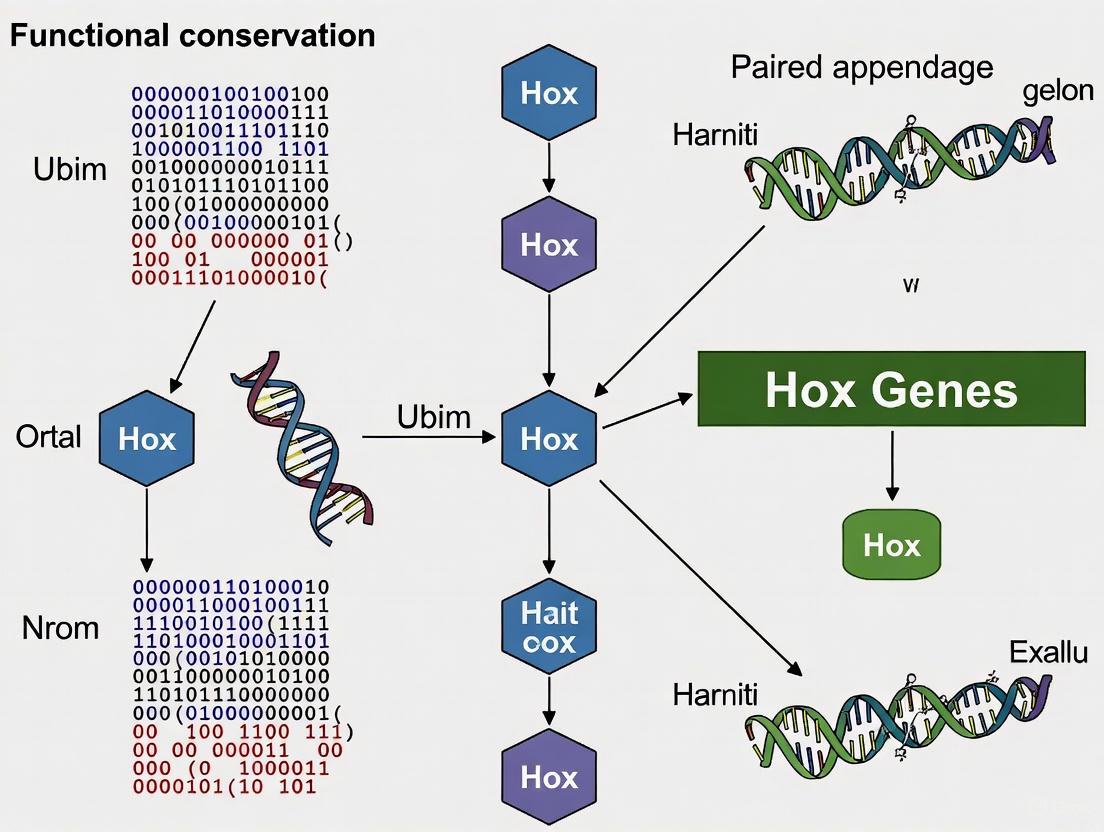
This article synthesizes current research on the profound functional conservation of Hox genes in specifying and patterning paired appendages across vertebrate evolution.
Hox Genes and Paired Appendage Development: Unraveling Functional Conservation from Zebrafish to Humans
Abstract
This article synthesizes current research on the profound functional conservation of Hox genes in specifying and patterning paired appendages across vertebrate evolution. We explore foundational principles of Hox gene biology, including cluster organization, colinearity, and their role as master regulators of positional identity. The review covers cutting-edge methodological approaches—from CRISPR-Cas9 mutagenesis to synteny-based algorithms—that reveal how Hox genes determine limb positioning through direct regulation of key factors like Tbx5. We address challenges in studying these redundant gene networks and present compelling comparative evidence of conserved tri-phasic expression patterns and regulatory mechanisms between teleost fins and tetrapod limbs. This synthesis provides crucial insights for developmental biologists and has significant implications for understanding evolutionary morphology and congenital limb disorders.
Evolutionary Guardians of Form: How Hox Genes Mastermind Appendage Positioning
The Hox genes, a subset of homeobox genes, encode a deeply conserved group of transcription factors that function as master regulators of animal body plans [1] [2]. They specify positional identity along the anteroposterior (head-to-tail) axis in a wide range of animals, from humans to fruit flies [3] [1]. The "Hox code" refers to the combinatorial expression of these genes within a segment or region that provides a molecular address, defining the morphological structures that will develop there [4]. This mechanism is fundamental to the development of paired appendages, and its evolutionary conservation is a key focus in evolutionary developmental biology (evo-devo) [2] [5]. Despite deep functional conservation, changes in Hox gene regulation and their downstream targets have been instrumental in the evolution of diverse body plans and novel structures, from the limbs of tetrapods to the luminescent lanterns of fireflies [6] [5]. This guide provides a comparative analysis of Hox gene function, using specific experimental data to illustrate their conserved and divergent roles in patterning paired appendages and related structures.
Core Principles and Evolutionary Conservation
The Hox genes are notable not only for their function but also for their genomic organization. They are typically clustered in the genome, and their order within the cluster corresponds to their spatial and temporal expression along the body axis, a phenomenon known as colinearity [1] [4]. A critical aspect of their function is the Hox-TALE protein interaction. Hox proteins require co-factors from the TALE family (e.g., PBC and Meis) to form complexes that bind DNA and regulate downstream target genes [3] [1]. This interaction is an ancient regulatory module, conserved across all eumetazoans and predating the evolution of bilaterian animals [3].
The following diagram illustrates this core, conserved mechanism of Hox gene function.
Comparative Analysis of Hox Gene Function in Model Systems
Research across diverse species reveals a shared paradigm where Hox genes are expressed in nested domains along the anteroposterior axis to specify segment identity. However, the outcomes—such as wings, legs, fins, or even novel structures—depend on the specific downstream genetic networks they activate in different contexts. The table below provides a quantitative and functional comparison of key posterior Hox genes (paralog groups 9-13) in the development of paired appendages across three model organisms.
| Hox Gene / Paralog Group | Model Organism | Expression Domain in Appendage | Functional Role & Phenotype of Loss-of-Function | Key Experimental Findings |
|---|---|---|---|---|
| Hoxc10 / Hox10 group | Mouse (Mus musculus) | Presumptive lumbar vertebrae [4] | Transformation of identity: Ribs form on lumbar vertebrae (toward thoracic identity) [2] [4]. | Paralogue knockout shows ground state is to form ribs; Hox10 activity suppresses rib development [2] [4]. |
| Hoxa10 / Hoxc10 | Snake (e.g., Python ) | Rib-bearing regions of axial skeleton [2] | No rib suppression: Expression in rib-bearing regions does not inhibit rib formation [2]. | Polymorphism in a Hox/Pax enhancer prevents response to rib-suppressing Hox10 proteins, leading to extended ribcage [2]. |
| Hoxd13 / hoxd13a | Zebrafish (Danio rerio) | Posterior-distal fin bud (postaxial cells) [7] [5] | Loss of distal structures: Disruption of endoskeletal disc and fin ray formation [5]. | CRISPR-Cas9 deletion of 5' regulatory landscape (5DOM) shows this region is not required for hoxd13a expression in fins, unlike in mouse limbs [5]. |
| Hoxd13 / Hoxd13 | Mouse (Mus musculus) | Developing autopod (digits) [5] | Severe digit reduction: Combined inactivation with Hoxa13 leads to agenesis of the autopod [5]. | Digit development depends on a 5' regulatory landscape (5DOM); its deletion removes Hoxd gene expression from the autopod [5]. |
| Abdominal-B (Abd-B) | Firefly (Photuris spp.) | Adult abdominal segments 6 & 7 (lantern location) [6] | Disruption of novel trait: Extensive disruption of the adult bioluminescent lantern [6]. | RNAi-mediated transcript depletion shows Abd-B was co-opted to instruct the formation of a evolutionary novelty [6]. |
| Ultrabithorax (Ubx) | Fruit Fly (Drosophila melanogaster) | Third thoracic segment (T3) [1] | Homeotic transformation: Halteres transform into a second pair of wings [1]. | Loss-of-function mutation leads to four-winged flies. Ubx normally represses wing-forming genes in T3 [1]. |
Detailed Experimental Protocols in Hox Gene Research
Protocol 1: Functional Analysis via RNA Interference (RNAi)
This protocol, used to investigate the role of Abdominal-B in firefly lantern development, demonstrates a method for transcript depletion in non-model insects [6].
- 1. Experimental Organism Preparation: Collect last-instar larvae of the target species (e.g., Photuris fireflies) from their natural habitat and maintain them in laboratory conditions that simulate their native environment (e.g., moist soil at 27°C) to induce pupation and adult development [6].
- 2. dsRNA Synthesis: Design and synthesize double-stranded RNA (dsRNA) molecules that are homologous to the target Hox gene (e.g., Abd-B). This is typically done via in vitro transcription from a template containing the gene sequence.
- 3. dsRNA Delivery: Inject the synthesized dsRNA into the body cavity of larvae or pupae. This allows the dsRNA to be taken up by cells and trigger the RNAi pathway, leading to the degradation of the corresponding endogenous mRNA.
- 4. Phenotypic Analysis: After the organisms develop to the target stage (e.g., adulthood), dissect and examine the tissues of interest. Analysis can include histological staining to observe tissue morphology and structure, and imaging to document the phenotypic consequences of gene knockdown [6].
Protocol 2: Regulatory Landscape Deletion via CRISPR-Cas9
This protocol, used to study the role of the Hoxd regulatory landscape in zebrafish, outlines a modern genome-editing approach [5].
- 1. Guide RNA (gRNA) Design: Design multiple gRNAs that flank the large, non-coding regulatory region to be deleted (e.g., the 5DOM or 3DOM landscape 5' to the hoxda cluster).
- 2. Microinjection into Zygotes: Co-inject Cas9 mRNA or protein along with the pool of gRNAs into single-cell zebrafish embryos. This enables the CRISPR-Cas9 system to make double-strand breaks at the target sites, resulting in the deletion of the intervening genomic region.
- 3. Mutant Line Generation: Raise injected embryos (F0) to adulthood and screen for germline transmission of the deletion. Cross founder fish to establish stable mutant lines (e.g., hoxdadel(5DOM)).
- 4. Expression Analysis: Use whole-mount in situ hybridization (WISH) on mutant embryos at various developmental stages (e.g., 36 to 72 hours post-fertilization) to visualize the spatial expression patterns of genes within the cluster (e.g., hoxd4a, hoxd10a, hoxd13a). Compare these patterns to those in wild-type embryos to determine the effect of the regulatory deletion [5].
The logical workflow for this CRISPR-Cas9 based protocol is detailed below.
The Scientist's Toolkit: Key Research Reagents
This section catalogs essential reagents and materials used in the featured experiments, providing a resource for researchers aiming to conduct similar studies.
| Reagent / Material | Function / Application | Example Use Case |
|---|---|---|
| CRISPR-Cas9 System | Targeted deletion of large genomic regions (e.g., regulatory landscapes) and specific genes. | Deletion of the 5DOM and 3DOM regulatory landscapes in zebrafish to study their role in hoxd gene regulation during fin development [5]. |
| RNAi (dsRNA) | Transcriptional knockdown of specific genes to assess loss-of-function phenotypes. | Functional analysis of Abd-B and abd-A in firefly lantern development where traditional genetics is not feasible [6]. |
| Pluripotent Stem Cells | In vitro modeling of developmental processes and for synthetic biology approaches. | Creation of artificial Hox clusters in mouse stem cells to study the principles of positional memory [8]. |
| Synthetic DNA | De novo synthesis of long DNA strands to build artificial gene clusters for functional testing. | Construction of artificial rat Hox gene clusters for insertion into mouse stem cells [8]. |
| Whole-Mount In Situ Hybridization (WISH) | Spatial visualization of gene expression patterns in intact embryos. | Mapping the expression domains of hoxd13a, hoxd10a, and hoxd4a in zebrafish fin buds after regulatory landscape deletion [5]. |
| CUT&RUN Assay | Mapping of histone modifications (e.g., H3K27ac, H3K27me3) and transcription factor binding sites. | Determining the active (H3K27ac) and repressed (H3K27me3) chromatin states over the zebrafish hoxda regulatory landscapes [5]. |
Evolutionary Insights: Co-option and Regulatory Changes
A major theme in Hox biology is that the evolution of novel morphological traits often involves the co-option of ancestral genetic tools rather than the invention of new genes. A seminal 2025 study on zebrafish and mice demonstrated that the regulatory landscape controlling Hoxd13 expression in tetrapod digits was co-opted from an ancestral regulatory program used for the development of the cloaca, a posterior orifice [5]. This indicates that deep homology exists not only in the genes themselves but also in their regulatory circuits, which can be redeployed for new functions.
Furthermore, changes in the regulatory sequences themselves drive diversity. In snakes, the extended ribcage evolved not because the Hox10 genes lost their rib-repressing function, but because of a polymorphism in a Hox/Pax-responsive enhancer that made it unresponsive to the rib-suppressing signal from Hox10 proteins [2]. This highlights that regulatory mutations are a key mechanism for evolving new body plans without altering the core Hox code.
Hox genes, which encode a family of transcription factors characterized by the homeodomain, are master regulators of embryonic development along the anterior-posterior axis in nearly all bilaterian animals [9] [10]. These genes are notable for their clustered genomic arrangement, and their organization, number, and content have undergone significant changes throughout animal evolution [11] [12]. These changes—including the duplication of entire clusters and the subsequent loss or divergence of individual genes—are strongly correlated with the emergence of morphological novelty and increased body plan complexity [13] [10]. For researchers investigating the genetic underpinnings of development and disease, understanding the conservation and variation in Hox cluster architecture across model and non-model species is fundamental. This guide provides a comparative overview of Hox cluster organization and paralog group distribution, synthesizing key genomic data to serve as a resource for ongoing research.
Table 1: Core Terminology in Hox Genomics
| Term | Definition | Research Significance |
|---|---|---|
| Hox Cluster | A genomic locus containing multiple Hox genes, typically arranged in a tight, ordered complex. | The fundamental unit of study; its integrity, size, and regulatory landscape influence gene expression [14] [15]. |
| Paralog Group (PG) | The set of Hox genes in different clusters that are descendants of a single ancestral gene via cluster duplication (e.g., all Hox1 genes). | Paralogs often have partially overlapping functions; comparing them reveals functional divergence and specialization [9] [10]. |
| Homeodomain | A 60-amino acid DNA-binding domain encoded by the 180-bp homeobox [9] [10]. | The core functional motif; its sequence evolution can indicate positive selection or conserved function [10]. |
| Colinearity | The phenomenon where the order of genes on the chromosome corresponds to their spatial and temporal expression in the embryo. | A key organizational principle; conserved from insects to mammals, though with variations [14] [12]. |
| Conserved Non-coding Sequence (CNS) | Intergenic regions under purifying selection, often housing cis-regulatory elements [14] [11]. | Identifies potential genomic regions critical for the regulation of Hox genes [14] [15]. |
Evolution of Hox Cluster Number and Size
The number of Hox clusters varies significantly across animal lineages due to whole genome duplication (WGD) events. Invertebrates typically possess a single cluster, while two rounds of WGD (2R) in the early vertebrate lineage established four Hox clusters (HoxA, HoxB, HoxC, HoxD) [13] [11]. A subsequent teleost-specific genome duplication (FSGD/3R) further increased this number to seven or eight clusters in many ray-finned fishes [11] [12]. Following duplication, clusters are often subject to gene loss and chromosomal rearrangement, leading to a dynamic genomic landscape.
Table 2: Hox Cluster Number and Size Across Selected Species
| Species / Clade | Number of Hox Clusters | Typical Gene Count per Cluster | Notable Features of Genomic Architecture |
|---|---|---|---|
| Fruit Fly (Drosophila) | 1 | Variable (split cluster) | The ancestral single cluster is split and disrupted [11] [16]. |
| Human/Mouse (Mammals) | 4 | Up to 11 genes | Relatively large and compact clusters; high CNS content [14] [15]. |
| Horn Shark | 4 | Includes Hox14 genes | Retains ancestral Hox14 genes since lost in tetrapods [15] [12]. |
| Zebrafish (Teleost Fish) | 7 | Highly variable | Result of FSGD; extensive gene loss; clusters are dramatically shorter than mammalian counterparts [11] [15]. |
| Cichlid Fish (Teleost) | 7 | Unique set per species | Ongoing gene loss (e.g., independent loss of hoxb7a); high morphological diversity [11]. |
| Tadpole Shrimp (Notostraca) | 1 (split) | Full complement | The single cluster is split into subclusters, a more derived condition than in Daphnia [17]. |
A comparative analysis of the HoxA cluster illustrates the scale of genomic change. The cluster spans approximately 110 kb in humans and horn sharks, but is reduced to about 100 kb in tilapia, and further to 62 kb and 33 kb in the two duplicated HoxA clusters (HoxAα and HoxAβ) of zebrafish [15]. This size reduction in teleosts is correlated with a lower abundance of Conserved Non-coding Sequences (CNS), particularly in the anterior and posterior regions of the clusters [15]. Furthermore, different teleost lineages have experienced independent gene losses; for example, the hoxb7a gene has been lost multiple times, most recently within the rapid radiation of East African cichlids [11].
Figure 1: Evolutionary Pathway of Hox Cluster Duplication and Divergence in Vertebrates. Key events include two rounds of early vertebrate genome duplication (2R) and a subsequent teleost-specific duplication (FSGD), followed by lineage-specific modifications.
Distribution and Evolution of Paralog Groups
Following cluster duplication, the descendant genes are known as paralogs, and sets of paralogs across clusters form paralog groups (e.g., HoxA1, HoxB1, HoxC1, and HoxD1 constitute paralog group 1) [9]. The fate of these paralogs varies; many are lost, but those that are retained often undergo functional divergence. This divergence can occur through several mechanisms, including subfunctionalization (where paralogs partition the ancestral function) and neofunctionalization (where one paralog acquires a new function) [13]. Evidence suggests that positive Darwinian selection acted on the homeodomain immediately after cluster duplication events, particularly at sites involved in protein-protein interactions, driving this functional diversification [10].
Table 3: Examples of Paralog Group Evolution and Functional Divergence
| Paralog Group | Functional Role | Evidence of Divergence After Duplication |
|---|---|---|
| Hox10 Genes (e.g., HoxA10, HoxC10) | Specification of lumbar vertebra identity; repression of rib formation in the lumbar region [9]. | In mice, inactivation of both HoxA10 and HoxC10 is required to induce homeotic transformation, showing redundant and specialized functions. In snakes, Hox10 genes lost rib-blocking ability [9]. |
| Hox11 Genes | Specification of sacral vertebra identity [9]. | Functional divergence between paralogs; studies show positive selection in HoxA-11 after teleost duplication [10]. |
| Hox13 Genes | Specification of most posterior body structures and genitalia [6]. | Ancestral Hox14 genes were present in shark and coelacanth but lost independently in tetrapod and teleost lineages [15] [12]. |
| Hox5 and Hox6 | Anterior-posterior patterning. | Branch-specific tests indicate positive selection acting on these paralog groups after early vertebrate duplications [10]. |
The conservation of paralog function can be striking. For instance, a mouse Hox gene can substitute for its fruit fly homologue and cause homeotic transformations when misexpressed [9]. However, non-equivalence is also common, highlighting the functional divergence that has occurred over hundreds of millions of years [10]. The pattern of complementary loss of conserved non-coding sequences (CNS) between paralogs has been investigated as a potential mechanism for resolving genetic redundancy via subfunctionalization. However, data from zebrafish Hox clusters did not yield strong evidence for this model, suggesting that adaptive modification may be a more significant driver of regulatory evolution after duplication [15].
Key Experimental Methodologies and Reagents
Research into Hox cluster architecture and function relies on a suite of established and modern molecular techniques.
Larval RNA Interference (RNAi)
- Protocol Summary (as used in firefly development studies [6]):
- Collection & Rearing: Last-instar larvae are collected from the wild and maintained in the laboratory under controlled conditions (e.g., 27°C, 16-hour light cycle) to induce pupation.
- dsRNA Preparation: Double-stranded RNA (dsRNA) is synthesized in vitro to target specific Hox genes (e.g., Abdominal-B, abdominal-A).
- Transcript Depletion: The dsRNA is injected into last-instar larvae to trigger the RNAi pathway, leading to the degradation of the target Hox gene mRNA.
- Phenotypic Analysis: The resulting adult morphology (e.g., of the firefly lantern) is examined for disruptions, allowing researchers to infer the gene's developmental function.
Comparative Genomics and Phylogenetic Footprinting
- Protocol Summary (for identifying CNS [14] [11]):
- Sequence Acquisition: Obtain whole-genome sequences or Hox-cluster-containing BAC clones from the species of interest.
- Multiple Sequence Alignment: Use tools like PipMaker or MAFFT to align Hox cluster sequences from evolutionarily distantly related species (e.g., human, shark, zebrafish).
- Identification of CNS: Scan the aligned intergenic regions for patches of sequence that are highly conserved above the background neutral rate. These "phylogenetic footprints" are putative cis-regulatory elements.
- Functional Validation: Test identified CNS sequences in vivo using reporter gene assays (e.g., lacZ in transgenic mice or fish) to confirm enhancer activity.
CRISPR/Cas9 Genome Editing
- Protocol Summary (for functional analysis of paralogs [13]):
- Guide RNA Design: Design synthetic guide RNAs (sgRNAs) complementary to sequences within the exon of a target Hox paralog.
- Microinjection: Co-inject sgRNAs and Cas9 mRNA/protein into single-cell embryos of the model organism.
- Screening: Genotype the resulting animals to identify knockout mutants with insertions or deletions (indels) that disrupt the homeodomain.
- Cross-Species Functional Assay: To test functional equivalence, precisely replace the endogenous Hox gene in one species (e.g., mouse) with its ortholog from another (e.g., fly) using CRISPR/HDR. This allows for the comparison of protein function in a native physiological context [13].
Figure 2: Integrated Experimental Workflow for Hox Gene Research. This cycle begins with genomic comparisons to identify targets, proceeds to functional manipulation via gene editing, and concludes with phenotypic analysis, the results of which feed back into evolutionary understanding.
The Scientist's Toolkit: Essential Research Reagents
Table 4: Key Reagent Solutions for Hox Gene Research
| Research Reagent | Primary Function in Hox Research |
|---|---|
| BAC (Bacterial Artificial Chromosome) Libraries | Provide large-insert genomic DNA clones (150-200 kb) that are essential for sequencing and analyzing entire Hox clusters from species without fully assembled genomes [11]. |
| Species-Specific Genome Databases | Foundational resources (e.g., NCBI, Ensembl) for obtaining annotated Hox cluster sequences, gene models, and homeodomain annotations for comparative analyses [17] [11]. |
| Homeobox-Specific Probes | Used to screen genomic libraries (like BACs) and to identify Hox genes via in situ hybridization; designed against the conserved homeobox to find all Hox family members or against unique flanking sequences for specific genes [11]. |
| CRISPR/Cas9 Systems | Enable precise knockout of Hox paralogs to assess functional redundancy and the generation of knock-in alleles for testing regulatory elements or performing cross-species functional complementation assays [13]. |
| Phylogenetic Analysis Software | Tools (e.g., IQ-TREE) used to reconstruct evolutionary relationships among Hox genes from different clusters and species, confirming orthology and paralogy relationships and testing for positive selection [17] [10]. |
The colinearity principle is a cornerstone of developmental biology, describing the precise spatial and temporal coordination of Hox gene expression that underpins the formation of the anterior-posterior (A-P) body axis in vertebrates and many other animal phyla. This multi-scalar property, known as Hox gene collinearity (HGC), represents a remarkable biological phenomenon where the order of Hox genes along the chromosome corresponds to their sequential expression patterns both in time and space during embryogenesis [18]. Hox genes encode transcription factors that orchestrate regional identity along the A-P axis, and their collinear expression provides a fundamental mechanism for translating genomic information into three-dimensional embryonic structures [19].
The conservation of Hox gene collinearity across diverse animal species suggests its fundamental importance in animal development and evolution. In vertebrates, this process is particularly crucial for the development of paired appendages, where Hox genes determine morphological specialization along the proximal-distal axis [20] [5]. Understanding the mechanisms governing spatial and temporal collinearity provides critical insights into both normal developmental processes and the evolutionary changes that generate morphological diversity, with potential applications in regenerative medicine and targeted therapies [21].
The Dual Nature of Hox Colinearity
Spatial Collinearity (SC)
Spatial collinearity describes the correlation between the physical order of Hox genes within their clusters on chromosomes and their expression domains along the anterior-posterior axis of the developing embryo. Genes at the 3' end of Hox clusters (e.g., Hox1, Hox2, Hox3) are expressed in anterior embryonic regions, while genes at the 5' end (e.g., Hox11, Hox12, Hox13) are expressed in more posterior regions [18]. This remarkable correspondence ensures that each axial region acquires its specific morphological identity during development.
In vertebrate paired appendages, spatial collinearity manifests as nested expression patterns that determine the identity of skeletal elements along the proximal-distal axis. For instance, in tetrapod limbs, Hoxa13 and Hoxd13 exhibit specific expression in the most distal structures (autopods or hands/feet), while more 3' Hox genes pattern proximal structures (stylopods and zeugopods) [5]. The conservation of this spatial regulatory logic, even in fish fins despite their different morphology, highlights the deep evolutionary conservation of this principle [5].
Temporal Collinearity (TC)
Temporal collinearity refers to the sequential activation of Hox genes during development, following their genomic order from 3' to 5' ends. In vertebrate embryos, Hox1 is expressed first, followed by Hox2, Hox3, and so on, with the most 5' genes (e.g., Hox13) being expressed last [19] [21]. This temporal sequence is intimately linked with the progressive emergence of axial tissues and is thought to lay the foundation for the spatial pattern that subsequently emerges [21].
While the existence of temporal collinearity has been questioned in some studies, comprehensive analyses across multiple vertebrate species provide compelling evidence for this phenomenon, particularly during early developmental stages when the body plan is established [21]. The timing of Hox gene activation appears crucial for coordinating the differentiation of various tissues along the A-P axis, ensuring proper alignment of anatomical structures derived from different germ layers.
Table 1: Comparative Analysis of Spatial and Temporal Collinearity
| Feature | Spatial Collinearity | Temporal Collinearity |
|---|---|---|
| Definition | Correlation between genomic order and spatial expression along A-P axis | Sequential gene activation following genomic order during development |
| Genomic direction | 3' genes → anterior expression; 5' genes → posterior expression | 3' genes activated first; 5' genes activated later |
| Evolutionary conservation | Conserved across bilaterians | Primarily observed in vertebrates |
| Functional significance | Assigns regional identity along A-P axis | Coordinates tissue differentiation with axial elongation |
| Regulatory mechanism | Controlled by global enhancer landscapes (3DOM, 5DOM) | Linked to progressive chromatin opening and pulling forces |
Molecular Mechanisms Underlying Colinearity
Regulatory Landscapes and Chromatin Organization
The colinear expression of Hox genes is governed by complex regulatory landscapes flanking the Hox clusters. In vertebrates, these landscapes are organized into two major domains: 3DOM (located at the 3' end) and 5DOM (located at the 5' end), which correspond to topologically associating domains (TADs) that compartmentalize regulatory interactions [5]. The 3DOM contains enhancers that control the early, proximal expression of 3' Hox genes, while the 5DOM regulates the later, distal expression of 5' Hox genes, particularly during appendage development [5].
Recent comparative studies between zebrafish and mice have revealed both conserved and diverged functions of these regulatory landscapes. Deletion of the 3DOM region in zebrafish abolishes expression of early Hox genes (hoxd4a, hoxd10a) in pectoral fin buds, mirroring findings in mouse limb buds [5]. Surprisingly however, deletion of the 5DOM region in zebrafish does not disrupt distal hoxd13a expression in fins, unlike the situation in mouse digits, suggesting evolutionary changes in regulatory circuitries [5]. Instead, the zebrafish 5DOM landscape appears essential for expression in the cloaca, indicating that the digit regulatory program in tetrapods was co-opted from a pre-existing cloacal regulatory machinery [5].
Biophysical Models of Colinear Activation
The biophysical model offers a physical explanation for temporal collinearity, proposing that pulling forces act sequentially on Hox genes to extrude them from compact chromatin territories into transcriptionally active domains [18]. According to this model, the Hox cluster behaves like an irreversibly expanding spring, with the pulling force (F) representing an interplay between microscopic (cluster) and macroscopic (embryonic) scales:
F = N × P
Where N represents the negative charge of Hox cluster DNA, and P represents a graded distribution of positively charged molecules along the A-P axis [18]. This force gradually increases during development, pulling out Hox genes in sequence from 3' to 5' ends, with the extent of extrusion proportional to the morphogen gradient along the axis.
Experimental evidence supporting this model comes from super-resolution imaging studies showing gradual elongation of Hox clusters along the 3' to 5' axis during gene activation [18]. The model provides a plausible mechanism for coordinating events across vastly different spatial scales, linking molecular interactions within the nanometer-scale chromatin fiber with patterning across millimeter-scale embryonic tissues.
Figure 1: Biophysical Model of Hox Gene Activation. This diagram illustrates the proposed mechanism whereby pulling forces sequentially extrude Hox genes from compact chromatin territories into transcriptionally active domains, following their genomic order from 3' to 5' ends.
Experimental Evidence and Methodologies
Functional Tests in Crustacean Models
The crustacean Parhyale hawaiensis has emerged as a powerful model for experimentally testing Hox gene function in appendage specialization. Researchers established tools for conditional misexpression using a heat-inducible system (PhHS) derived from Parhyale hsp70 genes [20]. This system enables precise temporal control of gene expression, with robust induction within 30 minutes of heat shock and peak expression at 1-2 hours [20].
Using this approach, scientists conducted functional tests of Ultrabithorax (Ubx) in controlling the transformation of thoracic legs into specialized feeding appendages called maxillipeds. Ectopic Ubx expression resulted in homeotic transformations of anterior appendages toward more posterior thoracic fates, including maxilliped-to-leg transformations [20]. These experiments confirmed that maxillipeds develop in the absence of Ubx expression or in the presence of low/transient Ubx, supporting an evolutionary path where stepwise changes in Hox expression brought about morphological transformations [20].
Table 2: Key Research Reagent Solutions for Hox Colinearity Studies
| Reagent/Technique | Function/Application | Experimental Model |
|---|---|---|
| Heat-inducible PhHS system | Conditional gene misexpression with temporal control | Parhyale hawaiensis [20] |
| Minos transformation vector | Stable transgenesis for generating transgenic lines | Parhyale hawaiensis [20] |
| CRISPR-Cas9 genome editing | Targeted deletion of regulatory landscapes | Zebrafish, mice [5] |
| CUT&RUN assay | Mapping histone modifications (H3K27ac, H3K27me3) | Zebrafish [5] |
| Whole-mount in situ hybridization | Spatial visualization of gene expression patterns | Multiple species [5] [21] |
| Super-resolution microscopy (STORM) | Nanoscale imaging of chromatin organization | Vertebrate cells [18] |
Cross-Species Regulatory Landscape Comparisons
Comparative analyses of Hox regulatory landscapes between zebrafish and mice have revealed deep conservation of genomic organization despite functional divergence. Both species maintain syntenic Hox loci flanked by two gene deserts (3DOM and 5DOM) that form topologically associating domains, with conserved positions of CTCF binding sites at TAD borders [5]. However, the functional conservation of these landscapes varies significantly.
Genetic deletion experiments showed that while 3DOM function is conserved in activating early Hox genes in proximal appendages, 5DOM function has diverged. In mice, 5DOM is essential for Hoxd gene expression in digits, whereas in zebrafish, 5DOM deletion does not affect distal hoxd13a expression in fins but instead disrupts cloacal expression [5]. This suggests that tetrapods co-opted an ancestral cloacal regulatory landscape for digit development during their evolution.
The Time-Space Translation Hypothesis
The Time-Space Translation (TST) hypothesis provides a framework for understanding how temporal collinearity is converted into spatial patterning along the A-P axis [21]. According to this model, the sequential temporal activation of Hox genes is transformed into a static spatial pattern through developmental processes including mesodermal convergence-extension movements and signaling gradients [21].
Experimental evidence supporting TST comes from observations that the temporally collinear Hox sequence initiates in ventrolateral, BMP-rich non-organizer mesoderm (NOM) and is subsequently converted to a dorsal spatial pattern by anti-BMP signals from the Spemann organizer [21]. This transition from traveling waves of Hox gene expression to a fixed spatial pattern has been documented in Xenopus, chicken, and zebrafish, suggesting a conserved mechanism across vertebrates [21].
Figure 2: Time-Space Translation Hypothesis. This diagram illustrates the proposed mechanism whereby sequential temporal activation of Hox genes is converted into a spatial pattern along the anterior-posterior axis through organizer signaling and tissue movements.
Evolutionary Implications and Functional Conservation
Co-option of Regulatory Landscapes
The evolution of novel morphological structures often involves the co-option of existing regulatory programs. A striking example comes from comparative studies of the Hoxd regulatory landscape in zebrafish and mice, which revealed that the digit-control program in tetrapods was co-opted from an ancestral cloacal regulatory machinery [5]. Despite the presence of syntenic counterparts of mouse digit enhancers in zebrafish, deletion of these regions in fish does not disrupt hoxd gene transcription during distal fin development but instead affects cloacal expression [5].
This finding suggests that the regulatory landscape active in tetrapod digits was not originally evolved for appendage development but was rather recruited from a pre-existing program controlling formation of the cloaca, a structure related to the mammalian urogenital sinus [5]. Such co-option events represent a fundamental mechanism for evolutionary innovation, allowing existing gene regulatory networks to be deployed in new contexts to generate novel structures.
Gene Duplication and Functional Divergence
Gene duplication events have played a crucial role in the functional evolution of Hox proteins. Vertebrates typically possess multiple Hox clusters (HoxA, HoxB, HoxC, HoxD) resulting from whole-genome duplication events, providing genetic material for functional diversification [22]. Following duplication, Hox genes can undergo several fates: nonfunctionalization (loss of function), neofunctionalization (acquisition of novel functions), or subfunctionalization (partitioning of ancestral functions) [22].
The functional divergence of duplicated Hox genes has been particularly important in the evolution of specialized appendages. For example, in crustaceans, the expression patterns of Ubx and other Hox genes correlate with the transformation of thoracic limbs into specialized feeding appendages (maxillipeds), and experimental alteration of Ubx expression can reverse these evolutionary transformations [20]. Similarly, in tetrapods, the co-option of Hoxa13 and Hoxd13 for digit formation illustrates how duplicated genes can be recruited for novel morphological functions [5].
Table 3: Evolution of Hox Cluster Organization Across Species
| Species/Group | Hox Clusters | Genome Duplication Events | Notable Features |
|---|---|---|---|
| Drosophila | 1 complex (ANT-C, BX-C) | None | Split cluster, spatial collinearity |
| Amphioxus | 1 cluster | None | Prototypical Hox cluster organization |
| Zebrafish | 7 clusters (hoxaa, hoxab, etc.) | Teleost-specific duplication (3R) | Additional clusters from fish duplication |
| Xenopus laevis | 8 clusters (HoxA.L, HoxA.S, etc.) | Allotetraploidization (4R) | Multiple homologs from polyploidy |
| Mouse/Human | 4 clusters (A, B, C, D) | Two rounds (2R) in vertebrates | Typical mammalian complement |
Research Applications and Future Directions
The study of Hox colinearity principles has significant implications for multiple research areas, including regenerative medicine, evolutionary developmental biology, and stem cell engineering. Understanding how Hox genes orchestrate positional identity along body axes could enable more precise programming of stem cells for tissue engineering and organoid development [21]. Additionally, insights into the regulatory mechanisms controlling Hox expression may inform therapeutic strategies for conditions involving axial patterning defects.
Future research directions include elucidating the precise biophysical mechanisms of chromatin dynamics during Hox activation, understanding how Hox proteins achieve functional specificity despite structural similarities, and exploring the potential for manipulating Hox patterns in regenerative contexts. The continued development of sophisticated genetic tools in emerging model organisms, combined with advanced imaging and genomic technologies, promises to uncover deeper insights into this fundamental principle of developmental biology.
The precise positioning of paired appendages along the anteroposterior (AP) body axis is a fundamental process in vertebrate development, governed by the spatially restricted expression of Hox genes. This review synthesizes recent advances from multiple model organisms to compare the mechanisms by which Hox codes instruct limb formation. We examine compelling genetic evidence from zebrafish, chick, and mouse models, demonstrating that specific Hox clusters and paralogous groups provide both permissive and instructive signals that establish the limb fields through direct regulation of key transcription factors like Tbx5. The emerging paradigm reveals a complex interplay of regulatory landscapes and chromatin dynamics that enable the functional conservation of Hox genes in patterning paired appendages across vertebrate evolution.
Hox genes, encoding evolutionarily conserved homeodomain-containing transcription factors, provide positional information along the anterior-posterior axis during animal development [23]. In vertebrates, these genes are organized into four clusters (HoxA, HoxB, HoxC, and HoxD) that exhibit structural collinearity—their genomic arrangement corresponds to their expression domains along the body axis [23]. A key aspect of their function includes specifying the locations where paired appendages emerge from the lateral plate mesoderm (LPM). While the role of Hox genes in limb patterning has been extensively studied, their fundamental involvement in determining the initial positioning of limb buds has only recently been genetically demonstrated [23] [24]. This review systematically compares experimental evidence across model organisms to elucidate how Hox genes establish limb formation zones, with implications for understanding evolutionary adaptations and congenital abnormalities.
Comparative Models of Hox-Mediated Limb Positioning
Zebrafish HoxB Clusters in Pectoral Fin Positioning
Table 1: Hox Gene Functions in Zebrafish Pectoral Fin Development
| Gene/Cluster | Function | Phenotype in Mutants | Target Genes | Genetic Evidence |
|---|---|---|---|---|
| hoxba & hoxbb clusters | Anterior-posterior positioning of pectoral fins | Complete absence of pectoral fins in double mutants | tbx5a (failed induction) | CRISPR-Cas9 cluster deletion [23] |
| hoxb4a, hoxb5a, hoxb5b | Pectoral fin field specification | Absence of pectoral fins (low penetrance) | tbx5a | Frameshift mutations and deletion mutants [23] |
| tbx5a | Initiation of pectoral fin buds | No fin bud formation | N/A | Expression absent in hoxba;hoxbb mutants [23] |
In zebrafish, the hoxba and hoxbb clusters (derived from the ancestral HoxB cluster through teleost-specific genome duplication) play an essential role in determining pectoral fin position. Simultaneous deletion of both clusters results in a complete absence of pectoral fins, accompanied by failure to induce tbx5a expression in the pectoral fin field of the lateral plate mesoderm [23]. This represents the first genetic evidence that Hox genes specify the positions of paired appendages in vertebrates. Further analysis identified hoxb4a, hoxb5a, and hoxb5b as pivotal genes in this process, though individual mutations show incomplete penetrance, suggesting cooperative function [23].
Avian Hox Codes in Forelimb Specification
Table 2: Hox Gene Functions in Chick Forelimb Positioning
| Hox Paralogs | Proposed Role | Experimental Manipulation | Effect on Limb Positioning | Target |
|---|---|---|---|---|
| Hox4/5 (PG4/5) | Permissive signal | Dominant-negative constructs; Misexpression | Reduced or expanded Tbx5 expression domain | Tbx5 regulation [24] |
| Hox6/7 (PG6/7) | Instructive signal | Misexpression in neck LPM | Ectopic limb bud formation anterior to normal field | Tbx5 activation [24] |
| Hox9+ (posterior) | Repressive signal | Not directly tested | Proposed to suppress Tbx5 expression | Tbx5 repression [24] |
Studies in chick embryos reveal that forelimb positioning is governed by a combinatorial Hox code where different paralog groups play distinct roles. HoxPG4/5 genes provide a permissive signal that establishes a territory competent for forelimb formation, while HoxPG6/7 genes within this domain provide instructive cues that directly activate Tbx5 expression [24]. When HoxPG6/7 genes are misexpressed in the neck lateral plate mesoderm (which normally expresses only HoxPG4/5), the tissue can be respecified to form an ectopic limb bud anterior to the normal limb field [24]. This demonstrates that the neck LPM retains limb-forming potential that is normally suppressed by the absence of instructive Hox signals.
Mammalian HoxD Regulation and Chromatin Dynamics
In mice, the HoxD cluster employs a bimodal regulatory strategy with distinct chromatin landscapes controlling proximal versus distal limb patterning [5]. A late phase of Hoxd activation controlled by enhancers in the 5' regulatory landscape (5DOM) is crucial for digit development [5] [25]. Recent research shows that the regulatory landscape active in distal limbs was co-opted in tetrapods from a pre-existing cloacal regulatory machinery [5].
Chromatin topology analyses reveal anterior-posterior differences in HoxD regulation, with distal posterior limb cells showing loss of polycomb-catalyzed H3K27me3 histone modification and chromatin decompaction over HoxD compared to anterior regions [25]. This decompaction facilitates spatial colocalization between the global control region (GCR) enhancer and 5' HoxD genomic regions specifically in the distal posterior limb, enabling the expression of Hoxd13 and other 5' Hoxd genes essential for autopod patterning [25].
Experimental Approaches and Methodologies
Genetic Manipulation Techniques
Table 3: Key Experimental Methods in Hox-Limb Research
| Method | Application | Model Organisms | Key Findings |
|---|---|---|---|
| CRISPR-Cas9 cluster deletion | Systematic hox cluster mutagenesis | Zebrafish | hoxba/hoxbb double mutants lack pectoral fins [23] |
| Electroporation of dominant-negative Hox constructs | Loss-of-function in specific tissues | Chick | HoxPG4/5 required for Tbx5 expression [24] |
| Chromatin Immunoprecipitation (ChIP) | Histone modification analysis | Mouse | Reduced H3K27me3 in posterior limb bud [25] |
| Immortalized cell lines | Anterior-posterior chromatin comparison | Mouse | Differential chromatin looping in limb A-P axis [25] |
| Heat-shock inducible transgenesis | Conditional misexpression | Parhyale (crustacean) | Ubx misexpression transforms appendage identity [20] |
The Scientist's Toolkit: Essential Research Reagents
Table 4: Key Research Reagents for Hox-Limb Studies
| Reagent/Resource | Function/Application | Examples in Research |
|---|---|---|
| CRISPR-Cas9 systems | Targeted gene and cluster deletion | Zebrafish hox cluster mutants [23] |
| Dominant-negative Hox constructs | Specific inhibition of Hox function | Hoxa4, a5, a6, a7 DN in chick [24] |
| H3K27me3-specific antibodies | Polycomb repression mapping | ChIP in mouse limb buds [25] |
| PhHS heat-shock vector | Conditional gene misexpression | Ubx misexpression in Parhyale [20] |
| Tbx5a/b reporter lines | Limb field visualization | tbx5a expression in zebrafish mutants [23] |
| 3DOM/5DOM deletion mutants | Regulatory landscape analysis | hoxda enhancer studies in zebrafish [5] |
Molecular Mechanisms and Signaling Pathways
The positioning of limbs by Hox genes involves a sophisticated regulatory network that integrates positional information with limb initiation signals. The following diagram illustrates the core signaling pathway and regulatory relationships:
The molecular pathway begins with restricted Hox expression along the anteroposterior axis in the lateral plate mesoderm. In the forelimb field, Hoxb4, Hox5, and related paralogs activate Tbx5 expression, which serves as a master regulator for forelimb initiation [23] [26] [24]. Tbx5 then initiates expression of fibroblast growth factors (FGFs) and Wnt signaling molecules, which promote limb bud outgrowth and establish the apical ectodermal ridge [26]. Simultaneously, Tbx5 helps establish the zone of polarizing activity that produces Sonic hedgehog (Shh), governing anteroposterior patterning within the developing limb [26]. Posterior Hox genes (including Hox9 and beyond) repress Tbx5 expression, thereby limiting the limb field and preventing ectopic limb formation in posterior regions [24].
Evolutionary Perspectives and Functional Conservation
The regulation of appendage development by Hox genes exhibits remarkable evolutionary conservation with significant adaptations. In zebrafish, the hoxba and hoxbb clusters (derived from the ancestral HoxB cluster) maintain the ancestral function of specifying appendage position, despite teleost-specific genome duplication [23]. Comparative analyses reveal that the regulatory landscapes controlling Hoxd gene expression in paired appendages display both conserved and divergent features between fishes and tetrapods.
Notably, the bimodal regulatory system controlling Hoxd expression in tetrapod limbs appears to have been co-opted from a pre-existing regulatory program. Recent evidence demonstrates that the distal limb regulatory landscape (5DOM) controlling digit development was co-opted from an ancestral cloacal regulatory program present in basal vertebrates [5]. In zebrafish, deletion of the 5DOM region does not disrupt hoxd gene transcription during distal fin development, unlike in mice, but instead leads to loss of expression within the cloaca [5]. This suggests that the regulatory machinery for digit development in tetrapods was recruited from a pre-existing program controlling development of the cloaca, illustrating evolutionary innovation through regulatory co-option.
The comparative analysis of Hox gene function across vertebrate models reveals a conserved fundamental principle: combinatorial Hox codes establish positional identity along the anteroposterior axis, thereby determining the precise locations where limb buds initiate. While the specific Hox paralogs involved may vary between species, their overarching role in defining limb formation zones through regulation of key transcription factors like Tbx5 represents a fundamental mechanism in vertebrate development.
Future research directions include elucidating the epigenetic mechanisms that establish and maintain specific Hox expression domains in the lateral plate mesoderm, understanding how Hox codes integrate with other signaling pathways to refine limb position, and exploring how alterations in these regulatory networks contribute to evolutionary adaptations in limb positioning across vertebrate species. The continued development of sophisticated genetic tools across multiple model organisms will enable increasingly precise dissection of these complex regulatory hierarchies, with potential applications in understanding congenital limb abnormalities and evolutionary developmental biology.
The study of Hox genes, master regulators of embryonic patterning, has been profoundly shaped by foundational research in the fruit fly, Drosophila melanogaster. In insects, these genes are essential for determining segment identity, including the specification of leg positioning and morphology. However, the evolution of paired appendages in vertebrates necessitated a suite of developmental innovations not found in flies. Vertebrate limbs, such as wings, fins, and legs, emerge from lateral plate mesoderm rather than segments, and their complex three-dimensional patterning along proximal-distal, anterior-posterior, and dorsal-ventral axes involves genetic circuits that have been extensively rewired and elaborated. This guide objectively compares the performance and experimental data of key vertebrate systems—mice, zebrafish, and axolotls—in unraveling the functional conservation and specific adaptations of Hox genes in limb development. By synthesizing the most current research, we provide a structured comparison of the experimental models and methodologies that are driving discoveries in this field, framed within the broader thesis of deep molecular conservation amid significant mechanistic divergence.
Core Concepts: Hox Gene Organization and Regulatory Logic
Genomic Architecture and Expression Dynamics
The fundamental genomic organization of Hox genes represents a key point of divergence between invertebrates and vertebrates, with direct implications for their function in limb development.
- Cluster Organization: Unlike the single, split Hox cluster in Drosophila, vertebrates possess multiple Hox clusters (HoxA, HoxB, HoxC, and HoxD) as a result of whole-genome duplications during early vertebrate evolution [27]. In teleost fishes like zebrafish, an additional teleost-specific whole-genome duplication resulted in seven hox clusters [28]. This expansion provided new genetic material for functional specialization, a critical vertebrate adaptation.
- Temporal Collinearity: A cornerstone of Hox biology is collinearity—the phenomenon where the order of genes on the chromosome corresponds to their temporal and spatial expression along the embryonic anterior-posterior axis [27]. In the developing limb, this principle is manifested through sequential gene activation that orchestrates patterning from the proximal stylopod to the distal autopod.
- Bimodal Regulation: A vertebrate-specific innovation in limb development is the bimodal regulatory control of the HoxD cluster. During mouse limb bud development, two large, flanking regulatory landscapes are activated sequentially: a 3' domain (3DOM) controls proximal limb patterning (stylopod and zeugopod), while a 5' domain (5DOM) controls distal digit development (autopod) [5]. This sophisticated switch mechanism has no direct counterpart in Drosophila leg development.
Key Vertebrate Hox Functions in Limb Development
- Antero-Posterior Positioning: Hox genes play a conserved role in determining where limbs emerge along the body axis. In zebrafish, genetic deletion of the
hoxbaandhoxbbclusters leads to a complete absence of pectoral fins, demonstrating a critical role for these genes in initiatingtbx5aexpression and establishing the limb field within the lateral plate mesoderm [28]. - Proximal-Distal Patterning: In tetrapods, the HoxA and HoxD clusters are paramount for patterning the limb's proximal-distal axis. Genes from paralog groups 9-13 cooperate to define the identity of the stylopod, zeugopod, and autopod [28]. Combined inactivation of
Hoxa13andHoxd13in mice results in agenesis of the autopod (hands and feet), underscoring their essential role in digit formation [5]. - Evolutionary Co-option: A landmark 2025 study revealed that the regulatory landscape (5DOM) controlling digit development in tetrapods was co-opted from a pre-existing regulatory program used for the development of the cloaca, an ancestral vertebrate structure [5]. This finding provides a powerful evolutionary mechanism for the origin of novel structures.
Comparative Experimental Model Systems
The following table summarizes the key vertebrate models, their primary applications in limb research, and their distinct advantages for probing Hox gene function.
Table 1: Key Vertebrate Models for Studying Hox Genes in Limb Development
| Model System | Primary Applications in Limb Research | Key Advantages | Notable Hox-Related Findings |
|---|---|---|---|
| Mouse (Mus musculus) | Genetic requirement of Hox genes; Regulatory landscape function; Digit patterning. | Sophisticated genetic tools (knockouts, conditional alleles); Well-characterized limb phenotypes; Mammalian relevance. | Deletion of 5DOM abrogates autopod development [5]; Hoxa13/Hoxd13 double mutants lack digits [5]. |
| Zebrafish (Danio rerio) | Evolutionary origin of fins/limbs; Regulatory landscape conservation; Genetic redundancy. | Transparent embryos for visualization; High-efficiency CRISPR/Cas9; Multiple hox clusters for redundancy studies. | hoxd13a overexpression expands distal tissue, reduces finfold [29]; hoxba/hoxbb deletion eliminates pectoral fins [28]. |
| Axolotl (Ambystoma mexicanum) | Limb regeneration; Positional memory; Role of Hox genes in post-embryonic patterning. | Unparalleled regenerative capacity; Transgenic techniques available; Ideal for studying adult positional information. | Hand2 (a Hox target) forms a positive-feedback loop with Shh to maintain posterior identity in regeneration [30]. |
Experimental Methodologies and Data
Landmark Experimental Protocols
To objectively compare the performance of these models, it is essential to understand the key experimental protocols that generate the foundational data in the field.
Table 2: Core Experimental Methodologies for Probing Hox Gene Function
| Method Category | Specific Technique | Protocol Summary | Key Data Output |
|---|---|---|---|
| Genetic Perturbation | CRISPR-Cas9 Cluster Deletion [5] [28] | Guide RNAs target flanking regions of a large genomic domain (e.g., entire 3DOM or 5DOM) for excision. Mutants are screened via PCR and sequencing. | Assessment of structural and molecular phenotypes (e.g., loss of digits, abolished gene expression). |
| Gene Expression Analysis | Whole-Mount In Situ Hybridization (WISH) [5] | Embryos are harvested and fixed. Digoxigenin-labeled RNA probes complementary to target Hox mRNA (e.g., hoxd13a) are hybridized and detected via color reaction. |
Spatial visualization of Hox gene expression patterns in the developing limb/fin bud. |
| Lineage Tracing & Fate Mapping | Tamoxifen-Inducible Cre-Lox System [30] | Transgenic animals (e.g., ZRS>TFP) are crossed with a Cre-dependent reporter line. Tamoxifen injection at specific stages induces permanent fluorescent labeling of target cells and their progeny. |
Determination of cell lineage origins and fates, e.g., tracking embryonic Shh cells into adulthood. |
| Epigenomic Profiling | CUT&RUN [5] | Intact nuclei from specific tissues (e.g., posterior trunk) are bound to magnetic beads. Antibodies against histone marks (e.g., H3K27ac) are used to target MNase cleavage, releasing specific protein-DNA complexes for sequencing. | Genome-wide maps of histone modifications, identifying active (H3K27ac) or repressed (H3K27me3) regulatory regions. |
Signaling Pathways and Regulatory Networks
The following diagram synthesizes the core signaling circuitry governing anterior-posterior patterning in the vertebrate limb, integrating data from mouse, zebrafish, and axolotl models.
Diagram 1: Hox-Shh Regulatory Network in Vertebrate Limb Patterning. This diagram integrates conserved pathways for limb initiation (zebrafish), patterning (mouse), and regeneration (axolotl), highlighting the central Hox-Shh feedback loop.
The Scientist's Toolkit: Essential Research Reagents
This table catalogs critical reagents and their functions, enabling researchers to replicate and extend key experiments in vertebrate limb development.
Table 3: Essential Research Reagents for Studying Hox Genes in Limb Development
| Research Reagent / Tool | Function / Application | Example Use Case |
|---|---|---|
| CRISPR-Cas9 System | Targeted genome editing for generating knockout mutants and large chromosomal deletions. | Deletion of entire regulatory landscapes like zebrafish hoxda 5DOM to test its function [5]. |
| Hoxd13a Overexpression Construct | Ectopic gene expression to study gain-of-function phenotypes and gene dosage effects. | Driving hoxd13a expression in zebrafish fins to induce distal expansion and finfold reduction, modeling digit evolution [29]. |
| ZRS>TFP Transgenic Reporter | Visualizing and tracking the activity of the Shh limb enhancer (ZRS) in real-time. | Fate-mapping embryonic Shh-lineage cells during axolotl limb development and regeneration [30]. |
| Hand2:EGFP Knock-in Allele | Endogenous tagging of a transcription factor to monitor its expression and protein dynamics. | Tracking Hand2 expression, a key mediator of posterior identity, in uninjured and regenerating axolotl limbs [30]. |
| Tamoxifen-Inducible Cre Lines | Temporal control of genetic recombination for precise lineage tracing and conditional mutagenesis. | Pulsing axolotl embryos with 4-OHT to label a subset of embryonic Shh-cells and track their contribution to the adult limb [30]. |
| H3K27ac Antibody | Immunoprecipitation of chromatin to identify active enhancers and promoters via CUT&RUN or ChIP-seq. | Profiling the active epigenetic landscape of the zebrafish hoxda locus to identify functional regulatory regions [5]. |
Integrated Discussion: Conservation and Adaptation
The experimental data from diverse vertebrate models reveal a complex picture of deep homology and lineage-specific adaptation. The conserved role of Hox genes in providing positional information is evident from the requirement for Hoxb genes in zebrafish fin placement [28] to the role of Hoxd genes in mouse digit specification [5]. Furthermore, the recent discovery that tetrapod digit enhancers were co-opted from an ancestral cloacal regulatory program [5] provides a powerful, universally applicable evolutionary mechanism: the rewiring of pre-existing gene regulatory networks gives rise to novel morphological structures.
A critical vertebrate adaptation is the evolution of complex bimodal regulatory landscapes flanking the Hox clusters, which allow for the independent control of gene expression in proximal versus distal limb domains [5] [27]. This represents a significant divergence from the regulatory logic operating in Drosophila. Furthermore, the continued expression and function of Hox genes and their targets (like Hand2) in adult axolotls for positional memory during regeneration [30] highlights a post-embryonic function that expands their role beyond initial development, offering intriguing implications for regenerative medicine.
In conclusion, while the core function of Hox genes as transcriptional regulators of body patterning is conserved from flies to humans, the vertebrate limb has become a paradigm for understanding how genomic duplication, regulatory landscape evolution, and network co-option have combined to produce a stunning diversity of morphological structures. The continued comparative analysis of these model systems, leveraging the tools and methodologies outlined herein, promises to further unravel the intricate genetic ballet of limb development and evolution.
Decoding the Limb Blueprint: Modern Techniques for Analyzing Hox Function
The emergence of the CRISPR-Cas9 system has fundamentally transformed evolutionary developmental biology, providing unprecedented precision for functional genetic studies. This technology has been particularly instrumental in investigating Hox genes, a deeply conserved family of transcription factors that orchestrate body plan organization along the anterior-posterior axis in bilaterian animals. A central question in evolutionary biology concerns the functional conservation of these genes, especially regarding their role in the development of paired appendages. This guide objectively compares the application of CRISPR-Cas9 for generating Hox cluster mutants across diverse model organisms, synthesizing experimental data to illuminate conserved and divergent mechanistic principles.
Experimental Approaches and Workflows
The core methodology for functional interrogation of Hox genes involves the targeted disruption of specific genes or entire clusters, followed by comprehensive phenotypic analysis. The workflow below outlines the key steps in this process.
Detailed Methodological Breakdown
sgRNA Design and Vector Construction: Single guide RNAs (sgRNAs) are designed to target evolutionarily conserved exonic regions, particularly within the homeodomain, to maximize the likelihood of generating null alleles. For high-throughput studies, pooled sgRNA libraries are constructed, with barcoding strategies enabling the tracking of individual mutants [31]. Vectors often utilize species-specific promoters (e.g., the U6 promoter) for high-efficiency sgRNA expression [31].
Delivery and Transformation: CRISPR-Cas9 components are delivered into embryos via microinjection or through Agrobacterium tumefaciens-mediated transformation in plants. The transformation efficiency is a critical metric; for instance, in maize, an average efficiency of 14% was reported, with mutation rates for specific targets reaching 79-83% in the T0 generation [31].
Genotyping and Mutation profiling: Mutagenesis events are confirmed using a combination of barcode-based next-generation sequencing (NGS) for pooled screens and Sanger sequencing for individual validation. This identifies the spectrum of insertions and deletions (indels) and confirms the knockout of the target gene [31].
Comparative Analysis of Hox Mutant Phenotypes
CRISPR-Cas9 has enabled systematic comparison of Hox gene functions across a wide phylogenetic spectrum. The following table summarizes key findings from recent studies in different model organisms.
Table 1: Comparative Phenotypes of Hox Cluster Mutants Generated via CRISPR-Cas9
| Model Organism | Targeted Hox Gene/Cluster | Key Phenotypic Outcome in Paired Appendages/Equivalent Structures | Penetrance | Molecular Readout | Experimental Reference |
|---|---|---|---|---|---|
| Zebrafish (Danio rerio) | hoxba & hoxbb double deletion | Complete absence of pectoral fins | 5.9% (Mendelian) | Loss of tbx5a expression in lateral plate mesoderm [23] [32] | |
| Zebrafish | hoxb4a, hoxb5a, hoxb5b | Absence of pectoral fins | Low penetrance | Failure to induce tbx5a [32] | |
| Amphipod Crustacean (Parhyale hawaiensis) | Ubx | Transformation of gnathopod (feeding appendage) towards a walking leg identity | High | Altered limb morphology [33] | |
| Amphipod Crustacean | Antp | Altered claw morphology | High | Specific identity defect in thoracic appendages [33] | |
| Amphipod Crustacean | Abd-B | Ectopic thoracic-type legs on abdomen | High | Homeotic transformation of posterior segments [33] | |
| Firefly (Photuris sp.) | Abdominal-B (Abd-B) (via RNAi) | Severe disruption of adult lantern (photogenic organ) | Extensive disruption | - [6] | |
| Maize (Zea mays) | High-throughput library (743 candidate genes) | Phenotypes relevant to agronomy and nutrition | Identified in plants with clear phenotypic changes | Barcode-based NGS identified 412 edited sequences [31] |
Conserved Regulatory Pathways
A conserved pathway for limb specification has emerged from these studies, particularly in vertebrates. The schematic below illustrates the core genetic pathway regulating pectoral fin positioning in zebrafish, a key finding from CRISPR-based mutagenesis.
The genetic pathway demonstrates that the HoxB-derived clusters are essential for establishing the positional competence of the lateral plate mesoderm to respond to retinoic acid signaling, ultimately leading to the localized expression of tbx5a and the initiation of the pectoral fin bud [23] [32].
The Scientist's Toolkit: Essential Research Reagents
Successful CRISPR-Cas9 experimentation relies on a suite of specialized reagents and tools. The following table details key solutions for generating and analyzing Hox cluster mutants.
Table 2: Essential Research Reagents for Hox Cluster Mutagenesis
| Reagent / Solution | Function / Application | Example from Literature |
|---|---|---|
| CRISPR-Cas9 Vector System | Delivers Cas9 nuclease and sgRNA expression cassettes into the host genome. | Vectors optimized for maize using endogenous U6 promoters for high-efficiency sgRNA expression [31]. |
| Species-Specific sgRNA Libraries | Pooled guides for high-throughput functional screening of multiple gene targets. | A library of 1,368 sgRNAs targeting 1,244 candidate genes in maize [31]. |
| Barcoded Sequencing Primers | Enables multiplexed identification of specific sgRNA integrations in a pooled mutant population. | Used to assign 85% of T0 plants to specific target vectors via NGS [31]. |
| In Situ Hybridization Probes | Visualizes spatial gene expression patterns of Hox genes and downstream targets (e.g., tbx5a) in mutant embryos. | Used to confirm loss of tbx5a in zebrafish hoxba/hoxbb mutants [23] [32]. |
| Anti-Hox Antibodies | Detects the presence, absence, or altered distribution of Hox proteins via immunohistochemistry or Western blot. | - |
The deployment of CRISPR-Cas9 mutagenesis across model organisms has provided definitive genetic evidence for the deep functional conservation of Hox genes in patterning paired appendages, while also revealing lineage-specific co-options. The technology has shifted the paradigm from correlation to causation in evo-devo. The data consistently show that Hox genes provide positional information—often through the regulation of key effector genes like tbx5a—to designate the location of limb outgrowth. Future research, powered by increasingly sophisticated gene-editing techniques, will focus on unraveling the complete regulatory networks downstream of Hox genes and understanding their roles in adult tissue homeostasis and regeneration.
The study of Hox genes and their role in patterning paired appendages provides a quintessential example of a long-standing paradox in evolutionary developmental biology: how can deeply conserved developmental processes be controlled by rapidly evolving regulatory sequences? For decades, sequence alignment has been the primary tool for identifying conserved regulatory elements across species. However, this approach fails dramatically when sequences diverge beyond recognition, which is particularly common in non-coding regulatory regions. Even in embryonic hearts, a structure whose developmental program is highly conserved across vertebrates, fewer than 50% of promoters and only approximately 10% of enhancers show sequence conservation between mouse and chicken [34].
This limitation is especially relevant for understanding the evolution of morphological diversity regulated by Hox genes. For instance, the transformation of thoracic legs into specialized feeding appendages (maxillipeds) in crustaceans correlates with changes in Ultrabithorax (Ubx) expression, yet the regulatory elements controlling these expression shifts may not be identifiable through sequence similarity alone [20]. Similarly, the evolution of digits in tetrapods from fin structures in fish involves co-option of ancestral regulatory landscapes controlling Hoxd gene expression, despite considerable sequence divergence [5].
Synteny-based algorithms represent a paradigm shift in comparative genomics, enabling researchers to identify functional conservation even when sequences have diverged beyond the detection limits of traditional alignment methods. This guide provides an objective comparison of these emerging methodologies and their application to studying Hox gene regulation in paired appendage development.
Fundamental Concepts: Synteny Conservation Beyond Sequence Similarity
Defining Synteny in Modern Genomics
In contemporary genomics, synteny refers to the preservation of genomic context and gene order between related species. While protein-coding sequences often maintain detectable similarity across vast evolutionary distances, non-coding regulatory elements typically evolve much faster, making them difficult to track using alignment-based methods alone. Synteny-based approaches leverage the observation that despite sequence divergence, the relative positions of regulatory elements within genomic landscapes are often maintained.
The theoretical foundation of synteny detection involves identifying "synteny anchors" – genomic regions that are sufficiently unique to establish unambiguous orthologous relationships between genomes. According to formal definitions, a genomic sequence w in genome G and sequence y in genome H are considered anchor matches if the distance between w and y is smaller than the distance between w and any other sequence in H, and smaller than the distance between y and any other sequence in G [35].
The Hox Paradox: Conserved Function Despite Divergent Regulation
Hox genes exemplify the challenge of linking sequence divergence to functional conservation. These evolutionarily conserved transcription factors display remarkably specific developmental functions despite encoding proteins with "poorly selective DNA-binding properties in vitro" [36]. This "Hox paradox" extends to their regulatory elements, where functional conservation often persists despite sequence divergence.
Studies of Hox gene regulation in paired appendage development have revealed several mechanisms that complicate sequence-based identification of regulatory elements:
- Rapid transcription factor binding site turnover: Functional conservation can be maintained even when individual transcription factor binding sites are rearranged between orthologous regulatory elements [34].
- Co-option of ancestral regulatory landscapes: The regulatory landscape controlling Hoxd gene expression in tetrapod digits was co-opted from an ancestral program controlling cloacal development in fish, despite significant sequence divergence [5].
- Dosage-dependent effects: Morphological diversification often depends on quantitative differences in Hox gene expression levels rather than qualitative changes in regulatory element function [36].
Table 1: Key Concepts in Synteny-Based Analysis of Regulatory Conservation
| Concept | Definition | Relevance to Hox Regulation |
|---|---|---|
| Synteny Anchor | Genomic regions sufficiently unique to establish orthology between species | Enables identification of conserved regulatory blocks despite sequence divergence |
| Indirect Conservation | Functional conservation of regulatory elements maintaine through preserved genomic position rather than sequence similarity | Explains how Hox regulatory elements can maintain function despite sequence divergence |
| Genomic Regulatory Block (GRB) | Region surrounding developmental genes containing conserved noncoding elements | Hox clusters are often embedded in such blocks with conserved synteny |
| Ancestral Linkage Group | Sets of genes inherited together from a common ancestor | Lepidoptera Hox genes show stability within 32 ancestral "Merian elements" [37] |
Algorithm Comparison: Synteny-Based Orthology Detection Methods
Interspecies Point Projection (IPP): A Synteny-Based Framework
The Interspecies Point Projection (IPP) algorithm represents a significant advancement in identifying orthologous regulatory elements between distantly related species. IPP operates on a simple but powerful principle: any non-alignable element located between flanking blocks of alignable regions should maintain its relative position in another genome [34].
The algorithm classifies projections into three confidence categories:
- Directly Conserved (DC): Regions projected within 300 bp of a direct alignment
- Indirectly Conserved (IC): Regions further than 300 bp from direct alignment but projectable through bridged alignments with summed distance to anchor points < 2.5 kb
- Nonconserved (NC): Low-confidence projections failing to meet above criteria
In practical application to mouse and chicken embryonic hearts, IPP dramatically increased the identification of putatively conserved regulatory elements: positionally conserved promoters increased more than threefold (from 18.9% to 65%) and enhancers more than fivefold (from 7.4% to 42%) compared to alignment-based methods alone [34].
AncST: Annotation-Free Synteny Detection
The Anchor Synteny Tool (AncST) implements an annotation-free approach to synteny detection that relies on k-mer statistics rather than gene annotations to identify synteny anchors [35]. This method is particularly valuable for identifying conserved non-coding elements, as it doesn't rely on pre-annotated genomic features.
The AncST workflow involves:
- Pre-computation of anchor candidates in each genome using k-mer statistics
- Pairwise cross-species comparisons limited to anchor candidates
- Identification of rearrangements between species
- Assessment of consistent synteny across multiple species
This approach outperforms annotation-based methods for closely related genomes, while annotation-based methods maintain advantages for more distantly related species [35].
Performance Comparison Across Evolutionary Distances
The performance of synteny-based algorithms varies significantly with evolutionary distance. In closely related species (e.g., mouse and rat), alignment-based methods identify over 90% of conserved regulatory elements. However, this proportion drops dramatically with increasing evolutionary distance, falling to 50-70% within placental mammals and even lower in non-mammalian vertebrates [34].
Table 2: Quantitative Comparison of Synteny-Based vs. Alignment-Based Methods
| Method | Mouse-Rat Conservation Detection | Mouse-Chicken Conservation Detection | Key Advantages | Limitations |
|---|---|---|---|---|
| Alignment-Based (LiftOver) | >90% of CREs | ~10% of enhancers, ~22% of promoters | Fast, widely implemented | Fails with sequence divergence |
| IPP Algorithm | Similar to alignment-based | 42% of enhancers, 65% of promoters | Identifies positionally conserved elements | Requires multiple bridging species |
| AncST Tool | Outperforms annotation-based | Performance not specifically quantified | Annotation-free, works with non-coding regions | Better for closely related genomes |
| Annotation-Based Synteny | Good performance | Better for distantly related genomes | Leverages conserved protein sequences | Limited to annotated genomic features |
Experimental Validation: Methodologies and Applications
Chromatin Profiling in Embryonic Hearts
The application of IPP to identify conserved regulatory elements in embryonic hearts provides a robust experimental validation of synteny-based approaches. The methodology involved:
Sample Collection and Preparation:
- Collection of embryonic mouse (E10.5, E11.5) and chicken (HH22, HH24) hearts at equivalent developmental stages
- Multi-omics profiling including ChIPmentation, ATAC-seq, RNA-seq, and Hi-C
- Identification of high-confidence CREs using CRUP (Chromatin Regulation Prediction) integrating histone modifications, chromatin accessibility, and gene expression
Experimental Workflow:
- Regulatory Element Identification: 20,252 promoters and 29,498 enhancers identified in mouse; 14,806 promoters and 21,641 enhancers in chicken
- Sequence Conservation Analysis: LiftOver analysis revealed only ~10% of enhancers showed sequence conservation
- Synteny-Based Projection: IPP applied using 16 species (mouse, chicken, and 14 bridging species)
- Functional Validation: Indirectly conserved chicken enhancers tested using in vivo reporter assays in mouse
This experimental paradigm demonstrated that indirectly conserved CREs exhibited similar chromatin signatures and sequence composition to sequence-conserved elements, despite greater shuffling of transcription factor binding sites between orthologs [34].
Hox Regulatory Landscape Analysis in Zebrafish
The study of Hoxd regulatory landscapes in zebrafish provides another compelling application of synteny-based approaches:
Genetic Manipulation Strategy:
- CRISPR-Cas9 mediated deletion of entire regulatory landscapes (3DOM and 5DOM) in zebrafish
- Comparison with equivalent deletions in mouse to assess functional conservation
- Histone modification profiling using CUT&RUN to assess regulatory potential
- Whole-mount in situ hybridization to analyze hoxd gene expression patterns
Key Findings:
- Deletion of 3DOM in zebrafish abolished hoxd4a and hoxd10a expression in pectoral fin buds, mirroring effects in mouse limb buds
- Despite syntenic conservation of 5DOM, its deletion did not affect hoxd13a expression in zebrafish fin buds, unlike the dramatic effect on digit development in mice
- This revealed that the regulatory landscape controlling distal limb development in tetrapods was co-opted from an ancestral program controlling cloacal development [5]
Table 3: Experimental Approaches for Validating Synteny-Based Predictions
| Method | Application | Key Insights | Technical Considerations |
|---|---|---|---|
| In Vivo Reporter Assays | Testing enhancer activity of predicted elements | Indirectly conserved elements drive appropriate tissue-specific expression | Requires species-specific transgenic capabilities |
| Chromatin Profiling | Comparing histone modifications and accessibility | Indirectly conserved elements show similar chromatin signatures to sequence-conserved elements | Need for equivalent developmental stages across species |
| CRISPR Deletion of Regulatory Landscapes | Assessing function of entire syntenic regions | Reveals co-option of regulatory landscapes for new functions | Possible compensation by redundant elements |
| Hi-C Chromatin Conformation | Comparing 3D genome architecture | Conservation of TADs and chromatin loops despite sequence divergence | Computational challenges in comparing across species |
Implementation of synteny-based approaches requires specialized computational tools and experimental reagents. The following table summarizes key resources for researchers investigating conserved regulatory elements in Hox gene networks.
Table 4: Essential Research Reagents and Computational Tools
| Resource | Type | Function | Application Example |
|---|---|---|---|
| CRUP | Computational Tool | Predicts CREs from histone modifications | Identified high-confidence heart enhancers in mouse and chicken [34] |
| IPP Algorithm | Computational Method | Projects regulatory elements across species based on synteny | Identified 5x more conserved enhancers between mouse and chicken [34] |
| AncST | Computational Tool | Annotation-free synteny detection using k-mer statistics | Identifies synteny anchors without gene annotations [35] |
| CUT&RUN | Experimental Assay | Maps histone modifications with low input requirements | Profiled H3K27ac and H3K27me3 in zebrafish hoxda locus [5] |
| PhHS Heat-Shock System | Transgenic Tool | Conditional gene misexpression in Parhyale hawaiensis | Tested Ubx function in crustacean appendage specialization [20] |
| Darwin Tree of Life Genomes | Data Resource | Chromosomal-level assemblies across Lepidoptera | Enabled inference of 32 ancestral Merian elements [37] |
Implications for Hox Gene Regulation in Paired Appendage Evolution
Synteny-based algorithms have profoundly reshaped our understanding of Hox gene regulation during the development and evolution of paired appendages. Several key insights have emerged:
Resolving the Hox Paradox Through Regulatory Landscape Analysis
The application of synteny-based approaches has revealed that functional conservation of Hox regulation often persists through mechanisms that are invisible to sequence-based methods:
- Positional conservation of enhancers: Despite low sequence conservation, enhancers often maintain their relative positions within Hox genomic regulatory blocks, allowing them to preserve their regulatory functions [34].
- Co-option of ancestral regulatory programs: The regulatory landscape controlling Hoxd gene expression during tetrapod digit development was co-opted from an ancestral program controlling cloacal formation in fish, explaining the deep conservation of this regulatory architecture despite its divergent functions [5].
- Dosage-dependent morphological diversification: Quantitative differences in Hox gene expression levels, rather than qualitative changes in regulatory elements, often drive morphological diversity in appendages [36].
Evolutionary Dynamics of Hox Regulatory Genomes
Comparative analyses leveraging synteny-based methods have revealed remarkable stability in genomic architecture surrounding Hox clusters:
- In Lepidoptera, Hox genes are contained within 32 ancestral "Merian elements" that have remained largely intact through 250 million years of evolution, despite the holocentric nature of lepidopteran chromosomes that might facilitate rearrangements [37].
- Fusions between ancestral elements are relatively rare and often involve smaller, repeat-rich elements, suggesting constraints on genome architecture that preserve regulatory neighborhoods [37].
- The stability of these ancestral linkage groups provides a genomic framework that facilitates the identification of conserved regulatory elements through synteny-based approaches.
Future Directions and Computational Challenges
As synteny-based methods mature, several frontiers promise to further enhance their utility for studying Hox gene regulation and evolution:
Integration with Pangenome Graphs
The emergence of pangenome graphs represents a natural extension of synteny-based approaches. Rather than comparing individual reference genomes, pangenome graphs incorporate diversity from multiple individuals within a species, providing a more comprehensive representation of genomic variation [38]. For Hox gene research, this approach could reveal how variation in regulatory element organization within species contributes to morphological diversity.
Machine Learning Enhancement
Machine learning approaches are increasingly being integrated with synteny-based methods to improve prediction accuracy. Tools like Pythia for predicting phylogenetic analysis difficulty and FANTASIA for functional annotation of proteins beyond sequence similarity represent the vanguard of this integration [39]. For Hox research, such approaches could help predict which positionally conserved elements are most likely to retain regulatory function.
Single-Cell Synteny Analysis
The integration of single-cell genomics with synteny-based approaches represents a particularly promising frontier. As single-cell ATAC-seq and multi-omics technologies mature, it may become possible to track regulatory conservation at cellular resolution across development, potentially revealing how Hox regulatory networks diverge between cell types despite conserved genomic contexts.
The continued development and application of synteny-based algorithms promises to further resolve the apparent paradox of conserved developmental processes driven by divergent regulatory sequences, offering new insights into the evolution of Hox-controlled developmental programs across the diversity of animal forms.
In the field of developmental biology, understanding the precise regulation of gene expression is crucial for unraveling the mechanisms that control the formation of complex structures like paired appendages. A key to this precision lies in the intricate three-dimensional organization of chromatin, which facilitates physical interactions between gene promoters and their distal regulatory elements, known as enhancers. Disruptions in these long-range interactions can lead to significant developmental defects and are implicated in various hereditary disorders [40] [41]. This guide provides an objective comparison of contemporary chromatin profiling technologies, detailing their experimental protocols and applications, with a specific focus on their use in studying the functionally conserved Hox genes during appendage development.
Table 1: Comparison of Key Chromatin Profiling Techniques
| Feature | Micro-C | CUT&Tag | Hi-C |
|---|---|---|---|
| Primary Application | High-resolution 3D chromatin architecture mapping [40] | Genome-wide profiling of histone modifications and protein-DNA interactions [42] | Genome-wide chromatin interaction profiling [40] |
| Key Resolutions | 5–10 kb for long-range interactions [40] | Single-nucleosome level [42] | Typically lower than Micro-C (e.g., 10-100 kb) [40] |
| Enzyme Used | Micrococcal Nuclease (MNase) [40] | Protein A-Tn5 fusion [42] | Restriction enzymes (e.g., MboI) [40] |
| Key Advantage | Maps nucleosome-resolution contacts; minimal sequence bias; improved signal-to-noise [40] | Higher signal-to-noise ratio than ChIP-seq; lower cell input; faster protocol [42] | Established, widely used method for genome-wide interactions [40] |
| Limitation | Complex data processing required [40] | Identifies protein binding sites but not 3D contacts directly [42] | Lower resolution; sequence bias; high background noise [40] |
Experimental Protocols for Chromatin Profiling
Micro-C for Mapping Chromatin Architecture
Micro-C is a high-resolution adaptation of the Hi-C method, designed to map the complete 3D architecture of the genome at the scale of individual nucleosomes [40].
Detailed Workflow:
- Crosslinking and Chromatin Fragmentation: Cells or tissues are fixed with formaldehyde to preserve chromatin interactions. Chromatin is then digested using Micrococcal Nuclease (MNase), which cleaves linker DNA in a sequence-independent manner, resulting in mononucleosomes [40].
- End Repair and Ligation: The digested chromatin ends are repaired and marked with biotin. Subsequently, intra- and inter-chromosomal ligation is performed under highly dilute conditions to favor ligation between crosslinked fragments [40].
- DNA Purification and Sequencing: The crosslinks are reversed, and the DNA is purified. Biotinylated ligation junctions are enriched and used to construct sequencing libraries for paired-end sequencing [40].
- Data Processing: After alignment to a reference genome (e.g., with BWA-MEM), paired-end reads are filtered to remove self-ligation products and short-range artifacts. The remaining chimeric reads, indicative of long-range interactions, are processed using specialized pipelines (e.g., Dovetail pipeline modules with pairtools) to generate high-resolution contact maps [40].
CUT&Tag for Profiling Histone Modifications
CUT&Tag (Cleavage Under Targets and Tagmentation) is an advanced technique for mapping the genomic locations of histone modifications or transcription factor binding sites [42].
Detailed Workflow:
- Cell Permeabilization and Antibody Binding: Isolated nuclei are permeabilized, and a primary antibody specific to the target histone mark (e.g., H3K4me1, H3K4me3, H3K27ac, H3K27me3) is added. This is followed by incubation with a secondary antibody [42].
- Binding of Protein A-Tn5 Transposome: A Protein A-Tn5 transposase fusion protein, pre-loaded with sequencing adapters (tagmentation mix), is added. Protein A binds to the antibody complex, localizing the Tn5 transposase to the target sites [42].
- Tagmentation and DNA Extraction: The addition of magnesium ions activates the Tn5 transposase, which simultaneously cleaves the DNA and inserts the sequencing adapters. The reaction is stopped, and the DNA fragments are extracted [42].
- Library Amplification and Sequencing: The tagmented DNA fragments are amplified by PCR to create the final sequencing library. Notably, since only targeted fragments are tagmented, the background noise is significantly lower than in traditional ChIP-seq [42].
Visualizing Chromatin Profiling Workflows
The following diagrams illustrate the core experimental workflows for Micro-C and CUT&Tag techniques.
Diagram 1: Micro-C Workflow for 3D Chromatin Mapping
Diagram 2: CUT&Tag Workflow for Histone Mark Profiling
The Scientist's Toolkit: Essential Research Reagents
The following table lists key reagents and their critical functions for successfully executing these chromatin profiling protocols.
Table 2: Essential Reagents for Chromatin Profiling Experiments
| Reagent / Solution | Function in the Protocol |
|---|---|
| Formaldehyde | Crosslinks proteins to DNA to freeze chromatin interactions and protein-DNA binding in place [40] [42]. |
| Micrococcal Nuclease (MNase) | Enzymatically digests chromatin into mononucleosomes for high-resolution interaction mapping in Micro-C [40]. |
| Protein A-Tn5 Transposase | Fusion protein that binds to antibodies and performs tagmentation (cut-and-paste) at target sites in CUT&Tag [42]. |
| Antibodies (Specific) | Primary antibodies (e.g., anti-H3K27ac) define the target; secondary antibodies can amplify the signal [42]. |
| Biotin-dATP | Labels the ends of MNase-digested fragments for efficient capture and enrichment of ligation junctions in Micro-C [40]. |
| Wash Buffer | Used to permeabilize cell membranes/nuclear envelopes and remove non-specifically bound reagents [42]. |
| Tagmentation Buffer | Provides the optimal ionic and pH conditions for the Tn5 transposase to function efficiently in CUT&Tag [42]. |
Hox Gene Regulation and Appendage Development: Insights from Chromatin Profiling
Hox genes are evolutionarily conserved transcription factors that act as master architects of the body plan, determining the identity of structures along the anterior-posterior axis, including paired appendages [36] [43]. A key to their function is the precise spatiotemporal expression controlled by complex regulatory landscapes.
Long-Range Regulation: Many critical enhancers for Hox genes are located hundreds of kilobases away from their target promoters. Chromatin conformation techniques like Micro-C have been instrumental in directly capturing the chromatin loops that bring these distant elements into physical proximity with their target genes [40] [41]. For example, structural variants that disrupt the 3D architecture around the DLX5/6 locus (linked to limb malformations) can abolish enhancer-promoter interactions, leading to transcriptional dysregulation and developmental defects like Split-Hand/Foot Malformation Type 1 (SHFM1) [40].
Dosage-Dependent Morphogenesis: Hox genes often exert their effects in a dosage-sensitive manner. Variations in Hox expression levels can lead to different morphological outcomes. For instance, the Ultrabithorax (Ubx) gene determines limb morphology in crustaceans and insects; its presence, absence, or specific expression level dictates whether an appendage becomes a feeding maxilliped, a walking leg, or a swimming pleopod [20] [36] [44]. Chromatin profiling helps decipher the enhancers that fine-tune this critical Hox dosage.
Functional Conservation and Divergence: While Hox genes themselves are deeply conserved, their regulatory networks have evolved to generate diverse appendage forms. Research in crustaceans like the mud crab (Scylla paramamosain) shows that knocking down the Hox gene Abdominal-A (Abd-A) disrupts the expression of downstream genes involved in chitin metabolism and juvenile hormone signaling, leading to malformed or absent pleopods (abdominal appendages) [44]. This demonstrates the conservation of Hox function in appendage patterning, while the specific downstream targets can vary, contributing to evolutionary diversity.
The precise positioning of limbs along the anterior-posterior body axis is a fundamental process in vertebrate development, governed by an evolutionarily conserved genetic network. At the core of this network lies the regulatory relationship between Hox transcription factors and their key downstream target, Tbx5, a cardinal determinant of forelimb initiation. This regulatory interaction represents a crucial node in the functional conservation of Hox genes during paired appendage development. The emergence of this Hox-Tbx5 regulatory module marked a significant evolutionary innovation, as the acquisition of apomorphic Tbx5 expression patterns likely contributed to the morphological transition from finless to finned conditions at the base of the vertebrate lineage [45]. Understanding the dynamics of this relationship provides critical insights into both normal developmental processes and the evolutionary origins of paired appendages, with direct relevance to congenital limb malformations in humans.
Molecular Mechanisms of Hox-Mediated Tbx5 Regulation
Cis-Regulatory Architecture of Tbx5
The forelimb-restricted expression of Tbx5 is controlled by a finely-tuned enhancer element located within the second intron of the mouse Tbx5 gene. This 361 base pair regulatory sequence contains six critical Hox binding sites (Hbs1-6) that are essential for its precise spatial expression pattern [46] [47]. Systematic mutational analysis of these individual binding sites has revealed their distinct contributions to enhancer function, with mutations in specific sites causing either complete loss of forelimb expression or dramatic caudal expansion into normally Tbx5-negative territories [47].
Table 1: Functional Analysis of Hox Binding Sites in the Tbx5 Forelimb Enhancer
| Binding Site | Mutation Effect | Proposed Function |
|---|---|---|
| Hbs1 | Loss of forelimb expression | Critical activation site |
| Hbs3 | Caudal expansion | Repression mediation |
| Hbs4 | Caudal expansion | Repression mediation |
| Hbs5 | Variable effects | Context-dependent function |
| Hbs6 | Minimal effect | Redundant or auxiliary role |
Combinatorial Hox Code for Rostrocaudal Patterning
The restricted expression of Tbx5 to forelimb-forming regions is achieved through a sophisticated balance of activation and repression mediated by distinct Hox paralogs along the rostrocaudal axis. Hox proteins expressed throughout the lateral plate mesoderm (such as Hoxa5, Hoxb5, and Hoxc5) form active complexes on the Tbx5 enhancer, providing broad activation potential [47]. However, this activation is counterbalanced by dominant repressive inputs from caudally-expressed Hox genes, particularly Hoxc9, which defines the caudal boundary of Tbx5 expression by forming repressive complexes on the same enhancer element [47]. This repressive capacity appears to be specific to Hox proteins expressed in caudal lateral plate mesoderm, representing a key mechanism for establishing the precise position of forelimb emergence.
Experimental Approaches for Tracking Hox-Tbx5 Dynamics
Enhancer Identification and Validation Protocols
The identification of the Tbx5 forelimb enhancer employed a multi-species comparative genomics approach combined with functional validation in transgenic models. Researchers first scanned conserved non-coding regions surrounding the Tbx5 locus using phylogenetic footprinting and chromatin profiling to identify potential regulatory elements [45]. The candidate 361bp enhancer was tested using lacZ reporter constructs in transgenic mice, successfully recapitulating the endogenous forelimb-restricted expression pattern of Tbx5 [46] [47]. Critical validation included rescue experiments in tbx5a mutant zebrafish, where the mammalian enhancer驱动 reporter expression in limb-forming regions, confirming its functional conservation [45].
Mapping Protein-DNA Interactions
Several complementary approaches have been employed to characterize direct physical interactions between Hox proteins and the Tbx5 enhancer:
Electrophoretic Mobility Shift Assay (EMSA): In vitro translated Hox proteins were incubated with ³²P-labeled oligonucleotides corresponding to individual Hox binding sites from the Tbx5 enhancer. Binding reactions were separated by non-denaturing PAGE, with supershift assays using specific antibodies confirming complex formation [46].
Chromatin Immunoprecipitation (ChIP): Genome-wide mapping of transcription factor occupancy using validated antibodies against HOXA13 and HOXD13 revealed extensive co-occupancy at shared genomic loci, demonstrating highly redundant binding patterns between these paralogs [48].
Site-directed Mutagenesis: The Stratagene QuikChange XL system was used to generate specific point mutations in individual Hox binding sites within the Tbx5 enhancer, enabling functional dissection of each site's contribution to regulatory activity [46].
Functional Assessment in Model Systems
Multiple model organisms have been instrumental in deciphering Hox-Tbx5 regulation, each offering unique experimental advantages:
Transgenic Mouse Models: Pronuclear microinjection of Tbx5 enhancer-reporter constructs into fertilized mouse oocytes generated transgenic embryos for spatiotemporal expression analysis at E8.5-E11.5 [46].
Chick Electroporation: In ovo electroporation of Hox expression vectors into the neural tube of HH10 chicken embryos enabled functional testing of Hox proteins on co-electroporated Tbx5 enhancer-reporter constructs [46].
Zebrafish Rescue Assays: Microinjection of mammalian Tbx5 enhancer constructs into tbx5a mutant zebrafish evaluated the conservation of regulatory function across vertebrate lineages [45].
Table 2: Key Experimental Models for Studying Hox-Tbx5 Regulation
| Model System | Experimental Advantages | Key Applications |
|---|---|---|
| Transgenic Mice | Precise developmental staging, genetic manipulation | Enhancer validation, spatiotemporal expression analysis |
| Chick Embryos | Accessibility for surgical manipulation, electroporation | Functional testing of Hox factors, boundary specification |
| Zebrafish | External development, genetic tractability, rescue assays | Cross-species conservation testing, rapid functional screening |
The Transition from Early to Late Limb Programs
As limb development progresses, Hox proteins continue to play pivotal roles in coordinating the transition from early patterning to distal specification. Genome-wide profiling of HOXA13 and HOXD13 binding in mouse limb buds at E11.5 revealed extensive co-occupancy at 14,000-18,000 genomic sites, demonstrating remarkable functional redundancy between these paralogs [48]. These binding sites show significant enrichment near genes involved in limb and digit morphogenesis, with preferential association with putative cis-regulatory modules marked by p300 binding and H3K27ac modification [48].
The transition from early (E10.5) to late (E11.5) distal limb development involves massive reprogramming of the transcriptional landscape, with 1,743 genes upregulated and 221 genes downregulated in late-distal wild-type limb cells [48]. Critically, Hox13 inactivation disrupts this transition, causing persistent expression of normally downregulated early limb genes while failing to activate the late-distal genetic program essential for digit formation [48]. This demonstrates that HOX13 proteins coordinate the transcriptional switch from proliferation to differentiation in the distal limb bud.
Evolutionary Conservation and Functional Diversification
The functional conservation of Hox genes in limb development extends beyond mammals to other vertebrate lineages. In Guangxi native chickens, TBX5 has been identified as a key regulator of feathered foot development, with moderate overexpression significantly increasing expression of cell proliferation-related genes in dermal fibroblasts [49]. This suggests that modifications to the Hox-Tbx5 regulatory network can generate evolutionary novelty, in this case contributing to the transformation of scales into feathers on the tarsus and shanks.
Comparative studies between jawless vertebrates (lampreys) and jawed vertebrates reveal that the derived Tbx5 expression pattern in gnathostomes, with its extension caudal to the heart and gills, was crucial for the evolution of paired appendages [45] [50]. The regulatory evolution of Tbx5 thus represents a key innovation in vertebrate evolution, with its deployment in discrete lateral plate mesoderm domains enabling the emergence of positionally restricted limb fields.
The Scientist's Toolkit: Essential Research Reagents
Table 3: Key Research Reagents for Investigating Hox-Tbx5 Regulation
| Reagent/Category | Specific Examples | Experimental Function |
|---|---|---|
| Reporter Vectors | BGZA lacZ vector, pCIG-IRES-eGFP | Enhancer testing, lineage tracing |
| Hox Expression Constructs | Murine Hoxa4, Hoxa5, Hoxb5, Hoxc4, Hoxc5 cDNAs | Gain-of-function analysis |
| Transgenic Systems | Pronuclear microinjection (mouse), in ovo electroporation (chick) | In vivo functional validation |
| Antibodies for Detection | Anti-Hoxb4, anti-HA, HOXA13-specific, HOXD13-specific | Protein localization, ChIP, immunofluorescence |
| Mutagenesis Systems | Stratagene QuikChange XL Site-Directed Mutagenesis Kit | Precise regulatory element engineering |
| Cell Culture Systems | Chicken dermal fibroblasts, FaDu cells | Cellular proliferation/migration assays, localization studies |
Concluding Perspectives
The dynamic regulation of Tbx5 by Hox transcription factors represents a paradigm of precision in developmental gene regulation. The mechanistic insights gained from studying this relationship—including enhancer architecture, combinatorial protein-DNA interactions, and evolutionary conservation—provide a framework for understanding how Hox genes orchestrate positional identity across diverse tissue contexts. Future research will likely focus on the three-dimensional chromatin architecture governing Hox-target interactions, single-cell resolution of expression dynamics, and translational applications for congenital limb disorders such as Holt-Oram syndrome, where TBX5 haploinsufficiency causes characteristic heart and forelimb abnormalities [51]. The continued dissection of this model system will undoubtedly yield further fundamental insights into the logic of developmental gene regulation and its evolution.
The study of Hox genes—master regulators of embryonic patterning and paired appendage development—provides fundamental insights into evolutionary developmental biology. A central thesis in this field posits that the functional conservation of regulatory elements across species underpins the remarkable preservation of body plans in jawed vertebrates. Cross-species validation of conserved enhancers represents a critical methodology for testing this thesis, enabling researchers to distinguish functionally important genetic elements from neutrally evolving sequences. This guide systematically compares the performance of current experimental approaches for identifying and validating conserved Hox-associated enhancers, providing researchers with a practical framework for selecting methodologies based on specific experimental requirements and evolutionary questions.
The conservation of cis-regulatory elements (CREs) can manifest through two primary mechanisms: sequence conservation, where nucleotide similarity persists across evolutionary time, and positional conservation, where genomic location relative to target genes is maintained despite sequence divergence. Recent evidence suggests that positional conservation may be far more widespread than previously recognized, with one 2025 study demonstrating that synteny-based approaches identify up to five times more conserved enhancers than sequence alignment methods alone [34]. This paradigm shift necessitates a re-evaluation of cross-species validation protocols, particularly for applications in pharmaceutical development where understanding the conservation of gene regulatory networks can inform disease modeling and therapeutic targeting.
Comparative Analysis of Enhancer Discovery and Validation Approaches
Table 1: Comparison of Primary Methodologies for Identifying Conserved Enhancers
| Methodology | Key Features | Evolutionary Distance | Validation Success Rate | Primary Applications |
|---|---|---|---|---|
| Sequence-Based Conservation | Relies on nucleotide similarity; Uses LiftOver tools; Depends on PhastCons scores | Effective for closely-related species (e.g., mouse-rat) | Identifies ~10% of enhancers in mouse-chicken comparison [34] | Mapping deeply conserved elements; Identifying functional constraints |
| Functional Epigenomic Profiling | Utilizes ATAC-seq, ChIPmentation, Hi-C; Cell-type-specific resolution; Multi-omics integration | Effective across moderate distances (e.g., human-marmoset) | 30% average success for functional enhancers in cortical cell types [52] | Cell-type-specific tool development; Disease modeling |
| Synteny-Based Mapping | IPP algorithm; Bridging species; Positional conservation independent of sequence | Effective for distantly-related species (e.g., mouse-chicken) | Increases conserved enhancer identification from 7.4% to 42% in mouse-chicken comparison [34] | Exploring regulatory evolution; Developmental gene regulation |
Table 2: Performance Metrics for Enhancer Validation in Transgenic Models
| Validation Method | Throughput | Quantitative Capability | Key Strengths | Reported Outcomes |
|---|---|---|---|---|
| In Vivo Reporter Assays | Low to moderate | Qualitative to semi-quantitative | Tests function in native chromatin context; Reveals spatial activity | Confirmed functional conservation of sequence-divergent chicken enhancers in mouse [34] |
| AAV Vector Delivery | Moderate | Quantitative via SSv4 sequencing | Cell-type-specific assessment; Compatible with diverse species | 30% success rate for On-Target enhancer activity in mouse cortex [52] |
| Single-Cell Multiomics Validation | High | Highly quantitative through sequencing | Simultaneous profiling of multiple modalities; Cell-type resolution | Identified 20,252 promoters and 29,498 enhancers in mouse heart [34] |
Experimental Protocols for Enhancer Validation
Cross-Species Enhancer Validation Using Reporter Assays
The fundamental protocol for testing conserved enhancer activity involves introducing candidate elements from one species into the embryo of another and assessing their regulatory potential. The following methodology has been successfully employed for validating heart enhancers between chicken and mouse:
Step 1: Candidate Enhancer Selection
- Identify putative enhancers through chromatin profiling (ATAC-seq, H3K27ac ChIPmentation) in source species [34]
- Select elements using either sequence conservation (LiftOver) or synteny-based (IPP algorithm) approaches
- Clone candidate elements into reporter vectors (e.g., lacZ, GFP) with minimal promoters
Step 2: Embryo Preparation and Delivery
- Harvest fertilized eggs or embryos from model organism (e.g., chicken embryos at HH22-HH24 stages [34])
- Perform microinjection of reporter constructs into developing tissue or systemic circulation
- For AAV-based delivery, utilize retro-orbital injection in postnatal models [52]
Step 3: Analysis of Reporter Expression
- Allow embryos to develop until desired developmental stage
- Process tissue for reporter detection (X-gal staining for lacZ, fluorescence imaging for GFP)
- Analyze expression patterns relative to known marker genes
- Compare expression patterns between donor and host species to assess functional conservation
This approach successfully demonstrated that approximately 42% of positionally conserved enhancers between mouse and chicken retain function despite minimal sequence similarity, highlighting the importance of syntenic mapping for identifying functional regulatory elements [34].
Cell-Type-Specific Enhancer Validation Using Single-Cell Multiomics
For researchers requiring cell-type-specific resolution, particularly in complex tissues like the brain, the following protocol integrates single-cell technologies:
Step 1: Cell-Type-Resolved Enhancer Prediction
- Perform single-cell multiome sequencing (10x Multiome) to simultaneously profile gene expression and chromatin accessibility [53]
- Identify candidate cis-regulatory elements (cCREs) using computational tools (ArchR, SCENIC+)
- Prioritize elements showing cell-type-specific accessibility patterns
- Cross-reference with cross-species conservation metrics (PhastCons, alignment algorithms)
Step 2: In Vivo Testing Using AAV Vectors
- Package top candidate enhancers into AAV vectors with fluorescent reporters
- Administer vectors via stereotactic or systemic injection (e.g., retro-orbital delivery)
- Allow 2-4 weeks for expression stabilization
Step 3: Specificity Validation
- Process tissue for single-cell RNA sequencing (Smart-seq v4)
- Quantify enhancer activity by counting vector-derived transcripts per cell type
- Classify enhancers as On-Target, Off-Target, Mixed-Target, or No-Labeling based on cell-type specificity [52]
- Compare with chromatin accessibility data to refine prediction algorithms
This comprehensive approach achieved a 30% success rate for identifying functional cell-type-specific enhancers in the mouse cortex, with performance improving when incorporating ATAC-seq specificity metrics and machine learning approaches [52].
Figure 1: Comprehensive workflow for cross-species enhancer validation, integrating both sequence-based and synteny-based identification approaches followed by transgenic testing in model organisms.
Visualization of Hox Gene Regulation and Experimental Design
Figure 2: Molecular architecture of Hox transcription factor complexes, showing the cooperative binding of Hox proteins with Extradenticle and Homothorax cofactors on cis-regulatory elements. Studies reveal that anterior Hox factors exhibit greater dependence on these cofactors and that flexible arrangements of binding sites can mediate regulatory specificity [54].
The Scientist's Toolkit: Essential Research Reagent Solutions
Table 3: Key Research Reagents for Cross-Species Enhancer Validation
| Reagent / Resource | Function | Example Applications | Performance Considerations |
|---|---|---|---|
| AAV Vectors | In vivo enhancer delivery and testing | Cell-type-specific enhancer validation in mouse cortex [52] | 30% success rate for On-Target enhancers; optimal for postnatal studies |
| Species-Specific Antibodies | Protein localization and expression analysis | Hox protein detection in mayfly embryos [55] | Enables comparative expression analysis across species |
| Cross-Species Genomic Alignments | Identification of conserved elements | LiftOver for sequence conservation analysis [34] | Limited to closely-related species; misses functionally conserved divergent elements |
| Synteny Mapping Algorithms (IPP) | Identification of positionally conserved elements | Detection of indirectly conserved enhancers between mouse and chicken [34] | 5x more sensitive than alignment-based approaches for distantly-related species |
| Single-Cell Multiome Platforms | Simultaneous profiling of gene expression and chromatin accessibility | Cell-type-resolved enhancer prediction in mammalian neocortex [53] | Enables cell-type-specific predictions in complex tissues |
| Transgenic Reporter Systems | Testing enhancer activity in vivo | lacZ/GFP reporter assays in chicken and mouse embryos [34] | Provides spatial and temporal activity patterns in developing tissues |
The comparative analysis presented in this guide reveals that effective cross-species validation of conserved enhancers requires strategic methodology selection based on evolutionary distance, tissue complexity, and resolution requirements. For closely-related species and deeply conserved elements, sequence-based approaches coupled with traditional transgenic reporter assays provide robust validation. For distantly-related species, synteny-based mapping algorithms like IPP dramatically increase discovery of functionally conserved enhancers that would be missed by sequence alignment alone. In complex tissues like the brain, single-cell multiomics combined with AAV validation offers the necessary cell-type resolution for both basic research and drug development applications.
The functional conservation of Hox gene regulation—maintained through both sequence and positional constraints—provides a powerful framework for understanding the evolution of body plans and paired appendages. The experimental approaches compared in this guide enable researchers not only to test hypotheses about regulatory evolution but also to develop more accurate models of human disease and identify conserved genetic elements that may be targeted in therapeutic interventions. As these methodologies continue to evolve, particularly through advances in machine learning and single-cell technologies, our capacity to decipher the complex regulatory code governing development across species will fundamentally transform both basic evolutionary biology and applied biomedical research.
Navigating Complexity: Overcoming Challenges in Hox Gene Research
Functional redundancy, wherein paralogous genes derived from a common ancestral gene can compensate for each other's loss, represents a fundamental genetic buffer system and a significant challenge in biomedical research. This phenomenon is particularly relevant in the context of Hox genes, a family of transcription factors highly conserved across animals that specify regional identity along the body axis during development [22]. The functional conservation of Hox genes, especially in paired appendage development research, provides an excellent framework for understanding paralog compensation. Gene duplication events have created numerous Hox paralogs, and their retention suggests they provide evolutionary advantages, often through functional redundancy that confers genetic robustness [22] [56]. However, this redundancy is frequently incomplete, creating complex genetic relationships with significant implications for understanding development, evolution, and disease mechanisms, particularly in cancer therapeutics [57].
Mechanisms of Paralog Compensation: From Theory to Evidence
Expression-Dependent Compensation
The ability of paralogs to compensate for one another depends critically on their expression patterns. Research in mouse models demonstrates that duplicates can be classified as "compensable" or "non-compensable" based on their expression profiles. Compensable duplicates possess paralogs expressed in the same complete set of tissues, enabling functional backup, while non-compensable duplicates lack such comprehensive overlapping expression [58]. The biological consequences of this distinction are striking: non-compensable duplicates exhibit essentiality rates similar to singleton genes (approximately 57%), whereas compensable duplicates show significantly lower essentiality (approximately 46%) [58]. This indicates that tissue-specific co-expression is a fundamental requirement for effective paralog compensation in complex organisms.
Evolutionary Trajectories of Paralog Genes
Following gene duplication, paralogs can undergo several evolutionary fates including non-functionalization, neo-functionalization, or sub-functionalization [22]. The preservation of paralogs through sub-functionalization occurs via the Duplication-Degeneration-Complementation (DDC) model, where degenerative mutations in regulatory elements partition ancestral functions between duplicates [59]. This model explains the maintenance of many paralogous Hox genes. However, even when paralogs appear functionally redundant under standard laboratory conditions, sophisticated fitness assays often reveal incomplete redundancy. For example, when Hoxb1 was replaced by Hoxa1 (its highly conserved paralog), no discernible phenotypic consequences appeared under standard laboratory conditions, yet competitive fitness assays in semi-natural environments revealed significant fitness reductions in homozygous Hoxb1A1 mice [59].
Table 1: Key Concepts in Paralog Compensation
| Concept | Definition | Biological Significance |
|---|---|---|
| Compensable Duplicates | Genes with paralogs expressed in all the same tissues | Exhibit reduced essentiality due to functional backup capacity [58] |
| Non-compensable Duplicates | Genes whose paralogs lack complete tissue expression overlap | Essentiality similar to singletons due to lack of compensation [58] |
| Synthetic Lethality | Lethality resulting from disruption of both paralogs when single disruptions are viable | Reveals hidden redundancy and identifies potential drug targets [56] |
| Subfunctionalization | Partitioning of ancestral gene functions between duplicates after duplication | Explains long-term preservation of paralogs through DDC model [59] |
Experimental Strategies for Investigating Paralog Compensation
Genetic Perturbation and Phenotypic Screening
Contemporary genetic screening approaches have revolutionized our ability to identify paralog compensation relationships systematically. Multiplexed CRISPR combinatorial screening enables high-throughput testing of thousands of paralog pairs for synthetic lethal interactions [60]. One study tested 36,648 human paralog pairs, revealing that synthetic lethalities are relatively infrequent and vary in penetrance across different cellular contexts [60]. This approach identified specific paralog pairs where simultaneous disruption proves lethal despite individual disruptions being tolerated. For example, splicing factors TRA2A and TRA2B were identified as synthetic lethal partners—while loss of either alone is typically neutral due to mutual compensation, simultaneous disruption proves lethal as they function as widespread redundant activators of both alternative and constitutive splicing [56].
Fitness Assays in Ecologically Relevant Contexts
Standard laboratory conditions often fail to reveal the full functional consequences of gene disruption, leading to overestimation of complete redundancy. Organismal performance assays (OPAs) conducted in semi-natural environments can detect cryptic fitness consequences not apparent in controlled laboratory settings [59]. In one innovative study, mice with a Hoxb1-to-Hoxa1 replacement that showed no phenotypic consequences under standard conditions exhibited significant fitness reductions when competing against wild-type controls in semi-natural enclosures. Homozygous Hoxb1A1 males acquired 10.6% fewer territories, and the allele frequency decreased in subsequent generations, demonstrating that Hoxb1 and Hoxa1 are more phenotypically divergent than laboratory assessments suggested [59].
Table 2: Experimental Approaches for Studying Paralog Compensation
| Method | Key Features | Applications | Findings |
|---|---|---|---|
| CRISPR Combinatorial Screening | High-throughput testing of paralog pairs; 36,648 pairs tested in one study [60] | Identifying synthetic lethal paralog pairs; mapping genetic interactions | Synthetic lethalities are infrequent and context-dependent; TRA2A/TRA2B identified as synthetic lethal [56] |
| RNA Interference (RNAi) | Transcript depletion without DNA alteration; larval application in insects [6] | Assessing gene function in non-model organisms; Hox gene analysis | Abd-B depletion disrupts firefly lantern development; appendage-patterning genes not involved [6] |
| Compound Mutant Analysis | Generating mutants with multiple paralog disruptions; embryonic analysis [61] | Revealing redundant functions in development; Hox paralog studies | Hoxa5;Hoxb5 compound mutants show aggravated lung phenotypes vs single mutants [61] |
| Organismal Performance Assays | Fitness measures in semi-natural competitive environments [59] | Detecting cryptic fitness consequences; testing functional redundancy | Hoxb1A1 swap mice show fitness deficits despite normal lab phenotypes [59] |
Signaling Pathways and Experimental Workflows
Paralogue Compensation Mechanisms
The following diagram illustrates the fundamental mechanisms through which paralog compensation occurs, integrating concepts from multiple studies on Hox genes and other paralog pairs:
Diagram 1: Paralogue Compensation Mechanisms. This diagram illustrates how gene duplication leads to different paralog relationships based on expression and functional overlap, resulting in varying compensatory capacities.
Experimental Workflow for Paralogue Interaction Mapping
The following diagram outlines a comprehensive experimental approach for identifying and validating paralog compensation relationships, integrating methodologies from multiple cited studies:
Diagram 2: Experimental Workflow for mapping paralog interactions, from initial screening to context-dependent validation.
The Scientist's Toolkit: Research Reagent Solutions
Table 3: Essential Research Reagents for Studying Paralog Compensation
| Reagent/Tool | Function | Example Applications |
|---|---|---|
| CRISPR-Cas9 Systems | Multiplexed gene disruption using orthogonal Cas9 proteins [56] | High-throughput paralog pair screening; synthetic lethality detection [60] [56] |
| RNAi Constructs | Transcript-specific depletion without genomic alteration [6] | Gene function assessment in non-model organisms; Hox gene studies [6] |
| Compound Mutant Models | Animals with multiple paralog disruptions [61] [59] | Revealing redundant functions; Hoxa5;Hoxb5 mouse models [61] |
| Expression Atlas Data | Tissue-specific expression patterns across organisms | Classifying compensable vs non-compensable duplicates [58] |
| Semi-Natural Enclosure Systems | Ecologically relevant competitive environments [59] | Detecting cryptic fitness consequences of gene disruptions [59] |
The study of paralog compensation requires multi-faceted approaches that integrate high-throughput genetic screening with detailed mechanistic studies in physiologically relevant contexts. The functional conservation of Hox genes provides an excellent model system for understanding these relationships, with implications for evolutionary biology, developmental biology, and cancer therapeutics. As screening technologies advance and more sophisticated animal models become available, our understanding of paralog compensation will continue to refine, potentially revealing new therapeutic opportunities for targeting cancer-specific vulnerabilities that arise from disrupted paralog buffering systems.
In the study of Hox genes—master regulators of embryonic patterning—the phenomenon of incomplete penetrance presents a significant challenge and opportunity for refining genotype-phenotype relationships. This guide objectively compares experimental models and genetic contexts where Hox-dependent limb and appendage phenotypes display variable penetrance. Framed within the broader thesis of deep functional conservation of Hox genes, we synthesize data from zebrafish, mouse, and other models to illustrate how redundant developmental systems buffer against genetic perturbation and how specific regulatory environments unmask phenotypic outcomes. This analysis provides researchers with a structured comparison of quantitative penetrance metrics, detailed methodologies for key experiments, and essential reagent solutions to advance the study of variable expressivity in developmental genetics.
Incomplete penetrance occurs when a specific genotype does not consistently manifest the expected phenotype across a population [62]. In Hox biology, this phenomenon is frequently observed due to the extensive functional redundancy between Hox cluster genes, compensatory signaling pathways, and epigenetic regulatory mechanisms that buffer developmental systems. The functional conservation of Hox genes across vast evolutionary distances underscores their fundamental role in patterning paired appendages, from zebrafish pectoral fins to mammalian limbs [23] [63]. This conservation creates robust genetic networks where loss of individual Hox genes may yield variable phenotypic outcomes due to backup systems provided by paralogous genes or modified signaling pathways.
Understanding the mechanisms underlying incomplete penetrance in Hox mutants is critical for interpreting developmental genetic data accurately and for designing targeted therapeutic approaches that account for phenotypic variability in monogenic disorders.
Comparative Analysis of Incomplete Penetrance in Hox Models
The following tables synthesize quantitative data on penetrance across key Hox mutant models, highlighting how genetic background and specific gene perturbations influence phenotypic outcomes.
Table 1: Penetrance of Limb/Apendage Phenotypes in Vertebrate Hox Models
| Organism/Model | Genetic Perturbation | Phenotype | Penetrance | Key Genetic Modifiers |
|---|---|---|---|---|
| Zebrafish | hoxba^-/-^; hoxbb^-/-^ double mutant | Complete absence of pectoral fins | 5.9% (15/252) [23] | Functional redundancy between duplicated HoxB clusters |
| Mouse | Gmnn^f/f^; Prx-Cre conditional knockout | Loss/reduction of forelimb skeletal elements | 100% (forelimb-specific) [64] | Altered 5' Hox gene expression domains |
| Mouse | Hoxb5 knockout | Rostral shift of forelimb buds | Incomplete [23] | Unidentified genetic background effects |
| Zebrafish | Individual hoxb4a, hoxb5a, hoxb5b deletion mutants | Absence of pectoral fins | Low penetrance [23] | Cooperative function of multiple Hox genes |
Table 2: Molecular Signatures in Hox Mutants with Variable Penetrance
| Model System | Altered Gene Expression | Signaling Pathway Dysregulation | Epigenetic Modifications |
|---|---|---|---|
| Gmnn^f/f^; Prx-Cre mouse | Expansion of 5' Hox gene expression into proximal/anterior limb bud [64] | Ectopic SHH signaling; Reduced GLI3 repressor form [64] | GMNN interaction with Polycomb complexes [64] |
| Zebrafish hoxba;hoxbb double mutant | Complete loss of tbx5a expression in pectoral fin field [23] | Lost competence to respond to retinoic acid [23] | Not specified in results |
| Mouse Gmnn deficiency (hindlimb model) | Ectopic expression of Hoxd13, Shh [64] | Ectopic posterior SHH signaling center [64] | Altered H3K27me3 patterning at Hox loci [64] |
Experimental Protocols for Assessing Hox Gene Penetrance
Zebrafish Hox Cluster Mutagenesis and Phenotypic Scoring
Objective: To generate and characterize zebrafish with deletions in specific Hox clusters and quantify penetrance of pectoral fin phenotypes.
Methodology Details:
- CRISPR-Cas9 Mutagenesis: Design guide RNAs targeting flanking regions of entire hoxba and hoxbb gene clusters. Inject Cas9 mRNA and guide RNAs into single-cell stage zebrafish embryos [23].
- Genotype Validation: Screen F0 founders for germline transmission using PCR with primers spanning deletion junctions. Establish stable mutant lines through successive generations.
- Phenotypic Analysis: At 3 days post-fertilization (dpf), score embryos for presence or absence of pectoral fins under dissecting microscope. Fix subsets of embryos for in situ hybridization.
- Gene Expression Analysis: Perform whole-mount in situ hybridization with tbx5a riboprobes on 24-48 hpf embryos to assess initiation of fin bud formation [23].
- Retinoic Acid Competence Assays: Treat 24 hpf embryos with 1µM all-trans retinoic acid for 6 hours, then assess tbx5a expression response via in situ hybridization or qRT-PCR [23].
Critical Reagents:
- Guide RNAs: Target sequences flanking Hox clusters
- In situ hybridization reagents: DIG-labeled RNA probes for tbx5a
- Retinoic acid stock: 1mM in DMSO
Mouse Conditional Knockout and Limb Analysis
Objective: To evaluate tissue-specific requirements for Geminin in Hox gene regulation and limb patterning using conditional mutagenesis.
Methodology Details:
- Genetic Crosses: Cross Gmnn^f/f^ females with Gmnn^+/f^; Prx-Cre males to generate conditional knockout embryos [64].
- Embryo Collection: Collect embryos at E10.5-E13.5 for phenotypic and molecular analysis.
- Skeletal Preparation: Stain E18.5 skeletons with Alcian Blue (cartilage) and Alizarin Red (bone) following standard protocols [64].
- Gene Expression Analysis: Perform RNA in situ hybridization on E10.5-E11.5 limb buds using probes for 5' Hox genes (Hoxa13, Hoxd13), Shh, and Ptch1 [64].
- Protein Analysis: Process embryos for immunohistochemistry using antibodies against cleaved GLI3 to assess SHH pathway activity [64].
Critical Reagents:
- Mouse strains: Gmnn floxed allele, Prx-Cre strain
- Histology reagents: Alcian Blue, Alizarin Red
- RNA probes: Hoxa13, Hoxd13, Shh, Ptch1
- Antibodies: Cleaved GLI3-specific antibodies
Signaling Pathways and Genetic Interactions
The following diagram illustrates the key genetic interactions and signaling pathways underlying incomplete penetrance in Hox mutants, integrating findings from multiple model systems:
Hox Gene Regulatory Network in Limb Development. This diagram integrates experimental findings from zebrafish and mouse models [64] [23], showing how perturbations at different network nodes contribute to variable phenotypic penetrance. Genetic redundancy between Hox clusters and feedback regulation between SHH and GLI3 creates buffering capacity that underlies incomplete penetrance.
The Scientist's Toolkit: Essential Research Reagents
This table details key reagents and their applications for studying incomplete penetrance in Hox mutants, compiled from methodologies across cited studies.
Table 3: Essential Research Reagents for Hox Penetrance Studies
| Reagent/Resource | Function/Application | Example Use Case |
|---|---|---|
| Prx-Cre transgenic mouse | Drives Cre recombinase expression in forelimb bud mesenchyme [64] | Tissue-specific knockout of floxed Gmnn alleles in mouse limb buds |
| Gmnn floxed allele | Conditional knockout allele for embryonic patterning studies [64] | Generation of limb-specific Geminin deficiency models |
| CRISPR-Cas9 system | Targeted mutagenesis of Hox gene clusters [23] | Generation of zebrafish hoxba;hoxbb double mutants |
| DIG-labeled RNA probes | Detection of specific mRNA transcripts by in situ hybridization [64] [23] | Visualization of tbx5a expression in zebrafish fin buds |
| Alcian Blue/Alizarin Red | Cartilage and bone staining, respectively [64] | Analysis of skeletal patterning in mouse embryo limbs |
| Anti-GLI3R antibodies | Immunodetection of cleaved GLI3 repressor form [64] | Assessment of SHH pathway activity in mutant limb buds |
| H3K27me3-specific antibodies | Immunodetection of repressive histone marks [64] | Analysis of epigenetic regulation at Hox loci |
The systematic comparison of incomplete penetrance across Hox mutant models reveals fundamental principles of developmental robustness. The functional conservation of Hox genes across vertebrate evolution has created genetic networks with built-in redundancy that buffers against perturbation, leading to variable phenotypic outcomes. Quantitative analysis of penetrance patterns provides insights into the hierarchy of genetic control elements in limb development and identifies critical nodes where compensatory mechanisms fail.
For researchers and drug development professionals, these findings highlight the importance of considering genetic background, epigenetic context, and threshold effects when interpreting mutant phenotypes or developing gene-targeted therapies. The experimental approaches and reagents detailed here provide a framework for systematically investigating phenotypic variability across model systems, ultimately enhancing our ability to predict genotype-phenotype relationships in both developmental biology and clinical genetics.
The Hox gene family represents a fascinating paradox in evolutionary developmental biology: how can genes with deeply conserved functions in body patterning exhibit such remarkable sequence and structural variation across species? These transcription factors are master regulators of anteroposterior axis specification in bilaterian animals, yet their genomic organization, regulatory sequences, and even protein functions have diverged significantly throughout evolution. This guide examines the distinction between conserved function and sequence variation in Hox genes, with a specific focus on their roles in paired appendage development. We objectively compare experimental findings across model organisms and synthesize current understanding of how functional conservation is maintained despite genomic divergence, providing researchers with a framework for evaluating regulatory evolution in developmental systems.
Comparative Analysis of Hox-Dependent Appendage Patterning
Table 1: Hox Gene Functions in Vertebrate Appendage Development Across Model Organisms
| Model Organism | Hox Cluster | Regulatory Mechanism | Phenotypic Outcome | Experimental Evidence |
|---|---|---|---|---|
| Mouse (Mus musculus) | HoxD | Bimodal regulation via 5' (5DOM) and 3' (3DOM) regulatory landscapes | Digit formation (autopod) | Deletion of 5DOM eliminates Hoxd13 expression and digit formation [5] |
| Zebrafish (Danio rerio) | hoxda | 3DOM required for proximal fin expression; 5DOM deletion has no effect on distal hoxd13a | Normal distal fin development despite 5DOM deletion | CRISPR-Cas9 deletion of regulatory landscapes; WISH expression analysis [5] |
| Zebrafish | hoxba/hoxbb | Anterior-posterior positioning of pectoral fins | Complete absence of pectoral fins in double mutants | Cluster deletion mutants; loss of tbx5a expression [23] |
| Chicken (Gallus gallus) | HoxD | Putative indirect conservation of regulatory elements | Heart development | Synteny-based ortholog identification (IPP algorithm) [34] |
Table 2: Quantitative Analysis of Hox Cluster Structural Variation
| Taxonomic Group | Typical Cluster Number | Cluster Organization | Gene Retention Pattern | Sequence Conservation |
|---|---|---|---|---|
| Mammals | 4 | Intact clusters | Patchwork retention after duplication | High sequence conservation in coding regions |
| Teleost Fishes | 7 (zebrafish) | Some broken clusters | Differential loss after TSGD | Regulatory sequence divergence |
| Insects (243 species) | 1 | Large intergenic distances; multiple breaks | ftz and zen duplications in many species | Poor enhancer sequence conservation [16] |
| Stylommatophora (land snails) | 2 broken clusters | HoxA (9 genes), HoxB (7 genes) | Patchwork retention after WGD | Highly diverged sequences [65] |
Experimental Approaches for Detecting Functional Conservation
Genetic Deletion of Regulatory Landscapes
Objective: To determine the functional conservation of Hox regulatory landscapes between zebrafish and mice.
Protocol:
- Target Selection: Identify syntenic regions corresponding to mouse 3DOM and 5DOM regulatory landscapes in the zebrafish hoxda cluster using genomic alignments [5].
- CRISPR-Cas9 Mutagenesis: Design guide RNAs flanking the entire 160 kb 5DOM and 95 kb 3DOM regions in zebrafish.
- Mutant Validation: Confirm precise deletion of target regions using long-range PCR and sequencing.
- Phenotypic Analysis: Assess pectoral fin development at 36-72 hours post-fertilization (hpf) using bright-field microscopy.
- Expression Analysis: Perform whole-mount in situ hybridization (WISH) for hoxd13a, hoxd10a, and hoxd4a expression patterns in mutant versus wild-type embryos.
- Histological Examination: Analyze fin skeleton formation using Alcian Blue and Alizarin Red staining at later developmental stages.
Key Findings: Unlike in mice, deletion of the 5DOM region in zebrafish does not disrupt hoxd13a expression or distal fin development, indicating divergent regulation of posterior Hox genes. However, 3DOM deletion eliminates proximal hoxd gene expression in both species, demonstrating conserved regulatory function for proximal appendage patterning [5].
Synteny-Based Identification of Conserved Regulatory Elements
Objective: To identify functionally conserved cis-regulatory elements (CREs) without relying on sequence similarity.
Protocol:
- Chromatin Profiling: Generate comprehensive chromatin maps using ATAC-seq and H3K27ac ChIP-seq from embryonic mouse (E10.5-E11.5) and chicken (HH22-HH24) hearts [34].
- CRE Prediction: Identify high-confidence enhancers and promoters using integrated computational pipelines (e.g., CRUP) that combine chromatin accessibility, histone modifications, and gene expression data.
- Ortholog Mapping: Apply the Interspecies Point Projection (IPP) algorithm using multiple bridging species to identify orthologous genomic regions based on synteny rather than sequence alignment.
- Functional Validation: Test candidate enhancers using in vivo reporter assays in transgenic mice.
- Binding Site Analysis: Compare transcription factor binding site organization between indirectly conserved orthologs.
Key Findings: IPP identified 5-fold more conserved enhancers between mouse and chicken than alignment-based methods, revealing that ~42% of heart enhancers show positional conservation despite sequence divergence. These "indirectly conserved" elements exhibit similar chromatin signatures but greater shuffling of transcription factor binding sites compared to sequence-conserved elements [34].
Diagram 1: Evolutionary Paths of Hox Regulatory Elements. This workflow illustrates how regulatory elements can maintain function despite sequence divergence through processes like subfunctionalization and synteny preservation.
Molecular Mechanisms of Regulatory Divergence and Conservation
Co-option of Ancestral Regulatory Landscapes
A striking example of regulatory co-option was recently discovered in tetrapod digit evolution. The regulatory landscape controlling Hoxd gene expression in developing digits—specifically the 5DOM region—was co-opted from an ancestral program regulating cloacal development. In zebrafish, deletion of this region has no effect on distal fin development but eliminates Hox gene expression in the cloaca, demonstrating its primary ancestral function. The cloaca is a structure related by ancestry to the mammalian urogenital sinus, and Hox13 genes are essential for its proper formation. This represents a profound case of regulatory rewiring where the entire regulatory machinery was repurposed for a novel morphological structure [5].
Non-Canonical Hox Functions and Evolutionary Flexibility
Beyond their canonical roles in anteroposterior patterning, Hox genes have evolved diverse non-canonical functions that reveal their evolutionary flexibility:
- Neurogenesis: Hox genes control terminal neuronal specificity in postmitotic neurons, determining neurite morphology, synaptic connections, and neurotransmitter profiles [43].
- Metamorphosis: In insects, Hox genes like ftz and zen have been co-opted for segmentation, extraembryonic membrane formation, and body polarity rather than their traditional anteroposterior patterning roles [16].
- Adult tissue homeostasis: Hox genes continue to function in adult tissues, maintaining organ-specific pools of progenitor or stem cells capable of responding to tissue-specific homeostatic needs and injury [63].
These non-canonical functions often operate through different molecular mechanisms than canonical patterning and may represent ancestral functions that preceded the evolution of sophisticated colinear regulation.
Diagram 2: Molecular Mechanisms of Hox Protein Function and Divergence. This diagram illustrates how Hox proteins interact with cofactors to regulate target genes, and how sequence variation can lead to functional divergence through altered cofactor specificity.
The Scientist's Toolkit: Essential Research Reagents
Table 3: Key Research Reagents for Studying Hox Regulatory Evolution
| Reagent/Tool | Application | Function in Analysis | Example Use |
|---|---|---|---|
| CRISPR-Cas9 genome editing | Targeted deletion of regulatory regions | Precise removal of large genomic landscapes to assess function | Deletion of 5DOM and 3DOM in zebrafish [5] |
| Interspecies Point Projection (IPP) | Identification of orthologous regulatory elements | Maps corresponding genomic locations based on synteny rather than sequence | Identifying conserved heart enhancers between mouse and chicken [34] |
| CUT&RUN chromatin profiling | Mapping histone modifications and transcription factor binding | Identifies active regulatory elements with high resolution | Characterizing H3K27ac and H3K27me3 in zebrafish hoxda locus [5] |
| Whole-mount in situ hybridization (WISH) | Spatial localization of gene expression | Visualizes transcription patterns in developing embryos | Assessing hoxd13a expression in zebrafish fin buds [5] |
| Hi-C chromatin conformation capture | Mapping 3D genome architecture | Identifies topologically associating domains (TADs) and chromatin interactions | Confirming conservation of TAD structures in Hox clusters [34] |
| Reporter transgenes (lacZ, GFP) | Testing enhancer activity | Determines functional conservation of regulatory elements | Validating chicken enhancer function in mouse embryos [34] |
The study of Hox gene regulation reveals that functional conservation can persist despite significant sequence divergence through various compensatory mechanisms. Synteny-based positioning, preservation of chromatin architecture, and co-option of ancestral regulatory landscapes all contribute to maintaining developmental functions while allowing for evolutionary innovation. For researchers investigating gene regulatory networks in development and disease, these findings emphasize the importance of looking beyond sequence conservation alone when identifying functional elements. The experimental approaches and reagents outlined in this guide provide a roadmap for distinguishing conserved function from sequence variation across diverse biological systems.
Understanding how regulatory networks evolve while maintaining core functions has implications beyond basic evolutionary biology, informing our approach to interpreting non-coding variation in human genetics and understanding the mechanistic basis of evolutionary innovations. As genomic technologies continue to advance, our ability to detect and validate functionally conserved elements will further illuminate the complex relationship between gene sequence and function.
The study of Hox genes—master regulators of embryonic development—provides fundamental insights into the evolution of animal body plans, particularly the development of paired appendages. These genes exhibit remarkable functional conservation across distantly related species, yet their regulatory sequences often diverge significantly at the nucleotide level. This paradox presents a central challenge for comparative genomics: how to accurately identify and compare functionally equivalent genomic elements across large evolutionary distances. As research progresses, the limitations of traditional sequence alignment-based methods become increasingly apparent, necessitating more sophisticated approaches that can distinguish biological conservation from mere sequence similarity. This article examines the technical limitations in cross-species genomic comparisons and evaluates emerging solutions that enable researchers to bridge these evolutionary divides, with particular emphasis on their application to Hox gene research and appendage development.
Computational Limitations in Cross-Species Sequence Comparison
The Sequence Conservation Bottleneck
Traditional methods for identifying conserved genomic elements rely primarily on sequence alignment algorithms such as BLAST and MUMmer. These tools identify regions of significant nucleotide similarity between species, operating under the assumption that functional elements evolve more slowly than non-functional DNA. However, this approach has profound limitations when comparing distantly related species. Research demonstrates that while protein-coding exons maintain detectable sequence conservation across large evolutionary distances, cis-regulatory elements (CREs) like enhancers often diverge beyond recognition by alignment-based methods. In fact, between mouse and chicken—species separated by approximately 300 million years of evolution—fewer than 50% of promoters and only about 10% of enhancers show significant sequence conservation despite evidence of widespread functional conservation [66].
The problem is particularly acute for Hox gene regulation. Studies of Hoxd gene expression in paired appendages reveal that despite dramatic morphological differences between fish fins and tetrapod limbs, the underlying cis-regulatory machinery shares deep evolutionary conservation. Orthologous sequences from zebrafish and skate can drive reporter gene expression in mouse limbs, demonstrating functional conservation that would be missed by strict alignment-based approaches [67]. This discrepancy between functional conservation and sequence similarity represents a fundamental challenge in comparative genomics.
Limitations of Evolutionary Distance Metrics
Average Nucleotide Identity (ANI) represents a widely used metric for estimating genetic similarity between genomes, but it suffers from definitional ambiguity and methodological limitations. Different tools calculate ANI using varying approaches—some focus on alignable regions only, while others consider whole genomes—leading to inconsistent results and complicating cross-study comparisons. The reliance on fixed-width segments (typically 1kb) interferes with identifying true borders of orthologous regions, and the dependence on alignment heuristics introduces additional variability [68].
Furthermore, the effectiveness of evolutionary distance estimation is highly dependent on sequence divergence. Studies show that distance estimation remains relatively robust until sequences diverge beyond 50% identity, beyond which alignment procedures artificially inflate apparent sequence identity and skew distance estimates. This creates a "divergence threshold" beyond which comparative analyses become increasingly unreliable [69]. For Hox gene clusters, which often exhibit complex patterns of conservation and divergence, these limitations can obscure important functional relationships.
Table 1: Comparison of Genomic Similarity Estimation Methods
| Method | Underlying Approach | Strengths | Limitations | Typical Use Cases |
|---|---|---|---|---|
| ANIb | BLAST-based alignment | Most accurate for tree distance | Computationally intensive | Species delineation |
| ANIm | MUMmer alignment | Faster than ANIb | Less accurate for distant species | Guide tree construction |
| Mash | k-mer sketching (MinHash) | Extremely efficient | Relies on single k-mer value | Database searching |
| Dashing | k-mer based | High efficiency | Limited accuracy for some clades | Large-scale comparisons |
Emerging Solutions for Detecting Conservation Beyond Sequence
Synteny-Based Approaches
Synteny-based algorithms represent a powerful alternative to alignment-based methods for identifying orthologous genomic regions. These approaches leverage the conserved gene order and genomic context rather than nucleotide similarity to identify corresponding elements across species. The recently developed Interspecies Point Projection (IPP) algorithm uses multiple bridging species to project genomic coordinates between distantly related organisms, enabling identification of "indirectly conserved" elements that lack detectable sequence similarity [66].
This method has proven particularly valuable for identifying conserved regulatory elements. When applied to mouse and chicken embryonic hearts, IPP increased the detection of putatively conserved promoters more than threefold (from 18.9% to 65%) and enhancers more than fivefold (from 7.4% to 42%) compared to traditional LiftOver approaches [66]. For Hox gene research, where regulatory elements often reside in conserved genomic blocks despite sequence divergence, such synteny-based approaches enable researchers to identify functional elements that would otherwise remain hidden.
Functional Conservation Assessment
Interspecies transgenesis provides the gold standard for testing functional conservation of regulatory elements. This approach involves transferring regulatory elements from one species to another and assessing their capacity to drive appropriate expression patterns. Studies of Hox gene regulation demonstrate the power of this method: when zebrafish and skate CsB enhancers were introduced into transgenic mice, they drove expression in the limb bud despite minimal sequence conservation [67]. Similarly, Ultrabithorax (Ubx) genes from honeybees and silkmoths could suppress wing development when expressed in Drosophila, demonstrating deep functional conservation of this Hox protein across 300 million years of insect evolution [70].
These functional assays reveal that conserved regulatory logic often persists despite sequence divergence, particularly for key developmental genes like Hox clusters. The computational identification of conserved regulatory elements must therefore be validated through experimental approaches that test function directly rather than relying solely on sequence metrics.
Table 2: Experimental Methods for Assessing Functional Conservation
| Method | Technical Approach | Key Applications in Hox Research | Limitations |
|---|---|---|---|
| Interspecies Transgenesis | Transfer of regulatory elements between species | Testing enhancer function across evolutionary distances | Technically challenging, species-specific effects |
| ChIP-seq | Mapping transcription factor binding sites | Identifying direct targets of Hox proteins | Antibody specificity, context-dependent binding |
| CRISPR/Cas9 Genome Editing | Targeted mutagenesis in diverse species | Testing gene function across evolutionary scales | Variable efficiency across species |
| Reporter Assays | Fusion of regulatory elements to fluorescent proteins | Quantifying enhancer activity | Missing chromosomal context |
Experimental Workflows for Cross-Species Hox Gene Analysis
Identifying Conserved Regulatory Elements
Diagram 1: Workflow for identifying conserved regulatory elements (CREs) across species. The process integrates functional genomic data with synteny-based mapping to overcome sequence divergence limitations. DC: Directly Conserved; IC: Indirectly Conserved; NC: Non-Conserved.
Functional Validation of Hox Regulatory Elements
Diagram 2: Experimental workflow for validating Hox regulatory elements through interspecies transgenesis. This approach directly tests whether elements from one species can drive appropriate expression patterns in another species, providing functional evidence of conservation.
Table 3: Key Research Reagent Solutions for Hox Gene Comparative Genomics
| Reagent/Resource | Function | Application Examples | Considerations |
|---|---|---|---|
| β-globin-lacZ Reporter | Minimal promoter vector for enhancer testing | Assessing Hoxd enhancer activity in mouse transgenic models [67] | Provides sensitive detection but requires histological staining |
| Tol2 Transposon System | Efficient genomic integration in zebrafish | Testing tetrapod enhancers in zebrafish fin development [67] | Enables rapid testing in aquatic vertebrates |
| Species-Specific Ubx Antibodies | Detecting native protein expression patterns | Mapping Ubx expression in Apis and Bombyx wing buds [70] | Requires validation to ensure no cross-reactivity |
| ChIP-seq Kits | Genome-wide mapping of transcription factor binding | Identifying direct targets of Ubx in diverse insect species [70] | Dependent on antibody quality and specificity |
| CRISPR/Cas9 Systems | Targeted genome editing in diverse organisms | Testing Hox gene function in crustacean limbs [63] | Efficiency varies across species and target sites |
| IPP Algorithm | Synteny-based orthology detection | Identifying conserved non-coding elements between mouse and chicken [66] | Requires multiple high-quality genome assemblies |
Case Study: Hox Gene Regulation in Paired Appendage Development
The evolution of paired appendages represents a classic example of morphological innovation, with Hox genes playing central roles in patterning fins, limbs, wings, and halteres. Research in this area highlights both the challenges and solutions for comparative genomics across large evolutionary distances. Studies of the Hoxd gene cluster reveal that cis-regulatory elements controlling distal limb expression (such as the Global Control Region) are present in fish despite their radically different appendage morphology. Through interspecies transgenesis, researchers demonstrated that orthologous sequences from tetrapods, zebrafish, and skate could drive reporter gene expression in both mouse limbs and zebrafish fins [67].
This functional conservation exists despite minimal sequence similarity that would be detectable by traditional alignment methods. Similarly, research on Ultrabithorax function across insect species reveals that while the protein sequences are functionally conserved, their downstream targets and regulatory mechanisms have diverged significantly. ChIP-seq analysis of Ubx binding in honeybees, silkmoths, and fruitflies shows that only 15-20% of putative targets are shared among all three species, despite similar roles in specifying segmental identity [70]. This case study illustrates the complex interplay between sequence divergence and functional conservation that characterizes Hox gene evolution.
The study of Hox gene conservation across evolutionary distances highlights both the limitations of traditional comparative genomics and the promising solutions emerging from integrated computational and experimental approaches. As the field moves forward, several key developments will enhance our ability to bridge evolutionary divides: single-cell sequencing technologies will enable higher-resolution comparisons of gene expression patterns; CRISPR-based genome editing in non-model organisms will facilitate direct functional testing; and improved algorithms that combine synteny, chromatin architecture, and machine learning will better predict functional conservation.
For researchers investigating the fundamental principles of developmental evolution, these advances promise deeper insights into how conserved genetic toolkits generate both stability and change in animal body plans. Particularly for Hox genes and their roles in patterning paired appendages, the integration of computational predictions with experimental validation across diverse species will continue to reveal the intricate balance between sequence divergence and functional conservation that has shaped animal evolution.
Pleiotropy, the phenomenon where a single genetic element or drug influences multiple, seemingly unrelated traits, presents a fundamental challenge and opportunity in biological research and drug development. Understanding how to disentangle specific, localized functions from broad systemic effects is critical for precise therapeutic targeting and for grasping the evolution of complex anatomical structures. This guide compares two quintessential examples of pleiotropy: the Hox family of transcription factors, which orchestrate body plan development, and statins, a class of cholesterol-lowering drugs with diverse physiological impacts. By examining the experimental approaches used to isolate their functions, researchers and drug developers can identify strategic frameworks for analyzing multifunctional biological agents.
The following sections provide a detailed comparison of these systems, summarizing key data, outlining foundational experimental protocols, and visualizing core signaling pathways to equip professionals with the tools for functional dissection.
Comparative Analysis of Pleiotropic Systems
The table below summarizes the core characteristics, pleiotropic outputs, and key challenges associated with Hox genes and statins, providing a high-level overview for comparison.
Table 1: Comparative Overview of Pleiotropic Systems
| Feature | Hox Genes | Statins |
|---|---|---|
| Primary Function | Anterior-posterior body axis patterning; appendage specification [27] [43] | Inhibition of HMG-CoA reductase; lowering LDL-cholesterol [71] [72] |
| Systemic Roles | Neuronal specification, autophagy, oogenesis, general cell differentiation [43] | Endothelial function modulation, anti-inflammatory effects, platelet reactivity reduction [71] |
| Appendage/Localized Roles | Specification of limb morphology (e.g., crustacean pleopods, tetrapod digits) [5] [44] | Dose-dependent modulation of angiogenesis (pro- or anti-angiogenic) [72] |
| Key Mechanistic Basis of Pleiotropy | Regulation of hundreds of downstream target genes; non-canonical functions [43] | Inhibition of isoprenoid intermediates (FPP, GGPP), affecting small GTPases (Rho, Rac) [71] [72] |
| Major Challenge in Isolation | High evolutionary conservation; functional redundancy; complex, overlapping regulatory landscapes [27] [5] [43] | Dose-dependent effect inversion; differential tissue distribution of lipophilic vs. hydrophilic variants [71] [72] |
Experimental Protocols for Functional Isolation
A critical step in deconstructing pleiotropy is the use of robust, reproducible experimental methods that can isolate specific functions. The protocols below are foundational to the research in this field.
RNA Interference (RNAi) in Crustacean Appendage Development
Purpose: To determine the specific role of a Hox gene (e.g., Abdominal-A) in the development of abdominal appendages (pleopods) in the mud crab Scylla paramamosain, isolating this function from its other systemic roles [44].
Workflow Overview:
- dsRNA Synthesis: A double-stranded RNA (dsRNA) molecule is designed to target the coding sequence of the SpAbd-A gene. The template is amplified from cDNA using primers with a T7 promoter sequence, and the dsRNA is synthesized in vitro using T7 RNA polymerase [44].
- Microinjection: The synthesized dsRNA is injected into developing crab embryos at a specific developmental stage, such as the zoea IV larval stage [44].
- Phenotypic Analysis: Treated larvae are observed for morphological abnormalities using techniques like Scanning Electron Microscopy (SEM) to visualize detailed appendage structures (e.g., pleopod degeneration or complete loss) [44].
- Transcriptomic Sequencing: Total RNA is extracted from larvae exhibiting appendage defects and from control larvae. High-throughput RNA sequencing (RNA-Seq) is performed to identify Differentially Expressed Genes (DEGs) [44].
- Bioinformatic Analysis: DEGs are analyzed through functional enrichment analysis (e.g., GO and KEGG pathways) to identify disrupted biological processes and signaling pathways, thereby reconstructing the gene network downstream of Abd-A [44].
Diagram 1: RNAi and transcriptomics workflow for isolating gene function.
Pharmacological Dose-Response Studies for Statin Pleiotropy
Purpose: To isolate the pro-angiogenic effects of statins from their anti-angiogenic effects, demonstrating that pleiotropic outcomes can be dependent on compound concentration [72].
Workflow Overview:
- Compound Preparation: Prepare a range of concentrations of a statin (e.g., Simvastatin or Pravastatin) in an appropriate solvent, from low (nano-molar) to high (micro-molar) doses [72].
- In Vitro Angiogenesis Assay: Treat endothelial cells (ECs) with the prepared statin concentrations. Key assays include:
- Proliferation Assay: Measure EC proliferation using methods like BrdU incorporation.
- Migration Assay: Assess EC migration using a Boyden chamber or scratch-wound assay.
- Tube Formation Assay: Plate ECs on Matrigel and quantify the formation of capillary-like tube structures [72].
- Pathway Analysis: Perform Western Blotting or ELISA on treated EC lysates to measure the activation states of key signaling proteins, such as phosphorylated Akt (p-Akt) and endothelial Nitric Oxide Synthase (eNOS), which are associated with pro-angiogenic effects [72].
- In Vivo Validation: Validate findings in an animal model of ischemia (e.g., rodent hindlimb ischemia). Administer low-dose statins and quantify capillary density and blood flow recovery in the ischemic tissue [72].
Signaling Pathways and Molecular Networks
Understanding the downstream molecular pathways is essential for mapping the point where specific functions diverge from systemic effects.
Hox-Regulated Network in Appendage Development
In mud crabs, the knockdown of Abdominal-A reveals a specific gene network governing pleopod formation. This network is distinct from Hox roles in axial patterning and involves several key functional groups [44].
Diagram 2: Hox gene network in crustacean appendage development.
Biphasic Signaling Pathways of Statins
The pleiotropic effects of statins on angiogenesis are a classic example of dose-dependent functional inversion, mediated through the mevalonate pathway.
Diagram 3: Biphasic statin effects on angiogenesis.
The Scientist's Toolkit: Key Research Reagents
This section catalogs essential reagents and their functions for investigating pleiotropic effects, as derived from the cited experimental protocols.
Table 2: Essential Reagents for Investigating Pleiotropy
| Reagent / Material | Primary Function in Research | Specific Application Example |
|---|---|---|
| Double-stranded RNA (dsRNA) | Triggers sequence-specific gene silencing via the RNAi pathway. | Knocking down Abdominal-A expression in crustacean larvae to study its role in pleopod development [44]. |
| T7 RNA Polymerase | Enzymatically synthesizes RNA in vitro from a DNA template containing a T7 promoter. | Production of dsRNA for RNAi experiments [44]. |
| Next-Generation Sequencing (NGS) | High-throughput determination of DNA or RNA sequences. | Transcriptomic analysis (RNA-Seq) to identify differentially expressed genes after genetic or pharmacological perturbation [44]. |
| Lipophilic Statins (e.g., Simvastatin) | Passive diffusion across cell membranes; broader tissue distribution. | Studying extra-hepatic, systemic pleiotropic effects in endothelial cells, vascular smooth muscle, etc. [71] [72] |
| Hydrophilic Statins (e.g., Pravastatin) | Require active transport into cells; more liver-specific action. | Comparing hepatic vs. systemic effects of HMG-CoA reductase inhibition [71] [72]. |
| Geranylgeranylpyrophosphate (GGPP) | Isoprenoid lipid intermediate for protein prenylation. | Rescue experiments to confirm that specific statin effects are mediated through inhibition of the mevalonate pathway [71] [72]. |
| Akt/eNOS Pathway Antibodies | Detect protein expression and phosphorylation states via Western Blot. | Elucidating the mechanism behind low-dose statin-induced pro-angiogenic effects [72]. |
The parallel study of Hox genes and statins provides a powerful conceptual framework for deconstructing pleiotropy. While the tools differ—RNAi and genetics for Hox genes versus dose titration and pathway rescue for statins—the strategic principle is universal: isolating specific functions requires precise intervention and multi-layered readouts. For Hox genes, this means moving beyond the canonical axial patterning roles to define tissue-specific regulons. For statins, it entails harnessing dose-dependent effects for targeted therapeutic outcomes. Mastering this functional dissection is key to advancing both fundamental evolutionary developmental biology and the next generation of precise, effective therapeutics.
Universal Principles: Conserved Hox Functions Across Evolutionary Distances
This guide provides a comparative analysis of the functional roles of different Hox clusters in zebrafish pectoral fin development, with a focused examination of the breakthrough findings on Hoxba/bb clusters. We present objective performance comparisons and supporting experimental data to elucidate the specialized versus redundant functions of Hox gene clusters in positioning and patterning paired appendages.
Hox genes, encoding evolutionarily conserved homeodomain-containing transcription factors, provide positional information during embryonic development along the anterior-posterior axis [23] [1]. Vertebrate Hox genes are organized in clusters, with zebrafish possessing seven Hox clusters resulting from two rounds of whole-genome duplication early in vertebrate evolution plus an additional teleost-specific duplication [13] [10]. These include derivatives of the ancestral HoxA cluster (hoxaa and hoxab), HoxB cluster (hoxba and hoxbb), HoxC cluster (hoxca and hoxcb), and a single HoxD cluster (hoxda) [23] [73].
Table: Hox Clusters in Zebrafish and Their General Roles in Pectoral Fin Development
| Cluster Name | Evolutionary Origin | Primary Role in Pectoral Fin Development |
|---|---|---|
| hoxba & hoxbb | HoxB | Anterior-posterior positioning; induction of tbx5a expression |
| hoxaa & hoxab | HoxA | Pectoral fin growth and patterning (redundant with hoxda) |
| hoxda | HoxD | Pectoral fin growth and patterning (redundant with hoxaa/ab) |
| hoxca & hoxcb | HoxC | Roles less characterized in pectoral fin development |
Comparative Analysis of Hox Cluster Functions
Hoxba/bb Clusters: Master Regulators of Fin Positioning
The most striking discovery in recent zebrafish research reveals that HoxB-derived hoxba and hoxbb clusters are essential for the initial anterior-posterior positioning of pectoral fins [23] [74]. Simultaneous deletion of both clusters results in a complete absence of pectoral fins, accompanied by failed induction of tbx5a expression in the pectoral fin field of the lateral plate mesoderm [23]. This phenotype demonstrates that these clusters provide essential positional cues for specifying where appendages form along the body axis.
HoxA- and HoxD-Derived Clusters: Modulators of Fin Patterning
In contrast to the positioning role of HoxB-derived clusters, zebrafish HoxA- and HoxD-derived clusters (hoxaa, hoxab, and hoxda) primarily regulate pectoral fin growth and patterning after initial bud formation [73]. Triple homozygous mutants (hoxaa-/-;hoxab-/-;hoxda-/-) develop pectoral fins that are significantly shortened but still present, with defects in both the endoskeletal disc and fin-fold [73]. This indicates their collective role in promoting fin outgrowth rather than initial positioning.
Table: Comparative Phenotypic Analysis of Hox Cluster Mutants in Zebrafish
| Genotype | Pectoral Fin Presence | tbx5a Expression | Key Morphological Defects | Genetic Penetrance |
|---|---|---|---|---|
hoxba-/-;hoxbb-/- |
Complete absence | Failed induction | No fin bud formation | Complete (100%) |
hoxaa-/-;hoxab-/-;hoxda-/- |
Present but shortened | Normal | Shortened endoskeletal disc and fin-fold | Complete (100%) |
hoxab-/-;hoxda-/- |
Present | Normal | Significant shortening of both disc and fin-fold | Complete (100%) |
hoxaa-/-;hoxab-/- |
Present | Normal | Shortened fin-fold only | Complete (100%) |
hoxb7a-/- |
Normal | Presumed normal | No apparent defects | N/A [75] |
Experimental Data and Methodologies
Key Experimental Protocols
Generation of Hox Cluster Mutants
Researchers employed the CRISPR-Cas9 system to generate precise deletions of entire Hox clusters or specific Hox genes [23] [73] [75]. The methodology involves:
- Design of guide RNAs (gRNAs) targeting flanking regions of target clusters
- Microinjection of Cas9 mRNA and gRNAs into one-cell stage zebrafish embryos
- Screening of founders (F0) for germline transmission
- Establishment of stable mutant lines through successive generations
Phenotypic Analysis of Mutants
- Morphological assessment: Live imaging of pectoral fin development at 3-5 days post-fertilization (dpf)
- Cartilage staining: Alcian blue staining to visualize cartilaginous endoskeletal discs in larvae
- Gene expression analysis: Whole-mount in situ hybridization to examine expression patterns of key genes like
tbx5aandshha - Skeletal analysis in adults: X-ray micro-CT scanning to examine skeletal structures in adult fish [73] [75]
Functional Gene Expression Analysis
- Whole-mount in situ hybridization: Detection of
tbx5aexpression at 30 hours post-fertilization (hpf) to assess initial fin bud formation - shha expression analysis: Examination of sonic hedgehog expression at 48 hpf to evaluate posterior fin bud signaling
- Retinoic acid competence assays: Treatment with retinoic acid to test responsiveness of fin field cells [23]
Signaling Pathways in Hox-Mediated Fin Development
Molecular Mechanisms: From Hox Expression to Fin Morphogenesis
Gene Hierarchy in Fin Development
The molecular pathway controlling pectoral fin development begins with Hoxb4a, Hoxb5a, and Hoxb5b within the hoxba and hoxbb clusters establishing positional identity along the anterior-posterior axis [23]. These genes directly or indirectly activate tbx5a expression in the lateral plate mesoderm, initiating fin bud formation. While frameshift mutations in individual Hox genes don't fully recapitulate the cluster deletion phenotype, deletion mutants at these genomic loci show absence of pectoral fins with low penetrance, suggesting cooperative function [23].
In later stages, HoxA- and HoxD-derived clusters maintain shha expression in the posterior fin bud, regulating cell proliferation and outgrowth through establishment of signaling centers [73]. The tri-phasic expression of posterior Hox genes during pectoral fin development mirrors the pattern observed in tetrapod limb development, suggesting deep evolutionary conservation of this regulatory logic [7].
The Scientist's Toolkit: Essential Research Reagents
Table: Key Research Reagents for Zebrafish Hox Gene Studies
| Reagent/Resource | Function/Application | Example Use in Hox Studies |
|---|---|---|
| CRISPR-Cas9 system | Targeted gene and cluster deletion | Generation of hox cluster mutants [23] [73] |
| Alt-R CRISPR-Cas9 system (Integrated DNA Technologies) | Precise genome editing | Frameshift mutation introduction in specific hox genes [75] |
| Whole-mount in situ hybridization | Spatial localization of gene expression | Detection of tbx5a and shha expression patterns [23] [73] |
| Alcian blue staining | Cartilage visualization | Analysis of endoskeletal disc development in larvae [73] |
| X-ray micro-CT scanning | High-resolution 3D skeletal imaging | Assessment of skeletal defects in adult zebrafish [73] [75] |
| Riken Wild-type (RW) zebrafish line | Standardized genetic background | Control and baseline for phenotypic comparisons [75] |
Discussion: Implications for Hox Gene Functional Conservation
These findings on zebrafish Hox clusters reveal both conserved and specialized functions in paired appendage development. The role of HoxB-derived clusters in anterior-posterior positioning represents a significant advancement in understanding how appendages are positioned along the body axis, a question that remained unresolved despite extensive studies in mouse models [23].
The functional conservation between zebrafish and tetrapods is evident in the posterior Hox genes of HoxA- and HoxD-derived clusters, which show similar tri-phasic expression patterns and cooperative functions in appendage patterning despite diverged fin/limb morphologies [7] [73]. This supports the hypothesis that deeply conserved genetic programs underlie the development of all vertebrate paired appendages.
Furthermore, the absence of phenotypic defects in hoxb7a mutants, despite it being the sole paralogous group 7 gene in zebrafish, highlights the complex redundancy and compensatory mechanisms that have evolved in vertebrate Hox gene networks [75]. This functional resilience has important implications for understanding evolutionary constraints and adaptability in developmental genetic programs.
The zebrafish Hox cluster research demonstrates a sophisticated division of labor among duplicated gene clusters, with HoxB-derived clusters specifying where appendages form and HoxA/D-derived clusters controlling how they develop. This comparative analysis provides researchers with a framework for understanding the functional conservation and divergence of Hox genes in vertebrate paired appendage development, offering insights relevant to evolutionary biology, developmental genetics, and morphological evolution.
The transition from paired fins to limbs was a pivotal event in vertebrate evolution. For decades, a central question in evolutionary developmental biology has been whether the sophisticated genetic mechanisms controlling limb development are innovations of tetrapods or have deeper evolutionary origins. This guide synthesizes recent experimental evidence to objectively compare the patterning mechanisms in zebrafish fins and mouse limbs. Data from genetic deletion studies, gene expression analyses, and comparative genomics now robustly demonstrate that the tri-phasic expression of Hox genes—a complex temporal and spatial regulation pattern once considered a hallmark of limb development—is functionally conserved in paired appendage development across vertebrates. This conservation extends to essential signaling pathways and genomic regulatory landscapes, revealing deep homology in appendage patterning mechanisms.
In tetrapod limb development, Hox genes from the HoxA and HoxD clusters are expressed in three distinct temporal and spatial phases that play instrumental roles in patterning the proximal-to-distal axis of the emerging limb [7] [76]. This tri-phasic expression pattern is crucial for assigning regional identity to different limb segments: the stylopod (upper arm/thigh), zeugopod (forearm/shank), and autopod (hand/foot) [76].
The evolutionary relationship between tetrapod limbs and fish fins has been extensively debated. While anatomically distinct—with fins primarily supporting aquatic locomotion and limbs enabling weight-bearing terrestrial movement—both structures are evolutionarily homologous as paired appendages [77]. A critical question has persisted: does the sophisticated tri-phasic Hox regulation that patterns tetrapod limbs represent a novel genetic innovation, or does it have deeper evolutionary roots in fin development? Recent experimental evidence from zebrafish and other fish models provides a definitive answer, demonstrating remarkable conservation of this regulatory logic.
Comparative Analysis of Tri-Phasic Expression Patterns
Defining the Three Phases
The tri-phasic expression pattern of Hox genes during tetrapod limb development is well-characterized [76]. During the first phase, Hoxd genes are activated in a sequential, collinear manner across the early limb bud, predominantly patterning the proximal structures (stylopod). The second phase involves a shift in regulatory control, leading to a distinct expression domain that patterns the intermediate segment (zeugopod). Finally, the third phase is characterized by an inverse collinear activation of 5' Hoxd genes (particularly Hoxd10-13) in the distal limb bud, which is essential for autopod formation and digit specification [76].
Table 1: Comparative Characteristics of Tri-Phasic Hox Expression in Mouse Limbs and Zebrafish Fins
| Developmental Feature | Mouse Limb Development | Zebrafish Fin Development | Conservation Status |
|---|---|---|---|
| Expression Phases | Three distinct temporal phases | Three distinct temporal phases | Fully conserved |
| Phase 1 Regulation | 3′ regulatory landscape (3DOM) controls proximal expression | 3′ regulatory landscape (3DOM) controls proximal expression | Fully conserved [5] |
| Phase 3 Regulation | 5′ regulatory landscape (5DOM) controls distal expression | 5′ regulatory landscape (5DOM) involved, but with functional divergence | Partially conserved [5] |
| Hox13 Requirement | Essential for autopod formation | Essential for distal fin development | Fully conserved [73] |
| Shh Dependence | Critical for Phase 3 expression | Critical for Phase 3 expression | Fully conserved [7] |
| Regulatory Landscape | Bimodal regulation with TAD organization | Bimodal regulation with TAD organization | Structural conservation [5] |
Conservation in Zebrafish Fin Development
Comprehensive analysis of Hox gene expression during zebrafish pectoral fin development has revealed a strikingly similar tri-phasic pattern [7]. As in tetrapods, zebrafish hoxa and hoxd genes are expressed in three distinct phases, with the third/distal phase specifically correlated with development of the most distal structure of the fin—the fin blade [7]. This parallel extends beyond mere expression patterns to encompass regulatory mechanisms, as the distal phase of hox gene expression in zebrafish fins similarly depends on sonic hedgehog signaling and the presence of long-range enhancers, mirroring the regulatory architecture observed in tetrapod limbs [7].
Functional conservation is further demonstrated by genetic deletion studies. Simultaneous deletion of hoxaa, hoxab, and hoxda clusters in zebrafish results in severely shortened pectoral fins with significant reductions in both the endoskeletal disc and fin-fold lengths [73]. This phenotype mirrors the severe limb truncation observed in mouse mutants lacking both HoxA and HoxD cluster functions, indicating deep functional conservation of these gene clusters in paired appendage development [73] [78].
Experimental Evidence for Conservation
Regulatory Landscape Deletion Studies
Recent groundbreaking research has directly tested the functional conservation of Hox regulatory landscapes through targeted deletion experiments. When the zebrafish 5DOM regulatory landscape (orthologous to the mouse digit-control region) was deleted, the surprising result was no disruption of hoxd13a expression during distal fin development [5]. This contrasts sharply with the mouse model, where 5DOM deletion completely abolishes Hoxd expression in the forming autopod [5].
This critical divergence led to a fundamental discovery: the zebrafish 5DOM landscape instead regulates hoxd gene expression in the cloaca, an ancestral regulatory function that appears to have been co-opted during tetrapod evolution for digit development [5]. This represents a fascinating case of evolutionary co-option, where an existing regulatory program was recruited for a novel morphological purpose during the fin-to-limb transition.
Table 2: Key Research Reagent Solutions for Studying Hox Gene Regulation in Paired Appendages
| Research Reagent | Application | Experimental Function | Species Validation |
|---|---|---|---|
| CRISPR-Cas9 | Cluster deletion | Targeted mutagenesis of Hox clusters and regulatory landscapes | Zebrafish, Mouse [5] [73] |
| Whole-mount in situ hybridization (WISH) | Gene expression analysis | Spatial localization of Hox gene transcripts during development | Zebrafish, Mouse, Shark [5] [78] |
| CUT&RUN assay | Epigenetic profiling | Mapping histone modifications (H3K27ac, H3K27me3) in regulatory landscapes | Zebrafish [5] |
| RNA-seq | Transcriptome analysis | Comprehensive gene expression profiling across developmental stages | Shark, Mouse [79] |
| ATAC-seq | Chromatin accessibility | Identification of open chromatin regions and putative enhancers | Mouse [79] |
| Transgenic reporters | Enhancer validation | Testing regulatory potential of conserved non-coding elements | Multiple species |
Signaling Pathway Conservation
Beyond the conserved tri-phasic expression pattern itself, the regulatory mechanisms governing this pattern show remarkable evolutionary stability. In both zebrafish fins and mouse limbs, the third phase of Hox expression is dependent on sonic hedgehog (Shh) signaling [7]. This conservation extends to the functional output, as Shh signaling inhibition produces comparable distal appendage defects in both systems.
The importance of Shh signaling is further highlighted by expression analyses in zebrafish Hox cluster mutants. In hoxab⁻/⁻;hoxda⁻/⁻ and hoxaa⁻/⁻;hoxab⁻/⁻;hoxda⁻/⁻ larvae, marked downregulation of shha expression in fin buds correlates with the observed fin shortening [73]. This suggests that Hox genes maintain their position upstream of key signaling pathways in the regulatory hierarchy controlling appendage outgrowth in both fins and limbs.
Figure 1: Regulatory Logic of Tri-Phasic Hox Expression. The diagram illustrates how distinct regulatory landscapes control sequential phases of Hox gene expression during appendage development, with signaling pathways particularly influencing the late distal patterning phase.
Beyond Zebrafish: Evolutionary Depth of Conservation
Evidence from Basal Vertebrates
The conservation of Hox-dependent patterning mechanisms extends beyond the teleost-tetrapod comparison to include more basal vertebrate groups. Studies in the paddlefish (Polyodon spathula), a basal ray-finned fish, and the catshark (Scyliorhinus canicula), a representative chondrichthyan, reveal that late-phase HoxD transcripts are present in cells of the fin-fold and co-localize with And1, a component of the dermal skeleton [78]. This suggests an ancestral role for HoxD genes in patterning the fin-folds of jawed vertebrates, indicating the evolutionary roots of these mechanisms predate the divergence of cartilaginous and bony fishes [78].
In paddlefish, HoxD genes exhibit a collinear pattern of nesting in early fin buds that includes HoxD14, a gene previously thought to be isolated from global Hox regulation [78]. Most significantly, both paddlefish and catshark demonstrate a proximo-distal dynamic in HoxD expression where late-phase transcripts extend into the fin-fold mesenchyme, suggesting HoxD-positive cells contribute to fin-fold-specific tissues in both taxa [78].
Developmental Hourglass Pattern
Transcriptomic comparisons between bamboo shark fins and mouse limbs reveal an intriguing hourglass-shaped conservation pattern throughout appendage development [79]. The early and late stages of fin/limb development show greater divergence in gene expression, while the middle stages exhibit stronger conservation [79]. This middle period corresponds to the phase when key patterning events, including the tri-phasic Hox expression, are established and may represent a developmentally constrained period resistant to evolutionary change.
During this constrained middle stage, open-chromatin analysis suggests that access to conserved regulatory sequences is transiently increased [79]. Stage-specific and tissue-specific open-chromatin regions are also enriched during this period, indicating intensive transcriptional regulation when the fundamental appendage pattern is established [79].
Figure 2: Evolutionary Conservation of Tri-Phasic Patterning. The diagram illustrates how the three phases of Hox gene expression are conserved between fish fins and tetrapod limbs, with particularly strong conservation in the middle patterning phase.
Research Protocols and Methodologies
Key Experimental Approaches
The evidence supporting conservation of tri-phasic patterning mechanisms derives from multiple sophisticated experimental approaches:
Genetic deletion studies: The CRISPR-Cas9 system has been employed to generate targeted deletions of entire Hox clusters (hoxaa, hoxab, hoxda) in zebrafish, revealing functional redundancy and cooperative roles in pectoral fin development [73]. Similarly, precise deletion of regulatory landscapes (3DOM and 5DOM) has tested the functional conservation of these regions in Hox gene regulation [5].
Comparative transcriptomics: RNA sequencing of developing bamboo shark fins and mouse limbs, coupled with accurate orthology mapping, has enabled systematic comparison of gene expression dynamics throughout appendage development [79]. This approach identified both conserved and divergent genetic programs underlying fin versus limb development.
Epigenetic profiling: CUT&RUN assays for histone modifications (H3K27ac and H3K27me3) have mapped the active and repressive chromatin states in zebrafish Hox regulatory landscapes, demonstrating conservation of three-dimensional chromatin organization despite functional divergence [5].
Cross-species enhancer testing: Transgenic approaches have been used to test the functional conservation of enhancer elements between fish and tetrapods, with some fish enhancers driving expression in mouse limbs and vice versa [78].
Technical Considerations
When designing experiments to study Hox gene regulation in paired appendages, several technical factors warrant consideration:
Species selection: While zebrafish offer excellent genetic tractability, their accelerated evolutionary rate and teleost-specific genome duplication can complicate direct comparisons with tetrapods [79]. Slowly-evolving species like bamboo shark, spotted gar, or elephant shark provide more straightforward comparative analyses but may have less accessible embryos [79].
Staging alignment: Accurate comparison of developmental processes requires careful alignment of developmental stages between species based on morphological landmarks rather than temporal equivalence [79].
Orthology determination: Precise gene orthology mapping is essential for valid comparisons, particularly for duplicated gene families like Hox clusters in teleosts [79]. Custom algorithms may outperform standard orthology prediction methods for these specialized comparisons [79].
The comprehensive experimental evidence from genetic, genomic, and developmental studies firmly establishes that the tri-phasic expression of Hox genes—a sophisticated patterning mechanism once considered potentially unique to tetrapod limbs—is functionally conserved in paired appendage development across jawed vertebrates. This conservation extends beyond mere gene expression patterns to include regulatory logic, signaling pathway integration, and three-dimensional genomic architecture.
The emerging evolutionary narrative suggests that the fin-to-limb transition involved not the invention of fundamentally new genetic circuitry, but rather the co-option and modification of existing developmental programs. The recruitment of the ancestral cloacal regulatory landscape for digit development exemplifies this evolutionary tinkering [5]. These findings highlight the profound developmental constraints that shape evolutionary outcomes, with the middle stages of appendage development appearing particularly resistant to change [79].
For researchers and drug development professionals, these insights underscore the relevance of fish models for understanding the fundamental mechanisms of paired appendage development and the human limb birth defects that can arise when these conserved processes are disrupted. The deep conservation of these patterning mechanisms across vertebrate evolution reinforces the utility of comparative approaches for unraveling the complex genetics of morphological development.
A central paradox in evolutionary developmental biology is the conservation of complex morphological structures despite extensive sequence divergence in the non-coding regulatory elements that control their formation. This review examines the principle of deeply conserved cis-regulatory logic underlying the functional conservation of Hox genes in paired appendage development. We synthesize evidence from recent studies demonstrating that regulatory landscapes can maintain functional integrity across vast evolutionary distances through mechanisms that transcend primary sequence conservation, focusing on the experimental approaches and quantitative data revealing these patterns. The findings presented herein have significant implications for understanding evolutionary constraints, regulatory architecture, and the interpretation of non-coding variation in developmental disorders.
The conservation of Hox gene function in patterning paired appendages across vertebrate taxa presents a compelling evolutionary puzzle. While these master regulatory genes exhibit deeply conserved expression patterns and functional roles in limb development, their associated cis-regulatory elements (CREs) often show remarkably low sequence conservation, particularly at larger evolutionary distances [34]. This discrepancy suggests that regulatory function can be maintained through mechanisms other than primary sequence identity.
The cis-regulatory logic – the operational principles governing how transcriptional regulatory information is encoded in DNA sequence and chromatin architecture – appears to be maintained even as the individual nucleotide sequences undergo substantial divergence. This conservation of regulatory function despite sequence divergence represents a fundamental principle of evolutionary developmental biology, with particular relevance for understanding how complex morphological structures are maintained across deep evolutionary time [80].
This review synthesizes evidence from comparative genomic and functional studies that elucidate the mechanisms underlying this phenomenon, with a specific focus on Hox gene regulation in appendage development. We provide quantitative comparisons of conservation metrics, detailed experimental methodologies, and visual representations of regulatory architectures to facilitate evaluation of the evidence for deeply conserved cis-regulatory logic.
Quantitative Landscape of Cis-Regulatory Conservation and Divergence
Systematic analyses of regulatory elements across species reveal distinct patterns of conservation and divergence depending on genomic context, element type, and evolutionary distance.
Table 1: Sequence Conservation of Cis-Regulatory Elements (CREs) in Mouse-Chicken Comparison
| Element Type | Directly Sequence-Conserved (DC) | Indirectly Conserved (IC) via Synteny | Total Conserved (DC + IC) | Fold-Increase with Synteny |
|---|---|---|---|---|
| Promoters | 18.9% | 46.1% | 65.0% | 3.4-fold |
| Enhancers | 7.4% | 34.6% | 42.0% | 5.7-fold |
Data derived from mouse and chicken embryonic heart CREs shows that synteny-based mapping methods dramatically increase the detection of conserved regulatory elements compared to alignment-based approaches [34]. This pattern indicates widespread functional conservation of CREs that lack obvious sequence similarity.
Table 2: Transcription Factor Occupancy Conservation at Orthologous Sites
| Genomic Context | Average Occupancy Conservation | Epigenetic State Conservation | DNA Methylation Preference |
|---|---|---|---|
| Promoter Regions | High (varies by TF) | Strongly conserved | Hypomethylated in both species |
| Distal Enhancers | Lower than promoters | Partially conserved | Hypomethylated in both species |
| CTCF-Bound Sites | High across all contexts | Strongly conserved | Hypomethylated in both species |
Analysis of 34 orthologous transcription factors in human and mouse cell lines revealed that while sequence preferences and chromatin features are generally conserved, the extent to which orthologous DNA segments are bound varies significantly with genomic location and transcription factor identity [81]. Promoter regions show higher conservation of transcription factor occupancy than distal enhancers, suggesting different evolutionary constraints on these regulatory modules.
Experimental Approaches for Identifying Conserved Regulatory Logic
Interspecies Point Projection (IPP) and Synteny-Based Mapping
Protocol 1: Identification of Indirectly Conserved Regulatory Elements
- Genomic Data Collection: Generate comprehensive chromatin profiles (ATAC-seq, H3K27ac ChIP-seq, Hi-C) from equivalent developmental stages in species of interest [34].
- Anchor Point Definition: Identify blocks of alignable sequences between species using pairwise whole-genome alignment tools.
- Bridged Alignment Construction: Incorporate multiple bridging species from relevant evolutionary lineages to increase anchor point density.
- Position Projection: For non-alignable CREs in the source genome, interpolate positions in the target genome relative to flanking anchor points using syntenic relationships.
- Confidence Classification:
- Directly Conserved (DC): Projected within 300 bp of a direct alignment
- Indirectly Conserved (IC): >300 bp from direct alignment but with summed distance to anchor points <2.5 kb through bridged alignments
- Non-Conserved (NC): Projections not meeting above criteria
This synteny-based approach identified 5.7-fold more conserved enhancers in the mouse-chicken comparison than alignment-based methods, revealing extensive "indirect conservation" of regulatory elements [34].
Phylogenetic Footprinting and Shadowing
Protocol 2: Identification of Divergent Cis-Regulatory Sequences
- Sequence Acquisition: Obtain genomic sequences containing regulatory regions of interest from multiple species (e.g., via BAC cloning or genome assembly) [82].
- Phylogenetic Footprinting: Compare non-coding sequences across divergent taxa to identify conserved non-coding elements (CNEs) with potential regulatory function.
- Transcription Factor Binding Site Prediction: Scan CNEs and proximal promoters for binding sites of relevant transcription factors using position weight matrices.
- Phylogenetic Shadowing: Compare putative regulatory sequences among closely related species with phenotypic differences to identify divergent transcription factor binding sites.
- Association Testing: Sequence candidate regulatory regions across multiple species and test for association between sequence variation and gene expression differences.
Application of this approach to opsin gene arrays in African cichlid fishes identified nine divergent sequences with potential contributions to expression differences, despite overall high conservation of regulatory regions [82].
Hox Gene Regulation in Paired Appendage Development: A Case Study
The regulation of Hox genes during paired appendage development provides a compelling model for understanding deeply conserved cis-regulatory logic. In tetrapods, Hoxd gene expression during limb development occurs in three distinct phases controlled by two large regulatory landscapes flanking the HoxD cluster [7] [5].
Diagram 1: HoxD Regulatory Landscapes and Their Functional Outputs. The HoxD cluster is flanked by two large regulatory domains that control expression in different developmental contexts. The 3' domain (3DOM) controls proximal limb expression, while the 5' domain (5DOM) controls both distal limb expression and cloacal/urogenital development.
Evolutionary Conservation and Co-option of Hox Regulatory Landscapes
Recent genetic evidence reveals surprising evolutionary trajectories for these regulatory landscapes. While the 3' regulatory domain (3DOM) controlling proximal limb/fin development is functionally conserved between mice and zebrafish, the 5' domain (5DOM) shows divergent functions [5]. In tetrapods, 5DOM controls Hoxd gene expression in developing digits, but in zebrafish, deletion of this region does not disrupt hoxd13a expression in distal fin development. Instead, the zebrafish 5DOM is essential for expression in the cloaca, suggesting that the digit regulatory program in tetrapods was co-opted from a pre-existing cloacal regulatory machinery [5].
This represents a remarkable case of deep regulatory conservation with functional reassignment – the regulatory landscape itself is conserved, but its deployment in appendage development represents an evolutionary innovation in tetrapods.
Diagram 2: Evolutionary Trajectory of 5DOM Regulatory Landscape. The 5DOM regulatory landscape controlling Hoxd gene expression maintained an ancestral role in cloacal development across vertebrates, but was co-opted for digit development in the tetrapod lineage, while maintaining its ancestral function.
Mechanisms Underlying Functional Conservation Despite Sequence Divergence
Transcription Factor Binding Site Shuffling and Collective Enhancer Architecture
Analysis of indirectly conserved enhancers reveals that functional conservation can occur through shuffling of transcription factor binding sites rather than conservation of individual sites [34]. This supports a "billboard" or "collective" model of enhancer architecture where the specific combination of transcription factor binding sites, rather than their precise order and orientation, defines enhancer activity [80].
In this model, enhancers contain multiple binding sites for the same and different transcription factors, providing robustness against individual binding site mutations. This architectural principle allows for substantial sequence divergence while maintaining regulatory function through preservation of the overall binding site composition.
Epigenetic Conservation and Three-Dimensional Chromatin Architecture
Conservation of three-dimensional chromatin architecture represents another mechanism maintaining regulatory logic despite sequence divergence. The Hoxd locus in both mice and zebrafish exhibits conserved topologically associating domains (TADs) flanking the gene cluster, despite differences in the size of these domains and sequence conservation within them [5].
Table 3: Epigenetic Feature Conservation Across Vertebrates
| Epigenetic Feature | Conservation Level | Functional Role |
|---|---|---|
| Non-Methylated Islands at Promoters | High across vertebrates | Maintain accessible chromatin environment |
| Topologically Associating Domains (TADs) | Structural conservation | Constrain enhancer-promoter interactions |
| Histone Modification Patterns | Partially conserved | Mark active/inactive regulatory elements |
| CTCF Binding Site Distribution | Variable conservation | Define domain boundaries |
Experimentally identified non-methylated islands (NMIs) are conserved at orthologous gene promoters across diverse vertebrates, representing an ancient epigenetic feature that is poorly predicted by computational CpG island identification methods, particularly in cold-blooded vertebrates [83]. This conservation of epigenetic features provides a mechanism for maintaining regulatory potential despite sequence divergence.
The Scientist's Toolkit: Essential Research Reagents and Methodologies
Table 4: Research Reagent Solutions for Studying Regulatory Conservation
| Reagent/Method | Application | Key Utility in Field |
|---|---|---|
| CUT&RUN/CUT&Tag | Genome-wide profiling of histone modifications and transcription factor binding | Requires fewer cells than ChIP-seq; applicable to diverse species [5] |
| Bio-CAP (Biotinylated CxxC Affinity Purification) | Experimental identification of non-methylated DNA | Overcomes limitations of computational CpG island predictions [83] |
| Synteny-Based Orthology Mapping (IPP algorithm) | Identification of orthologous regulatory elements | Identifies 5.7-fold more conserved enhancers than alignment-based methods [34] |
| Massively Parallel Reporter Assays (MPRAs) | High-throughput functional screening of regulatory sequences | Enables testing of thousands of candidate regulatory sequences [84] |
| Phylogenetic Footprinting/Shadowing | Identification of conserved and divergent regulatory sequences | Identifies candidate cis-regulatory sequences without prior functional annotation [82] |
| CRISPR-Cas9 Genome Editing | Functional validation of regulatory elements | Enables deletion of large regulatory landscapes and assessment of functional impact [5] |
The principle of deeply conserved cis-regulatory logic despite sequence divergence represents a fundamental insight into the evolution of developmental programs. The evidence from Hox gene regulation in paired appendages demonstrates that functional conservation can be maintained through syntenic positioning, three-dimensional chromatin architecture, and preservation of transcription factor binding site composition rather than individual nucleotide sequences.
These findings have important implications for interpreting non-coding variation in biomedical research, suggesting that functional significance cannot be assessed solely through sequence conservation metrics. The experimental approaches and reagents outlined here provide a roadmap for further elucidating the complex relationship between regulatory sequence evolution and functional conservation in developmental processes.
The homeobox (Hox) genes, encoding a family of evolutionarily conserved transcription factors, constitute the primary regulatory system governing anterior-posterior axis patterning and segmental identity in bilaterian animals. A central question in evolutionary developmental biology concerns the extent to which Hox proteins from divergent species retain interchangeable functions—a concept termed "functional equivalence." Cross-species rescue experiments, wherein a Hox gene from one species is expressed in the genetic background of a mutant from another, provide the most compelling functional assay for this equivalence. Research spanning arthropods to vertebrates reveals a complex landscape where profound functional conservation coexists with lineage-specific specialization. The investigation of this duality is not merely academic; it provides crucial insights into the evolutionary mechanisms generating morphological diversity and informs biomedical research that utilizes model organisms to understand the function of human genes [13] [85].
This guide objectively compares experimental data from key studies that probe Hox protein functional equivalence across distant taxa. By synthesizing quantitative results, methodological approaches, and molecular insights, we provide a framework for researchers to evaluate the degree of functional conservation and its mechanistic basis, with a particular focus on implications for paired appendage development.
Comparative Analysis of Cross-Species Rescue Outcomes
The functional equivalence of Hox proteins has been tested in multiple experimental systems, yielding a spectrum of rescue capabilities. The table below summarizes the core findings from pivotal studies, providing a quantitative overview of rescue efficacy and its determinants.
Table 1: Summary of Key Cross-Species Functional Equivalence Experiments
| Experimental System | Hox Genes/Proteins Tested | Rescue Outcome | Key Determinants Identified | Reference |
|---|---|---|---|---|
| Drosophila Brain Development | All Drosophila Hox proteins (except Abd-B) replacing Labial | Most Hox proteins are functionally equivalent in specifying the tritocerebrum. | Functional differences rely mainly on cis-regulatory elements, not protein specificity. | [86] |
| Sea Spider & Drosophila Hox Proteins | labial, Scr, Dfd, Ubx, abd-A from Endeis spinosa (sea spider) | Correlation between homeodomain conservation and functional conservation. A novel functional domain identified in Labial. | Sequence conservation within the homeodomain; novel functional motifs outside homeodomain. | [87] |
| Crustacean Appendage Specialization | Ultrabithorax (Ubx) in Parhyale hawaiensis | Ectopic Ubx causes homeotic transformations of anterior appendages to posterior thoracic fates. | Protein presence/absence and expression levels dictate appendage morphology (maxilliped vs. leg). | [20] |
| Zebrafish Pectoral Fin Positioning | HoxB cluster genes (hoxb4a, hoxb5a, hoxb5b) | Deletion of hoxba/hoxbb clusters eliminates pectoral fins; failure to induce tbx5a. | Cooperative function of HoxB genes establishes positional cues for appendage initiation. | [28] |
| Molecular Specificity in Drosophila | Specificity modules of Scr and Dfd | Scr and Dfd use similar Exd-dependent mechanisms for paralog-specific target gene regulation. | The "specificity module" (YPWM motif to homeodomain N-arm) and co-factor interaction (Exd/Hth). | [88] |
Key Insights from Comparative Data
- Widespread Equivalence in Certain Contexts: In the developing Drosophila brain, the regulatory context appears permissive, allowing most Hox proteins to activate the genetic program for tritocerebrum specification [86]. This suggests that for some developmental processes, Hox proteins possess an inherent functional redundancy.
- Central Role of the Homeodomain: The degree of functional conservation between sea spider and Drosophila Hox proteins strongly correlates with sequence conservation within the 60-amino-acid homeodomain, highlighting its fundamental role [87].
- Functional Divergence for Morphological Innovation: In contrast, experiments in crustaceans and zebrafish demonstrate that changes in Hox protein expression, or the evolution of specific protein functions, are directly responsible for morphological evolution, such as the transformation of feeding appendages (maxillipeds) or the positioning of paired fins [20] [28].
- Molecular Basis of Specificity: Despite similarities, Hox proteins achieve specificity in vivo through discrete protein modules and interactions with co-factors like Extradenticle (Exd) and Homothorax (Hth), which alter their DNA-binding selectivity and regulatory output [88].
Experimental Methodologies for Probing Functional Equivalence
A range of sophisticated genetic and molecular techniques underpin the studies in this field. The following diagram illustrates a generalized workflow for a cross-species rescue experiment, integrating methods from multiple studies.
Figure 1: Generalized workflow for a cross-species rescue experiment, synthesizing methodologies from multiple key studies.
Detailed Protocols for Key Assays
1. Genetic Rescue in Drosophila Brain Development [86]
- Objective: To test if other Hox proteins can replace Labial (Lab) function in brain development.
- Methodology:
- Transgene Construction: The coding sequences of various Drosophila Hox genes (proboscipedia, Deformed, Sex combs reduced, Antennapedia, Ultrabithorax, abdominal-A, Abdominal-B) are placed downstream of the labial gene's CNS-specific regulatory elements using the Gal4-UAS system.
- Genetic Crosses: These constructs are introduced into labial mutant flies.
- Phenotypic Scoring: Rescue efficacy is quantified by examining the restoration of the tritocerebral neuromere, including neuronal identity and axonal pathfinding defects characteristic of labial mutants.
2. Conditional Misexpression in Parhyale hawaiensis [20]
- Objective: To functionally test the role of Ultrabithorax (Ubx) in specifying appendage identity in a crustacean.
- Methodology:
- Heat-Shock Promoter Isolation: A 2.5-kb upstream regulatory region (PhHS) from a Parhyale hsp70 gene is isolated and confirmed to drive robust, heat-inducible expression of a DsRed reporter.
- Transgenesis: The PhHS promoter is used to drive Ubx cDNA isoforms. Constructs are introduced into the Parhyale genome using a Minos transformation vector or via transient injection to create genetic mosaics.
- Induction and Analysis: Embryos are heat-shocked daily during appendage development. Homeotic transformations in hatchlings are scored, comparing appendage morphologies (e.g., maxilliped-to-leg transformations) between Ubx-misexpressing and control tissues.
3. Hox Cluster Deletion in Zebrafish [28]
- Objective: To determine the essential role of HoxB cluster genes in pectoral fin positioning.
- Methodology:
- CRISPR-Cas9 Mutagenesis: The hoxba and hoxbb genomic clusters are deleted using CRISPR-Cas9. Double-homozygous mutants are generated.
- Phenotypic Screening: Mutants are screened for the absence of pectoral fins.
- Molecular Characterization: Expression of the key fin initiation marker tbx5a is analyzed in the lateral plate mesoderm of mutants via in situ hybridization. Competence to respond to retinoic acid signaling is also tested.
Molecular Mechanisms Underlying Equivalence and Specificity
The conflicting data—showing both functional equivalence and striking specificity—can be reconciled by examining the molecular mechanisms of Hox protein function at different levels.
The Hox Protein Specificity Module
Molecular dissection of Hox proteins like Scr and Dfd has identified a key region termed the "specificity module." This module, encompassing the YPWM motif, a linker region, and the N-terminal arm of the homeodomain, is critical for paralog-specific functions. It mediates interactions with co-factors Extradenticle (Exd) and Homothorax (Hth), enabling the recognition of distinct DNA binding sites and the regulation of unique target genes [88].
Table 2: Research Reagent Solutions for Hox Functional Studies
| Research Reagent | Function in Experimentation | Application Examples |
|---|---|---|
| Gal4-UAS System | Binary expression system for targeted gene misexpression. | Rescue of Drosophila labial mutants with other Hox genes [86]. |
| Heat-Inducible Promoters (e.g., PhHS) | Enables temporal control of gene expression. | Conditional Ubx misexpression in Parhyale [20]. |
| CRISPR-Cas9 System | Precise genome editing for gene knockouts and deletions. | Generation of hoxba/hoxbb cluster deletions in zebrafish [28]. |
| Minos Transformation Vector | Stable germline integration of transgenes. | Creating transgenic Parhyale lines [20]. |
| Exd/Hth Co-factors | DNA-binding co-factors that form complexes with Hox proteins. | Molecular dissection of Hox specificity in target gene regulation [88]. |
Regulatory Logic of Hox-Induced Appendage Patterning
The following diagram illustrates the simplified genetic pathway by which Hox genes, particularly in the HoxB cluster, specify the position of paired appendages in zebrafish, as revealed by cluster-deletion mutants.
Figure 2: Genetic pathway of HoxB-mediated pectoral fin positioning in zebrafish. hoxba/hoxbb cluster mutants fail to induce tbx5a and lose competence to respond to RA, leading to absent fins [28].
The body of evidence from cross-species rescue experiments paints a nuanced picture: Hox proteins exhibit a remarkable degree of functional equivalence, primarily dictated by the conserved homeodomain, when placed in a permissive regulatory context. However, for the acquisition of specific morphological traits—such as the specialized appendages in crustaceans or the precise positioning of paired fins in vertebrates—functional divergence is critical. This divergence is driven by changes in both cis-regulatory elements controlling Hox expression and in the protein sequences themselves, particularly within specificity modules that govern interactions with co-factors and DNA.
For researchers in drug development and human genetics, these findings are profoundly significant. They validate the use of model organisms for understanding the basic functions of human HOX genes, as the core biochemical functions are often conserved. Simultaneously, they sound a note of caution, as subtle species-specific differences in Hox protein function or regulation can lead to divergent outcomes. Future research, leveraging increasingly precise gene-editing technologies and cross-species transgenic approaches, will continue to delineate the boundaries of functional equivalence and illuminate the precise molecular alterations that have shaped animal body plans over evolutionary history.
The evolutionary transition from fish fins to tetrapod limbs represents one of the most significant morphological innovations in vertebrate history. Despite substantial anatomical differences, this transition was facilitated by the functional conservation and modification of a core genetic toolkit, primarily composed of Hox genes [89] [90]. These genes encode transcription factors that orchestrate embryonic development, and their deep evolutionary conservation underscores their fundamental role in patterning paired appendages across vertebrate lineages. Research over recent decades has revealed that the "Hox fin/limb building toolkit" is not only conserved but exhibits remarkable plasticity, enabling the diversification of appendage morphology while maintaining core developmental pathways [90]. This guide systematically compares the performance of these genetic programs across model organisms, providing experimental data and methodologies relevant for researchers investigating evolutionary developmental biology and the genetic basis of morphological evolution.
Molecular Evidence: Expression Patterns and Functional Conservation
Comparative Expression Domains of Key Hox Genes
The patterning of skeletal elements in both fins and limbs relies heavily on the coordinated expression of 5' HoxA and HoxD genes [89]. HoxA13 and HoxA11 play particularly crucial roles in establishing distal appendage identity, with their expression dynamics differing significantly between fish and tetrapods.
Table 1: Comparative Hox Gene Expression in Vertebrate Appendage Development
| Gene | Expression in Fish Fins | Expression in Tetrapod Limbs | Functional Role |
|---|---|---|---|
| HoxA13 | Distal mesenchyme, overlapping with HoxA11 [89] | Restricted to autopod (future hand/foot) [89] | Specifies distal appendage identity [89] [73] |
| HoxA11 | Overlapping with HoxA13 in distal mesenchyme [89] | Restricted to zeugopod (future forearm/shank) [89] | Patterns intermediate limb segments [89] |
| HoxD13 | Distal mesenchyme of developing fins [89] | Distal limb bud, involved in digit patterning [89] | Promotes endochondral proliferation, inhibits finfold formation [89] |
| HoxA9-12 | Proximal to intermediate domains [73] | Proximal to intermediate domains [73] | Patterns stylopod and zeugopod regions [73] |
During tetrapod limb development, the initially overlapping expression domains of HoxA11 and HoxA13 separate completely, with HoxA11 becoming restricted to the prospective zeugopod and HoxA13 to the future autopod [89]. This clear demarcation establishes distinct developmental compartments essential for forming the multi-boned limb structure. In contrast, zebrafish fins maintain overlapping hoxa11 and hoxa13 expression domains throughout development, with only transient separation observed in more basal actinopterygians and chondrichthyans [89]. This suggests that the evolution of limb complexity required the developmental decoupling of these expression domains.
Functional Conservation Across Vertebrates
Loss-of-function studies across vertebrate models demonstrate the deep functional conservation of Hox genes in appendage patterning. Simultaneous deletion of HoxA and HoxD cluster genes in mice produces severe limb truncations, particularly affecting distal elements [73]. Similarly, in zebrafish, mutation of hox13 genes in HoxA- and HoxD-related clusters results in abnormal pectoral fin morphology [73]. The functional redundancy among these genes is evident in zebrafish triple mutants lacking hoxaa, hoxab, and hoxda clusters, which display significantly shortened pectoral fins with both the endoskeletal disc and fin-fold affected [73].
Table 2: Phenotypic Consequences of Hox Gene Perturbations in Model Organisms
| Organism | Genetic Manipulation | Appendage Phenotype | Molecular Consequences |
|---|---|---|---|
| Mouse | Compound mutants for distal HoxA and HoxD alleles [89] | Limb truncation, loss of autopod elements [89] | Loss of distal identity specification [89] |
| Zebrafish | hoxaa−/−;hoxab−/−;hoxda−/− triple mutation [73] | Shortened pectoral fins, reduced endoskeletal disc and fin-fold [73] | Downregulation of shha expression in posterior fin bud [73] |
| Zebrafish | hoxd13a overexpression [89] | Extra endochondral tissue, reduced apical finfold [89] | Mirrors key fin-to-limb transition features [89] |
| Parhyale (crustacean) | Ubx misexpression [20] | Homeotic transformations: maxilliped-to-leg transformations [20] | Alters appendage identity specification [20] |
The functional equivalence of Hox proteins across vast evolutionary distances further demonstrates their deep conservation. Remarkably, mouse HoxA-5 can activate the same target genes as its Drosophila homolog, Sex combs reduced (Scr), despite approximately 600 million years of evolutionary divergence [10].
Experimental Approaches and Methodologies
Loss-of-Function Studies Using CRISPR-Cas9
Protocol: Generation of Hox Cluster Deletion Mutants in Zebrafish
The establishment of CRISPR-Cas9 technology has enabled precise manipulation of Hox clusters to assess their functional roles. The following methodology was employed to investigate functional redundancy among zebrafish Hox clusters [73]:
- Guide RNA Design: Design gRNAs targeting flanking regions of hoxaa, hoxab, and hoxda clusters
- Microinjection: Inject Cas9 mRNA and gRNAs into single-cell zebrafish embryos
- Mutant Isolation: Outcross founder fish and screen F1 generation for deletion mutants using PCR
- Cross Strategy: Intercross triple hemizygous mutants to generate various cluster deletion combinations
- Phenotypic Analysis: Assess pectoral fin development at 3-5 days post-fertilization (dpf) through:
- Morphological measurement of fin length
- Cartilage staining with Alcian Blue to visualize endoskeletal disc
- Whole-mount in situ hybridization for gene expression analysis
This approach revealed that hoxab cluster has the highest contribution to pectoral fin formation, followed by hoxda cluster and then hoxaa cluster, demonstrating their redundant but hierarchical functions [73].
Conditional Misexpression Approaches
Protocol: Heat-Inducible Misexpression in Parhyale hawaiensis
To test the capacity of Hox genes to control appendage identity, a conditional misexpression system was established in the crustacean Parhyale [20]:
- Promoter Isolation: Isolate upstream regulatory regions of hsp70 genes through inverse PCR
- Vector Construction: Clone the 2.5-kb PhHS heat-inducible fragment into Minos transformation vector
- Transgenesis: Microinject PhHS-PhUbx constructs with transposase mRNA into 1- or 2-cell stage embryos
- Heat Shock Regimen: Apply 1-hour heat shock at 37°C daily during appendage development stages
- Phenotype Scoring: Analyze hatchlings for homeotic transformations using:
- Comparative morphology between transformed and wild-type sides
- Statistical analysis of transformation penetrance
This methodology confirmed that Ubx misexpression causes homeotic transformations of anterior appendages toward more posterior thoracic fates, including maxilliped-to-leg transformations [20]. The experimental workflow for this approach is visualized below:
Comparative Transcriptomics and Open-Chromatin Analysis
Protocol: Cross-Species Transcriptome Comparison
To identify genetic differences between fins and limbs, a comprehensive comparison was performed using bamboo shark fins and mouse limbs [79]:
- Sample Collection: Collect embryonic fin/limb buds across equivalent developmental stages
- RNA Sequencing: Perform RNA-seq with three biological replicates per stage
- Orthology Mapping: Annotate coding genes using BLASTP against vertebrate databases with custom algorithm
- Data Normalization: Calculate transcripts per million (TPM) values and apply Max one scaling method
- Comparative Analysis: Identify heterochronic shifts and conserved expression modules
- ATAC-Seq: Profile open-chromatin regions (OCRs) to identify putative enhancers
- Conservation Analysis: Assess evolutionary conservation of OCR sequences across vertebrates
This integrated approach revealed an hourglass-shaped pattern of gene expression conservation, with mid-development exhibiting the highest constraint, and identified transient increases in access to conserved regulatory sequences during this critical period [79].
Evolutionary Mechanisms and Genomic Innovations
Regulatory Evolution and Cis-Regulatory Elements
The evolution of appendage morphology has been significantly influenced by changes in cis-regulatory elements rather than protein-coding sequences themselves. Comparative analyses of HoxA clusters across vertebrates have identified conserved non-coding elements with putative regulatory functions [14]. These elements are often located in intergenic regions and contain short, highly conserved fragments identical to known binding sites for regulatory proteins [14].
Notably, regulatory regions located between genes expressed most anteriorly in the embryo are longer and more evolutionarily conserved than those at other ends of Hox clusters [14]. Different presumed regulatory sequences are retained in either the Aα or Aβ duplicated Hox clusters in fish lineages, suggesting these elements participate in distinct gene regulatory networks [14]. This supports the duplication-deletion-complementation model of functional divergence after gene duplication events.
The following diagram illustrates the key regulatory mechanisms involved in the fin-to-limb transition:
Three potential modifications in Hox gene regulation have been identified as particularly important for appendage evolution: (1) the expansion of polyalanine repeats in HoxA11 and HoxA13 proteins; (2) the origin of a novel long-non-coding RNA with possible inhibitory function on HoxA11; and (3) the acquisition of cis-regulatory elements modulating 5' HoxA transcription [89].
Protein Evolution and Positive Selection
Despite the overall conservation of homeodomain sequences, analyses of Hox gene evolution have detected signatures of positive Darwinian selection acting on specific sites after cluster duplication events [10]. Branch-site dN/dS ratio tests and relative rate ratio analyses indicate that positive selection acted on the homeodomain immediately after Hox cluster duplications [10].
The location of sites under positive selection within the homeodomain suggests they are involved in protein-protein interactions rather than DNA-binding, which is constrained by structural requirements [10]. This pattern supports a model where adaptive evolution at a subset of sites not constrained by ancestral functions enabled novel protein interactions while maintaining core DNA-binding capabilities.
The Scientist's Toolkit: Essential Research Reagents
Table 3: Key Research Reagents for Investigating Hox Gene Function in Appendage Development
| Reagent/Model System | Key Features | Research Applications |
|---|---|---|
| Zebrafish (Danio rerio) | Two HoxA-derived clusters (hoxaa, hoxab), one HoxD-derived cluster (hoxda) [73] | Functional redundancy studies, CRISPR-Cas9 cluster deletions, pectoral fin development [73] |
| Brown-banded bamboo shark (Chiloscyllium punctatum) | Slow evolutionary rate, accessible embryos, genome available [79] | Comparative transcriptomics, fin vs. limb regulatory evolution [79] |
| Parhyale hawaiensis | Established crustacean model, transgenic techniques available [20] | Hox misexpression studies, appendage identity transformations [20] |
| PhHS heat-inducible system | 2.5-kb fragment from hsp70 genes, robust heat-shock response [20] | Conditional misexpression, temporal control of Hox gene expression [20] |
| ATAC-Seq methodology | Assay for Transposase-Accessible Chromatin with high-throughput sequencing [79] | Open-chromatin profiling, enhancer identification, regulatory evolution [79] |
The evolutionary transition from fins to limbs was facilitated by the functional conservation of a core Hox gene toolkit that was modified through regulatory innovations to generate novel morphological structures. The experimental evidence from multiple model systems reveals that the separation of HoxA11 and HoxA13 expression domains, the acquisition of novel cis-regulatory elements, and protein sequence evolution through positive selection were critical mechanisms enabling this transition. The deep functional conservation of Hox genes across diverse taxa, combined with their regulatory plasticity, provides a paradigm for understanding how conserved genetic programs can generate morphological diversity while maintaining core developmental functions. These findings offer insights for researchers investigating the genetic basis of morphological evolution and have implications for understanding the fundamental principles governing the evolution of novel structures in animal lineages.
Conclusion
The functional conservation of Hox genes in paired appendage development represents a fundamental principle of evolutionary developmental biology, with profound implications for both basic science and clinical applications. Research demonstrates that despite 550 million years of divergence, Hox genes maintain conserved roles in specifying positional identity, regulating key determinants like Tbx5, and executing tri-phasic patterning programs across vertebrate lineages. The development of sophisticated genetic tools and computational approaches has overcome previous limitations posed by functional redundancy and sequence divergence, revealing both deeply conserved mechanisms and species-specific adaptations. These findings not only illuminate how evolutionary novelty arises from conserved genetic toolkits but also provide critical insights for understanding congenital limb disorders and regenerative medicine. Future research should focus on elucidating the complete regulatory networks downstream of Hox genes, developing therapeutic approaches for Hox-related malformations, and exploring how these ancient patterning systems might be harnessed for tissue engineering applications.
References
- 1. Hox gene [https://en.wikipedia.org/wiki/Hox_gene]
- 2. Hox genes and evolution - PMC [https://pmc.ncbi.nlm.nih.gov/articles/PMC4863668/]
- 3. The Evolution of Body Plans: A TALE of two proteins [https://www.nature.com/scitable/blog/accumulating-glitches/the_evolution_of_body_plans/]
- 4. Hox Genes in Development: The Hox Code [http://www.nature.com/scitable/topicpage/hox-genes-in-development-the-hox-code-41402]
- 5. Co-option of an ancestral cloacal regulatory landscape ... [https://www.nature.com/articles/s41586-025-09548-0]
- 6. The function of Hox and appendage-patterning genes in the ... [https://pmc.ncbi.nlm.nih.gov/articles/PMC3973271/]
- 7. Tri-phasic expression of posterior Hox genes during ... [https://www.sciencedirect.com/science/article/pii/S0012160608010166]
- 8. Building artificial Hox genes [https://www.drugtargetreview.com/news/103915/building-artificial-hox-genes/]
- 9. Homeotic Genes and Body Patterns - Learn Genetics Utah [https://learn.genetics.utah.edu/content/basics/hoxgenes/]
- 10. Adaptive evolution of Hox-gene homeodomains after cluster ... [https://bmcecolevol.biomedcentral.com/articles/10.1186/1471-2148-6-86]
- 11. Comparative phylogenomic analyses of teleost fish Hox gene ... [https://pmc.ncbi.nlm.nih.gov/articles/PMC2080641/]
- 12. Hox clusters as models for vertebrate genome evolution [https://www.sciencedirect.com/science/article/abs/pii/S0168952505001654]
- 13. Diversification and Functional Evolution of HOX Proteins - PMC [https://pmc.ncbi.nlm.nih.gov/articles/PMC9136108/]
- 14. Evolutionary Conservation of Regulatory Elements in ... [https://pmc.ncbi.nlm.nih.gov/articles/PMC403639/]
- 15. Molecular evolution of the HoxA cluster in the three major ... [https://pmc.ncbi.nlm.nih.gov/articles/PMC122797/]
- 16. Review Evolution of the insect Hox gene cluster [https://www.sciencedirect.com/science/article/pii/S1084952122003573]
- 17. Comparative genomics of Hox and ParaHox genes among ... [https://www.frontiersin.org/journals/ecology-and-evolution/articles/10.3389/fevo.2023.1046960/full]
- 18. Physical Laws Shape Up HOX Gene Collinearity [https://www.mdpi.com/2221-3759/9/2/17]
- 19. mechanisms of Hox spatial-temporal collinearity in ... [https://pubmed.ncbi.nlm.nih.gov/39167089/]
- 20. Probing the evolution of appendage specialization by Hox ... [https://pmc.ncbi.nlm.nih.gov/articles/PMC2728992/]
- 21. Vertebrate hox temporal collinearity: does it exist and what is ... [https://pmc.ncbi.nlm.nih.gov/articles/PMC6464588/]
- 22. Diversification and Functional Evolution of HOX Proteins [https://www.frontiersin.org/journals/cell-and-developmental-biology/articles/10.3389/fcell.2022.798812/full]
- 23. HoxB-derived hoxba and hoxbb clusters are essential for ... [https://elifesciences.org/articles/105889]
- 24. Permissive and instructive Hox codes govern limb positioning [https://elifesciences.org/reviewed-preprints/100592]
- 25. Anterior-posterior differences in HoxD chromatin topology ... [https://pmc.ncbi.nlm.nih.gov/articles/PMC3413162/]
- 26. How the embryo makes a limb: determination, polarity and ... [https://pmc.ncbi.nlm.nih.gov/articles/PMC4580101/]
- 27. Hox genes in development and beyond - PMC - PubMed Central [https://pmc.ncbi.nlm.nih.gov/articles/PMC10216783/]
- 28. HoxB-derived hoxba and hoxbb clusters are essential for ... [https://elifesciences.org/reviewed-preprints/105889?utm]
- 29. Article Hoxd13 Contribution to the Evolution of Vertebrate ... [https://www.sciencedirect.com/science/article/pii/S1534580712004789]
- 30. Molecular basis of positional memory in limb regeneration [https://www.nature.com/articles/s41586-025-09036-5]
- 31. High-Throughput CRISPR/Cas9 Mutagenesis Streamlines ... [https://pmc.ncbi.nlm.nih.gov/articles/PMC7203946/]
- 32. HoxB-derived hoxba and hoxbb clusters are essential for ... [https://pmc.ncbi.nlm.nih.gov/articles/PMC12638046/]
- 33. CRISPR/Cas9 Mutagenesis Reveals Versatile Roles of ... [https://www.sciencedirect.com/science/article/pii/S0960982215014153]
- 34. Conservation of regulatory elements with highly diverged sequences across large evolutionary distances | Nature Genetics [https://www.nature.com/articles/s41588-025-02202-5]
- 35. Unbiased anchors for reliable genome-wide synteny detection | Algorithms for Molecular Biology | Full Text [https://almob.biomedcentral.com/articles/10.1186/s13015-025-00275-9]
- 36. Hox dosage and morphological diversification during ... [https://www.sciencedirect.com/science/article/abs/pii/S1084952122003603]
- 37. Comparative genomics reveals the dynamics of ... [https://www.nature.com/articles/s41559-024-02329-4]
- 38. Dynamics of genome evolution in the era of pangenome ... [https://www.sciencedirect.com/science/article/pii/S2666979X25003234]
- 39. Advances and challenges in understanding evolution ... [https://pmc.ncbi.nlm.nih.gov/articles/PMC12571500/]
- 40. Mapping of chromatin architecture and enhancer-promoter ... [https://pmc.ncbi.nlm.nih.gov/articles/PMC12568336/]
- 41. Shaping gene expression and its evolution by chromatin ... [https://www.sciencedirect.com/science/article/abs/pii/S0070215324000012]
- 42. Dynamic epigenomic landscape and gene regulatory ... [https://epigeneticsandchromatin.biomedcentral.com/articles/10.1186/s13072-025-00615-4]
- 43. Irreducible Complexity of Hox Gene: Path to the Canonical ... [https://link.springer.com/article/10.1134/S0006297924060014]
- 44. Molecular network of Abdominal-A in Scylla paramamosain ... [https://www.sciencedirect.com/science/article/abs/pii/S014181302508198X]
- 45. Regulatory evolution of Tbx5 and the origin of paired ... [https://pubmed.ncbi.nlm.nih.gov/27503876/]
- 46. Hox genes regulate the onset of Tbx5 expression in the forelimb [https://pmc.ncbi.nlm.nih.gov/articles/PMC3413163/]
- 47. A Combination of Activation and Repression by a Colinear ... [https://journals.plos.org/plosgenetics/article?id=10.1371/journal.pgen.1004245]
- 48. Distal Limb Patterning Requires Modulation of cis- ... [https://pmc.ncbi.nlm.nih.gov/articles/PMC5697718/]
- 49. Integrating whole-genome re-sequencing and ... [https://www.sciencedirect.com/science/article/pii/S0032579125001087]
- 50. Developmental Mechanism of Limb Field Specification ... [https://www.mdpi.com/2221-3759/4/2/18]
- 51. Single-nuclei transcriptomics reveals TBX5-dependent ... [https://www.jci.org/articles/view/180670]
- 52. Evaluating Methods for the Prediction of Cell Type-Specific ... [https://pmc.ncbi.nlm.nih.gov/articles/PMC11370467/]
- 53. Conserved and divergent gene regulatory programs of the ... [https://www.nature.com/articles/s41586-023-06819-6]
- 54. Comparing anterior and posterior Hox complex formation ... [https://www.sciencedirect.com/science/article/pii/S0012160610002344]
- 55. Characterizing Hox in mayflies (Ephemeroptera), with... genes [https://evodevojournal.biomedcentral.com/articles/10.1186/s13227-022-00200-w]
- 56. Incomplete paralog compensation generates selective ... [https://pmc.ncbi.nlm.nih.gov/articles/PMC12077678/]
- 57. Genetic Redundancy, Functional Compensation, and ... [https://www.sciencedirect.com/science/article/abs/pii/S240580331600042X]
- 58. Functional Compensation of Mouse Duplicates by their ... [https://pmc.ncbi.nlm.nih.gov/articles/PMC9387915/]
- 59. Fitness Assays Reveal Incomplete Functional Redundancy of ... [https://pmc.ncbi.nlm.nih.gov/articles/PMC4596679/]
- 60. Genetic mapping and predictive modeling of paralog ... [https://www.sciencedirect.com/science/article/pii/S2211124725012835]
- 61. Partial functional redundancy between Hoxa5 and Hoxb5 ... [https://pmc.ncbi.nlm.nih.gov/articles/PMC3680751/]
- 62. Incomplete Penetrance and Variable Expressivity [https://pmc.ncbi.nlm.nih.gov/articles/PMC9380816/]
- 63. Hox genes and patterning the vertebrate body [https://www.sciencedirect.com/science/article/abs/pii/S0070215324000322]
- 64. Geminin is required for Hox gene regulation to pattern the ... [https://pmc.ncbi.nlm.nih.gov/articles/PMC8362291/]
- 65. Evolution of Duplicated Hox Gene Clusters in Land Snails and ... [https://pmc.ncbi.nlm.nih.gov/articles/PMC12328838/]
- 66. Conservation of regulatory elements with highly... | Nature Genetics [https://www.nature.com/articles/s41588-025-02202-5?error=cookies_not_supported&code=a57b3011-4163-43ab-b38a-88dd86edc1ae]
- 67. Appendage expression driven by the Hoxd Global Control ... [https://pmc.ncbi.nlm.nih.gov/articles/PMC3150877/]
- 68. EvANI benchmarking workflow for evolutionary estimation... distance [https://pmc.ncbi.nlm.nih.gov/articles/PMC12159288/]
- 69. estimation and fidelity of pair wise sequence... Evolutionary distance [https://bmcbioinformatics.biomedcentral.com/articles/10.1186/1471-2105-6-102]
- 70. A comparative genomic analysis of targets of Hox protein ... [https://www.nature.com/articles/srep27885]
- 71. The Pleiotropic Effects of Statins – From Coronary Artery ... [https://pmc.ncbi.nlm.nih.gov/articles/PMC6378117/]
- 72. Pleiotropic properties of statins via angiogenesis ... [https://www.sciencedirect.com/science/article/abs/pii/S1359644622002951]
- 73. and HoxD-related clusters in the pectoral fin development [https://www.nature.com/articles/s41598-024-74134-9]
- 74. HoxB-derived hoxba and hoxbb clusters are essential for ... [https://pubmed.ncbi.nlm.nih.gov/41268905/]
- 75. Zebrafish hoxb7a mutants exhibit no apparent ... [https://www.sciencedirect.com/science/article/abs/pii/S2452014425000160]
- 76. Gene expression changes during the evolution of the ... [https://link.springer.com/article/10.1007/s42977-022-00136-1]
- 77. The Developmental Basis of Fin Evolution and the Origin ... [https://www.mdpi.com/1424-2818/13/8/384]
- 78. HoxD expression in the fin-fold compartment of basal ... [https://www.nature.com/articles/srep22720]
- 79. Developmental hourglass and heterochronic shifts in fin ... [https://elifesciences.org/articles/62865]
- 80. Cis-regulatory landscapes in the evolution and development ... [https://pmc.ncbi.nlm.nih.gov/articles/PMC10184250/]
- 81. Principles of regulatory information conservation between ... [https://pmc.ncbi.nlm.nih.gov/articles/PMC4343047/]
- 82. Divergence in cis-regulatory sequences surrounding the opsin ... [https://bmcecolevol.biomedcentral.com/articles/10.1186/1471-2148-11-120]
- 83. Epigenetic conservation at gene regulatory elements ... [https://elifesciences.org/articles/00348]
- 84. Understanding the roles of cis-regulatory elements ... [https://pmc.ncbi.nlm.nih.gov/articles/PMC11444527/]
- 85. Improving Hox Protein Classification across the Major Model ... [https://journals.plos.org/plosone/article?id=10.1371/journal.pone.0010820]
- 86. Functional equivalence of Hox gene products in the ... [https://pubmed.ncbi.nlm.nih.gov/11731458/]
- 87. A survey of conservation of sea spider and Drosophila Hox ... [https://www.sciencedirect.com/science/article/pii/S0925477315300125]
- 88. Dissecting the functional specificities of two Hox proteins - PMC [https://pmc.ncbi.nlm.nih.gov/articles/PMC2904943/]
- 89. HoxA Genes and the Fin-to-Limb Transition in Vertebrates [https://pmc.ncbi.nlm.nih.gov/articles/PMC5831813/]
- 90. the role of the "Hox fin/limb building toolkit" genes in ... [https://ui.adsabs.harvard.edu/abs/2017nsf....1656487C/abstract]