Hox Genes and the Blueprint of the Body: Decoding Limb Positional Identity in Development and Disease
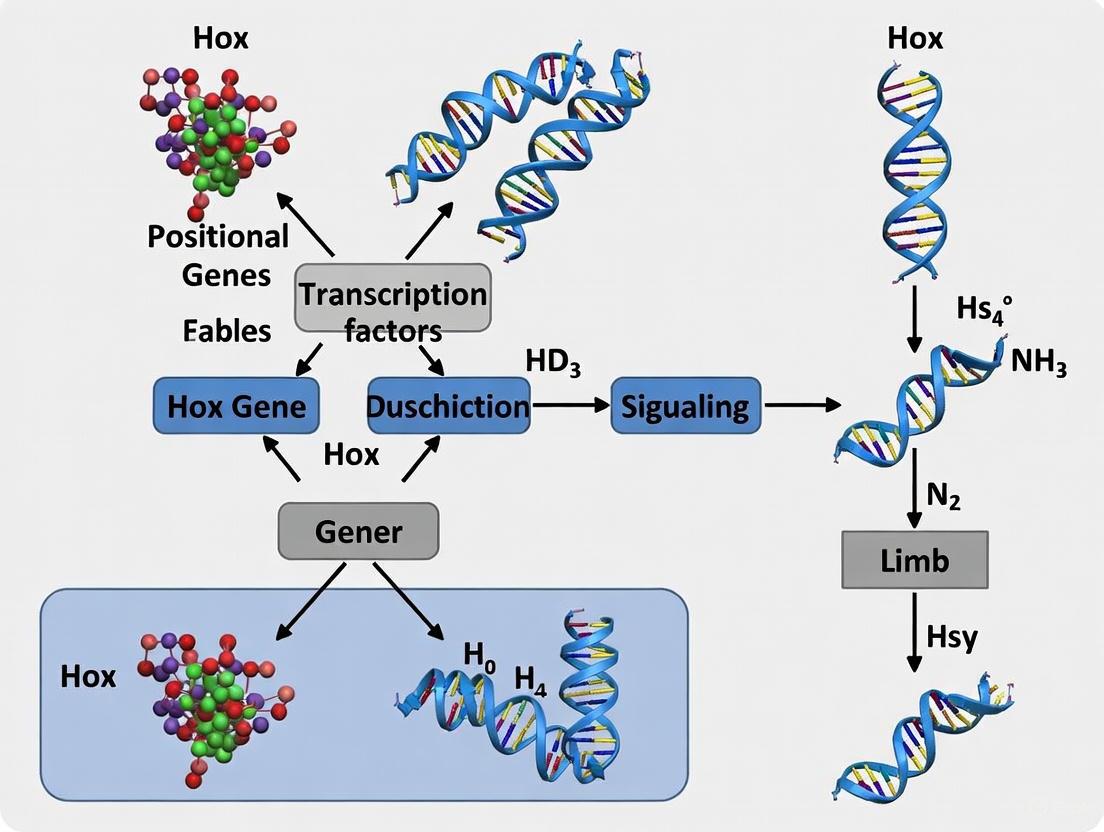
This article synthesizes current knowledge on the crucial role of Hox genes, a family of evolutionarily conserved transcription factors, in specifying positional identity along the anterior-posterior axis for vertebrate limb...
Hox Genes and the Blueprint of the Body: Decoding Limb Positional Identity in Development and Disease
Abstract
This article synthesizes current knowledge on the crucial role of Hox genes, a family of evolutionarily conserved transcription factors, in specifying positional identity along the anterior-posterior axis for vertebrate limb development. It explores the foundational 'Hox code' principle, where the combinatorial expression of these genes instructs the formation of limb structures at precise anatomical locations. The content delves into modern methodologies for analyzing Hox-driven patterning, addresses the challenges of functional redundancy and rapid evolution, and validates findings through cross-species comparative studies and emerging single-cell transcriptomic data from human models. For researchers and drug development professionals, this review highlights the implications of Hox gene dysregulation in cancer and the potential for targeting these pathways in regenerative medicine and oncology.
The Hox Code: Foundational Principles of Positional Information in Limb Patterning
Homeobox (Hox) genes represent a family of highly conserved transcription factors that orchestrate embryonic development along the anterior-posterior axis in bilaterian animals. These genes encode proteins that specify positional identity, ensuring appropriate structures form in correct body locations. This technical review examines Hox gene structure, function, and regulatory mechanisms, with particular emphasis on their role in specifying limb positional identity. We synthesize classical models with recent findings on Hox codes governing limb positioning and discuss experimental approaches for investigating their function in developmental and disease contexts.
Fundamental Principles of Hox Gene Biology
Gene Structure and Organization
Hox genes are distinguished by a conserved 180-base pair sequence known as the homeobox, which encodes a 60-amino acid homeodomain responsible for DNA binding [1]. This helix-turn-helix motif enables Hox proteins to function as transcription factors that regulate downstream target genes. In mammals, 39 Hox genes are organized into four clusters (HOXA, HOXB, HOXC, HOXD) located on different chromosomes, with each cluster containing up to 11 genes [2] [3]. This organization exhibits spatial collinearity, where gene position within clusters corresponds to their expression domains along the body axis [1] [4].
Evolutionary Conservation
Hox genes arose early in animal evolution, with conserved homologs identified across bilaterians and cnidarians [1] [5]. The ancestral Hox cluster underwent multiple duplication events during vertebrate evolution, resulting in multiple clusters in vertebrates compared to the single cluster typically found in invertebrates [6]. Despite approximately 550 million years of divergence, functional conservation is remarkable—mouse Hox proteins can substitute for their Drosophila homologs and induce appropriate developmental programs [6].
Hox Genes in Limb Positioning and Patterning
Axial Patterning and Positional Identity
Hox genes confer positional identity rather than forming structures directly, functioning analogous to a play director who specifies which scenes actors perform next [1] [6]. This positional specification occurs through combinatorial expression patterns known as "Hox codes"—unique combinations of Hox proteins that define regional identity along the anterior-posterior axis [5] [4]. In vertebrates, Hox genes pattern the axial skeleton by specifying identity of somites and vertebrae [2] [6].
Limb Field Specification and Positioning
The positioning of limb buds along the body axis is controlled by specific Hox codes in the lateral plate mesoderm. Recent research reveals that Hox4/5 genes provide permissive signals throughout the neck region, while Hox6/7 genes deliver instructive cues that precisely determine forelimb position [7]. This combinatorial code ultimately activates Tbx5, a key transcription factor initiating forelimb development program [7].
Limb Skeletal Patterning
During limb development, posterior Hox genes (paralogous groups 9-13) pattern skeletal elements along the proximodistal axis [2]. The vertebrate limb divides into three segments, each requiring specific Hox paralog groups:
- Proximal stylopod (humerus/femur): Requires Hox10 paralogous group
- Medial zeugopod (radius-ulna/tibia-fibula): Requires Hox11 paralogous group
- Distal autopod (hand/foot bones): Requires Hox13 paralogous group [2]
Table 1: Hox Paralogs Governing Vertebrate Limb Patterning
| Limb Region | Hox Paralogs Required | Skeletal Elements Specified |
|---|---|---|
| Stylopod (proximal) | Hox10 paralogs (HoxA10, C10, D10) | Humerus, Femur |
| Zeugopod (medial) | Hox11 paralogs (HoxA11, C11, D11) | Radius/Ulna, Tibia/Fibula |
| Autopod (distal) | Hox13 paralogs (HoxA13, C13, D13) | Hand bones, Foot bones |
Integration of Musculoskeletal Tissues
Hox genes coordinate patterning of bone, tendon, and muscle connective tissues to form functional musculoskeletal units [2]. Unexpectedly, Hox genes are not expressed in differentiated cartilage but rather in stromal connective tissues, where they regulate integration of musculoskeletal components [2]. This suggests Hox function in connective tissue provides instructional cues that coordinate development of adjacent tissues.
Experimental Approaches for Hox Gene Investigation
Loss-of-Function Methodologies
Genetic knockout models represent the gold standard for determining Hox gene function. Due to significant functional redundancy among paralogs, complete loss-of-function phenotypes often require targeting multiple genes within paralogous groups [2]. For example, inactivation of all three Hox10 paralogs (Hoxa10, Hoxc10, Hoxd10) transforms ribless lumbar vertebrae into rib-bearing thoracic-like vertebrae, demonstrating this group's role in repressing rib formation [5] [6].
siRNA-mediated knockdown provides an alternative approach for functional analysis in cell culture systems. Simultaneous transfection with siRNA pools targeting multiple Hox genes (e.g., HOXA10, HOXA11, HOXA13) can assess their collective contribution to processes like cell proliferation [8].
Gain-of-Function and Misexpression Studies
Ectopic Hox expression can determine whether a gene is sufficient to induce positional identities. The dominant-negative approach utilizes truncated Hox constructs lacking DNA-binding domains but retaining co-factor binding capability [7]. These dominant-negative variants compete with endogenous Hox proteins for co-factor binding, effectively suppressing Hox signaling function.
Lentiviral overexpression systems enable stable Hox expression in target cells. For example, lentiviral particles generated from pLenti-GIII-CMV-HOXB constructs can establish cell lines with sustained Hox overexpression for functional assays [8].
Expression Pattern Analysis
In situ hybridization remains fundamental for mapping Hox expression domains in embryonic tissues. Spatial and temporal colinearity can be visualized through whole-mount in situ approaches, revealing anterior expression boundaries that often correlate with morphological transitions [6] [4].
Bioinformatic analyses of genomic datasets (e.g., TCGA, CGGA, GEO) identify conserved non-coding regions and Hox expression patterns across species [9]. Phylogenetic footprinting aligns evolutionarily distant Hox clusters to identify conserved regulatory elements [9].
Research Reagent Solutions for Hox Gene Studies
Table 2: Essential Research Reagents for Hox Gene Investigations
| Reagent/Category | Specific Examples | Research Application |
|---|---|---|
| Expression Vectors | pLenti-GIII-CMV-HOXB constructs, BAC constructs with Hox cDNA | Ectopic overexpression, transgenic model generation |
| Gene Silencing Tools | ON-TARGETplus siRNA SMARTpools (e.g., PBX1, HOXA10, HOXA11, HOXA13), Dominant-negative Hox constructs | Targeted gene knockdown, functional inhibition |
| Cell Line Models | H295R adrenocortical cells, ABC mouse adrenal cells, ATC1/ATC7 cells | In vitro studies of Hox function in proliferation and differentiation |
| Animal Models | Cyp11a1:Cre; Ctnnb1 conditional allele mice, Sf-1:Hoxb9 transgenic mice | Tissue-specific Hox manipulation, cancer modeling |
| Detection Reagents | Antibodies against HOXB9, Ki67, active Caspase 3; In situ hybridization probes | Protein localization, proliferation and apoptosis assessment, expression patterning |
Regulatory Networks and Mechanisms
Hox proteins regulate transcription through partnership with co-factors, particularly PBX and MEIS proteins, which enhance DNA-binding specificity [1] [10]. A single Hox protein can function as either activator or repressor depending on cellular context and co-factor interactions [1].
Hox gene expression is regulated at multiple levels, including:
- Chromatin organization and three-dimensional architecture of Hox clusters
- Histone modifications such as H3K27me3 deposition [3]
- Enhancer elements identified through phylogenetic footprinting [9]
The diagram below illustrates a simplified regulatory network for Hox genes in limb positioning:
Pathological Implications and Therapeutic Targeting
Hox gene dysregulation contributes to various pathologies, particularly cancer [3] [10]. In glioblastoma (GBM), HOX genes normally absent in adult brain become aberrantly expressed, promoting tumor progression and therapeutic resistance [3]. Similarly, HOXB9 overexpression in adrenocortical tumors drives proliferation and represents a potential therapeutic target [8].
Therapeutic strategies targeting Hox networks include:
- Peptide inhibitors disrupting Hox-cofactor interactions [8]
- Epigenetic modulators targeting DNA methylation and histone modifications [10]
- Small molecule inhibitors of Hox-regulated pathways (e.g., PI3K inhibition for HOXA9+ tumors) [3]
Hox genes represent a fundamental regulatory system patterning animal body plans, with particularly crucial roles in specifying limb positional identity. Their combinatorial codes, evolutionary conservation, and hierarchical position in developmental pathways make them essential regulators of morphology. Continued investigation of Hox gene regulation, targets, and pathological roles will advance both basic developmental biology and therapeutic applications in cancer and regenerative medicine.
The Hox gene family, encoding a set of highly conserved transcription factors, represents a fundamental paradigm for understanding how genomic organization dictates gene function and phenotypic outcomes across metazoans. These genes are crucial for specifying positional identity along the anterior-posterior body axis during embryonic development. Their genomic architecture is characterized by a unique phenomenon known as collinearity, where the order of genes on the chromosome corresponds to their spatial and temporal expression domains in the embryo. This technical review delves into the principles of Hox genomic organization and collinearity, tracing the evolutionary conservation and divergence from foundational invertebrate models like Drosophila melanogaster to complex mammalian systems. Framed within a broader thesis on limb positional identity, we synthesize current research to elucidate how the structural and regulatory dynamics of Hox clusters instruct the specification of body structures, with a focused analysis on limb positioning. The document provides a detailed compendium of experimental methodologies, key reagent solutions, and quantitative data comparisons, serving as a resource for researchers and drug development professionals in evolutionary developmental biology and regenerative medicine.
Hox genes are master regulators of embryonic patterning, first described in the fruit fly, Drosophila melanogaster [2]. The "Hox code" refers to the combinatorial expression of these genes along the anterior-posterior axis, which provides cells with their positional coordinates [7]. A cornerstone of their biology is the collinear arrangement: genes at the 3' end of the cluster are expressed earlier and in more anterior regions, while genes at the 5' end are expressed later and in more posterior regions [2]. This review explores the intricacies of this genomic organization and its functional implications, with a specific emphasis on how it governs the specification of limb positional identity—a process highly dependent on precise Hox expression in the lateral plate mesoderm [7] [11].
Fundamental Principles of Hox Cluster Organization
The Hox gene cluster is an evolutionarily ancient feature, but its organization has undergone significant changes across different lineages.
Genomic Organization Across Metazoans
In most mammals, the ancestral Hox cluster underwent duplications, resulting in four clusters (HoxA, HoxB, HoxC, and HoxD) containing a total of 39 genes, which are further subdivided into 13 paralogous groups [2]. In contrast, Drosophila melanogaster possesses a single, split Hox cluster, divided into the Antennapedia complex (ANT-C) and the Bithorax complex (BX-C) [12]. This clustered organization is not absolute; in some species, such as the annelid Streblospio benedicti, the 11 Hox genes are located on a single chromosome, while in the octopus, they are scattered across different chromosomes [13].
The Phenomenon of Collinearity
Collinearity operates on multiple levels:
- Spatial Collinearity: The order of genes on the chromosome corresponds to their anterior expression boundary in the embryo.
- Temporal Collinearity: Genes at the 3' end of the cluster are activated before those at the 5' end. This principle is conserved from flies to mammals and is crucial for the correct patterning of the axial skeleton and appendages [2]. However, deviations exist; for instance, in some annelids and tunicates, Hox gene expression does not always follow strict collinearity [13].
Table 1: Hox Cluster Organization in Select Species
| Species/Clade | Number of Clusters | Number of Hox Genes | Cluster Integrity | Notable Features |
|---|---|---|---|---|
| Mammals | 4 (A, B, C, D) | 39 | Generally intact | Paralog groups 9-13 pattern the limb [2] |
| Drosophila melanogaster (Fruit Fly) | 1 (split into two complexes) | 8 | Split (ANT-C, BX-C) | Foundational model for Hox genetics [12] |
| Branchiopod Crustaceans (e.g., Daphnia) | 1 | Varies | Single, compact cluster | Considered a plesiomorphic condition [14] |
| Notostraca (Tadpole Shrimps) | 1 | Full complement | Possibly split into two subclusters | More derived genomic structure than Daphnia [14] |
| Streblospio benedicti (Annelid) | 1 | 11 | Genes on a single chromosome | Anterior cluster spans ~463 kbp [13] |
Hox Genes and the Specification of Limb Position
The development of limbs at specific locations along the body axis is a classic example of Hox-mediated positional specification. Research in chick and mouse models has been instrumental in deciphering this code.
The Vertebrate Limb Hox Code
In vertebrates, the posterior Hox genes (paralog groups 9-13) within the HoxA and HoxD clusters are critical for patterning the limb along the proximodistal axis [2]. The stylopod (upper arm), zeugopod (lower arm), and autopod (hand/foot) are specified by Hox10, Hox11, and Hox13 paralog groups, respectively [2]. Loss-of-function studies demonstrate that these genes are essential; for example, the loss of Hox11 genes results in the absence of zeugopod structures [2].
Recent work in chick embryos has refined our understanding by proposing a model of permissive and instructive Hox codes [7]. This model posits that:
- Hox4/5 genes provide a permissive signal, establishing a broad territory in the lateral plate mesoderm where a forelimb can form.
- Hox6/7 genes then provide an instructive signal within this permissive domain, determining the precise anterior-posterior position of the forelimb bud, marked by the initiation of Tbx5 expression [7].
Experimental Protocols for Limb Positioning Research
Protocol 1: Functional Analysis of Hox Genes in Chick Embryos via Electroporation [7] This protocol is used to test the necessity and sufficiency of specific Hox genes in limb positioning.
- Construct Preparation: Generate plasmids expressing dominant-negative (DN) or wild-type versions of the Hox gene of interest (e.g., Hoxa4, a5, a6, a7). DN variants lack the C-terminal homeodomain, preventing DNA binding while sequestering co-factors. The plasmid must also contain a reporter gene, such as Enhanced Green Fluorescent Protein (EGFP).
- Embryo Preparation: Incubate fertilized chick eggs to Hamburger-Hamilton (HH) stage 12, when the wing field is established.
- Electroporation: Briefly window the eggshell and inject the plasmid solution into the dorsal layer of the lateral plate mesoderm (LPM) in the prospective wing field. Apply precise electrical pulses to facilitate plasmid uptake by the LPM cells.
- Post-Processing Analysis: Harvest embryos 8-10 hours post-electroporation (at HH stage 14). Use EGFP fluorescence to identify successfully transfected areas. Analyze changes in the expression of key limb marker genes like Tbx5 via in situ hybridization or immunohistochemistry. Assess morphological outcomes after further incubation.
Protocol 2: Identification of Direct Hox Targets via ChIP-seq [15] This protocol identifies genomic regions bound by Hox proteins, such as Ultrabithorax (Ubx).
- Cell/ Tissue Collection: Harvest tissues or cells where the Hox gene is endogenously expressed (e.g., hindwing buds from the honeybee Apis mellifera or silkmoth Bombyx mori).
- Cross-linking: Fix tissues with formaldehyde to covalently link DNA-bound proteins to the chromatin.
- Chromatin Shearing: Lyse cells and sonicate the chromatin to shear DNA into fragments of 200-600 base pairs.
- Immunoprecipitation: Incubate the sheared chromatin with a specific antibody against the Hox protein of interest (e.g., anti-Ubx). Use Protein A/G beads to pull down the antibody-protein-DNA complexes.
- DNA Purification and Sequencing: Reverse the cross-links, purify the DNA, and prepare a sequencing library for high-throughput sequencing (ChIP-seq).
- Bioinformatic Analysis: Map the sequenced reads to the reference genome and identify peaks of enrichment, which represent putative direct binding targets of the Hox protein. Compare targets across species to infer evolutionary changes.
Signaling Pathways and Gene Regulatory Networks in Limb Positioning
The following diagram synthesizes the key regulatory interactions that determine limb position based on the permissive and instructive model, integrating Hox genes with known signaling pathways.
Diagram Title: Hox Gene Regulatory Logic in Vertebrate Limb Positioning
Evolutionary Dynamics and Genomic Stasis
The concept of "living fossils" often implies morphological and genomic stasis. However, studies on Hox genes challenge this notion. Research on tadpole shrimps (Notostraca), often considered living fossils, reveals that their Hox cluster structure is more derived—potentially split—than that of their branchiopod relative Daphnia, which retains a single compact cluster [14]. Furthermore, molecular evolutionary analyses show that Hox genes in Notostraca evolve at rates generally similar to those in related clades, with no strong signals of diversifying selection [14]. This demonstrates a decoupling of morphological and molecular evolution, where a conserved body plan can be maintained despite dynamic changes in the underlying genome architecture [14].
Table 2: Molecular Evolution of Hox Genes in Branchiopod Crustaceans
| Evolutionary Aspect | Finding | Interpretation |
|---|---|---|
| Sequence Substitution Rates | Generally similar across most Hox genes in Branchiopoda [14]. | Hox genes are under strong functional constraint, limiting amino acid changes. |
| Signals of Natural Selection | Few differences; not associated with diversifying selection [14]. | Purifying selection maintains protein function; morphological differences are not driven by changes in Hox protein sequence. |
| Genomic Cluster Structure | Varies from compact (Daphnia) to split (Notostraca, Artemia) [14]. | Genomic organization is more evolutionarily labile than previously thought. |
| Link to Morphology | No tight association between cluster dynamics and morphological evolution [14]. | Other regulatory factors (e.g., enhancers) are key drivers of morphological diversity. |
The Scientist's Toolkit: Essential Research Reagents
The following table details key reagents and methodologies used in advanced Hox gene research, as cited in the literature.
Table 3: Research Reagent Solutions for Hox Gene and Limb Development Studies
| Reagent / Method | Function/Description | Example Application |
|---|---|---|
| Dominant-Negative (DN) Hox Constructs | Truncated Hox proteins that dimerize with co-factors but cannot bind DNA, thereby inhibiting native Hox function [7]. | Used in chick electroporation to dissect the necessity of specific Hox genes (e.g., Hoxa4-a7) in limb positioning [7]. |
| Species-Specific Ubx Antibodies | Polyclonal antibodies raised against non-conserved N-terminal regions of Ultrabithorax (Ubx) for specific immunodetection [15]. | Enabled precise mapping of Ubx expression in Apis and Bombyx wing buds via immunohistochemistry [15]. |
| Chromatin Immunoprecipitation (ChIP-seq) | Identifies genome-wide binding sites for a protein of interest [15]. | Used to map direct targets of Ubx in Apis mellifera and Bombyx mori for cross-species comparison [15]. |
| Hybridization Chain Reaction (HCR) | A method of in situ hybridization that provides enhanced signal amplification and resolution [13]. | Used for high-fidelity spatial mapping of Hox gene expression in the annelid Streblospio benedicti [13]. |
| Transgenic Ectopic Expression | Forcing gene expression outside its normal domain to test sufficiency of function [15]. | Demonstrated that Ubx from Apis, Bombyx, and Tribolium can suppress wing development in Drosophila [15]. |
Advanced Genomic Architecture and Regulation
Beyond the linear cluster, the three-dimensional organization of the genome plays a critical role in Hox gene regulation. Studies in Drosophila have revealed an additional level of genome folding termed "meta-domains" in mature neurons [16]. These are specific associations of distant topologically associating domains (TADs), enabling megabase-range regulatory interactions between gene promoters and intergenic elements [16]. Factors like GAF and CTCF are directly involved in forming these long-range loops, which facilitate precise, cell-type-specific transcriptional control [16]. This sophisticated architectural layer adds another dimension to understanding how Hox gene expression and function are regulated.
The journey from the foundational genetics of the Drosophila Hox cluster to the complex, multi-cluster system of mammals reveals a remarkable story of evolutionary conservation, duplication, and divergence. The principle of collinearity remains a central tenet, but it is embedded within a dynamic genomic and epigenetic context that allows for both stability and flexibility in patterning the body plan. The specification of limb position serves as a powerful example of how a conserved Hox code can be implemented through hierarchical permissive and instructive signals in the lateral plate mesoderm. Future research, leveraging single-cell technologies, high-resolution 4C-seq, and CRISPR-based genomic editing, will further unravel how alterations in Hox cluster organization and regulation contribute to evolutionary diversity and human congenital disorders. For drug development professionals, understanding these fundamental mechanisms opens avenues for regenerative strategies aimed at repairing or replacing patterned tissues.
The concept of a "Hox code" represents a fundamental principle in developmental biology wherein the combinatorial expression of Hox (Homeobox) genes provides specific positional information that instructs the formation of anatomical structures along the body axes. First described in Drosophila, these highly conserved transcription factors exhibit a remarkable genomic organization characterized by collinear arrangement—their order on chromosomes mirrors their spatial and temporal expression domains during embryogenesis [2]. In the vertebrate limb, this molecular code operates through sophisticated mechanisms to specify segment identity along the proximodistal axis (stylopod→zeugopod→autopod) and patterning along the anterior-posterior axis (digit specification) [2]. The Hox gene family in mammals comprises 39 genes arranged in four clusters (HoxA, HoxB, HoxC, HoxD), further subdivided into 13 paralogous groups based on sequence similarity and genomic position [2]. Understanding this code is essential for deciphering the molecular logic of morphological diversity and has profound implications for evolutionary biology, regenerative medicine, and therapeutic development.
Deciphering the Hox Code: Axial and Appendicular Patterning Mechanisms
Hox Gene Organization and Expression Principles
The Hox gene family exhibits two primary expression paradigms in vertebrate development. Along the anterior-posterior (AP) body axis, Hox genes are expressed in overlapping, collinear domains within the somites, where a combinatorial code from multiple paralogous groups establishes positional identity for vertebral morphology [2]. In contrast, during limb development, posterior Hox genes (primarily from the HoxA and HoxD clusters) display non-overlapping functions along the proximodistal (PD) axis, with specific paralogous groups governing the formation of distinct limb segments [2]. This fundamental difference in operating principles underscores the versatility of Hox genes as patterning modules.
Table: Hox Gene Clusters and Paralogous Groups in Mammals
| Chromosomal Cluster | Number of Genes | Key Paralog Groups | Primary Expression Domains |
|---|---|---|---|
| HoxA | 11 | 1-13 | Anterior-Posterior Axis, Forelimb, Hindlimb |
| HoxB | 10 | 1-9 | Anterior-Posterior Axis |
| HoxC | 9 | 4-13 | Anterior-Posterior Axis, Hindlimb |
| HoxD | 9 | 1-13 | Anterior-Posterior Axis, Forelimb, Hindlimb |
Limb Patterning Along the Proximodistal Axis
The vertebrate limb is partitioned into three primary segments along the proximodistal axis, each under the governance of specific Hox paralogous groups. Genetic evidence demonstrates that loss of function in these paralog groups results not in homeotic transformations as seen in axial patterning, but in complete failure of segment specification [2]:
- Hox10 paralogs: Essential for stylopod (humerus/femur) formation
- Hox11 paralogs: Required for zeugopod (radius-ulna/tibia-fibula) patterning
- Hox13 paralogs: Necessary for autopod (hand/foot) development
This segmental specification system ensures proper limb architecture, with the posterior HoxA and HoxD clusters expressed in both forelimbs and hindlimbs, while the HoxC cluster exhibits hindlimb-specific expression [2].
Anterior-Posterior Axis Establishment
The establishment of the anterior-posterior axis in the developing limb involves a different set of Hox genes that regulate the zone of polarizing activity (ZPA) and Sonic hedgehog (Shh) expression. Recent research has identified crucial roles for Hox5 and Hox9 paralogous groups in this process [2]:
- Hox9 genes (Hoxa9, Hoxb9, Hoxc9, Hoxd9) promote posterior Hand2 expression, which inhibits the hedgehog pathway inhibitor Gli3, thereby permitting Shh induction in the posterior limb bud [2].
- Hox5 genes (Hoxa5, Hoxb5, Hoxc5) function to restrict Shh expression to the posterior limb bud by repressing anterior Shh expression through interaction with Plzf [2].
This antagonistic regulation ensures proper AP patterning, with disruption leading to significant digit pattern abnormalities.
Table: Hox Gene Functions in Limb Patterning
| Axis | Hox Paralogs | Key Functions | Phenotype of Loss-of-Function |
|---|---|---|---|
| Proximodistal | Hox10 | Stylopod (humerus/femur) patterning | Severe stylopod mis-patterning |
| Hox11 | Zeugopod (radius-ulna/tibia-fibula) patterning | Severe zeugopod mis-patterning | |
| Hox13 | Autopod (hand/foot) development | Complete loss of autopod elements | |
| Anterior-Posterior | Hox5 | Restricts Shh to posterior limb bud | Anterior patterning defects |
| Hox9 | Promotes posterior Hand2 and Shh expression | Loss of Shh expression, disrupted AP patterning |
Experimental Elucidation of the Forelimb Positioning Code
Permissive and Instructive Hox Codes
Recent research has revealed a sophisticated hierarchical mechanism governing forelimb positioning along the anterior-posterior axis, involving both permissive and instructive Hox gene functions. In avian embryos, Hox4 and Hox5 genes provide a permissive signal that establishes a broad territory in the neck region competent for forelimb formation [7]. Within this permissive domain, Hox6 and Hox7 genes deliver an instructive signal that precisely determines the final forelimb position within the lateral plate mesoderm (LPM) [7]. This two-tiered regulatory system ensures accurate limb positioning across vertebrate species despite variations in cervical vertebra number, with the forelimb consistently emerging at the cervical-thoracic boundary [7].
The initiation of the forelimb program is marked by Tbx5 expression in the LPM, which is functionally required for pectoral fin formation in zebrafish and forelimb formation in chicken and mice [7]. However, the forelimb-forming potential exists in mesodermal cells at the cervico-thoracic transitional zone long before Tbx5 activation, indicating that cells first acquire positional identity through Hox expression, followed by a developmental program guided by this positional history [7].
Experimental Paradigms and Key Findings
Critical insights into forelimb positioning have emerged from elegant functional experiments in chick embryos:
Loss-of-function approaches using dominant-negative (DN) Hox variants (Hoxa4, a5, a6, a7) electroporated into the dorsal layer of LPM demonstrated the necessity of HoxPG4-7 for forelimb formation [7]. These DN constructs lack the C-terminal portion of the homeodomain, rendering them incapable of DNA binding while preserving transcriptional co-factor interactions [7].
Gain-of-function experiments revealed that Hox6/7 genes are sufficient for reprogramming of neck lateral plate mesoderm to form ectopic limb buds anterior to the normal limb field [7].
This experimental evidence demonstrates that the forelimb program depends on combinatorial Hox gene actions, with Hox4/5 genes being necessary but insufficient for forelimb formation, while Hox6/7 can initiate the limb developmental program within the permissive territory established by Hox4/5 [7].
Diagram: Hierarchical regulation of forelimb positioning by permissive (Hox4/5) and instructive (Hox6/7) Hox codes in the lateral plate mesoderm (LPM), culminating in Tbx5 activation and forelimb bud formation.
Positional Memory and Regenerative Circuitries
The Hand2-Shh Positive-Feedback Loop
Recent groundbreaking research in axolotl limb regeneration has revealed a core molecular circuitry that maintains positional memory through a positive-feedback loop between the transcription factor Hand2 and the signaling molecule Shh [17]. This system operates in the following manner:
- Hand2 expression persists in posterior limb cells after development, priming them to form a Shh signaling center following amputation [17].
- During regeneration, Shh signaling reinforces Hand2 expression, creating a self-sustaining loop [17].
- After regeneration completion, Shh is downregulated while Hand2 expression is maintained, preserving posterior positional memory [17].
This molecular memory system allows cells to retain spatial information throughout the organism's life, enabling perfect pattern recreation during regeneration. The stability of this memory is maintained by the positive-feedback nature of the Hand2-Shh circuit [17].
Reprogramming Positional Memory
The discovery of the Hand2-Shh feedback loop has enabled revolutionary experiments in reprogramming positional memory. Researchers successfully converted anterior cells to a posterior memory state through transient Shh exposure during regeneration, which initiated an ectopic Hand2-Shh loop leading to stable Hand2 expression and lasting competence to express Shh [17]. This reprogramming demonstrates inherent directionality—anterior to posterior conversion occurs more readily than the reverse, suggesting hierarchical relationships in positional identity [17].
Diagram: The positive-feedback loop between Hand2 and Shh that maintains posterior positional memory and interacts with anterior Fgf8 to drive limb regeneration.
Experimental Methodologies for Hox Code Analysis
Key Research Reagents and Solutions
Table: Essential Research Reagents for Hox Code Investigation
| Reagent/Tool | Type | Key Function | Example Application |
|---|---|---|---|
| Dominant-Negative Hox Constructs | DNA Plasmid | Suppresses specific Hox signaling while preserving co-factor binding | Loss-of-function studies in chick LPM [7] |
| Hox:EGFP Knock-in | Transgenic Reporter | Tracks endogenous Hox expression patterns | Live imaging of Hox expression domains [17] |
| ZRS>TFP Transgenic | Enhancer Reporter | Monitors Shh expression via conserved limb enhancer | Fate mapping of Shh-expressing cells [17] |
| Tamoxifen-Inducible Cre | Genetic Tool | Enables temporal control of recombination | Lineage tracing of embryonic cell populations [17] |
| Electroporation System | Physical Delivery Method | Introduces constructs into specific embryonic regions | Targeted manipulation of chick LPM [7] |
Detailed Experimental Protocols
Dominant-Negative Hox Assay in Chick Embryos
This protocol enables functional interrogation of specific Hox genes in limb patterning [7]:
Vector Construction: Generate plasmids expressing dominant-negative Hox variants (Hoxa4, a5, a6, a7) lacking the C-terminal homeodomain but retaining transcriptional co-factor binding capability, along with EGFP reporter.
Embryo Preparation: Incubate chick embryos to Hamburger-Hamilton stage 12 (HH12), corresponding to the initiation of limb field specification.
Electroporation: Precisely electroporate DN-constructs into the dorsal layer of lateral plate mesoderm in the prospective wing field using specialized electrodes and pulse parameters.
Expression Analysis: Incubate for 8-10 hours until embryos reach HH14, then confirm transfection efficiency via EGFP fluorescence in the wing field.
Phenotypic Assessment: Analyze Tbx5 expression as the earliest marker of forelimb program activation, followed by morphological examination of limb bud development.
Positional Memory Reprogramming Assay
This approach tests the plasticity of positional identity in regenerating systems [17]:
Amputation: Surgically remove distal limb segments from adult axolotls to induce regeneration.
Shh Exposure: Apply recombinant Shh protein or Shh agonists to anterior blastema cells during early regeneration phase.
Lineage Tracing: Use transgenic reporters (ZRS>TFP for Shh, Hand2:EGFP for posterior identity) to monitor cell fate transitions.
Memory Testing: After complete regeneration, re-amputate and assess whether reprogrammed cells maintain ectopic Shh expression capacity without additional stimulation.
Molecular Validation: Analyze chromatin accessibility and transcription factor binding at the Hand2 locus to confirm stable epigenetic reprogramming.
Discussion: Integration and Therapeutic Implications
The Hox code represents a sophisticated genomic regulatory system that translates relatively simple molecular gradients into complex three-dimensional morphological patterns. The emerging paradigm reveals several organizing principles: (1) combinatorial specificity wherein unique Hox mixtures define positional addresses; (2) hierarchical organization with permissive and instructive layers; and (3) positive-feedback stabilization that locks in positional memory [7] [2] [17]. These mechanisms ensure robust pattern formation despite environmental fluctuations and genetic variation.
The therapeutic implications of deciphering the Hox code are substantial. Understanding positional memory mechanisms could revolutionize regenerative medicine approaches for limb reconstruction and tissue engineering. The ability to reprogram positional identity, as demonstrated by anterior-to-posterior conversion in axolotls, suggests potential strategies for generating specific tissue patterns in regenerative contexts [17]. Furthermore, the role of Hox genes in musculoskeletal integration reveals their function in coordinating tissue interactions during development, with relevance for congenital limb disorders and orthopedic therapeutics [2]. As research continues to unravel the complexities of the Hox code, the potential grows for harnessing these fundamental patterning principles for clinical applications.
The vertebrate limb serves as a paradigm for understanding the molecular mechanisms underlying positional identity and pattern formation. Central to this process are the Hox genes, transcription factors that confer morphological identity along the proximal-distal axis. This whitepaper delineates the specific functional domains of the Hox10, Hox11, and Hox13 paralog groups in patterning the stylopod, zeugopod, and autopod, respectively. We synthesize recent findings on their sustained roles beyond embryonic patterning into postnatal morphogenesis and tissue maintenance. The document provides a detailed overview of the core signaling pathways regulated by these genes, summarizes key quantitative data, and offers a toolkit of experimental methodologies and reagents for continued research in this field, framing these insights within the broader context of Hox-mediated specification of limb positional identity.
The coordinated development of the limb requires precise spatial and temporal control of genetic information to ensure the correct formation of its proximal-distal (PD) segments: the stylopod (upper arm/leg), zeugopod (forearm/shank), and autopod (hand/foot). The Hox family of transcription factors, with their unique genomic organization and spatiotemporally collinear expression, constitutes a fundamental regulatory system for this intricate process [18] [19]. In mammals, the 39 Hox genes are organized into four clusters (A, B, C, and D) and are expressed in overlapping domains along the PD axis of the developing limb bud, where they function in a partially redundant manner within paralog groups (genes with the same number across different clusters) [20].
The canonical model posits that specific sets of posterior Hox genes pattern distinct limb segments: Hox9 and Hox10 paralogs for the stylopod, Hox11 paralogs for the zeugopod, and Hox12 and Hox13 paralogs for the autopod [21] [20]. This "Hox code" is not merely a blueprint established at one embryonic timepoint but a dynamic system that remains active through fetal development and, as recent evidence shows, well into postnatal life, guiding the structural maturation of joint tissues [21]. This whitepaper will dissect the distinct and synergistic functions of the Hox10, Hox11, and Hox13 paralogs, providing a technical guide for researchers aiming to understand or therapeutically modulate limb patterning and related musculoskeletal disorders.
Functional Domains of Key Hox Paralog Groups
Extensive genetic studies in mice have delineated the primary responsibilities of each paralog group through loss-of-function experiments. The functional redundancy within paralog groups means that single-gene knockouts often yield subtle phenotypes, while compound mutations reveal the profound requirement for these genes in limb patterning.
Table 1: Functional Domains of Hox Paralog Groups in Limb Patterning
| Paralog Group | Primary Limb Domain | Major Skeletal Elements Affected | Key Phenotypes from Compound Mutations |
|---|---|---|---|
| Hox10 [20] | Stylopod | Humerus, Femur | Dramatic truncation or loss of the stylopod elements. |
| Hox11 [21] [20] | Zeugopod | Radius, Ulna, Tibia, Fibula | Severe reduction and malformation of the zeugopod; disrupted knee and elbow joints. |
| Hox13 [20] | Autopod | Carpals, Metacarpals, Digits | Complete loss of all autopod elements (wrist and digits). |
Hox10 and Stylopod Patterning
The Hox10 paralogs (including Hoxa10, Hoxc10, and Hoxd10) are paramount for the development of the stylopod. While mutation of a single Hox10 gene produces minor defects, combined mutation of Hoxa10, Hoxc10, and Hoxd10 results in a dramatic truncation or complete absence of the femur in the hindlimb [20]. This demonstrates the high degree of functional redundancy within this paralog group and its non-negotiable role in specifying the most proximal limb segment.
Hox11 and Zeugopod Patterning
The Hox11 paralogs (Hoxa11, Hoxc11, and Hoxd11) are the primary determinants of zeugopod identity. Single mutants for Hoxa11 or Hoxd11 show only modest defects in the ulna and radius [20]. However, double Hoxa11/Hoxd11 mutants exhibit a striking reduction in the size of the ulna and radius [20]. The function of Hox11 extends beyond embryonic patterning; it is continuously expressed in the zeugopod during postnatal development, where it is intimately coupled to the morphogenesis of articular cartilage in joints like the tibial plateau. Hoxa11 expression characterizes developing zeugopod joints and is maintained in adult articular chondrocytes, suggesting a role in maintaining region-specific tissue properties [21].
Hox13 and Autopod Patterning
The most distal limb structures, comprising the autopod, are specified by the Hox13 paralogs (Hoxa13 and Hoxd13). The requirement for these genes is absolute; combined mutation of Hoxa13 and Hoxd13 leads to a complete loss of all autopod elements [20]. These genes are critical for activating the second phase of Hox gene expression in the limb bud, which is essential for digit formation [22]. Furthermore, the presence of HOX13 proteins is a prerequisite for the clear separation of the zeugopod and autopod expression domains of other Hox genes, reinforcing their role as master regulators of distal limb identity [22].
Molecular Mechanisms and Regulatory Networks
The Hox proteins exert their effects by regulating complex downstream genetic networks. The phenomenon of "posterior prevalence," where more 5' (posterior) Hox genes can inhibit the activity of more 3' (anterior) genes, is a key principle governing their functional hierarchy [23].
Signaling Center Regulation
Hox genes are crucial for the establishment and maintenance of key limb signaling centers.
- Sonic Hedgehog (SHH) Signaling: Mutants for Hoxa9,10,11/Hoxd9,10,11 show a severe reduction in the expression of Shh in the Zone of Polarizing Activity (ZPA) [20]. This disrupts the anterior-posterior patterning critical for a normal limb.
- Fibroblast Growth Factor (FGF) Signaling: The same mutant combination also leads to decreased Fgf8 expression in the Apical Ectodermal Ridge (AER), impairing the outgrowth and progression of the limb bud along the PD axis [20].
The following diagram illustrates the regulatory network by which Hox genes pattern the limb through the control of these key signaling centers.
Downstream Genetic Pathways
Laser capture microdissection and RNA-Seq analysis of Hox mutant limbs have identified specific downstream pathways. In Hoxa9,10,11/Hoxd9,10,11 mutants, key genes involved in bone formation show altered expression, including [20]:
- Gdf5, Bmpr1b, Bmp7: Components of BMP signaling, crucial for chondrogenesis and joint formation.
- Igf1: A key growth factor for bone elongation.
- Runx3: A transcription factor vital for chondrocyte differentiation.
- Lef1: A mediator of Wnt signaling, another pathway essential for limb development.
Experimental Approaches and Methodologies
Research into Hox gene function relies on a suite of sophisticated genetic, molecular, and analytical techniques. The following table outlines key experimental reagents and their applications in this field.
Table 2: Research Reagent Solutions for Investigating Hox Gene Function in Limb Patterning
| Research Reagent / Model | Key Features and Applications | Example Use Case |
|---|---|---|
| Compound Mutant Mice [20] | Mice with frameshift mutations in multiple flanking Hox genes (e.g., Hoxa9,10,11/Hoxd9,10,11). Allows dissection of functional redundancy. | Revealing the combined role of Hox9-11 genes in regulating Shh and Fgf8 expression. |
| Conditional Knockout Mice [21] | Enables tissue-specific and/or temporal deletion of gene function. Critical for studying post-embryonic roles of Hox genes. | Identifying the role of Hoxa11 in postnatal articular cartilage morphogenesis in the zeugopod. |
| Hoxa11eGFP Reporter Mouse [21] | A live reporter line where eGFP expression is driven by the Hoxa11 promoter. Allows visualization of Hoxa11-expressing cells in real-time. | Tracking the dynamic expression of Hoxa11 from embryonic interzones to mature articular cartilage. |
| RNAscope In Situ Hybridization [21] | A highly sensitive and specific method for visualizing RNA expression in tissue sections with single-molecule resolution. | Precisely mapping the spatial expression of Hoxa11 mRNA in developing and postnatal joint tissues. |
| Laser Capture Microdissection (LCM) & RNA-Seq [20] | Allows for the isolation of specific cell populations (e.g., resting chondrocytes) from heterogeneous tissues for transcriptomic profiling. | Defining the gene expression programs in specific compartments of wild-type and Hox-mutant zeugopods. |
Detailed Protocol: Genetic Lineage Tracing and Phenotypic Analysis of Postnatal Joint Morphogenesis
This protocol, derived from [21], is used to investigate the long-term role of Hox genes in joint maintenance.
- Animal Model Generation: Utilize a conditional Hoxa11eGFP reporter mouse line. Cross with appropriate Cre-driver lines to label Hoxa11-expressing cells and their progeny.
- Tissue Collection and Processing: Harvest limb tissues at defined developmental stages (e.g., E13.5, E14.5, postnatal day 7, 3 weeks, 6 weeks, 6 months). Fix in 4% paraformaldehyde, decalcify if necessary, and embed in paraffin or optimal cutting temperature (OCT) compound.
- Sectioning and Staining: Section tissues at 5-7 μm thickness. Perform:
- Fluorescence Imaging: To visualize and track eGFP-positive cells.
- RNAscope In Situ Hybridization: Using probes for Hoxa11 and joint markers (e.g., Gdf5, Prg4) to validate and correlate expression.
- Histological Staining: Use Safranin O/Fast Green or Hematoxylin and Eosin (H&E) to assess tissue morphology, cell organization, and matrix composition.
- Image Acquisition and Analysis: Capture high-resolution images of joint sections. Quantify parameters such as articular cartilage thickness, chondrocyte column organization in the deep zone, and the persistence of Hoxa11eGFP signal over time.
The workflow for a comprehensive analysis of Hox gene function, integrating multiple modern techniques, is depicted below.
The delineation of functional domains for Hox10, Hox11, and Hox13 paralogs provides a foundational model for understanding vertebrate limb patterning. The emerging paradigm is that these transcription factors do not merely act as transient embryonic specifiers but as continuous regulators of tissue identity and morphology throughout development and into adulthood [21] [23]. The sustained expression of Hox11 in adult articular chondrocytes, for instance, challenges the traditional view and opens new avenues for researching their role in joint homeostasis, repair, and degenerative diseases like osteoarthritis.
Future research must focus on elucidating the complete "HoxOME"—the cell-specific transcriptional state of all Hox genes—across different limb cell types [23]. Furthermore, a deeper understanding of the downstream target genes and the protein interactomes of HOX proteins, particularly with their TALE co-factors like MEIS and PBX, will be critical for understanding the "Hox specificity paradox" and for identifying novel therapeutic nodes [23]. As we continue to deconstruct the Hox code, the insights gained will not only illuminate fundamental developmental biology but also hold profound potential for regenerative medicine and drug development aimed at musculoskeletal defects and injuries.
The establishment of the limb field within the lateral plate mesoderm (LPM) represents a fundamental process in vertebrate embryonic development, dictating the precise positioning of appendages along the anterior-posterior axis. This in-depth technical guide examines the core molecular mechanisms orchestrating limb field specification, with emphasis on the hierarchical regulatory networks governed by Hox genes. We synthesize current research demonstrating that limb positioning is controlled through a multi-step process involving regionalization of the LPM, nested Hox gene expression, and subsequent activation of limb initiation programs. Within the broader thesis of Hox-mediated positional identity, this review highlights recent advances revealing the combinatorial logic of permissive and instructive Hox codes that demarcate limb-forming territories. Experimental evidence from chick, mouse, and zebrafish models elucidates how retinoic acid signaling, Hox gene collinearity, and transcriptional cascades converge to activate key limb initiators including Tbx5. This whitepaper further provides detailed methodologies for key experiments and essential research reagents, offering a comprehensive resource for researchers investigating the developmental basis of limb positioning and its implications for evolutionary biology and regenerative medicine.
Vertebrate limb development initiates with the specification of discrete regions within the lateral plate mesoderm (LPM) that possess the competence to form limbs. This process is remarkable for its precision, with limb buds consistently emerging at specific axial positions despite variations in vertebral number across species [7]. The molecular orchestration of limb field specification involves progressive regionalization events that restrict limb-forming potential to defined locations along the body axis [24]. At the core of this positional regulation are Hox genes, which encode evolutionarily conserved transcription factors that provide cells with positional identity [2] [7]. The "limb field" constitutes a population of cells within the LPM that is committed to forming limb structures, characterized by the activation of a specific genetic program culminating in bud outgrowth.
The mechanistic basis of limb field specification provides a paradigm for understanding how embryonic fields are established and positioned. Recent research has shifted toward understanding the combinatorial Hox codes that confer permissive versus instructive signals for limb formation [25] [7]. This whitepaper synthesizes current knowledge of these early patterning events, focusing specifically on the establishment of the limb field within the LPM, with implications for both developmental biology and the evolution of positional information systems in vertebrates.
Stepwise Regionalization of the Lateral Plate Mesoderm
The specification of limb fields occurs through a sequence of patterning events that progressively restrict developmental potential. This process can be subdivided into distinct morphological and molecular phases.
Primary Regionalization: Establishment of ALPM and PLPM
The LPM is initially regionalized into anterior lateral plate mesoderm (ALPM), which gives rise to cardiac mesoderm, and posterior lateral plate mesoderm (PLPM), which contains the presumptive limb-forming fields [24]. Retinoic acid (RA) signaling plays a pivotal role in this primary regionalization. In zebrafish and mouse embryos deficient for retinaldehyde dehydrogenase 2 (Raldh2), a key enzyme in RA synthesis, the heart field expands posteriorly while forelimb initiation fails [24]. This demonstrates RA's essential function in establishing the anterior boundary of the forelimb-forming field.
Table 1: Key Signaling Pathways in LPM Regionalization
| Signaling Molecule | Primary Source | Function in Limb Field Specification | Mutant Phenotype |
|---|---|---|---|
| Retinoic Acid (RA) | Paraxial mesoderm | Regionalizes LPM into ALPM/PLPM; determines anterior boundary of forelimb field | Posterior expansion of heart field; failure of forelimb initiation [24] |
| FGF8 | Epiblast | Maintains posterior identity; inhibited by RA signaling | Ectopic expression expands heart field and suppresses limb formation [24] |
| Hoxb5b | Anterior PLPM | Direct target of RA; restricts posterior extension of heart field | Shoulder girdle positioning defects [24] |
Hox-Mediated Patterning Along the Anterior-Posterior Axis
Following the establishment of ALPM and PLPM, Hox genes are expressed in a nested fashion along the anterior-posterior axis within the PLPM, providing positional information that further regionalizes this domain into forelimb, interlimb, and hindlimb fields [24] [26]. The collinear expression of Hox genes creates a combinatorial code that defines specific axial positions. For example, Hox genes from paralogous groups (PG) 4-7 are expressed in overlapping domains within the forelimb field [7]. The timing of Hox gene expression is critical for proper limb positioning, with differential expression timing in the LPM determining the precise location where limb buds will emerge [27].
Tissue Layer Segregation and Limb Initiation
The third major step involves the thickening and splitting of the lateral plate mesoderm into somatic and splanchnic layers, proceeding sequentially from anterior to posterior regions [24]. This morphological reorganization creates the somatic layer of the PLPM, where limb initiation genes are activated. The expression of key limb initiation markers, including Tbx5 for forelimbs and Tbx4 for hindlimbs, marks the final commitment step in limb field specification and triggers the outgrowth of the limb bud [24].
Hox Codes in Limb Positioning: Permissive and Instructive Mechanisms
The Hox gene family represents the principal architects of positional identity along the anterior-posterior axis. In the context of limb field specification, different Hox paralog groups play distinct roles in establishing limb competence and activating the limb developmental program.
The Combinatorial Hox Code Model
Research from chick embryo models reveals that forelimb positioning is governed by a two-tiered Hox code system [25] [7]. HoxPG4 and HoxPG5 genes provide a permissive signal that demarcates a broad territory competent for forelimb formation, extending into the neck region. Within this permissive domain, HoxPG6 and HoxPG7 genes provide an instructive signal that directly determines the final position of forelimb bud emergence [7]. This combinatorial mechanism explains how limb position remains consistent relative to the cervical-thoracic boundary despite evolutionary variation in neck length.
Table 2: Functional Roles of Hox Paralogue Groups in Forelimb Positioning
| Hox Paralogue Group | Expression Domain | Functional Role | Sufficiency for Ectopic Limb Induction |
|---|---|---|---|
| PG4/PG5 (e.g., Hoxa4, Hoxa5) | Anterior PLPM, extending into neck | Permissive: Establishes competence for forelimb formation | No: Insufficient to induce ectopic limbs [7] |
| PG6/PG7 (e.g., Hoxa6, Hoxa7) | Forelimb field specifically | Instructive: Determines precise position of limb bud emergence | Yes: Sufficient to reprogram neck LPM to form limb buds [25] [7] |
| PG9-PG13 | Hindlimb field | Patterning of hindlimb position and proximal-distal elements | Not applicable |
Direct Transcriptional Control of Limb Initiation Genes
Hox proteins directly regulate the expression of key limb initiation genes. Specifically, Hox proteins that define the axial position of the limb-forming fields directly activate transcription of the forelimb initiation gene Tbx5 [24] [24]. This direct regulatory link connects the positional information encoded by Hox genes with the activation of the limb developmental program. The initiation of the forelimb program is marked by Tbx5 expression in the LPM, which is functionally required for pectoral fin formation in zebrafish and forelimb formation in chicken and mice [7].
Diagram 1: Hox gene regulatory network in limb field specification. Hox PG4/PG5 genes, induced by retinoic acid signaling, establish a permissive domain for limb formation. Within this domain, Hox PG6/PG7 provide instructive signals that directly activate Tbx5, initiating limb bud development.
Experimental Approaches and Methodologies
Investigating the mechanisms of limb field specification requires sophisticated experimental approaches that can manipulate and monitor gene expression in developing embryos. The following section details key methodologies used in this field.
Gain-of-Function Experiments in Chick Embryos
The electroporation-based overexpression of Hox genes in chick embryos has been instrumental in establishing the sufficiency of specific Hox factors for limb induction [25] [7].
Protocol: Electroporation of Hox Expression Constructs into Chick LPM
- Embryo Preparation: Incubate fertilized chick eggs to Hamburger-Hamilton stage 12 (HH12). Window the eggs under sterile conditions to access the embryo.
- DNA Solution Preparation: Prepare plasmid DNA (2-4 µg/µL) encoding full-length Hox genes (e.g., Hoxa6, Hoxa7) with a fluorescent reporter (e.g., EGFP) in PBS with fast green tracking dye.
- Microinjection and Electroporation: Inject DNA solution into the dorsal layer of the lateral plate mesoderm in the prospective wing field or neck region. Position platinum electrodes flanking the embryo and deliver pulses (5-10V, 50ms duration, 5 pulses with 100ms intervals) using a square wave electroporator.
- Post-Procedure Care: Seal the window with tape and return eggs to the incubator for 48-72 hours to allow for gene expression and phenotypic analysis.
- Analysis: Monitor ectopic EGFP expression to confirm transfection efficiency. Analyze embryos for ectopic Tbx5 expression by in situ hybridization and limb bud formation by morphology.
This approach demonstrated that overexpression of Hoxa6 or Hoxa7 in the neck LPM is sufficient to induce ectopic Tbx5 expression and initiate limb bud formation anterior to the normal limb field [25] [7].
Loss-of-Function Approaches
Loss-of-function studies are essential for establishing the necessity of specific Hox genes in limb field specification.
Dominant-Negative Hox Electroporation
- Construct Design: Generate dominant-negative forms of Hox genes (e.g., Hoxa4, Hoxa5, Hoxa6, Hoxa7) that lack the C-terminal portion of the homeodomain, rendering them incapable of DNA binding while retaining the ability to sequester transcriptional co-factors [7].
- Electroporation: Electroporated dominant-negative constructs into the prospective wing field of HH12 chick embryos using the protocol above.
- Phenotypic Analysis: Assess embryos for downregulation of Tbx5 and Fgf10 in the LPM, and reduction in limb bud size.
Genetic Knockout Models in Mice
- Model Generation: Create knockout mice for specific Hox genes using CRISPR-Cas9 or traditional gene targeting in embryonic stem cells.
- Phenotypic Characterization: Analyze mutant embryos for alterations in limb positioning, shoulder girdle development, and molecular marker expression.
While mouse Hoxb5 mutants show shoulder girdle defects, interpretation of limb positioning defects in global knockouts is complicated by concurrent alterations in vertebral identity [7]. This highlights the importance of tissue-specific approaches for studying limb positioning.
Molecular Analysis of Limb Field Specification
In Situ Hybridization Chain Reaction (HCR)
- Probe Design: Design DNA probes against target mRNAs (e.g., Tbx5, Hox genes, Fgf10).
- Sample Preparation: Fix embryos in 4% PFA and permeabilize with proteinase K.
- Hybridization and Amplification: Hybridize initiator probes overnight at room temperature. After washing, add fluorescently labeled hairpins for amplification and image using confocal microscopy.
RNA Sequencing and Transcriptomic Analysis
- Tissue Collection: Microdissect specific regions of interest (e.g., normal limb bud, ectopic limb bud, neck LPM) from transfected and control embryos.
- Library Preparation and Sequencing: Extract total RNA, prepare cDNA libraries, and sequence using Illumina platforms.
- Bioinformatic Analysis: Map reads to reference genome, perform differential expression analysis, and conduct gene ontology enrichment analysis to identify affected pathways.
The Scientist's Toolkit: Essential Research Reagents
The following table compiles key reagents and resources essential for investigating limb field specification.
Table 3: Essential Research Reagents for Limb Field Studies
| Reagent/Category | Specific Examples | Function/Application | Key Characteristics |
|---|---|---|---|
| Model Organisms | Chick (Gallus gallus), Mouse (Mus musculus), Zebrafish (Danio rerio) | In vivo functional studies | Accessibility for manipulation (chick), genetic tractability (mouse), transparency for imaging (zebrafish) |
| Expression Constructs | Full-length Hoxa6, Hoxa7; Dominant-negative Hox variants | Gain-of-function and loss-of-function studies | CMV or β-actin promoters; co-expression of fluorescent reporters (EGFP) for lineage tracing |
| Molecular Markers | Tbx5, Tbx4, Fgf10, Hox genes (PG4-PG8), Raldh2 | Lineage specification and positional identity assessment | Probes for in situ hybridization; antibodies for immunohistochemistry |
| Pharmacological Agents | Disulfiram (RALDH inhibitor), RA receptor antagonists | Perturbation of RA signaling | Stage-specific application to target LPM regionalization |
| Lineage Tracing Systems | Cre-loxP, Tamoxifen-inducible systems (e.g., ZRS>TFP) | Fate mapping of embryonic populations | Temporal control of labeling to track cell fates |
Evolutionary Context of Limb Field Acquisition
The acquisition of paired appendages was a pivotal event in vertebrate evolution. Comparative studies between limb-bearing gnathostomes (jawed vertebrates) and limbless cephalochordates (amphioxus) and agnathans (lampreys) provide insights into the evolutionary origins of limb field specification mechanisms [24].
In amphioxus, the ventral mesoderm shows no molecular regionalization into distinct cardiac versus posterior domains based on the expression of markers like AmphiHand, AmphiNkx2-tin, and AmphiTbx20 [24]. This suggests that the evolutionary emergence of limb fields was preceded by the acquisition of LPM regionalization. In contrast, the lamprey (a limbless agnathan) exhibits molecular regionalization of the LPM into ALPM and PLPM similar to gnathostomes, as evidenced by the expression of LjTbx20 in the anterior LPM and LjMyb in the posterior LPM [24]. This indicates that the genetic machinery for LPM regionalization predated the origin of paired fins.
The evolution of limb field specification likely involved the co-option of existing patterning systems, particularly the Hox gene network, to establish new developmental fields competent to form appendages. The deployment of Hox genes in the LPM to regulate Tbx5 expression represents a key innovation in the vertebrate lineage that enabled the emergence of paired fins and their evolutionary derivatives, including limbs [24].
The establishment of the limb field in the lateral plate mesoderm represents a sophisticated developmental process governed by hierarchical signaling interactions and transcriptional networks. Retinoic acid-mediated regionalization of the LPM into anterior and posterior domains creates a foundation upon which nested Hox expression provides precise positional information. The combinatorial action of permissive HoxPG4/5 signals and instructive HoxPG6/7 signals culminates in the direct transcriptional activation of limb initiation genes, particularly Tbx5, at precise axial positions.
Future research directions include elucidating the epigenetic mechanisms that maintain positional memory in the LPM, understanding how Hox codes are interpreted at the transcriptional level to activate limb-specific programs, and investigating how these patterning systems are modified during evolution to produce diverse limb positions across vertebrates. Furthermore, connecting these early patterning events with later stages of limb development and exploring their implications for regenerative medicine represents a promising frontier. The molecular insights into limb field specification not only advance our fundamental understanding of developmental patterning but also provide potential avenues for manipulating positional information in regenerative contexts.
From Code to Morphology: Methodological Approaches to Deciphering Hox Function
The Hox genes are an evolutionarily conserved family of transcription factors that play a fundamental role in establishing the anterior-posterior (AP) body axis in bilaterian embryos [28]. They encode proteins containing a DNA-binding homeodomain and regulate a plethora of downstream targets to define the identity of developing segments and structures [28] [6]. A key characteristic of most Hox genes is their genomic organization into clusters and the principle of spatial collinearity, wherein the order of genes on the chromosome correlates with their sequential expression domains along the AP axis of the embryo [28] [2]. In vertebrates, the Hox cluster underwent multiple duplication events, resulting in 39 Hox genes in mammals, arranged in four clusters (HoxA, HoxB, HoxC, HoxD) [2]. These genes are further classified into 13 paralogous groups based on sequence similarity and position within the cluster [2].
A paralogous group consists of genes from the different clusters (e.g., Hoxa1, Hoxb1, Hoxc1, Hoxd1) that are most similar to each other, a result of the cluster duplication events [6]. Members of a paralogous group often exhibit overlapping expression domains and significant functional redundancy, which has profound implications for genetic loss-of-function studies [2] [6]. This review details the methodologies and outcomes of paralogous group knockout experiments, with a specific focus on how these models have elucidated the role of Hox genes in specifying limb positional identity, a critical area of research in developmental biology and evolutionary genetics.
Experimental Approaches for Hox Gene Functional Analysis
The Rationale for Paralogous Group Knockouts
Due to the extensive functional redundancy among Hox paralogs, inactivating a single gene often results in subtle or no phenotypic consequences, as other members of the same paralogous group can compensate for the loss [2] [6]. This redundancy is a primary reason why investigating Hox gene function requires the simultaneous inactivation of multiple genes within a paralogous group. For instance, while single-gene knockouts might show minor defects, compound knockouts (e.g., lacking all Hox10 or Hox11 paralogs) reveal the essential and non-redundant functions of these groups, leading to severe, segment-specific patterning defects [2].
Key Loss-of-Function Methodologies
Classical and CRISPR-Cas9 Gene Targeting in Mice: The generation of loss-of-function models, particularly in mice, has been instrumental. This often involves homologous recombination in embryonic stem cells to create null alleles for multiple genes within a paralogous group. For example, to study the Hox10 group, targeted mutations are made in Hoxa10, Hoxc10, and Hoxd10 [2]. The advent of CRISPR-Cas9 genome engineering has dramatically accelerated this process, allowing for the simultaneous disruption of multiple genes with high efficiency [28].
Dominant-Negative Approaches: In model organisms like the chick, electroporation of dominant-negative (DN) Hox constructs provides a rapid method for functional interrogation. These DN variants lack the C-terminal portion of the homeodomain, rendering them incapable of binding DNA while retaining the ability to bind transcriptional co-factors. This sequesters co-factors and disrupts the function of the endogenous wild-type Hox proteins [7]. A typical protocol involves:
- Construct Design: Cloning DN forms of the Hox gene of interest (e.g., Hoxa4, a5, a6, a7) into an expression plasmid containing a reporter such as Enhanced Green Fluorescent Protein (EGFP).
- Electroporation: Introducing the plasmid into the target tissue, such as the lateral plate mesoderm (LPM) of a chick embryo at Hamburger-Hamilton stage 12.
- Phenotypic Analysis: Harvesting embryos after 8-10 hours (reaching ~HH14) and assessing the effects on downstream markers like Tbx5 and subsequent limb formation via in situ hybridization and immunohistochemistry [7].
Research Reagent Solutions for Hox Gene Studies
Table 1: Essential research reagents for Hox gene loss-of-function studies.
| Reagent / Model System | Key Function in Hox Research |
|---|---|
| CRISPR-Cas9 Genome Editing | Enables efficient, simultaneous knockout of multiple redundant Hox paralogs in animal models (e.g., mouse, zebrafish, Parhyale) [28]. |
| Conditional Knockout Mice (e.g., Cre-lox) | Allows tissue- or time-specific inactivation of Hox genes, bypassing embryonic lethality and dissecting function in specific tissues like the lateral plate mesoderm [7]. |
| Dominant-Negative Hox Constructs | Used for rapid functional knockdown in accessible model systems like the chick embryo to assess the role of specific Hox genes in limb positioning [7]. |
| Paralogous Group Compound Mutants | Mouse models with combined null mutations in all members of a paralogous group (e.g., Hox10: a10, c10, d10) to overcome genetic redundancy and reveal the group's true function [2]. |
Homeotic Transformations in the Axial Skeleton
A classic demonstration of Hox gene function is the homeotic transformation—where one segment of the body develops the identity of another—observed in the axial skeleton upon loss of Hox function. Unlike in the limb, Hox genes along the AP axis operate in a combinatorial code, where the morphology of a vertebra is determined by the specific combination of Hox proteins expressed [2]. The general principle is that loss of a Hox paralogous group typically results in an anterior homeotic transformation, meaning a vertebra assumes the morphology of a more anterior segment [2]. For instance, loss of the entire Hox10 paralogous group causes the lumbar vertebrae, which normally lack ribs, to transform into a more anterior vertebral identity that possesses ribs [6].
Figure 1: Mechanism of anterior homeotic transformation in the axial skeleton following Hox10 paralogous group knockout. The loss of Hox10 function causes posterior vertebrae to adopt a more anterior identity, characterized by the growth of ribs.
Hox Control of Limb Positioning and Patterning
The vertebrate limb develops from the LPM, and its position along the AP axis is tightly regulated by a Hox code. Recent research has refined the classic model, revealing that limb positioning is governed by both permissive and instructive Hox signals [7].
Genetic Control of Limb Positioning
Studies in chick embryos demonstrate that Hox4 and Hox5 paralogous groups provide a permissive signal that demarcates a broad territory in the LPM with the potential to form a forelimb. However, within this permissive field, the instructive signal of Hox6 and Hox7 is necessary and sufficient to determine the final position of the forelimb. Gain-of-function experiments show that misexpression of Hox6/7 in the neck LPM can reprogram this tissue to initiate the limb development program, including the activation of the key limb identity gene Tbx5, leading to the formation of an ectopic limb bud [7].
Patterning the Limb Skeleton along the Proximodistal Axis
Within the developing limb bud, posterior Hox genes (paralogous groups 9-13) in the A and D clusters are critical for patterning the skeleton along the proximodistal (PD) axis. In contrast to the combinatorial code of the axial skeleton, Hox function in the limb is largely non-overlapping along the PD axis. The loss of a single paralogous group leads to a complete failure to form the corresponding limb segment, rather than a transformation [2].
Table 2: Phenotypic consequences of posterior Hox paralogous group knockouts in the mouse limb.
| Hox Paralogous Group | Primary Limb Segment Affected | Major Phenotype of Compound Null Mutants |
|---|---|---|
| Hox9 | Stylopod (humerus/femur) | Disrupted anterior-posterior patterning; failure to initiate Shh expression [2]. |
| Hox10 | Stylopod (humerus/femur) | Severe mis-patterning and loss of identity of the stylopod [2]. |
| Hox11 | Zeugopod (radius/ulna, tibia/fibula) | Severe mis-patterning and loss of identity of the zeugopod [2]. |
| Hox13 | Autopod (hand/foot) | Complete loss of autopod skeletal elements [2]. |
Figure 2: Non-overlapping functions of Hox paralogous groups in patterning the proximodistal axis of the vertebrate limb. Loss of any group leads to a failure to form the corresponding limb segment.
Advanced Concepts: Molecular Integration and Human Disorders
Hox Protein Interactions in Limb Development
Hox proteins do not function in isolation but integrate with other transcription factor pathways. A key example is the direct physical and genetic interaction between Hox proteins and T-box factors in the limb. For instance, in the hindlimb, Tbx4 and Hoxc10 directly interact, bind to a composite T-box-Hox DNA motif, and synergistically activate downstream target genes. Conversely, Hoxd13 can interact with Tbx4/Tbx5 but antagonizes their transcriptional activity. This modulation of T-box factor activity by Hox proteins provides a molecular mechanism for the balanced and proportionate formation of limbs [29].
Human HOX Gene Disorders
Germline mutations in several HOX genes cause human congenital disorders, underscoring their clinical relevance. These disorders often mirror the phenotypes observed in mouse knockout models, demonstrating the conserved function of Hox genes. Key disorders include:
- Hand-Foot-Genital Syndrome (HFGS): Caused by heterozygous mutations in HOXA13. Characterized by limb anomalies (short thumbs, small feet) and urogenital defects [30].
- Synpolydactyly Type II: Caused by polyalanine expansions in HOXD13, leading to webbing and duplication of digits [30].
The variation in inheritance patterns, penetrance, and expressivity in these disorders highlights the complexity of Hox gene function and regulation in humans [30].
The precise positioning of limbs along the anterior-posterior (AP) axis represents a fundamental question in developmental biology, with profound implications for evolutionary biology and regenerative medicine. For over three decades, Hox genes—a family of transcription factors with spatially restricted expression patterns—have been hypothesized to act as master regulators of this process, functioning through a combinatorial "Hox code" that specifies positional identity [7]. Vertebrate limbs consistently emerge at specific axial levels despite variation in vertebral number across species, with the forelimb always positioned at the cervical-thoracic boundary [7]. While early evidence supporting Hox gene involvement in limb positioning was largely indirect, recent advances in gain-of-function and misexpression studies have provided direct experimental evidence for their role. These approaches have begun to untangle the complex genetic circuitry that not only patterns the limb itself but also defines its precise location along the body axis, revealing a sophisticated interaction of permissive and instructive signals that establish the limb field within the lateral plate mesoderm (LPM).
The initiation of the limb program is marked by the expression of Tbx5 in the LPM, a transcription factor functionally required for pectoral fin and forelimb formation across vertebrate species [7]. However, the forelimb-forming potential exists in mesodermal cells long before Tbx5 activation, suggesting cells first acquire positional identity through Hox gene expression [7]. This positional identity is encoded through the nested and combinatorial expression of Hox genes in the LPM, which subsequently translates to precise Tbx5 expression in the prospective forelimb region [7]. Contemporary models propose that limb positioning occurs in two phases: first, Hox-regulated gastrulation movements establish broad limb domains in the LPM, followed by a second phase where a specific Hox code directly regulates Tbx5 activation in the forelimb-forming region [7].
Experimental Approaches for Inducing Ectopic Limb Structures
Hox Gene Misexpression in Avian Embryos
The chick embryo has served as a premier model for studying limb patterning due to its accessibility for surgical and genetic manipulation. Recent investigations have focused on elucidating the roles of specific Hox paralogous groups (PG) in forelimb positioning through precise gain-of-function experiments.
Core Experimental Protocol
- Embryo Preparation: Fertilized chick eggs are incubated to Hamburger-Hamilton (HH) stage 12, corresponding to the period just before limb bud formation.
- Plasmid Constructs: Gain-of-function experiments utilize expression plasmids containing full-length Hoxa6 or Hoxa7 cDNA sequences driven by strong constitutive promoters. These constructs typically include an Enhanced Green Fluorescent Protein (EGFP) reporter cassette for tracking transfected cells [7].
- Electroporation Technique: Plasmid DNA is injected into the dorsal layer of the lateral plate mesoderm in the prospective wing field and incorporated into cells via electroporation. This technique uses precisely controlled electrical pulses to create temporary pores in cell membranes, allowing DNA entry [7].
- Analysis Timeline: Embryos are harvested 8-48 hours post-electroporation (reaching HH14-21) and processed for whole-mount in situ hybridization to visualize gene expression patterns or sectioned for histological analysis [7].
Key Findings and Molecular Interactions
This experimental approach has revealed that Hox4/5 genes provide a permissive signal throughout the neck region, creating a territory competent for limb formation. However, within this permissive field, Hox6/7 genes act instructively to determine the precise position of forelimb formation [7]. When Hox6/7 are misexpressed in anterior regions containing Hox4/5, the neck LPM can be respecified to form ectopic limb buds anterior to the normal limb field [7]. This represents the first experimental demonstration that neck LPM can be reprogrammed to form limb structures, highlighting the combinatorial nature of the Hox code in limb positioning.
Table 1: Hox Gene Functions in Chick Forelimb Positioning
| Hox Paralog Group | Expression Domain | Functional Role | Effect of Misexpression |
|---|---|---|---|
| Hox4/5 | Cervical LPM | Permissive signal | Necessary but insufficient for forelimb formation |
| Hox6/7 | Cervical-thoracic transition LPM | Instructive signal | Reprograms neck LPM to form ectopic limb buds |
| Hox9 | Caudal to limb field | Suppressive signal | Limits anterior expansion of Tbx5 expression |
Retinoic Acid-Induced Reprogramming in Amphibian Limbs
The axolotl (Ambystoma mexicanum) has emerged as a powerful model for studying positional memory and its manipulation during limb regeneration. Unlike developmental systems, regeneration recapitulates aspects of positional specification in a post-embryonic context, offering unique insights into the stability of positional information.
Accessory Limb Model (ALM) Protocol
- Initial Surgery: A nerve is deviated to a superficial wound created on the anterior, dorsal, posterior, or ventral aspect of the limb. Without additional intervention, this generates a "non-regenerative" blastema that forms but fails to progress to limb outgrowth [31] [32].
- Retinoic Acid Application: A single application of retinoic acid (RA) is administered to the wound site, either via soaked beads or topical solution. Dosing typically ranges from 10-100 μM, with higher concentrations producing more profound positional respecification [31].
- Positional Disparity Assessment: The efficacy of ectopic limb induction varies dramatically with wound position, providing insights into RA's mechanism of action. Anterior and dorsal wounds show high responsiveness to RA treatment, while posterior and ventral wounds show minimal ectopic limb formation [31].
- Analysis Methods: Regenerating structures are monitored for 2-8 weeks, with skeletal elements visualized through cartilage staining (e.g., Alcian blue) and histological analysis of tissue patterning [31].
Molecular Basis of Positional Memory
Recent groundbreaking research has identified a positive-feedback loop between Hand2 and Shh that maintains posterior positional identity in axolotl limbs [17]. Posterior cells constitutively express low levels of Hand2, which primes them to activate Shh expression following amputation. During regeneration, Shh signaling reinforces Hand2 expression, creating a self-sustaining circuit. After regeneration completes, Shh is downregulated but Hand2 expression persists, maintaining "memory" of posterior identity [17]. This circuit provides a molecular explanation for the long-standing observation that RA reprograms cells to a posterior-ventral-proximal (PVPr) positional identity, as RA treatment can initiate this feedback loop in anterior cells, leading to stable posteriorization of their positional memory [31] [17].
Table 2: Positional Dependence of RA-Induced Ectopic Limb Formation in Axolotl
| Wound Position | Blastema Formation Rate | Ectopic Structure Formation with RA | Frequency of Paired Limbs |
|---|---|---|---|
| Anterior | 93% | 71% | 50% of responding cases |
| Dorsal | 53% | 50% | 44% of responding cases |
| Posterior | 100% | 19% | 0% |
| Ventral | 86% | 6% | 0% |
Hoxd Gene Misexpression in Limb Patterning
Earlier foundational work on Hox gene function in limb development focused on the Hoxd cluster, particularly Hoxd-11 and Hoxd-13, revealing their roles in both bone condensation and growth regulation.
Retroviral Misexpression Protocol
- Vector Construction: Replication-competent retroviral vectors are engineered to express full-length Hoxd-11 or Hoxd-13 cDNA, with N-terminal truncation mutants generated to assess functional domains [33].
- Embryo Injection: Viral supernatant is microinjected into the developing wing or leg buds of chick embryos at HH stages 17-21, targeting the proliferating mesenchymal cells [33].
- Phenotypic Analysis: Injected embryos are harvested at day 10-12 of development, with skeletal elements analyzed through cartilage and bone staining and histological sectioning [33].
- Cell Proliferation Assessment: Tritiated thymidine incorporation assays are performed to quantify changes in cell division rates within specific skeletal elements [33].
Skeletal Patterning Outcomes
Hoxd-13 misexpression produces a consistent phenotype of shortened long bones, including the femur, tibia, fibula, and tarsometatarsals [33]. Truncated variants lacking the N-terminal alanine repeat region (implicated in human synpolydactyly) produce slightly milder versions of the same phenotype [33]. In contrast, Hoxd-11 misexpression affects both the initial cartilage condensation phase in the foot and later growth phases in the lower leg [33]. These findings support a model where Hox genes act as growth promoters, with different Hox genes exhibiting varying effectiveness in promoting growth. The combined action of all Hox genes expressed in a region competes for the same target genes, ultimately determining the regional growth rate and skeletal pattern [33].
Signaling Pathways in Limb Positioning and Regeneration
The molecular pathways governing limb development and regeneration involve complex interactions between signaling centers and transcription factor networks. The following diagrams illustrate key regulatory circuits identified through gain-of-function studies.
Hox Code Regulation of Forelimb Positioning
Diagram 1: Hox code governing forelimb positioning. Hox4/5 create a permissive field, while Hox6/7 provide instructive signals for Tbx5 activation.
Hand2-Shh Positional Memory Circuit
Diagram 2: Hand2-Shh positive-feedback loop maintaining posterior positional memory.
Research Reagent Solutions Toolkit
Table 3: Essential Research Reagents for Ectopic Limb Studies
| Reagent/Category | Specific Examples | Research Application | Key Considerations |
|---|---|---|---|
| Gene Expression Vectors | Hoxa6, Hoxa7, Hoxd-11, Hoxd-13 expression plasmids | Gain-of-function analysis | Include fluorescent reporters (EGFP) for lineage tracing |
| Dominant-Negative Constructs | Truncated Hox variants (missing homeodomain) | Loss-of-function studies | Preserve co-factor binding while blocking DNA binding |
| Chemical Inducers | Retinoic acid (various concentrations) | Positional reprogramming | Concentration-dependent effects; 10-100μM typical range |
| Viral Delivery Systems | Replication-competent retrovirus | Stable misexpression | Higher infection efficiency but potential spread concerns |
| Electroporation Equipment | Square-wave electroporators | Chick embryo transfection | Precise electrode positioning critical for LPM targeting |
| Lineage Tracing Tools | Cre-loxP systems, fluorescent reporters | Cell fate mapping | Inducible systems allow temporal control |
| Positional Biosensors | ZRS>TFP (Shh reporter), Hand2:EGFP | Signaling activity monitoring | Knock-in approaches for endogenous expression |
Gain-of-function and misexpression studies have fundamentally advanced our understanding of how ectopic limb structures can be induced, revealing a sophisticated hierarchical genetic regulation of positional identity. The emerging paradigm demonstrates that Hox genes act combinatorially, with some members (Hox4/5) establishing permissive fields while others (Hox6/7) provide instructive signals for precise limb positioning [7]. Simultaneously, research in regenerative models has identified the molecular circuitry—particularly the Hand2-Shh positive-feedback loop—that maintains positional memory into adulthood and can be manipulated to alter cell signaling outputs [17].
These findings have profound implications for both evolutionary biology and regenerative medicine. The conservation of Hox gene function in limb positioning across vertebrate species suggests that evolutionary changes in limb position may have arisen through modifications of this core regulatory network. From a therapeutic perspective, the ability to reprogram positional memory through targeted interventions opens promising avenues for promoting regenerative responses in non-regenerative species, including humans. Future research directions will likely focus on identifying the downstream targets of these regulatory networks, developing more precise temporal control over gene misexpression, and translating these fundamental insights into therapeutic strategies for congenital limb defects and trauma.
Spatial transcriptomics and in-situ sequencing have revolutionized our understanding of Hox gene expression and its fundamental role in establishing limb positional identity. These technologies enable researchers to move beyond single-cell resolution to visualize gene expression patterns within their native tissue context, providing unprecedented insights into the molecular mechanisms governing vertebrate body planning. This technical guide explores how these methods are delineating the sophisticated Hox codes that specify limb positioning and patterning across species, with direct implications for understanding congenital disorders and evolutionary biology.
The Hox family of transcription factors represents one of the most evolutionarily conserved genetic systems for anterior-posterior (AP) axis patterning in bilaterian animals. In vertebrates, the 39 Hox genes are organized into four clusters (A, B, C, and D) on separate chromosomes and exhibit two fundamental properties: spatial collinearity, where their expression domains along the AP axis correspond to their genomic position within clusters, and temporal collinearity, where genes are activated sequentially during development [34]. For decades, understanding the precise spatial deployment of Hox genes has been a central challenge in developmental biology, particularly in the context of limb positioning where specific combinatorial Hox codes determine the precise anatomical locations where limbs emerge from the flank.
The emergence of spatial genomic technologies has transformed our ability to visualize these patterning events directly in developing tissues, moving beyond inference from model organisms to direct observation in human embryos. These approaches are revealing both conserved principles and species-specific differences in Hox gene utilization, providing new mechanistic insights into how positional identity is established at cellular resolution.
Core Spatial Transcriptomics Technologies
Table 1: Comparison of Major Spatial Transcriptomics Technologies
| Technology | Gene Coverage | Spatial Resolution | Throughput | Key Applications |
|---|---|---|---|---|
| 10X Visium | Whole transcriptome | 55-100 μm | High | Tissue-wide mapping, cell type localization |
| In Situ Sequencing (ISS) | Targeted panels (100+ genes) | Single-cell | Medium | High-resolution validation, rare cell types |
| MERFISH | Targeted (10,000 genes) | Subcellular | High | Single-molecule quantification |
| Slide-seq | Whole transcriptome | 10 μm | High | High-resolution tissue cartography |
| osmFISH | Targeted (33+ genes) | Subcellular | Low | High-sensitivity validation |
Implementation Considerations
Each spatial transcriptomics approach offers distinct advantages depending on research objectives. Whole-transcriptome methods like 10X Visium provide unbiased discovery capabilities, making them ideal for initial atlas building and hypothesis generation [35] [36]. In contrast, targeted approaches like in-situ sequencing offer superior spatial resolution at single-cell level, enabling precise mapping of expression boundaries and rare cell populations [35]. For Hox gene studies specifically, researchers often employ a combinatorial strategy - using Visium for comprehensive tissue mapping followed by ISS for validating and refining expression patterns of key patterning genes at cellular resolution.
Recent methodological advances have significantly improved data quality. Techniques like ClampFISH address weak signal responses through enzyme-free padlock-style probes and click chemistry for covalent circularization, while osmFISH achieves high signal-to-noise ratios through background reduction and separate image analysis for each hybridization round [37]. These improvements are particularly valuable for detecting the often low-abundance transcripts of transcription factors like Hox genes.
Hox Codes in Limb Positioning: Mechanistic Insights
The Permissive-Instructive Model of Limb Positioning
Recent research using spatial genomic approaches has elucidated a sophisticated two-phase model for Hox-mediated limb positioning. Studies in chick embryos have revealed that Hox4/5 genes provide a permissive signal that demarcates a territory where forelimbs can form, while Hox6/7 genes within this domain provide instructive cues that determine the precise position of forelimb initiation [7]. This combinatorial code ultimately regulates the expression of Tbx5, a key transcription factor that initiates the forelimb developmental program in the lateral plate mesoderm.
The power of spatial transcriptomics lies in its ability to visualize these relationships directly in developing tissues. For instance, when researchers used gain-of-function approaches to express Hox6/7 in the neck region of chick embryos (where only Hox4/5 are normally expressed), they observed a dramatic result: the reprogramming of neck lateral plate mesoderm to form an ectopic limb bud anterior to the normal limb field [7]. This finding demonstrates the instructive capacity of the Hox6/7 code and illustrates how spatial technologies can validate functional hypotheses generated by expression patterns.
Hox Expression in Human Limb Development
Human developmental studies using single-cell and spatial transcriptomics have revealed both conserved and species-specific aspects of Hox deployment. A recent human embryonic limb atlas identified 67 distinct cell clusters from 125,955 single cells across multiple developmental timepoints (5-9 post-conception weeks) [36]. Spatial mapping demonstrated that classical mammalian anterior-posterior patterning genes, including HOXA and HOXD cluster genes, are deployed in human limb development with patterns consistent with those observed in model organisms.
Table 2: Key Hox Genes in Vertebrate Limb Patterning
| Hox Gene | Expression Domain | Functional Role | Human Disease Associations |
|---|---|---|---|
| HOXA13 | Distal limb, autopod | Digit patterning, growth | Hand-foot-genital syndrome |
| HOXD13 | Distal limb, digits | Digit identity, skeletal patterning | Synpolydactyly |
| HOXA11 | Zeugopod (forearm) | Radial/ulnar patterning | - |
| HOXA5 | Cervical/thoracic boundary | Forelimb positioning | - |
| HOXC6 | Thoracic region | Limb positioning, motor neuron pools | - |
Notably, spatial transcriptomics of human fetal spines revealed that neural crest derivatives unexpectedly retain the anatomical Hox code of their origin while also adopting the code of their destination, a trend confirmed across multiple organs [35]. This finding challenges simplistic models of Hox function and demonstrates how spatial technologies can reveal unexpected biological complexity.
Diagram 1: Hox code logic in limb positioning. Hox4/5 create a permissive domain (yellow), within which Hox6/7 provide an instructive signal (green) leading to Tbx5 activation and limb bud formation (red).
Experimental Protocols for Hox Gene Spatial Analysis
Integrated Single-Cell and Spatial Transcriptomics Workflow
The most powerful approach for mapping Hox codes combines single-cell RNA sequencing with spatial validation. A representative protocol from recent human spine development research includes these key steps [35]:
Tissue Collection and Preparation: Human fetal spines (5-13 post-conception weeks) are dissected into precise anatomical segments along the rostrocaudal axis using anatomical landmarks. This enables delineation of the inherent rostrocaudal maturation gradient.
Single-Cell Suspension Preparation: Fresh tissues are processed using standard techniques to generate single-cell suspensions, enriched for viable cells, followed by droplet-based mRNA library preparation (Chromium 10X).
Cell Type Identification: After sequencing, cells are clustered based on transcriptional profiles, identifying neuro-glial, mesenchymal progenitors, osteochondral, muscle, fibrous, tendon, meningeal, dermal, hematopoietic, and endothelial populations.
Spatial Validation: Consecutive tissue sections are used for Visium spatial transcriptomics (50μm resolution) and Cartana in-situ sequencing (single-cell resolution, 123-gene panel) to map identified cell types and Hox expression patterns into anatomical context.
Data Integration: The cell2location algorithm is applied to obtain estimated cell type abundance values for each spatial voxel, enabling comprehensive tissue reconstruction.
Diagram 2: Integrated workflow combining single-cell and spatial transcriptomics for Hox gene mapping.
Specific Methodologies from Key Studies
Human Limb Atlas Construction [36]:
- Tissue Source: Human hindlimbs from PCW5 to PCW9
- Single-Cell Platform: 10X Chromium
- Cell Numbers: 125,955 cells passing QC filters
- Spatial Mapping: Visium assay with VisiumStitcher for whole-limb sagittal reconstruction
- Validation: RNA in situ hybridization and immunofluorescence (RUNX2, THBS2, COL2A1)
Mouse Brain Hox Analysis [38]:
- Spatial Platform: Curio spatial transcriptomics
- Tissue Processing: Whole mouse brain sections
- Bioinformatics: High-performance computing pipeline for whole transcriptome analysis
- Visualization: Computational techniques for Hox gene expression pattern visualization
Hox Code Functional Validation [7]:
- Model System: Chicken embryos (HH stage 12)
- Functional Manipulation: Electroporation of dominant-negative Hox constructs into lateral plate mesoderm
- Readout: Tbx5 expression analysis by in situ hybridization after 8-10 hours (HH14)
- Controls: EGFP co-expression to identify transfected regions
The Scientist's Toolkit: Essential Research Reagents
Table 3: Key Reagents for Hox Gene Spatial Analysis
| Reagent/Category | Specific Examples | Function/Application |
|---|---|---|
| Spatial Transcriptomics Platforms | 10X Visium, Curio, MERFISH | Whole transcriptome or targeted spatial gene expression |
| In-Situ Sequencing Kits | Cartana ISS | Targeted gene panels at single-cell resolution |
| Cell Type Identification | Cell2location, Seurat, Scanpy | Computational deconvolution of spatial data |
| Hox Gene Validation | RNAscope, smFISH, ClampFISH | High-resolution validation of expression patterns |
| Functional Testing | Dominant-negative Hox constructs, CRISPR/Cas9 | Functional validation of Hox gene roles |
| Data Integration Tools | VisiumStitcher, NovoSpaRc | Spatial data alignment and reconstruction |
Future Directions and Applications
The integration of spatial transcriptomics with emerging technologies promises to further illuminate the mechanistic basis of Hox-mediated patterning. Key future directions include:
Temporal-Spatial Integration: Combining spatial transcriptomics with live imaging to understand the dynamics of Hox code establishment.
Multi-Omic Approaches: Integrating spatial epigenomic and proteomic data to understand the regulatory hierarchy controlling Hox expression.
Organoid Models: Using spatial technologies to characterize Hox expression in human limb organoids, enabling experimental manipulation of human-specific patterning events.
Clinical Translation: Applying spatial Hox analysis to understand the pathogenesis of congenital limb malformations, which affect approximately 1 in 500 human births [36].
Evolutionary Comparisons: Systematic spatial mapping of Hox codes across species to understand the evolutionary modifications underlying body plan diversity.
These approaches will continue to reveal how the precise spatial deployment of Hox genes builds diverse anatomical structures across species, with fundamental implications for developmental biology, evolutionary studies, and medical genetics.
The development of paired appendages at specific locations along the primary body axis is a defining characteristic of jawed vertebrates. Within this process, Hox genes encode a family of transcription factors that establish positional identity and serve as crucial regulators of limb formation and patterning. Through their combinatorial and nested expression in the lateral plate mesoderm (LPM), Hox genes provide the positional information that determines where limbs will form and what type of limb (forelimb versus hindlimb) will develop [39] [27]. This technical guide examines the sophisticated regulatory networks through which Hox genes control three fundamental signaling pathways—SHH, TBX5, and FGF—to orchestrate limb positioning, outgrowth, and patterning. Understanding these interactions is essential for research on congenital limb abnormalities and evolutionary diversification of limb morphology.
Hox Regulation of TBX5 in Forelimb Positioning and Initiation
Direct Transcriptional Control of TBX5 by Hox Proteins
The T-box transcription factor TBX5 serves as a definitive marker and essential regulator for forelimb initiation. Its restricted expression in the prospective forelimb territory is directly controlled by a specific rostral Hox code:
- Identification of a Hox-Responsive Enhancer: Research has identified a minimal 361 bp regulatory element within the second intron of the mouse Tbx5 gene that is sufficient to recapitulate early forelimb-restricted expression. This sequence contains six predicted Hox binding sites that are required for its regulatory function [40].
- Functional Validation: Co-electroporation studies in chick embryos and site-directed mutagenesis in mouse transgenic models demonstrate that Hox proteins directly bind to these sites to regulate Tbx5 onset. This provides the first direct evidence that Hox genes expressed in the LPM control the axial position of forelimb formation by activating Tbx5 [40].
- Cooperative Signaling Inputs: Additional studies show that retinoic acid (RA) and β-catenin/TCF/LEF signaling pathways act cooperatively with Hox gene inputs to directly regulate Tbx5 expression during limb bud induction [41].
Table 1: Experimental Evidence for Hox-Mediated TBX5 Regulation
| Experimental Approach | Key Finding | Reference |
|---|---|---|
| Transgenic mouse with lacZ reporter | 361 bp intronic sequence sufficient for forelimb-restricted Tbx5 expression | [40] |
| Site-directed mutagenesis | Six Hox binding sites required for regulatory function | [40] |
| Chick electroporation | Hox proteins regulate Tbx5 via identified enhancer element | [40] |
| Electrophoretic mobility shift assay | Hox proteins bind directly to putative Hox binding sites in vitro | [40] |
Hierarchical Hox Codes Determine Limb Field Competence
Recent research elucidates that a hierarchical Hox code governs limb positioning through both permissive and instructive mechanisms:
- Permissive Role of Hox4/5: Hox4 and Hox5 paralog groups establish a permissive field in the neck region where forelimb formation can occur. Loss-of-function experiments show these genes are necessary but not sufficient for forelimb formation [7].
- Instructive Role of Hox6/7: Within the Hox4/5 permissive domain, Hox6 and Hox7 genes provide instructive cues that directly determine the final forelimb position. Gain-of-function experiments demonstrate that Hox6/7 can reprogram neck LPM to form ectopic limb buds anterior to the normal limb field [7].
Figure 1: Hox gene hierarchy and cooperative signaling in Tbx5 regulation and forelimb initiation.
Hox Gene Interactions with Sonic Hedgehog (SHH) Signaling
Dual Modes of Hox-Mediated SHH Regulation
Hox genes regulate SHH signaling through two distinct mechanisms: activation in posterior limb compartments and repression in anterior domains:
- Posterior Hox Genes Activate and Maintain SHH: The posterior HoxA/D9-13 paralogous groups are collectively required for the activation and maintenance of Shh expression in the zone of polarizing activity (ZPA) [42]. This regulation is essential for anterior-posterior patterning of limb structures.
- Anterior Hox Genes Restrict SHH Expression: Surprisingly, the anterior Hox5 paralog group (Hoxa5, Hoxb5, Hoxc5) acts to restrict Shh expression to the posterior limb bud. Loss of all three Hox5 genes results in ectopic Shh expression in the anterior forelimb bud, leading to anterior patterning defects including triphalangeal digits and radius truncations [42].
Table 2: Phenotypic Consequences of Hox-Mediated SHH Misregulation
| Genetic Manipulation | Effect on SHH | Limb Phenotype | Reference |
|---|---|---|---|
| Hox5 triple knockout | Ectopic anterior expression | Anterior defects: missing/transformed digit 1, truncated radius | [42] |
| Posterior HoxA/D loss | Reduced/reduced SHH in ZPA | Loss of posterior elements | [42] |
| Plzf mutation combined with Hox5 reduction | Enhanced ectopic SHH | Severe anteriorization | [42] |
Molecular Mechanism of SHH Repression by Hox5
The repression of Shh by Hox5 proteins involves a specific interaction with the transcriptional regulator promyelocytic leukemia zinc finger (Plzf):
- Biochemical Interaction: Hox5 proteins interact directly with Plzf, and this interaction is necessary for the repression of Shh in the anterior limb bud [42].
- Genetic Evidence: The limb phenotype resulting from Hox5 loss is enhanced by reduction of Plzf function, indicating these factors act in a common pathway to restrict Shh expression [42].
- Enhancer-Specific Regulation: This repression likely occurs through the ZPA regulatory sequence (ZRS), a limb-specific enhancer located approximately 1 Mb from the Shh coding sequence, as point mutations in this enhancer produce similar anterior limb defects [42].
Integration of FGF Signaling in Hox Regulatory Networks
Synergistic Regulation of Hox Genes by FGF and SHH
During limb bud outgrowth, FGF signaling from the apical ectodermal ridge (AER) and SHH signaling from the ZPA act synergistically to regulate the expression of posterior Hox genes:
- Dual Requirement for Hoxd13 Activation: In vitro studies using limb bud mesenchymal cells demonstrate that both Fgf8 and Shh are required to activate Hoxd13 expression. Neither signal alone is sufficient for robust induction [43].
- Distinct Response Characteristics: Fgf8 exhibits a linear dose-response, while Shh shows a response that plateaus at higher concentrations, consistent with its action through derepression of Gli3 [43].
- Synergistic Effect: When both signals are supplied, they produce a synergistic effect on Hoxd13 expression far above the sum of levels produced by either signal alone [43].
Figure 2: Synergistic regulation of Hox genes by integrated FGF and SHH signaling.
Feed-Forward Loops in Limb Bud Induction
Hox genes participate in coherent feed-forward loops that integrate multiple signaling inputs:
- RA-TBX5-FGF10 Network: Retinoic acid signaling and Tbx5 act in a coherent feed-forward loop to regulate Fgf10 expression. This establishes a positive feedback loop of FGF signaling between the limb mesenchyme and ectoderm that is essential for limb bud initiation and outgrowth [41].
- Cooperative Regulation of Fgf10: Both RA and Tbx5 inputs are required for proper Fgf10 expression, despite Tbx5 expression in the forelimb field not being sufficient for limb initiation without RA signaling input [41].
Experimental Approaches and Methodologies
Genome-Wide Identification of Hox Targets
Advanced genomic techniques have been developed to identify direct Hox targets on a genome-wide scale:
- Epitope-Tagged Mouse Lines: Generation of Hoxa5FLAG epitope-tagged mouse lines that faithfully reproduce endogenous HOXA5 expression patterns enables chromatin immunoprecipitation followed by sequencing (ChIP-seq) [44].
- Multimodal Genomic Integration: Combination of ChIP-seq with ATAC-seq (Assay for Transposase-Accessible Chromatin with sequencing) and epigenetic analyses provides comprehensive identification of direct HOXA5 targets in developing lung tissue, revealing binding to regulatory elements of Fgf10, Tbx4/5, Ptch1, Bmp4, and Wnt2 [44].
- Data Accessibility: ChIP-seq and ATAC-seq data are typically deposited in public repositories such as NCBI GEO (e.g., accession numbers GSE299119 and GSE299120) [44].
Functional Validation of Hox Regulatory Elements
Several key methodologies enable functional validation of Hox-responsive regulatory elements:
- Transgenic Reporter Assays: The 361 bp Tbx5 forelimb-specific enhancer was identified by linking candidate sequences to a lacZ reporter and testing in transgenic mouse embryos [40].
- Site-Directed Mutagenesis: Putative Hox binding sites within regulatory elements can be systematically mutated to determine their necessity for enhancer function [40].
- Chick Electroporation: In ovo electroporation of expression constructs into the neural tube or LPM allows functional testing of Hox genes and their regulatory elements in a developmental context [40] [7].
- Electrophoretic Mobility Shift Assays (EMSAs): In vitro translated Hox proteins are used to confirm direct binding to predicted DNA binding sites [40].
Table 3: Key Research Reagents for Studying Hox Signaling Networks
| Reagent/Tool | Function/Application | Example Use |
|---|---|---|
| Hoxa5FLAG mouse line | In vivo identification of HOXA5 binding sites | ChIP-seq for genome-wide target identification [44] |
| Dominant-negative Hox constructs | Specific inhibition of Hox gene function | Loss-of-function studies in chick LPM [7] |
| Tbx5-lacZ reporter (361 bp) | Visualize Tbx5 enhancer activity | Identify Hox-responsive elements [40] |
| pCIG expression vector | Hox gene misexpression | Gain-of-function studies in chick embryos [40] |
| Limb bud mesenchymal culture system | In vitro signaling studies | Test FGF/SHH synergy in Hox regulation [43] |
Experimental Workflow for Hox Target Identification
Figure 3: Experimental workflow for identification and validation of direct Hox gene targets.
The intricate regulatory networks connecting Hox genes to the SHH, TBX5, and FGF signaling pathways represent a fundamental mechanism for controlling limb positional identity and patterning. Key principles emerging from current research include:
- Combinatorial Hox Codes: Limb positioning is determined by combinatorial Hox codes with both permissive (Hox4/5) and instructive (Hox6/7) components that operate in the lateral plate mesoderm [7].
- Dual Regulatory Modes: Hox genes employ both activating and repressive mechanisms to precisely confine signaling centers, as demonstrated by Hox5-mediated restriction of SHH to the posterior limb bud [42].
- Signal Integration: Hox genes both regulate and are regulated by major signaling pathways, creating integrated networks that coordinate limb patterning along all three axes [43] [41].
These findings provide a foundation for understanding the embryological basis of congenital limb defects and the evolutionary mechanisms underlying diversification of limb morphology across vertebrate species. Future research will likely focus on the precise transcriptional complexes through which Hox proteins regulate their targets and how these networks integrate with additional signaling pathways to orchestrate the complete program of limb development.
The musculoskeletal system represents a complex assembly of bone, tendon, and muscle tissues that must be precisely patterned and integrated during development to achieve physiological function. While Hox genes have long been recognized as master regulators of embryonic patterning, recent research has revealed a previously underappreciated paradigm: their expression in connective tissue stromal cells, rather than in differentiated skeletal elements, serves as a central hub for coordinating musculoskeletal integration. This whitepaper synthesizes current evidence demonstrating that region-specific Hox codes within fibroblasts, perichondrial cells, and muscle connective tissue orchestrate the assembly of functional musculoskeletal units. We examine the molecular mechanisms, experimental evidence, and technical approaches that establish connective tissue as a signaling center translating positional information into three-dimensional musculoskeletal architecture, with significant implications for regenerative medicine and therapeutic development.
For decades, Hox genes—highly conserved homeodomain-containing transcription factors—have been recognized for their fundamental role in anterior-posterior patterning and skeletal morphology. Traditional models focused primarily on their function in specifying vertebral identity along the body axis and patterning skeletal elements along the proximal-distal limb axis [2] [45]. However, a paradigm shift has emerged from recent research revealing that Hox genes are not significantly expressed in differentiated cartilage or bone cells, but instead demonstrate robust regionally restricted expression in the stromal connective tissues surrounding these structures [2] [46].
This whitepaper explores the compelling evidence that positions connective tissue as a central hub for Hox-mediated musculoskeletal integration. We examine how stromal Hox expression establishes positional identity within limb fields and coordinates the patterning of bone, muscle, and tendon into cohesive functional units. The concept of a "Hox code"—a specific combination of Hox genes expressed in a particular region—provides a molecular framework for understanding how positional information is encoded and executed across multiple tissue types [47]. Within the limb, different paralogous groups pattern specific segments: Hox9/Hox10 genes pattern the stylopod (humerus/femur), Hox11 genes pattern the zeugopod (radius/ulna, tibia/fibula), and Hox13 genes pattern the autopod (hand/foot bones) [2] [46].
The implications of this model extend beyond developmental biology to regenerative medicine and therapeutic development. Understanding how Hox genes coordinate tissue integration may inform novel strategies for promoting functional tissue regeneration and repairing complex musculoskeletal defects.
Hox Expression Patterns Establish Positional Identity in Connective Tissue Stroma
The Stromal Hox Code in Limb Development
Comprehensive expression analysis has revealed that Hox genes exhibit dynamic yet precise expression patterns within the connective tissue stromal cells of the developing limb. Utilizing Hoxa11eGFP knock-in alleles, researchers have demonstrated that Hox11 genes are expressed specifically in the outer perichondrium, tendon primordia, and muscle connective tissue of the zeugopod region, while being conspicuously absent from the condensing cartilage itself [46]. This expression pattern persists throughout embryonic development, with Hoxa11eGFP fluorescence remaining strong surrounding the radius and ulna, particularly in distal regions [46].
Similar regionally restricted expression patterns are observed for other Hox paralogous groups. Hox10 genes are expressed in connective tissues of the stylopod, while Hox13 genes localize to autopod connective tissues [2]. This creates a precise proximal-distal Hox code where each segment possesses a unique combinatorial expression signature within its stromal compartment. Importantly, this Hox code is established early in development and is maintained throughout patterning processes, suggesting its fundamental role in conveying positional information [47].
Distinct Roles in Axial Versus Appendicular Patterning
The function of Hox genes differs significantly between the axial skeleton and limb skeleton, reflecting distinct mechanistic roles. Along the anterior-posterior axis, Hox genes are expressed in overlapping domains within the somites, creating a combinatorial code where input from multiple paralogous groups establishes positional identity of each vertebra [2]. In this context, loss of an entire paralogous group typically results in anterior homeotic transformations, where vertebrae assume a more anterior morphology [2].
In contrast, within the limb skeleton, Hox paralogous groups function in a more discrete, non-overlapping manner. Loss of function results in complete absence of patterning information within specific limb segments rather than homeotic transformations. For example, loss of Hox11 paralogous genes leads to severe zeugopod mis-patterning without affecting stylopod or autopod elements [2] [46]. This distinction highlights the unique mechanistic principles governing Hox function in limb connective tissue patterning.
Table 1: Hox Gene Expression Domains and Functions in Limb Development
| Hox Paralogous Group | Expression Domains in Connective Tissue | Limb Segment Patterned | Loss-of-Function Phenotype |
|---|---|---|---|
| Hox9/Hox10 | Outer perichondrium, tendons, muscle connective tissue of stylopod | Stylopod (humerus/femur) | Severe stylopod mis-patterning |
| Hox11 | Outer perichondrium, tendons, muscle connective tissue of zeugopod | Zeugopod (radius/ulna, tibia/fibula) | Loss of zeugopod skeletal elements; disrupted muscle/tendon patterning |
| Hox13 | Outer perichondrium, tendons, muscle connective tissue of autopod | Autopod (hand/foot bones) | Complete loss of autopod skeletal elements |
Mechanisms of Musculoskeletal Integration via Stromal Hox Expression
Autonomous Patterning and Tissue Integration
Development of the limb musculoskeletal system involves the coordinated assembly of tissues from distinct embryonic origins. The skeletal elements and connective tissue stroma derive from lateral plate mesoderm, while muscle precursors originate from the somites and migrate into the limb bud [2]. Classical transplantation experiments demonstrated that muscle precursors lack intrinsic patterning information and can form normal limb musculature when grafted to ectopic positions [2]. Similarly, early patterning of connective tissue and skeletal elements occurs normally in muscle-less limb models, indicating that initial patterning events are tissue autonomous [2].
However, subsequent integration of these tissues into functional units requires precise tissue-tissue interactions. After initial pre-patterning, tendon primordia align between muscle masses and skeletal elements, with dorsal and ventral muscle bundles segregating into individual anatomical groups as muscle connective tissue cells align along future sites of splitting [2]. When tendon primordia are surgically removed, muscle patterning is disrupted and aberrant muscles form, demonstrating the essential role of connective tissue in organizing muscle architecture [2].
Hox-Mediated Regional Patterning of Musculoskeletal Tissues
Genetic evidence firmly establishes that Hox genes function within connective tissue stroma to coordinate regional patterning of all musculoskeletal tissues. In Hox11 compound mutants, zeugopod muscles and tendons are severely disrupted in addition to skeletal defects [46]. Crucially, in genetic backgrounds where a single wild-type allele of either Hoxa11 or Hoxd11 preserves normal skeletal patterning, muscle and tendon patterning remain disrupted, demonstrating that these defects are not secondary to skeletal malformations [46].
The mechanistic basis for this coordination involves Hox expression in connective tissue fibroblasts that serve as organizational centers within each limb segment. These fibroblasts create a positional framework that guides the assembly of muscle, tendon, and bone into integrated functional units. The molecular signals downstream of stromal Hox expression that mediate this coordination are currently being elucidated, with potential candidates including trophic factors, extracellular matrix components, and guidance cues that pattern migrating muscle precursors and tendon primordia.
Diagram 1: Hox-Dependent Musculoskeletal Integration Pathway
Experimental Models and Methodologies for Investigating Stromal Hox Function
Genetic Loss-of-Function Approaches
Elucidating the role of stromal Hox expression has required sophisticated genetic approaches that account for the significant functional redundancy between Hox paralogous group members. The standard methodology involves generating compound mutants lacking multiple members of a paralogous group. For example, to assess Hox11 function in the forelimb, researchers must simultaneously inactivate both Hoxa11 and Hoxd11, as Hoxc11 is not expressed in forelimbs and single mutants exhibit minimal phenotypes [46].
Phenotypic analysis of these compound mutants reveals the comprehensive role of Hox genes in musculoskeletal patterning. Hox11 mutant zeugopods display not only the expected skeletal defects (malformed radius/ulna), but also absent or mispatterned muscles (e.g., extensor carpi radialis, flexor carpi ulnaris) and missing or malformed tendons [46]. Lineage tracing using Hoxa11eGFP knock-in alleles confirms that these defects originate from aberrant connective tissue patterning rather than cell non-autonomous effects on other tissues [46].
Gain-of-Function and Misexpression Strategies
Complementary to loss-of-function approaches, gain-of-function experiments demonstrate the sufficiency of Hox genes to reprogram positional identity. In chick embryos, electroporation of Hoxb4 combined with dominant-negative Hoxc9 in the interlimb region can induce ectopic Tbx5 expression and shift the forelimb position posteriorly [48]. This approach reveals that limb positioning requires both activation of forelimb-promoting Hox genes (Hox4/5) and repression of forelimb-inhibiting Hox genes (Hox9) [7] [48].
These functional studies have established that Hox genes act in a two-phase mechanism to pattern the limb. During the first phase, Hox-regulated gastrulation movements establish the forelimb, interlimb, and hindlimb domains in the lateral plate mesoderm. In the second phase, a specific Hox code regulates Tbx5 activation in the forelimb-forming lateral plate mesoderm, with Hox4/5 genes activating Tbx5 and more posterior Hox genes (e.g., Hox9) repressing it [7] [48].
Table 2: Quantitative Phenotypic Analysis of Hox11 Mutants in Forelimb Zeugopod
| Tissue Type | Specific Defects in Hox11 Mutants | Severity | Dependence on Skeletal Defects |
|---|---|---|---|
| Skeletal Elements | Malformed radius and ulna; Loss of distinct bone boundaries | Severe | N/A |
| Muscles | Absence of specific muscles (extensor carpi radialis, flexor carpi ulnaris); Failure of muscle bundle separation | Moderate to Severe | Independent (occurs in genetic backgrounds with normal skeleton) |
| Tendons | Missing or malformed tendons; Failed muscle-tendon attachment | Moderate to Severe | Independent (occurs in genetic backgrounds with normal skeleton) |
| Connective Tissue | Disrupted muscle connective tissue patterning; Abnormal perichondrial organization | Severe | Primary defect |
Technical Approaches and Research Reagent Solutions
Essential Research Reagents and Model Systems
Advances in understanding stromal Hox function have been enabled by sophisticated research reagents and model systems. The table below summarizes key experimental tools that have been essential for elucidating the role of Hox genes in connective tissue-mediated musculoskeletal integration.
Table 3: Essential Research Reagents for Investigating Stromal Hox Function
| Reagent/Model System | Specific Example | Application and Utility |
|---|---|---|
| Compound Mutant Mice | Hoxa11-/-;Hoxd11-/- | Overcome functional redundancy to reveal paralogous group function |
| Knock-In Reporter Alleles | Hoxa11eGFP | Visualize endogenous expression patterns; Lineage tracing |
| Dominant-Negative Constructs | DN-Hoxc9 (lacking DNA-binding domain) | Specific inhibition of Hox function in precise spatiotemporal domains |
| Chick Electroporation System | RCAS vectors for Hox misexpression | Gain-of-function studies; Combinatorial gene expression testing |
| Lineage Tracing Systems | Cre/loxP with tissue-specific promoters (e.g., Prx1-Cre) | Fate mapping of connective tissue lineages |
| Ex Vivo Culture Systems | Limb bud culture; Organoid models | Real-time observation of patterning events; Experimental manipulation |
Experimental Workflows for Functional Analysis
A standardized experimental workflow has emerged for investigating stromal Hox function, combining genetic, molecular, and imaging approaches. The typical workflow begins with expression analysis using knock-in reporter alleles or in situ hybridization to define expression domains with cellular resolution [46]. This is followed by genetic perturbation using compound mutants or conditional approaches to assess loss-of-function phenotypes [46]. Complementary gain-of-function experiments using electroporation or transgenic approaches test the sufficiency of Hox genes to reprogram positional identity [48]. Finally, tissue-specific rescue experiments and molecular analysis of downstream effectors establish mechanistic pathways.
Diagram 2: Experimental Workflow for Stromal Hox Analysis
Implications for Regenerative Medicine and Therapeutic Development
The recognition of connective tissue as a Hox-dependent hub for musculoskeletal integration has profound implications for regenerative medicine and therapeutic development. Adult mesenchymal stromal cells maintain their embryonic Hox code into adulthood, serving as a positional memory system that could be harnessed for region-specific tissue regeneration [47]. In tissues with high regenerative capacity, special cell populations characterized by persistent expression of tissue-specific Hox genes appear critical for regenerative processes [47].
Evidence suggests that Hox-positive mesenchymal stromal cells may serve as a unique regenerative reserve in the postnatal period. These cells coordinate creation and maintenance of proper stromal architecture through tissue-specific mechanisms [47]. In successful murine digit tip regeneration, temporary upregulation of Hoxa13 and Hoxd13 genes—the same genes that regulate digit development in embryogenesis—accompanies regeneration [47]. Similarly, Hox gene expression is locally enhanced at sites of cutaneous wound healing and bone fracture, supporting their importance in these processes [47].
The mechanosensitivity of Hox gene expression adds another dimension to their therapeutic potential. Recent research has demonstrated that mechanical tension can modulate HOX gene expression in fibroblasts, suggesting a role in tension-dependent processes like scar formation [49]. Fibroblasts from different scar types (normal skin, hypertrophic scars, keloids) show differential HOX gene expression profiles and respond differently to mechanical tension, suggesting that manipulating mechanotransduction pathways could potentially modulate Hox-mediated patterning during regeneration [49].
Future Directions and Research Opportunities
Despite significant advances, numerous questions remain about the molecular mechanisms through which stromal Hox expression coordinates musculoskeletal integration. Key research priorities include:
- Identifying downstream effectors that translate Hox expression into specific tissue patterning events
- Elucidating epigenetic mechanisms that maintain Hox code stability in adult stromal cells
- Developing technologies to manipulate Hox codes for therapeutic purposes in regeneration
- Understanding how mechanical cues influence Hox expression and function in connective tissue
- Exploring computational models of Hox-mediated patterning to predict tissue integration outcomes
The emerging paradigm of connective tissue as a Hox-dependent hub for musculoskeletal integration represents a fundamental advance in developmental biology with significant translational potential. By understanding and ultimately harnessing these mechanisms, researchers may develop novel strategies for regenerating complex musculoskeletal structures with proper anatomical organization and functional integration.
Navigating Complexity: Troubleshooting Functional Redundancy and Technical Challenges
Functional redundancy, wherein multiple genes perform overlapping functions, presents a significant challenge in genetic research, particularly in the study of complex developmental processes. Functional redundancy is especially prevalent in gene families that have evolved through duplication events, such as the Hox genes, which play fundamental roles in specifying positional identity along the body axes [50] [1]. In the context of limb development, this redundancy creates substantial technical hurdles for researchers attempting to determine the specific functions of individual genes, as single-gene knockouts often produce minimal phenotypic consequences due to compensation by paralogous genes [2] [50].
The Hox gene family in mammals consists of 39 genes arranged in four clusters (HoxA, HoxB, HoxC, and HoxD), with members grouped into 13 paralogous groups based on sequence similarity and chromosomal position [2] [1]. This organization results in significant functional overlap among paralogs, necessitating sophisticated multi-gene knockout approaches to unravel their specific contributions to limb patterning. As this technical guide will demonstrate, overcoming these challenges requires carefully designed strategies that target entire paralogous groups or employ sophisticated molecular tools to dissect complex genetic networks.
Biological Foundation: Hox Genes and Limb Patterning
The Role of Hox Genes in Positional Identity
Hox genes encode a family of highly conserved transcription factors that specify regional identity along the anterior-posterior axis of animal embryos [1]. These proteins contain a DNA-binding domain known as the homeodomain that enables them to regulate hundreds of downstream target genes [1]. In limb development, Hox genes exhibit a remarkable property called colinearity, where their order along the chromosome corresponds to their spatial and temporal expression patterns during development [2]. This coordinated expression allows different combinations of Hox proteins to specify the identity of various limb segments.
The vertebrate limb is divided into three primary segments along the proximodistal axis: the stylopod (humerus/femur), zeugopod (radius-ulna/tibia-fibula), and autopod (hand/foot) [2]. Each segment requires specific Hox paralog groups for proper patterning, with non-overlapping functions that distinguish limb patterning from the combinatorial Hox codes used in axial skeleton development [2]. This segment-specific requirement makes limb development an ideal model system for studying functional redundancy and developing multi-gene knockout strategies.
Functional Redundancy Among Hox Paralogs
Extensive genetic studies have revealed that functional redundancy is a fundamental characteristic of Hox gene function in limb development. Members of the same paralogous group often perform overlapping functions, creating a robust system that can withstand individual gene mutations without catastrophic consequences [2]. For example, while single Hox gene knockouts may show mild or no phenotypes, combined knockouts of entire paralog groups result in severe limb patterning defects:
- Hox10 paralog group loss causes severe stylopod mis-patterning [2]
- Hox11 paralog group loss results in severe zeugopod mis-patterning [2]
- Hox13 paralog group loss leads to complete absence of autopod skeletal elements [2]
This redundancy has been evolutionarily maintained despite the expectation that duplicate genes would diverge in function over time [50]. Research suggests that expression reduction after gene duplication facilitates the retention of duplicates and conservation of their ancestral functions, creating persistent functional redundancy that complicates genetic analysis [50].
Table 1: Hox Paralog Groups and Their Roles in Limb Patterning
| Paralog Group | Limb Segment Specification | Phenotype of Combined Knockout | Key References |
|---|---|---|---|
| Hox9 | Forelimb positioning | Disrupted Shh expression, loss of AP patterning | [2] [7] |
| Hox10 | Stylopod (proximal) | Severe stylopod mis-patterning | [2] |
| Hox11 | Zeugopod (middle) | Severe zeugopod mis-patterning | [2] |
| Hox13 | Autopod (distal) | Complete loss of autopod elements | [2] |
Strategic Approaches for Multi-Gene Paralog Knockouts
Combinatorial Genetic Crosses
The traditional approach for addressing functional redundancy involves combinatorial genetic crosses of individual knockout mouse lines. This method requires breeding mice with single gene mutations through multiple generations to obtain animals lacking multiple paralogous genes. The process is time-consuming and resource-intensive, particularly when targeting large paralog groups with multiple members.
Key considerations for this approach include:
- Strain maintenance: Managing multiple breeding colonies for individual mutant lines
- Genotyping complexity: Analyzing increasingly complex genotype combinations
- Developmental compensation: Accounting for potential compensatory mechanisms during development
- Genetic background effects: Controlling for influences of mixed genetic backgrounds on phenotype penetrance
Despite these challenges, this approach has been successfully used to elucidate the functions of Hox paralog groups in limb development, revealing the segment-specific requirements mentioned previously [2].
Dominant-Negative Strategies
Dominant-negative constructs provide a powerful alternative to combinatorial crosses by simultaneously inhibiting the function of multiple related proteins. This approach involves expressing mutated forms of Hox proteins that retain the ability to dimerize with co-factors or bind DNA but lack transcriptional activity, thereby sequestering essential components of the transcriptional machinery [7].
Recent research in chick embryos has demonstrated the effectiveness of this approach for studying Hox function in limb positioning. Scientists generated dominant-negative Hox variants (Hoxa4, Hoxa5, Hoxa6, and Hoxa7) that lack the C-terminal portion of the homeodomain, rendering them incapable of binding target DNA while preserving their ability to interact with transcriptional co-factors [7]. These constructs were electroporated into the lateral plate mesoderm of developing limb buds, resulting in effective disruption of Hox function across multiple paralogs.
Diagram: Dominant-Negative Hox Mechanism - illustrating how mutant Hox proteins sequester co-factors without activating transcription.
CRISPR-Cas9-Based Multiplexed Genome Editing
The advent of CRISPR-Cas9 technology has revolutionized the study of functionally redundant gene families by enabling simultaneous targeting of multiple genomic loci. This approach allows researchers to directly target entire paralogous groups in a single experiment, bypassing the need for extensive breeding schemes.
Critical design considerations for multiplexed CRISPR knockouts include:
- Guide RNA design: Identifying conserved sequences across paralogs or designing specific guides for each gene
- Delivery optimization: Ensuring efficient targeting of all intended loci
- Off-target assessment: Controlling for unintended genomic modifications
- Efficiency validation: Confirming successful editing at all target sites
When targeting Hox genes, special consideration must be given to their clustered genomic organization, as large deletions affecting multiple Hox genes can complicate phenotypic interpretation due to the loss of adjacent genes with potentially distinct functions.
Experimental Design and Methodologies
Model System Selection
Choosing appropriate model systems is crucial for successful investigation of redundant gene functions in limb development. Different organisms offer distinct advantages:
- Mouse models: Provide the full spectrum of genetic tools, including conditional knockout systems, but require substantial time and resources for multi-gene targeting [2]
- Chick embryos: Allow rapid functional testing through electroporation and direct observation of developmental consequences, ideal for screening approaches [7]
- Axolotl regeneration systems: Offer unique insights into patterning mechanisms during limb regeneration, with emerging genetic tools [51]
Each system presents distinct advantages for addressing different aspects of functional redundancy, with chick embryos being particularly valuable for initial screening of Hox gene functions due to their accessibility and well-characterized limb development.
Phenotypic Assessment in Limb Development
Comprehensive phenotypic analysis is essential when studying multi-gene knockouts in limb development. Key assessment methods include:
Molecular marker analysis:
- Tbx5 expression: Early marker of forelimb formation whose disruption indicates defects in limb initiation [7]
- Shh expression: Critical for anterior-posterior patterning, regulated by Hox genes including Hox9 [2]
- Alx4, Hand2, Fgf8, HoxD10: Regional markers of limb patterning that reveal specific defects in positional identity [51]
Morphological assessment:
- Skeletal preparation and staining to evaluate bone patterning
- Analysis of muscle and tendon connectivity
- Assessment of joint formation and digit identity
Functional integration tests:
- Evaluation of muscle attachment sites
- Analysis of coordinated movement capabilities
- Assessment of nerve patterning and connectivity
Table 2: Key Molecular Markers for Assessing Hox Knockout Phenotypes in Limb Development
| Marker | Expression Domain | Functional Significance | Response to Hox Perturbation |
|---|---|---|---|
| Tbx5 | Forelimb field | Forelimb initiation | Lost with Hox4/5 disruption [7] |
| Shh | Zone of polarizing activity | AP patterning | Not initiated with Hox9 loss [2] |
| Alx4 | Anterior limb mesenchyme | Anterior identity | Ectopic expression with patterning defects [51] |
| Hand2 | Posterior limb mesenchyme | Posterior identity | Affected by Hox9 function [2] |
| Fgf8 | Apical ectodermal ridge | Limb outgrowth | Disrupted with proximal Hox loss [2] |
The Scientist's Toolkit: Essential Research Reagents
Table 3: Key Research Reagents for Multi-Gene Paralog Knockouts in Limb Research
| Reagent Category | Specific Examples | Function/Application | Technical Considerations |
|---|---|---|---|
| Dominant-negative constructs | DN-Hoxa4, DN-Hoxa5, DN-Hoxa6, DN-Hoxa7 [7] | Simultaneous inhibition of multiple Hox proteins | Require efficient delivery (electroporation); preserve co-factor binding |
| CRISPR-Cas9 systems | Multiplexed gRNA arrays targeting Hox paralogs | Direct genomic editing of multiple loci | Must address clustered genomic organization of Hox genes |
| Lineage tracing tools | DiI labeling, Cre-lox systems [51] | Fate mapping of manipulated cells | Essential for tracking contributions to limb structures |
| Expression vectors | Electroporation-compatible plasmids with tissue-specific promoters [7] | Targeted gene expression in limb tissues | Enable spatial and temporal control of transgene expression |
| Phenotypic analysis reagents | RNA in situ hybridization probes for key markers (Tbx5, Shh, etc.) [7] [51] | Molecular characterization of patterning defects | Require careful standardization for comparative analysis |
Case Study: Elucidating the Hox Code in Forelimb Positioning
Recent research on forelimb positioning provides an excellent case study for addressing functional redundancy through sophisticated genetic approaches. The positioning of limbs along the anterior-posterior axis is controlled by a complex Hox code involving multiple paralog groups with redundant functions [7].
Experimental Approach and Findings
Using dominant-negative Hox variants in chick embryos, researchers demonstrated that Hox4/5 genes provide permissive signals throughout the neck region, establishing a territory with forelimb-forming potential [7]. However, the final forelimb position is determined by instructive signals from Hox6/7 genes within this permissive region [7]. This combinatorial action represents a sophisticated mechanism for ensuring precise limb positioning while maintaining developmental robustness.
The experimental workflow involved:
- Designing dominant-negative constructs for Hoxa4, Hoxa5, Hoxa6, and Hoxa7
- Electroporating these constructs into specific regions of the lateral plate mesoderm
- Assessing effects on Tbx5 expression as an early indicator of forelimb formation
- Analyzing subsequent morphological development
Diagram: Hox Code Logic in Forelimb Positioning - showing the combinatorial action of permissive and instructive Hox signals.
Technical Insights and Methodological Refinements
This case study highlights several important technical considerations for addressing functional redundancy:
- Regional specificity: The effects of Hox perturbation were highly dependent on the precise region of the lateral plate mesoderm targeted, emphasizing the need for precise delivery methods
- Temporal considerations: The acquisition of patterning competency occurs gradually over multiple days, requiring careful timing of experimental interventions [51]
- Combinatorial actions: The permissive and instructive functions of different Hox groups demonstrate the importance of testing multiple paralog combinations
Addressing functional redundancy through multi-gene paralog knockouts remains a significant challenge in developmental genetics, but continued methodological advances are providing increasingly sophisticated solutions. The study of Hox genes in limb development has been particularly informative, revealing both the strategies employed by biological systems to ensure developmental robustness and the technical approaches needed to dissect these complex genetic networks.
Future directions in this field will likely include:
- Inducible systems for temporal control of multi-gene knockouts
- Single-cell analyses to resolve cellular heterogeneity in knockout phenotypes
- Computational models predicting functional interactions among paralogous genes
- Advanced delivery systems for spatially controlled genetic manipulation
As these methodologies continue to evolve, our ability to decipher complex genetic networks with built-in redundancy will dramatically improve, with implications not only for basic developmental biology but also for understanding disease processes and developing therapeutic interventions.
Within the broader context of Hox gene research and the specification of limb positional identity, a critical challenge persists: accurately distinguishing true alterations in limb field positioning from secondary skeletal malformations of the shoulder girdle. This distinction is paramount for the correct interpretation of mutant phenotypes in both developmental biology and preclinical models. This technical guide synthesizes current research to provide diagnostic criteria and methodological frameworks for researchers and drug development professionals. We detail specific Hox gene functions, present quantitative phenotypic data, and outline experimental protocols to empower precise phenotypic analysis in the study of limb patterning.
The vertebrate limb emerges at a precise boundary along the anterior-posterior (AP) axis, a process governed by an intricate Hox gene code that provides positional information to the lateral plate mesoderm [7] [27]. A central problem in developmental genetics arises when the forelimb appears mispositioned: is this a genuine homeotic shift in the limb field itself, or merely a secondary malformation of the skeletal elements that form the shoulder girdle? This distinction is not merely semantic; it reflects fundamental differences in underlying molecular mechanisms. For instance, while Hox genes are master regulators of axial patterning, mutations in these genes can cause shoulder girdle defects that mimic true limb shifts, complicating phenotypic analysis [7]. Framed within the broader thesis of Hox genes and limb positional identity, this guide provides the analytical tools to differentiate these phenomena, a capability essential for accurate gene function assignment and target validation in therapeutic development.
Hox Genes and the Specification of Limb Position
The Hox Code for Limb Positioning
Hox genes encode a family of transcription factors that are expressed in nested, overlapping domains along the AP axis, conferring positional identity to embryonic tissues. The combinatorial expression of specific Hox paralogous groups (PGs) in the lateral plate mesoderm creates a molecular address that determines where limb buds will initiate [7] [11].
- Forelimb Positioning: The forelimb forms at the cervical-thoracic boundary under the influence of HoxPG4-PG7 genes. Recent functional studies in chick embryos reveal a two-tiered mechanism: HoxPG4/5 genes provide a permissive signal that demarcates a territory competent for limb formation, while HoxPG6/7 genes within this domain provide an instructive cue that actively initiates the limb developmental program [7].
- Hindlimb Positioning: The hindlimb position is specified by more posterior Hox genes, including members of the Hox9 and later paralog groups [2].
The initiation of the limb program is marked by the expression of Tbx5 in the forelimb field, a direct target of the Hox code [7]. A key concept is that the limb-forming potential exists in mesodermal cells prior to Tbx5 activation, with their positional history encoded by their Hox expression profile [7].
Distinguishing Limb Field Shifts from Girdle Defects: Core Concepts
The following table summarizes the fundamental characteristics that differentiate these two distinct classes of phenotypes.
Table 1: Core Diagnostic Concepts for Phenotype Interpretation
| Feature | Genuine Limb Patterning Shift | Shoulder Girdle Defect |
|---|---|---|
| Molecular Cause | Altered Hox code in lateral plate mesoderm (LPM) prior to limb bud initiation [7]. | Defects in paraxial mesoderm-derived sclerotome or later skeletal development [52]. |
| Affected Tissue | Entire limb field positional identity. | Skeletal elements of the pectoral girdle (e.g., scapula, clavicle). |
| Key Molecular Markers | Altered Tbx5 expression domain in early LPM [7]. | Normal Tbx5 expression domain; later abnormalities in skeletal marker expression (e.g., Sox9) [2]. |
| Typical Hox Mutant Example | Reprogramming of neck LPM to limb fate via Hox6/7 misexpression [7]. | "Shrugged" shoulder appearance in Hoxb5 mutants without change in limb field address [7]. |
Experimental Frameworks for Phenotype Analysis
Molecular Marker Analysis
A definitive diagnosis requires tracking the establishment of the limb field through the expression of early markers.
Protocol: Early Limb Field Marker Analysis by In Situ Hybridization
- Sample Collection: Collect wild-type and mutant embryos at stages preceding and during limb bud initiation (e.g., HH12-17 for chick embryos) [7].
- Probe Preparation: Generate labeled riboprobes for key marker genes:
- Tbx5: The earliest marker for forelimb field competence and initiation. A shifted expression domain indicates a true patterning change [7].
- Hox Genes (a4, a5, a6, a7): To assess the integrity of the positional code in the LPM [7].
- Sox9: A marker for cartilage condensation; analyze later to assess if skeletal patterns are normal relative to the Tbx5 domain [2].
- Whole-Mount In Situ Hybridization: Process embryos according to standard protocols [7]. Precisely document the anterior-posterior boundaries of expression.
- Analysis: Compare the expression domains of Tbx5 and Hox genes in mutant versus wild-type embryos. A concordant shift in the Hox code and Tbx5 domain confirms a limb patterning shift. A normal Tbx5 domain with later girdle defects points to a secondary skeletal problem.
Functional Manipulation in Model Systems
Loss-of-function and gain-of-function experiments in avian models provide powerful tools to dissect causality.
Protocol: Dominant-Negative Hox Electroporation in Chick LPM This protocol tests the necessity of specific Hox genes for limb positioning [7].
- Construct Design: Generate plasmids expressing dominant-negative (DN) forms of Hox genes (e.g., Hoxa4, a5, a6, a7). These DN variants lack the C-terminal homeodomain, allowing them to bind co-factors but not DNA, thereby disrupting native Hox function [7].
- Electroporation: At HH12, electroporated the DN-construct into the dorsal layer of the lateral plate mesoderm in the prospective wing field.
- Control: Electroporated the contralateral side with a control (e.g., GFP-only) plasmid.
- Validation: After 8-10 hours (HH14), confirm expression of the DN-construct via co-expressed EGFP.
- Phenotyping: Analyze embryos 24-48 hours post-electroporation for changes in Tbx5 expression and subsequent limb bud morphology. Suppression of Tbx5 indicates the targeted Hox gene is required for limb initiation.
Diagram: Experimental Workflow for Functional Hox Gene Analysis
Signaling Pathways and Molecular Interactions
The Hox-dependent specification of limb position is not a linear pathway but a network of permissive and instructive interactions. The diagram below illustrates the core regulatory logic identified in recent studies.
Diagram: Hox Code Logic in Forelimb Positioning
The Scientist's Toolkit: Essential Research Reagents
The following table catalogues key reagents and their applications for studying limb patterning defects, as derived from cited methodologies.
Table 2: Research Reagent Solutions for Limb Patterning Studies
| Reagent / Tool | Function / Application | Key Experimental Use |
|---|---|---|
| Dominant-Negative Hox Constructs (e.g., DN-Hoxa4, a5, a6, a7) | Disrupts function of specific Hox paralogs by sequestering co-factors while blocking DNA binding [7]. | Testing the necessity of specific Hox genes for limb field initiation (loss-of-function). |
| Hox Gene Expression Plasmids | Forced expression of specific Hox genes in ectopic locations. | Testing the sufficiency of a Hox gene to reprogram tissue and induce ectopic limb fields (gain-of-function) [7]. |
| Tbx5 Riboprobe | RNA in situ hybridization to visualize the forelimb field. | The key assay for diagnosing genuine limb field shifts versus girdle defects [7]. |
| Hox Gene Riboprobes (a4, a5, a6, a7, etc.) | RNA in situ hybridization to map the positional code in the LPM. | Correlating changes in the Hox code with subsequent phenotypic changes [7]. |
| Chick Embryo Model System | In vivo model for functional manipulation via electroporation. | Allows precise spatiotemporal manipulation of gene expression in the LPM [7] [11]. |
Accurately distinguishing limb patterning shifts from shoulder girdle defects is a critical, non-trivial task in developmental genetics. The integration of early molecular marker analysis (especially Tbx5), detailed skeletal phenotyping, and functional genetic experiments provides a robust framework for making this distinction. The emerging model, central to understanding Hox-based limb specification, is that distinct Hox paralog groups function in a combinatorial manner—some setting a permissive field and others providing instructive signals—to definitively position the limb. Mastery of these diagnostic principles and techniques is essential for researchers aiming to elucidate the mechanisms of limb patterning and to validate targets for musculoskeletal diseases.
The study of Hox genes, which encode transcription factors crucial for anteroposterior body patterning in bilaterian animals, has been fundamentally shaped by research in established model organisms. However, nematodes present a striking evolutionary paradox that challenges conventional understanding. While the archetypical Hox gene cluster in most bilaterians consists of members from nine ortholog groups (HOX1-HOX9) arranged in ordered clusters, nematode Hox gene sets deviate dramatically from this paradigm [53]. The Caenorhabditis elegans Hox gene complement is not only reduced but also largely unclustered, distributed over an extensive genomic region with numerous unrelated genes interspersed between Hox loci [53]. This organizational divergence represents a remarkable natural experiment in developmental gene evolution, offering unique insights into how developmental systems can be rewired while maintaining functional output.
The significance of studying nematode Hox genes extends beyond fundamental evolutionary biology into the realm of evolutionary developmental biology (evo-devo). The nematode phylum encompasses tremendous ecological and functional diversity, with over 28,000 described species and potentially more than 1 million species total [53]. This diversity, coupled with rapidly evolving genomes and highly variable embryonic development patterns, makes nematodes an ideal system for investigating the relationship between genomic and morphological evolution [53]. Furthermore, the experimental tractability of species like C. elegans and Pristionchus pacificus enables detailed functional studies that can bridge the gap between gene sequence evolution and developmental phenotypic outcomes.
Patterns of Hox Gene Loss and Diversification in Nematoda
Comprehensive Phylogenetic Analysis of Hox Gene Complements
Recent advances in genome sequencing have enabled comprehensive surveys of Hox gene complements across the nematode phylum. Analysis of high-quality genomes from 80 species representing all major clades of Nematoda, along with Nematomorpha outgroups, has revealed that nematodes possess Hox genes from a maximum of six orthology groups (HOX1, HOX3, HOX4, HOX6-8 [ftz], HOX6-8 [Antp], and HOX9-13), with complete absence of HOX2 (pb), HOX5 (scr), and the Ubx/AbdA subtypes of HOX6-8 loci [53]. The maximum number of Hox loci found in any single nematode species was seven (in members of Spirurina/Clade III), while the minimum was merely four genes (in Oncholaimus oxyuris) [53].
Table 1: Hox Gene Distribution Across Nematode Clades
| Nematode Clade | Representative Species | Hox Genes Present | Total Hox Loci | Cluster Organization |
|---|---|---|---|---|
| Dorylaimia (Clade I) | Various | HOX1, HOX3, HOX4, HOX6-8, HOX9-13 | 5-6 | Variable, often interrupted |
| Enoplia (Clade II) | Oncholaimus oxyuris | HOX1, HOX4, HOX6-8, HOX9-13 | 4 | Highly derived |
| Chromadoria (Clade III-V) | Various | HOX1, HOX3, HOX4, HOX6-8, HOX9-13 | 4-7 | Variable |
| Rhabditina (Clade V) | Caenorhabditis elegans | HOX1 (ceh-13), HOX4 (lin-39), HOX6-8 (mab-5), HOX9-13 (egl-5, php-3, nob-1) | 6 | Dispersed (>4Mb span) |
This pattern of Hox gene evolution in nematodes is largely characterized by consecutive losses from an ancestral bilaterian complement, rather than the extensive duplications observed in vertebrate lineages [53]. The last common ancestor of protostomes and deuterostomes is thought to have possessed a cluster of at least seven Hox genes characterized by conserved colinearity, but nematodes have extensively deviated from this ancestral state through both gene loss and cluster disintegration [53].
Genomic Organization and Loss of Collinearity
The genomic organization of Hox genes in nematodes exhibits remarkable evolutionary plasticity. While the C. elegans Hox genes are distributed over an approximately >4 megabase span of chromosome III with up to 44 unrelated genes interspersed, this pattern is not representative of all nematodes [53]. Some nematode species retain intact clusters without significant dispersal, indicating that the disintegration observed in C. elegans represents one of multiple evolutionary trajectories within the phylum [53]. Even in C. elegans, where the genes are largely unclustered, there remains some residual collinearity, though the HOX1 and HOX4 orthologs (ceh-13 and lin-39) are inverted compared to the relative order of HOX6 and HOX9 orthologs [53].
The comparison with nematomorphs, the closest relatives to Nematoda, reveals that the common ancestor likely possessed five ancestral Hox ortholog groups, with Hox2 (Pb) present in Paragordius but lost in the nematode lineage [53]. This finding indicates that additional Hox gene loss occurred specifically within the nematode lineage after their divergence from nematomorphs.
Molecular Mechanisms Driving Rapid Hox Gene Evolution
Sequence Divergence and Functional Compensation
The rapid sequence evolution observed in nematode Hox genes, particularly in their homeodomains, presents a paradox: how can these essential patterning genes tolerate such substantial sequence change while maintaining their fundamental developmental functions? The answer appears to lie in functional compensation and network rewiring. In C. elegans, the six Hox genes include representatives of only four core Hox orthology groups, with the HOX9-13 group represented by three genes (egl-5, php-3, and nob-1) that may have undergone subfunctionalization or neofunctionalization to compensate for the loss of other Hox genes [53].
The evolutionary dynamics of Hox genes in nematodes follow principles of gene duplication and divergence observed throughout eukaryotic evolution [54]. When gene duplication occurs, it generates identical, non-allelic copies that can accumulate mutations without compromising organismal viability. The duplicated gene may undergo neofunctionalization (acquisition of novel function), subfunctionalization (partitioning of ancestral function), or pseudogenization (loss of function) [54]. In nematodes, this process has allowed a reduced Hox gene complement to nevertheless execute the complex patterning required for development.
Regulatory Evolution and Cis-Regulatory Changes
Beyond protein-coding sequence evolution, changes in regulatory elements have played a crucial role in nematode Hox gene evolution. The disintegration of the canonical Hox cluster in many nematode species suggests a relaxation of the selective pressures maintaining tight linkage, potentially enabled by the evolution of new regulatory mechanisms that operate independently of cluster organization [53]. This is particularly evident in the context of developmental plasticity in diplogastrid nematodes.
In Pristionchus pacificus and Allodiplogaster sudhausi, which display mouth-form plasticity, the regulatory networks controlling Hox gene expression have evolved considerably over approximately 180 million years of divergence [55]. Despite this evolutionary distance, key genes involved in mouth-form regulation retain conserved functions, though with species-specific modifications in their regulatory relationships and phenotypic effects [55].
Experimental Approaches and Methodologies
Computational Identification and Phylogenetic Analysis
The pipeline for identifying Hox gene complements in nematodes relies on carefully curated hidden Markov model (HMM) profiles for HOX homeodomains [53]. These profiles are derived from protein alignments of closely related species, using C. elegans and Amphioxus Hox homeodomains as in-group and outgroup references, respectively. This approach is particularly important given the rapid evolution of nematode homeodomains, which complicates standard similarity search techniques [53].
The analytical workflow involves:
- Sequence similarity searches using reference HMM profiles
- Phylogenetic placement within the known Hox gene taxonomy
- Synteny analysis to determine genomic context and cluster organization
- Orthology assignment across nematode species
This methodology has been validated by its ability to correctly recover all six expected Hox loci in C. elegans [53].
Functional Validation Using CRISPR-Cas9 Genome Editing
Functional analysis of nematode Hox genes and their regulatory networks has been revolutionized by CRISPR-Cas9 genome editing. In studies of mouth-form plasticity in diplogastrid nematodes, CRISPR has been used to generate knock-out mutants of putative mouth-form genes [55]. The experimental protocol involves:
- Guide RNA design targeting conserved exonic regions
- Microinjection of CRISPR components into gonads of adult worms
- Selection of homozygous frameshift mutants in subsequent progeny
- Phenotypic assessment across different environmental conditions
In Allodiplogaster sudhausi, which recently underwent whole genome duplication, this approach required targeting two duplicate genes for each homologous gene in Pristionchus pacificus [55]. Single gene knock-outs typically displayed wild-type phenotypes due to genetic redundancy, necessitating the creation of double mutants to reveal gene function [55].
Table 2: Key Research Reagents for Nematode Hox Gene Studies
| Reagent/Resource | Function/Application | Example Use Case |
|---|---|---|
| Curated HMM profiles | Identification of divergent Hox homeodomains | Phylogenomic surveys of Hox gene content [53] |
| CRISPR-Cas9 components | Targeted genome editing | Functional validation of Hox-related regulatory genes [55] |
| High-quality genome assemblies | Synteny and cluster organization analysis | Comparative genomics across nematode species [53] |
| Mutagenized populations | Source of genetic variation | Experimental evolution studies [56] |
| Species-specific culture protocols | Rearing under controlled conditions | Mouth-form plasticity assays [55] [56] |
Experimental Evolution Approaches
To understand how Hox-regulated developmental systems evolve under selective pressures, researchers have employed experimental evolution approaches using facultatively predatory nematodes [56]. The methodology involves:
- Chemical mutagenesis of a single stock to increase genetic variation
- Population splitting into multiple replicate populations
- Application of selective regimes (e.g., control vs. predatory environments)
- Long-term propagation (50+ generations) with periodic phenotyping
- Whole-genome sequencing to identify selected alleles
In one such experiment, populations of Pristionchus exspectatus were evolved under conditions of limited microbial food but plentiful nematode prey (C. elegans larvae), creating selection for increased induction of the predatory morph [56]. This approach revealed parallel genomic responses across replicate populations, including repeated selection for a specific transcription-factor binding-site variant [56].
Signaling Pathways and Gene Regulatory Networks
Diagram 1: Regulatory network controlling mouth-form plasticity in diplogastrid nematodes. Environmental cues trigger signaling pathways that modulate Hox gene expression, which in turn regulates developmental switch genes that determine mouth-form phenotypes (St=stenostomatous, Eu=eurystomatous, Te=teratostomatous).
The genetic network controlling mouth-form plasticity in diplogastrid nematodes provides a compelling example of how Hox-related genes are integrated into developmental decision-making processes. This network involves sulfatase genes (e.g., eud-1 in Pristionchus pacificus and sul-2-A/sul-2-B in Allodiplogaster sudhausi) that act as developmental switches, with knock-out mutants resulting in the complete absence of one alternative form [55]. These sulfatase genes function downstream of Hox genes and upstream of effector genes that directly control morphogenesis.
In A. sudhausi, which possesses three possible mouth morphs (stenostomatous, eurystomatous, and teratostomatous), the regulatory network has been modified to incorporate this additional phenotypic outcome [55]. The teratostomatous morph, which exhibits cannibalism against genetically identical kin, appears to have evolved through co-option of the existing regulatory machinery for the eurystomatous morph [55].
Comparative Context: Hox Genes in Limb Development and Body Patterning
The evolutionary dynamics observed in nematode Hox genes provide an instructive contrast to the patterns seen in other developmental contexts, particularly vertebrate limb development. In vertebrates, Hox genes from the HoxA and HoxD clusters play crucial roles in patterning the proximal-distal and anterior-posterior axes of limbs [57]. These genes are expressed in two waves—an early phase resembling the collinear regulation observed along the main body axis, and a later phase that may have evolved separately after cluster duplications [57].
Unlike the extensive gene loss observed in nematodes, vertebrates have generally expanded their Hox gene complements through whole genome duplications, with mammals possessing four Hox clusters [6]. The maintenance of tightly organized clusters in vertebrates, despite the dispersal observed in nematodes and some other taxa, suggests stronger functional constraints related to coordinate regulation of Hox gene expression [53].
The principle of posterior prevalence, where posterior Hox proteins antagonize the function of more anterior ones, operates in both vertebrate limb development and nematode body patterning, suggesting deep conservation of this regulatory logic despite extensive sequence divergence [57]. Furthermore, the ability of Hox genes to regulate the formation of organizing centers like the Zone of Polarizing Activity (ZPA) in vertebrate limbs through Sonic hedgehog (SHH) signaling demonstrates how ancient genetic programs can be co-opted for novel structures [57].
The study of rapid sequence evolution and gene loss in nematode Hox genes has revealed fundamental insights into the evolutionary dynamics of developmental gene networks. The nematode model demonstrates that highly conserved developmental systems can tolerate remarkable levels of genomic reorganization while maintaining functional output through network rewiring and regulatory evolution.
Key outstanding questions for future research include:
- Determining the precise molecular mechanisms that allow nematodes to maintain proper body patterning with a dramatically reduced Hox gene complement
- Understanding how the disintegration of the Hox cluster affects the coordinate regulation of remaining Hox genes
- Elucidating the relationship between Hox gene evolution and the tremendous morphological diversity within the nematode phylum
- Exploring potential connections between Hox gene loss and the evolution of novel developmental strategies in nematodes
The experimental approaches outlined in this review—including comparative phylogenomics, CRISPR-mediated functional analysis, and experimental evolution—provide powerful tools to address these questions. As high-quality genome sequences from diverse nematode species continue to accumulate, along with advanced gene manipulation techniques, nematodes will remain at the forefront of research into the evolutionary dynamics of developmental genes.
The precise spatiotemporal regulation of gene expression is the cornerstone of embryonic development, cell differentiation, and tissue homeostasis. At the heart of this regulation lies the dynamic remodeling of chromatin, the complex of DNA and proteins that packages the genome within the nucleus. Chromatin accessibility—the physical availability of DNA regions to binding by transcription factors and other machinery—serves as a fundamental gatekeeper for genomic processes including transcription, replication, and repair [58]. Two antagonistic groups of protein complexes, the Polycomb group (PcG) and Trithorax group (TrxG), constitute a critical epigenetic control system that maintains transcriptional states through development by modulating chromatin architecture [59] [60].
Originally discovered in Drosophila for their opposing effects on homeotic (Hox) gene expression, PcG and TrxG complexes have since been recognized as master regulators of cellular memory that maintain repressed or active transcriptional states, respectively, through cell divisions [60]. The PcG and TrxG system is particularly crucial for patterning processes requiring precise positional information, notably the specification of limb identity and placement along the anterior-posterior body axis—a process governed by Hox genes [39] [27] [7]. This technical review examines the molecular mechanisms of PcG/TrxG complexes, their control of chromatin accessibility, and their indispensable role in establishing limb positional identity, with special emphasis on experimental approaches and reagent solutions for ongoing research.
Molecular Mechanisms of PcG and TrxG Complexes
Biochemical Composition and Regulatory Functions
PcG and TrxG proteins form multi-subunit complexes that implement opposing chromatin states through distinct biochemical activities. PcG complexes primarily mediate transcriptional repression through two core complexes: Polycomb Repressive Complex 1 (PRC1) and 2 (PRC2). PRC2 catalyzes the trimethylation of histone H3 at lysine 27 (H3K27me3), a repressive mark that recruits PRC1. PRC1 then monoubiquitinates histone H2A at lysine 119 (H2AK119ub) and facilitates chromatin compaction through nucleosomal crowding, effectively limiting DNA accessibility to transcriptional activators [59] [60].
Conversely, TrxG complexes activate and maintain gene expression through multiple mechanisms. The COMPASS family of histone methyltransferases catalyzes the trimethylation of histone H3 at lysine 4 (H3K4me3), a hallmark of active transcription. Simultaneously, SWI/SNF (BAF) ATP-dependent chromatin remodeling complexes utilize energy from ATP hydrolysis to slide, evict, or restructure nucleosomes, thereby increasing DNA accessibility [59] [60]. Recent research has identified PARP1 (Poly(ADP-ribose) Polymerase 1) and its enzymatic antagonist PARG (Poly(ADP-ribose) Glycohydrolase) as critical effectors of TrxG and PcG, respectively. PARP1 binds with high affinity to TrxG-generated histone marks and promotes chromatin loosening through poly(ADP-ribosyl)ation, while PARG associates with PcG-occupied loci to maintain repression [61].
Antagonistic Balance in Gene Regulation
The functional opposition between PcG and TrxG creates a dynamic regulatory system capable of maintaining stable transcriptional states while remaining responsive to developmental cues. This balance is particularly crucial for Hox gene regulation, where precise expression patterns along the anterior-posterior axis determine segmental identity and limb positioning [60] [7]. The following diagram illustrates this antagonistic relationship:
Figure 1: PcG/TrxG Antagonistic Regulation. PcG complexes (red) mediate repression through histone modification and chromatin compaction, while TrxG complexes (green) promote activation through opposing mechanisms. PARP1 and PARG function as key effectors.
Chromatin Accessibility in Limb Positioning and Patterning
Hox Codes Determine Limb Positioning
The specification of limb position along the anterior-posterior axis represents a paradigm of precise developmental patterning governed by Hox genes. Research in chick embryos has revealed that limb positioning is controlled by a hierarchical Hox code in the lateral plate mesoderm, consisting of both permissive and instructive components. Hox4 and Hox5 paralog groups provide a permissive signal that establishes a territory competent for forelimb formation, while Hox6 and Hox7 deliver instructive cues that determine the precise anterior boundary of the forelimb field through activation of Tbx5, a master regulator of forelimb development [7].
This regulatory system exhibits remarkable evolutionary conservation while allowing species-specific variations in limb placement. The temporal dynamics of Hox gene expression are as critical as their spatial patterns; differential expression timing in the lateral plate mesoderm serves as a key mechanism determining where limbs will form [27]. The pioneering work of Cohn et al. demonstrated that Hox9 genes play a particularly important role in vertebrate limb specification, with their expression patterns defining positional values that determine whether limb-forming cells adopt forelimb or hindlimb identities [39].
Chromatin Remodeling Dynamics During Limb Development
Recent advances in epigenomic profiling have revealed the intricate relationship between chromatin accessibility dynamics and gene expression patterns during limb development. Comparative analysis of mouse and chicken limb buds demonstrates striking synchrony between temporal dynamics of chromatin accessibility and gene expression in mouse forelimb buds, while stage-specific divergence in chicken wing buds reveals species-specific regulatory heterochrony [62].
The implementation of limb positional identity involves extensive chromatin remodeling at cis-regulatory elements. ATAC-seq profiling of developing mouse forelimb buds at embryonic days E9.75, E10.5, and E11.5 has identified thousands of differentially accessible chromatin regions (DACs) that correspond to distinct phases of limb patterning and outgrowth. These accessibility dynamics correlate with spatiotemporal expression of key developmental regulators, including 5'Hoxa/d genes that pattern the autopod (handplate) and determine digit identity [62]. The following diagram illustrates the regulatory hierarchy governing limb positioning:
Figure 2: Hox Code Regulation of Limb Positioning. Hox4/5 establish a permissive domain, Hox6/7 provide instructive signals for Tbx5 activation, and Hox9 delivers repressive signals that constrain the limb field.
DNA Methylation in Chondrogenic Fate Specification
Beyond PcG/TrxG regulation, DNA methylation serves as another critical epigenetic layer controlling limb development, particularly during chondrogenesis. Research has demonstrated that DNA methylation dynamics govern cell fate decisions between chondrogenesis and cell death during autopod development. Inhibition of DNA methylation in interdigital tissue with 5-azacytidine induces ectopic digit formation, revealing that the balance between methylation and demethylation controls whether mesenchymal cells undergo chondrogenic differentiation or programmed cell death [63].
During early chondrogenesis, DNA methylation regulates mesenchymal condensation by controlling expression of cell adhesion and proapoptotic genes. This epigenetic mechanism ensures precise spatiotemporal patterning of skeletal elements by coordinating the recruitment and differentiation of chondrogenic precursors while eliminating interdigital webbing through controlled cell death [63].
Experimental Approaches and Methodologies
Chromatin Accessibility Profiling Techniques
Multiple complementary approaches have been developed to map chromatin accessibility genome-wide, each with distinct strengths and applications. The following table summarizes key methodologies:
Table 1: Chromatin Accessibility Assessment Methods
| Method | Principle | Resolution | Applications | References |
|---|---|---|---|---|
| ATAC-seq | Tn5 transposase insertion into accessible DNA | Single-nucleotide | Mapping hyper-accessible regions, single-cell protocols | [58] [62] [64] |
| DNase-seq | DNase I cleavage sensitivity | ~10-100 bp | Identifying hypersensitive sites, enhancer mapping | [58] |
| MNase-seq | Micrococcal nuclease digestion | Nucleosome-scale | Nucleosome positioning, occupancy | [58] |
| FAIRE-seq | Formaldehyde fixation and sonication | ~100-500 bp | Enriching hyper-accessible regions | [58] |
| DNA methyltransferase-based | Methyltransferase accessibility | Single-molecule | Nucleosome footprinting, long-range accessibility | [58] |
ATAC-seq (Assay for Transposase-Accessible Chromatin using sequencing) has emerged as particularly powerful due to its simplicity, low cell input requirements, and compatibility with single-cell applications. The standard ATAC-seq protocol involves isolating nuclei, tagmenting accessible DNA with Tn5 transposase, purifying the fragmented DNA, and then amplifying and sequencing the fragments [58] [64]. The distribution of fragment sizes reveals nucleosomal positioning, with subnucleosomal fragments (<100 bp) representing regions of high accessibility and longer fragments reflecting nucleosome-bound DNA.
Functional Validation Approaches
Understanding PcG/TrxG function in limb development requires integration of epigenomic profiling with functional genetic approaches. Loss-of-function and gain-of-function experiments in model organisms have been instrumental in deciphering Hox gene requirements. In chick embryos, electroporation of dominant-negative Hox variants (lacking DNA-binding domains but retaining co-factor interactions) into the lateral plate mesoderm has revealed specific requirements for Hoxa4, a5, a6, and a7 in forelimb formation [7].
For chromatin-associated proteins like PcG/TrxG components, Chromatin Immunoprecipitation followed by sequencing (ChIP-seq) enables genome-wide mapping of binding sites and histone modifications. Combined with transcriptomic profiling (RNA-seq) and chromatin accessibility mapping (ATAC-seq), this approach provides comprehensive insights into the regulatory networks controlled by these epigenetic regulators [61] [62].
Research Reagent Solutions Toolkit
Table 2: Essential Research Reagents for PcG/TrxG and Chromatin Accessibility Studies
| Reagent/Category | Specific Examples | Function/Application | References |
|---|---|---|---|
| Chromatin Accessibility Kits | ATAC-seq kits (commercial Tn5 transposase) | Genome-wide mapping of accessible chromatin | [58] [64] |
| Epigenetic Modulators | 5-Azacytidine (DNA methylation inhibitor) | Probing DNA methylation functions in chondrogenesis | [63] |
| Antibodies for Histone Modifications | Anti-H3K27me3 (PcG), Anti-H3K4me3 (TrxG) | Mapping repressive and active chromatin states | [61] |
| Genetic Constructs | Dominant-negative Hox variants (Hoxa4, a5, a6, a7) | Functional interrogation of Hox gene requirements | [7] |
| Plasmid Systems | PARP1/PARG expression vectors | Manipulating TrxG/PcG effector pathways | [61] |
Clinical Implications and Future Perspectives
PcG/TrxG in Human Developmental Disorders
Pathogenic variants in PcG and TrxG genes cause a significant subset of Mendelian Disorders of Epigenetic Machinery (MDEMs), collectively accounting for approximately 8% of monogenic developmental disorders in the DECIPHER database [59]. Analysis of 462 patients with PcG or TrxG-associated conditions revealed distinctive phenotypic patterns, including increased reporting of abnormalities affecting the integument, growth, head and neck, limbs, and digestive system [59].
Notably, data-driven clustering of patient phenotypes did not align strictly with specific genetic diagnoses, highlighting the extensive phenotypic heterogeneity and variability within and across different PcG/TrxG-related conditions. This complexity suggests that epigenomic dysregulations in these disorders impact downstream developmental pathways in ways that transcend traditional gene-centric disease classifications [59].
Emerging Research Directions
Future research on PcG/TrxG regulation of limb development and chromatin accessibility will likely focus on several promising areas. First, understanding the mechanistic basis of phenotypic variability in PcG/TrxG disorders requires multi-omics integration across developmental timepoints. Second, the application of single-cell epigenomic technologies to limb development will resolve cellular heterogeneity and lineage-specific regulatory dynamics. Third, comparative evolutionary studies of chromatin landscapes across species with different limb morphologies (e.g., bats with specialized forelimbs) may reveal species-specific enhancers and regulatory innovations [62] [39].
The recent identification of PARP1 and PARG as TrxG and PcG effectors, respectively, opens new therapeutic possibilities for modulating this epigenetic regulatory system [61]. Similarly, the discovery that DNA methylation dynamics control the balance between chondrogenesis and cell death during digit formation suggests potential regenerative medicine applications for manipulating cell fate decisions in skeletal repair and regeneration [63]. As chromatin profiling technologies continue to advance and integrate with functional genomics, our understanding of how PcG/TrxG complexes and chromatin accessibility orchestrate limb development will yield both fundamental biological insights and clinical advances.
The precise positioning of vertebrate limbs is a fundamental aspect of the body plan, yet the mechanisms distinguishing limb field specification within the lateral plate mesoderm (LPM) from vertebral patterning within the paraxial mesoderm remain incompletely characterized. This whitepaper synthesizes current research demonstrating that while both tissue layers rely on Hox gene expression for anterior-posterior (A-P) positional information, the regulatory codes and downstream genetic circuits are functionally separable. We detail how distinct Hox combinatorial codes provide permissive and instructive signals specifically within the LPM to initiate the limb developmental program via Tbx5 activation, independent of vertebral identity. The review provides a structured analysis of quantitative data, detailed experimental methodologies for investigating this patterning, and essential reagent solutions for researchers aiming to dissect these parallel patterning events for therapeutic or regenerative applications.
A core principle in vertebrate embryonic development is the establishment of positional identity along the A-P axis. The Hox family of transcription factors is the principal architect of this identity, determining the fate of diverse structures from vertebrae to limbs [7]. A critical, yet historically confounding, aspect of this process is that limbs consistently emerge at the cervical-thoracic (forelimb) and lumbar-sacral (hindlimb) boundaries, suggesting a link between vertebral identity and limb position. However, emerging evidence confirms that the Hox-dependent patterning of the paraxial mesoderm (which gives rise to vertebrae) and the LPM (which gives rise to the limb buds) are genetically dissociable events [7] [65].
The specification of limb-forming fields within the LPM is a multi-step process: 1) regionalization of the LPM into anterior (ALPM) and posterior (PLPM) domains; 2) establishment of a nested Hox code within the PLPM; and 3) activation of limb-initiation genes like Tbx5 in the forelimb field [65]. This review disentangles the mechanisms of LPM patterning from vertebral patterning, focusing on the specific Hox codes in the LPM that directly govern limb placement by initiating a core limb-bud initiation module.
Molecular Patterning: Distinct Hox Codes for Vertebrae and Limb Fields
The differentiation of the LPM into limb-forming fields occurs through a series of steps that are molecularly distinct from the patterning of the adjacent paraxial mesoderm.
Regionalization of the Lateral Plate Mesoderm
Before limb fields can be specified, the LPM must be regionalized. Retinoic acid (RA) signaling plays a pivotal role in this process by defining the boundary between the ALPM (cardiac mesoderm) and the PLPM (which contains the limb fields) [66] [65]. In zebrafish and mouse embryos, inhibition of RA synthesis leads to a posterior expansion of the heart field and a failure to initiate forelimb buds [65]. This regionalization appears to be a vertebrate innovation; the amphioxus, a limbless cephalochordate, lacks this molecular regionalization of its ventral mesoderm [65].
Anteroposterior Patterning by Hox Genes
Following regionalization, Hox genes are expressed in a nested, collinear fashion along the A-P axis in both the paraxial and lateral plate mesoderm. However, the functional outcome of this Hox expression is tissue-specific.
Table 1: Comparative Hox Gene Functions in Paraxial vs. Lateral Plate Mesoderm
| Tissue | Primary Role of Hox Genes | Key Hox Genes & Functions | Downstream Target | Phenotype of Perturbation |
|---|---|---|---|---|
| Paraxial Mesoderm | Determine vertebral identity (e.g., cervical vs. thoracic) | Various Hox genes (e.g., Hoxc6 for brachial identity) [7] |
Genes determining somite differentiation | Homeotic transformations of vertebral identity [7] |
| Lateral Plate Mesoderm | Position limb-forming fields; determine limb type (wing/leg) | Permissive: Hox4/5 [7]Instructive: Hox6/7 [7]Repressive: Hox9 for forelimb [66] |
Tbx5 (forelimb) [67] [7] |
Limb agenesis, limb position shifts, or identity changes [7] |
As outlined in Table 1, recent research reveals that the forelimb program depends on the combinatorial action of Hox genes. Hox4/5 paralogs provide a permissive cue, creating a territory in the LPM where a forelimb can form. Within this domain, Hox6/7 genes provide an instructive cue that actively initiates the limb formation program [7]. This mechanism is distinct from the Hox code operating in the paraxial mesoderm to define vertebral identity.
The following diagram illustrates the parallel yet distinct Hox-dependent pathways that pattern the paraxial and lateral plate mesoderm.
Core Genetic Modules: From Hox Code to Limb Bud Initiation
The positional information encoded by Hox genes in the LPM is translated into limb bud formation through a highly conserved genetic module.
Activation of Tbx5
The T-box transcription factor Tbx5 is the earliest specific marker of the forelimb field and is strictly necessary for forelimb formation [67] [68]. Evidence indicates that Tbx5 is a direct target of Hox proteins. An enhancer region within Tbx5 intron 2 contains multiple Hox binding sites and can drive expression in a pattern mimicking endogenous Tbx5 [66]. This direct regulation allows the Hox code to precisely position the Tbx5 expression domain.
The Tbx5/Fgf10/Fgf8 Feedback Loop
Once Tbx5 is activated, it initiates a core signaling cascade for limb bud outgrowth:
Tbx5directly inducesFgf10expression in the LPM [67].Fgf10protein diffuses to the overlying ectoderm, where it induces the expression ofFgf8[67] [69].Fgf8from the ectoderm reciprocally maintainsFgf10expression in the mesoderm, establishing a positive feedback loop that drives sustained proliferation and outgrowth of the limb bud [67].
This Tbx5/Fgf10/Fgf8 module is a central executing pathway for limb development, and its initiation is the key outcome of the LPM-specific Hox code.
Epithelial-to-Mesenchymal Transition (EMT)
Concurrently, the initiation of the limb bud involves a localized Epithelial-to-Mesenchymal Transition (EMT) within the somatopleure (the layer of LPM underlying the ectoderm). Upon induction, these cells lose their epithelial polarity and basement membrane, forming a loose mesenchymal bud. Fgf10 has been implicated in promoting this EMT, which is a crucial cellular event in bud formation [67].
Experimental Evidence: Key Studies and Protocols
Disentangling LPM and vertebral patterning requires precise experimental models. The following section details key methodologies and findings.
Loss-of-Function and Gain-of-Function Studies in Chick
The chick embryo is a premier model for manipulating limb positioning due to its accessibility for surgical and genetic manipulation.
Table 2: Key Experimental Findings on Hox Genes and Limb Positioning
| Experimental Approach | Key Finding | Implication | Source |
|---|---|---|---|
Dominant-Negative (DN) Hoxa4, a5, a6, a7 (electroporation into chick LPM) |
Suppression of forelimb bud formation. | HoxPG4-7 genes are necessary for forelimb formation. |
[7] |
Misexpression of Hoxc9 in chick forelimb field |
Downregulation of Tbx5; induction of Pitx1 (a hindlimb determinant). |
Posterior Hox genes repress forelimb fate. | [66] |
Ectopic Hox6/7 expression in anterior LPM (neck region) |
Reprogramming of neck LPM to form an ectopic limb bud. | Hox6/7 genes are sufficient to instruct limb fate within a permissive Hox4/5 domain. |
[7] |
Analysis of Tbx5 enhancer with mutated Hox sites |
Loss of enhancer activity; mutation of Hoxc9 sites caused posterior expansion. |
Tbx5 is a direct target of both activating (Hox4/5) and repressing (Hox9) Hox factors. |
[66] |
Detailed Protocol: Electroporation of Dominant-Negative Hox Constructs
This protocol is used to assess the necessity of specific Hox genes in the LPM [7].
- Construct Preparation: Generate plasmids expressing dominant-negative (DN) forms of Hox genes (e.g.,
DN-Hoxa4,DN-Hoxa5). These DN variants lack the C-terminal portion of the homeodomain, preventing DNA binding while retaining the ability to sequester co-factors. The plasmid also codes for a fluorescent reporter like EGFP. - Embryo Preparation: Incubate fertilized chick eggs to Hamburger-Hamilton (HH) stage 12. Window the egg and visualize the embryo using Indian ink injection.
- Electroporation: Position the embryo so the prospective wing field LPM is accessible. Inject the plasmid solution into the dorsal layer of the LPM. Apply electrical pulses (e.g., 5-10V, 50ms pulses) to facilitate DNA uptake into LPM cells.
- Incubation and Analysis: Re-incubate the embryos for 8-10 hours until they reach HH stage 14. Analyze successful transfection via EGFP fluorescence. Assess the phenotypic outcome (e.g., loss of
Tbx5expression via in situ hybridization, or failure of limb bud formation) on the electroporated side compared to the untransfected control side.
The experimental workflow for such an investigation is summarized below.
Insights from Evolutionary and Natural Variation
Evolution provides natural experiments in dissociating limb and vertebral patterning. For instance, the emu, a flightless bird, exhibits heterochronic development in its vestigial wing bud. The forelimb bud shows retarded growth and delayed expression of Shh (a key patterning gene), while the expression of early patterning genes like Tbx5 is maintained, albeit in a smaller domain [70]. This demonstrates that the initial specification of the limb field occurs, but later growth and patterning programs are modified independently.
The Scientist's Toolkit: Essential Research Reagents
Research in this field relies on a suite of well-established reagents and model systems.
Table 3: Key Research Reagents and Models for Limb Patterning Studies
| Reagent / Model | Specification / Common Use | Function in Research | Key Example |
|---|---|---|---|
| Chick (Gallus gallus) Embryo | HH stage 12-25; accessible for electroporation and grafting. | Primary model for functional manipulation (LOF/GOF). | Electroporation of DN-Hox constructs [7]. |
| Mouse (Mus musculus) Models | Gene knockouts (e.g., Fgf10 -/-, Tbx5 -/-). |
Model for analyzing null phenotypes and genetic redundancy. | Fgf10 -/- mice show failed limb bud initiation [67]. |
| Zebrafish (Danio rerio) | Mutants (e.g., raldh2); transparent embryos. |
Studying genetic pathways and LPM regionalization. | raldh2 mutants lack pectoral fins (forelimbs) [65]. |
| Dominant-Negative Hox Plasmids | e.g., pCAGGS-DN-Hoxa4-IRES-EGFP. |
To inhibit specific Hox gene function in a tissue-specific manner. | Loss of Tbx5 expression in chick LPM [7]. |
| Retinoic Acid Pathway Inhibitors | Disulfiram, Citral. | To inhibit RA synthesis and study its role in LPM regionalization. | Causes limb hypoplasia or positional shifts in chick/axolotl [69]. |
| FGF Protein-coated Beads | Heparin-coated beads soaked in Fgf10 or Fgf8. | Ectopic limb induction assay in the flank/competent ectoderm. | Induces ectopic limb buds in chick flank [67] [69]. |
The mechanistic disentanglement of LPM and vertebral mesoderm patterning represents a significant advance in our understanding of Hox gene function and body plan organization. The evidence is clear that a dedicated, combinatorial Hox code operates within the LPM to position the limbs by directly regulating the Tbx5-Fgf10 initiation module, a process that can be experimentally uncoupled from vertebral patterning. This paradigm clarifies interpretations of mutant phenotypes and provides a new framework for understanding the evolution of limb position across vertebrates.
Future research directions should focus on:
- Identifying the full set of direct Hox targets in the LPM beyond
Tbx5. - Elucidating the epigenetic landscape that defines the competence of LPM cells to respond to limb-initiating Hox signals.
- Exploring the clinical implications, as errors in this specific regulatory cascade likely underpin certain human congenital limb deformities like Holt-Oram syndrome (
Tbx5-related) [69].
For drug development and regenerative applications, the core Tbx5/Fgf10 module and its upstream Hox regulators represent critical nodal points. Mastering the control of these pathways holds the potential to guide progenitor cell differentiation towards a limb-forming fate, paving the way for novel therapeutic strategies in regenerative medicine.
Validation and Evolution: Cross-Species Comparisons and Clinical Relevance
Hox genes, which encode a family of transcription factors, are fundamental regulators of anterior-posterior patterning in bilaterian animals. Their evolutionary conservation and divergence represent a paradigm for understanding how genetic toolkits shape morphological diversity. This whitepaper synthesizes findings from key model organisms—Drosophila (flies), Danio (zebrafish), Gallus (chicken), and Homo sapiens—to elucidate the core principles of Hox gene function in specifying positional identity, with particular emphasis on limb formation. We examine the conserved chromatin architecture governing Hox expression, the critical modifications in regulatory circuits enabling evolutionary innovation, and the experimental methodologies that underpin these discoveries. The evidence reveals that while the fundamental Hox toolkit is strikingly conserved, the diversification of regulatory mechanisms and protein functions has been instrumental in the evolution of novel anatomical structures, such as the autopod (hand) in tetrapods.
Hox genes are master regulatory genes that share a conserved 180-base pair DNA sequence known as the homeobox, which encodes a DNA-binding domain called the homeodomain [71]. These genes are uniquely characterized by their genomic organization into clusters, their spatial and temporal collinearity (where the order of genes on the chromosome corresponds to their expression domains along the anterior-posterior axis of the embryo), and their profound role in determining cellular identity and regional morphology [52] [19].
The last common ancestor of protostomes and deuterostomes possessed a cluster of Hox genes, but vertebrate evolution has been shaped by whole-genome duplication events. While Drosophila possesses a single Hox cluster (the HOM-C), mammals have four clusters (HoxA, HoxB, HoxC, and HoxD) containing 39 genes subdivided into 13 paralogous groups (PGs) [52] [72]. This duplication provided genetic raw material for functional diversification, enabling more complex body plans to evolve [72]. Despite this expansion, the fundamental role of Hox genes in axial patterning remains deeply conserved from flies to humans [19] [71].
Evolutionary Conservation of Hox Genes
The conservation of Hox genes is evident at multiple levels: their genomic organization, protein sequences, and core patterning functions across vast evolutionary distances.
Deep Phylogenetic Conservation
Hox genes are not merely a feature of segmented animals; their evolutionary origins are deep. Analyses suggest the presence of homeobox genes in a common ancestor of plants and animals approximately 1,000 million years ago [71]. Furthermore, Hox genes and their derivatives have been identified in cnidarians, fungi, mollusks, and echinoderms, indicating an ancient role in body patterning that predates the bilaterian radiation [71].
Conserved Axial Patterning and "Hox Codes"
A cornerstone of Hox biology is the "Hox code"—a combinatorial expression of Hox genes that confers positional identity along the anteroposterior axis. This concept, first established in Drosophila, is rigorously conserved in vertebrates [52] [19]. In mice, for example, the specific combination of Hox genes expressed in the paraxial mesoderm determines the morphological identity of vertebral elements (cervical, thoracic, lumbar, etc.) [52]. Loss-of-function mutations typically result in homeotic transformations, where one segment acquires the identity of another, demonstrating that Hox genes function as selector genes for regional identity in both flies and mammals [52] [19].
Table 1: Key Examples of Hox Gene Conservation Across Model Organisms
| Organism | Conserved Genomic Feature | Conserved Functional Role | Phenotypic Outcome of Mutation |
|---|---|---|---|
| Drosophila | Single HOM-C cluster; spatial collinearity | AP patterning; segment identity | Homeotic transformations (e.g., legs in place of antennae) |
| Mouse/Human | Four Hox clusters (A-D); spatial collinearity | AP patterning; vertebral identity | Homeotic transformations (e.g., cervical vertebrae acquire thoracic identity) |
| Zebrafish | Seven Hox clusters (teleost-specific 3R duplication) | AP patterning; fin/limb bud regulation | Truncations and alterations in appendage development |
| Chicken | Four Hox clusters | AP patterning; limb positioning and identity | Shifts in limb bud position upon misexpression |
Conserved Chromatin Architecture in Limb Development
A profound example of deep conservation is the regulatory strategy for Hox gene expression in appendages. In developing mouse limbs, the transcription of Hoxa and Hoxd genes is regulated by a bimodal chromatin architecture [73]. This involves two distinct, distant regulatory landscapes located on either side of the gene cluster: a 3' proximal landscape and a 5' distal landscape. Genes in the central part of the cluster switch their interactions from the proximal to the distal landscape, prefiguring the transition from proximal (stylopod/zeugopod) to distal (autopod) limb expression [73]. Strikingly, this same bimodal chromatin architecture is found in zebrafish fins, indicating that this sophisticated regulatory mechanism predates the divergence of fish and tetrapods [73].
Evolutionary Divergence and Morphological Innovation
While the core toolkit is conserved, evolutionary divergence in Hox gene regulation and function is a critical driver of morphological novelty.
Regulatory Divergence and the Origin of Digits
A key divergence lies in how the conserved regulatory machinery is utilized. Although zebrafish possess the bimodal chromatin architecture for Hox gene regulation, the functional output of their regulatory elements differs. When transgenic mice were generated carrying zebrafish Hox regulatory landscapes, these fish sequences drove gene expression in the proximal mouse limb but failed to robustly activate transcription in the distal digit-forming region [73]. This experiment demonstrates that fish possess the core regulatory toolkit but lack the specific enhancer modifications necessary to deploy it for digit development. This supports an evolutionary scenario wherein digits arose as a tetrapod novelty through the retrofitting of pre-existing regulatory landscapes, rather than the de novo evolution of a completely new genetic system [73].
Changes in Hox Gene Complement and Protein Function
Beyond regulatory sequences, the Hox genes themselves have undergone lineage-specific changes.
- Gene Loss and Body Plan Simplification: Several lineages have experienced significant Hox gene loss. For example, nematodes like C. elegans have a highly reduced complement of only six Hox genes from four ancestral ortholog groups, which are also dispersed in the genome rather than clustered [53]. This loss is correlated with their simplified, vermiform body plan.
- Protein Functional Evolution: Following gene duplication, Hox proteins can undergo functional divergence. Recent advances in CRISPR/Cas9 technology now allow for precise in vivo testing of homologous protein function by "swapping" genes between species. These studies are beginning to uncover unexpected changes in protein activity that contribute to morphological diversity, moving beyond simple sequence comparisons [72].
- Positive Selection in Lineages with Morphological Specializations: Analyses of mammalian Hox genes have identified signals of positive selection and relaxed functional constraints in lineages with derived body plans, such as marine mammals. For instance, parallel amino acid substitutions have been found in some Hox genes of marine mammals, potentially linked to the evolution of their streamlined bodies [74].
Table 2: Molecular and Genomic Divergence in Hox Systems Across Species
| Organism/Lineage | Type of Divergence | Proposed Morphological Consequence |
|---|---|---|
| Zebrafish (vs. Mouse) | Divergence in distal limb enhancer function within a conserved chromatin architecture | Lack of digits; retention of fin radials |
| Nematodes (e.g., C. elegans) | Extensive Hox gene loss; disintegration of the physical cluster | Simplified, vermiform body plan |
| Marine Mammals | Positive selection and parallel amino acid substitutions in specific Hox genes | Streamlined body for aquatic life |
| Insects (Various Orders) | Independent cluster breaks; large intergenic distances; duplications of ftz/zen | Diversification of insect body plans and appendages |
Experimental Paradigms and Methodologies
Research on Hox genes relies on a sophisticated set of experimental approaches across model systems.
Key Experimental Models and Workflows
The integration of work in flies, fish, chickens, and mice has been essential for dissecting Hox function.
- Transgenic Analysis of Regulatory Evolution: As described in Section 3.1, a powerful method involves cloning regulatory sequences from one species (e.g., zebrafish) and inserting them into the genome of another (e.g., mouse) to create transgenic reporters. This tests the functional conservation of enhancers in vivo [73].
- Functional Manipulation in Chick Embryos: The chick embryo is a premier model for gain- and loss-of-function studies due to its accessibility for surgical and molecular manipulation. Electroporation of plasmids into the lateral plate mesoderm (LPM) allows for precise perturbation of gene function. For example, studies using dominant-negative Hox constructs and Hox misexpression have delineated a combinatorial code for forelimb positioning [7].
- Chromatin Conformation Capture (4C): This genome-wide technique was critical for identifying the bimodal chromatin architecture of the Hox clusters in both mouse and zebrafish. It maps long-range physical interactions between genes and their distal regulatory elements, providing a structural basis for gene regulation [73].
- Comparative Genomics and Phylogenetics: The analysis of sequenced genomes from diverse species allows for the comparison of Hox cluster structure, gene content, and evolutionary rates. This bioinformatic approach can reveal patterns of gene loss, cluster fragmentation, and positive selection correlated with morphological change [74] [14] [12].
The Scientist's Toolkit: Essential Research Reagents
Table 3: Key Reagents and Methods for Hox Gene Research
| Reagent / Method | Function/Description | Example Application |
|---|---|---|
| Dominant-Negative (DN) Hox Constructs | Truncated proteins that dimerize with wild-type Hox or co-factors, blocking DNA binding and function. | Dissecting necessity of specific Hox genes in chick LPM for limb positioning [7]. |
| CRISPR/Cas9 Genome Editing | Precise knockout or knock-in of genes and regulatory elements in endogenous loci. | Testing in vivo functional equivalence of homologous Hox proteins between species [72]. |
| Transgenic Reporter Models | A regulatory sequence from one species is fused to a reporter gene (e.g., LacZ) and inserted into another species' genome. | Assessing evolutionary conservation of enhancer function (e.g., zebrafish element in mouse) [73]. |
| Chromosome Conformation Capture (4C) | A technique to identify genome-wide physical interactions between a specific genomic locus and all other loci. | Mapping the 3D chromatin architecture of Hox clusters and their regulatory landscapes [73]. |
| In Situ Hybridization (ISH) | Uses labeled nucleic acid probes to localize specific mRNA transcripts in tissue sections or whole embryos. | Defining precise spatial expression domains of Hox genes (e.g., Hoxa11 vs Hoxa13) [73]. |
The study of Hox genes across flies, fish, chickens, and humans provides a powerful narrative of evolutionary tinkering. A deeply conserved genetic toolkit, characterized by clustered genes, collinear expression, and a shared chromatin regulatory logic, has been repeatedly modified to generate the stunning morphological diversity of the animal kingdom. The emergence of novel structures, such as the tetrapod autopod, was not a result of new genes but of co-option and refinement of existing regulatory circuits.
Future research will continue to leverage emerging technologies. The ability to precisely edit genomes with CRISPR/Cas9 and to sequence and manipulate the 3D architecture of chromatin in non-model organisms will provide unprecedented insights. Furthermore, integrating single-cell transcriptomics and proteomics across species will reveal how conserved transcription factors like Hox proteins interact with divergent co-factors and genomic landscapes to execute their functions. This deep mechanistic understanding of how Hox genes specify positional identity will not only illuminate the paths of evolutionary history but also inform regenerative medicine strategies aimed at rebuilding complex patterned tissues.
The anteroposterior (AP) axis of the vertebrate embryo is patterned by the spatially and temporally coordinated expression of HOX genes, a phenomenon known as the HOX code. For decades, this fundamental principle has been characterized primarily in model organisms. This whitepaper details a groundbreaking study that leverages single-cell and spatial transcriptomics to create a high-resolution developmental atlas of the human fetal spine, directly validating and refining the rostrocaudal HOX code in our own species. The research confirms that all anatomically fixed cell types display this positional code while making the unexpected discovery that neural crest cell derivatives retain a HOX gene "barcode" of their developmental origin. These findings provide an unprecedented resource for understanding human spine development and offer new insights into the molecular mechanisms governing positional identity, with significant implications for regenerative medicine and developmental disorder research.
The emergence of the primitive streak establishes the foundational anteroposterior (AP) and dorsoventral body axes in the developing human embryo [35] [75]. Molecular regulation of segmentation along the AP axis is governed by HOX genes—transcription factors containing a conserved homeodomain sequence [76]. In humans, 39 HOX genes are organized into four clusters (HOXA, HOXB, HOXC, HOXD) on different chromosomes [76]. These genes exhibit a remarkable property called collinearity, whereby their order on the chromosome correlates with both their timing of activation and their spatial expression domains along the AP axis [35] [76]. This nested, combinatorial expression pattern provides a blueprint for the regionalization of the future vertebral column into cervical, thoracic, lumbar, sacral, and caudal domains [76].
While decades of research in model organisms have established the fundamental role of HOX genes in axial patterning, their precise utilization across different human cell types remains incompletely characterized [35] [75]. Subtle differences in HOX gene complement and function between species necessitate direct examination in human tissues. This technical guide details the experimental approaches and analytical frameworks used to build a single-cell atlas of the developing human spine, with a specific focus on validating the rostrocaudal HOX code and uncovering novel biological principles governing positional identity in humans.
Experimental Workflow and Methodologies
Sample Acquisition and Preparation
The atlas was constructed from 7 human fetal spines collected between 5 and 13 weeks post-conception (post-conception week, PCW) [35]. From PCW9 onwards (n=5 spines), each spine was meticulously dissected into precise anatomical segments along the rostrocaudal axis using established anatomical landmarks, enabling resolution of the inherent rostrocaudal maturation gradient [35]. Fresh tissues were processed to generate single-cell suspensions, with viable cells enriched for subsequent library preparation.
Multi-Modal Single-Cell Genomics
The study employed three complementary high-resolution mRNA assays to capture both cellular heterogeneity and spatial organization:
- Single-Cell RNA Sequencing (scRNA-seq): Single-cell mRNA libraries were generated using a droplet-based method (Chromium 10X, 10X Genomics). Standard quality filters were applied, resulting in transcript count tables for approximately 174,000 cells [35].
- Spatial Transcriptomics (Visium): To spatially resolve cell types, the Visium assay (10X Genomics) was applied to axial sections of PCW7 and PCW9 spines, providing 50μm resolution readouts of gene expression [35].
- In-Situ Sequencing (ISS): For single-cell spatial resolution, a 123-gene Cartana in-situ sequencing protocol was applied to consecutive axial sections from PCW7 samples [35].
Data Integration and Analysis
The computational analysis involved a multi-step process to define cell types and examine HOX expression:
- Cell Type Identification: The scRNA-seq data were analyzed to identify distinct cell populations. Unsupervised clustering of approximately 174,000 cells revealed 61 distinct cell clusters [35].
- Spatial Mapping: The cell2location algorithm was applied to Visium data to map cell types back to their anatomical contexts, validated by classical marker gene expression [35].
- HOX Code Analysis: For rostrocaudal HOX expression analysis, cell types were categorized as "mobile" (e.g., hematopoietic cells) or "stationary" (e.g., osteochondral, mesenchymal). Differential expression testing by anatomical region was performed using the Wilcoxon rank-sum test, corrected for multiple comparisons [35]. The analysis focused on genes expressed in >10% of cells in a segment with a log₂-fold change >0.2, excluding genes with tissue-specific, position-agnostic roles [35].
Table 1: Key Experimental Platforms and Reagents
| Platform/Reagent | Specific Technology | Primary Function in Study |
|---|---|---|
| Single-Cell RNA-seq | Chromium 10X (10X Genomics) | Cellular census and identification of 61 distinct cell clusters from ~174,000 cells [35] |
| Spatial Transcriptomics | Visium (10X Genomics) | Spatial mapping of gene expression at 50μm resolution [35] |
| In-Situ Sequencing | Cartana ISS | Validation of gene expression and cell localizaiton at single-cell resolution [35] |
| Data Integration | cell2location Algorithm | Spatial mapping of cell types to anatomical context [35] |
| Data Analysis | Wilcoxon Rank-Sum Test | Identification of statistically significant rostrocaudal HOX gene expression [35] |
Figure 1: Experimental workflow for constructing the human fetal spine atlas, encompassing sample collection, multi-modal sequencing, and integrated data analysis.
Results: Decoding the HOX Landscape of the Developing Spine
A Comprehensive Cellular Census
The integrated analysis defined the cellular landscape of the developing human spine, identifying 61 distinct cell clusters spanning neuro-glial, mesenchymal progenitor, osteochondral, muscle, fibrous, tendon, meningeal, dermal, hematopoietic, and endothelial lineages [35]. Rare cell populations, including hypertrophic chondrocytes, notochordal cells, and cord floor/roof plate cells, were also captured [35]. Spatial mapping successfully localized these populations, for instance, revealing clear segregation of transcriptionally similar glial clusters to the nerve root, dorsal root ganglion, and exiting spinal nerve tract [35].
The Core Rostrocaudal HOX Code
Analysis of "stationary" cell types (e.g., osteochondral, mesenchymal) identified a core set of 18 HOX genes exhibiting the most position-specific expression patterns across the spine [35]. This refined HOX code was validated using both Visium spatial transcriptomics and in-situ sequencing [35]. Unexpectedly, this core code included the antisense gene HOXB-AS3, which showed strong sensitivity for positional coding in the cervical region [35].
Table 2: Refined Rostrocaudal HOX Code in Stationary Cell Types of the Human Fetal Spine
| HOX Gene | Primary Expression Domain | Notes on Specificity |
|---|---|---|
| HOXB-AS3 | Cervical | Antisense gene with strong cervical specificity [35] |
| HOXA5 | Cervical | Specific to cervical region in meningeal cells [35] |
| HOXA6 | Ubiquitous | Expressed across the axis in tendon cells [35] |
| HOXA7 | Cervical/Thoracic | Found in PAX1+ fibroblasts [77] |
| HOXB2 | Cervical | Not specific to cervical tissue in this atlas [35] |
| HOXB6 | Cervical | Specific to cervical region in osteochondral cells [35] |
| HOXC4 | Cervical | Demarcates cervical, rather than thoracic, tissue [35] |
| HOXC5 | Thoracic | Specific to thoracic region in meningeal cells [35] |
| HOXC6 | Cervical/Thoracic | - |
| HOXC11 | Sacral | Specific to sacral region in meningeal cells [35] |
| HOXD3 | Ubiquitous | Expressed across the axis in tendon cells [35] |
| HOXD4 | Ubiquitous | Expressed across the axis in tendon cells [35] |
| HOXD8 | Ubiquitous | Expressed across the axis in tendon cells [35] |
| HOXD9 | - | Part of the 18-gene core code [35] |
| Group 13 Genes | Sacral (Low) | Expressed at very low levels, triggering axial growth arrest [35] |
Cell-Type-Specific HOX Codes
Beyond the core set, individual cell types exhibited variations on the general HOX code, suggesting tissue-specific roles for certain HOX genes during development. For instance, osteochondral cells expressed one of the broadest HOX codes, while tendon cells expressed a more limited set, with HOXA6, HOXD3, HOXD4, and HOXD8 being expressed ubiquitously across the rostrocaudal axis rather than in a segment-specific fashion [35]. Meningeal cells showed specific enrichment of HOXC11 in the sacrum, HOXC5 in the thorax, and HOXA5 in the cervical region [35].
Neural Crest Cells Retain an Origin "Barcode"
A pivotal discovery was the behavior of neural crest cell derivatives. These migratory cells, which give rise to peripheral sensory and sympathetic neurons and glia, were found to retain the anatomical HOX code of their origin within the neural crest, while also adopting the HOX code of their destination [35] [75]. This "scar" of HOX expression acts as a persistent barcode of neural crest migration. This pattern was subsequently confirmed in neural crest derivatives across multiple other human fetal organs, suggesting a general principle [35].
The Scientist's Toolkit: Essential Research Reagents and Platforms
Table 3: Key Research Reagent Solutions for Atlas-Level Single-Cell Studies
| Category | Item | Technical Specification/Function |
|---|---|---|
| Single-Cell Genomics | Chromium 10X (10X Genomics) | Droplet-based single-cell partitioning and barcoding for 3' RNA-seq [35] |
| Spatial Transcriptomics | Visium (10X Genomics) | Slide-based spatial gene expression capture at 50μm resolution [35] |
| In-Situ Sequencing | Cartana ISS Panel | Custom 123-gene panel for targeted in-situ sequencing at single-cell resolution [35] |
| Data Integration Algorithms | cell2location | Bayesian model for mapping single-cell data onto spatial transcriptomics [35] |
| GIANT (Gene-based Integration) | Method that integrates data by constructing gene graphs, effective for cross-tissue analysis [78] | |
| Benchmarked Integration Tools | Scanorama, scVI, scANVI | High-performing methods for integrating complex, atlas-scale single-cell datasets [79] |
| Validation | Immunofluorescence Staining | Protein-level validation of cell types (e.g., FN1, COLIA1 for fibroblasts) [77] |
Discussion: Implications for Developmental Biology and Beyond
Validating and Refining a Fundamental Principle
This atlas provides direct, high-resolution validation of the HOX code hypothesis in humans. By moving beyond model organisms, it confirms the remarkable conservation of this regulatory logic while identifying human-specific nuances, such as the role of HOXB-AS3 [35]. The finding that the HOX code is a property of all anatomically fixed cell types underscores its fundamental role as a positional coordinate system for the entire developing spine.
A New Paradigm for Neural Crest Migration
The discovery that neural crest derivatives retain a HOX "barcode" of their origin revolutionizes our understanding of these cells. It suggests that their positional history is not erased after migration but is permanently recorded in their transcriptional state. This has profound implications for understanding the patterning of the peripheral nervous system and may provide a mechanism for ensuring that neural circuits are appropriately matched to their peripheral targets based on AP level.
Context within Limb Positioning Research
The atlas findings resonate with and inform ongoing research into how HOX genes determine limb placement. Studies in chick embryos have revealed that limb positioning is governed by a combinatorial HOX code in the lateral plate mesoderm, where Hox4/5 genes provide a permissive signal for forelimb formation, while Hox6/7 genes provide an instructive signal that determines the final position [7] [27]. The human spine atlas, by detailing the precise HOX signatures in mesodermal derivatives, provides a foundational reference for deciphering how similar codes are read and interpreted in the specific context of human limb bud initiation and outgrowth.
Technical Considerations and Data Accessibility
The robustness of these findings is underpinned by the multi-modal approach, where each technology cross-validates the others. The integration of scRNA-seq with spatial assays is crucial for distinguishing true positional identity from dissociation artifacts. It is important to note that benchmarking studies have shown that the choice of data integration method (e.g., Scanorama, scVI, Harmony) can impact the resolution of biological variation in atlas-level studies [79]. The data from this human fetal spine atlas is publicly available, providing an invaluable resource for the scientific community [75].
Figure 2: Neural crest HOX code retention model. Migratory neural crest cells retain the HOX code of their origin while adopting the code of their destination, creating a composite signature that serves as a permanent barcode of their developmental journey.
This single-cell atlas of the developing human fetal spine represents a significant leap forward in our understanding of axial patterning. It provides a definitive validation of the rostrocaudal HOX code in humans at unprecedented resolution, serves as a benchmark for the field of single-cell genomics, and introduces the novel concept of a persistent HOX barcode in neural crest cells. These insights not only deepen our fundamental knowledge of human development but also establish a critical framework for investigating congenital spinal disorders and designing cell-based regenerative therapies that require precise positional identity.
HOX (homeobox) genes, which are master regulators of embryonic development and axial patterning, are virtually absent in healthy adult brains but are significantly dysregulated in glioblastoma (GBM). This whitepaper synthesizes current evidence establishing HOX gene dysregulation as a critical driver of GBM pathogenesis, therapeutic resistance, and poor prognosis. Within the context of a broader thesis on Hox genes and the specification of limb positional identity, the re-emergence of these developmental regulators in GBM represents a dramatic example of cellular identity reprogramming. We provide a comprehensive analysis of specific HOX genes as biomarkers, detail the mechanisms by which they promote malignancy, and evaluate emerging therapeutic strategies targeting HOX pathways. This resource is designed to equip researchers and drug development professionals with the experimental frameworks and molecular insights necessary to advance this promising field.
HOX genes encode a family of evolutionarily conserved transcription factors that orchestrate body plan organization along the anterior-posterior axis during embryogenesis, including the specification of limb positional identity [3] [80]. In mammals, 39 HOX genes are organized into four clusters (HOXA, HOXB, HOXC, HOXD) located on chromosomes 7, 17, 12, and 2, respectively [3]. These genes are typically silenced in most adult tissues, but their aberrant re-expression is a hallmark of numerous malignancies.
In the context of glioblastoma, the most common and aggressive primary malignant brain tumor in adults, HOX gene dysregulation is particularly significant. Their presence in GBM, juxtaposed against their absence in normal adult brain tissue, positions them as ideal candidates for biomarkers and targeted therapies [3] [81]. The 2021 WHO Classification of CNS Tumors emphasizes molecular markers, and HOX gene signatures are emerging as powerful tools for stratifying IDH-wildtype GBM patients into distinct prognostic categories [3] [82]. This whitepaper delves into the molecular mechanisms, clinical relevance, and therapeutic targeting of this pivotal gene family in GBM.
HOX Gene Dysregulation as a Prognostic Biomarker
HOX gene expression profiles provide powerful prognostic stratification for GBM patients. Analyses of large datasets like The Cancer Genome Atlas (TCGA) and the Chinese Glioma Genome Atlas (CGGA) have consistently linked specific HOX gene signatures to poor survival outcomes [3] [82].
Clinically Validated HOX Gene Signatures
An 8-gene HOX signature (HOXA2, HOXA3, HOXC11, HOXC6, HOXC9, HOXD11, HOXD12, HOXD4) was identified through supervised and COX regression analysis of IDH-wildtype GBM data. This signature robustly splits GBM cohorts into two prognostic groups with significantly different survival probabilities (p<0.01) in both the TCGA dataset (n=237) and was validated in the independent CGGA dataset (n=310) [82].
Table 1: Prognostic HOX Genes in Glioblastoma
| HOX Gene | Chromosomal Cluster | Prognostic Association | Proposed Functional Role in GBM |
|---|---|---|---|
| HOXA9 | 7p15.2 | Poor Survival [3] [83] | Promotes proliferation, confers therapy resistance via PI3K pathway [3] |
| HOXA10 | 7p15.2 | Poor Survival [83] | Potential biomarker and therapeutic target [83] |
| HOXA5 | 7p15.2 | Poor Survival [3] | Linked to chromosome 7 gain, radiation resistance [3] |
| HOXA13 | 7p15.2 | Poor Survival [3] | Promotes proliferation/invasion via Wnt/β-catenin, TGF-β [3] |
| HOXC9 | 12q13.13 | Poor Survival [82] | Part of 8-gene prognostic signature [82] |
| HOXC6 | 12q13.13 | Poor Survival [82] | Part of 8-gene prognostic signature [82] |
| HOXD9 | 2q31.1 | Poor Survival [83] | Potential biomarker and therapeutic target [83] |
Key Experimental Protocols for HOX Biomarker Validation
The prognostic value of HOX genes is typically established through a multi-step bioinformatic and experimental pipeline.
- Protocol 1: Building a HOX Gene Prognostic Signature
- Data Acquisition: Obtain RNA sequencing data and corresponding clinical information (e.g., survival time, vital status) for a large GBM patient cohort from a source like TCGA.
- Differential Expression Analysis: Identify HOX genes that are significantly differentially expressed between tumor and normal tissue, or between high-grade and low-grade gliomas, using packages like "limma" in R. Apply thresholds (e.g., \|log2(Fold Change)\| > 1, FDR p-value < 0.05) [84].
- Prognostic Gene Selection: Perform univariate Cox regression analysis on the differentially expressed HOX genes to identify those significantly associated with overall survival.
- Signature Construction: Apply machine learning algorithms such as Least Absolute Shrinkage and Selection Operator (LASSO) regression to reduce overfitting and select the most potent combination of genes for the prognostic model [82].
- Risk Score Calculation: For each patient, calculate a risk score based on the expression levels of the signature genes weighted by their regression coefficients from the multivariate Cox model [85].
- Validation: Validate the prognostic model in one or more independent cohorts (e.g., CGGA, GEO datasets) by stratifying patients into high- and low-risk groups based on the median risk score and assessing survival difference using Kaplan-Meier and log-rank tests [82].
HOX Genes as Therapeutic Targets in GBM
The functional involvement of HOX genes in key oncogenic processes makes them attractive therapeutic targets. Several targeting strategies are under investigation.
Disrupting HOX-PBX Protein Interaction
A primary strategy involves inhibiting the interaction between HOX proteins and their PBX co-factor, which is essential for the transcriptional regulation of target genes [83].
- Therapeutic Agent: HTL-001 Peptide
- Mechanism: HTL-001 is a next-generation therapeutic peptide that acts as a competitive antagonist. It contains a conserved hexapeptide sequence that binds to the hydrophobic pocket of PBX proteins, preventing the formation of functional HOX-PBX dimers [83] [86].
- Experimental Workflow:
- In Vitro Cytotoxicity: Treat a panel of GBM cell lines and patient-derived GBM cancer stem cells (CSCs) with HTL-001. Assess cell survival using MTS assays and apoptosis via Annexin V/7-AAD staining and caspase 3/7 activation assays [83].
- In Vivo Biodistribution and Efficacy: Conduct biodistribution studies in murine models to confirm the peptide's ability to cross the blood-brain barrier. Evaluate therapeutic efficacy by measuring tumor growth inhibition in subcutaneous xenograft models and, most critically, improved survival in orthotopic GBM models [83].
The following diagram illustrates the mechanism of action of the HTL-001 peptide and the associated experimental workflow for its validation.
Targeting Epigenetic Mechanisms
HOX gene clusters are frequently silenced in adult tissues by Polycomb Repressive Complex 2 (PRC2)-mediated histone H3 lysine 27 trimethylation (H3K27me3). In GBM, loss of this repressive mark is a key mechanism behind widespread HOX gene overexpression [3].
- Experimental Protocol 2: Assessing Epigenetic Dysregulation
- Chromatin Immunoprecipitation Sequencing (ChIP-seq): Perform ChIP-seq on GBM patient samples and cell lines using antibodies against H3K27me3 and active marks like H3K27ac.
- Data Integration: Correlate the histone modification landscape with HOX gene expression data from RNA-seq to identify clusters where loss of H3K27me3 correlates with activation.
- Functional Validation: Treat GBM cells with epigenetic inhibitors (e.g., EZH2 methyltransferase inhibitors). Monitor subsequent changes in H3K27me3 levels at HOX clusters and corresponding changes in HOX gene expression and oncogenic phenotypes (proliferation, invasion) [3].
Table 2: Emerging Therapeutic Strategies Targeting HOX Pathways in GBM
| Therapeutic Strategy | Molecular Target | Example Agent | Stage of Development |
|---|---|---|---|
| Protein-Protein Interaction Inhibition | HOX-PBX Dimerization | HTL-001 peptide | Preclinical (in vivo models) [83] |
| Epigenetic Modulation | H3K27 methylation / EZH2 | EZH2 Inhibitors | Preclinical / Investigational [3] |
| Signal Pathway Inhibition | PI3K/AKT Pathway (upstream) | PI3K Inhibitors | Preclinical (shown to reverse HOXA9 effects) [3] |
| Differentiation Therapy | PDGFR & downstream targets | Kinase Inhibitors | Preclinical (induces neuronal-like differentiation) [87] |
The Scientist's Toolkit: Key Research Reagents and Models
Advancing research on HOX genes in GBM relies on a specific set of reagents, models, and methodologies.
Table 3: Essential Research Tools for Investigating HOX Genes in GBM
| Resource Category | Specific Examples | Key Application / Function |
|---|---|---|
| Cell Models | U87-MG, U251-MG, LN18 (established lines); Patient-derived GBM Cancer Stem Cells (CSCs) like GBM4 [83] | In vitro assessment of HOX function, drug screening, and stem cell biology |
| In Vivo Models | Murine subcutaneous xenografts; Orthotopic GBM models [83] | Preclinical evaluation of drug biodistribution, efficacy, and survival benefit |
| Bioinformatic Datasets | TCGA-GBM; CGGA; GEO (e.g., GSE4536, GSE4290) [3] [83] [82] | Discovery of dysregulated genes, prognostic signature development, and validation |
| Key Assays | MTS/CCK-8 (cell viability); Annexin V/7-AAD (apoptosis); Caspase 3/7 Glo; Transwell Invasion; RT-qPCR; RNA-seq; ChIP-seq [83] [84] [85] | Functional and mechanistic analysis of HOX gene roles |
| Targeting Reagents | HTL-001 peptide (HOX/PBX inhibitor); shRNAs/siRNAs for gene knockdown [83] [84] | Functional validation of specific HOX genes and therapeutic exploration |
Integrated Signaling and Research Workflow
The investigation of HOX genes in GBM involves understanding their upstream regulation and downstream effects. The following diagram integrates key signaling pathways and a typical experimental workflow from hypothesis to validation.
The reactivation of developmental HOX genes is a pivotal event in glioblastoma pathogenesis. Their robust association with poor prognosis underscores their value as biomarkers for patient stratification, while their functional roles in driving proliferation, invasion, and therapy resistance mark them as promising therapeutic targets. The ongoing development of targeted agents, such as the HOX/PBX dimer disruption peptide HTL-001, represents a novel and rational approach to combating this lethal disease. Future research must focus on translating these preclinical findings into clinical trials, ultimately integrating HOX-targeted strategies with existing standards of care to improve the dismal prognosis of GBM patients.
The acquisition of paired appendages was a pivotal event in vertebrate evolution. This whitepaper examines how comparative studies of limbless chordates—specifically, the cephalochordate amphioxus and the agnathan lamprey—provide critical insights into the evolutionary origins of limb field specification. Focus is placed on the foundational role of Hox genes in establishing positional identity along the anterior-posterior axis and the subsequent regionalization of the lateral plate mesoderm (LPM). Analysis of these models reveals a stepwise evolutionary history, wherein the deployment of a Hox-dependent regulatory network for limb positioning was a key innovation in the vertebrate lineage. The findings herein are framed within a broader thesis on Hox genes and the specification of limb positional identity, with implications for understanding the genetic basis of morphological evolution.
The evolutionary transition from limbless to limb-bearing vertebrates involved profound modifications to developmental genetic programs. Jawed vertebrates (gnathostomes) develop paired limb buds from the lateral plate mesoderm at discrete positions along the body axis [24]. The specification of these limb-forming fields is a multi-step process, tightly regulated by a network of transcription factors and signaling molecules. Central to this process are Hox genes, which provide positional information along the body axis [24] [66]. To understand how this network evolved, scientists turn to extant limbless chordates: amphioxus, a cephalochordate, and lampreys, jawless vertebrates (agnathans). These animals diverged prior to the acquisition of paired fins and thus serve as proxies for ancestral vertebrate states [24]. Comparative embryology of these species reveals which developmental mechanisms are ancestral and which are vertebrate innovations essential for limb field specification.
Molecular Regionalization of the Lateral Plate Mesoderm
A crucial step in limb field specification is the molecular regionalization of the lateral plate mesoderm (LPM) into anterior (ALPM) and posterior (PLPM) domains, with the PLPM giving rise to the limb-forming fields [24]. Retinoic acid (RA) signaling plays a pivotal role in this process.
Insights from Limbless Models
Studies in amphioxus and lamprey reveal the evolutionary history of LPM regionalization:
- Amphioxus: Molecular markers like AmphiHand, AmphiNkx2-tin, and AmphiTbx20 are expressed throughout the ventral mesoderm without clear regionalization into distinct cardiac and posterior domains. This suggests the amphioxus ventral mesoderm is not molecularly subdivided, indicating that the system for LPM regionalization was not yet established in the cephalochordate lineage [24].
- Lamprey: In contrast, markers such as LjTbx20 are expressed in the anterior LPM, while LjMyb is expressed in posterior mesodermal cells. This indicates that the lamprey LPM is regionalized into ALPM and PLPM, similar to gnathostomes. This represents a key evolutionary step towards the acquisition of limb-forming fields [24].
Table 1: Comparative Molecular Regionalization of the Ventral/Lateral Plate Mesoderm
| Species | Clade | Regionalization of LPM | Key Molecular Markers and Expression |
|---|---|---|---|
| Amphioxus | Cephalochordate | Not regionalized | AmphiHand, AmphiNkx2-tin, AmphiTbx20 expressed throughout ventral mesoderm [24]. |
| Lamprey | Agnathan (Vertebrate) | Regionalized into ALPM and PLPM | LjTbx20 (anterior LPM); LjMyb (posterior LPM) [24]. |
| Chick/Mouse | Gnathostome | Regionalized into ALPM and PLPM | Tbx5/Tbx4 in PLPM; Hand2 throughout LPM; Nkx2.5 in ALPM (cardiac mesoderm) [24]. |
The Role of Retinoic Acid and Hox Genes
In gnathostomes, a gradient of retinoic acid (RA) is critical for establishing the LPM domains that are permissive for limb formation. RA signaling regulates the expression of Hox genes in the LPM [24]. In zebrafish and mouse mutants lacking RA synthesis (e.g., raldh2 mutants), the heart field expands posteriorly and forelimb initiation fails [24]. RA signaling induces the expression of specific Hox genes, such as hoxb5b in zebrafish, which helps set the anterior boundary of the forelimb field by restricting the cardiac field [24]. This RA-Hox network, essential for positioning the limbs, appears to be a vertebrate innovation.
Hox Genes and the Positioning of Limb Fields
The nested expression of Hox genes along the anterior-posterior axis in the PLPM provides the positional information that defines the locations of the forelimb and hindlimb fields.
The Hox Code for Limb Positioning
The "Hox code" involves specific paralogue groups defining limb positions:
- Forelimb field: Specified by anterior Hox genes (e.g., paralogue groups 4 and 5). Hoxc4 and Hoxc5 are expressed at forelimb levels [66].
- Hindlimb field: Specified by more posterior Hox genes (e.g., paralogue groups 8 and 9). Hoxc9 is a key determinant of hindlimb position and also acts to repress forelimb identity in more posterior regions [66].
This Hox code directly activates the transcription of limb initiation genes. For instance, Hoxb5 and other anterior Hox proteins directly bind to an enhancer of Tbx5, a critical gene for forelimb initiation [24] [66]. Conversely, posterior Hox genes like Hoxc9 can repress this enhancer, preventing Tbx5 expression in the hindlimb region [66].
Diagram 1: Hox Gene Network in Limb Field Specification. Anterior and posterior Hox genes, regulated by RA, activate or repress limb-type specific T-box genes (Tbx5, Tbx4/Pitx1), which initiate the limb genetic program via Fgf10.
Evolutionary Changes in Hox Function
Research on limbless models and comparative genomics illuminates how Hox function evolved:
- Amphioxus: Has a single Hox cluster and lacks paired appendages. While its Hox genes are involved in axial patterning, they do not specify limb fields, as this structure is absent.
- Acquisition of regulatory elements: The evolution of limb fields in vertebrates involved the co-option of Hox genes into new regulatory networks. This included the acquisition of specific enhancers, like the Tbx5 limb enhancer with its Hox binding sites [24] [66].
- Protein function: In gnathostomes, the Hoxc9 protein acquired a key regulatory domain that suppresses the limb initiation program at thoracic levels, confining it to the correct axial position. This domain is specifically found in the Hoxc9 of appendage-bearing vertebrates, representing a molecular innovation critical for limb positioning [88].
The Core Limb Initiation Module: T-box Genes and FGF Signaling
Once the limb field is specified by the Hox code, a core genetic module is activated to initiate bud formation. This module is conserved across gnathostomes but absent in limbless chordates.
Tbx5 and Tbx4: Limb-Type Determinants
The T-box transcription factors Tbx5 and Tbx4 are key specifiers of forelimb and hindlimb identity, respectively [67] [66]. Their expression precedes limb bud formation.
- Tbx5: Directly activated by anterior Hox proteins in the forelimb field. It is essential for forelimb initiation; deletion of Tbx5 results in a failure to form forelimbs [67].
- Tbx4: Activated in the hindlimb field by Pitx1, which is itself regulated by posterior Hox genes. Tbx4 is required for hindlimb outgrowth, though its role in initial induction may be partially redundant with other factors [67].
Epithelial-to-Mesenchymal Transition and Fgf10
A critical early event in limb bud formation is an epithelial-to-mesenchymal transition (EMT) within the somatopleure of the LPM. This EMT generates the mesenchymal cell mass that forms the bud [67]. Tbx5 (in the forelimb) directly induces the expression of Fgf10 [67]. Fgf10 has a dual role:
- It acts as a morphogen to promote the EMT, destabilizing the epithelial basement membrane [67].
- It acts as a signaling molecule to the overlying ectoderm, inducing the formation of the Apical Ectodermal Ridge (AER) and the expression of Fgf8 [67].
A positive feedback loop is then established: FGF8 from the AER signals back to the mesoderm to maintain Fgf10 expression, sustaining limb outgrowth [67] [66].
Table 2: Core Genes in the Limb Initiation Module and Their Functions
| Gene | Expression Domain | Primary Function in Limb Initiation | Phenotype of Loss-of-Function |
|---|---|---|---|
| Tbx5 | Forelimb field | Specifies forelimb identity; directly activates Fgf10; promotes EMT. | Failure of forelimb bud formation [67]. |
| Tbx4 | Hindlimb field | Specifies hindlimb identity; activated by Pitx1; involved in Fgf10 activation. | Failure of hindlimb outgrowth; possible redundancy in initiation [67]. |
| Fgf10 | Limb bud mesoderm | Key cytokine; induces AER formation (Fgf8); promotes EMT and cell proliferation. | Complete absence of limbs [67]. |
| Fgf8 | Apical Ectodermal Ridge (AER) | Maintains Fgf10 expression in the mesoderm; essential for sustained outgrowth. | Severe limb truncations (redundancy with other AER-Fgfs) [67]. |
Diagram 2: Core Limb Initiation Module. Tbx5/Tbx4 activate Fgf10 in the mesoderm, triggering EMT and AER formation. An FGF feedback loop between the mesoderm and ectoderm sustains limb outgrowth.
Experimental Approaches and Research Reagents
The insights gained from limbless models and modern developmental biology rely on a suite of established experimental protocols and reagents.
Key Experimental Methodologies
- Whole-Mount In Situ Hybridization (WISH): A fundamental protocol for visualizing the spatial expression patterns of key genes (e.g., Hox genes, Tbx5, Tbx4, Fgf10) in embryos of model organisms (chick, mouse, zebrafish) and non-model organisms (lamprey) [24]. This technique allows for direct comparison of gene expression domains across species.
- Gene Knockdown/CRISPR-Cas9 Mutagenesis: Functional analysis of candidate genes in model organisms. This involves creating loss-of-function mutations (e.g., in Tbx5, Fgf10, Raldh2) and analyzing the resulting phenotypes to determine gene function [24] [67].
- Electroporation in Chick Embryos: A technique for introducing DNA (e.g., for gene overexpression or dominant-negative constructs) or RNAi (for gene knockdown) into specific regions of the developing chick limb bud. This allows for precise functional testing of genes during limb development [67] [66].
- Comparative Genomic Analysis: Identifying conserved non-coding elements (CNEs) and enhancers by comparing genomes of vertebrates, amphioxus, and other chordates. Enhancer activity is tested using reporter assays (e.g., lacZ) in transgenic mice or chick embryos [24] [66].
- Pharmacological Inhibition: Treating embryos with specific inhibitors (e.g., disulfiram for RA synthesis) to disrupt specific signaling pathways and observe the effects on limb field specification and patterning [24].
Research Reagent Solutions
Table 3: Essential Research Reagents for Studying Limb Field Evolution
| Reagent / Resource | Function and Application | Example Use Case |
|---|---|---|
| Specific Antibodies (e.g., anti-TBX5, anti-HOXC9) | Immunohistochemistry to visualize protein localization and expression levels in embryonic tissues. | Confirmatory protein-level analysis of gene expression patterns identified by WISH [24]. |
| Molecular Probes for WISH | Detect mRNA transcripts of key genes (Hox, Tbx, Fgf) in fixed embryos from multiple species. | Comparative analysis of Tbx5 expression domain in chick, mouse, and lamprey embryos [24]. |
| Retinoic Acid Pathway Inhibitors (e.g., disulfiram, BMS-493) | Chemically disrupt RA signaling to investigate its role in LPM regionalization and Hox gene expression. | Demonstrate the requirement of RA for defining the anterior boundary of the forelimb field [24]. |
| Plasmid Constructs for overexpression/dominant-negative | Forced expression or inhibition of gene function in specific embryonic tissues via electroporation. | Test the sufficiency of Hoxc9 to repress Tbx5 and shift limb position in chick embryos [66]. |
| Transgenic Animal Models (e.g., Raldh2-/-, Tbx5-/- mice) | Well-characterized loss-of-function models to study the phenotypic consequences of disrupted limb initiation genes. | Analyze the failure of forelimb initiation in Tbx5 null mutants [67]. |
| 3D Imaging & Modeling (OPT, Computer Simulations) | Optical Projection Tomography (OPT) and computational frameworks to create quantitative 4D atlases of limb development and simulate morphogenesis. | Model the physical and genetic processes of limb bud formation and test mechanistic hypotheses [89]. |
The study of limbless models like amphioxus and lamprey has been instrumental in deconstructing the evolutionary origins of the limb developmental program. The evidence supports a stepwise model: the ancestral state, represented by amphioxus, lacked molecular regionalization of the LPM. The vertebrate ancestor, represented by lamprey, evolved RA signaling and Hox-dependent regionalization of the LPM, a prerequisite for limb field specification. Gnathostomes subsequently co-opted this pre-patterned LPM, deploying a core initiation module (Tbx5/4-Fgf10) under direct Hox regulatory control to generate paired appendages at specific axial positions.
Future research will focus on further elucidating the cis-regulatory evolution that connected the Hox code to the limb initiation module. Advanced techniques, such as single-cell RNA sequencing across multiple species and the creation of multi-scale computer models of limb development, will provide deeper insights into the gene regulatory networks and cellular behaviors that drive morphogenesis [89]. Understanding these fundamental evolutionary and developmental principles not only illuminates the past but also provides a framework for comprehending the genetic basis of congenital limb disorders in humans.
The precise positioning of limbs along the anterior-posterior axis is a fundamental process in vertebrate development, governed by a complex interplay of transcriptional regulators. This whitepaper synthesizes current evidence validating the model that Hox4 and Hox5 paralogy groups provide permissive signals for forelimb formation, while Hox6 and Hox7 paralogy groups deliver instructive cues that determine precise limb positioning in chick embryos. Through loss- and gain-of-function approaches, researchers have demonstrated that the combinatorial action of these Hox genes establishes a molecular code in the lateral plate mesoderm that directly regulates Tbx5 activation and forelimb bud initiation. This hierarchical mechanism integrates both permissive and instructive signaling to ensure proper limb field specification, providing a paradigm for understanding the coordination of positional identity in embryonic development.
The development of functionally integrated morphological structures requires precise coordination between broadly defined developmental potentials and spatially restricted organizational cues. In vertebrate embryonic development, Hox genes—evolutionarily conserved transcription factors organized in chromosomal clusters—play a pivotal role in conferring positional identity along the anterior-posterior axis [18]. These genes exhibit both temporal and spatial collinearity, with their sequential activation in time and space mirroring their genomic organization [90]. This property makes Hox genes ideal regulators for patterning processes such as limb positioning, which must occur at specific axial levels despite evolutionary variation in vertebrate body plans [7] [24].
The conceptual framework of permissive versus instructive cues provides a functional distinction in developmental biology. Permissive factors establish a permissive field or competence zone where a developmental process can occur, while instructive factors provide specific spatial information that directs the precise location and identity of structures within that field [91] [92]. In the context of limb development, the initiation of forelimb buds is marked by Tbx5 expression in the lateral plate mesoderm (LPM), a transcription factor essential for pectoral appendage formation across vertebrate species [7] [93]. However, the mechanistic relationship between the Hox-determined positional code and Tbx5 activation has remained incompletely understood until recent experimental elucidation of the specific roles played by different Hox paralogy groups.
The Permissive-Instructive Model of Limb Positioning
Historical Context and Theoretical Framework
For over three decades, indirect evidence has suggested that Hox genes pattern the lateral plate mesoderm and determine limb position, though conclusive functional validation was lacking [7]. Early observations revealed that while Hox misexpression causes dramatic alterations in vertebral identity, only minor changes in limb development were observed in Hox mutants, suggesting potential functional redundancy or compensatory mechanisms [7]. Interpretation of Hox gene function in limb positioning was further complicated by the fact that global manipulations affect both lateral plate mesoderm patterning and vertebral identity, making it difficult to distinguish cell-autonomous from non-autonomous effects [7].
The permissive-instructive model emerged from observations that forelimb-forming potential exists in mesodermal cells at the cervico-thoracic transitional zone long before Tbx5 activation [7]. This led to the concept that cells first acquire positional identity through Hox expression, followed by execution of developmental programs guided by this positional history [7]. The model proposes that the positional identity of future limb-forming cells is coded by the nested and combinatorial expression of Hox genes in the lateral plate mesoderm, with different paralogy groups contributing distinct functions to the specification process [7] [24].
Molecular Anatomy of the Limb Positioning Code
The Hox-dependent limb positioning system operates through a hierarchical arrangement of genetic interactions:
Permissive Domain (Hox4/5): Hox4 and Hox5 paralogy groups are expressed in a broad domain encompassing the neck region and prospective forelimb field, establishing a permissive territory where forelimb development can occur [7]. Within this domain, Hox4/5 genes provide necessary but insufficient signals for forelimb formation, potentially through chromatin modification that creates a transcriptionally permissive environment for limb-specific gene expression.
Instructive Domain (Hox6/7): Hox6 and Hox7 paralogy groups exhibit more restricted expression within the posterior portion of the Hox4/5 domain, providing precise positional information that determines the exact anterior-posterior position of forelimb bud initiation [7]. These genes directly activate the genetic program for limb bud formation in a spatially restricted manner.
Integration Mechanism: The combinatorial action of these Hox proteins converges on regulation of Tbx5 expression, with Hox4/5 potentially priming the Tbx5 locus for activation and Hox6/7 directly stimulating transcription in the precise location where the limb bud will form [7].
Figure 1: Hierarchical organization of the Hox-dependent limb positioning system. Hox4/5 establish a permissive domain (blue) where limb formation can occur, while Hox6/7 provide instructive signals (red) that determine precise limb position through coordinated activation of Tbx5.
Experimental Validation in Chick Embryos
Loss-of-Function Approaches
To functionally validate the permissive-instructive model, researchers employed dominant-negative (DN) Hox variants in chick embryos to suppress specific Hox functions [7]. The experimental workflow involved:
Embryo Preparation: Hamburger-Hamilton stage 12 (HH12) chick embryos were selected for electroporation, corresponding to the period when the wing field is being established in the lateral plate mesoderm [7].
Construct Design: Plasmids expressing dominant-negative Hoxa4, Hoxa5, Hoxa6, or Hoxa7 were engineered. These DN variants lack the C-terminal portion of the homeodomain, rendering them incapable of binding target DNA while preserving their ability to bind transcriptional co-factors, thus acting as competitive inhibitors of endogenous Hox function [7].
Electroporation Protocol: Plasmids were electroporated specifically into the dorsal layer of the lateral plate mesoderm in the prospective wing field. This tissue-specific approach allowed researchers to manipulate Hox expression in the limb-forming mesoderm without altering vertebral positional identity, addressing a key limitation of global knockout studies [7].
Analysis Timeline: After 8-10 hours of development, embryos reached HH14, at which point expression from transfected DN-constructs was detectable in the wing field of the transfected side, marked by co-expressed Enhanced Green Fluorescent Protein (EGFP) [7].
The results demonstrated that suppression of Hox4/5 function abolished forelimb formation capacity, confirming their necessary role in establishing limb competence. Conversely, disruption of Hox6/7 function did not eliminate limb formation but altered its positional specification, consistent with their proposed instructive function [7].
Gain-of-Function Approaches
Complementary gain-of-function experiments provided crucial evidence for the sufficiency of Hox6/7 in directing limb positioning:
Ectopic Expression: Forced expression of Hox6/7 in the anterior lateral plate mesoderm within the Hox4/5 expression domain resulted in reprogramming of neck lateral plate mesoderm to form an ectopic limb bud anterior to the normal limb field [7].
Respecification Capacity: This dramatic respecification demonstrated that Hox6/7 genes are sufficient to initiate the entire limb developmental program outside the normal limb field, provided the permissive environment established by Hox4/5 is present [7].
Tbx5 Activation: The ectopic limb buds showed appropriate activation of Tbx5, confirming that Hox6/7 can directly initiate the genetic program for limb formation [7].
Table 1: Quantitative Outcomes of Hox Manipulation in Chick Embryos
| Experimental Condition | Tbx5 Expression Pattern | Limb Bud Morphology | Formation Frequency | Positional Accuracy |
|---|---|---|---|---|
| Control (Wild-type) | Restricted to normal limb field | Normal morphology at precise position | 100% | Precise |
| Hox4/5 Dominant-Negative | Severely reduced or absent | Absent or severely hypoplastic | <10% | N/A |
| Hox6/7 Dominant-Negative | Expanded or anteriorly shifted | Positional shifts along A-P axis | ~85% | Imprecise |
| Hox6/7 Ectopic Expression | Ectopic activation in neck LPM | Ectopic limb buds anterior to normal field | ~45% | Determined by expression site |
Critical Assessment of Experimental Evidence
The eLife assessment of this research notes that while the gain-of-function experiments are well supported, the loss-of-function experiments using dominant-negative constructs lack sufficient controls and could potentially result from experimental artifacts [7]. This highlights the need for complementary genetic approaches to fully validate the model. Nevertheless, the convergent evidence from both loss-of-function and gain-of-function approaches provides compelling support for the permissive-instructive model of Hox function in limb positioning.
The experimental findings demonstrate that Hox4/5 genes are necessary but insufficient for forelimb formation, while Hox6/7 genes are sufficient for reprogramming of neck lateral plate mesoderm to form an ectopic limb bud [7]. This functional relationship represents a classic permissive-instructive interaction, with Hox4/5 defining a permissive field and Hox6/7 providing specific positional information within that field.
Figure 2: Experimental workflow for validating Hox function in chick embryos. The approach combines precise temporal staging with targeted electroporation of functional Hox constructs to assess both loss-of-function and gain-of-function phenotypes.
The Scientist's Toolkit: Essential Research Reagents
Table 2: Key Research Reagents for Hox-Limb Patterning Studies
| Reagent/Category | Specific Examples | Function/Application | Experimental Use |
|---|---|---|---|
| Expression Constructs | Dominant-negative Hoxa4, a5, a6, a7; Wild-type Hox expression vectors | Perturbation of specific Hox functions; Ectopic expression | Loss-of-function and gain-of-function analysis |
| Electroporation System | Square-wave electroporator; Specialized electrodes | Targeted delivery of constructs to specific embryonic tissues | Precise spatial-temporal manipulation of LPM |
| Lineage Tracing | Enhanced Green Fluorescent Protein (EGFP) | Visualization of transfected cells and their progeny | Tracking experimental manipulations and fate mapping |
| Molecular Markers | Tbx5 antibody/in situ hybridization; Hox protein-specific antibodies | Detection of key molecular markers in the limb pathway | Assessing molecular outcomes of experimental manipulations |
| Embryo Culture | New culture techniques; Ex ovo cultivation systems | Maintenance of embryo viability during experimental procedures | Enabling extended observation and manipulation |
| Hox Inhibitors | Specific peptides; Antibody blocking reagents | Functional interference with Hox protein activity | Alternative approach to genetic manipulation |
Integration with Broader Developmental Mechanisms
Evolutionary Considerations
The permissive-instructive Hox code for limb positioning functions within an evolutionary framework that has enabled diversification of limb position across vertebrate species. Comparative studies reveal that despite variation in the number of cervical vertebrae between species, the pectoral fin or forelimb consistently positions at the cervical-thoracic boundary [7]. This conservation suggests that the fundamental relationship between Hox codes and limb positioning represents an evolutionarily constrained developmental module.
The emergence of the neck region in vertebrate evolution may have involved co-option of the Hox4/5 permissive system, allowing forelimb position to shift relative to the vertebral column while maintaining functional integration [7]. In this evolutionary context, Hox4/5 provided permissive cues for forelimb formation throughout the neck region, while the final position of the forelimb was determined by the instructive cues of Hox6/7 in the lateral plate mesoderm [7].
Connection to Retinoic Acid Signaling
The Hox-dependent limb positioning system is integrated with broader patterning mechanisms, particularly retinoic acid (RA) signaling, which plays a pivotal role in regionalizing the lateral plate mesoderm into anterior (ALPM) and posterior (PLPM) domains [24]. Retinoic acid signaling establishes a permissive environment for forelimb induction by regulating Hox gene expression, with RA deficiency leading to posterior expansion of the heart field and failure of forelimb initiation [24].
Studies in zebrafish, chick, and mouse embryos demonstrate that retinoic acid signaling induces Hoxb5 expression within forelimb fields, which helps restrict the posterior extension of the heart field and determine the anterior boundary of forelimb-forming fields [24]. This connection positions the Hox code as an intermediate regulatory layer translating broad RA patterning into precise positional information for limb initiation.
Cross-Regulation with FGF Signaling
The Hox limb positioning system interacts with FGF signaling pathways in a complex regulatory network. Retinoic acid signaling delimits cardiac and epiblast Fgf8-positive domains, creating a permissive environment for forelimb induction [24]. Chromatin immunoprecipitation analyses reveal that retinoic acid receptor isoforms bind to retinoic acid responsive elements near the Fgf8 promoter, suggesting direct repression of Fgf8 expression by RA signaling [24].
Transgenic zebrafish embryos expressing ectopic FGF signaling show expansion of the heart field and failure of pectoral fin development, supporting the view that FGF signaling is involved in regionalization of the lateral plate mesoderm and provides a permissive environment for forelimb induction [24]. This places the Hox code at the intersection of multiple signaling systems that collectively pattern the anterior-posterior axis.
The validation of Hox4/5 as permissive factors and Hox6/7 as instructive cues in chick embryo limb positioning represents a significant advance in understanding how positional identity is translated into morphological pattern during vertebrate development. This model provides a framework for explaining how limb position can remain constant relative to anatomical boundaries despite evolutionary variation in axial proportions.
Several important questions remain for future investigation:
Molecular Mechanisms: Precisely how Hox4/5 create a permissive environment at the chromatin level requires elucidation, including potential roles in chromatin modification and accessibility at limb-specific genetic loci.
Regulatory Hierarchy: The upstream regulators that establish the precise expression boundaries of Hox4/5 and Hox6/7 in the lateral plate mesoderm need identification, including potential roles for retinoic acid, FGF, and other signaling pathways.
Target Gene Networks: The complete set of downstream targets through which Hox6/7 execute the limb initiation program remains to be fully characterized, beyond the central role of Tbx5.
Evolutionary Plasticity: How modifications to this Hox code contribute to evolutionary diversity in limb positioning across vertebrate species represents an rich area for comparative studies.
The experimental approaches and reagents summarized in this whitepaper provide a foundation for addressing these questions, with chick embryos continuing to offer a powerful model system for manipulating and observing vertebrate limb development [94]. The integration of classical embryological techniques with modern genomic tools will enable deeper exploration of this fundamental patterning mechanism and its translational applications in regenerative medicine and evolutionary developmental biology.
Conclusion
The intricate mechanism by which Hox genes specify limb positional identity is a cornerstone of developmental biology, governed by a robust combinatorial code that integrates spatiotemporal expression with key signaling pathways. The challenges of redundancy and complexity are being overcome by advanced genetic and transcriptomic methodologies, revealing a system where connective tissue often acts as a central orchestrator of musculoskeletal integration. Crucially, the validation of this Hox code in human development and its stark dysregulation in cancers like glioblastoma transforms our fundamental understanding into a tangible clinical opportunity. Future research must focus on elucidating the complete downstream gene networks controlled by Hox factors and leveraging this knowledge to develop novel epigenetic and transcriptional therapies for congenital disorders, regenerative medicine applications, and targeted cancer treatments.
References
- 1. Hox gene [https://en.wikipedia.org/wiki/Hox_gene]
- 2. Hox Genes and Limb Musculoskeletal Development - PMC [https://pmc.ncbi.nlm.nih.gov/articles/PMC4216602/]
- 3. HOX gene dysregulation in glioblastoma: a narrative review of ... [https://pmc.ncbi.nlm.nih.gov/articles/PMC12092875/]
- 4. Hox Gene - an overview [https://www.sciencedirect.com/topics/biochemistry-genetics-and-molecular-biology/hox-gene]
- 5. Hox genes and evolution - PMC [https://pmc.ncbi.nlm.nih.gov/articles/PMC4863668/]
- 6. Homeotic Genes and Body Patterns - Learn Genetics Utah [https://learn.genetics.utah.edu/content/basics/hoxgenes/]
- 7. Permissive and instructive Hox codes govern limb positioning [https://elifesciences.org/reviewed-preprints/100592]
- 8. HOX genes promote cell proliferation and are potential ... [https://www.nature.com/articles/s41416-020-01166-z]
- 9. Evolutionary Conservation of Regulatory Elements in ... [https://pmc.ncbi.nlm.nih.gov/articles/PMC403639/]
- 10. Role of HOX genes in cancer progression and their ... [https://www.sciencedirect.com/science/article/abs/pii/S0378111924003822]
- 11. Hox9 genes and vertebrate limb specification [https://www.nature.com/articles/387097a0]
- 12. Review Evolution of the insect Hox gene cluster [https://www.sciencedirect.com/science/article/pii/S1084952122003573]
- 13. Comparative Hox genes expression within the dimorphic ... [https://pmc.ncbi.nlm.nih.gov/articles/PMC11438215/]
- 14. Comparative genomics of Hox and ParaHox genes among ... [https://www.frontiersin.org/journals/ecology-and-evolution/articles/10.3389/fevo.2023.1046960/full]
- 15. A comparative genomic analysis of targets of Hox protein ... [https://www.nature.com/articles/srep27885]
- 16. Chromosome-level organization of the regulatory genome ... [https://www.sciencedirect.com/science/article/pii/S0092867423007419]
- 17. Molecular basis of positional memory in limb regeneration [https://www.nature.com/articles/s41586-025-09036-5]
- 18. Hox genes in development and beyond - PMC - PubMed Central [https://pmc.ncbi.nlm.nih.gov/articles/PMC10216783/]
- 19. Chapter 9 Hox Genes and Vertebrate Axial Pattern [https://www.sciencedirect.com/science/article/pii/S0070215309880095]
- 20. Key pathways regulated by HoxA9,10,11/HoxD9,10,11 during ... [https://bmcdevbiol.biomedcentral.com/articles/10.1186/s12861-015-0078-5]
- 21. Hox11 expression characterizes developing zeugopod ... [https://pmc.ncbi.nlm.nih.gov/articles/PMC8277736/]
- 22. “Self-Regulation,” A New Facet of Hox Genes' Function - PMC [https://pmc.ncbi.nlm.nih.gov/articles/PMC4482672/]
- 23. HOX and MEINOX in cellular plasticity, fibrosis, and cancer [https://pmc.ncbi.nlm.nih.gov/articles/PMC12476820/]
- 24. Developmental Mechanism of Limb Field Specification along ... [https://pmc.ncbi.nlm.nih.gov/articles/PMC5831784/]
- 25. Permissive and instructive Hox codes govern limb positioning [https://elifesciences.org/reviewed-preprints/100592/reviews]
- 26. Google New Color Palette [https://www.color-hex.com/color-palette/51381]
- 27. Hox Timing Determines Limb Placement [https://www.sciencedirect.com/science/article/pii/S0960982218315987]
- 28. Homeotic Genes: Clustering, Modularity, and Diversity - PMC [https://pmc.ncbi.nlm.nih.gov/articles/PMC8386295/]
- 29. Regulatory integration of Hox factor activity with T-box ... [https://pubmed.ncbi.nlm.nih.gov/29490982/]
- 30. Minireview Human HOX gene disorders [https://www.sciencedirect.com/science/article/pii/S1096719213003600]
- 31. Position‐specific induction of ectopic limbs in non‐ ... [https://pmc.ncbi.nlm.nih.gov/articles/PMC4906668/]
- 32. A stepwise model system for limb regeneration [https://www.sciencedirect.com/science/article/pii/S0012160604001356]
- 33. Analysis of Hoxd-13 and Hoxd-11 misexpression in chick ... [https://pubmed.ncbi.nlm.nih.gov/9043077/]
- 34. Hox genes and patterning the vertebrate body [https://www.sciencedirect.com/science/article/abs/pii/S0070215324000322]
- 35. HOX gene expression in the developing human spine [https://www.nature.com/articles/s41467-024-54187-0]
- 36. A human embryonic limb cell atlas resolved in space and ... [https://www.nature.com/articles/s41586-023-06806-x]
- 37. From whole-mount to single-cell spatial assessment of gene ... [https://pmc.ncbi.nlm.nih.gov/articles/PMC7584572/]
- 38. Spatial Genomic Approaches to Investigate HOX Genes in ... [https://pubmed.ncbi.nlm.nih.gov/39745616/]
- 39. Hox9 genes and vertebrate limb specification [https://pubmed.ncbi.nlm.nih.gov/9139829/]
- 40. Hox genes regulate the onset of Tbx5 expression in the forelimb [https://pmc.ncbi.nlm.nih.gov/articles/PMC3413163/]
- 41. RA Acts in a Coherent Feed-Forward Mechanism with Tbx5 ... [https://www.sciencedirect.com/science/article/pii/S2211124715007068]
- 42. Hox5 interacts with Plzf to restrict Shh expression in the ... [https://pmc.ncbi.nlm.nih.gov/articles/PMC3845161/]
- 43. Integration of Shh and Fgf signaling in controlling Hox ... [https://pmc.ncbi.nlm.nih.gov/articles/PMC5373353/]
- 44. HOXA5-driven transcriptional program in lung development [https://www.sciencedirect.com/science/article/abs/pii/S0012160625002271]
- 45. and Limb Hox Development | Current... Genes Musculoskeletal [https://link.springer.com/article/10.1007/s11914-014-0241-0]
- 46. Hox11 genes are required for regional patterning and ... [https://pmc.ncbi.nlm.nih.gov/articles/PMC3817943/]
- 47. Hox-Positive Adult Mesenchymal Stromal Cells [https://www.frontiersin.org/journals/cell-and-developmental-biology/articles/10.3389/fcell.2020.00624/full]
- 48. Hox genes: the key to decipher limb position - the Node [https://thenode.biologists.com/hox-genes-the-key-to-decipher-limb-position-the-story-behind-the-paper/research/]
- 49. Tension-sensitive HOX gene expression in fibroblasts for ... [https://translational-medicine.biomedcentral.com/articles/10.1186/s12967-025-06191-1]
- 50. Maintenance of duplicate genes and their functional ... [https://pmc.ncbi.nlm.nih.gov/articles/PMC2942974/]
- 51. Neural regulation of H3K27me3 during the induction ... [https://www.nature.com/articles/s42003-025-08084-x]
- 52. Hox Genes and Regional Patterning of the Vertebrate Body Plan [https://pmc.ncbi.nlm.nih.gov/articles/PMC2909379/]
- 53. Evolutionary plasticity in nematode Hox gene complements ... [https://www.nature.com/articles/s41598-024-79962-3]
- 54. Origin and Evolution of Genes in Eukaryotes - PubMed Central [https://pmc.ncbi.nlm.nih.gov/articles/PMC12193501/]
- 55. Functional divergence of conserved developmental ... [https://www.nature.com/articles/s41598-025-14207-5]
- 56. Genomic parallelism defines repeated evolution of an ... [https://pmc.ncbi.nlm.nih.gov/articles/PMC12533638/]
- 57. The role of Hox genes during vertebrate limb development [https://www.sciencedirect.com/science/article/abs/pii/S0959437X07001165]
- 58. Chromatin accessibility: methods, mechanisms, and biological ... [https://pmc.ncbi.nlm.nih.gov/articles/PMC9683059/]
- 59. Polycomb-associated and Trithorax ... [https://www.nature.com/articles/s41431-025-01784-2]
- 60. Polycomb and Trithorax Group Genes in Drosophila - PMC [https://pmc.ncbi.nlm.nih.gov/articles/PMC5560782/]
- 61. PARP1 and PARG Are the Draft Horses for Polycomb ... [https://pmc.ncbi.nlm.nih.gov/articles/PMC12467497/]
- 62. Conserved and species-specific chromatin remodeling ... [https://www.nature.com/articles/s41467-021-25935-3]
- 63. Influence of DNA-methylation at multiple stages of limb ... [https://www.sciencedirect.com/science/article/pii/S0012160624001015]
- 64. An ATAC-seq Dataset Uncovers the Regulatory Landscape ... [https://www.frontiersin.org/journals/cell-and-developmental-biology/articles/10.3389/fcell.2021.651145/full]
- 65. Developmental Mechanism of Limb Field Specification ... [https://www.mdpi.com/2221-3759/4/2/18]
- 66. The role of timing in the development and evolution ... [https://www.frontiersin.org/journals/cell-and-developmental-biology/articles/10.3389/fcell.2023.1135519/full]
- 67. Limb positioning and initiation: an evolutionary context of ... [https://pmc.ncbi.nlm.nih.gov/articles/PMC10623539/]
- 68. How the embryo makes a limb: determination, polarity and ... [https://pmc.ncbi.nlm.nih.gov/articles/PMC4580101/]
- 69. Molecular Patterning of the Vertebrate Limb and ... [https://www.jyi.org/2007-april/2007/4/11/molecular-patterning-of-the-vertebrate-limb-and-implications-for-congenital-deformity]
- 70. Limb patterning genes and heterochronic development of the ... [https://evodevojournal.biomedcentral.com/articles/10.1186/s13227-016-0063-5]
- 71. Evolutionary Conservation of Hox Genes in Vertebrate ... [https://openaccesspub.org/evolutionary-science/article/1641]
- 72. Diversification and Functional Evolution of HOX Proteins [https://www.frontiersin.org/journals/cell-and-developmental-biology/articles/10.3389/fcell.2022.798812/full]
- 73. Conservation and Divergence of Regulatory Strategies at Hox ... [https://pmc.ncbi.nlm.nih.gov/articles/PMC3897358/]
- 74. Evolutionary changes of Hox genes and relevant ... [https://pmc.ncbi.nlm.nih.gov/articles/PMC5817400/]
- 75. An atlas of the developing human fetal spine [https://ega-archive.org/datasets/EGAD00001009801]
- 76. Establishment of Hox vertebral identities in the embryonic ... [https://pmc.ncbi.nlm.nih.gov/articles/PMC3523337/]
- 77. Integrated single-cell analyses decode the developmental ... [https://pmc.ncbi.nlm.nih.gov/articles/PMC9272381/]
- 78. A unified analysis of atlas single-cell data - PMC [https://pmc.ncbi.nlm.nih.gov/articles/PMC12047537/]
- 79. Benchmarking atlas-level data integration in single-cell ... [https://www.nature.com/articles/s41592-021-01336-8]
- 80. Cracking the Genetic Code of Glioblastoma: The Hidden Role ... [https://communities.springernature.com/posts/cracking-the-genetic-code-of-glioblastoma-the-hidden-role-of-hox-genes]
- 81. HOX gene dysregulation in glioblastoma [https://pubmed.ncbi.nlm.nih.gov/40392454/]
- 82. HOX Gene Signatures Predict Survival Outcomes of ... [https://proceedings.cmbes.ca/index.php/proceedings/article/view/1206]
- 83. HOX and PBX gene dysregulation as a therapeutic target in ... [https://pmc.ncbi.nlm.nih.gov/articles/PMC9006463/]
- 84. Identification and validation of HOXC6 as a diagnostic ... [https://www.frontiersin.org/journals/immunology/articles/10.3389/fimmu.2025.1449355/full]
- 85. The homeobox family gene signature predicts ... [https://www.nature.com/articles/s41598-024-84924-w]
- 86. HOX and PBX gene dysregulation as a therapeutic target ... [https://www.semanticscholar.org/paper/HOX-and-PBX-gene-dysregulation-as-a-therapeutic-in-Arunachalam-Rogers/5abccc749198f0166e501754be2d7fc6244787fc]
- 87. Differentiation therapy, Hox genes and Abemaciclib [https://braintumourresearch.org/blogs/research-campaigning-news/differentiation-therapy-hox-genes-and-abemaciclib?srsltid=AfmBOoqFp8a4ULpJjnP_Kpg8K5Nz-8gicxulm09V9NMsKO5tSfPka5xy]
- 88. Article Evolving Hox Activity Profiles Govern Diversity in ... [https://www.sciencedirect.com/science/article/pii/S1534580714001609]
- 89. Sharpe Group – Multicellular systems biology [https://www.embl.org/groups/sharpe/]
- 90. Some Questions and Answers About the Role of Hox ... [https://www.frontiersin.org/journals/cell-and-developmental-biology/articles/10.3389/fcell.2019.00257/full]
- 91. The Permissive Cue Laminin Is Essential for Growth Cone ... [https://pmc.ncbi.nlm.nih.gov/articles/PMC6763034/]
- 92. Neuronal activity during development: permissive or ... [https://www.sciencedirect.com/science/article/abs/pii/S0959438899800117]
- 93. Current research on mechanisms of limb bud development ... [https://www.jstage.jst.go.jp/article/ggs/99/0/99_23-00287/_html/-char/en]
- 94. The contribution of chicken embryology to ... [https://www.sciencedirect.com/science/article/pii/S0925477304001418]