Morphogen Gradient Formation and Interpretation: From Fundamental Mechanisms to Applications in Drug Development
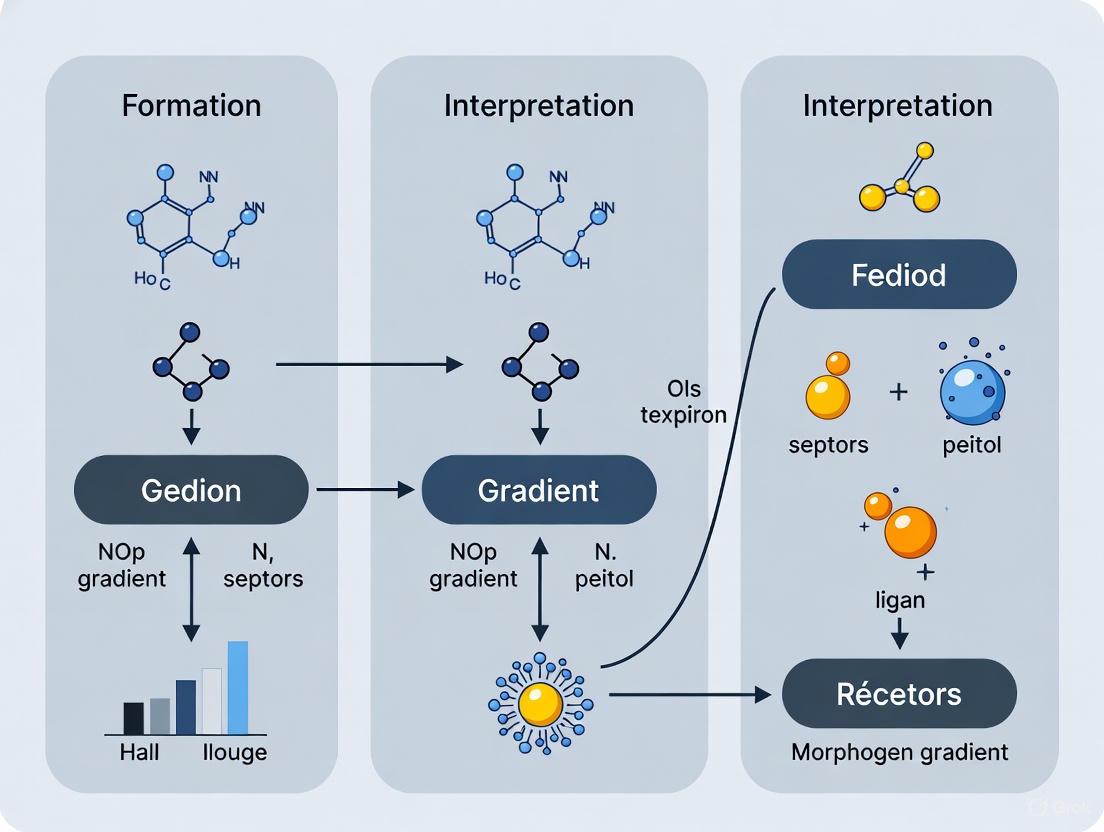
This article synthesizes contemporary research on morphogen gradient formation and interpretation, addressing both foundational biological mechanisms and their translational applications.
Morphogen Gradient Formation and Interpretation: From Fundamental Mechanisms to Applications in Drug Development
Abstract
This article synthesizes contemporary research on morphogen gradient formation and interpretation, addressing both foundational biological mechanisms and their translational applications. We explore the core biophysical principles—including diffusion, degradation, and endocytic trafficking—that govern gradient establishment, alongside the intracellular networks that enable precise signal interpretation. The review highlights how advanced model systems, such as organoids and synthetic biology circuits, are revolutionizing our ability to study and engineer morphogen-mediated patterning. We further examine the critical challenges of reproducibility, scalability, and precision in these systems, and discuss how integrating computational modeling, single-cell analytics, and standardized bioengineering is enhancing their predictive power for therapeutic development. Finally, the article evaluates the growing role of morphogen-informed models in preclinical drug screening and their emerging potential to reshape regenerative medicine and precision oncology.
Core Principles and Current Controversies in Morphogen Gradient Biology
The development of a complex multicellular organism from a single fertilized egg represents one of the most fascinating questions in biology. How embryonic tissues organize in space and time to form fields of distinct cells reliably has fascinated developmental biologists for decades [1]. The conceptual framework for understanding this process was fundamentally shaped by two pivotal theoretical advances: Francis Crick's physical analysis of diffusion-based gradient formation and Lewis Wolpert's elegant concept of positional information. These frameworks, developed within the broader context of morphogen gradient research, provide the foundational principles for how patterns emerge during embryonic development. The core premise is that positional information enables cells to determine their spatial location within a developing tissue and adopt specific fates accordingly [2] [1]. This whitepaper traces the evolution of these theoretical frameworks, their experimental validation, and their modern interpretation through quantitative systems-level approaches, providing researchers and drug development professionals with a comprehensive technical guide to the field.
The history of gradient theories dates back to early 20th century proposals of "formative substances" or metabolic gradients that could influence developmental plans [2] [3]. However, the first rigorous mathematical treatment was provided by Alan Turing in 1952 with his reaction-diffusion model, which showed how chemical substances he termed "morphogens" could self-organize into spatial patterns from homogeneous initial conditions [3]. This was followed by Crick's explicit analysis of diffusion as a physical mechanism for gradient formation and Wolpert's powerful abstraction of positional information, which together established a theoretical triad that continues to guide experimental and computational approaches in developmental biology and regenerative medicine.
Crick's Diffusion Model: The Biophysical Foundation
Theoretical Principles and Mathematical Formulation
Francis Crick's 1970 model provided a critical biophysical foundation for understanding how morphogen gradients could form in developing tissues [3]. Crick recognized that freely diffusing morphogen produced in a source cell and destroyed in a spatially distinct "sink" could establish a concentration gradient over developmentally relevant timescales. His key insight was that a localized sink was not strictly necessary—gradients can form if all cells act as sinks through uniform degradation, or even if morphogen is not degraded at all [3].
The fundamental mathematical description of morphogen spreading through non-directional movement with spatially uniform degradation can be captured by a partial differential equation that has become central to the field:
Where c represents morphogen concentration as a function of space and time, D is the effective diffusion coefficient [μm²/s], and k is the effective degradation rate [1/s] [3]. The first term on the right describes diffusion-driven spreading, while the second term represents first-order degradation. At steady state (when ∂c/∂t = 0), this equation yields an exponential concentration profile characterized by a specific characteristic length λ = √(D/k), which determines how far the morphogen signal extends from its source [1] [3].
Table 1: Key Parameters in Crick's Diffusion Model
| Parameter | Symbol | Units | Biological Role | Experimental Measurement |
|---|---|---|---|---|
| Diffusion Coefficient | D | μm²/s | Determines speed of morphogen spread | FRAP, FCS |
| Degradation Rate | k | s⁻¹ | Controls gradient length and turnover | Metabolic labeling, pulse-chase |
| Characteristic Length | λ = √(D/k) | μm | Spatial range of morphogen action | Immunostaining, live imaging |
| Source Strength | j₀ | molecules/(μm²×s) | Production rate at source | Quantified imaging, biosensors |
Boundary Conditions and Tissue Context
Crick's model explicitly considered boundary conditions that reflect biological reality. At the source boundary (x = 0), a constant flux of molecules enters the target tissue: D(∂c/∂x)|ₓ₌₀ = -j₀, where j₀ represents the source strength [3]. At the opposite tissue boundary (x = L), a reflective condition where (∂c/∂x)|ₓ₌ₗ = 0 assumes molecules cannot diffuse out of the tissue. The model elegantly demonstrates that the steady-state gradient shape depends solely on the ratio D/k, while the transient dynamics toward this steady state depend on D independently [1]. This separation of timescales has profound implications for developmental processes, particularly in rapidly patterning systems.
Figure 1: Crick's diffusion model for morphogen gradient formation
Wolpert's Positional Information: The French Flag Model
Core Conceptual Framework
Lewis Wolpert's seminal 1969 positional information model represented a paradigm shift in how developmental biologists conceptualized patterning [2] [1]. Wolpert elegantly postulated that cells determine their fate by interpreting local concentrations of graded morphogen profiles, abstractly termed positional information [2]. This framework provided a solution to his famous "French Flag Problem" of patterning, wherein a field of initially identical cells develops into precisely positioned blue, white, and red regions [2].
The French Flag model operates through several key principles. First, a prepatterned source establishes a morphogen gradient through a tissue. Second, cells respond to this gradient by interpreting local morphogen concentrations against predefined threshold values. Third, each concentration threshold triggers a specific genetic response, leading to discrete boundaries between cell fates despite the continuous nature of the gradient [2]. Wolpert's crucial insight was separating the "information" contained in the morphogen concentration from the "interpretation" machinery that converts this information into cellular responses—a distinction that allowed evolution to act independently on signaling and response mechanisms [2].
Experimental Validation and Molecular Proof
While Wolpert's conceptual framework found immediate popularity, its experimental validation required significant time. In 1974, transplantation experiments in Drosophila definitively demonstrated the existence of cytoplasmic determinants [2]. The watershed moment came in 1988 with the discovery of the anterior determinant Bicoid in the Drosophila embryo, which displayed all the characteristics of Wolpert's positional information concept [2] [1]. Bicoid forms a concentration gradient along the anterior-posterior axis, with different concentrations activating or repressing specific target genes to establish the body plan [1]. This was quickly followed by demonstrations that frog growth factors determine differential cell fates according to concentration thresholds [2], establishing Wolpert's framework as a universal mechanism operating across diverse organisms.
Figure 2: Wolpert's French Flag model of positional information
Shannon Information Theory in Positional Specification
The modern interpretation of positional information has shifted from qualitative description to quantitative, mathematically rigorous formulation based on Shannon information theory [2]. This approach addresses a fundamental challenge in morphogen-mediated patterning: the inherently stochastic nature of the mapping between physical position and local morphogen concentrations. Mutual information, I(X;Y) = S(X) + S(Y) - S(X,Y), provides a model-free measure of the statistical dependence between position and morphogen concentration, generalizing linear correlation coefficients to capture nonlinear relationships [2].
This information-theoretic framework enables researchers to answer fundamental systems-level questions: where does positional information reside in the patterning network, how is it transformed and accessed during development, and what fundamental limits is it subject to? [2]. The shift to information theory moves focus beyond specific biological mechanisms, molecules, genes, and pathways to reveal general principles governing the reliability of positional specification despite molecular noise.
Precision and Reproducibility in Developmental Patterning
Quantitative studies have revealed that specific morphological features during early development occur with remarkable precision and reproducibility across wild-type embryos [2]. The Bicoid gradient in Drosophila, for instance, patterns the embryo with characteristic lengths of approximately 100 μm, significantly larger than the Dpp (20 μm) and Wingless (6 μm) gradients in the fly wing [1]. This precision exists despite the stochastic nature of individual morphogen-receptor interactions and intracellular signaling events.
Table 2: Experimentally Characterized Morphogen Gradients
| Morphogen | System | Characteristic Length | Formation Mechanism | Target Genes/Outcomes |
|---|---|---|---|---|
| Bicoid | Drosophila embryo | ~100 μm | Diffusion & degradation [1] | Gap genes (hunchback, Krüppel) [1] |
| Dpp | Drosophila wing | ~20 μm | Diffusion & degradation [1] | Optomotor-blind, Spalt [1] |
| Wingless | Drosophila wing | ~6 μm | Diffusion & degradation [1] | Distal-less, Senseless [1] |
| BMP | Drosophila embryo | ~5 cells | Extracellular interactions [1] | pMad gradient, dorsal fates [1] |
| Sonic Hedgehog | Mouse neural tube | Tissue-scale | Co-expanding source [4] | Neural progenitor domains [4] |
Experimental Methodologies and Research Tools
Key Experimental Protocols for Gradient Analysis
The validation and quantification of morphogen gradients require sophisticated experimental approaches. Immunostaining and GFP fusion proteins provide static images of gradient profiles in fixed tissues [1]. For dynamic measurements, functional fluorescent protein-morphogen fusions enable live imaging of gradient formation and turnover [1]. Fluorescence recovery after photobleaching (FRAP) experiments yield quantitative data on diffusion coefficients by measuring how quickly fluorescence returns to a photobleached region [3].
Critical tests for morphogen function involve altering gradient shape through genetic manipulation and observing resulting changes in patterning outcomes. As expected for true morphogens, changes in Bicoid concentration elicit corresponding shifts in the expression domains of downstream target gap genes [1]. Similar approaches using inducible expression systems, morpholino knockdowns, or pharmacological inhibitors have been applied across model systems to establish causal relationships between gradient properties and patterning outcomes.
The Scientist's Toolkit: Essential Research Reagents
Table 3: Essential Research Reagents for Morphogen Gradient Studies
| Reagent/Category | Specific Examples | Function/Application | Key References |
|---|---|---|---|
| Fluorescent Protein Fusions | Bicoid-GFP, Dpp-GFP | Live imaging of gradient dynamics | [1] |
| Antibodies for Immunostaining | Anti-Bicoid, Anti-pMad | Fixed tissue gradient visualization | [1] [3] |
| Genetic Manipulation Tools | CRISPR/Cas9, RNAi, Gal4/UAS | Perturbation of gradient formation | [1] |
| Biosensors | FRET-based BMP sensors | Real-time signaling activity monitoring | [1] |
| Theoretical Modeling Tools | Reaction-diffusion solvers | Quantitative simulation of gradient dynamics | [2] [3] |
Advanced Concepts: Temporal Control and System-Level Properties
Beyond Position: Morphogen Gradients as Temporal Regulators
Recent research has revealed that morphogen gradients convey more than just spatial information—they can also orchestrate developmental timing [4]. In growing tissues such as the mouse neural tube, the same Sonic Hedgehog gradients that convey positional information can simultaneously enable cells to measure time [4]. The key mechanism involves a passively co-expanding morphogen source, which creates a hump-shaped transient signal as morphogen abundance first increases then decreases due to tissue growth [4].
This temporal dimension adds considerable sophistication to the French Flag model. In the developing neural tube, opposing gradients of Sonic Hedgehog and BMP signaling not only pattern spatial domains but can also synchronize developmental time across the entire tissue [4]. This dual functionality demonstrates how the same molecular machinery can solve multiple patterning challenges simultaneously through sophisticated dynamics.
Future Directions: Unsolved Puzzles in Gradient Biology
Despite significant advances, fundamental questions about morphogen gradients remain unanswered. The field continues to investigate how the precision and robustness of gradients emerge from stochastic molecular interactions [2]. The interplay between gradient formation and interpretation represents another frontier—in many systems, these processes may influence each other through mutual feedback loops rather than operating in linear sequence [1]. Understanding this interplay requires system-level approaches that combine quantitative experiments with theoretical modeling [1].
Future research must also address how gradients pattern tissues across different scales and how they integrate with other patterning mechanisms such as cell-cell communication and mechanical forces. The application of information theory to positional specification represents a promising framework for addressing these questions by providing model-free measures of patterning performance [2]. As techniques for quantitative measurement and perturbation continue to advance, so too will our understanding of these fundamental mechanisms of biological pattern formation.
Morphogen gradients are fundamental to patterning and growth in developing tissues, providing positional information through differential concentration-dependent signaling. The establishment, interpretation, and maintenance of these gradients rely on a complex interplay of biophysical transport mechanisms and biochemical processing. This technical guide provides an in-depth examination of three core mechanisms—diffusion, degradation, and extracellular regulation—that collaboratively shape morphogen distribution and signaling dynamics. We synthesize current research frameworks, highlighting how endocytic trafficking critically interprets the extracellular morphogen gradient by controlling signaling duration, while extracellular modulation fine-tunes ligand availability and distribution. Quantitative data from foundational studies are consolidated into structured tables, and detailed experimental protocols are provided for key methodologies. Visual signaling pathways and workflows, generated using compliant Graphviz specifications, enhance conceptual clarity. This resource aims to equip researchers and drug development professionals with a comprehensive mechanistic understanding essential for investigating gradient-dependent processes in development and disease contexts.
Morphogens are signaling molecules released from localized source cells that form concentration gradients across developmental fields, instructing cell fate in a concentration-dependent manner [5]. The paradigm of morphogen-mediated patterning hinges on the precise formation and interpretation of these gradients, which dictate distinct transcriptional responses based on threshold concentrations [6]. The gradient is not a static entity but a dynamic system shaped by the rates of morphogen production, dispersion from the source, and eventual turnover.
The core thesis of contemporary research posits that the interpretation of the morphogen gradient is as critical as its physical establishment. This interpretation is highly context-dependent, determined by the specific competence of the receiving cells—defined by their gene expression profile, available transcription factors, and epigenetic landscape [6]. Furthermore, it has become clear that cells interpret not only the level of morphogen but also the duration of signaling exposure [6] [7]. Thus, understanding gradient formation requires dissecting the transport mechanisms that govern its spatial distribution and the cellular mechanisms that decode its informational content.
Core Transport Mechanisms and Their Regulation
The formation of a stable morphogen gradient is a physical process governed by the relationship between diffusion, which spreads the molecule, and degradation, which limits its range. These core mechanisms are further modulated by a suite of extracellular factors.
Diffusion
Diffusion is the passive, thermally driven process that enables morphogens to spread from a local source, forming a concentration gradient. This movement is governed by Fick's laws, leading to a concentration that typically decays exponentially from the source. The effective range of the morphogen is determined by the diffusion coefficient (D) and the degradation rate (k). Recent studies, particularly on the Dpp morphogen in Drosophila, highlight that simple free diffusion is often insufficient to explain gradient dynamics in vivo. Instead, Dynamin-mediated internalization is crucial for shaping the extracellular distribution, as blocking this process expands the range of extracellular Dpp [7].
Degradation and Intracellular Trafficking
Morphogen degradation is essential for establishing a finite gradient and preventing uncontrolled signaling. The intracellular trafficking pathway is a key determinant of the signaling duration and, consequently, the interpretation of the gradient.
- Signal Initiation: Dpp signaling activation depends on Dynamin-mediated internalization from the cell surface [7].
- Signal Attenuation: Contrary to some models, Rab5-mediated early endosomal trafficking is dispensable for signaling initiation but required for its termination by promoting the downregulation of activated Thickveins (Tkv) receptors [7].
- Signal Termination: The Multivesicular Body (MVB) serves as a critical compartment for terminating Dpp signaling. The ESCRT complex sorts activated receptors into intraluminal vesicles (ILVs) for degradation. Blocking MVB formation expands the intracellular Dpp signaling gradient without altering the extracellular distribution, demonstrating that this step is vital for accurately interpreting the extracellular gradient [7]. Rab7-mediated lysosomal degradation appears to be a subsequent step for terminal degradation.
Extracellular Regulation
The extracellular space is not a passive medium but is actively involved in modulating morphogen movement and stability.
- Heparan Sulfate Proteoglycans (HSPGs): Proteins like Dally can bind morphogens, influencing their stability, diffusion, and presentation to signaling receptors. They can antagonize Tkv-mediated endocytosis, thereby promoting a longer-range gradient [7].
- Receptor-Mediated Sequestration: Cell-surface receptors, such as Tkv for Dpp, act as a sink for morphogens. Their binding can limit spread and facilitate internalization, a process described as "restricted diffusion" or "transcytosis" in some models [7].
Table 1: Key Morphogens and Their Associated Transport Mechanisms
| Morphogen | Organism | Core Transport Mechanism | Key Regulatory Factors | Primary Role in Development |
|---|---|---|---|---|
| Dpp/BMP | Drosophila | Diffusion & Endocytic Trafficking | Tkv, Punt, Dally, Dynamin, Rab5, ESCRT | Wing disc patterning and growth [7] |
| Sonic Hedgehog (Shh) | Vertebrates | Diffusion & Extracellular Modulation | PCT, Smoothened, Megf8, Mgrn1 | Neural tube patterning [5] |
| Wnt | Vertebrates, Drosophila | Diffusion & Restricted Spread | Frizzled receptors, extracellular inhibitors | Limb patterning, cell fate specification [6] |
Experimental Approaches and Methodologies
Investigating morphogen gradients requires sophisticated genetic, cell biological, and biophysical techniques to visualize endogenous proteins and perturb specific mechanisms.
Visualizing Endogenous Morphogen Gradients
A significant challenge has been the difficulty of visualizing endogenous morphogens at physiological levels. A breakthrough methodology involves generating functional, fluorescent protein-tagged alleles.
- Protocol: Generation of Endogenous Fluorescent-Tagged Morphogen Alleles [7]
- Allele Design: Insert a bright fluorescent protein (e.g., mGreenLantern or mScarlet) into the native morphogen gene locus, typically at the C-terminus of the mature peptide, to minimize disruption to protein folding and processing.
- Transgenesis: Use site-specific recombination (e.g., CRISPR/Cas9 or phiC31 integrase) to create a knock-in allele.
- Functional Validation:
- Genetic Rescue: Homozygous flies must be assessed for viability and adult wing morphology to confirm the tagged protein is functional.
- Signaling Activity: Immunostaining for phosphorylated Mad (pMad) in wing discs confirms the allele can activate the downstream signaling pathway correctly.
- Imaging: Use confocal microscopy to visualize both the extracellular gradient (via non-permeabilized immunostaining with α-GFP antibodies) and the total cellular pool (via direct fluorescence) in larval wing imaginal discs.
Perturbing Endocytic Trafficking
To dissect the role of intracellular trafficking, specific steps of the endocytic pathway can be blocked.
- Protocol: Blocking Key Endocytic Compartments [7]
- Dynamin-mediated Internalization: Express a dominant-negative form of Dynamin (e.g., Shibire(^{ts})) in clones of cells. This blocks all endocytosis from the plasma membrane.
- Early Endosome Function: Knock down or express dominant-negative Rab5 in clones to disrupt early endosome maturation and fusion.
- MVB Formation: Knock down key components of the ESCRT machinery (e.g., Vps28, Vps25, or Hrs) in clones to prevent the formation of intraluminal vesicles and block signal termination at this step.
- Lysosomal Degradation: Knock down or express dominant-negative Rab7 to disrupt transport from late endosomes to lysosomes.
The following workflow diagram illustrates the logical sequence of a typical genetic experiment to test the role of a specific gene in morphogen trafficking:
Table 2: Quantitative Data from Dpp Trafficking Experiments in Wing Discs [7]
| Experimental Condition | Effect on Extracellular Dpp Gradient | Effect on pMad Signaling Gradient | Interpretation |
|---|---|---|---|
| Control (Wild-type) | Normal graded distribution | Normal graded distribution | Baseline gradient formation and interpretation |
| Block Dynamin (Shibire^ts^) | Gradient expands | Signaling is impaired | Internalization is required for signaling and shapes extracellular gradient |
| Block Rab5 (Early Endosome) | No major change | Signaling range expands | Early endosomes are dispensable for spreading but required for signal attenuation |
| Block MVB (ESCRT) | No major change | Signaling range expands | Signal termination occurs at the MVB; critical for interpreting extracellular gradient |
| Block Rab7 (Lysosome) | Not reported | Minor or no change | Lysosomal degradation is not the primary mode of signal termination |
Visualization of Signaling Pathways
The Hedgehog (Hh) signaling pathway is a classic example of a morphogen pathway whose interpretation is critical for development. Its core components and regulatory feedback are outlined below.
The Scientist's Toolkit: Essential Research Reagents
The following table details key reagents and tools essential for experimental research in morphogen gradient biology.
Table 3: Research Reagent Solutions for Morphogen Gradient Studies
| Reagent / Tool | Function / Description | Example Use Case |
|---|---|---|
| Functional Fluorescent-tagged Alleles (e.g., mGL-dpp) | Enables visualization of endogenous morphogen distribution at physiological expression levels. | Directly quantifying extracellular and intracellular Dpp gradients in Drosophila wing discs [7]. |
| Dominant-Negative Dynamin (Shibire(^{ts})) | Blocks clathrin-mediated endocytosis in a temperature-sensitive manner. | Testing the necessity of internalization for morphogen signaling and gradient formation [7]. |
| Rab5, Rab7, ESCRT Mutants/RNAi | Allows specific disruption of distinct endosomal compartments. | Dissecting the role of early endosomes, MVBs, and lysosomes in signal activation and termination [7]. |
| Phospho-Specific Antibodies (e.g., α-pMad) | Marks cells with active morphogen signaling. | Visualizing the transcriptional output gradient of Dpp/BMP signaling [7]. |
| Receptor Mutants (e.g., tkv, pnt) | Removes key sinks and signaling components. | Studying how receptor binding and internalization shape the morphogen gradient [7]. |
| HSPG Mutants (e.g., dally, dly) | Disrupts extracellular matrix interactions with morphogens. | Investigating the role of the extracellular environment in stabilizing and transporting morphogens [7]. |
Morphogens are signaling molecules that are secreted from a localized source and form long-range concentration gradients to regulate growth and patterning of tissues and organs in a concentration-dependent manner [8] [9]. A fundamental challenge in developmental biology has been to understand how these gradients are formed, maintained, and interpreted by target cells. While extracellular diffusion and binding interactions were initially considered the primary shaping forces, a growing body of evidence demonstrates that intracellular trafficking plays an equally critical role in both shaping morphogen distribution and determining cellular response [8] [10] [7]. This endocytic debate centers on how the complex journey of morphogens and their receptors through the endosomal network—from internalization to recycling or degradation—controls the precision of developmental patterning.
The traditional view of morphogen gradient formation emphasized passive diffusion and limited extracellular stability. However, research spanning decades has revealed that morphogen activity is intimately linked with receptor-mediated endocytosis and subsequent intracellular sorting [8] [9]. The Dpp/BMP pathway in Drosophila, particularly in the wing imaginal disc, has served as a valuable model for these studies, demonstrating how trafficking influences both gradient geometry and signaling output [8] [7]. This whitepaper synthesizes current understanding of how distinct endocytic compartments contribute to morphogen gradient formation and interpretation, with particular emphasis on quantitative approaches that bridge molecular mechanisms to tissue-level patterning.
Fundamental Mechanisms: How Trafficking Shapes Gradient Formation
Endosomal Network Architecture and Cargo Dynamics
The endocytic pathway comprises a series of interconnected compartments with distinct biochemical properties and functions. Following internalization, cargo enters early endosomes marked by the small GTPase Rab5, where the initial sorting decisions occur [8] [10]. Cargo can then be recycled to the plasma membrane via recycling endosomes or targeted for degradation through maturation into late endosomes (characterized by Rab7) and subsequent fusion with lysosomes [8]. A specialized compartment known as the multivesicular body (MVB) facilitates the sorting of activated receptors into intraluminal vesicles for degradation, representing a key point of signal regulation [7].
Quantitative studies of endosomal network dynamics reveal that cargo distribution follows characteristic patterns influenced by kinetic parameters such as cargo influx, endosome fusion-fission rates, and endosome lifetime. One theoretical approach modeling these dynamics estimated the average time between endosome fusion events at approximately 3 minutes, with an endosome lifetime of roughly 11 minutes [8]. These parameters create a highly dynamic system where cargo amounts in single endosomes can vary over wide ranges, enabling precise regulation of signaling duration and intensity.
Models of Morphogen Gradient Formation
Several models have been proposed to explain how endocytic trafficking contributes to morphogen gradient formation:
- Transcytosis Model: Morphogens are internalized and transported through cells via repeated cycles of endocytosis and exocytosis, potentially extending their range [7].
- Glypican-Mediated Transport: Heparan sulfate proteoglycans (e.g., Dally) internalize and recycle morphogens independently of signaling receptors, contributing to extracellular gradient formation [7].
- Receptor-Mediated Sink Model: Signaling receptors (e.g., Tkv for Dpp) internalize morphogens, creating a sink that limits spread, with extracellular factors antagonizing this process to establish long-range distribution [7].
Recent research utilizing functional fluorescent protein-tagged Dpp alleles has provided new insights, demonstrating that while Dynamin-mediated internalization is required for Dpp signaling activation, Rab5-mediated early endosomal trafficking is surprisingly dispensable for Dpp spreading but essential for signal termination [7].
Table 1: Key Trafficking Components and Their Roles in Morphogen Gradient Formation
| Trafficking Component | Role in Gradient Formation | Effect When Disrupted |
|---|---|---|
| Dynamin | Mediates initial internalization of ligand-receptor complexes | Expands extracellular morphogen distribution but impairs signaling [7] |
| Rab5 | Regulates early endosome formation and cargo sorting | Expands signaling range due to impaired receptor downregulation [7] |
| Rab7 | Controls late endosome maturation and lysosomal degradation | Limited effect on Dpp signaling termination [7] |
| ESCRT Complex | Mediates MVB formation and receptor sorting into ILVs | Expands intracellular signaling range without altering extracellular gradient [7] |
| Recycling Endosomes | Return receptors to plasma membrane | Modulates cellular sensitivity and response duration [10] |
Interpretation of Gradients: How Cells Decode Positional Information
Signal Activation and Termination Compartments
The interpretation of morphogen gradients depends not only on ligand concentration but also on the subcellular location of signal activation and termination. Research has revealed that signaling is not restricted to the plasma membrane; instead, various endosomal compartments serve as distinct signaling platforms that influence the strength and duration of signaling outputs [10].
For Dpp/BMP signaling, recent evidence indicates that signal termination occurs primarily at the multivesicular body (MVB) through ESCRT-dependent sorting of activated receptors into intraluminal vesicles, rather than through Rab7-mediated lysosomal degradation [7]. When MVB formation is blocked, the Dpp signaling gradient expands without altering the extracellular Dpp distribution, demonstrating that this compartment is critical for proper interpretation of the morphogen gradient [7]. This finding highlights how the duration of intracellular signaling, controlled by trafficking kinetics, contributes to positional information.
Temporal Dynamics in Signal Interpretation
Cells can interpret both the concentration and duration of signaling activity to determine fate decisions. A striking example comes from Notch signaling, where different ligands (Dll1 and Dll4) produce distinct temporal patterns of NICD (Notch intracellular domain) release despite signaling through the same receptor [10]. These dynamics arise from differential endocytic clustering and transcytosis, leading to either pulsed or sustained NICD activity that is decoded into distinct transcriptional programs and cell fates [10].
Similarly, for the EGF receptor, spatially distinct populations of phosphatases control signaling kinetics, with plasma membrane-localizing PTPRJ/G and ER-localizing PTPN2 exhibiting different dephosphorylation rates [10]. The rate of perinuclear accumulation of receptor-bearing endosomes thus influences signaling lifetime, connecting trafficking speed to signal interpretation.
Table 2: Quantitative Parameters of Endocytic Trafficking in Signal Interpretation
| Parameter | Experimental Measurement | Biological Significance |
|---|---|---|
| Signaling Duration | Temporal analysis of pMad dynamics | Determines extent of target gene expression and patterning [7] |
| Receptor Phosphorylation Lifetime | FRET-based biosensors and phospho-specific antibodies | Influences signal output strength; regulated by compartment-specific phosphatases [10] |
| Perinuclear Accumulation Rate | Live imaging of fluorescently tagged receptors | Controls exposure to perinuclear phosphatases that deactivate receptors [10] |
| Endosomal Residence Time | Single endosome tracking and photoconversion | Determines opportunity for signal complex assembly and activation [8] |
| Ligand-Receptor Interaction Time | Fluorescence recovery after photobleaching (FRAP) | Affects signaling output magnitude and duration [10] |
Experimental Approaches and Key Findings
Visualization and Perturbation of Endogenous Morphogens
A significant advance in the field came from the generation of functional fluorescent protein-tagged dpp alleles (mGL-dpp and mSC-dpp) that enable simultaneous visualization of extracellular and intracellular Dpp distribution at physiological expression levels [7]. These tools revealed that Dpp predominantly exists intracellularly, with only a small fraction detectable extracellularly, highlighting the importance of intracellular trafficking for Dpp distribution and signaling.
Using these endogenous tags with systematic perturbation of trafficking components, researchers have delineated the specific roles of different endocytic compartments. The experimental workflow typically involves:
- Genetic perturbation of specific trafficking components (e.g., Rab5, Rab7, ESCRT subunits) using RNAi or dominant-negative mutants
- Quantitative imaging of extracellular vs. intracellular morphogen distribution
- Assessment of signaling activity via phospho-Mad (pMad) staining or other pathway reporters
- Correlation of trafficking defects with phenotypic outcomes in wing disc patterning and adult wing morphology [7]
This approach demonstrated that while Dynamin-mediated internalization shapes the extracellular Dpp gradient, MVB-dependent termination interprets this gradient by controlling signaling duration [7].
Quantitative Imaging and Computational Modeling
Advanced imaging techniques combined with computational modeling have been instrumental in bridging molecular-scale trafficking events with tissue-level gradient formation. Quantitative approaches include:
- Single-particle tracking of quantum dot-labeled ligands to follow trafficking itineraries
- Fluorescence correlation spectroscopy to measure binding interactions and diffusion coefficients
- Automated image analysis of large endosome populations to derive cargo distribution functions [8]
- Compartmental kinetic modeling to relate trafficking parameters to gradient morphology [8] [11]
These methods have revealed that the endosomal network operates through basic processes—cargo influx, homotypic endosome fusion, endosome fission, and endosome maturation—whose kinetics determine large-scale gradient properties [8]. For instance, analysis of cargo distributions in cells with fluorescently labeled Rab5 enabled estimation that the average time between endosome fusion events is approximately 3 minutes, with an endosome lifetime of about 11 minutes [8].
The Scientist's Toolkit: Essential Research Reagents and Methodologies
Table 3: Key Research Reagents for Studying Trafficking in Morphogen Gradients
| Reagent/Method | Function/Application | Key Findings Enabled |
|---|---|---|
| Functional fluorescent-tagged morphogen alleles (e.g., mGL-dpp, mSC-dpp) | Visualization of endogenous morphogen distribution at physiological levels | Revealed predominant intracellular localization of Dpp and differential effects of trafficking perturbations [7] |
| Dominant-negative Rab mutants (e.g., Rab5DN, Rab7DN) | Specific perturbation of distinct trafficking stages | Established that Rab5-mediated early endocytosis is dispensable for Dpp spreading but required for signal attenuation [7] |
| ESCRT component RNAi | Disruption of MVB formation and ILV sorting | Demonstrated that MVB formation is critical for signal termination and proper gradient interpretation [7] |
| Quantum Dot-FRET tracking | Quantitative analysis of polyplex stability and intracellular unpacking kinetics | Enabled correlation of trafficking kinetics with functional outcomes in gene delivery systems [11] |
| Phospho-specific antibodies (e.g., pMad) | Readout of pathway activation | Revealed expanded signaling range when MVB formation is blocked, despite normal extracellular gradient [7] |
| Cargo distribution analysis | Quantitative imaging of endosomal network dynamics | Enabled estimation of endosomal kinetic parameters (fusion rates, lifetimes) [8] |
The integration of quantitative experimental approaches with theoretical modeling has revolutionized our understanding of how intracellular trafficking shapes and interprets morphogen gradients. The emerging consensus indicates that gradient formation relies on Dynamin-dependent internalization, while gradient interpretation depends on the duration of intracellular signaling controlled by endocytic trafficking through specific compartments, particularly the MVB [7]. This framework reconciles previously conflicting models by assigning distinct roles to different trafficking steps.
Future research directions will likely focus on understanding how trafficking kinetics are modulated at the single-cell level to achieve robust patterning at the tissue scale, and how mechanical forces and cell shape influence trafficking decisions. The development of new imaging technologies capable of tracking multiple endosomal populations simultaneously in developing tissues will further accelerate knowledge gain in this field [10]. As our understanding of these processes deepens, so too will our ability to manipulate patterning systems for therapeutic applications in regenerative medicine and disease treatment.
Morphogen gradients are graded distributions of signaling molecules that specify distinct cellular fates in a concentration-dependent manner, providing a fundamental framework for understanding pattern formation in embryonic development. The concept, formalized by Lewis Wolpert in the positional information model, proposes that cells interpret their spatial position based on the concentration of a signaling molecule, then translate this information into specific developmental behaviors [1]. The first molecular demonstration emerged from studies of the Bicoid transcription factor in the Drosophila syncytium, where it forms an anterior-posterior gradient regulating downstream gap gene expression [1]. Since then, numerous secreted signaling proteins including Dpp, Wingless, Hedgehog, Activin, and Nodal have been identified as morphogens across diverse organisms [1].
Visualizing and quantifying these endogenous gradients presents significant technical challenges. Morphogens operate at microscopic scales, often spanning just a few cell diameters, and their dynamics can unfold within minutes. Furthermore, the interplay between gradient formation and interpretation creates complex feedback loops that necessitate system-level approaches combining experimental and theoretical strategies [1]. This technical guide explores innovative tools and methodologies for tracking endogenous morphogen distribution, providing researchers with practical frameworks for investigating these fundamental patterning mechanisms.
Quantitative Analysis of Morphogen Gradients
Characterizing Gradient Parameters
Quantitative analysis begins with precise measurement of gradient properties. Research indicates that morphogen gradients often exhibit exponential decay profiles, characterized by a single scale parameter known as the characteristic length (λ) [1]. This characteristic length represents the distance over which the morphogen concentration decreases by a factor of e and provides crucial information about gradient shape and spread. For example, studies have revealed that the Bicoid gradient in Drosophila has a characteristic length of approximately 100 μm, substantially larger than Dpp (20 μm) and Wingless (6 μm) gradients in the fly wing [1].
The exponential profile emerges from simple dynamics involving diffusion and linear degradation, where the characteristic length depends on the ratio of the diffusion coefficient (D) to the degradation rate (β) according to the relationship: λ = √(D/β) [1]. This mathematical framework enables researchers to infer dynamic parameters from static images of steady-state gradients, though precise quantification requires careful measurement techniques and appropriate controls.
Table 1: Experimentally Measured Characteristic Lengths of Model Morphogens
| Morphogen | System | Characteristic Length | Key References |
|---|---|---|---|
| Bicoid | Drosophila embryo | ~100 μm | Houchmandzadeh et al., 2002 [1] |
| Dpp | Drosophila wing disc | ~20 μm | Kicheva et al., 2007 [1] |
| Wingless | Drosophila wing disc | ~6 μm | Kicheva et al., 2007 [1] |
| BMP | Drosophila embryo | ~5 cells (sharp gradient) | Eldar et al., 2002 [1] |
Experimental Measurement Techniques
Several specialized approaches have been developed for visualizing and quantifying endogenous morphogen distributions:
Fluorescent Protein Fusions: The creation of functional fluorescent protein-morphogen fusions (e.g., GFP fusion proteins) enables direct visualization of gradient formation in living tissues [1]. This approach has been successfully applied to Bicoid, Dpp, and Wingless, revealing their exponential distribution patterns and enabling quantitative analysis of gradient dynamics.
Antibody Staining: Traditional antibody staining provides a static image of morphogen distribution in fixed tissues [1]. While lacking temporal resolution, this method offers high specificity and sensitivity for initial characterization of gradient morphology.
Activity Monitoring: Instead of tracking morphogen distribution directly, some approaches monitor downstream intracellular responses. For example, the BMP activity gradient in Drosophila embryos has been quantified by measuring phosphorylated Mad (pMad) levels, revealing a sharp profile that forms within approximately 30 minutes [1].
Computational Modeling: Mathematical modeling serves as an essential tool for interpreting experimental data and testing hypotheses about gradient dynamics. Models can predict how specific parameters affect gradient formation and provide insights that guide experimental design [1].
Experimental Protocols for Gradient Visualization
Live Imaging of Fluorescent Morphogen Fusions
This protocol details the procedure for tracking morphogen dynamics in living Drosophila tissues using endogenously tagged fluorescent fusion proteins.
Materials Required:
- Fly strains with endogenously tagged morphogen (e.g., Dpp-GFP)
- Confocal or light-sheet microscope with temperature control chamber
- Immersion oil appropriate for the objective lens
- Microscope slides and coverslips designed for live imaging
- Image analysis software (e.g., FIJI/ImageJ, Imaris)
Procedure:
- Cross appropriate fly genotypes to generate embryos or larvae expressing the fluorescently tagged morphogen.
- Prepare samples for imaging by mounting tissues in physiological buffer under a coverslip sealed with valap or specialized imaging chamber.
- Maintain samples at appropriate temperature (typically 25°C) throughout imaging procedure.
- Acquire time-lapse images using confocal or light-sheet microscopy with minimal laser power to prevent phototoxicity.
- Capture z-stacks at regular intervals (e.g., every 2-5 minutes) to monitor gradient dynamics.
- Process images using deconvolution algorithms to improve signal-to-noise ratio if necessary.
- Quantify fluorescence intensity along the relevant axis using line scan analysis in ImageJ.
- Fit exponential decay curves to intensity profiles to determine characteristic length.
Troubleshooting Tips:
- Photobleaching can be minimized by using reduced laser power and imaging chambers with oxygen scavengers.
- Movement artifacts may require physical immobilization of samples or computational image registration.
- Background fluorescence should be quantified in control regions and subtracted from measurements.
Fixed Tissue Analysis of Endogenous Morphogens
This protocol describes the quantification of morphogen gradients using antibody staining in fixed samples, enabling higher resolution and multiplexing with additional markers.
Materials Required:
- Primary antibodies against target morphogen
- Fluorescently conjugated secondary antibodies
- Fixation buffer (e.g., 4% paraformaldehyde in PBS)
- Permeabilization and blocking buffers
- Mounting medium with DAPI for nuclear counterstaining
- High-resolution confocal or super-resolution microscope
Procedure:
- Dissect tissues in cold PBS and transfer to fixation buffer for 20-45 minutes at room temperature.
- Wash fixed tissues 3×5 minutes in PBS with 0.1% Triton X-100 (PBT).
- Block non-specific binding sites with 5% normal serum in PBT for 1 hour at room temperature.
- Incubate with primary antibody diluted in blocking solution overnight at 4°C.
- Wash 3×15 minutes in PBT.
- Incubate with fluorescent secondary antibody for 2 hours at room temperature.
- Wash 3×15 minutes in PBT, with DAPI included in the second wash if desired.
- Mount samples in anti-fade mounting medium and seal with nail polish.
- Image using high-resolution microscopy, ensuring non-saturating acquisition settings.
- Quantify morphogen distribution using intensity profiling and compare across multiple samples.
Validation Controls:
- Include samples without primary antibody to assess background signal.
- Validate antibody specificity using genetic mutants when available.
- Use multiple antibodies recognizing different epitopes to confirm distribution patterns.
Computational Modeling and Data Analysis
Mathematical Framework for Gradient Interpretation
Computational models provide powerful tools for interpreting gradient data and generating testable predictions. The simplest model describing morphogen gradient formation incorporates diffusion from a localized source combined with uniform degradation. This framework generates an exponential steady-state distribution described by the equation:
C(x) = C₀e^(-x/λ)
where C(x) is the concentration at position x, C₀ is the concentration at the source, and λ is the characteristic length (λ = √(D/β)) [1]. Although real biological systems often incorporate additional complexity including reversible binding, facilitated transport, and feedback regulation, this basic model serves as a valuable starting point for quantitative analysis.
Table 2: Key Parameters in Morphogen Gradient Modeling
| Parameter | Symbol | Units | Experimental Measurement Approach |
|---|---|---|---|
| Diffusion coefficient | D | μm²/s | Fluorescence Recovery After Photobleaching (FRAP) |
| Degradation rate | β | s⁻¹ | Cycloheximide chase experiments |
| Production rate | J | molecules/s | Quantification of source activity |
| Characteristic length | λ | μm | Fluorescence intensity profiling |
| Interpretation threshold | Cₜₕᵣₑₛₕ | molecules/μm³ | Gene expression boundary analysis |
Tools for Quantitative Data Analysis
Several specialized software platforms facilitate quantitative analysis of morphogen gradients:
Displayr: A cloud-based survey analysis platform that specializes in quantitative data visualization and offers automated reporting features, though its application to biological imaging data may require adaptation [12].
Statistical Analysis Software: Programs like SPSS, Excel, SAS, or R provide robust environments for statistical analysis of quantitative data, including regression analysis to determine relationships between variables [13].
Custom Analysis Scripts: Many research groups develop custom analysis pipelines in Python, MATLAB, or R to address specific quantification challenges in gradient analysis, such as accounting for tissue curvature or normalizing between samples.
Computational-Experimental Workflow for Gradient Analysis
The Scientist's Toolkit: Essential Research Reagents
Successful visualization of endogenous morphogen gradients requires specialized reagents and tools. The following table details essential materials for experimental research in this field.
Table 3: Essential Research Reagents for Morphogen Gradient Visualization
| Reagent/Tool | Function | Example Applications | Technical Considerations |
|---|---|---|---|
| Fluorescent protein fusions (GFP, RFP) | Tagging morphogens for live imaging | Dpp-GFP, Wingless-GFP | Endogenous tagging preferred over overexpression |
| Specific antibodies | Detecting endogenous morphogens in fixed tissue | Anti-Bicoid, Anti-Dpp | Validate specificity with genetic controls |
| CRISPR/Cas9 genome editing | Endogenous tagging and functional analysis | Insertion of protein tags, creating mutants | Off-target effects must be controlled |
| Advanced microscopy systems (confocal, light-sheet) | High-resolution imaging of gradient dynamics | Live imaging of embryo development | Phototoxicity concerns with prolonged imaging |
| Image analysis software (FIJI, Imaris) | Quantifying fluorescence intensity and distribution | Intensity profiling, 3D reconstruction | Background subtraction critical for accuracy |
| Mathematical modeling software (MATLAB, Python) | Simulating gradient dynamics and making predictions | Testing transport models, estimating parameters | Model complexity should match biological knowledge |
Signaling Pathways and Experimental Design
Morphogen gradients function within specific signaling pathways that regulate developmental patterning. Understanding these pathways is essential for designing appropriate visualization experiments.
Morphogen Signaling Pathway with Feedback
The field of morphogen gradient visualization continues to evolve with emerging technologies offering new insights. Advanced imaging techniques including super-resolution microscopy and single-molecule tracking provide increasingly precise measurements of gradient parameters. Meanwhile, developments in genome editing enable more sophisticated genetic manipulations for testing specific hypotheses about gradient function.
The integration of quantitative experimental data with computational modeling remains essential for advancing our understanding of morphogen gradients. This combined approach has already revealed fundamental principles, such as the relationship between gradient dynamics and interpretation [1]. Future research will likely focus on understanding how multiple gradients interact to create complex patterns and how gradient interpretation is modulated by cellular context.
Visualizing endogenous morphogen distribution presents technical challenges, but the methodologies outlined in this guide provide a robust foundation for investigating these fundamental developmental mechanisms. By applying careful quantitative approaches and leveraging innovative tools, researchers can continue to unravel the complexities of pattern formation in developing systems.
Resolving Theoretical Controversies with Modern Experimental Evidence
The concept of morphogen gradients as carriers of positional information represents one of the most influential frameworks in developmental biology. First formally proposed by Lewis Wolpert in his 1969 positional information model [1] and later molecularly demonstrated with the Bicoid gradient in Drosophila [1], this paradigm has undergone significant evolution as experimental techniques have advanced. For decades, the central theoretical controversy in the field has revolved around a fundamental question: Can a single morphogen gradient achieve the remarkable precision observed in embryonic patterning, or do developing tissues require more complex mechanisms such as opposing gradients or supplementary timing mechanisms? This question strikes at the very heart of how we understand the encoding of spatial and temporal information in biological systems.
Recent experimental advances have brought this theoretical controversy into sharp focus. While early models suggested that single gradients could sufficiently pattern tissues, subsequent research revealed apparent precision limitations that seemed to necessitate more complex solutions. The development of sophisticated visualization techniques, quantitative measurements, and computational approaches has now provided unprecedented insight into gradient dynamics. This technical guide examines how modern experimental evidence is resolving long-standing theoretical debates, with particular emphasis on studies conducted in the mouse neural tube—a model system that has proven instrumental for understanding gradient precision and dynamics. We will explore how cutting-edge methodologies are transforming our understanding of morphogen function, from fundamental gradient formation to sophisticated interpretation mechanisms that enable precise tissue patterning in both space and time.
Theoretical Foundations and Historical Controversies
The Positional Information Framework and Its Limitations
The positional information model, as formalized by Wolpert, proposed that cells acquire spatial identity through their position relative to chemical concentration gradients [1]. This framework elegantly explained how organized patterns could emerge across developing tissues, with cells translating gradient information into specific fates through concentration-dependent differentiation. The first molecular validation came with the discovery of the Bicoid gradient in Drosophila, which patterns the anterior-posterior axis through direct concentration-dependent regulation of downstream genes [1].
However, as research expanded to other systems, theoretical challenges emerged. A fundamental limitation concerned timing: while gradients could efficiently convey spatial information, it remained unclear how they could simultaneously orchestrate the precise timing of differentiation events [4]. Additionally, quantitative analyses suggested that single gradients might lack the precision required to establish sharp boundaries in developing tissues, leading to proposals that opposing gradient systems or supplementary timing mechanisms must operate [4] [14].
The Precision Problem in Gradient Interpretation
Theoretical work highlighted a fundamental precision limitation in gradient-based patterning. For an exponential gradient described by C(x) = C₀exp(-x/λ), boundary positions are established where the concentration reaches a specific threshold: xθ = λln(C₀/Cθ) [14]. This relationship makes boundary positions sensitive to variations in both gradient amplitude (C₀) and decay length (λ). Molecular noise in morphogen production, transport, and degradation inevitably creates embryo-to-embryo variations in these parameters, theoretically translating into significant positional errors in boundary establishment [14].
This precision problem led to the hypothesis that single gradients were insufficient for precise patterning. Research in the mouse neural tube appeared to support this view, with reported positional errors of gradients increasing from 1-2 cell diameters in early stages to more than 30 cell diameters later in development [14]. These observations formed the basis for proposing that combined readout of opposing Sonic Hedgehog (SHH) and Bone Morphogenetic Protein (BMP) gradients was necessary to achieve the observed precision of central progenitor domain boundaries [14].
Modern Experimental Approaches to Gradient Analysis
Advanced Visualization and Quantification Techniques
Contemporary morphogen gradient research employs sophisticated visualization and quantification methods that have dramatically improved measurement precision. Current protocols, as detailed in works such as "Morphogen Gradients: Methods and Protocols" [15], include:
- Fluorescent protein-morphogen fusions for live imaging of gradient dynamics
- Antibody staining techniques for high-resolution spatial mapping of endogenous morphogen distributions
- Transcriptional reporters (e.g., GBS-GFP for SHH signaling) to monitor gradient interpretation in real time
- Phosphorylation-specific antibodies (e.g., for pSMAD in BMP signaling) to visualize activity gradients of signal transduction cascades
These techniques have enabled researchers to move beyond static snapshots of gradient distributions to dynamic measurements of gradient formation and interpretation. For instance, imaging of functional fluorescent protein-morphogen fusions has revealed that gradients such as Bicoid in Drosophila and Dpp and Wingless in the fly wing typically exhibit exponential decay profiles, characterized by a single scaling length that defines their spatial extent [1].
Computational and Mathematical Modeling Approaches
The integration of theoretical and experimental approaches has been essential for advancing our understanding of gradient dynamics [1]. Mathematical modeling enables researchers to:
- Quantify gradient parameters by fitting mathematical functions to experimental data
- Extract kinetic parameters (diffusion and degradation rates) from gradient dynamics
- Test hypothetical mechanisms through numerical simulations
- Distinguish between alternative models that could explain observed gradient behaviors
For exponential gradients, the characteristic length λ depends on the diffusion coefficient (D) and degradation rate (β) as λ = √(D/β) [1]. This relationship highlights a fundamental insight: different combinations of D and β can produce identical steady-state gradients, necessitating dynamic measurements to distinguish between potential mechanisms. Computational approaches have thus become indispensable for interpreting experimental data and deriving biologically meaningful parameters from gradient observations.
Table 1: Key Experimental Techniques in Modern Morphogen Gradient Research
| Technique Category | Specific Methods | Applications | Key Limitations |
|---|---|---|---|
| Morphogen Visualization | Antibody staining, GFP fusion proteins, Fluorescent in situ hybridization | Static mapping of morphogen distribution, Live imaging of gradient dynamics | Fixation artifacts, Tag-induced functional alterations, Limited temporal resolution |
| Signaling Activity Readouts | Phosphorylation-specific antibodies, Transcriptional reporters, SMAD phosphorylation assays | Monitoring intracellular signaling activity, Real-time tracking of gradient interpretation | Reporter sensitivity thresholds, Indirect measurement of signaling |
| Computational Approaches | Exponential fitting, Reaction-diffusion modeling, Noise analysis, Error propagation methods | Quantifying gradient parameters, Predicting boundary positions, Estimating patterning precision | Model dependence, Parameter uncertainty, Computational complexity |
Case Study: Re-evaluating Gradient Precision in the Neural Tube
Experimental Redesign and Methodology
A seminal 2022 study published in Nature Communications fundamentally reassessed the precision of morphogen gradients in the mouse neural tube, providing a textbook example of how improved methodologies can resolve theoretical controversies [14]. This research employed multiple independent approaches to overcome limitations of previous gradient measurements:
First, researchers directly compared different error estimation methods using synthetic exponential gradients with known statistical properties matching those reported for neural tube gradients [14]. This controlled approach enabled systematic evaluation of methodological artifacts in precision assessment.
Second, the study implemented a Direct Error Estimation Method (DEEM) that determined boundary positions in individual embryos and calculated the standard deviation of these positions, avoiding approximation errors inherent in previous indirect methods [14].
Third, researchers developed numerical simulations based on measured molecular noise levels in morphogen production, turnover, and diffusion to independently estimate gradient variability and positional error [14].
Critical to these advances was the use of improved statistical methods that acknowledged a fundamental mathematical reality: the arithmetic mean of different exponential functions is not itself exponential [14]. This insight resolved discrepancies between previous analytical approaches and direct measurements.
Resolution of a Theoretical Controversy
The revised experimental approach yielded a striking conclusion: the positional error of morphogen gradients in the neural tube had been significantly overestimated in previous studies [14]. Where earlier work reported errors increasing to more than 30 cell diameters in the neural tube center, the new analysis revealed that a single morphogen gradient could achieve the observed precision of central progenitor domain boundaries (NKX6.1 and PAX3 boundaries) throughout the first day of neural tube development [14].
This finding resolved the long-standing theoretical debate about whether opposing gradients were necessary for precise patterning. The research demonstrated that the combined readout of SHH and BMP gradients, previously proposed as essential for achieving precision, was not required—a single gradient provided sufficient positional information [14]. Furthermore, the study revealed that the size of gene expression domains remains independent of gradient amplitude variability when boundaries are established by threshold-based readout of a single gradient, creating a robust mechanism for producing precise progenitor cell numbers [14].
Table 2: Comparison of Error Estimation Methods in Morphogen Gradient Studies
| Method | Approach | Advantages | Limitations | Impact on Precision Assessment |
|---|---|---|---|---|
| FitEPM (Fitted Error Propagation Method) | Fit exponential to mean gradient, use analytical derivative in error propagation | Simple implementation, Works well near source | Overestimates error far from source (mean of exponentials isn't exponential) | Led to overestimation of positional errors, supporting multi-gradient models |
| NumEPM (Numerical Differentiation Error Propagation Method) | Numerical differentiation of mean gradient, use in error propagation | Better handles non-exponential mean shapes | Still indirect method, Sensitive to noise in mean gradient | Produced moderate error estimates |
| DEEM (Direct Error Estimation Method) | Direct determination of boundary positions in individual embryos, calculate standard deviation | Direct measurement, Avoids approximation artifacts, Mathematically precise | Requires high-quality data from multiple embryos | Revealed single gradients are sufficiently precise, resolved controversy |
Emerging Concept: Gradients as Temporal Regulators
Experimental Evidence for Dual Position-Time Encoding
Recent research has revealed an additional layer of functionality in morphogen gradients: their capacity to convey temporal information alongside positional cues. A 2025 study proposed that the same morphogen gradients that specify position can also enable cells to measure time during development [4]. This mechanistic insight emerged from quantitative analysis of the Sonic Hedgehog gradient in the mouse neural tube, combined with theoretical modeling of gradient dynamics in growing tissues.
The experimental approach involved precise measurement of SHH gradient dynamics during neural tube development, with particular attention to how gradient properties change as both the morphogen source and the target tissue expand [4]. Researchers tracked the spatial and temporal dynamics of SHH signaling using multiple complementary approaches, including direct morphogen visualization and signaling activity reporters.
The key discovery was that a passively co-expanding morphogen source, as found in the developing neural tube, produces a characteristic "hump-shaped" transient signal at fixed positions within the tissue [4]. As the source expands, morphogen abundance initially increases, but subsequently decreases due to tissue growth, exposing cells to a predictable temporal sequence of morphogen concentrations that can serve as a timing mechanism.
Theoretical Implications and Experimental Validation
This dual functionality of morphogen gradients resolves another theoretical puzzle: how the timing of differentiation is coordinated with positional specification during development. The proposed mechanism is strikingly simple, requiring no additional molecular machinery beyond the existing gradient system [4].
Experimental validation came from demonstrating that opposing gradient systems, such as the SHH and BMP gradients in the neural tube, can synchronize developmental timing across the entire tissue [4]. The research showed quantitatively where in the neural tube cells experience transient signaling and for what duration, providing a direct link between gradient dynamics and differentiation timing.
This conceptual advance has profound implications for understanding developmental programs, suggesting that the same signaling systems that pattern tissues spatially can also orchestrate temporal sequences of differentiation. The integration of positional and temporal information within single gradient systems represents a more parsimonious and robust mechanism than previously imagined.
Schematic of dual positional and temporal information encoding in morphogen gradients, based on experimental evidence from neural tube development [4].
The Scientist's Toolkit: Essential Research Reagents and Methodologies
Critical Reagents for Gradient Research
Table 3: Essential Research Reagents for Morphogen Gradient Studies
| Reagent Category | Specific Examples | Research Applications | Functional Role |
|---|---|---|---|
| Morphogen Visualization Tools | Anti-SHH antibodies, Anti-BMP antibodies, GFP fusion constructs, Fluorescent protein tags | Direct gradient visualization, Live imaging of gradient dynamics, Quantifying morphogen distribution | Enable direct observation of morphogen spatial distribution and dynamics |
| Signaling Activity Reporters | Phospho-SMAD antibodies, GBS-GFP transcriptional reporter, Phosphorylation-specific antibodies | Monitoring intracellular signaling activity, Assessing gradient interpretation, Measuring pathway activation | Provide readouts of gradient interpretation at cellular level |
| Computational Tools | Exponential fitting algorithms, Reaction-diffusion modeling software, Error analysis frameworks, Statistical comparison packages | Quantifying gradient parameters, Estimating patterning precision, Simulating gradient dynamics | Enable quantitative analysis and theoretical modeling of gradient properties |
| Genetic Tools | Transgenic reporter lines, Conditional knockout systems, Tissue-specific drivers, CRISPR-Cas9 editing systems | Testing necessity and sufficiency, Manipulating gradient components, Analyzing gene function | Allow functional manipulation of gradient formation and interpretation |
Experimental Workflows for Gradient Analysis
The integration of these reagents into standardized experimental workflows has been essential for resolving theoretical controversies. A typical comprehensive gradient analysis involves:
Workflow 1: Precision Assessment
- Gradient Visualization - Use antibody staining or fluorescent reporters to visualize morphogen distribution in multiple embryos [15] [14]
- Quantitative Profiling - Extract intensity profiles across the patterning field using image analysis software [14]
- Boundary Determination - Identify expression boundaries in individual samples using standardized thresholding [14]
- Error Calculation - Apply direct error estimation methods (DEEM) to calculate positional variability [14]
Workflow 2: Temporal Dynamics Analysis
- Time-Series Imaging - Capture gradient dynamics using live imaging of fluorescent reporters [4] [15]
- Source and Tissue Measurement - Quantify changes in source size and tissue dimensions over time [4]
- Signal Transient Analysis - Track concentration changes at fixed positions to identify hump-shaped dynamics [4]
- Synchronization Assessment - Analyze correlation between opposing gradients in timing coordination [4]
Experimental workflow for morphogen gradient analysis, integrating multiple methodological approaches to resolve theoretical questions.
Modern experimental evidence has fundamentally transformed our understanding of morphogen gradients, resolving long-standing theoretical controversies through improved methodologies and quantitative approaches. The integration of advanced visualization techniques, precise computational methods, and sophisticated genetic tools has revealed that gradient systems are both more precise and more multifunctional than previously appreciated.
The resolution of these controversies has substantial implications for both basic developmental biology and applied biomedical research. The demonstration that single gradients can achieve high patterning precision simplifies our understanding of developmental mechanisms and provides more straightforward frameworks for tissue engineering applications. Meanwhile, the discovery that gradients convey both positional and temporal information reveals previously unrecognized efficiencies in developmental programming.
These insights fundamentally reshape our theoretical framework of morphogen function, suggesting that developmental systems achieve robustness through elegant integration of multiple information types within single signaling systems rather than through redundant or overlapping mechanisms. As research continues to advance, further integration of experimental and theoretical approaches will undoubtedly continue to resolve additional controversies and reveal new layers of sophistication in these fundamental biological patterning systems.
Advanced Model Systems and Engineering Approaches for Gradient Study
Organoid technology represents a transformative advancement in biomedical research, enabling the in vitro modeling of human tissue complexity with unprecedented fidelity. These three-dimensional, self-organizing cellular structures recapitulate key aspects of in vivo organ development, architecture, and function, providing a critical bridge between conventional two-dimensional cell cultures and animal models. By preserving the genetic, phenotypic, and functional characteristics of original tissues, organoids have emerged as powerful platforms for drug evaluation, disease modeling, and personalized medicine. This technical guide examines the fundamental principles underlying organoid systems, with particular emphasis on their relationship to morphogen gradient formation and interpretation—the very signaling mechanisms that orchestrate tissue patterning in vivo. We detail standardized methodologies for organoid generation, culture, and application while highlighting recent technological innovations that enhance physiological relevance and screening throughput. The integration of organoids into drug development pipelines promises to improve predictive accuracy, reduce reliance on animal models, and ultimately accelerate the translation of therapeutic candidates to clinical practice.
Organoids are defined as specialized classes of cellular models that can self-organize into tissue-like structures containing multiple relevant cell types from the tissues they represent [16]. Unlike traditional two-dimensional cell cultures, organoids maintain three-dimensional architecture, cellular heterogeneity, and tissue-specific functions that closely mirror in vivo biology [17]. The foundation of modern organoid technology stems from the landmark 2009 discovery of LGR5+ adult stem cells in the intestine and the development of methods to culture these cells to mimic a near-native physiological environment [18].
The physiological relevance of organoids arises from their ability to recapitulate developmental processes, including the self-organization and cell fate determination governed by morphogen gradients—concentration-dependent signals that instruct cells regarding their position and identity within a tissue [4]. In developing tissues, morphogen gradients form through diffusion from localized sources to distributed sinks, with tissue geometry playing a critical role in gradient establishment and maintenance [19]. Organoid systems successfully mimic these patterning mechanisms, making them invaluable for studying human development, disease pathogenesis, and drug responses.
The drug development landscape is increasingly embracing organoid technology, particularly following regulatory shifts such as the FDA's 2025 roadmap for reducing animal testing requirements [17] [18]. With clinical trial failure rates exceeding 85% for some therapeutic areas, the pharmaceutical industry requires more predictive models that better capture human-specific biology [20]. Organoids address this need by preserving patient-specific genetic backgrounds, tumor heterogeneity, and tissue-level responses to therapeutic interventions, thereby enabling more accurate preclinical assessment of drug efficacy and toxicity.
Theoretical Foundations: Morphogen Gradients in Development and Organoid Systems
Principles of Morphogen Gradient Formation
Morphogen gradients are fundamental to tissue patterning in embryonic development, providing positional information that guides cell fate decisions. Traditional models describe gradient formation through source-diffusion-degradation mechanisms, wherein morphogens diffuse from a localized source and are degraded throughout the tissue [19]. Recent research has revealed that the complex geometry of developing tissues significantly influences gradient dynamics. Computational reconstructions of zebrafish epiboly have demonstrated that the tortuous extracellular space affects morphogen distribution, with pore connectivity directly impacting gradient shape and robustness [19].
The same morphogen gradients that convey positional information can also enable cells to measure developmental time, particularly in growing tissues with expanding morphogen sources [4]. As the source expands, morphogen abundance increases initially then decreases as tissue growth dilutes the signal, creating a hump-shaped temporal profile that cells can interpret as a timing mechanism [4]. This dual functionality of morphogens—encoding both spatial and temporal information—is crucial for recapitulating proper tissue development in organoid systems.
Recapitulating Morphogen Gradients in Organoid Culture
Organoid technology leverages understanding of morphogen signaling to direct self-organization and differentiation in vitro. Key signaling pathways—including Wnt, BMP, Notch, and Hedgehog—are manipulated through precise supplementation of growth factors and small molecule inhibitors to mimic in vivo niche signals [21]. The establishment of these signaling gradients in three-dimensional organoid cultures enables the coordinated processes of stem cell self-renewal and multi-lineage differentiation that characterize functional tissues.
Table 1: Key Signaling Pathways in Intestinal Organoid Development
| Pathway | Role in Intestinal Homeostasis | Common Modulators | Effect on Cell Fate |
|---|---|---|---|
| Wnt/β-catenin | Stem cell maintenance | CHIR99021 (activator) | Promotes LGR5+ stem cell expansion [21] |
| Notch | Proliferation vs. differentiation choice | DAPT (inhibitor) | Inhibits secretory differentiation [21] |
| BMP | Differentiation control | Noggin, DMH1 (inhibitors) | Promotes epithelial maturation [21] |
| EGF | Proliferation stimulation | EGF | Enhances growth and viability [21] |
Advanced organoid culture systems incorporate engineering approaches to establish precise morphogen gradients. Microfluidic devices and 3D-printed hydrogel systems enable spatiotemporal control of signaling molecules, effectively directing differentiation while minimizing factor consumption [17]. These technological innovations address the challenge of recreating in vivo-like signaling environments in homogeneous culture conditions devoid of natural spatial niches.
Figure 1: Morphogen Gradient Formation and Cellular Interpretation. Morphogens diffuse from a source through the extracellular space, forming concentration gradients that cells interpret to determine their position and fate.
Technical Methodologies: Organoid Generation and Culture
Establishing Human Intestinal Organoids with Enhanced Stemness
A tunable human intestinal organoid system exemplifies the sophisticated application of developmental principles to achieve controlled balance between self-renewal and differentiation [21]. The protocol leverages a combination of small molecule pathway modulators to enhance stem cell stemness, thereby amplifying differentiation potential and increasing cellular diversity without artificial spatial or temporal signaling gradients.
Initial Setup and Reporter System Generation:
- Generate LGR5-mNeonGreen reporter lines using CRISPR-Cas9 technology to visualize and track LGR5+ stem cells [21].
- Culture human intestinal crypts or stem cells in a basal medium containing EGF, the BMP inhibitor Noggin (or small molecule alternative DMH1), and R-Spondin1 to mimic essential niche signals.
- Eliminate factors that impede secretory cell generation, including SB202190, Nicotinamide, and PGE2, which are present in some conventional media formulations [21].
Enhanced Stemness Condition (TpC):
- Supplement basal medium with a combination of three key small molecules:
- Trichostatin A (T): HDAC inhibitor that modulates epigenetic regulation.
- 2-phospho-L-ascorbic acid (pVc): Vitamin C derivative that supports stem cell function.
- CP673451 (C): PDGFR inhibitor that enhances stem cell maintenance.
- This TpC condition substantially increases the proportion of LGR5+ stem cells and their reporter expression intensity [21].
- Culture dissociated single cells under TpC conditions to generate organoids with extensive crypt-like budding structures containing multiple intestinal lineages.
Lineage Differentiation Modulation:
- Shift the balance toward secretory cell differentiation using BET inhibitors.
- Promote enterocyte lineage commitment with enhanced proliferation through manipulation of Wnt, Notch, and BMP signaling pathways [21].
- For Paneth cell generation, incorporate IL-22 based signaling, though this may come at the cost of reduced organoid growth [21].
Table 2: Composition of Advanced Organoid Culture Conditions
| Component | Function | Concentration | Alternative |
|---|---|---|---|
| CHIR99021 | Wnt pathway activation | 3-5 μM | Wnt3a conditioned medium |
| Noggin | BMP inhibition | 100 ng/mL | DMH1 (500 nM) |
| R-Spondin1 | Wnt potentiation | 500 ng/mL | - |
| EGF | Epithelial proliferation | 50 ng/mL | - |
| A83-01 | TGF-β inhibition | 500 nM | - |
| Trichostatin A | HDAC inhibition | 500 nM | - |
| pVc | Antioxidant support | 50 μg/mL | - |
| CP673451 | PDGFR inhibition | 500 nM | - |
Characterization and Validation Methods
Comprehensive validation of organoid systems requires multimodal assessment to confirm physiological relevance:
Single-Cell Transcriptomics:
- Perform scRNA-seq on organoid samples to characterize cellular heterogeneity and identity.
- Integrate data with reference atlases, such as the Human Endoderm-derived Organoid Cell Atlas (HEOCA) which contains nearly one million cells from diverse conditions [22].
- Compare cell types and states between organoid models and harmonize annotations through mapping to primary tissue counterparts.
Immunofluorescence and Imaging:
- Validate protein expression of key intestinal markers:
- LGR5-mNeonGreen: Stem cell identification
- LYZ/DEFA5: Paneth cells
- MUC2: Goblet cells
- CHGA: Enteroendocrine cells
- ALPI: Mature enterocytes
- Employ high-throughput confocal imaging with advanced lasers to penetrate deep into organoid tissues and reveal 3D cellular interactions [16].
Functional Assays:
- Conduct colony-forming efficiency assays using dissociated single cells to quantify stem cell activity.
- Perform longitudinal tracking of individual LGR5+ stem cells to monitor differentiation dynamics and dedifferentiation events [21].
- Implement drug sensitivity testing with viability readouts to assess pharmacological responses.
Figure 2: Workflow for Generating and Validating Human Intestinal Organoids. The process from tissue isolation to application encompasses key steps for producing physiologically relevant models.
Current Research Advances and Applications
Technological Innovations in Organoid Systems
The organoid field has rapidly evolved beyond basic culture systems to incorporate sophisticated engineering and computational approaches:
Vascularization and Microfluidics: Integration of organoids with organ-on-chip technology combines three-dimensional structure with dynamic fluid flow and mechanical cues [20]. These platforms enhance cellular differentiation, establish well-polarized cell architectures, and enable co-culture with immune cells or microbes for modeling complex diseases like inflammatory bowel disease [20]. Microfluidic devices address diffusion limitations that lead to necrotic cores in larger organoids by improving nutrient access throughout the structure.
Automation and Artificial Intelligence: Automated systems like the CellXpress.ai Automated Cell Culture System operate continuously to minimize manual labor and improve reproducibility [16]. Machine learning algorithms support organoid research through automated image segmentation, real-time culture decisions, and transformation of complex imaging datasets into actionable drug screening insights [16]. These technologies reduce human bias and standardize protocols critical for reliable drug evaluation.
Standardized Atlas Integration: The creation of integrated transcriptomic atlases, such as the Human Endoderm-derived Organoid Cell Atlas (HEOCA), provides reference frameworks for assessing organoid fidelity [22]. These resources enable researchers to map new organoid protocols against primary tissue counterparts, identify off-target cell types, and quantify similarity to fetal or adult reference tissues [22].
Drug Evaluation Applications
Organoids have demonstrated particular utility in several drug development applications:
Personalized Oncology: Patient-derived organoids (PDOs) retain tumor histopathology, cellular heterogeneity, and patient-specific molecular profiles, enabling clinically predictive drug sensitivity testing [17]. Proof-of-concept studies have demonstrated the feasibility of using organoids to screen compound libraries and progress lead agents from discovery to clinical trials in significantly accelerated timelines [18]. For ultra-rare mutations, organoid assays have determined patient eligibility for existing treatments when clinical trial data was unavailable [18].
Toxicology and Safety Assessment: The structural and metabolic similarities between organoids and native tissues make them effective tools for evaluating drug toxicity and safety [17]. Organoid systems reduce false-positive drug hits and improve cardiac safety predictions during preclinical screening compared to conventional 2D cultures [17]. Following the FDA's policy shift away from animal testing requirements, pharmaceutical companies can now submit non-animal experimental data from organoid platforms as the basis for regulatory approval [17].
High-Throughput Screening: Advanced organoid biomanufacturing enables large-scale production of consistent models, with batch sizes ranging from 6 to 15 million organoids at the same passage [16]. This industrial approach provides the standardized, reproducible material necessary for high-throughput screening campaigns while capturing human biological diversity typically absent in traditional drug discovery [20].
The Scientist's Toolkit: Essential Research Reagents and Solutions
Table 3: Key Research Reagent Solutions for Intestinal Organoid Research
| Reagent Category | Specific Examples | Function | Considerations |
|---|---|---|---|
| Stem Cell Markers | LGR5 reporter lines, OLFM4 antibodies | Identification and tracking of stem cell populations | Endogenous labeling preserves function [21] |
| Differentiation Modulators | BET inhibitors, Notch inhibitors (DAPT) | Direct lineage specification | Concentration-dependent effects [21] |
| Extracellular Matrices | Matrigel, defined hydrogels | Provide 3D structural support | Defined compositions improve reproducibility [17] |
| Cytokine Supplements | R-Spondin1, EGF, Noggin | Mimic essential niche signals | Recombinant human proteins preferred [21] |
| Small Molecule Modulators | CHIR99021, A83-01, TpC combination | Pathway-specific manipulation | Enhanced stemness and differentiation [21] |
| Single-Cell Analysis Tools | 10x Genomics, Smart-seq2 | Cellular heterogeneity assessment | Integration with reference atlases [22] |
Organoid technology has fundamentally transformed the landscape of preclinical drug evaluation by introducing human-relevant models that faithfully recapitulate tissue complexity. The strategic manipulation of morphogen signaling pathways, which naturally guide development and homeostasis in vivo, enables the generation of organoid systems with controlled balance between self-renewal and differentiation. The ongoing integration of engineering approaches—including microfluidics, automation, and computational biology—addresses initial limitations in reproducibility, scalability, and physiological completeness.
The "Organoid Plus and Minus" framework exemplifies the field's evolution, combining culture system refinement with technological augmentation to enhance screening accuracy and translational relevance [17]. As regulatory agencies actively encourage alternatives to animal testing, organoid platforms are poised to become standard tools throughout the drug development pipeline. Future advances will likely focus on improving vascularization, incorporating immune components, and establishing more robust biobanking practices to capture human diversity.
The convergence of organoid technology with morphogen gradient research creates a powerful synergy that deepens our understanding of tissue patterning while providing more predictive models for therapeutic development. By maintaining fidelity to the fundamental principles of developmental biology, organoid systems will continue to advance both basic research and clinical translation, ultimately accelerating the delivery of effective, personalized treatments to patients.
Synthetic biology provides a powerful, engineering-based framework for uncovering the design principles that govern complex biological processes. A central aim of this field is to unravel how biological systems are genetically assembled and function by constructing simplified, rational designs of gene and protein circuits [23]. This approach is particularly valuable for decoding the logic of morphogen gradient formation and interpretation—a fundamental process in developmental biology where cells acquire positional information through differential concentrations of signaling molecules. The core premise is that complexity in patterning arises not necessarily from an increased number of genetic parts, but from novel combinations of pre-existing proteins and the modularity of biological parts [23]. By engineering minimal synthetic circuits, researchers can create simplified test-beds to refine our understanding of similarly structured natural networks, moving beyond correlation to establish causal relationships in patterning mechanisms. This hands-on exploration of design principles allows for a systematically quantitative description of the relationship between circuit architecture and phenotypic output, providing critical insights that observational studies alone cannot reveal.
Quantitative Foundations of Gene Circuit Design
Transcriptional Regulation and Transfer Functions
The engineering of synthetic patterning circuits begins with the precise characterization of fundamental genetic parts and their input-output relationships. Synthetic biology has enabled detailed, quantitative measurements of transcriptional regulation, building upon foundational work in genetics [23]. A critical concept is the transfer function, which quantitatively relates the input concentration of a transcription factor or inducer to the output concentration of a reporter gene [23]. These relationships can be mapped using synthetic constructs containing carefully designed promoter architectures driving measurable outputs such as fluorescent proteins or luciferase.
Table 1: Key Quantitative Parameters in Synthetic Circuit Characterization
| Parameter | Description | Measurement Approaches | Biological Significance |
|---|---|---|---|
| Transfer Function | Relationship between transcription factor concentration and transcriptional output | Titration of inducers with measurement of reporter protein/mRNA | Defines operational range and sensitivity of genetic circuits |
| Transcriptional Activity | Rate of mRNA production driven by specific promoter architecture | Combinatorial promoter libraries with reporter assays [23] | Determines output strength and dynamic range |
| Expression Noise | Variance in gene expression between isogenic cells | Single-cell time-lapse microscopy and flow cytometry [23] | Impacts robustness of patterning outcomes |
| Protein Degradation Rate | Half-life of protein components | Fusion of degradation tags with protein level monitoring [23] | Influences response dynamics and gradient stability |
Engineering Promoter Architecture
Combinatorial promoter libraries have served as an experimental breakthrough for quantitatively measuring how promoter architecture affects transcriptional activity [23]. These libraries are constructed by identifying specific operator sites that bind transcription factors and systematically ligating them in ways that shuffle their relative positions and copy numbers. Research in E. coli has revealed that repressors can effectively repress expression from core, proximal, and distal promoter regions, with strength of repression being greatest in the core region [23]. Interestingly, in Saccharomyces cerevisiae, a simple thermodynamic model incorporating transcription factor-DNA and transcription factor-transcription factor interactions could explain 49% of the variation in expression from promoter libraries [23]. This approach has demonstrated that weak binding sites, which are important for prokaryotic transcription, can also play significant roles in eukaryotic systems—a finding with particular relevance for designing graded response circuits in patterning systems.
Synthetic Circuits for Investigating Morphogen Gradients
Reconstituting Gradient Formation Mechanisms
Morphogen gradients provide positional information during development by forming concentration gradients that instruct cells to adopt distinct fates based on their exposure levels. Recent research has revealed that these gradients are regulated not only by molecular interactions but also by the physical characteristics of the developing tissue. In zebrafish epiboly, pore-scale 3D geometries reconstructed from light-sheet microscopy volumes have shown that a source-diffusion-degradation mechanism with additional binding to extracellular matrix polymers can explain the emergence and robust maintenance of Fgf8a gradients when realistic embryo geometries are considered [19]. Computational simulations in these reconstructed geometries demonstrate that the normalized gradient is robust against changes in source and sink rates but sensitive to changes in the pore connectivity of the extracellular space, with lower connectivity leading to steeper and shorter gradients [19]. This highlights the critical importance of considering realistic tissue geometries when studying morphogen gradients—a factor that synthetic circuits must account for to accurately recapitulate natural patterning processes.
Mechanical Force Integration in Patterning Systems
Beyond molecular diffusion, emerging evidence indicates that mechanical forces play a crucial role in ensuring robust tissue patterning by correcting noisy morphogen gradients. Research on the Wnt/β-catenin morphogen gradient—which patterns the embryonic anterior-posterior axis—has revealed that it generates cadherin-actomyosin interaction-mediated intercellular tension gradients, termed "mechano-gradients" [24]. Naturally generated unfit cells that produce noisy Wnt/β-catenin gradients induce local deformation of these mechano-gradients. Neighboring fit cells sense this deformation through the activation of Piezo family mechanosensitive calcium channels and secretion of annexinA1, which specifically eliminates unfit cells to recover proper morphogen gradients [24]. This mechanical force-mediated cell competition between morphogen-receiver cells provides a quality control mechanism that supports robust gradient formation, with potential implications for organogenesis and cancer biology.
Experimental Framework for Synthetic Patterning Circuits
Protocol: Engineering a Tunable Morphogen Gradient System
Objective: Create a synthetic morphogen gradient system with tunable parameters to investigate how gradient shape and interpretation thresholds affect patterning outcomes.
Materials and Reagents:
- Inducible Promoter System: Tetracycline- or arabinose-inducible promoters for precise control of morphogen source strength [23]
- Degradation Tags: ssrA or other degradation tags fused to morphogen genes to control ligand stability and diffusion range [23]
- Reporter Constructs: Fluorescent proteins (GFP, RFP) under control of promoters with different activation thresholds to read out positional information
- Host Strain: Engineered E. coli or mammalian cells with minimal background signaling
Procedure:
- Source Engineering: Clone morphogen gene (e.g., synthetic FGF variant) under control of inducible promoter with integrated degradation tags
- Receiver Circuit Design: Construct multiple reporter strains with promoters of varying sensitivities to the morphogen signal
- Spatial Arrangement: In microfluidic devices or on semi-solid media, establish source-sink geometry with precise cell positioning
- Gradient Characterization: Induce source expression and measure resulting morphogen distribution using fluorescence microscopy over time
- Patterning Assessment: Quantify reporter activation in receiver cells at different distances from the source to establish threshold responses
Data Analysis:
- Fit gradient profile to diffusion-degradation models with parameters for production rate, diffusion coefficient, and degradation rate
- Calculate activation thresholds for different receiver constructs
- Correlate local morphogen concentration with cell fate decisions
Protocol: Investigating Mechanical Force Feedback on Gradients
Objective: Examine how mechanical forces influence morphogen gradient interpretation and refinement using synthetic mechanosensitive circuits.
Materials and Reagents:
- Mechanosensitive Reporters: Piezo channel actuators or YAP/TAZ localization biosensors
- Force Application Systems: Magnetic tweezers, optical traps, or substrate stretching devices
- Cell-Cell Communication Modules: Engineered gap junctions or contact-dependent signaling systems
Procedure:
- Circuit Integration: Combine morphogen sensing circuitry with mechanosensitive reporting systems in the same cells
- Force Application: Subject cells to controlled mechanical stimuli while monitoring morphogen signaling responses
- Feedback Analysis: Measure how mechanical perturbations affect morphogen gradient interpretation and cell fate decisions
- Competition Assay: Co-culture cells with different mechanical properties and monitor elimination patterns
Standardization and Data Management
Visualization Standards with SBOL Visual
Effective communication of synthetic circuit designs requires standardized visual representation. The Synthetic Biology Open Language (SBOL) Visual standard provides a structured framework for visually representing genetic designs [25]. Initially introduced in 2013 as a set of 21 glyphs, SBOL Visual has evolved into a comprehensive diagrammatic language for biological designs, with version 3.0 published in 2021 [25]. This standard enhances the clarity of diagrams and figures capturing genetic design information by providing a cohesive visual language for representing nucleic acid sequences and the functional relationships between their features. SBOL Visual glyphs are publicly available in standard image formats and can be used with general-purpose computational drawing tools or specialized tools such as SBOL Canvas, VisBOL, SBOL Designer, and DNAplotlib [25]. Adoption of SBOL Visual has steadily increased, with approximately 70% of genetic designs in ACS Synthetic Biology being SBOL Visual compliant since 2020 [25].
Data Standards with SBtab and SBOL
Standardized data formats are essential for ensuring reproducibility and facilitating data exchange in synthetic biology research. SBtab is a flexible, table-based format for data exchange in Systems Biology that combines the advantages of standardized formats with the flexibility of spreadsheet files [26]. SBtab defines table structures and naming conventions that make tables easy to parse while supporting precise and complete information in data files. The format uses predefined table types for diverse kinds of data, including experimental time series, biochemical model parameters, and descriptions of network models [26]. Complementing this, the Synthetic Biology Open Language (SBOL) data standard provides a standardized format for the electronic exchange of information on both structural and functional aspects of biological designs [27]. SBOL uses Semantic Web practices and resources, such as Uniform Resource Identifiers (URIs) and ontologies, to unambiguously identify and define genetic design elements [27].
Table 2: Essential Research Reagents and Tools for Synthetic Patterning Circuits
| Category | Specific Examples | Function/Application | Key Features |
|---|---|---|---|
| Inducible Systems | Tet-On/Off, Arabinose-inducible | Precise control of morphogen source strength | Tunable induction, low background |
| Degradation Tags | ssrA, DHFR, PEST sequences | Control protein stability and diffusion range | Adjustable half-life, orthogonality |
| Fluorescent Reporters | GFP, RFP, YFP variants | Readout of gradient formation and interpretation | Different spectral properties, stability |
| Mechanosensitive Elements | Piezo channels, YAP/TAZ biosensors | Integration of mechanical cues | Force transduction, localization changes |
| Spatial Containment | Microfluidic devices, Agarose pads | Establishment of source-sink geometry | Controlled diffusion, cell positioning |
| Data Standards | SBOL, SBtab | Standardized data representation and exchange | Machine-readability, reproducibility |
| Visualization Tools | SBOL Designer, DNAplotlib | Circuit design and communication | Standards compliance, clarity |
Signaling Pathway Integration in Patterning Systems
Synthetic biology circuits represent a powerful reductionist approach for decoding the fundamental logic of biological patterning. By engineering minimal systems that recapitulate specific aspects of morphogen gradient formation and interpretation, researchers can establish causal relationships between circuit design and phenotypic output. The integration of quantitative measurements of gene expression, spatial modeling of gradient formation in realistic tissue geometries, and the emerging recognition of mechanical force feedback provides a comprehensive framework for understanding how robust patterns emerge from potentially noisy molecular processes. Future advances will likely involve more sophisticated integration of multiple signaling modalities, improved spatial control through microfluidic and tissue engineering approaches, and the development of even more standardized tools for design, data management, and visualization. As these minimal systems increase in complexity and fidelity to natural processes, they will continue to illuminate the core principles governing one of developmental biology's most fundamental phenomena: the transformation of genetic information into spatial patterns.
Microfluidic and 3D Bioprinting Platforms for Precutive Morphogen Delivery
The precise formation and interpretation of morphogen gradients are fundamental to tissue patterning and organogenesis in developmental biology [28]. Recapitulating these complex spatial and temporal cues in vitro has been a significant challenge, limiting the ability of researchers to study developmental processes and engineer functional tissues. The convergence of microfluidic technology and 3D bioprinting now offers unprecedented control over the cellular microenvironment, enabling the precise delivery of morphogens to create defined biological gradients [29] [30]. These integrated platforms represent a transformative approach for patterning cell fate and fabricating tissue constructs with sophisticated architectures. This technical guide explores the current advancements, methodologies, and applications of microfluidic and 3D bioprinting platforms for precutive morphogen delivery, framed within the broader context of morphogen gradient research.
Technological Foundations
3D Bioprinting Modalities
3D bioprinting encompasses several distinct technologies, each with unique advantages for fabricating tissue constructs and incorporating biological factors.
- Extrusion-Based Bioprinting: This method utilizes a syringe or nozzle to continuously deposit cell-laden bioinks in a layer-by-layer fashion. It is particularly suited for creating large, complex structures with high cell density, though it imposes moderate shear stress on cells. Modern systems often incorporate temperature-controlled printheads and advanced dispensing mechanisms to preserve cell viability [29].
- Inkjet Bioprinting: Operating similarly to traditional inkjet printers, this technique uses thermal or piezoelectric forces to eject droplets of bioink. It offers high resolution and speed and is noted for excellent cell viability, making it ideal for creating precise, small-scale patterns. However, it is generally limited to low-viscosity bioinks [29].
- Laser-Assisted Bioprinting: This nozzle-free technique uses a focused laser to transfer bioink from a donor substrate to a collector. It provides high precision (often below 10 µm) and high cell viability (>95%), allowing for single-cell placement. Its primary drawbacks are cost, complexity, and slower printing speeds [29].
- Stereolithography (SLA) and Volumetric Bioprinting (VBP): Light-based techniques use projected light patterns to crosslink photopolymerizable bioinks layer-by-layer (SLA) or all at once (VBP). They achieve high resolutions (down to 10 µm for SLA) and smooth surface finishes. VBP, a newer technology, enables the rapid formation of entire 3D structures within seconds without layering, resulting in higher resolution and smoother surfaces [29].
Microfluidic Integration and the "Printhead-on-a-Chip"
The integration of microfluidics with bioprinting has led to the development of advanced "printhead-on-a-chip" systems [30]. These systems process or manipulate minute volumes of fluids (10⁻⁹ to 10⁻¹⁸ liters) within microscale channels, offering several critical advantages for morphogen delivery:
- Precise Fluid Control: Enables real-time material switching and the creation of complex, multi-material architectures within a single construct [30].
- Gradient Formation: Laminar flow at the microscale allows for the generation of stable, user-defined biochemical (e.g., morphogen) gradients, which are essential for patterning cell behavior and tissue organization [30].
- Reduced Shear Stress: Microfluidic environments can be engineered to minimize shear forces on cells during the printing process, thereby enhancing cell viability and function [30].
- Enhanced Resolution: The small dimensions of microfluidic channels contribute to improved printing resolution at the microscale [30].
Experimental Methodologies
Fabrication of Microfluidic Bioprinting Systems
The creation of a microfluidic bioprinting platform involves several key steps:
- Nozzle/Chip Fabrication: Microfluidic printheads are typically fabricated using:
- Photolithography and Soft Lithography: The standard process for creating polydimethylsiloxane (PDMS)-based chips with high feature resolution [31].
- High-Resolution 3D Printing: An emerging method that allows for the rapid prototyping of complex microchannel designs directly from a digital model [30].
- Micro-Milling: A subtractive manufacturing method suitable for creating master molds or direct machining of certain polymers [30].
- System Integration: The fabricated microfluidic device must be seamlessly integrated with the bioprinter's motion control system, fluidic pressure controllers, and, for light-based systems, the optical engine.
- Bioink Preparation: Hydrogels are the primary material for bioinks. Key formulations include:
- Natural Polymer Hydrogels: Such as gelatin methacrylate (GelMA), alginate, and hyaluronic acid, prized for their biocompatibility and bioactive cues [29] [32].
- Decellularized Extracellular Matrix (dECM) Bioinks: Derived from native tissues, these retain tissue-specific biochemical signals that support cell morphogenesis [29].
- Synthetic Polymer Hydrogels: Like polyethylene glycol (PEG), which offer highly tunable mechanical and biochemical properties [29]. Morphogens (e.g., BMPs, TGF-βs) are incorporated into the bioink formulation or loaded into dedicated channels within the microfluidic device for controlled release.
Protocol for Generating a Bioprinted Morphogen Gradient
This protocol outlines the process for creating a 3D construct with an immobilized morphogen gradient using an integrated microfluidic bioprinting system.
- Objective: To fabricate a cell-laden hydrogel construct containing a spatially defined, stable gradient of a morphogen (e.g., BMP-2) to study its effects on stem cell differentiation.
Materials:
- Microfluidic printhead with at least two inlets and a mixing outlet.
- Bioink solution (e.g., 5-15% GelMA supplemented with photoinitiator).
- Human mesenchymal stem cells (hMSCs).
- Recombinant BMP-2 protein.
- Phosphate-buffered saline (PBS).
- Cell culture medium.
Procedure:
- Bioink Preparation: a. Prepare a base GelMA bioink and mix with hMSCs to achieve a final density of 5-20 million cells/mL. b. Divide the cell-laden bioink into two syringes. c. To one syringe, add BMP-2 to the desired maximum concentration (e.g., 100 ng/mL). This is the "high-concentration" bioink. d. The second syringe contains bioink without BMP-2 (or with a minimal concentration) and serves as the "low-concentration" bioink.
- System Priming and Printing: a. Load the two bioink syringes into the bioprinter and connect them to the inlets of the microfluidic printhead. b. Prime the channels to remove air bubbles and ensure consistent flow. c. Set the printing parameters: extrusion pressure, print speed, and the relative flow rates for the two bioink syringes. A linear gradient can be achieved by dynamically adjusting the flow rate ratio from 100:0 (High:Low) to 0:100 over the course of the print. d. Initiate the printing process onto a substrate. Simultaneously, activate the crosslinking mechanism (e.g., UV light for GelMA) to solidify the bioink immediately upon deposition, trapping the morphogen gradient within the hydrogel matrix.
- Post-Printing Culture and Analysis: a. Transfer the printed construct to a cell culture incubator. b. Culture the construct for the required duration, changing the medium as needed. c. Analyze the gradient's effects at specified time points using: * Immunofluorescence Staining: For differentiation markers (e.g., Runx2 for osteogenesis). * Gene Expression Analysis: qRT-PCR for lineage-specific genes. * Spectral PCCT Imaging: If contrast agents are co-printed, this can be used for non-invasive, longitudinal monitoring of construct integrity and potentially, through specific probes, cellular activity [32].
The following workflow diagram illustrates this multi-stage experimental process:
Quantitative Analysis of Bioprinting Techniques
The choice of bioprinting technology significantly impacts the resolution, viability, and suitability for morphogen delivery applications. The table below summarizes the key characteristics of different modalities.
Table 1: Comparative Analysis of 3D Bioprinting Modalities for Morphogen Delivery Applications
| Bioprinting Modality | Typical Resolution | Cell Viability | Key Advantages | Key Limitations for Morphogen Delivery |
|---|---|---|---|---|
| Extrusion-Based | 100 - 500 µm | Moderate (varies with shear stress) | High cell density; versatile bioinks; scalable. | Limited resolution for fine gradients; shear stress may affect cells. |
| Inkjet-Based | 100 - 500 µm | High (>85%) | High speed; excellent for droplet-based patterning. | Limited to low-viscosity bioinks; risk of nozzle clogging. |
| Laser-Assisted | <10 µm | Very High (>95%) | Highest precision; nozzle-free; gentle on cells. | Low throughput; complex and expensive setup. |
| Stereolithography (SLA) | ~10 - 50 µm | 70 - 90% | High resolution and smooth surfaces; fast. | Limited bioink options (must be photopolymerizable); potential cell damage from UV light. |
| Volumetric (VBP) | ~50 - 100 µm | Comparable to SLA | Extremely fast (seconds); no layer artifacts. | Very new technology; limited material databases. |
The Scientist's Toolkit: Research Reagent Solutions
Successful experimentation in microfluidic bioprinting for morphogen delivery requires a suite of specialized reagents and materials.
Table 2: Essential Research Reagents and Materials for Microfluidic Bioprinting of Morphogens
| Item | Function/Description | Example Applications |
|---|---|---|
| Gelatin Methacrylate (GelMA) | A photopolymerizable hydrogel derived from collagen; provides a biocompatible, tunable 3D matrix that supports cell adhesion and morphogen presentation. | Primary scaffold material for cell-laden constructs; can be blended with other hydrogels. |
| Decellularized ECM (dECM) Bioinks | Bioinks derived from native tissues (e.g., liver, heart dECM) that preserve tissue-specific biochemical cues, enhancing tissue-specific differentiation. | Creating a biologically relevant microenvironment for organ-specific models. |
| Polyethylene Glycol Dimethacrylate (PEGDMA) | A synthetic, photopolymerizable hydrogel used to modify the mechanical properties of other bioinks (like GelMA) and provide stability. | Added to GelMA to increase mechanical strength and stability of printed constructs. |
| Methacrylated Gold Nanoparticles (AuMA) | Functionalized nanoparticles that covalently bond into hydrogel networks during crosslinking; serve as a stable contrast agent for non-invasive CT imaging. | Longitudinal tracking of scaffold degradation and morphology using spectral PCCT. |
| Gd₂O₃ Nanoparticles | Nanoparticles providing strong contrast for X-ray and CT imaging; used to label and track different regions of a bioprinted construct. | Quantifying the distribution of multiple bioinks or materials within a single construct. |
| Iodixanol | A biocompatible compound used to tune the refractive index of the bioink to match that of encapsulated cells, reducing light scattering in light-based bioprinting. | Enables high-resolution SLA printing with high cell density bioinks. |
Applications in Morphogen Gradient Research
The integration of these platforms directly addresses core questions in morphogen gradient research, such as how gradients form and are interpreted by cells to dictate spatial patterning.
- Tissue Patterning and Organogenesis: These platforms enable the direct testing of hypotheses regarding morphogen concentration thresholds and the size of signaling fields. For instance, a BMP gradient can be bioprinted to pattern the dorsoventral axis in a model of neural tube development, allowing researchers to investigate how different threshold concentrations specify distinct neuronal subtypes [28].
- Vascularization: Coaxial microfluidic printing allows for the direct fabrication of hollow, perfusable tubes. By incorporating gradients of angiogenic morphogens (e.g., VEGF) within the surrounding bioink, researchers can guide endothelial cell sprouting and network formation in a controlled manner, which is critical for engineering viable thick tissues [30] [33].
- Disease Modeling and Drug Screening: Bioprinted tumor models can incorporate stromal cells and establish gradients of oncogenic signaling molecules (e.g., TGF-β) to recreate the tumor microenvironment. These models are invaluable for screening anti-cancer drugs and studying metastasis [29] [34]. Similarly, vessel-on-a-chip platforms with personalized vascular geometries can be used to study thrombosis under controlled flow and biochemical conditions [33].
Future Directions and Challenges
The field is rapidly evolving, with several emerging trends and persistent challenges.
- AI-Driven Design and Optimization: Artificial intelligence (AI) and machine learning are being deployed to manage the vast parameter space of bioprinting. AI can optimize bioink formulations, predict printing outcomes, and control the printing process in real-time to ensure high fidelity and quality, accelerating the transition from bench to bedside [35].
- 4D Bioprinting: This involves using smart, responsive materials that can change their shape or functionality over time (the 4th dimension) in response to external stimuli (e.g., light, temperature) or internal biological signals. This could be used to create dynamic morphogen gradients that evolve, more closely mimicking developmental processes [29].
- Scalability and Standardization: A significant hurdle remains the scaling up of these sophisticated models to create large, clinically relevant tissues. Furthermore, a lack of standardized protocols and quality control measures hinders reproducibility and widespread adoption. The implementation of a Quality by Design (QbD) framework is seen as a critical step to ensure robust and reproducible production of bioprinted constructs [35].
- Advanced Imaging Integration: As demonstrated with spectral Photon-Counting CT (PCCT), the integration of non-invasive, high-resolution imaging modalities is crucial for longitudinally monitoring scaffold integrity, cell distribution, and potentially even specific biological activities within the 3D construct over time [32].
Microfluidic and 3D bioprinting platforms have emerged as powerful and versatile tools for the precutive delivery of morphogens. By enabling unprecedented spatial and temporal control over biochemical and biophysical cues, these integrated technologies are providing new insights into the fundamental principles of morphogen gradient formation and interpretation. As the fields of AI, advanced materials, and imaging continue to converge with biofabrication, these platforms are poised to revolutionize not only basic developmental biology research but also the development of more effective regenerative therapies and personalized disease models.
A fundamental question in developmental biology is how the continuous concentration gradients of signaling molecules, known as morphogens, can generate tissues with sharply defined structures. Traditional models of morphogen-driven patterning suggest that diffusing morphogens form concentration gradients that direct cells to adopt distinct fates based on threshold concentrations [36]. However, this mechanism alone often fails to explain the sharpness of boundaries observed in developing tissues and organoids. Recent research has highlighted the crucial role of cell adhesion systems, particularly cadherins, in refining this positional information. The SYnthetic Morphogen system for Pattern Logic Exploration using 3D spheroids (SYMPLE3D) provides an innovative experimental platform to dissect the mechanistic interplay between morphogen signaling and cadherin-based adhesion, offering new insights for developmental biology and organoid engineering [37].
Core Principles of Morphogen Gradient Formation and Interpretation
Established Models of Morphogen-Mediated Patterning
Morphogens function as signaling molecules that control cell fate decisions in a concentration-dependent manner to regulate morphogenesis. They are secreted from source cells, diffuse through tissues, and form concentration gradients that provide positional information for cell differentiation [37]. The precision of this system is exemplified in Drosophila embryogenesis, where the Bicoid (Bcd) morphogen gradient patterns the anterior-posterior axis with positional accuracy of approximately a single nucleus width [36]. Theoretical frameworks suggest that morphogen profiles evolve under a cost-precision trade-off, where biological systems optimize the thermodynamic cost of producing morphogens against the need for patterning precision [36].
The Challenge of Boundary Sharpness
A significant limitation of pure morphogen gradient models is their inherent noisiness and inability to generate sharply defined tissue boundaries. In the classical diffusion-depletion model, morphogen molecules synthesized from a local source display an exponentially decaying concentration profile with a characteristic length λ [36]. While this provides positional information, the translation of this continuous gradient into discrete territories requires additional mechanisms to ensure robust boundary formation, particularly against fluctuations in morphogen concentration and the dynamic cellular rearrangements that occur during morphogenesis [38] [37].
The SYMPLE3D Synthetic Biology Platform
System Design and Components
The SYMPLE3D platform was specifically designed to disentangle the complex interactions between morphogen signaling and cell adhesion by employing a synthetic biology approach that offers unprecedented control over individual components [37]. This reductionist system enables researchers to systematically analyze how specific factors contribute to tissue patterning without the confounding variables present in in vivo systems.
The platform utilizes two primary engineered cell types:
GFP-Secreting Organizer Spheroids: These cells function as the morphogen source, secreting Green Fluorescent Protein (GFP) as a synthetic morphogen and expressing P-cadherin to facilitate cohesive spheroid formation.
Inducible Morphogen Capturing (imC) Cells: These receiver cells are engineered to express a synthetic Notch (synNotch) receptor that recognizes GFP. Upon GFP binding, the receptor induces expression of downstream reporter genes, typically an mCherry fluorescent protein [37].
Table 1: Core Components of the SYMPLE3D System
| Component | Type | Function in SYMPLE3D |
|---|---|---|
| GFP | Synthetic Morphogen | Diffusible signal that forms a concentration gradient; recognized by synNotch receptor |
| synNotch Receptor | Engineed Receptor | Customizable receptor that detects GFP and activates transcription of target genes |
| P-cadherin | Cell Adhesion Molecule | Expressed on organizer spheroids; mediates initial cell-cell adhesion |
| E-cadherin | Cell Adhesion Molecule | Inducible adhesion protein that drives cell sorting and boundary sharpening |
Experimental Workflow and Key Methodologies
The standard SYMPLE3D experimental protocol involves the following key steps:
Cell Line Engineering: Establish stable cell lines expressing the necessary components—GFP secretors with P-cadherin, and receiver cells with synNotch receptors.
3D Spheroid Co-culture: Co-culture the two cell types in three-dimensional matrices that support spheroid formation and cell-cell interactions, mimicking tissue-like environments.
Morphogen Gradient Establishment: Allow GFP secretion, diffusion, and capture by imC cells, creating a synthetic morphogen gradient.
Gene Expression Activation: SynNotch receptor activation in imC cells triggers expression of output genes (mCherry with or without E-cadherin).
Live Imaging and Analysis: Monitor the emergence and refinement of patterns in real time using fluorescence microscopy, tracking both morphogen distribution and cell sorting behaviors [37].
Cadherin-Mediated Sharpening of Morphogen-Induced Patterns
The E-Cadherin Dependent Boundary Sharpening Mechanism
Initial SYMPLE3D experiments using only the GFP-synNotch-mCherry signaling circuit resulted in noisy morphogen gradients with ectopically active cells—mCherry-positive cells appearing in inappropriate positions relative to the GFP gradient [37]. This finding mirrors the limitations of pure morphogen gradient models in vivo.
The critical breakthrough came when researchers engineered the imC cells to induce mCherry-fused E-cadherin in response to GFP detection, rather than mCherry alone. Remarkably, this single modification transformed the outcome from a noisy gradient to a uniformly activated tissue domain with a sharp boundary [37]. Real-time imaging revealed that E-cadherin expression enabled initially scattered activated cells to aggregate over time, with ectopically active cells being gradually absorbed into the main active domain, eliminating the fuzzy boundary.
Quantitative Analysis of Cell Sorting and Mixing Behaviors
Further investigation into the mechanism revealed that cells expressing different levels of E-cadherin within the GFP gradient could freely mix and form a single population, provided they expressed E-cadherin above a certain threshold. This mixing behavior allowed cells throughout the domain to receive uniform GFP exposure, leading to uniformly high E-cadherin expression across the entire synthetic tissue domain, despite the persisting GFP gradient [37].
Table 2: Comparison of SYMPLE3D Patterning Outcomes With and Without E-cadherin
| Patterning Aspect | SYMPLE3D (mCherry only) | SYMPLE3D (mCherry + E-cadherin) |
|---|---|---|
| Boundary Sharpness | Fuzzy, poorly defined | Sharp, clearly delineated |
| Spatial Organization | Ectopic activation outside expected domain | Compact, uniformly activated domain |
| Cellular Dynamics | Scattered, static activated cells | Active cell sorting and aggregation |
| Robustness | Sensitive to perturbations | Maintained under varying conditions |
The following diagram illustrates the differential outcomes between the basic SYMPLE3D system and the E-cadherin enhanced system:
Integration with Native Biological Processes
The principles elucidated by SYMPLE3D find strong support in studies of native developmental systems. Research on zebrafish gastrulation has shown that the Nodal morphogen gradient not only patterns the mesendoderm but also mechanically subdivides it into highly protrusive leader cells and less protrusive follower cells through a motility-driven unjamming transition [38]. This mechanical subdivision ensures ordered internalization that preserves patterning despite complex cellular flows.
Furthermore, the importance of tissue architecture in morphogen gradient formation has been highlighted by studies of Fgf8a gradient formation in zebrafish. Simulations using realistic 3D geometries of the extracellular space demonstrated that pore connectivity significantly influences gradient shape, with lower connectivity leading to steeper gradients [19]. This underscores how the physical properties of tissues interact with molecular signaling to shape developmental outcomes.
Mechanical forces also play a crucial role in correcting noisy morphogen gradients. The Wnt/β-catenin morphogen gradient generates tension gradients that enable neighboring cells to identify and eliminate unfit cells that produce noisy gradients through Piezo channel-mediated mechanosensing and annexin A1 secretion [24]. This mechanical correction system ensures robust tissue patterning alongside cadherin-mediated mechanisms.
The Scientist's Toolkit: Research Reagent Solutions
Table 3: Essential Research Reagents for SYMPLE3D and Related Patterning Studies
| Reagent / Tool | Category | Primary Function | Example Application |
|---|---|---|---|
| synNotch Receptor System | Engineered Receptor | Customizable cell-cell contact-dependent signaling; recognizes specific ligands and triggers user-defined genetic programs | Core component of SYMPLE3D for linking morphogen detection to gene activation [37] |
| Fluorescent Reporter Proteins (GFP, mCherry) | Live-Cell Imaging & Signaling | Visualize morphogen distribution (GFP) and pattern output (mCherry); can be fused to proteins of interest | Synthetic morphogen (GFP) and pattern readout (mCherry) in SYMPLE3D [37] |
| Cadherin Constructs (E-cadherin, P-cadherin) | Cell Adhesion Molecules | Mediate homophilic cell-cell adhesion; engineer differential adhesion for cell sorting | Boundary sharpening in SYMPLE3D (E-cad); organizer spheroid cohesion (P-cad) [37] |
| 3D Spheroid Culture Matrices | Tissue Culture Substrate | Support three-dimensional cell growth and organization; mimic tissue environment more accurately than 2D | Providing physiological context for SYMPLE3D experiments [37] |
| Rac1 Inhibitors/Activators | Small Molecule Tools | Modulate actin cytoskeleton dynamics and cell protrusiveness; probe mechanisms of cell migration | Testing role of protrusive activity in morphogen gradient interpretation [38] [39] |
| Morphogen Pathway Modulators | Small Molecule Tools | Activate or inhibit specific morphogen signaling pathways (e.g., Wnt, Nodal, BMP) | Comparative studies of different endogenous morphogen systems [24] [38] |
Research Applications and Future Directions
Experimental Applications of SYMPLE3D
The SYMPLE3D platform enables researchers to address previously intractable questions in developmental biology through controlled manipulation of key parameters:
- Pathway Engineering: Testing how different synthetic receptors and adhesion molecules interact to generate specific tissue architectures.
- Boundary Dynamics: Investigating how tissue boundaries are established and maintained during growth and regeneration.
- Perturbation Analysis: Systematically challenging the robustness of patterning systems by varying morphogen production rates, adhesion strength, and cellular contexts.
Protocol for Investigating Specific Morphogen-Adhesion Interactions
For researchers aiming to study a specific endogenous morphogen-adhesion interaction using the SYMPLE3D framework:
- Replace GFP with the morphogen of interest (e.g., Wnt, BMP) in the secretor cells.
- Engineer the synNotch receptor in receiver cells to recognize the specific morphogen.
- Program the genetic output to induce the cadherin type relevant to the biological system under study.
- Quantitative imaging: Monitor pattern formation using live-cell microscopy, tracking both morphogen distribution (via fluorescent tagging) and cell sorting behaviors.
- Functional validation: Use specific inhibitors (e.g., Rac1 inhibitors to probe cytoskeletal contributions, cadherin-blocking antibodies) to test mechanistic hypotheses [39] [37].
The following diagram outlines the molecular mechanism of the synNotch receptor and its coupling to cadherin expression:
Therapeutic Implications and Organoid Engineering
The principles elucidated by SYMPLE3D have significant implications for regenerative medicine and organoid technology. As noted by the developers, "Our findings suggest the possibility of programming a new tissue domain with sharp boundaries in organoids by combining synthetic morphogens with cell adhesion control" [37]. This approach could enable more precise engineering of complex tissue structures for disease modeling and drug screening. Furthermore, understanding how cadherin dysregulation affects tissue patterning—as seen in studies linking Desmoglein-2 deficiency to enhanced ECM expression and migration via NF-κB signaling—may reveal new therapeutic targets for cancer and wound healing disorders [40].
Within developmental biology, a fundamental question revolves around how cells accurately determine their positional information to form complex tissues and organs. The "French flag problem," a classical model, posits that cells accomplish this by interpreting the concentrations of diffusible signaling molecules called morphogens [41]. The simplest interpretation of this model requires a static morphogen gradient to produce stable patterns of gene expression. However, in vivo measurements consistently reveal that morphogen gradients are dynamic and transient [41]. This discrepancy necessitates a robust interpretation mechanism within the cells' underlying gene regulatory networks.
A prominent network topology proposed to solve this challenge is mutual inhibition downstream of antiparallel morphogen gradients [41]. This motif, observed in contexts like the early Drosophila embryo and vertebrate neural tube, is theorized to enable cells to lock into specific gene expression states despite changing signal concentrations. Isolating the specific role of mutual inhibition within complex natural networks, however, remains a significant challenge. The emergence of synthetic biology provides a powerful alternative approach: by building minimal genetic circuits from scratch, the sufficiency of hypothesized mechanisms can be tested in isolation under quantitative conditions [41] [42]. This whitepaper explores how engineered bistable networks, built around a core of mutual inhibition, are sufficient to interpret dynamic morphogen gradients and produce stable spatial patterns, providing a foundational framework for both understanding development and engineering synthetic tissues.
Core Mechanism: Mutual Inhibition and Bistability
The synthetic morphogen-induced mutual inhibition circuit, or "Exclusive Receiver" circuit, was engineered in E. coli to isolate and study this core network motif [41]. The circuit was designed to respond to two input signals, the homoserine lactones 3O-C6-HSL (C6) and 3O-C12-HSL (C12), which act as synthetic morphogens.
Circuit Design and Molecular Components
The core logic of the Exclusive Receiver circuit is illustrated in the diagram below. The two key transcription factors, LuxR and LasR, are placed under the control of repressible promoters, creating a cross-repressing topology.
Synthetic Mutual Inhibition Circuit. The diagram shows the core topology of the Exclusive Receiver circuit. C6 and C12 are input morphogens. LuxR and LasR are receiver proteins. TetR and LacI are repressor proteins. eCFP and eYFP are fluorescent reporter outputs. Arrows indicate activation; T-bars indicate repression. The mutual inhibition is created by TetR repressing LuxR expression and LacI repressing LasR expression.
The circuit functions as follows [41]:
- Presence of C6: C6 binds to and activates LuxR. LuxR activates expression of eCFP (a blue fluorescent protein) and LacI. LacI represses the expression of LasR.
- Presence of C12: C12 binds to and activates LasR. LasR activates expression of eYFP (a yellow fluorescent protein) and TetR. TetR represses the expression of LuxR.
- Mutual Exclusivity: When both signals are present, the mutually repressive link (LacI inhibiting LasR, and TetR inhibiting LuxR) forces the system to adopt one of two stable states—either high CFP/low YFP or high YFP/low CFP—but not both.
Bistability and Hysteresis: The Hallmarks of Memory
Central to the circuit's function is bistability, a property where two distinct stable steady states of gene expression are possible for a single set of input conditions [41]. Bistability arises directly from the non-linearity introduced by mutual inhibition.
A key experimental prediction of bistability is hysteresis, where the current state of the system depends on its history. To test this, cells were first conditioned ("primed") with either a high concentration of C6 or C12 and then exposed to mixtures of both signals [41]. Flow cytometry and single-cell microfluidic analysis confirmed that cells maintained their initial primed state (CFP+ or YFP+) over a wide range of signal combinations, rather than simply adopting a state dictated by the final signal ratio [41]. This history-dependent behavior is a hallmark of a bistable system and provides the network with a form of memory, enabling it to "lock in" a decision even after the initial instructing signal has changed or disappeared.
Table 1: Key Characteristics of the Exclusive Receiver Circuit
| Feature | Receiver Circuit (No Mutual Inhibition) | Exclusive Receiver Circuit (With Mutual Inhibition) |
|---|---|---|
| Response to High C6 | Produces CFP | Produces CFP |
| Response to High C12 | Produces YFP | Produces YFP |
| Response to Mixed Signals | Produces both CFP and YFP | Produces exclusively CFP or YFP |
| Stability | Monostable; state determined by current inputs | Bistable; state shows hysteresis and depends on history |
| Suitability for Interpreting Dynamic Gradients | Low; output changes with input | High; can maintain stable boundaries |
Interpreting Morphogen Gradients: From Single Cells to Spatial Patterns
The critical test for the synthetic bistable network was whether it could interpret dynamic, diffusing morphogen gradients to form stable spatial patterns of gene expression—a synthetic "French flag" [41].
Experimental Protocol for Spatial Patterning
The spatial patterning experiments were conducted using a solid agar assay that allowed for the establishment of diffusion-based morphogen gradients [41] [42]:
- Culture Setup: E. coli colonies harboring the Exclusive Receiver circuit were grown on filter paper placed on solid agar.
- Gradient Formation: The two morphogens, C6 and C12, were cast into the agar at opposite ends of the filter paper at varying concentrations, creating opposing gradients as the signals diffused through the agar over time.
- Imaging and Analysis: Timelapse fluorescence imaging was used to monitor the emergence of CFP and YFP expression domains in the bacterial population over time. The position where CFP and YFP expression were equal was tracked to quantify boundary stability.
Formation of Stable Boundaries
When C6 and C12 were provided at concentrations whose spatial average fell within the region of bistability identified at the single-cell level, the circuit produced a sharp, stable boundary between mutually exclusive domains of CFP and YFP expression [41]. Remarkably, this boundary remained fixed in space over time, even as the morphogen gradients themselves continued to diffuse and change, eventually moving toward homogeneity [41] [42]. This demonstrates that the mutual inhibition circuit does not simply read the instantaneous morphogen concentrations but performs a robust computational decision that is maintained due to bistability. In contrast, control experiments with a non-mutually inhibiting receiver circuit failed to produce such stable patterns.
The following diagram summarizes the complete experimental workflow, from circuit design to spatial pattern analysis.
Experimental Workflow for Synthetic Patterning. The key steps in building and validating the synthetic bistable network, from molecular construction to quantitative analysis of spatial patterns.
Quantitative Analysis and Modeling
A quantitative understanding of the system was achieved by developing a dynamic ordinary differential equation (ODE) model of the Exclusive Receiver circuit, parameterized against timecourse fluorescence data [41].
The model was derived from a previous model of the receiver circuit but incorporated the new repressors (TetR and LacI) and their regulatory interactions. Parameters were inferred using a sequential methodology, reusing a subset of parameters from the simpler receiver circuit model to constrain the more complex Exclusive Receiver model [41]. Numerical continuation methods were then applied to this data-constrained model to locate saddle-node bifurcations, thereby predicting the specific concentrations of C12 and C6 for which the system should be bistable [41]. The experimentally observed region of hysteresis was qualitatively similar to, though slightly larger than, the model's prediction, confirming that the model captured the essential dynamics of the circuit [41].
Table 2: Key Quantitative Findings from the Synthetic Bistable Network
| Parameter / Finding | Description | Experimental / Modeling Insight |
|---|---|---|
| Bistability Region | Range of C6 and C12 concentrations supporting two stable states | Predicted by ODE model and confirmed via hysteresis experiments [41] |
| Boundary Stability | Movement of the CFP/YFP expression boundary over time | Boundary remained fixed despite ongoing morphogen diffusion [41] |
| Critical Design Factor | Expression level and degradation of repressors (TetR, LacI) | Required multiple design-build-test-learn cycles to correctly balance for mutual exclusivity [41] [42] |
| Single-Cell Heterogeneity | Variation in switching behavior among cells in a population | Observed in microfluidic experiments; attributed to cell-to-cell differences in gene expression [41] |
The Scientist's Toolkit: Essential Research Reagents
The following table details key reagents and methodologies used in the construction and analysis of the synthetic morphogen interpretation system, serving as a reference for researchers seeking to work in this field.
Table 3: Research Reagent Solutions for Engineering Bistable Networks
| Reagent / Tool | Function / Description | Role in the Study |
|---|---|---|
| Homoserine Lactones (C6, C12) | Diffusible quorum-sensing molecules | Acted as synthetic morphogens to establish concentration gradients [41] |
| LuxR and LasR | Bacterial transcription factors | Engineered as the signal receivers and activators of the output genes [41] |
| TetR and LacI | Repressor proteins | Formed the core of the mutual inhibition motif by repressing the promoter of the opposing pathway [41] |
| Fluorescent Reporters (eCFP, eYFP) | Cyan and yellow fluorescent proteins | Provided quantifiable outputs for gene expression states, enabling high-throughput measurement [41] |
| Microfluidic Devices | Miniaturized platforms for cell culture | Enabled long-term, high-resolution imaging of gene expression dynamics in single cells [41] |
| Filter Paper Assay | Solid support for bacterial colonies on agar | Provided a platform for establishing diffusion-based gradients and observing spatial patterning [41] [42] |
The synthetic biology approach definitively demonstrates that mutual inhibition, even in isolation from other native network components, is sufficient to interpret dynamic morphogen gradients and generate stable spatial patterns [41] [42]. The bistability inherent in this network motif provides the system with hysteresis, allowing cells to retain a memory of their initial decision and maintain stable gene expression domains even after the instructing signals have changed.
This research provides a conceptual and practical framework for understanding how developing systems can achieve robustness in the face of fluctuating signals. The principles elucidated—bistability, hysteresis, and the role of mutual antagonism—are not limited to developmental biology but also appear in neural circuits governing perceptual bistability [43]. Furthermore, the integration of quantitative modeling with experimental data provides a blueprint for the forward engineering of multicellular systems. This opens avenues for programming complex tissue organization for regenerative medicine, creating smart biosensors that make discrete decisions, and developing self-organizing materials. By building to understand, synthetic biology continues to decode the fundamental algorithms of life.
Addressing Limitations and Enhancing Precision in Gradient Systems
Organoids, three-dimensional in vitro structures derived from stem cells, have emerged as transformative tools for modeling human development and disease. By preserving the genetic and phenotypic characteristics of their tissue of origin, they offer a more physiologically relevant platform than traditional two-dimensional cultures [44]. Their ability to self-organize and recapitulate key aspects of organ structure positions them as indispensable for studying complex biological processes, including morphogen gradient formation and interpretation [45] [46]. Morphogen gradients—concentration gradients of signaling molecules that direct cell fate specification—are fundamental to embryonic patterning, and organoids provide a unique window into studying these dynamics in human tissues [47] [46].
However, the full potential of organoid technology is constrained by three persistent challenges: significant model variability, incomplete functional maturity, and limited microenvironmental complexity. These limitations directly impact the fidelity with which organoids replicate the intricate signaling landscapes, including morphogen gradients, that guide tissue patterning in vivo. This review dissects these challenges, presents current methodological solutions, and provides a resource framework to advance the reliability and applicability of organoid models in fundamental research and drug development.
Core Challenges and Quantitative Assessment
The utility of organoids in morphogen research and disease modeling is directly governed by their ability to faithfully recapitulate in vivo conditions. The core challenges are interconnected, each exacerbating the others.
Challenge 1: Model Variability and Reproducibility
A primary obstacle in organoid research is the high degree of variability between individual organoids, even within the same batch. This lack of reproducibility stems from multiple sources, including batch-to-batch differences in critical reagents, stochasticity in self-organization, and protocol heterogeneity across laboratories [48] [20]. A 2023 survey highlighted that nearly 40% of scientists identify reproducibility and batch-to-batch consistency as the most significant challenges in working with complex models like organoids [20]. This variability introduces noise into experimental data, making it difficult to distinguish true biological signals from artifact and complicating the quantitative analysis of morphogen gradient formation and interpretation.
Challenge 2: Incomplete Functional Maturity
Many organoid models, particularly brain organoids, exhibit a developmental arrest at fetal-to-early postnatal stages, even after extended culture periods exceeding six months [49]. This immaturity severely limits their application in modeling adult-onset disorders, such as Alzheimer's disease, where mature amyloid-β processing is required [49]. The failure to robustly form supportive structures like a fully functional blood-brain barrier (BBB) and the incomplete maturation of key cell types like astrocytes are major bottlenecks [49]. Consequently, organoids often lack the necessary cellular context and physiological responses for predictive pharmacology and toxicology.
Challenge 3: Limited Microenvironmental Complexity
While organoids capture some aspects of tissue architecture, they frequently lack critical components of the native tissue microenvironment. The tumor microenvironment (TME), for instance, is a complex ecosystem comprising immune cells, vascular networks, and stromal elements, all of which influence tumor progression and therapy response [48] [50] [44]. Standard tumor organoid models, being primarily epithelial, lack this diversity, which restricts their utility in immunotherapy research [50]. Furthermore, the absence of vascularization limits organoid size due to necrotic core formation and impedes the study of systemic drug delivery and distribution [49] [20].
Table 1: Quantitative Summary of Key Challenges in Organoid Models
| Challenge | Key Metrics | Impact on Research | Supporting Data |
|---|---|---|---|
| Variability & Reproducibility | - 40% of scientists cite reproducibility as a major challenge [20]- Batch-to-batch variability in Matrigel [48] [51] | Reduces statistical power, complicates data interpretation, hinders protocol standardization. | Survey data from Molecular Devices [20] |
| Functional Maturity | - Developmental arrest at fetal stages even after >6 months culture [49]- Lack of mature BBB and astrocyte function [49] | Limits modeling of adult-onset diseases; immature pharmacodynamic responses for drug screening. | Analysis of extended brain organoid cultures [49] |
| Microenvironment Complexity | - Lack of vascularization leads to necrotic cores [49] [20]- Absence of immune cells in standard tumor organoids [48] [50] | Inaccurate modeling of immune-oncology, drug delivery, and tissue-scale signaling. | Studies on tumor organoid-immune co-culture and vascularization [48] [50] |
Advanced Experimental Protocols to Overcome Challenges
Addressing the limitations of organoid models requires innovative approaches in culture methodology, bioengineering, and data analysis. The following protocols detail cutting-edge techniques designed to enhance reproducibility, maturity, and complexity.
Protocol 1: Multiplexed Morphogen Screening for Regionalization
This protocol leverages arrayed morphogen exposure and single-cell RNA sequencing to generate regionalized neural organoids, directly addressing variability in patterning and enabling the study of morphogen gradients [47].
- Step 1: Organoid Generation and Neural Induction. Generate spheroids from human induced pluripotent stem cells (hiPSCs) in microwells. Neuralize them using dual SMAD inhibition (e.g., LDN-193189 and SB431542) for 10-12 days to direct differentiation toward neuroectoderm [47].
- Step 2: Arrayed Morphogen Exposure. At the neural progenitor stage, expose organoids to an array of morphogen pathway modulators. The screen should systematically vary:
- Identity: 8+ pathways (e.g., SHH, WNT, BMP, FGF, RA).
- Concentration: 3-5 different concentrations per modulator.
- Timing & Duration: Multiple timepoints and exposure lengths (e.g., 24h, 72h, continuous) [47].
- Step 3: Single-Cell RNA Sequencing (scRNA-seq). At defined endpoints, dissociate organoids and perform multiplexed scRNA-seq (e.g., using 10x Genomics with cell hashing).
- Step 4: Bioinformatic Analysis. Map the resulting transcriptomes onto reference atlases of human fetal brain development to deconvolve morphogen-cell-type relationships and identify conditions that generate specific regional identities (e.g., cortical, midbrain, cerebellar) [47].
- Key Applications: Generation of Cajal-Retzius cells and TAC3+ interneurons; systematic analysis of morphogen action on human neural fate specification [47].
Protocol 2: Organoid-Immune Co-Culture for TME Reconstitution
This protocol establishes a co-culture system of tumor organoids with autologous immune cells, adding a critical layer of microenvironmental complexity for immunotherapy research [48] [50].
- Step 1: Patient-Derived Tumor Organoid (PDTO) Establishment. Mechanically dissociate and enzymatically digest fresh tumor samples. Seed the cell suspension in a biomimetic extracellular matrix (ECM) like Matrigel. Culture in a tailored medium containing growth factors (e.g., Wnt3A, R-spondin-1, Noggin) to promote selective tumor cell growth [48] [50] [51].
- Step 2: Immune Cell Isolation and Activation. Isate peripheral blood mononuclear cells (PBMCs) or tumor-infiltrating lymphocytes (TILs) from the same patient's blood or tumor tissue. Activate T cells using anti-CD3/CD28 antibodies and interleukin-2 (IL-2) [48] [52].
- Step 3: Co-Culture System Setup. Establish the co-culture using one of two models:
- Step 4: Functional Assay. Treat the co-culture with immunotherapies (e.g., immune checkpoint inhibitors like anti-PD-1, or CAR-T cells). Readouts include:
- Key Applications: Prediction of patient-specific response to immunotherapy; study of immune evasion mechanisms; high-throughput screening of novel immunotherapies [48] [44].
Protocol 3: Live Imaging and Morphodynamic Analysis of Organoid Development
This protocol utilizes long-term light-sheet microscopy to track organoid morphogenesis in real-time, providing direct insight into the dynamic processes of self-organization and the role of the extracellular matrix [45].
- Step 1: Generation of Sparse, Fluorescently Labeled Organoids. Use a mosaic strategy by mixing a small proportion (e.g., 2%) of hiPSCs with endogenously tagged fluorescent proteins (e.g., histone-GFP for nuclei, actin-RFP for cytoskeleton) with unlabeled parental hiPSCs. This creates sparsely labeled organoids amenable to high-resolution tracking and segmentation [45].
- Step 2: Long-Term Light-Sheet Microscopy. At day 4 of development, transfer organoids to a custom imaging chamber with environmental control (37°C, 5% CO2). Image continuously for up to 2 weeks with a time resolution of 15-30 minutes using an inverted light-sheet microscope [45].
- Step 3: Matrix Manipulation. To investigate the role of the ECM, compare organoids embedded in Matrigel against those grown in its absence. This allows direct observation of how the extrinsic matrix influences lumen formation, neuroepithelial expansion, and tissue patterning [45].
- Step 4: Computational Tracking and Quantification. Use a suite of computational tools to segment and quantify:
- Tissue-scale properties: Overall organoid volume, lumen volume and number.
- Cellular dynamics: Interkinetic nuclear migration, cell division, and death.
- Subcellular features: Actin and tubulin dynamics [45].
- Key Applications: Identification of morphodynamic phases of brain organoid development; uncovering the role of ECM and YAP/WNT signaling in brain regionalization [45].
Diagram 1: Integrated Experimental Strategy. This workflow illustrates how combining advanced protocols addresses the core challenges in organoid research, leading to more reliable and physiologically relevant models for specific applications.
The Scientist's Toolkit: Essential Research Reagents and Platforms
Success in advanced organoid culture relies on a carefully selected set of reagents, tools, and platforms. The table below details key solutions for implementing the protocols described in this guide.
Table 2: Research Reagent Solutions for Advanced Organoid Models
| Category / Item | Specific Examples / Products | Function & Application | Key Considerations |
|---|---|---|---|
| Morphogens & Patterning Molecules | FGF8, BMP4, CHIR-99021 (WNT agonist), Retinoic Acid, SHH | Direct regional specification and arealization in neural organoids; establish signaling gradients. | Concentration, timing, and duration are critical; requires empirical optimization for each model [47] [46]. |
| Extracellular Matrices (ECM) | Matrigel, Synthetic hydrogels (e.g., GelMA) | Provide 3D structural support and biochemical cues for cell growth and polarization. | Matrigel has batch variability; synthetic hydrogels offer better reproducibility and tunable stiffness [48] [51]. |
| Culture Media Supplements | B27, N-2, Noggin, R-spondin-1, EGF, A83-01 (TGF-β inhibitor) | Promote stem cell maintenance, lineage-specific differentiation, and selective growth of target cells. | Formulations are highly tissue-specific; must be optimized for cancer vs. normal organoids [48] [51]. |
| Advanced Imaging & Analysis Platforms | Light-sheet microscopy (e.g., Viventis), scRNA-seq, Multiplexed immunofluorescence | Long-term live imaging of morphogenesis; high-resolution cellular and molecular phenotyping. | Requires specialized equipment and computational pipelines for data analysis and demultiplexing [49] [45]. |
| Engineering & Co-culture Systems | Microfluidic Organ-Chips, Bioreactors, Endothelial cells, PBMCs | Introduce fluid flow, mechanical cues, and vascular/immune components to enhance complexity and maturity. | Improves nutrient delivery, reduces necrosis, and enables immunotherapy testing [49] [50] [20]. |
Organoid technology stands at a pivotal point, with the potential to fundamentally reshape our understanding of human development and disease. The challenges of variability, maturity, and microenvironmental complexity are significant, but not insurmountable. As detailed in this review, integrated strategies that combine defined biochemical cues (morphogens), bioengineering innovations (live imaging, Organ-Chips), and computational analysis (scRNA-seq, morphodynamics) are providing a clear path toward more robust and physiologically relevant models.
The future of organoid research lies in the continued convergence of these disciplines. The integration of artificial intelligence (AI) to standardize organoid quality control and analysis, the development of synthetic matrices with tunable properties, and the creation of multi-tissue assembloid systems will further bridge the gap between in vitro models and in vivo physiology [48] [52] [20]. By systematically addressing the current limitations, the field is poised to unlock the full potential of organoids, making them indispensable for elucidating the principles of morphogen gradient interpretation, advancing personalized medicine, and accelerating the development of novel therapeutics.
The quest to understand morphogen gradient formation and interpretation stands as a central challenge in developmental biology, with profound implications for disease modeling and therapeutic development. Organoid systems have emerged as powerful experimental platforms for investigating these fundamental processes, yet their utility has been constrained by inherent limitations in reproducibility and physiological relevance. The "Organoid Plus and Minus" framework represents a transformative approach that addresses these dual challenges through a strategy of internal simplification and external augmentation [17]. This paradigm enables researchers to create more predictive and scalable models by systematically reducing culture complexity while enhancing functionality through technological integration. Within morphogen gradient research, this framework provides unprecedented opportunities to dissect the spatiotemporal dynamics of signaling molecules that pattern tissues—offering insights that bridge the gap between in vitro models and in vivo development. By reconciling the competing demands of experimental tractability and biological fidelity, the Plus and Minus approach establishes a new standard for organoid-based investigation of developmental mechanisms.
Core Principles of the Organoid Plus and Minus Framework
The "Minus" Strategy: Rational Simplification
The "minus" component focuses on strategic simplification of culture conditions to enhance reproducibility and reduce artifactual influences on morphogen signaling. This approach minimizes exogenous factors—particularly growth factors—that can obscure endogenous patterning mechanisms and introduce batch-to-batch variability [17]. Key implementations include:
Low-Growth Factor Media: Studies on colorectal cancer organoids (CRCOs) demonstrated that activation of Wnt and EGF signaling pathways, along with BMP inhibition, are not essential for most CRCO survival. Media formulated without R-spondin, Wnt3A, and EGF not only sustained proliferation but better preserved intratumoral heterogeneity and generated drug response data with improved predictive validity [17].
Defined Biomaterials: Engineered scaffolds and synthetic matrices replace ill-defined substrates like Matrigel, providing precise control over the biochemical and biophysical microenvironment. These defined systems enable better resolution of morphogen gradient effects by eliminating confounding factors from animal-derived matrices [17].
Conditioned Media Optimization: The use of conditioned media as a culture supplement enhances establishment efficiency and proliferation while reducing dependency on commercial additives, thereby lowering costs and improving reproducibility [17].
The "Plus" Strategy: Technological Augmentation
The "plus" component enhances organoid functionality and analytical capabilities through integration of advanced technologies:
Computational and AI Integration: Knowledge-driven deep learning systems like TransOrga-plus enable non-invasive, longitudinal analysis of organoid dynamics by integrating biological knowledge with multi-modal data processing [53] [54]. These systems achieve robust segmentation and tracking with Dice scores of 0.919 ± 0.02 and mIoU of 0.851 ± 0.04, significantly outperforming traditional methods [53].
Microfluidic and Bioreactor Systems: OoC and microfluidic platforms provide fine-tuned control of culture microenvironments, including nutrient and morphogen gradients, while decreasing reliance on supraphysiological concentrations of exogenous supplements [17].
Multi-omics Integration: Systematic analysis of cellular and transcriptional landscapes across protocols and cell lines establishes reference frameworks for evaluating organoid fidelity to in vivo development [55].
Quantitative Framework Performance and Validation
Table 1: Performance Metrics of Organoid Plus and Minus Technologies
| Technology | Metric | Performance | Application Context |
|---|---|---|---|
| TransOrga-plus | Dice Coefficient | 0.919 ± 0.02 | Organoid segmentation in bright-field microscopy [53] |
| mIoU | 0.851 ± 0.04 | Pixel-level classification accuracy [53] | |
| F1-Score | 0.856 ± 0.04 | Balance of precision and recall [53] | |
| Low-Growth Factor Media | Predictive Validity | Improved | CRCO drug response profiling [17] |
| Heterogeneity Preservation | Enhanced | Maintained intratumoral diversity [17] | |
| Machine Learning Optimization | Polarization Accuracy | High | Deterministic A-P symmetry breaking [56] |
| Arrangement Optimization | 6-organoid hexagon | Reproducible axial elongation [56] |
Table 2: Organoid Dataset Composition for Framework Validation
| Source | Total Samples | High-Resolution Samples | Sequence Samples | Tissue Types |
|---|---|---|---|---|
| OrganoID | 66 | 0 | 42 | Colon, Lung, PDAC, ACC [53] |
| TU/e | 1074 | 278 | 0 | Lung, Mammary [53] |
| Merck | 13 | 13 | 0 | Lung [53] |
| Total | 1153 | 291 | 42 | 5 distinct types |
Experimental Protocols for Morphogen Gradient Studies
Protocol 1: Machine Learning-Driven Symmetry Breaking
This protocol enables reproducible generation of axially elongating organoids with deterministic anterior-posterior patterning for morphogen gradient studies [56]:
Micropattern Preparation: Culture human pluripotent stem cells (hPSCs) on coverslips with 150-micron diameter extracellular matrix micropatterns. Upon matrix addition, hPSCs on each micropattern form an epithelial cyst enclosing a single lumen.
Posterior Induction: Expose cysts to conditions conferring posterior epiblast identity using 3-5 μM CHIR99021 (GSK3β inhibitor) while inhibiting BMP and TGFβ pathways with 100-500 nM LDN193189 and 5-10 μM A8301 respectively for four days.
Spatial Optimization: Apply machine learning to determine optimal organoid arrangement. Calculate feature vectors for each organoid including density (ρ) and density gradient (|∇ρ|) across multiple length scales (100-2000 microns).
Hexagonal Configuration: Arrange organoids in hexagonal units spaced 1.6 mm apart, which experimental validation shows maximizes polarization for coherent symmetry breaking.
Analysis: Fix and stain for anterior (SOX1) and posterior (CDX2) markers after four days. Quantify polarization (μ) as the distance between the centroid of CDX2+ cells and the organoid centroid.
Protocol 2: Non-Invasive Morphodynamic Analysis
This protocol enables longitudinal analysis of organoid development without fluorescent labeling [53] [54]:
Image Acquisition: Capture bright-field microscopic images of organoids at appropriate resolution (512×512 for standard, 1024×1024 or higher for high-res).
Multi-Modal Segmentation: Process images through TransOrga-plus's biological knowledge-driven branch, which integrates user-provided morphological characteristics (shape, size, texture, edge contrast, compactness) with frequency domain features for morphological clues and spatial domain features for visual clues.
Tracking Module Application: Employ decoupled visual and identity features for lightweight multi-organoid tracking across time-lapse sequences.
Dynamics Analysis: Generate single-organoid analysis, bulk analysis, and time-course analysis outputs for researcher evaluation.
Human-in-the-Loop Refinement: Incorporate biologist feedback to customize analysis parameters based on specific experimental conditions and organoid types.
Signaling Pathways in Organoid Patterning and Elongation
Signaling Network for Organoid Axial Patterning. The core excitable system composed of WNT/FGF signaling drives axial elongation by inducing a neuromesodermal progenitor (NMP)-like signaling center. Secreted WNT inhibitors suppress instabilities in this system, with their absence leading to ectopic tailbud formation and branching [56]. ECM influences patterning through YAP-mediated upregulation of WNT ligand secretion mediator (WLS) [45].
Essential Research Reagents and Solutions
Table 3: Key Research Reagents for Organoid Plus and Minus Applications
| Reagent Category | Specific Examples | Function | Application Context |
|---|---|---|---|
| Signaling Modulators | CHIR99021 (GSK3β inhibitor) | Activates canonical WNT pathway | Posterior patterning [56] |
| LDN193189 | Inhibits BMP signaling | Neural induction [56] | |
| A8301 | Inhibits TGFβ signaling | Supports posterior identity [56] | |
| Matrix Components | Defined synthetic hydrogels | Provides tunable mechanical cues | "Minus" strategy culture [17] |
| Matrigel | Basement membrane extract | Standard organoid culture [45] | |
| Cell Lines | Fluorescently tagged iPSCs | Enables live imaging | Morphodynamic tracking [45] |
| WTC-11 iPSCs | Reference cell line | Protocol standardization [45] | |
| Culture Media | Low-growth factor media | Reduces exogenous signaling inputs | "Minus" approach [17] |
| Conditioned media | Source of endogenously secreted factors | Cost-effective culture [57] |
Discussion and Future Perspectives
The Organoid Plus and Minus framework represents a paradigm shift in how researchers approach morphogen gradient studies using in vitro models. By systematically addressing both simplification and enhancement needs, this approach enables unprecedented resolution in analyzing patterning mechanisms while maintaining physiological relevance. The integration of machine learning for spatial optimization [56] and AI-driven morphological analysis [53] [54] creates new opportunities for high-throughput, quantitative investigations of gradient formation and interpretation.
Future developments will likely focus on increasing the scalability of these approaches for drug screening applications, particularly following recent regulatory shifts such as the FDA's 2025 announcement phasing out traditional animal testing in favor of organoid and organ-on-a-chip systems [17]. The convergence of optimized culture conditions ("minus") with advanced analytical technologies ("plus") will position organoids as central tools for precision medicine initiatives, enabling patient-specific therapeutic optimization while providing fundamental insights into the morphogenetic principles that guide tissue development and organization.
For researchers implementing this framework, success depends on carefully balancing simplification and enhancement strategies based on specific experimental goals—whether prioritizing mechanistic studies of gradient formation through reduced-complexity systems or developing clinically predictive models through technological augmentation.
The formation of morphogen gradients is a fundamental process in developmental biology, providing positional information that guides cell fate specification and tissue patterning. The "French flag" model posits that cells ascertain their position by reading the local concentration of a morphogen, which forms a concentration gradient across a developmental field. A critical question surrounding this model is how patterning precision is achieved despite the inherent biological noise in gradient formation and interpretation. Accurate quantification of gradient errors is therefore paramount for understanding the robustness of embryonic development. However, methodological differences in how gradient precision is measured have led to significantly divergent conclusions about the capabilities of biological systems, particularly in the context of the developing neural tube.
This whitepaper examines the core methodological pitfalls in gradient error analysis, focusing specifically on the quantification of positional error in morphogen gradients. We demonstrate how different estimation techniques applied to the same biological system—the opposing Sonic Hedgehog (SHH) and Bone Morphogenetic Protein (BMP) gradients in the mouse neural tube—can yield dramatically different interpretations of patterning precision. Through comparative analysis of established methodologies and presentation of experimental protocols, we provide researchers with a framework for avoiding common analytical errors and achieving more accurate assessments of gradient performance in developmental systems.
Core Methodologies for Positional Error Quantification
The positional error (σₓ) of a morphogen gradient represents the standard deviation of boundary positions across multiple embryos and quantifies the precision with which a gradient can specify a developmental boundary. Research literature reveals three predominant methods for estimating this crucial parameter, each with distinct mathematical foundations and practical implications [58] [14].
Direct Error Estimation Method (DEEM)
The DEEM approach calculates positional error directly from experimental measurements according to its mathematical definition [14]. For each embryo i, the position xθ,i where the morphogen concentration reaches a specific threshold Cθ is determined. The positional error is then computed as the standard deviation of these positions across N embryos:
σₓ = SD{xθ,i}
This method is considered the most mathematically direct approach as it requires no assumptions about gradient shape and utilizes actual measurement data without transformation. The DEEM provides a foundational benchmark against which other methods can be validated, though it requires precise determination of threshold crossing points for each individual embryo in a dataset [14].
Numerical Differentiation Error Propagation Method (NumEPM)
The NumEPM applies error propagation principles to translate variability in concentration measurements into positional variability [14]. This method uses the inverse slope of the mean gradient to convert vertical concentration variance into horizontal positional variance:
σₓ ≈ |∂C/∂x|⁻¹ σC
In practice, the slope |∂C/∂x| is determined through numerical differentiation of the mean concentration profile across all embryos. This approach avoids assumptions about the mathematical form of the gradient but is sensitive to noise in the concentration measurements and data processing choices such as binning and smoothing algorithms [58].
Fitted Exponential Error Propagation Method (FitEPM)
The FitEPM also employs error propagation but incorporates a specific mathematical assumption about gradient shape [14]. The method presupposes an exponential gradient form:
C(x) = C₀exp(-x/λ)
The inverse slope is then derived from the fitted parameters: |∂C/∂x|⁻¹ = λ/C(x). This parametric approach simplifies calculation but introduces potential bias when the mean of multiple exponential gradients deviates from a perfect exponential form, particularly in regions distant from the morphogen source [14].
Table 1: Core Methodologies for Quantifying Gradient Positional Error
| Method | Key Principle | Mathematical Formulation | Key Assumptions |
|---|---|---|---|
| DEEM | Direct measurement from individual embryo data | σₓ = SD{xθ,i} | None regarding gradient shape |
| NumEPM | Error propagation via numerical differentiation | σₓ ≈ |∂C/∂x|⁻¹ σC | Mean gradient profile accurately represents system |
| FitEPM | Error propagation with exponential fitting | σₓ ≈ (λ/C(x)) · σC | Gradients follow perfect exponential form |
Methodological Comparisons and Quantitative Discrepancies
Comparative application of these three methodologies to synthetic exponential gradients reveals significant discrepancies in estimated positional errors, particularly in regions distant from the morphogen source [14]. When applied to gradients with statistical properties matching those reported for neural tube patterning systems, the methods produce notably different results that fundamentally impact biological interpretation.
The NumEPM generates positional error estimates that closely align with the DEEM benchmark across the entire patterning field [14]. In contrast, the FitEPM progressively overestimates positional error with increasing distance from the morphogen source. This divergence stems from a fundamental mathematical principle: the arithmetic mean of multiple exponential functions with varying decay lengths is not itself a perfect exponential [14]. When an exponential function is fitted to this non-exponential mean profile, the fitted curve systematically deviates below the actual mean in the gradient tail region. This deviation leads to underestimation of the inverse slope and consequent overestimation of positional error in posterior regions of the neural tube [14].
Table 2: Comparative Positional Error Estimates in Neural Tube Gradients
| Developmental Stage | Gradient Region | DEEM/NumEPM Estimate (cell diameters) | FitEPM Estimate (cell diameters) | Biological Implication |
|---|---|---|---|---|
| 0-5 somite stages | Central | 1-2 | 1-2 | All methods agree on high precision |
| 10-15 somite stages | Central | 5-6 | 6-8 | Moderate divergence in estimates |
| 10-15 somite stages | Gradient tail | 5-6 | 6-8 | Significant methodological divergence |
| Later stages | Central | Not reliably measurable | >30 | FitEPM suggests gradient becomes unusable |
The practical impact of these methodological differences is substantial. Research concluding that a single morphogen gradient is insufficient for precise neural tube patterning relied heavily on FitEPM-derived estimates that indicated positional errors exceeding 30 cell diameters in central regions at later developmental stages [58] [14]. In contrast, DEEM and NumEPM analyses of the same biological system suggest substantially lower errors of approximately 5-6 cell diameters, indicating that single gradients may indeed possess sufficient precision to establish progenitor boundaries during critical developmental windows [58] [14].
The timing of gradient interpretation further complicates methodological comparisons. Evidence suggests that neural progenitors decode morphogen gradients during early developmental stages (0-15 somite stages, corresponding to 0-30 hours) [58]. During this critical period, all three estimation methods produce largely consistent and relatively low positional error estimates, with significant divergence occurring only at later stages when patterning decisions have already been established [58].
Experimental Protocols for Gradient Precision Assessment
Embryo Staining and Image Acquisition Protocol
To quantify gradient precision in neural tube development, researchers must first acquire high-quality protein localization data across multiple embryos [59]:
Fixation and Staining: Collect Drosophila melanogaster embryos at cleavage cycle 14 (or appropriate developmental stage for model organism). Fix embryos and perform antibody staining for target proteins (e.g., Gt, Hb, Kr, Eve for Drosophila; PAX3, NKX6.1 for mouse neural tube) using standard immunohistochemistry protocols.
Image Acquisition: Capture high-resolution images of stained embryos using consistent microscopy settings across all samples. Maintain identical illumination intensity, exposure time, and magnification throughout the acquisition process.
Position Normalization: Normalize all positional measurements to total embryo length (x/L) to account for natural size variations between embryos. For neural tube studies, measure positions along the dorsal-ventral axis.
Data Collection: For each embryo, record the positions of expression domain boundaries for relevant patterning genes. This typically requires analyzing 150+ embryos to achieve statistical power for precision estimates [59].
Gradient Error Assessment Protocol
Once expression boundary data is collected, researchers can implement the following workflow to quantify gradient precision:
Gradient Precision Analysis Workflow
Synthetic Gradient Validation Protocol
To validate methodological approaches, researchers can implement a synthetic data approach that tests estimation methods against known ground truth [14]:
Generate Synthetic Gradients: Create an ensemble of 100+ exponential gradients with the form Cᵢ(x) = C₀,ᵢexp(-x/λᵢ), where C₀,ᵢ and λᵢ are drawn from distributions matching experimental measurements.
Add Measurement Noise: Introduce appropriate noise to synthetic data to mimic experimental conditions, including both background fluorescence and localization variability.
Apply Estimation Methods: Calculate positional errors using DEEM, NumEPM, and FitEPM approaches on the synthetic dataset.
Validate Against Ground Truth: Compare method outputs to known positional errors from the synthetic data to quantify estimation accuracy and identify methodological biases.
Signaling Pathways in Neural Tube Patterning
The developing neural tube employs opposing morphogen gradients to pattern distinct neuronal progenitor domains along the dorsal-ventral axis. The precise interpretation of these gradients fundamentally depends on their accuracy and the methodological approaches used to quantify them [58] [14].
Neural Tube Patterning by Opposing Morphogen Gradients
The diagram illustrates how opposing BMP and SHH gradients establish positional information in the neural tube. The BMP gradient originates from dorsal regions while SHH emanates from ventral sources, creating a combinatorial code that progenitor cells interpret to assume specific identities [58]. The precision of this interpretation process directly impacts the accuracy of boundary formation between progenitor domains, with methodological choices in error quantification significantly influencing biological conclusions about the system's capabilities.
Research Reagent Solutions for Gradient Studies
Table 3: Essential Research Reagents for Morphogen Gradient Studies
| Reagent/Category | Specific Examples | Function in Gradient Research |
|---|---|---|
| Transcriptional Reporters | GBS-GFP (for SHH signaling) | Live monitoring of pathway activity; enables quantification of gradient dynamics [58] [14] |
| Phosphorylation Markers | pSMAD1/5/8 (for BMP signaling) | Indirect measurement of morphogen signaling activity; required for gradient visualization [58] [14] |
| Antibodies for Boundary Markers | Anti-PAX3, Anti-NKX6.1 | Visualization of expression domain boundaries; essential for positional reference [14] |
| Isotropic Phantoms | n-undecane solutions | Calibration standard for diffusion measurements; enables quantification of technical variability [60] |
| Fixed Specimens | Drosophila and mouse embryos | Preservation of spatial relationships; enables comparative analysis across multiple specimens [59] |
The accurate quantification of gradient precision is fraught with methodological challenges that can dramatically impact biological interpretation. The discrepancy between DEEM/NumEPM and FitEPM approaches demonstrates how analytical choices can lead to fundamentally different conclusions about the capabilities of morphogen gradients in neural tube patterning. Researchers must exercise caution in selecting error estimation methods, with preference for direct measurement approaches like DEEM when possible, or NumEPM when exponential assumptions are questionable. As the field advances toward more sophisticated models of gradient interpretation and potential therapeutic applications in tissue engineering, rigorous methodological standards for precision quantification will be essential for generating reliable insights into developmental precision.
This technical guide examines the critical relationship between imaging resolution and the accurate detection of morphogen gradients, focusing on the quantitative analysis of gradient-driven processes in developmental biology. We explore advanced microscopy techniques that overcome traditional resolution barriers, providing detailed methodologies and data for researchers aiming to quantify subtle gradient variations essential for pattern formation in tissue morphogenesis. The content is framed within the broader context of morphogen gradient formation and interpretation, offering a resource for scientists and drug development professionals working on quantitative bioimaging.
Morphogen gradients are fundamental to embryonic development, acting as biochemical signals that dictate cell fate in a concentration-dependent manner [38]. The accurate interpretation of these gradients is paramount for understanding pattern-preserving tissue morphogenesis. However, a significant technical challenge exists: imaging resolution directly limits our ability to detect and quantify these gradients with the precision necessary to model their biological impact. In systems like the zebrafish blastoderm, a gradient in Nodal signalling orchestrates complex internalization movements by mechanically subdividing mesendoderm into highly protrusive leader cells and less protrusive followers [38]. Resolving the subtle differences in signal concentration across this field is crucial for understanding how positional information is preserved during gastrulation. This guide details the technical limits imposed by resolution and provides methodologies to overcome them, enabling robust gradient detection and quantification.
Technical Hurdles in Gradient Detection
The primary challenge in gradient detection is that key cellular structures and signal variations occur at a scale below the diffraction limit of conventional light microscopy. This limitation manifests in several ways:
- Loss of Spatial Information: Low resolution fails to capture the precise subcellular localization of morphogens, blurring critical concentration boundaries.
- Inaccurate Quantification: Without sufficient resolution, quantitative phase imaging (QPI) measurements of wavefront distortion—which can be converted to key cellular metabolism metrics like dry-mass and density—become unreliable, especially in optically thick specimens where scattering increases background and reduces contrast [61].
- Impaired Dynamic Analysis: Gradient interpretation is not static; it requires observing rapid changes in signal distribution. Low-resolution imaging lacks the temporal resolution to track these dynamics effectively, missing critical events in gradient formation and propagation.
Advanced Methodologies for Enhanced Resolution
Gradient Retardance Optical Microscopy (GROM) for QPI
Gradient Retardance Optical Microscopy (GROM) is a method that transforms a standard Differential Interference Contrast (DIC) microscope into a Quantitative Phase Imaging (QPI) platform. It addresses the shortcomings of conventional QPI in optically thick specimens (~300 μm) where multiple scattering increases background levels and reduces contrast [61].
Experimental Protocol for GROM:
- Microscope Setup: Integrate a liquid crystal (LC) retarder into a standard DIC microscope (e.g., Leica DMi8). The system should operate in a standard Koehler configuration.
- Component Alignment: Adjust the orientation of illumination and detection polarizers and the relative position of the illumination and detection Wollaston prisms. Alignment can be confirmed by inspecting the interference pattern in the Fourier plane via a Bertrand lens and the symmetry of the gradient-phase image of a reference polystyrene particle (1 μm in diameter).
- LC Retarder Alignment: Align the LC retarder (e.g., Meadowlark Optics) using a rotational mount (e.g., Thorlabs RSP2) until its fast axis forms a 45° angle with the illumination polarizer.
- Image Acquisition: Synchronize sample positioning with image capture and the state of the LC retarder using open-source control software like MicroManager 2.0 coupled with an Arduino controller (UNO). Set a brief delay (0.1 ms) between setting the LC retarder voltage and capturing the image with a CMOS camera (e.g., Basler Ace acA4024-29um) to ensure precise timing.
- Data Processing: Acquire phase-shifted gradient-phase images (∇xΦ) and convert them to quantitative-phase images (ΔΦ) through integration or Wiener deconvolution [61].
Table 1: Key Specifications in a GROM Setup
| Component | Specification / Value | Function |
|---|---|---|
| Illumination | 650 nm center (20 nm bandwidth) | Low coherence illumination centered via bandpass filter |
| Condenser | Numerical Aperture (NA) 0.30 | Koehler illumination |
| Liquid Crystal Retarder | Placed between illumination and detection prisms | Enables independent phase-shifting of sheared beams |
| Synchronization Delay | 0.1 ms | Ensures image capture at preset retardance phases |
| Sample Thickness | Up to ~300 μm | Enables imaging of thick specimens like plant roots |
Motility-Driven Unjamming and Gradient Analysis in Zebrafish
The following workflow details the experimental approach for analyzing how a Nodal morphogen gradient regulates tissue patterning and internalization movements in zebrafish, a process where high-resolution imaging is critical for detection.
Diagram Title: Nodal Gradient-Driven Morphogenesis Workflow
Experimental Protocol for Protrusiveness and Internalization Analysis:
- Heterochronic Transplantations:
- Collect mesendoderm progenitors from the dorsal blastoderm margin of wild-type donor embryos at different gastrulation stages (e.g., 50% epiboly, shield, and 75% epiboly).
- Transplant these progenitors into the superficial layers of the blastoderm of sphere stage maternal-zygotic oep mutant (MZoep) host embryos, which lack most mesendoderm internalization movements [38].
- Quantify the internalization competence of donor cells by the end of host embryo gastrulation.
Protrusive Activity Analysis:
- Transplant small clusters of F-actin-labelled mesendoderm progenitors from donors at different stages.
- Systematically analyze protrusive activity in 3D over time by measuring the number and length of cellular protrusions directed towards the yolk syncytial layer (YSL) [38].
Motility Perturbation:
- Express low levels of a dominant-negative version of Rac1 (DN-Rac1) in internalization-competent early cells to reduce protrusiveness.
- Compare the internalization capacity and mean squared relative displacement (MSD) between control and DN-Rac1 cells to assess the link between protrusiveness and the motility-driven unjamming transition [38].
Table 2: Key Findings from Zebrafish Mesendoderm Internalization Studies
| Experimental Variable | Effect on Internalization Competence | Impact on Protrusiveness |
|---|---|---|
| Early Progenitors (50% epiboly) | High competence; efficient autonomous internalization | High number and length of protrusions; directed towards YSL |
| Late Progenitors (Shield/75% epiboly) | Low competence; failure to internalize autonomously | Decreased number and length of protrusions; "caged" motion |
| DN-Rac1 Expression in Early Cells | Drastically reduced internalization competence | Mild reduction in number/length of protrusions is sufficient to jam cells |
The Scientist's Toolkit: Essential Research Reagents and Materials
Table 3: Research Reagent Solutions for Gradient Detection Experiments
| Reagent / Material | Function / Application | Example Use Case |
|---|---|---|
| Liquid Crystal Retarder | Enables phase-shifting of orthogonally polarized beams in DIC microscopy | Core component in GROM for QPI [61] |
| MZoep Mutant Zebrafish | Host organism lacking functional Nodal signaling; used to create permissive environment for transplantation | Assaying autonomous migratory capacity of transplanted mesendoderm progenitors [38] |
| DN-Rac1 Construct | Dominant-negative GTPase to perturb cell motility and protrusion formation | Testing critical role of protrusive forces in motility-driven unjamming transition [38] |
| F-actin Labels | Fluorescent markers for visualizing cytoskeletal dynamics and protrusions | 3D analysis of protrusive activity in transplanted cells [38] |
| Arduino UNO Controller | Microcontroller for automating and synchronizing hardware components | Coordinating stage motion, LC retarder voltage, and image capture in GROM [61] |
Visualization and Data Interpretation
Overcoming resolution limits enables the creation of accurate models of gradient interpretation. The following diagram synthesizes the relationship between a key morphogen gradient, its cellular interpretation, and the resultant mechanical outcome that can be quantitatively measured.
Diagram Title: Signal Interpretation and Cell Fate Decision
The precise detection of morphogen gradients is inextricably linked to the resolution of the imaging technologies employed. Methodologies like GROM for QPI and the quantitative analysis of cellular protrusiveness in model organisms represent significant advancements in overcoming the technical limits of conventional microscopy. By providing robust, automated protocols and detailed reagent toolkits, this guide empowers researchers to quantitatively dissect the formation and interpretation of biochemical gradients. These capabilities are fundamental to advancing our understanding of developmental biology and informing drug development strategies that target signaling pathways reliant on precise gradient interpretation.
Computational Modeling for Predicting Gradient Behavior and Patterning Outcomes
Within the broader context of morphogen gradient formation and interpretation research, computational modeling has emerged as an indispensable tool for deciphering how embryonic cells decode positional information to form complex tissues and organs. Morphogen gradients—concentration fields of signaling molecules that control cell fate in a concentration-dependent manner—provide a fundamental mechanism for patterning developing embryos [62]. The French flag model, a seminal concept in this field, posits that threshold concentrations of a diffusing morphogen can specify multiple discrete cell fates across a tissue, much like the bands of the French flag [62]. However, the precise mechanisms by which these gradients achieve remarkable patterning precision despite biological noise remain incompletely understood. Computational approaches now provide a critical bridge between theoretical concepts and experimental observations, enabling researchers to quantify gradient properties, test patterning hypotheses, and predict the outcomes of molecular perturbations in silico before embarking on costly laboratory experiments. This technical guide examines current computational methodologies for modeling gradient behavior and their application to developmental patterning, with particular emphasis on protocols and implementations relevant to research and drug development.
Computational Frameworks for Gradient Analysis
Virtual Embryo Modeling and Machine Learning Approaches
Recent advances in imaging and computation have enabled the construction of comprehensive virtual embryo models that simulate developmental processes at single-cell resolution. One such framework for Caenorhabditis elegans embryogenesis demonstrates how precisely mapped cell lineages can be leveraged to study system-level behaviors during morphogenesis [63]. This approach incorporates several key computational components:
- Spatiotemporal alignment of individual embryo samples: Creating a virtual reference model through registration of multiple embryonic time-series data.
- Integration of single-cell gene expression profiles: Pooling spatial and temporal expression data into the unified virtual embryo framework.
- Machine learning-based spatial prediction: Implementing Random Forest Regression to accurately predict cell spatial positions from gene expression profiles for given developmental timepoints.
- Virtual 4-dimensional tomographic modeling: Enabling graphical simulation of single-cell data across three spatial dimensions and time.
- Signaling pathway inference: Using meta-data analysis to identify active biological signaling pathways within morphogenetic domains.
This integrated framework revealed intriguing crosstalk between multiple signaling pathways during tissue boundary formation and resulted in the development of "Embryo Aligner version 1.0," an open-source software tool provided to the research community for virtual embryo modeling and phenotypic perturbation analysis [63].
Statistical Framework for Estimating Morphogen Gradient Range
A crucial issue in morphogen gradient studies relates to their operational range—the distance over which they directly regulate cell signaling, gene expression, and differentiation. A statistical framework developed for this purpose provides both point estimates and confidence intervals for gradient spatial range [64]. When applied to the nuclear gradient of Dorsal transcription factor in Drosophila embryos, this approach demonstrated that the gradient spans approximately two-thirds of the dorsoventral axis, consistent with its direct role in specifying multiple gene expression boundaries [64].
The methodology involves several key steps. First, gradient quantification employs nuclear markers to create masks for precise measurement of transcription factor concentrations. The raw gradient data is then interpolated onto a uniform grid to enable comparison across multiple embryos. Finally, statistical analysis based on the empirical distribution of signal intensity across the tissue yields both point estimates and confidence intervals for the spatial range where the signal significantly differs from basal levels [64].
Table 1: Quantitative Metrics for Gradient Precision Analysis in Developmental Systems
| System | Gradient Type | Positional Error | Measurement Method | Reference |
|---|---|---|---|---|
| Mouse Neural Tube | Sonic Hedgehog (SHH) | 1-2 cell diameters (early); <30 diameters (late) | Direct Error Estimation Method (DEEM) | [14] |
| Mouse Neural Tube | BMP (pSMAD) | 1-2 cell diameters (early); <30 diameters (late) | Numerical Differentiation Error Propagation (NumEPM) | [14] |
| Drosophila Embryo | Dorsal (Dl) | Spans ~2/3 of DV axis | Statistical confidence interval | [64] |
| Synthetic Exponential Gradients | Theoretical | Varies with distance from source | FitEPM vs. DEEM comparison | [14] |
Methodologies for Quantifying Gradient Properties
Gradient Pattern Analysis (GPA)
Gradient Pattern Analysis (GPA) provides a geometric computing method for characterizing bilateral symmetry breaking in vector fields representing the gradient of a scalar field [65]. Unlike statistical methods that rely on data distribution properties, GPA operates on the local symmetry properties of gradient patterns. The core calculation involves:
- Representing a scalar field as an M × M amplitude matrix
- Computing the first-order gradient to create a lattice of M² vectors
- Applying Delaunay triangulation to connect all vectors
- Calculating the gradient asymmetry coefficient: GA = (NC - NV)/N_V
where NV represents the number of vectors and NC represents the number of connections in the triangulation [65]. This method is particularly sensitive to fine structural differences in pattern variability and has been applied to spatio-temporal pattern analysis in physics and environmental sciences, with extensions such as Gradient Spectral Analysis (GSA) combining GPA with wavelet analysis for short time series [65].
Error Estimation Methods for Gradient Precision
Assessing the precision of morphogen gradients requires careful methodological consideration, as different error estimation approaches can yield substantially different results. Recent work on mouse neural tube development revealed that previous estimates of gradient positional error were likely overstated due to methodological limitations [14]. Three primary methods have emerged:
- Direct Error Estimation Method (DEEM): The mathematical definition of positional error as the standard deviation of readout positions where individual gradients reach a threshold concentration: σx = SD{xθ,i} [14].
- Numerical Differentiation Error Propagation (NumEPM): Uses numerical differentiation of the mean gradient to estimate the inverse slope, which is then multiplied by the standard deviation of concentration: σx ≈ |∂C/∂x|^(-1) σC [14].
- Fit Error Propagation Method (FitEPM): Fits an exponential function to the mean gradient, then uses the analytical derivative of the exponential for error propagation [14].
Comparative analysis demonstrates that while NumEPM produces results close to DEEM, FitEPM can significantly overestimate positional errors, particularly in regions farther from the morphogen source [14]. This has important implications for assessing whether single gradients can achieve observed patterning precision or whether combined readout of multiple gradients is necessary.
Figure 1: Computational Methodologies for Gradient Analysis. Three primary approaches include Gradient Pattern Analysis for symmetry characterization, Error Estimation Methods for precision quantification, and Virtual Embryo Modeling for spatiotemporal simulation.
Experimental Protocols for Gradient Quantification
Protocol: 2D Dorsal Gradient Quantification in Drosophila Embryos
The following detailed methodology has been employed for quantifying nuclear Dorsal gradients from confocal images [64]:
Materials and Equipment:
- Wild-type Drosophila embryos (OreR strain)
- Primary antibody: Mouse anti-Dorsal (1:100 dilution)
- Nuclear stain: DAPI (1:10,000 dilution)
- Secondary antibodies: Alexa Fluor conjugates (1:500 dilution)
- Zeiss LSM 510 confocal microscope with 20× objective (NA 0.6)
- MATLAB with custom gradient quantification software
Procedure:
- Perform antibody staining as previously described [64].
- Acquire images at 1024 × 1024 pixel resolution, 12-bit depth, from focal plane approximately 70μm from anterior or posterior pole.
- Use DAPI staining to create nuclear masks for precise quantification of nuclear Dorsal concentrations.
- Fit raw nuclear Dorsal gradient to Gaussian curve solely for orientation to identify ventral-most position.
- Interpolate intensity onto uniform grid of 100 points (approximately equal to average number of nuclei along DV axis).
- Leverage bilateral symmetry of embryo to obtain two gradients (ventral-to-dorsal) from each cross-section.
- Normalize coordinates with ventral-most point as x=0 and dorsal-most point as x=1.
This protocol generates quantitative profiles of nuclear Dorsal distribution suitable for statistical analysis of gradient range and shape [64].
Protocol: 3D Gradient Quantification Using Light-Sheet Microscopy
For comprehensive 3D analysis of morphogen gradients throughout entire embryos, a customized pipeline for light-sheet microscopy data has been developed [64]:
Procedure:
- Acquire two-color 3D images of entire Drosophila embryos with 2μm z-step size between 2D planes.
- Use nuclear channel to generate embryonic cellular mass shell through Gaussian smoothing followed by global threshold application.
- Determine anterior-posterior (AP) axis by identifying maximally separated point pairs on the shell.
- Generate thin planar slabs (2% of AP length) perpendicular to AP axis.
- Intersect shell with planar slabs to create approximate planar rings.
- Subdivide rings into non-overlapping cuboids arranged at 5° intervals.
- Superimpose Dorsal signal channel onto cuboids to calculate mean intensities within each spatial bin.
This approach enables reconstruction of comprehensive 3D gradient profiles as a function of position along the AP axis [64].
Table 2: Research Reagent Solutions for Gradient Analysis
| Reagent/Resource | Type | Function/Application | Example Implementation |
|---|---|---|---|
| Mouse anti-Dorsal antibody | Primary antibody | Immunostaining for Dorsal transcription factor | 1:100 dilution for Drosophila embryo staining [64] |
| DAPI | Nuclear stain | Nuclear masking for precise localization | 1:10,000 dilution for nuclear identification [64] |
| Alexa Fluor conjugates | Secondary antibodies | Signal detection and amplification | 1:500 dilution for fluorescence imaging [64] |
| DIG-labeled antisense probes | FISH probes | Gene expression analysis via in situ hybridization | sog intron detection in Drosophila [64] |
| Embryo Aligner v1.0 | Software tool | Virtual embryo modeling and perturbation analysis | Open-source program for C. elegans embryogenesis [63] |
| Custom MATLAB scripts | Computational tools | Gradient extraction and quantification | Nuclear gradient analysis from confocal images [64] |
Visualization and Data Representation Standards
Color Contrast Requirements for Scientific Visualization
Effective visualization of gradient data requires adherence to established accessibility standards to ensure interpretability by all researchers, including those with visual impairments. The Web Content Accessibility Guidelines (WCAG) specify minimum color contrast ratios for different types of content [66] [67]:
- Standard text: Minimum contrast ratio of 4.5:1 (AA rating) or 7:1 (AAA rating)
- Large-scale text: Minimum contrast ratio of 3:1 (AA rating) or 4.5:1 (AAA rating)
- User interface components and graphical objects: Minimum contrast ratio of 3:1 (AA rating)
These standards are particularly relevant for creating accessible scientific figures, presentations, and software interfaces for gradient analysis tools. Adequate contrast benefits all users but is especially critical for individuals with low vision or color vision deficiencies, who may constitute a significant portion of the research community [68] [67]. Multiple tools are available for verifying contrast ratios, including WebAIM's Color Contrast Checker and accessibility features in browser developer tools [66].
Diagram Specification for Computational Workflows
Consistent visualization of computational workflows, signaling pathways, and logical relationships enhances reproducibility and comprehension. The following standards should be applied to all scientific diagrams:
- Maximum width: 760 pixels
- Color palette restriction: #4285F4 (blue), #EA4335 (red), #FBBC05 (yellow), #34A853 (green), #FFFFFF (white), #F1F3F4 (light gray), #202124 (dark gray), #5F6368 (medium gray)
- Contrast requirement: Explicit setting of text color (fontcolor) to ensure high contrast against node background color (fillcolor)
- Avoidance of color conflicts: Prohibition of identical colors for foreground elements and their backgrounds
These specifications ensure that computational workflows and signaling pathways remain legible across various display and publication formats while maintaining accessibility standards.
Figure 2: Experimental-Computational Pipeline for Gradient Analysis. Integrated workflow from experimental data acquisition through computational analysis to predictive modeling of patterning outcomes.
Computational modeling of gradient behavior represents a powerful interdisciplinary approach to deciphering the fundamental principles of developmental patterning. The methodologies outlined in this technical guide—from virtual embryo modeling and statistical range estimation to precision error analysis and gradient pattern characterization—provide researchers with a comprehensive toolkit for investigating morphogen gradient function. The integration of quantitative imaging data with computational models has already yielded important insights, including the demonstration that single gradients can achieve higher patterning precision than previously estimated [14], and that machine learning approaches can successfully predict spatial information from molecular profiles [63]. As these methods continue to evolve, they offer promising avenues for advancing tissue engineering strategies and developing therapeutic approaches that leverage the innate patterning capabilities of morphogen systems. The ongoing refinement of computational frameworks, coupled with increasingly sophisticated experimental techniques, ensures that gradient analysis will remain at the forefront of developmental biology and regenerative medicine research.
Evaluating Predictive Power and Clinical Translation of Morphogen Models
Correlating In Vitro Responses with Clinical Outcomes in Patient-Derived Models
The translational gap between preclinical models and clinical outcomes remains a significant barrier in biomedical research and therapeutic development [69]. Patient-derived models have emerged as a powerful strategy to bridge this gap, offering a more physiologically relevant platform for studying disease mechanisms and predicting therapeutic efficacy. These models, which include patient-derived organoids (PDOs), patient-derived cancer cells (PDCCs), and advanced microphysiological systems such as organs-on-chips, retain key genetic, phenotypic, and functional characteristics of the patient's original tissue [70] [71]. When properly established and validated, these systems demonstrate remarkable potential for correlating in vitro responses with clinical outcomes, thereby accelerating precision medicine and improving drug development success rates.
The fundamental premise underlying these models is that by preserving the biological complexity of human diseases ex vivo, researchers can create more predictive platforms for assessing drug sensitivity, resistance mechanisms, and disease progression. This technical guide examines the current state of correlating in vitro responses with clinical outcomes across multiple disease areas, with particular emphasis on methodology, validation frameworks, and integration with emerging technologies such as machine learning and synthetic biology approaches inspired by morphogen gradient research.
Model Systems and Their Clinical Correlation Capacity
Multiple patient-derived model platforms have been developed, each offering distinct advantages and limitations for clinical correlation studies. The choice of model system depends on the specific research question, available resources, and required throughput.
Table 1: Comparison of Patient-Derived Model Systems for Clinical Correlation
| Model Type | Key Characteristics | Success Rates | Clinical Correlation Evidence | Primary Applications |
|---|---|---|---|---|
| Patient-Derived Organoids (PDOs) | 3D structures from tissue samples, peritoneal fluids, or blood; retain genetic heterogeneity and morphological features | 39.5% from tumor tissue, 34.4% from peritoneal fluids, 25.6% from blood [70] | Responses mirror patient responses during therapy in longitudinal studies [70] | Drug sensitivity testing, disease modeling, biomarker discovery |
| Patient-Derived Cancer Cells (PDCCs) | Cells cultured directly from patient tumors as 2D monolayers, 3D spheroids, or in co-culture systems | Varies by tumor type; challenges in maintaining tumor heterogeneity [71] | Limited but growing studies showing correlation with clinical outcomes [71] | High-throughput drug screening, personalized therapy selection |
| Organ-on-Chip Systems | Microfluidic devices with human cells emulating organ-level physiology; permit real-time analysis | Technical complexity limits widespread implementation [69] | Identification of patient-specific immune phenotypes correlating with clinical severity [69] | Mechanistic studies, organ crosstalk investigation, toxicity testing |
| Intestinal Organoids for Cystic Fibrosis | Minimally invasive rectal biopsies; forskolin-induced swelling assay measures CFTR function | Established protocol with high success rates [72] | Correlation with sweat chloride concentration; predictive of modulator efficacy [72] | Personalized CFTR modulator selection, particularly for rare genotypes |
Quantitative Evidence of Clinical Correlation
Robust validation is essential to establish the predictive value of patient-derived models. Several studies have provided quantitative evidence supporting their ability to mirror clinical responses.
Table 2: Quantitative Evidence for Clinical Correlation of Patient-Derived Models
| Study Focus | Model System | Correlation Metric | Results | Reference |
|---|---|---|---|---|
| Multicancer PDO Drug Response | PDOs from multiple cancer types | In vitro vs. patient clinical response | PDO responses mirrored patient responses during therapy in longitudinal samples [70] | Journal of Experimental & Clinical Cancer Research (2025) |
| Machine Learning Prediction of Drug Response | Patient-derived cell lines + machine learning | Prediction accuracy for drug activity | High correlation (Rpearson=0.945 all drugs, 0.781 selective drugs); 6.6/10 top predictions correct [73] | npj Precision Oncology (2025) |
| Cystic Fibrosis Modulator Response | Patient-derived intestinal organoids | Forskolin-induced swelling vs. clinical measures | Differences in swelling correlate with sweat chloride changes; helps stratify responders [72] | Journal of Cystic Fibrosis (2025) |
| Sepsis Immune Phenotyping | Organ-on-chip with patient-derived cells | Neutrophil adhesion/transmigration vs. clinical severity | Identified hyperimmune, hypoimmune, and hybrid phenotypes correlating with severity [69] | PMC (2025) |
The machine learning approach described in [73] demonstrates particularly strong predictive performance, with a recommender system accurately predicting drug responses based on historical screening data. For all drugs in the library, the system achieved a Pearson correlation of 0.945 between predicted and actual drug activities, with an average of 6.6 out of the top 10 predictions correctly identifying actual top-performing drugs. Even for the more challenging task of predicting selective drugs (those active in less than 20% of cell lines), the system maintained strong performance (Rpearson=0.781, Rspearman=0.791) [73].
Experimental Protocols for Model Establishment and Validation
Protocol 1: Establishing Patient-Derived Organoids from Solid Tumors
The following protocol outlines the key steps for generating PDOs from solid tumor samples, based on methodologies from multicenter studies [70]:
Sample Collection and Transport: Obtain tumor tissue from surgical resection or biopsy procedures. Prioritize collection of non-necrotic lesions with solid or papillary growth. Place samples in phosphate-buffered saline (PBS) and maintain at 4°C until processing, ensuring processing within 24 hours of collection.
Tissue Dissociation:
- Cut tissue fragments into 2-3 mm pieces using sterile surgical blades.
- Wash tissue pieces with cold PBS through several rounds to remove debris.
- Digest tissue using Type IV Collagenase (1 mg/mL) and DNAse (0.5 mg/mL) in 30-40 minute incubation at 37°C with vortexing every 10 minutes.
- Filter the homogenate sequentially through 70μm and 40μm filters to obtain single cells and small clusters.
- Centrifuge the filtrate at 1000 rpm to pellet cells.
- Treat pellet with ACK Lysing Buffer for 5-10 minutes to eliminate erythrocytes.
- Wash once with basal culture media.
Organoid Culture Establishment:
- Mix cell pellet with growth factor-reduced Matrigel (final concentration 75%).
- Plate approximately 10,000 or more cells per 10μL droplet of Matrigel in a 24-well plate.
- Allow Matrigel to solidify at 37°C for 20-30 minutes.
- Add 250μL of histology-specific culture medium to each well.
- Change medium every 3 days, monitoring for organoid formation and growth.
Passaging and Expansion:
- Passage organoids at 70-80% confluence.
- Aspirate medium, collect organoids with cold PBS, and centrifuge at 1200 rpm.
- Add 1 mL of TrypLE Express to cell pellet and incubate for 5 minutes at 37°C.
- Split cells 1:2 to 1:3 depending on growth rate.
- Cryopreserve organoids from 3-4 confluent wells using Recovery Cell Culture Freezing Medium.
Protocol 2: Drug Sensitivity Assays in PDOs
To assess drug responses in PDOs that can be correlated with clinical outcomes:
Organoid Preparation for Assays:
- Harvest and dissociate organoids to single cells or small clusters (5-20 cells).
- Plate cells in Matrigel in 96-well plates suitable for high-throughput screening.
- Allow organoids to recover and expand for 3-5 days before drug exposure.
Drug Treatment:
- Prepare drug dilutions in appropriate medium at 10× final concentration.
- Add drug solutions to organoid cultures (10% of total volume).
- Include DMSO vehicle controls and reference compounds as benchmarks.
- Use at least three technical replicates per condition.
Viability/Viability Assessment:
- After 5-7 days of drug exposure, assess viability using CellTiter-Glo 3D or similar 3D-optimized assays.
- For functional assays (e.g., CFTR function in intestinal organoids), use forskolin-induced swelling (FIS) assays [72]:
- Stimulate with 0.8μM forskolin with and without CFTR modulators.
- Measure organoid swelling over time using live-cell imaging.
- Calculate response as swelling with drug and forskolin minus swelling with forskolin alone.
Data Analysis and Correlation:
- Normalize responses to vehicle controls.
- Calculate IC50 values or area under the curve for dose-response relationships.
- Compare in vitro responses to clinical metrics such as radiographic response, tumor markers, or symptom improvement.
Protocol 3: Machine Learning-Based Drug Response Prediction
For implementing machine learning approaches to predict drug responses [73]:
Data Collection:
- Perform comprehensive drug screening of a diverse set of patient-derived cell lines against a library of drugs.
- Collect dose-response data for all drug-cell line pairs.
Model Training:
- Select a probing panel of 30 drugs that represent the broader drug library.
- For new patient samples, screen only against this probing panel.
- Use random forest regression with 50 trees (default parameters) to learn relationships between historical screening data and new sample responses.
- Train models using responses from at least 100 randomly selected historical cell lines.
Response Prediction:
- Apply trained model to predict responses across the entire drug library for the new sample.
- Generate ranked list of predicted effective drugs.
- Validate top predictions (5-15 drugs) experimentally before clinical consideration.
Integration with Morphogen Gradient Research Concepts
The principles of morphogen gradient formation and interpretation provide a valuable conceptual framework for understanding how patient-derived models can predict clinical responses. Morphogens are signaling molecules that form concentration gradients to pattern tissues during development, and cells interpret these gradients through complex regulatory networks [74] [75]. Similarly, drugs form concentration gradients in tissues, and cells interpret these signals through their intrinsic regulatory networks.
Bistability and Hysteresis in Therapeutic Response
Synthetic biology approaches have demonstrated that mutual inhibition circuits downstream of morphogen signaling can create bistable systems that produce sharp expression boundaries in response to graded inputs [75]. In these engineered systems, cells exhibit hysteresis - their response depends not only on current signal concentration but also on their exposure history. This bistable behavior mirrors the on/off responses often observed in cancer therapies, where tumors either respond robustly or demonstrate complete resistance.
In morphogen gradient interpretation, the extracellular signal is converted into an intracellular signaling gradient, which is then interpreted through transcriptional networks to produce discrete cell fates [74]. Similarly, in patient-derived models, the extracellular drug concentration is processed through the cell's signaling networks to produce a discrete response (sensitivity vs. resistance). The fidelity of this interpretation process in patient-derived models determines their predictive value for clinical outcomes.
Endocytic Trafficking and Signal Interpretation
Recent research on Dpp morphogen gradient interpretation in Drosophila has revealed the critical role of endocytic trafficking in shaping and interpreting extracellular signals [74]. Specifically, Dynamin-mediated internalization is required for Dpp signaling activation, while Rab5-mediated early endosomal trafficking is dispensable for signaling initiation but required for signal termination. Furthermore, signaling termination at multivesicular bodies through ESCRT-dependent sorting helps translate the extracellular gradient into an appropriate intracellular signaling gradient.
These findings have direct implications for understanding drug responses in patient-derived models. The intracellular processing of drug signals - including uptake, compartmentalization, and termination - significantly influences the ultimate response. Patient-derived models that preserve these trafficking mechanisms are more likely to accurately predict clinical responses than simplified systems that lack these regulatory layers.
Essential Research Reagents and Materials
Successful establishment and utilization of patient-derived models for clinical correlation requires specific reagents and materials optimized for maintaining physiological relevance.
Table 3: Essential Research Reagent Solutions for Patient-Derived Models
| Reagent Category | Specific Examples | Function | Considerations |
|---|---|---|---|
| Dissociation Enzymes | Type IV Collagenase (1 mg/mL), DNAse (0.5 mg/mL), TrypLE Express | Tissue dissociation and organoid passaging | Gentle dissociation preserves cell viability; enzyme concentration optimization needed for different tissue types |
| Extracellular Matrices | Growth factor-reduced Matrigel (75% concentration) | Provides 3D support structure for organoid growth | Lot-to-lot variability requires batch testing; alternative synthetic matrices emerging |
| Culture Media Supplements | B27, N2, Noggin, R-spondin, EGF, FGF, Wnt agonists | Tissue-specific culture requirements | Exact formulation depends on tissue type; essential for maintaining stemness and differentiation capacity |
| Viability Assays | CellTiter-Glo 3D, ATP-based assays | Quantifying drug responses in 3D cultures | Optimized for 3D structures; superior to traditional MTT for organoids |
| Functional Assay Reagents | Forskolin (0.8μM for CFTR assays), specific agonists/antagonists | Assessing functional responses in organoids | Concentration optimization required for different applications |
| Cryopreservation Media | Recovery Cell Culture Freezing Medium | Long-term storage of patient-derived models | Superior recovery compared to standard DMSO-containing media |
Validation Framework and Implementation Considerations
Establishing Correlation with Clinical Outcomes
To validate the predictive capacity of patient-derived models, researchers should implement a structured framework:
Prospective Collection of Longitudinal Samples: Collect samples at multiple time points during therapy, including pre-treatment, on-treatment, and at progression [70]. This enables assessment of whether model responses mirror clinical evolution.
Blinded Testing: Perform drug sensitivity assays without knowledge of clinical outcomes to prevent bias in interpretation.
Correlation with Multiple Clinical Endpoints: Compare in vitro responses with various clinical metrics:
- Radiographic response (RECIST criteria)
- Tumor markers
- Symptom improvement
- Progression-free survival
- Overall survival
Statistical Analysis: Calculate correlation coefficients, positive predictive value, negative predictive value, sensitivity, and specificity for response prediction.
Addressing Technical Challenges
Several technical challenges must be addressed to ensure reliable clinical correlation:
Success Rate Improvement: Optimization of collection, transport, and processing protocols can improve success rates of model establishment. Using alternative sources such as peritoneal fluids or blood when tissue is unavailable expands applicability [70].
Heterogeneity Preservation: Techniques such as limited passaging, cryopreservation of early passages, and use of 3D cultures help maintain original tumor heterogeneity [71].
Microenvironment Recapitulation: Incorporation of immune cells, stromal components, and physiological fluid flow in organ-on-chip systems enhances physiological relevance [69] [76].
Standardization and Reproducibility: Development of standardized protocols, quality control metrics, and inter-laboratory validation ensures reproducible results across institutions.
The field of patient-derived models for clinical correlation is rapidly evolving, with several promising directions emerging. Integration with machine learning approaches, as demonstrated by the high predictive accuracy for drug responses [73], will enhance the utility of these platforms. Furthermore, the incorporation of advanced technologies such as microfluidic systems to model organ crosstalk [69] and the development of multi-tissue "body-on-a-chip" platforms will improve physiological relevance.
The conceptual framework of morphogen gradient interpretation provides valuable insights for enhancing these models. Understanding how cells interpret graded signals through regulatory networks, including bistable switches and hysteresis effects [75], can inform the development of more predictive assays. Similarly, insights into how endocytic trafficking shapes signal interpretation [74] highlight the importance of preserving intracellular processing mechanisms in these models.
As these technologies mature and validation accumulates, patient-derived models are poised to transform precision medicine, enabling truly individualized therapy selection based on functional testing of a patient's own cells. The continued refinement of these platforms, coupled with rigorous correlation studies, will bridge the persistent translational gap between preclinical models and clinical outcomes.
The pharmaceutical industry faces a critical challenge in improving the translational relevance of preclinical models used in drug discovery and development. Traditional systems, primarily two-dimensional (2D) cell cultures and animal models, have long been essential tools for evaluating drug efficacy and safety. However, these models often fail to faithfully recapitulate human-specific pathophysiology, leading to poor predictive value and high attrition rates in clinical trials. [52] This disconnect is strikingly evidenced by the fact that over 90% of drugs that appear effective in animal trials fail during human clinical testing. [77] This staggering statistic underscores an urgent need for more reliable, human-relevant platforms that can effectively bridge the gap between bench and bedside.
Recent advances in stem cell biology and organoid technology offer promising alternatives that address the limitations of conventional models. Organoids are three-dimensional (3D) multicellular structures grown in vitro that mimic the architecture, cellular diversity, and functionality of native human organs. [52] [78] These miniaturized, simplified versions of human organs self-organize from stem cells, providing unprecedented opportunities for studying human development, disease mechanisms, and drug responses in a more physiologically relevant context. [77] Within the specific context of morphogen gradient formation and interpretation research—a fundamental process governing embryonic development and cellular specialization—organoids provide a uniquely powerful platform for investigating human-specific patterning events that are otherwise inaccessible for direct study. [47] [79]
This whitepaper provides a comprehensive technical comparison of organoids, traditional 2D cultures, and animal models, with a specific focus on their applications in studying morphogen-mediated patterning and their evolving role in modern drug development pipelines.
Fundamental Model Characteristics and Technical Principles
Defining the Models
Traditional 2D Cultures represent the simplest model system, involving the growth of cells as a monolayer on flat, rigid plastic or glass surfaces. This environment forces all cells into a similar, unnatural shape and disrupts normal cell-cell and cell-matrix interactions. While 2D cultures are invaluable for basic research and high-throughput screening due to their simplicity, cost-effectiveness, and scalability, they quickly lose tissue-specific functions, particularly for gastrointestinal and neural cells that rely heavily on 3D architecture for proper function. [80] [78]
Animal Models, typically mice, have been the cornerstone of biomedical research due to their physiological similarities to humans and their manipulability. They provide a complex, systemic context that includes immune responses, hormonal regulation, and organ-organ interactions. However, cross-species differences in gene expression, developmental timing, and immune responses fundamentally limit their relevance for human disease. For instance, mouse models failed to replicate Zika-induced microcephaly unless the virus was injected directly into fetal brain tissue, whereas human brain organoids naturally recapitulated the condition due to human-specific cellular responses. [45] [77]
Organoids are 3D in vitro cultures derived from pluripotent stem cells (PSCs—both embryonic and induced) or adult stem cells (AdSCs). They are characterized by three main features: self-organization, multicellularity, and functional similarity to native tissues. [81] Unlike 2D cultures, organoids are typically cultured in hydrated polymer 3D hydrogel systems that provide a supportive extracellular matrix (ECM), enabling stem cells to proliferate and self-organize into complex structures that mirror the in vivo organ. [78] The process begins by guiding these stem cells through a series of developmental cues using growth factors, ECM components, and mechanical signals that mirror embryonic development, tailored to produce specific tissue types. [77]
Core Technical Differences
The table below summarizes the fundamental technical characteristics of each model system.
Table 1: Fundamental Characteristics of Research Models
| Characteristic | Traditional 2D Cultures | Animal Models | Organoids |
|---|---|---|---|
| Spatial Architecture | Monolayer; flat, forced polarity | Native 3D organ structure | 3D, self-organizing; mimics native microarchitecture |
| Cellular Complexity | Low; often single cell type | High; all native cell types present | Moderate to High; multiple cell types from the target organ |
| Stem Cell Source | Not typically stem cell-based | Not applicable | PSCs (ESCs, iPSCs) or tissue-specific AdSCs [78] [81] |
| Extracellular Matrix | Rigid, flat plastic surface | Native, physiological ECM | Engineered hydrogels (e.g., Matrigel, BME) [80] |
| Key Patterning Cues | Exogenous, uniform media supplements | Endogenous, systemic morphogen gradients | Exogenous morphogens & endogenous self-patterning [47] [79] |
| Self-Organization | No | Yes (in vivo) | Yes (in vitro) |
The Role of Models in Morphogen Gradient Research
Morphogen Gradients in Development
Morphogens are secreted signaling molecules (e.g., Sonic Hedgehog [SHH], WNT, BMPs, FGFs, retinoic acid [RA]) that diffuse from a localized source to form concentration gradients across a developing tissue. [79] Cells respond to specific morphogen thresholds by activating distinct gene regulatory networks, which ultimately determine their spatial identity and fate. This process partitions the neural tube, for instance, into discrete progenitor domains that give rise to the immense cellular diversity of the nervous system. [47] [79] The ability to replicate these spatiotemporal morphogen signaling events in vitro is crucial for generating specific neuronal populations and for studying human brain development and disease. [47]
Model-Specific Capabilities and Workflows
Animal Models have been foundational in discovering morphogen functions through in vivo studies. Transplantation experiments, such as implanting a floor plate (a source of SHH) into the limb, demonstrated that the same morphogen could specify digit patterning in the limb and motor neuron identity in the neural tube. [79] However, studying the nuanced dynamics of morphogen gradients in developing human embryonic tissue is extremely challenging due to limited access to specimens.
Organoids uniquely enable the direct investigation of human morphogen gradient formation and interpretation. They provide a manipulable system to dissect the principles of morphogen action—including concentration, timing, duration, and combinatorial signaling—in a human-specific context. [47] A key experimental workflow involves multiplexed morphogen screens, where neural organoids are exposed to an array of morphogen pathway modulators. The resulting cellular diversity is then deconvoluted using single-cell RNA sequencing (scRNA-seq) and mapped onto reference atlases of human fetal brain development to extract morphogen-cell-type relationships. [47]
The following diagram illustrates this integrated experimental pipeline for studying morphogen action in human neural organoids.
Diagram 1: Morphogen screening workflow in neural organoids.
Comparative Analysis of Model Performance
The table below provides a detailed, quantitative comparison of the three models across key parameters relevant to biomedical research and morphogen studies.
Table 2: Comparative Performance Analysis of Research Models
| Parameter | Traditional 2D Cultures | Animal Models | Organoids |
|---|---|---|---|
| Physiological Relevance | Low; lacks tissue context [52] [80] | High but species-specific [77] | High human-specific fidelity [52] [82] |
| Predictive Value for Drug Efficacy | ~10-20% clinical translation | ~10% clinical translation [77] | Significantly improved prediction (e.g., in oncology PDOs) [52] |
| Genetic Manipulability | High (CRISPR, siRNA) | High (transgenics) but complex/expensive | High (CRISPR); patient-specific iPSCs [52] [83] |
| Temporal Resolution (Development) | Static snapshot | Longitudinal but limited access | Longitudinal with live imaging [45] |
| Spatial Patterning Analysis | Not applicable | Fixed tissue sections | Self-patterning; can model human neural tube [47] [79] |
| Throughput & Scalability | Very High | Low | Medium, improving with automation [52] |
| Cost & Timeline | Low cost, days to weeks | High cost, months to years | Moderate cost, weeks to months [77] |
| Systemic Interaction Modeling | Not possible | Full organism context | Limited; addressed with assembloids/organs-on-chip [52] [77] |
Experimental Protocols and Technical Methodologies
Advanced Organoid Culture Protocols
Neural Organoid Generation and Patterning
This protocol enables the generation of regionalized neural organoids for studying morphogen-driven patterning, based on recent multiplexed screening approaches. [47]
- hiPSC Aggregation: Aggregate approximately 500 human induced pluripotent stem cells (hiPSCs) per spheroid in microwell plates to ensure uniform embryoid body formation.
- Neural Induction: Treat spheroids with dual SMAD inhibitors (e.g., LDN-193189 and SB431542) in neural induction medium (NIM) to direct cells toward a neuroectodermal fate. [47] [45]
- Morphogen Screening: Between days 5-20 of differentiation, expose organoids to an array of morphogen pathway modulators. A typical screen includes:
- 8 Pathways: SHH, WNT, BMP, TGF-β, FGF, RA, Notch, and EGF.
- 14 Modulators: A combination of agonists and antagonists for these pathways (e.g., SAG for SHH activation, CHIR99021 for WNT activation). [47]
- Matrix Embedding: Embed day 4 organoids in a supportive extracellular matrix (e.g., Matrigel) to stabilize tissue location and promote neuroepithelial formation and lumen expansion. [45] [80]
- Maturation and Analysis: Culture organoids for 40-120 days, with media exchanges to support differentiation and maturation. Analyze outcomes via scRNA-seq, immunohistochemistry, and functional assays.
Long-Term Live Imaging of Organoid Morphodynamics
This protocol, adapted from a 2025 Nature study, allows for the continuous observation of early brain organoid development. [45]
- Generate Sparse Fluorescent Organoids: Create a mosaic organoid by combining five distinct endogenously tagged hiPSC lines (e.g., labeling actin, tubulin, plasma membrane, nucleus, nuclear envelope) with unlabeled parental hiPSCs at a low ratio (2:100). This sparsely labels cells for tracking and segmentation.
- Mount for Imaging: At day 4, move organoids to a custom imaging chamber with fluorinated ethylene propylene microwells, cover with matrix, and provide NIM.
- Image with Light-Sheet Microscopy: Use an inverted light-sheet microscope with environmental control. Image for up to 188 hours (≈8 days) with a 30-minute time resolution, capturing the entire organoid initially and using tiling acquisition as it grows.
- Computational Demultiplexing and Tracking: Use computational tools to demultiplex the multi-protein fluorescent signals and segment and track tissue morphology, cell behaviors, and subcellular features over time. This enables quantification of tissue-scale properties like organoid volume, lumen volume, and lumen number. [45]
Key Signaling Pathways in Neural Patterning
The following diagram summarizes the core morphogen pathways and their interactions during neural tube patterning, a process that can be effectively modeled using regionalized neural organoids.
Diagram 2: Key morphogen pathways in neural tube patterning.
The Scientist's Toolkit: Essential Reagents and Technologies
The following table catalogs key reagents and technologies essential for advanced organoid research, particularly in the context of morphogen gradient and patterning studies.
Table 3: Research Reagent Solutions for Advanced Organoid Studies
| Reagent/Technology | Function | Example Use Case |
|---|---|---|
| Basement Membrane Extract (BME) | Provides a complex, undefined ECM hydrogel for 3D support; contains laminin, collagen IV, and growth factors. | Standard support matrix for intestinal, hepatic, and pancreatic organoid culture. [80] |
| Dual SMAD Inhibitors | Small molecules (LDN-193189, SB431542) that inhibit BMP and TGF-β/Activin/Nodal signaling to efficiently direct PSCs toward neuroectoderm. | Initial step in neural induction for cerebral organoid generation. [47] [45] |
| Morphogen Pathway Modulators | Agonists and antagonists (e.g., SAG for SHH; CHIR99021 for WNT; LDN-193189 for BMP) to manipulate cell fate. | Arrayed screens to generate neural diversity and map morphogen-cell type relationships. [47] |
| Single-Cell RNA Sequencing (scRNA-seq) | High-resolution profiling of transcriptomes from individual cells within a complex tissue or organoid. | Characterizing cellular heterogeneity and validating identity by mapping to human fetal atlases. [47] [45] |
| CRISPR-Cas9 Gene Editing | Precise genetic manipulation to introduce or correct disease-associated mutations or create reporter lines. | Engineering isogenic organoid lines to study genotype-phenotype relationships. [52] [83] |
| Light-Sheet Fluorescence Microscopy | High-speed, high-resolution, long-term live imaging of large, optically cleared samples with low phototoxicity. | Tracking tissue morphodynamics, cell behaviors, and lumen formation over days of organoid development. [45] |
| Assembloid Technology | Fusion of distinct, region-specific organoids to model circuit formation and cell migration. | Studying interneuron migration by fusing dorsal and ventral spinal cord organoids. [47] |
Organoid technology represents a paradigm shift in preclinical modeling, offering a powerful human-specific platform that bridges the critical gap between traditional 2D cultures and animal studies. By more accurately recapitulating the 3D architecture, cellular diversity, and functional properties of native tissues, organoids provide enhanced predictive power for drug efficacy, toxicity, and human-specific disease mechanisms, including morphogen gradient formation and interpretation. [52] [82]
While challenges remain—including standardization, batch-to-batch variability, scalability, and the full recapitulation of organ-level systemic interactions—ongoing interdisciplinary innovations are rapidly addressing these limitations. [52] The integration of organoids with microfluidic organ-on-chip platforms, [52] [81] the incorporation of immune and stromal components, [82] [81] and advances in automation and high-throughput screening [52] are collectively enhancing the physiological relevance and translational utility of these models.
The passage of the FDA Modernization Act 2.0 in 2022, which reduced mandatory animal testing for preclinical drug development, further signals a regulatory shift and creates a significant opportunity for validated human-relevant models like organoids. [77] For researchers focused on fundamental biological processes such as morphogen gradient formation, organoids offer an unprecedented and ethically advantageous window into previously inaccessible stages of human development. As the technology continues to evolve, organoids are poised to become indispensable tools in the quest to understand human biology, model disease, and accelerate the development of safe and effective therapeutics.
The U.S. Food and Drug Administration (FDA) announced a groundbreaking policy shift on April 10, 2025, initiating a phased elimination of animal testing requirements for drug development, starting with monoclonal antibodies and other biologics [84] [85] [86]. This strategic move transitions the regulatory foundation from traditional animal models to New Approach Methodologies (NAMs), which include advanced in silico models, microphysiological systems (MPS) such as organ-on-a-chip technology, and complex in vitro assays [84] [87]. The policy is underpinned by the FDA Modernization Act 2.0 of 2022, which legally removed the mandatory animal testing stipulation from drug approval processes [88] [87]. This review examines these regulatory changes through the lens of developmental biology, specifically exploring how principles of morphogen gradient formation and interpretation are being leveraged to create human-relevant testing platforms that promise to enhance the precision and efficiency of drug safety evaluation.
The New Regulatory Framework for Non-Animal Methods
Legislative and Policy Timeline
The transition away from animal testing has been catalyzed by recent legislative actions and FDA initiatives, creating a structured pathway for implementing human-relevant testing methods.
Table 1: Key U.S. Regulatory Milestones in the Transition to Non-Animal Methods
| Date | Agent | Milestone | Primary Impact |
|---|---|---|---|
| Dec 2020 | FDA | ISTAND Program Launch | Created a formal pathway for novel Drug Development Tools (DDTs), including Organ-Chips [88]. |
| Dec 2022 | U.S. Congress | FDA Modernization Act 2.0 | Removed the statutory animal-test mandate; redefined "nonclinical tests" to include in vitro, in silico, and microphysiological systems [88] [87]. |
| Sep 2024 | FDA | First Organ-Chip accepted into ISTAND | Emulate's Liver-Chip S1 for predicting Drug-Induced Liver Injury (DILI) set a procedural precedent [88]. |
| Apr 2025 | FDA | Roadmap & Phase-Out Plan | Announced animal studies would become "the exception"; prioritizes MPS data and AI-driven models [84] [88]. |
| Jul 2025 | NIH | Bars Animal-Only Proposals | Requires at least one validated human-relevant method in funded research [88]. |
Defining New Approach Methodologies (NAMs)
The FDA's framework categorizes NAMs into several complementary technological domains:
- In Silico Modeling and AI: Utilizes computational tools, artificial intelligence, and computational toxicology to simulate how a compound behaves in the human body, predicting pharmacokinetics, toxicity, and drug interactions [84] [87].
- Microphysiological Systems (MPS): Organ-on-a-chip platforms are micro-engineered devices that replicate the structure and function of human organs using human cells, mimicking key aspects of tissue physiology [87] [86].
- Organoids: Three-dimensional cell cultures grown from human stem cells that model complex interactions within tissues, providing a more holistic picture of drug effects on human biology [84] [87].
- Advanced In Vitro Assays: Use cultured human cells combined with high-content imaging and omics-based approaches (e.g., transcriptomics, proteomics) to provide detailed insight into mechanisms of action and toxicology pathways [87].
Qualification and Implementation Pathways
For a NAM to be used in regulatory submissions, it must undergo a qualification process for a specific Context of Use (COU), which defines the boundaries within which the available data justify the tool's application [89]. The FDA has established programs like the Innovative Science and Technology Approaches for New Drugs (ISTAND) to evaluate these novel methods [89] [88]. Furthermore, the agency encourages the use of integrated testing strategies that combine several NAMs to create robust, multi-faceted safety evaluations, thereby building a more complete picture of a drug's profile without relying on animal data [87].
Morphogen Gradients: A Biological Principle for Tissue Patterning
Fundamental Principles of Morphogen-Mediated Patterning
Morphogen gradients are a fundamental mechanism in developmental biology through which cells acquire distinct identities based on their position within a tissue. A morphogen is a signaling molecule that emanates from a localized source, forming a concentration gradient across a developmental field. Cells respond to specific threshold concentrations of this morphogen, leading to the activation of distinct genetic programs and resulting in spatial patterning [90] [91]. This principle is now being harnessed in vitro to engineer spatially patterned tissues for drug screening and disease modeling.
A Microfluidic Platform for Anterior-Posterior Endoderm Patterning
A seminal 2025 study detailed a methodology for using countervailing morphogen gradients to pattern human stem cells in vitro [90] [91]. This protocol exemplifies the convergence of developmental biology, bioengineering, and regulatory science.
Diagram 1: Morphogen Gradient Experimental Workflow
Detailed Experimental Protocol
Objective: To create spatially patterned cultures comprising anterior foregut and mid/hindgut cells from human pluripotent stem cell (hPSC)-derived endoderm through exposure to opposing morphogen gradients [90] [91].
Methodology:
Cell Preparation:
- Differentiate human pluripotent stem cells (hPSCs) into definitive endoderm cells using standard protocols.
- Dissociate the resulting endoderm cells into a single-cell suspension.
Microfluidic Device Setup:
- Utilize a commercially available microfluidic device designed for generating stable, opposing concentration gradients.
- Load the device with the prepared endoderm cell suspension in the central chamber designed for cell culture.
Generation of Morphogen Gradients:
- Introduce an anteriorizing signal (e.g., a BMP signaling inhibitor) through one inlet channel.
- Introduce a posteriorizing signal (e.g., FGF or WNT agonist) through the opposing inlet channel.
- Allow the morphogens to diffuse and establish stable, countervailing gradients across the cell culture chamber. The specific concentrations and exposure times must be optimized empirically.
Culture and Differentiation:
- Maintain the culture under these gradient conditions for a defined period (typically several days) to allow for cellular patterning and fate specification.
- Change the medium containing the morphogens as needed to maintain gradient stability.
Validation and Analysis:
- Fix and immunostain the resulting spatially patterned tissues for anterior (e.g., SOX2) and posterior (e.g., CDX2) markers to visualize the patterned regions.
- For quantitative fate assessment, harvest cells from distinct spatial locations within the device or perform single-cell RNA sequencing (scRNA-seq) on the entire culture to confirm the identities of anterior foregut and mid/hindgut cells at a transcriptional level [90] [91].
The Scientist's Toolkit: Key Reagents for Morphogen Gradient Patterning
Table 2: Essential Research Reagents for Microfluidic Tissue Patterning
| Reagent / Material | Function | Example in Protocol |
|---|---|---|
| Human Pluripotent Stem Cells (hPSCs) | The foundational, self-renewing cell source capable of differentiating into any cell type. | hPSCs are differentiated into the definitive endoderm lineage prior to patterning [90] [91]. |
| Microfluidic Device | A platform with micro-scale channels and chambers that enables precise control over fluid flow and the establishment of stable, overlapping chemical gradients. | Used to create countervailing gradients of anteriorizing and posteriorizing morphogens [90] [91]. |
| Anteriorizing Factor | A signaling molecule that promotes development towards anterior identities (e.g., foregut). | BMP signaling inhibitor [90] [91]. |
| Posteriorizing Factor | A signaling molecule that promotes development towards posterior identities (e.g., mid/hindgut). | FGF or WNT pathway agonist [90] [91]. |
| Single-cell RNA Sequencing (scRNA-seq) | A high-resolution analytical method to confirm the identity of patterned cells by profiling the complete set of RNA transcripts in individual cells. | Used to validate the presence of anterior foregut and mid/hindgut cell populations based on their transcriptomes [90] [91]. |
Convergence of Regulatory Science and Developmental Biology
From In Vivo Principles to In Vitro Platforms
The microfluidic platform for endoderm patterning is a prime example of how an in vivo developmental principle is directly translated into an in vitro regulatory tool. This approach complements and enhances the more common self-organizing organoid models by providing external spatial control, leading to more reproducible and scalable tissue structures [90] [91]. The ability to engineer such human-relevant tissues aligns perfectly with the FDA's push for NAMs that can better predict human-specific toxicities and efficacies that animal models often fail to capture [84] [92].
Diagram 2: NAMs Development Feedback Loop
Practical Integration into Drug Development
The FDA's Center for Drug Evaluation and Research (CDER) has identified specific contexts where animal testing can be reduced or replaced immediately. The table below outlines opportunities where technologies based on human biology, including gradient-based patterning, could be integrated.
Table 3: Selected CDER Opportunities for Streamlined Nonclinical Programs [93]
| Category | Context of Use | Current Regulatory Expectation & NAM Opportunity |
|---|---|---|
| Safety Pharmacology | To evaluate drug-induced liver injury (DILI) | "In vitro liver models have been developed to predict hepatotoxicity and drug-induced liver injury by assessing changes in liver biomarkers and functional endpoints." [93] |
| Safety Pharmacology | To evaluate seizure risk | "In vitro or in silico methods could hypothetically be developed and used to predict human-relevant seizure risk and effect on the central nervous system." [93] |
| Developmental and Reproductive Toxicity (DART) | General reduction of fertility and embryofetal development studies | "A number of alternative in vitro, ex vivo, and nonmammalian in vivo assays... have been developed to detect potential hazards to embryo-fetal development. The use of alternative assays for these purposes is encouraged." [93] |
| General Toxicity | Acute toxicity studies for small molecules | "When appropriately conducted dose-escalation studies or short-duration dose-ranging studies are available... stand-alone, single-dose acute toxicity studies are not warranted." [93] |
The FDA's policy to phase out animal testing represents a paradigm shift in drug development, moving the industry toward a more human-centric, ethical, and scientifically robust framework. This transition is not merely a regulatory change but is underpinned by significant advances in bioengineering that are directly inspired by developmental biology. The use of microfluidic platforms to apply morphogen gradients for in vitro tissue patterning is a powerful demonstration of how understanding fundamental biological processes like gradient formation and interpretation can yield transformative technologies. As these NAMs continue to be validated and qualified through programs like ISTAND, they are poised to become the cornerstone of preclinical safety and efficacy testing, ultimately accelerating the delivery of safer and more effective therapies to patients.
In the field of developmental biology, particularly in the study of morphogen gradient formation and interpretation, multi-omics integration has emerged as a transformative approach for deciphering complex cellular decision-making processes. Morphogen gradients provide positional information to cells, directing tissue patterning and cell fate specification through concentration-dependent responses. Comprehensively understanding this process requires moving beyond single-layer analyses to integrated approaches that connect genomic regulatory elements with their transcriptional outputs and downstream phenotypic effects. However, the integration of genomic and transcriptomic data presents significant challenges in validation and fidelity assurance, as technical variations across platforms, batch effects, and the absence of ground truth can compromise biological interpretations [94]. The paradigm is shifting from relying on absolute feature quantification to ratio-based profiling using common reference materials, which has been identified as a root cause of irreproducibility and offers a pathway toward more robust integration [94]. This technical guide outlines established and emerging frameworks for validating integrated models, with specific application to morphogen research, providing researchers with methodologies to ensure their multi-omics findings accurately reflect biological reality rather than technical artifacts.
Foundational Principles of Multi-omics Validation
The Critical Role of Reference Materials and Ground Truth
Effective validation of multi-omics integration requires biological reference points with known relationships that serve as built-in truth for benchmarking data integration methods. The Quartet Project addresses this need by providing multi-omics reference materials derived from B-lymphoblastoid cell lines of a family quartet (parents and monozygotic twin daughters) [94]. These materials—including DNA, RNA, protein, and metabolites—offer two fundamental types of built-in truth for validation: (1) Mendelian genetic relationships that define expected inheritance patterns, and (2) the central dogma of molecular biology that establishes the fundamental information flow from DNA to RNA to protein [94]. This design enables researchers to objectively evaluate both horizontal integration (within the same omics type across batches) and vertical integration (across different omics types from the same samples) using defined quality control metrics.
For morphogen research, where subtle changes in transcription factor expression and gradient interpretation drive patterning events, the signal-to-noise ratio (SNR) metric derived from Quartet reference materials provides a crucial validation parameter. By scaling the absolute feature values of study samples relative to a concurrently measured common reference sample on a feature-by-feature basis, ratio-based profiling produces more reproducible and comparable data suitable for integration across batches, labs, and platforms [94]. This approach is particularly valuable for distinguishing genuine morphogen-induced transcriptional responses from technical variations in gradient studies.
Computational Frameworks for Integration Fidelity
Beyond reference materials, computational frameworks provide the architectural foundation for validating integration fidelity. Foundation models pretrained on massive cellular datasets have recently emerged as powerful tools for this purpose. Models such as scGPT (pretrained on over 33 million cells) demonstrate exceptional capabilities in cross-task generalization, enabling zero-shot cell type annotation and perturbation response prediction [95]. These models utilize self-supervised pretraining objectives—including masked gene modeling, contrastive learning, and multimodal alignment—to capture hierarchical biological patterns that can be fine-tuned for specific validation tasks in morphogen research [95].
For spatial validation of morphogen gradients, Nicheformer employs graph transformers to model spatial cellular niches across 53 million spatially resolved cells, providing a framework for validating whether integrated genomic and transcriptomic data accurately recapitulate expected spatial patterning [95]. Similarly, PathOmCLIP aligns histology images with spatial transcriptomics via contrastive learning, enabling morphological validation of molecular patterns [95]. These approaches are particularly relevant for morphogen research, where the spatial distribution of gene expression is fundamental to gradient interpretation.
Table 1: Key Reference Databases for Multi-omics Validation
| Database | Primary Focus | Data Types | Application to Morphogen Research |
|---|---|---|---|
| TCGA (The Cancer Genome Atlas) | Cancer multi-omics profiling | RNA-Seq, DNA-Seq, miRNA-Seq, SNV, CNV, DNA methylation, RPPA | Identifying regulatory networks in patterning disorders |
| CPTAC (Clinical Proteomic Tumor Analysis Consortium) | Cancer proteomics | Proteomics data corresponding to TCGA cohorts | Connecting morphogen signaling to protein expression |
| ICGC (International Cancer Genomics Consortium) | Genomic alterations in cancer | Whole genome sequencing, somatic and germline mutations | Validating genomic-transcriptomic relationships |
| CCLE (Cancer Cell Line Encyclopedia) | Cancer cell line characterization | Gene expression, copy number, sequencing data, drug profiles | Testing morphogen responses in controlled systems |
| METABRIC (Molecular Taxonomy of Breast Cancer International Consortium) | Breast cancer subtyping | Clinical traits, gene expression, SNP, CNV | Subtype-specific regulatory network identification |
Experimental Methodologies for Validation
Ratio-Based Profiling with Reference Materials
The Quartet Project's ratio-based approach provides a standardized methodology for validating multi-omics integration. The protocol involves four critical steps:
Sample Preparation and Experimental Design: Concurrently process study samples and reference materials (Quartet D6 as the designated reference) using the same reagents, protocols, and sequencing platforms. Include at least three technical replicates for each sample to assess technical variability [94].
Data Generation and Quality Control: For genomic validation, calculate the Mendelian concordance rate—the percentage of variant calls that follow expected inheritance patterns across the Quartet family. For transcriptomic and other quantitative omics, compute the signal-to-noise ratio (SNR) by comparing the variance between different reference samples to the variance between technical replicates [94].
Ratio Calculation: Derive ratio-based data by scaling the absolute feature values of study samples relative to those of the concurrently measured reference sample (D6) on a feature-by-feature basis. This can be implemented using the formula:
Ratio_sample = Value_sample / Value_referencefor each molecular feature [94].Integration Fidelity Assessment: Evaluate integration methods based on their ability to (1) correctly classify Quartet samples into four different individuals and three genetically driven clusters, and (2) correctly identify cross-omics feature relationships that follow the central dogma of molecular biology (DNA→RNA→protein) [94].
For morphogen-specific applications, this protocol can be adapted by spiking in reference materials during single-cell RNA sequencing of gradient-responsive cells, enabling precise normalization of expression gradients and validation of transcription factor response thresholds.
Spatial Validation of Multi-omics Integration
Spatial transcriptomics technologies provide essential validation for morphogen gradient studies by enabling direct comparison of molecular patterns with histological context. A comprehensive evaluation framework for these platforms involves:
Platform Selection and Benchmarking: Based on recent comparative studies, select imaging-based spatial transcriptomics platforms (CosMx, MERFISH, Xenium) based on their performance characteristics. CosMx demonstrates the highest transcript counts and uniquely expressed gene counts per cell, while Xenium provides more comprehensive tissue coverage [96].
Cross-Platform Validation: To address platform-specific biases, perform orthogonal validation using bulk RNA sequencing and multiplex immunofluorescence on serial sections from the same specimens. Measure concordance between platforms using correlation coefficients for overlapping genes and compare spatial patterns with H&E staining for morphological context [96].
Cell Segmentation Accuracy Assessment: Evaluate the performance of manufacturers' cell segmentation algorithms by measuring (1) the percentage of cells containing transcript signals above background, (2) individual cell area sizes compared to expected morphological dimensions, and (3) co-expression of disjoint genes by measuring the level of joint detections from genes that are predominantly exclusive among cell populations [96].
Negative Control Analysis: Plot expression levels of negative control probes alongside target gene probes to determine whether target gene probes are expressed above background levels. Exclude any target genes that show expression similar to negative controls from downstream integration analyses [96].
Diagram 1: Spatial transcriptomics validation workflow. This framework integrates multiple platforms with orthogonal methods to validate spatial patterns in morphogen gradients.
Machine Learning Approaches for Integration Validation
Advanced machine learning frameworks provide powerful approaches for validating multi-omics integration, particularly through their ability to identify subtle relationships between genomic variants and transcriptional outputs:
Foundation Model Fine-Tuning: Leverage pretrained models like scGPT by fine-tuning on morphogen-relevant datasets. This process involves:
- Importing pretrained weights from models trained on millions of cells
- Domain adaptation using transfer learning on targeted morphogen-responsive cell types
- Validation through in silico perturbation experiments to predict transcriptional responses to morphogen gradient changes [95]
Multi-omics Survival Prediction: Implement frameworks like M3Surv that integrate multi-slide pathology images with multi-omics profiles using hypergraph-based strategies to capture intra- and inter-slide features. This approach includes a prototype-based memory bank that enables robust imputation for missing modalities, ensuring validation consistency even with incomplete data [97].
The Scissor Algorithm for Phenotype Association: Apply the Scissor algorithm to single-cell data to identify cell subpopulations (Scissor+ cells) significantly associated with specific phenotypic traits. Validate these associations by:
- Identifying Scissor+ proliferating cell genes with prognostic implications
- Employing machine learning combinations to construct risk scores
- Testing therapeutic response predictions in different risk groups [98]
Table 2: Machine Learning Frameworks for Multi-omics Validation
| Framework | Primary Approach | Validation Strength | Morphogen Application |
|---|---|---|---|
| scGPT | Transformer-based foundation model | Zero-shot cell annotation, perturbation prediction | Predicting transcriptional responses to morphogen changes |
| M3Surv | Hypergraph learning with memory bank | Robust with missing modalities | Integrating spatial patterns with molecular profiles |
| Scissor Algorithm | Phenotype-associated cell identification | Links cells to clinical outcomes | Identifying gradient-responsive cell subpopulations |
| Scissor+ Risk Score | Integrative machine learning (111 algorithms) | Superior prognostic performance | Quantifying morphogen signaling strength |
| BioLLM | Standardized benchmarking interface | Comparative model evaluation | Objective assessment of gradient analysis methods |
Reference Materials and Data Repositories
Successful multi-omics validation requires leveraging curated resources with established quality metrics:
Quartet Reference Materials: Available as National Reference Materials (GBW 099000-GBW 099007) for DNA and RNA, these provide the foundation for ratio-based profiling. Each reference material is stocked in more than 1,000 vials, ensuring consistent supply for longitudinal studies [94].
Multi-omics Data Portals: The Quartet Data Portal (https://chinese-quartet.org/) provides a comprehensive landscape of data quality metrics across multiple omics technologies. Similarly, the Omics Discovery Index (OmicsDI) consolidates datasets from 11 repositories in a uniform framework, enabling cross-dataset validation [99].
Spatial Transcriptomics Platforms: Commercially available platforms including CosMx (NanoString/Bruker), MERFISH (Vizgen), and Xenium (10x Genomics) offer standardized workflows for spatial validation, each with different strengths in transcript detection, tissue coverage, and cell segmentation accuracy [96].
Computational Tools and Software Ecosystems
Computational ecosystems have become critical for sustaining validation efforts in multi-omics research:
BioLLM: Provides a universal interface for benchmarking more than 15 foundation models, enabling standardized evaluation of different integration approaches [95].
DISCO and CZ CELLxGENE Discover: These platforms aggregate over 100 million cells for federated analysis, allowing researchers to validate their findings against large-scale reference datasets [95].
scGNN+: An open-source architecture that leverages large language models to automate code optimization, democratizing access to advanced validation pipelines for non-computational researchers [95].
Diagram 2: Multi-omics validation toolkit ecosystem. This diagram shows how different resource categories contribute to the overall validation workflow.
Application to Morphogen Gradient Research
The validation frameworks described above have particular significance for research on morphogen gradient formation and interpretation. Several specific applications emerge:
Validating Gradient-Responsive Transcriptional Networks: By applying Quartet-based ratio profiling to single-cell RNA sequencing data from developing tissues, researchers can distinguish genuine morphogen-induced transcriptional responses from technical variations. This is particularly important for identifying direct targets of morphogen signaling versus secondary responses [94].
Spatial Validation of Morphogen Expression Patterns: Integrated spatial transcriptomics and genomic data enable direct validation of morphogen source-sink relationships. The multi-platform comparison framework ensures that observed gradients reflect biology rather than platform-specific artifacts [96].
In Silico Perturbation of Morphogen Networks: Foundation models like scGPT can be used to predict transcriptional consequences of morphogen pathway perturbations, creating in silico validation of hypothesized network relationships before embarking on laborious experimental manipulations [95].
Temporal Validation of Gradient Interpretation: Machine learning approaches that integrate multi-omics data across time points enable validation of dynamic models of gradient interpretation, testing whether genomic regulatory elements are activated in the correct temporal sequence in response to morphogen exposure [98].
As multi-omics technologies continue to evolve, validation approaches must similarly advance. The integration of foundation models, standardized reference materials, and robust computational frameworks provides a pathway toward increasingly faithful representations of biological reality in morphogen gradient research. By adopting these validation practices, researchers can ensure their integrated models truly illuminate the complex processes of pattern formation rather than introducing new layers of technical complexity.
The formation of precise biological patterns during embryonic development is orchestrated by signaling molecules known as morphogens, which distribute across tissues in concentration gradients and dictate cell fate in a concentration-dependent manner [74] [36]. The Dpp/BMP morphogen gradient in the Drosophila wing disc, for instance, provides a fundamental model for understanding how cells interpret extracellular signals to determine positional information and cellular identity [74]. This exquisite regulatory system, honed by evolution for optimal precision with minimal thermodynamic cost [36], stands in stark contrast to the dysregulated signaling networks that drive tumor progression. In oncology, the very pathways that govern precise developmental patterning—including Wnt, BMP, and Hedgehog—are frequently co-opted by cancer cells, creating disordered gradients that fuel tumor heterogeneity and therapeutic resistance.
Patient-derived tumor organoids (PDOs) have emerged as transformative three-dimensional (3D) in vitro models that bridge this conceptual divide. These systems maintain the architectural integrity, cellular heterogeneity, and molecular profiles of parental tumors while providing experimental tractability [17] [100]. By preserving the genomic and histopathological characteristics of original tumor tissues, PDOs recapitulate the complex signaling landscapes that define cancer progression and treatment response [101]. This case study examines how principles gleaned from morphogen gradient research—particularly the dynamics of signal interpretation, threshold-dependent responses, and spatial organization—inform the application of tumor organoids in predictive drug screening for precision oncology.
Theoretical Foundation: Morphogen Gradient Principles Informing Cancer Biology
Fundamental Mechanisms of Morphogen Gradient Formation and Interpretation
Morphogen gradients establish precise spatial patterns during development through conserved mechanistic principles that offer valuable insights for cancer biology. The Decapentaplegic (Dpp) gradient in Drosophila exemplifies these principles, where Dpp produced by localized source cells spreads through tissue to form a concentration gradient that regulates patterning and growth [74]. Recent research utilizing functional fluorescent protein-tagged dpp alleles has revealed that cells employ Dynamin-mediated internalization for Dpp signaling activation, while signal termination occurs at the multivesicular body (MVB) through ESCRT-dependent sorting rather than Rab7-mediated lysosomal degradation [74]. This intracellular trafficking pathway critically influences how the extracellular morphogen gradient is interpreted, as blocking MVB formation expands the Dpp signaling range without altering the extracellular gradient itself [74].
The precision of morphogen-mediated patterning is mathematically constrained by a fundamental cost-precision trade-off relationship [36]. Theoretical models demonstrate that producing more morphogen molecules reduces relative concentration fluctuations, enabling more precise boundary formation but incurring greater thermodynamic costs. Remarkably, naturally occurring morphogen profiles, including those patterning the Drosophila embryo and wing imaginal disk, appear nearly optimized to achieve necessary precision with minimal cost [36]. This optimization principle—where the characteristic decay length (λ) should be approximately half the distance to the target boundary—represents an evolutionary refinement of signaling efficiency that cancer cells subvert through dysregulated growth pathways.
Parallels Between Developmental and Oncogenic Signaling Networks
The signaling pathways that govern morphogen gradient formation in development are frequently hijacked in oncogenesis. The Wnt signaling pathway, essential for establishing the Wingless (Wg) morphogen gradient in Drosophila wing discs, is aberrantly activated in most colorectal cancers [17]. Similarly, the BMP pathway (the mammalian equivalent of Dpp signaling) plays context-dependent roles in various cancers, functioning as both a tumor suppressor and promoter depending on cellular context [74]. This mechanistic conservation underscores why understanding gradient formation and interpretation provides valuable insights for therapeutic targeting in oncology.
In morphogen systems, cells convert graded extracellular signals into discrete fate decisions through threshold-dependent responses [36]. Cancer cells similarly exploit threshold behaviors in signaling pathways to evade death signals and sustain proliferation. The intracellular duration of signaling, not merely extracellular concentration, determines cellular responses—a principle demonstrated by the finding that blocking Dpp signal termination extends signaling range without changing extracellular distribution [74]. This temporal dimension of signal interpretation has direct implications for cancer therapeutics, where prolonged signaling through survival pathways often underlies treatment resistance.
Tumor Organoids as Predictive Platforms in Precision Oncology
Biological Fidelity and Clinical Correlation of Patient-Derived Organoids
Patient-derived tumor organoids represent a significant advancement over conventional two-dimensional (2D) cultures by preserving key aspects of in vivo tumor biology. These 3D models maintain tissue architecture, cellular heterogeneity, and patient-specific molecular profiles that more accurately reflect the original tumor microenvironment [17] [100]. Multi-omic analyses have demonstrated conserved molecular characteristics between tumors and their corresponding tumoroids, including genomic, transcriptomic, and proteomic signatures [101]. This fidelity translates to clinically relevant predictive capacity, with retrospective and prospective studies showing that tumoroid drug response profiles correlate with patient therapeutic outcomes [101].
The predictive validity of PDOs has been established across multiple cancer types. In colorectal cancer, PDO-based drug sensitivity assays have enabled patient stratification by identifying genetic and epigenetic signatures correlated with therapeutic efficacy [17]. Similarly, PDOs from bladder, pancreatic, and liver cancers have demonstrated utility in guiding treatment decisions [102]. This correlation between PDO responses and clinical outcomes positions organoids as valuable platforms for personalized therapy selection and drug development [101] [102].
Technical Advancements: The "Organoid Plus and Minus" Framework
Recent technological innovations have addressed initial limitations in organoid culture systems through an integrated "Organoid Plus and Minus" framework [17]. This approach combines internal optimization of culture conditions with external functional enhancement through engineering advances:
"Minus" Strategy: Rational simplification of culture conditions by minimizing exogenous growth factors and using defined matrices to reduce variability and improve physiological relevance. For example, colorectal cancer organoids cultured without R-spondin, Wnt3A, and EGF not only maintained proliferation but better preserved intratumoral heterogeneity and generated more predictive drug response data [17].
"Plus" Strategy: Augmentation of organoid complexity through integration with advanced technologies including artificial intelligence (AI), automated biomanufacturing, multi-omics analytics, and vascularization strategies [17]. This includes combining organoids with organ-on-a-chip (OoC) systems that provide fine-tuned control of microenvironmental gradients [17].
Table 1: Key Advantages and Limitations of Tumor Organoid Models
| Aspect | Advantages | Current Limitations |
|---|---|---|
| Biological Fidelity | Retains tumor histopathology, cellular heterogeneity, and molecular profiles of original tissue [17] [101] | Simplified tumor microenvironment; limited stromal and immune components [17] [100] |
| Predictive Validity | Strong correlation between PDO drug responses and clinical outcomes [101] [102] | Inter-batch variability; standardization challenges [17] |
| Clinical Translation | Enables personalized therapy selection; guides treatment decisions [101] [102] | Success rates of establishment; turnaround times for clinical decision-making [101] |
| Technical Versatility | Suitable for high-throughput screening; multi-omics integration; genetic engineering [17] [103] | Scalability challenges; cost considerations [17] [100] |
| Microenvironment Control | Defined culture conditions; compatible with functional biomaterials [17] [100] | Limited vascularization; challenges modeling dynamic stromal communication [17] |
Computational Integration: Enhancing Predictive Power Through Artificial Intelligence
PharmaFormer: Transfer Learning for Clinical Response Prediction
The integration of artificial intelligence with organoid technology has yielded powerful predictive models for clinical drug responses. PharmaFormer represents a cutting-edge approach that employs a custom Transformer architecture and transfer learning strategy to predict patient-specific therapeutic outcomes [102]. This model addresses the fundamental challenge of limited organoid pharmacogenomic data by initially pre-training on abundant gene expression and drug sensitivity data from 2D cell lines, then fine-tuning with smaller PDO datasets [102].
The architecture processes cellular gene expression profiles and drug molecular structures through separate feature extractors, then integrates these features through a Transformer encoder with three layers and eight self-attention heads [102]. This design enables the model to capture complex interactions between genomic features and compound structures, outperforming classical machine learning algorithms including Support Vector Machines (SVR), Multi-Layer Perceptrons (MLP), Random Forests (RF), k-Nearest Neighbors (KNN), and Ridge Regression [102]. In validation studies, PharmaFormer achieved a Pearson correlation coefficient of 0.742 for predicting drug responses across cell lines, significantly exceeding alternative methods [102].
Pharmacotranscriptomics in Drug Screening
Beyond specific architectures like PharmaFormer, pharmacotranscriptomics-based drug screening (PTDS) has emerged as a distinct paradigm that complements traditional target-based and phenotype-based approaches [103]. PTDS detects gene expression changes following drug perturbation in cells on a large scale, then analyzes the efficacy of drug-regulated gene sets, signaling pathways, and complex diseases using artificial intelligence [103]. This approach is particularly valuable for evaluating complex therapeutic interventions, such as traditional Chinese medicine, where multi-target effects predominate [103].
The technical evolution of PTDS encompasses advancements in high-throughput detection technologies (microarray, targeted transcriptomics, and RNA-seq) and data analysis methods (ranking, unsupervised learning, and supervised learning algorithms) [103]. When combined with organoid models, PTDS enables pathway-based drug screening strategies that capture the systems-level effects of therapeutic interventions on cancer signaling networks [103].
Table 2: Performance Comparison of Drug Response Prediction Models
| Model/Approach | Data Foundation | Key Performance Metrics | Clinical Validation |
|---|---|---|---|
| PharmaFormer [102] | Pre-training: 900+ cell lines; Fine-tuning: 29 colon cancer organoids | Pearson correlation: 0.742 (cell lines); Hazard ratio improvement: 2.5039 to 3.9072 (5-FU in colon cancer) [102] | Improved stratification of TCGA colon cancer patients by survival following 5-FU/oxaliplatin treatment [102] |
| Pharmacotranscriptomics (PTDS) [103] | Gene expression changes after drug perturbation | Enables pathway-based screening; suitable for complex drug mixtures (e.g., TCM) [103] | Not specifically reported in search results |
| Mathematical Tumor Models [104] | Quantitative systems pharmacology; digital twins | Models intratumoral immunotherapy; improves delivery and efficacy of therapies [104] | Virtual patients for immuno-oncology; lesson learned from mechanistic modeling [104] |
| AI with Organoids [17] | Patient-derived organoid biobanks | Enhances screening accuracy, throughput, and physiological relevance [17] | Positioned for co-clinical validation frameworks [17] |
Experimental Protocols and Methodologies
Establishment and Validation of Patient-Derived Tumor Organoids
Protocol: Generation and Drug Sensitivity Testing of Patient-Derived Organoids
Tissue Processing: Obtain fresh tumor tissue from surgical resection or biopsy under sterile conditions. Mechanically dissociate tissue into small fragments (0.5-1 mm³) using surgical scalpels, followed by enzymatic digestion with collagenase/hyaluronidase solution at 37°C for 30-60 minutes with gentle agitation [17] [101].
Cultivation: Embed digested tissue fragments in defined extracellular matrix (ECM) substitutes (e.g., Matrigel, synthetic hydrogels) and overlay with organoid-specific medium. The composition of the medium should be tailored to the tumor type, typically containing base medium supplemented with specific growth factors, inhibitors, and antibiotics [17] [101].
Passaging and Expansion: Passage organoids every 1-3 weeks based on growth density. For passaging, dissociate organoids using enzymatic or mechanical methods and re-embed fragments in fresh ECM. Cryopreserve early-passage organoids in freezing medium containing DMSO for long-term storage and biobanking [17].
Characterization: Validate organoids through histopathological comparison with original tumor (H&E staining), genomic profiling (whole-exome or targeted sequencing), transcriptomic analysis (RNA-seq), and if possible, proteomic characterization [101].
Drug Sensitivity Testing: Dissociate organoids into single cells or small clusters and plate in 384-well plates. Treat with compound libraries using concentration ranges (typically 8-point dilution series) and incubate for 5-7 days. Assess viability using ATP-based or PrestoBlue assays. Calculate IC₅₀ values and area under the dose-response curve (AUC) for each drug [17] [102].
Computational Workflow for Drug Response Prediction
Protocol: Implementing PharmaFormer for Clinical Response Prediction
Data Preprocessing: Obtain bulk RNA-seq data from patient tumor tissues and normalize using TPM or FPKM values. For drug compounds, encode molecular structures using Simplified Molecular-Input Line-Entry System (SMILES) representations [102].
Feature Extraction: Process gene expression profiles through two linear layers with ReLU activation. Process drug SMILES structures using Byte Pair Encoding followed by a linear layer and ReLU activation [102].
Model Architecture: Implement Transformer encoder with three layers, each containing eight self-attention heads. Concatenate gene expression and drug features before feeding into the encoder [102].
Transfer Learning Strategy: Pre-train the model using large-scale cell line pharmacogenomic data (e.g., GDSC database containing 900+ cell lines and 100+ drugs). Fine-tune the pre-trained model with tumor-specific organoid drug response data using L2 regularization to prevent overfitting [102].
Clinical Prediction: Apply the fine-tuned model to patient transcriptomic data to predict drug sensitivity scores. Stratify patients into sensitive and resistant groups based on predicted scores and correlate with clinical outcomes using Kaplan-Meier survival analysis and hazard ratios [102].
Visualization of Key Concepts and Workflows
Signaling Pathway Diagram: Morphogen Gradient Principles and Therapeutic Implications
Diagram 1: Morphogen signaling principles and therapeutic implications. Conserved developmental pathways (yellow) are frequently dysregulated in cancer (red), creating opportunities for therapeutic intervention (green) informed by morphogen gradient principles.
Experimental Workflow: Integrated Organoid and AI-Based Drug Screening
Diagram 2: Integrated workflow for organoid-based drug screening and clinical prediction. The process encompasses biological specimen processing (green), experimental screening (red), and computational integration (blue) to enable personalized therapy selection.
The Scientist's Toolkit: Essential Research Reagents and Platforms
Table 3: Key Research Reagent Solutions for Tumor Organoid Research
| Reagent/Platform | Function | Application Notes |
|---|---|---|
| Defined ECM Substitutes [17] | Provide 3D scaffolding for organoid growth; replace conventional Matrigel | Enable precise control of microenvironment; reduce batch variability; compatible with synthetic hydrogels |
| Low Growth Factor Media [17] | Support organoid growth with minimal exogenous factors | Enhance physiological relevance; improve predictive validity; composition tumor-type specific |
| Patient-Derived Organoid Biobanks [100] [101] | Collections of characterized PDOs from multiple patients | Enable population-level drug screening; support biomarker discovery; require standardized protocols |
| Multi-omics Profiling Platforms [17] [103] | Genomic, transcriptomic, proteomic characterization | Validate organoid fidelity; identify response biomarkers; integrate with drug screening data |
| Microfluidic/OoC Systems [17] [100] | Provide precise control of microenvironmental gradients | Enable vascularization studies; model drug pharmacokinetics; reduce growth factor requirements |
| AI/ML Integration Platforms [103] [102] | Computational prediction of drug responses | PharmaFormer for clinical response prediction; PTDS for pathway-based screening; require validation |
The integration of tumor organoid technology with principles from morphogen gradient research represents a powerful convergence of developmental biology and precision oncology. The regulatory precision exhibited by morphogen systems—achieving accurate patterning through optimized gradient formation and interpretation—provides a conceptual framework for understanding and targeting dysregulated signaling in cancer. Patient-derived organoids serve as the experimental bridge that translates these fundamental principles into clinically actionable insights.
Future advancements in this field will likely focus on several key areas: (1) enhancing organoid complexity through improved vascularization and immune component integration to better model the tumor microenvironment [17] [100]; (2) refining computational prediction models through larger organoid pharmacogenomic datasets and more sophisticated AI architectures [102]; (3) addressing standardization challenges to improve reproducibility and clinical adoption [17] [101]; and (4) expanding co-clinical validation frameworks to strengthen the correlation between organoid predictions and patient outcomes [101]. As these developments converge, tumor organoid-based drug screening promises to accelerate the transition from one-size-fits-all oncology to truly personalized therapeutic strategies informed by fundamental biological principles.
The recent policy shift by the U.S. Food and Drug Administration encouraging non-animal testing methods further underscores the growing importance of human-relevant models like organoids in drug development [17]. By positioned at the intersection of developmental biology, cancer research, and artificial intelligence, tumor organoid platforms embody the multidisciplinary approach necessary to advance precision oncology and improve patient outcomes.
Conclusion
The study of morphogen gradients has evolved from foundational theoretical models to sophisticated, application-oriented research that bridges developmental biology and clinical translation. Key takeaways include the established role of core mechanisms like diffusion and endocytic trafficking in gradient formation, alongside the powerful capability of engineered systems—from organoids to synthetic circuits—to decode patterning logic. The convergence of these biological insights with advanced engineering and computational tools is systematically addressing long-standing challenges in model reproducibility and precision. Looking ahead, the integration of vascularization, immune components, and standardized biomanufacturing will further enhance the physiological relevance of these systems. For biomedical research, this progress solidifies the role of morphogen-informed models as indispensable tools for drug discovery, toxicity testing, and personalized therapy, ultimately accelerating the development of more effective and precisely targeted clinical interventions.
References
- 1. Theoretical and experimental approaches to understand ... [https://pmc.ncbi.nlm.nih.gov/articles/PMC2290935/]
- 2. The many bits of positional information - PMC - PubMed Central [https://pmc.ncbi.nlm.nih.gov/articles/PMC7875500/]
- 3. Morphogen Gradient Formation - PMC [https://pmc.ncbi.nlm.nih.gov/articles/PMC2773637/]
- 4. Morphogen gradients can convey position and time in ... [https://www.sciencedirect.com/science/article/pii/S2950636025002208]
- 5. An Overview of Morphogens and their Signaling Pathway [https://www.news-medical.net/life-sciences/An-Overview-of-Morphogens-and-their-Signaling-Pathway.aspx]
- 6. Morphogen interpretation: concentration, time, competence ... [https://pmc.ncbi.nlm.nih.gov/articles/PMC5516147/]
- 7. Shaping and interpretation of Dpp morphogen gradient by ... [https://journals.plos.org/plosgenetics/article?id=10.1371/journal.pgen.1011766]
- 8. The Role of Endocytosis during Morphogenetic Signaling [https://pmc.ncbi.nlm.nih.gov/articles/PMC4067986/]
- 9. Understanding morphogen gradients: a problem of ... [https://pmc.ncbi.nlm.nih.gov/articles/PMC1993832/]
- 10. To be more precise: the role of intracellular trafficking in development and pattern formation - PMC [https://pmc.ncbi.nlm.nih.gov/articles/PMC7609031/]
- 11. Quantitative Comparison of Intracellular Unpacking ... [https://pmc.ncbi.nlm.nih.gov/articles/PMC3014860/]
- 12. 8 Best Research Tools for Analysis in 2025 Quantitative Data [https://www.displayr.com/best-survey-analysis-tools/]
- 13. What is Quantitative ? | Definition & Methods - ATLAS.ti Research [https://atlasti.com/research-hub/quantitative-software]
- 14. Precision of morphogen gradients in neural tube ... [https://www.nature.com/articles/s41467-022-28834-3]
- 15. Morphogen Gradients: Methods and Protocols [https://link.springer.com/book/10.1007/978-1-4939-8772-6]
- 16. Building reliable organoid models for human-relevant drug ... [https://www.drugtargetreview.com/article/189707/building-reliable-organoid-models-for-human-relevant-drug-discovery/]
- 17. Iteration of Tumor Organoids in Drug Development [https://pmc.ncbi.nlm.nih.gov/articles/PMC12566727/]
- 18. Beyond animal models: how organoids could transform ... [https://www.nature.com/articles/d42473-025-00219-2]
- 19. Morphogen gradients are regulated by porous media ... [https://pubmed.ncbi.nlm.nih.gov/40462756/]
- 20. 2025 Trends: Organoids [https://www.genengnews.com/topics/genome-editing/2025-trends-organoids/]
- 21. A tunable human intestinal organoid system achieves ... [https://www.nature.com/articles/s41467-024-55567-2]
- 22. An integrated transcriptomic cell atlas of human endoderm- ... [https://www.nature.com/articles/s41588-025-02182-6]
- 23. Understanding biological design from synthetic circuits - PMC [https://pmc.ncbi.nlm.nih.gov/articles/PMC3138802/]
- 24. Mechanical force-driven cell competition ensures robust ... [https://www.sciencedirect.com/science/article/pii/S1084952125000175]
- 25. A decade of SBOL Visual: growing adoption of a diagram ... [https://arxiv.org/html/2507.04601v1]
- 26. a flexible table format for data exchange in systems biology [https://pmc.ncbi.nlm.nih.gov/articles/PMC4978929/]
- 27. SBOL Data Model - | The Synthetic Biology Open Language [https://sbolstandard.org/datamodel-about/]
- 28. BMP Morphogen , Gradient , and Signaling... Formation Interpretation [https://videocast.nih.gov/watch=45972]
- 29. Advances in 3D Bioprinting and Microfluidics for Organ-on- ... [https://www.mdpi.com/2073-4360/17/22/3078]
- 30. Advances in Microfluidic Bioprinting for Multi-Material ... [https://scifiniti.com/3105-3866/1/2025.0002]
- 31. Integrating 3D Bioprinting and Microfluidics for Advanced ... [https://pmc.ncbi.nlm.nih.gov/articles/PMC11274229/]
- 32. Leveraging 3D Bioprinting and Photon-Counting Computed ... [https://pmc.ncbi.nlm.nih.gov/articles/PMC10842604/]
- 33. Integrating microfluidics, hydrogels, and 3D bioprinting for ... [https://pubs.rsc.org/en/content/articlelanding/2025/bm/d4bm01354a]
- 34. Recent applications of three-dimensional bioprinting in ... [https://www.sciencedirect.com/science/article/pii/S0169409X24002783]
- 35. AI-driven 3D bioprinting for regenerative medicine [https://pmc.ncbi.nlm.nih.gov/articles/PMC11625302/]
- 36. Cost-precision trade-off relation determines the optimal ... [https://elifesciences.org/articles/70034]
- 37. Shedding light on how tissues grow with sharply defined ... [https://www.asiaresearchnews.com/content/shedding-light-how-tissues-grow-sharply-defined-structures]
- 38. Morphogen gradient orchestrates pattern-preserving tissue ... [https://www.nature.com/articles/s41567-022-01787-6]
- 39. N-Cadherin based adhesion and Rac1 activity regulate ... [https://pubmed.ncbi.nlm.nih.gov/39905109/]
- 40. The desmosomal cadherin Desmoglein-2 controls ... [https://www.frontiersin.org/journals/cell-and-developmental-biology/articles/10.3389/fcell.2025.1691260/full]
- 41. Interpretation of morphogen by a synthetic gradients circuit bistable [https://www.nature.com/articles/s41467-020-19098-w?error=cookies_not_supported&code=18c64bc6-59c2-46ad-a2f5-a854056c8423]
- 42. Using synthetic biology to understand development | Research... [https://communities.springernature.com/posts/using-synthetic-biology-to-understand-development?channel_id=541-behind-the-paper]
- 43. Layered structure of cortex explains reversal dynamics in ... [https://pmc.ncbi.nlm.nih.gov/articles/PMC12546608/]
- 44. Organoid models in oncology: advancing precision cancer ... [https://www.cancerbiomed.org/content/early/2025/07/24/j.issn.2095-3941.2025.0127]
- 45. Morphodynamics of human early brain organoid ... [https://www.nature.com/articles/s41586-025-09151-3]
- 46. Morphogen-guided neocortical organoids recapitulate ... [https://pmc.ncbi.nlm.nih.gov/articles/PMC12424832/]
- 47. Generating human neural diversity with a multiplexed ... [https://www.sciencedirect.com/science/article/abs/pii/S1934590924003783]
- 48. Breakthroughs and challenges of organoid models for ... [https://www.nature.com/articles/s41420-025-02505-w]
- 49. Navigating Brain Organoid Maturation: From Benchmarking ... [https://pmc.ncbi.nlm.nih.gov/articles/PMC12383812/]
- 50. Tumor organoid-immune co-culture models - Nature [https://www.nature.com/articles/s41420-025-02407-x]
- 51. Breakthroughs and challenges of organoid models for ... [https://pmc.ncbi.nlm.nih.gov/articles/PMC12059183/]
- 52. Stem Cells and Organoids: A Paradigm Shift in Preclinical ... [https://pmc.ncbi.nlm.nih.gov/articles/PMC12299584/]
- 53. A knowledge-driven deep learning framework for organoid ... [https://pmc.ncbi.nlm.nih.gov/articles/PMC12538981/]
- 54. A knowledge-driven deep learning framework for organoid ... [https://bmcbiol.biomedcentral.com/articles/10.1186/s12915-025-02411-8]
- 55. Quantitative profiling of human brain organoid cell diversity ... [https://www.sciencedirect.com/science/article/pii/S2211124725009398]
- 56. Controlling organoid symmetry breaking uncovers an ... [https://pmc.ncbi.nlm.nih.gov/articles/PMC10122509/]
- 57. Optimized Culture Conditions for Improved Growth and ... [https://pmc.ncbi.nlm.nih.gov/articles/PMC7906999/]
- 58. Assessing the precision of morphogen gradients in neural ... [https://www.nature.com/articles/s41467-024-45148-8]
- 59. Precision and scaling in morphogen gradient read-out - PMC [https://pmc.ncbi.nlm.nih.gov/articles/PMC2858443/]
- 60. A Method for Calibrating Diffusion Gradients in ... [https://pmc.ncbi.nlm.nih.gov/articles/PMC2701239/]
- 61. Quantitative phase imaging by gradient retardance optical ... [https://www.nature.com/articles/s41598-024-60057-y]
- 62. Patterning principles of morphogen gradients - PMC [https://pmc.ncbi.nlm.nih.gov/articles/PMC9579920/]
- 63. Computational modeling and analysis of the ... [https://www.sciencedirect.com/science/article/pii/S2001037022002148]
- 64. A computational statistics approach for estimating the ... [https://pmc.ncbi.nlm.nih.gov/articles/PMC3201657/]
- 65. Gradient pattern analysis [https://en.wikipedia.org/wiki/Gradient_pattern_analysis]
- 66. Color contrast - Accessibility - MDN Web Docs - Mozilla [https://developer.mozilla.org/en-US/docs/Web/Accessibility/Guides/Understanding_WCAG/Perceivable/Color_contrast]
- 67. Understanding Success Criterion 1.4.3: Contrast (Minimum) [https://www.w3.org/WAI/WCAG21/Understanding/contrast-minimum.html]
- 68. Elements must meet minimum color contrast ratio thresholds [https://dequeuniversity.com/rules/axe/4.8/color-contrast]
- 69. Can patient-derived in vitro models improve clinical ... [https://pmc.ncbi.nlm.nih.gov/articles/PMC12528567/]
- 70. Multicenter study correlating molecular characteristics and ... [https://jeccr.biomedcentral.com/articles/10.1186/s13046-025-03437-0]
- 71. Advancements and challenges in culturing patient-derived ... [https://www.frontiersin.org/journals/lab-on-a-chip-technologies/articles/10.3389/frlct.2025.1663420/full]
- 72. Correlation between patient-derived intestinal organoids ... [https://www.sciencedirect.com/science/article/abs/pii/S156919932501570X]
- 73. Establishing predictive machine learning models for drug ... [https://www.nature.com/articles/s41698-025-00937-2]
- 74. Shaping and interpretation of Dpp morphogen gradient by ... [https://pmc.ncbi.nlm.nih.gov/articles/PMC12310002/]
- 75. Interpretation of morphogen gradients by a synthetic ... [https://www.nature.com/articles/s41467-020-19098-w]
- 76. Human preclinical multiple myeloma in for disease... vitro models [https://jbioleng.biomedcentral.com/articles/10.1186/s13036-025-00570-4]
- 77. Could Organoids Make Animal Models Obsolete in ... [https://www.news-medical.net/health/Can-Organoids-Replace-Animal-Models-in-Human-Disease-Research.aspx]
- 78. Applications and research trends in organoid based ... [https://www.nature.com/articles/s41598-025-07816-7]
- 79. Engineering human neuronal diversity: Morphogens and stem ... [https://pmc.ncbi.nlm.nih.gov/articles/PMC12447334/]
- 80. Developments in gastrointestinal organoid cultures to ... [https://www.frontiersin.org/journals/bioengineering-and-biotechnology/articles/10.3389/fbioe.2025.1521044/full]
- 81. A Concise Review of Organoid Tissue Engineering [https://www.mdpi.com/2674-1172/4/3/16]
- 82. Landscape of human organoids: Ideal model in clinics and ... [https://pmc.ncbi.nlm.nih.gov/articles/PMC11066475/]
- 83. Evolution of organoid genetics [https://www.sciencedirect.com/science/article/pii/S0171933525000068]
- 84. FDA Announces Plan to Phase Out Animal Testing ... [https://www.fda.gov/news-events/press-announcements/fda-announces-plan-phase-out-animal-testing-requirement-monoclonal-antibodies-and-other-drugs]
- 85. FDA Announces Plan to Phase Out Animal Testing ... [https://www.hklaw.com/en/insights/publications/2025/04/fda-announces-plan-to-phase-out-animal-testing-requirement]
- 86. FDA to Phase Out Animal Testing for Monoclonal ... [https://www.bigmoleculewatch.com/2025/04/15/fda-to-phase-out-animal-testing-for-monoclonal-antibodies-and-other-drugs/]
- 87. FDA to phase out animal testing requirement [https://www.bps.ac.uk/Publishing/Pharmacology-Matters/August-2025/No-More-Lab-Animals-%E2%80%9D-FDA-to-Phase-Out-Animal-Test]
- 88. A Recent Timeline of U.S. Actions to Reduce and Replace ... [https://emulatebio.com/alternatives-to-animal-testing-in-drug-development/]
- 89. Implementing Alternative Methods [https://www.fda.gov/science-research/advancing-alternative-methods-fda/implementing-alternative-methods]
- 90. Article A microfluidic platform for anterior-posterior human ... [https://www.sciencedirect.com/science/article/pii/S2589004225000033]
- 91. A microfluidic platform for anterior-posterior human ... [https://pubmed.ncbi.nlm.nih.gov/40040808]
- 92. FDA pushes to replace animal testing [https://www.nature.com/articles/s41587-025-02690-0]
- 93. Replacing and Reducing Animal Testing at CDER [https://www.fda.gov/about-fda/center-drug-evaluation-and-research-cder/replacing-and-reducing-animal-testing-cder]
- 94. Multi-omics data integration using ratio-based quantitative ... [https://www.nature.com/articles/s41587-023-01934-1]
- 95. Transformative advances in single-cell omics - PubMed Central [https://pmc.ncbi.nlm.nih.gov/articles/PMC12560279/]
- 96. Comparison of imaging based single-cell resolution spatial ... [https://www.nature.com/articles/s41467-025-63414-1]
- 97. Fusing multi-slide and multi-omics for memory-augmented ... [https://www.sciencedirect.com/science/article/abs/pii/S1361841525003925]
- 98. Integrative multi-omics and machine learning reveal critical ... [https://www.nature.com/articles/s41698-025-01027-z]
- 99. Multi-omics Data Integration, Interpretation, and Its Application [https://pmc.ncbi.nlm.nih.gov/articles/PMC7003173/]
- 100. Advances in precision oncology using patient-derived ... [https://www.frontiersin.org/journals/cell-and-developmental-biology/articles/10.3389/fcell.2025.1670328/full]
- 101. Review The future of tumor organoids in precision therapy [https://www.sciencedirect.com/science/article/pii/S2405803325000731]
- 102. PharmaFormer predicts clinical drug responses through ... [https://www.nature.com/articles/s41698-025-01082-6]
- 103. Advances in high-throughput drug screening based on ... [https://pubmed.ncbi.nlm.nih.gov/40945847/]
- 104. Challenges and opportunities for the next generation of ... [https://pubmed.ncbi.nlm.nih.gov/40700394/]