Multicolor Whole-Mount In Situ Hybridization: A Comprehensive Guide from Principles to Advanced 3D Applications
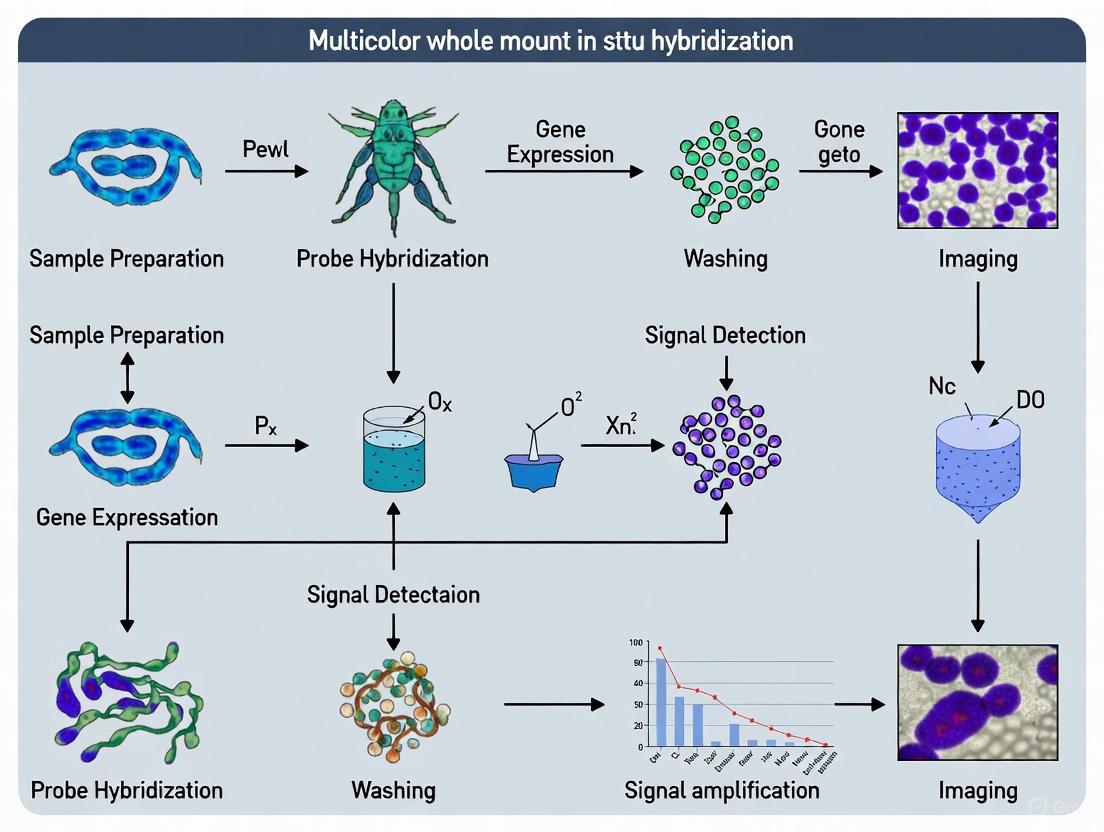
This article provides a complete resource for researchers and drug development professionals seeking to implement or optimize multicolor whole-mount in situ hybridization (WISH).
Multicolor Whole-Mount In Situ Hybridization: A Comprehensive Guide from Principles to Advanced 3D Applications
Abstract
This article provides a complete resource for researchers and drug development professionals seeking to implement or optimize multicolor whole-mount in situ hybridization (WISH). It covers foundational principles of spatial gene expression analysis, detailed methodological protocols for both chromogenic and fluorescent techniques, advanced troubleshooting strategies for common challenges, and rigorous validation approaches. With a focus on recent technological advances such as Hybridization Chain Reaction (HCR) and 3D imaging compatibility, this guide synthesizes current best practices for obtaining reliable, publication-quality data in diverse model systems, from zebrafish and Drosophila to non-model organisms.
Understanding Multicolor WISH: Core Principles and Probe Design Strategies
What is Multicolor WISH? Defining Key Concepts and Applications
Multicolor Whole-Mount In Situ Hybridization (WISH) is an advanced molecular technique that enables the simultaneous visualization of multiple distinct RNA transcripts within the three-dimensional context of intact biological specimens. By using nucleic acid probes labeled with different fluorescent or chromogenic tags, researchers can map the precise spatial relationships and co-expression patterns of multiple genes directly in fixed tissues, preserving critical anatomical information often lost in sectioned samples [1] [2]. This powerful method is particularly invaluable for studying complex biological processes in diverse research organisms, especially those where genetic tools are limited [2].
Core Principles and Technical Advantages
Multicolor WISH bridges a critical gap in functional genomics. While sequencing methods like RNA-seq provide comprehensive data on gene abundance, they lack spatial context. Multicolor WISH complements these data by answering where genes are expressed, revealing intricate expression patterns in their native tissue environment [2].
A key application is in the study of regeneration, where resolving gene expression in delicate, newly formed tissues like the planarian blastema is essential. Traditional WISH methods often use harsh proteinase K digestion to permeabilize tissues, which can damage morphology and destroy antigen epitopes, limiting compatibility with subsequent protein analysis [2]. The development of gentler protocols, such as the Nitric Acid/Formic Acid (NAFA) method, has been a significant advancement. This protocol enhances tissue preservation, particularly for fragile structures like the epidermis and blastema, while still allowing efficient probe penetration for robust signal detection [2].
Essential Reagents and Solutions for Multicolor WISH
Successful execution of a multicolor WISH experiment relies on a suite of specialized reagents. The table below outlines key components and their functions, drawing from proven protocols.
Table 1: Key Research Reagent Solutions for Multicolor WISH
| Reagent/Solution | Function/Description | Application Example |
|---|---|---|
| Fixative Solution | Preserves tissue architecture and immobilizes RNA transcripts; often formaldehyde-based. | Standard initial step for all specimens [1]. |
| Permeabilization Agents | Enables penetration of probes and antibodies into intact tissues. | Nitric Acid/Formic Acid (NAFA) mixture used as a gentle alternative to proteinase K [2]. |
| Hybridization Chain Reaction (HCR) Probes | Amplifies signal through enzymatic or hairpin-mediated amplification for high sensitivity. | Used in multiplex RNA FISH in mosquito brains for sensitive detection [1]. |
| Formamide | A component of hybridization buffers that helps control stringency. | Standard component of hybridization buffer [1]. |
| Nuclease Inhibitors | Protects RNA integrity during sample preparation. | EGTA (chelating agent) included in NAFA protocol to inhibit nucleases [2]. |
Quantitative Analysis of Multicolor WISH Performance
Evaluating the performance of different WISH protocols provides critical data for researchers selecting a method. The following table compares the NAFA protocol against two established methods based on key performance metrics.
Table 2: Protocol Performance Comparison in Planarian Studies
| Performance Metric | NAC Protocol | NA (Rompolas) Protocol | NAFA Protocol |
|---|---|---|---|
| Tissue Preservation | Poor (epidermal damage) [2] | Good [2] | Excellent [2] |
| Probe Permeability & WISH Signal | Strong [2] | Weak (for piwi-1, zpuf-6) [2] | Strong [2] |
| Immunostaining Compatibility | Weak (likely due to protease) [2] | Good [2] | Strong (bright anti-H3P signal) [2] |
| Key Differentiator | Uses mucolytic N-Acetyl Cysteine & proteinase K [2] | Acid-based, no proteinase K [2] | Combined acid (NA/FA) & EGTA, no proteinase K [2] |
Detailed Experimental Protocol: NAFA Fixation for Multicolor FISH and Immunostaining
The following workflow details the NAFA protocol, which has been validated in planarians and adapted for killifish fin regeneration [2].
Figure 1: The NAFA protocol workflow for combined FISH and immunostaining.
Sample Preparation and Fixation
- Dissection and Fixation: Dissect tissues (e.g., planarians or killifish tail fins) in a physiological buffer. Immediately transfer samples into fresh fixative solution, typically containing formaldehyde, for a defined period at room temperature to preserve morphology and RNA integrity [1] [2].
- Permeabilization with NAFA Solution: Following fixation, wash samples and incubate in the NAFA permeabilization solution. This critical step, which avoids proteinase K, typically uses a mixture of Nitric Acid and Formic Acid (or other carboxylic acids like acetic or lactic acid), along with the calcium chelator EGTA. This combination gently renders the tissue permeable to probes and antibodies while preserving delicate structures [2].
Hybridization and Signal Detection
- Pre-hybridization and Probe Incubation: Equilibrate tissues in a standard hybridization buffer containing formamide to control stringency. Incubate with gene-specific antisense RNA probes that are labeled with haptens (e.g., Digoxigenin, Fluorescein) or directly with fluorophores. Hybridization is typically performed overnight at an elevated temperature specific to the probe and tissue [1].
- Stringency Washes and Signal Development: After hybridization, perform a series of stringent washes to remove unbound and non-specifically bound probes. For signal detection, choose a method based on your experimental goals:
- Fluorescent HCR: Use fluorescently labeled hairpin probes for Hybridization Chain Reaction, which provides amplified signal and is ideal for multiplexing [1].
- Chromogenic Development: Use an antibody conjugated to an enzyme like Alkaline Phosphatase (AP) against the probe hapten, followed by incubation with a precipitating substrate (e.g., NBT/BCIP) [2].
Immunostaining and Imaging
- Combined Protein Detection: Following the WISH procedure, the same sample can be used for immunostaining. Incubate with a primary antibody against your protein of interest, followed by a fluorescently conjugated secondary antibody. The NAFA protocol's gentle nature results in well-preserved antigen epitopes, yielding a bright and specific immunofluorescence signal [2].
- Mounting and Confocal Microscopy: Clear the tissue and mount it in an anti-fading medium. Image the samples using a confocal microscope to capture the high-resolution, multi-channel three-dimensional data of RNA and protein localization [2].
Applications in Biomedical Research
Multicolor WISH is a cornerstone technique for spatial transcriptomics in a wide range of research fields.
- Regeneration Biology: It is indispensable for studying gene expression dynamics in regenerating tissues, such as planarian bodies and killifish fins, allowing researchers to decipher the molecular signals that control stem cell behavior and patterning in the blastema [2].
- Neuroscience and Development: The protocol has been successfully applied to map 3D spatial gene expression in complex organs like the mosquito brain, helping to unravel the molecular architecture of the nervous system [1].
- Drug Discovery and Development: In pharmaceutical research, Multicolor WISH can be used to visualize the spatial distribution of mRNA targets in whole organisms or tissues in response to drug candidates, providing critical insights into mechanism of action and tissue-specific efficacy.
In the field of molecular biology, the ability to visualize gene expression has been revolutionized by the transition from single-plex to multiplexed analysis. Multiplexing refers to the simultaneous detection of multiple distinct RNA species within the same biological sample. While traditional single-molecule fluorescence in situ hybridization (smFISH) provides precise quantification of individual transcripts with subcellular resolution, it is fundamentally limited to studying one or a few genes at a time [3]. The development of highly multiplexed spatial transcriptomics technologies has transformed this landscape, enabling researchers to uncover complex gene regulatory networks and cellular heterogeneity that were previously inaccessible. This paradigm shift is crucial for advancing our understanding of biological systems, where cellular processes are orchestrated by coordinated actions of multiple genes rather than by individual transcripts in isolation [4]. By preserving spatial context while dramatically increasing analytical throughput, multiplexed gene visualization provides an indispensable tool for exploring the intricate architecture of tissues and organs during development, in homeostasis, and in disease states.
Key Advantages of Multiplexed Gene Visualization
Unraveling Cellular Heterogeneity and Identity
Multiplexed RNA imaging enables comprehensive cell-type profiling by capturing unique gene expression signatures that define distinct cellular populations within complex tissues. Unlike single-gene detection methods, which provide fragmented information, simultaneous measurement of dozens to thousands of transcripts allows for robust identification and characterization of rare cell types and transitional states that would otherwise be missed [4]. For example, in the developing zebrafish brain, simultaneous visualization of multiple regulatory genes has been essential for mapping distinct neuronal lineages and brain subdivisions [5]. This capability is particularly valuable in stem cell biology and cancer research, where cellular heterogeneity drives functional diversity and therapeutic responses.
Enhanced Diagnostic Specificity and Accuracy
In biomedical applications, multiplexing significantly improves diagnostic precision by reducing false positives and false negatives through multi-marker verification. Cancer diagnosis exemplifies this advantage, as malignant states are associated with aberrant expression of multiple tumor-related genes rather than single biomarkers [4]. When these genes show fluctuating expression even in healthy cells, reliance on a single marker lacks sufficient specificity. Simultaneous detection of multiple cancer-associated transcripts provides a more reliable diagnostic signature, enabling earlier and more accurate disease detection. This multi-parameter approach also facilitates patient stratification and personalized treatment strategies based on comprehensive molecular profiles.
Decoding Gene Regulatory Networks
Multiplexed visualization enables researchers to map spatial relationships between functionally related genes, revealing how their expression patterns are coordinated within tissue architecture. By preserving the spatial context of transcript localization, these techniques can identify potential interactions between signaling pathways and their targets, transcription factor domains, and feedback mechanisms that maintain tissue organization [5]. This spatial dimension is particularly important for understanding morphogenetic processes during embryonic development and organ formation, where the precise positioning of gene expression domains dictates cellular fate decisions and tissue patterning.
Technical Efficiency and Experimental Throughput
From a practical standpoint, multiplexing offers significant resource optimization by maximizing data acquisition from precious biological samples. Rather than performing sequential single-gene detection on serial sections—which introduces alignment challenges and consumes more tissue—multiplexed approaches capture comprehensive gene expression information from the same cells [4]. This is especially valuable for limited clinical specimens or rare experimental models. Additionally, the integration of automated imaging platforms with multiplexed detection enables high-throughput spatial transcriptomics, making large-scale studies of gene expression patterns feasible across multiple conditions, time points, or treatment groups.
Dynamic RNA Monitoring in Living Systems
Recent technological advances have extended multiplexed RNA imaging from fixed specimens to living cells, enabling real-time tracking of RNA dynamics and interactions. While conventional FISH methods provide only static snapshots of gene expression, emerging live-cell multiplexed imaging platforms allow researchers to monitor RNA localization, transport, and turnover in response to cellular stimuli or perturbations [4]. This temporal dimension provides crucial insights into post-transcriptional regulatory mechanisms and how RNA behaviors correlate with other cellular components, opening new avenues for studying gene expression dynamics under physiological conditions.
Table 1: Quantitative Comparison of Multiplexed RNA Imaging Technologies
| Technique | Multiplexing Capacity | Spatial Resolution | Key Advantages | Primary Limitations |
|---|---|---|---|---|
| smFISH | 1-10 transcripts | Single-molecule | Precise quantification, subcellular localization | Limited multiplexing, high autofluorescence in plants [3] |
| MERFISH | 10,000+ transcripts | Single-molecule | Error-robust encoding, whole-transcriptome coverage | Multiple hybridization rounds, complex analysis [4] |
| seqFISH/+ | 10,000+ transcripts | Single-molecule | Sparse labeling strategy, super-resolution imaging | Many iterative rounds, photobleaching concerns [4] |
| Live-cell Multiplexed Imaging | 3-10 transcripts | Single-molecule to subcellular | Real-time dynamics, physiological conditions | Lower multiplexing capacity, probe delivery challenges [4] |
| Two-color FISH (AP/POD combination) | 2 transcripts | Cellular | One-step antibody detection, avoids inactivation steps | Limited to few targets, substrate bleed-through [5] |
Experimental Approaches and Workflows
Whole-Mount smFISH for Plant Tissues
The whole-mount smFISH (WM-smFISH) protocol represents a significant advancement for quantitative mRNA analysis in intact plant tissues, which traditionally presented challenges due to high levels of tissue autofluorescence [3]. This method involves several key steps: First, tissues are fixed and embedded in a hydrogel to preserve morphological integrity. Additional clearing steps using methanol and ClearSee treatments are then incorporated to minimize autofluorescence and light scattering. Following clearing, hybridization with gene-specific probes labeled with fluorophores such as Quasar570 or Quasar670 is performed. Finally, cell wall staining using Renaissance 2200 enables precise assignment of transcripts to individual cells [3]. A major advantage of this approach is its compatibility with fluorescent protein reporters, allowing simultaneous detection of mRNA and protein products from the same transgene. The computational workflow for analysis includes cell segmentation based on cell wall signal using Cellpose, quantification of mRNA foci per cell using FISH-quant, and measurement of protein intensity fluorescence with CellProfiler [3].
Hybridization Chain Reaction (HCR) for Multiplexed Detection
HCR provides a powerful signal amplification strategy for multiplexed RNA detection, particularly advantageous for challenging samples like the Anopheles gambiae brain [6]. The protocol begins with tissue dissection and fixation using 4% paraformaldehyde with 0.3% Triton X-100. For probe design, an automated HCR Probe Designer can split target mRNA sequences into short oligos (25 bp) that are filtered based on melting temperature (47°C-85°C), GC content (37-85%), and sequence specificity to eliminate cross-hybridization [6]. Each validated oligo pair is tagged with initiator sequences that trigger self-assembly of fluorophore-labeled hairpin amplifiers upon binding to target RNA. Typically, 15-20 probe pairs per transcript are sufficient for effective visualization. This method can be combined with immunohistochemistry for simultaneous protein detection, though careful fluorophore selection is essential to minimize spectral overlap [6].
Combined Alkaline Phosphatase and Peroxidase Detection Systems
A sophisticated two-color FISH approach combines alkaline phosphatase (AP) and peroxidase (POD) detection systems to overcome limitations of single-enzyme methods [5]. This protocol utilizes AP-Fast Blue and POD-tyramide signal amplification (TSA) with carboxyfluorescein (FAM) for simultaneous fluorescent detection of two different transcripts. Key optimizations include hydrogen peroxide treatment to improve embryo permeabilization and the addition of dextran sulfate to the hybridization mix to enhance signal sensitivity through molecular crowding effects [5]. A significant advantage of this system is the elimination of antibody-enzyme conjugate inactivation steps required in conventional sequential detection protocols, reducing both hands-on time and the potential for false-positive co-localization results due to insufficient inactivation. The AP system's sustained enzymatic activity allows for extended development times, making it particularly suitable for detecting lower abundance transcripts that might be missed with the quickly-quenched POD-TSA system [5].
Table 2: Research Reagent Solutions for Multiplexed FISH Applications
| Reagent/Category | Specific Examples | Function and Application Notes |
|---|---|---|
| Probe Design Platforms | AGambiaeHCRdesign, Molecular Instruments probe designer [6] | Customizable probe sets with initiator tags for HCR amplification; ensure specificity through BLAST filtering |
| Fluorophores | Quasar570, Quasar670, Alexa Fluor dyes [3] [6] | Signal detection across multiple channels; select to minimize spectral overlap with autofluorescence |
| Signal Amplification Systems | HCR hairpin amplifiers, TSA systems [6] [5] | Enhance sensitivity for low-abundance targets; HCR offers linear amplification while TSA provides exponential signal enhancement |
| Mounting and Clearing Media | ClearSee, 80% glycerol, ProLong Gold Antifade [3] [7] | Reduce light scattering and autofluorescence; improve imaging depth and signal-to-noise ratio in thick specimens |
| Detection Enzymes | Alkaline Phosphatase (AP), Horseradish Peroxidase (POD) [5] | Enzyme reporters for chromogenic or fluorescent detection; AP allows longer development times than POD |
| Cell Segmentation Tools | Cellpose, FISH-quant, CellProfiler [3] | Computational assignment of transcripts to individual cells; enable single-cell quantitative analysis |
Workflow Integration and Automation
Advanced multiplexed imaging workflows increasingly incorporate automated processing pipelines to handle the computational demands of data analysis. For example, the Tapenade Python package provides user-friendly tools for processing and analyzing multi-layered organoids across scales, including optical artifact correction, 3D nuclei segmentation, and signal normalization across depth and channels [7]. Similarly, integrated workflows for WM-smFISH combine image acquisition with computational analysis to quantify mRNA and protein levels at single-cell resolution, generating spatial heatmaps that visualize expression patterns and ratios between mRNA molecules and protein accumulation [3]. These automated pipelines are essential for extracting biologically meaningful information from the complex datasets generated by highly multiplexed imaging approaches.
Visualization of Experimental Workflows
Workflow for Combined HCR and Immunohistochemistry
HCR and IHC Combined Workflow: This diagram illustrates the sequential steps for simultaneous RNA and protein detection in whole-mount tissues, from sample preparation through computational analysis.
Multiplexed smFISH and Computational Analysis Pipeline
smFISH Computational Pipeline: This workflow shows the integration of experimental and computational steps for quantitative analysis of multiplexed FISH data at single-cell resolution.
Multiplexed gene visualization represents a transformative approach in spatial biology, enabling researchers to move beyond single-gene analysis to comprehensive profiling of gene regulatory networks within their native spatial context. The advantages of simultaneous multi-gene detection—including enhanced ability to decipher cellular heterogeneity, improved diagnostic specificity, insights into gene regulatory networks, technical efficiency, and dynamic monitoring capabilities—establish multiplexing as an essential methodology for modern biological research. As these technologies continue to evolve, with improvements in multiplexing capacity, sensitivity, and computational analysis, they promise to further deepen our understanding of complex biological systems and accelerate applications in disease mechanism studies, diagnostics, and therapeutic development [4]. The experimental workflows and reagents detailed herein provide researchers with practical frameworks for implementing these powerful approaches in diverse model systems and research contexts.
Multicolor whole-mount in situ hybridization (WM-FISH) enables the spatial visualization of gene expression within intact biological specimens, providing three-dimensional transcriptional context that is essential for developmental biology and biomedical research. The core of this technology rests on three interconnected pillars: the design of specific probes, the selection of detectable labels, and the methods for signal amplification and detection. Advancements in these components have significantly enhanced the multiplexing capability, sensitivity, and resolution of the technique, allowing researchers to decode complex gene regulatory networks directly in their native tissue environment. This application note details the critical reagents and methodologies that underpin robust and reproducible multicolor WM-FISH experiments, framed within the context of a broader thesis on protocol optimization.
Research Reagent Solutions: Essential Materials and Their Functions
The following table catalogs the fundamental reagents required for a successful multicolor WM-FISH experiment, along with their specific functions in the protocol.
Table 1: Key Research Reagents for Multicolor WM-FISH
| Reagent/Category | Function and Importance in the Protocol |
|---|---|
| HCR DNA Oligonucleotide Probes [8] | Split-initiator probes bind adjacent sites on target mRNA; two halves form a complete initiator to trigger amplification, enabling high specificity and low background. |
| Fluorophore-Labeled Hairpin Amplifiers [8] | Upon initiation, these hairpins self-assemble into a fluorescent polymer at the probe site, providing signal amplification in an antibody-free manner. |
| π-FISH Target Probes [9] | Proprietary probes with 2-4 complementary base pairs that form a stable π-shaped bond, increasing hybridization efficiency and signal stability. |
| Cell Wall Digesting Enzymes [8] | Critical for plant samples; permeabilizes the cell wall to allow probe penetration for whole-mount analysis. |
| White Light Laser (WLL) Microscope [10] | Confocal microscope with tunable excitation wavelengths; essential for distinguishing multiple fluorophores with distinct spectral properties. |
| Formaldehyde / Paraformaldehyde (PFA) [11] | Standard fixative for tissue preservation; maintains structural integrity and RNA localization within the sample. |
| Protease Plus / Proteinase K [11] [8] | Enzyme for tissue permeabilization; can also be used to digest fluorescent proteins when their signal interferes with FISH detection. |
Quantitative Performance of FISH Detection Methods
The choice of detection and amplification strategy directly impacts the sensitivity and quantitative output of a FISH experiment. The following table summarizes the performance characteristics of several modern methods, based on comparative studies.
Table 2: Comparison of FISH Detection Method Efficiencies
| Method | Key Mechanism | Proven Applications | Relative Signal Intensity & Sensitivity |
|---|---|---|---|
| HCR RNA-FISH v3 [8] [9] | Enzyme-free, self-assembling DNA hairpin amplification. | Multiplexed RNA detection in plants (Arabidopsis, maize) [8] and animals [1]; compatible with IHC. | High sensitivity with effective background suppression [9]. |
| π-FISH Rainbow [9] | Multi-layer amplification using π-shaped target probes and U-shaped amplifiers. | Detecting DNA, RNA, protein, and neurotransmitters; decoding 21 genes in mouse brain in two rounds. | Highest reported signal intensity and detection efficiency compared to HCR and smFISH [9]. |
| Standard smFISH [9] | Direct hybridization of many short, fluorescently-labeled oligonucleotides. | General purpose RNA detection; requires no amplification. | Lower signal intensity and sensitivity compared to π-FISH and HCR [9]. |
| Multicolor FISH (Non-combinatorial) [10] | Mono-labeled oligonucleotide probes with 8 distinct fluorophores, distinguished by WLL microscopy. | Differentiation of 7-8 microbial taxa simultaneously in activated sludge and mock communities. | High specificity; avoids biases from combinatorial labeling and complex post-processing [10]. |
Detailed Experimental Protocol: Whole-Mount HCR RNA-FISH
Below is a generalized and optimized protocol for multiplexed whole-mount RNA FISH using the Hybridization Chain Reaction (HCR), adapted for robustness across species [8].
Sample Preparation, Fixation, and Permeabilization
- Dissection and Fixation: Dissect fresh tissue in ice-cold phosphate-buffered saline (PBS) and immediately transfer to 4% paraformaldehyde (PFA) in a suitable buffer. Fix overnight at 4°C.
- Dehydration: Wash fixed samples twice with PBST (PBS with 0.1% Tween-20). Process through a graded methanol series (e.g., 25%, 50%, 75%, 100%) incubating for 10 minutes each on ice. Samples can be stored in 100% methanol at -20°C for short-term storage [11].
- Rehydration and Permeabilization: Rehydrate the samples through a reverse methanol series (75%, 50%, 25% methanol in PBST), followed by two washes in PBST. For plant tissues or tough specimens, incubate with a cell wall digesting enzyme solution to ensure adequate probe penetration [8].
Probe Hybridization and HCR Signal Amplification
- Pre-hybridization: Pre-hybridize samples in hybridization buffer for 30 minutes at the desired temperature (e.g., room temperature to 37°C).
- Hybridization: Replace the buffer with fresh hybridization buffer containing the specific HCR split-initiator probes (typically 1-4 nM each). Hybridize overnight in the dark.
- Post-Hybridization Washes: The next day, wash the samples 4-5 times over 1-2 hours with pre-warmed wash buffer to remove unbound probes stringently.
- Amplification: Pre-wash the samples in amplification buffer. Meanwhile, snap-cool the fluorophore-labeled HCR hairpin amplifiers by heating to 95°C for 90 seconds and allowing them to cool at room temperature for 30 minutes in the dark. Incubate the samples with the prepared hairpins (typically 60 nM) in amplification buffer for 4-16 hours in the dark.
- Final Washes and Mounting: Wash the samples several times with wash buffer to remove excess hairpins. Counterstain nuclei if desired (e.g., with DAPI), and mount the samples in an anti-fade mounting medium for imaging [8].
Workflow and Technology Comparison Diagrams
Figure 1: A generalized workflow for a whole-mount HCR FISH experiment, covering the key stages from sample preparation to final imaging.
Figure 2: A comparison of advanced FISH technologies, highlighting their core amplification mechanisms and optimal application scenarios to guide method selection.
In situ hybridization (ISH) has evolved from a method for localizing single genes to a sophisticated tool for visualizing multiple nucleic acid targets simultaneously within their native cellular or tissue context. The success of any multicolor whole mount ISH protocol hinges on a foundational element: the effective design and labeling of probes. Non-isotopic haptens, primarily digoxigenin (DIG), fluorescein, and biotin, have become the cornerstones of modern ISH due to their stability, safety, and high signal amplification potential [12]. These haptens are incorporated into nucleic acid probes, which are then detected via specific antibody or affinity interactions conjugated to reporters, enabling the precise spatial resolution of gene expression. Within the framework of a broader thesis on multicolor whole mount ISH, understanding the distinct characteristics of these labeling molecules is not merely a procedural detail but a critical strategic decision that directly impacts the sensitivity, specificity, and multiplexing capacity of an experiment. This document outlines the fundamental principles and optimized protocols for employing these haptens, providing researchers with the knowledge to design robust and reproducible multiplexed assays.
Hapten and Probe Design Principles
Characteristics of Common Haptens
The choice of hapten is paramount, influencing everything from probe incorporation efficiency to background signal. The table below summarizes the key properties of the three primary haptens used in probe labeling.
Table 1: Key Characteristics of Common Non-Isotopic Haptens for ISH
| Hapten | Source/Structure | Detection System | Key Advantages | Potential Limitations |
|---|---|---|---|---|
| Digoxigenin (DIG) | Steroid derived from Digitalis purpurea plants [12] | Anti-DIG antibody (conjugated to AP, HRP, or fluorophore) [12] | Very high specificity and low background in animal tissues; excellent for signal amplification [12]. | Detection requires an antibody step, which can be more complex than biotin detection. |
| Biotin | Essential vitamin (Vitamin B7) found in animal tissues [12] | Streptavidin or Avidin (conjugated to AP, HRP, or fluorophore) [12] | Strong affinity binding; well-established protocols. | Endogenous biotin in tissues can cause high background and false positives [12]. |
| Fluorescein | Synthetic organic molecule [13] | Anti-fluorescein antibody (conjugated to AP, HRP, or a different fluorophore) [13] | Directly detectable if conjugated to a fluorophore; widely used for antibody-based detection in multiplexing. | Can be photosensitive; signal may be less amplified than DIG or biotin without secondary detection. |
Probe Design and Labeling Methodologies
Probes for ISH are distinguished by their nucleic acid type, size, and the distribution of the label. DNA probes are commonly generated via nick translation, a method that incorporates hapten-labeled nucleotides (e.g., biotin-11-dUTP, DIG-11-dUTP) into double-stranded DNA [13] [14]. RNA probes (riboprobes), known for their high sensitivity and low background, are synthesized by in vitro transcription using RNA polymerases and hapten-labeled ribonucleotides (e.g., Fluorescein-12-UTP) [13] [15]. For advanced applications requiring high specificity, oligonucleotide probes can be chemically synthesized with a hapten or fluorophore conjugated directly to the 5' or 3' end [10].
A significant technical consideration is that the bulky structure of hapten-labeled nucleotides can cause steric hindrance, potentially reducing the efficiency of incorporation by polymerases. This is particularly noted with biotin, which can lead to suboptimal transcription rates [12]. DIG-labeled nucleotides also exhibit this property, but the high specificity of the detection system often compensates for potentially lower incorporation efficiency. The choice between direct and indirect detection is also crucial. Direct detection, where a fluorophore is attached directly to the probe, is simpler and faster. Indirect detection, using a hapten that is then bound by a labeled antibody or streptavidin, allows for significant signal amplification, making it indispensable for detecting low-abundance targets [13] [12].
Table 2: Probe Synthesis and Labeling Methods
| Method | Probe Type | Principle | Common Haptens Incorporated |
|---|---|---|---|
| Nick Translation | DNA | Uses DNase I to create single-strand "nicks" and DNA polymerase I to incorporate labeled nucleotides [13]. | Biotin-dUTP, DIG-dUTP, Dinitrophenol (DNP) [13] |
| In Vitro Transcription | RNA (Riboprobe) | Uses a linearized DNA template and RNA polymerase to synthesize labeled RNA strands [13] [15]. | Fluorescein-UTP, DIG-UTP, Biotin-UTP [13] |
| Chemical Synthesis | Oligonucleotide | Probes are built nucleotide-by-nucleotide with a hapten or fluorophore added during synthesis [10]. | Cy3, Cy5, Alexa Fluor dyes, DIG, Fluorescein [10] |
Experimental Protocols for Multicolor Whole Mount FISH
The following protocol has been optimized for multicolor fluorescence in situ hybridization in whole mount echinoderm embryos [16] but can be adapted for other model organisms with appropriate modifications to fixation and permeabilization.
Probe Labeling and Purification
This section details the generation of hapten-labeled riboprobes, which are highly sensitive for detecting mRNA in whole mount specimens.
- Template Preparation: Linearize 5-10 µg of plasmid DNA containing the gene of interest with an appropriate restriction enzyme. Purify the linearized template via phenol-chloroform extraction and ethanol precipitation.
- In Vitro Transcription:
- Set up a transcription reaction in a final volume of 20 µL [16]:
- 1 µg linearized DNA template
- 1x transcription buffer
- 10 mM DTT
- 40 U RNase inhibitor
- 2.5 mM each ATP, CTP, GTP
- 1.625 mM UTP
- 0.375 mM hapten-labeled UTP (e.g., DIG-UTP, Fluorescein-UTP) [16]
- 20-40 U of appropriate RNA polymerase (T7, T3, or SP6)
- Note: The 3.75:1 ratio of unlabeled to labeled UTP ensures high incorporation while maintaining probe integrity.
- Incubate at 37°C for 2 hours.
- Set up a transcription reaction in a final volume of 20 µL [16]:
- DNase Treatment and Purification: Add 2 U of DNase I (RNase-free) and incubate for 15 minutes at 37°C to remove the DNA template. Purify the labeled RNA probe using a spin column-based kit or by precipitation. Resuspend the probe pellet in 50 µL of nuclease-free water or hybridization buffer. Quantify the probe and store at -80°C.
Whole Mount Specimen Preparation and Hybridization
- Fixation and Permeabilization:
- Fixation: Fix embryos or tissues in 4% paraformaldehyde in a MOPS-buffered saline solution (e.g., 0.1M MOPS pH 7, 0.5M NaCl) for several hours at 4°C [16]. For early embryonic stages, it may be necessary to remove fertilization membranes to ensure probe penetration [16].
- Permeabilization: Wash fixed specimens in MOPS buffer with 0.1% Tween-20. For robust permeabilization, treat specimens with proteinase K (e.g., 10 µg/mL for 10-30 minutes) and refix in 4% PFA for 1 hour to maintain morphology.
- Pre-hybridization and Hybridization:
- Pre-hybridize specimens in hybridization buffer (e.g., 70% formamide, 100 mM MOPS pH 7, 500 mM NaCl, 0.1% Tween-20, 1 mg/ml BSA) for 1-4 hours at the hybridization temperature (typically 55-65°C) [16].
- Denature the probe by heating to 80°C for 5 minutes and immediately placing on ice.
- Replace the pre-hybridization buffer with fresh hybridization buffer containing the denatured probe (50-100 ng/mL). Hybridize overnight (12-16 hours) at the appropriate temperature.
- Post-Hybridization Washes:
- Remove the probe solution and perform stringent washes to reduce off-target binding:
- Wash 2x in a solution of 70% formamide, 100 mM MOPS pH 7, 500 mM NaCl, 0.1% Tween-20 for 30 minutes each at the hybridization temperature.
- Wash 2x in MOPS buffer with 0.1% Tween-20 for 15 minutes each at room temperature.
- Remove the probe solution and perform stringent washes to reduce off-target binding:
Immunological Detection and Signal Amplification
For hapten-labeled probes, detection requires an antibody-conjugate. For multicolor experiments, probes are typically detected and amplified sequentially.
- Blocking: Incubate specimens in a blocking solution (e.g., 0.5% PerkinElmer Blocking Reagent in MOPS buffer) for 1-2 hours to minimize non-specific antibody binding [16].
- Primary Antibody Incubation: Incubate with a hapten-specific antibody (e.g., anti-DIG-POD, anti-fluorescein-HRP, or anti-DNP-HRP) diluted in blocking solution for 2 hours at room temperature or overnight at 4°C [16].
- Signal Amplification (Tyramide Signal Amplification - TSA):
- Wash specimens thoroughly to remove unbound antibody.
- Incubate with the appropriate tyramide dye (e.g., Alexa Fluor 488 tyramide, Cy3 tyramide) diluted in the provided amplification diluent for 5-30 minutes. TSA provides a 10-200x increase in sensitivity over standard ICC/IHC/ISH methods [13].
- Quench the peroxidase activity from the first TSA reaction by treating the sample with 1% hydrogen peroxide for 30-60 minutes [13].
- Sequential Detection: Repeat steps 1-3 for the next hapten-labeled probe, using a different antibody and a spectrally distinct tyramide dye. This sequential application of TSA reactions allows for the multiplex detection of multiple targets beyond the number of available fluorophores [13].
Visualization of Workflows and Reagent Toolkits
Molecular Detection Workflow
The following diagram illustrates the fundamental molecular pathways for detecting each hapten, from probe hybridization to signal generation.
The Scientist's Toolkit: Essential Reagents for Multicolor FISH
Table 3: Key Research Reagent Solutions for Multicolor FISH
| Reagent / Kit | Function / Application | Example Use Case |
|---|---|---|
| Nick Translation DNA Labeling System 2.0 (e.g., Enzo) | Provides enzymes and buffer to generate hapten-labeled DNA probes for FISH [12]. | Labeling genomic DNA probes for chromosome enumeration or translocation detection [13]. |
| FISH Tag RNA Kits (e.g., Thermo Fisher) | A complete workflow for generating amine-modified RNA probes, which are then labeled with amine-reactive Alexa Fluor dyes [13]. | Directly creating fluorescent RNA probes for multiplexed gene expression analysis in whole mount embryos [13]. |
| Tyramide SuperBoost Kits (e.g., Thermo Fisher) | Provide extremely sensitive signal amplification via a poly-HRP mediated tyramide reaction, ideal for low-abundance targets [13]. | Detecting rare transcripts or proteins in formalin-fixed, paraffin-embedded (FFPE) tissue sections [13]. |
| TSA Palette Kit (e.g., PerkinElmer) | Contains a suite of tyramides with different fluorophores and a blocking reagent for multiplexed signal amplification [16]. | Sequential TSA for detecting 4+ targets in a single specimen using a limited set of primary antibodies [13]. |
| Label It DNP Labeling Kit (e.g., Mirus) | Enzymatically incorporates Dinitrophenol (DNP) hapten into nucleic acid probes, expanding the palette for multiplexing [16]. | Adding a 5th or 6th color channel to a highly multiplexed FISH experiment [13]. |
Mastering the fundamentals of DIG, fluorescein, and biotin labeling is a prerequisite for successful and innovative multicolor whole mount ISH research. The strategic selection of a hapten, informed by an understanding of its inherent advantages and limitations, directly shapes the quality and interpretability of experimental data. By adhering to optimized protocols for probe synthesis, hybridization, and powerful signal amplification techniques like TSA, researchers can push the boundaries of multiplexing. This enables the simultaneous visualization of complex gene regulatory networks within the beautiful and informative context of an intact, three-dimensional embryo, thereby providing profound insights into the spatial orchestration of development and disease.
The selection of detection methodology is a critical determinant of success in multicolor whole mount in situ hybridization (ISH). Chromogenic in situ hybridization (CISH) and fluorescence in situ hybridization (FISH) represent two foundational technological approaches, each with distinct advantages and limitations for visualizing spatial gene expression patterns. Within the broader thesis on multicolor whole mount ISH protocol research, this application note provides a structured comparison to guide researchers in selecting the optimal detection system based on experimental objectives, available equipment, and desired throughput. Both techniques enable the localization of specific nucleic acid sequences within a morphological context, yet they differ fundamentally in their detection chemistry, instrumentation requirements, and applications in multiplexing.
CISH utilizes an immunohistochemistry-like peroxidase reaction that produces a permanent, precipitating chromogenic signal visible with a standard bright-field microscope [17]. In contrast, FISH employs fluorophore-labeled probes that require excitation by specific wavelengths of light and detection through a fluorescence microscope equipped with specialized filter sets [10]. The strategic choice between these systems impacts not only the immediate experimental workflow but also the potential for data extraction, long-term sample preservation, and compatibility with downstream analyses.
Technical Comparison: CISH versus FISH
The decision between CISH and FISH involves evaluating multiple technical parameters against experimental requirements. The table below provides a systematic comparison of key characteristics:
Table 1: Technical comparison between CISH and FISH detection methods
| Parameter | Chromogenic ISH (CISH) | Fluorescent ISH (FISH) |
|---|---|---|
| Signal Type | Permanent chromogenic precipitate | Fluorescent emission |
| Microscope Requirements | Standard bright-field microscope | Fluorescence microscope with specific filter sets |
| Multiplexing Capacity | Limited, typically 2-3 targets | High, with advanced methods detecting 7+ targets simultaneously [10] |
| Signal Permanence | High; slides can be archived for years | Low; fluorophores fade over time |
| Spatial Resolution | Excellent for tissue morphology | Subcellular and single-molecule resolution possible [18] |
| Compatibility with H&E | Direct; allows easy correlation with histology | Indirect; requires serial sections or counterstains |
| Scanning Speed | Fast (approximately 29 sec/mm²) [19] | Slow with z-stacking (approximately 764 sec/mm²) [19] |
| Throughput in Routine Diagnostics | High; superior for high-throughput genetic testing [19] | Lower; more time-consuming for large batches |
| Protocol Duration | Can be lengthy (overnight hybridization) | Variable; IQ-FISH reduces time to 4 hours [19] |
Quantitative Performance Data
Studies directly comparing both methodologies in diagnostic settings demonstrate high concordance. In HER2/neu testing on breast carcinoma tissue microarrays, FISH detected amplification in 24.5% of tumors (46/188) compared to 22.9% (43/188) by CISH, with 94.1% overall concordance (177/188 tumors) [17]. Another study reported 99% concordance (94/95 cases) between CISH and FISH scoring results (Cohen κ coefficient: 0.9664) [19]. The scanning success rate was higher for CISH (97.6% overall, with CISH accounting for only 2 of 13 failed scans) [19].
Experimental Protocols for Multicolor Detection
Two-Color Fluorescent ISH with Differential Detection Systems
This protocol combines alkaline phosphatase (AP) and horseradish peroxidase (POD) reporter systems to enable simultaneous two-color fluorescent detection in a single procedure, eliminating the need for antibody conjugate inactivation [5].
Probe Preparation and Labeling:
- Synthesize antisense RNA probes labeled with haptens (digoxigenin, dinitrophenol, or fluorescein) using in vitro transcription.
- Purify probes and verify integrity by gel electrophoresis.
Sample Preparation and Pre-hybridization:
- Fix whole mount zebrafish embryos (or other model organisms) in 4% paraformaldehyde.
- Permeabilization Enhancement: Treat with 2% hydrogen peroxide to improve tissue permeabilization and subsequent probe accessibility [5].
- Perform proteinase K digestion (concentration and duration optimized for tissue type and age).
- Refix in 4% PFA and pre-hybridize in hybridization buffer at the hybridization temperature.
Hybridization and Washes:
- Signal Enhancement: Add labeled probes to hybridization buffer containing 5% dextran sulfate to increase local probe concentration through molecular crowding [5].
- Hybridize at appropriate temperature for 16-24 hours.
- Perform stringent washes with saline-sodium citrate (SSC) buffers at hybridization temperature and room temperature.
Simultaneous Two-Color Detection:
- Block nonspecific binding with blocking reagent.
- Incubate with a mixture of anti-hapten antibodies conjugated to different reporter enzymes:
- Anti-digoxigenin-AP (for target 1)
- Anti-fluorescein-POD (for target 2)
- Wash thoroughly to remove unbound antibodies.
Sequential Substrate Development:
- AP Detection: Develop with Fast Blue substrate for alkaline phosphatase. The AP reaction can proceed for extended periods (hours) due to high signal-to-noise ratio.
- POD Detection: Develop with carboxyfluorescein (FAM)-tyramide using tyramide signal amplification (TSA) for horseradish peroxidase. The TSA reaction is typically limited to 30 minutes as POD is quenched by substrate excess.
Imaging:
- Visualize using a fluorescence microscope with filters for Fast Blue (far-red) and FAM (green) fluorescence.
- Mount and store samples appropriately for fluorescence preservation.
Chromogenic ISH for High-Throughput Analysis
This protocol is optimized for situations requiring permanent staining and high-throughput processing, such as validation of gene amplification in clinical samples [19] [17].
Sample Preparation:
- Use formalin-fixed, paraffin-embedded (FFPE) tissue sections or tissue microarrays (TMAs).
- Deparaffinize slides and perform antigen retrieval using heat-induced epitope retrieval methods.
- Digest with pepsin (8 minutes at room temperature) to expose target sequences [19].
Hybridization:
- Apply digoxigenin-labeled DNA probes specific to the target gene.
- Co-denature specimen and probe at 95°C for 5-10 minutes.
- Hybridize overnight (16-24 hours) at 37°C in a humidified chamber.
Post-Hybridization Washes:
- Wash with 0.5× sodium chloride-sodium citrate (SSC) buffer to remove unbound probe.
- Rinse with phosphate-buffered saline with Tween (PBST).
Chromogenic Detection:
- Block endogenous peroxidase activity with 3% hydrogen peroxide for 10 minutes.
- Apply blocking solution (e.g., CAS-Block) for 10 minutes.
- Incubate with FITC-sheep anti-digoxigenin for 30-60 minutes.
- Wash and incubate with HRP-goat anti-FITC for 30-60 minutes.
- Develop with 3,3-diaminobenzidine tetrahydrochloride (DAB) for 20-30 minutes, producing a brown precipitate.
- Counterstain with hematoxylin and eosin, dehydrate, and mount.
Research Reagent Solutions
Table 2: Essential reagents for CISH and FISH applications
| Reagent Category | Specific Examples | Function in Protocol |
|---|---|---|
| Probe Labeling Systems | FISH Tag DNA/RNA Kits with Alexa Fluor dyes [13] | Enzymatic incorporation of amine-modified nucleotides for fluorophore conjugation |
| Signal Amplification | SuperBoost Tyramide Signal Amplification Kits [13] | Poly-HRP-mediated deposition of tyramide dyes for low-abundance targets |
| Chromogenic Substrates | DAB, Fast Red, Fast Blue [17] [5] | Enzyme-mediated precipitation for chromogenic detection |
| Fluorescent Substrates | Alexa Fluor tyramides, FITC-tyramide [13] | Enzyme-activated fluorescent precipitation for signal amplification |
| Permeabilization Enhancers | Dextran sulfate [5] | Increases hybridization efficiency through molecular crowding |
| Detection Enzymes | Horseradish peroxidase (POD), Alkaline phosphatase (AP) [5] | Enzymatic reporters for signal generation |
| Blocking Reagents | CAS-Block, normal serum [17] | Reduce nonspecific background staining |
Decision Framework and Workflow Integration
The following workflow diagram illustrates the key decision points for selecting between CISH and FISH based on experimental priorities:
Diagram 1: Decision framework for selecting between CISH and FISH methodologies
Advanced Applications and Future Directions
The field of in situ hybridization continues to evolve with significant advancements in multiplexing capacity and analytical methods. Recent developments in multicolor FISH approaches now enable the differentiation of up to eight phylogenetically distinct microbial populations using spectrally unique fluorophores and confocal laser scanning microscopy with white light laser technology [10]. For transcript localization in developmental models, optimized FISH procedures incorporating tyramide signal amplification (TSA) with dextran sulfate and peroxidase activity enhancers (4-iodophenol and vanillin) permit simultaneous visualization of up to three unique transcripts in whole-mount zebrafish embryos [20].
Artificial intelligence is increasingly transforming FISH image analysis. The recently developed U-FISH platform employs deep learning to enhance diverse FISH images for consistent spot detection, achieving an F1 score of approximately 0.924 and enabling AI-assisted FISH diagnostics [18]. This approach demonstrates superior accuracy and generalizability compared to existing methods while maintaining computational efficiency with only 163k parameters. Integration of such AI tools with large language models represents the next frontier in making sophisticated spatial-omics analysis accessible to broader research communities.
These technological advances are expanding the boundaries of what can be achieved with both FISH and CISH methodologies, providing researchers with increasingly powerful tools to resolve complex spatial gene expression patterns with subcellular resolution in their native morphological context.
Effective sample preparation is a critical foundation for successful multicolor whole-mount in situ hybridization (WISH), particularly in regeneration research where preserving delicate tissue morphology is paramount. This application note details the Nitric Acid/Formic Acid (NAFA) protocol, a versatile fixation and permeabilization method that superiorly preserves fragile structures like wound epidermis and blastemas while ensuring robust nucleic acid and protein detection. We provide a comprehensive methodological guide, quantitative performance comparisons, and essential resource tables to standardize practices across research and drug development laboratories.
In the context of multicolor WISH for studying complex processes like tissue regeneration, fixation and permeabilization are the most critical determinants of experimental success. Fixation stabilizes cellular components and preserves tissue architecture at a specific moment, preventing degradation and maintaining the spatial context of gene expression. Permeabilization enables macromolecular probes to access their intracellular targets without compromising the structural integrity achieved during fixation.
The technical challenge is particularly acute in regeneration research using models like planarians and killifish. The very tissues of greatest interest—the delicate, newly formed blastema and wound epidermis—are most vulnerable to damage from harsh chemical treatments. Traditional protocols that rely on proteinase K digestion or aggressive mucolytic agents often compromise this integrity, leading to tissue shredding and loss of morphological context. The NAFA protocol addresses this fundamental trade-off by enabling effective probe penetration while preserving fragile tissues, thereby ensuring that gene expression data can be accurately localized within an intact anatomical framework.
The NAFA Protocol: A Detailed Methodology
The Nitric Acid/Formic Acid (NAFA) protocol is a significant advancement, eliminating the need for proteinase K digestion. This preserves protein epitopes for concurrent immunostaining and drastically improves the structural preservation of delicate tissues.
Primary Fixation with NAFA Solution
The following table summarizes the key components of the NAFA fixation solution and their specific functions within the protocol:
Table 1: Composition and Function of the NAFA Fixation Solution
| Component | Final Concentration | Primary Function |
|---|---|---|
| Nitric Acid | 3% | Tissue permeabilization and macromolecule stabilization. |
| Formic Acid | 2% | Acts as a carboxylic acid to enhance tissue permeability. |
| EGTA | 1mM | Chelates calcium to inhibit nuclease activity, preserving RNA integrity. |
| Formaldehyde | 4% | Cross-links proteins and nucleic acids to preserve tissue structure. |
Procedure:
- Solution Preparation: Freshly prepare the NAFA fixation solution in a chemical fume hood.
- Fixation: Immerse tissue samples completely in the NAFA solution. The fixation duration is species- and size-dependent and must be empirically optimized.
- Rinsing: Following fixation, thoroughly rinse samples with a buffered solution like PBS to halt the fixation process and remove residual acids.
Permeabilization and Post-Fixation Handling
A key advantage of the NAFA protocol is that the primary fixation step achieves significant permeabilization, rendering a separate proteinase K digestion step unnecessary. This directly contributes to superior preservation of antigen epitopes for immunostaining and maintains the integrity of fragile tissues.
Subsequent Steps:
- Hybridization and Washes: Proceed with standard pre-hybridization, probe hybridization, and post-hybridization wash steps as required by your specific WISH protocol.
- Antibody Incubation: For tandem FISH and immunostaining, the preserved epitopes allow for effective antibody binding after the hybridization steps are complete.
Comparative Performance Analysis
The efficacy of the NAFA protocol is best demonstrated through direct comparison with established methods. The following table synthesizes qualitative and quantitative findings from validation studies.
Table 2: Comparative Analysis of Fixation Protocols for WISH and Immunostaining
| Protocol | Tissue Preservation (Epidermis/Blastema) | WISH Signal Quality | Compatibility with Immunostaining | Key Differentiating Component |
|---|---|---|---|---|
| NAFA | Excellent preservation; intact epidermis and blastema [2]. | Robust signal for internal (piwi-1) and external (zpuf-6) markers [2]. | High; brighter antibody signal (e.g., anti-H3P) due to no proteinase K [2]. | Nitric Acid + Formic Acid + EGTA. |
| NAC Protocol | Noticeable damage and shredding of delicate tissues [2]. | Robust WISH signal comparable to NAFA [2]. | Reduced; proteinase K digestion degrades target epitopes [2]. | N-Acetyl Cysteine + Proteinase K. |
| NA (Rompolas) Protocol | Excellent preservation, similar to NAFA [2]. | Very weak or absent WISH signal [2]. | Good for immunostaining alone [2]. | Nitric Acid without carboxylic acid. |
Experimental Workflow and Visual Guide
The following workflow diagram outlines the key decision points and steps in the NAFA protocol, contrasting it with traditional methods.
Diagram 1: A workflow comparing the NAFA and traditional fixation pathways, highlighting the critical advantage of the NAFA protocol in preserving tissue and enabling immunostaining.
Essential Research Reagent Solutions
Successful implementation of the NAFA protocol and subsequent WISH relies on a core set of high-quality reagents. The following table catalogs these essential materials.
Table 3: Key Reagent Solutions for Fixation and Permeabilization
| Reagent / Solution | Function / Purpose | Key Considerations |
|---|---|---|
| NAFA Fixation Solution | Primary fixative and permeabilization agent. | Must be prepared fresh. Contains strong acids; requires use in a fume hood. |
| EGTA Solution | Calcium chelation to protect RNA integrity from nucleases. | A critical additive for preserving target mRNA during fixation. |
| Phosphate-Buffered Saline (PBS) | Washing and rinsing buffer; base for other solutions. | Used to stop fixation and for general dilution and washing steps. |
| Hybridization Buffer | Provides optimal conditions for probe binding to target mRNA. | Formulation varies but typically includes salts, Denhardt's solution, and dextran sulfate. |
| Formamide | Component of hybridization buffer. | Reduces hybridization temperature, stringency, and background. |
| Anti-Digoxigenin/ Fab Fragments | Antibody conjugate for chromogenic or fluorescent detection. | Binds to hapten-labeled (e.g., DIG) RNA probes for visualization. |
| NBT/BCIP | Chromogenic substrate for alkaline phosphatase. | Produces an insoluble purple precipitate for brightfield microscopy. |
The NAFA protocol represents a significant methodological improvement for complex gene expression studies in delicate tissues. By forgoing destructive proteinase K treatment in favor of a balanced acid-based permeabilization, it successfully resolves the classic tension between tissue preservation and probe accessibility. Its proven efficacy in diverse regenerative models like planarians and killifish underscores its robustness and recommends it as a new standard for fixation and permeabilization in whole-mount in situ hybridization workflows, particularly those requiring concomitant protein detection.
Step-by-Step Protocols: From Traditional Chromogenic to Modern Fluorescent HCR
Standard Double Colorimetric ISH Protocol for Zebrafish Embryos
Whole-mount in situ hybridization (WISH) is an indispensable technique for characterizing the spatial distribution of gene transcripts during embryonic development. The ability to visualize two transcripts simultaneously through double colorimetric ISH is particularly valuable for defining overlapping and abutting gene expression domains, which helps elucidate the molecular subdivisions of complex tissues like the developing vertebrate brain [20] [5]. In zebrafish embryos, this technique has been extensively used to compare numerous regulatory gene expression patterns, providing critical insights into developmental mechanisms [5].
This application note details a standardized protocol for double colorimetric ISH in zebrafish embryos, optimized to achieve high signal sensitivity and low background. The protocol combines the chromogenic substrates NBT/BCIP and Fast Red for sequential detection of two different RNA probes, typically labeled with digoxigenin (DIG) and fluorescein (FL), respectively [21]. We have incorporated key optimizations, including the use of dextran sulfate in the hybridization buffer to enhance signal intensity through molecular crowding effects and hydrogen peroxide treatment to improve embryo permeabilization for better probe and antibody access [5]. This method provides researchers with a robust framework for precise gene expression analysis.
Material and Reagent Solutions
Research Reagent Solutions
The following table catalogues the essential reagents and their functions required for successfully performing double colorimetric ISH in zebrafish embryos.
Table 1: Key Reagents for Double Colorimetric ISH in Zebrafish Embryos
| Reagent Category | Specific Reagent/Solution | Function in the Protocol |
|---|---|---|
| Fixatives | 4% Paraformaldehyde (PFA) in PBS [21] | Preserves tissue morphology and immobilizes nucleic acids within the embryo. |
| Permeabilization Agents | Proteinase K [21], Hydrogen Peroxide (H₂O₂) [5] | Digests proteins to allow probe and antibody penetration into the tissue. |
| Hybridization Buffers & Components | Prehybridization Buffer (50% Formamide, 5x SSC, Heparin, Torula Yeast RNA) [22] [21], Dextran Sulfate [5] | Creates optimal stringency and blocking conditions for specific probe binding; dextran sulfate increases probe concentration via molecular crowding. |
| Probe Labels | Digoxigenin (DIG)-labeled RNA probes, Fluorescein (FL)-labeled RNA probes [22] [21] | Provides hapten labels for immunodetection of two distinct transcript targets. |
| Detection Antibodies | Anti-DIG-Alkaline Phosphatase (AP), Anti-FL-Alkaline Phosphatase (AP) [22] | Enzyme-conjugated antibodies that bind specifically to the probe labels. |
| Chromogenic Substrates | NBT/BCIP [22] [21], Fast Red [21] | AP substrates that yield a blue-purple (NBT/BCIP) or red (Fast Red) precipitate at the site of target gene expression. |
| Wash & Blocking Buffers | MABT, SSCT, Blocking Buffer (2% Roche Blocking Agent) [21] | Removes unbound reagents and blocks nonspecific binding sites to reduce background signal. |
The double colorimetric ISH protocol is a multi-day procedure involving specimen fixation, permeabilization, hybridization with labeled probes, and sequential chromogenic detection. A critical design principle is the order of detection: the first detection round is more sensitive [21]. Therefore, it is recommended to detect the weaker probe first using the DIG/NBT/BCIP system, followed by the stronger probe with the FL/Fast Red system [22] [21]. This sequence ensures optimal visualization of both transcripts. The schematic below outlines the complete experimental workflow.
Experimental Protocol
Detailed Step-by-Step Procedure
Day 1: Fixation, Permeabilization, and Hybridization
- Fixation: Fix dechorionated embryos overnight at 4°C in 4% Paraformaldehyde (PFA) [21].
- Dehydration: Wash embryos twice for 5 minutes in PBST (1x PBS with 0.1% Tween-20), followed by two 5-minute washes in 100% methanol. Incubate in fresh 100% methanol at -20°C for at least 1 hour or overnight for additional fixation and storage [21].
- Rehydration: Rehydrate the embryos through a series of washes: 5 minutes in 50% Methanol/50% PBST, then two 5-minute washes in PBST [21].
- Permeabilization:
- Treat with Proteinase K. The concentration and duration must be optimized for embryo age (e.g., ~10 µg/mL for 24 hpf embryos) [21].
- (Optional but recommended) To enhance permeability, treat fixed embryos with 2% hydrogen peroxide prior to Proteinase K digestion [5].
- Wash twice for 5 minutes in PBST.
- Re-fix in 4% PFA for 20 minutes at room temperature to maintain tissue integrity.
- Perform two final 5-minute washes in PBST.
- Pre-hybridization: Incubate embryos in pre-warmed prehybridization buffer (50% Formamide, 5x SSC, 0.1% Tween-20, 0.5 mg/mL torula yeast RNA, 50 µg/mL Heparin) for a minimum of 1 hour at 68°C [21]. For increased signal strength, include 5% dextran sulfate in the hybridization buffer [5].
- Hybridization: Replace the prehybridization buffer with fresh hybridization buffer containing both the DIG- and FL-labeled probes (typically 1 µL of each probe per 500 µL buffer). Incubate overnight at 68°C [22] [21].
Day 2: Stringency Washes and First Antibody Detection
- Stringency Washes: Pre-heat all wash buffers to 68°C. Perform the following sequential washes to remove unbound probe:
- 5 minutes in Hyb(-) (50% Formamide, 5x SSC, 0.1% Tween-20).
- Three times for 10 minutes in 25% Hyb(-) / 75% 2x SSCT.
- 5 minutes in 2x SSCT.
- Two times for 30 minutes in 0.2x SSCT.
- Switch to room temperature. Wash for 5 minutes in a 50:50 mix of 0.2x SSCT and MABT.
- Wash 5 minutes in MABT [21].
- Blocking: Incubate embryos in blocking buffer (2% Roche Blocking Agent in MABT) for at least 1 hour [21].
- First Antibody Incubation: Incubate embryos overnight at 4°C with anti-DIG-AP antibody, pre-absorbed if necessary, diluted in blocking buffer (typical dilution between 1:4000 to 1:10000) [22] [21].
Day 3: Chromogenic Development and Second Detection
- Post-Antibody Washes: Wash the embryos thoroughly to remove unbound antibody: 4 times for 15 minutes in MABT, followed by 2 times for 10 minutes in NTMT (100 mM NaCl, 50 mM MgCl₂, 100 mM Tris pH 9.5, 0.1% Tween-20, 5 mM Levamisol) [21].
- First Color Development (DIG probe): Transfer embryos to a multi-well plate and replace the NTMT with NBT/BCIP staining solution. Allow the blue-purple chromogenic reaction to develop in the dark, monitoring periodically until the desired signal intensity is achieved. Stop the reaction by washing several times with PBT [22] [21].
- Antibody Inactivation: Fix the embryos in 4% PFA for one hour at room temperature. This critical step inactivates the first antibody and prevents cross-reactivity in the second detection round [22].
- Second Antibody Incubation & Detection (FL probe):
- Wash embryos several times in PBT.
- Block in blocking buffer for 1 hour.
- Incubate with anti-FL-AP antibody in blocking buffer overnight at 4°C.
- On Day 4, repeat the post-antibody wash steps (washes in MABT followed by NTMT).
- For the second color development, use the Fast Red substrate according to the manufacturer's instructions until the red precipitate forms [22] [21].
- Post-staining and Imaging: Perform final washes in PBT. For imaging, embryos can be mounted in a glycerol-based solution or dehydrated and stored in ethanol. Image using a brightfield microscope [21].
Critical Timings and Parameters
Table 2: Key Optimization Parameters for Double Colorimetric ISH
| Protocol Step | Critical Parameter | Recommended Guideline | Purpose & Rationale |
|---|---|---|---|
| Permeabilization | Proteinase K concentration & time | Age-dependent; must be empirically determined (e.g., ~10 µg/mL for 24 hpf) [21] | Prevents over-digestion (tissue damage) or under-digestion (weak signal). |
| Hybridization | Addition of Dextran Sulfate | 5% in hybridization buffer [5] | Molecular crowding effect increases local probe concentration, enhancing signal strength. |
| Probe Detection Order | Sequence of antibody application | Detect weaker probe first (with DIG/NBT/BCIP) [22] [21] | The first detection round is more sensitive, ensuring visualization of low-abundance transcripts. |
| Color Development | Substrate reaction monitoring | Monitor visually; can be slowed by placing at 4°C [21] | Prevents over-development, which increases background, or under-development, which yields weak signal. |
Technical Optimization and Troubleshooting
Even with a standardized protocol, optimization for specific probes and experimental conditions is often necessary. The table below outlines common challenges and evidence-based solutions derived from the referenced literature.
Table 3: Troubleshooting Guide for Double Colorimetric ISH
| Problem | Potential Cause | Recommended Solution |
|---|---|---|
| High Background Signal | Non-specific probe/antibody binding; insufficient washing. | Increase stringency of post-hybridization washes (e.g., lower SSC concentration, higher temperature) [23]. Include blocking agents (heparin, torula RNA) in hybridization buffer [22] [23]. Use MABT for washes after hybridization to reduce background [21]. |
| Weak or No Signal | Poor probe penetration or concentration; low transcript abundance. | Optimize permeabilization with H₂O₂ pre-treatment [5]. Increase probe concentration and include 5% dextran sulfate in hybridization [5]. Extend substrate development time, particularly for the second probe [5]. |
| Uneven Staining | Uneven probe distribution; drying of embryos during hybridization. | Ensure embryos are fully submerged and tubes are horizontal on a shaker during all steps [21]. Use adequate volume of hybridization buffer and a properly sealed, humidified chamber to prevent evaporation [23]. |
| Loss of Morphology | Over-digestion with Proteinase K. | Precisely calibrate Proteinase K treatment time for embryo age and batch. Perform a time-course experiment. Stop digestion promptly with a glycine wash if needed [21]. |
Implementing Serial Stain-and-Strip Methods for Multiple Targets
Within the advancing field of multiplexed tissue analysis, the ability to visualize multiple biomarkers on a single sample is crucial for understanding complex cellular interactions, especially in the tumor microenvironment [24]. While techniques like multiplex immunofluorescence (mIF) and digital spatial profiling offer powerful solutions, their implementation can be hindered by requirements for specialized, costly platforms not available to most clinical laboratories [24]. Serial stain-and-strip methods present a viable and effective alternative, enabling researchers to sequentially label, image, and remove multiple targets on the same whole-mount specimen. This protocol details a rigorous framework for implementing these methods, ensuring the generation of high-quality, reproducible data for drug development and diagnostic research.
The core principle involves the cyclic application of fluorescent probes, followed by high-resolution image acquisition and subsequent gentle stripping of antibodies to preserve antigen integrity for the next round of staining. This approach, when performed with rigor, allows for the comprehensive mapping of numerous targets within a single biological sample, thereby maximizing the informational yield from precious specimens [24]. The following sections provide a detailed application note and protocol, designed with reproducibility at its core, to guide researchers through the critical steps of experimental design, execution, and quantitative analysis.
Experimental Design and Workflow
A successful serial stain-and-strip experiment requires meticulous pre-planning to minimize bias and ensure statistical rigor. A predefined acquisition and analysis pipeline, established through preliminary trials, is essential to avoid post-hoc data manipulation and biased conclusions [25].
The entire process, from sample preparation to final data integration, is visualized in the following workflow diagram. Adherence to this structured pathway is critical for maintaining sample integrity and data validity throughout the multi-cycle procedure.
Key Design Considerations
- Bias Mitigation: To prevent experimenter bias, predefine all imaging areas. Use software to capture images from fixed or randomly selected locations within a well or across the entire sample in a tiled manner, ensuring comprehensive and unbiased sampling [25].
- Controls are Critical: Each staining cycle must include appropriate controls. These are "no primary antibody" controls to assess specificity and, crucially, a "no-strip" control to confirm the complete removal of signal before proceeding to the next cycle [25].
- Statistical Power: Collaborate with a biostatistician during the experimental design phase to determine the necessary sample size and number of biological replicates required for sufficient statistical power [25]. Preliminary data should be used to establish this pipeline but not included in the final analysis.
Detailed Experimental Protocol
Materials and Reagents
The following table lists the essential research reagent solutions required for the serial stain-and-strip protocol.
Table 1: Key Research Reagent Solutions
| Item Name | Function / Purpose | Example / Notes |
|---|---|---|
| Validated Primary Antibodies | Specifically binds to target antigens of interest. | Use antibodies confirmed for IHC/IF in your sample type. Conjugate-free for sequential staining. |
| High-Fidelity Fluorescent Secondaries | Visualizes primary antibody binding. | Use bright, stable fluorophores (e.g., Alexa Fluor dyes). Select from different animal hosts to prevent cross-reactivity [25]. |
| Antibody Elution Buffer | Gently dissociates antibodies from antigens between cycles while preserving tissue morphology and antigenicity for subsequent rounds. | Common formulations include glycine-HCl (pH 2.0-3.0) or commercial stripping buffers. |
| Antigen Retrieval Solution | Re-exposes epitopes masked by fixation. | Citrate-based (pH 6.0) or Tris-EDTA (pH 9.0) solutions. Optimization may be required for different targets. |
| Blocking Solution | Reduces nonspecific binding of antibodies. | Typically contains serum from the same species as the secondary antibody and a detergent like Triton X-100. |
| Mounting Medium | Preserves samples and reduces photobleaching during imaging. | Use an anti-fade medium (e.g., with DABCO or commercial equivalents) [25]. |
Step-by-Step Staining and Stripping Protocol
Sample Preparation and Initial Staining:
- Perform standard antigen retrieval on fixed whole-mount samples appropriate for your tissue type.
- Block samples with a suitable blocking solution for 1-2 hours at room temperature to minimize background.
- Incubate with the first primary antibody (Target A) overnight at 4°C.
- The following day, wash thoroughly and incubate with the corresponding fluorophore-conjugated secondary antibody for 1-2 hours at room temperature, protected from light.
Image Acquisition (Cycle 1):
- Acquire high-resolution images of the stained samples for Target A. Adhere to the Shannon-Nyquist criterion for optimal spatial sampling, as calculated by your acquisition software, to ensure no resolution is lost [25].
- To obtain quantitative images, avoid pixel saturation and maximize the dynamic range for optimal contrast [25]. Maintain consistent focus, light intensity, and environmental factors (e.g., temperature, CO₂) across all imaging sessions.
- Save the images with precise metadata, including all acquisition parameters.
Antibody Elution (Stripping):
- Immerse the slide or sample in a pre-validated antibody elution buffer. A common method is using 0.2 M Glycine-HCl (pH 2.0-3.0) for 10-20 minutes with gentle agitation.
- Wash the sample extensively in PBS or a neutral pH buffer to remove the stripping solution and eluted antibodies completely.
Stripping Validation (Critical Quality Control Step):
- Re-image the sample using the exact same microscope settings and channels used in Step 2.
- Quantitatively analyze the resulting image. The fluorescent signal must be reduced to background levels. If residual signal is detected, the stripping cycle must be repeated until the validation check passes [25].
Subsequent Staining Cycles:
- Once stripping is validated, proceed to the next cycle by returning to Step 1 for the next target (Target B).
- Repeat the process of staining, imaging, and stripping for each additional target. Always perform the validation step between cycles.
Final Image Processing and Analysis:
- Use image analysis software (e.g., ImageJ, Fiji, or commercial platforms) to coregister all images from different cycles based on fiduciary markers or tissue landmarks.
- Generate a final multiplex image by overlaying the individually acquired channels.
- Perform quantitative and spatial analysis on the coregistered multiplex image data [24].
Quantitative Data and Validation
Rigor in image acquisition and processing is paramount for generating reliable, quantitative data. The following table summarizes key metrics and controls that must be tracked throughout the experiment.
Table 2: Quantitative Metrics and Validation Controls
| Parameter | Optimal Value / Target | Measurement Method / Purpose |
|---|---|---|
| Signal-to-Noise Ratio (SNR) | Maximized, > 3:1 | Compare mean signal intensity in the region of interest (ROI) to mean background intensity. Ensures detectable specific signal [25]. |
| Stripping Efficiency | > 95% signal reduction | Compare mean signal intensity in the target channel post-stripping to the pre-stripping intensity. Critical for protocol validity [25]. |
| Antigen Integrity | Preserved signal in re-stained cycle | Re-stain a previously stripped target in a final cycle. Confirms antigens remain detectable after elution treatments. |
| Coefficient of Variation (CV) | < 10-15% between replicates | Measure of technical reproducibility across multiple samples or imaging sessions [25]. |
| Sensitivity & Specificity | Aim for > 95% concordance | Compare automated or multiplexed results to a validated gold-standard method, as demonstrated in automated FISH validation studies [26]. |
Data Rigor and Reproducibility
- Hardware Calibration: Regularly confirm that the microscope light source is aligned and provides even illumination. Check the overlay and registration of different fluorescence channels using multicolor fluorescent beads [25].
- Image Quality: To increase signal, use bright, stable fluorophores and high numerical aperture (NA) objectives. To decrease noise, use phenol-red free media and reduce detector gain where possible [25].
- Automation Advantages: Where feasible, consider automation. As demonstrated in HER2 FISH testing, automated staining platforms can significantly reduce hands-on time, inter-operator variability, and overall supply costs while maintaining high sensitivity and specificity [26].
Applications in Multicolor Whole Mount In Situ Hybridization Research
The serial stain-and-strip methodology is perfectly suited to advance research in multicolor whole mount in situ hybridization (WISH). It enables the spatial mapping of numerous gene expression patterns within the complex three-dimensional architecture of intact embryos or tissues.
The primary application lies in the detailed characterization of the tumor microenvironment. By targeting a panel of biomarkers—such as those for different immune cell populations (CD8+ T cells, CD68+ macrophages), functional states (Ki-67, PD-1), and structural components (cytokeratin)—researchers can generate rich, quantitative data on cell-to-cell interactions and spatial relationships that are lost in single-plex analysis [24]. This detailed spatial information is invaluable for immuno-oncology research and the development of novel therapeutics.
The data generated through this protocol is inherently compatible with digital pathology and advanced image analysis. The coregistered, multi-target images serve as the foundation for quantitative spatial analysis, enabling the discovery of new cellular patterns and prognostic signatures that can inform diagnostic practice in the future [24].
Within the broader research on multicolor whole-mount in situ hybridization (WISH), the selection of chromogenic stain pairings is a critical determinant for successful multi-transcript visualization. This application note details the optimized pairing of Nitro Blue Tetrazolium/5-Bromo-4-Chloro-3-Indolyl Phosphate (NBT/BCIP) and Fast Red, a combination that leverages the high sensitivity and contrasting colors of these alkaline phosphatase (AP) substrates for effective two-color detection [22] [5]. While powerful, this pairing requires careful experimental design to overcome challenges such as signal masking and substrate compatibility, which are addressed in the protocols and data presented herein.
Foundational Principles and Substrate Characteristics
The effective use of NBT/BCIP and Fast Red hinges on understanding their distinct biochemical properties and the resulting visual and fluorescent signals. The table below summarizes their core characteristics.
Table 1: Key Characteristics of NBT/BCIP and Fast Red Substrates
| Characteristic | NBT/BCIP | Fast Red |
|---|---|---|
| Color Precipitate | Blue-purple [27] [22] | Red [5] |
| Fluorescent Emission | Near-infrared (emission detected with a 740 nm long pass filter) [22] | Visible with Texas Red or rhodamine filter sets [22] [5] |
| Relative Sensitivity | High; generally the substrate of choice for strong signal and low background [22] | Less sensitive than NBT/BCIP; may require signal enhancement [5] |
| Primary Application | Detection of the first or weaker probe in a sequential reaction [22] | Detection of the second probe; often used in multi-target assays [28] |
A significant advantage of this pairing is that both substrates produce precipitates that can be visualized chromogenically with a standard brightfield microscope and then imaged using fluorescence microscopy for higher resolution and co-localization studies [22]. This dual capability allows researchers to monitor the development of the color reaction in real-time to control signal strength and background, followed by high-resolution confocal imaging to resolve expression at a cellular level [22].
Experimental Protocol for Two-Color Detection
The following protocol is adapted from established methods for zebrafish embryos [22] and can be adjusted for other model organisms like Drosophila [29] [28].
Probe Design and Hybridization
- Probe Labeling: Generate antisense RNA probes labeled with haptens such as digoxigenin (DIG) and fluorescein (FL) by in vitro transcription [28].
- Simultaneous Hybridization: Co-hybridize fixed, permeabilized embryos with both the DIG- and FL-labeled probes simultaneously in a hybridization buffer. The inclusion of 5% dextran sulfate in the hybridization mix is recommended, as it creates a molecular crowding effect that can significantly enhance signal intensity for both substrates [5].
- Order of Detection: A critical consideration is the sequence of detection. It is generally advised to detect the DIG-labeled probe with Anti-DIG-AP first, followed by the FL-labeled probe with Anti-Fluorescein-AP [22]. The first detection round is typically more sensitive; therefore, the weaker probe should be labeled with DIG and detected first using NBT/BCIP for maximum sensitivity [22].
Sequential Immunodetection and Development
The workflow for the sequential detection is outlined in the following diagram.
Diagram 1: Sequential detection workflow for NBT/BCIP and Fast Red.
Key Steps and Reagent Details:
First Detection (Anti-DIG-AP with NBT/BCIP):
- After hybridization and stringency washes, incubate samples with anti-DIG-AP antibody (e.g., 1:2000 dilution in a blocking solution) overnight at 4°C [30].
- Wash samples thoroughly to remove unbound antibody.
- Develop the signal using NBT/BCIP in AP buffer (e.g., 100 mM Tris pH 9.5, 100 mM NaCl, 50 mM MgCl₂, 0.1% Tween-20) [22]. Monitor the color development under a microscope and stop the reaction by washing with PBT (PBS with 0.1% Tween-20) once the desired intensity is achieved.
Antibody Inactivation: A crucial step for preventing cross-talk between the two detection reactions is the inactivation of the first antibody-enzyme conjugate. This is achieved by post-fixing the samples in 4% paraformaldehyde (PFA) for one hour at room temperature [22]. Alternative protocols use a low pH glycine buffer to dissociate the antibody [28].
Second Detection (Anti-Fluorescein-AP with Fast Red):
- Incubate samples with anti-Fluorescein-AP antibody (e.g., 1:1000 dilution) [30].
- Wash thoroughly.
- Develop the Fast Red signal. Note that the optimal AP buffer for Fast Red may differ; some protocols recommend 0.2 M Tris pH 8.5 with 0.1% Tween-20 for this substrate [22]. Develop until the red precipitate is visible and stop with PBT washes.
Research Reagent Solutions
The following table lists essential materials and their functions for successfully implementing this protocol.
Table 2: Key Reagents for NBT/BCIP and Fast Red Two-Color WISH
| Reagent / Material | Function / Role | Example & Notes |
|---|---|---|
| DIG- and FL-labeled RNA Probes | Target-specific detection of mRNA transcripts. | Synthesized by in vitro transcription; probe length and GC content affect sensitivity [29]. |
| Anti-Digoxigenin-AP &Anti-Fluorescein-AP | Immunological detection of hapten-labeled probes. | Conjugated to Alkaline Phosphatase (AP); used sequentially [28] [22]. |
| NBT/BCIP Stock Solution | AP substrate yielding a blue-purple precipitate. | Ready-to-use solutions available; protect from air to prevent non-specific precipitation [27]. |
| Fast Red Tablet / Solution | AP substrate yielding a red precipitate. | Tablets are often dissolved in a supplied buffer before use [5]. |
| AP Reaction Buffer | Provides optimal pH and ions for enzyme activity. | Typically Tris buffer pH 9.5 for NBT/BCIP; pH 8.5 may be used for Fast Red [22] [30]. |
| Blocking Reagent | Reduces non-specific antibody binding. | e.g., 2% Roche Blocking Agent in maleic acid buffer [30]. |
| Proteinase K | Permeabilizes tissue for probe penetration. | Concentration and time are tissue-specific and critical for balance between signal and morphology [29] [28]. |
| Dextran Sulfate | Increases hybridization efficiency. | Adds viscosity; molecular crowding enhances signal intensity [5]. |
Troubleshooting and Data Interpretation
Even with an optimized protocol, researchers may encounter specific challenges. The table below outlines common issues and recommended solutions.
Table 3: Troubleshooting Common Experimental Issues
| Problem | Potential Cause | Recommended Solution |
|---|---|---|
| Weak or No Fast Red Signal | Low transcript abundance; insufficient permeabilization; incomplete inactivation of first AP reaction. | Permeabilize tissue with hydrogen peroxide prior to Proteinase K [5]. Ensure complete inactivation/fixation after first reaction. |
| Fast Red signal masked by strong NBT/BCIP signal | Physical overlap of darker precipitate. | Detect the less abundant transcript with the more sensitive first reaction (NBT/BCIP). Use fluorescent imaging for better resolution [22]. |
| High Background with NBT/BCIP | Over-fixation of tissue; substrate precipitation due to air exposure; incomplete washes. | Avoid over-fixing. Ensure staining containers are sealed and protected from light during development. Perform thorough stringency washes [27]. |
| Precipitation in NBT/BCIP stock solution | Substrate degradation or exposure to air. | Heat solution to 50°C to dissolve precipitates, or centrifuge before use [27]. Prepare fresh reagents for highest sensitivity. |
| Loss of morphological integrity | Over-digestion with Proteinase K. | Titrate Proteinase K concentration and incubation time for specific tissues. For Drosophila ovaries, 50 µg/ml for 1 hour is used [29]. |
The pairing of NBT/BCIP and Fast Red provides a robust methodology for dual-transcript detection in multicolor WISH applications. The protocol's strength lies in its use of highly sensitive AP chemistry, the ability to monitor reactions chromogenically, and the option for high-resolution fluorescent imaging. By adhering to the detailed protocols for sequential detection, reagent preparation, and troubleshooting outlined here, researchers can reliably apply this powerful technique to delineate complex gene expression patterns with high accuracy.
Advanced Fluorescent Whole-Mount In Situ Hybridization (WISH) represents a critical methodology for visualizing spatial gene expression patterns within the anatomical context of intact biological specimens. The development of Hybridization Chain Reaction v3.0 (HCR v3.0) has addressed multi-decade challenges in mRNA imaging, offering an unique combination of multiplexing, quantitation, sensitivity, and resolution for diverse organisms [31]. This enzyme-free, isothermal signal amplification technique enables researchers to image mRNA expression with subcellular resolution in thick, autofluorescent samples that pose significant challenges for conventional approaches [32]. Within the broader context of multicolor whole-mount in situ hybridization protocol research, HCR v3.0 provides a robust framework for investigating complex gene regulatory networks during embryonic development, tissue regeneration, and disease progression.
The fundamental innovation of HCR v3.0 lies in its implementation of automatic background suppression throughout the protocol, ensuring that reagents do not generate amplified background even if they bind non-specifically within the sample [31]. This capability dramatically enhances performance and robustness while simplifying experimental design, as researchers can utilize unoptimized probe sets for new targets and organisms without compromising signal-to-background ratios. These advances make HCR v3.0 particularly valuable for research in non-model organisms where extensive probe validation may be impractical [33].
Core Principles and Mechanism
HCR Mechanism and Evolution
The Hybridization Chain Reaction operates through a triggered self-assembly cascade of DNA hairpins. Each HCR amplifier consists of two species of kinetically trapped DNA hairpins (H1 and H2) that co-exist metastably until exposed to a cognate DNA initiator sequence (I1) [31]. The initiation process begins when I1 hybridizes to the input domain of hairpin H1, opening the hairpin to expose its output domain. This exposed domain then hybridizes to the input domain of hairpin H2, exposing its output domain, which is identical in sequence to initiator I1, thus propagating a chain reaction of alternating H1 and H2 polymerization steps [31].
This mechanism provides inherent background suppression during the amplification stage, as individual H1 or H2 hairpins that bind non-specifically in the sample cannot trigger formation of an amplification polymer. Earlier versions of HCR (v2.0) employed DNA probes complementary to target mRNA, each carrying a full HCR initiator I1. While effective for signal amplification, this approach carried the risk that any probe binding non-specifically would still trigger HCR, generating amplified background that decreased the signal-to-background ratio [31].
The v3.0 Innovation: Split-Initiator Probes
HCR v3.0 introduces a fundamental redesign of the probe architecture to achieve conditional initiator generation. Rather than using standard probes carrying full HCR initiators, v3.0 employs pairs of cooperative split-initiator probes that each carry half of the HCR initiator I1 [31]. This design ensures that HCR signal amplification occurs only when both probes hybridize specifically to adjacent binding sites on the target mRNA, colocalizing the two halves of the initiator. Individual probes that bind non-specifically within the sample cannot colocalize the two initiator halves and therefore cannot trigger HCR, thereby suppressing generation of amplified background [31].
The practical implication of this innovation is that researchers can now use larger probe sets without extensive optimization while maintaining high signal-to-background ratios. Experimental evidence demonstrates that while standard probes show dramatically increasing background with larger probe sets, split-initiator probes maintain minimal background even with 20 probe pairs, enabling significantly improved performance in challenging imaging settings such as whole-mount vertebrate embryos [31].
Diagram Title: HCR v3.0 vs v2.0 Mechanism Comparison
Performance and Quantitative Analysis
Background Suppression Efficiency
The automatic background suppression capability of HCR v3.0 has been quantitatively validated through both in vitro and in situ studies. Gel electrophoresis studies demonstrate typical HCR suppression of approximately 60-fold using split-initiator probes compared to traditional full-initiator designs [31]. In situ measurements comparing signal using full probe sets versus partial probe sets that eliminate one probe from each pair show typical HCR suppression of approximately 50-fold across five different HCR amplifiers [31].
The performance advantage of HCR v3.0 becomes particularly evident when examining the relationship between probe set size and signal-to-background ratio. While standard probes (v2.0) show a monotonic decrease in signal-to-background ratio as probe set size increases from 5 to 20 probes, split-initiator probes exhibit a monotonic increase in signal-to-background ratio with larger probe sets [31]. This fundamental difference enables researchers to improve detection sensitivity simply by increasing probe set size without the need for laborious probe optimization.
Quantitative Analysis Modes
HCR v3.0 enables three distinct multiplexed quantitative analysis modes that accommodate diverse research requirements and sample types:
qHCR Imaging: Provides analog mRNA relative quantitation with subcellular resolution in the anatomical context of whole-mount vertebrate embryos, enabling precise expression pattern analysis within complex tissue architectures [31] [32].
qHCR Flow Cytometry: Enables analog mRNA relative quantitation for high-throughput expression profiling of mammalian and bacterial cells, facilitating population-level analyses and rare cell detection [31] [32].
dHCR Imaging: Offers digital mRNA absolute quantitation via single-molecule imaging in thick autofluorescent samples, providing single-molecule resolution for precise transcript counting [31] [32].
Table 1: Quantitative Performance Metrics of HCR v3.0
| Performance Metric | HCR v2.0 | HCR v3.0 | Measurement Context |
|---|---|---|---|
| Background Suppression | ~1-fold (baseline) | ~50-60 fold improvement | In situ and gel studies [31] |
| Probe Set Size Effect | Decreasing signal-to-background with larger sets | Increasing signal-to-background with larger sets | Whole-mount chicken embryos [31] |
| Multiplexing Capacity | Up to 5 targets simultaneously | Maintains robust multiplexing with enhanced quantitation | Four-channel experiments demonstrated [31] |
| Sensitivity | Single-molecule detection possible | Maintains single-molecule sensitivity with improved background | Thick autofluorescent samples [32] |
| Sample Compatibility | Vertebrate embryos, tissue sections | Enhanced performance in challenging samples | Whole-mount octopus embryos, planarians [33] [2] |
Experimental Protocols
Whole-Mount HCR v3.0 Protocol for Embryonic Tissues
The following protocol has been optimized for whole-mount specimens including vertebrate embryos and invertebrate tissues, incorporating adaptations from multiple research applications [33].
Sample Preparation and Fixation
- Fixation: Fix specimens in 4% paraformaldehyde (PFA) in phosphate-buffered saline (PBS) overnight at 4°C. For delicate tissues such as planarian regeneration blastemas, consider the NAFA (Nitric Acid/Formic Acid) fixation protocol that eliminates proteinase K digestion and better preserves tissue integrity [2].
- Dehydration: Transfer fixed samples through a graded methanol/PBST series (25%, 50%, 75%, 100% methanol), 10 minutes each step. Store dehydrated samples in 100% methanol at -20°C until use [33].
- Rehydration: Gradually rehydrate specimens through reverse methanol/PBST series (75%, 50%, 25% methanol), 10 minutes each step, followed by multiple washes in PBST [33].
Permeabilization and Pre-hybridization
- Permeabilization: Treat samples with proteinase K (10 μg/ml in PBS-DEPC) for 15 minutes at room temperature. For delicate tissues, alternative permeabilization using the NAFA protocol may be preferable to preserve tissue architecture [2].
- Post-fixation: Re-fix samples in 4% PFA for 20 minutes to maintain tissue integrity after permeabilization.
- Pre-hybridization: Incubate specimens in probe hybridization buffer for 30 minutes at 37°C to reduce non-specific binding.
Probe Hybridization
- Probe Solution Preparation: Add 0.4 pmol of each split-initiator probe to 100 μl of probe hybridization buffer per sample [33]. For multiplexed experiments, pool probe sets for different targets in the same hybridization solution.
- Hybridization Conditions: Incubate samples in probe solution overnight at 37°C. Ensure adequate agitation if processing multiple samples.
Signal Amplification
- Post-hybridization Washes: Remove unbound probes through multiple stringent washes with probe wash buffer, followed by 5xSSCT washes.
- Hairpin Preparation: Aliquot 3 pmol each of H1 and H2 hairpins into separate tubes. Snap-cool hairpins by heating to 95°C for 90 seconds, then place on ice for 5 minutes, followed by 30 minutes at room temperature [33].
- Amplification: Combine pre-annealed hairpins in amplification buffer and add to samples. Incubate overnight in the dark at room temperature.
- Excess Hairpin Removal: Wash samples 3-5 times with 5xSSCT to remove unamplified hairpins [33].
Combinatorial Staining with Immunohistochemistry
HCR v3.0 maintains compatibility with immunohistochemistry (IHC) for simultaneous detection of protein and mRNA localization. The following protocol modifications enable combined detection:
- Sequential Staining: Perform HCR v3.0 first, followed by immunohistochemistry. The automatic background suppression of HCR v3.0 reduces cross-reactivity between detection systems [33].
- Antibody Incubation: After HCR amplification and washing, block samples in appropriate serum (e.g., 5% normal goat serum) for 1-2 hours, then incubate with primary antibody overnight at 4°C [33].
- Signal Detection: Use fluorophore-conjugated secondary antibodies with emission spectra distinct from HCR amplifiers to enable spectral separation during imaging.
Tissue Clearing and Imaging
For three-dimensional reconstruction of gene expression patterns, tissue clearing combined with light sheet fluorescence microscopy (LSFM) provides exceptional results:
- Clearing Method Selection: Fructose-glycerol clearing has demonstrated excellent compatibility with HCR v3.0 signal preservation while providing sufficient tissue transparency for LSFM [33].
- Clearing Protocol: Transfer stained samples to fructose-glycerol clearing solution for at least 2 days prior to imaging [33].
- Microscopy: Image cleared samples using light sheet fluorescence microscopy to capture three-dimensional expression patterns with minimal photobleaching.
Diagram Title: HCR v3.0 Experimental Workflow
Research Reagent Solutions
Successful implementation of HCR v3.0 requires careful selection and preparation of key reagents. The following table outlines essential components and their functions within the protocol.
Table 2: Essential Research Reagents for HCR v3.0
| Reagent Category | Specific Examples | Function | Protocol Notes |
|---|---|---|---|
| Split-Initiator Probes | Custom DNA oligo pools (25-33 nt per probe) | Target mRNA binding and conditional initiator generation | Design 20-30 probe pairs per target for optimal signal [33] |
| HCR Hairpin Amplifiers | B1-Alexa Fluor-546, B2-Alexa Fluor-647, B3-Alexa Fluor-488 | Signal amplification via triggered self-assembly | Snap-cool before use (95°C, 90s) [33] |
| Fixation Reagents | 4% Paraformaldehyde (PFA), NAFA solution | Tissue preservation and mRNA immobilization | NAFA preferred for delicate tissues [2] |
| Permeabilization Agents | Proteinase K, Formic Acid (NAFA protocol) | Enable probe penetration into tissue | Proteinase K concentration critical (10μg/ml, 15min) [33] |
| Hybridization Buffers | Probe hybridization buffer, amplification buffer | Optimize binding specificity and efficiency | Commercial or custom formulations acceptable |
| Clearing Solutions | Fructose-glycerol | Tissue transparency for 3D imaging | Preserves HCR fluorescence signal [33] |
Applications Across Model Systems
HCR v3.0 has demonstrated exceptional utility across diverse model organisms and research contexts, particularly where traditional ISH methods face limitations.
Vertebrate Embryonic Development
In whole-mount chicken embryos, HCR v3.0 enables multiplexed mRNA imaging with exceptional clarity despite significant sample thickness and autofluorescence. Four-channel multiplexed experiments using large unoptimized split-initiator probe sets have successfully visualized expression patterns of multiple genes in neural crest development [31]. The method's sensitivity allows detection of expression gradients and boundaries with cellular resolution, providing insights into patterning mechanisms during organogenesis.
Invertebrate Systems
For non-model organisms such as cephalopods, HCR v3.0 offers particular advantages due to its robustness and minimal requirement for species-specific optimization. In Octopus vulgaris embryos, HCR v3.0 has been combined with immunohistochemistry and tissue clearing to map neuronal and glial marker expression in three dimensions during brain development [33]. The protocol's compatibility with fructose-glycerol clearing and light sheet fluorescence microscopy enables comprehensive reconstruction of gene expression patterns within complex tissue architectures.
Regeneration Studies
The study of delicate regenerating tissues presents unique challenges for in situ hybridization due to tissue fragility. HCR v3.0 combined with the NAFA fixation protocol enables gene expression analysis in planarian flatworms and killifish tail fins during regeneration [2]. This approach preserves the integrity of the wound epidermis and blastema while permitting probe penetration, facilitating investigation of molecular mechanisms underlying regenerative processes.
Single-Molecule Imaging
Optimized HCR protocols enable single RNA molecule detection in systems such as Drosophila larvae, providing digital absolute quantitation (dHCR imaging) [34]. With proper optimization, high specificity and sensitivity can be achieved with only five pairs of probes, significantly reducing experimental cost and time while maintaining single-molecule resolution [34].
Technical Considerations and Troubleshooting
Probe Design Strategy
Effective probe design is crucial for successful HCR v3.0 experiments. While the split-initiator architecture provides tolerance for suboptimal probes, following established design principles enhances performance:
- Target Sequence Selection: Design probes against regions with minimal secondary structure and avoid repetitive sequences. Automated design tools can streamline this process [33].
- Probe Length and Specificity: Each split-initiator probe typically targets 25 nucleotides, with pairs designed to bind adjacent sites on the target mRNA [31].
- Validation Approach: While HCR v3.0 reduces the need for extensive probe validation, including control probes with known expression patterns verifies protocol performance.
Multiplexing Optimization
HCR v3.0 supports simultaneous detection of multiple mRNA targets through orthogonal amplifier systems. Successful multiplexing requires:
- Amplifier Specificity: Ensure HCR hairpins for different targets employ orthogonal initiator sequences to prevent cross-talk between amplification systems.
- Spectral Separation: Select fluorophores with distinct emission spectra and minimal bleed-through between detection channels.
- Sequential vs Simultaneous Amplification: For high-level multiplexing (≥3 targets), consider sequential amplification rounds to minimize potential interference.
Troubleshooting Common Issues
- High Background: Ensure adequate post-hybridization washes and verify hairpin snap-cooling procedure. Consider reducing probe concentration.
- Weak Signal: Increase probe set size (number of probe pairs), extend amplification time, or verify hairpin quality.
- Tissue Damage: For delicate tissues, implement NAFA fixation protocol without proteinase K digestion [2].
- Incomplete Clearing: Extend clearing time or optimize clearing solution composition for specific tissue types.
HCR v3.0 represents a significant advancement in fluorescent whole-mount in situ hybridization technology, offering researchers an unparalleled combination of sensitivity, specificity, and multiplexing capability. The implementation of split-initiator probes with automatic background suppression enables robust mRNA visualization in challenging samples ranging from whole-mount vertebrate embryos to delicate regenerating tissues. The protocol's compatibility with immunohistochemistry, tissue clearing, and advanced imaging modalities further enhances its utility for comprehensive gene expression analysis in three-dimensional contexts.
As the field continues to evolve, HCR v3.0 establishes a foundation for increasingly sophisticated spatial transcriptomic analyses, particularly in non-model organisms and complex tissue environments. The quantitative capabilities—including analog relative quantitation and digital absolute counting—position this technology as a cornerstone method for developmental biology, regeneration research, and disease mechanism investigations. By following the detailed protocols and considerations outlined in this application note, researchers can leverage the full potential of HCR v3.0 to address diverse biological questions with spatial precision and molecular accuracy.
Volume exclusion agents are critical additives in molecular biology techniques that enhance biomolecular interactions by effectively concentrating reactants within a reduced solvent volume. Polyvinyl alcohol (PVA) and dextran sulfate represent two such agents that significantly improve the efficiency and sensitivity of molecular hybridization techniques, including multicolor whole mount in situ hybridization (WISH). In the context of multicolor WISH protocol research, these polymers address fundamental challenges related to signal intensity, processing time, and background staining, thereby enabling more precise spatial resolution of gene expression patterns in complex tissues. The strategic application of PVA and dextran sulfate provides researchers with powerful tools to overcome diffusion limitations and enhance visualization of low-abundance transcripts, which is particularly valuable for mapping intricate gene regulatory networks during embryonic development.
Mechanism of Action: The Molecular Crowding Effect
Volume exclusion agents operate primarily through a molecular crowding effect that fundamentally alters the thermodynamics and kinetics of hybridization reactions. In solution, these high molecular weight polymers occupy significant solvent volume, effectively reducing the available space for other molecules. This spatial constraint increases the effective local concentration of probes and target sequences, thereby accelerating hybridization kinetics and enhancing signal development.
Dextran sulfate, a sulfated polysaccharide, creates a viscous environment that promotes molecular crowding. Studies demonstrate that adding 5% dextran sulfate to hybridization mixes dramatically improves signal sensitivity in zebrafish embryo WISH experiments [35]. The polymer's molecular structure facilitates this effect by excluding solvent volume and forcing probe-target interactions into closer proximity. Research indicates that this molecular crowding can make subtle expression sites in basal brain and pronephric primordium easily detectable, whereas they might be missed in standard protocols without dextran sulfate [35].
Polyvinyl alcohol functions similarly but exhibits additional beneficial properties in detection steps. When added to alkaline phosphatase substrate buffers at 10% concentration, PVA further enhances the enzymatic precipitation reaction [36]. The combination of both polymers can yield synergistic effects, with dextran sulfate improving probe hybridization efficiency in the initial steps and PVA enhancing signal development in subsequent detection phases.
Table 1: Properties and Functions of Volume Exclusion Agents in WISH
| Agent | Chemical Class | Typical Concentration | Primary Function | Protocol Stage |
|---|---|---|---|---|
| Dextran Sulfate | Sulfated polysaccharide | 5-10% | Molecular crowding, hybridization acceleration | Hybridization |
| Polyvinyl Alcohol (PVA) | Synthetic polymer | 10% | Signal enhancement, background reduction | Detection/Staining |
Quantitative Benefits in Whole Mount In Situ Hybridization
Empirical studies demonstrate significant quantitative improvements when incorporating volume exclusion agents into WISH protocols. Research comparing standard WISH protocols with dextran sulfate-enhanced methods revealed dramatically increased signal intensities for both Fast Red and Fast Blue substrate deposition under otherwise identical conditions and staining times [35]. This enhancement is particularly crucial for detecting less abundant transcripts where signal-to-noise ratio limitations often pose challenges.
In staining time comparisons, the addition of PVA to NTMT buffer reduced development time for NBT/BCIP staining to 2-4.5 hours, compared to substantially longer periods required in traditional protocols [36]. This time reduction is not merely a convenience but critically minimizes nonspecific background staining that typically accumulates with prolonged development times. The signal enhancement properties also make these agents particularly valuable for double in situ hybridization applications, where sensitivity often decreases in the second round of detection.
Table 2: Performance Enhancement with Volume Exclusion Agents in Zebrafish WISH
| Parameter | Standard Protocol | With Dextran Sulfate/PVA | Improvement Factor |
|---|---|---|---|
| Signal Intensity (sim1a detection) | Moderate | Strong | ~2-3x visually estimated [35] |
| NBT/BCIP Staining Time | 4-6 hours | 2-4.5 hours | ~30-50% reduction [36] |
| Detection of Subtle Expression Sites | Often missed | Clearly detectable | Critical enhancement [35] |
| Background Staining | Increases with time | Reduced | Significant improvement [36] |
Figure 1: Mechanism of signal enhancement through volume exclusion. PVA and dextran sulfate create molecular crowding that enhances hybridization efficiency and signal development.
Experimental Protocols
Dextran Sulfate-Enhanced Hybridization Protocol
Reagents Required:
- High-grade dextran sulfate (MW 40,000-50,000)
- Standard hybridization buffer components
- Prehybridization buffer (50% formamide, 5× SSC, 0.1% Tween-20)
Procedure:
- Prepare hybridization buffer by adding dextran sulfate to a final concentration of 5-10% (w/v) to your standard hybridization buffer [35].
- Completely dissolve dextran sulfate by gentle heating and vortexing, ensuring no particulate matter remains.
- For whole mount zebrafish embryos, rehydrate fixed samples through a graded methanol series into 1× PBS + 0.1% Tween-20 (PBTw).
- Permeabilize embryos with proteinase K (10 μg/mL) for 5 minutes, then refix in 4% paraformaldehyde for 20 minutes [36].
- Prehybridize embryos in prehybridization buffer for 2-4 hours at the appropriate hybridization temperature.
- Replace prehybridization buffer with dextran sulfate-containing hybridization buffer including labeled riboprobes.
- Hybridize overnight at appropriate temperature (typically 65-70°C).
- Proceed with standard post-hybridization washes and detection steps.
Technical Notes: Dextran sulfate significantly increases solution viscosity. Pipetting accuracy is crucial, and wide-bore tips may be necessary for embryo transfer. For double in situ hybridization, dextran sulfate is typically included only in the initial hybridization step [36].
PVA-Enhanced Alkaline Phosphatase Detection Protocol
Reagents Required:
- Polyvinyl alcohol (MW 31,000-50,000, 87-89% hydrolysis)
- NTMT buffer (100 mM NaCl, 50 mM MgCl₂, 100 mM Tris pH 9.5, 0.1% Tween-20)
- NBT/BCIP stock solutions
- Anti-digoxigenin or anti-fluorescein AP-conjugated antibodies
Procedure:
- Prepare NTMT staining buffer according to standard recipes.
- In a separate container, heat a mixture of 1 mL 1M Tris pH 9.5, 200 μL 5M NaCl, and 8.8 mL water to 90°C.
- Slowly add PVA to a final concentration of 10% (w/v) while shaking and incubating in a 60°C water bath [36].
- Once completely dissolved, cool the PVA solution to room temperature.
- Add remaining NTMT components (500 μL 1M MgCl₂ and 50 μL 20% Tween-20).
- Add NBT/BCIP stock solutions to final concentrations of 4.5 μL/mL and 3.5 μL/mL respectively.
- Replace standard staining buffer with PVA-enhanced staining buffer for the colorimetric detection step.
- Monitor staining development closely, as signal typically appears 30-50% faster than standard protocols.
- Stop reaction by washing with PBTw when desired intensity is achieved.
Technical Notes: PVA solutions should be prepared fresh and used immediately. The increased viscosity may require gentle rocking during staining to ensure even exposure. Signal development is significantly accelerated, so monitor embryos frequently to prevent overstaining [36].
Figure 2: Experimental workflow incorporating PVA and dextran sulfate into WISH protocols. Critical enhancement steps are highlighted in green.
Implementation in Multicolor Whole Mount In Situ Hybridization
The application of volume exclusion agents in multicolor WISH presents unique advantages and considerations. For sequential detection of multiple transcripts, these agents help maintain signal integrity across detection rounds. Research indicates that NBT/BCIP + Fast Red/BCIP represents the most effective stain pairing when combined with volume exclusion agents for double WISH in zebrafish embryos [36].
In multicolor applications, dextran sulfate is typically incorporated only in the initial hybridization step when both probes are applied simultaneously. The enhanced signal intensity achieved through molecular crowding is particularly valuable for the second detection round, which often suffers from reduced sensitivity due to antibody removal steps. PVA enhancement in the detection phase benefits both primary and secondary staining procedures.
For researchers developing triple-labeling or highly multiplexed WISH protocols, strategic application of these agents at different stages can help balance signal intensities across targets with varying abundance. The combination approach allows researchers to achieve comparable signal strengths for both abundant and rare transcripts within the same specimen.
The Scientist's Toolkit: Essential Reagent Solutions
Table 3: Key Research Reagents for Volume-Exclusion Enhanced WISH
| Reagent | Specification | Function | Application Notes |
|---|---|---|---|
| Dextran Sulfate | MW 40,000-50,000 | Hybridization enhancer | Use at 5-10% in hybridization buffer; increases viscosity significantly |
| Polyvinyl Alcohol (PVA) | MW 31,000-50,000, 87-89% hydrolysis | Signal development enhancer | Use at 10% in NTMT staining buffer; prepare fresh |
| NBT/BCIP | Standard stock solutions | Chromogenic AP substrate | Staining time reduced to 2-4.5 hours with PVA [36] |
| Fast Red | AP substrate | Red chromogenic precipitate | Requires 2-3 days staining without enhancers [36] |
| Proteinase K | Molecular biology grade | Tissue permeabilization | Standard 5 min digestion sufficient with enhanced protocols [36] |
| Anti-DIG-AP Fab fragments | Immunoassay grade | Probe detection | Use at 1:5000 dilution in blocking solution [36] |
Troubleshooting and Optimization Guidelines
Despite their significant benefits, volume exclusion agents require careful optimization to maximize their advantages while minimizing potential issues. Excessive dextran sulfate concentration can increase background in some tissue types, necessitating empirical optimization for specific applications. Similarly, PVA concentration should be carefully calibrated as deviations from the recommended 10% may compromise the enhancement effect.
Common challenges and solutions include:
- High Background Staining: Reduce dextran sulfate concentration to 5% or decrease hybridization time. Ensure adequate post-hybridization washes.
- Uneven Staining: With PVA-enhanced detection, ensure gentle agitation during color development to distribute the viscous solution evenly.
- Precipitation Issues: Filter PVA solutions through 0.45μm filters if particulate matter forms during preparation.
- Probe Penetration Problems: For thicker tissues, combine dextran sulfate with optimized permeabilization (e.g., hydrogen peroxide treatment) to enhance probe accessibility [35].
For multicolor WISH applications, researchers should validate each probe separately with the enhancement protocols before combining them, as response to volume exclusion agents can vary based on probe characteristics and target abundance.
The strategic implementation of PVA and dextran sulfate as volume exclusion agents significantly advances multicolor whole mount in situ hybridization methodology. Through their molecular crowding effects, these compounds enhance hybridization efficiency, reduce development time, and improve signal-to-noise ratios—critical factors for successful multiplexed gene expression analysis. The protocols outlined herein provide researchers with robust frameworks for incorporating these enhancements into existing workflows. As the demand for sophisticated spatial gene expression analysis grows, particularly in developmental biology and disease modeling, these volume exclusion strategies will continue to play an indispensable role in enabling precise, reproducible visualization of complex transcriptional networks within intact tissues.
Combining WISH with Immunohistochemistry (IHC) for Co-analysis
Integrating Whole-Mount In Situ Hybridization (WISH) with Immunohistochemistry (IHC) enables researchers to simultaneously visualize gene expression patterns and protein localization within intact tissue architecture. This multimodal approach provides powerful insights into cellular function, signaling pathways, and molecular interactions by correlating mRNA distribution with protein expression in the same biological sample. The protocol presented here is designed for the context of advanced multicolor whole-mount in situ hybridization research, allowing comprehensive analysis of complex biological systems without the need for tissue sectioning. This co-analysis technique is particularly valuable for developmental biology studies, cancer research, and drug development applications where spatial relationships between nucleic acids and proteins are critical for understanding disease mechanisms and treatment responses.
Technical Principles and Considerations
Fundamental Compatibility of WISH and IHC
The successful combination of WISH and IHC relies on the sequential application of both techniques while preserving tissue morphology and antigen/epitope integrity. WISH detects specific mRNA sequences through complementary nucleic acid probes, while IHC localizes specific proteins using antibody-based detection systems. The key challenge lies in performing both techniques on the same specimen without significant degradation of either target molecule or loss of morphological preservation. For WISH, this requires maintaining RNA integrity throughout the procedure, while IHC demands preserved protein antigenicity and epitope accessibility. The sequential workflow typically performs WISH first, as the harsh conditions of hybridization (elevated temperatures and denaturing agents) can destroy protein epitopes recognized by antibodies. Conversely, IHC performed first may interfere with probe accessibility during hybridization.
Spatial Resolution and Multiplexing Capabilities
The combined WISH-IHC approach provides single-cell resolution while maintaining the three-dimensional architecture of tissues and embryos. This allows researchers to determine whether cells expressing a particular mRNA also contain the corresponding protein product, or to investigate correlations between different genes and proteins within the same cellular context. The multicolor detection capability enables simultaneous visualization of multiple molecular species, with practical limitations typically ranging from 3-5 distinct targets depending on the detection system used. This multiplexing capacity makes the technique particularly valuable for characterizing complex cellular environments such as the tumor microenvironment, where interactions between different cell types are mediated by specific gene and protein expression patterns [37] [38].
Research Reagent Solutions and Essential Materials
Table 1: Essential Reagents and Materials for Combined WISH-IHC Analysis
| Category | Item | Function/Purpose |
|---|---|---|
| Tissue Processing | Paraformaldehyde (PFA) [39] | Cross-linking fixative that preserves tissue morphology and stabilizes biomolecules |
| Methanol, Ethanol [39] | Dehydration and permeabilization agents | |
| Xylene or alternatives [39] | Clearing agent for paraffin-embedded tissues | |
| Paraffin wax [39] | Embedding medium for structural support during sectioning | |
| Molecular Detection | DIG- or FITC-labeled RNA probes [40] | Target-specific hybridization probes for mRNA detection |
| Primary antibodies [41] | Specific recognition of target protein epitopes | |
| Secondary antibodies with enzyme/fluorochrome conjugates [41] | Signal amplification and detection | |
| Tyramide signal amplification (TSA) reagents [37] | Signal enhancement for low-abundance targets | |
| Signal Development | BCIP/NBT or similar substrates [40] | Chromogenic precipitation for colorimetric detection |
| DAB (3,3'-diaminobenzidine) [38] | Chromogen for peroxidase-based detection | |
| Fluorophore-conjugated tyramides [37] | Fluorescent signal generation for multiplexing | |
| Specialized Equipment | Microtome [39] | Precise sectioning of paraffin-embedded tissues |
| Hybridization oven [39] | Controlled temperature incubation for hybridization | |
| Fluorescence microscope with appropriate filter sets [37] | Visualization and imaging of fluorescent signals | |
| Whole slide scanner [37] | Digital imaging of entire specimens for quantitative analysis |
Workflow for Combined WISH-IHC Analysis
Experimental Flowchart
Sample Preparation Protocol
Tissue Fixation and Processing
- Fixation Method Selection: For combined WISH-IHC, perfusion fixation is preferred over immersion fixation for superior preservation of tissue architecture and molecular integrity. Perfusion with 4% paraformaldehyde (PFA) in PBS provides rapid and uniform fixation, particularly critical for whole-mount specimens [39]. If immersion fixation must be used, limit tissue thickness to 5mm and extend fixation time to 18-24 hours at 4°C.
- Embedding Procedure: Process fixed tissues through a graded ethanol series (50%-100%) for dehydration, followed by xylene or xylene-substitute clearing agents. Infiltrate with paraffin wax using three changes of molten paraffin in a vacuum oven (40-60°C), then embed in fresh paraffin using appropriate molds. Maintain consistent orientation for sectioning [39].
- Sectioning Parameters: Cut paraffin-embedded tissues into sections of 3-10μm thickness using a properly maintained microtome. Float sections on a 40-45°C water bath to remove wrinkles, then mount on charged glass slides. Dry sections overnight at 37°C to preserve heat-sensitive antigens while ensuring adhesion [39].
WISH Protocol Implementation
Pre-hybridization Processing
- Deparaffinization and Rehydration: Process slides through two changes of xylene (10-15 minutes each), followed by a graded ethanol series (100%-75%) and final rehydration in nuclease-free water [39].
- Permeabilization and Proteinase Treatment: Treat with proteinase K (1-10μg/mL in TE buffer) for 5-30 minutes at 37°C to expose target mRNA. Optimal concentration and time must be determined empirically based on tissue type and fixation conditions.
- Pre-hybridization: Equilibrate sections in hybridization buffer without probe for 1-2 hours at the appropriate hybridization temperature.
Hybridization and Detection
- Hybridization: Apply DIG- or FITC-labeled riboprobes in hybridization buffer (typically 50% formamide, 5× SSC, 0.1% Tween-20, and carrier RNA). Incubate overnight at 55-65°C in a humidified chamber [40].
- Post-hybridization Washes: Perform stringent washes with decreasing SSC concentrations (2× to 0.2× SSC) at hybridization temperature to remove non-specifically bound probe.
- Immunological Detection: Incubate with anti-DIG or anti-FITC antibodies conjugated to alkaline phosphatase (AP) for 2 hours at room temperature. Develop signal using BCIP/NBT substrate until desired intensity is achieved, then stop reaction in TE buffer [40].
IHC Protocol Implementation
Antigen Retrieval and Blocking
- Epitope Recovery: For formalin-fixed tissues, perform heat-induced epitope retrieval (HIER) using citrate buffer (pH 6.0) or EDTA buffer (pH 8.0-9.0). Heat slides in retrieval solution using a microwave oven, water bath, or pressure cooker according to antibody manufacturer recommendations [41] [39].
- Blocking Non-specific Binding: Block sections with protein-blocking solution (2-5% normal serum from the species of the secondary antibody) for 1 hour at room temperature. For tissues with endogenous peroxidase activity, quench with 3% H₂O₂ in methanol for 15 minutes.
Antibody Incubation and Detection
- Primary Antibody Application: Apply optimized concentration of primary antibody in blocking buffer overnight at 4°C in a humidified chamber. Include appropriate positive and negative controls [41].
- Signal Development: For chromogenic detection, use HRP-conjugated secondary antibodies with DAB substrate (producing brown precipitate) or AP-conjugated antibodies with Fast Red (producing red precipitate). For fluorescent detection, use fluorophore-conjugated secondary antibodies compatible with your microscope filter sets [37] [38].
- Counterstaining and Mounting: Counterstain with hematoxylin (for chromogenic detection) or DAPI (for fluorescent detection). Apply aqueous mounting medium for fluorescent detection or permanent mounting medium for chromogenic detection [41].
Quantitative Analysis Methods
Image Acquisition and Processing
Microscopy and Digital Imaging For quantitative analysis, acquire images using consistent exposure settings across all samples. For whole-mount specimens, use confocal microscopy with sequential scanning to prevent bleed-through between channels. For sectioned material, whole slide scanning provides comprehensive digital images for analysis [37]. Ensure proper color deconvolution for chromogenic signals to separate individual staining components, particularly when using multiple enzymes in the same assay [37].
Table 2: Quantitative Analysis Methods for Combined WISH-IHC
| Analysis Type | Methodology | Application | Software Tools |
|---|---|---|---|
| Signal Intensity Quantification | Measure pixel intensity in defined regions of interest (ROIs) | Compare expression levels between experimental conditions | ImageJ, Fiji, QuPath [40] |
| Co-localization Analysis | Calculate Pearson's correlation coefficient or Mander's overlap coefficient | Determine degree of mRNA-protein co-localization | ImageJ with JACoB plugin, Imaris |
| Cell Counting and Classification | Automated or manual counting of positive cells based on threshold intensity | Quantify populations of single-positive and double-positive cells | ImageJ, CellProfiler, QuPath [40] |
| Spatial Distribution Analysis | Assessment of signal distribution within tissue compartments | Determine preferential localization in specific tissue regions | HALO, Visiopharm |
| H-Score Calculation | Semiquantitative assessment incorporating intensity and percentage of positive cells | Comprehensive scoring system for protein expression | Manual calculation or automated algorithms [40] |
Validation and Quality Control
Specificity Controls
- Include sense riboprobes for WISH to confirm hybridization specificity
- Use isotype-matched control antibodies for IHC to detect non-specific binding
- Implement knockout or knockdown tissues as negative controls when available
- Include tissues with known expression patterns as positive controls
Quantitative Validation Validate analytical methods by comparing results from independent techniques such as RT-qPCR for mRNA quantification and Western blot for protein detection [42]. Establish reproducibility through intra- and inter-assay coefficient of variation calculations, with acceptable values typically below 15% [42]. For diagnostic applications, ensure the combined assay meets regulatory requirements for precision, accuracy, and reproducibility [42].
Troubleshooting and Optimization
Common Technical Challenges
Signal Quality Issues
- Weak or Absent WISH Signal: Extend hybridization time, increase probe concentration, or try different epitope retrieval methods. Test probe sensitivity on positive control tissues.
- High Background in IHC: Increase blocking time, optimize antibody concentrations, extend wash times, or include additional detergent in wash buffers.
- Loss of Tissue Morphology: Reduce protease concentration or treatment time, ensure adequate fixation, and avoid excessive heating during antigen retrieval.
Multiplexing Limitations
- Signal Bleed-Through: Use sequential imaging with narrow bandpass filters, or employ spectral unmixing algorithms for fluorophores with overlapping emission spectra [37].
- Enzyme Incompatibility: When using multiple enzymes, select substrates with non-overlapping precipitation products and perform development in sequence from least to most permanent.
Advanced Applications
Multiplexed Analysis The combination of WISH and IHC can be extended to highly multiplexed analysis through sequential hybridization approaches or using DNA-barcoded antibodies [37] [38]. Techniques such as CODEX (CO-Detection by indEXing) and multiplexed ion beam imaging (MIBI) enable detection of 40+ targets in the same specimen, though these typically require specialized instrumentation [38].
Three-Dimensional Reconstruction For whole-mount specimens, combine WISH-IHC with optical clearing techniques and light-sheet microscopy to create comprehensive three-dimensional maps of gene and protein expression patterns throughout intact tissues or embryos.
The integration of WISH with IHC provides a powerful methodological approach for correlating gene expression with protein localization in morphological context. This protocol enables researchers to address complex biological questions about transcriptional regulation, translation efficiency, and protein function within native tissue environments. As multiplexing technologies continue to advance, the combined WISH-IHC approach will increasingly contribute to our understanding of complex biological systems in development, homeostasis, and disease.
Multicolor whole mount in situ hybridization (WMISH) enables the precise spatial localization of multiple RNA transcripts within intact biological specimens, providing three-dimensional gene expression information that is lost in bulk sequencing approaches [16]. While the core principle of nucleic acid hybridization remains constant, the successful application of this technique across diverse sample types requires careful optimization to address unique structural and compositional challenges. This article details the specific adaptations necessary for three critical sample categories—embryos, brains, and regenerating plant tissues—within the broader context of advancing multicolor WMISH protocol research. We provide structured comparative data, detailed methodologies, and visual workflows to equip researchers with the practical tools needed to overcome sample-specific barriers to effective hybridization, permeabilization, and signal detection.
Sample-Specific Challenges and Adaptive Strategies
The table below summarizes the primary challenges and corresponding adaptations for each sample type, which are further elaborated in the subsequent protocols.
Table 1: Key Challenges and Adaptations for Different Sample Types
| Sample Type | Primary Challenges | Critical Adaptations |
|---|---|---|
| Embryos (Echinoderm) | Fertilization membrane impedes probe penetration; preservation of 3D morphology [16]. | Membrane removal via fine mesh; specific fixation formulas (e.g., 4% PFA with MOPS/NaCl) [16]. |
| Brains (Mosquito) | High lipid content and complex tissue architecture cause autofluorescence and probe penetration issues [1]. | Hybridization Chain Reaction (HCR) for signal amplification; extended permeabilization and detergent washes [1]. |
| Regenerating Tissues (Plant) | Dense cell walls and high autofluorescence obscure signal [3] [8]. | Cell wall enzyme digestion (Cellulase/Pectolyase); chemical clearing with ClearSee [8]. |
Workflow Logic and Adaptations
The following diagram illustrates the core workflow and highlights where sample-specific adaptations are integrated.
Detailed Experimental Protocols
Protocol A: Echinoderm Embryos and Larvae
This protocol is adapted from established methods for sea urchin and sea star embryos, which are valued for their transparency and well-characterized gene expression [16].
Key Reagent Solutions:
- Fixation Solution: 4% Paraformaldehyde, 0.1M MOPS pH 7.0, 0.5M NaCl. For sea stars, add 32.5% seawater [16].
- Hybridization Buffer: 70% Formamide, 100mM MOPS pH 7.0, 500mM NaCl, 0.1% Tween-20, 1 mg/ml BSA [16].
- Blocking Solution (for WMISH): 0.1M MOPS pH 7.0, 0.5M NaCl, 0.1% Tween-20, 10 mg/ml BSA, and 10% sheep serum [16].
Methodology:
- Fixation:
- Harvest embryos or larvae. For pre-hatching embryos, the fertilization membrane must be removed. Weaken membranes by fertilizing eggs in 10mM para-aminobenzoic acid (pABA) in pH 8.0 seawater and remove mechanically by passing embryos through a fine Nitex mesh (60µm for S. purpuratus) [16].
- Fix embryos in fixation solution for the appropriate duration.
- Fixed samples can be stored in methanol at -20°C for months to years [16].
- Hybridization and Detection:
- Rehydrate fixed samples through a graded methanol series to the hybridization buffer.
- Pre-hybridize in hybridization buffer for several hours at the hybridization temperature (e.g., 45-65°C).
- Add denatured, hapten-labeled (e.g., DIG, DNP) RNA probes and hybridize for 12-48 hours.
- Perform stringent post-hybridization washes to remove unbound probe.
- For colorimetric detection, incubate with an anti-hapten antibody conjugated to Alkaline Phosphatase (AP), followed by a color reaction using NBT/BCIP or similar substrate [16].
- For fluorescence, use an anti-hapten antibody conjugated to Horseradish Peroxidase (HRP) and employ Tyramide Signal Amplification (TSA), followed by antibody detection for protein co-localization if desired [16].
Protocol B: Mosquito Brain Tissue
This protocol utilizes HCR v3.0, which provides robust signal amplification and is ideal for complex tissues like the insect brain [1] [8].
Key Reagent Solutions:
- Probe Sets: DNA probes (~25 nt) designed to bind adjacent sites on the target mRNA, each containing a fraction of a split-initiator sequence [8].
- HCR Hairpin Amplifiers: Fluorescently labeled DNA hairpins that self-assemble upon initiation by the bound probes [8].
- Permeabilization Buffer: Phosphate-buffered saline (PBS) with added detergent (e.g., 0.5% Triton X-100).
Methodology:
- Dissection and Fixation:
- Dissect brains in cold PBS or insect physiology saline.
- Fix tissues immediately with 4% PFA for a defined period (e.g., 30-60 minutes) at room temperature [1].
Permeabilization and Pre-Hybridization:
- Permeabilize fixed tissues thoroughly. For insect brains, this may involve extended washes (e.g., 4-6 hours) with a permeabilization buffer [1].
- Pre-hybridize in a buffer containing formamide and SSC to reduce non-specific binding.
HCR FISH:
- Hybridization: Incubate tissues with the DNA probe sets overnight at low temperature (e.g., 37°C) [8].
- Washes: Perform post-hybridization washes to remove excess probe.
- Amplification: Add the HCR hairpin amplifiers and incubate for several hours (e.g., 4-6 hours) at room temperature. The hairpins self-assemble into fluorescent polymers only on the target-bound initiators, amplifying the signal [8].
- Imaging: Mount and image using confocal microscopy. The protocol allows for multiplexing by using different initiator/amplifier sets with distinct fluorophores [1] [8].
Protocol C: Plant Tissues (e.g., Roots, Meristems)
This protocol combines elements from whole-mount smFISH and HCR FISH, optimized for plant cell walls and autofluorescence [3] [8].
Key Reagent Solutions:
- Fixative: 4% PFA in PBS or a plant-specific buffer.
- Enzyme Digestion Mix: Cellulase (e.g., 0.1-0.5%) and Pectolyase (e.g., 0.05-0.1%) in an appropriate buffer to degrade cell walls [8].
- Clearing Reagent: ClearSee solution (10% (w/v) xylitol, 15% (w/v) sodium deoxycholate, 25% (w/v) urea) or similar alternatives to reduce autofluorescence [3].
- Hybridization Buffer: As described in Protocol A or B, depending on the probe technology used.
Methodology:
- Fixation and Permeabilization:
- Fix plant tissues in 4% PFA, potentially under vacuum infiltration to ensure penetration.
- Dehydrate through an ethanol series and rehydrate to promote permeabilization.
- Treat tissues with the enzyme digestion mix for a carefully optimized duration (e.g., 30 minutes) to create pores in the cell wall without destroying tissue integrity [8].
Autofluorescence Reduction:
- Incubate tissues in ClearSee solution for several hours to days. Extended treatment (over a week) can further reduce background in highly autofluorescent tissues like leaves [3].
Hybridization and Detection:
- Proceed with either the standard FISH protocol (using hapten-labeled probes and antibody detection) or the HCR FISH protocol as described for brains [8].
- For smFISH, hybridize with dozens of short, fluorescently-labeled oligonucleotide probes. The high probe density allows single-molecule detection as diffraction-limited spots under a confocal microscope [3].
- A cell wall stain (e.g., Renaissance 2200) can be included to aid in cell segmentation and quantification [3].
The Scientist's Toolkit: Essential Research Reagents
The following table catalogs key reagents critical for successful multicolor WMISH across different sample types.
Table 2: Essential Reagents for Multicolor Whole Mount In Situ Hybridization
| Reagent Category | Specific Examples | Function & Importance |
|---|---|---|
| Fixation Agents | Paraformaldehyde (PFA) [16] | Preserves tissue morphology and immobilizes RNA by cross-linking. |
| Permeabilization Agents | Detergents (Tween-20, Triton X-100) [16] [1]; Enzymes (Cellulase, Pectolyase) [8]; Proteinase K [8] | Creates pores in membranes and/or cell walls to allow probe entry. |
| Nucleic Acid Probes | Hapten-labeled (DIG, DNP) RNA probes [16]; HCR DNA probe sets [8]; smFISH oligonucleotides [3] | Binds specifically to target RNA sequences; choice defines detection method. |
| Signal Amplification Systems | Tyramide Signal Amplification (TSA) [16]; Hybridization Chain Reaction (HCR) [8] | Amplifies a single binding event into a detectable signal, crucial for sensitivity. |
| Detection Reagents | Anti-DIG-AP/HRP antibodies [16]; Fluorescent HCR hairpins [8] | Generates a visible signal (colorimetric or fluorescent) from the bound probe. |
| Blocking Agents | Bovine Serum Albumin (BSA), Sheep Serum [16] | Reduces non-specific binding of probes and antibodies, lowering background. |
| Clearing Agents | ClearSee [3] | Reduces tissue autofluorescence, a major challenge in plants and brains. |
Tissue clearing has emerged as a revolutionary methodology for enabling high-resolution three-dimensional imaging of biological specimens, particularly when integrated with light-sheet fluorescence microscopy. These techniques transform traditionally opaque tissues into transparent samples through refractive index matching, allowing researchers to visualize intricate biological structures without physical sectioning [43]. The development of aqueous-based clearing methods represents a significant advancement over historical organic solvent approaches, which often caused tissue shrinkage and fluorescent protein denaturation [43]. For researchers investigating spatial gene expression patterns through multicolor whole mount in situ hybridization, these clearing protocols provide unprecedented access to volumetric information while preserving molecular and structural integrity across diverse tissue types and species.
Recent innovations have focused on optimizing the balance between transparency achievement, fluorescence preservation, and structural maintenance. Methods such as ADAPT-3D and OptiMuS-prime exemplify the current generation of clearing techniques that prioritize protein preservation while achieving rapid transparency through novel chemical combinations [43] [44]. These protocols are particularly valuable for comprehensive analysis of complex tissues, including entire mouse brains, human intestinal specimens, and even bone-containing structures, enabling researchers to reconstruct biological systems in their native three-dimensional context.
Comparative Analysis of Tissue Clearing Methods
Quantitative Comparison of Modern Clearing Techniques
The field of tissue clearing has diversified into multiple methodological approaches, each with distinct advantages and limitations. The table below summarizes the key characteristics of contemporary clearing methods relevant to whole mount in situ hybridization applications:
Table 1: Comparison of Modern Tissue Clearing Techniques
| Method | Chemical Basis | Clearing Time | Tissue Size Preservation | Fluorescence Preservation | Best Applications |
|---|---|---|---|---|---|
| ADAPT-3D | Aqueous refractive index matching with partial lipid removal | 4 hours (RIM step) to 4 days (whole process) | Excellent (non-shrinking) | Excellent (preserves endogenous and antibody-conjugated fluorophores) | Whole mouse brains, brain slices, human intestinal tissues [43] |
| OptiMuS-prime | Sodium cholate and urea | 2 minutes (150 µm brain) to 7 days (whole rat brain) | Good | Excellent (protein-preserving) | Neural structures, vasculature, densely packed organs, human tissues [44] |
| Aqueous Methods with Delipidation | SDS or SC with urea | Days to weeks | Variable (some cause swelling) | Good (aqueous environment) | Immunostaining, thick tissue sections [43] [44] |
| Organic Solvent Methods | Dichloromethane, ethyl cinnamate | Fast (overnight) | Poor (shrinkage occurs) | Moderate (may denature fluorophores) | Rapid clearing, non-immuno applications [43] |
| Aqueous Methods without Delipidation | Histodenz, iohexol | 3 days | Good | Excellent (lipid-preserving) | Adipose tissue, lipid-rich structures [45] |
Technical Performance Metrics
The performance characteristics of clearing methods vary significantly based on their underlying mechanisms. ADAPT-3D achieves transparency through partial lipid removal combined with non-toxic aqueous refractive index matching, preserving tissue architecture while maintaining fluorescence signals [43]. This method demonstrates particular strength with whole mouse brains, requiring approximately 4 hours for the refractive indexing step after less than 4 days of preprocessing, without altering tissue dimensions [43].
In contrast, OptiMuS-prime utilizes sodium cholate as a non-denaturing detergent with small micelles combined with urea to disrupt hydrogen bonds and induce hyperhydration [44]. This combination enhances reagent penetration while preserving proteins in their native state, making it particularly suitable for immunolabeling applications. The clearing time varies dramatically with tissue thickness, from merely 2 minutes for 150-μm thick mouse brain sections to 7 days for whole rat brains [44].
For specialized applications involving lipid-rich tissues such as adipose tissue, methods preserving lipid content are essential. Research on trout and mouse adipocytes has demonstrated that aqueous Histodenz solutions successfully clear tissues without delipidation, enabling accurate 3D morphological characterization of adipocytes within their native tissue context [45].
Detailed Experimental Protocols
ADAPT-3D Protocol for Whole Mount Tissues
The ADAPT-3D method provides a streamlined approach for achieving tissue transparency while preserving fluorescence and tissue architecture:
Table 2: ADAPT-3D Protocol Steps and Specifications
| Step | Reagents | Duration | Conditions | Purpose |
|---|---|---|---|---|
| Fixation | Modified ADAPT:Fix (PFA pH 9.0) | 4 hours to overnight | 4°C | Tissue preservation and antigen retention |
| Rinsing | PBS with heparin (10 U/mL) and glycine (0.3 M) | Twice with excess volume | Room temperature | Remove excess fixative and reduce background |
| Decalcification (if needed) | ADAPT:Decal | Until soft to touch (daily changes) | Room temperature | Demineralize bone-containing specimens |
| Delipidation & Decolorization | ADAPT:DC | 6 hours per 1 mm of tissue | Room temperature | Partial lipid removal and bleaching |
| Refractive Index Matching | Aqueous RIM solution | 4 hours (whole brain) to 24 hours (1 mm slices) | Room temperature | Achieve tissue transparency |
For fixation, prepare ADAPT:Fix by either dissolving paraformaldehyde powder in PBS and adjusting to pH 9.0 with 10N NaOH, or adjusting commercial 4% PFA solution to pH 9.0 with triethanolamine [43]. Following fixation, rinse samples twice in PBS containing heparin and glycine using at least five times the tissue volume [43]. For tissues containing bone, immerse in excess ADAPT:Decal at room temperature with daily changes until the tissue is soft to the touch. Incubation with ADAPT:DC renders tissues partially transparent within hours, with general guidance of 6 hours per 1 mm of tissue thickness [43].
OptiMuS-prime Protocol for Passive Clearing
OptiMuS-prime offers a protein-preserving alternative with customized timing for different tissue types:
Solution Preparation: Prepare Tris-EDTA solution by dissolving 100 mM Tris and 0.34 mM EDTA in distilled water, adjusting pH to 7.5. Add 10% (w/v) sodium cholate, 10% (w/v) ᴅ-sorbitol, and 4 M urea to the Tris-EDTA solution. Dissolve completely at 60°C, then cool to room temperature for storage [44].
Clearing Process: Immerse fixed samples in 10-20 mL OptiMuS-prime solution and incubate at 37°C with gentle shaking. Adjust timing based on tissue type and thickness:
- 150-μm-thick mouse brain: 2 minutes
- 300-500-μm-thick mouse brain: 6 hours
- 1-mm-thick mouse brain: 18 hours
- 3.5-mm-thick mouse brain blocks: 2-3 days
- Whole mouse brain: 4-5 days
- Whole rat brain: 7 days [44]
Refractive Index Matching: For final imaging, transfer cleared tissues to OptiMuS RI solution (RI 1.47) containing 75% (w/v) Histodenz (iohexol) in the Tris-EDTA base with urea and ᴅ-sorbitol [44].
Whole-Mount Fluorescence In Situ Hybridization Protocol
For integration with multicolor whole mount in situ hybridization, adapt the following protocol:
Sample Preparation: Fix samples in 4% paraformaldehyde solution overnight at 4°C [11]. For embryos, remove yolk before fixation when necessary.
Permeabilization: Wash twice in PBST, then process through a dehydration series of 25%, 50%, 75%, and 100% methanol incubations for 10 minutes each on ice. Store in 100% methanol at -20°C until hybridization [11].
Probe Hybridization: Use RNAscope Multiplex Fluorescent Reagent Kit v2 with ProteasePlus for embryo permeabilization following manufacturer instructions [11].
Clearing and Imaging: After hybridization and signal development, clear samples using ADAPT-3D or OptiMuS-prime protocols described above. Image in appropriate mounting medium using light-sheet microscopy.
The Scientist's Toolkit: Essential Research Reagents
Table 3: Key Reagents for Tissue Clearing and 3D Imaging
| Reagent | Function | Application Notes |
|---|---|---|
| Paraformaldehyde (PFA) | Tissue fixation | Use at 4% in PBS, pH adjustment to 9.0 enhances fluorescence preservation [43] |
| Sodium Cholate | Delipidating detergent | Non-denaturing, forms small micelles, superior to SDS for protein preservation [44] |
| Urea | Hyperhydration agent | Disrupts hydrogen bonds, reduces light scattering, concentration typically 4-8M [44] |
| Histodenz/Iohexol | Refractive index matching | Aqueous RI matching (RI ~1.47), non-toxic, preserves fluorescence [45] [44] |
| Triton X-100 | Detergent | Lipid removal, typically used at 0.1-0.5% for membrane permeabilization |
| ᴅ-Sorbitol | Tissue preservation | Gentle clearing and sample preservation, prevents over-disruption of tissue architecture [44] |
| Heparin & Glycine | Rinsing additives | Reduce background fluorescence and non-specific binding during washing steps [43] |
| N-methyl-diethanolamine | Decolorization | Removes heme pigments from blood-rich tissues, use at 25% (v/v) in PBS [44] |
Workflow Visualization
Workflow for Multicolor 3D FISH with Tissue Clearing
Method Selection Guidelines
Tissue Clearing Method Selection Guide
The integration of advanced tissue clearing methods with light-sheet microscopy and multicolor whole mount in situ hybridization represents a powerful paradigm for comprehensive 3D spatial gene expression analysis. Techniques such as ADAPT-3D and OptiMuS-prime provide researchers with customizable options balancing transparency speed, structural preservation, and molecular integrity. The continued refinement of these protocols, particularly through the development of gentler detergents and optimized refractive index matching solutions, continues to expand the possible applications across diverse tissue types and species. When selecting an appropriate clearing method, researchers should consider the specific experimental requirements including tissue size, presence of bone or lipids, need for immunostaining, and required structural preservation to achieve optimal 3D imaging results for their whole mount in situ hybridization studies.
Solving Common WISH Problems: A Troubleshooting Guide for Clear Results
Addressing High Background and Non-Specific Staining
In the pursuit of spatial multiomics within complex tissues, multicolor whole mount in situ hybridization (WISH) represents a powerful technique for delineating gene expression patterns. However, the integrity of this data is critically dependent on achieving high signal-to-noise ratios. High background and non-specific staining pose significant challenges, obscuring true biological signals and compromising experimental conclusions. This application note synthesizes established immunohistochemistry (IHC) principles with cutting-edge FISH advancements to provide a comprehensive framework for identifying, troubleshooting, and resolving these issues, thereby ensuring the reliability and reproducibility of your multicolor WISH research.
A systematic approach to troubleshooting begins with a clear understanding of the potential sources of non-specific staining. These can be broadly categorized into issues related to sample preparation, reagent specificity, and detection conditions.
Quantitative Impact of Common Issues on Staining Quality
Table 1: Common causes of high background and their relative impact on staining quality.
| Cause of Background | Impact on Signal-to-Noise Ratio | Frequency of Occurrence | Ease of Resolution |
|---|---|---|---|
| Insufficient Blocking [46] [47] | High | Very Frequent | Easy |
| Primary Antibody Concentration Too High [46] [47] | High | Frequent | Easy |
| Over-fixation of Tissue [46] [47] | Moderate to High | Frequent | Moderate |
| Inactive Detection System Components [48] | High (No Signal) | Occasional | Easy |
| Endogenous Enzyme Activity [47] [48] | High | Frequent | Easy |
| Incomplete Deparaffinization [47] | High | Occasional | Easy |
| Tissue Section Drying [46] [47] | High | Occasional | Easy |
Experimental Protocols for Diagnosing Staining Problems
Protocol 1: Identifying Endogenous Enzyme Interference
- Sample Preparation: Prepare a test tissue section as per your standard WISH or IHC protocol up to the blocking step.
- Control Incubation: Instead of applying the primary antibody, incubate the sample directly with the detection substrate (e.g., DAB, NBT/BCIP) for the same duration used in your full protocol [48].
- Analysis: The appearance of a strong signal indicates interference from endogenous peroxidases (for DAB) or phosphatases (for NBT/BCIP).
- Solution: Incorporate a quenching step using 3% H₂O₂ in methanol (for peroxidases) or levamisole (for alkaline phosphatases) prior to antibody incubation [48].
Protocol 2: Determining Optimal Primary Antibody Concentration
- Titration Setup: Prepare a series of primary antibody dilutions. A recommended starting point is a 2-fold serial dilution spanning the manufacturer's suggested concentration (e.g., 1:50, 1:100, 1:200, 1:400) [46].
- Parallel Staining: Apply these dilutions to adjacent tissue sections or whole mounts, ensuring all other steps in the protocol are identical.
- Evaluation: Analyze the stained samples microscopically. The optimal concentration provides the strongest specific signal with the cleanest background. A concentration that is too high will manifest as increased non-specific background, while a concentration that is too low will yield a weak or absent specific signal [46] [47].
Advanced Strategies for Signal and Background Optimization
Modern FISH technologies have introduced novel probe designs and amplification strategies that inherently minimize background. Integrating these concepts can significantly enhance WISH protocols.
Comparison of FISH Signal Amplification Technologies
Table 2: Performance comparison of various in situ hybridization signal amplification methods.
| Method | Principle | Relative Signal Intensity | Relative Background Noise | Suitability for Short Targets |
|---|---|---|---|---|
| π-FISH Rainbow [9] | π-shaped probe binding & U-shaped amplification | High | Low | Yes (with π-FISH+ variant) |
| HCR (v3.0) [9] | Hybridization chain reaction | Medium | Low | Yes |
| smFISH [9] | Multiple short, labeled probes | Low | Low | No |
| Branched DNA (bDNA) [9] | Multi-layer branching amplification | High | Medium | No |
| RCA [9] | Rolling circle amplification | High | High | No |
The π-FISH rainbow method, for instance, employs primary probes with 2-4 complementary base pairs that form a stable π-shaped bond, enhancing hybridization efficiency and specificity. This is followed by U-shaped bilateral amplification probes that generate higher signal intensity compared to traditional L-shaped unilateral probes [9]. Empirical data demonstrates that π-FISH rainbow produces significantly higher signal spots per cell and greater fluorescence intensity compared to HCR and smFISH, while maintaining a false-positive rate of less than 0.51% [9].
Protocol for Robust Multiplexed Detection with Low Background
Protocol 3: Implementing a π-FISH-Inspired Probe Design and Workflow This protocol outlines key steps inspired by the high-efficiency π-FISH rainbow method for a robust WISH experiment [9].
Probe Design:
- Design primary "π-probes" that contain 2-4 complementary base pairs in their middle region to facilitate stable π-bond formation.
- Use 10-15 probes per target gene to achieve optimal signal intensity without increasing spot size excessively [9].
Sample Preparation and Pre-treatment:
- Fixation: Avoid over-fixation. For whole mounts, optimize fixation time based on tissue size; immersion fixation is suitable for smaller tissues, while perfusion may be necessary for larger specimens [47].
- Permeabilization: Ensure adequate permeabilization to allow probe entry. For paraffin-embedded samples, use fresh xylene and ensure complete deparaffinization to prevent high background [47].
Hybridization and Stringency Washes:
- Blocking: Incubate samples with a blocking agent (e.g., normal serum from the secondary antibody host species, BSA) at an increased concentration or for a longer duration to reduce non-specific binding [46] [47]. For biotin-based systems, use an avidin/biotin blocking kit [47] [48].
- Hybridization: Perform probe hybridization in a buffer containing a gentle detergent (e.g., 0.05% Tween-20) to minimize hydrophobic interactions [46]. Use a humidity chamber to prevent sections from drying out, which causes irreversible non-specific binding [46].
- Post-Hybridization Washes: Implement stringent washes with buffers containing appropriate salt concentrations (e.g., between 0.15 M and 0.6 M NaCl can help reduce ionic interactions) [48].
Signal Amplification and Detection:
- Employ U-shaped bilateral amplification probes for higher signal gain.
- Critical Step - Monitor Development: When using chromogenic substrates, monitor the color development under a microscope. Stop the reaction immediately once the specific signal is clear to prevent over-development, which leads to diffuse background [46].
Diagram 1: Experimental workflow for low-background WISH.
The Scientist's Toolkit: Essential Reagents and Materials
Table 3: Key research reagent solutions for mitigating non-specific staining.
| Reagent / Material | Function / Purpose | Application Notes |
|---|---|---|
| Normal Serum (from secondary antibody host species) [46] [47] | Blocks non-specific binding sites in the tissue. | Use at concentrations of 2-10% (v/v) in blocking buffer. |
| Avidin/Biotin Blocking Kit [47] [48] | Blocks endogenous biotin and avidin binding sites. | Critical when using biotin-streptavidin based detection systems. |
| Hydrogen Peroxide (H₂O₂) [46] [48] | Quenches endogenous peroxidase activity. | Typically used at 3% concentration in methanol or water. |
| Sodium Borohydride [48] | Reduces aldehyde-induced autofluorescence in fixed tissues. | Use ice-cold (1 mg/mL) in PBS or TBS. |
| Detergents (e.g., Tween-20) [46] [48] | Reduces hydrophobic interactions in wash buffers. | Use at 0.05% (v/v) in antibody diluents and wash buffers. |
| High-NaCl Buffer [48] | Reduces ionic, non-specific antibody binding. | Add NaCl to blocking buffer (0.15 M - 0.6 M final concentration). |
| Fluorescence Quenching Dyes (e.g., Sudan Black B) [46] [48] | Suppresses tissue autofluorescence. | Particularly effective against lipofuscin in aged tissues. |
| π-FISH Rainbow Probe Sets [9] | Provides high-efficiency, low-background target hybridization. | Designed with 2-4 complementary base pairs for stability. |
Diagram 2: Troubleshooting logic for high background staining.
In multicolor whole mount in situ hybridization (WM-ISH), achieving robust, specific signal detection for multiple RNA targets simultaneously is a cornerstone of advanced transcriptional studies in complex tissues. However, researchers frequently encounter the critical challenge of poor or absent signal, which can compromise data integrity and experimental timelines. This application note, framed within a broader thesis on optimizing multicolor WM-ISH protocols, provides a systematic framework for diagnosing and resolving signal failure. We focus specifically on two of the most common culprits: probe efficacy and tissue permeabilization. By outlining definitive checks and detailed rescue protocols, this guide empowers scientists to troubleshoot experiments effectively, ensuring reliable and reproducible results in fields ranging from basic neurobiology to drug discovery.
The Scientist's Toolkit: Research Reagent Solutions
The following table details essential reagents and their functions critical for troubleshooting signal issues in WM-ISH protocols.
Table 1: Essential Research Reagents for Troubleshooting WM-ISH
| Reagent | Primary Function | Troubleshooting Role |
|---|---|---|
| Digoxigenin (DIG)-labeled RNA Probe | A non-radioactive label for hybridization; detected with an antibody conjugate. | Probe quality and integrity are checked to rule out degradation as a cause of signal failure [1]. |
| Proteinase K | An enzyme that digests proteins and unmask target mRNAs. | Key permeabilization agent; concentration and incubation time are critical optimization variables [1]. |
| Hybridization Chain Reaction (HCR) Probes | Amplification system for enhancing signal detection. | Used in multiplex protocols to provide amplified, high-contrast signal while enabling multiplexing [1]. |
| Formaldehyde | A crosslinking fixative that preserves tissue morphology. | Fixation time must be balanced with permeabilization; over-fixation can prevent probe access [1]. |
| Anti-Digoxigenin Antibody Conjugate | An antibody conjugated to a fluorophore or enzyme that binds to DIG-labeled probes. | Confirms probe binding; signal absence here points to a probe or hybridization issue. |
| Permeabilization Buffers (e.g., with Triton X-100) | Detergent-based solutions that create pores in tissue and cell membranes. | Allows probe entry into the tissue; insufficient permeabilization is a primary cause of no signal. |
Quantitative Framework for Signal Failure Analysis
A systematic approach to troubleshooting requires quantifying potential failure points. The following table outlines common symptoms, their probable causes, and diagnostic checks.
Table 2: Troubleshooting Poor or No Signal in WM-ISH
| Symptom | Most Probable Cause | Diagnostic Check | Expected Outcome from Check |
|---|---|---|---|
| No signal for a single probe, but others work | Probe Degradation or Synthesis Failure | Run gel electrophoresis of the probe. | A intact probe appears as a distinct band; smearing indicates degradation. |
| No signal for any probe in a sample | Incomplete Tissue Permeabilization | Perform a control hybridization with a validated, highly abundant "housekeeping" gene probe. | A positive control signal confirms the issue is sample-specific (permeabilization/fixation) rather than procedural. |
| High, non-specific background across entire tissue | Over-Permeabilization or Excessive Proteolysis | Reduce Proteinase K concentration or incubation time by 50% in a parallel experiment. | Reduced background while maintaining specific signal confirms over-permeabilization. |
| Weak or faint signal for all targets | Suboptimal Hybridization or Washing Conditions | Check hybridization buffer pH and temperature. Re-run with increased probe concentration. | Increased signal intensity confirms suboptimal hybridization kinetics or low probe concentration. |
Experimental Protocols for Probe and Permeabilization Checks
Protocol 1: Probe Integrity and Quality Control Check
An effective probe is the foundation of a successful WM-ISH experiment. This protocol details steps to verify probe quality before committing valuable samples [1].
Agarose Gel Electrophoresis:
- Prepare a standard 1% non-denaturing agarose gel in 1x TAE buffer.
- Mix 1 µL of the synthesized RNA probe with 5 µL of loading dye.
- Load the mixture alongside a DNA/RNA molecular weight ladder.
- Run the gel at 100V for 30-45 minutes and visualize under UV light.
- Interpretation: A successful probe synthesis will show a single, sharp band of the expected size. A smeared appearance indicates degradation, and the probe should be re-synthesized.
Dot-Blot Validation (Alternative/Optional):
- Serially dilute the probe and a known positive control in nuclease-free water.
- Spot 1 µL of each dilution onto a positively charged nylon membrane.
- Cross-link the RNA to the membrane using UV light.
- Perform a standard colorimetric or chemiluminescent detection protocol for the probe's label (e.g., anti-DIG antibody).
- Interpretation: A clear, concentration-dependent signal confirms both the presence and the functionality of the label.
Protocol 2: Tissue Permeabilization Efficiency Assay
This protocol uses a validated control probe to determine whether the tissue has been adequately permeabilized to allow probe entry [1].
- Sample Preparation: Divide your fixed tissue samples (e.g., Anopheles gambiae brains) into two groups: one undergoing the standard permeabilization protocol and the other a more aggressive one.
- Permeabilization Conditions:
- Standard: Incubate with 10 µg/mL Proteinase K for 15 minutes at room temperature [1].
- Enhanced: Incubate with 20 µg/mL Proteinase K for 25 minutes at room temperature.
- Control Hybridization: Subject both sample sets to the full WM-ISH procedure using a probe for a ubiquitously and highly expressed gene (e.g., Actin or GAPDH).
- Analysis and Interpretation:
- If the standard group shows no signal but the enhanced group shows a clear signal, the original permeabilization was insufficient.
- If both groups show a signal, the original permeabilization may be at the lower end of sufficiency.
- If neither group shows a signal, the issue likely lies elsewhere (e.g., probe penetration is blocked by over-fixation, or the probe itself is faulty).
Workflow Visualization for Troubleshooting
The following diagram illustrates the logical decision-making pathway for diagnosing and resolving poor or no signal, integrating the protocols and checks described above.
Diagram 1: A logical workflow for troubleshooting signal failure in WM-ISH experiments.
In multicolor whole mount in situ hybridization (WISH) research, sample pigmentation presents a significant challenge by obscuring colorimetric detection and complicating the visualization of gene expression patterns. Zebrafish (Danio rerio) embryos, a cornerstone model in developmental biology, begin to develop melanin pigment around 1-day post fertilization (dpf), with melanophores becoming prominent by 2 dpf [49]. This natural pigmentation can interfere with the resolution and sensitivity of WISH procedures. Consequently, researchers routinely employ depigmentation strategies to achieve the optical clarity required for accurate observation. The two predominant methods for managing pigmentation are 1-phenyl 2-thiourea (PTU) treatment, which inhibits melanin synthesis, and post-fixation bleaching, which chemically removes existing pigment [36] [50]. This application note, framed within a broader thesis on optimizing multicolor WISH protocols, provides a detailed comparison of these methods, along with standardized experimental protocols, to guide researchers and drug development professionals in selecting and implementing the most appropriate depigmentation technique.
Comparison of Depigmentation Methods
The choice between PTU treatment and chemical bleaching involves a trade-off between embryo transparency, procedural time, and potential physiological impacts. A summary of the key characteristics of each method is provided in the table below.
Table 1: Comparative Analysis of PTU Treatment and Bleaching Methods for Zebrafish Depigmentation
| Feature | PTU Treatment | Post-Fixation Bleaching |
|---|---|---|
| Mechanism of Action | Inhibits tyrosinase, a key enzyme in the melanin synthesis pathway, preventing pigment formation [49] | Oxidizes and dissolves pre-existing melanin pigment after fixation [36] |
| Standard Working Concentration | 0.003% to 0.2 mM (200 µM) [36] [49] | 3% Hydrogen Peroxide (H₂O₂) in 1.79 mM KOH [36] |
| Treatment Window | Must be initiated before pigmentation begins (by ~24 hpf); ineffective on pre-existing pigment [50] [49] | Can be performed after fixation on pigmented embryos [36] |
| Primary Advantages | Prevents pigment from forming, resulting in consistently transparent embryos ideal for long-term imaging [50] | Rapid (approx. 5-minute incubation); avoids potential teratogenic or physiological side effects of long-term chemical exposure [36] |
| Documented Drawbacks & Side Effects | - Can be toxic or teratogenic at high concentrations or with prolonged exposure [50]- Reported to alter physiological responses; one study showed it reduced seizurogenic response to pentylenetetrazol [49]- May reduce hatching rates and cause snout malformations [49] | Does not prevent the initial formation of pigment, which might be a consideration for certain developmental studies |
Detailed Experimental Protocols
PTU Treatment Protocol for Inhibiting Melanogenesis
The following protocol describes the use of PTU to generate transparent zebrafish embryos by inhibiting melanin production.
Reagents and Materials:
- 1-phenyl 2-thiourea (PTU) Stock Solution: Prepare a 0.2 M stock solution in distilled water. Filter-sterilize and store at 4°C or in aliquots at -20°C for long-term storage [36] [49].
- Danieau's Solution or Embryo Medium: Standard medium for raising zebrafish embryos.
- PTU Working Solution: Dilute the stock solution in embryo medium to a final concentration of 0.2 mM (200 µM) [36]. For some applications, a lower concentration of 0.003% (approx. 30 µM) may be sufficient and potentially less toxic [49].
Procedure:
- Treatment Initiation: At the desired developmental stage, typically by gastrulation and before the onset of pigmentation (around 24 hours post-fertilization), remove the chorion if dechorionated embryos are required [36] [50].
- Incubation: Transfer the embryos to the 0.2 mM PTU working solution. Incubate the embryos in the PTU solution at standard rearing temperatures (e.g., 28.5°C) until the desired developmental stage is reached.
- Solution Refreshment: Replace the PTU solution daily to maintain efficacy.
- Fixation: After the incubation period, collect the embryos and proceed with standard fixation protocols for WISH (e.g., fixation in 4% paraformaldehyde) [36].
- Important Considerations:
- PTU treatment must be initiated before pigment cells begin to produce melanin, as it does not remove existing pigment [50].
- Due to reported side effects, including potential alterations in seizure response and developmental toxicity, it is critical to include proper PTU-treated controls in all experiments [49].
Post-Fixation Bleaching Protocol for Pigment Removal
This protocol outlines a rapid chemical method to remove pigment from already fixed zebrafish embryos.
Reagents and Materials:
- Bleaching Solution: 3% Hydrogen Peroxide (H₂O₂) and 1.79 mM Potassium Hydroxide (KOH) in distilled water [36]. Prepare fresh from stock solutions.
- Phosphate-Buffered Saline with Tween 20 (PBTween): PBS pH 7.4 with 0.1% Tween-20 [36].
Procedure:
- Fixation: Fix embryos in 4% paraformaldehyde following standard laboratory protocols and wash with PBTween [36].
- Bleaching: Incubate the fixed embryos in the 3% H₂O₂ / 1.79 mM KOH bleaching solution. The incubation is typically brief, approximately 5 minutes at room temperature, but may require optimization based on the degree of pigmentation [36].
- Washing: Thoroughly wash the bleached embryos several times with PBTween to remove all traces of the bleaching solution.
- Storage: Proceed directly to the WISH protocol or store the transparent embryos in methanol at -20°C [36].
The Scientist's Toolkit: Essential Research Reagents
Successful implementation of depigmentation and WISH protocols relies on a set of key reagents. The following table details their critical functions.
Table 2: Key Research Reagent Solutions for Depigmentation and WISH
| Reagent | Function/Application |
|---|---|
| 1-phenyl 2-thiourea (PTU) | A tyrosinase inhibitor used to prevent melanogenesis in live embryos, ensuring optical transparency for visualization [50] [49] |
| Hydrogen Peroxide (H₂O₂) | An oxidizing agent used in a basic (KOH) solution to chemically bleach pre-formed melanin pigment in fixed samples [36] |
| Paraformaldehyde (PFA) | A cross-linking fixative used to preserve tissue morphology and immobilize nucleic acids within the embryo for WISH [36] [51] |
| Proteinase K | A broad-spectrum serine protease used to digest proteins and permeabilize the fixed tissue, allowing probe penetration [36] |
| Polyvinyl Alcohol (PVA) | A volume exclusion agent added to the staining buffer to locally concentrate reactants, thereby reducing stain development time and non-specific background [36] |
| Dextran Sulfate | Another volume exclusion agent often included in the hybridization buffer to improve hybridization efficiency and signal [36] |
| NBT/BCIP | A colorimetric substrate for alkaline phosphatase (AP); it produces a purple/indigo precipitate and is the most common stain for WISH due to its strong signal and low background [36] |
| Anti-Digoxigenin-AP Fab fragments | An antibody conjugate used to detect digoxigenin (DIG)-labeled riboprobes; the alkaline phosphatase enzyme then catalyzes the colorimetric reaction [36] [51] |
Workflow and Signaling Pathway Diagrams
Decision Workflow for Pigmentation Management
The following diagram outlines the logical decision-making process for selecting and applying the appropriate depigmentation method based on experimental goals and sample status.
Mechanism of PTU Action on Melanogenesis
This diagram illustrates the biochemical pathway of melanin synthesis and the specific point of inhibition by PTU.
Permeabilization is a critical step in multicolor whole-mount in situ hybridization (WM-ISH), determining the success of nucleic acid probe delivery and subsequent detection. Effective permeabilization balances conflicting needs: creating sufficient openings in cellular and tissue barriers to allow probe entry while preserving morphological integrity and, in combined protocols, protein antigenicity. Within the context of advanced multicolor WM-ISH protocol research, two permeabilization strategies—enzymatic (using Proteinase K) and organic solvent-based (using acetone)—represent philosophically distinct approaches with specific application niches.
Proteinase K, a broad-spectrum serine protease, digests proteins and permeabilizes tissues by degrading cellular and extracellular matrix components [52]. Acetone, as an organic solvent, permeabilizes by dehydrating tissues and extracting lipids from cellular membranes [29]. The choice between these methods significantly impacts signal intensity, background noise, and compatibility with downstream applications like immunohistochemistry. This Application Note synthesizes experimental data to guide researchers in selecting and optimizing permeabilization strategies for complex WM-ISH workflows.
Technical Comparison of Permeabilization Mechanisms
Proteinase K: Enzymatic Permeabilization
Proteinase K facilitates probe accessibility by selectively digesting proteins that constitute physical barriers to probe penetration. This enzymatic action is particularly effective for thicker tissues or those with dense extracellular matrices. The efficacy of Proteinase K treatment depends critically on concentration, incubation time, and temperature, requiring empirical optimization for each tissue type and developmental stage [52] [29].
In practice, successful Proteinase K permeabilization for Drosophila ovaries utilizes a concentration of 50 µg/ml for 1 hour, followed by post-fixation to preserve morphology after permeabilization [29]. For small, delicate specimens such as Octopus vulgaris embryos, a reduced concentration of 10 µg/ml for 15 minutes at room temperature proves sufficient while minimizing structural damage [33].
Acetone: Solvent-Based Permeabilization
Acetone permeabilizes tissues through a fundamentally different mechanism by dissolving membrane lipids and precipitating cellular proteins. This dual action creates pores in cellular membranes while simultaneously acting as a fixative. As part of a combined permeabilization strategy for challenging samples, acetone treatment often follows organic solvent (xylenes) exposure and precedes detergent-based (RIPA) permeabilization [29].
This approach is particularly valuable when preserving protein epitopes for subsequent immunohistochemistry is essential, as acetone does not enzymatically degrade antigens like Proteinase K. The typical protocol involves treating tissues with chilled acetone for 5-10 minutes, either alone or in sequence with other solvents [29].
Quantitative Performance Comparison
Experimental data from systematic permeabilization comparisons in Drosophila ovaries reveal clear performance differences between Proteinase K, acetone, and combined methods. The table below summarizes key findings for detecting germline transcripts (gurken) and follicle cell transcripts (broad) across different permeabilization approaches:
Table 1: Permeabilization Efficiency Comparison for RNA Detection in Drosophila Ovaries
| Permeabilization Method | Signal Intensity (gurken) | Signal Intensity (broad) | Protein Antigen Preservation | Optimal Application |
|---|---|---|---|---|
| Proteinase K (50 µg/ml, 1h) | Strong within 15 minutes | Strong within 45 minutes | Poor | Standard RNA FISH without protein co-detection |
| Acetone + Xylenes | Weak even after 2 hours | Weak after 5.5 hours | Excellent | IF/FISH with sensitive protein targets |
| RIPA + Xylenes | Moderate after 2 hours | Moderate after 5.5 hours | Good | Balanced RNA/protein detection |
| RIPA + Xylenes + Acetone | Strong after 2 hours | Strongest after 5.5 hours | Good | Demanding IF/FISH applications |
Data adapted from [29]
These findings demonstrate that while Proteinase K provides the most rapid and robust RNA detection, it severely compromises protein antigenicity. Acetone-based methods, particularly when combined with other permeabilization agents, preserve protein epitopes but require extended development times for adequate RNA signal generation.
Experimental Protocols
Proteinase K Permeabilization for WM-ISH
This protocol is optimized for Drosophila ovaries but can be adapted to other tissue types with appropriate validation [29].
Materials:
- Proteinase K (e.g., Roche, 10 µg/ml for delicate tissues to 50 µg/ml for robust tissues)
- PBS-DEPC (Diethyl pyrocarbonate-treated phosphate buffered saline)
- Post-fixation solution: 4% paraformaldehyde in PBS
- Glycine solution: 2 mg/ml in PBS
Procedure:
- Following initial fixation and ethanol dehydration/rehydration, wash samples in PBS-DEPC.
- Prepare Proteinase K working solution in PBS-DEPC at appropriate concentration (10-50 µg/ml).
- Incubate samples in Proteinase K solution for 15-60 minutes at room temperature with gentle agitation.
- Terminate digestion by washing twice with glycine solution (2 mg/ml in PBS).
- Post-fix samples in 4% PFA for 30 minutes to maintain structural integrity.
- Proceed immediately to prehybridization or hybridization steps.
Critical Optimization Parameters:
- For Octopus vulgaris embryos: 10 µg/ml for 15 minutes at room temperature [33]
- For Drosophila ovaries: 50 µg/ml for 1 hour at room temperature [29]
- Always include a post-fixation step after Proteinase K treatment
Acetone-Based Permeabilization for IF/FISH
This protocol maximizes protein antigen preservation while providing adequate permeabilization for RNA FISH probes [29].
Materials:
- Acetone (chilled to -20°C)
- Xylenes
- RIPA buffer (150 mM NaCl, 1% NP-40, 0.5% sodium deoxycholate, 0.1% SDS, 50 mM Tris, pH 8.0)
- Ethanol series (25%, 50%, 75%, 100%)
Procedure:
- After initial fixation, dehydrate samples through ethanol series (25%, 50%, 75%, 100%).
- Incubate in xylenes for 15 minutes at room temperature.
- Transfer to chilled acetone (-20°C) for 5-10 minutes.
- Rehydrate through reverse ethanol series (100%, 75%, 50%, 25%).
- Wash with PBS-DEPC.
- Incubate with RIPA buffer for 1 hour at room temperature.
- Wash with PBS-DEPC before proceeding to immunohistochemistry.
Note: For combined IF/FISH, complete entire protein detection protocol before performing FISH with additional permeabilization.
Integrated Workflow Strategies
The strategic selection between Proteinase K and acetone permeabilization depends on experimental priorities. The following workflow diagrams illustrate optimal application pathways for different research scenarios:
Diagram 1: Permeabilization Method Selection Workflow - A decision tree guiding researchers in selecting between Proteinase K and acetone-based permeabilization based on experimental requirements.
Diagram 2: IF/FISH Sequential Workflow - Optimal workflow for combined protein and RNA detection, with acetone-based permeabilization preserving epitopes during the IF phase.
The Scientist's Toolkit: Essential Research Reagents
Table 2: Key Reagents for Permeabilization Optimization
| Reagent | Function | Application Notes |
|---|---|---|
| Proteinase K | Enzymatic digestion of structural proteins | Concentration critical: 10 µg/ml for delicate embryos, 50 µg/ml for robust tissues [33] [29] |
| Acetone | Lipid extraction & protein precipitation | Use chilled (-20°C); typically combined with other solvents [29] |
| Xylenes | Organic solvent permeabilization | Enhances acetone efficacy; 15-minute incubation [29] |
| RIPA Buffer | Detergent-based permeabilization | Follows solvent treatment in combined protocols [29] |
| Paraformaldehyde | Tissue fixation | Always post-fix after Proteinase K treatment [29] |
| Formamide | Hybridization denaturant | Concentration affects probe binding stringency [52] |
| HCR Amplifiers | Signal amplification | Used with split-initiator probes in HCR v3.0 [33] |
Permeabilization strategy selection fundamentally shapes experimental outcomes in multicolor whole-mount in situ hybridization. Proteinase K offers superior RNA detection efficiency in traditional FISH applications, while acetone-based methods provide essential protein epitope preservation for combined IF/FISH workflows. The optimal approach reflects a balancing act between signal intensity, structural preservation, and multimodal compatibility.
Advanced research applications increasingly favor integrated permeabilization strategies that combine the strengths of multiple approaches. The protocols and data presented here provide a systematic framework for researchers to optimize permeabilization conditions within the context of their specific experimental goals, tissue systems, and detection requirements. As WM-ISH methodologies continue evolving toward higher-plex analyses and nanoscale resolution, precision permeabilization will remain a cornerstone of successful spatial transcriptomics and proteomics.
Preventing Morphological Damage and Tissue Loss
The integrity of tissue morphology is paramount in biological research, particularly for techniques like multicolor whole mount in situ hybridization (ISH) that rely on precise spatial resolution of biomolecules. A failure to prevent morphological damage and tissue loss during sample preparation compromises the accuracy of gene expression analysis, cellular localization, and the validity of experimental data. This application note provides detailed, evidence-based protocols designed to preserve tissue architecture, supported by quantitative data on the effects of various handling methods and key reagents essential for successful multicolor whole mount ISH within a broader thesis on spatial transcriptomics.
Quantitative Analysis of Sample Handling Methods
The choice of sample handling protocol directly impacts tissue morphology. The following table summarizes a systematic comparison of common methods, evaluating their effect on the optical attenuation coefficient—a quantitative measure of tissue integrity—and morphology relative to fresh tissue [53].
Table 1: Impact of Sample Handling Protocols on Tissue Morphology and Attenuation
| Handling Method | Protocol Summary | Effect on Tissue Attenuation Coefficient | Effect on Tissue Morphology |
|---|---|---|---|
| Fresh (Gold Standard) | Imaged submerged in PBS within 2 hours of extraction. | Baseline | Baseline [53] |
| Formalin Fixation | Submerged in 4% formaldehyde for 24h, then stored in PBS. | Negligible effect size | Negligible effect size; best alternative to fresh [53] |
| Snap Freezing | Rapidly frozen in isopentane on dry ice, stored at -80°C. | Negligible effect size | Negligible effect size; best alternative to fresh [53] |
| Slow Freezing (Cryobox) | Frozen in cryobox at -1°C/min, stored at -80°C. | Significant difference | Significant difference [53] |
| Slow Freezing with DMSO | Submerged in cryopreservation media (DMEM + 10% DMSO), frozen in cryobox at -1°C/min. | Significant difference | Significant difference [53] |
| Direct Freezing | Placed directly into a -80°C freezer. | Significant difference | Significant difference [53] |
Detailed Experimental Protocols for Tissue Preservation
Protocol A: Optimal Fresh Tissue Handling for ISH
This protocol is designed to minimize degradation prior to fixation or processing for ISH [53].
- Dissection & Collection:
- Perform dissection swiftly using sharp instruments to minimize mechanical stress and crushing.
- Immediately submerge the collected tissue sample in ice-cold phosphate-buffered saline (PBS), pH 7.4.
- Short-Term Storage & Transport:
- Maintain the sample at 5°C to prolong usability.
- Critical Step: Complete all subsequent steps, preferably fixation, within 2 hours of extraction to avoid autolysis and degradation.
- Imaging Setup (if applicable):
- For any immediate imaging or analysis, keep the sample submerged in PBS to maintain hydration and reduce surface reflections. Use pins to secure the tissue if it tends to float.
Protocol B: Formalin Fixation for Long-Term Morphological Preservation
Formalin fixation is the recommended method for long-term storage when fresh tissue is not available, as it provides negligible impact on morphology and attenuation [53].
- Fixation:
- Submerge the dissected tissue in a sufficient volume of 4% formaldehyde in a tissue holder to maintain its natural, unfolded geometry.
- Fix for 24 hours at room temperature.
- Post-Fixation Rinse:
- After 24 hours, gently clean the tissue with 70% ethanol to remove excess fixative.
- For long-term storage, submerge the fixed tissue in PBS and store at 5°C until ready for ISH processing.
Protocol C: Snap Freezing for Biomolecule Preservation
Snap freezing is the optimal freezing method for preserving labile biomolecules while maintaining tissue structure, making it ideal for subsequent RNA/protein detection in ISH [53].
- Preparation:
- Chill a bath of isopentane on a bed of dry ice until partially frozen.
- Embed the tissue in Optimal Cutting Temperature (O.C.T.) compound if required for cryosectioning.
- Freezing:
- Rapidly submerge the sample directly into the cold isopentane for a few seconds until fully frozen.
- Critical Step: The speed of this process is crucial to prevent the formation of large, destructive ice crystals.
- Storage:
- Transfer the snap-frozen sample to a -80°C freezer for long-term storage.
- Thawing for Use:
- Thaw frozen samples for 5 minutes at room temperature in PBS before proceeding to ISH protocols.
The Scientist's Toolkit: Research Reagent Solutions
Table 2: Essential Reagents for Tissue Preservation and Multicolor ISH
| Reagent/Solution | Function & Application |
|---|---|
| Phosphate-Buffered Saline (PBS) | An isotonic, pH-balanced solution used to rinse and temporarily store tissue, maintaining osmotic balance and preventing dehydration during dissection and short-term storage [53]. |
| Formaldehyde (4%) | A cross-linking fixative that permanently preserves tissue architecture by forming methylene bridges between proteins. It is ideal for long-term morphological preservation for ISH and histology [53]. |
| Dimethyl Sulfoxide (DMSO) | A cryoprotectant agent. When used at 10% concentration in media, it penetrates cells to reduce ice crystal formation during freezing, thereby mitigating freeze-thaw damage to cellular structures [53]. |
| Isopentane | A coolant for snap freezing. Its high thermal conductivity enables ultra-rapid freezing of tissues, which is essential for preserving cellular ultrastructure and labile biomolecules [53]. |
| π-FISH Target Probes | Specialized oligonucleotide probes containing 2-4 complementary base pairs that form a stable π-shaped bond with the target nucleic acid, increasing hybridization efficiency, stability, and specificity in multiplexed ISH [9]. |
| U-shaped Amplification Probes | Secondary and tertiary probes used in signal amplification cascades (e.g., π-FISH). Their design generates higher signal intensity compared to traditional L-shaped probes, enabling sensitive detection of low-abundance transcripts [9]. |
Workflow and Pathway Visualizations
Tissue Preservation Decision Pathway
This diagram outlines the critical decision points for selecting an appropriate sample handling method based on research objectives and logistical constraints.
LZK-AKT Signaling in Astrocyte Morphological Regulation
This diagram illustrates a key molecular pathway identified in the regulation of cytoskeletal dynamics and morphological adaptation in reactive astrocytes following central nervous system (CNS) injury, a process critical to preventing tissue loss [54].
Controlling Stain Development Times to Prevent Over-development
In multicolor whole mount in situ hybridization (WISH), achieving optimal signal intensity while minimizing background is a critical challenge. Over-development of chromogenic or fluorescent stains can lead to masked expression domains, false-positive co-localization signals, and high background fluorescence that compromises data interpretation. Effective control of stain development times is particularly crucial in multiplexed experiments where sequential detection of multiple transcripts requires precise termination of each reaction. This application note provides detailed methodologies for monitoring and controlling stain development to prevent over-development, ensuring high-quality, reproducible results for researchers and drug development professionals working with spatial transcriptomics.
The Critical Role of Controlled Development
The enzymatic reactions used in FISH detection systems—primarily involving alkaline phosphatase (AP) and horseradish peroxidase (POD)—have fundamentally different kinetic properties that dictate appropriate control strategies [22] [5]. AP-based detection offers long-lasting enzymatic activity, allowing extended development times ranging from hours to overnight for detecting weakly expressed transcripts [22]. This extended reactivity window provides researchers the flexibility to monitor development progress and stop reactions at optimal timepoints. In contrast, POD-based tyramide signal amplification (TSA) systems are rapidly quenched by substrate excess, typically allowing productive reaction times of less than 30 minutes [5]. This limited window demands more precise timing control but offers powerful signal amplification benefits.
The consequences of inadequate development control are particularly pronounced in multicolor FISH experiments. When using conventional AP substrates like NBT/BCIP and Fast Red, the darker NBT/BCIP precipitate often masks lighter Fast Red signals when over-developed, making genuine cellular co-localization difficult to distinguish [22]. Similarly, over-development of fluorescent substrates leads to elevated background fluorescence that obscures specific signal detection, especially for weakly expressed transcripts.
Quantitative Comparison of Detection Systems
Table 1: Performance Characteristics of FISH Detection Systems
| Parameter | Alkaline Phosphatase (AP) | Horseradish Peroxidase (POD) |
|---|---|---|
| Productive Reaction Time | Hours to overnight [22] | <30 minutes [5] |
| Signal Monitoring | Chromogenic monitoring possible [22] | Limited monitoring capability [22] |
| Sensitivity for Weak Transcripts | High (extended development possible) [22] | Limited (quick reaction quenching) [5] |
| Background Development | Low with proper termination [22] | High without extensive washing [22] |
| Key Substrates | NBT/BCIP, Vector Red, Fast Red, Fast Blue [22] [5] | Fluorescent tyramides [5] |
Table 2: Development Characteristics of Common AP Substrates
| Substrate | Optimal Development Time | Visualization Method | Contrast Ratio | Applications |
|---|---|---|---|---|
| NBT/BCIP | Monitor until desired intensity [22] | Chromogenic: blue-purple; Fluorescent: near-infrared [22] | High signal, low background [22] | Primary probe detection [22] |
| Vector Red | Monitor until desired intensity [22] | Fluorescent: Texas Red/rhodamine filters [22] | Similar to Fast Red [22] | Secondary probe detection [22] |
| Fast Red | 4-12 hours [5] | Chromogenic: red; Fluorescent: Texas Red/rhodamine filters [5] | Lighter than NBT/BCIP [22] | Chromogenic and fluorescent detection [5] |
| Fast Blue | Monitor until desired intensity [5] | Chromogenic: blue; Fluorescent: far-red filters [5] | Less sensitive than NBT/BCIP [5] | Chromogenic detection only [5] |
Experimental Protocol for Controlled Two-Color FISH
Materials and Reagents
Table 3: Essential Research Reagents for Controlled FISH Development
| Reagent | Function | Application Notes |
|---|---|---|
| Dextran Sulfate | Molecular crowding to increase probe concentration [5] | Add to hybridization mix at 5% concentration [5] |
| Hydrogen Peroxide | Embryo permeabilization and endogenous peroxidase blocking [5] | Pre-treatment before proteinase K digestion [5] |
| Anti-DIG-AP | Alkaline phosphatase-conjugated antibody for DIG-labeled probes [22] | Pre-absorb with acetone powder to reduce background [22] |
| Anti-FL-AP | Alkaline phosphatase-conjugated antibody for fluorescein-labeled probes [22] | Use for second detection round [22] |
| NBT/BCIP | Chromogenic AP substrate producing blue-purple precipitate [22] | High sensitivity, low background; monitor development visually [22] |
| Vector Red | Fluorescent AP substrate [22] | Detect with Texas Red or rhodamine filter sets [22] |
| Fast Red | Chromogenic/fluorescent AP substrate [5] | Forms red precipitate; fluorescent with rhodamine filters [5] |
| Fast Blue | Chromogenic/fluorescent AP substrate [5] | Forms blue precipitate; fluorescent with far-red filters [5] |
Detailed Methodology: Two-Color FISH with Development Control
Day 1: Sample Preparation and Hybridization
- Fix embryos/tissues in 4% paraformaldehyde following standard procedures [22].
- Permeabilize samples with 2% hydrogen peroxide treatment prior to proteinase K digestion to improve probe accessibility [5].
- Dehydrate through ethanol series and store at -20°C.
- Rehydrate, wash 3 times in PBT (PBS with 0.2% BSA, 0.2% Tween 20).
- Incubate in prehybridization buffer for 2 hours at 65°C [22].
- Hybridize with DIG- and fluorescein-labeled probes in prehybridization buffer containing 5% dextran sulfate at 65°C overnight [22] [5]. For optimal results, label the stronger expressing probe with fluorescein and the weaker probe with DIG [22].
Day 2: Post-Hybridization Washes and First Antibody Incubation
- Perform stringent washes: 75%, 50%, and 25% prehybridization buffer in 2X SSC (15 minutes each), 2X SSC (15 minutes), then two washes of 0.2X SSC (30 minutes each) at 65°C [22].
- Wash in a dilution series of 0.2X SSC:PBT (3:1, 1:1, 1:3, then PBT) for 5 minutes each at room temperature.
- Incubate overnight at 4°C in anti-DIG-AP antibody (pre-absorbed with acetone powder) diluted in 2% lamb serum in PBT [22]. The first AP reaction has higher sensitivity, making it suitable for detecting weaker probes [22].
Day 3: Sequential Substrate Development with Controlled Timing
- Wash embryos 6 times in PBT, then once in AP buffer (100mM Tris pH 9.5, 100mM NaCl, 50mM MgCl₂, 0.10% Tween 20) [22].
- First development (DIG-labeled probe): Develop in NBT/BCIP solution (4.5μl of 50mg/ml NBT, 3.5μl of 50mg/ml BCIP per 1ml AP buffer) [22].
- Critical step: Monitor development progress visually under a dissecting microscope.
- Stop reaction with several PBT washes when desired signal intensity is achieved but before background appears.
- Inactivate anti-DIG-AP by fixing in 4% PFA for one hour at room temperature [22].
- Process for anti-FL-AP detection, using 0.2M Tris pH 8.5 with 0.1% Tween 20 as buffer [22].
- Second development (FL-labeled probe): Develop using Vector Red substrate according to manufacturer's instructions [22].
- Monitor development closely to prevent over-development of the second signal.
- To reduce background fluorescence during imaging, dehydrate embryos in ethanol overnight [22].
Workflow Visualization
Two-Color FISH Development Control Workflow
Advanced Signal Enhancement Strategies
Optimization for Weak Transcript Detection
For detecting weakly expressed transcripts, several enhancement strategies can be employed while maintaining development control:
Dextran Sulfate Enhancement: Inclusion of 5% dextran sulfate in the hybridization mixture creates molecular crowding effects that significantly increase signal intensity for both chromogenic and fluorescent detection [5]. This allows shorter development times while maintaining signal strength, reducing the risk of over-development.
Hydrogen Peroxide Permeabilization: Treatment with 2% hydrogen peroxide prior to proteinase K digestion improves embryo permeability, enhancing probe and antibody accessibility without compromising tissue integrity [5]. This optimization is particularly beneficial for the second detection round in sequential developments, which typically has lower sensitivity.
Substrate Selection Strategy: For challenging targets with very low expression levels, leverage the extended development capability of AP substrates rather than POD-TSA systems. AP reactions can proceed for extended periods (overnight if necessary) with maintained signal-to-noise ratio, while POD-TSA is quickly quenched and unsuitable for very weak targets [5].
Combination Detection Systems
Detection System Selection Strategy
Combining AP and POD detection systems enables simultaneous detection without antibody inactivation steps, significantly reducing protocol time and preventing false-positive co-localization signals from insufficient enzyme inactivation [5]. This approach leverages the complementary strengths of both systems: AP provides sensitivity for weak transcripts through extended development, while POD-TSA offers rapid, amplified signal for abundant transcripts.
Troubleshooting and Quality Control
Monitoring Development Progression
Effective control of stain development requires careful monitoring at critical stages:
Chromogenic Monitoring: For AP-based chromogenic substrates (NBT/BCIP, Fast Red, Fast Blue), monitor development progress visually under a dissecting microscope. Stop reactions when specific staining reaches desired intensity but before non-specific background staining appears [22].
Fluorescent Signal Optimization: For fluorescent substrates (Vector Red, fluorescent tyramides), perform test developments with single probes to establish optimal development times. Fluorescent signals are best visualized using appropriate filter sets: Texas Red/rhodamine filters for Vector Red and Fast Red, and far-red filters for Fast Blue and NBT/BCIP fluorescence [22] [5].
Background Reduction: After development, dehydrate samples in ethanol overnight to reduce background fluorescence, particularly for the NBT/BCIP substrate [22]. Image samples within a few days of processing for optimal signal-to-noise ratio.
Addressing Common Development Issues
Table 4: Troubleshooting Development Problems
| Problem | Potential Cause | Solution |
|---|---|---|
| High background fluorescence | Over-development of fluorescent substrates | Reduce development time; include ethanol dehydration step [22] |
| Masked signal in two-color FISH | Darker NBT/BCIP precipitate obscuring lighter signals | Develop NBT/BCIP first; monitor closely to prevent over-development [22] |
| Weak signal for second probe | Reduced sensitivity in sequential detection | Apply weaker probe in first detection round; use hydrogen peroxide permeabilization [22] [5] |
| Bleed-through between channels | Overlapping emission spectra of fluorescent substrates | Combine AP-Fast Blue with POD-TSA-FAM instead of using Fast Red and Fast Blue together [5] |
Controlling stain development times represents a critical parameter in obtaining publication-quality results in multicolor whole mount FISH experiments. The strategic application of development monitoring, combined with optimized permeabilization and signal enhancement techniques, enables researchers to prevent over-development while maintaining high sensitivity for detecting both abundant and weakly expressed transcripts. By implementing these detailed protocols and quality control measures, scientists can achieve precise spatial resolution of gene expression patterns essential for advanced research in developmental biology, biomarker discovery, and drug development.
Reproducibility is a fundamental pillar of scientific research, and in complex techniques like multicolor whole-mount Fluorescence In Situ Hybridization (FISH), it hinges critically on meticulous reagent preparation and standardization. Buffer composition and freshness are not merely procedural details but are central to achieving consistent, high-quality results. This document provides detailed application notes and protocols, framed within broader thesis research on multicolor whole-mount FISH, to standardize buffer preparation and management. These guidelines are designed to help researchers, scientists, and drug development professionals minimize experimental variability, thereby enhancing the reliability and reproducibility of their spatial biology data.
Quantitative Data: Buffer Compositions and Stability
Standardized buffer recipes are the first critical step toward ensuring that FISH results are consistent within and across laboratories. The following tables summarize key buffer formulations and their stability data.
Table 1: Standardized Hybridization Buffer Composition [55]
| Component | Final Concentration | Purpose & Rationale |
|---|---|---|
| NaCl | 900 mM | Provides ionic strength for specific probe binding; concentration is critical for stringency. |
| Tris-HCl | 20 mM | Maintains stable pH during the hybridization reaction. |
| EDTA | 1 mM | Chelates divalent cations to inhibit RNase activity. |
| Sodium Dodecyl Sulphate (SDS) | 0.01% | Reduces surface tension and non-specific binding. |
| Formamide | Variable (e.g., 0-50%) | Denaturing agent; its precise concentration is probe-specific and determines hybridization stringency. |
| Labeled Oligonucleotide | 100 ng per hybridization | The specific probe; must be of high purity and integrity. |
Table 2: Buffer Stability and Quality Control Parameters
| Buffer/Reagent | Recommended Storage | Stable Lifetime (Fresh) | Key QC Indicator(s) of Degradation |
|---|---|---|---|
| Hybridization Buffer | -20°C, aliquoted | 3 months | Precipitate formation; increase in non-specific background fluorescence. |
| 20x SSC Stock | Room Temperature | 6 months | Cloudiness or microbial growth; drop in pH. |
| Working Wash Buffer | 4°C | 1 week | pH drift > 0.2 units; microbial contamination. |
| Paraformaldehyde (PFA) 4% | 4°C, protected from light | 1 week | Polymerization (white precipitate); loss of fixation efficacy. |
| Ethanol (for dehydration) | Room Temperature, sealed | 1 month | Absorption of ambient moisture reducing concentration. |
Experimental Protocols for Buffer Preparation and QC
Protocol: Preparation and QC of Hybridization Buffer
This protocol ensures the consistent preparation of a critical reagent for multicolor whole-mount FISH [55].
Preparation:
- In a sterile, RNAse-free 50 mL tube, add approximately 30 mL of molecular biology grade water.
- Sequentially add and fully dissolve each component from Table 1 in the order listed, ensuring complete dissolution before adding the next.
- Adjust the final pH to 7.2 ± 0.1 using HCl or NaOH.
- Bring the final volume to 50 mL with water. Mix thoroughly by inversion.
- Filter-sterilize the buffer using a 0.22 µm syringe filter into sterile, RNAse-free tubes.
- Aliquot immediately to avoid repeated freeze-thaw cycles. Label with identity, date, pH, and a unique batch number.
Quality Control (QC) Testing:
- Performance QC: For each new batch, perform a parallel FISH experiment on a well-characterized control sample (e.g., a mock community of known cells [10]) using both the new batch and the previous batch of buffer.
- Acceptance Criterion: The new batch must yield equivalent signal intensity and specificity, with no increase in non-specific background, to be approved for use.
Protocol: Whole-Mount FISH with Standardized Buffers
This protocol adapts standard FISH procedures for whole-mount samples, emphasizing the use of standardized and QC-controlled buffers [10] [56].
Sample Fixation and Permeabilization:
- Fixation: Immerse dissected tissue in freshly prepared 4% Paraformaldehyde (PFA) in 1x PBS for 2 hours at 4°C [55]. For better preservation of 3D structure in complex samples like biofilms or activated sludge, consider agarose embedding during formaldehyde fixation [10].
- Washing: Rinse the fixed tissue three times (5 minutes each) with 1x PBS.
- Permeabilization: Treat samples with a permeabilization solution (e.g., 70% ethanol) for 1 hour at room temperature.
Hybridization with Controlled Stringency:
- Dehydration: Dehydrate the fixed cells by centrifuging and resuspending in 96% ethanol [55].
- Hybridization Setup: For each sample, prepare 100 µL of hybridization buffer per the standardized recipe in Table 1. Add the required amount of fluorescently labeled oligonucleotide probes (e.g., 100 ng) [55].
- Incubation: Immerse the sample in the hybridization buffer. Incubate for 3 hours at 46°C in a dark, humidified chamber to prevent evaporation and fluorophore quenching [55].
Post-Hybridization Washing:
- Removal of Buffer: Carefully remove the sample from the hybridization buffer.
- Stringent Wash: Wash the sample in a pre-warmed wash buffer of suitable stringency (e.g., 20 mM Tris-HCl, 5 mM EDTA, 0.01% SDS, and NaCl concentration adjusted based on the formamide concentration in the hybridization buffer) for 15 minutes at 48°C [55].
- Rinse: Perform a final brief rinse in 1x PBS at room temperature.
Mounting and Imaging:
- Mounting: Mount the sample in an anti-fade mounting medium compatible with the fluorophores used.
- Imaging: Image using a confocal laser scanning microscope (CLSM). For multicolor FISH with eight fluorophores, a CLSM equipped with white light laser (WLL) technology is highly recommended for optimal distinction of fluorophores with distinct spectral properties [10].
Workflow Visualization: Standardized FISH Protocol
The following diagram outlines the critical steps and decision points in the standardized whole-mount FISH protocol, highlighting stages where buffer freshness is paramount.
Standardized FISH Workflow
The Scientist's Toolkit: Essential Research Reagent Solutions
A curated list of essential materials and their functions is critical for planning and executing reproducible multicolor whole-mount FISH experiments.
Table 3: Key Research Reagent Solutions for Multicolor Whole-Mount FISH
| Item | Function & Application in Protocol | Critical Notes for Standardization |
|---|---|---|
| Oligonucleotide Probes | Target-specific detection of rRNA sequences within cells. | Use mono-labeled probes for unambiguous signal interpretation in multicolor FISH [10]. Validate new probe batches. |
| Molecular Grade Water | Solvent for all buffers and reagents. | Must be RNase-free to prevent degradation of probes and target RNA. |
| Formamide, Ultra-Pure | Key component of hybridization buffer; controls stringency. | Use high-purity grade. Deionize if necessary. Concentration is probe-specific. |
| Paraformaldehyde (PFA) | Cross-linking fixative for tissue and cell structure preservation. | Always use freshly prepared (or freshly thawed aliquots) solutions [55]. |
| Saline-Sodium Citrate (SSC) Buffer | Provides ionic strength for hybridization and washing steps. | Prepare a 20x stock at pH 7.0; filter and store properly. Dilute to working concentration as needed. |
| Anti-fade Mounting Medium | Preserves fluorescence signal during microscopy. | Select a medium compatible with all fluorophores used (e.g., from blue to far-red). |
| Ethanol (Analytical Grade) | Used for sample dehydration and permeabilization. | Ensure concentration is accurate; store sealed to prevent evaporation and absorption of moisture. |
Within multicolor whole mount in situ hybridization (WMISH) research, achieving consistent and high-quality results across diverse tissue types presents significant technical challenges. This application note addresses two critical adaptations—fin notching and re-permeabilization—essential for processing difficult tissues such as adult zebrafish fins, which are characterized by dense extracellular matrices and robust epidermal barriers that impede probe penetration. These methods are framed within a broader thesis on optimizing WMISH protocols for complex biological specimens, providing actionable solutions for researchers investigating gene expression patterns in challenging model systems. The protocols detailed herein integrate established fixation principles with specialized physical and chemical permeabilization techniques to overcome diffusion barriers without compromising tissue integrity or morphological preservation.
The Scientist's Toolkit: Essential Research Reagents
The following table catalogs key reagents and their specific functions in adapting WMISH protocols for difficult tissues, providing a quick reference for experimental setup.
Table 1: Essential Research Reagents for Adapted WMISH Protocols
| Reagent | Primary Function | Application Context |
|---|---|---|
| Paraformaldehyde (PFA) [16] | Cross-linking fixative that preserves tissue morphology and stabilizes RNA. | Standard initial fixation for most tissues. |
| Triton X-100 [57] | Non-ionic detergent that permeabilizes lipid membranes. | Initial permeabilization step for standard tissues; re-permeabilization agent. |
| Proteinase K [16] | Serine protease that digests proteins to expose target epitopes and RNAs. | Critical for digesting dense protein matrices in tough tissues post-fixation. |
| Formamide [16] | Denaturing agent that reduces hybridization temperature and increases stringency. | Key component of hybridization buffer to ensure specific probe binding. |
| Sheep Serum [16] | Source of non-specific proteins to block unbound sites and reduce background. | Used in blocking solutions prior to antibody incubation. |
| Anti-DIG-AP Antibody [16] | Enzyme-conjugated antibody for colorimetric detection of digoxigenin-labeled probes. | Standard detection method for colorimetric WMISH. |
| TSA Plus DNP System [16] | Tyramide signal amplification system for high-sensitivity fluorescence detection. | Essential for multiplexed FISH, enabling sequential probe detection. |
Physical Permeabilization: Fin Notching
Rationale and Principle
Fin notching is a physical permeabilization technique designed to overcome the diffusion barriers presented by tough, scaly tissues like the adult zebrafish fin. The principle is mechanical: creating precise, controlled incisions in the dense epidermal layer and underlying connective tissue to provide direct pathways for hybridization probes and antibodies to access the tissue interior. This method is particularly crucial for adult tissues where the extracellular matrix and thick epithelium are otherwise impermeable to large macromolecules, a problem highlighted in studies of zebrafish fin regeneration where successful analysis requires complete tissue penetration [58].
Quantitative Analysis of Tissue Barriers
Understanding the physical properties of difficult tissues informs the necessity for techniques like fin notching. Recent research into tissue mechanics provides quantitative insights into these barriers.
Table 2: Tissue Properties Affecting Probe Penetration
| Tissue Characteristic | Impact on WMISH | Experimental Measurement |
|---|---|---|
| Intercellular Flow Resistance [59] | Higher resistance in densely packed tissues reduces reagent penetration and increases processing time. | Larger tissue clusters take significantly longer to relax when deformed, indicating slower fluid flow [59]. |
| Extracellular Matrix Density | Creates a physical mesh that restricts macromolecular diffusion. | Proteinase K digestion time required for adequate probe penetration (e.g., 10-30 minutes for zebrafish fin [16]). |
| Tissue Compressibility [59] | Less compressible tissues resist physical penetration methods and require more aggressive notching. | Tissue compliance correlates with intercellular fluid flow; stiffer tissues have restricted flow [59]. |
Step-by-Step Protocol
- Fixation: Immerse freshly dissected zebrafish fins in 4% paraformaldehyde in 0.1M MOPS (pH 7.5), 0.5M NaCl overnight at 4°C [16].
- Washing: Rinse fixed fins 3×5 minutes in PBS to remove residual fixative.
- Notching Procedure:
- Place the fixed fin on a silicone dissection plate submerged in PBS.
- Using a fine scalpel (e.g., #11 blade) or micro-scissors, make a series of parallel, perpendicular incisions approximately 0.5-1mm apart along the length of the fin rays.
- Ensure incisions penetrate through the epidermal layer and into the underlying mesenchymal tissue without completely severing the fin ray.
- For particularly dense fin segments, create additional notches at 45-degree angles to form a grid pattern.
- Post-Notching Processing: Proceed directly to Proteinase K treatment (10-30 µg/mL for 15-30 minutes at room temperature) to further digest exposed intracellular components [16].
- Hybridization: Transfer the notched fin to hybridization buffer containing labeled probes and incubate with agitation for 36-48 hours at the appropriate hybridization temperature.
Figure 1: Fin notching significantly enhances probe penetration in tough tissues like adult zebrafish fins. The workflow begins with standard fixation, followed by the critical notching step that creates physical pathways for reagents.
Chemical Permeabilization: Re-permeabilization Strategies
Theoretical Foundation
Re-permeabilization addresses a common problem in multicolor FISH: the loss of permeability following initial hybridization and detection cycles. This occurs because antibody-enzyme complexes and precipitation products from the first detection round can physically block access to subsequent probes. The strategy involves re-establishing membrane permeability after each detection cycle without damaging the signal already generated. The FIX & PERM Cell Permeabilization Kit protocol demonstrates the effectiveness of sequential fixation and permeabilization, though typically applied to cell suspensions rather than whole tissues [60].
Comparative Permeabilization Methods
Different permeabilization agents operate through distinct mechanisms, making them suitable for different stages of the re-permeabilization process.
Table 3: Permeabilization Agents for WMISH
| Agent | Mechanism of Action | Concentration | Advantages | Limitations |
|---|---|---|---|---|
| Triton X-100 [57] | Solubilizes lipid membranes by disrupting lipid-lipid and lipid-protein interactions. | 0.1-0.5% in PBS | Mild, effective for most applications; suitable for repeated use. | Less effective on dense extracellular matrices. |
| Methanol [60] | Precipitates proteins and extracts lipids, creating pores in cellular structures. | 100% cold methanol | Excellent for nuclear antigens; enhances staining for cell cycle markers. | Can destroy some epitopes; not recommended for RPE-conjugated antibodies. |
| Proteinase K [16] | Digests peptide bonds, cleaving proteins that block probe access. | 1-50 µg/mL (concentration and time critical) | Highly effective for tough extracellular matrices. | Over-digestion destroys tissue morphology; requires precise optimization. |
Sequential Re-permeabilization Protocol
This protocol is optimized for multiplex FISH requiring 3+ rounds of probe detection.
- Initial Processing: Complete standard WMISH through the first probe detection (colorimetric or fluorescent).
- Post-Detection Assessment:
- Document signal intensity and localization.
- If signal appears weak or patchy, proceed with re-permeabilization.
- Re-permeabilization Step:
- Wash tissue 3×5 minutes in PBS with 0.1% Tween-20 (PBTw).
- Incubate in freshly prepared Cell Permeabilization Buffer (0.3% Triton X-100 in PBS) for 20-30 minutes at room temperature with gentle agitation [57].
- For particularly resistant tissues, incorporate a mild Proteinase K treatment (1-5 µg/mL in PBTw for 5-10 minutes) before Triton X-100.
- Re-hybridization:
- Return tissue to hybridization buffer for 1-2 hours.
- Add the next labeled probe and continue with standard hybridization and detection protocols.
- Cycle Repetition: Repeat steps 3-4 for each subsequent probe in the multiplex series.
Figure 2: The re-permeabilization decision workflow. This cyclical process is critical for successful multiplex FISH, allowing researchers to enhance permeability between detection rounds when signal is inadequate.
Integrated Workflow for Difficult Tissues
For the most challenging specimens, combining fin notching with strategic re-permeabilization produces optimal results. The following integrated protocol has been validated for adult zebrafish fin regeneration studies, where gene expression analysis is crucial for understanding mechanisms like Notch signaling during venous arterialization [58].
- Enhanced Fixation: Fix tissues in 4% PFA with 0.1% Triton X-100 added to begin the permeabilization process during fixation.
- Physical Notching: Perform fin notching as described in Section 3.3.
- Controlled Digestion: Treat with Proteinase K (concentration and duration optimized for specific tissue type).
- Hybridization & Detection: Carry out standard hybridization and detection protocols.
- Re-permeabilization Assessment: After signal detection, evaluate penetration efficiency.
- Strategic Re-permeabilization: Apply Triton X-100 permeabilization buffer between detection cycles as needed.
- Final Preservation: Mount tissues in appropriate mounting medium for long-term preservation.
Troubleshooting and Quality Control
Successful implementation requires careful attention to critical parameters that vary by tissue type and experimental conditions.
- Proteinase K Optimization: This is the most variable parameter. For new tissue types, perform a time course experiment (5, 15, 30 minutes) with fixed concentration (10 µg/mL) or a concentration gradient (1, 10, 50 µg/mL) with fixed time. Optimal digestion preserves tissue architecture while permitting full probe penetration [16].
- Signal-to-Noise Balance: Increased permeabilization often elevates background. Enhance blocking conditions by increasing serum concentration to 10% and adding 1-2% BSA to blocking solutions [16].
- Morphological Integrity: Over-processing manifests as tissue fragmentation or loss of cellular detail. If this occurs, reduce Proteinase K treatment time or Triton X-100 concentration in subsequent experiments.
- Validation: Always include control tissues with known expression patterns to distinguish technical failure from true biological negatives.
Fin notching and re-permeabilization represent essential technical adaptations for expanding the utility of multicolor WMISH to difficult tissue types. By integrating physical and chemical strategies to overcome diffusion barriers, researchers can reliably investigate gene expression patterns in biologically important but technically challenging specimens such as regenerating zebrafish fins. These optimized protocols, when combined with careful quality control and troubleshooting, provide a robust framework for advancing research in developmental biology, regeneration, and disease modeling.
Ensuring Data Accuracy: Validation, Controls, and Technique Comparison
In the context of multicolor whole-mount in situ hybridization (WMISH) protocol research, the reliability of gene expression data is paramount. Controls are standard benchmarks used in experiments to ensure that results are due to the factor being tested and not external influences [61]. This article details the essential controls, with a specific focus on the proper use of sense probes and other negative controls, to ensure the validity and interpretability of multicolor WMISH experiments, which allow the detection of RNAs from multiple different genes in embryos [62] [63].
Understanding Experimental Controls
Controls are fundamental for establishing the validity and reliability of an experiment. They provide a basis for comparison and help identify potential errors in the experimental setup or procedure [61].
Positive Controls
Positive controls demonstrate that the testing procedure is capable of producing a positive result when the expected outcome is present. They confirm that all reagents and instruments are functioning correctly [61]. In RNA fluorescence in situ hybridization (RNA FISH) experiments, a catalogued, functionally tested probe set for a known expressed gene provides a positive control. A successful signal from this control confirms the experiment was performed correctly [64].
Negative Controls
Negative controls ensure no change is observed when a change is not expected. They help confirm that a positive result is truly due to the test condition and not external factors, thereby ruling out false positives [61]. A fundamental example in RNA FISH is the no-probe control, where the sample is processed with hybridization buffer only. This control helps distinguish true signal from sample autofluorescence [64].
Negative Controls in Nucleic Acid Detection
Beyond general controls, specific negative controls are required for nucleic acid detection techniques like WMISH and RNA FISH to confirm the specificity of the observed signal.
Sense Probes: A Traditional Control
Sense probes are historically used as a negative control in hybridization experiments. These probes are complementary to the sense (coding) strand and should not hybridize to the endogenous mRNA, which is antisense. The absence of signal with a sense probe supports the specificity of the antisense probe signal. However, for some technologies like Stellaris RNA FISH, the use of sense probes is generally not recommended, as it may lead to higher background or false signal from sense strand transcription [64].
Essential Negative Controls for Specificity
The following controls are critical for verifying that detected signals are specific to the target RNA:
- RNase Pre-treatment: Treating a sample with RNase A prior to hybridization should abolish the signal, confirming it is produced by probe bound to RNA and not by non-specific binding to other cellular components [64].
- Target Knockdown/Knockout Control: Testing the probe set in a cell line or tissue void of the target transcript (e.g., via siRNA knockout) is an ideal negative control for specificity. The absence of signal confirms the probe set does not cross-hybridize with other, similar RNA sequences [64].
- Heterologous Probe Control: Using a probe set targeting a gene from an unrelated organism (e.g., GFP in cells that do not express it) can serve as an effective negative control for non-specific hybridization [64].
Table 1: Summary of Key Experimental Controls for In Situ Hybridization
| Control Type | Purpose | Example in ISH/RNA FISH | Interpretation of Valid Result |
|---|---|---|---|
| Positive Control | Confirm experimental procedure works and reagents are functional. | Probe for a known, expressed gene [64]. | Specific signal is produced. |
| No-Probe Control | Identify background autofluorescence. | Process sample with hybridization buffer only [64]. | No signal or only background autofluorescence is detected. |
| Sense Probe | Test for non-specific hybridization (use with caution). | Use a sense-strand probe [64]. | No specific signal is produced. |
| RNase Control | Confirm signal is RNA-derived. | Pre-treat sample with RNase A before hybridization [64]. | Signal is abolished. |
| Knockout Control | Verify probe specificity. | Test probe in a cell line where the target gene is deleted [64]. | No specific signal is produced. |
Detailed Methodologies for Key Control Experiments
RNase Treatment Protocol
To confirm that the observed signal is derived from RNA, perform RNase treatment prior to hybridization.
- Sample Preparation: Fix and permeabilize cells or embryos following standard protocols for your sample type.
- RNase Treatment: Incubate the sample with RNase A at a concentration of 50 µg/mL in an appropriate buffer.
- Incubation Conditions: Treat for 30 minutes to 1 hour at 37°C.
- Termination and Wash: Remove the RNase solution and wash the sample thoroughly to eliminate any residual enzyme activity.
- Hybridization: Proceed with the standard WMISH or RNA FISH protocol, including hybridization with your target probe set. Expected Outcome: A valid result shows a significant reduction or complete absence of staining in the RNase-treated sample compared to the untreated control, confirming the signal's dependence on intact RNA [64].
No-Probe Control and Autofluorescence Assessment
This control is essential for identifying signal from background autofluorescence.
- Parallel Processing: Split your sample and process one part identically to the experimental samples through all steps of fixation, permeabilization, and washing.
- Omit Probe: During the hybridization step, use hybridization buffer only, omitting any probe.
- Imaging and Analysis: Image the control sample using the same microscopy settings and filters as your experimental samples. Also, image all samples in an unused filter channel (e.g., a standard FITC filter) to detect autofluorescence that may be mistaken for specific signal [64]. Expected Outcome: The no-probe control should show no specific punctate spots. Any signal detected in an unused filter channel is likely autofluorescence and should be accounted for during experimental analysis [64].
The Scientist's Toolkit: Research Reagent Solutions
Table 2: Essential Reagents and Materials for Controlled In Situ Hybridization
| Reagent/Material | Function/Purpose | Example & Notes |
|---|---|---|
| Digoxigenin-labelled Probes | Non-radioactive labeling for sensitive RNA detection in whole-mounted embryos [63]. | Allows for colorimetric detection; enables multicolor experiments when used with other labels [62]. |
| Fluorescein-labelled Probes | Another non-radioactive label for simultaneous detection of multiple RNA targets [62]. | Used in combination with digoxigenin and biotin for three-color detection [62]. |
| Biotin-labelled Probes | A third label for multicolor whole-mount in situ hybridization [62]. | Detection requires an appropriate enzyme conjugate. |
| Alkaline Phosphatase (AP) Conjugates | Enzyme-antibody conjugates for colorimetric detection of hybridized probes. | Anti-digoxigenin-AP, anti-fluorescein-AP, streptavidin-AP; used with chromogenic substrates [62]. |
| RNase A | An enzyme that degrades single-stranded RNA. | Used in negative control experiments to confirm the RNA-dependency of the signal [64]. |
| Chromogenic Substrates | Produce an insoluble, colored precipitate at the site of probe hybridization. | Different substrate combinations (e.g., BCIP/NBT, Fast Red) allow for multicolor detection [62]. |
Workflow and Validation Logic
The following diagrams illustrate the experimental workflow for a controlled WMISH experiment and the logical decision process for validating results using controls.
Diagram 1: A workflow diagram showing the parallel processing of experimental and control samples in a WMISH experiment.
Diagram 2: A logic flow diagram for interpreting experimental results using control outcomes.
In the modern genomic landscape, research increasingly relies on a multi-faceted approach to gene expression analysis. While next-generation sequencing technologies like RNA-Seq provide unparalleled breadth in transcriptome profiling, the scientific community recognizes the enduring value of orthogonal validation using established methods like quantitative PCR (qPCR). This correlation is not merely a procedural formality but a critical step in ensuring data integrity, especially when these datasets feed into sophisticated spatial techniques like multicolor whole mount in situ hybridization (WMISH), which reveals the precise anatomical context of gene expression.
The relationship between RNA-Seq and qPCR is fundamentally complementary rather than competitive [65]. RNA-Seq excels in discovery—identifying novel transcripts, splice variants, and differentially expressed genes across the entire transcriptome without prior knowledge. Conversely, qPCR provides targeted, highly sensitive quantification of specific genes of interest, serving as the "gold standard" for gene expression validation [66] [67]. When these methods are used in concert, researchers can move confidently from genome-wide discovery to focused investigation and spatial localization, building a comprehensive understanding of gene expression dynamics.
Understanding Method Concordance and When Validation is Necessary
The Concordance Landscape Between qPCR and RNA-Seq
Comprehensive studies have systematically evaluated the correlation between RNA-Seq and qPCR. One major analysis comparing five different RNA-seq analysis pipelines against qPCR for over 18,000 protein-coding genes found that 15-20% of genes showed non-concordant results when comparing the two technologies [68]. However, this statistic requires careful interpretation. The vast majority of these non-concordant cases (approximately 93%) involved genes with expression fold-changes lower than 2, and about 80% had fold-changes below 1.5 [68]. This indicates that significant discrepancies most frequently occur with subtle expression changes.
The same study concluded that only a very small fraction (approximately 1.8% of genes) showed severe non-concordance, typically characterized by differential expression in opposite directions or one method detecting change while the other did not [68]. These severely discordant genes were typically lower expressed and shorter, highlighting the impact of transcript abundance and structure on quantification accuracy.
Guidelines for When Validation Adds Value
The decision to validate RNA-Seq results with qPCR should be strategic. Validation is particularly recommended in these scenarios:
- When the entire biological story hinges on a few key genes, especially if those genes have low expression levels or show relatively small fold-changes [68].
- For studies with limited biological replication, where statistical power may be insufficient to confidently identify all true positives.
- When investigating specific gene families known to present technical challenges, such as highly polymorphic genes like the Human Leukocyte Antigen (HLA) system, where moderate correlations (0.2 ≤ rho ≤ 0.53) have been reported between qPCR and RNA-Seq [69].
- When planning to use the gene expression data for clinical or regulatory purposes, where an additional layer of verification is prudent [67].
- When extending findings to new sample types or conditions not included in the original RNA-Seq experiment [68].
Table 1: Situational Guide for RNA-Seq Validation with qPCR
| Scenario | Validation Recommended? | Rationale |
|---|---|---|
| Genome-wide discovery study | Optional | RNA-Seq alone is generally reliable with proper replication and analysis [68] |
| Study focuses on few key genes | Recommended | Critical to verify foundational results with orthogonal method |
| Low expression genes of interest | Highly Recommended | Both technologies show lower concordance for low-abundance transcripts [68] |
| Subtle fold-changes (<1.5) | Recommended | Concordance decreases with smaller expression differences [68] |
| Clinical/regulatory application | Highly Recommended | Adds robustness for decision-making [67] |
| Highly polymorphic gene families | Recommended | Technical challenges may affect quantification [69] |
Integrated Experimental Protocol for RNA-Seq and qPCR Correlation
Sample Preparation and RNA Quality Control
Begin with high-quality RNA extracts from the same biological source material to ensure meaningful comparison between platforms. For cell lines, harvest cells during logarithmic growth phase. For tissues, process immediately after collection or use optimally preserved samples. Assess RNA integrity using appropriate methods (e.g., Bioanalyzer), aiming for RNA Integrity Numbers (RIN) > 8 for standard RNA-Seq and recognizing that specialized methods like NanoString may tolerate more degraded samples [67].
Key Consideration for Spatial Context: When working within a multicolor WMISH framework, note that fixation conditions optimal for morphological preservation (e.g., 4% paraformaldehyde with MOPS buffer) [16] may differ from those ideal for RNA extraction. For correlative studies, process parallel samples – some dedicated to RNA extraction and others to morphological analysis.
RNA-Seq Library Preparation and Sequencing
Proceed with strand-specific RNA-Seq library preparation following established protocols. The choice between transcriptome-wide and targeted RNA-Seq depends on research goals: transcriptome-wide for discovery, targeted panels for focused, cost-effective analysis of specific pathways [67]. Sequence with sufficient depth (typically 20-50 million reads per sample for standard mRNA-Seq) using an Illumina platform or equivalent. Incorporate biological replicates (minimum n=3, preferably more) to ensure statistical robustness.
Candidate Gene Selection for qPCR Validation
The selection of genes for qPCR validation should be purposeful rather than random. One common recommendation is to validate at least 20 genes [70]. Construct your validation set to include:
- Key genes of interest central to your biological hypothesis.
- Genes with varying expression levels (high, medium, low).
- Genes showing a range of fold-changes (both large and small).
- Control genes for normalization (see section 3.4).
Tools like Gene Selector for Validation (GSV) software can systematically identify optimal reference genes and highly variable candidate genes from your RNA-Seq data based on expression stability and abundance [66].
qPCR Experimental Design and Execution
Reference Gene Selection
Move beyond traditional housekeeping genes like GAPDH and ACTB, which can vary under experimental conditions [66] [71]. Instead, use RNA-Seq data to identify truly stable reference genes specific to your system. The GSV software applies filters to select genes with low variability (standard variation of log₂(TPM) < 1), no exceptional expression in any sample, high expression (average log₂(TPM) > 5), and low coefficient of variation (< 0.2) [66].
qPCR Reaction Setup
Use TaqMan assays or SYBR Green chemistry with optimized primers. Perform technical replicates (at least duplicates, preferably triplicates) for each biological sample. Include no-template controls for each assay. Use a standardized master mix to minimize pipetting variation.
Data Normalization and Analysis
Calculate expression values using the ΔΔCt method. For normalization, avoid using single traditional housekeeping genes. Instead, use the global median normalization approach or select the most stable gene identified by algorithms like RefFinder, which incorporates multiple stability measures [71].
Data Integration and Correlation Analysis
Quantitative Comparison Framework
To correlate RNA-Seq and qPCR data, compare the fold-change values for each gene between experimental conditions as derived from both methods. Calculate Pearson correlation coefficients, with values ≥ 0.7 generally indicating good concordance [70]. For a more detailed view, generate scatter plots of log₂ fold-change values from RNA-Seq versus qPCR.
Table 2: Technical Comparison of RNA Expression Analysis Methods
| Parameter | RNA-Seq (Transcriptome-Wide) | Targeted RNA-Seq | qPCR | NanoString |
|---|---|---|---|---|
| Throughput | High (all transcripts) | Medium (dozens to hundreds) | Low (1-10 targets) | Medium (up to ~800 targets) |
| Primary Application | Discovery, novel transcripts | Targeted pathways, validation | Target validation | Validation, clinical research |
| Sensitivity | High | Very High (for targets) | Very High | High |
| Dynamic Range | >10⁵ | >10⁵ | >10⁷ | 10³-10⁴ |
| Sample Quality Requirement | High (RIN >8) | Medium-High | Medium-High | Low (FFPE compatible) |
| Turnaround Time | Days to weeks | Days to weeks | 1-3 days | <48 hours |
| Bioinformatics Demand | High | Medium | Low | Low |
| Cost per Sample | $$$ | $$ | $ | $$ |
| Spatial Context | No (unless spatial RNA-Seq) | No | No | No |
Interpretation Guidelines
When interpreting correlation results:
- Expect the strongest concordance for moderately to highly expressed genes with large fold-changes (>2).
- Investigate outliers where the two methods disagree—these may result from technical artifacts (e.g., PCR duplicates in RNA-Seq, primer inefficiency in qPCR) or biological factors (e.g., isoform-specific expression detected only by one method).
- Consider that qPCR may provide more accurate quantification for very low-abundance transcripts where RNA-Seq struggles with limited read counts.
Integration with Multicolor Whole Mount In Situ Hybridization
The combination of quantitative data from RNA-Seq/qPCR with spatial context from multicolor WMISH creates a powerful multidimensional view of gene expression. Once validated through qPCR, differentially expressed genes become prime candidates for spatial localization in the whole mount context.
The sequential workflow typically proceeds from discovery (RNA-Seq) to validation (qPCR) to spatial localization (WMISH). However, WMISH can also inform the validation process—genes showing striking spatial expression patterns in WMISH might be prioritized for qPCR validation, especially if their RNA-Seq results appear counterintuitive.
For genes validated through the RNA-Seq/qPCR correlation, multicolor WMISH can then be employed to determine their spatial expression patterns within whole embryos or tissues. This protocol involves fixing specimens, hybridizing with multiple differentially labeled probes (e.g., digoxigenin, fluorescein, and biotin), and detecting with appropriate enzyme conjugates using different chromogenic substrates [72]. The result is a detailed map of where specific RNAs accumulate within the morphological context, bringing quantitative validation into anatomical focus.
Reagent Solutions and Materials
Table 3: Essential Research Reagents for Validation Workflow
| Reagent / Tool | Function / Application | Examples / Notes |
|---|---|---|
| TaqMan Gene Expression Assays | Target-specific qPCR detection | Provide exon-exon junction spanning designs; select variant-specific assays when necessary [65] |
| RNA Stabilization Reagents | Preserve RNA integrity pre-extraction | RNAlater or similar products |
| Stranded RNA Library Prep Kits | RNA-Seq library construction | Illumina TruSeq Stranded mRNA kit |
| Reference Gene Selection Software | Identify stable normalizers from RNA-Seq data | GSV software, RefFinder [66] |
| Multicolor FISH Probe Labeling Kits | Prepare labeled probes for spatial detection | Label It DNP Labeling Kit; DIG, FITC labeling systems [16] |
| Hybridization Buffer | Enable specific probe binding in WMISH | Typically contains formamide, salts, and blocking agents [16] |
| Enzyme-Conjugate Antibodies | Detect hybridized probes | Anti-DIG-AP, Anti-DIG-POD, Anti-DNP-HRP [16] |
| Chromogenic Substrates | Visualize probe binding spatially | NBT/BCIP, Fast Red, TSA Plus fluorescence systems [16] |
Workflow and Pathway Diagrams
Integrated Validation Workflow
Method Complementarity in Gene Expression Analysis
Validating RNA-Seq results with qPCR remains a valuable practice, particularly for key genes that form the foundation of biological conclusions. The correlation between these methods is generally strong, especially for well-expressed genes with substantial fold-changes. By following the systematic approach outlined here—from careful experimental design and appropriate gene selection to rigorous correlation analysis—researchers can build robust, verifiable gene expression datasets.
When this quantitative validation is further integrated with the spatial dimension provided by multicolor whole mount in situ hybridization, the result is a comprehensive understanding of gene expression that encompasses both magnitude and location. This multi-technique framework empowers researchers to make confident conclusions about gene regulation and function across diverse biological systems and experimental contexts.
In situ hybridization (ISH) is a foundational technique in molecular biology that enables the detection and localization of specific nucleic acid sequences within intact tissues, cells, or entire organisms. The method bridges transcriptomics and spatial context, making it indispensable for understanding gene expression patterns in developmental biology, disease pathology, and cellular identification [73] [74]. Two principal methodological approaches have emerged: whole-mount ISH, where hybridization is performed on entire three-dimensional tissue specimens or embryos, and sectioned ISH, where thin slices of embedded tissue are analyzed [75]. The choice between these approaches significantly impacts experimental outcomes, data interpretation, and technical requirements.
This analysis provides a comparative examination of whole-mount and sectioned ISH methods, focusing on their respective advantages, limitations, and optimal application scenarios. We present structured experimental protocols, quantitative performance data, and practical guidance to enable researchers to select and implement the most appropriate method for their specific research context within multicolor whole-mount ISH protocol research.
Core Methodological Comparisons
Fundamental Characteristics and Applications
Whole-mount and sectioned ISH methods differ fundamentally in their preparation approaches, with significant implications for their applications.
Whole-mount ISH preserves the three-dimensional architecture of biological specimens, allowing comprehensive analysis of gene expression patterns throughout intact tissues or embryos. This approach is particularly valuable in developmental biology for studying embryonic patterning [75], organogenesis [7], and complex tissue organizations that would be disrupted by sectioning. Recent applications include defining cellular structure in diverse tissues using methods like MERFISH (multiplexed error-robust fluorescence in situ hybridization) [76] and creating digital atlases of developing organoids at single-cell resolution [7]. The method enables researchers to connect gene expression to the source cell within its native anatomical context [77].
Sectioned ISH involves analyzing thin tissue sections (typically 3-7 μm) [73] from paraffin-embedded or frozen samples, providing superior resolution for cellular and sublocalization studies. This approach is indispensable in clinical diagnostics and pathology [73], particularly for formalin-fixed, paraffin-embedded (FFPE) tissue archives. Sectioned methods offer reduced background signal and are more compatible with bright-field microscopy techniques like chromogenic ISH (CISH) and silver-enhanced ISH (SISH) [73]. The technique is particularly valuable for detecting genetic alterations in heterogeneous cancer tissues [73] and when precise cellular localization is required.
Quantitative Performance Comparison
The table below summarizes key performance characteristics and technical requirements for both ISH approaches:
Table 1: Performance and Technical Comparison of Whole-Mount vs. Sectioned ISH
| Parameter | Whole-Mount ISH | Sectioned ISH |
|---|---|---|
| Spatial Context | Preserves 3D architecture and tissue-wide expression patterns [7] [75] | 2D analysis; may lose 3D relationships between sections [73] |
| Resolution | Limited by light penetration and scattering; typically cellular to subcellular [7] | Superior cellular and subcellular resolution [73] |
| Tissue Penetration | Major challenge; requires extended hybridization times and permeabilization [7] [75] | Minimal penetration issues due to thin sections [73] |
| Sample Thickness | 100-500 μm for organoids [7]; early mouse embryos [75] | Typically 3-7 μm sections [73] |
| Multiplexing Capability | Compatible with multiplex FISH (e.g., MERFISH) [76] but limited by probe penetration | Well-established for multiplexing (e.g., HER2/CEP17 in breast cancer) [73] |
| Processing Time | Extended protocols: 2-3 days for whole-mount mouse embryos [75] | Shorter hybridization times (hours); total protocol: 6h for SISH [73] |
| Technical Complexity | High: requires specialized clearing, permeabilization, and imaging [7] | Lower: standard histology equipment and protocols [78] [73] |
| Imaging Requirements | Advanced microscopy (two-photon, light-sheet) for thick samples [7] | Standard bright-field or fluorescence microscopy [73] |
| Primary Applications | Developmental biology, organoid studies, 3D spatial transcriptomics [7] [75] | Clinical diagnostics, cancer pathology, high-resolution cellular studies [73] |
Visualization of Method Selection Workflow
The following diagram outlines the decision-making process for selecting between whole-mount and sectioned ISH approaches based on research objectives and sample characteristics:
Diagram 1: ISH Method Selection Workflow
Detailed Experimental Protocols
Whole-Mount ISH Protocol for Mouse Embryos and Organoids
Whole-mount ISH requires specialized processing to maintain structural integrity while ensuring sufficient probe penetration throughout the specimen.
Sample Preparation and Fixation
Embryo Collection and Fixation
- Collect mouse embryos (E7.5-E9.5) in cold DPBS [75]
- Fix in 4% paraformaldehyde (PFA) at 4°C overnight [75]
- Dehydrate through methanol series (25%, 50%, 75%, 100%) [75]
- Store at -20°C in 100% methanol for up to one week [75]
Permeabilization and Protein Digestion
- Rehydrate through descending methanol series [75]
- Treat with 6% H₂O₂ in PTW to quench endogenous peroxidases [75]
- Incubate with proteinase K (20 µg/mL in Tris buffer) for 10-20 minutes at 37°C [75]
- Refix with 4% PFA/0.1% glutaraldehyde for 20 minutes [75]
Probe Design and Hybridization
Probe Design Considerations
- Optimal probe length: 600-900 bases for highest sensitivity and specificity [75]
- Incorporate minimal T7 promoter sequence for in vitro transcription [75]
- DIG-labeled RNA probes generated by in vitro transcription [75]
- Purify probes using phenol:chloroform extraction or commercial kits [75]
Hybridization Conditions
- Prehybridize for 1-4 hours at 65-70°C [75]
- Hybridize with DIG-labeled probes in hybridization buffer at 65-70°C overnight [75]
- Hybridization Buffer Composition:
Post-Hybridization Washes and Detection
Stringency Washes
Immunological Detection
- Block with 2% bovine serum albumin (BSA) in TBST [75]
- Incubate with anti-DIG-AP antibody (1:2000-1:5000 dilution) overnight at 4°C [75]
- Extensive TBST washes to remove unbound antibody [75]
- Develop with NBT/BCIP in NTMT buffer [75]
- Monitor color development and stop reaction with PTW washes [75]
Clearing and Imaging
Specimen Clearing
- Clear specimens in 50% glycerol/PBS [75]
- Image using two-photon or light-sheet microscopy for thick samples [7]
Imaging Optimization for Thick Samples
- Use refractive index matching mediums (80% glycerol) for improved penetration [7]
- Implement dual-view imaging and computational fusion for complete sample reconstruction [7]
- Apply spectral unmixing to remove autofluorescence and signal crosstalk [7]
Sectioned ISH Protocol for Tissue Sections
Sectioned ISH builds on standard histology techniques with modifications to preserve RNA integrity and enable specific hybridization.
Tissue Processing and Sectioning
Tissue Fixation and Embedding
- Fix tissues in 4% PFA or 10% neutral buffered formalin [78]
- Process through ethanol series and xylene [78]
- Embed in paraffin and section at 3-7 μm thickness [73]
Slide Preparation and Deparaffinization
- Bake slides at 60°C for 20 minutes to ensure adhesion [73]
- Deparaffinize in xylene (2 × 3 minutes) [78]
- Rehydrate through graded ethanol series (100%, 95%, 70%, 50%) [78]
- Rinse in cold tap water and place in appropriate buffer [78]
Permeabilization and Pre-Treatment
Antigen Retrieval and Permeabilization
- Digest with 20 μg/mL proteinase K in pre-warmed 50 mM Tris for 10-20 minutes at 37°C [78]
- Optimal proteinase K concentration requires titration based on tissue type and fixation [78]
- Acetylation step optional to reduce background by blocking positively charged amines [23]
Hybridization and Detection
Probe Selection and Denaturation
- RNA probes: 250-1500 bases, with optimal length ~800 bases [78]
- DNA probes provide high sensitivity but hybridize less strongly to target mRNA [78]
- Denature probes at 95°C for 2-5 minutes before application [78] [23]
Hybridization Conditions
- Apply 50-100 μL diluted probe per section [78]
- Hybridize overnight at 55-62°C in humidified chamber [78]
- Standard Hybridization Buffer:
Post-Hybridization Washes
- High stringency washes: 50% formamide in 2× SSC at 37-45°C [78]
- Remove non-specific binding with 0.1-2× SSC at 25-75°C [78]
- Adjust wash stringency based on probe characteristics [78]
Signal Detection and Analysis
Chromogenic Detection
- Incubate with enzyme-conjugated antibody (e.g., anti-DIG-AP) [78] [23]
- Develop with NBT/BCIP or DAB until signal appears [78] [75]
- Counterstain with hematoxylin or nuclear fast red [73]
- Mount with aqueous medium and image with bright-field microscopy [23]
Fluorescence Detection
- For FISH: counterstain with DAPI [23]
- Mount with antifade medium to preserve fluorescence [23]
- Image using fluorescence microscope with appropriate filter sets [23] [74]
Protocol Visualization
The following workflow diagrams illustrate the key procedural steps for both whole-mount and sectioned ISH methods:
Diagram 2: Comparative ISH Workflows
Technical Considerations and Optimization
The Scientist's Toolkit: Essential Research Reagents
Successful ISH experiments require careful selection and optimization of key reagents. The following table outlines essential components and their functions:
Table 2: Essential Research Reagents for ISH Protocols
| Reagent Category | Specific Examples | Function | Optimization Tips |
|---|---|---|---|
| Fixatives | 4% Paraformaldehyde (PFA), 10% Neutral Buffered Formalin [78] [75] | Preserve tissue morphology and nucleic acid integrity | Over-fixation can reduce probe accessibility; duration varies by sample size [74] |
| Permeabilization Agents | Proteinase K, Triton X-100, Tween-20 [78] [23] | Enable probe access to cellular targets | Concentration critical; too little reduces signal, too much damages morphology [74] |
| Hybridization Components | Formamide, SSC, Denhardt's solution, Dextran sulfate [78] [75] | Create optimal environment for specific probe binding | Formamide concentration affects stringency; dextran sulfate concentrates probe [78] |
| Blocking Agents | BSA, Casein, Yeast RNA, Heparin, Salmon Sperm DNA [78] [23] [75] | Reduce non-specific background binding | Combine multiple blocking agents for challenging tissues [23] |
| Detection Systems | DIG-labeled probes, Anti-DIG-AP, NBT/BCIP [75] | Visualize hybridized probes | NBT/BCIP development requires monitoring to prevent over-development [75] |
| Mounting Media | Glycerol-based (whole-mount), Aqueous mounting media (sectioned) [75] | Preserve samples for microscopy | Antifade mounting essential for fluorescence preservation [23] |
Troubleshooting Common Challenges
Both whole-mount and sectioned ISH present distinct technical challenges that require specific optimization strategies:
Whole-Mount ISH Specific Challenges
Incomplete Probe Penetration
- Problem: Uneven staining or weak signal in sample center [7]
- Solutions:
High Background Autofluorescence
Physical Sample Damage
- Problem: Tissue disintegration during extended procedures [75]
- Solutions:
Sectioned ISH Specific Challenges
High Background Staining
- Problem: Non-specific probe binding throughout tissue [23]
- Solutions:
Weak or Absent Signal
- Problem: Insufficient specific hybridization signal [23]
- Solutions:
Uneven Staining
- Problem: Patchy or inconsistent signal across tissue section [23]
- Solutions:
Advanced Technical Applications
Multiplexing Strategies
Modern ISH applications increasingly require simultaneous detection of multiple targets:
Whole-Mount Multiplex FISH
- Sequential hybridization and signal removal [76] [77]
- MERFISH: Combinatorial barcoding with error-resistant codes [76]
- OneSABER: Unified platform using SABER concatemers for signal amplification [77]
Sectioned Multiplex ISH
- Sequential chromogenic detection with enzyme inactivation between rounds [73]
- Multicolor FISH with spectrally distinct fluorophores [74]
- SISH/CISH combinations for simultaneous DNA and RNA detection [73]
Quantitative Analysis Approaches
Whole-Mount Data Extraction
- 3D segmentation and registration algorithms [7]
- Computational correction of optical artifacts in thick samples [7]
- Signal normalization across depth and channels [7]
Sectioned ISH Quantification
- Automated signal counting algorithms [73]
- Machine learning approaches for HER2 scoring in clinical samples [73]
- Integration with digital pathology platforms [73]
Method Selection Guidelines
Application-Specific Recommendations
Choosing between whole-mount and sectioned ISH requires careful consideration of research objectives, sample properties, and technical resources:
Select Whole-Mount ISH When:
- 3D architectural context is essential for interpretation [7] [75]
- Studying intact embryos, organoids, or small tissues [7] [75]
- Analyzing tissue-scale gene expression patterns [75]
- Advanced imaging resources (two-photon, light-sheet) are available [7]
Select Sectioned ISH When:
- Maximum cellular and subcellular resolution is required [73]
- Working with clinical archives (FFPE tissues) [73]
- Precise cellular localization in complex tissues is needed [73]
- Standard microscopy equipment is available [73]
- High-throughput processing is prioritized [73]
Emerging Methodological Innovations
The ISH field continues to evolve with several promising technological developments:
Enhanced Signal Amplification
- Hybridization chain reaction (HCR) for improved sensitivity [77]
- SABER concatemers for tunable signal amplification [77]
- Rolling circle amplification for detection of short sequences [80]
Advanced Imaging Integration
- Two-photon microscopy for deep tissue imaging [7]
- Computational clearing and 3D reconstruction [7]
- Machine learning-based image analysis [73]
Microfluidic Applications
- Active probe delivery to reduce hybridization time [74]
- Real-time monitoring of hybridization kinetics [74]
- Miniaturized reaction volumes for reagent conservation [74]
Whole-mount and sectioned ISH methods offer complementary approaches for spatial gene expression analysis, each with distinct advantages and limitations. Whole-mount ISH preserves three-dimensional context essential for understanding tissue-scale expression patterns in developing systems, while sectioned ISH provides superior resolution for cellular and sublocalization studies in clinical and research applications.
Method selection should be guided by research questions, sample characteristics, and technical capabilities rather than perceived superiority of either approach. Ongoing methodological innovations in signal amplification, multiplexing, and computational analysis continue to expand the applications and performance of both techniques.
As spatial transcriptomics advances, the integration of whole-mount and sectioned approaches, combined with computational reconstruction methods, may offer the most comprehensive understanding of gene expression within its architectural context. The protocols and considerations presented here provide a foundation for selecting, optimizing, and implementing these essential spatial genomics techniques.
Within multicolor whole-mount in situ hybridization (WMISH) research, rigorously assessing staining rate and precision is paramount for validating methodological efficacy. These quantitative metrics determine the protocol's sensitivity, reliability, and utility for precise spatial gene expression analysis. This document details standardized protocols and metrics for evaluating these critical parameters, providing a framework for optimizing multicolor WMISH in developmental and neurological research contexts. The procedures are adapted from established WMISH methodologies [81] and incorporate advanced multiplexing approaches [1] to ensure robust, quantifiable outcomes.
Quantitative Efficacy Metrics for Multicolor WMISH
The consistent achievement of bright, uniform, and reproducible labeling is a foundational requirement for any cell tracking or staining study [82]. The following metrics are critical for evaluating multicolor WMISH efficacy.
Table 1: Key Quantitative Metrics for Assessing Staining Efficacy
| Metric | Description | Measurement Method | Target Value |
|---|---|---|---|
| Staining Rate | The proportion of target cells or tissues exhibiting specific, above-background signal. | (Positive Cells / Total Cells) × 100% [81] [1]. | > 85% for high-abundance transcripts. |
| Signal-to-Noise Ratio (SNR) | Ratio of specific signal intensity to non-specific background fluorescence. | Mean Signal Intensity / Mean Background Intensity [1]. | > 3:1 for clear distinction. |
| Precision (Inter-Assay CV) | Consistency of staining rate and intensity across replicate experiments. | Coefficient of Variation (CV) between replicates [82]. | < 15%. |
| Signal Uniformity | Homogeneity of staining within a sample and across identical samples. | Quantitative image analysis of intensity distribution [83]. | Low variance in mean intensity. |
| Specificity | Ability of the probe to bind only to its intended target sequence. | Observation of expected spatial expression patterns; use of negative controls [81]. | No off-target or ectopic signal. |
Table 2: Common Sources of Staining Variability and Mitigation Strategies
| Source of Variability | Impact on Metrics | Mitigation Strategy |
|---|---|---|
| Probe Hybridization Efficiency | Low staining rate, high background noise. | Optimize probe concentration, hybridization temperature, and time [81] [1]. |
| Tissue Permeabilization | Inconsistent staining depth and rate. | Standardize Proteinase K concentration and digestion time tailored to tissue age and type [81]. |
| Antibody Binding Efficiency | Low signal intensity, poor SNR. | Titrate antibody concentrations; include pre-blocking steps [81] [1]. |
| Endogenous Pigment | High background noise, masks specific signal. | Pre-treatment with hydrogen peroxide or other bleaching agents [81]. |
| Enzymatic Detection | Non-linear signal amplification, high variability. | Use alternative detection methods like Hybridization Chain Reaction (HCR) for quantitative, multiplexed detection [1]. |
Experimental Protocols for Efficacy Assessment
Protocol A: Standard Whole-Mount In Situ Hybridization
This foundational protocol, adapted for zebrafish embryos, is used to establish baseline staining rates and precision [81].
Part I: Fixation and Pre-Hybridization
- Fixation: Collect staged embryos and fix in 4% paraformaldehyde (PFA) overnight at 4°C.
- Washing: Wash fixed embryos in phosphate buffered saline containing 0.1% Tween-20 (PBSt) 3 times for 10 minutes each.
- Dechorionation: Manually dechorionate embryos using fine-tipped forceps to ensure reagent exposure.
- Dehydration & Storage: Dehydrate embryos in a graded methanol series (25%, 50%, 100% PBSt) and store in 100% methanol at -20°C.
- Rehydration: When ready, rehydrate embryos through a reverse methanol series (50%, 25% PBSt) and wash in 100% PBSt.
- Bleaching (if needed): Incubate embryos in 10% hydrogen peroxide in PBSt for 10-20 minutes to remove pigments.
- Proteinase K Digestion: Digest embryos with Proteinase K (50 mg/mL diluted 1:5000 in PBSt) for 3-15 minutes, depending on embryo age.
- Re-fixation: Re-fix embryos in 4% PFA for 30 minutes, then wash 3 times in PBSt for 5 minutes each.
Part II: Hybridization and Detection
- Pre-hybridization: Incubate embryos in prehybridization solution (PHS) at 70°C for 2-3 hours.
- Hybridization: Replace PHS with hybridization solution containing 1.5 μL Digoxigenin-labeled riboprobe per 0.5 mL solution. Incubate at 70°C overnight.
- Post-Hybridization Washes: The next day, wash embryos at 70°C in graded solutions of 75%, 50%, and 25% PHS in 2X SSC, followed by a wash in 0.2X SSC at 68°C for 30 minutes.
- Antibody Blocking: Transfer embryos to MAB buffer, then pre-block in blocking solution for at least 3 hours at room temperature.
- Antibody Incubation: Incubate embryos with anti-digoxigenin antibody (pre-blocked and diluted 1:2000 in blocking solution) overnight at 4°C.
- Colorimetric Development: The next day, wash embryos and incubate with appropriate colorimetric substrate for signal development. Analyze staining.
Protocol B: Multiplex Fluorescence WMISH with Immunohistochemistry
This advanced protocol for mosquito brains integrates HCR for multiplexed RNA detection and enables quantitative analysis of signal intensity and co-localization [1].
- Dissection and Fixation: Dissect adult Anopheles gambiae brains in ice-cield PBS and fix in 4% PFA.
- Hybridization with HCR Probes: Hybridize fixed whole-mount brains with DNA probes designed for HCR v3.0.
- HCR Signal Amplification: Amplify signal using fluorescently labeled HCR hairpins. This step is quantitative, sensitive, and robust, allowing for precise measurement of staining intensity [1].
- Immunohistochemistry (Optional): To add a protein localization data layer, incubate samples with a primary antibody, followed by a fluorescently conjugated secondary antibody.
- Tissue Preparation and Imaging: Mount the stained brains and image using a confocal microscope. Acquire z-stacks for 3D spatial gene expression analysis.
The Scientist's Toolkit: Essential Research Reagents
Table 3: Key Reagent Solutions for Multicolor WMISH
| Reagent / Material | Function & Role in Efficacy | Example & Notes |
|---|---|---|
| Digoxigenin (DIG)-labeled Riboprobe | Essential for specific target mRNA localization. | Synthesized from linearized plasmid cDNA [81]. Critical for achieving high staining specificity. |
| Hybridization Chain Reaction (HCR) Probes | Enable multiplexed, quantitative RNA detection without enzymatic amplification. | HCR v3.0 DNA probes [1]. Improve signal precision and allow for multiple targets. |
| Anti-Digoxigenin Antibody | Binds to DIG-labeled probe for colorimetric or fluorescent detection. | Conjugated to alkaline phosphatase (AP) for colorimetry or a fluorophore [81]. |
| Proteinase K | Digests proteins to permeabilize the tissue, allowing probe access. | Concentration and incubation time must be optimized for each tissue type to balance access and morphology [81]. |
| Prehybridization Solution (PHS) | Blocks non-specific binding sites to reduce background noise. | Contains components like formamide and salts. Pre-hybridization is critical for a high Signal-to-Noise Ratio [81]. |
Workflow and Staining Efficacy Logic
The following diagrams outline the experimental workflow and the decision-making process for troubleshooting staining efficacy.
Figure 1: A sequential workflow diagram of the major stages in a multicolor WMISH protocol.
Figure 2: A logical troubleshooting diagram for addressing common issues affecting staining rate and precision.
Within the broader scope of a thesis on multicolor whole-mount in situ hybridization (WMISH), this application note addresses a critical methodological challenge: the validation of probe and protocol interchangeability. WMISH is an indispensable technique in developmental biology for detecting the spatial localization of gene expression in entire organisms [63]. The evolution from radioactive to digoxigenin-labeled probes significantly advanced the field, reducing procedure times from weeks to days and enabling whole-mount analysis in model organisms like Xenopus, zebrafish, and mice [63]. The subsequent development of multicolor fluorescence WMISH further empowered researchers to visualize multiple gene transcripts simultaneously, thereby unraveling complex genetic networks [63]. However, combining probes from different synthesis methods within a single multicolor experiment introduces significant risks of cross-reactivity, inconsistent labeling efficiency, and variable detection sensitivity. This document provides a standardized framework for cross-validating nucleic acid probes and hybridization methods to ensure reproducibility and data fidelity in complex, multicolor experiments, a necessity for rigorous scientific inquiry in gene expression analysis.
Key Research Reagent Solutions
The following table details essential reagents and their functions central to performing robust multicolor WMISH and cross-protocol validation.
Table 1: Essential Research Reagents for Multicolor WMISH
| Reagent | Function/Description | Application Note |
|---|---|---|
| Digoxigenin-labeled Probes | Non-radioactive hapten labels for antibody-based colorimetric or fluorescent detection. | A cornerstone of modern ISH, enabling detection in whole-mounted specimens [63]. |
| Fluorescein-labeled Probes | Alternative non-radioactive hapten for multicolor experiments. | Used in mixture with digoxigenin-probes for two-color detection in zebrafish and Drosophila embryos [63]. |
| Bromodeoxyuridine (BrdU) | Thymidine analog used for labeling dividing cells. | Can be combined with ISH for concomitant gene expression and cell proliferation analysis [84]. |
| Carboplatin & Paclitaxel | Chemotherapeutic agents used in CROSS regimen. | Example of drugs studied in cancer contexts where ISH might be used to investigate mechanisms [85]. |
| Anti-Digoxigenin Antibodies | Conjugated antibodies for detecting digoxigenin-labeled probes. | Typically conjugated to alkaline phosphatase (AP) or horseradish peroxidase (HRP) for colorimetric or tyramide signal amplification. |
| Anti-Fluorescein Antibodies | Conjugated antibodies for detecting fluorescein-labeled probes. | Must be from a different host species than anti-digoxigenin to prevent cross-reactivity in multicolor assays. |
Quantitative Data from Literature
Recent systematic investigations into streamlining WMISH protocols provide quantifiable benchmarks for key performance metrics. The following table synthesizes experimental outcomes from a simplified planarian WMISH protocol, which can serve as a reference for validation studies.
Table 2: Performance Metrics of a Simplified WMISH Protocol [84]
| Parameter | Traditional Protocol | Simplified 2-Day Protocol | Impact/Notes |
|---|---|---|---|
| Total Processing Time | > 3 days | 2 days | Significant reduction in labor and time-to-results [84]. |
| Hands-on Steps | Laborious | Significantly reduced | Improves throughput for academic settings [84]. |
| Application | Colorimetric ISH | Colorimetric & Multicolor FISH | Maintains capability for both output types [84]. |
| Model Organisms | - | Schmidtea mediterranea, Dugesia japonica | Validated in planarian species [84]. |
| Compatible Analyses | Gene expression, Stem cells (via BrdU) | Gene expression, Immunofluorescence | Allows for combined gene and protein expression analysis [84]. |
Experimental Protocol for Cross-Validation
This section outlines a detailed methodology for validating the interchangeability of probes synthesized via different methods (e.g., PCR-labeling vs. in vitro transcription) and their performance across different WMISH protocol variants.
Probe Synthesis and Quality Control
- A. Probe Design: Design gene-specific antisense probes of 500-1000 base pairs. Ensure specificity by BLAST analysis against the target organism's genome.
- B. Synthesis Methods:
- Method 1 (PCR-labeling): Incorporate digoxigenin-11-dUTP or fluorescein-12-dUTP directly during a PCR amplification of the target sequence. Purify via ethanol precipitation.
- Method 2 (In vitro Transcription): Clone the target sequence into a vector with promoter sites (T7, T3, SP6). Generate labeled antisense RNA probes by in vitro transcription in the presence of labeled NTPs. Purify using RNA-grade column purification.
- C. Quality Control: Verify probe integrity via agarose gel electrophoresis. Quantify labeling efficiency using a spot test on a nylon membrane with series diluted probes and anti-digoxigenin/fluorescein antibodies.
Cross-Protocol Hybridization and Detection
- A. Sample Preparation: Fix wild-type Drosophila or zebrafish embryos in standard fixative (e.g., 4% paraformaldehyde). Dehydrate and rehydrate through a graded methanol series. Permeabilize with proteinase K.
- B. Hybridization: Divide permeabilized embryos into two groups for the two protocols being compared (e.g., Traditional vs. Simplified [84]). Hybridize all samples with a mixture of probes for two different genes, where each probe is synthesized using a different method (PCR vs. in vitro transcription).
- C. Post-Hybridization Washes: Perform stringent washes according to the specific protocol. This typically involves Saline-Sodium Citrate (SSC) buffers at varying stringencies.
- D. Immunological Detection:
- For Colorimetric Detection: Block embryos and incubate with Anti-Digoxigenin-AP and Anti-Fluorescein-POD (HRP) antibodies. Develop the chromogenic reaction for each enzyme sequentially (e.g., NBT/BCIP for AP, then TAM/Fast Red for POD), with an inactivation step in between.
- For Fluorescence Detection: Block and incubate with Anti-Digoxigenin and Anti-Fluorescein antibodies conjugated to different fluorophores (e.g., Anti-Dig-Cy3 and Anti-Fluorescein-Cy5). Wash extensively and mount for imaging.
Validation and Analysis
- A. Signal Specificity: Confirm the absence of signal in no-probe controls and sense-strand probe controls.
- B. Cross-Reactivity Check: Ensure no bleed-through or nonspecific antibody binding in single-probe hybridizations processed with the full antibody cocktail.
- C. Quantitative Analysis: Capture high-resolution images. Use image analysis software to quantify signal intensity and signal-to-noise ratio for each probe/protocol combination across multiple embryos (n≥10). Statistically compare results using ANOVA.
- D. Success Criteria: A validated pair of probes/methods will show consistent, specific, and non-overlapping signal patterns, with no significant difference in signal quality metrics between protocol variants.
Workflow and Signaling Pathway Diagrams
The following diagrams, generated with Graphviz using the specified color palette, illustrate the core experimental workflow and the conceptual logic of probe detection.
Diagram 1: Cross-Protocol Validation Workflow
Diagram 2: Probe Detection Signaling Logic
Within the field of molecular biology, particularly for research involving multicolor whole mount in situ hybridization, the choice of technique profoundly impacts the quality, reliability, and scope of the findings. For decades, traditional in situ hybridization (ISH) and its fluorescent derivatives (FISH) have been the standard tools for mapping gene expression in a morphological context [52]. However, the emergence of Hybridization Chain Reaction (HCR) presents a powerful, enzyme-free alternative for signal amplification. This application note provides a detailed comparative evaluation of HCR against traditional ISH, focusing on their performance, protocols, and suitability for advanced research and drug development applications. The analysis is framed within the ongoing research on optimizing multicolor whole-mount protocols, aiming to equip scientists with the data needed to select the most appropriate technology for their experimental goals.
Performance Comparison: HCR vs. Traditional ISH
The selection between HCR and traditional ISH involves balancing multiple performance metrics. The following table summarizes the key quantitative and qualitative differences between these two technologies.
Table 1: Performance and Characteristics of Traditional ISH versus HCR
| Feature | Traditional ISH (FISH) | Hybridization Chain Reaction (HCR) |
|---|---|---|
| Amplification Mechanism | Enzyme-based (e.g., alkaline phosphatase, peroxidase) [52] | Enzyme-free, isothermal self-assembly of DNA hairpins [86] [87] |
| Multiplexing Capability | Challenging; often requires serial staining procedures which are time-consuming and damage samples [87]. | Straightforward; multiple orthogonal amplifiers enable parallel detection of several targets in a single round [87] [88]. |
| Signal-to-Background Ratio | Good, but enzyme diffusion can compromise spatial resolution [87]. | High; tethered amplification polymers ensure sharp subcellular signal localization [86] [87]. |
| Sensitivity | Can detect low-abundance mRNAs with tyramide signal amplification (TSA) [52]. | High sensitivity; can achieve single-molecule imaging and outperforms TSA for some targets [86]. |
| Tissue Morphology Preservation | Proteinase K treatment often required, which can damage tissue structure [86]. | Superior; protocols often omit proteinase K, preserving antigenicity for simultaneous protein detection [86]. |
| Protocol Duration | Lengthy, especially for multiplexing (e.g., 5 days for 3 targets) [87]. | Streamlined; a single protocol independent of target number (often 1-2 days) [87] [88]. |
| Reagent Cost & Durability | RNA probes are more expensive and vulnerable to degradation [87]. | DNA probes and hairpins are more cost-effective and durable [86] [87]. |
| Ease of Automation | Compatible with automated platforms. | Seamlessly integrates with automated staining platforms for high reproducibility [88]. |
Experimental Protocols
Protocol: Traditional Multicolor FISH
This protocol for metaphase chromosome analysis exemplifies a standard multicolor FISH (mFISH) workflow, highlighting the enzymatic treatments and stringent washes characteristic of traditional methods [89].
Table 2: Key Reagents for Traditional FISH Protocol
| Reagent | Function |
|---|---|
| RNase A Working Solution | Degrades endogenous RNA to reduce background. |
| Pepsin (in 0.01 M HCl) | Digests proteins and removes residual cytoplasm. |
| Formaldehyde (in PBS/MgCl₂) | Post-fixes the sample to preserve morphology after enzymatic digestion. |
| Formamide (in 2xSSC) | Denaturant used for denaturing both the sample and probe. |
| SSC Buffer (Saline-Sodium Citrate) | Standard buffer for hybridization and washing steps. |
| DAPI Antifade Counterstain | Counterstain that binds DNA, allowing visualization of chromosomes. |
- Sample Preparation: Prepare chromosome spreads on a slide. Dehydrate through a series of ethanol baths (70%, 80%, 100%) and air dry [89].
- Pretreatment:
- Denaturation and Hybridization:
- Post-Hybridization Washes:
- Detection and Mounting:
- Drain the slide and apply DAPI antifade counterstain. Apply a coverslip and seal with clear nail polish for imaging with a fluorescence microscope [89].
Protocol: Modified HCR RNA-FISH
This optimized HCR protocol for whole-mount or tissue sections uses short DNA hairpins, offering a cost-effective and sensitive method with superior tissue preservation [86] [90].
Table 3: Key Reagents for HCR RNA-FISH Protocol
| Reagent | Function |
|---|---|
| Split-Initiator DNA Probes (36-39 nt) | Bind target mRNA and carry initiator sequences for HCR. |
| Fluorophore-Labeled DNA Hairpins (H1 & H2) | Metastable amplifiers that self-assemble into a fluorescent polymer upon initiation. |
| SSCT Buffer | Permissive hybridization and wash buffer (SSC with Tween-20). |
| TE Buffer (Tris-EDTA) | For storage and dilution of DNA probes and hairpins. |
| Blocking Solution | Reduces nonspecific binding of probes and hairpins. |
- Probe and Hairpin Design:
- Sample Fixation and Permeabilization: Fix tissues appropriately (e.g., with 4% PFA). Permeabilization conditions may be adjusted, and proteinase K treatment can often be omitted to preserve antigenicity [86].
- Hybridization:
- Incubate the sample with the mixed split-initiator probe sets in a suitable hybridization buffer. A typical hybridization is carried out at 37°C overnight [86].
- Post-Hybridization Washes:
- Wash the sample to remove unbound probes. This is typically done with SSCT buffer at 37°C to maintain stringency without formamide [87].
- Signal Amplification:
- Final Washes and Imaging:
Workflow and Signaling Pathways
The fundamental difference between the two technologies lies in their signal generation mechanics. The following diagrams illustrate the core workflows and amplification mechanisms.
Traditional ISH (FISH) Workflow
HCR RNA-FISH Amplification Mechanism
Research Reagent Solutions
Successful implementation of these techniques relies on key reagents and their optimized selection.
Table 4: Essential Research Reagents and Solutions
| Item | Category | Function & Key Characteristics |
|---|---|---|
| Split-Initiator DNA Probes [86] | HCR Probe | Short, singly-labeled DNA probes that bind mRNA and trigger HCR; enable high specificity and low background. |
| Short DNA Hairpins (H1/H2) [86] | HCR Amplifier | Engineered for metastability; self-assemble into long, tethered polymers for high signal gain in permissive conditions. |
| Poly(A) Probe Set [90] | HCR Control | Targets polyadenylated RNA; serves as a positive control for RNA integrity and staining quality. |
| RNase A [89] | Traditional ISH Reagent | Removes endogenous RNA to reduce nonspecific background in FISH protocols. |
| Formamide [89] | Traditional ISH Reagent | Denaturant used to destabilize nucleic acid duplexes during denaturation and stringent washing. |
| Tyramide Signal Amplification (TSA) [52] | Traditional ISH Reagent | Enzyme-based method to deposit multiple fluorophores per probe for detecting low-abundance targets. |
| HCR Pro Assays [88] | Commercial HCR Kit | Clinical-grade, protease-free HCR assays for automated platforms; enable reproducible LDT development. |
The comparative analysis demonstrates that HCR technology offers significant advantages for multicolor whole-mount in situ hybridization, including superior multiplexing ease, enhanced signal localization, and better preservation of tissue morphology. While traditional ISH remains a robust and widely established method, HCR's enzyme-free, isothermal amplification aligns with the needs of modern research and drug development for precise, multiplexed gene expression analysis. The ongoing integration of HCR into clinical-grade diagnostics [88] further underscores its reliability and potential to become the new field standard for spatial transcriptomics.
Data Interpretation and Presentation of Multiplexed Gene Expression
Multiplexed whole-mount in situ hybridization (WM-ISH) represents a transformative methodology for spatial transcriptomics, enabling the simultaneous visualization of multiple mRNA targets within intact biological specimens. This approach provides three-dimensional transcriptional profiling while preserving crucial anatomical context, offering significant advantages over traditional single-plex methods for understanding complex gene regulatory networks during development and disease processes. This application note details optimized protocols for multiplexed WM-ISH, focusing on robust experimental workflows, rigorous data interpretation frameworks, and standardized presentation guidelines essential for producing publication-quality data. We emphasize the Hybridization Chain Reaction v3.0 (HCR v3.0) platform, which provides superior signal amplification, low background noise, and exceptional multiplexing capabilities compared to conventional methods [1] [33]. The protocols outlined herein are specifically optimized for complex tissues, including invertebrate nervous systems and whole embryos, facilitating comprehensive analysis of spatial gene expression patterns in three dimensions.
Experimental Workflow for Multiplexed WM-ISH
The following diagram outlines the core procedural workflow for multiplexed whole-mount in situ hybridization, integrating critical validation and quality control checkpoints to ensure experimental reproducibility.
Figure 1: Experimental workflow for multiplexed WM-ISH. Key quality control checkpoints (yellow) ensure experimental validity and signal specificity throughout the procedure.
Detailed Protocol Steps
Sample Preparation and Fixation
- Tissue Dissection: Carefully dissect tissue in cold phosphate-buffered saline (PBS) to preserve RNA integrity. For mosquito brains, perform dissections under a stereomicroscope using fine forceps [1].
- Fixation: Fix samples in 4% paraformaldehyde (PFA) in PBS overnight at 4°C. This cross-linking step preserves tissue architecture and prevents RNA degradation [33] [11].
- Dehydration: Dehydrate through a graded methanol series (25%, 50%, 75%, 100% MeOH/PBST), 10 minutes per step, followed by storage at -20°C in 100% methanol until use [1] [33].
Probe Hybridization and Signal Detection
- Rehydration and Permeabilization: Gradually rehydrate samples to PBST (PBS with 0.1% Tween-20). Treat with proteinase K (10μg/ml in PBS-DEPC) for 15 minutes at room temperature to permit probe access [33].
- Probe Hybridization: Incubate with HCR v3.0 probe sets (0.4 pmol of each probe in 100μL probe hybridization buffer) overnight at 37°C. Each probe set targets specific mRNA sequences with split-initiator design [33].
- HCR Amplification: Prepare HCR hairpins (3 pmol each) by snap-cooling (90s at 95°C, 5min on ice, 30min at room temperature). Amplify signal overnight in the dark with Alexa Fluor-labeled hairpins (B1-546, B2-647, B3-488) [33].
- Optional Immunohistochemistry: Combine with protein detection by applying primary antibodies (e.g., anti-phosphorylated histone H3) diluted in blocking buffer overnight at 4°C, followed by appropriate fluorescent secondary antibodies [1] [33].
Tissue Clearing and Imaging
- Clearing: Clear tissues in fructose-glycerol solution for at least 48 hours. This water-based method effectively reduces light scattering while preserving fluorescent signals from HCR and immunohistochemistry [33].
- Image Acquisition: Image using light sheet fluorescence microscopy (LSFM) or confocal microscopy. LSFM offers rapid imaging of whole specimens with minimal photobleaching, ideal for 3D reconstruction [33].
Research Reagent Solutions
Table 1: Essential reagents and materials for multiplexed WM-ISH experiments
| Reagent Category | Specific Product/Component | Function and Application Notes |
|---|---|---|
| Fixation | 4% Paraformaldehyde (PFA) in PBS | Preserves tissue morphology and RNA integrity; standard overnight fixation at 4°C [33] [11] |
| Permeabilization | Proteinase K (10μg/ml in PBS-DEPC) | Enzymatically digests proteins to enable probe penetration; optimize concentration and timing for each tissue type [33] |
| HCR v3.0 System | Split-initiator DNA probe sets | Target-specific probes (27-33 pairs per gene) with initiator sequences for amplification [33] |
| HCR v3.0 System | Alexa Fluor-labeled hairpins (B1-546, B2-647, B3-488) | Fluorescent amplification molecules that polymerize at initiator sites; enable multiplexing [33] |
| Detection | DAPI (1:2000 in 5xSSCT) | Nuclear counterstain; incubate for 2 hours followed by washing [33] |
| Tissue Clearing | Fructose-glycerol solution | Water-based clearing method that preserves HCR fluorescent signals; superior to organic solvents for HCR-treated samples [33] |
| Mounting & Imaging | Light Sheet Fluorescence Microscope | Enables rapid 3D imaging of cleared whole-mount specimens with minimal photodamage [33] |
Data Interpretation and Validation Framework
Controls and Quality Assessment
The comprehensive interpretation of multiplexed WM-ISH data requires rigorous validation through appropriate experimental controls and quality metrics.
Table 2: Essential control experiments for validating multiplexed WM-ISH results
| Control Type | Implementation | Expected Outcome | Interpretation Guidance |
|---|---|---|---|
| Negative Control | Omit probe from hybridization buffer | No specific fluorescent signal | Confirms signal specificity and absence of non-specific hairpin amplification [33] |
| Positive Control | Probes for ubiquitously expressed genes | Consistent expression pattern across expected tissues | Verifies tissue integrity, RNA quality, and successful protocol execution [33] |
| Technical Replication | Process multiple specimens from same biological sample | Consistent expression patterns across replicates | Assesses technical variability and protocol robustness |
| Biological Replication | Process specimens from different individuals | Accounts for natural biological variation | Distinguishes consistent expression patterns from individual variability |
| Specificity Control | Use of sense probes or unrelated gene probes | Minimal background hybridization | Confirms probe specificity; particularly important for new probe sets |
Quantitative Analysis and Scoring
The quantitative analysis of multiplexed WM-ISH data enables comparative assessment of gene expression patterns across samples and experimental conditions.
Table 3: Scoring system for spatial gene expression analysis in whole-mount specimens
| Analysis Parameter | Assessment Method | Application Notes |
|---|---|---|
| Expression Domain | Binary assessment (present/absent) in specific anatomical regions | Document precise anatomical boundaries of expression using consistent reference landmarks |
| Expression Intensity | Semi-quantitative scoring (0-4 scale):0 = no signal1 = weak2 = moderate3 = strong4 = very strong | Normalize to internal positive control; consistent imaging parameters essential for valid comparisons |
| Spatial Resolution | Cellular vs. regional expression | Distinguish single-cell resolution from tissue-level patterns; depends on tissue clearing efficiency and probe penetration |
| Multiplexing Accuracy | Co-localization analysis of multiple targets | Verify expected expression relationships; use appropriate fluorophore combinations with minimal spectral overlap |
| 3D Reconstruction | Volumetric assessment of expression domains | Light sheet microscopy enables comprehensive 3D analysis of complex expression patterns [33] |
Visualization and Color Contrast Guidelines
Effective visualization of multiplexed data requires careful consideration of color selection and contrast to ensure accurate data interpretation and accessibility.
Color Palette and Applications
Table 4: Recommended color palette for multiplexed WM-ISH visualization
| Color Name | Hex Code | RGB Values | Recommended Application |
|---|---|---|---|
| Google Blue | #4285F4 | (66,133,244) | Primary target gene; high visibility |
| Google Red | #EA4335 | (234,67,53) | Secondary target gene; distinct from blue |
| Google Yellow | #FBBC05 | (251,188,5) | Tertiary target gene; use with dark background |
| Google Green | #34A853 | (52,168,83) | Quaternary target gene; natural contrast |
| White | #FFFFFF | (255,255,255) | Background; high contrast with dark colors |
| Light Gray | #F1F3F4 | (241,243,244) | Alternative background |
| Dark Gray | #202124 | (32,33,36) | Text and annotations |
| Medium Gray | #5F6368 | (95,99,104) | Borders and secondary elements |
Contrast Compliance Standards
Adherence to established contrast ratios ensures visual accessibility and clear data presentation across diverse display systems and for users with visual impairments.
Figure 2: WCAG color contrast requirements for scientific visualizations. Adherence to these standards ensures accessibility for all readers, including those with color vision deficiencies [91] [92].
Implementation Guidelines
- Text-Background Combinations: Utilize dark text (#202124) on light backgrounds (#FFFFFF, #F1F3F4) for optimal readability in annotations and figure labels [92].
- Fluorophore Assignment: Assign fluorophores to targets based on abundance levels, with brighter channels (e.g., Alexa Fluor 488) for lower expression targets.
- Parallel Visualization: Present both individual channels and merged composites to enable assessment of both specific signals and spatial relationships.
- Scale Bars and Orientation Markers: Include precise scale bars and anatomical orientation markers in all images to provide spatial context.
Troubleshooting and Optimization
Common challenges in multiplexed WM-ISH and their solutions include:
- Poor Signal-to-Noise Ratio: Optimize proteinase K concentration and digestion time; increase probe concentration to 0.6-0.8 pmol/100μL; extend amplification time to 24-36 hours [33].
- Incomplete Tissue Clearing: Extend fructose-glycerol clearing to 3-5 days; ensure complete dehydration prior to clearing; consider refractive index matching [33].
- Spectral Bleed-Through: Implement sequential imaging with spectral unmixing; select fluorophores with minimal emission overlap; verify filter sets appropriately.
- Non-specific Signal: Include additional washing steps with 5xSSCT at room temperature; optimize hybridization stringency through temperature and salt concentration adjustments [1].
- Tissue Damage During Processing: Handle specimens with wide-bore pipette tips; perform washes with gentle agitation; process tissues in perforated containers to minimize mechanical stress.
Multicolor fluorescence in situ hybridization (FISH) has become an indispensable tool in molecular cytogenetics and genomics, enabling the simultaneous detection of multiple nucleic acid targets within their native cellular and tissue contexts. This technique provides unparalleled spatial resolution, allowing researchers to decipher complex genomic architectures, gene expression patterns, and chromosomal abnormalities at the single-cell level. The power of multicolor FISH lies in its ability to visualize multiple targets in a single experiment, providing a comprehensive view of genomic organization and function that is lost in bulk analysis methods. As we move further into the era of spatial biology, the applications of multicolor FISH continue to expand across diverse model organisms, from microorganisms to plants and animals [9].
The versatility of FISH technologies has been demonstrated in numerous studies, facilitating breakthroughs in basic research, clinical diagnostics, and drug development. This article presents detailed case studies highlighting successful applications of multicolor FISH in different model organisms, with a focus on practical protocols and quantitative outcomes that researchers can implement in their own investigations.
Case Studies in Animal Models
Murine Tumor Cell Line Identity Verification
Background: Murine tumor models are potent tools for cancer research, but their validity can be compromised by undetected cell line cross-contamination and in vitro karyotypic evolution. Routine karyotyping of murine cell lines is technically challenging due to the morphological similarity of mouse chromosomes [93].
Experimental Protocol: Researchers applied a 21-color COBRA (COmbined Binary RAtio) FISH approach to screen commonly used murine tumor cell lines. The methodology included:
- Cell Preparation: Cells were harvested and fixed using standard cytogenetic protocols to obtain metaphase spreads and interphase nuclei.
- Probe Labeling: Whole chromosome painting probes were differentially labeled with fluorochromes to generate a unique spectral signature for each chromosome.
- Hybridization: Probes were hybridized to target chromosomes under stringent conditions to ensure specificity.
- Image Acquisition and Analysis: Fluorescence signals were captured using a microscope equipped with appropriate filter sets and analyzed with specialized software to identify spectral karyotypes.
Key Findings: The multicolor FISH analysis revealed that three murine lymphoma cell lines (EL-4, MBL-2, and RBL-5) sharing immunologic determinants actually had a common origin, indicating cross-contamination. Conversely, three murine colon cancer cell lines (C26, CC36, and C51) were confirmed as independent tumor clones despite sharing some immunologic markers [93].
Table 1: Quantitative Findings in Murine Tumor Cell Lines
| Cell Line Type | Cell Lines Studied | Key Finding | Technical Outcome |
|---|---|---|---|
| Lymphoma | EL-4, MBL-2, RBL-5 | Common origin due to cross-contamination | Validation of 21-color FISH for cell line authentication |
| Colon Carcinoma | C26, CC36, C51 | Independent tumor clones | Exclusion of cross-contamination |
Significance: This study underscored that cross-contamination and in vitro evolution of murine tumor cell lines are common phenomena. Multicolor FISH was established as an efficient tool for verifying cell line origin and tracking chromosomal evolution, thereby ensuring the integrity of research using these models [93].
Decoding Neuronal Subtypes in Mouse Brain
Background: Understanding the cellular heterogeneity of the brain is crucial for neuroscience research. While single-cell RNA sequencing identifies cell subtypes, it lacks spatial context.
Experimental Protocol: A novel method, π-FISH rainbow, was developed for highly efficient multiplexed in situ detection. The workflow is as follows [9]:
- Probe Design: Primary π-FISH target probes containing 2-4 complementary base pairs are designed to form a stable π-shaped structure.
- Sample Preparation: Fresh-frozen or formalin-fixed paraffin-embedded (FFPE) mouse brain tissues are sectioned and prepared for FISH.
- Hybridization and Signal Amplification: A sequential hybridization of secondary U-shaped and tertiary amplification probes is performed to amplify the signal.
- Multiplexed Detection: By combining different fluorescence signal probes, 15 different genes can be differentiated in a single round of hybridization.
- Imaging: Tissues are imaged using confocal or widefield fluorescence microscopy.
Key Findings: The landscape of diverse neuron subclusters was delineated by decoding the spatial distribution of 21 marker genes using only two rounds of hybridization. The method demonstrated high sensitivity and specificity, with a false-positive rate of less than 0.51%. It successfully reproduced the mutually exclusive expression patterns of known marker genes (e.g., Sst and Vip, Gad1 and Slc17a7) in the mouse cerebral cortex [9].
Significance: The π-FISH rainbow technology provides a robust and highly sensitive platform for spatial transcriptomics in complex tissues, enabling the mapping of cellular heterogeneity and interactions within their native architectural context.
Karyotypic Characterization of a Murine Leydig Cell Tumor Line
Background: The murine Leydig cell tumor line I-10, established in 1967, has been used in nearly 50 studies without comprehensive cytogenetic characterization [94].
Experimental Protocol: Standard multicolor FISH techniques, including the use of whole chromosome painting probes, were applied to metaphase spreads of the I-10 cell line to establish its baseline karyotype.
Key Findings: The study provided the first detailed cytogenomic characterization of the I-10 cell line, identifying its chromosomal constitution and any structural abnormalities.
Significance: This work highlighted a common issue in biomedical research: many widely used murine tumor cell lines lack proper cytogenetic characterization. The findings provide an essential reference for future studies utilizing the I-10 model system, ensuring that genomic context is considered when interpreting experimental results [94].
Case Studies in Human Tissues
Analysis of Intratumoral Heterogeneity in Esophageal Adenocarcinoma
Background: Solid tumors often exhibit intratumoral heterogeneity, which can drive disease progression and therapy resistance. Profiling this heterogeneity in situ is technically challenging.
Experimental Protocol: Sequential Multilocus FISH (SML-FISH) was developed to overcome limitations of simultaneous multicolor FISH in tissue sections, where signal and nuclear overlaps are problematic [95]. The protocol is as follows:
- Tissue Sectioning: 10 μm sections are cut from FFPE tissue blocks of primary adenocarcinoma.
- Pretreatment: Slides are heated in a microwave oven and digested with pronase E.
- Sequential Hybridization and Imaging: Commercially available locus-specific and centromeric probes are applied sequentially in a defined order:
- Hybridize the first probe (e.g., LSI D7S486).
- Perform stringent washing.
- Acquire a 3D image stack using a Confocal Laser Scanning Microscope (CLSM).
- Wash out the probe completely by heating.
- Repeat the process for the next nine probes (e.g., CEP 7, LSI c-myc, CEP 8, etc.).
- Signal Evaluation: Signal patterns (disomy, polysomy, amplification) are analyzed for each probe at the single-cell level.
Key Findings: SML-FISH revealed complex and heterogeneous patterns of gene amplification (c-met, c-myc, cyclin D1, Her-2/neu, and 20q13.2) and chromosomal polysomy within and between individual tumor cells. For instance, Her-2/neu amplification was homogeneous, while cyclin D1 amplification was highly heterogeneous. The technology enabled the correlation of different genetic events at the single-cell level in situ [95].
Significance: SML-FISH provides a unique insight into the complex clonal architecture of tumors, revealing a greater degree of intratumoral heterogeneity than previously anticipated from bulk analyses.
Prenatal and Leukemia Diagnosis
Background: Rapid and accurate detection of chromosomal aneuploidies is critical in prenatal diagnosis and for identifying cancer-associated genetic aberrations in hematological malignancies.
Experimental Protocol: Multicolor FISH was established as a clinical diagnostic tool on various sample types [96]:
- Sample Collection: Peripheral blood, amniotic fluid, embryos, or bone marrow samples are collected.
- Probe Hybridization: Probes specific for chromosomes 13, 18, 21, X, and Y (for prenatal diagnosis) or for the BCR/ABL fusion gene (for leukemia) are hybridized to metaphase chromosomes or interphase nuclei.
- Analysis: Hybridization signals are scored to identify numerical chromosomal abnormalities or specific gene rearrangements.
Key Findings: The technique successfully detected chromosomal aberrations in all sample types, providing results complementary to conventional chromosome analysis.
Significance: Multicolor FISH was validated as a clinically useful tool for rapid prenatal diagnosis, preimplantation genetic diagnosis, and the diagnosis and monitoring of leukemia [96].
The Scientist's Toolkit: Research Reagent Solutions
The successful application of multicolor FISH relies on a suite of essential reagents and materials. The table below details key components and their functions.
Table 2: Essential Reagents and Materials for Multicolor FISH
| Item | Function/Description | Examples & Notes |
|---|---|---|
| DNA Probes | Nucleic acid sequences labeled for target detection. | Includes whole chromosome paints (WCPs), locus-specific identifiers (LSIs), and centromeric enumerating probes (CEPs). Can be homemade or commercial (e.g., from Abbott/Vysis, Cytocell) [95] [97]. |
| Fluorochromes & Haptens | Reporter molecules for signal generation. | Direct labels: SpectrumGreen, SpectrumOrange, Texas Red [97]. Indirect labels: Biotin (detected by avidin-fluorochrome), Digoxigenin (detected by anti-digoxigenin) [97] [98]. |
| Nucleic Acid Counterstain | Stains nuclear DNA to provide cellular context. | DAPI (4',6-diamidino-2-phenylindole), which fluoresces blue [95] [98]. |
| Filter Sets | Microscope optics for isolating specific fluorescence signals. | Critical for multicolor analysis. Multi-pass filters or precise single-pass filters are used to distinguish multiple fluorochromes [98]. |
| Hybridization Buffers & Blocking Agents | Create optimal stringency conditions and reduce non-specific background. | Typically include formamide, saline-sodium citrate (SSC), and detergents. Blocking agents include Cot-1 DNA and sonicated salmon sperm DNA. |
A critical practical note: Properly stored FISH probes (at -20°C in the dark) remain viable for decades, far beyond typical manufacturer expiration dates, as demonstrated by a study of 581 probes aged 1-30 years [97].
Workflow Visualization
The following diagram illustrates the logical decision process for selecting the appropriate multicolor FISH technique based on experimental goals.
The case studies presented herein demonstrate the profound impact of multicolor FISH technologies across a spectrum of model organisms and research applications. From safeguarding the integrity of murine cell lines and mapping neuronal circuits in the mouse brain to dissecting the complex clonal architecture of human cancers, these techniques provide indispensable spatial and genomic insights. The continuous innovation in FISH methodology, exemplified by π-FISH, SML-FISH, and other multiplexing approaches, is pushing the boundaries of sensitivity, multiplexing capacity, and application breadth. As these protocols become more robust and accessible, they will undoubtedly remain a cornerstone of biological discovery and clinical diagnostics in the spatial genomics era.
Conclusion
Multicolor whole-mount in situ hybridization has evolved from a specialized technique into a robust, accessible platform for spatial gene expression analysis, significantly enhanced by methods like HCR that offer superior multiplexing capabilities and compatibility with 3D imaging. Successful implementation hinges on careful probe design, appropriate choice between chromogenic and fluorescent detection, and diligent troubleshooting of background and penetration issues. As the field advances, the integration of WISH with tissue clearing, advanced microscopy, and computational analysis promises to unlock deeper insights into complex biological processes, from embryonic development and regeneration to disease mechanisms, ultimately accelerating discovery in basic research and therapeutic development.
References
- 1. Protocol for multiplex whole-mount RNA fluorescence in ... [https://pubmed.ncbi.nlm.nih.gov/41014564/]
- 2. A powerful and versatile new fixation protocol for ... [https://bmcbiol.biomedcentral.com/articles/10.1186/s12915-024-02052-3]
- 3. Whole-mount smFISH allows combining RNA and protein ... [https://www.nature.com/articles/s41477-023-01442-9]
- 4. Multiplexed RNA imaging and in situ profiling in living cells [https://pmc.ncbi.nlm.nih.gov/articles/PMC12589969/]
- 5. Two-color fluorescent in situ hybridization in the embryonic ... [https://bmcdevbiol.biomedcentral.com/articles/10.1186/1471-213X-11-43]
- 6. Protocol for multiplex whole-mount RNA fluorescence in situ ... [https://pmc.ncbi.nlm.nih.gov/articles/PMC12509983/]
- 7. A quantitative pipeline for whole-mount deep imaging and ... [https://elifesciences.org/reviewed-preprints/107154v1]
- 8. A rapid and sensitive, multiplex, whole mount RNA ... [https://plantmethods.biomedcentral.com/articles/10.1186/s13007-023-01108-9]
- 9. Highly efficient and robust π-FISH rainbow for multiplexed ... [https://www.nature.com/articles/s41467-023-36137-4]
- 10. A Multicolor Fluorescence in situ Hybridization Approach ... [https://pmc.ncbi.nlm.nih.gov/articles/PMC6593226/]
- 11. Whole-mount fluorescence in situ hybridization experiments [https://bio-protocol.org/exchange/minidetail?id=15283592&type=30]
- 12. Shall you use Biotin or Digoxigenin for ISH Probe Labeling? [https://www.enzo.com/note/shall-you-use-biotin-or-digoxigenin-for-ish-probe-labeling/]
- 13. Fluorescence In Situ Hybridization (FISH) [https://www.thermofisher.com/us/en/home/life-science/cell-analysis/cellular-imaging/in-situ-hybridization-ish/fluorescence-in-situ-hybridization-fish.html]
- 14. Selected In Situ Hybridization Methods: Principles and ... [https://pmc.ncbi.nlm.nih.gov/articles/PMC8270300/]
- 15. Quantitative methods for genome-scale analysis of in situ ... [https://pmc.ncbi.nlm.nih.gov/articles/PMC2395252/]
- 16. Methodology for Whole Mount and Fluorescent RNA in situ ... [https://pmc.ncbi.nlm.nih.gov/articles/PMC7583651/]
- 17. Comparing Fluorescence In Situ Hybridization and ... [https://www.nature.com/articles/3880868]
- 18. U-FISH: a fluorescent spot detector for imaging-based spatial ... [https://genomebiology.biomedcentral.com/articles/10.1186/s13059-025-03736-x]
- 19. Comparison of Fluorescence In Situ Hybridization and ... [https://pmc.ncbi.nlm.nih.gov/articles/PMC3870126/]
- 20. Multicolor fluorescent in situ hybridization to define abutting ... [https://pubmed.ncbi.nlm.nih.gov/21466670/]
- 21. Double Whole Mount Colorimetric in situ Hybridization on ... [https://insitutech.wordpress.com/2016/05/11/double-whole-mount-colorimetric-in-situ-hybridization-on-zebrafish-embryos/]
- 22. Two-color fluorescent in situ hybridization using ... [https://pmc.ncbi.nlm.nih.gov/articles/PMC4336792/]
- 23. ISH Protocol [https://www.bostonbioproducts.com/resources/ish-protocol/]
- 24. A Practical Update for Pathologists [https://www.sciencedirect.com/science/article/pii/S0893395223001023]
- 25. A beginner's guide to rigor and reproducibility in fluorescence ... [https://pmc.ncbi.nlm.nih.gov/articles/PMC6080651/]
- 26. Automation of fluorescent in situ hybridization (FISH) ... [https://pubmed.ncbi.nlm.nih.gov/40962484/]
- 27. NBT Protocol & Troubleshooting [https://www.sigmaaldrich.com/US/en/technical-documents/protocol/genomics/nucleic-acid-labeling-and-detection/nbt-solution?srsltid=AfmBOor4mc3WZ_zWJ37kDTRD64Dsz1Fu1SXzPDY_PNUGPqeAllLujS23]
- 28. Multi-target Chromogenic Whole-mount In Situ Hybridization ... [https://pmc.ncbi.nlm.nih.gov/articles/PMC4781704/]
- 29. Optimized RNA ISH, RNA FISH and protein-RNA double ... [https://pmc.ncbi.nlm.nih.gov/articles/PMC4126239/]
- 30. A Guide for Successful Colorimetric in situ Hybridization on ... [https://insitutech.wordpress.com/2016/02/17/colorimetric-in-situ-hybridization-on-paraffin-sections/]
- 31. Third-generation in situ hybridization chain reaction [https://pmc.ncbi.nlm.nih.gov/articles/PMC6031405/]
- 32. Third-generation in situ hybridization chain reaction - PubMed [https://pubmed.ncbi.nlm.nih.gov/29945988/]
- 33. Optimization of Whole Mount RNA Multiplexed in situ ... [https://pmc.ncbi.nlm.nih.gov/articles/PMC9196907/]
- 34. Optimization of hybridization chain reaction for imaging ... [https://pubmed.ncbi.nlm.nih.gov/39351922/]
- 35. Two-color fluorescent in situ hybridization in the embryonic ... [https://pmc.ncbi.nlm.nih.gov/articles/PMC3141750/]
- 36. Comparative in situ hybridization protocols in zebrafish [https://pmc.ncbi.nlm.nih.gov/articles/PMC9490454/]
- 37. Society for Immunotherapy of Cancer - PubMed Central - NIH [https://pmc.ncbi.nlm.nih.gov/articles/PMC11749220/]
- 38. Overview of multiplex immunohistochemistry ... [https://pmc.ncbi.nlm.nih.gov/articles/PMC7170662/]
- 39. IHC-P protocols [https://www.abcam.com/en-us/technical-resources/protocols/ihc-with-samples-in-paraffin]
- 40. 🟥 How to Perform Qualitative and Quantitative Analysis on ... [https://www.linkedin.com/pulse/how-perform-qualitative-quantitative-analysis-wb-ihc-fc-jack-jie--u72le]
- 41. Immunohistochemistry (IHC) [https://www.cellsignal.com/learn-and-support/overview-of-ihc?srsltid=AfmBOorZraEEgwX1qceRaexjy8ez4XVIpRNHa8FMbsFfiz88uWUrgrcI]
- 42. Quantitative Image Analysis of Human Epidermal Growth ... [https://pmc.ncbi.nlm.nih.gov/articles/PMC6629520/]
- 43. ADAPT-3D:accelerated deep adaptable processing of ... [https://www.nature.com/articles/s41598-025-16766-z]
- 44. A novel protein-preserving passive tissue clearing ... [https://www.nature.com/articles/s12276-025-01550-w]
- 45. 3D imaging and quantitative analysis of adipocytes in situ ... [https://pmc.ncbi.nlm.nih.gov/articles/PMC12456214/]
- 46. Ultimate IHC Troubleshooting Guide: Fix Weak Staining & ... [https://www.atlasantibodies.com/knowledge-hub/blog/the-ultimate-ihc-troubleshooting-guide-from-weak-staining-to-high-background/]
- 47. Tips for Reducing Non-specific Staining in IHC [https://www.biossusa.com/blogs/news/tips-for-reducing-non-specific-staining-in-ihc?srsltid=AfmBOopVceBBxoAw5l6QKPzIltQMDvc1WcuAWbdj03xcbbsCBU6i848R]
- 48. IHC Troubleshooting Guide [https://www.thermofisher.com/us/en/home/life-science/protein-biology/protein-biology-learning-center/protein-biology-resource-library/pierce-protein-methods/ihc-troubleshooting-guide.html]
- 49. Phenylthiourea-mediated experimental depigmentation ... [https://www.sciencedirect.com/science/article/abs/pii/S105687192400042X]
- 50. Generating Transparent Zebrafish: A Refined Method to ... [https://link.springer.com/article/10.1007/s1012601-0053-4]
- 51. Two-Color In Situ Hybridization of Whole-Mount Mouse ... [https://pmc.ncbi.nlm.nih.gov/articles/PMC7724504/]
- 52. A technical review and guide to RNA fluorescence in situ ... [https://pmc.ncbi.nlm.nih.gov/articles/PMC7085896/]
- 53. Impact of sample handling protocols on soft tissue ... [https://www.spiedigitallibrary.org/journals/journal-of-biomedical-optics/volume-30/issue-10/106004/Impact-of-sample-handling-protocols-on-soft-tissue-attenuation-coefficient/10.1117/1.JBO.30.10.106004.full]
- 54. Morphological regulation of wound repair astrocytes by ... [https://pmc.ncbi.nlm.nih.gov/articles/PMC12404237/]
- 55. Fluorescence In Situ Hybridization (OPTIR-FISH) - PMC [https://pmc.ncbi.nlm.nih.gov/articles/PMC11797646/]
- 56. Protocol for the visualization of bacteria in the tick gut using ... [https://www.sciencedirect.com/science/article/pii/S2666166725002205]
- 57. Flow Cytometry, Triton X-100 Permeabilization Protocol [https://www.cellsignal.com/learn-and-support/protocols/protocol-flow-triton-x100?srsltid=AfmBOorEHRtjvQSGWyJd8elAQl2dwpma0Da6-5qH2nIqIrOMtPq3w8A3]
- 58. Notch signaling regulates venous arterialization during ... [https://www.omicsdi.org/dataset/biostudies-literature/S-EPMC4996968]
- 59. MIT engineers uncover a surprising reason why tissues are ... [https://news.mit.edu/2025/mit-engineers-uncover-surprising-reason-why-tissues-are-flexible-rigid-0620]
- 60. FIX & PERM Cell Fixation & Permeabilization Kit [https://www.thermofisher.com/us/en/home/life-science/cell-analysis/flow-cytometry/sample-preparation-assays-for-flow-cytometry/fix-and-perm-cell-fixation-and-permeabilization-kit.html]
- 61. What are Positive and Negative Controls? [https://scienceready.com.au/pages/positive-and-negative-controls?srsltid=AfmBOopIBrFP5FkfPAoM1QQXbH2Z8DV38rAcLYgw_FwCMPa5juO0YU3B]
- 62. Multicolour whole-mount in situ hybridization to Drosophila ... [https://pubmed.ncbi.nlm.nih.gov/24173569/]
- 63. Multicolor Whole-Mount In Situ Hybridization [https://link.springer.com/protocol/10.1385/1-59259-066-7:139]
- 64. 5 ways controls can demystify your Stellaris™ RNA FISH ... [https://blog.biosearchtech.com/five-ways-controls-can-demystify-your-stellaris-rna-fish-experiment]
- 65. Real-Time PCR (qPCR) and Whole-Transcriptome NGS [https://www.thermofisher.com/us/en/home/life-science/pcr/real-time-pcr/ngs-comparison.html]
- 66. RNA-seq validation: software for selection of reference and ... [https://bmcgenomics.biomedcentral.com/articles/10.1186/s12864-024-10511-y]
- 67. BLOG: Choosing the Right RNA Analysis Method [https://www.eurofins-viracorbiopharma.com/resource-library/posts/2025/june/blog-choosing-the-right-rna-analysis-method-rna-seq-nanostring-or-qpcr/]
- 68. Do results obtained with RNA-sequencing require ... [https://pmc.ncbi.nlm.nih.gov/articles/PMC7823214/]
- 69. Comparison between qPCR and RNA-seq reveals challenges ... [https://pmc.ncbi.nlm.nih.gov/articles/PMC9883133/]
- 70. How to validate RNASeq DEGs using qPCR [https://www.biostars.org/p/269940/]
- 71. Systematic comparison and assessment of RNA-seq ... [https://www.nature.com/articles/s41598-020-76881-x]
- 72. Multicolour whole-mount in situ hybridization to Drosophila ... [https://link.springer.com/article/10.1007/s004270050055]
- 73. Review of In Situ Hybridization (ISH) Stain Images Using ... [https://www.mdpi.com/2075-4418/14/18/2089]
- 74. In Situ Hybridization: Tips, Techniques, and Expert Insights [https://www.the-scientist.com/tips-and-tricks-for-in-situ-hybridization-71928]
- 75. Wholemount in situ Hybridization for Spatial-temporal ... [https://pmc.ncbi.nlm.nih.gov/articles/PMC8635846/]
- 76. Protocol optimization improves the performance of ... [https://www.nature.com/articles/s41598-025-17477-1]
- 77. One probe fits all: a highly customizable modular RNA in situ ... [https://pmc.ncbi.nlm.nih.gov/articles/PMC12148028/]
- 78. ISH: in situ hybridization protocol [https://www.abcam.com/en-us/technical-resources/protocols/in-situ-hybridization]
- 79. Optimized protocol for whole-mount RNA fluorescent in situ ... [https://www.sciencedirect.com/science/article/pii/S2666166723005701]
- 80. A denaturation-free protocol for in situ visualization of short ... [https://pubmed.ncbi.nlm.nih.gov/41150644/?utm_source=FeedFetcher&utm_medium=rss&utm_campaign=None&utm_content=0GaYCevddEDAfC5HA0wlElkFqaKqOUgRmbLrsDcYiaD&fc=None&ff=20251028234401&v=2.18.0.post22+67771e2]
- 81. Using Whole Mount in situ Hybridization to Link Molecular ... [https://pmc.ncbi.nlm.nih.gov/articles/PMC3197306/]
- 82. Optimized staining and proliferation modeling methods for cell ... [https://pubmed.ncbi.nlm.nih.gov/23271219/]
- 83. Multiplexed immunohistochemistry, imaging, and quantitation [https://www.sciencedirect.com/science/article/pii/S1046202314002837]
- 84. A simplified and rapid in situ hybridization protocol for planarians - PubMed [https://pubmed.ncbi.nlm.nih.gov/37851365/]
- 85. Real-world outcomes of the CROSS regimen in patients with ... [https://pmc.ncbi.nlm.nih.gov/articles/PMC11795631/]
- 86. Modified in situ Hybridization Chain Reaction Using Short ... [https://pmc.ncbi.nlm.nih.gov/articles/PMC7235299/]
- 87. Next-Generation in Situ Hybridization Chain Reaction [https://pmc.ncbi.nlm.nih.gov/articles/PMC4046802/]
- 88. Molecular Instruments'® RNA In Situ Hybridization ... [https://www.biospace.com/press-releases/molecular-instruments-rna-in-situ-hybridization-rna-ish-technology-enables-breakthrough-laboratory-developed-tests-ldts-to-advance-precision-medicine-for-inflammatory-skin-disease]
- 89. Multicolor FISH Protocol [https://www.creative-bioarray.com/support/multicolor-fish-protocol.htm]
- 90. Poly(A) probe HCR RNA-FISH specifically marks pyriform ... [https://www.sciencedirect.com/science/article/abs/pii/S0012160625003033]
- 91. Text has enhanced contrast | ACT Rule | WAI [https://www.w3.org/WAI/standards-guidelines/act/rules/09o5cg/]
- 92. Color Contrast Guidelines for Text & UI Accessibility [https://daily.dev/blog/color-contrast-guidelines-for-text-and-ui-accessibility]
- 93. Application of multicolor fluorescence in situ hybridization ... [https://pubmed.ncbi.nlm.nih.gov/12550772/]
- 94. Applications of Fluorescence in Situ Hybridization II. [https://www.lidsen.com/journals/genetics/genetics-collection/fluorescence-situ-hybridization]
- 95. Sequential Multilocus Fluorescence In Situ Hybridization ... [https://www.nature.com/articles/3780359]
- 96. [The Establishment and Clinical Application of Multicolor ... [https://pubmed.ncbi.nlm.nih.gov/15719040/]
- 97. Hapten-labeled DNA probes can be stored and used in ... [https://pmc.ncbi.nlm.nih.gov/articles/PMC12163036/]
- 98. Fluorescence in situ Hybridization [https://www.microscopyu.com/applications/fluorescence-in-situ-hybridization-fish/fluorescence-in-situ-hybridization]