Post-Hybridization Wash Stringency Optimization: A Complete Guide for Researchers
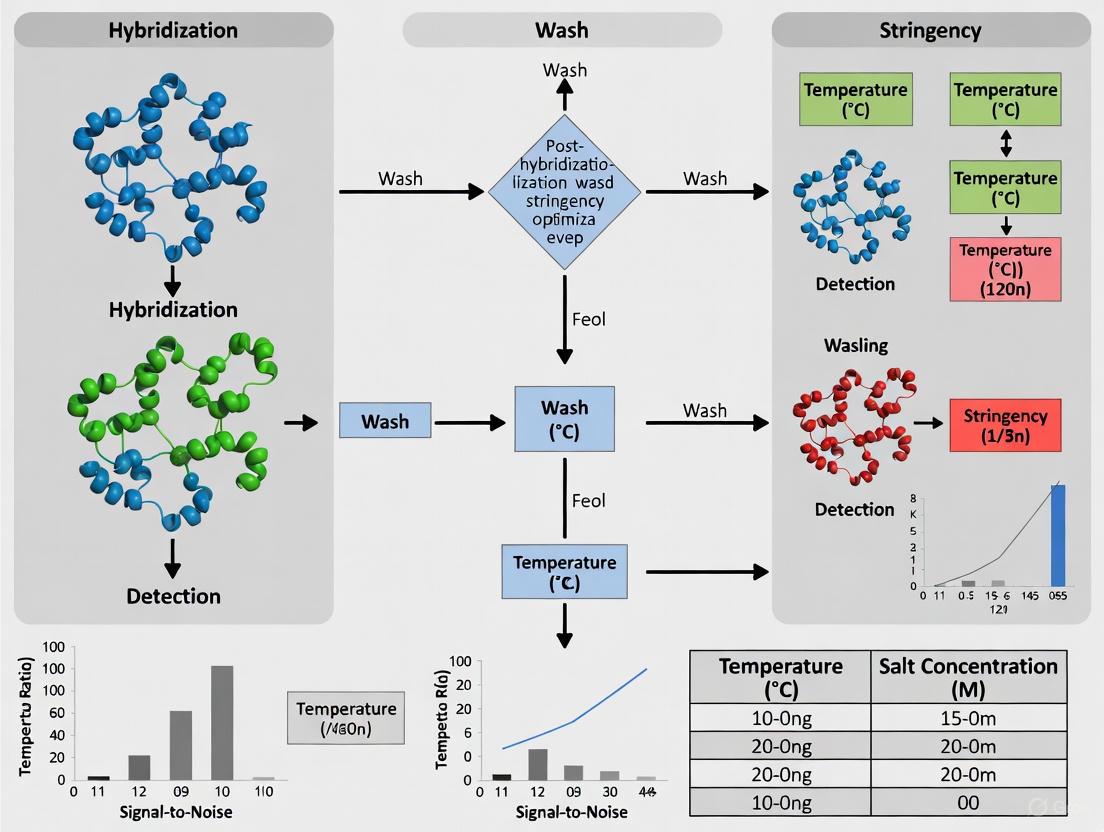
This article provides a comprehensive guide for researchers and drug development professionals on optimizing post-hybridization wash stringency for in situ hybridization (ISH) and fluorescence in situ hybridization (FISH) techniques.
Post-Hybridization Wash Stringency Optimization: A Complete Guide for Researchers
Abstract
This article provides a comprehensive guide for researchers and drug development professionals on optimizing post-hybridization wash stringency for in situ hybridization (ISH) and fluorescence in situ hybridization (FISH) techniques. Covering foundational principles to advanced applications, it details how precise control of temperature and salt concentration is critical for achieving high signal-to-noise ratios, accurate genotyping, and reliable detection of nucleic acid targets. The content explores methodological parameters, troubleshooting strategies, and validation approaches to enhance assay specificity and sensitivity in biomedical research and clinical diagnostics.
Understanding Stringency: The Scientific Foundation of Post-Hybridization Washes
Core Principles FAQ
What is stringency in nucleic acid hybridization?
Stringency refers to the specificity of binding between a probe and its target nucleic acid sequence. High stringency conditions ensure that only perfectly complementary sequences form stable hybrids, while low stringency conditions allow some mismatched sequences to bind [1]. The balance between affinity (yield) and specificity is a central principle; conditions that favor tighter binding often correlate with increased off-target binding, making specificity a greater concern than sensitivity in many modern applications [2].
How do temperature and salt concentration affect stringency?
Temperature and salt concentration are the two primary factors controlling stringency. Their relationship is inverse [2] [1]:
- To increase stringency: Raise the temperature and lower the salt concentration. Higher temperatures disrupt hydrogen bonds in mismatched hybrids, while lower salt concentrations reduce hybrid stability by failing to shield the negative charges on the phosphate backbones of nucleic acids, increasing electrostatic repulsion [1].
- To decrease stringency: Lower the temperature and raise the salt concentration. This stabilizes duplexes, including those with mismatches [1].
What is the role of chaotropic salts in hybridization?
Chaotropic salts (e.g., guanidine HCl, guanidine thiocyanate) play a dual role in sample preparation for hybridization assays. They destabilize hydrogen bonds and van der Waals forces, leading to protein denaturation (including nucleases), and they disrupt the hydration shells of nucleic acids, facilitating their binding to silica matrices in purification columns [3]. It is crucial to wash them away thoroughly before hybridization, as residual salts can impede elution and lead to poor purity measurements (low A260/230 ratios) [3].
Troubleshooting Guide
| Symptom | Probable Cause | Resolution |
|---|---|---|
| High background noise | Incomplete removal of non-specifically bound probe during washes [4] [5]. | Increase stringency of post-hybridization washes (raise temperature, use low-salt buffer like 0.1X SSC) [5] [1]. For DNA probes, ensure formaldehyde is not used in washes [4]. |
| Low or no signal | Hybridization conditions too stringent: Excessively high temperature or low salt during hybridization [2] [5].Inadequate target accessibility: Insufficient digestion of proteins masking the target [4] [5]. | Re-optimize hybridization conditions (lower temperature, increase salt). Optimize Proteinase K or pepsin digestion concentration and time via titration [4] [5]. |
| Unexpected cross-hybridization | Probe binding to repetitive sequences (e.g., Alu, LINE elements) [5].Wash stringency too low to dissociate partially matched sequences [2]. | Add blocking DNA (e.g., COT-1 DNA) during hybridization [5]. Implement more stringent washes (raise temperature, lower salt concentration) [2] [1]. |
| Poor sample purity affecting hybridization | Residual salts or proteins from inefficient nucleic acid purification [6] [3]. | Add an extra ethanol wash step during purification. Ensure lysis is complete and use high-quality, fresh ethanol for wash buffers [3]. |
Experimental Protocol: Post-Hybridization Stringency Wash Optimization
This protocol provides a methodology for determining the optimal post-hybridization wash conditions to maximize signal-to-noise ratio, a key aspect of thesis research on stringency optimization.
Materials and Reagents
- Hybridized samples (e.g., on membrane or slides).
- Sodium Saline Citrate (SSC) Buffer (20X stock): 3 M NaCl, 0.3 M trisodium citrate, pH 7.0.
- Water bath or heat block, temperature-adjustable (range 25°C to 80°C).
- Stringent Wash Buffer I: 2X SSC, 0.1% SDS.
- Stringent Wash Buffer II: 0.1X SSC, 0.1% SDS.
- Detection system appropriate for your probe label (e.g., streptavidin-HRP for biotin).
Procedure
- Pre-wash: Following hybridization, perform a brief rinse at room temperature with ~50 mL of SSC buffer to remove the hybridization solution.
- Primary Wash: Wash the samples with 50-100 mL of Stringent Wash Buffer I for 15 minutes at room temperature with gentle agitation.
- Stringency Wash Titration: Divide the samples into several identical batches.
- Prepare multiple containers with Stringent Wash Buffer II.
- Incubate each sample batch in a separate container for 15 minutes, but vary the temperature of the wash across a defined range (e.g., 50°C, 55°C, 60°C, 65°C).
- Final Rinse: Briefly rinse all samples in a low-salt buffer at room temperature.
- Detection: Proceed with the standard detection protocol for your system.
Data Analysis
- Quantify the specific signal and background noise for each wash temperature.
- Calculate the signal-to-noise ratio (SNR) for each condition.
- Plot the SNR against the wash temperature. The temperature that yields the highest SNR is the optimal stringency for that specific probe-target pair.
Quantitative Data for Stringency Optimization
The following table summarizes key parameters and their quantitative effects based on experimental data from the literature.
Table 1: Quantitative Effects of Assay Parameters on Performance
| Parameter | Typical Range or Value | Effect on Assay | Citation |
|---|---|---|---|
| Post-Hybridization Wash Temperature | 55°C - 80°C [5] [1] | Critical for disrupting mismatched hybrids; higher temperatures increase specificity. | [5] [1] |
| Post-Hybridization Wash Salt (SSC) | 0.1X - 2X [5] [1] | Lower concentration (e.g., 0.1X) increases stringency by reducing duplex stability. | [5] [1] |
| Proteinase K Digestion (for ISH) | 1-5 µg/mL, 10 min @ RT [4] | Essential for target accessibility; requires titration to balance signal and morphology. | [4] |
| MP ddPCR Assay Performance (4-plex) | LoB: 0-16.29 copies/mLLoD (Allele Frequency): ≤ 0.38%R²: ≥ 0.98 [7] | Demonstrates high sensitivity and specificity achievable with optimized, standardized protocols. | [7] |
Table 2: Research Reagent Solutions for Hybridization Assays
| Reagent | Function / Principle | Example Application |
|---|---|---|
| Chaotropic Salts (Guanidine HCl/thiocyanate) | Denature proteins, disrupt water structure to promote nucleic acid binding to silica [3]. | Cell lysis and nucleic acid purification prior to hybridization [3]. |
| Biotin-labeled Probes | Serve as affinity reagents; captured by streptavidin-coated beads or detected with streptavidin-enzyme conjugates [2] [5]. | Hybridization capture experiments like CHART, ChIRP; Chromogenic In Situ Hybridization (CISH) [2] [5]. |
| Digoxigenin-labeled Probes | Non-radioactive immune tag; detected with high-affinity anti-digoxigenin antibodies. Avoids background from endogenous biotin [4]. | Fluorescent In Situ Hybridization (FISH), CISH [4]. |
| Locked Nucleic Acid (LNA) Probes | Sugar-modified nucleotides that increase duplex stability and thermal affinity, enhancing specificity, though requiring careful optimization [2] [7]. | Increasing probe specificity, especially for short sequences in techniques like ISH and multiplex dPCR [2] [7]. |
| Formamide | Denaturant that lowers the effective melting temperature (Tm) of nucleic acid hybrids, allowing high-stringency hybridization at lower temperatures to preserve morphology [4]. | In Situ Hybridization (ISH) buffers [4]. |
| Mediator Probes (MP) & Universal Reporters (UR) | Label-free MPs bind target; a separate, standardized UR generates fluorescence upon MP cleavage. Enables highly specific, optimization-free multiplexing [7]. | Multiplex digital PCR for detecting cancer-associated point mutations in liquid biopsies [7]. |
Workflow and Relationship Visualizations
Diagram 1: Core hybridization workflow and stringency control.
Diagram 2: How stringency washes discriminate hybrids.
Troubleshooting FAQs
FAQ 1: My hybridization experiment has low signal-to-noise ratio. Which parameter should I adjust first? Start by optimizing the stringency of your post-hybridization washes. Low signal-to-noise ratio is often caused by non-specific binding or off-target probe retention. Increase the stringency gradually by:
- * Raising the temperature* of your wash buffers within the stability limits of your hybrid.
- Increasing the formamide concentration in your hybridization buffer, as it is a common chemical denaturant used to control stringency [8].
- Lowering the salt concentration in your wash buffers, as reduced cation concentration destabilizes non-specific bonds [9]. Systematically testing a range for each parameter while holding the others constant will help you identify the optimal conditions.
FAQ 2: How can I reduce non-specific background signal in my FISH-based assay? Non-specific background can be introduced by off-target binding of probes. This issue can be tissue- and probe-specific [8].
- Pre-screen readout probes: Test your readout probes against your sample type to identify those that bind non-specifically and exclude them from your panel [8].
- Optimize encoding probe hybridization: The efficiency and specificity of probe assembly depend on the denaturing conditions during hybridization, which are a combination of temperature and chemical denaturants like formamide [8]. Screen a range of formamide concentrations to find the optimal balance for your specific probes.
- Use high-quality reagents: Ensure buffers are fresh and properly prepared, as reagent "aging" during long experiments can decrease performance and increase background [8].
FAQ 3: What is the most critical factor for ensuring reproducible hybridization results? Rigorous calibration and maintenance of your temperature control systems is paramount. Temperature directly influences hybridization kinetics and stringency.
- Calibrate regularly: Use and maintain calibrated equipment to ensure the set temperature matches the actual temperature in your sample tube or bath.
- Ensure consistent heating: Inadequate temperature control during steps like initial denaturation or hybridization will lead to significant variability in hybrid formation and stability.
- Account for temperature in protocols: Remember that the electrode slope in pH measurements is temperature-dependent; inaccurate temperature data will lead to inaccurate pH control, which is another key parameter [10].
The following table summarizes the general effects of changing key parameters on hybrid stability and experimental stringency. Use this as a guide for systematic optimization.
| Parameter | Effect on Hybrid Stability | Effect on Stringency | Practical Consideration |
|---|---|---|---|
| Temperature Increase | Decreases [8] [11] | Increases | A higher temperature promotes dissociation of mismatched hybrids. Screen a range of ± 5°C from the predicted Tm [11]. |
| Salt Concentration Increase | Increases [9] | Decreases | Higher cation (e.g., Na⁺) concentration stabilizes the hybrid by shielding the negative phosphate backbone charges. For binding to a column, a concentration between 50-150 mM NaCl is often used [9]. |
| pH Deviation from Neutral | Variable, can decrease | Variable | Alkaline or acidic conditions can disrupt hydrogen bonding. The specific effect depends on the nucleotide composition and the buffer system used. |
| Chemical Denaturants (e.g., Formamide) | Decreases [8] | Increases | Adding formamide allows for a reduction in the hybridization temperature, which can be useful for protecting tissue samples. The effect on single-molecule signal brightness can be weak across an optimal range [8]. |
Detailed Experimental Protocol: Formamide Stringency Screening
This protocol is designed to systematically determine the optimal formamide concentration for hybridization, based on methodologies used in multiplexed RNA FISH optimization [8].
1. Objective To identify the formamide concentration that maximizes specific signal (brightness of single-molecule spots) while minimizing background in a single-molecule fluorescence in situ hybridization (smFISH) experiment.
2. Materials
- Fixed cell or tissue sample.
- Encoding probe set targeting your RNA of interest.
- Fluorescently labeled readout probes.
- Hybridization buffer (without formamide).
- Formamide (molecular biology grade).
- Wash buffers of varying stringency (e.g., with different SSC concentrations).
- Fluorescence microscope.
3. Procedure
- Step 1 - Preparation: Prepare a series of hybridization buffers containing formamide at concentrations varying in 5% increments (e.g., 0%, 5%, 10%, 15%, 20%, 25%).
- Step 2 - Hybridization: Apply your encoding probe set to identical sample sections, each using one of the formamide buffers. Hybridize at a fixed temperature (e.g., 37°C) for a fixed duration (e.g., 24 hours) [8].
- Step 3 - Washes: Perform post-hybridization washes with appropriate stringency buffers.
- Step 4 - Readout: Hybridize with fluorescent readout probes.
- Step 5 - Imaging and Analysis: Image all samples under identical conditions. Quantify the average brightness of single-molecule fluorescent spots and the background signal intensity for each condition.
4. Data Analysis Plot the average single-molecule signal brightness and the background intensity against the formamide concentration. The optimal condition is the one that provides a high signal intensity with a low background, typically appearing as a plateau in the signal-to-noise ratio.
Experimental Workflow Diagram
The diagram below outlines the logical workflow for optimizing hybrid stability parameters.
Research Reagent Solutions Toolkit
The table below lists key reagents and materials essential for experiments investigating hybrid stability.
| Item | Function in Experiment |
|---|---|
| Encoding Probes | Unlabeled DNA probes that bind to the cellular RNA. They contain a targeting region and a barcode region for readout [8]. |
| Fluorescent Readout Probes | Short, fluorescently labeled oligonucleotides that bind to the barcode region of the encoding probes assembled on the RNA, allowing detection [8]. |
| Formamide | A chemical denaturant used in hybridization buffers to control stringency, allowing for lower hybridization temperatures [8]. |
| SSC Buffer (Saline-Sodium Citrate) | A common buffer used in hybridization and washes. Its concentration directly controls ionic strength (salt concentration), which is a key parameter for stringency. |
| pH Buffer Solutions | To maintain a stable and specific pH during hybridization and washing steps, which is critical for reproducible hybrid stability. |
| Blocking Oligos | Unlabeled oligonucleotides used to mask repetitive sequences in the genome, reducing non-specific binding of probes [12]. |
Troubleshooting Guides
Low or No Hybridization Signal
| Symptom | Possible Cause | Solution |
|---|---|---|
| Poor or no signal | Low probe density or improper surface immobilization [13] | Optimize probe immobilization conditions (ionic strength, interfacial electrostatic potential) [13]. |
| Excessive steric hindrance from high probe density [13] | Dilute the probe layer to reduce density and improve target access [13] [14]. | |
| Inefficient denaturation of target or probe | Ensure denaturation is performed at 95±5°C for 5-10 minutes with the sample cover-slipped to prevent evaporation [5]. | |
| Inadequate permeabilization of sample | Optimize permeabilization conditions (concentration, time, temperature) using agents like Triton X-100 or proteinase K [15]. |
High Background or Non-Specific Signal
| Symptom | Possible Cause | Solution |
|---|---|---|
| High background staining | Inadequate post-hybridization stringency washing [5] | Perform stringent washes with SSC buffer at 75-80°C for 5 minutes [5]. |
| Non-specific binding from probe repetitive sequences | Add COT-1 DNA during hybridization to block repetitive sequences [5]. | |
| Sample drying during protocol steps | Ensure slides and samples remain humidified throughout the entire procedure [5]. | |
| Electrostatic cross-talk between charged DNA molecules [14] | For DNA probes, optimize ionic strength during hybridization; use ~100 mM Na+ concentration [14]. |
Issues with Hybridization Efficiency and Kinetics
| Symptom | Possible Cause | Solution |
|---|---|---|
| Low hybridization efficiency | Excessively high surface probe density [13] | Control probe density during immobilization. High densities can reduce efficiency to ~10% [13]. |
| Slow hybridization kinetics | Steric and electrostatic barriers on solid support [13] [14] | Use strategic templated immobilization to dilute PNA/DNA probe layer and reduce electrostatic repulsion [14]. |
Frequently Asked Questions (FAQs)
How does surface probe density directly impact hybridization?
Probe density is a critical controlling factor. At low densities, hybridization can be highly efficient with kinetics that follow Langmuir-like models. In contrast, at high densities, hybridization efficiency can drop dramatically to around 10%, and the kinetics of target capture become significantly slower due to steric hindrance and electrostatic repulsion [13].
What are the key differences between solution-phase and surface hybridization?
Surface-immobilized probes operate under different constraints than solution-phase reactions. Thermodynamic equilibrium may not be reached in a practical time, and hybridization can be kinetically or sterically inaccessible for some sequences or surface densities, which is not a concern in solution [13].
How can I optimize my protocol for better RNA FISH performance (like MERFISH)?
Performance depends on multiple protocol choices. Key optimizations include:
- Probe Design: Signal brightness depends on target region length, with 20-50 nt being typical. Efficiency plateaus for sufficiently long regions, so optimize for cost and specificity [8].
- Hybridization Buffer: Modifications to encoding probe hybridization and buffer composition can substantially enhance the probe assembly rate and signal brightness [8].
- Reagent Stability: Reagents can "age" during multi-day experiments. Use methods to ameliorate this effect for consistent performance [8].
Can I use the same stringency wash conditions for all my experiments?
No, stringent wash conditions must be optimized for your specific probe and sample. While 75-80°C in SSC buffer is a common starting point [5], the ideal temperature and salt concentration depend on the probe's melting temperature (Tm) and the level of non-specific binding. Always validate for each new assay.
Impact of Probe Density on Hybridization Efficiency and Kinetics
The following table summarizes key quantitative findings from research on DNA films [13].
| Probe Density Regime | Hybridization Efficiency | Kinetics Profile |
|---|---|---|
| Low Density | Up to ~100% of probes can be hybridized | Follows Langmuir-like kinetics |
| High Density | Drops to ~10% | Significantly slower than low-density regime |
Effect of Ionic Strength on Hybridization
This table summarizes the influence of salt concentration, a key parameter in your wash stringency, on the hybridization process [14].
| Parameter | Effect of Low Ionic Strength | Effect of High Ionic Strength | Optimal Range (for PNA) |
|---|---|---|---|
| Association Rate | Subject to electrostatic barrier (DNA probes) [14] | Monotonic decrease [14] | --- |
| Hybridization Signal | Suboptimal due to repulsion [14] | Suboptimal due to other factors [14] | ~100 mM Na+ [14] |
Experimental Protocols
Controlled Immobilization of DNA Probes for Density Studies
This protocol outlines the methodology for creating DNA films with controlled probe density, as used in foundational studies [13].
Key Materials:
- Oligonucleotides: Thiol-modified DNA oligonucleotides (e.g., C6-SH) for covalent attachment to gold surfaces.
- Solid Support: Cleaned gold substrate (e.g., for SPR spectroscopy).
- Solution: KH₂PO₄ (1 M) or other salts to control ionic strength during immobilization.
- Backfiller: Mercaptohexanol (1 mM solution) to create a well-defined mixed monolayer.
Detailed Procedure:
- Surface Cleaning: Clean the gold substrate with a piranha solution (7:3 H₂SO₄:H₂O₂). CAUTION: Piranha solution is extremely corrosive and must be handled with care.
- Probe Immobilization: Immobilize thiol-modified ssDNA or dsDNA onto the gold surface by exposure for a controlled duration (e.g., >10 hours).
- Density Control: Vary the probe density by using different immobilization strategies:
- Solution Ionic Strength: Immobilize in buffers of different salt concentrations.
- Electrostatic Potential: Apply an interfacial electrostatic field to assist in DNA adsorption.
- DNA Conformation: Compare immobilization of single-stranded DNA (ssDNA) versus duplex DNA (dsDNA). Under the same conditions (1 M KH₂PO₄), ssDNA-C6-SH achieves a higher density (~11 × 10¹² molecules/cm²) than dsDNA-C6-SH (~2.8 × 10¹² molecules/cm²) [13].
- Backfilling: Treat the DNA film with a 1 mM mercaptohexanol solution for 1-2 hours to passivate unoccupied gold sites.
- Denaturation (for dsDNA films): If duplex DNA was immobilized, denature the film by rinsing with hot water (e.g., 80°C) to remove the non-tethered strand, creating an ssDNA probe surface.
Optimized Hybridization and Stringency Wash Protocol for CISH/FISH
This protocol provides detailed steps for reliable hybridization and washing, critical for your thesis context [5].
Key Materials:
- Pretreatment Buffer: For heat-induced epitope retrieval.
- Digestion Solution: Pepsin, optimized for your tissue type (typically 3-10 minutes at 37°C).
- Hybridization Buffer: Contains formamide, SSC, etc.
- Wash Buffers: PBST (PBS with 0.025% Tween 20), SSC buffer (for stringent wash).
Detailed Procedure:
- Heat-Induced Epitope Retrieval: Heat slides in pretreatment buffer for 15 minutes once the buffer reaches 98°C.
- Enzymatic Digestion: Treat slides with pepsin at 37°C for 3-10 minutes. Over-digestion weakens signal; under-digestion decreases signal.
- Denaturation: Denature target and probe simultaneously on a hot plate at 95±5°C for 5-10 minutes. Ensure slides are cover-slipped and in a humidified environment.
- Hybridization: Apply probe and hybridize at 37°C for 16 hours (overnight) in a sealed, humidified chamber.
- Post-Hybridization Washes:
- Remove coverslips by soaking in PBST.
- Wash slides in PBST, then incubate with pre-warmed TBS wash buffer at 37±2°C for 15 minutes.
- Stringent Wash (Critical for Specificity):
- Rinse slides briefly with SSC buffer at room temperature.
- Immerse slides for 5 minutes in SSC buffer at 75°C. Increase the temperature by 1°C per slide when processing more than 2 slides, but do not exceed 80°C.
- After the stringent wash, rinse slides with TBST.
Signaling Pathways and Workflows
Research Reagent Solutions
| Reagent | Function/Benefit |
|---|---|
| Mercaptohexanol | Used as a backfilling agent with thiol-modified DNA on gold surfaces. Creates a well-defined mixed monolayer that reduces non-specific adsorption and can help control probe spacing and orientation [13]. |
| COT-1 DNA | Used to block non-specific hybridization of probes to repetitive sequences (e.g., Alu, LINE elements) in the genome, thereby reducing background staining [5]. |
| Formamide | A chemical denaturant used in hybridization buffers to lower the effective melting temperature (Tm) of nucleic acid duplexes, allowing hybridization to be performed at milder, more controlled temperatures [8]. |
| PNA (Peptide Nucleic Acid) Probes | Synthetic probes with a neutral peptide backbone. They lack the negative charge of DNA, which can reduce electrostatic repulsion with target DNA and improve hybridization kinetics and affinity, especially under low ionic strength conditions [14]. |
The optimization of post-hybridization wash stringency is fundamentally governed by the relationship between two key thermodynamic principles: the melting temperature (Tm) and Gibbs Free Energy (ΔG). The Tm of a nucleic acid duplex is the temperature at which half of the molecules are in a single-stranded state and half are in a double-stranded state [16]. Gibbs Free Energy (ΔG) represents the amount of "useful" energy available to do work at constant temperature and pressure, and its negative value (ΔG < 0) indicates a spontaneous process [17]. In the context of hybridization experiments, a thorough understanding of how these two parameters interrelate and respond to experimental conditions is crucial for achieving specific binding while minimizing non-specific background.
Fundamental Principles & Mathematical Relationships
The Definition of Gibbs Free Energy (ΔG)
In thermodynamic terms, the Gibbs Free Energy is defined as ( G = H - TS ), where H is enthalpy, T is temperature, and S is entropy [17]. The change in Gibbs Free Energy for a process, such as DNA hybridization, is given by: [ \Delta G = \Delta H - T \Delta S ] A negative ΔG signifies a spontaneous process, while a positive value indicates non-spontaneity [17]. For nucleic acid hybridization, a negative ΔG reflects a favorable reaction where the duplex is stable.
The Relationship Between ΔG and Tm
The Tm is directly related to the thermodynamic parameters of the system. At the melting temperature, the system is at equilibrium between the double-stranded and single-stranded states, meaning ( \Delta G = 0 ). This allows for the derivation of the relationship: [ T_m = \frac{\Delta H}{\Delta S - R \ln(C)} ] where R is the gas constant and C is the concentration [18]. This equation demonstrates that Tm is not an intrinsic constant but depends on the enthalpy (ΔH) and entropy (ΔS) changes of hybridization, as well as experimental conditions like oligo concentration.
Key Factors Influencing Tm and ΔG
The following factors critically influence both Tm and the free energy of hybridization, directly impacting wash stringency optimization [16]:
- Salt Concentration: Monovalent cations (e.g., Na⁺) stabilize duplexes. Increasing salt concentration increases Tm.
- Divalent Cations: Magnesium ions (Mg²⁺) have a more profound effect on stability than monovalent ions. The concentration of free Mg²⁺ must be carefully considered.
- Oligonucleotide Concentration: Tm increases with higher oligo concentrations.
- Mismatches: Base pair mismatches decrease duplex stability and Tm, with the effect depending on the mismatch type and sequence context.
- Probe Length and GC Content: Longer probes and higher GC content generally increase Tm.
Troubleshooting Guides & FAQs
Frequently Asked Questions (FAQs)
FAQ 1: During post-hybridization washes, I consistently get high background. How can thermodynamic principles help me solve this?
- Explanation: High background indicates non-specific binding of your probe. This occurs when the wash stringency is too low to destabilize imperfectly matched duplexes.
- Solution Based on Tm/ΔG: Increase the stringency of your washes. Since ΔG becomes less favorable (less negative) at higher temperatures, you can increase the wash temperature. Alternatively, you can decrease the salt concentration in your wash buffer (e.g., use a lower concentration of SSC). Both actions reduce the Tm of non-specific hybrids, causing them to denature and wash away, while the perfectly matched target-probe duplex (with a higher Tm) remains bound [19] [16] [20].
FAQ 2: My signal is too weak after washing, even with a validated probe. What should I troubleshoot?
- Explanation: Weak signal suggests that the specific target-probe duplex is also being destabilized during washes, meaning the stringency is too high.
- Solution Based on Tm/ΔG: Decrease the wash stringency. Lower the wash temperature and/or increase the salt concentration in your wash buffer. This will stabilize the duplexes by making ΔG more favorable, preventing the specific hybrids from melting off [19] [4]. Also, verify your probe concentration, as lower than optimal concentrations can lead to a weaker signal due to a lower observed Tm [16].
FAQ 3: How does a single base pair mismatch (like a SNP) affect my experiment, and how can I adjust for it?
- Explanation: A single mismatch destabilizes the duplex, making ΔG less negative and lowering its Tm compared to a perfectly matched duplex.
- Solution Based on Tm/ΔG: You can exploit this difference for discrimination. To preferentially detect the perfectly matched sequence, increase stringency (higher temperature, lower salt) until the Tm of the mismatched duplex is exceeded and it denatures. For PCR assays, placing the mismatch near the 5' end of a probe or primer minimizes its destabilizing effect on the 3' end, which is critical for extension [16]. Using shorter probes can also enhance mismatch discrimination [16].
Troubleshooting Guide Table
The table below summarizes common issues and their thermodynamic solutions.
| Problem | Root Cause | Thermodynamic Solution | Expected Outcome |
|---|---|---|---|
| High Background | Wash stringency too low; non-specific hybrids remain. | Increase wash temperature [19] [20] or decrease salt concentration (e.g., use 0.1x SSC instead of 2x SSC) [19] [20]. | Non-specific hybrids melt, reducing background. |
| Weak Specific Signal | Wash stringency too high; specific hybrids are melting. | Decrease wash temperature [4] or increase salt concentration [19]. | Specific hybrids remain stable, preserving signal. |
| Poor Mismatch Discrimination | Stringency not optimized to differentiate between perfect and mismatched duplexes. | Fine-tune wash temperature and salt to a point between the Tm of the perfect and mismatched duplex. | Only the perfect-match hybrid remains bound. |
| Inconsistent Results Between Runs | Variation in buffer ion concentration or temperature. | Precisely control temperature (±1°C) [19] and accurately prepare SSC buffer concentrates. | Highly reproducible hybridization and wash results. |
Experimental Protocols & Data Analysis
Protocol: Determining Tm via UV Melting Curve
Principle: The hyperchromic effect describes the increase in UV absorbance at 260 nm as double-stranded DNA melts into single strands [18].
Materials:
- UV-Vis spectrophotometer with a temperature-controlled cuvette holder.
- DNA oligonucleotide and its perfect complement.
- Appropriate hybridization buffer (e.g., containing defined Na⁺ or Mg²⁺ concentrations).
Methodology:
- Sample Preparation: Mix equimolar amounts of complementary oligonucleotides in buffer. Denature at 95°C for 2 minutes and cool slowly to room temperature to allow duplex formation [18].
- Data Collection: Place the sample in the spectrophotometer. Increase the temperature gradually (e.g., 1-2°C per minute) while monitoring absorbance at 260 nm.
- Analysis: Plot absorbance versus temperature. The Tm is determined as the midpoint of the transition curve between the double-stranded and single-stranded plateaus (see diagram below) [18].
Workflow Diagram: From Experiment to Tm Calculation
Quantitative Data for Experimental Planning
Table 1: Effect of Salt Concentration on Tm and Implied ΔG Adjusting salt concentration is a primary method for stringency control. The data below illustrates its powerful effect [16].
| Sodium Ion (Na⁺) Concentration | Approximate Effect on Tm | Thermodynamic Impact on ΔG |
|---|---|---|
| 20-30 mM | Baseline Tm | Baseline ΔG |
| 50 mM (Common in SSC buffers) | +0 to +2 °C | ΔG becomes more negative (more favorable) |
| 1 M | ~ +20 °C | ΔG becomes significantly more negative |
Table 2: Standard Post-Hybridization Wash Conditions These common conditions from FISH protocols can serve as a starting point for optimization [19].
| Wash Step | Buffer Composition | Temperature | Duration | Stringency Level & Purpose |
|---|---|---|---|---|
| Primary Wash | 0.4x SSC | 72 ± 1 °C | 2 min | High Stringency: Removes non-specific binding. |
| Secondary Wash | 2x SSC / 0.05% Tween | Room Temperature | 30 sec | Low Stringency: Removes residual buffer and stabilizes sample. |
The Scientist's Toolkit: Essential Reagents & Materials
Table 3: Key Research Reagent Solutions for Hybridization & Wash Optimization
| Reagent / Material | Function in Experiment | Role in Controlling Tm / ΔG |
|---|---|---|
| SSC Buffer (Saline-Sodium Citrate) | Provides monovalent cations (Na⁺) during hybridization and washes [19] [20]. | Na⁺ neutralizes the negative charge on DNA backbones. Higher [SSC] stabilizes duplexes (increases Tm, makes ΔG more negative) [19] [16]. |
| Formamide | Added to hybridization buffer to lower the effective melting temperature of probes [20] [4]. | Destabilizes hydrogen bonding between base pairs. Allows hybridization to occur at lower, morphologically safer temperatures (lowers Tm, makes ΔG less favorable) [4]. |
| TWEEN 20 (Detergent) | Non-ionic detergent added to wash buffers [19]. | Reduces background staining by minimizing hydrophobic interactions and enhances reagent spreading. Does not directly affect Tm/ΔG of nucleic acid duplexes. |
| DNA Oligonucleotide Probes | The molecular tool designed to bind a specific nucleic acid target. | Their sequence (length, GC content) defines the intrinsic ΔH and ΔS of hybridization, setting the baseline Tm [18] [16]. |
| Locked Nucleic Acids (LNA) | Synthetic nucleic acid analogues incorporated into probes [16]. | Enhance binding affinity to the target. Increase Tm and make ΔG more negative, allowing the use of shorter, more specific probes [16]. |
Advanced Concepts: Solvation Energy
Emerging research highlights that classical models may not fully account for the role of water. The formation of a DNA duplex releases water molecules that were solvating the single strands. This process has a associated solvation free energy (ΔGS), which recent studies suggest can be large and unfavorable (positive) for DNA hybridization [21]. This means energy must be expended to desolvate the interacting surfaces. This advanced framework modifies the classical equilibrium equation to: [ \Delta G^\circ = -RT \ln(K) - [AB]{eq} \Delta GS ] where [AB] is the concentration of the duplex. This implies the equilibrium constant K is not truly constant but can vary with product concentration when ΔGS is significant [21]. While this may not change immediate protocol decisions, it provides a deeper theoretical foundation for understanding hybridization behavior under different conditions.
Frequently Asked Questions (FAQs)
Why are spacer molecules necessary in microarray design? Spacer molecules are crucial because they position the probe sequence away from the solid substrate. This distance reduces steric hindrance and minimizes unfavorable electrostatic interactions between the negatively charged DNA backbone and the often negatively charged surface, which can dramatically reduce hybridization efficiency and signal intensity [22] [23].
What is the optimal length for a spacer? Research indicates that an optimal spacer length is about 45–60 atoms, which corresponds to approximately 8–10 nucleotides [22]. One study found that hybridization signal increased linearly with poly(A) spacer length up to 18-24 nucleotides for certain targets [22].
How does probe distance from the surface affect wash stringency? The stringency required for accurate results is directly influenced by the probe's distance from the surface. Probes closer to the surface are influenced by additional surface-related stringency. Research has shown that probes near the surface required a 4x SSC wash buffer, while those placed further away required a much lower ionic strength buffer (0.35x SSC) to achieve accurate genotyping, indicating different local environments [22].
Can I use any nucleotide sequence as a spacer? No, the spacer sequence should be carefully selected to avoid complementarity with the target sequence. In silico screening using tools like BLASTN for short, nearly exact matches is recommended to identify sequences that will not hybridize to the target and potentially create a hairpin structure [22].
What are the consequences of insufficient spacer length? Short spacer lengths can lead to significantly reduced hybridization signals. This is due to steric hindrance preventing target access and strong electrostatic effects from the surface that can reduce the local melting temperature (Tm) of the probe-target duplex by tens of degrees Celsius [22].
Troubleshooting Guides
Problem: Low or No Hybridization Signal
| Potential Cause | Diagnostic Steps | Recommended Solution |
|---|---|---|
| Insufficient spacer length | Review probe design specifications. Compare signal intensity against probes with validated longer spacers. | Redesign probes to include a spacer of 45-60 atoms (approx. 8-10 nucleotides) between the surface and the recognition sequence [22] [23]. |
| High probe density | Analyze surface probe density if possible. High densities can lead to steric and electrostatic crowding. | Optimize the probe immobilization protocol to achieve a moderate surface density that maximizes the signal-to-background ratio [23]. |
| Spacer sequence hybridization | Perform in silico analysis (BLAST) of the spacer sequence against the target genome. | Select a neutral spacer sequence with no significant complementarity to the intended target to prevent non-specific binding [22]. |
Problem: High Background Signal
| Potential Cause | Diagnostic Steps | Recommended Solution |
|---|---|---|
| Non-specific adsorption | Check for non-specific binding on control spots. Ensure buffers contain detergents. | Include TWEEN 20 detergent in wash buffers to decrease background staining and enhance reagent spreading [19]. |
| Sub-optimal stringency washes | Evaluate if background is uniform or spot-specific. Experiment with different wash stringencies. | Optimize post-hybridization wash stringency by adjusting SSC concentration and temperature. Probes farther from the surface may require lower SSC concentration (e.g., 0.35x) [22]. |
| Surface contaminants | Inspect slides for debris. Review cleaning protocols for solution jars and equipment. | Periodically wash solution jars and use filtered pipette tips to reduce background issues from expelled debris [19]. |
Problem: Inconsistent Specificity Across Probes
| Potential Cause | Diagnostic Steps | Recommended Solution |
|---|---|---|
| Variable spacer placement | Check if all probes are designed with a consistent spacer strategy. | Standardize spacer length and attachment chemistry for all probes on the array to ensure uniform hybridization behavior [22]. |
| Ignoring surface-induced stringency | Analyze if specificity issues correlate with probe design. | Account for the additional stringency imposed by the surface, especially for probes tethered shorter. Adjust global wash conditions or redesign affected probes with longer spacers [22]. |
Table 1: Impact of Spacer Length on Hybridization Performance Data derived from systematic studies on spacer molecules [22].
| Spacer Length (Atoms) | Approximate Length (Nucleotides) | Relative Signal Intensity | Key Observations |
|---|---|---|---|
| ~15-20 | ~3-4 | Low | Significant steric and electrostatic hindrance; very low signal. |
| ~45 | ~8 | Medium-High | Good signal; often considered a minimum effective length. |
| ~60 | ~10 | High | Optimal range for maximum hybridization yield and signal. |
| >60 | >10 | Saturated | No significant further improvement in signal intensity. |
Table 2: Relationship Between Probe Distance and Wash Stringency Experimental data showing how spacer length alters effective stringency requirements [22].
| Probe Distance from Surface | Optimal Wash Buffer (SSC) | Rationale |
|---|---|---|
| Close (Short Spacer) | 4x SSC (Higher Salt) | Higher ionic strength is needed to shield strong negative surface potentials that destabilize duplexes. |
| Far (Long Spacer) | 0.35x SSC (Lower Salt) | Surface effects are minimized; standard lower ionic strength washes effectively remove non-specific binding. |
Detailed Experimental Protocol: Multi-Parametric Optimization of Spacer Length and Stringency
This protocol is based on a study that systematically varied spacer length, probe length, and wash stringency to optimize microarray performance [22].
1. Probe Design and Array Fabrication:
- Design Probes: Design 60-mer oligonucleotide probes targeting your genes of interest. Incorporate a spacer (linker) at the 5' end to position the probe sequence at a defined distance from the surface.
- Vary Spacer Length: Create probe sets with three distinct spacer lengths, effectively placing the gene-specific sequence in discrete steps along the oligonucleotide (e.g., proximal, medium, and distal from the surface upon immobilization).
- Fabricate Arrays: Synthesize and spot the probes onto your chosen microarray substrate (e.g., commercially available 8x15k custom arrays).
2. Hybridization and Multi-Stringency Wash:
- Hybridize: Hybridize the labeled target sample to the array according to standard protocols for your system.
- Multi-Stringency Wash: Use a custom-built multi-stringency array washer (MSAW) or manually partition the array to apply six different stringency wash conditions to identical sub-arrays. Vary the ionic strength of the SSC buffer (e.g., from 0.1x to 4x SSC) while keeping other factors like temperature and time constant.
3. Data Acquisition and Analysis:
- Scan Array: Scan the microarray using a standard laser scanner to obtain fluorescence signal intensities for each spot.
- Analyze Signal and Specificity: For each probe and wash condition, quantify the specific hybridization signal and non-specific background.
- Plot Dissociation Curves: If possible, generate dissociation curves by monitoring signal loss across the different stringency washes.
- Correlate with Thermodynamics: Perform linear regression between the experimental hybridization data and calculated thermodynamic parameters (Tm and ΔG) to understand how spacer length and wash condition affect correlation with theory.
Experimental Workflow for Spacer Optimization
The Scientist's Toolkit: Essential Research Reagents
Table 3: Key Reagents for Probe Spacer Optimization Compilation of critical materials from referenced protocols [22] [19] [23].
| Reagent | Function in Experiment | Key Consideration |
|---|---|---|
| Spacer Phosphoramidites (e.g., Hexa-ethyloxy-glycol) | Chemical building blocks used during oligonucleotide synthesis to create a defined, non-nucleotide spacer between the probe and the surface [24]. | Length (number of atoms) and hydrophobicity are key parameters. Inertness is critical to avoid non-specific binding. |
| SSC Buffer (Saline Sodium Citrate) | The primary buffer used for controlling stringency in post-hybridization washes. Ionic strength (SSC concentration) is a major determinant of stringency [22] [19]. | Concentration (e.g., 0.1x to 4x) and pH must be precisely prepared and controlled for reproducible results. |
| TWEEN 20 | A non-ionic detergent added to wash buffers to reduce non-specific hydrophobic interactions and lower background staining [19]. | Typical concentration is 0.05%. Enhances the spreading of wash reagents. |
| 5' Amino-Linker Modifier | A chemical modification (e.g., 5'-Amino-Modifier C6) added to the oligonucleotide to allow for covalent tethering to surface-activated slides [24]. | Ensures probes are stably and uniformly immobilized, which is the foundation for consistent spacer function. |
| Formamide | A denaturing agent used in hybridization buffers to lower the effective melting temperature (Tm) of the probe-target duplex, allowing hybridization to be performed at a manageable temperature [20]. | Allows for lower temperature hybridization, which can help preserve sample integrity. |
Impact of Spacer Molecules on Hybridization
Practical Implementation: Stringency Optimization Protocols for Diverse Applications
SSC Buffer FAQs and Troubleshooting
What is SSC buffer and what is its role in post-hybridization washes?
Saline-sodium citrate (SSC) buffer is a standard solution used in nucleic acid hybridization techniques such as Southern blotting, Northern blotting, and in situ hybridization (ISH) [25]. Its primary role in post-hybridization washes is to control stringency, which determines the specificity of the hybridization [26] [25]. The buffer provides positively charged sodium ions that counteract the repulsive negative forces between the DNA backbones of the probe and its target [26]. This action is crucial for removing non-specific interactions and ensuring that only perfectly matched probe-target hybrids remain [26].
How do SSC concentration and temperature affect wash stringency?
The stringency of a post-hybridization wash is determined by the combined effect of SSC concentration and temperature. Adjusting these parameters allows researchers to fine-tune the required level of specificity for their experiment.
Key Relationships:
- SSC Concentration: Lower SSC concentrations provide higher stringency by reducing the ionic strength, which disrupts non-specific bonds [26].
- Temperature: Higher wash temperatures provide higher stringency by destabilizing imperfectly matched hybrids [26].
The table below summarizes standard post-hybridization wash conditions from a hematology FISH protocol:
| Probe Type | First Wash | Second Wash | Purpose |
|---|---|---|---|
| Most Probes [26] | 0.4x SSC at 72°C ± 1°C for 2 mins | 2x SSC / 0.05% Tween at room temperature for 30 sec | Balance specificity with signal retention |
| Enumeration Probes [26] | 0.25x SSC at 72°C ± 1°C for 2 mins | 2x SSC / 0.05% Tween at room temperature for 30 sec | Achieve higher stringency for repetitive targets |
What are the consequences of incorrect stringency?
Using incorrect wash stringency is a common source of experimental problems in hybridization assays.
- High Background/Non-specific Signals: Caused by low stringency washes (e.g., temperature below 71°C or SSC concentration higher than 0.4x) [27] [26]. This results in failure to wash away weakly bound or non-specifically bound probes.
- Weak or Lost Signal: Caused by excessively high stringency washes (e.g., temperature above 73°C or SSC concentration lower than 0.4x) [27] [26]. Overly stringent conditions can denature even the specific probe-target hybrids.
How is SSC buffer typically formulated?
SSC buffer is commonly prepared as a 20X concentrated stock solution for convenient dilution to working concentrations. The standard formulation is consistent across major suppliers.
Table: Standard 20X SSC Buffer Formulation
| Component | Concentration | Purpose |
|---|---|---|
| Sodium Chloride (NaCl) | 3.0 M [25] [28] | Provides sodium ions (Na+) to shield negative phosphate backbone charges |
| Sodium Citrate (C6H5Na3O7) | 0.3 M [25] [28] | Acts as a buffering agent, maintaining pH at 7.0 [25] [28] |
What other factors influence wash effectiveness?
- Detergents: Adding a small amount of detergent, such as 0.05% Tween 20, to the wash buffer helps reduce background staining and improves reagent spreading [26].
- pH: The pH of the SSC buffer affects the availability of positive ions. Deviations from the standard pH of 7.0 can alter stringency and lead to unexpected results [26].
- Equipment Calibration: Regular calibration of water baths and hybridizers is critical. Temperature discrepancies in equipment can lead to unintentional variations in stringency [26].
Experimental Protocol: Optimizing Post-Hybridization Washes
The following workflow details a standard method for post-hybridization stringency washes, adaptable for both chromogenic and fluorescence in situ hybridization (FISH) protocols [27] [26] [29].
Workflow for Post-Hybridization Washes
Key Materials & Reagents:
- SSC Buffer (20X Stock): 3.0 M NaCl, 0.3 M Sodium Citrate, pH 7.0 [25] [28].
- Detergent: Tween-20 [27] [26].
- Lab Equipment: Coplin jars or staining dishes, water bath or hybridization oven calibrated to maintain 72°C ± 1°C [27] [26].
Step-by-Step Procedure:
- Coverslip Removal: Gently remove the coverslips from the slides after the overnight hybridization [27].
- First Stringency Wash: Perform the first wash in a pre-warmed, low-SSC concentration buffer. The exact formulation depends on the probe type, as shown in the diagram above. Use a water bath or hybridization oven to ensure precise temperature control, as stringency is highly temperature-sensitive [27] [26].
- Second Stringency Wash: Perform a brief wash at room temperature with a higher SSC concentration and a detergent like Tween 20. This step helps to remove residual reagents and further reduce background without risking the specific signal [26].
- Proceed to Detection: After the final wash, slides can be moved to the next stage of the protocol, such as antibody incubation for signal detection [27] [29].
The Scientist's Toolkit: Research Reagent Solutions
Table: Essential Reagents for Hybridization and Wash Protocols
| Reagent | Function | Example Application |
|---|---|---|
| SSC Buffer (20X) [25] [28] | Controls stringency during hybridization and washes; ions stabilize nucleic acid hybrids. | Used in post-hybridization washes for FISH and ISH [26] [29]. |
| Formamide [27] [29] | A denaturing agent used in hybridization buffers to lower the melting temperature (Tm) of DNA. | Allows hybridization to occur at lower, less damaging temperatures (e.g., 37-45°C) [27]. |
| Blocking Reagents (e.g., BSA, Casein, Heparin) [27] [29] | Bind to non-specific sites on the tissue or membrane to prevent probe attachment and reduce background. | Included in pre-hybridization and hybridization buffers [27]. |
| Detergents (Tween-20, SDS) [27] [26] | Surfactants that help permeabilize samples, aid in washing efficiency, and reduce background staining. | Added to wash buffers (e.g., 2x SSC/0.05% Tween) [26]. |
| Proteinase K [27] | An enzyme that digests proteins and increases tissue permeability, allowing better probe penetration. | Used for sample pre-treatment before hybridization [27]. |
Core Concepts: The Role of Post-Hybridization Washes
What is the primary function of a post-hybridization wash?
Post-hybridization washing is a critical step designed to remove non-specific interactions between the probe and non-target regions of the genome. This process enhances probe specificity by eliminating improperly bound probes, thereby reducing background noise and improving the signal-to-noise ratio in your final results [19].
How do stringency factors influence wash efficiency?
Stringency conditions determine how rigorously non-specifically bound probes are removed. The table below summarizes the key factors affecting stringency and their optimal settings for FISH protocols:
Table 1: Key Stringency Factors and Their Effects in Post-Hybridization Washes
| Factor | Effect on Stringency | Low Stringency Example | High Stringency Example | Optimal Condition for FISH |
|---|---|---|---|---|
| SSC Concentration | Higher salt = lower stringency; Lower salt = higher stringency | >0.4xSSC [19] | <0.4xSSC [19] | 0.4xSSC or 0.25xSSC [19] |
| Temperature | Higher temperature = higher stringency | <71°C [19] | >73°C [19] | 72±1°C [19] |
| pH | Deviation from optimal reduces effectiveness | pH differs from 7.0 [19] | pH differs from 7.0 [19] | pH 7.0 [19] |
| Detergent | Reduces background staining | N/A | N/A | 0.05% TWEEN 20 [19] |
The buffers used in post-hybridization washing are typically SSC-based, providing positively charged sodium ions that counteract the repulsive negative force between the DNA backbones of both the probe and target. Appropriate balance of these factors is essential for optimal results [19].
How does the choice of probe type affect wash conditions?
Different probe types form hybrids with varying stability, which directly influences how they respond to wash stringency:
Table 2: Probe Types and Their Hybridization Properties
| Probe Type | Hybrid Stability | Key Considerations | Recommended Wash Conditions |
|---|---|---|---|
| RNA Probes (Riboprobes) | RNA-RNA hybrids are most stable [4] | Uniform size, high incorporation of label [4] | Standard stringency washes [4] |
| DNA Probes | RNA-DNA hybrids are moderately stable [4] | Do not bind as tightly to targets; avoid formaldehyde in washes [4] [30] | Modified wash conditions without formaldehyde [4] |
| Oligonucleotide Probes | DNA-DNA hybrids are least stable [4] | Chemically synthesized to high specific activity [4] | Temperature and salt concentration optimization [4] |
| LNA Probes | Enhanced stability [4] | Locked Nucleic Acid technology enhances efficiency [4] | May tolerate higher stringency conditions [4] |
Technology-Specific Troubleshooting Guides
FISH (Fluorescence In Situ Hybridization) Troubleshooting
What are common FISH issues and their solutions?
Table 3: FISH Troubleshooting Guide
| Problem | Possible Causes | Troubleshooting Strategies |
|---|---|---|
| Poor or No Signal | Inadequate denaturation, insufficient probe concentration, poor permeabilization [15] | Check probe design and labeling efficiency; optimize denaturation and hybridization conditions; increase probe concentration or hybridization time; ensure adequate permeabilization [15] |
| High Background | Insufficient washing, low stringency, cross-reactivity [15] | Optimize wash conditions (temperature, salt concentration, duration); increase stringency of washes; check for probe cross-reactivity [4] [15] |
| Weak or Faded Signal | Fluorophore degradation, over-fixed samples, inadequate detection [15] | Use fresh fluorophore or signal amplification; optimize mounting medium with antifade reagents; minimize light exposure; avoid over-fixation [15] |
| Uneven or Patchy Signal | Uneven probe distribution, air bubbles, uneven drying [15] | Ensure uniform probe distribution during hybridization; avoid air bubbles during mounting; verify sample preparation consistency [15] |
| Morphological Distortion | Over-fixation, over-permeabilization, harsh handling [15] | Optimize fixation and permeabilization conditions; use gentler cell/tissue dissociation methods; ensure proper sample handling and storage [15] |
What are the optimized post-hybridization wash conditions for hematology FISH?
For most FISH applications in hematology, the following wash conditions have been optimized:
- Standard Probes: 0.4xSSC for 2 minutes at 72±1°C, followed by 2xSSC/0.05% Tween for 30 seconds at room temperature [19]
- Enumeration Probes: 0.25xSSC for 2 minutes at 72±1°C, followed by 2xSSC/0.05% Tween for 30 seconds at room temperature [19]
The inclusion of TWEEN 20 detergent is particularly important as it decreases background staining and enhances the spreading of reagents in wash buffers [19].
Microarray Hybridization Troubleshooting
What are frequent microarray hybridization problems and solutions?
Microarray hybridization problems can arise from multiple sources, including printing artifacts, RNA sample quality issues, fluorophore labeling inefficiencies, and suboptimal hybridization conditions [31]. Appropriate controls and detailed image analysis are essential for diagnosing these issues [31].
Key trouble areas include:
- Printing artifacts: Ensure proper printer maintenance and quality control
- RNA sample quality: Verify RNA integrity before proceeding with labeling
- Fluorophore labeling: Optimize labeling efficiency and incorporate appropriate controls
- Hybridization conditions: Standardize temperature, time, and buffer composition
- Post-hybridization washes: Implement stringent wash protocols to reduce background
Tissue Microarray (TMA) In Situ Hybridization Optimization
What are essential tips for successful ISH on Tissue Microarrays?
Proteinase K Digestion: This is a critical step where insufficient digestion diminishes hybridization signal, while over-digestion destroys tissue morphology. Optimal concentration typically ranges from 1-5 µg/mL for 10 minutes at room temperature, but should be titrated for each TMA [4] [30].
Coverslip Selection: Use plastic coverslips or Parafilm instead of glass, as glass can create a vacuum that pulls the small tissue cores off the slide [30].
Hybridization Temperature: Typical hybridization temperatures range between 55°C and 62°C and should be optimized for each tissue microarray analyzed [30].
Reagent Maintenance: Triethanolamine and acetic anhydride should be replenished every 2-3 weeks, and 10% neutral buffered formalin should be changed every 3-4 days [30].
RNase-free Conditions: All reagents and supplies that contact TMA slides must be RNase-free, with glassware for post-hybridization washes reserved exclusively for that purpose [30].
Experimental Protocols & Workflows
Standardized FISH Post-Hybridization Wash Protocol
Diagram 1: FISH Post-Hybridization Wash Workflow
Comprehensive In Situ Hybridization Workflow
Diagram 2: Comprehensive ISH Workflow
Research Reagent Solutions
Table 4: Essential Research Reagents for Hybridization Applications
| Reagent Category | Specific Examples | Function & Application Notes |
|---|---|---|
| Wash Buffers | SSC-based buffers (0.25xSSC, 0.4xSSC, 2xSSC) [19] | Provide sodium ions to counteract repulsive forces between DNA backbones; concentration determines stringency [19] |
| Detergents | TWEEN 20 (0.05%) [19], Triton X-100 [15] | Reduce background staining and enhance reagent spreading in wash buffers [19] |
| Permeabilization Agents | Proteinase K (1-5 µg/mL) [4], Triton X-100, Tween-20 [15] | Allow probe access to target nucleic acids; requires optimization to balance accessibility and morphology preservation [4] [15] |
| Probe Labels | Fluorescent dyes (Fluorescein, Rhodamine, Cy3, Cy5) [15], Biotin, Digoxigenin [4] | Direct (fluorescent) or indirect (biotin/digoxigenin) detection; digoxigenin preferred for avoiding endogenous biotin [4] |
| Counterstains | DAPI, Propidium Iodide [15] | DNA-binding fluorescent dyes to visualize nuclear and cellular morphology after hybridization [15] |
| Detection Systems | Polymer-based detection, avidin/biotin, anti-digoxigenin antibodies [4] [32] | Polymer-based systems offer enhanced sensitivity over biotin-based systems; specific antibodies for digoxigenin detection [4] [32] |
Advanced Technical FAQs
How can I troubleshoot persistent background issues in FISH?
Beyond standard washing optimization, periodic washing of solution jars and ensuring adequate detergent removal can help reduce background issues. Additionally, using filtered pipette tips can reduce intermittent background problems from debris being expelled onto FISH slides [19].
What are the key validation considerations for tissue array methods?
Tissue array method validation must address tumor heterogeneity concerns. Studies show that using three cores per tumor provides optimal results, with concordance rates between tissue arrays with triplicate cores and full sections exceeding 90-98% for various markers [33]. Core size selection (0.6mm, 1mm, 2mm) also affects reproducibility, with 2mm cores offering easier assessment and lower tissue loss rates during sectioning (approximately 5% vs. 20% for 0.6mm cores) [33].
How does probe design influence hybridization efficiency?
Ideal RNA probes should be between 250-1500 nucleotides, with approximately 800 nucleotides exhibiting the highest sensitivity and specificity [30]. For FISH applications, DNA fragments extracted from bacterial artificial clones (BACs) containing 100-200 Kilobase human genomic sequences are commonly used, providing the appropriate balance of specificity and signal strength [34].
What are the advantages of tissue array methods for high-throughput research?
Tissue array technology enables simultaneous analysis of hundreds or thousands of tissue specimens under identical conditions, dramatically increasing throughput while reducing reagent requirements and costs [33]. When a tissue array block containing 1,000 cores is cut 200 times, as many as 200,000 individual assays can be performed from a single block [33]. This standardization level surpasses what is achievable using standard histopathological techniques.
Core Concepts in Stringency Optimization
What is stringency and why is it critical in hybridization assays?
Stringency refers to the specificity of probe-target binding in molecular hybridization experiments. High stringency conditions ensure that only perfectly complementary nucleic acid sequences form stable hybrids, while mismatched sequences are effectively removed during washing. This is paramount for obtaining accurate and specific results in techniques like FISH, microarray analysis, and hybrid capture sequencing [1].
The stringency of a wash buffer is primarily controlled by two factors: temperature and salt concentration.
- To increase stringency: Raise the temperature and lower the salt concentration. Higher temperatures disrupt the hydrogen bonds holding together mismatched base pairs, while lower salt concentrations reduce hybrid stability by decreasing the shielding of electrostatic repulsion between the negatively charged DNA backbones [1].
- To decrease stringency: Lower the temperature and raise the salt concentration. This stabilizes hybrids, allowing even partially matched sequences to remain bound [1].
How do solid surfaces influence stringency requirements?
The solid support to which probes are immobilized introduces additional constraints not present in solution-phase hybridization. Steric hindrance and electrostatic interactions with the surface can significantly alter probe accessibility and stability [22].
- Surface Effects: The negative charge of common glass substrates can create a repulsive environment for nucleic acids, dramatically reducing the local melting temperature (
Tm) of proximal probes [22]. - Spacer Role: Incorporating spacer molecules between the probe and the surface mitigates these effects. Research indicates that spacers of 45-60 atoms (approximately 8-10 nucleotides) are optimal to position the probe away from the surface's electrostatic influence [22].
- Differential Stringency: A single probe can experience different effective stringencies along its length; the segment closest to the surface is subject to higher stringency due to surface effects. This means a single wash condition may not be optimal for the entire probe [22].
Systematic Multi-Parameter Experimentation
A comprehensive multi-parametric study investigated the interplay of probe length, spacer length, and wash stringency using custom microarrays. The key parameters and findings are summarized below [22].
Table: Systematic Parameters for Probe Characterization
| Parameter | Variations Tested | Key Findings |
|---|---|---|
| Probe Length | Seven different lengths | Longer probes generally increase signal but decrease specificity [22]. |
| Spacer Length | Three discrete positions from the surface | Probes near the surface required higher ionic strength (4x SSC) for accurate genotyping, while distal probes required lower ionic strength (0.35x SSC) [22]. |
| Wash Stringency | Six levels of ionic strength | The optimal stringency is dependent on the probe's distance from the surface [22]. |
| G + C Content | ~20% to ~70% | Influences hybridization signal and must be accounted for in probe design and condition optimization [22]. |
Experimental Protocol: Multi-Stringency Array Washer (MSAW) Setup
The following methodology enables the simultaneous testing of multiple stringency conditions.
1. Washer Design and Fabrication:
- A Multi-Stringency Array Washer (MSAW) was custom-built to process standard 8x15K Agilent arrays.
- The device consists of a bottom layer for buffer handling, an elastic polydimethylsiloxane (PDMS) layer defining eight individual wash chambers, and a pressure lid.
- Each chamber can be supplied with a different stringency wash buffer, allowing eight conditions to be tested on a single slide [22].
2. Probe Design and Array Configuration:
- Design probes targeting your genomic regions of interest (e.g., the phenylalanine hydroxylase (PAH) gene).
- Systematically vary the probe length and the length of the spacer (e.g., poly-A or specific non-hybridizing sequences) that distances the probe from the array surface.
- Spots are printed in a pre-defined layout across the array [22].
3. Hybridization and Multi-Stringency Wash:
- Hybridize the fluorescently labeled sample to the array under standard conditions.
- After hybridization, mount the slide in the MSAW.
- Pump wash buffers of varying ionic strength (e.g., from 0.35x SSC to 4x SSC) through each of the eight chambers simultaneously.
- All washes are typically performed at room temperature unless specified otherwise [22].
4. Data Analysis:
- Scan the array and analyze the hybridization signals, specificity, and dissociation curves for each probe under each stringency condition.
- Use linear regression to correlate experimental data with calculated thermodynamic parameters like
Tmand Gibbs free energy (ΔG) [22].
The workflow for this experimental setup is as follows:
Troubleshooting FAQ: Post-Hybridization Washes
Q1: My assay has high background staining. How can I reduce it?
- Cause: Inadequate stringency washing is a common cause of high background, as it fails to remove non-specifically bound probes [5].
- Solution: Ensure you are using the correct, pre-warmed stringent wash buffer. For FISH/CISH protocols, a wash with 0.4x SSC at 72°C ±1°C for 2 minutes, followed by a room temperature wash with 2x SSC/0.05% Tween for 30 seconds is often optimal [19]. Increase the temperature of the stringent wash by 1°C per slide if processing multiple slides, but do not exceed 80°C [5].
- Additional Checks:
- Include TWEEN 20 in your wash buffers to decrease background and enhance reagent spreading [19].
- Periodically clean wash solution jars and use filtered pipette tips to prevent debris from contributing to background [19].
- Verify that your probes do not contain repetitive sequences (e.g., Alu or LINE elements), which can cause elevated background. If they do, add COT-1 DNA during hybridization to block non-specific binding [5].
Q2: I am getting weak or no specific signal. What should I investigate?
- Cause: This can be due to several factors, including excessive stringency, poor probe accessibility, or reagent issues.
- Solution:
- Check Stringency: Overly harsh conditions (too high temperature or too low salt) can denature specific hybrids. Systemically reduce the wash temperature and/or increase the SSC concentration based on multi-stringency data [1] [5].
- Optimize Digestion: For tissue samples, enzyme pretreatment (e.g., pepsin digestion) is crucial. Over-digestion can eliminate signal, while under-digestion can decrease it. Optimize the digestion time (e.g., 3-10 minutes at 37°C for most tissues) for your specific sample type [5].
- Verify Reagent Activity: Confirm that enzyme conjugates (e.g., HRP) are active by mixing a drop of conjugate with a drop of substrate; a color change should occur within minutes [5].
Q3: How can I detect only perfectly matched hybrids and eliminate signals from mismatched sequences?
- Answer: To maximize specificity and detect only perfect matches, you must use high stringency conditions. This is achieved by:
- Raising the wash temperature: This disrupts the weaker hydrogen bonding in mismatched duplexes.
- Lowering the salt (SSC) concentration: This reduces the stabilization of imperfect hybrids by decreasing the shielding of electrostatic repulsion [1].
- Example: A wash buffer with 0.1x SSC at 65°C would be of higher stringency than a buffer with 2x SSC at 45°C.
Q4: Why do my probes with different designs perform inconsistently under the same wash conditions?
- Cause: Probes are affected differently by the solid surface. A probe's distance from the surface, its length, and its G+C content all influence its effective
Tmand thus its optimal wash stringency [22]. - Solution: Do not rely on a single, universal wash condition. Use a systematic multi-parameter approach during assay development to characterize each probe design. A probe placed near the surface will require a higher ionic strength wash (e.g., 4x SSC) for accurate results, while an identical probe placed further away will require a lower ionic strength (e.g., 0.35x SSC) [22].
The Scientist's Toolkit: Key Research Reagents & Materials
Table: Essential Reagents for Multi-Stringency Hybridization Studies
| Reagent / Material | Function / Application | Example from Literature |
|---|---|---|
| SSC Buffer (Saline-Sodium Citrate) | The foundational component of stringency wash buffers; ionic strength (concentration) is a primary determinant of stringency. | Used across all cited protocols, with concentrations varied from 0.35X to 4X SSC for optimal washing [22] [19] [5]. |
| TWEEN 20 Detergent | A non-ionic surfactant added to wash buffers to reduce background staining and ensure even spreading of reagents. | Recommended in FISH protocols added to 2x SSC (e.g., 0.05% concentration) for the final wash step [19]. |
| Spacer Molecules | Molecular linkers (e.g., poly-A, specific synthetic sequences) that distance the probe from the solid surface to mitigate adverse surface effects. | Poly-A spacers or other 45-60 atom linkers were used to position probes away from the surface, dramatically improving hybridization yield [22]. |
| COT-1 DNA | Unlabeled genomic DNA rich in repetitive sequences; used as a blocking agent to prevent non-specific binding of probes to repetitive elements in the target. | Recommended for addition during hybridization to reduce high background caused by probe binding to repetitive sequences like Alu or LINE elements [5]. |
| Multi-Stringency Array Washer (MSAW) | A custom-fabricated device that allows simultaneous application of different stringency wash buffers to sub-arrays on a single slide. | Enabled the systematic study of six stringencies across eight sub-arrays, revealing the interaction between spacer length and required SSC concentration [22]. |
Advanced Workflow: Streamlined Hybrid Capture
Recent innovations have led to simplified workflows that bypass traditional bead-based capture and post-hybridization PCR. The "Trinity" workflow, for example, reduces turnaround time by over 50% while improving data quality. The key innovation is a streptavidin-functionalized flow cell, which allows the direct loading of the hybridization product onto the sequencer [35].
Table: Comparison of Traditional vs. Simplified Hybrid Capture Workflows
| Parameter | Traditional Workflow | Simplified "Trinity" Workflow |
|---|---|---|
| Core Steps | Bead-based capture, multiple temperature-controlled washes, post-hybridization PCR [35]. | Direct loading of hybridization product onto a streptavidin flow cell; on-flow cell circularization and amplification [35]. |
| Total Time | 12 - 24 hours [35]. | As fast as 5 hours [35]. |
| Key Wash Steps | Multiple precise washes with different SSC buffers and temperatures [35]. | Wash steps are integrated and simplified on the flow cell surface. |
| Impact on Data | PCR amplification can reduce library complexity and introduce duplicates; potential for indel calling errors [35]. | PCR-free option available; reduces duplicates, improves library complexity and indel calling accuracy (e.g., 89% reduction in indel false positives) [35]. |
The logical progression from traditional to modern approaches is summarized below:
FAQs on Formamide Use and Troubleshooting
1. Why is formamide used in hybridization buffers? Formamide is a chemical solvent that denatures DNA by disrupting hydrogen bonds between base pairs. This action lowers the melting temperature ((T_m)) of nucleic acid duplexes, allowing hybridization to occur at lower temperatures (typically 37–45°C instead of 80–100°C). The key benefit is better preservation of cellular and tissue morphology, as lower incubation temperatures reduce heat-induced damage [36] [37] [38].
2. What are the main challenges when using formamide? Despite its benefits, formamide presents several challenges. It is a known hazardous chemical (teratogen) requiring careful handling [39]. Traditional protocols using formamide can be time-consuming, often requiring overnight hybridization for sufficient signal intensity in techniques like Fluorescence In Situ Hybridization (FISH) [36]. Furthermore, the high temperatures used in standard denaturation steps can still cause deterioration of tissue texture and morphology in some delicate samples [40].
3. Are there safer and faster alternatives to formamide? Yes, researchers have developed effective alternatives. Some newer hybridization buffers substitute formamide with less hazardous solvents, enabling faster hybridization times—reducing the process from overnight to just one hour (the IQFISH method)—while eliminating the need for blocking repetitive sequences [36]. Another proven alternative is using 8 M urea in the hybridization buffer, which has been shown to improve tissue preservation, reduce non-specific background staining, and offer a safer working environment [40].
4. How does formamide affect post-hybridization wash stringency? Post-hybridization washes are critical for removing non-specifically bound probes and are a key focus of stringency optimization research. While formamide is primarily used in the hybridization buffer, the stringency of subsequent washes depends on temperature, salt concentration (SSC), and pH [19]. For example, a common stringent wash involves 0.4x SSC at 72±1°C for 2 minutes, followed by a non-stringent wash with 2x SSC/0.05% Tween at room temperature for 30 seconds [19]. The inclusion of a detergent like TWEEN 20 helps decrease background staining [19].
5. How can high background staining be resolved? High background can often be traced to the post-hybridization wash steps [5]. Ensure that stringent washes are performed correctly using SSC buffer at the recommended temperature (e.g., 75-80°C) [5]. The use of detergents like TWEEN 20 in wash buffers can reduce background [19]. Additionally, if probes contain repetitive sequences, background can be elevated; this can be mitigated by adding COT-1 DNA during hybridization to block these sequences [5]. Always use the recommended wash buffers, as rinsing with water or PBS without detergent can also lead to high background [5].
Experimental Protocols for Stringency Optimization
Protocol 1: Standard FISH with Formamide and Post-Hybridization Washes
This protocol is adapted from common cytogenetic FISH procedures [19] [5].
- Sample Pretreatment: Fix cells or tissue sections according to standard methods (e.g., Carnoy's fixative for cells, paraffin-embedding for tissues). Deparaffinize if needed, followed by antigen retrieval using heat (e.g., 98°C for 15 minutes). Digest with pepsin (e.g., 3-10 minutes at 37°C) to expose target nucleic acids [5].
- Denaturation: Denature the target DNA and probe simultaneously or separately. A typical denaturation step involves heating the sample with the applied probe at 95±5°C for 5-10 minutes in a formamide-containing buffer (e.g., 70% formamide) [5].
- Hybridization: Incubate the slides with the probe in a humidified chamber at 37°C for 16 hours (overnight). The hybridization buffer typically contains 50% formamide, SSC, dextran sulfate, and blocking agents [37] [5].
- Post-Hybridization Washes (Stringency Optimization):
- Stringent Wash: Rinse slides briefly in SSC buffer at room temperature. Then, immerse them in 0.4x SSC at 72±1°C for 2 minutes [19]. For enumeration probes, 0.25x SSC at 72±1°C may be optimal [19].
- Non-Stringent Wash: Wash the slides in 2x SSC/0.05% TWEEN 20 at room temperature for 30 seconds to remove excess salts and reduce background [19].
- Detection: Proceed with appropriate detection steps for fluorescent (FISH) or chromogenic (CISH) signals [5].
Protocol 2: Fast, Non-Toxic In Situ Hybridization Without Formamide
This protocol, based on the IQFISH method, uses alternative solvents to replace formamide, drastically reducing assay time and toxicity [36].
- Sample Preparation: Fix and permeabilize samples as in standard protocols (e.g., Carnoy's fixative and pepsin digestion).
- Denaturation/Hybridization: Denature and hybridize with the probe using a specialized, formamide-free hybridization buffer. This step is performed at a lowered temperature and requires only 1 hour of incubation. Remarkably, this method does not require separate denaturation or blocking of repetitive sequences [36].
- Post-Hybridization Washes: Perform washes optimized for the specific alternative solvent system. While the exact SSC concentrations may vary, the principle of a higher-stringency wash followed by a lower-stringency wash to reduce background still applies [36] [19].
- Detection: Detect signals as usual. The method has been validated for both DNA and PNA (Peptide Nucleic Acid) probes [36].
Quantitative Data for Stringency Optimization
Table 1: Post-Hybridization Wash Conditions for Stringency Control
The following table summarizes key parameters for optimizing wash stringency based on standard FISH protocols [19].
| Stringency Level | SSC Concentration | Temperature | Time | Purpose and Effect |
|---|---|---|---|---|
| High Stringency | 0.25x - 0.4x | 72 ±1°C | 2 minutes | Removes probes with imperfect matching, increasing specificity. Higher temperatures or lower salt increase stringency [19]. |
| Low Stringency / Background Reduction | 2x (+ 0.05% TWEEN 20) | Room Temperature | 30 seconds | Removes excess salt and detergents, minimizing non-specific background staining [19]. |
Research Reagent Solutions
Table 2: Essential Reagents for Hybridization and Wash Optimization
This table details key reagents used in formamide-based and alternative hybridization protocols.
| Reagent | Function | Example Usage |
|---|---|---|
| Formamide | Denaturing agent that lowers nucleic acid (T_m), enabling lower hybridization temperatures for morphology preservation [36] [38]. | Used at 50-70% (v/v) in hybridization buffers [5]. |
| SSC Buffer (Saline-Sodium Citrate) | Provides sodium ions that shield the negative charges on DNA backbones; concentration critically controls wash stringency [19]. | Used at various concentrations (e.g., 0.25x, 0.4x, 2x) in post-hybridization washes [19]. |
| TWEEN 20 | Non-ionic detergent that reduces background staining by enhancing the spreading of wash reagents and minimizing non-specific binding [19]. | Added at 0.05% to non-stringent wash buffers (e.g., 2x SSC) [19]. |
| Urea | A safer alternative denaturing agent to formamide. Disrupts hydrogen bonding, lowers (T_m), and can improve tissue preservation and reduce background [40]. | Can replace formamide at 8 M concentration in hybridization buffers [40]. |
| Dextran Sulfate | A crowding agent that increases the effective probe concentration, thereby enhancing the hybridization rate and signal intensity [37]. | Commonly included in hybridization buffers at ~10% concentration [37]. |
| COT-1 DNA | Blocking agent used to suppress non-specific hybridization of probe sequences to repetitive elements in the genome (e.g., Alu, LINE) [5]. | Added in excess to the hybridization mixture alongside the probe [5]. |
Workflow Diagram: Formamide-Based FISH and Stringency Optimization
The diagram below illustrates the key steps in a standard FISH procedure, highlighting the critical points for stringency optimization during the post-hybridization phase.
TWEEN-20 (polysorbate 20) is a non-ionic surfactant that plays a critical role in optimizing experimental stringency and reducing background staining across various molecular biology techniques. In diagnostic and research applications, including fluorescence in situ hybridization (FISH) and immunoblotting, TWEEN-20 enhances assay specificity by minimizing non-specific interactions between probes or antibodies and off-target sites. Its unique properties allow researchers to achieve cleaner results with higher signal-to-noise ratios, which is essential for accurate data interpretation in both basic research and drug development contexts.
The detergent functions primarily through its hydrophilic-lipophilic balance, allowing it to interact with both aqueous solutions and hydrophobic surfaces. This property enables TWEEN-20 to block non-specific binding sites on membranes and tissue sections while simultaneously stabilizing experimental conditions during washing procedures. Within the context of post-hybridization wash stringency optimization research, understanding the precise mechanisms of TWEEN-20 action provides valuable insights for developing more robust and reproducible experimental protocols.
Mechanisms of Action: How TWEEN-20 Reduces Background
TWEEN-20 reduces background staining through multiple interconnected mechanisms that enhance assay specificity:
Hydrophobic Interaction Disruption: The detergent's amphipathic structure allows it to interact with hydrophobic regions on membranes and tissue sections that might otherwise attract probes or antibodies non-specifically. By occupying these sites, TWEEN-20 prevents unintended binding that leads to background noise [41].
Electrostatic Shielding: In molecular techniques like FISH, the phosphate backbones of nucleic acids carry negative charges that can cause repulsion between probe and target sequences. While SSC buffers provide sodium ions to counteract this repulsion, TWEEN-20 enhances this effect by creating a more uniform ionic environment, facilitating proper hybridization [19] [42].
Enhanced Reagent Spreading: The surfactant properties of TWEEN-20 improve the uniform distribution of wash solutions across the sample surface, ensuring consistent removal of unbound reagents and preventing localized areas of high background [19].
Protein Complex Stability: In immunoblotting applications, TWEEN-20 can contribute to epitope renaturation without disrupting antigen-antibody complexes, thereby improving specific signal detection while minimizing background interference [43].
The effectiveness of these mechanisms depends critically on proper concentration optimization, as excessive TWEEN-20 can potentially elute weakly bound targets or disrupt desired interactions.
TWEEN-20 Applications Across Research Techniques
Fluorescence In Situ Hybridization (FISH)
In FISH protocols, post-hybridization washes incorporating TWEEN-20 are essential for removing non-specifically bound probes while preserving specific hybridization signals. The combination of appropriate SSC concentration, temperature, and TWEEN-20 creates optimal stringency conditions that discriminate between perfect matches and off-target binding [19]. Recommended concentrations typically range from 0.05% to 0.1% in wash buffers, with specific applications potentially requiring further optimization based on probe characteristics and target accessibility [19] [44].
Table 1: Standard TWEEN-20 Concentrations in FISH Wash Buffers
| Buffer Component | Standard Concentration | Purpose | Technique |
|---|---|---|---|
| SSC Buffer | 0.25x-2x | Provides sodium ions to neutralize DNA backbone repulsion | FISH [19] |
| TWEEN-20 | 0.05% | Reduces non-specific binding and enhances reagent spreading | FISH [19] |
| Wash Temperature | 72±1°C (high stringency) | Controls hybridization stringency | FISH [19] |
| Secondary Wash | 2xSSC/0.05% TWEEN-20, 30s RT | Final removal of residual unbound probe | FISH [19] |
Immunoblotting and Immunohistochemistry
In protein detection methods, TWEEN-20 serves as a key component in blocking buffers and wash solutions. Research demonstrates that incorporating TWEEN-20 in immunoblotting assays significantly improves the detection of various autoantibodies in connective tissue diseases, enhancing both sensitivity and specificity compared to detergent-free protocols [43]. For immunohistochemistry, TWEEN-20 added to wash buffers (typically at 0.05%) minimizes hydrophobic interactions that contribute to background staining without eluting specifically bound primary antibodies [41].
Nucleic Acid Purification
TWEEN-20 enhances the performance of magnetic bead-based nucleic acid purification systems by reducing non-specific binding that leads to contaminant carryover. When working with streptavidin-coupled Dynabeads, adding TWEEN-20 to a final concentration of up to 0.1% followed by resuspension and washing helps prevent bead aggregation and minimizes background [44]. This application is particularly valuable for preparing high-purity samples for downstream diagnostic applications and sequencing in drug development pipelines.
Troubleshooting Guide: TWEEN-20 Related Issues
Table 2: Troubles Common TWEEN-20 Related Problems
| Problem | Possible Causes | Solutions | Supporting Techniques |
|---|---|---|---|
| High Background Staining | Insufficient TWEEN-20 concentration; Insufficient blocking; Antibody concentration too high | Increase TWEEN-20 to 0.05-0.1%; Extend blocking time; Titrate primary antibody [41] | IHC, Immunoblotting [43] [41] |
| Weak or No Signal | Excessive TWEEN-20 concentration; Over-washing; Low reagent viability | Reduce TWEEN-20 concentration; Shorten wash time; Verify reagent activity [43] | FISH, IHC, Immunoblotting |
| Uneven Staining | Inconsistent reagent coverage; Tissue drying; Contaminated solutions | Use humidity chamber; Ensure complete coverage; Filter solutions [19] [41] | IHC, FISH |
| Cell Morphology Changes | Excessive TWEEN-20 concentration; Prolonged exposure | Reduce concentration to 0.03% or lower; Shorten incubation time [45] | Cell culture, IFA |
| Bead Aggregation | Electrostatic interactions between beads | Wash beads with 0.1% TWEEN-20, then resuspend in detergent-free buffer [44] | Nucleic acid purification |
Frequently Asked Questions (FAQs)
Q1: Why is TWEEN-20 specifically recommended over other detergents for reducing background? TWEEN-20 provides an optimal balance between effective background reduction and preservation of specific interactions. Unlike stronger detergents like Triton X-100 or NP-40, which are more aggressive in eluting proteins from membranes [43], TWEEN-20 effectively blocks hydrophobic binding sites without significantly disrupting specific antigen-antibody complexes or nucleic acid hybrids [43] [41]. This makes it particularly valuable for techniques requiring preservation of delicate molecular interactions.
Q2: What is the optimal TWEEN-20 concentration for post-hybridization washes in FISH? For most FISH applications, a concentration of 0.05% TWEEN-20 in 2xSSC for 30 seconds at room temperature following higher stringency washes provides optimal background reduction [19]. Some enumeration probes may perform better with 0.25xSSC washes at 72±1°C for 2 minutes followed by the same TWEEN-20-containing wash [19]. Specific optimal concentrations should be determined empirically for each experimental system.
Q3: Can TWEEN-20 affect cell integrity during experiments? Yes, at elevated concentrations or with prolonged exposure, TWEEN-20 can transiently alter cell membrane morphology. Research on PK-15 cells demonstrated that 0.03% TWEEN-20 induced reversible membrane changes including slight swelling and decreased microvilli [45]. These effects were restored to normal after TWEEN-20 removal, but researchers should use the minimum effective concentration and duration for their specific applications.
Q4: How does TWEEN-20 interact with stringency factors like temperature and SSC concentration? TWEEN-20 works synergistically with standard stringency factors. SSC provides sodium ions that counteract the repulsive negative force between DNA backbones, while temperature controls the kinetic energy that disrupts imperfect matches [19] [42]. TWEEN-20 enhances this process by ensuring uniform buffer contact with the sample and removing nonspecifically bound probes through its surfactant action [19]. Optimal results require balancing all three factors.
Q5: Why might background issues persist despite using TWEEN-20? Persistent background can indicate several issues: (1) Contaminated solution jars that need periodic cleaning; (2) Debris being expelled onto slides from unfiltered pipette tips; (3) Insufficient blocking of endogenous enzymes in IHC; (4) Over-development of chromogen substrates [19] [41]. Implementing comprehensive troubleshooting including equipment maintenance and protocol optimization is recommended.
Experimental Protocols
Standard FISH Post-Hybridization Wash Protocol with TWEEN-20
This protocol outlines the recommended procedure for post-hybridization washes in FISH applications, optimized for signal-to-noise ratio enhancement.
Materials Required:
- Pre-warmed 0.4xSSC buffer (±0.05% TWEEN-20)
- 2xSSC/0.05% TWEEN-20 buffer (room temperature)
- Water bath or heating block (72±1°C)
- Coplin jars or staining dishes
- Forceps for slide handling
Procedure:
- Following hybridization, remove coverslips carefully and place slides in pre-warmed 0.4xSSC buffer with 0.05% TWEEN-20.
- Wash for 2 minutes at 72±1°C with gentle agitation.
- Transfer slides to 2xSSC buffer containing 0.05% TWEEN-20 at room temperature.
- Wash for 30 seconds with gentle agitation.
- Proceed to detection or counterstaining steps as required by specific protocol.
Technical Notes:
- For enumeration probes, 0.25xSSC may provide better results [19]
- Periodically clean wash solution jars to prevent contaminant accumulation
- Use filtered pipette tips when preparing solutions to reduce debris-related background [19]
- Validate each new probe with stringency testing to establish ideal conditions
TWEEN-20 Titration Protocol for Method Optimization
This protocol provides a systematic approach for determining the optimal TWEEN-20 concentration for specific applications.
Materials Required:
- TWEEN-20 stock solution (10% or 20%)
- Base wash buffer appropriate for technique (SSC for FISH, PBS/TBS for IHC)
- Positive and negative control samples
Procedure:
- Prepare TWEEN-20 dilutions in base buffer across a concentration range (e.g., 0%, 0.01%, 0.05%, 0.1%, 0.5%).
- Process positive and negative control samples in parallel using standard protocols but varying only the TWEEN-20 concentration in wash buffers.
- Evaluate results based on signal intensity in positive controls and background in negative controls.
- Select the concentration that provides the highest signal-to-noise ratio.
- Validate optimized conditions across multiple experimental replicates.
Research Reagent Solutions
Table 3: Essential Reagents for Background Optimization
| Reagent | Function | Application Examples |
|---|---|---|
| SSC Buffer (0.1x-2x) | Provides sodium ions to neutralize nucleic acid repulsion | FISH post-hybridization washes [19] [42] |
| TWEEN-20 | Non-ionic detergent that reduces nonspecific binding | Wash buffers for FISH, IHC, immunoblotting [19] [43] [41] |
| Normal Serum | Blocks nonspecific antibody binding sites | Immunohistochemistry, immunoblotting [41] |
| BSA | Protein-based blocking agent | Nucleic acid purification, immunoblotting [44] |
| Dynabeads | Magnetic beads for nucleic acid purification | Sample preparation for molecular assays [44] |
Visualization of TWEEN-20 Mechanism
The following diagram illustrates how TWEEN-20 reduces background staining through multiple mechanisms:
Troubleshooting Guide: Solving Common Stringency-Related Problems
High background signal is a common and frustrating issue in hybridization experiments, such as Southern, Northern, and Fluorescence In Situ Hybridization (FISH). It can obscure specific results, lead to misinterpretation of data, and reduce the overall sensitivity of an assay. Within the broader research context of post-hybridization wash stringency optimization, effectively diagnosing and correcting high background is paramount for achieving reliable and publication-quality data. This guide provides a systematic, question-and-answer approach to help researchers identify the root causes of high background and implement precise stringency adjustments to resolve them.
Core Concepts: What is Stringency?
Hybridization Stringency refers to the specificity of the binding between a probe and its target sequence. High stringency conditions are designed to permit hybridization only between perfectly or highly complementary sequences, while discouraging any non-specific or partial matches.
The stringency of a hybridization reaction, particularly during the critical post-hybridization wash steps, is primarily controlled by two key factors [1] [46]:
- Temperature: Higher temperatures disrupt the hydrogen bonds holding the nucleic acid strands together. Mismatched hybrids, being less stable, dissociate more readily at elevated temperatures than perfectly matched hybrids [1].
- Salt Concentration: Salt (e.g., from SSC buffer) provides positively charged sodium ions that shield the negative charges on the phosphate backbones of the nucleic acids. This reduces electrostatic repulsion, stabilizing the hybrid. Lowering the salt concentration removes this shielding, increasing repulsion and destabilizing non-specific binding [1] [19].
Therefore, to increase stringency and wash away non-specifically bound probe causing high background, the standard approach is to raise the temperature and lower the salt concentration of the wash buffer [1].
Troubleshooting Guide: Causes and Solutions for High Background
FAQ 1: My FISH slides have a very high, diffuse background across the entire sample. What should I check first?
A high, diffuse background often indicates that non-specific binding of the probe has occurred and the post-hybridization washes were not sufficiently stringent.
- Primary Cause: Inadequate stringency during post-hybridization washes.
- Solutions:
- Increase Wash Temperature: Perform washes at a higher temperature. For example, many FISH protocols use a stringent wash at 72°C [19].
- Decrease Salt Concentration: Use a lower concentration of SSC buffer for the stringent wash. A common high-stringency wash is 0.4x SSC or even 0.25x SSC, compared to a standard 2x SSC solution [19].
- Add Detergent: Incorporate a small amount of detergent like TWEEN 20 to your wash buffers. This helps reduce background staining by improving the spreading of reagents and washing away residual probe [19].
- Ensure Proper pH: The pH of the wash buffer determines the availability of positive sodium ions. A pH that differs from the optimal range (around pH 7) can lead to suboptimal washing and background issues [19].
The table below summarizes the effect of these key parameters.
Table 1: Adjusting Wash Buffer Parameters to Control Stringency
| Parameter | To Increase Stringency | To Decrease Stringency | Effect on Hybrid Stability |
|---|---|---|---|
| Temperature | Raise | Lower | Higher temperature disrupts hydrogen bonds, especially in mismatched hybrids. |
| Salt Concentration | Lower | Raise | Lower salt increases electrostatic repulsion between probe and target. |
| pH | Adjust towards optimal range (often ~7.0) | Deviate from optimal range | Incorrect pH affects ion availability and hybrid stability [19]. |
FAQ 2: I am using a DNA probe for my Northern blot, and I'm seeing a smeared background. What could be wrong?
Smeared backgrounds can result from sample degradation or issues with the probe itself.
- Primary Causes:
- Sample Degradation: Nucleic acids degraded by nucleases will produce fragments of various sizes, leading to a smear and increased non-specific probe binding [47].
- Probe Overloading or Degradation: Using too much probe or a degraded probe can saturate the membrane with non-specific signal.
- Solutions:
- Practice Good Nuclease Hygiene: Always wear gloves, use nuclease-free reagents and labware, and have dedicated RNA/DNA work areas [47].
- Check RNA/DNA Integrity: Always run a sample on a gel before blotting to confirm it is intact and not degraded.
- Optimize Probe Concentration: Titrate the probe concentration to use the minimum amount required for a clear specific signal.
- Purify the Probe: Ensure your labeled probe is clean and not contaminated with unincorporated nucleotides or proteins.
FAQ 3: The background in my chromogenic ISH is high, and the specific signal is weak. How can I fix this?
For chromogenic detection (CISH), high background often stems from issues with the detection system or incomplete blocking.
- Primary Causes:
- Endogenous Enzyme Activity: If using peroxidase-based detection, endogenous peroxidases in the tissue can react with the substrate, producing a precipitate.
- Endogenous Biotin: When using biotinylated probes, endogenous biotin in certain tissues can be bound by avidin/streptavidin reagents, creating false-positive signals [4].
- Insufficient Blocking: The sample was not adequately blocked before the detection steps, allowing non-specific binding of antibodies or other detection reagents.
- Solutions:
- Quench Endogenous Enzymes: Treat samples with hydrogen peroxide (for HRP) or levamisole (for Alkaline Phosphatase) before the detection step.
- Block Endogenous Biotin: Use a commercial endogenous biotin blocking kit or pre-incubate the sample with excess avidin followed by biotin [4].
- Use Alternative Labels: Switch from biotin to digoxigenin-labeled probes. Digoxigenin is a plant-derived hapten not found in mammalian tissues, virtually eliminating endogenous background [4].
- Optimize Blocking: Ensure your blocking solution (e.g., BSA, serum, or commercial blockers) is appropriate and that the blocking time is sufficient.
Optimizing Your Post-Hybridization Wash Protocol
A systematic approach to optimizing wash stringency is critical. The following workflow outlines the logical decision-making process for troubleshooting high background.
Diagram 1: Stringency Optimization Workflow
Step-by-Step Adjustment Guide
- Establish a Baseline: Begin with the standard high-stringency wash conditions recommended for your probe and assay (e.g., 72°C with 0.4x SSC for FISH) [19].
- Evaluate the Result:
- If the background is still high, the wash conditions are not stringent enough. Proceed to increase stringency.
- If the background is low but the specific signal is also weak or absent, the wash conditions are too stringent. Proceed to decrease stringency.
- Adjust Systematically: Change only one parameter at a time (e.g., temperature OR salt concentration) in small increments. For example:
- To increase stringency: Raise the wash temperature by 2-5°C, or decrease the SSC concentration by a small step (e.g., from 0.4x to 0.3x or 0.25x).
- To decrease stringency: Lower the wash temperature by 2-5°C, or increase the SSC concentration (e.g., from 0.4x to 0.5x).
- Re-evaluate: After each adjustment, repeat the experiment and assess the signal-to-background ratio.
- Iterate: Continue this process until an optimal balance is achieved with a strong specific signal and a clean, low background.
Research Reagent Solutions
The following table lists key reagents essential for performing and optimizing post-hybridization washes.
Table 2: Essential Reagents for Post-Hybridization Washes
| Reagent | Function / Purpose | Example Use & Notes |
|---|---|---|
| SSC Buffer (Saline-Sodium Citrate) | Provides the monovalent cations (Na+) that control stringency by shielding electrostatic repulsion [1] [46]. | The workhorse of hybridization buffers. Used for both hybridization solutions and wash buffers. Concentration is critical (e.g., 2x SSC, 0.4x SSC, 0.1x SSC). |
| Formamide | A helix-destabilizing agent that lowers the melting temperature (Tm) of hybrids. Allows for high-stringency washes to be performed at lower, less harsh temperatures, which helps preserve tissue morphology [46]. | Often included in hybridization buffers (e.g., 50% formamide). |
| Detergents (e.g., TWEEN 20, SDS) | Reduces non-specific hydrophobic interactions and helps wash away unbound probe from the sample and container walls. Decreases background staining [19]. | A small percentage (e.g., 0.05% TWEEN 20) is commonly added to wash buffers [19]. |
| Formamide (in Washes) | Can be added to post-hybridization wash buffers to increase stringency without further increasing temperature [46]. | Useful for fine-tuning stringency when temperature control is limited. |
| DNase/RNase (Nucleases) | Used to digest non-specifically bound single-stranded DNA or RNA probes, respectively, after hybridization. Can significantly reduce background [4]. | Use S1 nuclease for DNA probes and RNase A for RNA probes. Requires careful optimization to avoid damaging the specific signal [4]. |
Advanced Technical Note: The Role of Wash Time and Volume
While temperature and salt are the primary drivers of stringency, other factors can be optimized:
- Wash Duration: Longer wash times can help remove more of the weakly bound probe. Typical washes range from 5 to 30 minutes per wash, with multiple changes of the wash buffer.
- Wash Volume: Using an adequate volume of wash buffer ensures that the probe is diluted and removed from the system. Always use enough buffer to fully submerge and agitate the membrane or slide.
Frequently Asked Questions (FAQs)
What is the most critical factor to check first when I get no signal? First, verify the integrity of your target sample and the activity of your detection reagents. Degraded nucleic acids in over-fixed tissues or inactive enzyme conjugates are common culprits. You can test conjugate activity by mixing it with its substrate; a color change should occur within minutes [5].
My signal is present but weak and inconsistent. What should I optimize? Weak signal often stems from suboptimal hybridization efficiency or excessive stringency in post-hybridization washes. Focus on optimizing the hybridization temperature and time, and ensure your post-hybridization wash temperature and salt concentration are not too high, as this can remove specifically bound probes [46] [48].
I have a high background that is obscuring my specific signal. How can I reduce it? High background is frequently caused by insufficiently stringent post-hybridization washes or probes that bind to non-target sequences. Ensure your stringent wash is performed at the correct temperature (e.g., 75-80°C in SSC buffer) and consider adding blockers like COT-1 DNA if your probe contains repetitive sequences [5].
Why is the signal strength variable across my tissue section? This is often a technical artifact from uneven distribution of the probe solution or air bubbles trapped under the coverslip during hybridization. Ensure the probe solution covers the entire sample evenly and that the coverslip is applied carefully without bubbles [48].
Troubleshooting Guide: Common Problems and Solutions
| Problem Area | Specific Issue | Possible Causes | Recommended Solutions |
|---|---|---|---|
| Sample & Pretreatment | Weak/No Signal | Over-fixation; Inadequate digestion [48] | Optimize fixation time; Verify digestion temperature/time [48]. |
| Tissue Loss | Insufficient fixation; Excessive digestion [48] | Change fixative or increase fixation time; Optimize digestion time/temperature [48]. | |
| Probe & Hybridization | Weak/No Signal | Inactive probe; Incorrect hybridization temperature/time [5] [48] | Check probe-conjugate matching; Optimize hybridization temperature (often 25°C below Tm) [46] [5]. |
| High Background | Probes with repetitive sequences [5] | Add blocking DNA (e.g., COT-1 DNA) during hybridization [5]. | |
| Post-Hybridization Washes | Weak/No Signal | Excessive stringency (temp too high, salt too low) [46] | Lower wash temperature; Increase salt concentration in wash buffer [46]. |
| High Background | Insufficient stringency (temp too low, salt too high) [46] [5] | Increase wash temperature (e.g., 75-80°C); Use low salt concentration buffers [5]. | |
| Detection | Weak/No Signal | Inactive enzyme conjugate; Incorrect substrate [5] | Test conjugate activity with substrate; Ensure conjugate matches substrate (e.g., HRP with DAB) [5]. |
| High Background | Substrate reaction too long; Dark counterstain [5] | Monitor staining microscopically and stop reaction promptly; Use light counterstain [5]. |
Experimental Protocol: Systematic Optimization of Hybridization and Wash Conditions
The following protocol, based on Response Surface Methodology (RSM), allows for the simultaneous optimization of multiple parameters to enhance sensitivity, providing a framework for thesis research on wash stringency [49].
1. Experimental Design:
- Objective: To determine the optimal combination of hybridization and post-hybridization wash parameters for maximum signal-to-noise ratio.
- Key Parameters: The most influential factors to test include:
- Design: Use a statistical design (e.g., a Central Composite Design) to vary these factors simultaneously with a minimal number of experimental runs [49].
2. Required Reagents and Materials:
| Research Reagent Solution | Function in the Experiment |
|---|---|
| Silicon Nanowires/Gold Nanoparticles (SiNWs/AuNPs) | A sensing nanomaterial that enhances the electrochemical signal and provides a high surface area for probe immobilization [49]. |
| Biotin- or Digoxigenin-Labeled Probes | Nucleic acid probes that are complementary to your target; the label allows for subsequent detection [5]. |
| Stringent Wash Buffer (e.g., SSC with Tween 20) | Used to remove weakly bound and non-specifically bound probes after hybridization. The salt concentration and temperature are critical variables [5]. |
| Enzyme Conjugate (e.g., Streptavidin-HRP) | Binds to the probe label and catalyzes a colorimetric or chemiluminescent reaction for detection [5]. |
| Methylene Blue | A redox indicator that intercalates with double-stranded DNA (hybridized target), allowing for electrochemical detection via Differential Pulse Voltammetry (DPV) [49]. |
3. Procedure:
- Step 1: Sensor Preparation. Immobilize your DNA probe onto the SiNWs/AuNPs-modified electrode surface [49].
- Step 2: Hybridization. Apply the target sample to the sensor and incubate under the different conditions of temperature, time, and salt concentration as defined by your experimental design [49].
- Step 3: Post-Hybridization Washes. Perform washes using buffers of varying stringency (adjusted via temperature and salt concentration) for each test condition [46] [5].
- Step 4: Signal Detection.
- Electrochemical: Immerse the sensor in Methylene Blue solution and measure the reduction signal using DPV. The current signal is proportional to the amount of hybridized DNA [49].
- Chromogenic/Fluorescent: Incubate with the appropriate enzyme substrate and measure the color intensity or fluorescence [5].
- Step 5: Data Analysis. Use statistical software to fit the response data (signal intensity) to a model and identify the optimal parameter values that maximize the signal while minimizing background [49].
Optimization Workflow and Parameter Interactions
The diagram below visualizes the systematic, iterative process of troubleshooting and optimizing your hybridization assay to achieve high sensitivity, directly linking cause and effect.
This workflow outlines the critical decision points for enhancing signal sensitivity. The post-hybridization wash step is a key balance, as adjusting stringency in either direction directly trades off between background reduction and signal preservation [46] [5].
Non-specific hybridization is a fundamental challenge that can compromise the validity of experiments ranging from clinical fluorescence in situ hybridization (FISH) to microarray analysis. This technical support guide addresses the critical factors affecting hybridization specificity, with particular emphasis on post-hybridization wash stringency optimization. The ability to discriminate between perfectly matched target sequences and spurious off-target sequences with single-base resolution represents the pinnacle of hybridization specificity, enabling researchers to obtain reliable, reproducible data across diverse experimental conditions [50]. The following troubleshooting guides and FAQs provide practical methodologies for identifying and correcting specificity issues, supported by quantitative data and optimized protocols.
Troubleshooting Guides & FAQs
Frequently Encountered Specificity Problems
FAQ: What are the primary factors that affect hybridization specificity?
The success of nucleic acid hybridization depends on multiple interdependent factors:
- Probe characteristics: Length, sequence composition, and GC content significantly impact specificity [51]
- Hybridization conditions: Temperature, buffer composition (including salt concentration and pH), and presence of denaturing agents like formamide [46]
- Experimental setup: Whether the assay is solution-based or solid-phase affects hybridization kinetics [51]
- Post-hybridization washes: Stringency conditions during washing are critical for removing non-specifically bound probes [5]
FAQ: Why are post-hybridization washes necessary, and how do they improve specificity?
Post-hybridization washing is essential for removing non-specific interactions between the probe and off-target genomic regions [19]. The buffers used (typically SSC-based) provide positively charged sodium ions that counteract the repulsive negative forces between DNA backbones. Properly optimized washes maintain specific binding while eliminating imperfectly matched hybrids through controlled stringency conditions [19].
Troubleshooting Common Specificity Issues
Problem: High background staining or signal in negative controls
- Potential Cause: Inadequate stringency during post-hybridization washes
- Solution:
- Increase wash temperature (typically 72±1°C for many FISH applications) [19]
- Decrease salt concentration in wash buffer (e.g., from 0.4xSSC to 0.25xSSC) [19]
- Ensure proper pH control (deviation from pH 7 can affect stringency) [19]
- Include TWEEN 20 detergent in wash buffers to decrease background staining [19]
- Additional Considerations: Check for repetitive sequences in probes that may require COT-1 DNA blocking during hybridization [5]
Problem: Weak or absent specific signal despite target presence
- Potential Cause: Excessive stringency washing all probe material
- Solution:
Problem: Inconsistent results between experimental replicates
- Potential Cause: Variable washing techniques between operators or runs
- Solution:
Quantitative Data for Stringency Optimization
Post-Hybridization Wash Parameters for Common Applications
Table 1: Standard post-hybridization wash conditions for different experimental needs
| Application Type | Wash Buffer Composition | Temperature | Duration | Specificity Level |
|---|---|---|---|---|
| Standard FISH [19] | 0.4xSSC | 72±1°C | 2 minutes | High specificity |
| Enumeration Probes [19] | 0.25xSSC | 72±1°C | 2 minutes | Very high specificity |
| Follow-up Wash [19] | 2xSSC/0.05% Tween 20 | Room Temperature | 30 seconds | Background reduction |
| Low Stringency [19] | >0.4xSSC | <71°C | 2 minutes | Reduced specificity |
| High Stringency [19] | <0.4xSSC | >73°C | 2 minutes | Enhanced specificity |
Thermodynamic Parameters for Optimal Specificity
Table 2: Thermodynamic targets for robust hybridization specificity across conditions [50]
| Parameter | Target Value | Impact on Specificity |
|---|---|---|
| ΔG′ (concentration-adjusted standard free energy) | ≈ 0 kcal/mol (range: -1 to +1) | Enables near-optimal single-base discrimination |
| Δn (change in number of nucleic acid molecules) | 0 | Ensures robustness to concentration variations |
| ΔH° (standard enthalpy change) | 0 kcal/mol | Provides temperature robustness |
| ΔN (change in number of paired bases) | 0 | Confers salinity robustness |
| Discrimination Factor (Q) | 3 to 100+ (median: 26) | Quantifies specificity against spurious targets |
Experimental Protocols
Standardized Post-Hybridization Wash Procedure for FISH
This protocol is adapted from established hematology FISH methods with optimization for specificity enhancement [19]:
Preparation:
- Pre-warm stringent wash buffer (0.4xSSC or 0.25xSSC depending on application) to 72±1°C in a water bath
- Have secondary wash buffer (2xSSC/0.05% Tween 20) at room temperature
- Ensure adequate buffer volumes for complete slide immersion
Primary Stringent Wash:
- Transfer slides to pre-warmed stringent wash buffer
- Incubate for 2 minutes with gentle agitation
- Monitor temperature closely (±1°C tolerance)
Secondary Wash:
- Transfer slides to 2xSSC/0.05% Tween 20 buffer
- Incubate for 30 seconds at room temperature
Dehydration and Mounting:
- Dehydrate slides through ethanol series (70%, 85%, 100%)
- Air dry slides completely in darkness
- Apply appropriate mounting medium with DAPI counterstain
Toehold Exchange Probe Design for Enhanced Specificity
This advanced methodology enables single-base discrimination across diverse experimental conditions [50]:
Probe Design Principles:
- Create probes with two toehold domains: initiation toehold (5' end) and dissociation toehold (3' end)
- Balance thermodynamic properties between toeholds (ΔN ≈ 0, similar ΔG° and ΔH°)
- Design for ΔG′ ≈ 0 kcal/mol for optimal specificity-yield tradeoff
Hybridization Reaction:
- Hybridization initiates at 5' toehold domain
- Branch migration proceeds through the central region
- Spontaneous dissociation of 3' toehold releases protector strand
- Overall reaction: X + PC → XC + P (where Δn = 0)
Validation:
- Test against targets with single-base changes (replacements, deletions, insertions)
- Verify performance across temperature range (10°C to 37°C)
- Confirm function across salt concentrations (1 mM to 47 mM Mg²⁺)
Signaling Pathways and Workflow Visualization
Post-Hybridization Stringency Optimization Workflow
Diagram Title: Post-Hybridization Stringency Optimization Workflow
The Scientist's Toolkit: Essential Research Reagents
Table 3: Key reagents for optimizing hybridization specificity
| Reagent | Function | Specificity Application |
|---|---|---|
| SSC Buffer (20x concentrate) | Provides sodium ions for stringency control | Dilution (0.25x-2x) determines wash stringency [19] |
| Formamide | Denaturing agent that destabilizes DNA duplexes | Reduces hybridization temperature while maintaining specificity [46] |
| TWEEN 20 | Non-ionic detergent | Reduces background staining in wash buffers [19] |
| COT-1 DNA | Repetitive sequence blocker | Blocks hybridization to repetitive genomic elements [5] |
| Dextran Sulfate | Anionic macromolecule | Reduces non-specific interactions and concentrates probe [46] |
| Denatured Salmon Sperm DNA | Non-specific blocking agent | Shields non-homologous sequences from probe interaction [46] |
| Mg²⁺ Solutions | Divalent cation source | Affects hybridization thermodynamics; concentration impacts specificity [50] |
Advanced Techniques for Challenging Applications
Mismatch-Specific Nuclease Treatment
For applications requiring extreme specificity, such as coincidence cloning or subtractive hybridization, consider implementing Mispaired DNA Rejection (MDR) technology. This approach utilizes mismatch-specific nucleases to selectively degrade heteroduplexes containing base mismatches, reducing background from 60% to 4% or lower in cross-hybridization scenarios [53].
Double-Stranded Nucleic Acid Hybridization
Novel approaches using double-stranded nucleic acids with single-base resolution can significantly improve both selectivity and robustness. This method creates two mismatch bubbles at a single mismatched base pair, raising the energy barrier for non-specific hybridization while reducing unexpected secondary structures that interfere with specificity [54].
Optimizing hybridization specificity requires systematic attention to both hybridization conditions and post-hybridization washing parameters. The techniques presented here—from basic stringency adjustment to advanced probe design strategies—provide researchers with a comprehensive toolkit for addressing non-specific hybridization across diverse experimental platforms. By implementing these troubleshooting guides, standardized protocols, and quantitative optimization approaches, scientists can achieve the precise specificity required for confident data interpretation in both basic research and diagnostic applications.
This guide addresses the core sample-specific challenges you face when working with Formalin-Fixed Paraffin-Embedded (FFPE) and frozen tissues. Optimizing your protocols for each sample type is not merely a recommendation—it is a prerequisite for generating reliable and reproducible data, especially in the context of post-hybridization wash stringency optimization research. The integrity of your results in applications like microarrays and next-generation sequencing (NGS) depends on a clear understanding of each sample's inherent properties and limitations.
Frequently Asked Questions (FAQs) & Troubleshooting
1. How does RNA quality differ between FFPE and frozen tissues, and how does this impact sequencing?
RNA from FFPE tissues is typically highly degraded and fragmented due to the formalin fixation process, while frozen tissues preserve RNA in a more intact, native state [55] [56]. This directly impacts your sequencing metrics.
- Problem: FFPE RNA-seq libraries show a higher proportion of reads mapping to intronic and intergenic regions, higher duplication rates, and increased ribosomal RNA content compared to libraries from frozen tissue [57] [55].
- Solution:
- For FFPE: Use DV200 (the percentage of RNA fragments > 200 nucleotides) instead of RIN (RNA Integrity Number) for quality control. A DV200 > 30% is often considered usable [57]. Select library prep kits specifically designed for degraded RNA and requiring low input, such as those utilizing random primed amplification [57] [58].
- For Frozen: Standard high-quality RNA protocols (RIN > 8) are applicable. The higher input requirements for some kits are less problematic due to the better quality of the starting material.
Table 1: Representative Sequencing Metrics from FFPE vs. Frozen Tissues
| Metric | FFPE Tissue | Frozen Tissue |
|---|---|---|
| % Uniquely Mapped Reads | Lower (e.g., ~80-90%) [57] | Higher (e.g., >90%) [56] |
| % Ribosomal RNA | Can be high (e.g., >17%) [57] | Typically very low (e.g., ~0.1%) [57] |
| % Reads Mapping to Exons | Lower (~9%) [57] | Higher |
| % Reads Mapping to Introns | Higher (e.g., ~35-62%) [57] [55] | Lower |
| Duplication Rate | Higher (e.g., ~28%) [57] | Lower (e.g., ~11%) [57] |
2. What are the critical steps for adapting DNA methylation analysis for FFPE samples?
The DNA from FFPE samples is fragmented and cross-linked, requiring a modified workflow compared to fresh/frozen DNA [59].
- Problem: Failure to account for FFPE DNA degradation leads to bisulfite conversion failure and poor-quality methylation data.
- Solution: Incorporate mandatory quality control and restoration steps.
- Quantification: Use a fluorometric method (e.g., Qubit, PicoGreen) for accurate double-stranded DNA measurement [59].
- QC Assay: Perform a qPCR-based quality check (e.g., Infinium FFPE QC kit). Illumina recommends proceeding only with samples showing a delta Ct < 5 [59].
- Increased Input: Use a higher DNA input (≥ 250 ng, up to 1000 ng) for bisulfite conversion to improve reproducibility [59].
- DNA Restoration: Use a dedicated restoration kit (e.g., Infinium HD FFPE DNA Restore Kit) post-bisulfite conversion before proceeding to the assay amplification step [59].
3. Can I use FFPE tissues for single-cell RNA sequencing, and what are the special considerations?
Yes, FFPE tissues are compatible with modern flexible single-cell assays like the 10x Genomics Chromium Single Cell Gene Expression Flex [60].
- Problem: Standard single-cell protocols are designed for fresh, viable cells and are not compatible with fixed, archived tissues.
- Solution:
- Block Storage: For optimal single-cell performance, store FFPE blocks at 4°C, away from light, to minimize RNA degradation [60].
- Sectioning: Use clean, RNase-free blades and allow blocks to rehydrate sufficiently. Handle curls gently to maximize cell recovery; avoid using forceps [60].
- Dissociation: Follow specific manual or instrument-based dissociation protocols for FFPE sections. Expect variability in cell yield and sensitivity depending on the original fixation quality of the block [60].
4. My gene expression microarray results show poor reproducibility and low magnitude ratio values. Could wash stringency be the issue?
Yes, suboptimal post-hybridization wash stringency is a critical factor often overlooked in microarray protocols [61].
- Problem: Low-stringency wash conditions fail to remove nonspecifically bound cDNA probes, leading to increased background noise, decreased magnitude of log2 ratios, and poor reproducibility [61].
- Solution: A systematic approach to stringency optimization is required.
- Optimization: Empirical testing is needed to find the "sweet spot." While low stringency causes nonspecific binding, excessively high stringency can strip away specific signals, also leading to poor data [61].
- Validation: Research has shown that relatively high-stringency conditions provide the best reproducibility and agreement with orthogonal methods like quantitative PCR, producing more representative expression values [61].
Workflow and Decision Pathways
The following diagram illustrates the key decision points and procedural differences when working with FFPE versus frozen tissues, from sample acquisition to data analysis.
Research Reagent Solutions
The following table details key reagents and kits essential for overcoming challenges associated with FFPE and frozen tissues.
Table 2: Essential Research Reagents for FFPE and Frozen Tissue Workflows
| Reagent / Kit | Sample Type | Primary Function | Key Consideration |
|---|---|---|---|
| RNeasy FFPE Kit (Qiagen) | FFPE | Optimized RNA extraction from FFPE tissue; includes DNase treatment. | Designed to handle cross-linked, fragmented RNA; uses xylene for deparaffinization [55]. |
| SMARTer Stranded Total RNA-Seq Kit v2 (TaKaRa) | FFPE (Low Input) | Stranded RNA-seq library prep from low-input/degraded RNA. | Requires 20-fold less RNA input than some other kits, crucial for limited samples [57]. |
| Infinium FFPE QC & Restore Kits (Illumina) | FFPE | Quality assessment and restoration of FFPE DNA for methylation arrays. | Mandatory pre-bisulfite conversion QC (delta Ct < 5); restores DNA post-conversion [59]. |
| Zymo Bisulfite Conversion Kit | FFPE & Frozen | Converts unmethylated cytosine to uracil for methylation analysis. | Higher DNA input (≥250 ng) is recommended for FFPE samples for best reproducibility [59]. |
| BioPrime DNA Labeling System | FFPE (DNA) | Random-primed amplification of limited/converted DNA for array CGH. | Superior to DOP-PCR for uniform genomic representation in array-based CGH [58]. |
| CORALL FFPE Kit (Lexogen) | FFPE | Whole transcriptome sequencing from FFPE-derived RNA. | Provides gene detection profiles comparable to those from frozen tissues [56]. |
| Chromium Single Cell Gene Expression Flex (10x Genomics) | FFPE & Frozen | Single-cell RNA-seq from fixed/frozen cells, nuclei, or tissue. | Enables profiling of archived FFPE samples with a flexible workflow that includes fixation [60]. |
Success in molecular research using biobanked tissues hinges on a tailored approach. Acknowledging the fundamental differences between FFPE and frozen tissues—from storage implications to nucleic acid integrity—allows researchers to select appropriate QC metrics, specialized kits, and optimized wet-lab protocols. By systematically addressing these sample-specific challenges, as outlined in this guide, scientists can confidently leverage the vast potential of both FFPE and frozen tissue repositories, ensuring the generation of high-quality, reliable data for drug development and clinical research.
The accuracy of molecular techniques such as microarrays, fluorescence in situ hybridization (FISH), and hybrid capture sequencing is fundamentally dependent on the meticulous design of nucleic acid probes. Hybridization efficiency and specificity are complex functions of multiple interdependent factors. Key among these are probe length and GC content, both of which are critical for determining the thermodynamic stability of the probe-target duplex. This guide details the core principles and troubleshooting methodologies for designing effective probes, framed within the context of optimizing post-hybridization wash stringency to maximize signal-to-noise ratios in experimental data.
Core Concepts & Quantitative Guidelines
Probe Length
Probe length is a primary determinant of hybridization characteristics, directly influencing sensitivity, specificity, and signal intensity. The optimal length represents a balance between these factors.
Table 1: Optimal Probe Length for Different Applications
| Application | Recommended Probe Length | Key Rationale | Supporting Evidence |
|---|---|---|---|
| Gene Expression Microarrays | ~150 nucleotides | Optimal signal intensity for accurate expression measurement without experimental validation. [24] | Survey of 25-1000 nt probes; 150mer provided high sensitivity. [24] |
| High-Specificity Microarrays | 19-21 nucleotides | Maximizes specificity for discriminating single-nucleotide mismatches. [62] | Custom array experiments with 14- to 25-mer probes showed peak specificity in this range. [62] |
| Stellaris RNA FISH | 18-22 nucleotides | Balance of binding efficiency and permeability for single-molecule RNA detection. [63] | Designed for similar binding characteristics; can be mixed in a set. [63] |
| General FISH Probes | 15-30 nucleotides (DNA) | Maintains specificity and avoids intramolecular structures or low synthesis yields. [64] | Standard practice to ensure thermodynamic parameters (e.g., ΔG) are met. [64] |
GC Content and Thermodynamics
GC content and associated thermodynamic properties are critical for predicting probe behavior and ensuring uniform hybridization performance across a probe set.
Table 2: GC Content and Thermodynamic Parameters
| Design Factor | Optimal Range | Impact on Hybridization | Design Software |
|---|---|---|---|
| GC Content | 45-55% [24] | Prevents overly stable (high GC) or unstable (low GC) duplex formation. [24] | Primer3 [24] [64], OligoCalc [64] |
| Overall Gibbs Free Energy (ΔG) | -13 to -20 kcal/mol (for DNA probes) [64] | A negative ΔG indicates a thermodynamically favorable reaction. [64] | Mfold [24] |
| Melting Temperature (Tm) | Application-dependent | Temperature where 50% of probe-target duplexes are dissociated. [64] | ArrayDesign [64] |
- GC Content and Target Accessibility: In RNAi and other applications, high GC content is often negatively correlated with efficiency. This is primarily because high-GC target sites tend to form stable secondary structures, making them inaccessible to probes, rather than due to the GC content itself. [65]
- Secondary Structure Prediction: Tools like Mfold are used to screen for probes that bind to target sequences with maximal Gibbs free energy, minimizing self-hybridization or hairpin formation that would impede the probe's availability. [24]
Figure 1: A generalized workflow for iterative probe design and optimization, covering key considerations like length, GC content, specificity, and secondary structure.
Troubleshooting Common Probe Design Issues
FAQ: How can I increase the number of probes for a challenging target?
Some targets, such as short transcripts or those with repetitive sequences, may not yield the minimum number of probes required for a successful experiment (e.g., 25 probes for Stellaris RNA FISH). [63]
Solution Strategies:
- Increase Input Sequence Length: Expand the target sequence by including untranslated regions (UTRs) or, for intron-targeting assays, short stretches of flanking exons. [63]
- Reduce Probe Spacing: Decrease the minimum nucleotide spacing between probe binding sites from the default of 2 to 1, allowing for more densely packed probes. (Note: This is not recommended for certain dyes like CAL Fluor Red 635). [63]
- Vary Probe Length: For sequences with non-uniform GC content, create a mixed-mer probe set. Iteratively design probes with lengths from 18mer to 22mer and combine the non-overlapping sequences into a single set. AT-rich regions are better targeted by longer probes (21-22mer), while GC-rich regions are better targeted by shorter ones (18-19mer). [63]
- Reduce Masking Level: The designer software masks repetitive sequences. Lowering the masking level (e.g., from level 5 to 4 or 3) makes more sequence available for design. Caution: Lower masking levels (2 or 1) require mandatory BLAST analysis to ensure specificity, as they reduce protection against targeting pseudogenes or similar sequences. [63]
FAQ: How can I increase wash stringency to detect only perfectly matched hybrids?
Post-hybridization washes are critical for removing partially matched duplexes and reducing background noise.
Solution:
- To increase stringency, raise the temperature and lower the salt concentration of the wash buffer. [1]
- High Temperature: Disrupts hydrogen bonds in mismatched hybrids.
- Low Salt Concentration: Reduces hybrid stability by diminishing the shielding effect on the negative charges of the phosphate backbones, increasing electrostatic repulsion.
- Incorrect approaches that decrease stringency include lowering the temperature or raising the salt concentration, as these stabilize even mismatched hybrids. [1]
Figure 2: The relationship between wash buffer conditions and hybridization outcomes. Increasing stringency selectively retains only perfectly matched hybrids.
FAQ: Why do my probes have poor hybridization efficiency despite good sequence matches?
Poor efficiency can stem from issues with target accessibility or probe sequence properties.
Potential Causes and Fixes:
- Target Site Inaccessibility: The target region may be buried within a stable secondary structure or bound by proteins. [64] [65] Solution: Use in silico secondary structure prediction tools (e.g., Mfold) during the design phase to avoid inaccessible regions. [24] [64]
- Poor GC Content: A GC content outside the 45-55% range can lead to non-uniform performance. [24] Solution: Filter candidate probes based on GC content and use tools like OligoCalc for quick evaluation. [64]
- Probe Secondary Structure: The probe itself may form stable hairpins or self-dimers. Solution: Use software to screen for and eliminate probes with a propensity for intramolecular binding. [24] [64]
Table 3: Key Research Reagent Solutions for Probe-Based Assays
| Item / Reagent | Function in Experiment | Specific Example / Note |
|---|---|---|
| Biotinylated Oligo Baits | Enable hybrid capture of target sequences from fragmented genomic libraries. [35] | Used in solution-phase hybrid capture; captured by streptavidin. |
| Streptavidin Magnetic Beads | Bind biotinylated probe-target complexes for separation and washing. [35] | A standard component in traditional hybrid capture workflows. |
| Stringent Wash Buffers | Remove non-specifically bound and mismatched sequences post-hybridization. [1] | Typically low-salt buffers (e.g., 0.1X SSC) used at elevated temperatures. |
| Spacers & Amino-Linkers | Chemical modifiers added to oligonucleotide probes during synthesis. [24] | Spacer extends probe away from the solid surface; amino-linker enables covalent immobilization. |
| Human Cot-1 DNA | Repetitive DNA used as a blocking agent in hybridizations. | Suppresses non-specific binding of repetitive sequences in the sample. |
Advanced & Emerging Methodologies
Simplified Hybrid Capture Workflow
Traditional hybrid capture is time-consuming and involves bead-based capture, multiple temperature-controlled washes, and post-hybridization PCR, which can introduce biases and reduce library complexity. [35] Emerging solutions, such as the Trinity workflow, streamline this process by:
- Eliminating bead-based capture and post-hybridization PCR.
- Directly loading the hybridization product onto a specialized streptavidin flow cell.
- Circularizing and amplifying captured targets directly on the flow cell. This approach reduces the workflow time by over 50% and improves data quality by reducing duplicates and improving indel calling accuracy. [35]
Quantitative Analysis of GC Bias
In clinical genomics, GC content-associated variations in coverage can negatively impact the fidelity of copy number variation (CNV) calling in hybridization capture panels. [66] Tools like panelGC provide a novel metric to quantify and monitor these GC biases in sequencing data. This allows researchers to identify and flag potential procedural anomalies, thereby enhancing the quality control and reliability of hybridization capture panel sequencing. [66]
Validation and Quality Control: Ensuring Reproducible and Accurate Results
In the context of post-hybridization wash stringency optimization research, the implementation of appropriate controls is not merely a recommendation—it is a fundamental requirement for generating reliable, specific, and interpretable data. Post-hybridization washes are critical for removing nonspecifically bound probes, thereby enhancing the signal-to-noise ratio. However, without proper controls, it is impossible to distinguish true signal from background artifacts, validate experimental protocol efficacy, or confirm target specificity. This guide details the essential controls required for hybridization-based assays, providing researchers with a framework to troubleshoot common issues and ensure data integrity.
Defining the Core Control Types
Controls are designed to answer specific questions about your experimental results. The table below summarizes the three primary control types, their purpose, and the specific question they address.
Table 1: Core Controls for Hybridization Experiments
| Control Type | Primary Purpose | Specific Question It Answers | Expected Result |
|---|---|---|---|
| Positive Control | Validate experimental protocol and target accessibility [52] [5] [67] | "Did I perform the experiment correctly?" [67] | Clear, specific signal in known positive sample. |
| Negative Control (No-Probe) | Distinguish true signal from background autofluorescence [67] | "Are my detected spots true signal or just background?" [67] | Absence of specific staining or spots. |
| Negative Control (Specificity) | Confirm probe binding is specific to the intended target [67] | "Is the signal specific to my target?" [67] | Absence of signal in target-void or RNase-treated samples [67]. |
The following diagram illustrates the logical relationship between experimental questions and the appropriate controls to use for troubleshooting.
Detailed Control Methodologies and Protocols
Positive Controls
A positive control is used to verify that every step of the protocol—from sample preparation to hybridization, washing, and detection—was performed correctly [67].
- Recommended Protocol:
- Use a Catalogued Probe Set: Employ a commercially available, functionally tested probe set targeting a gene known to be abundantly expressed in your sample type (e.g., a housekeeping gene) [67].
- Use a Known Positive Tissue Sample: Process a tissue or cell line sample that is confirmed to express the target nucleic acid alongside your test samples [52] [5].
- Interpretation: A specific signal in the positive control confirms the technical success of the experiment. A lack of signal indicates a problem with the protocol, reagent integrity, or sample quality [5] [67].
Negative Controls
Negative controls are essential for assessing specificity and background. They are typically applied with each experimental run.
A. No-Probe Control
This control identifies signal stemming from tissue autofluorescence or nonspecific binding of detection reagents, rather than from the probe itself [67].
- Recommended Protocol:
- Treat a replicate sample identically to all others.
- Omit the probe from the hybridization buffer, replacing it with buffer only [67].
- Interpretation: The absence of specific staining in this control validates that signals observed in test samples are due to probe hybridization.
B. Target-Specificity Controls
These controls verify that the observed signal is due to hybridization to the specific target nucleic acid.
- RNase Treatment Control:
- Cell Line or Tissue Void of Target:
FAQs: Integrating Controls with Wash Stringency Optimization
Q1: My positive control shows good signal, but my test sample is negative. What does this indicate?
This result, with a valid positive control, strongly suggests that the target nucleic acid is not present or is below the detection limit in your test sample, rather than indicating a protocol failure [67]. To investigate further, use a complementary method like qPCR to verify the expression of your target in the sample [67].
Q2: I observe high background staining across my entire sample, including the no-probe control. What is the cause?
High background in the no-probe control indicates the issue is not probe-specific. Common causes include:
- Insufficient Stringency Washes: Inadequate post-hybridization washing is a primary cause of high background [27] [5]. Increase stringency by raising the wash temperature and/or lowering the salt concentration (e.g., using 0.1X SSC instead of 2X SSC) [1] [19].
- Inadequate Blocking: Ensure pre-hybridization blocking is effective and includes agents like Denhardt's solution, BSA, or salmon sperm DNA to block nonspecific sites [27].
- Detection System Issues: Check that the enzyme conjugate is active and that the substrate development time is not excessive [5].
Q3: After increasing wash stringency, my specific signal disappears. What should I do?
This indicates that the wash conditions are too harsh and are dissociating even the specifically bound probes. You should:
- Systematically Optimize Wash Conditions: Titrate the stringency by gradually adjusting temperature and salt concentration to find a balance that removes background while retaining specific signal [19].
- Verify Probe Specificity: Ensure your probe is designed for high specificity to its target and does not contain repetitive sequences that can cause nonspecific binding [52] [5].
Q4: My signals are weak and uneven across the section. How can I troubleshoot this?
Uneven staining is often related to sample processing and reagent application:
- Ensure Sample Integrity: Use high-quality, thin sections that are thoroughly adhered to charged slides. Inconsistent fixation or tissue degradation can lead to weak signals [52] [5].
- Prevent Evaporation: Ensure the sample does not dry out at any point and that the probe/reagents are applied evenly. Use a properly sealed humidified chamber during hybridizations and incubations [52] [5].
- Optimize Pretreatment: Conditions for steps like permeabilization (e.g., with Proteinase K) must be optimized for your specific tissue type to allow probe access without damaging the sample [27] [52].
Essential Research Reagent Solutions
The following table lists key reagents and their critical functions in establishing robust controls and optimizing hybridizations.
Table 2: Key Reagents for Control and Hybridization Experiments
| Reagent / Solution | Function | Application Notes |
|---|---|---|
| Pre-hybridization Buffer | Blocks nonspecific binding sites on the tissue/sample [27]. | Often contains formamide, SSC, Denhardt's solution, and blocking agents like salmon sperm DNA [27]. |
| Stringent Wash Buffer (SSC-based) | Removes weakly bound (non-specific) probes after hybridization [1] [19]. | Stringency is controlled by salt concentration (SSC) and temperature. Higher temperature + lower salt = higher stringency [1]. |
| RNase A | Enzyme that degrades single-stranded RNA [67]. | Used in a control to confirm that an observed signal is from an RNA target [67]. |
| Proteinase K | Protease enzyme used for tissue permeabilization [27]. | Critical for allowing probe access to intracellular targets; concentration and time must be optimized [27] [5]. |
| Tween 20 / Detergent | Surfactant that reduces background staining and improves reagent spreading [27] [19]. | Commonly added to wash buffers (e.g., PBST, TBST) to lower nonspecific adhesion [27] [5]. |
| Formamide | Denaturing agent added to hybridization buffers to lower the effective melting temperature (Tm) of hybrids [27]. | Allows hybridization to be performed at a lower, less destructive temperature without losing specificity [27]. |
FAQs on Multi-Technique Integration
FAQ 1: Why should I integrate IHC with RNA sequencing, and what are the key benefits? Integrating IHC with RNA sequencing (RNAseq) allows you to gain a more comprehensive understanding of your samples by combining spatial, protein-level data with bulk gene expression information. While IHC provides spatial detail and protein-level expression, RNAseq adds molecular depth, capturing underlying transcriptional activity and mutational burden. When combined on the same sample, this approach can lead to a stronger understanding of a drug’s mechanism of action, better biomarker discovery, and a fuller picture of the tumor-immune landscape, which is particularly valuable for immunotherapy studies [68].
FAQ 2: My qPCR results show inconsistent Ct values. What could be the cause and how can I fix it? Ct value variations are often caused by manual errors such as inconsistent pipetting, which lead to differences in template concentrations across assays. To address this:
- Ensure proper pipetting techniques to enhance consistency.
- Consider using reliable liquid handling systems or automated dispensing systems. Automation can significantly improve precision in liquid handling, reducing human error and boosting the reproducibility of results without the need for extensive troubleshooting [69].
FAQ 3: How can I optimize post-hybridization washes to reduce background in my FISH experiments? Post-hybridization washing is necessary to remove non-specific interactions between the probe and undesirable genomic regions, thereby increasing probe specificity. The stringency of these washes is critical and is influenced by the concentration of SSC buffer, temperature, and pH.
- Standard Wash: A common optimized protocol involves a 2-minute wash with 0.4xSSC at 72±1°C, followed by a 30-second wash with 2xSSC/0.05% Tween at room temperature [19].
- Key Parameters: Too much SSC in the buffer will produce a poor washing effect (low stringency), while too little SSC will tend to wash all the probe away (high stringency). Increasing the temperature also increases stringency. The inclusion of TWEEN 20 detergent decreases background staining [19].
FAQ 4: What are the major challenges when sequencing human genomes with next-generation sequencing (NGS), and how can they be managed? Sequencing human genomes with NGS presents production and bioinformatics challenges.
- Production Issues: These include sample contamination, library chimeras, and variable run quality. Careful laboratory practice and standardized protocols are essential to mitigate these issues [70].
- Data Analysis: The sheer volume of data and short-read lengths make analysis challenging. The development of streamlined, highly automated pipelines for data analysis is critical. Furthermore, to comprehensively characterize variation in a single genome, highly redundant coverage (currently ~30x) is required to account for sequencing error [70].
Troubleshooting Guides
Guide 1: Addressing High Background Staining in IHC
High background staining results in a poor signal-to-noise ratio. The table below summarizes common causes and solutions.
Table 1: Troubleshooting High Background in IHC
| Cause | Solution |
|---|---|
| Endogenous Enzymes | Quench endogenous peroxidases with 3% H₂O₂ in methanol or use a commercial blocking solution [71]. |
| Endogenous Biotin | Block endogenous biotin using an avidin/biotin blocking solution prior to adding the avidin-biotin-enzyme complex [71]. |
| Secondary Antibody Cross-reactivity | Increase the concentration of normal serum from the source species for the secondary antibody in your blocking buffer (up to 10% v/v). Alternatively, reduce the concentration of the biotinylated secondary antibody [71]. |
| Primary Antibody Issues | Reduce the final concentration of the primary antibody. You can also add NaCl (0.15 M to 0.6 M) to the antibody diluent to reduce ionic interactions [71]. |
Guide 2: Overcoming Common qPCR Challenges
qPCR challenges can impact data quality and reliability. The following table outlines frequent issues and remedies.
Table 2: Troubleshooting Common qPCR Issues
| Problem | Possible Cause | Solution |
|---|---|---|
| Low Yield | Poor RNA quality, inefficient cDNA synthesis, suboptimal primer design. | Optimize RNA purification and clean-up. Adjust cDNA synthesis conditions. Use software to design primers with appropriate length, GC content, and melting temperature [69]. |
| Non-Specific Amplification | Primer dimers or primer-template mismatches. | Redesign primers using specialized software. Optimize the annealing temperature of your reaction [69]. |
| Ct Value Variations | Inconsistent pipetting leading to differences in template concentration. | Ensure proper pipetting techniques and consider using an automated liquid handler to improve accuracy and reproducibility [69]. |
Experimental Protocols for Data Integration
Protocol 1: Constructing a Prognostic Gene Signature from Integrated Sequencing Data
This methodology, derived from recent cancer genomics studies, outlines how to combine single-cell and bulk RNA sequencing data to identify prognostic genes and build a predictive model [72] [73].
- Data Collection: Obtain bulk RNA-seq data (e.g., from TCGA) and clinical information for training. Source validation datasets from repositories like GEO. Collect single-cell RNA-seq (scRNA-seq) data from relevant samples [72] [73].
- scRNA-seq Data Processing:
- Perform quality control using tools like Seurat, filtering cells based on detected genes, UMI counts, and mitochondrial gene percentage [72].
- Normalize data and identify highly variable genes.
- Correct for batch effects and perform dimensionality reduction (PCA, t-SNE).
- Cluster cells and annotate cell types using marker genes [72].
- Identification of Key Cell Subpopulations:
- Bulk Data Integration and Model Building:
- Identify Differentially Expressed Genes (DEGs) between disease and control samples in bulk data [72].
- Intersect DEGs with the characteristic genes from the key scRNA-seq subpopulation [72].
- Apply machine learning algorithms (e.g., Cox regression, LASSO, random survival forests) to the training cohort to select the final prognostic genes and construct a risk model [72] [73].
- Validate the model's performance in independent validation cohorts [73].
Protocol 2: Combined IHC and RNAseq Analysis on a Single Sample
This protocol maximizes the value of limited tissue samples by generating both spatial protein and whole-transcriptome data [68].
- Sample Preparation: Use formalin-fixed paraffin-embedded (FFPE) tissue sections. For IHC, perform heat-induced epitope retrieval (HIER) using a buffer like sodium citrate [71].
- IHC Staining:
- Block tissue, for example, with 3% H₂O₂ to quench endogenous peroxidases [71].
- Probe with a primary antibody specific to your target, diluted in a suitable buffer, overnight at 4°C [71].
- The next day, wash slides extensively and apply an HRP-conjugated secondary antibody [71].
- Perform chromogenic detection using a substrate like DAB, then counterstain with hematoxylin [71].
- RNA Extraction and Sequencing: From an adjacent section or a serial section of the same sample block, extract RNA. Proceed with library construction and RNA sequencing on an appropriate platform [68].
- Integrated Data Analysis:
Research Reagent Solutions
Table 3: Essential Reagents for Hybridization and Detection Techniques
| Item | Function | Example/Note |
|---|---|---|
| SSC Buffer | Provides sodium ions to counteract repulsion between DNA backbones during hybridization and washes; concentration dictates stringency [19]. | Used in post-hybridization washes for FISH (e.g., 0.4xSSC or 0.25xSSC) [19]. |
| Formamide | A denaturing agent that allows hybridization to occur at lower temperatures, helping to conserve sample morphology [4]. | Included in hybridization buffer to lower the melting temperature. |
| Proteinase K | Digests proteins to permeabilize tissue, allowing probe access to nucleic acid targets. Concentration must be carefully optimized [4]. | Typical starting concentration is 1-5 µg/mL for 10 minutes at room temperature [4]. |
| TWEEN 20 | A non-ionic detergent that reduces background staining and enhances the spreading of reagents in wash buffers [19]. | Added to SSC wash buffers (e.g., 0.05% concentration) [19]. |
| Biotin/Digoxigenin Labels | Non-radioimmune tags incorporated into nucleic acid probes for indirect detection. | Digoxigenin is plant-derived and avoids interference from endogenous biotin [4]. |
| Sodium Citrate Buffer (pH 6.0) | A common buffer used for heat-induced epitope retrieval (HIER) in IHC to expose target proteins in FFPE samples [71]. | Used with heating in a microwave or pressure cooker [71]. |
Workflow Diagrams
Integration Workflow for Prognostic Model
IHC Background Troubleshooting
Frequently Asked Questions (FAQs)
FAQ 1: What are the most reliable methods for quantifying Signal-to-Noise Ratio (SNR) in imaging data acquired with parallel imaging techniques?
Traditional SNR measurement methods, which involve dividing the average signal in a region of interest (ROI) by the standard deviation of the signal in a background ROI, are not valid for images reconstructed with parallel imaging. This is because parallel imaging causes noise to become spatially varying, meaning noise measured in one image region may not represent noise elsewhere in the same image [74].
A practical and validated method involves acquiring a fast "noise scan" immediately after the anatomical scan. This noise scan uses identical settings but disables all radiofrequency (RF) pulses, cardiac triggering, and navigator gating. The result is a pure noise dataset acquired in a fraction of the time (e.g., 30 seconds for a 10-minute coronary MRA). SNR is then calculated by dividing the mean signal from an ROI on the anatomical image by the calibrated standard deviation from the identical ROI on the noise image [74]. For diffusion tensor imaging (DTI), a "single image set" method can estimate SNR without duplicate acquisitions by pairing up diffusion-weighted images with closely aligned encoding directions, calculating difference images, and applying k-space high-pass filtering to yield noise images [75].
FAQ 2: How can I increase the stringency of a post-hybridization wash to detect only perfectly matched hybrids?
To increase stringency and ensure detection of only completely matched hybrids, you should raise the temperature and lower the salt concentration of the wash buffer [1].
- Raise the Temperature: Higher thermal energy disrupts the hydrogen bonds that stabilize mismatched base pairs. Only perfectly complementary sequences, which have more bonding and thus higher thermal stability, will remain hybridized under these conditions [1].
- Lower the Salt Concentration: Salt ions (e.g., Na+) shield the negative charges on the phosphate backbones of DNA/RNA, reducing electrostatic repulsion between the two strands. Lowering the salt concentration reduces this shielding effect, increasing repulsion and destabilizing imperfect hybrids, which have fewer stabilizing hydrogen bonds to begin with [1].
The other combinations (e.g., lowering temperature or raising salt concentration) will decrease stringency and allow non-specific hybrids to persist [1].
FAQ 3: My qPCR assay is showing non-specific amplification or primer-dimer formation. What steps can I take to improve specificity?
Non-specific amplification in qPCR is often a direct result of suboptimal primer design or reaction conditions [76].
- Redesign Primers: Use specialized software to design primers with optimal characteristics. Primers should be 17-22 base pairs long, have a GC content of no more than 60%, and avoid runs of identical nucleotides. Crucially, check for self-complementarity to avoid hairpins and primer-dimer formation. Always verify primer specificity using tools like BLAST to ensure a single, unique amplicon [76] [77].
- Optimize Primer Concentration: Using excessively high primer concentrations can promote non-specific binding and primer-dimer artifacts. Perform a concentration gradient test to identify the lowest effective concentration that maintains high amplification efficiency [76].
- Optimize Annealing Temperature: Perform a temperature gradient experiment to determine the highest possible annealing temperature that still allows efficient primer binding to the specific target. This higher temperature will destabilize non-specific binding events [69] [77].
- Include a Melt Curve Analysis: If using intercalating dyes like SYBR Green, always run a dissociation (melt) curve at the end of the qPCR run. A single, sharp peak indicates a single, specific PCR product. Additional peaks at lower temperatures typically signify primer-dimer formation or other non-specific products [77].
Table 1: Comparison of SNR Measurement Methods for Different Imaging Modalities
| Method | Principle | Application Context | Key Advantages | Key Limitations |
|---|---|---|---|---|
| Fast Noise Scan (SNR~noRF~) [74] | Acquires a pure noise dataset by disabling RF pulses after the anatomical scan. | 3D Coronary MRA with parallel imaging. | Practical; validated (<10.1% deviation from gold standard); fast (30s additional scan time). | Requires access to scanner control to implement the noise sequence. |
| Difference Image (Reference Method) [75] | Uses two identical image sets; a difference image is calculated to isolate noise. | Muscle Diffusion Tensor Imaging (DTI). | Considered a reference standard; accounts for spatially varying noise from array coils. | Requires duplicate acquisitions, doubling scan time; impractical for clinical routines. |
| Single Image Set Method [75] | Pairs similar diffusion-encoding direction images; difference images are k-space filtered to extract noise. | Muscle DTI where duplicate images are not available. | Does not require duplicate scans; offers better repeatability (CR of 13.8% vs 21.1%). | Requires multiple diffusion directions; complex data processing. |
| Multiple Repetitions (SNR~mult~) [74] | Calculates per-pixel SNR from the mean and standard deviation over many identical acquisitions. | General MRI; considered the gold standard for validation. | Most accurate definition of SNR as it measures true signal variation at each voxel. | Prohibitively long scan time for in vivo studies; susceptible to motion and system drift. |
Table 2: Impact of Wash Buffer Conditions on Hybridization Stringency
| Condition | Temperature | Salt Concentration | Effect on Hybrid Stability | Resulting Stringency |
|---|---|---|---|---|
| Low Stringency | Lowered | Raised | Stabilizes all hybrids, including mismatched ones. | Low; allows detection of non-specific and partially matched sequences. |
| High Stringency | Raised | Lowered | Destabilizes mismatched hybrids more than perfect matches. | High; allows detection of only perfectly complementary sequences [1]. |
Detailed Experimental Protocols
Protocol for SNR Quantification Using a Fast Noise Scan
This protocol is adapted from a validated method for coronary Magnetic Resonance Angiography (MRA) [74].
1. Hardware and Software Requirements:
- A commercial MR scanner where sequence parameters can be modified.
- A phased-array coil for signal reception.
- Image analysis software capable of handling DICOM images and performing ROI statistics.
2. Anatomical Image Acquisition:
- Acquire the primary anatomical 3D dataset using your standard clinical or research protocol (e.g., a segmented k-space spoiled gradient echo sequence for MRA).
- Note the exact parameters, including receiver gain, bandwidth, and geometry.
3. Fast Noise Scan Acquisition:
- Immediately after the anatomical scan, repeat the acquisition with the following critical modifications:
- Disable all RF excitation pulses. This prevents signal from being generated.
- Disable cardiac triggering and respiratory navigator gating.
- Keep all other parameters identical, especially receiver gain, bandwidth, and geometry, to ensure the thermal noise statistics match the anatomical scan.
- This noise scan is typically abbreviated and can be acquired very quickly (e.g., in 30 seconds).
4. Image Reconstruction:
- Reconstruct both the anatomical dataset and the noise dataset using the same reconstruction algorithm. The algorithm must use only linear filters, as non-linear filters can alter noise statistics differently in each dataset [74].
5. SNR Calculation:
- Using an image analysis tool, select ROIs in the anatomical image for signal measurement.
- Copy these ROIs to the identical spatial locations in the corresponding noise images.
- Calculate the signal (S~noRF~) as the mean pixel intensity within the ROI on the anatomical image.
- Calculate the noise (N~noRF~) as the standard deviation of the pixel intensity in the same ROI on the noise image, multiplied by a correction factor ( \frac{\sqrt{2}}{\sqrt{4-\pi}} ) to account for the Rayleigh distribution of noise in magnitude images [74].
- Compute the SNR as: SNR~noRF~ = S~noRF~ / N~noRF~ [74].
Protocol for Optimizing Post-Hybridization Wash Stringency
This protocol provides a framework for establishing high-stringency conditions in hybridization assays like Southern or Northern blotting [1].
1. Hybridization:
- Perform the standard hybridization procedure using your labeled probe and target membrane.
2. Post-Hybridization Washes:
- Preparation: Prepare two wash buffer solutions (e.g., SSC or SSPE) with different stringencies: a low-stringency buffer (e.g., 2X SSC) and a high-stringency buffer (e.g., 0.1X SSC).
- Low-Stringency Wash (Initial Rinse): Perform an initial wash at room temperature with a low-stringency buffer to remove non-specifically bound probe and excess hybridization solution.
- High-Stringency Wash:
- Transfer the membrane to a container with a high-stringency, low-salt buffer (e.g., 0.1X SSC).
- Wash at an elevated temperature. The exact temperature must be determined empirically but often starts at 65°C [1].
- Perform multiple washes (e.g., 2-3 times for 15-30 minutes each) under these conditions.
3. Detection:
- Proceed with the standard detection steps for your assay (e.g., exposure to X-ray film for chemiluminescence).
4. Optimization and Troubleshooting:
- If the signal is too weak, slightly lower the wash temperature or increase the salt concentration.
- If background is high or non-specific bands are visible, increase the wash temperature further or decrease the salt concentration. The goal is to find the condition that retains the desired specific signal while eliminating background.
Experimental Workflow and Signaling Pathways
Troubleshooting qPCR Specificity
Post-Hybridization Wash Stringency
The Scientist's Toolkit: Research Reagent Solutions
Table 3: Essential Reagents and Materials for Featured Experiments
| Item | Function/Description | Example Application in Protocols |
|---|---|---|
| SSC Buffer (Saline-Sodium Citrate) | A standard buffer used in hybridization and post-hybridization washes. The concentration directly controls stringency. | Diluting from 20X SSC stock to create low-salt (0.1X) high-stringency wash buffers [1]. |
| Digoxigenin (DIG)-labeled Probes & Anti-DIG Antibodies | A non-radioactive labeling and detection system for nucleic acid hybridization. Provides high sensitivity and low background. | Used in hybridization-based proximity labeling (HyPro) to recruit enzymes to RNA targets for proteome profiling [78]. |
| TaqMan Probes | Sequence-specific, fluorogenic hydrolysis probes for qPCR. Provide superior specificity compared to DNA-binding dyes. | Used in duplex or multiplex qPCR to simultaneously quantify a target gene and an endogenous control in a single tube [79]. |
| SYBR Green Dye | A fluorescent dye that intercalates into double-stranded DNA. A cost-effective chemistry for qPCR. | Requires meticulous primer design and melt curve analysis to ensure specificity, as it detects all dsDNA [76] [79]. |
| DNase I (RNAse-free) | An enzyme that degrades single- and double-stranded DNA. | Treatment of RNA samples prior to reverse transcription to remove contaminating genomic DNA, preventing false positives in qPCR [77]. |
| High-Stringency Wash Buffer | A low-salt buffer (e.g., 0.1X SSC) used at elevated temperatures. | Critical for removing partially matched (mismatched) probe-target hybrids after hybridization, ensuring only specific signals are detected [1]. |
FAQs: Post-Hybridization Wash Stringency Optimization
1. How can I increase the stringency of a wash buffer to detect only completely matched hybrids? To increase stringency and ensure detection of only perfectly matched hybrids, you should raise the temperature and lower the salt concentration of your wash buffer [1]. Higher temperatures disrupt hydrogen bonds between mismatched base pairs, while lower salt concentrations reduce hybrid stability by decreasing the ionic strength that shields electrostatic repulsion between DNA strands [1]. For example, in FISH protocols, high-stringency washes often use 0.4x SSC at 72±1°C [19].
2. Why is my background signal too high after post-hybridization washes? High background signal typically results from non-specific probe binding, insufficient washes, or inadequate blocking [27]. To resolve this, increase the stringency of your post-hybridization washes by using higher temperature or lower SSC concentration [27]. Ensure your wash buffers contain detergents like TWEEN 20 to decrease background staining [19], and periodically wash solution jars to remove debris [19].
3. What are the key parameters to control during post-hybridization washes? The three critical parameters to control are temperature, salt concentration, and pH [19]. Temperature and salt concentration have an inverse relationship with stringency, while pH determines the availability of positive ions that affect hybridization stability [19]. These parameters must be consistently maintained across laboratories for reproducible results.
4. How do I troubleshoot weak hybridization signals? Weak signals may result from poor tissue accessibility, probe degradation, or insufficient probe concentration [27]. Optimize permeabilization using Proteinase K or detergent-based methods [20], check RNA/DNA integrity before hybridization, and ensure you're using the recommended probe concentration for your specific tissue type and detection method [27].
Troubleshooting Guides
High Background Staining
Problem: Excessive non-specific signal making specific hybridization difficult to interpret.
Solutions:
- Increase wash stringency: Implement a more stringent wash with higher temperature (up to 75°C) and lower salt concentration (0.1-0.4x SSC) [20] [19]
- Extend washing time: Increase duration of stringency washes from 2 minutes to 5-10 minutes per wash [20]
- Add detergent: Include 0.05% TWEEN 20 in your SSC wash buffers to reduce background [19]
- Include blocking steps: Add an acetylation step after permeabilization to block positively charged amines that cause non-specific binding [27]
Inconsistent Results Between Laboratories
Problem: The same protocol yields different results when performed in different laboratories.
Solutions:
- Standardize buffer preparation: Use centralized or precisely calibrated buffer solutions across laboratories [80]
- Calibrate equipment: Ensure water baths, incubators, and thermal cyclers are calibrated to the same standard [80]
- Implement quality controls: Use reference samples with known hybridization patterns to validate each run [81]
- Document deviations: Maintain detailed records of any protocol modifications and environmental conditions [80]
Experimental Protocols for Stringency Optimization
Basic Post-Hybridization Wash Protocol for High Stringency
Materials Required:
- SSC buffer (20x concentrate): 175.3g NaCl, 88.2g sodium citrate in 1L sterile dH₂O, pH adjusted to 7.0 [20]
- Formamide (molecular biology grade)
- MABT buffer: Maleic acid buffer with Tween-20 [20]
- Water bath with precise temperature control (±0.5°C)
- Coplin jars or staining dishes
Step-by-Step Procedure:
- Prepare wash buffers fresh or use aliquots from a standardized stock [19]
- Pre-warm SSC-formamide wash buffer to 45°C in a water bath
- Immerse slides in pre-warmed 50% formamide/2x SSC buffer for three 5-minute washes with gentle agitation
- Transfer slides to 0.4x SSC buffer pre-warmed to 72±1°C for three 5-minute washes [19]
- Complete with two 30-minute washes in MABT buffer at room temperature [20]
- Proceed immediately to detection steps to prevent sample drying
Temperature and Salt Concentration Optimization Experiment
Objective: Systematically determine optimal stringency conditions for your specific probe-target system.
Experimental Design:
Protocol:
- Prepare multiple identical samples from the same source to minimize biological variability [81]
- Create a conditions matrix testing at least three temperatures (65°C, 70°C, 75°C) and three SSC concentrations (0.1x, 0.4x, 1.0x) [20] [19]
- Process samples in parallel using the same hybridization and detection conditions
- Quantify results using both specific signal intensity and background measurements
- Calculate signal-to-noise ratio for each condition to identify the optimal balance
Validation and Quality Control Framework
Inter-Laboratory Validation Protocol
Sample Exchange Program:
- Distribute reference samples with known hybridization patterns to all participating laboratories [81]
- Use standardized reagents including aliquots of the same wash buffer stocks [80]
- Implement blinded analysis where technicians are unaware of expected results
- Collect quantitative data on signal intensity, background, and specificity
Key Performance Metrics: Table: Quantitative Metrics for Inter-Laboratory Validation
| Metric | Target Value | Acceptable Range | Measurement Method |
|---|---|---|---|
| Signal-to-Noise Ratio | >10:1 | >5:1 | Quantitative image analysis |
| Background Intensity | <5% of max signal | <10% of max signal | Pixel intensity measurement |
| Inter-Lab CV | <15% | <25% | Coefficient of variation between labs |
| Intra-Lab CV | <10% | <15% | Coefficient of variation within lab |
Longitudinal Performance Monitoring
The BabyDetect study demonstrated the importance of longitudinal monitoring, confirming consistent performance across more than 5,900 samples through strict quality control thresholds for sequencing, coverage, and contamination [82]. Implement similar monitoring by:
- Tracking quality metrics for each batch processed
- Using control samples with every experimental run
- Documenting all protocol deviations and environmental conditions
- Regularly recalibrating equipment and verifying buffer pH and concentrations [80]
Research Reagent Solutions
Table: Essential Reagents for Standardized Post-Hybridization Washes
| Reagent | Function | Optimized Concentration | Quality Controls |
|---|---|---|---|
| SSC Buffer (20x) | Provides sodium ions to neutralize DNA backbone repulsion [19] | 0.1x-2.0x depending on desired stringency [20] | pH verification (7.0±0.2), conductivity measurement, sterile filtration |
| Formamide | Denaturant that reduces thermal stability of mismatched hybrids | 50% in primary wash buffer [20] | Purity >99.5%, absorbance testing, aliquoting to prevent degradation |
| TWEEN 20 | Detergent that reduces background staining and enhances reagent spreading [19] | 0.05% in final wash buffers [19] | Low peroxide grade, verification of absence of DNase/RNase activity |
| MABT Buffer | Gentle alternative to PBS for nucleic acid detection, reduces background [20] | 1x concentration for final washes [20] | pH verification (7.5±0.2), autoclave sterilization, freshness dating |
| Proteinase K | Permeabilization agent for tissue accessibility [20] | 20 µg/mL in Tris buffer (optimize for tissue type) [20] | Activity verification, aliquoting to prevent freeze-thaw cycles |
Advanced Optimization Techniques
Automated Protocol Implementation
Recent advancements demonstrate that automation and workflow simplification can significantly improve reproducibility. Studies show that automated DNA extraction improved scalability and consistency in large-scale genomic screening programs [82]. Similarly, simplified hybrid capture approaches that eliminate complex wash steps and post-hybridization PCR have shown reduced turnaround time by over 50% while maintaining or improving capture specificity [35].
Buffer Formulation Improvements
Commercial buffer systems have evolved to streamline workflows while maintaining performance. For example, optimized hybridization and wash kits now feature reduced washing steps and support shorter hybridization periods while maintaining sensitivity [83]. These advancements demonstrate the ongoing innovation in reagent design to enhance inter-laboratory reproducibility.
Cross-Laboratory Proficiency Testing
Establish regular proficiency testing schemes where all laboratories process the same samples using their standard protocols. Analyze results collectively to identify systematic variations and develop corrective actions [81]. This approach enables performance-based quality management and continuous improvement of inter-laboratory reproducibility.
In molecular biology research, the choice between pre-optimized commercial kits and custom-built protocols represents a critical decision point with significant implications for experimental outcomes, resource allocation, and research timelines. This technical support center provides comprehensive guidance for researchers navigating this complex decision landscape, with particular emphasis on post-hybridization wash stringency optimization.
Pre-optimized commercial kits offer standardized, ready-to-use solutions with validated protocols, while custom protocols provide researchers with the flexibility to tailor experimental parameters to specific research needs. The fundamental distinction lies in the balance between standardization and customization, where commercial kits prioritize reproducibility and convenience, whereas custom protocols enable precise parameter optimization for novel applications.
Technical Comparison: Performance Metrics and Capabilities
Quantitative Performance Comparison
Table 1: Direct performance comparison between standard and optimized hybrid capture methods
| Performance Metric | Traditional Hybrid Capture | Optimized Trinity Workflow |
|---|---|---|
| Total Workflow Time | 12-24 hours [35] | ~5 hours [35] |
| Post-hybridization PCR | Required [35] | Eliminated [35] |
| Bead-based Capture | Required [35] | Eliminated [35] |
| Wash Steps | Multiple temperature-controlled [35] | Simplified [35] |
| Indel False Positives | Baseline | 89% reduction [35] |
| Indel False Negatives | Baseline | 67% reduction [35] |
| Library Complexity | Reduced due to PCR [35] | Improved [35] |
| Duplicate Rates | Higher [35] | Reduced [35] |
Application-Specific Considerations
Table 2: Decision framework based on research applications and requirements
| Research Consideration | Pre-optimized Kits Recommendation | Custom Protocols Recommendation |
|---|---|---|
| Project Timeline | Tight deadlines; rapid results needed [84] | Extended timelines permit optimization [84] |
| Technical Expertise | Limited specialized staff [84] | Experienced molecular biology team available [84] |
| Experimental Goals | Standard applications; established targets [84] | Novel targets; specialized applications [8] |
| Budget Constraints | Higher upfront kit costs [84] | Higher personnel/time investment [84] |
| Stringency Requirements | Standard wash conditions sufficient [85] [86] | Non-standard samples requiring optimization [87] [4] |
| Throughput Needs | High-throughput standardized processing [84] | Low-to-medium throughput with customization [8] |
Troubleshooting Guides
Post-hybridization Wash Optimization
Problem: High background noise in FISH imaging
Problem: Weak or absent specific signal
- Probable Cause: Excessive stringency washing away specific probes [4]
- Solution:
Problem: Inconsistent results between experiments
Hybridization Efficiency Optimization
Problem: Low signal-to-noise ratio in MERFISH
- Probable Cause: Suboptimal encoding probe design or hybridization conditions [8]
- Solution:
Frequently Asked Questions (FAQs)
Q1: When should I choose a pre-optimized commercial kit over developing a custom protocol? Pre-optimized kits are preferable when working with standard targets, operating under tight deadlines, or when laboratory personnel have limited specialized expertise. They provide validated conditions that ensure reproducibility and reduce optimization time [84]. Custom protocols become necessary when targeting novel genomic regions, working with non-standard sample types, or when specific performance requirements exceed kit capabilities [8].
Q2: What are the key parameters to optimize in post-hybridization washes? The critical parameters for wash optimization include temperature (typically 63-72°C), SSC concentration (0.25x-2x), wash duration (30 seconds to 2 minutes), detergent concentration (e.g., TWEEN 20), and pH maintenance at approximately 7.0 [85] [86]. These parameters collectively determine stringency by affecting the stability of specific versus non-specific probe binding [4].
Q3: How can I reduce background staining in my ISH experiments? Background reduction strategies include: optimizing proteinase K digestion to enhance probe access without destroying morphology [4], using appropriate detergents like TWEEN 20 in wash buffers [85], digesting non-specifically bound probes with nucleases (S1 nuclease for DNA probes, RNase A for RNA probes) [4], and blocking endogenous biotin with excess avidin/streptavidin when using biotinylated probes [4].
Q4: What are the advantages of the newer simplified hybrid capture workflows? Streamlined workflows like the Trinity method offer several advantages: reduced processing time (from 12-24 hours to ~5 hours), elimination of post-hybridization PCR which preserves library complexity, improved variant calling accuracy (89% reduction in indel false positives), and simplified procedures by removing bead-based capture steps and multiple washes [35].
Q5: How does probe design affect hybridization efficiency? Probe characteristics significantly impact performance. Target region length (20-50 nt) shows weak dependence on brightness once sufficient length is achieved [8]. RNA-RNA hybrids provide greater stability than RNA-DNA or DNA-DNA hybrids [4]. Incorporation efficiency of labeled nucleotides and the labeled/unlabeled nucleotide ratio affects signal strength [4]. For FISH-based methods like MERFISH, encoding probe design and readout sequences determine specificity and background [8].
Experimental Protocols and Workflows
Protocol Optimization Methodology for Hybrid Capture
Workflow for Systematic Protocol Optimization
Post-hybridization Stringency Optimization Procedure
Objective: Determine optimal wash stringency conditions to maximize signal-to-noise ratio for specific probe-target combinations.
Materials:
- Hybridized samples
- SSC buffer concentrates (20x)
- TWEEN 20 detergent
- Temperature-controlled water bath or heat block
- Wash buffers with varying stringency
Method:
- Prepare wash buffer series with SSC concentrations ranging from 0.25x to 2x [85]
- Add TWEEN 20 to all wash buffers at 0.05% concentration to reduce background [85]
- Divide samples into treatment groups for systematic testing of parameters
- Perform primary wash for 2 minutes at temperatures ranging from 63-72°C [85] [86]
- Execute secondary wash with 2x SSC/0.05% TWEEN 20 for 30 seconds at room temperature [85]
- Process samples through detection steps
- Quantify results by measuring signal intensity and background levels
Expected Outcomes: Optimal conditions typically fall within 0.4x SSC at 72±1°C for 2 minutes followed by 2x SSC/0.05% TWEEN 20 for 30 seconds at room temperature for most probe types [85]. Enumeration probes may require 0.25x SSC at similar conditions [85].
Research Reagent Solutions
Table 3: Essential reagents for hybridization optimization and their functions
| Reagent/Category | Function/Purpose | Application Notes |
|---|---|---|
| SSC Buffer (20x) | Provides sodium ions that counter DNA backbone repulsion; determines stringency [85] | Concentration typically 0.25x-2x; lower = higher stringency [85] |
| TWEEN 20 Detergent | Reduces background staining; enhances reagent spreading [85] | Use at 0.05% concentration in wash buffers [85] |
| Formamide | Chemical denaturant; allows lower hybridization temperatures [8] | Concentration screening (0-50%) often needed for optimization [8] |
| Proteinase K | Digests proteins for enhanced probe access to targets [4] | Titrate 1-5 µg/mL to balance signal vs. morphology [4] |
| Encoding Probes | Target-specific probes with readout sequences for detection [8] | Target regions 20-50 nt; design affects brightness [8] |
| Readout Probes | Fluorescently labeled probes for signal generation [8] | Bind to encoding probe readout sequences [8] |
Signaling Pathways in Developmental Biology Context
Signaling Pathways in Early Development
Conclusion
Optimizing post-hybridization wash stringency is fundamental for achieving specific, sensitive, and reproducible results in nucleic acid detection techniques. Successful optimization requires careful balancing of temperature, salt concentration, and buffer composition tailored to specific applications and sample types. The integration of systematic multi-parametric approaches with rigorous validation ensures accurate genotyping, reliable gene expression profiling, and precise spatial localization of nucleic acids. Future directions include developing standardized protocols for novel sample types, advancing multiplexed detection systems, and creating computational tools for predictive stringency optimization, ultimately enhancing the translational impact of hybridization technologies in drug development and clinical diagnostics.
References
- 1. Optimizing Stringency in Wash Buffers for Hybridization Assays [https://www.letstalkacademy.com/increasing-stringency-hybridization-buffers/]
- 2. Principles and Practices of Hybridization Capture Experiments ... [https://pmc.ncbi.nlm.nih.gov/articles/PMC6824240/]
- 3. A complete guide to how nucleic acid extraction kits work [https://bitesizebio.com/13516/how-dna-extraction-rna-miniprep-kits-work/]
- 4. 10 Tips for Optimizing In Situ Hybridization (ISH) [https://www.enzo.com/note/10-tips-for-optimizing-in-situ-hybridization-ish/]
- 5. In Situ Hybridization Support—Troubleshooting [https://www.thermofisher.com/us/en/home/technical-resources/technical-reference-library/gene-expression-analysis-genotyping-support-center/in-situ-hybridization-support/ish-support-troubleshooting.html]
- 6. Nucleic Acid Purification System – Frequently Asked ... [https://www.mrclab.com/nucleic-acid-purification-system%E2%80%93frequently-asked-questions]
- 7. Stringent Base Specific and Optimization-Free Multiplex ... [https://pmc.ncbi.nlm.nih.gov/articles/PMC8616434/]
- 8. Protocol optimization improves the performance of ... [https://www.nature.com/articles/s41598-025-17477-1]
- 9. How to Purify Your Protein With Ion Exchange ... [https://www.goldbio.com/blogs/articles/develop-the-best-protocol-for-protein-purification-with-ion-exchange-chromatography-iex?srsltid=AfmBOor7j5gvWKpZlkZ-WXNEBWTBpabkXTb1i78drYYSZwmmEoLDWraR]
- 10. pH Meter Calibration Problems? Check Out These 12 Tips! [https://www.ysi.com/ysi-blog/water-blogged-blog/2013/04/ph-meter-calibration-problems-check-out-these-12-tips?srsltid=AfmBOoqbl67-EhKGl5PVRSqlN35fu_KFKDrZ_t4X-DvL51F35jLVjrp_]
- 11. Optimizing your PCR [https://www.takarabio.com/learning-centers/pcr/faq/optimization?srsltid=AfmBOoqIvDrxccmlugxf5WiwcMJy2bG9hk70FSaWN-j5jOwLJ7zHMczI]
- 12. Next-Level Efficiency: IDT Launches xGen Hybridization ... [https://www.labmanager.com/next-level-efficiency-idt-launches-xgen-hybridization-and-wash-v3-kit-for-ngs-labs-33901]
- 13. The effect of surface probe density on DNA hybridization [https://pmc.ncbi.nlm.nih.gov/articles/PMC97561/]
- 14. Surface Density Dependence of PCR Amplicon ... [https://www.sciencedirect.com/science/article/pii/S0006349505733282]
- 15. FISH Tips and Troubleshooting [https://www.creative-bioarray.com/support/fish-tips-and-troubleshooting.htm]
- 16. How to Calculate DNA Melting Temperature (Tm) | IDT [https://www.idtdna.com/page/support-and-education/decoded-plus/understanding-melting-temperature-t-sub-m-sub/]
- 17. Gibbs free energy [https://en.wikipedia.org/wiki/Gibbs_free_energy]
- 18. Oligonucleotide Melting Temperature [https://www.sigmaaldrich.com/US/en/technical-documents/protocol/genomics/pcr/oligos-melting-temp?srsltid=AfmBOoqfiK2UBLTodmxdQGYGfqlnU6J0eQLt1NSMsL-UqqntBmZGZf4A]
- 19. Hematology FISH protocol - Post-hybridization washes [https://www.ogt.com/us/resources/fish-resources-and-support/fish-support/hematology-fish-protocol-post-hybridization-washes/]
- 20. ISH: in situ hybridization protocol [https://www.abcam.com/en-us/technical-resources/protocols/in-situ-hybridization]
- 21. Solvation free energy in governing equations for DNA ... [https://pmc.ncbi.nlm.nih.gov/articles/PMC11532980/]
- 22. Multi-stringency wash of partially hybridized 60-mer probes ... [https://pmc.ncbi.nlm.nih.gov/articles/PMC2582620/]
- 23. Strategies for optimizing DNA hybridization on surfaces [https://www.sciencedirect.com/science/article/abs/pii/S0003269713004703]
- 24. Optimization of probe length and the number of probes per ... [https://pmc.ncbi.nlm.nih.gov/articles/PMC484198/]
- 25. 20X SSC pH 7.0 (MB-045) [https://www.rockland.com/categories/supporting-reagents/20x-ssc-ph-7-0-MB-045/?srsltid=AfmBOopug8At-zojyod3SRhpy2me6Kt4Y4vgbkYDamh0aZNNIe0BHdyt]
- 26. Hematology FISH protocol [https://www.ogt.com/ca/resources/fish-resources-and-support/fish-support/hematology-fish-protocol/]
- 27. ISH Protocol [https://www.bostonbioproducts.com/resources/ish-protocol/]
- 28. SSC Buffer, 20X, Molecular Grade [https://www.promega.com/products/biochemicals-and-labware/biochemical-buffers-and-reagents/ssc-buffer_-20x_-molecular-grade/]
- 29. Chromogenic in situ hybridisation [https://www.protocols.io/view/chromogenic-in-situ-hybridisation-dgjp3umn.html]
- 30. Ten Tips for In Situ Hybridization of Tissue Microarrays [https://www.thermofisher.com/us/en/home/references/ambion-tech-support/microrna-studies/general-articles/ten-tips-for-in-situ-hybridization-.html]
- 31. Troubleshooting microarray hybridizations [https://pubmed.ncbi.nlm.nih.gov/16939784/]
- 32. Immunohistochemistry (IHC) Troubleshooting Guide & the ... [https://www.cellsignal.com/learn-and-support/troubleshooting/ihc-troubleshooting-guide?srsltid=AfmBOopF7kl6zsSv1mmHV1hPslUVDhneadnkV78WDcukd7u7VCNVe-W4]
- 33. Tissue Array Methods for High-throughput ... [https://pmc.ncbi.nlm.nih.gov/articles/PMC2741654/]
- 34. Fluorescence In situ Hybridization: Cell-Based Genetic ... [https://www.frontiersin.org/journals/cell-and-developmental-biology/articles/10.3389/fcell.2016.00089/full]
- 35. A simplified hybrid capture approach retains high ... [https://pmc.ncbi.nlm.nih.gov/articles/PMC12403294/]
- 36. Fast and non-toxic in situ hybridization without blocking of ... [https://pubmed.ncbi.nlm.nih.gov/22911704/]
- 37. Hybridization compositions and methods using formamide [https://patents.google.com/patent/WO2013046033A1/en]
- 38. Low-Temperature and High-Efficiency Solid-Phase ... [https://www.mdpi.com/2072-666X/15/5/565]
- 39. A denaturation-free protocol for in situ visualization of short ... [https://journals.plos.org/plosone/article?id=10.1371/journal.pone.0335619]
- 40. A safer, urea-based in situ hybridization method improves ... [https://www.sciencedirect.com/science/article/pii/S0012160617303755]
- 41. Ultimate IHC Troubleshooting Guide: Fix Weak Staining & ... [https://www.atlasantibodies.com/knowledge-hub/blog/the-ultimate-ihc-troubleshooting-guide-from-weak-staining-to-high-background/]
- 42. Why should post-hybridization washes be carried out? [https://www.enzo.com/kb/why-should-post-hybridization-washes-be-carried-out/]
- 43. The use of Tween 20 in immunoblotting assays for ... [https://www.sciencedirect.com/science/article/abs/pii/S002217590000168X]
- 44. Dynabeads Nucleic Acid Purification Support— Troubleshooting [https://www.thermofisher.com/ca/en/home/technical-resources/technical-reference-library/nucleic-acid-purification-analysis-support-center/dynabeads-nucleic-acid-purification-support/dynabeads-nucleic-acid-purification-support-troubleshooting.html]
- 45. - Tween transiently changes the surface morphology of PK-15 cells... 20 [https://bmcvetres.biomedcentral.com/articles/10.1186/s12917-018-1457-5]
- 46. Solution Hybridization - an overview [https://www.sciencedirect.com/topics/medicine-and-dentistry/solution-hybridization]
- 47. Nucleic Acid Gel Electrophoresis Troubleshooting [https://www.thermofisher.com/us/en/home/life-science/cloning/cloning-learning-center/invitrogen-school-of-molecular-biology/na-electrophoresis-education/na-electrophoresis-troubleshooting.html]
- 48. In Situ Hybridization Protocol & Troubleshooting [https://www.creativebiolabs.net/in-situ-hybridization.htm]
- 49. Strategies in the optimization of DNA hybridization conditions ... [https://pmc.ncbi.nlm.nih.gov/articles/PMC10286818/]
- 50. Optimizing the specificity of nucleic acid hybridization - PMC [https://pmc.ncbi.nlm.nih.gov/articles/PMC4238961/]
- 51. What are the factors that affect the success of nucleic acid ... [https://www.aatbio.com/resources/faq-frequently-asked-questions/what-are-the-factors-that-affect-the-success-of-nucleic-acid-hybridization]
- 52. Steps to Better ISH Staining [https://www.leicabiosystems.com/us/knowledge-pathway/steps-to-better-ish/]
- 53. Improving specificity of DNA hybridization-based methods [https://pubmed.ncbi.nlm.nih.gov/15371554/]
- 54. Specific and robust hybridization based on double- ... [https://www.sciencedirect.com/science/article/abs/pii/S0003267022001398]
- 55. Comparison of whole transcriptome sequencing of fresh, ... [https://pmc.ncbi.nlm.nih.gov/articles/PMC10058139/]
- 56. Fresh frozen vs FFPE samples for next-generation ... [https://www.lexogen.com/blog/fresh-frozen-vs-ffpe-samples-for-next-generation-sequencing-studies/]
- 57. Comparative analysis of library preparation approaches for ... [https://www.nature.com/articles/s41598-025-12992-7]
- 58. Array-Based Comparative Genomic Hybridization from ... [https://pmc.ncbi.nlm.nih.gov/articles/PMC1867501/]
- 59. Infinium HD Methylation assay workflow for fresh/frozen ... [https://knowledge.illumina.com/microarray/general/microarray-general-reference_material-list/000001566]
- 60. Planning your single cell experiment with Flex [https://www.10xgenomics.com/blog/planning-your-single-cell-experiment-with-flex-faqs-for-fresh-frozen-and-ffpe-samples]
- 61. Optimizing stringency for expression microarrays [https://pubmed.ncbi.nlm.nih.gov/14579749/]
- 62. Experimental optimization of probe length to increase the ... [https://bmcgenomics.biomedcentral.com/articles/10.1186/1471-2164-8-373]
- 63. Designing Stellaris RNA FISH Probes Part I [https://blog.biosearchtech.com/considerations-for-optimizing-stellaris-rna-fish-probe-design]
- 64. Guidelines for the Design of FISH Probes [https://www.creative-bioarray.com/support/guidelines-for-the-design-of-fish-probes.htm]
- 65. A structural interpretation of the effect of GC-content on ... [https://bmcbioinformatics.biomedcentral.com/articles/10.1186/1471-2105-10-S1-S33]
- 66. Enhancing clinical genomic accuracy with panelGC [https://pubmed.ncbi.nlm.nih.gov/39256198/]
- 67. 5 ways controls can demystify your Stellaris™ RNA FISH ... [https://blog.biosearchtech.com/five-ways-controls-can-demystify-your-stellaris-rna-fish-experiment]
- 68. Maximize Sample Value with Combined IHC and RNAseq ... [https://cellcarta.com/science-hub/combined-ihc-rnaseq-analysis/]
- 69. qPCR Troubleshooting: How to Ensure Successful ... [https://dispendix.com/blog/qpcr-troubleshooting]
- 70. Challenges of sequencing human genomes - PMC [https://pmc.ncbi.nlm.nih.gov/articles/PMC2980933/]
- 71. IHC Troubleshooting Guide [https://www.thermofisher.com/us/en/home/life-science/protein-biology/protein-biology-learning-center/protein-biology-resource-library/pierce-protein-methods/ihc-troubleshooting-guide.html]
- 72. Integration of Single-cell and bulk RNA sequencing data ... [https://www.nature.com/articles/s41598-025-22803-8]
- 73. Single‐Cell and Bulk RNA Sequencing Highlights Intra‐ ... [https://pmc.ncbi.nlm.nih.gov/articles/PMC12379737/]
- 74. Practical Signal-to-Noise Ratio Quantification for Sensitivity ... [https://pmc.ncbi.nlm.nih.gov/articles/PMC3098458/]
- 75. Signal-to-noise ratio assessment of muscle diffusion tensor ... [https://pmc.ncbi.nlm.nih.gov/articles/PMC6774594/]
- 76. Troubleshooting fine‐tuning procedures for qPCR system ... [https://pmc.ncbi.nlm.nih.gov/articles/PMC6647679/]
- 77. qPCR Troubleshooting Guide [https://azurebiosystems.com/qpcr-resources/troubleshooting/]
- 78. Enhanced hybridization-proximity labeling discovers ... [https://www.nature.com/articles/s41467-025-64282-5]
- 79. Introduction to Quantitative PCR (qPCR) Gene Expression ... [https://www.thermofisher.com/us/en/home/life-science/pcr/real-time-pcr/real-time-pcr-learning-center/gene-expression-analysis-real-time-pcr-information/introduction-gene-expression.html]
- 80. Error evaluation in the laboratory testing process and ... [https://pmc.ncbi.nlm.nih.gov/articles/PMC8882017/]
- 81. Proficiency testing and cross-laboratory method comparison to ... [https://mbmg.pensoft.net/article/133264/]
- 82. Analytical Validation of a Genomic Newborn Screening ... [https://pmc.ncbi.nlm.nih.gov/articles/PMC12551001/]
- 83. Optimized xGen™ Hybridization & Wash Kit v3 | IDT [https://www.idtdna.com/pages/support/faqs/what-is-new-about-version-3-of-the-xgen-hybridization-and-wash-kit]
- 84. Pre-built Vs Custom App Development: The 2025 Decision ... [https://appscrip.com/blog/pre-built-vs-custom-app-development/]
- 85. Haematology FISH protocol - Post-hybridisation washes [https://www.ogt.com/resources/fish-resources-and-support/fish-support/haematology-fish-protocol-post-hybridisation-washes/]
- 86. What modifications to the protocol can be made to optimize ... [https://www.twistbioscience.com/faq/ngs-kits/what-modifications-protocol-can-be-made-optimize-hybrid-capture]
- 87. An optimized in situ hybridization protocol to study early ... [https://link.springer.com/article/10.1007/s42977-025-00290-2]