Preserving RNA Integrity: A Comprehensive Guide to Tissue Fixation for Reliable In Situ Hybridization
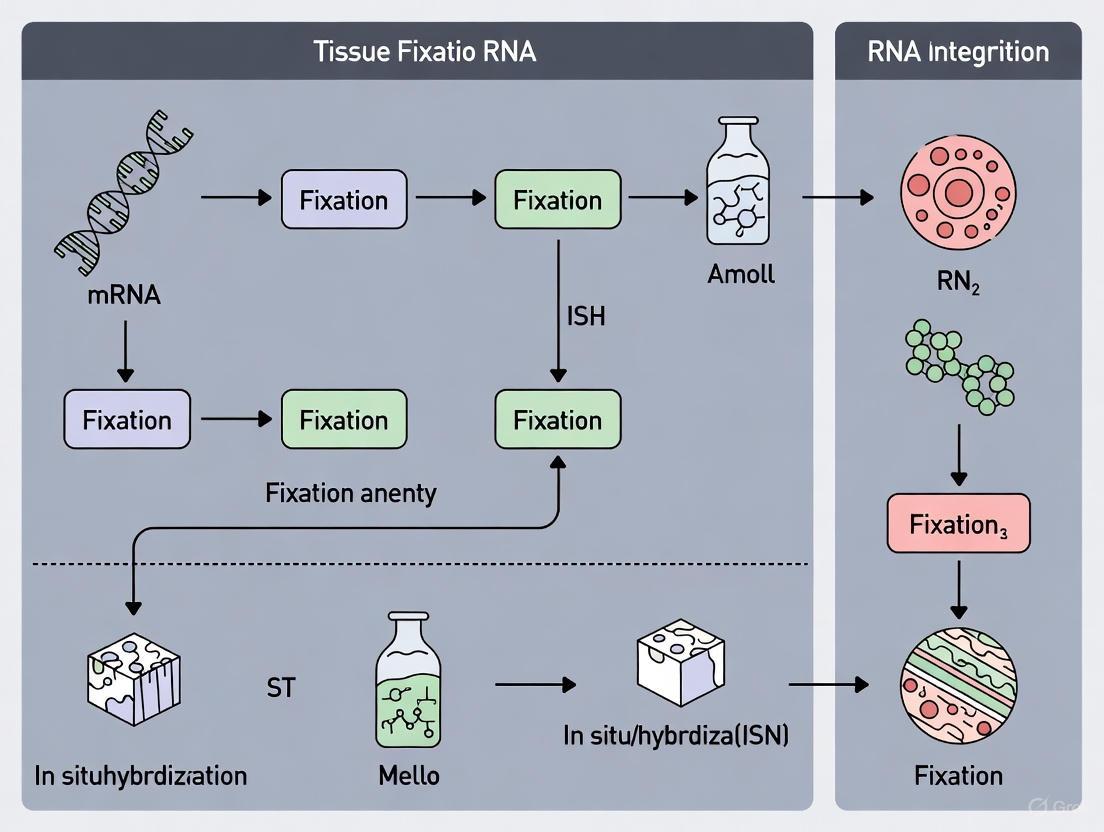
This article provides a comprehensive guide for researchers and drug development professionals on optimizing tissue fixation to preserve RNA integrity for in situ hybridization (ISH).
Preserving RNA Integrity: A Comprehensive Guide to Tissue Fixation for Reliable In Situ Hybridization
Abstract
This article provides a comprehensive guide for researchers and drug development professionals on optimizing tissue fixation to preserve RNA integrity for in situ hybridization (ISH). It covers the foundational principles of how different fixatives interact with RNA, details established and emerging fixation protocols for various applications, and offers practical troubleshooting strategies for common pitfalls. Furthermore, it explores the critical role of ISH in validating high-throughput transcriptomic data, such as from RNA-Seq and microarrays, ensuring accurate spatial localization of gene expression findings in clinical and research settings.
The Building Blocks: How Fixation Chemistry Governs RNA Preservation
The Critical Role of Fixation in Halting RNase Activity and RNA Degradation
In molecular histopathology, the preservation of RNA integrity is paramount for accurate analysis, particularly in techniques such as in situ hybridization (ISH). Fixation serves as the critical first step in this process, acting to halt cellular autolysis and neutralize endogenous RNase activity that would otherwise rapidly degrade labile RNA molecules. This technical guide explores the fundamental mechanisms by which different classes of fixatives stabilize RNA, provides comparative data on their performance, and offers detailed protocols for optimizing fixation conditions to ensure maximal RNA integrity for downstream ISH applications. The principles outlined herein form the foundational framework for a broader thesis on maintaining RNA integrity in tissue-based research.
RNA degradation in biological samples is primarily mediated by ribonucleases (RNases), ubiquitous enzymes that catalyze the cleavage of RNA phosphodiester bonds. These enzymes remain highly active under various conditions and can rapidly degrade cellular RNA once tissues are removed from their native physiological environment. Bacterial RNase J1, for instance, exemplifies this threat through its potent dual enzymatic activities—possessing both endo- and 5' to 3' exo-ribonuclease capabilities that enable it to initiate and complete RNA degradation efficiently [1].
The challenge is particularly acute in diagnostic and research settings where tissue samples must be preserved for subsequent RNA analysis. Without immediate and effective fixation, RNases quickly compromise RNA integrity, leading to:
- Loss of transcriptomic information
- Reduced signal-to-noise ratios in ISH
- Compromised quantification of gene expression
- Potential false-negative results in research and diagnostics
Thus, the primary objective of tissue fixation in an ISH context extends beyond morphological preservation to include the rapid inactivation of RNases and stabilization of RNA targets against degradation.
Chemical Foundations of Tissue Fixation
Fixation methods are broadly categorized into two principal mechanisms based on their interaction with biomolecules: precipitating fixatives and cross-linking fixatives [2]. Each class employs distinct chemistry to denature proteins (including RNases) and render biological structures insoluble.
Precipitating Fixatives
Precipitating fixatives work by removing water from the tissue environment, causing protein denaturation through dehydration and coagulation:
- Organic solvents (e.g., ethanol, methanol, acetone) reduce the dielectric constant, altering ionic interaction strengths and precipitating denatured macromolecules [2].
- Acid fixatives (e.g., acetic acid) lower pH, altering charge environments and leading to protein denaturation and coagulation [2].
- Mechanism: These fixatives disrupt hydrogen bonding and hydrophobic interactions, causing proteins to unfold and aggregate, thereby entrapping RNases in an inactive state.
Cross-linking Fixatives
Cross-linking fixatives create covalent bonds between biomolecules, forming a three-dimensional network that immobilizes cellular contents:
- Aldehydes (formaldehyde, glutaraldehyde) primarily react with amino groups on proteins to form carbonyl compounds, initiating insolubilization [2].
- Reaction progression: The initial reaction progresses to form stable methylene bridges (-CH₂-) between amino groups, creating a stable molecular network [3] [2].
- Effect on RNases: Covalent cross-linking physically restricts enzyme mobility and blocks active sites, effectively neutralizing catalytic function.
Table 1: Comparison of Common Fixative Types and Their Properties
| Fixative Type | Examples | Mechanism of Action | Effect on RNases | Impact on RNA |
|---|---|---|---|---|
| Cross-linking | Formaldehyde (NBF), Glutaraldehyde, PLP | Forms covalent methylene bridges between proteins | Immobilizes and denatures enzymes | Stabilizes but may modify bases [2] |
| Precipitating | Ethanol, Methanol, Acetone | Dehydration and protein coagulation | Entraps in denatured aggregates | Minimal chemical modification |
| Oxidizing | Osmium tetroxide | Coordinates with multiple molecules | Denatures through oxidation | Can degrade if over-exposed |
| Compound | Carnoy's, Methacarn, B-5 | Multiple mechanisms combined | Varies by composition | Varies by composition [3] |
Molecular Mechanisms of RNA Protection by Fixation
Formaldehyde Chemistry in Detail
Formaldehyde, the most common fixative in histopathology, exhibits complex chemistry that directly impacts RNA preservation:
- Reactive species: In aqueous solution, formaldehyde exists primarily as methylene glycol (H₂C(OH)₂), which penetrates tissues rapidly [3].
- Cross-linking formation: Formaldehyde initially forms methylol adducts with amino groups, which then condense to form methylene bridges between closely spaced nucleophiles [2].
- RNA interactions: Formaldehyde reacts with RNA bases, particularly adenine, guanine, and cytosine (but not thymine or uracil due to lack of exocyclic amino residues) [2].
- Kinetics: Cross-linking formation is promoted under low pH and high temperature conditions, which can accelerate the fixation process [2].
RNase Inactivation Mechanisms
The efficacy of fixation in halting RNase activity depends on multiple factors:
- Active site blockade: Cross-linking fixatives covalently modify critical amino acid residues in RNase active sites.
- Steric hindrance: The three-dimensional network created by cross-linking fixatives physically prevents RNases from accessing their RNA substrates.
- Protein denaturation: Precipitating fixatives unfold RNase tertiary structure, destroying catalytic capability.
The diagram below illustrates the molecular competition between RNA degradation by RNases and RNA preservation by fixation:
Molecular Protection Mechanism: This diagram illustrates the critical race between RNase-mediated degradation and fixative-mediated protection of RNA molecules in tissue samples.
Experimental Comparisons of Fixative Efficacy on RNA Preservation
Quantitative Analysis of RNA Quality Post-Fixation
Multiple studies have systematically evaluated how different fixation methods affect RNA quality and suitability for downstream analysis:
Table 2: RNA Quality Metrics Across Different Fixation and Processing Methods
| Fixation Method | RNA Integrity Number (RIN) | DV200 Value (%) | Suitability for ISH | Key Limitations |
|---|---|---|---|---|
| Neutral Buffered Formalin | Variable (4-7) [4] | 30-70% [4] | High with AR | Formalin-induced modifications [2] |
| PAXgene | Moderate-High (6-8) | 60-80% | Excellent | Specialized processing needed |
| HOPE | High (7-9) | 70-90% | Excellent | Complex protocol |
| Ethanol/Methanol | High (7-9) | 70-95% | Good | Tissue morphology challenges |
| Zinc-based Fixatives | Moderate-High (6-8) | 50-80% | Good | Less predictable penetration |
Impact of Fixation on Downstream RNA Analysis Methods
The choice of fixative significantly influences the performance of various RNA analysis platforms:
- RNA-Sequencing: Standard poly(A) capturing methods perform poorly with formalin-fixed RNA due to fragmentation, necessitating specialized approaches like SMART-Seq with random primers instead of oligo dT [5].
- qRT-PCR: Amplification of longer transcripts is compromised in cross-linked RNA, requiring amplification of shorter targets (<150 bp) for reliable quantification.
- Nanopore Sequencing: Direct RNA sequencing of native RNA avoids reverse transcription and amplification biases but requires high-quality RNA input [6].
Optimized Fixation Protocols for RNA Integrity
Standardized Formalin Fixation for RNA Preservation
For optimal RNA preservation in formalin-based fixation:
- Tissue Preparation:
- Dissect tissue into ≤0.5 cm thick sections
- Use RNase-free tools and containers
- Process immediately after collection
Fixation Conditions:
- Use fresh 10% Neutral Buffered Formalin (NBF)
- Maintain 4°C temperature during fixation
- Fix for precisely 18-24 hours [4]
- Use tissue volume to fixative ratio of 1:10
Post-fixation Processing:
- Transfer to 70% ethanol for storage
- Process through graded ethanols and xylene
- Embed in paraffin using minimal temperature exposure
Specialized Molecular Fixatives for Superior RNA Recovery
Molecular fixatives specifically designed for biomolecule preservation:
- HOPE Technique:
- Hepes-glutamic acid buffer-mediated Organic solvent Protection Effect
- Combined with acetone fixation [3]
- Preserves both morphology and RNA integrity
- UMFIX Protocol:
- Methanol-based with polyethylene glycol additive
- Requires rapid tissue processing systems [3]
The complete workflow for optimal RNA preservation during tissue processing is illustrated below:
RNA Preservation Workflow: This diagram outlines the critical steps and control points in tissue processing to maximize RNA integrity for downstream molecular applications including in situ hybridization.
The Scientist's Toolkit: Essential Reagents for RNA-Quality Fixation
Table 3: Research Reagent Solutions for RNA-Preserving Fixation
| Reagent/Fixative | Chemical Composition | Mechanism of Action | Application in ISH Research |
|---|---|---|---|
| Neutral Buffered Formalin (NBF) | 10% formaldehyde, phosphate buffer | Cross-linking via methylene bridges | Standard morphology with acceptable RNA; requires antigen retrieval [3] |
| PAXgene Tissue System | Proprietary mix of alcohols and organic compounds | Precipitation and minimal cross-linking | Superior RNA preservation with good morphology |
| HOPE Fixative | Hepes-glutamic acid buffer with acetone | Organic solvent protection effect | Excellent for protein and nucleic acid preservation [3] |
| UMFIX | Methanol, polyethylene glycol | Denaturation and dehydration | Compatible with rapid processing systems [3] |
| Zinc-Based Fixatives | Zinc salts, buffer | Unknown, possibly coordination complexes | Non-toxic, good for IHC and ISH [3] |
| RNA-later | High-salt ammonium sulfate solution | Dehydration and inhibition of RNases | Primarily for RNA preservation, limited morphology |
Effective fixation serves as the critical first line of defense against RNase-mediated RNA degradation in tissue samples destined for ISH research. The chemical mechanism of fixation—whether through cross-linking or precipitation—directly determines the extent of RNase inactivation and RNA accessibility for subsequent molecular analyses. As molecular pathology continues to evolve toward increasingly refined transcriptomic analyses, the implementation of fixation protocols specifically optimized for RNA preservation becomes ever more essential. By understanding the fundamental principles outlined in this technical guide and applying the optimized protocols provided, researchers can significantly enhance RNA integrity in fixed tissues, thereby ensuring the reliability and reproducibility of their ISH experiments within the broader context of tissue-based RNA research.
In the realm of histochemistry and molecular pathology, fixation is a critical foundational process that preserves biological architecture while directly influencing the analytical integrity of macromolecules. For research centered on RNA integrity, particularly within in situ hybridization (ISH) workflows, the choice between cross-linking and precipitating fixatives is paramount. Cross-linking agents, primarily aldehydes like formaldehyde, create extensive molecular bridges that stabilize tissue morphology but introduce significant RNA fragmentation and covalent modifications. In contrast, precipitating fixatives, such as alcohols, preserve RNA quality more effectively by dehydrating and precipitating cellular components without cross-linking, though they may compromise some structural details. This review delineates the chemical mechanisms of these fixative classes, evaluates their impact on RNA stability and ISH efficacy, and provides evidence-based protocols to guide researchers in selecting and optimizing fixation strategies for advanced molecular investigations.
Fixation serves as the cornerstone of reliable histopathological and molecular analysis, aiming to preserve cells and tissue components in a state that most closely resembles their living condition. The fundamental objective is to prevent autolysis and putrefaction, stabilize macromolecules, and harden tissues to withstand subsequent processing [ [7] [8] [9]. Within the specific context of investigating RNA for techniques such as in situ hybridization (ISH), fixation moves beyond simple preservation. It becomes a critical determinant of the success or failure of an experiment, directly influencing the extractability, integrity, and detectability of RNA molecules [ [2] [10]. The dynamic and often labile nature of RNA makes it exceptionally vulnerable to pre-analytical variables, with the fixation step being among the most consequential.
The dichotomy in fixation approaches lies between cross-linking and precipitating agents. Formalin, or neutral buffered formalin (NBF), has been the ubiquitous cross-linking fixative in pathology for over a century, prized for its superior morphological preservation [ [3] [7]. However, for molecular biologists, its propensity to fragment nucleic acids and introduce chemical modifications presents a significant hurdle [ [10] [11]. Conversely, precipitating fixatives like ethanol and methanol, while sometimes yielding less optimal cytological detail, are known to better preserve the quality of RNA and DNA [ [9] [12]. This creates a persistent tension between morphological fidelity and molecular integrity. This review dissects the mechanisms of these two fixative classes, quantifying their impact on RNA, and frames the discussion within the practical challenges of ISH research, thereby providing a rational framework for fixation selection in drug development and basic research.
Fundamental Mechanisms of Fixation
The chemical principles underlying cross-linking and precipitating fixatives are fundamentally distinct, leading to their divergent effects on cellular constituents, particularly RNA.
Cross-Linking Fixatives
Cross-linking fixatives, chiefly formaldehyde and glutaraldehyde, operate by creating covalent bonds between reactive side chains of biological molecules. Formaldehyde, a small, highly mobile molecule, primarily targets the side-chain amino groups of lysine, as well as the rings of histidine, tyrosine, and arginine, forming initial methylene glycol adducts that subsequently evolve into stable methylene bridges (-CH2-) [ [3] [2]. This process generates a three-dimensional network of interconnected proteins, and to a lesser extent, nucleic acids and lipids.
While this network excellently preserves cellular ultrastructure and traps molecules in situ, it has deleterious consequences for RNA. Formaldehyde reacts with the exocyclic amino groups of adenine, guanine, and cytosine in RNA [ [2]. Furthermore, it induces protein-RNA cross-links, effectively encapsulating RNA within a protein cage. This not only complicates RNA extraction but also masks target sequences, hindering probe hybridization in ISH. Glutaraldehyde, with two reactive aldehyde groups, is an even more efficient cross-linker than formaldehyde, creating shorter and more rigid bridges that are exceptionally detrimental to molecular analyses, limiting its use primarily to electron microscopy [ [7] [9].
Precipitating Fixatives
Precipitating fixatives, including ethanol, methanol, and acetone, function through dehydration and the disruption of hydrophobic interactions. By removing water molecules from the cellular environment, these alcohols and ketones destabilize the tertiary structure of proteins. This exposes hydrophobic regions, causing proteins to unfold and precipitate out of solution in a random, coagulated mass [ [7] [3]. This process also extracts lipids from membranes, permeabilizing the cell.
Crucially, precipitating fixatives are non-additive; they do not form covalent bonds with cellular macromolecules. RNA is therefore precipitated and co-agulated alongside proteins but is not chemically modified or covalently cross-linked. This absence of chemical alteration is the principal reason why RNA extracted from alcohol-fixed tissues is of higher quality, with longer fragment lengths, compared to formalin-fixed counterparts [ [10] [12]. The mechanism is succinctly illustrated in the following diagram, which contrasts the two processes.
Comparative Impact on RNA Integrity and Analysis
The choice of fixative has profound and quantifiable consequences for RNA, which directly impacts the efficacy of downstream analyses like ISH, RT-PCR, and transcriptome-wide profiling.
RNA Degradation and Quality Metrics
Formalin fixation inflicts damage on RNA through multiple mechanisms: * strand breakage, *base modification (e.g., conversion of adenine to N6-methyladenine), and cross-linking to proteins [ [13] [11]. This results in severe RNA fragmentation. Studies show that while amplification of short amplicons (<200-400 bp) from FFPE-RNA is sometimes possible, longer fragments are universally lost. The degradation is time-dependent, with a major reduction in extractable RNA occurring within the first day of formalin fixation, after which the quality remains stably poor [ [11]. In contrast, alcohol-based fixatives like PAXgene and UMFIX demonstrate a remarkable ability to preserve high molecular weight RNA. Electropherograms of RNA from UMFIX-fixed tissues show distinct 18S and 28S ribosomal bands comparable to fresh-frozen controls, whereas these bands are absent in formalin-fixed samples [ [10].
Table 1: Quantitative Comparison of RNA from Different Fixation Methods
| Fixative Type | Example | RNA Integrity Number (RIN) | Amplicon Size Limit (RT-PCR) | Suitability for Microarrays |
|---|---|---|---|---|
| Cross-linking | NBF (24-72 hr) | 3.0 - 4.0 [13] | < 400 bp [11] [10] | Poor, high background noise |
| Precipitating | PAXgene (UMFIX) | 5.0 - 8.0+ [12] [10] | > 2000 bp [10] | Good, high correlation with fresh tissue |
| Reference Standard | Fresh Frozen | 8.0 - 10.0 | > 5000 bp | Excellent |
Consequences for In Situ Hybridization (ISH)
The integrity and accessibility of RNA targets are critical for successful ISH. Formaldehyde fixation presents a dual challenge for ISH: the target RNA is often fragmented, limiting probe design to short sequences, and it is physically trapped by protein cross-links, reducing its accessibility to probes [ [2]. This often necessitates the use of antigen retrieval or proteolytic digestion steps to break cross-links and unmask epitopes, which can itself further degrade the already-fragile RNA [ [2]. Furthermore, formaldehyde reacts variably with purines and pyrimidines, which can alter the kinetics and efficiency of probe hybridization [ [2].
Precipitating fixatives, by avoiding cross-links, leave RNA more accessible. This simplifies ISH protocols and can improve signal intensity. However, a critical technical consideration is that alcohol fixation alone can sometimes lead to poor morphological preservation or loss of cellular RNA during subsequent washing steps. To counter this, sequential fixation protocols have been developed. For example, a protocol for combined fluorescence ISH and immunocytochemistry on neurons uses an initial fixation with 4% paraformaldehyde to stabilize structure, followed by a post-fixation with cold methanol to permeabilize cells and improve probe accessibility without heavy cross-linking [ [14]. This hybrid approach underscores the practical compromises often required.
Experimental Protocols and Practical Considerations
Translating the theoretical understanding of fixatives into robust, reproducible laboratory practice requires careful attention to protocol details.
Protocol: RNA Analysis from Formalin-Fixed Paraffin-Embedded (FFPE) Tissue
The following protocol is adapted from studies investigating RNA in long-term formalin-fixed tissues [ [11].
- Dewaxing and Rehydration: Cut 2-4 sections of 10μm thickness from the FFPE block. Deparaffinize by incubation in AutoDewaxer or xylene (15 min, 95°C with shaking), followed by centrifugation. Rinse thoroughly with 100% ethanol.
- Formalin Wash: A crucial step to remove residual formalin and its byproducts. Wash the tissue pellet in 1 mL of a high-salt buffer (e.g., 5x TAE buffer) for 30 minutes to 24 hours. TAE has been shown to yield twice the RNA amount compared to ethanol washes.
- RNA Extraction and Digestion: Resuspend the tissue in a denaturing guanidine isothiocyanate-based buffer (e.g., 4 M guanidine isothiocyanate, 25 mM β-mercaptoethanol) and grind thoroughly. Incubate for 72 hours at 65°C with mild shaking. The extended, heated digestion is critical for reversing formaldehyde-induced cross-links.
- Purification: Extract RNA using acid phenol-chloroform (pH 4). Precipitate the aqueous phase with 100% ethanol. Wash the pellet with 75% ethanol and resuspend in RNase-free water.
- Quality Control: Assess RNA concentration by spectrophotometry (e.g., NanoDrop). Evaluate RNA integrity using an Agilent 2100 Bioanalyzer. Expect a low RIN (e.g., 3.0-4.0) and a fragmented profile. Target short amplicons (100-250 bp) for subsequent RT-qPCR.
Protocol: RNA Analysis from Alcohol-Fixed Tissue (UMFIX/PAXgene)
This protocol is based on the evaluation of universal molecular fixatives that preserve RNA effectively [ [10] [12].
- Immediate Fixation: Immediately upon collection, immerse thin (3-4 mm) tissue slices in a sufficient volume of UMFIX (a methanol-polyethylene glycol-based fixative) or PAXgene at room temperature. Fixation time can range from 1 hour to several weeks without significant RNA degradation.
- Rapid Tissue Processing (RTP): Process the fixed tissue using a defined, shortened automated processing cycle or manual processing. A key requirement is to process the tissue in a formalin-free processor or a flushed system to avoid formalin contamination, which catastrophically reduces RNA yield and integrity [ [12]. A typical RTP cycle is 6.5 to 11.5 hours.
- RNA Extraction from PFPE Blocks: Section the paraffin-embedded (PFPE) block. Use dedicated kits designed for proteinase K-based digestion of paraffin-embedded tissues (e.g., PAXgene Tissue RNA kit). Standard FFPE RNA kits can also be used but may be less optimized for the higher-quality RNA.
- Quality Control: Quantify RNA via spectrophotometry. Analyze integrity with a Bioanalyzer. Expect a RIN of 5.0 or higher, with visible ribosomal peaks. This RNA is suitable for long-range RT-PCR (amplicons >2000 bp) and expression microarrays.
Table 2: The Scientist's Toolkit: Essential Reagents for Fixation & RNA Analysis
| Reagent/Fixative | Composition | Primary Function | Key Consideration for RNA |
|---|---|---|---|
| Neutral Buffered Formalin (NBF) | ~4% Formaldehyde, Phosphate Buffer | Cross-linking fixation; gold standard for morphology | Causes fragmentation; requires cross-link reversal |
| UMFIX | Methanol, Polyethylene Glycol | Precipitating fixation; preserves macromolecules | Enables high-quality RNA from paraffin blocks |
| PAXgene Tissue Fixative | Proprietary non-crosslinking solution | Precipitating fixation; balanced morphology & molecular integrity | Yields RNA intermediate in quality between FFPE and fresh-frozen |
| RNAlater | High-sulfate salt solution | RNA stabilization at ambient temperature | Not a fixative; used to stabilize RNA prior to freezing/fixation |
| Guanidine Isothiocyanate Buffer | 4 M Guanidine Isothiocyanate, β-mercaptoethanol | Lysis, RNase inhibition, and reversal of cross-links | Critical for efficient RNA extraction from FFPE tissues |
| Quantichrom Formaldehyde Assay Kit | Enzymatic Assay Reagents | Quantifies formaldehyde concentration | Essential for monitoring formalin contamination in processors |
The divergence in the mechanisms of action between cross-linking and precipitating fixatives establishes a fundamental trade-off in biomedical research: the unparalleled morphological preservation offered by formalin comes at the cost of significant and often irreparable damage to RNA. For disciplines increasingly reliant on high-quality RNA, such as transcriptomics and spatial biology, this compromise is often untenable. Precipitating fixatives like UMFIX and PAXgene present a compelling alternative, demonstrating that it is feasible to preserve histomorphology adequate for pathological assessment while simultaneously protecting RNA integrity to a degree that enables sophisticated molecular analyses like whole transcriptome microarrays and amplification of long RNA fragments [ [10].
The future of tissue fixation in RNA-focused research, including ISH, lies in standardization and informed selection. Researchers must move beyond the reflexive use of formalin and instead align their fixation strategy with their primary analytical endpoint. For projects where RNA integrity is paramount, the adoption of standardized, alcohol-based fixation protocols is strongly indicated. Furthermore, the insidious issue of formalin contamination in tissue processors, which can undermine the benefits of alcohol fixation, must be systematically addressed through dedicated instrumentation or rigorous flushing protocols [ [12]. As molecular diagnostics and personalized medicine continue to evolve, the fixation process must be recognized not as a mere preparatory step, but as a critical variable that dictates the quality and validity of all downstream data.
Formalin (aqueous formaldehyde) fixation fundamentally underpins modern histopathology and molecular research by preserving tissue architecture through covalent cross-linking. This process stabilizes biomolecules in situ but creates a significant biochemical paradox: while protecting nucleic acids from degradation, the resulting methylene bridges simultaneously render them inaccessible for molecular analyses like RNA in situ hybridization (ISH). The core challenge lies in the formalin-induced formation of protein-protein, protein-DNA, and protein-RNA cross-links, which physically block enzyme access and primer annealing. This technical review dissects the chemistry of formalin cross-linking, quantitatively analyzes its impact on nucleic acid accessibility, and presents validated experimental strategies to reverse these effects while preserving RNA integrity for ISH research. By integrating recent advances in cross-link reversal with optimized fixation protocols, researchers can unlock the vast molecular potential of archived biospecimens for high-resolution gene expression studies.
Formaldehyde, the active component of formalin, serves as a fundamental tool in biological research due to its unique ability to penetrate cells rapidly and preserve structural context through covalent stabilization. As the smallest aldehyde, formaldehyde is highly electrophilic and readily reacts with nucleophilic functional groups prevalent in biological systems, including amino, imino, and sulfhydryl groups present on proteins and nucleic acids [15]. This reaction cascade begins with the formation of a methylol adduct (-N-CH2OH) when formaldehyde attacks a primary amine, which can then dehydrate to form a reactive Schiff base. This intermediate subsequently reacts with a second nearby nucleophile, creating a stable methylene bridge (-N-CH2-N-) that covalently links the two biomolecules [15] [2].
The cross-linking process occurs through a two-step mechanism (Figure 1), with the initial methylol adduct formation being relatively rapid and potentially reversible, while the subsequent methylene bridge formation creates stable, irreversible linkages under standard fixation conditions [15]. This cross-linking network stabilizes the three-dimensional architecture of tissues and cellular components, effectively "freezing" biological structures in their native state. However, this stabilization comes at the cost of modified biomolecular accessibility, as the covalent network can physically block enzyme binding sites, mask epitopes, and inhibit molecular interactions essential for downstream analyses.
Figure 1. Chemical mechanism of formalin cross-linking. Formaldehyde initially reacts with nucleophilic groups (primarily on proteins) to form methylol adducts, which then create stable methylene bridges with nearby DNA or RNA, resulting in covalently cross-linked complexes.
For RNA-focused research, particularly ISH, the implications are profound. The preservation of tissue morphology is essential for accurate spatial localization of gene expression, but the cross-links that enable this preservation simultaneously create significant analytical challenges. The formalin-induced modifications and cross-links can block probe hybridization in ISH applications and inhibit reverse transcription and PCR amplification, ultimately reducing detection sensitivity and quantitative accuracy [16]. Understanding this delicate balance between morphological preservation and molecular accessibility is fundamental to optimizing fixation protocols for RNA integrity in ISH research.
Molecular Mechanisms of Cross-linking and Nucleic Acid Accessibility
Protein-Nucleic Acid Cross-linking
The formation of stable DNA-protein crosslinks (DPCs) and RNA-protein complexes represents the primary mechanism through which formalin compromises nucleic acid accessibility. Formaldehyde readily reacts with the amino groups of DNA bases (primarily adenine, guanine, and cytosine) and the side chains of protein residues including lysine, arginine, cysteine, and tryptophan [15] [17]. This reaction creates a dense network of covalent linkages that physically tether nucleic acids to surrounding nuclear and cytoplasmic proteins.
The accessibility of DNA to formalin modification depends critically on local chromatin organization. DNA within open, transcriptionally active chromatin regions is more susceptible to formaldehyde attack due to reduced protein shielding and increased dynamic "breathing" that exposes reactive sites [15]. Recent genome-wide mapping studies have demonstrated that formaldehyde-induced DPCs are non-randomly distributed across the genome, with enrichment in open chromatin regions characterized by histone acetylation and active transcription marks [18]. This preferential formation in accessible chromatin creates an analytical bias that must be considered when interpreting ISH results from formalin-fixed samples.
For RNA, the situation is further complicated by its single-stranded nature and diverse structural conformations. Formaldehyde reacts with the exocyclic amino groups of RNA bases (adenine, guanine, and cytosine), forming methylol derivatives that can subsequently cross-link to proximal proteins [16]. These modifications disrupt the normal base-pairing interactions essential for probe hybridization in ISH and prevent efficient cDNA synthesis during reverse transcription. The extent of RNA modification depends on multiple factors, including fixation duration, formalin concentration, and the structural context of the RNA within ribonucleoprotein complexes.
Cross-linking Density and Structural Consequences
The density of the cross-linking network directly determines the degree of nucleic acid sequestration. Under standard fixation conditions (3.7% formalin for 24-48 hours), the resulting meshwork of covalent linkages creates a molecular cage that traps RNA within the fixed tissue matrix. This physical entrapment, combined with the chemical modification of RNA bases, significantly reduces the efficiency of molecular detection techniques [19].
The extent of cross-linking follows a time- and concentration-dependent relationship, with longer fixation times and higher formalin concentrations producing more extensive and potentially irreversible cross-linking [2]. This presents a particular challenge for museum specimens and clinical archives, where prolonged formalin exposure was common practice. In these samples, the cumulative cross-linking density can be so extensive that standard molecular retrieval methods fail, necessitating specialized reversal protocols to recover analyzable nucleic acids [19].
The spatial organization of cross-linking also creates differential accessibility across tissue types and cellular compartments. Regions with high protein content and dense macromolecular packing typically exhibit more extensive cross-linking, creating barriers to probe penetration in ISH applications. This heterogeneity can result in inconsistent staining and variable signal intensity, complicating quantitative comparisons between tissue regions or experimental conditions.
Table 1: Formalin Reactivity with Biological Molecules
| Target Molecule | Reactive Sites | Primary Products | Impact on Accessibility |
|---|---|---|---|
| Proteins | Lysine, arginine, cysteine, tryptophan side chains | Methylol adducts, methylene bridges | Creates structural scaffold for cross-linking |
| DNA | Exocyclic amino groups of adenine, guanine, cytosine | Hydroxymethyl derivatives, protein cross-links | Inhibits enzyme binding, blocks polymerase progression |
| RNA | Exocyclic amino groups of bases, ribose hydroxyls | Methylol adducts, protein cross-links | Reduces probe hybridization efficiency in ISH |
| Chromatin | Histone-DNA interfaces, nucleosome surfaces | DNA-protein and protein-protein cross-links | Creates differential accessibility based on chromatin state |
Quantitative Effects on Molecular Assays
Impact on RNA Detection and ISH
The efficiency of RNA detection in formalin-fixed tissues is quantitatively compromised by cross-linking through multiple mechanisms. Experimental data demonstrates that standard formalin fixation reduces RNA recovery yields by approximately 78% compared to matched fresh-frozen samples, with concomitant degradation of RNA quality as measured by RNA integrity number (RIN) from 9.3 (fresh) to 1.4 (fixed) [16]. This dramatic reduction in both quantity and quality directly translates to diminished sensitivity in ISH applications.
The cross-linking density directly influences probe penetration and hybridization efficiency in ISH. Studies systematically varying formaldehyde concentration and cross-linking temperature have demonstrated that intense cross-linking conditions (2% formaldehyde at 37°C) preferentially capture short-range molecular interactions but simultaneously create a denser network that restricts macromolecular access [20]. This creates an optimization challenge where sufficient cross-linking is necessary to preserve morphological structure, but excessive cross-linking inhibits the analytical detection of the preserved targets.
The chemical modifications of RNA bases during formalin fixation further compound these accessibility issues. The formation of methylol adducts on adenine, guanine, and cytosine residues disrupts the hydrogen bonding patterns essential for specific probe hybridization in ISH [16]. This results in both reduced signal intensity due to fewer successful hybridization events and potential increases in non-specific background from imperfect probe matching. The cumulative effect is a significant reduction in the signal-to-noise ratio that can obscure authentic expression patterns, particularly for low-abundance transcripts.
Method-Specific Sensitivity Reductions
Different molecular assays exhibit variable sensitivity to formalin-induced cross-linking, based on their specific technical requirements and procedural steps (Table 2). Understanding these method-specific vulnerabilities is essential for selecting appropriate analytical approaches and correctly interpreting results from formalin-fixed materials.
Table 2: Assay-Specific Impacts of Formalin Cross-linking
| Assay Type | Critical Steps Compromised | Primary Effects | Typical Sensitivity Reduction |
|---|---|---|---|
| RNA ISH | Probe penetration, hybridization | Reduced signal intensity, increased background | 50-80% for mRNA targets |
| qRT-PCR | Reverse transcription, primer annealing | Reduced amplification efficiency, cycle threshold shifts | 10-1000 fold depending on target length |
| RNA Sequencing | RNA fragmentation, adapter ligation | 3' bias, reduced library complexity | 60-90% loss of transcript detection |
| Chromatin Accessibility | Enzyme cleavage, fragment separation | Underrepresentation of open chromatin | 2-5 fold enrichment reduction |
For ISH specifically, the spatial context preservation comes at the cost of significant technical challenges. The cross-linked matrix impedes probe diffusion throughout the tissue section, resulting in heterogeneous staining and under-detection of targets, particularly in dense tissue regions. Furthermore, the chemical modifications to RNA bases reduce the thermodynamic stability of probe-target duplexes, necessitating optimization of hybridization stringency and potentially requiring specialized probe design strategies to maintain detection specificity.
Experimental Protocols for Cross-link Reversal and Analysis
Cross-link Reversal for RNA Recovery
Recent methodological advances have developed effective strategies to reverse formalin-induced cross-links while preserving RNA integrity for downstream analyses. A representative high-efficiency protocol for RNA recovery from formalin-fixed tissues involves several critical steps [16]:
Tissue Permeabilization: Incubate fixed tissue sections with proteinase K (100 µg/mL) in a suitable buffer (e.g., TE buffer, pH 8.0) at 55°C for 2 hours. This enzymatic digestion partially disrupts the protein matrix, enhancing access to reversal agents.
Heat-Mediated Cross-link Reversal: Immerse samples in phosphate-buffered saline (PBS) and incubate at 70°C for 1 hour. The combination of elevated temperature and ionic solution promotes the reversal of methylene bridges without causing excessive RNA fragmentation.
RNA Extraction: Purify RNA using acid phenol:chloroform extraction followed by ethanol precipitation in the presence of sodium acetate and glycogen carrier. This approach maximizes recovery of the fragmented RNA typical of fixed specimens.
This optimized protocol demonstrates significant improvements over standard methods, increasing RNA recovery rates from 16% to 62% as measured by Qubit fluorometry and improving RNA quality metrics (DV200 values increase from 26% to 83%) [16]. The recovered RNA is suitable for various downstream applications, including whole-transcriptome sequencing and targeted ISH analyses.
Alternative Fixation Strategies
For new experiments where fixation conditions can be controlled, several alternative strategies can better balance morphological preservation with nucleic acid accessibility:
The NAFA Protocol: The Nitric Acid/Formic Acid (NAFA) fixation method represents a significant advancement for delicate tissues destined for ISH analysis [21]. This approach eliminates the need for proteinase K digestion, thereby preserving antigen epitopes for simultaneous protein and RNA detection while maintaining excellent tissue morphology. The protocol involves:
- Fixation in a solution containing nitric acid (0.5%) and formic acid (2%) for 2 hours at room temperature
- Post-fixation washes with phosphate-buffered saline containing EGTA (5 mM) to chelate calcium and inhibit nucleases
- Direct processing for ISH without proteinase K treatment, preserving delicate tissue structures
The NAFA protocol demonstrates particular utility for fragile structures like planarian epidermis and regeneration blastemas, where conventional formalin-based methods cause significant tissue damage [21]. This method maintains RNA integrity while enabling robust ISH signal development, making it especially valuable for studying delicate tissues and whole-mount specimens.
Controlled Formalin Fixation: When formalin fixation is necessary, precisely controlling exposure parameters can optimize the trade-off between preservation and accessibility:
- Limit formalin concentration to 1-2% instead of standard 3.7%
- Reduce fixation time to 4-24 hours instead of extended periods
- Use neutral buffered formalin (pH 7.0-7.4) to minimize acid-catalyzed degradation
- Incorporate post-fixation washes with glycine (0.1 M) to quench unreacted formaldehyde
These modifications reduce cross-linking density while maintaining adequate morphological preservation, resulting in improved nucleic acid accessibility for subsequent molecular analyses.
Figure 2. Workflow for RNA recovery from formalin-fixed tissues. The process involves sequential enzymatic digestion, heat-mediated reversal of cross-links, and specialized RNA extraction to obtain material suitable for various molecular applications.
The Scientist's Toolkit: Essential Reagents and Methods
Table 3: Key Research Reagents for Cross-linking Studies
| Reagent/Method | Function | Application Notes |
|---|---|---|
| Paraformaldehyde (PFA) | Cross-linking fixative | Use freshly prepared; concentration (1-4%) and pH (7.0-7.4) critical |
| Proteinase K | Proteolytic enzyme for permeabilization | Concentration (10-100 µg/mL) and time must be optimized for tissue type |
| Glycine | Formaldehyde quencher | Terminates cross-linking reaction (0.1-0.2 M) |
| Heat Treatment | Cross-link reversal | 70°C in PBS effective for RNA recovery |
| Acid Phenol:Chloroform | RNA extraction | Effectively separates RNA from cross-linked proteins |
| EGTA | Calcium chelator | Preserves RNA integrity during fixation (5 mM) |
| Formic Acid | Tissue permeabilization | Component of NAFA protocol (2%) for ISH compatibility |
| Nitric Acid | Tissue fixative | Component of NAFA protocol (0.5%) for structural preservation |
The relationship between formalin chemistry and nucleic acid accessibility represents a fundamental consideration for RNA ISH research. The very cross-links that preserve tissue structure simultaneously create significant barriers to molecular detection through physical sequestration and chemical modification of RNA targets. The recent methodological advances detailed herein—including optimized cross-link reversal protocols, alternative fixation strategies like NAFA, and controlled formalin exposure parameters—provide powerful tools to overcome these challenges. By strategically implementing these approaches, researchers can successfully navigate the compromise between morphological preservation and molecular accessibility, unlocking the full potential of formalin-fixed tissues for high-resolution spatial transcriptomics and gene expression analysis.
Tissue fixation is a critical first step in molecular pathology that preserves cellular architecture and biomolecules for downstream analysis. For research and diagnostics relying on RNA integrity in ISH research, such as RNA in situ hybridization (RNA-ISH) and spatial transcriptomics, the choice of fixation parameters directly determines the success of gene expression visualization. Formalin-fixed, paraffin-embedded (FFPE) tissue remains the most widely used archival method in pathology, but its cross-linking chemistry can severely compromise RNA quality if not properly controlled. This guide details the essential parameters of time, temperature, and tissue thickness to maximize RNA preservation for sensitive RNA-ISH applications, providing a standardized framework for researchers and drug development professionals pursuing spatially resolved gene expression analysis.
Fundamental Principles of Tissue Fixation for RNA Preservation
The primary goal of fixation for RNA studies is to rapidly inactivate endogenous RNases while preserving tissue morphology and RNA accessibility. Formalin fixation creates methylene bridges between proteins, effectively trapping cellular contents but potentially masking RNA targets and introducing fragmentation through cross-linking. Unlike protein-focused immunohistochemistry, RNA-specific applications demand stricter control over pre-analytical variables as RNA is inherently less stable.
The cold ischemia time—the period between tissue excision and immersion in fixative—should not exceed one hour to prevent significant RNA degradation by endogenous nucleases. Furthermore, the fixative penetration rate dictates that tissue specimens must be trimmed to appropriate dimensions before fixation begins, as inadequate penetration results in a gradient of preservation from the surface to the core of the specimen. For the most demanding RNA-fluorescence in situ hybridization (RNA-FISH) applications, alternative fixatives like BE70 (a phosphate-buffered solution containing 70% ethanol, glycerol, and glacial acetic acid) may provide superior RNA integrity while maintaining adequate morphology, as they operate through coagulation rather than cross-linking and do not cause over-fixation.
Optimal Fixation Parameters
Based on current literature and practical experience, the following parameters represent optimal conditions for preserving RNA integrity in tissues destined for ISH applications.
Table 1: Optimal Fixation Parameters for RNA Integrity
| Parameter | Optimal Specification | Practical Considerations |
|---|---|---|
| Tissue Thickness | 2-3 mm [22] | Thinner sections facilitate uniform fixative penetration. Tissue must fit in cassette without compression. |
| Fixation Time | 6-72 hours (room temperature) [22] | Minimum 6 hours for small biopsies; up to 24-72 hours for larger specimens. Avoid excessive fixation. |
| Fixation Temperature | Room temperature | Cold temperatures slow fixation; elevated temperatures may accelerate degradation. |
| Fixative Volume Ratio | 1:20 (tissue to fixative) [22] | Ensures adequate fixative volume for complete penetration and prevents dilution by tissue fluids. |
| Primary Fixative | 10% Neutral Buffered Formalin (NBF) [22] | Maintains physiological pH to prevent RNA hydrolysis. |
For specialized applications requiring highest RNA integrity, BE70 fixative provides an alternative that greatly reduces formalin-induced artifacts and retains RNA quality for single-molecule RNA-FISH, producing high-resolution, diffraction-limited confocal images of even rare RNA transcripts in tissues [23]. BE70 fixation does not produce over-fixation, allowing samples to remain in fixative for extended periods (24 hours to 6 months) without compromising RNA integrity or cell morphology [23].
Experimental Evidence: Impact of Fixation on RNA Quality
Systematic Assessment of RNA Degradation in Archived Tissues
A 2025 systematic study investigating RNA degradation in breast cancer samples provides crucial experimental evidence for fixation effects on RNA-FISH signals. The research performed RNAscope multiplex fluorescent assays with four house-keeping gene (HKG) probes on 62 archived breast cancer samples (30 FFPETs and 32 FFTs). Results demonstrated that:
- RNA degradation in FFPETs occurred in an archival duration-dependent fashion, with significantly lower signal counts compared to fresh frozen tissues (FFT) [24]
- High-expression genes (UBC and PPIB) showed more pronounced degradation than low-to-moderate expressors (POLR2A and HPRT1) with high statistical significance (p<0.0001) [24]
- PPIB, despite having the highest initial signal, demonstrated the most severe degradation in both adjusted transcript and H-score quantification methods (R² = 0.35 and R² = 0.33, respectively) [24]
This study underscores that although RNAscope probes are designed to detect fragmented RNA, performing sample quality checks using HKGs before ISH experiments is strongly recommended to ensure accurate results [24].
Alternative Protocol for Delicate Tissues
Recent methodological advances have led to the development of the Nitric Acid/Formic Acid (NAFA) protocol, specifically designed to preserve RNA integrity in delicate tissues while allowing optimal probe penetration for ISH. This protocol:
- Eliminates proteinase K digestion, thereby better preserving antigen epitopes for combined ISH and immunostaining [21]
- Preserves fragile epidermal structures and regeneration blastema in planarian tissues, which are typically damaged by conventional mucolytic treatments [21]
- Maintains compatibility with fluorescent ISH while enabling brighter immunostaining signals compared to traditional protocols [21]
- Has been successfully adapted for regenerating teleost fins, suggesting broad applicability across multiple species [21]
Table 2: Key Research Reagent Solutions for RNA-Preserving Fixation
| Reagent/Fixative | Composition | Primary Function | Application Notes |
|---|---|---|---|
| 10% NBF [22] | 4% formaldehyde in neutral phosphate buffer | Protein cross-linking, morphology preservation | Gold standard for general pathology; requires strict parameter control for RNA work |
| BE70 Fixative [23] | 70% ethanol, glycerol, glacial acetic acid in PBS | Coagulative fixation, RNA integrity preservation | Superior for single-molecule RNA-FISH; no over-fixation concerns |
| NAFA Fixative [21] | Nitric acid, formic acid, EGTA | Tissue permeabilization, nuclease inhibition | Ideal for delicate tissues; compatible with FISH and immunostaining |
| DEPC-Treated Water [23] | Diethyl pyrocarbonate treated water | RNase inactivation for solution preparation | Essential for all RNA workstations and buffer preparation |
Comprehensive Workflow for RNA-Quality Tissue Processing
The diagram below illustrates the complete workflow from tissue acquisition to paraffin embedding, highlighting critical steps for preserving RNA integrity:
Quality Assessment and Troubleshooting
RNA Integrity Assessment Methods
Following proper fixation, verifying RNA quality is essential before proceeding with ISH experiments:
- RNA Integrity Number (RIN): Algorithmically generated score from 1 (degraded) to 10 (intact) based on capillary electrophoresis [25] [26]. While widely used, RIN may not reliably predict mRNA integrity in all tissue types, particularly post-mortem brain samples [25]
- Spectrophotometry: Assesses RNA purity through A260/A280 ratio (ideal ~2.0) and A260/A230 ratio (ideal >1.8) to detect protein or chemical contamination [26]
- Fluorometry: Provides higher sensitivity and specificity for RNA quantification, especially valuable for low-concentration samples [26]
Common Fixation Problems and Solutions
- Under-fixation: Results in poor morphology and RNA degradation; ensure adequate fixation time and proper tissue sizing
- Over-fixation: Causes excessive cross-linking, reducing probe accessibility in ISH; adhere to recommended maximum fixation times
- Incomplete penetration: Creates preservation gradients; always trim tissues to 2-3mm thickness before fixation
- RNase contamination: Maintain RNase-free workstation using dedicated reagents and DEPC-treated water [23]
Optimal tissue fixation for RNA integrity in ISH research requires meticulous control over time, temperature, and tissue thickness parameters. Standardized fixation in 10% NBF for 6-72 hours with tissue specimens trimmed to 2-3mm thickness provides the foundation for reliable RNA preservation. For the most demanding applications, alternative fixatives like BE70 or specialized protocols like NAFA may offer superior performance. By implementing these evidence-based guidelines and incorporating rigorous quality control assessment, researchers can ensure maximum RNA integrity for advanced in situ hybridization techniques, ultimately enhancing the reliability of spatial gene expression data in both research and drug development contexts.
For research requiring the simultaneous analysis of tissue morphology and RNA integrity, particularly for sensitive techniques like in situ hybridization (ISH), the choice of fixative is a critical determinant of success. While neutral buffered formalin (NBF) is a histological standard, its cross-linking mechanism severely compromises RNA quality. This whitepaper evaluates three alcohol-based fixatives—Methacarn, Ethanol, and Carnoy's solution—as superior alternatives for preserving RNA in a context relevant to ISH research. Evidence synthesized from current scientific literature indicates that these precipitating fixatives provide an optimal balance of excellent tissue architecture and high-quality RNA, making them indispensable tools for modern drug development and molecular pathology.
In biomedical research, the fixation process is the foundational step that stabilizes biological specimens for microscopic and molecular analysis. The fundamental goal of fixation is to arrest autolysis and putrefaction, thereby preserving tissue in a state that closely mimics its living condition [2]. The mechanism by which a fixative achieves this has profound implications for downstream applications. Fixatives are broadly categorized into cross-linking agents (e.g., formalin, paraformaldehyde) and precipitating (or coagulating) agents (e.g., alcohols, acetone) [2] [9].
Cross-linking fixatives like formalin create methylene bridges between proteins, which excellently preserve morphology but inevitably mask epitopes and, most critically, fragment and modify nucleic acids [2]. This degradation poses a significant challenge for techniques such as ISH, which relies on the integrity of RNA sequences for hybridization with labeled probes [27]. In contrast, precipitating fixatives such as methanol and ethanol work by dehydrating tissues and precipitating macromolecules, a process that largely avoids the damage to RNA integrity associated with cross-linking [28] [9]. For researchers investigating gene expression patterns within a spatial context, selecting a fixative that robustly preserves RNA is therefore not merely a technical detail but a prerequisite for obtaining valid, high-quality data.
Comparative Analysis of Alcohol-Based Fixatives
Quantitative and qualitative studies consistently demonstrate that alcohol-based fixatives outperform formalin for RNA preservation. The following analysis summarizes the performance of Methacarn, Ethanol, and Carnoy's solution across key parameters.
Table 1: Comprehensive Comparison of Alcohol-Based Fixatives for RNA Research
| Fixative | Mechanism & Composition | Tissue Morphology | RNA Integrity & Yield | Key Advantages | Key Limitations |
|---|---|---|---|---|---|
| Methacarn | Precipitating; Methanol-Chloroform-Acetic Acid | Excellent | Excellent; yields sufficient for RT-PCR of long mRNA sequences [29] [30]. | Considered a fixative of choice when both morphology and RNA integrity are prioritized [30]. Provides high-quality RNA and protein from paraffin-embedded tissues [29]. | Requires handling of chloroform. |
| Ethanol | Precipitating; Dehydrates and precipitates proteins. | Good to Excellent [28] [30] | Excellent; provides high RNA integrity and immunoreactivity in paraffin-embedded specimens [28]. | Simple composition, easy to use. Provides large DNA/RNA fragments sufficient for PCR [9]. Can cause tissue shrinkage and hardening [9]. | |
| Carnoy's Solution | Precipitating; Ethanol-Chloroform-Acetic Acid | Good to Excellent [30] | High Integrity; RNA is easily extractable and well-preserved, though may be lost from tissue sections during ISH treatments without post-fixation [31]. | Excellent for preserving hydrophilic structures like colonic mucus layers [32]. | RNA retention in tissue sections can be erratic for ISH; may require post-fixation with formaldehyde vapor to improve signal [31]. Can reduce immunofluorescence sensitivity [32]. |
Table 2: Quantitative Performance Data from Key Studies
| Study Reference | Fixatives Assessed | Key Quantitative Finding |
|---|---|---|
| Shibutani et al., 2000 [29] | Methacarn | Total RNA yield of 52 ± 15 ng/mm² from a 10-μm thick rat liver section. mRNA was suitable for amplification of long gene-specific fragments. |
| Cox et al., 2006 [30] | Methacarn, Ethanol, Modified Carnoy's | Modified Methacarn provided the best results for RNA quality and morphology, followed by 70% Ethanol and Modified Carnoy's. |
| Liu et al., 2012 [28] | Methacarn, Ethanol-based, NBF | Oligonucleotide fragments from 108 to 577 base pairs were successfully amplified from alcohol-fixed tissues in amounts comparable to unfixed tissue. |
Experimental Protocols for Fixation and RNA Analysis
To ensure reproducibility, detailed methodologies for fixation and RNA quality assessment are provided below.
Fixation Protocol for Methacarn
The following protocol is adapted from studies that successfully used Methacarn-fixed, paraffin-embedded (MFPE) tissues for gene expression analysis [29].
- Tissue Preparation: Dissect tissue to a thickness not exceeding 5 mm to ensure rapid and uniform penetration of the fixative.
- Fixation: Immerse the tissue sample promptly in at least 10 volumes of Methacarn fixative (typically comprising 60% methanol, 30% chloroform, and 10% glacial acetic acid) at 4°C. The fixation time is typically 2–4 hours, though this should be optimized for specific tissue types.
- Processing: Following fixation, process the tissues through a series of graded alcohols (e.g., 95% and 100% ethanol) for dehydration, followed by xylene for clearing, and finally embed in paraffin using a standard automated tissue processor or a protocol designed for alcohol-fixed tissues.
- Storage: Store the resulting MFPE blocks in a cool, dry place. RNA in these blocks has been shown to be stable for extended periods.
Assessing RNA Integrity: RT-PCR Workflow
The workflow below outlines the process for validating RNA quality from fixed paraffin-embedded tissues, a critical step before performing ISH [29].
Key Experimental Details:
- RNA Extraction: Use a single-step extraction method with a reagent like QIAzol lysis reagent to efficiently isolate RNA from deparaffinized sections [29] [33].
- Quality Control: Assess RNA quantity and purity using a spectrophotometer (e.g., Nanodrop). For quality, use an Agilent Bioanalyzer to generate an RNA Integrity Number (RIN); however, note that alcohol-fixed RNA may be of high quality despite a lower RIN if it demonstrates good amplifiability [33].
- Amplification Test: Design PCR primers to amplify gene-specific fragments of different lengths (e.g., 100 bp, 300 bp, 500 bp). The successful amplification of longer fragments is a strong indicator of well-preserved RNA [28] [29].
The Scientist's Toolkit: Essential Research Reagents
Successful implementation of these fixation strategies requires specific reagents and tools. The following table details the essential components of the toolkit.
Table 3: Research Reagent Solutions for RNA-Preserving Fixation
| Reagent / Solution | Function in Protocol | Technical Notes |
|---|---|---|
| Methacarn Fixative | Primary precipitating fixative. | Mix 60% methanol, 30% chloroform, 10% glacial acetic acid. Prepare fresh and keep at 4°C for use [29]. |
| Modified Carnoy's Solution | Primary precipitating fixative. | Typically 60% ethanol, 30% chloroform, 10% glacial acetic acid. Excellent for mucus preservation [32]. |
| 70% Ethanol | Primary fixative or storage buffer for fixed tissues. | A simple and effective RNA-preserving fixative [30]. Also used for rehydration and washing steps. |
| Proteinase K | Enzyme for antigen retrieval in ISH. | Digests proteins that may obscure target RNA. Concentration (e.g., 20 µg/mL) and time must be optimized to balance signal with tissue morphology [27]. |
| Digoxigenin (DIG)-labeled RNA Probes | Sensitive detection of target mRNA in ISH. | Antisense RNA probes (~800 bases) offer high sensitivity and specificity. Denature before applying to tissue [27]. |
| Formamide | Component of hybridization buffer. | Lowers the melting temperature of DNA, allowing hybridization to occur at a lower, less destructive temperature [27]. |
| Saline-Sodium Citrate (SSC) Buffer | Stringency washes post-hybridization. | Higher temperature and lower SSC concentration (e.g., 0.1x SSC) increase stringency, reducing non-specific binding [27]. |
Discussion and Path Forward for ISH Research
The convergence of evidence firmly establishes that alcohol-based fixatives, particularly Methacarn, are superior to formalin for research workflows where RNA integrity is paramount. Their precipitating action preserves RNA in a state that is both accessible and amplifiable, enabling techniques like RT-PCR and ISH to be performed on the same archival specimens used for histological diagnosis [28] [29] [30]. This compatibility is crucial for translational research and drug development, where it allows for direct correlation of gene expression data with tissue pathology.
A key consideration for ISH is that the easy extractability of RNA from Carnoy's-fixed tissue does not automatically translate to optimal in situ hybridization. One study noted that RNA can be lost from Carnoy's-fixed sections during the ISH procedure itself, leading to weak signals. This challenge can be mitigated by post-fixing the tissue sections with formaldehyde vapor, which helps retain the RNA within the tissue architecture for robust detection [31]. Furthermore, novel fixatives like Poloxamer 407 are being developed to simultaneously preserve difficult structures like colonic mucus and enhance signals for both immunofluorescence and FISH, indicating that the field of fixation continues to evolve [32].
In conclusion, moving beyond traditional formalin fixation is no longer an option but a necessity for cutting-edge molecular morphology. By adopting Methacarn, Ethanol, or optimized Carnoy's solutions, researchers can unlock the full potential of their tissue specimens, ensuring that the invaluable RNA data required for ISH and other molecular analyses is preserved with the highest fidelity.
From Principle to Practice: Optimized Fixation Protocols for ISH
10% Neutral Buffered Formalin (NBF) remains the universal fixative of choice for histopathology, providing an exceptional balance of tissue morphology preservation and biomolecular integrity. This whitepaper details the critical role of standardized 10% NBF fixation within the context of RNA in situ hybridization (ISH) research, specifically examining its impact on RNA integrity. We present quantitative data on the effects of fixation time and archival storage on RNA quality, provide optimized experimental protocols for FFPE tissue processing, and discuss emerging alternatives. Adherence to the precise fixation parameters outlined herein is fundamental for ensuring the reliability and reproducibility of RNA-based assays in both research and diagnostic settings.
Since its introduction in the 1890s, formalin fixation has become the cornerstone of diagnostic and research pathology [34]. Among various formulations, 10% Neutral Buffered Formalin (NBF) has emerged as the gold standard. Its primary function is to preserve tissue architecture and cellular components by creating methylene cross-links between proteins, thereby preventing autolysis and putrefaction [35] [22]. For modern molecular pathology, which increasingly relies on techniques like RNA in situ hybridization (ISH), the choice of fixative is paramount. While 10% NBF excellently preserves morphology, its chemical action can impact nucleic acids, potentially leading to RNA fragmentation and cross-linking [13] [36]. This whitepaper explores the use of 10% NBF specifically for preserving RNA integrity, framing it within the broader thesis that optimal and standardized fixation is the most critical pre-analytical factor for successful RNA ISH research.
The Science of 10% NBF and Its Impact on RNA Integrity
Chemical Composition and Mechanism of Action
10% NBF is a buffered aqueous solution containing 3.7%–4.0% formaldehyde gas by weight, typically with a phosphate buffer to maintain a neutral pH [35] [22]. The buffer is crucial as it prevents acidity that can lead to tissue artifacts and enhances the quality of fixation. The formaldehyde component hydrates to form methylene glycol, which penetrates tissues and forms reversible methylene bridges between amino groups of proteins in a time-dependent manner [35]. Over longer periods, these cross-links become more stable and covalent, which, while preserving tissue morphology, can fragment RNA and modify RNA bases through adduct formation [35] [13]. This cross-linking is a double-edged sword: it is essential for morphological preservation but poses a significant challenge for subsequent RNA molecular assays.
Quantitative Effects of Fixation Time on RNA Quality
The duration of formalin fixation is a major determinant of RNA integrity. Protocols that deviate from the recommended timeframe can severely compromise RNA quality and assay performance.
Table 1: Impact of Formalin Fixation Time on RNAscope Signal Intensity
| Fixation Time | Signal Intensity | Percent Area of Signal | Assay Usability |
|---|---|---|---|
| 1-28 days | Strong, stable signal | High, stable | Optimal for RNAscope ISH |
| 60-90 days | Gradual decrease | Gradual decrease | Usable, but with reduced signal |
| 180 days | Detectable signal | Reduced area | Suboptimal, but target may be detected |
| 270 days | No detectable signal | No detectable signal | Not suitable for RNAscope ISH [35] |
A rigorous 2024 study systematically evaluated the effect of 10% NBF fixation time on RNAscope ISH signal for a reference gene (16S rRNA). The results demonstrated a significant decline in both signal intensity and the percent area of signal after 180 days of continuous fixation, with no detectable signal at 270 days [35]. This underscores that while RNA is resilient, extremely prolonged fixation renders it undetectable by ISH. For routine practice, the manufacturer of RNAscope (Advanced Cell Diagnostics) explicitly recommends a fixation time of 16–32 hours in 10% NBF at room temperature for optimal results [37]. Under-fixation (<16 hours) leads to protease over-digestion during pretreatment, causing RNA loss and poor morphology. Over-fixation (>32 hours) causes excessive cross-linking, resulting in poor probe accessibility, low signal, and a poor signal-to-background ratio, even though tissue morphology may remain excellent [37].
The Challenge of Archival FFPE Tissue Blocks
Archival FFPE tissue blocks represent an invaluable resource for retrospective research. However, extended storage can gradually fragment RNA molecules through oxidative damage, independent of the initial fixation [35]. Despite this, RNAscope ISH has demonstrated remarkable robustness, successfully detecting canine distemper virus RNA in FFPE tissues stored at room temperature for up to 15 years [35]. This indicates that for many targets, RNA remains sufficiently intact for detection even in long-term archival samples, provided the initial fixation was performed correctly.
Optimized Protocols for FFPE Tissue Processing with 10% NBF
Standardized protocols are essential to minimize pre-analytical variables and ensure high-quality RNA preservation for downstream ISH applications.
Tissue Fixation Protocol
The following protocol, synthesized from manufacturer recommendations and recent scientific literature, is designed to optimize RNA integrity [22] [37]:
- Cold Ischemia Time: Minimize the delay between tissue resection and placement in fixative. This time should not exceed 1 hour to prevent RNA degradation [22].
- Tissue Preparation: Trim the tissue specimen to a thickness of 2–3 mm to ensure rapid and uniform penetration of the fixative [22].
- Fixative Volume Ratio: Use a minimum volume ratio of 1 part tissue to 20 parts 10% NBF. The fixative must be fresh and free of blood or other contaminants [22].
- Fixation Time and Temperature: Fix tissues for 16–32 hours at room temperature. Fixation at 4°C or for shorter periods results in under-fixation, while exceeding 32 hours leads to over-fixation [37].
- Post-Fixation Storage: After fixation, tissues can be stored in 70% ethanol prior to processing, though this is not recommended for brain or other neurological tissues [22].
Tissue Processing and Embedding
Following fixation, tissues are processed using an automated tissue processor. This involves serial dehydration in graded alcohols, clearing with xylene or substitutes, and impregnation with molten paraffin wax. Consistent embedding orientation for each tissue type is critical for subsequent morphological analysis and molecular testing [22]. Customizing processing schedules (time, temperature, pressure/vacuum) for different tissue types ensures optimal paraffin infiltration while preserving RNA.
Comparative Analysis and Emerging Alternatives
10% NBF vs. Frozen Tissue for RNA Analysis
Fresh-frozen tissue is traditionally considered the gold standard for RNA preservation, yielding high-quality, high-integrity RNA suitable for the most sensitive downstream assays [38] [36]. However, it provides inferior morphological preservation compared to FFPE tissue and presents significant logistical challenges for long-term storage. RNA extracted from FFPE tissue is characteristically fragmented, but techniques like RNAscope ISH are specifically designed to work with these shorter fragments, bringing the benefits of morphological context to RNA analysis [39].
Novel Fixatives and Preservation Solutions
Research into alternatives to 10% NBF is ongoing, driven by the desire to improve biomolecular recovery while maintaining morphology. A 2025 study investigated silver nanoparticles (AgNPs) as a potential tissue preservative. The results indicated that AgNPs solution excelled in molecular preservation, maintaining consistent DNA, RNA, and protein concentration and quality over 72 hours, whereas formalin treatment led to degradation over time. However, 10% NBF demonstrated superior preservation of tissue structural integrity [40]. This highlights the inherent trade-off and suggests that the "optimal" fixative may be application-dependent.
The Researcher's Toolkit: Essential Reagents for FFPE-RNA Research
Table 2: Key Research Reagents and Their Functions in FFPE-Tissue RNA Analysis
| Reagent / Kit | Primary Function | Application Note |
|---|---|---|
| 10% NBF | Primary tissue fixative; preserves morphology via protein cross-linking | Must be fresh and used within recommended 16-32 hr window [37] |
| RNAscope Assay | In situ hybridization for RNA detection in FFPE tissues | Unique "double Z" probe design enables single-molecule sensitivity [35] [39] |
| Proteinase K | Enzyme for digesting cross-linked proteins; provides probe accessibility | Digestion time requires optimization for specific fixation conditions [37] |
| ERCC RNA Spike-Ins | External RNA controls for quantifying RNA molecules in a sample | Essential for normalizing sequencing data from degraded FFPE RNA [36] |
10% Neutral Buffered Formalin remains the gold standard fixative for FFPE tissues, striking a critical, though imperfect, balance between the exceptional preservation of histological structure and the retention of analyzable RNA. The integrity of RNA for advanced ISH techniques like RNAscope is highly dependent on strict adherence to standardized fixation and processing protocols, particularly fixation time. As molecular pathology continues to evolve, a deep understanding of the chemical principles and practical nuances of 10% NBF fixation is fundamental for any researcher leveraging archival FFPE tissues for RNA-based discovery and diagnostics.
Diagrams
10% NBF Fixation Impact on RNA
FFPE Tissue Workflow for RNA ISH
In the study of regeneration using models like planarians, Whole-mount in situ hybridization (WISH) is a cornerstone technique for visualizing gene expression patterns. However, a significant technical challenge has persisted: traditional tissue permeabilization methods often degrade the very delicate regenerating tissues, such as the wound epidermis and blastema, that are central to these studies. Furthermore, the use of harsh treatments like proteinase K digestion can compromise RNA integrity and destroy protein epitopes, limiting the protocol's utility for combined molecular analyses [21] [41].
The Nitric Acid/Formic Acid (NAFA) protocol was developed to address these dual challenges. It represents a significant advancement in fixation methodology by enabling robust preservation of tissue anatomy while simultaneously permitting excellent probe and antibody penetration for both RNA in situ hybridization (ISH) and immunostaining assays, all without the need for protein-damaging enzymatic digestion [21].
The Critical Role of Tissue Fixation in Preserving RNA Integrity for ISH
The primary goal of any fixation protocol for ISH is to preserve the native spatial distribution of RNA transcripts within a tissue architecture. Effective fixation must achieve a balance between:
- Tissue Preservation: Maintaining the physical integrity of delicate cellular structures.
- Macromolecule Immobilization: Locking RNA targets in place to prevent diffusion.
- Sample Permeabilization: Allowing access for hybridization probes without degrading the target.
Traditional protocols for challenging tissues like planarians have relied on aggressive treatments with mucolytic agents (e.g., N-Acetyl Cysteine or NAC) and proteinase K digestion to achieve permeabilization. Unfortunately, these treatments frequently damage the fragile blastema and epidermis, compromise RNA integrity, and disrupt protein antigen epitopes, thereby preventing co-analysis [21]. The NAFA protocol overcomes these limitations by replacing the enzymatic digestion step with a carefully formulated acid-based treatment, thereby better preserving the integrity of both the tissue and the macromolecules within for accurate analysis.
The NAFA Protocol: A Detailed Methodology
The NAFA protocol combines acid treatment strategies with calcium chelation to create a versatile fixation and permeabilization system compatible with a wide range of molecular techniques.
Core Workflow
The diagram below illustrates the key stages of the NAFA protocol, from sample preparation through to visualization.
Key Research Reagent Solutions
The table below details the essential reagents and their functions within the NAFA protocol.
| Reagent/Kit | Function in Protocol | Key Outcome |
|---|---|---|
| Nitric Acid & Formic Acid | Primary fixation & permeabilization; replaces proteinase K. | Preserves delicate tissue structures (epidermis, blastema) while enabling probe penetration [21]. |
| EGTA (Ethylene glycol-bis(β-aminoethyl ether)-N,N,N′,N′-tetraacetic acid) | Calcium chelator; inhibits nuclease activity. | Protects RNA integrity during sample preparation [21]. |
| Anti-acetylated tubulin antibody | Immunostaining target for cilia. | Serves as a key marker for evaluating epidermal integrity and preservation quality [21]. |
| Anti-H3P (Phospho-Histone H3) antibody | Immunostaining target for mitotic cells. | Demonstrates protocol compatibility with tandem FISH and immunostaining; produces brighter signal with NAFA [21]. |
| Agilent 2100 Bioanalyzer | Assessment of RNA Integrity (RIN). | Provides a quantitative measure (RIN 1-10) of RNA quality, crucial for downstream ISH success [42] [43]. |
Comparative Experimental Data
The development and validation of the NAFA protocol involved direct comparisons with established methods, including the NA (Rompolas) protocol and the NAC protocol. The following table summarizes key quantitative and qualitative findings from these studies.
| Parameter | NAFA Protocol | NAC Protocol [21] | NA (Rompolas) Protocol [21] |
|---|---|---|---|
| Epidermis Integrity | Well-preserved (similar to NA) | Damaged, noticeable breaches | Well-preserved |
| Blastema Integrity | Preserved | Damaged or destroyed | Preserved |
| Chromogenic WISH Signal | Strong (for piwi-1, zpuf-6, etc.) | Strong | Weak or absent |
| Fluorescent FISH Signal | Strong | Strong | Much weaker |
| Immunostaining Compatibility | High; brighter anti-H3P signal | Compatible, but epitopes may be compromised | Compatible |
| Proteinase K Digestion | Not required | Required | Not required |
Experimental Validation and Key Findings
The NAFA protocol was rigorously validated through a series of experiments in planarians, demonstrating its superiority for studying regeneration.
- Superior Tissue Preservation: Immunostaining with an anti-acetylated tubulin antibody, which labels cilia in the epidermis, revealed that the NAFA protocol preserved epidermis integrity as effectively as the NA protocol and significantly better than the NAC protocol, which caused clear damage [21].
- Robust RNA Detection: Chromogenic and fluorescent WISH for marker genes expressed in internal cell populations (piwi-1, marking neoblasts) and more external progenitors (zpuf-6) showed that the NAFA protocol produced strong, specific signals indistinguishable from the NAC protocol. Critically, this was achieved without the associated tissue damage seen with NAC treatment [21].
- Enhanced Combined Analyses: The protocol excels in tandem applications. Following FISH, immunostaining for phosphorylated Histone H3 (H3P) revealed that the NAFA protocol produced a brighter antibody signal compared to both NAC and NA protocols, despite similar mitotic cell densities, indicating better preservation of antigenicity [21].
- Cross-Species Applicability: The versatility of NAFA was demonstrated by its successful adaptation for WISH on regenerating killifish tail fins, where it yielded better ISH signal with minimal background, suggesting broad applicability for studying wound response and regeneration across multiple species [21] [41].
Application in Drug Development and NAMs
While the NAFA protocol is a specialized research tool, its development aligns with the broader paradigm shift in preclinical research toward New Approach Methodologies (NAMs). These methodologies aim to provide more human-relevant data while reducing reliance on traditional animal models [44] [45] [46].
Advanced, human-relevant in vitro models such as organoids and microphysiological systems (MPS) are becoming integral to drug discovery and toxicity testing [44] [46]. The principles underlying the NAFA protocol—optimizing fixation to preserve delicate structures and sensitive biomolecules—are directly transferable to these complex 3D culture systems. Ensuring the highest RNA integrity and preserving tissue morphology in patient-derived organoids is essential for generating reliable transcriptomic data and using ISH for biomarker validation within these human-relevant models [46].
The NAFA protocol establishes a new standard for the molecular analysis of delicate tissues. By eliminating the need for proteinase K and leveraging a specific acid-based formulation, it successfully resolves the long-standing conflict between achieving adequate sample permeabilization and preserving morphological and biomolecular integrity. Its compatibility with both ISH and immunostaining, combined with its proven efficacy in multiple research organisms, makes it a powerful and versatile tool. It empowers researchers to simultaneously visualize gene expression and protein localization within the pristine context of fragile but biologically critical structures like the regeneration blastema, thereby accelerating our understanding of the molecular mechanisms driving tissue repair and regeneration.
The integration of tissue clearing techniques with robust RNA detection methods represents a frontier in spatial biology, enabling detailed transcriptomic analysis within intact three-dimensional tissue architectures. A significant challenge in this domain is the preservation of RNA integrity throughout the harsh chemical processes required for tissue clarification. This technical guide details the application of carbodiimide-based chemistry, specifically using 1-ethyl-3-(3-dimethylaminopropyl)carbodiimide (EDC), to covalently retain RNAs within clarified tissues. We provide a comprehensive experimental framework for EDC-based RNA fixation, quantitative data on its efficacy in improving RNA retention, and protocols for subsequent in situ hybridization, positioning this methodology as a critical advancement for gene expression analysis in cleared tissues for ISH research.
Tissue clearing techniques have revolutionized biomedical research by enabling optical interrogation of intact tissue volumes, thereby preserving crucial contextual information on cellular morphology and network organization. However, a major limitation of many clearing methods is their incompatibility with RNA analysis. Standard protocols often involve prolonged incubation at elevated temperatures (37°C or greater), which accelerates the reversal of formalin-induced crosslinks and leads to substantial RNA loss [47]. This is particularly problematic for clinical human samples, which are often immersion-fixed, more prone to degradation, and require even harsher clearing conditions.
The scientific and clinical opportunity cost is substantial. Reliable RNA retention in intact tissues allows researchers to access a wealth of biological information that is difficult or impossible to obtain through protein labeling alone, including:
- Untranslated RNA species (e.g., microRNAs, lncRNAs)
- The vast majority of splice variants
- Immediate early gene (IEG) RNAs used as markers of neuronal activity
- Gene products for which specific antibodies are unavailable or non-specific
EDC-based chemistry directly addresses this challenge by establishing temperature-resistant covalent linkages between RNA molecules and the surrounding protein or hydrogel matrix, thereby stabilizing the transcriptome within the tissue architecture during the clearing process [47].
EDC Chemistry and Mechanism of Action
Fundamental Reaction Principles
EDC (1-ethyl-3-(3-dimethylaminopropyl)carbodiimide hydrochloride) is a water-soluble, zero-length crosslinker that catalyzes the formation of amide bonds between carboxyl (-COOH) and primary amine (-NH₂) groups. In the context of RNA retention, the mechanism proceeds as follows [48]:
- Activation: EDC reacts with a 5'-phosphate group on an RNA molecule, forming a reactive, yet unstable, O-acylisourea intermediate.
- Nucleophilic Displacement: This intermediate is susceptible to nucleophilic attack by a primary amine group from a surrounding protein or the hydrogel matrix.
- Bond Formation: The result is a stable, covalent amide bond between the RNA and the amine-containing molecule.
- Byproduct Release: A soluble urea derivative of EDC is released as a byproduct.
This covalent linkage is significantly more resistant to heat-induced hydrolysis than the methylene bridges formed by formalin fixation, making it ideal for tissue clearing protocols [47].
Comparative Analysis of Crosslinking Strategies
Initial research explored multiple chemical strategies for RNA retention. A comparative study evaluated EDC, PMPI (p-maleimidophenyl isocyanate), and DSS (disuccinimidyl suberate) [47]. While both EDC and PMPI showed markedly improved RNA retention compared to controls, EDC was selected as the superior agent due to its minimal impact on tissue clearing time (adding only 1-2 days for 1mm blocks) compared to PMPI, which doubled the clearing duration. DSS provided no significant increase in RNA yield.
Table 1: Comparison of Chemical Strategies for RNA Retention in Hydrogel-Embedded Tissue
| Crosslinker | Target Group | Reactive Group | RNA Retention | Impact on Clearing Time |
|---|---|---|---|---|
| EDC | 5'-phosphate | Primary Amine | Markedly Improved | Minimal increase (1-2 days) |
| PMPI | 2' hydroxyl | Sulfhydryl | Markedly Improved | Significant (doubled) |
| DSS | Amine | Amine | Not Significant | Not Reported |
Figure 1: EDC-mediated RNA Crosslinking Mechanism. The diagram illustrates the covalent bonding of RNA to surrounding proteins or hydrogel matrix via EDC chemistry, enhancing retention during tissue clearing.
Experimental Protocol for EDC-Based RNA Retention
This protocol is optimized for CLARITY-based hydrogel embedding but can be adapted for other tissue stabilization methods.
Materials and Reagents
Table 2: Essential Research Reagent Solutions for EDC-Based RNA Retention
| Item | Function/Description | Example/Catalog |
|---|---|---|
| EDC | Carbodiimide crosslinker; forms amide bonds between RNA phosphates and amines | 1-ethyl-3-(3-dimethylaminopropyl)carbodiimide hydrochloride [47] |
| Hydrogel Monomer | Forms supportive mesh for tissue integrity during clearing | Acrylamide (1-4%) [47] |
| Paraformaldehyde (PFA) | Primary fixative; establishes baseline tissue and nucleic acid crosslinks | 4% PFA in PBS [49] |
| MES Buffer | Optimal reaction buffer for EDC chemistry; lacks extraneous carboxyls/amines | 4-morpholinoethanesulfonic acid, pH 4.5-7.2 [48] |
| Proteinase K | Enzyme for antigen retrieval; digests proteins to permit probe access [27] | 20 µg/mL in Tris-HCl [27] |
| DNA Probes | For subsequent ISH; diffuse more efficiently than RNA probes into cleared tissue [47] | DIG-labeled, 50-base DNA probes [47] |
Step-by-Step Methodology
Tissue Preparation and Fixation:
- Perfuse or immerse tissue samples in 4% paraformaldehyde (PFA) for 24 hours at 4°C to establish initial crosslinks [49].
Hydrogel Embedding:
- Embed fixed tissues in 1% acrylamide hydrogel, as this concentration was found superior to 4% for subsequent RNA accessibility and detection [47].
- Polymerize the hydrogel at 37°C for 3 hours.
EDC-Mediated RNA Fixation:
- Prepare a 0.1M-1.0M solution of EDC in MES buffer. Avoid phosphate or Tris buffers at this stage as they can reduce reaction efficiency.
- Incubate the hydrogel-embedded tissue in the EDC solution for 24-48 hours at 4°C with gentle agitation. This step establishes the critical temperature-resistant bonds.
Tissue Clearing:
- Proceed with the chosen clearing protocol (e.g., CLARITY). EDC-treated tissue blocks typically clear within a few extra days compared to non-EDC controls.
Long-Term Storage:
- Store cleared tissues in clearing solution or PBS at 4°C. EDC-treated samples have demonstrated stable RNA preservation for at least 6 months under these conditions [47].
Quantitative Efficacy and Validation
The performance of EDC-based RNA retention has been rigorously quantified using multiple biochemical and imaging techniques.
RNA Yield and Retention Metrics
Post-clearing analysis of EDC-treated tissues demonstrates significant improvement in RNA retention compared to untreated controls. Total RNA biochemical measures show markedly improved retention in EDC-fixed samples. Furthermore, EDC treatment enables long-term RNA stability, with no significant RNA loss detected during subsequent storage at 4°C for up to 6 months [47].
Direct RNA Visualization and In Situ Hybridization Performance
Complementary staining and hybridization techniques provide direct visual confirmation of EDC efficacy:
- Acridine Orange Staining: EDC-treated 1% CLARITY tissue showed significantly increased RNA staining compared to controls and 4% hydrogel samples [47].
- Oligo(dT) In Situ Hybridization: This method targets the polyA tail of mature mRNA. EDC-treated 1% hydrogel samples exhibited the highest mRNA signal, confirming effective preservation of the mRNA population most relevant for transcriptional phenotyping [47].
- Target-Specific ISH: EDC treatment was critical for detecting mRNA in human clinical samples after clearing, whereas untreated controls lost detectable signal [47].
Table 3: Quantitative Performance of EDC-Based RNA Retention in Cleared Tissues
| Assessment Method | Tissue Type / Condition | Key Finding | Implication |
|---|---|---|---|
| Total RNA Yield | Rodent brain, 1% hydrogel + EDC | Markedly improved retention vs. control after clearing | Preserves transcriptome for bulk analysis |
| Acridine Orange Staining | Rodent brain, 1% hydrogel + EDC | Significantly increased RNA signal vs. control and 4% hydrogel | Confirms broad RNA retention via direct staining |
| Oligo(dT) ISH | Rodent brain, 1% hydrogel + EDC | Highest mRNA signal among tested conditions | Effective preservation of mature, polyadenylated mRNA |
| Target-Specific ISH | Human temporal lobe, 1% hydrogel + EDC | Detectable mRNA after clearing vs. no signal in control | Enables transcript-specific detection in challenging clinical samples |
| Long-Term Stability | Rodent brain, cleared, 6 months at 4°C | No significant RNA loss post-clearing | Allows biobanking and repeated analysis of cleared samples |
Figure 2: EDC RNA Retention Workflow. The integrated experimental pipeline from tissue preparation through to analysis, highlighting the critical EDC crosslinking step.
Optimizing In Situ Hybridization in Cleared Tissues
Following successful RNA retention and tissue clearing, robust ISH is crucial for gene-specific detection.
Probe Design and Diffusion Characteristics
- Probe Type: Use DNA probes rather than RNA probes. Research has demonstrated that 50-base DIG-labeled DNA probes diffuse significantly faster into EDC-CLARITY tissue, reaching the center of 2 mm tissue blocks within 3 hours, whereas corresponding RNA probes exhibit slower penetration likely due to greater non-specific binding [47].
- Probe Length: For traditional ISH, RNA probes should be 250–1,500 bases long, with approximately 800 bases often providing optimal sensitivity and specificity [27].
Hybridization and Stringency Washes
- Hybridization Temperature: Optimize temperature based on probe sequence and tissue type. Typical hybridization temperatures range between 55°C and 62°C [27]. For cleared tissues, incubation at 65°C overnight is often effective [47].
- Stringency Washes: Adjust wash temperature and saline-sodium citrate (SSC) concentration based on probe characteristics [27]:
- For short or complex probes: Lower temperature (up to 45°C) and lower stringency (1–2x SSC).
- For single-locus or large probes: Higher temperature (around 65°C) and higher stringency (below 0.5x SSC).
The application of EDC-based chemistry represents a significant methodological advancement for RNA analysis in intact, cleared tissues. By creating stable, covalent bonds between RNA and the tissue matrix, this approach directly mitigates the primary challenge of RNA loss during aggressive clearing procedures. The quantitative data confirms that EDC treatment not only preserves a substantial portion of the transcriptome but also remains compatible with downstream ISH applications for specific transcript detection.
The implications for ISH research are profound. This methodology enables researchers to:
- Correlate transcriptional activity with cellular morphology and spatial position within complex tissues.
- Study rare cell populations or dynamic transcriptional events without losing structural context.
- Leverage archival FFPE samples for volumetric transcriptomics, unlocking vast biobanks for hypothesis-generating research.
Future developments will likely focus on increasing the multiplexing capability of ISH within cleared tissues, combining EDC-based RNA retention with protein labeling, and further streamlining protocols for high-throughput application. As tissue clearing becomes a standard tool in pathology and research, robust RNA retention methods like EDC chemistry will be indispensable for achieving a holistic, multi-omic understanding of tissue organization and function in health and disease.
The quality of standard single-cell experiments is often intrinsically dependent on the immediate processing of cells or tissues post-harvest to preserve fragile and vulnerable cell populations. This presents a significant logistical challenge for both basic research and clinical applications, particularly in multi-center studies where sample collection occurs across diverse geographical locations with variable processing infrastructure. Within the broader context of tissue fixation strategies for RNA integrity in in situ hybridization research, reversible chemical fixation represents a paradigm shift, enabling researchers to "freeze" cellular processes at the moment of collection while retaining compatibility with downstream genomic applications.
Traditional preservation methods, including cryopreservation and alcohol-based fixation, present substantial limitations for single-cell genomics. Cryopreservation can physically damage cell membranes, impact post-thaw viability, disrupt intracellular compartments, and induce cellular stress responses, ultimately leading to changes in sample composition and transcriptomic profiles [50]. Alcohol-based fixatives, such as methanol or ethanol, cause cellular dehydration and protein denaturation, potentially introducing biases in transcriptomic analysis [51]. Aldehyde-based fixatives like formaldehyde and paraformaldehyde (PFA) create irreversible crosslinks that impede most high-throughput scRNA-seq protocols relying on standard polyA-based expression capture, making them incompatible with many single-cell multiome analyses, cellular indexing of transcriptomes and epitopes sequencing (CITE-seq), and immune repertoire profiling [51] [50].
The ideal fixative for single-cell genomics must satisfy multiple criteria: efficient penetration of cell membranes and tissues, preservation of cellular structure and integrity, protection of RNA from degradation, and compatibility with downstream molecular applications. FixNCut addresses these requirements through the application of dithio-bis-succinimidyl propionate (DSP), also known as Lomant's Reagent, a membrane-permeable, reversible crosslinker that stabilizes cellular integrity through covalent crosslinking of free amine groups found at the N-terminus of polypeptide chains [51] [50]. The presence of a disulfide bond in the center of the DSP molecule enables reversal of crosslinking via reducing agents like DTT, which are present in most reverse transcription buffers of single-cell sequencing applications, thus restoring accessibility to biomolecules for downstream analysis [51].
FixNCut Methodology: Core Principles and Molecular Mechanisms
Biochemical Foundation of DSP-Based Fixation
DSP (dithio-bis-succinimidyl propionate) belongs to the class of homo-bifunctional N-hydroxysuccinimide ester (NHS ester) crosslinkers. The compound features an amine-reactive NHS ester at each end of an 8-carbon spacer arm containing a central disulfide bond [51]. The NHS esters specifically react with primary amines (ε-amino groups of lysine residues and N-terminal of polypeptides) under physiological pH conditions (pH 7-9) to form stable amide bonds while releasing N-hydroxy-succinimide [51]. The lipophilic nature and membrane permeability of DSP facilitate intracellular and intramembrane protein conjugation, enabling comprehensive stabilization of cellular architecture.
The crosslinking reaction is typically quenched after 30 minutes by the addition of Tris-HCl buffer, which provides free amine groups to react with any remaining unreacted DSP molecules [52]. The critical innovation of FixNCut lies in exploiting the reducible disulfide bond within DSP's spacer arm. Treatment with reducing agents such as dithiothreitol (DTT) at concentrations of 50 mM cleaves this disulfide bridge, effectively reversing the crosslinks and restoring molecular accessibility for downstream processing [51] [52]. This reversibility distinguishes DSP from conventional aldehyde-based fixatives and enables its application with standard single-cell genomic workflows.
Standardized FixNCut Protocol
The FixNCut methodology has been optimized for both cell suspensions and solid tissues, with specific considerations for each sample type. The following section details the standardized protocol as presented in recent methodological publications [50].
Reagent Preparation
- Fixation Concentrate Stock Solution: Prepare a 50 mg/mL solution of DSP in anhydrous DMSO. Aliquot (e.g., 100 μL) and store at -80°C to maintain stability [50] [52].
- Working Fixation Solution: Immediately before use, dilute the stock solution to a working concentration of 1 mg/mL in PBS. Add DSP stock dropwise to PBS while vortexing to minimize precipitation. Filter through a 30 μm filter if precipitation is observed [52].
- Quenching Solution: 1 M Tris-HCl buffer, pH 7.5.
- Dissociation Buffer: PBS with 1% BSA, supplemented with RNase inhibitor (e.g., Protector RNase Inhibitor at 40 U/μL) [50].
Fixation Procedure for Tissue Samples
Tissue Preparation: Immediately after collection, partition tissues larger than 3 mm in diameter or edge length into smaller pieces to facilitate fixative penetration [50].
Fixation Incubation: Immerse tissue samples in freshly prepared DSP working solution (1 mg/mL in PBS). Use approximately 200 μL solution for tissue fragments up to 2-3 mm in size. Incubate at room temperature for 30 minutes with gentle agitation [51] [50].
Reaction Quenching: Add Tris-HCl buffer to a final concentration of 20 mM (e.g., 4.1 μL of 1 M Tris-HCl per 200 μL fixation reaction) to quench unreacted DSP. Mix gently by pipetting and incubate for 5 minutes [50] [52].
Storage Option: Fixed tissues can be stored in PBS with 1% BSA and RNase inhibitor at 4°C for up to 24 hours or cryopreserved for extended storage until dissociation [51].
Tissue Dissociation and Crosslink Reversal
Enzymatic Dissociation: Transfer fixed tissues to dissociation buffer containing appropriate tissue-specific enzymes (e.g., Liberase TM for lung and colon tissues). Digest at recommended temperature and duration for the specific tissue type [51] [50].
Cell Suspension Processing: Following dissociation, filter the cell suspension through appropriate strainers (e.g., 70 μm then 40 μm) to obtain single-cell suspensions. Centrifuge and resuspend in PBS with 1% BSA [50].
Crosslink Reversal: Incorporate DTT at a final concentration of 50 mM into the reverse transcription buffer during single-cell library preparation. This step reverses DSP crosslinks and restores RNA accessibility [51] [52].
Performance Validation: Comprehensive Assessment of FixNCut Efficacy
Preservation of RNA Integrity and Library Complexity
Rigorous validation experiments have demonstrated that FixNCut effectively preserves RNA integrity and library complexity comparable to fresh samples. In studies using human peripheral blood mononuclear cells (PBMCs), Bioanalyzer profiles of amplified cDNA from DSP-fixed and fresh samples were virtually identical, indicating no adverse effects of DSP fixation on RNA integrity or reverse transcription performance [51].
Sequencing libraries generated from FixNCut-processed samples show mapping statistics equivalent to fresh samples, with over 80% of reads confidently mapping to the reference genome and more than 50% representing exonic reads usable for quantifying gene expression levels [51]. The relationship between sequencing depth and feature detection (genes and UMIs) remains comparable between fixed and fresh samples, indicating conserved library complexity [51].
Table 1: Comparison of Key Sequencing Metrics Between Fresh and FixNCut-Processed PBMCs
| Metric | Fresh PBMCs | DSP-Fixed PBMCs | Significance |
|---|---|---|---|
| Reads Mapping to Genome | >80% | >80% | Not significant |
| Exonic Reads | >50% | >50% | Not significant |
| Detected Genes | 22,481 + 1,667 unique | 22,481 + 1,482 unique | Highly overlapping |
| Correlation (UMI vs. Sequencing Depth) | 3.65e−05 ± 1.11e−05 | 3.56e−05 ± 1.14e−05 | Not significant |
| Gene Count Distribution | Similar across cell types | Similar across cell types | Not significant |
Conservation of Cellular Composition and Transcriptomic Profiles
Single-cell RNA sequencing of FixNCut-processed tissues demonstrates exceptional preservation of cellular composition and transcriptomic profiles. Joint analysis of fresh and fixed PBMCs revealed that cells cluster based on biological identity rather than processing protocol, with all major cell types and states represented at similar proportions across conditions [51]. Minor variations were observed only in specific populations, such as a slight increase in classical monocytes in fresh samples and NK cells in fixed samples, but the overall cellular diversity was fully maintained [51].
Pseudo-bulk gene expression correlation between fresh and fixed samples reaches remarkable concordance (R² = 0.99, p < 2.2e−16), indicating minimal fixation-induced alterations in gene expression patterns [51]. Biological processes critical to cellular state assessment, including apoptosis, hypoxia, reactive oxygen species response, cell-cycle regulation, unfolded protein response, and inflammatory pathways, remain unchanged between processing conditions [51].
Table 2: Cell Type Proportions in Fresh vs. FixNCut-Processed Human PBMCs
| Cell Type | Fresh PBMCs (%) | DSP-Fixed PBMCs (%) | Variation |
|---|---|---|---|
| CD4+ T Cells | 28.5 | 29.1 | +0.6% |
| CD8+ T Cells | 18.2 | 17.8 | -0.4% |
| B Cells | 12.4 | 12.1 | -0.3% |
| Classical Monocytes | 15.3 | 13.9 | -1.4% |
| Non-classical Monocytes | 4.2 | 4.5 | +0.3% |
| NK Cells | 10.1 | 12.3 | +2.2% |
| Dendritic Cells | 3.5 | 3.2 | -0.3% |
| Other Cells | 7.8 | 7.1 | -0.7% |
Reduction of Stress-Related Artifacts
A significant advantage of FixNCut is its ability to minimize stress-related artifacts induced by sample handling and processing. By fixing tissues prior to dissociation, FixNCut prevents the induction of immediate early genes and stress response genes that typically occur during the mechanical and enzymatic stresses of tissue dissociation [51]. This is particularly valuable for preserving the native transcriptional states of sensitive cell populations, such as immune cells and epithelial cells, which are prone to rapid transcriptional changes upon removal from their physiological context [50].
Differential expression analysis between fresh and FixNCut-processed samples identified only four consistently upregulated genes in fixed samples, all representing hemoglobin subunits (HBA1, HBA2, and HBB) and a mitochondrial gene (MT-ND4L) – a pattern also observed in low-temperature digestion protocols and thus not unique to DSP fixation [51].
Compatibility with Multiomic and Spatial Technologies
The versatility of FixNCut extends beyond standard scRNA-seq to various single-cell and spatial genomics platforms, making it a valuable sample preparation method for comprehensive multimodal studies.
Single-Cell Multiomics Compatibility
FixNCut demonstrates excellent compatibility with various single-cell genomic assays:
- scRNA-seq: Fully compatible with standard 3' and 5' single-cell RNA sequencing workflows, including those from 10x Genomics [51] [50].
- ATAC-seq: Compatible with single-cell assay for transposase-accessible chromatin sequencing, enabling epigenomic profiling from the same fixed samples [50] [53].
- Immune Profiling: Supports immune repertoire sequencing (BCR/TCR) due to its compatibility with 5' sequencing workflows that capture variable joining regions [50].
- CITE-seq: Works with cellular indexing of transcriptomes and epitopes sequencing for simultaneous protein and RNA detection [51].
Spatial Transcriptomics Integration
For spatial genomics, FixNCut can be employed in conjunction with multiple spatial transcriptomics technologies. The method has been successfully applied to multiplexed tissue imaging for spatial proteomics using platforms such as Phenocycler [51]. The fixation principle also aligns with requirements for various spatial transcriptomics methods, particularly those benefiting from stabilized tissue morphology while retaining RNA accessibility.
The following diagram illustrates the comprehensive FixNCut workflow and its compatibility with various downstream applications:
Diagram 1: Comprehensive FixNCut workflow showcasing sample processing from collection to various downstream single-cell and spatial applications.
Research Reagent Solutions: Essential Materials for FixNCut Implementation
Successful implementation of the FixNCut protocol requires specific reagents and equipment optimized for reversible crosslinking workflows. The following table details essential components and their functions within the methodology.
Table 3: Essential Research Reagents and Equipment for FixNCut Protocol
| Category | Specific Product/Type | Manufacturer/Example | Function in Protocol |
|---|---|---|---|
| Primary Fixative | Dithio-bis-succinimidyl propionate (DSP) | Thermo Fisher (Cat: 22586) | Reversible protein crosslinking via amine groups |
| Solvent | Anhydrous DMSO | Thermo Fisher (Cat: D12345) | Dissolution of DSP stock solution |
| Buffer System | 10× PBS, pH 7.4 | Invitrogen (Cat: AM9624/AM9625) | Physiological buffer for working solution |
| Quenching Reagent | UltraPure Tris-HCl, pH 7.5 | Thermo Fisher (Cat: 15567027) | Quenches unreacted DSP by providing amine groups |
| RNase Inhibition | Protector RNase Inhibitor | Roche (Cat: RNAINH-RO) | Preserves RNA integrity during processing |
| Dissociation Enzymes | Liberase TM Research Grade | Roche (Cat: 5401119001) | Tissue-specific enzymatic digestion |
| Protein Carrier | Bovine Serum Albumin (BSA) | Sigma Aldrich (Cat: A1595) | Reduces non-specific binding in buffers |
| Reducing Agent | Dithiothreitol (DTT) | Various suppliers | Reverses DSP crosslinks in downstream processing |
| Filtration | Flowmi Cell Strainers (40 μm) | Sigma (Cat: BAH136800040) | Removal of aggregates from single-cell suspensions |
| Specialized Equipment | Centrifuge with swinging-bucket rotor | Eppendorf 5810/5810R | Gentle pelleting of fixed cells |
Technical Considerations and Protocol Optimization
Critical Implementation Parameters
Successful implementation of FixNCut requires attention to several technical considerations:
DSP Solubilization: DSP is insoluble in aqueous solutions and must first be dissolved in anhydrous DMSO before dilution into PBS. Rapid vortexing during dilution is essential to prevent precipitation [52]. If substantial precipitation occurs, the dilution should be repeated with a fresh DSP aliquot [52].
Fixation Timing: The recommended 30-minute fixation at room temperature provides optimal crosslinking without excessive modification that might impede downstream reversal. Prolonged fixation may reduce reversal efficiency and impact RNA recovery [51] [50].
Tissue Size Considerations: Tissue fragments should not exceed 3 mm in any dimension to ensure adequate fixative penetration. Larger tissues require partitioning before fixation [50].
Compatibility with Staining Panels: DSP fixation preserves epitopes for many antibody-based staining approaches, but validation of specific antibody clones following fixation is recommended, as some epitopes may be masked by crosslinking [51].
Troubleshooting Common Challenges
Low Cell Yield After Dissociation: May indicate incomplete reversal of crosslinks. Ensure fresh DTT is used at appropriate concentration (50 mM final) in lysis or reverse transcription buffers [50] [52].
Reduced RNA Quality: Can result from insufficient RNase inhibition. Include protector RNase inhibitor in all dissociation and wash buffers [50].
Cell Clumping: Often caused by DSP precipitation during preparation. Filter working solution through 30 μm filter before use and ensure proper vortexing during dilution [52].
FixNCut represents a significant advancement in sample preparation for single-cell and spatial genomics, effectively addressing the critical need to disconnect sampling time and location from downstream processing. By leveraging the reversible crosslinking properties of DSP, this methodology preserves RNA integrity, library complexity, and cellular composition while minimizing stress-related artifacts introduced during sample handling.
The technical validation across multiple tissue types and species, combined with compatibility across diverse genomic platforms, positions FixNCut as a versatile tool that enables robust and flexible study designs. Particularly for multi-center clinical studies, biobanking initiatives, and projects involving rare or difficult-to-acquire samples, this methodology provides a standardized approach to sample preservation that maintains molecular fidelity.
As single-cell and spatial technologies continue to evolve, standardized and robust sample preparation methods like FixNCut will play an increasingly important role in ensuring data quality and reproducibility, ultimately advancing our understanding of cellular heterogeneity in health and disease.
The integrity of RNA within processed tissue blocks is a cornerstone for the success of subsequent molecular analyses, particularly RNA in situ hybridization (ISH). The journey from fresh tissue to a formalin-fixed, paraffin-embedded (FFPE) block involves multiple critical steps where RNA is vulnerable to degradation. This technical guide synthesizes current evidence and protocols to outline a standardized workflow for tissue processing that prioritizes RNA preservation. It delves into the impact of variables such as fixation time, processing protocols, and fixation buffers on RNA quality, providing actionable guidelines and data-driven recommendations to ensure that RNA integrity is maintained from the moment of sample collection to the final embedded block, thereby supporting reliable and reproducible research outcomes.
In the context of a broader thesis on tissue fixation for RNA integrity in ISH research, mastering the pre-analytical phase is paramount. ISH and other transcriptomic techniques like single-cell RNA sequencing rely on the detection of intact RNA molecules within their native spatial context. However, RNA is inherently labile, and its integrity is highly susceptible to pre-analytical conditions [13] [54]. The process of tissue processing and embedding, while designed to preserve morphological architecture, can introduce significant RNA degradation if not meticulously controlled.
The widespread adoption of transcriptional profiling of tumors and other tissues has been limited by the inability to consistently isolate high-quality RNA from routine surgical specimens [13]. While FFPE tissue remains the gold standard for diagnostic histopathology, having been built on over a century of knowledge, the RNA derived from it is often variable in quality [13] [51]. This variability stems from factors during the transformation of fresh tissue into a stable paraffin block, including warm ischemia, fixation conditions, and tissue processing cycles [13]. Understanding and optimizing these elements is, therefore, not merely a technical exercise but a fundamental requirement for any robust research program investigating gene expression in situ.
The Vulnerability of RNA and Fundamental Handling Principles
RNA's single-stranded nature and the ubiquitous presence of highly stable ribonucleases (RNases) make it prone to rapid degradation. Proper handling is the first and most critical line of defense.
- RNase Contamination Control: A strict RNase-free workflow is essential. This involves using clean gloves and lab coats, decontaminating surfaces and pipettes with specific RNase decontamination solutions (e.g., RNase-X), and using certified RNase-free tips, tubes, and water [54] [55]. Diethyl pyrocarbonate (DEPC) treatment of water and solutions is a traditional method, but it has drawbacks, including incompatibility with Tris buffers and its status as a suspected carcinogen [54] [55].
- RNA Stabilization at Collection: For tissues destined for RNA analysis, immediate stabilization is key. This can be achieved by snap-freezing and storage at -80°C or by immersion in commercial RNA stabilization reagents like RNAlater, which permeate tissue to stabilize and protect RNA [13] [54].
- Proper RNA Storage: For long-term storage, purified RNA should be kept in slightly alkaline conditions (e.g., TE buffer, pH 7.5) with EDTA to chelate divalent cations that catalyze hydrolysis, and stored at -70°C [54] [55].
Dissecting the Tissue Processing Workflow: Impact on RNA
The standard pathway to an FFPE block consists of several sequential stages, each with distinct challenges for RNA preservation. The following workflow diagram outlines the key stages and critical control points for protecting RNA.
Warm Ischemia and Fixation
The time between interruption of the tissue's blood supply and fixation, known as warm ischemia, is a major source of RNA degradation. Tissues should be transferred to fixative as rapidly as possible. One study on rat kidney tissues demonstrated that RNA quality deteriorates significantly when ischemia time extends beyond what is necessary [13].
Fixation, typically with 10% neutral-buffered formalin (NBF), halts degradation and preserves morphology. However, formalin induces chemical cross-links between RNA and proteins, which, while stabilizing, can mask RNA and make it less accessible for downstream assays if not properly reversed [13] [54] [51]. The duration of fixation is therefore a critical balance. A systematic study found that an optimal fixation period of 12–24 hours in phosphate-buffered formalin resulted in better-quality RNA compared to shorter or longer times [13]. Extended fixation beyond 72 hours is consistently associated with poorer RNA quality [13] [56]. The type of buffer is also important, with phosphate-buffered formalin outperforming unbuffered or other buffers for RNA preservation [13].
Table 1: Recommended Fixation Guidelines for Various Tissues [56]
| Tissue Type | Recommended Fixative | Optimal Duration | Special Considerations |
|---|---|---|---|
| Brain | 10% NBF or 4% PFA | 24–48 hours | Slice to ≤5 mm; >72 hours can mask phospho-epitopes. |
| Liver/Kidney | 10% NBF | 12–24 hours | Trim to ≤3 mm thickness. |
| Spleen/Lymph Node | 10% NBF | 6–24 hours | Use ≥20:1 fixative-to-tissue ratio due to high blood content. |
| Lung | 10% NBF | 12–24 hours | Instill fixative to keep alveoli inflated. |
| Skin/Soft Tissue | 10% NBF | 6–24 hours | Limit to <24 hours for certain IHC targets (e.g., SOX10). |
| Testis | Bouin's Solution | 6–24 hours | Provides superior nuclear detail; rinse picric acid thoroughly. |
Tissue Processing: Dehydration, Clearing, and Infiltration
After fixation, tissues undergo automated processing to remove water and replace it with paraffin. This involves dehydration through a series of graded alcohols, clearing with agents like xylene to remove alcohol, and finally, infiltration with molten paraffin.
The length of the tissue processing cycle can impact RNA integrity. Counterintuitively, one study found that longer tissue processing times were associated with higher quality RNA [13]. The authors hypothesized that more gradual dehydration might be less damaging. The use of vacuum-assisted infiltration in automated processors ensures consistent and complete paraffin penetration, which is crucial for generating high-quality sections and stabilizing the tissue for long-term storage [56].
Quantitative Evidence: Linking Processing to RNA Quality
Empirical data is crucial for validating the impact of processing protocols. Key metrics for assessing RNA quality include the RNA Integrity Number (RIN), which evaluates the integrity of ribosomal RNA peaks, and the performance of RNA in downstream assays like quantitative RT-PCR.
Table 2: Impact of Tissue Processing Variables on RNA Quality [13]
| Processing Variable | Condition Tested | Impact on RNA Quality | Recommended Best Practice |
|---|---|---|---|
| Fixation Time | 0 to 72 hours | Optimal RNA quality with 12–24 hr fixation; significant degradation after 72 hr. | Fix for 12–24 hours in NBF. |
| Fixation Buffer | Unbuffered, Phosphate, Tris, CaCl2 | Phosphate-buffered formalin yielded the highest RNA quality. | Use neutral-buffered (phosphate) 10% formalin. |
| Processing Time | 140 to 660 min | Longer processing times (e.g., 30-45 min per station) correlated with higher RNA quality. | Avoid excessively short, rushed processing protocols. |
| Gene Region Analyzed | 5', Middle, 3' | The middle region of a gene suffers less damage from fixation/processing. | Design qPCR assays or ISH probes to target the middle of transcripts. |
Advanced and Alternative Methodologies
While FFPE is standard, emerging methodologies offer new ways to balance morphology with molecular integrity.
- Reversible Fixation with DSP: FixNCut is a novel workflow that uses dithiobis(succinimidyl propionate) (DSP), a reversible crosslinker, to fix tissues prior to dissociation [51]. The cross-links can be reversed with reducing agents like DTT, allowing for high-quality single-cell RNA sequencing. This method demonstrates that fixation itself is not inherently destructive; the key is the reversibility of the cross-links.
- Perfusion Fixation: For sensitive tissues like brain, perfusion fixation provides superior and rapid preservation compared to immersion. A 2025 study demonstrated that perfusion fixation with paraformaldehyde, when combined with a carefully optimized immuno-laser capture microdissection (immuno-LCM) protocol, could yield RNA of relatively high integrity amenable to RNA-seq [57].
- Specialized Fixatives for Specific Tissues: As shown in Table 1, certain tissues benefit from specialized fixatives. Bouin's solution is preferred for testis due to superior nuclear detail, though it is less "DNA-friendly" and requires thorough rinsing [56].
The Scientist's Toolkit: Essential Reagents for RNA Preservation
Table 3: Research Reagent Solutions for RNA Integrity
| Reagent / Kit | Function | Application Context |
|---|---|---|
| RNAlater | RNA Stabilization Solution | Immersion of fresh tissues to stabilize RNA immediately after collection for storage/transport. |
| DSP (Lomant's Reagent) | Reversible Cross-linking Fixative | FixNCut protocol; allows fixation prior to dissociation with subsequent reversal for sequencing. |
| TRIzol/TRI Reagent | Monophasic Lysis Reagent | Simultaneous dissociation of cells and inactivation of RNases during RNA isolation from fresh/frozen tissue. |
| RNAstorm FFPE Kit | RNA Extraction & Cross-link Reversal | Chemically reverses formaldehyde cross-links in FFPE tissue without high heat, reducing fragmentation. |
| DEPC (Diethyl pyrocarbonate) | RNase Inactivator | Treatment of water and solutions to inactivate RNases; requires autoclaving and has handling cautions. |
| RiboGuard/RNasin | RNase Inhibitors | Proteins added to reactions to inhibit specific RNases, protecting pure RNA during handling. |
Ensuring RNA integrity from sample to block is an achievable goal that demands a disciplined, evidence-based approach to tissue processing and embedding. The core principles are universal: minimize warm ischemia, control fixation duration, use appropriate buffers, and follow validated processing protocols. The quantitative data clearly shows that a fixation window of 12–24 hours in neutral-buffered formalin and thorough, non-rushed processing cycles are conducive to optimal RNA preservation. By integrating these practices and leveraging advanced tools like reversible fixatives, researchers can produce high-quality FFPE blocks that are a reliable foundation not only for superior histology but also for the demanding molecular techniques like RNA in situ hybridization that are driving modern biomedical research and drug development.
Solving Common Challenges: A Troubleshooting Guide for RNA Fixation
In the realm of molecular pathology and biomedical research, the accuracy of data derived from tissue analysis is paramount. For techniques such as in situ hybridization (ISH), which visualizes specific nucleic acid sequences within their native tissue context, the integrity of the target RNA is a foundational requirement. The journey from tissue dissection to analysis is fraught with variables that can compromise molecular integrity, ultimately skewing experimental results and clinical interpretations. Among these pre-analytical factors, ischemia time and fixative-to-tissue ratio stand out as two of the most critical yet often overlooked parameters. Proper management of these variables is not merely a procedural detail but a fundamental aspect of ensuring the reliability and reproducibility of research, particularly within a broader thesis on tissue fixation for RNA integrity in ISH studies. This guide provides an in-depth technical overview for researchers and drug development professionals, synthesizing current evidence and establishing clear protocols for safeguarding RNA quality.
The Impact of Ischemia Time on RNA Integrity
Ischemia time, defined as the interval between the interruption of a tissue's blood supply and its final stabilization (either by freezing or fixation), is a period of significant metabolic stress. During this time, cellular pathways are dysregulated, leading to rapid degradation of labile molecules, including RNA.
Molecular Consequences of Ischemia
Upon interruption of blood flow, hypoxia triggers a cascade of events within tissues. The expression of hypoxia-responsive genes is altered, and cellular energy stores are depleted. As cells begin to decay, endogenous nucleases, such as RNases, are activated and begin to degrade RNA. The profound impact of ischemia time on gene expression profiles was shown in a study on renal cell carcinoma, where the expression of over 4,000 genes was significantly altered by prolonged ischemia times and warmer storage conditions [58]. The study found that RNA integrity, as measured by RNA Integrity Number (RIN), remained high for up to 4 hours post-resection, but the gene expression profiles were dramatically changed, underscoring that RNA stability does not equate to transcriptional stability [58].
Quantitative Thresholds for Different Molecular Analytes
The sensitivity to ischemia varies significantly between different types of macromolecules. A comprehensive multi-omics study across four solid tumor types (CRC, HCC, LUAD, LUSC) revealed a striking hierarchy of sensitivity:
- Phosphoproteins are the most sensitive, with nearly 50% of the most highly expressed phosphosites being lost as ischemia time increases [59].
- Total proteins are of intermediate sensitivity.
- mRNA is comparatively more stable, though still significantly affected [59].
The table below summarizes key quantitative findings from recent studies on cold ischemia time.
Table 1: Impact of Cold Ischemia Time on Biomolecule Integrity
| Biomolecule | Tissue Type | Storage Condition | Stability Duration | Key Findings | Citation |
|---|---|---|---|---|---|
| mRNA | Colorectal Cancer | On Ice | Up to 48 hours | RIN remains acceptable. | [60] |
| mRNA | Colorectal Cancer | Room Temperature | Degradation begins at 8 hours (tumor) and 24 hours (normal). | Tumor RNA is more labile. | [60] |
| mRNA | Multiple Solid Tumors | N/A | Cut-off recommended at <12 minutes. | >12.5% of mRNAs show altered tumor vs. normal expression beyond this time. | [59] |
| Protein | Colorectal Cancer | On Ice | Up to 48 hours | Expression levels remain stable. | [60] |
| Protein | Colorectal Cancer | Room Temperature | Changes begin at 24 hours. | Altered expression profiles. | [60] |
| Protein | Multiple Solid Tumors | N/A | Significant dysregulation. | 25% of proteins show altered expression with ischemia >15 min. | [59] |
| Phosphoproteins | Multiple Solid Tumors | N/A | Highly sensitive. | ~50% of phosphosites show altered expression with ischemia >15 min. | [59] |
| DNA | Colorectal Cancer | Room Temperature | Degradation in tumor tissue at 24 hours. | More stable than RNA and protein. | [60] |
These findings highlight that cold ischemia time should be rigorously controlled and minimized, with a target of under 12 minutes for multi-omics studies involving phosphoproteomics [59]. For RNA-focused work like ISH, storing specimens on ice is a highly effective strategy to preserve integrity for extended periods [60].
Optimizing Fixation for RNA Preservation
Fixation halts degradation and preserves tissue morphology. The choice of fixative and the conditions under which it acts are equally critical for successful ISH.
Fixative Types and Their Mechanisms
Fixatives are broadly categorized by their mechanism of action:
- Cross-linking Agents (e.g., Formaldehyde): These agents form methylene bridges between the amino groups of proteins, creating a network that traps nucleic acids. While excellent for morphology, formaldehyde can chemically modify RNA and, if over-concentrated or used for too long, can mask target epitopes and reduce hybridization efficiency [2] [9].
- Precipitating Agents (e.g., Ethanol, Methanol): These dehydrate tissues and precipitate proteins, leaving nucleic acids in a state that is often more accessible for molecular extraction and hybridization. Alcohol-based fixatives are generally considered superior for preserving RNA and DNA integrity [9].
Novel fixative systems like the PAXgene Tissue System have been developed to combine the morphological preservation of cross-linking fixatives with the superior nucleic acid quality of precipitating agents. Studies show that RNA from PAXgene-fixed tissues performs as well as RNA from fresh-frozen samples in downstream RT-PCR assays, unlike RNA from formalin-fixed tissues which shows inhibition, particularly with longer amplicons [61].
Critical Fixation Parameters
Beyond the choice of fixative, the execution of the fixation process is crucial.
- Fixative-to-Tissue Ratio: A 10:1 ratio of fixative to tissue volume is widely recommended as a minimum standard. This ensures sufficient fixative penetration to stabilize the entire specimen rapidly and uniformly [62].
- Fixation Time: Under-fixation fails to preserve the inner parts of the tissue, while over-fixation (e.g., beyond 24-48 hours in formalin) leads to excessive cross-linking, making nucleic acids less accessible for ISH probes. The consensus for 10% Neutral Buffered Formalin (NBF) is an optimal fixation time of 12 to 24 hours at room temperature [13] [62].
- Fixative Buffer and pH: The use of buffered formalin (e.g., NBF) is essential. Unbuffered formalin oxidizes into formic acid, which lowers the pH, promotes acidic hydrolysis of nucleic acids (creating apurinic sites in DNA), and accelerates deleterious cross-linking [2] [13].
Table 2: Optimized Fixation Parameters for RNA Integrity
| Parameter | Recommendation | Rationale | Citation |
|---|---|---|---|
| Primary Fixative | 10% Neutral Buffered Formalin (NBF) | Standard for histology and ISH; provides good morphology and RNA preservation. | [62] |
| Fixative-to-Tissue Ratio | Minimum 10:1 (v/v) | Ensures uniform and rapid penetration to prevent internal degradation. | [62] |
| Optimal Fixation Time | 24 hours (±12 hours) | Balances complete fixation with avoidance of excessive cross-linking. | [13] [62] |
| Tissue Thickness | ≤ 5 mm | Allows for effective and timely penetration of fixative. | [62] |
| Alternative Fixative | PAXgene Tissue System | Provides formalin-like morphology with fresh-frozen-like RNA quality. | [61] |
Experimental Protocols for Validation
To ensure that pre-analytical variables are controlled, laboratories should implement and validate standardized protocols. The following are detailed methodologies cited in the literature.
Protocol: Assessing Ischemia Time in Human Renal Cell Carcinoma
This protocol, adapted from a study on renal tumors, provides a framework for quantifying the effects of ischemia [58].
- Objective: To examine the impact of ischemia and storage conditions on RNA integrity and gene expression in renal cell carcinoma.
- Materials:
- Solid renal tumors resected without renal hilar clamping.
- OCT compound, isopentane, dry ice.
- Phosphate Buffered Saline (PBS).
- TRIzol reagent, Qiagen RNeasy Mini Kit.
- Agilent 2100 Bioanalyzer for RIN assessment.
- Affymetrix GeneChip microarrays.
- Methodology:
- Immediately after resection, a reference piece of tumor is snap-frozen in OCT-cooled isopentane (0-minute time point).
- The remaining tumor is divided and stored in PBS at three temperatures: 4°C (on ice), 22°C (room temperature), and 37°C (simulating laparoscopic surgery).
- Tissue aliquots from each temperature condition are snap-frozen at 5, 30, 60, 120, and 240 minutes after resection.
- All samples are sectioned and subjected to H&E staining for pathological confirmation of tumor content (>80%).
- RNA is extracted from all samples. RNA integrity is assessed via Bioanalyzer; only samples with RIN >7 are used for microarray analysis.
- Gene expression profiles are compared between the 0-time point and subsequent time points using paired statistical tests.
Protocol: Evaluating Fixation Conditions in Mouse Tissue
This protocol, derived from a systematic study on fixation, outlines how to test the impact of fixation variables [13].
- Objective: To determine the impact of fixation time, buffer, and tissue processing on RNA quality.
- Materials:
- Mouse kidney tissue.
- Various fixatives: Phosphate-buffered, Tris-buffered, and unbuffered formalin.
- Tissue-Tek VIP IV automated tissue processor.
- TRIzol, RNeasy mini kits.
- NanoDrop spectrophotometer, Agilent 2100 bioanalyzer.
- QuantiGene branched-DNA assay for RNA integrity measurement.
- Methodology:
- Mouse kidneys are fixed for varying durations (0 to 72 hours) in different buffered formalins.
- Tissues are processed using a defined paraffin-embedding procedure with varying processing times.
- RNA is extracted from FFPE sections using a method involving deparaffinization, grinding in guanidine isothiocyanate solution, and incubation at 65°C for 72 hours, followed by PCI extraction.
- RNA quantity is measured by spectrophotometry, and quality is assessed by bioanalyzer and the QuantiGene assay.
- Real-time RT-PCR is performed with amplicons of varying lengths to profile the degradation pattern of the RNA.
The Scientist's Toolkit: Research Reagent Solutions
The following table catalogues key reagents and their critical functions in managing pre-analytical variables for RNA in situ hybridization.
Table 3: Essential Research Reagents for Tissue Stabilization and RNA Analysis
| Reagent / Kit | Primary Function | Application Note |
|---|---|---|
| RNAlater Stabilization Solution | Stabilizes and protects RNA in unfixed tissues by inactivating RNases. | Ideal for preserving samples during prolonged cold ischemia times; tissues can be stored at 4°C or -80°C after immersion [60]. |
| PAXgene Tissue System | A non-formalin fixative that stabilizes morphology and nucleic acids simultaneously. | Provides high-quality RNA suitable for long-amplicon RT-PCR and ISH, outperforming standard formalin [61]. |
| RNeasy Mini Kit (Qiagen) | Silica-membrane-based purification of high-quality total RNA from tissues. | Commonly used for RNA extraction from both frozen and fixed tissues; includes a DNase digestion step [58] [60]. |
| Agilent 2100 Bioanalyzer | Microfluidics-based system for assessing RNA integrity (RIN). | The industry standard for objectively quantifying RNA quality; a RIN ≥7 is often a threshold for high-quality RNA in gene expression studies [58] [60]. |
| RNAscope ISH Assay (ACD) | A novel, highly sensitive ISH platform using a proprietary probe design and signal amplification system. | More tolerant of RNA degradation from suboptimal fixation; allows for use of FFPE tissues with stricter slide storage guidelines (e.g., use within 3 months at room temp) [62]. |
Visualizing the Workflow and Impact
The following diagrams summarize the logical relationships and workflows discussed in this guide.
Figure 1: The foundational relationship between pre-analytical variables and the ultimate success of an ISH experiment. Ischemia time directly degrades RNA, while fixation parameters can either preserve it or, if suboptimal, mask it through cross-linking.
Figure 2: An optimized tissue processing workflow designed to maximize RNA integrity for ISH, emphasizing the control of ischemia time and fixation parameters at each step.
The pursuit of scientific rigor in RNA in situ hybridization research demands unwavering attention to the pre-analytical phase. As detailed in this guide, ischemia time and fixative-to-tissue ratio are not mere footnotes in a protocol but are decisive factors that can determine the success or failure of an experiment. The evidence is clear: prolonged ischemia, even under cold conditions, systematically degrades the molecular landscape, with phosphoproteins and mRNA expression profiles being notably vulnerable. Similarly, inappropriate fixation can lock nucleic acids in an inaccessible state, rendering even intact RNA undetectable. By adopting the standardized protocols and thresholds outlined herein—such as minimizing cold ischemia to under 15 minutes, employing a 10:1 fixative-to-tissue ratio, and using buffered formalin for 12-24 hours—researchers and drug developers can significantly enhance the reliability and reproducibility of their ISH data. Ultimately, mastering these pre-analytical variables is the first and most critical step in ensuring that the biological story told by an ISH assay is both accurate and meaningful.
In the field of molecular pathology and research, tissue fixation is a critical gateway step upon which the success of subsequent analytical techniques, especially RNA In Situ Hybridization (ISH), depends. Proper fixation preserves tissue morphology and, crucially, maintains RNA integrity for accurate spatial gene expression analysis. However, achieving the perfect balance between over-fixation and under-fixation presents a significant challenge. Over-fixation can cause excessive nucleic acid cross-linking, masking target sequences and reducing probe accessibility, while under-fixation fails to preserve tissue architecture and RNA, leading to rapid degradation and loss of signal. This guide delves into the core principles and latest protocols for optimizing tissue fixation, providing a technical roadmap for researchers and drug development professionals to safeguard RNA integrity in ISH research.
The Impact of Fixation on RNA Integrity
Formalin-fixed paraffin-embedded tissue (FFPET) is the most widely used pathology archive, but formalin fixation causes cross-linking and fragmentation of RNA [24]. This directly impacts the sensitivity and quantifiability of RNA-FISH assays. Studies systematically assessing RNA-FISH signals show that the number of detectable RNAscope signals in FFPETs is lower than in fresh frozen tissues (FFT) in an archival duration-dependent fashion [24]. Furthermore, the negative effects of fixation are not uniform; high-expressor housekeeping genes (e.g., UBC, PPIB) can exhibit more pronounced degradation compared to low-to-moderate expressors (e.g., POLR2A, HPRT1) [24]. These findings underscore that fixation is not a mere preservation step but a active determinant of data quality.
Quantitative Guidelines for Fixation
The table below summarizes the core parameters and their quantitative impacts on RNA quality, based on established protocols and recent research.
Table 1: Fixation Parameters and Their Impact on RNA Integrity
| Parameter | Under-Fixation Consequences | Over-Fixation Consequences | Optimal Target |
|---|---|---|---|
| Fixation Time | Incomplete tissue preservation; RNA degradation by RNases; poor morphology [63] | Excessive nucleic acid cross-linking; reduced probe accessibility; weak or negative ISH signal [27] [24] | 12-24 hours in 10% Neutral Buffered Formalin (NBF) is a common standard [24] |
| Fixative Type | Inconsistent results; difficult troubleshooting [63] | - | 10% NBF is widely used for FFPET; 4% Paraformaldehyde (PFA) is common for fresh frozen tissue and whole-mount samples [27] [24] |
| Ischemia Time | RNA degradation begins prior to fixation; compromised RNA integrity [24] | (Not applicable) | As short as possible; should be controlled and recorded [24] |
| Tissue Processing | - | - | Longer processing times can better preserve RNA quality in FFPET [24] |
Experimental Protocols for Optimal Fixation
Standard Formalin Fixation for FFPET and ISH
For routine histopathology and ISH, fixation with 10% Neutral Buffered Formalin (NBF) is standard. The following protocol is recommended for breast cancer tissue and can be adapted for other tissue types [24]:
- Tissue Handling: Limit ischemia time and proceed to fixation immediately after collection. Careful handling and prompt fixation limit the loss of RNA by endogenous RNases [63].
- Fixation: Immerse tissue in a sufficient volume of 10% NBF (typically 10:1 fixative to tissue volume). Maintain fixation for 12-24 hours at room temperature [24].
- Post-Fixation Processing: After fixation, tissues are dehydrated through a series of ethanol baths, cleared with xylene, and embedded in paraffin to produce blocks for sectioning [27].
- Sectioning and Storage: Section tissues at 4-7 µm thickness and mount on charged slides to ensure adhesion. For long-term storage of unstained slides, avoid storing them dry at room temperature. Instead, store in 100% ethanol at -20°C or in a covered plastic box at -80°C to preserve RNA for several years [27].
The NAFA Protocol for Delicate Tissues and Whole-Mount ISH
A powerful and versatile new fixation protocol has been developed for challenging applications, such as studying wound healing and regeneration in planarians and killifish, where traditional methods damage delicate tissues [64]. The Nitric Acid/Formic Acid (NAFA) protocol avoids proteinase K digestion, leading to better tissue preservation and antigen epitope retention, and is compatible with both chromogenic and fluorescent ISH, as well as immunostaining [64].
- Fixative Solution: The NAFA fixative consists of a mixture of nitric acid and formic acid. The protocol also includes the calcium chelator EGTA to inhibit nucleases and preserve RNA integrity during sample preparation [64].
- Fixation Procedure: Immerse intact tissues or whole organisms in the NAFA fixative for the prescribed duration. This protocol has been shown to robustly preserve delicate epidermal tissues and the regeneration blastema while allowing probe and antibody penetration [64].
- Compatibility: Following NAFA fixation, samples can be processed for ISH without the need for harsh mucolytic treatments or proteinase K digestion, which are often detrimental to tissue integrity and antigenicity [64].
Experimental Workflow and Signaling Pathways
The following diagram illustrates the critical decision points in the tissue fixation workflow and their consequences for RNA integrity and ISH outcomes.
Diagram 1: Fixation Workflow and Impact on ISH
The Scientist's Toolkit: Essential Research Reagents
The table below lists key reagents and their critical functions in ensuring RNA integrity during tissue fixation and processing for ISH.
Table 2: Essential Reagents for Tissue Fixation and RNA Integrity Preservation
| Reagent / Material | Function / Rationale |
|---|---|
| 10% Neutral Buffered Formalin (NBF) | Standard cross-linking fixative that preserves tissue morphology by forming methylene bridges between proteins. Buffering prevents acid-induced damage [24]. |
| 4% Paraformaldehyde (PFA) | A common fixative for fresh frozen tissues and cell preparations. Provides good morphological preservation for molecular techniques [24]. |
| RNase Inhibitors | Compounds and practices (e.g., using sterile techniques, gloves, RNase-free solutions and glassware) to prevent ubiquitous RNase enzymes from destroying cellular RNA and RNA probes [27]. |
| NAFA Fixative | A specialized fixative containing Nitric and Formic Acids, used for delicate tissues and whole-mount ISH. Enhances permeability without proteinase K, preserving tissue integrity and antigenicity for combined ISH/immunostaining [64]. |
| EGTA (Calcium Chelator) | Included in the NAFA protocol to chelate calcium, thereby inhibiting calcium-dependent nucleases and helping to preserve RNA integrity during sample preparation [64]. |
| Ethanol (100%) | Used for dehydration after fixation and for long-term storage of unstained slides at -20°C to prevent RNA degradation over several years [27]. |
| Charged Slides | Used for mounting tissue sections to ensure strong adhesion during ISH procedures, preventing section loss and uneven staining [63]. |
| Proteinase K | An enzyme used for antigen retrieval in some ISH protocols on FFPET sections. Requires careful titration, as insufficient digestion reduces signal, while over-digestion damages tissue morphology [27]. |
Finding the perfect balance in tissue fixation is not a one-size-fits-all endeavor but a deliberate process that must be tailored to the tissue type, research question, and intended downstream applications. The consequences of imbalance—whether the RNA degradation of under-fixation or the target masking of over-fixation—can compromise the validity of research and diagnostic outcomes. By adhering to quantitative guidelines, such as controlling fixation time and ischemia, and by considering innovative protocols like NAFA for delicate tissues, researchers can systematically overcome these challenges. A rigorous and informed approach to fixation ensures that the foundational step of sample preparation supports, rather than undermines, the powerful spatial transcriptomic insights that RNA ISH provides.
In the study of gene expression within its native tissue context, in situ hybridization (ISH) stands as a cornerstone technique. Its success, however, is fundamentally governed by the initial steps of tissue fixation and preparation. Formalin fixation, while excellent for preserving tissue morphology, creates protein-RNA and protein-protein cross-links that mask target epitopes and RNA sequences, rendering them inaccessible to probes and antibodies. This creates a central paradox in ISH research: how to achieve both excellent morphological preservation and optimal macromolecular accessibility. The processes of antigen retrieval and permeabilization are, therefore, not mere technical steps but critical interventions designed to reverse the masking effects of fixation, thereby regaining probe access to RNA and ensuring the accuracy and sensitivity of gene expression analysis. This guide details the principles and protocols essential for navigating this crucial phase of experimental workflow.
The Impact of Fixation on RNA Detection
The integrity of RNA and the ability to detect it are significantly influenced by fixation parameters. Understanding these effects is vital for planning experiments, especially those involving archived samples.
Formalin Fixation Time
Prolonged formalin fixation progressively reduces RNA detection capability. A systematic study investigating the effect of 10% Neutral Buffered Formalin (NBF) fixation time on the detection of a reference gene (16S rRNA) via RNAscope in situ hybridization revealed a clear decline in signal over time [35].
Table 1: Effect of Formalin Fixation Time on RNAscope Signal
| Fixation Time in 10% NBF | Signal Intensity and Percent Area | Detectability |
|---|---|---|
| 1 - 90 days | Stable, high signal | Readily detectable |
| 180 days | Significant decrease | Signal still detectable |
| 270 days | Further decrease | Signal no longer detectable [35] |
FFPE Tissue Storage Time
In contrast to fixation time, storage of properly processed Formalin-Fixed, Paraffin-Embedded (FFPE) tissue blocks appears to be less detrimental. The same study demonstrated that RNAscope could successfully detect canine distemper virus (CDV) RNA in FFPE tissue blocks stored at room temperature for up to 15 years [35]. This finding is crucial for retrospective studies, indicating that long-term archival of FFPE tissues does not necessarily preclude successful RNA ISH analysis.
Core Principles and Methods of Antigen Retrieval
Antigen retrieval methods aim to break the methylene cross-links formed during formalin fixation, thereby unmasking epitopes and RNA targets. The two primary approaches are Heat-Induced Epitope Retrieval (HIER) and enzymatic retrieval.
Heat-Induced Epitope Retrieval (HIER)
HIER is the most common and generally effective method. It involves heating tissue sections in a specific buffer to a high temperature to hydrolyze cross-links [65]. The process can be performed using several devices, each with its own protocol.
Table 2: Common HIER Buffers and Their Applications
| Retrieval Buffer | Composition | Typical pH | Common Use Cases |
|---|---|---|---|
| Sodium Citrate | 10 mM Sodium Citrate, 0.05% Tween 20 | 6.0 | A widely used, standard buffer for many targets [65]. |
| Tris-EDTA | 10 mM Tris Base, 1 mM EDTA, 0.05% Tween 20 | 9.0 | Ideal for more challenging epitopes; often used for phospho-targets [65] [66]. |
| EDTA | 1 mM EDTA | 8.0 | Another common high-pH buffer for unmasking a broad range of epitopes [65]. |
Enzymatic Antigen Retrieval
This method uses proteolytic enzymes like proteinase K to digest proteins and break cross-links. However, it carries a higher risk of damaging tissue morphology and requires careful optimization of enzyme concentration and incubation time to avoid non-specific staining or tissue degradation [65].
Advanced and Integrated Retrieval Protocols
Standardized HIER Protocol for FFPE Tissues
The following is a generalized HIER protocol adapted from multiple commercial and technical sources [65] [67] [68].
- Deparaffinization and Rehydration: Begin with standard dewaxing by immersing slides in xylene or a substitute (e.g., Histoclear II), followed by a graded ethanol series (100%, 90%, 70%) and finally distilled water [68].
- Buffer Selection and Heating: Place the slides in a coplin jar filled with a sufficient volume of preheated antigen retrieval buffer (e.g., low-pH buffer, Sodium Citrate pH 6.0, or Tris-EDTA pH 9.0). The choice of buffer is antigen-dependent and may require empirical testing [65] [68].
- Heating Method: Choose one of the following standard methods:
- Pressure Cooker: Bring the buffer to a boil, add slides, secure the lid, and once full pressure is reached, time for 3 minutes [65].
- Microwave: Heat slides in retrieval buffer in a microwave until boiling, then continue boiling for 20 minutes [65]. Using a scientific microwave is preferable to avoid uneven heating.
- Steamer/Water Bath: Place the container with slides and buffer in a preheated steamer or water bath at 95-100°C for 20 minutes [65] [67].
- Cooling: After heating, remove the container and run cold tap water over it for 10-20 minutes to cool the slides to room temperature [65] [68].
- Washing: Gently rinse the slides with distilled water and then with 1X PBS before proceeding to immunostaining or ISH [68].
Innovative Protocols for Delicate Tissues
Recent methodological advances offer solutions for challenging samples. The Nitric Acid/Formic Acid (NAFA) protocol, developed for fragile regenerating planarian tissues, provides robust preservation and permeability without a proteinase K digestion step [21]. This protocol is compatible with both fluorescent ISH (FISH) and immunostaining, preserving the integrity of delicate external structures like the epidermis and blastema while allowing probe penetration for internal gene targets such as piwi-1 (neoblast marker) [21].
Polyacrylamide Gel Embedding for Enhanced Signal
For highly multiplexed RNA ISH techniques like DART-FISH, crosslinking cDNA molecules to a polyacrylamide (PA) gel after reverse transcription significantly enhances signal. This embedding strategy improves the in-situ retention of cDNA molecules throughout the rigorous protocol, leading to a 1.5-fold median increase in feature count per gene compared to methods where the gel is cast later [69].
The Scientist's Toolkit: Essential Reagents and Materials
Table 3: Key Research Reagent Solutions for Antigen Retrieval and ISH
| Reagent / Material | Function / Purpose | Examples & Notes |
|---|---|---|
| Antigen Retrieval Buffers | Hydrolyzes formalin-induced cross-links to unmask RNA targets. | Sodium Citrate (pH 6.0), Tris-EDTA (pH 9.0), EDTA (pH 8.0); choice is target-dependent [65]. |
| Proteolytic Enzymes | Enzymatically digests proteins to break cross-links (Enzymatic Retrieval). | Proteinase K; requires careful optimization to avoid tissue damage [65]. |
| Permeabilization Agents | Disrupts lipid membranes to facilitate probe entry into cells. | Detergents like Tween 20; acids in NAFA protocol [65] [21]. |
| Padlock Probes & RCA | Enables highly multiplexed RNA detection with signal amplification. | Used in DART-FISH; padlock probes are circularized and amplified via Rolling Circle Amplification (RCA) to boost signal [69]. |
| Polyacrylamide Gel | Embeds and retains cDNA/RNA molecules in situ to prevent loss. | Used in DART-FISH; crosslinking after reverse transcription improves signal retention and yield [69]. |
| Blocking Reagents | Reduces non-specific binding of probes and antibodies. | IHC/ICC Blocking Buffer (Low or High Protein); serum from the host species of the secondary antibody [68]. |
Antigen retrieval and permeabilization are indispensable, dynamic processes that bridge the gap between the structural preservation offered by fixation and the functional need for biomolecular access in ISH. The optimal protocol is not universal but must be tailored to the specific tissue, target, and fixation history. By understanding the underlying principles—from the effects of extended formalin fixation to the mechanism of HIER—and leveraging both established and emerging protocols, researchers can reliably regain probe access to RNA. This ensures the highest data quality in ISH research, enabling precise spatial gene expression analysis that is fundamental to advancing our knowledge in fields from neurobiology to pathology.
Formalin-Fixed Paraffin-Embedded (FFPE) tissues represent an invaluable resource for biomedical research, particularly in oncology and molecular pathology. These samples, preserved through formaldehyde fixation and paraffin embedding, provide a stable medium for preserving tissue morphology and molecular information. For researchers investigating RNA integrity in in situ hybridization (ISH) contexts, proper long-term storage of both FFPE blocks and slides is paramount to ensuring reliable, reproducible results. The chemical modifications and degradation mechanisms that affect RNA in FFPE samples—including fragmentation, cross-linking, and oxidative damage—can be significantly mitigated through optimized storage practices. This technical guide synthesizes current evidence to establish best practices for preserving FFPE blocks and slides, with particular emphasis on maintaining RNA quality for downstream molecular applications.
FFPE Sample Preparation: Foundation for Long-Term Preservation
The longevity of FFPE samples begins with proper initial processing. The standard preparation protocol involves multiple critical stages that collectively influence molecular integrity:
Fixation: Tissues are immersed in formalin (typically 10% neutral buffered formalin) for 6-72 hours, during which formaldehyde cross-links proteins and nucleic acids, preserving cellular structures but potentially fragmenting RNA [13] [70]. Optimal fixation times vary by tissue type and size, but generally range between 12-24 hours for balanced morphology and molecular preservation [13].
Dehydration: Fixed tissues undergo gradual dehydration through a series of ethanol solutions (typically 70%-95%-100%) to remove water content completely [70].
Clearing: A clearing agent (xylene or less toxic alternatives like isopropanol) displaces ethanol and removes fatty residues, preparing tissues for paraffin infiltration [70].
Paraffin Embedding: Tissues are infiltrated with molten paraffin wax (approximately 60°C) and cooled to form stable blocks suitable for sectioning [70].
Each processing stage introduces potential challenges for RNA preservation. Prolonged fixation promotes excessive cross-linking, while inadequate processing compromises structural integrity. Tissue size uniformity, immediate fixation after collection (minimizing ischemic time), and standardized processing protocols establish the foundation for long-term molecular stability [13] [70].
Optimal Storage Conditions for FFPE Blocks and Slides
FFPE Block Storage
FFPE blocks demonstrate remarkable stability when stored under appropriate conditions. Multiple studies confirm that paraffin-embedded tissues maintain molecular integrity for decades under basic ambient storage.
Temperature: Room temperature (typically 20-25°C) is sufficient for long-term FFPE block storage [71]. Refrigeration or freezing provides no additional protective benefit and may introduce moisture-related risks.
Humidity Control: Maintaining low humidity environments prevents moisture absorption and paraffin deterioration [72].
Light Exposure: Protection from direct sunlight minimizes photo-oxidative damage to nucleic acids [72].
Stability Duration: Blocks stored for up to 10 years have yielded RNA suitable for quantitative real-time PCR (qRT-PCR) and next-generation sequencing (NGS), though with gradually diminishing quality metrics over time [73].
FFPE Section Storage
Cut sections present significantly greater vulnerability to molecular degradation compared to intact blocks. The increased surface area exposes RNA to atmospheric oxygen and environmental contaminants, accelerating degradation.
Table 1: Comparative RNA Quality in FFPE Sections Under Different Storage Temperatures
| Storage Temperature | Total RNA Concentration | Long RNA Fragments (150-6000 nt) | Suitability for Downstream Analysis |
|---|---|---|---|
| -80°C | Highest | Best preservation | Optimal for sensitive applications |
| -20°C | Moderate | Good preservation | Suitable for most applications |
| 4°C | Reduced | Moderate preservation | Limited applications |
| 24°C (Room Temperature) | Lowest | Significant degradation | Not recommended for long-term storage |
[72] demonstrated that storage temperature directly influences both RNA concentration and fragment length preservation. After one week of storage, sections at -80°C retained significantly more long RNA fragments (150-6000 nucleotides) compared to those stored at higher temperatures [72]. For proteomic analyses, however, FFPE sections stored at both room temperature and -80°C showed comparable protein identification rates over 48 weeks, suggesting different biomolecules have distinct storage requirements [71].
Quantitative Evidence: Storage Impact on Molecular Integrity
RNA Quality Metrics Over Time
The relationship between storage duration and RNA quality follows a predictable degradation trajectory, though proper handling can mitigate the rate of decline.
Table 2: RNA Quality Metrics in Relation to FFPE Block Storage Time
| Storage Duration | RNA Integrity Number (RIN) | DV200 Value (%) | qRT-PCR Success Rate | NGS Success Rate |
|---|---|---|---|---|
| 1-2 years | Moderate reduction | >70% | High with short amplicons | High |
| 5 years | Significant reduction | 50-70% | Moderate | Moderate to High |
| 10 years | Severely compromised | <50% | Possible with optimized protocols | Possible with optimized protocols |
[73] observed that archiving time negatively correlated with RNA Integrity Number (RIN) and positively correlated with qRT-PCR threshold cycle (CT) values, indicating reduced RNA quality and quantity. Nevertheless, samples up to 10 years old achieved 100% qRT-PCR success rates when using short primers (62 bp versus 98 bp), demonstrating that proper experimental design can overcome storage-related degradation [73].
Institutional Processing Comparisons
Pre-storage processing conditions significantly impact long-term molecular preservation. [73] documented striking differences between institutions employing distinct handling protocols:
- Institution A: Implemented immediate tissue processing with proper fixation, achieving 100% NGS success rates
- Institution B: Frequently stored tissues for >6 hours before fixation and fixed without proper sectioning, resulting in significantly lower success rates
This evidence underscores that optimal storage outcomes depend heavily on pre-storage processing quality.
Practical Protocols for FFPE Storage and Quality Assessment
RNA Extraction and Quality Control Workflow
The following diagram illustrates a standardized workflow for processing stored FFPE samples and assessing RNA quality:
Diagram 1: Experimental workflow for RNA extraction and quality assessment from stored FFPE samples.
Recommended Storage Protocol for FFPE Slides
Based on cumulative evidence, the following protocol maximizes RNA preservation in cut sections:
Preparation:
- Use fresh microtome blades to prevent contamination and ensure clean sections
- Cut sections at 5-20μm thickness depending on application requirements
Storage Conditions:
- Temperature: -80°C for long-term storage (>2 weeks)
- For short-term storage (<48 hours), -20°C is acceptable
- Use desiccant-containing containers to maintain low humidity
- Preclude light exposure with opaque containers or aluminum foil wrapping
Quality Control Checkpoints:
- Assess RNA concentration and purity via spectrophotometry (A260/A280 ratio ~1.8-2.0)
- Determine RNA integrity via Bioanalyzer/Fragment Analyzer (DV200 > 70% preferred)
- Validate functionality with qPCR using short amplicons (<100 bp) targeting housekeeping genes
The Scientist's Toolkit: Essential Materials for FFPE Research
Table 3: Key Research Reagents and Kits for FFPE RNA Analysis
| Product Category | Specific Examples | Function/Application |
|---|---|---|
| RNA Extraction Kits | RecoverAll Total Nucleic Acid Isolation Kit, Qiagen RNeasy FFPE Kit, Promega ReliaPrep FFPE Total RNA Miniprep | Optimized for fragmented, cross-linked RNA from FFPE tissues; include deparaffinization reagents and specialized digestion buffers |
| Deparaffinization Agents | Xylene, D-Limonene | Remove paraffin wax from sections; D-Limonene offers less toxic alternative [72] |
| Digestion Enzymes | Proteinase K, specialized enzyme mixtures | Break protein-RNA cross-links and digest proteins to release nucleic acids |
| Nucleic Acid Quality Assessment | Agilent Bioanalyzer RNA chips, Perkin Elmer RNA labchips, TapeStation | Evaluate RNA integrity (RIN, DV200) and quantify fragment size distribution |
| Downstream Analysis Kits | qRT-PCR kits with short amplicon designs, NGS library prep kits for degraded RNA | Accommodate fragmented nature of FFPE-derived RNA for accurate analysis |
FFPE tissue archives represent invaluable biomedical resources whose research utility depends critically on appropriate long-term storage practices. The evidence consistently demonstrates that:
- FFPE blocks maintain molecular stability for decades at room temperature when protected from moisture and light
- Cut sections require stringent frozen storage (-80°C) to preserve RNA integrity, particularly for ISH and other RNA-based applications
- Pre-storage processing quality fundamentally determines long-term molecular preservation potential
- Strategic experimental design (short amplicons, targeted sequencing) can successfully overcome storage-related degradation
Implementation of these evidence-based storage protocols ensures maximal preservation of molecular integrity in FFPE collections, enabling reliable retrospective studies and unlocking the full potential of archival tissue banks for RNA-focused research, including in situ hybridization applications where RNA integrity is paramount.
In the context of tissue fixation for RNA integrity in in situ hybridization (ISH) research, preventing RNase contamination is not merely a routine laboratory practice but a fundamental determinant of experimental success. RNA degradation can severely compromise the quality and interpretability of ISH data, particularly when working with delicate archival tissues such as Formalin-Fixed Paraffin-Embedded (FFPET) samples. RNA fluorescence in situ hybridization (RNA-FISH) has become increasingly vital in research and clinical settings for diagnosing disease pathology, but its application is often hindered by low RNA quality in archived pathology tissues [24]. The vulnerability of RNA to degradation during tissue fixation and processing necessitates rigorous contamination control protocols to preserve morphological context and molecular information.
The challenges are particularly pronounced in FFPET samples, where formalin fixation causes cross-linking and fragmentation of RNA, leading to lower quality nucleic acids [24]. Systematic assessments have demonstrated that RNA degradation in FFPET occurs in an archival duration-dependent fashion, with high-expressor housekeeping genes showing the most pronounced degradation [24]. This degradation directly impacts RNA-FISH signal quality and quantification, emphasizing the critical need for comprehensive RNase control strategies throughout the tissue processing and experimental workflow. Within this framework, proper handling techniques and the strategic use of RNase inhibitors become essential components of a robust research protocol aimed at preserving RNA integrity for accurate spatial transcriptomic analysis.
RNases are enzymes that catalyze the cleavage of RNA into smaller components, playing important roles in natural nucleic acid metabolism but posing significant threats to experimental RNA integrity. These enzymes are exceptionally stable and difficult to inactivate due to their robust nature, which includes numerous intramolecular disulfide bonds that make them refractory to many decontamination methods [74]. The stability of RNases is evidenced by their ability to quickly regain original structure after thermal denaturation and retain considerable activity even after repeated freeze-thaw cycles and autoclaving [75].
RNase contamination presents both endogenous and exogenous challenges for researchers. Key contamination sources include:
- Endogenous RNases: Naturally present within cells and tissues, released during cell lysis [75]
- Human-derived contaminants: Present in body fluids including tears, saliva, mucus, and perspiration; also found in flaked skin and hair [74]
- Laboratory surfaces: Benches, pipettors, glassware, and equipment regularly exposed to environmental contaminants [74]
- Bacterial and fungal sources: Primary environmental sources of RNases in most laboratory settings [74] [75]
- Consumables: Tubes, tips, and reagents not certified as RNase-free [74]
The consequences of RNase contamination are particularly problematic for ISH research on fixed tissues. Studies have shown that RNA degradation in FFPET samples follows an archival duration-dependent fashion, with high-expression genes being most affected [24]. This degradation directly impacts the sensitivity and accuracy of RNA-FISH signal detection and quantification, potentially leading to false negative results or inaccurate expression measurements.
Strategic Defense: Comprehensive RNase Control in the Laboratory
Implementing a systematic approach to RNase control is essential for successful RNA-based research, particularly for sensitive applications like ISH. A multi-layered strategy combining proper technique, environmental control, and chemical inhibition provides the most effective protection against RNA degradation.
Sterile Techniques and Laboratory Practices
Maintaining an RNase-free work environment requires consistent adherence to proper techniques and regular decontamination protocols:
- Personal Protective Equipment: Always wear gloves and change them frequently, especially after touching skin, door handles, or other potentially contaminated surfaces [75]
- Dedicated Workspace: Designate specific areas for RNA work and keep them free from clutter and non-essential traffic [75]
- RNase-Free Consumables: Use certified RNase-free tips, tubes, and reagents exclusively for RNA work [74]
- Equipment Decontamination: Regularly clean benchtops, pipettors, and tube racks with RNase decontamination solutions [74]
- Aerosol Control: Use barrier or filter tips to prevent cross-contamination via pipettors [74]
Ambion scientists recommend the following schedule for maintaining RNase control [74]:
- Daily: Use RNase-free buffers, reagents, and consumables; include RNase inhibitors in reactions
- Weekly: Thoroughly clean lab benchtops, pipettors, and tube racks
- Monthly: Test water sources for RNase contamination
- As Needed: Test bench-prepared reagents; clean electrophoresis equipment before RNA use
Sample Storage and Preservation
Proper RNA storage is critical for maintaining integrity, as trace RNase contamination can compromise samples even when frozen [74]:
- Short-term storage: Resuspend RNA in RNase-free water (with 0.1 mM EDTA) or TE buffer and store at -80°C [74]. The chelating agent prevents strand scission by binding divalent cations.
- Long-term storage: Precipitate RNA with salt/alcohol solution and store at -20°C [74]. The low temperature and alcohol presence inhibit enzymatic activity while the slightly acidic pH stabilizes RNA.
- Tissue preservation: For tissue samples destined for ISH, quickly freeze in liquid nitrogen and store at -80°C, minimizing ischemic time before fixation [24] [75].
Chemical Decontamination Methods
Several chemical approaches effectively eliminate RNases from surfaces and solutions:
- DEPC Treatment: Diethyl pyrocarbonate inactivates RNases by modifying histidine residues in active sites, though it is not completely effective and cannot be used with Tris buffers [74] [75]
- RNase Decontamination Solutions: Commercial formulations specifically designed for surface decontamination [74]
- Oxidizing Agents: Solutions containing hydrogen peroxide or hypochlorite can effectively denature RNases
Research Reagent Solutions: Essential Tools for RNase Control
The table below summarizes key reagents used to prevent RNase contamination and their specific applications in RNA research:
Table 1: Essential Research Reagents for RNase Control
| Reagent | Primary Function | Mechanism of Action | Applications |
|---|---|---|---|
| Murine RNase Inhibitor [75] | Inhibits RNase activity | Non-competitive binding to RNases (A, B, C families) | cDNA synthesis, RT-PCR, in vitro transcription, RNA purification |
| Guanidine Isothiocyanate [75] | RNase inhibition during lysis | Protein denaturation | RNA extraction from cells and tissues |
| DEPC [75] | Solution decontamination | Histidine modification in RNase active sites | Treatment of water and buffers (except Tris) |
| Vanadyl Ribonucleoside Complex [75] | RNase inhibition | Transition state analog formation | RNA isolation procedures |
| EGTA [21] | Nuclease inhibition | Calcium chelation | Sample preservation for ISH |
Murine RNase inhibitors offer particular advantages for sensitive applications, including high antioxidant activity due to the absence of oxidation-sensitive cysteines found in human-origin inhibitors, making them more stable for low-DTT experiments [75]. These inhibitors remain active across a broad pH range (5.0-9.0) and temperature range (25°C-55°C), compatible with thermostable reverse transcriptases used in molecular workflows [75].
RNase Inhibitors in Practice: Mechanisms and Experimental Integration
Mechanism of Action
RNase inhibitors function through specific biochemical interactions that neutralize RNase activity:
- Non-competitive Inhibition: Protein-based inhibitors like RNasin bind to RNases non-covalently, forming stable complexes that cause enzymatic inactivation without competing for the active site [75]
- Broad-Spectrum Activity: Murine RNase inhibitors specifically inhibit RNase A, B, and C family enzymes, providing comprehensive protection [75]
- Compatibility: Quality inhibitors do not interfere with polymerase activities, making them suitable for reverse transcription, PCR, and in vitro transcription applications [75]
Implementation in Experimental Workflows
Strategic incorporation of RNase inhibitors throughout experimental procedures significantly enhances RNA integrity:
- System Setup: Add RNase inhibitors to reaction mixtures before other components that might introduce contamination [75]
- Concentration Optimization: Titrate inhibitor amounts based on experimental needs; typical recommendations range from 1-5 U/μL depending on application [75]
- Complementary Approaches: Combine inhibitors with proper technique; even robust inhibitors cannot overcome poor laboratory practices
Table 2: RNase Inhibitor Performance in Experimental Applications
| Application | Recommended Usage | Effectiveness | Notes |
|---|---|---|---|
| RT-qPCR [75] | 1μL inhibitor protects 1μg RNA from 5ng RNase | Effectively maintains CT values; superior to competitors in direct comparisons | Maintains RNA integrity through reverse transcription and amplification |
| cDNA Synthesis [75] | 40-80U per reaction | Complete protection of template RNA | Compatible with AMV, M-MuLV reverse transcriptases |
| In vitro Transcription [75] | 0.5-1U/μL reaction | Prevents degradation of RNA products | Works with SP6, T7, T3 RNA polymerases |
| RNA Purification [75] | Add to lysis buffers | Protects RNA during extraction | Particularly important for RNase-rich tissues |
Tissue Fixation and RNA Integrity: Special Considerations for ISH Research
The critical intersection of RNase control and tissue fixation presents unique challenges for ISH research. Traditional fixation methods often compromise RNA integrity while attempting to preserve morphological structure. Formalin fixation in FFPET causes cross-linking and fragmentation of RNA, leading to lower quality nucleic acids [24]. This degradation directly impacts RNA-FISH signals in an archival duration-dependent fashion [24].
Innovative Fixation Approaches
Recent methodological advances address the competing demands of morphology preservation and RNA protection:
- NAFA Protocol: The Nitric Acid/Formic Acid fixation method better preserves delicate tissues like regeneration blastemas without proteinase K digestion, improving compatibility with both ISH and immunostaining while maintaining RNA integrity [21]
- Calcium Chelation: Incorporation of EGTA during fixation inhibits nucleases and preserves RNA integrity [21]
- Optimized Fixation Conditions: Standardized fixation time (12-24 hours) and controlled cold ischemic times significantly improve RNA quality in breast cancer tissues [24]
Quality Assessment in Fixed Tissues
Implementing rigorous quality control measures ensures reliable ISH results:
- Housekeeping Gene Validation: Perform sample quality checks using HKG probes (e.g., UBC, PPIB, POLR2A, HPRT1) to assess RNA integrity before ISH experiments [24]
- Degradation Monitoring: Recognize that high-expresser genes degrade more rapidly in archived samples, potentially biasing results [24]
- Signal Quantification: Use appropriate normalization methods that account for differential degradation patterns in FFPET samples [24]
Integrated Workflow: From Tissue Collection to RNA Analysis
The following diagram illustrates the comprehensive integration of RNase control measures throughout the tissue processing and analysis workflow, highlighting critical decision points and protective strategies:
Diagram 1: Integrated RNase Control Workflow
This integrated approach ensures that RNase control is maintained throughout the entire experimental process, from initial tissue collection through final analysis. Each critical control point represents an opportunity to implement specific protective measures detailed in previous sections, creating a comprehensive defense against RNA degradation.
Preventing RNase contamination through sterile techniques and strategic inhibitor use is fundamental to successful ISH research, particularly when working with fixed tissue samples where RNA is inherently vulnerable. The integrated approach outlined in this guide—combining rigorous laboratory practices, appropriate chemical inhibitors, optimized fixation methods, and systematic quality controls—provides a robust framework for maintaining RNA integrity. As RNA-FISH and spatial transcriptomics continue to advance as critical tools in both research and clinical diagnostics, maintaining RNA quality through comprehensive contamination control remains the foundation for generating accurate, reproducible molecular data that faithfully represents in vivo gene expression patterns.
Confirming Specificity: ISH as a Validation Tool in the Modern Lab
Next-generation sequencing technologies, including bulk RNA-seq and single-cell RNA-seq (scRNA-seq), have revolutionized our ability to profile gene expression patterns across biological systems. However, these approaches share a fundamental limitation: the dissociation process obliterates crucial spatial context, disconnecting gene expression data from its native tissue architecture [76] [33]. This loss of spatial information represents a significant challenge for validating transcriptomic findings in their proper morphological context. Spatial validation bridges this critical gap, confirming that computational predictions accurately reflect biological reality within intact tissues.
RNAscope in situ hybridization (ISH) technology has emerged as a powerful solution for spatial validation, offering single-molecule sensitivity and single-cell resolution within morphologically preserved tissue sections [77] [78]. Its proprietary double Z probe design ensures specific amplification of target signals while suppressing background noise, making it particularly valuable for confirming findings from RNA-seq and microarray studies [78]. This technical guide explores the integrated experimental framework for using RNAscope ISH as a spatial validation tool, with particular emphasis on tissue fixation protocols that preserve RNA integrity—a foundational requirement for reliable spatial transcriptomics.
Core Principles and Advantages
RNAscope ISH employs a novel probe design strategy that fundamentally differs from traditional ISH methods. Each target RNA is detected using approximately 20 pairs of proprietary "Z" probes that hybridize in tandem to the same RNA molecule [78]. This double Z probe architecture requires two independent probes to bind adjacent sites on the target RNA before signal amplification can proceed, rendering nonspecific hybridization undetectable [78]. The resulting signal amplification cascade generates discrete punctate dots, each representing a single RNA molecule, allowing for both visual assessment and precise quantification.
The key advantages of RNAscope for spatial validation include:
- Single-Molecule Sensitivity: The 20x20x20 probe design and signal amplification provides sufficient sensitivity to detect individual RNA molecules [78].
- High Specificity: Double Z probe design prevents amplification of non-specific signals, eliminating background noise [78].
- Compatibility with Archived Samples: The relatively short target regions (40-50 bases) allow successful hybridization even with partially degraded RNA, enabling work with formalin-fixed, paraffin-embedded (FFPE) tissue blocks [35] [78].
- Single-Cell Resolution: Each punctate dot can be assigned to individual cells, enabling precise cellular localization and quantification [77] [78].
- Multiplexing Capability: Allows simultaneous detection of multiple RNA targets in the same tissue section [79].
Comparative Analysis of Transcriptomic Technologies
Table 1: Comparison of Transcriptomic Technologies for Validation Workflows
| Technology | Spatial Context | Throughput | Resolution | Primary Applications | Key Limitations |
|---|---|---|---|---|---|
| Bulk RNA-seq | Lost during tissue dissociation | High (entire transcriptome) | Bulk tissue average | Discovery phase, differential expression | No spatial or cellular resolution |
| scRNA-seq | Lost during single-cell isolation | Medium-high (thousands of cells) | Single-cell | Cellular heterogeneity, novel cell types | Technically challenging for some tissues |
| Microarrays | Lost during tissue processing | High (predefined gene sets) | Bulk tissue average | Targeted profiling, clinical assays | Limited dynamic range, predefined targets |
| RNAscope ISH | Preserved in intact tissue | Low-medium (1-12 targets per run) | Single-molecule, single-cell | Spatial validation, morphological correlation | Targeted approach, limited multiplexing |
Integrated Workflows for Spatial Validation
Strategic Approach to Validation
The process of spatially validating RNA-seq or microarray data follows a logical progression from computational analysis to visual confirmation. This begins with identifying candidate genes from sequencing datasets that show differential expression patterns worthy of spatial confirmation. These may include genes with proposed cell-type specificity, disease-associated biomarkers, or treatment-responsive transcripts [79]. The next critical step involves designing appropriate RNAscope probes, which can be developed for almost any target in any species within approximately two weeks [77].
A key consideration in validation workflows is selecting the appropriate positive and negative controls. Technical workflow quality control should include a housekeeping gene positive control probe and a nonspecific bacterial gene negative control probe (e.g., dapB) to ensure assay specificity [77]. Sample-specific positive controls are particularly important when working with archived tissues where RNA quality may be compromised [35].
RNAscope Experimental Workflow
The RNAscope procedure can be completed within a single day and consists of four main stages, which can be performed manually or on automated staining systems [77]:
Sample Preparation and Pretreatment: Tissue sections or cells on slides are pretreated to unmask target RNA and optimally permeabilize samples to allow probe access. This includes deparaffinization (for FFPE samples), epitope retrieval, and protease treatment [77].
Probe Hybridization: Target-specific probes hybridize to RNA molecules. The double Z probe design (~20 probe pairs per target) ensures specific binding to the target RNA [77] [78].
Signal Amplification: A cascade of sequential hybridization steps amplifies the signal through pre-amplifiers and amplifiers, dramatically enhancing detection sensitivity [78].
Signal Detection and Visualization: Labeled probes bind to amplifiers, generating detectable signals. Chromogenic detection produces brown punctate dots under bright-field microscopy, while fluorescent detection allows multiplexing [77].
Diagram 1: Spatial Validation Workflow from Sequencing to RNAscope Confirmation. This diagram outlines the logical flow from initial transcriptomic discovery to spatial validation.
Tissue Fixation and RNA Integrity: Foundational Considerations
Impact of Fixation on RNA Detection
Tissue fixation represents a critical variable in spatial validation workflows, directly impacting RNA quality and detection sensitivity. The most commonly used fixative, 10% neutral-buffered formalin (NBF), preserves tissue architecture through protein cross-linking but progressively fragments RNA and modifies nucleotides through adduct formation [35]. Understanding these effects is essential for designing robust validation experiments.
A systematic study evaluating formalin fixation time demonstrated that RNAscope signal intensity and percent area of signal gradually decrease with extended fixation but remain detectable at 180 days, with complete signal loss observed only at 270 days of formalin fixation [35]. This timeline provides practical guidance for working with archived specimens. For FFPE tissue storage, RNAscope can detect targets in blocks stored at room temperature for up to 15 years, though signal intensity may diminish over time [35].
The manufacturer's recommended fixation protocol suggests 16-36 hours in 10% NBF for optimal assay performance, but the technology demonstrates robustness beyond these parameters [35]. When processing new specimens, fixation for 24-48 hours in 10% NBF represents the ideal window, balancing adequate tissue preservation with RNA integrity maintenance.
RNA Quality Assessment and Pretreatment Optimization
Tissue RNA quality and fixation conditions can vary significantly, occasionally necessitating adjustment of pretreatment conditions for optimal results [77]. The importance of appropriate controls cannot be overstated when validating RNA integrity. Two levels of quality control are recommended:
- Technical Workflow Quality Control: Ensures the assay itself is functioning correctly using control samples tested with housekeeping gene positive control probes and nonspecific bacterial gene negative control probes [77].
- Sample/RNA Quality Control: Assesses the specific tissue sample's suitability, which may require optimization of pretreatment conditions based on control probe results [77].
For suboptimal samples, several adjustments can improve outcomes:
- Protease Treatment Duration: Increased or decreased digestion time based on fixation levels
- Epitope Retrieval Conditions: Temperature and duration modifications
- Hybridization Conditions: Altered time and temperature parameters
Table 2: Effect of Formalin Fixation Duration on RNAscope Signal Detection
| Fixation Duration | Signal Intensity | % Area of Signal | Detection Capability | Recommended Applications |
|---|---|---|---|---|
| 1-28 days | Strong | High | Optimal | Prospective studies, optimized validation |
| 60-90 days | Moderate | Moderate | Reliable | Archived specimen validation |
| 180 days | Detectable | Reduced | Possible | Historical sample analysis |
| 270 days | Minimal | Minimal | Not recommended | Limited utility |
Experimental Protocols and Methodologies
RNAscope Assay Procedure
The RNAscope assay follows a standardized workflow with specific variations based on sample type and detection method. The following protocol details the chromogenic detection method for FFPE tissues:
Materials and Reagents:
- RNAscope Pretreatment Kit
- Target probes (positive control, negative control, experimental targets)
- RNAscope Amplification Reagents
- Chromogenic Detection Reagents
- Hematoxylin counterstain
- Appropriate mounting medium
Manual Assay Protocol [77]:
Slide Preparation and Deparaffinization
- Bake FFPE slides at 60°C for 1 hour
- Deparaffinize in xylene (2 × 5 minutes)
- Hydrate through ethanol series (100%, 100%, 95%, 70%, 50%; 1 minute each)
- Rinse in distilled water
Pretreatment
- Apply hydrogen peroxide solution for 10 minutes at room temperature
- Rinse in distilled water
- Perform epitope retrieval in preheated retrieval solution for 15 minutes
- Rinse in distilled water, then in 100% ethanol
- Air dry completely
- Apply protease solution for 30 minutes at 40°C
- Rinse in distilled water
Probe Hybridization
- Apply target probes to completely dry slides
- Hybridize for 2 hours at 40°C in a hybridization oven
- Wash slides 2 × 2 minutes in wash buffer at room temperature
Signal Amplification
- Apply AMP1 for 30 minutes at 40°C
- Wash 2 × 2 minutes in wash buffer
- Apply AMP2 for 30 minutes at 40°C
- Wash 2 × 2 minutes in wash buffer
- Apply AMP3 for 15 minutes at 40°C
- Wash 2 × 2 minutes in wash buffer
Detection and Counterstaining
- Apply DAB reaction mixture for 10 minutes at room temperature
- Rinse in distilled water
- Apply hematoxylin for 2 minutes
- Rinse in distilled water
- Air dry completely
- Mount with mounting medium
Multiplex Fluorescent RNAscope Protocol
For validating multiple targets from RNA-seq datasets simultaneously, the multiplex fluorescent RNAscope protocol enables detection of up to 12 targets in the same tissue section:
Sequential Probe Hybridization and Signal Development
- Hybridize first channel probe set for 2 hours at 40°C
- Develop signal using appropriate fluorophore
- Image the specific signal pattern
- Quench fluorescence by exposing to specific reagents
Repetition for Additional Channels
- Repeat hybridization, detection, imaging, and quenching for each additional channel
- Use different fluorophores for each target
Image Alignment and Analysis
- Align images from different channels using software tools
- Analyze co-localization patterns and cellular distributions
Data Analysis and Interpretation
Quantitative and Qualitative Assessment
RNAscope data interpretation combines quantitative analysis with spatial pattern recognition. The fundamental principle is that each punctate dot represents a single RNA molecule, enabling precise quantification at cellular resolution [77] [78]. Several approaches facilitate data analysis:
Scoring Methods:
- Manual Scoring: Categorize staining results into five grades based on dots per cell visualized under magnification [77]:
- 0: No staining or <1 dot per 10 cells (40X)
- 1+: 1-3 dots/cell (visible at 20-40X)
- 2+: 4-10 dots/cell, very few dot clusters (visible at 20-40X)
- 3+: >10 dots/cell, <10% positive cells have dot clusters (visible at 20X)
- 4+: >10 dots/cell, >10% positive cells have dot clusters (visible at 20X)
- Automated Quantification: Utilize image analysis tools such as HALO software (Indica Labs) or Aperio RNA ISH Algorithm (Leica Biosystems) for high-throughput dot counting and cellular analysis [77].
Spatial Pattern Analysis:
- Cellular Localization: Determine whether expression is restricted to specific cell types
- Regional Distribution: Identify expression gradients or compartment-specific patterns
- Co-localization Studies: Assess correlation between multiple targets in multiplex assays
Correlation with Sequencing Data
Successful spatial validation requires demonstrating concordance between RNAscope results and sequencing data. Several approaches facilitate this correlation:
Expression Pattern Correlation:
- Compare cell-type specificity observed in RNAscope with cell-type markers from scRNA-seq
- Validate regional expression gradients identified in bulk RNA-seq
- Confirm differential expression between conditions or tissue regions
Quantitative Correlation:
- Establish correlation between RNA-seq expression values and RNAscope dot counts
- Validate fold-change differences observed in sequencing experiments
- Confirm absence of expression in negative control situations
Diagram 2: RNAscope Data Analysis Tools and Applications. This diagram categorizes computational tools for analyzing RNAscope data, highlighting their primary applications.
The Scientist's Toolkit: Essential Research Reagents and Materials
Table 3: Key Research Reagent Solutions for RNAscope Validation Experiments
| Reagent/Category | Function | Examples/Specifications | Application Notes |
|---|---|---|---|
| RNAscope Pretreatment Kits | Unmask target RNA, permeabilize cells | RNAscope Pretreatment Kit for FFPE | Critical for archived samples; may require optimization |
| Target Probes | Hybridize to specific RNA targets | Species-specific designs, positive controls (POLR2A, PPIB, UBC), negative controls (dapB) | Can be developed for any target in any species within 2 weeks |
| Amplification Reagents | Signal amplification | AMP1, AMP2, AMP3 | Sequential application enables signal enhancement |
| Detection Systems | Visualize hybridized probes | Chromogenic (DAB), Fluorescent (multiple channels) | Chromogenic for bright-field, fluorescent for multiplexing |
| Automation Reagents | Compatible with automated systems | RNAscope 2.5 LS Reagent Kit | For Leica BOND RX, Roche Discovery platforms |
| Image Analysis Software | Quantification and analysis | HALO, Aperio algorithms, ImageJ, Scimap | Enable automated dot counting and spatial analysis |
RNAscope ISH technology provides an indispensable platform for spatially validating transcriptomic data from RNA-seq and microarray studies. By bridging the gap between high-throughput sequencing and tissue morphology, it enables researchers to confirm computational predictions within their native biological context. The technology's robust performance across various sample types, including archived FFPE tissues, makes it particularly valuable for both prospective and retrospective studies. As spatial biology continues to evolve, RNAscope remains a cornerstone technology for confirming that molecular signatures identified through bulk sequencing methods truly reflect in situ biology, ultimately strengthening the translational potential of genomic discoveries.
Detecting Splice Variants and Non-Coding RNAs with BaseScope Assays
The ability to detect specific RNA sequences within their native tissue context is a cornerstone of modern molecular biology, particularly in the study of complex transcriptional events such as alternative splicing and the expression of non-coding RNAs. Splice variants—distinct mature mRNAs produced from a single gene through alternative exon inclusion or exclusion—play significant roles in human disease, especially in cancer and neurological disorders [80]. Similarly, non-coding RNAs, including short sequences such as pre-miRNAs, perform crucial regulatory functions. However, their precise cellular localization in complex tissue environments has been historically limited by the insufficient sensitivity and specificity of available technologies.
Traditional RNA in situ hybridization (ISH) techniques often target exons present in both pre-mRNA and mature mRNA, making it impossible to determine whether the detected signal originates from unspliced nuclear transcripts or mature cytoplasmic mRNAs [80]. This limitation precludes reliable identification of specific splice variants. The BaseScope Assay overcomes this fundamental challenge through its unique ability to target the specific exon-exon junctions that define mature splice variants, thereby ensuring accurate detection within the appropriate morphological context. When framed within the broader thesis of tissue fixation for RNA integrity in ISH research, the exceptional performance of BaseScope is inextricably linked to the quality of the starting material, making proper tissue handling and fixation a critical prerequisite for success.
BaseScope Technology: Core Principles and Advantages
BaseScope is a novel, ultrasensitive in situ hybridization technology from Advanced Cell Diagnostics (ACD) that builds upon the proven platform of the established RNAscope technology [81] [82]. Its core innovation lies in achieving single-molecule detection sensitivity using a single "ZZ" probe pair, which is uniquely designed to hybridize to adjacent sequences on the target RNA [82] [83].
The technology's key differentiator is its proprietary signal amplification system, which requires both Z probes of a pair to bind in close proximity for successful amplification. This dual-Z requirement differentiates it from traditional ISH methods that use single oligonucleotides or cRNA probes, and it effectively suppresses non-specific hybridization and background signal, as off-target binding does not result in amplification [82]. This mechanism allows BaseScope to achieve highly specific and sensitive detection of RNA targets with down to single-nucleotide differences [81].
BaseScope is specifically optimized for shorter RNA targets ranging from 50 to 300 bases, a range that is challenging for traditional RNAscope assays designed for targets longer than 300 nucleotides [84]. This capability makes BaseScope the ideal solution for detecting exon junctions, splice variants, point mutations, and short non-coding RNAs directly in a multitude of sample types, including formalin-fixed paraffin-embedded (FFPE) tissues, fresh frozen tissues, and cultured cells [81] [83].
Table 1: BaseScope Assay Applications and Specifications
| Application Category | Specific Target Examples | Key Technological Advantage |
|---|---|---|
| Exon Junctions / Splice Variants | METΔ14, EGFRvIII, AR variants [81] [80] | Discerns mature mRNA via exon-exon junction detection [80] |
| Short RNA Sequences | Pre-miRNA, T cell receptors (TCRs), CDR3 sequences [81] [83] | Detects targets as short as 50 nucleotides [84] |
| Point Mutations & SNPs | KRAS G12D, single nucleotide polymorphisms [81] [82] | Discriminates down to single-nucleotide differences [81] |
| Other Applications | Gene fusions, circular RNA (circRNA), gene editing/CRISPR [81] [83] | Identifies short, highly homologous sequences [83] |
Experimental Design and Protocol
Strategic Planning and Probe Design
Successful BaseScope experiments begin with careful strategic planning. While probes are designed and synthesized by the vendor (ACD), investigators must ensure that the requested anti-sense probes perfectly match the RNA sequence of the species under investigation [82]. For splice variant detection, probes are strategically designed to span the specific exon-exon junction of interest, a design that ensures detection only occurs when the precise splicing event has taken place in the mature mRNA [80].
A classic example of this approach is the detection of METΔ14, an exon-skipping splice variant relevant in lung cancer. This requires three distinct probes:
- A common control probe targeting an exon junction present in all MET transcripts (e.g., exon junction 12/13)
- A wild-type-specific probe targeting the junction that includes the skipped exon (e.g., exon junction 14/15)
- A variant-specific probe targeting the novel junction created by exon skipping (e.g., exon junction 13/15) [80]
This multi-probe strategy allows for simultaneous validation of RNA quality and differential detection of wild-type and variant transcripts within the same experimental framework.
Sample Preparation and Fixation for RNA Integrity
The foundation of any successful BaseScope experiment is the preservation of RNA integrity through appropriate tissue collection and fixation. This is particularly critical when working with archived FFPE tissues, as formalin fixation causes cross-linking and fragmentation of RNA, leading to lower nucleic acid quality [24]. While BaseScope is designed to detect fragmented RNA, pre-analytical factors significantly influence outcomes.
For FFPE tissues, key factors include:
- Ischemia Time: Shorter ischemia times are associated with better RNA preservation [24].
- Fixation Time: Optimal fixation in 10% neutral buffered formalin (NBF) for 12-24 hours is recommended [24].
- Archival Duration: RNA quality in FFPET degrades in an archival duration-dependent fashion [24].
For fresh frozen tissues (FFT), which generally preserve RNA better than FFPE, a common fixation method prior to BaseScope involves 4% paraformaldehyde (PFA) at room temperature for 20 minutes [24]. A newly developed Nitric Acid/Formic Acid (NAFA) fixation protocol has also shown promise for delicate tissues, as it preserves tissue integrity without requiring proteinase K digestion, which can compromise RNA quality and antigen epitopes [21].
Detailed BaseScope Assay Workflow
The following diagram illustrates the key stages of the BaseScope assay workflow:
The BaseScope assay consists of a series of standardized steps, typically completed within one day [82]. The protocol below outlines the key stages for FFPE sections, with modifications for fresh-frozen samples noted.
Materials Required:
- BaseScope Reagent Kit (e.g., v2-RED) [83]
- BaseScope Target Probes (Catalog or Made-to-Order) [83]
- Control Probes (Positive and Negative) [82]
- HybEZ Oven (ACD) [83]
- Superfrost or equivalent microscope slides
Procedure:
- Slide Pretreatment: For FFPE sections, begin by baking slides, followed by deparaffinization and dehydration in xylene and ethanol. For fresh-frozen sections, start with fixation in 4% PFA. FFPE sections then undergo antigen retrieval procedures at 98°C–102°C [24].
- Protease Digestion: Treat slides with a proprietary protease solution to permeabilize the tissue and enhance probe accessibility. This step does not require an RNase-free environment, unlike traditional RNA ISH [83].
- Probe Hybridization: Apply the BaseScope target probe to the tissue section and incubate in the HybEZ Oven at 40°C for 2 hours. The single ZZ probe pair is designed to be complementary to approximately 50 contiguous bases in the target RNA [82].
- Signal Amplification: Perform a series of sequential amplification steps using the provided Amplifier solutions. This branched DNA amplification can theoretically yield an 8000-fold increase in signal per target, enabling single-transcript detection [82].
- Signal Detection: Develop the signal using chromogenic (e.g., Fast Red) or fluorescent detection. The result is a punctate signal where each dot represents a single RNA molecule [83].
Applications and Data Interpretation
Detection of Splice Variants in Cancer Research
BaseScope enables sensitive and specific detection of splice variants with single-cell resolution in intact tissues. The application of BaseScope for detecting MET exon 14 skipping (METΔ14) in lung cancer serves as a powerful illustrative example [80]. In this context:
- The probe designed for the exon 13/15 junction specifically labels cancer cells harboring the METΔ14 variant.
- The wild-type probe (exon 14/15) shows no signal in these same cells, confirming specificity.
- The common probe (exon 12/13) confirms the presence of overall MET transcript in the tissue.
This approach provides unambiguous identification of the specific cell populations expressing the oncogenic splice variant, information that is crucial for understanding tumor heterogeneity and developing targeted therapies. Similar probe design strategies can be applied to other clinically relevant splice variants, such as EGFRvIII in glioblastoma [81].
Analysis of Short and Non-Coding RNAs
Beyond splice variants, BaseScope excels at detecting short RNA sequences that are inaccessible to other ISH methods. A key application is the visualization of T cell receptors (TCRs) and their complementary-determining region 3 (CDR3) sequences to track specific T-cell clones [83]. BaseScope can discern between highly homologous sequences of different CDR3 regions, allowing researchers to identify and localize specific T-cell populations within the tumor microenvironment.
Furthermore, BaseScope is capable of detecting other short targets, including:
- Pre-miRNAs (short non-coding RNAs) [83]
- Gene editing outcomes from CRISPR technologies [81]
- Highly homologous gene family members, such as distinguishing between individual MAGEA genes [83]
Table 2: Essential Research Reagent Solutions for BaseScope Assays
| Reagent / Material | Function / Purpose | Example Catalog Number |
|---|---|---|
| BaseScope Reagent Kit | Provides all necessary solutions for hybridization, amplification, and detection | Kit v2-RED [83] |
| Target Probe(s) | Target-specific ZZ probe pair for gene/splice variant of interest | Catalog-specific [83] |
| Control Probes | Positive control (e.g., PPIB, POLR2A) and negative control (e.g., bacterial DapB) to validate assay performance | 320881 (Positive), 320871 (Negative) [82] |
| HybEZ Oven | Provides precise temperature control for hybridization and incubation steps | 321710/321720 [82] |
| Protease Solution | Digests tissue proteins to enable probe access to target RNA | Included in reagent kit [83] |
| Amplifier Solutions | Sequential reagents for signal amplification via branched DNA technology | Included in reagent kit [82] |
Troubleshooting and Quantification
Ensuring Specificity and Managing Background
A systematic approach to controls is essential for validating BaseScope results. Every experiment should include:
- Positive Control Probe: A probe targeting a ubiquitously expressed housekeeping gene (e.g., PPIB, POLR2A) to confirm overall RNA quality and assay performance [82].
- Negative Control Probe: A probe with no target in the tissue (e.g., bacterial DapB) to assess non-specific background signal [82].
Unexpected results require careful investigation of pre-analytical variables. As noted in RNAscope studies, RNA degradation in FFPE tissues is most pronounced in highly expressed genes and occurs in an archival duration-dependent fashion [24]. Therefore, checking tissue quality with housekeeping gene probes is strongly recommended to ensure accurate interpretation of results [24].
Data Analysis and Quantification
BaseScope signals appear as distinct, punctate dots under the microscope, with each dot theoretically representing a single RNA molecule [85]. Quantitative analysis can be performed on high-resolution images (20-63X magnification) captured using fluorescent or brightfield microscopy [82].
Common quantification approaches include:
- Transcript Counting: Manually or automatically counting the number of dots per cell or a defined tissue area.
- H-Score Analysis: A semi-quantitative method that incorporates both the intensity and the percentage of positive cells, often used in tissue analysis [24].
- Spatial Analysis: Determining the distribution of signals across different tissue compartments or cell types.
For multiplexed analysis with RNAscope, careful consideration must be given to channel assignment, as Channel 1 probes are the most sensitive, followed by Channel 3, while Channel 2 shows the lowest sensitivity [82]. This strategic assignment is crucial for accurately detecting co-expression patterns of multiple targets.
The BaseScope Assay represents a significant advancement in RNA in situ hybridization technology, providing researchers with an unparalleled tool for visualizing short RNA targets, splice variants, and single-nucleotide polymorphisms within the native tissue context. Its unique probe design and amplification chemistry allow for single-molecule sensitivity and high specificity, enabling discoveries that were previously technically challenging or impossible.
The successful application of this powerful technology, however, rests upon the foundation of high-quality tissue preparation. The broader thesis of RNA integrity preservation in ISH research underscores that optimal results from BaseScope, like all RNA-based spatial techniques, are inextricably linked to careful attention to pre-analytical factors including ischemia time, fixation protocols, and archival conditions. By integrating this robust detection method with rigorous tissue handling practices, researchers and drug development professionals can unlock deeper insights into gene expression regulation, disease mechanisms, and therapeutic responses at single-cell resolution.
Multiplex Fluorescent In Situ Hybridization (FISH) represents a significant evolution from basic fluorescence in situ techniques, enabling the simultaneous detection of multiple nucleic acid targets within their native cellular or tissue context. This powerful approach allows researchers to visualize co-localization patterns and spatial relationships among different DNA or RNA molecules, providing critical insights into gene expression, chromosomal architecture, and cellular organization. While established spatial transcriptomics methods have been widely used to map RNA profiles, they are inherently limited by the need for cell fixation and permeabilization, providing only static snapshots [86]. Recent developments of advanced fluorescent probes now enable multiplexed RNA imaging in living cells, offering a powerful way to monitor RNA localization, interaction, and concentration changes in real time [86].
The fundamental principle underlying multiplex FISH involves using spectrally distinct fluorophore labels for each different hybridization probe, enabling the resolution of several genetic elements or multiple gene expression patterns in a single specimen with multicolor visual display [87]. This technique has proven particularly valuable in cancer research, neuroscience, and developmental biology, where understanding the spatial coordination of gene activity is essential for deciphering complex biological processes. The unique ability to correlate molecular findings with tissue morphology makes multiplex FISH an indispensable tool for both research and clinical diagnostics.
Technical Approaches for Multiplexing
Barcoding and Combinatorial Strategies
Modern multiplex FISH employs sophisticated barcoding systems to overcome the limitations of spectral overlap. One prominent approach utilizes combinatorial labeling where (n) rounds of imaging are performed with each barcode "on" in exactly (k) rounds and "off" in others [69]. When "on," the barcode signals in one of three fluorescent channels. This strategy generates a theoretical maximum of (\left(\genfrac{}{}{0pt}{}{n}{k}\right){3}^{k}) unique barcodes, enabling measurement of hundreds to thousands of RNA species with limited decoding rounds [69]. For example, with 6 rounds of decoding and (k)=3, 540 valid barcodes can be generated, while 7 rounds allow for 945 genes ((k)=3), and 8 rounds enable 5,670 genes ((k)=4) [69].
The DART-FISH technology implements this system using gene-specific barcodes created by concatenating (k) 20-nucleotide-long decoder sequences placed on padlock probe backbones [69]. These decoder sequences, derived from Illumina BeadArray technology, are designed with limited cross-hybridization potential. In each imaging round, three unique fluorescent decoding probes are hybridized and imaged, with rolonies (RCA colonies) appearing "on" only when a decoding probe corresponds to one of their decoder sequences is present [69]. This enzyme-free, isothermal decoding method allows for rapid and reliable processing without sophisticated temperature control setups.
Signal Amplification Methods
Various signal amplification strategies have been developed to enhance detection sensitivity in multiplex FISH:
Branched DNA (bDNA) Signal Amplification: Used in Invitrogen ViewRNA and PrimeFlow assays, this direct fluorescence RNA ISH method employs multiple independent but compatible signal amplification systems for multiplexing [87]. The process involves sample preparation, target hybridization, signal amplification, and detection, resulting in greater specificity, lower background, and higher signal-to-noise ratios [87].
Rolling Circle Amplification (RCA): Padlock probe-based technologies like DART-FISH utilize RCA to generate RCA colonies (rolonies) in situ, producing DNA nanoballs with hundreds of copies of barcode sequences concatenated together [69]. This substantially boosts the signal-to-noise ratio from individual transcripts, making detection more reliable.
Hybridization Chain Reaction (HCR): This method uses initiator probes that trigger self-assembly of fluorescently labeled DNA hairpins, providing exponential signal amplification while maintaining high specificity and low background.
Table 1: Comparison of Multiplex FISH Signal Amplification Technologies
| Technology | Mechanism | Multiplexing Capacity | Advantages | Limitations |
|---|---|---|---|---|
| DART-FISH | Padlock probes + RCA | Hundreds to thousands of genes | Enzyme-free decoding, cost-effective probe production | Requires specialized barcode design |
| Branched DNA (ViewRNA) | Sequential hybridization & amplification | Limited by signal amplification systems | Low background, high specificity | Commercial platform, limited customization |
| RNAscope | Proprietary Z-probes & preamplification | Up to 4-12 targets in standard assays | High sensitivity, works with FFPE | Moderate multiplexing capacity |
| HCR | Initiated self-assembly | theoretically unlimited | Isothermal, high signal amplification | Complex probe design |
Tissue Fixation and RNA Integrity Considerations
The choice of tissue preservation method significantly impacts RNA integrity and consequently affects multiplex FISH results. The most common archival methods present distinct advantages and challenges for nucleic acid preservation:
Formalinfixed Paraffin-Embedded (FFPE) Tissues
FFPET represents the most widely used pathology archive but presents substantial challenges for RNA-FISH due to extensive nucleic acid crosslinking caused by formalin fixation [24]. RNA degradation in FFPET occurs in an archival duration-dependent fashion, with pronounced effects on high-expression genes [24]. Studies comparing RNA-FISH signals between FFPET and fresh frozen tissues (FFT) demonstrate that the number of RNAscope signals in FFPETs is significantly lower than in FFTs, with RNA degradation most pronounced in high-expressor housekeeping genes like UBC and PPIB compared to low-to-moderate expressors like POLR2A and HPRT1 (p<0.0001) [24].
Analysis of RNA expression over time showed that PPIB, which has the highest signal, was the most degraded in both adjusted transcript and H-score quantification methods (R² = 0.35 and R² = 0.33, respectively) [24]. This proves that although RNAscope probes are designed to detect fragmented RNA, performing sample quality checks using housekeeping genes is strongly recommended to ensure accurate results. Pre-analytical factors contributing to RNA quality in FFPET samples include ischemia time, formalin fixation duration and buffer composition, and tissue processing parameters [24].
Fresh Frozen Tissue (FFT) Preservation
FFT biobanking using liquid nitrogen (snap frozen) or Optimal Cutting Temperature (OCT) cryo-gel preserves nucleic acids significantly better than FFPET [24]. However, this method requires extremely low-temperature storage (-80°C freezer or liquid nitrogen tank), making it more expensive and cumbersome to handle compared with FFPET [24]. For FFT samples, fixation with 4% paraformaldehyde (PFA) at room temperature for 20 minutes is typically used before FISH procedures, with conditions needing optimization for specific experimental requirements [24].
Table 2: Impact of Tissue Fixation Methods on RNA Integrity and FISH Performance
| Parameter | FFPE | Fresh Frozen |
|---|---|---|
| RNA integrity | Cross-linked and fragmented | Better preserved |
| Archival requirements | Room temperature | -80°C or liquid nitrogen |
| Handling convenience | Easy, stable at room temp | Complex, requires cold chain |
| Cost | Low | High (storage) |
| RNA degradation pattern | Archival time-dependent | Minimal degradation with proper storage |
| Effect on high-expression genes | Pronounced degradation | Well-preserved |
| Signal intensity | Lower, degradation-dependent | Higher, better preservation |
| Recommended quality control | Essential: HKG verification | Recommended: HKG verification |
Experimental Protocols for Multiplex FISH
DART-FISH Workflow Protocol
The DART-FISH protocol involves specific steps designed to maximize sensitivity and multiplexing capability:
Tissue Preparation: Fresh-frozen tissue sections are fixed with paraformaldehyde (PFA) and permeabilized. For FFPE tissues, additional steps including baking slides and antigen retrieval at 98°C–102°C are required [24].
Reverse Transcription: Tissue sections are reverse-transcribed with a mixture of random and poly-dT primers. Adding a 5' handle to reverse-transcription primers enables collective visualization of all cDNA molecules with fluorescent oligos (RiboSoma stain) [69].
cDNA Embedding: Crosslinking cDNA molecules immediately after reverse-transcription to a polyacrylamide (PA) gel enhances signal retention. This embedding strategy led to a 1.5-fold median increase of feature count per gene compared to when PA gel is cast after RCA [69].
Padlock Probe Hybridization: After RNA digestion, cDNA molecules are hybridized with a library of padlock probes and circularized at high temperature to ensure specificity [69].
Rolling Circle Amplification: Circularized padlock probes are amplified via RCA, generating rolonies with hundreds of barcode sequence copies concatenated as DNA nanoballs [69].
Combinatorial Decoding: (n) rounds of imaging are performed where barcodes are detected using three fluorescent decoding probes per round, with probes stripped between cycles at room temperature [69].
RNAscope Multiplex Fluorescent Assay
For the RNAscope multiplex fluorescent assay, specific protocols have been developed for different sample types:
FFPET Sample Preparation: Slides are baked using a HybEZ II Oven, followed by antigen retrieval procedures conducted at 98°C–102°C [24].
FFT Sample Preparation: Tissue fixation begins with 4% PFA at room temperature for 20 minutes, with conditions optimized before RNAscope experiments [24].
Probe Hybridization: Following pre-treatment, RNAscope multiplex fluorescence assays are performed according to manufacturer's protocol using housekeeping genes as positive targets and bacterial dapB as a negative control [24].
Signal Amplification and Detection: The process involves probe hybridization, signal amplification, fluorescence staining, and signal development using fluorophores such as Opal 520, 570, 620, and 690 [24].
Image Acquisition: Performed within 2 weeks after completing RNAscope assays using automated quantitative pathology imaging systems like Vectra Polaris [24].
Essential Research Reagents and Tools
Successful implementation of multiplex FISH requires specific reagents and tools designed to maintain RNA integrity and enable precise detection:
Table 3: Essential Research Reagent Solutions for Multiplex FISH
| Reagent/Tool | Function | Specific Examples | Application Notes |
|---|---|---|---|
| Padlock Probes | Target-specific hybridization | DART-FISH probes | Can be produced enzymatically from oligo pools to reduce costs [69] |
| Signal Amplification System | Enhance detection sensitivity | Branched DNA (ViewRNA), RCA | Choice affects multiplexing capacity and background [69] [87] |
| Cell Segmentation Stain | Define cellular boundaries | RiboSoma (cytoplasmic stain) | Substantially improves segmentation of cell bodies [69] |
| Decoding Probes | Read combinatorial barcodes | Fluorescently labeled oligos | DART-FISH uses 3 probes per round with isothermal stripping [69] |
| Fixation Reagents | Preserve tissue morphology and RNA | PFA, ethanol/acetic acid | Critical for RNA integrity; affects protocol downstream [24] |
| Housekeeping Gene Probes | Quality control for RNA integrity | UBC, PPIB, POLR2A, HPRT1 | Essential for verifying sample quality, especially in FFPE [24] |
| Embedding Matrix | Retain nucleic acids in situ | Polyacrylamide gel | Enhances signal by 1.5-fold median increase in feature count [69] |
Implementation and Best Practices
Image Analysis and Data Processing
Advanced computational methods are essential for analyzing multiplex FISH data. DART-FISH employs a computational method for decoding features at the pixel level from dense fluorescent images based on sparse deconvolution [69]. Automated image analysis algorithms have been devised for fluorescent barcode systems that enable simultaneous hybridization for quantification of gene copy numbers [88]. These algorithms are particularly valuable for high-throughput analysis and when working with samples with limited cellularity, such as circulating tumor cells [88].
Artificial intelligence tools and algorithms are increasingly being applied to automate repetitive tasks, accelerate workflows through automated scanning, and identify morphologic and spatial patterns that may be overlooked by the human eye [89]. Machine learning approaches are used across the entire spectrum of pathology, including cancer detection, grading, molecular classification, treatment outcome prediction, and prognostic modeling [89].
Technical Considerations and Limitations
While multiplex FISH offers powerful capabilities, researchers should consider several technical aspects:
Optical Overcrowding: Targeting more genes with high sensitivity can result in optical overcrowding, which may hinder rolony decoding. Physical expansion of tissues has been used as an approach to address this limitation [69].
Autofluorescence: Human tissues may have high autofluorescence background caused by lipofuscin granules, proteins such as collagen and elastin, or mitochondria, making application challenging [69].
Probe Design Constraints: Early multiplexed in situ hybridization techniques typically required longer target RNA transcripts (>1.5kb), restricting analysis of important shorter molecules such as neuropeptides and interferons [69].
Sample Quality Requirements: FISH testing is unsuitable for hydrolyzed samples or tissues prepared using metal-containing fixatives. Acid decalcification of hard tissue may result in DNA hydrolysis; EDTA decalcification is preferred for bony specimens [89].
Multiplex fluorescent in situ hybridization technologies have dramatically expanded our ability to study gene expression and genomic architecture in situ, enabling co-localization studies that were previously impossible. The development of sophisticated barcoding strategies, signal amplification methods, and computational analysis tools has transformed FISH from a single-gene visualization technique to a powerful multiplexing platform capable of simultaneously profiling hundreds to thousands of genes.
Critical to success with these techniques is careful attention to tissue fixation methods and their impact on RNA integrity, particularly when working with archival FFPE samples where RNA degradation follows predictable patterns based on archival duration and gene expression levels. By implementing appropriate quality controls using housekeeping genes, optimizing protocols for specific sample types, and leveraging the growing repertoire of research reagents specifically designed for multiplex FISH applications, researchers can unlock profound insights into cellular organization and gene regulation within native tissue contexts.
As these technologies continue to evolve, particularly with the integration of artificial intelligence and automated analysis platforms, multiplex FISH is poised to become an increasingly accessible and powerful tool for both basic research and clinical diagnostics, enabling ever more comprehensive profiling of gene expression patterns in health and disease.
Integrated transcriptomic and proteomic analysis through the combination of in situ hybridization (ISH) and immunohistochemistry (IHC) represents a powerful spatial biology approach that preserves crucial molecular context within complex tissues. This technical guide details the methodologies and challenges of multiplexed RNA-protein detection, with particular emphasis on tissue fixation protocols—a critical determinant for successful RNA integrity preservation. We provide comprehensive experimental workflows, key reagent solutions, and analytical frameworks to enable researchers to simultaneously visualize gene expression and protein localization within the same tissue section, thereby advancing our understanding of coordinated molecular events in development, disease, and drug discovery.
Spatial biology represents a paradigm shift in molecular analysis, preserving the tissue architecture that traditional bulk omics methods destroy. Spatial context is indispensable for understanding how molecular events coordinate across complex systems like the neural networks of the brain [90]. Spatial multi-omics integrates multiple molecular datasets—including spatial transcriptomics and proteomics—from the same tissue section, correlating gene expression patterns with protein abundance and localization [90].
- Spatial Transcriptomics: Reveals active transcriptional states and cellular heterogeneity by mapping the complete set of RNA transcripts within their native tissue environment [90].
- Spatial Proteomics: Investigates protein distribution, abundance, and interactions within the natural tissue landscape, moving beyond simply identifying "what proteins are present" to understanding "where they are located and what this reveals about cellular function" [90].
The combination of IHC and ISH enables true spatial multi-omics by simultaneously mapping proteins (the final functional products of gene expression) and mRNA transcripts (the intermediate messengers) within the same cellular context. However, this integration presents significant technical challenges due to the opposing requirements of each technique [90].
Core Technical Challenges and Solutions
Combining IHC and ISH introduces fundamental methodological conflicts that must be addressed through optimized protocols. The table below summarizes the primary challenges and corresponding solutions:
Table 1: Key Challenges in Combining IHC and ISH and Their Solutions
| Challenge | Impact on Assay | Solution |
|---|---|---|
| Protease Digestion (ISH) | Destroys antibody epitopes, causing IHC signal loss [90] | Post-IHC antibody crosslinking to anchor antibodies before ISH protease treatment [90] |
| RNase Contamination (IHC) | Degrades RNA targets, causing ISH signal loss [90] | Use of RNase inhibitors during IHC steps [90] |
| Harsh Permeabilization | Can damage delicate tissue structures, especially in fragile samples [64] | Alternative fixation protocols (e.g., NAFA) that avoid proteinase K [64] |
| Signal Overlap | Difficulty distinguishing multiple RNA and protein targets | Spectral unmixing, careful fluorophore selection, and sequential detection [90] |
The following diagram illustrates the core conflict between standard IHC and ISH protocols and the central solution of modified sample treatment:
Tissue Fixation and Pre-Treatment for RNA Integrity
The foundation of successful dual ISH-IHC begins with tissue fixation that optimally preserves both RNA integrity and protein antigenicity. Inadequate fixation leads to rapid RNA degradation, compromising ISH sensitivity.
Conventional Fixation Approaches
- Formalin-Fixed Paraffin-Embedded (FFPE) Tissue: Provides excellent morphological preservation and lower RNase activity compared to fresh tissues. However, standard formalin fixation can create RNA-protein crosslinks that require protease digestion for probe access, potentially compromising protein epitopes [90] [27].
- Cryopreserved Tissue: Offers higher initial RNA integrity but presents challenges with higher endogenous RNase activity and potential ice crystal formation during freezing that can disrupt tissue architecture [90].
Innovative Fixation Strategy: The NAFA Protocol
For delicate tissues, particularly in regeneration studies using planarians or killifish, the Nitric Acid/Formic Acid (NAFA) protocol provides superior preservation of both RNA integrity and tissue morphology. This method addresses critical limitations of traditional approaches:
- Eliminates Proteinase K Digestion: The NAFA protocol achieves effective tissue permeabilization without proteinase K, which typically damages antigen epitopes and delicate tissues like the regeneration blastema in planarians [64].
- Enhanced Tissue Preservation: Compared to traditional NAC (N-acetyl cysteine) protocols, NAFA better preserves epidermal integrity and prevents tissue shredding while maintaining compatibility with both chromogenic and fluorescent detection [64].
- Calcium Chelation: Incorporation of EGTA (ethylene glycol-bis(β-aminoethyl ether)-N,N,N′,N′-tetraacetic acid) inhibits nucleases, further protecting RNA integrity during sample preparation [64].
This protocol has demonstrated successful adaptation across species, including regenerating teleost fins, suggesting broad applicability for studying wound response and regeneration while preserving both nucleic acid and protein targets [64].
Experimental Workflows and Protocols
Dual IHC-ISH Workflow for Mouse Brain Tissue
Thermo Fisher Scientific R&D developed an optimized protocol for multiplexing IHC and ISH in mouse brain tissue using ViewRNA ISH kits alongside antibody-based IHC labeling [90]. The sequential workflow ensures the preservation of both protein and RNA signals:
Critical Protocol Modifications
- RNase Inhibition: Application of recombinant ribonuclease inhibitors (e.g., RNaseOUT) before and during IHC labeling to protect RNA from degradation introduced during antibody incubation steps [90].
- Antibody Crosslinking: After IHC labeling but before ISH pretreatment, antibodies are crosslinked to the tissue using appropriate crosslinkers. Standard formaldehyde fixation alone cannot withstand the subsequent protease treatments required for ISH, leading to antibody loss and diminished protein signal [90].
- Sequential Detection: Performing IHC first, followed by crosslinking, then ISH detection minimizes the exposure of RNA to potential RNase contamination during IHC steps [90].
RNA In Situ Hybridization Protocol
For the ISH component, a robust protocol using digoxigenin (DIG)-labeled RNA probes includes these critical stages [27]:
- Sample Preparation and Deparaffinization: FFPE sections are deparaffinized in xylene and rehydrated through graded ethanol series. Slides must not dry out after rehydration to prevent non-specific antibody binding [27].
- Antigen Retrieval and Permeabilization: Treatment with proteinase K (typically 20 µg/mL in Tris buffer, 10-20 minutes at 37°C) to expose target nucleic acids. Optimal concentration and time require titration based on tissue type and fixation length [27].
- Hybridization: Denatured probes (250-1500 bases, approximately 800 bases optimal) in hybridization solution (containing formamide, salts, Denhardt's solution, dextran sulfate) are applied to sections and incubated overnight at appropriate hybridization temperature (55-62°C typical range) [27].
- Stringency Washes: Removal of non-specifically bound probe through washes of increasing stringency (e.g., 50% formamide in 2x SSC, followed by 0.1-2x SSC) at controlled temperatures (25-75°C) [27].
- Immunological Detection: Blocking with appropriate buffer (e.g., MABT + 2% BSA or serum), incubation with anti-DIG antibody conjugated to alkaline phosphatase or other reporter enzymes, followed by colorimetric (NBT/BCIP) or fluorescent detection [27].
Research Reagent Solutions
Successful dual ISH-IHC requires carefully selected reagents to overcome technical challenges. The table below details essential solutions and their functions:
Table 2: Essential Research Reagents for Dual ISH-IHC Experiments
| Reagent Category | Specific Examples | Function | Application Notes |
|---|---|---|---|
| RNase Inhibitors | RNaseOUT [90] | Protects RNA integrity during IHC steps | Critical during antibody incubations; use recombinant forms for highest efficiency |
| Antibody Crosslinkers | Formaldehyde with crosslinking enhancers [90] | Anchors antibodies after IHC before ISH | Prevents antibody dissociation during ISH protease treatment |
| ISH Detection Kits | ViewRNA ISH Tissue Assay Kits [90] | Sensitive RNA detection via branched DNA signal amplification | Enables multiplexing of up to 4 RNA targets; compatible with fluorescence and colorimetry |
| Antibody Labeling Kits | ReadyLabel Antibody Labeling Kits [90] | Custom conjugation of fluorophores to antibodies | Essential when directly labeled antibodies are unavailable for targets |
| Permeabilization Reagents | Proteinase K [27]; NAFA solution [64] | Enables probe access to nucleic acids | Titration required; NAFA avoids proteinase K for delicate tissues |
| Mounting Media | ProLong RapidSet [90] | Preserves fluorescence and signal integrity | Prevents photobleaching; maintains stable colorimetric deposits |
Data Visualization and Analysis
Advanced imaging platforms are crucial for detecting multiple signals in dual ISH-IHC experiments. Systems capable of spectral unmixing and multi-channel acquisition allow simultaneous visualization of numerous RNA and protein targets [90].
- Spectral Imaging: Instruments like the EVOS S1000 Spatial Imaging System can resolve up to nine fluorophores in a single acquisition, enabling highly multiplexed experiments [90].
- Signal Separation: Sequential imaging and spectral unmixing algorithms help distinguish autofluorescence from specific signals and separate overlapping emission spectra [90].
- Quantitative Analysis: Software tools enable correlation analysis between RNA and protein signals across tissue regions, identifying discordant and concordant expression patterns that may indicate post-transcriptional regulation [91].
Integrated analysis of transcriptomic and proteomic data from the same tissue section can reveal novel regulatory mechanisms, such as the mTOR-mediated regulation of ribosomal gene translation in neural progenitors identified in human cortical development studies [91].
The integration of ISH and IHC represents a powerful methodological advancement for spatial multi-omics, enabling the direct correlation of transcriptional activity and protein expression within native tissue contexts. Success hinges on addressing the fundamental technical conflicts between the two techniques through optimized tissue fixation, strategic workflow sequencing, and specialized reagent systems. The continued refinement of these integrated approaches will provide unprecedented insights into the spatial architecture of molecular networks in development, disease pathology, and therapeutic interventions.
Orthogonal testing, the practice of verifying results from one assay by employing one or more independent methods, represents a cornerstone of rigorous molecular research and diagnostic validation. In the specific context of In Situ Hybridization (ISH), this process is indispensable for confirming the accuracy, specificity, and biological relevance of its spatial findings. The interpretation of ISH data, particularly RNA-ISH, is inherently influenced by pre-analytical variables, with tissue fixation being a paramount factor determining RNA integrity. Formalin-fixed paraffin-embedded tissue (FFPET), while the most widely used archival method in pathology, subjects RNA to extensive cross-linking and fragmentation, directly impacting the quality and quantifiability of ISH results [24]. Within this framework, correlating ISH findings with other molecular assays not only bolsters confidence in the data but also provides a more holistic view of gene expression, from transcription to translation, all while preserving precious tissue morphology.
The Impact of Tissue Fixation on RNA Integrity and ISH Outcomes
The foundation of any reliable ISH assay is the preservation of RNA within the tissue sample. The method and duration of fixation are therefore critical pre-analytical factors that must be considered when designing an orthogonal testing strategy.
Formalin fixation in FFPETs causes nucleic acid cross-linking, leading to a lower quality of RNA compared to fresh frozen tissue (FFT) biobanking [24]. This degradation is not uniform; it occurs in an archival duration-dependent fashion and affects high-abundance transcripts more profoundly. A systematic study on breast cancer samples demonstrated that the RNA degradation in FFPETs was most pronounced in high-expressor house-keeping genes (HKGs) like UBC and PPIB, compared to low-to-moderate expressors like POLR2A and HPRT1 (p<0.0001) [24]. This has direct consequences for signal assessment in RNA-ISH and underscores the necessity of performing sample quality checks using a panel of HKGs before proceeding with downstream assays [24].
Table 1: Impact of Tissue Archiving on RNA-FISH Signal Quality
| Tissue Type | Archiving Method | Key RNA Integrity Finding | Implication for ISH |
|---|---|---|---|
| FFPET | Room temperature, paraffin-embedded | Significant, time-dependent RNA degradation; most pronounced in high-expressor genes [24]. | Lower signal counts; requires HKG quality control for accurate quantification [24]. |
| FFT | -80°C or liquid nitrogen | Superior RNA preservation with minimal fragmentation [24]. | Higher signal counts; more reliable for quantifying high-abundance targets [24]. |
The robustness of ISH assays like BaseScope in the face of variable fixation has been demonstrated. One study showed that storing tissues in formalin for up to 7 days and storing cut sections for up to 3 months did not negatively impact the detection of the foot-and-mouth disease virus, highlighting the reliability of some advanced ISH methods even under suboptimal pre-analytical conditions [92]. Nevertheless, best practices for RNA preservation should always be followed, including prompt fixation in 10% Neutral Buffered Formalin and storage of cut sections under RNase-free conditions at 4°C [93].
Orthogonal Methodologies: Correlating ISH with Key Molecular Techniques
ISH and Immunohistochemistry (IHC)/Immunofluorescence (IF)
Combining RNA-ISH with protein detection techniques like IHC or IF is a powerful spatial multi-omics approach. This combination allows researchers to directly explore the relationship between mRNA transcription and protein translation within the same cellular context, providing insights into gene regulation and protein degradation processes [93].
A key application is resolving ambiguous IHC results. For instance, equivocal HER2 status in breast cancer determined by IHC can be clarified using quantitative RNA-ISH as a companion diagnostic [24]. Technological advances now enable fully integrated workflows, such as the RNAscope protease-free assay on the Roche DISCOVERY ULTRA platform, which seamlessly integrates RNA-ISH with IHC or IF on the same tissue section. This allows for the visualization of proteins with protease-sensitive epitopes that might otherwise be damaged by the protease treatment typically required in traditional ISH protocols [94].
ISH and Quantitative PCR (qPCR) / Digital PCR (dPCR)
While ISH provides spatial context, PCR-based methods offer superior sensitivity for absolute quantification of nucleic acids. Orthogonal validation with these techniques is therefore highly valuable.
qPCR quantifies target concentration by referencing a calibration curve but can be affected by factors that alter amplification efficiency, making it less reliable for low-abundance targets or samples with inhibitors [95]. Digital PCR (dPCR), a technique with single-molecule sensitivity, overcomes these limitations by partitioning the sample into thousands of individual reactions and using Poisson statistics to determine the absolute copy number without a calibration curve [95]. This makes dPCR significantly more robust and sensitive, excelling in detecting rare variants such as circulating tumor DNA (ctDNA) with a variant allele frequency (VAF) detection limit of 0.1%, compared to 1% for qPCR [95].
Table 2: Orthogonal Nucleic Acid Quantification Techniques for ISH Validation
| Technique | Principle | Key Advantage | Consideration for ISH Correlation |
|---|---|---|---|
| qPCR | Amplification with a fluorescent probe and quantification via a standard curve. | Widely available, well-established. | Less robust; results can vary with amplification efficiency; lower sensitivity for rare targets [95]. |
| Digital PCR (dPCR) | Partitions sample into numerous reactions for absolute digital counting. | High sensitivity and specificity; absolute quantification without a standard curve; superior for rare variants (0.1% VAF) [95]. | Requires nucleic acid extraction, losing spatial context; more expensive [95]. |
| BEAMing | Advanced dPCR using beads, emulsion, amplification, and magnetics. | Extremely high sensitivity (0.01% VAF) [95]. | Technically complex, labor-intensive, and low-throughput [95]. |
When correlating ISH with bulk methods like PCR, it is crucial to account for tissue heterogeneity. ISH can identify and quantify RNA specifically within tumor cells (e.g., using IHC cytokeratin markers to highlight tumor regions [93]), whereas PCR analyzes a lysate from a bulk tissue section that may contain a mixture of cell types. For accurate correlation, the ISH analysis should be performed on regions with a high percentage of target cells, and the same areas should be macro-dissected for PCR analysis.
ISH and Next-Generation Sequencing (NGS)
Next-Generation Sequencing (NGS) provides comprehensive, untargeted profiling of the entire transcriptome but typically loses spatial information in bulk analyses. RNA-ISH serves as a powerful orthogonal method to validate and localize findings from NGS experiments. This targeted spatial transcriptomics method confirms the expression of specific genes identified by NGS at a single-cell level on tissue sections, adding a crucial layer of morphological context [24]. For example, in renal cell carcinoma, TRIM63 was identified as a potential marker for MiTF-rearranged RCC (MiTF-rRCC). An RNA-ISH assay was then developed and validated on a large cohort of 331 tumors, confirming TRIM63 overexpression with high specificity (96.2%) for MiTF-rRCC, thereby translating a bulk sequencing finding into a robust, spatially-resolved diagnostic assay [96].
Experimental Protocol for Orthogonal Validation
This section provides a detailed, actionable protocol for performing orthogonal validation of an RNA-ISH finding using qPCR/dPCR on serial sections from a single FFPET block.
Step 1: Tissue Sectioning and QC
- Cut serial sections (4–7 µm) from the FFPET block of interest onto charged slides for ISH and into sterile tubes for nucleic acid extraction.
- For ISH slides, bake at 60°C for 30–120 minutes to improve tissue adhesion [93].
- Review an H&E-stained serial section to identify and mark regions of interest (e.g., tumor regions with >50% cancer cells) to guide both ISH analysis and macro-dissection [24].
Step 2: RNAscope ISH Assay
- Follow the RNAscope Multiplex Fluorescent v2 assay protocol [24].
- Pre-treatment: Bake FFPET slides and perform antigen retrieval at 98°C–102°C. For FFT, fix in 4% PFA for 20 minutes at room temperature [24].
- Hybridization & Amplification: Hybridize with target-specific probes and positive control HKG probes (e.g., UBC, PPIB, POLR2A, HPRT1) and a negative control bacterial gene (dapB) [24].
- Signal Detection: Use fluorophore-conjugated labels (e.g., Opal dyes) for visualization and mount with an anti-fade reagent [24].
- Image Acquisition & Analysis: Scan slides using a system like the Vectra Polaris within 2 weeks. Quantify RNAscope signals (dots/cell) within the pre-identified regions of interest [24].
Step 3: Nucleic Acid Extraction and dPCR
- Macro-dissection: Using the marked H&E slide as a guide, carefully scrape the corresponding regions from the unstained serial sections into a tube.
- RNA Extraction: Isolate total RNA using a kit designed for FFPET samples (e.g., RNeasy Mini Kit). Assess RNA concentration and quality using NanoDrop and TapeStation [24].
- Digital PCR Setup: Follow the manufacturer's protocol for the chosen dPCR system (droplet or microwell-based).
- Data Analysis: Quantify the absolute copy number of the target gene and a reference HKG per microliter of input. Calculate the transcript ratio.
Step 4: Data Correlation and Analysis
- Statistically correlate the quantitative data from ISH (mean dots/cell) and dPCR (absolute copy number) across multiple samples.
- A strong positive correlation validates the specificity and quantitative performance of the ISH assay.
- Discrepancies may indicate issues with probe specificity, RNA degradation, or differences in assay sensitivity.
Table 3: Key Research Reagent Solutions for Orthogonal ISH Workflows
| Item | Function/Description | Example Product(s) |
|---|---|---|
| RNAscope Probe | Target-specific, proprietary "double Z" probe design for highly sensitive and specific single-molecule RNA detection [85]. | RNAscope Probe e.g., for TRIM63, HKGs (PPIB, POLR2A) [24] [96]. |
| Multiplex Fluorescent Kit | Enables simultaneous detection of multiple RNA targets on a single tissue section. | RNAscope Multiplex Fluorescent v2 Kit [24]. |
| Protease-Free Assay | Allows co-detection of RNA and protease-sensitive protein epitopes on the same section. | RNAscope ISH Protease-Free Assays [94]. |
| Housekeeping Gene Probes | Essential controls for assessing sample RNA quality and integrity in ISH assays [24]. | RNAscope Probes for UBC, PPIB, POLR2A, HPRT1 [24]. |
| Automated IHC/ISH Platform | Provides precise, consistent application of assays, minimizing human error and variability. | Roche DISCOVERY ULTRA, Leica BondRX [94] [93]. |
In an era of increasingly sophisticated molecular diagnostics and spatial biology, orthogonal testing remains a non-negotiable standard for ensuring data integrity. Correlating ISH findings with IHC, dPCR, and NGS creates a powerful, multi-faceted validation framework that compensates for the limitations of any single assay. Acknowledging and controlling for the impact of tissue fixation and pre-analytical variables on RNA integrity is the critical first step in this process. By adopting the integrated workflows and experimental protocols outlined in this guide, researchers and drug development professionals can confidently generate robust, reproducible, and biologically meaningful data, thereby accelerating the translation of discoveries from the research bench to clinical application.
Conclusion
The integrity of RNA in tissue specimens is the cornerstone of successful in situ hybridization, fundamentally dependent on the initial fixation step. This synthesis of knowledge confirms that while 10% NBF remains a widely applicable standard, alternative fixatives like modified methacarn and innovative protocols like NAFA and EDC-CLARITY offer superior solutions for specific challenges, from preserving delicate tissues to enabling volumetric RNA analysis. A meticulous approach to pre-analytical variables, coupled with the strategic use of ISH for spatial validation of high-throughput data, empowers researchers to generate robust, reliable, and clinically actionable insights. Future directions will likely see increased integration of reversible fixation for multi-omics and the continued refinement of multiplexed ISH technologies, further solidifying its indispensable role in both basic research and the development of personalized therapeutics.
References
- 1. Both exo- and endo-nucleolytic activities of RNase J1 from ... [https://pmc.ncbi.nlm.nih.gov/articles/PMC5711453/]
- 2. Reflections on the Principles of Fixation in Histochemistry and ... [https://pmc.ncbi.nlm.nih.gov/articles/PMC12173635/]
- 3. Tissue fixation and the effect of molecular fixatives on ... [https://pmc.ncbi.nlm.nih.gov/articles/PMC4240801/]
- 4. Systematic comparison of quantity and quality of RNA ... [https://translational-medicine.biomedcentral.com/articles/10.1186/s12967-024-05890-5]
- 5. Comparison of RNA-Sequencing Methods for Degraded RNA [https://www.mdpi.com/1422-0067/25/11/6143]
- 6. A systematic benchmark of Nanopore long-read RNA ... [https://www.nature.com/articles/s41592-025-02623-4]
- 7. Intro to Tissue Fixation in Histology: Types, Methods & More [https://www.leicabiosystems.com/knowledge-pathway/fixation-and-fixatives-1-the-process-of-fixation-and-the-nature-of-fixatives/]
- 8. Effect of Fixatives and Tissue Processing on the Content and ... [https://pmc.ncbi.nlm.nih.gov/articles/PMC1850907/]
- 9. Characterization of Fixatives and their Application in ... [https://biomedres.us/fulltexts/BJSTR.MS.ID.007563.php]
- 10. A Tissue Fixative that Protects Macromolecules (DNA, RNA ... [https://www.nature.com/articles/3780733]
- 11. Factors affecting RNA quantification from tissue long-term ... [https://www.sciencedirect.com/science/article/abs/pii/S1056871918307676]
- 12. Do Tissues Fixed in a Non-crosslinking Fixative Require ... [https://pmc.ncbi.nlm.nih.gov/articles/PMC8182638/]
- 13. Factors in Tissue Handling and Processing That Impact ... [https://pmc.ncbi.nlm.nih.gov/articles/PMC2569903/]
- 14. article A Simple Method for Combined Fluorescence In Situ ... [https://www.sciencedirect.com/science/article/pii/S1016847823107588]
- 15. Formaldehyde Crosslinking: A Tool for the Study of Chromatin ... [https://pmc.ncbi.nlm.nih.gov/articles/PMC4646298/]
- 16. Streamlined Full-Length Total RNA Sequencing of ... [https://www.mdpi.com/1422-0067/25/12/6504]
- 17. Mass spectrometry reveals the chemistry of formaldehyde ... [https://www.nature.com/articles/s41467-020-16935-w]
- 18. Genome-wide mapping of formaldehyde-induced DNA– ... [https://pmc.ncbi.nlm.nih.gov/articles/PMC12311792/]
- 19. Reframing Formalin: A Molecular Opportunity Enabling ... [https://pmc.ncbi.nlm.nih.gov/articles/PMC11887604/]
- 20. Crosslinking intensity modulates the reliability and ... [https://www.nature.com/articles/s42003-024-06904-0]
- 21. A powerful and versatile new fixation protocol for ... [https://bmcbiol.biomedcentral.com/articles/10.1186/s12915-024-02052-3]
- 22. Optimal FFPE Tissue Fixation, Processing, and Embedding [https://cellcarta.com/science-hub/optimal-ffpe-tissue-fixation-processing-and-embedding-a-comprehensive-guide/]
- 23. Optimizing Tissue Preservation for High-Resolution ... [https://pmc.ncbi.nlm.nih.gov/articles/PMC7202135/]
- 24. RNAscope Multiplex FISH Signal Assessment in FFPE and ... [https://pmc.ncbi.nlm.nih.gov/articles/PMC11755420/]
- 25. sciencedirect.com/topics/biochemistry-genetics-and-molecular-biology... [https://www.sciencedirect.com/topics/biochemistry-genetics-and-molecular-biology/rna-integrity-number]
- 26. quantification and quality assessment techniques | QIAGEN RNA [https://www.qiagen.com/us/knowledge-and-support/knowledge-hub/bench-guide/rna/rna-analysis/quantification-and-analysis-of-rna]
- 27. ISH: in situ hybridization protocol [https://www.abcam.com/en-us/technical-resources/protocols/in-situ-hybridization]
- 28. Alcohol based fixatives provide excellent tissue ... [https://pubmed.ncbi.nlm.nih.gov/22921675/]
- 29. Methacarn fixation: a novel tool for analysis of gene ... [https://pubmed.ncbi.nlm.nih.gov/10701689/]
- 30. Assessment of fixatives, fixation, and tissue processing on ... [https://pubmed.ncbi.nlm.nih.gov/16332367/]
- 31. Preservation of RNA for in situ hybridization: Carnoy's versus ... [https://pubmed.ncbi.nlm.nih.gov/1280665/]
- 32. Clinically adaptable polymer enables simultaneous spatial ... [https://www.nature.com/articles/s41522-020-00143-x]
- 33. Protecting RNA quality for spatial transcriptomics while ... [https://www.frontiersin.org/journals/neuroscience/articles/10.3389/fnins.2023.1198154/full]
- 34. Direct formalin fixation induces widespread transcriptomic ... [https://www.nature.com/articles/s41598-020-71521-w]
- 35. Effect of formalin-fixation and paraffin-embedded tissue ... [https://pmc.ncbi.nlm.nih.gov/articles/PMC11185121/]
- 36. Reproducible and sensitive micro-tissue RNA sequencing ... [https://www.nature.com/articles/s41598-022-23651-6]
- 37. Sample Preparation | In Situ Hybridization, RNA-ISH [https://acdbio.com/support-solution-category/sample-preparation]
- 38. An exfoliation and enrichment strategy results in improved ... [https://pmc.ncbi.nlm.nih.gov/articles/PMC1955442/]
- 39. RNAscope: A Novel in Situ RNA Analysis Platform for ... [https://www.sciencedirect.com/science/article/pii/S1525157811002571]
- 40. Silver Nanoparticles as a Novel Tissue Preservative [https://pubmed.ncbi.nlm.nih.gov/40508143/]
- 41. A powerful and versatile new fixation protocol for ... [https://pubmed.ncbi.nlm.nih.gov/39497153/]
- 42. Analysis of RNA Yield, Integrity, and Purity [https://www.biopharminternational.com/view/validating-rna-quantity-and-quality-analysis-rna-yield-integrity-and-purity]
- 43. Is Your RNA Intact? Methods to Check RNA Integrity [https://www.thermofisher.com/us/en/home/references/ambion-tech-support/rna-isolation/tech-notes/is-your-rna-intact.html]
- 44. Editorial New Approach Methodologies in Drug Development [https://www.sciencedirect.com/science/article/abs/pii/S1359644625001886]
- 45. How new approach methodologies are reshaping drug ... [https://www.mckinsey.com/industries/life-sciences/our-insights/the-synthesis/how-new-approach-methodologies-are-reshaping-drug-discovery]
- 46. New Approach Methodologies: What Clinical Pharmacologists ... [https://pmc.ncbi.nlm.nih.gov/articles/PMC12404678/]
- 47. Multiplexed intact-tissue transcriptional analysis at ... - PMC [https://pmc.ncbi.nlm.nih.gov/articles/PMC4775740/]
- 48. Carbodiimide Crosslinker Chemistry [https://www.thermofisher.com/us/en/home/life-science/protein-biology/protein-biology-learning-center/protein-biology-resource-library/pierce-protein-methods/carbodiimide-crosslinker-chemistry.html]
- 49. A novel protein-preserving passive tissue clearing ... [https://pmc.ncbi.nlm.nih.gov/articles/PMC12586516/]
- 50. FixNCut: A Practical Guide to Sample Preservation by ... [https://pmc.ncbi.nlm.nih.gov/articles/PMC11417608/]
- 51. FixNCut: single-cell genomics through reversible tissue ... [https://genomebiology.biomedcentral.com/articles/10.1186/s13059-024-03219-5]
- 52. A practical solution for preserving single cells for RNA ... [https://www.nature.com/articles/s41598-018-20372-7]
- 53. FixNCut: A Practical Guide to Sample Preservation ... - PubMed [https://pubmed.ncbi.nlm.nih.gov/39315321/]
- 54. Tech Tip: Tips & Best Practices for Working with RNA [https://biotium.com/tech-tips-protocols/tips-best-practices-for-working-with-rna/]
- 55. RNA Basics: Working with RNA [https://www.thermofisher.com/th/en/home/references/ambion-tech-support/nuclease-enzymes/general-articles/working-with-rna.html]
- 56. Tissue Processing and Embedding Services [https://www.ihisto.io/tissue-processing/tissue-processing-and-embedding]
- 57. Immuno-laser capture microdissection of perfusion-fixed ... [https://pubmed.ncbi.nlm.nih.gov/40780673/]
- 58. Impact of Ischemia and Procurement Conditions on Gene ... [https://pmc.ncbi.nlm.nih.gov/articles/PMC3658320/]
- 59. Tumor specimen cold ischemia time impacts molecular ... [https://www.nature.com/articles/s41419-024-07090-x]
- 60. Impact of Cold Ischemic Time and Freeze-Thaw Cycles on ... [https://www.jcancer.org/v10p4978.htm]
- 61. Non-formalin fixative versus formalin-fixed tissue [https://www.sciencedirect.com/science/article/pii/S0014480012001050]
- 62. Review of In Situ Hybridization Techniques for Drug Research ... [https://pmc.ncbi.nlm.nih.gov/articles/PMC10467011/]
- 63. Steps to Better ISH Staining [https://www.leicabiosystems.com/us/knowledge-pathway/steps-to-better-ish/]
- 64. A powerful and versatile new fixation protocol for ... [https://pmc.ncbi.nlm.nih.gov/articles/PMC11533299/]
- 65. IHC antigen retrieval protocol [https://www.abcam.com/en-us/technical-resources/protocols/ihc-antigen-retrieval]
- 66. Immunohistochemistry (IHC) [https://www.cellsignal.com/learn-and-support/overview-of-ihc?srsltid=AfmBOoqCcobnA7gatdqxqPCBQJ_uUmqzxvU35mbuGpHY4tsIWV0BTkJa]
- 67. Protocol for Heat-Induced Epitope Retrieval (HIER) [https://www.rndsystems.com/resources/protocols/protocol-heat-induced-epitope-retrieval-hier]
- 68. IHC FFPE Tissue Low pH Antigen Retrieval—Direct Method [https://www.thermofisher.com/us/en/home/references/protocols/cell-and-tissue-analysis/protocols/ihc-ffpe-tissue-low-ph-antigen-retrieval-direct-method.html]
- 69. Mapping human tissues with highly multiplexed RNA in situ ... [https://www.nature.com/articles/s41467-024-46437-y]
- 70. What are FFPE samples and how are they prepared? [https://www.lexogen.com/blog/what-are-ffpe-samples-and-how-are-they-prepared/]
- 71. The effect of storage time and temperature on ... [https://pmc.ncbi.nlm.nih.gov/articles/PMC11796064/]
- 72. Setting out the frame conditions for feasible use of FFPE ... [https://www.sciencedirect.com/science/article/abs/pii/S0344033818310744]
- 73. Optimization of RNA Extraction from Formalin-Fixed Paraffin ... [https://pmc.ncbi.nlm.nih.gov/articles/PMC5744000/]
- 74. The Basics: RNase Control [https://www.thermofisher.com/us/en/home/references/ambion-tech-support/nuclease-enzymes/general-articles/the-basics-rnase-control.html]
- 75. Murine RNase Inhibitor-Avoiding RNase contamination [https://www.yeasenbio.com/blogs/enzyme/murine-rnase-inhibitor-avoiding-rnase-contamination]
- 76. Advances in spatial transcriptomics and its application ... [https://www.nature.com/articles/s41413-025-00429-w]
- 77. bio-techne.com/reagents/ rnascope - ish - technology / rnascope ... [https://www.bio-techne.com/reagents/rnascope-ish-technology/rnascope/rnascope-ish-reference-guide]
- 78. RNAscope Enables Spatial Genomic ISH ... [https://acdbio.com/science/how-it-works]
- 79. 2024 May 21 - Accelerate Spatial Visualization for Target... | ACDBio [https://acdbio.com/2024-may-21-accelerate-spatial-visualization-target-identification-and-validation-using-rnascope-ish]
- 80. Splice Variant | In Situ Hybridization, RNA-ISH [https://acdbio.com/science/applications/research-areas/splice-variant]
- 81. Explore BaseScope™ Assays, a unique product from ACD [https://acdbio.com/basescope-assays-0]
- 82. Detection and Quantification of Multiple RNA Sequences ... [https://pmc.ncbi.nlm.nih.gov/articles/PMC7476812/]
- 83. BaseScope RED Assay | In Situ Hybridization, RNA-ISH [https://acdbio.com/basescope%C2%A0red-assay]
- 84. RNAscope ISH Technology [https://www.bio-techne.com/reagents/rnascope-ish-technology]
- 85. 2025 Jan 14 - Unlock the role of spatial profiling in ... [https://acdbio.com/2025-jan-14-unlock-role-spatial-profiling-detecting-diverse-mrna-markers-and-short-targets]
- 86. Multiplexed RNA imaging and in situ profiling in living cells [https://pubs.rsc.org/en/content/articlelanding/2025/sc/d5sc06220a]
- 87. In Situ Hybridization (ISH), CISH, and FISH Reagents [https://www.thermofisher.com/us/en/home/life-science/cell-analysis/cellular-imaging/in-situ-hybridization-ish.html]
- 88. Highly Multiplexed Fluorescence in Situ Hybridization for in ... [https://www.sciencedirect.com/science/article/pii/S1525157818300229]
- 89. Genomic aberration detection by fluorescence in situ ... [https://www.sciencedirect.com/science/article/abs/pii/S0046817725001935]
- 90. Spatial Omics x Neuroscience: Dual ISH-IHC Brain Mapping [https://www.thermofisher.com/blog/life-in-the-lab/spatial-omics-dual-ish-ihc-brain-mapping/]
- 91. Integrated transcriptome and proteome analysis reveals ... [https://pmc.ncbi.nlm.nih.gov/articles/PMC10059687/]
- 92. The optimisation and application of a novel BaseScope™ ... [https://www.sciencedirect.com/science/article/pii/S0166093425001302]
- 93. Optimizing your in situ hybridization for success [https://cellcarta.com/science-hub/optimizing-your-in-situ-hybridization-for-success/]
- 94. 2025 Mar 18 - Accelerate RNA and Protein Biomarker ... [https://acdbio.com/2025-mar-18-accelerate-rna-and-protein-biomarker-development-new-rnascope%E2%84%A2-ish-protease-free-assays]
- 95. Analytical techniques for nucleic acid and protein detection ... [https://www.nature.com/articles/s12276-025-01453-w]
- 96. Diagnostic accuracy of TRIM63 RNA-ISH in MiTF ... [https://www.sciencedirect.com/science/article/abs/pii/S0046817725001492]