RNAscope vs qPCR: Uncovering High Concordance and Critical Differences in Gene Expression Analysis
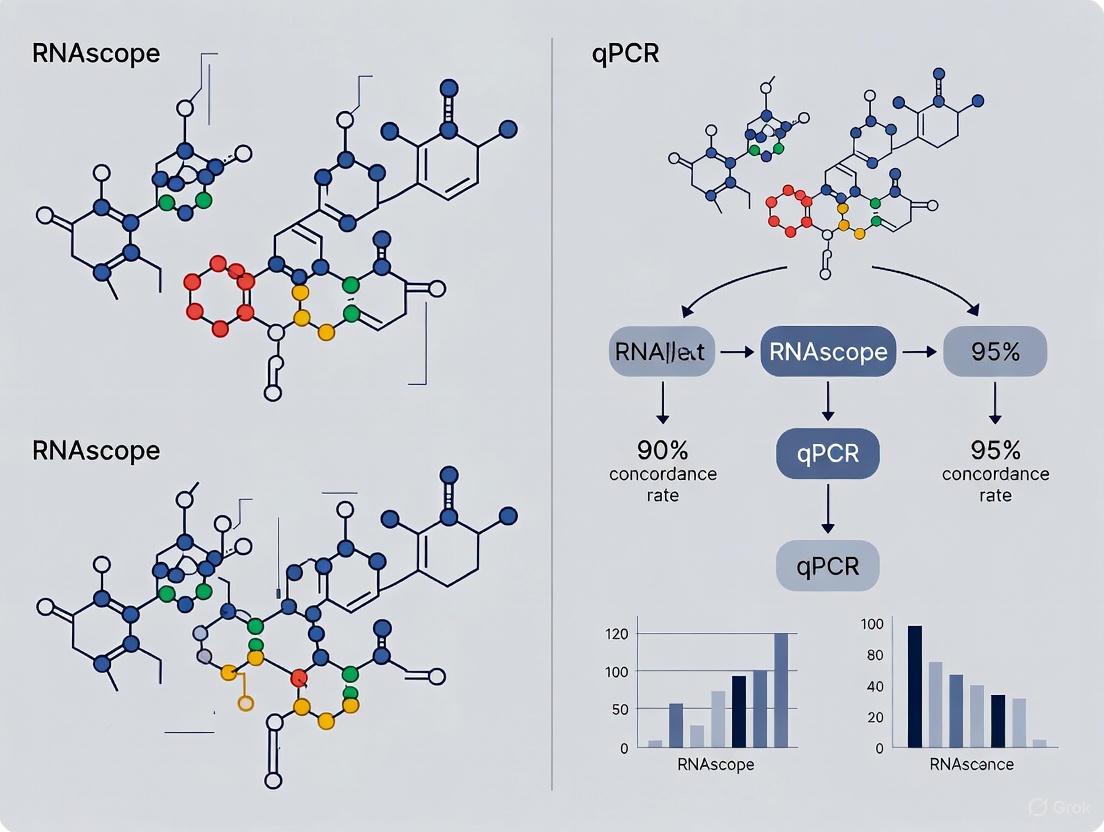
This article systematically examines the concordance between RNAscope in situ hybridization and quantitative PCR (qPCR) for gene expression analysis, a critical consideration for researchers, scientists, and drug development professionals.
RNAscope vs qPCR: Uncovering High Concordance and Critical Differences in Gene Expression Analysis
Abstract
This article systematically examines the concordance between RNAscope in situ hybridization and quantitative PCR (qPCR) for gene expression analysis, a critical consideration for researchers, scientists, and drug development professionals. We explore the foundational principles of each technology, their methodological strengths and applications in fields like cancer research and neuroscience, and provide troubleshooting guidance for optimization. Drawing from recent systematic reviews and primary research, we validate the high reported concordance rates (81.8–100%) and clarify that discrepancies often arise from the fundamental difference between measuring RNA within a spatial context versus bulk tissue extraction. This synthesis empowers professionals to select the appropriate technique or use them complementarily for robust, spatially-resolved gene expression data.
Understanding the Core Technologies: Principles of RNAscope and qPCR
Quantitative Polymerase Chain Reaction (qPCR) remains a cornerstone technique in molecular biology, diagnostics, and pharmaceutical research, maintaining its status as a pervasive tool for nucleic acid quantification despite the emergence of novel technologies [1]. This guide objectively examines the performance characteristics of qPCR relative to emerging alternatives, with particular focus on its concordance with RNAscope in situ hybridization within research and clinical contexts. While techniques like digital PCR (dPCR) offer advanced capabilities for absolute quantification and rare target detection, qPCR continues to excel in scenarios requiring high-throughput, cost-effective bulk analysis of gene expression [2]. The technology's resilience in research and clinical laboratories stems from its robust performance characteristics, extensive validation history, and continuous optimization of reagent systems. This analysis synthesizes comparative experimental data to delineate the precise technical positioning of qPCR—highlighting both its enduring strengths and limitations—to inform selection criteria for researchers, scientists, and drug development professionals navigating the evolving landscape of molecular quantification technologies.
Performance Comparison: qPCR Versus Emerging Methodologies
qPCR vs. RNAscope: Analytical Concordance and Divergence
Table 1: Comparative Analysis of qPCR and RNAscope Performance Characteristics
| Parameter | qPCR | RNAscope | Experimental Evidence |
|---|---|---|---|
| Concordance Rate | 97.3% with FISH in unequivocal cases [3] | 81.8-100% with qPCR/qRT-PCR/DNA ISH [4] | Breast carcinoma study (n=132) [3]; Systematic review (27 studies) [4] |
| Sensitivity | High (detection of low-abundance targets) [1] | Single-molecule detection capability [5] | Systematic review confirming RNAscope sensitivity reaches 100% [4] |
| Specificity | High with proper primer optimization [6] | Exquisitely specific (approaching 100%) [4] | Unique "Z" probe design minimizes off-target binding [4] |
| Tissue Context Preservation | No (requires RNA extraction) [4] | Yes (in situ analysis maintains morphology) [5] | Enables resolution of heterogeneous ERBB2 status in breast carcinoma [3] |
| Protein Expression Correlation | Indirect (mRNA level only) | Lower concordance with IHC (58.7-95.3%) [4] | Different measures (RNA vs. protein) explain discrepancy [4] |
| Throughput Capability | High (96-well formats standard) [2] | Moderate (automated platforms available) [3] | Suitable for large-scale screening applications [2] |
The comparative data reveal a high concordance rate between qPCR and RNAscope technologies when measuring identical RNA targets, particularly in homogeneous samples with unequivocal expression status [3]. This strong correlation establishes qPCR as a reliable bulk quantification method that aligns well with spatially resolved techniques. However, RNAscope demonstrates superior performance in resolving equivocal cases, particularly those exhibiting intratumoral heterogeneity where bulk qPCR may average critical expression variations [3]. This distinction highlights the complementary nature of these technologies—while qPCR provides efficient bulk quantification, RNAscope offers single-cell resolution within morphological context.
qPCR vs. Digital PCR: Analytical Tradeoffs
Table 2: qPCR and dPCR Technical Comparison for Biosensing Applications
| Characteristic | qPCR | Digital PCR | Experimental Support |
|---|---|---|---|
| Quantification Approach | Relative (Ct value based on standard curves) [2] | Absolute (Poisson statistics of positive partitions) [2] | Requires known target concentrations for standard curves [2] |
| Limit of Detection | Moderate | Superior for rare targets [2] | dPCR can detect single targets among 2 million [6] |
| Inhibition Resistance | Susceptible to inhibitors from environmental contaminants [6] | Less susceptible to inhibitors [2] | Better performance with humic acids in environmental samples [2] |
| Throughput | High (standard 96-well format processes 96 tests in hours) [2] | Lower throughput [2] | COVID-19 testing: 35+ million daily tests using qPCR pooling [2] |
| Cost Efficiency | High (lower per-test cost) [2] | Higher (costly chips/consumables) [2] | Economic factor crucial for large-scale screening [2] |
| Multiplexing Capability | Well-established | Developing | Multiplex qPCR detects multiple genotypes simultaneously [6] |
The comparison between qPCR and dPCR reveals a nuanced technological landscape where selection depends heavily on application requirements. For bulk quantification applications where relative quantification suffices and high throughput is essential, qPCR maintains distinct advantages in cost-effectiveness and operational efficiency [2]. Conversely, dPCR excels in scenarios demanding absolute quantification, rare allele detection, or working with challenging samples containing PCR inhibitors [2] [6]. The experimental evidence indicates these technologies should be viewed as complementary rather than competing, with qPCR remaining the workhorse for routine bulk quantification while dPCR addresses specialized applications requiring its advanced capabilities.
Experimental Protocols and Methodologies
Key Experimental Workflows
RNAscope-qPCR Concordance Validation Protocol
The high concordance rates between qPCR and RNAscope are established through standardized experimental protocols. In a representative study investigating ERBB2 status in invasive breast carcinoma (n=132), researchers implemented a rigorous comparative methodology [3]:
Sample Preparation:
- Tumor tissue samples were processed as Formalin-Fixed Paraffin-Embedded (FFPE) sections for RNAscope
- Adjacent tissue sections were homogenized for RNA extraction and qPCR analysis
- RNA quality verification through positive control probes (PPIB, Polr2A, UBC) based on expected expression levels [4]
qPCR Methodology:
- RNA extraction using silica-based membrane columns
- Reverse transcription with random hexamers and/or gene-specific primers
- Amplification using SYBR Green or TaqMan chemistry on standard qPCR platforms
- Cycle threshold (Ct) determination using instrument software
- Relative quantification using standard curve method with reference genes
RNAscope Protocol:
- FFPE sections baked at 60°C for 1 hour followed by deparaffinization
- Pretreatment with target retrieval reagents and protease digestion
- Hybridization with target-specific "Z" probe pairs (20 pairs per target)
- Signal amplification through sequential binding of preamplifier, amplifier, and enzyme conjugate
- Chromogenic development with DAB followed by counterstaining
- Manual or digital quantification of signal dots (each representing single RNA molecules)
Concordance Assessment:
- Statistical analysis of expression correlation between techniques
- Interpretation of discordant results in context of tumor heterogeneity
- Establishment of clinical cut-off values for positive classification
This protocol established 97.3% concordance between RNAscope and qPCR in cases where FISH results were unequivocal, with RNAscope providing superior resolution in heterogeneous or equivocal cases [3].
qPCR-ddPCR Comparative Performance Assessment
Experimental comparisons between qPCR and ddPCR follow standardized methodologies to evaluate performance characteristics:
Sample Processing:
- Serial dilutions of target nucleic acids (genomic DNA, synthetic oligonucleotides, or cDNA)
- Analysis of identical samples across both platforms
- Incorporation of restriction enzymes (EcoRI, HaeIII) to evaluate accessibility impact [7]
qPCR Analysis:
- Amplification efficiency calculation from standard curve slopes
- Limit of Detection (LOD) and Limit of Quantification (LOQ) determination
- Assessment of precision through inter- and intra-assay coefficients of variation
- Evaluation of dynamic range across template concentrations
ddPCR Analysis:
- Partition generation (20,000 droplets for ddPCR; nanoscale chambers for ndPCR)
- End-point amplification with fluorescence detection
- Poisson correction for absolute quantification
- Threshold determination for positive/negative partition classification
Comparative Metrics:
- Precision assessment using Coefficient of Variation (CV)
- Accuracy evaluation against known standard concentrations
- Sensitivity comparison through LOD/LOQ values
- Inhibition resistance testing with spike-in contaminants
These protocols consistently demonstrate ddPCR's advantages for rare target detection and absolute quantification, while confirming qPCR's superior throughput and cost-efficiency for bulk quantification [2] [7].
Experimental Data Interpretation
The experimental evidence reveals that qPCR and RNAscope exhibit high concordance (81.8-100%) in direct methodological comparisons [4]. This strong correlation validates qPCR as a reliable bulk quantification tool that aligns well with spatially resolved techniques. However, systematic review data indicates that RNAscope demonstrates lower concordance (58.7-95.3%) with immunohistochemistry, highlighting the distinction between mRNA and protein measurement [4].
In comparative assessments with dPCR, studies demonstrate that qPCR maintains advantages in dynamic range and throughput, while dPCR offers superior precision and sensitivity for low-abundance targets [7]. For example, in copy number analysis of protists, both technologies showed strong linear correlation with cell numbers, but dPCR exhibited higher precision, particularly with optimized restriction enzymes [7].
Technical Workflows and Decision Pathways
qPCR Experimental Workflow
Technology Selection Decision Pathway
Essential Research Reagent Solutions
Table 3: Key qPCR Reagent Systems and Research Solutions
| Reagent Category | Representative Vendors | Key Characteristics | Optimal Application Context |
|---|---|---|---|
| Hydrolysis Probes | Thermo Fisher (TaqMan), Roche | High specificity, multiplexing capability | Clinical diagnostics, pathogen detection [1] |
| SYBR Green Chemistry | Bio-Rad, Qiagen | Cost-effective, simple probe design | Gene expression screening, primer validation [1] |
| Reverse Transcriptases | Thermo Fisher, Promega | High efficiency, robust performance | RNA quantification with challenging samples [1] |
| Master Mix Formulations | Takara Bio, NEB | Enhanced sensitivity, inhibitor resistance | Complex samples (FFPE, environmental) [1] |
| Multiplex Systems | Qiagen, Agilent | Multiple target detection in single reaction | Pathogen panels, gene expression networks [6] |
| Automated Systems | Roche, Thermo Fisher | High-throughput, minimal hands-on time | Large-scale screening, clinical diagnostics [1] |
Vendor selection should be guided by application requirements, with clinical diagnostics favoring systems with regulatory approvals (Roche, Qiagen) and research applications prioritizing flexibility and cost-effectiveness (Bio-Rad, Promega) [1]. Performance validation across key parameters including amplification efficiency, sensitivity, reproducibility, and inhibitor tolerance is essential for robust experimental outcomes.
The experimental evidence confirms qPCR's enduring role as the workhorse for bulk quantification in molecular analysis. Its high concordance with RNAscope (81.8-100%) validates its reliability for mRNA quantification, while its advantages in throughput, cost-efficiency, and established workflows maintain its position in research and clinical laboratories [3] [4]. The strategic selection of quantification technologies must align with experimental objectives: RNAscope for spatial resolution in heterogeneous samples, dPCR for absolute quantification of rare targets, and qPCR for high-throughput bulk analysis where relative quantification suffices [3] [2]. Rather than representing competing technologies, these methodologies form a complementary toolkit for comprehensive molecular analysis, with qPCR serving as the foundational bulk quantification platform upon which more specialized techniques can be deployed for refined investigation.
For decades, gene expression analysis has relied heavily on grind-and-bind methods like quantitative PCR (qPCR) and its derivatives. While these techniques provide sensitive quantification, they fundamentally lack spatial context, as RNA extraction destroys the native tissue architecture and cellular relationships [8]. This limitation has been particularly significant in cancer research, virology, and neurobiology, where the precise location of gene expression within a tissue specimen often carries critical biological and clinical meaning [9] [10]. The advent of RNA in situ hybridization (RNA-ISH) techniques promised spatial resolution but was historically hampered by insufficient sensitivity and specificity to reliably detect low-abundance transcripts [8] [4].
The RNAscope technology represents a paradigm shift, achieving what traditional RNA-ISH could not: single-molecule visualization while preserving tissue morphology [8]. This article provides a comparative guide examining RNAscope's performance against established qPCR methods, focusing on the concordance rates that define their relationship in modern research and clinical applications. By framing this comparison within the broader thesis of spatial versus bulk analysis, we equip researchers and drug development professionals with the data needed to select the optimal tool for their gene expression challenges.
Technological Foundations: How RNAscope Achieves Single-Molecule Sensitivity
The Double-Z Probe Design: A Foundation of Specificity
The exceptional performance of RNAscope stems from its novel double-Z probe design, a fundamental departure from conventional ISH probes. This proprietary system employs pairs of "Z" probes that must bind contiguously to the target RNA molecule to form a complete hybridization site for the subsequent amplification machinery [8] [4]. Each "Z" probe contains a target-specific sequence, a spacer, and a tail sequence. The requirement for two independent probes to bind adjacent sites dramatically reduces non-specific background hybridization, as it is statistically improbable for off-target binding to juxtapose the correct probe pair [8]. This design underpins the technology's claim to 100% specificity [4].
Signal Amplification: Visualizing Single RNA Molecules
Following target hybridization, RNAscope employs a sophisticated, hybridization-mediated signal amplification cascade:
- A preamplifier molecule binds to the paired "Z" probe tails.
- Multiple amplifier molecules then attach to the preamplifier.
- Finally, numerous label probes (conjugated to enzymes for chromogenic detection or fluorophores for fluorescence) hybridize to each amplifier [8] [4].
This multi-layered architecture can theoretically generate up to 8,000 labels for a single target RNA molecule, achieving the signal intensity required for single-molecule detection under a standard microscope [4]. Each detected dot corresponds to an individual RNA molecule, enabling direct quantification of transcript copy number within individual cells [5] [11].
The qPCR Standard: Sensitivity Without Context
In contrast, reverse transcription quantitative PCR (RT-qPCR) is a powerful solution-based technique for quantifying gene expression. Its workflow involves RNA extraction from tissue or cells, reverse transcription to complementary DNA (cDNA), and amplification with target-specific primers and fluorescent detection chemistry (e.g., TaqMan probes or SYBR Green) [12]. The quantification cycle (Cq) value, determined during the exponential phase of amplification, provides a highly sensitive measure of the starting quantity of the target nucleic acid, with detection possible down to a single copy [12] [13]. However, this process obliterates all spatial information, and results can be confounded by RNA from unwanted cell types or tissue elements [8].
Performance Comparison: Concordance Rates and Discrepancies
Direct comparisons between RNAscope and qPCR reveal a complex relationship characterized by high concordance in some contexts and informative discrepancies in others, largely driven by what each technology measures.
Quantitative Concordance in Validation Studies
A systematic review of 27 studies found that RNAscope exhibits a high concordance rate (CR) with qPCR and qRT-PCR, ranging from 81.8% to 100% [4]. This high level of agreement confirms that RNAscope is a robust method for quantifying RNA levels. Specific experimental validations support this finding. For instance, in a study using a cell line panel, RNAscope results for DKK1 mRNA showed a significant correlation (Spearman's rho = 0.86) with RNA-Seq data from the Cancer Cell Line Encyclopedia [5].
Table 1: Concordance Rates Between RNAscope and Other Techniques
| Comparison Method | Concordance Rate (CR) | Key Context |
|---|---|---|
| qPCR / qRT-PCR | 81.8% - 100% [4] | Direct RNA-level comparison; high concordance. |
| DNA In Situ Hybridization | 81.8% - 100% [4] | Gene detection; high concordance. |
| Immunohistochemistry (IHC) | 58.7% - 95.3% [4] | RNA vs. protein; lower concordance expected. |
The Spatial Advantage and Discordance with Protein
The concordance between RNAscope and immunohistochemistry (IHC) is notably lower and more variable (58.7-95.3%) [4]. This is biologically expected, as the two techniques measure different molecules (RNA vs. protein), and post-transcriptional regulation can decouple mRNA abundance from protein levels. This discrepancy is not a failure of either technology but rather a revelation of underlying biology. RNAscope's ability to provide this spatial context is a key advantage. For example, in gastric cancer, a DKK1 RNAscope assay allowed researchers to quantify expression specifically within tumor cells, a task impossible with bulk qPCR [5].
Robustness in Challenging Samples
A significant operational advantage of RNAscope is its performance with partially degraded RNA. In a study of human post-mortem brain tissue, RNAscope signal for housekeeping genes (PPIB, TBP) remained strong even in samples with low RNA Integrity (RQI) scores as low as 2.9. In the same samples, qPCR amplification efficiency was significantly negatively impacted by low RQI (R = -0.942) [11]. This demonstrates that RNAscope is less affected by RNA fragmentation, likely because its probe set targets a ~1kb region and can still hybridize to shorter fragments [8] [4].
Experimental Protocols for Comparative Studies
RNAscope Workflow for FFPE Tissues
The RNAscope protocol for formalin-fixed paraffin-embedded (FFPE) tissues is highly standardized and parallels common IHC workflows, making it accessible for clinical and research laboratories [5] [10].
- Slide Preparation: Cut 5 μm sections from FFPE blocks, mount on slides, and bake at 60°C for 1 hour.
- Deparaffinization & Dehydration: Immerse slides in xylene (2 x 5 min) followed by 100% ethanol (2 x 3 min) [10].
- Pretreatments:
- Target Probe Hybridization: Apply target-specific probe mixture (e.g., for a gene of interest) and incubate (2 hours, 40°C) [10].
- Signal Amplification: Perform a series of sequential amplifications using preamplifier, amplifier, and label probes according to manufacturer protocols [8] [10].
- Signal Detection & Counterstaining: For chromogenic detection, incubate with DAB substrate, counterstain with hematoxylin, dehydrate, and mount [10].
RT-qPCR Workflow for Gene Expression Quantification
The standard two-step RT-qPCR protocol offers flexibility for analyzing multiple targets from a single RNA sample [12].
- RNA Extraction: Isolate total RNA from homogenized tissue or cells, using methods that minimize RNase contamination.
- RNA Quality and Quantity Assessment: Measure RNA concentration and purity spectrophotometrically. Assess integrity using methods like the RNA Integrity Number (RIN) or RQI [11].
- Reverse Transcription (RT): Convert purified RNA to cDNA using reverse transcriptase. This step can be primed with:
- Oligo-d(T) primers: for mRNA-specific conversion.
- Random hexamers: for comprehensive conversion of all RNA, including non-polyadenylated species [12].
- Quantitative PCR (qPCR):
- Assay Design: Use gene-specific primer pairs, often with a fluorescent probe (TaqMan) for maximum specificity [12].
- Amplification: Mix cDNA with primers, nucleotides, polymerase, and buffer. Run in a real-time PCR instrument for 40-50 cycles.
- Data Acquisition: The instrument records fluorescence during each cycle, generating amplification curves [12].
- Quantification Analysis:
Essential Research Reagent Solutions
Successful implementation of these technologies requires a suite of specific reagents and tools.
Table 2: Essential Research Reagents and Tools
| Reagent / Tool | Function | Example & Notes |
|---|---|---|
| RNAscope Probe Sets | Target-specific detection | Custom or catalogued probes (e.g., DKK1, HPV E6/E7) [5] [10]. |
| Positive Control Probe | Assay & tissue quality validation | Probes for housekeeping genes (e.g., PPIB, UBC, Polr2A) [5] [4]. |
| Negative Control Probe | Background noise assessment | Bacterial dapB gene probe [5] [4]. |
| Detection Kit | Signal generation | Chromogenic (DAB) or fluorescent (OPAL dyes) kits [10] [15]. |
| qPCR Assays | Target amplification | Pre-designed TaqMan assays or custom SYBR Green primers [12]. |
| Reverse Transcriptase | cDNA synthesis | High-efficiency enzymes for robust first-strand synthesis [12]. |
| qPCR Master Mix | Amplification reaction | Contains polymerase, dNTPs, buffer, and fluorescence chemistry [12] [14]. |
| Digital Image Analysis | RNAscope quantification | Software like HALO, QuPath, or Aperio for automated dot counting [5] [4] [11]. |
The comparative data firmly establishes that RNAscope and qPCR are not mutually exclusive technologies but are, in fact, highly concordant and complementary tools. The choice between them—or the decision to use them in tandem—should be guided by the specific research question.
For pure quantification of RNA abundance in a homogeneous sample, qPCR remains the gold standard due to its broad dynamic range, high throughput, and ease of use [12]. However, when the spatial distribution of expression is critical—such as in tumor heterogeneity, viral infection studies, or complex tissues like the brain—RNAscope provides indispensable information that qPCR cannot [9] [10] [11]. The robust performance of RNAscope in the face of RNA degradation also makes it particularly valuable for working with archived FFPE samples or challenging tissues like post-mortem brain [11].
The future of gene expression analysis lies in leveraging the respective strengths of these platforms. RNAscope is poised for expanded use in companion diagnostic development and spatial transcriptomics, providing a critical bridge between bulk RNA-sequencing data and cellular pathophysiology [5] [4]. By understanding their concordance and their points of divergence, researchers and drug developers can more effectively decipher the complex language of gene expression.
In the evolving landscape of molecular diagnostics and research, accurately measuring gene expression is fundamental to advancing personalized medicine, particularly in oncology. For years, quantitative real-time PCR (qPCR) and its variant quantitative reverse transcriptase PCR (qRT-PCR) have stood as the gold standard techniques for gene expression analysis, offering sensitive detection of RNA molecules from tissue extracts. However, these bulk analysis methods inherently lack spatial context, obscuring critical information about cellular heterogeneity and tissue localization that may have profound diagnostic implications. The emergence of RNAscope, a novel in situ hybridization (ISH) technology, promises to bridge this gap by enabling visualization and quantification of RNA molecules within the intact tissue architecture. This comparison guide objectively examines the concordance between these methodologies through a systematic analysis of the available evidence, providing researchers, scientists, and drug development professionals with a data-driven perspective on their comparative performance and optimal applications.
Understanding the Technologies: Principles and Methodologies
qPCR/qRT-PCR: The Established Benchmark
qPCR and qRT-PCR are solution-based techniques that quantify nucleic acids after extraction from homogenized tissue samples. In qRT-PCR, RNA is first reverse-transcribed into complementary DNA (cDNA), which is then amplified and quantified using fluorescent probes in real-time. The cycle threshold (Ct) value obtained correlates with the initial amount of the target RNA. While these methods offer excellent sensitivity and a broad dynamic range for quantification, they necessitate RNA extraction, a process during which RNA molecules can be lost or degraded. More critically, these approaches provide an average expression value for the entire tissue sample, discarding all spatial information about which specific cells within a heterogeneous tissue express the gene of interest [4].
RNAscope: Spatial Context with Single-Cell Resolution
RNAscope is a bright-field in situ hybridization technique that allows for the visualization and quantification of RNA targets within morphologically intact cells and tissues. Its revolutionary design is based on a proprietary double-Z probe chemistry, which confers exceptional specificity and sensitivity.
- Underlying Principle: The assay uses paired "Z" probes that are designed to bind adjacent to each other on the target RNA sequence. Only when both probes hybridize correctly can a subsequent pre-amplifier molecule bind, initiating a signal amplification cascade that can generate up to an 8,000-fold amplification. This results in a distinct, quantifiable dot for each individual RNA molecule, visible under a standard microscope [4].
- Key Workflow Steps: The standard RNAscope procedure begins with slide preparation from Formalin-Fixed Paraffin-Embedded (FFPE) or frozen tissues. This is followed by permeabilization, hybridization of the target-specific Z probes, and the sequential signal amplification steps. Finally, the signals are visualized using chromogenic or fluorescent labels, and the results are quantified by counting the dots manually or with digital image analysis software [4].
- Critical Advantages: A primary strength of RNAscope is its ability to resolve intratumoral heterogeneity and provide single-cell resolution. Furthermore, it can be multiplexed to detect several RNA species simultaneously and integrated with immunohistochemistry (IHC) to co-detect proteins on the same tissue section [4] [16].
The Systematic Review: A Rigorous Comparison Framework
A 2022 systematic review provides the most comprehensive, evidence-based analysis of RNAscope's performance relative to established techniques, including qPCR/qRT-PCR [4] [17]. The review analyzed 27 retrospective studies, the majority of which focused on cancer samples, using the QUADAS-2 tool to evaluate the risk of bias.
Key Findings on Concordance
The systematic review's analysis of concordance rates (CR) between RNAscope and various gold standard methods yielded critical quantitative data, summarized in the table below.
Table 1: Concordance Rates Between RNAscope and Other Techniques from Systematic Review
| Comparison Method | Concordance Rate (CR) Range | Key Factors Influencing Concordance |
|---|---|---|
| qPCR / qRT-PCR | 81.8% - 100% [4] [17] | High concordance due to both techniques measuring RNA; differences may arise from tissue heterogeneity and RNA extraction efficiency. |
| DNA In Situ Hybridization (ISH) | High Concordance (Specific range not provided) [4] | Both are in situ techniques, preserving spatial context. |
| Immunohistochemistry (IHC) | 58.7% - 95.3% [4] [17] | Lower concordance primarily because IHC detects protein, while RNAscope detects RNA, reflecting different stages of gene expression (transcription vs. translation). |
The data demonstrates that RNAscope has a high concordance rate with qPCR and qRT-PCR, confirming its reliability for detecting and quantifying RNA levels. The review concluded that RNAscope is a "highly sensitive and specific method" that can effectively complement existing gold standard techniques in clinical diagnostics [4] [17].
Evidence in Action: Case Studies Across Cancer Types
Resolving Equivocal HER2 Status in Breast Cancer
In a landmark study investigating HER2 status in 132 invasive breast carcinomas, RNAscope was deployed as a fully automated, quantitative bright-field ISH method. The study found that RNAscope and qPCR were 97.3% concordant with Fluorescence In Situ Hybridization (FISH) in cases where FISH results were unequivocal. Crucially, the study highlighted that RNAscope was superior to qPCR in cases exhibiting intratumoral heterogeneity or equivocal FISH results. This underscores RNAscope's unique value in resolving diagnostically challenging cases by providing quantitative, single-cell HER2 mRNA data that retains spatial information lost in qPCR's bulk analysis [3].
Validating a Biomarker Assay for Gastric Cancer
In the development of a companion diagnostic for the therapeutic antibody DKN-01, a DKK1 RNAscope assay was rigorously validated for gastric and gastroesophageal junction (G/GEJ) adenocarcinoma. The validation process provided a direct comparison between RNAscope, RNA-Seq data, and IHC. The RNAscope results showed a significant correlation with RNA-Seq data from the Cancer Cell Line Encyclopedia (Spearman’s rho = 0.86, p < 0.0001). Furthermore, RNAscope proved to be more sensitive than IHC, successfully detecting DKK1 RNA in HeLa cell pellets where IHC signal was absent. This study also showcased the integration of RNAscope with a digital image analysis algorithm (QuPath) to quantify the H-score, enhancing objectivity and reproducibility [5].
Table 2: Key Experimental Details from Featured Studies
| Study Focus | Sample Type & Size | Key Targets | Comparison Methods | Major Finding |
|---|---|---|---|---|
| HER2 in Breast Carcinoma [3] | 132 invasive breast carcinomas | HER2 mRNA | qPCR, FISH, IHC, CISH | 97.3% concordance with qPCR and FISH; superior for heterogeneous cases. |
| DKK1 in G/GEJ Adenocarcinoma [5] | 40 G/GEJ tumor resections; cell line pellets | DKK1 mRNA | RNA-Seq, qPCR, IHC | Strong correlation (r=0.86) with RNA-Seq; more sensitive than IHC. |
| Gene Expression in Ovarian Carcinoma [9] | High-grade serous ovarian carcinoma samples | CCNE1, WFDC2, PPIB | RT-droplet digital PCR (RT-ddPCR) | Automated quantification methods (QuantISH, QuPath) showed good concordance with RNAscope, while RT-ddPCR showed less. |
Experimental Protocols and Reagent Solutions
Core RNAscope Workflow for Diagnostic Validation
The following protocol, derived from the validated clinical studies, outlines the key steps for employing RNAscope in a comparative analysis with qPCR [4] [5]:
- Sample Preparation: Use 5 µm sections from Formalin-Fixed Paraffin-Embedded (FFPE) tissue blocks mounted on charged slides. Maintain RNA integrity by controlling storage conditions and section age.
- Pretreatment: Bake slides, followed by deparaffinization and rehydration. Perform target retrieval and protease treatment to permeabilize the tissue without damaging RNA or morphology.
- Probe Hybridization: Apply the target-specific RNAscope probes (e.g., for HER2 or DKK1) and the necessary control probes (positive control: PPIB or POLR2A; negative control: bacterial dapB). Incubate at 40°C in a HybEZ oven for 2 hours.
- Signal Amplification: Perform a series of sequential amplifications (Amp 1-6) as per the RNAscope kit protocol to build the amplification complex.
- Signal Detection & Visualization: Use chromogenic (DAB) or fluorescent detection to visualize the RNA molecules as distinct dots. Counterstain with hematoxylin for chromogenic assays.
- Quantification and Analysis: Quantify signals manually by a trained pathologist or, for higher throughput and objectivity, use digital image analysis software (e.g., HALO, QuPath, Aperio). The result is typically reported as dots per cell or an H-score that accounts for staining intensity and distribution [5].
The Scientist's Toolkit: Essential Reagents and Solutions
Table 3: Key Research Reagent Solutions for RNAscope Experiments
| Item | Function | Examples & Notes |
|---|---|---|
| RNAscope Probe | Target-specific detection | Catalog probes (e.g., HER2, DKK1) or Made-to-Order probes for proprietary targets [18]. |
| Control Probes | Assay validation | PPIB/POLR2A/UBC (positive control for RNA integrity); dapB (negative control for background) [4] [5]. |
| RNAscope Kit | Core reagents | Contains amplifiers, labels, and buffers for the signal amplification cascade (e.g., RNAscope 2.5 HD Reagent Kit). |
| Digital Analysis Software | Objective quantification | HALO, QuPath, Aperio; used for automated dot counting and H-score calculation [4] [5]. |
| Automated Staining Platform | Standardization | Platforms like the Roche DISCOVERY ULTRA or Leica BOND RX enable fully automated, high-throughput, and reproducible staining [19] [16]. |
The body of evidence, culminating in a systematic review, firmly establishes that RNAscope exhibits a high concordance rate (81.8-100%) with qPCR/qRT-PCR for measuring gene expression. This confirms its technical robustness as an RNA detection method. The fundamental distinction between the techniques is not primarily one of accuracy, but of information output: qPCR provides a sensitive, bulk quantification of RNA from a tissue lysate, while RNAscope provides a spatially resolved, single-cell quantification that reveals cellular heterogeneity and preserves tissue morphology.
For researchers and clinicians, the choice between these techniques should be guided by the specific scientific question. qPCR remains a powerful tool for rapid, high-throughput screening of large sample sets where spatial data is not critical. In contrast, RNAscope is indispensable for resolving heterogeneous gene expression, validating biomarkers in complex tissues, and guiding the development of spatially informed diagnostics and therapeutics, such as in gene therapy biodistribution studies [18]. While the current evidence supports RNAscope as a powerful complementary technique, the systematic review notes that further prospective studies are needed to fully validate its standalone use in clinical diagnostics, including comprehensive cost-benefit analyses [4].
In the field of gene expression analysis, researchers and drug development professionals often face critical choices between technological platforms. Two prominent methods—quantitative polymerase chain reaction (qPCR) and RNAscope in situ hybridization—offer distinct approaches to measuring RNA expression. While qPCR provides quantitative data on RNA levels from tissue homogenates, RNAscope delivers spatial context by visualizing RNA molecules within intact cells and tissues. Understanding the concordance between these methods is essential for validating biomarkers, advancing diagnostic applications, and making informed decisions in experimental design. This guide objectively compares the performance of these techniques, examining the factors that drive their agreement and the specific circumstances where their results may diverge.
Fundamental Technical Principles: What Each Technique Measures
qPCR: Bulk Quantitative Analysis
qPCR is a solution-based method that quantifies the abundance of specific RNA sequences after reverse transcription to cDNA. It involves amplifying target sequences through thermal cycling while monitoring fluorescence accumulation in real-time. The key output is the cycle threshold (Ct) value, which represents the number of amplification cycles required for the fluorescence signal to cross a detection threshold. This value is inversely proportional to the starting quantity of the target RNA [20]. The method requires RNA extraction and purification, which can sometimes lead to loss of material but enables highly sensitive detection of low-abundance transcripts. Calculations often involve the ΔΔCt method for relative quantification or standard curves for absolute quantification, with efficiency corrections crucial for accurate interpretation [20].
RNAscope: Spatial Single-Molecule Detection
RNAscope is an advanced in situ hybridization technique that enables visualization and quantification of RNA molecules within intact tissue sections. The technology employs a proprietary double-Z probe design that recognizes target RNA sequences with high specificity. Each target RNA molecule is detected through a signal amplification cascade that generates a distinct punctate dot visible under microscopy [4]. A critical advantage is that each dot corresponds to a single RNA molecule, enabling direct quantification at single-cell resolution while preserving spatial context [21]. The method can be applied to various sample types including formalin-fixed paraffin-embedded (FFPE) tissues, frozen sections, and fixed cells without requiring RNA extraction [4].
Table 1: Core Characteristics of qPCR and RNAscope
| Feature | qPCR | RNAscope |
|---|---|---|
| What is measured | Total RNA from tissue homogenates | Individual RNA molecules in intact cells |
| Spatial information | No | Yes (single-cell resolution) |
| Sensitivity | High (can detect low-abundance transcripts) | High (single-molecule detection) |
| Sample requirements | RNA extraction required | Intact tissue sections |
| Throughput | High (multiple samples/genes) | Moderate (limited by imaging) |
| Quantification approach | Ct values, relative/absolute quantification | Dot counting, H-scoring |
| Tissue integrity impact | Requires high RNA quality | Tolerates partially degraded RNA [11] |
Concordance Analysis: Quantitative Agreement Between Platforms
Multiple studies have systematically compared RNAscope and qPCR to evaluate their concordance across various tissue types and experimental conditions. The overall agreement is generally high, though specific factors can influence the correlation.
A systematic review encompassing 27 studies found that RNAscope demonstrates high concordance with qPCR, with reported agreement rates ranging from 81.8% to 100% across various studies and target genes [4]. This comprehensive analysis confirmed RNAscope as a "highly sensitive and specific method" with strong performance characteristics compared to established molecular techniques.
In a focused study on HER2 status determination in breast carcinoma, researchers reported 97.3% concordance between RNAscope and qPCR when compared to fluorescence in situ hybridization (FISH) as the reference standard [3]. This exceptionally high agreement in a clinically relevant context underscores the reliability of both methods for measuring expression of important biomarkers.
For the DKK1 gene in gastric and gastroesophageal junction tumors, a strong correlation was observed between RNAscope and orthogonal methods including RNA sequencing data (Spearman's rho = 0.86, p < 0.0001) [5]. This demonstrates that RNAscope maintains high concordance with transcriptomic approaches across different gene targets and tissue types.
Table 2: Concordance Rates Between RNAscope and qPCR Across Studies
| Study Context | Concordance Rate | Key Findings |
|---|---|---|
| Systematic Review | 81.8-100% | High overall concordance across multiple studies and targets [4] |
| HER2 in Breast Cancer | 97.3% | Near-perfect agreement in clinically relevant biomarker [3] |
| DKK1 in G/GEJ Cancer | Spearman's rho = 0.86 | Strong correlation with RNA-seq data [5] |
Despite generally high concordance, several important factors can lead to divergent results between RNAscope and qPCR:
Spatial Heterogeneity and Sampling Bias
RNAscope captures gene expression heterogeneity within tissues by analyzing intact sections, while qPCR measures average expression from homogenized samples. In tumors with intratumoral heterogeneity, qPCR may dilute signals from rare cell populations or regions of high expression. The systematic review noted that RNAscope was superior to qPCR in cases with intratumoral heterogeneity as it can identify rare positive cells within predominantly negative samples [4] [3].
RNA Quality and Integrity
RNA degradation affects these methods differently. qPCR amplification efficiency depends heavily on RNA integrity, with degradation leading to reduced sensitivity and accuracy. In contrast, RNAscope can detect partially degraded RNA molecules because its probe design targets multiple regions of the transcript [5]. Research on human brain tissues demonstrated that RNAscope signals remain robust even in samples with low RNA quality (RQI ≥ 2.9), whereas qPCR results showed significant degradation-dependent reduction [11].
Analytical Sensitivity Differences
While both techniques offer high sensitivity, their detection limits operate differently. RNAscope can identify single transcripts within individual cells, providing exceptional sensitivity for rare cells in a population. qPCR can detect low-abundance transcripts but only as an average across the entire sample. This fundamental difference means that for rare cell populations or focal expression patterns, the methods may yield apparently discordant results that actually reflect their different capabilities.
Experimental Design and Methodological Considerations
Optimal Workflow for Method Comparison
When designing studies to compare RNAscope and qPCR, specific protocols ensure valid comparisons:
Essential Research Reagent Solutions
Successful implementation of these techniques requires specific reagents and controls:
Table 3: Essential Research Reagents for RNAscope and qPCR Studies
| Reagent/Category | Function | Examples/Specifications |
|---|---|---|
| RNAscope Controls | Validate assay performance | Positive: PPIB, POLR2A, UBC (species-specific) Negative: bacterial dapB gene [4] [21] |
| qPCR Controls | Ensure reaction efficiency | Reference genes: ACTB, GAPDH, HPRT1 (must show stable expression) [20] |
| Sample Preservation | Maintain RNA integrity | Fresh 10% NBF fixation (16-32h, RT) for FFPE; rapid freezing for frozen tissues [21] |
| Probe Design | Target-specific detection | RNAscope: >300 bases (optimal: 1000 bases); qPCR: amplicons typically 80-150bp [21] |
| Enzyme Systems | Signal generation/amplification | Reverse transcriptase, DNA polymerase for qPCR; HRP or AP-based detection for RNAscope |
RNAscope Experimental Protocol
The RNAscope procedure requires careful attention to tissue preparation and hybridization conditions:
Sample Preparation: Cut FFPE sections at 5±1μm or frozen sections at 10-20μm using SuperFrost Plus slides to prevent tissue detachment [21].
Pretreatment: Perform epitope retrieval without cooling steps, followed by protease digestion for tissue permeabilization at optimized conditions [21].
Hybridization: Use the HybEZ II oven to maintain precise temperature (40°C) and humidity control during probe hybridization [22] [21].
Signal Amplification: Apply the amplification cascade sequentially without skipping steps or allowing slides to dry [21].
Detection: Use chromogenic or fluorescent labels followed by counterstaining and mounting.
Imaging and Analysis: Acquire images using brightfield or fluorescence microscopy, then quantify dots manually or with digital pathology software such as Halo, QuPath, or Aperio [4] [11].
qPCR Experimental Protocol
For reliable qPCR results comparable to RNAscope:
RNA Extraction: Isolve RNA from tissue sections adjacent to those used for RNAscope, using standardized extraction methods.
Quality Assessment: Determine RNA integrity numbers (RIN) or similar metrics; samples with RQI < 3.9 may yield suboptimal qPCR results [11].
Reverse Transcription: Convert RNA to cDNA using reverse transcriptase with appropriate priming methods.
qPCR Setup: Perform technical replicates (minimum 3) for each sample, include no-template controls, and use validated primer sets [20].
Efficiency Calculation: Prepare serial dilutions of a known template to calculate PCR efficiency using the formula: Efficiency (%) = (10^(-1/slope) - 1) × 100 [20]. Acceptable efficiency ranges from 85% to 110%.
Data Analysis: Use the ΔΔCt method for relative quantification or standard curves for absolute quantification [20].
Interpretation Guidelines and Decision Framework
Decision Framework for Technique Selection
Researchers should select methods based on their specific experimental questions:
Choose RNAscope when: Spatial context is critical; analyzing heterogeneous tissues; working with partially degraded samples; detecting rare cells; validating IHC findings at the RNA level.
Choose qPCR when: High-throughput quantification is needed; analyzing homogeneous cell populations; working with high-quality RNA; requiring absolute quantification; limited by tissue quantity for sectioning.
Use both methods when: Comprehensive validation is required; correlating bulk expression with spatial patterns; investigating complex biological systems with both homogeneous and heterogeneous elements.
RNAscope and qPCR show strong concordance (typically 81.8-100%) when appropriately validated and applied to suitable samples. The highest agreement occurs with high-quality RNA samples and homogeneous tissue expression patterns. Discordance often arises from biological factors like spatial heterogeneity rather than technical failure, providing complementary information rather than contradictory results. For clinical diagnostics and biomarker validation, RNAscope serves as an excellent orthogonal method to confirm qPCR findings, particularly when spatial context is biologically relevant. Understanding the strengths and limitations of each platform enables researchers to make informed choices about which technology to deploy based on their specific research questions and sample characteristics.
Methodological Strengths and Real-World Applications in Research & Diagnostics
Leveraging RNAscope's Spatial Advantage in Complex Tissues
In the field of gene expression analysis, the transition from bulk measurement techniques to spatially resolved methods represents a paradigm shift in how researchers study biological systems. While quantitative PCR (qPCR) and related methods have long served as gold standards for gene expression quantification, they fundamentally lack the ability to preserve the spatial context of expression within intact tissues. This limitation becomes critically important in complex tissues characterized by heterogeneity, such as tumors, brain regions, and developing organs, where the precise location of gene expression carries fundamental biological significance. The RNAscope in situ hybridization (ISH) technology has emerged as a powerful solution to this challenge, providing single-molecule sensitivity while maintaining crucial spatial information.
This guide objectively compares RNAscope's performance against qPCR and other established methods, focusing specifically on their concordance rates and respective applications within complex tissue environments. As research increasingly demonstrates that spatial organization profoundly influences cellular function and disease mechanisms, the scientific community requires clear, data-driven comparisons to select appropriate methodologies for their specific research questions. By examining direct experimental comparisons and validation studies, we provide researchers, scientists, and drug development professionals with the evidence needed to make informed decisions about implementing spatial biology tools in their workflows.
Technical Comparison: RNAscope vs. qPCR Fundamentals
Core Methodological Principles
RNAscope employs a proprietary double-Z probe design that enables highly specific signal amplification through a hierarchical branching system [4]. Each pair of Z-probes hybridizes to the target RNA, with the double-Z structure serving as a prerequisite for subsequent amplification steps. This design achieves single-molecule detection by generating a distinct dot for each RNA molecule, visualized through chromogenic or fluorescent methods [4]. The signal amplification occurs through a pre-amplifier that binds to the Z-probe tails, followed by amplifier molecules that provide numerous binding sites for labeled probes [4]. This sophisticated architecture achieves up to 8,000-fold signal amplification while minimizing background noise through the requirement for dual probe binding [4].
In contrast, quantitative PCR (qPCR) and quantitative reverse transcriptase PCR (qRT-PCR) utilize reverse transcription to convert RNA into complementary DNA (cDNA), followed by amplification through thermal cycling with fluorescence-based detection [4]. These methods provide excellent sensitivity for detecting low-abundance transcripts but require tissue homogenization, which irrevocably loses all spatial information about gene expression patterns [4]. While qPCR delivers precise quantitative data on overall transcript levels across a tissue sample, it cannot resolve expression differences between cell subtypes or regional variations within complex tissues.
Table 1: Fundamental Technical Characteristics Comparison
| Characteristic | RNAscope | qPCR/qRT-PCR |
|---|---|---|
| Spatial Resolution | Single-cell/subcellular level | Bulk tissue analysis |
| Target Detection | Direct RNA visualization | cDNA amplification |
| Tissue Requirement | FFPE, frozen, fixed cells | Homogenized tissue |
| Sample Preservation | Maintains tissue architecture | Destructive process |
| Quantification Approach | Dot counting per cell | Fluorescence threshold cycles |
| Multiplexing Capacity | Up to 12-plex with different channels | Limited by fluorescence spectra |
| Throughput | Moderate (slide-based) | High (plate-based) |
Experimental Workflows and Protocol Requirements
The RNAscope workflow begins with slide preparation from formalin-fixed paraffin-embedded (FFPE), frozen tissues, or fixed cells [4]. Slides undergo controlled permeabilization to enable probe access while preserving RNA integrity, followed by hybridization with target-specific Z-probes [4]. Signal amplification occurs through sequential application of pre-amplifier and amplifier molecules, followed by chromogenic or fluorescent detection [4]. The entire process can be performed manually or automated on platforms like Leica BOND or Roche systems [23]. Critical quality controls include positive control probes for housekeeping genes (PPIB, Polr2A, UBC) to verify RNA integrity and negative control probes (bacterial dapB gene) to confirm absence of background staining [4].
The qPCR workflow involves RNA extraction from homogenized tissue using commercial kits, RNA quantification by spectrophotometry, reverse transcription to cDNA, and amplification with sequence-specific primers and fluorescent probes [4]. The process requires careful RNA handling to prevent degradation and includes controls for amplification efficiency, genomic DNA contamination, and reference genes for normalization. While highly standardized for high-throughput applications, the multi-step process introduces potential variability during RNA extraction and reverse transcription that can affect quantitative accuracy.
Diagram 1: Comparative experimental workflows for RNAscope and qPCR
Concordance Rate Analysis: Direct Comparative Studies
Systematic Review Evidence
A comprehensive systematic review evaluating RNAscope's application in clinical diagnostics compared its performance against established gold standard methods, including qPCR, qRT-PCR, immunohistochemistry (IHC), and DNA in situ hybridization (DNA ISH) [4]. The analysis encompassed 27 retrospective studies, primarily focused on cancer samples, with risk of bias assessed using the QUADAS-2 tool [4]. The findings demonstrated that RNAscope exhibits high concordance with PCR-based methods, with reported agreement ranging from 81.8% to 100% across various studies and sample types [4]. This strong correlation confirms that RNAscope maintains quantitative accuracy while adding the crucial dimension of spatial resolution.
Notably, the concordance between RNAscope and IHC was more variable (58.7% to 95.3%), reflecting the fundamental differences between detecting RNA versus protein [4]. This discrepancy highlights the complex relationship between transcript levels and translated protein products, influenced by post-transcriptional regulation, protein turnover rates, and technical limitations of antibodies [4]. In cases where RNAscope detected signals but IHC failed, the superior sensitivity of RNAscope for low-abundance targets was identified as a contributing factor [4].
Table 2: Concordance Rates Between RNAscope and Reference Methods
| Comparison Method | Concordance Range | Key Factors Influencing Concordance |
|---|---|---|
| qPCR/qRT-PCR | 81.8% - 100% | RNA preservation, tumor heterogeneity, analytical sensitivity |
| DNA ISH | High (specific rates not provided) | Target accessibility, probe specificity |
| IHC | 58.7% - 95.3% | RNA-protein correlation, antibody quality, post-transcriptional regulation |
| FISH (HER2 example) | 97.3% in unequivocal cases | Intratumoral heterogeneity, scoring methodology |
Case Study: Resolving Equivocal HER2 Status in Breast Cancer
A critical application demonstrating RNAscope's advantage in complex tissues comes from breast cancer diagnostics, where accurate assessment of ERBB2 (HER2) status directly impacts treatment decisions [3]. In a study of 132 invasive breast carcinomas, researchers developed a fully automated, quantitative RNAscope assay to quantify single-cell HER2 mRNA levels [3]. When compared to FDA-approved fluorescence in situ hybridization (FISH), both RNAscope and qPCR showed 97.3% concordance with FISH in cases with unequivocal results [3].
However, RNAscope demonstrated superior performance in clinically challenging scenarios with intratumoral heterogeneity or equivocal FISH results [3]. Unlike qPCR, which averages expression across all cells, RNAscope enabled precise quantification of HER2 expression within specific tumor regions and individual cells, resolving ambiguous cases that complicate treatment decisions [3]. This case illustrates how spatial resolution provides decisive advantages in heterogeneous tissues where critical signals may be diluted or masked in bulk analyses.
Specialized Applications in Complex Tissue Environments
Addressing Tumor Heterogeneity
Complex tissues like tumors display remarkable cellular diversity, with distinct subpopulations exhibiting different gene expression patterns that influence disease progression and treatment response. RNAscope's ability to preserve spatial context enables researchers to map gene expression within specific tumor regions, immune cell infiltrates, and stromal compartments [3]. This capability proves particularly valuable for:
- Biomarker validation for patient stratification [23]
- Characterizing tumor microenvironment interactions [24]
- Mapping resistance mechanisms within treatment-resistant niches [3]
- Quantifying intratumoral heterogeneity and its clinical significance [3]
In the validation of a DKK1 RNAscope assay for gastric and gastroesophageal junction (G/GEJ) adenocarcinoma, researchers successfully detected a dynamic range of DKK1 expression (H-scores 0-180) while localizing signals specifically to tumor cells [5]. The study combined RNAscope with digital image analysis using QuPath software, demonstrating robust correlation with RNA-seq data from the Cancer Cell Line Encyclopedia (Spearman's rho = 0.86, p < 0.0001) [5].
Neuroscience Applications
The complex architecture of the nervous system presents exceptional challenges for gene expression analysis, with highly specialized functions mapping to specific regions, layers, and even individual cells. RNAscope enables precise mapping of neuronal cell subtypes, central inflammatory responses, and networks involved in pain and addiction [25]. Research applications include:
- Validating single-cell RNA-seq findings in situ [26] [27]
- Tracking neuroinflammatory responses with spatial precision [25]
- Localizing neurotransmitter receptors and signaling components [26]
- Mapping circuit-specific gene expression patterns [27]
Gene Therapy Development and Validation
The development of gene therapies requires precise assessment of vector biodistribution, transduction efficiency, and therapeutic transgene expression within complex tissues [28]. RNAscope and BaseScope (for shorter targets) enable researchers to visualize these critical parameters while maintaining tissue context [28]. A notable example comes from Adverum Biotechnologies, which utilized BaseScope to evaluate ADVM-062, an AAV-based gene therapy for blue cone monochromacy [28]. The technology enabled the team to demonstrate successful transduction and expression of human L-opsin in foveal cone cells, providing crucial evidence for orphan drug designation [28].
Diagram 2: Decision pathway for selecting appropriate gene expression method
Research Reagent Solutions for Spatial Biology
Implementing RNAscope technology requires specific reagents and controls optimized for spatial gene expression analysis. The following essential components form the foundation for robust RNAscope experiments:
Table 3: Essential Research Reagents for RNAscope Experiments
| Reagent/Category | Function | Examples & Specifications |
|---|---|---|
| ZZ Target Probes | Hybridize to specific RNA targets | RNAscope (~20 ZZ pairs, >300 nt), BaseScope (1-3 ZZ pairs, 50-300 nt), miRNAscope (17-50 nt) [23] |
| Positive Control Probes | Verify RNA integrity and assay performance | PPIB (moderate expression), Polr2A (low expression), UBC (high expression) [4] |
| Negative Control Probes | Assess background and nonspecific binding | Bacterial dapB gene (should not hybridize to mammalian RNA) [4] |
| Amplification Systems | Signal generation and enhancement | Chromogenic (HRP/AP-based) or fluorescent detection systems [4] |
| Automation Platforms | Standardize staining and improve reproducibility | Leica BOND, Roche Ventana, Lunaphore COMET systems [23] [29] |
| Image Analysis Software | Quantify RNA signals and generate data | Halo, QuPath, Aperio with digital algorithm support [4] [5] |
The comparative analysis between RNAscope and qPCR reveals complementary strengths with distinct application domains. While qPCR remains unsurpassed for high-throughput quantification of gene expression across large sample sets, RNAscope provides critical spatial resolution that proves indispensable for complex tissues and heterogeneous samples. The high concordance rates (81.8-100%) between these techniques validate RNAscope's quantitative reliability while highlighting its unique capacity to resolve spatial expression patterns lost in bulk analyses [4].
For researchers and drug development professionals, the decision to implement RNAscope should be guided by specific research questions and tissue characteristics. RNAscope delivers maximum value when investigating spatially organized biological systems, validating discoveries from omics technologies, addressing tumor heterogeneity, and developing therapeutic agents where tissue distribution critically influences efficacy and safety. As spatial biology continues to evolve, RNAscope's integration with multiplex protein detection, automated platforms, and advanced computational analysis positions it as a cornerstone technology for unraveling complexity in biological systems.
For future applications, emerging directions include higher-plex detection systems, increased automation for clinical translation, and standardized validation frameworks for diagnostic development. By strategically leveraging RNAscope's spatial advantages where they provide maximum scientific insight, researchers can accelerate discoveries and therapeutic development across complex disease areas.
qPCR's Role in High-Throughput Screening and Validation
Quantitative Polymerase Chain Reaction (qPCR) has established itself as a cornerstone technology in molecular diagnostics and biomedical research, particularly in high-throughput screening and validation workflows. Its ability to provide sensitive, specific, and quantitative detection of nucleic acid targets makes it indispensable for applications ranging from infectious disease surveillance to biomarker validation. In contemporary research, qPCR often serves as a reference standard against which emerging technologies are benchmarked. One such technology, RNAscope in situ hybridization, has emerged as a powerful complementary technique that provides spatial context lacking in qPCR. This guide objectively compares the performance characteristics of qPCR and RNAscope, examining their respective advantages, limitations, and concordance through recently published experimental data to inform researchers, scientists, and drug development professionals in their methodological selections.
Technical Performance Comparison: qPCR vs. RNAscope
Table 1: Key Performance Metrics of qPCR and RNAscope
| Performance Parameter | qPCR | RNAscope |
|---|---|---|
| Sensitivity | Detects down to 5×10² copies/μL DNA [30] | Single-molecule detection capability [4] |
| Specificity | High (99.5% accuracy in STH detection) [31] | Exceptional (100% reported in validation studies) [4] |
| Throughput Capacity | High (semi-automated, multiplexed detection) [31] [32] | Moderate (automated platforms available) [5] |
| Spatial Resolution | None (homogenized samples) | Single-cell resolution with tissue architecture preservation [5] |
| Quantification Capability | Excellent (standard curves, R²: 0.983-0.998) [30] | Semi-quantitative (dot counting, H-scoring) [5] |
| RNA Integrity Requirement | High quality RNA preferred | Tolerant of partially degraded FFPE RNA [4] |
| Multiplexing Capacity | High (detection of 22+ targets) [30] | Moderate (typically 1-3 targets simultaneously) [4] |
| Concordance with Reference Methods | 97.3% with FISH in unequivocal cases [3] | 58.7-95.3% with IHC [4] |
Table 2: Application-Based Method Selection Guidelines
| Research Application | Recommended Method | Rationale |
|---|---|---|
| Large-Scale Prevalence Studies | qPCR | Superior throughput for population-level screening [31] [32] |
| Biomarker Discovery/Validation | qPCR (initial), then RNAscope (confirmation) | High sensitivity for detection, then spatial validation [5] |
| Pathogen Detection in Environmental Samples | qPCR | Broad multiplexing capability (22+ targets) [30] |
| Tumor Heterogeneity Investigation | RNAscope | Single-cell resolution within tissue architecture [5] [3] |
| Clinical Trial Subject Stratification | RNAscope with digital image analysis | Reduced pathologist variability, objective scoring [5] |
| Equivocal Case Resolution | RNAscope | Superior for cases with intratumoral heterogeneity [3] |
Experimental Data and Concordance Analysis
Concordance Rates Between Methodologies
A systematic review examining RNAscope implementation in clinical diagnostics revealed important concordance patterns with established methods. When compared to PCR-based techniques (qPCR and qRT-PCR), RNAscope demonstrated high concordance rates ranging from 81.8% to 100% across multiple studies. However, the concordance between RNAscope and immunohistochemistry (IHC) was notably lower (58.7% to 95.3%), primarily reflecting the fundamental difference between detecting RNA versus protein [4].
Specific comparative studies have provided quantitative performance data. In breast carcinoma research assessing HER2 status, both RNAscope and qPCR showed 97.3% concordance with fluorescence in situ hybridization (FISH) in cases where FISH results were unequivocal. However, RNAscope proved superior in cases exhibiting intratumoral heterogeneity or equivocal FISH results [3].
High-Throughput qPCR Validation Data
Recent developments in high-throughput qPCR platforms demonstrate their robust performance characteristics. A multiplexed qPCR assay for detecting soil-transmitted helminth infections achieved accuracy metrics at or above 99.5% and 98.1% for each target species at the level of technical replicate and individual extraction, respectively [31] [32]. This platform was specifically designed for large-scale clinical trials like the DeWorm3 cluster randomized trial, requiring processing of thousands of samples [32].
Another HT-qPCR assay targeting 22 waterborne pathogens exhibited excellent amplification efficiencies between 80% and 107%, with R² values of standard curves ranging from 0.983 to 0.998. The limit of detection was established at 5×10² copies/μL DNA, with coefficients of variation of 1.0%-4.6% and 1.2%-6.4% for intra- and inter-group experiments, respectively [30].
RNAscope Validation Metrics
The validation of RNAscope for detecting DKK1 in gastric and gastroesophageal junction adenocarcinoma followed Clinical Laboratory Improvement Amendments (CLIA) guidelines. The assay successfully met predefined acceptance criteria for sensitivity, specificity, accuracy, and precision. The unique design of RNAscope's "Z" probes contributes to its exceptional performance, providing up to 8,000-fold signal amplification while maintaining specificity through a requirement for probe dimerization [5] [4].
Experimental Protocols and Workflows
High-Throughput qPCR Methodology
Protocol: Multiplexed STH Detection Platform [31] [32]
- Sample Preparation: Human stool samples are processed using a semi-automated DNA extraction protocol compatible with 96-well plates.
- Assay Design: Multiplex qPCR assays targeting four species of soil-transmitted helminths (STH) are designed with appropriate controls.
- qPCR Setup: Reactions are prepared using automated liquid handling systems to ensure reproducibility and enable high-throughput processing.
- Amplification Parameters: Standard qPCR cycling conditions are applied with fluorescence detection at each cycle.
- Data Analysis: Results are automatically analyzed using pre-defined quantification cycle (Cq) thresholds and compared to standard curves for quantification.
- Quality Control: Implementation of rigorous validation procedures including negative controls, positive controls, and reference standards.
RNAscope Methodology with Digital Image Analysis
Protocol: DKK1 RNAscope Chromogenic In Situ Hybridization [5]
- Slide Preparation: Formalin-fixed paraffin-embedded (FFPE) tissue sections are cut and mounted following standard histopathology protocols.
- Pretreatment: Slides undergo deparaffinization, rehydration, and target retrieval to expose RNA targets while maintaining tissue architecture.
- Probe Hybridization: DKK1-specific "Z" probe pairs are hybridized to target RNA sequences. Each probe contains a target-binding region, linker sequence, and tail for amplifier binding.
- Signal Amplification: A multistep amplification process is performed sequentially:
- Pre-amplifier molecules bind to "Z" probe tails
- Multiple amplifier molecules bind to each pre-amplifier
- Labeled probes conjugate to amplifier molecules
- Chromogenic Detection: Enzyme-mediated chromogenic reaction produces visible dots at the site of each target RNA molecule.
- Digital Image Analysis: Whole slides are scanned and analyzed using software (e.g., QuPath, Halo) that:
- Identifies tumor regions based on morphological features
- Quantifies DKK1 signal as dots per cell
- Calculates H-scores based on dot counts per cell
- Pathologist Review: Digital analysis results are reviewed by a pathologist for final approval and interpretation.
Research Reagent Solutions
Table 3: Essential Research Reagents for qPCR and RNAscope
| Reagent/Category | Function | Example Applications |
|---|---|---|
| qPCR Master Mix | Contains enzymes, dNTPs, buffers for amplification | STH detection [31], waterborne pathogen screening [30] |
| Multiplex Assay Panels | Simultaneous detection of multiple targets | 22-plex waterborne pathogen detection [30] |
| RNAscope Probe Sets | Target-specific "Z" probes for RNA detection | DKK1 detection in G/GEJ adenocarcinoma [5] |
| Positive Control Probes | Verify RNA integrity and assay performance | PPIB (moderate expression), Polr2A (low expression), UBC (high expression) [4] |
| Negative Control Probes | Assess background signal | Bacterial dapB gene (absent in human tissues) [5] [4] |
| Automated Image Analysis Software | Quantitative assessment of RNAscope signals | QuPath, Halo, Aperio for digital H-scoring [5] [4] |
| Reference Genes | Data normalization in qPCR | 18S rRNA in macrophage polarization studies [33] |
Integrated Workflow and Pathway Analysis
The relationship between qPCR and RNAscope in a comprehensive research strategy can be visualized as complementary technologies addressing different research questions:
Diagram Title: Integrated qPCR and RNAscope Research Workflow
qPCR remains an indispensable tool for high-throughput screening and validation applications requiring quantitative results across large sample sets. Its robust performance characteristics, including high sensitivity, specificity, and multiplexing capacity, make it particularly valuable for population-level studies and initial biomarker discovery. RNAscope serves as a powerful complementary technology that provides critical spatial context and single-cell resolution, especially valuable for heterogeneous samples and clinical diagnostics. The high concordance between qPCR and RNAscope (81.8-100% with PCR-based methods) supports their complementary use in validation workflows [4]. For comprehensive research programs, an integrated approach leveraging the throughput of qPCR for initial screening followed by RNAscope for spatial validation represents an optimal strategy for generating both quantitative and contextual molecular data.
The development of targeted therapies relies heavily on the identification and validation of precise biomarkers to select patient populations most likely to benefit from treatment. In gastroesophageal adenocarcinoma (G/GEJ), the Dickkopf-1 (DKK1) protein—a secreted modulator of Wnt signaling—has emerged as a promising therapeutic target due to its frequent overexpression in tumors and association with poor clinical outcomes [5]. The investigational agent DKN-01, a humanized monoclonal antibody targeting DKK1, has demonstrated notable clinical activity, particularly in patients with elevated tumoral DKK1 expression [34]. This case study examines the comprehensive validation of a DKK1 RNAscope chromogenic in situ hybridization (CISH) assay, objectively comparing its performance against established molecular techniques like quantitative polymerase chain reaction (qPCR) within the broader thesis of RNAscope versus qPCR concordance research.
DKK1 as a Therapeutic Target and Biomarker in Gastroesophageal Cancer
Biological Function and Clinical Relevance
DKK1 is best characterized as an antagonist of Wnt/β-catenin-dependent (canonical) signaling but has also been implicated in activating Wnt/β-catenin-independent pathways and PI3K/AKT signaling [5]. In various gastrointestinal cancers, including esophageal adenocarcinoma (EAC), DKK1 may function as an oncogene itself through Wnt-independent signaling pathways [35]. Its expression is elevated in a range of tumor types, and this elevation is frequently associated with poor clinical prognosis [5]. Nonclinical models demonstrate that DKK1 promotes tumor growth, stimulates angiogenesis, facilitates metastasis, and favors an immunosuppressive tumor microenvironment [5].
Table 1: Clinical Evidence for DKK1 as a Biomarker in Gastrointestinal Cancers
| Cancer Type | Expression Pattern | Clinical Correlation | Therapeutic Implications |
|---|---|---|---|
| Gastric/Gastroesophageal Junction Adenocarcinoma | Frequently overexpressed in tumors [5] | Associated with poor clinical outcomes [5] | DKN-01 (anti-DKK1) shows enhanced activity in DKK1-high patients [34] |
| Esophageal Adenocarcinoma (EAC) | Upregulated in high-grade dysplasia and EAC vs. Barrett's esophagus [35] | Higher serum levels correlate with advanced TNM staging and worse 5-year overall survival [35] | Serum DKK1 levels decrease after neoadjuvant treatment [35] |
| Various GI Cancers (Meta-Analysis) | Elevated serum levels in multiple GI cancers [36] | Pooled sensitivity: 0.72, specificity: 0.90 for cancer diagnosis [36] | Potential screening biomarker across GI malignancies |
DKK1-Targeted Therapy Clinical Response
The correlation between DKK1 expression and treatment response has been demonstrated in clinical trials. In the phase 2a DisTinGuish trial (NCT04363801) investigating DKN-01 in combination with tislelizumab and chemotherapy for advanced esophageal cancer, the objective response rate was 68% in the frontline population but reached 90% in the DKK1-high second-line population [34]. This striking differential response underscores the critical importance of accurate biomarker assessment for patient stratification. Furthermore, the lack of clear correlation between high DKK1 and high PD-L1 expression supports the hypothesis that the antitumor activity is attributable to DKN-01's targeting of DKK1 rather than solely to PD-1 inhibition [34].
Comparative Analysis of DKK1 Detection Methodologies
RNAscope is a novel in situ hybridization technique that represents a significant advancement over traditional RNA detection methods. The technology employs a unique "Z" probe design that enables single-molecule detection while suppressing background noise [4]. Each "Z" probe consists of three elements: a lower region that hybridizes to the target RNA, a spacer sequence, and a tail that binds to a pre-amplifier sequence [4]. The assay requires "Z" probes to form a dimer on the target RNA before signal amplification can commence, contributing to its exceptional specificity [4]. The amplification cascade can result in up to 8,000-times signal amplification, enabling detection of individually hybridized RNA molecules as distinct dots [4].
Experimental Protocol for DKK1 Biomarker Validation
The validation of the DKK1 RNAscope assay followed Clinical Laboratory Improvement Amendments (CLIA) guidelines and encompassed multiple experimental phases [5]:
1. Cell Line Selection and Initial Assessment:
- Four cell lines (PC3, A549, HeLa, and Pfeiffer) expressing a range of DKK1 were identified using Cancer Cell Line Encyclopedia (CCLE) RNA-Seq data [5].
- Cell line DKK1 expression was confirmed by qPCR and enzyme-linked immunosorbent assay (ELISA) [5].
- A control formalin-fixed paraffin-embedded (FFPE) cell pellet array (CPA) was generated and assessed by RNAscope for RNA integrity with PPIB (positive control) and background signal with dapB (negative control) [5].
2. Specificity Testing:
- Specificity FFPE CPAs were generated with cell lines expressing high levels of other Dickkopf family members (DKK2, DKK3, DKK4, or DKKL1) but low DKK1 [5].
- These were verified by qPCR to ensure minimal DKK1 cross-reactivity [5].
3. Clinical Validation:
- 40 G/GEJ tumor resections were assessed following CLIA guidelines [5].
- Assay performance was evaluated for sensitivity, specificity, accuracy, and precision against pre-defined acceptance criteria [5].
- A digital image analysis algorithm was developed to identify tumor cells and quantify DKK1 signal, generating an H-score [5].
Quantitative Comparison of Detection Methods
Table 2: Performance Comparison of DKK1 Detection Methodologies
| Method | Principle | Sensitivity | Specificity | Spatial Context | Key Limitations |
|---|---|---|---|---|---|
| RNAscope CISH | In situ hybridization with signal amplification; detects RNA in tissue sections [5] | Single-molecule detection; can detect partially degraded RNA [5] [4] | High; minimal cross-reactivity with DKK family members [5] | Preserves tissue architecture and cellular localization [5] | Requires specialized equipment and analysis [5] |
| qPCR/dPCR | Amplification of extracted RNA; quantitative measurement [9] | High for abundant transcripts [9] | High with specific primer design [9] | No spatial context; homogenized tissue [4] | Loses tissue architecture information; requires RNA extraction [4] |
| Immunohistochemistry (IHC) | Antibody-based protein detection in tissue sections [5] | Lower than RNAscope for DKK1; failed to detect signal in HeLa cells where RNAscope succeeded [5] | Dependent on antibody quality; potential cross-reactivity [5] | Preserves tissue architecture and cellular localization [5] | Limited by antibody availability and quality [5] [4] |
| ELISA | Antibody-based protein detection in serum/lysates [5] [36] | Moderate; pooled sensitivity of 0.72 for GI cancer detection [36] | Moderate; pooled specificity of 0.90 for GI cancer detection [36] | No spatial context; systemic measurement [36] | Cannot localize expression to specific cells or tissue regions [36] |
Concordance Between RNAscope and Other Methods
The concordance between RNAscope and qPCR has been systematically evaluated. A comparative analysis of gene expression methods for RNA in situ hybridization images demonstrated good concordance between automated quantification methods (including QuPath) and RNAscope scoring [9]. However, RT-droplet digital PCR showed less concordance [9]. In the specific validation of the DKK1 RNAscope assay, a significant correlation was observed between RNAscope digital H-scores and DKK1 RNA-Seq data from the CCLE database across 48 cell lines (Spearman's rho = 0.86, p-value < 0.0001) [5]. This high concordance supports the accuracy of the RNAscope assay while providing the additional advantage of spatial resolution.
A systematic review comparing RNAscope with gold standard techniques reported that RNAscope has a high concordance rate with qPCR and qRT-PCR (81.8-100%), though its concordance with immunohistochemistry was lower (58.7-95.3%), which is expected given that these techniques measure different molecules (RNA vs. protein) [4].
Visualization of Experimental Workflows and Signaling Pathways
DKK1 Signaling Pathways in Gastroesophageal Cancer
DKK1 Signaling Pathway Interactions: This diagram illustrates the complex signaling networks involving DKK1 in gastroesophageal cancer. DKK1 primarily functions through interactions with multiple transmembrane receptors: LRP5/6, Kremen1/2, and CKAP4 [35]. The binding to LRP5/6 inhibits Wnt signaling, while interaction with ROR/RYK receptors can activate Rac GTPase and JNK through the Disheveled protein [35]. The DKK1-CKAP4 pathway appears particularly crucial for DKK1's oncogenic role in esophageal adenocarcinoma [35].
RNAscope Experimental Workflow
RNAscope Experimental and Analysis Workflow: The RNAscope procedure begins with slide preparation from FFPE tissues, followed by three key steps: permeabilization, hybridization, and signal amplification [4]. The unique "Z" probes hybridize to the target RNA, initiating an amplification cascade that ultimately allows detection with chromogenic or fluorescent labels [4]. Quality controls include PPIB as a positive control for RNA integrity and dapB as a negative control for background signal [5] [4]. Results are visualized by microscopy and can be quantified manually or digitally using software such as QuPath or Halo [5] [4].
Essential Research Reagent Solutions
Table 3: Key Research Reagents for DKK1 RNAscope Validation
| Reagent / Solution | Function | Specific Examples | Application Notes |
|---|---|---|---|
| RNAscope Probes | Target-specific oligonucleotides designed to hybridize to DKK1 mRNA [5] | DKK1 target probe, PPIB positive control probe, dapB negative control probe [5] | Probes are bioinformatically designed for specificity; different lots should be validated for consistency [5] |
| Signal Amplification System | Multi-step amplification process to enhance detection sensitivity [4] | Pre-amplifier, amplifier, and label probes [4] | Enables single-molecule detection; each dot represents one RNA molecule [5] [4] |
| Cell Line Pellet Arrays (CPA) | Controlled sample sets for assay validation [5] | PC3 (high DKK1), A549/HeLa (moderate DKK1), Pfeiffer (no DKK1) [5] | Provides samples with known expression levels for accuracy assessment [5] |
| Digital Image Analysis Software | Algorithm-based quantification of RNA expression [5] [9] | QuPath, Halo, Aperio [5] [9] [4] | Reduces pathologist variability; supports H-score calculation [5] |
| Automated Staining Platform | Standardized assay performance [37] | Ventana Discovery Ultra [37] | Ensures consistency in staining conditions and reagent application [37] |
Implications for Clinical Diagnostics and Therapeutic Development
The validation of the DKK1 RNAscope assay represents a significant advancement in biomarker development for gastroesophageal cancer. The high concordance between RNAscope and qPCR (Spearman's rho = 0.86) [5], coupled with RNAscope's superior spatial resolution, positions it as a powerful tool for precision medicine initiatives. The ability to quantify DKK1 expression directly in tumor cells while preserving tissue architecture provides critical information that bulk RNA extraction methods cannot offer. This spatial context is particularly valuable for understanding tumor heterogeneity and the tumor microenvironment.
The integration of digital image analysis algorithms further enhances the utility of the RNAscope assay by reducing pathologist variability and supporting more reproducible scoring [5]. This combination of robust ISH technology with quantitative digital pathology creates a comprehensive solution for biomarker assessment in clinical trials and potentially in routine diagnostics.
Future Perspectives
As targeted therapies like DKN-01 continue to demonstrate clinical efficacy in biomarker-selected populations [34], the importance of validated companion diagnostics will only increase. The DKK1 RNAscope assay validation framework provides a template for developing similar assays for other biomarkers. Furthermore, the ability of RNAscope to perform multiplex analysis [4] opens possibilities for evaluating complex biomarker signatures within the same tissue section, potentially enhancing patient stratification beyond single-marker approaches.
While the currently validated DKK1 RNAscope assay focuses on gastric and gastroesophageal junction adenocarcinomas, the fundamental principles and methodologies are applicable across cancer types. As research continues to elucidate the complex roles of DKK1 and its receptors in various malignancies [35], robust detection methods will remain essential for translating biological insights into clinical practice.
Molecular characterization of different cell-types in the complex human brain is of crucial importance for both fundamental and applied research in neurodegenerative diseases. The human brain is composed of potentially hundreds of different cell types displaying complex morphologies and often long, ramified processes, making its dissociation into single cells exceptionally difficult [11]. While single-cell RNA sequencing (scRNA-seq) provides valuable transcriptomic data, it fails to capture essential spatial context, cell-to-cell relationships, and circuitry structure that are particularly important in neurodegenerative conditions like Alzheimer's disease (AD) [11]. In situ hybridization (ISH) methods that visualize specific mRNA molecules within intact tissue sections maintain tissue integrity, cell structure, and morphology, thereby preserving this critical spatial information. However, traditional ISH methods have faced limitations in sensitivity and specificity, especially when working with partially degraded RNA from post-mortem human brain samples [4] [11]. This case study examines how RNAscope technology addresses these challenges by enabling precise single-cell quantification of mRNA expression in neurodegenerative disease research, with specific comparison to qPCR methodologies.
Technology Comparison: RNAscope Versus qPCR for Brain Research
Fundamental methodological differences
RNAscope represents a significant advancement in RNA in situ hybridization technology. Its proprietary "double Z" probe design enables highly specific detection of target RNA sequences within intact cells and tissues [4]. Each probe pair hybridizes to the target RNA, initiating a signal amplification cascade that can generate up to 8,000-fold amplification while suppressing background noise [4]. Critically, each detected dot corresponds to a single RNA molecule, allowing for direct quantification at subcellular resolution while preserving spatial context [38] [11].
In contrast, quantitative PCR (qPCR) requires RNA extraction from tissue homogenates, which necessarily destroys spatial information and averages expression across all cell types present in the sample [4]. This method relies on reverse transcription followed by amplification of target sequences, with quantification based on fluorescence detection at each amplification cycle. While exceptionally sensitive for detecting low-abundance transcripts, it cannot provide information about which specific cells express the target or how expression patterns relate to tissue pathology.
Performance comparison in neurodegenerative disease research
Recent studies have directly compared these technologies in the context of neurodegenerative disease research. The table below summarizes key performance characteristics based on experimental data from human brain tissue studies:
Table 1: Performance comparison between RNAscope and qPCR in human brain studies
| Parameter | RNAscope | qPCR | Experimental Context |
|---|---|---|---|
| Spatial Resolution | Single-cell/subcellular | Tissue homogenate (averaged) | Human hippocampal sections [11] |
| RNA Integrity Requirement | Effective even with RQI ≥ 2.9 [11] | Severely compromised with RQI < 3.9 [11] | Frozen human brain samples with varying RQI [11] |
| Cell-type Specific Discrimination | Excellent (validated with SLC1A2, MAP2, P2RY12) [11] | Not possible without prior cell sorting | Multiplexed detection in human hippocampus [11] |
| Concordance with Alternative Methods | High concordance with qPCR (when RQI high) [11] | High concordance with RNAscope (when RQI high) [11] | Human hippocampal samples [11] |
| Impact of Low RQI on Signal | No significant reduction (p = 0.5889) [11] | Significant reduction (p = 0.0004) [11] | PPIB detection across RQI range 2.9-7.4 [11] |
| Therapeutic Development Utility | Visualize biodistribution, cellular tropism [18] | Quantify average expression levels | Gene therapy biodistribution studies [18] |
A particularly compelling finding from direct comparison studies is the differential impact of RNA integrity on each technology. While qPCR amplification efficiency significantly declines with lower RNA Quality Indicator (RQI) scores (R = -0.942, p = 0.0004 for PPIB), RNAscope signal remains robust even in samples with RQI as low as 2.9 (R = 0.227, p = 0.5889 for PPIB) [11]. This technical advantage is particularly valuable when working with banked neuropathology specimens, which often exhibit some degree of RNA degradation.
Experimental Protocols for Neurodegenerative Disease Applications
RNAscope protocol for frozen human brain tissue
The optimized RNAscope protocol for frozen human brain sections involves several critical steps that differ from standard FFPE protocols [11]:
Tissue Preparation: Fresh-frozen human brain tissues are cryosectioned at 10-20μm thickness and mounted on Superfrost Plus slides. Sections are fixed in pre-chilled 4% paraformaldehyde for 60 minutes at 4°C, followed by dehydration in graded ethanols (50%, 70%, 100%).
Pretreatment and Permeabilization: Slides undergo protease treatment (Protease IV) for 30 minutes at room temperature to permeabilize tissues and enhance probe accessibility while preserving tissue morphology.
Probe Hybridization: Target probes (e.g., PPIB, SLC1A2, MAP2, P2RY12, TREM2, SNAP25, DKK1) are hybridized for 2 hours at 40°C in a HybEZ oven. Multiplexed detection can be achieved using different channel probes in the same section.
Signal Amplification: The proprietary RNAscope amplification steps are performed according to manufacturer recommendations, with sequential application of AMP1, AMP2, and AMP3 solutions for fluorescent or chromogenic detection.
Counterstaining and Imaging: Sections are counterstained with DAPI or hematoxylin, coverslipped, and imaged using high-resolution fluorescence or brightfield microscopy. For quantitative analysis, entire sections are digitally scanned using high-throughput slide scanners.
qPCR protocol for parallel validation
For comparative studies, qPCR is performed using RNA extracted from adjacent tissue sections [11]:
RNA Extraction: Total RNA is extracted using TRIzol reagent with DNase I treatment to remove genomic DNA contamination.
RNA Quality Assessment: RNA integrity is determined using automated electrophoresis systems (e.g., Bioanalyzer) to calculate RNA Quality Indicator (RQI) scores.
Reverse Transcription: 500ng-1μg of total RNA is reverse transcribed using random hexamers and Moloney murine leukemia virus reverse transcriptase.
Quantitative PCR: cDNA is amplified using gene-specific primers and SYBR Green chemistry on real-time PCR systems. Housekeeping genes (e.g., PPIB, TBP, GAPDH) are used for normalization.
Data Analysis: Relative expression is calculated using the 2^(-ΔΔCt) method with appropriate control samples for comparison.
Image analysis pipeline for single-cell quantification
A critical advancement enabling robust quantification of RNAscope data is the implementation of sophisticated image analysis pipelines [11]:
Nuclear Segmentation: The HALO image analysis platform (Indica Labs) or QuPath open-source software performs nuclear segmentation based on DAPI or hematoxylin counterstains.
Cell Boundary Definition: Cytoplasmic boundaries are defined using intensity thresholds and morphological operations.
Puncta Detection: RNA puncta are identified using channel-specific intensity thresholds and size exclusion criteria.
Cell Assignment: Detected puncta are assigned to individual cells based on spatial proximity.
Quantitative Output: The pipeline generates cell-by-cell RNA counts, enabling statistical comparison of expression levels between cell types and experimental conditions.
Table 2: Key research reagent solutions for single-cell RNA quantification studies
| Reagent/Resource | Function/Application | Specific Examples |
|---|---|---|
| RNAscope Probe Sets | Target-specific RNA detection | PPIB (positive control), dapB (negative control), SLC1A2 (astrocytes), MAP2 (neurons), P2RY12 (microglia) [11] |
| Cell Type-Specific Markers | Identification of neural cell populations | SLC1A2/SLC1A3 (astrocytes), MAP2/RBFOX3 (neurons), P2RY12/ITGAM/CST7 (microglia) [11] |
| Image Analysis Platforms | Automated quantification of RNA signals | HALO (Indica Labs), QuPath, Aperio [4] [11] |
| Disease-Relevant Targets | Investigation of neurodegenerative mechanisms | TREM2 (microglial function), SNAP25 (synaptic integrity), DKK1 (Wnt signaling) [11] |
| Control Probes | Assessment of technique and sample quality | PPIB (moderate expression), Polr2A (low expression), UBC (high expression) [4] |
Experimental Workflow Visualization
The following diagram illustrates the integrated experimental workflow for single-cell RNA quantification in neurodegenerative disease research:
Diagram 1: Integrated workflow for RNAscope and qPCR analysis in brain research
Application in Alzheimer's Disease Research
Validation in human hippocampal samples
The optimized RNAscope approach has been successfully applied to investigate gene expression changes in Alzheimer's disease using banked human hippocampal samples [11]. Researchers demonstrated robust detection of cell-type specific markers including SLC1A2 for astrocytes, MAP2 for neurons, and P2RY12 for microglia, enabling precise quantification of expression patterns within the complex architecture of the human hippocampus. This cell-type resolution is particularly valuable in AD, where different cell populations contribute differently to disease pathogenesis.
Investigation of AD-relevant gene targets
The technology has been employed to study expression changes in genes with established relevance to AD pathogenesis:
TREM2 (Triggering Receptor Expressed on Myeloid cells 2): Microglial TREM2 expression was quantified in situ, revealing changes associated with AD pathology that recapitulated previous bulk qPCR findings while adding spatial context at single-cell resolution [11].
SNAP25 (Synaptosomal-Associated Protein 25): Neuronal expression of this synaptic protein was quantified in relation to AD progression, demonstrating the technology's ability to detect synapse-associated changes in specific neuronal populations [11].
DKK1 (Dickkopf-1): This Wnt signaling modulator, previously associated with poor clinical outcomes in cancer, was investigated in neuronal and astrocytic populations in AD brain sections, revealing cell-type-specific expression patterns that would be obscured in bulk qPCR analyses [5] [11].
Discussion and Research Implications
Advantages of RNAscope for neurodegenerative disease research
The single-molecule sensitivity and spatial resolution of RNAscope technology provide several distinct advantages for neurodegenerative disease research. First, the ability to work effectively with partially degraded RNA (RQI ≥ 2.9) from banked human brain specimens dramatically expands the range of samples available for investigation [11]. Second, the capacity to correlate gene expression changes with specific neuropathological features (e.g., amyloid plaques, tau tangles, Lewy bodies) within the same tissue section provides invaluable context for interpreting molecular findings. Third, the technology enables investigation of cell-type-specific responses to disease processes, which is particularly important in conditions like AD where multiple cell types (neurons, astrocytes, microglia, oligodendrocytes) contribute to pathogenesis.
Limitations and complementary role of qPCR
Despite its significant advantages for spatial analysis, RNAscope does not replace qPCR in neurodegenerative disease research. qPCR remains more practical for screening large numbers of samples or targets and provides superior sensitivity for detecting very low-abundance transcripts. The highest-value approach combines both technologies, using qPCR for initial screening and RNAscope for detailed spatial investigation of prioritized targets. Furthermore, while RNAscope provides excellent quantitative data at single-cell resolution, it remains technically challenging for high-plex investigation of dozens or hundreds of genes simultaneously, an area where bulk or single-cell RNA sequencing excels.
Future applications in drug development
The precise single-cell quantification capabilities of RNAscope have significant implications for drug development in neurodegenerative diseases. The technology enables visualization of biodistribution and cellular tropism of therapeutic agents, including viral vectors used in gene therapy approaches [18]. Additionally, it can monitor target engagement and pharmacodynamic responses in specific cell types within the complex environment of the brain, providing critical information for optimizing therapeutic candidates. As the field moves toward more targeted interventions for neurodegenerative conditions, the ability to precisely quantify molecular changes in specific cell populations will become increasingly valuable.
RNAscope technology represents a significant advancement in single-cell RNA quantification for neurodegenerative disease research. Its ability to provide spatially resolved, cell-type-specific expression data even in partially degraded human brain tissues addresses critical limitations of traditional qPCR approaches. While the technologies show strong concordance when RNA integrity is high, RNAscope maintains sensitivity in low-RQI samples where qPCR performance deteriorates. The complementary use of both methods—leveraging the high-throughput capability of qPCR and the spatial resolution of RNAscope—provides a powerful approach for investigating molecular mechanisms in conditions like Alzheimer's disease. As neurodegenerative disease research increasingly focuses on cell-type-specific responses and spatial relationships to pathology, RNAscope and similar spatial transcriptomics technologies will play an expanding role in both basic research and therapeutic development.
The integration of multiple analytical techniques, often termed multi-omics, has become fundamental to advancing our understanding of complex biological systems. In the field of spatial biology, combining RNA in situ hybridization (ISH) with immunohistochemistry (IHC) represents a powerful approach to simultaneously visualize gene expression and protein distribution within the morphological context of tissue architecture. This multiplexing capability is particularly valuable for understanding tumor heterogeneity, validating biomarkers, and elucidating complex molecular pathways in disease and development. RNAscope technology has emerged as a highly sensitive and specific ISH method for detecting RNA with single-molecule sensitivity, while IHC remains the gold standard for protein detection in clinical and research settings. When combined, these techniques provide complementary data that can confirm and extend findings from each method alone, offering a more complete picture of molecular events within tissues.
The drive toward multi-omic analysis reflects a growing recognition that neither RNA nor protein data alone can fully capture the complexity of biological systems. As noted in a systematic review of RNAscope applications, this technology "could be used as a complementary technique alongside existing procedures to enhance the diagnosis of disease that occurs as a result of abnormal gene expression, for example to confirm any unclear results from gold standard methods" [4]. This review will explore the technical considerations, experimental protocols, and performance characteristics of combining RNAscope with IHC, with particular attention to its applications in cancer research and biomarker validation.
Technical Foundations: RNAscope and IHC Principles
RNAscope is a novel in situ hybridization technology that represents a significant advancement over traditional ISH methods. The key innovation lies in its unique probe design and signal amplification system. RNAscope uses "Z" probes that consist of three elements: a lower region that hybridizes to the target RNA molecule, a spacer sequence, and a tail that binds to a pre-amplifier sequence. This design requires two "Z" probes to bind adjacent to each other on the target RNA before amplification can occur, ensuring exceptional specificity by minimizing off-target binding and background noise [4].
The signal amplification process involves multiple steps that enable single-molecule detection. After the "Z" probes hybridize to the target RNA, a pre-amplifier binds to the probe tails, followed by multiple amplifiers that attach to each pre-amplifier. Finally, labeled probes conjugate to the amplifiers, resulting in up to 8,000-fold signal amplification. This robust amplification allows for detection of individual RNA molecules, which appear as distinct punctate dots under microscopy [4]. Each dot represents a single RNA transcript, enabling both qualitative assessment of expression patterns and quantitative analysis of expression levels.
Immunohistochemistry Fundamentals
Immunohistochemistry (IHC) is a well-established technique for detecting protein expression in tissue sections using antibody-based staining. The method relies on the specific binding of primary antibodies to target antigens, followed by detection with enzyme-conjugated secondary antibodies and chromogenic substrates. IHC provides information about protein localization, abundance, and distribution within the context of tissue morphology, making it invaluable for both research and diagnostic applications [39]. Despite its widespread use, IHC has limitations including potential cross-reactivity, variability in antibody performance, and dependence on tissue fixation and processing methods.
Performance Comparison: RNAscope vs. Other Technologies
Concordance with Established Molecular Techniques
Multiple studies have evaluated the performance of RNAscope against other molecular techniques, with consistently high concordance rates observed across different platforms and applications.
Table 1: RNAscope Concordance with Other Methods
| Comparison Method | Concordance Rate | Study Details | Key Findings |
|---|---|---|---|
| qPCR/qRT-PCR | 81.8-100% [4] | Systematic review of 27 studies | High sensitivity and specificity for RNA detection |
| DNA ISH | 81.8-100% [4] | Multiple cancer samples | Reliable gene detection compared to DNA-based methods |
| IHC | 58.7-95.3% [4] | Various biomarkers and cancer types | Lower concordance reflects biological differences between RNA and protein |
| RNA-seq | Strong correlations (0.53-0.89) [40] | 365 FFPE samples across solid tumors | RNA-seq thresholds established to reflect IHC classifications |
The variation in concordance rates between RNAscope and IHC highlights important biological and technical considerations. The moderate correlation in some studies reflects post-transcriptional regulation, differences in protein and RNA turnover rates, and technical factors related to antibody specificity and affinity. A study examining nine cancer biomarkers across 365 formalin-fixed, paraffin-embedded (FFPE) samples found strong correlations between RNA sequencing and IHC for most biomarkers, with coefficients ranging from 0.53 to 0.89 [40]. This suggests that while RNA and protein levels generally correlate well, the relationship is complex and influenced by multiple factors.
Advantages of RNAscope Over Traditional ISH
RNAscope offers several significant advantages over traditional ISH methods:
- Superior Sensitivity and Specificity: The proprietary probe design and amplification system enable detection of individual RNA molecules with minimal background noise [4].
- Ability to Detect Low-Abundance Targets: Unlike traditional ISH, which is limited to highly expressed genes, RNAscope can detect targets with low expression levels (3-15 copies per cell) [4].
- Compatibility with FFPE Tissues: RNAscope performs well on formalin-fixed, paraffin-embedded tissues, the standard preservation method in clinical archives [5] [21].
- Single-Cell Resolution: The technique allows analysis of gene expression at the single-cell level, enabling assessment of cellular heterogeneity within tissues [41].
- Multiplexing Capability: RNAscope can detect multiple RNA targets simultaneously using different probe channels and detection systems [21].
Experimental Protocols for Combined RNAscope and IHC
Workflow Integration Strategies
There are two primary approaches to combining RNAscope and IHC: consecutive staining on the same tissue section and parallel staining on serial sections. Each method has distinct advantages and considerations.
Table 2: Comparison of Combined RNAscope-IHC Workflow Strategies
| Workflow Strategy | Procedure | Advantages | Limitations |
|---|---|---|---|
| Consecutive Staining | Perform either RNAscope or IHC first, followed by the other technique on the same section | Direct spatial correlation of RNA and protein in identical cells | Potential interference between protocols; requires careful optimization |
| Parallel Staining | Perform RNAscope and IHC on adjacent serial tissue sections | Minimal protocol interference; simpler optimization | Indirect correlation between RNA and protein in different sections |
| Automated Platforms | Implement standardized protocols on systems like Leica BOND RX or Roche DISCOVERY ULTRA | Improved reproducibility; reduced technical variability | Requires access to specialized equipment [39] |
The consecutive staining approach on the same section provides the most direct evidence of co-localization but requires careful optimization to prevent interference between the two techniques. As noted in a webinar on combined RNA ISH and IHC, "combining the protein detection capabilities of IHC with single-molecule mRNA expression analysis using RNAScope ISH technology builds a more complete and robust picture of the molecular mechanisms" [41].
Detailed Methodological Protocol
The successful integration of RNAscope with IHC requires attention to several critical steps:
Sample Preparation:
- Use 5 μm thick FFPE tissue sections mounted on SuperFrost Plus slides for optimal adhesion [21].
- Ensure proper tissue fixation in 10% neutral buffered formalin (NBF) for 16-32 hours at room temperature [21].
- Avoid under-fixation (<16 hours) or over-fixation (>32 hours), which can compromise RNA integrity.
- For frozen tissues, section thickness of 10-20 μm is recommended [21].
Combined Staining Protocol:
- Begin with deparaffinization and rehydration of FFPE sections using xylene and ethanol series.
- Perform epitope retrieval using appropriate buffers (e.g., citrate-based) at 95-100°C.
- Conduct protease digestion for tissue permeabilization (RNAscope protease plus for 30 minutes at 40°C).
- Execute RNAscope hybridization following manufacturer's protocols:
- Hybridize with target probes for 2 hours at 40°C in a HybEZ oven [42].
- Perform sequential amplification steps (Amp 1-6) with appropriate washes.
- Develop chromogenic signal using DAB or Fast Red substrates.
- Proceed with IHC staining:
- Block endogenous peroxidase activity if using HRP-based detection.
- Apply primary antibody with appropriate dilution and incubation conditions.
- Detect with secondary antibodies and alternative chromogen (e.g., Vector Blue if DAB was used for RNAscope).
- Counterstain with hematoxylin or appropriate nuclear stain.
- Mount with aqueous mounting media for fluorescent detection or permanent mounting media for chromogenic detection.
Critical Control Measures:
- Include positive control probes (PPIB, POLR2A, or UBC) to verify RNA integrity [21].
- Use negative control probes (dapB) to assess background signal [5].
- Implement appropriate IHC controls including isotype controls and tissue controls with known expression.
- For multiplex fluorescent detection, include controls for spectral bleed-through and autofluorescence.
Diagram 1: Combined RNAscope-IHC Experimental Workflow. This integrated protocol shows the sequential steps for performing RNA in situ hybridization and immunohistochemistry on the same tissue section, highlighting the critical stages of sample preparation, RNA detection, protein detection, and final analysis.
Research Reagent Solutions and Essential Materials
Successful implementation of combined RNAscope and IHC requires specific reagents and equipment to ensure optimal performance and reproducibility.
Table 3: Essential Research Reagents and Equipment for Combined RNAscope-IHC
| Category | Specific Product/Equipment | Function/Purpose | Key Considerations |
|---|---|---|---|
| Core Equipment | HybEZ Oven System [42] | Maintains optimal temperature and humidity during hybridization | Critical for manual RNAscope assays; provides consistent results |
| Automated Stainers (Leica BOND RX, Roche DISCOVERY ULTRA) [39] | Automated processing of IHC and RNAscope assays | Improves reproducibility; reduces technical variability | |
| Probes & Controls | RNAscope Target Probes [21] | Detect specific RNA targets of interest | Available for >25,000 human, mouse, and rat genes |
| Positive Control Probes (PPIB, POLR2A, UBC) [21] | Verify RNA integrity and assay performance | Selected based on expected expression level of target | |
| Negative Control Probe (dapB) [5] | Assess background and nonspecific signal | Bacterial gene not present in animal tissues | |
| Detection Systems | Chromogenic Detection Kits (DAB, Fast Red) [5] | Visualize RNA and protein signals | Use different chromogens for distinct visualization |
| Multiplex Fluorescent Reagents [41] | Enable detection of multiple targets simultaneously | Different fluorophores for spectral separation | |
| Specialized Supplies | SuperFrost Plus Slides [21] | Tissue section adhesion | Prevent tissue detachment during stringent washes |
| Hydrophobic Barrier Pens [21] | Create well-defined reagent containment areas | Maintain proper reagent volume over tissue section |
Applications in Cancer Research and Biomarker Validation
Tumor Heterogeneity and Biomarker Discovery
The combination of RNAscope and IHC has proven particularly valuable in cancer research, where it enables detailed analysis of tumor heterogeneity and biomarker validation. In prostate cancer, for example, this approach has been used to "unravel tumor heterogeneity" by probing "multiple cancer-specific molecular markers in the morphological context" [41]. Prostate cancer is characterized by multiple independent tumor foci with distinct molecular profiles, and traditional bulk analysis methods often miss important molecular differences between these foci.
A prominent application has been in the validation of DKK1 as a biomarker for gastric and gastroesophageal junction (G/GEJ) adenocarcinoma. Researchers developed and validated a DKK1 RNAscope chromogenic in situ hybridization assay alongside a digital image analysis algorithm to quantify DKK1 expression in tumor tissues. This approach demonstrated "sensitivity, specificity, accuracy, and precision" according to CLIA guidelines, supporting its use for patient selection in clinical trials of DKN-01, a therapeutic antibody targeting DKK1 [5]. The study highlighted the advantage of RNAscope over IHC in some applications, noting that "the RNAscope assay is much more sensitive and was able to detect RNA in the HeLa cell pellet whereas no IHC signal was observed" [5].
Multi-Omic Antibody Validation
Bio-Techne has leveraged RNAscope as part of a multi-omic approach to antibody validation, recognizing the need for "orthogonal antibody validation tools" to ensure specificity [43]. By comparing protein detection using IHC with RNA detection using RNAscope, researchers can confirm antibody specificity through correlation with transcriptomic data. This approach aligns with the International Working Group for Antibody Validation recommendations, which include genetic validation as one of the five pillars of antibody validation [43].
This application was highlighted in a study where "RNAscope was incorporated as a pivotal technology in a high-throughput assay cascade, whereby protein and RNA localization and expression levels were compared in tissues for target identification and validation" [43]. The similar workflow between RNAscope and IHC facilitates this comparative analysis, either on serial tissue sections or sequentially on the same section.
Technical Considerations and Optimization Strategies
Critical Factors for Assay Success
Several technical factors are crucial for successful integration of RNAscope with IHC:
Sample Quality and Integrity:
- RNA Preservation: Ensure proper tissue fixation and processing to maintain RNA integrity. Degraded RNA will result in diminished signals.
- Fixation Consistency: Standardize fixation protocols across samples to minimize variability. Fixation in 10% NBF for 16-32 hours is recommended [21].
- Section Quality: Use microtomy best practices to avoid tears, folds, or thickness variations that can affect both RNAscope and IHC results.
Assay Optimization:
- Order of Staining: Determine whether RNAscope or IHC should be performed first based on target abundance and antibody performance. In some cases, IHC may be preferred first to preserve epitope integrity.
- Protease Digestion: Optimize protease treatment duration and concentration to balance signal intensity with tissue morphology preservation. Under-digestion reduces signal, while over-digestion compromises morphology [42].
- Signal Separation: When multiplexing, ensure distinct visualization methods for RNA and protein targets through careful selection of chromogens or fluorophores with non-overlapping spectra.
Validation and Controls:
- Include all recommended controls for both RNAscope (positive control probes, negative control dapB) and IHC (isotype controls, positive tissue controls).
- Validate each assay independently before attempting combination.
- Establish scoring criteria that account for both RNA and protein expression patterns.
Troubleshooting Common Challenges
Several challenges may arise when combining RNAscope with IHC:
- High Background: Optimize protease concentration and duration; ensure proper washing between steps; verify specificity of both RNA probes and antibodies.
- Weak Signal: Check RNA integrity with positive control probes; optimize epitope retrieval conditions; verify probe and antibody concentrations.
- Morphology Preservation: Reduce protease digestion time; optimize fixation conditions; consider using frozen sections if FFPE processing compromises morphology.
- Signal Interference: When performing sequential staining, ensure that the first detection system does not interfere with the second; consider using different detection chemistries (e.g., alkaline phosphatase for one target, HRP for the other).
The combination of RNAscope with IHC represents a powerful multi-omic approach that leverages the strengths of both technologies to provide comprehensive spatial analysis of molecular expression in tissues. This integrated methodology enables researchers to correlate transcriptomic and proteomic data within the morphological context of intact tissues, offering insights that would be impossible with either technique alone. The high sensitivity and specificity of RNAscope, coupled with the protein detection capabilities of IHC, create a synergistic platform for biomarker validation, tumor heterogeneity studies, and therapeutic development.
As spatial biology continues to advance, the integration of multiple analytical modalities will become increasingly important for understanding complex biological systems. The combination of RNAscope and IHC represents a significant step toward comprehensive multi-omic tissue analysis, providing researchers with a powerful tool to unravel the complexities of disease mechanisms and identify novel therapeutic targets. With proper optimization and validation, this approach can generate robust, reproducible data that bridges the gap between genomic discoveries and functional protein expression in health and disease.
Navigating Challenges and Optimizing Protocols for Reliable Data
In the evolving field of molecular diagnostics, the validation of gene expression assays requires meticulous attention to technical controls that ensure reliability and accuracy. This is particularly crucial when comparing emerging spatial biology techniques like RNAscope with established gold standards such as quantitative PCR (qPCR). Within this context, control genes including PPIB (peptidylprolyl isomerase B), POLR2A (RNA polymerase II subunit A), and dapB (dihydrodipicolinate reductase) serve critical functions in verifying assay performance [4]. These controls are indispensable for interpreting the concordance rates between RNAscope and qPCR, which systematic reviews report to be between 81.8–100% [4] [17] [44]. The lower concordance with immunohistochemistry (IHC) (58.7–95.3%) underscores a fundamental principle: different techniques measure different biomolecules (RNA vs. protein), and robust controls are essential for meaningful cross-platform comparisons [4]. This guide objectively examines the experimental application of these control genes, providing the comparative data and methodologies needed for rigorous assay validation in research and diagnostic development.
The Critical Control Genes: Functions and Selection Criteria
The validity of any RNA detection assay hinges on the proper implementation of control probes. These controls are engineered to answer specific questions about the assay itself, ensuring that the results for the target gene of interest are trustworthy.
- dapB (Negative Control): This bacterial gene is absent from the human genome and should yield no detectable signal in human tissue samples [4] [5]. Its purpose is to assess the degree of non-specific binding and background noise. A successful assay shows minimal to no staining with the dapB probe, confirming the high specificity of the hybridization and amplification process [4].
- PPIB (Moderate Expression Positive Control): PPIB is a housekeeping gene with consistent, moderate expression levels (typically 10–30 copies per cell) across most human tissues [4] [5]. A robust PPIB signal confirms that the pre-analytical steps—from tissue fixation and processing to the assay procedure itself—have preserved RNA integrity sufficiently for successful detection.
- POLR2A (Low Expression Positive Control): This gene, which encodes a subunit of RNA polymerase II, is typically expressed at lower levels (3–15 copies per cell) [4]. POLR2A serves as a more stringent positive control, validating the assay's sensitivity and its ability to detect low-abundance RNA transcripts.
Table 1: Summary of Essential Control Genes for RNAscope Assay Validation
| Control Gene | Type | Expression Level | Primary Function | Interpretation of Results |
|---|---|---|---|---|
| dapB | Negative | Not applicable (bacterial gene) | Assess non-specific binding and background noise. | A valid result shows minimal or no signal. |
| PPIB | Positive | Moderate (10–30 copies/cell) | Verify RNA integrity and overall assay performance. | A valid result shows a clear, expected signal. |
| POLR2A | Positive | Low (3–15 copies/cell) | Confirm assay sensitivity for low-abundance targets. | A valid result shows a detectable, lower signal. |
Comparative Analysis: RNAscope vs. qPCR
Systematic reviews and primary studies consistently demonstrate a high concordance between RNAscope and PCR-based methods, underscoring the reliability of RNAscope for RNA quantification when proper controls are used.
Concordance Data from Systematic Review
A 2022 systematic review evaluating RNAscope's suitability in clinical diagnostics provides the most comprehensive overview [4] [17] [44]. The review, which analyzed 27 retrospective studies, found that RNAscope is a highly sensitive and specific method with a high concordance rate (CR) when compared to qPCR and qRT-PCR, ranging from 81.8% to 100% [4]. This high level of agreement confirms that RNAscope provides a quantitatively accurate measure of RNA levels.
It is critical to contextualize this concordance by comparing it to other techniques. The same review found that the concordance rate between RNAscope and IHC was lower, ranging from 58.7% to 95.3% [4]. This discrepancy is not an indication of assay failure but rather reflects the fundamental difference in what is being measured: RNA (via RNAscope) versus protein (via IHC). The correlation between mRNA transcript levels and their corresponding protein products is not always direct due to post-transcriptional regulation, making this lower concordance biologically plausible and expected.
Key Advantages of Each Technique
The choice between RNAscope and qPCR is not solely based on concordance but on the unique informational output of each technology.
- qPCR is a powerful, high-sensitivity method for quantifying the overall abundance of a transcript within a tissue lysate. Its primary limitation is the loss of all spatial context; it cannot determine which cells within a heterogeneous tissue are expressing the gene [4].
- RNAscope preserves the tissue architecture, allowing for single-cell resolution and the assessment of gene expression within the histopathological context [4]. This is vital for understanding tumor heterogeneity, identifying rare cell populations, and confirming that a transgene is expressed in the intended target cells [18]. The technology's design, using a double "Z" probe system, allows for single-molecule visualization and suppresses background noise, leading to its high sensitivity and specificity [4] [45].
Table 2: Comparative Analysis: RNAscope vs. qPCR
| Parameter | RNAscope | qPCR |
|---|---|---|
| Spatial Context | Preserved. Enables single-cell resolution and cellular localization. | Lost during RNA extraction. Provides a bulk tissue average. |
| Sensitivity | High (can detect single RNA molecules) [4]. | Very High. |
| Specificity | Very High (due to the double "Z" probe design) [4]. | High. |
| Measured Output | RNA molecules visualized as discrete dots within intact cells. | Fluorescence intensity from amplified cDNA. |
| Tissue Requirement | FFPE, Fresh Frozen, Fixed Cells [4]. | Extracted RNA from homogenized tissue. |
| Key Advantage | Visualizes spatial distribution and cellular heterogeneity [3]. | Highly quantitative for total transcript abundance. |
| Concordance with other methods | 81.8-100% with qPCR; 58.7-95.3% with IHC [4]. | N/A |
Experimental Protocols for Control Validation
The following section outlines the standard methodologies employed for validating RNAscope assays using PPIB, POLR2A, and dapB controls, as derived from the cited literature.
RNAscope Workflow and Control Integration
The RNAscope procedure is a meticulous, multi-step process that integrates controls at critical points to ensure interpretable results [4].
Figure 1: Standard RNAscope workflow integrated with control validation. The critical step of control interpretation occurs after visualization to determine if the experimental run is valid.
- Sample Preparation (Slide Preparation): The process begins with preparing tissue sections on slides. RNAscope is optimized for a variety of sample types, most commonly Formalin-Fixed Paraffin-Embedded (FFPE) tissues, as well as tissue microarrays (TMA), fresh frozen tissues, and fixed cells [4]. Proper fixation is critical for preserving RNA integrity.
- Permeabilization: This step treats the tissue to allow the probes to enter the cells while preserving cellular morphology [4].
- Hybridization with Probes: A mixture of probes is applied. This includes the target gene probe(s) and the control probes (PPIB, POLR2A, and dapB) [4] [5]. The "Z" probe pairs bind specifically to their target RNA sequences.
- Signal Amplification: A multi-step amplification cascade is performed. Each bound "Z" probe pair can bind a pre-amplifier, which in turn binds multiple amplifiers, and finally multiple labelled probes. This process can achieve up to 8,000-fold signal amplification, enabling single-molecule detection [4].
- Visualization and Analysis: Depending on the label (chromogenic or fluorescent), signals are visualized under a microscope. Each dot represents a single RNA molecule [4]. Analysis can be performed manually or using digital image analysis software like Halo or QuPath [4] [9] [5].
Validation Protocol Using Cell Line Pellet Arrays
A robust validation method, as demonstrated in the DKK1 assay development, involves using a Cell Line Pellet Array (CPA) [5]. This approach provides a controlled system with known expression levels.
- Cell Line Selection: Select cell lines with known, varying expression levels of the target gene, using databases like the Cancer Cell Line Encyclopedia (CCLE). Include lines that express related but distinct genes (e.g., DKK2, DKK3) to test for cross-reactivity and a line with no expression as a negative control [5].
- CPA Construction and Staining: Generate formalin-fixed, paraffin-embedded cell pellets from the selected lines and arrange them in an array. Perform the RNAscope assay on the CPA slides, staining for the target gene and the control genes PPIB and dapB [5].
- Data Correlation: Quantify the RNAscope signals (e.g., using digital H-score from QuPath) and correlate these results with orthogonal data from the same cell lines, such as RNA-Seq, qPCR, and/or ELISA data. A strong correlation (e.g., Spearman's rho = 0.86, as reported for DKK1) supports the specificity and accuracy of the RNAscope assay [5].
Research Reagent Solutions for Assay Validation
Successful implementation of the validation protocols requires a specific toolkit of reagents and software. The table below details the essential components as referenced in the studies.
Table 3: Essential Research Reagents and Tools for RNAscope Validation
| Item | Category | Specific Examples / Properties | Primary Function in Validation |
|---|---|---|---|
| Control Probes | Core Reagents | dapB (negative), PPIB (moderate positive), POLR2A (low positive) [4]. | Verify assay specificity, sensitivity, and RNA integrity. |
| "Z" Probe Pairs | Technology Component | Pairs of ~20 bp probes; require dimerization for binding [4]. | Enable specific signal amplification and suppress background. |
| Digital Analysis Software | Analysis Tool | Halo (Indica Labs), QuPath (Open Source) [4] [9] [5]. | Provide objective, quantitative scoring of RNA molecules/cell. |
| Automated Stainer | Instrumentation | Fully automated RNAscope platforms [4]. | Standardize the assay workflow, improving reproducibility and throughput. |
| Cell Line Pellet Array | Validation Material | FFPE pellets of cell lines with known expression from CCLE [5]. | Serve as a reproducible reference material for analytical validation. |
The rigorous implementation of control genes PPIB, POLR2A, and dapB is a non-negotiable component of robust RNA assay development and validation. The high concordance between RNAscope and qPCR, as established in systematic reviews, confirms that RNAscope is a quantitatively reliable platform for RNA detection [4]. The choice between these techniques is therefore not a question of accuracy, but of informational need: qPCR for high-sensitivity bulk quantification, and RNAscope for spatially resolved, single-cell analysis that reveals cellular heterogeneity and context [3]. For researchers and drug developers, this evidence supports the use of RNAscope, guided by its critical controls, as a powerful tool for gene expression analysis in both basic research and the development of targeted therapies.
The integrity of RNA samples is a foundational concern in molecular biology, directly influencing the accuracy and reliability of gene expression analysis. For researchers and drug development professionals, the choice between quantitative PCR (qPCR) and in situ hybridization techniques like RNAscope is often dictated by the quality of available samples, particularly when working with archival tissues or clinically derived materials. This guide provides an objective comparison of how these two prominent technologies perform across the spectrum of RNA integrity, a critical consideration within the broader investigation of RNAscope versus qPCR concordance.
RNA Integrity: A Primer on Measurement and Importance
RNA Integrity Number (RIN) is an algorithm-assisted measurement that assigns RNA quality a value from 1 (completely degraded) to 10 (perfectly intact). Traditionally assessed through the 28S:18S ribosomal RNA ratio, this method has been superseded by automated approaches like the Agilent 2100 bioanalyzer, which uses microcapillary electrophoresis to provide a more reliable, user-independent assessment [46].
The integrity of RNA is paramount because degradation can severely compromise downstream applications. As RNA degrades, it fragments into shorter molecules, potentially leading to:
- Under-representation of gene expression in target-based assays
- Loss of spatial context in tissue architecture
- Inconsistent results across experimental batches
- Failed experiments and wasted precious samples
Divergent Technological Responses to RNA Degradation
Fundamental Principles and Workflows
qPCR (Quantitative Polymerase Chain Reaction) qPCR operates through RNA extraction, reverse transcription to complementary DNA (cDNA), and amplification of specific target sequences through thermal cycling. This bulk analysis approach provides excellent quantification but requires intact RNA molecules for reverse transcription, particularly in the region targeted by primers [4].
RNAscope (In Situ Hybridization) RNAscope utilizes a novel probe design strategy with paired "Z" probes that bind adjacent to each other on the target RNA. This enables simultaneous signal amplification and background suppression through a proprietary amplification system, allowing single-molecule visualization while preserving tissue morphology [45]. Unlike qPCR, RNAscope can detect partially degraded RNA because it uses multiple short probes against a target region rather than requiring one intact continuous sequence.
Comparative Workflow Diagrams
The diagram below illustrates the fundamental operational differences between these technologies and how they are differentially affected by RNA degradation:
Experimental Evidence: Quantitative Comparison of Performance
Direct Comparative Studies
Multiple studies have systematically compared RNAscope and qPCR performance across varying RNA integrity conditions. The data reveal a consistent pattern of RNAscope maintaining robustness where qPCR performance declines.
Table 1: Comparative Performance Across RNA Integrity Levels
| RQI/RIN Range | qPCR Performance | RNAscope Performance | Key Findings |
|---|---|---|---|
| High (RQI 7.2-7.4) | Optimal amplification | Optimal detection | 97.3% concordance between methods [3] |
| Moderate (RQI 5.0-6.6) | Reduced amplification efficiency | Maintained signal detection | RNAscope maintains single-molecule sensitivity [11] |
| Low (RQI 2.9-3.6) | Significant signal loss (R = -0.942, p = 0.0004) [11] | No significant signal reduction (R = 0.227, p = 0.5889) [11] | RNAscope unaffected by degradation that cripples qPCR |
| Clinical FFPE (Variable) | High failure rate with degraded samples | Successful detection despite fragmentation | RNAscope detects fragmented RNA in archival samples [5] |
Concordance Rates in Systematic Analysis
A comprehensive systematic review of 27 studies examining RNAscope performance against established gold-standard methods revealed telling concordance patterns:
Table 2: Concordance Rates Between RNAscope and Reference Methods
| Comparison Method | Concordance Range | Factors Influencing Concordance |
|---|---|---|
| qPCR/qRT-PCR | 81.8-100% [4] | Highest concordance with high-quality RNA; decreases with degradation |
| DNA ISH | 81.8-100% [4] | Consistent across RNA quality spectrum |
| IHC | 58.7-95.3% [4] | Different biomarkers measured (RNA vs protein) |
| RNA-seq | Significant correlation (Spearman's rho = 0.86, p < 0.0001) [5] | Maintained even with suboptimal samples |
Methodological Protocols for Comparative Studies
Standardized Experimental Workflow
To objectively compare RNAscope and qPCR performance across RNA integrity levels, researchers should implement the following standardized protocol:
Sample Preparation and Quality Assessment
- Collect paired samples from the same source material (FFPE blocks or frozen tissues)
- Extract RNA using standardized protocols appropriate for the sample type
- Determine RIN/RQI using an Agilent 2100 bioanalyzer or similar system [46]
- Stratify samples into integrity groups (high, medium, low) for balanced comparison
Parallel Processing
- qPCR Analysis
- Use consistent input amounts (e.g., 100ng total RNA)
- Implement reverse transcription with random hexamers and/or gene-specific primers
- Run triplicate reactions with appropriate controls (no-template, no-RT)
- Calculate expression using standard ΔΔCt method with reference genes
- RNAscope Analysis
Quantification and Analysis
- qPCR: Calculate relative expression values normalized to reference genes
- RNAscope: Quantify signals manually or using image analysis software (HALO, QuPath) [47]
- Statistical comparison: Assess correlation coefficients, concordance rates, and sensitivity at each integrity level
The Scientist's Toolkit: Essential Research Reagents
Table 3: Key Reagents and Platforms for Comparative Studies
| Category | Specific Products/Platforms | Function in Experimental workflow |
|---|---|---|
| RNA Quality Assessment | Agilent 2100 Bioanalyzer with RNA 6000 Nano/Pico chips [46] | Provides RIN algorithm for objective RNA integrity scoring |
| RNAscope Platform | RNAscope HiPlex, Multiplex Fluorescent, or Chromogenic kits [45] | Enables target-specific RNA detection in situ |
| Control Probes | PPIB (moderate expression), POLR2A (low expression), UBC (high expression), dapB (negative) [4] | Validate assay performance, RNA integrity, and specificity |
| Image Analysis Software | HALO, QuPath, Aperio, Indica Labs platforms [11] [47] | Provides quantitative analysis of RNAscope signals |
| qPCR Platforms | Real-time PCR systems with reverse transcription capabilities | Standard quantitative gene expression analysis |
| Sample Types | Formalin-Fixed Paraffin-Embedded (FFPE) tissues, fresh frozen samples, cell pellets [5] | Represents common research and clinical materials |
Implications for Research and Diagnostic Applications
The differential impact of RNA integrity on these technologies has significant practical implications:
For Clinical Diagnostics: RNAscope demonstrates particular utility in resolving equivocal cases in clinical samples, such as determining HER2 status in breast cancer, where it achieves 97.3% concordance with FISH in unequivocal cases and superior performance in heterogeneous or challenging samples [3]. This reliability with suboptimal samples makes it valuable for archival tissue analysis.
For Drug Development: In preclinical studies, particularly for gene therapies, RNAscope provides critical spatial information about biodistribution that qPCR cannot offer, while simultaneously being less compromised by sample quality issues [48]. This enables more reliable safety and efficacy assessment throughout the drug development pipeline.
For Neuroscience Research: Studies on post-mortem human brain tissue, which typically has low RQI values (often 2.9-4.0), demonstrate RNAscope's ability to generate reliable data where qPCR shows significant degradation-related artifacts [11]. This opens opportunities for investigating neurodegenerative diseases using valuable banked samples.
The evidence clearly demonstrates that RNA integrity presents a significant conundrum with divergent impact on qPCR and RNAscope technologies. While both methods show high concordance under optimal conditions, RNAscope maintains robust performance across a wider spectrum of RNA quality, particularly valuable when working with challenging sample types like FFPE tissues or post-mortem specimens. Researchers must consider sample quality as a critical factor when selecting analytical methods, with RNAscope offering a reliable solution for degraded or suboptimal samples where traditional qPCR may produce misleading results. This understanding enables more informed technology selection, ultimately supporting more reproducible and reliable research outcomes and diagnostic decisions.
RNAscope technology has revolutionized gene expression analysis by enabling highly sensitive and specific detection of RNA targets within their native spatial and morphological tissue context [4]. This spatial biology method provides a pivotal advantage over extraction-based techniques like qPCR by preserving the anatomical architecture, allowing researchers to visualize gene expression at the single-cell and even single-molecule level [48]. Each punctate dot in an RNAscope image represents an individual RNA molecule, making accurate quantification essential for robust scientific conclusions [49].
The transition from manual to digital quantification represents a significant evolution in RNAscope data analysis, addressing critical challenges of objectivity, reproducibility, and efficiency [47]. As regulatory guidelines for cell and gene therapy products increasingly emphasize thorough biodistribution assessment, the need for precise, quantitative tissue-based analysis has never been more important [48]. This guide systematically compares quantification methodologies within the broader context of RNAscope and qPCR concordance research, providing researchers with evidence-based best practices for implementing optimal quantification strategies across diverse experimental scenarios.
RNAscope vs. qPCR: Establishing Concordance and Context
Understanding the relationship between RNAscope and quantitative PCR (qPCR) is fundamental to interpreting quantification data. These techniques measure gene expression through different paradigms—qPCR assesses bulk expression in homogenized samples, while RNAscope provides spatial resolution at the single-cell level.
Systematic Review of Concordance Evidence
A comprehensive systematic review evaluating RNAscope in clinical diagnostics compared it with established "gold standard" methods, including qPCR. The review, which analyzed 27 retrospective studies, confirmed that RNAscope is a highly sensitive and specific method that has a high concordance rate with qPCR and qRT-PCR, ranging from 81.8% to 100% [4]. This strong correlation validates RNAscope as a reliable method for gene expression measurement while offering the additional advantage of spatial context.
However, the same review noted that concordance with immunohistochemistry (IHC) was somewhat lower (58.7–95.3%), primarily due to the different biological products measured by each technique (RNA vs. protein) and post-transcriptional regulation mechanisms [4]. This distinction highlights the importance of selecting analytical methods based on specific research questions rather than assuming complete equivalence between different biomarker classes.
Advantages in Detecting Spatial Heterogeneity
RNAscope demonstrates particular utility in cases where spatial heterogeneity or equivocal results complicate interpretation using other methods. In a study investigating ERBB2 (HER2) status in invasive breast carcinoma, both RNAscope and qPCR showed 97.3% concordance with fluorescence in situ hybridization (FISH) in straightforward cases. However, RNAscope proved superior to qPCR in cases with intratumoral heterogeneity or equivocal FISH results, enabling resolution of HER2 status through single-cell mRNA quantification [3].
Table 1: Comparative Performance of RNAscope Versus Other Analytical Techniques
| Technique | Concordance with Reference Method | Key Advantages | Limitations |
|---|---|---|---|
| RNAscope | 81.8-100% with qPCR/qRT-PCR [4] | Spatial context, single-cell resolution, detection of heterogeneity | Requires specialized equipment for quantification |
| qPCR | 81.8-100% with RNAscope [4] | High throughput, absolute quantification, established workflows | Loses spatial information, requires RNA extraction |
| IHC | 58.7-95.3% with RNAscope [4] | Protein-level detection, familiar methodology | Measures different biomarker class (protein vs. RNA) |
The complementary nature of these techniques is exemplified in gene therapy applications, where RNAscope can reveal critical spatial information about AAV vector biodistribution and transgene expression that qPCR necessarily misses. For instance, RNAscope has visualized AAV vectors trapped in interstitial spaces—information crucial for understanding delivery efficiency but completely undetectable by non-spatial methods like qPCR [48].
Manual Quantification Methods: Traditional Approaches with Modern Applications
Manual quantification methods for RNAscope data remain widely used, particularly in laboratories beginning their spatial transcriptomics journey or working with clearly defined cellular populations.
Semi-Quantitative Histological Scoring (Methodology #1)
The manufacturer-recommended scoring system provides a structured approach for manual assessment based on predetermined criteria [50]. This method involves visual estimation of dot counts per cell across multiple representative regions:
- Score 0: 0 dots/cell (no expression)
- Score 1: 1-3 dots/cell (low expression)
- Score 2: 4-9 dots/cell (medium expression)
- Score 3: 10-15 dots/cell (high expression)
- Score 4: >15 dots/cell (very high expression)
For homogeneous expression patterns, where cells display relatively uniform staining for the target RNA, the overall expression level can be assessed by measuring the average number of dots per cell across the entire cell population [50]. This approach works well for consistently expressed markers where minimal cell-to-cell variation is expected.
H-Score for Heterogeneous Expression
In scenarios involving heterogeneous expression, where cells display different staining levels within the same population, the Histo score (H-score) provides a more nuanced quantification approach [50]. The H-score calculation incorporates both the intensity of expression and the percentage of cells at each expression level:
H-score = Σ (ACD score or bin number × percentage of cells per bin)
This generates a numerical value ranging from 0 to 400, with higher values indicating greater overall expression. The binning approach categorizes cells into groups based on their expression levels (0-4+), enabling capture of expression distribution across a population rather than just the average [50].
Specialized Applications and Manual Method Adaptations
Manual methods adapt to various biological scenarios through targeted approaches:
- For subpopulation or region-specific expression, analysis focuses specifically on the relevant cell subpopulation or anatomical region rather than the entire tissue section [50].
- When investigating target expression in multiple cell types, each distinct cell type can be analyzed independently according to standard methodologies [50].
- In rare cell expression scenarios, where identifying the number of positive cells proves more relevant than average expression levels, quantification focuses on counting positive cells (≥1 dot/cell) rather than calculating dots per cell [50].
Table 2: Manual Quantification Approaches for Different Expression Scenarios
| Expression Scenario | Recommended Manual Method | Key Consideration |
|---|---|---|
| Homogeneous expression | Average dots per cell | Assess multiple representative regions |
| Heterogeneous expression | H-score | Capture distribution across expression levels |
| Subpopulation expression | Region-specific analysis | Define regions of interest before quantification |
| Multiple cell types | Independent analysis per cell type | Use morphological markers for cell identification |
| Rare cell expression | Percentage positive cells | Focus on presence/absence rather than level |
Digital Quantification Methods: Automated, Objective, and Reproducible
Digital quantification methods leverage image analysis software to provide objective, reproducible data from RNAscope images, addressing key limitations of manual approaches.
Software Platforms for RNAscope Quantification
Multiple software platforms have demonstrated efficacy for quantifying RNAscope signals, each with distinct strengths and operational characteristics:
- HALO: ACD's preferred platform, described as a "gold standard program" for ISH image analysis with adaptability, powerful analytic capabilities, and high processing speed [4].
- QuPath: An open-source solution that shows good concordance with both RNAscope scoring and RT-droplet digital PCR, particularly valuable for research settings with limited budgets [9].
- QuantISH: Demonstrates robust performance even for low-expressed genes like CCNE1, with modular design enhancing accessibility as a viable analysis alternative [9].
- Other Platforms: Studies have evaluated multiple platforms including Colour Deconvolution, SpotStudio, WEKA, and LEICA RNA-ISH algorithm, with WEKA showing particularly strong agreement with manual quantification in colorectal cancer specimens [47].
Comparative Performance of Digital Analysis Platforms
Research directly comparing quantification methods provides insights into their relative performance. A comparative analysis of gene expression methods for RNA-ISH images found good concordance between automated methods and RNAscope, with RT-droplet digital PCR showing less concordance [9]. This suggests that digital image analysis closely aligns with established manual approaches while offering greater objectivity and throughput.
Another study examining RNAscope compatibility with image analysis platforms concluded that several freely available and commercial tools enable reliable RNA in situ expression analysis performing at similar levels to qRT-PCR [47]. However, the authors emphasized that researchers must consider factors such as expected expression levels of target genes, software usability, and functionality when selecting an analysis platform.
Experimental Protocols for Method Validation
Robust validation of RNAscope quantification requires carefully designed experiments incorporating appropriate controls and standardized workflows.
Essential Experimental Controls
Proper experimental design necessitates inclusion of specific controls to ensure result validity:
- Negative Control Probe: The bacterial dapB gene confirms absence of background noise, as this gene should not be present in animal samples [4] [49].
- Positive Control Probes: Housekeeping genes validate signal detection and RNA integrity:
ACD recommends running minimum three slides per sample: your target marker panel, a positive control, and a negative control probe [49].
Sample Preparation Workflow
The RNAscope workflow begins with appropriate sample preparation, which varies by sample type:
Diagram 1: RNAscope Sample Preparation Workflow. The process varies slightly depending on sample type, with critical branching at the deparaffinization step.
For fresh-frozen sections, which often provide superior RNA preservation, the protocol includes fixation in 4% paraformaldehyde followed by dehydration in ethanol series (50%, 70%, 100%) before proceeding to pretreatment steps [51]. The extremely high sensitivity and specificity of RNAscope stems from its unique probe design requiring "Z" probes to form a dimer on the target RNA sequence before amplification can begin [51].
Quantification Protocol for Comparative Studies
A validated protocol for generating quantitative data comparable to qPCR involves several critical steps:
Image Acquisition: Capture high-resolution images using bright-field (chromogenic) or fluorescent microscopy with appropriate filters [49]. For comprehensive analysis, scan entire slides or capture images from at least three representative regions [4].
Threshold Setting: Using negative control slides (dapB), establish detection thresholds to minimize background signal while retaining true positive signals [49].
Cell Segmentation: Define cellular boundaries using nuclear counterstains (DAPI, hematoxylin) or membrane markers to enable per-cell quantification [50].
Dot Detection: Apply size and intensity parameters to identify individual RNA molecules, recognizing that clusters may represent multiple transcripts in close proximity [49].
Data Export: Extract numerical data including dots per cell, percentage positive cells, and H-scores for statistical analysis [50].
This protocol reliably generates data showing high concordance with qPCR results while providing additional spatial information [48].
Implementation Guide: Selecting the Right Quantification Method
Choosing between manual and digital quantification approaches requires careful consideration of multiple factors. The following decision framework supports appropriate method selection based on research needs and available resources.
Diagram 2: Quantification Method Selection Framework. This decision tree guides researchers to appropriate quantification strategies based on their specific requirements and constraints.
The Scientist's Toolkit: Essential Research Reagents and Materials
Successful RNAscope quantification requires specific reagents and tools at each stage of the experimental workflow:
Table 3: Essential Research Reagent Solutions for RNAscope Quantification
| Category | Specific Items | Function | Example Sources |
|---|---|---|---|
| Sample Preparation | RNAscope Pretreatment Kit | Tissue pretreatment for probe access | ACD [51] |
| Probe Systems | Target probes, Positive control probes, Negative control probes | Target-specific detection and quality control | ACD [51] |
| Detection Kits | RNAscope Fluorescent Multiplex Kit, RNAscope HD Brown Kit | Signal amplification and detection | ACD [51] |
| Manual Analysis | ImmEdge hydrophobic barrier pen, Whatman paper | Slide preparation and liquid management | Vector Laboratories, GE Healthcare [51] |
| Digital Analysis Software | HALO, QuPath, WEKA, SpotStudio | Image analysis and quantification | Indica Labs, Open source [4] [47] |
| Imaging Equipment | HybEZ oven, Fluorescent microscope with appropriate filters | Controlled hybridization, Image acquisition | ACD, Microscope manufacturers [51] [49] |
Strategic Implementation Recommendations
Based on comparative performance data and practical considerations:
- For low-throughput studies with limited budgets, begin with manual scoring approaches, focusing on consistent application of scoring criteria across samples [50].
- For high-throughput applications or studies requiring high precision, invest in digital quantification solutions such as HALO or QuPath, which show good concordance with both manual methods and qPCR [9] [4].
- In heterogeneous expression scenarios, implement H-scoring approaches either manually or through digital platforms to capture expression distribution rather than just averages [50].
- For multiplex experiments detecting several genes simultaneously, leverage digital quantification capabilities to accurately distinguish and quantify multiple targets [51].
Regardless of the chosen method, validation against established techniques like qPCR remains crucial. Studies consistently show high concordance (81.8-100%) between properly quantified RNAscope data and qPCR results, providing confidence in RNAscope's reliability while acknowledging its additional spatial information benefits [4] [48].
The evolution from manual to digital quantification of RNAscope signals represents significant progress in spatial biology research. Manual methods provide accessible entry points with minimal infrastructure requirements, while digital approaches offer enhanced objectivity, reproducibility, and throughput for larger studies. The high concordance between properly quantified RNAscope data and qPCR results (81.8-100%) validates RNAscope as a reliable method for gene expression analysis while providing the crucial added dimension of spatial context [4].
As the field advances, the integration of RNAscope with increasingly sophisticated digital analysis platforms will continue to enhance our ability to resolve gene expression patterns at single-cell resolution within native tissue architecture. This powerful combination enables researchers to address fundamental biological questions with unprecedented precision, ultimately accelerating discovery and therapeutic development in areas ranging from cancer research to gene therapies.
In clinical diagnostics and therapeutic development, the detection of biomarkers is foundational to personalized medicine. Immunohistochemistry (IHC) has long been the gold standard for visualizing protein expression in tissue contexts. However, the emergence of highly sensitive and specific RNA detection techniques, particularly RNAscope in situ hybridization (ISH), has revealed significant discrepancies when compared with IHC results. This divergence stems from fundamental biological and technical factors that cause mRNA and protein levels to correlate imperfectly. Understanding these discrepancies is crucial for researchers and drug development professionals who rely on accurate biomarker interpretation. This guide explores the mechanistic reasons behind these divergent results, providing a scientific framework for reconciling data from these complementary techniques.
The Biological Divide: Fundamental Reasons for Discrepancy
The central dogma of molecular biology outlines the flow of genetic information from DNA to RNA to protein. However, this process is not a simple 1:1:1 relationship. Multiple regulatory mechanisms create a complex landscape where mRNA abundance does not directly predict protein levels.
- Post-Transcriptional Regulation: After mRNA is synthesized, its translation into protein is controlled by complex mechanisms, including microRNAs and RNA-binding proteins, which can repress translation or target the mRNA for degradation without ever producing the corresponding protein [4].
- Post-Translational Modifications and Protein Turnover: Proteins undergo extensive modifications (e.g., phosphorylation, glycosylation, ubiquitination) that affect their stability, function, and half-life. A rapidly degraded protein may be present at low levels even with abundant corresponding mRNA [4] [52].
- Temporal Delays in Expression: There is often a significant time lag between mRNA synthesis and the appearance of the mature, functional protein. A snapshot of the tissue at a single time point may capture high mRNA but low protein, or vice versa, depending on the dynamic state of the cell [52].
- Alternative Splicing and Protein Isoforms: A single gene can produce multiple mRNA variants through alternative splicing, which may then be translated into distinct protein isoforms. An antibody used in IHC might be specific to one isoform, while the RNAscope probe could detect all splice variants, leading to a measured discrepancy [52].
Diagram 1: The mRNA-Protein Expression Pathway. This diagram illustrates the multi-step journey from gene to functional protein, highlighting key regulatory points (red arrows) where expression levels of mRNA and protein can diverge.
The Technical Divide: How Methodologies Measure Different Realities
Beyond biology, the inherent differences in IHC and RNAscope technologies contribute to observed discrepancies. Each technique has distinct strengths, limitations, and specific detection targets.
- Different Analytes: Protein vs. RNA: The most fundamental difference is the analyte itself. IHC detects specific protein epitopes using antibodies, while RNAscope detects specific RNA sequences with nucleic acid probes. One measures the end-product, the other the instruction manual [4].
- Antibody-Specific Challenges: IHC results can be affected by antibody cross-reactivity, non-specific binding, variable affinity, and the sensitivity of the antibody to formalin fixation and epitope masking. A poorly validated antibody is a common source of false negatives or positives [52] [5].
- Probe Specificity and Signal Amplification: RNAscope uses a proprietary double-Z probe design that requires two independent probe binding events to initiate a powerful signal amplification cascade. This design suppresses background noise and provides single-molecule sensitivity, making it highly specific and capable of detecting even low-abundance or partially degraded RNAs in FFPE tissue [4] [5].
- Impact of Tissue Quality: RNA is notoriously labile and susceptible to degradation during tissue collection, fixation, and processing. While RNAscope is robust to partial RNA degradation, extensive degradation can lead to false-negative results. IHC is generally more resilient to protein degradation in FFPE tissue, but over-fixation can mask epitopes [4] [11].
Table 1: Fundamental Differences Between IHC and RNAscope ISH
| Feature | Immunohistochemistry (IHC) | RNAscope In Situ Hybridization |
|---|---|---|
| Primary Analyte | Protein | RNA (mRNA, lncRNA) |
| Detection Molecule | Antibody | Nucleic Acid Probe |
| Key Signal Mechanism | Antigen-Antibody Binding | Probe-Target Hybridization & Amplification |
| Measures | Protein Abundance & Localization | RNA Transcript Abundance & Localization |
| Major Influencing Factors | Epitope preservation, antibody specificity, cross-reactivity | RNA integrity, probe design, off-target hybridization |
| Spatial Context | Preserved (single-plex or multiplex) | Preserved (single-plex or multiplex) |
Evidence from the Bench: Concordance Data in Practice
Empirical studies across various cancer types and biomarkers consistently demonstrate a range of concordance between IHC and RNA-based methods, underscoring that high concordance is not a given.
A systematic review of RNAscope found that while its concordance with other nucleic acid techniques like qPCR and DNA ISH was high (ranging from 81.8% to 100%), its concordance with IHC was notably lower and more variable, ranging from 58.7% to 95.3% [4] [53]. This supports the notion that the RNA-protein discrepancy is a major factor.
Specific biomarker studies reveal this variability:
- A study of TTF-1 in non-small cell lung cancer showed near-perfect agreement (91.3%, κ=0.848) between IHC and mRNA ISH [54].
- In contrast, a study comparing CD antigen expression in prostate cell types found poor to moderate correlations, with Pearson correlations ranging from 0 to 0.63 [52].
- Research on PD-L1 (CD274) across multiple cancer types demonstrated that while mRNA levels were generally associated with IHC classification, threshold optimization was required and only provided moderate sensitivity [55].
Table 2: Concordance Rates Between IHC and RNAscope Across Selected Biomarkers
| Biomarker | Tissue/Cancer Type | Concordance / Correlation | Key Finding |
|---|---|---|---|
| TTF-1 | Non-Small Cell Lung Cancer | 91.3% (κ=0.848) [54] | Near-perfect agreement between methods. |
| CD Antigens | Prostate Cell Types | Pearson: 0 - 0.63 [52] | Poor to moderate correlation, varies by gene. |
| PD-L1 | NSCLC, HNSCC, UC | Moderate Sensitivity vs. IHC [55] | mRNA associated with IHC status but not interchangeable. |
| DKK1 | Gastric/GEJ Adenocarcinoma | High concordance with RNA-seq (r=0.86) [5] | RNAscope more sensitive than IHC in some cell lines. |
| HER2 (ERBB2) | Invasive Breast Carcinoma | 97.3% concordance with FISH [3] | RNAscope resolves equivocal/heterogeneous cases. |
Experimental Protocols for Comparative Studies
For researchers designing studies to compare IHC and RNAscope, robust and validated protocols are essential.
RNAscope Assay Workflow (Chromogenic) The RNAscope assay is a standardized, automated protocol suitable for FFPE tissues [4] [5]:
- Slide Preparation: Cut 5µm sections from FFPE tissue blocks and mount on slides.
- Pretreatment: Bake slides, deparaffinize, and treat with hydrogen peroxide to block endogenous peroxidases.
- Target Retrieval: Use a specific target retrieval solution to expose the target RNA sequences.
- Protease Digestion: Apply a mild protease to permeabilize the tissue without destroying RNA.
- Probe Hybridization: Incubate slides with the target-specific RNAscope probe (e.g., DKK1, PD-L1) for 2 hours at 40°C.
- Signal Amplification: A series of amplifier molecules are hybridized sequentially to build the signal amplification cascade.
- Chromogenic Detection: Use DAB or a red chromogen to develop the signal, resulting in brown/red punctate dots.
- Counterstaining and Analysis: Counterstain with hematoxylin, then analyze manually or with digital image analysis software.
Diagram 2: RNAscope Chromogenic Workflow. The key steps in the RNAscope assay, from tissue preparation through to signal detection and analysis.
IHC Staining Protocol (Standard DAB) For a comparable IHC assay on serial sections from the same FFPE block [56] [55]:
- Slide Preparation: Cut 4-5µm serial sections from the same FFPE block.
- Deparaffinization and Rehydration: Pass slides through xylene and graded alcohols.
- Antigen Retrieval: Use heat-induced epitope retrieval (HIER) with a citrate or EDTA-based buffer.
- Blocking: Block endogenous peroxidase and non-specific protein binding.
- Primary Antibody Incubation: Apply the validated primary antibody (e.g., anti-DKK1, anti-PD-L1) at a specific dilution for a defined time.
- Secondary Antibody and Detection: Apply a labeled secondary antibody and detection system (e.g., HRP-Streptavidin).
- Chromogenic Development: Develop with DAB to produce a brown precipitate.
- Counterstaining and Analysis: Counterstain with hematoxylin, then score by a pathologist or via digital image analysis.
The Scientist's Toolkit: Essential Research Reagent Solutions
Table 3: Key Reagents and Solutions for IHC and RNAscope Studies
| Item | Function | Example/Note |
|---|---|---|
| RNAscope Probe | Target-specific detection | e.g., Hs-DKK1, Hs-CD274; designed for high specificity [5]. |
| Positive Control Probe | Assay & RNA integrity validation | PPIB (moderate expression), Polr2A (low expression) [4] [11]. |
| Negative Control Probe | Background noise assessment | dapB (bacterial gene) confirms minimal off-target signal [4] [5]. |
| IHC Primary Antibody | Target protein detection | Clone-specific (e.g., anti-DKK1, SP263 for PD-L1); requires rigorous validation [56] [55]. |
| Automated Stainer | Protocol standardization | Leica BOND RX; ensures run-to-run reproducibility [56] [5]. |
| Digital Analysis Software | Objective quantification | HALO, QuPath; enables quantitative scoring of dots/cell (RNAscope) or % staining (IHC) [4] [56] [11]. |
The discrepancy between IHC and RNAscope results is not a failure of either technology but a reflection of biological complexity and methodological specificity. RNAscope excels with its high sensitivity and specificity for RNA, ability to provide spatial context, and robustness in detecting low-abundance transcripts. IHC remains the definitive method for confirming the presence and localization of the final functional unit—the protein.
For researchers and drug developers, this means that these techniques are best used as complementary tools. RNAscope can be employed to validate gene expression, resolve equivocal IHC results, and detect heterogeneity. IHC confirms protein-level expression. By understanding the "why" behind the divergence, scientists can make more informed choices, design better experiments, and ultimately, build a more accurate and comprehensive understanding of disease biology for therapeutic development.
Evidence-Based Validation and Comparative Analysis for Informed Choice
This guide provides an objective comparison of the performance between RNAscope in situ hybridization and quantitative PCR (qPCR) methodologies for gene expression analysis. Central to this comparison is the concordance rate, a critical metric for assessing the agreement between a new diagnostic technique and established standards. Based on a systematic review of the scientific literature, this article synthesizes quantitative data on concordance rates, details the experimental protocols that generate this evidence, and explains the underlying technological principles. The analysis is framed within the broader thesis that RNAscope presents a reliable, spatially-resolved alternative to PCR-based methods, with high concordance supporting its utility in both research and clinical diagnostics.
In the development and validation of new clinical measurement methods, it is imperative to confirm whether their results are equivalent to those of existing standard methods before implementation in clinical practice [57]. The concordance rate (CR) serves as a fundamental statistical measure for this purpose, quantifying the percentage agreement between two testing methodologies. A high concordance rate indicates that the new method produces results consistent with the established "gold standard," thereby building confidence in its reliability [57] [58].
The comparison between RNAscope and qPCR is particularly nuanced because while both techniques measure RNA expression, they operate on fundamentally different principles and provide distinct types of information. qPCR (quantitative Polymerase Chain Reaction) and its variant qRT-PCR (quantitative Reverse Transcription PCR) are solution-based methods that quantify the average expression level of a target gene across a bulk tissue lysate, sacrificing spatial context for sensitivity and throughput [4]. In contrast, RNAscope is a novel in situ RNA analysis platform that enables the visualization and quantification of RNA molecules within the intact tissue architecture, preserving precious spatial information at single-cell resolution [4] [11]. This systematic review evaluates the evidence comparing these two techniques, focusing on their concordance rates across various studies and tissue contexts.
Systematic Review Data: Quantitative Concordance Findings
A comprehensive systematic review searched CINAHL, Medline, Embase, and Web of Science databases for studies conducted after 2012 that directly compared RNAscope with one or more gold standard techniques, including qPCR, on human samples [4] [17]. The review included 27 articles, which were assessed for risk of bias using the QUADTS-2 tool, with scores ranging from low to middle risk, supporting the robustness of the findings [4].
Table 1: Concordance Rates Between RNAscope and Gold Standard Techniques from Systematic Review
| Comparison Method | Concordance Rate Range | Key Factors Influencing Concordance |
|---|---|---|
| qPCR / qRT-PCR | 81.8% - 100% [4] | High concordance due to both techniques measuring RNA targets. |
| DNA In Situ Hybridization (ISH) | 81.8% - 100% [4] | High concordance in gene detection applications. |
| Immunohistochemistry (IHC) | 58.7% - 95.3% [4] | Lower concordance primarily due to measuring different molecules (RNA vs. protein). |
The data reveal that RNAscope has a high concordance rate with qPCR and qRT-PCR, consistently ranging from 81.8% to 100% across the reviewed studies [4]. This high level of agreement is logically attributed to the fact that both techniques target the same RNA molecules, albeit through different detection mechanisms. The systematic review concluded that RNAscope is a highly sensitive and specific method that could complement gold standard techniques used in clinical diagnostics [4].
Further supporting evidence comes from specific application studies. For instance, one study focusing on HER2 status in invasive breast carcinoma found that both RNAscope and qPCR showed a 97.3% concordance with Fluorescence In Situ Hybridization (FISH) in cases where FISH results were unequivocal [3]. Another study comparing gene expression analysis methods for ovarian carcinoma samples found good concordance between automated RNAscope quantification and RNAscope score, though RT-droplet digital PCR showed less concordance [9].
Experimental Protocols for Concordance Assessment
The RNAscope Workflow and Technology Principle
The high concordance between RNAscope and qPCR is underpinned by a robust and standardized experimental workflow. The RNAscope technique is an advanced form of in situ hybridization that utilizes a novel probe design to achieve single-molecule sensitivity [4].
Protocol Workflow:
- Sample Preparation: The process begins with slide preparation from formalin-fixed, paraffin-embedded (FFPE) tissues, tissue microarrays (TMA), fresh frozen tissues, or fixed cells [4].
- Permeabilization: Tissue slides are treated to permit probe access to intracellular RNA.
- Hybridization: Target-specific "Z" probes hybridize to the RNA of interest. Each pair of "Z" probes is designed to bind adjacent to each other on the target RNA [4].
- Signal Amplification: A series of sequential amplifications occur:
- Pre-amplifier molecules bind to the paired "Z" probes.
- Multiple amplifier molecules then bind to each pre-amplifier.
- Finally, enzyme-conjugated label probes (chromogenic or fluorescent) bind to the amplifiers, resulting in a signal amplification of up to 8,000 times [4].
- Visualization and Quantification: Signals are visualized as distinct dots under a microscope, with each dot representing a single RNA molecule. Quantification can be performed manually or using software like Halo, QuPath, or Aperio [4] [11] [9].
The unique "Z" probe design is the cornerstone of RNAscope's performance, requiring a dimer to form for amplification to proceed. This mechanism suppresses background noise and enables the technique to achieve both high sensitivity and specificity, which can each reach 100% [4]. This robust protocol allows RNAscope to reliably detect RNA even in challenging samples, such as frozen human brain tissue with partially degraded RNA, where qPCR amplification can be negatively impacted [11].
qPCR Workflow for Comparison
In concordance studies, RNAscope is typically compared against qPCR or qRT-PCR, which follows a well-established protocol:
- RNA Extraction: Total RNA is extracted and purified from homogenized tissue samples.
- Reverse Transcription: For qRT-PCR, RNA is reverse transcribed into complementary DNA (cDNA).
- Quantitative PCR: The cDNA (or RNA directly in some cases) is amplified in a thermal cycler in the presence of sequence-specific primers and fluorescent probes.
- Quantification: The cycle threshold (Ct) at which the fluorescence exceeds a background level is used to quantify the starting amount of the target nucleic acid, relative to reference (housekeeping) genes [59] [60].
A key differentiator in these protocols is that qPCR requires tissue homogenization, which destroys all spatial information, whereas RNAscope preserves the tissue morphology for spatial analysis [4].
Visualization of Technological Principles and Workflows
RNAscope Signal Amplification Mechanism
The following diagram illustrates the proprietary probe design and signal amplification cascade that gives RNAscope its high sensitivity and specificity.
Comparative Experimental Workflow: RNAscope vs. qPCR
This workflow highlights the key procedural differences between the two techniques, particularly the preservation of spatial context in RNAscope.
The Scientist's Toolkit: Key Research Reagent Solutions
The successful implementation of the RNAscope technique and its validation against qPCR relies on a set of critical reagents and analytical tools. The following table details these essential components.
Table 2: Essential Reagents and Tools for RNAscope and Concordance Studies
| Item | Function | Examples & Notes |
|---|---|---|
| RNAscope Probes | Target-specific oligonucleotide pairs ("Z" probes) designed to hybridize to the RNA of interest. | Catalog probes (e.g., for PPIB, WPRE); Made-to-Order probes for proprietary targets [18]. |
| Control Probes | Validate assay performance and tissue RNA integrity. | Positive control: PPIB, POLR2A, UBC. Negative control: bacterial dapB gene [4] [11]. |
| Amplification Reagents | A series of molecules that bind sequentially to the Z-probes to amplify the signal. | Pre-amplifier, amplifier, and enzyme-labeled probe solutions [4]. |
| Analysis Software | Quantifies RNA molecules (dots) within tissues at single-cell resolution. | Halo, QuPath, Aperio [4] [11] [9]. |
| RNA Extraction Kits | Isolate total RNA from tissue samples for downstream qPCR analysis. | Kits such as RNeasy FFPE [59]. |
| qPCR Assays | Primers and probes for the quantitative detection of the same RNA targets analyzed by RNAscope. | Assays can be laboratory-developed or commercially sourced [59] [60]. |
The body of evidence synthesized from systematic reviews and primary research studies demonstrates a consistently high concordance rate between RNAscope and qPCR, typically ranging from 81.8% to 100% [4]. This strong agreement validates RNAscope as a highly sensitive and specific method for RNA detection. The choice between these techniques, therefore, should not be based solely on concerns about accuracy but on the specific research question. qPCR remains the preferred method for high-throughput, bulk quantification of RNA expression levels. In contrast, RNAscope is the unequivocal choice when spatial context, cellular heterogeneity, or single-cell resolution is critical to the biological investigation, offering a powerful complementary technique that enhances our ability to interpret gene expression within the morphological framework of intact tissues.
Gene expression analysis is a cornerstone of modern biological research and drug development. While established techniques like quantitative PCR (qPCR), RNA sequencing (RNA-Seq), and enzyme-linked immunosorbent assay (ELISA) provide valuable quantitative data, they require tissue homogenization, which irrevocably loses the spatial context of gene expression [61]. This is a critical limitation, as gene expression patterns are highly heterogeneous within tissues, especially in complex environments like tumors. The RNAscope in situ hybridization (ISH) technology addresses this gap by enabling the visualization and quantification of RNA expression within the context of intact tissue architecture, at single-cell resolution [61] [4]. This guide objectively compares the performance of RNAscope with RNA-Seq and ELISA, providing experimental data that demonstrates its value as a complementary and validating technique.
Technology Comparison: Performance Metrics and Data Concordance
Independent studies have systematically compared RNAscope to other gold-standard methods, demonstrating strong concordance while highlighting the unique spatial information RNAscope provides. The table below summarizes key performance data from these comparative analyses.
Table 1: Comparative Analysis of RNAscope with Other Biomarker Detection Technologies
| Technology | Measured Molecule | Spatial Context | Key Comparative Findings with RNAscope |
|---|---|---|---|
| RNAscope ISH | RNA | Yes, single-cell resolution | Benchmark technology for spatial detection. |
| RNA-Seq / qPCR | RNA | No | High concordance (Spearman's rho = 0.86, p<0.0001) with RNAscope in cell line studies [5] [62] [48]. |
| ELISA | Protein | No | Expression trends show consistency; RNAscope can detect RNA in cells where protein is undetectable by IHC/ELISA, suggesting higher sensitivity [5] [62]. |
| Immunohistochemistry (IHC) | Protein | Yes | Lower concordance rate (58.7–95.3%) due to differences between RNA and protein expression and antibody availability [4]. |
A systematic review of RNAscope in clinical diagnostics confirmed it is a highly sensitive and specific method with a high concordance rate of 81.8–100% with qPCR and RNA-Seq. The review noted that its concordance with IHC is lower, which is expected as the two techniques measure different molecules (RNA vs. protein) and can be influenced by post-transcriptional regulation and antibody quality [4].
Table 2: Validation Metrics for the DKK1 RNAscope Assay in G/GEJ Adenocarcinoma
| Performance Parameter | Result | Assessment |
|---|---|---|
| Analytical Specificity | 100% (40/40 tumor resections) | Pass |
| Analytical Sensitivity | 100% (40/40 tumor resections) | Pass |
| Accuracy vs. qPCR | Spearman's rho = 0.629, p = 0.003 | Pass |
| Precision | 92% (11/12 results within expression bin) | Pass |
The data in Table 2, derived from a CLIA-guided validation of a DKK1 RNAscope assay, shows that the technology meets rigorous standards for clinical application, demonstrating robust specificity, sensitivity, accuracy, and precision [5] [62].
Experimental Evidence: Key Studies and Workflows
Case Study: Validation of DKK1 as a Biomarker in Gastric Cancer
One of the most comprehensive studies directly correlating RNAscope with RNA-Seq, qPCR, and ELISA focused on validating DKK1 as a predictive biomarker for gastric and gastroesophageal junction (G/GEJ) cancer [5] [62] [48].
Experimental Protocol:
- Cell Line Selection: Cell lines (PC3, A549, HeLa, Pfeiffer) expressing a range of DKK1 were identified using public RNA-Seq data from the Cancer Cell Line Encyclopedia (CCLE).
- Expression Confirmation: DKK1 expression in these cell lines was confirmed using qPCR and ELISA.
- FFPE Sample Preparation: A formalin-fixed, paraffin-embedded (FFPE) cell pellet array (CPA) was generated from the selected cell lines.
- RNAscope Assay: The CPA was analyzed using the DKK1 RNAscope chromogenic ISH assay. The housekeeping gene PPIB served as a positive control for RNA integrity, and the bacterial gene dapB served as a negative control for background noise.
- Digital Quantification: The open-source software QuPath was used to quantify the RNAscope signal, generating a digital H-score (a measure of expression level based on the percentage of positive cells and staining intensity).
- Data Correlation: The digital H-scores from RNAscope were directly compared to the RNA-Seq and qPCR data.
Findings: The study found a highly significant correlation (Spearman's rho = 0.86, p < 0.0001) between DKK1 RNAscope H-scores and RNA-Seq data across 48 cancer cell lines. The RNAscope results were also consistent with ELISA data. Notably, RNAscope demonstrated superior sensitivity to IHC, detecting DKK1 RNA in HeLa cells where the protein was undetectable by IHC [5] [62]. This workflow is summarized in the diagram below.
Application in Viral Detection and Subcellular Localization
RNAscope's utility extends beyond mRNA validation to detecting viral RNA and investigating subcellular biology. In one study, Digital Transcriptome Subtraction (DTS)—an RNA-Seq-based method—was used to identify viral pathogen sequences in high-grade gliomas. The presence of the viral sequence was subsequently validated using the highly sensitive RNAscope ISH assay, confirming its presence within the tissue context [26].
Another critical application is understanding why some mRNA transcripts are resistant to silencing by RNA interference (RNAi). A study investigating Apolipoprotein E (ApoE) mRNA found stark differences in the efficacy of silencing RNAs (siRNAs) between neuronal and glial cells. While qPCR and QuantiGene assays confirmed ApoE mRNA expression in both cell types, RNAscope revealed the reason for the discrepancy: in neuronal cells, ~80% of ApoE mRNA was localized to the nucleus, making it inaccessible to cytoplasmic RNAi machinery. In glial cells, over 90% of the mRNA was cytoplasmic and susceptible to silencing [63]. This highlights RNAscope's unique ability to uncover biologically critical spatial localization that is completely missed by bulk analysis methods.
The Scientist's Toolkit: Essential Research Reagent Solutions
The successful implementation of RNAscope and its correlation with other platforms relies on a set of key reagents and tools.
Table 3: Essential Reagents and Tools for RNAscope Validation Experiments
| Item | Function | Example |
|---|---|---|
| RNAscope Probe | Target-specific probes designed to hybridize to the RNA of interest. | DKK1, PPIB, PDGFB, AFP [5] [64]. |
| Control Probes | Verify assay performance. | PPIB/Polr2A/UBC (positive control for RNA integrity), dapB (negative control for background) [5] [4]. |
| FFPE Tissue Sections | The most common sample type for which RNAscope is optimized. | Formalin-fixed, paraffin-embedded tissue sections or cell pellet arrays [5] [4]. |
| Digital Analysis Software | Quantifies RNA signals (dots) and generates H-scores or other metrics. | QuPath, Halo, Aperio [5] [62] [4]. |
| Cell Line Encyclopedia | Publicly available dataset for selecting cell lines with known expression levels. | Cancer Cell Line Encyclopedia (CCLE) for designing validation studies [5] [62]. |
The body of evidence demonstrates that RNAscope is not a replacement for qPCR, RNA-Seq, or ELISA but a powerful complementary technology. While the latter methods excel at providing high-throughput, quantitative data, RNAscope adds an indispensable layer of spatial and morphological information. The high concordance rates with RNA-Seq and qPCR data validate its analytical accuracy, while its ability to detect targets in situations where protein-based assays fail underscores its high sensitivity. For researchers and drug developers, integrating RNAscope into the validation workflow is crucial for:
- Confirming NGS discoveries within the tissue microenvironment [26] [24].
- Understanding cellular heterogeneity and identifying which specific cells express a target [4].
- Explaining discordant biological results, such as the nuclear sequestration of mRNA affecting RNAi efficacy [63].
- Advancing companion diagnostic development by providing a robust, CLIA-validatable assay [5] [62].
By moving "beyond qPCR" and incorporating spatial context, scientists can de-risk drug development programs and gain a more complete, biologically relevant understanding of gene expression.
In the evolving landscape of genetic analysis, the choice of analytical technique profoundly shapes biological insights. While quantitative polymerase chain reaction (qPCR) has long been the gold standard for gene expression quantification, RNA in situ hybridization (RNAscope) offers a transformative spatial dimension that reveals critical biological information inaccessible to bulk extraction methods. This guide objectively compares the performance of RNAscope against qPCR, drawing upon systematic reviews and empirical studies to demonstrate that despite high overall concordance, RNAscope uniquely resolves intratumoral heterogeneity, provides single-cell resolution within morphological context, and delivers reliable data from suboptimal samples where qPCR fails. The following data, protocols, and analyses illuminate the specific scenarios where the spatial dividend of RNAscope becomes indispensable.
Gene expression analysis is a cornerstone of modern biological research and clinical diagnostics. For decades, qPCR and its variants have dominated this field due to their sensitivity, quantitation, and throughput. However, these methods require homogenization of tissue, a process that obliterates the spatial architecture of the sample. The resulting data represents an average expression level across all cells in the sample, masking cell-to-cell variations and losing all information about the original location of the expression.
RNAscope technology bridges this fundamental gap. As a novel in situ hybridization method, it enables the visualization and quantification of single RNA molecules within intact tissue sections. This preserves the tissue morphology and provides spatial context. A systematic review of studies comparing both techniques confirms that while their results are often congruent, RNAscope provides a layer of information that is simply unrecoverable with qPCR post-homogenization [4] [53]. This article will dissect the nature and value of this "spatial dividend."
Quantitative Performance & Concordance
A systematic review of 27 studies provides a robust framework for understanding the relationship between RNAscope and established techniques. The review found that RNAscope has a high concordance rate (CR) with qPCR and qRT-PCR, ranging from 81.8% to 100% [4] [53]. This indicates that when measuring overall transcript levels in a homogeneous sample, both techniques are highly aligned.
However, a direct comparison reveals a key performance differentiator: sensitivity to sample quality. A study on human brain tissue demonstrated that qPCR results are highly dependent on RNA integrity, with amplification efficiency plummeting in samples with low RNA Quality Indicator (RQI) scores. In stark contrast, RNAscope signal remained robust and quantifiable even in samples with low RQI (as low as 2.9) [11]. The table below summarizes the core comparative data.
Table 1: Comparative Performance of RNAscope vs. qPCR
| Performance Metric | RNAscope | qPCR |
|---|---|---|
| Spatial Resolution | Single-cell, within morphological context | None (bulk tissue homogenate) |
| Concordance with qPCR | 81.8% - 100% [4] | N/A |
| Concordance with IHC | 58.7% - 95.3% [4] | N/A |
| Impact of Low RNA Integrity | Minimal to none [11] | Severe negative impact [11] |
| Ability to Resolve Heterogeneity | Yes [3] | No |
| Throughput | Lower (manual or automated imaging) | High |
| Primary Output | RNA molecule count per cell, with location | Average RNA concentration per sample |
The lower concordance range between RNAscope and immunohistochemistry (IHC) (58.7-95.3%) is primarily attributed to the fundamental difference in what is being measured: RNA (RNAscope) versus protein (IHC). This discrepancy itself can be informative, revealing post-transcriptional regulation events [4].
The Spatial Dividend in Action: Key Applications
Resolving Tumor Heterogeneity and Equivocal Diagnoses
In clinical diagnostics, particularly in breast cancer HER2 testing, intratumoral heterogeneity and equivocal results remain significant challenges. A landmark study demonstrated RNAscope's unique utility here. While both RNAscope and qPCR showed 97.3% concordance with FISH in unequivocal cases, RNAscope was superior in cases with heterogeneous gene amplification or equivocal FISH results [3].
qPCR, by averaging the expression of HER2 across the entire tumor sample, can underreport the presence of a subpopulation of HER2-positive cells. RNAscope, however, can visually identify and quantify these rare positive cells within a sea of negative ones, enabling a more accurate diagnosis and ensuring patients receive appropriate targeted therapies [3]. This spatial resolution is its most critical dividend.
Validating Gene Therapy Biodistribution and Safety
In gene therapy development, biodistribution and cellular tropism of viral vectors are critical safety and efficacy parameters. Regulatory agencies like the FDA recommend biodistribution studies for gene therapy products [18]. qPCR can quantify the vector copy number in a tissue extract but cannot show which cells were transduced.
RNAscope directly visualizes the biodistribution and cellular tropism of viral vectors (e.g., AAV) and expresses transgene mRNA with single-molecule sensitivity. For example, it can distinguish whether an AAV vector is primarily sequestered in the interstitial space or has successfully entered the nucleus of target cells—a distinction impossible with qPCR [18]. This spatial information is invaluable for selecting optimal vectors and capsids, and for identifying potential off-target effects.
Enabling Analysis in Challenging Samples
The analysis of human post-mortem brain tissue for neurodegenerative disease research is often hampered by variable RNA degradation. As noted, qPCR is highly sensitive to this degradation. The same study that established RNAscope's resilience to low RQI also showed that its results for genes like TREM2, SNAP25, and DKK1 in Alzheimer's disease brain samples favorably recapitulated findings from bulk qPCR and previously published data [11]. This makes RNAscope a powerful tool for leveraging valuable biobank samples that would be unsuitable for qPCR analysis.
Experimental Protocols
This protocol is adapted from a study that optimized RNAscope for single-cell quantification in frozen human brain tissue.
1. Sample Preparation:
- Use fresh-frozen tissue samples embedded in OCT compound.
- Section tissue at 5-10 µm thickness using a cryostat.
- Mount sections on positively charged glass slides.
- Immediately fix slides in chilled 10% Neutral Buffered Formalin for 15-60 minutes at 4°C.
- Dehydrate slides through a graded ethanol series (50%, 70%, 100%) and air-dry.
2. RNAscope Assay (Manual):
- Treat slides with hydrogen peroxide for 10 minutes at room temperature.
- Perform target retrieval by incubating slides in a proprietary retrieval solution for 5-10 minutes at 98-102°C.
- Apply a protease treatment to permeabilize the tissue for 15-30 minutes at 40°C.
- Hybridize with target-specific RNAscope probes (e.g., for PPIB, TREM2, SLC1A2) for 2 hours at 40°C.
- Perform a series of signal amplification steps (Amp 1-6) as per manufacturer's instructions, each lasting 15-45 minutes at 40°C.
- For fluorescence, develop the signal using fluorophore-conjugated labels. For chromogenic detection, use DAB.
3. Counterstaining and Mounting:
- Counterstain nuclei with Gill's Hematoxylin (chromogenic) or DAPI (fluorescent).
- Mount slides with a suitable mounting medium for preservation.
4. Image Acquisition and Quantification:
- Scan slides using a bright-field or fluorescent microscope.
- Quantify RNA molecules (dots) manually or using image analysis software like HALO (Indica Labs) or QuPath.
- The analysis pipeline involves nuclear segmentation based on the counterstain and subsequent dot counting within defined cellular boundaries.
1. Sample Homogenization and RNA Extraction:
- Pulverize frozen tissue under liquid nitrogen or homogenize in a lysis buffer.
- Extract total RNA using a commercial kit (e.g., based on silica-membrane columns).
- Treat the extracted RNA with DNase I to remove genomic DNA contamination.
- Quantify RNA concentration and assess purity using a spectrophotometer (e.g., Nanodrop).
- Assess RNA integrity using an instrument like a Bioanalyzer to determine RQI.
2. cDNA Synthesis:
- Reverse transcribe 0.5-2 µg of total RNA into cDNA using a reverse transcriptase enzyme and oligo(dT) and/or random hexamer primers.
3. Quantitative PCR:
- Prepare a reaction mix containing cDNA template, gene-specific forward and reverse primers, and a fluorescent DNA-binding dye (e.g., SYBR Green) or a probe-based system (e.g., TaqMan).
- Run the reaction in a real-time PCR thermocycler with the following typical cycling conditions:
- Initial denaturation: 95°C for 10 minutes.
- 40 cycles of:
- Denaturation: 95°C for 15 seconds.
- Annealing/Extension: 60°C for 1 minute.
- Analyze the cycle threshold (Ct) values using the instrument's software.
- Normalize target gene expression to one or more stable reference genes (e.g., GAPDH, ACTB) using the ∆∆Ct method.
Diagram 1: A comparison of the fundamental workflows for RNAscope and qPCR, highlighting the preservation of spatial information in the former versus the bulk analysis of the latter.
The Scientist's Toolkit: Essential Research Reagent Solutions
Table 2: Key Reagents and Tools for RNAscope and qPCR Experiments
| Item | Function | Example Use Case |
|---|---|---|
| RNAscope Probe | Target-specific "Z" probe pair designed to hybridize to RNA of interest. | Detecting HER2 mRNA in breast cancer [3] or viral transgenes in gene therapy [18]. |
| Positive Control Probe (e.g., PPIB) | Validates assay success; measures tissue RNA integrity. | Used in every experiment to confirm the protocol worked [4] [11]. |
| Negative Control Probe (e.g., dapB) | Confirms absence of background noise; a bacterial gene not in animal tissues. | Essential for setting thresholds for specific signal in analysis [4] [11]. |
| Signal Amplification Reagents | A series of pre-amplifier, amplifier, and label probes that create the detectable signal. | Core of the RNAscope kit, enabling single-molecule sensitivity [4]. |
| HALO/QuPath Software | Image analysis platform for automated quantification of RNAscope dots per cell. | Essential for robust, high-throughput quantification of in situ hybridization results [11] [9] [47]. |
| RNA Extraction Kit | Silica-membrane column-based system for purifying total RNA from homogenized tissue. | First step in qPCR workflow; critical for obtaining pure, intact RNA [11]. |
| Reverse Transcriptase | Enzyme that synthesizes complementary DNA (cDNA) from an RNA template. | Creates the stable cDNA template for qPCR amplification [11]. |
| qPCR Master Mix | Optimized buffer containing DNA polymerase, dNTPs, and fluorescent dye for qPCR. | Ensures efficient and specific amplification of the target cDNA during qPCR cycles [11]. |
The debate between RNAscope and qPCR is not about identifying a single winner, but about understanding their complementary strengths. The evidence demonstrates a high concordance where it is expected: in measuring overall transcript levels in homogeneous samples. However, RNAscope provides a critical spatial dividend that is indispensable in modern research and diagnostics. Its ability to resolve heterogeneity, validate biodistribution in advanced therapies, and utilize challenging archival tissues makes it an essential tool. While qPCR remains a powerhouse for high-throughput screening, RNAscope is the definitive method for contextualizing genetic expression within the intricate architecture of life's complex systems.
The advent of personalized medicine has increased the demand for diagnostic assays that can accurately measure biomarker expression to guide therapy selection. While quantitative PCR (qPCR) has served as the gold standard for RNA quantification, it requires tissue homogenization, which destroys the histological context of gene expression [8]. This limitation is particularly significant in heterogeneous tissue samples like tumors, where biomarker expression may be confined to specific cell populations. RNAscope (R) in situ hybridization (ISH) has emerged as a platform that bridges this gap by enabling single-molecule RNA visualization within the intact tissue architecture [8] [4]. This article objectively compares the performance of RNAscope against qPCR and immunohistochemistry (IHC), focusing on its regulatory progress and utility as a companion diagnostic.
The RNAscope Platform
RNAscope is a novel ISH technology that utilizes a unique double-Z (ZZ) probe design to achieve simultaneous signal amplification and background suppression [8]. This design allows for single-molecule visualization while preserving tissue morphology, making it particularly suitable for analysis of formalin-fixed, paraffin-embedded (FFPE) tissue specimens [8].
Table: Core Components of the RNAscope Technology
| Component | Description | Function |
|---|---|---|
| Double-Z Probes | Pairs of probes that bind contiguously to the target RNA | Creates a unique binding site for the preamplifier; enables specificity |
| Preamplifier | Molecule that binds to the Z-probe tails | Forms the foundation for signal amplification |
| Amplifier | Branched molecule that binds to the preamplifier | Multiplies the number of available binding sites |
| Label Probes | Enzyme (HRP/AP) or fluorescent-conjugated probes | Provides detectable signal via chromogenic or fluorescent reaction |
Signal Amplification Mechanism
The RNAscope signal amplification system is a critical differentiator from traditional ISH methods. Each target RNA molecule is hybridized by 20 probe pairs (double Z). The two tail sequences from a probe pair collectively form a 28-base hybridization site for the preamplifier. Each preamplifier contains 20 binding sites for the amplifier, which in turn contains 20 binding sites for the label probe. This sequential hybridization can theoretically yield up to 8,000 labels for each target RNA molecule, enabling single-molecule sensitivity [8].
Figure: RNAscope Signal Amplification Cascade. The proprietary double-Z probe design enables specific binding and multi-level amplification, allowing for single-molecule detection.
Performance Comparison: RNAscope Versus Established Techniques
RNAscope vs. qPCR: Concordance and Complementary Value
Multiple studies have demonstrated a high concordance between RNAscope and qPCR, validating RNAscope as a quantitative method for RNA analysis. A 2021 systematic review found that RNAscope has a high concordance rate with qPCR and qRT-PCR, ranging from 81.8% to 100% [4]. This high correlation confirms the quantitative reliability of the RNAscope method.
Table: Concordance Between RNAscope and qPCR/qRT-PCR
| Study | Disease Context | Target(s) | Concordance Rate |
|---|---|---|---|
| Systematic Review [4] | Various cancers | Multiple genes | 81.8% - 100% |
| Breast Cancer Study [59] | Breast cancer | ER, PR, HER2 | 88.0% - 94.4% |
The key differentiator lies not in quantification accuracy, but in the preservation of spatial information. While qPCR provides a bulk measurement of gene expression from a homogenized sample, RNAscope reveals the specific cellular sources of expression within complex tissues. This is particularly valuable for identifying expression in rare cell populations, determining tumor cell-specific expression in stroma-rich samples, and analyzing heterogeneous biomarker distribution [8] [4].
RNAscope vs. IHC: Comparing RNA and Protein Detection
The systematic review by Alshehri et al. (2021) reported that the concordance rate between RNAscope and IHC was somewhat lower (58.7%-95.3%) than its concordance with qPCR [4]. This is expected, as these techniques measure different biomolecules - RNA versus protein - which are subject to different regulatory mechanisms.
However, RNAscope offers several advantages over IHC: (1) Probes can be developed for any gene rapidly without the need for antibody development [61] [65]; (2) It enables highly sensitive detection of RNA even when protein levels are low [5]; (3) It avoids issues with antibody specificity and cross-reactivity [65].
Table: Technical Comparison: RNAscope vs. qPCR vs. IHC
| Parameter | RNAscope | qPCR | IHC |
|---|---|---|---|
| Target Molecule | RNA | RNA | Protein |
| Tissue Context | Preserved | Destroyed | Preserved |
| Sensitivity | Single-molecule | High (but requires RNA input) | Variable (depends on antibody) |
| Specificity | High (double-Z design) | High (primer-dependent) | Variable (antibody-dependent) |
| Multiplexing | Up to 4-plex fluorescent | Limited (requires validation) | Typically single-plex |
| Throughput | Medium | High | Medium-High |
| Automation | Available (BOND III) | High | Available |
| Companion Diagnostic Use | Established (e.g., HPV) | Limited | Established |
RNAscope in Clinical Diagnostics and Companion Diagnostic Applications
Regulatory Status and Clinical Implementation
RNAscope has made significant progress toward clinical adoption through partnerships with diagnostic manufacturers. The technology has been optimized for diagnostic use on the fully automated Leica BOND III platform, which integrates seamlessly into routine laboratory workflows [66] [65].
Currently, there are multiple Analyte Specific Reagents (ASRs) available for clinical use, including probes for:
- Viral detection: CMV, EBV, and SARS-CoV-2 [66]
- Human papillomavirus: HPV-6, HPV-11, HPV-16, HPV-18, HPV-31, and HPV-33 [66] [65]
- Tumor markers: Albumin, Napsin-A, and TTF-1 [66]
The RNAscope ISH Probe High Risk HPV is CE IVD marked for detecting 18 high-risk HPV subtypes in oropharyngeal squamous cell carcinoma, representing a significant milestone in its regulatory pathway [65].
Companion Diagnostic Development
The robust performance of RNAscope in clinical samples has positioned it as a valuable platform for companion diagnostic development. A key example is the validation of a DKK1 RNAscope assay for patient selection in clinical trials of DKN-01, a therapeutic antibody targeting DKK1 for gastric and gastroesophageal junction (G/GEJ) adenocarcinoma [5].
The DKK1 RNAscope chromogenic ISH assay was validated according to Clinical Laboratory Improvement Amendments (CLIA) guidelines for sensitivity, specificity, accuracy, and precision. The assay demonstrated a significant correlation with RNA-Seq data (Spearman's rho = 0.86, p < 0.0001) across 48 cancer cell lines, confirming its accuracy [5]. Furthermore, the RNAscope assay was more sensitive than IHC, detecting DKK1 RNA in HeLa cells where IHC showed no signal [5].
This application highlights RNAscope's utility in companion diagnostic development, particularly for targets where IHC reagents are unavailable or suboptimal.
Experimental Protocols for Comparative Studies
RNAscope Assay Procedure for FFPE Tissues
The standard RNAscope protocol for FFPE tissues involves the following key steps [8]:
- Slide Preparation: 5μm FFPE tissue sections are baked, deparaffinized in xylene, and dehydrated through an ethanol series.
- Pretreatment: Slides are incubated in citrate buffer (10 mmol/L, pH 6) at 100-103°C for 15 minutes, followed by protease digestion (10 μg/mL) at 40°C for 30 minutes.
- Probe Hybridization: Target probes in hybridization buffer are applied and incubated at 40°C for 2 hours.
- Signal Amplification: Sequential 30-minute incubations with preamplifier, amplifier, and label probe at 40°C, with wash steps between each hybridization.
- Signal Detection: Chromogenic detection using DAB or Fast Red followed by counterstaining with hematoxylin.
- Analysis: Visualization under bright-field or fluorescent microscopy with manual or digital quantification.
Validation Protocol for Companion Diagnostic Assays
The CLIA-compliant validation of the DKK1 RNAscope assay provides a template for companion diagnostic development [5]:
- Analytical Specificity: Assessment using cell line pellets with known expression of related genes (DKK2, DKK3, DKK4) to confirm minimal cross-reactivity.
- Analytical Sensitivity: Demonstration of detection down to a single RNA molecule per cell.
- Accuracy: Comparison with orthogonal methods (RNA-Seq, qPCR, IHC) across multiple cell lines and patient samples.
- Precision: Evaluation of inter- and intra-observer, inter-instrument, and inter-lot reproducibility.
- Digital Image Analysis Integration: Development and validation of algorithms for automated quantification to reduce pathologist variability.
The Scientist's Toolkit: Essential Research Reagent Solutions
Table: Essential RNAscope Reagents and Controls for Research
| Reagent/Category | Specific Examples | Function/Application |
|---|---|---|
| Detection Kits | RNAscope 2.5 HD Reagent Kit (BROWN) | Core reagents for chromogenic detection |
| Target Probes | >30,000 predesigned probes across species | Target-specific detection |
| Positive Control Probes | PPIB (moderate expression), Polr2A (low expression), UBC (high expression) | Verify RNA integrity and assay performance |
| Negative Control Probes | dapB (bacterial gene) | Assess background and nonspecific signal |
| Automation Systems | Leica BOND III, Roche Ventana | Standardized, high-throughput processing |
| Digital Analysis Software | Halo, QuPath, Aperio | Quantitative analysis of RNA expression |
RNAscope represents a significant advancement in molecular pathology, offering single-molecule sensitivity while preserving crucial spatial information that is lost in grind-and-bind methods like qPCR. The technology demonstrates high concordance with qPCR (81.8-100%) while providing additional contextual data that can be critical for accurate biomarker interpretation [4]. With its progression toward regulatory approval and established utility in companion diagnostic development, RNAscope is poised to play an increasingly important role in personalized medicine. The automated platforms and standardized controls make it suitable for integration into clinical workflows, particularly for scenarios where spatial resolution of RNA expression provides clinically actionable information not available through other methods.
Conclusion
RNAscope and qPCR demonstrate high technical concordance, affirming the reliability of RNAscope for gene expression measurement. However, they are best viewed as complementary rather than interchangeable technologies. The choice hinges on the biological question: qPCR is optimal for high-throughput, bulk quantification, while RNAscope is indispensable for preserving spatial context, analyzing heterogeneous tissues, and visualizing viral vector biodistribution in gene therapy. Future directions include the standardization of digital quantification pipelines, expanded use in clinical diagnostics as a companion diagnostic, and prospective studies to fully establish its standalone diagnostic utility. For researchers and drug developers, a combined approach leverages the strengths of both methods, providing both quantitative rigor and critical spatial intelligence for a complete understanding of gene expression.
References
- 1. Top QPCR Reagents Companies & How to Compare Them ... [https://www.linkedin.com/pulse/top-qpcr-reagents-companies-how-compare-xfbre]
- 2. Quantitative or digital PCR? A comparative analysis for ... [https://www.sciencedirect.com/science/article/abs/pii/S0165993624001584]
- 3. Automated Quantitative RNA in Situ Hybridization for ... [https://www.sciencedirect.com/science/article/pii/S1525157812003157]
- 4. Evaluation of the Suitability of RNAscope as a Technique ... [https://pmc.ncbi.nlm.nih.gov/articles/PMC8710359/]
- 5. Validation of a DKK1 RNAscope chromogenic in situ ... [https://www.nature.com/articles/s41598-021-89060-3]
- 6. Competitiveness of Quantitative Polymerase Chain ... [https://www.mdpi.com/2673-8007/1/3/28]
- 7. Comparing the precision of two digital PCR applications for ... [https://www.nature.com/articles/s41598-025-13143-8]
- 8. : A Novel RNAscope RNA Analysis Platform for Formalin-Fixed... in Situ [https://pmc.ncbi.nlm.nih.gov/articles/PMC3338343/]
- 9. Regular article Comparative Analysis of Gene Expression ... [https://www.sciencedirect.com/science/article/pii/S1525157824001636]
- 10. JoVE | Peer Reviewed Scientific Video Journal - Methods and Protocols [https://www.jove.com/t/51426/-rnascope]
- 11. Single-Cell Quantification of mRNA Expression in The ... [https://www.nature.com/articles/s41598-019-48787-w]
- 12. Introduction to Quantitative PCR (qPCR) Gene Expression ... [https://www.thermofisher.com/us/en/home/life-science/pcr/real-time-pcr/real-time-pcr-learning-center/gene-expression-analysis-real-time-pcr-information/introduction-gene-expression.html]
- 13. Methods to determine limit of detection and ... [https://pmc.ncbi.nlm.nih.gov/articles/PMC5496743/]
- 14. A simple, accurate and universal method for quantification of ... [https://bmcbiotechnol.biomedcentral.com/articles/10.1186/s12896-016-0256-y]
- 15. Fluorescence Single Hybridization Using Molecule ... In Situ RNAscope [https://bio-protocol.org/en/bpdetail?id=5269&type=0]
- 16. AACR 2025 - RNAscope Multiomics Assay for Spatial ... [https://www.bio-techne.com/resources/literature/identifying-immune-cell-phenotypes-using-spatial-multiomics]
- 17. Evaluation of the Suitability of RNAscope as a Technique ... [https://pubmed.ncbi.nlm.nih.gov/34957535/]
- 18. [RNAscope enables visualization of biodistribution] | [ACD] [https://acdbio.com/science/applications/research-areas/gene-therapy]
- 19. Bio-Techne to Showcase Cutting-Edge Solutions at the ... [https://acdbio.com/bio-techne-showcase-cutting-edge-solutions-2025-american-association-cancer-research-aacr-annual]
- 20. How To Interpret RT- qPCR Results – GoldBio [https://www.goldbio.com/blogs/articles/how-to-interpret-rt-qpcr-results]
- 21. RNAscope in situ hybridization (ISH) FAQs [https://www.bio-techne.com/reagents/rnascope-ish-technology/getting-started/faqs]
- 22. Tips & Tricks for Running the RNAscope Assay [https://acdbio.com/2019-nov-26-becoming-expert-tips-tricks-running-rnascope-assay]
- 23. Spatially Identify and Validate RNA Biomarkers ... [https://www.bio-techne.com/reagents/rnascope-ish-technology/biomarker-development]
- 24. 2024 May 21 - Accelerate Spatial Visualization for Target ... [https://acdbio.com/2024-may-21-accelerate-spatial-visualization-target-identification-and-validation-using-rnascope-ish]
- 25. Spatial Biology with RNAscope [https://www.bio-techne.com/applications/spatial-biology]
- 26. NGS Validation with RNAscope ISH [https://acdbio.com/science/applications/research-solutions/ngsht-transcriptomic-validation-rna-seq]
- 27. Review Advances in Spatial Biology with the Best of 2022 ... [https://acdbio.com/2022-dec-13-review-advances-spatial-biology-best-2022-publications-using-rnascope%E2%84%A2-ish-technology]
- 28. Spatial biology gives a clear view on gene therapy [https://www.nature.com/articles/d42473-023-00098-5]
- 29. Bio-Techne Advances Spatial Biology Solutions Bridging ... [https://acdbio.com/bio-techne-advances-spatial-biology-solutions-bridging-translational-research-clinical-applications]
- 30. Development of a High-Throughput qPCR Assay for ... [https://weekly.chinacdc.cn/en/article/doi/10.46234/ccdcw2025.016]
- 31. Development and validation of a high-throughput qPCR ... [https://pubmed.ncbi.nlm.nih.gov/39792930/]
- 32. Development and validation of a high-throughput qPCR ... [https://journals.plos.org/plosntds/article?id=10.1371/journal.pntd.0012760]
- 33. Comparative analysis of RT-qPCR, flow cytometry, and Di ... [https://pmc.ncbi.nlm.nih.gov/articles/PMC12418842/]
- 34. DKK1-Targeted Agent Shows Efficacy in ... [https://www.targetedonc.com/view/dkk1-targeted-agent-shows-efficacy-in-gastroesophageal-cancer]
- 35. DKK1 and Its Receptors in Esophageal Adenocarcinoma [https://www.mdpi.com/2075-4418/15/1/85]
- 36. Serum dickkopf-1 as a biomarker in screening ... [https://pmc.ncbi.nlm.nih.gov/articles/PMC4622446/]
- 37. Validation of a DKK1 RNAscope chromogenic in situ ... [https://epistem.co.uk/spotlights/histology/dkk1-rnascope-validation-gastric-adenocarcinoma/]
- 38. 2025 Jan 14 - Unlock the role of spatial profiling in ... [https://acdbio.com/2025-jan-14-unlock-role-spatial-profiling-detecting-diverse-mrna-markers-and-short-targets]
- 39. Automating IHC & RNAscope® ISH for academic research [https://www.leicabiosystems.com/life-sciences-and-research-solutions/webinars/automating-ihc-and-rnascoper-ish-for-academic-research-lessons-from-equine-arteritis-virus-covid-19/]
- 40. RNA sequencing and immunohistochemistry jointly ... [https://pmc.ncbi.nlm.nih.gov/articles/PMC12318096/]
- 41. Webinar: Combined RNA ISH and IHC [https://www.novusbio.com/support/webinars/application-of-combined-rna-ish-and-ihc?srsltid=AfmBOors_WzGxIqxGQCrirDnTrDcg1Ax_HEqN3LLKkd66SGe9p-jM3AP]
- 42. RNAscope Assay Workflow | In Situ Hybridization, RNA-ISH [https://acdbio.com/support-solution-category/rnascope-assay-workflow]
- 43. Bio-Techne Leverages The RNAscope™ Technology To ... [https://acdbio.com/bio-techne-leverages-rnascope%E2%84%A2-technology-advance-multiomic-approach-antibody-validation]
- 44. Evaluation of the Suitability of RNAscope as a Technique ... [https://link.springer.com/article/10.1007/s40291-021-00570-2]
- 45. RNAscope: A Novel in Situ RNA Analysis Platform for ... [https://www.sciencedirect.com/science/article/pii/S1525157811002571]
- 46. The RIN: an RNA integrity number for assigning integrity ... [https://pmc.ncbi.nlm.nih.gov/articles/PMC1413964/]
- 47. RNAscope compatibility with image analysis platforms for ... [https://www.sciencedirect.com/science/article/pii/S0065128121000878]
- 48. RNAscope Uncovers what qPCR Misses | ACD [https://www.bio-techne.com/reagents/rnascope-ish-technology/gene-therapy/ish-v-qpcr]
- 49. RNAscope Assay Visualization and Interpretation [https://acdbio.com/support-solution-category/rnascope-assay-visualization-and-interpretation]
- 50. A Guide for RNAscope™ Data Analysis [https://www.bio-techne.com/reagents/rnascope-ish-technology/rnascope/guide-rnascope-data-analysis]
- 51. Detection and Quantification of Multiple RNA Sequences ... [https://pmc.ncbi.nlm.nih.gov/articles/PMC7476812/]
- 52. Correlation of mRNA and protein levels: Cell type-specific ... [https://pmc.ncbi.nlm.nih.gov/articles/PMC2413246/]
- 53. Evaluation of the suitability of RNAscope as a technique to ... [https://eprints.gla.ac.uk/260983/]
- 54. Comparison of immunohistochemistry and mRNA in situ ... [https://pmc.ncbi.nlm.nih.gov/articles/PMC4665203/]
- 55. Assessment of PD-L1 mRNA and protein expression in non ... [https://journals.plos.org/plosone/article?id=10.1371/journal.pone.0215393]
- 56. RNA sequencing and immunohistochemistry jointly ... [https://www.nature.com/articles/s41598-025-12780-3]
- 57. Concordance rate of a four-quadrant plot for repeated ... [https://pmc.ncbi.nlm.nih.gov/articles/PMC8638183/]
- 58. [2007.04042] Concordance Rate of a Four-Quadrant Plot ... [https://arxiv.org/abs/2007.04042]
- 59. Concordance of RT-qPCR with immunohistochemistry and its ... [https://pmc.ncbi.nlm.nih.gov/articles/PMC10519502/]
- 60. Development and Validation of Two RT-qPCR Diagnostic ... [https://www.sciencedirect.com/science/article/pii/S1525157822000186]
- 61. RNAscope, In Situ Hybridization Technique | ACD [https://acdbio.com/referenceguide]
- 62. Validation of a DKK1 RNAscope chromogenic in situ ... [https://pmc.ncbi.nlm.nih.gov/articles/PMC8110580/]
- 63. Cell Type Impacts Accessibility of mRNA to Silencing by RNA ... [https://pmc.ncbi.nlm.nih.gov/articles/PMC7340969/]
- 64. RNAscope 2.5 HD Brown Assay | In Situ Hybridization ... [https://acdbio.com/publication-product/rnascope-25-hd-brown-assay]
- 65. RNAscope™ Insights for Anatomic Pathology [https://www.bio-techne.com/reagents/rnascope-ish-technology/rnascope-insights-anatomic-pathology]
- 66. RNAscope in situ hybridization (ISH) for Clinical Diagnostics [https://acdbio.com/diagnostics]