Strategies for Reducing CRISPR-Cas9 Off-Target Effects in Zebrafish: A Guide for Biomedical Research
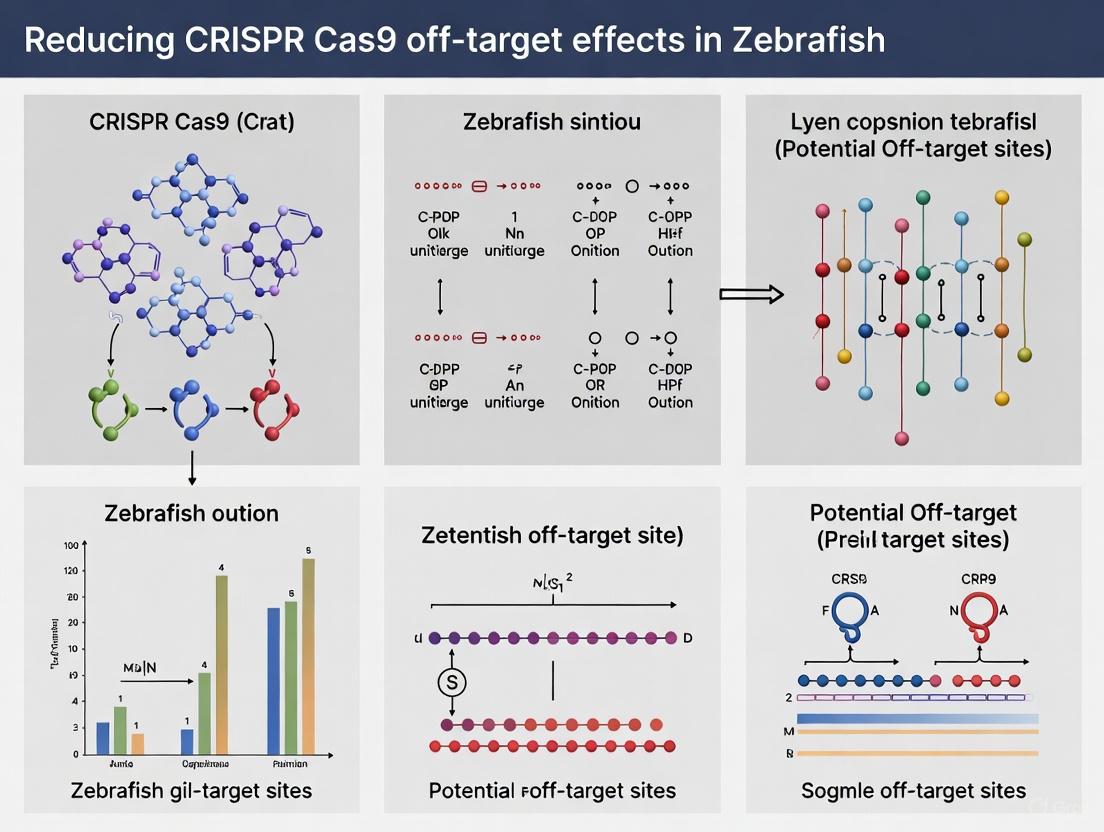
This article provides a comprehensive guide for researchers and drug development professionals on evaluating and mitigating CRISPR-Cas9 off-target effects in zebrafish models.
Strategies for Reducing CRISPR-Cas9 Off-Target Effects in Zebrafish: A Guide for Biomedical Research
Abstract
This article provides a comprehensive guide for researchers and drug development professionals on evaluating and mitigating CRISPR-Cas9 off-target effects in zebrafish models. It covers the foundational understanding of off-target mechanisms, methodological approaches for improved specificity using high-fidelity Cas9 variants and optimized sgRNA design, troubleshooting strategies for complex outcomes like structural variants and mosaicism, and validation techniques using both in silico and empirical detection methods. By synthesizing current evidence and best practices, this resource aims to enhance the reliability and safety of zebrafish CRISPR editing for disease modeling and therapeutic development.
Understanding CRISPR Off-Target Effects in Zebrafish: Mechanisms and Risks
Frequently Asked Questions (FAQs)
Q1: What exactly are "off-target effects" in CRISPR-Cas9 experiments? Off-target effects occur when the CRISPR-Cas9 system creates unintended DNA cleavages at locations in the genome other than the intended target site. These effects are a major concern for therapeutic applications, as they might disrupt the function or regulation of non-targeted genes. Off-target mutations can include small insertions and deletions (indels) or larger, more complex structural variants [1] [2].
Q2: Beyond small indels, what kinds of larger DNA damage should I be concerned about? Research has shown that CRISPR-Cas9 can induce large structural variants (SVs), defined as insertions and deletions ≥50 base pairs. These SVs can occur at both on-target and off-target sites. One study in zebrafish found that SVs represented 6% of editing outcomes in founder larvae and could be passed on to the next generation [1].
Q3: How can I detect these larger structural variants in my zebrafish models? Common validation methods like short-read or Sanger sequencing often fail to detect larger genome aberrations. To reliably identify structural variants, it is advisable to use long-read sequencing technologies, such as PacBio Sequel or nanopore sequencing. These methods are more capable of revealing complex rearrangements and larger insertions or deletions at on-target and off-target sites [1].
Q4: Are there simple experimental modifications that can reduce off-target effects in zebrafish? Yes. A recent study demonstrated that transient low-temperature incubation of zebrafish embryos after CRISPR-Cas9 injection can significantly suppress off-target mutagenesis. For the zebrafish target region ywhaqa, this method maintained high on-target mutation rates while significantly reducing off-target mutation rates at the Off-Y1 site, without severely compromising embryo survival [3].
Q5: What factors influence where off-target effects occur? The off-target activity of CRISPR-Cas9 is influenced by several factors, including the position of mismatches between the guide RNA and the DNA, the DNA context, guide RNA secondary structure, and the concentration of the Cas9 enzyme. Cas9 can tolerate up to 3 mismatches between the sgRNA and genomic DNA, but off-target effects have been observed with more mismatches, sometimes even involving the PAM site [1] [2] [4].
Troubleshooting Guide
Problem: Suspected Off-Target Mutations in F1 Generation
| Symptom | Possible Cause | Recommended Solution | Key Performance Indicator |
|---|---|---|---|
| Unanticipated phenotypic variation in F1 offspring [1]. | Germline transmission of undetected off-target mutations or structural variants from mosaic founders [1]. | Implement low-temperature embryo incubation (e.g., shift to 28°C after early development) to suppress off-target mutagenesis [3]. | Significant reduction in off-target mutation rate in F1 juveniles; maintained high on-target efficiency. |
| Sequencing of known off-target site confirms mutations in offspring. | Founder fish were highly mosaic in their germ cells, passing mutations to progeny [1]. | Use long-read sequencing on founder germ cells or pooled F1 larvae to comprehensively assess mutation load before establishing lines [1]. | Identification of multiple distinct insertion/deletion events in a single founder, confirming mosaicism. |
| PCR-based detection methods fail to explain phenotype. | Large structural variants (≥50 bp) are present but undetected by short-read sequencing [1]. | Replace standard sequencing with long-read sequencing (e.g., PacBio Sequel) for on-/off-target site analysis [1]. | Detection of structural variants representing a significant percentage (e.g., 6%) of editing outcomes. |
Problem: In Vitro Confirmation of Off-Target Cleavage
| Symptom | Possible Cause | Recommended Solution | Key Performance Indicator |
|---|---|---|---|
| Uncertainty about potential off-target loci for a given gRNA. | In silico prediction tools may miss sites due to complex factors like chromatin environment [2]. | Employ biochemical in vitro detection assays like Nano-OTS, CIRCLE-seq, or Digenome-seq on purified genomic DNA to experimentally identify off-target sites [1] [2]. | Discovery of off-target sites with multiple mismatches, including in repetitive or complex genomic regions. |
| High background noise in cleavage detection assays. | Non-specific activity of detection enzymes or intricate mutations at the target site [5]. | Redesign PCR primers for a distinct cleaved banding pattern; use lysate from mock-transfected cells as a negative control [5]. | Clear, distinguishable cleavage bands on a gel with minimal background. |
Quantitative Data on Off-Target Effects
The following table summarizes key quantitative findings from recent in vivo studies in zebrafish, providing a benchmark for evaluating experimental outcomes.
Table 1: Quantified Off-Target and Structural Variant Frequencies in Zebrafish
| Genotype / Stage | gRNA Target | On-Target Editing Efficiency | Off-Target Mutation Rate | Frequency of Structural Variants (≥50 bp) | Key Finding |
|---|---|---|---|---|---|
| Founder Larvae (F0) [1] | sh2b3 | 92.6% | 1.8% (Off-target 1) | 6% of total editing outcomes | SVs occur at both on-target and off-target sites. |
| Founder Larvae (F0) [1] | ywhaqa | 93.6% | Off-target 1: 2.4%Off-target 2: 6.3% | 6% of total editing outcomes | Multiple off-target sites can be active simultaneously. |
| Adult Founders (F0) [1] | sh2b3 & ywhaqa | 69.2% (edited founders) | Not Specified | Not Specified | High degree of mosaicism in adults. |
| Offspring (F1) [1] | sh2b3 & ywhaqaqa | Not Specified | 26% of offspring | 9% of offspring | SVs and off-target mutations can be heritable. |
Table 2: Impact of Low-Temperature Incubation on Mutation Rates
| Experimental Group | Target Region | Mutation Rate (Standard Temp) | Mutation Rate (Low Temp) | Statistical Significance |
|---|---|---|---|---|
| Zebrafish [3] | On-target (ywhaqa) | Remained High | Remained High | Not Significant (On-target efficiency maintained) |
| Zebrafish [3] | Off-target (Off-Y1) | Significant Rate | Significantly Reduced | Yes (p < 0.05) |
Experimental Protocols
Protocol 1: Experimental Workflow for Assessing On- and Off-Target Effects In Vivo
This protocol outlines the key steps for a comprehensive analysis of CRISPR-Cas9 editing outcomes in zebrafish, from embryo injection to sequencing analysis [1].
Protocol 2: Temperature Modulation to Suppress Off-Target Mutations
This protocol details the method for using low-temperature incubation to reduce off-target effects in zebrafish and medaka embryos [3].
The Scientist's Toolkit: Essential Research Reagents
Table 3: Key Reagents and Kits for Off-Target Analysis
| Item Name | Function / Application | Specific Example / Vendor (if provided) |
|---|---|---|
| Ribonucleoprotein (RNP) Complexes | Cas9 protein pre-complexed with sgRNA for direct microinjection; often results in >90% on-target editing efficiency [1]. | N/A |
| Long-Read Sequencer | Platform for sequencing large DNA amplicons to detect structural variants and complex rearrangements missed by short-read tech [1]. | PacBio Sequel System [1] |
| Nano-OTS | A nanopore sequencing-based assay to experimentally identify genome-wide Cas9 off-target cleavage sites in vitro, effective in complex genomic regions [1]. | N/A |
| In Vitro Cleavage Detection Kit | Kit for verifying Cas9 cleavage activity on endogenous genomic loci via PCR and enzymatic detection [5]. | GeneArt Genomic Cleavage Detection Kit [5] |
| Genomic Cleavage Selection Kit | Kit that includes a fluorescence-based reporter (OFP) to enrich for transfected cells and assess cleavage activity [5]. | GeneArt Genomic Cleavage Selection Kit [5] |
Frequently Asked Questions (FAQs)
FAQ 1: To what extent can mismatches between my sgRNA and the DNA target lead to off-target effects?
Cas9 can tolerate mismatches, but this tolerance is highly dependent on the mismatch's position, number, and identity. While early studies suggested activity with up to 4-6 mismatches, the most critical factor is their location [2] [6].
- PAM-Proximal "Seed" and "Core" Regions: Mismatches within the 10-12 nucleotides adjacent to the Protospacer Adjacent Motif (PAM), often called the "seed" region, are generally less tolerated. A specific 4-nucleotide "core" sequence (positions +4 to +7 upstream of the PAM) is exceptionally sensitive, where single-nucleotide mismatches often abolish cleavage entirely [7].
- PAM-Distal Region: Mismatches in the 5' end of the sgRNA (farther from the PAM) are more readily tolerated [7] [2].
- Mismatch Quantity and Type: The risk of off-target editing increases with fewer mismatches. Some nucleotide substitutions are more tolerated than others, and bulges (insertions or deletions in the DNA relative to the sgRNA) can also be cleaved and should be considered [6].
Table 1: Impact of Mismatch Position on Cas9 Cleavage Activity
| Mismatch Position (relative to PAM) | Tolerance Level | Effect on Cleavage Efficacy |
|---|---|---|
| PAM-proximal "Core" (+4 to +7) | Very Low | Single mismatches often abolish cleavage activity [7]. |
| PAM-proximal "Seed" (up to +12) | Low | Mismatches are less tolerated and significantly reduce cleavage [7] [2]. |
| PAM-distal (5' end) | Moderate to High | Mismatches are better tolerated, with minimal to moderate reduction in cleavage [7]. |
| PAM sequence (NGG) | Very Low | Mutations in the PAM sequence (e.g., NGG to NAG) can be tolerated for some sgRNAs, but often greatly compromise cleavage [7] [2]. |
FAQ 2: Are there specific PAM sequences beyond NGG that Cas9 can recognize?
Yes, while the canonical PAM for Streptococcus pyogenes Cas9 is 5'-NGG-3', under certain conditions, alternative PAM sequences can be recognized, though with lower efficiency. The most commonly reported non-canonical PAM is 5'-NAG-3' [7] [2]. However, recognition of NAG and other non-canonical PAMs (e.g., NGA) is highly dependent on the specific sgRNA sequence, and cleavage efficacy is typically much lower than at an NGG site [7].
FAQ 3: What is the most effective strategy to mitigate mismatch-driven off-target effects in my zebrafish experiments?
A multi-layered strategy is recommended for high-fidelity editing in zebrafish:
- In silico sgRNA Design: Use computational tools to select sgRNAs with minimal off-target potential. Prioritize sgRNAs with unique on-target sites and whose predicted off-target sites have multiple mismatches, especially within the PAM-proximal "seed" region [2] [8]. Popular tools include Cas-OFFinder and CCTop [2].
- Use High-Fidelity Cas9 Variants: Replace wild-type Cas9 with engineered high-fidelity mutants such as eSpCas9(1.1), SpCas9-HF1, or HiFi Cas9. These variants have mutations that reduce tolerance to sgRNA-DNA mismatches, significantly lowering off-target activity without substantially compromising on-target efficiency [8].
- Optimize Delivery Method and Dosage: Deliver CRISPR components as ribonucleoprotein (RNP) complexes instead of plasmid DNA. RNP delivery is fast and can reduce off-target effects by shortening the exposure time of the genome to Cas9. Using the minimum effective dose of Cas9 and sgRNA also helps limit off-target activity [6] [8].
- Experimental Off-Target Validation: Empirically test for off-target effects using sensitive methods. For zebrafish research, long-read sequencing of amplicons spanning the on-target and predicted off-target sites (as demonstrated with PacBio sequencing) can reveal unexpected structural variants and indels [1].
Table 2: Experimental Methods for Detecting CRISPR/Cas9 Off-Target Effects
| Method | Principle | Key Advantage | Key Limitation |
|---|---|---|---|
| GUIDE-seq [2] [8] | Integrates double-stranded oligodeoxynucleotides (dsODNs) into DSB sites in vivo for genome-wide profiling. | Highly sensitive; low false-positive rate; works in living cells. | Limited by transfection efficiency in some systems. |
| CIRCLE-seq [2] [8] | Circularizes sheared genomic DNA, which is then incubated with Cas9-sgRNA in vitro; cleaved sites are linearized and sequenced. | Highly sensitive; works on purified DNA without cellular context. | Lacks cellular chromatin context, which can influence Cas9 binding. |
| Digenome-seq [2] | Cas9-digested genomic DNA is subjected to whole-genome sequencing (WGS) to identify cleavage sites. | High sensitivity; no a priori knowledge of off-targets needed. | Expensive; requires high sequencing coverage and a reference genome. |
| Long-read Amplicon Seq [1] | PCR-amplifies regions of interest (on/off-target sites) followed by long-read sequencing (e.g., PacBio). | Detects large structural variants (SVs) and complex indels missed by short-read methods. | Targeted approach; requires prior knowledge of loci to amplify. |
| BLISS & BLESS [2] | Captures DSBs in situ using biotinylated adaptors or dsODNs. | Directly captures DSBs at the time of detection; works in fixed cells and tissues. | Only provides a snapshot of DSBs at a single time point. |
Experimental Protocol: Validating On-Target and Off-Target Editing in Zebrafish
This protocol, adapted from recent zebrafish studies, details how to empirically assess editing fidelity using long-read amplicon sequencing [1].
1. sgRNA Selection and Pre-testing:
- Select 3-4 candidate sgRNAs against your target gene using in silico tools (e.g., Cas-OFFinder) to nominate sequences with the fewest potential off-target sites, particularly avoiding those with few (1-3) mismatches in the PAM-distal region [2] [6].
- If possible, pre-screen sgRNAs for off-target activity in vitro using methods like Nano-OTS or CIRCLE-seq on purified zebrafish genomic DNA to identify the most specific guide before proceeding to in vivo work [1] [2].
2. Zebrafish Embryo Microinjection:
- Reagents: Synthesize your selected sgRNA and Cas9 mRNA (or obtain recombinant Cas9 protein for RNP formation).
- Injection: Microinject a mixture of sgRNA and Cas9 mRNA/protein into the yolk of one-cell stage zebrafish embryos [9] [10].
- Controls: Include uninjected embryos from the same clutch as negative controls.
3. DNA Extraction and Amplicon Generation:
- Sample Collection: At 5 days post-fertilization (dpf), pool a subset of injected larvae. Raise the remaining fish to adulthood (F0 founders).
- DNA Extraction: Isolate genomic DNA from pooled larvae and fin clips of adult founders.
- PCR Amplification: Design primers to generate large amplicons (2.6 - 7.7 kb) spanning the on-target site and all predicted off-target sites. Using long-range, high-fidelity PCR ensures the amplification of large structural variants [1].
4. Long-Read Sequencing and Analysis:
- Library Preparation & Sequencing: Prepare sequencing libraries from the purified amplicons and sequence using a long-read technology (e.g., PacBio Sequel system).
- Data Analysis: Process the sequencing data using specialized software (e.g., SIQ) to identify and quantify all insertion and deletion mutations (indels) and larger structural variants (SVs ≥ 50 bp) at each site [1].
- Filtering: Subtract any mutations identified in the uninjected controls to filter out natural polymorphisms and sequencing errors.
5. Germline Transmission Assessment:
- Outcross adult F0 founder fish to wild-type partners to generate an F1 generation.
- Analyze the F1 offspring to determine which off-target mutations and SVs are heritable, providing a critical assessment of the long-term genetic impact [1].
The Scientist's Toolkit: Key Reagents for Fidelity Testing
Table 3: Essential Research Reagents and Resources
| Reagent / Resource | Function / Description | Application in Zebrafish |
|---|---|---|
| High-Fidelity Cas9 Variants (e.g., SpCas9-HF1, HiFi Cas9) | Engineered Cas9 proteins with reduced affinity for mismatched DNA targets. | Significantly lowers off-target editing while maintaining good on-target activity when injected as mRNA or RNP [8]. |
| Cas-OFFinder Software | An open-source tool for genome-wide prediction of potential off-target sites with user-defined parameters (mismatches, bulges) [2]. | Critical first step for sgRNA design and for selecting loci for targeted off-target validation via amplicon sequencing [2] [6]. |
| PacBio Long-Read Sequencing | A sequencing technology that produces long, continuous reads (several kilobases). | Essential for detecting large, complex structural variants and insertions at on-target and off-target sites that are missed by short-read sequencers [1]. |
| Ribonucleoprotein (RNP) Complexes | Pre-complexed recombinant Cas9 protein and sgRNA. | A preferred delivery method; RNP delivery leads to rapid degradation and can significantly reduce off-target effects compared to plasmid DNA delivery [6] [8]. |
| MAGeCK Software | A computational tool (Model-based Analysis of Genome-wide CRISPR-Cas9 Knockout) for analyzing CRISPR screen data. | Useful for analyzing the distribution and enrichment/depletion of sgRNAs in high-throughput screens to identify true hits and potential confounders [11]. |
Workflow Diagram: From sgRNA Design to Validation
The diagram below illustrates the core workflow and decision points for designing a specific sgRNA and experimentally confirming its fidelity.
FAQ 1: How common are off-target mutations in zebrafish CRISPR studies?
Off-target mutations in zebrafish CRISPR studies occur, but their frequency is generally low. However, the type and inheritance of these unintended edits are critical for risk assessment.
The table below summarizes findings from key studies on off-target mutation frequency and type.
| Study Model / Description | Reported Off-Target Frequency | Key Findings on Mutation Type |
|---|---|---|
| General Assessment (Hruscha et al.) | 1.1% - 2.5% of potential sites [12] | Demonstrates the high specificity of the CRISPR/Cas9 system in vivo [12]. |
| Deep Sequencing Study (BMC Genomics) | Majority of tested loci had low in vivo frequencies (<1%) [13] | Low off-target activity was confirmed across 50 different gRNAs [13]. |
| Structural Variants Study (Nature Comms) | 26% of offspring carried an off-target mutation [1] | Large structural variants (SVs) were found at both on-target and off-target sites, with 9% of offspring inheriting an SV [1]. |
FAQ 2: What types of unintended mutations should I be most concerned about?
While small insertions and deletions (indels) at off-target sites are rare, the most significant concern is the formation of large structural variants (SVs). These are insertions or deletions ≥50 bp and more complex rearrangements that can occur at both on-target and off-target sites [1]. Standard validation methods like Sanger sequencing often miss these SVs, requiring more sophisticated long-read sequencing technologies (e.g., PacBio) for detection [1].
FAQ 3: Are CRISPR-induced mutations inherited by the next generation?
Yes, both intended on-target and unintended off-target mutations can be transmitted to the F1 generation. A key finding is that adult founder zebrafish (F0) are highly mosaic. This means their somatic and germ cells contain a variety of different editing outcomes, which is why the offspring can inherit a range of different mutations [1]. One study found that 26% of offspring carried an off-target mutation and 9% inherited a large structural variant [1].
Troubleshooting Guides
Guide 1: How to Reduce Off-Target Effects and Improve Knock-in Efficiency
Detailed Protocol
This protocol is based on the use of Cas9 ribonucleoprotein (RNP) complexes, which have been shown to improve specificity and efficiency [14].
Design and Synthesis
- sgRNA Design: Use specialized software (e.g., CRISPRScan) to select gRNAs with high predicted on-target efficiency and low off-target potential [13].
- Template Design (for knock-in): For precise edits, co-inject a single-stranded DNA (ssODN) template containing your desired variant flanked by homology arms. To significantly boost efficiency, one strategy is to clone this template into a circular plasmid flanked by CRISPR target sites, which gets linearized in vivo to provide the repair template [15].
- RNP Complex Formation: Complex the purified sgRNA with purified Cas9 protein (not mRNA) in a microinjection buffer. A common injection mix contains 200 ng/µL sgRNA and 600 ng/µL Cas9 protein [16]. Incubate for 10-15 minutes at room temperature before injection.
Microinjection
Modulating DNA Repair (Optional)
- To favor Homology-Directed Repair (HDR) for knock-ins, consider co-injecting a morpholino to knock down a key protein of the Non-homologous end joining (NHEJ) pathway, such as Ku70. This has been shown to improve knock-in efficiency for some targets [14].
Post-injection Handling
- To increase mutagenesis efficiency, one study found that incubating injected embryos at a lower temperature (12°C) for 30-60 minutes post-injection can extend the single-cell stage and improve editing rates [17]. After this, return embryos to standard rearing conditions (28.5°C).
The following workflow diagram illustrates the optimized RNP-based knock-in process.
Guide 2: How to Detect and Validate On-Target and Off-Target Mutations
Accurate detection is crucial, as standard methods can miss large structural variants.
Detailed Protocol
Sample Collection: For a comprehensive view, collect pools of injected F0 larvae and individual adult F0 founders. To assess germline transmission, raise founders and collect their F1 offspring [1] [13].
Initial Screening for Small Indels:
- PCR and High-Resolution Melt Analysis (HRMA): A rapid, affordable method to identify pools of embryos with successful mutagenesis. DNA with indels produces a different melt curve than wild-type DNA [18].
- Heteroduplex Mobility Assay (HMA): PCR products are run on a polyacrylamide gel. Heteroduplexes (formed between wild-type and mutant DNA strands) migrate differently, appearing as "smears" that indicate editing [16] [13].
- Sanger Sequencing with Deconvolution Tools: PCR amplicons are Sanger sequenced. Tools like TIDE or ICE analyze the chromatogram to deconvolute the mixture of sequences and estimate indel efficiency [13].
Comprehensive Detection of Structural Variants (Critical Step):
- Long-Range PCR: Generate large amplicons (2.6–7.7 kb) spanning the on-target and predicted off-target sites [1].
- Long-Read Sequencing: Use technologies like PacBio Sequel to sequence these amplicons. Long reads are essential for reliably identifying large insertions, deletions, and complex rearrangements that short-read sequencing misses [1].
- Bioinformatic Analysis: Use specialized software (e.g., SIQ) to identify and quantify all mutation types from the long-read sequencing data [1].
The logical relationship between mutation types and the recommended detection methods is summarized below.
The Scientist's Toolkit: Research Reagent Solutions
| Reagent / Material | Function / Explanation | Example Usage |
|---|---|---|
| Cas9 Protein (RNP Complex) | Purified Cas9 protein complexed with sgRNA. Reduces off-target effects and improves editing efficiency compared to mRNA injection. | Directly injected into one-cell stage embryos [14] [16]. |
| Single-Stranded Oligodeoxynucleotide (ssODN) | A single-stranded DNA template used for Homology-Directed Repair (HDR) to introduce precise point mutations or small tags [15] [14]. | Co-injected with RNP for knock-in generation [14]. |
| Ku70 Morpholino | An antisense oligonucleotide that temporarily blocks the expression of Ku70, a key protein in the NHEJ repair pathway. | Co-injected to bias repair toward HDR, improving knock-in efficiency [14]. |
| Long-Read Sequencing (PacBio/Nanopore) | Genomics technology that generates long DNA sequence reads, enabling the detection of large structural variants missed by Sanger sequencing. | Used for comprehensive profiling of on-target and off-target editing outcomes in F0 and F1 animals [1]. |
| High-Resolution Melt Analysis (HRMA) | A rapid post-PCR method that detects sequence variants by differences in DNA melting behavior. | Used for initial high-throughput screening of F0 and F1 embryos to identify potential mutants [18]. |
Troubleshooting Guide: Addressing Off-Target Effects in Zebrafish CRISPR Experiments
Why are my zebrafish phenotypes inconsistent or unexpected despite high on-target editing efficiency?
Unexpected phenotypic outcomes can result from CRISPR-Cas9 off-target effects, where the Cas9 nuclease cleaves unintended genomic sites with sequence similarity to your target. These off-target edits can disrupt functionally important genes and confound your experimental results.
Primary Causes:
- Mismatch tolerance: Wild-type SpCas9 can tolerate 3-5 base pair mismatches between gRNA and genomic DNA, especially if mismatches are distal to the PAM sequence [4] [19]
- gRNA secondary structure: Complex gRNA folding can reduce specificity and promote off-target binding [4]
- Prolonged nuclease activity: Extended expression of CRISPR components increases off-target opportunities [19]
- High nuclease concentration: Excessive Cas9/gRNA concentrations can saturate specific binding sites [4]
Detection and Verification Protocol:
- In silico prediction: Use Cas-OFFinder or similar tools to identify potential off-target sites with up to 6 nucleotide mismatches [2]
- Candidate site sequencing: Amplify and sequence top predicted off-target loci from your edited zebrafish samples [19]
- Comprehensive analysis: For critical applications, consider GUIDE-seq or CIRCLE-seq to identify off-target sites genome-wide [2]
- Phenotypic validation: Outcross edited fish and track whether phenotypes segregate with intended edits
Prevention Strategies:
- Utilize high-fidelity Cas9 variants (e.g., SpCas9-HF1, eSpCas9) with reduced off-target activity [19]
- Optimize gRNA design to minimize off-target potential (see FAQ section below)
- Deliver CRISPR components as ribonucleoprotein (RNP) complexes rather than plasmid DNA to reduce persistence time [19]
- Titrate Cas9/gRNA concentrations to the minimum required for efficient editing [4]
Frequently Asked Questions
How can I predict potential off-target sites for my zebrafish gRNA?
Answer: Multiple in silico tools are available for off-target prediction. The table below summarizes the primary computational methods:
Table: Computational Tools for CRISPR Off-Target Prediction
| Tool Name | Key Features | Advantages | Limitations |
|---|---|---|---|
| CasOT [2] | Exhaustive search with adjustable PAM and mismatch parameters | First exhaustive prediction tool; customizable parameters | Biased toward sgRNA-dependent effects |
| Cas-OFFinder [2] | Tolerant of various sgRNA lengths, PAM types, mismatches and bulges | Widely applicable; flexible parameters | Doesn't fully consider epigenetic context |
| FlashFry [2] | High-throughput analysis of thousands of targets | Fast processing; provides GC content and on/off-target scores | Requires computational expertise |
| CCTop [2] | Scoring based on mismatch distance to PAM | User-friendly web interface | Limited to standard SpCas9 PAM |
Experimental Considerations: Always validate computational predictions experimentally, as current tools cannot fully account for chromatin accessibility, DNA methylation, and cellular context that influence editing efficiency [2].
What experimental methods can detect off-target edits in zebrafish?
Answer: The following table compares major experimental approaches for off-target detection:
Table: Experimental Methods for Detecting Off-Target Effects
| Method | Principle | Sensitivity | Throughput | Requirements |
|---|---|---|---|---|
| Candidate Sequencing [19] | Sanger or NGS of predicted off-target sites | Moderate | High | Prior knowledge of potential off-target sites |
| GUIDE-seq [2] [19] | Integration of dsODNs into DSBs followed by sequencing | High | Medium | Cell transfection capability |
| CIRCLE-seq [2] [19] | In vitro Cas9 cleavage of circularized genomic DNA | Very High | High | Purified genomic DNA |
| Whole Genome Sequencing [19] | Comprehensive sequencing of entire genome | Ultimate | Low | Significant budget and bioinformatics |
Zebrafish-Specific Protocol for Candidate Site Sequencing:
- Identify top 10-20 potential off-target sites using Cas-OFFinder or similar tool
- Design PCR primers flanking each potential off-target site
- Amplify regions from pooled F0 zebrafish genomic DNA or individual F1 fish
- Sequence using Sanger or next-generation sequencing
- Analyze sequencing traces with tools like ICE (Inference of CRISPR Edits) to quantify indel frequencies [19]
- Correlate specific off-target edits with observed phenotypes in individual fish
How can I design better gRNAs to minimize off-target effects?
Answer: Optimal gRNA design incorporates multiple strategies to enhance specificity:
Key Design Principles:
- Specificity scoring: Select gRNAs with high specificity scores from tools like CRISPOR that calculate on-target to off-target activity ratios [19]
- GC content: Maintain moderate GC content (40-60%) - too low reduces stability, too high may increase off-target potential [19]
- gRNA length: Consider truncated gRNAs (17-19 nt instead of 20 nt) for increased specificity, though this may reduce on-target efficiency [19]
- Chemical modifications: Incorporate 2'-O-methyl analogs (2'-O-Me) and 3' phosphorothioate bonds (PS) in synthetic gRNAs to enhance stability and specificity [19]
- Avoid repetitive regions: Target unique genomic sequences with minimal homology elsewhere in the genome
Validation Workflow:
- Design 3-5 candidate gRNAs for your target using multiple design tools
- Compare specificity scores and select the top 2-3 candidates
- Test editing efficiency and specificity in zebrafish embryos
- Select the gRNA with the best balance of high on-target and low off-target activity
How do I interpret phenotypic results when off-target effects are suspected?
Answer: Use this systematic approach to distinguish true from confounded phenotypes:
Confirmation Protocol:
- Outcross to wild-type lines: Cross your edited fish with wild-type zebrafish and track phenotype segregation with genotyped edits across multiple generations [10]
- Multiple independent alleles: Generate 2-3 independent mutant alleles; consistent phenotypes across alleles suggest true effects [20]
- Rescue experiments: Reintroduce wild-type transgene to confirm phenotypic rescue [21]
- Complementary approaches: Validate using morpholinos or small molecule inhibitors targeting the same pathway [21]
- CRISPant validation: For rapid assessment, compare F0 CRISPant phenotypes with stable mutant lines [22]
Red Flags for Confounded Phenotypes:
- Phenotypes vary significantly between individuals with identical intended edits
- F0 CRISPants show stronger phenotypes than stable heterozygous mutants
- Outcrossing eliminates the phenotype despite retention of the intended edit
- Multiple independent alleles show different phenotypic severity
Table: Key Research Reagents for Minimizing Off-Target Effects in Zebrafish
| Reagent Type | Specific Examples | Function & Application | Considerations |
|---|---|---|---|
| High-Fidelity Cas9 Variants | SpCas9-HF1, eSpCas9, HypaCas9 [19] | Engineered for reduced off-target activity while maintaining on-target efficiency | Some variants show reduced on-target efficiency; requires validation |
| Alternative Cas Nucleases | Cas12a (Cpf1), SaCas9 [19] | Different PAM requirements and cleavage mechanisms reduce overlap with SpCas9 off-target sites | PAM limitations may restrict targeting range |
| Chemical Modifications | 2'-O-Me, 3' Phosphorothioate bonds [19] | Enhance gRNA stability and reduce off-target interactions | Requires synthetic gRNA production; increased cost |
| Delivery Vehicles | Ribonucleoprotein (RNP) complexes [19] | Shortened activity window reduces off-target potential | Direct delivery to zebrafish embryos can be challenging |
| Detection Tools | GUIDE-seq, CIRCLE-seq, ICE analysis tool [2] [19] | Identify and quantify off-target edits; analyze editing efficiency | Varying cost, complexity and equipment requirements |
Experimental Workflows and Visual Guides
Off-Target Assessment Workflow
Mechanisms of Off-Target Cleavage
FAQs and Troubleshooting Guides
Why is my germline transmission rate low despite high F0 mosaicism?
High mosaicism in the F0 generation does not guarantee successful germline transmission. The key factor is whether the CRISPR-Cas9 edit is present in the primordial germ cells.
Key Considerations:
- Injection Timing: Inject CRISPR components at the one-cell stage to maximize distribution to all cells, including germline precursors [23].
- Template Design: Use donor templates with short homology arms (24-48 bp) for Homology-Mediated End Joining (HMEJ), which achieves higher germline transmission rates (averaging ~50% across several loci) compared to traditional methods [24].
- Template Protection: Utilize 5' AmC6 end-protected primers to generate PCR amplicon donors. This modification prevents degradation and multimerization, significantly enhancing knock-in efficiency and subsequent germline transmission [25].
Troubleshooting Steps:
- Verify Template Quality: Ensure your donor template is properly linearized and purified.
- Optimize Concentration: Titrate the concentration of Cas9 protein/sgRNA and donor template. High concentrations of Cas9 can increase somatic mutations but may not improve germline transmission.
- Screen Multiple F0s: Raise and outcross a larger number of mosaic F0 founders, as germline transmission can be highly variable between individuals.
How can I reduce mosaicism in F0 CRISPR-injected zebrafish?
Mosaicism occurs when edits are not incorporated during the first cell division, leading to animals with a mixture of edited and unedited cells.
Strategies to Reduce Mosaicism:
- Use Cas9 Protein: Co-inject preassembled Cas9 ribonucleoprotein (RNP) complexes with the sgRNA, instead of Cas9 mRNA. This accelerates the generation of double-strand breaks immediately after injection [25] [23].
- Early Injection: Inject immediately after fertilization into the cell cytoplasm or directly into the blastomere.
- Optimized Donor Design: For knock-ins, employ the "GeneWeld" HMEJ strategy using the pGTag vector series. This method uses a universal gRNA (UgRNA) to linearize the donor vector in vivo, exposing short homology arms and promoting highly efficient and precise integration [24].
What methods can I use to accurately assess F0 mosaicism and edit efficiency?
Accurate assessment is crucial for selecting the best F0 founders to raise.
Common Methods:
- Heteroduplex Mobility Assay (HMA): A quick, low-cost gel-based method to detect indels. PCR products from injected embryos are analyzed on a polyacrylamide gel; heteroduplex formation indicates mutagenesis [23].
- Junction Fragment PCR: For knock-in validation, use PCR with one primer in the endogenous locus and another in the inserted cassette. Sanger sequencing of this product confirms precise integration [25] [24].
- Restriction Fragment Length Polymorphism (RFLP): If the edit disrupts or creates a restriction site, digest the PCR product with the appropriate enzyme and analyze the fragment pattern.
- Next-Generation Sequencing (NGS): For the most quantitative analysis, perform targeted amplicon sequencing to determine the exact percentage of edited alleles.
Does high-efficiency editing increase the risk of off-target effects in the germline?
Current evidence suggests that CRISPR-Cas9 does not significantly inflate off-target single nucleotide variants (SNVs) in zebrafish.
Supporting Data: A whole-exome sequencing study comparing control and CRISPR-Cas9 edited zebrafish found no increase in transmissible variants in the F1 generation or in mosaic F0 individuals [26]. The study concluded that in vivo editing with carefully designed sgRNAs does not precipitate an inflation of deleterious point mutations [26].
To Minimize Risks:
- sgRNA Design: Use tools like CRISPOR or CRISPRscan to select sgRNAs with high on-target and low off-target scores [26].
- Use High-Fidelity Cas9 Variants: Consider Cas9 enzymes engineered for higher specificity.
- Prediction Tools: Utilize algorithms like CRISPRdirect or Cas-OFFinder to predict and screen potential off-target sites [26].
Quantitative Data on Editing Efficiency
Table 1: Germline Transmission Rates from Different Knock-in Strategies
| Method | Homology Arm Length | Key Feature | Reported Germline Transmission Rate | Key Reference |
|---|---|---|---|---|
| HMEJ (pGTag) | 24-48 bp | Cas9-mediated in vivo donor linearization | Average of ~50% (range: 22-100%) across 8 loci | [24] |
| 3' Knock-in | Long (~900 bp) | 5' AmC6-modified dsDNA donor | 11.5% to 20% | [25] |
| ssODN HDR | N/A | Single-stranded oligodeoxynucleotide donor | Knock-in efficiencies of 3.5-15.6% | [12] |
Table 2: Impact of Homology Arm Length on Integration Efficiency
| Homology Arm Length | Precise Integration Rate (5' end) | Observation |
|---|---|---|
| 12 bp | 56% (5/9 alleles) | Lower efficiency, higher rate of imprecise integration |
| 24 bp | 95% (19/20 alleles) | High precision and efficiency |
| 48 bp | 79% (15/19 alleles) | High efficiency, robust performance |
Experimental Workflow & Protocols
Workflow for Improving Germline Transmission
Protocol: CRISPR-Cas9 Knock-in Using HMEJ Strategy
Based on the GeneWeld method for high-efficiency targeted integration [24]:
sgRNA and Donor Design:
- Design a sgRNA with high on-target efficiency (validate using CHOPCHOP or similar tool).
- Clone 24-48 bp homology arms into a pGTag vector. The homology arms should flank the UgRNA site for in vivo linearization.
Reagent Preparation:
- Synthesize sgRNA and the UgRNA in vitro.
- Prepare the donor plasmid.
- Complex purified Cas9 protein with the sgRNA and UgRNA to form RNPs.
Microinjection:
- Inject ~1 nL of a mixture containing:
- Cas9 protein (200 pg/nl)
- sgRNA (100 pg/nl)
- UgRNA
- Donor plasmid
- into the cytoplasm of one-cell stage zebrafish embryos [23].
- Inject ~1 nL of a mixture containing:
Screening and Raising Founders:
- At 3-5 dpf, screen injected embryos (F0) for precise integration using a rapid DNA extraction and PCR genotyping protocol.
- Raise PCR-positive, mosaic F0 embryos to adulthood.
Germline Transmission Testing:
- Outcross adult F0 fish to wild-type partners.
- Collect and genotype F1 embryos to identify those carrying the precise knock-in allele.
- Calculate germline transmission rate as the percentage of F0 fish that produce edited F1 offspring.
The Scientist's Toolkit: Key Research Reagent Solutions
Table 3: Essential Reagents for Zebrafish CRISPR Genome Editing
| Reagent / Tool | Function / Purpose | Example / Note |
|---|---|---|
| Cas9 Protein | Creates double-strand breaks at target DNA sites. Using protein (RNP) leads to faster editing and reduced mosaicism compared to mRNA. | Purified protein available from commercial suppliers (e.g., PNA Bio) [23]. |
| pGTag Vectors | A suite of donor vectors for HMEJ. Simplifies knock-in by using short homology arms and a universal gRNA for in vivo linearization. | Available from Addgene; designed for easy engineering of homology arms [24]. |
| 5' AmC6 Modified Primers | Primers with a C6 carbon linker at the 5' end. Used to synthesize dsDNA donors with increased resistance to degradation, boosting knock-in efficiency. | Critical for cloning-free, PCR-amplified dsDNA donor preparation [25]. |
| UgRNA | A universal guide RNA sequence with no predicted targets in zebrafish, pig, or human genomes. Used in HMEJ to linearize the donor vector inside the cell. | Ensures consistent liberation of homology arms in the pGTag system [24]. |
| idTracker Software | Open-source software for tracking zebrafish locomotion in behavioral assays. Useful for analyzing potential phenotypes in edited lines. | Can be used to analyze behavior in validated knock-in lines [27]. |
Practical Strategies for Enhancing CRISPR Specificity in Zebrafish Models
FAQs: Understanding High-Fidelity Cas9 Variants
Q1: What are high-fidelity Cas9 variants and why are they crucial in zebrafish research?
High-fidelity Cas9 variants are engineered versions of the standard Streptococcus pyogenes Cas9 (SpCas9) nuclease designed to reduce off-target effects while maintaining robust on-target activity. They are crucial in zebrafish research because unintended mutations can be passed to the next generation, complicating phenotype interpretation. Studies show that standard CRISPR-Cas9 editing in zebrafish can introduce structural variants (insertions/deletions ≥50 bp) at both on-target and off-target sites, with 6% of editing outcomes in founder larvae containing these larger alterations, and 26% of offspring inheriting an off-target mutation [28]. Using high-fidelity variants minimizes this risk, ensuring that observed phenotypes are linked to the intended genetic modification.
Q2: How do SpCas9-HF1, eSpCas9, and HiFi Cas9 mechanistically reduce off-target effects?
These variants reduce off-target editing by weakening the interactions between the Cas9 protein and the DNA backbone. This makes the Cas9 cleavage more dependent on perfect guide RNA:DNA complementarity. The specific mechanisms are [4]:
- SpCas9-HF1 (High-Fidelity 1) contains four mutations (N497A, R661A, Q695A, and Q926A) that disrupt hydrogen bonding between Cas9 and the phosphate groups of the target DNA strand.
- eSpCas9 (enhanced Specificity) contains mutations (K848A, K1003A, and R1060A) that mitigate the "electrostatic steering" that promotes non-specific binding to off-target DNA.
- HiFi Cas9 is a variant developed by Integrated DNA Technologies (IDT) that offers an optimal balance of high on-target efficiency and significantly reduced off-target effects, though its precise mutation set is proprietary. It is particularly noted for its performance in human cells and is increasingly used in other model organisms.
Q3: What is the typical reduction in off-target activity for these variants compared to wild-type SpCas9?
While exact figures can vary by target site and delivery method, high-fidelity variants can dramatically reduce off-target activity. For example, the development of HF-BE3, a high-fidelity base editor incorporating the SpCas9-HF1 mutations, demonstrated a reduction in off-target effects by up to 37-fold at non-repetitive sites and about 3-fold at a highly repetitive site compared to the standard BE3 editor [29]. In zebrafish, the use of Cas9 protein (a strategy often paired with high-fidelity variants) has been shown to significantly increase on-target indel percentages and improve the specificity of knock-in editing compared to Cas9 mRNA [30].
Q4: Does using a high-fidelity variant guarantee no off-target effects?
No. While high-fidelity variants significantly lower the probability, the risk of off-target effects is not eliminated. Off-target activity is influenced by multiple factors, including the specific guide RNA (gRNA) sequence, nucleotide context, gRNA secondary structure, and cellular enzyme concentration [4]. Therefore, careful gRNA design and empirical off-target assessment remain essential steps in any experiment.
Q5: Are there trade-offs in on-target efficiency when using high-fidelity variants?
Early high-fidelity variants sometimes suffered from reduced on-target cutting efficiency. However, newer versions like HiFi Cas9 have been optimized to minimize this trade-off. When using any high-fidelity variant, it is critical to select gRNAs with high predicted on-target activity. Computational tools can assist in this selection, and empirical validation of editing efficiency in injected zebrafish embryos is strongly recommended [31].
Troubleshooting Guides
Problem: Low On-Target Editing Efficiency with a High-Fidelity Variant
Potential Causes and Solutions:
Cause 1: Suboptimal gRNA Design.
- Solution: Re-design gRNAs using modern prediction tools that incorporate deep learning models. Prioritize gRNAs with high predicted efficiency scores and avoid those with high similarity to other genomic regions. Ensure a GC content between 40-60% [31].
- Protocol: Use tools like CHOP-CHOP or ACEofBASEs (the latter is referenced for base editors) to design and select gRNAs with minimal predicted off-targets [32] [29].
Cause 2: Inadequate Concentration of CRISPR Components.
- Solution: Titrate the concentration of the Cas9 protein/gRNA complex (ribonucleoprotein, RNP). Using purified Cas9 protein complexed with gRNA (RNP) is often more effective and specific than injecting Cas9 mRNA [30].
- Protocol: For zebrafish microinjection, test a range of RNP concentrations (e.g., 50-500 ng/μL total). A proven effective condition is using non-target asymmetric PAM-distal (NAD) single-stranded oligodeoxynucleotide (ssODN) repair templates with Cas9 protein, which has been shown to yield somatic editing efficiencies of ~2.8% to 5.1% in zebrafish [30].
Cause 3: Inefficient Delivery or Poor Viability of Embryos.
- Solution: Ensure the health and fecundity of zebrafish breeding pairs and optimize the microinjection setup to minimize embryo damage [23].
- Protocol: Follow established zebrafish CRISPR protocols. Use a manual microinjection rig at a zoom stereo microscope. Collect and inject embryos within 30 minutes of fertilization at the single-cell stage. Maintain injected embryos at 28.5°C in system water [23].
Problem: Suspected Persistent Off-Target Effects
Potential Causes and Solutions:
Cause 1: gRNA with High Off-Target Potential.
- Solution: Even with a high-fidelity variant, a gRNA designed for a sequence with many near-identical genomic matches can cause problems. Use multiple computational tools to predict and avoid such gRNAs.
- Protocol: Before starting experiments, perform genome-wide off-target prediction using tools like Cas-OFFinder or CRISPRitz to scan for sites with up to 5 nucleotide mismatches [33].
Cause 2: Lack of Empirical Off-Target Validation.
- Solution: Computational prediction is not perfect. Use sensitive experimental methods to identify off-target sites.
- Protocol: For a comprehensive assessment, use in vitro methods like CIRCLE-seq or CHANGE-seq, which can identify potential off-target sites genome-wide with high sensitivity [33]. For validation in your specific experiment, perform targeted amplicon sequencing of the top predicted off-target loci in your F0 and F1 generation zebrafish [28].
Cause 3: Undetected Structural Variants.
- Solution: Standard genotyping methods like heteroduplex mobility assays or short-read sequencing may miss large deletions or complex rearrangements.
- Protocol: To detect structural variants (SVs) at the on-target site, use long-read sequencing technologies (e.g., PacBio Sequel system) on large amplicons spanning the target site. One study found that 6% of editing outcomes in zebrafish larvae were SVs, which can be inherited by the next generation [28].
Table 1: Comparison of High-Fidelity Cas9 Variants
| Variant | Key Mutations | Mechanism of Fidelity | Reported Reduction in Off-Target Effects | Typical On-Target Efficiency |
|---|---|---|---|---|
| SpCas9-HF1 | N497A, R661A, Q695A, Q926A | Disrupts H-bonds to DNA phosphate backbone | Up to 85% reduction in human cells; HF-BE3 showed >37-fold reduction at some sites [29] | Can be reduced; requires highly efficient gRNA |
| eSpCas9 | K848A, K1003A, R1060A | Reduces non-specific DNA binding via electrostatic steering | Significant reduction in human cells and mice | Can be reduced; requires highly efficient gRNA |
| HiFi Cas9 | Proprietary | Optimized balance of fidelity and affinity | Near-undetectable off-targets in many cases while maintaining high on-target activity | High, with minimal trade-off compared to wild-type |
Table 2: Zebrafish-Specific CRISPR Efficiency Data
| Parameter | Standard CRISPR (Wild-type Cas9) | CRISPR with High-Fidelity Variants & Optimized Protocol | Source/Context |
|---|---|---|---|
| On-target indel frequency | Up to 86% (with efficient gRNA) [12] | High, but requires optimization (see Table 1) | Founders (F0) |
| Off-target mutation rate | 1.1–2.5% at predicted sites [12] | Drastically reduced, often to near-undetectable levels | Founders (F0) |
| Structural Variants (SVs) at on-target site | 6% of editing outcomes [28] | Not specifically reported, but expected to be reduced due to fewer DSBs at off-target sites | Founder larvae |
| Germline transmission of off-target mutations | 26% of offspring carried an off-target mutation [28] | Expected to be significantly lower | F1 Generation |
Experimental Protocols
Protocol 1: Optimized Knock-in in Zebrafish using RNP and Early Genotyping
This protocol leverages Cas9 protein (compatible with high-fidelity variants) and early selection to improve the efficiency of generating knock-in (KI) models [30].
- gRNA and Repair Template Design: Design a high-efficiency sgRNA. Use a non-target asymmetric PAM-distal (NAD) conformation single-stranded oligodeoxynucleotide (ssODN) as a repair template, with a length of 120 nucleotides.
- RNP Complex Formation: Complex purified Cas9 protein (e.g., HiFi Cas9) with the in vitro transcribed sgRNA to form ribonucleoprotein (RNP) complexes.
- Microinjection: Co-inject the RNP complexes and the ssODN repair template into the cytoplasm of zebrafish embryos at the one-cell stage.
- Early Genotyping with ZEG: At 72 hours post-fertilization (hpf), use the Zebrafish Embryo Genotyper (ZEG) device to extract a minimal amount of genomic DNA from each embryo with high survival rates.
- Next-Generation Sequencing (NGS): Library and sequence the extracted DNA using NGS to accurately quantify the somatic KI efficiency in each individual embryo.
- Selective Raising: Identify and raise only the embryos with the highest KI efficiency to adulthood. This pre-selection can lead to an almost 17-fold increase in somatic editing efficiency and greatly improves the chances of germline transmission [30].
Protocol 2: Long-Read Sequencing for Detecting Structural Variants
This protocol is used to identify large, unintended mutations at the on-target site that are often missed by standard techniques [28].
- Amplification: From edited zebrafish (F0 adults or their F1 offspring), construct large PCR amplicons (e.g., 2.6–7.7 kb) that span the CRISPR-Cas9 on-target cleavage site.
- Library Preparation and Sequencing: Prepare sequencing libraries from these amplicons and run them on a long-read sequencing platform, such as the PacBio Sequel system.
- Data Analysis: Use specialized software (e.g., SIQ) to analyze the long reads for the presence of structural variants (insertions or deletions ≥50 bp) and complex rearrangements.
Visualization of Workflows and Relationships
Optimized Zebrafish CRISPR Workflow
Factors Influencing Off-Target Effects
The Scientist's Toolkit: Research Reagent Solutions
Table 3: Essential Reagents for High-Fidelity CRISPR in Zebrafish
| Reagent / Tool | Function / Description | Example / Note |
|---|---|---|
| High-Fidelity Cas9 Protein | Purified recombinant protein for RNP complex formation. Reduces off-targets and improves editing speed compared to mRNA. | HiFi Cas9, eSpCas9(1.1) Protein |
| sgRNA Synthesis Kit | For in vitro transcription of high-quality, single-guide RNA. | HiScribe T7 High Yield RNA Synthesis Kit [23] |
| Long-Range PCR Kit | To amplify large genomic regions for long-read sequencing to detect structural variants. | Q5 High-Fidelity 2× Master Mix [23] |
| ssODN Repair Template | Single-stranded DNA donor for introducing precise point mutations via HDR. | 120 nt, non-target asymmetric PAM-distal (NAD) conformation [30] |
| Microinjection Equipment | Setup for delivering CRISPR reagents into zebrafish embryos. | Piezo-driven microinjector, micromanipulators [23] |
| Zebrafish Embryo Genotyper (ZEG) | Device for minimally invasive DNA extraction from 72 hpf embryos for early genotyping. | Enables pre-selection of high-efficiency founders [30] |
| gRNA Design & Off-Target Prediction Software | Computational tools to design efficient gRNAs and predict potential off-target sites. | CHOP-CHOP [32], ACEofBASEs [29], Cas-OFFinder [33] |
Frequently Asked Questions (FAQs)
1. What is the optimal GC content for my sgRNA, and why does it matter? The optimal GC content for a sgRNA is between 40% and 80% [34]. GC content is a key factor in sgRNA stability. sgRNAs with higher GC content are generally more stable, which can contribute to improved on-target editing efficiency [34] [35]. However, extremely high GC content should be avoided, as it may negatively impact performance.
2. My sgRNA has high predicted efficiency, but I'm observing low editing rates in my zebrafish embryos. What could be wrong? A common error is assuming a perfect match between predicted and real-world efficiency in a complex biological system [36]. In silico predictions are a starting point, but functional validation in your specific model is crucial. Discrepancies between prediction tools and in vivo outcomes in zebrafish have been documented [13]. The solution is to empirically test the in vivo cutting efficiency by microinjecting a batch of zebrafish embryos with different sgRNAs and using validated PCR primers and protocols to detect edits in the somatic tissue [36].
3. What are truncated gRNAs (tru-gRNAs), and how do they reduce off-target effects? Truncated gRNAs (tru-gRNAs) are guide RNAs with shorter regions of target complementarity, typically 17 or 18 nucleotides instead of the standard 20 [37]. By shortening the gRNA-DNA interface, these guides become more sensitive to mismatches between the sgRNA and the genomic DNA. This increased sensitivity means that even small sequence discrepancies at potential off-target sites are less likely to be tolerated, thereby reducing off-target cleavage. Studies in human cells have shown that tru-RGNs can decrease undesired mutagenesis at off-target sites by 5,000-fold or more without sacrificing on-target efficiency for many targets [37].
4. How can chemical modifications on sgRNAs improve my CRISPR experiments in zebrafish? Chemically modified sgRNAs are engineered to be more stable and less immunogenic. Primary challenges with standard sgRNAs include:
- Degradation by exonucleases before reaching the target site.
- Activation of the innate immune system in primary cells, potentially triggering apoptosis and reducing yield [38]. Chemical modifications, such as 2'-O-methylation (2'-O-Me) and phosphorothioate (PS) bonds added to the 5' and 3' ends of the sgRNA, act as armor. These modifications protect the guide from degradation and can reduce immune recognition, leading to higher editing efficiencies, especially in challenging cell types or for in vivo applications [38].
5. Where should chemical modifications be placed on the sgRNA? The location of chemical modifications is critical. They are typically added to the 5' and 3' ends of the sgRNA molecule because these regions are particularly vulnerable to exonuclease degradation [38]. However, a key rule is to avoid any modifications in the "seed region" (the 8-10 bases at the 3' end of the crRNA sequence), as this could impair the hybridization of the gRNA to its target DNA sequence [38].
Troubleshooting Guides
Problem: High Off-Target Editing
Potential Causes and Solutions:
- Cause 1: Poorly specific sgRNA sequence. The chosen sgRNA may have high sequence similarity to multiple genomic loci.
- Solution: Redesign your sgRNA using specialized software that performs comprehensive off-target analysis. Tools like Cas-OFFinder or CHOPCHOP allow you to scan the genome for regions with sequence similarity, accounting for mismatches and alternative PAM sequences (e.g., NAG, NGA) [2] [35]. Select a guide with minimal potential off-target sites, preferably in non-coding regions.
- Cause 2: The sgRNA remains active in cells for too long, increasing the window for off-target cleavage.
- Solution 1: Use truncated gRNAs (tru-gRNAs). Designing your sgRNA with 17-18 nucleotides of complementarity can dramatically increase its specificity [37].
- Solution 2: Employ synthetic, chemically modified sgRNAs. These can offer more controlled activity compared to plasmid-expressed guides, which may lead to prolonged and higher levels of sgRNA expression [34] [38].
- Solution 3: Consider advanced strategies like an optically controlled CRISPR-OFF switch. Recent research uses light-activated small molecules and modified guide RNAs to precisely control the timing of CRISPR system activity, significantly reducing off-target effects [39].
- Cause 3: Using a standard Cas9 nuclease.
Problem: Low On-Target Editing Efficiency
Potential Causes and Solutions:
- Cause 1: Suboptimal sgRNA sequence or GC content.
- Cause 2: Inefficient sgRNA delivery or rapid degradation.
- Solution: Use synthetic, chemically modified sgRNAs with 2'-O-Me and PS modifications to enhance stability and resistance to nucleases, which often results in higher editing efficiency [38].
- Cause 3: Inconsistent microinjection techniques in zebrafish embryos.
- Solution: Standardize injection protocols. Variability in injection volumes or damage to embryos can greatly affect results. Ensure proper training, use consistent injection pressures, and work with calibrated equipment [36].
Table 1: Performance of Truncated vs. Full-Length gRNAs
Data derived from studies in human cells showing the trade-offs between guide length and specificity [37].
| Target Site | Full-Length (20nt) Indel % | Truncated (17-18nt) Indel % | Reduction in Off-Target Effects |
|---|---|---|---|
| VEGFA Site 1 | 23.7% | 21.2% | >10,000-fold |
| VEGFA Site 3 | 42.9% | 47.3% | ~5,000-fold |
| EMX1 Site 1 | 25.3% | 16.6% | >10,000-fold |
| EGFP Site #2 | Comparable | Comparable | Site-dependent increase in mismatch sensitivity |
Table 2: Comparison of Common sgRNA Chemical Modifications
Summary of key modifications used to enhance sgRNA performance [38].
| Modification Type | Location on sgRNA | Primary Function | Key Considerations |
|---|---|---|---|
| 2'-O-methyl (2'-O-Me) | Backbone (ribose sugar), 5' and 3' ends | Protects from nuclease degradation; increases stability. | Most common natural RNA modification. |
| Phosphorothioate (PS) | Backbone (phosphate group), 5' and 3' ends | Creates nuclease-resistant bonds between nucleotides. | Often used in combination with 2'-O-Me (MS modification). |
| 2'-O-methyl-3'-PACE (MP) | Backbone, 3' end | Reduces off-target editing while maintaining on-target activity. | A variation to further enhance performance. |
Experimental Protocols
Protocol 1: Empirical Testing of sgRNA Somatic Editing Efficiency in Zebrafish
This protocol is essential for confirming the activity of your designed sgRNAs before attempting to generate stable lines [36] [13].
- Design and Synthesis: Design 2-4 sgRNAs per target gene using a tool like CRISPRScan [13]. Synthesize the sgRNAs (e.g., as synthetic guides or via in vitro transcription).
- Microinjection: Prepare a solution containing Cas9 protein or mRNA and your sgRNA. Microinject this solution into the yolk of one-cell stage wild-type zebrafish embryos.
- Incubation: Incubate the injected embryos and a batch of uninjected control siblings under standard conditions until 3-5 days post-fertilization (dpf).
- DNA Extraction: Pool ~20 injected embryos and extract genomic DNA. Also, extract DNA from uninjected control embryos.
- PCR Amplification: Using validated primers, amplify a ~200-500 bp region surrounding the target site from both the injected and control DNA samples.
- Efficiency Analysis: Choose one of the following methods to quantify editing efficiency:
- Next-Generation Sequencing (NGS): The gold standard. Amplify and sequence the target region via Illumina. Use a tool like CrispRVariants to calculate the percentage of reads carrying indel mutations compared to the control [13].
- TIDE/ICE Analysis: Subject the PCR amplicons to Sanger sequencing. Analyze the chromatograms using the TIDE (Tracking of Indels by DEcomposition) or ICE (Inference of CRISPR Edits) web tools, which deconvolve the mixed sequences and provide an estimated indel frequency [13].
- Polyacrylamide Gel Electrophoresis (PAGE): A quicker, affordable method. Run the PCR products on a polyacrylamide gel. The presence of heteroduplexes (caused by a mix of indel alleles) creates a "smear" or additional bands. The intensity ratio of this smear in injected vs. control samples gives a relative measure of efficiency, though it is less quantitative than sequencing [13].
Protocol 2: Validating sgRNA Specificity and Detecting Off-Target Effects
To confidently attribute phenotypes to on-target edits, assessing off-target activity is critical.
- In Silico Prediction: Use bioinformatics tools like Cas-OFFinder or CCTop to generate a list of potential off-target sites across the genome. These tools nominate sites based on sequence similarity, allowing for a few mismatches or bulges [2].
- Prioritization: From the list, prioritize sites for experimental validation. Focus on sites with the highest sequence similarity, especially those located in exons or regulatory regions of other genes.
- Experimental Detection:
- Targeted Sequencing: Design PCR primers to amplify the top 3-5 predicted off-target loci from your injected and control zebrafish DNA (from Protocol 1). Sequence these amplicons (via Sanger or NGS) and analyze for the presence of indels. Studies in zebrafish have found that in vivo off-target mutation rates at these top candidate sites are often low (<1% to ~3%) [13].
- Advanced Unbiased Methods: For a comprehensive, genome-wide assessment, consider methods like GUIDE-seq or CIRCLE-seq [2]. While more complex and expensive, these methods do not rely on prior sequence information and can reveal unexpected off-target sites.
Workflow and Strategy Diagrams
sgRNA Optimization and Validation Workflow
Strategic Placement of Chemical Modifications on sgRNA
The Scientist's Toolkit: Research Reagent Solutions
| Item | Function/Description | Example Tools / Types |
|---|---|---|
| sgRNA Design Software | Computational tools to predict on-target efficiency and nominate potential off-target sites. | CHOPCHOP, CRISPRScan, Cas-OFFinder, Synthego Design Tool, TrueDesign Genome Editor [34] [13] [35]. |
| Synthetic sgRNA | Chemically synthesized guides that allow for precise chemical modifications (e.g., 2'-O-Me, PS) to enhance stability and editing efficiency. | Synthego sgRNA [34] [38]. |
| High-Fidelity Cas Nucleases | Engineered Cas proteins with reduced off-target activity while maintaining high on-target cleavage. | eSpCas9, SpCas9-HF1, hfCas12Max [34] [38]. |
| Validation Kits & Reagents | Tools for experimentally confirming editing efficiency and specificity after microinjection. | GeneArt Genomic Cleavage Detection Kit (T7E1 assay) [35], Sanger Sequencing (TIDE/ICE analysis) [13], NGS services. |
| Off-Target Detection Kits | Specialized kits for comprehensive, unbiased identification of off-target sites. | GUIDE-seq, CIRCLE-seq [2]. |
CRISPR-Cas9 has revolutionized genetic research, but its reliance on double-strand breaks (DSBs) leads to undesired insertions, deletions, and translocations, raising concerns for therapeutic applications [40]. In zebrafish research, where genetic similarity to humans and rapid development make it an invaluable model, reducing these off-target effects is paramount. Advanced editing systems—nickases, base editors, and prime editors—offer more precise alternatives by minimizing DSBs. This technical support center addresses the specific challenges researchers face when implementing these technologies in zebrafish models, providing troubleshooting guidance to enhance editing precision and efficiency.
Troubleshooting Guides
Addressing Low Base Editing Efficiency
Problem: Low efficiency in converting target bases in zebrafish embryos.
- Potential Cause: Suboptimal guide RNA design or editing window placement.
- Solution: Ensure the target base is positioned within the optimal editing window. For Cytosine Base Editors (CBEs), the editing window is typically ~5 nucleotides wide, positioned 15-17 bases upstream of the PAM site. For Adenine Base Editors (ABEs), the window is often ~4-5 bases wide [41].
- Protocol Adjustment: Utilize codon-optimized base editors like AncBE4max, which shows approximately threefold higher editing efficiency compared to BE3 in zebrafish. Deliver as RNP complexes via microinjection [41] [29].
- Validation: Confirm editing efficiency 1-day post-injection using targeted amplicon sequencing from a pool of ~10 embryos.
Problem: Inefficient editing at targets with restrictive PAM sequences.
- Solution: Employ engineered Cas9 variants with relaxed PAM requirements.
- SpG Cas9: Recognizes NGN PAMs. Optimize by using purified SpG protein combined with MS-modified gRNA (EEgRNA) [42].
- SpRY Cas9: Functions as a "near PAM-less" editor, targeting NRN (preferred) and NYN PAMs. The SpRY-based base editor (SpRY-CBE4max) can achieve editing efficiencies up to 96% [41] [42].
- Procedure: Formulate RNP complexes with 5μM final concentration for microinjection into one-cell stage embryos [42].
Managing Bystander and Off-Target Mutations
Problem: Unintended editing of non-target bases within the active window.
- Solution: Select target sequences with minimal number of editable bases (C's for CBEs, A's for ABEs) within the editing window. If bystander mutations occur, assess their impact on protein function phenotypically.
- Advanced Tool: Use novel editors with narrowed activity windows. For example, the
zevoCDA1-198CBE features a focused editing window to reduce bystander effects [41].
Problem: Off-target editing at genomic sites with sequence similarity to the target.
- Solution:
- gRNA Design: Use online platforms like ACEofBASEs for sgRNA design and off-target prediction. Select gRNAs with unique sequences in the genome and minimal off-target sites [41].
- High-Fidelity Systems: Use high-fidelity base editor variants. For example, HF-BE3 reduces off-target effects by up to 37-fold at non-repetitive sites [41].
- Delivery Method: Opt for RNP complex delivery over mRNA, as RNP leads to more transient editor activity, reducing off-target effects [43].
- Analysis: Perform off-target analysis via tools like Cas-OFFinder and validate using high-throughput sequencing (HTS) on pooled embryos [41] [44].
Overcoming Low Prime Editing Efficiency
Problem: Low rates of precise "Prime Edit" integration in zebrafish embryos.
- Solution: Systematically optimize reaction conditions and components [45]:
- Temperature: Incubate injected embryos at 32°C instead of 28.5°C.
- PBS Length: Use a primer binding site (PBS) length of 10 nts.
- pegRNA Scaffold: Employ the C9E pegRNA scaffold.
- Editor Choice: For single-nucleotide substitutions, the nickase-based PE2 is generally more efficient and precise than nuclease-based PEn [46].
Problem: High incidence of impure prime edits (IPEs) and byproduct indels.
- Solution:
- PE Strategy: For point mutations, the PE2 system (without an additional nicking gRNA) may be preferable in zebrafish, as the PE3 strategy (with a nicking gRNA) does not consistently improve performance and can increase byproducts [45].
- Template Design: Avoid long reverse transcription templates (RTTs). RTTs of 13-15 nt can be as effective as longer ones [45].
Table 1: Troubleshooting Common Scenarios in Zebrafish Genome Editing
| Problem Category | Specific Symptom | Possible Solution | Key References |
|---|---|---|---|
| Low Efficiency | Inefficient C>T or A>G conversion | Use AncBE4max; Ensure target base is in editing window | [41] [29] |
| Cannot target desired genomic region | Use PAM-relaxed variants (SpG for NGN, SpRY for NRN/NYN PAMs) | [41] [42] | |
| Imprecise Editing | Bystander mutations in editing window | Select targets with fewer editable bases; Use narrow-window editors (zevoCDA1-198) | [41] |
| Unwanted indels at target site | Use RNP delivery; Choose high-fidelity variants (HF-BE3) | [41] [43] | |
| Prime Editing Issues | Low rate of precise edits | Optimize conditions: 32°C, PBS=10nt, C9E scaffold; Use PE2 for substitutions | [45] [46] |
| Complex, impure edits (IPEs) | Avoid PE3 strategy; Use shorter RTT templates (13-15 nt) | [45] |
Frequently Asked Questions (FAQs)
Q1: What are the primary advantages of base editors and prime editors over standard CRISPR-Cas9 nuclease in zebrafish research?
Base editors (BEs) and prime editors (PEs) offer significant advantages by avoiding double-strand breaks (DSBs). Standard CRISPR-Cas9 relies on DSB repair, which is error-prone and leads to a high frequency of insertions and deletions (indels). Base editors directly convert one base to another (C-to-T or A-to-G) without DSBs, resulting in higher efficiency and purity of point mutations [40]. Prime editors, using a reverse transcriptase, can install all 12 possible base-to-base conversions, as well as small insertions and deletions, also without DSBs, which minimizes unwanted on-target indels and reduces off-target effects [45] [43] [40].
Q2: How do I choose between a base editor and a prime editor for my experiment in zebrafish?
The choice depends on the specific genetic modification you need to introduce [40]:
- Base Editors (BE): Ideal for introducing transition mutations (C→T, G→A, A→G, T→C). They are highly efficient and suitable for creating pathogenic point mutations or introducing stop codons. Choose CBEs for C-to-T (and G-to-A) changes and ABEs for A-to-G (and T-to-C) changes.
- Prime Editors (PE): Necessary for all transversion mutations (e.g., G→T, G→C, C→A, etc.), larger insertions (demonstrated up to 30 bp in zebrafish), or precise deletions. While potentially less efficient than BEs for simple transitions, PEs offer a much broader editing scope [45] [46].
Q3: What is the most effective delivery method for these editors in zebrafish?
Delivery as ribonucleoprotein (RNP) complexes (pre-assembled purified editor protein + synthetic guide RNA) is highly recommended. RNP delivery leads to rapid activity and rapid degradation, which reduces off-target effects and minimizes mosaicism in founder embryos (F0) [45] [42]. Microinjection of RNP complexes into the one-cell stage embryo is the standard protocol. Using chemically modified gRNAs (e.g., 2'-O-methyl-3'-phosphorothioate modification) can further enhance stability and editing efficiency [42].
Q4: How prevalent are off-target effects with base and prime editors, and how can I assess them in my model?
Both base and prime editors show significantly reduced off-target effects compared to standard CRISPR-Cas9 nucleases because they do not create DSBs [40]. However, off-target editing can still occur. To assess this:
- Computational Prediction: Use tools like Cas-OFFinder and online platforms like ACEofBASEs to predict potential off-target sites during the gRNA design phase [41].
- Empirical Validation: Perform high-throughput sequencing (HTS) of the top predicted off-target sites, as well as the on-target site, from a pool of injected embryos. Studies using HTS have shown that optimized base editors like
zhyA3A-CBE5can have off-target editing that is "almost imperceptible" [41].
Q5: I have successfully edited F0 zebrafish. What are the chances of germline transmission?
Founder (F0) zebrafish are often highly mosaic due to editing events occurring after the first cell division. A study using long-read sequencing found that an average of 69.2% of adult F0 fish showed evidence of on-target editing in their somatic cells, with many carrying multiple different editing events [1]. Germline transmission rates are variable. One prime editing study screened 14 F0 founders for each of two targets and found one germline-transmitting founder for each, with transmission rates of 8.3% and 12.3% for the precise edit in the offspring (F1) [45]. It is crucial to screen multiple F0 founders and outcross them to wild-types to identify those that transmit the desired edit to the F1 generation.
The Scientist's Toolkit: Research Reagent Solutions
Table 2: Essential Reagents for Advanced Genome Editing in Zebrafish
| Reagent / Tool | Function / Description | Example Use Case in Zebrafish |
|---|---|---|
| AncBE4max | A highly efficient, codon-optimized cytosine base editor (CBE). | Increased editing efficiency ~3x over BE3; used for modeling oncogenic mutations in tp53 [41] [29]. |
| ABE8e | A high-efficiency adenine base editor (ABE). | For precise A•T to G•C conversions; the zSpRY-ABE8e variant targets relaxed PAM sites [42]. |
| PE2 Protein | The core prime editor protein (Cas9 nickase fused to reverse transcriptase). | Used as RNP with pegRNA for point mutations, small insertions, and deletions; demonstrated germline transmission of pathogenic variants [45]. |
| SpG & SpRY Cas9 | Engineered SpCas9 variants with relaxed PAM requirements. | SpG targets NGN PAMs; SpRY is "near PAM-less" (prefers NRN). Essential for targeting previously inaccessible sites [42]. |
| C9E pegRNA Scaffold | An optimized scaffold for prime editing guide RNA. | Increases the frequency of precise prime edits when used with PE2 in zebrafish embryos [45]. |
| ACEofBASEs | Online platform for sgRNA design and off-target prediction. | Aids in designing high-specificity guides for base editors and predicting potential off-target sites [41]. |
| MS-modified gRNA (EEgRNA) | gRNA with 2'-O-methyl-3'-phosphorothioate modifications at terminal bases. | Dramatically improves the efficiency and stability of SpG and SpRY RNP complexes during microinjection [42]. |
Experimental Protocols
Protocol: Base Editing in Zebrafish using RNP Microinjection
This protocol outlines the use of purified base editor protein for microinjection, a method that reduces off-target effects and mosaicism.
Materials:
- Purified base editor protein (e.g., AncBE4max, zSpRY-ABE8e)
- Chemically synthesized and modified target-specific sgRNA (e.g., MS-modified)
- Microinjection equipment
- Wild-type zebrafish embryos at one-cell stage
Procedure:
- RNP Complex Formation: Combine purified base editor protein and sgRNA at a molar ratio of 1:2 to 1:5 (e.g., 5μM final protein concentration). Incubate at 37°C for 10 minutes to assemble the RNP complex [42].
- Microinjection: Back-load the RNP complex into a needle and microinject ~1-2 nL directly into the cytoplasm of a one-cell stage zebrafish embryo.
- Embryo Incubation: After injection, incubate embryos at standard zebrafish rearing temperatures (e.g., 28.5°C) or at slightly elevated temperatures (up to 32°C) to potentially enhance editing efficiency for some systems [45].
- Efficiency Validation: At 1-day post-fertilization (dpf), collect a pool of 10-20 embryos. Extract genomic DNA and perform PCR amplification of the target region. Analyze editing efficiency using Sanger sequencing (decomposed with tools like ICE) or targeted next-generation sequencing [42].
Protocol: Prime Editing in Zebrafish using PE2 RNP
This protocol describes the installation of precise edits using the PE2 system delivered as RNP.
Materials:
- Purified PE2-His protein
- In vitro transcribed or synthesized pegRNA with C9E scaffold
- Optional: Nicking gRNA (ngRNA) for PE3 strategy
Procedure:
- Complex Assembly: Co-complex the PE2 protein with the pegRNA (and ngRNA if using PE3) at a defined ratio. A typical injection mixture might contain 2.5μM PE2 protein and 7.5μM pegRNA [45].
- Microinjection: Microinject the RNP complex into the cytoplasm of one-cell stage zebrafish embryos.
- Temperature Optimization: Incubate the injected embryos at 32°C to significantly improve the rate of precise prime editing [45].
- Analysis: At 1 dpf, pool embryos for genomic DNA extraction. Use targeted amplicon sequencing to assess editing outcomes. Categorize reads as:
- Pure Prime Edits (PPEs): Contain only the intended edit.
- Impure Prime Edits (IPEs): Contain the intended edit plus other mutations.
- Byproduct Edits: Other mutations without the intended edit [45].
Visualizing the Molecular Mechanisms
The following diagrams illustrate the core mechanisms of base and prime editors, highlighting how they achieve precision without double-strand breaks.
Diagram 1: Mechanisms of Base and Prime Editing. Base editors use a deaminase enzyme to directly change one base into another on a single DNA strand, while prime editors use a reverse transcriptase to copy edited DNA from a pegRNA template directly into the genome.
Frequently Asked Questions (FAQs)
1. Why should I use RNP complexes instead of DNA or mRNA for CRISPR delivery in zebrafish? Using pre-assembled Ribonucleoprotein (RNP) complexes, where the Cas9 protein is complexed with guide RNA before injection, is a superior delivery method for several reasons. It leads to high editing efficiency and, most importantly for reducing off-target effects, it decreases off-target mutations relative to plasmid transfection methods [47]. Because the RNP complex is active immediately upon injection but has a shorter intracellular lifespan, it minimizes the time window during which off-target cleavage can occur, thereby enhancing the specificity of your editing experiment [47] [48].
2. How do I determine the correct concentration of RNP complexes to inject? The optimal concentration is a balance between achieving high on-target efficiency and minimizing toxicity or off-target effects. While specific concentrations can vary, a proven starting point is testing a ratio that delivers high editing efficiency while minimizing cellular toxicity [47]. One effective protocol for F0 knockouts involves using a set of three synthetic gRNAs per gene, which has been shown to convert >90% of injected embryos into biallelic knockouts [48]. It is crucial to verify the concentration of your guide RNAs and ensure you are delivering an appropriate dose, as this is a common first step in troubleshooting [47].
3. What is the best way to validate my gRNA efficiency and specificity before a large experiment? It is highly recommended to test two or three guide RNAs to determine which is the most efficient [47]. While bioinformatic tools exist for prediction, there is no substitute for empirical testing. The best validation occurs in your intended experimental system (in vivo), but if that is not feasible, you can perform an in vitro cleavage assay by incubating the RNP complex with a DNA template containing the target sequence and analyzing the products via gel electrophoresis [47]. For specificity, use tools like CRISPOR that leverage the Cutting Frequency Determination (CFD) score, which is highly discriminative for identifying potential off-target sites [49].
4. Besides standard Cas9 RNP, are there more precise editing tools available? Yes, prime editing systems delivered as RNPs represent a significant advance in precision. These systems use a prime editor protein (e.g., PE2, PE7) and a specialized prime editing guide RNA (pegRNA) to install precise point mutations, insertions, or deletions without creating double-strand DNA breaks [45] [50]. For example, the optimized PE7 system combined with La-accessible pegRNAs has demonstrated a 6.8- to 11.5-fold increase in editing efficiency over older systems in zebrafish [50].
Troubleshooting Guides
Problem: Low On-Target Editing Efficiency
Potential Causes and Solutions:
- Cause 1: Inefficient guide RNA (gRNA).
- Solution: Design and test multiple gRNAs. Use bioinformatic tools like CRISPOR to pre-screen for guides with high predicted efficiency, but always validate experimentally [47] [49]. Consider using chemically synthesized, modified gRNAs, which have been shown to improve stability and editing efficiency compared to in vitro transcribed (IVT) guides [47] [51].
- Cause 2: Suboptimal RNP concentration or composition.
- Solution: Titrate the concentration of your RNP complex. A pilot experiment should test different ratios of Cas9 protein to gRNA. Refer to established protocols, such as using multiple gRNAs (e.g., three per gene) to maximize the probability of creating a biallelic knockout [48].
- Cause 3: Targeting a genomic region with low accessibility.
- Solution: Check for potential chromatin constraints using available bioinformatic resources and consider targeting an alternative exon or region within the same gene.
Problem: High Off-Target Effects
Potential Causes and Solutions:
- Cause 1: gRNA with low specificity.
- Solution: During gRNA design, select guides with high specificity scores. The CFD off-target score has been shown to be highly reliable; setting a cutoff (e.g., CFD < 0.023) can dramatically reduce false positives while retaining most true off-target sites [49]. Avoid guides with very high GC content, as they are associated with a greater number of off-target sites [49].
- Cause 2: Prolonged exposure to active Cas9.
- Cause 3: Unanticipated structural variants.
- Solution: Be aware that CRISPR editing, including with RNP, can induce large structural variants (SVs) at both on-target and off-target sites. To detect these, validate your edited lines using long-read sequencing technologies (e.g., PacBio) in addition to standard methods, as SVs often escape detection by short-read sequencing [1].
The following tables summarize key quantitative findings from recent studies relevant to RNP and concentration optimization in zebrafish.
Table 1: Editing Efficiencies of Different CRISPR Systems Delivered as RNP in Zebrafish
| Editor System | Target Site | Edit Type | Efficiency | Key Finding | Source |
|---|---|---|---|---|---|
| PE2 RNP | tyr, kras | Point Mutation (PPE) | Up to 6.5% | Proof-of-concept for precise point mutations. | [45] |
| PE7 RNP + La-pegRNA | Various loci | Point Mutation/Indels | Up to 16.0% | 6.8-11.5x improvement over PE2 RNP. | [50] |
| PE2 RNP | adgrf3b | 10 bp Deletion | Up to 33.6% | Higher efficiency for defined deletions vs point mutations. | [45] |
| Cas9 RNP (multi-guide) | slc24a5, tyr | Gene Knockout | >90% (Phenotypic) | 3 synthetic gRNAs per gene achieved highly penetrant F0 knockouts. | [48] |
Table 2: Incidence of Unintended Mutations from CRISPR Editing in Zebrafish
| Edit Type | System | Frequency / Observation | Implication | Source |
|---|---|---|---|---|
| Structural Variants (SVs) | Cas9 RNP | 6% of editing outcomes in F0 larvae. | SVs occur at on- and off-target sites; use long-read sequencing for detection. | [1] |
| Impure Prime Edits (IPEs) | PE2 RNP | Variable, can include scaffold incorporations, deletions. | Highlights need for careful screening and optimization of pegRNA designs. | [45] |
| Off-target mutations (in vivo) | Cas9 RNP | Majority of tested loci had low frequencies (<1%). | Confirms RNP can yield specific editing, but pre-testing is advised. | [52] |
Experimental Protocols
Protocol 1: High-Efficiency F0 Knockout using Multi-guide RNP Complexes
This protocol is adapted from [48] and is designed to generate biallelic knockout zebrafish in the F0 generation with high penetrance, suitable for behavioral and complex phenotypic screening.
- gRNA Design and Synthesis:
- Select three target sites within the first few exons of your gene of interest.
- Use synthetic, chemically modified crRNAs rather than in vitro transcribed (IVT) gRNAs for improved activity and reduced toxicity [47] [48].
- Resuscribe synthetic crRNAs and tracrRNA in nuclease-free water to a stock concentration of 100 µM.
- RNP Complex Assembly:
- For a single injection mix, combine for each of the three targets:
- 1 µL of 100 µM crRNA (for one target)
- 1 µL of 100 µM tracrRNA
- Heat the mixture at 95°C for 5 minutes and then allow it to cool slowly to room temperature to form the crRNA:tracrRNA duplex.
- To the duplex, add Cas9 protein (e.g., Alt-R S.p. Cas9 Nuclease V3) to a final concentration that has been optimized (e.g., 600 ng/µL Cas9 with a 1:1 molar ratio of gRNA duplex to protein is a common starting point [48]).
- Incubate the final RNP mixture at 37°C for 10-15 minutes to allow complex formation.
- For a single injection mix, combine for each of the three targets:
- Microinjection:
- Microinject approximately 1-2 nL of the assembled RNP complex into the cell or yolk of one-cell stage zebrafish embryos.
- Validation:
- At 2-5 days post-fertilization (dpf), extract genomic DNA from a pool of embryos or individual larvae.
- Amplify the target regions by PCR and analyze editing efficiency using next-generation sequencing (NGS) or tracking of indels by decomposition (TIDE/ICE) tools [52].
Protocol 2: Prime Editing RNP Complex Assembly and Injection
This protocol is based on methods from [45] and [50] for achieving precise edits with prime editors.
- pegRNA Design:
- Design pegRNAs with a primer binding site (PBS) of 10-13 nucleotides and a reverse transcription template (RTT) of 13-15 nucleotides for optimal efficiency in zebrafish [45].
- Consider using the C9E pegRNA scaffold architecture and La-accessible pegRNAs (with polyU 3' ends) for use with the PE7 system to significantly boost efficiency [45] [50].
- Protein and RNP Preparation:
- Use purified prime editor protein (e.g., PE2-His, PE7).
- Complex the prime editor protein (e.g., at 750 ng/µL) with the pegRNA (e.g., at 240 ng/µL) by co-incubation to form the RNP complex [50].
- Microinjection and Incubation:
- Microinject 2 nL of the PE RNP complex into the yolk cytoplasm of one-cell stage zebrafish embryos.
- Incubate the injected embryos at a slightly elevated temperature (32°C) to improve prime editing efficiency [45].
- Analysis:
- Harvest embryos at 2 dpf and extract genomic DNA.
- Amplify the target region and use NGS to quantify "pure prime edits" (PPEs), "impure prime edits" (IPEs), and byproduct indels [45].
Experimental Workflow and Reagent Toolkit
Workflow Diagram: RNP Complex Preparation and Validation
Research Reagent Solutions
Table 3: Essential Reagents for RNP-based CRISPR in Zebrafish
| Reagent / Material | Function / Description | Recommendation / Note |
|---|---|---|
| Synthetic crRNA & tracrRNA | Guide RNA components that direct Cas9 to the target DNA sequence. | Use chemically modified versions (e.g., 2'-O-methyl analogs) for enhanced stability and reduced immune stimulation [47] [51]. |
| High-Purity Cas9 Nuclease | The enzyme that creates a double-strand break at the target site. | Use recombinant, endotoxin-free protein for RNP assembly to ensure high activity and low toxicity. |
| Prime Editor Protein (PE2/PE7) | Fusion protein (nCas9 + reverse transcriptase) for precise editing without double-strand breaks. | PE7 combined with La-accessible pegRNAs shows a significant efficiency boost in zebrafish [50]. |
| pegRNA / La-accessible pegRNA | Specialized guide RNA for prime editing containing PBS and RTT sequences. | La-accessible pegRNAs (with 3' polyU) are optimized for the PE7 system [50]. |
| Microinjection Equipment | For delivering RNP complexes into single-cell zebrafish embryos. | Calibrate needle to deliver 1-2 nL volume precisely. |
| NGS Library Prep Kit | For preparing sequencing libraries from amplified target sites to quantify editing. | Essential for detecting a full spectrum of edits, including structural variants and impure prime edits [45] [1]. |
This technical support guide provides detailed protocols and troubleshooting advice for optimizing single-stranded oligodeoxynucleotide (ssODN) design and homology arms to achieve precise CRISPR-Cas9-mediated knock-in in zebrafish models. These strategies are specifically framed within efforts to reduce off-target effects, a critical concern for generating reliable research data and therapeutic applications.
Core Design Principles and Quantitative Parameters
Precise genome editing via homology-directed repair (HDR) requires optimal design of your ssODN donor template. The key design features are summarized in the table below.
Table 1: Key Optimization Parameters for ssODN Donor Design
| Design Parameter | Recommended Specification | Experimental Rationale and Impact on HDR |
|---|---|---|
| Total ssODN Length | ~120 nucleotides [53] | Balances efficient synthesis with sufficient space for homology arms and insert. Longer sequences are more prone to synthesis errors [53]. |
| Homology Arm Length | At least 40 bases [54] [55] [53] | Ensures robust recognition and strand invasion by the cellular repair machinery during HDR [54]. |
| Insertion Location | As close as possible to the DSB, ideally within 10 bp [55] | HDR efficiency is highest when the insert is near the double-strand break due to the mechanism of DNA end resection [55]. |
| Blocking Mutations | Incorporate silent mutations in the PAM sequence or seed region of the gRNA [54] [55] | Prevents re-cleavage of the successfully edited allele by Cas9, thereby increasing the yield of perfect HDR events [54]. |
| Chemical Modifications | Phosphorothioate (PS) linkages at the ends [54] | Can improve HDR efficiency by increasing the stability of the ssODN against cellular nucleases [54]. |
The following diagram illustrates the logical workflow for designing and validating an optimized ssODN donor template.
Research Reagent Solutions
Successful knock-in experiments depend on using high-quality reagents. The table below lists essential materials and their functions.
Table 2: Essential Reagents for Zebrafish Knock-In Experiments
| Reagent Type | Specific Function | Recommendation for Reducing Off-Target Effects |
|---|---|---|
| Chemically Modified sgRNA | Guides Cas9 to the target locus [47] | Use chemically synthesized, modified sgRNAs (e.g., 2’-O-methyl modifications) to improve stability and reduce immune stimulation [47]. |
| Ribonucleoprotein (RNP) Complex | Pre-formed complex of Cas9 protein and sgRNA [47] | RNP delivery leads to fast, precise editing with reduced off-target effects compared to plasmid DNA delivery [47] [56]. |
| NHEJ Pathway Inhibitors | Small molecules that suppress the competing NHEJ repair pathway [56] | Compounds like SCR7 inhibit NHEJ, favoring HDR and increasing knock-in efficiency [56]. |
| HDR Enhancers | Small molecules that upregulate the HDR pathway [56] | RS-1 can enhance HDR, leading to a 2- to 5-fold increase in knock-in efficiency [56]. |
| Long-Range PCR & Sequencing Kits | Validation of on-target integration and detection of structural variants [1] | Use long-read sequencing (e.g., PacBio) to identify large, unintended structural variants at both on-target and off-target sites [1]. |
Troubleshooting FAQs
Q1: My knock-in efficiency is very low despite a well-designed ssODN. What are the main strategies to improve HDR rates?
A1: Low HDR efficiency is a common challenge due to competition from the NHEJ pathway. Implement a multi-pronged approach:
- Inhibit Competing Pathways: Use small-molecule inhibitors of key NHEJ proteins (e.g., DNA-PKcs inhibitors) [57] [56]. This directly reduces error-prone repair, funneling DSBs toward HDR.
- Enrich S/G2 Phase Cells: HDR is most active in the S and G2 phases of the cell cycle. Ensure your cells are actively dividing. Some protocols use cell cycle regulators to synchronize cells in S-phase, but be cautious of cytotoxicity [55].
- Optimize Delivery: Use RNP complexes instead of plasmid DNA for faster, more precise editing with fewer off-targets [47] [56]. For ssODNs, consider tethering the donor directly to the RNP complex to ensure co-localization at the break site [56] [53].
Q2: How can I confirm that my knock-in is precise and has not introduced large, unintended structural variants?
A2: Standard short-read sequencing can miss large deletions or complex rearrangements.
- Employ Long-Read Sequencing: Technologies like PacBio Sequel or Nanopore sequencing allow you to sequence entire knock-in amplicons (2.6–7.7 kb) in a single read, revealing structural variants ≥50 bp that would otherwise be undetected [1].
- Test in Founders and Offspring: Unintended mutations can be mosaic in founder generation (F0) and segregate to the next generation (F1). Sequence a large number of F1 offspring to accurately assess the full spectrum of editing outcomes, including off-target SVs [1].
Q3: I am concerned about off-target effects. How does ssODN design and RNP delivery help mitigate this risk?
A3: Off-target activity is a critical safety concern.
- Use RNP Complexes: Delivering pre-formed Cas9-sgRNA complexes as RNPs leads to a short burst of nuclease activity, which has been shown to reduce off-target effects compared to prolonged expression from plasmids [47].
- Include Blocking Mutations: A key part of ssODN design is incorporating silent "blocking" mutations in the PAM site or the sgRNA binding sequence within the donor template. This prevents Cas9 from re-cleaving the successfully edited allele, which minimizes repeated cutting cycles that could increase the chance of off-target events [54] [55].
- Pre-test gRNAs: Before your main experiment, test multiple gRNAs for efficiency and specificity. Use genome-wide methods like Nano-OTS to identify and avoid gRNAs with known off-target sites [1].
Detailed Experimental Protocol
This protocol outlines the steps for performing and validating a knock-in experiment in zebrafish using ssODN donors, incorporating best practices for minimizing off-target effects.
Step 1: Reagent Preparation
- sgRNA Selection and Synthesis: Design and select 2-3 sgRNAs with high predicted on-target efficiency using bioinformatic tools. Opt for chemically synthesized, modified sgRNAs for enhanced stability and reduced immunogenicity [47].
- ssODN Donor Design: Design the ssODN according to the parameters in Table 1. Ensure the homology arms are 40+ bases, the total length is ~120 nt, and silent blocking mutations are included in the PAM or seed region [54] [55] [53].
- RNP Complex Formation: Complex purified Cas9 protein with the synthesized sgRNA at an optimized molar ratio in vitro and incubate for 10-15 minutes at room temperature to form the RNP complex prior to injection [47].
Step 2: Zebrafish Microinjection
- Timing: Inject the RNP complex and ssODN donor template into the cytoplasm of one-cell-stage zebrafish embryos [1] [10].
- Concentrations: A typical starting point is 300-500 ng/μL for the Cas9 protein and 100-200 ng/μL for the ssODN donor, but these should be optimized [47].
Step 3: Validation and Analysis
- Initial Screening: From injected founder (F0) larvae, extract genomic DNA. Use PCR to amplify the target region and check for editing efficiency via enzymatic mismatch assays or Sanger sequencing [47].
- Long-Read Sequencing for Comprehensive Analysis: To thoroughly assess precise integration and detect structural variants, perform long-read sequencing on large amplicons spanning the on-target site. This is critical for identifying large deletions or complex rearrangements that are missed by standard methods [1].
- Germline Transmission Analysis: Raise injected embryos to adulthood (F0 founders). Outcross F0 fish and screen the resulting F1 offspring for the presence of the knock-in allele using the methods above. This confirms germline transmission and allows you to assess the frequency of off-target mutations in the next generation [1].
Troubleshooting Common Challenges in Zebrafish CRISPR Experiments
Addressing Mosaicism in Founder Generation and Germline Transmission
Troubleshooting Guides & FAQs
Frequently Asked Questions
1. What is genetic mosaicism in the context of CRISPR/Cas9 editing, and why is it problematic? Genetic mosaicism occurs when a CRISPR/Cas9-edited founder animal (G0) contains different cell populations with distinct genotypes. This happens because editing continues after the first embryonic cell division, resulting in cells with varying mutations throughout the organism [58] [59]. This is particularly problematic because it can lead to:
- Inconsistent phenotypic presentation, complicating phenotype analysis [60]
- Potential absence of the intended genotype in the germline, preventing transmission to the next generation [59]
- Difficulty in genotyping and establishing stable lines [58]
2. What are the key factors that influence mosaicism rates in zebrafish embryos? Multiple experimental factors significantly impact mosaicism rates:
Table: Factors Influencing Mosaicism in Zebrafish CRISPR Editing
| Factor | Impact on Mosaicism | Recommendation |
|---|---|---|
| CRISPR Format | Cas9 protein (RNP) complexes reduce mosaicism compared to mRNA injections [1] | Use purified Cas9 protein complexed with sgRNA as RNP |
| Timing of Injection | Later editing activity increases mosaicism [59] | Inject at earliest possible stage (1-cell stage) |
| Concentration/Dosage | High concentrations can prolong editing activity [1] | Optimize to balance efficiency with reduced mosaicism |
| Repair Pathway Modulation | NHEJ-dominated repair contributes to mosaic patterns [10] | Explore HDR-enhancing strategies (e.g., HMEJ, small molecules) |
3. How can I accurately screen for germline transmission in mosaic founders? Traditional tissue biopsy may not accurately represent germline mutations. The most effective method involves:
- Screening sperm samples from potential G0 males via next-generation sequencing of amplicons [61]
- This approach provides precise information on transmission rates and specific indel sequences [61]
- Enables design of targeted genotyping assays for F1 carriers [61]
- Allows simultaneous cryopreservation of sperm carrying known mutations [61]
4. Can I still obtain meaningful data from mosaic G0 animals? Yes, G0 mosaic zebrafish (crispants) can provide valuable functional data when properly analyzed:
- Phenotypic convergence between G0 crispants and homozygous germline mutants has been demonstrated for multiple genes [60] [62]
- Quantitative phenomic approaches can decode spatially variable phenotypes in mosaic individuals [60]
- High editing efficiencies (mean 88% indels) in crispants can mimic stable knockout phenotypes [62]
Experimental Protocols for Reducing Mosaicism
Protocol 1: RNP Microinjection with Early Embryo Collection
Materials Required:
- Purified Cas9 protein
- Synthesized target-specific sgRNA
- Microinjection apparatus
- Zebrafish with natural spawning capability
Procedure:
- Complex Cas9 protein with sgRNA at molar ratio 1:2 in injection buffer, incubate 10-15 minutes at 37°C to form RNP complexes [1]
- Backfill injection needles with RNP complex solution
- Inject into cytoplasm of 1-cell stage zebrafish embryos (within 15 minutes post-fertilization)
- Transfer injected embryos to fresh embryo medium and incubate at 28.5°C
- Consider collecting embryos at earlier developmental stages to limit editing window
Protocol 2: Germline Transmission Screening via Sperm Sequencing
Materials Required:
- Sample collection tools
- DNA extraction kits
- PCR reagents
- Next-generation sequencing platform access
Procedure:
- Collect sperm from adult G0 males raised from injected embryos [61]
- Extract genomic DNA from sperm samples
- Design nested PCR primers flanking target site (250-300 bp amplicon)
- Amplify target region with barcoded primers for multiplex sequencing [61]
- Sequence on Illumina MiSeq or similar platform
- Analyze reads with tools like CrispRVariants or custom pipelines to quantify mutation spectra [61] [13]
- Select founders with high-frequency frameshift alleles for line establishment
Protocol 3: HMEJ-Mediated Knock-in to Reduce Mosaicism
Materials Required:
- pGTag donor vectors with short homology arms (24-48 bp) [24]
- Universal gRNA (UgRNA) for donor liberation
- Target-specific sgRNA
- Cas9 mRNA or protein
Procedure:
- Design donor construct with 24-48 bp homology arms flanking cargo, bounded by UgRNA sites [24]
- Co-inject donor plasmid, Cas9, target-specific sgRNA, and UgRNA into 1-cell embryos
- UgRNA directs Cas9 to liberate homology arms from donor in vivo [24]
- HMEJ pathway mediates precise integration via short homologies
- Screen for reporter expression and verify precise integration by junction PCR
Quantitative Data on Mosaicism and Editing Outcomes
Table: Experimental Editing Efficiencies and Outcomes in Zebrafish
| Study Focus | Editing Efficiency | Germline Transmission | Key Findings |
|---|---|---|---|
| G0 Crispant Analysis [62] | Mean 88% indel efficiency | N/A (G0 analysis) | High indel rates mimic stable knockouts; skeletal phenotypes consistent with germline mutants |
| Long-read Sequencing [1] | 84-97% on-target editing | 26% of offspring carried off-target mutations | Structural variants represented 6% of editing outcomes; high germline mosaicism observed |
| Short Homology HMEJ [24] | N/A | 22-100% germline transmission | 24-48 bp homology arms sufficient for precise integration; reduced mosaicism in targeted knock-ins |
| Sperm Screening Method [61] | Variable by target | Precisely quantified per founder | Direct germline screening enables accurate transmission prediction and archive creation |
Research Reagent Solutions
Table: Essential Reagents for Addressing Mosaicism in Zebrafish CRISPR
| Reagent/Category | Specific Examples | Function/Application |
|---|---|---|
| CRISPR Formats | Cas9 protein, sgRNA, RNP complexes [1] | Direct delivery of active editing complex; reduces timing variability |
| Donor Vectors | pGTag series with UgRNA sites [24] | HMEJ-mediated precise integration; simplified homology arm design |
| Screening Tools | Barcoded PCR primers, NGS platforms [61] | High-throughput mutation detection in germline and somatic tissues |
| Control Elements | Universal gRNA (UgRNA) [24] | Standardized donor vector liberation; predictable cutting efficiency |
| Repair Modulators | RS-1 (Rad51 stimulator) [59] | Enhance HDR efficiency; potentially reduce NHEJ-dominated mosaicism |
Signaling Pathways and Workflow Visualizations
Mitigating Large Structural Variants and Complex Rearrangements
Why are large structural variants a major concern in zebrafish CRISPR research?
Large structural variants (SVs), defined as insertions and deletions ≥50 base pairs, are a significant class of unintended mutations in CRISPR-Cas9 edited zebrafish. A key study found that approximately 6% of editing outcomes in founder larvae were such structural variants, which occurred at both on-target and off-target sites [1]. Perhaps more critically, these unintended edits are not just somatic; they can be passed through germlines. The research showed that 9% of the offspring (F1 generation) from edited founders inherited a structural variant [1]. This heritability poses a substantial risk for longitudinal studies and the establishment of stable genetic lines, as these large, unplanned mutations can lead to confounding phenotypes and misinterpretation of experimental results.
Troubleshooting Guide: FAQs on Structural Variants
How can I detect large structural variants that standard genotyping misses?
Routine genotyping methods like short-read sequencing or Sanger sequencing are effective for identifying small insertions and deletions (indels) but often fail to detect larger, more complex structural variants [1]. To reliably identify these SVs, you must employ long-read sequencing technologies.
Recommended Protocol: Long-Read Sequencing for SV Detection [1]
- Amplicon Generation: Design PCR primers to generate large amplicons (e.g., 2.6–7.7 kb) that span your CRISPR-Cas9 target site(s).
- Sequencing: Sequence these PCR products using a long-read platform, such as the PacBio Sequel system.
- Data Analysis: Analyze the resulting long-read data using specialized software (e.g., SIQ) to detect and quantify a broader spectrum of editing outcomes, including large insertions, deletions, and complex rearrangements.
What strategies can minimize the occurrence of structural variants?
While no method eliminates risk entirely, a multi-pronged approach significantly reduces the frequency and impact of structural variants.
1. Optimize gRNA Specificity: The first line of defense is selecting a guide RNA with maximal specificity.
- Use Computational Tools: Leverage online algorithms during gRNA design to predict and minimize potential off-target sites with sequence homology [63] [64].
- Experimental Validation: Pre-screen gRNAs for off-target activity using in vitro assays (e.g., Nano-OTS) on zebrafish genomic DNA before proceeding to in vivo experiments [1].
2. Utilize High-Fidelity Cas9 Variants: Replace wild-type Cas9 with engineered, high-fidelity versions that have reduced off-target activity. These enzymes are designed to be more stringent in their DNA binding and cleavage [64].
3. Employ Advanced Editing Systems: Consider using precision editing systems that do not rely on double-strand breaks, which are a primary cause of complex structural variants.
- Prime Editing: This system uses a Cas9 nickase fused to a reverse transcriptase to directly write new genetic information into a target site without creating a double-strand break. It is highly precise for small edits and significantly reduces unwanted byproducts [46].
- Cas9 Nickase: Using a pair of Cas9 nickases that each make a single-strand break can still generate a double-strand break but with much higher specificity, as it requires two closely spaced off-target events for an error to occur [64].
How does mosaicism in founder generation complicate variant analysis?
A high degree of mosaicism is common in founder (F0) generation zebrafish. This means a single fish possesses a diverse array of different mutations (both small indels and large SVs) across its somatic and germ cells [1]. This complicates phenotypic analysis in the F0 generation and means that the specific mutation passed to the next generation is unpredictable.
Mitigation Strategy: The standard and most reliable practice is to bypass the mosaic F0 generation entirely. Screen the offspring (F1 generation) of outcrossed founders to identify and establish stable, non-mosaic lines with the desired genetic alteration. This ensures a consistent genotype and phenotype for all downstream experiments [1].
Experimental Data & Reagent Solutions
The following table summarizes critical data on the occurrence and inheritance of structural variants from a foundational study [1].
| Metric | Finding | Experimental Context |
|---|---|---|
| Prevalence in Founders | ~6% of editing outcomes were SVs (≥50 bp) | Analysis of edited zebrafish larvae via long-read sequencing. |
| Location of SVs | Detected at both on-target and off-target sites | Long-read sequencing of pre-established off-target sites. |
| Germline Transmission | 26% of offspring inherited an off-target mutation; 9% inherited an SV | Sequencing of F1 generation larvae and juveniles from crossed founders. |
| Founder Mosaicism | Adult founders were highly mosaic in germ cells | Observation of many distinct mutation types in a single founder. |
The Scientist's Toolkit: Essential Reagents & Methods
This table outlines key tools and methods directly relevant to mitigating complex rearrangements in zebrafish.
| Tool / Method | Function & Utility | Key Examples |
|---|---|---|
| Long-Read Sequencing | Detects large SVs and complex rearrangements missed by short-read methods. Critical for comprehensive off-target assessment. | PacBio Sequel, Oxford Nanopore [1] [65] |
| High-Fidelity Cas9 | Engineered Cas9 variants with reduced off-target cleavage, lowering the risk of DSBs that lead to SVs. | eSpCas9(1.1), SpCas9-HF1, HypaCas9 [64] |
| Prime Editing Systems | Enables precise nucleotide substitution and small insertions/deletions without double-strand breaks, avoiding NHEJ-related SVs. | PE2 (nickase-based), PEn (nuclease-based) [46] |
| gRNA Design Software | Computational prediction of highly specific guide RNAs and potential off-target sites to inform experimental design. | Various online algorithms and webtools [63] |
| In Vitro Off-Target Assays | Pre-testing gRNA specificity on genomic DNA before in vivo use to identify problematic guides. | Nano-OTS [1] |
Experimental Workflow Diagrams
Workflow for Comprehensive Detection of Structural Variants
This diagram illustrates a recommended experimental pipeline to effectively detect and validate large structural variants in your zebrafish line.
Strategic Framework to Minimize Structural Variants
This diagram outlines the key strategic pillars for preventing the introduction of large structural variants during genome editing.
In zebrafish CRISPR/Cas9 research, distinguishing true on-target knock-in events from false positives caused by random, trans insertions is a critical experimental challenge. These false positives can mislead data interpretation, compromise experimental validity, and waste valuable research resources. This guide provides specific methodologies and troubleshooting approaches to accurately identify and validate precise genetic modifications within the broader effort to reduce CRISPR-Cas9 off-target effects in zebrafish models.
FAQs: Understanding and Identifying False Positives
What are "trans insertions" and why do they cause false positives?
Trans insertions refer to the random, off-target integration of donor DNA templates into genomic locations other than the intended on-target site. During CRISPR-Cas9 experiments aimed at precise knock-in through homology-directed repair (HDR), these unintended integrations can occur simultaneously with on-target editing. When screening methods (such as PCR) detect the presence of the inserted sequence but cannot confirm its precise genomic location, researchers may mistakenly identify these trans insertions as successful on-target knock-ins, leading to false positive results [66].
How prevalent are large structural variations in CRISPR-edited zebrafish?
Beyond small insertions and deletions (indels), CRISPR-Cas9 editing can induce large, unintended structural variations (SVs) at both on-target and off-target sites. One comprehensive study in zebrafish found that SVs (insertions and deletions ≥50 bp) represented approximately 6% of all editing outcomes in founder larvae. These SVs were found to be heritable, with about 9% of offspring inheriting such structural variants [1]. The table below summarizes the quantitative findings from key studies:
Table 1: Prevalence of Unintended Mutations in CRISPR-Edited Zebrafish
| Mutation Type | Prevalence in Founders | Prevalence in F1 Offspring | Detection Method |
|---|---|---|---|
| Structural Variations (≥50 bp) | 6% of editing outcomes | 9% inherit SVs | Long-read sequencing (PacBio) [1] |
| Off-target mutations (general) | Varies by gRNA | 26% carry off-target mutations | Long-read sequencing [1] |
| General off-target effects | 1.1-2.5% mutation rates at potential sites | Not specified | Targeted sequencing [12] |
Why is standard genotyping insufficient to detect these false positives?
Short-read sequencing and PCR-based methods have significant limitations for comprehensive genotyping:
- Primer bias: Large deletions that remove primer binding sites will make those events undetectable, leading to underestimation of incorrect editing outcomes [66].
- Size limitations: Short-read technologies (like Illumina) cannot reliably span and detect large structural variations or complex rearrangements [1].
- Locus specificity: Standard PCR confirms the presence of an insert but not its precise genomic context or whether multiple copies have integrated randomly [66].
What experimental designs increase the risk of trans insertions?
Certain CRISPR-Cas9 protocols carry heightened risks for generating false positives:
- High concentrations of Cas9/sgRNA: Can increase off-target cleavage activity [1].
- DNA-PKcs inhibitors: Used to enhance HDR rates, these compounds can markedly increase the frequency of kilobase- and megabase-scale deletions and chromosomal translocations [66].
- Poorly designed gRNAs: Those with high off-target potential significantly increase the risk of unintended integrations [1].
Troubleshooting Guide: Detection and Validation
Step 1: Pre-screen gRNAs for off-target activity
Before beginning knock-in experiments, rigorously profile your gRNAs:
- Use genome-wide assays: Employ methods like Nano-OTS (Nanopore Off-Target Sequencing) to experimentally identify potential off-target sites, even in repetitive and complex genomic regions [1].
- Select optimal gRNAs: Choose gRNAs with minimal perfect matches across the genome, as the number of genomic sites with perfect complementarity is the best predictor of off-target lethality [67].
- Leverage bioinformatic tools: Utilize computational prediction tools to identify gRNAs with lower theoretical off-target potential [1].
Table 2: Essential Research Reagents and Methods for Accurate Detection
| Reagent/Method | Function/Application | Key Features |
|---|---|---|
| PacBio Sequel System | Long-read sequencing of large amplicons | Detects structural variations ≥50 bp; high accuracy (>QV20) [1] |
| Nano-OTS | Genome-wide identification of off-target sites | Works with nanopore sequencing; identifies sites in complex genomic regions [1] |
| SIQ Software | Analysis of PacBio reads for editing outcomes | Quantifies mutation frequencies from long-read data [1] |
| High-fidelity Cas9 variants | Enhanced specificity genome editing | Reduces off-target activity while maintaining on-target efficiency [66] |
| Paired nickase strategy | DSB formation using two adjacent single-strand nicks | Reduces off-target effects compared to standard Cas9 [66] |
Step 2: Implement long-range PCR and long-read sequencing
To overcome the limitations of short-read sequencing:
- Design large amplicons: Create PCR products spanning 2.6-7.7 kb around the Cas9 cleavage site [1].
- Use long-read sequencing: Apply PacBio or Oxford Nanopore technologies to sequence these amplicons, as they can reliably detect large SVs and complex rearrangements [1].
- Include proper controls: Always sequence uninjected controls processed identically to experimental samples to establish baseline mutation rates and filter out false positives [1].
Step 3: Validate putative knock-ins with multiple assays
Employ orthogonal validation methods to confirm true knock-ins:
- Junction PCR: Design primers that bind in the genomic flanking regions outside the homology arm and within the insert to verify precise integration at the intended locus.
- Southern blotting: Provides information about copy number and integration pattern without amplification bias.
- Inverse PCR: Helps identify the genomic location of random insertions when trans insertions are suspected.
- Fluorescent in situ hybridization (FISH): Can visually confirm the correct chromosomal location of large inserts [68].
The following workflow diagram illustrates a comprehensive strategy for detecting true knock-ins while identifying false positives:
Step 4: Modify experimental parameters to reduce false positives
Adjust your CRISPR protocol to minimize unwanted editing outcomes:
- Use ribonucleoprotein (RNP) complexes: Delivery as RNP rather than plasmid DNA can reduce off-target effects while maintaining high on-target efficiency [1].
- Optimize delivery concentrations: Use low multiplicity of infection for lentiviral sgRNA libraries and minimal effective concentrations of editing components [67].
- Avoid problematic enhancers: Be cautious with DNA-PKcs inhibitors and other HDR-enhancing compounds that can exacerbate genomic aberrations [66].
- Employ high-fidelity Cas9 variants: Use engineered Cas9 proteins with enhanced specificity, though note these may still introduce some on-target aberrations [66].
Accurately distinguishing true knock-ins from false positives caused by trans insertions requires a multifaceted approach combining careful gRNA selection, appropriate detection technologies (particularly long-read sequencing), and rigorous orthogonal validation. By implementing these practices, zebrafish researchers can significantly improve the reliability of their CRISPR-Cas9 knock-in experiments, leading to more robust and reproducible results in functional genomics and drug discovery research.
Balancing On-Target Efficiency with Off-Target Reduction
Troubleshooting Guides
FAQ: Addressing Common CRISPR-Cas9 Experimental Challenges in Zebrafish
Why are my F1 generation zebrafish showing unexpected phenotypic variations despite high on-target editing efficiency in founders?
You are likely observing germline mosaicism and transmission of undetected off-target mutations. Research demonstrates that adult founder zebrafish (F0) are highly mosaic in their germ cells, with approximately 26% of their offspring (F1) carrying off-target mutations and 9% carrying structural variants [1]. These unintended mutations can create confounding phenotypic effects in subsequent generations.
Troubleshooting Steps:
- Implement long-read sequencing (PacBio Sequel or Nanopore) on founder germline tissue or pooled F1 larvae to detect large structural variants (≥50 bp) that short-read sequencing misses [1].
- Pre-screen gRNAs for off-target activity using genome-wide methods like Nano-OTS in vitro before proceeding to in vivo experiments [1].
- For critical experiments, always sequence validate the specific alleles in the F1 generation used for crossing, rather than relying solely on F0 genotyping.
How can I reduce off-target mutations without compromising on-target editing efficiency?
The balance between efficiency and specificity can be achieved through multiple optimization strategies. A promising, simple method involves temperature modulation during early development.
Troubleshooting Steps:
- Temperature Modulation: Incubate microinjected zebrafish embryos at low temperature (e.g., 16°C) during early development. One study showed this significantly reduced off-target mutation rates at three tested loci in medaka and one in zebrafish (ywhaqa Off-Y1) while maintaining high on-target efficiency [3]. After the initial low-temperature period, return embryos to 28°C for normal development.
- Use High-Fidelity Cas Variants: Replace wild-type SpCas9 with high-fidelity mutants like eSpCas9 or SpCas9-HF1. These engineered proteins are trapped in an inactive state when bound to mismatched targets, drastically reducing off-target cleavage while maintaining robust on-target activity with >85% of gRNAs [69].
- Optimize gRNA Design: Select gRNAs with a GC content between 40-60% and use truncated sgRNAs (tru-gRNAs) with fewer than 20 nucleotides. These designs can decrease off-target effects by reducing the stability of off-target binding [69].
What methods can I use to reliably detect off-target effects in my zebrafish model?
Standard short-read sequencing is insufficient for a comprehensive off-target assessment, as it often misses large structural variants and complex rearrangements.
Troubleshooting Steps:
- Comprehensive Sequencing: Employ a combination of methods. Use CIRCLE-seq or GUIDE-seq on in vitro samples to identify potential off-target sites [69] [70]. Follow this with long-read sequencing of large amplicons (2.6–7.7 kb) spanning both on-target and predicted off-target sites from your in vivo samples [1].
- Leverage Computational Prediction Tools: Use established in silico tools like Cas-OFFinder to bioinformatically predict potential off-target sites based on sequence homology to your gRNA [3]. However, do not rely on these tools exclusively, as they may miss sites affected by chromatin context or structural variants.
- Internal Control Methods: For complex screening experiments, consider novel methods like CRISPR-StAR, which generates internal controls within each single-cell-derived clone, effectively controlling for heterogeneity and improving the accuracy of identifying true genetic dependencies [71].
My knock-in experiments in zebrafish have very low efficiency. How can I improve this?
While zebrafish are amenable to knockout via NHEJ, knock-ins via HDR are challenging. Alternative repair mechanisms can be leveraged.
Troubleshooting Steps:
- Utilize NHEJ-Based Methods: Instead of HDR, use homology-independent strategies like HITI (Homology-Independent Targeted Integration). HITI is active throughout the cell cycle and in post-mitotic cells, often resulting in higher integration efficiency [72].
- Ribonucleoprotein (RNP) Delivery: Microinject pre-assembled Cas9 protein-gRNA complexes (RNPs) instead of plasmid DNA. RNP delivery is rapid and can achieve >90% editing efficiency in founder larvae, reducing the chances of mosaicism [1] [10].
- Validate with Long-Range PCR and Sequencing: After attempting knock-in, use long-range PCR to amplify the entire integration site and confirm correct structure via long-read sequencing, as complex rearrangements are common [1].
Experimental Protocols for Key Workflows
Protocol 1: Temperature-Modulated Embryo Incubation to Suppress Off-Target Effects [3]
Objective: To reduce off-target mutagenesis during CRISPR-Cas9 genome editing in zebrafish embryos while preserving on-target efficiency.
Materials:
- Wild-type zebrafish adults for breeding
- Standard reagents for zebrafish embryo collection and maintenance
- CRISPR-Cas9 components (e.g., Cas9 protein, sgRNA)
- Microinjection apparatus
- Precision incubators set to 16°C and 28°C
Method:
- Microinjection: Prepare and microinject CRISPR-Cas9 ribonucleoproteins (RNPs) into the cytoplasm of one-cell stage zebrafish embryos.
- Low-Temperature Incubation: Immediately after injection, place the embryos in a 16°C incubator. Maintain this temperature for the first 6-8 hours post-fertilization (hpf), covering early developmental cycles.
- Temperature Shift: After the initial low-temperature period, carefully transfer the embryos to a standard 28°C incubator for the remainder of their development.
- Validation: At the larval stage (e.g., 5 dpf), sample pools of larvae for DNA extraction. Use amplicon sequencing of both the on-target and known/predicted off-target sites to quantify editing efficiency and specificity.
Note: Continuous incubation at 16°C can decrease embryo survival rates. The limited early-development window effectively suppresses off-target effects while maintaining viability [3].
Protocol 2: Long-Read Amplicon Sequencing for Detecting Structural Variants [1]
Objective: To identify and characterize large structural variants (SVs) and complex mutations at on-target and off-target sites in CRISPR-edited zebrafish.
Materials:
- DNA from edited zebrafish larvae, founders, or offspring
- PCR reagents and high-fidelity DNA polymerase for long amplicons
- Primers designed to amplify 2.6 - 7.7 kb fragments spanning the target site
- PacBio Sequel system or Oxford Nanopore device for long-read sequencing
Method:
- Amplicon Generation: Design PCR primers to generate large amplicons (2.6–7.7 kb) that flank the Cas9 cleavage site(s). Include uninjected control embryos in the same run.
- PCR Amplification: Perform PCR using a high-fidelity polymerase optimized for long fragments.
- Library Preparation and Sequencing: Prepare the PCR products for long-read sequencing according to the platform's specifications (e.g., PacBio SMRTbell library for the Sequel system).
- Data Analysis: Process the resulting long reads using analysis software such as SIQ. Filter out any mutations or structural variants also present in the uninjected controls to exclude sequencing artifacts and natural polymorphisms.
Note: This method is critical because standard short-read sequencing fails to detect large insertions, deletions, and complex rearrangements, which can represent 6% or more of all editing outcomes [1].
Data Presentation
Table 1: Quantitative Analysis of Unintended Mutation Rates in CRISPR-Edited Zebrafish
Table summarizing key quantitative findings from empirical studies on off-target effects and structural variants in zebrafish models.
| Mutation Type | Frequency / Rate | Experimental Context | Detection Method | Source |
|---|---|---|---|---|
| Structural Variants (SVs) | ~6% of editing outcomes | Founder larvae (F0) | Long-read sequencing (PacBio) | [1] |
| Off-target mutations in offspring | 26% of F1 offspring | Offspring of mosaic founders (F1) | Long-read sequencing (PacBio) | [1] |
| Structural Variants in offspring | 9% of F1 offspring | Offspring of mosaic founders (F1) | Long-read sequencing (PacBio) | [1] |
| On-target efficiency with RNP delivery | >90% (84% - 96.7% range) | Founder larvae (F0) | Long-read sequencing (PacBio) | [1] |
| Off-target reduction with low-temperature incubation | Significant reduction (specific rates vary by locus) | Early embryos (F0) | Targeted sequencing | [3] |
Table 2: Research Reagent Solutions for Off-Target Mitigation
A toolkit of essential reagents and their functions for designing specific and efficient CRISPR-Cas9 experiments in zebrafish.
| Reagent / Tool | Function / Description | Key Advantage | Reference |
|---|---|---|---|
| High-Fidelity Cas9 Variants (e.g., eSpCas9, SpCas9-HF1) | Engineered Cas9 proteins with reduced affinity for off-target DNA sequences. | Retain high on-target activity while significantly reducing off-target cleavage; SpCas9-HF1 maintains activity with >85% of sgRNAs. | [69] |
| Cas9 Ribonucleoproteins (RNPs) | Pre-complexed Cas9 protein and guide RNA delivered directly by microinjection. | Rapid degradation in vivo reduces off-target exposure; achieves >90% editing efficiency in zebrafish founders. | [1] [10] |
| Nano-OTS | A long-read sequencing-based assay (nanopore) to identify off-target sites in vitro. | Identifies off-target sites in complex/repetitive genomic regions without amplification bias; used for gRNA pre-screening. | [1] |
| Truncated sgRNAs (tru-gRNAs) | Guide RNAs shortened at the 5' end (17-19 nt instead of 20 nt). | Increases specificity by reducing stability of binding to off-target sites with mismatches. | [69] |
| Prime Editors | Fusion of Cas9 nickase (nCas9) and a reverse transcriptase, directed by a pegRNA. | Enables precise base edits without creating double-strand breaks, thereby minimizing off-target effects. | [69] |
| CRISPR-StAR | A screening method using Cre-inducible sgRNAs and unique molecular identifiers (UMIs). | Generates internal controls within each cell clone, overcoming noise from heterogeneity in complex in vivo models. | [71] |
Workflow and Pathway Visualization
CRISPR Off-Target Mitigation Workflow in Zebrafish
Troubleshooting Decision Tree for CRISPR Issues
Frequently Asked Questions (FAQs)
Q1: What are the most critical steps for reducing off-target effects in zebrafish CRISPR experiments? A1: The most critical steps are: 1) Careful gRNA design using tools that predict both on-target efficiency and off-target sites, 2) Using high-fidelity Cas9 variants, 3) Delivering CRISPR components as ribonucleoprotein (RNP) complexes, which can reduce exposure time and potential off-target activity, and 4) Validating your gRNA's somatic activity before proceeding to germline transmission studies [73] [13] [74].
Q2: How many gRNAs should I design per gene target? A2: It is recommended to select a minimum of two target sites per gene. Empirical data shows that approximately 85% of targets are sufficiently active to generate germline mutations, so using two targets ensures success in almost all cases. For highly efficient biallelic knockout in F0 generations, using three distinct gRNAs per gene via cytoplasmic injection is most effective [73] [74].
Q3: What is the optimal delivery method for CRISPR components in zebrafish? A3: Microinjection of pre-assembled Cas9-gRNA ribonucleoprotein (RNP) complexes into the cytoplasm of one-cell stage embryos generally shows higher efficiency and reduced mosaicism compared to mRNA injections. Using synthetic crRNAs rather than in vitro-transcribed gRNAs also achieves more efficient target cleavage [75] [74].
Q4: How can I quickly validate the efficiency of my gRNA before raising founder fish? A4: Implement a somatic activity test like CRISPR-STAT (Somatic Tissue Activity Test). This involves collecting 8 injected and 8 uninjected embryos 24-48 hours post-injection, followed by fluorescent PCR and capillary electrophoresis to detect indel formation by comparing fragment size peaks [73].
Troubleshooting Guides
Problem: Low Mutagenesis Efficiency
Symptoms: Poor indel formation in somatic tissue testing, low germline transmission rates in founder fish.
Solutions:
- Verify gRNA Design: Use design tools specifically validated for zebrafish and select guides with 40-80% GC content. A 5'-G in the first position of the gRNA improves transcription efficiency [75].
- Optimize Injection Mix: For RNP delivery, co-inject 25-50pg sgRNA per target with 150-300pg Cas9 mRNA or 1 mg/mL Cas9 protein. A triple dgRNP approach (three gRNAs per gene) significantly increases biallelic disruption rates [73] [74].
- Check Injection Site: Cytoplasmic injections typically yield higher biallelic disruption rates compared to yolk injections for most targets [74].
Problem: High Off-Target Effects
Symptoms: Unpredicted phenotypic effects, sequencing reveals mutations at non-targeted sites with sequence similarity.
Solutions:
- Utilize High-Fidelity Cas9: Engineered variants like HF-BE3 reduce off-target rates by up to 37-fold at non-repetitive sites [29].
- Improve gRNA Selection: Select guides with minimal predicted off-target sites (<500 preferred). Tools are available to display all possible Cas9 target sites throughout the zebrafish genome including off-target predictions [73].
- Use Modified Formats: Chemically synthesized crRNAs perfectly matched to target sequences achieve more efficient target cleavage with fewer off-target effects than in vitro-transcribed gRNAs with potential mismatches [74].
Problem: High Embryo Mortality
Symptoms: Significant death of injected embryos within 24-48 hours post-injection.
Solutions:
- Titrate Concentration: Overly high concentrations of Cas9 or gRNA can be toxic. Reduce Cas9 protein to 1 mg/mL and use minimum effective gRNA amounts [75].
- Injection Technique: Ensure proper needle calibration and injection volume (typically 1-2 nL). Practice on dye-injected embryos to optimize technique.
- Target Essential Genes: If targeting essential genes, inject into the yolk rather than cytoplasm to reduce biallelic mutations that cause early lethality, particularly when the goal is germline transmission rather than F0 phenotyping [73].
Table 1: CRISPR Delivery Methods and Efficiency Comparisons
| Delivery Method | Efficiency Range | Key Advantages | Optimal Use Cases |
|---|---|---|---|
| Cas9 mRNA + in vitro transcribed gRNA | 28% average germline transmission [20] | Established protocol, suitable for multi-gene targeting | Stable line generation, low-to-medium throughput |
| Cas9 Protein (RNP) + synthetic crRNA | Up to 90% biallelic disruption in F0 [74] | Reduced off-target effects, immediate activity | High-throughput F0 screening, essential genes |
| Base Editor Systems (ABE/CBE) | 9.25%-87% depending on system [29] | Precise single-nucleotide changes, no double-strand breaks | Disease modeling, specific point mutations |
Table 2: gRNA Design and Validation Tools
| Tool/Method | Primary Function | Key Features | Validation Correlation |
|---|---|---|---|
| CRISPRScan | gRNA efficiency prediction | Zebrafish-specific, considers nucleosome positioning | Moderate correlation with in vivo efficiency [13] |
| CRISPR-STAT | Somatic activity validation | Fluorescent PCR, capillary electrophoresis | High correlation: somatic activity predicts germline transmission [73] |
| Heteroduplex Mobility Assay (HMA) | Indel detection | Low-cost, rapid assessment | Weak correlation with sequencing results [13] |
| ICE/TIDE | Sanger sequencing analysis | Deconvolutes complex indel mixtures | ICE shows higher correlation (ρ=0.88) than TIDE (ρ=0.59) with Illumina data [13] |
Experimental Protocols
Protocol 1: Cloning-Free sgRNA Synthesis for High-Throughput Workflows
This oligo-based method can synthesize 96 sgRNAs in 3-4 hours [73]:
Design: Combine a target-specific DNA oligo (55-57nt) containing a T7 promoter sequence (5′-TTCTAATACGACTCACTATA-3′), the 18-20nt target sequence, and a 20nt complementary sequence to the guide RNA with a "generic" DNA oligo for the guide RNA (80nt).
Annealing and Extension: Anneal the two oligos and extend with DNA polymerase. The resulting product serves as template for in vitro transcription.
In Vitro Transcription: Use commercial transcription kits following manufacturer's instructions while maintaining RNase-free conditions.
Purification: Purify sgRNA using standard molecular biology methods and quantify before injection.
Protocol 2: Embryo Microinjection for Optimal Knockout Efficiency
Materials: Prepared sgRNA, Cas9 protein or mRNA, microinjection apparatus, zebrafish embryos at one-cell stage.
Preparation: For RNP complexes, pre-assemble Cas9 protein with sgRNA at room temperature for 10-15 minutes before injection.
Concentration: Use 25-50pg sgRNA per target and 150-300pg Cas9 mRNA, or 1 mg/mL Cas9 protein for RNP delivery [73] [75].
Injection: For maximal biallelic disruption in F0, perform cytoplasmic injections with three distinct dgRNPs per gene [74].
Controls: Include uninjected embryos and Cas9-only controls to account for injection effects.
Protocol 3: Somatic Activity Validation (CRISPR-STAT)
Sample Collection: At 24-48 hours post-injection, collect 8 injected and 8 uninjected control embryos.
DNA Extraction: Extract genomic DNA from pooled embryos.
Fluorescent PCR: Perform "three-primer" fluorescent PCR using gene-specific primer pairs and a fluorescently tagged primer.
Analysis: Separate amplicons using capillary electrophoresis. Compare fragment size peaks between injected and uninjected embryos to detect fold reduction of WT-sized alleles, indicating indel formation [73].
Workflow Visualization
CRISPR Workflow for Zebrafish with Off-Target Reduction
The Scientist's Toolkit: Research Reagent Solutions
Table 3: Essential Reagents for Zebrafish CRISPR Workflows
| Reagent/Resource | Function | Specific Recommendations |
|---|---|---|
| Cas9 Variants | Target DNA cleavage | Standard SpCas9 for broad targeting; High-fidelity variants (HF-BE3) for reduced off-target effects (37-fold reduction) [29] |
| Guide RNA Formats | Target specification | Synthetic crRNAs for highest efficiency; In vitro transcribed for cost-effective high-throughput screens [74] |
| Delivery Materials | Component introduction | Cas9 protein (1 mg/mL) for RNP complexes; Cas9 mRNA for co-injection approaches [75] |
| Design Tools | gRNA selection | UCSC browser tracks with zebrafish-specific target sites; CRISPRScan for efficiency predictions; ACEofBASEs for base editing design [73] [29] [13] |
| Validation Reagents | Mutation detection | Fluorescent primers for CRISPR-STAT; NGS libraries for precise characterization; HMA reagents for rapid assessment [73] [75] |
| Zebrafish Strains | Model organism | NHGRI-1 strain with documented variations to avoid polymorphisms; Transgenic reporter lines for phenotypic tracking [73] [74] |
Validating and Detecting Off-Target Editing in Zebrafish Systems
In zebrafish research, where high-throughput genetic screens are common, predicting and minimizing CRISPR-Cas9 off-target effects is crucial for experimental validity. In silico prediction tools serve as the first line of defense, allowing researchers to identify potential off-target sites computationally before embarking on costly experimental work. This analysis focuses on three prominent tools—CCTop, Cas-OFFinder, and COSMID—evaluating their respective strengths, limitations, and optimal applications within zebrafish genomics.
Tool Comparison: Algorithms and Performance Metrics
The following table summarizes the key characteristics and performance data of each tool, with quantitative data derived from a 2023 comparative study in primary human hematopoietic stem and progenitor cells, which provides relevant performance metrics for sensitive cell types [76].
Table 1: Comparative Analysis of CCTop, Cas-OFFinder, and COSMID
| Feature | CCTop | Cas-OFFinder | COSMID |
|---|---|---|---|
| Primary Algorithmic Approach | Homology-based search with efficiency scoring [76] | Genome-wide search for DNA sequences with bulges and mismatches [33] | Stringent mismatch criteria with integrated scoring cutoff [76] |
| Mismatch Tolerance | Up to 5 mismatches typically allowed [76] | Configurable for mismatches and DNA/RNA bulges [33] | More stringent (e.g., ~3 mismatches tolerated) [76] |
| Key Distinguishing Feature | User-friendly web interface; provides on-target efficiency predictions | Flexibility in PAM specification; comprehensive off-target search | Implements a cutoff score to limit reporting of low-likelihood sites [76] |
| Reported Sensitivity | High sensitivity in nomination [76] | High sensitivity in nomination [76] | High sensitivity; identified all off-target sites found by HiFi Cas9 [76] |
| Reported Positive Predictive Value (PPV) | Lower PPV compared to COSMID and DISCOVER-Seq [76] | Lower PPV compared to COSMID [76] | Among the highest PPV, alongside DISCOVER-Seq and GUIDE-Seq [76] |
| Ideal Use Case | Initial, broad screening for potential off-target sites | Identifying off-targets with non-canonical PAMs or complex bulges | Final safety assessment due to high specificity and lower false-positive rate [76] |
Integrated Experimental Protocol for Off-Target Assessment in Zebrafish
The workflow below illustrates a comprehensive strategy, integrating in silico predictions with empirical validation, to thoroughly assess off-target activity in zebrafish experiments.
Step-by-Step Methodology
Step 1: In Silico Prediction Phase
- Input: The 20-nt gRNA spacer sequence and the zebrafish reference genome (e.g., GRCz11).
- Parallel Tool Execution: Run all three tools (CCTop, Cas-OFFinder, COSMID) independently.
- CCTop Setup: Use default parameters for zebrafish. Note its higher mismatch tolerance may generate a larger initial list [76].
- Cas-OFFinder Setup: Leverage its flexibility to search for potential off-targets with bulges (insertions or deletions in the DNA:RNA heteroduplex) that other tools might miss [33].
- COSMID Setup: Apply its integrated scoring system to filter out low-probability sites, accepting its more stringent output [76].
- Output: A consolidated, non-redundant list of nominated off-target sites for experimental testing.
Step 2: Empirical Validation Phase
- Amplicon Design: Design PCR primers to amplify ~200-300 bp regions surrounding each nominated off-target site.
- Next-Generation Sequencing (NGS): Amplify target regions from genomic DNA of edited G0 zebrafish larvae and uninjected controls. Perform high-coverage Illumina sequencing (recommended >100,000x read depth per amplicon) [76] [13].
- Variant Calling: Use specialized tools (e.g., CrispRVariants) to identify and quantify insertion/deletion (indel) frequencies at each site by comparing to control DNA [13].
- Analysis: Sites with indel frequencies significantly higher in edited samples than in controls are confirmed as true off-targets.
Essential Research Reagent Solutions
Table 2: Key Reagents for Zebrafish CRISPR Off-Target Analysis
| Reagent / Material | Function / Explanation | Application Note |
|---|---|---|
| High-Fidelity (HiFi) Cas9 | Engineered Cas9 variant with reduced off-target activity while maintaining high on-target efficiency [76] [77]. | Crucial for minimizing the very off-target effects being studied. Using HiFi Cas9 is a key mitigation strategy [76]. |
| Ribonucleoprotein (RNP) | Complex of purified Cas9 protein and synthetic gRNA, delivered via microinjection [77]. | Transient delivery method reduces off-target effects compared to plasmid-based delivery [77] [78]. |
| Zebrafish Genomic DNA | Source material for subsequent PCR amplification of potential off-target loci. | Isolate high-quality DNA from pooled G0 larvae or individual founders. Be aware of genetic variation between lines [79]. |
| NGS Library Prep Kit | For preparing sequencing libraries from multiplexed PCR amplicons. | Allows high-throughput sequencing of hundreds of nominated sites across multiple samples simultaneously. |
| SNP Database | A reference of known genetic variants in the specific zebrafish line used (e.g., AB, TU) [79]. | Critical Step: Check nominated off-target sites against SNP databases. A single SNP in the seed sequence can abolish cutting, making a predicted site inactive [79]. |
Frequently Asked Questions (FAQs)
Q1: Can I rely solely on in silico predictions to rule out off-target effects in my zebrafish model? No. In silico tools are an essential first step but are not infallible. They primarily predict sites based on sequence homology, but cleavage efficiency can be influenced by local chromatin structure and other cellular factors not modeled by these tools [77] [33]. A comprehensive safety assessment requires empirical validation of nominated sites using targeted sequencing [76] [77].
Q2: Why does CCTop predict many more potential off-target sites than COSMID? This is due to fundamental differences in their stringency. CCTop typically allows up to five mismatches, casting a wider net, while COSMID uses a more restrictive algorithm, tolerating fewer mismatches (e.g., ~three) and applying a scoring cutoff to report only higher-confidence sites [76]. Consequently, CCTop has high sensitivity but lower positive predictive value (PPV), meaning more of its predictions may be false positives, while COSMID achieves higher PPV.
Q3: My gRNA has a perfect on-target sequence, but editing efficiency is very low in my zebrafish line. Could in silico tools help explain this? Yes. This is a common issue highlighting a critical pre-design step. Single Nucleotide Polymorphisms (SNPs) are prevalent in different zebrafish lines. A SNP within the gRNA's target site, especially in the "seed sequence" proximal to the PAM, can prevent Cas9 binding and cleavage [79]. Before finalizing a gRNA, always check your specific zebrafish line's genome sequence for SNPs at the intended target site, a factor that in silico tools assuming a perfect reference genome might not account for.
Q4: The comparative study cited is in human cells. Are these findings relevant to zebrafish? Yes, the core findings are highly relevant. The fundamental mechanism of CRISPR-Cas9 binding and cleavage is conserved across vertebrates. The study's key conclusion—that refined bioinformatic tools like COSMID can achieve high sensitivity and PPV, and that empirical methods did not find off-targets missed by bioinformatics—provides a strong, generalizable rationale for using these tools effectively in zebrafish [76]. However, always use tools configured for the zebrafish genome.
Frequently Asked Questions (FAQs)
Q1: What are the key differences between in vitro and cell-based off-target detection methods?
A1: The choice between in vitro (e.g., CIRCLE-seq) and cell-based (e.g., GUIDE-seq, DISCOVER-Seq) methods involves a trade-off between sensitivity and physiological relevance. The table below summarizes their core characteristics:
| Method | Core Principle | Key Strengths | Key Limitations & Troubleshooting |
|---|---|---|---|
| CIRCLE-seq [80] [81] | In vitro circularized genomic DNA is cleaved by Cas9; cleaved ends are sequenced. | - Extremely high sensitivity- Low background noise- Does not require a reference genome [80] | - High false-positive rate from lacking cellular context [81]- Cannot observe actual indels from DNA repair [81] |
| GUIDE-seq [80] [81] | Double-stranded oligodeoxynucleotides integrate into DSBs in living cells. | - Performed in a cellular environment- Captures off-targets within native chromatin | - Can yield false positives from random DSBs [81]- Requires efficient delivery into cells [80] |
| DISCOVER-Seq [81] | In situ identification of Cas9 off-targets via MRE11 binding. | - Works in vivo and in situ- Leverages endogenous DNA repair machinery | - Only detects DSBs present at sample preparation [81]- May miss low-frequency or transient events |
Q2: My CIRCLE-seq experiment is yielding a high number of potential off-target sites. How can I distinguish which are biologically relevant for my zebrafish model?
A2: A high number of potential sites is expected with CIRCLE-seq due to its high sensitivity [81]. To prioritize sites for validation in your zebrafish model:
- Confirm Cleavage in Vitro: First, ensure the sites have strong supporting reads and the characteristic bidirectional cleavage pattern ending 3 bp upstream of the PAM [80].
- Filter with Bioinformatics: Cross-reference the list of off-target sites with the zebrafish reference genome. Prioritize sites located within exons or regulatory regions of genes.
- Validate in Vivo: The critical step is to experimentally test the top candidate sites in your zebrafish embryos. Use targeted amplicon sequencing (e.g., using PacBio long-read sequencing [1]) on genomic DNA from injected embryos to confirm that mutations occur at these loci in a living organism.
Q3: I am not detecting any off-target mutations in my F1 zebrafish generation with amplicon sequencing, despite positive predictions. What could be wrong?
A3: This is a common challenge often related to mosaicism in the founder generation (F0) [1].
- Root Cause: The CRISPR-Cas9 system can continue to act after the first cell division in the injected embryo. This results in F0 founders that are a mosaic of many different editing outcomes across their somatic and germ cells. An off-target mutation might be present in only a small fraction of the germ cells, leading to a low transmission rate to the F1 generation [1].
- Solution: Increase your sampling size. Sequence a larger number of F1 offspring to detect low-frequency transmitted mutations. Alternatively, you can pool F1 larvae for initial screening to increase the chance of detection before genotyping individuals.
Troubleshooting Guides
Table: Common CIRCLE-seq Issues and Solutions
| Problem | Possible Cause | Solution |
|---|---|---|
| High background noise | Incomplete digestion of linear DNA by plasmid-safe DNase during library prep. | Titrate the DNase enzyme concentration and confirm digestion efficiency using a bioanalyzer. |
| Low number of reads mapping to cleavage sites | Inefficient Cas9 cleavage of the circularized DNA library. | Verify the activity of the purified Cas9 protein and gRNA in a standard in vitro cleavage assay before running the full CIRCLE-seq protocol [81]. |
| Many identified sites lack a canonical PAM | Excessive sequencing depth can lead to the identification of very low-frequency, non-specific breaks. | Adjust the bioinformatics scoring threshold to be more stringent. Focus on sites with a high number of supporting reads and a valid PAM sequence. |
Table: Addressing Off-Target Effects in Zebrafish Experiments
| Observed Issue | Underlying Problem | Proactive Strategy & Validation |
|---|---|---|
| Unexpected phenotypic variance in F1 generation | Inheritance of uncharacterized off-target mutations or large structural variants (SVs) [1]. | Use CIRCLE-seq to pre-screen your gRNAs. Follow up by screening F1 offspring for large SVs at both on-target and predicted off-target sites using long-read sequencing [1]. |
| Mosaicism in F0 founders complicates analysis | Ongoing Cas9 activity after the single-cell stage [1]. | Acknowledge that F0 fish are highly mosaic. Base your primary analysis on the F1 generation, which carries stable, inherited mutations. Use the F0 for initial phenotype screening. |
| Poor correlation between predicted and actual off-target mutations | Predictive algorithms do not capture the full complexity of the in vivo environment. | Combine in vitro biochemical screening (CIRCLE-seq) with a sensitive cell-based method if available for your system, or perform deep amplicon sequencing of predicted sites in pooled F1 DNA. |
Experimental Protocols
Protocol: CIRCLE-seq for Off-Target Profiling in Zebrafish Genomic DNA
This protocol, adapted from Tsai et al. and the JoVE visual protocol, outlines how to identify genome-wide off-target sites for a CRISPR-Cas9 guide RNA using zebrafish genomic DNA [80] [81].
Workflow Overview:
The following diagram illustrates the key steps of the CIRCLE-seq method, from DNA preparation to sequencing.
Step-by-Step Methodology:
Genomic DNA (gDNA) Isolation (Time: 1 day)
- Isolate high-quality, high-molecular-weight genomic DNA from a pool of zebrafish tissue or embryos using a commercial DNA purification kit.
- Critical: Include a negative control (gDNA without Cas9 treatment) throughout the protocol. Quantify DNA using a fluorometer to ensure accurate concentration [81].
DNA Library Construction & Circularization (Time: 2-3 days)
- Shearing: Fragment the gDNA (~2 µg) via focused ultrasonication to an average size of 1-2 kb.
- End-Repair and Ligation: Use exonuclease and ligase treatments to convert the sheared, linear DNA fragments into covalently closed, circular double-stranded DNA molecules.
- Digestion: Treat the circularized DNA with plasmid-safe DNase to digest any remaining linear DNA molecules. This step is crucial for achieving a low background [80] [81].
In Vitro Cleavage with Cas9-gRNA (Time: 1 day)
- Incubate the purified circular DNA library with the pre-complexed Cas9 protein and the gRNA of interest (as a ribonucleoprotein, RNP) in the appropriate reaction buffer.
- Control: Set up a parallel reaction with the Cas9 protein but no gRNA to identify any non-specific cleavage.
Sequencing Library Preparation (Time: 2-3 days)
- Purify the DNA after the cleavage reaction. The Cas9 cleavage linearizes the circular DNA at sites of activity, creating free ends.
- Ligate Illumina sequencing adapters to these newly created ends.
- Amplify the library with a low number of PCR cycles and validate its quality using a bioanalyzer before sequencing [81].
Data Analysis (Time: 1-2 days)
- Process the paired-end sequencing data through the CIRCLE-seq analysis pipeline.
- The pipeline maps the reads to the zebrafish reference genome and identifies clusters of read starts, which correspond to Cas9 cleavage sites. These sites are then scored based on the number of supporting reads and their similarity to the on-target sequence [80].
Protocol: Validating Off-Target Sites in Zebrafish Embryos
After identifying potential off-target sites with CIRCLE-seq, the following protocol can be used to confirm their mutation in vivo.
- gRNA and Cas9 Preparation: Prepare the same gRNA and Cas9 protein (as mRNA or protein) used for the CIRCLE-seq screen.
- Zebrafish Microinjection: Microinject the Cas9 and gRNA into one-cell-stage zebrafish embryos.
- DNA Extraction: At 24-48 hours post-fertilization, pool multiple injected embryos and extract genomic DNA.
- Amplicon Sequencing: Design PCR primers to amplify ~200-300 bp regions surrounding each top-predicted off-target site and the on-target site. Generate amplicon libraries from the pooled embryo DNA and sequence them deeply using Illumina or PacBio sequencing. PacBio long-read sequencing is particularly effective as it can also detect large structural variants that are missed by short-read sequencing [1].
- Analysis: Use bioinformatics tools (e.g., CRISPResso2, ICE) to analyze the sequencing data and quantify the insertion/deletion (indel) frequencies at each amplicon target.
The Scientist's Toolkit: Research Reagent Solutions
Table: Essential Reagents for Off-Target Detection assays
| Reagent / Kit | Function in the Protocol | Considerations for Zebrafish Research |
|---|---|---|
| High-Fidelity DNA Ligase | Catalyzes the formation of phosphodiester bonds during DNA circularization in CIRCLE-seq. | Critical for efficient library construction. Ensure the enzyme is suitable for blunt-end ligation. |
| Plasmid-Safe DNase | Degrades linear DNA molecules while leaving circular DNA intact, drastically reducing background in CIRCLE-seq [80]. | This enzyme is a key differentiator for CIRCLE-seq. Verify activity with your specific DNA sample. |
| Recombinant S. pyogenes Cas9 Nuclease | The core editing protein. Used in complex with gRNA for in vitro cleavage (CIRCLE-seq) or in vivo microinjection. | For in vivo injections in zebrafish, using Cas9 protein pre-complexed with gRNA as an RNP complex increases efficiency and reduces off-target effects compared to mRNA injection [1]. |
| NEXTFLEX Illumina DNA-Seq Kit | Prepares the final library for high-throughput sequencing by adding indexes and adapters. | Compatible with the DNA fragments generated by Cas9 cleavage in CIRCLE-seq. Other library prep kits with similar specifications can be used. |
| PacBio Sequel System & SMRTbell Prep Kit | Used for long-read amplicon sequencing to validate complex structural variants and mosaicism in founder (F0) and offspring (F1) fish [1]. | Essential for detecting large deletions/insertions (≥50 bp) that are common but missed by short-read sequencing [1]. |
Frequently Asked Questions (FAQs)
Q1: Why should I use long-read sequencing instead of short-read sequencing to validate my CRISPR experiments in zebrafish?
Short-read sequencing (e.g., Illumina) has technical limitations that can cause it to miss large, unintended structural variants (SVs). These SVs, defined as insertions, deletions, or other rearrangements ≥50 base pairs, are a recognized outcome of CRISPR-Cas9 activity. One study found that 6% of editing outcomes in zebrafish founder larvae were SVs, which occurred at both on-target and off-target sites. These large mutations can be passed to the next generation, making their detection critical for assessing the safety of your edits [1] [82]. Long-read technologies from PacBio and Oxford Nanopore Technologies (ONT) generate reads that are thousands to millions of bases long, providing the necessary span to confidently identify these complex variations [83] [84].
Q2: What is the key difference between PacBio HiFi and Nanopore sequencing for SV detection?
The core difference lies in the balance between read length and accuracy. The following table summarizes the key distinctions:
| Feature | PacBio HiFi Sequencing | Oxford Nanopore (ONT) Sequencing |
|---|---|---|
| Technology Principle | Fluorescence detection during synthesis in zero-mode waveguides (ZMW) [83] | Measures current changes as DNA passes through a protein nanopore [83] |
| Typical Read Length | 500 base pairs to 20 kb [83] | 20 kb to over 1 Mb [83] [84] |
| Read Accuracy | >99.9% (Q30-Q40) [83] [84] | ~98-99.5% (with recent Q20+ chemistry) [84] |
| Best Suited For | Applications requiring high base-level precision for variant calling [84] | Resolving very large, complex SVs and rapid, portable sequencing [83] [84] |
| Typical Run Time | ~24 hours [83] | ~72 hours [83] |
Q3: My primary concern is accuracy for clinical applications. Which platform should I choose?
For applications where the highest possible accuracy is the primary concern, such as clinical diagnostics or validating specific variants, PacBio HiFi sequencing is often recommended. HiFi reads combine long length with a base-level accuracy exceeding 99.9% (Q30), which is comparable to Sanger sequencing. This high fidelity minimizes false positive variant calls and is essential for confidently identifying mutations with potential therapeutic implications [83] [84].
Q4: I need to detect very large or complex structural variants. Which technology is better?
Oxford Nanopore Technology (ONT) is generally superior for this task due to its ability to produce ultra-long reads. ONT reads can exceed 1 megabase in length, allowing them to span massive repetitive regions and large, complex structural variants that are challenging for other technologies to resolve. While its single-read accuracy is typically lower than PacBio HiFi, its unparalleled read length makes it ideal for mapping the most extensive genomic rearrangements [84].
Q5: How do I analyze long-read data to find structural variants in my zebrafish genome?
The general workflow involves mapping your sequencing reads to a reference genome and then using specialized tools to find discrepancies that indicate SVs. The following diagram illustrates the core bioinformatics pipeline:
Bioinformatics Pipeline for SV Detection
Q6: What are the best software tools for detecting SVs from long-read data?
Several tools have been benchmarked for this purpose. Your choice may depend on the sequencing technology and your specific needs. The table below compares three commonly used tools:
| Software | Key Features & Strengths | Recommended Use |
|---|---|---|
| Sniffles_v2 | Read-alignment-based detector; capable of detecting SVs across different coverages [85]. | General-purpose SV detection for both PacBio and ONT data. |
| CuteSV | High sensitivity, especially with lower-coverage datasets; achieves nearly linear multi-thread speed [85]. | Efficient analysis of large datasets or when sequencing depth is a constraint. |
| Nanovar | Uses a neural-network-based algorithm for high-confidence SV calls and zygosity estimation from low-depth ONT data [85]. | Optimal for low-coverage ONT sequencing data, such as in clinical patient screens. |
Troubleshooting Guides
Issue 1: Low Diagnostic Yield Despite High Sequencing Coverage
Problem: You have sequenced your edited zebrafish genome at high coverage but are not finding the structural variants you suspect are present.
Solution:
- Verify Bioinformatics Tools: Ensure you are using SV-calling software that is appropriate for your data. For example, one study on pear genomes found that Nanovar had the highest sensitivity for detecting SVs at low sequencing depth (10–15x), while Sniffles_v2 and CuteSV showed high overlap with known presence/absence variations at 30x depth [85]. Using multiple callers and comparing results can reduce false negatives.
- Check for Off-Target Sites: Use your long-read data to experimentally determine off-target activity. Protocols like Nano-OTS, a long-read sequencing assay using Nanopore, can identify off-target cleavage sites even in repetitive and complex genomic regions without amplification bias [1]. This allows you to screen these specific regions for SVs.
Issue 2: High False Positive Variant Calls
Problem: Your analysis is producing an overwhelming number of potential SVs, many of which are likely artifacts.
Solution:
- Leverage Platform Strength: If false positives are a major concern, PacBio HiFi sequencing is often the best fit due to its high accuracy and comprehensive insights [83]. Its >99.9% base-level accuracy dramatically reduces the noise that can lead to false positive SV calls.
- Apply Stringent Filtering: Filter your called SVs against a set of uninjected control samples. This was a critical step in the zebrafish study, where all events detected in a control were removed from further analysis to filter out false positives [1].
- Validate with Orthogonal Methods: Use independent methods like PCR and Sanger sequencing to confirm the presence of critical SVs, especially those with potential functional significance [86].
Problem: The file sizes and computational demands for long-read data analysis are prohibitive.
Solution:
- Plan for Data Storage: Be aware of the different raw data file sizes. For example, a PacBio Revio system produces ~60 GB file per cell, whereas a Nanopore PromethION run can produce files as large as ~1300 GB [83]. This has direct implications for data storage costs and transfer times.
- Choose the Right Assembler: For de novo genome assembly, use efficient tools like Canu, which is a hierarchical assembler well-suited for the relatively high-error rate of PacBio and Nanopore reads. Canu requires significant resources (e.g., ≥64 GB memory for large eukaryotic genomes) but offers better runtime performance and lower sequencing coverage requirements [87].
The Scientist's Toolkit: Research Reagent Solutions
This table outlines key materials and their functions for a typical experiment using long-read sequencing to detect CRISPR-induced SVs in zebrafish.
| Item | Function in the Experiment | Specification / Note |
|---|---|---|
| Zebrafish Line | Animal model for in vivo CRISPR editing. | AB strain is commonly used [1]. |
| Cas9-gRNA RNP Complex | To generate double-strand breaks at the target genomic locus. | Microinjected into fertilized eggs at the single-cell stage [1] [10]. |
| PacBio SMRTbell Libraries | Template for PacBio HiFi sequencing on Sequel or Revio systems. | Requires high molecular weight DNA; enables detection of sequence and 5mC methylation [83] [1]. |
| Oxford Nanopore Ligation Sequencing Kit | Prepares genomic DNA for sequencing on MinION or PromethION flow cells. | Best for ultra-long reads; can be used for direct RNA and modification detection [83]. |
| Minimap2 Aligner | Efficiently aligns long-read sequences to a reference genome. | One of the most widely used aligners for long-read data [85]. |
| SIQ Software | Analyzes PacBio reads to detect and quantify genome editing outcomes. | Used to calculate on-target and off-target editing efficiencies from amplicon data [1]. |
Gene editing in primary cells, such as Human Hematopoietic Stem and Progenitor Cells (HSPCs), presents unique challenges that distinguish it from work in immortalized cell lines. These cells have evolved robust defense mechanisms to protect their genomic integrity, making them more resistant to manipulation and more prone to activating DNA damage responses like p53-mediated apoptosis following nuclease-induced double-strand breaks [88]. Furthermore, the therapeutic application of edited HSPCs demands the highest standards of genomic fidelity. This guide synthesizes troubleshooting advice and key methodologies from HSPC editing studies to help researchers, particularly those using zebrafish models, design rigorous validation strategies that ensure both experimental accuracy and clinical safety.
Troubleshooting Common Editing Challenges in Primary Cells
Q1: Why is my editing efficiency low in primary hematopoietic stem cells, and how can I improve it?
A: Low editing efficiency in HSPCs is often due to challenges in delivering editing components and the innate resistance of quiescent stem cells.
- Challenge: Inefficient Delivery. HSPCs are particularly resistant to the introduction of foreign molecules. The delivery method is critical.
- Solution: Utilize electroporation of pre-assembled Cas9-gRNA Ribonucleoprotein (RNP) complexes [89] [90]. RNP delivery is fast, reduces off-target effects by limiting nuclease activity time, and avoids the need for nuclear import of DNA. MaxCyte electroporation technology, for example, has been demonstrated to achieve high efficiency on-target editing in bulk HSPC populations with low toxicity [89].
- Challenge: Cell State and DNA Repair Bias. Long-term repopulating HSCs are often quiescent, which limits the efficiency of Homology-Directed Repair (HDR), a repair pathway that requires cells to be in the S/G2 phases of the cell cycle [88].
- Solution: To enhance HDR, researchers can use controlled cycling protocols to transiently push HSCs into the cell cycle ex vivo before returning them to quiescence, thereby preserving their stem cell properties [90]. For knock-out strategies, the error-prone Non-Homologous End Joining (NHEJ) pathway is more accessible, but its efficiency can still be influenced by the specific guide RNA used.
Q2: How can I reliably detect unintended "off-target" editing events?
A: Off-target effects, where Cas9 cuts at unintended genomic sites with sequence similarity to the guide RNA, are a major safety concern. Standard genotyping methods like Sanger sequencing are insufficient for a comprehensive assessment.
- Solution 1: Genome-Wide Sequencing. The gold standard is Whole Genome Sequencing (WGS) of single-cell-derived clones. This unbiased approach can identify off-target mutations and other large-scale genomic variations anywhere in the genome. A study using WGS on clonal isolates from edited HSPCs found no evidence of significant structural variations, underscoring the potential safety of well-optimized RNP electroporation [89].
- Solution 2: Targeted In Vitro Off-Target Searches. Methods like CIRCLE-Seq and GUIDE-seq can experimentally identify potential off-target cleavage sites in vitro [13] [1]. These techniques use purified genomic DNA or cells to profile the nuclease's activity, providing a list of high-risk off-target sites that can then be specifically screened for in your final edited samples.
- Solution 3: Long-Read Sequencing for Structural Variants. Techniques like PacBio Sequel or nanopore sequencing can detect large structural variants (insertions, deletions, rearrangements ≥50 bp) that are often missed by short-read sequencing. One study in zebrafish found that such structural variants represented 6% of editing outcomes and could be passed to the next generation [1].
Table 1: Methods for Detecting Unintended Mutations in Gene-Edited Cells
| Method | What It Detects | Advantages | Limitations |
|---|---|---|---|
| Whole Genome Sequencing (WGS) | Single nucleotide variants, indels, and structural variants across the entire genome [89]. | Unbiased, comprehensive. | Expensive, computationally intensive. |
| Long-Range PCR + Long-Read Sequencing | Large structural variants and complex rearrangements at both on-target and off-target sites [1]. | Detects complex mutations missed by short-read tech. | Requires prior knowledge of target regions for PCR. |
| CIRCLE-Seq / GUIDE-seq | Genome-wide map of potential off-target cleavage sites [13]. | Highly sensitive, performed in vitro. | Does not reflect the chromatin state of actual cells. |
| TIDE / ICE Analysis | Spectrum and frequency of small indels at a specific target site from Sanger sequencing [13]. | Quick, affordable for on-target check. | Limited to one locus; cannot detect large or distant edits. |
Q3: After a successful CRISPR knockout, why do I still detect protein expression?
A: Persistent protein expression after a putative knockout can stem from several factors related to gene and protein biology.
- Cause: Alternative Splicing and Isoforms. Your guide RNA might target an exon that is not present in all protein-coding isoforms due to alternative splicing. If a functional isoform without the edited exon exists, a truncated or altered protein could still be produced [91].
- Troubleshooting Tip: When designing your experiment, use genomic databases (e.g., Ensembl) to design guide RNAs that target an early exon common to all prominent isoforms of your target gene [91].
- Cause: Non-Frameshifting Edits. Not all indels created by NHEJ will result in a frameshift and premature stop codon. In-frame deletions or insertions can still produce a partially or fully functional protein [88].
- Troubleshooting Tip: Always validate knockout at the protein level using techniques like western blotting and sequence the edited locus in your cell population to understand the spectrum of induced mutations [91]. Do not rely on genomic DNA cleavage assays alone.
Essential Experimental Protocols for Validation
Protocol 1: Validating On-Target Editing Efficiency
This protocol uses ICE analysis, a cost-effective method to quantify editing from Sanger sequencing data.
- Amplify Target Locus: Design primers to amplify a ~500-800 bp region surrounding the CRISPR target site from both edited and control (uninjected) sample DNA.
- Sanger Sequencing: Purify the PCR product and submit it for Sanger sequencing using one of the amplification primers.
- ICE Analysis:
- Upload the Sanger sequencing chromatogram (.ab1 file) from the edited sample to the ICE tool (e.g., from Synthego).
- Upload the corresponding chromatogram from the control sample as the reference.
- Input the sequence of your guide RNA.
- The tool will deconvolve the mixed sequencing trace from the mosaic edited population and provide an "ICE score," which is the predicted percentage of indels, and a breakdown of the most frequent mutation types [13].
Protocol 2: A Workflow for Comprehensive Off-Target Assessment
This multi-step workflow combines in silico, in vitro, and in vivo validation for a thorough safety profile.
- In Silico Prediction: Use bioinformatics tools (e.g., CRISPRScan, Synthego's guide design tool) to predict the top 5-10 potential off-target sites with the highest sequence similarity to your guide RNA [91] [13].
- In Vitro Confirmation: Perform an in vitro off-target assay like CIRCLE-Seq on purified genomic DNA to get an experimental list of cleavage sites [13].
- In Vivo Screening: In your final edited cell population (e.g., pooled zebrafish larvae or cultured HSPCs), amplify the genomic regions identified in Steps 1 and 2. Analyze these amplicons using next-generation sequencing (e.g., Illumina) to quantify the frequency of mutations at each potential off-target locus [13].
- Clonal Analysis (For Clinical Applications): For therapies, isolate single-cell clones from the edited HSPC population. Expand these clones and perform Whole Genome Sequencing on them to identify any off-target mutations or structural variants that occurred during editing [89].
The following diagram illustrates this multi-layered validation workflow.
Protocol 3: Assessing Genomic Integrity via Long-Read Sequencing
This protocol is crucial for detecting large structural variants.
- Amplicon Generation: Generate large PCR amplicons (2.6–7.7 kb) spanning the on-target and known off-target sites from edited sample DNA [1].
- Library Preparation & Sequencing: Prepare sequencing libraries from these amplicons and run them on a long-read sequencer such as the PacBio Sequel system [1].
- Data Analysis: Use specialized analysis software (e.g., SIQ) to identify and quantify large insertions, deletions, and complex rearrangements from the long-read data. Compare to uninjected controls to filter out background noise [1].
The Scientist's Toolkit: Key Research Reagents & Solutions
Table 2: Essential Materials and Methods for HSPC and Zebrafish Editing Validation
| Tool / Reagent | Function | Application in Validation |
|---|---|---|
| Ribonucleoprotein (RNP) Complexes | Pre-complexed Cas9 protein and guide RNA for direct delivery [89]. | Reduces off-target effects; enables high-efficiency editing in HSPCs via electroporation. |
| Electroporation Systems (e.g., MaxCyte) | Platform for delivering RNP and other payloads into primary cells [89]. | Enables efficient transfection with low toxicity, critical for maintaining HSPC viability and function. |
| PacBio Sequel / Nanopore Sequencers | Long-read sequencing platforms [1]. | Detects large structural variants and complex rearrangements at on- and off-target sites. |
| ICE (Inference of CRISPR Edits) Software | Bioinformatics tool for analyzing Sanger sequencing data [13]. | Provides a quick, quantitative breakdown of on-target editing efficiency and indel patterns. |
| CIRCLE-Seq Assay | An in vitro, genome-wide method to identify nuclease off-target sites [13]. | Generates a sensitive, experimental profile of potential off-target cleavage sites for targeted screening. |
| Single-Cell Cloning | Isolating and expanding individual cells to create a homogeneous population. | Essential for WGS to link any observed genomic variation to a specific editing event in a single clone [89]. |
Rigorous validation is not merely a final step but an integral part of the experimental design for CRISPR editing in primary cells. The lessons from HSPC studies highlight that a combination of tools is necessary: RNP delivery to maximize on-target activity, multiple sequencing methodologies (from ICE to WGS and long-read sequencing) to capture the full spectrum of unintended mutations, and a deep understanding of cell biology to interpret functional outcomes. By adopting these comprehensive validation strategies, researchers can advance their CRISPR work in zebrafish and other models with greater confidence, accuracy, and safety, paving the way for robust scientific discoveries and successful therapeutic applications.
Developing a Comprehensive Safety Assessment Strategy for Preclinical Studies
In zebrafish-based preclinical research, CRISPR-Cas9 technology has revolutionized functional genomics and disease modeling. However, the potential for unintended mutations poses significant challenges for data reliability and therapeutic applications. This technical support center provides targeted troubleshooting guides and FAQs to help researchers minimize off-target effects and enhance the safety of their genome editing experiments in zebrafish models.
Quantitative Risks of CRISPR-Cas9 in Zebrafish
Understanding the frequency and types of unintended mutations is crucial for risk assessment. The following table summarizes key quantitative findings from recent studies:
Table 1: Quantified Risks of Unintended Mutations in Zebrafish CRISPR-Cas9 Editing
| Mutation Type | Frequency | Location | Inheritance | Study Details |
|---|---|---|---|---|
| Structural Variants (SVs) [1] | 6% of editing outcomes | On-target & off-target sites | Passed to next generation (9% of F1 offspring) | Found in founder larvae; SVs defined as insertions/deletions ≥50 bp [1] |
| Off-target mutations [1] | Not specified in F0 | Pre-identified off-target sites | Passed to next generation (26% of F1 offspring) | Detected using long-read sequencing [1] |
| Mosaicism in Founders [1] | Prevalent in 69.2% (18/26) of adult F0 fish | Germ cells | Leads to varied mutation profiles in offspring | Many distinct indels observed in single individuals [1] |
| Off-target reduction via low-temperature incubation [3] | Significant reduction | Off-target sites | Germ line transmission suppressed | Effective when applied during early development [3] |
Troubleshooting FAQs
Q1: What are the most effective strategies to minimize off-target effects in zebrafish embryos?
- Optimize Delivery and Concentration: Titrate the amounts of sgRNA and Cas9 to find the minimum dose that achieves efficient on-target editing, as high concentrations increase off-target risk [92].
- Utilize High-Fidelity Cas9 Variants: Use engineered Cas9 versions (e.g., HF-Cas9) that have been shown to reduce off-target activity while maintaining on-target efficiency [93].
- Incorporate Temperature Modulation: Incubate injected embryos at lower temperatures (e.g., 16°C) during early development. This method significantly reduces off-target mutation rates without affecting on-target efficiency [3].
- Employ Careful gRNA Design: Select guide RNAs with highly unique target sequences. Use computational tools to predict potential off-target sites, avoiding guides with significant homology to other genomic regions, especially in the 12-nucleotide "seed" region adjacent to the PAM site [93] [92].
Q2: My editing efficiency is low. How can I improve it without increasing safety risks?
- Optimize gRNA Design and TracrRNA Length: Design and test 3-4 different gRNAs targeting the same locus to find the most effective one. Increasing the length of the tracrRNA component has also been shown to consistently improve modification efficiency [92].
- Use Ribonucleoprotein (RNP) Complexes: Deliver pre-assembled complexes of Cas9 protein and gRNA via microinjection. This method typically results in high editing efficiency (>90%) and can reduce toxicity compared to DNA-based delivery methods [1] [93].
- Validate Promoter Compatibility: Ensure that the promoters driving Cas9 and gRNA expression are suitable for zebrafish cells. Codon-optimization of the Cas9 gene for zebrafish can also enhance expression and functionality [93] [29].
Q3: How can I reliably detect structural variants and off-target mutations that traditional methods might miss?
- Implement Long-Read Sequencing: Use technologies like PacBio Sequel or Nanopore sequencing. These methods are more capable of detecting large structural variants (≥50 bp) and complex rearrangements that often escape detection by short-read sequencing or Sanger methods [1].
- Perform Multi-Generational Analysis: Screen the F1 offspring of founder fish (F0) to identify and quantify the inheritance of off-target mutations and structural variants. This is critical for assessing the long-term safety and germline transmission of unintended edits [1].
Q4: What should I do if there is no ideal PAM site near my target sequence?
- Consider Alternative PAMs: The Cas9 from Streptococcus pyogenes can recognize "NAG" as an alternative PAM sequence, though with about one-fifth the efficiency of the canonical "NGG" PAM [92].
- Use Alternative Editors or Cas Variants: Explore "near PAM-less" base editors (e.g., CBE4max-SpRY) that can recognize virtually all PAM sequences. Alternatively, use Cas9 variants with altered PAM specificities [29] [92].
Experimental Protocols for Safety Assessment
Protocol 1: Assessing On-target and Off-target Editing Efficiency
Purpose: To accurately quantify intended and unintended mutations in injected zebrafish embryos.
Materials:
- Injected zebrafish embryos (at larval stage, e.g., 5 dpf) and uninjected controls
- Lysis buffer for genomic DNA extraction
- PCR reagents and high-fidelity DNA polymerase
- Primers designed to amplify on-target and predicted off-target sites (amplicon size 2.6-7.7 kb) [1]
- PacBio Sequel system or other long-read sequencing platform [1]
Procedure:
- Extract Genomic DNA from pooled larvae (at least 5 days post-fertilization).
- Generate Large Amplicons using PCR to span the on-target and predicted off-target sites.
- Prepare Sequencing Library following the manufacturer's guidelines for the long-read sequencing platform.
- Sequence the Amplicons using the PacBio Sequel system to obtain highly accurate (>QV20) long reads.
- Analyze Data using specialized software (e.g., SIQ) to detect and quantify insertion/deletion mutations and structural variants. Filter out mutations also present in uninjected control samples to eliminate false positives [1].
Protocol 2: Low-Temperature Incubation to Suppress Off-target Mutagenesis
Purpose: To reduce the rate of off-target mutations by modulating embryo incubation temperature.
Materials:
- Freshly injected zebrafish embryos
- Temperature-controlled incubators
Procedure:
- After microinjection of CRISPR-Cas9 components, immediately place the embryos in an incubator set to 16°C.
- Maintain the low-temperature incubation for the early stages of development.
- After this initial period, gradually increase the temperature to the standard 28°C to ensure normal survival and development rates [3].
- Compare the off-target mutation rates in temperature-treated embryos versus control embryos kept at 28°C using the sequencing method described in Protocol 1.
Workflow for low-temperature incubation protocol to reduce off-target effects [3].
Protocol 3: Germline Transmission Analysis in F1 Generation
Purpose: To evaluate the inheritance of on-target edits, off-target mutations, and structural variants.
Materials:
- Adult founder (F0) zebrafish
- Wild-type mating partners
- Equipment for juvenile fin-clipping and DNA extraction
Procedure:
- Cross Adult Founder Fish with wild-type partners to generate an F1 generation.
- Collect Samples from F1 juvenile fish (e.g., at 2 months) for DNA analysis.
- Perform Genotyping using long-read sequencing of the on-target and confirmed off-target sites, as described in Protocol 1.
- Quantify the Inheritance Rate by calculating the percentage of F1 offspring that carry specific off-target mutations or structural variants [1].
The Scientist's Toolkit: Essential Reagents and Materials
Table 2: Key Research Reagents and Solutions for Safety Assessment
| Item | Function/Description | Application in Safety Assessment |
|---|---|---|
| Long-read Sequencer (PacBio Sequel, Nanopore) [1] | Detects large structural variants and complex indels missed by short-read methods. | Essential for comprehensive off-target profiling and SV identification. |
| High-Fidelity Cas9 (e.g., HF-Cas9) [93] | Engineered Cas9 variant with reduced off-target activity. | Minimizes unintended cleavage while maintaining on-target efficiency. |
| Ribonucleoprotein (RNP) Complexes [1] | Pre-assembled complexes of Cas9 protein and sgRNA. | Reduces mosaicism and cell toxicity; increases editing efficiency. |
| Base Editors (BEs) (e.g., ABE, CBE) [29] | Enables precise single-nucleotide changes without double-strand breaks. | Alternative to standard CRISPR-Cas9 for point mutations; reduces indels and SVs. |
| Temperature-Controlled Incubator [3] | Allows precise regulation of embryo incubation temperature. | Used for low-temperature protocol to suppress off-target mutagenesis. |
| Nano-OTS Assay [1] | Nanopore sequencing-based method to experimentally identify off-target sites. | Genome-wide identification of Cas9 cleavage sites in vitro prior to in vivo experiments. |
Advanced Safety Techniques
Base Editing as a Safer Alternative
Base editors (Cytosine Base Editors and Adenine Base Editors) enable precise single-nucleotide changes without creating double-strand breaks in DNA, significantly reducing the formation of indels and structural variants compared to standard CRISPR-Cas9 [29]. These editors fuse a catalytically impaired Cas nuclease to a deaminase enzyme, directly converting one base pair to another within a specific editing window.
Comparison of standard CRISPR-Cas9 and base editing mechanisms [29].
Comprehensive Workflow for Safety Assessment
Implementing a robust safety strategy requires a multi-step process from design through validation.
Comprehensive workflow for assessing CRISPR-Cas9 safety in zebrafish models [1] [3].
Conclusion
Reducing CRISPR-Cas9 off-target effects in zebrafish requires a multi-faceted approach combining optimized reagents, careful experimental design, and thorough validation. The integration of high-fidelity Cas9 variants, rationally designed sgRNAs, and advanced editing systems like prime editors significantly enhances specificity while maintaining therapeutic potential. Comprehensive detection using both computational predictions and empirical methods, particularly long-read sequencing to identify structural variants, is crucial for accurate risk assessment. As zebrafish continue to serve as vital models for human disease and drug discovery, these refined CRISPR protocols will enable more reliable genotype-phenotype correlations and accelerate the development of safer gene therapies. Future directions should focus on standardizing off-target assessment protocols and developing next-generation editing tools with inherently higher precision for clinical translation.
References
- 1. CRISPR-Cas9 induces large structural variants at on-target ... [https://www.nature.com/articles/s41467-022-28244-5]
- 2. Off-target effects in CRISPR/Cas9 gene editing - PMC [https://pmc.ncbi.nlm.nih.gov/articles/PMC10034092/]
- 3. Low-temperature embryo incubation suppresses off-target ... [https://pubmed.ncbi.nlm.nih.gov/40131558/]
- 4. Off-target interactions in the CRISPR-Cas9 Machinery [https://www.sciencedirect.com/science/article/pii/S2405580825002213]
- 5. CRISPR-Based Genome Editing Support—Troubleshooting [https://www.thermofisher.com/us/en/home/technical-resources/technical-reference-library/genome-editing-support-center/crispr-based-genome-editing-support/crispr-based-genome-editing-support-troubleshooting.html]
- 6. High-throughput sgRNA testing reveals rules for Cas9 ... [https://pmc.ncbi.nlm.nih.gov/articles/PMC10279869/]
- 7. Profiling single-guide RNA specificity reveals a mismatch ... [https://www.nature.com/articles/srep40638]
- 8. evaluating and mitigating off-target effects in CRISPR gene ... [https://www.frontiersin.org/journals/bioengineering-and-biotechnology/articles/10.3389/fbioe.2023.1339189/full]
- 9. Protocol for generating mutant zebrafish using CRISPR ... [https://www.sciencedirect.com/science/article/pii/S2666166723007207]
- 10. Zebrafish genome engineering using the CRISPR-Cas9 ... [https://pmc.ncbi.nlm.nih.gov/articles/PMC5127170/]
- 11. CRISPR Screen Analysis: Expert Troubleshooting Q&A [https://www.ubigene.us/application/crispr-screening-data-analytics-faq.html]
- 12. Efficient CRISPR/Cas9 genome editing with low off-target ... [https://pubmed.ncbi.nlm.nih.gov/24257628/]
- 13. Evaluation of CRISPR gene-editing tools in zebrafish [https://bmcgenomics.biomedcentral.com/articles/10.1186/s12864-021-08238-1]
- 14. Efficient Generation of Knock-In Zebrafish Models for ... [https://pubmed.ncbi.nlm.nih.gov/34502338/]
- 15. Precise and efficient genome editing in zebrafish using the ... [https://pmc.ncbi.nlm.nih.gov/articles/PMC4299274/]
- 16. Embryo Microinjection With CRISPR-Cas9 in Mice and ... [https://www.thermofisher.com/us/en/home/life-science/genome-editing/genome-editing-learning-center/genome-editing-resource-library/genome-editing-application-notes/protocol-embryo-microinjection-crispr-cas9-mice-zebrafish.html]
- 17. Improving CRISPR/Cas9 mutagenesis efficiency by ... [https://www.nature.com/articles/s41598-020-77677-9]
- 18. A Streamlined CRISPR Pipeline to Reliably Generate ... [https://pmc.ncbi.nlm.nih.gov/articles/PMC4248249/]
- 19. CRISPR Off-Target Editing: Prediction, Analysis, and More [https://www.synthego.com/blog/crispr-off-target-editing/]
- 20. CRISPR-based functional genomics tools in vertebrate ... [https://www.nature.com/articles/s12276-025-01514-0]
- 21. Combining Zebrafish and CRISPR/Cas9: Toward a More ... [https://pmc.ncbi.nlm.nih.gov/articles/PMC6037853/]
- 22. Rapid generation of a sdhb loss-of-function zebrafish ... [https://www.nature.com/articles/s41525-025-00518-z]
- 23. CRISPR-Cas9-induced gene knockout in zebrafish [https://pmc.ncbi.nlm.nih.gov/articles/PMC9617198/]
- 24. Efficient targeted integration directed by short homology in ... [https://elifesciences.org/articles/53968]
- 25. Efficient knock-in method enabling lineage tracing ... [https://pmc.ncbi.nlm.nih.gov/articles/PMC9990459/]
- 26. Frontiers | Analysis of Single Nucleotide Variants in... [https://www.frontiersin.org/journals/genetics/articles/10.3389/fgene.2019.00949/full]
- 27. Method Standardization for Conducting Innate Color ... [https://pmc.ncbi.nlm.nih.gov/articles/PMC7459758/]
- 28. CRISPR-Cas9 induces large structural variants at on-target ... [https://pmc.ncbi.nlm.nih.gov/articles/PMC8810904/]
- 29. Base editors in zebrafish: a new era for functional ... [https://www.frontiersin.org/journals/genome-editing/articles/10.3389/fgeed.2025.1598887/full]
- 30. Improved selection of zebrafish CRISPR editing by early ... [https://www.nature.com/articles/s41598-023-27503-9]
- 31. CRISPR–Cas9 gRNA efficiency prediction: an overview of ... [https://pmc.ncbi.nlm.nih.gov/articles/PMC9023298/]
- 32. CRISPR/Cas9-Mediated Zebrafish Knock-in as a Novel ... [https://www.frontiersin.org/journals/neuroanatomy/articles/10.3389/fnana.2017.00052/full]
- 33. Assessing and advancing the safety of CRISPR-Cas tools [https://www.nature.com/articles/s41467-023-35886-6]
- 34. The Complete Guide to Understanding CRISPR sgRNA [https://www.synthego.com/guide/how-to-use-crispr/sgrna/]
- 35. Tips to optimize sgRNA design - Life in the Lab [https://www.thermofisher.com/blog/life-in-the-lab/tips-to-optimize-sgrna-design/]
- 36. Common Errors in Zebrafish Genetic Model Generation [https://www.zeclinics.com/blog/common-errors-in-zebrafish-genetic-model-generation]
- 37. Improving CRISPR-Cas nuclease specificity using ... [https://pmc.ncbi.nlm.nih.gov/articles/PMC3988262/]
- 38. Demystifying CRISPR gRNA Chemical Modifications [https://www.synthego.com/blog/chemically-modified-grna/]
- 39. Reducing CRISPR-Cas9 off-target effects by optically ... [https://www.sciencedirect.com/science/article/pii/S2451945624004021]
- 40. New kids on the block: Base and prime editors [https://www.asbmb.org/asbmb-today/science/011724/new-kids-on-the-block-base-and-prime-editors]
- 41. Base editors in zebrafish: a new era for functional ... [https://pmc.ncbi.nlm.nih.gov/articles/PMC12133889/]
- 42. SpG and SpRY variants expand the CRISPR toolbox for ... [https://www.nature.com/articles/s41467-022-31034-8]
- 43. CRISPR-Cas9 DNA Base-Editing and Prime-Editing - PMC [https://pmc.ncbi.nlm.nih.gov/articles/PMC7503568/]
- 44. Analysis of off-target effects of CRISPR/Cas-derived RNA- ... [https://pmc.ncbi.nlm.nih.gov/articles/PMC3875854/]
- 45. CRISPR prime editing with ribonucleoprotein complexes in ... [https://pmc.ncbi.nlm.nih.gov/articles/PMC8553808/]
- 46. Optimised genome editing for precise DNA insertion and ... [https://elifesciences.org/reviewed-preprints/107475]
- 47. 5 tips when starting a CRISPR-Cas9 experiment | IDT [https://www.idtdna.com/page/support-and-education/decoded-plus/quick-tips-when-starting-a-crispr-experiment/]
- 48. A simple and effective F0 knockout method for rapid ... [https://elifesciences.org/articles/59683]
- 49. Evaluation of off-target and on-target scoring algorithms and ... [https://genomebiology.biomedcentral.com/articles/10.1186/s13059-016-1012-2]
- 50. Optimized Ribonucleoprotein Complexes Enhance Prime ... [https://pmc.ncbi.nlm.nih.gov/articles/PMC12345536/]
- 51. Enhanced RNA-targeting CRISPR-Cas technology in ... [https://www.nature.com/articles/s41467-025-57792-9]
- 52. Evaluation of CRISPR gene-editing tools in zebrafish - PMC [https://pmc.ncbi.nlm.nih.gov/articles/PMC8734261/]
- 53. Review Optimizing homology-directed repair for gene editing [https://www.sciencedirect.com/science/article/abs/pii/S0168952525001064]
- 54. Optimized design parameters for CRISPR Cas9 and ... [https://www.nature.com/articles/s41598-021-98965-y]
- 55. CRISPR 101: Making a Knock-In Cell Line [https://blog.addgene.org/crispr-101-making-a-knock-in-cell-line]
- 56. CRISPR Knock-In: Protocol, Mechanism & Applications [https://lifesciences.danaher.com/us/en/library/crispr-knock-in.html]
- 57. CRISPR-Cas9-mediated homology-directed repair for ... [https://pmc.ncbi.nlm.nih.gov/articles/PMC11531618/]
- 58. Mosaicism in CRISPR/Cas9-mediated genome editing [https://www.sciencedirect.com/science/article/pii/S0012160618302513]
- 59. Tackling mosaicism in gene edited livestock [https://www.frontiersin.org/journals/animal-science/articles/10.3389/fanim.2024.1368155/full]
- 60. Phenomics-based quantification of CRISPR-induced ... [https://pmc.ncbi.nlm.nih.gov/articles/PMC7213258/]
- 61. Efficient identification of CRISPR/Cas9-induced insertions ... [https://bmcgenomics.biomedcentral.com/articles/10.1186/s12864-016-2563-z]
- 62. Crispant analysis in zebrafish as a tool for rapid functional ... [https://elifesciences.org/articles/100060]
- 63. Methods for Optimizing CRISPR-Cas9 Genome Editing ... [https://pmc.ncbi.nlm.nih.gov/articles/PMC4976696/]
- 64. CRISPR Guide [https://www.addgene.org/guides/crispr/]
- 65. Challenges in identifying large germline structural variants ... [https://pmc.ncbi.nlm.nih.gov/articles/PMC7026727/]
- 66. The hidden risks of CRISPR/Cas: structural variations and ... [https://www.nature.com/articles/s41467-025-62606-z]
- 67. Genomic amplifications cause false positives in CRISPR ... [https://pmc.ncbi.nlm.nih.gov/articles/PMC4975541/]
- 68. Two-Color CRISPR Imaging Reveals Dynamics of Herpes ... [https://pmc.ncbi.nlm.nih.gov/articles/PMC9769385/]
- 69. Recent Advancements in Reducing the Off-Target Effect of ... [https://pmc.ncbi.nlm.nih.gov/articles/PMC10802171/]
- 70. CRISPR nuclease off-target activity and mitigation strategies [https://www.frontiersin.org/journals/genome-editing/articles/10.3389/fgeed.2022.1050507/full]
- 71. CRISPR-StAR enables high-resolution genetic screening ... [https://www.nature.com/articles/s41587-024-02512-9]
- 72. ORANGE: A CRISPR/Cas9-based genome editing toolbox ... [https://pmc.ncbi.nlm.nih.gov/articles/PMC7176289/]
- 73. A High-Throughput functional genomics workflow based on ... [https://pmc.ncbi.nlm.nih.gov/articles/PMC5630457/]
- 74. Highly Efficient Synthetic CRISPR RNA/Cas9-Based ... - PMC [https://pmc.ncbi.nlm.nih.gov/articles/PMC8570140/]
- 75. Efficient Production and Identification of CRISPR/Cas9 ... [https://pmc.ncbi.nlm.nih.gov/articles/PMC6231919/]
- 76. Comparative analysis of CRISPR off-target discovery tools ... [https://pmc.ncbi.nlm.nih.gov/articles/PMC10124080/]
- 77. Evaluation and Reduction of CRISPR Off-Target Cleavage ... [https://pmc.ncbi.nlm.nih.gov/articles/PMC6686686/]
- 78. Mitigating off-target effects in CRISPR/Cas9-mediated in vivo ... [https://pmc.ncbi.nlm.nih.gov/articles/PMC7220873/]
- 79. Single nucleotide polymorphism in the genomic target ... [https://www.sciencedirect.com/science/article/abs/pii/S245201442200245X]
- 80. CIRCLE-seq: a highly sensitive in vitro screen for genome- ... [https://pmc.ncbi.nlm.nih.gov/articles/PMC5924695/]
- 81. CIRCLE-Seq for Interrogation of Off-Target Gene Editing [https://www.jove.com/t/67069/circle-seq-for-interrogation-of-off-target-gene-editing]
- 82. CRISPR-Cas9 induces large structural variants at on-target ... [https://pubmed.ncbi.nlm.nih.gov/35110541/]
- 83. 101: Comparing Sequencing - long ... - read sequencing PacBio [https://www.pacb.com/blog/sequencing-101-comparing-long-read-sequencing-technologies/]
- 84. Long-Read Sequencing and Structural Variant Detection [https://pmc.ncbi.nlm.nih.gov/articles/PMC12293859/]
- 85. Comparison of structural variants detected by PacBio-CLR ... [https://bmcgenomics.biomedcentral.com/articles/10.1186/s12864-022-09074-7]
- 86. Error Rate of PacBio vs Nanopore : How Accurate Are Long - Read ... [https://www.cd-genomics.com/blog/pacbio-nanopore-error-rate-correction-strategies/]
- 87. Canu: Genome Assembly for PacBio and Nanopore - Long ... Reads [https://www.reneshbedre.com/blog/canu-long-read-assembler.html]
- 88. Understanding and overcoming adverse consequences of ... [https://pmc.ncbi.nlm.nih.gov/articles/PMC8571175/]
- 89. Off-target Effects of CRISPR-Cas9 Gene Editing in HSPCs [https://maxcyte.com/resource/off-target-effects-of-crispr-cas9-gene-editing-in-human-hematopoietic-stem-and-progenitor-cells/]
- 90. Editing human hematopoietic stem cells: advances and ... [https://www.sciencedirect.com/science/article/abs/pii/S1465324922007496]
- 91. Irregular Protein Expression After CRISPR Edits [https://www.synthego.com/blog/crispr-irregular-protein-expression/]
- 92. CRISPR-Cas9 Troubleshooting | Blog [https://go.zageno.com/blog/crispr-cas9-troubleshooting]
- 93. Troubleshooting Guide for Common CRISPR-Cas9 Editing ... [https://synapse.patsnap.com/article/troubleshooting-guide-for-common-crispr-cas9-editing-problems]