Targeted Epigenome Editing in Zebrafish: A dCas9 Toolkit for Functional Genomics and Disease Modeling
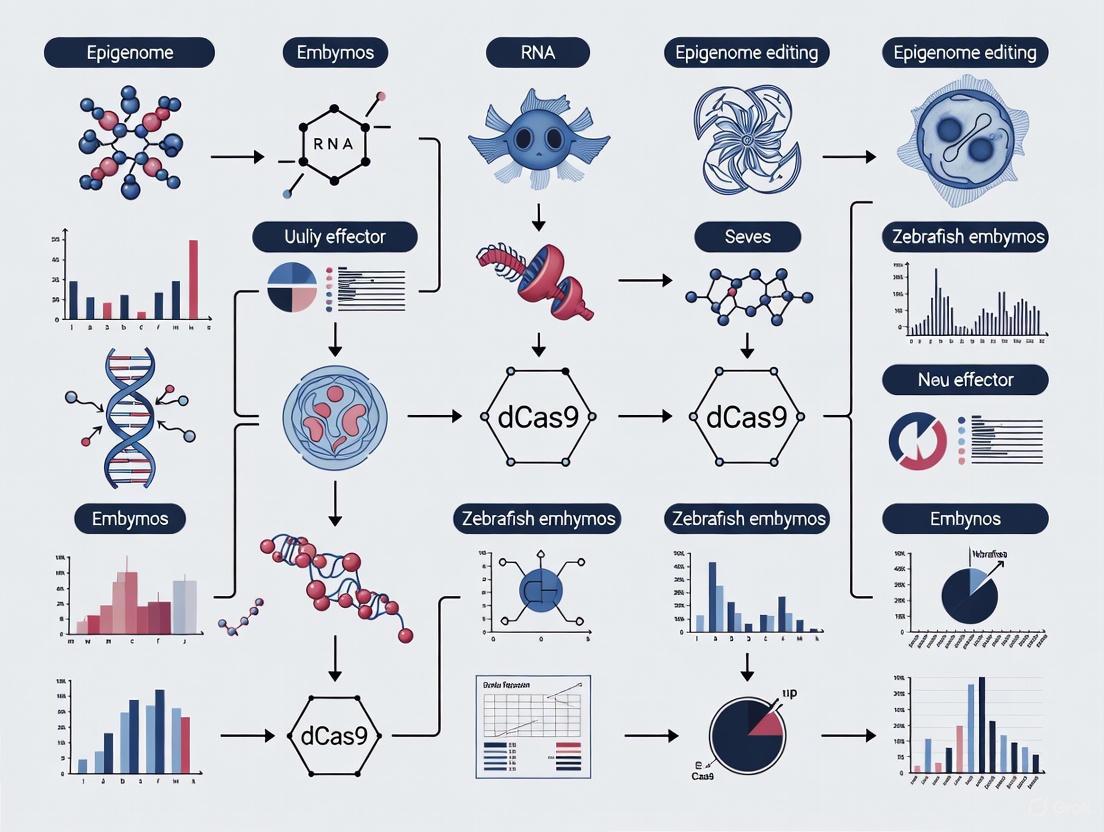
This article provides a comprehensive overview of CRISPR/dCas9-based epigenome editing in zebrafish embryos, a rapidly advancing field that merges the genetic tractability of zebrafish with precision epigenetic tools.
Targeted Epigenome Editing in Zebrafish: A dCas9 Toolkit for Functional Genomics and Disease Modeling
Abstract
This article provides a comprehensive overview of CRISPR/dCas9-based epigenome editing in zebrafish embryos, a rapidly advancing field that merges the genetic tractability of zebrafish with precision epigenetic tools. We cover foundational principles, from the engineering of dCas9-effector fusions like dCas9-Dnmt and dCas9-Tet to direct DNA methylation editing. The content details methodological advances for robust application, including stable delivery systems like Ac/Ds transposition and optimized effector domains. We address common troubleshooting scenarios and optimization strategies for enhancing specificity and durability. Finally, we explore validation techniques and comparative analyses with other model systems, highlighting the unique potential of zebrafish for in vivo functional studies of the epigenome in development and disease.
The Foundations of Epigenome Editing: From dCas9 Principles to Zebrafish Applications
CRISPR/dCas9 technology has revolutionized functional genomics by enabling precise modulation of gene expression without altering the underlying DNA sequence. This approach harnesses a catalytically deactivated Cas9 (dCas9) protein, which retains its ability to target specific genomic loci guided by RNA molecules but does not cut DNA. By fusing dCas9 to various epigenetic effector domains, researchers can directly rewrite epigenetic marks at designated genes, making it a powerful "engine" for targeted epigenome modulation [1] [2].
This technology represents a significant advancement over previous methods like zinc finger nucleases (ZFNs) and transcription activator-like effector nucleases (TALENs), offering greater flexibility and programmability [3]. The fusion proteins can recruit DNA methyltransferases, histone acetyltransferases, histone methyltransferases, or other chromatin-modifying enzymes to install or remove specific epigenetic marks, thereby activating or repressing gene expression in a highly targeted manner [1] [2].
Key Applications in Zebrafish Research
The combination of CRISPR/dCas9 epigenome editing with the zebrafish model system has created powerful opportunities for studying gene function and modeling human diseases. Zebrafish offer unique advantages, including external embryonic development, transparent embryos for easy observation, and a genome that shares approximately 71.4% of human genes [4]. Furthermore, 84% of genes known to be associated with human disease have a zebrafish counterpart, making it an ideal model for functional genomics and disease modeling [4].
Table 1: Key Applications of dCas9 Epigenome Editing in Zebrafish Research
| Application Domain | Specific Example | Outcome/Significance |
|---|---|---|
| Neurological & Behavioral Research | Targeted epigenetic editing of the Arc gene in memory-encoding neurons | Bidirectional control of fear memory formation; effects were reversible using anti-CRISPR proteins [5] |
| Cardiovascular Disease Modeling | Knock-in lines for Cantú syndrome mutations | Demonstrated enlarged ventricles with enhanced cardiac output and cerebral vasodilation [4] |
| Neurodevelopmental Disorders | Study of SHANK3 gene orthologs in autism spectrum disorder | CRISPR-generated mutant zebrafish displayed autism-like behavior [4] |
| Neurodegenerative Disease Research | Epigenetic repression of V337M-mutated MAPT gene in neurons | Reduced disease-associated Tau protein levels [6] |
| Genetic Screening | Large-scale screening of 254 genes for hair cell regeneration | Identified genes essential for tissue regeneration [3] |
Beyond the applications summarized in Table 1, base editing technologies have also been successfully applied in zebrafish. These precision tools enable single-nucleotide modifications without inducing double-strand breaks, making them particularly valuable for modeling human genetic diseases caused by point mutations [7]. For instance, cytosine base editors (CBEs) and adenine base editors (ABEs) have been used to create specific disease models and study gene function with high fidelity [7].
Experimental Protocols
Delivery of Epigenome Editors via RENDER Platform
The RENDER (Robust ENveloped Delivery of Epigenome-editor Ribonucleoproteins) platform represents a significant advancement for delivering CRISPR-based epigenome editors into cells, including zebrafish embryos [6].
Table 2: Key Reagents for RENDER Platform Delivery
| Reagent | Function/Description | Application Note |
|---|---|---|
| Engineered Virus-Like Particles (eVLPs) | Enveloped delivery vehicles derived from retroviruses; protective shell without viral genetic material | Eliminates risk of viral genome integration; less limited by cargo size [6] |
| gag-Epigenome Editor Fusion Protein | Plasmid encoding fusion between gag polyprotein and epigenome editor (e.g., CRISPRoff) | Enables packaging of editor into eVLP; modified from base editor eVLP platform [6] |
| VSV-G Envelope Protein | Vesicular stomatitis virus G protein | Pseudotypes eVLPs for broad cellular tropism and efficient entry [6] |
| Wild-type gag-pol Polyprotein | Provides structural and enzymatic components for particle assembly | Required for proper eVLP formation and maturation [6] |
| Single-Guide RNA (sgRNA) | Target-specific RNA component | Co-packaged with editor protein; determines genomic targeting [6] |
Protocol Steps:
- eVLP Production: Co-transfect Lenti-X HEK293T cells with plasmids encoding VSV-G, wild-type gag-pol, gag-epigenome editor fusion protein, and sgRNA.
- Particle Harvest: Collect eVLPs from cell culture supernatant at 48- and 72-hours post-transfection. Extending to 72 hours substantially increases yield.
- Concentration & Validation: Concentrate harvested eVLPs and validate successful packaging of editor proteins via ELISA or Western blot.
- Cell Treatment: Treat target cells (or zebrafish embryos) with a single dose of epigenome editor eVLPs.
- Efficiency Assessment: Analyze editing efficiency 3 days post-treatment using appropriate methods (e.g., flow cytometry for reporter genes) and monitor durability over subsequent days/weeks [6].
Microinjection in Zebrafish Embryos
Microinjection of ribonucleoprotein (RNP) complexes into one-cell stage zebrafish embryos is a well-established and efficient method for delivering CRISPR/dCas9 epigenome editors.
Table 3: Essential Reagents for Zebrafish Microinjection
| Reagent/Equipment | Function/Description | Application Note |
|---|---|---|
| dCas9-Effector RNP Complex | Preassembled complex of dCas9-effector protein and sgRNA | Most transient delivery format; minimizes off-target effects [8] |
| Microinjection Setup | Micropipette puller, microinjector, micromanipulator, stereomicroscope | Precisely controlled delivery into embryos at one-cell stage [8] |
| Injection Mold | Agarose or plastic mold to position embryos during injection | Standardizes procedure and immobilizes embryos [8] |
| Embryo Medium (E3) | Buffer for maintaining embryos during and after injection | Provides appropriate ionic environment for embryo development [8] |
| sgRNA Design Tools | CHOPCHOP, CRISPRscan | Computational tools for designing high-efficiency sgRNAs with minimal off-target potential [8] |
Protocol Steps:
- sgRNA Design & Preparation: Design sgRNAs using specialized tools (e.g., CHOPCHOP). sgRNAs can be produced via in vitro transcription (IVT) using a T7 promoter system or purchased from commercial suppliers [8].
- RNP Complex Assembly: Pre-assemble the RNP complex by incubating purified dCas9-effector fusion protein with sgRNA in nuclease-free buffer.
- Needle Preparation: Prepare injection needles using a micropipette puller and break the tip with fine forceps to an appropriate diameter.
- Embryo Collection & Preparation: Set up zebrafish crosses and collect one-cell stage embryos, arranging them in an injection mold.
- Microinjection: Inject nanoliter volumes of the RNP complex directly into the cytoplasm of one-cell stage embryos.
- Post-Injection Care: Transfer injected embryos to fresh embryo medium and incubate at 28.5°C, monitoring for development and potential phenotypic changes [8].
Visualization of Core Concepts
dCas9-Epigenetic Effector Mechanism
(Diagram 1: dCas9-Epigenetic Effector Mechanism)
Experimental Workflow for Zebrafish
(Diagram 2: Experimental Workflow for Zebrafish)
The Scientist's Toolkit
Table 4: Essential Research Reagent Solutions for dCas9 Epigenome Editing
| Tool/Reagent | Function in Research | Specific Examples/Notes |
|---|---|---|
| CRISPR/dCas9 Epigenetic Editors | Target epigenetic modifiers to specific DNA sequences | CRISPRoff: Fuses dCas9 to DNMT3A-3L and KRAB for durable silencing [6]. dCas9-p300: Histone acetyltransferase for gene activation [9]. TET1-dCas9: Demethylase for DNA demethylation and gene reactivation [6]. |
| Delivery Systems | Introduce editors into cells or organisms | RENDER Platform: eVLPs for RNP delivery [6]. Lipid Nanoparticles (LNPs): For mRNA delivery in vivo [5]. Microinjection: Standard for zebrafish embryos [8]. |
| sgRNA Design Tools | Computational design of high-efficiency guides | CHOPCHOP, CRISPRscan: Predict on-target efficiency and minimize off-target effects [8]. |
| Analysis Methods | Validate editing efficiency and functional outcomes | Bisulfite Sequencing: For DNA methylation analysis. RNA-seq: Transcriptomic analysis. ChIP-seq: For histone modification profiling. Flow Cytometry: For reporter gene silencing [6]. |
| Zebrafish-Specific Reagents | Adapted tools for the model organism | Codon-Optimized Editors: Enhanced expression in zebrafish. Base Editor Variants: e.g., AncBE4max, CBE4max-SpRY for precise single-nucleotide changes [7]. |
Epigenome editing, enabled by programmable DNA-binding platforms like nuclease-deficient CRISPR/Cas9 (dCas9), allows for precise manipulation of gene expression without altering the underlying DNA sequence [10]. This approach relies on fusing dCas9 to epigenetic "effector" domains, which can modify the chromatin landscape to activate or repress target genes [11] [10]. These effectors include enzymes that catalyze DNA methylation (DNMTs) and demethylation (TETs), as well as writers, erasers, and readers of histone modifications. The deployment of these tools in vertebrate models, such as zebrafish embryos, facilitates high-resolution analysis of gene regulatory interactions in vivo, providing critical insights for basic research and therapeutic development [11] [3]. This document outlines the key effector domains, their mechanisms, and detailed protocols for their application in epigenome editing studies within zebrafish.
Core Epigenetic Effector Domains: Functions and Mechanisms
The following table summarizes the primary classes of epigenetic effector domains, their molecular functions, and key downstream consequences.
Table 1: Key Epigenetic Effector Domains and Their Functions
| Effector Class | Representative Domains | Catalytic Function | Primary Genomic Consequence | Typical Transcriptional Outcome |
|---|---|---|---|---|
| DNA Methyltransferases | DNMT3A, DNMT3L [10] [12] | Transfer of methyl group to cytosine (5mC) [13] | Increased CpG methylation [10] | Gene repression [10] |
| DNA Demethylases | TET1 catalytic domain [13] [10] | Oxidation of 5mC to 5hmC, 5fC, 5caC [13] [14] | Active DNA demethylation [13] [10] | Gene activation [10] |
| Histone Acetyltransferases | p300 catalytic domain [10] [15] | Addition of acetyl group to H3K27 [10] | Increased H3K27ac mark [10] [15] | Gene activation [10] |
| Histone Methyltransferases | EZH2 (for H3K27me3) [15] [16], PRDM9 (for H3K4me3) [15] | Addition of methyl group to histone tails [15] | Deposition of H3K27me3 (repressive) or H3K4me3 (active) [15] | Context-dependent repression or activation [15] |
| Transcriptional Repressors | KRAB [11] [10] | Recruitment of repressive complexes [11] | Chromatin compaction, loss of active marks [11] | Robust gene silencing [11] [10] |
| Transcriptional Activators | VP64, p65, SAM [11] [10] | Recruitment of transcriptional machinery [10] | Increased histone acetylation, DNA demethylation [10] | Strong gene activation [11] [10] |
DNA Methylation and Demethylation Effectors
- DNMTs (DNMT3A, DNMT3B): These de novo methyltransferases establish DNA methylation patterns, which are typically associated with repressed promoters and enhancers [10] [12]. Their activity is antagonized by the TET family of enzymes.
- TET Enzymes (TET1, TET2, TET3): These dioxygenases initiate active DNA demethylation by iteratively oxidizing 5-methylcytosine (5mC) to 5-hydroxymethylcytosine (5hmC), 5-formylcytosine (5fC), and 5-carboxycytosine (5caC) in an Fe(II)/α-ketoglutarate-dependent manner [13] [14]. The intermediates 5fC and 5caC can be excised by thymine DNA glycosylase (TDG) and replaced with an unmodified cytosine via base excision repair [13]. The TET1 catalytic domain is a key effector for targeted DNA demethylation and gene activation [10].
Histone-Modifying Effectors
- Histone Acetyltransferases (HATs): Effectors like the p300 catalytic domain add acetyl groups to histone tails, creating a more open chromatin structure. For example, H3K27ac is a hallmark of active promoters and enhancers [10].
- Histone Methyltransferases (HMTs): These effectors deposit methyl groups on specific histone lysine residues. The functional outcome is highly context-dependent. While EZH2-mediated H3K27me3 is generally repressive [15] [16], the installation of H3K4me3 at promoters can causally instruct transcription by hierarchically remodeling the chromatin landscape [15].
Transcriptional Regulators
- Repressive Effectors (e.g., KRAB): The KRAB domain recruits repressive complexes that promote the spread of heterochromatin, leading to durable gene silencing [11] [10].
- Activating Effectors (e.g., VP64, SAM, VPR): These are synthetic transcriptional activators built from tandem repeats of viral peptides or combinations of activation domains. They recruit the cellular transcription machinery to initiate gene expression. The Synergistic Activation Mediator (SAM) system has been used successfully in chicken embryos to activate an endogenous target promoter [11].
Quantitative Profiles of Epigenetic Effectors
The quantitative performance of epigenome editors is critical for experimental design. The table below summarizes data on the editing efficiency and transcriptional impact of various effectors based on a systematic study in mouse embryonic stem cells [15].
Table 2: Quantitative Editing Efficiency and Transcriptional Impact of Key Effectors
| Installed Chromatin Mark | Effector Domain | Fold-Enrichment at Target Locus (vs. Background) | Typical Magnitude of Transcriptional Change | Notes on Penetrance/Heterogeneity |
|---|---|---|---|---|
| H3K4me3 | PRDM9 catalytic domain | ~20-fold [15] | Can causally instruct transcription [15] | Hierarchically remodels chromatin landscape [15] |
| H3K27me3 | EZH2 full-length | >20-fold [15] | Repression; maximizes silencing penetrance when co-targeted with H2AK119ub [15] | Silencing is highly penetrant across single cells in combinatorial editing [15] |
| H2AK119ub | RING1B catalytic domain | >20-fold [15] | Repression; strongest in combination with H3K27me3 [15] | Co-targeting with H3K27me3 enhances silencing penetrance [15] |
| DNA Methylation | DNMT3A/3L catalytic domain | Up to 60% methylation at unmethylated promoters [15] | Repression [10] | High level of de novo methylation achieved [15] |
| H3K27ac | p300 catalytic domain | ~7-fold [15] | Activation (but can cause indirect effects/toxicity) [15] | Requires lower induction to minimize off-target effects [15] |
| H3K9me2/3 | G9a catalytic domain | ~15-fold [15] | Repression [15] | Robust ON-target deposition [15] |
Experimental Protocols for Zebrafish Embryos
The following protocol is adapted from optimized methods for genome and epigenome engineering in avian embryos [11], tailored for the zebrafish model system.
Protocol: Targeted Epigenetic Perturbation in Zebrafish Embryos
Objective: To achieve somatic epigenome editing at a specific genomic locus in zebrafish embryos using dCas9-effector fusions.
I. Reagent Preparation
- dCas9-Effector Plasmid: Clone your chosen effector domain (e.g., TET1-CD, p300-CD, KRAB) into a zebrafish expression vector downstream of a nuclear-localized dCas9. The plasmid should be driven by a ubiquitous (e.g., beta-actin) or tissue-specific promoter [11].
- Guide RNA (gRNA) Cloning: Design a 20nt spacer sequence specific to your target genomic locus (e.g., a promoter or enhancer). Clone this into an optimized gRNA expression vector using a chick U6 (cU6) or a similar RNA Pol III promoter [11]. The pcU6.3 vector was shown to mediate highly efficient sgRNA expression [11].
- Template Sequence for gRNA Cloning:
[5'-GTTTTAGAGCTAGAAATAGCAAGTTAAAATAAGGCTAGTCCGTTATCAACTTGAAAAAGTGGCACCGAGTCGGTGCTTTTT-3'][11].
II. Microinjection into Zebrafish Embryos
- Prepare the injection mix:
- dCas9-effector plasmid (25-50 ng/µL)
- gRNA plasmid (10-25 ng/µL)
- Phenol red tracer (0.1%)
- Inject 1-2 nL of the mixture directly into the cytoplasm or yolk of one-cell stage zebrafish embryos [3].
III. Post-Injection Culture and Analysis
- Incubate injected embryos in egg water at 28.5°C until the desired developmental stage is reached.
- Sort embryos for fluorescence if a reporter (e.g., Citrine) is included in the dCas9-effector construct [11].
IV. Downstream Validation and Phenotyping A. Assessment of Epigenetic Editing Efficiency
- DNA Methylation Changes: Perform bisulfite sequencing on pooled embryos or dissected tissues to quantify changes at the target locus [10].
- Histone Modification Changes: Use chromatin immunoprecipitation followed by qPCR (ChIP-qPCR) or CUT&RUN on pooled embryo samples to measure enrichment of the specific histone mark (e.g., H3K4me3, H3K27me3) [15].
- 5hmC Detection: For TET effector experiments, employ techniques like Tet-assisted bisulfite sequencing (TAB-seq) or immunostaining with anti-5hmC antibodies to confirm oxidation of 5mC [13] [14].
B. Assessment of Transcriptional and Phenotypic Outcomes
- Gene Expression Analysis: Use whole-mount in situ hybridization (WISH) or qRT-PCR on RNA extracted from pools of embryos to visualize and quantify changes in expression of the target gene [17].
- Phenotypic Analysis: Document morphological phenotypes using bright-field or confocal microscopy. For T-cell development studies, FACS analysis of fluorescent reporter embryos (e.g., rag2:DsRed) can quantify changes in specific cell populations [17].
Workflow Diagram: Epigenome Editing in Zebrafish
The following diagram illustrates the key steps and components of the epigenome editing workflow in zebrafish embryos.
The Scientist's Toolkit: Key Reagents and Materials
Table 3: Essential Research Reagents for dCas9-Effector Studies in Zebrafish
| Reagent / Material | Function / Description | Example / Source |
|---|---|---|
| dCas9-Effector Plasmids | Core tool for targeted epigenome editing; carries the epigenetic modifier. | dCas9-p300 [10], dCas9-TET1-CD [10], dCas9-KRAB [11], Modular dCas9GCN4 with scFV-tagged effectors [15] |
| gRNA Expression Vectors | Directs the dCas9-effector complex to the specific DNA locus. | Vectors with chick U6 (cU6) promoters (e.g., pcU6.3) [11] |
| Microinjection Apparatus | For precise delivery of plasmids into zebrafish embryos. | Standard zebrafish microinjection setup [3] |
| Antibodies for Validation | Essential for confirming epigenetic mark changes via ChIP or immunostaining. | Anti-5hmC [14], Anti-H3K4me3 [15], Anti-H3K27me3 [15] [16], Anti-H3K27ac [10] [15] |
| Detection Kits | For measuring downstream transcriptional effects. | qRT-PCR kits, Whole-mount in situ hybridization kits [17] |
| Zebrafish Reporter Lines | Transgenic lines to visualize biological processes or specific cell types. | rag2:DsRed (for T-cell visualization) [17], coro1a:EGFP (for lymphoid progenitors) [17] |
The targeted epigenetic effector domains associated with DNMT, TET, and transcriptional regulator families provide a powerful toolkit for dissecting gene regulatory networks in vivo. When deployed using the dCas9 platform in tractable models like zebrafish, these tools enable researchers to move beyond correlation and establish causality between specific epigenetic marks, gene expression, and phenotypic outcomes. The protocols and resources outlined here provide a framework for applying these technologies to answer fundamental questions in developmental biology and disease mechanisms.
Zebrafish as an Ideal In Vivo Model for Developmental Epigenetics
The zebrafish (Danio rerio) has emerged as a premier vertebrate model for studying developmental epigenetics due to its unique combination of experimental accessibility and physiological relevance. With approximately 80% of human disease-related genes having at least one zebrafish ortholog and conservation of epigenetic marks, this model provides critical insights into the regulatory mechanisms governing embryogenesis and disease pathogenesis [18]. The external development, optical transparency during embryogenesis, and rapid maturation make zebrafish exceptionally suitable for real-time observation of developmental processes and for manipulating epigenetic regulators. These advantages are particularly valuable for epigenome editing research, where precise spatial and temporal control of gene regulation can be achieved using engineered systems such as CRISPR/dCas9 fused to epigenetic effector domains [19].
*citation:3] Furthermore, zebrafish share most organ systems with other vertebrates, enabling the study of complex tissue-specific epigenetic regulation in organs such as the heart [20] [21]. The ability to generate large sample sizes from a single mating pair (70-300 embryos) provides the statistical power necessary to account for the genetic heterogeneity present in zebrafish lines, making findings more translatable to human populations where genetic diversity is the norm [22]. This article provides a comprehensive guide to leveraging the zebrafish model for developmental epigenetics research, with a focus on practical methodologies for epigenome editing and analysis framed within the context of dCas9-effector applications in zebrafish embryos. [22][citation:6
Experimental Protocols for Zebrafish Epigenome Editing
CRISPR/dCas9-Effector System Assembly for Targeted DNA Methylation Editing
The CRISPR/dCas9 system provides a versatile platform for targeted epigenome editing in zebrafish embryos. The following protocol describes the construction and validation of dCas9 fused to DNA methyltransferase (Dnmt) or ten-eleven translocation (Tet) catalytic domains for precise manipulation of DNA methylation states [19].
Plasmid Design and Construction:
- Begin with the dCas9 backbone (e.g., Addgene plasmid #46757 with D10A and H840A mutations to ensure nuclease inactivity)
- Insert a short Gly4Ser linker (GGGGSGGGGS) at the C-terminus of dCas9 to facilitate fusion with effector domains
- Amplify the catalytic domain of zebrafish Dnmt7 (also known as Dnmt3ba; NM001020476.2) or Tet2 (XM005159903.4) from cDNA using high-fidelity polymerase (e.g., Phanta Master Mix)
- Clone the amplified catalytic domain downstream of the Gly4Ser linker, preserving the N- and C-terminal nuclear localization sequences (NLS) on dCas9
- Verify plasmid sequence integrity through Sanger sequencing before proceeding to mRNA synthesis [19]
mRNA Synthesis and Purification:
- Linearize the constructed plasmid using SfiI restriction enzyme
- Perform in vitro transcription using the T3 mMESSAGE mMACHINE Kit (Ambion, AM1348) according to manufacturer specifications
- Purify synthesized mRNA using an RNAclean Kit (TIANGEN, DP412) or similar silica-membrane based purification system
- Quantify mRNA concentration using NanoDrop spectrophotometry and adjust to 1000 ng/μL for storage at -80°C
- Assess RNA integrity by gel electrophoresis before microinjection [19]
gRNA Design and Preparation:
- Select target sites within promoter regions or specific regulatory elements of genes of interest (e.g., dmrt1, cyp19a1a)
- Design gRNAs with 5'-N18-20-NGG-3' structure, prioritizing sequences with minimal off-target potential as predicted by tools like CRISPOR
- Chemically synthesize and modify gRNAs (GenScript or comparable service)
- Resolve gRNAs in RNase-free water at 1000 ng/μL concentration for storage at -80°C [19]
Microinjection into Zebrafish Embryos:
- Prepare injection mixture containing dCas9-Dnmt7CD or dCas9-Tet2CD mRNA (300 ng/μL) and gene-specific gRNA (30 ng/μL)
- Load injection needles (borosilicate glass capillary tubes) with 2-3 μL of the injection mixture
- Inject approximately 2 nL of the mixture into the yolk of one-cell stage zebrafish embryos using a pneumatic picopump
- Maintain injected embryos in E3 embryo medium at 28.5°C
- Collect embryos at desired timepoints (6, 24, or 48 hours post-fertilization) for DNA/RNA extraction [19]
Cardiomyocyte-Specific Epigenomic Profiling in Developing Zebrafish Heart
This protocol describes the isolation of specific cell populations from zebrafish embryos for epigenomic and transcriptomic analysis, with a focus on cardiomyocytes at 72 hours post-fertilization (hpf) when key developmental milestones including heart looping and trabeculation are complete [20].
Cardiomyocyte Isolation and Fluorescence-Activated Cell Sorting (FACS):
- Raise cmlc2-GFP (Tg(myl7::GFP)) transgenic zebrafish embryos to 72 hpf at 28.5°C
- Anesthetize larvae with tricaine (MS222, 200-300 mg/L) and wash with cold HBSS
- Dissociate tissues with sequential enzymatic treatment: collagenase type II (100 mg/mL in 0.1 M Tris-HCl pH 7.5) for 30 minutes followed by 0.25% trypsin for 10 minutes at room temperature
- Gently pipette the cell suspension with a wide-bore 1000 μL tip to facilitate dissociation
- Filter cell suspension through 100 μm and 40 μm nylon meshes via gentle centrifugation at 2000 rpm for 5 minutes
- Resuspend cell pellet in FACS buffer (1% BSA, 2% FBS in PBS) with propidium iodide (10 μg/mL) to exclude dead cells
- Sort GFP-positive cardiomyocytes using a BD Influx Cell Sorter or comparable instrument with a 70 μm nozzle at 60 psi sheath pressure
- Calibrate autofluorescence levels using wild-type (TU) zebrafish cells processed in parallel
- Collect 30,000 GFP+ cardiomyocytes and GFP- control cells into low-binding tubes containing 300 μL RNAlater Stabilization Solution for transcriptomics or 0.125 M glycine-PBS for epigenomic analysis [20]
Chromatin Immunoprecipitation Sequencing (ChIP-seq) from Sorted Cardiomyocytes:
- Fix sorted cells with 4% formaldehyde for 10 minutes at room temperature
- Quench fixation with 0.25 M glycine in PBS and wash cells three times with 0.125 M glycine-PBS
- Perform chromatin fragmentation via sonication or enzymatic digestion (e.g., MNase)
- Incubate fragmented chromatin with antibodies specific to histone modifications (e.g., H3K27ac for active enhancers, H3K4me3 for promoters)
- Capture antibody-bound chromatin complexes using protein A/G magnetic beads
- Reverse crosslinks, purify DNA, and prepare sequencing libraries using compatible kits (e.g., Ovation Ultralow System V2)
- Sequence libraries on an Illumina platform (e.g., HiSeq 3000) with 50 bp single reads [20]
RNA Sequencing from Sorted Cardiomyocytes:
- Extract total RNA from sorted GFP+ and GFP- cells using RNEasy Plus Micro Kit (Qiagen)
- Assess RNA integrity using BioAnalyzer (Agilent) and quantify with Qubit RNA HS Assay Kit
- For limited RNA samples (1-4 ng from 35,000 GFP+ cells), employ linear amplification using single primer isothermal amplification (e.g., Nugen Ovation RNA-seq system V2)
- Convert amplified RNA to cDNA and fragment to ~290 bp via sonication
- Prepare sequencing libraries and sequence on Illumina platforms as described for ChIP-seq [20]
Quantitative Developmental Reference Data
Zebrafish development follows a predictable timeline with specific epigenetic and morphological changes at each stage. The following tables provide quantitative reference data for developmental staging and organ-specific maturation to guide experimental design in developmental epigenetics research.
Table 1: Key Developmental Milestones in Zebrafish Embryogenesis
| Hours Post-Fertilization (hpf) | Developmental Stage | Epigenetic Processes | Organogenesis Events |
|---|---|---|---|
| 0-3 hpf | Zygotic | Maternal-to-zygotic transition; Zygotic genome activation | Cleavage divisions |
| 3-24 hpf | Gastrula to Segmentation | Establishment of cell-type specific methylation patterns | Germ layer formation; Somite development |
| 24-48 hpf | Pharyngula | Tissue-specific enhancer activation; Histone modification establishment | Heart tube formation and looping; Brain regionalization |
| 48-72 hpf | Hatching | Chromatin accessibility changes in cardiomyocytes [20] | Heart trabeculation; Circulation; Pigmentation |
| >72 hpf | Larval | Stable maintenance of tissue-specific epigenetic patterns | Organ maturation; Swim bladder inflation |
Table 2: Zebrafish Organ Development Metrics Quantified by Mueller Matrix OCT [23]
| Organ/Structure | Measurement Technique | Key Developmental Period | Quantifiable Parameters |
|---|---|---|---|
| Heart | Mueller matrix OCT | 24-72 hpf | Chamber volume, contractility, tissue organization |
| Eyes | Deep learning segmentation of OCT images | 24-72 hpf | Volume, retinal layer formation, lens development |
| Spine | Polarization-difference imaging | 24-72 hpf | Vertebral patterning, notochord maturation |
| Yolk sac | Volume calculation from 3D reconstructions | 1-5 dpf | Utilization rate, resorption timing |
| Swim bladder | Automated organ segmentation | 4-7 dpf | Inflation timing, volume changes |
Experimental Design and Workflow Visualization
The following diagrams illustrate key experimental workflows and molecular mechanisms for zebrafish epigenetics research, providing visual guidance for implementing the protocols described in this article.
Diagram 1: CRISPR/dCas9 Epigenome Editing Workflow in Zebrafish
Diagram 2: Cell-Type Specific Epigenomic Profiling Workflow
Diagram 3: dCas9-Effector Targeted DNA Methylation Mechanism
Table 3: Key Research Reagent Solutions for Zebrafish Developmental Epigenetics
| Reagent/Resource | Function/Application | Example Products/Sources |
|---|---|---|
| Transgenic Zebrafish Lines | Cell-type specific labeling and isolation | cmlc2-GFP (cardiomyocytes) [20]; fli:eGFP (vasculature) [18]; casper (pigment-free) [22] |
| Epigenome Editing Systems | Targeted DNA methylation manipulation | dCas9-Dnmt7CD (methylation); dCas9-Tet2CD (demethylation) [19] |
| Cell Sorting Tools | Isolation of specific cell populations | BD Influx Cell Sorter; Antibodies for surface markers [20] |
| Sequencing Kits | Library preparation for transcriptomics and epigenomics | Ovation RNA-seq System V2; Ovation Ultralow System V2 [20] |
| Methylation Analysis | DNA methylation quantification | EZ DNA Methylation-Gold Kit; Multiplex Methylation PCR Sequencing [19] |
| Bioinformatics Tools | Data analysis and visualization | EpiVisR [24]; FastQC; MultiQC; MACS2; DiffBind [25] |
| Imaging Systems | Non-invasive developmental monitoring | Mueller matrix OCT [23]; Confocal microscopy [18] |
Quality Control and Data Analysis Standards
Rigorous quality control is essential for generating reliable epigenomic data from zebrafish models. The following standards should be implemented throughout experimental workflows:
Sequencing Data Quality Metrics:
- ATAC-seq: Sequencing depth ≥25 million reads; ≥75% aligned reads; TSS enrichment ≥6; FRiP score ≥0.1 [26]
- ChIP-seq: Uniquely mapped reads ≥80%; appropriate histone modification-specific controls [20]
- RNA-seq: High-quality RNA (RIN ≥8); library complexity assessment; normalization for cross-sample comparisons [20] [26]
- Methylation analysis: Bisulfite conversion efficiency ≥99%; coverage uniformity across CpG sites [19]
Experimental Design Considerations:
- Account for genetic heterogeneity by using appropriate sample sizes (minimum 15-25 breeding pairs to maintain genetic diversity) [22]
- Include stage-matched controls and multiple biological replicates
- Consider maternal contribution of gene products, particularly for early developmental studies (pre-3 hpf) [22]
- For epigenome editing experiments, include multiple gRNAs targeting the same locus to control for off-target effects [19]
Data Analysis and Visualization:
- Implement standardized pipelines for reproducibility (e.g., nf-core, ENCODE pipelines) [25]
- Utilize specialized tools for zebrafish epigenomic data (EpiVisR) that enable integration of methylation data with gene expression and phenotypic outcomes [24]
- Apply appropriate statistical corrections for multiple testing in epigenome-wide analyses
- Validate findings through orthogonal methods such as transgenic reporter assays [20]
By adhering to these protocols, quality standards, and utilizing the referenced resources, researchers can effectively leverage the zebrafish model to advance our understanding of developmental epigenetics and its implications for human health and disease.
A fundamental challenge in modern biology lies in moving beyond the correlation of epigenetic marks with gene expression states to definitively establishing causal relationships. While sequencing technologies can generate vast amounts of data linking epigenetic modifications to transcriptional outcomes, these observations remain inherently correlative. True functional validation requires direct intervention—precisely rewriting epigenetic marks and observing the resulting phenotypic consequences. The convergence of two powerful technologies now makes this possible: CRISPR-based epigenome editing, which allows for the targeted installation or removal of specific epigenetic marks, and the zebrafish (Danio rerio) model organism, which offers a unique in vivo vertebrate platform for high-throughput functional screening. This Application Note details how the fusion of catalytically inactive Cas9 (dCas9) with epigenetic effector domains can be deployed in zebrafish embryos to systematically dissect causal epigenetic mechanisms, providing researchers and drug development professionals with robust protocols to transition from observational genomics to interventional functional validation.
Application Notes: dCas9-Effector Systems for Targeted Epigenome Editing in Zebrafish
1Targeted DNA Methylation Editing with dCas9-Dnmt7CD and dCas9-Tet2CD
The zebrafish model has been successfully leveraged to establish causality for DNA methylation marks at specific genomic loci. The principle involves fusing dCas9 to the catalytic domain of a zebrafish de novo DNA methyltransferase (Dnmt7, also known as Dnmt3ba) or a ten-eleven translocation methylcytosine dioxygenase (Tet2) [19]. When co-injected with gene-specific guide RNAs (gRNAs) into one-cell stage zebrafish embryos, these systems enable locus-specific DNA hypermethylation or hypomethylation, respectively.
Key Quantitative Findings from In Vivo Editing:
The table below summarizes exemplary quantitative data from a targeted methylation editing experiment on the dmrt1 and cyp19a1a gene promoters in zebrafish embryos [19].
Table 1: Quantitative Outcomes of Targeted DNA Methylation Editing in Zebrafish Embryos
| Target Gene | dCas9-Effector System | gRNA Used | Baseline Methylation % (Control) | Edited Methylation % | Change (Percentage Points) |
|---|---|---|---|---|---|
| dmrt1 TSS | dCas9-Dnmt7CD | dmrt-g2 | ~17% | ~70% | +53 |
| dmrt1 TSS | dCas9-Dnmt7CD | dmrt-g3 | ~17% | ~55% | +38 |
| cyp19a1a TSS | dCas9-Tet2CD | cyp19a-g1 | ~80% | ~45% | -35 |
| cyp19a1a TSS | dCas9-Tet2CD | cyp19a-g2 | ~80% | ~60% | -20 |
This data demonstrates the robust efficacy of these systems in shifting the methylation landscape at targeted promoters, providing a direct causal intervention to test hypotheses generated from correlative sequencing data.
2Conditional CRISPR Activation via RNA-Sensing Guide RNAs
Beyond direct epigenome editing, establishing causality also requires tools for precise spatiotemporal control of gene expression. Recent advances have led to the development of engineered RNA-sensing guide RNAs, such as the inducible spacer-blocking hairpin sgRNA (iSBH-sgRNA) [27] [28]. These sgRNAs are designed with complex secondary structures that render them inactive in their ground state. However, upon recognizing a complementary "trigger" RNA transcript, they undergo a conformational change that activates CRISPR-dependent function.
This technology has been validated in both mammalian cells (HEK293T) and zebrafish embryos, enabling CRISPR-mediated transcriptional activation in response to endogenous RNA biomarkers [28]. This provides a powerful method for cell-type-specific restricted activity, where CRISPRa is activated only in cells expressing a specific RNA trigger, thereby allowing for precise functional validation within complex in vivo systems like the developing zebrafish embryo.
Experimental Protocols
1Protocol: Targeted DNA Methylation Editing in Zebrafish Embryos
This protocol describes the methodology for achieving locus-specific DNA hypermethylation or hypomethylation in zebrafish embryos using dCas9-Dnmt7CD and dCas9-Tet2CD systems [19].
I. Plasmid Construction and mRNA Synthesis
- dCas9-Effector Plasmid Construction: Fuse the catalytic domain of zebrafish Dnmt7 (NM001020476.2) or Tet2 (XM005159939.4) to the C-terminus of dCas9 (carrying D10A and H840A mutations) via a short Gly4Ser linker (Gly4Ser). Ensure the construct retains both N- and C-terminal nuclear localization sequences (NLS) [19].
- gRNA Design and Synthesis: Design gRNAs targeting the promoter or regulatory region of interest. Select targets with high on-target efficiency and minimal off-target potential using tools like CRISPOR [19]. Chemically synthesize and purify gRNAs.
- In Vitro Transcription: Linearize the dCas9-effector plasmid template and transcribe mRNA in vitro using a T3 mMessage mMachine kit. Purify the mRNA and quantify it via spectrophotometry (e.g., NanoDrop). Store mRNA and gRNA stocks at -80°C.
II. Microinjection into Zebrafish Embryos
- Preparation: Dilute dCas9-Dnmt7CD or dCas9-Tet2CD mRNA to a working concentration of 300 ng/µL and gRNA to 30 ng/µL in nuclease-free water.
- Microinjection: Using a microinjector, inject 2 nL of the mRNA/gRNA mixture into the cytoplasm of one-cell stage wild-type AB-line zebrafish embryos.
- Husbandry: Maintain injected embryos at 28.5°C in E3 embryo medium according to standard procedures [19].
III. Sample Collection and DNA Methylation Analysis
- Collection: At the desired time point (e.g., 24-48 hours post-fertilization), collect pools of 10 embryos into microcentrifuge tubes.
- DNA Extraction: Extract genomic DNA using a commercial kit (e.g., Quick-DNA Miniprep Plus Kit).
- Bisulfite Conversion & Sequencing: Convert 100 ng of genomic DNA using the EZ DNA Methylation-Gold Kit. Perform multiplex methylation-specific PCR (MMP) with bisulfite-converted DNA and pool primers. Prepare sequencing libraries and sequence on an Illumina platform (e.g., NovaSeq PE150) [19].
- Data Analysis: Align sequencing reads and calculate the percentage of methylation at each CpG site in the targeted region. Compare to uninjected or control-injected embryos to determine editing efficiency.
2Protocol: Conditional Gene Activation via RNA-Sensing iSBH-sgRNAs in Zebrafish
This protocol outlines the use of engineered iSBH-sgRNAs to achieve CRISPR activation (CRISPRa) in response to specific RNA triggers within zebrafish embryos [28].
I. Component Design and Cloning
- iSBH-sgRNA Design: For your target gene of interest, design an iSBH-sgRNA using a computational algorithm like MODesign. The design incorporates a spacer sequence complementary to the desired DNA target, a spacer* sequence partially complementary to the spacer, and a 14-nucleotide loop [28].
- RNA Trigger Design: Design an RNA trigger sequence that is fully complementary to the combined loop and spacer* region of the iSBH-sgRNA. Flank the trigger sequence with 5' and 3' hairpin structures to enhance its stability in vivo [28].
- Plasmid Construction: Clone the iSBH-sgRNA expression cassette under a U6 promoter. Clone the RNA trigger expression cassette under a separate U6 or another appropriate RNA polymerase III promoter. A CRISPR activator (e.g., dCas9-VP64) should be expressed from a compatible plasmid.
II. Embryo Injection and Validation
- Co-injection: Co-inject the following plasmids into one-cell stage zebrafish embryos:
- Plasmid expressing the CRISPRa protein (dCas9-VP64)
- Plasmid expressing the iSBH-sgRNA
- Plasmid expressing the RNA trigger (for the experimental group); a control group should be injected without the trigger plasmid.
- Functional Assessment: Assess the outcome of conditional activation using a fluorescent reporter cassette (e.g., ECFP under a promoter with multiple CRISPR target sequences) or by analyzing endogenous transcript levels via RT-qPCR.
The Scientist's Toolkit: Research Reagent Solutions
Table 2: Essential Reagents for dCas9-Epigenome Editing in Zebrafish
| Reagent / Solution | Function & Explanation |
|---|---|
| dCas9-Effector Plasmids | Plasmids encoding dCas9 fused to epigenetic catalytic domains (e.g., Dnmt7 for methylation, Tet2 for demethylation). The backbone should include necessary promoters (e.g., SP6, T3) for in vitro transcription and nuclear localization signals (NLS). |
| Chemically Modified gRNAs | Synthetic guide RNAs with specific chemical modifications (e.g., 2'-O-methyl analogs) at key residues to enhance stability and reduce degradation by cellular nucleases in vivo, thereby improving editing efficiency [28]. |
| iSBH-sgRNA & Trigger Plasmids | Engineered sgRNA plasmids that remain inactive until bound by a complementary RNA trigger. This system allows for cell-type-specific control of CRISPR activity based on endogenous RNA biomarkers [28]. |
| CRISPR Activator (dCas9-VPR/VP64) | A catalytically dead Cas9 fused to transcriptional activation domains (e.g., VP64, VPR). Used in conjunction with targeted gRNAs or RNA-sensing sgRNAs to activate gene expression from specific promoters. |
| Multiplex Methylation PCR (MMP) Primers | A pool of bisulfite-conversion-specific primers designed for targeted amplification of multiple genomic regions of interest. This allows for cost-effective, deep sequencing-based quantification of DNA methylation levels at base resolution [19]. |
Signaling Pathways and Workflow Diagrams
1dCas9-Epigenetic Effector Mechanism
2Experimental Workflow for Functional Validation
A Practical Guide to Implementing dCas9-Effector Systems in Zebrafish Embryos
The fusion of catalytic domains to a nuclease-null Cas9 (dCas9) has established a powerful platform for precision epigenome engineering. This technology enables targeted transcriptional modulation and manipulation of chromatin states without altering the underlying DNA sequence, making it particularly valuable for investigating gene regulatory networks during development [1] [29]. In zebrafish embryo research, dCas9-effector systems provide a unique opportunity to dissect the role of specific epigenetic marks in governing embryogenesis and organogenesis. The efficacy of these synthetic constructs is profoundly influenced by three critical design elements: the choice of catalytic effector domain, the composition and length of peptide linkers, and the configuration of nuclear localization signals (NLSs) [29]. This application note details evidence-based protocols for constructing and validating optimized dCas9-effector fusions, with a specific focus on applications in zebrafish models.
Core Architecture of a dCas9-Effector Fusion
A functional dCas9-epigenetic effector construct minimally requires three components: the dCas9 protein for programmable DNA binding, an epigenetic "writer" or "eraser" domain for introducing or removing epigenetic marks, and NLS sequences to ensure efficient nuclear entry [29]. The catalytic domain of Ten-eleven translocation methylcytosine dioxygenase 1 (TET1), for instance, can be fused to dCas9 to create a tool for targeted DNA demethylation and gene activation [30]. Figure 1 illustrates the logical relationship and basic workflow for deploying such a construct.
Figure 1. Core workflow for dCas9-effector targeted epigenome editing. The dCas9 protein, guided by an sgRNA, binds specific DNA sequences. A fused catalytic domain (effector) modifies the local epigenetic state, facilitated by NLS sequences for nuclear import and optimized linkers for proper folding.
Quantitative Data on Effector and NLS Configurations
Performance of Transcriptional Repressors
The potency of a dCas9-effector fusion is highly dependent on the specific repressor domain used. Recent screening of over 100 bipartite and tripartite fusion proteins identified several high-performance configurations, as summarized in Table 1.
Table 1: Performance of Novel dCas9-Repressor Fusions in Mammalian Cells [31]
| Construct Name | Key Domains | Reported Performance vs. dCas9-ZIM3(KRAB) | Notable Features |
|---|---|---|---|
| dCas9-ZIM3(KRAB)-MeCP2(t) | ZIM3(KRAB) + truncated MeCP2 | ~20–30% better knockdown (p<0.05) | Improved repression across cell lines & targets; reduced gRNA-dependent variability |
| dCas9-KRBOX1(KRAB)-MAX | KRBOX1(KRAB) + MAX | ~20–30% better knockdown (p<0.05) | Effective bipartite repressor |
| dCas9-ZIM3(KRAB)-MAX | ZIM3(KRAB) + MAX | ~20–30% better knockdown (p<0.05) | Effective bipartite repressor |
| dCas9-KOX1(KRAB)-MeCP2(t) | KOX1(KRAB) + truncated MeCP2 | ~20–30% better knockdown (p<0.05) | Potent repressor using a classic KRAB domain |
Advanced NLS Engineering for Enhanced Activity
Efficient nuclear import is critical for in vivo efficacy, especially in large-cell systems like zebrafish embryos. Traditional NLS fusions at protein termini can impair recombinant yield and function. Table 2 compares standard and advanced NLS strategies.
Table 2: Comparison of Nuclear Localization Signal (NLS) Strategies [32] [33]
| NLS Strategy | Description | Reported Outcome | Considerations |
|---|---|---|---|
| Terminal NLS | Single or multiple NLS sequences fused to N-/C-terminus of Cas9. | Standard approach, but can be inefficient and affect protein yield. | Simplicity; potential for recombinant expression issues. |
| NLS-free Cas9 | Cas9 expressed without an engineered NLS. | Can achieve effective editing via "hitchhiking" with endogenous nuclear proteins. | Relies on endogenous import mechanisms; potential for reduced controllability. |
| Hairpin Internal NLS (hiNLS) | Installation of structured NLS peptides at internal sites in the Cas9 backbone. | Improved editing efficiency in primary human T cells vs. terminal NLS; high protein purity/yield even with 9 NLS tags. | Requires rational selection of insertion sites; maintains protein stability. |
Experimental Protocols for Construct Assembly and Validation
Protocol: Modular Assembly of a dCas9-TET1 Fusion for Zebrafish
This protocol outlines the construction of a dCas9-TET1 fusion protein, an activator that promotes DNA demethylation [30], for microinjection into zebrafish embryos.
Reagents:
- Plasmid backbone with zebrafish codon-optimized dCas9 (Addgene #112399 or similar)
- cDNA for human TET1 catalytic domain (aa 1418–2136)
- Plasmid encoding flexible peptide linker (e.g., (GGS)n)
- Plasmid encoding SV40 NLS peptide
- Restriction enzymes (e.g., BsaI, SapI) or Gibson Assembly reagents
- T4 DNA Ligase
Procedure:
- Vector Preparation: Digest the dCas9 plasmid backbone with appropriate restriction enzymes to create a recipient vector. Gel-purify the linearized fragment.
- Insert Preparation: a. TET1 Catalytic Domain: Amplify the TET1 catalytic domain sequence from the cDNA source using PCR primers that add overhangs compatible with the linker and the dCas9 vector. b. Linker and NLS: Synthesize or amplify the DNA fragments encoding a flexible linker (e.g., (GGS)₅) and an SV40 NLS sequence.
- Golden Gate or Gibson Assembly: Assemble the fragments in a single reaction. A typical fusion order is:
dCas9 - (GGS)₅ Linker - TET1 catalytic domain - SV40 NLS. - Transformation and Cloning: Transform the assembly reaction into competent E. coli. Select positive clones on appropriate antibiotic plates.
- Sequence Verification: Isolate plasmid DNA from multiple colonies and verify the entire fusion sequence, including linker and NLS regions, by Sanger sequencing.
Protocol: Validating Fusion Protein Functionality in Zebrafish Embryos
Reagents:
- Validated dCas9-effector plasmid from Protocol 4.1
- sgRNA template targeting a gene of interest (e.g., a developmental gene promoter)
- SP6 or T7 mMESSAGE mMACHINE kit for in vitro transcription
- Phenol Red solution (0.5%)
- Microinjection equipment
Procedure:
- mRNA Synthesis: Linearize the finalized dCas9-effector plasmid. Use an in vitro transcription kit to synthesize capped, polyadenylated mRNA. Purify the mRNA and resuspend in nuclease-free water.
- sgRNA Preparation: Synthesize sgRNA by in vitro transcription from a dsDNA template. Purify the sgRNA.
- Injection Mix Preparation: Combine the following to a final volume:
- dCas9-effector mRNA (100–200 pg/nl)
- sgRNA (30–50 pg/nl)
- Phenol Red (0.05% final concentration as tracer)
- Zebrafish Embryo Microinjection: Inject 1–2 nl of the mixture into the yolk or cell of 1-cell stage zebrafish embryos.
- Phenotypic and Molecular Validation: a. Phenotypic Screening: Observe injected embryos over 24–96 hours post-fertilization (hpf) for expected morphological changes (e.g., developmental defects if targeting an essential gene). b. DNA/RNA Extraction: At 24 hpf, pool 20-30 dechorionated embryos. Extract genomic DNA for methylation analysis or total RNA for transcriptomic analysis. c. Downstream Analysis: - For TET1 fusions: Perform bisulfite sequencing on the target locus to quantify demethylation efficiency [30]. - For Repressor fusions (e.g., KRAB): Use RT-qPCR to measure knockdown of the target gene transcript [31]. - For Activator fusions: Use RT-qPCR to measure upregulation of the target gene transcript.
Troubleshooting:
- High Embryo Mortality: Reduce the concentration of injected mRNA/sgRNA.
- Weak or No Phenotype: Verify mRNA and sgRNA integrity; test different sgRNA target sites; increase mRNA/sgRNA concentration.
- Off-Target Effects: Include a dCas9-only control and design multiple sgRNAs to confirm on-target effects.
The Scientist's Toolkit: Essential Research Reagents
Table 3: Key Reagents for dCas9-Effector Research in Zebrafish
| Reagent / Solution | Function / Application | Example / Source |
|---|---|---|
| Catalytically Dead Cas9 (dCas9) | Programmable DNA-binding scaffold that does not cut DNA. | Addgene (#112399, zebrafish codon-optimized). |
| Epigenetic Effector Domains | Catalytic cores that add/remove epigenetic marks (e.g., TET1 for demethylation, DNMT3A for methylation, p300 for acetylation). | TET1 catalytic domain [30]; KRAB, MeCP2 repressor domains [31]. |
| Nuclear Localization Signal (NLS) | Peptide sequence that directs protein import into the cell nucleus. | SV40 NLS (PKKKRKV) [32]; Hairpin Internal NLS (hiNLS) [33]. |
| Flexible Peptide Linkers | Spacer sequences between protein domains that ensure proper folding and activity. | (GGS)ₙ repeats [29]; (GGGGS)ₙ (Gly-Ser linkers). |
| In Vitro Transcription Kit | Generates capped mRNA and sgRNA for embryo microinjection. | SP6/T7 mMessage mMachine Kit (Thermo Fisher). |
| Bisulfite Conversion Kit | Prepares DNA for analysis of methylation status at target loci. | EZ DNA Methylation Kit (Zymo Research). |
Schematic of a Multi-Effector dCas9 System
Advanced constructs can recruit multiple effector domains simultaneously to achieve synergistic effects. Figure 2 illustrates the architecture of a highly potent, multi-domain repressor system, such as the dCas9-ZIM3(KRAB)-MeCP2(t) fusion [31].
Figure 2. Architecture of a multi-effector dCas9 repressor. The dCas9-ZIM3(KRAB)-MeCP2(t) fusion protein uses two distinct repressor domains (ZIM3(KRAB) and a truncated MeCP2) connected via optimized linkers, creating a synergistic system for potent gene silencing [31].
The repurposing of the bacterial CRISPR/Cas9 system into a programmable epigenome-editing platform represents a transformative advance in molecular biology. By fusing a catalytically inactive "dead" Cas9 (dCas9) to various effector domains, researchers can directly manipulate the epigenetic landscape without altering the underlying DNA sequence [34]. This toolkit is particularly powerful for establishing causal relationships between specific epigenetic marks and gene expression outcomes, a central challenge in functional genomics. For researchers working with zebrafish embryos—a premier model for vertebrate development and human disease—these tools offer the unique ability to dissect the role of epigenetic mechanisms like DNA methylation in a whole-animal context [19]. The core principle involves recruiting epigenetic writer or eraser enzymes (e.g., DNA methyltransferases or TET dioxygenases) to precise genomic loci via programmable guide RNAs (gRNAs), enabling targeted epigenetic modification and functional studies of regulatory elements.
The following section details essential plasmid resources and their applications for targeted DNA methylation editing. The table below summarizes key commercially available plasmids for constructing dCas9-epigenetic effector fusions.
Table 1: Key Plasmid Resources for dCas9-Based Epigenome Editing
| Plasmid Name | Effector Domain | Key Features | Vector Backbone | Addgene ID | Primary Application |
|---|---|---|---|---|---|
| DNMT3A-dCas9 | DNMT3A (aa 602-912) | 3xFLAG-NLS-DNMT3A-dCas9-NLS; for targeted methylation | pcDNA3.3-TOPO | #100090 [35] | Mammalian expression |
| LLP185 pLVP-dCas9-DNMT3a V2 | DNMT3A catalytic domain | Lentiviral delivery; P2A puromycin resistance; 3xHA and 3xTy1 tags | pLVP | #100936 [36] | Mammalian expression (lentiviral) |
| Fuw-dCas9-Tet1-P2A-BFP | TET1 catalytic domain | PiggyBac transposon system for stable integration; P2A-BFP reporter | Fuw | #108245 [37] | Targeted demethylation in mammalian cells |
| SID4x-dCas9-KRAB | SID4x + KRAB domains | Dual repressive domains for potent transcriptional repression | Custom | Protocol in [38] | Enhancer interference (Enhancer-i) |
The dCas9-DNMT3A constructs are designed for targeted DNA methylation. The Addgene plasmid #100090 is a mammalian expression plasmid with a C-terminal dCas9 fused to a truncated human DNMT3A protein, containing its catalytic domain [35]. For more advanced applications, the Lister lab's plasmid #100936 (LLP185) is a lentiviral construct that uses a SunTag system to recruit multiple DNMT3A domains, a design that has been shown to overcome pervasive off-target activity associated with direct dCas9-DNMT3A fusions [36].
Conversely, the dCas9-TET1 system enables targeted DNA demethylation. The Fuw-dCas9-Tet1-P2A-BFP plasmid (#108245) is a versatile tool that utilizes a PiggyBac transposon system for potential stable genomic integration in mammalian cells and includes a BFP reporter for tracking transfection or infection efficiency [37]. This system has been successfully applied to reactivate epigenetically silenced tumor suppressor genes, such as miR-200c in breast cancer cells [39].
For targeted transcriptional repression without altering DNA methylation, the dCas9-SID4x-KRAB effector provides a powerful alternative. This fusion protein combines two potent repressive domains: the Krüppel-associated box (KRAB) domain, which recruits repressive complexes that catalyze histone H3 lysine 9 trimethylation (H3K9me3), and the Sin3A interacting domain (SID4x), which recruits histone deacetylases (HDACs) [38]. This dual recruitment leads to a more robust and reliable silencing of gene expression, making it highly effective for interrogating enhancer function in what is known as Enhancer Interference (Enhancer-i).
Diagram 1: Core mechanism of dCas9-epigenetic effector system.
In Vivo DNA Methylation Editing in Zebrafish Embryos
The zebrafish model is exceptionally suited for in vivo epigenome editing studies due to its external development, optical transparency, and genetic tractability. A 2023 study directly demonstrated the functionality of CRISPR/dCas9-based DNA methylation editing systems in zebrafish [19].
Plasmid Design and mRNA Synthesis for Zebrafish
The core tools are fusion proteins of dCas9 with the catalytic domains of zebrafish epigenetic enzymes:
- dCas9-Dnmt7CD: Fuses dCas9 to the catalytic domain of the zebrafish de novo DNA methyltransferase Dnmt7 (also known as Dnmt3ba).
- dCas9-Tet2CD: Fuses dCas9 to the catalytic domain of the zebrafish ten-eleven translocation methylcytosine dioxygenase Tet2.
These fusions are connected via a short, flexible Gly4Ser linker (GS) and include N- and C-terminal nuclear localization signals (NLS) to ensure proper localization [19]. To use these tools, the following protocol is recommended:
- Linearize the plasmid templates containing the dCas9-effector fusions using appropriate restriction enzymes (e.g., SfiI).
- Synthesize mRNA in vitro using the T3 mMESSAGE mMACHINE Kit (Ambion, AM1348).
- Purify the mRNA using a standard RNAclean Kit and quantify it via Nanodrop.
- Aliquot and store the mRNA stock (1000 ng/μl) at -80°C.
gRNA Design and Microinjection
- gRNA Design: Select gRNA target sites within the promoter or regulatory region of your gene of interest (e.g., dmrt1, cyp19a1a). Tools like CRISPOR should be used to minimize off-target effects [19].
- gRNA Synthesis: Chemically synthesize and modify gRNAs commercially (e.g., GenScript), resuspending them in RNase-free water at 1000 ng/μl.
- Microinjection Mix Preparation: Prepare a mixture containing:
- dCas9-Dnmt7CD or dCas9-Tet2CD mRNA: 300 ng/μl
- Target-specific gRNA(s): 30 ng/μl
- Microinjection: Inject 2 nl of the mixture into the yolk of one-cell stage zebrafish embryos.
Validation and Outcome Assessment
Table 2: Methods for Validating Targeted Epigenome Editing in Zebrafish
| Method | Target | Key Steps | Information Gained |
|---|---|---|---|
| Multiplex Methylation PCR (MMP) Sequencing | DNA Methylation | Bisulfite conversion, multiplex PCR with adapted primers, NovaSeq PE150 sequencing [19] | Base-resolution methylation status of individual CpG sites in the target region. |
| RNA Extraction & qRT-PCR | Gene Expression | Extract total RNA from pools of embryos (e.g., 10 embryos) at 48 hpf; perform qRT-PCR. | Functional consequence of methylation editing on transcriptional output of the target gene. |
| Phenotypic Observation | Developmental Phenotypes | Monitor injected embryos for morphological changes (e.g., altered development, organogenesis defects). | Biological and functional impact of the targeted epigenetic perturbation. |
Diagram 2: Zebrafish embryo editing workflow.
Application Notes and Protocols for Mammalian Systems
CRISPR/dCas9-TET1-Mediated DNA Demethylation
This protocol enables precise erasure of DNA methylation at specific genomic loci in mammalian cell cultures [37].
A. sgRNA Cloning into sgRNA Scaffold Construct
- Design sgRNAs: Identify 20bp target sequences upstream of the PAM site in your gene's promoter. Verify specificity to minimize off-target effects.
- Anneal Oligos: Anneal sense and antisense DNA oligos corresponding to the sgRNA sequence.
- Ligate into Vector: Use T4 ligase to clone the annealed oligos into the AarI-digested pgRNA-modified vector (Addgene #84477).
- Transform and Verify: Transform Stbl3 competent cells, then confirm positive clones by colony PCR and Sanger sequencing.
B. Delivery of dCas9-TET1 and sgRNA Constructs
- Lentiviral Production: Co-transfect HEK293T cells with the transfer plasmid (e.g., Fuw-dCas9-Tet1-P2A-BFP), packaging plasmid (pCMV-dR8.74), and envelope plasmid (pCMV-VSV-G) using a transfection reagent like X-tremeGENE.
- Transduction: Transduce your target cells with the harvested lentiviral supernatant. Optionally, use Fluorescence-Activated Cell Sorting (FACS) to isolate BFP-positive cells 48-72 hours post-transduction.
C. Examination of Editing Results by Pyrosequencing
- Extract Genomic DNA: Use the DNeasy Blood & Tissue Kit 72-96 hours post-transduction/transfection.
- Perform Bisulfite Conversion: Treat DNA with the EZ DNA Methylation-Gold kit.
- Pyrosequencing: Amplify the target region from bisulfite-converted DNA using PyroMark PCR Master Mix and analyze the methylation percentage with the PyroMark Q48 Advanced system.
This dCas9-TET1 system has been successfully used to reactivate epigenetically silenced genes, such as miR-200c in breast cancer cells, leading to reduced expression of EMT-transcription factors ZEB1/ZEB2 and impaired tumor cell aggressiveness [39].
Multiplexed gRNA Assembly for Complex Targeting
Multiplexing gRNAs allows for coordinated targeting of multiple genomic sites, which is often necessary for effective epigenetic editing [40] [41]. A Golden Gate assembly method enables efficient cloning of up to 30 gRNA expression cassettes into a single vector [41].
Key Steps:
- Design gRNA Oligos: Use online tools (e.g., crispr.mit.edu), ensuring the target sequence starts with a 'G' for optimal U6 promoter activity and lacks BbsI, BsaI, or BsmBI restriction sites.
- Anneal and Clone: Anneal oligos and clone them into individual modular vectors (pMA-SpCas9-g1 to g10) using BbsI digestion and T4 DNA ligation.
- Golden Gate Assembly: Assemble the individual gRNA cassettes into the final array vector (pMA-MsgRNA-EGFP) using BsaI digestion and ligation. This single-round assembly works for 2-10 gRNAs. For 11-30 gRNAs, a second assembly round is needed.
- Screen and Verify: Screen colonies by PCR using universal primers and verify the final construct by restriction digest and sequencing.
This multiplexing approach is critical for applications like Enhancer-i, where multiple enhancers may need to be targeted simultaneously to understand their combinatorial role in gene regulation [38].
Enhancer Interference (Enhancer-i) with dCas9-SID4x-KRAB
This protocol uses the potent SID4x-dCas9-KRAB fusion to deactivate enhancers at their endogenous loci [38].
- Generate Stable Cell Line: Transfect your cell line (e.g., Ishikawa cells) with the SID4X-dCas9-KRAB plasmid and select with an appropriate antibiotic (e.g., blasticidin) to create a polyclonal stable cell line.
- Design and Clone Multiplexed gRNAs: Design gRNAs to target the enhancer region(s) of interest and clone them into a multiplexed gRNA expression vector.
- Transient gRNA Transfection: Transfect the stable SID4X-dCas9-KRAB cell line with the multiplexed gRNA plasmid. A minimum of 4 µg of gRNA plasmid per well in a 6-well plate is recommended.
- Stimulate and Harvest Cells: If studying an inducible response (e.g., estrogen), stimulate cells after transfection and harvest 6-24 hours post-stimulation.
- Analyze Gene Expression: Extract total RNA and perform qRT-PCR to assess changes in expression of genes associated with the targeted enhancers.
The CRISPR/dCas9 epigenome editing toolkit provides an unprecedentedly precise and modular platform for functional genomics. The plasmid resources and detailed protocols outlined in this document provide a roadmap for implementing these powerful techniques in both zebrafish and mammalian systems. The core tools—dCas9-DNMT3A for targeted methylation, dCas9-TET1 for targeted demethylation, and dCas9-SID4x-KRAB for robust transcriptional repression—enable researchers to move beyond correlation and establish causality in epigenetic research.
For the zebrafish model, the direct application of dCas9-Dnmt7CD and dCas9-Tet2CD systems opens new avenues for investigating the role of DNA methylation in vertebrate development and disease modeling in vivo [19]. In mammalian cells, the refinement of effector domains, such as the development of the highly effective dCas9-ZIM3(KRAB)-MeCP2(t) repressor, continues to enhance the efficiency and reliability of epigenetic perturbations [31]. By leveraging these tools and adhering to the standardized protocols for vector assembly, gRNA multiplexing, and validation, researchers can systematically decode the functional output of the epigenetic landscape, accelerating discovery in basic science and therapeutic development.
Within the context of epigenome editing in zebrafish embryos using dCas9 effectors, the choice of delivery method is paramount to experimental success. The method dictates the timing, duration, and localization of the editing machinery, directly influencing the specificity and interpretability of the results. This application note details two powerful, yet functionally distinct, approaches for delivering CRISPR components: the gold-standard technique of microinjection and the advanced somatic integration achieved via the Ac/Ds transposon system.
Microinjection of in vitro-transcribed (IVT) components offers rapid implementation for early developmental studies. In contrast, the Ac/Ds system enables sustained, mosaic-free expression of guide RNAs (gRNAs), which is particularly critical for CRISPR interference (CRISPRi) and other dCas9-mediated epigenetic modifications that require persistent effector presence. This document provides a quantitative comparison, detailed protocols, and a toolkit of reagents to equip researchers in selecting and implementing the optimal strategy for their functional genomics research.
Comparative Analysis of Delivery Methods
The table below summarizes the key characteristics of each delivery method to guide your experimental design.
Table 1: Quantitative Comparison of CRISPR/dCas9 Delivery Methods in Zebrafish
| Feature | Microinjection of RNP/mRNA | Ac/Ds Somatic Integration |
|---|---|---|
| Typical Cargo | Cas9 protein mRNA + IVT sgRNA; or pre-assembled RNP complexes [42] [43] | Plasmid DNA: Ds-transposon (carrying sgRNA expression cassette) + Ac-transposase mRNA [40] |
| Onset of Action | Immediate (within hours) | Delayed (requires integration and transcription) |
| Duration of Expression | Short-lived (IVT sgRNAs degrade quickly, typically by 24-48 hpf) [40] | Sustained and stable (sgRNA expression detected up to 5 days post-fertilization, dpf) [40] |
| Efficiency (Biallelic Disruption) | Up to 90%+ with cytoplasmic injection of 3 distinct RNP complexes per gene [42] | High efficiency of somatic integration; functional effect depends on sgRNA and target |
| Mosaicism in F0 | High (editing events occur after cell division begins) | Reduced (stable integration facilitates more uniform expression across cell lineages) [40] |
| Ideal for dCas9 Applications | Less suitable for CRISPRi requiring long-term repression | Highly suitable for CRISPRi, activation (CRISPRa), and epigenome editing due to sustained gRNA expression [40] |
| Key Advantage | Speed and high efficiency for gene knockout studies in early development | Enables tissue-specific, long-term perturbation without altering DNA sequence [40] |
| Primary Limitation | Transient expression limits utility for late-stage phenotypes | More complex vector construction and optimization required |
Detailed Experimental Protocols
Protocol 1: Highly Efficient Biallelic Mutagenesis via RNP Microinjection
This protocol, optimized for synthetic CRISPR RNAs (crRNAs), maximizes the rate of biallelic gene disruption in F0 zebrafish embryos, effectively creating "F0 knockouts" that phenocopy stable mutants [42].
Table 2: Reagents for RNP Microinjection
| Reagent | Function/Description | Final Amount per Embryo |
|---|---|---|
| crRNA (Synthetic) | Target-specific guide RNA; more efficient and consistent than in vitro-transcribed gRNAs [42]. | ~3-6 pg per crRNA (3 crRNAs recommended) |
| tracrRNA | Universal trans-activating RNA; hybridizes with crRNA to form a functional guide duplex. | ~9-18 pg (to match total crRNA) |
| Cas9 Nuclease | High-quality, recombinant Cas9 protein. | ~150-300 pg |
| Nuclease-Free Water | Diluent for preparing the injection mixture. | - |
| Phenol Red (0.5%) | Injection tracer for visual confirmation of delivery. | As needed |
Procedure:
- dgRNP Complex Formation: For a single gene target, combine three distinct crRNAs (to ensure high biallelic disruption rates [42]) with tracrRNA and nuclease-free water. Heat the mixture at 95°C for 5 minutes and then allow it to cool slowly to room temperature to form dual-guide RNA (dgRNA) complexes.
- RNP Assembly: Add the pre-assembled dgRNA complexes to the Cas9 protein. Incubate at 37°C for 10-15 minutes to form the functional Ribonucleoprotein (RNP) complexes.
- Injection Setup: Dilute the RNP mixture with a small volume of phenol red solution. Load the solution into a needle and calibrate the injection volume.
- Microinjection: Inject the RNP solution directly into the cytoplasm of one-cell stage zebrafish embryos. Cytoplasmic injection has been shown to yield more consistent results than yolk injection for this application [42].
- Post-Injection Care: After injection, transfer the embryos to egg water and incubate at 28.5°C. Screen for desired phenotypes at the appropriate developmental stage.
Protocol 2: Sustained sgRNA Expression via Ac/Ds Somatic Integration
This protocol is designed for long-term epigenome editing applications (e.g., CRISPRi with dCas9-SID4x) by ensuring persistent sgRNA expression through transposon-mediated integration of the sgRNA cassette into the somatic genome [40].
Table 3: Reagents for Ac/Ds Transposition
| Reagent | Function/Description | Final Amount per Embryo |
|---|---|---|
| pVC-Ds-sgRNA Plasmid | "Dissociation" (Ds) donor plasmid containing U6-promoter driven sgRNA expression cassette, flanked by Ds terminal repeats [40]. | 50 pg |
| Ac-Transposase mRNA | In vitro-transcribed mRNA encoding the "Activator" (Ac) transposase enzyme that catalyzes the integration. | 24 pg |
| dCas9-Effector Source | Transgenic line (e.g., TgBAC(sox10:dCas9-SID4x)) or co-injected mRNA for the nuclease-deficient Cas9 fused to transcriptional repressors/activators. |
- |
Procedure:
- Vector Construction: Clone your target-specific sgRNA sequence (20 bp spacer) into the
BsmBIrestriction site of thepVC-Ds-sgRNAplasmid [40]. For enhanced effect, consider pooling multiple sgRNA plasmids targeting the same genomic region. - Injection Mixture Preparation: Combine the
pVC-Ds-sgRNAplasmid DNA and the in vitro-transcribedAc-transposasemRNA in nuclease-free water. Include phenol red as a tracer. - Microinjection: Co-inject the mixture into the cell of one-cell stage zebrafish embryos. If using a tissue-specific dCas9 transgenic line, the sgRNA integration will be universal, but the epigenetic effect will be restricted to dCas9-expressing tissues.
- Phenotypic Analysis: Screen for phenotypic consequences of sustained epigenome editing from 24 hours post-fertilization (hpf) onwards. The stable integration allows for observation of effects through later stages, up to at least 5 dpf [40].
Experimental Workflow and Pathway Diagrams
The following diagrams illustrate the logical workflow for method selection and the molecular mechanism of the Ac/Ds system for sustained CRISPRi.
Diagram 1: Decision Workflow for Method Selection
Diagram 2: Mechanism of Ac/Ds-Mediated Sustained CRISPRi
The Scientist's Toolkit: Essential Research Reagents
Table 4: Key Reagent Solutions for Zebrafish Epigenome Editing
| Reagent / Tool | Category | Critical Function in the Workflow |
|---|---|---|
| Synthetic crRNA & tracrRNA | Microinjection Reagent | Forms highly efficient and specific RNP complexes with Cas9 protein, superior to IVT gRNAs for consistent F0 biallelic disruption [42]. |
| Ac/Ds Transposon System | Somatic Integration Tool | Enables robust, sustained expression of sgRNAs from an integrated DNA cassette, overcoming the transient nature of injected RNAs [40]. |
| dCas9-Effector Fusion | Epigenetic Effector | Catalytically dead Cas9 fused to repressive (e.g., KRAB, SID4x) or activating domains; the core engine for sequence-specific epigenome editing without DNA cleavage [40]. |
| Tissue-Specific Promoter BAC | Transgenic Line Tool | Drives spatially controlled expression of dCas9-effectors, restricting epigenetic modulation to specific cell types or tissues (e.g., sox10 for neural crest) [40]. |
| U6 Promoter-sgRNA Vector | sgRNA Cloning Vector | Plasmid backbone for expressing sgRNAs from the strong, Pol III-driven U6 promoter, ensuring high-level, constitutive gRNA transcription [40]. |
The advent of CRISPR-based epigenome editing has revolutionized functional genomics, allowing researchers to manipulate gene expression without altering the underlying DNA sequence. This application note provides a detailed framework for the selection and validation of guide RNAs (gRNAs) targeting regulatory elements—promoters, enhancers, and transcription start sites (TSS)—within the context of zebrafish embryo research. When fused to epigenetic effector domains, the catalytically dead Cas9 (dCas9) serves as a programmable platform for targeted transcriptional regulation and DNA modification [19] [44]. The success of these experiments is critically dependent on the strategic design and selection of gRNAs, which must navigate the unique challenges posed by non-coding regulatory regions, including their open chromatin structure, sequence redundancy, and cell-type-specific activity.
Within the zebrafish model, the tractability of external development, genetic homology, and transparency of embryos provides an ideal system for in vivo epigenome editing [8] [19]. This protocol synthesizes established design principles with zebrafish-specific experimental workflows to enable robust and reproducible targeting of regulatory elements using dCas9-effector fusions.
Core Principles of gRNA Design for Regulatory Elements
The design of gRNAs for regulatory elements differs significantly from strategies used for protein-coding gene knockouts. The objective shifts from disrupting an open reading frame to precisely positioning an epigenetic modifier within a specific regulatory context to modulate DNA accessibility or transcription factor binding.
Positional Constraints Relative to the TSS
The optimal positioning of gRNAs is dictated by the specific epigenetic effector being used. The table below summarizes the key design rules for different applications.
Table 1: gRNA Positioning Guidelines for Epigenetic Modulators
| Application | Optimal Position Relative to TSS | Key Considerations | Primary References |
|---|---|---|---|
| CRISPR Activation (CRISPRa) | -400 to -50 bp upstream of the TSS [45] | Targets the core promoter region; multiple gRNAs often needed for robust activation. | [45] |
| CRISPR Interference (CRISPRi) | -50 to +300 bp relative to the TSS [45] | Effective targeting from either DNA strand; aims to block transcription initiation or elongation. | [45] |
| DNA Methylation Editing | Within the promoter or specific CpG islands [19] | Target regions with baseline intermediate methylation for most pronounced effects. | [19] |
Key Design Parameters and Scoring
Beyond positional constraints, gRNA sequences must be evaluated for their predicted activity and specificity.
- On-Target Efficiency: This predicts how effectively a gRNA directs the dCas9-effector complex to the intended genomic site. Multiple scoring algorithms have been developed, including Rule Set 3, CRISPRscan, and Lindel [46]. These tools use large-scale experimental data to assign scores based on gRNA sequence composition. For zebrafish work, the CRISPRscan algorithm is particularly relevant as it was trained on in vivo data from zebrafish embryos [46].
- Off-Target Risk Assessment: Specificity is paramount to ensure that observed phenotypic effects are due to on-target editing. Potential off-target sites are identified by searching the genome for sequences with high homology to the gRNA. Scoring methods like the Cutting Frequency Determination (CFD) score help quantify this risk [46]. Generally, gRNAs with potential off-target sites containing fewer than three mismatches, especially in regions of open chromatin, should be avoided [46] [47].
Experimental Protocol for gRNA Validation in Zebrafish
This section outlines a detailed protocol for designing, generating, and validating gRNAs for epigenome editing studies in zebrafish embryos.
gRNA Design and In Vitro Transcription
Step 1: Target Site Identification
- Obtain the genomic sequence of the target regulatory element from databases such as Ensembl or UCSC Genome Browser. Confirm the precise TSS using available zebrafish RNA-Seq data [47].
- Using a design tool like CHOPCHOP or CRISPOR, input the sequence and specify the need for gRNAs within the positional windows defined in Table 1 [8] [45] [46].
- Select 3-5 candidate gRNAs with high on-target efficiency scores (e.g., Rule Set 3 score > 0.6) and low off-target potential (CFD score < 0.05 for any near-complete match) [46].
Step 2: gRNA Template Preparation
- For each selected gRNA, synthesize a gene-specific primer containing the T7 promoter sequence followed by the 17-20 bp target-specific sequence (crRNA) and a partial scaffold sequence:
TAATACGACTCACTATAGGNNNNNNNNNNNNNNNNNNgttttagagctagaa[8]. - Use a common reverse primer for the scaffold:
AAAAGCACCGACTCGGTGCCACTTTTTCAAGTTGATAACGGACTAGCCTTATTTTAACTTGCTATttctagctctaaaac[8]. - Set up a 100 μL PCR reaction to generate the DNA template using standard Taq polymerase master mix [8].
Step 3: In Vitro Transcription (IVT) and Purification
- Purify the PCR product via phenol-chloroform extraction and ethanol precipitation [8].
- Use a commercial T7 IVT kit according to the manufacturer's instructions to transcribe the gRNA from the purified DNA template.
- Column-purify the resulting gRNA using RNA spin columns, quantify its concentration, and store it in aliquots at -80°C [8].
Microinjection in Zebrafish Embryos
Step 4: Preparation of Injection Mixture
- Prepare a working injection mixture containing:
- Centrifuge the mixture briefly and keep it on ice before loading into a injection needle.
Step 5: Microinjection Procedure
- Pull injection needles from glass capillaries using a micropipette puller.
- Backfill a needle with the injection mixture using a microloader tip.
- Break the needle tip gently with fine forceps to achieve an injection volume of approximately 2 nL per embryo [8] [19].
- Inject the mixture into the cytoplasm of one-cell stage zebrafish embryos.
- Maintain injected embryos in E3 embryo medium at 28.5°C [8].
Validation and Phenotypic Analysis
Step 6: Molecular Validation of Editing
- At 6-48 hours post-fertilization (hpf), collect pools of 10 embryos for DNA and RNA extraction [19].
- For DNA Methylation Analysis: Use bisulfite conversion followed by Multiplex Methylation PCR (MMP) sequencing to determine the methylation status of individual CpG sites within the targeted region [19].
- For Transcriptional Analysis: Perform quantitative RT-PCR on extracted RNA to measure changes in expression of the target gene.
Step 7: Phenotypic Screening
- Observe and document developmental phenotypes regularly. For example, targeted epigenetic manipulation of genes like
dmrt1orcyp19a1acan lead to specific, observable developmental defects [19]. - Correlate molecular validation data (methylation changes, expression changes) with observed phenotypes to establish a functional link.
Diagram 1: gRNA Design and In Vivo Validation Workflow in Zebrafish. This flowchart outlines the key steps from initial bioinformatic design to final experimental validation in zebrafish embryos.
Table 2: Key Research Reagent Solutions for dCas9 Epigenome Editing in Zebrafish
| Reagent / Resource | Function / Description | Example / Source |
|---|---|---|
| dCas9-Effector Plasmids | Backbone for in vitro mRNA synthesis of fusion proteins (e.g., dCas9-Dnmt7CD, dCas9-Tet2CD). | Addgene [19] |
| In Vitro Transcription Kit | For synthesis of capped, polyadenylated dCas9-effector mRNA and gRNAs. | T3 mMessage mMachine Kit (Ambion) [19] |
| gRNA Design Tools | Web-based platforms for designing and scoring gRNAs for specificity and efficiency. | CHOPCHOP, CRISPOR, CRISPRscan [8] [45] [46] |
| Microinjection System | Apparatus for precise delivery of CRISPR reagents into zebrafish embryos. | Pneumatic or plunger-based microinjector [8] |
| Bisulfite Conversion Kit | For preparing DNA to analyze site-specific DNA methylation changes. | EZ DNA Methylation-Gold Kit (Zymo Research) [19] |
| Zebrafish Husbandry | Standardized conditions for embryo production and maintenance. | AB-line zebrafish, 28.5°C, 14h:10h light:dark cycle [19] |
Advanced Considerations and Troubleshooting
- Multiplexing gRNAs: To ensure robust epigenetic manipulation, it is standard practice to co-inject multiple gRNAs (typically 3 or more) targeting the same regulatory element. This approach accounts for potential variations in individual gRNA efficiency and maximizes the density of epigenetic modifiers across the target region [19] [48].
- Leveraging Genomic Datasets: For enhanced specificity, particularly when targeting non-coding regions, utilize available genomic data. CRISPRware is a tool that can integrate RNA-Seq or ATAC-Seq data from zebrafish to design gRNAs that target active, accessible chromatin regions in a cell-type-specific manner, thereby increasing the likelihood of success [47].
- Managing Off-Target Effects: To minimize off-target activity, carefully review the off-target report from your design tool. Select gRNAs where potential off-target sites have at least 3-5 mismatches and are not located within the promoter or enhancer regions of other active genes [46] [48]. The use of dCas9, which lacks nuclease activity, inherently reduces the functional consequences of off-target binding compared to wild-type Cas9.
The zebrafish (Danio rerio) has emerged as a preeminent vertebrate model for functional genomics, disease modeling, and the dissection of gene regulatory elements. Its unique combination of optical transparency, rapid ex utero development, and genetic tractability provides an unparalleled platform for observing biological processes in real time [49] [50]. The development of CRISPR-based technologies, particularly nuclease-deactivated Cas9 (dCas9) fused to epigenetic effectors, has further revolutionized the field. These tools enable precise manipulation of the epigenome without altering the underlying DNA sequence, allowing researchers to probe the causal relationships between epigenetic states, gene expression, and phenotype in a living organism [27]. This application note details protocols and frameworks for employing these systems in zebrafish embryos to model human diseases, elucidate enhancer function, and study dynamic gene regulation, thereby providing a robust in vivo context for validating findings relevant to human biology and therapeutic development.
Application Note 1: Modeling Genetic Disorders with Precision Genome Editing
The ability to introduce patient-specific mutations into the zebrafish genome is crucial for modeling genetic diseases. While traditional CRISPR-Cas9 generates double-strand breaks (DSBs) repaired by error-prone non-homologous end joining (NHEJ), often resulting in insertions or deletions (indels), newer precision editing tools like base editors (BEs) allow for the direct, efficient conversion of single nucleotides without inducing DSBs [7].
Experimental Protocol: Creating a Point Mutation Model with Base Editing
This protocol outlines the steps to model a human genetic disorder caused by a specific point mutation using a cytosine base editor (CBE) in zebrafish.
sgRNA Design and Synthesis:
- Design: Identify the target genomic locus and the specific C:G to T:A conversion required. Design a sgRNA with its 5-10 nucleotide "spacer" sequence adjacent to a Protospacer Adjacent Motif (PAM, e.g., NGG for SpCas9) so that the target cytosine falls within the editor's "activity window" (typically positions 4-8 within the spacer) [7].
- Synthesis: Synthesize the sgRNA template via a DNA oligomer and transcribe it in vitro using a T7 or U6 polymerase kit. Alternatively, purchase a chemically modified sgRNA for enhanced stability [51] [7].
Base Editor mRNA Preparation:
- Linearize a plasmid containing a zebrafish-codon-optimized base editor (e.g., AncBE4max) [7].
- Transcribe the mRNA in vitro using an mRNA synthesis kit. Include a 5' cap analog and a poly(A) tailing kit to enhance mRNA stability and translation in the embryo.
Microinjection into Zebrafish Embryos:
- Prepare an injection mixture containing the base editor mRNA (e.g., 100-200 pg) and sgRNA (e.g., 25-50 pg) [7].
- Inject 1-2 nL of the mixture into the cytoplasm or yolk of one-cell stage zebrafish embryos.
Screening and Validation:
- At 1-2 days post-fertilization (dpf), extract genomic DNA from a pool of embryos for preliminary efficiency assessment using targeted sequencing or the SURVEYOR assay [52].
- Raise injected embryos (F0) to adulthood. Outcross them to wild-type fish and screen the F1 offspring for the desired point mutation via PCR and Sanger sequencing to establish stable mutant lines.
Table 1: Comparison of Genome-Editing Tools in Zebrafish
| Tool | Mechanism | Primary Outcome | Efficiency in Zebrafish | Key Advantage |
|---|---|---|---|---|
| CRISPR-Cas9 Nuclease | DSB induction, repaired by NHEJ | Small insertions/deletions (indels) | ~35% somatic mutation rate [52] | Rapid generation of knock-out alleles |
| Cytosine Base Editor (CBE) | Direct conversion of C•G to T•A without DSBs | Point mutations | 9-90%, depending on system and target [7] | High precision, minimal indels, no DSBs |
| Adenine Base Editor (ABE) | Direct conversion of A•T to G•C without DSBs | Point mutations | Comparable to CBE, technology evolving [7] | Expands scope of possible edits |
| dCas9-Effector Fusions | Catalytically inactive; recruits epigenetic modifiers | Targeted gene activation/repression | Varies by system; demonstrated in embryos [27] | Functional epigenome editing without altering DNA sequence |
The Scientist's Toolkit: Key Reagents for Base Editing
Table 2: Essential Reagents for Precision Genome Editing
| Research Reagent | Function | Example/Notes |
|---|---|---|
| Base Editor Plasmid | Source of mRNA for the editing machinery. | AncBE4max (zebrafish-codon optimized for higher efficiency) [7] |
| sgRNA | Guides the editor to the specific genomic target. | Chemically modified sgRNAs (e.g., 2'-O-Methyl analogs) improve stability [7] [27] |
| Microinjection Apparatus | Delivers reagents into single-cell embryos. | Includes micropipette puller, micromanipulator, and pressurized air injector. |
| Genotyping Primers | Amplifies the targeted genomic region for sequencing. | Essential for validating edits in F0 and establishing stable F1 lines. |
Application Note 2: Dissecting Cardiac Regeneration Enhancers In Vivo
Cis-regulatory elements (CREs), or enhancers, are non-coding DNA sequences that control the spatiotemporal dynamics of gene expression. Mutations in CREs are increasingly linked to human disease. Zebrafish are an ideal model for studying CRE function in vivo, particularly in processes like heart regeneration, where dynamic gene expression is critical [53] [49].
Experimental Protocol: Testing Enhancer Function with Transgenic Reporters
This protocol describes how to test the potential enhancer activity of a DNA sequence using a fluorescent reporter in zebrafish.
Candidate Enhancer Identification:
Reporter Construct Cloning:
Zebrafish Transgenesis:
- Co-inject the purified reporter construct (e.g., 25 pg) with transposase mRNA (e.g., 25 pg) into the cytoplasm of one-cell stage embryos [49].
- Raise injected embryos (F0) to adulthood. These are potential founders for the transgenic line.
Screening and Analysis:
- Screen F1 embryos for specific, reproducible EGFP expression patterns that indicate enhancer activity.
- For regeneration studies, established transgenic adults can be subjected to cardiac injury (e.g., ventricular resection or cryoinjury). Monitor EGFP expression dynamically during the regeneration process to identify injury-responsive enhancers, known as Tissue Regeneration Enhancer Elements (TREEs) [53].
Table 3: Epigenetic Marks for Identifying Active Cis-Regulatory Elements
| Epigenetic Mark/Assay | Association | Utility in Zebrafish |
|---|---|---|
| H3K4me1 | Marks poised and active enhancers | Can be performed on FACS-sorted cell populations (e.g., cardiomyocytes) [20] |
| H3K27ac | Distinguishes active enhancers from poised ones | Provides a strong signal for active regulatory elements in vivo [20] |
| ATAC-seq | Identifies open, accessible chromatin regions | Requires low cell numbers, suitable for embryonic tissues and sorted cells [49] |
| p300/CBP Binding | Co-activators enriched at active enhancers | A hallmark of enhancer activity used in discovery studies [49] |
The Scientist's Toolkit: Key Reagents for Enhancer Assays
Table 4: Essential Reagents for Enhancer Dissection
| Research Reagent | Function | Example/Notes |
|---|---|---|
| Minimal Promoter Vector | Basal promoter for enhancer-reporter constructs. | c-fos or lepb P2 minimal promoters are commonly used [53] [49] |
| Fluorescent Reporter | Visual readout of enhancer activity. | EGFP, mCherry; allows live imaging in transparent embryos. |
| Tol2 Transposase System | Enables genomic integration of the reporter construct. | Creates stable transgenic lines for consistent analysis [49] |
| Cardiac Injury Model | Induces regeneration to study TREEs. | Ventricular resection or genetic ablation models (e.g., cmlc2:NTR) [53] |
Application Note 3: Real-Time Study of Gene Regulation with Inducible dCas9 Systems
A significant frontier in epigenome editing is achieving spatiotemporal control over gene regulation. This is particularly important for studying genes with pleiotropic effects or for mimicking the dynamics of disease processes. Engineered RNA-sensing guide RNAs provide a platform for activating dCas9-effectors in response to endogenous RNA biomarkers, offering unprecedented precision [27].
Experimental Protocol: Conditional Gene Activation with RNA-Sensing sgRNAs
This protocol utilizes inducible spacer-blocking hairpin sgRNAs (iSBH-sgRNAs) to activate a dCas9-transcriptional activator in specific cells or at specific times based on the presence of a trigger RNA.
System Design:
- dCas9-Effector: Select a transcriptional activator (e.g., dCas9-VPR) and clone it under a ubiquitous promoter.
- iSBH-sgRNA: Design an sgRNA targeting a gene of interest. Engineer it to include a 14-nt loop and a spacer* sequence complementary to part of the spacer. This creates a secondary structure that blocks the sgRNA from binding dCas9 until the trigger RNA is present [27].
- Trigger RNA: Design an RNA sequence complementary to both the loop and spacer* of the iSBH-sgRNA. It can be expressed from a tissue-specific promoter or represent an endogenous RNA biomarker.
Delivery and Validation in Vivo:
- Co-inject plasmids or mRNAs encoding the dCas9-effector, the iSBH-sgRNA, and the trigger RNA into one-cell stage zebrafish embryos.
- For stability in vivo, use chemically modified iSBH-sgRNAs (e.g., with 2'-O-methyl modifications) to protect against nuclease cleavage [27].
Phenotypic and Molecular Readout:
- Monitor for activation of the target gene by imaging a linked fluorescent reporter or by in situ hybridization.
- Assess the phenotypic consequences of spatially or temporally restricted gene activation.
The Scientist's Toolkit: Key Reagents for Inducible Systems
Table 5: Essential Reagents for Conditional Gene Regulation
| Research Reagent | Function | Example/Notes |
|---|---|---|
| dCas9-Effector Fusion | Core protein for targeted epigenome editing. | dCas9-VPR (strong activator), dCas9-Vp64 (weaker activator) [27] |
| iSBH-sgRNA | Conditionally active guide RNA. | Engineered with loop and spacer*; chemical modifications enhance in vivo stability [27] |
| Trigger RNA | Molecular key that activates the system. | Can be a synthetic transcript or an endogenous cellular RNA biomarker. |
| Fluorescent Reporter | Real-time readout of system activity. | Reporter gene under control of a promoter with target CRISPR-targeting sequences [27] |
Overcoming Technical Hurdles: Strategies for Enhancing Specificity and Efficacy
Minimizing Mosaicism and Ensuring Robust Editing in F0 Embryos
In the field of functional genomics, the use of zebrafish (Danio rerio) as a vertebrate model has been revolutionized by CRISPR-Cas9 technologies, enabling precise genetic manipulations for disease modeling and gene function studies [3] [54]. A significant challenge in applying these technologies, particularly for epigenome editing using catalytically inactive Cas9 (dCas9) effector systems, is the prevalence of mosaicism in founder (F0) generation embryos [55]. Mosaicism occurs when editing components remain active through subsequent cell divisions after the one-cell stage, resulting in a mixture of edited and unedited cells within a single embryo [55]. This technical hurdle is especially problematic for epigenetic editing approaches that aim for uniform transcriptional modulation across tissues, as mosaic expression patterns can confunctional experimental results and reduce the reliability of phenotypic readouts. This application note provides detailed protocols and strategies to minimize mosaicism and ensure robust, reproducible editing in zebrafish F0 embryos, with particular emphasis on applications for dCas9-based epigenome editing research.
Understanding the Mechanisms of Mosaicism
Mosaicism in CRISPR/Cas9-mediated genome editing presents a major challenge for generating reliable F0 animal models [55]. The phenomenon arises when the CRISPR machinery remains active beyond the first cell division, leading to uneven distribution of genetic edits across embryonic cells [55]. Several factors contribute to mosaicism, including:
- Timing of CRISPR Component Delivery: Microinjection at the one-cell stage does not guarantee that double-strand breaks occur before DNA replication and cell division [55].
- Persistence of Editing Activity: Long-lasting Cas9 protein and guide RNA activity can lead to continuous editing through multiple cell cycles [55].
- Variable Repair Outcomes: The stochastic nature of DNA repair mechanisms following double-strand breaks can result in different mutations across cells [55].
For epigenome editing approaches utilizing dCas9-effector fusions, minimizing mosaicism is particularly crucial as the goal is often uniform transcriptional modulation across entire tissues or embryos to establish clear phenotypic outcomes.
Strategic Approaches to Minimize Mosaicism
Optimized Delivery Methods and Reagent Formats
The choice of delivery method and reagent format significantly impacts editing efficiency and mosaicism rates. Research demonstrates that using synthetic CRISPR RNA/Cas9 ribonucleoprotein (RNP) complexes rather than in vitro transcribed mRNA approaches substantially reduces mosaicism [56].
Key Advantages of RNP Delivery:
- Rapid onset of activity: Immediate genome editing upon delivery
- Reduced persistence: Shorter functional duration limits editing to early cell divisions
- Higher efficiency: Improved mutation rates with less variability between embryos
A highly effective approach utilizes a dual-guide synthetic CRISPR RNA/Cas9 RNP (dgRNP) system with chemically synthesized crRNA and tracrRNA [56]. This system achieves more consistent biallelic gene disruption when three distinct dgRNPs per target gene are co-injected, converting over 90% of injected embryos into F0 knockouts with minimal mosaicism [56].
Table 1: Comparison of CRISPR Delivery Methods for Reducing Mosaicism
| Delivery Method | Mosaicism Rate | Editing Efficiency | Key Advantages |
|---|---|---|---|
| plasmid DNA | High | Variable | Easy preparation |
| Cas9 mRNA + in vitro transcribed gRNA | Moderate to High | Moderate | Low cost |
| Synthetic RNP complexes | Low | High | Rapid activity, minimal persistence |
| dCas9-effector fusions with optimized gRNA | Low to Moderate | Dependent on target | Epigenetic modulation |
Advanced Reagent Engineering
For dCas9-based epigenome editing applications, specialized guide RNA designs can provide additional control over editing activity. Engineered RNA-sensing guide RNAs enable conditional activation of CRISPR systems in response to specific cellular triggers [27].
The inducible spacer-blocking hairpin sgRNA (iSBH-sgRNA) platform presents a promising approach for spatial and temporal control of dCas9-effector activity [27]. These engineered sgRNAs fold into complex secondary structures that remain inactive until encountering specific RNA triggers, providing a mechanism to restrict editing to desired time windows or cell populations [27].
Implementation of iSBH-sgRNAs in zebrafish embryos requires:
- Careful design of spacer-blocking hairpins to ensure proper folding
- Identification of appropriate RNA triggers for activation
- Validation of background activity versus induced state
- Potential use of chemical modifications to enhance stability in vivo [27]
Experimental Protocols for Robust F0 Editing
Highly Efficient dgRNP-Based Mutagenesis Protocol
This protocol enables rapid cardiovascular phenotypic screening in F0 zebrafish with minimal mosaicism, achieving over 90% biallelic disruption efficiency [56].
Reagent Preparation:
- Design three synthetic crRNAs targeting distinct sites within the first few exons of the target gene
- Resuspend crRNA and tracrRNA in nuclease-free water to 100 µM stock concentration
- Prepare RNP complex by mixing:
- 1.5 µL of each crRNA (100 µM)
- 3 µL tracrRNA (100 µM)
- 10 µL Cas9 protein (10 µM)
- 5 µL nuclease-free water
- Incubate at 37°C for 15 minutes to form RNP complexes
Microinjection Procedure:
- Set up zebrafish matings using dividers the afternoon before injection
- Collect one-cell stage embryos within 15 minutes of fertilization
- Prepare injection needles using a micropipette puller and break tips with fine forceps
- Load RNP mixture into injection needles using microloader tips
- Perform cytoplasmic injections using a pneumatic microinjector at approximately 1-2 nL volume per embryo
- Transfer injected embryos to embryo medium (E3) and maintain at 28.5°C
Validation and Screening:
- Assess editing efficiency at 24-48 hours post-fertilization using high-resolution melt analysis or T7 endonuclease assay [56]
- Confirm phenotypic consistency across multiple embryos
- Sequence a subset of embryos to verify mutation profiles
Embryo-Derived Cell Line Generation for Epigenome Editing
For dCas9-effector applications, establishing embryo-derived cell lines provides a complementary approach to reduce animal use and improve experimental reproducibility [54] [57]. The protocol below enables generation of genotype-defined cell lines from individual F0 embryos.
Cell Line Derivation Protocol:
- Prepare single-cell suspension from 24-36 hpf embryos:
- Remove chorions enzymatically with pronase
- Dissociate embryos in trypsin-EDTA
- Pass through cell strainer to obtain single cells
- Plate cells in culture medium:
- Use Leibovitz's L-15 medium supplemented with 15% FBS
- Maintain at 26-28°C without CO₂
- Use gelatin-coated plates for improved adhesion
- Expand and characterize lines:
- Passage at 80-90% confluence
- Confirm pluripotency markers (nanog, sox2, pou5f1)
- Test differentiation capacity via embryoid body formation
- Transfert with dCas9-effector constructs:
- Use nucleofection for efficient delivery
- Employ zebrafish-specific promoters for optimal expression
- Include selection markers for stable line generation
Applications for Epigenome Editing:
- High-throughput screening of epigenetic modifiers
- Controlled differentiation studies
- Molecular analysis under defined conditions
- Reduced reliance on live animal experimentation [54]
Table 2: Research Reagent Solutions for Minimizing Mosaicism
| Reagent Type | Specific Product/Format | Function | Optimization Tips |
|---|---|---|---|
| Cas9 Format | Synthetic Cas9 protein (NEB M0386) | Immediate editing activity | Use nuclear localization signals |
| Guide RNA | Synthetic crRNA:tracrRNA duplex [56] | Enhanced stability and efficiency | Design 3 crRNAs per target gene |
| Delivery Method | RNP complex microinjection [56] | Rapid editing, reduced mosaicism | Cytoplasmic injection at 1-cell stage |
| dCas9-Effector System | dCas9-VPR or dCas9-Vp64 [27] | Transcriptional activation | Use weaker activators to reduce background |
| Conditional Control | iSBH-sgRNA [27] | RNA-sensing activation | Chemically modify for in vivo stability |
| Cell Culture | Leibovitz's L-15 + 15% FBS [54] | Embryo-derived cell line establishment | Feeder-free for better reproducibility |
Quantification and Validation of Editing Efficiency
Robust quantification methods are essential for evaluating the success of mosaicism reduction strategies. The table below summarizes key metrics and assessment methods for F0 editing experiments.
Table 3: Quantitative Assessment of Editing Efficiency and Mosaicism
| Assessment Method | Measurement Parameters | Optimal Outcomes | Implementation Notes |
|---|---|---|---|
| High-Resolution Melt Analysis (HRMA) | Mutation detection sensitivity | >90% biallelic disruption [56] | Rapid screening of multiple embryos |
| T7 Endonuclease Assay | Indel frequency | High efficiency across embryo pool | Cost-effective but less sensitive |
| Next-Generation Sequencing | Precise mutation profiles | Uniform edits across tissues | Reveals mosaic patterns |
| Phenotypic Consistency | Penetrance of expected phenotype | Full phenocopy of stable mutants [56] | Best functional assessment |
| Germline Transmission | Mutation rate in F1 generation | High transmission efficiency | Long-term validation |
Minimizing mosaicism in F0 zebrafish embryos is achievable through optimized reagent selection, delivery methods, and experimental timing. The combination of synthetic RNP complexes with multiple guide RNAs per target and precise one-cell stage cytoplasmic injection provides the most effective approach for achieving uniform biallelic editing [56]. For dCas9-effector applications in epigenome editing, additional strategies such as engineered conditional sgRNAs and embryo-derived cell lines offer pathways to enhanced specificity and reproducibility [54] [27]. Implementation of these protocols will significantly improve the reliability of F0 embryo studies in zebrafish functional genomics and epigenetic research.
A significant challenge in CRISPR-based epigenome editing, particularly in zebrafish embryo models, is the rapid degradation of single-guide RNAs (sgRNAs), which limits the duration and efficacy of functional studies. This Application Note compares two primary methods for sgRNA delivery: traditional in vitro-transcribed (IVT) sgRNAs and a novel system utilizing Ac/Ds transposons for sustained in vivo sgRNA expression. We provide quantitative data and detailed protocols demonstrating that the Ac/Ds transposon system enables robust, tissue-specific epigenome editing via dCas9-effector fusions up to 5 days post-fertilization (dpf), effectively overcoming the instability inherent to IVT sgRNAs. This approach is contextualized within a broader research thesis on modulating epigenetic states in zebrafish embryos.
In CRISPR/dCas9-mediated epigenome editing, the nuclease-deficient Cas9 (dCas9) is targeted to specific genomic loci by an sgRNA and fused to epigenetic effector domains (e.g., transcriptional repressors like SID4x or activators like VP64) to modulate gene expression without altering the DNA sequence [40] [58]. Unlike CRISPR knockout strategies that induce permanent early indels, epigenome editing requires sustained sgRNA presence to maintain the dCas9-effector complex at the target site for effective transcriptional modulation [40].
This requirement poses a critical challenge in transient models like zebrafish embryos. Standard in vitro-transcribed (IVT) sgRNAs are unstable in the cellular environment; they are uncapped, non-polyadenylated, and highly susceptible to degradation by endogenous RNases [40] [59]. Consequently, their activity rapidly diminishes, often within the first 24 hours post-injection (hpi), making them unsuitable for studies requiring long-term perturbation, such as investigating the role of enhancers in late-stage development [40]. This technical limitation creates a pressing need for robust delivery systems that ensure persistent sgRNA expression throughout the experimental timeline.
Comparative Analysis: Transposon System vs. In Vitro Transcripts
The table below summarizes the core quantitative differences between the two sgRNA delivery methods, based on empirical data from zebrafish embryo models [40].
Table 1: Quantitative Comparison of sgRNA Delivery Methods in Zebrafish Embryos
| Parameter | In Vitro-Transcribed (IVT) sgRNA | Ac/Ds Transposon-Expressed sgRNA |
|---|---|---|
| Expression Duration | Rapid degradation; detectable signal lost by 24-48 hours post-injection (hpi). | Sustained expression; sgRNA robustly detectable at 5 days post-injection (dpi). |
| Typical Injection Amount | Varies; often high concentrations (e.g., 100-300 pg) to compensate for degradation. | Low amounts sufficient (e.g., 50 pg vector + 24 pg Ac mRNA). |
| Efficiency of Specific Expression | Not applicable (method does not drive tissue-specific expression on its own). | 45.2% to 88.0% of injected embryos show specific, tissue-restricted patterns. |
| Key Advantage | Simple, rapid production. | Enables long-term, tissue-specific CRISPRi/a and epigenome editing in F0 embryos. |
| Primary Limitation | Unsuitable for experiments beyond early development. | Requires microinjection and vector cloning. |
The Scientist's Toolkit: Essential Reagents for the Ac/Ds Transposon System
The following reagents are critical for implementing the transposon-based sgRNA delivery system in zebrafish.
Table 2: Key Research Reagent Solutions
| Reagent | Function/Description | Key Feature |
|---|---|---|
| Ac/Ds-sgRNA Vector | A mini-vector containing the sgRNA sequence under a U6 promoter, flanked by Ds transposon elements [40]. | Contains a BsmBI site for Golden Gate cloning of sgRNA spacer sequences. |
| Ac mRNA | Synthetic mRNA encoding the Ac transposase enzyme [40]. | Catalyzes the genomic integration of the Ds-flanked sgRNA cassette upon co-injection. |
| Tissue-Specific dCas9-Effector Line | A stable transgenic zebrafish line expressing dCas9 fused to an epigenetic effector domain (e.g., dCas9-SID4x) under a tissue-specific promoter (e.g., sox10) [40]. | Confines epigenome editing to a specific cell lineage (e.g., neural crest cells). |
| Chemically Modified Synthetic sgRNA | (Optional) As a control; synthetic sgRNAs with chemical modifications (e.g., 2'-O-Methyl, Phosphorothioate bonds) at the 5' and 3' ends [59]. | Offers enhanced nuclease resistance and reduced immune activation compared to IVT sgRNAs. |
Experimental Protocols
Protocol: Delivering Sustained sgRNA with the Ac/Ds Transposon System
This protocol details the generation of somatic transgenic zebrafish embryos with stable sgRNA expression for long-term epigenome editing studies [40].
sgRNA Cloning into Ac/Ds Vector
- Design an oligonucleotide corresponding to the 20-nucleotide spacer sequence targeting your genomic locus of interest.
- Use a Golden Gate assembly strategy with BsmBI restriction enzyme to clone the annealed oligonucleotide into the pre-linearized pVC-Ds-sgRNA vector.
- Sequence-verify the final plasmid to ensure correct sgRNA spacer integration.
mRNA Synthesis
- Linearize a plasmid containing the Ac transposase cDNA under a strong promoter (e.g., T7 or SP6).
- Use an mRNA synthesis kit (e.g., mMessage mMachine) to generate 5'-capped and 3'-polyadenylated Ac mRNA in vitro. This enhances the mRNA's stability and translation efficiency upon injection.
Microinjection into Zebrafish Embryos
- Prepare an injection mix containing:
- 50 pg of the purified pVC-Ds-sgRNA plasmid.
- 24 pg of the synthesized Ac mRNA.
- Nuclease-free water and phenol red dye for visualization.
- Inject 1-2 nL of the mixture directly into the cytoplasm of one-cell stage wild-type zebrafish embryos. For tissue-specific epigenome editing, perform this injection in embryos from a stable tissue-specific dCas9-effector transgenic line (e.g., Tg(sox10:dCas9-SID4x)).
- Prepare an injection mix containing:
Incubation and Analysis
- Incubate injected embryos at 28.5°C in standard E3 embryo medium.
- Screen for successful integration and expression at desired developmental stages (e.g., 24 hpf to 5 dpf). The robust sgRNA expression from the integrated transposon will facilitate sustained dCas9-effector binding and epigenetic modulation.
Protocol: Conventional Delivery with In Vitro-Transcribed (IVT) sgRNA
This traditional protocol results in transient sgRNA expression, suitable only for short-term editing [60] [40].
DNA Template Preparation
- PCR-amplify or synthesize a DNA template for the sgRNA. The template must include the T7 promoter sequence upstream of the sgRNA sequence.
In Vitro Transcription
- Use a commercial T7 RNA polymerase IVT kit to transcribe the sgRNA from the DNA template.
- Include a ribonuclease inhibitor in the reaction to protect the newly synthesized RNA from degradation.
sgRNA Purification and Quantification
- Purify the transcribed sgRNA using spin columns or precipitation methods (e.g., lithium chloride) to remove enzymes, salts, and residual nucleotides.
- Quantify the sgRNA concentration using a spectrophotometer and dilute it to the desired working concentration in nuclease-free water.
Microinjection and Limitations
- Co-inject the purified IVT sgRNA (typically 100-300 pg) with dCas9-effector mRNA or protein into one-cell stage embryos.
- Note: The uncapped, non-polyadenylated IVT sgRNA will be rapidly degraded in vivo, with significant loss of signal within hours, limiting functional analysis to early developmental stages [40].
Workflow and Mechanism Visualization
The following diagram illustrates the core experimental workflow and the fundamental difference in sgRNA persistence between the two methods.
Diagram 1: Workflow for Sustained vs. Transient sgRNA Delivery.
For CRISPR/dCas9 epigenome editing studies in zebrafish embryos that require persistent manipulation beyond the first day of development, the Ac/Ds transposon system offers a superior solution to the problem of sgRNA degradation. By enabling continuous, genomic expression of sgRNAs, this method facilitates robust and sustained epigenetic perturbations in F0 embryos, allowing researchers to probe gene function and regulatory networks throughout critical stages of development. While IVT sgRNAs remain useful for acute, short-term experiments, the transposon-based approach bridges a critical technological gap, accelerating functional genomics in this versatile model organism.
The application of CRISPR/dCas9-based epigenome editing in zebrafish embryos introduces unprecedented opportunities for studying gene regulation during vertebrate development. Unlike conventional CRISPR/Cas9 that creates DNA double-strand breaks, epigenome editing utilizes catalytically dead Cas9 (dCas9) fused to effector domains to modulate gene expression without altering DNA sequence [19] [58]. While this approach eliminates risks associated with DNA cleavage, off-target effects remain a significant concern as dCas9 maintains DNA-binding capability and can potentially associate with non-target genomic sites. In zebrafish research, where embryonic transparency and rapid development enable real-time observation of epigenetic perturbations, controlling for off-target effects is essential for generating reliable data [19] [61]. The high fecundity and genetic tractability of zebrafish make it an ideal model for high-throughput epigenome editing studies, provided that gRNA design and validation are rigorously implemented.
The fundamental mechanism of off-target binding stems from the mismatch tolerance of the Cas9 protein, which can accommodate several base pair mismatches between the gRNA and target DNA, particularly in the PAM-distal region [62] [63]. For epigenome editing applications, where sustained binding may be required for effective recruitment of epigenetic modifiers, even transient off-target binding could result in meaningful biological consequences. This application note provides a comprehensive framework for predicting, analyzing, and minimizing off-target effects in zebrafish epigenome editing research, with specific protocols adapted for embryo microinjection.
Quantitative Analysis of gRNA Mismatch Tolerance
Understanding the positional specificity of mismatch tolerance is fundamental to predicting off-target effects. The tolerance varies significantly depending on the position, type, and number of mismatches between the gRNA and target DNA sequence.
Table 1: Mismatch Tolerance by Position and Type
| Mismatch Position | Tolerance Level | Experimental System | Key Findings |
|---|---|---|---|
| PAM-distal (5' end) | High | Microbial editing [63] | Truncation of 1-2 nucleotides maintained activity; 3 nucleotides abolished cleavage |
| PAM-proximal (3' end) | Low | BRET reporter system [64] | Mismatches near PAM sequence significantly reduce binding efficiency |
| Single mismatch with 5'-truncation | Very Low | E. coli editing [63] | Additional single mismatch prevented 5'-truncated sgRNA from recognizing target |
| Central region | Moderate | BRET reporter system [64] | Nucleotide-specific tolerance patterns observed |
The structural basis for this positional dependence lies in the Cas9-gRNA-DNA ternary complex architecture. The PAM-proximal region requires more precise complementarity for stable complex formation, while the 5' end exhibits greater structural flexibility. Research demonstrates that the combination of 5'-truncation with strategic mismatch placement can achieve remarkable specificity. In microbial systems, introducing both a 5'-truncation and a single mismatch at specific positions reduced off-target effects to near background levels while maintaining on-target activity [63]. Although these findings originate from microbial studies, the fundamental principles of DNA-RNA hybridization apply to zebrafish systems, with appropriate consideration for differences in genomic context and delivery methods.
Table 2: gRNA Design Strategies for Enhanced Specificity
| Strategy | Mechanism | Efficacy in Reducing Off-Targets | Considerations for Zebrafish |
|---|---|---|---|
| 5'-truncated sgRNAs | Reduced seed region stability | High (up to 80% reduction) [63] | May require increased concentration for sufficient on-target activity |
| High-fidelity Cas variants | Engineered protein-DNA interactions | Moderate to High [65] | Must be validated for epigenome editing efficiency |
| Chemical modifications (2'-O-Me, PS) | Enhanced stability and specificity | Moderate [62] | Compatibility with embryo development needs verification |
| Dual-guide systems | Require simultaneous binding | High [62] | Increased complexity for delivery |
gRNA Design Tools and Selection Criteria
Computational prediction represents the first line of defense against off-target effects. Several bioinformatic tools have been developed specifically for gRNA design, with CRISPOR being prominently used in zebrafish research [19]. These tools employ diverse algorithms to rank gRNAs based on predicted on-target efficiency and off-target potential.
CRISPOR (http://crispor.tefor.net) incorporates multiple scoring algorithms, including Doench et al. and Moreno-Mateos et al., to evaluate gRNA quality. The tool scans the entire genome for potential off-target sites with up to 5 mismatches, providing a comprehensive risk assessment. In zebrafish epigenome editing studies, researchers have successfully employed CRISPOR to select gRNAs targeting specific genes like dmrt1 and cyp19a1a, confirming minimal off-target effects through subsequent validation [19]. The tool's specificity for zebrafish genome assemblies (danRer10, danRer11) makes it particularly valuable for this model organism.
For advanced applications, DeepHF represents a deep learning-based approach that predicts gRNA activity for both wild-type and high-fidelity Cas9 variants [65]. This tool utilizes a recurrent neural network (RNN) combined with important biological features to outperform traditional linear models. When designing gRNAs for high-fidelity Cas9 variants like eSpCas9(1.1) and SpCas9-HF1, DeepHF shows particular utility as these engineered proteins exhibit different mismatch tolerance profiles compared to wild-type SpCas9.
The selection of promoter systems for gRNA expression also influences specificity. While the human U6 (hU6) promoter traditionally requires a guanine (G) as the first transcription nucleotide, the mouse U6 (mU6) promoter can initiate with either adenine (A) or G, expanding the targetable sites without compromising activity [65]. This flexibility is particularly advantageous when designing gRNAs for high-fidelity Cas9 variants that are sensitive to 5' mismatches.
Experimental Protocols for Zebrafish Embryos
gRNA Design and In Vitro Transcription for Zebrafish Epigenome Editing
This protocol describes the complete workflow for designing and validating gRNAs with minimal off-target potential in zebrafish embryos, specifically adapted for dCas9-epigenetic effector fusions.
Materials:
- Zebrafish genomic database (Ensembl, UCSC)
- CRISPOR web tool (http://crispor.tefor.net)
- Plasmid with zebrafish U6 promoter or mU6 promoter [65]
- T3 or T7 mMessage mMachine kit for in vitro transcription [19]
- Microinjection apparatus
Procedure:
Target Identification and gRNA Design:
- Identify the precise genomic region to be targeted for epigenome editing (e.g., promoter, enhancer)
- Extract 200-300 bp sequence flanking the target site from the zebrafish genome assembly (danRer10 or danRer11)
- Input the sequence into CRISPOR, selecting the appropriate zebrafish genome build
- Review all potential gRNAs with a minimum off-target score of 50 or higher
- Select 3-5 candidate gRNAs with high on-target efficiency scores and minimal predicted off-target sites
gRNA Expression Vector Construction:
- Clone selected gRNA sequences into a zebrafish-optimized expression vector under the control of U6 promoter
- For high-fidelity Cas9 variants, consider using mU6 promoter to expand targetable sites [65]
- Verify sequence fidelity through Sanger sequencing, paying particular attention to the seed region
In Vitro Transcription for Microinjection:
- Linearize the gRNA expression vector downstream of the gRNA sequence
- Perform in vitro transcription using appropriate RNA polymerase
- Purify RNA using standard ethanol precipitation or commercial cleanup kits
- Quantify RNA concentration and quality using spectrophotometry
Chemical Modification (Optional):
- For enhanced stability and reduced immunogenicity, incorporate 2'-O-methyl analogs (2'-O-Me) and 3' phosphorothioate bond (PS) modifications at the terminal nucleotides [62]
- These modifications are particularly beneficial for epigenome editing applications requiring sustained expression
Microinjection and Validation in Zebrafish Embryos
Materials:
- One-cell stage zebrafish embryos
- dCas9-effector fusion mRNA (e.g., dCas9-Dnmt7CD, dCas9-Tet2CD) [19]
- Prepared gRNAs
- Microinjection needles and apparatus
- E3 embryo medium
Procedure:
Injection Mixture Preparation:
Embryo Microinjection:
- Align one-cell stage embryos along injection groove
- Inject 2 nL of the mixture into the yolk or cell cytoplasm using calibrated injection apparatus
- Maintain injected embryos in E3 medium at 28.5°C
- Monitor development regularly, removing any unviable embryos
On-target Efficiency Validation:
- At 24-48 hours post-fertilization (hpf), collect 10-20 embryos for DNA methylation analysis
- Extract genomic DNA using commercial kits (e.g., Quick-DNA Miniprep Plus Kit)
- Assess targeted epigenetic modifications using bisulfite sequencing (for DNA methylation editing) or ChIP-qPCR (for histone modifications)
- Confirm gene expression changes via RT-qPCR for downstream targets
Off-target Assessment:
- Select top 5-10 predicted off-target sites from CRISPOR analysis
- Design PCR primers flanking each potential off-target region
- Amplify and sequence these regions from pooled injected embryos
- Compare to uninjected controls to identify any unintended epigenetic modifications
- For comprehensive analysis, consider targeted sequencing approaches like GUIDE-seq or CIRCLE-seq if available [62]
Research Reagent Solutions for Zebrafish Epigenome Editing
Table 3: Essential Research Reagents for Off-Target Minimization
| Reagent Category | Specific Examples | Function | Application Notes |
|---|---|---|---|
| dCas9-Effector Fusions | dCas9-Dnmt7CD, dCas9-Tet2CD [19] | Targeted DNA methylation/demethylation | Zebrafish codon-optimized versions show highest activity |
| gRNA Expression Systems | U6 promoter vectors, Ac/Ds transposition system [40] | Sustained gRNA expression | Ac/Ds system enables prolonged expression beyond 5 dpf |
| High-Fidelity Variants | eSpCas9(1.1), SpCas9-HF1 [65] | Reduced off-target binding | Must be validated for epigenome editing applications |
| Detection Reagents | Bisulfite conversion kits, 5mC antibodies [19] | Validation of epigenetic modifications | Multiplex methylation PCR sequencing offers quantitative data |
| Delivery Tools | Microinjection apparatus, Transgenic lines [40] | Introduction of editing components | Tissue-specific dCas9 expression enables spatial control |
Preventing off-target effects in zebrafish epigenome editing requires a multi-faceted approach combining computational prediction, careful gRNA design, and experimental validation. The integration of tools like CRISPOR for gRNA selection, strategic use of mismatch-sensitive designs such as 5'-truncated gRNAs, and implementation of rigorous validation protocols establishes a robust framework for specific epigenetic perturbations. As zebrafish continue to emerge as a premier model for environmental epigenetics and developmental gene regulation studies [61], these methodologies will be essential for generating high-quality, reproducible data. Future directions will likely incorporate machine learning approaches for improved gRNA design and single-cell multi-omics for comprehensive off-target profiling, further enhancing the precision of epigenome editing in this versatile model organism.
The advent of CRISPR-based epigenome editing has revolutionized functional genomics, enabling precise transcriptional control without altering the underlying DNA sequence. For researchers using vertebrate models like zebrafish, achieving high penetrance in founder generation (F0) animals is crucial for rapid phenotypic screening. This application note outlines optimized strategies for multi-guide RNA (gRNA) designs and the selection of superior effector domains, specifically focusing on the potent ZIM3 repressor, to maximize editing efficiency and phenotypic penetrance in zebrafish embryo research.
Effector Domain Selection: A Quantitative Comparison
Selecting the appropriate repressor domain fused to catalytically dead Cas9 (dCas9) is a foundational step for effective CRISPR interference (CRISPRi). While the KRAB domain from KOX1 (ZNF10) has been historically common, recent systematic analyses reveal that the ZIM3 (ZNF657/ZNF264) domain offers significantly stronger repression [66].
Table 1: Comparison of CRISPRi Effector Domains
| Effector Domain | Repression Strength | Key Characteristics & Mechanism | Reported Performance |
|---|---|---|---|
| ZIM3-KRAB | Strongest | Recruits TRIM28/KAP1 co-repressor complex with high affinity; ideal for robust gene knockdowns [66]. | ~2-3x stronger repression than KOX1 in human cell lines [67] [66]. |
| KOX1-KRAB (ZNF10) | Moderate | The first characterized KRAB domain; recruits TRIM28/KAP1 with lower affinity than ZIM3 [66]. | Baseline repression; sufficient for some applications but leaves room for improvement [66]. |
| MeCP2-KRAB | Variable | An engineered, non-KRAB effector; can exhibit context-dependent activation or repression [68]. | Milder effects compared to ZIM3; can paradoxically upregulate some genes [68]. |
Beyond its strong on-target repression, Zim3-dCas9 has been demonstrated to provide an excellent balance between high efficacy and minimal non-specific effects on cell growth or the transcriptome, making it a top candidate for generating reliable CRISPRi cell lines [67]. Notably, in cardiomyocytes, Zim3-KRAB-dCas9 expression alone, even without gRNAs, was found to paradoxically upregulate key cardiac ion channel genes, suggesting a potential role in promoting a more mature cellular phenotype—a finding that should be considered in experimental designs [68].
Multi-gRNA Strategies for Enhanced Penetrance
Employing multiple gRNAs per gene target is a powerful strategy to increase the probability of biallelic disruption and achieve high phenotypic penetrance, especially in F0 zebrafish models ("crispants").
Table 2: Multi-gRNA Strategies for High-Penetrance F0 Knockouts
| Strategy | Key Principle | Advantages | Validated Efficacy |
|---|---|---|---|
| Dual-sgRNA Cassette | A single genetic element expressing two distinct sgRNAs targeting the same gene [67]. | Ultra-compact library design; significantly improved knockdown over single sgRNAs; reduces library size and cost [67]. | Near-perfect recall in growth screens; correlates strongly with traditional 5-sgRNA libraries [67]. |
| Optimal Single gRNA Selection | Using 1-2 carefully selected gRNAs per gene instead of 3-4, based on predictive algorithms and empirical validation [69]. | Reduces embryo dysmorphia, off-target effects, and cost; enables high-throughput screening of hundreds of genes [69]. | Achieved high phenotypic penetrance across 324 gRNAs targeting 125 genes; strong transcriptomic overlap with stable knockout lines [69]. |
Systematic evaluation in zebrafish has shown that using 1-2 optimally selected gRNAs per gene can achieve high penetrance with low variability and mosaicism, making this approach suitable for large-scale disease gene validation [69]. This strategy prioritizes gRNA quality over quantity, leveraging design tools and empirical data to select guides with the highest predicted and observed activity.
Experimental Protocols
Protocol 1: Designing and Cloning a Dual-sgRNA Cassette for Zebrafish
This protocol enables the assembly of two highly effective gRNAs into a single expression vector for co-injection with Cas9 protein or mRNA.
Key Reagents:
- Zebrafish Golden Gate Assembly Vectors: e.g., from the Wenbiao Chen Lab, which allow for the ordered assembly of 2-5 gRNAs into custom destination vectors [70].
- Type IIS Restriction Enzymes: BsaI or BsmBI, for creating unique overhangs for seamless assembly.
- dCas9-Effector Plasmid: A plasmid expressing a dCas9-ZIM3 fusion protein under a zebrafish-specific promoter. This must be supplied on a separate plasmid or as in vitro transcribed mRNA [70].
Workflow:
- gRNA Selection: For your target gene, select the two top-performing gRNA spacer sequences using design tools (e.g., CRISPOR, CRISPRscan) and prioritize those with high predicted efficiency and frameshift-indel scores [69].
- Oligonucleotide Annealing: Synthesize and anneal single-stranded DNA oligonucleotides corresponding to each selected spacer sequence.
- Golden Gate Assembly:
- Clone each annealed oligonucleotide into individual intermediary vectors containing the U6 promoter and gRNA scaffold, using the appropriate Type IIS enzyme (e.g., BbsI).
- Perform a second Golden Gate reaction using the intermediary plasmids and the zebrafish destination vector. The Type IIS enzyme (e.g., BsaI) will excise the promoter-gRNA units and ligate them in the correct orientation into the final plasmid [70].
- Validation: Sequence the final construct to confirm the correct assembly of both gRNA sequences.
Protocol 2: Microinjection for High-Penetrance F0 Knockouts in Zebrafish
This protocol is optimized for achieving biallelic gene disruption in a high percentage of injected F0 embryos using Cas9 ribonucleoprotein (RNP) complexes.
Key Reagents:
- Cas9 Protein: Purified Cas9-NLS protein.
- gRNAs: Synthetic, chemically modified gRNAs or in vitro transcribed (IVT) gRNAs, purified for high quality.
- Microinjection Equipment: Standard zebrafish microinjection setup.
Workflow:
- RNP Complex Formation: Prepare a 6 µL injection mixture containing:
- 1 µL of 40 µM Cas9-NLS protein.
- 3 µL of gRNA(s) (1 µg for a single gRNA or a maximum of 3 µg for multiplexed gRNAs).
- 2 µL of 1 M potassium chloride.
- Incubate at 37°C for 10 minutes to form RNP complexes [69].
- Embryo Injection: Inject approximately 1.43 nL of the RNP mixture directly into the cytoplasm of one-cell stage zebrafish embryos. The final delivered amount should be roughly 7.2-14.4 fmol of gRNA(s) and 9.33 fmol of Cas9 protein, achieving a molar ratio of approximately 1-1.5 gRNAs to 1 Cas9 protein [69].
- Phenotypic Assessment: Raise injected embryos at 28°C and monitor development daily. Phenotypes can be assessed as early as 1-5 days post-fertilization (dpf). High-quality, high-penetrance F0 knockouts show strong transcriptomic overlap with stable homozygous knockout lines, enabling rapid validation [69].
The Scientist's Toolkit: Research Reagent Solutions
Table 3: Essential Reagents for Optimized Zebrafish CRISPRi
| Reagent / Tool | Function | Example Sources / Notes |
|---|---|---|
| dCas9-ZIM3 Plasmid | Core CRISPRi effector for robust transcriptional repression. | Clone from published resources; ensure expression is driven by a zebrafish-specific promoter [67] [66]. |
| Golden Gate Modular Cloning Kit | For flexible and ordered assembly of multiple gRNA expression cassettes. | Wenbiao Chen Lab vectors for zebrafish (2-5 gRNAs) [70]. |
| Chemically Modified sgRNAs | Enhances gRNA stability and reduces degradation in vivo, improving editing efficiency. | Commercially available synthetic gRNAs (e.g., from Synthego, IDT Alt-R) [69] [71]. |
| Cas9-NLS Protein | High-purity protein for RNP complex formation, ensuring immediate activity and reduced off-targets. | Commercially available from multiple vendors (e.g., UC Berkeley QB3 Macrolab) [69]. |
| gRNA Design Tools | In silico selection of high-efficiency gRNAs with predicted repair outcomes. | CRISPOR (incorporates CRISPRscan, Doench scores); inDelphi or FORECasT for predicting frameshift frequencies [69]. |
Optimizing editing penetrance in zebrafish embryos requires a multi-faceted approach. The integration of high-efficacy effector domains like ZIM3 with empirically validated multi-gRNA strategies, such as dual-sgRNA cassettes or optimally selected single gRNAs, provides a robust framework for achieving high phenotypic penetrance in F0 animals. The protocols and reagents outlined herein offer a practical pathway for researchers to implement these best practices, accelerating the functional validation of candidate genes in vertebrate models.
The zebrafish (Danio rerio) has emerged as a premier vertebrate model for functional genomics and epigenetics research, combining genetic tractability with physiological complexity. Within this model, the repurposing of the maize Ac/Ds transposition system has provided a flexible molecular toolkit for characterizing cis-regulatory elements and enabling sustained expression of CRISPR-based tools in F0-microinjected embryos [40]. This advancement is particularly crucial for assessing the durability of epigenetic interventions, bridging the gap between transient manipulations in injected embryos and stable germline transmission in transgenic lines.
A fundamental challenge in epigenome editing lies in distinguishing transient transcriptional effects from heritable epigenetic memory. While CRISPR interference (CRISPRi) can temporarily suppress gene expression through steric hindrance or reversible chromatin modifications, achieving stable, mitotically heritable silencing requires the establishment of more permanent epigenetic marks such as DNA methylation [6] [72]. The zebrafish embryo presents a unique system for dissecting these dynamics, allowing researchers to track epigenetic memory from early development through organogenesis and into adult tissues.
This Application Note provides detailed protocols and analytical frameworks for designing and interpreting durability assessments in zebrafish epigenome editing experiments, with particular emphasis on dCas9-effector systems.
Quantitative Comparison of Epigenetic Silencing Modalities
Table 1: Characteristics of Major Epigenome Editing Approaches
| Editing System | Molecular Mechanism | Durability | Key Effector Domains | Typical Efficiency in Zebrafish | Primary Applications |
|---|---|---|---|---|---|
| CRISPRi | Steric hindrance of RNA polymerase; recruitment of repressive complexes | Transient (days) | KRAB, SID4x | 45-88% specific expression patterns with Ac/Ds system [40] | Acute gene suppression; enhancer screening |
| CRISPRoff (DNMT3A-3L-dCas9-KRAB) | De novo DNA methylation + H3K9me3 deposition | Heritable (weeks to months, potentially mitotically stable) | DNMT3A-3L, KRAB | ~75% silencing in human cells via RENDER delivery [6] | Stable gene silencing; epigenetic memory studies |
| dCas9-KRAB Alone | Histone modification (H3K9me3) without DNA methylation | Transient to semi-stable | KRAB | N/A in zebrafish (established in mammalian systems) | Short-term repression; candidate validation |
| TET1-dCas9 | Active DNA demethylation | Stable reactivation | TET1 catalytic domain | ~6% reactivation efficiency in pre-silenced loci [6] | Erasure of epigenetic silencing; gene reactivation |
Table 2: Delivery Methods for Epigenome Editors in Vertebrate Models
| Delivery Method | Cargo Format | Integration Risk | Durability of Expression | Suitability for Zebrafish Embryos | Key Advantages |
|---|---|---|---|---|---|
| Plasmid DNA + Transposon | DNA vector | High with transposase | Stable if integrated | Excellent (Ac/Ds, Tol2) | Sustained sgRNA expression; germline transmission [40] |
| mRNA + Synthetic sgRNA | RNA molecules | None | Transient (degrades in days) | Well-established | Rapid deployment; no integration risk |
| Virus-like Particles (RENDER) | Preassembled RNP complexes | None | Single transient exposure | Potential for adaptation | Minimal off-target exposure; large cargo capacity [6] |
| Adeno-Associated Virus (AAV) | DNA vector | Low (non-integrating) | Prolonged but not permanent | Limited by packaging capacity | High transduction efficiency; tissue-specific targeting |
Experimental Protocols for Durability Assessment
Protocol 1: Establishing Sustained Epigenetic Silencing Using Ac/Ds-sgRNA System
Principle: Leverage the maize Ac/Ds transposition system for continuous expression of sgRNAs in F0 zebrafish embryos, enabling prolonged CRISPRi activity throughout development when combined with tissue-specific dCas9-effector lines [40].
Materials:
- pVC-Ds-E1b:eGFP-Ds enhancer-reporter vector ("Ac/Ds-enh")
- Ac/Ds-sgRNA vector with U6a promoter and BsmBI cloning sites
- Ac mRNA (transposase)
- TgBAC(sox10:dCas9-SID4x-2a-Citrine)ox117 zebrafish line or similar tissue-specific dCas9-effector line
- Microinjection equipment for zebrafish embryos
- sgRNA targets against genomic region of interest
Procedure:
- sgRNA Cloning: Using BsmBI restriction sites, clone sgRNA spacers (20 bp) targeting your genomic region of interest into the Ac/Ds-sgRNA vector via Golden Gate assembly [40].
- Vector Preparation: Purify Ac/Ds-sgRNA vector (30 pg) and Ac mRNA (24 pg) using high-purity plasmid preparation methods.
- Microinjection: Co-inject Ac/Ds-sgRNA vector + Ac mRNA into single-cell zebrafish embryos from the tissue-specific dCas9-effector line.
- Screening: At 24 hpf, screen for Citrine fluorescence to identify embryos with successful dCas9-effector expression in target tissues.
- Phenotypic Monitoring: Assess silencing phenotypes at 24 hpf, 48 hpf, 72 hpf, and 5 dpf using morphological, molecular, or reporter-based readouts.
- Molecular Validation: At each timepoint, fix subsets of embryos for RNA in situ hybridization or qPCR to quantify target gene expression reduction.
- Epigenetic Analysis: At 5 dpf, pool embryos showing strong silencing for bisulfite sequencing (DNA methylation) and ChIP-qPCR (H3K9me3, H3K27me3) at target loci.
Technical Notes:
- The Ac/Ds system achieves 45.2-88.0% embryos with specific expression patterns, outperforming Tol2 at lower nucleic acid concentrations [40].
- For robust silencing, design 3-5 sgRNAs targeting promoter/enhancer regions with high chromatin accessibility.
- Include control embryos injected with non-targeting sgRNA to distinguish non-specific effects.
Protocol 2: Assessing Heritable Epigenetic Memory
Principle: Implement the RENDER (Robust ENveloped Delivery of Epigenome-editor Ribonucleoproteins) platform to transiently deliver CRISPRoff and distinguish transient from heritable silencing based on persistence after cell division [6].
Materials:
- Engineered virus-like particles (eVLPs) packaged with CRISPRoff RNPs
- sgRNAs targeting gene promoter of interest
- Wild-type or transgenic zebrafish embryos
- Cell dissociation reagents for primary cell culture
- Flow cytometry equipment (if using fluorescent reporters)
- Bisulfite sequencing kit
Procedure:
- eVLP Production: Co-transfect Lenti-X HEK293T cells with plasmids encoding VSV-G, wild-type gag-pol polyprotein, gag-CRISPRoff fusion protein, and sgRNA targeting your gene of interest. Harvest eVLPs at 72 hours post-transfection [6].
- Concentration Quantification: Concentrate harvested eVLPs via ultracentrifugation and quantify editor protein content using ELISA.
- Zebrafish Treatment: Microinject eVLPs into zebrafish embryos at 1-4 cell stage or treat dissociated embryonic cells.
- Durability Timeline: Split cells or track injected embryos over 14-28 days, assessing target gene expression at regular intervals (3, 7, 14, 21, 28 days post-treatment).
- DNA Methylation Analysis: Perform bisulfite sequencing at target loci at each timepoint to correlate expression silencing with CpG methylation density.
- Clonal Analysis: For cell cultures, isolate single cells and expand clones to assess mitotic stability of silenced state across divisions.
- Reactivation Challenge: Treat silenced cells/embryos with DNA methyltransferase inhibitors (5-azacytidine) or TET1-dCas9 to test reversibility [6].
Technical Notes:
- CRISPRoff-eVLPs maintain robust silencing for >14 days in human cells, while CRISPRi-eVLPs show full reactivation within 7 days [6].
- Heritable silencing correlates with acquisition of DNA methylation at target promoters.
- Include dCas9-eVLPs as control to distinguish silencing from epigenetic effectors versus dCas9 binding alone.
Signaling Pathways and Molecular Mechanisms
Diagram 1: Molecular pathways distinguishing transient (CRISPRi) and heritable (CRISPRoff) epigenetic silencing mechanisms. Heritable silencing requires establishment of a positive feedback loop between DNA methylation and repressive histone modifications.
The Scientist's Toolkit: Essential Research Reagents
Table 3: Key Reagent Solutions for Zebrafish Epigenome Editing
| Reagent / Tool | Function | Example Application | Key Features |
|---|---|---|---|
| Ac/Ds Transposition System | Somatic and germline integration of DNA constructs | Sustained sgRNA expression in F0 embryos [40] | High efficiency (45-88%); lower nucleic acid requirements than Tol2 |
| dCas9-SID4x Effector | Transcriptional repression | CRISPRi perturbation of enhancers [40] | Four concatenated mSin3 repressive domains; strong repression |
| CRISPRoff System | Heritable epigenetic silencing | Durable gene repression through DNA methylation [6] | Combines DNMT3A-3L + KRAB; induces mitotically stable silencing |
| TET1-dCas9 | Epigenetic reactivation | Erasure of DNA methylation; gene reactivation [6] | Catalytic domain of TET1; reverses CRISPRoff silencing |
| RENDER Platform | Transient delivery of epigenome editors | Ribonucleoprotein delivery via engineered VLPs [6] | Minimal off-target risk; large cargo capacity; single transient exposure |
| U6a-sgRNA Vector | Zebrafish-optimized sgRNA expression | Constitutive sgRNA expression in zebrafish cells [40] | Species-specific U6 promoter; Golden Gate cloning compatibility |
Analytical Framework for Data Interpretation
Defining Durability Thresholds
Establish clear criteria for classifying silencing as transient versus heritable:
- Transient Silencing: Gene repression that persists ≤7 days, showing complete reactivation upon cell division or embryo development, without stable epigenetic marks [6].
- Heritable Silencing: Gene repression that persists ≥14 days through multiple cell divisions, associated with stable epigenetic marks (DNA methylation) that are maintained after the editing machinery is degraded [6].
Measuring Analog Epigenetic Memory
Epigenetic memory is not simply binary (on/off) but can exist as a spectrum of stable expression states. Recent research reveals that distinct grades of DNA methylation lead to corresponding, persistent gene expression levels [73]. When designing durability assessments:
- Quantify expression across a continuum rather than binary on/off states
- Correlate DNA methylation density with expression level persistence
- Assess whether the positive feedback between DNA methylation and H3K9me3 is required for memory maintenance [73]
Experimental Workflow for Comprehensive Assessment
Diagram 2: Comprehensive experimental workflow for assessing epigenetic silencing durability in zebrafish models, incorporating molecular and phenotypic analyses across multiple timescales.
Assessing the durability of epigenetic silencing in zebrafish embryos requires integrated experimental designs that combine robust delivery systems with appropriate temporal tracking and molecular validation. The Ac/Ds transposition system enables sustained sgRNA expression for CRISPRi studies in F0 embryos [40], while emerging technologies like RENDER offer promising avenues for transient delivery of more complex epigenome editors like CRISPRoff [6].
Critical success factors include:
- Implementing multiple sgRNAs to enhance silencing efficacy [40]
- Correlating phenotypic persistence with epigenetic mark establishment
- Designing appropriate controls to distinguish transcriptional from epigenetic effects
- Utilizing both quantitative expression analyses and epigenetic mapping techniques
As the field advances, leveraging zebrafish for epigenetic memory studies will increasingly inform both basic mechanisms of gene regulation and therapeutic applications of epigenome editing.
Validation, Comparative Analysis, and Future Directions in Epigenome Engineering
The advent of CRISPR/dCas9-based epigenome editing has revolutionized functional genomics, enabling precise manipulation of the epigenetic landscape without altering the underlying DNA sequence. In the context of zebrafish embryo research, this technology provides a powerful platform for investigating the causal relationships between epigenetic marks, gene expression, and phenotypic outcomes. However, the reliability of these findings hinges on robust validation methodologies. This application note details three essential validation techniques—Bisulfite Sequencing for DNA methylation analysis, CUT&RUN for chromatin profiling, and RNA-Expression analysis—framed within the specific requirements of epigenome editing studies in zebrafish embryos. Together, these methods form a comprehensive toolkit for confirming the efficacy, specificity, and functional consequences of dCas9-effector targeted epigenetic modifications.
Bisulfite Sequencing for DNA Methylation Validation
Principle and Workflow
Bisulfite sequencing is the gold standard method for detecting DNA methylation at single-base resolution. The technique relies on the differential sensitivity of cytosines to bisulfite conversion: unmethylated cytosines are deaminated to uracils (and read as thymines after PCR amplification), while methylated cytosines remain protected from conversion [74] [75]. For validating DNA methylation changes induced by dCas9-Dnmt or dCas9-Tet effector systems in zebrafish embryos, this method is indispensable.
Multiplex Methylation PCR (MMP) Sequencing, a targeted bisulfite sequencing approach, is particularly efficient for validating specific loci. This method uses multiplexed primers to simultaneously amplify multiple target regions from bisulfite-converted DNA, followed by next-generation sequencing to quantify methylation levels at individual CpG sites [19].
Table 1: Key Reagents for Targeted Bisulfite Sequencing
| Reagent | Function | Example/Supplier |
|---|---|---|
| Bisulfite Conversion Kit | Chemically converts unmethylated C to U | EZ DNA Methylation-Lightning Kit [74] |
| Target-Specific Primers | Amplifies regions of interest post-conversion | Designed with MethPrimer software [19] |
| High-Fidelity HotStart PCR Mix | Amplifies bisulfite-converted DNA with high accuracy | KAPA HiFi HotStart Uracil+ ReadyMix [74] |
| NGS Library Prep Kit | Prepares amplified DNA for sequencing | NEBNext Ultra II DNA Library Prep Kit [74] |
Detailed Protocol for MMP Sequencing in Zebrafish Embryos
Sample Preparation and DNA Extraction:
- Collect Embryos: At the desired time point (e.g., 6, 24, or 48 hours post-fertilization), pool a minimum of ten zebrafish embryos per experimental group [19].
- Extract Genomic DNA: Use a combined DNA/RNA extraction kit, such as the Quick-DNA/RNA Miniprep Plus Kit, to obtain high-quality genomic DNA [19]. Quantify DNA using a fluorometric assay (e.g., Qubit dsDNA HS Assay).
Bisulfite Conversion and Target Amplification:
- Bisulfite Treatment: Convert 100 ng of genomic DNA using a commercial bisulfite conversion kit. Ensure the conversion efficiency is >99% by monitoring the conversion rate at non-CpG (CHH) sites [19].
- Multiplex PCR Amplification:
- Primer Design: Design primers using software like MethPrimer. Substitute cytosines with Y/R bases in the sequence to avoid methylation bias if a CpG site falls within the primer binding region [19].
- PCR Setup: Perform multiplex PCR on the bisulfite-converted DNA using a pre-pooled primer mix and a master mix optimized for bisulfite-converted templates (e.g., 2× KAPA2G Fast Multiplex Mix).
- Cycling Conditions: 99°C for 2 min; 27 cycles of (99°C for 15 sec, 60°C for 4 min); 72°C for 10 min [19].
Library Preparation and Sequencing:
- Purify PCR Products: Clean the initial PCR products using solid-phase reversible immobilization (SPRI) beads.
- Indexing PCR: Ligate dual index adapters (e.g., Illumina TruSeq) to the purified PCR products via a second, limited-cycle PCR.
- Library QC and Sequencing: Purify the final libraries, quantify them, and sequence on an Illumina platform (e.g., NovaSeq) with a PE150 strategy [19].
Data Analysis:
- Processing: Align sequenced reads to a bisulfite-converted reference genome using aligners like Bismark [75] [76].
- Quantification: Calculate the methylation percentage for each CpG site as #C / (#C + #T) [75]. Statistical analysis (e.g., Two-way ANOVA with Tukey's multiple comparisons) can then be applied to compare methylation levels between dCas9-effector injected embryos and control groups [19].
Data Standards and Quality Control
For robust and reproducible data, adhere to the following quality control metrics [19] [76]:
- Bisulfite Conversion Efficiency: Must be ≥98%. This is critical for accurate methylation calling.
- Sequencing Coverage: Aim for a minimum of 100X coverage per CpG site for confident quantification.
- Biological Replication: Include at least two biological replicates (e.g., two independent pools of injected embryos) per condition.
- Statistical Significance: Apply appropriate statistical tests (e.g., Tukey's multiple comparisons) to confirm the significance of observed methylation changes.
CUT&RUN for Chromatin Profiling Validation
Principle and Workflow
CUT&RUN (Cleavage Under Targets and Release Using Nuclease) is an advanced chromatin profiling technique that maps protein-DNA interactions in situ with high sensitivity and low background. In the context of dCas9-effector experiments, it can validate the recruitment of engineered effectors and subsequent changes in histone modifications at the target locus [77] [78].
The method utilizes Protein A/G fused to Micrococcal Nuclease (pAG-MNase). After permeabilizing cells, a target-specific antibody (e.g., against a histone mark or the dCas9 protein itself) is introduced. The pAG-MNase enzyme is then tethered to the antibody. Activation with calcium ions triggers targeted MNase cleavage around the binding site, releasing specific chromatin fragments for sequencing [77] [78].
Table 2: Key Reagents for CUT&RUN
| Reagent | Function | Example/Supplier |
|---|---|---|
| Concanavalin A (ConA) Beads | Immobilizes cells or nuclei | CUTANA ConA Beads [77] |
| Validated Primary Antibody | Binds target protein or histone mark | Tri-Methyl-Histone H3 (Lys4) Rabbit mAb [79] |
| pAG-MNase Enzyme | Tethered nuclease for targeted cleavage | CUTANA pAG-MNase [77] |
| Digitonin | Permeabilizes cell membranes | 5% Digitonin stock solution [78] |
| Protease Inhibitor Cocktail | Prevents protein degradation during isolation | Protease Inhibitor Cocktail [79] |
Detailed Protocol for CUT&RUN in Zebrafish Embryos
Cell and Nuclei Preparation:
- Dechorionate and Dissociate Embryos: At the desired stage, dechorionate zebrafish embryos and dissociate them into a single-cell suspension using gentle trypsinization. Avoid scraping, which can lyse cells [79].
- Cross-linking (Optional): For stabilizing labile interactions, a light fixation (0.1% formaldehyde for 2 minutes) can be used, though native conditions are recommended initially [79] [77]. Quench with glycine.
- Wash Cells: Wash cells 2-3 times in 1X Wash Buffer (containing Spermidine and Protease Inhibitor Cocktail) to remove cellular debris [79].
CUT&RUN Reaction:
- Immobilize Cells: Bind 100,000 cells to 10 μL of pre-washed Concanavalin A magnetic beads in Binding Buffer for 20 minutes at room temperature [79] [78].
- Permeabilize Cells: Resuspend bead-bound cells in Antibody Buffer (Wash Buffer + 0.05% Digitonin) to permeabilize the membranes. Optimization of digitonin concentration is critical for success [77].
- Antibody Binding: Incubate with the primary antibody (e.g., against H3K4me3 for active promoters or H3K27me3 for repressed regions) overnight at 4°C with horizontal shaking [78].
- pAG-MNase Binding: Wash away unbound antibody and incubate with pAG-MNase (e.g., 700 ng/μL) for 1-2 hours at room temperature [78].
- Targeted Cleavage and Release: Wash beads and resuspend in Incubation Buffer containing CaCl₂. Incubate on ice for 15 minutes to activate MNase cleavage. Stop the reaction with Stop Buffer (containing EGTA and EDTA) and incubate at 37°C to release the cleaved fragments into the supernatant [77] [78].
DNA Purification and Sequencing:
- Purify DNA: Recover the supernatant and purify the released DNA using a column-based kit optimized for small fragments.
- Library Preparation and Sequencing: Prepare sequencing libraries from the low-yield DNA using kits specifically optimized for CUT&RUN (e.g., incorporating pre-capitalized adapters for low-input samples). Sequence to a depth of 3-8 million reads per sample, which is typically sufficient due to the high signal-to-noise ratio [77].
Data Interpretation and Quality Control
- Controls: Always include a negative control (e.g., IgG) and a positive control (e.g., H3K4me3) to assess background and assay performance [79] [77].
- Peak Calling: Use tools like SEACR for peak calling, which is effective for CUT&RUN's low-background data.
- Validation of Editing: Successful recruitment of a dCas9-transcriptional activator should result in increased signal for active marks (e.g., H3K27ac) at the target site, while a repressor should increase signals for repressive marks (e.g., H3K27me3).
RNA-Expression Analysis for Functional Validation
Principle and Integration
While not detailed in the search results, RNA-Expression analysis is a critical functional readout for any epigenome editing experiment. The ultimate goal of targeting epigenetic modifiers to gene regulatory elements is to alter gene expression. Validating changes in the transcript levels of the target gene, and potentially its downstream pathways, confirms the functional outcome of the epigenetic manipulation.
This analysis is typically performed using RNA sequencing (RNA-seq) or quantitative RT-PCR (qRT-PCR) on RNA extracted from the same pool of dCas9-effector injected embryos used for molecular validation.
A Framework for RNA-Expression Analysis
- RNA Extraction: Extract total RNA from pools of injected zebrafish embryos using a commercial kit. Ensure RNA Integrity Numbers (RIN) are high (>8.5) for reliable sequencing.
- Library Prep and Sequencing: For RNA-seq, prepare libraries (e.g., poly-A selected) and sequence on an Illumina platform. A depth of 20-30 million reads per sample is standard.
- Differential Expression Analysis: Map reads to the zebrafish reference genome (GRCz11) and perform differential expression analysis using tools like DESeq2 or edgeR. The primary gene target of the dCas9-effector should be the top candidate for significant expression change.
- qRT-PCR Validation: Technically validate key findings from RNA-seq using qRT-PCR with gene-specific primers.
Table 3: Overview of Validation Techniques
| Technique | Validates | Key Metric | Typical Sample Input | Key Strength |
|---|---|---|---|---|
| Bisulfite Sequencing | DNA Methylation Change | % Methylation per CpG | 10+ embryos (pooled) [19] | Single-base resolution |
| CUT&RUN | Chromatin Mark Change / Effector Recruitment | Sequencing Read Enrichment | 100,000 cells [79] | Low background, high resolution |
| RNA-Expression Analysis | Functional Outcome | Gene Expression Fold-Change | 10+ embryos (pooled) | Direct link to phenotype |
The Scientist's Toolkit: Research Reagent Solutions
Table 4: Essential Research Reagents for Epigenome Editing Validation
| Reagent / Solution | Critical Function | Application Notes |
|---|---|---|
| dCas9-Effector Plasmids | Targeted epigenetic editing | Fuse dCas9 to catalytic domains of Dnmt7 or Tet2 for methylation editing [19]. |
| pAG-MNase | Targeted chromatin cleavage | Essential for CUT&RUN; enables high-sensitivity mapping [77] [78]. |
| Validated Antibodies | Specific target recognition | Crucial for CUT&RUN success. Validate for species reactivity (zebrafish) [79]. |
| Bisulfite Conversion Kit | Distinguishes methylated C | High conversion efficiency (>99%) is non-negotiable for accurate results [19] [74]. |
| Concanavalin A Beads | Cell immobilization | Simplifies buffer changes and fragment separation in CUT&RUN [79] [77]. |
| High-Fidelity Uracil+ Polymerase | Amplifies bisulfite-converted DNA | Prevents bias and errors during PCR amplification for bisulfite sequencing [74]. |
A multi-faceted validation strategy is paramount for robust epigenome editing research in zebrafish embryos. By employing Bisulfite Sequencing (MMP Sequencing) to confirm direct DNA methylation changes, CUT&RUN to verify localized alterations in chromatin marks and effector binding, and RNA-Expression analysis to demonstrate the consequent functional impact, researchers can build a compelling and rigorous narrative for their findings. The protocols and standards outlined here provide a concrete framework for applying these powerful validation techniques, ensuring the reliability and reproducibility of discoveries in the dynamic field of in vivo epigenome editing.
Within the context of broader thesis research on epigenome editing in zebrafish embryos, the strategic selection of a dCas9-effector system is paramount. The two primary strategies for targeted transcriptional repression are the CRISPR interference (CRISPRi) system, which utilizes a Krüppel associated box (KRAB) domain to induce repressive histone modifications, and the DNA methylation system, which fuses catalytic domains of DNA methyltransferases (e.g., Dnmt7) to dCas9 to directly methylate promoter DNA [19] [80]. This application note provides a structured, quantitative comparison of these systems and detailed protocols for their implementation in zebrafish, serving as a guide for researchers and drug development professionals aiming to achieve robust and specific gene silencing in vivo.
Quantitative Comparison of dCas9-Effector Systems
The table below summarizes the key performance characteristics of CRISPRi and DNA methylation editors, synthesizing data from direct comparisons and individual system reports.
Table 1: Benchmarking dCas9-Effector Systems for Transcriptional Repression
| Feature | CRISPRi (dCas9-KRAB) | DNA Methylation (dCas9-Dnmt) |
|---|---|---|
| Core Mechanism | Recruitment of repressive histone modifiers (e.g., H3K9me3) to block transcription [80]. | Catalytic addition of 5-methylcytosine (5mC) marks to CpG islands in promoter/enhancer regions [19] [80]. |
| Repression Efficiency | Comparable to or better than TALE-based repressors; highly effective for gene knockdown [81]. | Capable of efficient, site-specific hypermethylation and gene silencing in vivo [19]. |
| Potency in Endogenous Gene Activation | Not applicable (repression system). | Less potent than TALE-based activators in reactivating silenced endogenous loci like Oct4 and Nanog [81]. |
| Onset of Action | Relatively fast; protein binding causes immediate steric hindrance [81]. | Slower; relies on the establishment of epigenetic marks, which may require cell division for full stability [80]. |
| Stability/Heritability | Short-term; effects are typically reversible upon loss of the dCas9-effector [82]. | Long-term and heritable; DNA methylation can be maintained over multiple cell divisions, enabling persistent silencing [80]. |
| Key Advantage | High efficiency and predictability for knockdown; lower risk of confounding by physical interference compared to activation [81] [82]. | Creation of a stable, epigenetic "memory" of the silenced state, even after the editor is degraded [80]. |
| Primary Limitation | Effects are often transient and not inherited. | The need for cell division and endogenous machinery to maintain methylation can limit initial efficiency [83]. |
Experimental Protocols for Zebrafish Embryos
Protocol A: Targeted Gene Repression with dCas9-KRAB
This protocol describes a method for transient transcriptional repression in zebrafish embryos using the CRISPRi system.
Workflow Diagram: dCas9-KRAB Repression
Detailed Reagents and Steps:
- Molecular Constructs: Utilize a plasmid expressing dCas9-KRAB. The KRAB domain recruits repressive complexes that catalyze histone modifications such as H3K9me3, leading to chromatin condensation and gene silencing [84] [80].
- gRNA Design and Synthesis: Design at least 3-5 gRNAs targeting the transcription start site (TSS) or proximal promoter of the gene of interest. Using multiple gRNAs can induce synergistic suppression for more potent effects [84]. Chemically synthesize and modify gRNAs for high stability in vivo [19].
- mRNA and gRNA Preparation: Linearize the dCas9-KRAB plasmid template and synthesize capped mRNA in vitro using a kit such as the T3 mMessage mMachine Kit. Purify the mRNA and resuspend it in nuclease-free water [19].
- Microinjection Mixture: Prepare the injection mixture on ice. A final concentration of 300 ng/µL for dCas9-KRAB mRNA and 30 ng/µL for each gRNA has been successfully used in vivo [19].
- Zebrafish Embryo Injection: Microinject approximately 2 nL of the mixture into the cytoplasm of one-cell stage zebrafish embryos.
- Post-Injection Analysis: Incubate injected embryos at 28.5°C until the desired developmental stage. Harvest embryos at, for example, 24 or 48 hours post-fertilization (hpf) for analysis. Repression efficiency should be quantified via RT-qPCR of the target transcript and correlated with any expected phenotypic outcomes.
Protocol B: Targeted DNA Methylation with dCas9-Dnmt
This protocol outlines the steps for inducing stable, heritable gene silencing via targeted DNA methylation in zebrafish.
Workflow Diagram: dCas9-Dnmt Methylation Editing
Detailed Reagents and Steps:
- Effector Construction: Fuse the catalytic domain (CD) of a de novo DNA methyltransferase (e.g., zebrafish Dnmt7) to the C-terminus of dCas9 via a short, flexible peptide linker (e.g., Gly4Ser). Retain nuclear localization signals (NLS) on dCas9 to ensure nuclear import [19].
- gRNA Design: Design gRNAs to target regions rich in CpG sites, typically within gene promoters. Tools like CRISPOR can assist in selecting specific targets and evaluating potential off-target effects [19].
- mRNA Synthesis: Linearize the dCas9-Dnmt7CD plasmid and synthesize capped mRNA in vitro. Quantify the mRNA and dilute to a stock concentration of 1000 ng/µL.
- Embryo Injection: Co-inject dCas9-Dnmt7CD mRNA (300 ng/µL) and gRNA (30 ng/µL) into one-cell stage zebrafish embryos [19].
- Sample Collection: Collect pools of injected embryos at specific time points (e.g., 6, 24, or 48 hpf). Extract genomic DNA using a commercial kit.
- Methylation Analysis:
- Bisulfite Conversion: Treat extracted DNA with bisulfite using a kit such as the EZ DNA Methylation-Gold Kit. This converts unmethylated cytosines to uracils, while methylated cytosines remain unchanged.
- Quantification: Perform quantitative analysis via Multiplex Methylation PCR (MMP) sequencing [19]. This involves designing multiplex primers for bisulfite-converted DNA, followed by high-throughput sequencing to determine the methylation status of individual CpG sites at the target locus.
The Scientist's Toolkit: Essential Research Reagents
Table 2: Key Reagents for dCas9-Effector Experiments in Zebrafish
| Reagent / Solution | Function / Purpose | Examples / Notes |
|---|---|---|
| dCas9-Effector Plasmids | Provides the template for in vitro mRNA synthesis of the epigenetic editor. | - dCas9-KRAB for repression [84]- dCas9-Dnmt7CD for DNA methylation [19] |
| gRNA | Guides the dCas9-effector complex to the specific DNA target sequence. | Chemically synthesized, modified gRNAs recommended for high stability and reduced off-target effects [19]. |
| In Vitro Transcription Kit | Synthesizes high-quality, capped mRNA for microinjection. | T3 or T7 mMessage mMachine Kit (Ambion) [19]. |
| Bisulfite Conversion Kit | Chemically modifies DNA to distinguish methylated from unmethylated cytosines. | EZ DNA Methylation-Gold Kit (Zymo Research) [19]. |
| Methylation Analysis Service/Kit | Precisely quantifies DNA methylation levels at the target site. | Multiplex Methylation PCR (MMP) sequencing [19]. |
The choice between CRISPRi and DNA methylation editors is application-dependent. For robust, transient knockdown where reversibility is desired, dCas9-KRAB (CRISPRi) is the superior tool due to its high efficiency and rapid onset. Conversely, for studies requiring long-term, stable silencing that persists beyond the presence of the editor—such as in disease modeling or functional studies of heritable epigenetic states—the dCas9-Dnmt system is indispensable, despite a potentially more complex establishment phase. Integrating the protocols and benchmarking data provided herein will empower researchers to make informed decisions and effectively apply these powerful epigenome-editing tools in zebrafish models.
The ability to capture heterogeneous cellular responses is paramount in functional genomics. While bulk sequencing methods provide population averages, they often mask critical cell-to-cell variation. The integration of epigenome editing technologies with zebrafish embryo models offers a powerful platform for probing gene function at single-cell resolution. This Application Note details how researchers can leverage the zebrafish model to dissect heterogeneous epigenetic and transcriptional responses using targeted epigenome editing and single-cell transcriptomic profiling. The protocols herein are framed within a broader research thesis on employing nuclease-deficient Cas9 (dCas9) effector systems in zebrafish embryos to achieve precise spatial and temporal control of gene regulation, enabling the functional validation of non-coding genomic elements and the modeling of disease-associated epigenetic dysregulation.
This document provides a detailed framework for implementing single-cell technologies to analyze the effects of epigenome editing in zebrafish embryonic models. We focus on practical methodologies for somatic CRISPR/dCas9-based interference (CRISPRi) and subsequent cell-type-specific epigenetic and transcriptional profiling, enabling the detection of heterogeneous perturbation outcomes across different cell populations within a complex tissue context.
Experimental Protocols
Protocol 1: Somatic CRISPRi in F0 Zebrafish Embryos Using the Ac/Ds Transposition System
A significant challenge in F0 perturbation studies is the transient nature of conventionally delivered reagents. The maize Ac/Ds transposition system enables sustained expression of guide RNAs (sgRNAs), which is crucial for effective CRISPRi mediated by tissue-specifically expressed dCas9 effectors [40]. The workflow below outlines the key steps for implementing this system.
Key Steps and Considerations:
- Vector Preparation: Clone a pool of 2-3 sgRNAs targeting your enhancer or promoter of interest into the pVC-Ds-E1b-sgRNA vector using Golden Gate assembly (BsmBI restriction sites) [40]. The small vector size (<4.5 kb) allows efficient co-integration of multiple sgRNAs.
- Microinjection Mix:
- Ac/Ds-sgRNA plasmid DNA: 50 pg per embryo
- Ac transposase mRNA: 24 pg per embryo
- Tissue-specific dCas9-effector mRNA: (e.g., from a sox10:dCas9-SID4x transgene) [40]
- Embryo Handling: Inject 1-2 nL of the prepared mix into the cell yolk or cytoplasm of one-cell-stage zebrafish embryos. Raise injected embryos at standard temperatures (e.g., 28.5°C) and score for desired tissue-specific reporter expression or phenotypic changes from 24 hours post-fertilization (hpf) onwards.
Protocol 2: Cell-Type-Specific Isolation for Epigenomic and Transcriptomic Profiling
To analyze epigenetic and transcriptional heterogeneity, specific cell populations must be isolated from complex embryonic tissues. The following protocol, adapted from cardiomyocyte-specific studies, details this process for downstream single-cell or population-level assays [20].
Detailed Methodology:
Generate Single-Cell Suspension:
- Use transgenic zebrafish lines expressing a fluorescent reporter (e.g., GFP) under a cell-type-specific promoter (e.g., cmlc2 for cardiomyocytes, sox10 for neural crest) [20].
- At the desired stage (e.g., 72 hpf), pool and dechorionate approximately 2,000-3,000 larvae. Immobilize larvae in tricaine (MS222).
- Digest tissue with collagenase type II (100 µg/mL) for 30 minutes followed by 0.25% trypsin for 10 minutes at room temperature. Gently pipette to dissociate cells [20].
- Filter the cell suspension sequentially through 100 µm and 40 µm nylon meshes. Pellet cells by centrifugation (5 min at 2000 rpm).
Fluorescence-Activated Cell Sorting (FACS):
- Resuspend the cell pellet in FACS buffer (1% BSA, 2% FBS in PBS). Add propidium iodide (10 µg/mL) to exclude dead cells.
- Use a high-speed cell sorter (e.g., BD Influx). Caligate gates using wild-type (non-fluorescent) cell suspensions to establish autofluorescence thresholds [20].
- Sort GFP-positive (GFP+) target cells and GFP-negative (GFP-) control cells into appropriate collection tubes. For RNA-seq, sort into RNAlater; for ChIP-seq, sort fixed cells into glycine-PBS.
Downstream Library Preparation:
- For RNA-seq: Extract total RNA using the RNEasy Plus Micro Kit. For low-input samples (1-4 ng), employ linear amplification (e.g., NuGEN Ovation RNA-seq System V2). Prepare sequencing libraries (e.g., Illumina) [20].
- For ChIP-seq: Fix cells, perform chromatin immunoprecipitation with antibodies against specific histone marks (e.g., H3K27ac for active enhancers), and prepare libraries for next-generation sequencing [20].
Quantitative Data from Key Studies
The following table summarizes performance data from relevant studies utilizing these approaches in zebrafish.
Table 1: Quantitative Outcomes of Zebrafish-Based Single-Cell and Epigenome Editing Studies
| Study Focus | Key Experimental Output | Quantitative Result | Citation |
|---|---|---|---|
| Ac/Ds Transposition Efficiency | Embryos with specific enhancer-driven GFP pattern (F0) | 45.2% to 88.0% (superior or comparable to Tol2) [40] | |
| sgRNA Expression Duration | Detection of sgRNA transcript | Sustained expression detectable at 5 days post-injection (dpi) with Ac/Ds vs. rapid degradation of in vitro transcribed sgRNA [40] | |
| Cell-Type-Specific cRE Identification | Cardiomyocyte-specific cis-regulatory elements (cREs) identified at 72 hpf | Comprehensive repertoire from ~30,000 FACS-sorted GFP+ cardiomyocytes [20] | |
| Toxicological Transcriptomics | Differentially Expressed Genes (DEGs) in PFOS-exposed larvae | 8.63% (2,390/27,698) of genes were significant DEGs across 22 distinct cell clusters [85] |
The Scientist's Toolkit: Research Reagent Solutions
The table below catalogues essential reagents and their applications for conducting these advanced experiments.
Table 2: Essential Research Reagents for Zebrafish Epigenome Editing and Single-Cell Analysis
| Research Reagent / Tool | Function and Application | Specific Example / Vector |
|---|---|---|
| Ac/Ds Transposon System | Enables sustained somatic expression of sgRNAs in F0 embryos for prolonged CRISPRi activity. | pVC-Ds-E1b:eGFP-Ds (enhancer reporter); Ac/Ds-sgRNA mini-vector [40] |
| dCas9-Effector Fusion | Nuclease-deficient Cas9 fused to repressive domains for targeted gene silencing without DNA cleavage. | dCas9-SID4x (four concatenated mSin3 repressive domains) [40] |
| Tissue-Specific Reporter Lines | Enables fluorescent labeling and subsequent FACS isolation of specific cell types from whole embryos. | Tg(myl7::GFP) (cardiomyocytes) [20]; Tg(sox10:dCas9-SID4x) (neural crest) [40] |
| Cell Dissociation Enzymes | Digest extracellular matrix to generate high-viability single-cell suspensions from zebrafish larvae. | Collagenase Type II + Trypsin combination [20] |
| scRNA-seq Platform | Profiles transcriptomes of individual cells to uncover heterogeneity in response to epigenetic perturbation. | 10X Genomics Chromium System [86] |
Visualizing the Single-Cell Analysis Pipeline
The entire workflow, from embryo perturbation to data analysis, can be summarized in the following diagram, which integrates the protocols and tools described above.
The combination of robust in vivo epigenome editing tools like the Ac/Ds-CRISPRi system and high-resolution single-cell technologies provides an unparalleled approach for deconstructing cellular heterogeneity in the zebrafish embryo. The detailed protocols and reagent tables outlined in this Application Note empower researchers to design and execute studies that move beyond population-level observations, enabling the precise mapping of transcriptional and epigenetic regulatory networks across diverse cell types within a developing vertebrate organism. This integrated methodology is instrumental for validating the function of non-coding genomic elements, modeling the cellular origins of disease, and ultimately advancing drug discovery pipelines.
The emergence of CRISPR-based epigenome editing technologies, particularly those utilizing catalytically dead Cas9 (dCas9), has revolutionized functional genomics by enabling precise modulation of gene expression without altering the underlying DNA sequence. While mammalian cell systems and stem cell models have served as pioneering platforms for developing these technologies, the zebrafish (Danio rerio) embryo presents a uniquely powerful vertebrate model for dissecting epigenetic mechanisms in developmental, disease, and therapeutic contexts. This application note provides a comparative analysis of epigenome editing technologies across model systems, with detailed protocols for implementing dCas9-effector systems in zebrafish embryos. We synthesize key insights from mammalian and stem cell studies to inform optimized experimental design in zebrafish, leveraging their genetic tractability, optical transparency, and high fecundity for high-resolution epigenetic studies.
Zebrafish share approximately 70% genetic similarity with humans, including conserved epigenetic regulatory mechanisms, making findings highly translatable [54]. The external development and optical clarity of zebrafish embryos enable real-time visualization of epigenetic perturbation effects throughout embryogenesis, while their rapid development (major organ systems form within 24-48 hours post-fertilization) facilitates high-throughput screening of epigenetic modifications. This document provides the essential methodological framework for harnessing these advantages through dCas9-based epigenome editing, bridging lessons from mammalian systems with zebrafish-specific adaptations.
Established dCas9-Effector Systems in Mammalian and Stem Cell Models
Modular Epigenome Editing Toolkits
Recent advances in mammalian and stem cell systems have yielded highly modular epigenome editing platforms that provide valuable blueprints for zebrafish applications. A prominent example is the dCas9-GCN4 scaffold system, which utilizes an optimized array of GCN4 motifs to recruit multiple copies of scFV-tagged epigenetic effectors to genomic targets, thereby amplifying editing activity [15]. This system has been successfully deployed in mouse embryonic stem cells (ESCs) to program nine distinct chromatin modifications at physiological levels, including H3K4me3, H3K27ac, H3K27me3, H3K9me2, H3K36me3, H3K79me2, H4K20me3, H2AK119ub, and DNA methylation [15].
The transcriptional responses to specific chromatin marks exhibit notable context-dependence. For instance, installation of H3K4me3 at promoters can causally instruct transcription by hierarchically remodeling the chromatin landscape, while co-targeting H3K27me3 and H2AK119ub maximizes silencing penetrance across single cells [15]. These findings highlight the importance of both the specific chromatin modification and the underlying genomic context in determining functional outcomes—a critical consideration for zebrafish experimental design.
Effector Domain Engineering and Applications
Table 1: Established dCas9-Effector Systems for Targeted Epigenome Editing
| Effector Domain | Catalytic Source | Epigenetic Modification | Transcriptional Outcome | Editing Efficiency | Validation in Model Systems |
|---|---|---|---|---|---|
| p300-CD | Human p300 | H3K27ac | Activation | 7-20-fold enrichment | Mouse ESCs, human cell lines |
| PRDM9-CD | Human PRDM9 | H3K4me3 | Activation | >20-fold enrichment | Mouse ESCs, human cell lines |
| TET1-CD | Human TET1 | DNA demethylation | Activation | Up to 60% methylation change | Human embryonic stem cells [87] |
| EZH2-FL | Human EZH2 | H3K27me3 | Repression | ~20-fold enrichment | Mouse ESCs, cancer cell lines |
| DNMT3A-CD | Human DNMT3A | DNA methylation | Repression | 40-60% methylation | Mouse ESCs, neuronal progenitors |
| KRAB-MeCP2 | Synthetic fusion | Chromatin compaction | Repression | >80% gene silencing | Xenopus tropicalis [88], mammalian cells |
| Ring1b-CD | Human Ring1b | H2AK119ub | Repression | >20-fold enrichment | Mouse ESCs, differentiated cells |
The effector domains employed in these systems typically derive from catalytic cores of chromatin-modifying enzymes rather than full-length proteins, minimizing non-catalytic regulatory activities that could confound results [15]. This design principle is particularly important for zebrafish studies, where precise interpretation of phenotypic outcomes is essential. The development of human embryonic stem cell lines expressing dCas9-TET1 fusion proteins demonstrates the trend toward stable, reusable epigenetic editing platforms [87], an approach that could be readily adapted for zebrafish transgenic lines.
Protocol 1: Implementing Modular dCas9-Effector Systems in Zebrafish Embryos
Reagent Preparation and Validation
This protocol adapts the modular dCas9-GCN4 scaffold system [15] for zebrafish embryos, enabling robust epigenome editing with a variety of epigenetic effectors.
Research Reagent Solutions:
- dCas9-GCN4 plasmid: Core scaffolding component with optimized GCN4 motif array for effector recruitment
- Effector domain plasmids: scFV-tagged catalytic domains of epigenetic modifiers (e.g., p300-CD for H3K27ac, EZH2-FL for H3K27me3)
- Target-specific gRNAs: Designed with zebrafish-specific optimal parameters [89]
- Cas9-GFP mRNA: For Cre-controlled CRISPR mutagenesis applications [89]
- Microinjection solution: 0.5× Danieau buffer with phenol red for visualization
Experimental Workflow:
Microinjection and Embryo Processing
gRNA Design and Preparation: Design gRNAs with 20-nucleotide spacer sequences complementary to your target genomic region. For epigenetic activation, target promoter regions approximately -200 to +50 bp from the transcription start site. For repression, target enhancer regions or promoter-proximal elements. Clone gRNAs into vectors with zebrafish U6 promoters for efficient expression [89].
mRNA and Plasmid Preparation: Linearize template DNA for in vitro transcription of dCas9-effector fusion mRNAs. Use the mMessage mMachine kit for cap addition and polyadenylation to enhance stability. Alternatively, prepare plasmid DNA encoding both dCas9-effector constructs and gRNAs at concentrations of 100-300 ng/μL for microinjection.
Zebrafish Embryo Microinjection: Collect zebrafish embryos within 30 minutes of spawning. Using a microinjection apparatus, inject 1-2 nL of the injection mixture containing 100-300 pg dCas9-effector mRNA/plasmid and 25-50 pg gRNA into the cell yolk or cytoplasm at the 1-cell stage. Include phenol red (0.1%) in the injection solution to monitor delivery success.
Embryo Incubation and Screening: Maintain injected embryos at 28.5°C in E3 embryo medium. For fluorescence-based screening systems like the Cre-Controlled CRISPR (3C) system [89], visualize recombination and Cas9-GFP expression between 12-24 hours post-fertilization (hpf) using fluorescence microscopy.
Editing Efficiency Validation: At 24-48 hpf, pool 10-20 embryos for genomic and epigenomic analysis. For chromatin modification assessment, use CUT&RUN-qPCR with modification-specific antibodies [15]. For DNA methylation analysis, perform bisulfite sequencing on target regions.
Troubleshooting and Optimization
- Low editing efficiency: Increase gRNA and dCas9-effector concentrations; verify gRNA target accessibility through chromatin accessibility maps (ATAC-seq) when available.
- Embryo toxicity: Titrate down dCas9-effector concentrations; use intermediate effector domains with lower catalytic activity if necessary.
- Variable phenotypes: Implement multiple gRNAs per target; use early embryonic heat shock promoters (hsp70l) for more uniform expression [89].
- Off-target effects: Include control embryos injected with catalytically dead effector mutants; profile genome-wide binding through dCas9 ChIP-seq.
Protocol 2: Conditional Epigenome Editing Using Cre-Controlled Systems
The 3C Mutagenesis System for Zebrafish
The Cre-Controlled CRISPR (3C) mutagenesis system [89] provides a robust platform for conditional gene inactivation in zebrafish and can be adapted for conditional epigenome editing. This system enables spatial and temporal control of dCas9-effector expression, allowing researchers to bypass embryonic lethality and study gene function at specific developmental stages.
Research Reagent Solutions:
- 3C effector construct: Contains a promoter driving a floxed STOP cassette upstream of dCas9-effector-GFP fusion
- Tissue-specific Cre/CreERT2 lines: Driver lines for spatial and temporal control of recombination
- gRNA expression vector: With zebrafish U6 promoter for target-specific gRNA expression
- 4-Hydroxytamoxifen (4-OHT): For temporal activation of CreERT2 systems
Experimental Workflow for Conditional Epigenome Editing:
Implementation and Validation
Transgenic Line Generation: Create a Tol2 transposon-based vector containing a ubiquitous or tissue-specific promoter driving a floxed DsRed-STOP cassette upstream of the dCas9-effector-GFP coding sequence. Include a zebrafish U6 promoter-driven gRNA expression cassette targeting your gene of interest. Inject this construct into 1-cell stage embryos and raise to adulthood to identify founders.
Cre-Dependent Activation: Cross 3C transgenic fish with tissue-specific Cre or CreERT2 driver lines. For temporal control with CreERT2 systems, treat embryos with 5-10 μM 4-hydroxytamoxifen (4-OHT) at desired developmental stages. The Cre-mediated recombination excises the STOP cassette, allowing dCas9-effector-GFP expression and subsequent epigenome editing at the target locus.
Visualization and Isolation: GFP-positive recombined cells indicate successful dCas9-effector expression and potential epigenome editing. For molecular analysis, manually dissect fluorescent regions or use fluorescence-activated cell sorting (FACS) at 24-48 hpf to isolate GFP+ cells for downstream analysis [89].
Molecular Validation: Extract genomic DNA and RNA from sorted GFP+ cells. Assess epigenetic modifications at the target locus using locus-specific CUT&RUN or ChIP-qPCR. Evaluate transcriptional changes by RT-qPCR or RNA-seq. Compare to non-recombined (DsRed+) siblings as controls.
The 3C system has demonstrated high efficiency in zebrafish, with frameshift mutation rates exceeding 76.5% in recombined cells when used for genetic editing [89]. When adapted for epigenome editing, similar recombination efficiencies are expected, though the functional outcomes will depend on the specific effector domain employed.
Application Notes for Disease Modeling and Functional Genomics
Leveraging Zebrafish Embryo-Derived Cell Lines
Zebrafish embryo-derived cell lines provide complementary in vitro platforms for epigenome editing applications, particularly for high-throughput screening and mechanistic studies. These cell lines maintain stable proliferation and often exhibit pluripotent or multipotent characteristics, making them valuable for epigenetic studies.
Table 2: Zebrafish Embryo-Derived Cell Lines for Epigenome Editing Applications
| Cell Line | Derivation Stage | Culture Medium | Pluripotency Markers | Transfection Efficiency | Applications in Epigenome Editing |
|---|---|---|---|---|---|
| ZF4 | 24 hpf embryos | DMEM/F12 + 10% FBS | Moderate | 30-50% (lipofection) | Stable dCas9-effector line generation |
| ZEM2 | Blastula embryos | L-15 + 5% FBS | Low | 40-60% (electroporation) | High-throughput epigenetic screens |
| PAC2 | 24 hpf embryos | L-15 + 15% FBS | Low | 50-70% (nucleofection) | Circadian epigenetics, reporter assays [54] |
| ZES1 | Blastula embryos | DMEM + bFGF | High (nanog, sox2, pou5f1) | 60-80% (nucleofection) | Pluripotency regulation, differentiation studies |
| ZEC | Early embryos | DMEM/F12 + 10% FBS | Moderate | 40-50% (lipofection) | Chemical screening, toxicology [57] |
These cell lines can be cultured at 26-28°C under ambient CO₂ conditions in Leibovitz's L-15 medium, which provides excellent buffering capacity without requiring specialized incubators [54]. The shift toward defined, feeder-free culture conditions enhances reproducibility for epigenome editing applications, reducing variability caused by undefined factors secreted by feeder layers.
Integration with Advanced Genomic Technologies
The combination of dCas9-effector systems with emerging technologies in zebrafish research creates powerful multidimensional approaches for functional genomics:
Single-Cell Multi-omics: Following dCas9-effector-mediated epigenome editing, perform single-cell RNA-seq and ATAC-seq on dissociated embryonic cells to resolve cell type-specific transcriptional and chromatin accessibility changes.
Live Imaging of Epigenetic States: Generate transgenic lines with fluorescent reporters under the control of epigenetically targeted loci to visualize dynamic gene expression changes in real-time following epigenome editing.
High-Throughput Chemical Screening: Use zebrafish embryo-derived cell lines with stable dCas9-effector expression to screen small molecule libraries for compounds that enhance or suppress specific epigenetic states.
Xenotransplantation Models: Leverage the Cas9-GFP component of the 3C system to isolate epigenetically edited cells and transplant them into host embryos for cancer modeling or regenerative medicine applications [54].
The Scientist's Toolkit: Essential Research Reagents
Table 3: Essential Research Reagent Solutions for dCas9-Epigenome Editing in Zebrafish
| Reagent Category | Specific Examples | Function | Zebrafish-Specific Considerations |
|---|---|---|---|
| dCas9 Scaffolds | dCas9-GCN4, dCas9-KRAB, dCas9-p300 | Core targeting module with effector recruitment | Codon-optimize for zebrafish; use zebrafish-specific promoters |
| Epigenetic Effectors | PRDM9-CD (H3K4me3), TET1-CD (DNA demethylation), EZH2-FL (H3K27me3) | Catalytic domains for specific epigenetic modifications | Validate cross-species activity; test for toxicity in embryos |
| gRNA Expression Systems | zebrafish U6 promoters, T7 polymerase for in vitro transcription | Target-specific guidance | Design with zebrafish genome specificity; avoid off-target sites |
| Delivery Vectors | Tol2 transposon vectors, lentiviral vectors, plasmid DNA | Efficient nucleic acid delivery | Tol2 system provides stable integration; mRNA for transient expression |
| Tracking Systems | GFP, mCherry, DsRed | Visualization of edited cells and regions | Use bright fluorophores for embryonic visualization; multiple colors for multiplexing |
| Conditional Systems | Cre/loxP, CreERT2, 3C mutagenesis system | Spatial and temporal control | Heat-shock promoters for temporal control; tissue-specific Cre drivers |
| Validation Tools | Modification-specific antibodies, CUT&RUN, bisulfite sequencing | Assessment of editing efficiency | Optimize for zebrafish chromatin; species-specific antibodies |
This toolkit provides the foundation for implementing robust epigenome editing studies in zebrafish embryos. Special consideration should be given to zebrafish-specific adaptations, including codon optimization of effector domains, use of species-specific promoters, and validation of epigenetic tools in the zebrafish genomic context.
The field of epigenetic editing represents a paradigm shift in therapeutic intervention, moving beyond permanent genomic alteration towards reversible, precise control of gene expression. This approach leverages the body's innate epigenetic machinery—the complex system of chemical modifications to DNA and histones that regulates gene activity without changing the underlying DNA sequence [90]. The principal promise of epigenetic-based therapies lies in the ability to control gene expression directly at the pre-transcriptional level, thus correcting gene dysregulation at its source. This capability is particularly valuable for treating diseases driven by aberrant gene expression rather than structural gene mutations [91].
The emergence of precision epigenomic modulators such as OTX-2002, ST-502, and EPIC-321 signals a new era of therapeutic development focused on defined loci with highly precise, durable, and tunable approaches [90]. These novel therapies aim to overcome the limitations of first-generation epigenetic drugs, which were plagued by poor pharmacokinetic and safety profiles due largely to off-target effects and lack of specificity. The fusion of catalytically inactive Cas9 (dCas9) with various epigenetic effector domains has created a versatile platform for targeted epigenetic reprogramming, enabling researchers to write or erase epigenetic marks at specific genomic locations with unprecedented precision [58].
Within this evolving landscape, the zebrafish (Danio rerio) has emerged as an outstanding vertebrate model for epigenetic research and therapeutic discovery. Its advantages include ease of husbandry, high fecundity, external fertilization, short life cycle, and optical transparency of embryos that permits non-invasive live imaging of morphogenesis [92]. Importantly, components of the epigenetic machinery in zebrafish show overall conservation with mammals, making it an ideal system for validating epigenetic therapies before mammalian studies [92].
Application Notes: dCas9-Effector Systems in Zebrafish
The application of dCas9-epigenetic effector systems in zebrafish embryos has opened new avenues for functional genomics and therapeutic discovery. By combining the DNA-targeting specificity of the CRISPR/Cas9 system with the regulatory functions of various epigenetic modifiers, researchers can precisely manipulate the epigenome to study gene function and develop potential treatments.
Key dCas9-Effector Systems and Their Applications
The table below summarizes the primary dCas9-effector systems used in epigenetic editing and their research applications in zebrafish.
Table 1: dCas9-Epigenetic Effector Systems and Applications
| dCas9-Effector System | Epigenetic Function | Gene Expression Outcome | Zebrafish Research Applications |
|---|---|---|---|
| dCas9-DNMT3a [58] | Adds DNA methylation (writes 5mC marks) | Gene silencing [58] | Studying tumor suppressor reactivation; imprinting disorders |
| dCas9-TET1 [58] | Removes DNA methylation (erases 5mC marks) | Gene activation [58] | Modeling developmental gene activation; therapeutic gene upregulation |
| dCas9-p300 [58] | Adds histone acetylation (H3K27ac) | Strong gene activation | Enhancing developmental gene expression; bypassing repressive mutations |
| dCas9-KRAB [58] | Recruits repressive complexes | Gene silencing | Silencing dominant-negative alleles; modeling loss-of-function |
| dCas9-MECP2 [58] | Chromatin compaction | Gene silencing | Studying chromatin structure-function relationships |
Quantitative Assessment of Epigenetic Editing Efficiency
Recent studies have demonstrated the efficacy of epigenetic editing in zebrafish models across various target genes and biological processes. The quantitative data below highlights the efficiency of different approaches.
Table 2: Efficiency Metrics for Epigenetic Editing in Zebrafish Models
| Target Gene/Pathway | dCas9-Effector Used | Editing Efficiency | Observed Phenotypic Outcome |
|---|---|---|---|
| popdc2 cardiac enhancer [20] | Natural recruitment | Endogenous regulation | Validated as cardiac regulatory element |
| bmp10 cardiac enhancer [20] | Natural recruitment | Endogenous regulation | Validated as cardiac regulatory element |
| Seven genomic imprinting regions [58] | dCas9-Dnmt3a | Multi-locus editing | Production of viable offspring after fertilization |
| PLPP3 [58] | dCas9-DNMT | Significant reduction | Reduced PLPP3 expression via increased 5mC |
| CTCF binding sites [58] | dCas9-DNMT3a | Altered chromatin looping | Enhanced interaction between enhancers and gene loops |
The versatility of the zebrafish model is further enhanced by the expanding capacity of CRISPR/Cas9 systems beyond the traditional SpCas9. Bioinformatics analysis suggests that the number of available target sites in the zebrafish genome can be greatly expanded using Cas9 orthologs such as Staphylococcus aureus Cas9 (SaCas9) and its KKH variant, which recognize distinct protospacer-adjacent motifs (PAMs) including NNGRRT and NNNRRT sequences [93]. This expanded target repertoire further facilitates the utility of zebrafish for genetic studies of vertebrate biology and therapeutic development.
Experimental Protocols
Protocol 1: Targeted DNA Methylation Using dCas9-DNMT3a in Zebrafish Embryos
Objective: To achieve targeted gene silencing through DNA methylation at specific genomic loci in zebrafish embryos using dCas9-DNMT3a fusion proteins.
Materials:
- Zebrafish strain: Tubingen (TU) wild-type or transgenic lines [20]
- Plasmid constructs: dCas9-DNMT3a fusion, sgRNA expression vector [58]
- Microinjection equipment: Micropipette puller, microinjector [93]
- Embryo handling tools: Petri dishes, tricaine (MS-222) [20]
- Genomic DNA extraction kit
- Bisulfite conversion kit
- PCR reagents
- Sequencing primers
Procedure:
- sgRNA Design and Preparation: Design sgRNAs complementary to the target genomic region. For DNMT3a targeting, focus on promoter regions or enhancer elements of the gene of interest. Synthesize sgRNA using in vitro transcription with T7 RNA polymerase [93].
dCas9-DNMT3a mRNA Synthesis: Linearize the dCas9-DNMT3a plasmid template. Synthesize capped mRNA using the mMESSAGE mMACHINE Sp6 or T7 kit according to manufacturer instructions. Purify using RNeasy FFPE kit [93].
Zebrafish Embryo Microinjection:
- Prepare injection solution containing dCas9-DNMT3a mRNA (300 ng/μL) and sgRNA (30 ng/μL) [93].
- Collect one-cell stage zebrafish embryos from natural spawning.
- Inject 1-2 nL of the solution into the yolk or cell cytoplasm of one-cell stage embryos using a microinjection system.
- Maintain injected embryos at 28.5°C in embryo medium [93].
Post-Injection Analysis:
- At 2-3 days post-fertilization (dpf), assess embryonic development and phenotype.
- For genomic analysis, pool 6-10 embryos and extract genomic DNA by alkaline lysis [93].
- Analyze methylation status at the target locus using bisulfite sequencing.
- Assess gene expression changes by RT-qPCR or RNA in situ hybridization.
Troubleshooting Tips:
- High mortality rates: Dilute injection concentration and verify RNA quality.
- Low editing efficiency: Verify sgRNA activity using T7E1 assay and test multiple sgRNAs.
- Off-target effects: Include control sgRNAs with scrambled sequences and analyze potential off-target sites.
Protocol 2: Epigenetic Activation Using dCas9-TET1 in Zebrafish
Objective: To achieve targeted gene activation through DNA demethylation at specific genomic loci in zebrafish embryos using dCas9-TET1 fusion proteins.
Materials:
- Zebrafish strain: Tubingen (TU) wild-type or appropriate transgenic line
- Plasmid constructs: dCas9-TET1 fusion, sgRNA expression vector
- Microinjection equipment
- Embryo handling tools
- Genomic DNA extraction kit
- Bisulfite conversion kit
- RNA extraction kit
- RT-qPCR reagents
Procedure:
- sgRNA Design and Preparation: Design sgRNAs targeting CpG-rich regions in the promoter or enhancer of the gene of interest. Synthesize sgRNAs as described in Protocol 1.
dCas9-TET1 mRNA Synthesis: Linearize dCas9-TET1 plasmid and synthesize capped mRNA as described in Protocol 1.
Zebrafish Embryo Microinjection: Follow the same microinjection procedure as Protocol 1, using dCas9-TET1 mRNA instead of dCas9-DNMT3a.
Post-Injection Analysis:
- At desired developmental stages, assess phenotypic changes.
- Extract genomic DNA for bisulfite sequencing to confirm demethylation at the target locus.
- Extract total RNA for RT-qPCR to quantify gene expression changes.
- For spatial analysis of gene expression, perform whole-mount in situ hybridization.
Validation Methods:
- Confirm targeted demethylation through bisulfite sequencing of the target region.
- Verify gene expression changes using RT-qPCR with gene-specific primers.
- Assess phenotypic consequences through morphological analysis and live imaging.
Visualizing Experimental Workflows and Molecular Mechanisms
dCas9-Effector System Workflow
Molecular Mechanism of Epigenetic Editing
The Scientist's Toolkit: Research Reagent Solutions
Successful implementation of epigenetic editing protocols in zebrafish requires specific reagents and tools optimized for this model system. The table below details essential materials and their applications.
Table 3: Essential Research Reagents for dCas9-Epigenetic Editing in Zebrafish
| Reagent/Tool | Function | Specific Application in Zebrafish | Example Sources/References |
|---|---|---|---|
| dCas9-Effector Plasmids | Template for mRNA synthesis | Epigenetic editing: DNMT3a, TET1, p300, KRAB fusions [58] | Addgene repositories; Academic labs |
| sgRNA Scaffold Vectors | Guide RNA expression | Target-specific epigenetic modification [93] | Commercial synthesis; In vitro transcription kits |
| Microinjection Apparatus | Embryo delivery | Precise introduction of editing components [93] | Standard zebrafish facility equipment |
| mRNA Synthesis Kits | In vitro transcription | Production of capped, stable mRNA [93] | mMESSAGE mMACHINE Sp6/T7 kits |
| Zebrafish Transgenic Lines | Cell-type specific targeting | Cardiomyocyte (myl7:GFP) [20]; Tissue-specific analysis | Zebrafish International Resource Center |
| Bisulfite Conversion Kits | DNA methylation analysis | Validation of epigenetic editing efficiency [58] | Commercial epigenetics kits |
| Chromatin Immunoprecipitation | Histone modification analysis | Confirm histone mark changes (H3K4me3, H3K27ac) [20] | Standard protocols with zebrafish-specific antibodies |
| Cas9 Variants (SaCas9, KKH SaCas9) | Expanded targeting capacity | Accessing genomic regions with non-NGG PAMs [93] | Addgene; Custom protein production |
The expanded targeting capacity provided by Cas9 orthologs such as SaCas9 is particularly valuable for epigenetic editing applications. SaCas9 recognizes a longer PAM sequence (5′-NNGRRT-3′), which occurs on average every 32 bps of random DNA, while its KKH variant with partially relaxed specificity (5′-NNNRRT-3′) further increases the targeting range [93]. This versatility enables researchers to target epigenetic modifications to previously inaccessible sites in the zebrafish genome.
The therapeutic potential of precision epigenetic medicine is substantial, with the ability to control gene expression directly at the pre-transcriptional level and correct gene dysregulation at its source [90]. The principal advantage of this approach lies in being able to turn gene expression up or down in a durable but typically not permanent manner, without making any changes to the underlying genomic sequence. This capability is particularly valuable for treating complex diseases where multiple genes contribute to pathology or where permanent genetic modification poses safety concerns.
The future of epigenetic editing will likely focus on improving target specificity, reprogramming maintenance, and delivery methods. Current research is addressing the challenge of off-target effects that have limited earlier epigenetic therapies [90]. As these technical hurdles are overcome, epigenetic editing is poised to become a powerful therapeutic approach for a wide range of conditions, including monogenic disorders, cancers, inflammatory diseases, and neurological conditions [1] [90].
Zebrafish models will continue to play a crucial role in this development, serving as a versatile platform for validating epigenetic therapies before advancing to mammalian systems and clinical applications. The unique combination of genetic tractability, optical transparency, and evolutionary conservation makes zebrafish an ideal system for both discovery and preclinical validation of novel epigenetic therapies. As the field progresses toward clinical applications, the foundational research conducted in zebrafish and other model systems will be instrumental in realizing the full potential of precision epigenetic medicine.
Conclusion
The integration of CRISPR/dCas9-based epigenome editing with the zebrafish model has created a powerful and versatile platform for establishing causal links between chromatin modifications, gene expression, and phenotype in a live vertebrate. The development of systems like dCas9-Dnmt7 and dCas9-Tet2 for targeted DNA methylation editing, coupled with robust delivery methods such as Ac/Ds transposition, enables precise functional genomics and disease modeling. Future efforts will focus on improving the durability and stability of epigenetic marks across cell divisions, developing more sophisticated multi-effector systems for combinatorial editing, and expanding the toolkit to target a wider array of histone modifications. As delivery methods advance—including promising platforms like virus-like particles (VLPs) for RNP delivery—zebrafish epigenome editing is poised to make significant contributions to our understanding of developmental biology and the future of epigenetic therapies.
References
- 1. Epigenetic editing: from concept to clinic [https://www.nature.com/articles/s41573-025-01323-0]
- 2. Precision scalpels for the epigenome: next-gen editing ... [https://www.frontiersin.org/journals/medicine/articles/10.3389/fmed.2025.1613722/full]
- 3. CRISPR-based functional genomics tools in vertebrate ... [https://www.nature.com/articles/s12276-025-01514-0]
- 4. Gene Editing Using CRISPR: Zebrafish as a Model System ... [https://www.synthego.com/blog/crispr-zebrafish/]
- 5. CMN Weekly (31 October 2025) [https://crisprmedicinenews.com/news/cmn-weekly-31-october-2025-your-weekly-crispr-medicine-news/]
- 6. Programmable epigenome editing by transient delivery of ... [https://www.nature.com/articles/s41467-025-63167-x]
- 7. Base editors in zebrafish: a new era for functional ... [https://www.frontiersin.org/journals/genome-editing/articles/10.3389/fgeed.2025.1598887/full]
- 8. CRISPR/Cas9-Mediated Genome Editing in Zebrafish - PMC [https://pmc.ncbi.nlm.nih.gov/articles/PMC11753827/]
- 9. Predicting the effect of CRISPR-Cas9-based epigenome ... [https://pmc.ncbi.nlm.nih.gov/articles/PMC10592942/]
- 10. Editing the Epigenome: Technologies for Programmable ... [https://pmc.ncbi.nlm.nih.gov/articles/PMC4922638/]
- 11. Genome and epigenome engineering CRISPR toolkit for in ... [https://pmc.ncbi.nlm.nih.gov/articles/PMC5869010/]
- 12. Evolutionary and structural insights into DNMTs and TETs [https://pmc.ncbi.nlm.nih.gov/articles/PMC12392533/]
- 13. TET (Ten-eleven translocation) family proteins: structure, ... [https://www.nature.com/articles/s41392-023-01537-x]
- 14. 5-Hydroxymethylcytosine: a key epigenetic mark in cancer ... [https://pmc.ncbi.nlm.nih.gov/articles/PMC12621374/]
- 15. Systematic epigenome editing captures the context ... [https://www.nature.com/articles/s41588-024-01706-w]
- 16. EZH2 variants derived from cryptic splice sites govern distinct ... [https://pmc.ncbi.nlm.nih.gov/articles/PMC12418382/]
- 17. ATF7IP/SETDB1-mediated epigenetic programming ... [https://www.nature.com/articles/s41467-025-61680-7]
- 18. Zebrafish cancer models for in vivo oncology drug screening [https://www.zeclinics.com/blog/zebrafish-cancer-models]
- 19. In vivo DNA methylation editing in zebrafish - PMC [https://pmc.ncbi.nlm.nih.gov/articles/PMC10038036/]
- 20. Epigenomics and transcriptomics profiles of developing ... [https://www.nature.com/articles/s41597-025-05895-9]
- 21. Epigenomics and transcriptomics profiles of developing ... [https://pubmed.ncbi.nlm.nih.gov/41057362/?dopt=abstract]
- 22. Zebrafishology, study design guidelines for rigorous and ... [https://www.nature.com/articles/s42003-025-07496-z]
- 23. Quantitative characterization of zebrafish development based ... [https://pmc.ncbi.nlm.nih.gov/articles/PMC10278635/]
- 24. EpiVisR: exploratory data analysis and visualization in ... [https://bmcbioinformatics.biomedcentral.com/articles/10.1186/s12859-022-04836-2]
- 25. A Biologist's Roadmap to Epigenomic Analysis [https://thisisepigenetics.ca/about-epigenetics/beyond-sequence-biologists-roadmap-epigenomic-analysis]
- 26. Comprehensive guide for epigenetics and transcriptomics ... [https://pmc.ncbi.nlm.nih.gov/articles/PMC11799959/]
- 27. Specific modulation of CRISPR transcriptional activators ... [https://elifesciences.org/articles/87722]
- 28. Specific modulation of CRISPR transcriptional activators ... [https://pmc.ncbi.nlm.nih.gov/articles/PMC12306969/]
- 29. Epigenome Engineering Using dCas Systems for ... [https://www.mdpi.com/1422-0067/26/13/6371]
- 30. Generation of human embryonic stem cell line expressing ... [https://pubmed.ncbi.nlm.nih.gov/40850232]
- 31. Engineering novel CRISPRi repressors for highly efficient ... [https://genomebiology.biomedcentral.com/articles/10.1186/s13059-025-03640-4]
- 32. Hitchhiking of Cas9 with nucleus-localized proteins impairs ... [https://www.sciencedirect.com/science/article/pii/S1525001624000777]
- 33. Hairpin Internal Nuclear Localization Signals in CRISPR- ... [https://pubmed.ncbi.nlm.nih.gov/40163415/]
- 34. The CRISPR tool kit for genome editing and beyond - PMC [https://pmc.ncbi.nlm.nih.gov/articles/PMC5953931/]
- 35. DNMT3A-dCas9 (Plasmid #100090) [https://www.addgene.org/100090/]
- 36. LLP185 pLVP-dCas9-DNMT3a V2 (Plasmid #100936) [https://www.addgene.org/100936/]
- 37. CRISPR/dCas9-Tet1-Mediated DNA Methylation Editing [https://en.bio-protocol.org/en/bpdetail?id=4976&type=0]
- 38. Dissection of Enhancer Function Using Multiplex CRISPR- ... [https://www.jove.com/t/57883/dissection-enhancer-function-using-multiplex-crispr-based-enhancer]
- 39. CRISPR/dCas9-TET1–mediated epigenetic editing ... [https://www.nature.com/articles/s41598-025-16911-8]
- 40. Ac/Ds transposition for CRISPR/dCas9-SID4x epigenome ... [https://pmc.ncbi.nlm.nih.gov/articles/PMC10320716/]
- 41. A Golden Gate-based Protocol for Assembly of Multiplexed ... [https://bio-protocol.org/en/bpdetail?id=2059&type=0]
- 42. Highly Efficient Synthetic CRISPR RNA/Cas9-Based ... - PMC [https://pmc.ncbi.nlm.nih.gov/articles/PMC8570140/]
- 43. CRISPR/Cas9 Delivery Systems to Enhance Gene Editing ... [https://www.mdpi.com/1422-0067/26/9/4420]
- 44. CRISPR–Cas9-mediated genome editing and guide RNA ... [https://link.springer.com/article/10.1007/s00335-015-9565-z]
- 45. CRISPR guide RNA design for research applications - PMC [https://pmc.ncbi.nlm.nih.gov/articles/PMC5014588/]
- 46. A Guide to Efficient CRISPR gRNA Design: Principles and ... [https://www.genscript.com/a-guide-to-efficient-crispr-grna-design-principles-and-design-tools.html]
- 47. CRISPRware: an efficient method for contextual gRNA ... [https://pmc.ncbi.nlm.nih.gov/articles/PMC11213142/]
- 48. CRISPR-TE: a web-based tool to generate single guide RNAs ... [https://mobilednajournal.biomedcentral.com/articles/10.1186/s13100-024-00313-0]
- 49. Zebrafish: A Powerful Model for Understanding the ... [https://pmc.ncbi.nlm.nih.gov/articles/PMC6784013/]
- 50. Frontiers | The role of zebrafish (Danio rerio) in dissecting ... [https://www.frontiersin.org/journals/neural-circuits/articles/10.3389/fncir.2013.00063/full]
- 51. Zebrafish genome engineering using the CRISPR-Cas9 ... [https://pmc.ncbi.nlm.nih.gov/articles/PMC5127170/]
- 52. Genome editing with RNA-guided Cas9 nuclease in ... [https://www.nature.com/articles/cr201345]
- 53. Decoding an organ regeneration switch by dissecting cardiac ... [https://pmc.ncbi.nlm.nih.gov/articles/PMC7774905/]
- 54. Emerging Frontiers in Zebrafish Embryonic and Adult-Derived ... [https://pmc.ncbi.nlm.nih.gov/articles/PMC12072986/]
- 55. Mosaicism in CRISPR/Cas9-mediated genome editing [https://www.sciencedirect.com/science/article/pii/S0012160618302513]
- 56. Highly Efficient Synthetic CRISPR RNA/Cas9-Based ... [https://www.frontiersin.org/journals/cell-and-developmental-biology/articles/10.3389/fcell.2021.735598/full]
- 57. Emerging Frontiers in Zebrafish Embryo Cell Lines [https://www.preprints.org/manuscript/202504.0700]
- 58. CRISPR/Cas9 technology: applications in oocytes and early ... [https://translational-medicine.biomedcentral.com/articles/10.1186/s12967-023-04610-9]
- 59. Demystifying CRISPR gRNA Chemical Modifications [https://www.synthego.com/blog/chemically-modified-grna/]
- 60. The Complete Guide to Understanding CRISPR sgRNA [https://www.synthego.com/guide/how-to-use-crispr/sgrna/]
- 61. Environmental epigenetics in zebrafish [https://epigeneticsandchromatin.biomedcentral.com/articles/10.1186/s13072-017-0154-0]
- 62. CRISPR Off-Target Editing: Prediction, Analysis, and More [https://www.synthego.com/blog/crispr-off-target-editing/]
- 63. Mismatch Intolerance of 5′-Truncated sgRNAs in CRISPR ... [https://pmc.ncbi.nlm.nih.gov/articles/PMC8235755/]
- 64. Evaluation of CRISPR-Cas9 mismatch activity using a ... [https://www.sciencedirect.com/science/article/pii/S0026265X24023683]
- 65. Optimized CRISPR guide RNA design for two high-fidelity ... [https://www.nature.com/articles/s41467-019-12281-8]
- 66. Which Protein Domain is Best for CRISPRi? A New Study ... [https://crisprmedicinenews.com/news/which-protein-domain-is-best-for-crispri-a-new-study-has-the-answer/]
- 67. Maximizing CRISPRi efficacy and accessibility with dual- ... [https://elifesciences.org/articles/81856]
- 68. Paradoxical effects of ZIM3, a CRISPRi effector, on human ... [https://pmc.ncbi.nlm.nih.gov/articles/PMC10954067/]
- 69. Optimizing gRNA selection for high-penetrance F0 ... [https://pmc.ncbi.nlm.nih.gov/articles/PMC11915512/]
- 70. CRISPR 101: Multiplex Expression of gRNAs [https://blog.addgene.org/crispr-101-multiplex-expression-of-grnas]
- 71. Strategies for improving the genome-editing efficiency of ... [https://www.sciencedirect.com/science/article/pii/S2405844024146191]
- 72. CRISPR/dCas9 Tools: Epigenetic Mechanism and ... [https://www.mdpi.com/1422-0067/24/19/14865]
- 73. Analog epigenetic memory revealed by targeted chromatin ... [https://www.sciencedirect.com/science/article/pii/S2666979X25002411]
- 74. Targeted Bisulfite Sequencing for Biomarker Discovery [https://pmc.ncbi.nlm.nih.gov/articles/PMC7855209/]
- 75. DNA Methylation: Bisulfite Sequencing Workflow [https://nbis-workshop-epigenomics.readthedocs.io/en/latest/content/tutorials/methylationSeq/Seq_Tutorial.html]
- 76. Whole-Genome Bisulfite Sequencing Data Standards and ... [https://www.encodeproject.org/data-standards/wgbs/]
- 77. Complete Step-by-Step Guide to CUT&RUN [https://www.epicypher.com/resources/blog/complete-step-by-step-guide-to-cutrun/]
- 78. ChIC/CUT&RUN-seq protocol [https://www.abcam.com/en-us/technical-resources/protocols/cut-and-run-protocol]
- 79. CUT&RUN Kit Protocol [https://www.cellsignal.com/learn-and-support/protocols/cut-and-run-protocol?srsltid=AfmBOopxfarN9Ca7wdSTl7mTJmlEiS9PoPy4ORvlr0tGULbNo2T7YOcQ]
- 80. Advances in CRISPR-Cas systems for epigenetics [https://www.sciencedirect.com/science/article/abs/pii/S1877117324001522]
- 81. Comparison of TALE designer transcription factors and the ... [https://pmc.ncbi.nlm.nih.gov/articles/PMC4227760/]
- 82. CRISPR GENome and epigenome engineering improves loss ... [https://pmc.ncbi.nlm.nih.gov/articles/PMC12272254/]
- 83. Antagonistic interactions safeguard mitotic propagation of ... [https://www.nature.com/articles/s42003-023-05692-3]
- 84. Regulation of transcriptionally active genes via the ... [https://www.nature.com/articles/cr201535]
- 85. Single-cell RNA sequencing reveals tissue-specific ... - PubMed [https://pubmed.ncbi.nlm.nih.gov/39947082/]
- 86. Single-cell transcriptomes of zebrafish germline reveal ... [https://pmc.ncbi.nlm.nih.gov/articles/PMC12289312/]
- 87. Generation of human embryonic stem cell line expressing ... [https://www.sciencedirect.com/science/article/pii/S1873506125001618]
- 88. CRISPR/Cas-mediated mRNA knockdown in the embryos of ... [https://pmc.ncbi.nlm.nih.gov/articles/PMC12020200/]
- 89. Cre-Controlled CRISPR mutagenesis provides fast and ... [https://www.nature.com/articles/s41467-021-21427-6]
- 90. Drugging the epigenome in the age of precision medicine [https://pmc.ncbi.nlm.nih.gov/articles/PMC9832256/]
- 91. A New Era of Epigenetic Medicines - The Scientist [https://www.the-scientist.com/a-new-era-of-epigenetic-medicines-73057]
- 92. Zebrafish Epigenetics, Volume II [https://www.frontiersin.org/research-topics/72891/zebrafish-epigenetics-volume-iiundefined]
- 93. Expanding CRISPR/Cas9 Genome Editing Capacity in ... [https://pmc.ncbi.nlm.nih.gov/articles/PMC4978904/]