Unlocking Genetic Secrets: The Transformative Advantages of Zebrafish Embryos in Biomedical Research
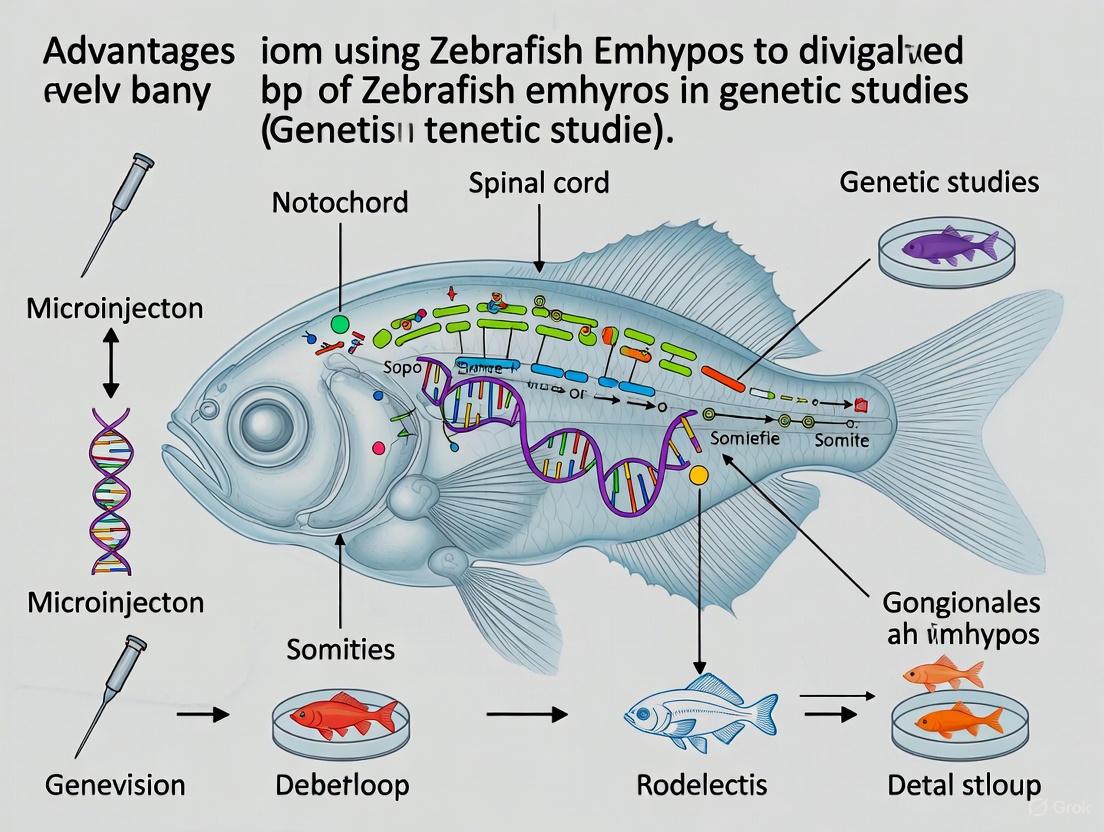
This article provides a comprehensive overview of the unique advantages of zebrafish embryos in genetic studies, tailored for researchers, scientists, and drug development professionals.
Unlocking Genetic Secrets: The Transformative Advantages of Zebrafish Embryos in Biomedical Research
Abstract
This article provides a comprehensive overview of the unique advantages of zebrafish embryos in genetic studies, tailored for researchers, scientists, and drug development professionals. It explores the foundational genetic and biological rationale for using this model, details cutting-edge methodological applications from high-throughput screening to precise gene editing, addresses common troubleshooting and optimization strategies to ensure data rigor, and offers a comparative validation against traditional mammalian models. By synthesizing these four core intents, the article serves as a definitive guide for leveraging the zebrafish embryo's full potential to accelerate disease modeling, functional genomics, and therapeutic discovery.
The Genetic Powerhouse: Why Zebrafish Embryos Are a Premier Model for Human Biology
The zebrafish (Danio rerio) has emerged as an indispensable model organism in biomedical research, primarily due to its remarkable genetic homology with humans. Current genomic analyses reveal that approximately 70% of human genes have at least one obvious zebrafish orthologue, with this conservation rising to 84% for genes associated with human diseases. This high degree of genetic similarity, combined with the unique advantages of zebrafish embryos—including optical transparency, external development, and high fecundity—positions zebrafish as a powerful vertebrate model for studying disease mechanisms and accelerating therapeutic development. This technical guide examines the foundation of zebrafish-human genetic conservation and its practical applications in contemporary research paradigms, providing methodologies and resources to leverage this model system effectively.
Zebrafish have transitioned from a developmental biology model to a cornerstone of functional genomics and precision medicine. As a vertebrate, zebrafish share most organ systems with humans, including cardiovascular, nervous, and immune systems [1] [2]. The sequencing and annotation of the zebrafish genome provided the critical foundation for systematic comparisons with the human genome, revealing extensive synteny and orthology [3]. This conservation extends beyond mere sequence similarity to encompass functional pathways, making zebrafish particularly valuable for modeling human disease processes and performing high-throughput drug screens [4].
The zebrafish model offers a unique combination of vertebrate biology and practical experimental advantages. Their small size, rapid generation time (2-4 months to maturity), and high fecundity (70-300 embryos per mating pair) enable large-scale genetic studies that are not feasible in other vertebrate systems [1]. These characteristics are complemented by the optical transparency of externally developing embryos, which permits real-time, non-invasive imaging of developmental processes and cellular dynamics in live organisms [4]. When integrated with their genetic tractability, these features make zebrafish an ideal system for bridging the gap between invertebrate models and mammalian systems, offering both physiological relevance and experimental scalability.
The Genomic Landscape: Quantitative Analysis of Conservation
Comprehensive Genome Comparisons
Systematic comparative genomic analyses between zebrafish and humans reveal a complex relationship characterized by both extensive conservation and important evolutionary divergences. The zebrafish genome contains approximately 26,000 protein-coding genes, which represents one of the largest gene sets among sequenced vertebrates [3]. This expanded gene count is partially attributed to a teleost-specific whole-genome duplication event that occurred approximately 340 million years ago [1] [3].
Table 1: Zebrafish-Human Genomic Comparison
| Genomic Feature | Zebrafish | Human | Conservation Relationship |
|---|---|---|---|
| Protein-coding genes | ~26,000 [3] | ~20,000 | - |
| Human genes with zebrafish ortholog | - | - | 70-71.4% [2] [4] [3] |
| Disease gene conservation | - | - | 82-84% [1] [2] [4] |
| One-to-one orthologs | - | - | 47% of human genes [3] |
| One-human-to-many-zebrafish | - | - | Significant proportion due to teleost duplication [3] |
The 70% genetic similarity figure represents the proportion of human protein-coding genes that have at least one zebrafish ortholog [3]. This conservation is not uniform across all genomic regions. Notably, chromosome 4 in zebrafish displays unique characteristics, with approximately 80% of its genes having no identifiable human orthologs, including 110 genes that appear to be zebrafish-specific [3].
Disease Gene Conservation and Implications
The conservation of disease-associated genes is particularly relevant for biomedical research. Analysis of the Online Mendelian Inheritance in Man (OMIM) database reveals that 82% of human genes with morbidity descriptions have at least one zebrafish ortholog [3]. More recent analyses suggest this figure may be as high as 84% [2] [4]. This elevated conservation of disease genes enhances the utility of zebrafish for modeling human genetic disorders.
Table 2: Disease Modeling Capabilities in Animal Models
| Feature | Zebrafish | Mouse | Advantage of Zebrafish |
|---|---|---|---|
| Genetic similarity to humans | ~70% of genes have orthologs [4] | ~85% [4] | Sufficient for most disease modeling with higher throughput |
| Transparency for imaging | High (embryos/larvae; casper adults) [1] [4] | Low | Enables real-time, non-invasive visualization |
| High-throughput screening capability | Very high [4] [5] | Moderate | Cost-effective large-scale genetic/drug screens |
| Disease modeling efficiency | High for developmental, cardiovascular, cancer models [4] | High for complex diseases [4] | Rapid results due to external development |
| Ethical & cost considerations | Low cost, fewer ethical limitations [4] | Higher cost, stricter regulations [4] | Enables larger sample sizes, reduced regulatory burden |
The teleost-specific genome duplication has important implications for disease modeling. While this duplication event resulted in many genes having two copies in zebrafish (ohnologues), approximately 47% of human genes maintain a one-to-one relationship with their zebrafish ortholog [3]. For the remaining genes, subfunctionalization has often occurred, where the original gene functions have been divided between duplicate paralogs [1]. This complexity necessitates careful consideration when designing zebrafish models of human disease, as mutating a single gene may not recapitulate the complete human phenotype.
Zebrafish Embryonic Advantages for Genetic Studies
The experimental power of the zebrafish model is significantly enhanced by the unique advantages of its embryonic stages. These advantages transform the fundamental genetic homologies into practical research applications.
Optical Accessibility and External Development
Zebrafish embryos develop externally and are optically transparent during early developmental stages, permitting direct observation of organogenesis in real time [4]. This transparency facilitates high-resolution imaging of dynamic biological processes, from cell migration to heart formation, without invasive procedures. To extend the window for optical clarity, researchers can use phenyl-thio-urea (PTU) to prevent pigment formation until around 7 days post-fertilization (dpf) [1]. For longer-term studies, genetically transparent lines such as the casper mutant (lacking pigment cells) enable imaging of larval and adult tissues [1].
The external development of zebrafish embryos allows for precise experimental manipulations that are not possible in utero. Researchers can microinject reagents—including synthetic mRNA, morpholinos, CRISPR components, or transposons for transgenesis—directly into one-cell stage embryos to achieve uniform distribution throughout the developing organism [1]. This accessibility enables systematic perturbation of gene function and rapid assessment of resulting phenotypes.
Rapid Development and High Fecundity
Zebrafish embryogenesis proceeds with remarkable speed, with major organ systems forming within 24-72 hours post-fertilization [4]. This rapid developmental timeline permits the analysis of complex vertebrate processes in a time-efficient manner. By 2-3 days post-fertilization, embryos have hatched and begun independent feeding, with sexual maturity reached within 2-4 months [1].
The high fecundity of zebrafish—with mating pairs producing hundreds of embryos weekly—provides large sample sizes that enhance statistical power and facilitate high-throughput approaches [1] [5]. This prolific breeding is particularly valuable for genetic studies, as it supports the generation of numerous offspring for Mendelian analysis and enables forward genetic screens that would be impractical in mammalian systems.
Diagram 1: Experimental workflow leveraging zebrafish embryonic advantages for genetic studies.
Methodologies for Leveraging Genetic Homology in Research
Genetic Manipulation Techniques
The high degree of genetic conservation between zebrafish and humans is functionally exploited through a diverse toolkit of genetic manipulation techniques:
CRISPR/Cas9 Genome Editing: The CRISPR/Cas9 system has revolutionized zebrafish genetic engineering, enabling precise generation of knockout and knock-in models [4] [6]. The standard protocol involves:
- Design of guide RNAs (gRNAs) targeting conserved exonic regions of the zebrafish ortholog
- In vitro transcription of gRNA and Cas9 mRNA (or preparation of Cas9 protein)
- Microinjection into one-cell stage embryos for widespread distribution
- Screening for founders (F0) carrying germline mutations
- Outcrossing to establish stable lines (F1) [6]
This approach has been successfully used to model various human diseases, including Cantú syndrome (cardiovascular disorder) through knock-in of human disease-causing mutations, and autism spectrum disorder through generation of shank3b loss-of-function mutations [6].
Morpholino Knockdown: Morpholino antisense oligonucleotides (MOs) provide transient gene knockdown by blocking translation or proper splicing of target mRNAs [1] [5]. While particularly useful for rapid assessment of gene function during early development (first 2-3 dpf), limitations include potential toxicity, off-target effects, and diminishing efficacy over time [1] [5]. Proper controls are essential, including dose-response curves, rescue experiments, and multiple independent morpholinos targeting the same gene.
Transgenesis: Zebrafish are highly amenable to transgenesis using Tol2 or other transposon systems [1]. The protocol typically involves co-injection of transposase mRNA with plasmid containing the gene of interest flanked by transposon inverted repeats. This method enables tissue-specific expression, lineage tracing, and modeling of regulatory mutations.
Functional Validation Through Cross-Species Complementation
A powerful approach for validating gene function involves testing the ability of human genes to rescue zebrafish mutants. This methodology provides direct evidence of functional conservation:
- Generate zebrafish mutant for gene of interest using CRISPR/Cas9
- Prepare human mRNA coding sequence for microinjection
- Inject human mRNA into zebrafish mutant embryos
- Assess rescue of phenotypic abnormalities
This approach has demonstrated remarkable functional conservation, as illustrated by studies of DNA Polymerase Theta, where zebrafish and human orthologs show not only high sequence similarity (63% identity in polymerase domain) but also conserved functional characteristics including microhomology-mediated end joining and translesion synthesis capabilities [7].
Research Reagent Solutions for Zebrafish Studies
Table 3: Essential Research Reagents for Zebrafish Genetic Studies
| Reagent/Category | Function/Application | Key Considerations |
|---|---|---|
| CRISPR/Cas9 components | Targeted genome editing [6] | gRNA design toward conserved domains; Cas9 protein or mRNA delivery |
| Morpholino oligonucleotides | Transient gene knockdown [1] [5] | Optimal for early development; requires careful control designs |
| Tol2 transposon system | Transgenesis and lineage tracing [1] | Enables tissue-specific expression and stable line generation |
| Casper mutant line | Adult transparency for imaging [1] | Permits longitudinal studies and adult tissue visualization |
| PTU (Phenyl-thio-urea) | Inhibits pigment formation [1] | Extends imaging window but may have subtle developmental effects |
| Zebrafish Orthology (ZFIN) Database | Orthology information and reagent validation [1] | Critical for experimental design and identifying appropriate targets |
Applications in Disease Modeling and Drug Discovery
The combination of genetic homology and embryonic advantages has positioned zebrafish as a premier model for human disease research. Several key applications demonstrate their utility:
Rare Genetic Diseases: Zebrafish are particularly valuable for studying rare genetic diseases, where their high fecundity and genetic tractability overcome limitations of small patient populations [5]. Successful models include Dravet syndrome (epilepsy), Wolfram syndrome, and various neurodegenerative disorders [5]. The high conservation of disease genes (84%) enables modeling of a broad spectrum of conditions, with the transparency of embryos permitting non-invasive assessment of neurological and physiological phenotypes.
Cardiovascular Research: The conservation of cardiovascular development and function, combined with optical accessibility, makes zebrafish ideal for studying heart development, disease mechanisms, and screening cardiotoxic compounds [4]. Real-time imaging of heart function and blood flow in transparent embryos provides insights not readily available in mammalian models.
Cancer Modeling: Zebrafish models of cancer leverage their genetic homology to recapitulate human cancer pathways [4]. Transgenic lines expressing human oncogenes, combined with tumor suppressor mutations, have generated models of various cancers. The optical transparency enables direct visualization of tumor initiation, progression, and metastasis in live animals.
Neurobehavioral Studies: The conservation of neurological pathways permits modeling of neuropsychiatric and neurodegenerative disorders [8]. Zebrafish exhibit complex behaviors that can be quantified using automated tracking systems, enabling high-throughput screening of neuroactive compounds [4] [8].
Diagram 2: Therapeutic discovery pipeline using zebrafish disease models.
The 70% gene sharing and 84% disease gene conservation between zebrafish and humans provides a robust genetic foundation for biomedical research. When integrated with the unique embryonic advantages of zebrafish—including external development, optical transparency, and rapid organogenesis—this genetic homology enables research approaches that are not feasible in other vertebrate systems. Current methodologies leveraging CRISPR/Cas9, sophisticated transgenesis, and high-throughput phenotypic screening continue to expand the utility of this model organism. As precision medicine advances, zebrafish stand poised to play an increasingly important role in functional validation of human genetic variants, personalized therapeutic testing, and elucidation of disease mechanisms, effectively bridging the gap between in vitro assays and clinical applications.
The zebrafish (Danio rerio) has emerged as a premier model organism for biomedical research, providing a unique combination of genetic tractability, optical transparency, and significant conservation of vertebrate anatomy and physiology. This whitepaper details the substantial conservation between zebrafish and human organ systems, focusing on the heart and brain as representative examples. We present quantitative data on genetic homology, organ system functionality, and developmental timing, alongside detailed experimental protocols for investigating these systems. The documented anatomical and functional parallels, coupled with advanced genetic tools, position zebrafish as an invaluable model for deciphering genetic mechanisms of human diseases and accelerating therapeutic discovery.
The zebrafish has rapidly gained prominence in genetic and biomedical research due to its distinctive experimental advantages. As a vertebrate, it shares a high degree of genetic similarity with humans; approximately 70% of all human genes have at least one zebrafish ortholog, and this figure rises to 84% for genes known to be associated with human disease [4] [9]. This genetic conservation, combined with practical research benefits, makes it a powerful platform for genetic studies.
Key advantages include:
- External Fertilization and Optical Clarity: Zebrafish embryos develop externally and are optically transparent, enabling non-invasive, real-time imaging of developmental processes at cellular resolution [4] [9].
- High Fecundity and Rapid Development: A single mating pair can produce hundreds of embryos weekly, and major organs form within 24-48 hours post-fertilization (hpf), facilitating high-throughput genetic screens and rapid experimental turnaround [1] [4].
- Genetic Tractability: The model is highly amenable to genetic manipulation using technologies such as CRISPR-Cas9, morpholino oligonucleotides, and transgenesis, allowing for precise modeling of human genetic disorders [1] [6].
Conservation of Organ Systems
The following sections and tables summarize the extensive anatomical and functional conservation between zebrafish and humans, focusing on two complex organ systems: the heart and the brain.
Table 1: Quantitative Genetic and Functional Conservation by Organ System
| Organ System | Key Conserved Features | Genetic Homology | Functional Assays in Zebrafish |
|---|---|---|---|
| Heart | • Four-chambered heart (sinus venosus, atrium, ventricle, bulbus arteriosus) [10]• Presence of intracardiac nervous system (IcNS) [11]• Similar cardiac conduction system [10]• Capable of regeneration [12] | ~84% of human cardiovascular disease genes have zebrafish orthologs [6] [9] | • Electrocardiography (ECG) [11]• Heart rate and contractility analysis [11]• Regeneration assays post-resection [12] |
| Brain & Nervous System | • Blood-brain barrier [8]• Major neurotransmitter systems (e.g., cholinergic, dopaminergic) [11] [8]• Complex behaviors (social, learning, anxiety) [9] | ~84% of human neurological disease genes have zebrafish orthologs [8] [9] | • Behavioral assays (locomotion, learning) [8]• Calcium imaging of neuronal activity [8]• scRNA-seq of neuronal subtypes [11] |
| Enteric Nervous System (ENS) | • "First brain" controlling gut motility [13]• Derived from vagal neural crest cells [13]• Expresses conserved markers (e.g., phox2bb, ret, sox10) [13] | High conservation of key ENS developmental genes (e.g., RET, SOX10) [13] | • Spatial genomic analysis (SGA) [13]• Whole-mount hybridization chain reaction (HCR) [13] |
Table 2: Comparative Developmental Timing of Key Events
| Developmental Event | Zebrafish | Human |
|---|---|---|
| Onset of Heart Contraction | ~22 hours post-fertilization (hpf) [10] | ~23 days [10] |
| Heart Looping | ~33 hpf [10] | ~23 days [10] |
| Formation of Heart Valves | Initiated by 37 hpf; completed by 16 days post-fertilization (dpf) [10] | Initiated at ~28 days [10] |
| Major Organs Formed | 24-72 hpf [4] | 4-8 weeks |
The Heart: A Conserved and Regenerative Organ
The zebrafish heart, while simpler in its conical structure, shares fundamental functional and regulatory principles with the human heart. A recent study decoding the zebrafish intracardiac nervous system (IcNS) revealed a surprising heterogeneity of neuronal types, including pacemaker-like neurons, underscoring a complex, conserved regulatory network for cardiac rhythmicity [11]. scRNA-seq of the adult zebrafish heart identified distinct neuronal and Schwann cell populations expressing a rich repertoire of neurotransmitter receptors, indicative of sophisticated local control [11]. Furthermore, unlike the human heart, the zebrafish heart possesses a remarkable capacity to regenerate following injury, a process driven by the dedifferentiation and proliferation of cardiomyocytes and a critical role played by the reactivated epicardium [12]. This makes it a powerful model for studying cardiac repair.
The Brain and Nervous System: From Neuronal Circuits to Behavior
The zebrafish central nervous system is highly conserved. Its brain contains major structures and neurotransmitter systems found in humans, facilitating the study of complex behaviors and neurological diseases [8] [9]. Research has shown that zebrafish possess brain chemicals like oxytocin, which are involved in emotions such as fear, enabling the study of conditions like anxiety and stress [9]. The peripheral nervous systems, such as the enteric nervous system (ENS), are also conserved. Spatial genomic analysis of the zebrafish ENS has identified region-specific gene expression (e.g., hoxb5b, etv1) along the gut, providing a blueprint for understanding gut neurodevelopment and its disorders [13].
Experimental Protocols for Genetic Studies
This section outlines detailed methodologies for key experiments that leverage the zebrafish model to study conserved organ systems.
Protocol: Single-Cell RNA Sequencing of the Zebrafish Heart
This protocol is adapted from [11] for characterizing cellular heterogeneity in the adult zebrafish heart.
- Tissue Dissociation: Isolate hearts from adult transgenic zebrafish (e.g., Tg(elavl3:EGFP) for neurons). Pool multiple hearts to ensure sufficient cell count.
- Cell Dissociation: Mechanically dissociate and enzymatically digest the tissue into a single-cell suspension using collagenase and papain.
- Cell Sorting and Sequencing: Use Fluorescence-Activated Cell Sorting (FACS) to isolate GFP-positive cells or process the entire cell population. Proceed with standard scRNA-seq library preparation using a platform such as 10x Genomics.
- Bioinformatic Analysis:
- Perform quality control to remove low-quality cells and doublets.
- Integrate datasets from biological replicates.
- Use unsupervised clustering algorithms (e.g., Seurat, Scanpy) to identify distinct cell populations.
- Identify cluster-specific marker genes and perform Gene Ontology (GO) enrichment analysis.
- Validate key findings with in situ hybridization or immunohistochemistry.
Protocol: Spatial Genomic Analysis of the Enteric Nervous System
This protocol, based on [13], maps gene expression in the context of the intact tissue architecture.
- Sample Preparation: Fix zebrafish larvae (e.g., 4 and 7 dpf) in 4% paraformaldehyde and position them on silanized slides.
- Multiplexed Hybridization Chain Reaction (HCR):
- Design HCR probes against target mRNAs (e.g., phox2bb, ret, elavl3).
- Perform sequential rounds of hybridization and fluorophore amplification. Between rounds, use DNase I treatment to remove the previous probe set.
- High-Content Imaging: Acquire high-resolution z-stack images of the entire gut using a confocal microscope with automated tiling and stitching capabilities.
- 3D Segmentation and Data Extraction:
- Import stitched images into software such as IMARIS.
- Use the AI-powered segmentation tool to identify individual ENS cells in 3D space, followed by manual curation.
- Export cell positions (XYZ coordinates) and fluorescence intensity data for each channel.
- Spatial Bioinformatics: Analyze the extracted data to identify spatial gene expression patterns, cell communities, and correlation networks based on the positional context of the cells.
Figure 1: Workflow for Spatial Genomic Analysis of the zebrafish ENS. This pipeline integrates spatial and transcriptional data to map gene expression in a tissue context.
Protocol: Cardiac Regeneration Assay
This established protocol [12] is used to study the molecular mechanisms of heart regeneration.
- Ventricular Resection:
- Anesthetize adult zebrafish in tricaine.
- Perform a small lateral incision to expose the heart.
- Use iridectomy scissors to surgically resect approximately 20% of the ventricular apex.
- Carefully return the heart to the pericardial cavity and suture the incision.
- Tissue Collection and Analysis:
- At defined time points post-injury (e.g., 1, 7, 14, 30 days), harvest hearts for analysis.
- For histological analysis: Fix, section, and stain with antibodies (e.g., against Troponin T for cardiomyocytes) or dyes (e.g., Picrosirius Red for collagen deposition).
- For proliferation studies: Inject fish with BrdU or EdU prior to collection to label proliferating cells, and co-stain with cardiac markers.
- For molecular analysis: Perform RNA/protein extraction from the apex region or use in situ hybridization to localize gene expression (e.g., raldh2, tbx18 in the epicardium).
Figure 2: Key Stages of Zebrafish Heart Regeneration. Following injury, zebrafish hearts fully regenerate muscle tissue without scarring, a process driven by epicardial activation and progenitor cells.
The Scientist's Toolkit: Essential Research Reagents
The following table details key reagents and resources for conducting advanced genetic and physiological studies in zebrafish.
Table 3: Essential Research Reagents and Resources
| Reagent/Resource | Function/Application | Examples & Notes |
|---|---|---|
| CRISPR-Cas9 System [6] | Targeted gene knockout and knock-in. | Microinjection of gRNA + Cas9 protein into one-cell stage embryos. Enables modeling of human disease mutations. |
| Morpholino Oligonucleotides [1] [4] | Transient gene knockdown by blocking translation or splicing. | Ideal for rapid assessment of gene function during early development (1-3 dpf). Requires careful controls for off-target effects. |
| Transgenic Lines (e.g., Casper) [1] [9] | Enables high-resolution imaging in larvae and adults. | casper mutants lack pigment, allowing for non-invasive visualization of internal organs and processes like tumor growth. |
| Pan-Neuronal Markers [11] [13] | Identification of neuronal cells and processes. | Antibodies against HuC/D or transgenic lines like Tg(elavl3:EGFP) are used to label neurons in the CNS and ENS. |
| Hybridization Chain Reaction (HCR) [13] | Multiplexed, high-sensitivity RNA in situ detection in whole-mount samples. | Superior for spatial genomic analysis; allows for simultaneous detection of multiple mRNA targets in 3D-preserved tissues. |
| Zebrafish International Resource Center (ZINC) [1] | Repository for zebrafish lines. | Source for wild-type, mutant, and transgenic lines. Critical for maintaining genetic diversity and acquiring research models. |
| The Zebrafish Information Network (ZFIN) [1] | Centralized genomic and phenotypic database. | Curated database for genetic sequences, mutants, antibodies, protocols, and publications. Essential for experimental design and data analysis. |
The zebrafish model offers an unparalleled combination of anatomical and physiological conservation with human organ systems and the practical advantages required for sophisticated genetic studies. The documented parallels in heart and brain structure and function, supported by quantitative data and robust experimental methodologies, validate its utility. The ongoing development of advanced tools, from single-cell genomics to spatial transcriptomics and precise gene editing, ensures that the zebrafish will remain at the forefront of efforts to unravel the genetic underpinnings of human disease and pioneer novel therapeutic strategies.
The unique optical transparency of zebrafish embryos and larvae provides an unparalleled window into developmental processes, enabling researchers to observe dynamic biological events in real-time within a living, intact organism. This characteristic, central to the zebrafish model's value, allows for high-resolution, non-invasive imaging that is difficult or impossible to achieve with other vertebrate models. This technical guide explores how this transparency advantage is leveraged to advance genetic studies and drug discovery, detailing cutting-edge imaging methodologies, quantitative performance data, and practical experimental protocols. By integrating these approaches, researchers can decode developmental signaling, neural circuit function, and disease mechanisms with single-cell resolution across entire embryonic systems.
The zebrafish (Danio rerio) has emerged as a cornerstone of developmental genetics and biomedical research, with its optical transparency during embryonic and larval stages representing one of its most powerful attributes [4] [14]. This natural transparency enables direct visualization of internal organ development, cellular dynamics, and disease processes in real-time without invasive surgical procedures [15]. When combined with genetic tools that make specific cell types fluorescently tagged, this model provides unprecedented access to the intricate processes of vertebrate development [14].
The transparency is not merely a passive quality but an active research enabler that aligns with modern scientific and ethical standards. From 5 days post-fertilization, zebrafish larvae develop fully functional organs while maintaining sufficient transparency for detailed observation [16]. For studies requiring extended transparency beyond natural windows, researchers can utilize genetic mutants such as the casper line, which remains transparent into adulthood, or chemically inhibit pigment formation with phenyl-thio-urea (PTU) [1]. This physical characteristic, combined with the zebrafish's 70% genetic homology with humans and rapid external development, positions it as an ideal vessel for studying conserved biological mechanisms [4] [15].
Technical Foundations of Real-Time Imaging
Advanced Imaging Modalities Leveraging Transparency
The transparency of zebrafish embryos enables the application of sophisticated imaging technologies that capture dynamic biological processes across spatial and temporal scales. Selective Volume Illumination Microscopy (SVIM) exemplifies this synergy, combining light-field microscopy's synchronous volumetric imaging with confined illumination to dramatically enhance image contrast [17]. SVIM achieves this by illuminating only the volume of interest rather than the entire sample, removing background signal from extraneous tissue while maintaining the ability to capture extended volumes in single snapshots [17].
This approach demonstrates particular efficacy for imaging dynamic systems where components undergo rapid three-dimensional movements. SVIM has been successfully deployed to capture cellular-resolution 3D movies of the beating zebrafish heart and brain-wide neural activity, achieving volumetric rates of 90 volumes per second over the entire heart [17]. Compared to conventional wide-field light-field microscopy, SVIM provides 50% better contrast for heart wall imaging and 10% improvement for blood cell tracking, enabling precise quantification of dynamic processes [17].
For larger-scale developmental mapping, integrated approaches like Zebrahub combine single-cell sequencing time course data with lineage reconstructions from light-sheet microscopy [18]. This multimodal atlas offers high-resolution molecular insights into zebrafish development, enabling in silico fate-mapping experiments that correlate gene expression patterns with lineage decisions across embryogenesis.
Quantitative Performance Metrics of Zebrafish Imaging
Table 1: Performance Metrics of Advanced Imaging Modalities in Zebrafish
| Imaging Modality | Spatial Resolution | Temporal Resolution | Z-Depth Coverage | Key Advantages |
|---|---|---|---|---|
| SVIM | ~3 μm laterally, ~6 μm axially [17] | 90 volumes/sec [17] | 440 × 440 × 100 μm³ [17] | High contrast, synchronous volumetric capture |
| Deep Learning Classification | Sufficient for embryo staging [19] | 10.5 ms processing time [19] | N/A | Non-invasive, high-throughput sorting |
| Automated Teratogenicity Screening | Morphological defect detection [16] | Rapid phenotypic assessment [16] | Whole-embryo | High correlation with mammalian models |
Table 2: Deep Learning Embryo Sorting Accuracy by Developmental Stage
| Developmental Stage | Detection Accuracy | Sorting Efficiency |
|---|---|---|
| Stage 1 (Single-cell) | 90.63% [19] | 88.13% [19] |
| Advanced Stage | 93.36% [19] | 91.80% [19] |
| Dead Embryos | 99.03% [19] | 96.60% [19] |
Experimental Protocols for Developmental Imaging
High-Throughput Phenotypic Screening for Teratogenicity
The transparency of zebrafish embryos enables robust screening platforms for developmental toxicity assessment. The following protocol outlines an automated approach that combines zebrafish embryogenesis with artificial intelligence:
Embryo Preparation: Collect zebrafish embryos from natural spawning and maintain in embryo medium until screening. For consistent results, synchronize developmental stages by selecting embryos at the same post-fertilization window [16].
Compound Exposure: Dispense embryos into 96-well plates containing various concentrations of test compounds using automated liquid handling systems. Include positive (known teratogens) and negative controls in each plate [16].
Incubation and Development: Maintain embryos at 28.5°C for 120 hours post-fertilization (hpf), allowing complete organogenesis while avoiding regulations for vertebrate animal use [16].
Image Acquisition: Automatically capture bright-field and fluorescence images of each embryo using high-content screening systems. The transparency enables imaging of internal structures without fixation or sectioning [16].
Phenotypic Analysis: Utilize deep learning algorithms to evaluate 16 morphological parameters related to embryo development. The system automatically classifies compounds as teratogens or non-teratogens based on quantitative phenotypic profiles [16].
This platform demonstrates high correlation with mammalian models and human teratogenicity data, achieving superior predictive performance compared to traditional rodent tests for certain compound classes [16].
Whole-Brain Functional Imaging with SVIM
The following protocol details the application of Selective Volume Illumination Microscopy for brain-wide neural activity mapping in larval zebrafish:
Sample Preparation: Use transgenic zebrafish larvae (5-7 days post-fertilization) expressing genetically encoded calcium indicators (e.g., GCaMP) in neurons. Embed larvae in low-melting-point agarose with imaging-appropriate orientation [17].
Microscope Configuration:
- Implement selective volume illumination via galvanometer-based rapid scanning of the specified volume multiple times within a single camera exposure
- Position a microlens array at the image plane for light-field detection
- Use either 1-photon or 2-photon excitation, with 2-photon offering better contrast for neural recordings [17]
Data Acquisition: Capture spontaneous or stimulus-evoked brain activity at volumetric rates sufficient to resolve calcium transients (typically 1-10 Hz volume rate). The entire zebrafish brain can be imaged simultaneously thanks to the transparency and SVIM's extended depth coverage [17].
Image Reconstruction: Process raw light-field images using 3D deconvolution approaches with publicly available software. The selective illumination dramatically enhances reconstruction quality by reducing background fluorescence [17].
Neural Activity Analysis: Extract calcium traces from identified neurons across the brain. SVIM's enhanced contrast enables detection of fourfold more active neurons during spontaneous brain activity compared to conventional wide-field light-field microscopy [17].
The Scientist's Toolkit: Essential Research Reagents and Materials
Table 3: Key Research Reagent Solutions for Zebrafish Imaging
| Reagent/Material | Function | Application Example |
|---|---|---|
| Casper Mutant Line | Genetically transparent adult zebrafish [1] | Long-term in vivo imaging of processes like tumor progression |
| Phenyl-thio-urea (PTU) | Chemical inhibitor of pigment formation [1] | Maintaining larval transparency beyond natural window for development studies |
| Genetically Encoded Calcium Indicators (e.g., GCaMP) | Fluorescent reporters of neural activity [17] | Brain-wide functional imaging of neuronal dynamics |
| Green Fluorescent Protein (GFP) and Variants | Fluorescent labeling of specific cells and structures [14] | Real-time tracking of cellular processes and organ development |
| Morpholino Oligonucleotides | Transient gene knockdown [1] | Rapid assessment of gene function during early development |
| CRISPR/Cas9 Components | Permanent genome editing [4] [1] | Generating stable transgenic and mutant lines for developmental studies |
| Low-Melting-Point Agarose | Immobilization for live imaging [17] | Sample stabilization during microscopy without compromising viability |
Visualization and Data Analysis Approaches
Integrated Workflow for Developmental Analysis
The transparency of zebrafish embryos enables comprehensive analytical pipelines that connect real-time imaging with computational methods. The integration of deep learning with imaging data creates powerful frameworks for quantitative developmental analysis:
This integrated approach demonstrates how transparency-enabled imaging connects with computational analysis to generate quantitative insights. The YOLOv8-based deep learning model achieves 97.6% detection accuracy with a processing speed of 10.5 milliseconds, enabling real-time classification of embryo developmental stages [19]. Subsequent microfluidic sorting then achieves efficiencies ranging from 88.13% to 96.60% depending on embryo class, creating an automated pipeline from imaging to sample processing [19].
For teratogenicity screening, this workflow enables the assessment of 16 phenotypic parameters related to embryo development, with trained algorithms automatically classifying compounds based on quantitative morphological profiles [16]. The platform shows high correlation with known mammalian and human teratogenicity data, demonstrating how zebrafish transparency bridges in vitro and in vivo models for predictive toxicology.
The transparency of zebrafish embryos remains one of the most valuable attributes for developmental genetics and drug discovery research. This physical characteristic, when combined with advanced imaging technologies such as SVIM, deep learning classification, and high-throughput screening platforms, enables researchers to visualize and quantify biological processes at resolutions and scales unmatched by other vertebrate models. As imaging methodologies continue to evolve and computational analysis becomes increasingly sophisticated, the transparency advantage will further solidify the zebrafish's position as a critical model system for unraveling the complexities of vertebrate development and disease.
Zebrafish (Danio rerio) have emerged as a preeminent model organism in biomedical research, largely due to reproductive characteristics that are uniquely suited for large-scale genetic and drug discovery studies. This whitepaper details how the high fecundity, rapid generational turnover, and external fertilization of zebrafish directly address the throughput and scalability limitations inherent in mammalian model systems. We provide a quantitative analysis of these advantages, detail key experimental protocols that leverage these traits and present a structured framework for integrating zebrafish into high-content research pipelines. The biological and methodological insights herein are framed within the broader thesis that zebrafish embryological advantages are foundational to their growing dominance in genetic research and early-stage drug development.
The foundational strength of the zebrafish model rests upon a specific suite of reproductive traits that collectively enable unparalleled experimental scalability in vertebrate research. These traits—high fecundity, external fertilization, and rapid embryonic development—provide a practical solution to the bottlenecks of cost, space, and time that constrain studies using traditional mammalian models [20].
As vertebrates, zebrafish share a high degree of genetic and functional homology with humans, with approximately 70% of human genes having a zebrafish counterpart and over 80% of disease-associated proteins being conserved [20] [21]. This conservation ensures that biological insights are translationally relevant. However, unlike mice, zebrafish produce hundreds of embryos weekly from a single breeding pair, and their embryos develop externally in a transparent state, allowing for direct, non-invasive observation of developmental processes [22] [23]. This combination of biological relevance and experimental tractability makes zebrafish an indispensable tool for modern genetic research.
Quantitative Advantages of Zebrafish Reproduction
The quantitative reproductive metrics of zebrafish offer a direct and significant advantage over other vertebrate models, particularly in the context of large-scale genetic screens and drug discovery pipelines. The table below provides a structured comparison of these key parameters.
Table 1: Quantitative Reproductive Comparison between Zebrafish and Mouse Models
| Parameter | Zebrafish | Mouse | Experimental Implication for Large-Scale Studies |
|---|---|---|---|
| Embryos per Spawning | 200 - 300 eggs per pair weekly [24] [20] | 5 - 10 pups per litter [20] | Enables high-throughput screening with massive sample sizes. |
| Reproductive Maturity | 3 - 6 months [24] | ~2 months | Faster generation turnover for genetic crossing and lineage studies. |
| Embryonic Development | External, ex utero [20] [22] | Internal, in utero | Enables direct manipulation (e.g., microinjection) and continuous visual access. |
| Embryonic Transparency | Transparent embryos and larvae [25] [23] | Opaque embryos | Facilitates high-content phenotypic screening and live imaging without sacrifice. |
| Ploidy Manipulation | Haploid embryos viable for several days [25] | Not viable | Allows for rapid identification of recessive mutations in a single generation. |
These quantitative advantages translate directly into practical research benefits. The ability to generate hundreds of offspring from a single pair in one week means that a small zebrafish colony can produce a volume of data that would require orders of magnitude more rodents, significantly reducing the space, cost, and time required for statistically powerful experiments [23]. Furthermore, external development and optical clarity are not merely logistical conveniences; they are enabling technologies that permit researchers to observe pathogenesis and treatment responses in real-time within a living, intact vertebrate.
Core Experimental Protocols Leveraging Reproductive Traits
The unique reproductive biology of the zebrafish has given rise to specialized experimental protocols that are central to its utility in genetic research. The workflows for these protocols are complex, involving specific sequences and decision points, which are best represented visually. The following diagrams and accompanying text detail two foundational methodologies.
Protocol 1: The Haploid Screen for Recessive Mutations
A powerful application of the zebrafish model is the haploid screen, which dramatically accelerates the identification of recessive mutations by bypassing the need for multiple generations of inbreeding [25]. The following diagram illustrates the workflow for this screen.
Diagram 1: Haploid Screen Workflow for Recessive Mutant Identification.
This protocol leverages the fact that zebrafish embryos can survive for several days in a haploid state. The key methodological steps are as follows:
- Mutagenesis: A parental (P) generation male is treated with a chemical mutagen like N-ethyl-N-nitrosourea (ENU) to induce random mutations in its germline [25].
- Carrier Generation: The mutagenized male is outcrossed with a wild-type female. The resulting first-generation (F1) progeny are raised to adulthood. Each F1 fish is a potential heterozygous carrier of unique recessive mutations.
- Haploid Embryo Production: Eggs are manually obtained ("squeezed") from an F1 female. Simultaneously, sperm is collected from a wild-type male and subjected to ultraviolet (UV) light irradiation. This UV treatment crosslinks the paternal DNA, rendering it incapable of contributing genetic material to the embryo [25].
- In Vitro Fertilization (IVF) and Analysis: The UV-inactivated sperm is used to fertilize the F1 female's eggs in vitro. The sperm activates the egg to begin development, but the resulting embryos develop with only the haploid maternal set of chromosomes. If the F1 female was a carrier of a recessive mutation, 50% of the haploid clutch will display the mutant phenotype, allowing for rapid identification of the carrier female without the need to raise a second (F2) generation [25].
Protocol 2: Induced Disease Modeling and High-Throughput Screening
The high fecundity of zebrafish is crucial for creating disease models and conducting high-throughput chemical screens. The workflow for this approach is highly parallel and iterative, as shown below.
Diagram 2: Workflow for Disease Modeling and High-Throughput Screening.
This protocol utilizes the large numbers of externally developing embryos for functional studies:
- Disease Model Induction: A disease state is recapitulated in zebrafish using methods such as:
- Chemical Induction: Exposure to compounds like testosterone to induce conditions resembling Polycystic Ovary Syndrome (PCOS), characterized by follicular arrest and reduced ovulation [26].
- Genetic Manipulation: Using CRISPR/Cas9 or transgenesis to create knock-out or knock-in models of human diseases, such as introducing a BRAF mutation to model melanoma [27] [21].
- High-Throughput Screening (HTS): The model organism is then leveraged for screening. Hundreds of synchronized, transparent embryos are arrayed into multi-well plates and exposed to libraries of small molecules directly from their aqueous environment [21] [28].
- Multi-Parametric Phenotyping: The transparency and external development of the embryos allow for in-depth, high-content phenotyping. This can include automated imaging of heart function, assessment of neuronal development, quantification of liver size, or behavioral tracking [21]. This enables simultaneous evaluation of both efficacy and complex toxicity profiles (cardio-, neuro-, hepato-toxicity) within a whole vertebrate system [28].
The Scientist's Toolkit: Essential Reagents and Materials
Successful execution of the protocols described above relies on a set of core reagents and materials. The following table catalogs the key solutions and their specific functions in zebrafish reproductive and genetic research.
Table 2: Essential Research Reagent Solutions for Zebrafish Experiments
| Reagent / Solution | Composition / Type | Primary Function in Experimentation |
|---|---|---|
| Sperm Inactivation Solution | Ultraviolet (UV) Light [25] | Crosslinks paternal DNA during IVF to create haploid embryos for genetic screens. |
| Embryo Water | Distilled water with instant ocean salt; pH = 7.0 ± 0.2 [26] | Maintains osmotic balance and provides the necessary ionic environment for normal embryo development. |
| Anesthetic Solution | Tricaine Mesylate (e.g., 1% solution) [26] | Anesthetizes adult fish for humane procedures such as tissue collection or sperm/egg squeezing. |
| Chemical Mutagen | N-ethyl-N-nitrosourea (ENU) [25] | Induces point mutations at high density in the male germline for forward genetic screens. |
| Model-Inducing Agent | Testosterone (e.g., 100 ng/mL in facility water) [26] | Induces pathological states in females that mimic human reproductive disorders like PCOS. |
| Fixative Solution | 4% Paraformaldehyde (PFA) in buffer [26] | Preserves tissue and embryonic morphology for subsequent histological or immunohistochemical analysis. |
The "ridiculous reproductivity" of the zebrafish is far from a trivial biological curiosity; it is the engine that drives its value as a premier model organism. The quantitative advantages of high fecundity, coupled with the qualitative access granted by external fertilization and embryonic transparency, create a unique and powerful research platform. As detailed in this whitepaper, these traits enable specific, high-efficiency methodologies—from haploid screens that compress years of genetic analysis into months, to high-throughput drug screens that provide whole-organism efficacy and toxicity data at an unparalleled scale. For the research community focused on unraveling genetic mechanisms and accelerating drug discovery, the zebrafish model offers a scalable, ethically refined, and scientifically robust pathway from gene sequence to physiological function.
The 3Rs principles (Replacement, Reduction, and Refinement), first articulated by Russell and Burch in 1959, provide a foundational ethical framework for the use of animals in scientific research [29] [30]. Decades after their inception, these principles have gained renewed relevance through their convergence with a powerful biomedical model: the zebrafish embryo. This combination represents a paradigm shift in how researchers approach genetic studies and drug development while addressing ethical considerations.
Zebrafish (Danio rerio) have emerged as a transformative model organism that uniquely bridges the gap between invertebrate models and mammalian systems [1] [22]. The optical transparency of their embryos, high genetic similarity to humans (approximately 70% gene homology), and rapid external development make them exceptionally suited for developmental biology and genetic research [20] [31] [23]. A critical ethical advantage lies in their regulatory status: according to EU Directive 2010/63/EU, zebrafish embryos within the first five days post-fertilization are not classified as protected animals, as they are not capable of independent feeding [32] [33]. This classification positions zebrafish embryos as a compelling Replacement option in the 3Rs framework, allowing researchers to obtain systemic in vivo data without the ethical constraints associated with vertebrate models [32].
This technical guide explores how zebrafish embryos advance the 3Rs principles in practice, providing detailed methodologies, quantitative data, and experimental protocols to empower researchers to implement these approaches in genetic studies and preclinical research.
The 3Rs Principles: Evolution and Modern Interpretation
The original 3Rs framework defined by Russell and Burch has evolved significantly, with modern interpretations emphasizing their role in promoting both ethical standards and scientific excellence [30]. The core principles are:
Replacement: The use of insentient material to replace conscious living animals in research. Modern interpretations advocate for "absolute replacement" where possible, using non-animal models, and "relative replacement" using non-sentient life stages [29] [30]. For zebrafish, this means utilizing embryos within the first 5 days post-fertilization (dpf), which are not classified as protected animals under EU Directive 2010/63/EU [32] [33].
Reduction: Minimizing the number of animals used while obtaining statistically significant information. This is achieved through improved experimental design, statistical analysis, and sharing resources [29].
Refinement: Modifying procedures to minimize pain, distress, and lasting harm to animals that are still used [29]. For zebrafish, this includes using non-invasive imaging techniques and optimal housing conditions.
Contemporary perspectives recognize the 3Rs not merely as a technical checklist but as a dynamic framework that evolves with scientific progress [30]. The scientific community continues to refine these principles, with some researchers proposing additional Rs such as Responsibility and Reproducibility to address modern research challenges [30].
Table 1: Modern Interpretation of the 3Rs Principles
| Principle | Original Definition (1959) | Modern Interpretation | Zebrafish Embryo Application |
|---|---|---|---|
| Replacement | Substitution for conscious living higher animals of insentient material | Complete avoidance of animal use in research, testing, and education | Use of embryos <5 dpf classified as non-protected; non-animal alternatives |
| Reduction | Reduction in numbers of animals used to obtain information of given amount and precision | Obtaining comparable information from fewer animals through better design and analysis | High-throughput screening with hundreds of embryos simultaneously |
| Refinement | Decrease in incidence or severity of inhumane procedures | Minimizing pain, distress, and lasting harm through improved welfare | Non-invasive imaging; optimal housing; early endpoints |
Zebrafish Embryos as a Replacement Tool: Scientific and Ethical Advantages
Biological Similarities to Humans
Despite their phylogenetic distance from humans, zebrafish share remarkable biological conservation. They possess two eyes, a mouth, brain, spinal cord, intestine, pancreas, liver, bile ducts, kidney, esophagus, heart, ear, nose, muscle, blood, bone, cartilage, and teeth [20]. The genetic basis for developing these structures is highly conserved, with approximately 70% of human genes having zebrafish counterparts [20] [31]. This high degree of homology enables researchers to model human diseases in zebrafish with significant predictive validity.
Practical Advantages Over Traditional Mammalian Models
Zebrafish offer several practical advantages that align with both ethical and efficiency goals in research:
Small size and low maintenance costs: Adult zebrafish are small and can be housed in large groups ("shoals"), requiring significantly less space and lower maintenance costs than mice [20].
High reproductive capacity: A single mating pair can produce 50-300 eggs weekly, compared to mice that typically produce litters of 1-10 pups with approximately three litters in their lifetime [20]. This high fecundity supports large-scale genetic studies.
External embryonic development: Zebrafish embryos are fertilized and develop externally, allowing for easy manipulation and observation without invasive procedures [20] [22].
Optical transparency: The transparent nature of zebrafish embryos enables direct visualization of internal organ development and processes under microscopy without invasive techniques [20] [31] [23].
Genetic tractability: Zebrafish genomes are highly amenable to manipulation using techniques such as CRISPR-Cas9, morpholinos, and transgenesis [1] [22].
Regulatory Status and Ethical Positioning
The regulatory classification of zebrafish embryos before 5 days post-fertilization as non-protected organisms under EU Directive 2010/63/EU provides a significant ethical advantage [32] [33]. During this period, researchers can gather systemic in vivo data without the regulatory constraints associated with vertebrate models, effectively implementing Replacement while maintaining biological relevance [32].
Quantitative Data: Zebrafish Embryos in Toxicity and Developmental Studies
The Zebrafish Embryo Developmental Toxicity Assay (ZEDTA) represents a promising approach to replace traditional mammalian testing for teratogenic substances [33]. Recent optimization efforts have refined this protocol to enhance reliability while minimizing animal use.
Table 2: Historical Control Data from Optimized ZEDTA Protocol (26 Experiments)
| Endpoint | Incidence Rate (%) | Details |
|---|---|---|
| Overall Mortality | 3.5% | Recorded after 96 hours of exposure |
| Overall Malformations | 7.6% | Observed in all surviving larvae |
| Yolk Sac Deformation | 4.0% | Most frequent malformation |
| Tail Malformations | 2.8% | Including kinked tails |
| Heart Malformations | 2.6% | Irregular shape, edema, or abnormal heartbeat |
| Head Malformations | 1.6% | Missing structures, uneven eye shape, edema |
The optimized ZEDTA protocol achieved these results through specific parameters: exposure in 24-well plates at 26°C with renewal of test solutions after 48 hours of exposure [33]. The use of 0.5% v/v DMSO did not induce more malformations or mortality than exposure to standard ISO medium, providing a viable solvent option for compound testing [33]. These low background rates of mortality and malformations indicate a high degree of protocol reliability with minimal confounding factors.
Experimental Protocols and Methodologies
Zebrafish Embryo Developmental Toxicity Assay (ZEDTA)
The ZEDTA protocol has been systematically optimized for developmental toxicity testing [33]:
Embryo Collection and Selection: Fertilized eggs of zebrafish wildtype Tüebingen are obtained and pre-selected during the blastula phase (2-4 hours post-fertilization) using light microscopy. Only fertilized eggs with a round chorion and no signs of coagulation are selected.
Exposure Conditions:
- Temperature: 26°C proved optimal over 28°C
- Vessel: 24-well plates
- Medium: ISO water with specific ionic composition (CaCl₂·2H₂O at 211.5 mg/L, MgSO₄·7H₂O at 88.8 mg/L, NaHCO₃ at 46.7 mg/L, and KCl at 4.2 mg/L)
- Renewal: Semi-static with renewal after 48 hours
- Lighting: 14-hour light period daily at 550-1080 lux
Endpoint Assessment: Observations are performed at 24-hour intervals (24, 48, 72, and 96 hours following start of exposure). The extended General Morphology Score (extended GMS) is used to assess development, while specific teratogenic endpoints are scored as present or absent.
Genetic Manipulation Techniques
Zebrafish are highly amenable to genetic manipulation, supporting both Reduction and Refinement through precise targeting:
Morpholinos: Antisense oligonucleotides that block translation or splicing, providing rapid knockdown during the first 2-3 days post-fertilization [1].
CRISPR-Cas9 Gene Editing: Enables precise genome modifications for creating disease models. The one-cell-stage fertilized eggs can be easily injected with gene-editing components to generate transgenic or knock-out zebrafish lines [20] [1].
Chemical Mutagenesis: Zebrafish embryos can absorb chemical mutagens added to their water, enabling forward genetic screens with higher mutagen density than rodents [23].
Advanced Imaging and Quantification
The transparency of zebrafish embryos enables non-invasive imaging, a key Refinement technique:
Mueller Matrix Optical Coherence Tomography (OCT): This non-invasive imaging technology provides high-resolution (less than ten micrometers) 3D images with several millimeters penetration depth [31]. When combined with deep learning-based U-Net networks, it can automatically segment and quantify volume changes in various anatomical structures including body, eyes, spine, yolk sac, and swim bladder from day 1 to day 19 of development [31].
Fluorescence Microscopy: Transgenic zebrafish lines with fluorescently labeled tissues allow real-time visualization of biological processes without invasive procedures [20].
The Researcher's Toolkit: Essential Materials and Reagents
Table 3: Key Research Reagent Solutions for Zebrafish Embryo Studies
| Reagent/Resource | Function | Application Example |
|---|---|---|
| Morpholinos (MOs) | Gene knockdown by blocking translation or splicing | Rapid screening of gene function during first 2-3 dpf [1] |
| CRISPR-Cas9 System | Precise genome editing | Creating knock-out or knock-in disease models [20] [1] |
| Phenyl-thio-urea (PTU) | Prevents pigment formation | Maintains transparency for imaging beyond early stages [1] |
| DMSO (0.5% v/v) | Solvent for compound testing | Enables chemical screening without significant background malformations [33] |
| MS-222 | Anesthetic for procedures | Enables humane handling during imaging or manipulation |
| ISO Water Medium | Standardized exposure medium | Provides consistent ionic composition for toxicity tests [33] |
| Casper Mutant Line | Genetically transparent strain | Enables imaging of larval and adult tissues [1] |
Visualizing Experimental Workflows and 3Rs Integration
The following diagrams illustrate key experimental workflows and the integration of 3Rs principles in zebrafish embryo research:
Zebrafish Embryo Toxicity Screening Workflow
Zebrafish Embryo Toxicity Screening Workflow
3Rs Implementation Framework in Zebrafish Research
3Rs Implementation Framework in Zebrafish Research
The integration of zebrafish embryos into biomedical research represents a significant advancement in implementing the 3Rs principles without compromising scientific rigor. The genetic similarity to humans, practical advantages over mammalian models, and favorable regulatory status of early developmental stages position zebrafish as an ethical and efficient model system.
Future directions for maximizing the 3Rs potential of zebrafish embryos include:
Protocol Harmonization: Continued refinement and standardization of protocols like ZEDTA to enable global harmonization and regulatory acceptance [33].
Advanced Imaging Technologies: Further development of non-invasive imaging techniques such as Mueller matrix OCT combined with deep learning for more comprehensive developmental analysis [31].
Genetic Tool Development: Expansion of precise genetic manipulation tools to enhance disease modeling while reducing animal numbers through more targeted approaches.
Educational Integration: Incorporating zebrafish embryo methodologies into training programs to promote widespread adoption of 3Rs-aligned practices.
As the scientific community continues to prioritize both ethical considerations and research quality, zebrafish embryos offer a powerful platform to bridge these objectives, enabling groundbreaking genetic studies while adhering to the evolving framework of the 3Rs principles.
From Gene to Function: Practical Applications and High-Throughput Methodologies
The zebrafish (Danio rerio) has emerged as an indispensable vertebrate model for functional genomics and biomedical research, bridging the gap between invertebrate models and mammalian systems. Its unique biological attributes make it particularly suited for genetic manipulation, including external embryonic development, optical transparency of embryos and larvae, and high fecundity, with a single pair capable of producing hundreds of embryos weekly [4] [1]. From a genetic perspective, zebrafish share significant homology with humans; approximately 70% of human genes have at least one zebrafish ortholog, and this number increases to 84% for genes known to be associated with human disease [6] [4]. This conservation, combined with the ease of genetic manipulation, positions the zebrafish as a powerful platform for modeling human diseases and accelerating drug discovery.
A distinctive genomic feature of zebrafish is their ancestral genome duplication event, which means that for a substantial portion of human genes, zebrafish possess two paralogs [34] [1]. This presents both a challenge and an opportunity: while it may require targeting multiple genes to fully recapitulate a human genetic condition, it also enables the study of subfunctionalization and genetic redundancy. Furthermore, the extensive genetic heterogeneity of common laboratory zebrafish strains more accurately mirrors human population diversity than inbred mouse models, potentially yielding findings with greater translational relevance [1]. The integration of advanced gene-editing technologies, including CRISPR/Cas9, TALENs, and Morpholinos, has thus transformed the zebrafish into a versatile and scalable system for reverse genetics and functional genomic studies.
The Gene Editing Toolkit: Mechanisms and Applications
The arsenal of gene-editing tools available for zebrafish research enables precise manipulation of the genome and transcriptome, each with distinct mechanisms, strengths, and ideal applications.
CRISPR/Cas9 Systems
The CRISPR/Cas9 system functions as a programmable nuclease that introduces double-stranded breaks (DSBs) at specific genomic loci directed by a guide RNA (gRNA). These breaks are primarily repaired by the cell's error-prone non-homologous end joining (NHEJ) pathway, often resulting in insertions or deletions (indels) that disrupt the open reading frame and create knockout alleles [35]. The high efficiency of this system in zebrafish was demonstrated by early studies showing precise gene disruptions and germline transmission [35].
Key Advancements: The toolkit has expanded beyond standard CRISPR/Cas9 knockouts. CRISPR-mediated knock-in utilizes an alternative DNA repair pathway, homology-directed repair (HDR), to incorporate specific point mutations or sequences from an exogenous repair template, allowing for the precise modeling of human disease-associated variants [6] [36]. More recently, CRISPR-Cas13d has been adopted as a potent knockdown platform that targets mRNA instead of DNA, enabling the rapid degradation of both zygotic and maternal transcripts without altering the genome, which is particularly useful for studying essential genes and early developmental processes [37].
Morpholino Oligonucleotides
Morpholino oligonucleotides (MOs) are synthetic antisense molecules that transiently suppress gene function. They feature a morpholine ring backbone connected by phosphorodiamidate linkages, making them nuclease-resistant and stable in vivo [38]. They operate through two primary mechanisms:
- Translation-blocking MOs bind to the 5' untranslated region (UTR) and start codon of mRNA, preventing the ribosome from assembling and initiating protein synthesis [39] [38].
- Splice-blocking MOs target exon-intron junctions in pre-mRNA, interfering with splicing and leading to exon skipping or intron retention, which typically produces a non-functional truncated protein [1] [38].
A critical application of MOs is in functional rescue experiments. By co-injecting a MO with a wild-type or mutant human mRNA, researchers can assess whether the mRNA can reverse the morphant phenotype. A failure of the mutant mRNA to rescue provides strong evidence for the pathogenicity of a specific genetic variant [39].
TALENs (Transcription Activator-Like Effector Nucleases)
TALENs represent an earlier generation of programmable nucleases that predate the widespread adoption of CRISPR/Cas9. They are fusion proteins consisting of a customizable DNA-binding domain, derived from transcription activator-like effectors (TALEs), fused to the FokI nuclease domain. The DNA-binding domain is composed of repeating units that each recognizes a single nucleotide, allowing for the design of proteins that target specific DNA sequences [35]. Upon binding, the FokI domains dimerize to create a double-stranded break, which is then repaired by NHEJ to generate knockout mutations. While highly effective, TALENs are more complex and labor-intensive to engineer than CRISPR/Cas9 gRNAs, which has limited their use for high-throughput applications [35].
Comparative Analysis of Gene-Editing Technologies
The selection of an appropriate gene-editing strategy depends on the experimental goals, timeline, and required precision. The following table summarizes the key characteristics of the three main technologies.
Table 1: Comparative Analysis of Gene-Editing Technologies in Zebrafish
| Feature | CRISPR/Cas9 | Morpholino (MO) | TALENs |
|---|---|---|---|
| Molecular Mechanism | Nuclease-induced double-strand break | Antisense oligonucleotide blocks translation or splicing | Nuclease-induced double-strand break |
| Permanence | Heritable, permanent mutation | Transient (typically 2-5 days) | Heritable, permanent mutation |
| Primary Application | Stable knockouts, precise knock-ins | Rapid transient knockdown, splice modulation | Stable knockouts |
| Development Time | Weeks (gRNA design and synthesis) | Days (oligo design and synthesis) | Months (protein engineering) |
| Throughput | High (easily scalable) | High | Low (complex protein design) |
| Key Advantages | High efficiency, versatility (base editing, etc.), biallelic editing in F0 | Rapid assessment, can target maternal mRNA, low cost | High specificity, flexible target site selection |
| Key Limitations | Potential for off-target effects, mosaicism in F0 | Transient effect, potential for off-target/p53 activation, requires careful controls | Technically challenging and time-consuming to design |
Beyond these core characteristics, specific applications demand optimized protocols. For instance, generating highly penetrant biallelic knockouts in the first generation (F0) requires strategic enhancement of CRISPR efficiency. Research has shown that simultaneous cytoplasmic injection of three distinct dual-guide RNP (dgRNP) complexes per gene into one-cell stage embryos results in the most efficient and consistent biallelic gene disruptions, successfully phenocopying stable mutant homozygotes [34]. For knock-in approaches, studies optimizing the introduction of single base-pair substitutions have found that using Cas9 protein combined with a non-target asymmetric PAM-distal (NAD) single-stranded oligodeoxynucleotide (ssODN) repair template significantly outperforms other conditions, achieving somatic editing efficiencies of approximately 2-5% [36].
Experimental Protocols for Key Workflows
Protocol: Highly Efficient F0 Biallelic Knockout using dgRNPs
This protocol describes a method for generating biallelic knockout phenotypes in F0 zebrafish embryos via co-injection of multiple synthetic CRISPR RNA/Cas9 ribonucleoprotein complexes (dgRNPs), effectively creating "F0 knockouts" that phenocopy stable mutants [34].
dgRNP Complex Design and Assembly:
- Design three crRNA molecules targeting distinct exons within the gene of interest, ideally within the 5' coding region to maximize the chance of frameshift mutations.
- For each target, combine crRNA and tracrRNA in equimolar ratios to form a duplex.
- Assemble the dgRNP complex by incubating the crRNA:tracrRNA duplex with recombinant Cas9 protein to form a functional ribonucleoprotein complex.
Zebrafish Embryo Injection:
- Prepare an injection mixture containing all three dgRNP complexes targeting the same gene.
- Using a microinjector, inject 1-2 nL of the mixture directly into the cytoplasm of one-cell stage zebrafish embryos.
Phenotypic Analysis:
- Raise injected embryos under standard conditions.
- Analyze phenotypes at the desired developmental stage. This method has been successfully used to model vascular defects, such as stalled angiogenic sprouting, observable by 32 hours post-fertilization (hpf) [34].
- Confirm gene disruption efficiency via high-resolution melt analysis (HRMA) or T7 endonuclease I assay on a subset of embryos.
Protocol: Knock-In of a Point Mutation via HDR
This protocol outlines the steps for creating precise knock-in models of human disease-associated point mutations in zebrafish using CRISPR/Cas9 and a repair template [36].
Reagent Preparation:
- sgRNA and Cas9: Select a highly efficient sgRNA with the cut site as close as possible to the intended mutation site. Use either Cas9 mRNA or protein, with protein often yielding higher efficiency [36].
- ssODN Repair Template: Design a 120-nucleotide single-stranded oligodeoxynucleotide (ssODN) repair template. The template should contain the desired point mutation flanked by homologous arms. A non-target asymmetric PAM-distal (NAD) conformation is recommended [36].
Embryo Injection and Early Genotyping:
- Co-inject the sgRNA, Cas9 protein, and the ssODN repair template into the cytoplasm of one-cell stage embryos.
- At 72 hpf, use the Zebrafish Embryo Genotyper (ZEG) device to perform a minimally invasive biopsy for genomic DNA extraction [36].
- Screen the DNA samples using a sensitive method like next-generation sequencing (NGS) to identify embryos with the highest rates of correct HDR.
Selective Rearing and Germline Transmission:
- Select and raise only the pre-screened embryos with the highest knock-in efficiency to adulthood.
- Outcross these adult fish and screen the F1 offspring to identify those carrying the knock-in allele, establishing a stable line.
Protocol: Transient Knockdown using Morpholinos
This protocol details the use of morpholino oligonucleotides for the transient knockdown of gene function during early zebrafish development [38].
Morpholino Design:
- Identify the target sequence from verified zebrafish transcript databases.
- Design either a translation-blocking MO (targeting the 5' UTR and start codon) or a splice-blocking MO (targeting an exon-intron junction).
- A standard working concentration is typically in the range of 0.1-1.0 mM.
Embryo Injection:
- Resuspend the MO in nuclease-free water.
- Inject 1-2 nL of the MO solution directly into the yolk or cell of one- to four-cell stage embryos.
Validation and Phenotypic Analysis:
- For a translation-blocking MO, validate knockdown efficiency via western blotting if an antibody is available.
- For a splice-blocking MO, validate efficiency by RT-PCR to detect mis-spliced transcripts.
- Record phenotypes over the first 2-5 days post-fertilization. Include control injections of a standard control MO.
- Perform rescue experiments by co-injecting the MO with wild-type mRNA of the target gene to confirm phenotype specificity [39].
Visualization of Workflows and Mechanisms
The following diagrams illustrate the core mechanisms and an integrated experimental workflow for these gene-editing technologies in zebrafish.
Diagram 1: Molecular mechanisms of CRISPR/Cas9, Morpholino, and TALEN technologies. Each system employs a distinct method to alter or suppress gene function, from creating permanent DNA breaks to blocking mRNA translation.
Diagram 2: A decision-making workflow for planning gene-editing experiments in zebrafish, guiding the selection of the appropriate technology based on the experimental goal and outlining subsequent validation steps.
The Scientist's Toolkit: Essential Research Reagents and Materials
Successful gene-editing experiments in zebrafish rely on a suite of specialized reagents and tools. The following table catalogs the core components of the zebrafish geneticist's toolkit.
Table 2: Essential Research Reagents and Materials for Zebrafish Gene Editing
| Reagent/Material | Function/Description | Key Considerations |
|---|---|---|
| Cas9 Protein | Recombinant Cas9 nuclease for complexing with gRNA. Enables immediate activity upon injection. | Often yields higher editing efficiency and lower mosaicism than Cas9 mRNA [34] [36]. |
| Synthetic crRNA & tracrRNA | Chemically synthesized components that form the functional guide RNA when complexed. | More efficient and consistent than in vitro-transcribed (IVT) gRNAs, with fewer off-target effects [34]. |
| Morpholino Oligos | Nuclease-resistant antisense oligonucleotides for transient gene knockdown. | Requires careful design and validation (e.g., rescue experiments) to confirm phenotype specificity [39] [38]. |
| ssODN Repair Template | Single-stranded oligodeoxynucleotide used as a donor template for HDR-mediated knock-in. | Optimal length is ~120 nt; non-target asymmetric PAM-distal (NAD) conformation is often most effective [36]. |
| Zebrafish Embryo Genotyper (ZEG) | A microfluidic device for minimally invasive biopsy of 72 hpf embryos for early genotyping. | Allows for NGS-based screening and selective raising of embryos with high editing efficiency, saving time and resources [36]. |
| Microinjector & Micromanipulator | Precision equipment for delivering nanoliter volumes of reagents into zebrafish embryos. | Critical for consistent cytoplasmic or yolk injection at the one-cell stage. |
| Inference of CRISPR Edits (ICE) | Software tool for analyzing Sanger sequencing data to quantify CRISPR editing efficiency and indel patterns. | Provides a cost-effective and rapid alternative to NGS for initial efficiency checks [36]. |
The advanced gene-editing toolkit available for the zebrafish model, comprising CRISPR/Cas9, TALENs, and Morpholinos, provides researchers with a versatile set of strategies for functional genomic analysis. The choice of tool is not a matter of superiority but of strategic application: CRISPR/Cas9 excels in creating permanent, heritable mutations and is ideal for high-throughput knockout screens and precise knock-in modeling; Morpholinos offer unparalleled speed for transient knockdown and are powerful for initial gene function screening and targeting maternal transcripts; while TALENs represent a historically important technology with high specificity. The unique advantages of the zebrafish embryo—its transparency, rapid development, and genetic tractability—magnify the power of these technologies. By enabling the rapid validation of disease-associated genes and the high-throughput screening of therapeutic compounds, the synergy between zebrafish biology and modern gene-editing technologies is significantly accelerating the pace of discovery in biomedical research and drug development [40].
The zebrafish (Danio rerio) has emerged as a powerful vertebrate model organism for studying human diseases, bridging the gap between invertebrate models and mammalian systems. Since its introduction by George Streisinger in the 1970s, zebrafish research has expanded dramatically, with the number of publications rising steeply since the 2000s [1] [41]. Approximately 70% of human protein-coding genes have functional orthologs in zebrafish, including over 82% of human disease-associated genes, making it a highly relevant model for human disease mechanisms [1] [42] [43]. The zebrafish combines genetic tractability with physiological similarities to mammals, offering unique advantages for modeling conditions ranging from neurodevelopmental disorders to metabolic diseases. Its position as the second most used NIH-funded research model after mice underscores its established value in biomedical research [1]. This whitepaper examines how zebrafish models advance our understanding of human disease mechanisms within the broader context of their unique advantages for genetic studies.
Unique Advantages of Zebrafish Embryos for Genetic Studies
Zebrafish embryos provide exceptional experimental capabilities that make them particularly suitable for genetic studies and disease modeling. Their most distinctive advantages stem from biological characteristics that facilitate large-scale, high-resolution investigation of disease processes.
Table 1: Key Advantages of Zebrafish Embryos for Genetic Disease Studies
| Advantage | Technical Benefit | Application in Disease Modeling |
|---|---|---|
| External Development & Optical Clarity | Real-time imaging of organogenesis and cellular processes | Direct observation of disease phenotypes in living organisms [44] [45] |
| High Reproductive Capacity | Large sample sizes for statistical power; high-throughput screening | Overcoming genetic variability; drug screening at scale [1] [42] |
| Rapid Development | Completion of major organogenesis within 96 hours post-fertilization | Accelerated study of developmental disorders [1] [44] |
| Genetic Tractability | Efficient genome editing via CRISPR/Cas9; transient knockdown with morpholinos | Precise modeling of human genetic mutations [1] [44] [41] |
| Genetic Heterogeneity | Outbred population mimicking human genetic diversity | More translatable findings for human populations with genetic variability [1] |
The optical transparency of zebrafish embryos during early development enables unparalleled observation of pathological processes in real time. This transparency, combined with the availability of transgenic lines expressing fluorescent reporters, allows direct visualization of cellular behavior and molecular dynamics at resolutions often unattainable in rodent models [41] [45]. Researchers can observe phenomena such as tumor metastasis, neuronal degeneration, or inflammatory cell migration as they occur in a living organism.
The high fecundity of zebrafish—with clutch sizes of 70-300 embryos per mating pair—enables experimental designs with sufficient statistical power to account for the inherent genetic variability of zebrafish strains [1]. Unlike highly inbred mammalian models, common laboratory zebrafish strains (TU, AB, TL) show significant genetic heterogeneity, with one study demonstrating up to 37% genetic variation in wild-type lines [1]. This diversity more closely mirrors human population genetics and can provide more translatable results, particularly for drug testing where response variability is expected.
The zebrafish genome presents both opportunities and challenges due to an ancient genome duplication event. Approximately 47% of human genes with zebrafish orthologs have a single counterpart, while the remainder have multiple orthologs [1] [44]. This duplication can complicate genetic studies, as both paralogs may need to be targeted to recapitulate human loss-of-function phenotypes. However, this characteristic also enables studies of subfunctionalization, where duplicated genes partition ancestral functions, sometimes allowing investigation of essential genes without embryonic lethality [44].
Modeling Neurodevelopmental Disorders
Zebrafish have become an invaluable model for studying neurodevelopmental disorders (NDDs), offering unique insights into the pathological mechanisms underlying conditions such as autism spectrum disorder (ASD), schizophrenia, and intellectual disabilities. The conservation of fundamental brain architecture and neurotransmitter systems between zebrafish and humans provides a physiological relevant platform for investigation [41].
Table 2: Zebrafish Models of Neurodevelopmental Disorders
| Disorder | Genetic Target | Observed Phenotypes | Pathological Insights |
|---|---|---|---|
| Autism Spectrum Disorder | shank3b, chd8, cntnap2, 16p11.2 homologs | Repetitive swimming, reduced social interaction, neuronal cell death, macrocephaly, GI motility disruption | Synaptic dysfunction, altered brain cell proliferation, GABAergic deficits [44] |
| Schizophrenia | Multiple risk genes | Cognitive impairment, social withdrawal, memory deficits | Neurotransmitter imbalance, disrupted neural connectivity [44] |
| Epilepsy Syndromes | gabra1, scn1lab | Spontaneous seizures, hyperactivity, convulsive responses to stimuli | Channelopathies, network hyperexcitability [44] [41] |
| Cerebral Palsy | Multiple genetic and induced models | Motor deficits, movement disorders | disrupted motor circuit development/function [46] |
The crispant technology represents a particularly advanced application in NDD research, allowing for rapid functional assessment of candidate genes. By using CRISPR/Cas9 to generate F0 knock-outs with high levels of somatic mutations, researchers can bypass the need for time-consuming generation of stable mutant lines [41]. This approach enables phenotype assessment within days, making it possible to screen multiple candidate genes quickly. Crispants with epilepsy-related mutations, for example, exhibit seizure phenotypes that can be used for drug screening as early as 3-7 days post-fertilization [41].
The translational potential of zebrafish NDD models is exemplified by the discovery of clemizole as a potential therapy for Dravet Syndrome. Using scn1lab mutant zebrafish that model SCN1A-driven Dravet Syndrome, researchers identified clemizole's antiseizure properties in a high-throughput screen [41]. This finding has progressed to phase 3 clinical trials, demonstrating how zebrafish models can directly contribute to therapeutic development for neurological disorders [41].
Figure 1: Experimental Workflow for Neurodevelopmental Disorder Research Using Zebrafish
Modeling Neurological and Neurodegenerative Diseases
Beyond neurodevelopmental disorders, zebrafish have proven valuable for studying a broad spectrum of neurological conditions including neurodegenerative diseases like Alzheimer's and Parkinson's, epilepsy, and psychiatric disorders. The evolutionary conservation of brain structures and neurotransmitter systems enables faithful modeling of human disease pathways.
Experimental Approaches in Neurological Disease Modeling
High-throughput neurobehavioral screening represents one of the most powerful applications of zebrafish in neurological research. Automated platforms using video tracking systems (e.g., Noldus Daniovision) enable quantitative assessment of locomotion, seizure activity, and cognitive behaviors in 96-well formats [41]. These systems can measure parameters such as total distance moved, velocity changes, angle turns, and response to visual stimuli, providing robust phenotypic data for disease modeling and drug screening [41].
The pentylenetetrazole (PTZ) seizure model exemplifies this approach, where zebrafish exposed to this convulsant agent exhibit a stereotyped, concentration-dependent sequence of behavioral changes leading to convulsions [41]. This model allows for rapid screening of antiepileptic compounds and investigation of seizure mechanisms. Similarly, models of Parkinson's disease using neurotoxins like MPTP enable researchers to visualize dopaminergic neuron degeneration in real-time and screen neuroprotective compounds [45].
Functional genomics using zebrafish has illuminated pathogenic mechanisms across numerous neurological disorders. For example, modeling DEPDC5 loss-of-function mutations revealed not only the expected epileptiform discharges and mTOR signaling alterations but also a previously unknown mTOR-independent reduction in inhibitory synapse complexity [43]. Similarly, studies of GLDC mutations have provided insights into glycine encephalopathy pathophysiology [43].
Modeling Metabolic Disorders
Zebrafish have become indispensable for advancing our understanding of metabolic disorders such as obesity, diabetes mellitus, dyslipidemia, and metabolic syndrome. Their genetic tractability, optical transparency during early development, and conservation of key metabolic pathways with humans make them particularly valuable for dissecting disease mechanisms [47].
Key Findings in Metabolic Disease Modeling
Research using zebrafish has uncovered conserved metabolic mechanisms and identified novel disease pathways. Studies targeting key metabolic genes like pparγ, lepr, ins, and srebp have revealed their roles in energy homeostasis and metabolic dysfunction [47]. The FTO (fat mass and obesity-associated) gene, widely implicated in mammalian energy balance regulation, demonstrates evolutionarily conserved functions in zebrafish. Recent research shows that FTO inhibition with rhein significantly reduces food intake and modulates hepatic lipid and glucose metabolism through the STAT3 signaling pathway [48].
Zebrafish metabolic studies leverage several unique advantages: optical transparency enabling direct visualization of processes like lipid accumulation; high fecundity supporting large-scale genetic and drug screens; and genetic homology ensuring pathway conservation with humans. These features facilitate both discovery of fundamental mechanisms and translational drug development.
Figure 2: FTO-Mediated Metabolic Regulation Pathway in Zebrafish
Experimental Design and Methodologies
Genetic Manipulation Techniques
The zebrafish model supports a diverse array of genetic manipulation technologies that enable precise disease modeling. These can be broadly categorized into knockdown approaches that transiently reduce gene function and permanent genetic modifications that create stable lines.
Morpholinos represent the classical knockdown approach, using modified oligonucleotides that can target either the translation start site (preventing protein synthesis) or splice sites (causing aberrant splicing and protein truncation) [1] [44]. While highly valuable for rapid screening during the first 2-3 days post-fertilization, morpholinos require careful controls as they can activate p53 signaling, particularly in neural tissue [1].
CRISPR/Cas9 gene editing has revolutionized zebrafish genetic studies, enabling precise introduction of human disease-associated mutations [1] [44] [41]. The technology allows generation of bi-allelic knockouts in F0 animals ("crispants") for rapid phenotype assessment, as well as creation of stable mutant lines through germline transmission [44] [41]. This approach has been successfully applied to model disorders ranging from hypophosphatasia (alpl knockout) to intestinal inflammation (ACE deficiency) [42].
Considerations for Rigorous Experimental Design
Several methodological considerations are essential for generating reproducible, rigorous data using zebrafish models:
Genetic diversity management requires careful consideration. Unlike inbred mammalian models, zebrafish strains exhibit substantial genetic heterogeneity. Maintaining genetic diversity by obtaining generations from stock centers or combining clutches from 15-25 crosses helps prevent bottlenecks and preserves population heterogeneity that may better model human genetic diversity [1].
Maternal contribution represents another key consideration in experimental design. Zebrafish embryos rely on maternal RNAs and proteins for early development, with zygotic genome activation occurring around 3 hours post-fertilization [1]. This maternal contribution can mask phenotypes for homozygous mutations until maternal transcripts degrade, necessitating examination of progeny from heterozygous mothers to assess complete loss-of-function phenotypes [1].
Sample size determination must account for the inherent variability in zebrafish populations while leveraging their high fecundity. Large clutch sizes enable studies with sufficient power to detect phenotypic effects against genetically variable backgrounds, making zebrafish particularly suitable for studying complex gene-environment interactions [1].
The Scientist's Toolkit: Essential Research Reagents and Materials
Table 3: Key Research Reagent Solutions for Zebrafish Disease Modeling
| Reagent/Material | Function | Application Examples |
|---|---|---|
| CRISPR/Cas9 System | Precise genome editing for introducing disease-relevant mutations | Generation of stable mutant lines (e.g., alpl, ACE, SDHB) and crispants for rapid screening [44] [42] [41] |
| Morpholinos | Transient gene knockdown by blocking translation or splicing | Rapid assessment of gene function during early development (first 2-3 dpf) [1] [44] |
| Transgenic Reporter Lines | Cell-type-specific expression of fluorescent proteins for live imaging | Real-time visualization of neuronal activity, tumor progression, inflammatory responses [44] [41] |
| PTU or casper mutant | Inhibition of pigment formation for improved optical clarity | Enhanced imaging capabilities during later developmental stages [1] |
| Automated Behavioral Systems | High-throughput quantitative assessment of locomotor and cognitive phenotypes | Neurobehavioral screening for epilepsy, ASD, Parkinson's disease models [44] [41] |
| Zebrafish Liver (ZFL) Cells | In vitro system for metabolic studies | Investigation of lipid metabolism, glucose homeostasis, drug screening [48] |
Zebrafish have firmly established their value as a complementary model system for human disease studies, particularly in contexts where traditional mammalian models face limitations in scalability, imaging capability, or genetic manipulation. The unique advantages of zebrafish—including external development, optical transparency, genetic tractability, and high fecundity—position them as powerful tools for unraveling disease mechanisms and accelerating therapeutic development.
Future research directions will likely see increased integration of advanced omics technologies to map disease-specific molecular signatures, application of personalized medicine approaches using patient-derived mutations in zebrafish avatars, and utilization of computational models to predict therapeutic outcomes [47]. The growing sophistication of genetic tools, particularly CRISPR/Cas9 and crispant technologies, continues to enhance the precision and efficiency of zebrafish disease modeling [41].
As biomedical research increasingly focuses on personalized therapeutic approaches, zebrafish models offer a unique combination of physiological relevance and experimental tractability that bridges the gap between in vitro studies and mammalian systems. Their continued adoption will undoubtedly contribute to advancing our understanding of disease mechanisms and accelerating the development of novel treatments across diverse therapeutic areas.
The zebrafish (Danio rerio) has emerged as a powerful model organism that effectively bridges the gap between in vitro assays and mammalian models in high-throughput screening (HTS) for drug discovery [49]. Their unique combination of genetic homology to humans—sharing approximately 70% of human genes and 84% of human disease-associated genes—with small size, optical transparency, and rapid development makes them uniquely suited for HTS applications in multi-well plate formats [50]. This technical guide explores the methodologies, technological innovations, and practical considerations for leveraging the zebrafish model in HTS campaigns, with particular emphasis on how their miniature scale enables sophisticated whole-organism screening at unprecedented throughput levels.
Technical Advantages of Zebrafish for HTS
The zebrafish model offers several distinct advantages for HTS that capitalize on its small physical dimensions:
- Whole-Organism Context in Miniaturized Format: Zebrafish embryos and larvae fit into standard multi-well plates, providing complex vertebrate biology in a format compatible with automated screening platforms. This enables researchers to capture systemic effects of compounds, including metabolism, toxicity, and multi-organ interactions, which are impossible to detect in cell-based assays [50].
- Genetic Tractability: Techniques such as CRISPR-Cas9 gene editing and morpholino-based knockdown allow for the creation of precise disease models that recapitulate human pathological conditions. These models can be screened against large compound libraries to identify potential therapeutic candidates [49].
- Direct Compound Administration: Zebrafish embryos absorb small molecules directly from the surrounding water, typically requiring only microgram quantities of test compounds. This simplifies administration, reduces reagent costs, and eliminates the need for invasive delivery methods [49].
- Optical Transparency: The natural transparency of zebrafish embryos during early development stages enables real-time, non-invasive visualization of internal organ systems, cellular processes, and phenotypic changes using standard microscopy techniques [49] [50].
- Ethical and Regulatory Alignment: Under EU Directive 2010/63, zebrafish embryos remain outside the scope of animal protection legislation until 5 days post-fertilization, facilitating early-stage high-throughput experimentation with fewer ethical concerns compared to mammalian models [50].
Multi-Well Plate Configurations and Optimization
The selection of appropriate multi-well plate formats represents a critical methodological consideration that directly impacts data quality, throughput capacity, and experimental outcomes.
Table 1: Multi-Well Plate Configuration for Zebrafish Screening
| Plate Format | Recommended Well Diameter | Optimal Medium Volume | Suitable Assay Duration | Primary Applications |
|---|---|---|---|---|
| 384-well | ~3-4 mm | 8-80 μL (InnoCell plate) [51] | Short-term (<5 dpf) | Primary screening, toxicity assessment |
| 96-well | ~6-7 mm | 10-200 μL (InnoCell plate) [51] | Short to medium term | Secondary screening, phenotypic analysis |
| 48-well | ~10-12 mm | Not specified in results | Medium term (with caution) | Behavioral studies, smaller scale assays |
| 24-well | ~15-16 mm | Standard volume | Long-term (>5 dpf) [52] | Behavioral studies, chronic exposure |
Recent advancements in culture plate technology have addressed the critical challenge of oxygen supply in high-density formats. Studies demonstrate that highly oxygen-permeable plates (e.g., InnoCell with PMP polymer) significantly improve embryo viability and assay sensitivity, particularly in 384-well formats where medium volumes can be reduced to as low as 8-10 μL without compromising developmental parameters [51]. This innovation enhances screening efficiency by enabling higher density formats while maintaining physiological relevance.
Behavioral studies require careful plate selection, as research indicates that long-term experiments in 48 and 96-well plates may increase stress levels and individual variability in zebrafish larvae due to spatial constraints [52]. For investigations of circadian rhythms or extended developmental observations, 24-well plates are recommended despite the throughput compromise [52].
Automated HTS Methodologies and Experimental Protocols
High-Content Imaging and Phenotypic Screening
Automated imaging systems form the cornerstone of modern zebrafish HTS, enabling rapid acquisition and analysis of complex phenotypic data.
Workflow Protocol: A customizable screening procedure utilizing the WiScan Hermes High Content Imaging System involves several key stages [53]:
- Sample Preparation: Zebrafish embryos (wild-type or transgenic) are arrayed into multi-well plates, typically at 6 hours post-fertilization (hpf).
- Compound Exposure: Test compounds are administered directly to the aqueous environment, often using precision dispensing technologies such as ink-jet printing to enhance reproducibility [49].
- Automated Imaging: The system acquires brightfield and fluorescent images at predetermined developmental time points. Artificial intelligence-driven algorithms (e.g., WiSoft Athena) automatically detect anatomical structures and partition the animal into relevant regions for analysis [53].
- Phenotypic Analysis: Software algorithms quantify morphological parameters, fluorescence intensity, and spatial patterns to assess compound effects.
VAST BioImager Integration: For higher precision morphological assessments, the Vertebrate Automated Screening Technology (VAST) BioImager automates the handling and positioning of individual larvae, ensuring consistent orientation for high-resolution fluorescent imaging. This system is particularly valuable for organ-specific screening using transgenic zebrafish lines that express fluorescent markers in targeted tissues [49].
Behavioral Screening and Locomotor Analysis
Quantitative analysis of zebrafish larval movement provides powerful insights into neuroactive compound effects and neurological disease modeling.
Tracking Methodology: The protocol for behavioral analysis typically involves four key phases [54]:
- Video Capture: Generate high-quality, flatly-illuminated video recordings of larvae swimming in multi-well plates, ensuring zebrafish appear as dark objects on a light background with minimal background interference.
- Video Analysis: Use tracking software (e.g., LSRtrack, EthoVision XT, or Zebralab) to detect motion through pixel quantification, larval tracking, or kinematic analysis.
- Data Analysis: Analyze tracking data to determine parameters such as positional preference, displacement, velocity, acceleration, and movement event duration/frequency.
- Validation: Implement controls such as tricaine-immobilized animals to verify signal-to-noise characteristics and tracking accuracy [54].
Standardized Behavioral Assays:
- Visual Motor Response (VMR): A visually driven behavior where zebrafish adjust movement in response to changes in light intensity, typically assessed at 5 days post-fertilization [49].
- Embryonic Photomotor Response (PMR): A consistent behavior in zebrafish embryos occurring approximately 24 hours after fertilization in reaction to specific light stimulus sequences [49].
Complete systems such as DanioVision provide integrated solutions for these behavioral assays, incorporating infrared cameras, programmable stimulus control, and specialized analysis software [49].
Advanced Screening Applications
- Pre-Screening Mobility Assessment: Recent research demonstrates that pre-assessing and grouping zebrafish larvae based on equivalent mobility before drug exposure can significantly enhance detection sensitivity. This approach reduces individual heterogeneity and increases the signal-to-noise ratio, enabling detection of drug-induced variations in motor function with approximately 80% clarity compared to ~20% in non-preselected cohorts [55].
- Integrated 3D Atlas Development: Ongoing initiatives, such as the NIH-funded project to create a comprehensive 3D digital microanatomical atlas of the zebrafish, promise to revolutionize HTS data interpretation. This resource integrates high-resolution anatomical data with genomic information using techniques like X-ray 3D histotomography, providing spatial context for gene expression and compound effects [56].
Technological Framework and Research Reagents
The implementation of robust zebrafish HTS requires a suite of specialized equipment, software, and reagents designed to maximize throughput while maintaining data quality.
Table 2: Essential Research Reagents and Solutions for Zebrafish HTS
| Category | Specific Product/Technology | Function and Application | Key Features |
|---|---|---|---|
| Culture Plates | InnoCell highly oxygen-permeable plate [51] | Enhanced embryo viability in reduced volumes | PMP polymer base; 190x theoretical oxygen supply vs. PS |
| Standard polystyrene (PS) plates [51] | Conventional culture platform | Low cost; widely available; limited oxygen permeability | |
| Imaging Systems | WiScan Hermes High Content Imaging System [53] | Automated image acquisition for phenotypic screening | Brightfield and fluorescence capabilities; AI-driven analysis |
| VAST BioImager [49] | Automated embryo handling and positioning | Precise orientation for high-resolution fluorescent imaging | |
| Behavioral Analysis | DanioVision [49] | Integrated behavioral analysis system | Programmable stimuli; infrared cameras; locomotion tracking |
| LSRtrack software [54] | Open-source larval tracking and analysis | MATLAB-based; centroid tracking; movement event detection | |
| Compound Dispensing | Ink-jet printing technology [49] | Precision compound administration | Nanoliter-scale dispensing; improved reproducibility |
| Transgenic Lines | Tissue-specific fluorescent reporters [49] | Target organ visualization and quantification | GFP/RFP expression in specific cell types (e.g., Tg(kdrl:EGFP)) |
HTS Workflow and Technology Integration
The following diagram illustrates the integrated workflow and technological relationships in a comprehensive zebrafish HTS platform:
Zebrafish models provide an unparalleled platform for high-throughput drug screening that successfully balances biological complexity with practical scalability. Their small size enables efficient use of multi-well plate formats, while their genetic similarity to humans and optical transparency facilitate meaningful phenotypic assessment. Recent technological innovations—including advanced oxygen-permeable plates, automated imaging systems, AI-driven analysis, and sophisticated behavioral tracking—have substantially enhanced the reproducibility, sensitivity, and throughput of zebrafish-based HTS. As these methodologies continue to evolve alongside community resources like the 3D zebrafish atlas, the implementation of zebrafish HTS promises to accelerate drug discovery pipelines and improve the predictive validity of preclinical screening campaigns.
The zebrafish (Danio rerio) has emerged as a preeminent vertebrate model system that lends itself particularly well to quantitative investigations with live imaging approaches, owing to its exceptionally high optical clarity during embryonic and larval stages [57] [58]. This optical transparency, combined with rapid external development and high genetic similarity to humans, positions zebrafish as an ideal bridge between invertebrate models and mammalian systems for studying cellular dynamics and organogenesis [1] [4]. The ability to directly observe developmental processes in real-time provides unparalleled access to the dynamic cellular behaviors that underlie tissue formation and function in a living vertebrate organism.
Recent technological advances in light microscopy, particularly in light-sheet fluorescence microscopy (LSFM), have enabled comprehensive analyses of cellular dynamics during zebrafish embryonic development, systematic mapping of gene expression dynamics, quantitative reconstruction of mutant phenotypes, and system-level biophysical studies of morphogenesis [57] [59] [60]. These approaches allow researchers to move beyond static snapshots of development to capture the full dynamic complexity of embryogenesis, from subcellular events to tissue-scale rearrangements. This technical guide outlines the fundamental principles, methodologies, and applications of live imaging for in vivo phenotypic analysis in zebrafish embryos, with particular emphasis on its relevance for genetic studies and drug development research.
Technical Foundations of Zebrafish Live Imaging
Advanced Microscopy Modalities
The exceptional optical clarity of zebrafish embryos permits the application of various advanced microscopy techniques, each with distinct advantages for specific experimental requirements. Light-sheet fluorescence microscopy (LSFM) has become the gold standard for long-term, high-resolution imaging of zebrafish embryogenesis due to its unique combination of high imaging speed, excellent optical sectioning capability, low phototoxicity, and deep penetration [57] [58]. In LSFM, the principle of sample illumination with a planar light sheet perpendicular to the axis of fluorescence detection provides intrinsic optical sectioning, meaning fluorophores are only excited in the illuminated plane, thereby minimizing photobleaching and photodamage outside the volume of interest [58].
Confocal Raman spectroscopic imaging (cRSI) represents a powerful label-free alternative that visualizes intrinsic biomolecular distributions without fluorescent labels. This technique utilizes inelastic scattering of laser light to generate spectroscopic datasets that map chemical bonds, enabling identification of a broad range of biomolecules including lipids, proteins, and nucleic acids simultaneously in unlabeled samples [61]. For subcellular imaging with superior resolution, axially swept light-sheet microscopy (ASLM) provides enhanced resolution while maintaining the speed advantages of light-sheet imaging [59].
Table 1: Comparison of Live Imaging Modalities for Zebrafish Embryos
| Imaging Modality | Spatial Resolution | Temporal Resolution | Key Advantages | Ideal Applications |
|---|---|---|---|---|
| Light-sheet Fluorescence Microscopy | Lateral: 0.39-1.01 µmAxial: 0.65-2.42 µm [59] | Very high (10 million voxels/sec) [58] | Low phototoxicity, high penetration depth, multi-view imaging | Long-term development, whole-organism imaging |
| Confocal Raman Spectroscopy | Subcellular (0.5-1 µm lateral) [61] | Low to moderate | Label-free, biomolecular specificity, no transfection required | Metabolic profiling, disease phenotype characterization |
| Multi-scale Light-sheet Platform | Dual-mode: low-res (1.01 µm lateral) and high-res (0.39 µm lateral) [59] | Adaptive switching between modes | Simultaneous whole-organism and subcellular observation | Cell-cell interactions, rare event detection |
Multi-Scale and Multi-View Imaging Platforms
A significant recent advancement is the development of self-driving, multi-resolution light-sheet microscope platforms that enable simultaneous observation across spatial scales from subcellular dynamics to whole-organism context [59]. These systems integrate dual-sided multi-directional selective plane illumination (mSPIM) for low-resolution whole-organism imaging with axially swept light-sheet microscopy (ASLM) for high-resolution subcellular imaging, allowing researchers to capture rare cellular events while maintaining anatomical context [59]. Such platforms implement adaptive imaging schemes that perform high-resolution imaging only in selected regions of interest, efficiently balancing data acquisition needs with minimization of photodamage.
Multi-view imaging represents another critical strategy for comprehensive observation of zebrafish embryogenesis. This approach involves observing the same specimen along multiple different directions, making parts of the specimen visible that would otherwise be hidden in single-orientation imaging [58]. Advanced implementations like the SiMView platform use an orthogonal arrangement of four independently operated optical arms for simultaneous bi-directional illumination and detection, providing exceptional physical coverage of large developing specimens [58].
Experimental Design and Methodologies
Sample Preparation and Mounting
Proper sample preparation is fundamental to successful live imaging experiments. Zebrafish embryos should be oriented and mounted in low melting point agarose to provide stability during long-term imaging while maintaining physiological conditions [61]. For optimal optical access, strategically transparent zebrafish lines such as the crystal mutant (nacrew2/w2;albb4/b4;roya9/a9) provide superior transparency in both the body and eyes without the toxic side effects associated with chemical pigment inhibitors like 1-phenyl-2-thiourea (PTU) [62]. The crystal mutant lacks pigmentation in the retinal pigment epithelium, enabling optical access to tissues inside or between the eyes while maintaining normal visual behavior and neural function [62].
Table 2: Key Research Reagent Solutions for Zebrafish Live Imaging
| Reagent/Category | Specific Examples | Function/Application | Technical Considerations |
|---|---|---|---|
| Transparent Mutant Lines | crystal (nacrew2/w2;albb4/b4;roya9/a9) [62], casper [1] | Enhanced optical accessibility | crystal mutant enables retinal imaging without behavioral defects |
| Fluorescent Reporters | ubi:mito-Keima, ubi:mito-EGFP-mCherry [63], sox17:H2B-tBFP, mezzo:eGFP [60] | Specific labeling of cellular compartments and lineages | pH-sensitive probes (Keima) enable detection of acidic organelles |
| Mounting Media | Low melting point agarose [61] | Sample stabilization for long-term imaging | Maintains physiological conditions while providing mechanical support |
| Genetic Tools | CRISPR/Cas9, morpholinos [1] [4] | Gene perturbation and lineage tracing | Morpholinos enable rapid screening but may have off-target effects |
Protocol for Long-Term Live Imaging of Embryogenesis
The following protocol outlines a standardized approach for pan-embryo imaging of zebrafish development, with specific adaptations for different experimental goals:
Sample Preparation: Dechorionate zebrafish embryos at appropriate stages and embed in 0.7-1.2% low melting point agarose within imaging chambers. Precisely orient embryos using fine tools to optimize imaging access to regions of interest [60] [61].
Microscope Configuration: For light-sheet microscopy, configure illumination and detection parameters based on experimental needs. For multi-scale imaging, set the motorized slit opening to NA 0.367 for high-resolution imaging or wider openings for low-resolution mapping. Select appropriate tube lenses and cameras for desired magnification: 100mm tube lens with large sensor camera for low-resolution (11.1x magnification, 382nm pixel size) or 500mm tube lens with sensitive camera for high-resolution (55.56x magnification, 117nm pixel size) [59].
Multi-view Acquisition: Implement sequential or simultaneous imaging from multiple orientations. For comprehensive coverage, acquire complementary views at 90° increments. For the SiMView platform, utilize four optical arms (two illumination, two detection) arranged orthogonally [58].
Temporal Sampling Strategy: Balance temporal resolution with phototoxicity constraints. For tracking all cells during early embryogenesis, acquire volumetric data approximately once per minute to maintain cell identities as cells move several micrometers per minute [58]. Adjust sampling rates based on specific biological processes under investigation.
Environmental Control: Maintain temperature at 28-30°C using precisely controlled heating systems. For extended time-lapse experiments exceeding 24 hours, consider perfusion systems for oxygenation and nutrient delivery [59].
Applications in Cellular Dynamics and Organogenesis
Mapping Pan-Embryo Cell Dynamics During Gastrulation
Live imaging has enabled unprecedented views of gastrulation movements that establish the fundamental body plan. By combining multi-view light-sheet microscopy with computational analysis of cell trajectories, researchers can reconstruct the dynamic behaviors of all three germ layers simultaneously [60]. This approach has revealed that during early gastrulation (4-7 hours post-fertilization), a distinct distribution of cells in each germ layer is established via movement characteristics predominantly determined by position in the embryo, with subsequent amplification by global movements that organize organ precursors along the embryonic axis [60].
Specific germ layer dynamics include epiboly movements where all three germ layers spread over the yolk cell, involution of mesendoderm cells forming multi-layered structures, and convergence-extension behaviors that narrow and lengthen the embryonic axis. Through quantitative analysis of cell trajectories, researchers have determined that movement characteristics are not strictly germ layer-specific but correlate strongly with spatial position within the embryo [60]. These pan-embryo analyses provide a systems-level understanding of how coordinated cell behaviors drive large-scale morphogenetic transformations.
Quantitative Analysis of Subcellular Processes
At the subcellular level, live imaging enables investigation of organelle dynamics and their roles in development and disease. The generation of mitophagy biosensor zebrafish lines (Tg(ubi:mito-Keima) and (Tg(ubi:mito-EGFP-mCherry)) has enabled quantitative intravital imaging of mitochondrial recycling during physiological stresses including embryonic development, fasting, and hypoxia [63]. These biosensors utilize pH-sensitive fluorescent proteins to distinguish healthy mitochondria (maintaining pH 7.8 matrix) from those undergoing degradation in acidic autolysosomes.
Time-lapse imaging has revealed that in fasted muscle, mitochondrial filaments undergo piecemeal fragmentation and recycling rather than the wholesale turnover observed in cultured cells [63]. Furthermore, through genetic epistasis analyses, researchers have identified bnip3 as the master regulator of hypoxia-induced mitophagy in vertebrate muscle, independently of other putative hypoxia-associated mitophagy receptors (bnip3la/nix, fundc1) or the pink1-prkn (Parkin) pathway [63]. These findings demonstrate how zebrafish live imaging can resolve fundamental biological mechanisms with direct relevance to human diseases including neurodegenerative disorders and metabolic conditions.
Imaging Host-Pathogen Interactions and Disease Processes
Zebrafish live imaging provides powerful approaches for investigating infectious diseases and cancer progression. In tuberculosis research, confocal Raman spectroscopic imaging has enabled volumetric biomolecular profiling of Mycobacterium marinum infections in zebrafish embryos, distinguishing between wild-type and ΔRD1 mutant strains based on their distinct biomolecular signatures within lesions [61]. This label-free approach reveals complex metabolic heterogeneities that determine disease progression and treatment susceptibility.
For cancer research, multi-scale light-sheet microscopy platforms enable simultaneous observation of tumor cell invasion, metastatic dissemination, and immune cell interactions within the context of the entire organism [59]. These approaches have enabled quantitative analysis of immune-cancer cell interactions in zebrafish xenograft models, identifying cellular behaviors that lead to successful phagocytosis or immune evasion in the metastatic niche [59]. The ability to track these dynamic processes in real-time provides insights that are inaccessible through traditional endpoint analyses.
Data Management and Computational Analysis
Image Processing and Data Handling
Live imaging experiments generate substantial data volumes that present significant computational challenges. A single zebrafish embryo imaged with subcellular resolution can produce over half a terabyte of data per timepoint and channel [59]. Effective data management strategies include:
- Real-time data reduction through adaptive sampling schemes that limit acquisition to relevant regions, such as imaging a spherical shell around the embryo surface rather than the entire volume [60].
- Multi-view reconstruction algorithms that fuse complementary views into consolidated datasets with optimized signal-to-noise ratio and complete spatial coverage [58].
- Efficient compression formats that balance preservation of biologically relevant information with reduction of storage requirements.
Cell Tracking and Morphodynamic Analysis
Computational analysis of cell behaviors requires accurate segmentation and tracking of cells across time and space. Machine learning approaches, particularly deep neural networks, have dramatically improved the accuracy of these tasks for high-density cell populations. Quantitative parameters derived from tracking include:
- Trajectory straightness index measuring the directness of cell movement paths [60]
- Velocity and persistence quantifying speed and directionality of migration
- Division kinetics tracking cell cycle progression and orientation
- Neighborhood relationships analyzing cell-cell interactions and collective behaviors
These quantitative analyses enable correlation of cellular behaviors with genetic perturbations, pharmacological treatments, or environmental modifications, providing powerful insights into the regulation of morphogenetic processes.
Future Perspectives and Concluding Remarks
Live imaging of zebrafish embryogenesis continues to evolve with emerging technologies that enhance spatial resolution, temporal coverage, and molecular specificity. Multi-modal imaging platforms that combine complementary techniques like light-sheet microscopy and Raman spectroscopy provide both structural and biomolecular information from the same specimen [61]. Advanced biosensors with improved dynamic range and spectral characteristics enable monitoring of multiple signaling activities simultaneously. Computational frameworks incorporating artificial intelligence and computer vision are overcoming previous limitations in data analysis and interpretation.
The integration of these advanced imaging technologies with the genetic tractability and physiological relevance of the zebrafish model solidifies its position as an indispensable platform for biomedical research. Live imaging of cellular dynamics and organogenesis in zebrafish provides a unique window into the complex processes that build a vertebrate embryo, with direct applications for understanding human development and disease. As these methodologies become more accessible and standardized, they will increasingly drive discoveries in fundamental biology and translational medicine.
Behavioral assays represent a critical toolset in biomedical research, providing quantitative readouts of complex cognitive, motor, and emotional functions. Within the context of genetic studies and drug discovery, the zebrafish (Danio rerio) embryo has emerged as a powerful model organism that combines physiological relevance with high-throughput capability. The establishment of robust behavioral paradigms in zebrafish is underpinned by several key advantages: approximately 70% of human genes have at least one zebrafish ortholog, with this figure rising to approximately 82% for genes known to be associated with human diseases [4] [50]. This high degree of genetic homology enables researchers to model complex human disorders with greater translational relevance than many traditional models permit.
The technical advantages of zebrafish further enhance their utility for behavioral quantification. Their external fertilization and embryonic transparency allow for direct observation of development and real-time monitoring of physiological processes [4] [50]. From a practical research perspective, zebrafish are highly fecund, producing hundreds of embryos per mating, and their small size enables housing in high-density systems, significantly reducing the space and cost requirements compared to mammalian models [50]. Perhaps most critically for behavioral research, zebrafish larvae exhibit a rich repertoire of behaviors shortly after fertilization, and their small size and social nature facilitate automated behavioral tracking in multi-well plate formats, making them exceptionally suited for high-throughput compound screening [4] [50]. This combination of genetic tractability, physiological relevance, and practical efficiency establishes zebrafish as an indispensable platform for quantifying behavioral domains relevant to human health and disease.
The Scientific Rationale for Zebrafish in Behavioral Research
Genetic and Physiological Homology
The zebrafish model demonstrates remarkable conservation of fundamental biological processes with humans, making behavioral findings highly translatable. The nervous system of zebrafish shares key structural and functional features with mammals, including similar basic brain architecture, neurotransmitter systems, and neuronal pathways [64]. Critical brain regions such as the telencephalic areas (analogous to the human hippocampus and amygdala) and the dopaminergic system in the ventral midbrain are structurally and functionally conserved, supporting the investigation of complex behaviors including memory, fear responses, and reward processing [64]. This neurological conservation enables the modeling of sophisticated behavioral phenotypes that are directly relevant to human psychiatric and neurological conditions.
Technical and Practical Advantages
Beyond biological conservation, zebrafish offer significant methodological advantages for behavioral quantification. The optical transparency of embryos and early larvae permits direct visualization of neural activity and development in real-time, enabling researchers to correlate behavioral outputs with underlying physiological events [4] [64]. This transparency, combined with modern imaging techniques, allows for whole-brain recording at single-cell resolution in live, behaving animals—a capability rarely feasible in mammalian models [64]. From a screening perspective, zebrafish embryos fit readily into multi-well plate formats, facilitating high-throughput behavioral phenotyping [50]. Furthermore, the absence of a fully developed blood-brain barrier until approximately 10 days post-fertilization enables straightforward systemic drug delivery for pharmacological behavioral studies [64].
Table 1: Comparative Analysis of Model Organisms for Behavioral Research
| Feature | Zebrafish | Mice | In Vitro Models |
|---|---|---|---|
| Genetic similarity to humans | ~70% of human genes have orthologs [4] | ~85% genetic similarity [4] | N/A |
| Throughput capacity | Very high (larvae in multi-well plates) [4] [50] | Moderate | High |
| Imaging accessibility | High (whole-brain, single-cell resolution possible) [64] | Low (typically requires invasive methods) | High |
| System complexity | Whole-organism context | Whole-organism context | Limited cellular context |
| Ethical considerations | Reduced (embryos not protected until 5 dpf in EU) [50] | Stringent regulations apply | Minimal |
| Cost efficiency | High [4] [50] | Low | High |
Quantitative Behavioral Domains and Assay Methodologies
Behavioral functions in zebrafish can be systematically categorized into distinct domains, each quantifiable through standardized assay protocols. The selection of appropriate behavioral endpoints is crucial for generating meaningful, reproducible data that accurately reflects the cognitive, motor, or emotional processes under investigation.
Motor Function Assays
Motor assays quantify the fundamental locomotor capacity of zebrafish, serving as primary indicators of neuromuscular integrity, general health, and the effects of pharmacological or genetic manipulations.
Locomotor Activity Measurement: This foundational assay involves tracking zebrafish movement in multi-well plates using automated video tracking systems. Larvae are typically placed individually in wells, and their activity is recorded for a standardized period (often 20-60 minutes). The raw data provides several quantitative endpoints: total distance traveled (measured in mm), velocity (mm/s), time active versus inactive, and burst activity duration [50] [64]. These parameters offer insights into overall motor function, with alterations potentially indicating sedation, neuromuscular impairment, or hyperactivity. Protocol: Place 5-7 days post-fertilization (dpf) larvae in 96-well plates (one larva per well) with appropriate embryo medium. Record movement using an overhead camera with consistent lighting for 30 minutes. Analyze videos using automated tracking software (e.g., EthoVision, ZebraLab) to extract locomotor parameters. Include appropriate controls (vehicle-treated) and ensure consistent environmental conditions throughout testing.
Tail Coiling Assay: This early motor behavior is assessed in embryos 24-48 hours post-fertilization and represents the first spontaneous muscular movements. Quantification typically involves counting the number of tail coils per minute [64]. Protocol: Position embryos in agarose-filled wells to restrict movement for clear visualization. Record behavior for 5-minute intervals and manually or automatically count tail coiling events. This assay is particularly sensitive to neurotoxicants and compounds affecting early neuromuscular development.
Cognitive Function Assays
Cognitive assays probe higher-order brain functions, including learning, memory, and decision-making processes, which are frequently impaired in neurological and neuropsychiatric disorders.
Learning and Memory Paradigms: Zebrafish are capable of associative learning, which can be measured through various conditioning protocols. A common approach involves pairing a neutral conditioned stimulus (CS; e.g., light) with an aversive unconditioned stimulus (US; e.g., mild heat). After multiple pairings, the learned response to the CS alone is measured [64]. Quantitative endpoints include response probability (%) and latency to respond (s). Protocol: For a typical assay, larvae (7 dpf) are exposed to a 10-second light (CS) followed immediately by a 10-second mild heat pulse (US) in a controlled chamber. After multiple training sessions (e.g., 10 trials with inter-trial intervals), memory retention is tested by presenting the CS alone and measuring the conditioned response. Alternative approaches use chemical stimuli (e.g., morpholine as an olfactory cue) paired with aversive stimuli.
Habituation Assays: This form of non-associative learning measures the progressive decrease in response to a repeated, neutral stimulus. A common implementation uses the acoustic startle response, where a brief, sharp tap elicits a characteristic C-bend escape response. Protocol: Larvae are placed in a 96-well plate and exposed to repeated auditory/vibrational stimuli (e.g., 40 trials with 20-second inter-trial intervals). The number of stimuli required for the response amplitude to decrease by 50% serves as the primary metric for habituation learning. Impaired habituation is observed in models of autism spectrum disorder and other neurodevelopmental conditions [64].
Emotional Function Assays
Emotional assays measure behaviors reflective of anxiety, stress, and fear-like states, providing insights into the neurobiological mechanisms underlying affective disorders.
Novel Tank Diving Test: This assay exploits the natural tendency of zebrafish to seek cover when anxious, manifested as bottom-dwelling behavior when introduced to a novel environment. Protocol: Individual adult zebrafish or larvae are introduced into a novel tank, and their swimming behavior is recorded for 5-10 minutes. Automated tracking quantifies time spent in top zone (%), number of transitions to top zone, and latency to enter top zone (s). Anxiolytic compounds typically increase exploration of the top zone, while anxiogenic manipulations reduce it [64].
Light/Dark Preference Test: Zebrafish naturally prefer dark environments but will explore illuminated areas in a state of reduced anxiety. Protocol: The testing apparatus consists of interconnected light and dark chambers. The animal is placed in the apparatus, and movement between compartments is tracked. Key measures include time spent in light compartment (%), latency to enter light compartment (s), and number of transitions. This test is pharmacologically validated, with anxiolytic drugs increasing time in the light area [64].
Table 2: Quantitative Metrics in Zebrafish Behavioral Domains
| Behavioral Domain | Specific Assay | Primary Quantitative Metrics | Typical Baseline Values (Larvae) |
|---|---|---|---|
| Motor Function | Locomotor Activity | Total distance (mm), velocity (mm/s), time active (s) | Distance: 200-500 mm/10 min (strain-dependent) [50] |
| Motor Function | Tail Coiling | Coils per minute | 10-30 coils/minute (24 hpf) [64] |
| Cognitive Function | Learning & Memory | Response probability (%), latency to respond (s) | >70% response probability after conditioning [64] |
| Cognitive Function | Habituation | Number of trials to 50% response reduction | 15-25 trials (strain-dependent) [64] |
| Emotional Function | Novel Tank Test | Time in top zone (%), transitions to top | 20-40% time in top (adults) [64] |
| Emotional Function | Light/Dark Test | Time in light compartment (%) | 20-35% time in light [64] |
Experimental Design and Workflow
A robust behavioral neuroscience study in zebrafish requires careful experimental planning, standardized procedures, and appropriate data analysis strategies. The following workflow outlines the key stages from experimental conception to data interpretation.
Behavioral Study Workflow
Critical Experimental Considerations:
- Standardization: Maintain consistency in housing conditions, testing time of day, water quality, age, and genetic background of animals to minimize variability.
- Blinding: Ensure experimenters are blind to treatment groups during testing and analysis to prevent observer bias.
- Controls: Include appropriate positive, negative, and vehicle controls to validate assay performance and isolate experimental effects.
- Sample Size: Power analysis should determine group sizes, typically n ≥ 12-15 animals per group for behavioral studies to account for inherent variability.
- Ethical Considerations: Follow the 3Rs principles (Replacement, Reduction, Refinement). In the EU, zebrafish embryos ≤ 5 days post-fertilization are not protected by animal welfare legislation, facilitating early-stage screening [50].
Data Analysis Methods for Behavioral Quantification
The quantitative nature of zebrafish behavioral assays generates complex, multi-dimensional datasets that require appropriate statistical approaches for meaningful interpretation.
Descriptive Analysis serves as the foundational first step, calculating measures of central tendency (mean, median) and dispersion (standard deviation, standard error) for all primary behavioral endpoints [65] [66]. This provides an overview of data distribution and variability within experimental groups.
Inferential Analysis tests specific hypotheses about group differences. T-tests (for two-group comparisons) and Analysis of Variance (ANOVA) followed by post-hoc tests (for multiple groups) determine the statistical significance of observed effects [65] [66]. For repeated measures designs (e.g., learning across trials), repeated measures ANOVA is appropriate.
Regression Analysis models relationships between variables, such as dose-response curves in pharmacological studies or the relationship between gene expression levels and behavioral severity [65] [66]. Multiple regression can account for the influence of several independent variables simultaneously.
Time Series Analysis is particularly valuable for analyzing temporal patterns in behavior, such as circadian rhythms, habituation curves, or behavioral sequences [65]. This approach treats behavioral data as a sequence of observations ordered in time, revealing patterns not apparent in aggregate measures.
Cluster Analysis identifies natural groupings within behavioral data, which can reveal distinct behavioral phenotypes or subtypes within a seemingly homogeneous population [65]. This unsupervised learning approach is especially useful for identifying novel endophenotypes in genetic models.
Table 3: Essential Research Reagents and Solutions for Zebrafish Behavioral Research
| Reagent/Solution | Composition/Specification | Primary Function in Research |
|---|---|---|
| Embryo Medium | Standardized salt solution (e.g., E3 medium) | Maintains osmotic balance and supports embryonic development [50] |
| Morpholino Oligonucleotides | Gene-specific antisense sequences | Transient knockdown of target genes for functional analysis [4] |
| CRISPR/Cas9 System | Cas9 protein + gene-specific guide RNA | Permanent gene editing to create stable genetic models [4] [64] |
| Pharmaceutical Compounds | Small molecules dissolved in DMSO/vehicle | Pharmacological manipulation of neural systems for target validation |
| Fluorescent Reporters | Transgenic lines with neural expression | Visualizing neuronal activity and circuitry in live animals [64] |
| Agarose | Low-melting point agarose (1-2%) | Immobilizing larvae for imaging or precise behavioral stimulation |
| Danieau's Solution | Balanced salt solution with pH buffer | Maintaining larval health during longer behavioral experiments |
Integration with Modern Research Technologies
Contemporary zebrafish behavioral research increasingly integrates with advanced technologies that enhance data quality, throughput, and analytical depth. The application of machine learning algorithms to behavioral analysis represents a significant advancement, enabling the identification of subtle behavioral patterns that may escape conventional analysis [67]. These approaches can classify behavioral states, predict genetic manipulations from behavioral profiles, and identify novel behavioral signatures of disease states.
The combination of whole-brain imaging in transparent zebrafish larvae with simultaneous behavioral monitoring provides unprecedented access to the neural circuits governing behavior [64]. This functional mapping allows researchers to directly correlate specific neural activity patterns with behavioral outputs, moving beyond correlation to causal understanding.
High-throughput screening platforms have been developed that combine automated behavioral tracking in multi-well plates with integrated data analysis pipelines [50]. These systems can rapidly screen thousands of compounds or multiple genetic manipulations, significantly accelerating the pace of discovery in neuropharmacology and functional genomics.
Research Technology Integration
Behavioral assays in zebrafish provide a powerful, quantitative approach for investigating cognitive, motor, and emotional functions within a physiologically relevant yet highly scalable model system. The combination of high genetic homology with humans, practical advantages for screening, and well-characterized behavioral paradigms establishes zebrafish as an indispensable tool for modern neuroscience research [4] [50] [64]. As behavioral quantification methodologies continue to evolve alongside genetic, imaging, and computational technologies, the zebrafish model is poised to make increasingly significant contributions to our understanding of the biological basis of behavior and the development of novel therapeutic interventions for disorders of the nervous system.
Ensuring Rigor and Reproducibility: Overcoming Challenges in Zebrafish Research
Outbred animal models, such as the zebrafish (Danio rerio), are characterized by significant and inherent genetic heterogeneity. While this diversity more accurately mirrors human population genetics, it introduces unique challenges for experimental design and data interpretation. This technical guide provides a comprehensive framework for leveraging zebrafish embryos as a powerful model system, with a specific focus on strategies to account for, manage, and capitalize on genetic variability. We detail rigorous methodologies, quantitative comparisons, and practical tools to ensure robust and reproducible research outcomes in genetic studies and drug development.
The Zebrafish Embryo: A Model for Human Genetic Diversity
The zebrafish has emerged as a premier vertebrate model for biomedical research, offering a unique combination of high genetic homology with humans and natural genetic diversity. Approximately 70% of human genes have at least one zebrafish ortholog, and this figure rises to 82% for genes associated with human diseases [4] [1]. This conservation enables the effective modeling of a wide spectrum of human genetic conditions.
Unlike traditional isogenic mammalian models, common laboratory "wild-type" zebrafish lines, such as Tubingen (TU), AB, and Tupfel long fin (TL), exhibit substantial genetic heterogeneity. Studies of single nucleotide polymorphisms (SNPs) have revealed a 7% interstrain genetic variation in more inbred research animals, with variation in wild-type lines reaching as high as 37% [1]. This inherent variability, a consequence of maintained heterozygosity, makes the zebrafish an exceptionally relevant model for human disease and drug response, which manifest across genetically diverse populations.
Table 1: Key Advantages of Zebrafish Embryos for Genetic Studies
| Feature | Technical Benefit | Application in Genetic Studies |
|---|---|---|
| External Fertilization & Embryo Transparency | Enables real-time, non-invasive imaging of developmental and cellular processes [4]. | Direct observation of phenotypic outcomes of genetic manipulations. |
| Rapid Development | Major organs form within 24-48 hours post-fertilization (hpf) [4]. | High-throughput screening of genetic effects on embryogenesis. |
| High Fecundity | Clutches of 70-300 embryos per mating pair [1]. | Achieve large sample sizes (N) to power studies and account for variability. |
| Genetic Tractability | Amenable to CRISPR/Cas9, prime editing, and morpholino techniques [4]. | Model diverse human disease-associated mutations efficiently. |
| Natural Genetic Variation | Models human genetic diversity and variable drug responses [1]. | More translatable results for human populations. |
A critical consideration in zebrafish genetics is an ancient genome duplication event. While 47% of human genes have a single zebrafish ortholog, the remainder have two or more paralogs [1]. This can be advantageous for studying subfunctions of a gene but necessitates targeting multiple genes to create a full null mutant comparable to a human genotype.
Quantifying and Sourcing Genetic Variability in Animal Models
Understanding the origin and magnitude of variability is the first step in designing a robust experiment. In outbred strains, genetic variation is maintained through defined rotational mating schemes designed to maximize heterozygosity [68].
Table 2: Sources and Impact of Variability in Animal Models
| Source of Variability | Impact on Experimental Data | Documented Evidence |
|---|---|---|
| Inter-Vendor Genetic Drift | Significant differences in phenotype and disease sensitivity. | Sprague Dawley rats from different vendors showed marked differences in sensitivity to induced epilepsy and subsequent neurodegeneration [68]. |
| Genetic Bottlenecks | Loss of genetic diversity, leading to inconsistent results. | Can occur from importing insufficient founder animals or using too few breeding pairs in a colony [68]. |
| Population Substructure | Genetic and phenotypic differences between same-stock animals from different breeding facilities. | CD-1 mice from different commercial facilities showed genetic substructure akin to that between closely related human populations [69]. |
| Zebrafish-Specific: Genome Duplication | Potential for functional redundancy; single-gene knockout may not produce an overt phenotype. | ~53% of human disease genes have multiple orthologs in zebrafish, requiring multi-gene targeting for complete knockout [1]. |
Strategic Experimental Design for Managing Variability
Foundational Principles: The 3Rs and Beyond
Adherence to the 3Rs (Replacement, Reduction, and Refinement) in animal research also promotes robustness and reproducibility through careful, ethical experimental design [70]. To this, a "4th R" — Reproducibility — should be explicitly added, achieved via the following strategies.
Pre-Experimental Planning
- Know Your Strain and Source: Precisely report the strain nomenclature (e.g., AB, TU) and the source vendor or facility. For a series of experiments, do not switch vendors or substrains mid-stream, as performance may not be equivalent [68] [70].
- Maintain Genetic Diversity: When maintaining a zebrafish colony, avoid genetic bottlenecks by creating each new generation from clutches derived from at least 15-25 independent crosses [1].
- Implement Blinding and Randomization: Practices such as blinding the experimenter to the treatment group and randomizing the order of animal testing are crucial to remove conscious and unconscious bias, especially when scoring subjective phenotypes [70].
Diagram 1: Experimental workflow integrating strategies to manage variability from the initial planning stage.
Power Analysis and Pilot Studies
It is tempting to begin with a full-scale experiment, but a pilot study is highly advisable. A pilot study helps researchers:
- Understand how the phenotype manifests in their specific hands and assay conditions.
- Determine the degree of variability inherent to their model and system.
- Calculate the effect size and statistical power needed to determine the appropriate sample size (N) for a definitive study [70].
Because phenotypic prevalence and intensity in outbred animals follow a normal distribution, and some animals may be lost during the study, it is wise to include extra animals in each cohort beyond the number calculated from the power analysis [70]. The large clutch size of zebrafish makes this feasible and cost-effective.
A Zebrafish-Specific Experimental Protocol: Accounting for Maternal Contribution
A critical and often overlooked aspect of zebrafish genetics is the maternal contribution of RNA and proteins to the early embryo. The zygotic genome does not fully activate until approximately 3 hours post-fertilization (hpf). Before this, the embryo relies entirely on maternal gene products [1].
Protocol: Assessing Maternal vs. Zygotic Gene Function
Objective: To distinguish between the function of a gene product provided by the mother (maternal effect) and that expressed from the embryo's genome (zygotic effect).
Methodology:
- Generate Homozygous Mutant Embryos: Use CRISPR/Cas9 or other gene-editing tools to create a stable mutant line for your gene of interest.
- Set Up Crosses:
- Cross 1 (Control): Homozygous wild-type females x Homozygous wild-type males. → All offspring are heterozygous/wild-type.
- Cross 2 (Zygotic Mutant): Homozygous wild-type females x Homozygous mutant males. → All offspring are heterozygous; they receive a mutant allele from the father but have normal maternal contribution.
- Cross 3 (Maternal and Zygotic Mutant - MZ): Homozygous mutant females x Homozygous mutant males. → All offspring are homozygous mutant and lack both the maternal and zygotic wild-type gene product.
- Phenotypic Analysis: Compare phenotypes across the three crosses at relevant developmental stages.
- A phenotype observed only in Cross 3 indicates a maternal effect.
- A phenotype observed in Cross 2 and Cross 3 indicates a zygotic effect.
- An enhanced phenotype in Cross 3 compared to Cross 2 indicates a combined maternal and zygotic effect.
Considerations: This protocol requires the generation and maintenance of stable mutant lines, which is time-consuming but provides a definitive assessment of gene function.
Table 3: Key Research Reagent Solutions for Zebrafish Genetics
| Reagent/Resource | Function | Key Considerations |
|---|---|---|
| CRISPR/Cas9 System | Genome editing for creating precise mutant models. | Allows for the modeling of specific human disease-associated mutations [4]. |
| Morpholino Oligonucleotides (MOs) | Transient knockdown of gene expression by blocking translation or splicing. | Ideal for rapid screening; effects are transient and may have off-target effects, including p53 activation [1]. |
| Phenyl-thio-urea (PTU) | Chemical inhibitor of melanin production. | Maintains optical transparency of embryos beyond 3 dpf for extended imaging windows; can have mild teratogenic effects [1]. |
| Casper Mutant Line | A genetically transparent mutant line (lacking melanophores and iridophores). | Enables high-resolution imaging of internal processes in larval and adult stages [4] [1]. |
| The Zebrafish Information Network (ZFIN) | Curated database of genetic, genomic, and phenotypic data. | Essential resource for gene annotation, mutant lines, and protocols [1]. |
| Zebrafish International Resource Center (ZIRC) | Central repository for distributing zebrafish lines. | Source for wild-type, mutant, and transgenic lines, helping ensure consistency across labs [1]. |
Diagram 2: Logical relationship between common experimental challenges and the strategies deployed to overcome them.
Genetic variability in outbred zebrafish strains is not a obstacle to be feared, but a feature to be strategically managed and harnessed. By understanding the sources of this variability, implementing rigorous experimental designs that include pilot studies and blinding, and leveraging the unique tools and resources of the zebrafish community, researchers can produce data of the highest translational relevance. The guidelines presented herein provide a roadmap for navigating genetic heterogeneity, ultimately accelerating the pace of discovery in functional genomics and precision medicine.
Abstract The teleost-specific whole-genome duplication (TS-3R WGD) event, occurring approximately 350 million years ago, endowed zebrafish with an abundance of duplicated genes [71]. This genetic architecture presents both a challenge and a unique opportunity for functional genetic studies. This whitepaper details the evolutionary mechanisms governing duplicated gene fate and provides a rigorous experimental framework for deconvoluting gene redundancy in zebrafish, positioning the model as an indispensable system for probing vertebrate gene function and advancing therapeutic discovery [71] [1].
1. Introduction: The Zebrafish as a Model for Genetic Redundancy Zebrafish share approximately 70% of their protein-coding genes with humans, a figure that rises to over 80% for disease-associated genes [4] [6]. However, a defining characteristic of the zebrafish genome is the retention of duplicates for many genes due to the TS-3R WGD [71]. It is estimated that roughly 26% of analyzed zebrafish gene pairs exist within double-conserved synteny blocks, with duplicates found for approximately 5,300 of its 26,206 protein-coding genes [71] [1]. This "genome duplication puzzle" necessitates specialized strategies to unravel functional redundancy, offering a powerful natural experiment to study protein structure, function, and regulation [71].
2. Evolutionary Fate of Duplicated Genes Following duplication, gene pairs evolve through distinct trajectories, which can be summarized by three primary models [71].
Table 1: Evolutionary Models for Duplicated Gene Fate
| Model | Genetic Consequence | Functional Outcome | Research Implication |
|---|---|---|---|
| Non-functionalization | One copy acquires a deleterious mutation and becomes a pseudogene. | Loss of original function in one paralog. | Creates a single functional locus, simplifying analysis. |
| Neofunctionalization | One copy acquires mutations leading to a novel, beneficial function. | Gain of a new, adaptive function in one paralog. | Allows investigation of emergent biological processes. |
| Subfunctionalization | Duplicates partition ancestral functions (e.g., by expression domain or protein activity). | Each paralog retains a subset of the original gene's roles. | Requires analysis of both paralogs for a complete picture of the ancestral function. |
The following diagram illustrates the logical progression of these evolutionary pathways.
3. Experimental Framework for Addressing Genetic Redundancy A systematic approach is required to dissect the functions of duplicated genes, moving from genomic analysis to functional validation.
3.1. Genomic Characterization and Target Selection The initial step involves identifying and characterizing the gene pair of interest.
- Database Interrogation: Utilize the Zebrafish Information Network (ZFIN) to identify all paralogs, their genomic locations, and existing mutant lines [1].
- Sequence Divergence Analysis: Compare coding and regulatory sequences of paralogs. High sequence conservation may indicate functional redundancy, while significant divergence suggests sub- or neofunctionalization [71].
- Expression Profiling: Analyze spatiotemporal expression patterns via in situ hybridization or transgenic reporter lines. Overlapping expression hints at redundancy, while distinct patterns suggest partitioned function [71] [1].
3.2. Advanced Genome Editing Protocols CRISPR-Cas9-based technologies are the cornerstone for functional genetic validation in zebrafish. The following workflow outlines a multi-paralog targeting strategy.
Protocol 1: CRISPR-Cas9-Mediated Knockout for Redundancy Testing This protocol is optimized for generating loss-of-function alleles for one or more paralogs [6] [72].
- gRNA Design: Design guide RNAs (gRNAs) targeting early exons or critical functional domains shared between paralogs. To ensure specificity, perform an in silico off-target analysis against the zebrafish genome.
- Reagent Synthesis: Synthesize gRNAs in vitro or procure chemically modified synthetic gRNAs for enhanced stability.
- Microinjection Cocktail: Prepare a mixture containing 100-200 ng/μL of Cas9 protein and 25-50 ng/μL of each gRNA in nuclease-free water.
- Embryo Injection: Microinject 1-2 nL of the cocktail into the cytoplasm of one-cell stage zebrafish embryos.
- Efficiency Assessment: At 24-48 hours post-fertilization (hpf), extract genomic DNA from a pool of embryos. Use T7 Endonuclease I (T7E1) assay or tracking of indels by decomposition (TIDE) analysis to evaluate mutation efficiency.
- Line Establishment: Raise injected embryos (F0) to adulthood and outcross to identify germline-transmitting founders. Incross F1 offspring to generate stable homozygous mutant lines for each paralog and subsequently cross these lines to create double mutants [1].
Protocol 2: Prime Editing for Precise Modeling of Subfunctionalized Alleles Prime editing enables the introduction of specific nucleotide substitutions or small insertions/deletions without double-stranded DNA breaks, ideal for mimicking human disease variants or creating hypomorphic alleles [72].
- Prime Editing Guide RNA (pegRNA) Design: The pegRNA must contain: (a) a spacer sequence for target binding, (b) the desired edit (e.g., a point mutation) within the reverse transcriptase (RT) template, and (c) a primer binding site (PBS). A synthetic single-guide RNA (sgRNA) targeting the non-edited strand (nicking gRNA) is also required.
- Reagent Preparation: Refold synthesized pegRNAs to prevent secondary structure formation. Use PE2 editor mRNA, which consists of Cas9 nickase fused to an engineered reverse transcriptase.
- Microinjection Cocktail: Co-inject PE2 mRNA (100-200 ng/μL) with the pegRNA (50-100 ng/μL) and the nicking sgRNA (50-100 ng/μL).
- Incubation: Post-injection, incubate embryos at 32°C to enhance reverse transcriptase efficiency [72].
- Genotyping: At 96 hpf, screen for precise edits using restriction fragment length polymorphism (RFLP) or amplicon sequencing. A study demonstrated a precision score of 40.8% for nucleotide substitution using the PE2 system [72].
3.3. Phenotypic and Functional Assessment A tiered phenotypic analysis is critical for uncovering redundant and unique functions.
- Developmental Analysis: Compare single and double mutants for gross morphology, organogenesis, and survival. A phenotype evident only in the double mutant is a hallmark of genetic redundancy [71] [73].
- Behavioral Assays: Employ high-throughput behavioral tests (e.g., acoustic startle response, novel tank test) to uncover subtle neurological or sensory deficits [74] [73].
- Molecular Phenotyping: Use techniques such as single-cell RNA sequencing or whole-mount in situ hybridization to map gene expression changes and identify disrupted genetic networks in single versus double mutants [75].
Table 2: Quantitative Data on Zebrafish Genetic Redundancy from Key Studies
| Analysis Type | Metric | Value | Significance |
|---|---|---|---|
| Genome Analysis | Gene pairs in double-conserved synteny | 3,440 pairs (26% of analyzed genes) [71] | Illustrates the extensive scale of retained duplicates from TS-3R WGD. |
| Genome Analysis | Protein-coding genes with duplicates | ~5,300 of 26,206 genes [71] | Highlights the prevalence of redundancy and the challenge for functional studies. |
| Prime Editing | Efficiency of precise nucleotide substitution (PE2 system) | 8.4% efficiency, 40.8% precision score [72] | Provides a benchmark for using advanced genome editing to model specific alleles. |
| Genetic Screening | Mutant lines with sex determination defects from DNA repair gene KO | 6 out of multiple genes tested [76] | Demonstrates the functional specialization (subfunctionalization) of duplicated genes. |
4. The Scientist's Toolkit: Essential Research Reagents A successful genetic redundancy study in zebrafish relies on key reagents and resources.
Table 3: Essential Research Reagents for Zebrafish Genetic Studies
| Reagent / Resource | Function / Description | Example Use-Case |
|---|---|---|
| Wild-type Strains | Genetically diverse laboratory lines (e.g., AB, TU, TL) [1]. | Provides a heterogeneous genetic background that more accurately models human populations. |
| Casper Mutant Line | A transparent, pigment-free zebrafish line [4] [1]. | Enables high-resolution, real-time imaging of internal processes in larval and adult stages. |
| CRISPR-Cas9 System | Cas9 protein and synthetic gRNAs for generating knockouts [6]. | Rapid, efficient creation of loss-of-function mutations in one or multiple paralogs. |
| Prime Editor (PE2) | Cas9 nickase-reverse transcriptase fusion and pegRNAs for precise editing [72]. | Introduction of specific point mutations to model human disease variants or subfunctionalized alleles. |
| ZFIN Database | Curated database of genetic, genomic, and phenotypic data [1]. | Critical for identifying paralogs, available mutant lines, and MOs, and for designing experiments. |
| Zebrafish International Resource Center (ZIRC) | Repository for acquiring wild-type, mutant, and transgenic zebrafish lines [1]. | Source for specific genetic models and for depositing newly generated lines. |
5. Conclusion The duplicated zebrafish genome is not a complication to be circumvented but a powerful feature to be exploited. By applying the structured experimental framework outlined herein—from careful genomic characterization to the strategic use of advanced genome editing and multi-tiered phenotyping—researchers can solve the "genome duplication puzzle." This approach unlocks profound insights into vertebrate gene function, the evolution of genetic networks, and the molecular underpinnings of disease, solidifying the zebrafish's role as a premier model in biomedical research.
In zebrafish research, a thorough understanding of the distinct roles played by maternally deposited factors and zygotically expressed genes is critical for designing rigorous genetic experiments. A significant challenge in achieving complete loss-of-function phenotypes lies in the persistent presence of maternal gene products, which can mask the effects of zygotic genome mutations during early development. This technical guide examines the biological basis of maternal and zygotic contributions, outlines methodologies to perturb both components and provides a framework for designing experiments that yield unambiguous, reproducible knockout phenotypes. The strategies discussed herein underscore the unique advantages of the zebrafish model for high-throughput, precise genetic studies in biomedical research.
Following fertilization, the early zebrafish embryo is initially controlled by maternal RNAs and proteins deposited into the egg during oogenesis [1]. These maternal factors support early developmental processes such as cell division and initial patterning until the activation of the embryonic genome. The zygotic genome activation (ZGA), a pivotal developmental milestone, occurs approximately at 3 hours post-fertilization (hpf) in zebrafish, marking the transition from maternal to embryonic control of development [1] [77]. This period, known as the maternal-to-zygotic transition (MZT), involves the simultaneous activation of thousands of genes from the zygotic genome against a backdrop of gradually degrading maternal transcripts [77].
A critical consideration for genetic studies is that embryos with homozygous mutations in genes essential for development may still develop normally for several days if their heterozygous female parent provided wild-type transcripts [1]. This phenomenon occurs because the maternal contribution can functionally compensate for the absence of zygotically expressed gene products. Consequently, to observe the complete loss-of-function phenotype for many genes, researchers must target both the maternal contribution from the mother and the zygotic expression in the embryo itself [1]. The zebrafish model, with its external fertilization, optical clarity, and high fecundity, provides an ideal system for investigating these complex genetic interactions and designing effective strategies for complete gene knockout.
Biological Foundations: Distinguishing Maternal and Zygotic Contributions
Temporal Dynamics of Genomic Control
The establishment of embryonic control proceeds through distinct, sequential phases characterized by shifting dependencies on maternal and zygotic gene products, as outlined in Table 1.
Table 1: Developmental Timeline of Genomic Control in Zebrafish
| Developmental Stage | Time Post-Fertilization | Primary Genetic Control | Key Processes |
|---|---|---|---|
| Zygote | 0-0.2 hours | Maternal | Rapid cleavages driven by maternal deposits |
| Cleavage Period | 0.2-3 hours | Maternal | Initiation of maternal transcript degradation |
| Zygotic Genome Activation | ~3 hours | Transition | Onset of minor wave ZGA; chromatin remodeling |
| Blastula Period | 3-5.3 hours | Zygotic Initiation | Major wave ZGA; NPS pioneer factors open chromatin |
| Gastrula Period | 5.3-10 hours | Predominantly Zygotic | Maternal transcripts largely degraded; embryonic patterning |
Molecular Regulation of Zygotic Genome Activation
The activation of the zygotic genome is not a passive process but is actively regulated by sophisticated molecular mechanisms. Maternal vertebrate pluripotency factors, including Nanog, Pou5f3 (OCT4 homolog), and Sox19b (SOX2 homolog)—collectively termed NPS—function as pioneer factors that bind to condensed chromatin, increase accessibility, and facilitate the acquisition of activating histone modifications [77]. These factors orchestrate a large portion of genome activation, though parallel pathways exist as some genes are still activated in NPS-deficient embryos [77].
Recent research has revealed that distinct classes of enhancers are activated during ZGA through different epigenetic mechanisms. H3K4me2-marked enhancers are epigenetically bookmarked by DNA hypomethylation, allowing them to recapitulate gamete activity in the embryo independently of NPS pioneering. In contrast, enhancers lacking H3K4me2 predominantly rely on NPS factors for de novo activation [77]. This nuanced understanding of ZGA regulation provides multiple potential intervention points for experimental design.
Figure 1: Molecular Transitions During Maternal-to-Zygotic Transition. The diagram illustrates the sequential progression from maternal control to zygotic autonomy, highlighting key molecular events including maternal RNA degradation, zygotic genome activation, and chromatin remodeling processes.
Methodological Approaches for Complete Gene Knockout
Achieving complete loss-of-function requires simultaneous targeting of both maternal and zygotic gene contributions. Several established methodologies can be employed, each with distinct advantages and limitations for probing gene function at different developmental stages, as summarized in Table 2.
Table 2: Comparison of Gene Perturbation Methods in Zebrafish
| Method | Mechanism of Action | Optimal Application | Key Considerations |
|---|---|---|---|
| CRISPR/Cas9 (Stable Lines) | Heritable genomic edits; creates indel mutations | Complete zygotic knockout; maternal-zygotic mutants via germline transmission | Requires outcrossing to eliminate off-target effects; time-intensive [78] |
| Morpholino Oligonucleotides | Translation blocking or splice-site interference | Rapid assessment of zygotic knockdown; temporal control via injection timing | Potential p53-mediated neurotoxicity; efficacy limited to first 2-3 dpf [1] |
| Chemical Inhibition | Direct inhibition of protein function (e.g., CBP/P300) | Acute disruption of specific pathways; temporal control | Potential off-target effects; concentration-dependent toxicity [79] |
| Maternal Mutant Generation | Germline-specific mutation in female | Direct targeting of maternal contribution | Technically challenging; requires surrogate motherhood approaches |
Detailed Experimental Protocols
CRISPR/Cas9 for Generating Maternal-Zygotic Mutants
The most comprehensive approach for complete gene knockout involves creating stable mutant lines where both the mother and embryo lack functional gene copies. The following protocol outlines this process:
gRNA Design and Validation: Design 2-4 gRNAs targeting early exons of the gene of interest using prediction tools such as CRISPRScan. Empirical validation is crucial, as computational predictions often show poor correlation with actual in vivo efficiency [78]. Target regions with high sequence uniqueness to minimize off-target effects.
Microinjection and Founder Generation: Inject one-cell stage wild-type embryos with Cas9 protein or mRNA and validated gRNAs. Raise injected embryos (G0) to adulthood—these mosaic founders will contain edited germ cells.
Outcrossing and Line Establishment: Outcross G0 adults to wild-type partners to obtain F1 offspring with specific germline mutations. Sequence F1 embryos to identify those carrying desired mutations and establish stable heterozygous lines.
Generating Maternal-Zygotic Mutants: Cross heterozygous females and males to produce homozygous mutant embryos. Since the heterozygous mother contributes wild-type maternal mRNA, these embryos represent zygotic mutants only. To generate maternal-zygotic mutants, the homozygous female must herself be derived from a heterozygous mother, ensuring no wild-type maternal contribution is present.
Phenotypic Analysis: Compare four experimental groups: (1) wild-type, (2) zygotic mutants (from heterozygous mother), (3) maternal-zygotic mutants (from homozygous mother), and (4) maternal heterozygotes (embryos from heterozygous mother). This comprehensive approach disentangles maternal and zygotic contributions.
Combinatorial Approaches Using Morpholinos and CRISPR
For rapid assessment of gene function, researchers can combine zygotic mutants with morpholino-mediated knockdown of maternal transcripts:
Generate Zygotic Mutants: Use established zygotic mutant lines as detailed in section 3.2.1.
Maternal Transcript Knockdown: Inject gene-specific morpholino into one-cell stage embryos derived from heterozygous crosses. Translation-blocking morpholinos prevent production of functional protein from maternal transcripts.
Genotype-Phenotype Correlation: Culture injected embryos and genotype individually. Embryos that are homozygous mutant and successfully injected with morpholino represent the maternal-zygotic knockdown condition.
Control Injections: Include appropriate controls such as standard control morpholino injected into siblings from the same clutch to account for injection artifacts.
Table 3: Research Reagent Solutions for Maternal-Zygotic Studies
| Reagent / Tool | Function | Application Notes |
|---|---|---|
| CRISPR/Cas9 System | Creates heritable genomic mutations | Use CRISPRScan for gRNA design; validate efficiency with ICE or TIDE analysis [78] |
| Morpholino Oligonucleotides | Transient knockdown of maternal transcripts | Monitor for p53-dependent neurotoxicity; use appropriate splice-blocking controls [1] |
| CBP/P300 Inhibitors (A485) | Blocks H3K27ac deposition and developmental gene activation | Useful for studying ZGA-specific processes; validate H3K27ac reduction via immunostaining [79] |
| Casper Transparent Line | Enables live imaging of larval and adult stages | Facilitates phenotypic analysis past embryonic stages; combined with pigment removal using PTU [1] |
Figure 2: Experimental Workflow for Complete Gene Knockout. The diagram outlines parallel strategies for generating complete knockout phenotypes, including both stable genetic line establishment and transient approaches for rapid assessment.
Data Analysis and Interpretation Framework
Distinguishing Maternal and Zygotic Phenotypes
Proper interpretation of knockout experiments requires careful discrimination between phenotypes arising from maternal versus zygotic gene loss. Maternal-effect phenotypes typically manifest in embryos from mutant mothers, regardless of the embryo's own genotype. In contrast, zygotic phenotypes appear in mutant embryos regardless of the maternal genotype. The most severe phenotypes generally emerge in maternal-zygotic mutants, where both sources of gene product are eliminated.
Researchers should employ a systematic genotyping and phenotyping approach across multiple crosses:
- Cross 1: Heterozygous female × Heterozygous male (produces all zygotic genotypes from heterozygous mother)
- Cross 2: Homozygous female × Homozygous male (produces maternal-zygotic mutants)
- Cross 3: Wild-type female × Homozygous male (produces heterozygous embryos with wild-type maternal contribution)
Quantitative analysis of phenotypic penetrance and expressivity across these crosses provides unambiguous assignment of gene function to maternal, zygotic, or both contributions.
Molecular Validation of Knockout Efficacy
Confirming successful gene perturbation at the molecular level is essential for interpreting phenotypic data:
Transcript Analysis: Use quantitative RT-PCR to measure mRNA levels in maternal-zygotic mutants compared to controls. For morpholino approaches, assess splice variants when using splice-blocking morpholinos.
Protein Detection: Employ immunohistochemistry or Western blotting when specific antibodies are available to confirm reduction or elimination of target protein.
Functional Assays: Develop tissue-specific or pathway-specific functional readouts relevant to the gene of interest, particularly when working with hypomorphic rather than null alleles.
Rescue Experiments: Where possible, perform rescue experiments by injecting in vitro transcribed wild-type mRNA into mutant embryos to confirm phenotype specificity.
The strategic targeting of both maternal and zygotic gene contributions represents a fundamental approach for achieving complete functional gene knockout in zebrafish research. The methodologies outlined in this guide—from stable line generation to transient knockdown approaches—provide researchers with multiple pathways to address the complex temporal dynamics of gene function during early vertebrate development. As zebrafish continue to serve as a powerful model for biomedical research, particularly in precision medicine and drug discovery [4], the rigorous application of these principles will enhance the reproducibility and translational relevance of genetic studies. By leveraging the unique advantages of the zebrafish system, including high fecundity, external development, and genetic tractability, researchers can design experiments that fully capture the complete spectrum of gene function from oogenesis through embryogenesis.
Zebrafish (Danio rerio) have emerged as a premier model organism in biomedical research, offering distinct advantages for genetic studies. Their high fecundity, external embryonic development, and optical transparency of embryos provide an unparalleled window into vertebrate development and disease mechanisms [20] [23]. A key technological advancement that propelled zebrafish research forward was the development of antisense morpholino oligonucleotides (MOs), which enable transient gene "knockdown" during early development [80]. Morpholinos are synthetic molecules designed to bind complementary RNA sequences through Watson-Crick base pairing, blocking translation or splicing of target genes with high specificity [38]. Their neutral phosphorodiamidate morpholine backbone makes them resistant to nucleases, providing enhanced stability compared to other antisense approaches [38].
The utility of morpholinos is significantly enhanced by the zebrafish's genetic similarity to humans, with approximately 70% of human genes having at least one obvious zebrafish ortholog, and 82% of human disease-causing genes conserved in zebrafish [20] [38]. This conservation, combined with the experimental advantages of zebrafish, establishes them as a powerful system for modeling human genetic diseases and investigating gene function. However, effective use of morpholinos requires careful attention to technical pitfalls and validation strategies to ensure reliable interpretation of results.
Morpholino Design and Mechanism
Structural Properties and Functional Types
Morpholinos derive their name from the morpholine ring that replaces the ribose sugar found in natural nucleic acids. This structural modification, coupled with neutral phosphorodiamidate linkages, creates an uncharged, water-soluble molecule that hybridizes with high specificity to RNA targets without triggering significant nonspecific immune responses or RNA degradation pathways [38].
There are two primary functional classes of morpholinos used in zebrafish research:
- Translation-blocking MOs: These target the 5' untranslated region (5'-UTR) and start codon (AUG) to prevent ribosome assembly and inhibit translation initiation. They typically block production of the protein without affecting the mRNA transcript.
- Splice-blocking MOs: These bind to exon-intron or intron-exon splice junctions, leading to exon skipping or intron retention during mRNA processing. This generates defective or truncated transcripts that can be detected through RT-PCR analysis [38].
Table 1: Comparison of Morpholino Types
| Morpholino Type | Target Site | Mechanical Action | Validation Method |
|---|---|---|---|
| Translation-blocking | 5'-UTR and start codon (AUG) | Prevents ribosome assembly and translation initiation | Western blot to confirm reduced protein levels |
| Splice-blocking | Exon-intron or intron-exon junctions | Causes exon skipping or intron retention | RT-PCR to detect aberrant splicing patterns |
Optimization of Morpholino Design
Effective morpholino design begins with precise identification of the target gene and verification of its transcript sequence. Zebrafish orthologs of target genes should be retrieved from genomic databases such as Ensembl and NCBI, followed by sequence verification through RT-PCR and sequencing of multiple individuals to detect natural polymorphisms that might affect MO binding efficiency [38]. Key design principles include:
- Perfect base-pair complementarity with the target sequence
- Minimal self-complementarity to prevent internal hybridization
- Avoidance of stable dimer formations with non-target sequences
- Empirical testing of multiple non-overlapping MOs against the same target to confirm phenotype specificity
For splice-blocking MOs, binding sites should be selected near splice donor or acceptor sites, with efficacy confirmed through PCR analysis of the resulting transcripts [38].
Fig 1. Morpholino mechanisms of action showing translation-blocking and splice-blocking pathways.
Technical Pitfalls and Off-Target Effects
Common Off-Target Mechanisms
Despite their specificity, morpholinos can produce confounding off-target effects through several mechanisms. The most extensively characterized is the activation of p53-dependent apoptotic pathways [80]. This nonspecific response can manifest as widespread cell death and developmental abnormalities that are unrelated to the targeted gene function. Additional off-target mechanisms include:
- Non-specific immune activation through unintended stimulation of pattern recognition receptors
- Hybridization to partially complementary sequences with mismatches, leading to unintended mRNA targeting
- Disruption of microRNA processing and function through sequence-independent interactions
- Cellular stress responses triggered by high concentrations of morpholinos
These off-target effects are particularly problematic because they can mimic authentic phenotypes, leading to erroneous conclusions about gene function if not properly controlled.
Pitfalls in Experimental Design
Several common experimental design flaws can compromise morpholino studies:
- Inadequate controls: Failure to include appropriate controls is the most significant design flaw. This includes using standard control morpholinos with no known targets and multiple non-overlapping morpholinos against the same target.
- Dosage issues: Using excessive morpholino concentrations increases off-target effects while insufficient concentrations may produce incomplete knockdown.
- Temporal limitations: Morpholino efficacy is generally limited to the first 3-5 days of development, making them unsuitable for studying later developmental stages or adult phenotypes.
- Validation gaps: Relying solely on phenotypic observation without molecular confirmation of target engagement and knockdown efficacy.
Table 2: Common Morpholino Pitfalls and Solutions
| Pitfall Category | Specific Issue | Recommended Solution |
|---|---|---|
| Specificity | Off-target p53 activation | Co-inject p53-targeting MO; use multiple non-overlapping MOs |
| Validation | Lack of knockdown confirmation | Perform RT-PCR (splice MOs) or Western blot (translation MOs) |
| Experimental Design | Phenotype misinterpretation | Include rescue experiments with target mRNA; control MOs |
| Technical Application | Variable delivery efficiency | Standardize injection techniques; use tracer dyes |
| Timing | Diminished efficacy over time | Limit analysis to first 3-5 days; consider stable mutants for later stages |
Optimization Strategies and Validation Protocols
Controlling for p53-Mediated Off-Target Effects
The most established strategy for addressing p53-dependent off-target effects is co-injection of a p53-targeting morpholino alongside the primary morpholino of interest [80]. This approach specifically suppresses the apoptotic response triggered by nonspecific morpholino activity, helping to distinguish authentic phenotypes from off-target effects. The protocol involves:
- Preparing a mixture of the target-specific morpholino and p53 morpholino in appropriate buffer
- Titrating the ratio of target to p53 morpholino to identify concentrations that minimize toxicity while maintaining efficacy
- Including controls injected with p53 morpholino alone to assess its specific effects
- Comparing phenotypes between target morpholino alone versus target + p53 morpholino combinations
This co-injection strategy has been successfully implemented in numerous studies investigating carbonic anhydrase function and other developmental processes in zebrafish [80] [38].
Rescue Experiments as Gold Standard Validation
The most rigorous approach for validating morpholino specificity is through rescue experiments with target mRNA. This protocol involves:
- mRNA Preparation: Synthesizing capped, sense mRNA encoding the target gene, ideally with silent mutations in the morpholino binding site to prevent degradation.
- Co-injection Setup: Establishing experimental groups including:
- Uninjected controls
- Standard control morpholino
- Target-specific morpholino alone
- Target mRNA alone
- Target morpholino + rescue mRNA
- Phenotypic Analysis: Quantifying the extent to which co-injected mRNA reverses the morphant phenotype.
- Molecular Confirmation: Verifying restored protein function through Western blot, immunohistochemistry, or enzymatic assays when available.
Rescue experiments were successfully employed in validating FAM50A as the causative gene for Armfield X-linked intellectual disability syndrome, where expression of human FAM50A mRNA rescued phenotypes in zebrafish fam50a knockouts [81].
Dose-Response and Temporal Considerations
Careful titration of morpholino concentration is essential for balancing efficacy against toxicity. The optimal protocol includes:
- Dose-response analysis: Testing a range of concentrations (typically 0.1-5 mM) to identify the lowest effective dose
- Time-course studies: Assessing phenotype penetration at multiple developmental timepoints
- Morpholino stability assessment: Monitoring persistence of effects throughout experimental timeframe
- Control for developmental delay: Distinguishing specific phenotypes from general developmental retardation
For carbonic anhydrase studies, morpholino-mediated knockdown has successfully revealed novel roles in neural development, reproduction, and swim bladder formation when properly validated [38].
Fig 2. Experimental workflow for controlling morpholino off-target effects.
Morpholinos in the CRISPR Era
Complementary Roles in Functional Genomics
The emergence of CRISPR/Cas9-based genome editing has transformed zebrafish genetics, enabling precise heritable gene knockouts that overcome certain limitations of morpholinos [81] [38]. However, morpholinos retain distinct advantages for specific applications:
- Rapid assessment of gene function without generating stable lines
- Analysis of maternal gene contributions through knockdown before zygotic genome activation
- Titratable knockdown allowing dosage studies of essential genes
- Temporal control through staged injection protocols
- Cost-effective screening of multiple gene targets
For these reasons, morpholinos and CRISPR often serve as complementary approaches rather than mutually exclusive technologies. The ideal strategy frequently involves initial morpholino-based screening followed by CRISPR/Cas9 validation for high-priority targets.
Integrated Validation Framework
A comprehensive validation framework for morpholino studies should incorporate:
- Multiple morpholinos: At least two non-overlapping morpholinos against the same target producing concordant phenotypes
- Rescue experiments: mRNA complementation as the gold standard for specificity
- p53 co-injection: Control for nonspecific apoptotic effects
- CRISPR confirmation: Comparison with stable mutant phenotypes when available
- Molecular phenotyping: Transcriptomic or proteomic analysis to verify expected pathway alterations
This integrated approach was successfully applied in studies of ZC4H2 mutations associated with Miles-Carpenter syndrome, where morpholino and CRISPR models both revealed defects in motor function and GABAergic interneuron development [81].
The Scientist's Toolkit: Essential Research Reagents
Table 3: Essential Research Reagents for Morpholino Studies
| Reagent/Solution | Function/Application | Technical Considerations |
|---|---|---|
| Gene Tools Morpholinos | Commercial source of validated MOs | Custom design available; quality control critical |
| p53-Targeting MO | Control for off-target apoptosis | Standard concentration: 0.2-0.5 mM in injection mix |
| Capped mRNA Kits | Generate rescue experiment mRNA | Include polyA tailing; use SP6/T7 RNA polymerases |
| Phenol Red Tracer | Visualize injection distribution | 0.5-1% final concentration; non-toxic |
| Microinjection Apparatus | Deliver MOs to zebrafish embryos | Precision pneumatic or mechanical injectors |
| Danieau Buffer | Standard injection medium | 58 mM NaCl, 0.7 mM KCl, 0.4 mM MgSO₄, 0.6 mM Ca(NO₃)₂, 5.0 mM HEPES, pH 7.6 |
| Control MO | Standard negative control | Designed against human β-globin or random sequence |
Morpholino oligonucleotides remain powerful tools for functional genomics in zebrafish despite the emergence of CRISPR-based approaches. Their optimal use requires careful attention to design principles, dosage optimization, and comprehensive validation to minimize off-target effects. When properly controlled through p53 co-injection, rescue experiments, and molecular phenotyping, morpholinos provide unique insights into gene function during early vertebrate development. The integration of morpholino and CRISPR technologies represents the current state-of-the-art for zebrafish genetic studies, leveraging the respective advantages of each approach to establish robust genotype-phenotype relationships relevant to human development and disease.
The reproducibility of scientific research is foundational to biomedical advancement. For in vivo models, standardization of husbandry is a critical, yet often overlooked, component of experimental rigor. The zebrafish (Danio rerio) has emerged as a premier model organism for genetic studies and drug discovery, owing to its high genetic homology to humans, external embryonic development, and optical transparency of embryos. This technical guide delineates the essential husbandry practices—focusing on standardized environmental controls and nutrition—required to ensure zebrafish model health, welfare, and the generation of high-quality, reproducible scientific data. By framing these protocols within the context of the zebrafish's unique advantages for genetic research, this document provides a framework for researchers to optimize their aquaculture practices for superior scientific outcomes.
The establishment of the zebrafish as a dominant model in biomedical research is driven by biological characteristics that make it exceptionally suited for genetic and developmental studies. A key statistic underpinning its utility is that approximately 70% of human genes have at least one zebrafish ortholog, and this figure rises to 84% for genes known to be associated with human diseases [20] [4]. This high degree of genetic conservation enables researchers to create accurate models of human genetic disorders.
The practical advantages of zebrafish further cement their role in modern laboratories:
- External Fertilization and Embryonic Transparency: Zebrafish embryos develop externally and are optically transparent, permitting non-invasive, real-time imaging of developmental processes and cellular dynamics under a microscope [20] [23] [82]. This is invaluable for observing the effects of genetic manipulations.
- Rapid Development and High Fecundity: Major organ systems form within 24 to 72 hours post-fertilization, and a single pair of fish can produce hundreds of embryos on a weekly basis [20] [4]. This rapid lifecycle supports high-throughput genetic and drug screens that would be prohibitively expensive or time-consuming in mammalian models.
- Ease of Genetic Manipulation: The external development of embryos facilitates direct microinjection at the one-cell stage. Advanced gene-editing tools like CRISPR/Cas9 have been optimized for zebrafish, allowing researchers to generate precise knock-in and knock-out models of human cardiovascular disorders and other diseases with high efficiency [4] [83].
However, the full potential of this powerful model can only be realized through strict standardization of husbandry, as variations in environment and diet are significant confounding variables that can compromise data integrity and reproducibility.
Standardized Environmental Controls
A controlled and enriched environment minimizes stress in aquatic populations, which in turn reduces physiological variability and improves the reliability of experimental results.
The Critical Role of Environmental Enrichment
Environmental enrichment (EE) is not merely an animal welfare concern; it is a prerequisite for scientifically robust and reproducible research. Traditional aquarium enrichments can be problematic; they may not be standardized, can harbor pathogens (biosafety risk), or be monopolized by dominant fish, leading to increased aggression [84].
A novel solution is the Environmental Enrichment Divider (EED). This device is designed to:
- Mimic Natural Habitat: It replicates the hanging vegetation found in the native rivers and ponds of zebrafish in India and Bangladesh [84].
- Promote Standardization: Made from inert, autoclavable plastic, the EED provides a uniform enrichment that can be identically implemented across different tanks and facilities, eliminating a key source of variability [84].
- Prevent Aggression: Its design cannot be monopolized by a single dominant individual, thereby reducing stress and aggression within the shoal and promoting more natural and consistent behavior across the population [84].
Water Quality and Housing Parameters
While the search results provided do not specify exact water quality parameters (e.g., pH, conductivity, nitrogen compound levels), it is universally acknowledged that these must be consistently monitored and controlled by automated systems. Furthermore, zebrafish are social fish that prefer to be housed in large groups, or "shoals" [20]. Their small size and shoaling nature make them more space-efficient and cheaper to maintain than rodent models, but they still require appropriately sized and stocked tanks to avoid stress from overcrowding or isolation.
Standardized Diets for Optimal Growth and Health
Diet is a major source of uncontrolled variation in animal research. A systematic review published in 2024 highlighted the significant heterogeneity in zebrafish nutritional studies and the urgent need for standardized laboratory diets to enhance welfare and guarantee research reproducibility [85].
The Problem of Dietary Variability
Currently, no consensus exists on the optimal nutritional composition for laboratory zebrafish. Diets are often based on requirements for other fish species, and research groups use a wide variety of feeds, including:
- Fishmeal (FM): A traditional protein source.
- Soy Protein Isolate: A plant-based alternative.
- Insect-Based Meals: Such as defatted prepupae meal.
- Supplements: Including probiotics, Chlorella spirulina, and Royal Jelly [85].
This lack of standardization substantially impacts experimental outcomes, as diet can influence growth rates, body composition, gene expression, and even the transcriptome of tissues like fast-muscle [85] [82].
Quantitative Analysis of Growth Parameters
The 2024 systematic review analyzed studies to determine the effect of different feed categories on key growth parameters in juvenile zebrafish: Specific Growth Rate (SGR), Weight Gain (%), and Length Gain (%) [85]. The following table synthesizes the findings, defining optimal growth as the largest SGR and greatest percentage gains.
Table 1: Comparison of Zebrafish Growth Performance on Different Diet Categories
| Diet Category | Specific Example | Specific Growth Rate (SGR) | Weight Gain (%) | Length Gain (%) | Key Findings |
|---|---|---|---|---|---|
| Category 4: Insect-Based | Defatted Prepupae Meal | Optimal [85] | High [85] | High [85] | Identified as the optimal diet for SGR in overall analysis. |
| Category 3: Fishmeal | 50% Fishmeal | High [85] | High [85] | High [85] | Showed superior performance within its subcategory. |
| Category 5: Supplemented | 6.4% Royal Jelly | High [85] | High [85] | High [85] | Promoted upregulation of growth hormone genes. |
| Category 2: Plant-Based | Soy Protein Isolate | Lower [85] | Lower [85] | Lower [85] | Associated with moderate transcriptome changes in muscle. |
The statistical analysis revealed a significant effect of diet on zebrafish SGR. The optimal diet identified was Category 4 (defatted prepupae meal), which supported a significantly higher SGR than other categories in a direct comparison [85]. It is important to note that one study reported significantly greater growth metrics than all others, indicating the potential for outlier results and underscoring the need for more standardized experimental conditions in future nutritional research [85].
Experimental Protocols for Husbandry-Associated Studies
Protocol: Assessing Genetic Diversity in Wild Populations
Understanding genetic variation is crucial for selective breeding and maintaining genetic health in laboratory strains. The following protocol, adapted from Islam et al. (2025), uses Random Amplified Polymorphic DNA (RAPD) to assess population genetics [86].
- Sample Collection: Collect tissue samples (e.g., fin clip or muscle) from freshly euthanized fish. Preserve samples at -20°C.
- DNA Extraction: Isolate genomic DNA from muscle tissue using an automated DNA extractor (e.g., Promega Maxwell 16). Assess DNA concentration and purity via spectrophotometer (260/280 nm ratio) and dilute to ~25 ng/μL.
- PCR Amplification:
- Reaction Mix: Prepare a 20 μL volume containing: 10 μL Hot Start Green Master Mix (containing dNTPs, MgCl₂, Taq polymerase, buffer), 2 μL genomic DNA, 6 μL Nuclease-Free Water, and 2 μL of a RAPD primer (e.g., OPA-11, OPC-05).
- Thermocycling:
- Initial Denaturation: 95°C for 3 minutes.
- 40 Cycles of:
- Denaturation: 94°C for 30 seconds.
- Annealing: 48°C for 30 seconds.
- Extension: 72°C for 90 seconds.
- Final Extension: 72°C for 5 minutes.
- Gel Electrophoresis: Separate amplified DNA products on a 1% agarose gel. Visualize bands under UV transillumination and photograph the gel.
- Data Analysis: Score the presence or absence of DNA bands across samples. Use banding patterns to calculate polymorphism percentages and genetic distances between populations.
Protocol: Cardiomyocyte-Specific Epigenomic Profiling
This detailed methodology for isolating cardiomyocytes for transcriptomic and epigenomic analysis, such as ChIP-seq, demonstrates a sophisticated genetic application that relies on healthy, well-maintained zebrafish [87].
- Animal Model: Use transgenic
cmlc2-GFPzebrafish, where cardiomyocytes express Green Fluorescent Protein (GFP). - Cell Dissociation:
- Collect larvae at 72 hours post-fertilization (hpf). Anesthetize with tricaine (MS222).
- Wash larvae in cold HBSS and dissociate tissues by sequential enzymatic digestion: first with collagenase type II for 30 minutes, then with 0.25% trypsin for 10 minutes at room temperature.
- Gently pipette the solution to dissociate cells and filter the suspension through 100 μm and 40 μm nylon meshes.
- Fluorescence-Activated Cell Sorting (FACS):
- Resuspend the cell pellet in FACS buffer. Use a BD Influx Cell Sorter to isolate GFP-positive (GFP+) cardiomyocytes.
- Calibrate the sorter using wild-type (GFP-negative) cells. Gate cells to exclude dead cells (using propidium iodide) and autofluorescent cells (e.g., pigment cells).
- Collect ~30,000 GFP+ cardiomyocytes per sample for subsequent sequencing.
- Downstream Applications:
- For RNA-seq: Sort cells into RNAlater, extract RNA, and prepare libraries using a single-primer isothermal amplification kit (e.g., Nugen Ovation RNA-seq).
- For ChIP-seq: Fix cells with PFA before sorting to cross-link proteins to DNA. Perform chromatin immunoprecipitation with antibodies against specific histone marks.
The workflow below illustrates the key stages of this protocol.
Diagram 1: Workflow for cardiomyocyte-specific profiling.
The Scientist's Toolkit: Essential Research Reagents
The following table details key reagents and materials used in the experimental protocols cited in this guide, along with their critical functions.
Table 2: Key Research Reagent Solutions for Zebrafish Studies
| Reagent / Material | Function / Application | Example Use Case |
|---|---|---|
| CRISPR/Cas9 System | Precision genome editing to create knock-in/knock-out models of human diseases. | Modeling human genetic disorders like Cantú Syndrome and cardiomyopathy [83]. |
| cmlc2-GFP Transgenic Line | Visual labeling and isolation of cardiomyocytes via GFP fluorescence. | Facilitating FACS sorting of heart cells for transcriptomic and epigenomic studies [87]. |
| Hot Start Green Master Mix | PCR amplification for genotyping and genetic diversity analysis (RAPD). | Amplifying DNA fragments to assess genetic variation in wild populations [86]. |
| Environmental Enrichment Divider (EED) | Standardized habitat enrichment to reduce stress and aggression. | Improving animal welfare and data reproducibility in housing tanks [84]. |
| Defatted Prepupae Meal | Insect-based protein source for standardized nutrition. | Use as an optimal diet to support specific growth rate (SGR) in juveniles [85]. |
| Hmga1 Protein | A key regulatory protein involved in unlocking dormant repair genes. | Cross-species application to promote cardiomyocyte proliferation and heart repair in mice [88]. |
Superior husbandry is not ancillary to high-quality science; it is its foundation. The compelling advantages of the zebrafish model—from its genetic tractability to its translational relevance in disease modeling and drug screening—can be fully leveraged only in an environment of rigorous standardization. The implementation of controlled environmental enrichments, such as the EED, and the adoption of a nutritionally optimized, standardized diet are proven strategies to minimize experimental variability. As the zebrafish continues to solidify its role in precision medicine and functional genomics, a steadfast commitment to refining and standardizing its care will directly accelerate the pace of discovery and the reliability of research outcomes for the scientific community.
Zebrafish vs. Mammalian Models: A Comparative Analysis for Translational Relevance
This technical guide provides a direct comparison between zebrafish and mouse models, focusing on the critical parameters of cost, throughput, and genetic tractability. For researchers in genetics and drug development, model organism selection significantly impacts experimental feasibility, timeline, and budgetary requirements. Within the broader context of a thesis on zebrafish advantages, this analysis demonstrates that zebrafish offer a compelling alternative to traditional murine models, particularly for high-throughput genetic screening and early-stage therapeutic discovery. Their unique combination of optical transparency, high fecundity, and advanced genetic tools positions them as a powerful, scalable, and cost-effective platform for modern biomedical research.
The selection of an appropriate model organism is a foundational decision in biomedical research, one that directly influences the success, cost, and translational potential of scientific inquiries. For decades, the mouse (Mus musculus) has been the predominant mammalian model, offering genetic and physiological similarities to humans. However, the zebrafish (Danio rerio) has emerged as a powerful vertebrate model that bridges the gap between in vitro cell culture systems and complex mammalian models [4]. This document provides a rigorous, head-to-head comparison of these two systems, analyzing quantitative data on cost, throughput, and genetic tractability to inform strategic decision-making for research and drug development programs. The analysis underscores the advantages of the zebrafish embryo model, which aligns with the growing need for ethically conscious, efficient, and highly scalable in vivo platforms in the era of precision medicine and high-throughput biology.
Quantitative Face-Off: A Data-Driven Comparison
The following tables synthesize key quantitative metrics from the literature, providing a direct comparison of the characteristics most relevant to research planning and resource allocation.
Table 1: Core Biological and Operational Characteristics
| Characteristic | Zebrafish | Mouse |
|---|---|---|
| Genetic Similarity to Humans | ~70% of human genes have at least one zebrafish ortholog; ~84% of disease-linked genes have a counterpart [4] [89]. | ~85% genetic similarity to humans [4]. |
| Time to Sexual Maturity | 2 - 4 months [1]. | Approximately 2 months. |
| Embryo/Fetus Development | External fertilization; rapid organogenesis (major organs formed in 24-48 hours) [4]. | Internal gestation; longer developmental timeline. |
| Offspring per Breeding Pair | 70 - 300 embryos per clutch [1]. | 2 - 12 pups per litter [1]. |
| Optical Clarity for Imaging | High (embryos/larvae are transparent; transparent mutant strains like casper available for adults) [4] [1]. |
Low; imaging typically requires invasive methods [4]. |
| Ethical Considerations | Lower sentience; reduced ethical concerns and regulations, adhering to 3Rs principles [4]. | Higher sentience; stricter ethical regulations and oversight [90]. |
Table 2: Research Application and Economic Metrics
| Metric | Zebrafish | Mouse |
|---|---|---|
| Housing & Husbandry Cost | Low (small size, aquatic housing) [4]. | High (larger size, specific pathogen-free facilities) [4]. |
| High-Throughput Screening Suitability | Very high; larvae can be screened in 96- or 384-well plates [4] [49]. | Moderate; limited by size, cost, and time [4]. |
| Typical Sample Size for Experiments | Large (dozens to hundreds) due to high fecundity and small size [1]. | Limited by litter size and housing costs [1]. |
| Genetic Model Generation Timeline (CRISPR) | Weeks to a few months, due to rapid external development [4]. | Several months, due to internal gestation and longer generation times. |
| Market Size (2024/2025) | Zebrafish disease models market valued at ~$300 million [91]. | Mice model market valued at ~$1.67 billion in 2025 [90]. |
| Market Growth Catalyst | Cost-effectiveness and high-throughput capabilities in drug discovery [91]. | Advancements in genetic engineering and demand for personalized medicine [90]. |
Deep Dive into Genetic Tractability and Experimental Protocols
The efficiency and precision of genetic manipulation are critical for modeling human diseases. Both systems have seen revolutionary advances with CRISPR/Cas9, but their practical application differs significantly.
Genetic Engineering Workflows
The following diagram illustrates the key steps and fundamental differences in creating and analyzing genetically engineered models in zebrafish and mice.
Key Genetic Characteristics and Protocols
Zebrafish-Specific Genetic Considerations: A significant feature of the zebrafish genome is an ancestral whole-genome duplication event, resulting in many genes having two orthologs (ohnologs) [92] [1]. Approximately 47% of human genes with a zebrafish counterpart have a single ortholog, while the remainder have more than one [1]. This can be advantageous for studying subfunctionalized genes but may require targeting multiple genes to fully recapitulate a human loss-of-function phenotype. Furthermore, zebrafish embryos rely on maternal gene contribution for early development, meaning phenotypes from zygotic mutations may be masked until maternal RNA and proteins are depleted [1].
Detailed CRISPR/Cas9 Genome Editing Protocol (Zebrafish):
- Guide RNA (gRNA) Design and Synthesis: Design gRNAs to target the gene of interest. gRNAs can be synthesized in vitro using T7 RNA polymerase.
- Cas9 RNA Preparation: If not using Cas9 protein, synthesize capped mRNA in vitro from a Cas9 expression vector.
- Microinjection Mix Preparation: Combine gRNA(s) and Cas9 mRNA/protein with a phenol red tracer in nuclease-free water.
- Microinjection into Embryos: Within the first hour post-fertilization, inject approximately 1-2 nL of the mix into the cell yolk or cytoplasm of one-cell stage zebrafish embryos.
- Screening and Raising: Raise injected embryos. The resulting F0 generation is mosaic. Screen for desired mutations via PCR and sequencing of bulk embryo lysates or individual larvae. Outcross mosaic F0 adults to wild-type fish to identify germline transmission and establish stable F1 lines.
Genetic Manipulation Techniques Beyond CRISPR:
- Morpholinos: These are antisense oligonucleotides used for transient gene knockdown in zebrafish by blocking mRNA translation or splicing [4] [1]. They allow for rapid phenotype assessment within 2-5 days post-fertilization but are subject to off-target effects, which must be controlled for with appropriate rescue experiments [1].
- Tol2 Transposon System: A widely used method in zebrafish for creating transient or stable transgenic lines. It involves co-injecting plasmid DNA containing the transgene flanked by Tol2 sites with transposase mRNA, leading to integration of the transgene into the genome [1].
High-Throughput Screening and Cost Efficiency
The scalability of an experimental model directly impacts its utility in large-scale applications like drug discovery and toxicology screening.
High-Throughput Screening Workflow
Zebrafish are uniquely suited for high-throughput and high-content screening in a vertebrate system. The following diagram outlines a typical automated workflow.
Key Methodologies in High-Throughput Screening
Automated Imaging and Analysis: Platforms like the Vertebrate Automated Screening Technology (VAST) BioImager automate the handling, orientation, and high-resolution fluorescent imaging of zebrafish larvae. This enables consistent organ-level and cellular-resolution data acquisition across thousands of samples [49]. When coupled with transgenic lines expressing fluorescent markers in specific tissues, this allows for real-time, in vivo observation of biological processes.
Behavioral Screening: Automated systems like DanioVision are used for high-throughput analysis of larval behavior. Assays such as the Embryonic Photomotor Response (EPR) and the Visual Motor Response (VMR) provide quantitative readouts on neural development, motor function, and sensory processing, which are useful for neuropharmacology and neurotoxicity studies [49].
Economic Advantages: The high fecundity of zebrafish means that a single clutch can provide enough embryos for a robust pilot screen. Their small size allows them to be housed and tested in microtiter plates, drastically reducing the quantities of chemical compounds required (micrograms versus milligrams for mice) and associated costs [4] [49]. This scalability makes large-scale genetic and chemical screens, which would be prohibitively expensive in mice, feasible in zebrafish.
The Scientist's Toolkit: Essential Research Reagents and Materials
Successful experimentation requires a suite of reliable reagents and tools. Below is a curated list of essential solutions for zebrafish research.
Table 3: Key Research Reagent Solutions for Zebrafish Studies
| Reagent/Material | Function/Description | Key Application Example |
|---|---|---|
| CRISPR/Cas9 System | RNA-guided genome editing tool for creating targeted knockouts, knockins, and point mutations. | Generation of stable mutant lines to model human genetic diseases [4] [1]. |
| Morpholino Oligonucleotides | Antisense oligonucleotides for transient gene knockdown by blocking translation or splicing. | Rapid assessment of gene loss-of-function phenotypes during early development (1-5 dpf) [4] [1]. |
| Tol2 Transposon System | A DNA transposon system for efficient creation of transient and stable transgenic lines. | Generation of transgenic reporter lines expressing fluorescent proteins in specific tissues or cell types [1]. |
| Phenyl-Thio-Urea (PTU) | A chemical inhibitor of melanogenesis that prevents pigment formation. | Maintains optical transparency of embryos and larvae beyond 3 dpf for enhanced imaging clarity [1]. |
casper Mutant Line |
A genetically transparent mutant zebrafish line (lacking melanophores and iridophores). | Enables high-resolution, non-invasive imaging of internal organs and processes in adult fish [4] [1]. |
| Automated Imaging Systems (e.g., VAST BioImager) | Robotic system that automates the orientation and imaging of live zebrafish larvae. | High-throughput, high-content phenotypic screening in multi-well plate formats [49]. |
| Behavioral Tracking Systems (e.g., DanioVision) | Integrated system with cameras and software for quantifying larval movement and behavior. | High-throughput neuropharmacology and toxicology screening using EPR and VMR assays [49]. |
The choice between zebrafish and mouse models is not a matter of declaring a universal winner but of strategically aligning the model's strengths with the research objectives. As detailed in this guide, zebrafish provide unparalleled advantages in throughput, speed, and cost-efficiency for large-scale genetic screening, early drug discovery, and real-time in vivo imaging. Their genetic tractability and high fecundity enable rapid iteration and hypothesis testing. Mice, with their closer phylogenetic relationship to humans and more complex physiology, remain indispensable for studying sophisticated mammalian systems, behaviors, and diseases where murine physiology is a critical factor. However, for a significant segment of biomedical research—particularly in functional genomics, toxicology, and pre-clinical therapeutic screening—the zebrafish model offers a powerful, scalable, and ethically advantageous vertebrate platform. Integrating zebrafish into the initial phases of research pipelines can dramatically accelerate discovery and provide a robust filter for prioritizing subsequent, more resource-intensive studies in mammalian systems.
Within the broader thesis on the advantages of zebrafish embryos for genetic research, this whitepaper details their validated role in translational medicine. The unique combination of genetic tractability, optical clarity, and high-throughput screening capabilities in zebrafish models has directly accelerated the preclinical development of therapies for complex human diseases. This document provides an in-depth technical examination of successful applications in muscular dystrophy and melanoma research, including quantitative data summaries, detailed experimental protocols, and essential resource guides for the research community.
The zebrafish (Danio rerio) has emerged as a powerful vertebrate model that effectively bridges the gap between invertebrate models and mammalian systems in translational research pipelines. Its utility is rooted in a suite of distinctive advantages: external fertilization, embryonic transparency, and rapid organogenesis, which collectively facilitate the real-time visualization of pathological processes in a living, intact organism [4]. Furthermore, the zebrafish model boasts a high degree of genetic homology with humans; approximately 70% of human genes have at least one zebrafish ortholog, a figure that rises to 82% for human disease-associated genes [1] [93]. When combined with cost-effective husbandry and the capacity for large-scale genetic and chemical screens, these features establish the zebrafish as an indispensable tool for modeling human disease, elucidating pathogenic mechanisms, and validating novel therapeutic strategies [4].
Zebrafish Models of Muscular Dystrophy: From Mechanism to Therapy
Muscular dystrophies (MDs) are a group of genetic disorders characterized by progressive muscle degeneration and weakness. Zebrafish models have been instrumental in advancing our understanding of these conditions and developing potential treatments.
Disease Modeling and Therapeutic Exploration for Duchenne Muscular Dystrophy (DMD)
Duchenne Muscular Dystrophy (DMD), one of the most severe and common forms of MD, is caused by mutations in the dystrophin gene, which disrupts the dystrophin-associated glycoprotein complex (DGC) linking the muscle fiber cytoskeleton to the extracellular matrix [94]. The zebrafish sapje (dmdta222a) mutant, a dystrophin-null allele, closely mirrors the human condition in severity and progression, exhibiting abundant necrotic myofibres, mononucleate infiltrates, and extensive fibrosis [94].
Table 1: Zebrafish Models in Muscular Dystrophy Research
| Disease | Zebrafish Model | Key Genomic/Pathological Features | Therapeutic Insights |
|---|---|---|---|
| Duchenne Muscular Dystrophy (DMD) | sapje (dmdta222a) mutant [94] | Dystrophin deficiency; progressive myofibre detachment & necrosis; mirrors human severity [94] | Exon skipping restored 20-30% dystrophin, rescuing pathology [94] |
| Becker Muscular Dystrophy (BMD) | Not specified in search results | Partial loss of dystrophin function; milder phenotype [94] | In-frame mutations produce partially functional dystrophin [94] |
| Dystroglycanopathies | dag1 Mutants [94] | Aberrant glycosylation of α-dystroglycan; impaired binding to laminin [94] | Models link glycosylation defects to muscle pathology [94] |
These models have been pivotal for testing therapeutic approaches. A statistically evaluated analysis in dystrophin-deficient zebrafish demonstrated that only 20–30% of normal dystrophin transcript levels are required to recover a severe dystrophic pathology, a critical benchmark for exon-skipping and gene therapy strategies [94]. Furthermore, the model's utility for drug screening was confirmed when a small-molecule screen identified 19 compounds that prevented dystrophic pathology, while the drug PTC124, claimed to promote read-through of premature stop codons, showed no effect, underscoring the model's value in validating drug efficacy [94].
Experimental Protocol: Assessing Muscular Integrity in Zebrafish
The following workflow is commonly used to evaluate muscle pathology and treatment efficacy in zebrafish MD models.
Diagram 1: Experimental workflow for zebrafish muscular dystrophy research.
Detailed Methodology:
Model Generation: Create dystrophin-deficient models using:
- Morpholino Knockdown: Inject antisense morpholino oligonucleotides targeting the dmd gene translation start or splice sites into the yolk of 1-4 cell stage embryos to achieve transient gene knockdown [94].
- CRISPR/Cas9 Mutagenesis: Use stable mutant lines like sapje (dmdta222a), which carry a dystrophin-null allele, for studies beyond early development [94] [93].
Phenotypic Screening: At 3-5 days post-fertilization (dpf), assess muscle integrity using the birefringence assay. Under polarized light, healthy muscle appears bright due to organized myofibrils, while dystrophic muscle displays patchy dimming due to myofiber disintegration and necrosis [94].
Therapeutic Intervention:
- Small Molecule Screening: Incubate larvae in multi-well plates with compound libraries. High-throughput capabilities allow for testing hundreds of compounds [94].
- Antisense Oligonucleotides: Microinject exon-skipping morpholinos or other oligonucleotides into embryos to restore the reading frame of mutated dmd transcripts [94].
Outcome Measures:
- Quantitative Birefringence: Score the degree of muscle integrity recovery.
- Histology: Process fixed larvae for sectioning and staining (e.g., H&E) to visualize inflammatory infiltrates, fibrosis, and myofiber morphology [94].
- Behavioral Assays: Quantify touch-evoked escape response, as dystrophic fish exhibit reduced swimming velocity and distance [94].
- Molecular Confirmation: Use RT-PCR and Western blot to verify dystrophin transcript correction and protein restoration [94].
Zebrafish Models in Cancer Research: Targeting Melanoma
Zebrafish have proven equally transformative in oncology, particularly in modeling melanoma and advancing drug discovery.
Transgenic and Xenograft Models of Melanoma
Two primary modeling approaches are used in zebrafish melanoma research:
- Transgenic Models: The Tg(mitfa:V12HRAS; mitfa:GFP) model expresses oncogenic HRASG12V in melanocytes. These fish develop melanocyte hyperplasia as larvae and progress to invasive melanoma in adulthood, with concomitant activation of both ERK MAPK and PI3K-AKT signaling pathways—a hallmark of human melanoma progression [95].
- Patient-Derived Xenograft (PDX) Models: For uveal melanoma (UM), a lethal ocular cancer, patient-derived spheroid cultures are injected into the vasculature of 48 hours post-fertilization (hpf) zebrafish larvae (e.g., Tg(fli:GFP x casper) strain). This model achieves a 100% success rate for engraftment and robustly forms micrometastases in the liver and caudal hematopoietic tissue within days, accurately recapitulating the primary site of metastasis in human UM patients [96].
High-Throughput Drug Screening and Combination Therapy
The larval zebrafish model enables rapid, high-throughput chemical screening. In one study, a quantitative melanin absorption assay was developed to measure melanocyte burden in V12RAS larvae, achieving a Z-factor (Z') of 0.6, indicating an excellent and robust assay for high-throughput screening [95].
Table 2: Melanoma Drug Screening in Zebrafish
| Screening Approach | Key Finding | Translation/Outcome |
|---|---|---|
| Pathway Targeting | Combined MEK + PI3K/mTOR inhibition showed super-additive suppression of melanocyte hyperplasia [95] | Validates dual-pathway inhibition as a superior therapeutic strategy |
| FDA-Approved Library Reprofiling (640 compounds) | Identified Rapamycin, Disulfiram, and Tanshinone as hits that synergized with MEKi [95] | Discovery of novel combination therapy candidates for melanoma |
| Ferroptosis Induction in UM PDX | GPX4/SLC7A11 expression negatively correlates with patient survival; ferroptosis inducers greatly reduced metastasis [96] | Identified ferroptosis as a promising therapeutic strategy for metastatic uveal melanoma |
A screen of 640 FDA-approved compounds in combination with sub-optimal doses of a MEK inhibitor (PD184352) or a PI3K/mTOR inhibitor (NVPBEZ235) identified several hits. These included Rapamycin (an mTOR inhibitor), Disulfiram, and Tanshinone, which were shown to cooperate with the pathway inhibitors to suppress the growth of transformed zebrafish melanocytes and exhibited activity against cultured human melanoma cells [95]. This demonstrates the power of the model for drug repurposing and identifying effective combination therapies.
Experimental Protocol: Melanoma Drug Screening in Zebrafish
The following diagram and protocol describe the workflow for high-throughput drug screening in a zebrafish melanoma model.
Diagram 2: Workflow for high-throughput drug screening in zebrafish melanoma models.
Detailed Methodology:
Embryo Arraying and Treatment: At 2 dpf, array 10 hatched V12RAS transgenic embryos per well into 24-well plates containing the test compounds. Include control wells with DMSO (vehicle) and non-pigmented Casper strain embryos on each plate for normalization [95].
Compound Exposure: Expose embryos to single agents or combination therapies for 72 hours. For combination synergy studies, drugs are combined in a ratio corresponding to their individual EC50 values and serially diluted [95].
Phenotype Quantification:
- Melanin Absorption Assay: At 5 dpf, transfer pools of larvae to a 96-well plate, dissolve them in lysis buffer, and measure the absorbance of the lysate at 340 nm. Subtract the absorbance from Casper embryos to correct for background pigmentation (e.g., in the retinal epithelium) [95].
- Imaging and Counting: Alternatively, use automated bright-field imaging to count melanocytes directly.
- Toxicity Assessment: Monitor survival rates and morphological defects. Compounds are typically re-screened at lower concentrations if survival falls below 80% [95].
Hit Identification and Validation: Normalize data to vehicle-treated controls. Apply statistical methods like the median absolute deviation (MAD) to identify hits (e.g., with a cut-off of -2.5 MAD). Confirm primary hits in secondary, larger-scale assays and validate efficacy in human melanoma cell lines [95].
The Scientist's Toolkit: Essential Research Reagent Solutions
Table 3: Key Reagents for Zebrafish Translational Research
| Reagent / Resource | Function / Application | Example Use Case |
|---|---|---|
| Morpholinos (MOs) [1] [94] | Transient gene knockdown by blocking translation or splicing | Rapid functional assessment of disease genes in early development (e.g., dmd morphants) [94] |
| CRISPR/Cas9 System [4] [93] | Precise genome editing for generating stable mutant and transgenic lines | Creating stable dystrophin-null sapje mutants [94] [93] |
| Casper Mutant Line [1] [96] | Genetically transparent adult zebrafish; enables deep-tissue imaging | Real-time visualization of cancer cell metastasis in xenograft studies [96] |
| Tg(fli:GFP) Line [96] | Labels the entire vascular system with green fluorescent protein | Visualizing tumor cell extravasation and interaction with blood vessels in xenografts [96] |
| Patient-Derived Spheroids [96] | 3D culture that maintains tumorigenic and metastatic potential | Modeling metastatic uveal melanoma in xenograft assays with high engraftment success [96] |
Zebrafish models have unequivocally demonstrated their translational value, moving from fundamental biology to direct contributions in the therapeutic pipeline. The genetic and physiological conservation with humans, coupled with unparalleled capabilities for in vivo imaging and high-throughput screening, provides a unique platform for disease modeling and drug discovery. The documented success stories in muscular dystrophy and melanoma research, supported by the robust experimental protocols and reagents outlined herein, validate the zebrafish as a powerful and predictive model system. Its continued integration into translational workflows promises to accelerate the development of novel therapies for a broad spectrum of human diseases.
::: {.abstract} This whitepaper delineates the unique advantages of the zebrafish (Danio rerio) as a vertebrate model organism, with a specific focus on its applications in genetic studies and biomedical research. Positioned as a powerful intermediary between invertebrate models and mammalian systems, the zebrafish offers a synergistic combination of genetic tractability, optical transparency, and high fecundity. This document provides a technical overview of the experimental protocols, key reagents, and quantitative benchmarks that establish the zebrafish as an indispensable tool for modern scientific inquiry, particularly within the context of a thesis exploring the advantages of zebrafish embryos for genetic research. :::
The zebrafish has rapidly emerged as a preeminent model organism in biomedical research, bridging the critical gap between simple invertebrate systems and complex mammalian models like mice [1]. Its value is rooted in a unique set of biological and practical characteristics that facilitate rigorous, reproducible, and scalable experimentation. For a thesis centered on the advantages of zebrafish embryos in genetic research, it is foundational to recognize that approximately 70% of human genes have at least one obvious zebrafish ortholog, and this figure rises to 84% for genes known to be associated with human disease [4] [81] [6]. This high degree of genetic conservation, combined with the physiological similarity of most organ systems to those of humans, makes the zebrafish a highly relevant model for deciphering gene function and modeling human diseases [1] [4].
The rapid expansion of zebrafish studies is propelled by its comparative advantages. As a vertebrate, it shares complex organ systems and disease pathways with humans, yet its external development, high fecundity, and genetic accessibility enable experimental approaches typically associated with smaller, less complex organisms [1]. The following sections will provide an in-depth technical guide to leveraging these advantages, from foundational biological considerations to cutting-edge experimental protocols.
Comparative Advantages: Zebrafish vs. Mouse Models
When selecting a model organism for genetic research, a comparative analysis of key parameters is essential. The table below provides a structured, quantitative comparison between zebrafish and mouse models, highlighting the unique niche of zebrafish.
Table 1: A quantitative comparison of key characteristics between zebrafish and mouse models.
| Feature | Zebrafish | Mouse | Research Implication |
|---|---|---|---|
| Genetic Similarity to Humans | ~70% of protein-coding genes have an ortholog [4] [81] | ~85% [4] (up to 80% have mouse orthologs [81]) | High translational relevance for a majority of human disease genes. |
| Embryonic Development | External, rapid (major organs in 24-48 hours) [4] | Internal, slower | Enables direct manipulation and real-time observation of development. |
| Embryo Transparency | High (larvae & transparent strains like Casper) [1] [4] | Low | Allows non-invasive, high-resolution live imaging of internal processes. |
| Fecundity | High (70-300 embryos per clutch) [1] | Moderate (2-12 pups per litter) [1] | Enables high-throughput studies and large sample sizes for statistical power. |
| Generation Time | ~3 months [97] | ~3 months [97] | Similar turnaround for genetic studies. |
| Housing Cost | Low (~$6/tank of 10 fish monthly) [97] | Higher (~$20/cage monthly) [97] | Significant cost savings for large-scale studies. |
| Ethical & Regulatory Constraints | Fewer limitations [4] | Stricter regulations [4] | Simplifies experimental logistics, aligning with 3Rs principles. |
A critical, often underappreciated advantage of the zebrafish is its inherent genetic heterogeneity. Unlike highly inbred mouse lines, common laboratory "wild-type" zebrafish strains (e.g., Tubingen, AB) exhibit significant genetic variability, with one study noting up to 37% genetic variation in wild-type lines [1]. While this can introduce noise, it is a powerful feature for modeling human disease, as it more accurately reflects the genetic diversity of human populations, particularly in drug response studies [1]. This heterogeneity is mitigated by the ability to generate large sample sizes from a single clutch, ensuring statistical robustness.
The Zebrafish Genetic Toolkit: Methodologies for Manipulation
The zebrafish model is supported by a robust and versatile toolkit for genetic manipulation, enabling researchers to precisely dissect gene function. The following section details key methodologies and reagents.
Gene Editing and Transgenesis Protocols
CRISPR-Cas9-Mediated Knockout The efficiency and versatility of CRISPR-Cas9 have made it the method of choice for generating loss-of-function mutations in zebrafish [81] [6].
- Protocol: The most efficient approach involves microinjecting a pre-complexed mixture of guide RNA (gRNA) and Cas9 protein into the yolk of one-cell stage embryos [6]. This ensures the gene-editing machinery is present during the earliest stages of development.
- Applications: This protocol is widely used for functional gene validation. For instance, knockout mutants for 17 Fanconi Anemia (FA) genes revealed the roles of these genes in growth and sexual development, while a shank3b knockout model exhibited autism-like behaviors, elucidating the molecular mechanisms of Autism Spectrum Disorder [6].
CRISPR-Cas9-Mediated Knock-in While more challenging, knock-in techniques are crucial for modeling specific human disease-associated point mutations.
- Protocol: This method relies on introducing a double-stranded break via CRISPR-Cas9 and providing a donor DNA template to exploit the cell's Homology-Directed Repair (HDR) pathway [6].
- Applications: Researchers have successfully used this to introduce human cardiovascular-disorder-causing mutations (e.g., for Cantú syndrome) into zebrafish orthologous genes, resulting in models that recapitulated disease phenotypes such as enlarged ventricles and cerebral vasodilation [6].
Morpholino Oligonucleotides (MOs) for Transient Knockdown Before the widespread adoption of CRISPR, morpholinos were the standard for transient gene knockdown.
- Protocol: MOs are synthetic antisense oligonucleotides injected into one-cell stage embryos. They function by either blocking the translation start site or disrupting proper mRNA splicing [1] [4].
- Considerations: MO effects are transient, typically lasting 2-3 days post-fertilization (dpf). A critical experimental control is to co-inject a p53 MO, as standard MOs can non-specifically activate p53-mediated apoptosis, particularly in neural tissues [1].
Key Research Reagent Solutions
The experimental protocols above rely on a core set of reagents and resources, which are curated and made accessible to the global research community.
Table 2: Essential research reagents and resources for zebrafish genetic studies.
| Reagent/Resource | Type | Primary Function | Example/Source |
|---|---|---|---|
| CRISPR-Cas9 System | Gene Editing | Targeted gene knockout and knock-in. | Cas9 protein, synthetic gRNA [6]. |
| Morpholino (MO) | Transient Knockdown | Acute gene silencing by blocking translation or splicing. | Gene Tools, LLC; records available via ZFIN [1]. |
| Tol2 Transposon System | Transgenesis | Stable integration of foreign DNA into the genome. | Tol2 transposase mRNA, donor plasmid with transgene [81]. |
| Zebrafish Mutant Lines | Biological Model | Studying loss-of-function phenotypes. | Zebrafish International Resource Center (ZIRC) [1]. |
| The Zebrafish Information Network (ZFIN) | Database | Curated repository for genes, mutants, phenotypes, and protocols. | https://zfin.org [1]. |
Visualizing the Genetic Manipulation Workflow
A standard workflow for creating and validating a zebrafish genetic mutant model is outlined in the diagram below. This process integrates the key reagents and methods discussed.
Figure 1: Workflow for generating a stable zebrafish mutant line using CRISPR-Cas9. (KO: Knockout, KI: Knock-in).
Beyond Embryos: Expanding the Research Horizon
While embryonic stages are a primary strength, the utility of zebrafish extends into adulthood, facilitated by technological advancements.
- Adult Behavior and Neurobiology: Zebrafish exhibit a rich repertoire of behaviors, including shoaling, hunting, and sleep, which can be modeled in assays analogous to those used in rodents. These include tank diving tests for anxiety, T-mazes for learning and memory, and social interaction tests [98] [99]. This allows for the study of complex neuropsychiatric disorders and neural circuit function [98] [81].
- Advanced Imaging in Adults: While larval transparency is lost, the generation of pigment-deficient mutant lines like casper allows for high-resolution imaging of internal organs and even cancer cells in adult fish [1] [4].
- Future Directions and Resources: The zebrafish community continues to develop innovative tools. A notable example is a recent NIH-funded project to create a comprehensive, integrated 3D digital microanatomical atlas of the zebrafish using high-resolution X-ray histotomography and transcriptomic data, which will serve as an invaluable open-access resource for the research community [56]. Furthermore, automation is being integrated into core facilities to handle high-throughput embryo sorting, improving efficiency and reproducibility [100].
The zebrafish has firmly established its unique and indispensable niche in the model organism spectrum. For a thesis focused on genetic research, its advantages are compelling: the unparalleled access to early vertebrate development provided by transparent embryos, the scalability enabled by high fecundity, and the precision offered by a sophisticated genetic toolkit. The quantitative comparisons and detailed methodologies outlined in this whitepaper demonstrate that the zebrafish is not merely a substitute for the mouse, but a complementary model that excels in areas where traditional mammalian systems face limitations. By enabling high-throughput, in vivo analysis within a vertebrate context, the zebrafish model is poised to remain at the forefront of functional genomics and precision medicine, accelerating our understanding of human health and disease. ::: ```
Within the context of genetic studies, zebrafish embryos are rightly celebrated for their transparency, high fecundity, and ease of genetic manipulation, offering unparalleled advantages for developmental and biomedical research [42] [20] [1]. However, a rigorous scientific approach requires a clear understanding of the model's constraints. This guide details the specific physiological, genetic, anatomical, and methodological boundaries that define when zebrafish are not the ideal experimental system. Recognizing these limitations is crucial for designing robust experiments and accurately interpreting data.
Physiological and Systemic Boundaries
Fundamental physiological differences between zebrafish and humans can limit the translational potential of findings, particularly in metabolic studies and drug discovery.
Table 1: Key Physiological Differences and Their Research Implications
| Physiological Trait | Zebrafish Characteristic | Human Characteristic | Impact on Research & Limitations |
|---|---|---|---|
| Thermoregulation | Poikilotherm (body temperature varies with environment) [101] | Homeotherm (maintains constant internal temperature) [101] | Drug metabolism and efficacy can differ significantly, complicating direct clinical translation [101]. |
| Cardiovascular System | Two-chambered heart; single circulatory system [42] | Four-chambered heart; double circulatory system | Lacks the pulmonary circulation present in humans, limiting modeling of certain cardiovascular conditions [42]. |
| Lung Function | Absent; gas exchange via gills [20] | Present | Cannot model human pulmonary diseases or drug delivery via inhalation [20]. |
| Immune System | Adaptive immunity develops by ~28 days post-fertilization [102] | Fully developed adaptive immunity | Early larval stages lack a mature adaptive immune system, which can alter tumor engraftment and immune response studies [102]. |
Genetic and Anatomical Constraints
Despite significant genetic homology, specific genomic and anatomical features of zebrafish can pose challenges for modeling human genetic diseases.
Genetic Divergence and Anatomical Absences
Zebrafish share approximately 70% of protein-coding genes with humans, and many biological pathways are conserved [20] [9]. However, a genome duplication event in their evolutionary history means that for nearly half of human genes, zebrafish have two orthologs (paralogs) [42] [1]. This can necessitate creating double mutants to recapitulate a human loss-of-function phenotype, a complex and time-consuming process [1]. Furthermore, zebrafish lack homologs for about 30% of human genes, making those genes impossible to study in this system [20]. Anatomically, zebrafish do not possess several organs found in humans, including mammary glands, prostate, and lungs, precluding their use as a model for cancers or diseases specific to these tissues [20].
Methodological Challenges and Considerations
Several practical experimental factors, from genetic modeling to environmental control, introduce variability and complexity into zebrafish studies.
Genetic Modeling and Technical Hurdles
The extensive genetic variability among common laboratory zebrafish strains (e.g., AB, TU) stands in contrast to isogenic mouse models. This heterogeneity can increase phenotypic variability and statistical noise, requiring larger sample sizes to achieve significance, though it may better represent human genetic diversity [1]. Additionally, the presence of maternal RNA and proteins in the early embryo can mask the phenotypic effect of a zygotic homozygous mutation until the maternal contribution is depleted, complicating the analysis of essential early-acting genes [1].
Environmental and Imaging Limitations
The aquatic environment of zebrafish makes administering water-insoluble compounds challenging [101]. While the transparency of embryos is a major advantage, this translucency decreases with age in wild-type fish. Although chemical treatment or genetic mutants (e.g., casper) can extend the window for optical clarity, live imaging of internal organs in adult fish remains technically demanding [1].
Decision Framework and Alternative Considerations
The following decision diagram outlines key questions to determine the suitability of the zebrafish model for a specific research goal.
Essential Research Reagent Solutions
To address some of the limitations discussed, specific reagents and tools have been developed for zebrafish research.
Table 2: Key Reagents for Advanced Zebrafish Research
| Reagent/Tool | Function | Application in Addressing Limitations |
|---|---|---|
| CRISPR/Cas9 System | Precise gene editing for generating knockout and knock-in models [42]. | Creates specific human disease-associated mutations; used to model diseases like hypophosphatasia (HPP) and intestinal inflammation [42]. |
| Casper Mutant Line | A genetically transparent mutant zebrafish lacking pigmentation [1]. | Enables enhanced optical clarity for imaging internal processes in larval and adult stages, extending the window for live observation [1]. |
| Phenyl-thio-urea (PTU) | A chemical inhibitor of melanin synthesis [1]. | Prevents pigment formation in embryos and larvae, maintaining transparency for imaging studies up to ~7 days post-fertilization [1]. |
| Morpholino Oligomers | Antisense oligonucleotides that transiently block RNA splicing or translation [1]. | Allows for rapid, transient gene knockdown to assess gene function in early development, though potential for off-target effects requires careful controls [1]. |
The zebrafish model is a powerful instrument in the scientific toolkit, but its performance is context-dependent. A deep understanding of its limitations—from physiological divergence and genetic architecture to practical experimental hurdles—is not a critique of the model but a prerequisite for its effective use. By rigorously applying the decision framework outlined here and leveraging available reagent solutions, researchers can strategically deploy the zebrafish model where it is strongest, validate findings in complementary systems when necessary, and maximize the impact and reproducibility of their genetic and biomedical research.
The zebrafish (Danio rerio) has emerged as a pivotal vertebrate model that effectively bridges the gap between traditional in vitro assays and mammalian preclinical studies in therapeutic development. With approximately 70% of human genes possessing at least one zebrafish ortholog and 84% of human disease-associated genes having zebrafish counterparts, this model offers exceptional genetic tractability combined with in vivo complexity [4] [14]. This technical review examines how zebrafish data directly informs human therapeutic development, focusing on the integration of advanced genetic tools, high-throughput screening methodologies, and translational applications across disease domains including oncology, neurology, and metabolic disorders. We provide detailed experimental protocols, quantitative comparisons, and visual workflows to guide researchers in leveraging zebrafish models for drug discovery and validation.
Zebrafish have revolutionized preclinical therapeutic development through their unique combination of biological relevance and practical experimental advantages. As a vertebrate model, zebrafish share substantial genetic, anatomical, and physiological conservation with humans, including similar organ systems, drug target homology, and disease mechanisms [4] [14]. Their optical transparency during embryonic and larval stages enables real-time, non-invasive visualization of biological processes, from tumor cell invasion to neuronal circuitry development [103] [104]. This transparency, combined with external fertilization and rapid ex utero development, facilitates large-scale genetic and chemical screens that would be prohibitively expensive or ethically challenging in mammalian models [4].
The zebrafish model aligns with the 3Rs principles (Replacement, Reduction, and Refinement) in animal research by providing a vertebrate system with reduced neurophysiological capacity compared to mammals, while generating human-relevant data [1]. From a practical standpoint, zebrafish offer significant cost and efficiency benefits over mammalian models, requiring less housing space and generating hundreds of offspring per mating pair weekly, enabling powerful statistical analysis [105] [14]. These advantages position zebrafish as an exceptional filter for prioritizing therapeutic candidates before advancing to more resource-intensive mammalian models.
Genetic and Physiological Foundations for Translational Relevance
Genetic Conservation with Humans
The translational power of zebrafish models stems from substantial genetic conservation with humans. Comparative genomic analyses reveal that approximately 70% of human genes have at least one zebrafish ortholog, rising to 82-84% for genes known to be associated with human diseases [4] [106]. This conservation extends to protein-coding sequences, regulatory elements, and physiological pathways relevant to drug metabolism, efficacy, and toxicity.
A notable consideration in zebrafish genetics is the teleost-specific whole-genome duplication event that occurred approximately 340 million years ago, resulting in many genes having two orthologs in zebrafish versus one in humans [1]. While this can complicate genetic studies requiring double mutants, it also offers unique opportunities to study subfunctionalization of gene paralogs and genetic redundancy. The zebrafish community maintains comprehensive databases such as the Zebrafish Information Network (ZFIN) and Zebrafish International Resource Center (ZIRC) to support genetic mapping and experimental design [1].
Physiological and Anatomical Similarities
Zebrafish possess all major organ systems found in humans, including a complex nervous system, heart, liver, kidney, and pancreas, with similar cellular composition and functionality [106] [14]. Their cardiovascular system exhibits remarkable conservation in heart rate, electrophysiology, and circulatory dynamics, making it highly relevant for cardiovascular drug development and toxicity testing [14]. Unlike nocturnal rodents, zebrafish have cone-dominant retinas similar to humans, providing superior models for visual research and ocular therapeutics [14].
The zebrafish central nervous system (CNS) closely mirrors the human CNS in macro-organization, cellular morphology, major neurotransmitter systems, and functional neuroendocrine systems [106]. Cortisol serves as the primary stress hormone in both zebrafish and humans, displaying comparable potency at glucocorticoid receptors [106]. These conserved features enable meaningful modeling of complex human disorders and accurate prediction of therapeutic responses.
Table 1: Quantitative Comparison of Zebrafish and Mammalian Models
| Feature | Zebrafish | Mouse | Human |
|---|---|---|---|
| Genetic similarity to humans | ~70% of genes have orthologs [4] | ~85% genetic similarity [4] | 100% |
| Transparency for imaging | High (embryos/larvae; Casper adults) [4] [1] | Low, requires invasive methods | N/A |
| High-throughput screening capability | Very high (96-well formats) [4] | Moderate | Low |
| Time to organogenesis | 24-72 hours post-fertilization [4] | Several weeks | Several weeks |
| Ethical & cost considerations | Lower cost, fewer ethical limitations [4] | Higher cost, stricter regulations | Highest ethical concerns |
| Sample size per breeding | 70-300 embryos [1] | 2-12 pups | N/A |
Experimental Methodologies and Workflows
Genetic Manipulation Techniques
Modern zebrafish research employs sophisticated genetic tools to model human diseases with high precision. CRISPR/Cas9 genome editing has become the method of choice for generating stable knockout and knock-in models, allowing researchers to introduce specific disease-associated mutations with high efficiency [103]. The process involves microinjection of CRISPR components into single-cell embryos, followed by outcrossing to establish stable lines [103].
Morpholino oligonucleotides (MOs) provide a rapid alternative for transient gene knockdown during early development [1]. These modified antisense oligonucleotides can block translation initiation or pre-mRNA splicing, resulting in temporary suppression of gene function. However, MOs can produce off-target effects, including activation of p53 pathways, particularly in neural tissues, necessitating appropriate controls and validation [1].
For gain-of-function studies, Tol2 transposon-mediated transgenesis enables efficient integration of foreign DNA into the zebrafish genome [103]. This approach allows tissue-specific expression of fluorescent reporters, human genes, or optogenetic tools under the control of specific promoters. The Transgene Electroporation in Adult Zebrafish (TEAZ) method further enables spatial and temporal control of oncogene expression in adult fish [103].
Drug Screening and Evaluation Protocols
Zebrafish embryos and larvae are ideally suited for high-throughput drug screening due to their small size, aquatic habitat, and permeability to small molecules. Standardized protocols involve arraying embryos into 96-well plates at specific developmental stages, followed by compound administration through water exposure or microinjection [14].
Water immersion represents the simplest administration route, suitable for compounds with adequate water solubility. However, this method presents challenges for poorly soluble molecules, which often require solvents like dimethyl sulfoxide (DMSO) that can introduce synergistic toxicity at concentrations as low as 0.1% [106]. For precise compound delivery, microinjection into the circulation, yolk, or specific tissues ensures accurate dosing but requires specialized equipment and technical expertise [104].
Endpoint analyses typically include mortality assessment, morphological scoring, behavioral analyses (locomotor activity, sensory responses), and molecular readouts (qPCR, immunohistochemistry, RNA sequencing). Fluorescent transgenic lines enable real-time monitoring of specific biological processes, such as tumor growth, metastasis, or neuronal degeneration [104].
Diagram 1: Zebrafish Drug Screening Workflow
Therapeutic Area Applications
Oncology Drug Development
Zebrafish have become indispensable tools in oncology research, offering two primary modeling approaches: genetically engineered models and xenograft models [103]. Transgenic zebrafish with tissue-specific expression of human oncogenes驱动自发肿瘤形成,再现人类癌症的起始、进展和转移过程。
Patient-derived xenograft (PDX) models, or "zebrafish avatars," are created by transplanting fluorescently labeled human tumor cells into zebrafish embryos at 2-4 days post-fertilization [103]. The lack of a functional adaptive immune system during early development enables successful engraftment without rejection, allowing researchers to study patient-specific tumor behavior and drug responses within a living organism [103]. Recent clinical studies have demonstrated remarkable predictive value, with zebrafish avatar responses matching patient chemotherapy outcomes in all 18 breast cancer cases analyzed [103].
These models enable real-time, non-invasive imaging of tumor dynamics at single-cell resolution. Transgenic lines with GFP-labeled blood vessels (e.g., Tg(fli:eGFP)) allow detailed study of tumor-induced angiogenesis, while models with fluorescent macrophages or fibroblasts facilitate investigation of tumor-microenvironment interactions [103]. The zebrafish xenograft platform has been successfully automated (ZeOncoTest) for high-throughput compound screening, significantly accelerating anti-cancer drug discovery [103].
Central Nervous System (CNS) Disorders
Zebrafish possess a complex nervous system with well-conserved neurotransmitter pathways, blood-brain barrier components, and behavioral outputs, making them highly suitable for modeling CNS disorders and screening neuroactive compounds [8] [106]. Their translucent embryonic brain enables direct visualization of neuronal circuitry, axonal pathfinding, and real-time monitoring of neural activity using calcium indicators [8].
Zebrafish models have been successfully established for neurodegenerative diseases (Alzheimer's, Parkinson's), neurodevelopmental disorders (autism spectrum disorders), epilepsy, and psychiatric conditions [8] [106]. Behavioral paradigms quantifying cognitive, motor, and emotional functions provide robust phenotypic endpoints for drug screening. For example, the GSK3β inhibitor TDZD-8 has demonstrated neuroprotective effects in a zebrafish model of Alzheimer's disease, while lanthionine ketimine-5-ethyl ester has shown promise in reducing Okadaic acid-induced neurotoxicity [106].
The zebrafish model also plays a critical role in neurotoxicity assessment, with over 450 compounds identified as potential human neurotoxins [106]. The developing zebrafish brain exhibits particular sensitivity to chemical toxicants, providing a sensitive platform for detecting developmental neurotoxicity. Standardized behavioral tests, including photomotor response, locomotor activity, and light/dark transition assays, enable high-throughput neurotoxicity screening [106].
Cardiovascular and Metabolic Diseases
Zebrafish have proven particularly valuable for cardiovascular research due to the optical accessibility of their developing heart and blood vessels, enabling direct observation of cardiac function, hemodynamics, and vascular development. Their ability to survive without efficient circulation during early development permits analysis of severe cardiovascular mutations that would be embryonic lethal in mammalian models [4].
Models of cardiomyopathy, arrhythmias, and vascular defects have provided insights into disease mechanisms and enabled screening of therapeutic compounds [4]. Zebrafish are also increasingly used to study metabolic disorders, with conserved pathways regulating lipid homeostasis, glucose metabolism, and endocrine function. Recent applications include using non-invasive larval urine assays to monitor renal function and metabolic parameters [4].
Research Reagent Solutions Toolkit
Table 2: Essential Research Reagents for Zebrafish Studies
| Reagent/Tool | Function | Applications | Considerations |
|---|---|---|---|
| CRISPR/Cas9 | Precise genome editing | Knockout, knock-in, point mutations | High efficiency; enables stable line generation [103] |
| Morpholino Oligonucleotides | Transient gene knockdown | Rapid functional screening during early development | Potential off-target effects; p53 activation in neural tissue [1] |
| Tol2 Transposon System | Efficient transgenesis | Tissue-specific expression, fluorescent reporters | Stable integration; large cargo capacity [103] |
| Transgenic Reporter Lines (e.g., Tg(fli:eGFP)) | Visualizing specific cell types/processes | Angiogenesis, tumor growth, neuronal imaging | Enables real-time, in vivo monitoring [103] [104] |
| Casper Line | Pigmentless adults | Adult imaging, tumor cell tracking | Maintains transparency through adulthood [1] |
| Phenyl-thio-urea (PTU) | Prevents pigment formation | Extends imaging window in wild-type lines | Can affect development if used prolonged [1] |
Data Translation and Validation Frameworks
Bridging to Mammalian Systems
While zebrafish provide exceptional advantages for early-stage discovery, translating findings to human therapeutics requires rigorous validation in mammalian systems. Key pharmacokinetic parameters and brain penetration profiles of drugs like irinotecan and lorcaserin in zebrafish show strong correlation with human data, supporting their predictive value [106]. However, physiological differences such as body temperature (28°C optimal for zebrafish vs. 37°C for humans), species-specific lipid metabolism, and blood-brain barrier development must be considered when extrapolating results [106].
A hierarchical validation approach is recommended, where hits from zebrafish screens advance to rodent models before clinical consideration. This strategy leverages the strengths of each model while mitigating their individual limitations. The growing recognition of zebrafish in regulatory contexts is evidenced by Organization for Economic Co-operation and Development (OECD) acceptance of certain zebrafish testing protocols, particularly in toxicity assessment [105].
Addressing Model Limitations
Several technical challenges persist in zebrafish research. The aqueous administration route differs significantly from human drug delivery, potentially affecting compound absorption, metabolism, and distribution [106]. The quantification of internal drug concentrations following water exposure remains challenging, complicating dose-response interpretations [103]. Additionally, some human-specific disease aspects may not fully recapitulate in zebrafish, particularly for disorders involving higher cognitive functions or complex cortical structures [106].
Recent technological innovations are addressing these limitations. Advanced analytical techniques enable better measurement of drug uptake and metabolism. Xenograft models using juvenile zebrafish provide more developed tissue contexts while requiring immunosuppression [103]. High-resolution imaging modalities including light-sheet microscopy and in toto reconstruction allow comprehensive analysis of complex biological processes at cellular resolution.
Diagram 2: Zebrafish in Therapeutic Development Pipeline
Emerging Applications and Future Directions
The zebrafish model continues to evolve with technological advancements, opening new frontiers in therapeutic development. Single-cell transcriptomics applied to zebrafish models provides unprecedented resolution of disease-associated cellular states and molecular pathways [4]. The integration of machine learning and computational modeling with zebrafish phenotypic data enhances predictive accuracy and enables identification of complex pattern associations beyond human discernment [4].
Emerging applications include host-microbiome interactions, where zebrafish models illuminate how microbial communities influence drug metabolism, efficacy, and toxicity [4]. Automated behavioral profiling platforms enable high-throughput, objective quantification of complex neurophenotypes, advancing neuropsychiatric drug discovery [4]. The establishment of zebrafish embryo-derived cell lines offers scalable, reproducible in vitro systems that complement whole-organism studies while aligning with 3R principles [107].
The zebrafish research market is projected to grow from USD 118.8 million in 2024 to USD 412.8 million by 2033, reflecting accelerating adoption across academic, pharmaceutical, and biotechnology sectors [105]. This growth is particularly prominent in the Asia-Pacific region, which holds approximately 44.3% of the market share, driven by expanding research infrastructure and governmental support for biomedical innovation [105].
Zebrafish have firmly established their role as a transformative model system in the therapeutic development pipeline, effectively bridging the gap between invertebrate models, cell-based assays, and mammalian systems. Their unique combination of genetic tractability, optical accessibility, and physiological conservation with humans enables researchers to unravel disease mechanisms and identify promising therapeutic candidates with unprecedented efficiency and translational relevance.
As technological innovations continue to enhance the zebrafish experimental toolbox, their impact on drug discovery and development is poised to expand significantly. The integration of advanced genome editing, high-content imaging, automated behavioral analysis, and computational approaches will further strengthen the predictive power of zebrafish models, accelerating the delivery of novel therapies to patients while adhering to ethical research principles.
Conclusion
Zebrafish embryos stand as a uniquely powerful and versatile model system that seamlessly integrates high genetic homology with unparalleled practical advantages for genetic studies. Their optical transparency, capacity for high-throughput screening, and suitability for advanced gene editing position them as an indispensable bridge between in vitro assays and complex mammalian models. While considerations such as genetic variability and species-specific biology require careful experimental design, ongoing technological innovations continue to enhance their translational relevance. The future of zebrafish in biomedical research is bright, poised to drive significant advances in precision medicine, functional validation of genomic data, and the discovery of novel therapeutic strategies for human disease.
References
- 1. Zebrafishology, study design guidelines for rigorous and ... [https://www.nature.com/articles/s42003-025-07496-z]
- 2. Genetic Similarity Between Zebrafish and Humans [https://www.zeclinics.com/blog/genetic-similarity-between-zebrafish-and-humans]
- 3. The zebrafish reference genome sequence and its ... [https://www.nature.com/articles/nature12111]
- 4. Zebrafish: A Versatile and Powerful Model for Biomedical ... [https://pmc.ncbi.nlm.nih.gov/articles/PMC12632426/]
- 5. Use of Zebrafish Models to Boost Research in Rare Genetic ... [https://pmc.ncbi.nlm.nih.gov/articles/PMC8706563/]
- 6. Gene Editing Using CRISPR: Zebrafish as a Model System ... [https://www.synthego.com/blog/crispr-zebrafish/]
- 7. Orthologues with homologous function | PLOS One [https://journals.plos.org/plosone/article?id=10.1371/journal.pone.0321886]
- 8. Review on zebra fish as an alternative animal model for ... [https://www.sciencedirect.com/science/article/pii/S2543106425000195]
- 9. Why zebrafish are used in animal research | EARA [https://www.eara.eu/zebrafish-and-animal-research]
- 10. The zebrafish model system in cardiovascular research: A tiny ... [https://pmc.ncbi.nlm.nih.gov/articles/PMC3963735/]
- 11. Decoding the molecular, cellular, and functional ... [https://www.nature.com/articles/s41467-024-54830-w]
- 12. Zebrafish Heart Regeneration as a Model for Cardiac ... [https://pmc.ncbi.nlm.nih.gov/articles/PMC2597874/]
- 13. Whole‐Gut Spatial Genomic Analysis Reveals Molecular ... [https://pmc.ncbi.nlm.nih.gov/articles/PMC12412201/]
- 14. Zebrafish Model Organism: All You Need To Know [https://www.zeclinics.com/blog/zebrafish-model-organism-all-you-need-to-know]
- 15. The potential of zebrafish as drug discovery research tool in ... [https://pmc.ncbi.nlm.nih.gov/articles/PMC11300644/]
- 16. Zebrafish: A NAM for Developmental Toxicity [https://www.zeclinics.com/blog/zebrafish-larvae-as-a-new-alternative-methodology-nam-for-the-assessment-of-compounds-teratogenicity]
- 17. High-contrast, synchronous volumetric imaging with ... [https://www.nature.com/articles/s42003-020-0787-6]
- 18. A multimodal zebrafish developmental atlas reveals the ... [https://www.sciencedirect.com/science/article/pii/S0092867424011474]
- 19. Combining deep learning and microfluidics for fast and ... [https://www.nature.com/articles/s41598-025-17946-7]
- 20. Why Use Zebrafish to Study Human Diseases? [https://irp.nih.gov/blog/post/2016/08/why-use-zebrafish-to-study-human-diseases]
- 21. Zebrafish disease models in drug discovery - PubMed Central [https://pmc.ncbi.nlm.nih.gov/articles/PMC9210578/]
- 22. Zebrafish as a Developmental Model Organism for ... [https://www.nature.com/articles/pr2008227]
- 23. Five reasons why zebrafish make excellent research models [https://nc3rs.org.uk/news/five-reasons-why-zebrafish-make-excellent-research-models]
- 24. Zebrafish: A Versatile Animal Model for Fertility Research - PMC [https://pmc.ncbi.nlm.nih.gov/articles/PMC4983327/]
- 25. Production of Haploid Zebrafish Embryos by In Vitro Fertilization [https://pmc.ncbi.nlm.nih.gov/articles/PMC4214630/]
- 26. Improving the sexual activity and reproduction of female ... [https://www.nature.com/articles/s41598-021-83085-4]
- 27. Zebrafish as a model system for studying reproductive ... [https://www.frontiersin.org/journals/cell-and-developmental-biology/articles/10.3389/fcell.2024.1481634/full]
- 28. Zebrafish in Early Drug Discovery: Advancing Pharma ... [https://www.zeclinics.com/blog/zebrafish-in-early-drug-discovery-advancing-pharma-research]
- 29. Animal Use Alternatives (3Rs) | National Agricultural Library [https://www.nal.usda.gov/animal-health-and-welfare/animal-use-alternatives]
- 30. Toward a common interpretation of the 3Rs principles in ... [https://www.nature.com/articles/s41684-024-01476-2]
- 31. Quantitative characterization of zebrafish development based ... [https://pmc.ncbi.nlm.nih.gov/articles/PMC10278635/]
- 32. Zebrafish and the 3Rs: Ethical and Efficient Research ... [https://www.zeclinics.com/blog/zebrafish-and-the-3rs]
- 33. Zebrafish Embryo Developmental Toxicity Assay (ZEDTA) for ... [https://pmc.ncbi.nlm.nih.gov/articles/PMC12568098/]
- 34. Highly Efficient Synthetic CRISPR RNA/Cas9-Based ... - PMC [https://pmc.ncbi.nlm.nih.gov/articles/PMC8570140/]
- 35. CRISPR-based functional genomics tools in vertebrate ... [https://www.nature.com/articles/s12276-025-01514-0]
- 36. Improved selection of zebrafish CRISPR editing by early ... [https://www.nature.com/articles/s41598-023-27503-9]
- 37. Utilizing CRISPR-Cas13d-knockdown in zebrafish to study a ... [https://pmc.ncbi.nlm.nih.gov/articles/PMC12548727/]
- 38. Making sense of carbonic anhydrase function in zebrafish ... [https://link.springer.com/article/10.1007/s00438-025-02303-0]
- 39. Morpholino Knockdown in Zebrafish: A Tool to Investigate ... [https://pubmed.ncbi.nlm.nih.gov/41075035/?utm_source=FeedFetcher&utm_medium=rss&utm_campaign=None&utm_content=0wpopBxCErPJjK7C4o5k3sKHNqDu3AxCUFVQyUcHtQ_&fc=None&ff=20251028221845&v=2.18.0.post22+67771e2]
- 40. CRISPR Meets Zebrafish: Accelerating the Discovery of ... [https://www.sciencedirect.com/science/article/pii/S2472555222065790]
- 41. Zebrafish Neurological Disease Models [https://www.zeclinics.com/blog/zebrafish-neurological-disease-models/]
- 42. Special Issue “Zebrafish: A Model Organism for Human Health ... [https://pmc.ncbi.nlm.nih.gov/articles/PMC12111426/]
- 43. Zebrafish Is a Powerful Tool for Precision Medicine ... [https://www.frontiersin.org/journals/molecular-neuroscience/articles/10.3389/fnmol.2022.944693/full]
- 44. Zebrafish in neurodevelopmental disorders studies: Genetic ... [https://pmc.ncbi.nlm.nih.gov/articles/PMC12426306/]
- 45. Modeling Human Diseases with Zebrafish [https://www.zeclinics.com/blog/modeling-human-diseases-with-zebrafish]
- 46. Zebrafish in neurodevelopmental disorders studies [https://pubmed.ncbi.nlm.nih.gov/40156170/]
- 47. Zebrafish navigating the metabolic maze: insights into ... [https://pubmed.ncbi.nlm.nih.gov/39697864/]
- 48. Regulation of feeding and metabolism by fat mass ... [https://www.nature.com/articles/s41598-025-24733-x]
- 49. Zebrafish in High-Throughput Screening: Optimizing Drug ... [https://www.zeclinics.com/blog/zebrafish-in-high-throughput-screening]
- 50. Zebrafish Efficacy Assays: Advancing Drug Discovery [https://www.zeclinics.com/blog/efficacy-assays-drug-discovery-zebrafish]
- 51. Enhanced Drug Screening Efficacy in Zebrafish Using a ... [https://www.mdpi.com/2076-3417/15/15/8156]
- 52. The effects of well plate size in zebrafish [https://noldus.com/blog/well-plate-size-zebrafish-behavior]
- 53. A versatile, automated and high-throughput drug screening ... [https://pubmed.ncbi.nlm.nih.gov/34472582/]
- 54. Quantification of larval zebrafish motor function in multi-well ... [https://pmc.ncbi.nlm.nih.gov/articles/PMC4169233/]
- 55. A high-throughput system for drug screening based on the ... [https://www.sciencedirect.com/science/article/pii/S2405844024125261]
- 56. Researchers secure $3.3M NIH grant to create 3D ... [https://pennstatehealthnews.org/2025/09/researchers-secure-nih-grant-to-create-3d-zebrafish-atlas/]
- 57. of In embryogenesis vivo imaging zebrafish [https://pubmed.ncbi.nlm.nih.gov/23523701/]
- 58. In vivo imaging of zebrafish embryogenesis - PMC [https://pmc.ncbi.nlm.nih.gov/articles/PMC3907156/]
- 59. Imaging of cellular dynamics from a whole organism to sub ... [https://pmc.ncbi.nlm.nih.gov/articles/PMC12039951/]
- 60. Multi-scale imaging and analysis identify pan-embryo cell ... [https://www.nature.com/articles/s41467-019-13625-0]
- 61. biomolecular In of vivo using confocal... imaging zebrafish embryos [https://www.nature.com/articles/s41467-020-19827-1?error=cookies_not_supported&code=c21f29bd-639a-4cee-81f4-0cc049252220]
- 62. A crystal-clear zebrafish for in vivo imaging [https://www.nature.com/articles/srep29490]
- 63. Quantitative intravital imaging in zebrafish reveals in vivo ... [https://pmc.ncbi.nlm.nih.gov/articles/PMC7929928/]
- 64. Advances in Zebrafish as a Comprehensive Model of Mental ... [https://pmc.ncbi.nlm.nih.gov/articles/PMC11921866/]
- 65. A Practical Guide to Quantitative Data Analysis Methods ... [https://www.looppanel.com/blog/quantitative-data-analysis-methods]
- 66. Data Analysis Methods: 7 Essential Techniques for 2025 [https://atlan.com/data-analysis-methods/]
- 67. Key Trends in Quantitative Analysis for 2025 [https://moldstud.com/articles/p-the-future-of-quantitative-analysis-key-trends-to-watch-in-2025]
- 68. Variations within Outbred Strains: Know Your Strains and ... [https://www.taconic.com/resources/variations-within-outbred-strains-know-your-strains-and-stocks]
- 69. Genetic Variation and Population Substructure in Outbred ... [https://pmc.ncbi.nlm.nih.gov/articles/PMC2649211/]
- 70. Experimental design: Top four strategies for reproducible ... [https://www.jax.org/news-and-insights/jax-blog/2016/march/experimental-design-top-four-strategies-for-reproducible-mouse-research]
- 71. Zebrafish: unraveling genetic complexity through duplicated ... [https://pmc.ncbi.nlm.nih.gov/articles/PMC11612004/]
- 72. Optimised genome editing for precise DNA insertion and ... [https://elifesciences.org/reviewed-preprints/107475]
- 73. How Zebrafish Can Drive the Future of Genetic-based ... [https://link.springer.com/article/10.1007/s10162-021-00798-z]
- 74. Whole-Brain Mapping in Adult Zebrafish and Identification ... [https://www.eneuro.org/content/12/3/ENEURO.0382-24.2025]
- 75. EvoDevo in Zebrafish: Bridging Evolution, Development ... [https://bionomous.ch/evodevo-in-zebrafish-bridging-evolution-development-and-drug-discovery/?utm_source=linkedin&utm_medium=LinkedIn&utm_campaign=EvoDevo_article]
- 76. Zebrafish Unga Is Required for Genomic Maintenance ... [https://pmc.ncbi.nlm.nih.gov/articles/PMC12452583/]
- 77. H3K4me2 distinguishes a distinct class of enhancers during ... [https://journals.plos.org/plosbiology/article?id=10.1371/journal.pbio.3003239]
- 78. Evaluation of CRISPR gene-editing tools in zebrafish | BMC Genomics | Full Text [https://bmcgenomics.biomedcentral.com/articles/10.1186/s12864-021-08238-1]
- 79. Coordinated action of multiple active histone modifications ... [https://www.nature.com/articles/s41467-025-60246-x]
- 80. A primer for morpholino use in zebrafish [https://pubmed.ncbi.nlm.nih.gov/19374550/]
- 81. Zebrafish as an animal model for biomedical research [https://www.nature.com/articles/s12276-021-00571-5]
- 82. Zebrafish Embryos: A Versatile and Affordable Animal ... [https://biatgroup.com/zebrafish-embryos-a-versatile-and-affordable-animal-model-for-scientific-research/]
- 83. Gene-edited zebrafish models take disease research to the ... [https://www.hubrecht.eu/gene-edited-zebrafish-models-take-disease-research-to-the-next-level/]
- 84. A Standardized Structural Environmental Enrichment for ... [https://pubmed.ncbi.nlm.nih.gov/40583549/]
- 85. The effect of laboratory diet and feeding on growth ... [https://www.nature.com/articles/s41684-024-01456-6]
- 86. Genetic variation of three wild zebrafish population (Danio ... [https://www.frontiersin.org/journals/ecology-and-evolution/articles/10.3389/fevo.2025.1582204/full]
- 87. Epigenomics and transcriptomics profiles of developing ... [https://www.nature.com/articles/s41597-025-05895-9]
- 88. Zebrafish protein unlocks dormant genes for heart repair [https://www.hubrecht.eu/zebrafish-protein-unlocks-dormant-genes-for-heart-repair/]
- 89. Effectiveness of zebrafish models in understanding human ... [https://www.sciencedirect.com/science/article/pii/S2405844023017644]
- 90. Mice Model Market Size, Growth, Trends & Forecast, 2025 ... [https://www.fortunebusinessinsights.com/mice-model-market-112254]
- 91. Zebrafish Disease Models Analysis 2025 and Forecasts 2033 [https://www.archivemarketresearch.com/reports/zebrafish-disease-models-143393]
- 92. Zebrafish: A marvel of high-throughput biology for 21st ... [https://pmc.ncbi.nlm.nih.gov/articles/PMC4321749/]
- 93. Zebrafish as a Model Organism for Research in Rare ... [https://www.mdpi.com/1422-0067/26/18/8832]
- 94. Zebrafish models flex their muscles to shed light on muscular ... [https://pmc.ncbi.nlm.nih.gov/articles/PMC3484855/]
- 95. Reprofiling using a zebrafish melanoma model reveals ... [https://pmc.ncbi.nlm.nih.gov/articles/PMC5130012/]
- 96. Patient-derived zebrafish xenografts of uveal melanoma ... [https://www.nature.com/articles/s41420-023-01446-6]
- 97. Model Benefits - Zebrafish Aquaculture Core [https://www.med.unc.edu/zebrafish/gene-editing/model-benefits/]
- 98. Zebrafish UCL [http://zebrafishucl.org/]
- 99. Zebrafish vs. Mouse Models: A New Standard in ... [https://invivobiosystems.com/disease-modeling/zebrafish-vs-mouse-models-pioneering-the-future-of-phenotypic-assays/]
- 100. Behind the Tanks: Zebrafish Research Meets Automation [https://bionomous.ch/behind-the-tanks-zebrafish-research-meets-automation/]
- 101. Zebrafish: The Emergence of a New Animal Model in Scientific ... [https://voices.uchicago.edu/triplehelix/2025/01/02/zebrafish-the-emergence-of-a-new-animal-model-in-scientific-research/]
- 102. Zebrafish models in glioma research [https://www.frontiersin.org/journals/immunology/articles/10.3389/fimmu.2025.1601656/full]
- 103. Zebrafish cancer models for in vivo oncology drug screening [https://www.zeclinics.com/blog/zebrafish-cancer-models]
- 104. Transgenic zebrafish embryos to evaluate the in vivo ... [https://www.nature.com/articles/s41598-025-00258-1]
- 105. Zebrafish for Research Market Size To Reach USD 412.8 ... [https://dimensionmarketresearch.com/report/zebrafish-for-research-market/]
- 106. Towards zebrafish model applications in drug discovery ... [https://www.sciencedirect.com/science/article/abs/pii/S0014299925005308]
- 107. Emerging Frontiers in Zebrafish Embryonic and Adult-Derived ... [https://pmc.ncbi.nlm.nih.gov/articles/PMC12072986/]