Whole Mount Staining in Developmental Biology: A Comprehensive Guide to 3D Imaging Applications and Protocols
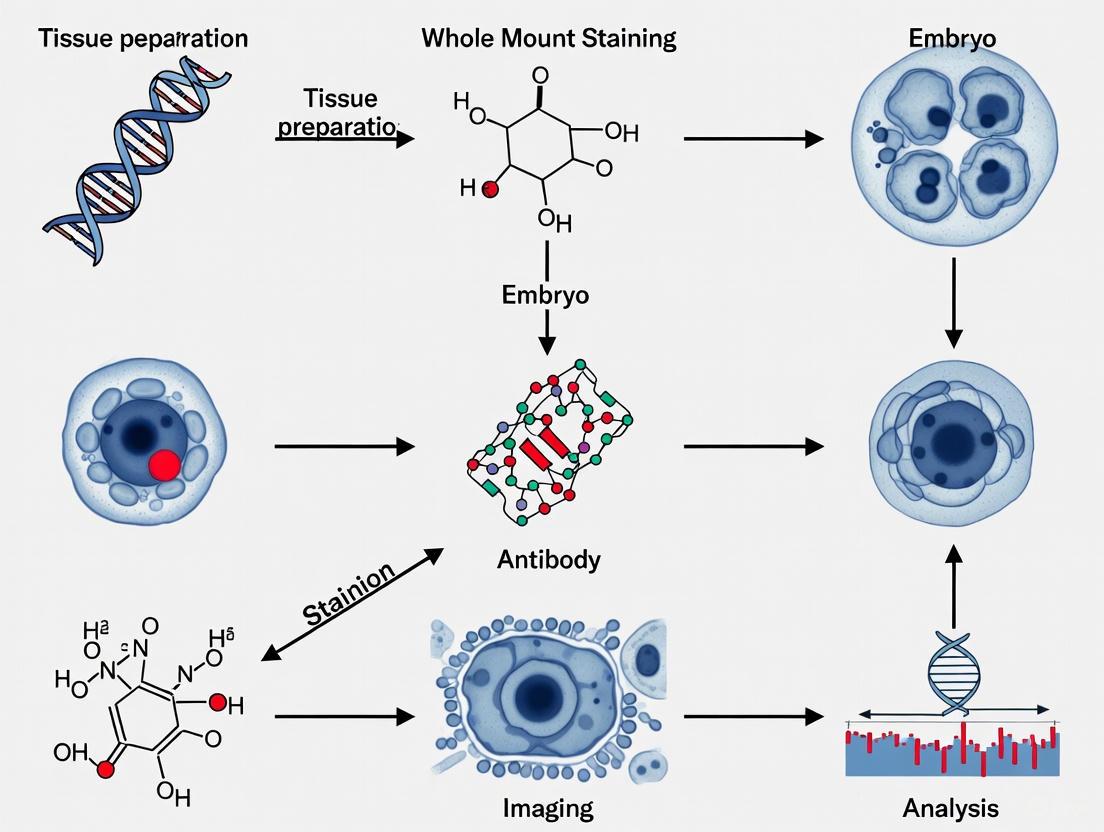
This article provides a comprehensive resource for researchers and drug development professionals on the application of whole mount staining in developmental biology.
Whole Mount Staining in Developmental Biology: A Comprehensive Guide to 3D Imaging Applications and Protocols
Abstract
This article provides a comprehensive resource for researchers and drug development professionals on the application of whole mount staining in developmental biology. It covers the foundational principles of this technique, which preserves the native 3D architecture of tissues and embryos for spatial analysis. The content details specific methodological protocols for diverse samples including zebrafish spinal cords, mouse ocular lenses, and organoids, alongside troubleshooting strategies for common challenges like poor antibody penetration and high background. Finally, it explores advanced validation methods and comparative analyses with section-based techniques, offering insights into how whole mount staining drives discovery in developmental mechanisms, disease modeling, and regenerative medicine.
Understanding Whole Mount Staining: Core Principles and When to Choose It for 3D Biological Context
Whole mount staining is a specialized technique in immunohistochemistry (IHC) used to visualize protein expression within intact, three-dimensional tissue specimens, such as entire embryos or organs, without the need for physical sectioning [1]. This method stands in contrast to traditional IHC performed on thin tissue sections, as it preserves the complete spatial architecture of the sample, providing a holistic view of biological structures and the relationships within them [1]. The technique is particularly invaluable in fields like developmental biology, embryology, and neurobiology, where understanding the context of tissue architecture is critical for studying processes such as organ formation, neural circuit mapping, and the effects of genetic manipulations [1].
The core principle of whole mount staining hinges on successful antigen-antibody binding within a thick, unsectioned tissue [1]. Achieving this requires carefully optimized protocols to overcome the primary challenge of the method: ensuring that all reagents, including fixatives, antibodies, and washing buffers, can fully penetrate the sample to reach its deepest layers. This necessitates extended incubation times and often more rigorous permeabilization steps compared to standard IHC [1]. When executed correctly, whole mount staining enables comprehensive 3D spatial analysis that is simply not possible with two-dimensional sections.
Core Principles and Strategic Applications
The decision to employ whole mount staining is driven by specific research questions where three-dimensional context is paramount. Its foundational principles and primary applications are summarized in the table below.
Table 1: Core Principles and Applications of Whole Mount Staining
| Aspect | Description |
|---|---|
| Defining Principle | Visualization of antigen distribution within an intact, unsectioned tissue specimen, preserving its native 3D architecture [1]. |
| Key Technical Challenge | Ensuring complete penetration of all reagents (fixatives, antibodies, wash buffers) throughout the often large and thick sample [1]. |
| Central Requirement | Extended incubation times for all steps (fixation, blocking, antibody incubation, washing) compared to section-based IHC [1]. |
| Primary Application in Developmental Biology | Mapping gene and protein expression patterns during embryonic development in model organisms like zebrafish, chick, and mouse [1]. |
| Application in Organogenesis Studies | Visualizing the morphogenesis of tubular organs, such as the Wolffian duct's development into the coiled epididymis [2]. |
| Application in Neurobiology | Tracing neural circuits and visualizing complex nerve arbor structures in their entirety, as demonstrated in taste bud innervation studies [3]. |
Experimental Workflow and Methodology
A generalized protocol for whole mount staining involves a sequence of critical steps, each requiring careful optimization for the specific tissue type and age. The workflow can be visualized as follows:
Whole Mount Staining Workflow
Detailed Protocol for a Wolffian Duct Culture and Staining
The following detailed methodology, adapted from a study on epididymal coiling, illustrates a specific application of the whole mount technique in developmental biology [2].
1. Tissue Isolation and Culture
- Time Mating & Dissection: Establish 15.5 days post coitum (dpc) pregnant mice. Sacrifice the dam and dissect the embryos to isolate the urogenital ridges containing the Wolffian ducts (WDs) in ice-cold Hank's Balanced Salt Solution (HBSS) [2].
- In Vitro Culture: Place the isolated WDs on a polycarbonate track etch membrane (rough side up) at an air-medium interface. Culture them in DMEM/F12 medium supplemented with 10% Fetal Bovine Serum (FBS), 1% penicillin/streptomycin, and 1% L-glutamine. Maintain the culture at 37°C with 5% CO₂ for up to 3 days, changing the medium daily. During this period, the straight WDs will undergo extensive coiling, mimicking in vivo development [2].
2. Fixation and Whole Mount Immunofluorescence
- Fixation: Harvest the cultured tissues and fix them in 4% Paraformaldehyde (PFA) overnight at 4°C or for 1 hour at room temperature [2].
- Dehydration & Rehydration: A critical step for antibody penetration. Dehydrate the fixed tissues in a graded ethanol series (25%, 50%, 75%, 100%), 10 minutes each at 4°C. Then, rehydrate them through a reverse ethanol series (100%, 75%, 50%, 25%). Tissues can be stored at 4°C in 75% ethanol at this stage [2].
- Washing & Blocking: Wash the rehydrated tissues 4 times for 20 minutes each with PBS containing 0.1% Triton X-100 (PBS-T) at room temperature with gentle rocking. Subsequently, block the tissues for 1 hour at room temperature in a blocking buffer (PBS + 1% BSA + 0.2% non-fat dry milk powder + 0.3% Triton X-100) to minimize non-specific antibody binding [2].
- Antibody Incubation: Incubate the tissues with primary antibody (e.g., anti-cytokeratin 8 for epithelial cells) diluted in blocking buffer overnight at 4°C with gentle rocking. The following day, wash the tissues thoroughly with PBS-T before incubating with fluorophore-conjugated secondary antibodies, again overnight at 4°C [2].
3. Imaging and Analysis
- Mounting & Imaging: After final washes, mount the stained whole tissues for imaging. Due to the thickness of the samples, confocal microscopy is essential for acquiring high-resolution z-stack images that can be used to reconstruct the 3D structure of the coiled duct [1] [2].
- Quantification: The resulting 3D image data allows for quantitative analysis of morphological parameters (e.g., degree of coiling, epithelial cell organization) and protein localization and expression levels in the context of the intact organ [2].
The Scientist's Toolkit: Essential Reagents and Materials
Successful whole mount staining relies on a suite of specialized reagents and materials. The table below details key components and their functions.
Table 2: Essential Research Reagent Solutions for Whole Mount Staining
| Reagent/Material | Function/Application | Specific Examples & Notes |
|---|---|---|
| Fixatives | Preserves tissue architecture and antigenicity by cross-linking or precipitating proteins [1]. | 4% Paraformaldehyde (PFA): Most common; may require overnight fixation [1] [4]. Methanol: Alternative if PFA causes epitope masking [1]. |
| Permeabilization Agents | Creates pores in cell membranes to allow antibody penetration into the tissue interior [2] [4]. | Triton X-100: A non-ionic detergent used at concentrations from 0.1% to 0.3% in buffers [2] [4]. |
| Blocking Buffers | Reduces non-specific binding of antibodies, thereby lowering background signal [2] [4]. | Typically contains a protein source (e.g., 1% BSA, serum) and detergent in PBS [2] [4]. |
| Validated Primary Antibodies | Binds specifically to the target antigen of interest. | Antibodies that work on frozen sections (IHC-Fr) are likely suitable for whole-mount staining [1]. |
| Fluorophore-Conjugated Secondaries | Amplifies signal by binding to the primary antibody; allows detection. | Enables fluorescent visualization. Multiple colors allow for labeling of different targets [2]. |
| Nuclear Counterstains | Labels all nuclei, providing a anatomical reference for the tissue. | Hoechst 33342 or DAPI: Blue-fluorescent stains that are fixable and can be used in whole mounts [4] [5]. |
| Membrane/Capsule Stains | Labels cell membranes or basement membranes for structural context. | Fluorescent-labeled Wheat Germ Agglutinin (WGA): Binds to glycoproteins on the cell surface and in the basement membrane [4]. |
| Mounting Media | Preserves the sample and provides the correct refractive index for microscopy. | Glycerol-based buffers or specialized clearing solutions like fructose-glycerol are used for mounting thick samples [1] [6]. |
Critical Considerations and Limitations
While powerful, whole mount staining presents unique challenges that must be factored into experimental design.
1. Sample Size and Permeability The most significant limitation is the restriction on sample size due to limited reagent penetration. As an embryo or tissue grows, it becomes too large for antibodies and other solutions to permeate effectively. The table below provides general guidelines for maximum recommended embryo ages, beyond which dissection may be necessary [1].
Table 3: Practical Limits for Whole Mount Staining of Embryos
| Model Organism | Recommended Maximum Age for Staining | Considerations for Older/Larger Samples |
|---|---|---|
| Chicken | Up to 6 days [1] | Dissection into segments may be required for effective staining and imaging [1]. |
| Mouse | Up to 12 days [1] | Removal of surrounding muscle and skin may be necessary [1]. |
| Zebrafish | (Implied to be early stages) | Requires dechorionation (removal of the egg membrane) to allow reagent penetration [1]. |
2. Antibody and Fixative Compatibility Antigen retrieval techniques commonly used on paraffin sections are generally not feasible for whole mounts, as the heat and harsh chemicals would destroy the fragile sample [1]. Therefore, if the chosen fixative (like PFA) masks the epitope recognized by an antibody, the experiment may fail. In such cases, testing alternative fixatives like methanol is the primary recourse [1].
3. Imaging and Data Analysis Visualizing the interior of a thick, opaque sample requires advanced imaging techniques like confocal microscopy, which can optically section the tissue [1] [4]. The resulting 3D datasets are large and complex, requiring sophisticated image analysis software (e.g., FIJI/ImageJ) for quantification and interpretation [4].
When to Choose Whole Mount Staining: A Decision Framework
The choice between whole mount and section-based staining is strategic. The following diagram outlines the key decision points for researchers.
Decision Framework for Staining Method
Whole mount staining is a powerful technique that provides an unparalleled view of biological form and function within its native three-dimensional context. Its application is fundamental to developmental biology, enabling researchers to visualize the dynamic processes of embryogenesis and organ formation in a way that section-based methods cannot. While the technique demands careful optimization of fixation, permeabilization, and staining protocols to overcome challenges related to reagent penetration, the reward is a comprehensive dataset that preserves the intricate spatial relationships within tissues. As advanced imaging and tissue clearing techniques continue to evolve, whole mount staining will remain a cornerstone methodology for understanding the complex architecture of life's developmental processes.
Whole mount staining represents a paradigm shift in histological analysis, enabling the comprehensive three-dimensional visualization of intact biological specimens. This technical guide details the core advantage of this methodology—the unparalleled preservation of native spatial relationships—within the context of developmental biology research. We provide a rigorous framework for researchers and drug development professionals to determine when whole mount approaches are warranted, supplemented by quantitative comparisons, detailed protocols, and analytical workflows for implementing these techniques in studies of embryogenesis, organogenesis, and tissue patterning.
Biological structures and developmental processes unfold in three dimensions, creating complex architectural relationships that are fundamental to their function. Traditional sectioning methods for histology inevitably disrupt these spatial contexts, compromising the ability to analyze tissue organization, cell-cell interactions, and long-range signaling networks. Whole mount staining addresses this fundamental limitation by enabling the processing, staining, and imaging of intact tissue specimens, thereby preserving their complete three-dimensional architecture [1] [3].
This preservation is particularly crucial in developmental biology, where understanding the physical relationships between cells and tissues is essential for elucidating mechanisms of morphogenesis, patterning, and organ formation. The ability to analyze structures in their entirety reduces sampling bias and technical variability, allowing for absolute measurements of volumes, cell counts, and structural morphologies [3]. This guide establishes the theoretical and practical framework for deploying whole mount techniques within a research strategy, providing the necessary tools to determine when the 3D context is indispensable.
Quantitative Advantages: 2D Sectioning vs. 3D Whole Mount Analysis
The decision to employ whole mount methodologies should be guided by a clear understanding of their analytical superiority for specific research questions. The table below summarizes key quantitative and qualitative advantages of whole mount staining over traditional sectioning for developmental studies.
Table 1: Comparative Analysis of 2D Sectioning vs. 3D Whole Mount Approaches
| Analytical Parameter | 2D Sectioning Limitations | 3D Whole Mount Advantages | Impact on Developmental Biology Research |
|---|---|---|---|
| Spatial Relationships | Disrupted; relationships split across sections and must be inferred [3]. | Preserved in their native state; allows direct visualization of cell-cell and tissue-tissue interactions [7]. | Enables accurate mapping of neural circuits, signaling centers, and tissue boundaries during embryogenesis. |
| Absolute Cell Counts | Approximated from representative sections or summed across serial sections, introducing bias and variability [3]. | Enables direct counting of entire cell populations within a structure (e.g., a whole taste bud) [3]. | Provides definitive data on cell number changes in knockout models or during normal development. |
| Tissue/Organ Volume | Calculated from sectional profiles, often assuming idealized geometry [3]. | Can be directly measured and reconstructed from 3D image data [3]. | Allows precise tracking of organ growth and morphological changes over developmental time. |
| Structure Morphology | Incompletely captured; arborization patterns (e.g., neurons) are split and poorly labeled [3]. | Complete morphology of intricate structures (e.g., nerve arbors, vascular networks) can be captured and analyzed [3] [8]. | Essential for studying the development of complex structures like the nervous and vascular systems. |
| Sampling Bias | Inherent bias toward analyzing smaller structures that fit completely within a section [3]. | Reduces bias by allowing analysis of entire structures regardless of their size relative to section thickness. | Improves the reliability and reproducibility of phenotypic analyses in developmental mutants. |
Foundational Methodologies: Protocols for Whole Mount Staining
Successful implementation of whole mount staining requires careful optimization of standard immunohistochemical protocols to account for increased tissue thickness. The following core methodologies provide a reliable starting point for various sample types.
Standard Whole Mount Immunofluorescence Protocol
This protocol, adaptable for embryos and organoids, emphasizes extended incubation times to ensure adequate antibody penetration [1].
Fixation and Permeabilization:
- Fixative: Immerse tissue in freshly prepared 4% Paraformaldehyde (PFA) in PBS. Incubation time must be optimized for sample size (e.g., 30 minutes for small embryos, 1 hour or overnight for larger tissues) [4] [1].
- Critical Consideration: PFA cross-linking can mask some epitopes. If staining fails, methanol fixation is a recommended alternative, as it does not cause cross-linking [1].
- Permeabilization/Blocking: Incubate fixed samples in a blocking buffer containing 0.3% Triton X-100 and a protein source (e.g., 3% goat serum, 0.3% BSA) for several hours or overnight. This step is crucial for antibody access and reducing non-specific background [4].
Antibody Incubation and Washing:
- Primary Antibody: Incubate with the primary antibody diluted in permeabilization/blocking buffer for 24-72 hours at 4°C with gentle agitation. Time is determined by sample size and density.
- Washing: Perform prolonged washes (e.g., 3-5 times for 1-2 hours each) with PBS containing a mild detergent (e.g., 0.1% Triton X-100) to remove unbound antibody thoroughly [1].
- Secondary Antibody: Incubate with fluorescent-conjugated secondary antibodies, also for 24-72 hours at 4°C, protected from light.
- Nuclear Counterstain: Include dyes like Hoechst 33342 or DAPI in one of the final washes to label all nuclei [4] [9].
Clearing and Mounting (Optional but Recommended):
- To improve optical clarity for deep imaging, clear samples by mounting them in a refractive-index matching medium. A solution of 80% Glycerol in PBS is effective and straightforward. For superior clearing, consider advanced agents like fructose-glycerol solutions or CUBIC reagents [9] [10] [6].
The following workflow diagram summarizes the key decision points and steps in a standard whole mount staining protocol.
Specialized Protocol: Whole Mount Staining of ECM-Embedded Organoids
The requirement for extracellular matrix (ECM) gels in 3D organoid culture poses a significant challenge, as the gel can limit antibody penetration and increase background. The protocol below outlines a method for staining ECM gel-embedded pancreatic organoids without disrupting their structure [6].
- Fixation: Fix the entire ECM gel block containing the organoids with 4% PFA for 30-60 minutes at room temperature.
- Quenching: Wash and then incubate the block with PBS-glycine buffer to quench autofluorescence from free aldehydes.
- Blocking and Permeabilization: Block and permeabilize the gel block for 4-6 hours at room temperature using a buffer containing 0.5–1.0% Triton X-100 and 5–10% serum.
- Antibody Incubation: Incubate the block with primary antibody for 48-72 hours at 4°C with gentle agitation, followed by extensive washing over 24 hours. Repeat with secondary antibodies for another 48-72 hours.
- Clearing and Mounting: Mount the stained gel block using a specialized fructose-glycerol clearing solution to render the ECM transparent for imaging [6].
The Scientist's Toolkit: Essential Reagents and Materials
The following table catalogs key reagents and their critical functions for successful whole mount staining, as derived from the cited protocols.
Table 2: Essential Research Reagent Solutions for Whole Mount Staining
| Reagent / Material | Function / Purpose | Example from Protocol & Key Consideration |
|---|---|---|
| Paraformaldehyde (PFA) | Cross-linking fixative that preserves tissue architecture and antigenicity. | 4% PFA in PBS is the standard fixative [4] [1]. Over-fixation can mask epitopes; time must be optimized. |
| Methanol | Precipitating fixative; an alternative when PFA cross-linking harms the target epitope. | Used if PFA fixation fails [1]. Does not cause protein cross-linking, offering different antigen accessibility. |
| Triton X-100 | Non-ionic detergent that permeabilizes cell membranes and ECM. | Used at 0.3%-1.0% in blocking/wash buffers [4] [6]. Critical for antibody penetration into thick samples. |
| Serum Albumin (BSA) | Blocking agent that reduces non-specific antibody binding. | Used at 0.3% in combination with serum for effective blocking [4]. |
| Goat / Donkey Serum | Provides proteins to block non-specific sites and minimize background. | Typically used at 3-10% in blocking buffer [4] [6]. Should match the host species of the secondary antibody. |
| Hoechst 33342 / DAPI | Fluorescent nuclear counterstains that bind DNA. | Used at 1:500 dilution to visualize all cell nuclei in the 3D volume [4] [9]. |
| Rhodamine-Phalloidin | Fluorophore-conjugated probe that specifically labels F-actin. | Used to visualize the cellular cytoskeleton [4]. |
| Wheat Germ Agglutinin (WGA) | Fluorophore-conjugated lectin that labels basement membranes and glycoproteins. | Used to stain the lens capsule, a specialized basement membrane [4]. |
| Glycerol-based Mounting Media | Aqueous mounting medium that provides initial tissue clearing. | 80% Glycerol provides a 3-fold reduction in intensity decay at 100µm depth compared to PBS [9]. |
| Fructose-Glycerol Solution | Specialized clearing solution for refractive index matching. | Used for mounting ECM gel-embedded organoids to achieve transparency [6]. |
Advanced Imaging and Analysis: From Data to Insight
Acquiring 3D image data is only the first step. Robust analysis pipelines are required to extract meaningful biological insights from whole mount samples.
Imaging Modalities for Cleared Tissues
Choosing the right microscope is critical and depends on sample size and resolution requirements.
- Confocal Microscopy: Ideal for high-resolution imaging of smaller samples (up to a few hundred microns). It uses a pinhole to reject out-of-focus light, providing clear optical sections [4] [10].
- Multiphoton Microscopy: Superior for imaging larger, denser organoids (200–500 µm) due to its ability to penetrate deeper into tissue with less scattering and photodamage. It is a powerful alternative when light-sheet or confocal microscopy is limited by sample opacity [9].
- Light-Sheet Microscopy: The gold standard for rapid imaging of very large, cleared samples (cm-scale), such as entire embryos or organs. It provides high speed and minimal photobleaching but requires high transparency [10].
Quantitative Spatial Analysis Framework
To move beyond qualitative observation, advanced computational frameworks are used to quantify spatial relationships. The "colocatome" analysis is one such framework that catalogs significant colocalizations between pairs of cell subpopulations [11].
- Multiplexed Imaging: Tissues are stained with a panel of markers (e.g., 15-plex immunofluorescence) to identify multiple cell types and states.
- Cell Segmentation and Phenotyping: Automated algorithms (e.g., CELESTA, Tapenade) identify and classify every cell in the 3D volume based on its marker expression profile [9] [11].
- Spatial Metric Calculation: The Colocation Quotient (CLQ) is calculated for each pair of cell subpopulations to identify which pairs are in close proximity (positive colocalization) versus those that are distant (negative colocalization) [11].
- Spatial Randomization: The significance of each colocalization is assessed by comparing the real CLQ to a null distribution generated by randomly permuting cell type labels across the tissue.
- Cross-Sample Comparison: Normalization of CLQs enables direct comparison of spatial features across different samples, conditions, or even between in vitro models and human pathological specimens [11].
The following diagram illustrates this integrated pipeline for 3D image acquisition and analysis.
Whole mount staining is not merely a technical workaround but a fundamental methodology for developmental biology and related fields where 3D spatial context is non-negotiable. Its primary advantage—the complete preservation of tissue architecture for analyzing spatial relationships—provides a level of biological insight that is simply unattainable with sectional approaches. As tissue clearing, deep imaging, and sophisticated computational analysis continue to advance, the application of whole mount techniques will undoubtedly expand, offering an increasingly powerful lens through which to view and understand the intricate process of development. Researchers should integrate these protocols and analytical frameworks into their projects when the research question hinges on a comprehensive understanding of structure, arrangement, and spatial interaction at a tissue-wide scale.
Whole mount staining is an indispensable technique in developmental biology that allows for the three-dimensional (3D) visualization of biological structures within intact tissues and organs. Unlike traditional sectioning methods that disrupt spatial context, whole mount staining preserves the intricate architecture and interconnections of biological systems, providing unparalleled insights into developmental processes. This approach is particularly valuable for studying complex 3D structures such as vascular networks, neural circuits, and developing organs, where maintaining structural integrity is essential for accurate phenotypic analysis. The technique encompasses various staining methodologies, including immunohistochemistry, fluorescent labeling, and classical dye-based staining, each offering unique advantages for specific research applications in developmental biology and drug discovery.
The fundamental principle underlying whole mount staining involves the permeabilization of intact tissues to allow staining reagents to penetrate throughout the entire specimen, followed by visualization using appropriate imaging technologies. This methodology enables researchers to analyze spatial relationships, cellular interactions, and structural patterns within the context of the complete tissue architecture. For developmental biologists, this means being able to trace the formation of complex structures from embryonic stages through maturation, observe cell migration patterns, and identify critical signaling centers that orchestrate organogenesis. The ability to study these processes in three dimensions has revolutionized our understanding of developmental mechanisms and their disruptions in disease states.
Technical Foundations of Whole Mount Staining
Core Principles and Methodological Considerations
Successful whole mount staining relies on several critical technical considerations that ensure optimal staining quality and tissue preservation. The process typically begins with careful tissue fixation using reagents such as 4% paraformaldehyde (PFA), which stabilizes protein structures while maintaining antigenicity for immunological detection [12] [2]. Fixation time must be carefully optimized based on tissue size and density to ensure complete penetration without over-fixation, which can mask epitopes and reduce staining intensity. Following fixation, permeabilization is achieved using detergents like Triton X-100 or saponin, which create pores in cellular membranes to allow antibody penetration while preserving structural integrity.
The choice of staining reagents depends on the research objectives and target structures. For immunohistochemical approaches, primary antibodies must be carefully selected for their specificity and compatibility with whole mount applications, considering factors such as molecular size that affects tissue penetration [13]. Similarly, classical dyes like Alcian blue and Alizarin red for skeletal staining require specific solvent conditions and staining durations to achieve optimal specificity [14]. The development of tissue clearing techniques has significantly enhanced whole mount staining by reducing light scattering in thick tissues, thereby improving optical penetration and imaging quality for large specimens [15]. These include hydrophobic methods (e.g., 3DISCO, iDISCO), hydrophilic methods, and hydrogel-based approaches, each with particular advantages for different tissue types and imaging requirements.
Imaging and Visualization Technologies
The full potential of whole mount staining is realized through advanced imaging technologies capable of resolving 3D structures in optically cleared or thick tissues. Confocal microscopy provides optical sectioning capabilities with resolution sufficient to visualize cellular details, typically achieving lateral resolution of approximately 0.32μm with axial resolution around 5.8μm under optimal conditions [13]. For larger specimens, light-sheet fluorescence microscopy (LSFM) offers rapid imaging of entire organs with minimal photodamage, making it particularly suitable for time-lapse studies of developing systems. More recently, whole-brain optical tomography systems have been developed that combine automated sectioning with wide-field imaging, enabling high-throughput acquisition of entire brain datasets with single-cell resolution [13].
The imaging approach must be matched to the research question, considering the resolution requirements, sample size, and need for quantitative analysis. For tracing fine neuronal processes or capillary networks, higher resolution (0.3-0.5μm voxels) is necessary, while for cell body distribution or larger vascular patterns, more modest resolution (2-3μm voxels) may suffice [15]. The enormous data sets generated by these approaches—ranging from gigabytes for regional analyses to terabytes for whole-brain imaging—require sophisticated computational infrastructure for storage, processing, and analysis [15].
Table 1: Imaging Modalities for Whole Mount Staining Applications
| Imaging Modality | Resolution Range | Optimal Tissue Depth | Key Applications | Data Volume (Mouse Brain) |
|---|---|---|---|---|
| Confocal Microscopy | 0.2-0.5μm lateral | <200μm | Cellular details, organoids | 10-100 GB |
| Two-Photon Microscopy | 0.5-1.0μm lateral | <1mm | Deep tissue, live imaging | 50-500 GB |
| Light-Sheet Microscopy | 1-5μm lateral | Whole organs | Rapid screening, development | 100GB-1TB |
| Whole-Brain Tomography | 0.32μm lateral | Entire brain | Neural circuits, vasculature | 1-10 TB |
Whole Mount Staining of Vascular Networks
Technical Protocols for Vascular Visualization
The visualization of intact microvascular networks using whole mount staining requires specialized approaches to ensure complete labeling of the complex 3D structure. A highly effective method involves intravascular perfusion of fluorescently labeled lectins, which bind specifically to glycoproteins on endothelial cells, followed by whole mount preparation and imaging [16]. The protocol begins with the intravascular injection of wheat germ agglutinin (WGA) conjugated to fluorophores such as Alexa Fluor 488, which has demonstrated superior capability for labeling the entire vascular network including capillaries, arterioles, and venules. For discrimination between arterial and venous sides of the circulation, isolectin GS-IB4 (ISO) can be co-administered, as it specifically labels arteriolar vasculature and early capillary segments but not the venular network [16].
Following perfusion staining, target muscles (soleus, extensor digitorum longus, diaphragm, gluteus maximus, or cremaster) are excised and pinned at optimal sarcomere length to maintain physiological architecture during fixation. Tissues are then fixed with 4% PFA for 1-2 hours at room temperature, followed by washing with phosphate-buffered saline (PBS) with 0.1% Triton X-100 (PBS-T) to remove excess fixative. For thicker muscles, optional tissue clearing using hydrophobic methods (e.g., 3DISCO) can be employed to enhance optical penetration. Samples are then mounted for fluorescence microscopy using specialized chambers that maintain the 3D structure during imaging.
An alternative approach for vascular visualization involves perfusion with FITC-labeled gel, which fills the vascular lumen and provides contrast for microcomputed tomography (μCT) imaging. However, this method may not consistently label all small vessels and is less suitable for capillary-level analysis [16]. For imaging, samples are typically viewed using confocal or light-sheet microscopy with z-stack acquisition to capture the entire 3D network, followed by computational reconstruction and analysis of vascular parameters including density, diameter, and branching patterns.
Research Applications and Quantitative Analysis
Whole mount staining of vascular networks enables sophisticated quantitative analysis of microvascular architecture under various physiological and pathological conditions. This approach has been instrumental in studying angiogenesis during development, tumor vascularization, and vascular remodeling in response to exercise or disease. Key parameters that can be quantified include vessel density (total vessel length per unit volume), branching frequency, vessel diameter distribution, and perfusion capacity [17] [16].
For the intestinal muscle layer, a detailed protocol enables 3D visualization of the vasculature within whole-mount preparations, allowing quantification of vascular area and vessel diameter [17]. This methodology has revealed important insights into organ-specific vascular patterning and has been applied to study neuro-vascular and immune-vascular interactions in gut physiology and disease. Similar approaches have been used to investigate the skeletal muscle microvasculature, where WGA-based perfusion staining has demonstrated consistent labeling patterns across different muscle fiber types, enabling comparative studies of vascular density and architecture in relation to metabolic demand [16].
Table 2: Vascular Labeling Reagents for Whole Mount Staining
| Labeling Reagent | Target Structures | Binding Specificity | Signal Intensity | Compatibility with Clearing |
|---|---|---|---|---|
| WGA (Wheat Germ Agglutinin) | Entire vascular network | Endothelial glycoproteins | High (capillaries bright) | Excellent |
| ISO (Isolectin GS-IB4) | Arterioles, early capillaries | α-D-galactose residues | Moderate | Good |
| LYCO (Lycopersicon Esculentum) | Entire vascular network | Poly-N-acetyllactosamine | Moderate | Good |
| FITC-labeled gel | Microvascular lumen | Physical filling | Variable | Limited |
Whole Mount Approaches for Neural Circuit Mapping
Advanced Methodologies for Brain-Wide Circuit Analysis
Whole mount staining of neural circuits presents unique challenges due to the enormous complexity and density of the brain, requiring specialized approaches for comprehensive circuit mapping. Two primary technical routes have emerged for whole-brain optical imaging: tissue clearing-based techniques and histological sectioning-based techniques [15]. Tissue clearing methods render the brain transparent through refractive index matching using hydrophobic, hydrophilic, or hydrogel-based approaches, enabling light-sheet microscopy of intact specimens. Representative methods include uDISCO, FDISCO, and vDISCO, which vary in their fluorescence preservation capabilities and compatibility with different antibody types [15].
As an alternative, the rapid whole-brain optical tomography method combines automated imaging and sectioning to acquire high-resolution datasets of the entire brain while collecting all physical slices for subsequent molecular analysis [13]. This system employs structured illumination microscopy (SIM) to provide optical-sectioning imaging of agarose-embedded samples, with lateral resolution of 0.32×0.32μm and axial resolution of 5.8μm, sufficient to resolve dendritic spines and fine axonal processes. Following imaging of each section, a high-precision vibratome sections the imaged tissue, with slices automatically collected via a water-flow device into multi-well plates for post-hoc immunostaining. This approach enables correlation of circuit-level anatomy with molecular phenotypes in the same brain, providing unprecedented insights into the relationship between neural connectivity and gene expression.
For whole-mount immunostaining of neural circuits, careful consideration must be given to antibody penetration in thick tissues. Pre-treatment with permeabilization reagents such as Triton X-100 (0.5-1%) for extended periods (days to weeks) is often necessary, with the addition of dimethyl sulfoxide (DMSO) sometimes employed to enhance antibody penetration. The development of nanobodies and other small recognition molecules has significantly improved penetration uniformity in whole-mount brain staining, enabling more consistent labeling throughout thick specimens [15].
Molecular Phenotyping of Neural Circuits
A significant advantage of whole mount approaches for neural circuit analysis is the ability to integrate connectivity mapping with molecular phenotyping, identifying the neurotransmitter systems, receptors, and signaling molecules associated with specific neural pathways. This is particularly valuable for understanding the functional organization of neural circuits and their alterations in disease states. The platform described by [13] enables efficient identification of molecular phenotypes of brain-wide neural circuits through post-hoc immunostaining of selected slices following whole-brain imaging, significantly enhancing the efficiency of molecular phenotyping compared to traditional methods.
This integrated approach has been applied to map brain-wide distribution of inputs to motor, sensory, and visual cortices and determine their molecular phenotypes in several subcortical regions [13]. By combining anterograde or retrograde tracing with immunohistochemistry for specific molecular markers, researchers can determine the neurochemical identity of neurons within particular circuits, revealing principles of functional organization that would be inaccessible through anatomical methods alone. The ability to automate much of this process makes large-scale studies of circuit molecular architecture feasible, potentially enabling systematic cataloging of neural cell types and their connectivity patterns throughout the brain.
Table 3: Technical Specifications for Whole-Brain Neural Circuit Imaging
| Parameter | Tissue Clearing Methods | Sectioning-Based Tomography |
|---|---|---|
| Resolution | 1-5μm (light-sheet) | 0.32μm lateral, 5.8μm axial |
| Tissue Integrity | Fully intact | Physically sectioned but collected |
| Molecular Phenotyping | Limited antibody penetration | Excellent for post-hoc staining |
| Processing Time | Days to weeks | ~72 hours for full mouse brain |
| Data Volume | 1-10 TB (mouse brain) | 1.6-8.9 TB (mouse brain) |
| Key Applications | Circuit mapping, cell distribution | Detailed morphology, molecular correlates |
Whole Mount Staining in Organogenesis Studies
3D Visualization of Developing Organs
Whole mount staining provides unparalleled insights into organogenesis by preserving the 3D architecture of developing organs, enabling researchers to observe morphological changes, cell differentiation patterns, and signaling activity within their native spatial context. A representative protocol for studying tubulogenesis involves the isolation and culture of embryonic organs such as the Wolffian duct (WD), followed by whole mount immunofluorescence to visualize key developmental processes [2]. The Wolffian duct, which develops into the highly coiled epididymis, serves as an excellent model for understanding tubular organ development.
The protocol begins with isolation of mouse embryonic gonadal ridges from 15.5 days post coitum (dpc) pregnant females, followed by culture on polycarbonate track etch membranes at the air-medium interface using DMEM/F12 medium supplemented with 10% fetal bovine serum [2]. This culture system supports normal development and coiling of the WD over 3 days, mimicking in vivo morphogenesis. Following culture, tissues are fixed with 4% PFA overnight at 4°C or for 1 hour at room temperature, then processed for whole mount immunofluorescence. The staining protocol includes dehydration in a graded ethanol series (25%, 50%, 75%, 100%), rehydration, blocking with PBS containing 1% BSA, 0.2% non-fat dry milk powder and 0.3% Triton X-100, followed by incubation with primary antibodies overnight at 4°C [2].
Key markers for organogenesis studies include cytokeratin 8 (CK8) for epithelial structures, phospho-Histone H3 (PH3) for cell proliferation, and active β-catenin for Wnt signaling activity. After primary antibody incubation, samples are washed extensively with PBS-T and incubated with fluorophore-conjugated secondary antibodies overnight at 4°C, followed by additional washing and mounting for confocal microscopy. This approach has revealed crucial insights into balanced Wnt signaling requirements for WD coiling during prenatal development and can be applied to study various signaling pathways in organogenesis by adding chemical activators or inhibitors to the culture medium.
Signaling Pathway Analysis in 3D Context
The application of whole mount staining to organogenesis enables researchers to correlate signaling pathway activity with morphological changes in developing organs, providing mechanistic insights into how molecular cues direct structural formation. For example, the addition of Wnt inhibitor IWR1 to cultured WDs results in inhibition of coiling, demonstrating the requirement for Wnt signaling in this process [2]. Similarly, whole mount staining for active β-catenin reveals the spatial distribution of Wnt signaling activity during WD development, identifying signaling centers that may guide morphological patterning.
This integrated approach—combining organ culture with whole mount staining—provides a powerful platform for investigating the roles of specific signaling pathways in organogenesis without the need for genetically modified animal models for every experimental manipulation. Researchers can test the effects of multiple pathway modulators in controlled culture conditions and assess outcomes using quantitative morphological analysis combined with molecular mapping through immunofluorescence. This methodology is particularly valuable for rapid screening of potential teratogens or therapeutic agents that might affect organ development, with applications in drug safety testing and developmental toxicity assessment.
The ability to visualize entire developing organs in 3D also facilitates the study of mechanical forces and their role in morphogenesis. By combining whole mount staining with computational modeling, researchers can analyze how cellular behaviors such as proliferation, differentiation, and migration generate the mechanical forces that shape developing organs, bridging the gap between molecular genetics and biomechanics in developmental biology.
Comparative Analysis and Technical Implementation
Strategic Selection of Whole Mount Staining Approaches
The optimal whole mount staining approach depends on multiple factors including tissue size, research questions, available resources, and required resolution. For vascular network analysis, perfusion-based methods with small molecular probes like WGA provide rapid, comprehensive labeling of the entire microvasculature, but may be less suitable for molecular phenotyping of different vascular cell types. In contrast, immunohistochemical approaches allow specific cell type identification but face penetration challenges in thicker tissues. Neural circuit mapping requires the highest data resolution and volume, with tissue clearing methods best suited for comprehensive circuit tracing, while section-based tomography enables superior molecular phenotyping through post-hoc staining.
For organogenesis studies, the maintenance of 3D architecture is paramount, making whole mount approaches essential despite potential limitations in antibody penetration. The combination of organ culture with whole mount staining represents a particularly powerful approach for experimental manipulation of developmental processes, allowing direct observation of how signaling perturbations affect morphogenesis. Researchers must carefully balance the need for structural preservation against the requirements for molecular characterization when selecting their methodological approach.
Table 4: Comparative Analysis of Whole Mount Staining Applications
| Application | Optimal Staining Method | Recommended Imaging | Key Technical Challenges | Data Output |
|---|---|---|---|---|
| Vascular Networks | Perfusion labeling (WGA) | Confocal, light-sheet | Complete network labeling | Vessel density, diameter |
| Neural Circuits | Tissue clearing, sectioning tomography | Light-sheet, SIM | Data volume, penetration | Connection matrices, morphology |
| Organogenesis | Whole mount immunofluorescence | Confocal | Antibody penetration in thick tissue | 3D morphology, signaling patterns |
The Scientist's Toolkit: Essential Research Reagents
Successful implementation of whole mount staining methodologies requires careful selection of reagents and materials optimized for 3D tissue processing. The following table summarizes key reagents and their applications across the different use cases discussed in this review.
Table 5: Research Reagent Solutions for Whole Mount Staining
| Reagent/Material | Function | Application Examples | Technical Considerations |
|---|---|---|---|
| 4% Paraformaldehyde | Tissue fixation | All applications | Fixation time critical for penetration/antigenicity |
| Triton X-100 | Permeabilization | All applications | Concentration (0.1-1%) affects penetration vs. preservation |
| WGA Lectin | Vascular labeling | Vascular networks | Perfusion required; labels entire network |
| ISO Lectin | Arteriolar labeling | Vascular networks | Specific to arterioles and early capillaries |
| Primary Antibodies | Target protein detection | All applications | Size affects penetration; nanobodies preferred for thick tissue |
| Alcian Blue | Cartilage staining | Skeletal development | Requires acidic conditions; specific for glycosaminoglycans |
| Alizarin Red | Bone staining | Skeletal development | Requires alkaline conditions; calcium binding |
| Dimethyl Sulfoxide | Penetration enhancement | Neural circuits, thick tissues | Improves antibody penetration but may damage tissue |
| Refractive Index Matching Solutions | Tissue clearing | Neural circuits, large organs | Choice depends on fluorescence preservation needs |
Whole mount staining represents a powerful methodology for 3D visualization of biological structures in developmental biology, with particular strength for studying vascular networks, neural circuits, and organogenesis. The technical approaches reviewed here—ranging from perfusion labeling for vasculature to tissue clearing for neural circuits and organ culture for developing systems—provide researchers with diverse tools to address specific research questions while preserving critical spatial information. As these methodologies continue to evolve, particularly through improvements in tissue clearing, imaging technologies, and computational analysis, whole mount staining will undoubtedly remain a cornerstone technique for understanding the complex three-dimensional architecture of biological systems and its development over time. The integration of these approaches with molecular phenotyping methods further enhances their utility, enabling correlation of structure with function at multiple biological scales.
Whole mount staining is a powerful technique in developmental biology that enables the visualization of biological structures, gene expression patterns, and protein localization within intact, three-dimensional specimens. Unlike traditional sectioning methods that disrupt spatial context, whole mount staining preserves the intricate architecture of embryos, organs, and engineered tissue models, providing a comprehensive view of developmental processes. This approach has become increasingly valuable for creating detailed 3D atlases of development and for screening complex phenotypes in disease models. The decision to employ whole mount staining, however, hinges on critical considerations regarding sample type and size, which directly impact protocol success, imaging quality, and analytical outcomes. This technical guide examines these considerations within the broader thesis of determining when whole mount staining is the optimal choice for developmental biology research, providing researchers with a framework for experimental planning and execution.
Sample Type and Size Specifications
The table below summarizes key sample types used in whole mount studies, along with their size ranges and primary applications in developmental biology research.
Table 1: Sample Types and Size Ranges for Whole Mount Staining
| Sample Type | Typical Size Range | Key Applications | Technical Considerations |
|---|---|---|---|
| Early-Stage Embryos (e.g., mouse, chick, fish) | ~100 µm to 1-2 mm [10] | Fate mapping, pattern formation, early organogenesis | Often naturally transparent; may require minimal clearing. |
| Gastruloids | 100 µm to 500 µm [9] | Studying self-organization, symmetry breaking, and gene patterning in a 3D model. | Highly dense and light-diffusive; require aggressive clearing and multiphoton microscopy. |
| Tumor Spheroids | ~200-500 µm (as cited in models) [18] | Drug efficacy testing, analysis of tumor-stroma interactions. | Co-culture spheroids require cell-type-specific segmentation for analysis. |
| Cleared Adult Tissues (e.g., organs from mice) | Several millimeters to centimeters [10] | Mapping neural/vascular networks, inter-organ connections, and gene expression in adults. | Require prolonged clearing and staining; best imaged with light-sheet microscopy. |
Experimental Workflow for Whole Mount Analysis
The process of whole mount analysis involves a multi-step pipeline, from sample preparation to quantitative data extraction. The following diagram outlines the core workflow, highlighting the critical decision points at each stage.
Workflow Module Details
Sample Preparation: The process begins with fixation, typically using paraformaldehyde (PFA), to preserve molecular content and tissue structure. Under-fixation can lead to content loss, while over-fixation reduces transparency, fluorescence, and immunoreactivity [10]. This is followed by whole mount immunostaining or enzymatic staining (e.g., X-gal for LacZ activity) to label structures of interest [19].
Optical Clearing: This critical step homogenizes the refractive index throughout the sample to reduce light scattering and achieve transparency. The choice of clearing method is a major decision point and is influenced by sample size, the need to preserve fluorescence, and the intended imaging modality [10].
- Aqueous Methods (e.g., CUBIC): Use hyperosmotic solutions to remove lipids and raise the refractive index. They are good for preserving fluorescence and are often combined with immunostaining [10] [19].
- Organic Solvent Methods (e.g., 3DISCO): Involve dehydration and incubation in high-refractive-index solvents. They achieve very high transparency but can quench some fluorescent proteins [10].
- Simple Mounting Media (e.g., 80% Glycerol): A straightforward option for smaller or less dense samples like gastruloids, providing a good balance of clearing and compatibility with fluorescence [9].
3D Imaging: The selection of an imaging microscope depends on the sample size and required resolution.
- Multiphoton Microscopy: Excels at imaging dense, large samples (100-500 µm) due to its superior tissue penetration and minimal photodamage [9].
- Light-Sheet Microscopy: Ideal for rapid imaging of very large, cleared samples (several mm to cm), such as entire embryos or organs [10].
- Confocal Microscopy: Best suited for high-resolution imaging of smaller, well-cleared samples. It can struggle with light penetration and scattering in larger, denser tissues [9].
Computational Processing & Analysis: This final stage involves processing the large 3D image datasets to extract quantitative information. Key steps include image registration, 3D segmentation of individual cells (nuclei), and quantification of signals (e.g., gene expression) [18] [9]. Advanced pipelines now incorporate machine learning, such as convolutional neural networks (CNNs), to automate the analysis of cell-type-specific processes like proliferation, apoptosis, and drug susceptibility on a single-cell level [18].
Research Reagent Solutions
The following table details essential reagents and materials used in whole mount staining and clearing protocols, with their specific functions.
Table 2: Key Reagents for Whole Mount Staining and Tissue Clearing
| Reagent / Material | Function | Example Use Case |
|---|---|---|
| Paraformaldehyde (PFA) | Crosslinking fixative that preserves tissue architecture and antigenicity. | Standard primary fixation for embryos and spheroids [18] [19]. |
| Triton X-100 / NP-40 | Non-ionic detergents that permeabilize cell membranes to allow antibody penetration. | Used in penetration buffers for immunostaining [18] [19]. |
| Primary & Secondary Antibodies | Enable specific detection of proteins (antigens) of interest via immunofluorescence. | Whole mount immunostaining of 3D spheroids and gastruloids [18] [9]. |
| X-gal (5-Bromo-4-chloro-3-indolyl-β-D-galactopyranoside) | Chromogenic substrate for β-galactosidase (LacZ). Produces a blue precipitate upon enzymatic cleavage. | Visualizing spatial and temporal gene expression in LacZ knock-in mouse embryos [19]. |
| CUBIC Reagent | An aqueous-based clearing cocktail containing urea and surfactants that delipidates and homogenizes refractive index. | Clearing of whole mouse embryos and organs for deep imaging [19]. |
| N,N,N',N'-Tetrakis(2-hydroxypropyl)ethylenediamine | A key component of CUBIC-1 that acts as a hydrophilic reagent to promote clearing. | Clearing of whole mouse embryos and organs [19]. |
| Glycerol | A mounting medium with a refractive index higher than water, used for simple optical clearing. | Clearing of gastruloids for two-photon microscopy [9]. |
| Potassium Ferrocyanide/Ferricyanide | Redox agents used in X-gal staining solutions to enhance the colorimetric reaction and prevent diffusion of reaction intermediates. | Essential components of the X-gal staining solution for LacZ detection [19]. |
Discussion and Best Practices
When to Use Whole Mount Staining
Whole mount staining is the preferred method when the research question demands an understanding of spatial relationships in three dimensions. This is critical for studying processes like embryogenesis, organ formation, and the complex cellular interactions within tumor spheroids. The technique is indispensable for creating comprehensive 3D maps of gene expression or neural connectivity, where sectioning would destroy the very context being studied. However, for very large or dense adult tissues where antibody penetration is a limiting factor, or when ultra-high-resolution analysis of a specific, small region is needed, traditional sectioning may still be more practical.
Optimizing for Sample Size and Type
Successful implementation requires matching the protocol to the sample. For large, dense samples like late-stage embryos or organoids, robust clearing methods like CUBIC and powerful imaging techniques like multiphoton or light-sheet microscopy are necessary. In contrast, smaller, naturally transparent embryos may only require mild clearing with glycerol and can be effectively imaged with confocal microscopy. Furthermore, the choice of stain must be considered; while immunofluorescence is powerful, the penetration of antibodies can be limited in very large samples, making alternative approaches like endogenous fluorescent protein expression or small molecule stains advantageous.
In developmental biology research, the choice between traditional sectioning and whole-mount 3D imaging represents a fundamental trade-off between spatial context and resolution. Traditional sectioning involves physically cutting tissue into thin slices for two-dimensional analysis, followed by computational reconstruction to infer three-dimensional structure [20]. In contrast, whole-mount approaches preserve intact tissue architecture through optical clearing and advanced microscopy, enabling direct 3D observation of biological structures [21] [9]. This technical guide examines both methodologies within the context of a broader thesis on optimal application of whole-mount staining, providing developmental biologists with evidence-based criteria for selecting the most appropriate approach for their specific research questions. The emergence of sophisticated tissue clearing techniques, refined imaging protocols, and robust computational pipelines has positioned whole-mount 3D imaging as a powerful complement to traditional sectioning, particularly for questions requiring understanding of complex spatial relationships within intact tissues and organ systems [22] [23].
Technical Foundations: Methodological Principles and Limitations
Traditional Sectioning and Reconstruction
Traditional sectioning methodology relies on physical tissue processing through paraffin embedding or cryopreservation, followed by microtome-sectioning into slices typically ranging from 5-20μm thickness. The process involves sequential staining of sections, imaging via standard microscopy, and computational alignment to reconstruct 3D structure from 2D data [20]. This approach provides excellent cellular and subcellular resolution within individual sections, but introduces several limitations: structural artifacts from cutting and processing, potential loss of material between sections, and challenges in accurately registering serial sections for 3D reconstruction [21]. Additionally, the process of reconstructing serial sections is time-consuming and prone to errors, especially due to artifacts introduced by cutting and the difficulty of stitching images accurately [21].
Whole-Mount 3D Imaging and Clearing
Whole-mount techniques maintain tissue integrity through chemical processing that renders specimens transparent while preserving fluorescent signals. The fundamental principle involves refractive index (RI) matching through delipidation and dehydration to reduce light scattering, enabling deep-tissue imaging [21] [24]. Biological tissues scatter light due to refractive index variations between cellular components, particularly lipid membranes. Tissue clearing homogenizes the refractive index throughout the sample, allowing light to penetrate deeply with minimal distortion [21]. Fixed and delipidated tissue behaves as an electrolyte gel with fractal properties, responding predictably to chemical modifications that enable controlled clearing and staining [24].
Table 1: Major Clearing Method Categories and Their Characteristics
| Clearing Type | Mechanism | Tissue Compatibility | Key Advantages | Primary Limitations |
|---|---|---|---|---|
| Aqueous-Based (CUBIC, ScaleA2) | Water-soluble RI matching reagents | Most tissue types, minimal shrinkage | Compatibility with fluorescent proteins, straightforward protocol | Slower clearing for dense tissues |
| Solvent-Based | Organic solvent dehydration | Large organs, whole organisms | Rapid clearing, high transparency levels | Potential quenching of fluorescent signals |
| Hydrogel-Based | Polymer embedding and delipidation | Complex tissues, protein preservation | Superior macromolecule retention | Lengthy protocol, specialized equipment needed |
Quantitative Comparison: Performance Metrics Across Techniques
Imaging Performance and Resolution Metrics
Systematic evaluation of imaging quality provides objective criteria for method selection. Research has established quantitative metrics for comparing clearing protocols, with intensity variance demonstrating strong correlation with human expert evaluations of image quality [25]. In validated testing environments using 3D spheroid models, clearing methods like CUBIC and ScaleA2 significantly outperformed uncleared samples and simpler methods like ClearT across multiple quality metrics [25].
Table 2: Performance Comparison of Representative Clearing Methods
| Method | Protocol Complexity | Clearing Time | Intensity Variance Score | Tissue Expansion/Shrinkage | Fluorescent Protein Compatibility |
|---|---|---|---|---|---|
| CUBIC | Moderate | 5-14 days | 89.5 ± 6.2 | Expansion (~1.5x) | Excellent |
| ScaleA2 | Moderate | 7-10 days | 87.3 ± 7.1 | Minimal change | Good |
| Sucrose | Simple | 2-5 days | 82.1 ± 5.8 | Minimal shrinkage | Moderate |
| RapiClear | Simple | 1-3 days | 84.6 ± 4.9 | Minimal change | Good |
| Uncleared | N/A | N/A | 45.2 ± 8.7 | N/A | N/A |
Information Preservation and Artifact Profiles
Each methodology presents distinct advantages and limitations regarding biological information preservation:
Traditional Sectioning Advantages:
- Superior resolution for subcellular structures within individual sections
- Compatibility with extensive antibody panels validated for 2D sections
- Established protocols across research institutions
- Lower computational requirements for analysis
Traditional Sectioning Limitations:
- Structural discontinuities between sections
- Loss of 3D spatial context and long-range cellular connections
- Underestimation of large structures and connection networks
- Labor-intensive reconstruction processes
Whole-Mount 3D Imaging Advantages:
- Preservation of intact tissue architecture and long-range connections
- Accurate quantification of tissue volumes and cellular distributions
- Elimination of sectioning artifacts and reconstruction errors
- Capacity for large-volume imaging with cellular resolution
Whole-Mount 3D Imaging Limitations:
- Reduced resolution compared to high-magnification section imaging
- Antibody penetration limitations in dense tissues
- Specialized equipment requirements (light-sheet, two-photon microscopy)
- Substantial computational resources for large dataset processing
Experimental Protocols: Implementation Guidelines
Whole-Mount Immunostaining Pipeline
The CUBIC-HistoVIsion protocol exemplifies an optimized pipeline for whole-organ staining [24]:
Tissue Preparation and Fixation:
- Dissect tissue and fix in 4% PFA in 0.1M phosphate buffer (pH 7.4) for 6-48 hours at 4°C
- Wash in PBS (3 × 2 hours) to remove fixative completely
Delipidation and Clearing:
- Incubate in CUBIC-L reagent (10% N-butyldiethanolamine, 10% Triton X-100) at 37°C with gentle shaking
- Refresh reagent every 2-3 days until tissue becomes transparent (5-14 days depending on size)
- Wash in PBS with 0.1% Triton X-100 (3 × 2 hours)
Immunostaining:
- Block in PBS containing 6% donkey serum, 1% DMSO, 0.1% Triton X-100 for 24 hours at room temperature
- Incubate with primary antibodies diluted in blocking solution for 7-14 days at 37°C with agitation
- Wash in PBS with 0.1% Triton X-100 (3 × 6 hours)
- Incubate with secondary antibodies diluted in blocking solution for 7-14 days at 37°C
- Wash in PBS with 0.1% Triton X-100 (3 × 6 hours)
Refractive Index Matching:
- Incubate in CUBIC-R+ reagent (45% sucrose, 25% urea, 10% 2,2',2"-nitrilotriethanol) until tissue clears (1-3 days)
- Mount in CUBIC-R+ for imaging
Imaging Setup for Cleared Tissues
For optimal results with cleared samples, specific imaging configurations are recommended:
Light-Sheet Microscopy (for large volumes):
- Dual-side illumination with beam merging
- Detection objective: 4×/0.4 NA or 10×/0.6 NA
- Sheet thickness: 2-6μm depending on resolution requirements
- Z-step size: 1-3μm for cellular resolution
Two-Photon Microscopy (for dense organoids):
- Wavelength: 920nm for GFP, 1040nm for RFP
- Objective: 20×/1.0 NA water immersion
- Z-step size: 1-2μm
- Glycerol-based mounting medium for improved depth penetration [9]
The Scientist's Toolkit: Essential Research Reagents and Materials
Table 3: Essential Reagents for Whole-Mount 3D Imaging
| Reagent Category | Specific Examples | Function | Application Notes |
|---|---|---|---|
| Clearing Reagents | 2,2'-thiodiethanol (TDE), N-butyldiethanolamine, Quadrol | Refractive index matching, delipidation | TDE suitable for delicate tissues; CUBIC reagents for complete organ clearing |
| Permeabilization Agents | Triton X-100, Tween-20, Saponin | Membrane permeabilization for antibody access | Triton X-100 most common; saponin preferred for membrane antigen preservation |
| Mounting Media | RapiClear 1.47, 80% glycerol, ProLong Gold | RI matching for imaging | Glycerol cost-effective; RapiClear for high-RI requirements |
| Nuclear Stains | Hoechst, DAPI, SYTO dyes | Cell identification and segmentation | Hoechst for broad compatibility; DAPI for blue channel |
| Primary Antibodies | Monoclonal anti-sucrase-isomaltase, Anti-β-catenin | Target protein detection | Validate for whole-mount use; smaller fragments improve penetration |
| Secondary Antibodies | Alexa Fluor conjugates | Signal amplification | Use pre-adsorbed antibodies to reduce non-specific binding |
| Blocking Reagents | BSA, donkey serum, non-fat dry milk | Reduce non-specific antibody binding | Serum from host species matching secondary antibodies |
Application Framework: Decision Guidelines for Developmental Biology Research
The choice between traditional sectioning and whole-mount approaches should be guided by specific research questions and sample properties. The following decision framework supports appropriate methodological selection:
Research Domains Favoring Whole-Mount Approaches
- Tubular Organ Morphogenesis: Studies of epididymal coiling, vascular patterning, or neural tube formation benefit from preserved 3D context [2]
- Organoid Development and Characterization: Complex 3D models like gastruloids, intestinal organoids, or tumor spheroids require volumetric analysis [21] [9]
- Cell Migration and Fate Mapping: Tracing neuronal crest cell migration or metastatic patterns demands uninterrupted tissue context [23]
- Vascular and Neural Network Analysis: Understanding interconnected systems like cerebrovascular networks or neural circuits [24]
Research Domains Favoring Traditional Sectioning
- Subcellular Ultrastructure Analysis: Synaptic vesicle distribution, organelle organization, or cytoskeletal arrangements
- High-Plex Biomarker Detection: Panels exceeding 10-15 markers where antibody penetration becomes limiting
- Archival Human Tissue Analysis: Formalin-fixed paraffin-embedded samples with extensive cross-linking
- Routine Histopathological Assessment: Standardized diagnostic evaluation protocols
Future Directions and Concluding Recommendations
The ongoing evolution of tissue clearing methodologies, imaging technologies, and computational analysis pipelines continues to expand the applications of whole-mount 3D imaging in developmental biology. Emerging approaches such as multimodal integration, spatial transcriptomics in 3D contexts, and machine learning-based analysis promise to further enhance the information yield from intact tissue specimens [23]. For developmental biologists, the decision framework presented herein provides guidance for methodological selection based on specific research questions, sample characteristics, and technical requirements. Whole-mount staining approaches offer unparalleled capabilities for preserving 3D architectural context, while traditional sectioning maintains advantages for ultrahigh-resolution analysis of discrete tissue regions. The most comprehensive research programs will increasingly leverage both methodologies in complementary fashion, employing whole-mount techniques for system-level understanding and traditional sectioning for detailed subcellular characterization.
Protocols in Action: Step-by-Step Whole Mount Staining for Diverse Developmental Models
In developmental biology research, particularly in whole mount staining of embryos and tissues, the choice of fixative is a fundamental decision that predetermines the success or failure of an experiment. Fixation serves not merely to preserve tissue structure but to immobilize antigens in their native context while maintaining antigenicity for antibody recognition. Within the specific context of whole mount staining for studying developmental processes—such as organogenesis, neural circuit formation, and embryonic patterning—this balance becomes especially critical. The three-dimensional complexity of intact embryos presents unique challenges for reagent penetration while demanding preservation of delicate architectural relationships that are essential for accurate interpretation. The fixation method directly influences whether researchers observe true biological signals or artefacts introduced by the preparation process itself.
The debate between crosslinking fixatives like paraformaldehyde (PFA) and precipitating fixatives like methanol remains central to experimental design. As we explore in this technical guide, neither method offers universal superiority; rather, each presents distinct advantages and compromises that must be strategically aligned with research goals. Through examination of fixation mechanisms, empirical data from comparative studies, and protocol specifications, this review provides developmental biologists with the evidence-based framework needed to make informed decisions for preserving antigen integrity in whole mount applications.
Mechanisms of Action: How Fixatives Work
Crosslinking Fixatives (PFA)
Paraformaldehyde, the polymeric form of formaldehyde, functions through covalent crosslinking of biomolecules. Upon dissolution in aqueous solutions, PFA yields monomeric formaldehyde that reacts primarily with primary amines (e.g., lysine side chains) and other functional groups in proteins and nucleic acids to form methylene bridges (-CH₂-). This creates a molecular meshwork that stabilizes cellular architecture by chemically linking adjacent proteins [26] [27]. The crosslinking process preserves subcellular structures with high fidelity but can potentially mask epitopes by altering the three-dimensional conformation of proteins or by physically blocking antibody access to antigenic sites [27].
For whole mount applications, PFA fixation typically involves immersion in 4% PFA for extended durations—ranging from several hours to overnight—to enable adequate penetration throughout the three-dimensional tissue [1] [2]. The inclusion of sucrose in PFA fixatives helps maintain osmotic balance, thereby reducing tissue distortion during the fixation process [28]. A significant advancement in crosslinking fixation comes from evidence that PFA alone may be insufficient for complete immobilization of certain membrane proteins, leading to recommendations for combined PFA-glutaraldehyde formulations that provide more extensive crosslinking and prevent artefactual redistribution of labile components [26].
Precipitating Fixatives (Methanol)
Methanol employs a fundamentally different mechanism, acting as a dehydrating agent that precipitates cellular proteins without forming covalent crosslinks. By removing water molecules and disrupting hydrophobic interactions, methanol causes proteins to unfold and aggregate into insoluble matrices, thereby denaturing antigens while retaining them in situ [29] [30]. This precipitation mechanism often unmasks epitopes that might be inaccessible in native protein conformations, making methanol fixation particularly valuable for detecting certain intracellular antigens [31].
Notably, methanol simultaneously fixes and permeabilizes tissues in a single step, eliminating the need for additional detergent treatments [31] [32]. Standard protocols involve incubation in ice-cold 100% methanol for 5-15 minutes, significantly shorter than typical PFA fixation times [31] [32] [33]. However, studies comparing fixation methods have revealed that methanol can cause extraction of soluble proteins and compromise ultrastructural preservation, particularly affecting membrane integrity and delicate cytoplasmic structures [30].
Table 1: Fundamental Mechanisms of PFA vs. Methanol Fixation
| Characteristic | Paraformaldehyde (PFA) | Methanol |
|---|---|---|
| Primary mechanism | Covalent crosslinking via methylene bridges | Protein precipitation and dehydration |
| Effect on proteins | Stabilizes native structure | Denatures proteins |
| Effect on epitopes | May mask through crosslinking | Often unmasks hidden epitopes |
| Tissue penetration | Slow, requires extended incubation for whole mounts | Rapid, fixes quickly throughout tissue |
| Additional permeabilization | Usually required (Triton X-100) | Self-permeabilizing |
| Structural preservation | Excellent for membranes and organelles | Can cause extraction and shrinkage |
Comparative Experimental Data: Evidence-Based Applications
Differential Detection of Cellular Antigens
Empirical studies directly comparing fixation methods reveal striking differences in antigen detection capabilities. A comprehensive investigation of cardiac ion channels in rat ventricular myocytes demonstrated that the choice between formalin (FA, containing ~4% formaldehyde) and methanol dramatically influenced which proteins could be visualized [29]. As summarized in Table 2, certain ion channels (Kv1.5, Kv4.2, and Cav1.2) were readily detected at intercalated discs and transverse tubules following methanol fixation but remained undetectable with FA fixation. Conversely, Kir6.2 channels at transverse tubules and Nav1.5 at the sarcolemma were successfully labeled with FA but not with methanol [29].
These findings underscore the antigen-specific nature of optimal fixation conditions, likely reflecting differences in epitope accessibility and preservation. The implications for developmental biology are profound—where the localization of specific signaling molecules, transcription factors, and structural proteins in three-dimensional contexts must be faithfully preserved. For researchers investigating novel antigens in whole mount preparations, this necessitates systematic fixation testing rather than relying on standardized protocols.
Structural Preservation and Artefact Prevention
The structural consequences of fixation choice extend beyond antigen accessibility to encompass overall tissue and cellular integrity. Studies examining subcellular structure have revealed that methanol fixation alone results in complete loss of integrity of intracellular membranes and organelles, while acetone causes similar damage [30]. In contrast, PFA fixation preserves ultrastructural details with remarkable fidelity, closely approximating native cellular architecture.
A critical consideration for membrane proteins is the potential for artefactual clustering when inadequate fixation permits residual mobility. Research on lymphatic endothelial cells demonstrated that PFA fixation alone was insufficient to completely immobilize transmembrane receptors like LYVE-1 and CD44, leading to patching and capping artefacts during secondary antibody incubation [26]. Only the addition of low concentrations (0.2%) of glutaraldehyde to PFA solutions fully immobilized these receptors, preserving their native diffuse distribution patterns [26]. This finding has particular relevance for whole mount studies of developmental processes involving receptor localization and signaling complex formation.
Table 2: Differential Detection of Ion Channels with FA vs. Methanol Fixation [29]
| Ion Channel | Localization | FA Fixation | Methanol Fixation |
|---|---|---|---|
| Kv1.5 | T-tubules | + | + |
| Intercalated discs | - | + | |
| Kv4.2 | T-tubules | + | + |
| Intercalated discs | - | + | |
| Cav1.2 | T-tubules | - | + |
| Kir6.2 | T-tubules | + | - |
| Nav1.5 | Sarcolemma | + | + |
Fixation Protocols for Whole Mount Staining
PFA-Based Whole Mount Fixation Protocol
For whole mount staining of embryos or tissue explants, PFA fixation follows a standardized approach with critical attention to duration and temperature:
Sample Preparation: Isolate embryos or tissues in ice-cold physiological buffer (e.g., PBS or HBSS). For larger embryos, dissection may be necessary to ensure fixative penetration [1] [2].
Fixation Solution: Prepare fresh 4% PFA in phosphate buffer (pH 7.4). For delicate antigens, consider adding 0.1-0.5% glutaraldehyde to improve immobilization of membrane proteins [26].
Fixation Conditions: Immerse samples in fixative for time periods ranging from 2 hours to overnight at 4°C, depending on sample size. For mouse embryos up to 12 days or chicken embryos up to 6 days, overnight fixation at 4°C is typically effective [1] [2].
Post-fixation Processing: Rinse samples thoroughly with PBS containing detergent (0.1-1% Triton X-100 or Tween-20) to remove residual fixative. For thicker samples, subsequent permeabilization may be required despite PFA fixation [2].
This protocol is particularly suited for labile antigens that might be extracted by organic solvents and for studies requiring optimal ultrastructural preservation. The extended fixation times necessary for whole mount samples, however, may exacerbate epitope masking through crosslinking, necessitating careful optimization for each antigen-antibody combination [1].
Methanol-Based Whole Mount Fixation Protocol
Methanol fixation offers a rapid alternative for whole mount applications:
Sample Preparation: Collect and rinse embryos or tissues in PBS. Smaller samples (e.g., early-stage embryos) are ideal for methanol fixation due to better penetration [1].
Fixation Solution: Use ice-cold 100% methanol stored at -20°C. Pre-cooling is essential for optimal protein precipitation and morphological preservation [31] [32].
Fixation Conditions: Immerse samples in methanol for 5-15 minutes at -20°C. The brief fixation time prevents excessive hardening and brittleness that can complicate subsequent handling [31].
Rehydration and Processing: Gradually rehydrate samples through a descending methanol series (100%→75%→50%→25%) in PBS, followed by thorough washing in PBS with detergents. This stepwise rehydration helps maintain structural integrity [2].
The methanol approach is particularly valuable when studying phospho-epitopes or other modification-specific antigens that may be sensitive to crosslinking, and when PFA fixation has yielded unsatisfactory results despite antigen retrieval attempts [1]. The protocol's brevity and simplicity make it advantageous for high-throughput screening applications in developmental genetics.
Decision Framework and Troubleshooting
Strategic Selection Guide
The choice between PFA and methanol fixation should be guided by experimental priorities and antigen characteristics. The following diagram illustrates a systematic approach to this decision process:
Flowchart Title: Fixation Method Decision Pathway
This decision pathway emphasizes the antigen-specific nature of optimal fixation. For developmental biologists working with whole mount specimens, additional considerations include sample size and thickness, as methanol penetration may be insufficient for larger embryos, while extended PFA fixation might over-crosslink surface regions before adequately fixing interior tissues.
Troubleshooting Common Issues
Poor antigen detection despite validated antibodies often stems from inappropriate fixation. If PFA fixation yields weak signals, consider switching to methanol or incorporating an antigen retrieval step (when compatible with sample integrity). Conversely, if methanol fixation produces nonspecific staining or high background, PFA may provide better specificity [1] [29].
Structural artefacts such as uneven staining or receptor patching frequently indicate inadequate fixation. For membrane proteins in particular, adding low concentrations (0.05-0.2%) of glutaraldehyde to PFA fixatives can prevent artefactual clustering without significantly impairing antibody penetration [26]. When morphological preservation is unsatisfactory with methanol alone, sequential PFA-methanol fixation (brief PFA followed by methanol) may offer a compromise that balances structure preservation with epitope accessibility [30].
For whole mount specimens, incomplete penetration of fixatives represents a frequent challenge. Agitation during fixation, appropriate sample sizing through dissection, and extended fixation times can improve consistency. For particularly refractory antigens, testing multiple fixation approaches in pilot studies remains the most reliable strategy.
The Scientist's Toolkit: Essential Research Reagents
Table 3: Essential Reagents for Fixation and Whole Mount Staining
| Reagent/Category | Specific Examples | Function and Application Notes |
|---|---|---|
| Crosslinking Fixatives | 4% PFA, PFA/GA combination | Preserves native protein structure and cellular architecture; essential for membrane protein studies |
| Precipitating Fixatives | 100% methanol, ice-cold | Denatures proteins, often unmasks epitopes; suitable for intracellular antigens |
| Permeabilization Agents | Triton X-100, Tween-20, Methanol | Enables antibody penetration; concentration and duration must be optimized for sample thickness |
| Blocking Reagents | Normal serum, BSA, non-fat dry milk | Reduces nonspecific antibody binding; serum should match secondary antibody host species |
| Buffering Systems | PBS, TBS, phosphate buffer | Maintains pH and osmotic balance during fixation; critical for structural preservation |
| Mounting Media | Fluoromount-G, Vectashield, glycerol-based | Preserves fluorescence and provides appropriate refractive index for imaging |
| Visualization Aids | DAPI, DRAQ5, fluorescent secondaries | Enables detection of specific targets and nuclear counterstaining |
The strategic selection between PFA and methanol fixation represents one of the most consequential decisions in designing whole mount staining experiments for developmental biology research. As evidenced by comparative studies, each method offers distinct advantages: PFA excels in structural preservation and membrane protein immobilization, particularly when enhanced with glutaraldehyde, while methanol frequently provides superior epitope accessibility for intracellular antigens and phosphorylation sites. The experimental context—specifically the target antigens, tissue type, and research questions—should guide this fundamental choice rather than relying on laboratory tradition or standardized protocols.
For developmental biologists investigating the complex three-dimensional architecture of embryonic systems, fixation conditions must be optimized not merely for individual epitopes but for the integrated preservation of biological context. This often necessitates empirical testing and validation of fixation protocols alongside antibody characterization. As advanced imaging techniques continue to reveal increasingly detailed pictures of developmental processes, appropriate fixation remains the foundational step that enables accurate biological interpretation, ensuring that observed patterns reflect native organization rather than preparation artefacts.
In developmental biology research, whole-mount staining preserves the intricate three-dimensional architecture of tissues and embryos, providing a comprehensive view of protein localization and gene expression patterns that section-based methods can obscure [1]. However, a significant technical challenge limits this technique: enabling antibodies to penetrate deep into intact tissues to reach their intracellular targets. Effective permeabilization and blocking are the critical steps that overcome the natural barriers of cellular and extracellular matrices, ensuring specific and uniform staining throughout thick biological samples. This guide details the optimized protocols and principles that allow researchers to successfully visualize molecular markers within the context of an intact tissue's structure.
The Core Challenge: Barriers to Antibody Penetration
The architecture that makes whole-mount tissues biologically informative also makes them technically challenging to stain. The primary barriers include:
- Cellular Membranes: The lipid bilayer of the plasma membrane and nuclear envelope are impermeable to large molecules like antibodies. Cross-linking fixatives like paraformaldehyde (PFA) further reinforce this barrier [34].
- Extracellular Matrix (ECM): Tissues and organoids are often embedded in dense ECM gels (e.g., Matrigel) or surrounded by a collagenous capsule, which physically blocks antibody diffusion [35] [36] [37].
- Tissue Thickness: Unlike thin sections, whole tissues can be hundreds of microns thick, requiring antibodies to travel long distances to reach the tissue core. Inadequately optimized protocols result in staining gradients, with strong signals at the periphery and weak or no detection in the center [38].
Permeabilization Strategies for Deep Tissue Penetration
Permeabilization creates pores in cellular and extracellular barriers, granting antibodies access to intracellular epitopes. The choice of agent and method must balance effective penetration with the preservation of tissue ultrastructure and antigenicity.
Detergent-Based Permeabilization
Detergents solubilize lipid membranes by disrupting lipid-lipid and lipid-protein interactions.
Table 1: Common Detergents for Whole-Mount Permeabilization
| Detergent | Suggested Concentration | Mechanism of Action | Key Considerations |
|---|---|---|---|
| Triton X-100 | 0.1 - 0.5% [39] [37] | Non-ionic, creates large pores | Effective for most intracellular targets; can damage ultrastructure and solubilize membrane proteins [38] [39]. |
| Tween-20 | 0.1 - 0.5% [39] [37] | Non-ionic, milder than Triton X-100 | Often used in wash buffers to reduce background; gentler alternative for permeabilization [37]. |
| Saponin | 0.2 - 0.5% [39] | Mild, cholesterol-dependent | Creates reversible pores; ideal for membrane-associated antigens; may require presence in all subsequent buffers [34]. |
Solvent-Based Permeabilization
Organic solvents like methanol and ethanol precipitate proteins and extract lipids, simultaneously fixing and permeabilizing tissues.
- Mechanism: Dehydrates cells, denatures and precipitates proteins, and dissolves lipids [39] [34].
- Protocol: Incubate fixed tissues with ice-cold 95-100% methanol or ethanol for 5-10 minutes [39]. For flow cytometry of immune cells, 70% ethanol has been shown to provide lower background and better resolution than methanol or saponin [40].
- Advantages: Fast, effective for many cytoskeletal and nuclear antigens [34].
- Disadvantages: Can destroy membrane integrity and denature sensitive epitopes; not suitable for many lipid-based or protein modification-specific antibodies [34].
Advanced and Alternative Permeabilization Methods
For specialized applications, alternative strategies can overcome the limitations of standard methods.
- Permeabilization-Free Immunohistochemistry: A breakthrough protocol for thick brain sections demonstrates that preserving the extracellular space (ECS) during immersion fixation allows antibodies to penetrate up to 1 mm thick tissue without any permeabilization. This method uses a fixative of 4% PFA with very low concentrations of glutaraldehyde (e.g., 0.005%) and completely omits detergents, resulting in excellent antibody penetration while perfectly preserving ultrastructural integrity for correlative electron microscopy [38].
- Enzymatic Digestion: For tissues with a tough physical barrier, enzymatic treatment can be used. In the ocular lens, a collagenous capsule blocks antibody entry. A gentle digestion with 0.25% collagenase for 30-60 minutes at 37°C digests the capsule, enabling subsequent antibody staining of the underlying epithelium without disrupting the tissue's 3D structure [36].
The Scientist's Toolkit: Essential Reagent Solutions
Table 2: Key Reagents for Whole-Mount Permeabilization and Blocking
| Reagent / Solution | Function / Purpose | Example Formulation |
|---|---|---|
| Fixative (4% PFA) | Cross-links proteins to preserve cellular morphology and antigenicity [35] [39] [1]. | 4% paraformaldehyde in 1X PBS [35]. |
| Permeabilization Agent | Solubilizes membranes to allow antibody entry into the cell [41] [39]. | 0.5% Triton X-100 in PBS [41]. |
| Blocking Buffer | Reduces non-specific antibody binding to minimize background signal [35] [41] [39]. | 3-5% serum (e.g., goat serum) or 1-3% BSA in PBS, often with 0.1-0.5% detergent [35] [41]. |
| Wash Buffer | Removes unbound antibodies and reagents between steps [37]. | 1X PBS, often with 0.1% Triton X-100, 0.05% Tween-20, and 0.1% BSA [37]. |
Optimized Blocking Strategies to Reduce Background
Following permeabilization, blocking is essential to prevent antibodies from binding non-specifically to exposed hydrophobic sites and charged surfaces, which causes high background staining.
- Blocking Agents: The most common agents are proteins from normal serum (from the same species as the secondary antibody host), bovine serum albumin (BSA), or a combination of both [39]. A typical blocking buffer for whole-mount tissues might contain 3-5% normal serum and 0.1-0.3% BSA in a PBS-based buffer [36].
- Incubation Conditions: Blocking should be performed for a minimum of 1-2 hours at room temperature, or overnight at 4°C for thicker or more challenging samples [35] [41]. For some tissues with preserved extracellular space, studies have shown that blocking serums can be omitted without compromising staining quality, though this requires empirical validation [38].
- Buffer Formulation: Blocking buffers often include a low concentration of detergent (e.g., 0.1-0.3% Triton X-100) to continue preventing the re-association of lipids and to keep the tissue permeable during the blocking step [36].
Integrated Experimental Workflow
The diagram below outlines the key decision points in a permeabilization and blocking strategy for whole-mount tissues.
Detailed Protocols from the Literature
Protocol 1: Conventional Detergent-Based Method for Organoids
This protocol is adapted from a whole-mount organoid staining procedure [35].
- Fixation: Fix 30-40 Matrigel-embedded organoid domes with 4% PFA for 30-60 minutes at room temperature.
- Permeabilization and Blocking: Incubate fixed organoids in a blocking buffer containing 0.5% Triton X-100 and 5% horse serum in PBS. Incubate overnight at 4°C or for 2-4 hours at room temperature.
- Antibody Incubation: Incubate with primary antibodies diluted in the same blocking buffer overnight at 4°C. Wash thoroughly (3x 10-15 minutes) with PBS before adding fluorophore-conjugated secondary antibodies in blocking buffer overnight at 4°C.
- Washing and Imaging: Perform final washes with PBS and mount for confocal microscopy.
Protocol 2: Permeabilization-Free IHC for ECS-Preserved Tissues
This protocol enables antibody penetration in up to 1 mm thick brain sections without detergents, preserving ultrastructure for EM [38].
- Fixation for ECS Preservation: Immersion-fix tissue with a primary fixative containing 4% PFA and a very low concentration of glutaraldehyde (0.005%).
- Sectioning: Prepare acute tissue sections (300 µm to 1 mm thick).
- Antibody Incubation: Omit all detergents. Incubate sections with primary antibody (e.g., 33-66 nM IgG) in an isotonic antibody incubation buffer for 72-120 hours at room temperature.
- Clearing and Imaging: Refix tissue with 2% PFA and clear using a fructose-based solution (SeeDB) for deep-tissue two-photon imaging.
Protocol 3: Enzymatic Permeabilization for Lens Tissue
This protocol is designed to overcome the collagenous capsule barrier of the whole-mounted lens [36].
- Fixation: Fix freshly dissected lenses in 4% PFA for 30 minutes at room temperature and wash with PBS.
- Enzymatic Digestion: Transfer lenses to a solution of 0.25% collagenase A in PBS and incubate at 37°C for 30-60 minutes.
- Blocking: Transfer lenses to a permeabilization/blocking buffer containing 0.3% Triton X-100 and 3% goat serum for 2 hours at room temperature.
- Antibody Staining: Proceed with standard primary and secondary antibody incubations.
Mastering permeabilization and blocking is not a matter of applying a single formula, but of strategically selecting and optimizing methods based on the biological question and sample properties. While conventional detergent-based methods offer a robust starting point, advanced techniques like permeabilization-free IHC and enzymatic digestion greatly expand the scope of whole-mount staining. By carefully considering the trade-offs between penetration, epitope preservation, and structural integrity, developmental biologists can reliably unlock the rich, three-dimensional data housed within intact tissues, providing unparalleled insights into the complex processes of embryonic development and disease.
In developmental biology, the choice of staining technique is pivotal for accurately interpreting three-dimensional tissue architecture and cellular relationships. While traditional sectioning methods provide high-resolution two-dimensional data, they can obscure the complex three-dimensional contexts essential for understanding morphogenetic processes. Whole-mount immunofluorescence staining preserves these spatial relationships, allowing comprehensive visualization of structures throughout intact tissues. This technical guide provides detailed methodologies for two specialized applications: whole-mount staining of adult zebrafish spinal cords and mouse lens fiber cells. These protocols exemplify the strategic use of whole-mount approaches for challenging tissue types where three-dimensional architecture is fundamental to their biological function—the intricate neural vasculature of the spinal cord and the elaborate membrane interdigitations of lens fibers.
The Strategic Advantage of Whole-Mount Staining
Whole-mount immunofluorescence is particularly valuable when investigating tissues where three-dimensional architecture directly informs function. The technique involves staining intact tissue specimens without sectioning, preserving spatial relationships that are critical for understanding developmental processes, neural circuits, and cellular networks [1]. This approach is ideally suited for:
- Tissues with complex three-dimensional cellular arrangements such as the zebrafish spinal cord vasculature and the interlocking membrane structures of lens fiber cells
- Developmental processes where the spatial context of protein expression patterns is essential for interpreting function
- Organs with inherent symmetry or patterning that requires holistic visualization to appreciate
The fundamental challenge in whole-mount staining lies in balancing sufficient permeabilization for antibody penetration with preservation of tissue morphology and antigenicity. This trade-off becomes increasingly critical with larger or denser tissues, necessizing protocol optimization for each specific application [1].
Table: Advantages and Limitations of Whole-Mount Immunofluorescence
| Aspect | Advantages | Limitations |
|---|---|---|
| Spatial Context | Preserves 3D architecture and cellular relationships [1] | Imaging challenges in thicker specimens due to light scattering [1] |
| Tissue Integrity | Maintains intact structures without sectioning artifacts | Antibody penetration limitations in dense tissues [1] |
| Developmental Analysis | Ideal for visualizing patterning in embryos and organs [1] | Limited to smaller specimens unless dissected [1] |
| Technical Considerations | Comprehensive visualization of networks (e.g., neural, vascular) | Extended incubation times required [1] |
| Compatibility | Suitable for confocal microscopy and 3D reconstruction | Antigen retrieval typically not feasible in fragile samples [1] |
Whole-Mount Immunofluorescence for Adult Zebrafish Spinal Cords
This protocol enables detailed visualization of spinal cord structures in adult zebrafish, particularly the vascular network, which plays a pivotal role in the spinal cord's response to injury [42]. The method combines optimized whole-mount immunofluorescence with clearing techniques to overcome the challenge of imaging opaque tissues. The approach is valuable for studies of neural development, regeneration, and vascular biology, with potential for downstream applications including gelatin embedding, cryosectioning, and additional staining after clearing reversion [42].
Detailed Experimental Workflow
The process for preparing and staining adult zebrafish spinal cords requires careful tissue handling to preserve delicate structures while ensuring adequate antibody penetration.
Critical Steps and Technical Considerations
Fixation: Use 4% paraformaldehyde (PFA) with overnight incubation at 4°C for optimal preservation of spinal cord architecture and antigenicity [1]. Alternative fixatives like methanol may be considered if PFA causes epitope masking [1].
Permeabilization and Blocking: Extended incubation times with permeabilization agents (e.g., Triton X-100) are essential for antibody penetration into intact spinal cord tissue. Use protein-based blocking solutions (e.g., BSA, serum, or commercial blocking buffers) to minimize non-specific antibody binding [2] [43].
Antibody Incubation: Primary antibody incubation requires extended periods (overnight to several days) to ensure adequate penetration. Antibody concentrations may need to be increased compared to section staining protocols [1].
Tissue Clearing: Apply chemical clearing techniques (e.g., Scale-based methods) to reduce light scattering and improve imaging depth in the opaque spinal cord tissue [42].
Imaging: Use confocal microscopy to obtain high-resolution z-stacks through the cleared spinal cord, enabling three-dimensional reconstruction of stained structures [42] [1].
Whole-Mount Immunofluorescence for Mouse Lens Fiber Cells
This specialized protocol enables preservation and immunostaining of singular mouse lens fiber cells and bundles, allowing detailed localization of proteins within these complexly shaped cells [44]. The method faithfully preserves cell membrane architecture comparable to electron microscopy data while permitting antibody staining for specific proteins at cell membranes and within the cytoplasm [44]. This approach is particularly valuable for studying proteins involved in forming the complex interlocking membranes essential for lens biomechanical properties.
Detailed Experimental Workflow
The isolation and staining of mouse lens fiber cells requires meticulous technique to preserve their delicate and complex morphology while allowing antibody access.
Critical Steps and Technical Considerations
Lens Dissection and Processing: Carefully remove lenses from enucleated eyes and decapsulate to expose fiber cells. Bisect the lens along the anterior-posterior axis and remove the rigid nuclear region to improve reagent access to cortical fibers [44].
Fixation: Use 1% paraformaldehyde overnight at 4°C for optimal preservation of lens fiber cell morphology [44]. This lower PFA concentration compared to standard protocols helps preserve antigenicity while maintaining complex membrane structures.
Antibody Staining: Double the primary antibody concentration typically used for tissue sections to account for the higher cell mass in whole-mount preparations [44]. Include cytoskeletal and membrane markers (e.g., phalloidin, WGA) in secondary antibody solution for comprehensive structural visualization.
Mounting: Gently separate fiber cell bundles during mounting to minimize overlapping and ensure optimal visualization of individual cell morphology. Use #1.5 coverslips with appropriate mounting media formulated for confocal microscopy [44].
Comparative Analysis of Methodologies
Protocol Specifications and Requirements
Table: Direct Comparison of Zebrafish Spinal Cord and Mouse Lens Protocols
| Parameter | Zebrafish Spinal Cord | Mouse Lens Fiber Cells |
|---|---|---|
| Primary Fixative | 4% PFA, overnight at 4°C [1] | 1% PFA, overnight at 4°C [44] |
| Permeabilization | Extended incubation with Triton X-100 [42] | 0.3% Triton X-100 in blocking solution [44] |
| Blocking Solution | Protein-based (BSA, serum, or commercial buffers) [2] | 5% serum, 0.3% Triton X-100 [44] |
| Antibody Incubation | Extended periods (overnight to days) [1] | Primary: O/N at 4°C; Secondary: 3h at RT [44] |
| Special Techniques | Tissue clearing [42] | Mechanical separation of fiber bundles [44] |
| Imaging Method | Confocal microscopy [42] | Confocal microscopy [44] |
| Key Challenge | Sufficient antibody penetration [1] | Preserving delicate membrane structures [44] |
| 3D Information | Comprehensive vascular/neural networks [42] | Complex membrane interdigitations [44] |
Strategic Implementation Guidance
The choice between these specialized protocols depends on research objectives and tissue characteristics:
Select zebrafish spinal cord protocol when studying: neural development, vascular patterning, regeneration models, or when comprehensive three-dimensional context of the entire tissue is required.
Choose mouse lens fiber cell protocol when investigating: cell morphology, membrane specialization, protein localization in complex cellular architectures, or biomechanical properties related to cell shape.
Consider alternative sectioning approaches when: working with large tissues unsuitable for whole-mount, when antigen retrieval is necessary, or when high-resolution imaging of very small structures is prioritized over three-dimensional context.
Essential Research Reagent Solutions
Successful implementation of whole-mount immunofluorescence requires careful selection and optimization of research reagents. The following table details essential materials and their functions for these specialized protocols.
Table: Essential Research Reagents for Whole-Mount Immunofluorescence
| Reagent Category | Specific Examples | Function and Application Notes |
|---|---|---|
| Fixatives | 4% Paraformaldehyde (PFA) [44] [1], Methanol [1] | Preserves tissue architecture and antigenicity; PFA is standard but methanol alternative if epitope masking occurs [1] |
| Permeabilization Agents | Triton X-100 [2] [44] | Enables antibody penetration by disrupting membranes; concentration and incubation time require optimization [2] |
| Blocking Agents | BSA, non-fat dry milk, normal serum, protein-free commercial buffers [2] [43] | Reduces non-specific antibody binding; serum from secondary antibody species often most effective [43] |
| Primary Antibodies | Target-specific antibodies validated for IHC | Should be validated for immunohistochemistry on cryosections before whole-mount application [1] |
| Secondary Antibodies | Species-specific antibodies conjugated to fluorophores [43] | Signal amplification in indirect IF; multiple secondary molecules bind to each primary antibody [43] |
| Fluorophores | Alexa Fluor dyes, FITC, TRITC [43] | Choose based on brightness, photostability, and microscope compatibility; minimize spectral overlap in multiplexing [43] |
| Mounting Media | Antifade mounting media formulated for confocal microscopy [44] | Preserves fluorescence and reduces photobleaching; essential for long imaging sessions |
Whole-mount immunofluorescence staining provides an indispensable approach for studying developmental processes in their native three-dimensional context. The specialized protocols presented here for zebrafish spinal cords and mouse lens fiber cells demonstrate how method optimization can overcome the unique challenges posed by different tissue types. The zebrafish spinal cord protocol enables comprehensive visualization of complex neural and vascular networks through strategic implementation of tissue clearing techniques. Conversely, the mouse lens fiber cell method preserves delicate membrane architectures essential for understanding cellular biomechanics. By selecting the appropriate whole-mount approach based on specific research questions and tissue characteristics, developmental biologists can extract rich structural information that would be lost in traditional sectioning methods. As imaging technologies continue to advance, whole-mount techniques will undoubtedly remain fundamental for connecting molecular expression patterns to their functional context in intact biological systems.
Whole-mount skeletal staining is a foundational technique in developmental biology, providing the first critical analysis of skeletal phenotypes in research. This method allows for the comprehensive evaluation of the shapes, sizes, and appropriate spatial locations of all skeletal elements within a specimen, making it the primary technique for detecting alterations in skeletal patterning. Because cartilage and bone are distinguished through differential staining with Alcian blue and Alizarin red S, respectively, the procedure also serves as a powerful means to assess the pace of skeletal maturation [45] [46]. The decision to use whole-mount staining over section-based methods is paramount when the research question requires an understanding of the three-dimensional architecture of the entire skeletal system or when analyzing patterning defects that might be missed in individual sections [1]. This protocol, detailing the staining of pre- and postnatal mouse skeletons, has been refined over more than a century and remains an indispensable tool for researchers and drug development professionals investigating skeletal development, genetic models, and the effects of pharmacological interventions [45] [2].
The biological basis for this technique lies in the two distinct processes of bone formation: endochondral and intramembranous ossification. In endochondral bone formation, mesenchymal condensations differentiate into chondrocytes that secrete a cartilaginous matrix rich in proteoglycans, glycosaminoglycans (GAGs), and specific collagen types. This cartilage template is subsequently replaced by bone. In contrast, intramembranous ossification involves the direct differentiation of mesenchymal cells into bone-forming osteoblasts without a cartilage intermediate [45]. The selective staining properties of Alcian blue and Alizarin red S directly target the unique chemical compositions of these tissues; Alcian blue, a cationic dye, binds strongly to the sulfated GAGs abundant in cartilage, while Alizarin red S, an anionic dye, forms complexes with calcium cations, which are highly concentrated in mineralized bone [45].
The Scientist's Toolkit: Essential Research Reagent Solutions
Successful whole-mount skeletal staining requires precise preparation of specific solutions and the use of appropriate tools. The following table details the key reagents, their compositions, and their specific functions within the protocol [45].
Table 1: Essential Reagents for Whole-Mount Skeletal Staining
| Reagent/Solution | Composition | Primary Function |
|---|---|---|
| Alcian Blue Stain | 0.03% (w/v) Alcian blue 8GX in 80% Ethanol and 20% Glacial Acetic Acid | Stains cartilage proteoglycans and glycosaminoglycans (GAGs) blue-green. |
| Alizarin Red S Stain | 0.005% (w/v) Alizarin red S in 1% (w/v) Potassium Hydroxide (KOH) | Stains calcium deposits in mineralized bone red. |
| Potassium Hydroxide (KOH) | 1% (w/v) Aqueous Solution | Clears soft tissues, rendering the specimen transparent for visualization. |
| Fixative | 95% Ethanol (EtOH) | Dehydrates and fixes tissues, preserving structure. |
| Fat Clearing Agent | 100% Acetone | Removes adipose tissue and permeabilizes the specimen. |
| Storage Medium | 100% Glycerol | Preserves cleared and stained skeletons for long-term storage. |
Required Tools and Equipment: Dissecting microscope, fine forceps, scalpel, dissecting scissors, glass scintillation vials (15-50 mL) or conical tubes, and photographic equipment for documentation [45]. Note that KOH is highly caustic; a lab coat, gloves, and goggles must be worn when handling it. Furthermore, KOH solutions can dissolve glass and should be stored in plastic containers or made fresh [45].
Experimental Workflow and Staging Strategy
The overall workflow for whole-mount skeletal staining involves specimen preparation, fixation, delipidation, differential staining, and clearing. The specific details of the protocol, particularly the extent of dissection and the duration of each step, are critically dependent on the size and developmental stage of the specimen. The flowchart below illustrates the key decision points and the parallel protocols for different embryonic and postnatal stages.
Flowchart Title: Stage-Dependent Staining Workflow
Detailed Experimental Protocols by Developmental Stage
The following sections provide the detailed, step-by-step methodologies for staining skeletons across key developmental time points. Adherence to these protocols is critical for obtaining high-quality, interpretable results.
Staining of Skeletal Elements: Mid-Gestation Stages (E12.5–E16.5)
This protocol is optimized for the smaller size and delicate nature of mid-gestation embryos [45].
- Specimen Collection: Collect embryos following the euthanization of timed pregnant females and place them in 1x Phosphate-Buffered Saline (PBS).
- Dissection: Remove the extraembryonic membranes and the eyes while the embryo is in PBS. For embryos at E12.5-E14.5, it is not necessary to remove the skin or eviscerate. For older embryos in this range (E15.5-E16.5), gently remove the skin and internal organs.
- Fixation: Transfer the embryos to glass scintillation vials containing 70% ethanol to fix overnight at 4°C.
- Dehydration: Remove the 70% ethanol and replace it with 95% ethanol for 1 hour.
- Delipidation: Remove the 95% ethanol and replace it with 100% acetone overnight at room temperature.
- Cartilage Staining: Remove the acetone and replace it with Alcian blue staining solution. Incubate for 1 to 4 hours.
- Bone Staining: Remove the Alcian blue stain and replace it with Alizarin red S staining solution. Incubate for 3 to 4 hours.
- Clearing: Remove the Alizarin red S stain and replace it with 1% KOH. Incubate for 12 hours to overnight to clear the embryo.
- Storage: Transfer the embryos to a 50% glycerol and 50% (1%) KOH solution. Once the tissue appears transparent, transfer the specimen to 100% glycerol for long-term storage.
Late-Gestation and Early-Postnatal Stages: E16.5–P21
Larger and more developed specimens require more extensive dissection and longer staining times [45].
- Specimen Preparation: Wash and then scald the specimen in hot tap water for 20-30 seconds at approximately 65°C to facilitate maceration and skin removal.
- Dissection: Carefully remove the eyes, all skin, internal organs, and adipose tissue.
- Fixation: Fix the eviscerated specimens in 95% ethanol overnight at room temperature.
- Delipidation: Place the samples in 100% acetone overnight at room temperature.
- Cartilage Staining: Submerge the embryo in Alcian blue solution and incubate overnight at room temperature.
- Destaining: Wash the embryos in two changes of 70% ethanol, then incubate them in 95% ethanol overnight to remove excess blue stain from soft tissues.
- Pre-Clearing: Remove the ethanol and add a 1% KOH solution for 1 hour at room temperature.
- Bone Staining: Replace the KOH with Alizarin red S solution. Incubate for 3-4 hours at room temperature, or to slow the staining, place at 4°C overnight.
- Clearing and Storage: Replace the stain with a 50% glycerol and 50% (1%) KOH solution. Incubate until the specimen is cleared and excess red color is removed. Transfer to 100% glycerol for long-term storage.
Later Postnatal and Adult Stages (3 Weeks Old and Over)
Adult specimens, with their dense bones and significant adipose tissue, require the most extensive processing [45].
- Dissection: Euthanize the mouse, remove the skin, eyes, and all visceral organs. Remove as much adipose and excess connective tissue as possible.
- Fixation: Place the skeleton in two changes of 95% ethanol overnight at room temperature to dehydrate and fix.
- Delipidation: Replace the solution with 100% acetone for 2 days to further fix the specimen and dissolve remaining adipose tissue.
- Cartilage Staining: Incubate the specimen in Alcian blue solution for 1 to 3 days.
- Destaining: Wash in two changes of 70% ethanol, then incubate in 95% ethanol overnight.
- Pre-Clearing: Replace with 1% KOH for 4 hours at room temperature or overnight at 4°C.
- Bone Staining: Replace the KOH with Alizarin red S solution. Incubate the specimens for 2 to 5 days.
- Final Clearing and Storage: Transfer the specimen into 1% KOH as a clearing solution. For long-term storage, keep the specimen in 100% glycerol.
To facilitate easy comparison and protocol selection, the key parameters and variations across developmental stages are summarized in the table below.
Table 2: Quantitative Summary of Staining Protocol Parameters by Stage
| Developmental Stage | Specimen Preparation | Fixation | Alcian Blue Staining | Alizarin Red S Staining | Clearing |
|---|---|---|---|---|---|
| Mid-Gestation (E12.5-E16.5) | Remove eyes only; optional evisceration for E15.5+ | 70% EtOH, O/N @ 4°C | 1 - 4 hours | 3 - 4 hours | 1% KOH, O/N |
| Late-Gestation/Postnatal (E16.5-P21) | Remove skin, eyes, and all internal organs | 95% EtOH, O/N | Overnight | 3 - 4 hours (or O/N @ 4°C) | Glycerol/KOH |
| Adult (≥ 3 Weeks) | Remove skin, eyes, organs, and extensive adipose tissue | 95% EtOH, O/N (2 changes) | 1 - 3 days | 2 - 5 days | 1% KOH |
Imaging and Data Interpretation
For imaging, carefully place the stained and cleared skeleton in a clear plastic or glass dish filled with 100% glycerol. Allow any optical disturbances (Schlieren patterns) to settle before imaging [45]. Place the specimen under a dissecting microscope utilizing bright-field optics and a white background. If necessary, use fine forceps to carefully trim away any excess non-skeletal tissue that may obstruct the view of key skeletal elements [45]. When documenting results, ensure the image includes a scale bar and follows best practices for scientific visualization, such as using high-contrast colors and avoiding "chartjunk" to present the data as clearly as possible [47].
The advent of complex three-dimensional (3D) cellular models, such as organoids and gastruloids, has revolutionized developmental biology and drug discovery research. These structures replicate the intricate architecture and cellular heterogeneity of native tissues, presenting a unique challenge for traditional analytical methods. Within this context, whole mount staining has emerged as an indispensable technique, allowing for the comprehensive visualization of gene and protein expression within the intact 3D structure. Unlike traditional sectioning methods that disrupt spatial context, whole mount techniques preserve the entire tissue architecture, enabling researchers to capture a holistic view of biological processes. This whitepaper provides an in-depth technical guide to the advanced application of whole mount staining for complex 3D structures, detailing rigorous protocols, quantitative analysis pipelines, and a tailored scientist's toolkit for implementation.
Core Principles and Strategic Advantages
Whole mount staining is a technique designed to visualize specific biomolecules within an intact tissue or 3D cellular aggregate. The fundamental principle involves the permeabilization of the entire sample, allowing staining reagents to access all cells, followed by the detection of target antigens (in immunohistochemistry, IHC) or RNA transcripts (in whole mount in situ hybridization, WMISH) without physical sectioning [1] [48].
The decision to use whole mount staining over section-based methods is strategic and hinges on the research objective. The following table summarizes the key comparative advantages:
Table 1: Whole Mount Staining vs. Section-Based Methods
| Feature | Whole Mount Staining | Section-Based Staining |
|---|---|---|
| 3D Spatial Context | Preserved entirely; allows for analysis of long-range spatial relationships and global patterning [1]. | Disrupted; requires computational reconstruction, which can be complex and error-prone [48]. |
| Tissue Architecture | Maintains original integrity and biomechanical context. | Inherently altered by the sectioning process. |
| Workflow Complexity | Technically demanding, requiring extended incubation times for permeabilization and antibody penetration [1]. | More straightforward and standardized. |
| Compatibility with Large Samples | Limited by reagent penetration; typically suitable for embryos and organoids up to a few hundred micrometers [1]. | No inherent size limit, as tissue is physically sectioned. |
| Imaging & Analysis | Requires advanced microscopy (e.g., confocal, two-photon) and 3D image analysis pipelines [4] [9]. | Simpler, widefield microscopy is often sufficient. |
For researchers studying processes where 3D context is paramount—such as embryonic patterning, neural circuit mapping, or the self-organization of gastruloids—whole mount staining is the unequivocal method of choice [1]. It is particularly powerful for phenotyping, validating 3D model systems, and conducting spatial transcriptomics in a native tissue context.
Detailed Experimental Protocols
Protocol 1: Whole-Mount Immunohistochemistry (IHC) for Organoids
This protocol is adapted from established methods for staining intact tissues and 3D cell cultures [49] [1].
Fixation and Permeabilization:
- Fixation: Fix the organoids or gastruloids in 4% Paraformaldehyde (PFA). The fixation time must be optimized based on size, typically ranging from 30 minutes at room temperature to overnight at 4°C for larger structures (>200 µm) [1]. This cross-linking step preserves cellular architecture and antigenicity.
- Washing: Remove PFA by washing the samples 3-5 times in phosphate-buffered saline (PBS) containing a mild detergent (e.g., 0.1% Tween-20) to reduce background.
- Permeabilization and Blocking: Incubate the samples in a permeabilization and blocking buffer for several hours or overnight. A standard buffer is PBS containing 0.3% Triton X-100, 3% Bovine Serum Albumin (BSA), and 5% normal serum (from the species of the secondary antibody) [4]. This step is critical for antibody penetration and for blocking non-specific binding sites.
Antibody Staining:
- Primary Antibody Incubation: Incubate the samples with the primary antibody diluted in the blocking buffer. Due to the 3D nature of the sample, incubation times are significantly longer than for cells on a slide. Incubate for 24-72 hours at 4°C with gentle agitation to ensure uniform antibody penetration [1].
- Washing: Perform extensive washing, with multiple buffer changes over 6-24 hours, to remove unbound primary antibody.
- Secondary Antibody Incubation: Incubate with a fluorophore- or enzyme-conjugated secondary antibody, diluted in blocking buffer, for 24-48 hours at 4°C.
- Final Washing and Mounting: Conduct a final series of washes. For imaging, mount the samples in an anti-fading mounting medium compatible with the detection method.
Protocol 2: Whole-MountIn SituHybridization (WMISH)
WMISH is used to localize specific RNA transcripts within the intact sample and shares similarities with the IHC workflow but requires RNA-specific handling [48].
- Fixation and Permeabilization: Fix samples in 4% PFA to preserve RNA integrity. After washing, a critical permeabilization step using a protease (e.g., Proteinase K) is often required to facilitate the penetration of the RNA probe into the tissue [48].
- Hybridization: Synthesize labeled, anti-sense RNA probes (riboprobes) complementary to the target mRNA. Hybridize the probes to the fixed samples at an optimized temperature (e.g., 60-70°C) for overnight to 48 hours.
- Stringency Washes: Perform post-hybridization washes with a buffered saline solution to remove any non-specifically bound probe. Treatment with RNase (e.g., RNase A and T1) can be used to digest single-stranded, unhybridized RNA, reducing background [48].
- Signal Detection: Detect the hapten-labeled (e.g., digoxigenin) probes using an antibody-enzyme conjugate (e.g., anti-digoxigenin-alkaline phosphatase). The location of the bound probe is then visualized by adding an enzyme substrate, which produces a colored, insoluble precipitate [48].
Diagram 1: Whole-Mount IHC Workflow.
Advanced Imaging and Quantitative Analysis Pipeline
The true power of whole mount staining is unlocked through advanced imaging and computational analysis, which transform 3D images into quantitative data.
Deep-Tissue Imaging Modalities
- Confocal Microscopy: Suitable for thinner or less dense samples. It provides optical sectioning but can be limited by light scattering in larger, dense organoids [4].
- Multiphoton Microscopy: The preferred method for large, dense structures like gastruloids (200-500 µm in diameter). It uses longer-wavelength light for deeper tissue penetration with minimal photodamage and photobleaching, enabling high-resolution imaging throughout the entire sample volume [9].
Computational Processing and Analysis
A robust computational pipeline is required to extract meaningful information from the complex 3D image data. Key steps include:
- Spectral Unmixing: Correcting for fluorescence signal crossover between channels [9].
- 3D Nuclei Segmentation: Identifying and segmenting every cell nucleus in the volume is a foundational step for all subsequent analysis. This can be achieved with tools like Tapenade, a Python package designed for this purpose [9].
- Signal Normalization: Correcting for intensity attenuation with imaging depth to ensure accurate quantification [9].
- Registration and Stitching: For very large samples that must be imaged in multiple tiles or from multiple angles, algorithms like PythoStitcher can be used to computationally reconstruct the artificial whole-mount section from individual fragments [50].
Table 2: Quantitative Parameters from a Whole-Mount Analysis Pipeline [9]
| Scale of Analysis | Measurable Parameters | Biological Insight |
|---|---|---|
| Tissue Scale | Gross morphology, tissue layers, pattern formation, spatial mapping of gene expression domains. | Elucidates overall organization and symmetry breaking events. |
| Cellular Scale | Nuclear morphology (volume, sphericity), nuclear density, spatial distribution of cell types, mitotic indices. | Reveals local cell differentiation, proliferation, and death. |
| Molecular Scale | Co-expression patterns of multiple genes/proteins, intensity quantification of markers. | Uncovers gene regulatory networks and signaling pathway activity. |
Diagram 2: Image Analysis Pipeline.
The Scientist's Toolkit: Essential Reagents and Materials
Success in whole mount staining depends on the quality and appropriate selection of reagents. The following table details the essential components of a whole mount staining workflow.
Table 3: Research Reagent Solutions for Whole Mount Staining
| Reagent / Material | Function / Purpose | Technical Notes & Examples |
|---|---|---|
| Fixative | Preserves tissue structure and immobilizes antigens/RNA. | 4% Paraformaldehyde (PFA) is standard. Methanol is an alternative for PFA-sensitive epitopes [1]. |
| Permeabilization Agent | Disrupts membranes to allow antibody/probe access. | Triton X-100 or Tween-20. Protease (e.g., Proteinase K) is often used for WMISH [1] [48]. |
| Blocking Solution | Reduces non-specific antibody binding to minimize background. | BSA or normal serum from a non-reactive species. Typically used at 1-5% in buffer [4]. |
| Validated Primary Antibodies | Binds specifically to the target protein of interest. | Critical to use antibodies validated for IHC in fixed tissues. Specificity must be confirmed in the model system. |
| Labeled Riboprobes | Complementary RNA sequence to bind target mRNA. | Must be synthesized in vitro and labeled with a hapten (e.g., digoxigenin) for detection [48]. |
| Mounting Medium | Preserves fluorescence and allows for high-resolution microscopy. | Use an anti-fade medium (e.g., ProLong Gold). For deep imaging, a clearing agent like 80% glycerol can be used as a mounting medium to reduce light scattering [9]. |
Whole mount staining represents a critical methodological bridge connecting the physiological relevance of complex 3D models like organoids and gastruloids with the molecular specificity of modern cell biology. While the protocols are demanding, requiring careful optimization of fixation, permeabilization, and extended incubation times, the payoff is an unparalleled, holistic view of cellular organization and gene expression patterns. When integrated with advanced multiphoton microscopy and sophisticated computational pipelines, this technique transitions from a qualitative visualization tool to a powerful quantitative platform. It enables researchers to move beyond simple observation and towards a deeper, data-driven understanding of the fundamental principles of development, disease, and tissue repair, thereby solidifying its place as a cornerstone technique in the era of 3D biology.
Solving Common Challenges: A Troubleshooting Guide for Optimal Whole Mount Staining
Overcoming Poor Antibody Penetration in Thick Samples
In developmental biology, understanding protein localization and expression patterns in a three-dimensional context is paramount. Whole-mount immunohistochemistry (IHC), which involves staining intact tissues or entire embryos, is a crucial technique for this, as it preserves the complex spatial architecture of developing structures that is lost in thin sections [1]. However, a significant and common challenge with this method is achieving adequate antibody penetration throughout thick, often dense, samples. Ineffective penetration results in weak, uneven staining, or false-negative results, particularly in the deep tissue regions. This guide details the core principles and optimized protocols to overcome this barrier, enabling researchers to make informed decisions about employing whole-mount staining and to generate reliable, high-quality data for their studies.
The Core Challenge: Why Penetration Fails in Thick Samples
In traditional section-based IHC, antibodies need only traverse a thin slice of tissue (typically 3-10 µm). In contrast, whole-mount samples, such as mouse embryos or organ primordia, can be hundreds of microns to millimeters thick. This creates a dual physical and biochemical barrier.
The primary issue is the dense extracellular matrix and intact cell membranes, which physically block the diffusion of large antibody molecules. Furthermore, the chemical fixation process itself, while essential for preserving tissue morphology, creates protein cross-links that can mask epitopes and further hinder antibody access [51] [1]. Unlike with paraffin-embedded sections, antigen retrieval using heat is generally not feasible for whole-mount samples, especially fragile embryos, as the heating process would destroy the tissue's integrity [1]. Consequently, the entire strategy for whole-mount IHC must be designed to gently and effectively overcome these barriers without damaging the sample.
A Strategic Framework for Enhanced Antibody Penetration
Overcoming penetration issues requires a multi-faceted approach at every stage of the protocol, from sample preparation to final imaging. The following diagram illustrates the critical decision points and strategies in this workflow.
Strategic Sample Preparation
The journey to successful staining begins even before fixation. Sample size is the most critical factor. As a rule, smaller samples stain more efficiently. For example, mouse embryos are typically used up to 12 days post-coitum, and chicken embryos up to 6 days, as beyond these stages, reagents cannot penetrate the center effectively [1]. For larger samples, a key strategy is microdissection; removing surrounding muscle and skin or even dissecting the tissue of interest into smaller segments can dramatically improve reagent access [1]. Additionally, for samples like zebrafish embryos, a mandatory step is dechorionation—removing the protective egg membrane either manually with fine forceps or enzymatically with pronase—to allow fixatives and antibodies to enter [1].
Optimized Fixation and Permeabilization
Fixation must strike a delicate balance between preserving morphology and maintaining antigenicity.
- Fixative Choice: 4% Paraformaldehyde (PFA) is the most common fixative, but it works by creating protein cross-links that can mask epitopes. For antibodies sensitive to this cross-linking, methanol is a popular alternative, as it precipitates proteins without cross-linking and can simultaneously permeabilize the tissue [1]. The effects of different fixatives on the final staining outcome can be profound, as some epitopes may be stained well with one fixative but not another [51].
- Permeabilization Agents: Following fixation, permeabilization is essential. Detergents are added to the washing and blocking buffers to dissolve lipid membranes and create pores for antibodies to pass through. Common agents include Triton X-100 (e.g., 0.1-1%) or Tween-20 [2] [1]. For particularly tough tissues, a step using acetone can also be effective [51].
Table 1: Comparison of Common Fixatives for Whole-Mount IHC
| Fixative | Mechanism | Advantages | Disadvantages | Considerations |
|---|---|---|---|---|
| 4% PFA | Cross-linking | Excellent morphology preservation, standard for many antibodies [1] | Can mask epitopes, requires longer fixation times for whole-mounts [1] | Fixation time may need optimization to prevent over-fixation [51] |
| Methanol | Precipitation | Can improve antibody access for some targets, also permeabilizes [1] | Poorer preservation of tissue morphology compared to PFA [51] | A good alternative to test if PFA fixation fails [1] |
Extended Staining and Incubation Protocols
The single most important adjustment in the staining protocol itself is the drastic extension of incubation times. What takes hours for thin sections can take days for whole mounts.
- Washing and Blocking: Washes must be prolonged (e.g., 20 minutes to several hours each) with gentle rocking to ensure complete reagent exchange throughout the tissue [2]. Blocking with serum or BSA to prevent non-specific antibody binding is equally critical and should be done for several hours or overnight.
- Antibody Incubation: Primary antibody incubation typically requires an overnight (O/N) incubation at 4°C, or even several days [2] [1]. Similarly, secondary antibody incubation should be conducted overnight. Using gentle rocking throughout these steps ensures even distribution of antibodies.
Table 2: Key Parameter Optimization for Whole-Mount vs. Section IHC
| Parameter | Standard Section IHC | Whole-Mount IHC | Rationale |
|---|---|---|---|
| Fixation Time | 18-24 hours [52] | 30 min to O/N, potentially longer [1] | Allows fixative to fully penetrate dense, thick tissue [1] |
| Antibody Incubation | 1-2 hours / O/N [52] | O/N to several days [2] [1] | Provides time for large antibody molecules to diffuse deep into the sample [1] |
| Washing Steps | 5-15 minutes each [52] | 20 minutes to several hours each [2] | Ensures complete removal of unbound antibodies from the entire sample volume to reduce background |
| Permeabilization | Often minimal | Critical step with detergents (e.g., Triton X-100) [2] | Disrupts lipid membranes to create pathways for antibodies to navigate the extracellular matrix [1] |
The Scientist's Toolkit: Essential Reagents and Materials
The following table lists key reagents and their specific functions in addressing the penetration challenge in whole-mount staining protocols.
Table 3: Research Reagent Solutions for Whole-Mount IHC
| Reagent / Material | Function / Application | Key Consideration |
|---|---|---|
| Paraformaldehyde (PFA) | Primary fixative; preserves tissue structure by creating protein cross-links [51] [1] | Concentration and fixation time must be optimized to balance morphology and antigenicity [51]. |
| Methanol | Alternative precipitative fixative; can enhance permeability for some targets [1] | A key reagent to test if 4% PFA results in poor staining due to epitope masking [1]. |
| Triton X-100 | Detergent; added to buffers to permeabilize cell and organelle membranes [2] | Concentration is critical (e.g., 0.1%-1%); too little results in poor penetration, too much can damage morphology. |
| Dimethyl Sulfoxide (DMSO) | Penetration enhancer; often used in initial steps to help with detergent permeabilization. | Facilitates the entry of other reagents, particularly in tough tissues or older embryos. |
| Proteinase K | Enzyme; used for limited enzymatic digestion to expose epitopes (an alternative to heat retrieval). | Use requires careful titration, as over-digestion will severely damage the tissue structure. |
| CUBIC Reagent | Tissue clearing agent; homogenizes refractive indices to make tissue transparent for deep imaging [53] | Enables visualization of staining in the deepest parts of the sample by reducing light scattering [53]. |
Advanced Solutions: Tissue Clearing and Imaging
Even with perfect staining, visualizing the signal in a thick, opaque sample is challenging. Tissue clearing techniques have become a game-changer. Methods like CUBIC (Clear, Unobstructed Brain/Body Imaging Cocktails) actively remove lipids and other light-scattering molecules, rendering the sample transparent [53]. This process does not directly aid antibody penetration but is crucial for visualizing the results of successful deep-tissue staining.
For imaging cleared or even uncleared whole mounts, confocal microscopy is highly recommended [1]. Unlike widefield microscopy, which captures light from the entire thickness of the sample, causing blur, a confocal microscope uses a pinhole to eliminate out-of-focus light. This allows for the acquisition of crisp "optical sections" at various depths within the tissue, which can then be reconstructed into a clear 3D image, fully leveraging the power of whole-mount staining.
Overcoming poor antibody penetration in thick samples is a systematic process of removing barriers and allowing time for diffusion. There is no single solution; success hinges on the cumulative optimization of sample size, fixative choice, extended permeabilization, and drastically prolonged incubation times. By integrating these wet-lab techniques with advanced tissue clearing and confocal microscopy, researchers can reliably unlock the rich, three-dimensional data that whole-mount staining provides, offering unparalleled insights into the spatial and temporal dynamics of development.
Reducing High Background and Non-Specific Signal
Whole-mount staining is an indispensable technique in developmental biology, enabling researchers to visualize gene and protein expression patterns within the three-dimensional context of intact embryos and tissues. Unlike traditional section-based methods that disrupt spatial relationships, whole-mount preservation provides a comprehensive view of biological processes as they unfold in developing organisms [1]. However, this powerful approach presents a significant technical challenge: the persistent problem of high background and non-specific signal. These artifacts can obscure critical data and lead to misinterpretation of expression patterns, potentially compromising research conclusions.
The fundamental issue stems from the inherent complexity of intact tissues. The thickness of whole-mount specimens creates substantial barriers for reagent penetration while simultaneously increasing opportunities for non-specific binding and autofluorescence [1]. Furthermore, the mandatory usage of extracellular matrix (ECM) gels in many three-dimensional culture systems, such as organoids, can further limit antibody penetration and increase background signals [37]. Successfully addressing these challenges requires a systematic understanding of both the sources of background and the strategic solutions available to researchers.
This technical guide examines the principal causes of high background in whole-mount applications and provides evidence-based protocols for achieving clear, specific staining. By framing these solutions within the context of developmental biology research, we aim to empower researchers to make informed decisions about when and how to implement whole-mount approaches to maximize scientific insight while maintaining technical rigor.
Fundamental Challenges in Three-Dimensional Specimens
The transition from thin sections to whole-mount specimens introduces several interconnected challenges that collectively contribute to background signals. The primary issue revolves around the penetration depth required for staining reagents. Antibodies and probes must traverse significantly greater distances to reach their targets in the interior of intact embryos or tissues, increasing the probability of non-specific binding along the way [1]. This problem is particularly acute in larger specimens, where reagents may fail to reach central regions entirely, leading to either false negatives or uneven staining patterns.
A second major challenge involves tissue autofluorescence, which arises naturally from endogenous fluorophores present in biological samples. This autofluorescence creates a background "glow" that can mask specific signals, particularly when detecting low-abundance targets [54]. The problem is compounded by the mandatory use of extracellular matrix (ECM) gels in many three-dimensional culture systems, which can physically impede reagent access while contributing their own background signals [37].
The fixation process itself represents another potential source of background. Inadequate fixation can compromise tissue integrity, while over-fixation—particularly with cross-linking fixatives like paraformaldehyde—can mask epitopes and promote non-specific binding [55] [1]. Finding the optimal balance is essential for preserving both morphology and antigenicity while minimizing background.
Technical and Procedural Pitfalls
Beyond these inherent challenges, several technical aspects of the staining procedure can introduce or exacerbate background problems. Insufficient blocking represents a common pitfall, as residual binding sites throughout the tissue can capture detection reagents non-specifically. Similarly, inadequate washing between steps allows unbound reagents to persist within the tissue, contributing to generalized background signal.
The choice of detection method also significantly impacts background levels. Traditional chromogenic whole-mount in situ hybridization methods generate diffusible reaction products that can spread from the actual site of target RNA localization, reducing spatial resolution [55]. While fluorescent detection offers improved resolution, it introduces additional considerations related to optical properties of the tissue and potential channel crosstalk in multiplexed experiments.
Table 1: Common Sources of Background in Whole-Mount Staining and Their Characteristics
| Source Category | Specific Source | Manifestation | Primary Impact |
|---|---|---|---|
| Tissue Properties | Autofluorescence | General glow across channels | Reduced signal-to-noise ratio |
| Light scattering | Hazy appearance, depth-dependent signal loss | Reduced imaging depth and resolution | |
| Endogenous enzymes | Non-specific substrate conversion | False positive signals in enzymatic detection | |
| Technical Factors | Incomplete blocking | Speckled or generalized background | Non-specific reagent binding |
| Insufficient washing | High overall background | Retention of unbound reagents | |
| Over-fixation | Masked epitopes, increased autofluorescence | Reduced specific signal and increased background | |
| Reagent Issues | Non-optimal antibody concentration | Saturated or weak signals | Either obscured specific signal or high background |
| Cross-reactive antibodies | Staining in inappropriate tissues | Misleading specific signals | |
| Probe degradation | Diffuse, non-specific hybridization | High background in nucleic acid detection |
Strategic Approaches to Background Reduction
Optimized Fixation and Permeabilization Strategies
The foundation of successful whole-mount staining begins with appropriate fixation and permeabilization. For most embryonic specimens, fixation in 4% paraformaldehyde (PFA) provides excellent preservation of morphology and antigenicity. However, fixation time must be carefully optimized based on specimen size and developmental stage. For zebrafish embryos at 20 hours post-fertilization, 1 hour of fixation at room temperature yields optimal results, while shorter fixation times (30 minutes) may be sufficient for older embryos (24 hpf or older) [55]. It is critical to note that under-fixation can compromise tissue integrity, while over-fixation can mask epitopes and increase autofluorescence.
Permeabilization represents an equally critical step for enabling reagent access throughout the specimen. For whole-mount immunofluorescence, effective permeabilization buffers typically include detergents such as Triton X-100 (0.1-1%) or Tween-20 (0.1-0.5%) [37] [4]. The duration of permeabilization must be extended for larger specimens to ensure complete penetration. For ECM-embedded samples, such as pancreatic organoids, maintaining appropriate temperature (37°C) throughout the procedure helps preserve gel integrity while allowing adequate permeabilization [37].
Proteinase K treatment can enhance permeability for certain applications, particularly in situ hybridization, but requires precise optimization. Excessive digestion damages tissue morphology, while insufficient treatment limits probe access. For mouse embryos between E8.5 and E11.5, limited proteinase K digestion following rehydration has proven effective for achieving balanced permeability and preservation [56].
Advanced Blocking and Washing Methodologies
Effective blocking is paramount for reducing non-specific binding in whole-mount specimens. Standard blocking buffers typically include serum proteins (1-10%) from a species mismatched to the primary antibody host, combined with detergent and inert proteins such as bovine serum albumin (BSA) [37] [4]. For challenging specimens with high background, increasing the blocking concentration or incorporating additional blocking agents such as glycine (for aldehyde groups) or commercial blocking reagents may provide further improvement.
Washing efficiency represents another critical factor in background reduction. The extended thickness of whole-mount specimens necessitates longer washing times and potentially increased agitation to ensure complete removal of unbound reagents. For whole-mount immunofluorescence, specialized wash buffers such as IF-wash buffer (containing Triton X-100, Tween-20, and BSA) can help maintain tissue permeability while reducing non-specific interactions [37]. For RNA in situ hybridization, using 0.2× SSCT (saline-sodium citrate buffer + 0.01% Tween-20) or 1× PBT (phosphate buffer + 0.01% Tween-20) instead of traditional wash buffers containing SDS better preserves embryo integrity while effectively removing unbound probes [55].
Table 2: Buffer Compositions for Background Reduction in Whole-Mount Staining
| Buffer Type | Key Components | Concentration | Primary Function | Application Notes |
|---|---|---|---|---|
| IF-Wash Buffer [37] | Triton X-100, Tween-20, BSA, NaN₃ | 1.95 μL/mL, 0.49 μL/mL, 0.1%, 0.005% | Reduce non-specific antibody binding | Warm to 37°C for ECM-embedded samples; pH 7.4 |
| Permeabilization/Blocking Buffer [4] | Triton X-100, BSA, goat serum | 0.3%, 0.3%, 3% | Blocking and permeabilization | Overnight incubation at 4°C for fixed lenses |
| PBS-Glycine [37] | Glycine, PBS | 75 mg/mL in 10X stock | Quench aldehyde groups from fixation | Reduces background from free aldehyde groups |
| SSCT Wash Buffer [55] | Saline-sodium citrate, Tween-20 | 0.2× SSC, 0.01% Tween-20 | Remove unbound probes in WISH | Better preserves embryo integrity than SDS-containing buffers |
Technical Protocols for Specific Applications
Whole-Mount Immunofluorescence for ECM-Embedded Organoids
The following protocol has been optimized for whole-mount immunofluorescence staining of extracellular matrix (ECM)-embedded pancreatic organoids, with specific attention to background reduction [37]:
Sample Preparation and Fixation:
- Culture organoids in an 8-well chamber slide according to established protocols.
- Aspirate medium and wash with 500 μL of pre-warmed PBS.
- Fix with 500 μL of pre-warmed 2% PFA at room temperature for 15 minutes. Critical: Perform all pipetting steps gently and slowly to preserve ECM gel integrity. Maintain samples at 37°C throughout the procedure using a pre-warmed working plate.
Blocking and Antibody Incubation:
- Prepare blocking buffer consisting of 1× IF-wash buffer supplemented with 10% normal goat serum.
- Block samples for 2-4 hours at room temperature with gentle agitation.
- Prepare primary antibodies diluted in blocking buffer at empirically determined concentrations (typically 1:100-1:500).
- Incubate with primary antibody for 24-48 hours at 4°C with gentle agitation.
- Wash 5× with 1× IF-wash buffer, 1 hour per wash, at room temperature with agitation.
- Incubate with fluorophore-conjugated secondary antibodies diluted in blocking buffer (typically 1:500) for 24 hours at 4°C protected from light.
- Wash 5× with 1× IF-wash buffer, 1 hour per wash, at room temperature with agitation.
Mounting and Imaging:
- For improved transparency and fluorescence preservation, mount samples in fructose-glycerol clearing solution (2.5M fructose in 82.5% glycerol) [37].
- Image using confocal microscopy with optimal pinhole settings (1 Airy Unit) for sectioning.
High-Sensitivity RNA In Situ Hybridization in Embryos
This protocol adapts RNAscope technology for whole-mount embryos, enabling high-resolution detection of multiple transcripts with minimal background [55]:
Probe Design and Hybridization:
- Fix embryos in 4% PFA in PBS for 1 hour at room temperature (20 hpf zebrafish embryos).
- Dehydrate through methanol series and air-dry for 30 minutes after methanol removal.
- Digest with Pretreat solution for 20 minutes to enhance permeability.
- Hybridize with target probes at 40°C overnight. Critical: The standard 65°C hybridization temperature used in conventional FISH results in complete signal loss. Lower temperatures of 40-50°C provide optimal specific signal with minimal background [55].
Post-Hybridization Processing:
- Perform post-fixation with 4% PFA for 30 minutes at room temperature to preserve embryo integrity.
- Conduct signal amplification according to RNAscope protocols.
- Wash with 0.2× SSCT buffer instead of original wash buffers to maintain embryo morphology.
- For multiplex detection, repeat amplification with different fluorophores for additional targets.
Signal Detection and Imaging:
- Counterstain with DAPI (1:500) for nuclear visualization.
- Clear specimens using LIMPID (Lipid-preserving index matching for prolonged imaging depth) method for improved imaging depth [54].
- Image using confocal microscopy with appropriate filter sets for each channel.
Diagram 1: Experimental workflow for whole-mount staining highlighting critical background reduction steps. Key stages including fixation, blocking, washing, and mounting require specific optimization to minimize non-specific signal while preserving tissue integrity and specific staining.
The Scientist's Toolkit: Essential Reagents and Materials
Table 3: Research Reagent Solutions for Background Reduction in Whole-Mount Staining
| Reagent Category | Specific Product | Optimal Concentration | Function in Background Reduction |
|---|---|---|---|
| Fixatives | Paraformaldehyde (PFA) | 2-4% in PBS | Preserves tissue architecture; concentration and time must be optimized to balance morphology and antigenicity [37] [55] |
| Detergents | Triton X-100 | 0.1-1% | Permeabilizes membranes; enables antibody penetration while contributing to washing efficiency [37] [4] |
| Blocking Agents | Normal Goat Serum | 3-10% | Provides non-specific protein blocking; reduces antibody binding to non-target sites [37] [4] |
| Bovine Serum Albumin (BSA) | 0.1-3% | Inert protein blocker; reduces non-specific hydrophobic interactions [37] [4] | |
| Washing Additives | Tween-20 | 0.1-0.5% | Mild detergent; reduces surface tension for improved reagent removal [37] [55] |
| Clearing Agents | Fructose-Glycerol Solution | 2.5M fructose in 82.5% glycerol | Improves tissue transparency; preserves fluorescence signals while reducing light scattering [37] |
| LIMPID Solution | SSC, urea, iohexol | Aqueous clearing method; enables deep imaging while preserving lipids and epitopes [54] |
Imaging and Analysis of Cleared Specimens
Advanced Imaging Techniques for Whole-Mount Samples
The successful reduction of background signals must be coupled with appropriate imaging methodologies to capture high-quality data from whole-mount specimens. Confocal microscopy represents the standard approach for imaging stained whole-mount samples, with optimal pinhole settings (1 Airy Unit) providing the ideal balance between optical sectioning and signal intensity [4]. For larger specimens that require greater imaging depth, light-sheet microscopy offers an alternative with reduced photobleaching and faster acquisition times.
The implementation of optical clearing techniques significantly enhances imaging capabilities for whole-mount specimens. The LIMPID (Lipid-preserving index matching for prolonged imaging depth) method represents a particularly valuable approach, as it preserves tissue architecture while enabling deep imaging penetration [54]. This aqueous clearing technique uses readily accessible components—saline-sodium citrate, urea, and iohexol—to match the refractive index of the tissue to that of the objective lens, thereby reducing light scattering and improving image quality at depth.
For quantitative imaging applications, particularly those involving fluorescence in situ hybridization, the hybridization chain reaction (HCR) system offers significant advantages. HCR employs a linear amplification scheme that scales fluorescence intensity to RNA quantity, enabling quantitative assessment of gene expression in addition to spatial localization [54]. This proportionality between signal and target abundance represents a distinct advantage over non-linear amplification methods that provide only qualitative information.
Troubleshooting and Quality Assessment
Systematic troubleshooting is essential for identifying and resolving sources of background in whole-mount staining. The following flow diagram provides a structured approach to diagnosing and addressing common problems:
Diagram 2: Troubleshooting guide for high background in whole-mount staining. Different patterns of non-specific signal indicate distinct underlying causes and require specific corrective approaches to resolve the technical issues.
The decision to employ whole-mount staining in developmental biology research must balance the significant advantages of three-dimensional context against the technical challenges of background management. When implemented with careful attention to the principles outlined in this guide, whole-mount approaches provide unparalleled insights into spatial relationships and expression patterns that would be lost in section-based methodologies.
The key to success lies in recognizing that background reduction is not a single intervention but a comprehensive strategy encompassing specimen preparation, reagent selection, procedural execution, and appropriate imaging. By systematically addressing each potential source of non-specific signal—through optimized fixation, effective blocking, thorough washing, and appropriate clearing—researchers can achieve the high signal-to-noise ratios necessary for meaningful biological interpretation.
As technological advances continue to improve both detection methods and imaging capabilities, the applications for whole-mount staining in developmental biology will expand accordingly. The integration of multiplexed protein and RNA detection, quantitative imaging approaches, and advanced optical clearing methods will further enhance the power of whole-mount techniques to reveal the complex spatial regulation of developmental processes. By maintaining rigorous attention to background reduction throughout these methodological evolutions, researchers can ensure that their findings reflect biological reality rather than technical artifact.
Addressing Epitope Masking from Fixation and Autofluorescence
Whole-mount staining is an indispensable technique in developmental biology, enabling researchers to visualize protein expression and tissue architecture in three dimensions within intact embryos or organs [1]. This holistic view is crucial for understanding complex morphogenetic events, such as the coiling of the Wolffian duct to form the epididymis or the formation of the cardiac crescent during heart development [2] [57]. However, two significant technical challenges consistently impede success: epitope masking from chemical fixation and tissue autofluorescence.
Epitope masking occurs when the process of chemical fixation, essential for preserving tissue architecture, creates cross-links that physically obscure the antigen-binding sites recognized by antibodies [58] [51]. Autofluorescence involves the natural emission of light by tissue components, creating a background signal that can obscure specific antibody-derived fluorescence, leading to inaccurate data interpretation [58] [24]. Within the context of a broader thesis on when to employ whole-mount staining, understanding and mitigating these issues is paramount. This guide provides an in-depth technical framework for addressing these obstacles, ensuring reliable, high-quality data from whole-mount studies in developmental biology and drug discovery research.
Understanding the Core Problems: Physicochemical Foundations
The Mechanism of Epitope Masking
Fixation is a necessary compromise. It preserves structural integrity but fundamentally alters the tissue's physicochemical state. The primary fixative used in whole-mount studies is paraformaldehyde (PFA), which creates methylene bridges (-CH₂-) between proteins, effectively locking them in place [51]. While this stabilizes the tissue, it can:
- Stereochemically block antibody access: The cross-linking network can physically shield the specific amino acid sequence that constitutes the antibody's epitope [1].
- Alter protein conformation: The chemical process of fixation can denature proteins, changing the structure of the epitope so it is no longer recognized by the antibody [58].
This is a particular bottleneck in whole-mount staining because, unlike with thin sections, antigen retrieval techniques that use heat or enzymes are generally not feasible for entire embryos or large tissue segments, as these harsh treatments destroy the delicate 3D structure the technique aims to preserve [1].
Autofluorescence in biological tissues arises from multiple intrinsic sources, which interfere with the detection of fluorophore-labeled antibodies. The key contributors in developmental tissues include:
- Lipids and extracellular matrix components [24].
- Reduced nicotinamide adenine dinucleotide (NADH) and flavins [58].
- Cross-linked proteins generated by fixation, particularly with aldehydes like PFA and glutaraldehyde [51].
This autofluorescence is problematic because it elevates the background signal, thereby reducing the signal-to-noise ratio and making it difficult to distinguish a true positive signal, especially for low-abundance antigens [58] [24].
Strategic Solutions and Experimental Protocols
Overcoming Epitope Masking
A multi-pronged strategy is required to circumvent epitope masking without compromising tissue structure.
Fixative Optimization and Alternative Fixatives
The choice of fixative is the first and most critical parameter. If PFA (4%) masks the epitope, a switch to precipitative fixatives like methanol or acetone can be highly effective.
Table 1: Comparison of Common Fixatives for Whole-Mount Staining
| Fixative | Mechanism | Advantages | Disadvantages | Ideal for Epitopes |
|---|---|---|---|---|
| 4% PFA | Cross-linking | Excellent tissue preservation, standard for morphology [2] [57] | High risk of epitope masking [1] | Stable, non-conformational |
| Methanol | Precipitation | Avoids cross-linking, good for many PFA-sensitive epitopes [1] | Poorer preservation of fine structure [51] | Intracellular, cytosolic |
| Ethanol | Precipitation | Similar to methanol | Can be harsher than methanol | Specific antibody validation needed |
| Acetone | Precipitation | Strong permeabilization | Extracts lipids, can disrupt morphology [51] | Membrane-associated (with caution) |
Protocol: Methanol Fixation for Whole-Mount Embryos
- Dissect embryos in ice-cold PBS.
- Transfer embryos to pre-chilled 100% methanol at -20°C.
- Fix for 30 minutes to 2 hours at -20°C. The duration must be optimized empirically.
- Rehydrate the embryos through a graded methanol series (75%, 50%, 25% methanol in PBS) for 10 minutes each at room temperature.
- Proceed to blocking and immunostaining [1].
Enhanced Permeabilization and Chemical Unmasking
For tissues fixed with PFA, enhancing permeabilization is essential. This can be achieved by incorporating detergents into the blocking and washing buffers.
- Detergents: Triton X-100 (0.1-1%) or Tween-20 are commonly used. Saponin (0.5-1%) is particularly effective as it cholesterol in cell membranes, creating pores for antibody entry [57] [1].
- Alternative Permeabilization Agents: Some advanced protocols use partial digestion with proteases (e.g., Proteinase K) to cleave cross-links, but this requires extreme care to avoid destroying the tissue [24].
Recent research characterizing fixed and delipidated tissue as an "electrolyte gel" provides a scientific basis for optimization. The staining environment's ionic strength and pH can significantly impact the gel's swelling and the accessibility of charged molecules like antibodies [24].
Reducing and Quenching Autofluorescence
A combination of chemical quenching and optical techniques is most effective for managing autofluorescence.
Table 2: Autofluorescence Quenching Strategies
| Method | Mechanism | Protocol | Effectiveness & Notes |
|---|---|---|---|
| Sudan Black B | Binds to lipofuscin and other autofluorescent compounds [58] | Incubate stained samples in 0.1-1% Sudan Black B in 70% ethanol for 20-30 min. Rinse thoroughly. | Highly effective for lipid-rich tissues; compatible with most fluorophores. |
| Copper Sulfate | Reduces fluorescence intensity via metal ion interaction [58] | Incubate in 50mM CuSO₄ in ammonium acetate buffer (pH 5.0) for 1 hour. | Useful for general background reduction. |
| TrueBlack Lipofuscin Autofluorescence Quencher | Commercial reagent specifically targeting lipofuscin | Use according to manufacturer's instructions, typically after secondary antibody incubation. | Very effective; but can be expensive for large samples. |
| Light-Sheet Microscopy | Optical sectioning minimizes out-of-focus fluorescence [24] | Image cleared samples with light-sheet microscopy. | Not a chemical treatment, but dramatically improves signal-to-background by illuminating only the focal plane. |
An Integrated Workflow: CUBIC-HistoVIsion as a Case Study
The CUBIC-HistoVIsion pipeline exemplifies a bottom-up design that addresses penetration and background issues for large-scale tissues. It treats fixed and delipidated tissue as an electrolyte gel, systematically optimizing staining conditions based on the tissue's physicochemical properties [24].
Key Innovations:
- Delipidation and Clearing: Removes lipids, a major source of autofluorescence and a barrier to diffusion.
- Swelling Control: Uses chemical environment (ionic strength, pH) to control the gel's mesh size, facilitating the penetration of large antibody complexes.
- Iterative Staining: For difficult antigens, reagents can be applied iteratively to achieve uniform labeling throughout an entire adult mouse brain or a human tissue block [24].
The Scientist's Toolkit: Essential Reagents and Materials
Table 3: Research Reagent Solutions for Whole-Mount Staining
| Item | Function | Example/Note |
|---|---|---|
| Primary Antibodies | Target-specific binding | Must be validated for IHC on cryosections first [1]. |
| Fluorophore-conjugated Secondary Antibodies | Signal amplification and detection | Choose fluorophores with high quantum yield; multiple species available. |
| Polycarbonate Track Etch Membrane | Support for tissues at air-medium interface during culture [2] | Critical for maintaining tissue integrity during long-term culture. |
| Saponin | Permeabilization agent | Creates pores in cholesterol-rich membranes [57]. |
| Bovine Serum Albumin (BSA) | Blocking agent | Reduces non-specific antibody binding in blocking buffer [2] [57]. |
| Triton X-100 | Detergent | Used for permeabilization and in wash buffers (e.g., PBS-T) [2]. |
| Anti-fade Mounting Media | Preserves fluorescence | Contains agents like n-Propyl gallate (nPG) to reduce photobleaching [57]. |
| Sudan Black B | Autofluorescence quencher | Effectively reduces lipofuscin-based background [58]. |
| CUBIC Reagents | Tissue delipidation and clearing | Enables whole-organ imaging and reduces scattering/autofluorescence [24]. |
Success in whole-mount immunostaining for developmental biology is not a matter of chance but of strategic problem-solving. Epitope masking and autofluorescence are significant yet surmountable hurdles. By understanding the underlying mechanisms—the cross-linking nature of fixatives and the physicochemical properties of tissue as a gel—researchers can make informed decisions. A combination of fixative optimization, enhanced permeabilization, chemical quenching, and advanced imaging provides a robust framework for obtaining clear, reliable, and publication-quality 3D data. This technical mastery ensures that whole-mount staining remains a powerful tool for unraveling the complexities of embryonic development and evaluating morphological outcomes in preclinical drug development.
Optimizing Incubation Times and Antibody Concentrations
The decision to use whole-mount staining over traditional sectioning methods represents a critical juncture in developmental biology research. This technical guide provides a comprehensive framework for optimizing two of the most challenging parameters in whole-mount immunohistochemistry (IHC) and in situ hybridization: incubation times and antibody concentrations. Through systematic analysis of experimental parameters and their interactions, researchers can achieve superior staining quality while preserving valuable three-dimensional context in embryonic specimens. The protocols and optimization strategies presented here will enable scientists to balance the competing demands of antibody penetration, signal intensity, and morphological integrity that are unique to whole-mount approaches.
Whole-mount staining techniques preserve the three-dimensional architecture of embryos and intact tissue samples, allowing for comprehensive spatial analysis of protein and gene expression patterns throughout development. Unlike traditional section-based methods that require computational reconstruction, whole-mount approaches maintain structural relationships that are essential for understanding developmental processes [1] [48]. This preservation comes with significant technical challenges, primarily related to reagent penetration and diffusion limitations in thick specimens.
The fundamental difference between whole-mount and section-based techniques lies in sample thickness. While cryosections typically measure 5-6 μm in thickness, whole-mount embryos can be hundreds of microns thick, creating a substantial barrier for antibodies and probes [1] [48]. Consequently, incubation times must be extended dramatically—often from hours to days—to allow reagents to penetrate to the sample's core. Similarly, antibody concentrations require careful optimization to achieve sufficient signal-to-noise ratios without creating excessive background staining.
Understanding when to employ whole-mount techniques is essential for developmental biologists. These methods are particularly valuable when studying:
- Tissue patterning and morphogenetic movements
- Neural circuit formation and connectivity
- Organogenesis and three-dimensional tissue relationships
- Gene expression domains that span multiple tissue layers
Theoretical Foundations of Parameter Optimization
Physical and Biochemical Constraints in Whole-Mount Staining
The optimization of incubation times and antibody concentrations in whole-mount techniques is governed by Fick's laws of diffusion, which describe how molecules move through tissues and cellular matrices. Antibodies and probes must traverse multiple barriers to reach their targets, including fixed cell membranes, extracellular matrix, and in some cases, specialized embryonic structures. The fixation method significantly impacts this process by cross-linking proteins that can mask epitopes or create additional diffusion barriers [1].
The size and age of the embryo directly influence optimization parameters. As development proceeds, embryos increase in size and complexity, creating greater diffusion distances and more potential binding sites for antibodies. Recommended maximum ages for effective whole-mount staining include chicken embryos up to 6 days and mouse embryos up to 12 days [1]. Beyond these stages, dissection into smaller segments may be necessary to achieve adequate reagent penetration.
Critical Parameter Interactions
Incubation times and antibody concentrations do not function in isolation but interact in complex ways that affect staining outcomes. These interactions must be considered during experimental optimization:
- Time-Concentration Relationship: Higher antibody concentrations may reduce required incubation times but increase non-specific binding
- Permeabilization-Diffusion Balance: Excessive permeabilization can damage morphology while insufficient treatment limits antibody access
- Fixation-Epitope Compatibility: Cross-linking fixatives like paraformaldehyde preserve structure but may mask epitopes, requiring higher antibody concentrations or alternative fixation methods
Table 1: Key Parameters for Optimization in Whole-Mount Staining
| Parameter | Impact on Staining | Optimization Consideration |
|---|---|---|
| Antibody Concentration | Signal intensity vs. background | Typically 2-5x higher than section IHC |
| Primary Antibody Incubation Time | Penetration depth | 24-72 hours, depending on sample size |
| Secondary Antibody Incubation Time | Signal amplification | 12-24 hours, typically shorter than primary |
| Permeabilization Duration | Antibody access vs. morphology | Embryo age-dependent; 5-30 minutes |
| Fixation Method | Epitope preservation & accessibility | PFA vs. methanol comparison essential |
Optimization Strategies and Experimental Design
Systematic Approach to Parameter Optimization
Successful optimization requires a structured methodology that accounts for interactions between multiple variables. The Taguchi method and response surface methodology (RSM) provide powerful frameworks for efficiently exploring complex parameter spaces with minimal experimental runs [59]. These approaches enable researchers to identify not only individual parameter effects but also significant interactions that impact staining quality.
A Doehlert design represents an efficient experimental approach for optimizing multiple factors simultaneously. This methodology was successfully applied to optimize propidium monoazide treatment parameters, revealing that different factors predominated in different matrices—PMA concentration was most influential in manure while photoactivation time was key in lagoon effluent [60]. Similarly, in whole-mount staining, the relative importance of incubation time versus antibody concentration may vary depending on embryo size and tissue density.
Practical Optimization Workflow
The following workflow provides a systematic approach to optimizing incubation times and antibody concentrations:
- Establish Baseline Conditions: Begin with antibody concentrations 2-3 times higher than recommended for section IHC and incubation times of 24 hours for primary antibodies
- Conduct Initial Screen: Test a wide range of concentrations and times in a grid pattern to identify promising parameter ranges
- Refine Parameters: Use a statistical experimental design to explore interactions between key parameters
- Validate Conditions: Confirm optimized parameters with multiple biological replicates and control samples
Diagram 1: Systematic Optimization Workflow. DOE = Design of Experiments
Detailed Experimental Protocols
Whole-Mount Immunohistochemistry Optimization Protocol
Sample Preparation and Fixation
- Dissect embryos in cold phosphate-buffered saline (PBS)
- Fix in 4% paraformaldehyde (PFA) in PBS for 30 minutes at room temperature or overnight at 4°C
- Wash 3 × 5 minutes in PBT (PBS + 0.1% Tween-20)
- Permeabilize with 0.1-1% SDS in PBS for 10 minutes [61]
- Wash 3 × 5 minutes in PBT
- Block in 5% normal serum in PBT for 2-4 hours at room temperature
Antibody Incubation Optimization
- Prepare primary antibody dilutions in blocking solution (typically 1:100 to 1:1000)
- Incubate with primary antibody with gentle agitation:
- Test 24, 48, and 72-hour timepoints at 4°C
- Include control samples without primary antibody
- Wash 6 × 30 minutes to 2 hours in PBT (total wash time 3-12 hours)
- Prepare secondary antibody conjugates in blocking solution (typically 1:200 to 1:1000)
- Incubate with secondary antibody for 12-24 hours at 4°C
- Wash 6 × 30 minutes to 2 hours in PBT
- Proceed with detection methods
Whole-Mount In Situ Hybridization Optimization Protocol
The WMISH protocol shares similarities with IHC but includes additional steps for RNA preservation and detection [48] [61]:
Probe Hybridization Optimization
- Fix embryos in 4% PFA for 30 minutes at room temperature
- Dehydrate through methanol series (25%, 50%, 75%, 100%) and store at -20°C
- Rehydrate through methanol series in reverse
- Treat with proteinase K (1-10 μg/mL) for 5-30 minutes based on embryo age
- Re-fix in 4% PFA for 20 minutes
- Prehybridize in hybridization buffer for 2-4 hours at 65-70°C
- Hybridize with digoxigenin-labeled riboprobe (0.5-2 μg/mL) for 16-72 hours at 65-70°C
- Wash stringently with decreasing salt concentrations at hybridization temperature
Antibody Detection Optimization
- Block in 2% blocking reagent for 2-4 hours
- Incubate with anti-digoxigenin antibody conjugated to alkaline phosphatase
- Test concentrations from 1:1000 to 1:5000
- Optimize incubation time (2-16 hours at 4°C)
- Wash extensively (8-12 changes over 24 hours)
- Develop with NBT/BCIP substrate for 30 minutes to 48 hours
Research Reagent Solutions
Table 2: Essential Reagents for Whole-Mount Staining Optimization
| Reagent Category | Specific Examples | Function | Optimization Tips |
|---|---|---|---|
| Fixatives | 4% PFA, Methanol | Preserve tissue structure and antigenicity | Methanol may improve epitope accessibility for some antibodies [1] |
| Permeabilization Agents | SDS, Triton X-100, Proteinase K | Enable antibody penetration | Concentration and time must be balanced with morphology preservation [61] |
| Blocking Reagents | Normal serum, BSA | Reduce non-specific binding | Should match host species of secondary antibody |
| Primary Antibodies | Target-specific IgGs | Bind target antigens | Must be validated for whole-mount applications [1] |
| Secondary Antibodies | Enzyme- or fluorophore-conjugated | Detect primary antibody | Concentration critical for signal-to-noise ratio |
| Detection Substrates | NBT/BCIP, DAB, fluorescent dyes | Visualize bound antibodies | Development time significantly affects signal intensity |
Data Analysis and Validation Methods
Quantitative Assessment of Staining Quality
Evaluating the success of optimization experiments requires objective assessment criteria. The following parameters should be quantified:
- Signal-to-Noise Ratio: Compare staining intensity in target tissues versus background
- Penetration Depth: Assess whether staining is uniform throughout the specimen
- Morphological Preservation: Evaluate tissue integrity after extended incubations
- Reproducibility: Determine consistency across multiple samples
Statistical analysis of these parameters can identify significant improvements from optimization. Analysis of Variance (ANOVA) is particularly valuable for determining which factors have statistically significant effects on staining outcomes [59].
Troubleshooting Common Optimization Challenges
Table 3: Troubleshooting Guide for Optimization Problems
| Problem | Potential Causes | Solutions |
|---|---|---|
| Weak or absent staining | Insufficient antibody penetration | Increase incubation times, enhance permeabilization |
| Epitope masking by fixative | Try alternative fixatives (e.g., methanol) | |
| Antibody concentration too low | Test higher antibody concentrations | |
| High background staining | Non-specific antibody binding | Optimize blocking conditions, increase wash stringency |
| Antibody concentration too high | Titrate to find optimal concentration | |
| Insufficient washing | Increase wash frequency and duration | |
| Uneven staining | Inadequate agitation during incubation | Ensure consistent gentle agitation |
| Variable reagent penetration | Test different permeabilization strategies | |
| Poor morphology | Over-permeabilization | Reduce permeabilization agent concentration/time |
| Extended incubation damage | Add antimicrobial agents to buffers |
Optimizing incubation times and antibody concentrations is essential for successful whole-mount staining in developmental biology research. The three-dimensional context preserved by these methods provides invaluable insights into developmental processes that cannot be obtained through section-based approaches alone. By applying systematic optimization strategies and understanding the interactions between key parameters, researchers can overcome the technical challenges associated with whole-mount techniques. The protocols and guidelines presented here provide a foundation for developing robust, reproducible whole-mount staining methods that will advance our understanding of developmental mechanisms.
Clearing Techniques and Refractive Index Matching for Deep Imaging
In developmental biology, understanding complex three-dimensional (3D) relationships is crucial for elucidating how tissues are organized and interact within the broader biological system [54]. The relationships between developing structures are often spatially intricate, extending into 3D formations. Traditional methods that reconstruct 3D spatial information from two-dimensional thin sections are technically challenging, as thin sections can easily be torn, folded, or wrinkled, and the tissue is irreversibly altered [54]. This is particularly problematic for investigating the expression of multiple genes in the same tissue with sequential imaging techniques.
A method that images the 3D volume without physical sectioning of the tissue can avoid these technical challenges and preserve the tissue for multiple imaging sessions [54]. To achieve this, it is essential to address the innate opacity of biological tissues, which is caused by lipids and proteins that scatter light, thereby limiting imaging depth. Optical clearing is a tissue processing technique that enables high-resolution imaging deep within thick tissue by reducing scattering [54]. This guide explores the core principles, methods, and applications of clearing techniques, providing developmental biologists with a framework for selecting and implementing these powerful tools within their whole-mount staining workflows.
The Principle of Tissue Clearing
The Source of Tissue Opacity
The opacity of biological tissues is a fundamental barrier to deep imaging. This opacity arises from light scattering caused by heterogeneous structures within cells and the extracellular matrix. Proteins and lipids that form cells and biological tissues have a high refractive index (RI ~1.45-1.47), while the cytosol (the aqueous part inside each cell) has a refractive index closer to water (RI = 1.33) [62]. When light passes through these regions with different refractive indices, it is diffracted and absorbed differently, causing the light rays to scatter [62]. The more cells in a sample, the greater the amount of light that gets dispersed, making thick tissues appear opaque and impairing high-resolution microscopy.
The Role of Refractive Index Matching
The core concept behind all tissue clearing methods is to equalize the refractive index throughout the sample. By normalizing the RI across all cellular components, light can pass through the tissue with minimal scattering, rendering the specimen transparent and enabling light microscopy to resolve features deep within the sample [62]. The ideal clearing protocol achieves this RI matching while preserving tissue architecture, fluorescent signals (both endogenous and from staining), and antigenicity for immunolabeling.
Table 1: Common Refractive Indices in Tissue Clearing
| Material | Refractive Index (RI) |
|---|---|
| Water | 1.33 |
| Cytosol | ~1.33 |
| Lipids & Proteins | 1.45 - 1.47 |
| Glycerol | 1.47 |
| CLARITY Imaging Solution | ~1.45 |
| BABB | 1.55 |
| 3DISCO/iDISCO | 1.56 |
| Microscope Immersion Oil | ~1.515 |
Categories of Clearing Methods
There are three primary approaches to making biological tissues transparent, each with distinct mechanisms, advantages, and limitations. Selecting the appropriate category is the first critical step in experimental planning.
Organic Solvent-Based Methods
These hydrophobic methods typically involve tissue dehydration followed by lipid removal and, finally, RI matching with organic solvents [62]. A prominent example is the 3DISCO method, which is rapid and robust, clearing tissues in hours to days [62]. However, a major drawback is significant tissue shrinkage and the quenching of many fluorescent proteins, limiting their use with endogenous reporters [62]. The solvents used, such as BABB (a mixture of benzyl alcohol and benzyl benzoate), are also highly toxic and can damage microscope equipment [62].
Aqueous and Hyper-Hydrating Methods
These water-based protocols, such as SeeDB and CUBIC, work by hyper-hydrating the tissue and using high-refractive-index aqueous solutions to achieve transparency [62]. Their main advantage is excellent compatibility with fluorescent proteins and immunostaining, along with lower chemical hazard [54] [62]. The trade-off is that clearing can be slower and may cause tissue expansion [62]. The LIMPID (Lipid-preserving refractive index matching for prolonged imaging depth) method is a single-step aqueous technique that preserves lipids and minimizes tissue swelling and shrinking, making it compatible with RNA fluorescence in situ hybridization (FISH) and immunohistochemistry [54].
Hydrogel-Embedding Methods
Techniques like CLARITY, PACT/PARS, and SHIELD involve embedding the sample in a hydrogel that forms a scaffold cross-linked to biomolecules. This stabilizes the tissue structure while lipids are removed with strong detergents, followed by RI matching [62]. These methods are technically more complex and can require days or weeks, sometimes needing electrophoresis to accelerate the process [63] [62]. However, they excel at preserving proteins, RNA, and DNA, making them ideal for multiplexed labeling and FISH studies [62]. The EZ Clear method offers a simplified approach, clearing whole adult mouse organs in 48 hours with minimal size change and good preservation of endogenous fluorescence [63].
Table 2: Comparison of Primary Tissue Clearing Method Categories
| Method Type | Example Protocols | Compatibility | Protocol Time | Tissue Morphology | Key Advantages | Key Disadvantages |
|---|---|---|---|---|---|---|
| Organic Solvent-Based | 3DISCO, iDISCO, uDISCO | Limited FPs, some IHC | Hours - Days | Shrinkage | Fast, robust clearing | Toxic solvents, FP quenching, shrinkage |
| Aqueous Hyper-Hydrating | SeeDB, CUBIC, LIMPID | Excellent for FPs & IHC | Days | Expansion (Preserved) | Safe, preserves fluorescence | Slower, limited to smaller samples |
| Hydrogel-Embedding | CLARITY, PACT, SHIELD | Excellent for FPs, IHC & FISH | Days - Weeks | Preserved / Slight Expansion | Best biomolecule preservation | Technically complex, longer protocols |
Quantitative Comparison of Clearing Protocols
Selecting an optimal clearing method requires balancing multiple factors, including the biological question, sample type, and available resources. The following table synthesizes key characteristics of widely used protocols to guide this decision. Note that "Protocol Time" is highly dependent on sample size and specific adaptations.
Table 3: Detailed Comparison of Individual Clearing Methods
| Method Name | Type | Immunostaining | Fluorescent Proteins | Protocol Time | Tissue Morphology | Refractive Index | Ideal Tissue Size |
|---|---|---|---|---|---|---|---|
| BABB [62] | Solvent | Yes | No | Days | Shrinkage | 1.55 | Young mouse brain |
| 3DISCO [62] | Solvent | Limited | Yes | Hours/Days | Shrinkage | 1.56 | Adult mouse brain |
| iDISCO(+) [62] | Solvent | Yes | No | Hours/Days | Shrinkage | 1.56 | Adult mouse brain |
| SeeDB [62] | Aqueous | No | Yes | Days | Preserved | 1.48 | Mouse Brain |
| CUBIC [62] | Aqueous | Yes | Yes | Days | Expansion | 1.47 | 1-2 mm tissues |
| CLARITY [62] | Hydrogel | Yes | Yes | Days/Weeks | Expansion | 1.45 | Whole mouse brain |
| LIMPID [54] | Aqueous | Yes | Yes | Days | Minimal Change | Tunable (~1.515) | Whole-mount tissues |
| EZ Clear [63] | Aqueous | Yes | Yes | 48 Hours | Minimal Change | 1.518 | Whole adult organs |
Experimental Protocols for Key Techniques
LIMPID Protocol for 3D FISH and Immunostaining
The 3D-LIMPID-FISH workflow is a simplified, lipid-preserving method compatible with RNA FISH and antibody co-labeling, ideal for mapping gene expression in 3D [54].
Workflow Overview:
Figure 1: The 5-step LIMPID workflow for whole-mount samples.
Detailed Methodology:
- Sample Extraction and Fixation: Dissect the whole-mount tissue (e.g., quail embryo, mouse brain slice) and fix with paraformaldehyde (PFA) to preserve structure. Overfixation can reduce FISH signals; optimization of fixation time may be required [54].
- Bleaching (Optional): Incubate tissue in H₂O₂ to eliminate autofluorescence. This step can be omitted if autofluorescence is to be preserved [54].
- Delipidation (Optional): A delipidation step can be included for higher transparency but may be omitted to maintain lipid structure integrity [54].
- Staining: Perform FISH and/or immunohistochemistry staining.
- FISH Probes: Use custom-designed oligonucleotide probes. For high sensitivity, employ amplification schemes like the Hybridization Chain Reaction (HCR), which provides linear amplification for quantifiable RNA data [54]. Limit amplification time (e.g., 2 hours) to visualize single RNA molecules as discrete fluorescent dots [54].
- Immunostaining: Co-label with primary and fluorescent secondary antibodies against target proteins.
- Clearing and Refractive Index Matching: Immerse the stained sample in the LIMPID solution. The solution contains saline-sodium citrate, urea, and iohexol [54]. The percentage of iohexol can be adjusted to fine-tune the refractive index to match the objective lens (e.g., 1.515 for a typical oil immersion lens), minimizing optical aberrations [54].
- Imaging: Mount the cleared sample and image using confocal or light-sheet microscopy. The protocol supports high-resolution 3D imaging with minimal aberrations using high-magnification objectives [54].
EZ Clear Protocol for Whole Organ Clearing
EZ Clear is a rapid and simple aqueous method for clearing whole adult mouse organs, preserving endogenous fluorescence and allowing downstream applications like immunolabeling and histology [63].
Workflow Overview:
Figure 2: The EZ Clear protocol enables downstream processing after imaging.
Detailed Methodology:
- Lipid Removal: Immerse the fixed organ in a lipid removal solution containing 50% (v/v) tetrahydrofuran (THF) in sterile Milli-Q water. This dissolves lipids while keeping the organ hydrated [63].
- Washing: Transfer the sample to sterile Milli-Q water for 4 hours to remove residual THF from the tissue [63].
- Refractive Index Matching and Imaging: Incubate the sample in the aqueous EZ View imaging solution (RI = 1.518) at room temperature for 24 hours to achieve transparency [63]. The sample can then be imaged by light-sheet or confocal microscopy.
- Downstream Processing (Optional): A key advantage of EZ Clear is that after wholemount imaging, samples can be processed for cryosectioning and subsequent immunofluorescent staining or standard histology without loss of fluorescence signal [63].
The Scientist's Toolkit: Essential Reagents and Materials
Table 4: Key Research Reagent Solutions for Tissue Clearing
| Reagent/Material | Function | Example Use |
|---|---|---|
| Iohexol | Refractive index matching agent | A key component of the LIMPID clearing solution [54]. |
| Tetrahydrofuran (THF) | Lipid removal solvent | Used in EZ Clear protocol to dissolve lipids in an aqueous environment [63]. |
| Iodine Potassium Iodide (I₂KI) | Contrast agent for X-ray CT | Staining ligaments and tendons for ex vivo microCT; fast penetration but can cause shrinkage [64]. |
| Saline-Sodium Citrate (SSC) Buffer | Hybridization buffer | Used in FISH protocols and as a component of the LIMPID solution [54]. |
| Hydrogel Monomers (e.g., Acrylamide) | Tissue embedding and scaffolding | Forms the polymer matrix in CLARITY to preserve tissue structure during lipid removal [62]. |
| DAPI (4',6-diamidino-2-phenylindole) | Nuclear counterstain | Fluorogenic dye used in TRUST and other methods for labeling cell nuclei [65]. |
| H₂O₂ (Hydrogen Peroxide) | Bleaching agent | Reduces tissue autofluorescence in protocols like LIMPID [54]. |
| Formamide | Denaturing agent in hybridization | Can be added to FISH protocols to increase fluorescence intensity [54]. |
| Ethyl Cinnamate | Less-toxic organic solvent | Alternative to BABB in solvent-based clearing; helps preserve fluorescent protein emission [65]. |
| Urea | Denaturant & clearing agent | Component of hyper-hydrating aqueous solutions like LIMPID and CUBIC [54] [62]. |
Integration with Whole-Mount Staining in Developmental Biology
The power of optical clearing is fully unlocked when combined with whole-mount staining, allowing developmental biologists to visualize gene expression, protein localization, and tissue morphology in an intact 3D context.
Whole-Mount Immunofluorescence and FISH
Whole-mount immunofluorescence staining of complex 3D cultures, such as extracellular matrix (ECM) gel-embedded pancreatic organoids, demonstrates the critical need for effective clearing. Staining within an ECM gel poses challenges for antibody penetration, but specialized protocols enable successful labeling and subsequent clearing with fructose-glycerol solution for high-quality imaging [6]. Furthermore, the combination of whole-mount immunofluorescence with FISH, as demonstrated compatible with the LIMPID method, enables the direct correlation of mRNA transcription and protein product localization within the same sample, providing a deeper understanding of gene regulatory networks in development [54].
Advanced Imaging and Analysis Pipelines
For large and dense 3D samples like gastruloids, an integrated experimental and computational pipeline is often required. This involves:
- Optimized Clearing and Mounting: Using a refractive index-matched mounting medium [66].
- Dual-Side Imaging: Employing two-photon microscopy with opposing dual-side imaging for enhanced laser penetration, followed by image registration and fusion [66].
- Computational Analysis: Applying specialized pre-processing, 3D nuclear segmentation (e.g., with StarDist3D), and quantitative analysis of gene expression patterns and nuclear morphometry [66]. Such pipelines are essential for extracting quantitative, single-cell resolution data from entire cleared specimens.
Choosing the appropriate clearing technique is a strategic decision that depends on the specific requirements of the developmental biology study. When the primary goal is to map RNA and protein expression in 3D with quantitative single-molecule sensitivity, aqueous methods like LIMPID are highly suitable due to their compatibility with FISH and minimal tissue alteration. For rapid screening of large organs or when downstream histological processing is desired, EZ Clear offers an excellent balance of speed, simplicity, and flexibility. For the most challenging samples where maximum biomolecule preservation is critical for multiplexed analysis, hydrogel-based methods like CLARITY are the gold standard, despite their technical complexity.
By integrating these clearing methods with robust whole-mount staining and advanced imaging pipelines, researchers can transcend the limitations of 2D sectioning and uncover the intricate spatial and molecular dynamics that drive embryonic development.
Ensuring Accuracy: Validation, Advanced Imaging, and Technique Comparison
Validating Staining Specificity with Controls and Image Analysis Pipelines
In developmental biology, the accurate visualization of biological structures is paramount to drawing meaningful conclusions. Whole mount staining, which involves labeling and visualizing intact tissues or embryos, preserves critical three-dimensional spatial relationships that are lost in traditional sectioning techniques [1]. However, the increased complexity and thickness of these samples introduce significant challenges for ensuring staining specificity. Proper validation through controlled experiments and robust image analysis is not merely a technical formality but a fundamental requirement for producing reliable, interpretable data. Within the broader context of deciding when to employ whole mount staining in developmental research, establishing a rigorous validation framework enables researchers to confidently study complex morphological processes, from embryonic vascular patterning to organogenesis, in their native three-dimensional context [67].
Theoretical Framework: Principles of Validation
The core principle of staining validation rests on demonstrating that the observed signal genuinely reflects the distribution and abundance of the target molecule, rather than arising from non-specific interactions, background, or artifacts. This is particularly challenging in whole mount preparations due to increased autofluorescence, limited antibody penetration, and the potential for high background in thicker tissues [1]. A comprehensive validation strategy integrates multiple pillars of evidence, including the use of biological and technical controls, corroboration with independent methods (orthogonal validation), and quantitative image analysis to objectively assess staining patterns.
Control Experiments: The Foundation of Specificity
Control experiments are the first and most critical line of defense against misinterpretation. They provide a baseline for distinguishing specific signal from noise and artifact. The following table summarizes the essential types of controls for validating staining specificity.
Table 1: Key Control Experiments for Validating Staining Specificity
| Control Type | Description | Interpretation of Valid Result | Primary Application |
|---|---|---|---|
| Negative Control (No Primary Antibody) | Sample is processed with an isotype control or without the primary antibody, but with the secondary antibody and detection system. | Absence of specific staining signal. | Rules out non-specific binding of the secondary antibody or background from the detection system. |
| Biological Negative Control | Use of tissue or cells known to lack the target antigen (e.g., knockout model, siRNA knockdown) [68]. | Significant reduction or absence of staining signal compared to wild-type. | Confirms the antibody's specificity for the target protein in the specific sample matrix. |
| Biological Positive Control | Use of tissue or cells known to express the target antigen at high levels. | Strong, specific staining in the expected pattern. | Verifies that the staining protocol and antibody are functioning correctly. |
| Orthogonal Validation | Comparison of staining results with data from independent methods (e.g., RNA in situ hybridization, mRNA expression data from RNA-seq) [68]. | Correlation between protein localization (staining) and mRNA expression or distribution. | Provides independent confirmation of the staining pattern using a method with different potential artifacts. |
| Competition / Blocking Control | Pre-incubation of the primary antibody with an excess of its target antigen (peptide block) before application to the sample. | Marked reduction in staining intensity. | Confirms that the antibody binding is specific to the intended epitope. |
The following diagram illustrates the logical workflow for implementing these controls to build a case for staining specificity.
Staining Specificity Validation Workflow
Quantitative Image Analysis Pipelines
Subjective visual assessment of staining is insufficient for robust validation. Quantitative image analysis provides objective metrics to evaluate specificity and intensity. A typical pipeline involves image acquisition, pre-processing, segmentation, and feature extraction.
Table 2: Key Metrics and Methods in Quantitative Staining Analysis
| Analysis Stage | Key Metrics/Techniques | Application in Specificity Validation |
|---|---|---|
| Pre-processing | Background subtraction, flat-field correction, noise reduction. | Normalizes images and reduces technical variations to improve signal-to-noise ratio. |
| Segmentation | Intensity thresholding, machine learning-based classifiers (e.g., Weka, Ilastik), edge detection. | Identifies and separates specific staining regions from background and other cellular structures. |
| Intensity Measurement | Mean/Integrated intensity, Signal-to-Background Ratio (SBR), Coefficient of Variation (CV). | Quantifies the amount of stain in a region. SBR directly measures specificity against local background. |
| Morphometric Analysis | Area, perimeter, shape descriptors, texture analysis. | Determines if staining localization conforms to expected cellular or sub-cellular morphology. |
| Colocalization Analysis | Pearson's Correlation Coefficient, Mander's Overlap Coefficient, Costes' randomization. | Objectively assesses if two probes (e.g., antibody and a compartment marker) reside in the same pixel region. |
| Advanced & Unbiased Analysis | Dimensionality reduction (t-SNE, UMAP) [69], clustering algorithms (PhenoGraph, FlowSOM). | Unsupervised identification of cell populations or staining patterns without researcher bias. |
The workflow for this quantitative analysis, from raw image to validated data, is outlined below.
Quantitative Image Analysis Pipeline
Integrated Experimental Protocols
Protocol 1: Validating Antibody Specificity in Whole Mount Staining
This protocol is adapted from general whole mount principles and antibody validation guidelines [1] [68].
Fixation and Permeabilization:
- Fix tissue with 4% Paraformaldehyde (PFA) for times ranging from 30 minutes to overnight at 4°C, depending on tissue size [4] [1]. Note: PFA cross-linking can mask epitopes; methanol may be an alternative.
- Permeabilize with 0.3% Triton X-100 in a blocking buffer (e.g., PBS with 0.3% BSA and 3% goat serum) for several hours to overnight to ensure antibody penetration [4].
Control and Staining Setup:
- Divide the sample into aliquots for the following parallel treatments:
- Test Sample: Incubate with the primary antibody of interest.
- Negative Control: Incubate with an isotype-matched control antibody or omit the primary antibody.
- Biological Negative Control (if available): Use knockout tissue stained with the primary antibody.
- Incubate samples with primary antibodies in blocking buffer at 4°C overnight.
- Divide the sample into aliquots for the following parallel treatments:
Washing and Detection:
- Wash thoroughly (3 x 5 minutes to 1 hour each, depending on tissue size) with PBS containing 0.1% Tween-20 (PBS-T) [4] [1].
- Incubate with fluorophore-conjugated secondary antibodies and nuclear stains (e.g., Hoechst 33342, 1:500) in blocking buffer for several hours to overnight [4].
- Perform final washes with PBS-T before mounting.
Protocol 2: Orthogonal Validation Using RNAi and Flow Cytometry
For cell surface targets, flow cytometry provides a quantitative platform for validation, which can be correlated with whole mount imaging data [68].
Knockdown:
- Transfert cells with siRNA or shRNA targeting the gene of interest. Include a non-targeting siRNA as a control.
- Confirm knockdown efficiency at the mRNA level by RT-qPCR after 48-72 hours.
Flow Cytometry Staining:
- Harvest control and knockdown cells.
- Stain cells with the antibody against the target protein and a viability dye.
- Include fluorescence-minus-one (FMO) controls to set positive gates accurately.
- Analyze on a flow cytometer. A validated antibody will show a clear reduction in median fluorescence intensity (MFI) in the knockdown population compared to the control.
The Scientist's Toolkit: Essential Reagents and Materials
Table 3: Key Research Reagent Solutions for Staining Validation
| Reagent/Material | Function | Example Use Case |
|---|---|---|
| Validated Primary Antibodies | Binds specifically to the target antigen. | Use clones validated by HLDA workshops or in peer-reviewed literature for immune cell markers [68]. |
| Isotype Controls | Matches the immunoglobulin class and subclass of the primary antibody without specific targeting. | Used in negative control samples to account for non-specific Fc receptor binding [1]. |
| Fluorophore-Conjugated Secondary Antibodies | Amplifies signal by binding to the primary antibody; conjugated to a fluorophore. | Detects primary antibody binding in fluorescent whole mount staining [4]. |
| Paraformaldehyde (PFA) | Cross-linking fixative that preserves tissue architecture and antigenicity. | Standard fixation for whole mount samples (e.g., 4% PFA) [4] [1]. |
| Triton X-100 | Non-ionic detergent that permeabilizes cell membranes. | Allows antibody penetration into whole mount tissues (e.g., 0.1-0.5%) [4]. |
| Blocking Serum | Reduces non-specific antibody binding to the tissue. | Incubation before and during antibody application (e.g., 3-5% goat or donkey serum) [4]. |
| siRNA/shRNA | Triggers RNA interference to knock down target gene expression. | Creates a biological negative control to test antibody specificity [68]. |
| Nuclear Stains (Hoechst/DAPI) | Fluorescent dyes that bind DNA. | Labels all nuclei in a sample, providing a counterstain for morphological context [4] [1]. |
| Mounting Media | Preserves fluorescence and allows for imaging. | Used to mount samples under a coverslip for microscopy. |
Application in Whole Mount Developmental Biology
The principles of validation are critically applied in whole mount studies of developing tissues. For instance, research on the embryonic mouse skin and corneal vasculature relies on whole mount immunostaining to visualize complex, three-dimensional branching patterns of blood and lymphatic vessels [67]. Similarly, studies of ocular lens development use whole mount imaging to quantify epithelial cell morphology and meridional row packing [4]. In these contexts, rigorous controls ensure that observed patterns genuinely represent the distribution of vascular markers or cytoskeletal elements, forming a reliable basis for understanding developmental mechanisms.
Validating staining specificity is a multi-faceted process that is indispensable for producing credible scientific data. It requires a strategic combination of carefully designed control experiments and objective, quantitative image analysis. By integrating these protocols into a standardized workflow, researchers can confidently utilize powerful whole mount staining techniques to uncover the intricate details of developmental processes, secure in the knowledge that their visual data accurately reflects biological reality.
Leveraging Confocal and Two-Photon Microscopy for 3D Reconstruction
The study of development requires a holistic understanding of how tissues and organs form in three dimensions over time. While traditional histology provides high-resolution cellular data from thin sections, it inherently disrupts the spatial context of the intact specimen. Whole mount staining, which involves applying molecular stains or antibodies to entire embryos or organs, preserves this valuable 3D architectural information and enables comprehensive analysis of developmental processes [70]. When combined with advanced optical sectioning microscopy techniques—primarily confocal and two-photon microscopy—researchers can achieve detailed 3D reconstructions of biological structures at cellular resolution.
The fundamental challenge in whole mount imaging lies in balancing signal penetration, spatial resolution, and photodamage to the specimen. Different microscopy approaches address these challenges through distinct physical mechanisms, making each technique uniquely suited to specific experimental requirements in developmental biology. This guide examines the principles, applications, and practical methodologies for leveraging these powerful imaging technologies to reconstruct developmental processes in their native 3D context.
Core Principles of Optical Sectioning Microscopy
Confocal Microscopy
Confocal microscopy creates optical sections by illuminating a single diffraction-limited spot at a time and using a pinhole aperture to reject out-of-focus light from above and below the focal plane [71]. As this spot is scanned across the specimen, a detector builds up a 2D image point-by-point. By sequentially imaging multiple focal planes along the z-axis, a 3D representation of the specimen can be computationally reconstructed.
The key advantage of this approach is dramatically improved image contrast and effective resolution compared to widefield fluorescence microscopy. However, because the excitation light illuminates the entire axial path through the specimen, photobleaching and phototoxicity can occur throughout the sample, not just at the focal plane [72]. This can be particularly problematic for live imaging applications in developing embryos.
Two-Photon Microscopy
Two-photon microscopy relies on the near-simultaneous absorption of two longer-wavelength (typically infrared) photons to excite a fluorophore that would normally require a single higher-energy (shorter-wavelength) photon [72]. This non-linear excitation process occurs with significant probability only at the focal point where photon density is highest, providing intrinsic optical sectioning without requiring a confocal pinhole [73].
The use of longer excitation wavelengths provides several advantages for imaging developmental specimens: reduced scattering for deeper penetration into tissue (up to millimeters in some specimens), minimized photobleaching and phototoxicity outside the focal plane, and reduced autofluorescence from native tissue components [72] [73]. These characteristics make two-photon microscopy particularly valuable for long-term live imaging of developmental processes and for reconstructing structures deep within intact embryos or organs.
Table 1: Comparison of Confocal and Two-Photon Microscopy for Developmental Imaging
| Characteristic | Confocal Microscopy | Two-Photon Microscopy |
|---|---|---|
| Excitation Mechanism | Single-photon absorption | Simultaneous two-photon absorption |
| Optical Sectioning | Physical pinhole blocks out-of-focus light | Intrinsic; only focal point has sufficient photon density |
| Excitation Wavelength | UV, visible, or near-UV | Typically 700-1100 nm (infrared) |
| Penetration Depth | Up to ~200 µm in mildly scattering specimens [71] | Up to millimeters in scattering specimens [71] [73] |
| Out-of-Focus Photobleaching | Significant throughout illumination path | Minimal; confined to focal plane |
| Live Imaging Compatibility | Moderate (phototoxicity concerns) | High (reduced phototoxicity) |
| Best Applications | Fixed specimens, high-resolution imaging of transparent/small specimens, surface features | Deep tissue imaging, live embryo culture, long-term time-lapse |
Specimen Preparation for 3D Reconstruction
Whole Mount Staining Approaches
Successful 3D reconstruction begins with optimized specimen preparation. For fixed samples, whole mount nuclear staining with permeable dyes such as DAPI, Hoechst, or far-red stains like Draq5 provides an excellent method to reveal overall embryonic morphology with exceptional clarity [70]. This approach, sometimes called "pseudo-SEM," can rival the topological detail of scanning electron microscopy while preserving specimens for additional assays.
For pigmented embryos (zebrafish, Xenopus), pigment must be addressed through chemical treatment with 1-phenyl 2-thiourea (PTU) during development, using albino variants, or through post-fixation bleaching with H₂O₂ [70] [74]. The permeability of the staining protocol must also be considered—as embryonic skin matures (around E16.5 in mice), penetration of nuclear dyes becomes limited [70].
Table 2: Nuclear Stains for Whole Mount Embryo Imaging
| Nuclear Stain | Excitation (Conventional) | Excitation (Confocal) | Applications |
|---|---|---|---|
| DAPI | Xenon or mercury lamp with UV filter | 405 nm laser | Standard fixed specimens, high-resolution detail |
| Hoechst dyes | Xenon or mercury lamp with UV filter | 405 nm laser | Fixed and live-cell imaging (membrane permeant) |
| Red Dot 1 (Biotium) | 488-647 nm (647 nm optimal) | 488-647 nm lasers | Far-red staining, multicolor applications |
| Draq5 (Biostatus) | 488-633 nm (sub-optimal) | 488-633 nm lasers | Deep penetration, multiphoton compatibility |
Tissue Clearing Methods
For larger specimens or those with significant light scattering, tissue clearing techniques dramatically improve imaging depth and quality by reducing the heterogeneity of refractive indices within the sample [10]. Clearing methods fall into three main categories:
- Aqueous methods (e.g., ScaleS, CUBIC): Use hydration to solubilize lipids in micelles with hyperosmotic solutions to raise the refractive index [75] [10]. These methods generally provide good fluorescence preservation but more moderate clearing.
- Hydrogel-based methods (e.g., CLARITY): Increase protein crosslinking to stabilize tissue structure, enabling use of strong detergents for lipid removal [10]. These methods excel at preserving macromolecules for immunostaining.
- Organic solvent methods (e.g., 3DISCO, BABB): Homogenize refractive index through dehydration followed by incubation in high-refractive-index solvents [10]. These provide excellent transparency but may quench some fluorescent proteins.
The recently developed ScaleH method combines the clearing efficiency of ScaleS with polyvinyl alcohol to create a self-hardening medium that significantly improves fluorescence retention—particularly valuable for imaging stem cell-derived retinal neurons in regenerative studies [75].
Workflow for Whole Mount Specimen Preparation
Imaging Methodologies and Protocols
Whole Mount Nuclear Stain Imaging Protocol
Based on the method described for E9.0 mouse embryos [70]:
Dissection and Wash: Isolate embryos in phosphate-buffered saline (PBS). Remove decidua, yolk sac, and amnion. Rinse thoroughly in PBS to eliminate debris.
Fixation: Fix embryos in 4% paraformaldehyde (PFA) for 2-24 hours depending on specimen size.
Staining: Incubate in physiological buffer containing nuclear stain (e.g., DAPI at 1-5 µg/mL) for 24-48 hours with gentle agitation. Staining duration depends on specimen size and permeability.
Washing: Rinse specimens in fresh PBS or physiological buffer to remove excess stain.
Mounting: For pseudo-SEM imaging, mount in aqueous physiological buffer. For deeper imaging, proceed with tissue clearing protocols.
Imaging Parameters:
- For confocal: Set optical slice spacing to ensure sufficient overlap (typically 1-5 µm depending on numerical aperture)
- Define top and bottom optical slices to avoid cropping specimen in z-axis
- Adjust pinhole size to balance optical slice thickness and signal intensity
Optimizing Imaging Depth and Resolution
Achieving high-quality 3D reconstructions requires careful optimization of imaging parameters:
Numerical Aperture (NA) Selection: Higher NA objectives provide better resolution but reduced working distance—balance based on specimen size and required resolution.
Refractive Index Matching: Ensure mounting media refractive index matches the objective lens design specifications (e.g., ~1.33 for water immersion, ~1.51 for oil immersion).
Z-step Size: Set according to Nyquist sampling theory—typically 1/3 to 1/2 of axial resolution. Insufficient overlap creates layered artifacts in projections [70].
Signal-to-Noise Optimization: For two-photon imaging, laser power must balance sufficient signal generation against potential thermal damage or nonlinear photoeffects.
Table 3: Troubleshooting Common 3D Imaging Artifacts
| Problem | Possible Causes | Solutions |
|---|---|---|
| Uneven layered appearance | Insufficient overlap between optical sections | Decrease z-step distance; ensure proper pinhole alignment [70] |
| Poor penetration depth | High scattering in specimen; insufficient excitation | Implement tissue clearing; optimize laser power/wavelength |
| High background fluorescence | Incomplete clearing; non-specific staining | Optimize delipidation; include blocking steps in staining protocol |
| Spatial distortion | Refractive index mismatch | Use appropriate immersion media; correct for spherical aberration |
| Photobleaching during acquisition | Excessive laser power; prolonged exposure | Optimize detection sensitivity; use photon-counting detectors |
3D Reconstruction and Analysis Workflow
Image Processing Pipeline
After acquiring z-stack image series, several computational steps are required to generate accurate 3D reconstructions:
Pre-processing: Correct for illumination inhomogeneity, background subtraction, and signal normalization. For quantitative analysis of gene expression, corrections for optical artifacts inducing signal intensity variations are essential [66].
Spectral Unmixing: Separate overlapping fluorescence signals using reference spectra, particularly important for two-photon imaging where excitation spectra are broader [66].
Registration: Align multiple image volumes, especially when using dual-view imaging to compensate for limited penetration or when imaging large specimens from multiple angles.
Segmentation: Identify and delineate structures of interest. Machine learning approaches like StarDist3D can achieve high accuracy (F1 scores of 85% or higher at 50% IoU threshold) for nuclear segmentation in complex specimens like gastruloids [66].
Quantitative Analysis: Extract morphometric parameters (nuclear density, division patterns, morphology, deformation) and gene expression patterns from segmented structures.
The Scientist's Toolkit: Essential Research Reagents
Table 4: Key Reagents for Whole Mount 3D Imaging
| Reagent Category | Specific Examples | Function and Application |
|---|---|---|
| Nuclear Stains | DAPI, Hoechst, Draq5, Red Dot 1 | Reveal cellular architecture and tissue morphology [70] |
| Fixation Reagents | Paraformaldehyde (PFA), PFA with additional crosslinkers | Preserve tissue structure and molecular content [10] |
| Clearing Reagents | ScaleS, CUBIC, CLARITY reagents, BABB | Reduce light scattering by homogenizing refractive indices [75] [10] |
| Permeabilization Agents | Triton X-100, Tween-20, Digitonin | Enable penetration of stains and antibodies through tissue |
| Blocking Reagents | BSA, normal serum, powdered milk | Reduce non-specific antibody binding |
| Mounting Media | Glycerol-based media, ECi, DBE, ScaleH | Match refractive index for optimal resolution [75] [10] |
| Immunostaining Reagents | Primary and secondary antibodies | Specific protein localization and co-localization studies |
Advanced Applications and Future Directions
Integrating Light-Sheet Microscopy
While confocal and two-photon microscopy remain workhorses for 3D reconstruction, light-sheet fluorescence microscopy (LSFM) offers complementary advantages for particularly large or light-sensitive specimens. Also known as Selective Plane Illumination Microscopy (SPIM), this technique illuminates only a thin plane of the specimen at a time while detecting the resulting fluorescence orthogonally with a camera [76].
Digital Scanned Laser Light Sheet Microscopy (DSLM) provides up to 50 times higher imaging speeds and 10-100 times higher signal-to-noise ratio while exposing specimens to at least three orders of magnitude less light energy than confocal and two-photon microscopes [76]. This makes it ideal for rapid imaging of large specimens or extremely long-term time-lapse observations of developmental processes.
Emerging Technologies
Recent technological advances continue to push the boundaries of what's possible in 3D reconstruction of developmental specimens:
Two-photon synthetic aperture microscopy (2pSAM) achieves aberration-corrected 3D imaging at millisecond scales with three orders of magnitude reduction in photobleaching, enabling visualization of complete germinal-center formation during immune response [77].
Multi-view fusion combines images acquired from multiple angles to overcome penetration limitations and resolve structures deep within scattering specimens [66].
Adaptive optics correct for sample-induced aberrations in real time, maintaining high resolution throughout large imaging volumes [71] [77].
Microscopy Selection Guide for Developmental Studies
The integration of whole mount staining with confocal and two-photon microscopy has revolutionized our ability to reconstruct developmental processes in three dimensions. The choice between these imaging modalities—and emerging alternatives like light-sheet microscopy—depends critically on the specific biological question, specimen characteristics, and required spatiotemporal resolution.
Confocal microscopy remains the gold standard for high-resolution imaging of smaller or cleared specimens, while two-photon microscopy excels at deep tissue imaging and long-term live observations with minimal phototoxicity. Recent advances in tissue clearing, computational analysis, and adaptive optics continue to expand the boundaries of what can be achieved, enabling researchers to reconstruct developmental processes with unprecedented clarity and comprehensiveness.
As these technologies mature and become more accessible, they will increasingly enable systems-level understanding of development—from single-cell behaviors to organ-scale morphogenesis—fundamentally advancing our knowledge of how complex organisms form and function.
Integrating Whole Mount Staining with RNA FISH and Immunodetection
In developmental biology, understanding the precise spatial and temporal expression of genes and proteins is paramount. While traditional histological sections provide valuable two-dimensional data, they inherently disrupt the three-dimensional architecture of tissues and embryos. Whole mount staining techniques preserve this invaluable 3D context, allowing for a comprehensive analysis of expression patterns throughout an entire intact sample. The integration of RNA fluorescence in situ hybridization (RNA FISH) with immunodetection methods within a whole mount framework represents a powerful synergistic approach. This combination enables the simultaneous visualization of mRNA transcripts and protein products within their native spatial relationships, providing a more complete functional picture of developmental processes. This technical guide outlines the methodologies, applications, and analytical frameworks for successfully combining these techniques, providing developmental biologists and drug discovery researchers with a roadmap for when and how to deploy whole mount staining to answer complex biological questions.
Core Methodologies and Protocols
The successful integration of RNA FISH and immunodetection in whole mount samples requires careful optimization to balance mRNA preservation, antibody penetration, and epitope integrity. Below are detailed protocols adapted from recent, validated studies.
Whole Mount RNA FISH with Immunohistochemistry
This protocol is adapted from a study on mouse meninges, which successfully combined RNAscope technology with protein co-detection [78].
Sample Preparation and Fixation
- Tissue Isolation: Isplicate mouse meninges (skull cap) and fix overnight in 4% Paraformaldehyde (PFA). For practice, calvaria can be split mid-line before meningeal extraction [78].
- Probe Selection: Order target-specific RNA probes (e.g., for Pecam1, Aif1, Cx3cr1). Catalog probes from ACD are typically available within two weeks [78].
- Mounting: Prepare dried whole mounts of the meninges on microscope slides for subsequent staining procedures [78].
Step-by-Step Hybridization and Staining The following table summarizes the key stages of the combined protocol:
Table 1: Key Steps for Combined RNA FISH and Immunohistochemistry
| Step | Description | Timing | Critical Parameters |
|---|---|---|---|
| Fixation | O/N fixation in 4% PFA | 1 day | Ensures preservation of RNA and tissue structure |
| Target Retrieval | Steam in 1x target retrieval solution | ~15 min | Use a vegetable steamer; time is critical |
| Probe Hybridization | Incubate with target-specific RNAscope probes | ~2 hours | Multiplex possible with different probe channels (C1, C2, C3) |
| Signal Amplification | Amplify with Opal fluorophore reagents (e.g., Opal 520, 570, 690) | ~1.5 hours | Assign one fluorophore per probe channel |
| Immunostaining | Incubate with primary antibodies (e.g., anti-CD31, anti-IBA1), then HRP-conjugated secondaries | O/N + 1 hour | Antibody dilution (e.g., 1:1000) must be optimized |
| Detection & Mounting | Apply fluorophore for protein detection and mount with ProLong Glass Antifade Mountant | ~1 hour | Protects against photobleaching |
Critical Reagents and Equipment
- REAGENTS: RNAscope Multiplex Fluorescent Reagent Kit v2, Opal Fluorophore Reagent Packs, Target-specific RNA probes, Primary and secondary antibodies, ProLong Glass Antifade Mountant [78].
- EQUIPMENT: HybEz II Hybridization System, Fluorescence microscope (widefield or confocal), Vegetable steamer for target retrieval, Fine dissection tools [78].
Whole Mount Single-Molecule FISH (smFISH) with Protein Detection
For applications requiring absolute quantification of mRNA molecules at subcellular resolution, a whole mount smFISH protocol has been validated in plant tissues, with principles applicable to animal models [79].
Overview and Workflow This method allows for the detection of individual mRNA molecules and simultaneous visualization of fluorescent reporter proteins, enabling direct comparison of transcript and protein levels in single cells [79].
- Fixation and Permeabilization: Fix tissues in 4% PFA. Permeabilization is enhanced using methanol and ClearSee treatments to reduce autofluorescence, a common challenge in whole tissues [79].
- Hybridization: Hybridize with probe sets targeting exonic regions of the mRNA of interest. The protocol uses multiple short probes to enhance signal [79].
- Cell Wall Staining: Include a step for cell wall staining (e.g., with Renaissance 2200) to assign transcripts to specific cells for intracellular expression comparisons [79].
- Computational Analysis: A dedicated computational workflow segments cells based on cell wall signal, counts mRNA foci per cell, and measures protein fluorescence intensity, generating expression heatmaps [79].
Hybridization Chain Reaction (HCR) RNA-FISH
A rapid, 3-day whole mount HCR RNA-FISH protocol for plants offers an antibody-free signal amplification method, which can also be combined with immunodetection [80].
Key Advantages and Steps
- Signal Amplification: Utilizes an initiator sequence that triggers self-assembly of fluorescently labeled DNA hairpins, providing robust signal amplification without antibodies [80].
- Multiplexing: Allows easy simultaneous detection of three different transcripts by using different initiator/amplifier sequences [80].
- Compatibility with Fluorescent Proteins: The protocol preserves sufficient fluorescent protein signal (e.g., GFP) to allow concurrent detection of mRNA and its protein product, crucial for studying mobile proteins [80].
- Combined FISH-IHC: An improved IHC protocol can be performed after HCR FISH, enabling RNA and protein detection even for non-fluorescent proteins [80].
Analytical and Quantitative Frameworks
The transition from qualitative observation to quantitative data is critical for robust biological insight. The following frameworks support this transition.
Quantitative Image Analysis
Semi-Automated Cell Counting and Classification: Traditional manual cell counting in immunohistochemistry is subjective and time-consuming. A semi-automated pipeline using the open-source software QuPath has been validated for low-cellularity tissues [81].
- Workflow: After digitizing stained slides, an object classifier is trained in QuPath to distinguish immunopositive cells, immunonegative cells, and tissue artifacts. Batch analysis then generates immunopositivity rates [81].
- Validation: This method shows no significant difference from manual counting (p=0.783) and a strong correlation (r=0.9602, p<0.0001), while significantly improving inter-rater reproducibility [81].
Single-Cell mRNA and Protein Quantification: The combined smFISH/protein detection protocol includes a computational workflow for single-cell resolution [79]:
- Cell Segmentation: Cell outlines are identified from cell wall stains using Cellpose [79].
- mRNA Counting: The number of mRNA foci per cell is estimated using FISH-quant [79].
- Protein Measurement: Fluorescence intensity of the protein reporter is measured per cell using CellProfiler [79].
- Data Visualization: Heatmaps are generated to visualize spatial variations in the mRNA-to-protein ratio across the tissue [79].
Buffer and Reagent Formulations
The preparation of specific buffers is crucial for assay success. The table below lists key formulations from the cited protocols.
Table 2: Key Buffer and Solution Formulations for Whole Mount Staining
| Solution Name | Components | Function | Protocol Source |
|---|---|---|---|
| TBST (TBS Wash Buffer) | TBS + 0.005% Tween-20 (v/v) | Washing steps to reduce non-specific binding | [78] |
| TBSB (Blocking Buffer) | TBS + 0.1% Bovine Serum Albumin (w/v) | Blocking agent to minimize background | [78] |
| Permeabilization/Blocking Buffer | PBS, 0.3% Triton X-100, 0.3% BSA, 3% Goat Serum | Permeabilizes membranes and blocks for immunostaining | [4] |
| Phosphate Buffered Saline (PBS) | 137 mM NaCl, 2.7 mM KCl, 10 mM Na₂HPO₄, 1.8 mM KH₂PO₄ | Isotonic washing and dilution buffer | [78] |
| Tris-Buffered Saline (TBS) | 150 mM NaCl, 50 mM Tris, pH to 7.6 with HCl | Buffer for immunological assays | [78] |
The Scientist's Toolkit: Essential Research Reagents
Successful implementation of integrated whole mount staining relies on a core set of validated reagents and tools.
Table 3: Essential Reagents and Tools for Integrated Whole Mount Staining
| Item Category | Specific Examples | Function | Considerations |
|---|---|---|---|
| RNA Probe Systems | RNAscope probes (ACD), HCR initiator probes, smFISH probe sets | Target-specific binding to mRNA of interest | Catalog vs. custom-made; number of probes per target affects sensitivity [78] [79] [80] |
| Signal Amplification | Opal Fluorophore Reagent Packs, HCR DNA Hairpin Amplifiers | Amplifies FISH signal for detection | Antibody-based (Opal) vs. enzyme-free (HCR); enables multiplexing [78] [80] |
| Validation Controls | RNAscope 3-Plex Negative Control Probe, RNase A treatment | Distinguish specific signal from background & artifacts | Essential for validating protocol specificity [78] [79] |
| Permeabilization Agents | Tween-20, Triton X-100, Enzymes (for plant cell walls) | Allows probes/antibodies to penetrate tissue/cells | Concentration and time must be optimized to avoid tissue damage [78] [80] |
| Mounting Media | ProLong Glass Antifade Mountant | Preserves sample and fluorescence for imaging | Antifade agents are critical for long-term signal preservation [78] [4] |
| Analysis Software | QuPath, FISH-quant, CellProfiler, Cellpose | Semi-automated quantification of mRNA and protein | Open-source tools streamline quantitative analysis [79] [81] |
Experimental Workflow and Decision Pathways
Integrating multiple staining techniques requires a logical sequence of steps and decision points. The following diagram visualizes the core workflow for a combined RNA FISH and immunodetection experiment.
Diagram 1: Workflow for combined RNA FISH and immunodetection. The path taken depends on whether RNA integrity or protein epitope preservation is the primary concern.
The integration of RNA FISH and immunodetection within a whole mount framework provides an unparalleled tool for developmental biologists seeking to correlate gene expression with protein localization in a intact three-dimensional context. The protocols and methods detailed herein—from the commercially streamlined RNAscope multiplexing to the quantitative smFISH and versatile HCR approaches—offer a suite of options that can be selected and optimized based on specific research needs. As the field advances, the push towards higher multiplexing, improved penetration in thicker specimens, and more sophisticated, automated quantification pipelines will continue to enhance the power of these techniques. By carefully applying these integrated staining strategies, researchers can uncover new insights into the complex spatiotemporal dynamics that govern development, tissue homeostasis, and disease.
Within developmental biology research, the selection of an appropriate staining technique is paramount for accurately interpreting the complex processes of morphogenesis and cell differentiation. For decades, section-based immunohistochemistry (IHC) has served as the cornerstone technique for visualizing antigen distribution in tissue samples [82]. However, whole mount immunofluorescence has emerged as a powerful alternative approach that preserves three-dimensional architectural context [2]. This analysis examines the comparative strengths and limitations of these techniques within the specific context of developmental biology research, providing researchers with a scientific framework for selecting the optimal method based on their experimental objectives. The fundamental distinction lies in their approach to tissue processing: section-based IHC involves analyzing thin slices of tissue, while whole mount staining processes the entire tissue specimen intact, enabling visualization of structures in their native three-dimensional configuration [2] [83].
Technical Foundations and Methodological Principles
Section-Based Immunohistochemistry (IHC)
Section-based IHC relies on the microtome or cryostat sectioning of tissue specimens into thin slices typically ranging from 4-7μm in thickness [84] [85]. This process begins with tissue fixation using cross-linking agents such as paraformaldehyde or denaturing agents like methanol, which preserve tissue architecture and prevent degradation [86] [83]. The fixed tissue is then embedded in paraffin wax or OCT compound for frozen sections, providing structural support for precise sectioning [86]. For formalin-fixed paraffin-embedded (FFPE) tissues, a critical antigen retrieval step is required to reverse formaldehyde-induced protein cross-links that mask epitopes [84] [85]. This is typically achieved through either heat-induced epitope retrieval (HIER) using microwave ovens, pressure cookers, or water baths, or proteolytic-induced epitope retrieval (PIER) using enzymes like proteinase K or trypsin [86] [83].
The immunohistochemical staining process itself employs labeled antibodies to detect specific antigens within tissue sections [85]. While direct methods using primarily-labeled antibodies exist, most protocols utilize indirect methods with secondary antibodies for signal amplification [83]. Detection systems have evolved from basic enzyme conjugates to sophisticated polymer-based methods that offer enhanced sensitivity through the attachment of multiple enzyme molecules to a polymer backbone [85]. For visualization, chromogenic substrates like 3,3'-diaminobenzidine (DAB) produce permanent staining visible by light microscopy, while fluorophore-conjugated antibodies enable fluorescence detection [86].
Whole Mount Immunofluorescence
Whole mount immunofluorescence maintains the integrity of three-dimensional tissue structures by applying immunostaining principles to entire tissue specimens [2]. This technique is particularly valuable for studying tubular organs and embryonic structures, as it preserves spatial relationships that are lost during sectioning [2]. The protocol begins with careful isolation and fixation of intact tissues, typically using 4% paraformaldehyde to preserve architecture without excessive cross-linking [2]. For thicker specimens, a crucial permeabilization step using detergents like Triton X-100 or saponin is essential to ensure antibody penetration throughout the tissue [2] [83].
A distinctive aspect of whole mount processing involves dehydration and rehydration through a graded series of ethanol solutions, which improves antibody penetration while maintaining structural integrity [2]. Tissues are incubated with primary and secondary antibodies for extended durations compared to section-based methods—often overnight for primary antibodies and several hours for secondary antibodies—to facilitate adequate diffusion throughout the specimen [2]. The three-dimensional distribution of antigens is then visualized using confocal microscopy, which enables optical sectioning and reconstruction of the entire tissue volume [2].
Table 1: Core Technical Differences Between Section-Based IHC and Whole Mount Immunofluorescence
| Parameter | Section-Based IHC | Whole Mount Immunofluorescence |
|---|---|---|
| Tissue Integrity | Disrupted through sectioning | Preserved in 3D |
| Specimen Thickness | 4-7μm thin sections | Entire tissue specimens (typically <5mm) |
| Antibody Penetration | Rapid (<1 hour) | Slow (requires overnight incubation) |
| Permeabilization Requirement | Mild (Triton X-100) | Extensive (Triton X-100 + dehydration) |
| Visualization Method | Light or fluorescence microscopy | Primarily confocal microscopy |
| Spatial Context | Two-dimensional | Three-dimensional |
Experimental Protocols for Developmental Biology Research
Section-Based IHC Protocol for Developmental Tissues
The following protocol has been optimized for embryonic tissues commonly studied in developmental biology:
Tissue Fixation and Processing: Harvest embryonic tissues and immediately fix by immersion in 10% neutral buffered formalin for 24 hours at room temperature [84]. For superior preservation, perform transcardial perfusion with 4% paraformaldehyde before tissue dissection [86].
Embedding and Sectioning: Process fixed tissues through graded ethanol series (70%, 80%, 95%, 100%), clear in xylene, and infiltrate with paraffin wax [85]. Embed in orientation appropriate for study objectives. Section at 4-5μm thickness using a microtome and mount on charged slides [84].
Deparaffinization and Antigen Retrieval: Deparaffinize slides in xylene (3 × 10 minutes) and rehydrate through graded ethanols to water [85]. Perform heat-induced epitope retrieval using 10mM sodium citrate buffer (pH 6.0) in a microwave oven (100°C for 5-10 minutes) or pressure cooker [85] [83]. Cool slides for 15-20 minutes before proceeding.
Immunostaining: Block endogenous peroxidase activity with 3% hydrogen peroxide for 15 minutes [84]. Block nonspecific binding with 5-10% normal serum from secondary antibody species for 1 hour [86]. Incubate with primary antibody diluted in blocking buffer for 1 hour at room temperature or overnight at 4°C [84]. Detect using appropriate polymer-based detection system and DAB chromogen [85]. Counterstain with hematoxylin, dehydrate, clear, and mount [84].
Whole Mount Immunofluorescence Protocol for Embryonic Structures
This protocol is adapted from studies of Wolffian duct morphogenesis [2]:
Tissue Isolation and Fixation: Isolate embryonic structures (e.g., 15.5 dpc mouse urogenital ridges) in ice-cold HBSS [2]. Fix intact tissues in 4% paraformaldehyde overnight at 4°C or for 1 hour at room temperature [2].
Permeabilization and Blocking: Wash tissues 3× with PBS-T (PBS + 1% Triton X-100) for 10 minutes each with slow rocking [2]. Dehydrate through graded ethanol series (25%, 50%, 75%, 100%) and rehydrate in reverse series, 10 minutes each at 4°C [2]. Wash with PBS + 0.1% Triton X-100 (4 × 20 minutes). Block with blocking buffer (PBS + 1% BSA + 0.2% non-fat dry milk powder + 0.3% Triton X-100) for 1 hour at room temperature [2].
Antibody Incubation: Incubate with primary antibody diluted in blocking buffer overnight at 4°C with gentle rocking [2]. Wash extensively with PBS + 0.1% Triton X-100 (6 × 30 minutes) over 24 hours. Incubate with fluorophore-conjugated secondary antibody diluted in blocking buffer overnight at 4°C with gentle rocking [2].
Clearing and Imaging: Wash with PBS + 0.1% Triton X-100 (6 × 30 minutes) over 24 hours. Clear tissues using appropriate clearing reagent if needed. Mount in anti-fade mounting medium and image using confocal microscopy with optical sectioning [2].
Comparative Analysis: Strengths and Limitations
Information Content and Spatial Context
The most significant distinction between these techniques lies in their preservation of spatial relationships. Whole mount immunofluorescence excels at maintaining three-dimensional tissue architecture, allowing researchers to visualize complex structural relationships and global patterning events essential for understanding developmental processes [2]. This approach enables the comprehensive mapping of cell migration pathways, tubular morphogenesis, and gradient formation across entire embryonic structures without reconstruction artifacts [2]. For example, in studying Wolffian duct development, whole mount staining reveals the intricate coiling patterns essential for proper epididymal function—information that would be lost in section-based analysis [2].
In contrast, section-based IHC provides superior cellular and subcellular resolution due to the minimal light scattering in thin specimens [86]. This enables precise localization of antigens to specific subcellular compartments and identification of rare cell types within heterogeneous tissues [86]. The technique also allows for exact correlation with tissue morphology through adjacent hematoxylin and eosin (H&E) stained sections, providing important histopathological context [82].
Technical Considerations and Practical Limitations
Antibody penetration represents a fundamental challenge for whole mount techniques, particularly for thicker specimens [83]. While permeabilization strategies improve reagent access, they cannot completely overcome diffusion barriers in dense tissues, potentially resulting in incomplete staining or false negatives in deeper regions [83]. Additionally, light scattering in thick specimens limits resolution in conventional widefield microscopy, necessitating specialized confocal microscopy for optimal imaging [2].
Section-based IHC faces different limitations, primarily related to tissue sampling artifacts from analyzing small portions of potentially heterogeneous tissues [87]. The sectioning process itself can introduce morphological distortions and make it difficult to reconstruct three-dimensional relationships from two-dimensional data [86]. Furthermore, the antigen retrieval process required for FFPE tissues may damage sensitive epitopes or alter antigenicity [84].
Table 2: Comprehensive Strengths and Limitations Analysis
| Aspect | Section-Based IHC | Whole Mount Immunofluorescence |
|---|---|---|
| Spatial Context | Limited to 2D information | Preserves 3D architecture and relationships |
| Cellular Resolution | Excellent for subcellular localization | Limited by light scattering in thick tissues |
| Antibody Consumption | Minimal (50-100μL per section) | Substantial (500μL-1mL per specimen) |
| Protocol Duration | 1-2 days | 4-7 days |
| Technical Expertise | Standard histology skills | Specialized clearing and imaging techniques |
| Compatibility with Archives | Excellent (FFPE blocks) | Limited to prospectively collected specimens |
| Multiplexing Capacity | Moderate (limited by chromogen overlap) | High (multiple fluorophores) |
| Quantification Potential | Established path for digital analysis [88] [87] | Emerging computational approaches |
| Throughput Capacity | High (multiple sections per slide) | Low (individual processing per specimen) |
Reproducibility and Quantification Potential
The reproducibility of staining results differs significantly between these approaches. Section-based IHC benefits from extensive standardization and the development of digital pathology platforms for quantification [87]. Whole slide imaging coupled with image analysis algorithms enables high-throughput quantification of staining intensity and distribution with minimal inter-observer variability [88] [87]. Studies have demonstrated that computer-aided analysis of section-based IHC can achieve strong correlation (Spearman correlations of 0.88-0.90) with pathologist visual scoring while providing continuous variable data [88].
For whole mount techniques, standardization and quantification remain challenging due to variations in antibody penetration, light scattering, and the complexity of three-dimensional data analysis [2]. While computational methods for three-dimensional image analysis are advancing, they require specialized expertise and lack the established validation frameworks available for section-based quantification [2].
The Scientist's Toolkit: Essential Research Reagents
Table 3: Essential Research Reagents for IHC Techniques
| Reagent Category | Specific Examples | Function | Technique Compatibility |
|---|---|---|---|
| Fixatives | 4% Paraformaldehyde, 10% Neutral Buffered Formalin | Preserve tissue architecture and antigen integrity | Both |
| Permeabilization Agents | Triton X-100, Tween-20, Saponin, Digitonin | Enable antibody access to intracellular targets | Both (concentration varies) |
| Blocking Reagents | Normal Serum, BSA, Non-Fat Dry Milk | Reduce non-specific antibody binding | Both |
| Antigen Retrieval Reagents | Sodium Citrate Buffer (pH 6.0), Tris-EDTA (pH 9.0), Proteinase K | Unmask epitopes cross-linked by fixation | Primarily section-based |
| Primary Antibodies | Monoclonal (mouse/rabbit), Polyclonal (rabbit/goat) | Specific recognition of target antigens | Both (validation required) |
| Detection Systems | HRP-Polymer, Alkaline Phosphatase-Polymer, Fluorophore Conjugates | Visualize antibody-antigen interactions | Both |
| Chromogens | DAB, NovaRed, Vector Blue | Produce insoluble colored precipitates | Section-based |
| Mounting Media | Aqueous, Organic, Anti-fade | Preserve staining and optimize microscopy | Both (type-specific) |
Decision Framework: Technique Selection for Developmental Biology Research
The choice between section-based IHC and whole mount immunofluorescence should be guided by specific research questions and experimental constraints:
Optimal Applications for Whole Mount Immunofluorescence
- Tubular Morphogenesis Studies: Investigation of coiling, branching, and lumen formation in developing organs [2]
- Cell Migration Analysis: Tracking neural crest cell migration or primordial germ cell movement
- Patterning and Gradient Formation: Visualizing morphogen gradients across embryonic fields
- Vascular Development: Mapping three-dimensional vascular network formation
- Organ Culture Validation: Screening phenotypic effects in whole organ culture systems [2]
Ideal Use Cases for Section-Based IHC
- High-Throughput Screening: Analyzing large specimen numbers efficiently [87]
- Archival Tissue Studies: Utilizing formalin-fixed paraffin-embedded tissue repositories [82]
- Cellular and Subcellular Localization: Precise determination of antigen distribution within cells [86]
- Clinical Correlation Studies: Linking experimental findings with histopathological features [82]
- Quantitative Analysis Projects: Requiring robust, reproducible quantification across multiple samples [88] [87]
Future Perspectives and Concluding Remarks
The evolving landscape of immunohistochemical techniques continues to expand options for developmental biologists. Emerging approaches such as CLARITY-based tissue clearing, light-sheet microscopy, and multiplexed imaging are bridging the gap between the spatial context of whole mount staining and the resolution of section-based methods [82]. Furthermore, computational advances in three-dimensional image analysis and deep learning algorithms promise to overcome current limitations in whole mount quantification [87] [82].
In conclusion, the selection between section-based IHC and whole mount immunofluorescence represents a strategic decision that should align with specific research objectives in developmental biology. Whole mount techniques offer unparalleled preservation of three-dimensional relationships essential for understanding morphogenetic processes, while section-based methods provide superior resolution and quantification capabilities for cellular and subcellular analysis. By applying the decision framework outlined in this analysis and considering the potential for integrating complementary approaches, researchers can optimize their experimental design to most effectively address their specific research questions in developmental biology.
Quantitative Morphometric Analysis of Whole Mount Samples
Whole mount staining is a foundational technique in developmental biology and related fields, enabling the visualization and quantitative assessment of biological structures within their intact, three-dimensional context. Unlike traditional section-based methods that disrupt spatial relationships, whole mount techniques preserve the intricate architecture of tissues and organs, providing a holistic view of developmental processes, morphological changes, and pathological alterations [1]. This approach is particularly valuable for studying dynamic systems such as embryonic development, organogenesis, and tissue remodeling, where three-dimensional organization is critical to function [89].
The integration of quantitative morphometric analysis with whole mount staining represents a significant advancement, transforming qualitative observations into robust, measurable data. This combination allows researchers to extract precise numerical descriptors of form and structure, creating powerful datasets for comparing experimental conditions, developmental stages, or genetic variants [90]. When framed within the broader context of a research thesis, understanding when to employ whole mount staining versus sectioning techniques is crucial for appropriate experimental design. Whole mount methods are ideally suited for investigating three-dimensional patterning, cellular organization, and tissue architecture in relatively small or transparent samples where antibody penetration is achievable [1]. This technical guide provides comprehensive methodologies for performing quantitative morphometric analysis on whole mount samples, with specific applications in ocular lens and mammary gland research, offering researchers a framework for implementing these powerful techniques in their investigative work.
Key Quantitative Parameters for Morphometric Analysis
Morphometric analysis of whole mount samples involves measuring specific parameters that quantitatively describe tissue architecture and cellular organization. These measurements provide objective data for comparing experimental conditions, developmental stages, or genetic variants. Based on established protocols, the following table summarizes key quantitative parameters applicable to various tissue types:
Table 1: Key Morphometric Parameters for Whole Mount Analysis
| Parameter Category | Specific Measurement | Biological Significance | Measurement Technique |
|---|---|---|---|
| Capsule/Matrix Properties | Capsule thickness | Tissue integrity & biomechanical properties [90] | Orthogonal projections from confocal microscopy [90] |
| Epithelial Cell Organization | Epithelial cell area | Cell size changes during differentiation [90] | Membrane staining & area measurement [90] |
| Nuclear area and shape | Nuclear morphology & compaction [90] | Nuclear staining & shape descriptors [90] | |
| Tissue Architecture | Cell order in meridional rows | Organization during differentiation [90] | Counting cells from anterior to equator [90] |
| Fiber cell width | Elongation & packing efficiency [90] | Membrane staining & width measurement [90] | |
| Branching Morphogenesis | Terminal end bud (TEB) count | Branching activity & morphogenesis [89] | Direct counting from panoramic images [89] |
| Bifurcated TEB count | Branching complexity [89] | Classification and counting [89] | |
| Duct and acini counts | Structural complexity [89] | Counting at set distances from landmarks [89] |
The selection of appropriate parameters depends on the research question and tissue type. For studies focusing on cellular differentiation and tissue organization, parameters such as epithelial cell area, nuclear morphology, and cell packing efficiency are particularly informative [90]. For investigating branching morphogenesis in systems like the mammary gland, quantification of TEBs, ductal branching, and spatial patterning provides crucial insights into developmental processes [89]. Accurate measurement of these parameters requires high-quality staining and optimized imaging techniques to ensure that the three-dimensional structure is adequately preserved and visualized.
Experimental Protocols for Whole Mount Staining and Imaging
Whole Mount Immunofluorescent Staining for Ocular Lens Analysis
This protocol enables high-resolution visualization of peripheral lens structures with preserved three-dimensional architecture [90]:
- Tissue Preparation: Dissect ocular lenses immediately following euthanasia and transfer into fresh 1X phosphate-buffered saline (PBS). For live imaging, maintain lenses in phenol red-free medium 199 [90].
- Fixation: Fix lenses in 4% paraformaldehyde (PFA) for optimal preservation of antigenicity and tissue structure. The fixation duration must be optimized based on sample size [90] [1].
- Permeabilization and Blocking: Permeabilize fixed samples with 0.5% Triton X-100 in PBS containing 5% horse serum (or serum from the secondary antibody host species) to facilitate antibody penetration while reducing non-specific binding [91].
- Staining:
- Label membranes using tdTomato for live lenses or rhodamine-phalloidin for F-actin in fixed samples [90].
- Stain lens capsules with Wheat Germ Agglutinin (WGA) conjugated to fluorophores [90].
- For nuclear counterstaining, use Hoescht 33342 or DAPI at 5 μg/mL in PBS for 15-20 minutes at room temperature [90] [91].
- Imaging: Image samples using laser scanning confocal microscopy (e.g., Zeiss 880) to capture high-resolution z-stacks through the tissue volume. For anterior lens capsule and epithelial cell analysis, acquire orthogonal (XZ) projections [90].
Whole Mount Staining for Mammary Gland Morphogenesis
This carmine alum-based staining protocol highlights ductal structures in mammary gland whole mounts for developmental analysis [89]:
- Tissue Isolation:
- Euthanize 8-week-old female mice using CO2 inhalation and secure limbs to a dissection board.
- Make a skin incision along the abdomen and midline without breaching the peritoneum.
- Pin back the skin to expose mammary glands, then gently remove the entire fat pad from the skin.
- Transfer tissue to a glass slide, spread gently with forceps, and allow edges to dry before staining [89].
- Fixation: Immerse tissues in freshly prepared Carnoy's fixative (60% ethanol, 30% chloroform, 10% glacial acetic acid) for 2-4 hours or overnight at room temperature in a chemical fume hood [89].
- Staining:
- Hydrate tissues through a graded ethanol series (70%, 50%, 30%) and distilled water.
- Stain in Carmine Alum solution (0.2% carmine, 0.5% aluminum potassium sulfate) overnight at 4°C.
- Differentiate in wash buffer (70% ethanol, 2% HCl) until the solution becomes clear [89].
- Clearing and Mounting:
- Dehydrate through an ethanol series (70%, 95%, 100%), 15 minutes each.
- Clear in xylene and mount with Permount or neutral balsam [89].
- Imaging and Analysis: Capture panoramic images of entire mammary glands using a dissecting microscope. Quantify terminal end buds (TEBs), bifurcated TEBs, and duct branches at standardized distances from the lymph node [89].
General Whole Mount Immunohistochemistry Protocol
For protein localization in intact tissues, this generalized IHC protocol applies across multiple tissue types [1]:
- Fixation: Fix tissues in 4% PFA at room temperature for 30 minutes or overnight at 4°C. Alternative fixatives like methanol may be used if PFA causes epitope masking [1].
- Permeabilization: Permeabilize with optimized concentrations of Triton X-100 or other detergents. Incubation times must be extended compared to section staining to ensure complete penetration [1].
- Antibody Incubation:
- Incubate with primary antibodies diluted in blocking buffer overnight at 4°C.
- Wash thoroughly with PBS (3×10-15 minutes each) to remove unbound antibody.
- Incubate with fluorophore-conjugated secondary antibodies overnight at 4°C.
- Wash again with PBS (3×10-15 minutes each) [91].
- Imaging: For thicker samples, use confocal microscopy to visualize deeper layers. Image samples while floating in glycerol buffer or after mounting in optimized mounting media [1].
Visualization and Workflow Diagrams
Figure 1: Experimental workflow for whole mount staining and analysis.
Figure 2: Morphometric analysis pipeline from image to interpretation.
The Scientist's Toolkit: Essential Research Reagents
Successful whole mount morphometric analysis requires carefully selected reagents and materials optimized for preserving three-dimensional tissue architecture and enabling antibody penetration. The following table details essential solutions and their specific functions:
Table 2: Essential Research Reagents for Whole Mount Analysis
| Reagent/Solution | Composition/Example | Primary Function | Application Notes |
|---|---|---|---|
| Fixatives | 4% Paraformaldehyde (PFA) [1] [91] | Preserves tissue architecture and antigenicity | Standard choice; may require optimization for specific epitopes [1] |
| Carnoy's Fixative (60% ethanol, 30% chloroform, 10% acetic acid) [89] | Preserves tissue structure with less cross-linking | Specialized application for mammary gland whole mounts [89] | |
| Methanol [1] | Alternative fixative | Used when PFA causes epitope masking [1] | |
| Permeabilization Agents | Triton X-100 [90] [91] | Detergent for membrane permeabilization | Enables antibody penetration; concentration typically 0.1-0.5% [91] |
| Blocking Solutions | 5% Horse Serum + 0.5% Triton X-100 in PBS [91] | Reduces non-specific antibody binding | Use serum from secondary antibody host species [91] |
| Staining Reagents | Carmine Alum (0.2% carmine, 0.5% aluminum potassium sulfate) [89] | Histological stain for ductal structures | Specifically highlights mammary epithelial tree [89] |
| Rhodamine-phalloidin [90] | F-actin staining for cell membranes | Visualizes cellular boundaries [90] | |
| WGA (Wheat Germ Agglutinin) conjugates [90] | Binds capsule glycoproteins | Labels basement membranes [90] | |
| Nuclear Counterstains | Hoescht 33342 [90] | DNA intercalating dye | Live or fixed cell imaging [90] |
| DAPI (5 μg/mL in PBS) [91] | DNA binding dye | Standard nuclear counterstain [91] | |
| Mounting Media | Permount [89] | Permanent mounting medium | Compatible with organic clearing agents [89] |
| Neutral Balsam [89] | Aqueous mounting medium | Alternative to Permount [89] |
Whole mount quantitative morphometric analysis represents a powerful methodology for investigating three-dimensional biological structures in developmental biology, disease modeling, and drug development. The techniques detailed in this guide enable researchers to move beyond qualitative descriptions to obtain robust, quantifiable data on tissue architecture and cellular organization. The decision to employ whole mount approaches should be guided by specific research questions where preservation of spatial relationships is paramount, with consideration given to sample size limitations and antibody penetration challenges [1].
When strategically applied within a research framework, these methods provide unparalleled insights into developmental processes, tissue remodeling, and pathological changes. The integration of careful staining protocols with rigorous quantitative analysis creates a robust platform for investigating complex biological systems in their native three-dimensional context, offering significant advantages over traditional sectioning approaches for appropriate sample types and research questions.
Conclusion
Whole mount staining is an indispensable technique in developmental biology, offering an unparalleled view of biological structures within their native 3D context. Its application is crucial for studying complex processes like vascular repair, skeletal patterning, and organoid development, where spatial relationships are key. While the method presents technical challenges in permeabilization and imaging, optimized protocols and advanced troubleshooting strategies make it highly accessible. The future of whole mount staining lies in its integration with quantitative imaging pipelines, multiplexed biomarker detection, and sophisticated computational analysis, which will further solidify its role in advancing our understanding of development, disease mechanisms, and the evaluation of novel therapeutic interventions.
References
- 1. IHC staining protocol for whole mount samples [https://www.abcam.com/en-us/technical-resources/protocols/wholemount-staining-for-ihc]
- 2. Organ Culture and Whole Mount Immunofluorescence ... [https://pmc.ncbi.nlm.nih.gov/articles/PMC5352256/]
- 3. Whole-Mount Staining, Visualization, and Analysis of ... [https://pmc.ncbi.nlm.nih.gov/articles/PMC8785251/]
- 4. Whole Mount Imaging Methodology to Visualize and ... [https://pmc.ncbi.nlm.nih.gov/articles/PMC11623403/]
- 5. Cellular Stains Selection Guides [https://biotium.com/technology/cellular-stains/cellular-stains-comparison-guides/]
- 6. Protocol for whole-mount immunofluorescence staining of ... [https://www.sciencedirect.com/science/article/pii/S2666166724002971]
- 7. Unlocking the Third Dimension Benefits of 3D ... [https://visikol.com/blog/2024/02/29/unlocking-the-third-dimension-benefits-of-3d-reconstruction-in-whole-mount-imaging/]
- 8. Visualization and analysis of whole depot adipose tissue ... [https://www.sciencedirect.com/science/article/pii/S2589004221010956]
- 9. A quantitative pipeline for whole-mount deep imaging and ... [https://elifesciences.org/reviewed-preprints/107154]
- 10. Tissue clearing and 3D imaging in developmental biology - PMC [https://pmc.ncbi.nlm.nih.gov/articles/PMC8497915/]
- 11. A quantitative spatial cell-cell colocalizations framework ... [https://www.nature.com/articles/s41467-024-55129-6]
- 12. Protocol Guide: Immunofluorescent Staining of Whole ... [https://www.sigmaaldrich.com/US/en/technical-documents/protocol/cell-culture-and-cell-culture-analysis/3d-cell-culture/organoid-antibody-staining?srsltid=AfmBOopyLbnTQciUVgmW8-7n39sySIdmLb8uccd27SOhd9P2XNJayiCc]
- 13. A platform for efficient identification of molecular ... [https://www.nature.com/articles/s41598-017-14360-6]
- 14. Efficient and Easy-Dyeing Method of Whole-Mount Skeletal ... [https://pubmed.ncbi.nlm.nih.gov/40662457/]
- 15. Whole-brain Optical Imaging: A Powerful Tool for Precise ... [https://pmc.ncbi.nlm.nih.gov/articles/PMC10661546/]
- 16. Perfusion Staining Methods for Visualization of Intact ... [https://pubmed.ncbi.nlm.nih.gov/39561724/]
- 17. Protocol for three-dimensional whole-mount imaging of the ... [https://www.sciencedirect.com/science/article/pii/S2666166724003356]
- 18. A spheroid whole drug testing pipeline with machine-learning... mount [https://bmccancer.biomedcentral.com/articles/10.1186/s12885-024-13329-9]
- 19. Protocol for whole-mount X-gal staining combined with ... [https://pmc.ncbi.nlm.nih.gov/articles/PMC8792446/]
- 20. Understanding the three-dimensional world from two- ... [https://www.sciencedirect.com/science/article/pii/S2153353922004825]
- 21. Comparison of different clearing and acquisition methods ... [https://pmc.ncbi.nlm.nih.gov/articles/PMC7865078/]
- 22. moving on from organisms to organs-on-a-chip and organoids [https://pmc.ncbi.nlm.nih.gov/articles/PMC4905804/]
- 23. 3D spatial biology: A new dimension for drug discovery [https://www.ddw-online.com/3d-spatial-biology-a-new-dimension-for-drug-discovery-36077-202508/]
- 24. Versatile whole-organ/body staining and imaging based on ... [https://www.nature.com/articles/s41467-020-15906-5]
- 25. A quantitative metric for the comparative evaluation of ... [https://pmc.ncbi.nlm.nih.gov/articles/PMC7907228/]
- 26. Critical importance of appropriate fixation conditions for faithful ... [https://pmc.ncbi.nlm.nih.gov/articles/PMC5051640/]
- 27. Fixation Strategies and Formulations Used in IHC Staining [https://www.thermofisher.com/us/en/home/life-science/protein-biology/protein-biology-learning-center/protein-biology-resource-library/pierce-protein-methods/fixation-strategies-formulations.html]
- 28. ICC: Staining Protocol - Formaldehyde Fixation [https://www.sysy.com/protocols/protocol-icc-pfa]
- 29. Comparison of formaldehyde and methanol fixatives used ... [https://journals.viamedica.pl/folia_morphologica/article/view/FM.2015.0041/29851]
- 30. Effects of acetone, methanol, or paraformaldehyde on ... [https://pubmed.ncbi.nlm.nih.gov/11759062/]
- 31. ICC: Staining Protocol - Methanol Fixation [https://www.sysy.com/protocols/protocol-icc-methanol]
- 32. BestProtocols: ICC Methanol Fixed Cells—Direct Method [https://www.thermofisher.com/us/en/home/references/protocols/cell-and-tissue-analysis/protocols/icc-methanol-fixed-cells-direct-method.html]
- 33. Immunofluorescence Protocol for Cell-based Assays ... [https://www.cellsignal.com/learn-and-support/protocols/protocol-if-methanol-fixation?srsltid=AfmBOoq2EKn9IjwEv_hify5PdimKbAK4fhuk6zh7NzyCSJD-SsIQBLae]
- 34. Successful Immunofluorescence: Fixation & Permeabilization [https://blog.cellsignal.com/successful-immunofluorescence-fixation-and-permeabilization]
- 35. Protocol Guide: Immunofluorescent Staining of Whole ... [https://www.sigmaaldrich.com/US/en/technical-documents/protocol/cell-culture-and-cell-culture-analysis/3d-cell-culture/organoid-antibody-staining?srsltid=AfmBOoox1RR37sFpvdNe4KwVLZ_c0r8eekEzXwdFrtWZGyFJ6IHuWM-m]
- 36. Whole mount staining of lenses for visualization of lens ... [https://pmc.ncbi.nlm.nih.gov/articles/PMC8374519/]
- 37. Protocol for whole-mount immunofluorescence staining of ... [https://pmc.ncbi.nlm.nih.gov/articles/PMC11227007/]
- 38. Permeabilization-free en bloc immunohistochemistry for ... [https://pmc.ncbi.nlm.nih.gov/articles/PMC8118656/]
- 39. Immunocytochemistry protocol [https://www.abcam.com/en-us/technical-resources/protocols/icc-protocol]
- 40. An optimized permeabilization step for flow cytometry ... [https://pmc.ncbi.nlm.nih.gov/articles/PMC6396090/]
- 41. Fix, Perm, and Block protocol [https://www.thermofisher.com/us/en/home/life-science/cell-analysis/cell-analysis-learning-center/molecular-probes-school-of-fluorescence/imaging-basics/protocols-troubleshooting/protocols/fix-perm-block.html]
- 42. Protocol for whole-mount preparation, clearing, and ... [https://pubmed.ncbi.nlm.nih.gov/39656590/]
- 43. Immunofluorescence staining: Visualizing cellular structures [https://www.abcam.com/en-us/knowledge-center/immunocytochemistry/immunofluorescence-staining]
- 44. Preparation and Immunofluorescence Staining of Bundles and ... [https://pmc.ncbi.nlm.nih.gov/articles/PMC10729647/]
- 45. - Whole Skeletal Mount - PMC Staining [https://pmc.ncbi.nlm.nih.gov/articles/PMC5384832/]
- 46. - Whole Skeletal Mount | SpringerLink Staining [https://link.springer.com/protocol/10.1007/978-1-62703-989-5_9]
- 47. 16 Guidelines for Effective Data Visualizations in ... - Luís Cruz [https://luiscruz.github.io/2021/03/01/effective-visualizations.html]
- 48. Video: Whole-Mount In Situ Hybridization [https://www.jove.com/v/5330/whole-mount-in-situ-hybridization]
- 49. Generation of human gastric assembloids from primary ... [https://pmc.ncbi.nlm.nih.gov/articles/PMC10673726/]
- 50. Full resolution reconstruction of whole-mount sections from ... [https://www.nature.com/articles/s41598-024-52007-5]
- 51. Immunohistochemistry (IHC): The Complete Guide [https://www.antibodies.com/applications/immunohistochemistry]
- 52. IHC-P protocols [https://www.abcam.com/en-us/technical-resources/protocols/ihc-with-samples-in-paraffin]
- 53. Protocol for whole-mount X-gal staining combined with ... [https://www.sciencedirect.com/science/article/pii/S2666166722000077]
- 54. A simple and fast optical clearing method for whole-mount ... [https://pmc.ncbi.nlm.nih.gov/articles/PMC12342960/]
- 55. Simultaneous high-resolution detection of multiple transcripts combined... [https://bmcbiol.biomedcentral.com/articles/10.1186/s12915-014-0055-7]
- 56. in Situ Hybridization of E8.5 to E11.5 Mouse Embryos Whole Mount [https://www.jove.com/t/2797/whole-mount-in-situ-hybridization-of-e85-to-e115-mouse-embryos]
- 57. Quantitative Whole-mount Immunofluorescence Analysis of ... [https://pmc.ncbi.nlm.nih.gov/articles/PMC6475905/]
- 58. Ten Approaches That Improve Immunostaining: A Review of ... [https://pmc.ncbi.nlm.nih.gov/articles/PMC8836139/]
- 59. Optimization of the incubation parameters for biogenic ... [https://www.sciencedirect.com/science/article/pii/S2405844022019284]
- 60. Experimental design for the optimization of propidium ... [https://bmcmicrobiol.biomedcentral.com/articles/10.1186/s12866-015-0505-6]
- 61. An optimised in situ hybridisation protocol for the... whole mount [https://bmcdevbiol.biomedcentral.com/articles/10.1186/s12861-015-0068-7]
- 62. Overview of Tissue Clearing Methods and Applications [https://andor.oxinst.com/learning/view/article/overview-of-tissue-clearing-methods-and-applications]
- 63. EZ Clear for simple, rapid, and robust mouse whole organ ... [https://elifesciences.org/articles/77419]
- 64. Optimal Contrast Agent Staining of Ligaments and Tendons ... [https://journals.plos.org/plosone/article?id=10.1371/journal.pone.0153552]
- 65. Translational rapid ultraviolet-excited sectioning ... [https://elifesciences.org/articles/81015]
- 66. A quantitative pipeline for whole-mount deep imaging and ... [https://elifesciences.org/reviewed-preprints/107154v1/reviews]
- 67. Whole-Mount Immunostaining Methods to Study the Blood ... [https://link.springer.com/chapter/10.1007/978-94-017-9716-0_21]
- 68. Antibody Validation for Flow Cytometry [https://blog.addgene.org/antibody-validation-for-flow-cytometry]
- 69. Advanced flow cytometry data analysis ... [https://www.flowjo.com/advanced_analysis.html]
- 70. Whole mount nuclear fluorescent imaging [https://pmc.ncbi.nlm.nih.gov/articles/PMC3504639/]
- 71. Diving into the deep: confocal vs multi-photon microscopy [https://abberior.rocks/knowledge-base/diving-into-the-deep-confocal-vs-multi-photon-microscopy/]
- 72. Two-Photon Excitation Microscopy for the Study of Living ... [https://pmc.ncbi.nlm.nih.gov/articles/PMC4004770/]
- 73. More than double the fun with two-photon excitation ... [https://www.nature.com/articles/s42003-024-06057-0]
- 74. An improved method for whole-mount in situ hybridization ... [https://www.frontiersin.org/journals/cell-and-developmental-biology/articles/10.3389/fcell.2024.1487644/full]
- 75. Optimizing Tissue Clearing Methods for Improved Imaging ... [https://www.sciencedirect.com/science/article/abs/pii/S0165027025002079]
- 76. Quantitative in vivo imaging of entire embryos with Digital ... [https://www.sciencedirect.com/science/article/abs/pii/S0959438809000178]
- 77. Two-photon synthetic aperture microscopy for minimally ... [https://www.sciencedirect.com/science/article/pii/S0092867423004129]
- 78. Protocol for RNA fluorescence in situ hybridization in mouse ... [https://pmc.ncbi.nlm.nih.gov/articles/PMC8956821/]
- 79. Whole-mount smFISH allows combining RNA and protein ... [https://www.nature.com/articles/s41477-023-01442-9]
- 80. A rapid and sensitive, multiplex, whole mount RNA ... [https://plantmethods.biomedcentral.com/articles/10.1186/s13007-023-01108-9]
- 81. Application and Validation of Semiautomatic Quantification of ... [https://pmc.ncbi.nlm.nih.gov/articles/PMC11885164/]
- 82. Review of immunohistochemistry techniques: Applications, ... [https://www.sciencedirect.com/science/article/abs/pii/S0740257024000467]
- 83. Immunohistochemistry (IHC) Methods and Techniques [https://ihcworld.com/2024/01/26/introduction-to-immunohistochemistry-ihc-method-and-technique/]
- 84. Immunohistochemistry for Pathologists: Protocols, Pitfalls, ... [https://pmc.ncbi.nlm.nih.gov/articles/PMC5122731/]
- 85. An Introduction to the Performance of Immunohistochemistry [https://pmc.ncbi.nlm.nih.gov/articles/PMC6749998/]
- 86. Immunohistochemistry Techniques, Strengths, Limitations ... [https://www.technologynetworks.com/analysis/articles/immunohistochemistry-techniques-strengths-limitations-and-applications-363107]
- 87. Whole tumor section quantitative image analysis ... [https://www.nature.com/articles/labinvest201782]
- 88. Quantitative comparison of immunohistochemical staining ... [https://pmc.ncbi.nlm.nih.gov/articles/PMC3379953/]
- 89. Development of the Mammary Gland in Mouse: A Whole - Mount ... [https://bio-protocol.org/en/bpdetail?id=5089&type=0]
- 90. Imaging to Visualize and Quantify Peripheral Lens... Whole Mount [https://app.jove.com/t/66017/whole-mount-imaging-to-visualize-quantify-peripheral-lens-structure]
- 91. Protocol Guide: Immunofluorescent Staining of Whole ... [https://www.sigmaaldrich.com/US/en/technical-documents/protocol/cell-culture-and-cell-culture-analysis/3d-cell-culture/organoid-antibody-staining?srsltid=AfmBOorfSxvxJDBNGYrPgN7ex3oLZBzxmveTAAh1gaeOUkcQFY0JKzyR]