Wnt/PCP Pathway in Convergence and Extension: From Embryonic Morphogenesis to Cancer Therapeutic Targeting
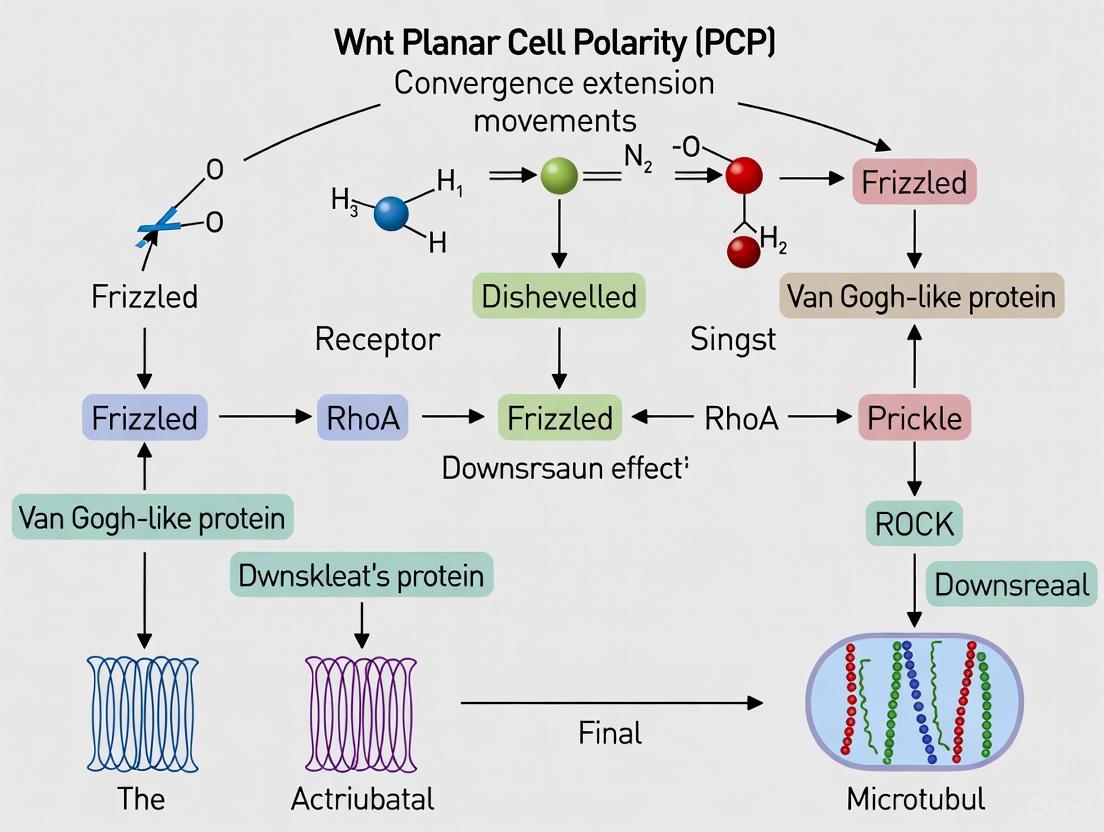
This comprehensive review synthesizes current knowledge of the Wnt/Planar Cell Polarity (PCP) pathway's crucial role in orchestrating convergence and extension (C&E) movements during vertebrate development and disease.
Wnt/PCP Pathway in Convergence and Extension: From Embryonic Morphogenesis to Cancer Therapeutic Targeting
Abstract
This comprehensive review synthesizes current knowledge of the Wnt/Planar Cell Polarity (PCP) pathway's crucial role in orchestrating convergence and extension (C&E) movements during vertebrate development and disease. We explore the foundational molecular mechanisms governing polarized cell behaviors, methodological approaches for investigating PCP signaling, common experimental challenges with optimization strategies, and comparative analyses with other Wnt pathways. For researchers and drug development professionals, this article highlights how dysregulated PCP signaling contributes to neural tube defects and cancer progression, while examining emerging therapeutic opportunities targeting this pathway for overcoming drug resistance and metastasis in oncology.
Core Mechanisms: Decoding Wnt/PCP Signaling in Cellular Polarization and Tissue Morphogenesis
The Wnt/Planar Cell Polarity (PCP) pathway is an evolutionarily conserved, β-catenin-independent non-canonical Wnt signaling cascade that directs polarized cell morphology and coordinated behavior within the tissue plane [1] [2]. Originally discovered in Drosophila melanogaster for its role in organizing epithelial structures such as wing hairs and ommatidia, this pathway has been co-opted in vertebrates to regulate fundamental morphogenetic events, most notably the convergent extension (CE) movements that drive gastrulation and neural tube closure [3] [1]. The core molecular machinery involves a defined set of membrane receptors, cytoplasmic adapters, and small GTPase effectors that translate polarized signals into asymmetric cytoskeletal reorganization and directional cell movement [4] [1]. This technical guide details the essential components of the Wnt/PCP pathway, their molecular interactions, and the experimental frameworks used to delineate their functions, providing a comprehensive resource for researchers investigating this critical signaling system.
Core Molecular Components of the Wnt/PCP Pathway
Frizzled Receptors: Structure and Specificity
Frizzled (Fz) receptors constitute a subfamily of G-protein-coupled receptors (GPCRs) and serve as the primary entry point for Wnt ligands [5] [6]. The ten mammalian FZD receptors (FZD1-10) share a conserved architecture: an extracellular N-terminal cysteine-rich domain (CRD) responsible for Wnt binding, seven transmembrane (7TM) helices, and an intracellular C-terminal domain [5] [6]. The CRD is stabilized by ten conserved cysteine residues that form disulfide bonds, creating a binding pocket for the lipid-modified moiety of Wnt ligands [6]. The intracellular loops and C-terminal tail are critical for downstream signal transduction, particularly a conserved KTXXXW motif located just downstream of TM7, which is essential for binding the cytoplasmic scaffold protein Dishevelled (Dvl) [5] [7].
Table 1: Key Frizzled Receptors in PCP Signaling
| Receptor | Key Ligands | Primary Signaling Role | Notable Features |
|---|---|---|---|
| FZD3 | Wnt5a, Wnt11 [6] | Non-canonical PCP [5] [6] | Required for axon guidance in CNS; in vivo axon growth [5]. |
| FZD6 | Wnt5a, Wnt4 [8] | Non-canonical PCP [6] [8] | Lacks a C-terminal PDZ-binding motif; regulates hair follicle orientation [6] [8]. |
| FZD7 | Wnt5a, Wnt11 [6] | Canonical & Non-canonical [6] | Most studied in cancer; has a conserved cholesterol-binding site [6]. |
Specific FZD receptors demonstrate a preference for mediating PCP signaling. For instance, FZD3 and FZD6 are primarily associated with non-canonical pathways [6] [8]. FZD6 is particularly notable for its role in tissue polarity, as evidenced by the disorganized hair follicles and nail dysplasia observed in FZD6-null mice and humans with FZD6 mutations, respectively [8]. Furthermore, genetic studies reveal functional redundancy between FZD6 and FZD3, as double-knockout mice exhibit severe neural tube closure defects not seen in single knockouts [8]. The specificity of FZD receptors is determined by structural variations in their CRD and linker domains, which influence ligand binding and pathway selection [7] [6].
The Cytoplasmic Signalosome: Dishevelled and Regulators
The cytoplasmic phosphoprotein Dishevelled (Dsh in flies, Dvl in vertebrates) is a central hub that relays signals from activated Fz receptors to diverse downstream effectors [7] [1]. Dvl contains three core domains: DIX, PDZ, and DEP. The PDZ domain mediates interactions with Fz receptors and other partners, while the DEP domain is critical for PCP signaling, directing membrane localization and activating small GTPases [7] [1].
Recent research has elucidated sophisticated mechanisms regulating Dvl dynamics. The chordate-specific protein Dact1 promotes the formation of Dvl oligomers, facilitating a critical binding partner switch where Dvl disengages from the tetraspan protein Vangl2 and instead associates with Fz to form signalosome-like clusters upon non-canonical Wnt stimulation [9]. This Dvl oligomerization, induced by Dact1, is essential for CE in vertebrates [9]. The functional balance between Dvl and Vangl2 is crucial; while both are necessary for CE, their over-expression is inhibitory, and they genetically antagonize each other, suggesting a finely tuned regulatory switch controlling pathway activity [9].
Small GTPases: Rho, Rac, and Cdc42 as Key Effectors
The Rho family of small GTPases—Rho, Rac, and Cdc42—act as molecular switches that cycle between active (GTP-bound) and inactive (GDP-bound) states to orchestrate cytoskeletal remodeling, the final output of Wnt/PCP signaling [4] [1]. They are activated by guanine nucleotide exchange factors (GEFs) and inactivated by GTPase-activating proteins (GAPs).
Table 2: Rho GTPases in Wnt/PCP Signaling
| GTPase | Primary Function in Cytoskeleton | Key Upstream Activator | Key Downstream Effector |
|---|---|---|---|
| Rho | Actin-myosin filament assembly; contractile forces [4] [1] | Daam1 [10] | ROCK (Rho-associated kinase) [4] [1] |
| Rac | Actin polymerization; lamellipodia formation (protrusive forces) [4] [1] | Dvl (DEP domain-dependent) [4] | JNK (Jun N-terminal Kinase) [4] [1] |
| Cdc42 | Actin polymerization; filopodia formation [4] | Gβγ/PKC (Wnt/Ca2+ pathway) [4] | Not specified in results |
In the Wnt/PCP pathway, activation of these GTPases occurs through distinct but interconnected branches. Rho activation is mediated by the Formin homology protein Daam1, which binds to both Dvl and Rho, forming a bridge that facilitates Wnt/Fz-induced Dvl-Rho complex formation and Rho activation [10]. Rac activation, conversely, requires the DEP domain of Dvl and operates independently of Daam1 [4]. Cdc42 can be activated via the Wnt/Ca2+ pathway, involving G-proteins and Protein Kinase C (PKC) [4]. The coordinated action of these GTPases regulates polarized cell behaviors such as directed migration, mediolateral intercalation, and the stabilization of cellular protrusions [4] [3].
The Pathway in Action: Signal Transduction Logic
The following diagram illustrates the core signal transduction logic of the Wnt/PCP pathway, from ligand-receptor binding to cytoskeletal rearrangement.
Essential Experimental Protocols for Wnt/PCP Research
Assessing Rho and Rac Activation in Cultured Cells
The activation of Rho and Rac following Wnt stimulation can be biochemically quantified using a GST-pulldown assay [4]. This method utilizes fusion proteins that specifically bind to the active, GTP-bound form of each GTPase.
Detailed Protocol:
- Stimulation: Treat mammalian cells (e.g., HEK293, HeLa) by transfection with cDNA for Wnt (e.g., Wnt1, Wnt3a, Wnt5a) and/or Fz, or by application of Wnt-conditioned medium for a predetermined time (e.g., 15-45 minutes) [4].
- Lysis: Rapidly lyse cells on ice using a mild lysis buffer (e.g., 50 mM Tris, pH 7.5, 10 mM MgCl2, 0.5 M NaCl, 1% Triton X-100) supplemented with protease and phosphatase inhibitors.
- Pulldown: Incubate clarified cell lysates with glutathione beads conjugated to the appropriate GST-fusion protein:
- Washing and Elution: Wash the beads extensively with lysis buffer to remove non-specifically bound proteins. Elute the bound proteins by boiling in SDS-PAGE sample buffer.
- Detection: Analyze the eluates (GTP-bound fraction) and total cell lysates (input control) by Western blotting using antibodies specific for Rho, Rac, or Cdc42. The ratio of GTP-bound protein to total protein quantifies activation [4].
Functional Analysis in Xenopus Embryos
Xenopus laevis is a premier model for studying the role of Wnt/PCP in convergent extension during gastrulation [4] [3] [10]. Key functional assays include:
DMZ Explant Assay:
- Microinjection: Inject mRNA or morpholinos (MOs) targeting the gene of interest (e.g., Fz7, Wnt11, Dvl, Daam1) into the dorsal marginal zone (DMZ) of 4- to 8-cell stage embryos [4] [9].
- Explant Culture: At the late blastula stage (stage 10), excise the DMZ and culture it in neutral buffered saline until control explants undergo significant elongation.
- Phenotypic Scoring: Capture images of the explants and quantify the degree of convergent extension by measuring the length-to-width ratio (LWR). Inhibition of PCP signaling results in a failure to elongate and a reduced LWR [9].
Whole-Embryo Phenocopy: Inject mRNA or MOs into the DMZ of whole embryos and allow them to develop to the tailbud stage (stage 25-26). Defective CE movements manifest as a shortened anterior-posterior body axis, which can also be quantified by LWR [9].
Research Reagent Solutions Toolkit
Table 3: Essential Reagents for Wnt/PCP Pathway Investigation
| Reagent / Tool | Function / Application | Example Use Case |
|---|---|---|
| GST-RBD / GST-PBD | Pulldown of active, GTP-bound Rho and Rac [4]. | Biochemical quantification of Wnt-induced GTPase activation in cell culture [4]. |
| Dominant-Negative (DN) Constructs (e.g., Xdd1, DN-Dvl, DN-Fz) | Inhibits specific pathway components to probe functional requirement [4] [9]. | Microinjection in Xenopus DMZ to block CE movements [9]. |
| Morpholinos (MOs) | Antisense oligonucleotides for knocking down gene expression [9]. | Knockdown of Dact1 in Xenopus to study its role in CE [9]. |
| Specific Antibodies (vs. phospho-proteins, total proteins) | Detection of protein levels, post-translational modifications, and activation states. | Western blot for pJNK, total JNK; immunofluorescence for asymmetric protein localization. |
| Xenopus laevis Embryos | In vivo model for studying gastrulation and CE movements [4] [3] [9]. | DMZ explant assay to isolate and quantify CE-specific cell behaviors [9]. |
Integrated Experimental Workflow
A typical workflow for dissecting a novel component's role in the Wnt/PCP pathway integrates the tools and protocols above, as visualized in the following diagram.
{: .no_toc}
- TOC {:toc}
The Planar Cell Polarity (PCP) pathway is a fundamental, evolutionarily conserved signaling system that coordinates the polarization of cells within the plane of an epithelium. This review deconstructs the pathway's molecular architecture, beginning with the core mechanism of asymmetric protein localization and intercellular communication, largely defined by genetic studies in Drosophila. We explore how this core module has been adapted in vertebrates to regulate complex cellular behaviors, most notably convergent extension (CE) movements during gastrulation, which are essential for axial elongation and neural tube closure. The integration of vertebrate-specific components, such as the Wnt-PCP ligand-receptor systems and downstream Rho GTPase signaling modules, is detailed. Furthermore, we examine the distinct roles of the global Fat/Dachsous/Four-jointed module in orienting polarity. This guide synthesizes current models with key experimental methodologies and reagents, providing a foundational resource for researchers investigating PCP in development and disease.
Planar Cell Polarity (PCP) refers to the coordinated orientation of cells and their subcellular structures along an axis within the plane of a tissue. This form of polarization is critical for the form and function of diverse organs, from the precisely aligned hairs on a Drosophila wing to the sensory hair cells in the mammalian inner ear [11] [12]. The PCP signaling pathway, a highly conserved non-canonical Wnt pathway, governs these processes. While initially deciphered in insect models, its role in vertebrate embryogenesis is profound, particularly in regulating convergent extension (CE) movements during gastrulation. CE is a fundamental morphogenetic process wherein cells intercalate mediolaterally to drive the narrowing (convergence) and lengthening (extension) of the body axis [13] [3]. Defective PCP signaling disrupts CE, leading to severe developmental anomalies such as open neural tube defects (e.g., spina bifida) in mice and humans [3] [14]. Beyond development, PCP genes have been implicated in cancer cell invasion and metastasis [14]. This review dissects the molecular architecture of the PCP pathway, highlighting the conserved core machinery and the critical vertebrate-specific adaptations that enable it to direct complex morphogenetic events like CE.
The Conserved Core PCP Machinery
Genetic studies in Drosophila have identified a set of six core proteins that form the heart of the PCP signaling system. Their hallmark is their ability to self-organize into asymmetric, complementary complexes at opposite sides of a cell, creating a molecular memory of the polarity axis.
Core PCP Components and Their Asymmetric Localization
The core proteins are subdivided into two opposing complexes that localize to adjacent cell membranes:
- The Distal Complex (or Fz complex): This group is enriched on the distal side of cells (relative to the body axis) and consists of:
- Frizzled (Fz): A seven-pass transmembrane receptor that is the central initiator of the intracellular signal [11] [14].
- Dishevelled (Dsh/Dvl): A cytoplasmic scaffolding protein that transduces the signal from Fz [11] [15].
- Diego (Dgo): An ankyrin-repeat protein that stabilizes the distal complex [11] [14].
- The Proximal Complex (or Vang complex): This group localizes to the proximal side of the cell and includes:
- Flamingo (Fmi/Celsr): An atypical cadherin that localizes to both proximal and distal membranes and is thought to form homophilic interactions between adjacent cells, bridging the two complexes across the intercellular space [11] [14].
The diagram below illustrates the conserved asymmetric localization and interaction of these core PCP proteins between two adjacent cells.
Figure 1: The conserved core PCP module. Core proteins form asymmetric complexes at opposing cell membranes. Intercellular interactions via Flamingo homodimers and feedback between Fz and Vang complexes coordinate polarity between neighboring cells.
Mechanism of Intercellular Coordination
The establishment of PCP is not a cell-autonomous event but relies on intercellular communication to coordinate polarity across a tissue. The current model posits that the initial symmetry is broken by a global cue. Subsequently, the core proteins engage in a self-amplifying feedback loop: Fz-Dsh-Dgo in one cell reinforces the recruitment of Vang-Pk to the adjacent membrane of the neighboring cell, and vice-versa [11] [14]. This interaction is mediated by Fmi, which forms homophilic bonds across cells, and potentially by direct Fz-Vang interactions [14]. This creates a local alignment of polarity that propagates throughout the tissue, ensuring that every cell is polarized in the same direction as its neighbors. Mutations in any core gene disrupt this delicate balance, resulting in a loss of coordinated polarity, evident in randomly oriented wing hairs in flies or mis-oriented stereociliary bundles in the mouse cochlea [11] [12].
Vertebrate-Specific Adaptations of the PCP Pathway
While the core molecular machinery is conserved, vertebrates have evolved specific adaptations that employ PCP signaling for more dynamic processes, most notably gastrulation CE movements.
Integration with Wnt Ligands and Receptors
In vertebrates, the core PCP pathway is often referred to as the Wnt-PCP pathway because it is activated by specific Wnt ligands. Unlike the canonical Wnt/β-catenin pathway, it operates independently of β-catenin and LRP5/6 co-receptors [16] [15].
- Key Ligands: Wnt5a, Wnt11, and Wnt11b are the primary ligands that activate the non-canonical, PCP branch of Wnt signaling. For example, in zebrafish, mutations in wnt11 (silberblick) and wnt5 (pipetail) disrupt CE movements [3].
- Receptors and Co-receptors: The pathway utilizes Frizzled receptors (e.g., Fz3, Fz6, Fz7) but also engages specific co-receptors not found in flies, such as Ror2 and Ryk, which help transduce the polarity signal [16].
The integration of Wnt ligands and vertebrate-specific receptors with the conserved core PCP module to regulate CE is shown in the following diagram.
Figure 2: The vertebrate Wnt-PCP pathway. Wnt ligands bind Fz and Ror/Ryk co-receptors, activating the conserved core module. This signals through vertebrate-specific effectors like Daam1, WGEF, and small GTPases (RhoA, Rac) to reorganize the actin cytoskeleton, driving CE movements.
Downstream Signaling to the Cytoskeleton
A key vertebrate adaptation is the specific linkage of the core PCP complex to regulators of the actin cytoskeleton, which is essential for driving the polarized cell behaviors of CE.
- The Daam1-WGEF-RhoA Axis: Upon activation, Dvl interacts with the formin protein Daam1. This complex recruits a specific guanine nucleotide exchange factor (GEF), WGEF (also known as p114RhoGEF), to the membrane. WGEF directly activates the small GTPase RhoA [15]. Active RhoA then signals through its effector Rho-associated kinase (ROCK) to promote actin polymerization and actomyosin contractility, which is critical for generating the forces needed for mediolateral intercalation [3] [15].
- Rac and JNK Pathway: In parallel, Dvl can also activate the small GTPase Rac, which in turn signals through JNK to regulate actin dynamics and gene expression, contributing to directed cell migration [16].
The distinct cellular outcomes of PCP signaling in different vertebrate tissues are summarized in the table below.
Table 1: Vertebrate-Specific PCP-Mediated Processes and Associated Components
| Process/Tissue | Key PCP Components | Cellular Behavior | Phenotype of Loss-of-Function |
|---|---|---|---|
| Gastrulation (CE) | Vangl2, Pk, Dvl, Wnt5a/11, Fz7 | Mediolateral intercalation, polarized protrusions | Shortened body axis, neural tube defects (e.g., Loop-tail in Vangl2 mutants) [13] [3] |
| Inner Ear Polarity | Vangl2, Celsr1, Fz3/6, Dvl | Coordinated orientation of stereociliary bundles | Mis-oriented hair bundles, hearing loss, vestibular dysfunction [12] [17] |
| Neural Tube Closure | Vangl2, Scrib, Dvl | Apical constriction, coordinated cell shaping | Craniorachischisis (completely open neural tube) [11] [14] |
The Fat/Dachsous/Four-Jointed Global Module
Beyond the core pathway, the Fat/Dachsous/Four-jointed (Ft/Ds/Fj) system acts as a global module that provides long-range directional information to orient the core PCP machinery relative to the tissue axes [11] [14].
- Components: This module consists of the atypical cadherins Fat (Ft) and Dachsous (Ds), and the Golgi kinase Four-jointed (Fj).
- Mechanism: Fj phosphorylates the extracellular domains of both Ft and Ds, modulating their affinity. Ds and Fj are often expressed in complementary gradients across a tissue (e.g., from anterior to posterior). This creates a spatial bias in the heterophilic binding of Ds on one cell to Ft on a neighboring cell. This global signal is thought to orient the activity of the core PCP pathway, possibly by regulating the asymmetric localization of the core proteins or through a transcriptional response involving the transcriptional co-repressor Atrophin [11] [14].
- Relationship to Core Pathway: The relationship between the Ft/Ds/Fj and core modules is complex and not fully resolved. Evidence supports a model where the global Ft/Ds/Fj system acts upstream to bias the orientation of the core module, which then amplifies and coordinates this signal locally [14]. However, some data suggest Fat signaling may also operate in parallel to influence polarity directly [11].
Experimental Analysis of PCP in Convergent Extension
The zebrafish gastrula is a premier model for dissecting the role of PCP in CE due to its external development and optical clarity, allowing for high-resolution live imaging of cell behaviors.
Key Experimental Workflow
A standard experimental workflow for analyzing PCP function in zebrafish CE is outlined below.
Figure 3: Experimental workflow for analyzing PCP in zebrafish convergent extension.
The Scientist's Toolkit: Key Reagents and Models
Table 2: Essential Research Tools for Wnt-PCP Pathway Investigation
| Category / Reagent | Example / Model System | Key Function and Application |
|---|---|---|
| Genetic Models | Zebrafish (knypek, trilobite), Mouse (Loop-tail, Crash) | In vivo analysis of PCP function; trilobite encodes Vangl2, Loop-tail is a Vangl2 mutant [13] [3]. |
| Morpholinos | Antisense oligonucleotides against wnt11, wnt5b, vangl2 | Transient gene knockdown to assess loss-of-function phenotypes during gastrulation [3] [15]. |
| Expression Constructs | Dominant-negative Dvl (DN-Dvl), Constitutively active RhoA (CA-RhoA) | Functional perturbation or rescue of specific pathway nodes; CA-RhoA can rescue WGEF depletion [15]. |
| Activity Assays | Rho/Rac GTP-pulldown assays, Phospho-specific antibodies | Biochemical validation of pathway activity; measuring GTP-bound RhoA levels [15]. |
| Imaging Tools | Confocal microscopy, Fluorescent biosensors (e.g., for actin) | Live-cell imaging and quantification of cytoskeletal dynamics and cell behaviors [13] [3]. |
The molecular architecture of the PCP pathway reveals a elegant synthesis of a deeply conserved core mechanism and context-dependent vertebrate adaptations. The core module, with its asymmetric protein complexes and intercellular feedback loops, provides a universal cellular compass. In vertebrates, this compass is calibrated by the global Ft/Ds/Fj system and wired into the cytoskeletal machinery via Wnt ligands and the Daam1-WGEF-RhoA axis to power the large-scale tissue remodeling of CE. Despite significant progress, key challenges remain. The precise molecular nature of the initial global cue is still enigmatic. Furthermore, the extensive crosstalk between the PCP pathway and other signaling pathways (e.g., BMP, Notch) during gastrulation adds a layer of complexity that is only beginning to be understood [3]. Future research, leveraging advanced techniques in live imaging, structural biology, and quantitative modeling, will be essential to fully decode the dynamic PCP interactome. A complete understanding of this pathway holds immense promise for developing therapeutic strategies for the multitude of human diseases, from birth defects to cancer, rooted in defective cell polarity.
The Wnt/Planar Cell Polarity (PCP) pathway represents a crucial β-catenin-independent branch of Wnt signaling that orchestrates complex morphogenetic processes through the spatial regulation of cellular behaviors. This pathway governs coordinated cellular polarization in the tissue plane, enabling fundamental processes including mediolateral intercalation, directed cell migration, and the formation of polarized protrusions. Through core components such as Frizzled, Van Gogh (Vangl), Prickle, and Dishevelled, Wnt/PCP signaling establishes cellular asymmetry and links positional information to cytoskeletal reorganization. This technical review examines the mechanisms by which Wnt/PCP drives these critical cellular behaviors, with emphasis on their role in convergence and extension movements during vertebrate gastrulation and neural tube closure. Experimental evidence from multiple model organisms demonstrates that precise spatiotemporal control of Wnt/PCP signaling is essential for normal development, while its dysregulation contributes to human diseases including neural tube defects and cancer metastasis.
The Wnt/Planar Cell Polarity (PCP) pathway constitutes an evolutionarily conserved non-canonical Wnt signaling cascade that directs polarized cell behaviors across epithelial sheets and mesenchymal tissues. Unlike the canonical Wnt/β-catenin pathway that regulates gene expression, Wnt/PCP signaling primarily influences cytoskeletal organization and cell motility through rapid, transcription-independent mechanisms [16]. The core molecular machinery comprises transmembrane proteins Frizzled (Fz), Van Gogh (Vangl, also known as Strabismus), Flamingo (Celsr in vertebrates), and cytoplasmic components Dishevelled (Dsh/Dvl), Prickle (Pk), and Diego (Dgo) that form asymmetric complexes across cell membranes to establish and maintain polarity [18].
This asymmetric distribution generates directional information within the tissue plane, orthogonal to the apico-basal axis, which enables cells to interpret their positional context and execute polarized behaviors [18]. The core PCP components exhibit specific localization patterns: Fz-Dsh-Dgo complexes localize to distal cell membranes while Vang-Pk complexes occupy proximal membranes in many epithelial contexts [18]. This asymmetric arrangement is propagated between neighboring cells through intercellular interactions between Fz and Vangl via Flamingo/Celsr, creating a feedback loop that reinforces polarity across the tissue [18]. Wnt ligands, particularly Wnt5a, Wnt11, and related members, provide instructional cues that establish the initial polarity bias, though whether they function as directional cues or permissive signals remains context-dependent [19].
Mediolateral Intercalation
Cellular Mechanisms and Molecular Regulation
Mediolateral intercalation represents a fundamental cell behavior driven by Wnt/PCP signaling that powers convergent extension (C&E) movements during vertebrate gastrulation. This process involves the polarized intercalation of cells between their medial and lateral neighbors, resulting in tissue narrowing along the mediolateral axis and concomitant elongation along the anteroposterior axis [3]. During intercalation, cells form lamellipodial protrusions oriented preferentially along the mediolateral axis, which exert traction on adjacent cells to drive intercalation [3].
The Wnt/PCP pathway regulates this polarized behavior through Rho GTPase activation. Specifically, Wnt5a and Wnt11 ligands engage Frizzled receptors to activate Dishevelled, which in turn recruits and activates the Formin homology protein Daam1 [3]. Daam1 then stimulates RhoA, leading to activation of Rho-associated kinase (ROCK) which regulates actomyosin contractility through myosin light chain phosphorylation [3]. Simultaneously, the PCP pathway engages Rac1 to regulate actin polymerization through WAVE and Arp2/3 complexes, thereby promoting lamellipodial protrusion formation [3]. This coordinated regulation of both protrusive and contractile forces enables efficient cell intercalation.
Table 1: Key Wnt/PCP Components Regulating Mediolateral Intercalation
| Component | Role in Intercalation | Mutant Phenotype |
|---|---|---|
| Wnt11 | Primary ligand regulating polarized protrusions | Shortened body axis, wider somites [3] |
| Vangl2 | Core PCP protein establishing polarity | Defective CE movements, neural tube defects [20] [3] |
| Prickle | Modulates Dvl activity and asymmetric localization | Impaired cell polarity and intercalation [3] [21] |
| Daam1 | Formin linking Dvl to Rho activation | Disrupted actin organization and protrusions [3] |
| RhoA/ROCK | Regulates actomyosin contractility | Loss of polarized cell behavior [3] |
Experimental Evidence and Protocols
Zebrafish studies have been instrumental in elucidating the role of Wnt/PCP signaling in mediolateral intercalation. Key experiments involve live imaging of gastrulating embryos from Wnt/PCP mutants such as trilobite (Vangl2), knypek (glypican 4/5), and silberblick (Wnt11) [3]. The standard protocol involves:
- Embryo preparation: Collect zebrafish embryos at sphere stage and maintain in E3 embryo medium at 28.5°C until shield stage (6 hpf).
- Morpholino injection: To achieve gene knockdown, inject 1-2 nl of specific morpholinos against target PCP genes into the yolk of 1-4 cell stage embryos.
- Live imaging: Mount dechorionated embryos in 0.8% low-melting-point agarose and image using confocal or two-photon microscopy at 20-60 second intervals for 2-4 hours during gastrulation (shield to 80% epiboly stages).
- Cell tracking: Use fluorescent membrane markers (e.g., GFP-CAAX) to trace individual cell movements and protrusion dynamics.
- Quantitative analysis: Measure velocity, directionality, persistence, and protrusion orientation using tracking software (e.g., ImageJ with TrackMate).
In Xenopus, the expliant assay has been particularly valuable for studying intercalation. The protocol involves:
- Isolate animal cap tissue from blastula-stage embryos.
- Culture explants in Danilchik's medium for D in simple ectoderm.
- For mesodermal explants, inject synthetic mRNAs encoding Wnt/PCP components or dominant-negative constructs at the 4-cell stage, then isolate dorsal marginal zone tissue at early gastrula stage.
- Image explant elongation over 4-6 hours while fixed at 10-minute intervals.
- Quantify convergent extension by measuring length-to-width ratio of explants.
These approaches have revealed that Wnt/PCP mutants exhibit randomized protrusion orientation rather than complete loss of motility, explaining the failure of convergent extension without blocking cell migration per se [3].
Directed Migration
Mechanisms of Wnt/PCP-Guided Cell Movement
Directed migration represents another crucial cellular behavior regulated by Wnt/PCP signaling, occurring in contexts ranging from parietal endoderm migration in mammalian embryos to intestinal stem cell recruitment during tissue repair [22] [23]. Unlike mediolateral intercalation where cells move between neighbors, directed migration involves coordinated movement of individual cells or collectives toward specific locations.
In Drosophila intestinal regeneration, Wnt/PCP signaling guides stem cell migration to wound sites through a mechanism involving Otk (PTK7 orthologue) released from enteroendocrine cells [22]. At injury sites, matrix metalloproteinases (MMPs) cleave Otk, releasing its extracellular domain which activates non-canonical Wnt signaling in intestinal stem cells (ISCs) [22]. This activation triggers the formation of actin-based protrusions and directional migration toward the wound. Similarly, in mammalian development, parietal endoderm migration depends on Wnt/PCP signaling through Rho/ROCK to establish directional persistence [23].
The molecular mechanism involves Frizzled receptor activation by Wnt ligands, leading to Dishevelled recruitment and subsequent activation of small GTPases. In the case of directed migration, the pathway primarily engages Rac1 and Cdc42 to regulate actin polymerization at the leading edge through WASP/WAVE proteins and the Arp2/3 complex [22]. This results in the formation of lamellipodia and filopodia that propel cell movement. The PCP complex establishes front-rear polarity by asymmetrically localizing guidance receptors and downstream effectors, enabling cells to sense and respond to directional cues.
Table 2: Directed Migration Models and Key Findings
| Biological System | Wnt/PCP Components | Migratory Behavior |
|---|---|---|
| Drosophila intestinal regeneration [22] | Otk, Fz, Dsh | ISC migration toward wounds (60-80% of ISCs form protrusions) |
| Mammalian parietal endoderm [23] | Daam1, Rho, ROCK | 68.6% cells oriented in migration direction; requires Rho/ROCK |
| Border cell migration (Drosophila) [18] | Fz, Prickle, Vang | Collective migration of cell clusters during oogenesis |
| Neural crest migration [24] | Vangl2, Prickle, Celsr1 | Collective migration with leader-follower cell patterning |
Experimental Approaches for Analyzing Directed Migration
The Drosophila intestine has emerged as a powerful model for studying Wnt/PCP-regulated migration due to its accessibility for live imaging and genetic manipulation. The standard protocol for analyzing ISC migration includes:
- Genetic labeling: Use escargot::Gal4 combined with Su(H)::Gal80 and tub::Gal80ts to specifically label ISCs with fluorescent markers (e.g., eYFP).
- Injury models:
- Enteropathogen infection: Feed flies Erwinia carotovora carotovora 15 (Ecc15) for 16 hours to induce widespread damage.
- Laser ablation: Use two-photon microscopy to create precise ~30 µm wounds in intestinal epithelium.
- Live imaging: Prepare wholemount intestinal explants and image using confocal microscopy at 2-5 minute intervals for 2.5 hours.
- Migration analysis: Track cell body movement and protrusion dynamics using manual tracking or automated software.
- Pharmacological inhibition: Treat explants with Cytochalasin B (5 µM) or Blebbistatin (50 µM) to disrupt actin polymerization or myosin function, respectively.
Key quantitative measurements include:
- Percentage of ISCs forming protrusions (increases from ~8% in homeostasis to 73% near wounds)
- Directionality index (migration toward vs. away from wound)
- Migration velocity and persistence
- Distance traveled by cell bodies and protrusion tips
For mammalian parietal endoderm studies, the F9 teratocarcinoma embryoid body system provides a well-established model [23]. The experimental approach involves:
- Differentiate F9 cells into parietal endoderm using retinoic acid and cAMP.
- Inhibit PCP signaling using specific pharmacological agents (e.g., sFRP to sequester Wnts, ROCK inhibitor Y-27632).
- Assess cell orientation by quantifying Golgi apparatus position relative to the nucleus and migration direction.
- Measure migration speed using time-lapse microscopy and tracking software.
These approaches have demonstrated that PCP perturbation does not necessarily block migration but rather disrupts directional persistence, resulting in increased random motility but ineffective directed movement [23].
Polarized Protrusions
Cytoskeletal Regulation and Protrusion Dynamics
Polarized protrusion formation represents the primary cellular output of Wnt/PCP signaling that enables both mediolateral intercalation and directed migration. These actin-rich structures include lamellipodia (broad, sheet-like protrusions) and filopodia (thin, finger-like projections) that extend in the direction of movement determined by the PCP orientation [22]. The formation and polarization of these protrusions requires precise spatiotemporal control of the actin cytoskeleton by Wnt/PCP effectors.
The molecular pathway initiating protrusion formation begins with Wnt binding to Frizzled receptors, which recruits Dishevelled to the membrane [22]. Activated Dsh then engages multiple downstream effectors:
- Rac1 activation stimulates WAVE complex-mediated activation of the Arp2/3 complex, promoting branched actin nucleation and lamellipodia formation [22].
- Cdc42 activation triggers N-WASP-mediated activation of Arp2/3 and formins (such as mDia1/Dia in Drosophila) for filopodia formation [22].
- RhoA activation through Daam1 engages ROCK to regulate myosin II contractility, which provides the necessary tension for protrusion stabilization and retraction of the cell rear [3].
In migrating intestinal stem cells, this pathway results in the formation of a single dominant lamellipodium that becomes the leading edge of the cell [22]. The protrusion extends through actin polymerization at the plus ends of filaments pushing against the membrane, while retrograde flow of actin networks toward the cell center is coupled to adhesion formation at the leading edge. Wnt/PCP signaling ensures that this process occurs asymmetrically, restricting protrusion formation to the appropriate cell cortex.
Experimental Analysis of Protrusion Dynamics
Advanced live imaging techniques have enabled detailed analysis of polarized protrusion dynamics in Wnt/PCP contexts. The standard approach for quantifying protrusion behavior includes:
Fluorescent labeling:
- Actin: Express LifeAct-GFP or Utrophin-GFP in target cells
- Membrane: Express myristoylated-GFP or use lipophilic dyes
- PCP components: Tag endogenous or express fluorescently tagged Vangl2, Fz, or Dvl
Time-lapse imaging using spinning disk confocal or two-photon microscopy at 15-30 second intervals for 30-60 minutes.
Image analysis to quantify:
- Protrusion initiation frequency and location
- Protrusion lifetime and extension/retraction dynamics
- Correlation between PCP component localization and protrusion sites
- Actin flow rates using fluorescent speckle microscopy or FRAP
Pharmacological perturbations using specific inhibitors:
- Cytochalasin D (1 µM) to block actin polymerization
- CK-666 (100 µM) to inhibit Arp2/3 complex
- SMIFH2 (10 µM) to inhibit formin activity
- Y-27632 (20 µM) to inhibit ROCK
In Xenopus neural tube closure studies, researchers have successfully correlated PCP component localization with protrusion orientation [20]. The methodology involves:
- Generate fluorescently tagged PCP constructs (e.g., Vangl2-GFP, Fz-RFP).
- Inject synthetic mRNAs into Xenopus embryos at 1-2 cell stage.
- Isolate neural plates at neurula stages and culture as explants.
- Perform time-lapse imaging of cell behaviors while monitoring PCP protein localization.
- Fixed tissue analysis using immunofluorescence for core PCP components and phalloidin staining for actin.
These approaches have revealed that in Wnt/PCP defective embryos, cells still form protrusions but lack coordinated orientation, demonstrating the pathway's role in polarizing rather than initiating protrusive activity [20] [3].
Research Reagent Solutions
Table 3: Essential Research Reagents for Wnt/PCP Studies
| Reagent Category | Specific Examples | Application/Function |
|---|---|---|
| Genetic Tools | Vangl2Lp mutant mice, trilobite zebrafish | Classic PCP mutants for loss-of-function studies [20] [3] |
| Chemical Inhibitors | Cytochalasin B, Blebbistatin, Y-27632 | Disrupt actin dynamics, myosin function, and ROCK signaling [22] |
| Live Imaging Markers | LifeAct-GFP, GFP-CAAX, H2B-RFP | Visualize actin dynamics, membrane morphology, and nuclear position [22] |
| Antibodies | Anti-Vangl2, Anti-Prickle1, Anti-Dvl1 | Immunofluorescence detection of PCP component localization [20] |
| Recombinant Proteins | sFRP1, Wnt5a, Wnt11 | Modulate Wnt signaling pathways [23] |
| Morpholinos | vangl2, wnt11, fz7 targeting | Gene-specific knockdown in zebrafish and Xenopus [3] |
Visualizing Wnt/PCP Signaling and Cellular Responses
Wnt/PCP Signaling Cascade Diagram
Experimental Approaches for Wnt/PCP Research
The Wnt/Planar Cell Polarity pathway represents a fundamental signaling system that translates positional information into coordinated cellular behaviors through regulation of the cytoskeleton. The three major cellular behaviors discussed—mediolateral intercalation, directed migration, and polarized protrusion formation—collectively enable the complex tissue rearrangements essential for embryonic development and adult tissue homeostasis. Understanding the precise molecular mechanisms governing these processes provides critical insights into congenital disorders such as neural tube defects, as well as pathological conditions including cancer metastasis. Future research directions include elucidating the crosstalk between Wnt/PCP and other signaling pathways, developing more specific pharmacological modulators, and applying advanced imaging technologies to visualize PCP dynamics in real-time within living organisms. The experimental approaches and reagents outlined in this review provide the foundational methodology for continued investigation into this crucial regulatory pathway.
The Wnt/Planar Cell Polarity (PCP) pathway is an essential regulator of cellular and tissue polarity during embryonic development, governing processes such as convergent extension (C&E) movements during gastrulation and the polarization of sensory hair cells [3]. A core, yet complex, aspect of its function is the intricate control it exerts over the microtubule (MT) cytoskeleton. This whitepaper delves into the specific mechanisms by which the Wnt/PCP pathway regulates the positioning of the Microtubule Organizing Center (MTOC) and facilitates the asymmetric localization of proteins, two processes fundamental to establishing cellular asymmetry. The emerging paradigm is one of reciprocal interaction: the Wnt/PCP pathway directly influences the organization of the microtubule cytoskeleton and, in turn, an intact cytoskeleton is required for the proper establishment and function of the pathway's own components [25] [26]. This interplay is critical for polarized cell behaviors underlying morphogenesis and has significant implications for understanding diseases, such as cancer and ciliopathies, where these processes are disrupted.
Molecular Mechanisms of Wnt/PCP-Mediated Cytoskeletal Control
The non-canonical Wnt/PCP pathway, distinct from the β-catenin-dependent canonical pathway, signals through a conserved set of core proteins to bring about cytoskeletal reorganization. The pathway is initiated by ligands such as Wnt5a, Wnt7, and Wnt11 binding to Frizzled (Fz) receptors and co-receptors like ROR2 or Glypican 4/6 (Knypek) [16] [3]. This activation triggers the intracellular protein Dishevelled (Dvl/Dsh), which acts as a central hub, relaying signals to downstream effectors that directly remodel the actin and microtubule networks.
Two primary branches of the pathway regulate the cytoskeleton:
- The RhoA/ROCK branch is crucial for activating actomyosin contractility, which powers cell shape changes and migration [3].
- The Rac/JNK branch influences microtubule dynamics and is implicated in establishing and maintaining cellular polarity [27].
A key outcome of Wnt/PCP signaling in polarized cells is the repositioning of the MTOC, a structure that includes the centrosome and nucleates microtubules. During zebrafish gastrulation, Wnt/PCP signaling through Knypek (Glypican4/6) and Dishevelled is required for the MTOC to become biased to the posterior and medial side of the cell within the plane of the germ layers [25] [26]. This polarized positioning of the MTOC reorganizes the entire microtubule network, influencing intracellular trafficking and the placement of organelles and proteins.
Furthermore, studies in C. elegans have revealed a direct link between Wnt signaling, MTOC asymmetry, and cell fate determination. In the asymmetric division of the EMS cell, a Wnt signal establishes an asymmetry of astral microtubules, with more microtubules found on the anterior side. This microtubule asymmetry is necessary for the asymmetric nuclear localization of WRM-1/β-catenin and POP-1/TCF in the daughter cells [28]. Laser manipulation experiments confirmed that perturbing spindle asymmetry directly alters the nuclear distribution of β-catenin, demonstrating that microtubules can regulate the nuclear localization of key transcriptional effectors [28].
The relationship is reciprocal. The microtubule cytoskeleton is also required for the initial establishment of PCP protein asymmetry. In zebrafish, disruption of microtubules before the establishment of polarity prevents the anterior clustering of the core PCP protein Prickle. However, once established, this asymmetric localization becomes independent of microtubules, indicating they are required for initiation but not maintenance [26]. This complex, mutual regulation between the Wnt/PCP pathway and the cytoskeleton ensures robust coordination of cell polarity with embryonic axes.
Table 1: Key Wnt/PCP Pathway Components in Cytoskeletal Remodeling
| Component | Type | Primary Function in Cytoskeletal Control |
|---|---|---|
| Wnt5a / Wnt11 | Ligand | Activates the non-canonical Wnt/PCP pathway [16] [3] |
| Frizzled (Fz) | Receptor | Binds Wnt ligands, initiates intracellular signaling [16] |
| Knypek (Gpc4) | Co-receptor | Glypican that facilitates ligand-receptor interaction [26] [29] |
| Dishevelled (Dvl) | Scaffold Protein | Central hub; relays signal to RhoA and Rac GTPases [16] [26] |
| RhoA / RAC1 | Small GTPase | Regulates actomyosin contractility (RhoA) and cell protrusions (Rac) [3] [27] |
| DAAM1 | Formin Protein | RhoA effector; nucleates unbranched actin filaments [3] |
| Prickle (Pk) | Core PCP Protein | Antagonizes Dvl; shows asymmetric membrane localization [25] [26] |
| Vangl2 | Core PCP Protein | Forms feedback loop with Fz; crucial for polarity [3] [29] |
Quantitative Data: Experimental Evidence of Wnt/PCP Control
The following tables summarize key quantitative findings from seminal studies investigating the control of MTOC positioning and asymmetric protein localization by the Wnt/PCP pathway.
Table 2: MTOC Positioning Defects in Zebrafish Gastrulation [26] This study quantified the position of the centrosome/MTOC relative to the cell nucleus in zebrafish mesoderm and ectoderm cells during gastrulation. The "Cen2" phenotype represents the wild-type, polarized state where both centrosomes are attached to the posterior cortex.
| Genotype / Condition | % Cen2 (Wild-type) | % Cen1 (Intermediate) | % Cen0 (No Attachment) | n (cells) |
|---|---|---|---|---|
| Wild-type | 71% | 29% | 0% | 41 |
| knypek (gpc4) mutant | 10% | 40% | 50% | 10 |
| dsh-2; mig-5(RNAi) | 10% | 20% | 70% | 10 |
Table 3: Nuclear Anchoring in C. elegans Asymmetric Division [30] This research analyzed the attachment of the posterior nucleus to the cell cortex via centrosomes after the division of the EMS cell. RNAi of Wnt pathway components significantly disrupted this nuclear anchoring.
| Genotype / Condition | % with Cortical Attachment (Cen1+Cen2) | % with No Attachment (Cen0) | n (cells) |
|---|---|---|---|
| Wild-type | 100% | 0% | 41 |
| mom-2/wnt(RNAi) | 83% | 17% | 18 |
| src-1(RNAi) | 20% | 80% | 15 |
| mom-5/fz(RNAi) | 50% | 50% | 10 |
| gsk-3(RNAi) | 0% | 100% | 8 |
Experimental Protocols: Key Methodologies in the Field
Analyzing MTOC Polarity in Zebrafish Gastrulation
This protocol is adapted from the work of Sepich et al. [26], which established the role of Wnt/PCP signaling in polarizing the MTOC during convergence and extension movements.
Objective: To assess the intracellular position of the MTOC relative to the body axes in living zebrafish embryos and determine the requirement for Wnt/PCP signaling.
Key Reagents:
- Fluorescent Tubulin Markers: mRNA encoding GFP-γ-tubulin or GFP-centrin to label centrosomes/MTOCs.
- Membrane Marker: mRNA for membrane-targeted RFP (CAAX-RFP) to delineate cell boundaries.
- Morpholinos or Mutants: For knocking down or knocking out genes of interest (e.g., knypek, dishevelled).
- Microtubule Disruptors: Nocodazole to test the dependency of PCP protein localization on microtubules.
Detailed Workflow:
- Embryo Preparation and Microinjection: At the one- to two-cell stage, microinject zebrafish embryos with a mixture of mRNA encoding the fluorescent centrosomal marker (e.g., 5-40 pg of Xenopus EGFP-centrin) and a membrane marker (200-400 pg of CAAX-RFP).
- Live-Imaging and Staging: Raise injected embryos to the desired gastrulation stages (e.g., 75-85% epiboly for mid-gastrulation). Manually dechorionate embryos and mount in low-melting-point agarose for live-imaging confocal microscopy.
- 4D Image Acquisition: Acquire Z-stack time-lapse images (4D imaging) of the mesoderm or ectoderm layers. Track the position of the GFP-labeled MTOC relative to the cell nucleus and the embryonic axes (anteroposterior and mediolateral) over time.
- Perturbation Experiments: To test the role of specific genes, repeat the imaging in embryos with genetic mutations (e.g., knypek, trilobite/vangl2) or those injected with morpholinos against target genes.
- Quantitative Analysis: For each cell, classify the MTOC position into one of three phenotypes:
- Cen2: Both centrosomes are attached to the posterior cortex (fully polarized).
- Cen1: Only one centrosome is attached.
- Cen0: No centrosomes are attached to the cortex (non-polarized).
- Microtubule Disruption: To test the role of microtubules in PCP establishment, treat embryos with nocodazole (e.g., 10 μg/mL) before the onset of polarization (mid-gastrulation). Fix the embryos and immunostain for core PCP proteins like Prickle to assess the establishment of its asymmetric anterior localization.
Investigating Wnt-Mediated Spindle Asymmetry in C. elegans
This protocol is based on the research by Sugioka et al. [28], which demonstrated that Wnt signaling regulates spindle asymmetry to control the asymmetric nuclear localization of β-catenin.
Objective: To manipulate and measure spindle asymmetry and determine its effect on the nuclear localization of WRM-1/β-catenin.
Key Reagents:
- Strains: C. elegans strains expressing fluorescently tagged proteins (e.g., GFP-β-tubulin, GFP-γ-tubulin, mCherry-histone, WRM-1::GFP).
- RNAi Clones: For knocking down Wnt pathway components (e.g., apr-1/APC).
- Laser Ablation System: A microscope-coupled laser for precise manipulation of the spindle.
Detailed Workflow:
- Worm Culture and Preparation: Culture and synchronize worms expressing the desired fluorescent reporters. Mount young adult worms on agar pads for imaging of early embryos.
- Live Imaging of Mitotic Spindles: Use spinning-disk confocal microscopy to capture high-resolution time-lapse images of the EMS cell division. Image GFP-β-tubulin to visualize spindle microtubules and mCherry-histone to mark chromosomes.
- Measuring Microtubule Asymmetry: Quantify the fluorescence intensity of astral microtubules on the anterior versus posterior sides of the spindle during telophase. Calculate an asymmetry index (e.g., anterior intensity/posterior intensity).
- Laser Manipulation: In wild-type or mutant embryos, use a laser microbeam to sever microtubules on one side of the spindle to artificially create asymmetry or correct defective asymmetry.
- Correlating with Nuclear β-Catenin: In the same embryos, track the nuclear localization of WRM-1/β-catenin (WRM-1::GFP) and the transcription factor POP-1/TCF in the daughter nuclei (MS and E cells) after division.
- Perturbation and Rescue: In Wnt pathway mutants (e.g., mom-2/Wnt), use laser manipulation to restore spindle asymmetry and assess whether this rescues the defective nuclear asymmetry of WRM-1 and POP-1.
The Scientist's Toolkit: Essential Research Reagents
Table 4: Key Reagents for Studying Wnt/PCP and Cytoskeletal Integration
| Reagent / Tool | Function / Application | Example Use-Case |
|---|---|---|
| GFP-γ-Tubulin / Centrin | Labels centrosomes/MTOCs for live imaging | Visualizing and quantifying MTOC positioning in zebrafish gastrulation [26]. |
| Membrane-Targeted RFP (CAAX-RFP) | Outlines cell membranes | Defining cell boundaries and intracellular geometry in live embryos [26]. |
| Prickle-GFP Fusion Protein | Reports asymmetric localization of core PCP proteins | Studying the establishment of planar polarity and its dependence on microtubules [26]. |
| PORCN Inhibitors (e.g., ETC-159) | Blocks secretion of all Wnt ligands | Acute withdrawal of Wnt signaling to study downstream transcriptional and cytoskeletal effects [31]. |
| Nocodazole | Reversibly depolymerizes microtubules | Testing the requirement of an intact MT cytoskeleton for PCP establishment and protein trafficking [26]. |
| Zebrafish PCP Mutants (e.g., knypek, vangl2) | Genetic loss-of-function models | Establishing the necessity of specific PCP components for cytoskeletal organization and cell movements [26] [29]. |
| Laser Ablation / Manipulation System | Precisely severs or perturbs cellular structures | Directly testing the functional role of spindle asymmetry in protein localization [28]. |
Visualizing the Wnt/PCP - Cytoskeleton Signaling Axis
The following diagram illustrates the core mechanisms by which the Wnt/PCP pathway regulates the microtubule cytoskeleton to control MTOC positioning and asymmetric protein localization.
The Wnt/Planar Cell Polarity (PCP) pathway, a non-canonical Wnt signaling cascade, serves as a fundamental regulatory system governing polarized cell behaviors during embryonic development. This pathway plays an indispensable role in orchestrating the large-scale morphogenetic movements that shape the early embryo, particularly during gastrulation and neural tube closure [32]. The core molecular machinery of Wnt/PCP signaling consists of a conserved set of proteins including Frizzled (Fz) receptors, Dishevelled (Dvl), Van Gogh (Vangl), Prickle (Pk), Celsr, and Flamingo that become asymmetrically localized within cells to impart directional information [33] [3]. During vertebrate gastrulation, Wnt/PCP signaling directs convergent extension (C&E) movements that narrow the germ layers along the mediolateral axis while simultaneously elongating the embryo in the anteroposterior direction [32] [3]. Subsequently, during neurulation, the same pathway regulates the intricate cellular rearrangements and apical constriction events required for neural plate bending and fusion, ultimately leading to the formation of the neural tube [34]. Mutations in PCP genes consistently result in severe developmental defects including neural tube defects (NTDs) such as spina bifida, hearing deficits, kidney diseases, and limb elongation abnormalities, underscoring the pathway's critical importance in human development and disease [32] [35].
Molecular Mechanisms of Wnt/PCP Signaling
Core Pathway Components and Their Interactions
The Wnt/PCP signaling cascade operates through a sophisticated molecular interaction network that establishes and maintains cellular polarity. The core PCP proteins form two distinct molecular complexes that localize to opposite sides of the cell: the Frizzled-Dishevelled complex and the Vangl-Prickle complex [33] [36]. This asymmetric distribution is fundamental to the pathway's function in polarizing cell behavior. When Wnt ligands, particularly Wnt5a and Wnt11, bind to Frizzled receptors, they initiate a signaling cascade that activates Dishevelled through phosphorylation and membrane recruitment [3] [37]. The activated Dishevelled then engages with downstream effectors including Daam1, Rho, and Rac GTPases, ultimately leading to reorganization of the actin cytoskeleton and microtubule networks [26] [3]. This cytoskeletal remodeling drives the polarized cell behaviors characteristic of PCP signaling. The establishment of polarity is further reinforced by feedback interactions between the opposing complexes, with Celsr and Flamingo cadherins mediating intercellular communication that coordinates polarity across tissue boundaries [32] [33].
Signaling Outputs and Cytoskeletal Remodeling
The ultimate functional output of Wnt/PCP signaling is the spatial and temporal control of cytoskeletal dynamics that drive morphogenetic movements. Key downstream effectors include Rho-associated kinase (ROCK), cofilin, and JNK, which regulate actomyosin contractility and microtubule stability [3] [36]. In zebrafish gastrulation, Wnt/PCP signaling directly controls the position of the microtubule organizing center (MTOC), orienting it posteriorly and medially within the plane of the germ layers [26]. This polarization of the cytoskeleton enables cells to execute directed behaviors such as mediolateral intercalation, oriented cell division, and directed migration [32] [3]. Live imaging studies in Xenopus have revealed that PCP proteins dynamically enrich at specific cell-cell junctions, where they spatially and temporally correlate with actomyosin-driven contractile behavior during neural tube closure [33]. This intimate link between PCP protein localization and cytoskeletal remodeling provides the mechanical forces necessary for large-scale tissue morphogenesis during embryonic development.
Table 1: Core Wnt/PCP Pathway Components and Their Functions
| Component | Type | Primary Function | Localization |
|---|---|---|---|
| Frizzled (Fz) | Receptor | Wnt ligand binding; initiates intracellular signaling | Anterior cell membrane |
| Dishevelled (Dvl) | Scaffold protein | Transduces signal from Fz to downstream effectors | Posterior cell membrane |
| Vangl | Transmembrane protein | Forms complex with Prickle; establishes polarity | Anterior cell membrane |
| Prickle (Pk) | Cytoplasmic adaptor | Stabilizes Vangl complex; inhibits Dvl | Anterior cell membrane |
| Celsr | Atypical cadherin | Mediates intercellular communication; coordinates polarity | Junctional, throughout membrane |
| Wnt5a/Wnt11 | Ligand | Activates PCP pathway; biases toward non-canonical signaling | Extracellular, secreted |
Wnt/PCP in Gastrulation Movements
Convergent Extension Mechanisms
Gastrulation represents a pivotal period in embryonic development when the basic body plan is established through massive cell rearrangements. During this process, convergent extension (C&E) movements narrow the germ layers along the mediolateral axis while simultaneously elongating the embryo anteroposteriorly [32] [3]. The Wnt/PCP pathway regulates multiple polarized cellular behaviors that drive C&E, including directed cell migration, mediolateral intercalation, and radial intercalation [3]. In zebrafish embryos with disrupted PCP signaling (e.g., knypek, trilobite, or silberblick mutants), C&E movements are severely impaired, resulting in shortened anteroposterior axes and widened dorsal structures despite normal cell fate specification [3]. These mutants undergo normal epiboly and internalization but fail to properly execute the intercalation behaviors that drive embryonic elongation. The pathway functions by aligning individual cell polarities with the embryonic axes, ensuring coordinated movement across the entire tissue [26] [3].
Molecular Regulation of Cell Behaviors
At the molecular level, Wnt/PCP signaling coordinates gastrulation movements through precise regulation of cytoskeletal dynamics and cell adhesion. During zebrafish gastrulation, Wnt/PCP components including Knypek/Glypican4/6 and Dishevelled control the intracellular position of the microtubule organizing center (MTOC), biasing it posteriorly and medially within the plane of the germ layers [26]. This polarization requires intact Wnt/PCP signaling and correlates with the transition from slow to fast C&E movements. Additionally, the pathway regulates dynamic cohesion of anterior mesoderm cells and influences endocytosis of E-cadherin molecules, thereby modulating cell adhesion properties to permit rearrangements [3]. The distribution of extracellular matrix components such as Fibronectin is also under PCP control, providing directional cues for migrating cells [3]. These multifaceted regulations ensure that individual cell behaviors are seamlessly integrated into the large-scale tissue rearrangements that shape the embryonic body plan.
Table 2: Quantitative Analysis of Gastrulation Defects in PCP Mutants
| Mutant/Model | Affected Gene | Convergence Defect (%) | Extension Defect (%) | Additional Phenotypes |
|---|---|---|---|---|
| Trilobite | Vangl2 | 40-50% widening | 25-30% shortening | Disrupted protrusion stability |
| Knypek | Glypican4/6 | 35-45% widening | 20-25% shortening | Random MTOC positioning |
| Silberblick | Wnt11 | 30-40% widening | 15-20% shortening | Impaired directed migration |
| Pipetail | Wnt5 | 25-35% widening | 10-15% shortening | Reduced cell cohesion |
| Looptail (mouse) | Vangl2 | 45-55% widening | 30-35% shortening | Neural tube defects |
Wnt/PCP in Neural Tube Closure
Cellular Mechanisms of Neural Tube morphogenesis
Neural tube closure represents another critical morphogenetic process regulated by Wnt/PCP signaling. During neurulation, the flat neural plate bends and fuses to form the neural tube, the precursor to the central nervous system. This complex transformation requires multiple coordinated cellular behaviors including apical constriction, controlled proliferation, directed apoptosis, and cell intercalation [34]. Wnt/PCP signaling plays a particularly important role in regulating convergent extension movements within the neural plate, which narrows and elongates the neuroepithelium prior to folding [32] [34]. Time-lapse imaging studies in mouse embryos have revealed that PCP signaling controls oriented cell intercalation through the regulation of actomyosin-driven junction shrinking [34] [33]. In Xenopus neural plate epithelia, PCP proteins including Prickle2 and Vangl2 dynamically enrich at shrinking mediolaterally-oriented cell-cell junctions, where they spatially and temporally correlate with actomyosin contractility [33]. This polarized junction remodeling drives the intercalation behaviors that narrow the neural tissue and facilitate proper neural fold elevation and fusion.
Neural Tube Defects and Pathological Implications
When Wnt/PCP signaling is disrupted, neural tube closure frequently fails, resulting in neural tube defects (NTDs) that rank among the most common structural birth defects in humans [32] [34]. Mouse models with impaired PCP signaling, such as the Looptail (Vangl2 mutant) and SLMAP3 knockout mice, consistently exhibit NTDs including craniorachischisis – a severe defect characterized by completely open neural tubes from midbrain to tail [34] [36]. In SLMAP3-deficient embryos, neural plates show significantly reduced length and increased width, indicating arrested convergent extension [36]. These embryos display thinner neural plates and wider neural groove apertures, consistent with defective medial-lateral intercalation. Molecular analysis reveals dysregulation of PCP components including Dishevelled 2/3 and downstream effectors ROCK2, cofilin, and JNK1/2 in SLMAP3-deficient brains [36]. Additionally, cytoskeletal proteins such as γ-tubulin, actin, and nestin show abnormal localization patterns in neural tubes lacking functional SLMAP3, disrupting the precise cytoskeletal organization required for successful neural tube closure [36].
Experimental Analysis of Wnt/PCP Function
Key Methodologies and Protocols
The investigation of Wnt/PCP signaling in gastrulation and neural tube closure employs sophisticated experimental approaches that enable visualization and manipulation of polarized cell behaviors. Live imaging of transgenic reporters in model organisms such as Xenopus, zebrafish, and mouse has been instrumental in elucidating the dynamic cellular rearrangements controlled by PCP signaling [34] [33]. For example, in Xenopus neural plate studies, researchers use mRNA injection to express fluorescent protein fusions of PCP components (e.g., GFP-Prickle2, GFP-Vangl2) at carefully titrated doses that permit imaging without disrupting normal PCP function [33]. Embryos are then mounted for time-lapse imaging using confocal or light-sheet microscopy to capture cell intercalation events and junction dynamics. To quantify PCP protein localization, cell-cell junctions are categorized based on their orientation relative to the embryonic axes, with V-junctions (mediolaterally-aligned, separating anteroposterior neighbors) and T-junctions (perpendicular to V-junctions) analyzed separately for protein enrichment [33].
Genetic and Molecular Manipulation Approaches
Genetic screens and targeted manipulations have identified numerous core PCP components and revealed their functional relationships. In zebrafish, forward genetic screens identified critical PCP mutants including trilobite (Vangl2), knypek (Glypican4/6), and silberblick (Wnt11) that disrupted gastrulation movements without affecting cell fates [3]. More recently, comparative genetic screens in human haploid cells have uncovered new regulatory mechanisms in Wnt signaling, including requirements for the transcription factor AP-4 (TFAP4) and the GPI anchor biosynthetic machinery in modulating pathway activity [38]. To functionally test PCP components, researchers employ various interference approaches such as expression of dominant-negative constructs (e.g., Xdd1, a PCP-specific dominant negative of Dvl2), morpholino-mediated knockdown, and CRISPR/Cas9-mediated gene editing [33] [3]. These manipulations are often combined with tissue-specific promoters or targeted injection strategies to create genetic mosaics, allowing comparison of normal and experimental cells within the same embryo [33]. The recovery of asymmetric PCP protein localization after such manipulations provides important insights into pathway regulation and the mechanisms establishing cellular polarity.
Table 3: Essential Research Reagents for Wnt/PCP Studies
| Reagent/Category | Specific Examples | Function/Application | Experimental Use |
|---|---|---|---|
| Genetic Models | Looptail mouse (Vangl2 mutant), Trilobite zebrafish (Vangl2 mutant), SLMAP3 KO mouse | In vivo analysis of PCP function; phenotype characterization | Developmental genetics, teratology studies |
| Fluorescent Reporters | GFP-Prickle2, RFP-Vangl2, Centrin-GFP (MTOC marker) | Live imaging of protein dynamics and cytoskeletal organization | Time-lapse microscopy, FRAP analysis |
| Functional Manipulators | Xdd1 (dominant-negative Dvl), Wnt5a recombinant protein, Vangl2 morpholinos | Pathway inhibition or activation | Functional testing, rescue experiments |
| Detection Reagents | Anti-acetylated tubulin, Anti-pDvl2, Anti-ZO-1 (apical marker) | Immunohistochemistry and Western blotting | Protein localization and expression analysis |
| Experimental Assays | Acid-Injury and Repair (AIR) model, Precision-cut lung slices (PCLS) | Study repair and regeneration mechanisms | Adult tissue repair studies |
Visualization of Wnt/PCP Signaling Pathway
Wnt/PCP Signaling Cascade and Cellular Outputs
Experimental Workflow for PCP Analysis
Experimental Analysis of Wnt/PCP Function
The Wnt/Planar Cell Polarity pathway represents a fundamental signaling system that orchestrates complex morphogenetic processes during embryonic development. Through the precise regulation of cytoskeletal dynamics, cell adhesion, and polarized cell behaviors, this pathway controls the convergent extension movements that shape the germ layers during gastrulation and the intricate tissue rearrangements that drive neural tube closure [32] [34] [3]. The molecular machinery of Wnt/PCP signaling, centered around the asymmetric distribution of core components including Frizzled, Dishevelled, Vangl, and Prickle, provides cells with directional information that is translated into coordinated tissue-level morphogenesis [33] [36]. Continued research into this pathway will not only enhance our understanding of basic developmental mechanisms but also provide crucial insights into the etiology of common birth defects such as neural tube defects. Future studies employing increasingly sophisticated live imaging, genetic manipulation, and biophysical approaches will undoubtedly reveal additional layers of regulation and complexity in this essential signaling system.
Research Applications: Experimental Models and Analytical Techniques for Wnt/PCP Investigation
The Wnt/Planar Cell Polarity (PCP) pathway is an evolutionarily conserved β-catenin-independent signaling cascade that coordinates polarized cell behaviors critical for embryonic morphogenesis. This pathway regulates fundamental processes including convergent extension (C&E) movements during gastrulation, neural tube closure, and the establishment of tissue polarity across species. Core PCP components, including Frizzled (Fzd), Van Gogh (Vangl), Prickle, and Celsr, become asymmetrically localized within cells to instruct polarity. Research utilizing key model organisms—zebrafish, Xenopus, mouse, and avian systems—has been instrumental in uncovering the molecular mechanics and cellular outputs of Wnt/PCP signaling. This guide synthesizes the experimental evidence and methodologies from these systems, providing a technical resource for researchers investigating how PCP signaling directs morphogenetic movements in development and disease.
Table 1: Core PCP Components and Their Functions Across Model Organisms
| Component | Gene/Protein Name | Primary Function in PCP | Key Phenotypes in Mutants |
|---|---|---|---|
| Ligand | Wnt5a, Wnt11 | Activates non-canonical pathway; provides directional cue [39] [40] | Defective C&E; shortened body axis [39] |
| Receptor | Frizzled (Fzd) | Binds Wnt ligands; recruits Dvl [41] | Varies by tissue and organism |
| Atypical Receptor | Ror2, Ryk | Co-receptor that modulates PCP signaling [42] | Skeletal and neural tube defects |
| Cytoplasmic Mediator | Dishevelled (Dvl/Dsh) | Scaffold protein; relays signal to downstream effectors [41] [42] | Gastrulation defects |
| Membrane Protein | Vangl1/2 (Strabismus) | Forms asymmetric complex with Prickle [39] [35] | Neural tube defects (e.g., spina bifida); defective C&E [39] [35] |
| Membrane Protein | Celsr1 | Adhesive protein; propagates polarity between cells [42] | Neural tube closure defects [35] |
| Cytoplasmic Protein | Prickle | Forms asymmetric complex with Vangl [42] | Defective cell polarization |
| Effector/Formin | Daam1 | Links PCP to actin cytoskeleton via Profilin [41] | Cytoskeletal disorganization |
Zebrafish: A Transparent Model for Live Imaging of Gastrulation
The zebrafish model is prized for its external development and optical clarity, allowing for high-resolution, real-time imaging of gastrulation movements in live embryos. Genetic studies have identified key PCP mutants that disrupt C&E without affecting cell fates, providing a clean system to dissect the pathway's role in morphogenesis [39].
Key Experimental Findings and Mutant Phenotypes
Forward genetic screens identified several core PCP mutants. silberblick (slb)/wnt11 and pipetail (ppt)/wnt5a mutants exhibit compromised C&E, resulting in a shortened anterior-posterior axis [39]. trilobite (tri)/vangl2 mutants display defects in mediolateral (ML) cell elongation and polarization [39]. knypek (kny)/glypican 4 mutants, which affect a membrane-associated co-receptor, show similar C&E defects [39]. In slb/wnt11 mutants, prechordal plate progenitor cells exhibit reduced migration velocity and persistence, and their protrusions are misoriented, demonstrating a critical role for PCP signaling in directing cell migration [39].
Quantitative Analysis of Cell Behaviors
Research quantifying cell behaviors in zebrafish gastrula has revealed how PCP signaling regulates distinct cellular processes in different embryonic domains [39]:
- In the lateral domain, cells undergo directed migration toward the dorsal midline. PCP signaling is required for the polarity and persistence of this migration.
- In the dorsal domain, the chordamesoderm undergoes mediolateral intercalation (MIB), where cells elongate and intercalate between their medial and lateral neighbors. In
knyortrimutants, cells fail to elongate ML, and intercalation is impaired [39]. - In the paraxial mesoderm, PCP signaling regulates the anisotropy of radial intercalation (cell movement between tissue layers). In wild-type embryos, radial intercalation is biased to separate anterior-posterior neighbors, thus driving extension. In
tri;knydouble mutants, this bias is lost, and ML intercalation increases, compromising tissue extension [39].
Essential Research Reagents and Protocols
- Key Mutants/Alleles:
slb/wnt11,ppt/wnt5a,tri/vangl2,kny/glypican 4. - Morpholino Antisense Oligos: For transient, targeted gene knockdown.
- Live Imaging & Cell Tracking: Embryos are mounted in agarose and imaged using confocal or two-photon microscopy. Cells can be labeled globally with fluorescent dyes or sparsely using mRNA injection for single-cell resolution of behaviors like protrusion dynamics and migration trajectories [39].
- Quantitative Metrics: Key parameters to quantify include cell velocity, directionality/persistence, ML elongation ratio, and the rate/directionality of cell intercalation events.
Xenopus: The Classic System for Explant Studies of Convergent Extension
The Xenopus laevis embryo has been a cornerstone for studying gastrulation due to its large size and amenability to microsurgery and explant culture. The ability to isolate animal caps or dorsal mesoderm explants allows for the precise analysis of C&E in a controlled environment.
Experimental Evidence from Explant Studies
In Xenopus, the core cellular behavior driving C&E is MIB within the dorsal mesoderm. Time-lapse imaging of explants reveals a stereotypical sequence: initially, cells extend lamellipodia randomly; by mid-gastrulation, they become bipolar, with their long axes and protrusions stabilized along the ML axis, allowing them to intercalate between neighbors [39]. This process narrows the tissue mediolaterally and extends it anteroposteriorly. Functional experiments, including the injection of dominant-negative or constitutively active PCP components, have firmly established that Wnt/PCP signaling is essential for polarizing these cell behaviors.
Key Methodologies and Reagents
- MRNA Injection: Synthetic mRNAs encoding wild-type, dominant-negative, or constitutively-active forms of PCP genes (e.g.,
Fzd,Dvl,Vangl2) can be injected into specific blastomeres to manipulate pathway activity cell-autonomously or non-cell-autonomously. - Explant Culture: The "Keller sandwich" explant, comprising two pieces of dorsal mesoderm cultured with their deep layers facing each other, is a gold-standard assay for isolating and quantifying C&E movements.
- Lineage Tracing: Co-injection of
lacZor fluorescent protein mRNAs with experimental mRNAs allows for the visualization of cell behaviors in fixed or live explants. - Actin Cytoskeleton Visualization: Phalloidin staining is used to visualize F-actin and assess cell shape and polarization.
Table 2: Summary of Model Organism Strengths and Key Assays
| Organism | Key Advantages | Primary Morphogenetic Readouts | Common Manipulations |
|---|---|---|---|
| Zebrafish | Live imaging of cell migration; genetic tractability | Directed migration; MIB; radial intercalation [39] | Mutants; morpholinos; transgenic lines |
| Xenopus | Large embryos; explant assays; gain/loss-of-function | Mediolateral Intercalation Behavior (MIB) [39] | mRNA injection; explant culture |
| Mouse | Relevance to human development and disease | Neural tube closure; axis elongation; organogenesis [35] | Knockout/knockin models (e.g., Looptail) [40] |
| Avian (Chick) | Surgical accessibility; electroporation | Neural tube closure; cell polarity in epithelia | In ovo electroporation; bead implantation |
Mouse: Connecting PCP Signaling to Mammalian Development and Disease
The mouse model is essential for understanding the role of Wnt/PCP signaling in mammalian development and its implication in human congenital disorders. Mutations in core PCP genes result in severe neural tube defects and other organogenesis problems [35].
The Looptail Mouse Model and Neural Tube Defects
The Looptail (Lp) mouse, which carries a point mutation in the core PCP gene Vangl2, is a seminal model for studying PCP in mammals [40]. Vangl2 Lp/+ and Vangl2 Lp/Lp embryos exhibit craniorachischisis, a severe form of neural tube defect where the entire neural tube fails to close [35]. This phenotype underscores the conserved role of PCP signaling in regulating the polarized cell behaviors, such as apical constriction and oriented cell division, that are essential for neural tube morphogenesis.
PCP Signaling in Adult Tissue Homeostasis and Repair
Beyond embryogenesis, mouse models are revealing the functions of PCP in tissue repair. Studies on Looptail mice demonstrate that a dysfunctional PCP pathway impairs lung repair. For instance, Vangl2 Lp alveolar epithelial cells are less migratory than wild-type cells, and the ability of Wnt5a to enhance the alveolar epithelial progenitor (AEP) cell population following injury is attenuated in Lp lungs [40]. This highlights a role for PCP signaling in regulating cell migration and progenitor cell responses in adult tissue homeostasis.
Essential Reagents and Experimental Approaches
- Mutant Mouse Lines:
Vangl2 Lp[40],Vangl1andVangl2knockouts,Celsr1knockouts [35]. - Lineage-Specific Knockouts: Cre-loxP technology to delete PCP genes in specific tissues (e.g., lung epithelium).
- Ex Vivo Repair Models: Precision-cut lung slices (PCLS) and the Acid-Injury and Repair (AIR) model can be used to study the role of PCP in tissue repair in a controlled setting [40].
- Histological Analysis: Careful morphological and immunohistochemical examination of embryonic and adult tissues to assess polarity, cytoskeletal organization, and cell differentiation.
Avian Systems: Surgical and Electroporation Advantages
Avian embryos, particularly chick and quail, offer a unique accessible and self-sustaining platform for experimentation. Their development in ovo allows for sophisticated surgical manipulations and molecular perturbations.
Key Methodologies and Contributions
- In Ovo Electroporation: This technique allows for the transient overexpression (e.g., of
Wnt11,Fzd7) or knockdown (e.g., via shRNA) of PCP components in a spatially and temporally controlled manner on one side of the embryo, using the contralateral side as an internal control. - Grafting Experiments: Tissue grafts, such as transplanting the Hensen's node (the avian organizer), can be used to test the ability of tissues to induce polarity or recruit surrounding cells in a PCP-dependent manner.
- Bead Implantation: Heparin or acrylic beads soaked in recombinant proteins (e.g., Wnt ligands) or pharmacological inhibitors can be implanted to manipulate signaling pathways locally.
- Live Imaging: Modern imaging techniques now permit the observation of cell behaviors in cultured avian embryos, bridging the gap between the experimental accessibility of avian systems and the cellular-resolution analysis possible in zebrafish and Xenopus.
The Wnt/PCP Signaling Pathway: A Visual Guide
The following diagram, generated from the DOT script below, illustrates the core Wnt/PCP pathway and its connection to cytoskeletal remodeling, integrating findings from the model organisms discussed.
The Scientist's Toolkit: Essential Research Reagents
Table 3: Key Research Reagents for Wnt/PCP Studies
| Reagent Category | Specific Example | Function/Application in Research |
|---|---|---|
| Mutant/Transgenic Lines | Zebrafish: tri/vangl2, slb/wnt11 [39]Mouse: Vangl2 Lp (Looptail) [40] |
Model PCP loss-of-function; study embryogenesis and disease. |
| Molecular Tools | Xenopus: Synthetic mRNA (e.g., wnt11, dnFzd)Chick: shRNA constructs for in ovo electroporation |
Forced gene expression or knockdown to test gene function. |
| Cell Culture & Ex Vivo Models | Mouse Precision-Cut Lung Slices (PCLS) & AIR model [40] | Study PCP role in tissue injury and repair in a 3D context. |
| Visualization & Staining | Phalloidin (F-actin stain)Antibodies vs. PCP components (e.g., Vangl2) | Visualize actin cytoskeleton and asymmetric protein localization. |
| Live Imaging & Tracking | Zebrafish: Fluorescent lineage tracers (e.g., GFP mRNA)Confocal/Two-photon microscopy [39] | Quantify cell behaviors (migration, intercalation) in real-time. |
This guide details core genetic and molecular methodologies applied to dissect the Wnt/Planar Cell Polarity (PCP) pathway's role in convergence and extension (CE) movements during embryonic development. CE movements, driven by polarized cell intercalation, are fundamental for axial elongation, and their disruption is a hallmark of Wnt/PCP pathway defects.
Mutant Analysis
Forward genetic screens in model organisms like zebrafish and Xenopus have identified crucial Wnt/PCP components. Analysis involves phenotyping, genetic mapping, and functional validation.
Protocol: Genetic Mapping and Positional Cloning
- Crossing Scheme: Cross heterozygous carriers of the CE mutation to generate homozygous mutant embryos.
- Phenotypic Analysis: Fix embryos at tailbud stages (e.g., 12-14 somites) and stain for in situ hybridization against CE markers (e.g., tbxta, ntla) or perform phalloidin staining to visualize actin-based protrusions.
- Bulked Segregant Analysis: Pool genomic DNA from ~30 mutant embryos (case pool) and ~30 wild-type siblings (control pool).
- Whole-Genome Sequencing: Sequence both pools to a coverage of >30x.
- Variant Calling: Identify single nucleotide polymorphisms (SNPs) and insertions/deletions (indels). Filter for variants that are homozygous in the mutant pool and heterozygous or homozygous reference in the control pool.
- Linkage Analysis: Plot the frequency of the mutant allele across chromosomes. A region with ~100% frequency indicates linkage to the mutation.
- Candidate Gene Identification: Identify all genes in the linked interval and prioritize based on known pathway function.
- Validation: Confirm causality via CRISPR-Cas9 knockout/rescue or mRNA injection to phenocopy/rescue the defect.
Quantitative Data from a Simulated CE Mutant Screen Table 1: Representative Phenotypic Penetrance in a Wnt/PCP Mutant
| Genotype | N | Severe CE Defect (%) | Mild CE Defect (%) | Normal (%) | Average AP Axis Length (µm ±SD) |
|---|---|---|---|---|---|
| +/+ | 50 | 0 | 0 | 100 | 1250 ± 45 |
| m/m | 50 | 85 | 15 | 0 | 750 ± 120 |
Mutant Analysis Workflow
Morpholino Knockdown
Morpholino oligonucleotides (MOs) are used for transient, antisense-mediated gene knockdown by blocking translation or splicing.
Protocol: Splicing-Modifying MO Microinjection in Zebrafish/Xenopus
- MO Design: Design a 25-base MO complementary to an exon-intron junction of the target Wnt/PCP gene (e.g., vangl2, prickle1).
- Preparation: Resuspend MO to 1-2 mM in nuclease-free water.
- Injection Setup: Pull glass capillary needles and calibrate injection volume (1-2 nL per embryo).
- Microinjection: Inject MO (typically 2-8 ng) into the yolk or a specific blastomere of 1-4 cell stage embryos.
- Control: Co-inject a standard control MO or a p53 MO to rule off-target effects.
- Efficacy Check: At 24 hours post-fertilization (hpf), harvest 5-10 embryos for RT-PCR using primers flanking the targeted exon to confirm aberrant splicing.
- Phenotypic Analysis: Score live embryos for CE defects (shortened body axis, broadened notochord) at 24-48 hpf.
Research Reagent Solutions: Morpholino Knockdown
| Reagent/Material | Function |
|---|---|
| Gene-Tools MO | Custom antisense oligonucleotide for specific gene targeting. |
| Phenol Red | Tracking dye for visualizing injection volume. |
| Microinjector (e.g., Picospritzer) | Precise pneumatic pressure control for embryo injection. |
| Borosilicate Glass Capillaries | Fine needles for embryo microinjection. |
CRISPR-Cas9 Approaches
CRISPR-Cas9 enables targeted gene knockout, knock-in, and precise base editing for stable genetic manipulation.
Protocol: CRISPR-Cas9 Knockout in Zebrafish
- gRNA Design: Design a 20-nt guide RNA (gRNA) sequence targeting an early exon of the Wnt/PCP gene. Check for off-targets using tools like CRISPRscan.
- gRNA Synthesis: Synthesize gRNA via in vitro transcription from a DNA template or as a synthetic crRNA.
- Cas9/gRNA Complex Formation: Mix purified Cas9 protein (e.g., 300-500 pg) with gRNA (e.g., 50-100 pg) and incubate to form ribonucleoprotein (RNP) complexes.
- Microinjection: Inject the RNP complex into 1-cell stage zebrafish embryos.
- Efficiency Validation (T7 Endonuclease I Assay): a. Extract genomic DNA from a pool of 10-15 injected embryos at 24 hpf. b. PCR-amplify the target region (~300-500 bp). c. Heteroduplex Formation: Denature and reanneal the PCR product. d. Digest with T7EI enzyme, which cleaves mismatched DNA. e. Analyze fragments on an agarose gel. Cleaved bands indicate successful mutagenesis.
- Founder (F0) Screening: Raise injected embryos to adulthood. Outcross F0 adults to wild-types and screen their F1 progeny for indel mutations via PCR and sequencing.
Quantitative Data from CRISPR-Cas9 Gene Editing Table 2: Typical CRISPR-Cas9 Knockout Efficiency
| Target Gene | N embryos injected | Survival Rate (%) | Mutagenesis Rate (T7EI, %) | Germline Transmission Rate (F0, %) |
|---|---|---|---|---|
| wnt5b | 150 | 75 | 85 | 40 |
| fzd7a | 150 | 80 | 90 | 35 |
CRISPR-Cas9 Workflow
Comparative Analysis of Tools
Table 3: Comparison of Genetic and Molecular Tools for Wnt/PCP Analysis
| Feature | Mutant Analysis | Morpholino Knockdown | CRISPR-Cas9 |
|---|---|---|---|
| Temporal Control | Constitutive | Acute (embryonic) | Constitutive or Inducible |
| Permanence | Stable, heritable | Transient (2-4 days) | Stable, heritable |
| Mechanism | Random/Forward genetics | Antisense oligo | Targeted nuclease |
| Primary Application | Gene discovery, null phenotypes | Acute loss-of-function, target validation | Knockout, knock-in, precise editing |
| Key Advantage | Unbiased discovery | Rapid, low-cost | High specificity, versatile |
| Key Limitation | Time-consuming, labor-intensive | Off-target effects, transient | Off-target potential, complex |
Wnt/PCP Pathway in CE Movements
The core Wnt/PCP pathway coordinates polarized cell behavior. Asymmetric localization of core components (e.g., Vangl2, Prickle, Fzd) instructs cytoskeletal remodeling, driving mediolateral intercalation.
Wnt/PCP Signaling Pathway
Convergent extension (CE) is a fundamental morphogenetic process that narrows tissues in one axis while simultaneously elongating them in a perpendicular axis, playing a crucial role in shaping the embryonic body plan during gastrulation and organogenesis. This technical guide provides a comprehensive framework for the quantitative analysis of CE movements, with particular emphasis on the integration of advanced live imaging technologies and computational cell tracking methods. The content is framed within the broader context of Wnt/Planar Cell Polarity (PCP) pathway research, which provides the essential signaling framework that coordinates polarized cellular behaviors during CE. We detail experimental protocols for visualizing and quantifying key cellular dynamics, present structured quantitative data from seminal studies, and visualize the core signaling pathways. This resource is designed to equip researchers, scientists, and drug development professionals with the methodological foundation to investigate CE movements with unprecedented precision in both developmental and disease contexts.
Convergent extension is a conserved morphogenetic process that drives tissue elongation during embryonic development across species from Drosophila to vertebrates including zebrafish, Xenopus, and mouse [43]. During CE, cells intercalate along the mediolateral axis, resulting in tissue narrowing (convergence) and simultaneous elongation (extension) along the anteroposterior axis [39] [43]. This process is fundamental to key developmental events including gastrulation and neural tube closure, with defects leading to severe structural birth defects [32].
The Wnt/Planar Cell Polarity pathway serves as the primary regulatory system controlling CE movements by coordinating polarized cell behaviors across tissue planes [39] [32]. This non-canonical Wnt signaling branch operates independently of β-catenin and functions through asymmetric localization of core PCP components including Frizzled (Fz), Vangl, Celsr, and Prickle, which in turn direct cytoskeletal reorganization and polarized cellular activities [44] [45] [32]. The establishment of planar polarity enables tissue-wide coordination of cellular processes including directed cell migration, mediolateral intercalation, and polarized cell divisions [39] [32].
Table 1: Core Components of the Wnt/PCP Pathway in Vertebrate CE
| Component | Role in CE | Vertebrate Models |
|---|---|---|
| Vangl2 | Transmembrane protein asymmetrically localizing to one side of cell; essential for polarity | Zebrafish, Mouse [44] [45] |
| Frizzled (Fz3/6) | Wnt receptor localizing opposite Vangl; initiates intracellular signaling | Mouse [45] |
| Celsr1 | Atypical cadherin bridging Fz and Vangl complexes across adjacent cells | Mouse [45] |
| Wnt5a/Wnt11 | Ligands activating PCP pathway; regulate polarized cell behaviors | Zebrafish, Xenopus [39] [16] |
| Dishevelled (Dvl) | Cytoplasmic adaptor transducing Fz activation to downstream effectors | Xenopus, Mouse [16] [32] |
| Prickle | Cytoplasmic protein regulating Vangl activity and asymmetric localization | Zebrafish, Mouse [32] |
Live Imaging Technologies for CE Analysis
Advanced Model Systems for Endogenous PCP Visualization
Recent advances in genome editing have revolutionized live imaging of CE by enabling the generation of endogenously tagged PCP components, providing unprecedented views of polarity protein dynamics during morphogenesis. CRISPR/Cas9 technology has been successfully employed to create functional fluorescently tagged knock-in alleles of core PCP proteins in both zebrafish and mouse models [44] [45]. These include sfGFP-Vangl2 in zebrafish, which reveals authentic Vangl2 regulation during embryogenesis, and Celsr1-3xGFP, Fz6-3xGFP, and tdTomato-Vangl2 in mice, which enable super-resolution imaging of asymmetric protein localization at cell junctions [44] [45]. These endogenously tagged proteins provide superior consistency, sensitivity, and live-imaging capabilities compared to immunohistochemical methods or exogenous expression, while largely maintaining protein functionality [44].
Imaging Modalities and Resolution Requirements
Live imaging of CE movements requires specific imaging capabilities to capture both rapid cellular dynamics and long-term tissue remodeling. Light-sheet microscopy has emerged as a particularly powerful approach for imaging CE in zebrafish and Drosophila embryos, enabling long-term time-lapse acquisition with minimal phototoxicity while maintaining cellular resolution [46]. For analyzing asymmetric protein localization at cell junctions, super-resolution techniques such as STED (Stimulated Emission Depletion) microscopy are essential to resolve Fz and Vangl2 localization to opposite sides of cell junctions without the need for clonal or mosaic expression [45]. The optimal imaging setup must balance temporal resolution (typically 2-5 minute intervals for cell tracking), spatial resolution (sufficient to identify cell boundaries and membrane protrusions), and duration (often 10+ hours for complete CE events during gastrulation).
Quantitative Cell Tracking and Error Prediction
Computational Framework for Cell Tracking
Modern cell tracking for CE analysis employs sophisticated computational frameworks that combine neural networks with statistical physics to determine cell trajectories with associated error probabilities [47]. OrganoidTracker 2.0 represents a fundamental advance in this field, utilizing a probabilistic graph description of the tracking problem where nodes represent detected cells and links represent possible connections between them [47]. The algorithm assigns "link energy" values defined as the negative relative log likelihood of a link being true, with low energy indicating more plausible connections. A key innovation is the use of integer flow solvers to find the collection of paths on the graph with minimal associated energy, representing the most probable set of cell tracks [47]. This approach achieves remarkable accuracy, with error rates of <0.5% per cell per frame for intestinal organoid data even before manual curation [47].
Error Prediction and Statistical Significance
A critical advancement in cell tracking methodology is the ability to assign confidence values to predicted tracks, which enables rigorous statistical reporting similar to P-values in conventional data analysis [47]. By combining neural network predictions with statistical physics concepts including microstates, partition functions, and marginalization, modern algorithms compute context-aware error probabilities that reflect biological intuition - a low-probability tracking step can still be of high confidence if all alternative cell-linking arrangements are excluded by high-confidence tracks of surrounding cells [47]. These error probabilities can be generated for any lineage feature of interest, from cell cycles to entire lineage trees, enabling fully automated analysis by retaining only high-confidence track segments and focusing manual curation efforts on rare low-confidence tracking steps [47].
Table 2: Quantitative Performance Metrics of Cell Tracking Algorithms
| Performance Metric | OrganoidTracker 2.0 | Traditional Methods |
|---|---|---|
| Tracking Error Rate | <0.5% per cell per frame | 2-5% per cell per frame |
| Manual Curation Time | Hours for 300-cell organoid over 60h | Days for equivalent dataset |
| Error Prediction | Context-aware probability for each step | Heuristic flagging only |
| Automation Capacity | Fully automated analysis possible | Extensive manual intervention required |
| Statistical Reporting | Error probabilities for all lineage features | No confidence measures |
Experimental Protocols for CE Analysis
Protocol: Live Imaging of Convergent Extension in Zebrafish
Objective: To capture and analyze CE movements during zebrafish gastrulation using live imaging of endogenously tagged PCP components.
Materials:
- Zebrafish strain with endogenously tagged sfGFP-Vangl2 [44]
- High-resolution confocal or light-sheet microscope with environmental chamber
- Low-melt agarose for embryo mounting
- E3 embryo medium
Procedure:
- Collect zebrafish embryos from natural spawning and maintain at 28.5°C until 50% epiboly stage (approximately 5.5 hours post-fertilization).
- Dechorionate embryos manually using fine forceps and embed in 0.8-1.2% low-melt agarose in E3 medium, oriented to optimize imaging of the region of interest.
- Mount samples in the microscope environmental chamber maintained at 28.5°C.
- Acquire time-lapse images using a 20x or 40x objective at 2-5 minute intervals for 6-10 hours to capture gastrulation movements.
- For high-resolution analysis of PCP protein dynamics, use confocal microscopy with z-stacks covering the entire cell height at 1-2 minute intervals.
- Process images using computational methods to extract cell positions, shapes, and tracks.
Key Analysis Parameters:
- Cell displacement velocity and directionality
- Rate and orientation of cell intercalations
- Asymmetric localization of sfGFP-Vangl2 at cell membranes
- Tissue strain rates derived from cell rearrangements
Protocol: Quantitative Analysis of Cell Intercalation Dynamics
Objective: To quantify cell intercalation behaviors during CE using computational cell tracking data.
Materials:
- Time-lapse imaging data of CE movements
- Cell tracking software (e.g., OrganoidTracker 2.0)
- Custom scripts for intercalation analysis
Procedure:
- Import time-lapse data into cell tracking software and perform automated cell segmentation and tracking.
- Manually curate tracking results focusing on steps with high predicted error probabilities.
- Export cell track data including positions, lineages, and division events.
- Identify T1 transition events by detecting neighbor exchanges between consecutive time points.
- Calculate intercalation orientation by measuring the angle between the shrinking and growing interfaces.
- Quantify the proportion of active vs. passive intercalations by analyzing interface shrinkage dynamics.
- Correlate intercalation events with local PCP protein asymmetry when available.
Quantitative Measures:
- Intercalation rate (T1 transitions per unit time per unit area)
- Orientation bias of intercalations relative to the embryonic axes
- Relationship between intercalation and local tissue strain
- Coordination of intercalation events across the tissue
Wnt/PCP Signaling Pathway in Convergent Extension
The Wnt/Planar Cell Polarity pathway constitutes the primary signaling system governing convergent extension movements during vertebrate development [32]. This non-canonical Wnt pathway operates through distinct intracellular signaling cascades, primarily the Wnt/PCP pathway, which regulates polarized cell behaviors through small GTPases and JNK activation, and the Wnt/Ca²⁺ pathway, which influences cell adhesion and motility through calcium release [16]. Core PCP components become asymmetrically localized within cells, with Frizzled and Dishevelled complexes localizing to one side and Vangl and Prickle complexes localizing to the opposite side, thereby establishing molecular polarity that directs cytoskeletal reorganization and polarized cellular behaviors [45].
During gastrulation, Wnt/PCP signaling regulates multiple distinct cellular behaviors depending on embryonic position, including directed migration of prechordal mesoderm cells, mediolateral intercalation in the dorsal domain, and polarized radial intercalation in the paraxial mesoderm [39]. In zebrafish, mutations in PCP components such as trilobite (Vangl2), knypek (Glypican4), and silberblick (Wnt11) specifically disrupt CE movements without affecting cell fates, resulting in embryos with shortened anterior-posterior axes and wider dorsal structures [39]. Similarly, in Xenopus, PCP signaling controls mediolateral intercalation behaviors through regulation of bipolar actin-rich membrane protrusions and junctional remodeling [43].
The Scientist's Toolkit: Essential Research Reagents
Table 3: Essential Research Reagents for Live Imaging of CE Movements
| Reagent Category | Specific Examples | Function/Application |
|---|---|---|
| Genetically Engineered Models | sfGFP-Vangl2 zebrafish [44]; Celsr1-3xGFP, Fz6-3xGFP, tdTomato-Vangl2 mice [45] | Endogenous tagging of PCP components for live imaging |
| Live Imaging Systems | Light-sheet microscopy; Spinning disk confocal; STED super-resolution | Time-lapse acquisition with minimal phototoxicity; high-resolution localization |
| Cell Tracking Software | OrganoidTracker 2.0 [47] | Automated cell tracking with error prediction |
| PCP Antibodies | Vangl2, Frizzled, Dishevelled (for validation) | Immunofluorescence validation of protein localization |
| Morpholinos/CRISPR | Wnt5a, Wnt11, Vangl2 targeting reagents [39] | Functional perturbation of PCP signaling |
| Biological Materials | Keller explants (Xenopus) [43]; zebrafish organoids | Tissue explants for controlled imaging environments |
Quantitative Data on Cellular Behaviors During CE
Comprehensive quantification of cellular behaviors during convergent extension has revealed distinct modes of cell intercalation and tissue remodeling across model systems. In Drosophila germ band extension, quantitative analysis demonstrates that approximately 70-80% of tissue elongation results from T1-driven cell rearrangements, with the remainder attributable to cell shape changes [46]. The distribution of T1 orientation shows strong bias along the anteroposterior axis, with median orientation within 15° of the direction of extension [46]. In vertebrate systems, CE movements display regional specialization, with zebrafish dorsal mesodermal cells exhibiting velocity of 5-10 μm/hour during directed migration, while cells in the lateral domain show both slow (2-5 μm/hour) and fast (8-15 μm/hour) dorsal-directed migration populations [39].
Table 4: Quantitative Cellular Dynamics During Convergent Extension
| Cellular Behavior | Quantitative Measure | Experimental System |
|---|---|---|
| Cell Intercalation Rate | 0.8-1.2 T1 transitions/100 cells/hour | Drosophila GBE [46] |
| Cell Migration Velocity | 5-15 μm/hour (tissue-dependent) | Zebrafish gastrula [39] |
| PCP Protein Asymmetry | 2.5:1 polarization ratio (anterior:posterior) | Zebrafish neural tube [44] |
| Actomyosin Oscillation | 1-3 minute周期 | Xenopus notochord [43] |
| Junctional Remodeling | 0.5-2.0 μm/minute interface shrinkage | Drosophila GBE [46] |
| Tissue Strain Rate | 0.05-0.15 hour⁻¹ (extension); -0.03 to -0.08 hour⁻¹ (convergence) | Various vertebrate models |
The integration of advanced live imaging technologies with computational cell tracking has transformed our ability to quantitatively analyze convergent extension movements with unprecedented precision. The development of endogenously tagged PCP components in model organisms provides authentic readouts of planar cell polarity dynamics, while algorithms like OrganoidTracker 2.0 with accurate error prediction enable rigorous statistical analysis of cell behaviors [47] [44] [45]. These methodological advances have revealed the complex coordination of cellular behaviors—including directed migration, mediolateral intercalation, and polarized cell division—that collectively drive tissue-scale morphogenesis during gastrulation and neural tube closure.
Future developments in this field will likely focus on enhancing multiscale imaging capabilities, improving computational prediction of tissue mechanics, and developing more sophisticated perturbation approaches to dissect the complex feedback between PCP signaling, cytoskeletal dynamics, and tissue morphogenesis. As these technologies mature, they will provide deeper insights into the fundamental principles governing morphogenetic movements and their dysregulation in structural birth defects and disease processes.
1 Introduction
The non-canonical Wnt/Planar Cell Polarity (PCP) pathway is a fundamental signaling cascade that directs convergent extension (CE) movements during vertebrate gastrulation, a process crucial for establishing the embryonic body plan [4] [1]. These polarized cell movements are driven by precise reorganization of the actin cytoskeleton, orchestrated by the Rho family of small GTPases—notably Rho, Rac, and Cdc42 [4]. Rho GTPases act as molecular switches, cycling between an active GTP-bound state and an inactive GDP-bound state, to regulate cytoskeletal dynamics [4]. This technical guide provides an in-depth overview of the biochemical assays used to detect the activation of these GTPases and the formation of key protein complexes within the Wnt-PCP pathway, providing essential methodologies for researchers investigating morphogenetic cell movements, cancer cell migration, and related drug discovery efforts.
2 The Wnt-PCP Pathway and Rho GTPase Signaling
The core non-canonical Wnt-PCP pathway is initiated when ligands like Wnt5a or Wnt11 bind to Frizzled (Fz) receptors, often in conjunction with co-receptors [16]. This signal is transduced by the cytoplasmic protein Dishevelled (Dvl/Dsh), which acts as a central hub to activate distinct downstream branches.
- Rho Activation Branch: Dvl interacts with the Formin-homology protein Daam1. This complex then engages a specific Guanine Nucleotide Exchange Factor (GEF), such as WGEF, which directly catalyzes the exchange of GDP for GTP on RhoA [15]. GTP-bound RhoA then activates its effector ROCK (Rho-associated kinase), leading to actomyosin contractility and stress fiber formation [4] [16].
- Rac Activation Branch: Dvl can also activate Rac through a mechanism that is independent of the Daam1-Rho axis [48]. This process involves other intermediary proteins, such as the Dvl-associating protein Daple, which helps direct a complex containing Dvl and atypical Protein Kinase C (aPKC) to activate Rac [49]. GTP-bound Rac promotes the formation of lamellipodial protrusions and activates JNK (Jun N-terminal kinase) [4] [48].
The activation of these two branches in a coordinated and parallel manner is essential for the cell polarization and directional intercalation that underlies convergent extension [48]. The following diagram illustrates the core components and their relationships within this pathway, leading to Rho and Rac activation.
3 Biochemical Assays for GTPase Activation
A cornerstone of investigating Wnt-PCP signaling is the direct measurement of Rho GTPase activity. The GST-fusion protein pulldown assay is the standard biochemical method for this, leveraging the specific, high-affinity binding of effector domains to the active, GTP-bound form of the GTPases [4] [48].
3.1 Principle of the GST-Pulldown Assay The assay uses a glutathione S-transferase (GST) tag fused to a specific binding domain from a downstream effector protein that only recognizes the GTP-bound state of the GTPase.
- For RhoA activation, the Rho-Binding Domain (RBD) of Rhotekin (GST-Rhotekin-RBD) is used [4] [48].
- For Rac1 and Cdc42 activation, the p21-Binding Domain (PBD) of p21-activated kinase (PAK) (GST-PAK-PBD) is used [4] [48].
The general workflow involves preparing cell or tissue lysates under non-denaturing conditions, incubating the lysate with the GST-fusion protein bound to glutathione-sepharose beads, washing away unbound and inactive proteins, and then eluting and analyzing the specifically bound active GTPase via Western blotting.
3.2 Detailed Experimental Protocol
A. GST-Pulldown for Active Rho and Rac
Materials:
- Source of Rho/Rac: Mammalian cells (e.g., HEK293T) or Xenopus embryo explants stimulated with Wnt ligand (e.g., Wnt-1, Wnt-5a) or transfected with pathway components (e.g., Fz7, Dvl) [48].
- Lysis Buffer: 50 mM Tris pH 7.4, 150 mM NaCl, 1% Triton X-100, 0.5% Sodium deoxycholate, 0.1% SDS, 10 mM MgCl₂. Supplement with fresh protease and phosphatase inhibitors [4] [48]. Note: The MgCl₂ concentration is critical as it stabilizes the GTPase in its current nucleotide-bound state.
- GST-Fusion Proteins: GST-Rhotekin-RBD (for Rho) and GST-PAK-PBD (for Rac/Cdc42), expressed in E. coli and purified using glutathione-sepharose beads.
- Other Reagents: Glutathione-sepharose beads, SDS-PAGE and Western blotting equipment, anti-Rho, anti-Rac, and anti-Cdc42 antibodies.
Procedure:
- Stimulation and Lysis: Serum-starve cells to reduce basal activity [48]. Treat cells with Wnt-conditioned medium or control medium for 5 minutes to 3 hours. Place samples on ice, rapidly aspirate media, and lyse cells in ice-cold lysis buffer. Clarify lysates by centrifugation at 13,000 x g for 10 minutes at 4°C.
- Pulldown Incubation: Incubate equal amounts of clarified lysate (e.g., 500-1000 µg of total protein) with ~20 µg of GST-fusion protein pre-bound to glutathione-sepharose beads for 45-60 minutes at 4°C with gentle agitation.
- Washing: Pellet the beads by brief centrifugation and wash three to four times with a large volume (e.g., 500 µL) of ice-cold Wash Buffer (50 mM Tris pH 7.4, 150 mM NaCl, 1% Triton X-100, 10 mM MgCl₂).
- Elution and Analysis: Elute the bound proteins by adding 2X Laemmli sample buffer and boiling for 5 minutes. Resolve the eluates and corresponding total cell lysates (to assess total GTPase levels) by SDS-PAGE.
- Detection: Perform Western blotting using antibodies specific for Rho, Rac, or Cdc42. The amount of GTPase detected in the pulldown fraction corresponds to the active, GTP-bound population.
The following workflow diagram summarizes the key steps in this protocol.
3.3 Quantitative Data and Interpretation The table below summarizes key quantitative findings from foundational studies using these assays in the context of Wnt-PCP signaling.
Table 1: Quantitative Data from Rho/Rac Activation Assays in Wnt-PCP Studies
| Stimulus / Manipulation | Cell / Embryo System | GTPase Measured | Key Quantitative Finding | Citation |
|---|---|---|---|---|
| Wnt-1 Conditioned Medium | HEK293T cells | Rac | Rapid Rac activation observable within 5 minutes, lasting over 3 hours; not blocked by protein synthesis inhibitor cycloheximide. | [48] |
| Overexpression of Fz7 | HEK293T cells | Rac & Rho | Significant activation of both Rac and Rho in a Fz-specific manner (e.g., Fz7 and Fz1 were strong activators). | [48] |
| Overexpression of WGEF | Xenopus embryos | Rho | Activated RhoA and rescued CE defects caused by dominant-negative Wnt-11. | [15] |
| Overexpression of Daple | HEK293T cells | Rac | More than doubled the active (GTP-bound) form of Rac1, but not RhoA or Cdc42. | [49] |
| siRNA Knockdown of Daple | HEK293T cells | Rac | Basal activation level of Rac1 decreased by ~50%; also attenuated Wnt5a-induced Rac activation. | [49] |
4 Assays for Protein Complex Formation
The Wnt-PCP pathway relies on dynamic, signal-induced protein complexes. Co-immunoprecipitation (Co-IP) is the primary method to study these interactions.
4.1 Key Complexes in Wnt-PCP Signaling
- Dvl-Daam1-Rho Complex: Wnt signaling induces the formation of a ternary complex involving Dvl, Daam1, and RhoA. Daam1 acts as a bridge, binding directly to the PDZ domain of Dvl and to RhoA [10] [15].
- Dvl-WGEF Complex: The Rho GEF WGEF can bind directly to Dvl and Daam1. Deletion of the Dvl-binding domain in WGEF creates a hyperactive form, suggesting this interaction is regulatory [15].
- Dvl-Daple-aPKC Complex: Daple binds to Dvl via its C-terminal PDZ-binding motif and promotes the association of Dvl with aPKC, which is critical for Rac activation [49].
4.2 Co-Immunoprecipitation Protocol
Materials:
- Cell Lysates: Prepared from transfected or stimulated cells (e.g., HEK293T).
- IP Lysis Buffer: Similar to pulldown lysis buffer but may use milder detergents (e.g., 1% NP-40).
- Antibodies: Antibodies against the protein of interest (e.g., anti-Dvl, anti-Daam1) and a control IgG.
- Protein A/G Beads.
Procedure:
- Lysis: Lyse cells in IP buffer. Pre-clear the lysate by incubating with protein A/G beads alone.
- Immunoprecipitation: Incubate the pre-cleared lysate with the specific antibody or control IgG overnight at 4°C. Then add protein A/G beads for 2-4 hours to capture the antibody-protein complex.
- Washing and Elution: Wash beads extensively with IP buffer. Elute bound proteins by boiling in sample buffer.
- Analysis: Analyze the immunoprecipitates and input lysates by Western blotting to detect co-precipitating proteins.
5 The Scientist's Toolkit: Essential Research Reagents
The table below catalogs crucial reagents used in the experiments and assays described in this guide.
Table 2: Key Research Reagents for Wnt-PCP and Rho GTPase Studies
| Reagent / Tool | Type | Key Function in Experiments | Example Use |
|---|---|---|---|
| GST-Rhotekin-RBD | Recombinant Protein | Pulldown assay to specifically isolate and quantify active, GTP-bound Rho. | Detecting Wnt-induced Rho activation in cell lysates [4] [48]. |
| GST-PAK-PBD | Recombinant Protein | Pulldown assay to specifically isolate and quantify active, GTP-bound Rac and Cdc42. | Measuring Rac coactivation by Wnt/Fz signaling [4] [48]. |
| WGEF (GEF) | DNA Construct / Protein | Identified as the GEF connecting Dvl/Daam1 to Rho activation. Overexpression activates Rho; depletion inhibits CE. | Demonstrating direct link between upstream PCP components and Rho GTPase switch [15]. |
| Daam1 | DNA Construct / Protein | Formin-homology protein that binds Dvl and Rho; required for Wnt-induced Dvl-Rho complex formation. | Disrupting Daam1 function blocks Rho activation and gastrulation, but not β-catenin signaling [10]. |
| Daple | DNA Construct / Protein / siRNA | Dvl-associating protein that directs formation of a Dvl/aPKC complex for Rac activation. | siRNA knockdown of Daple impairs Wnt5a-mediated Rac activation and cell migration [49]. |
| Dominant-Negative Fz7 | DNA Construct | Acts as a competitive inhibitor of Wnt ligand-receptor binding. | Used to demonstrate the requirement of Fz receptor for Wnt-induced RhoA and Rac activation [4]. |
| Wnt-5a / Wnt-11 | Ligand (Conditioned Medium / Protein) | Prototypical ligands for activating the non-canonical Wnt-PCP pathway. | Stimulating Rac and Rho activation in cultured cells and embryo explants [48] [16]. |
6 Conclusion
The biochemical assays detailed in this guide—specifically the GST-pulldown for Rho/Rac activation and co-immunoprecipitation for protein complex analysis—are indispensable tools for dissecting the molecular mechanics of the Wnt-PCP pathway. The quantitative data generated by these methods has been instrumental in establishing the core signaling logic, revealing the parallel activation of Rho and Rac, and identifying key molecular bridges like Daam1, WGEF, and Daple. Mastery of these protocols, combined with the strategic use of the listed research reagents, provides a solid foundation for advancing research in developmental biology, disease mechanisms, and the screening for therapeutic agents that modulate this critical pathway.
The planar cell polarity (PCP) pathway represents a fundamental biological system that coordinates cellular polarity in the tissue plane, directing essential morphogenetic processes including convergent extension (CE) movements during embryonic development. In vertebrates, CE is regulated by non-canonical Wnt ligands signaling through core PCP proteins such as Dishevelled (Dvl), Frizzled (Fz), and Van gogh-like (Vangl), which become asymmetrically localized within cells to establish polarity axes. Understanding the precise subcellular localization and dynamic rearrangements of these protein complexes requires sophisticated high-resolution microscopy approaches that transcend the limitations of conventional diffraction-limited light microscopy. The emergence of super-resolution techniques has revolutionized our capacity to visualize these molecular arrangements at the nanoscale, providing unprecedented insights into the spatial organization underlying tissue morphogenesis. This technical guide explores the current state of high-resolution microscopy methodologies as applied to the study of asymmetric protein localization and cytoskeletal rearrangements within the context of Wnt PCP signaling and CE, with particular emphasis on practical implementation for research scientists and drug development professionals.
High-Resolution Microscopy Modalities: Principles and Applications
The selection of appropriate microscopy techniques is paramount for successful visualization of PCP protein localization and cytoskeletal architecture. The following table summarizes the key super-resolution modalities applicable to PCP and cytoskeletal research:
Table 1: Super-Resolution Microscopy Techniques for PCP and Cytoskeletal Research
| Technique | Resolution (Lateral) | Key Principle | Applications in PCP/Cytoskeleton | Live Cell Compatibility |
|---|---|---|---|---|
| STORM/PALM/FPALM | <20 nm | Stochastic activation and localization of single molecules | Nanoscale distribution of PCP proteins; cytoskeletal architecture | Limited (slow acquisition) |
| STED | ~30-80 nm | Stimulated emission depletion of periphery fluorophores | Dynamics of PCP protein clusters; membrane organization | Good with optimized labels |
| SIM | ~100 nm | Moiré patterns from structured illumination | Cytoskeletal rearrangements; protein distributions | Very good (high speed) |
| TIRF | ~100 nm (limited z-axis) | Evanescent wave excitation of thin region | Cortical cytoskeleton; membrane-associated PCP complexes | Excellent |
| Light-Sheet | ~200-300 nm (but fast volumetric) | Selective plane illumination | 3D cytoskeletal organization; developmental dynamics | Excellent for long-term imaging |
Localization Microscopy (STORM/PALM)
Stochastic optical reconstruction microscopy (STORM) and photoactivated localization microscopy (PALM) techniques rely on the stochastic activation of sparse subsets of fluorophores, whose positions are determined with nanometer precision and reconstructed into a super-resolution image. These methods have proven exceptionally powerful for visualizing the nanoscale organization of cytoskeletal elements and PCP protein complexes. For instance, STORM imaging revealed the periodic distribution of actin filaments and associated cytoskeletal proteins in axons, a structural feature below the resolution limit of conventional microscopy [50]. Similarly, PALM studies of focal adhesions have demonstrated that proteins like paxillin and vinculin form functionally distinct non-overlapping nanoaggregates that are undetectable using conventional imaging methods [50]. These approaches are particularly valuable for studying the precise relative localization of core PCP components such as Fz, Dvl, and Vangl, which form interconnected complexes at cell membranes with spatial dimensions well below the diffraction limit.
Structured Illumination Microscopy (SIM)
Structured illumination microscopy (SIM) improves resolution by illuminating specimens with a defined regular pattern of diffraction-limited light and dark bands, creating Moiré patterns that encode high-frequency information. Through computational reconstruction from multiple pattern orientations, SIM achieves approximately twofold resolution improvement over conventional microscopy. This technique is particularly valuable for imaging dynamic processes in live cells, as it offers faster acquisition times compared to single-molecule localization methods and reduced phototoxicity compared to STED microscopy. SIM has been successfully applied to visualize cytoskeletal rearrangements during immune synapse formation and to track the distribution of PCP components in epithelial tissues [50] [51].
Total Internal Reflection Fluorescence (TIRF) Microscopy
While not strictly a super-resolution technique, TIRF microscopy provides exceptional axial resolution by restricting excitation to a thin (~100-200 nm) region near the coverslip through an evanescent field. This makes it ideal for studying processes at the cell cortex, including the membrane association of PCP complexes and cortical cytoskeletal dynamics. TIRF has been extensively used to investigate actin dynamics in T cell synapses, where it has revealed the intricate remodeling of cortical actin during immune signaling [51]. Recent applications include studying the clustering of core PCP components in Drosophila epithelia, where TIRF provided insights into the formation of asymmetric protein complexes at junctional sites [52].
Visualizing PCP Protein Asymmetry and Dynamics
Core PCP Protein Localization
The fundamental principle of PCP signaling involves the segregation of distinct molecular complexes to opposite sides of cells. A core complex containing Dsh/Dvl, Fz, and the atypical cadherin Flamingo (Fmi) localizes to one cell membrane, while an opposing complex containing Vang and Prickle (Pk) localizes to the opposite membrane [52]. This asymmetric distribution creates a molecular polarity that directs downstream cellular responses, including oriented cell division, migration, and cytoskeletal reorganization.
Recent research using high-resolution microscopy has revealed that this asymmetry is established through a combination of intracellular feedback mechanisms and intercellular communication. Notably, studies in Drosophila have demonstrated that cells lacking Flamingo, or expressing a homodimerization-deficient Flamingo variant, can still polarize autonomously, indicating that functional PCP subcomplexes form and segregate through cell-intrinsic mechanisms [52]. This cell-autonomous polarization occurs despite the absence of intercellular communication, highlighting the importance of intracellular feedback loops in establishing PCP protein asymmetry.
Quantitative Analysis of Protein Distributions
The transition from qualitative description to quantitative analysis represents a critical advancement in PCP research. Modern image analysis tools enable precise measurement of protein distribution asymmetry, clustering behavior, and colocalization patterns. For example, the projected system of internal coordinates from interpolated contours (PSICIC) image analysis toolkit allows quantitative assessment of protein localization patterns in bacterial systems, identifying cellular regions that are over- or under-enriched in localized proteins [53]. Similar approaches applied to PCP signaling have enabled researchers to quantify the degree of asymmetry in core protein distributions under different genetic and pharmacological perturbations.
Table 2: PCP Protein Localization Patterns and Quantitative Metrics
| Protein Complex | Localization Pattern | Quantification Methods | Functional Significance |
|---|---|---|---|
| Fz/Dsh/Dgo | Distal membrane (wing) | Polarization score (bright:dark side ratio) | Determines hair orientation |
| Vang/Pk | Proximal membrane (wing) | Cluster density analysis | Opposes Fz activity; coordinates polarity |
| Flamingo | Both membrane domains | Homodimerization assays; junctional intensity | Mediates intercellular communication |
| Dact1-Dvl oligomers | Signalosome-like clusters | Cluster size distribution; oligomerization assays | Initiates non-canonical Wnt signaling in vertebrates |
Cytoskeletal Rearrangements in Convergent Extension
Actin Cytoskeleton Dynamics
The actin cytoskeleton undergoes dramatic reorganization during convergent extension movements, transitioning from cortical arrays to specialized structures that facilitate cell intercalation. Super-resolution imaging has revealed previously unappreciated details of these rearrangements, including the formation of specific actin networks at mediolateral protrusions that power cell intercalation [51]. Different actin populations can be distinguished based on their association with specific actin-binding proteins, such as the Arp2/3 complex (branched actin) and formins (linear actin), each contributing distinct mechanical properties to the extending tissue.
Microtubule Organization
Microtubules, while less extensively studied in CE contexts, also display polarized organization during morphogenetic events. STORM and PALM imaging have provided new details regarding microtubule architecture in developing tissues, including the organization of centrosomal proteins, the arrangement of microtubules underlying organelle movement, and the interaction of kinesin motor proteins with microtubules in cellular processes [50]. In vertebrate models, microtubules have been shown to align along the axis of tissue extension, potentially contributing to the stabilization of polarized cell behaviors.
Experimental Protocols for High-Resolution Imaging of PCP and Cytoskeleton
Sample Preparation for PCP Protein Localization
Cell Culture and Transfection:
- Use appropriate cell systems (e.g., Drosophila S2 cells, mammalian epithelial cells, or Xenopus animal cap explants) that exhibit planar polarization
- Employ CRISPR/Cas9-mediated endogenous tagging or transient transfection with fluorescent protein fusions (e.g., GFP, mCherry) to core PCP components
- For N- versus C-terminal fusions, validate that tagging does not disrupt protein function through rescue experiments in null backgrounds [53]
Fixation and Immunostaining:
- Fix cells with 4% paraformaldehyde in cytoskeletal stabilization buffer to preserve native protein distributions
- Avoid methanol fixation, which disrupts actin architecture and can alter PCP protein localization [51]
- For immunostaining, use validated antibodies against core PCP components with appropriate controls (e.g., knockout tissue)
Live-Cell Imaging Considerations:
- Express fluorescent protein fusions at endogenous levels to avoid overexpression artifacts
- For prolonged imaging, maintain physiological conditions (temperature, CO₂) and minimize phototoxicity through low illumination intensities
- Employ HaloTag or SNAP-tag systems for pulse-chase labeling of protein populations [54]
Super-Resolution Imaging of Cytoskeletal Elements
Actin Labeling Strategies:
- For fixed samples, use phalloidin derivatives (e.g., phalloidin-AlexaFluor 488) with cytoskeletal stabilization buffers [51]
- For live imaging, employ actin-binding protein derivatives (e.g., Lifeact, Utrophin) or self-labeling tags such as SiR-actin [51]
- Validate that labels do not perturb actin dynamics or organization through comparative studies
Imaging Parameters for STORM/PALM:
- Use photoswitchable/photoactivatable fluorescent proteins (for PALM) or organic dyes (for STORM) with appropriate imaging buffers
- Acquire 10,000-50,000 frames to ensure sufficient localization events for reconstruction
- Implement drift correction using fiduciary markers or cross-correlation algorithms
Image Processing and Analysis:
- Reconstruct super-resolution images using established algorithms (e.g., ThunderSTORM, rapidSTORM)
- Quantify cytoskeletal architecture using spatial statistics (e.g., filament orientation, cross-correlation, cluster analysis)
Workflow for High-Resolution Imaging of PCP and Cytoskeleton
Advanced Labeling Technologies for Cryo-Electron Microscopy
The integration of light and electron microscopy represents the next frontier in correlative imaging, combining molecular specificity with ultrastructural context. Recently developed genetically encoded multimeric tags (GEMs) enable intracellular protein localization in cryo-electron tomography (cryo-ET) through recognizable structural signatures [54]. These 25-nm-sized tags, derived from encapsulin protein scaffolds, can be coupled to GFP-tagged proteins of interest via ligand-induced dimerization, allowing time-controlled labeling to minimize disturbance to native protein function. This approach has been successfully applied to localize endogenous proteins across different organelles in human cells, including Ki-67 at the mitotic chromosome surface, Nup96 at the nuclear pore, and seipin at endoplasmic reticulum-lipid droplet contact sites [54].
The GEM system exemplifies the ongoing innovation in labeling technologies that bridge resolution gaps between light and electron microscopy. For PCP research, such approaches hold promise for elucidating the precise structural relationships between core PCP components and membrane architectures at nanometer resolution.
Table 3: Essential Research Reagents for High-Resolution PCP and Cytoskeletal Imaging
| Category | Specific Reagents/Tools | Application/Function | Considerations |
|---|---|---|---|
| Fluorescent Tags | mCherry, GFP variants [53], HaloTag [54], SNAP-tag [54] | Protein fusion tags for localization | mCherry folds better than GFP in all cellular compartments [53] |
| Cytoskeletal Labels | Phalloidin derivatives [51], Lifeact [51], SiR-actin [51] | Specific F-actin visualization | Phalloidin-AlexaFluor 488 provides superior detail; SiR-actin is live-cell compatible |
| PCP Antibodies | Species-specific anti-Fz, Vangl, Dvl antibodies | Immunostaining of endogenous proteins | Require validation in knockout controls |
| Genetic Tools | CRISPR/Cas9 for endogenous tagging [55], ORFeome libraries [53] | Precise genetic manipulation | Gateway cloning system enables high-throughput fusion generation [53] |
| Imaging Systems | Open-source UC2 microscope [56], TIRF, STORM, SIM systems | Image acquisition across resolution scales | Open-source systems provide cost-effective alternatives [56] |
| Analysis Software | PSICIC [53], MicroEye [56], ThunderSTORM | Quantitative image analysis | Open-source solutions increasingly available |
Future Perspectives and Concluding Remarks
The field of high-resolution microscopy continues to evolve at a rapid pace, with emerging technologies promising even deeper insights into PCP signaling and cytoskeletal dynamics. The ongoing development of open-source microscopy platforms is democratizing access to super-resolution imaging, making these powerful techniques available to a broader research community [56] [55]. Similarly, advances in quantitative image analysis and artificial intelligence are transforming how we extract meaningful biological information from complex image data, moving beyond qualitative description to rigorous statistical characterization of protein distributions and organizational patterns.
For the study of PCP-mediated convergent extension, several future directions appear particularly promising. The application of live-cell super-resolution microscopy to embryonic systems will illuminate the dynamic processes through which PCP proteins become asymmetrically localized and direct cytoskeletal rearrangements. Similarly, the integration of multiscale imaging approaches—from single-molecule localization to tissue-level dynamics—will provide a comprehensive understanding of how subcellular asymmetry translates into tissue morphogenesis. Finally, the development of novel biosensors and labeling strategies will enable researchers to probe not just the localization but the functional states and interactions of PCP components in living systems.
PCP Signaling Logic in Convergent Extension
In conclusion, high-resolution microscopy approaches have fundamentally transformed our understanding of asymmetric protein localization and cytoskeletal rearrangements in the context of PCP signaling and convergent extension movements. By enabling visualization of molecular distributions at the nanoscale, these techniques have revealed the exquisite spatial precision with which cells organize their internal machinery to execute complex morphogenetic programs. As these methodologies become increasingly accessible and integrated with complementary approaches, they will continue to drive discoveries in developmental biology and provide insights into the mechanistic basis of human birth defects and diseases linked to PCP pathway dysfunction.
Experimental Challenges: Overcoming Technical Limitations in PCP Pathway Research
The Wnt signaling pathway is an evolutionarily conserved system critically involved in regulating a diverse range of cellular activities, including proliferation, differentiation, migration, and cell fate determination [57] [16]. This pathway primarily branches into two distinct arms: the β-catenin-dependent canonical Wnt pathway and the β-catenin-independent noncanonical Wnt pathway [57] [16]. The noncanonical branch itself further divides into the Wnt/Planar Cell Polarity (PCP) pathway and the Wnt/calcium (Ca²⁺) pathway [57]. While the canonical pathway predominantly regulates cell proliferation and fate specification through β-catenin-mediated transcriptional activation, the Wnt/PCP pathway essentially controls polarized cell behaviors, coordinated tissue morphogenesis, and directed cell migration [57] [3]. Despite sharing common components—including Wnt ligands, Frizzled receptors, and Dishevelled proteins—these pathways initiate distinct intracellular signaling cascades that result in markedly different cellular outcomes. This technical guide provides a comprehensive framework for distinguishing between the Wnt/PCP and canonical Wnt/β-catenin signaling pathways, with particular emphasis on their roles in convergence and extension (C&E) movements during vertebrate gastrulation, offering methodologies and analytical tools essential for researchers and drug development professionals working in this field.
Core Pathway Mechanisms and Components
The Canonical Wnt/β-catenin Pathway
The canonical Wnt/β-catenin pathway functions as a critical regulator of target gene expression within the nucleus [16]. In the absence of a Wnt ligand, a multiprotein destruction complex—composed of Axin, Adenomatous Polyposis Coli (APC), Glycogen Synthase Kinase 3β (GSK3β), Casein Kinase 1α (CK1α), and β-TrCP—orchestrates the phosphorylation and subsequent ubiquitination of β-catenin, targeting it for proteasomal degradation [57] [16]. This prevents β-catenin accumulation and its translocation to the nucleus.
Upon binding of specific canonical Wnt ligands (including Wnt1, Wnt2, Wnt3, Wnt3a, and Wnt8a) to a Frizzled (Fz) receptor and its LRP5/6 co-receptor, an intracellular signaling cascade is initiated [57] [16]. This interaction recruits the cytoplasmic protein Dishevelled (Dvl/Dsh) to the cell membrane, leading to the phosphorylation of LRP5/6 tails. The phosphorylated LRP5/6 then binds and recruits Axin away from the destruction complex, causing the complex to disassemble [57]. Consequently, β-catenin is stabilized, accumulates in the cytoplasm, and translocates into the nucleus. Inside the nucleus, β-catenin partners with T-cell factor/Lymphoid enhancer factor (TCF/LEF) transcription factors, displacing transcriptional repressors and recruiting co-activators such as CBP/p300, BCL9, Pygo, and BRG1 to initiate the transcription of Wnt target genes [57] [16].
The Non-Canonical Wnt/Planar Cell Polarity (PCP) Pathway
The Wnt/PCP pathway operates independently of β-catenin and LRP5/6 co-receptors and is not involved in TCF/LEF-mediated transcription [57] [3]. This pathway is typically activated by a different set of Wnt ligands, primarily Wnt5a, Wnt11, and also including Wnt4, Wnt5b, Wnt6, and Wnt7a [57] [16] [3]. These ligands bind to Frizzled receptors, often utilizing a distinct set of co-receptors such as ROR1/ROR2, RYK, PTK7, and the proteoglycans Glypican 4/6 [57] [3].
The core signaling mechanism revolves around the core PCP proteins, including Van Gogh (Vangl2 in vertebrates), Strabismus (Stbm), Prickle, Frizzled, Dishevelled, and Diego [3] [58]. Ligand binding leads to the phosphorylation of Dvl, which subsequently recruits proteins like Inversin (Invs) and the polarity protein Par6 [57]. A crucial regulatory step involves the Smurf ubiquitin ligase, which is recruited by phosphorylated Dvl and binds to Par6. Smurf then ubiquitinates Prickle, targeting it for proteasomal destruction. The degradation of Prickle, an inhibitor of Wnt/PCP signaling, liberates Dvl to associate with DAAM1 (Dishevelled-associated activator of morphogenesis 1) [57]. This Dvl-DAAM1 complex activates small GTPases RhoA and Rac1. Activated RhoA signals through ROCK (Rho-associated kinase), influencing the actin cytoskeleton, while Rac1 activates JNK (c-Jun N-terminal kinase), which can lead to changes in gene expression related to cell migration and polarity [16] [3]. The asymmetric distribution and interaction of core PCP components at the membrane ultimately convey polarity information to the cell, directing polarized behaviors.
Table 1: Core Ligands, Receptors, and Transducers in Canonical and PCP Signaling
| Component | Canonical Wnt/β-catenin Pathway | Wnt/PCP Pathway |
|---|---|---|
| Defining Feature | β-catenin-dependent | β-catenin-independent |
| Key Ligands | Wnt1, Wnt2, Wnt3, Wnt3a, Wnt8a [57] | Wnt5a, Wnt11, Wnt4, Wnt5b, Wnt6, Wnt7a [57] [3] |
| Primary Receptors | Frizzled (Fz) [57] | Frizzled (Fz) [57] |
| Co-receptors | LRP5/6 [57] [16] | ROR1/2, RYK, PTK7, Glypican 4/6 [57] [3] |
| Key Cytoplasmic Mediators | Dvl, Axin, GSK3β, CK1α, APC [57] [16] | Dvl, Vangl2, Prickle, DAAM1 [57] [3] |
| Core Pathway Proteins | β-catenin, TCF/LEF | Vangl2, Prickle, Celsr1 [57] [58] |
| Downstream Effectors | β-catenin/TCF/LEF transcription complex [57] | Small GTPases (RhoA, Rac1), ROCK, JNK [16] [3] |
| Primary Biological Outcomes | Cell fate specification, proliferation, survival [57] [16] | Cell polarization, directed migration, cytoskeletal reorganization [57] [3] |
Distinguishing Functional Outputs in Development and Disease
Distinct Roles in Gastrulation Movements
Vertebrate gastrulation involves massive, highly coordinated cell movements that shape the embryo and establish the germ layers. The distinct functions of the canonical and PCP pathways are particularly evident during these processes. The Wnt/PCP pathway is a key regulator of Convergence and Extension (C&E) movements [3]. C&E movements involve the narrowing (convergence) and lengthening (extension) of the embryonic tissue, driven by polarized cellular behaviors such as mediolateral cell intercalation, directed migration, and changes in cell shape [3]. These polarized behaviors are direct functional outputs of PCP signaling. For example, in zebrafish, mutations in PCP genes like vangl2 (trilobite), wnt11 (silberblick), and wnt5 (pipetail) result in severe C&E defects, producing embryos with a characteristic shortened and widened body axis, while leaving cell fates largely unaffected [3].
In contrast, the canonical Wnt/β-catenin pathway is crucial for patterning and cell fate specification along the anterior-posterior axis during gastrulation [57] [16]. It regulates the expression of genes that determine which tissues will form. Therefore, while PCP signaling directs how cells move, canonical signaling determines what those cells will become. The phenotypes of mutant embryos underscore this division: disrupting PCP signaling disrupts embryogenesis by disorganizing cell movements, whereas disrupting canonical signaling disrupts it by altering the fundamental body plan and tissue identities.
Implications in Human Disease and Cancer
The dysregulation of these pathways contributes to disease through distinct mechanisms. Aberrant activation of the canonical Wnt/β-catenin pathway is a well-established driver in numerous cancers, particularly colorectal cancer [16]. This is frequently due to loss-of-function mutations in the APC tumor suppressor gene or gain-of-function mutations in β-catenin (CTNNB1), leading to constitutive β-catenin stabilization and unregulated proliferation [16]. Consequently, a major focus of therapeutic development is to inhibit this pathway.
The role of the Wnt/PCP pathway in cancer is more complex and context-dependent. While not a primary oncogenic driver like canonical signaling, PCP components are critically involved in tumor cell invasion and metastasis by regulating cell motility and polarity [58]. Furthermore, a crucial functional distinction exists: the Wnt/PCP pathway can antagonize canonical Wnt/β-catenin signaling [58]. For instance, Wnt5a, a primary non-canonical ligand, can inhibit β-catenin signaling in certain cancer contexts, and the core PCP protein Vangl2 has been shown to negatively regulate the canonical pathway in development and disease [58]. This antagonistic relationship provides a potential therapeutic avenue, where activating PCP signaling could be a strategy to suppress oncogenic canonical signaling.
Table 2: Functional and Phenotypic Distinctions Between Canonical and PCP Pathways
| Aspect | Canonical Wnt/β-catenin Pathway | Wnt/PCP Pathway |
|---|---|---|
| Primary Developmental Function | Cell fate specification, proliferation, body axis patterning [57] [16] | Cell polarity, migration, tissue morphogenesis (e.g., C&E) [57] [3] |
| Key Phenotype in Model Organisms | Alterations in tissue identity, embryonic lethality, homeotic transformations [16] | Defective C&E: shortened body axis, wider somites/notochord (e.g., zebrafish slb/wnt11, tri/vangl2) [3] |
| Role in Cancer | Driver of tumor initiation and proliferation (e.g., via APC/β-catenin mutations) [16] | Regulator of cancer cell invasion, metastasis; can antagonize β-catenin [58] |
| Cellular Process | Regulation of gene transcription | Cytoskeletal remodeling, polarized membrane trafficking |
| Relationship to Other Pathway | Can be inhibited by PCP activation [58] | Can inhibit canonical β-catenin signaling [58] |
The Scientist's Toolkit: Research Reagent Solutions
Table 3: Essential Reagents and Models for Pathway-Specific Research
| Reagent / Model | Function / Purpose | Specific Examples & Notes |
|---|---|---|
| Ligand-Based Reagents | To selectively activate or inhibit a specific pathway. | Recombinant Wnt3a (canonical agonist) [16]. Recombinant Wnt5a (PCP agonist) [58]. Secreted Frizzled-related proteins (sFRPs) can bind and inhibit multiple Wnts [59]. |
| Genetic Models | To study loss-of-function and gain-of-function phenotypes in vivo. | Zebrafish: slb/wnt11, ppt/wnt5, tri/vangl2, kny/gpc4 mutants [3]. Mouse: Vangl2 Loop-tail mutants [58]. |
| Cell-Based Assays | To quantify pathway-specific activity in a controlled setting. | TOPFlash/FOPFlash reporter for β-catenin/TCF activity [16]. AP-1 reporter assay for PCP/JNK activity. Cell polarization/scattering assays. |
| Antibodies & Stains | To visualize protein localization, activation, and abundance. | Anti-β-catenin (nuclear vs. membrane localization) [16]. Anti-Vangl2 (asymmetric membrane localization) [58]. Phalloidin (F-actin organization). Anti-phospho-Histone H3 (mitosis). |
| Biosensors | To visualize dynamic signaling events in live cells/tissues. | Fluorescently tagged Wnt ligands (e.g., Wnt8-Venus) to study distribution [59] [60]. FRET-based biosensors for RhoA/Rac1 activity. |
Experimental Protocols for Pathway Analysis
Quantifying Extracellular Wnt Ligand Dynamics
Understanding the extracellular distribution of Wnt ligands is crucial for interpreting their signaling range and mode of action. The following protocol, adapted from Mii et al. (2021), details how to analyze the dynamics of Wnt8 in Xenopus embryos, a system highly relevant for gastrulation studies [59] [60].
- Reagent Preparation: Construct mRNA encoding Wnt8 fused to a monomeric fluorescent protein (e.g., Venus, mCherry). A secreted form of the fluorescent protein (sec-mV) should be used as a control for non-specific diffusion. Prepare expression vectors and synthesize capped mRNA for microinjection.
- Sample Preparation and Imaging: Microinject the mRNA into one cell of a Xenopus embryo at the 1-4 cell stage. Allow the embryos to develop until the desired gastrula stage. Mount the embryos for live imaging using confocal microscopy. Capture high-resolution z-stacks to visualize the distribution of the fluorescently tagged Wnt8 along cell boundaries.
- Fluorescence Correlation Spectroscopy (FCS): Use FCS to measure diffusion coefficients of the fluorescent ligands within a small confocal volume (~0.1 fL) at the cell surface and in the extracellular space. This technique helps distinguish between rapidly diffusing (free) and slowly moving (bound) populations of Wnt ligands.
- Fluorescence Decay After Photoconversion (FDAP): Select a region of interest (ROI) on a cell surface exhibiting punctate Wnt8 accumulation. Photoconvert the fluorescent protein in this ROI (e.g., from green to red for Dendra2). Monitor the fluorescence decay of the photoconverted signal over time in the converted channel. The exponential decay curve provides quantitative data on the binding stability and turnover rate of cell-surface-bound Wnt ligands.
- Data Analysis and Modeling: The FCS data will typically reveal a small population of fast-diffusing ligands and a larger population of surface-bound ligands. The FDAP decay kinetics can be fitted to exponential models. These quantitative parameters can then be used in mathematical models to simulate and understand the formation of Wnt protein gradients, which are often established by a dynamic exchange between rare free and abundant bound populations [59] [60].
Functional Assays for Convergence and Extension Movements
To directly assess the role of Wnt/PCP signaling in gastrulation, functional assays in zebrafish are highly effective.
- Morpholino/Knockout Model Generation: To inhibit the function of a specific PCP gene (e.g., Vangl2, Wnt11), use antisense morpholino oligonucleotides for transient knockdown or CRISPR/Cas9 to generate stable mutant lines. The zebrafish trilobite (tri/vangl2) and silberblick (slb/wnt11) mutants are classic models for this purpose [3].
- Whole-Mount In Situ Hybridization (WISH): At the end of gastrulation (e.g., 12-14 hours post-fertilization in zebrafish), fix embryos and perform WISH using riboprobes for anterior neural (e.g., otx2) and prechordal plate (e.g., gsc) markers. In PCP-deficient embryos, the anterior neuroectoderm will appear broader and shorter, indicating failed C&E [3].
- Time-Lapse Imaging of Cell Behaviors: Deploy transgenic zebrafish lines with fluorescently tagged membranes (e.g., Tg(cldnB:lynGFP)) or cytoplasm. Mount embryos in agarose for live imaging during gastrulation. Use confocal microscopy to capture time-lapse sequences of mesendodermal and ectodermal cell movements.
- Quantitative Analysis of Cell Trajectories: Track the movement of individual cells or groups of cells using manual tracking or software packages (e.g., TrackMate in Fiji/ImageJ). Key parameters to quantify include:
- Directionality Persistence: The straightness of cell paths. PCP defects often lead to less directed, more random migration.
- Velocity: The speed of cell movement.
- Mediolateral Intercalation: Quantify the number of cells undergoing intercalation behaviors by measuring neighbor exchange events in high-resolution time-lapses. PCP mutants show significantly reduced intercalation.
- Analysis of Tissue Morphology: Measure the length and width of the entire embryo or specific structures like the notochord and somites at the end of gastrulation. A significantly increased width-to-length ratio is a hallmark of defective C&E movements [3].
Pathway Visualization and Computational Modeling
The following diagrams, generated using Graphviz DOT language and adhering to the specified color palette and contrast rules, illustrate the core logic and components of each signaling pathway.
Canonical Wnt/β-catenin Signaling Pathway
Diagram 1: Canonical Wnt/β-catenin Pathway Logic. This diagram contrasts the pathway's "OFF" and "ON" states. In the absence of Wnt, a destruction complex targets β-catenin for degradation, and TCF/LEF factors repress target genes. Upon Wnt binding to Fz and LRP5/6, Dvl is activated, inhibiting the destruction complex. This allows β-catenin to accumulate and enter the nucleus, where it partners with TCF/LEF and co-activators to initiate transcription [57] [16].
Wnt/Planar Cell Polarity (PCP) Signaling Pathway
Diagram 2: Wnt/Planar Cell Polarity (PCP) Pathway. This diagram illustrates the core mechanism of Wnt/PCP signaling. A non-canonical Wnt ligand binds to Fz and its co-receptor, activating Dvl. Core PCP proteins (Vangl2, Prickle, Celsr1) form asymmetric complexes across the cell membrane, conveying polarity information. Downstream, Dvl signals through DAAM1 to activate the small GTPases RhoA and Rac1. RhoA/ROCK and Rac1/JNK signaling cascades ultimately drive cytoskeletal reorganization and directed cell migration, fundamental to processes like convergence and extension [57] [3] [58].
Functional redundancy presents a fundamental challenge in genetic research, particularly in the investigation of multi-gene families. This phenomenon occurs when multiple genes perform overlapping or similar biochemical functions, allowing them to compensate for one another's loss [61]. In plant genomes, approximately 64.5% of genes belong to paralogous gene families, ranging from 45.5% in the moss Physcomitrella patens to 84.4% in apple (Malus domestica) [62]. Similarly, studies in yeast and nematodes have revealed that many duplicate gene pairs remain functionally redundant even a billion years after duplication [63]. This widespread redundancy severely hampers traditional genetic approaches, as loss-of-function mutations in individual genes often fail to produce observable phenotypes, obscuring the biological roles of genetically redundant family members [61] [62].
Within the context of Wnt/Planar Cell Polarity (PCP) pathway research, functional redundancy poses particular challenges for unraveling the mechanisms governing convergent extension (CE) movements during vertebrate gastrulation. The Wnt/PCP pathway regulates coordinated cellular polarization and intercalation behaviors that drive CE, a fundamental process that narrows and elongates embryonic tissues [3] [42]. Genetic studies in zebrafish have identified multiple Wnt/PCP components—including trilobite (Vangl2), knypek (Glypican4), silberblick (Wnt11), and pipetail (Wnt5/5b)—whose mutation disrupts CE movements [3]. However, comprehensive understanding of this pathway has been complicated by potential functional overlap between pathway components and parallel signaling systems.
Mechanisms and Evolutionary Perspectives of Genetic Redundancy
Origins and Maintenance of Redundant Gene Functions
Genetic redundancy arises through two primary mechanisms: "redundancy of parts" and "distributed robustness" [61]. Redundancy of parts typically results from gene duplication events, where copied genes retain substantial sequence similarity and interchangeable functions. Distributed robustness refers to cases where genetically distinct genes or pathways converge on similar functions through different cellular mechanisms. Evolutionary theories suggest that complete gene redundancy is evolutionarily unstable unless selective pressures maintain it [61]. Proposed explanations for the persistence of redundant genes include:
- Dosage advantage: Increased gene dosage provides fitness benefits in certain environmental or genetic contexts
- Subfunctionalization: Duplicate genes partition ancestral functions while maintaining partial overlap
- Neofunctionalization: One duplicate acquires new functions while retaining some ancestral capabilities
- Functional specialization: Duplicates specialize for different conditions while maintaining core overlapping functions
Gene expression analyses in yeasts and mammals have revealed a fascinating phenomenon: duplicate genes often show substantially reduced expression levels compared to their progenitor genes [63]. This expression reduction may represent a special type of subfunctionalization that facilitates duplicate gene retention while conserving ancestral functions. Approximately 30% of duplicate gene pairs with negative epistasis show decreased mean expression after duplication, suggesting this mechanism contributes significantly to long-term redundancy maintenance [63].
Table: Evolutionary Mechanisms for Retention of Duplicate Genes
| Mechanism | Description | Impact on Redundancy |
|---|---|---|
| Dosage Advantage | Increased gene product provides selective advantage | Maintains complete redundancy |
| Subfunctionalization | Partitioning of ancestral functions between duplicates | Maintains partial redundancy |
| Neofunctionalization | One duplicate acquires new function | Reduces redundancy over time |
| Expression Reduction | Reduced expression in both duplicates maintains total dosage | Preserves functional equivalence |
Implications for Wnt/PCP Pathway Research
The evolutionary persistence of genetic redundancy has direct implications for investigating Wnt/PCP signaling. This pathway comprises multiple ligand-receptor systems (Wnt5a, Wnt11, Frizzled receptors), intracellular transducers (Dvl, Daam1), and effector complexes that show potential functional overlap [3] [15]. For example, in zebrafish gastrulation, Wnt11 and Wnt5a play partially overlapping roles in regulating CE movements, with single mutations producing milder defects than combined perturbations [3]. Similarly, multiple Rho guanine nucleotide exchange factors (GEFs) have been implicated in activating RhoA downstream of Wnt/PCP signaling, with WGEF (Weak-similarity GEF) representing one such factor that connects Dishevelled to Rho activation during Xenopus gastrulation [15].
The prevalence of genetic redundancy suggests that comprehensive understanding of Wnt/PCP signaling in CE movements requires systematic approaches that simultaneously target multiple pathway components. Traditional single-gene perturbation strategies may fail to reveal the full functional repertoire of genetically redundant network elements.
Technological Framework: CRISPR-Based Solutions for Overcoming Redundancy
Multi-Targeted CRISPR Library Design
Recent advances in CRISPR-Cas technology have enabled the development of sophisticated approaches to address functional redundancy at genome scale. The multi-targeted CRISPR library strategy represents a paradigm shift in functional genomics, allowing systematic targeting of multiple redundant genes simultaneously [64] [62]. This approach involves designing single guide RNAs (sgRNAs) that target conserved sequences across multiple genes within families, enabling coordinated perturbation of redundant gene networks.
The library design process employs specialized algorithms such as CRISPys, which uses phylogenetic reconstruction to organize gene families into hierarchical trees and designs optimal sgRNAs targeting multiple members within subgroups [64] [62]. Key design considerations include:
- Target specificity: sgRNAs are filtered using Cutting Frequency Determination (CFD) scoring, typically retaining only guides with on-target scores >0.8
- Off-target minimization: Strict thresholds are applied to eliminate guides with potential off-target effects (20% of on-target score for exonic regions, 50% for other genomic regions)
- Comprehensive coverage: Multiple sgRNAs are designed for each gene set to ensure robust mutagenesis
- Functional grouping: Libraries are often partitioned into sub-libraries targeting specific functional groups (transporters, transcription factors, enzymes, etc.)
Table: Multi-Targeted CRISPR Library Implementation in Model Systems
| Organism | Library Scale | Target Genes | Key Findings | Reference |
|---|---|---|---|---|
| Tomato (Solanum lycopersicum) | 15,804 sgRNAs targeting 10,036 genes | Gene families across 10 functional categories | Identified mutants in fruit development, flavor, nutrient uptake, pathogen response | [64] |
| Arabidopsis (Arabidopsis thaliana) | 59,129 sgRNAs targeting 16,152 genes | 74% of protein-coding genes belonging to families | Discovered novel cytokinin transporters (PUP7, PUP21, PUP8) with redundant functions | [62] |
| Rice (Oryza sativa) | 25,604 sgRNAs targeting 12,802 genes | Genes expressed in shoot tissue | Demonstrated scalability for crop improvement | [64] |
Application of this approach to Wnt/PCP research would enable systematic dissection of redundant components within the pathway. For example, designing sgRNAs targeting conserved regions across multiple Frizzled receptors, Wnt ligands, or downstream effectors could reveal previously hidden genetic interactions essential for convergent extension movements.
Experimental Workflow for Multi-Gene Perturbation
The following diagram illustrates the comprehensive workflow for implementing multi-targeted CRISPR screening to address functional redundancy:
Research Reagent Solutions for Multi-Gene Family Studies
Table: Essential Research Reagents for Functional Redundancy Studies
| Reagent Category | Specific Examples | Function & Application | Considerations |
|---|---|---|---|
| Multi-Target CRISPR Libraries | Tomato genome-wide library (15,804 sgRNAs), Arabidopsis Multi-Knock (59,129 sgRNAs) | Simultaneous targeting of multiple redundant genes | Requires specialized algorithms (CRISPys) for sgRNA design; partition into sub-libraries by function |
| Specialized Vectors | Intronized Cas9 vectors (zCas9i), Golden Gate cloning systems | Enhanced editing efficiency, modular library assembly | Intronized Cas9 shows improved editing in plants; Golden Gate enables scalable library construction |
| Tracking Systems | CRISPR-GuideMap (double barcode tagging) | High-throughput sgRNA identification in pooled screens | Essential for mapping genotype to phenotype in complex screens |
| Bioinformatics Tools | CRISPys algorithm, PLAZA database, Phytozome | Phylogenetic analysis, sgRNA design, gene family annotation | Critical for identifying conserved target sites across gene families |
| Validation Reagents | Domain-specific antibodies, in situ hybridization probes, transgenic reporters | Phenotypic validation and mechanistic follow-up | Wnt/PCP studies require specific probes for pathway components (Vangl2, Fzd, Dvl) |
Experimental Protocols: Technical Approaches for Redundancy Resolution
Protocol: Multi-Targeted CRISPR Screen for Wnt/PCP Components
This protocol outlines a systematic approach for investigating redundant gene function in Wnt/PCP signaling using multi-targeted CRISPR screening, adapted from established methods in plant systems [64] [62] with modifications for developmental biology applications.
Step 1: Identification of Target Gene Families
- Compile all known components of the Wnt/PCP pathway from literature and databases
- Identify gene families with potential redundant functions (e.g., Frizzled receptors, Wnt ligands, RhoGEFs)
- Perform phylogenetic analysis to determine evolutionary relationships and identify conserved domains
- Select target regions with high sequence conservation for sgRNA design
Step 2: sgRNA Design and Library Construction
- Use CRISPys algorithm to design sgRNAs targeting conserved sequences across multiple family members
- Apply stringent filters: on-target score >0.8, minimal off-target potential
- Clone sgRNAs into appropriate Cas9 vectors using Golden Gate assembly
- Validate library coverage by deep sequencing (aim for >98% sgRNA representation)
Step 3: Delivery and Mutant Generation
- For Xenopus/zebrafish studies: Inject sgRNA/Cas9 complexes at 1-4 cell stage
- For mammalian systems: Use lentiviral delivery with appropriate titration
- Generate sufficient mutant numbers for statistical power (typically >500 independent lines)
- Include control sgRNAs targeting non-essential loci
Step 4: Phenotypic Screening for Convergent Extension Defects
- Assess gastrulation phenotypes in live embryos (shortened axis, widened structures)
- Analyze cell polarity and intercalation behaviors using time-lapse imaging
- Quantify CE movements through tissue explant assays
- Evaluate molecular readouts of Wnt/PCP activity (phosphorylated proteins, target genes)
Step 5: Genotype-Phenotype Correlation
- Use CRISPR-GuideMap or similar barcoding system to track sgRNAs
- Correlate specific sgRNA combinations with phenotypic severity
- Validate hits through individual mutant analysis
- Perform epistasis tests to establish genetic hierarchy
Protocol: Expression Analysis for Multicopy Genes
For investigating potentially redundant Wnt/PCP components at the expression level, this protocol provides a standardized workflow adapted from multicopy gene studies in Physcomitrium patens [65].
Step 1: Comprehensive Gene Family Identification
- Query genomic databases using BLAST with known Wnt/PCP components
- Apply filtering parameters: E-value >1e-5, identity >70%, coverage >70%
- Perform domain prediction and annotation to verify functional conservation
- Construct phylogenetic trees to determine evolutionary relationships
Step 2: Expression Pattern Analysis Across Development
- Collect samples across key developmental stages (e.g., gastrula to neurula)
- Include relevant tissue/organ contexts for Wnt/PCP signaling
- Design copy-specific primers with stringent validation
- Perform RT-qPCR with appropriate reference genes (validate stability)
Step 3: Functional Redundancy Assessment
- Analyze expression patterns for overlap vs. divergence
- Correlate expression domains with potential functional redundancy
- Identify conditions that may reveal specialized functions
- Prioritize targets for combinatorial perturbation
Wnt/PCP Pathway Architecture and Experimental Targeting Strategies
The Wnt/Planar Cell Polarity pathway represents an ideal system for applying redundancy-resolution strategies, given its complex architecture with multiple potentially redundant components. The following diagram illustrates key pathway elements and potential targeting sites for multi-gene perturbation:
This pathway architecture reveals multiple nodes where functional redundancy likely occurs, including the Wnt ligands (Wnt5a, Wnt11), Frizzled receptors, Dishevelled isoforms, and downstream effector systems. Multi-targeted CRISPR approaches can be designed to simultaneously perturb multiple components at these nodes to overcome compensatory mechanisms.
Functional redundancy in multi-gene families represents both a challenge and an opportunity in biological research. While it complicates traditional genetic approaches, it also reflects fundamental evolutionary principles of biological systems. The development of multi-targeted CRISPR technologies now provides powerful tools to systematically address this challenge, enabling researchers to move beyond single-gene perturbations to network-level analyses.
For the Wnt/PCP field, applying these approaches promises to reveal previously hidden genetic interactions and functional relationships within this essential signaling pathway. As these methods continue to evolve—with improvements in sgRNA design, delivery efficiency, and phenotypic screening—our ability to dissect complex genetic networks will dramatically increase. This will not only advance basic understanding of developmental processes like convergent extension but also facilitate the identification of therapeutic targets in diseases involving Wnt/PCP dysregulation.
The integration of multi-target screening with single-cell technologies, advanced imaging, and computational modeling represents the next frontier in functional genomics. These integrated approaches will ultimately transform our understanding of how genetically redundant systems orchestrate complex biological processes in development, homeostasis, and disease.
Optimizing Detection Methods for Transient PCP Protein Asymmetries
The Wnt/Planar Cell Polarity (PCP) pathway is a crucial regulator of convergent extension (C&E) movements during vertebrate gastrulation, driving the narrowing and lengthening of the embryonic body axis [3]. This process is characterized by highly dynamic, polarized cell behaviors such as mediolateral intercalation and directed migration, all of which require the precise asymmetric localization of core PCP proteins to coordinate polarity across tissues [3]. The core PCP module consists of transmembrane proteins Frizzled (Fz), Flamingo (Fmi; Celsr1 in vertebrates), and Van Gogh (Vang; Vangl in vertebrates), along with cytoplasmic components Dishevelled (Dsh), Prickle (Pk), and Diego (Dgo) [66] [52]. These proteins form intercellular complexes that bridge neighboring cells, allowing them to coordinate their polarity [66]. In developing epithelia, these proteins physically interact and localize asymmetrically at opposite cell ends, forming intercellular complexes that link the polarity of neighboring cells [66]. The asymmetric localization of these proteins occurs in stable, signalosome-like membrane subdomains termed puncta, where core proteins exhibit lower turnover rates and higher stability than elsewhere in cell junctions [66]. Detection of these often transient asymmetries presents significant technical challenges, requiring optimized methods to capture their dynamic nature and stoichiometric relationships during crucial developmental processes like C&E.
Core Challenges in Detecting Transient PCP Asymmetries
Technical Limitations and Biological Constraints
Detecting transient PCP protein asymmetries presents multiple technical challenges that require specialized optimization:
Dynamic Protein Turnover: Core PCP proteins within stable puncta exhibit varying turnover rates, with asymmetric localization that can be rapidly remodeled during cellular polarization [66]. This necessitates high temporal resolution imaging to capture meaningful asymmetry data.
Complex Stoichiometric Relationships: Quantitative imaging reveals that core PCP complex composition is highly plastic, with Fmi and Fz forming a stoichiometric nucleus while the relative levels of the other four core proteins can vary independently [66]. This variable stoichiometry complicates standard quantification approaches.
Geometric Sensitivity: Traditional polarity quantification methods show significant sensitivity to cell geometry, where cell shape changes throughout development can artificially influence polarity measurements if not properly controlled [67]. This is particularly problematic during C&E movements where cell morphology undergoes dramatic changes.
Spatial Resolution Limits: The asymmetric distribution of PCP components occurs at subcellular junctions, often approaching the resolution limits of conventional light microscopy. This necessitates super-resolution approaches for precise complex localization.
Critical Optimization Parameters
The following parameters must be optimized for accurate PCP asymmetry detection:
Table 1: Key Optimization Parameters for PCP Asymmetry Detection
| Parameter | Impact on Detection | Optimal Range |
|---|---|---|
| Temporal Resolution | Captures dynamics of asymmetry establishment | 30-sec to 5-min intervals based on protein turnover |
| Spatial Resolution | Distinguishes junctional vs. cytoplasmic pools | ≤200 nm for precise complex localization |
| Signal-to-Noise Ratio | Enables accurate quantification of weak signals | >7:1 for reliable puncta identification |
| Photostability | Permits extended time-lapse imaging | <5% photobleaching per imaging cycle |
| Cell Viability Maintenance | Ensures physiological relevance | >90% viability throughout experiment |
Advanced Detection and Quantification Methods
Quantitative Imaging Approaches
Fluorescence Quantification and Stoichiometry
For determining relative stoichiometry of core planar polarity proteins in vivo, EGFP-tagged proteins imaged under identical conditions provide reliable quantitative data when expressed at endogenous levels [66]. This approach leverages the linear relationship between GFP fluorescence and molecule number, enabling precise relative concentration measurements [66]. Critical methodological considerations include:
- Endogenous Tagging: For Fmi, Fz, and Pk, EGFP tags should be inserted into the endogenous locus via in vivo homologous recombination to maintain physiological expression levels [66].
- Standardized Imaging: All tagged proteins must be imaged under identical conditions to enable valid cross-comparison of fluorescence intensities.
- Intensity Calibration: Compare fluorescence intensities of different tagged molecules to determine relative concentrations, utilizing the linear increase of GFP fluorescence with molecule number [66].
Polarity Quantification Methods
Recent methodological advances have produced sophisticated tools for quantifying planar polarity:
Table 2: Comparison of Planar Polarity Quantification Methods
| Method | Principle | Advantages | Limitations |
|---|---|---|---|
| Principal Component Analysis (PCA) | Compresses cells into regular shapes and computes angle producing largest variance of normalized intensities [67] | Robust to cell geometry variations; provides unbiased polarity magnitude and angle | Requires specialized software (QuantifyPolarity) |
| Fourier Series Analysis | Computes Fourier decomposition for angular distribution of junctional protein intensities (0° to 360°) [67] | Widely adopted; sensitive to continuous distributions | Significant sensitivity to cell geometry changes |
| Vertical-Horizontal Junction Ratio | Calculates fluorescence intensity ratio of vertical to horizontal cell junctions [67] | Simple implementation; intuitive output | Assumes specific polarity axis; poorly suited to irregular geometries |
The novel PCA-based method implemented in the QuantifyPolarity GUI demonstrates particular strength for C&E studies where cell morphology undergoes dramatic changes, as it computes polarity magnitude from eigenvalues (λ1, λ2) of principal components independently of cell geometry [67].
Live-Cell Imaging Modalities
Total Internal Reflection Fluorescence (TIRF) Microscopy
For high-resolution analysis of PCP protein dynamics in vivo, TIRF microscopy provides superior signal-to-noise ratio for imaging junctional complexes [52]. This technique is particularly valuable for detecting weak asymmetric localizations in mutant backgrounds or during initial symmetry breaking events. Implementation requires:
- Sample Preparation: Live Drosophila pupal wings or vertebrate embryonic tissues expressing endogenously tagged PCP proteins.
- Imaging Parameters: Laser angle set to achieve evanescent field depth of 100-200 nm to selectively excite junctional proteins.
- Data Acquisition: Time-lapse imaging at 1-5 minute intervals to capture cluster dynamics without excessive photodamage.
Fluorescence Recovery After Photobleaching (FRAP)
FRAP analysis reveals differential stability of core proteins within puncta versus non-puncta regions, with core proteins within puncta exhibiting highly stable association and lower turnover rates [66]. Standard protocol:
- Pre-bleach Imaging: Capture 5-10 baseline frames at 2-sec intervals.
- Photobleaching: Apply high-intensity laser pulse to region of interest (5-10 cell junctions).
- Recovery Monitoring: Image at 2-sec intervals for 2-5 minutes to track fluorescence recovery.
- Data Analysis: Calculate half-time of recovery and mobile fraction using exponential curve fitting.
Experimental Protocols for PCP Asymmetry Detection
Sample Preparation and Validation
Genetic Tool Implementation
To investigate cell-autonomous polarization mechanisms, implement "offline" genetic tools that isolate individual cells from intercellular PCP communication:
Protocol: Generating Offline Cell Systems
- Genetic Manipulation: Remove Fmi entirely using fmi null alleles, or replace endogenous Fmi with a construct that disrupts trans homodimerization but facilitates intracellular complex assembly (FmiΔcad; lacking all cadherin repeats) [52].
- Viability Rescue: Preserve organism viability using tissue-specific rescue with pan-neural GAL4-1407 converted to the Q system to maintain Fmi expression in essential tissues [52].
- Validation: Verify absence of QF2-1407 activity in the target tissue (e.g., wing) by crossing to QUAS-GFP, and confirm Fmi absence by antibody staining [52].
Adhesive Interaction Analysis
For analyzing Celsr1/Fmi adhesive interactions critical for PCP complex organization:
Cell Aggregation Assay Protocol
- Cell Line Preparation: Utilize K-562 cells (cadherin-free, non-adhesive, suspension-growing) transfected with Celsr1 constructs [68].
- Transfection: Express wild-type Celsr1 or mutant Celsr1Crsh (D1040G substitution between EC7 and EC8) in suspension cells [68].
- Aggregation Induction: Place transfected cells in rotation culture and monitor intercellular adhesion.
- Quantification: Measure aggregation index and size distribution of cell clusters over time.
Quantitative Image Analysis Workflow
Protocol: Automated Polarity Quantification Using QuantifyPolarity
- Image Preprocessing: Load confocal or TIRF microscopy images of junctional PCP protein localization.
- Cell Segmentation: Utilize automated segmentation to identify individual cell boundaries and calculate nematic order of fluorescence intensity [68] [67].
- Junctional Mask Creation: Generate angular distribution profiles of protein intensities spanning 0°-360° with respect to cell centroid [67].
- Polarity Calculation: Apply PCA-based method to compute polarity magnitude from eigenvalues (λ1, λ2) of principal components, determining the angle that produces largest variance of normalized intensities [67].
- Data Export: Extract polarity magnitude and angle for statistical analysis and correlation with cell morphological parameters.
Research Reagent Solutions
Table 3: Essential Research Reagents for PCP Asymmetry Studies
| Reagent/Category | Specific Examples | Function/Application |
|---|---|---|
| Genetic Tools | fmi null alleles; FmiΔcad transgene; Tissue-specific GAL4/Q systems [52] | Isolating cell-autonomous polarization; tissue-specific manipulation |
| Live Imaging Reporters | Endogenously EGFP-tagged Fz, Vang, Fmi, Pk [66] [52] | Quantitative stoichiometry analysis; protein dynamics tracking |
| Quantification Software | QuantifyPolarity GUI [67] | Geometry-insensitive polarity quantification; automated cell morphology analysis |
| Cell Adhesion Assays | K-562 suspension cells; Celsr1 transfection constructs [68] | Analyzing homophilic adhesive interactions; cis- vs trans-binding studies |
| Super-resolution Microscopy | TIRF; STORM; STED [52] [68] | Nanoscale visualization of PCP complex organization; cluster size determination |
Integration with Convergence and Extension Research
The detection methods outlined above provide critical tools for investigating Wnt/PCP pathway function during vertebrate gastrulation. In zebrafish, mutations in Wnt/PCP components (tri/Vangl2, kny/glypican 4, slb/Wnt11, ppt/Wnt5) specifically disrupt C&E movements without affecting cell fates, resulting in shortened anterior-posterior body axis and wider dorsal structures [3]. Similar requirements for Wnt/PCP signaling occur during Xenopus and avian gastrulation, where the pathway regulates mediolateral intercalation behaviors [3].
Optimized detection of PCP protein asymmetries enables researchers to:
- Correlate specific protein localization patterns with distinct cell behaviors during C&E
- Determine how PCP components interact with other pathways regulating gastrulation (Bmp, chemotaxis, adhesion pathways)
- Identify molecular lesions in PCP-related birth defects including neural tube and congenital heart defects [68] [3]
The experimental approaches detailed in this technical guide provide the methodological foundation for advancing our understanding of how transient protein asymmetries orchestrate the complex cell behaviors that shape embryonic tissues through convergence and extension movements.
Standardizing Quantitative Metrics for Cell Polarity and Movement Analyses
The study of morphogenetic movements, particularly those governed by the Wnt/Planar Cell Polarity (PCP) pathway during convergent extension (C&E), relies heavily on quantitative assessment of cellular asymmetry and directional behavior. In vertebrate gastrulation, the Wnt/PCP pathway acts as a key regulator of C&E movements, essential for orchestrating polarized cell behaviors including directed cell migration, mediolateral intercalation, and radial cell intercalation [39]. These processes narrow the germ layers in the mediolateral direction while extending the embryo along the anterior-posterior axis, with defects resulting in shortened body axes and widened dorsal structures in model organisms such as zebrafish [39]. The establishment of planar polarity provides spatial and temporal information that guides highly dynamic mesenchymal cells during these complex morphogenetic events. However, the molecular mechanisms underlying this polarization remain incompletely understood, necessitating robust and standardized quantitative approaches to decipher polarity establishment and function.
The challenge in quantifying cell polarity stems from several factors: the dynamic nature of cell behaviors during development, variations in cell geometry and packing, and the diversity of readouts from different experimental systems. Without standardized metrics, comparisons across studies and model systems become problematic, hindering progress in understanding the fundamental principles of PCP signaling. This technical guide addresses these challenges by providing a standardized framework for quantifying cell polarity and movement analyses specifically within the context of Wnt PCP pathway research, offering researchers a comprehensive toolkit for consistent and reproducible measurements.
Core Quantitative Metrics for Cell Polarity and Movement
Defining Polarity Types and Their Metrics
Cell polarity manifests in distinct forms, each requiring specific quantification approaches. In the context of PCP and C&E movements, researchers must distinguish between these polarity types as they employ different measurement strategies.
Table 1: Fundamental Types of Cell Polarity and Their Metrics
| Polarity Type | Biological Context | Key Quantitative Metrics | Measurement Approach |
|---|---|---|---|
| Planar Cell Polarity (PCP) | Coordinated orientation of cells within the epithelial plane | Polarity magnitude (0-1), polarity angle (0-360°), alignment index | Junctional protein asymmetry, cell elongation orientation |
| Front-Rear Polarity | Directed cell migration during gastrulation | Nuclei-Golgi vector, persistence, velocity, directedness | Organelle positioning, migration trajectory analysis |
| Apical-Basal Polarity | Epithelial tissue organization | aPKC/Par3/CRB asymmetry, junctional localization | Protein distribution along apical-basal axis |
| Mediolateral Elongation | Convergent extension movements | Length-to-width ratio, elongation index, orientation angle | Cell shape analysis, long axis orientation relative to embryo axes |
Standardized Metrics for Wnt/PCP-Dependent Cell Behaviors
During vertebrate gastrulation, Wnt/PCP signaling regulates specific cell behaviors that drive C&E movements. The following metrics have been standardized for quantification of these processes in zebrafish and other model systems:
Directed Cell Migration Metrics: For anterior prechordal mesoderm migration, key parameters include migration velocity (μm/min), persistence (ratio of net displacement to total path length), and directional accuracy (angular deviation from the intended trajectory). In slb/wnt11 mutants, both velocity and persistence of anterior migration are significantly reduced, with randomized directionality of pseudopod-like processes [39].
Cell Intercalation Metrics: For mediolateral intercalation behavior (MIB), essential metrics include intercalation rate (number of successful intercalation events per unit time), neighbor exchange frequency, and ML elongation index (ratio of cell length along ML axis to AP axis). In zebrafish knypek and trilobite mutants, cells show defective ML elongation with significantly reduced ML polarity [39].
Radial Intercalation Metrics: This behavior is quantified using radial intercalation index (rate of movement between layers), AP-bias ratio (preferential separation of anterior-posterior neighbors versus medial-lateral neighbors), and layer distribution kinetics. Wnt/PCP signaling regulates the AP bias of radial intercalation, with tri;kny double mutants showing decreased AP-directed intercalations and increased ML intercalations [39].
Computational Tools for Polarity Quantification
Several specialized software tools have been developed to quantify cell polarity and morphology, each with unique strengths and methodological approaches.
Table 2: Computational Tools for Cell Polarity and Morphology Quantification
| Tool Name | Methodology | Key Features | Applicability to PCP Studies |
|---|---|---|---|
| QuantifyPolarity | Principal Component Analysis (PCA) | Shape-insensitive polarity measurement, automated cell morphology and packing analysis | Robust for varying cell geometries in developing tissues |
| Polarity-JaM | Multi-feature extraction and circular statistics | Holistic analysis of polarity, junctions, and morphology; nuclei-Golgi polarity quantification | Suitable for collective cell migration and shear stress responses |
| Fourier Series Method | Fourier decomposition of angular intensity distribution | Classical approach for junctional protein asymmetry | Sensitive to cell geometry variations |
| Ratio Method | Square wave fitting to angular distribution | Ratio of opposite quadrant intensities | Limited for irregular cell geometries |
Implementation of Shape-Insensitive Polarity Quantification
The PCA-based method implemented in QuantifyPolarity represents a significant advancement for PCP studies as it minimizes the confounding effects of cell geometry. This approach compresses cells into regular shapes and computes the angle that produces the largest variance of normalized intensities [67]. Polarity magnitude is determined from the eigenvalues (λ1, λ2) of both principal components (v1, v2) according to the formula: Polarity Magnitude = (λ1 - λ2) / (λ1 + λ2), which remains independent of cell geometry [67]. This method performs robustly when challenged with varying cell sizes, shapes, eccentricities, and image conditions, making it particularly suitable for developmental studies where cell morphology changes dynamically.
For PCP protein localization studies, the angular distribution profile of junctional intensities spanning 0°-360° with respect to the cell centroid is analyzed. In polarized cells, this typically reveals two peaks of intensity at θ and θ+π, corresponding to the polarity angle [67]. The PCA method effectively captures this bipolar distribution without being influenced by irregular cell shapes that can artifactually affect other quantification methods.
Experimental Protocols for PCP Analysis
Live Imaging of Gastrulation Movements
Sample Preparation: For zebrafish studies, dechorionate embryos at sphere stage (4 hpf) and mount in 1% low-melting-point agarose in embryo medium. Maintain temperature at 28.5°C throughout imaging. For perturbation studies, utilize known Wnt/PCP mutants (trilobite/Vangl2, knypek/Glypican4, silberblick/Wnt11, piptail/Wnt5a) or morpholino injections [39].
Image Acquisition: Use confocal or light-sheet microscopy with spatial resolution sufficient to resolve individual cell boundaries (typically 0.2-0.5 μm in xy, 1-2 μm in z). For tracking mesendodermal cell movements, acquire images every 1-2 minutes from 50% epiboly to tailbud stage (6-10 hpf). For PCP protein localization, maximize signal-to-noise ratio while minimizing photobleaching and phototoxicity [69].
Cell Tracking and Trajectory Analysis: Manually or automatically track individual cells using software such as TrackMate or custom algorithms. Calculate velocity, persistence, and directionality from resulting trajectories. For anterior migration of prechordal mesoderm, focus on cells at the anterior edge where MIB is not observed [39].
Quantifying Protein Asymmetry at Cell Junctions
Sample Fixation and Staining: Fix embryos at appropriate stages in 4% paraformaldehyde. For PCP core proteins (e.g., Fz, Vangl, Prickle), use validated antibodies with appropriate controls including knockout validation. Include membrane markers (e.g., GFP-CAAX) for cell segmentation.
Image Processing: Segment individual cells using deep learning algorithms (Cellpose, StarDist) or threshold-based methods. Extract junctional fluorescence intensity using specialized software (Junction Mapper, QuantifyPolarity). For each cell, generate an angular distribution profile of protein intensity around the cell circumference [67] [70].
Polarity Calculation: Apply PCA, Fourier Series, or Ratio methods to calculate polarity magnitude and angle. Compare experimental conditions with appropriate statistical tests for circular data (Rayleigh test, Watson-Williams test). Include positive controls (e.g., Drosophila pupal wing with known Fz asymmetry) to validate methodology [67].
Signaling Pathway Visualization
Figure 1: Wnt/PCP Signaling Pathway Regulating Cell Polarity and Movements. This diagram illustrates the core molecular components of the Wnt/Planar Cell Polarity pathway and their connections to specific cell behaviors during convergent extension. The pathway features asymmetric localization of core membrane complexes that ultimately regulate cytoskeletal effectors to drive polarized cell behaviors [39] [32].
Experimental Workflow for PCP Quantification
Figure 2: Experimental Workflow for PCP Quantification. This diagram outlines the standardized workflow from sample preparation through data interpretation for quantitative analysis of cell polarity and movements. Each stage includes critical quality control checkpoints to ensure data reliability [67] [70] [69].
Research Reagent Solutions for PCP Studies
Table 3: Essential Research Reagents for Wnt/PCP Pathway Studies
| Reagent Category | Specific Examples | Function/Application | Validation Considerations |
|---|---|---|---|
| Genetic Models | Zebrafish: tri/Vangl2, kny/Glypican4, slb/Wnt11, ppt/Wnt5a | In vivo analysis of PCP-dependent cell behaviors | Phenotypic characterization: shortened axis, wider somites [39] |
| Antibodies for PCP Proteins | Anti-Vangl2, Anti-Frizzled, Anti-Prickle, Anti-Dvl | Protein localization and asymmetry studies | Knockout validation, junctional signal specificity [67] |
| Live Cell Markers | Membrane: GFP-CAAX, LifeAct-GFP (actin), H2B-RFP (nuclei) | Cell morphology and migration tracking | Photostability, minimal perturbation of native processes [69] |
| Perturbation Tools | Morpholinos, CRISPR/Cas9, Small molecule inhibitors (e.g., ROCK inhibitor Y-27632) | Functional analysis of pathway components | Dose optimization, specificity controls, rescue experiments [39] |
| Image Analysis Software | QuantifyPolarity, Polarity-JaM, Cellpose, Fiji/ImageJ | Automated segmentation and polarity quantification | Benchmarking against manual analysis, parameter optimization [67] [70] |
Data Interpretation and Statistical Framework
Statistical Analysis of Polarized Distributions
The analysis of cell polarity data requires specialized statistical approaches distinct from conventional linear data analysis. For polarity angle data, which follows a circular distribution, standard linear statistics are inappropriate. Instead, researchers should employ circular statistics that account for the periodic nature of angular data [70].
The polarity index (also known as the resultant vector length) serves as a key metric for quantifying the strength of collective cell polarization. Calculated as the length of the average of individual cell orientation vectors, the polarity index ranges from 0 (completely random orientation) to 1 (perfect alignment) [70]. For a population of cells with orientation angles αi, the polarity index is computed as:
- Calculate the resultant vector: r = (1/N) × Σ(cos αi, sin αi)
- Polarity index R = ||r||
- Mean direction θ = atan2(Σ sin αi, Σ cos αi)
Hypothesis testing for circular data includes the Rayleigh test for uniformity and the Watson-Williams test for comparing mean directions between experimental groups. These tests properly account for the circular nature of polarity data and should replace standard t-tests or ANOVA for directional data [70].
Correlation Analysis with Cell Morphometric Parameters
In PCP studies, it is often necessary to examine relationships between polarity and cell morphological parameters. The Polarity-JaM toolbox facilitates this multivariate analysis by extracting multiple feature categories including object identification and localization, morphology, polarity, and intensity-related properties [70]. Key correlations to examine include:
- Relationship between PCP protein asymmetry magnitude and cell elongation
- Correlation of polarity angle consistency with cell shape regularity
- Dependence of migration persistence on front-rear polarity strength
- Relationship between mediolateral intercalation frequency and tissue extension rates
These analyses help establish whether observed polarity patterns are cause or consequence of morphological changes, providing deeper insight into the mechanistic relationships between PCP signaling and cell behaviors during morphogenesis.
Standardized quantitative metrics for cell polarity and movement analyses are essential for advancing our understanding of Wnt/PCP pathway function in morphogenetic processes. The framework presented here integrates recent methodological advances in image analysis, particularly shape-insensitive polarity quantification methods, with standardized experimental protocols and specialized statistical approaches. By adopting these standardized metrics and methods, researchers can ensure comparability across studies and model systems, accelerating progress in deciphering the mechanisms of planar cell polarity and its role in development and disease.
The integration of live imaging with computational tools like QuantifyPolarity and Polarity-JaM provides unprecedented capability to quantify dynamic cell behaviors and protein localizations with high spatiotemporal resolution [67] [70] [69]. As these methods continue to evolve, they will enable increasingly sophisticated multivariate analyses that capture the complexity of PCP signaling and its effects on tissue morphogenesis. Through continued refinement and adoption of standardized quantitative approaches, the field will move closer to a comprehensive understanding of how polarized cellular behaviors are regulated at the molecular level and how they generate forces that shape embryonic structures.
Troubleshooting Common Artifacts in Live Imaging of Dynamic Morphogenetic Processes
Live imaging is an indispensable tool for visualizing the dynamic cell behaviors driving morphogenetic processes like convergence and extension (C&E) movements, which narrow and lengthen the embryonic body plan. The Wnt/Planar Cell Polarity (PCP) pathway is a critical regulator of these movements, controlling polarized cell behaviors such as directed migration and mediolateral intercalation [39]. However, capturing these rapid, fine-scale cellular events poses significant technical challenges. Artifacts like motion blur, phototoxicity, and low resolution can obscure crucial details and lead to erroneous biological interpretations. This guide provides in-depth, practical solutions for identifying and mitigating these common imaging artifacts within the context of Wnt/PCP and C&E research.
Section 1: Identifying and Quantifying Common Live Imaging Artifacts
Precise artifact identification is the first step toward mitigation. The table below summarizes the primary challenges in live imaging of dynamic morphogenetic events.
Table 1: Common Artifacts in Live Imaging of Morphogenetic Processes
| Artifact Type | Impact on C&E/Wnt PCP Studies | Quantifiable Metrics for Assessment |
|---|---|---|
| Motion Blur | Smears polarized protrusions and obscures directionality of cell migration [39]. | Blurred Edge Width (BEW), Spatial Frequency Response at 50% contrast (MTF50) [71]. |
| Phototoxicity | Alters native cell behaviors (e.g., velocity, persistence); induces ectracellular cell death [72]. | Reduction in cell migration speed, changes in lamellipodial persistence, morphological signs of stress. |
| Low Resolution | Fails to resolve fine structures like cytonemes, filopodia, and asymmetric protein localization [73]. | Signal-to-Noise Ratio (SNR), resolution measured via Fourier Ring Correlation (FRC). |
Section 2: Advanced Imaging and Analytical Protocols
Protocol: Implementing RobustSAM for Segmenting Degraded Images
Segmenting cells in low-quality images is a common bottleneck. RobustSAM (Robust Segment Anything Model) is a deep learning model designed for this challenge [74].
- Principle: RobustSAM is trained on both clear and synthetically degraded images, allowing it to learn degradation-invariant features [74].
- Workflow:
- Input: Submit your motion-blurred or low-resolution live imaging data.
- Processing: The image encoder extracts features. The key innovation is the Anti-Degradation Output Token Generation (AOTG) module, which generates robust tokens from degraded images that are consistent with those from clear images [74].
- Output: The model produces an accurate segmentation mask, even from poor-quality input.
- Application: Use RobustSAM to accurately outline cell boundaries in images where high-speed cell migration during gastrulation has introduced motion blur, enabling reliable cell tracking [74].
Diagram 1: RobustSAM segmentation workflow for degraded images.
Protocol: Random Illumination Microscopy (RIM) for Live-Cell Super-Resolution
Resolving subcellular PCP component localization requires super-resolution techniques that are gentle enough for live cells.
- Principle: RIM achieves super-resolution (~140 nm) using speckled illumination and statistical image reconstruction, without the high phototoxicity of other SRM methods [72].
- Workflow:
- Sample Preparation: Transfert cells or generate transgenic embryos expressing fluorescently tagged proteins (e.g., sfGFP-Vangl2) [44].
- Image Acquisition: Illuminate the sample with a series of random speckle patterns. RIM is robust to excitation-side aberrations, allowing for deeper imaging [72].
- Image Reconstruction: Compute a super-resolved image using variance-based statistical methods from the acquired speckled images [72].
- Application: Ideal for long-term, multicolor live imaging of endogenous Vangl2 polarity in neuroepithelial cells or the dynamics of Wnt-transporting cytonemes [73] [44].
Protocol: Endogenous Tagging and Live Imaging of PCP Components
Overexpression of PCP proteins can disrupt native polarity. Thus, imaging endogenously tagged proteins is crucial.
- Workflow for Generating Endogenous Reporters:
- Design: Use CRISPR/Cas9 to knock-in a bright, rapidly maturing fluorophore (e.g., sfGFP) at the N-terminus of your protein of interest (e.g., Vangl2) [44].
- Validation: Confirm the fusion protein is functional via rescue of mutant phenotypes (e.g., C&E defects in zebrafish vangl2 mutants) [44].
- Live Imaging: Capture the dynamic localization of the endogenously tagged protein (e.g., anterior enrichment in neuroepithelial cells) using confocal or light-sheet microscopy [44].
Table 2: Research Reagent Solutions for Live Imaging of Wnt/PCP Signaling
| Reagent / Tool | Function in Live Imaging | Example Use in Wnt/PCP Research |
|---|---|---|
| Endogenous sfGFP-Vangl2 [44] | Native reporter for core PCP protein localization and trafficking. | Visualize planar polarization during neural tube formation and basal body positioning [44]. |
| Wnt/PCP Pathway Mutants (e.g., knypek, trilobite) [39] | Controls for discerning specific phenotypes from artifacts. | Benchmark cellular phenotypes (e.g., loss of ML cell elongation) against wild-type [39]. |
| Lipid Dyes (e.g., Nile Red) [75] | "One-to-many" staining of membrane-bound organelles for multiplexed imaging. | Segment up to 15 subcellular structures to study organelle interactome during polarized cell behaviors [75]. |
| RIM Microscope [72] | Live-cell super-resolution imaging with low phototoxicity. | Track the 3D motion of cytoskeletal elements like myosin minifilaments deep inside tissues [72]. |
Diagram 2: Decision tree for troubleshooting live imaging artifacts.
Section 3: A Scientist's Toolkit for Wnt/PCP Live Imaging
Success in live imaging hinges on a combination of advanced reagents, instrumentation, and analytical tools.
Table 3: The Scientist's Toolkit for Live Imaging Wnt/PCP-Mediated C&E
| Category | Specific Tool / Method | Key Advantage |
|---|---|---|
| Imaging Modalities | Random Illumination Microscopy (RIM) [72] | Low phototoxicity, super-resolution, aberration-resistant. |
| Spinning-Disk Confocal with SR [75] | High-speed, high-resolution multiplexed organelle imaging. | |
| Genetic Tools | Endogenously tagged PCP proteins (e.g., sfGFP-Vangl2) [44] | Reports native protein dynamics without overexpression artifacts. |
| Conditional protein degradation (zGrad) [44] | Enables tissue-specific, temporal disruption of PCP function. | |
| Analytical & Computational Tools | RobustSAM [74] | Accurate segmentation of blurry/low-resolution images. |
| Deep Convolutional Neural Networks (DCNN) [75] | Multiplexed segmentation of organelles from single dye channels. | |
| Quantitative Metrics | Blurred Edge Width (BEW), MTF50 [71] | Objective quantification of motion blur in images. |
| Cell Velocity & Directional Persistence [39] | Quantifies impact of artifacts/phototoxicity on cell behavior. |
The intricate cell behaviors regulated by the Wnt/PCP pathway, from mediolateral intercalation to directed migration, demand high-fidelity live imaging. Artifacts like motion blur, low resolution, and phototoxicity are not mere inconveniences; they are significant sources of experimental error that can obscure true biological mechanisms. By adopting the strategies outlined—leveraging endogenous reporters, implementing gentle super-resolution techniques like RIM, and utilizing robust computational tools like RobustSAM—researchers can overcome these hurdles. This integrated approach ensures that the observed dynamics accurately reflect the exquisite cellular choreography of convergence and extension, ultimately leading to more reliable and impactful scientific discoveries.
Pathway Integration: Cross-Talk, Validation Models, and Therapeutic Translation
The Wnt/Planar Cell Polarity (PCP), Notch, and Hedgehog signaling pathways represent three highly conserved signaling systems that orchestrate fundamental processes during embryonic development, including cell fate specification, tissue patterning, and morphogenetic movements [76] [77]. Dysregulation of these pathways is increasingly recognized as a critical factor in tumorigenesis, cancer progression, and therapeutic resistance [16] [76]. This technical review provides a comparative analysis of these pathways, with particular emphasis on the Wnt/PCP pathway's role in convergence and extension (C&E) movements—a core process in embryonic morphogenesis and cancer metastasis. Understanding the distinct and overlapping functions of these signaling networks provides crucial insights for developing targeted anticancer therapies.
Pathway Mechanisms and Molecular Components
Wnt/Planar Cell Polarity Pathway
The Wnt/PCP pathway, a branch of non-canonical Wnt signaling, governs polarized cell behaviors within the tissue plane, independently of β-catenin [16] [3]. Its core function is the regulation of cytoskeletal organization and directional cell movement.
- Core Components: Central molecular components include non-canonical Wnt ligands (e.g., Wnt5a, Wnt11), Frizzled (Fz) receptors, Dishevelled (Dvl), the core PCP proteins Van Gogh (Vangl), Prickle, and Celsr, along with downstream effectors Daam1, Rho, and Rac [3] [15].
- Signal Transduction: Wnt ligand binding to Fz receptors activates Dvl. Dvl, in turn, interacts with Daam1 to activate the small GTPase RhoA [15]. RhoA activation leads to ROCK-mediated actin cytoskeleton reorganization. In a parallel branch, Dvl can activate Rac1, influencing cell motility via JNK [16] [3].
- Key Regulatory Mechanism: The Wnt/PCP pathway establishes cellular asymmetry through the asymmetric localization of its core components (e.g., Vangl, Prickle, Fz) within cells, which is essential for coordinating polarity across a tissue [3].
Notch Signaling Pathway
The Notch pathway facilitates short-range, contact-dependent communication between adjacent cells, influencing cell fate decisions [76].
- Core Components: The pathway comprises Notch receptors (Notch 1-4 in mammals), canonical ligands (Jagged-1, -2, and Delta-like-1, -3, -4), and the transcription factor CSL (CBF1/RBPJ) [78] [76].
- Canonical Signal Transduction: Ligand-receptor interaction triggers sequential proteolytic cleavages by ADAM proteases and γ-secretase. This releases the Notch Intracellular Domain (NICD), which translocates to the nucleus. NICD binds CSL, displacing corepressors and recruiting co-activators to initiate transcription of target genes like HES and HEY families [76].
- Non-Canonical Signaling: Notch can also signal in a CSL-independent manner by interacting with other pathways such as NF-κB, PI3K/AKT, and Wnt, or through non-canonical ligands [76].
Hedgehog Signaling Pathway
The Hedgehog (Hh) pathway is a morphogen pathway critical for tissue patterning and stem cell maintenance [76].
- Core Components: Key components include Hedgehog ligands (Sonic, Indian, Desert), the Patched (PTCH1) receptor, the Smoothened (SMO) transducer, and the GLI family of transcription factors (GLI1, GLI2, GLI3) [76].
- Signal Transduction: In the absence of Hh ligand, PTCH1 inhibits SMO. GLI proteins are processed into transcriptional repressors. Ligand binding to PTCH1 relieves inhibition of SMO, leading to the activation of full-length GLI transcription factors, which enter the nucleus to activate target genes [76].
Table 1: Comparative Overview of Core Pathway Components
| Aspect | Wnt/PCP Pathway | Notch Pathway | Hedgehog Pathway |
|---|---|---|---|
| Key Ligands | Wnt5a, Wnt11 [16] [3] | Jagged1-2, Delta-like1,3,4 [76] | Sonic, Indian, Desert Hedgehog [76] |
| Receptors | Frizzled [3] | Notch1-4 [76] | Patched [76] |
| Signal Transducers | Dvl, Daam1, RhoA, Rac1 [3] [15] | γ-Secretase, NICD [76] | Smoothened, GLI proteins [76] |
| Nuclear Effectors | (Cytoskeletal remodeling) | RBPJ/CSL [78] [76] | GLI transcription factors [76] |
| Primary Output | Cell polarity, migration [3] | Cell fate determination [76] | Tissue patterning, stemness [76] |
Role in Embryonic Development
Wnt/PCP in Convergence and Extension Movements
The Wnt/PCP pathway is the principal regulator of C&E movements during vertebrate gastrulation, which narrows tissues mediolaterally (convergence) and elongates them anteroposteriorly (extension) [3]. This process is fundamental for axial elongation and neural tube closure.
- Cellular Behaviors: Wnt/PCP signaling directs several polarized cellular behaviors, including:
- Mediolateral Intercalation: Cells intercalate between their dorsal and ventral neighbors, driving tissue extension [3].
- Directed Cell Migration: Cells exhibit persistent, directional migration [3].
- Polarized Protrusive Activity: Cells form lamellipodial and filopodial protrusions oriented along the mediolateral axis, generating traction for intercalation [15].
- Genetic Evidence: Mutations in core PCP genes (e.g., Vangl2, Prickle, Wnt5a, Wnt11) in zebrafish and Xenopus result in characteristic C&E defects, yielding a shortened and widened body axis [3]. For instance, zebrafish silberblick (slb)/wnt11 and knypek (kny)/glypican4 mutants exhibit failed notochord and somite elongation [3].
Notch in Cell Fate Patterning
The Notch pathway regulates "lateral inhibition," where a cell adopting a primary fate inhibits its neighbors from doing the same, ensuring proper pattern formation [76]. This is critical in neurogenesis, somite segmentation, and angiogenesis.
Hedgehog in Morphogen Gradients
The Hedgehog pathway acts as a morphogen, forming a concentration gradient that patterns numerous structures, including the neural tube, limbs, and digits [76]. Different threshold concentrations of Hh signaling activate distinct transcriptional programs, determining cell fates in a spatially organized manner.
Table 2: Primary Developmental Functions and Associated Mutant Phenotypes
| Pathway | Key Developmental Role | Representative Mutant Phenotypes (Model Organisms) |
|---|---|---|
| Wnt/PCP | Convergence & extension gastrulation movements; neural tube closure; planar polarity of epithelial tissues [3]. | Shortened body axis (zebrafish slb/wnt11, tri/vangl2); widened somites/notochord; neural tube defects (mouse Vangl2 Lp) [3]. |
| Notch | Lateral inhibition; cell fate specification; somite segmentation; angiogenesis [76]. | Neurogenic phenotypes (excess neurons); somite segmentation defects; vascular remodeling defects [76]. |
| Hedgehog | Patterning of neural tube, limb, and other structures; stem cell maintenance [76]. | Holoprosencephaly (loss of midline structures); limb patterning defects (e.g., Polydactyly) [76]. |
Implications in Cancer Pathogenesis
Dysregulation of the Wnt/PCP, Notch, and Hedgehog pathways contributes to tumor initiation, progression, metastasis, and therapeutic resistance, though their mechanisms differ significantly.
- Wnt/PCP in Cancer Cell Invasion and Metastasis: The role of Wnt/PCP in cancer is predominantly linked to its normal function in cell motility. By promoting cytoskeletal reorganization, polarized cell movement, and collective cell migration, this pathway drives cancer cell invasion and metastasis [16] [3]. Altered expression of PCP components (e.g., WNT5A, VANGL) is frequently observed in various cancers [16].
- Notch in Tumor Suppression and Oncogenesis: Notch signaling exhibits a context-dependent role in cancer. It can act as an oncogene, promoting cell survival and proliferation, as seen in T-cell acute lymphoblastic leukemia (T-ALL) [78] [76]. Conversely, it can function as a tumor suppressor in certain squamous cell carcinomas [76].
- Hedgehog in Sustaining Tumor Growth: Aberrant Hh signaling, often through mutations in PTCH1 or SMO, is implicated in cancers like basal cell carcinoma and medulloblastoma [76]. It contributes to tumorigenesis by maintaining cancer stem cell populations and supporting the tumor microenvironment.
Experimental Analysis and Research Toolkit
Key Experimental Models for Wnt/PCP in C&E
The molecular mechanisms of Wnt/PCP in C&E have been extensively studied using loss-of-function and gain-of-function approaches in model organisms.
- Xenopus Embryo Manipulation:
- Functional Interference: Microinjection of dominant-negative constructs (e.g., dn-Fz7, dn-Dvl) or Morpholino antisense oligonucleotides (MOs) against PCP components (e.g., XWGEF) into Xenopus embryos inhibits C&E, resulting in shortened axes [3] [15].
- Functional Rescue: Co-injection of constitutively active downstream effectors (e.g., active RhoA or ROCK) can rescue C&E defects caused by inhibition of upstream PCP components, demonstrating their position in the pathway [15].
- Zebrafish Mutant Analysis: Forward genetic screens identified mutants with C&E defects, such as silberblick (wnt11), trilobite (vangl2), and knypek (glypican 4) [3]. Analysis of these mutants revealed requirements for PCP signaling in directed and polarized cell behaviors.
Detailed Protocol: Analyzing Rho Activation in Wnt/PCP Pathway
Objective: To assess the role of a putative GEF (e.g., WGEF) in RhoA activation downstream of Wnt/PCP signaling in Xenopus [15].
Sample Preparation:
- Microinject Xenopus embryos at the 1-2 cell stage with:
- Experimental Group: mRNA encoding WGEF (or putative PCP component).
- Control Group: Nuclease-free water or control mRNA.
- Allow embryos to develop to gastrula stages.
- Lyse pools of embryos for protein extraction.
- Microinject Xenopus embryos at the 1-2 cell stage with:
RhoA Activation Assay:
- Use a Rhotekin-RBD (Rho-binding domain) pull-down assay.
- Incubate embryo lysates with GST-Rhotekin-RBD beads. The active, GTP-bound form of RhoA will bind to the beads.
- Wash beads thoroughly to remove non-specifically bound proteins.
- Elute bound proteins and analyze by Western Blot.
Detection and Analysis:
- Probe the Western Blot with an anti-RhoA antibody.
- Compare the levels of active RhoA (pulled down) and total RhoA (from total lysate) between experimental and control groups.
- Expected Outcome: Overexpression of WGEF should increase the amount of active, GTP-bound RhoA detected in the pull-down, indicating its role as a RhoGEF in the pathway [15].
The Scientist's Toolkit: Key Research Reagents
Table 3: Essential Reagents for Investigating Wnt/PCP and Related Pathways
| Reagent / Tool | Function / Application | Example Use Case |
|---|---|---|
| Dominant-Negative Fz7/Dvl | Inhibits endogenous PCP signaling by disrupting receptor function or downstream transduction [3]. | Microinjection in Xenopus to phenocopy C&E defects [3]. |
| Morpholino Oligos (MOs) | Knocks down gene expression by blocking mRNA translation or splicing. | Knockdown of XWGEF in Xenopus to validate its necessity for C&E [15]. |
| Constitutively Active RhoA/ROCK | Activates the downstream cytoskeletal machinery independently of upstream signals. | Rescue experiment to confirm pathway hierarchy (e.g., rescues XWGEF MO defects) [15]. |
| Rhotekin-RBD Pull-down Assay | Isolates and quantifies the active, GTP-bound form of RhoA from cell or embryo lysates. | Measuring RhoA activation upon Wnt stimulation or WGEF overexpression [15]. |
| CRISPR/Cas9 Knockout | Generates stable, loss-of-function mutations in target genes. | Creating HEYL-knockout CRC cell lines to study Notch pathway function in proliferation [78]. |
| 2-Gene Prognostic Signature (HEYL & WNT5A) | Serves as a biomarker for patient stratification and outcome prediction. | Evaluating the correlation of the Notch-related gene signature with overall survival in colorectal cancer [78]. |
Therapeutic Targeting and Clinical Outlook
Targeting these pathways presents both opportunities and challenges for cancer therapy due to their complex regulation and crosstalk.
- Current Therapeutic Strategies:
- Wnt/PCP: Targeting this pathway for anti-metastatic therapy is in early stages. Strategies may involve inhibiting key nodal points like Frizzled receptors or downstream kinases (ROCK) [16].
- Notch: Clinical development includes γ-secretase inhibitors (GSIs) and monoclonal antibodies against Notch receptors or ligands (e.g., anti-DLL4). Challenges include on-target toxicity due to the pathway's broad role [78] [76].
- Hedgehog: SMO inhibitors (e.g., vismodegib, sonidegib) are approved for treating basal cell carcinoma and are being tested in other cancers [76].
- Combination Therapies: A promising approach involves combining pathway-specific inhibitors with other treatment modalities. For instance, targeting Wnt/β-catenin signaling has been shown to overcome resistance to chemotherapy, targeted therapy, and immunotherapy in preclinical models [79] [76]. The prognostic signature involving WNT5A (Wnt/PCP) and HEYL (Notch) highlights the potential for targeting pathway crosstalk in cancers like colorectal cancer [78].
The Wnt/PCP, Notch, and Hedgehog pathways play distinct yet complementary roles in development and cancer. The Wnt/PCP pathway is uniquely critical for coordinating collective cell migration during embryonic C&E movements—a process co-opted during cancer metastasis. While Notch primarily dictates cell fate and Hedgehog establishes tissue patterns, all three pathways converge on regulating cell proliferation, survival, and stemness in tumorigenesis. Future research dissecting the intricate crosstalk between these pathways and developing sophisticated targeting strategies holds immense promise for advancing precision oncology. A deep understanding of their comparative biology, as outlined in this analysis, is fundamental to this endeavor.
The planar cell polarity (PCP) pathway, a crucial branch of noncanonical Wnt signaling, governs convergent extension (CE) movements essential for embryonic development and tissue morphogenesis. Research in this field relies on sophisticated validation models that span genetic, cellular, and tissue-level approaches. This technical guide examines the current landscape of validation methodologies, from traditional genetic rescue experiments to advanced three-dimensional organoid systems, providing researchers with a comprehensive framework for investigating Wnt PCP pathway mechanisms. The convergence of these models offers unprecedented opportunities to dissect the complex signaling networks that coordinate cellular behaviors during development and disease processes, particularly in the context of CE movements.
Wnt Signaling Pathways: Core Mechanisms and Components
Canonical and Noncanonical Wnt Signaling
The Wnt signaling pathway is categorized into canonical (β-catenin-dependent) and noncanonical (β-catenin-independent) branches, each regulating distinct cellular processes. The canonical Wnt/β-catenin pathway controls target gene expression through the stabilization and nuclear translocation of β-catenin, which associates with TCF/LEF transcription factors to initiate transcription of Wnt target genes [16]. In the absence of Wnt ligands, β-catenin is phosphorylated by a multiprotein destruction complex comprising Axin, APC, GSK3β, CK1α, PP2A, and β-TrCP, marking it for ubiquitination and proteasomal degradation [16].
In contrast, the noncanonical Wnt pathway functions independently of β-catenin/TCF/LEF-mediated transcription and is essential for regulating cell polarity, migration, and coordinated tissue movements during embryogenesis [16]. The noncanonical pathway comprises two major intracellular signaling cascades: the Wnt/planar cell polarity (PCP) pathway and the Wnt/calcium (Ca²⁺) pathway [16].
Key Components of Wnt PCP Signaling
The Wnt PCP pathway utilizes a specific set of ligands, receptors, and intracellular effectors to establish and maintain cellular polarity. Key Wnt ligands in PCP signaling include Wnt5a, Wnt7, and Wnt11, which bind to Frizzled (Fzd) family receptors on the cell surface [16]. This interaction initiates a signaling cascade via disheveled (Dvl/Dsh) proteins, triggering downstream signaling through Rho/Rac small GTPases and Jun N-terminal kinase (JNK) [16]. Specifically, Dvl/Dsh interacts with effectors like DAAM1 (disheveled-associated activator of morphogenesis 1), leading to ROCK activation and subsequent JNK activation through MAPK pathways [16].
Table 1: Core Components of the Wnt PCP Signaling Pathway
| Component Type | Key Elements | Function in PCP Signaling |
|---|---|---|
| Ligands | Wnt5a, Wnt7, Wnt11 | Bind to Fzd receptors to initiate PCP signaling |
| Receptors/Coreceptors | Frizzled, ROR2, GPC4 | Receptor complex for Wnt ligand recognition |
| Intracellular Transducers | Dvl/Dsh, DAAM1 | Relay signal from membrane to downstream effectors |
| Small GTPases | Rho, Rac | Regulate cytoskeletal reorganization |
| Kinase Pathways | JNK, ROCK | Mediate changes in gene expression and cell behavior |
Genetic Rescue Models for Wnt PCP Pathway Analysis
Zebrafish as a Model for PCP Function
The zebrafish model system has proven invaluable for dissecting Wnt PCP pathway components and their functions during CE movements. Research has demonstrated that disruptions in PCP and Wnt pathway genes produce distinct phenotypes in the zebrafish lateral line system [29]. While mutations in core PCP genes vangl2 and scrib cause random orientations of hair cells in all neuromasts, mutations in Wnt pathway genes wnt11f1, gpc4, and fzd7a/b induce a characteristic concentric pattern of hair cell orientation specifically in primII-derived neuromasts [29].
This phenotypic distinction revealed that the Wnt and PCP pathways function in parallel to establish proper hair cell orientation, rather than in a linear hierarchy as previously hypothesized [29]. The concentric hair cell phenotype in Wnt pathway mutants stems from misaligned support cells rather than direct defects in the core PCP mechanism, highlighting the importance of the cellular microenvironment in PCP establishment [29].
Genetic Rescue Experimental Approach
Genetic rescue experiments follow a standardized protocol to validate gene function:
Phenotype Characterization: First, define the null mutant phenotype through detailed morphological and molecular analysis. In zebrafish PCP studies, this involves quantitative assessment of hair cell orientation using phalloidin staining to visualize actin-rich stereocilia and immunostaining for the kinocilium position [29].
Transgene Design: Construct a rescue transgene containing the wild-type coding sequence under appropriate regulatory control. Include a traceable marker such as GFP for identification of successfully transfected cells.
Functional Validation: Introduce the rescue construct into mutant embryos and assess phenotypic reversion. Successful restoration of wild-type patterns confirms the specific gene requirement for the observed process.
Structure-Function Analysis: Introduce targeted mutations in specific protein domains to dissect functional requirements.
Table 2: Genetic Rescue Outcomes in Zebrafish Wnt PCP Models
| Genetic Manipulation | Hair Cell Phenotype | Interpretation |
|---|---|---|
| vangl2/scrib mutation | Random orientation in all neuromasts | Disruption of core PCP mechanism |
| wnt11f1/gpc4/fzd7a/b mutation | Concentric pattern in primII neuromasts | Defect in support cell alignment |
| Double mutants (PCP + Wnt) | Enhanced disorganization | Parallel pathway function |
| Wnt11f1 overexpression | Ectopic orientation patterns | Instructive polarization capacity |
3D Organoid Systems for Pathway Validation
Organoids are in vitro three-dimensional tissue structures derived from pluripotent stem cells, progenitor cells, or differentiated cells that undergo self-organization to recapitulate specific structures and functions of native tissues [80]. Compared to traditional two-dimensional culture systems, organoids preserve tissue polarity, stemness, and differentiation potential, making them particularly valuable for studying complex morphogenetic processes like those regulated by Wnt PCP signaling [80].
The successful construction of organoids relies on precise regulation of developmental signaling pathways, including Wnt, TGF-β, growth factors, and Notch [80]. Through the incorporation of specific signaling modulators such as Wnt ligands, ROCK inhibitors, and pathway-specific agonists/antagonists, researchers can direct the self-organization and patterning of organoids to model specific tissues and disease states [80].
Wnt Signaling in Biliary Organoid Development
Biliary organoids provide an excellent model for investigating Wnt pathway functions in epithelial morphogenesis. During bile duct development, the Wnt/β-catenin pathway exerts complex and finely tuned regulation—its activation promotes hepatoblast expansion, while moderate inhibition facilitates biliary fate maintenance [80]. Studies have shown that during ductal plate formation, Wnt signaling may be locally suppressed to allow Notch signaling to dominate, highlighting the pathway crosstalk essential for proper tissue patterning [80].
In biliary organoid culture systems, Wnt3a plays a pivotal role in maintaining stemness and promoting proliferation through activation of Wnt signaling [80]. The balance between Wnt activation and inhibition can be manipulated to direct differentiation toward specific lineages, enabling researchers to model the complex signaling dynamics that occur during normal development and disease progression.
Fallopian Tube Organoids and Wnt7A-FZD5 Signaling
Single-cell transcriptomics of patient-derived fallopian tube organoids has identified a critical WNT7A-FZD5 signaling axis that maintains fallopian tube stem cells [81]. Using optimized organoid culture conditions with endogenous WNT/β-catenin signaling reporters, researchers have demonstrated that FT stem cell renewal is highly dependent on WNT/β-catenin signaling [81].
This model system revealed that an estrogen-regulated WNT7A-FZD5 signaling axis is critical for stem cell renewal, with WNT/β-catenin pathway-activated cells forming a distinct transcriptomic cluster enriched in extracellular matrix remodeling and integrin signaling pathways [81]. These findings highlight how organoid models can uncover novel signaling mechanisms in tissue homeostasis and disease.
Protocol for Establishing 3D Organoid Cultures
The following methodology outlines the key steps for generating 3D organoid cultures from patient-derived cells:
Cell Source Preparation:
- Utilize patient-derived conditional reprogramming cells (CRCs) previously established in 2D culture [82]
- Prepare growth factor-reduced Matrigel on ice to maintain liquid state
- For rapidly growing cells, adjust density to 5,000 cells per 20 μL Matrigel; for slower-growing cells, use 10,000 cells per 20 μL [82]
Organoid Formation:
- Thoroughly mix CRCs with 90% growth factor-reduced Matrigel [82]
- Aliquot 20 μL of cell-Matrigel mixture into each well of a 6-well plate, forming dome structures
- Solidify the suspension at 37°C for 20 minutes
- Add 4 mL of appropriate medium (e.g., F medium for pancreatic CRCs) [82]
- Refresh medium every 3-4 days
Organoid Maintenance and Passage:
- Harvest organoids when >50% exceed 300 μm in size (typically 2-4 weeks) [82]
- Transfer organoids to a 15 mL tube, add 10 mL chilled PBS
- Centrifuge at 1,500 RPM for 3 minutes and carefully remove supernatant
- Repeat washing three times to efficiently isolate organoids from Matrigel
- For passaging, mechanically or enzymatically dissociate organoids to single cells or small clusters
- Replate cells in fresh Matrigel following the initial seeding protocol
Advanced In Vitro Models for Paracrine Wnt Signaling
Modeling Paracrine Noncanonical Wnt Signaling
Noncanonical Wnt signaling requires complex paracrine interactions between signal-sending and signal-receiving cells, often of different lineages. A highly reproducible method has been developed to evaluate these paracrine interactions in vitro using a non-contact coculture system [83].
This protocol enables (1) functional and molecular assessment of noncanonical Wnt signaling between any two cell types of interest; (2) dissection of signal-sending versus signal-receiving molecules in the pathway; and (3) phenotypic rescue experiments with standard molecular or pharmacologic approaches [83]. When applied to neural crest cell (NCC)-mediated noncanonical Wnt signaling in myoblasts, researchers demonstrated that NCC presence increases phalloidin-positive cytoplasmic filopodia and lamellipodia in myoblasts and improves myoblast migration in wound-healing assays [83]. This system identified the Wnt5a-ROR2 axis as a crucial noncanonical Wnt signaling pathway between NCC and second heart field cardiomyoblast progenitors [83].
Paracrine Signaling Assay Protocol
The coculture assay for paracrine noncanonical Wnt signaling involves these key steps:
Cell Preparation:
- Culture signal-sending cells (e.g., STO murine embryonic fibroblasts) in DMEM with 7% FBS, 1% penicillin/streptomycin, and 2 nM L-glutamine on gelatin-coated flasks [83]
- Culture signal-receiving cells (e.g., C2C12 myoblasts) in DMEM with 10% FBS and 1% penicillin/streptomycin [83]
- Maintain both cell types at 37°C with 5% CO₂ until ~60-70% confluency
Non-Contact Coculture Setup:
- Use transwell inserts or conditioned media transfer to establish paracrine signaling
- For conditioned media approach: Incubate signal-sending cells in serum-free medium for 24-48 hours, collect supernatant, and apply to signal-receiving cells
- For transwell system: Plate signal-receiving cells in bottom chamber and signal-sending cells in upper chamber
Functional Assessment:
- Perform wound-healing assays to evaluate directional migration
- Use immunostaining for F-actin (phalloidin) to visualize cytoskeletal changes
- Quantify filopodia/lamellipodia formation and cell polarization
- Employ molecular interventions (siRNA, inhibitors) to dissect specific pathway components
The Scientist's Toolkit: Essential Research Reagents
Table 3: Key Research Reagents for Wnt PCP Pathway Studies
| Reagent Category | Specific Examples | Function/Application |
|---|---|---|
| Wnt Ligands | Wnt3a, Wnt5a, Wnt7a, Wnt11 | Pathway activation; Wnt3a for canonical, Wnt5a for noncanonical |
| Signaling Modulators | A83-01 (TGF-β inhibitor), DAPT (Notch inhibitor), Y-27632 (ROCK inhibitor) | Pathway-specific inhibition in organoid cultures [80] |
| Extracellular Matrix | Growth factor-reduced Matrigel, Collagen, Laminin | 3D scaffold for organoid formation and maintenance [82] |
| Cell Culture Media | F medium, DMEM/F12 with supplements | Support stem cell maintenance and differentiation |
| Analysis Tools | phalloidin, β-catenin antibodies, TCF/LEF reporters | Visualization of cytoskeletal organization and pathway activity |
Integrated Validation Approaches and Future Directions
The convergence of genetic rescue models and 3D organoid systems provides a powerful framework for validating Wnt PCP pathway functions in development and disease. Genetic approaches establish necessary and sufficient roles for specific components, while organoid models reveal how these components function within complex tissue contexts. The integration of single-cell transcriptomics with these validation models has identified novel signaling axes, such as the WNT7A-FZD5 pathway in fallopian tube stem cell maintenance [81].
Future advancements will likely focus on improving organoid complexity through incorporation of multiple cell types, biomechanical cues, and spatial patterning information. Additionally, the development of more sophisticated biosensors for real-time monitoring of pathway activity in living cells and tissues will enhance our understanding of Wnt PCP dynamics during convergent extension movements. These integrated approaches promise to unravel the intricate signaling networks that coordinate cellular behaviors during tissue morphogenesis, with significant implications for developmental biology and regenerative medicine.
The Wnt/Planar Cell Polarity (PCP) pathway, a β-catenin-independent non-canonical Wnt signaling branch, has emerged as a critical regulator of cancer pathogenesis. This technical review examines its multifaceted role in driving therapeutic resistance and metastatic dissemination in cancer stem cells (CSCs). We synthesize current mechanistic understanding of how Wnt/PCP signaling coordinates cytoskeletal reorganization, maintains stemness phenotypes, and reprograms cellular metabolism to foster aggressive cancer traits. The whitepaper further details experimental methodologies for investigating Wnt/PCP functions and provides a comprehensive toolkit of research reagents. Emerging evidence positions Wnt/PCP components as promising biomarkers and therapeutic targets, particularly in malignancies characterized by enhanced cellular plasticity and dissemination capabilities. This resource aims to equip researchers and drug development professionals with integrated experimental and conceptual frameworks for advancing targeted interventions against Wnt/PCP-driven cancer progression.
The Wnt/PCP pathway, one of the primary non-canonical Wnt signaling branches, governs fundamental cellular processes including polarity establishment, directed migration, and convergent extension movements during embryonic development [3] [16]. In cancer, reactivation of this developmental program confers malignant attributes, particularly within the CSC compartment [84]. Unlike the canonical Wnt/β-catenin pathway that primarily regulates gene transcription, the Wnt/PCP pathway signals through small GTPases to orchestrate cytoskeletal dynamics and cell motility [85] [15].
The core molecular machinery of the Wnt/PCP pathway comprises transmembrane proteins including Frizzled (FZD) receptors, Van Gogh-like (VANGL) proteins, and cytoplasmic effectors including Dishevelled (DVL) and Daam1 [9]. Wnt ligands including Wnt5a and Wnt11 typically initiate pathway activation [16] [84], which triggers asymmetric distribution of core components and activates downstream Rho GTPase signaling. This ultimately leads to actin cytoskeleton reorganization and directional cell movement [15].
Within the context of cancer, Wnt/PCP signaling enhances metastatic potential by promoting invasive cell behaviors and therapeutic resistance by sustaining stem cell populations that evade conventional treatments [84] [86]. This whitepaper delineates the mechanistic basis of Wnt/PCP-mediated pathogenesis in CSCs, provides validated experimental approaches for its investigation, and discusses translational applications for cancer therapeutics.
Molecular Mechanisms of Wnt/PCP in Cancer Stem Cells
Cytoskeletal Remodeling and Metastatic Dissemination
The Wnt/PCP pathway directly controls actin cytoskeleton reorganization through Rho GTPase activation, a fundamental process enabling cancer cell invasion and metastasis.
Rho/Rac Activation: Upon Wnt ligand binding (e.g., Wnt5a), FZD receptors engage DVL, which recruits the formin protein Daam1 and specific guanine nucleotide exchange factors (GEFs) including WGEF (Weak-similarity GEF) to activate RhoA [15]. This activation cascade leads to ROCK-mediated actin contractility and stress fiber formation, providing the mechanical force for cell invasion [84] [15]. Concurrently, Rac1 activation through DVL promotes lamellipodia formation, facilitating membrane protrusion and forward movement during migration [15].
Directed Migration and Invasion: In metastatic adrenocortical carcinoma models, Wnt/PCP signaling activation correlates with relocalization of cytoskeletal proteins including β-actin and vimentin, enabling invasive behavior [84]. The pathway coordinates polarized distribution of cytoskeletal components, establishing front-rear polarity essential for directional migration through confined microenvironments [3] [84].
Convergent Extension in Collective Invasion: Wnt/PCP signaling mediates collective cancer cell invasion through convergent extension movements, where intercalating cells narrow tissue width while extending length [9]. This process, fundamental to embryonic morphogenesis, is co-opted by carcinoma cells for stromal infiltration and metastatic spread [9].
Stemness Maintenance and Therapeutic Resistance
Wnt/PCP signaling contributes directly to CSC maintenance through multiple mechanisms that enhance survival under therapeutic stress.
Chemotherapy Resistance: CSCs utilize Wnt/PCP-driven motility to escape therapeutic pressure. In preclinical cancer models, Wnt5a-enriched cell populations exhibit enhanced survival following chemotherapeutic challenge, associated with upregulated expression of stemness markers including CD44, CD24, and ALDH1 [84]. The pathway maintains a plastic state allowing dynamic transitions between epithelial and mesenchymal characteristics, protecting CSCs from therapy-induced cytotoxicity [84] [86].
Immune Evasion: The Wnt5a-IDO1 axis creates an immunosuppressive niche that protects CSCs from immune surveillance. Wnt5a signaling upregulates indoleamine 2,3-dioxygenase 1 (IDO1), catalyzing tryptophan degradation to kynurenine metabolites that suppress T-cell function and promote regulatory T-cell expansion [87]. This metabolic immune checkpoint enables CSCs to evade elimination by adaptive immunity [87].
Stemness Transcription Factor Regulation: Wnt/PCP signaling intersects with transcriptional networks that maintain pluripotency. In metastatic cancer models, Wnt/PCP activation correlates with specific HOX gene cluster expression, particularly HOXD10, which reinforces stem cell identity and enhances tumorigenic potential [84].
Metabolic Reprogramming
Wnt/PCP-driven CSCs exhibit distinct metabolic adaptations that support their biosynthetic and energetic requirements during dissemination.
Glycolytic Shift: Canonical and non-canonical Wnt signaling enhances aerobic glycolysis (Warburg effect) through upregulation of key enzymes including pyruvate dehydrogenase kinase 1 (PDK1), lactate dehydrogenase A (LDHA), and glucose transporters (GLUTs) [87]. This metabolic adaptation supports rapid ATP production and provides glycolytic intermediates for anabolic processes in migrating cells.
Glutaminolysis Activation: Under nutrient stress, Wnt-driven CSCs increase glutamine metabolism to maintain tricarboxylic acid (TCA) cycle intermediates, redox balance through glutathione production, and epigenetic regulation via α-ketoglutarate [87]. This metabolic plasticity enables survival in nutrient-poor metastatic microenvironments.
Macropinocytosis Induction: Wnt/PCP signaling activates Rac1 and mTORC2 to enhance actin-driven macropinocytosis, enabling CSCs to scavenge extracellular proteins as alternative nutrient sources during metastasis [87]. This nutrient salvage pathway complements glycolytic and glutaminolytic metabolism to sustain proliferation under metabolic stress.
Table 1: Wnt/PCP Pathway Components and Their Roles in Cancer Stem Cells
| Component | Function | Role in CSCs | Cancer Relevance |
|---|---|---|---|
| Wnt5a | Primary non-canonical ligand | Activates RhoA/ROCK signaling | Overexpression in metastatic models [84] |
| FZD7 | WNT receptor | Enhances invasiveness, stemness | Upregulated in gastric cancer [86] |
| DVL | Cytoplasmic scaffold protein | Organizes signaling complexes | Oligomerization facilitates signalosome formation [9] |
| VANGL2 | Tetraspan protein | Regulates cell polarity | Mutations impair CE movements [9] |
| RhoA | Small GTPase | Cytoskeletal remodeling | Activated via WGEF/Daam1 [15] |
| RAC1 | Small GTPase | Lamellipodia formation | Promotes membrane protrusion [15] |
| DAAM1 | Formin protein | Actin nucleation | Links DVL to Rho activation [15] |
| DACT1 | Scaffold protein | Regulates DVL-VANGL switch | Chordate-specific PCP modulator [9] |
Experimental Models and Methodologies
In Vitro Migration and Invasion Assays
Directed Migration Analysis:
- Protocol: Seed cancer cells in serum-free medium on Transwell inserts (8μm pores) coated with Matrigel (for invasion) or left uncoated (for migration). Place complete medium with chemoattractant (e.g., 10% FBS or recombinant Wnt5a) in lower chamber. Incubate 24-48 hours. Fix cells with 4% PFA and stain with 0.1% crystal violet. Count migrated cells in 5 random fields per insert using brightfield microscopy.
- Modification for Wnt/PCP Studies: Pre-treat cells with Wnt/PCP inhibitors (e.g., FZD7 antagonists, ROCK inhibitor Y-27632) or activate pathway with recombinant Wnt5a (50-100ng/mL). Knockdown specific components using siRNA against DVL, VANGL2, or WGEF to confirm pathway-specific effects.
Single-Cell Tracking:
- Protocol: Plate cells sparsely in culture dishes and allow adherence. Acquire time-lapse images every 10 minutes for 24 hours using phase-contrast microscopy maintained at 37°C and 5% CO₂. Track individual cell movements using automated tracking software (e.g., ImageJ with TrackMate plugin). Analyze velocity, directionality, and mean squared displacement.
- Wnt/PCP Application: Compare mesenchymal-like cancer cells (high Wnt/PCP) with epithelial-like cells. Inhibit pathway function with dominant-negative DVL or ROCK inhibitors to quantify contribution to motility parameters.
3D Spheroid Invasion Models
Spheroid Formation and Embedding:
- Protocol: Harvest trypsinized cells and resuspend in complete medium. Seed 5,000 cells/well in ultra-low attachment 96-well plates. Centrifuge at 1,000xg for 10 minutes to enhance cell aggregation. Culture for 72 hours to form compact spheroids. Embed individual spheroids in collagen I matrix (2mg/mL final concentration) in 24-well plates.
- Invasion Quantification: Capture brightfield images at 24-hour intervals for 72 hours. Measure spheroid area and invasive protrusion length using ImageJ. Calculate invasion index as (final area - initial area)/initial area.
- Wnt/PCP Modulation: Treat embedded spheroids with Wnt5a (100ng/mL) or Wnt/PCP inhibitors. For genetic manipulation, establish stable lines expressing Wnt/PCP components (e.g., constitutively active RhoA, dominant-negative VANGL2) before spheroid formation.
Biochemical Analysis of Pathway Activity
Co-immunoprecipitation for Protein Complexes:
- Protocol: Lyse cells in RIPA buffer supplemented with protease and phosphatase inhibitors. Pre-clear lysates with protein A/G beads for 30 minutes at 4°C. Incubate with primary antibody (e.g., anti-DVL, anti-VANGL2, or anti-FZD7) overnight at 4°C. Add protein A/G beads and incubate 2 hours. Wash beads 3 times with lysis buffer, elute proteins with 2X Laemmli buffer, and analyze by Western blotting.
- Wnt/PCP Applications: Detect DVL-VANGL2 versus DVL-FZD interactions under different Wnt stimulation conditions [9]. Test how DACT1 expression influences DVL oligomerization and binding partner switching.
Rho GTPase Activation Assays:
- Protocol: Use Rhotekin-RBD or PAK-PBD agarose beads to pull down active RhoA or Rac1 respectively from cell lysates. Stimulate cells with Wnt5a (100ng/mL, 15-30 minutes) before lysis. Detect active and total GTPase levels by Western blotting.
- Application: Verify WGEF as the specific GEF connecting Wnt/PCP to Rho activation by comparing control and WGEF-depleted cells [15].
Diagram 1: Wnt/PCP signaling network in cancer stem cells.
Research Reagent Solutions
Table 2: Essential Research Reagents for Investigating Wnt/PCP in Cancer Stem Cells
| Reagent Category | Specific Examples | Research Application | Key Considerations |
|---|---|---|---|
| Recombinant Ligands | Recombinant Wnt5a, Wnt11 | Pathway activation; chemotaxis assays | Use carrier proteins (e.g., BSA) to prevent adsorption; validate activity in functional assays |
| Small Molecule Inhibitors | Y-27632 (ROCK inhibitor), FZD7 antagonists (vantictumab) | Functional pathway blockade; therapeutic testing | Verify specificity through rescue experiments; monitor compensatory pathway activation |
| Antibodies | Anti-phospho-MYPT1 (ROCK activity), anti-VANGL2, anti-DVL2, anti-β-catenin (localization) | Immunofluorescence, Western blot, IHC | Optimize for specific applications (e.g., IHC requires different validation than WB) |
| siRNA/shRNA | DVL1/2/3, VANGL2, FZD7, WGEF, DACT1 | Loss-of-function studies | Use multiple targets to control for off-target effects; include rescue constructs |
| Expression Constructs | Constitutively active RhoA, dominant-negative DVL, DACT1 mutants, VANGL2 variants | Gain-of-function studies; mechanistic dissection | Tag with distinct fluorophores (GFP, mScarlet) for localization and co-expression studies |
| Reporters | ATF2-luciferase (JNK activity), NFAT-luciferase (calcium signaling), RhoA FRET biosensors | Pathway activity quantification | Normalize to constitutive controls; confirm specificity with pathway inhibitors |
| 3D Culture Matrices | Matrigel, collagen I, synthetic hydrogels | Invasion assays; stem cell niche modeling | Matrix stiffness significantly impacts invasion phenotype; standardize concentrations |
Visualization and Data Analysis
Pathway Mapping and Experimental Workflows
Diagram 2: Experimental workflow for Wnt/PCP studies.
Quantitative Analysis of Wnt/PCP Phenotypes
Morphometric Analysis of Cell Polarity:
- Protocol: Fix and stain cells for F-actin (phalloidin) and nuclei (DAPI). Acquire high-resolution confocal images. Use ShapeDescriptor or similar software to quantify cell elongation (length:width ratio), orientation angle, and front-rear polarization of organelles. Measure asymmetric distribution of PCP components (e.g., VANGL2 versus FZD) at cell membranes.
- Data Interpretation: Wnt/PCP activation produces significantly higher elongation ratios and coordinated orientation across cell populations. Asymmetric protein distribution demonstrates active pathway signaling.
Invasion Metrics from 3D Models:
- Protocol: Segment spheroid core and invasive protrusions using intensity thresholds in ImageJ. Calculate invasion index as (total area - core area)/core area. Quantify protrusion number, length, and branching complexity using skeleton analysis algorithms.
- Advanced Analysis: Employ machine learning approaches (e.g., Ilastik) to classify invasive phenotypes automatically. Track dynamic protrusion behavior in live-cell imaging to capture retraction and extension cycles.
The Wnt/PCP pathway represents a pivotal mechanism through which CSCs coordinate metastatic dissemination and therapeutic resistance. By integrating cytoskeletal dynamics, stemness regulation, and metabolic adaptation, this pathway enables the plasticity required for cancer progression under selective pressures. Current challenges in targeting Wnt/PCP therapeutically include pathway complexity, context-dependent outcomes, and potential developmental toxicity.
Promising therapeutic approaches include FZD-targeted monoclonal antibodies [88] [86], inhibition of downstream effectors including ROCK, and combination strategies that simultaneously target Wnt/PCP-driven motility and complementary resistance mechanisms. The development of predictive biomarkers including VANGL2 mutations and Wnt5a expression signatures will enable patient stratification for targeted interventions.
Future research directions should focus on elucidating the crosstalk between Wnt/PCP and other resistance pathways, developing nanomedicine approaches for targeted delivery of Wnt/PCP inhibitors [87], and exploring compensatory mechanisms that may limit therapeutic efficacy. As our understanding of Wnt/PCP signaling in CSCs continues to mature, so too will opportunities for innovative interventions against the most aggressive forms of cancer.
The Planar Cell Polarity (PCP) pathway, a critical branch of non-canonical Wnt signaling, governs polarized cell behaviors essential for embryonic development and tissue homeostasis. Dysregulation of this evolutionarily conserved pathway contributes to diverse human pathologies, most prominently neural tube defects (NTDs) and carcinoma progression. This review synthesizes current understanding of how mutations in core PCP genes disrupt convergent extension movements during neurulation and subsequently facilitate cancer initiation, invasion, and metastasis. We examine the molecular mechanisms underpinning these clinical correlations, present quantitative analyses of PCP gene alterations across cancer types, and detail experimental methodologies for investigating PCP functions. The emerging paradigm reveals that PCP signaling components function as tumor suppressors in developmental contexts but are frequently co-opted to drive malignant progression in carcinomas, presenting both challenges and opportunities for therapeutic targeting.
The planar cell polarity (PCP) pathway comprises an evolutionarily conserved signaling axis that coordinates polarized cell morphology, movement, and organization within the plane of epithelial and mesenchymal tissues [89]. Initially characterized in Drosophila melanogaster, the core PCP machinery has been extensively studied in vertebrate development, where it directs fundamental morphogenetic processes including convergent extension (CE) during gastrulation, neural tube closure, and organogenesis [90] [89]. The PCP pathway is genetically and biochemically distinct from canonical Wnt/β-catenin signaling, operating primarily through β-catenin-independent mechanisms to regulate cytoskeletal organization and directional cell migration [16].
Core PCP components include transmembrane proteins Frizzled (Fzd), Van Gogh (Vangl), and Flamingo (Celsr), along with intracellular mediators Dishevelled (Dvl), Prickle (Pk), and Diego [90]. These proteins form asymmetric complexes across cell membranes, establishing polarity that coordinates cellular behaviors across tissue planes. In recent years, clinical evidence has firmly established that disruption of PCP signaling contributes to human diseases, particularly NTDs and cancer [90] [91] [89]. During embryogenesis, PCP mutations impair CE movements essential for neural tube closure, resulting in conditions such as spina bifida and craniorachischisis [91]. In carcinoma, altered expression of PCP components promotes tumor malignancy by enhancing cell dissemination, invasion, and metastatic capacity [90] [92].
This review examines the clinical correlations between PCP gene mutations in NTDs and carcinoma, framed within the broader context of Wnt PCP pathway research on CE movements. We integrate molecular mechanisms with clinical observations, provide structured experimental methodologies, and visualize key signaling networks to facilitate ongoing research in this rapidly advancing field.
Molecular Mechanisms of PCP Signaling
Core PCP Pathway Components
The core PCP signaling pathway operates through a highly conserved molecular machinery that establishes and maintains cellular polarity within the tissue plane. Unlike canonical Wnt signaling that regulates gene expression through β-catenin-mediated transcription, PCP signaling primarily influences cytoskeletal organization and cell motility through activation of small GTPases and JNK signaling cascades [16].
Table 1: Core PCP Pathway Components and Their Functions
| Component | Type | Function in PCP Signaling | Vertebrate Homologs |
|---|---|---|---|
| Frizzled (Fz) | Transmembrane receptor | Binds Wnt ligands, initiates intracellular signaling | Fzd1-10 |
| Van Gogh (Vang) | Tetraspanin-like transmembrane protein | Forms opposing complex with Fz, establishes asymmetry | Vangl1, Vangl2 |
| Flamingo (Fmi) | Atypical cadherin | Mediates intercellular communication between opposing complexes | Celsr1-3 |
| Dishevelled (Dsh) | Intracellular scaffold | Transduces signal from Fz to downstream effectors | Dvl1-3 |
| Prickle (Pk) | Intracellular scaffold | Forms complex with Vang, antagonizes Dsh activity | Prickle1-4 |
| Diego (Dgo) | Intracellular scaffold | Regulates asymmetric complex formation | Ankrd6 (Inversin) |
In the established PCP mechanism, these components form asymmetric complexes across neighboring cells, with Fz/Dsh localizing to one side of the cell and Vang/Pk localizing to the opposite side, creating a polarity vector across the tissue [90]. This asymmetric distribution is stabilized by intercellular interactions between Flamingo proteins on adjacent cells, propagating polarity information throughout the epithelial field [89]. The establishment of this polarity enables coordinated cellular behaviors including oriented cell division, polarized membrane protrusions, and directional migration—processes essential for both embryonic development and cancer progression.
PCP Signaling Cascade
The following diagram illustrates the core PCP signaling pathway and its downstream effects on cytoskeletal reorganization:
Figure 1: PCP Signaling Pathway and Cellular Outcomes. Non-canonical Wnt ligands (Wnt5a, Wnt11) bind to Frizzled (FZD) and/or ROR receptors, activating intracellular Dishevelled (DVL). DVL signals through DAAM1 to activate small GTPases RHO and RAC, which subsequently activate ROCK and JNK respectively. These effectors reorganize actin and microtubule networks to establish cell polarity, directional migration, and convergent extension movements.
The activation of downstream effectors leads to cytoskeletal rearrangements that power CE movements during embryogenesis and facilitate invasive behaviors in carcinoma cells [90] [16]. In migrating cancer cells, PCP components localize asymmetrically, with Fzd and Dvl accumulating at leading edges while Vangl and Pk localize to trailing regions, mirroring their distribution in developmentally polarized epithelial cells [90].
PCP Gene Mutations in Neural Tube Defects
Genetic Epidemiology of PCP-Related NTDs
Neural tube defects, including anencephaly and spina bifida, represent serious congenital malformations affecting approximately 1 in 1000 established pregnancies worldwide, with considerable variation across ethnic and geographic populations [91]. Genetic studies have established that approximately 70% of NTD risk is attributable to genetic factors, with PCP pathway genes representing a significant component of this heritable risk [91]. Mutations in core PCP genes disrupt the coordinated CE movements required for proper neural tube closure, leading to completely penetrant NTD phenotypes in animal models and contributing to human NTD cases.
Table 2: PCP Gene Associations with Neural Tube Defects
| Gene | NTD Phenotype in Models | Human NTD Associations | Proposed Mechanism in Neurulation |
|---|---|---|---|
| Vangl1/2 | Craniorachischisis in Looptail mice [89] | Spina bifida, craniorachischisis [91] [89] | Disrupted microtubule organization and polarized cell movements |
| Celsr1 | Craniorachischisis in Crash mice [89] | Spina bifida [91] | Impaired intercellular communication and polarity propagation |
| Fzd3/6 | Neural tube closure defects [89] | Not fully established | Defective Wnt ligand sensing and signal initiation |
| Prickle1 | Neural tube closure defects [90] | Spina bifida [91] | Disrupted asymmetric complex formation with Vangl |
| Dvl1/2 | Craniorachischisis in double mutants [91] | Not fully established | Impaired signal transduction from Fzd receptors |
| Fuz | Neural tube defects [92] | Not fully established | Defective ciliogenesis and disrupted Shh signaling |
The essential role of PCP signaling in neural tube closure is further demonstrated by the observation that mutations in different PCP genes can produce similar NTD phenotypes, reflecting their coordinated function within a unified signaling pathway. Additionally, gene-environment interactions significantly influence NTD risk, with maternal hyperthermia, pesticide exposure, and folate deficiency modifying penetrance of PCP-related NTDs [91].
Experimental Analysis of PCP Function in Neural Tube Closure
Objective: To evaluate the functional consequences of PCP gene mutations on neural tube closure using mammalian embryo models.
Methodology:
Animal Models: Utilize genetically engineered mouse strains with conditional or null alleles of PCP genes (e.g., Vangl2Lp/Lp, Celsr1Crsh/Crsh). Time mating to obtain precisely staged embryos.
Embryo Collection: Collect embryos at critical neurulation stages (E8.5-E10.5 in mice). For phenotypic analysis, fix embryos in 4% paraformaldehyde for histological examination or process for molecular analyses.
Histological Analysis: Process fixed embryos for paraffin embedding and sectioning. Perform hematoxylin and eosin staining to assess neural tube morphology and closure status.
Whole-mount in situ Hybridization: Analyze expression patterns of PCP genes and neural patterning markers (e.g., Pax3, Shh, Neurog1) using digoxigenin-labeled riboprobes on whole embryos.
Immunofluorescence: Section embryos and perform immunofluorescence using antibodies against core PCP proteins (Vangl2, Fzd3, Prickle1) and polarity markers (phospho-MLC, atypical PKC). Use confocal microscopy to assess asymmetric protein localization.
Cell Behavior Analysis: Inject fluorescent dyes (DiI, DiO) into the neural folds to trace cell movements and measure CE rates in explant cultures.
Expected Results: Embryos with PCP mutations typically exhibit failed neural tube closure, particularly at the hindbrain and spinal levels. Immunofluorescence reveals disrupted asymmetric localization of core PCP components, while cell tracing demonstrates impaired medial-lateral intercalation characteristic of defective CE movements [91] [89].
PCP Dysregulation in Carcinoma
PCP Gene Alterations Across Cancer Types
Emerging evidence demonstrates that components of the PCP pathway are frequently dysregulated in carcinoma, where they primarily influence tumor cell invasion, metastasis, and treatment resistance. Unlike the loss-of-function mutations observed in NTDs, cancer-associated alterations in PCP genes may involve either increased or decreased expression, reflecting context-dependent roles in tumor progression [90] [92].
Table 3: PCP Gene Dysregulation in Human Carcinomas
| PCP Gene | Cancer Type | Expression Alteration | Functional Consequences | Clinical Correlation |
|---|---|---|---|---|
| VANGL1 | Glioblastoma, Colon Cancer | Overexpression [90] | Promotes cell migration and invasion [90] | Poor prognosis [90] |
| VANGL2 | Breast Cancer, Head-Neck SCC | Overexpression [90] | Enhances metastatic dissemination [90] | Reduced survival [90] |
| FZD7 | Hepatocellular, Ovarian, Colorectal | Overexpression [88] [86] | Activates Wnt signaling, promotes EMT [88] [86] | Invasion, late TNM stage [86] |
| WNT5A | Breast, Gastric, Melanoma | Overexpression [90] | Promotes cell motility and invasiveness [90] | Context-dependent oncogene |
| WNT11 | Breast, Colon, Prostate | Overexpression [90] | Enhances cell motility and metastasis [90] | Poor outcome |
| FUZ | Head-Neck SCC, Lung Adenocarcinoma | Downregulation [92] | Loss of pro-apoptotic function [92] | Poor overall survival [92] |
The pan-cancer investigation of the PCP effector FUZ illustrates the complex relationship between PCP signaling and tumor progression. In head-neck squamous cell carcinoma (HNSC) and lung adenocarcinoma (LUAD), reduced FUZ expression correlates with poor patient survival, while promoter hypermethylation contributes to its transcriptional downregulation [92]. Functional studies demonstrate that FUZ acts as a pro-apoptotic protein, and loss of this function promotes cancer cell survival [92].
PCP Signaling in Cancer Cell Invasion
The following diagram illustrates how PCP components coordinate directional migration and invasion in carcinoma cells:
Figure 2: PCP-Mediated Directional Invasion in Carcinoma Cells. In migrating cancer cells, PCP components localize asymmetrically, with FZD/DVL/RAC complexes at the leading edge promoting actin polymerization and matrix proteolysis, while VANGL/PRICKLE/RHOA complexes at the trailing edge facilitate focal adhesion turnover. This coordinated polarization enables directional invasion through extracellular matrix.
This asymmetric organization mirrors the establishment of planar polarity in developing epithelia but is deployed in carcinoma cells to drive invasion [90]. The molecular mechanisms involve activation of small GTPases that regulate actin dynamics and actomyosin contractility, generating the forces required for cell movement through tumor microenvironments.
Experimental Protocol for Analyzing PCP in Cancer Models
Objective: To investigate the functional role of PCP genes in carcinoma invasion and metastasis using in vitro and in vivo models.
Methodology:
Gene Expression Analysis:
- Extract RNA from tumor samples and matched normal tissues.
- Perform quantitative RT-PCR using primers for PCP genes (VANGL1/2, FZD7, WNT5A, PRICKLE1) and normalization to housekeeping genes (GAPDH, ACTB).
- Analyze protein expression by immunohistochemistry on formalin-fixed paraffin-embedded sections or by Western blotting from frozen tissues.
Functional Manipulation in Cell Lines:
- Utilize siRNA or CRISPR/Cas9 to knock down PCP genes in cancer cell lines with high invasive potential (e.g., MDA-MB-231, HT-29).
- Establish overexpression models using lentiviral transduction of PCP cDNAs in weakly invasive lines.
Invasion and Migration Assays:
- Perform Transwell invasion assays with Matrigel-coated chambers, quantifying cells that invade through matrix over 24-48 hours.
- Conduct wound healing assays, measuring migration into scratched areas over time.
- Use time-lapse microscopy to track individual cell movements and directionality.
Analysis of Cell Polarity:
- Plate cells on fibronectin-coated patterns to control adhesion geometry.
- Fix and stain for PCP components (Vangl, Fzd) and cytoskeletal markers (F-actin, tubulin).
- Quantify asymmetric protein localization using confocal microscopy and fluorescence intensity measurements.
In Vivo Metastasis Models:
- Inject control and PCP-manipulated cancer cells into immunocompromised mice (tail vein for lung metastasis, intracardiac for systemic dissemination).
- Monitor tumor growth and metastasis using bioluminescent imaging.
- Harvest organs at endpoint for histological analysis of metastatic burden.
Expected Results: PCP gene knockdown typically reduces invasive capacity in vitro and metastatic potential in vivo, associated with loss of polarized cell morphology and directed migration [90] [92]. Overexpression of certain PCP components (e.g., WNT5A, VANGL1) enhances invasion and metastasis, while tumor suppressors like FUZ inhibit these processes when reintroduced.
Therapeutic Targeting and Research Tools
Research Reagent Solutions
The investigation of PCP signaling in disease contexts requires specialized research tools and experimental approaches. The following table details essential reagents for studying PCP mechanisms in both developmental and cancer models:
Table 4: Research Reagent Solutions for PCP Investigation
| Reagent Category | Specific Examples | Application/Function | Experimental Context |
|---|---|---|---|
| Antibodies | Anti-Vangl2 (phospho-Serine), Anti-Fzd7, Anti-Dvl2 | Protein localization by IF, Western quantification | Tissue sections, cell lines [90] [92] |
| Cell Lines | MDCK II, HEK293, MEFs from PCP mutants | Epithelial polarity studies, signaling assays | In vitro polarization models [90] |
| Animal Models | Vangl2Lp/Lp mice, Celsr1Crsh/Crsh mice | Neural tube defect studies, genetic interaction | Developmental biology [91] [89] |
| Expression Vectors | pCS2-Wnt5a, pCMV-FZD7, pRK5-Vangl1 | Gain-of-function studies, rescue experiments | Cell culture, microinjection [90] |
| Chemical Inhibitors | JNK inhibitor SP600125, ROCK inhibitor Y-27632 | Pathway inhibition, functional validation | Signaling mechanism studies [16] |
| siRNA/shRNA | ON-TARGETplus VANGL1 SMARTpool, TRC FZD7 shRNA | Gene knockdown, loss-of-function studies | Functional assays in cell lines [90] [92] |
These research tools have enabled significant advances in understanding PCP signaling mechanisms. For instance, antibodies against phosphorylated Vangl2 have revealed post-translational regulation of PCP components, while chemical inhibitors of downstream effectors like ROCK and JNK have helped establish functional relationships between PCP signaling and cytoskeletal reorganization [90] [16].
Therapeutic Implications and Future Directions
The clinical correlations between PCP gene mutations in NTDs and carcinoma present both challenges and opportunities for therapeutic development. In developmental contexts, preventive strategies focusing on folate supplementation have demonstrated efficacy in reducing NTD risk, although the precise molecular relationship between folate metabolism and PCP signaling remains incompletely understood [91]. Emerging evidence suggests that folate status influences epigenetic regulation of PCP genes, potentially explaining some gene-nutrient interactions in NTD pathogenesis.
In oncology, the PCP pathway represents a promising but complex therapeutic target. Several targeting approaches are currently under investigation:
Monoclonal Antibodies: FZD-targeted antibodies (e.g., vantictumab) have shown preclinical efficacy in gastric cancer models with FZD7 upregulation [86]. These antibodies block Wnt binding and receptor activation, potentially inhibiting both canonical and non-canonical signaling.
Antibody-Drug Conjugates: Novel ADCs targeting FZD7 (septuximab vedotin) demonstrate strong anti-tumor activity in preclinical models with acceptable safety profiles [86].
Small Molecule Inhibitors: Compounds targeting downstream PCP effectors like ROCK show promise in disrupting the cytoskeletal changes required for tumor cell invasion [16].
Future research directions should focus on developing tissue-specific PCP modulators to minimize off-target effects, identifying predictive biomarkers for patient selection, and exploring combination therapies that simultaneously target PCP signaling and complementary pathways. The extensive crosstalk between PCP and other signaling networks (Hippo, Notch, TGF-β) suggests that coordinated targeting of multiple pathways may yield superior therapeutic outcomes compared to single-pathway inhibition [16] [86].
Clinical and experimental evidence firmly establishes that PCP gene mutations contribute significantly to both neural tube defects and carcinoma progression. While developmental contexts typically involve loss-of-function mutations that disrupt coordinated cell movements during embryogenesis, cancer contexts demonstrate both oncogenic and tumor-suppressor roles for different PCP components. The dual involvement of PCP signaling in these clinically distinct conditions highlights the fundamental importance of polarized cell behaviors in both development and disease.
Future research efforts should focus on elucidating the context-specific regulation of PCP components, developing targeted therapeutic strategies that account for pathway complexity, and identifying robust biomarkers for patient stratification. The continued investigation of PCP signaling will undoubtedly yield important insights into the fundamental mechanisms of cell polarity while providing new opportunities for clinical intervention in both developmental disorders and cancer.
The Wnt/Planar Cell Polarity (PCP) pathway, a β-catenin-independent non-canonical Wnt signaling branch, has emerged as a critical regulator of fundamental cellular processes including directed cell migration, polarized cell intercalation, and tissue morphogenesis. Initially discovered in Drosophila melanogaster, this pathway is now recognized as a key orchestrator of convergence and extension (C&E) movements during vertebrate gastrulation and is increasingly implicated in disease pathogenesis, particularly cancer metastasis and therapeutic resistance. This technical review examines the molecular architecture of the Wnt/PCP pathway, its mechanistic role in polarized cell behaviors, and the current landscape of therapeutic agents targeting its components. We provide a comprehensive analysis of small molecules and biologics in development, detailed experimental methodologies for pathway investigation, and essential research tools for advancing targeted modulation of this therapeutically promising pathway.
The Wnt/Planar Cell Polarity pathway represents a distinct branch of Wnt signaling that functions independently of β-catenin and governs the establishment of cellular polarity within the tissue plane, perpendicular to the apical-basal axis [3]. This pathway is highly conserved from Drosophila to vertebrates, where it coordinates complex morphogenetic events, most notably the convergence and extension (C&E) movements that drive embryonic axis elongation during gastrulation [39] [3].
In vertebrate embryos, C&E movements narrow tissues mediolaterally while extending them anteroposteriorly, shaping the embryonic body plan. The Wnt/PCP pathway is selectively required for these movements, as evidenced by zebrafish mutants such as silberblick (wnt11), pipetail (wnt5), trilobite (vangl2), and knypek (glypican 4/6), which display characteristic shortened body axes and broader somites and notochords despite normal cell fates and other gastrulation movements [39] [3]. These mutants revealed the pathway's essential role in regulating specific polarized cell behaviors, including directed cell migration, mediolateral intercalation, and radial intercalation, which collectively drive C&E [39].
Beyond development, dysregulated PCP signaling contributes to pathological processes, particularly in cancer, where it promotes invasive behaviors, metastasis, and therapeutic resistance [88] [93]. This dual role in development and disease has intensified interest in targeting the PCP pathway for therapeutic intervention.
Molecular Mechanisms of Wnt/PCP Signaling
Core Pathway Components
The Wnt/PCP signaling cascade employs a specialized set of core molecular components that transduce polarity signals from extracellular ligands to intracellular effector systems:
Ligands: Wnt5a, Wnt11, and related non-canonical Wnt proteins serve as primary ligands for PCP pathway activation [16]. These secreted glycoproteins undergo Porcupine (PORCN)-mediated lipidation in the endoplasmic reticulum, which is essential for their secretion and receptor binding activity [94] [85].
Receptors and Co-receptors: Transmembrane Frizzled (FZD) receptors, particularly FZD3, FZD6, and FZD7, bind Wnt ligands and initiate intracellular signaling [88]. These receptors collaborate with co-receptors including ROR2, RYK, and tyrosine-protein kinase 7 (PTK7) to form functional signaling complexes [16].
Core PCP Modules: The pathway utilizes an evolutionarily conserved membrane-associated complex consisting of Van Gogh-like (VANGL), Prickle (PRICKLE), and Celsr proteins, which interact reciprocally with the FZD receptor system to establish and maintain cellular polarity [3].
Intracellular Effectors: Dishevelled (DVL/Dsh) serves as a central cytoplasmic adaptor protein, transducing signals from activated FZD receptors to downstream signaling branches [16]. DVL recruits and activates DAAM1 (Dishevelled-associated activator of morphogenesis 1), which in turn activates the small GTPases RhoA and Rac [3] [16].
Downstream Kinases: Activated RhoA signals through Rho-associated kinase (ROCK), while Rac signals through JNK (c-Jun N-terminal kinase) [16]. These kinase cascades ultimately regulate cytoskeletal reorganization, polarized membrane trafficking, and transcriptional changes necessary for polarized cell behaviors [16].
The following diagram illustrates the core Wnt/PCP signaling cascade and its downstream effects on cell polarity and movement:
Signaling Cascade and Cellular Outputs
The Wnt/PCP signaling cascade initiates when Wnt ligands bind to FZD receptors and their co-receptors, leading to DVL recruitment and activation. Activated DVL stimulates DAAM1, which functions as a guanine nucleotide exchange factor (GEF) for RhoA [3]. Simultaneously, DVL activates Rac through alternative mechanisms. This bifurcation creates two parallel signaling branches:
The RhoA-ROCK branch regulates actomyosin contractility through phosphorylation of myosin light chain (MLC) and LIM kinase (LIMK)-mediated cofilin inhibition, generating the asymmetric cytoskeletal tension required for polarized cell behaviors [16].
The Rac-JNK branch controls microtubule dynamics and gene expression patterns through transcription factor phosphorylation, including members of the AP-1 family [16].
These coordinated outputs direct essential PCP-dependent processes such as polarized membrane protrusion formation, oriented cell division, and coordinated collective cell migration [39] [3].
PCP Pathway in Convergence & Extension Movements
During vertebrate gastrulation, the Wnt/PCP pathway regulates distinct polarized cell behaviors in specific embryonic domains to drive C&E movements. The table below summarizes these behaviors and their regulation by PCP signaling:
Table 1: Wnt/PCP-Regulated Cell Behaviors During Convergence & Extension
| Embryonic Domain | Cell Behavior | PCP Regulation | Experimental Evidence |
|---|---|---|---|
| Anterior Dorsal Domain | Directed anterior migration of prechordal mesoderm | Controls migration velocity and persistence; establishes leading-trailing cell polarity | In wnt11/slb mutants, prechordal mesoderm cells show reduced velocity and randomized protrusion direction [39] |
| Posterior Dorsal Domain | Mediolateral intercalation (MIB) in chordamesoderm | Mediates cell elongation and alignment perpendicular to dorsal midline | knypek and trilobite mutants exhibit defective cell elongation and impaired intercalation [39] |
| Paraxial Mesoderm | Polarized radial intercalation | Provides anterior-posterior bias to intercalation direction | tri;kny double mutants show decreased AP-directed radial intercalations [39] |
| Lateral Domain | Dorsal-directed migration | Coordinates collective cell polarity and migration direction | PCP mutations disrupt coordinated polarization and directed migration [39] |
The following diagram illustrates how these coordinated cell behaviors drive convergence and extension movements during gastrulation:
Emerging Therapeutic Targeting Strategies
Targeting the Wnt/PCP pathway presents unique therapeutic opportunities due to its specific roles in polarized cell behaviors and its involvement in disease processes, particularly cancer metastasis and fibrosis. The development of PCP-targeted therapeutics has accelerated in recent years, with agents targeting various levels of the signaling cascade.
Small Molecule Inhibitors
Small molecules represent the most advanced class of PCP pathway inhibitors, with several candidates demonstrating promising preclinical efficacy:
Table 2: Small Molecule Inhibitors Targeting Wnt/PCP Pathway Components
| Target | Compound | Mechanism of Action | Development Stage | Key Applications |
|---|---|---|---|---|
| PORCN | LGK974, ETC-1922159 | Inhibits Wnt ligand palmitoylation and secretion | Phase I clinical trials | Gastric, pancreatic, and colorectal cancers [88] [95] |
| Tankyrase | G007-LK, XAV939 | Stabilizes AXIN degradation complex | Preclinical development | Colorectal cancer models; promotes β-catenin degradation [96] [97] |
| ROCK | Y-27632, Fasudil | Inhibits ROCK kinase activity | Approved (cardiovascular); repurposing for cancer | Limits actomyosin contractility and invasive cell migration [16] |
| FZD | FZD7-specific compounds | Antagonizes FZD receptor function | Preclinical optimization | Triple-negative breast cancer, hepatocellular carcinoma [88] |
Biologics and Monoclonal Antibodies
Biologic agents offer enhanced specificity for extracellular pathway components:
FZD-targeted antibodies: OMP-18R5 (vantictumab) binds to multiple FZD receptors and inhibits Wnt signaling, showing efficacy in breast and pancreatic cancer models [93]. FZD7-specific antibodies demonstrate particular promise in hepatocellular carcinoma by blocking non-canonical Wnt signaling [88].
ROR1-targeted therapies: Monoclonal antibodies (e.g., cirmtuzumab) and CAR-T cells targeting ROR1, a WNT5A receptor frequently overexpressed in cancers, have advanced to clinical trials for hematological malignancies and solid tumors [16].
Natural bioactive compounds: Several plant-derived compounds, including xanthohumol and resveratrol analogs, demonstrate PCP pathway inhibition through mechanisms involving FZD receptor antagonism and DVL disruption [88] [95].
Experimental Protocols for PCP Pathway Investigation
In Vivo Gastrulation Movement Assays
Zebrafish embryogenesis provides a powerful model system for investigating PCP pathway function in C&E movements. The following protocol outlines a standard approach for quantifying gastrulation defects:
Materials:
- Wild-type and PCP mutant zebrafish embryos (e.g., slb/wnt11, tri/vangl2)
- Antisense morpholinos for gene knockdown
- Microinjection apparatus
- Time-lapse microscopy setup
- Image analysis software (e.g., ImageJ, Imaris)
Method:
- Collect zebrafish embryos at 1-cell stage and maintain at 28.5°C in E3 embryo medium.
- For loss-of-function studies, inject antisense morpholinos against target PCP genes (e.g., vangl2, prickle) into the yolk at 1-4 cell stage.
- For gain-of-function studies, inject synthetic mRNA encoding wild-type or constitutively active PCP components.
- At shield stage (6 hpf), mount embryos in 1% low-melting point agarose for time-lapse imaging.
- Acquire images every 2-5 minutes for 4-6 hours using differential interference contrast (DIC) or fluorescence microscopy.
- Track individual cell trajectories and velocities using automated tracking software.
- Quantify C&E by measuring axis length and tissue width at tailbud stage.
Key Measurements:
- Anterior-posterior extension ratio (final length/initial length)
- Convergence index (initial width/final width)
- Cell migration velocity and directionality
- Protrusion dynamics and persistence
This approach enabled researchers to identify that in wnt11/slb mutants, prechordal mesoderm cells show significantly reduced migration velocity (from ~1.0 μm/min to ~0.6 μm/min) and randomized protrusion direction, demonstrating the specific role of Wnt/PCP signaling in establishing directional persistence [39].
Cell Polarity and Invasion Assays
3D Spheroid Invasion Assay:
- Culture cancer cells in ultra-low attachment plates to form spheroids.
- Embed spheroids in collagen or Matrigel matrix.
- Treat with PCP pathway modulators (e.g., ROCK inhibitor Y-27632, PORCN inhibitor LGK974).
- Monitor invasive protrusion formation over 24-72 hours.
- Fix, stain for F-actin (phalloidin) and nuclei (DAPI), and image using confocal microscopy.
- Quantify protrusion number, length, and orientation relative to spheroid center.
Immunofluorescence Analysis of PCP Components:
- Culture cells on polarized filters or patterned substrates.
- Fix with 4% PFA, permeabilize with 0.1% Triton X-100.
- Incubate with antibodies against core PCP proteins (VANGL2, PRICKLE, FZD).
- Use high-resolution confocal microscopy to assess asymmetric protein localization.
- Quantify polarization using orientation analysis software.
The Scientist's Toolkit: Research Reagent Solutions
Table 3: Essential Research Reagents for Wnt/PCP Pathway Investigation
| Reagent Category | Specific Examples | Research Application | Key Findings Enabled |
|---|---|---|---|
| Mutant Models | Zebrafish: tri/vangl2, slb/wnt11, kny/gpc4 | In vivo analysis of gastrulation movements | Revealed specific C&E defects without fate changes [39] |
| Chemical Inhibitors | Y-27632 (ROCK), LGK974 (PORCN) | Pathway inhibition studies | Demonstrated requirement for ROCK in polarized migration [16] |
| Antibodies | Anti-VANGL2, anti-phospho-MLC, anti-FZD7 | Protein localization and activation | Identified asymmetric membrane localization of core PCP components [3] |
| Expression Constructs | Constitutively active RhoA, dominant-negative DVL | Gain/loss-of-function studies | Established hierarchy in PCP signaling cascade [3] |
| Biosensors | FRET-based RhoA activity sensors | Live imaging of signaling dynamics | Visualized localized RhoA activation at leading edges [39] |
The Wnt/PCP pathway represents a sophisticated signaling system that translates polarity cues into coordinated cellular behaviors, with fundamental roles in embryonic development and increasing relevance in disease pathogenesis. While significant progress has been made in understanding the core mechanisms of PCP signaling and developing initial therapeutic strategies, several challenges remain.
Future efforts should focus on developing more specific inhibitors that target individual PCP components without disrupting related signaling pathways, particularly the canonical Wnt/β-catenin pathway. The development of biomarkers for patient stratification and the exploration of combination therapies—such as PCP inhibitors with chemotherapy, targeted agents, or immunotherapy—represent promising directions. As our understanding of PCP signaling in disease contexts deepens, particularly its roles in metastasis and therapeutic resistance, targeted modulation of this pathway offers substantial potential for advancing treatment of cancer and other pathologies involving aberrant cell migration and tissue organization.
Conclusion
The Wnt/PCP pathway represents a fundamental signaling system orchestrating polarized cellular behaviors essential for embryonic development and tissue homeostasis. Its dysregulation contributes significantly to congenital disorders and cancer progression, particularly through roles in metastasis and therapeutic resistance. Future research must focus on developing more specific PCP pathway modulators, establishing robust biomarkers for patient stratification, and exploring combinatorial approaches that integrate PCP inhibition with existing therapies. The translational potential of targeting this pathway is substantial, offering novel avenues for addressing neural tube defects and overcoming persistent challenges in cancer treatment, particularly for tumors driven by cancer stem cells with enhanced migratory capacity. Advancing our understanding of PCP signaling will require innovative model systems and multidisciplinary approaches bridging developmental biology and clinical oncology.
References
- 1. Wnt signaling pathways meet Rho GTPases [https://genesdev.cshlp.org/content/23/3/265.full]
- 2. Signalling Wnt Pathway [https://www.news-medical.net/life-sciences/Wnt-Signalling-Pathway.aspx]
- 3. Regulation of convergence and extension movements ... [https://www.sciencedirect.com/science/article/abs/pii/S1084952109001694]
- 4. Activation and Function of Small GTPases Rho, Rac, and ... [https://pmc.ncbi.nlm.nih.gov/articles/PMC4414490/]
- 5. A Role for Frizzled and Their Post-Translational Modifications in the... [https://pmc.ncbi.nlm.nih.gov/articles/PMC8369345/]
- 6. Frizzled receptors: gatekeepers of Wnt signaling in ... [https://www.frontiersin.org/journals/cell-and-developmental-biology/articles/10.3389/fcell.2025.1599355/full]
- 7. Structure–Function Dissection of the Frizzled Receptor in ... [https://pmc.ncbi.nlm.nih.gov/articles/PMC3512140/]
- 8. Non-canonical WNT / PCP signalling in cancer: Fzd6 takes centre stage [https://www.nature.com/articles/oncsis201769?error=cookies_not_supported&code=ed71db43-bf07-471e-b88b-cba8f683f0e5]
- 9. Dact1 induces Dishevelled oligomerization to facilitate ... [https://www.nature.com/articles/s41467-025-57658-0]
- 10. Article Wnt/Frizzled Activation of Rho Regulates Vertebrate ... [https://www.sciencedirect.com/science/article/pii/S0092867401006146]
- 11. The plane facts of PCP in the CNS - PMC - PubMed Central [https://pmc.ncbi.nlm.nih.gov/articles/PMC2833340/]
- 12. Planar cell polarity signaling in vertebrates - PubMed Central [https://pmc.ncbi.nlm.nih.gov/articles/PMC4158832/]
- 13. Core pathway proteins and the molecular basis of planar ... [https://www.sciencedirect.com/science/article/abs/pii/S1084952121002500]
- 14. Regulation of PCP by the Fat signaling pathway [https://genesdev.cshlp.org/content/27/20/2207.long]
- 15. WGEF activates Rho in the Wnt–PCP pathway and controls ... [https://pmc.ncbi.nlm.nih.gov/articles/PMC2262038/]
- 16. Wnt signaling pathways in biology and disease [https://www.nature.com/articles/s41392-025-02142-w]
- 17. Conserved and Divergent Principles of Planar Polarity ... [https://www.frontiersin.org/journals/neuroscience/articles/10.3389/fnins.2021.742391/full]
- 18. Wnt-Frizzled planar cell polarity signaling in the regulation of ... [https://pmc.ncbi.nlm.nih.gov/articles/PMC9870057/]
- 19. regulation of planar Wnt polarity ( cell ) PCP [https://pubmed.ncbi.nlm.nih.gov/23140633/]
- 20. The non-canonical Wnt-PCP pathway shapes the mouse ... [https://pmc.ncbi.nlm.nih.gov/articles/PMC5992595/]
- 21. Planar Cell Polarity Genes Regulate ... [https://www.sciencedirect.com/science/article/pii/S0960982205003349]
- 22. Non-canonical Wnt signaling promotes directed migration ... [https://www.nature.com/articles/s41467-021-27384-4]
- 23. The planar cell polarity pathway directs parietal endoderm ... [https://www.sciencedirect.com/science/article/pii/S0012160609001742]
- 24. Wnt/PCP signaling contribution to carcinoma collective cell ... [https://pmc.ncbi.nlm.nih.gov/articles/PMC6467734/]
- 25. Wnt/PCP signaling controls intracellular position of MTOCs ... [https://pubmed.ncbi.nlm.nih.gov/21205798/]
- 26. Wnt/PCP signaling controls intracellular position of MTOCs ... [https://pmc.ncbi.nlm.nih.gov/articles/PMC3014639/]
- 27. Wnt/Fz signaling and the cytoskeleton: potential roles in ... [https://www.nature.com/articles/cr200941]
- 28. Wnt Regulates Spindle Asymmetry to Generate Asymmetric ... [https://www.sciencedirect.com/science/article/pii/S0092867411008877]
- 29. PCP and Wnt pathway components act in parallel during ... [https://www.nature.com/articles/s41467-019-12005-y]
- 30. Regulation of asymmetric positioning of nuclei by Wnt and ... [https://pmc.ncbi.nlm.nih.gov/articles/PMC2855865/]
- 31. Temporal dynamics of Wnt-dependent transcriptome reveal an ... [https://pmc.ncbi.nlm.nih.gov/articles/PMC6264740/]
- 32. Wnt/planar cell polarity signaling controls morphogenetic ... [https://link.springer.com/article/10.1007/s00018-022-04620-8]
- 33. Spatial and temporal analysis of PCP protein dynamics ... [https://elifesciences.org/articles/36456]
- 34. Insights into the Dynamics of Mouse Neural Tube Closure ... [https://www.sciencedirect.com/science/article/pii/S0012160625003094]
- 35. Wnt/planar cell polarity signaling controls morphogenetic ... [https://pubmed.ncbi.nlm.nih.gov/36369349/]
- 36. SLMAP3 is essential for neurulation through mechanisms ... [https://www.life-science-alliance.org/content/7/12/e202302545]
- 37. Deciphering the impacts of modulating the Wnt-planar cell ... [https://www.frontiersin.org/journals/cell-and-developmental-biology/articles/10.3389/fcell.2024.1349312/full]
- 38. Comparative genetic screens in human cells reveal new ... [https://elifesciences.org/articles/21459]
- 39. Regulation of convergence and extension movements ... [https://pmc.ncbi.nlm.nih.gov/articles/PMC2796982/]
- 40. Deciphering the impacts of modulating the Wnt-planar cell ... [https://pmc.ncbi.nlm.nih.gov/articles/PMC10927798/]
- 41. Profilin and Non-Canonical Wnt Signaling - PubMed Central [https://pmc.ncbi.nlm.nih.gov/articles/PMC12452346/]
- 42. Canonical and Non-Canonical Wnt Signaling Generates ... [https://www.mdpi.com/2221-3759/12/3/20]
- 43. Models of convergent extension during morphogenesis - PMC [https://pmc.ncbi.nlm.nih.gov/articles/PMC5763355/]
- 44. Live imaging and conditional disruption of native PCP ... [https://www.nature.com/articles/s41467-022-33322-9]
- 45. New mouse models for high resolution and live imaging of ... [https://pmc.ncbi.nlm.nih.gov/articles/PMC8487645/]
- 46. The Geometric Basis of Epithelial Convergent Extension [https://elifesciences.org/reviewed-preprints/95521v1]
- 47. Cell tracking with accurate error prediction [https://www.nature.com/articles/s41592-025-02845-6]
- 48. Coactivation of Rac and Rho by Wnt/Frizzled signaling is ... [https://pmc.ncbi.nlm.nih.gov/articles/PMC195976/]
- 49. The Dishevelled-associating protein Daple controls ... [https://www.nature.com/articles/ncomms1861]
- 50. Focusing super resolution on the cytoskeleton - PMC [https://pmc.ncbi.nlm.nih.gov/articles/PMC4882751/]
- 51. Super-Resolution Imaging Approaches for Quantifying F ... [https://www.frontiersin.org/journals/cell-and-developmental-biology/articles/10.3389/fcell.2021.676066/full]
- 52. Cell autonomous polarization by the planar cell polarity ... [https://www.nature.com/articles/s41467-025-64563-z]
- 53. Quantitative genome-scale analysis of protein localization in ... [https://pmc.ncbi.nlm.nih.gov/articles/PMC2671984/]
- 54. Genetically encoded multimeric tags for subcellular protein ... [https://www.nature.com/articles/s41592-023-02053-0]
- 55. The new era of quantitative cell imaging—challenges and ... [https://pmc.ncbi.nlm.nih.gov/articles/PMC10339817/]
- 56. An open-source, high resolution, automated fluorescence ... [https://elifesciences.org/reviewed-preprints/89826]
- 57. Canonical and noncanonical Wnt signaling - PubMed Central [https://pmc.ncbi.nlm.nih.gov/articles/PMC10425814/]
- 58. Review Bridging the gap between non-canonical and ... [https://www.sciencedirect.com/science/article/abs/pii/S1084952121002676]
- 59. Quantitative analyses reveal extracellular dynamics of Wnt ... [https://pmc.ncbi.nlm.nih.gov/articles/PMC8139832/]
- 60. Quantitative analyses reveal extracellular dynamics of Wnt ... [https://elifesciences.org/articles/55108]
- 61. Gene Redundancy - an overview [https://www.sciencedirect.com/topics/biochemistry-genetics-and-molecular-biology/gene-redundancy]
- 62. Multi-Knock – a multi-targeted genome-scale CRISPR toolbox ... [https://pmc.ncbi.nlm.nih.gov/articles/PMC7615256/]
- 63. Maintenance of duplicate genes and their functional ... [https://pmc.ncbi.nlm.nih.gov/articles/PMC2942974/]
- 64. Construction of multi-targeted CRISPR libraries in tomato ... [https://www.nature.com/articles/s41467-025-59280-6]
- 65. The genetic puzzle of multicopy genes: challenges and ... [https://plantmethods.biomedcentral.com/articles/10.1186/s13007-025-01329-0]
- 66. Robust Asymmetric Localization of Planar Polarity Proteins ... [https://pmc.ncbi.nlm.nih.gov/articles/PMC5177602/]
- 67. QuantifyPolarity, a new tool-kit for measuring planar polarized ... [https://pmc.ncbi.nlm.nih.gov/articles/PMC8451067/]
- 68. Celsr1 adhesive interactions mediate the asymmetric ... [https://elifesciences.org/articles/62097]
- 69. To see and to know: the power of live imaging ... [https://www.sciencedirect.com/science/article/pii/S1673852725002826]
- 70. Polarity-JaM: an image analysis toolbox for cell ... [https://www.nature.com/articles/s41467-025-56643-x]
- 71. Quality Assessment of High-Speed Motion Blur Images for ... [https://pmc.ncbi.nlm.nih.gov/articles/PMC12197302/]
- 72. Super-resolved live-cell imaging using random illumination ... [https://www.sciencedirect.com/science/article/pii/S2667237521000096]
- 73. Wnt/PCP controls spreading of Wnt/β-catenin signals by ... [https://elifesciences.org/articles/36953]
- 74. How RobustSAM Helps With Blurry/Degraded Image ... [https://www.labellerr.com/blog/robustsam-image-segmentation-for-degraded-images/]
- 75. Fast segmentation and multiplexing imaging of organelles ... [https://www.nature.com/articles/s41467-025-57877-5]
- 76. The Role of Notch, Hedgehog, and Wnt Signaling ... [https://www.frontiersin.org/journals/cell-and-developmental-biology/articles/10.3389/fcell.2021.650772/full]
- 77. Wnt Signaling Pathway Regulation of Embryonic Pattern ... [https://www.longdom.org/open-access/wnt-signaling-pathway-regulation-of-embryonic-pattern-formation-1103191.html]
- 78. A Notch signal pathway related gene signature predicts ... [https://pmc.ncbi.nlm.nih.gov/articles/PMC12506287/]
- 79. Wnt/β-catenin mediated signaling pathways in cancer [https://pmc.ncbi.nlm.nih.gov/articles/PMC12150590/]
- 80. Organoids in biliary research: insights into developmental ... [https://pmc.ncbi.nlm.nih.gov/articles/PMC12440928/]
- 81. Single-cell transcriptomics identifies a WNT7A-FZD5 ... [https://www.sciencedirect.com/science/article/pii/S2211124723013669]
- 82. Establishing 3D organoid models from patient-derived ... [https://molecular-cancer.biomedcentral.com/articles/10.1186/s12943-025-02374-y]
- 83. Modeling Paracrine Noncanonical Wnt Signaling In Vitro [https://pmc.ncbi.nlm.nih.gov/articles/PMC9253518/]
- 84. (Non)canonical Wnt signaling, cytoarchitecture and stemness [https://www.nature.com/articles/s12276-025-01507-z]
- 85. Wnt/β-catenin mediated signaling pathways in cancer [https://molecular-cancer.biomedcentral.com/articles/10.1186/s12943-025-02363-1]
- 86. Wnt signaling in cancer: from biomarkers to targeted therapies ... [https://molecular-cancer.biomedcentral.com/articles/10.1186/s12943-025-02306-w]
- 87. Targeting Wnt-driven metabolic adaptations in cancer [https://www.frontiersin.org/journals/cell-and-developmental-biology/articles/10.3389/fcell.2025.1622218/full]
- 88. WNT signaling in cancer: molecular mechanisms and ... [https://pmc.ncbi.nlm.nih.gov/articles/PMC12540965/]
- 89. Insight into planar cell polarity [https://www.sciencedirect.com/science/article/abs/pii/S001448271400384X]
- 90. Cellular and Molecular Mechanisms Underlying Planar ... [https://pmc.ncbi.nlm.nih.gov/articles/PMC5934344/]
- 91. A quest for genetic causes underlying signaling pathways ... [https://pmc.ncbi.nlm.nih.gov/articles/PMC10241075/]
- 92. Pan-cancer investigation reveals mechanistic insights of ... [https://www.aging-us.com/article/202582/text]
- 93. Review Therapeutic targets in the Wnt signaling pathway [https://www.sciencedirect.com/science/article/abs/pii/S0006295225001108]
- 94. Bioinformatic Analysis of WNT Family Proteins - PMC [https://pmc.ncbi.nlm.nih.gov/articles/PMC12264420/]
- 95. Molecular mechanisms and clinical implications of Wnt ... [https://www.sciencedirect.com/science/article/abs/pii/S0006291X25015220]
- 96. Targeting Wnt Pathways with Small Molecules as New ... [https://pubmed.ncbi.nlm.nih.gov/39482911/]
- 97. Targeting Wnt Pathways with Small Molecules as New ... [https://pmc.ncbi.nlm.nih.gov/articles/PMC12060913/]